1829. LITCHFIELD FEMALE ACADEMY.
Reading edition
The Summer Term of this Institution commences on the 13th of May next. Tuition—ten or twelve dollars for the term, according to the studies pursued.
For a single quarter, six dollars.
Litchfield April 23 45
Advertisement from the Litchfield Enquirer Thursday April 30, 1829
[Notice of Beginning of Term in Litchfield Enquirer, Nov. 5, 1829.]
“LITCHFIELD FEMALE ACADEMY.”
“The Winter Term of this Institution will commence on Wednesday Nov. 25th. Tuition in the higher branches, ten dollars for the term; in the lower, eight dollars, seventy-five cents. For a single quarter, six dollars.”
“October 27.”
SCHOOL BILL.
Miss Grant
Tuition, winter term,—— $8.75
School expenses .42
$9.17
Rec’d payment
John P. Brace
Litchfield, April 20th, 1829
272
AN INDIAN BALLAD.
By Mr. John P. Brace.
There is a lone and quiet lake,
Near Bantam’s peaceful stream
Upon whose waters brightly bask,
The sun’s first morning beam—
Gay is the green upon its hills,
And gay its sparkling waves;
And gaily in their glassy tide
The moon her image laves—
Alone amid its green it lies,
Its waves as brightly blue
As woman’s eyes in mildest hours;
Like that as quiet too—
Once were its hills a forest huge,
Its swamps a tangled scene,
But cultivation’s hand has lower’d
Its oak clad hills so green.
Where once the chestnut sought the breeze,
Where solemn waved the pine,
The tall corn smiles in brighter green
The russet hay-cocks shine—
Slow changed the peaceful wave from once
When not a hand had dar’d
To clear the tangled forest glades
And not a field was bar’d—
Sometimes its mirror would reflect
The red man’s bark canoe.
Sometimes amid its tangled shade
The deer looked wildly through.
’Twas long before that fated hour
When first the white man came,
Nootonuc, on its oak clad hills—
Pursued his wonted game.
273No aim like his the tomahawk sent,
Like his none bent the bow,
And none so swift across the lake
Could dart the light canoe—
His form ’twas like his native pines,
Erect his manly grace,
And in his hardy mind there beamed
The courage of his race.
The morn had decked the eastern sky
When on the Bantam lake
Nootonuc’s birch canoe was seen
The glass like wave to break—
He passed the low and swampy mouth
Of Bantam’s sluggish tide,
And near the pine clad eastern shore
His bark was seen to glide.
Why did he slack his swift career
Upon the eastern shore?
Was it to see the bright sun’s rays
The blue wave silvering oer—
’Twas not to view the sun’s bright rays
Silvering the curling wave,—
Far other thoughts then swelled his breast
And fir’d his courage brave—
And yet the scene might well have stopt
Nootonuc’s rapid course;
Might well have filled a nobler mind
With beauty’s gladdening force.
The rising sun just fringed the clouds,
Just tinged the eastern pines,
While on the pebbly shore beneath
The darkness still reclines.
The tall dark pines in lengthened shade
Reposed upon the lake,
While oft beneath their gloomy tops
The rising light would break—
274In broad expanse to westward lay
The still dark bosom’d tide,
While many a point, in splendour drest,
Rose gay on every side—
The wave beneath its brightening banks
Reposed so silently,
’Twas like the sleep that infants feel
When friends are smiling by—
No ripple broke the mirror there,
No mark the tide defaced,
Save the long track the swift canoe
Upon the surface trac’d—
Nootonuc gazed a moment there,
Then to the beach he turned,
And long before the boat had stopp’d
The lagging wave he spurn’d—
For on the shore a form there stood
Than morning light more dear;
Beneath whose feet the wavelets slept
A mirror light and clear—
“Oh land not here,” Ompoia said,
“My love, oh! land not here;
My father stern will see thy bark,
E’en now his voice I hear—
“His eye is like the eagle’s ken,
His arrow like his flight:
And he has sworn to take thy life,
Oh! haste with morning’s light.”
“I will not fly the face of man
Until I fly with thee;
Oh! haste Ompoia to my boat
And cross the lake with me—
“Seest thou that mountain top so blue
Athwart the eastern sky?
Beyond that hill I’ll bear thee, love,
Where all my warriors lie”—
275“I cannot fly” Ompoia said,
“I will not with thee roam,
Until the deadly feud is hushed
I cannot leave my home—
“My father’s anger fierce would burn,
Thou art his deadliest foe;
And not until that hate be past
With thee I will not go”—
“Your father’s haughty threats are vain,
Him and his tribe I dare;
For they will ne’er Nootonuc quail
Nor drive him to despair.
“Upon the Sheppaug’s turbid stream
A hundred warriors lie,
And ready to my whistle, they
Would to my succour fly—
“I do not fear his eagle eye
Or arrow’s swiftest course,
My heart can bear that eye’s proud glance,
My breast that arrow’s force.
“But see, the broad lake glows in light,
For me my warriors stay!
Say, will you meet at evening hour,
I’ve many words to say.”
Ompoia said, “Thou knowest, my love,
On the southeastern shore
An island lies in gentle slope
With plane trees covered o’er.”
“’Tis there when mid the evening shade
The moon rolls bright above
I’ll meet thee on the eastern beach,
Till then, farewell, my love,”
She said. A single bound’s enough
Nootonuc’s boat to gain;
One stroke of his strong oar sufficed
To drive him from the main.
276One stroke he gave, when from the wood
An arrow cut the sky,
Tho’ spent its strength, it struck beneath
The warrior’s sable eye.
Nootonuc’s red brow flashed with rage
“Yes, ’twas thine,” he cried;
“For this, ’ere night my spear shall drink
Thy red blood’s warmest tide.
“Not even Ompoia’s lovely form
Shall save thee from my ire,
Tho’ she should closely round thee cling
I’d drag thee to the fire.”
The lake now foam’d beneath his oar
A track of living light;
’Twas like the life a hero leads,
As transient, as ’twas bright.
’Tis evening now, the blushing west,
In amber radiance glows,
And o’er the lake the closing day
The lengthen’d shadow throws.
The sky in brightest hue was decked
While round the setting sun
The gorgeous clouds in mantle gay
Of gold and purple shone.
A light breeze played among the trees,
And danced upon the wave,
While all the splendour of the sky
In bright reflection gave.
Soon as the last expiring ray
The high hills glided o’er,
Ompoia’s light canoe was seen
To leave the eastern shore.
Around that rocky point she pass’d
That midway cuts the lake,
Slow was her course, and still her oar
The darkening wave did break,
277How little then Ompoia thought
As round that point she passed,
Whose axe would cut the sycamore
Whose shade was o’er her cast.
Soon as that point was clear’d the isle
Rose full upon the sight,
While on its gentle slope there slept
The rising moonbeam’s light.
Soon was the bright wave over past
And on the island shore
The skiff was moor’d, and near the rock
She leaned upon her oar.
“Oh! why comes not Nootonuc’s bark?
The moon rolls clear above,
Darkness and light are like to him
Then why comes not my love?
“Oh! why comes not Nootonuc’s bark?
The lake is calm and clear,
But storm and calm are like to him
Then why comes not my dear?
“What sound is that within the woods
Is it Nootonuc’s tread?
No! ’tis the night owl on the trees
That wave above my head.
“What splash is that upon the wave
Is it Nootonuc’s oar?
No ’tis the duck’s young brood that leave
The lake to gain the shore.
“What is that flash of blood-red light
That streaks the eastern sky,
What if it be my father’s hut
While far away am I?”
High rose a column huge of flame
Far o’er the mid lake land,
And like a meteor of the night
Flash’d far on every hand.
278So earnest on the fire she gaz’d
So wrapt Ompoia stood
She never heard her lover’s oars
As swift he cross’d the flood.
“Why hast thou staid so long my love?
And why so breathless now?
And what may mean those fire scorched plumes
That blood mark on thy brow?”
“Thou knowest,” he sternly said, “that ne’er
An insult I forgive;
Nor does there breathe a man who dares
Provoke my rage and live.
“This night my foeman I surprised,
His fresh torn scalp I bear,
His blood the signal of my tribe
Upon my brow I wear.
“Even now, around his smoking home
My warriors watch the fire,
That home was thine, Ompoia, once
That foeman was thy Sire.
“Nay, shrink not from me thus, my love,
I must revenge my wrongs,
Else I should lose in war my fame
In death my funeral songs.
“Now thou’rt the last of all thy race
And thou must fly with me.
No other home but these fond arms
Is left this night for thee.
“Nay, curse me not, my father’s shade
Blest me from yonder cloud,
I knew his locks, his blood red eye
I knew his gesture proud.
“Next to the taste of foeman’s blood
Is thy affection dear
Then fly with me, Ompoia love
And do not linger here.
279“Nootonuc, in this little hour
I’ve lived an elder’s age,
So many feelings in my heart
Of grief revenge and rage—
“Oh, dear to me, was my loved home,
And dear to me my Sire,
Gentle to me, yet stern to all
That raised his bloody ire.
“But dearer still wast thou to me,
Thou wast my only love,
But with that blood mark on thy brow
With thee I cannot rove.
“Nootonuc, no, my father’s shade
Forbids it from the grave
I’ll seek my death-bed yonder first
Beneath the glassy wave,”
She said, when on the hill above
A Warrior’s form appear’d
And with a bound the low shrubs there
That closed them in he clear’d.
“I’ve found thee, then, my bloody foe,”
Ompoia’s brother said—
And sent with strong and certain aim
His tomahawk at his head—
With rapid step Ompoia sprung
Before the coming death,
The weapon stretch’d her on the ground
Her lover’s feet beneath.
’Twas but a moment’s pause, when quick
As the red lightning’s blow,
Nootonuc’s weapon left its sheath
And laid the warrior low—
He staid but to crush him in the sand,
Staid but his scalp to tear,
When to Ompoia’s side he sprung,
But death was reigning there.
280From those dark eyes that rolled so fair
Gone was the light of life,
No motion in those graceful limbs,
Save the last dying strife—
“She’s gone,” he cried, “the fairest flower
That ere on Bantam bloom’d,
How all the hopes of joy, of life,
Are in that form entombed—
“And shall I live a blasted oak
No ivy round me twin’d,
I look around this lone, lone world
And see no kindred mind—
“What is then left to love or hate,
My foemen all are dead;
What binds me now to this dull life
The dearest tie has fled?
“I did not think when life was young
That this would be its close,
But on the glorious battle field
Surrounded by my foes.
“Shade of my Sire! thou once did hope
In all a parent’s pride,
That o’er each foeman of my race
I’d pour red battle tide.
“Father, there’s not one foe to the
But’s sleeping in his blood,
From Housatonic’s willowy stream
To Bantam’s lazy flood.
“Shade of my Sire! forgive thy son.
I leave this tiresome world,
No death song o’er my cold corpse sung,
No death cloud round me furl’d
“In that far land beyond the hill
Where the great Spirit dwells,
Where sorrow’s stream can never flow,
But joy forever swells,
281“I come to seek thy long loved shade,
Ompoia dear,” he cried,
Then from the rock’s high top he sprung,
And sunk beneath the tide—
The following article by Miss Sarah Pierce was called forth by the excessive intemperance of those times. This Temperance Society had been organized in Litchfield in 1789, and is said to be first of its kind in the world.
Ecclesiasticus. 19–1 He that contemneth small things shall fall by little and little.
Sir.
though there has been a number of very excellent pieces in your paper warning your readers against the dreadful sin of intemperance and various means suggested, to check this overwhelming evil, yet I think the subject has not been laid before the public in such a manner as to reach every case. Could every person be persuaded to abstain entirely from the use of ardent spirits, the danger would be at an end, but many are deceived and think they do abstain, because they make use of spirits only as a medicine, originally prescribed by the physician, but this use soon degenerates into intemperance, of which the subject is not aware till it is too late to recede. The habit has become fixed before the person is sensible of his danger. I have therefore taken up my pen to describe what has passed under my own observation, if hereby some one soul may be benefitted by my experience. I have known several women who have been blessed as the instruments of rescuing their husbands from the gulph of perdition. Let me then call upon all married women, particularly the young, to note the following rules. Endeavor to make the house of your husband the most interesting place upon earth. Make use of the same attractions to keep, that you employed to win the affections of your husband. If you have not the talent of pleasing conversation, endeavor to acquire it. The hours of domestic quiet will prove dull, unless enlivened by social and cheerful conversation. If your husband is entertained by wit, read sprightly anecdotes to relate. Of politicks, attend so far to the state of the nation, as to enter into his feelings and be able to converse on that never ending theme. Is he fond of science enter into his views, and gain instruction by his researches. If you have children, keep them clean and under good government, that they may be interesting, instead of disgusting objects. Teach them to hold out their infant hands with joy at the sight of their father, and when their minds begin to expand, 282teach them something amusing to repeat to him, a verse, a story, or any pretty trifle. Above all endeavor to exert your culinary skill at every meal, that your husband may not be induced to resort to an oyster house to please his palate. I have known more than one man lead into the fatal habit of intemperance, by the frugality, or indolence of their wives. If you are poor and obliged to perform all your domestic duties with your own hands, do not think, because it is a busy day, you need not prepare a dinner for your husband. A person who is in the least degree inclined to intemperance must have regular meals, and those made palatable, or he will have recourse to liquor to supply the craving of his appetite. Now don’t let any young unsuspecting female think, my husband does not need this watchful care, they all need it. The young men of this age have been nursed in the bowers of Luxury, and few if any have escaped the contagion of that dreadful atmosphere. The seeds of dissipation have been sown in childhood, and it requires care, skill, patience, and perseverance to eradicate them. Should they have taken such deep root, as already to bring forth the fruits of death, do not be discouraged. I was formerly acquainted with a woman of high rank, whose husband had so far fallen a sacrifice to the pleasures of the flowing bowl, as often to be brought home in a most shocking state of intoxication. His wife was careful not to expose him to her servants, but performed the disgusting office of attendance herself. She never reproached him, but when the effects were over, and reason returned, she spoke to him in the kindliest and most forcible manner, of the disgrace and danger of such conduct, she painted in glowing colours the effect it would produce upon his reputation here, and his happiness in the coming world. Her prayers & her exertions were blessed, he lived respected, and died at a good old age, lamented by a numerous circle of friends and descendants. And we may reasonably hope that both husband and wife are now enjoying the bliss of the righteous.
I have also witnessed the ill effects produced by a contrary conduct. Mr. —— was early accustomed to take a social glass with his friends, but discovered no inclination to excess, till he had been a husband and a father many years. His wife was amiable, industrious, and pious, but she did not know that to be a helpmeet for man, her influence must be daily exerted to keep him steadfast in the path of virtue. Having no suspicion of danger, and being what is called a notable housewife, she seldom provided a regular dinner. Her husband frequently came in fatigued with business, and finding nothing he relished to appease his hunger, he habituated himself to take a glass of brandy to give a tone to his stomach, till in time he became the slave of intemperance, 283and from being an ornament to society, and the favorite of his family, he became an object of grief and shame to his nearest relatives.
Another woman, no less amiable but dilatory in performing her domestic duties, prolonged her morning slumber till a late hour. Her husband whose business called him early abroad, supplied the want of a reasonable breakfast, by a morning whet, till he became a confirmed drunkard, which might undoubtedly have been prevented had his strength been invigorated by plentiful early meals.
The beginnings of vice are to be carefully watched. Bad habits are like the nets which the insidious spider weaves around her victims. If the first tender thread is allowed to entwine itself around you, the next will prove a snare not easily broken. Warn those over whom you have any influence, not against the festive glass, but the morning whet, and the evening dose, taken to recruit exhausted nature. The strength they give is momentary, and they finally debilitate instead of invigorating the constitution. They are the first fine chords Satan weaves round those he is sure to destroy. You may think you have sense and firmness enough to command your appetite, but where one escapes, thousands fall. Tis like the famous Upas of Java, where criminals who have forfeited their lives are sent to procure poison, if they succeed in reaching the tree and filling a box with its deadly juice, they are pardoned. But few have hardihood of nerve to survive the pestilential vapor; they generally die on the road, and the country for miles around is whitened with their bones. As the poet beautifully describes it.
No foot retreating, on the sand impressed,
Invites the visit of a second guest.
Let me also warn women to beware of the same fatal poison. You are by nature more exposed to its fatal influence than men, your nerves are weaker, your employments are in general more sedentary, your constitutions more delicate, are more exposed to sickness and debility, which seems to call for stimulating medicines, especially when you are encumbered with a large family and sickly children, it seems as if nature required support, but beware of the opiate, and the warm sling, at first they seem to prop the constitution, but in the end they undermine it. If nature fails under the pressure of watchful nights and tedious days, make use of rich soups, or other palatable and strengthening food, with a small quantity of the best wine, it will be less likely to lead to intoxication than opium. Many kinds of bitter tea will give a tone to the stomach, and if you find your constitution 284sinking under the infirmities of sickness, trouble, or hard labour, you had better sink into your graves than become the slaves of Satan. Even on a bed of sickness, where the body is racked with acute pain, it is sinful for the physician to prescribe the powerful opiate.
Our Saviour when he bore the heavy weight of his father’s anger and our sins, refused to take one. The vinegar and gall were given to criminals to deaden their pains, but Christ refused to take it, he would not lessen the agony of his sufferings, by an opiate, he would not enter the world of spirits, with benumbed faculties. A celebrated divine remarked that he never knew any christian who enjoyed a full and comforting hope in his last hours, that had taken opiates in any great quantity. Let me also exhort parents not to furnish their sons with money to spend on public days, unless they are sure it will not be spent in the purchase of liquor. Let them be warned by precept and example, against using the fatal poison even in small quantities. Did all feel as they ought, did they feel that ardent spirits is the deadliest poison, did they feel that it is the fumes of the bottomless pit, sent forth by the imps of the infernal regions to draw mankind to destruction, they would guard their children against it, as they would guard them from the grasp of a tyger. And let me entreat you my aged friends to beware, when nature fails, and the grass-hopper has become a burthen, let me entreat you to beware of soothing your pains, and strengthening your frail bodies with the comforting glass. When you have almost run your race, will you be ensnared at the goal. What reproach have some professors of religion brought on the Christian name by falling in second childhood into this fatal sin. And though through the infirmities of the flesh they may occasionally err, yet even that must be followed by deep and bitter repentance, or we cannot hope they will ever enter heaven. Then let the sprightly youth, with vigorous manhood, and the hoary head all unite in one common bond, to deprive Satan of his most successful weapon, and resolve rather to die in the conflict than be overcome by the enemy of our race.
A friend to temperance.
A letter written by a lady seventy-seven years of age, to her daughter, attending Miss Pierce’s Academy, Litchfield, Conn.
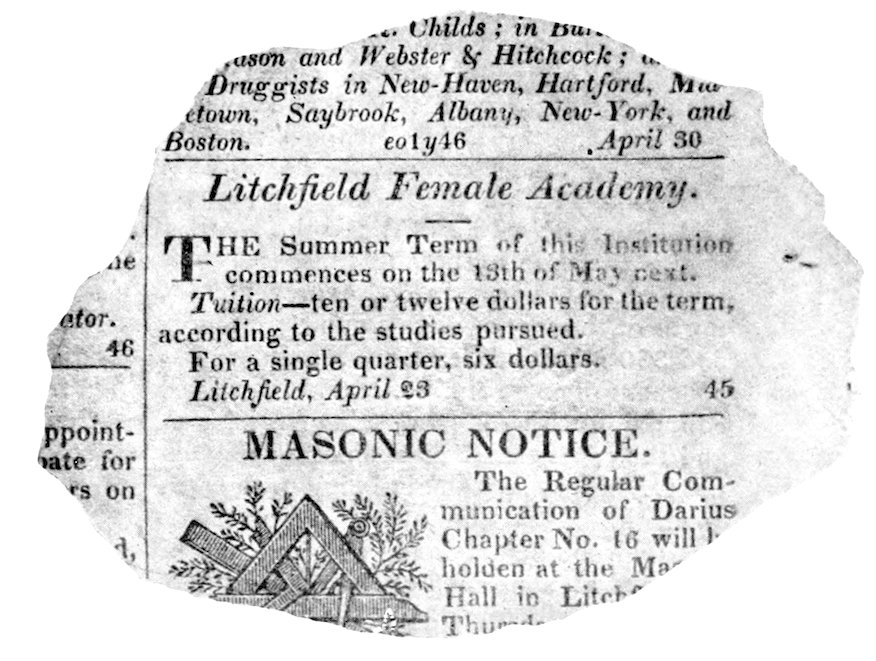
Pl. LIII.—Terms for Tuition from Litchfield Paper
’Twas far remote, Maria dear,
From kindred and thy native land,
Yet oft and joyfully we hear
From thee through lines drawn by thy hand.
285Kind the act, that taught to spell,
Kind the act, that taught to write,
And kind the power that taught the skill
And gave the genius to indite.
When friends remote as distant poles
Whose fond remembrance rivets deep
We thus convey from soul to soul
The secret whispers of the heart.
’Tis by this act, for well I know,
That sighing lovers gain relief,
When aw’d by friend with frowning brow,
The whispering quill doth soothe the grief.
’Tis by this art I now direct
My counsel to thy minor years,
Treat not my candour with neglect,
But give it all the right it bears.
And ne’er forget the solemn truth,
While coasting on life’s dangerous sea,
That gray experience writes for youth
And sets up Beacons by the way.
True friends are jewels rich and rare,
The sweetest cordials found in life,
To ease the anxious mind from care,
And check the seeds of growing strife.
But ah Maria! few there be
Who can define that word a friend.
Then lock the heart, keep safe the key,
And firmly on thyself depend.
Beware, my lovely girl, beware,
Of those we most are prone to trust,
The flattering tongue that speaks most fair,
Too often proves the most unjust.
Never check the humane tear that flows
When funeral knells invade the ear;
But learn to feel for other’s woe
And aid their sorrows with a tear.
And when thou seest the ancient die
Or think on [67]Halsey’s hasty doom,
This useful lesson learn thereby,
Make sure those joys beyond the tomb.
Never let ill-boding pensive care,
Ever check the taste of harmless joys;
While we rejoice that you’re the care
Of her whom we so highly prize.
On future hopes your parents gaze,
And wish the wish’d for prospect nigh;
When native and acquired lays
Shall soothe them in soft melody.
But should I never see that day,
Nor hear the music of thy voice,
For thee Maria, will I pray,
And hope to meet, where saints rejoice.
286