1820. GEORGE YOUNGLOVE CUTLER—HIS JOURNAL.
Reading edition
George Younglove Cutler was born in Watertown, Connecticut, graduated at Yale in 1816, was admitted to the bar in 1821. He married Mary Munson, the daughter of Eneas Munson, of New Haven. Judge Daggett was her uncle.
Mr. Cutler practised law in Watertown and New York, then moved to Illinois. Mrs. Cutler named the town Venus, which was changed to Commerce, and finally to Nauvoo, which it now bears. There were a good many Mormons there. Mr. Cutler died, and is buried in the centre of Nauvoo, there being a monument to him with a railing round it. During the period of his studying law with Judge Reeve in Litchfield, he wrote a journal which was to be exchanged with Miss Bellamy for one she was to write. From it the following extracts are given, as they bear upon the life and people of Litchfield, and give us a type of the young men with whom Miss Pierce’s pupils came in contact.
OBITUARY. “Died on the 3rd September at his residence in Hancock Co. Illinois, Geo. Y. Cutler, Esq. formerly of this city (New Haven) a native of Watertown, in this State (Conn).
Mr. Cutler, six years since, bade farewell to home friends and kindred to try his fortune in the West. Leaving cities, towns, and wilderness behind, he planted himself in a frontier settlement on the banks of the Upper Mississippi. Aided, under Providence, only by his own resources, viz. the varied talents of a mind of great native force, his enterprise was just beginning to be rewarded, the desert around him to blossom, and his old home to be forgotten in that of his own creation,—when death came to tell with emphasis the oft repeated lesson, “doat not on earth.”
Mr. Cutler’s physical energies were not adequate to the vigorous activity of a mind ever busy and prompting to arduous effort.—The exposure and fatigue incident to the varied avocations of land-agent and lawyer, merchant and farmer, had for a year or two previous to his decease rendered his health extremely feeble. His sun went down at noon—his life closed in the prime of his usefulness, and sure we are, that the rising village of which he was a member, will not forget him without a tear—his nearer friends, acquainted with his manliness and generosity of his character, will not forget him with one.
193[From a notice of Nauvoo formerly Commerce revisited]
“The only thing I noticed, which had undergone no change since I was familiar with it in 1836 and ’37 was Cutler’s grave. It was enclosed with a stone wall, and stood about half a mile from the river—George Y. Cutler was one of the earliest settlers in Hancock County and one of its first County commissioners—dying he was buried at this spot.”
Extracts from the Journal of One Mr. Scratch’m
Corrected Revised & Illustrated with Notes by his numerous Friends & Acquaintance. Commenced at New Haven, July 4th 1820. Finished at sweet Watertown Christmas Eve of the same year.
To Miss Betsy Bellamy this Book is dedicated with the most profound respect, esteem & consideration.
Litchfield, Connecticut
May 1820.
You that are not willing to excuse the follies contained in the following pages are uncharitable & ungenerous, illiberal & unwise—more than that you are beneath my notice and farther still, you cannot help yourselves.
July 8th Miss M.[51] I fear you will expect me to go to Miss Tottens with you to day—you must excuse me and endeavor to amuse yourself with Mr. Peck or some other of your numerous satellites—for my part, I intend to run off to what they call a Beach party—if one can be made out—we will go to see Mr. Pinkney and arrange matters.
The youngest Miss Lovejoy looked very pretty. Her sister’s prayerbook full of poetry, among the rest
“I never loved a tree or flower
But t’was the first to fade away.”
The same motto came to Caroline Lord at Mrs. Lord’s party last winter—I should like to hear from Caroline.
People of Fairfield County have thin lips, small mouths & small chins. (This remark is merely hazarded)
July 10th. 11 P. M. Messrs. Lovejoy & Nichols, Misses Elliot, Judson & Tomlinson & Booth 8 ladies, Pinkney & myself, a fine time.
194Stratford is justly celebrated for ladies, it is equal to Litchfield & superior in this respect: that awkward ceremony which is there thought to constitute gentility is here despised—I have been very politely treated here. This party was one of the greatest frolics I ever engaged in with girls. Saw the handsomest clouds I ever beheld (They make very fine clouds in Stratford as Miss —— said of the moonshine in Litchfield.)
July 12. The Ball was very pleasant.... Miss Tomlinson does not dance but sat diffidently by and shrewdly said as she saw the heels fly this way & that, “This is solemn business.” I suppose she thought it making a “toil of pleasure as the old man said when he buried his wife.”
... 5 P. M. a pretty little dish of sentiment with Miss E.—am related to her through Parson Beecher of Litchfield.
July 17 10 A. M. Roda is singing—it reminds me of those flute-like tones I used to hear at Gov. Wolcott’s.
July 18 To Derby with Capt. Whitney—tandem to see Mrs. Prince & her boy—poor little fellow—half sick—my old friend K. Beach there. K. likes Mary Peck’s piece—sentiment. Mrs. N copied it.
July 20 10 P. M. have been a good boy today.
July 21 10 A. M. out to Mr. Vanden Heuvel’s place—the prettiest thing of the kind in Connecticut.
5 P. M. Miss M.[52] you are disappointed of a ride with a favorite beau of yours by this shower—I am sorry.
July 22 Miss M.[52] you were becomingly dressed last night because there was less fix about you than common. I like richness of dress but hate ribbons & bows & knots & ruffles & rigmaroles generally speaking I dislike ornaments of any kind. To see ladies loaded with as many foolish kickshaws as are put on now-a-days looks more like burlesque than reality. It appears to be almost a difficult thing for some of them to walk & they are deprived of everything like grace and are more like awkward caricatures than human figures....
July 28 A peep at Miss Hart—the sister of Capt. Hull’s wife—most horribly fashionable in her accoutrements—there she goes [a drawing occurs here in the original with big bonnet and parasol, Plate XXXI.] “It is a very pretty thing, no doubt, to see a young lady dressed with Parisian flowers & Parisian gauzes & an Indian fan & the whole &c. of fashionable array. But I question if this be after all, the style in which a young man of any understanding sees a young lady with most danger to his peace.” (Peter.)
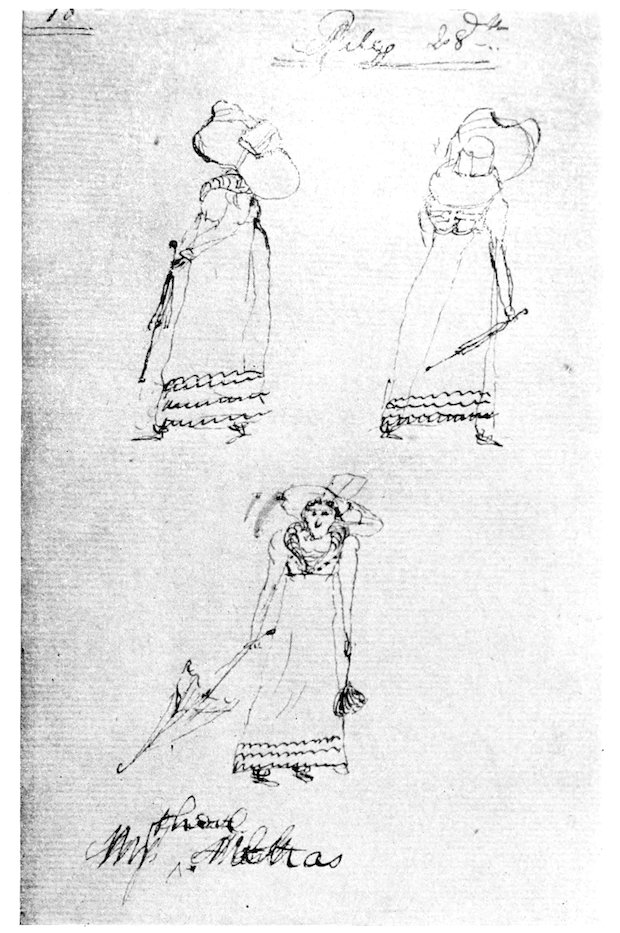
Pl. XXXI.—Pen Drawing from Journal of George Y. Cutler
195July 29 From Sir John Suckling’s poem of the wedding—
“Her feet beneath her petticoat,
Like little mice stole in and out
As if they feared the light.” (Peter.)
July 31 Miss M. has looked well this evening, was not as much beruffled as common—which made her shoulders appear infinitely more to advantage than common.
August 6 A person without a temper is like a knife without an edge, says Miss M.
Aug. 10 [With picture of Miss M., Plate XXXII.] This figure looks very much like a Miss —— not the face merely the form. Miss M. with her cambric hat—over her face—done from memory but the portrait is rather flattering which could not however be well avoided taking into consideration the state of the delineator’s imaginations—the figure is rather too straight—the bonnet does not poke up near enough to the angle of 45°, but it is tolerably well done at least so much so that I kiss it ever and anon.
Aug. 18 Miss Tomlinson (Mary Ann, daughter of Dr. Tomlinson & Sally Hill of Guilford) mar. Rev. —— Mitchell & is now living at Stratford Conn—(where Dr. T. was a practising physician May 16, 1809).
Aug. 18 (Evening) Miss Talmadge here—is certainly elegant—there is no such woman in New Haven—Litchfield is certainly an extraordinary place for beauty—the mountain air gives them the expression of health & that is the principal ingredient—went to see her with M.—She has been at D; was charmed with the romantic cast of the country—true—they have reason to boast of that—it is more like my idea of Scottish-high-land scenery than any other I have seen—but the girls are the pride of the place. A flattering letter from Geo. Jacobs.
Aug. 19th (Morning) Am in trouble.[53]
Capt. Vose says it rained so fast in D. the other night that “it seemed as if the clouds had tipt up.”
196Chief Justice Hosmer is the man who disturbed me with his noise at Dr. Catlin’s—as he roomed under me—he who offered to marry Mary Peck & myself & made us blush—have just met him—he appeared very jolly—“pressed my hand” very hard—& said “be as great a man as Daggett.” A Law Case before my Justice Cupid Black Eyes versus Blue Eyes.
How unfortunate it is to forget faces! I am cruelly troubled in that way—instance the story of Betsey Burr—ask me what that was & I will tell you. Mr. Goodrich from Georgia—an entertaining old gentleman.
Aug. 31st....
I carry my gallantry so far as to say that though a woman ought never to engage herself to a man for any great length of time before consummation of the nuptials, if she can retain her lover without so doing,—yet, if this is necessary, of which she is to be the Judge, & she does so bind herself by her promise to marry, still I go to the length of allowing her to take a better husband, or one more agreeable to her, if she has the opportunity—I give her the liberty of violating her engagement in lieu of her power of choice. Shall women be compelled to take the first creature that offers himself lest they should not find another? Shall they be compelled to love him (on the hand) by denying, when they do not know that they shall ever see another man in their lives, who comes near them, nor have the power of making a selection—this I think is but a fair balance for the great advantage which our sex possess in their opportunities to suit themselves in this important concern—& more, if there is to be an advantage on either side, it certainly ought not to be on ours,—because the contract is so much more important in its consequences to females than to males—for besides leaving everything else to unite themselves to one man they subject themselves to his authority—they depend more upon their husband than he does upon the wife for society & for the happiness & enjoyment of their lives,—he is their all—their only relative—their only hope—but as for him—business leads him out of doors, far from the company of his wife, & it engages his mind & occupies his thoughts so as frequently to engross them almost entirely & then it is upon his employment that he depends almost entirely for the happiness of his life—certainly then, unfortunate, helpless, interesting woman ought to have all the advantage in the matrimonial contract & instead of her present oppression ought to be allowed to make the most of every advantage & opportunity which fortune throws in her way—I will go further & apply the case. I would justify any woman in treating me in that way—provided she did it in a delicate manner—than which nothing is more easy—& which no woman of sense & judgment would fail to do.
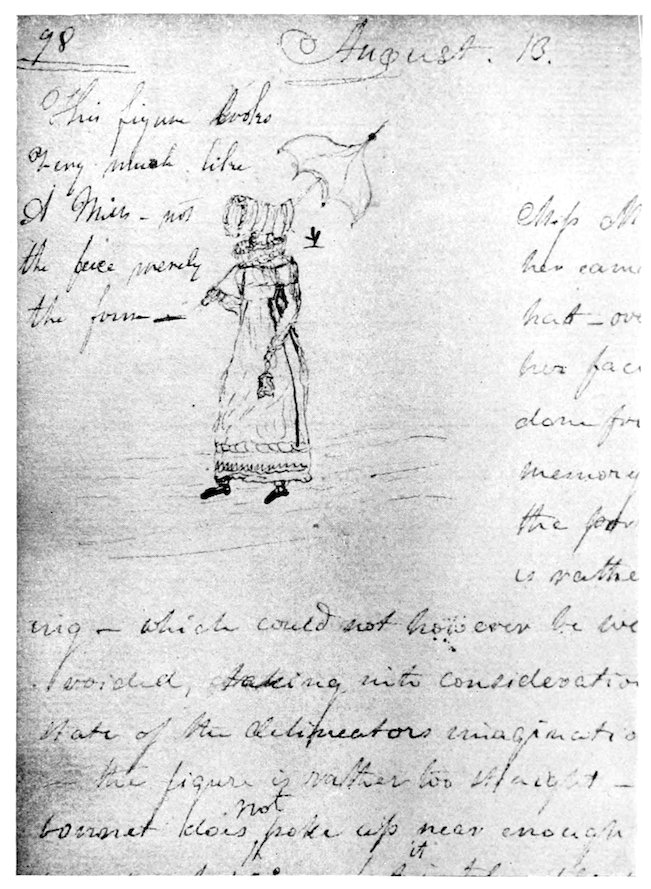
Pl. XXXII.—From Journal of George Y. Cutler
197Sept. 1 This day opens the autumn I love the tranquillity which attends the falling of the leaf—I expect to pass it alone at W—[54] a great part of it in the old lot which lies on both sides of the brook—
Sept. 2. Finished with Mr. Daggett[55]—so life is running away.
So in spite of all your severity towards me—unhappy girl—well I will go & see you when I go to L—— & if your spirits are low, I will say kind things to you—if not, I shall be glad to see it, & will praise your truly almost inimitable beauty—such color has been seldom worn in the dull looking world, & such a complexion has been seldom seen since the days of Cleopatra.
I should suppose this P. girl might also tremble, lest she should meet with a second misfortune of the same kind, as she is engaged to a brother of M. A.’s sweetheart—he is going away to France—the same reasons too will naturally operate in this case as in the other—which can be nothing more than want of fortune & her want of family places her a step farther than M. A. from a connection with a L. Engagements are dangerous affairs—“reason” & love keep little company together now-a-days—Love easily takes possession of a man, but an engagement connected with delay is apt to cool it & when the passion is moderated, it is easily ousted by reason—& often too by something which ought to have less effect than reason—It is probably the interference of friends who have caused the mishap in this case—it can be nothing else but avarice & that is a very dishonorable reason considering his already monstrous estate—if I was an Emperor I would hang such a man. But perhaps there is a better side to his story, I hope so. I remember when he first went to L [Litchfield] I was in his room[56] opposite M. A.’s door—we were looking out & saw them, she & the amiable Hannah—L—— remarked “I suppose these young ladies i.e.: the ladies of this village—depend upon law 198students for their husbands—I will be very careful they do not ensnare me”—within three weeks he was engaged to M. A. & talked to me of Father W. I will write to Fred Whittlesey & inform him of this cruel affair—I know he will feel for the charming girl. It has been reported that L. says “he will go to Europe with a light heart.”
Sept. 3. (Sunday the 17th anniversary of my mother’s death.) She was buried on Sunday.[57] After so long & so cruel a separation how sweet t’will be to meet the spirits of our dear friends in another world! Death is the greatest of blessings!
Sept. 5th A delightful ride to D. with my dear M. She looked sweet, modest, interesting & good—They all appeared pleased with her which gratified me of course. M. enjoyed the visit also. Henry & Lucy Sheldon came there & said that H. L. had disappointed 6 ladies before M. A. W. if so—the wretch ought to be prosecuted says Judge Reeve—Mrs. Pyncheon told me yesterday also that Mr. L. had himself been twice disappointed—M. A.’s feelings may be nice upon the point but her delicacy ought not to prevent his punishment especially since her family is not rich.
Sept. 6 In fine spirits. Evening saw Miss Ogden in church—an enthusiast—....
A Mrs. Dickenson—a Painter’s wife from N. Y.[58] was at Butler’s this morning (note; she was in Litchfield 8 years ago & was visited by the students a great deal....)
Sept. 8. Henry & Lucy [Sheldon] also Hopkins McCracken. 3 P. M. Am full of Duck & feel gloriously, thank heaven. (note: [in another hand] an elevated cause of gratitude!)
Miss Amelia Ogden at Mr. Bristol’s.
“Adonization”—a word used by Peter—manufactured by him, I suppose—from Adonis & used to express the act of “making the toilet” or dandies say, or in other words “bucking out,” “brushing up”—“furbishing”—“making fix” “prigging.”
Old Mr. Williams from the South—a very pleasant man too—have gratified him by telling what an excellent lawyer his son was, who was awhile at L. with me. Mr. Thorn from one of the West Indian Islands says “Wilberforce had an Estate there but disposed of it before he 199procured the abolition of the Slave trade.—Dam him, he ought to have been hung 25 years since.
“And Wilberforce the minister of grace,
The new Las Casas of a ruin’d race,
With Angel might opposed the rage of hell
And fought like Michael till the dragon fell.”
Sept. 10. The reason why a man puts his left leg in first when he draws on his pantaloons, is, because the operation is such a commonplace one that the man does not stop to call in reason to his aid—now then acting without any principle, he is governed entirely by his most natural feelings—& being a creature naturally averse to exertion he does that which costs him the least trouble—now it is much easier to lift the left leg than the right one—because the left leg being less accustomed (for want of arduous use, which the right leg more frequently undergoes) to being depended on,—it is borne upon with less weight than the right. Also & moreover—the right leg by the above mentioned use & exercise acquires a stouter character, becomes heavier & more difficult to raise—.... [page gone here.—Ed.]
This then is the state of the case—that that faculty or quality or ingredient or component part of the human mind which is called reason—is not brought into operation by the act of adonisationizing the legs with pantaloons, but on the contrary nature & natural feeling are the sole agents in the deed—& the discrepancy which exists between the government of the rules of experience & that of instinct is apparent to every man when he puts on his pantaloons. Gen. Van Rensalaer at table—called the Patroon of Albany, owns an estate which extends 20 miles[59] on Hudson river including the city of Albany—a rich, stern & reputed charitable man—very plain in dress & sober in diet. I should call him a country Justice & perhaps a militia officer.
Sept. 14. [At New Haven] returned from an excellent ball—went with the Lymans of course—liked Miss Woolsey as well as ever & Miss Munson—George Jacobs—excellent fellow was with us. & a Mr. Jackson from Middletown—a man that Miss Talmadge liked—had great fun of course—Mr. Johnston, brother of Betsy’s—But the pleasure of Miss Shipman’s sociability & politeness & dancing & looking at & praising her niece Miss Jones—the sweetest girl in the room, were the substance of my enjoyment.
200Sept. 15 Mr. Benedict of Woodbury & his lady here—she being the sister of Jane Tomlinson, the wit of New Haven. loaded Mr. B. off with nectarines.
Sept. 16. [picture of Hector & Andromache, Plate XXXIII.] Not the parting of Hector & Andromache but of M. & myself on Thursday morning. The sword is not quite as crooked as it should be, & the handkerchief at M’s face is not sufficiently particularized—But it’s a glorious drawing—you have done nobly with your own face particularly the nose. But why does she turn away from you?—to conceal her grief—as maiden diffidence dictated.
Sept. 17 (It being Sunday wore pumps & white stockings to meeting.)
Sept. 18 tore my Angola pantaloons! They will be obliged to be mended with drab—which will not quite suit their complexion. Children of the brain are as dear as living offspring let them be never so homely—& moreover I am acquiring quite a friendship for my law books since they are my only associates except this my favorite crony & patient confident.
Somebody said there was a letter in the Post Office directed to some person in the Estate of Conn.
Sept. 21 to begin this great day was powdered. huzza! here we go, the defenders of our country—but lo my horse has fallen under me & I am with my sword in the dirt & he (careful creature) is bounding in his turn over me without harming a hair of my head—now I am appearing to great advantage—now the girls are falling in love with me—now at dinner Mr. Such a thing whom Lyman & myself saw at the ball & Mr. Law—both from Georgia there—now it is afternoon & I am bounding about—now running our people—now my horse is fatigued—now it is night—now I am dancing at the ball—Mr. Tomlinson there that I look so much like & also Daniel Bacon’s daughters—Julia is handsome—now I am at home & there is a sweet little letter from her that is dearer than the apple of my eye or the core of my heart or the spirit of my breath & I have read it with delight & am in bed.
So George McClellan is growing largely in Philadelphia & married to John Brinton’s sister—it beats the Dutch.
Geo. Jacobs M. calls him my brother “in mischief & wickedness.”
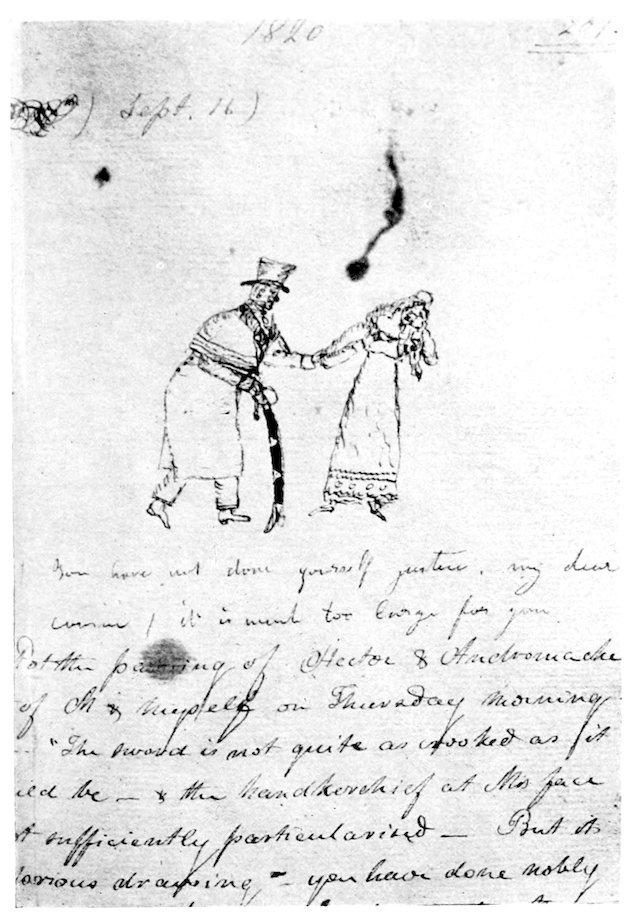
Pl. XXXIII.—From Journal of George Y. Cutler
(Noon) to dine with Lucy—a Miss Davenport from Stamford. At tea at Judge Holmes. Evening a pleasant call on Miss Rogers & afterwards a charming visit at Mary Ann W’s—how interesting! how beautiful! how much improved in her personal appearance. I could 201not help telling her my opinion—In return she reciprocated my compliments—which I always like—she is one of the finest looking females I ever saw—she told me of my interview with Parson Beecher at New Haven—am very sorry to have my conduct in that affair misrepresented or misunderstood—as it is—I never thought of treating his reverence with disrespect.
Thereby hangs a tale [this at Litchfield—E. N. V.]
A pleasant frolic at Dr. Catlin’s [North St.—E. N. V.]
Tea at Miss Collins
Evening Litchfield
Was examined for admittance to the Barr of the Court of Common Pleas & admitted—5 other young men with me—Walter S. Franklin from Lancaster Penna William T. Gould of this place & formerly a class mate of mine at Yale—Thomas Whittlesey of Danbury, Conn—one Humphrey & one Towny—all passed.
Sept. 29 took the oath of an attorney at nine o’clock in the morning.
Oct. 2 in conversation with Amelia Flint.
Oct. 10 John Myers dead—is it he that Sarah Noyes used to talk so much of? What an eternal talker she was! and yet always entertaining—fine girl—I am sorry that she is so unwell as they tell of.
Oct. 19 gathered my winter apples.
Oct. 18 letter from T. Whittlesey characteristically filled with a burlesque translation of one of Horace’s Odes—introducing Bantam’s river which flows gently along making eddies as it goes & says that Taylor has been refused by Miss Swift of Windham, Taylor of Canandaigua (afterward Chancellor Whittlesey living in Rochester N. Y. E. P. Childs)
Oct. 21 A painful day this. Small infirmities vex me severely at times—I don’t sit down with saint like patience—but an ague in my face causes more grumbling & groaning than an age of real misery would—Yet I study quite as much as when well....
Oct. 22 (Draft of a letter to a lady.) Take care of your health—take exercise—attend to the affairs of the house—rise early & cultivate your appetite—I hope to see your waist larger when I next have a view of your otherwise charming-person—My complaint today is an ague in the face, it is a cruel one too. I once all but died with it at Litchfield; to cure it I go without food & take my usual remedy. Laudanum—it is a rheumatic disease. I wish you were here to kiss my cheek & make me well I know you would do it—would you not?
202I am very sorry to hear you say a word about depression of spirits! Be careful not to indulge yourself in repeating such things as will excite no interest in those you may be addressing, but who will perhaps ridicule your troubles; do not talk about the wearisomeness of life & say you wish yourself out of the world. if such things must be expressed put them in your book—there they will incommode no one & you can scar them out at your leisure. I have never met with four persons who were willing to listen to such details. When such sensations oppress you fly from yourself, seek society, go abroad, walk or ride, take up some hard work or read the first book that comes in your way—or do them all—in short put your mind into a different train of ideas.—... run to this letter if you please—when you are in your next fit—read over this part of it, & then fly about the house until you are much fatigued & see if your tone is not altered.
Oct. 24 A mineralogical compliment from Dr. A. S. M. in return for a box of stones sent him—which I collected from the neighboring stone walls, etc. “horizontalizing them” to use his expression, much to the disadvantage of the agricultural interests in this part of the country.
(Evening) was pleased to see in the Journal the marriage of Nancy Hotchkiss [notes the death of] Elias L. Townsend, a school mate of mine at Wolcott & a classmate for a while at College—a fine mind he had. he wrote good poetry.
Oct. 26 Made my debut at pleading before Squire C—opposed by Phelps of Woodbury in 2 cases—lost one of them—liked it on the whole.
Oct. 27 The name Seymour—very common among us—should be spelt Seamer—meaning one who uses a needle.
Sec. 3 Atkins reports page 44....
Nov. 7 Mr. L. & myself to Woodbury. Nate (horse that is) broke loose ran away with the gig—for a mile. Sally Porter (that was) gave us a most excellent dinner—Fortunate man I am that the gig was not ruined.
“Like Sir John Cutler’s stockings our present Constitution is to be darned & mended till not a speck of the original texture is left.” Ev. Post.
It was actually so of the first ship that went round the world.
Nov. 8 went to chace the fox with Jo & Land in a drizzling storm of wind.
Miss Skinner, the Gov. of Vermont’s daughter, at B. De Forest’s says Oliver & Conard are to be married this evening at Miss Pierce’s.
203Nov. 12 a terrible storm of snow, 10 inches deep & not a trifle remarkable for the earliness of the season.
Nov. 13 “The Paddy sat down by a river, saying, I can cross over soon—for it runs so fast that it cannot run long.”
Nov. 16 For the toothache
1 Tablespoonful of spirits
1 do vinegar
1 tea do common salt. Ev. Post.
Nov. 18 Mr. Daggett read me a curious letter of Old Reeve’s. Hunt Stone surmises that L. cheated M. A. W. to revenge an insult of that kind once offered to one of his Uncles by one of her Aunts.
Nov. 19 Charlotte tells me a story of Aunt Hopkins & my mother how they used to “keep house” for Uncle Leman at L——, how they used chairs in those days which were “worked” on the seat by their own hands. & how a great deal of labor was bestowed upon them, & how valuable and fashionable they were—Aunt M. was one day employed in this way & was sitting in the Hall so that she could be seen from the street—Old Parson Bellamy was riding that way & saw the girl thus pleasantly situated & agreeably employed, for she was educated in industry. The good old Priest turned his horse to the door & said, “My child, do you know to whom it is that you are indebted for your present situation? You have the good things of this life about yourselves & it is the prayers of your good mother which has done this for you. I saw you all stand like lambs about her death-bed & I thought the wolves would have you.”
Nov. 20 Mr. John Stirling has been here on his way to see a sweetheart, he looks well & is large & finely formed. Mary Ann Beers is the name of his inamorata—he says J. K. Livingston & Charlotte Landon are to be married this evening.
Nov. 24 Walter S. Franklin Esq.[60] says there was kissing done at Charlotte Landon’s wedding—singular for so stiff & prudish a place as L——
[The following extracts are from his mother’s journal transcribed in his own.—Ed.]
“Jan. 20, 1782. Last Monday we had visitors from Town in Slay. we drinkd tea then Leman sent for a fiddler. we spent the evening pretty enough.”
204She mentions John Talmadge having gone with them to a ball—the same who now lives in Warren (1820) I suppose—he has a daughter Francis.
At another ball “Leman waited on Elizabeth Garnsey.” “Sweet Ireland”
At Derby Jan. 20 1782.
“Just at night Leman came to us Drest & went with us slay & horses across the river & through the snow. at length through a great Deal of tribulation we arrived at Mr. David Deforists, where we had good fires, good Brandy wine & wincom too—our company was not large but we had good Musick which kept those few the busier.”
“Sept. 26. Returned from D. Sheldon’s Sister Rachel came there from Hartford the night after I got there with Noah Webster.”
“It fell to Sam Sheldon to carve. he took up a rib which was taken out of the Pork, & very impolitely tho very innocently said—that was such a thing as woman was made of. Yea, says Polly Hopkins & (in both cases) it was taken out of much such a creature.”
My mother appears to have been extremely fond of scribbling in this way. I may have inherited some of her fondness for the quill. Would to heaven I could have inherited her whole disposition—for I believe it to have been one of the sweetest ever bestowed upon a mortal.
ANTICIPATION.
Why grieve at cruel, wayward fate
She yet may have in store
Some princely, pow’rful proud estate
For thee to lord it o’er.
Perhaps e’en now there lies conceal’d
Beneath tomorrow’s mystery;
Events, which when they are reveal’d,
Will place thy name in history.
Nov. 28 Went to Waterbury & tomorrow morning before daylight, shall be obliged to be off in the cold—thro’ the snow on horseback to Litchfield—all for this vexatious law—cursed be the day when I first turned my face towards the fields of litigation.
205Nov. 29. It was no killing thing either. Much worse would it be to hang. for the moon was bright, The snow full of reflection, I full of breakfast, & Nate full of fire. While the cocks of the country crowed about us for musick & the stars shot this way & that about the heavens, as if making a display of fireworks for our amusement. All was silent. As we rose the hills & looked back upon the far distance which ran down the valley to the south east, the two extremes of the splendor of the united powers of snow & moonbeams & and the contrasted darkness of the deep ravines into which light would not penetrate, filled the whole view. I often stopped to admire the cold but burnished beauties of the prospect & felt the magnificence of the scene.
I found Geo. up, tho I little expected it when I turned a corner to take a look at his window. I had little thought of seeing a light there at that time of the night—I ran upstairs opened the door an inch and inquired if Mr. Gibbs lived there. Then we laughed ourselves to death & disturbed the neighbors. Mr. Chambers in the backroom inquired who the Devil had come & being told, said, he “thought t’was him.” breakfasted there & told stories till I thought I had told too many.
“William is indeed engaged to Miss Rodgers. Little Taylor,[61] you remember him—he is mentioned in orator Ogilvies book as a rare specimen has killed himself for the love of Miss Swift.”
“Your affair with Parson B. is much misrepresented here & the old women shake their heads whenever your name is mentioned.
I do not blame myself neither does he blame me.
Aaron Burr told a student of his, to rise in the morning with this determination—“As I shall never see this day again I will today do all that can be done in one day.”
“Daggett’s letter pleased Reeve & his family very much.” When I turned my face homeward I felt the inconvenience of 3 pairs of pantaloons, 2 of stockings, 2 shirts and 2 great coats.
Now I think my ride too good a one to grumble about.
Dec. 1 Cousin John good fellow has come thro this piercing wind to bid me goodbye before he goes to New York—that maelstrom, that whirlpool of business into whose vortex so many of our best young men are attracted & drawn away from their own firesides. [New York in 1820!—Ed.] John thinks he has suffered enough from this ride to atone for a great many sins.
Dec. 2 There was a Miss Shephard from Newtown at the Election ball last May—she was the counterpart of some fine looking Indian girl—tall as one of the trees of her native forest, but still not disproportionate 206by any means. She was just as round as she should be—her head as high as it could be & surmounted with a single white ostrich feather[62]—She danced with some grace, stept high as she looked & commanded much notice. I was pleased with the exhibition & so were some others ladies & gents who went with me from one end of the room to the other to have a view of the architecture of her frame & headdress. I thought the girl looked as if she had some notions of her own. Some others who pretended to more than they deserved made flying shot her. Gentlemen always mark down such slights to the score of envy whether dictated by that spirit or not.
Dec. 4 John has laughed all day till he has at last split his jacket. his company has raised my spirits till they have become absolutely volatile. He is teasing me off to bed—that disgraceful spot for a man: Nothing is more demeaning than to be every day obliged to crawl into a nest and vilely snore away one third of that time which is already so short. Nothing but a Sancho Panza would ever consider the practise as otherwise than an unhappy fashion & a shameful employment. It would naturally seem fit for so frail a creature as woman to spend most of her time in this effeminate operation, but for a hearty, hard & healthy piece of stuff like the other rough sex, who is not above it?
Dec. 9 Harry Storrs(?)—grandfather purchased one of the present senators in Congress (Matthew Lyon) for a yoke of oxen from the master of the ship in which he came from England to be sold for his passage.
Dec. 10. (Anent the trial of the Queen) a curse fit for England—“Thy skies over thy head shall be brass & the earth that is under thy feet shall be iron.” Why? Because they deserve all they can pick up. It is impossible to invent enough for them. Sodom contained more good in proportion to its population. The heart sickens at the national corruption of that proud people. Their missionary and Bible Societies are but the beautiful outside of the apple of Sodom which is filled with loathsome ashes.
Dec. 12. It was very cold going to Litchfield—but I reached it—went to Geo. Jacob’s room—Mr. Glover (son of John J.) there—told a story of Mr. Jeffersons how a large turkey was put before a fire within a screen which was high enough to confine him, for he was alive—how a plate of stuffing or dressing was put in each corner—how the Turkey had been kept from food for a few days previous—how 207he went from one dish to another till he was completely roasted & ready dressed.
Ev. Saw a pretty sight at —— Catlin’s went to Mary Peck’s have seldom seen a girl look more kissable. Caroline Lord is not as pleasantly situated as I wish she were. Sarah Denny is not married.
Dec. 15 went home.
Dec. 18 went to L—escaped from the lawsuit by an accident—went to a party at Mrs. Goodwin’s was happy to find the Misses W. there. They were the gems of the circle—Flora was sociable—Miss Lewis animated—Susan Leavitt showed some spirit which became her—Mrs. Gould was civil to me for having taken a poor relative of hers into my gig one day and transporting her a mile or so without knowing who she was. Mr. Austin sang a song of one Miss Pough, &c. it was as good as such things in general—Miss Mary Ann thought she was near being swallowed at the kissing bout which has been held in L——.
Miss Lewis says Susan Leavitt is to marry some priest.
They say Helen was all but kissed to death at the Landons—The wonder would be if she was not. a saw was lost at sea—the carpenter said next day “I can’t forget that excellent saw, it sticks in my gizzard yet.” The Boy ran down to the Captain crying out—“I have found where the Saw is—it sticks in the Carpenter’s gizzard!! A good story & well told by Sam Glover.
Dec. 20 This being at court has some pleasant things about it—it creates at least a little variety in life—this is the second week of it.
21— I sat in Judgment at the examination of Geo. Jacobs—he did finely—it was a matter of course however.
Dec. 22 A little Miss Williams at Dr. Sheldon’s looks pretty.
Mr. Bacon made a funny argument in the lawsuit of the students—Huntington is the best pleader at our bar—particularly in a question of technical law—he does not do as well with facts. He is lazy however & slovenish—Bacon is industrious & rather fond of dress—Benedict is sly.
Came home in the evening—it is now eleven & quite cold—the nails of the house crack.
Here I close this piece of quil driving enjoyment to commence another with Christmas—You that read be not offended—for there is nothing ill meant in all this—but be charitable and be amused if you can—I have been very often and very much so while thus engaged.
Scratch’em
208
WRITINGS OF MISS PIERCE.
ADDRESS AT THE CLOSE OF THE SUMMER 1820. BY MISS S. PIERCE.
In reviewing the occurrences of the past summer & in giving out the rewards promised at its commencement many subjects of reflection present themselves to you. Another season for improvement has elapsed & its influence on your future fate has already been stamped & cannot be erased. Standing as you now do at the threshold of the [school?] & about to bid it adieu forever—pause for a few moments and ask yourselves the question—What have been its uses, its profit, its bearing on your happiness in this world and its effects on your eternal condition—Young persons as they stand in life are too apt to suppose that they have almost an eternity of years before them and that the misimprovement of one term or one year will be of little value—But how idle is such an opinion, how destructive to improvement and deadening to the mind—Even granting that ideas fail’d of being obtained in one year may be accumulated the next—yet the progress in the path of science must be stopped by this unreasonable indolence—Besides the habits of mind given, the power of indolent habits will be sufficient to exhibit the incorrectness of such positions—The mind formed as it is for activity must be constantly exercised in the years of growth—otherwise it will move in a sluggish and indolent course and finally stagnate in its channel—There is no moment when the mind is stationary if not moving onward in its orbit it will retrograde—Hence a continual culture is necessary until the habits of intellectual industry are formed, and the mind can go on in its progress from the momentum of its first impulse—Those of you then who have watched the summer and have calmed your consciences with the notion that after industry will enable you to atone for this neglect—have reasoned from false premises and have perhaps originated those habits of indolence, whose cold and palsying touch will freeze the current of your soul & chain its every future effort—This question then, should be heard with attention and reflection—“Have I this summer by the constant improvement of each hour, accumulated those treasures of science which are so necessary to usefulness & acquired those habits of intellectual perseverance that will render my future progress in science easy”—To those who have not I will repeat that they themselves are the cause of the weakness of mind & want of genius of which they complained & as they have “sown to the wind so they must reap to the whirlwind”—My young friends hear my advice 209whether you continue with us or employ your hours at some other seminary or under the parents guidance—be advised by me to stop the deadly influence of indolence, the disease is now young & can be checked—allow it for a few years & no power on earth can control its lethargy—it will benumb one faculty after another until your understanding “sleep the sleep of death”—We are extremely happy in asserting that a stretch of industry & perseverance rarely equalled in the annals of this school has been exhibited this summer but few are exceptions to this assertion—but to the consciences of those few, I would wish to speak so plainly as to be felt & so powerfully as to govern—What will be the account that God will demand of hours supplied but to be wasted—of talents granted but to be abused—of the light of intellect given but to be shrouded by the mists of indolence. From these few dark shades in the picture we turn to those brighter hues, that have gladdened our eyes and encouraged our hearts—To those who have employed their time to advantage, who have now been sowing that harvest they will reap hereafter, we have many words of praise to give—But the character of our praise & the merits of each can be better learnt by a reference to the prizes & the credit marks—
But there is another light in which the flight of time this summer is to be viewed—When industry shall have accomplished its object & indolence shall have performed its office, when the stream of time shall have emptied all its waters into the ocean of eternity—indeed long after this world with its own peculiar concerns & trials shall appear “as some lone island speck seen far—far off across a wide long stretch of sea”—will this summer be remembered with pain or joy, as its time of probation has been improved—Have you any good reason to suppose its remembrance will be painful—If the occurrences of this summer have not induced your repentance & reformation, will any after considerations effect them—Is there great reason to imagine that hearts that have resisted the providences of this season will still resist them when habits of sin have increased its power and the chains of the world wound themselves more closely round. Will God be more merciful hereafter, when you have sinned longer against him—But will that hereafter arrive? Are none a prey to death as young, as strong as blooming as you? Where now is all that was Clarinda Darling, whose sun at this summer dawn rose as clear as bright as yours? mouldering beneath the clods of the valley—Will you not pause one moment and leaning over her grave resolve that e’er death strike you, you will give yourselves to God—Do you think that strength of frame & vigor of body will secure from the tyrant’s grasp, & then after neglect your repentance?—Who three months since so blithely bound’d on your 210path to school as she? Whose frame so vigorous & whose strength so strong? Can beauty save you—Look at her grave & ask—
“Will the cold earth its silence break
To tell how soft, how smooth a cheek
Beneath its surface lies.”
Can intellect stay the dart? If native strength of mind & intellect’s opening promise could e’er have stopped the power of death, Clarinda would have heard me this day. Seldom in the course of my experience have I found at such an age the promise
“of fairer flowers,
Or richer fruits in future hours.”
To a memory of quick & ready powers she joined a comprehension and grasp of mind at her age rarely equalled—sure she was young her intellect was dawning, but it was a dawn of vivid light—a dawn that promised a bright & glorious day of mind—Be advised then in your attention to other duties not to neglect those you owe to God—We have seldom dismissed a school with the regret we now do—You have marked this summer with a persevering industry, an attention to our commands & a regard to our feelings that will lead us to hold you long in remembrance—But the time of our control over you has elapsed & we send you from us with most ardent wishes for your future usefulness & happiness in life & hopes that we all shall meet in that world where those who assemble “meet to part no more.”
A FRAGMENT.
According to your request I have taken my pen to communicate a few remarks, which long experience has taught me, have a great influence on the character of youth. A German writer justly observes, “that no one can labor for himself, without at the same time laboring for all others, or labor for others without favoring his own interest, the increasing welfare of each being the increasing welfare of all. For each to consider himself a member of the great connexion that embraces the family of man, adds much to his feeling of interest in being.” Each mother may say to herself, I am not a useless being, I have been the instrument of introducing into this world an immortal being—a soul that must be happy or miserable to all eternity—what a solemn thought, what a responsible situation do ye mothers hold in the great chain which extends from the first breath inhaled by our first parents, to the remotest point of eternity. 211All that is great or wise or good among men, (with a few wonderful exceptions), is planted in infancy. Parents are therefore the benefactors, or the curse of society. As you fulfil your duties to your children, the prosperity of your country, the happiness of the world, and the glory of the church, will increase or diminish. Say not then to yourselves I am poor, illiterate, and can therefore do no good; if you have the training of one mind, you have a treasure committed to your trust of more value than the mines of Peru. The servant who had but one talent, and did not improve it, was cast out into utter darkness—he was not punished for wasting his Lord’s money, but for not increasing its value. Thus some parents think it sufficient to clothe and feed their children and protect their bodies from harm, but do not think of training their immortal minds for usefulness in this world, and to promote the glory of God, and the happiness of heaven through the endless ages of eternity. Think then when looking upon your infant offspring, I owe to this child all the obligations laid on me by former generations—the wise and good men who laid the foundation of this mighty empire whose names are signalized in the history of the world, who amidst persecution, toil and danger, planted churches, founded colleges and schools, enacted wise and equitable laws, and were the benefactors of the human race. I am come into their harvest, I tread upon the same earth, which they cultivated, I am enjoying the blessings everywhere spread around by their wisdom and industry. They have finished their work and gone to that rest prepared for the faithful servant. I am now bound in duty to them, my country and my God to take up the sublime task which they imposed on themselves. They have ceased from their work; but I have greater facilities and a wider field for action. I can bring to greater perfection than they had the power of performing that magnificent undertaking of making our common race wiser and happier. And how is this to be done—by training up children in the fear of God—by teaching them to deny themselves to both luxury and pride, by inspiring them with true patriotism to prize the good of their country above their own private interest, to fulfil the scripture rule, of loving their neighbor as themselves. Selfishness is the great destroyer of human happiness. A selfish person is always uneasy, he is even jealous of the attention he receives from others, for he rates his own merit beyond the standard it deserves. This principle often extends to a whole family; the parents love their children, not for the virtues they possess, but because they are their children,—they are never afflicted at the danger impending over their neighborhood or country, unless it threatens them with loss of 212property or some inconvenience. They will not unite in any of the benevolent societies of the age, because if they give they choose to do it according to their own whim and not to be confounded with the vulgar—so that their charities are the offspring of pride, not of benevolence—and can such beings ever enter heaven where all is love? If this selfish spirit prevailed in every family, would there be anything great or good performed in the earth? I call upon parents who love their country, who love the cause of Christ to begin early to eradicate this principle of our sinful nature. As soon as a child begins to desire the playthings of its older brothers or sisters teach it to be content with its own portion of toys, and frequently give up his right to another, praise him for every act of self-denial, and frown upon him for every act of selfishness. The method pursued in some Sabbath schools is highly commendable, to give your children an opportunity of earning a cent each week to place in the charity box at the S. School, and when you give your children money encourage them to bestow it on some good object, either in the purchase of some useful article, or to benevolent purposes. Never permit your children to spend their money in the purchase of dainties to please the palate; it will not only destroy their health but create a desire of self-gratification, which in the end may lead them to glutony and drunkenness. Begin early to teach them the shame of thinking much of the pleasure of the table—relate to them pleasing stories from sacred and profane history of the heroes and Christians who rose above the pleasures of animal nature, and amidst the temptations of a court subsisted on the simplest food. Daniel and his three friends and Cyrus are two excellent examples. Enforce your precepts by examples of the disgusting effects of glutony in some of the Roman emperors and of others in later times, that they may learn early to prefer the intellectual to the animal nature. Do not give your children as a reward an orange or a bit of cake; it will give them a love of good eating, but if they have been good take them to see some curious animal, beautiful garden, or some interesting works of art, or present them with a useful entertaining book. Often oblige them to perform acts of duty when their inclinations are opposed to it—for instance, if your child is engaged in an interesting play, and it is the proper hour for study, or you have some act of labor for him to perform, and he is unwilling to leave his sport, state to him mildly....
213
DIALOGUE BETWEEN MISS TRUSTY AND HER PUPILS.
(Miss T.) You are much engaged, my young friends, may I ask what subject you are discussing?
(Emily) We have been disputing whether men or women have the greatest influence in the world, and which contributes most to the benefit of the community. Mary contends that men justly claim that honor, as they rule nations, command armies, and perform the principle part of the active labor, which contributes to the sustenance and comfort of society. I have been endeavoring to prove that the tasks assigned to women though not often of so public notoriety are not the less important.
(Miss T.) It would give me pleasure to hear what arguments you have both advanced.
(E) I have thought, madam, that though men are the ostensible rulers of the world, their counsels and actions are often the result of female influence. I know at least their bad actions are frequently instigated by weak or unprincipled women. Was not Adam persuaded by his ambitious consort to eat of the prohibited Tree? Was it not the depravity introduced by the beautiful, but vicious descendants of Cain, which brought on the Deluge? And in every period of the Jewish history do we not find women sustaining a conspicuous part? Deborah was not only a distinguished ruler, but a commander of the armies of Israel. The city of Abel was saved from destruction by the wisdom of a woman, when Joab pursued after the rebellious Sheba. The Israelites were saved by the wisdom and courage of Judith, when they appeared on the verge of destruction. It was the influence of depraved females which destroyed the wisdom and power of Solomon, and the idolatry introduced by the daughter of Jezebel withered the prosperity of the kingdom of Judah. I could mention many other instances both in ancient and modern history were it necessary, to prove that in every age of the world, the influence of women has had great weight in national affairs.
(Mary) Emily has mentioned a few acts of heroism performed by women during the existence of the Jewish nation, but in that long period how many wise and great men displayed their talents for the benefit of mankind. I therefore contend that illustrious women are like comets which appear but seldom, and therefore surprise and astonish by their brilliancy, while men of virtue and talents like planets are always visible in some part of the moral hemisphere, and by their constant light are of more use than the most dazzling star whose 214rays are seldom seen. I think, Miss Trusty, you must decide in my favor.
(Miss T.) It is of little consequence, my dear young friends, whether men or women have the power of rendering most benefit to the world, but it is of the utmost importance that we perform all the good in our power, and use the talents God has bestowed upon us to improve the happiness of society. But few of our sex are called to act a conspicuous part on the grand Theatre of life, but our influence in community is notwithstanding of immense importance. Most men are so entirely engrossed by business as to have but little opportunity of fully understanding the characters of their children; this can be done only by the mother. She has it her power to plant the seeds of vice or virtue and an awful responsibility rests upon her, if she does not exterminate every root of evil as she perceives it springing up in the heart or temper of her children. Many amiable and pious women have permitted the seeds of selfishness, ambition, revenge and deceit to spring up in the hearts of their offspring, by false tenderness and partiality, a fond mother who imagines that her children will love her more ardently if she indulges them in all their early wishes, and thus prepares them to repine at the necessary evils of life, while the mother who habituates her children to self-denial, prepares them to meet every cross accident with cheerfulness. She will teach them honor exists not in resenting, but in forgiving injuries, and thus guard their young minds from imbibing the false and fatal vice of duelling. That true greatness lies not in titles or wealth, but in advancing the cause of religion. She will be careful to search deeply into the characters of her children and guard them against those lighter faults to which they are naturally inclined, as well as those deeper sins which easily beset them and is never turned aside by false tenderness from crossing their desires if they tend to evil. She not only prays daily for them, but with them. She begins with the first dawn of reason to teach them the obligations they are under to God, their parents, their near relatives, and their fellow beings with whom they have intercourse. And when their capacities are sufficiently enlarged, she will endeavor to impress their minds by expounding the doctrines of the Gospel, as connected with its precepts. Nor does she confine her instructions to religion, but imbues their young minds with human science and literature; for this end she studies the best authors, that she may be able to point out to her children their beauties and defects, and thus store their minds with sound ideas and solid principles, and fit them for acting on the scenes of busy life with firmness and dignity.
Would every mother in this intelligent and free nation thus carefully 215train up her children, we should soon feel its beneficial effects, not only in private life, but in society. It would produce Davids, Edwards and Dwights to adorn our pulpits and colleges, Washingtons, Madisons and Jays to fill our military and civil offices and Brainards, Eliots and Mayhews to disseminate knowledge and religion among the heathen. A faithful mother not only points out the road to virtue, but arduously guards her offspring against the dangers of dissipation in all its various forms. The theatre, the gaming table, and the midnight revel, would not open the gates of the bottomless abyss, to so many of our deluded youth, had their mothers with agonizing eloquence warned them to shun those dangerous inlets to the infernal regions, when as yet the world had not cast its iron chains around their hearts, while their minds were in a degree pure and spotless, and their bosoms glowed with love to her who bore them. It is not enough to plant moral principles in the heart and to warn the young against the baleful effects of dissipation—the syren tongue of pleasure will often lure the youth of lively temper from the paths of virtue, unless pleasing entertainments are found at home to relax the mind. Women who have the arrangement of domestic amusements should seek to procure such as are innocent and improving not only to induce their children, but their husbands and brothers, to delight more in the domestic circle than in the most elegant public entertainment. And would mothers, wives and sisters exert their talents as much to please their own family as they do to entertain strangers, we shall see fewer husbands, sons and brothers resorting to public places for amusement. I cannot elucidate this theory better than by giving you the history of one of my earliest friends. Mrs. B—— possessed a superior understanding which had received the highest improvement that a solid and polished education could bestow. These advantages were rendered more pleasing by the charms which pure and ardent piety cast around her sincere.... Her husband was so much engaged in public business he seldom found leisure to assist in the arduous task of training up their three sons to usefulness. Mrs. B. early discovered that her sons possessed uncommon eagerness of spirit, and would be easily led astray by the arts of the designing and flattering multitude, who swarm around young men of high rank and large fortunes. She therefore devoted her time and talents and all the power of her mind to guard them against the dangers which surrounded their path. While infants in the mother’s arms she began to form their tempers and check their too glowing sensibility by teaching them to bear and forbear with each other’s petulance and to submit with patience when any disappointment occurred. I remember finding her one morning with books, pictures and children’s 216toys scattered around her; she made an apology for the litter in her parlor, saying as it was a holy day, she felt it her highest duty to entertain her children, lest they should desire to resort to the common among their school companions, where they might acquire habits that the exertions of maternal influence would never correct. I endeavor, therefore, she added, to select their associates and devote my time to enliven their amusements, that their home may be the happiest place on earth to them, and truly I never beheld a happier group of youthful faces than at that instant entered the room, from a short run they had taken in the garden, each one begging Mrs. B. to come and walk with them, and teach them the names and history of the flowers and birds as she promised them. When the sons of Mrs. B. had reached that period of life when childish amusement becomes insipid, and as young men they wished for higher entertainment, she invited an orphan niece to reside with her, whose amiable manners and polite accomplishments, assisted to enliven the family circle. Musick, painting and the most sprightly and interesting conversation gave a zest to each hour not devoted to study. Mrs. B. gave frequent entertainments to prevent her high spirited sons from resorting to public places for amusement. The charms of intellectual conversation were never more fully displayed than in Mrs. B.’s parties. Men of the most enlightened minds and most shining talents thought themselves honored to be admitted as her guests. And none received that favor but those who possessed unblemished morals. She was particularly careful to select as companions for her sons young gentlemen and ladies who were more distinguished for talents and virtue than for rank or wealth. By these means she formed the taste and matured the judgment of her sons and preserved them from the dangerous allurements of the gay and dissipated circles they would otherwise have entered and which would undoubtedly have proved their ruin.
Her prayers and her exertions have been fully answered for their spiritual as well as their temporal interest. They are now active promoters of religion both at home and in foreign countries, united to intelligent and pious wives and displaying those manly virtues which justly entitles them to rank among our most distinguished citizens. Nor was the bright example of Mrs. B. lost on her husband, who in early life had imbibed infidel principles. She was greatly afflicted when she found the husband whom she so tenderly loved, was not only indifferent to religion but a disbeliever in Divine revelation; his respect for his wife’s weakness (as he thought it) prevented him from expressing his contempt of religion in her presence, but she easily perceived his sentiments were perverted, and strove by her conduct to 217prove what influence it produced on the heart and temper. She never obtruded her principles upon him, or reverted to his want of faith. But in a severe affliction which befell them, he saw and admired the fortitude which sustained his pious wife, while he felt only the repinings of discontent. This led him to wish that there was another and happier state where he should again meet his beloved and only and uncommonly lovely daughter, who had been snatched from them at the interesting age of four, when the infantile prattle is most dear to a parent’s heart. Mrs. B. seized upon these moments of affliction and by her mild and forcible arguments prevailed on her husband to read the Scriptures and attend public worship. When he read or heard any doctrine advanced which he disbelieved or perverted, her lucid and simple explanations accompanied with the tenderest expressions of affection, convinced him of his error and removed his doubts. Her prayers in the meantime ascended hourly to heaven for his conversion and were heard by Him who has promised that the prayer of faith shall never be offered in vain. Mr. B. had sought for happiness from wealth, from the approbation of the world; his political and military talents raised him to the highest summit which ambition desired, but he found the temple of happiness was not there, and he sought it before age had palsied his feelings in the bosom of his family, in communion with his Redeemer and in employing his great abilities for the extension of knowledge and truth. Mrs. B.’s example and instructions were blessed to all who were so fortunate as to reside long in her family. Her domestics were patterns of honesty, industry and piety. But she did not confine her exertions to her own family,—the poor looked to her as their protector, her alms were always accompanied with suitable admonitions and many hardened sinners have been brought through her influence to humble themselves at the foot of the cross. She engaged with ardor in all the benevolent societies of this day of enterprise. Like Mr. Frey she visited the abodes of infamy and guilt, on her tongue dwelt the words of persuasion and kindness, and many outcasts of society were brought by her means to abandon the paths of iniquity and return to the abodes of virtue and blessed the day which led Mrs. B. to visit their wretched cells. Age has now silvered her head and destroyed the bloom of her cheek, but the virtues of her heart and the exalted intelligence of her mind have stamped a loveliness upon her countenance which the withering hand of Time cannot destroy, and though seventy years have shaded the charms of youth, she is a more interesting object to her husband and friends than she was at the fascinating age of seventeen.
(E.) You have in the history of Mrs. B. shown us how a married 218woman possessed of wealth and intelligence may exert influence, but what can be done by the young and inexperienced.
(Miss T.) Young women have the power of extending the knowledge of religion by aiding the charitable institutions established for preaching the Gospel, those who are rich by their contributions and influence. We have not many women who like Lady Huntington devote all their income to that noble end, but I am happy to know a number, who though they do not leave themselves destitute of a change of apparel (as Lady Huntington often did) yet clothe themselves in the most simple attire that they may bestow what others expend in jewels and fashionable dress, in promoting the cause of their Redeemer.
Miss Julia T—— receives a moderate allowance from her father, who is a man of the world and wishes to see his daughter dress in the most fashionable style. Julia conforms to his wishes so far as to appear neat and elegant in her attire, but at the same time practices such strict economy as enables her to bestow a great part of her little income in charity. Her expensive dresses are never worn except to please her father, or when ceremony requires a splendid attire. She can with truth apply the words of Queen Esther to her own feelings: “Thou knowest O Lord that I abhor these signs of my high estate,” and Julia not having any family to employ her time devotes all her activity in promoting the cause of Christ. She not only contributes largely herself, but influences others to support the Gospel, not only in their own city and country, but in evangelizing the heathen. Her hands are daily employed in making garments for the poor, or for the benefit of education and missionary societies. The sick, the afflicted....
[A fragment.]
A free government like ours can only be supported by the virtue of its citizens. The ancient governments were destroyed by the vices of their subjects. Greece and Rome ceased to rule the world when their citizens became corrupted by luxury and sloth. It is indispensable to the existence of a republic to be moral and religious. Who then can calculate the beneficial effects resulting from the early habits of piety and morality planted by maternal wisdom upon the rising generation. And may we not hope that the daughters of America will imitate the example of the Spartan and Roman matrons in the day of their glory, who taught their children to love their country beyond every earthly object, even their own lives. Then shall we find many a Pederatio (?) 219who will rejoice that there are three hundred citizens more worthy to fill a part of honor than himself. May we not hope that by cultivating the solid rather than the ornamental branches of education, our young women will emulate their sisters in Europe in moral and intellectual acquirements, that on this side of the Atlantic Hannah Mores and Mrs. Sherwoods will arise to instruct and enlighten the world and justly merit the high enconium pronounced by Gov. Metcalf of Kentucky. “It is true that woman....
[A fragment.]
Among the poor and middling classes of society a dangerous ambition is excited which every lover of their country and religion should endeavor to suppress. Many of the wives and daughters of our mechanics and day laborers expend all their earnings in dress and furniture, and thus deprive themselves of the pleasure of contributing to the extension of Christianity. Those who have professed themselves to be the followers of Christ should remember, that when they took the vows of God upon them, they engaged to devote their time and talents to his cause, and the small sum bestowed by the poor will meet as great a reward as the large donations of the rich, and it will be said to the daily laborer who spends all his earnings upon his own pleasure, as well as to the rich, for as much as ye did it not to one of the least of these my disciples, ye did it not to me. The greater part of the funds raised in England for the extension of the Gospel are from the poorer classes of society, and she who can prevail on these classes in our community to contribute to this noble enterprise will aid much in the extension of the Gospel.
VERSES TO MISS NANCY COLLINS WHO WAS ENGAGED TO BE
MARRIED THE FIRST SLEIGHING.
The inspiring snow storm whistled round,
And Nancy blushes at the sound,
For now pale Sol’s returning ray,
Proclaims how near the nuptial day,
Her bosom beats: she knows not why.
She starts to think the hour so nigh,
When she her plighted vows must pay,
And learn that fearful word, Obey,
The word is not so hard my dear
As our proud sex would make us fear.
220When love and friendship tie the band,
Easy the chain, light the command.
Now see her hurrying round the room,
Come Betsy pray put up the broom
The hearth is clear enough I’m sure
Lewis will come in half an hour,
And then that sewing wont be done
There look the sleighs begin to run
I’ll send for Susan right away,
Last year she promised me a day
And Sally too engaged a day,
Norman shall bring them right away,
Now fancy wing thy airy flight,
To where Charles views with wild delight,
The falling snow more swift appear,
And in a bride suit deck the year,
Not half so sweet I hear him say
Is Spring when drest by bloom in May
Not half so sweet are evening showers
That raise the drooping sun-burnt flowers
As this drear storm; they cant impart
Such rapture to a lover’s heart.
Now you’ll see him hurrying down
His sleigh bells heard in every town
Windows are filled, heads at each square
Each wondering much what beau goes there,
Heaven bless you! and may you never know
The sting of sorrow, or the throb of woe
May no dark cloud your shining days o’ercast
But still each sun shine brighter than the last.
[A fragment.]
When tired with dansing I retir’d to rest
My drowsy eyes with wellcome sleep were blest
Me thought my soul had took her last farewell
And now in Paradice had come to dwell
While wondering what kind angel brought me here
The sound of sweetest music reach’d my ear
Such at the Heavenly airs of Paradice
Play’d to departed souls, who freed from vice
221Have safe arriv’d upon that blissful shore
Where happiness awaits them ever more
Ye heavenly powers who hear my prayer
Grant me the art to join this heavenly choir
Tis what I never could obtain below—
The music ceas’d and seem’d to answer No
Sighing I make’d the visions disappear
But pleas’d I found the heaven’ly music here
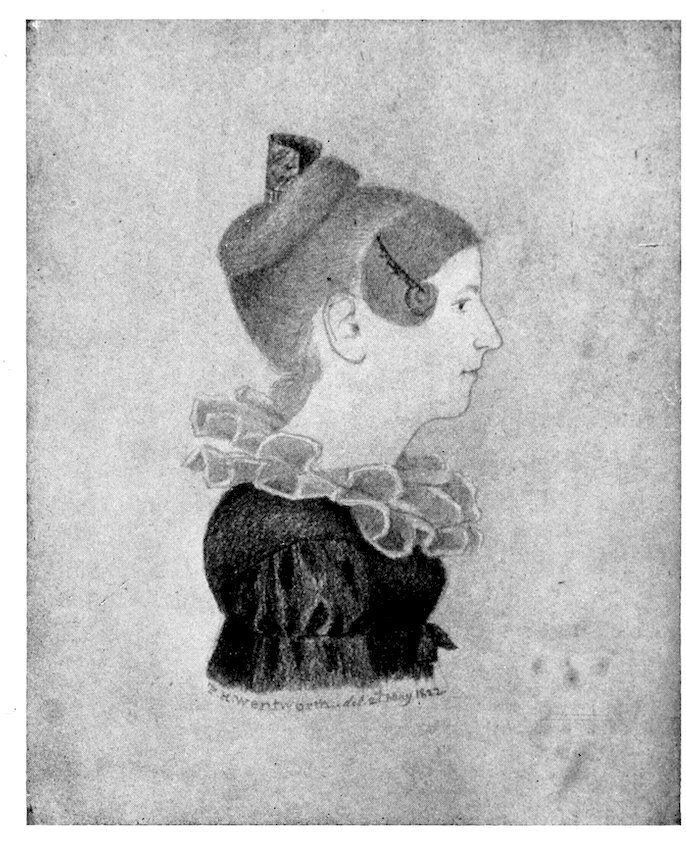
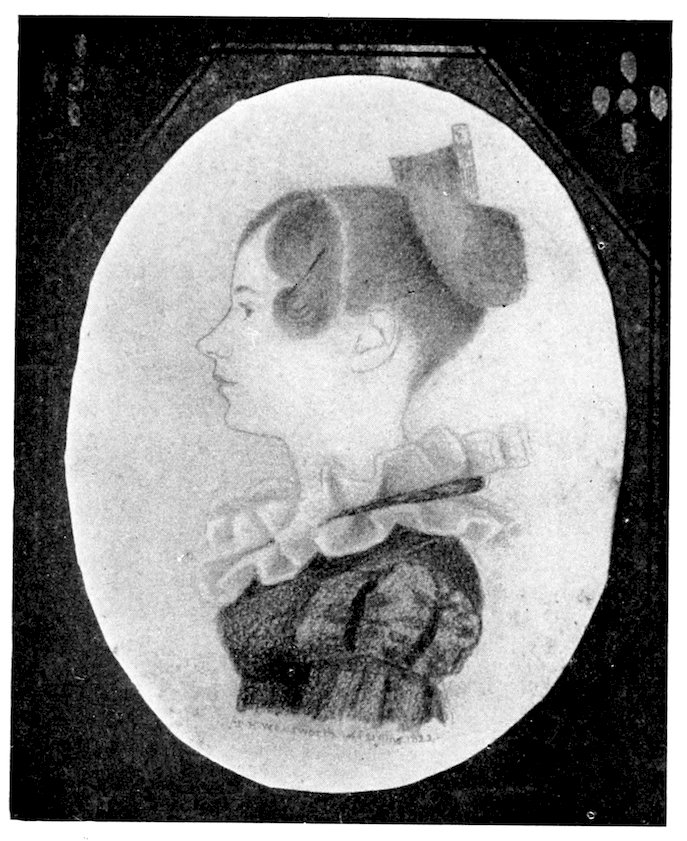
Pl. XXXIV.—Jane R. Lewis From pencil sketch
The young gentleman played on their flutes under the window of each Lady after they had retired and this was the compliment Sarah paid them
PARAPHRASE.[63]
Guide me oh Thou great Jehovah,
Pilgrim thro’ this barren land,
I am weak, but thou art mighty,
Hold me by thy powerful hand,
Bread of Heaven, Bread of Heaven,
Feed me till I want no more.
· · · · ·
Guide our troops oh great Jehovah,
Save this sinful war worn land,
We are weak, but thou art mighty,
Save us by thy powerful hand,
King of Heaven, King of Heaven,
Save us, and we ask no more.
Shield our fathers in the strife
Guard our brothers we implore,
Give them victory, freedom, life,
Drive out all foes, from this shore,
King of Heaven, King of Heaven,
Dry our tears, and hear our prayer.
THE MISSES LEWIS’ DIARY—EXTRACTS FROM COMMONPLACE BOOK. 1820. JANE LEWIS—HER JOURNAL.
Continuation of Journal for the summer of 1820.
Sunday morning Mr. Beecher preached from Gen. 7th Chap. 1st & 5th, “And the Lord said unto Noah, come thou, and all thy house into the ark; for thee have I seen righteous before me in this generation.” 222“And Noah did according unto all the Lord commanded.” In about 15 years God looked upon the earth, and saw there was great wickedness, and he said “The heart of man is evil continually, every imagination of man’s heart was evil” and he said “I will destroy man whom I have created, from the face of the earth, both man & beast & the creeping things & the fowls of the air for it repenteth me that I have made them” but Noah found grace in the eyes of the Lord and he said unto Noah, make thee an ark of gopher wood; rooms shall thou have made in the ark & shall pitch it within & without with pitch.” As the ark saved Noah, so will Christ save all who trust in him. Noah by faith prepared him an ark to save him from destruction, so also may Christians prepare the souls of their children from the bonds of Satan, It has pleased God to prescribe duties to parents & it has also pleased him to save those who believe on him. At the appointed time when all needful preparations had been made Noah was directed to enter with all his family: into the ark: because the Lord had “seen him righteous before him in that generation” the apostle says that he “became heir of the righteousness which is by faith, The same principle which induced him to believe, on the testimony of God, & contrary to all human probability, that the deluge would come at the appointed season, led him also, on the same testimony, to expect the day of judgement & perdition of ungodly men, this moved him to flee from the wrath to come, as well as to prepare the ark; & as he believed that, in the ark alone he could be safe during the approaching deluge; so he doubtless believed the revelation of a saviour, & sought & expected salvation through him alone. The duty of God requires that he that exercises faith for his children shall be saved, Noah exercises faith for not only his children but for all mankind, he preached 120 years for their salvation but what effect did it have “God has made provision in the covenant of grace for our children. Before the deluge Noah’s family was the only one who could say, I keep thy commandments. What relation should we exercise toward our children. In order to bring our children to Christ we must first come to him ourselves “God has mercy on whom he will have mercy” It is necessary to bring them to a covenant with Christ. The piety of parents is necessary to bring their children to a peace with God. When children are in great danger parents who have no religion themselves may feel interested for the welfare of their children, and when parents die & have no heavenly comfort, they feel for them & repent if their past life has not been spent to the salvation of their children.
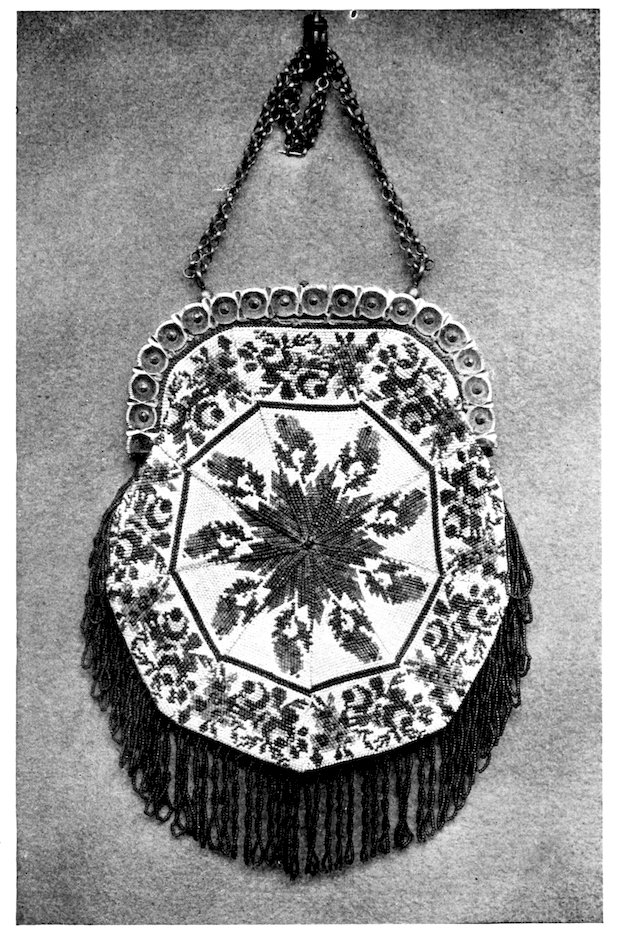
Pl. XXXV.—Bead Bag made by Jane R. Lewis, 1829
“What shall it profit a man if he gain the whole world & lose his 223own soul,” heavenly treasures are eternal, but earthly riches are but few & transient. Happy they who are a part of Christs family, and safe with him in the ark, they may look forward without dismay, & rejoice in the assurance that they shall triumph when a deluge of fire shall encircle the visible creation, but, unless we dare to be singular, & renounce the favor and venture the scorn & hatred of the world unless we be willing to submit to self-denial & diligence, we can find no admission into this ark
Sunday afternoon Mr. Beecher preached from Hosea 10th. 1st, “Isreal is an empty vine, he bringeth forth fruit unto himself” Isreal has often been compared to a vine, but the nation was become an empty vine that bringeth forth no fruit to perfection. They not only spent their abundance on themselves but even their apparent good works sprang from ostentation, or other selfish motives, & not from regard to the glory & the will of God. We shall consider first that there is a difference between love & selfishness. We exercise more love to ourselves than to our neighbours & this is termed selfishness. 2nd. modification of selfishness is to love to God. God loves his children if we keep his commandments.
Sunday evening Mr. Brace read a sermon.
Monday we were examined in the third volume of Sacred History and recited in Modern Europe.
Tuesday sums were given out.—
Wednesday morning recited in Logic and Modern Europe, afternoon I went over to see Roxana Clark along with Maria C.
Thursday was parsing afternoon, no division beat as several had the same.—
Friday was examination day.
Saturday Miss Pierce gave us some very good instruction.
Sunday morning Mr. Baldwin preached ... evening I attended conference, Mr. Baldwin read a letter from Mr. Beecher concerning the revival at New Haven & delivered an exhortation—
Monday to Saturday nothing particular happened. I attended school and recited my usual lessons in Logic & Modern Europe—& attended to the usual occupations of school, mornings & evening’s generally devoted to study.
Saturday afternoon took a short ride.
Sunday morning I attended meeting heard Mr. Hooker preach—Evening attended conference—The remainder of the week was spent the same as usual.
Sunday morning Mr. Beecher preached—Evening Mr. Beecher gave an account of the revival in New Haven.
224Monday was examined in 3rd Vol—of Universal History
Tuesday forenoon recited in Logic & Modern Europe & wrote, afternoon Mr. Brace gave out sums. I did not have the good luck like others of my companions to get a sum done—evening took a short walk.
Wednesday was field-day—I had the great pleasure of seeing a Louisania Parawra or Black Bear—
Thursday was parsing day Miss Rogers division beat—
Friday was examined in Modern Europe, Logic & the Coast.[64]
Saturday my name was called, I cared more for the lecture that I expected than the miss for ciphering, but it was short, much more so than I expected.—
Sunday morning Mr. Beecher preached.—evening attended conference.
Monday forenoon recited in Logic & Modern Europe afternoon was examined in Third Volume of Universal History & spelt.
Thursday took the coast & recited in Logic & Modern Europe.
Wednesday was holiday evening Betsey & Elizabeth both went to walk with me.
Thursday afternoon were called to parse, our division has beaten twice this summer. evening Betsey & Elizabeth went with me up to Mr. Brace’s. We spent the evening very pleasantly with Ann Jones & Margaret Mix.
Friday morning took the coast & were examined in Modern Europe afternoon examined in Logic & The Coast, the latter I did not miss in evening was spent in writing journal & coast.
Saturday the credit marks were taken in & I had about an hundred for writing etc.
Sunday. Mr. Beecher preached morning & afternoon. Sunday evening I attended conference
Monday was examined in Chemistry missed three times afternoon in Modern Europe did not miss.
Tuesday morning finished being examined in Modern Europe & was in afternoon examined in Universal History.
Wednesday was examined in Universal History all day & missed considerable.
Thursday was examined in lectures in Astronomy. Philosophy &c. by having two weeks journal to copy I have missed the wrong weeks journal, This week I have been attending school & preparing myself for the general examination
Pl. XXXVI.—Mary Ann Lewis From pencil sketch
225Sunday morning attended meeting. Mr. Beecher preached morning & afternoon. Evening attended conference.
Monday was examined in Chemistry & Modern Europe.
Tuesday was examined in Modern Europe & Universal History.
Wednesday was examined in History.
Thursday in Paley, Philosophy & Logic
Friday in Philosophy, Arithmetic & Rhetoric.
Saturday in Grammar
Sunday Mr. Mills preached
JANE R. LEWIS—EXTRACTS FROM HER COMMONPLACE BOOK.
AN ADDRESS TO THE MOON.
Sweet Moon if like Cretona’s sage
By any spell my hand should dare
To make thy disk my ample page
And write my thoughts my wishes there
How many a friend whose careless eye
Now wanders o’er that starry sky
Would smile upon that orb to meet
The recollection fond and sweet
The reveries of fond regret
The promise never to forget
And all my heart and soul would send
To many a dear lov’d distant friend
Ann M. Richards
New York
WRITTEN ON THE LATE QUEEN OF FRANCE BY BOUFFLE, ON
HER REQUESTING A SONG ON HER DEFECTS.
Would you know what rumour lays
To charge of Antoinette?
That she is often light it says
Fickle, mad, & a coquette
And is it so?
Oh yes! but know
So nice the line her fancy draws
Her very slights
Create delights
And Cato’s self would smile applause
226Sense, it says, her royal head
Does not over burden much,
Adulation too, tis said
Easily her soul can touch;
And is it so?
Oh yes! but know
So well she manages the matter
The Gods on high
Would leave the sky
And come on earth, her charms to flatter
If for business or for pleasure
The hour, by herself be set
One may wait, tis said, her leisure
Tis a trifle to forget,
And is it so?
Oh yes! but know
That when one next beholds her face
All wrongs, adieu!
Delights renew.
And Time flies on with swifter pace—
That “I” & “me” fill all discourse
And self runs on supremely
Tis said she finds no other source
She loves herself extremely
And is it so?
Oh yes! but know
The case is just you’ll find
What blame to prove
That she should love
What’s lov’d by all mankind?
About 1823
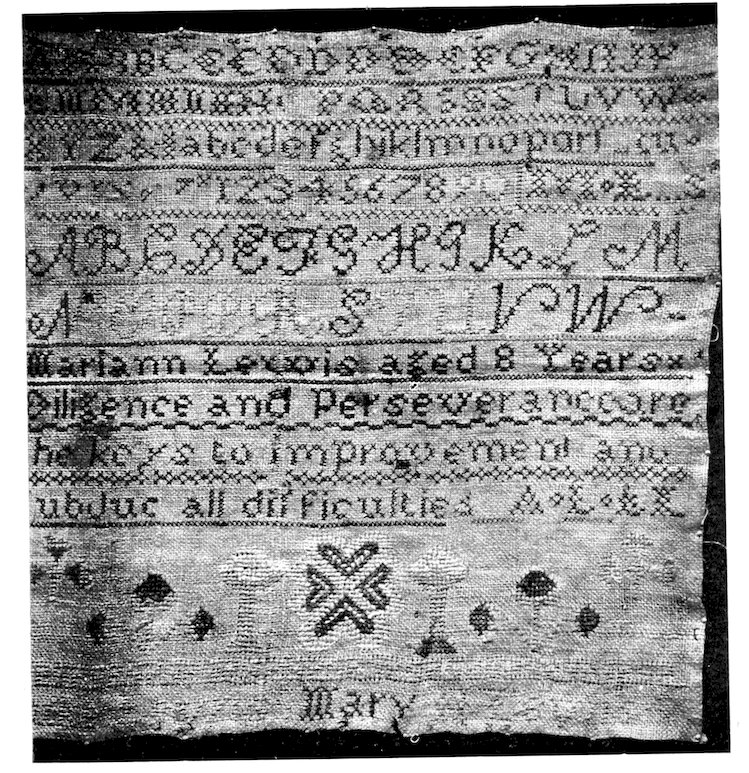
Pl. XXXVII.—Sampler of Mary Ann Lewis
REV. DR. BEECHER’S DESCRIPTION OF NIAGARA FALLS.
Approaching the falls from Buffalo on the Canadian shore, the first indication of our proximity to them was a hoarse rumbling, which was scarcely audible at the distance of four or five miles, but which opened upon the ear as we advanced, with increasing roar, until at the distance of three miles, it became loud as the voice of many waters, a column of mist in the mean time descending as smoke from a pit marked more definitely than sound could do, the exact position of this scene of wonders, the sublime arising from obscurity was now experienced 227in all its power, it did not appear what we should see, but imagination seized the moment to elevate and fill the mind with expectation and majestic dread. Within a mile of the falls the river rolls smoothly along in rapid silence, as if unconscious of its approaching destiny, till at once across its entire channel it falls the apparent distance of 10 or 12 feet, when instantly its waters are thrown into consternation and foam & boil & whirl & run in every direction, as if filled with instinctive dread, at this place the shore recedes, and allows the terrific waters to spread out in shallows over an extent twice as broad as the natural channel of the river—A portion of the waters as if hoping to escape, rushes between the American shore and the island, (whose brow forms a part of the continued cliff which on either side constitutes the fall), and too late to retreat discovering the mistake hurries down the precipice and is dashed on the rocks below. This is the highest part of the fall, and broadest, nearly approaching to the beautiful; the waters being shallow and the sheet entirely white below.
Another large sheet of contiguous water on the other side of the island undecoyed by appearances and apparently desperate by an infallible premonition, attempts no evasion, but with tumult & roar, rushes on and thunders down the precipice which stretches about half across to the Canadian shore. The rest and the largest portion of the river, as if terrified by the fate of its kindred waters, retires a little but scarcely is the movement made before the deep declivities of the river’s bed summons the dispersion of waters into one deep dark flood which rolls its majestic tide upon the destruction below. The shallow waters, which as yet have escaped, cling terrified to the Canadian shore, reconnoitering every nook and corner in quest of some way to escape, but their search is fruitless, and they come round at length reluctantly, and are dashed upon the death they had so long struggled to escape.
It is at the junction of these two sides of the cataract, nearly in the form of two sides of a triangle, rounded at the point, that the most powerful sheet of water falls. The depth of the water in the channel above & as it bends over the precipice cannot from the nature of the case be ascertained. I should judge from the appearance that it might be from 15 to 20 feet—The color of the part of the stream is black, as it bends over the cliff and descends, at the intersection of the two sides and for several rods on either hand it becomes a deep and beautiful green which continues till the column is lost in the cloud of mist that ascends before it. With respect to the impression made by the view of the falls, it may be observed that whoever approaches 228them anticipating amazement at the descent of the water from a giddy height will be disappointed. It is the multitude of waters and their power as they roll & foam & thunder which arrests the step, suspends the breath, dilates the eye, lifts the hand and fills the soul with wonder. It seems to be the good pleasure of God that men shall learn his omnipotence by evidence addressed to the senses as well as the understanding & that there shall be on earth continued illustrations of his mighty power, of creation, we ascertain by faith & not by sight; the heavenly bodies though vast and distant roll silently in their courses. But the earth by its quakings, the volcano by its fires, the ocean by its mountain waves and the floods of Niagara by the majesty of their power and ceaseless thunderings proclaim to the eye & to the ear & to the heart the omnipotence of God. From their far distant sources & multitudinous dispersions He called them into the reservoirs of the North & bid them hasten their accumulating tide to this scene of wonders, & for ages the obedient waters have rolled and thundered his praise. It is as has been stated, where the two lines of the precipice meet, that the deepest and most powerful sheet of water falls, but it is here also, just where the hand of Omnipotence is performing its greatest wonders that the consummation of the work is hid. What the phenomena are when the stupendous torrent strikes at the foot of the falls, no mortal eye hath seen, a mist rising to nearly half the height of the fall, is the veil beneath which the Almighty performs his wonders alone, and there is the hiding of his power. This is the spot upon which the eye wishfully fixes and tries in vain to penetrate, over which the imagination hovers, but cannot catch even a glympse to sketch with her pencil. This deep recess is the most sublime and awful scene upon which my eye was ever fixed. There amid the thunderings & in solitude & darkness, from age to age Jehovah has proclaimed, I am the Almighty God.
In beholding this deluge of created Omnipotence the thought, how irresistible is the displeasure of God, rushes upon the soul. It requires but a little aid of the imagination to behold in this ceaseless flow of waters, the stream of his indignation which shall beat upon the wicked in the gulf below the eternal pit, & in the cloud of exhalations, the smoke of their torments which ascendeth up forever & ever. And nothing but the warbling of unearthly voices seems necessary to make one feel that hell and destruction is uncovered before him.
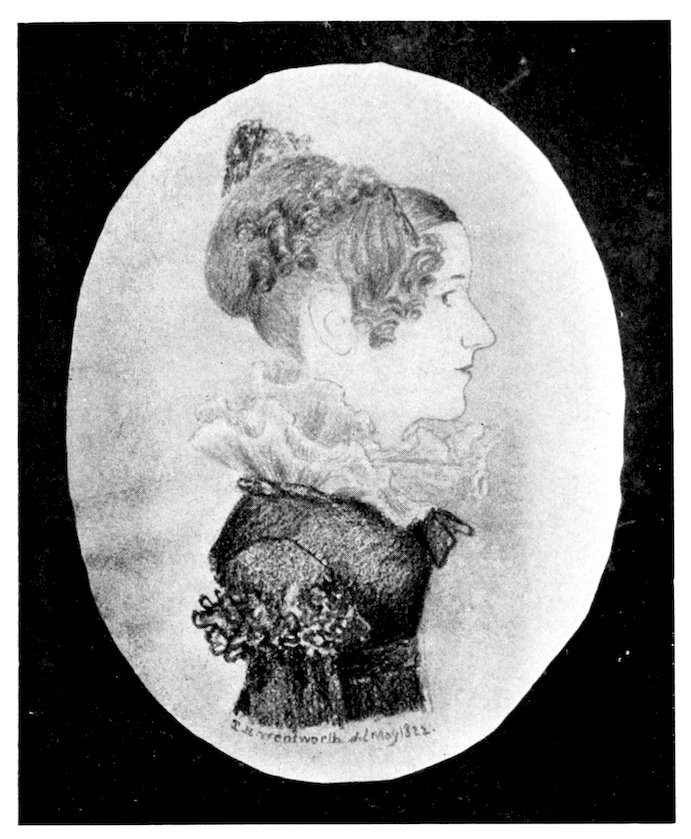
Pl. XXXVIII.—Louisa C. Lewis From pencil sketch
With these associations, all is dark and terrific & dreadful, till from the midst of this darkness and these mighty thunderings the bow, 229brilliant type of mercy, arises, and spreads its broad arch over the agitated waters, proclaiming that the Omnipotence which rules the stream, is associated with mercy as well as with justice.
LOUISA C. LEWIS—EXTRACTS FROM HER COMMONPLACE BOOK.
IN IMITATION OF THE SONG “WHEN SHALL WE THREE MEET AGAIN.”
O when shall we two meet again?
With cheerful heart, with welcome smile,
And all the past
With woe o’ercast
Forget to taste of bliss the while
O when shall we two meet again?
And all the promised pleasure know
Which hope to cheer
My pathway drear
Afford, this heart where’re I go
O when shall we two meet again?
The look the well known voice to greet
And free from care
Together share
Our walks, again, by moonlight sweet.
Shall cruel fortune prove our foe
And time with lingering steps detain
Shall years go by
Nor hasten nigh
The hour when we shall meet again.
Shall sorrow spread her gloomy cloud
And hope deferred, my bosom pain
Shall absence prove
A chill to love
E’er you and I shall meet again
But if stern fate, this joy deny
And our fond wish should prove but vain.
Beyond the sky
May you and I,
In bliss immortal meet again.
THE BANTAM.
I’ve seen old Hudson’s swelling pride,
As on he rush’d to meet the ocean.
No Storms then lash’d his solemn tide,
No dashing waves made wild commotion
But pine crown’d cliffs & tall trees waving green,
Frown’d o’er the flood, the guardians of the scene.
I’ve seen Connecticut’s fair wave,
Still as it went forever smiling;
While the tall corn its bright green gave,
The river’s darker hue beguiling:
Rich are thy fields thy skies forever shine;
“Nor drinks the sea, a lovelier wave than thine.”
But still there is a dearer stream,
Tho’ on its breast no white sails bearing;
Tho’ rough its rock, and cold its beam,
And brown the leaves its trees are wearing
For in that stream’s white foam when life was young
I thoughtless play’d, nor dreamt of future wrong
J. P. Brace
230