1801–1868. LITCHFIELD AT THE BEGINNING OF THE NINETEENTH CENTURY.
Reading edition
Many a summer visitor, after toiling laboriously up the circuitous little branch of the Consolidated Railroad and arriving at Litchfield for the first time, wonders why, though perched on such a distant hilltop, it still wears such an air of old established dignity. The results of the changed conditions of travel are not easily recognized. Instead of being at the end of a small branch road as it is now, a hundred years ago Litchfield was on the high road, traversed by more than one of the main lines of Post Coaches, then the only means of public travel.
21The first of these stage lines were “The Litchfield and New Milford Turnpike Company, incorporated in October, 1797; The Litchfield and Harwinton Company in October, 1798; The Litchfield and Canaan Company in May, 1799. Then followed Strait’s Turnpike from Litchfield to New Haven, the Litchfield and Cornwall, the Litchfield and Torrington and the Litchfield and Plymouth Turnpikes.”[10]... “Daily lines of mail stages were established between this village and Hartford, New Haven, Norwalk, Poughkeepsie and Albany.”[10]...
“Litchfield was on the great inland route from Boston to New York as well as from Hartford to West Point so that the amount of travel through the town was very great.”[10]
This continued until about the year 1840, when the building of railroads broke up the stage routes and left the town stranded by itself, the nearest railroad four miles away. Then naturally many of the inhabitants moved away to new and growing centres of commerce and influence.
When the census[11] of 1820 was taken Litchfield ranked fourth in population in the State, New Haven, Hartford, and Middletown only taking precedence. Great red, four-horse coaches with whips cracking and horns blowing came and went at a great pace[12] all day long through the town,—from New York to Albany by way of Danbury and Poughkeepsie, from New York to Boston via Danbury and Hartford, and in many other directions. A driver and later owner, of one of these stages, Hiram Barnes by name, was a resident of North Street and so noted a character in the community that Mrs. Harriet Beecher Stowe immortalized him in her “Poganuc People” under the name of “Hiel Jones.” He is therein portrayed by her graphic pen along with other prominent people of the town, as she drew largely upon her youthful memories of Litchfield in writing that volume. So, too, Henry Ward Beecher recalls Hiram Barnes in the passage from his life quoted later on in this chapter.
Some of the advertisements of these stage routes read as follows:
22For Poughkeepsie, New York and Albany.
Daily through in 20 Hours
Stage leaves Litchfield every morning at 5 o’clock (Sundays excepted) and arrives at Poughkeepsie at 5 P. M.
Steam Boats leave Poughkeepsie every evening at 5 o’clock and arrive in New York or Albany next morning at 1 o’clock.
This line passes through Cornwall, Sharon, Amenia, Washington and Pleasant Valley to Poughkeepsie.
This arrangement to continue until further notice.
For seats apply at Philo C. Bush,
Deming’s Tavern, William Stevens,
Litchfield, April 1829. Proprietors.
In the following one it is interesting to observe the emphasis laid upon “no night travelling” as a special inducement to travellers to take that line. One doubts its advantages on reading further that the stage leaves at 3 A. M.!
New Arrangement.
Litchfield, New Milford, Danbury and Norwalk Mail Stage.
This stage leaves Josiah Park’s Hotel, Litchfield, on Tuesdays, Thursdays and Saturdays at 3 in the morning, passing thro’ New Preston, New Milford and Brookfield and arrives at Danbury to lodge: leaves Danbury next morning for Norwalk and arrives in time for passengers to take the steam boat for N. York. No Night Travelling.
Fare through to New York 3.25
Returning
Takes the Norwalk passengers at Danbury on Monday, Wednesday and Friday morning, and arrives in Litchfield the same day.
For seats apply at the Bar at
Park’s Hotel, Litchfield,
H. Barnes, Proprietor,
Nov. 10, 1829.
Mrs. H. B. Carr[13] of New Milford writes: “I do not recall any incident of her school life at Litchfield of which my mother told 23me, except that the stage for New Milford left in the morning before daylight, and that, from fear of being left when going home for vacation, she and her cousin dressed for the journey—over night!”
To still farther advertise the stage routes the owner of the weekly paper was called upon to furnish a notice in rhyme with the following result. It is copied from an issue of 1833:
PEOPLE’S LINE.
This line leaves Sharon Mondays and Fridays weekly,
Arrives at Litchfield, at four o’clock precisely.
Leaves Litchfield, Tuesdays and Saturdays at 6 A. M.
Will arrive in Sharon at 8 P. M.
Returning; will pass thro’ Wolcottville and Goshen,
And through the pleasant villages of Cornwall and East Sharon,
And o’er those bleak and hoary hills in safety it will bound,
And the fleet horses often shed their shoes upon the ground.
Passengers who wish to pass those hills of gloomy shade,
Can know they will not be upset, or in the gutter laid,
With safety they will take their seats, in safety they’ll arrive,
On the fair hills of Sharon, where grow lilies and thrive.
Our steeds are of the finest blood, both young and gay and keen.
No spavins or great ring-bones upon their hoofs are seen,
And passengers will not be disturbed by horses with the heaves;
Which is unpleasant to all passengers but murderers and thieves;
Our coach will be most splendid; the seats are also fine,
The glossy wheels in sunny morn most brilliantly do shine
The driver is most careful and trusty with the lines,
And lazy horses will find the thong around their ears entwined.
Our driver is most honest, and those who trust to him
To do for them small errands, he’ll do them all in time
And those who would send money by him to any docket,
May rest assured he’ll not reserve more than half for his own pocket.
From Litchfield to Sharon our fare is very low
And money will be refunded if we don’t carry you through.
One dollar twenty-five cents will be our regular sum,
It will hardly keep our horses well, and our drivers in good rum.
The owner of this line will always be at his stand
And applicants can always find the gentleman on hand;
He wishes to be patronized by all who wish to go
O’er those hills and valleys of frozen ice and snow.
G. W. Hamlin,
Proprietor Litchfield Enquirer, 1833.
24Not only was Litchfield on the main lines of travel, but it was a commercial and industrial centre. The “Gazetteer of the States of Connecticut and Rhode Island” for 1810 says: “The most important manufactures in the town is that of iron of which there are 4 forges, 1 slitting mill and one nail factory. There are 1 cotton factory, 1 oil mill, 1 paper mill, 2 cording machines, 6 fulling mills, 5 grain mills, 18 saw mills, 5 large tanneries, besides several on a small scale. 2 comb factories, 2 hatters shops, 2 carriage makers, 1 cabinet furniture maker, 3 saddlers and a number of house carpenters, joiners and smiths and other mechanics.” The population then was 4,639. There were 4 companies of militia and “16 mercantile stores.”
The writer mentions a mineral spring of chalybeate and sulphureous water within one half mile of the Court House—which had been found very efficacious in curing disease. An iron foundry was situated on the east side of the upper end of North Street, about where the house of the Misses Van Winkle now stands. It was owned and run by Morse and[14] Carrington. A very superior quality of ore from Salisbury or Kent was here made into anchors, the first and best in the country.
To the north of this were grist and fulling mills which used the water of the little river to turn their wheels. Wool was “fulled,” as the term is, for hats that were made and sold on South Street by Ozias and Major Moses Seymour. This hat factory was afterward moved to the west of the town and owned by Messrs. Braman and Kilbourne. The first leather pocketbooks in this country were made by Erastus Lord in Baltimore. He moved to Litchfield and continued to make them at his house on the south side of Prospect Street, where Mr. MacMartin now lives. A piece of fine workmanship in the way of a jewel casket made by him is still in the possession of his descendants.
There was a cotton mill near the present bridge at the foot of South Street. Its owner built the house now occupied by Mr. Crandall. Not far off was a papier maché factory. Excellent brass goods were made somewhere in the town, as specimens of andirons, latches, etc., are now in evidence. They are advertised with other goods in the current newspapers. There were also 25extensive dye works for yarns and cloths of different kinds. Coaches were made at a factory on Chestnut Hill.
Furniture was made by a number of persons. Among them were Silas E. Cheney, David Bulkley, and George Dewey, who was noted for his fine carving. He often added his name. There was a well known goldsmith who must have been a man of genial nature, as he went by the name of “Uncle Billy” Ward. It is not long since a silver spoon was dug up in the north part of the village which bore his name. There was a jeweller by the name of Merriman. There were a number of publishers, Thomas Collier being a prominent one. He established an early newspaper, the Monitor, in 1784, and continued to publish it for many years.
North Street was the main business street. Here the friends, Mr. Julius Deming and Colonel Tallmadge had their dwelling houses opposite each other, and their shops in smaller wooden buildings south of their houses. They imported goods from Europe, and with them came the large wooden panels used in the interior of Mr. Deming’s house. With the addition of Oliver Wolcott, they bought the ship “Trident” and opened trade with China under the name of the “Litchfield China Trading Co.” They also imported two hundred horses to improve the stock in this country. Mr. Deming started a paper mill in Bantam.
To the north of the Tallmadge house was a small unpretending frame building, the second home of the first law school in the United States. Pupils from north, south, east, and west gathered here to attend the lectures of Judge James Gould. To the honor of his predecessor, Judge Reeve, be it said that he inaugurated this school, which was held in a similar simple building adjoining his house on South Street. Judge Reeve took the initiative in this country with regard to the legal standing of women, and was the first to advocate their having equal rights with men.
A little further north, on the middle of the land now occupied by the Underwood house stood Miss Pierce’s little schoolhouse. It was situated between her own house shown in Plate V, and a small red building on the site of the present parsonage, where lived her brother, Mr. Brace and family, including her 26nephew, Mr. John Pierce Brace, who later became her assistant. Owing to the density of the alder bushes, which were not cleared away from this part of the street, it is reported that Miss Mary Pierce, being sent on an errand to a neighbor’s when a little child, was lost! A little below here there were not only fences to the houses, but on the outside of the path were a row of posts with wooden rails extending from one to another, probably for the purpose of tying horses. The young men in the law school may have had some of the same feeling towards this fence that the students in New Haven have toward the one that formerly surrounded the Yale Campus, as an eye witness tells of seeing a group of them perched on it and amusing themselves by stopping and teasing Miss Mary Brace when a pretty little girl of twelve or thirteen years of age.
Not far off was a government depot for military stores under the charge at first of Commissary William Richards and later of Governor Wolcott. This was erected near the site of Doctor Buel’s house. Another was added to it about where the Court House now stands. A military guard was stationed here night and day. At the time of the Revolution, Litchfield was thought to be so far from the fighting line as to be safe from attack by the British. The leaden statue of King George the Third which was pulled down from the pedestal on which it stood on the Bowling Green of New York City was carried up there in pieces for the same reason. Some of the young people of the village had a frolic in the orchard back of Governor Wolcott’s house melting it and running it into bullets to be fired back again at the supporters of the King. An authentic account of the affair is given in the following letter of Henry Guy Gould, son of Judge Gould:
An Equestrian statue of Geo-3 stood in the Bowling Green, N. York—It stood till 1776 when twas thrown down. No part of the horse or rider was ever seen after its overthrow. An American gentleman in Russia speaks of it thus. I saw a flaming engraving of it in a black wooden frame. The ringleader was a negro, straining with all his might at a rope, one end of which was fastened to the head of the statue, and the other end tied around the negro’s waist—how this picture got to Russia is a mystery—A Mrs. Marvin and the Wolcotts melted this statue into bullets—running the lead into 27moulds—besides this the Wolcott ladies made 42,000 cartridges—the statue was lead gilded.
In Mr. Wolcott’s orchard was a shed, where he chopped up the statue with an axe—& his sisters & daughters had the fun of moulding the lead into bullets—& making them into cartridges—This is all the record that I can find—but it is a most amusing account of the fact—Could king George have heard the conversation during the melting & moulding of the lead he might have said—
“Let not the heavens hear these telltale women rail at the Lord’s anointed.”
The “lead” was a true satire on the dull heavy old king George—Indeed, I wonder that the proud English nation should condescend to make a statue of their honored king of lead. These bullets were used by our army to shoot at the English.
I hope you will not criticise the penmanship, as my hand is rather weak—and I am 71 years old.
Henry Guy Gould—
Litchf’d—Connt Oct. 20. 1872—
In Kilbourne’s History of Litchfield we also find a detailed account of this frolic and learn that by actual count 42,088 bullets were made.
That the town was a patriotic centre can be learned from the part it took in the Revolution, but it was also public-spirited and particularly advanced in movements for education. Not only did the first law school in America have its beginnings in this little town, and the first school for the higher education of women, but in the Monitor for 1798 we read of a public library as having been in existence for some time. The bookstores not only advertised themselves in the weekly papers, but also the new books as they came to their shelves. There was a “Litchfield Lyceum” with its lectures, debates, and weekly meetings, and still farther, in 1831, we find a notice which proves that even at that early date the movement toward manual training was taking shape in the thought of these broad-minded men. A society was incorporated October 27, 1831, and a notice was published to the subscribers for stock in the “Manual Labor High School of Litchfield County. Committee: Frederick Wolcott, Lot Norton, Orange Merwin, Tertius D. Potter and Solomon Rockwell.”
28Preparations were to be made for the choice of location, necessary buildings, etc. Also about this time we find advertised a select school for business students, mathematics, and the languages, kept by M. R. Deming. In 1789, long before the temperance movement in which the Rev. Lyman Beecher became so prominent, a temperance pledge was drafted and signed by many people. The original pledge was republished, with other articles bearing upon the same subject, in the Litchfield Enquirer of September 26, 1833.
A few of Miss Pierce’s scholars boarded in her own house, built in 1803, but there was no boarding school in the modern acceptation of the term. The rest of the pupils boarded with different families throughout the town, as did also those of the law school. There were some years as many as one hundred or more belonging to each school.
Imagine these now quiet streets with red coaches rattling through them, with signs of importer, publisher, goldsmith, hatter, etc., hanging on the shops, with young men arriving on horseback to attend the law school and divide their attention between their studies of the law and studies of the pretty pupils of the “female academy.” Then there were some gay bloods from the south so much at home in the town that they disported themselves in pink gingham frock coats! So said an eye witness.[15]
To complete the picture, there was the daily procession of school girls taking their exercise to the sound of flute and flageolet, and surely it was a lively scene.
Henry Ward Beecher was born in Litchfield in June, 1813, on the upper part of this very North Street, and was prepared for college by Miss Pierce. He gives such a graphic and interesting picture of it in his “Life” that it is well to let our readers see the locality as he saw it:
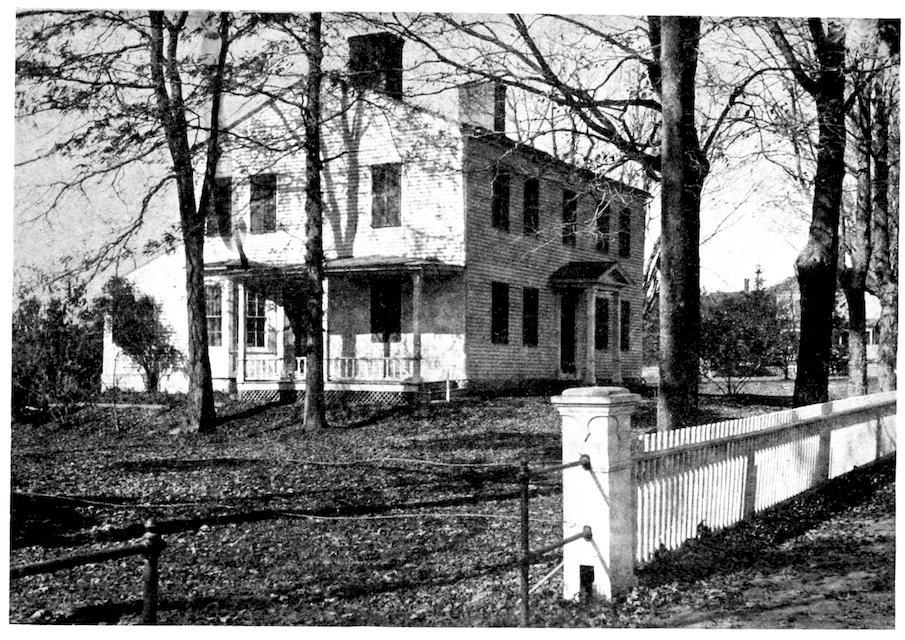
Pl. V.—Miss Pierce’s House, built in 1802
“Equally marked was Litchfield at that day for its social and moral as for its natural advantages. Its early settlers, mostly from the excellent stock from which the colonies of Hartford and Windsor were formed, were men of broad and liberal mould, and began their work upon this hilltop in a characteristic fashion. They laid out their 29streets and staked off the village common, with such generous breadth that they remained the delight of residents, and the admiration of strangers to this day. They made such liberal provision for education and religion that the settlement soon became noted for the excellency of its schools and the commanding influence of its pulpit.
“The law school of Judges Reeve and Gould, and the young ladies’ school of the Misses Pierce, made it an educational center scarcely second in the breadth of its influence to any in the land, and attracted a class of residents of high social position.
“Its courts gathered from time to time some of the leading members of the bar from the whole country, not for a few hours, as now with our railroad facilities, but for days and weeks together. All these things help to create a very high order of public spirit—that force which often wholly unregarded, is yet so powerful in moulding the character and giving direction to the life.”
One other element in this commercial influence must not be omitted—“Its intense patriotism.”
“Litchfield” revisited, written in 1856 by Henry Ward Beecher:
“The morning after our arrival in Litchfield we sallied forth alone. The day was high and wide, full of stillness and serenely radiant. As we carried our present life up the North Street, we met at every step our boyhood life coming down. There were the old trees, but looking not so large as to our young eyes. The stately road had, however, been bereaved of the buttonball trees, which had been crippled by disease. But the old elms retained a habit peculiar to Litchfield. There seemed to be a current of wind which at times passes high up in the air over the town, and which moves the tops of the trees, while on the ground there is no movement of wind. How vividly did that sound from above bring back early days, when for hours we lay upon the windless grass and watched the top leaves flutter, and marked how still were the under leaves of the same tree!
“One by one came the old houses. On the corner stood and stands the jail—awful building to young sinners! We never passed its grated windows without a salutary chill. The old store, and same old name, Buell; the bank, and its long lean legs spindling up to hold the shelf up under the roof! The Colonel Tallmadge house, that used to seem so grand, that it was cold, but whose cherry trees in the front yard seemed warm enough and attractive to our longing lips and watery mouths. How well do we remember the stately gait of the 30venerable colonel of Revolution memory! We don’t recollect that he ever spoke to us or greeted us,—not because he was austere or unkind, but from a kind of military reserve. We thought him good and polite, but should as soon have thought of climbing the church steeple as of speaking to one living so high and venerable above all boys!
“Then came Judge Gould’s! Did we not remember that, and the faces that used to illuminate it? The polished and polite Judge, the sons and daughters in that little office in the yard, the successive classes of law students that received that teaching which has so often honored both bar and bench. Here, too, we stop to retrace the very place where, being set on by a fiery young Southern blood, without any cause that we knew of then or can remember now, we undertook to whip one of Judge Gould’s sons, and did not do it. We were never satisfied with the result, and think if the thing could be reviewed now it might turn out differently.
“There, too, stood Dr. Catlin’s house, looking as if the rubs of time had polished it instead of injuring it. Next there seemed to our puzzled memory a vacancy. Ought there not to be about there a Holmes’ house to which we used to go and get baskets of Virgaloo pears, and were inwardly filled, as a satisfying method, of keeping us honest toward the pears in the basket?
“But Dr. Sheldon’s house is all right. Dear old Dr. Sheldon! We began to get well as soon as he came into the house; or if the evil spirit delayed a little, ‘Cream-o’-tartar’ with hot water poured upon it and sweetened, finished the work. He had learned long before the days of homeopathy, that a doctor’s chief business is to keep parents from giving their children medicine, so that nature may have a fair chance at the disease without having its attention divided or diverted.
“But now we stop before Miss Pierce’s—a name known in thousands of families, where gray headed mothers remember the soft and quiet days of Litchfield schooling. The fine residence is well preserved, and time has been gentle within likewise. But the school house is gone, and the throng that have crossed its threshold brood the whole globe with offices of maternal love. The Litchfield Law School in the days of Judge Tapping Reeve and Judge Gould and Miss Pierce’s Female School, were in their day two very memorable institutions, and, though since supplied by others on a larger scale, there are few that will have performed so much, if we take into account the earliness of the times and the fact that they were pioneers and parents of those that have supplanted them. But they are gone, the buildings moved off, and the grounds smoothed and soft to the foot with green 31grass. No more shall the setting sun see Litchfield streets thronged with young gentlemen and ladies, and filling the golden air with laughter or low converse which unlaughing then, made life musical forever after!
“But where is the Brace house? An old red house—red once, but picked by the winds and washed by rains till the color was neutral, thanks to the elements. The old elm trees guard the spot,—a brotherhood as noble as these eyes have ever seen, lifted high up, and in the part nearest heaven locking their arms together and casting back upon their separate trunks an undivided shade. So are many, separate in root and trunk, united far up by their heaven touching thoughts and affections.
“Mrs. Lord’s house is the only one now before we reach our own native spot. This, too, holds its own and is fertile in memories. Across the way lived Sheriff Landon, famous for dry wit and strong politics.
“But south of him lived the greatest man in town, Mr. Parker who owned the stages; and the wittiest man in town, with us boys, was Hiram Barnes, that drove stage for him! To be sure, neither of them was eminent for learning or civil influence, but, in that temple which boys’ imaginations make, a stage proprietor and a stage driver stands forth as grand as Minerva in the Parthenon.”
Henry Ward Beecher’s sister, Mrs. Harriet Beecher Stowe, also writes of Litchfield:
“Poganuc (Litchfield) in its summer dress was a beautiful place. Its main street had a row of dignified white houses, with deep dooryards and large side gardens, where the great scarlet peony flamed forth, where were generous tufts of white lilies, with tall spires of saintly blossoms, and yellow lilies with their faint sweet perfume, and all the good old orthodox flowers of stately family and valid pretensions. In all the dooryards and along the grassy streets on either side were over-shadowing, long-branching trees, forming a roof of verdure, a green upper world from whose recesses birds dropped down their songs in languages unknown to us mortals. Who shall interpret what is meant by the sweet jargon of robin and oriole and bobolink, with their endless reiterations? Something wiser, perhaps, than we dream in our lower life here.”[16]
32That there were amusements of some kind follows as a matter of course when there were so many young people in a place whose time was not all spent in study and whose high spirits must overflow now and then.
In summer there were gay walks to Prospect Hill, where there was then, as later, an Echo Rock, and to Love’s Altar, a shady nook by the stream below the hill back of Governor Wolcott’s house. Both of these resorts were immortalized in color by Miss Mary Peck in her album.[17]
Mr. Lord had built a bowling alley on the west side of the Prospect Hill road for the benefit of the pupils of both schools, so we can picture these walks combined with lively bowling matches, much like those of later days that were held in the old bowling alley, back of the United States Hotel. Then another set of young men and women met in bright summer days and passed many a merry hour minding no more a rise in the thermometer than ardent golfers do now.
Then there were even gayer sleigh rides on crisp winter evenings, for Miss Pierce specifies in her rules for the school in 1825: “No young lady is allowed to attend any public ball or sleigh party till they are more than 16 years old.”
A fine pine grove of which some of the trees still remain to mark the site, and which received the name of Pine Island, lay a mile or two directly south, and was a favorite picnic ground for the girls. Candy-making and candy-pulling by a big wood fire were great occasions, for does not Mr. Cutler draw with his pen a lively picture of such a party he attended?
The scarcity of sugar in those days probably added great interest to the spring crop of maple sugar, and with snow still on the ground we can think of the frolics there must have been sometimes over big kettles of sap, which was taken out and cooled with snow to make a delicious candy. Possibly there may sometimes have been invitations to apple bees and corn husking just outside of the town.
Then there were excursions to the Lake, for we read in the Litchfield Monitor for August, 1795:
33
POND LILY.
This subscriber informs the public, and particularly those who either for health or pleasure are disposed to enjoy the water, that he has thoroughly repaired that commodious, prime sailing Pleasure Boat, the Pond Lily; and that she will ply from the northern to the southern shore every day in the week, (wind and weather permitting.) She has good accommodations for Passengers; and Ladies and Gentlemen, wishing to indulge in a few hours of healthy and agreeable pastime, will be cheerfully waited upon. Select Companis from the town and country, are solicited to afford themselves this pleasant relaxation from business; and on seasonable notice to the Skipper of the Boat, every required attention is promised them, by their devoted, humble servant.
James Lee.
Litchfield, August 24, 1795.
N. B.—There is a new wharf erected on the east end of the Pond; which makes it much more convenient for the Passengers than formerly.
A much later advertisement reads:
The new and elegant Horse boat, Bantam, having been recently built for the express purpose of accommodating pleasure parties on the Bantam Lake is now completely prepared to accommodate ladies and gentlemen who may wish to take advantage of this safe and neat (!) mode of taking a trip upon our pleasant waters. Parties wishing to engage the boat for a trip, must give two days notice to the subscriber residing at the north end of the Lake.
Harmon Stone.
Litchfield, June 27, 1826.
BANTAM LAKE. (GREAT POND, SO CALLED)
Being a plan of much resort the subscriber has fitted up a small establishment, located on the shore of the northeast extreme of said Lake, in neat order, for the accommodation of those gentlemen and ladies who may wish to spend a few hours on and about this beautiful sheet of water.
Frederick A. Marsh.
May 28, 1829.
In 1827 the following notice was posted. This must have caused great excitement with its unusual novelty.
34
THE AERIAL PHAETON.[18]
Litchfield, Conn.
The subscriber intends erecting on Litchfield Hill by the first day of September next an Aerial Phaeton. The design of the machine is to afford an agreeable pastime to ladies and gentlemen. It consists of Four Carriages each supported by Two Arms, which are attached to an Axletree in the centre. They are turned by a Propelling Machine, and will carry eight persons at once, two in each carriage, who will in regular succession be raised to the distance of Fifty Feet in the air, at a rate of velocity equal to ten miles a minute, or slower, as suits the wishes of those occupying the carriages, and all with perfect ease and safety. This method of recreation and amusement has been highly recommended by the most eminent Physicians in the United States, and will be found the best mode for taking an airing, by those whose lives are sedentary, that can be practised. The place where it is to be erected, is airy, the prospect extending wide, and being relieved by all the variety of hill and dale. Every attention will be paid to company, and all things done “decently and in order.”
John H. Montgomery,
Inventor and maker of the Aerial Phaeton.
Litchfield, Aug. 17, 1827.
Price 12½ per mile—children, half price.
One of the great events of the year was training day. It is sketchily written of in Mr. Cutler’s diary, page 193, where it is depicted from the standpoint of a young participant.
Miss Pierce’s method of education being both original and comprehensive, she not only wrote history for her scholars to learn, but plays for them to act.[19] These performances are said to have been very engrossing to the scholars, all lessons and other occupations being given up for the time. They must also have greatly entertained the townspeople. Then, either to try to rival the fine acting of the “Female Academy,” or to return the courtesy of their entertainment, or both, the young men of the Law School would write and act other plays. Of the character of these plays we have so far found no record.
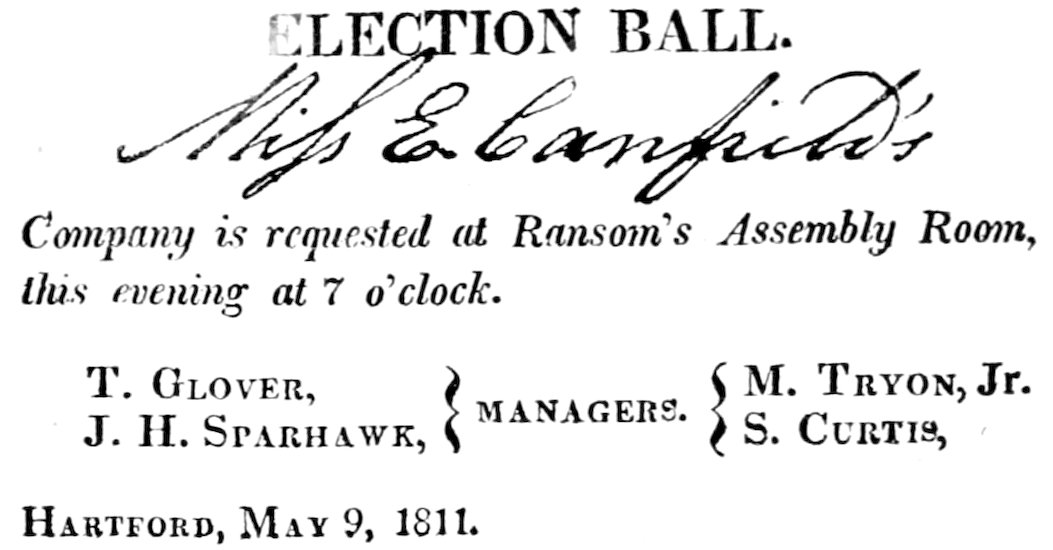
Pl. VI.—Facsimile of Invitation to a Ball in Hartford, Conn. To “The Rose of Sharon”
35Finally, there were balls: balls in the schoolroom under Miss Pierce’s own patronage, the invitations to attend them being highly prized by the law students, and balls given at the tavern or public house kept by Josiah Parks, on the top floor of the United States Hotel. These latter were larger. Those at the school were called balls; but Miss Pierce’s grandniece reports their being simple, early dances rather than real balls. “In 1798 a ball with the customary entertainment and variety of music, cost about $160,[20] and nothing was said about it,” showing that there had been a material change in the conditions and prosperity of the town since the earlier days when a dollar to be paid to a man with a fiddle to play for dancing was all the necessary cost of an evening’s entertainment. On Plate VI is a facsimile of an invitation to an election ball in Hartford.
There was quite an elaborate system of merit marks at the school, and many a mark was won by the tiny stitches sewed on a dainty seam of some muslin gown, for according to the fashion of the day, woman’s attire could hardly be too delicate. There were no tailor-made gowns then. Even in winter muslin dresses and slippers were worn.
“‘In 1794,’[21] to use Carlyle’s words, ‘every man began to ponder whether he should not even dress himself like the Free Peoples of Antiquity.’ Carlyle, of course, was speaking of French men and women; but the fashions adopted by them soon spread to England, though English women never pushed the classical craze so far as the French did.
“It seems to us, however, that French women were not so much endeavoring to dress so as to look like the Ancient Greeks and Romans, as undressing themselves in order to look as much as possible like the statues which these ancient ‘Free Peoples’ produced. Garment after garment was laid aside, until they had brought their apparel down to something that at all events succeeded in recalling the same transparent scantiness so essential to the right setting forth of the beauties of sculpture.... It was well that the readers of fashion books of that time should be cautioned against exposing themselves to the air for if the truth is to be spoken, our grandmothers and great grandmothers 36were only half clad—exposed to the perpetual variations of one of the most trying climates in the world; they for the most part confronted it and its continual changes attired in a short round dress of white cambric, with arms and necks all but bare, and feet clad in silk stockings and thin kid or morocco shoes. In winter, it is true, they had their warm pelisses, and mantels of cloth or velvet, and these were frequently lined with fur; but they cut the period of wearing winter wraps absurdly short, never gave up their white cambric dresses, and early in the spring and late in autumn often went out more lightly apparelled than we should in the dog days. Their own deaths and the large amount of consumption they have handed down to their descendants are the fruits of this folly....
“In December, 1806 we read: ‘The pelisse of twilled sarsnet with simple wrap front continues the reigning favorite.’ Indeed, ‘the gentle and pliant sarsnet’ and ‘the yielding and adhesive imperial satin of gossamer softness’ are constantly prescribed for pelisses and spensers at all periods of the year.
“Diderot says that ‘When writing of women we should dip our pen in the rainbow and throw over each line the powder of butterflies’ wing, instead of sand.’ And it almost seems as if in the beginning of this century it was the fashion to dress them in the same ethereal manner.
“On Christmas eve, 1803, Prince Jerome Bonaparte married Miss Elizabeth Paterson. A gentleman present on the occasion said: ‘All the clothes worn by the bride might have been put in my pocket. Her dress was of muslin richly embroidered, of extremely fine texture. Beneath her dress she wore but a single garment.’
“Dresses which were extolled in summer and autumn were never wholly banished in winter and spring. Our grandmothers were like the daffodils, they appeared in all their bright attire before the swallow dared to come, and ‘took the winds of March with beauty.’ How many of them suffered for what they did, we may guess at, but can never know. How much stronger we ourselves might have been had they thought and acted differently, it is also vain to conjecture, but we can clothe ourselves and our children in obedience to the laws of health and strenuously resist all attempts to induce us to do the contrary.
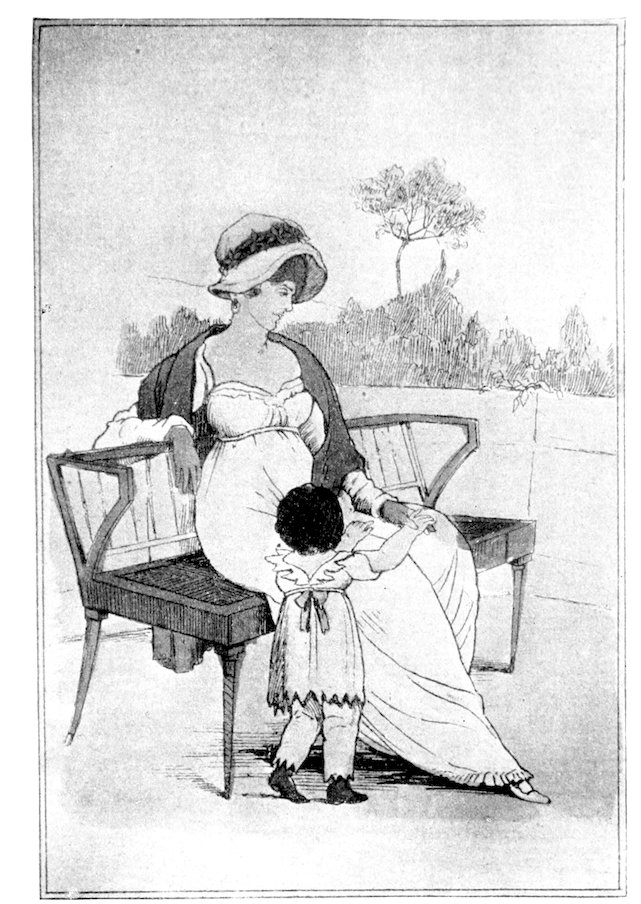
Pl. VII.—Fashions of 1807 From “Our Grandmothers’ Gowns”
“Still we find ‘a round gown jaconet muslin prescribed’ in December, 1812. We read: ‘Notwithstanding the severity of the season, 37morning dresses continue to be made in white muslin, which is more fashionable than anything else.’ It continued to be so for many a year after this. It was supposed to be indelicate to wear anything else. ‘The dress of women,’ we are told, ‘should differ in every point from that of men. This difference ought even to extend to the choice of stuffs; for a woman habited in cloth is less feminine than if she were clothed in transparent gauze, in light muslin or in soft and shining silk.’
“A lady and her child attired in the most elegant fashions of the season, September, 1807:
“Lady’s Dress—A round gown with short train, ornamented at the feet in flutings of muslin or needlework; a long sleeve ruched, with full top; frock back and lapel, bosom cut low, and trimmed with scalloped lace, a chapeau a la bocage of imperial chip or sarsnet, or ornamented with a wreath of ivy or jonquil.... A shawl of Chinese silk thrown negligently over the shoulders....
“Child’s Dress—A frock and trousers of fine cambric, bordered at the bottom in rich fancy Vandyke; French back and bosom cut very low, and ornamented with the same; Circassian sleeve very short....
“This is a lady’s outdoor equipment for October! The child’s arms and neck are bare, and its feet are covered with nothing stouter than yellow kid. Did the doctors of those days make larger fortunes than they do now? They can never have been without work.”
While these passages are from an English standpoint, the following quotations go to prove that the ocean was no barrier to apparel of much the same nature; and while there was so much less communication between the small New England towns and Europe, we know that there were even then direct importations of fashion plates. Plate VIII is from one dated July 1, 1799, which was brought from London soon afterwards by Mr. Julius Deming for his daughters.[22]
[From the Evening Post of 1802.]
Wednesday, February 3.
FASHIONABLE NEWS.
Ladies Dresses for December.
Walking Dresses. Round dress of thick white muslin. The Hungarian cloak, made of nacarat, or scarlet silk, trimmed all around 38with broad black lace or fur. A bonnet of the same colour as the cloak, trimmed with black lace or fur, and ornamented with a flower or feather of the same colour.
Dancing or Full Dress. A short robe of fine muslin, with a train or petticoat of the same; the robe made plain over the bosom, with additional fronts, to fly open from the shoulders. The whole bound with scarlet ribbon; the sleeves and the robe, from the shoulders to the bottom, are ornamented with scarlet ribbon. The bosom trimmed round with deep white lace. A hat of white silk, turned up in front, and lined with scarlet; a feather of the same colour fixed in front, to fall over the crown.
General Observations. The prevailing colours are scarlet, pink and purple. Black bear muffs and tippets, long before, and in the form of a handkerchief, are general for morning and walking dresses; and white muffs and tippets for full dress. Feathers and flowers of all descriptions are universal; long scarlet ribbons are worn round the bosom, from which miniatures or lockets are suspended. Caps in full dress are more prevalent than last winter.
London Pap.
[From “A Girl’s Life Eighty Years Ago,” by Eliza Southgate Bowne.]
Albany, Aug. 8, 1802.
The Patroon and his wife came to see us. She is really beautiful, dressed very plain; cotton cambric morning gown, white sarsnet cloak, hair plain, and black veil thrown carelessly over her head.
New York, June 6, 1803.
Caroline and I went shopping yesterday, and ’tis a fact that the little white satin Quaker bonnets, cap-crowns, are the most fashionable that are worn—lined with pink or blue or white; but I’ll not have one, for if any of my old acquaintances should meet me in the street they would laugh,—I would if I were them. I mean to send Sister Boyd a Quaker cap, the first tasty one I see; Caroline’s are too plain, but she has promised to get me a more fashionable pattern. ’Tis the fashion. I see nothing new or pretty,—large sheer muslin shawls put on as Sally Weeks wears hers are much worn, they show the form thro’ and look pretty; silk nabobs, plaided, colored and white, are much worn, very short waists, hair very plain.
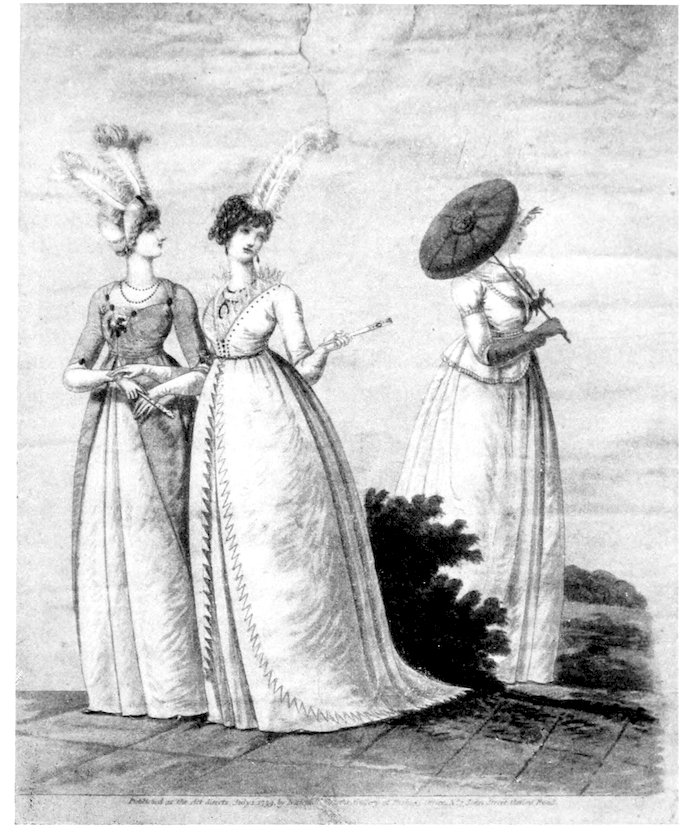
Pl. VIII.—Fashion Plate from England, 1799
39New York, June 18, 1803.
The fashions are remarkably plain; sleeves much longer than ours, and half handkerchiefs are universally worn. At Mrs. Henderson’s party there was but one lady except myself with a handkerchief—dressed as plain as possible, the most fashionable women the plainest. I have got you a pretty India spotted muslin—’tis fashionable here.
The silk dresses must also have been light and airy in weight as Miss Pierce’s grandniece tells a story of her aunt’s best black silk well worth relating in these days of Saratoga trunks. At the present time railroad passengers grumble at being limited to one hundred pounds of baggage. A hundred years ago the amount permitted to each passenger of a stage coach was but fourteen pounds, and a trunk then was hardly larger than a handbag now, certainly not as commodious as a dress-suit case.
Having just returned from a visit to her sister Mrs. Croswell, at Catskill, Miss Sarah Pierce reproached Miss Mary Pierce for having omitted to put her best black silk in her trunk when packing it. “I certainly put it in,” replied Miss Mary. “If you did I could not find it,” was the retort. Miss Mary went upstairs and shortly returned with the dress in her hand and showed how careful she had been to lay the dress between the folds of an undergarment to keep it from being creased. This was also the reason why Miss Pierce had not perceived it in the trunk. Could any of the beruffled, trailing gowns of these days be hid away like that?
That the elaborate dress of some of the matrons of Litchfield, extended even to powdered hair raised in towers on the head can be learned from the portraits extant by the painter Earle. The notice of his coming is taken from the Litchfield Monitor.
Litchfield, Feb 24th 1796
Arrived in town a few days since, from New York, Mr. Ralph Earle, the celebrated Portrait Painter; who holds rank with the most distinguish’d pupils of the great West. His Paintings will do honor to any country, in any age.
May 18 1796
Mr. Ralph Earle, the celebrated Portrait Painter, is now at New Milford; where he will probably reside for some time. As we profess a friendship for Mr. Earle and are desirous that the Public avail themselves 40of the abilities of this able artist, we feel a pleasure in making this communication, many gentlemen in this vicinity, having been disappoint of his services, and several of our friends being driven to accept of the paltry daubs of assuming pretenders.
Mr. Earl’s price for a Portrait of full length is Sixty Dollars, the smaller size Thirty Dollars; the Painter finding his own support and materials,—Applications by letter or otherwise, will be transmitted to Mr. Earle from this office, or the Post-master at New Milford will take charge of all letters addressed to Mr. Earle.
The following letter from the Litchfield Monitor of June 8, 1796, shows how far-reaching was the Republican feeling in Litchfield when it was sought to regulate through the press even the old custom of wearing mourning:
DRESSING IN MOURNING.
To the Printers of the United States.
Gentlemen,—
As your employment gives you the means of great influence in our country, it is of great importance that you should be wise and good men; that you should improve your influence in promoting the best interest and real welfare of our rising nation.
At this time I would mention one error in my countrymen, which prevails to our shame and poverty—the growing Fashion of dressing in mourning. This is to our disgrace, and gives mortification to every true lover of this country. During the Revolution, an economical fashion, truly republican, was established and all classes wore it; this was only a piece of crape or black ribbon on the left arm of men, and a black ribbon on the head of women. This American fashion did honor to our country, while at the same time it saved the property of the people. The President of the United States, some of the Governors and first rulers, have continued the fashion to this day. But great numbers of unreflecting persons have thoughtlessly returned again to an imitation of the British people, and greatly to their own loss, and to the injury of the country. The articles worn for mourning, are imported from Europe, for which our money is exported. This is a serious misfortune; for the sum is very great which is every year wasted for this trumpery. Let us act more like Americans, and save our honor and our money. We ought to have our own fashions, and the most frugal ones. To be imitators of Europeans and to our own loss is disgraceful. Our pride as well as our reason, forbids this 41servile practice. Americans! assert yourselves. Act with independent minds! be no longer the dupes of a silly fashion. Elect no man to any office who is guilty of this littleness of conduct—thereby you will preserve your national dignity, and millions of your money!
An American.
P.S. It is really strange, and much to be regretted that our legislatures do not attempt to correct this evil. A recommendation from high authority to the people, would produce a good effect. At least, it would keep in countenance those who wish to avoid the fashion—for fashion is a tyrant, and weak people are afraid to disobey. This tyrant therefore, should be borne down by the authority of high examples.
In order to round out this sketch of the social conditions and customs at Litchfield during the period of these chronicles, let us read the impressions of a stranger,—a young man who, like many another, found there not only a good legal education, but—a wife.
In the autobiography of the Rev. Lyman Beecher, his son Charles Beecher writes the following:
“Judge Tapping Reeve, for over half a century a citizen of Litchfield, was the founder of the celebrated law school, which for forty years was resorted to by young men of talent from nearly every state in the Union. Judge Reeve’s first wife was a granddaughter of President Edwards, and sister of Aaron Burr, who for about six years regarded Litchfield as home.”[23]
“No less distinguished in point of literary cultivation was the family of Judge Gould for many years associated with Judge Reeve in the law school, and afterwards its principal. He was of fine personal appearance, polished manners, extensive acquaintance with the English classics, and in all matters of rhetorical or verbal criticism his word was law. His wife was in no way inferior to him in general information and brilliant conversational powers.”[24]
To this institution came Edward D. Mansfield, from whose “Personal Memories,” published in Cincinnati in 1879, we extract the following passages:
“It was about the middle of June, 1823, that my father and I drove up to Grove Catlin’s tavern, on the ‘Green’ of Litchfield, Conn. 42It was one of the most beautiful days of the year, and just before sunset. The scene most striking. Litchfield is on a hill, about one thousand feet above the sea, and having fine scenery on every side. On the west rises ‘Mount Tom’ a dark frowning peak; in the southwest, ‘Bantam Lake,’ on whose shores I have often walked and ridden. In the north and east other ridges rolled away in the distance, and so, from Litchfield Hill, there is a varied and delightful prospect. One of the first objects which struck my eyes was interesting and picturesque. This was a long procession of school girls, coming down North Street, walking under the lofty elms, and moving to the music of a flute and flageolet. The girls were gayly dressed and evidently enjoying their evening parade, in this most balmy season of the year. It was the school of Miss Sally Pierce, whom I have mentioned before, as one of the earliest and best of the pioneers in American female education. That scene has never faded from my memory. The beauty of Nature, the loveliness of the season, the sudden appearance of this school of girls, all united to strike and charm the mind of a young man, who, however varied his experience, had never beheld a scene like that.
“It was commonly my practice to walk in the afternoons of summer, and the opportunities for pleasant walking were like those of riding, very good and tempting. Litchfield, like many New England towns, was built chiefly on two main streets, one going north and south, and the other east and west, and the whole on a hill or ridge, with Bantam river running on the east and another stream on the west. North and South Street was more than a mile in length, shaded nearly its whole length by those lofty and broad spreading elms for which some of the towns of Connecticut was noted. In the warm days of summer, and in these beautiful and cloudless sunsets, like the day in which I had first seen it, most of the young people would be on the streets, and among them those of the students who, like myself, were lovers of beauty and of scenery. Owing to my introduction to society, which is always a great benefit to young men of any sense, I was soon acquainted with the best families and my afternoon walks, as well as my evening visits, often led me among those distinguished in beauty, grace and position. One of my temptations to an afternoon walk was to meet the girls, who, like ourselves, were often seen taking their daily walk. Among these, were the Wolcotts, the Demings, the Tallmadges, the Landons and Miss Peck, who afterwards became my wife....
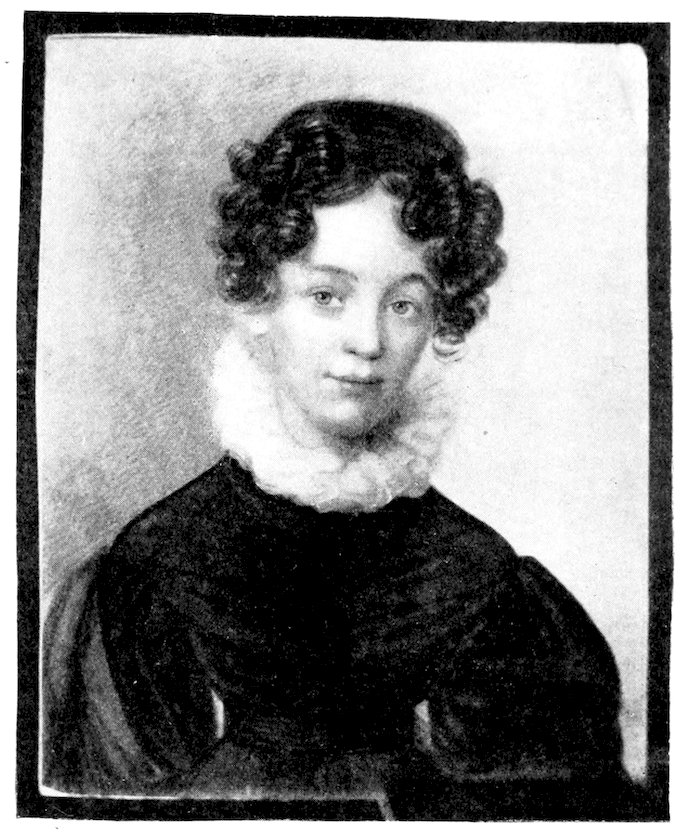
Pl. IX.—Lucy Sheldon (Mrs. Theron Beach) From a miniature by Dickinson
“There were more than fifty law students boarding in Litchfield, many of them of wealthy families, and many of them from the South. Of course, there must be some amusement, and often the midnight air resounded with the songs of midnight rioters, and sometimes stories were circulated to the students’ disadvantage. After hearing some remarks on the ‘fast’ students, I met Dr. Sheldon walking, and said to him: ‘Doctor, they say we are the worst students ever were in Litchfield.’ ‘Pooh! pooh!’ said the doctor, ‘they are not half as bad as they were in my day.’ So I was comforted with the idea that we were not casting shame on those venerable Puritans who had condescended to become our ancestors. Be this as it may, I greatly enjoyed those evening sleigh rides, and those country suppers, when we would ride off to Goshen, or Harwinton, or other village, and order our turkey and oysters, served up with pickles and cake, and then set Black Cæsar to play jigs on a cracked fiddle. But the grand occasions were something beyond this, when we got sleighs with fine horses, and buffalo robes, and foot-stoves, and invited the belles of Litchfield, who never hesitated to go, and set off to the distant village to have a supper and dance. I seldom danced, and some of the girls did not, but there were always some who did, and we had jolly times. So passed my days in Litchfield, doing a great deal of good work in study, enjoying much of good society, and passing its hours in innocent amusements.”
43