1830–1897. REMINISCENCES AND LETTERS.
Reading edition
HARRIET WADSWORTH (MRS. KILBOURN)—HER REMINISCENCES.
Harriet Wadsworth was in a class of little girls taught by Miss Sally Pierce in 1830 and 1831. This class was a preparatory one to the Academy. The pupils were thoroughly drilled in arithmetic and spelling. The latter was studied from a dictionary. Davol’s speller was also used.
There were as many as one hundred and twenty pupils at one time. Every family in the village took pupils as boarders, four occupying one room.
Miss Catlin was drawing teacher.
The closing exercises of the academy were held at the Court House. Paintings and needlework by the young ladies were hung on the walls. The pupils were dressed in white and were given diplomas. Singing and recitations were part of the exercises.
Mr. John Brace left the academy to take the school of Miss Catherine Beecher at Hartford. When Miss Pierce gave up teaching 287in 1833 Miss Jones afterward associated with Miss Landon, took charge of the school. Following them were the Misses Swift who lived where Mrs. Kilbourn now lives.
Some of the girls in Mrs. Kilbourn’s class were Elizabeth Prince, (Mrs. N. R. Child), Mary Goodwin (Mrs. Taylor) and Mary Brace.
LETTER FROM MRS. GEORGE C. SEELYE (ANN ELIZA JACKSON), GENEVA, N. Y., MARCH, 1897.
I was but a Child when I attended Litchfield school and of course did not appreciate the privilege as an older person would have done, and I have since. Your letter awoke and quickened memories that have become more or less dormant, so that now I feel the worth of those months of early privilege. The Misses Pierce and Mr. Brace were remarkable persons in every way, Model teachers for those days.
Being such a child I was made much of and was very happy. Boarded at Dr. Sheldons. Aunt Lucy (as I called his daughter) was loving, taking me in her own room and bed. The influences in that beautiful home were useful to us all, for the Foundation was religious. Every Sunday afternoon Miss Sheldon called all the boarders into her room and read, talked, advised and prayed with us, not in a morose way at all but in a happy way.
Mr. Lyman Beecher was pastor of the Congregational Church and used to visit the school every week, generally had one of his students with him, and held a Prayer and Enquiry meeting. I remember him as a sombre, austere looking man not a bit like his son Henry Ward. He soon went to Boston.
As memory goes back I think there was perhaps more true sincerity in Life then generally than now. Time was felt to be more valuable. We were happy without so much to distract us. As scholars we did not feel that we must be entertained and amused. I do not under value amusements they are often Relaxations that are needful, as Lincoln used to say.
I love to revert to Litchfield days as among the happiest days of my life. I think Miss Pierce loved me as generally my seat was on the old desk next hers I was a great Pet of Judge Gould. There was a Julia Leavitt of Brooklyn, Sarah Lewis, Eliza Jackson I suppose one of the New Jersey Jacksons.
288
REMINISCENCES OF MRS. EMILY CHAUNCEY CURTIS, 1898.
In addition to the names of Mrs. Jackson and her half sister I remember one other, that of Almira Dole who was quite a beauty and quite given to flirtations with the Law students, which of course caused Miss Pierce some trouble, she also was fond of playing pranks; once, to the dismay of her teachers she made a mask of a pumpkin, placed a lamp or a lantern inside and mounted it on a tin in front of the house. Each of the older pupils if they were mature, was given charge of a younger one. Though sister Julia was only about fifteen when she entered she had charge of a little girl of nine or ten—attending to her wardrobe and sleeping with her.
LETTER FROM MRS. MARY HUNT (OVER NINETY YEARS OLD).
Detroit Oct. 3d 1899
College Ave. 635
My dear Mrs. Bissell:[68]
I do much regret my inability to add much of interest or importance to what has been already written of the early history of Litchfield; I was but a young school girl, and did not realize or treasure up recollections for the future, as I might have done. My recollection of Miss Pierce’ school room is of a long, a very long room, it then seemed to me, with an elevated platform at each end, whereon were seated our honored teachers, Miss Pierce and Mr. John Brace.
The pupils were expected to make their most graceful and respectful obeisance on entering the room, which was acknowledged with most formal politeness. Miss Pierce was rather small in stature, with a fair sweet face, and dignified manners: Miss Mary Pierce assisted occasionally in school, but devoted herself more especially to housekeeping. I have no knowledge of the later lives of these two estimable ladies: I have looked in vain for the name, (in the Book of Days, and other records, of Litchfield History) of Edwards and I am surprised to find no mention made of that most worthy family, Mrs. Edwards and her two unmarried daughters, under whose kind care it was my privilege and good fortune to be placed during my school days in Litchfield. They deserve an honored place among the worthies of this famous town.
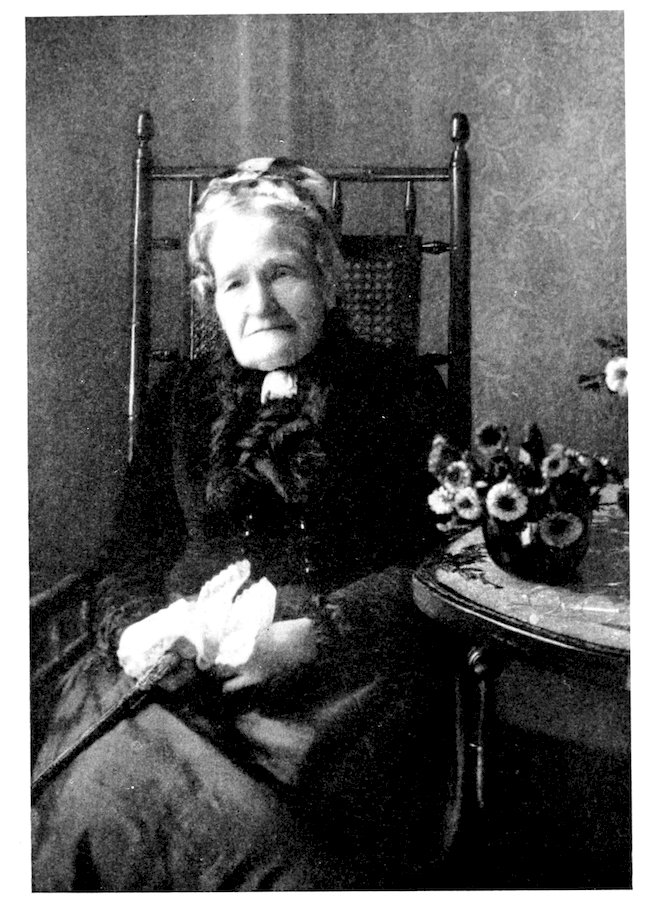
Pl. LIV.—Mary A. Hunt Centennial Picture. Taken on her 100th birthday, 1902.
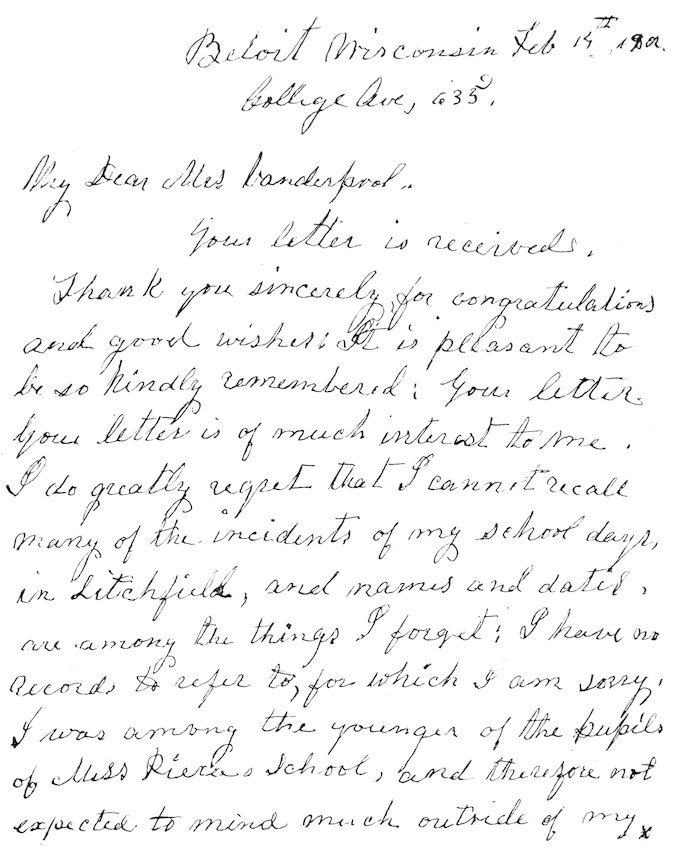
Pl. LV.—Letter of Mary A. Hunt
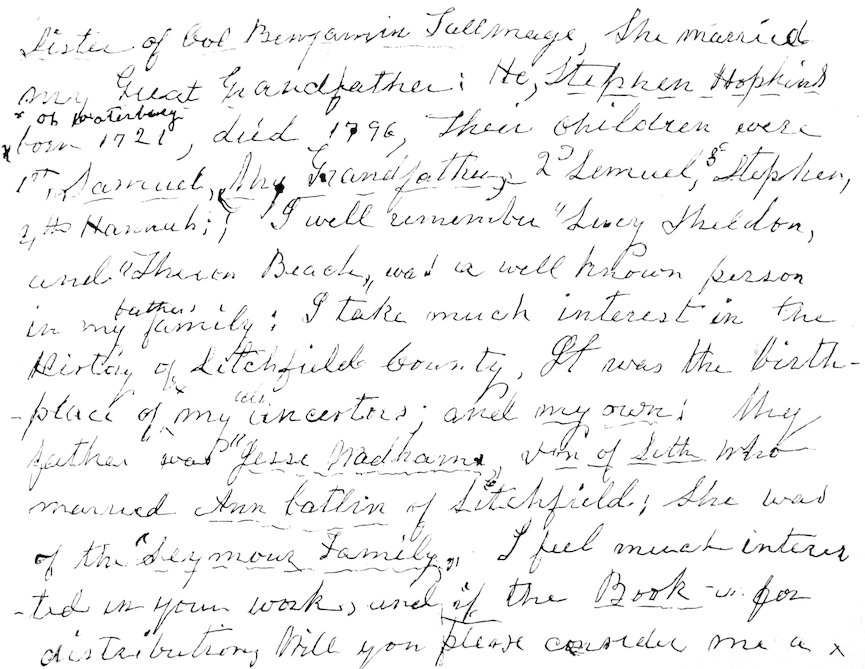
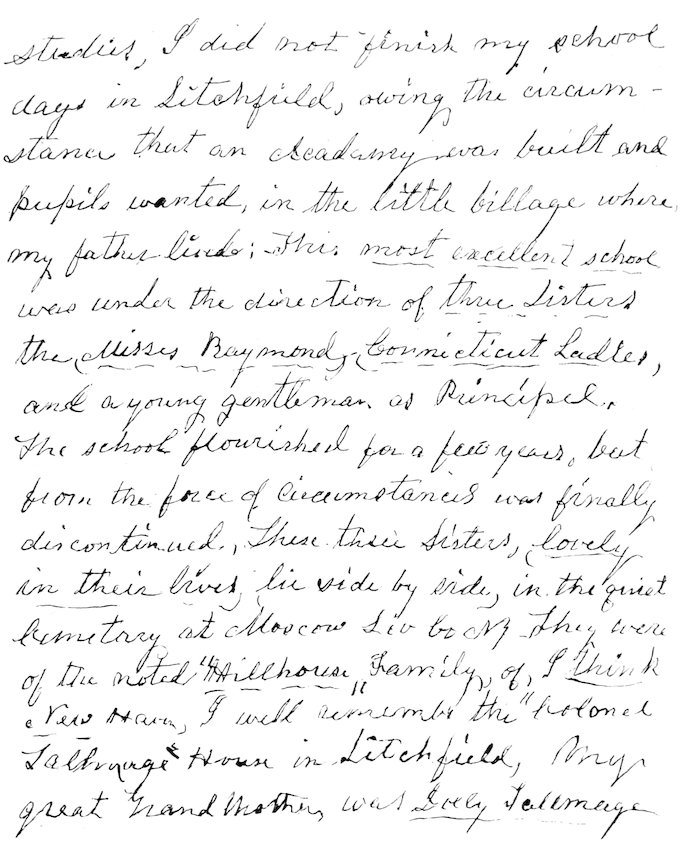
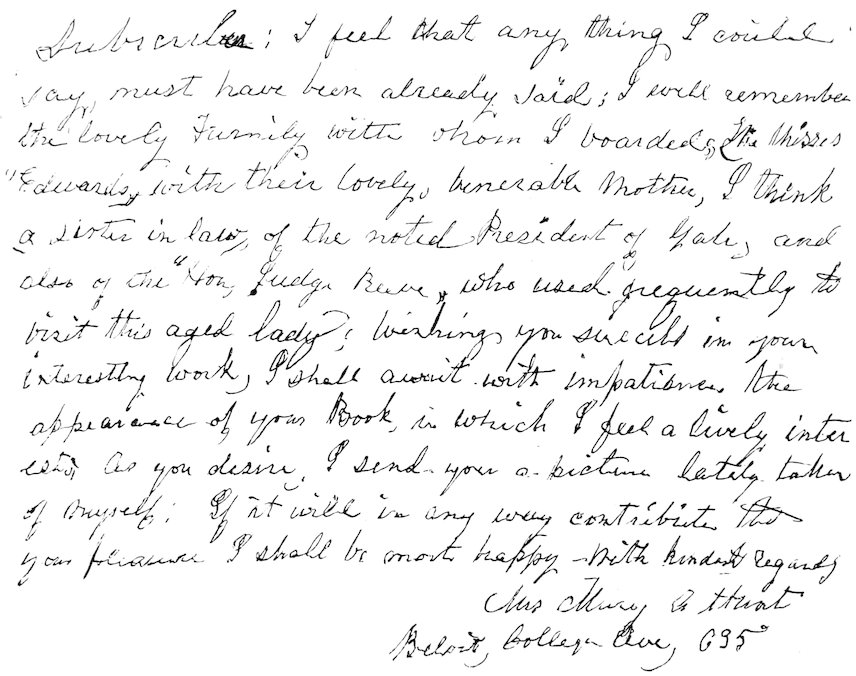
289Mrs. Edwards was a near relative of President Edwards of Yale, also I think, sister in law of the noted Judge Reeve, to whose unremitting kindness and sympathy she owed many of the pleasures of her declining years. Judge Reeve seldom allowed a week to pass without visiting this venerated friend; and his visits were counted among the bright and sunny spots in her life. She was a confirmed invalid for many years. This family were warm friends and admirers of Miss Pierce.
They were fellow workers in the welfare and education of two Hawaian boys, “Hoobokiah” and “Hope” by name who were at the mission school at Cornwall. These youths were occasional visitors and were much petted and noticed: I think Hoobokiah died before returning to his native land. I can at this day recall his face.
Very sincerely yours,
Mrs. Mary A. Hunt.
REMINISCENCES OF MISS FANNY LORD.
November 11, 1899.
There was a house on North St. about where Mrs. M’Laughlin now lives, with a long sloping roof called at that time “a lean-to.” Some of Miss Pierce’s pupils boarded there with the family of Edwards[69] who occupied it. They were so strict that the law students called it “the convent.”
There were two pupils Margaret Hopkins and Elizabeth Sheldon.[70] The former went with some of her friends to spend the evening at “aunt Bull’s” on the south side of Prospect St. where Mr. MacMartin lives. A law student of the party put back the hands of the clock so that when one of the number took Margaret back to Miss Pierce’s where she boarded, the house was quite shut up. After knocking Miss Pierce came to the door in night-cap and gown, candle in hand! Some time after this occurrence, during her wedding journey, Margaret and her bridegroom met the young man, her escort, and they all had much amusement over their reminiscences of the encounter.
After the experience related in Mr. Cutler’s diary of the jilting of one of the Litchfield girls by one of the law students parents were even more careful as to any attentions paid to their daughters. Sometimes they even went so far that if a young man called three times on one of them they would ask his “intentions.” Mr. Lord built a bowling alley on the west side of the Prospect Hill road for the benefit of the pupils of both schools.
Miss Pierce used to say to one of the girls, “Mary Goodwin, I see inbred sin on your back,” and said it so often that on entering the 290school room one morning there was a charcoal sketch fastened up on the wall of Miss Pierce herself with “inbred sin on her back!”
This same Mary Goodwin laughed one day during prayers when Miss Pierce exclaimed “Mary Goodwin, Mary Goodwin you will be cast into outer darkness where there is weeping and gnashing of teeth!” To which Mary replied, “Then I suppose those who have no teeth will have to gum it!” Miss Pierce’s house was built for six hundred dollars.
Mr. John P. Brace’s father was the writing master and was always called “Daddy Brace.”
LETTER FROM MRS. ANNA M. RICHARDS.
Orange, N. J.
March 18, 1902
I received your letter last evening and hasten to comply with your request that I should write down some of my “personal memories” of Miss Mary Pierce. The remembrance of our intercourse with her is so fresh and so delightful that it is hard for me to realize that it continued less than three years, and that nearly forty years have passed since that time. I well remember the charming circles she used to gather round her tea-table—the repast very simple—a plate of shaved, smoked beef, some preserves and a basket of cake—but the conversation, a veritable “feast of reason.” One of her pupils, Mrs. Whiting (the mother of Miss Lizzie Whiting,) once said to me that she thought Miss Pierce was a marked instance of the mellowing power of age, for the girls used to be very much afraid of Miss Mary’s black eyes. She dined with us one Thanksgiving, her last Thanksgiving day on earth. Her conversation was most interesting, dealing largely with the past. I wish I had taken it down at the time. One thing I distinctly recall. At one time she said her sister, the principal of the school, was so discouraged with their prospects, that she felt they must probably go elsewhere—but opening her Bible, the first words that met her eye were, “Trust in the Lord, and do good, so shalt thou dwell in the land, and verily thou shalt be fed.” This she accepted as a word of promise to them, and a direction to them to remain in Litchfield. It was Miss Pierce’s custom to close her house in the Fall for the winter, but at the time of which I speak, she was staying at home, busily engaged she told me looking over old papers. She died in New Haven I think the following June. I remember her speaking once of Dr. Beecher’s preaching, that when he came to Litchfield from Easthampton, the images in his sermons were 291drawn largely from the sea, but that soon the everlasting hills furnished them, and that after he went to Boston, she heard him talk, almost with a shock, about getting up steam. As you doubtless know, the lot on which the Parsonage stands was given to the Society by Miss Pierce. I remember thinking at the time how hard it must be for her to give up the beautiful clump of trees, standing upon it almost a little grove, as I picture them, which it was necessary to cut down. I fear these few reminiscences will be very unsatisfactory to you, as they certainly are to me, but they seem to be all which I can recall with sufficient distinctness to justify repetition. All success to you in your “labor of love,” which, when completed, will be an enduring monument to some of the noble workers whose memories the world should “not willingly let die.”
RECOLLECTIONS OF SUSAN SPENCER.
I often heard my mother refer to having been with Sarah Kingsbury, at the school of Miss Sallie Pierce. I think they boarded with a distant relative of the Clarks, whom my mother called “Aunt Bull.” (on Prospect street.) During their stay there Major Kingsbury then a cadet at West Point, visited them, and created quite a little stir and interest among the young ladies, partly due to his uniform and military bearing.
I was impressed with the simplicity of the janitor service of those days. The young ladies, in turn, swept the school room, performing that duty before breakfast.
FROM LETTER FROM MRS. CAROLINE SEDGWICK KNIGHT.
Sharon, Conn.
March 31st, 1902
... My mother, Betsey Swan, was the eldest child of Cyrus Swan, a lawyer in Sharon, Conn. who practiced at the Litchfield Bar. She was born Feb. 6th 1807, and I have heard her say that at the age of twelve years she was placed by her Father in this school. It was her first experience away from home, and of course she suffered from homesickness. She made the acquaintance of a day pupil, Henrietta Jones,[71] the daughter of the Rector. As my mother had left a little baby sister at home it was a great delight to go to the Rectory and rock the cradle of Henrietta’s baby brother.
292I do not know how long she was a member of the school. She married at the age of fifteen Charles Sedgwick who was twelve years her senior, a lawyer in Sharon who died in 1882 and who had been state’s attorney for Litchfield County about twenty years. My mother died at the age of 87 in the home in which she was born, married and had given birth to ten children.
DR. JOSIAH G. BECKWITH—REMINISCENCES.
Beginning of the Willard Academy.
In the winter of 1885 I made a trip to Montreal and returning by the Vermont Central made the discovery that the winter was a pretty dull season for business in Vermont, and that the railroad was in no haste to carry its passengers out of the state! We stopped for breakfast at St. Albans, and at Burlington were informed that we would have ample time to take a toboggan slide down the hill on which the town is built, and out a mile or so on the ice of lake Champlain, where sleighs were in attendance to return us to the hotel with our lungs well filled with Vermont oxygen: and at Middlebury which was reached when the short day was drawing to its close, we were informed that the stop was for the night. I found accommodations at the Addison House, whose long wind swept piazzas looked uninviting to the approaching stranger: but the section kept open for winter guests was comfortable and homelike. I improved the remaining daylight to make calls on relatives in the branch of the Seymours settled in that place—at the old Horatio Seymour homestead I found Mr. Philip Battell who was a brother of our Mr. Robbins Battell of Norfolk—while a law student at the old Litchfield School he became engaged to Emma Seymour, who was in Litchfield attending Miss Pierce’s School—after their marriage they made a part of Mr. Seymour’s household, who was then a widower and they lived and died at the homestead in Middlebury.
Mr. Battell was very glad to see a Litchfield representative, and said that I had struck them at just the right time—that there was to be held at his house that evening a meeting of the Middlebury Historical Society to observe the Centennial Anniversary of the Addison County Court—whose first session was held one hundred years ago, that day, with the Hon. John Strong as the presiding Justice. Mr. Battell informed me that he had filled the office of Secretary of the Society since its organization, and that to warn the meetings and provide the banquet were among his duties.
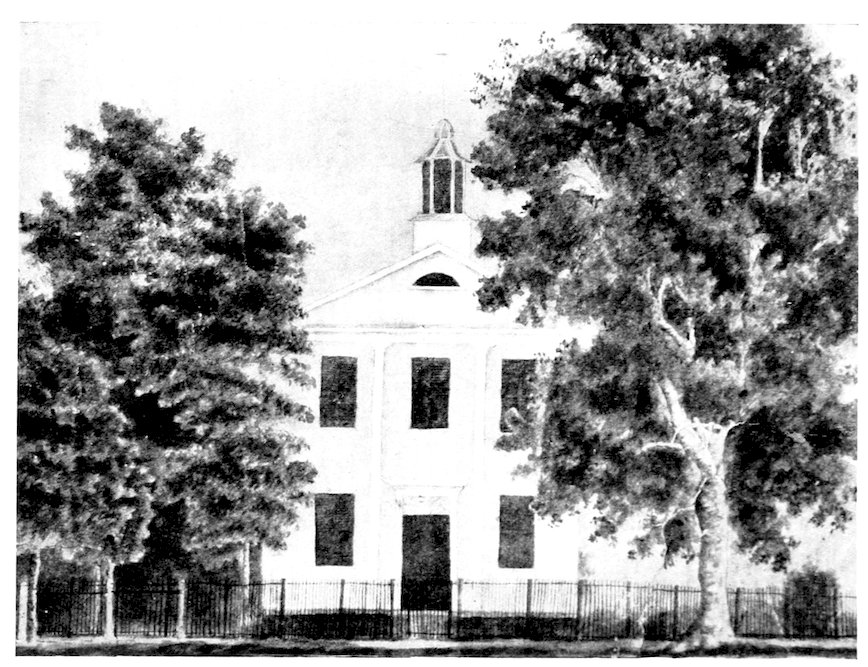
Pl. LVI.—The Litchfield Academy From original water-color, probably by Mr. Gimbrede, afterwards engraver in New York
293I found the members were largely made up of the faculty of Middlebury College, with a number of professional and business men of the city: Governor Stewart, Mr. Battell’s son in law, was the presiding officer, and he insisted in spite of my modest remonstrances upon my taking the seat of honor at the head of the table, as the living representative of the presiding Justice of one hundred years ago. The conversation, after reading the minutes of the Court by Gov. Stewart, was largely taken up with a discussion of the Strong family. John Strong settled the county in 1765: he drove up with his wife and three children on the ice of Lake Champlain from Salisbury, Ct., and took possession of a log cabin, which he had built the preceding winter, in an abandoned French settlement, while out on a hunting excursion. For a time bears and wolves were their only neighbors, but other settlers soon followed, and he lived to see the wilderness blossom like the rose. When the revolution broke out, Mr. Strong took the part of the colonists, although the British garrison at Crown Point had long been good customers and had filled his chests with British gold: And when Gen. Burgoyne and his Indian Allies approached, he rode down through the State, and warned the settlers to fly from the approaching army, and to take their flocks and herds with them—and it was doubtless due to this timely warning, and sagacious advise, that Gen. Burgoyne brought his army to Saratoga in an absolutely starving condition: the country over which he had been obliged to so slowly pass, had yielded no supplies, and at Saratoga he could do nothing but surrender.
John Strong expected to return in time to remove his family to a place of safety, but he was captured by Indian scouts, who bound him for torture in their usual manner. He told them however that they must release him, and take him before Gen. Burgoyne, for whom he bore a message—the Indians were impressed by his coolness and imposing presence, and complied with his request; when brought to Gen. Burgoyne he asked for his parole—which was granted until the “Army returned.” “But suppose General that the Army does not return”—“In that event;” replied General Burgoyne, “you are released.” Had he known what especially good work Strong had done that the Army should not return, he might have returned him to the care of the Indians. Mr. Strong hastened to his home, which he found had been burned by the Indians—he raked the ashes for the bones of his family, and not finding them, concluded that they had escaped to the South, and looked for them in Salisbury, Ct.; they had found refuge in Dorset, Vt. where they remained until the close of the war. Mabel, my Grandmother, was born there in 1782.
John Strong was born in Coventry this State and was the fourth in 294descent from Elder John Strong of Dorchester, Mass. He married Agnes, the daughter of John McCan a refugee from the Scotch rebellion of 1715: he was a wealthy landowner and received income from property which he had deeded to a friend to avoid confiscation, as long as he lived—but after his decease the remittances stopped—his only other child John, was killed in a naval engagement. In 1797 Mabel Strong, Lucy Case and a Miss Dwight, all of Addison, Vt., made a start for Litchfield, Ct., to attend Miss Pierce’s School—They made the journey to Bennington on horseback, and from thence the Rev. Mr. Dwight drove them to Litchfield—the latter part of the journey was made in a wagon.
Mabel Strong made her home during the years of her stay in Litchfield, with Mrs. Brace, a sister of Miss Pierce, and the mother of John P. Brace—her wardrobe was made up after her arrival. The Brace house stood on the site now occupied by the Congregational parsonage—it was painted red when I remember it, and had a long roof on the rear reaching nearly to the first story. Many of Miss Pierce’s young ladies found their future husbands in Litchfield: Lucy Case, married Horatio Seymour, who had removed from Litchfield, and was a practicing lawyer in Middlebury, Vt., afterwards U. S. Senator from that state.
He was very much interested in having a school for young ladies established in Middlebury similar to that of Miss Pierce’s of Litchfield—My grandfather Moses Seymour Jr. drove from Litchfield, with a sleigh and pair of horses in Feb. 1800, to bring home Mabel Strong as his bride; Miss Pierce and Idea, daughter of Hon. Jedediah Strong, whose house stood where the McNeils[72] now live, and whose name, then as now, was graven on the white mile stone, accompanied him as far Middlebury; where a School was established for Miss Strong, and countenanced and encouraged by the presence of Miss Pierce. This School had an existence for several years; Miss Strong fell a victim to the rigors of the Vermont climate, and was succeeded by Miss Emma Willard, who eventually removed it to Troy, N. Y. Miss Pierce returned with the wedding party.
General Samuel Strong was a brother of Mabel and was a frequent visitor at Litchfield: he commanded a military force at the battle of Plattsburgh, which he raised by his individual exertions—and was thanked for his services by the Legislatures of the states of Vermont and New York.
He also received from the state of New York a sword of honor, which is now in possession of the Vermont Historical Society.
295The General was wounded at the battle, and feared consumption. He visited Litchfield on his way to the South, to spend the winter, and called in Dr. Sheldon for advice. The Doctor told him to spend all the time on horseback, that the weather would permit—The advice was followed, and the General lived to be old. This Doctor was wise beyond his generation.
In 1817 the General had a coach built by Ambrose Norton, whose wagon shop stood on the ground now occupied by the Echo Farm creamery: All the material were produced in Litchfield, and the work was also done here—separate bills were rendered for wood work, ironing, leather, broadcloth, silver plating &c. with hours of labor on each, and the aggregate was $350. I found these bills among my grandfather’s old papers and consider them worth preserving as evidence of the industries which made the old Litchfield a thriving and important town. We can no longer produce iron, silver plating, leather and broadcloth, nor do we build coaches for the magnates of Vermont.
Moses Seymour Jr., and his bride commenced housekeeping in what was then known as the Skinner house, now occupied by the Bissells next the United States Hotel; they afterwards removed to the Marsh house on the corner, where the Library building stands, where they remained until 1817, when the house which I now occupy, was completed for my grandfather and they took possession of it in that year. Moses Seymour Jr. was for many years high Sheriff of the County. The office was at that time in the hands of the Governor of the State—Mr. Seymour was appointed by Governor Oliver Wolcott; he died in 1826. Mrs. Mabel Seymour survived him until 1839—she died at Litchfield—Mrs. Mabel Seymour had three daughters who were graduated from Miss Pierce’s Academy—Louisa married Mr. Stanly Lockwood of Painsville Ohio, where she lived, and where she died in 1878, leaving surviving children, John Seymour Lockwood, and Mrs. Louisa Malin, both living in that city. Delia Storrs Seymour was a teacher, and died in Litchfield in 1887: she was unmarried.
Jane Seymour married Dr. Josiah G. Beckwith who was for forty years in active practice in this town; she lived, until her death, which occurred in 1868, in her father’s homestead; she left surviving issue, Dr. J. G. Beckwith of this town, Dr. George S. Beckwith of Pine Plains, New York, and two daughters, unmarried, Elizabeth Gale and Sarah Hunt. Dr. George S. Beckwith and Elizabeth G. Beckwith are deceased. I have the diplomas of Delia S. Seymour and Jane Seymour—They are printed on small pieces of silk, and give the studies in which the graduate had been instructed: each bears the name of the graduate; but they are neither dated nor signed.
296
FROM A LETTER FROM MISS SARAH D. GARDINER.
Both my grandmothers were pupils of Miss Pierce.
Sarah D. Gardiner and her sister Mary B. were the daughters of John Lyon Gardiner of Gardiner’s Island. The former became the wife of David Thompson, Esq., of New York, and the latter on leaving Miss Pierce’s went to Miss Willard’s school[73] in Troy, N. Y., and at the early age of twenty-three, died in Columbia, South Carolina, where she had gone in search of health.
Mrs. Thompson often spoke of Miss Pierce and Mr. Brace. She was very young when she entered the school and must have been quite homesick at first. After she had been there sometime she was one day surprised to find her room mate engaged in making the bed, and on learning that the pupils were expected to keep their rooms in order exclaimed: “Why didn’t you tell me?” “Because,” replied her kind-hearted companion, who was an older girl, “I knew that you were not accustomed to it!”
She must have boarded later at Dr. Sheldon’s, for she spoke of learning her lessons with Miss Julia Gould, and in the darkening twilight returning across the street to Dr. Sheldon’s (or Miss Lucy Sheldon’s?) while the good Judge, standing in his doorway watched the little figure safely over. Juliana MacLachlan, my father’s mother, had been a pupil in the school at an earlier date. She was a beautiful girl and a belle with the law students. When but fifteen years old she married David Gardiner of East Hampton, Long Island.
REMINISCENCES OF MRS. A. S. FARNAM.
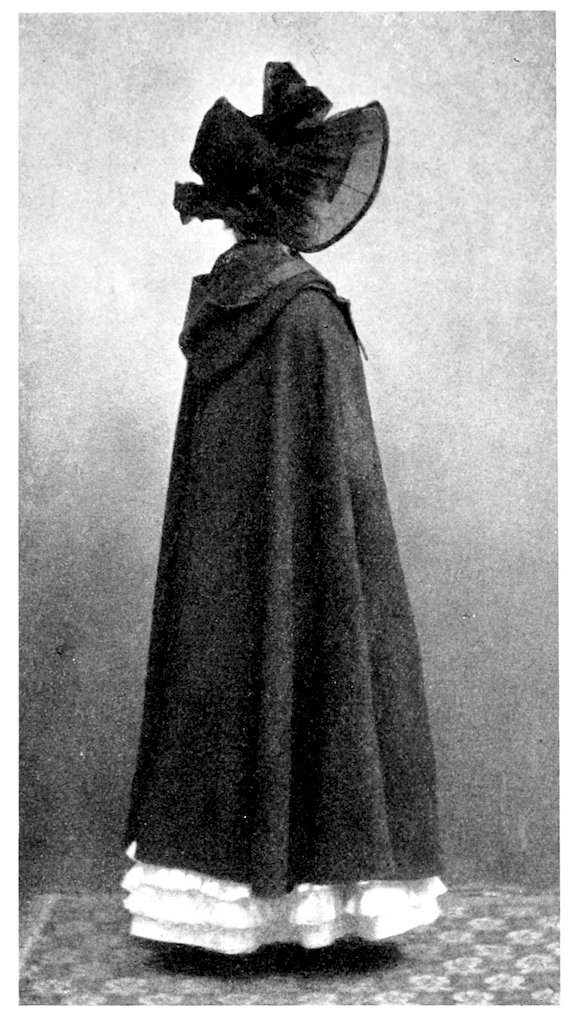
Pl. LVII.—Litchfield Costume of about 1827 Black crape bonnet made for his widow to wear at the funeral of Mr. Cheney
I went to Litchfield in the Spring of 1830. Mr. Brace was at the head of the school, but Miss Pierce came into the school every morning and taught the class in Universal History which was a book of her own compiling, and she used often to give the girls talks.... I think of her as a little old lady active and bright; somehow I have a more distinct recollection of her half-brother and sister who lived with her; I think Miss Mary kept the house; I don’t remember any assistant teachers at all; I do remember three or four boys who attended the school because there was no boys’ school in town; one was Willie Jones, the son of Parson Jones as he was called; another was son of 297Dr. Buel on North Street, the same who had the sanitarium at a later day; another was George Seymour, a nephew of Origen Seymour; I think his father was dead; there was a young lad by the name of Hull that I did not know as well; a sister of young Buel’s mother, Miss Wadhams from Goshen, was in school for quite a time; Hannah Beach also was from Goshen; her father married Miss Lucy Sheldon.... I think most of the families took a few boarders; there were four sisters named Rankin from Newark. It seems strange, but I cannot recall the names of the girls who boarded at Mrs. Lord’s with me excepting a Miss Clark; we all occupied the rooms in the third story, the best rooms of the house were rented to young gentlemen who were law students.... There were two or three girls who boarded at the Parmalees’ on South Street; one was a Miss Larned from Maryland; another was from New London....
REMINISCENCES OF MISS ESTHER H. THOMPSON.
Litchfield, Connecticut,
December 12, 1896.
Aunt Anna Thompson used to mention with much amusement the feuds between Miss Pierce’s scholars and the farmers’ daughters—more especially that peculiar class of young American girls who were “living out”—the “help”—in village families. It would never have answered to call them servants, nor were they such in the modern sense! These girls, usually the most ambitious of their family, made more independent by self support, gaining influence in proportion to the polish acquired by intercourse with village people, easily dominated all of their set, and together were a strong band. The school girls were supercilious, the help aggressively arrogant—and both classes equally proud and uncompromising. Many a battle was fought on Sunday as well as on week day. All around the gallery walls of the old church on the green was a row of square pews fenced in with the conventional high lattice work, while in front were two rows of benches. Many of the young people of the congregation chose to sit there where they were more free from the restraining presence of their seniors. Sometimes one part of the gallery would be considered the special choice, sometimes another, but “out girls” and school girls would never freely mingle! When one pew was monopolized by school girls for a noticeable length of time the “out girls” would come early some Sunday and “pack” the seats. Then would follow pin pricking, pinching 298and punching through the lattice—and the incensed school girls would bide their time to preempt the “out girls’” places.
The worst possible indignity that the school girls could heap upon the “help” was to give them the stinging epithet of “Potwrastlers”—probably meaning dish-washers!!
Aunt Anna could judge of these stormy scenes from neutral ground as she belonged to neither faction. She said that the class spirit mentioned in “Poganuc People” was specially well depicted.
“Nabby” of “Poganuc People” was for a long time the “help” in Miss Pierce’s family, so I think the old scholars would remember her—the “Aunt” Emily Addis who lived and died in the little house at the foot of Gallows Hill. When her mother died leaving to her care her little sister Mary—afterwards Mrs. Churchill—Miss Pierce kindly let her bring the child with her to her house—I think taking her into the school. “Nabby” is a composite character being in part Emily Addis and in part an older sister who married Hiram Barnes,—the “Hiel Jones” of the story—and left town.
Dinah Atwell, a strange half-crazed character, may be remembered by the old scholars. She spent her time between the Pierce family here and another Pierce sister in Rhinebeck. Memories of her are centered in the old church on the green where she reigned a selfappointed tithing-mistress watching the children from her seat high up on the pulpit stairs.
Mr. Norton told me that the Central Park was the thought of Miss Mary Pierce. She contributed money to have it graded and fenced.
It would seem to me that no tribute to Miss Pierce and her school could be complete without a mention of her “door-yard” with its odd assortment of flowers. The many wild plants scattered here and there, Mr. Norton told me were transplanted by the pupils,—perhaps while studying Botany. There were Solomon’s Seal, White Baneberry with its creamy flowers in early summer followed in autumn by a stiff cluster of oval white berries with black dots on thickened ink stems, the wandlike wreathy stem of Carrion Flower with its greenish blossoms and dark slate-colored berries, Trilliums of more than one species, Violets, Anemones, Bloodroot, Celandine, Adder tongues and two-leafed Solomon’s Seal and others. I have often tried to think how the flower beds were originally laid out. There must have been one following the front fence—all well kept yards had that—possibly one by the north yard fence and another following the circular walks to the front door. But all traces are now obliterated! I can’t quite feel that these woodsy plants that had so long outlived the young girls who planted them belonged to the present generation to uproot and destroy. I miss 299them and always shall whenever I pass the place. There certainly could have been no sweeter “keep sake” left by the scholars to the town than these flowers. The girls may not have had far to carry the roots for the woods were nearer the village then than now. Mr. Norton told me that when Miss Sarah and Miss Mary Pierce were little children they were sent across the street to Parson Champion’s and lost their way in the bushes and men were called out to find them! At that time the road was near the west side walk and the rest of the street was a tangle of bushes.
Miss Pierce must have had a deep love for flowers and a rare faculty for impressing her scholars. The six or eight old pupils of whom I have had any knowledge were peculiarly fond of plants. Years ago when I had a little school in town Miss Harriet Grant brought Fanny to me and in telling me of her attainments said she had worked her sampler at home and was well advanced in Grammar, she having taught her, as she herself had learned, from Murray’s Grammar, which she had used at Miss Pierce’s school. She considered that the best textbook on the subject. She spoke with as nearly enthusiasm as her quaint prim manners would allow of her instruction in Botany while at that school and the pleasure it had been to her through life, and of a number of rare plants she had found.
LETTER FROM MR. J. DEMING PERKINS.
Litchfield, March 3d, 1897.
I have been unable to find much of interest to add to your labor of love, but can say that the house which the Misses Sarah and Mary Pierce occupied and which was torn down by Mrs. Underwood in 1896, was built in the year 1800. The “Litchfield Female Academy,” a later building, which stood north of their house was erected in 1827 by a stock company incorporated in that year. This latter building was removed to the Beecher Lot, corner of North and Prospect Streets, prior to 1860, and was occupied there by the boys’ school of the late Rev. James Richards D.D., under the name of “Elm Park Collegiate Institute” for some years.
Mr. Henry R. Jones of Brooklyn, N. Y. converted it into a dwelling house after he purchased that corner about 1882; the “Beecher Homestead” building having previously been purchased by Dr. Henry W. Buel, and removed to “Spring Hill,” about 1872 where it now forms a part of his group of buildings.
300