1811–1820.
Reading edition
By this date the few and simple studies taught in the school in its early stages had expanded so that we find proofs of higher branches and better methods of study. There is a globe now in the possession of Charles H. Woodruff, Esq., of New York, which was used in the school. It was made and sold in London. It was afterwards used in a boy’s school in Cornwall, Connecticut, which Mr. Woodruff attended.
The map of the world (Plate XLII) was drawn by Miss Lewis when at school, and there is also a map of the United States drawn by Eliza Ann Mulford, in possession of her son, both of which serve to prove careful instruction in geography.
Miss Pierce thought highly of the knowledge to be gained from the study of history, but could find no satisfactory textbook, so she wrote a history herself, which she published and sold to subscribers. The names and dates of publication are as follows.
Mrs. Harriet Beecher Stowe’s letter on the subject of the histories explains itself.
HISTORIES[37]
“The general History which Miss Sarah Pierce wrote for her pupils” Mrs. Asa Gray’s letter.
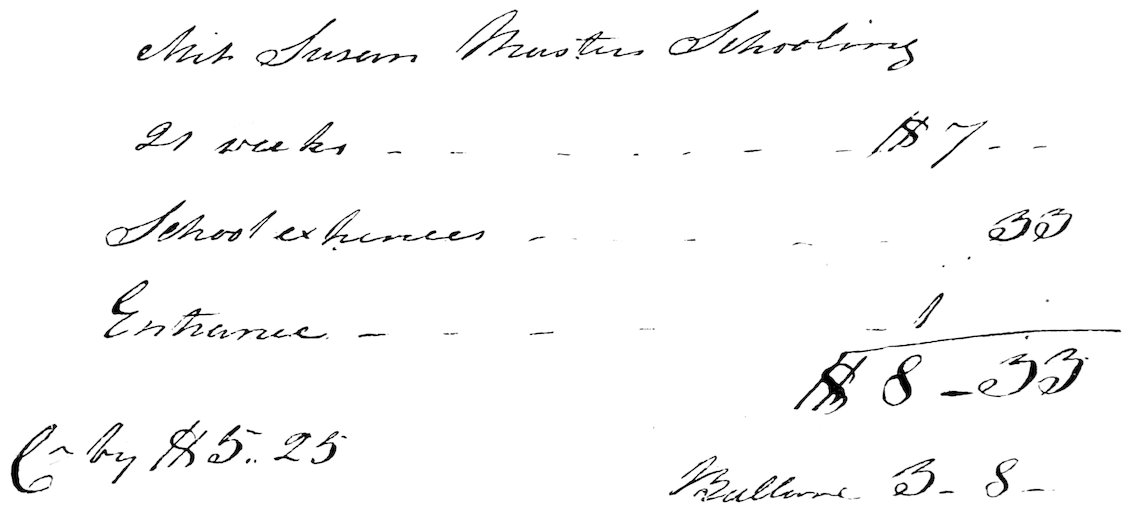
Pl. XV.—Facsimile of Bill, about 1805

81Sketches
of
Universal History
Compiled from Several Authors
For the use of Schools
Vol 1.
First Edition
New Haven
Printed by Joseph Barber
1811
Volume Second same title, date 1816, with list of subscribers.
Volume III same title. Printed by T. G. Woodward. 1817 New Haven No list
Volume IV. same title. Printed by T. G. Woodward 1818 New Haven No list
Preface from “Sketches of Universal History compiled from various authors, for the use of Schools, by Miss Sarah Pierce. Second edition printed by Starr & Niles, Middletown, (Conn.) 1823.” bound with Vol II which was “printed by S. S. Smith, Litchfield 1827.”
“Having from long experience found that children and youth imbibe ideas most easily, when placed in the form of question and answer, and not finding any historical work of that kind, of sufficient length to interest the mind, I have compiled these Sketches for the use of Schools, endeavoring to intermix moral with historical instruction, and to obviate those objections which arise in the minds of youth against the justice of God, when they read the wars of the Israelites.—I have attempted also to give them a general notion of the government of God, and of the truth of the Scripture, by a partial account of the fulfilment of prophecy. I am sensible that all this has been done by many able writers; but as their works are too expensive to be put into the hands of children, and of greater magnitude than they have time or patience to study, I have compiled this abridgment for their benefit. This history may also be useful in private families; which are not able to purchase the larger works from which it is selected.”
82Hartford May 9
My Dear Friend
In undertaking the instruction of my children in History, I am often reminded of the source from whence I drew my early historic knowledge I do not find any where a compend as satisfactory to me as are my recollections of your History all compends are generally so dry & devoid of interest that children are disgusted by them & Rollin & others are too minute and voluminous—yours as I recollect was a happy medium between the two—I write to know whether I could procure two copies from you for the use of my family—They can be sent to Hartford to the care of T. C. Perkins Esq. with a note of the price which I will cheerfully forward
As I live longer & see my children growing up around me I am often reminded of my early obligations to you & take pleasure in having this opportunity to express my sense of what I have gained from your early care—May God bless you my dear friend & grant you in his good time a joyful reunion with those friends of past years whose memory is precious alike to us all
Yours affectionately
H. B. Stowe
In addition to these histories the pupils were taught to make elaborate historical charts of which one of six feet in length is now in the Litchfield Historical Society. It was made by Miss Lewis, and is neatly and carefully drawn in ink and decorated with water-color. It begins with the creation and ends with George III. See Plate XX. Another historical chart was made by Eliza Ogden and is in the possession of her daughter. The subject is English History and embraces the Wars of the Roses, and here and there tiny pink and white roses are painted to indicate the relative positions of the houses of York and Lancaster (Plate XXIX).
Composition was made of great importance. The many copies of letters, poems, and addresses prove they were considered valuable steps toward good writing, and the high quality of the authors and quotations show that Miss Pierce laid much stress upon style in composition as well as exalted ideas.
The following list of prizes given about this time are interesting, as they bear upon this study, and are examples of the stilted elegance of style and the mournful subjects of that period:
83
PRIZE
Presented Miss Amelia Lewis for the first prize in her class. Litchfield April 28 1812.
S. Pierce.
God’s
Terrible Voice in the City.
Wherein are set forth the Sound of the voice, in a narration of the two dreadful Judgements of Plague and Fire, inflicted upon the City of London; in the Years 1665, and 1666.
By Thomas Vincent
Also a concise statement of the Origen of London with a Picture of its present state, from a late authentic Work.
Bridgeport: printed and sold by Lockwood & Backus, 1811.
PRIZE
Presented to Miss Jane S. Lewis as the Prize in Arithmetic. April 25th 1820.
A Sketch of my Friend’s Family,
Intended to suggest some Practical Hints on Religion and Domestic
Manners. By Mrs. Marshall, author of Henwick Tales.
Fourth Edition.
In every work, regard the Writer’s end.
Springfield
Printed by Ira Daniels. 1820.
The Hermit in London
or
Sketches of English Manners
Printed for Evert Duychinck
No. 68 Water Street
New York
1820
Present to Miss Jane H. Lewis as the first prize at school. October 31st 1820.
That Miss Pierce was fairness itself in awarding the prizes to her scholars is shown by the following report. She evidently invited some of the prominent ladies of the community to give the prizes instead of trusting to her own judgment.
84
REPORT OF JUDGES FOR PRIZE OF MERIT.
We, whose names are underwritten, having attended to the qualifications of the candidates for the prize of merit, in Miss Pierce’s School, are of opinion that Miss Clarissa Deming[38] is entitled thereto.
Litchfield, April 22d 1811.
Elizabeth Reeve.
Nancy Landon.
Hulda Sheldon.
Roxana Beecher.
Amanda Smith.
Mary Hubbard.
Anabella Reeve.
PLAYS BY MISS SARAH PIERCE.
The following are some of the plays Miss Pierce wrote for the amusement and edification of her pupils. They were usually given at the end of the school term, and the young men of the town were often invited to take part.
RUTH.
[From an unfinished manuscript in possession of the Litchfield Historical Society.]
Act 1st. Scene 1st.
Naomi. Ruth. Orpha.
(N) The circling year once [illegible]
The fatal day, which blasted all my joys
Which banish’d hope, the wretches latest compact
And black despair erect her empire here.
My loved daughters, well may ye remember
This fatal morn, black with impending woe
Which hid forever, the last ray of comfort.
Your hopes like mine fled like morning dew
Before the scorching blast of dire disease.
Then join with me once more, to weep this day
Fatal to love, a too maternal fondness.
85(Or)
My dearest mother why indulge this grief
Can plaints unbar the gloomy caves of death?
[illegible] prevail on that grim tyrant?
[illegible] lives back, to realms of day
Then dry thy tears and taste what happiness,
Remains on earth, to soothe thy evening hours.
Soon will the shades of night close on thy eyes
Soon wilt thou meet those vows too long bemoan’d.
Think of those friends those joys which fate has left
And give thy sorrows to the oblivious gales
Which waft o’er Leethe the souls to Pluto’s realms.
(Na) On youthful hearts grief makes a slight impression
But buries deep, within the breast of age
Its barbed darts; yet sure thou hast not forgot
That eventful day, big with impending woe
When pestilence, sent by heaven [illegible]
Walking in darkness, strew’d the [illegible]
Then Mahlon fell, my first born son expir’d,
My might, my glory, my defense lay low.
His brother’s arms entwined the lifeless corse.
He breath’d one sigh, cast one sad parting glance
Then fled his spirit, forth to worlds unknown
Your lives my sons, were transcripts of true faith
Lovely in life, in death dissevered not.
(Ruth)
Too well dear mother mem’ry paints that day
In bleeding characters within our hearts
[illegible] woes we bless the God of mercy
Who left us thee, returned the lamp of life
When the last ray, seemed quiv’ring to expire.
(Na) Why was I spar’d, when my lov’d children fell;
Why is my life prolong’d, in life of woe
No husband’s tears will fall upon my grave:
No child will lodge me in the silent tomb:
No friend will weep for sad Naomi’s fate.
(Or)
O say not thus, are not we thy children
Shall we not weep, to see Naomi low.
86When my ungrateful heart, forgets thy virtues
May tenfold vengeance blast its marble sinews!
(Na) Forgive the wrong, if aught escap’d I [illegible]
Which breath’d a thought reproachful of your love
The fondest heart could wish no kinder children
Children ye are all the proudest heart could wish
Nor could my sons, had Heaven seen fit to spare them
Nor could my sons had God preserved them to me
Have shewn more filial tenderness and love
’Tis not my loss alone, but yours, I grieve
’Tis for your fate as much as mine I grieve
That God’s avenging hand is raised against me
O! Israel happy land, why did I leave thee
Could not the hand which led our chosen ancestors
[ - - - illegible - - - ] of holy Sinai
[ - - illegible - - ] angel’s food the bread of Heaven
Which made their garments proof ’gainst time’s decay
Has given me food tho’ famine now around
I fear my heart distrustful of his power,
Relied too much on Moab’s fruitful plains.
(enter a messenger)
(Mess)
I bring good tidings to thee friend Naomi.
(Na) Tidings to me, Oh! what to me is good?
(Mess)
Our God hath visited our land in mercy
With lib’ral harvests crown’d our famish’d fields.
Our woes forgot we raise the song of praise,
And smiling peace and joy go hand in hand.
· · · · ·
(Na) O bless the Lord, who hears his peoples prayers,
And pours his mercies on his chosen race.
My soul shall magnify his holy name
And tho’ to me, the earth must be a [illegible]
I will rejoice, that others feel his [illegible]
Unmix’d with sorrow, unalloyed with pain [illegible]
I pray thee friend, dispose of all my goods
Thou know’st the art of traffic in this land,
87I Will repay each act of heathen kindness
Lest any one should reproach our [illegible]
I’ll pay what I owe in Moab
[ - - illegible - - - - - -
- - - - - ] then seek my native land.
Messenger.
[illegible] my least request.
Most willingly I’ll undertake the office.
(exit messenger)
[ - - illegible - - ] able age of comfort
[ - - illegible - - ] those who roll in wealth
[ - - illegible - - ] thy broken fortune
[ - - illegible - - ] within the mighty ocean.
[ - illegible - ] admits their abounding treasures
[ - illegible - ] no luxury to their full board
[illegible] their persons in one sumptuous dress
[ - illegible - ] cancel not my obligation
[ - illegible - ] no plea against the laws of justice
[ - illegible - ] should ever guide our actions
[ - - illegible - - ] on its basis.
Press’d by a famine in my native land
Thou knows’t my husband sought thy fruitful country
But heaven which erst, had bless’d our house,
Withdrew its smiles, misfortunes blighting touch,
Wither’d our store of wealth; by sickness press’d
Woe follow’d woe, with quick and dreadful speed
The stroke of death, first fell on my lov’d lord
My children next fill’d an untimely tomb.
Sorrow and pain hung heavy on my soul
And weigh’d me down even to the gates of death,
recal the long the painful hours ye watch’d
O’er my sick couch, the many tears ye shed.
And all the kindness of thy heathen brethren.
Then number o’er the many
· · · · ·
RUTH.
Continued from a second manuscript.
Orpha.
Why would you strip yourself of all convenience, to pay demands of those already rich. The remnant of thy fortune would not add one 88hour of luxury to their full board or deck their persons in one sumptuous dress. (Exit.)
Naomi.
Perhaps it will not. But does their wealth excuse, or form plea to evade the laws of justice? The sacred laws which ought to guide our actions, as every virtue rests upon its basis.
Pressed by a famine in my native land, thou knowest my husband sought thy fruitful country, but Heaven who liberally had crowned our stores, withdrew its smiles with’red our fortunes, blighted all our hopes. By sickness pressed; by woe on woe assailed; first my loved husband felt the stroke of death! My children next, sunk in the untimely tomb. the long, the painful hours thou hast watched o’er my sick couch, the many tears thou hast shed, and number o’er the many causes which destroyed our fortune:—and say,—has one unthinking or unjust expense brought on our poverty?
[illegible]
I know there has not. Then why deprive thy self of every comfort to pay demands, which stern necessity and sickness caused?
Naomi.
The very reasons which you name would urge it. Did they not trust my honor? a stranger’s honor? and should I fail in justice, then every wretch suffering like me, might justly blame Naomi, who taught to foreigners that Israel’s faith, was slight regarded among heathen friends.
No. It shall ne’er be said Naomi lives, in ease and plenty on the wealth of others. I’ll rather spend my latest farthing,—beg my passage to Israel’s faithful land—then to my brethren become a servant, and earn an honest pittance with these hands; than any tongue should say “Naomi wrong’d me.”
Ruth.
I pray thee take these ornaments useless to me, they will serve to [illegible] thy comforts.
Naomi.
No. I’ll not take thy bridal gifts away. I part with mine, for that our law demands; but keep thou thine for future times of sadness, or perhaps to deck a happier bridal day.
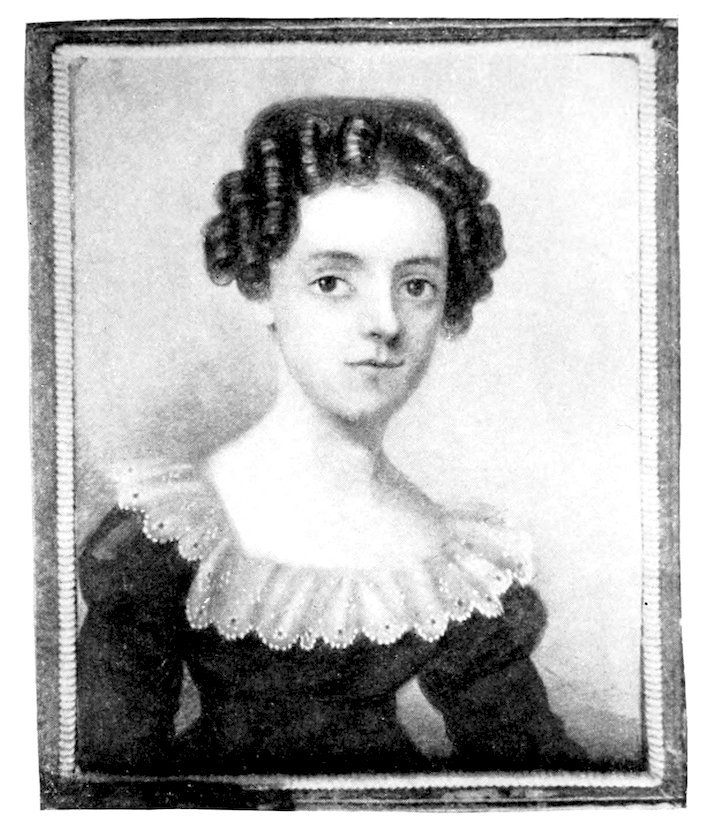
Pl. XVI.—Lucretia Deming, Pupil, 1816 From a miniature painted by Dickinson
89Ruth.
No. I entreat thee take them. Did I not help to spend upon thy fortunes? has not my sustenance procured by thee in rich abundance; lowered thy little stock? Or dost thou think so meanly of my love, that these prized jewels, given by my dearest Mahlon, can e’er be worn to deck a rival’s bride?—Take them I entreat thee! dearest mother!
Naomi.
I will not; cannot take them.
Ruth.
Then I will sell them to help thee on thy journey. I know my Mahlon would not blame the deed.
Orpha.
O! here are mine! Pray let them go together. The blush of shame would rise upon my cheek, to see these jewels shine in my attire, when yours are gone; and our loved parent lives by her own labor.
Naomi.
My daughters, ye oppress me with your kindness. If need require I will accept your offers; meantime let us prepare to make the journey.
Scene 2nd.
Naomi. Ruth. Orpah.
Naomi.
No. Go my daughters each to thy mother’s house. May God reward thee. May all the kindness ye have shewn my dear lost sons and me, be doubled to ye. May every anxious hour, which ye have spent, the tears ye have shed when we have counted o’er the months by woes, and chid the tardy sun, whose sluggard pace detained us prisoners in a wretched world; be reckoned o’er in new found blessings on your virtuous lives.
Ruth.
No. We will go with thee and share thy sorrows.
Orpah.
And relieve thy cares.
90Naomi.
Why will ye go? I’ve no more sons to give ye. In Judah’s land no honors wait Naomi; but cruel taunts from those who erst have looked, with pining envy at my happy state.
No kindly brother, no sister’s friendship will help to soothe thy lonely exiled hours. Here wealth, here honor yet may crown your days. Cherished by parents bless’d by prosperous fortune, whose kindly cares, will shield your youthful years from pinching want. Think you these hands, which now are all thats left me, can guard your tender limbs unused to labor, from hard oppression and the unfeeling scoffs, which full fed wealth pours on the unfortunate? No. Go my daughters, nor add to all my sorrows the severer pang of seeing you suffer with me.
Orpah.
My friend! my more than mother! must we then! ah! must we part?
Be witness Heaven I would not leave thee thus, could I contribute aught to soften thy sad fate. But I’ll not add another pang to those thou hast felt already. Adieu. Adieu. (Exit.)
Naomi.
See, thy sister has left me. Why not follow her?
Ruth.
O force me not to leave thee. My parent’s happiness is full without me. Propitious fortune with a lavish hand, scatters her stores of wealth and greatness on them. The joyous sun to them shines ever bright. The feast, the dance, the charms of sweetest music, beguile each care and open every sense to laughing pleasure, and her dangerous wiles. Meantime their gallant sons, and beautious daughters in the gay festive train compleat their joys. I love my parents with a daughters fondness; and gratitude recalls my helpless years, watched by their tenderness; their fostering care, rear’d my young frame; adorn’d my riper years with useful knowledge; guarded my steps from each contagious folly. But ’twas thou my second parent, who taught my mind the exalted charms of virtue;—freed my young soul from vain delusive worship of idol Gods; feared in my native land, and bade my hopes aspire, to serve that Being who fills creation with his boundless presence. And may his vengeance strike my guilty head, when I forsake thee: Poor—friendless—stricken through with grief and years. No. I will follow thee where’er thou goest; my hands shall learn to 91toil for thee my mother. Industry is the surest balm for grief. Thy God is mine. Thy people I will love. One house shall hold us and one grave contain.
Naomi.
O thou who viewest the smallest atom of thy vast creation; notest the most trivial act of little man! If I have e’er deserved a boon of thee, O! give it me in blessings on this child. Oh! may her virtues meet their full reward, and I can ask no more.
Scene draws.
Land of Israel.
Naomi: Ruth: a group of young maidens.
Ruth.
How blithsome seems yon troop of beautious maidens! What healthful pleasure lights each face with smiles! See: they advance.
Second Lady to her companions.
Pray who are those clad in a garb of sorrow? Could I believe my senses! ’tis Naomi, so justly famed for wisdom, truth and goodness, Elimelek’s wife.
First Lady.
Can—can this be Naomi? Yes it must be her. But say? what sad reverse of fortune brought thee here? alone, and bearing marks of wretchedness? If thou art indeed Naomi, pray inform me.
Naomi.
Yes ’tis she who once was justly called Naomi. The apparent favorite of indulgent Heaven; but now—a hapless widow, doomed to mourn, the untimely fate of all her dearest friends. Then let Naomi perish with her fortunes, and henceforth call this wretched being Masa; for Heaven has dealt the cup of sorrow to me, and I have drank its deep, its bitter dregs.
First Lady.
We sympathize, Naomi, in thy sufferings. But remember, the Almighty gave, and he may take away, and ’tis our duty to submit in silence, to adore his justice, and to praise his name, in deep affliction, as in days of bliss. But, come my friends; thou art weary of thy journey; come, rest thyself beneath our welcome roof, and thou shalt find a friend who yet can love thee.
92Naomi.
How sweet is kindness to a bleeding heart, torn by sharp sorrow; and unfeeling insult. Already have I met, even here, in Bethlem, with taunts from those I once esteemed most highly; but thou I find art still the same dear friend, and shrinkst not back at fortune’s withering touch.
First Lady.
Accursed be those who fail in time of need; and they are accursed by their own stubborn hearts; too hard to feel the force of generous friendship; of wiping tears from eyes o’ercharged with grief and lighting smiles upon the grief worn cheek. Come; I will lead thee to my dearest parents, whose joys, like mine will brighten at thy presence.
Naomi.
With gratitude I follow thy request, and see my daughter—the generous wife of my lamented Mahlon—has left her friends, her country and her Gods, to cheer her mother, and to share her fate. Let her, I pray thee, with me partake thy bounty.
First Lady.
Most willingly. I honor virtue, and am proud to meet her in a kindred form. Come, come with me, and once more taste repose.
Naomi: Ruth:
Naomi.
This is the place! O well known scenes! dear monitors of bliss forever fled! That field, rich with luxuriant harvest;—that beautious dwelling, now like myself in ruins; where curling vines in purple clusters twine, around its fallen columns, was once my own; my father’s once—A stranger now inherits it.
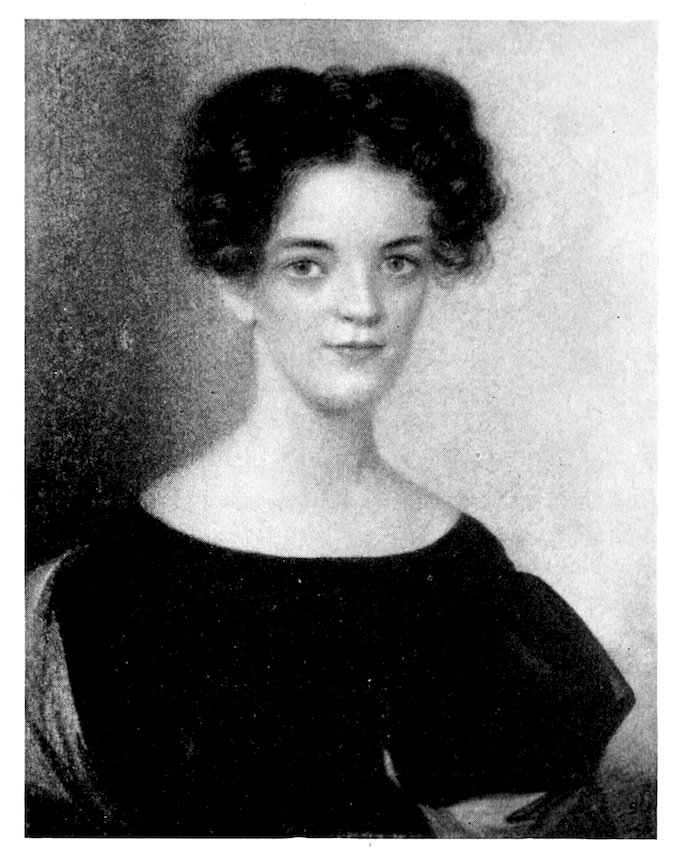
Pl. XVII.—Elizabeth Huntington Wolcott, Pupil, 1820
O, that I could recal past months! the days when God preserved me! when by his light I shunned the paths of evil!—O days! forever—ever flown; when Heaven’s best bounties courted my acceptance! Blest in my husband, blest with dutious children, my path with oil and honey overflowed! Thy daughters, Judah, bowed before my steps, and silent hung upon my flowing words; the aged rose whene’er I passed the gate; and blushing youth retired as I advanced. The poor, the stranger, bless’d my liberal hand; for wretchedness to me ne’er plead in vain. But now—as widow—desolate and poor, the rich forget me, and the poor deride. Even those who erst through 93fear, shrunk blushing from my view, with cruel insults and unfeeling taunts, add to my misery by sharp rebuke; and say “that’s she who once so rich and great; whom princes honored, and whom age revered; who, when distress assailed her native land, wandered to foreign climes, and other Gods; now desolate returned; struck by the Almighty, doubtless for her sins; bereft of all;—her sons and husband perish within a land of strangers. Thus fade the wicked, though their house be strong, when God, in anger brings their crimes to light.”
Ruth.
O could the boundless height of my affection, suffice to soothe the bitter pangs thou feelst!
What is the world? a vain, delusive bubble, and what are friends, who follow prosperous fortunes, but shrink before the stroke of poverty? poor heartless beings; unworthy of a sigh. Rather let those few worthies claim our thoughts, who sympathize with thee in all thy sufferings.
Naomi.
Thy virtue soars above the touch of woe. Thy friendship, sweeter than the dews of Hermon, and dear as incense from our holy altar, shall be my solace. Yes;—I’ll dry my tears, for they distress thee:—esteem our lowly roof more honorable than courtly domes—our coarse and scanty fare, more delicate than fruits of Lebanon—our homely garb—more precious than robes of princes,—and when our little stores are gone, the hand, which feeds the ravens, will send more.
Ruth.
O! praised by Heaven! who inspires thy soul with comfort! The frowns of poverty are light as air, when cheerfulness resides within the bosom. Industry unlocks a mine of wealth, to all who ope their hands to seize her favors.
I marked the fields. The reapers now, with busy hands are gathering their full harvests. I’ll go and glean, and for thy sake am confident of good.
Naomi.
Nay rather let us go. How will thy delicate hands, unused to labor, sustain the sultry heat of harvest. My older frame is now of little value; the soul which it imprisons, longs for flight:—and perhaps remorse may touch my kindred’s hearts, when they behold me, with those poor hands, picking the scanty ears from fields that should be mine.
94Ruth.
If ever I deserved a boon from thee! If leaving friends and country for thy sake, have gained a place for me within thy bosom! grant my request I pray thee!
Naomi.
If thou hast gained a place within my bosom. Be witness ministering spirits of mercy, how dear a place you hold in my affections! Name thy request, and thou shalt see it granted, even with the blood that mantles at my heart.
Ruth.
Then stay at home I pray thee. Spare thy grief worn frame from future toil. Art not thou all my stock of happiness? my only comfort in this distant land? Then guard the treasure with a jealous eye, lest I in losing thee should lose my all. What shame! what just derision would Judah’s daughters cast on Ruth, who sent her mother to the field to glean and staid ignobly idle here at home.
Naomi.
Then go my child, and Heaven prosper thee.
Ruth and a Company of Village Maids.
First Villager.
But say; what first informed thy reason? oped thy eyes, to own the same laws which guide our nation?
Ruth.
My mind was roused at hearing the miracles wrought for your ancestors. Oft while the wondrous theme flowed from Naomi’s tongue, I thought an angel spoke. When righteous Abraham offered up his son; when Godlike Joseph saved his cruel brethren; when Moses, snatched from the devouring flood, rescued the chosen race from haughty Pharaoh:—my heart approved, and wished to share their virtues; But when my astonished mind reviewed the miracles; the glory, power, and wisdom of Jehovah:—I saw our Gods were impotent to save—the works of men and spirits of darkness—I scorned their worship, and from that moment prized Naomi far above the reverend forms to whom I owe my being.
Enter Rebecca. All the maids rise.
95Rebecca.
The sun has hardly past his midday path, retire not therefore damsels. I have come to enjoy with you the innocent mirth, which healthful labor only knows. Let not my presence check your decent joy, but let the song the tale, again go round.
First Villager.
We were listening to a tale of virtuous woe; the history of this worthy Moabite.
Rebecca.
I have heard her story, and admire her virtue. (to Ruth) May God a recompense on thee bestow, for all thou hast left, and make this country dearer than thine own.
Ruth.
Accept my thanks. Tho’ words are poor to express my gratitude, for all this kindness shown a stranger.
Rebecca.
Thy merits claim it all. But say. Does no heart rending sigh affect thy bosom, for those dear friends thou hast left and left forever?
Ruth.
My heart oft wanders to my friends and parents, and could my wishes bring them to thy country, or bend their faith to thy most holy laws, my happiness would be too great for mortals. But now I cannot wish myself in Moab, lest softening luxury and their persuasion, should wean my heart from all those sacred duties I owe my God, and my best friend, Naomi.
Rebecca.
(Aside.) Angelic woman! she far exceeds my son’s description of her. (to the maids) Take lessons from her, O ye maids of Judah! who so oft forget your duty to the Lord! his daily gifts remind you of his goodness.—I thought I heard a soft, melodious voice, warbling sweet music as I passed this way. It would much delight me would you sing again.
Second Reaper.
It was Ruth who sang to please your noble son, when tired with labor, he reposed awhile, and entertained himself with our discourse.
96Rebecca.
I thought to have found him here when I came in. Say will you sing again to please a friend, warm in affection, though of sudden growth?
Ruth.
Alas! my voice so long attun’d to woe, but ill accords with harmony. But my poor talents are ever at command, when worth invites, or friendship sues.
Ruth sings.
Tho’ tender and young, my fortune is gone,
My husband I’ve lost to increase my sad moan.
A gleaner alas! to the fields I must go.
To ask of the swains some relief from our woe.
My story would soften the heart of a churl,
O pity a hapless girl.
2nd.
The blessings of plenty press your basket and store
Then distribute those gifts to the stranger and poor;
Your friends too smile round you, but I to my cost,
Now reckon them o’er by the tears for their loss.
My story &c.
3rd.
Tho’ a wanderer from my country I roam,
From the blessings of plenty, and the pleasures of home,
Yet Naomi’s fond love would repay all my care,
Could I chase from her mind the mists of despair.
Her story &c.
4th.
Then steel not your bosoms against my sad tale
But think on my years; they will surely prevail—
My tears kindly dry, and O may you ne’er know,
The horrors of want, or the heart ache of woe.
Our sorrows &c.
Rebecca.
A thousand thanks my charming friend. I will no longer keep thee from thy labor.
(Scene draws)
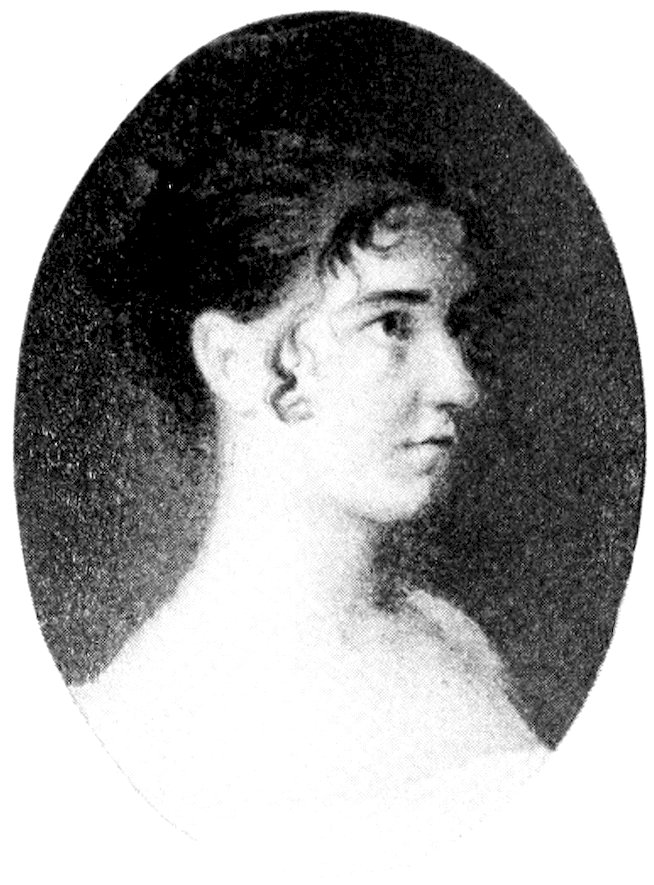
Pl. XVIII.—Maria Tallmadge Daughter of Colonel Tallmadge, and wife of John P. Cushman, of Troy, Pupil, 1802
97Naomi alone.
The sun has almost reached his western gate. My child will soon return. How slow the hours move by when she is gone. I feel my heart begins again to know, a mother’s fondness, and a mother’s fears. Ah! let me check this growing love, lest it should ope new springs to wound my peace.—But cease my vain repining. What! Shall we from Heaven’s grace receive the cup of bliss, and yet our share of ill refuse? and are afflictions aught but mercies in disguise? the alternate cup; medicinal, tho’ bitter? and by love’s own hand, for salutary ends administered?
But were these ills indeed;—can fond complaint arrest the wings of time? Can grief command that setting sun, to roll his flaming orb back to yon eastern coast, and bring again the hours of yesterday? or from the dark, cold grave, the buried corse restore to light and life?
Blessed spirits farewell! Yet, yet a few short days of erring grief; of human fondness sighing in the breast, and sorrow is no more.—The evening hour comes on. How mild! how grand! On yonder hill I can enjoy its beauties, and meditate more fully Heaven’s beneficence. (exit.)
Enter Ruth with a basket.
Ruth.
Naomi is not here! Where shall I find her? (sits down her basket and enter two women)
First Woman.
Boaz commanded that we bring you this.
Second Woman.
And begs you would always glean within his fields, and ample harvests shall repay your toils.
Ruth.
Reward him, God of strangers, for his goodness!—Tell him Ruth thanks him for this kindness shown her, and prays Naomi’s God may bless him too.
(the two women go out)
Why is my heart so pleased with this days labor? His flattery oped an avenue to love. Oh! Mahlon! Am I growing cold to thee? To the dear day that weeps thy sacred dust, I vowed a lasting fond remembrance (sings) I have a silent sorrow here &c. O Boaz! Boaz! 98why so like my Mahlon? If ’tis a crime to love thee! O! thou sole arbiter of fate! Thou God supreme, all just, all wise, who bidst what still is best in cloud or sunshine; whose severest hand woundst but to heal, and chastens to amend! Correct my heart, if any wrong desires, unjust sensations cause this tumult here!
(enter Naomi)
Naomi.
Welcome my daughter! Thou hast soon returned, and amply loaded. Heaven has sped thy efforts, and moved some generous heart to assist thy labors. Say: to whose liberal hand my thanks are due?
Ruth.
Boaz he is called, whose goodness crowned my labors, whose humane heart pitied a stranger’s fortune.
Naomi.
O God of Abraham! shower thy blessings on him, and double all this kindness on his head. I know him well. He is near of kin to us, once with my sons was linked in sacred friendship.
Ruth.
I thought I viewed my Mahlon’s likeness in him. The same his manly port and dignity, tempered with smiles of sweet benevolence. He bid me seek no other field but his, and promised liberal harvests to my toils. I thanked him for this kindness shewn a stranger, he praised me for the love I bear thee, and said ’twas for thy sake he noted me.
Naomi.
Follow his counsels as thou wouldst a brother’s. Remain fast by his maidens, nor let them meet thee in another’s field. So shall his friendship make our lives as happy as any earthly fortune now can make them.
(enter Rebecca)
Rebecca.
All hail, Naomi! Welcome to thy country, and still more welcome; for bringing this sweet damsel. My son, struck by her charms, and still more by her virtues, solicits your consent and hers, to make him happy. (to Ruth) Say, will thy heart, where sweet compassion reigns, where noble friendship sheds its purest light; consent once more to wed a son of Judah, and add new honors to our chosen race?
99Naomi.
Ah say, my daughter! Wilt thou make him happy? this generous man, this most deserving kinsman. I prayed that Heaven would shower its favors on him, and could it bless him more than by giving thee?
Ruth.
I once believed no second vows would win me or charm my heart, from the lost lord [- -illegible- -] my fond affections; but my lord [- -illegible- -] seemed returned once more, when [- -illegible - -] my eyes gazed on the noble Boaz. his liberal hand bespoke a generous heart, and I with pride and pleasure shall accept, a second husband from God’s chosen people.
Rebecca.
Thy sweet compliance wins my best affections, and I will haste to make my son most happy.
(music)
SONG SUNG AT MY EXHIBITION IN PLACE OF THE FIRST HERE.
I
Sons of Judah hear a stranger!
Deign my sorrows to remove;
Music! aid a hapless gleaner;
Tune their hearts to deeds of love.
Peace and plenty on thee shower;
Want attends my day of woe.
I have tasted pleasure’s power,
More the depths of grief to know.
II
Then in pity soothe the gleaner!
Let not age implore in vain.
I’ve a mother, had you seen her
[-illegible-] you’d give the golden grain.
[-illegible-] the smiles of fortune cheer’d us;
[-illegible-] and friendship bless’d our board.—
[illegible] long since those tongues that jeer’d us,
[illegible] have trembled at a word.
100III
Oh! how fallen is the gleaner!
Pity then a stranger’s fate.
Though I’m poor, I might be meaner,—
Vice doth near my steps await.
Stranger hast thou tasted sorrow?
No. Thy heart forever gay,
Lookst with hope upon tomorrow,—
Yields itself to joy this day.
IV
Wealth is thine and friends and power—
All which earth or Heaven can give
Whilst round us misfortunes lour—
Gleaning all our means to live
Poverty will wound the keener,
More the use of wealth we know:
Pity then the hapless gleaner
Pity, and thy gifts bestow.
THE TWO COUSINS.
Mrs. Leyster.
Constantinia. } her two daughters.
Helen. }
Alicia, their cousin.
Mrs. Sydney.
Harriot.
Constantia.
Alicia.
Mrs. Leyster.
Mrs. Sydney.
Harriot.
M. Peck.
C. Rockwell.
Mrs. McNeil.
M. Hoffman.
M. Beecher.
Scene I.
(Mrs. Leyster and Constance.)
Mrs. Leyster.
My dear Constance, young as you are, I hope and believe I may depend on your prudence. I am a happy mother, in being able thus early to place a confidence in my child!
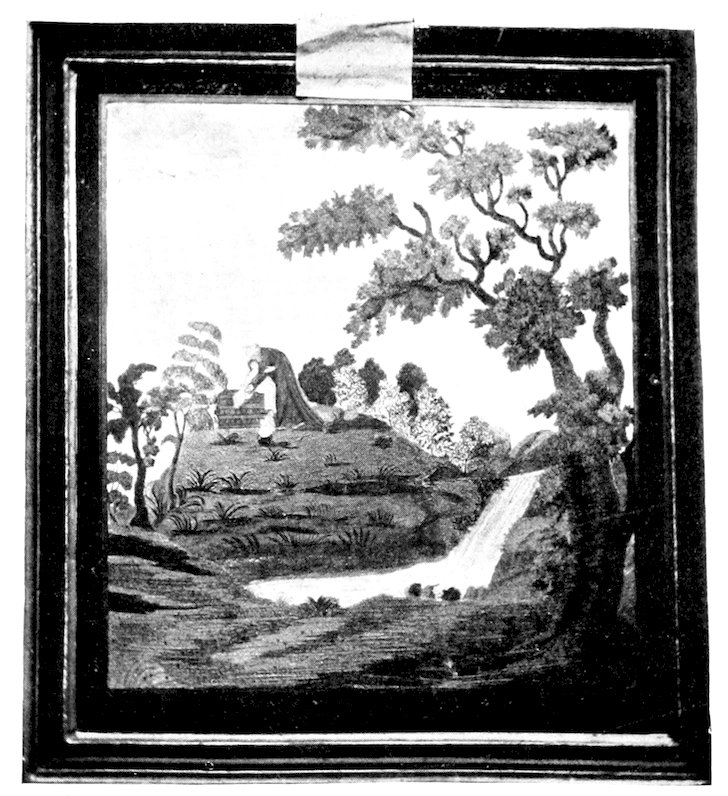
Pl. XIX.—“The Sacrifice of Isaac” Partly embroidered in chenille, and partly painted in water-colors, by Zerviah Miner, Pupil, 1823
101Constantia, (kissing her hand with tears in her eyes.)
Oh, Mama, never, never will I abuse it; my heart promises, and you may depend upon that heart, which owes not only the power of keeping a secret but everything it owns of goodness to you!
Mrs. Leyster, (affected.)
My dear child!
Constantia.
But Mama, I hope I am not inquisitive, but you seemed to say you would tell me—
Mrs. Leyster.
What disturbed me; I will, my dear, indeed I will read to you your Aunt’s letter.
(Mrs. Leyster, reading a letter.)
My system of education I find at last to be erroneous. Alicia has deceived my expectations; she has been imprudent and disingenuous; I should be very miserable if I thought her faults proceeded from the heart, as it is I am truly unhappy. I gave her a yearly allowance for clothes and pocket money, upon a solemn promise that she would never purchase anything without immediate payment. For the first quarter, she bought many expensive trifles and was in want of many necessary articles. I remarked on this folly, and hoped she had corrected it. I was myself guilty for not inspecting her accounts. For some time past, I have observed her to be greatly dejected, and discovered that she had run greatly in debt; this has been partly owing to her intimacy with some extravagant girls, who ridiculed her scruples. I wished to break this connection, and wish you, my dear sister, to take charge of her for six months. I know your affectionate heart will not refuse me this favour.
Constantia.
My dear mama, I hope you intend to receive my cousin; poor Alicia, how I pity her. Don’t you think Mama, she will be happy here in the summer?
Mrs. Leyster.
No my dear, although she is but thirteen, she has been introduced, by a mistaken indulgence, into company; she has acquired a relish for dissipation; and lost the desire, which young people naturally have, for the charms and liberty of the country. But your cousin will be here tomorrow; we must endeavor to make the country pleasant to her.
102Scene II.
(Alicia and her maid Betty.)
Betty.
Pray, Miss, I understand you are going into the country to your Aunt Leyster’s; how long may you be going to stay?
Alicia.
Longer than I like, I assure you, Betty. My mama is determined I shall stay six months.
Betty.
Six months, why you will be moped to death. I wonder my mistress thinks of taking you to such a place.
Alicia.
I shall have a melancholy time indeed, for their is no saying any thing to Mamma. I never saw her so obstinate in my life.
Betty.
To be sure, madam Leyster is a good sort of a woman. But la, Miss you will be tired to death. Why, they say, she does nothing from morning till night, but read the bible and say her prayers.
Alicia.
And do you think that is true, Betty?
Betty.
To be sure I do. Why, they say, Miss, that Madam Leyster has never been in London, since the death of the Colonel, but once, and that was at your christening. So you may be sure that she is an oddity.
Alicia.
Then she has no card parties.
Betty.
Card parties, la, bless you Miss, I dare say their’s not a house within six or seven miles of her.
Alicia.
Well, I shall have a charming time of it, but their’s no persuading Mama. I don’t know what’s come to her; so you may pack up my 103things, let’s see. I shall take my pink lutestring, and my blue satin slip; then there is my spotted book muslin, and my fine jaconet with sprigs; as for the striped muslin, you will not forget that.
Betty.
La, Miss, what will you do with so many clothes?
Alicia.
I desire you to put up all that I mention, and don’t forget my hat with the white feathers. The only entertainment I shall have will be the pleasure of dressing and undressing myself.
Betty.
Very true, Miss—
Alicia.
I felt quite bad enough when I was at school, and I am sure I shall feel ten times worse, now I am agoing to my aunt’s. Oh, Betty, don’t forget to run to the library and ask for those twenty volumes of new novels that I have bespoke, and tell the librarian to put in a dozen plays beside.
Betty.
Yes, Miss.
Scene.
(Alicia and Constance.)
Constance.
How should you like to employ yourself, cousin?
Alicia.
It is indifferent to me.
Constance.
Are you too much tired with your journey, to take a stroll in the garden? We shall have yet a light half hour.
Alicia.
Yes, it is early to have done tea.
Constance.
In London, I suppose you are later?
Alicia.
Oh dear, yes; we have never done tea there till between eight and nine.
104Constance.
Then what hour do you sup?
Alicia.
That depends on where we are. My mother is early, we sup before twelve. The Seymours never till near one; and if one is at a ball, three or four is the usual hour.
Constance.
Why, then you must lose half your day in bed.
Alicia.
Oh, we rise as early as other people. It is of no use to be up before one’s friends are stirring.
(Enter Mrs. Woodford.)
Mrs. Woodford.
Miss Alicia, I am about returning to London. Have you any message to send to your mama?
(Alicia crying, but does not speak.)
Mrs. Woodford.
Have you any letter written?
Alicia.
I will write soon.
Constance.
You may have some particular message to say to Mrs. Woodford. I will leave you.
(Exit Constance.)
Alicia.
Oh, Mrs. Woodford, you will soon see London and my dear mother, and I am left in this horrid place.
Mrs. Woodford.
Don’t weep my dear, your aunt is a charming woman and you will soon be very happy in the country. Good morning; I shall tell your mother that I left you well.
(Exit Mrs. Woodford.)
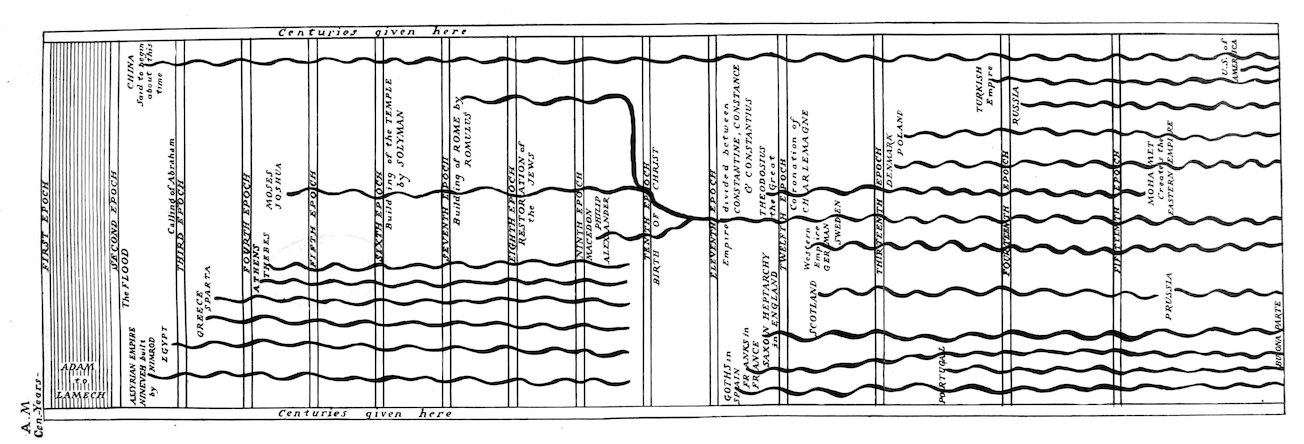
Pl. XX.— A Chart of the History of the World, by Mary Ann Lewis The original is 6 feet long and 1 foot 9 inches wide. The centuries and years are given down the sides, and the names of the emperors, kings, queens, etc. are inserted in their proper places along the curved lines
105Alicia, (walking about and crying.)
Happy in the country! That is impossible.
(Enter Constance.)
Constance.
Dear cousin—
Alicia.
Have I not even the privilege of being alone? I am not used Miss Leyster, to be thus intruded upon! Ah, I am indeed very little used to anything I can expect to meet with here!
Constance.
My dearest cousin, I beg you to pardon me, if I am an intruder. I came to see if I could do anything to comfort you; but if you wish me gone, I will leave you, but why should you wish it? Suffer me to be your friend; suffer me if possible, to make you happy!
Alicia.
You are very good; better than I either expected or deserved. You know I have much to lament; leave me, pray, my dear, I will soon come down.
Scene III.
(Constantia, and Alicia, Mrs. Leyster, Mr. and Mrs. Sydney. Mr. Sydney writing at a desk.)
Mrs. Sydney, (speaking to a servant, who enters.)
Tell Edward and Harriet, their little friends have come. I am sorry, Mrs. Leyster, you did not bring Helen; she is nearer my daughter’s age, than Constance.
(Enter Harriet Sydney, running into the room.)
Harriet.
Mama, Ned says he won’t come!
Mrs. Sydney.
Very pretty indeed! Pray what is he doing?
Harriet.
He is making a cart, and when it is done, we are going to draw it about the court, full of stones.
106Mrs. Sydney.
We! What, have you been helping him?
Harriet.
Yes, I have, and you cannot think how droll it will be.
Mrs. Sydney.
However that is, you will please to sit down now. Don’t you see Miss Leyster, and here is Miss Wyndham her cousin from London.
Harriet (advancing with her head poked down and her finger in her mouth.)
Mrs. Sydney.
Do, Mr. Sydney, speak to her! Do you see she does not mind me?
Mr. Sydney.
How now, Miss! What’s here to do? Why don’t you do as your mother bids you? I shall take you in hand presently, if you don’t behave better. Don’t speak to her, Miss Wyndham; she is not worth your notice.
Harriet sidles into a chair, with her finger still in her mouth, and muttering says.
How d’ ye do, Miss?
(Enter young Sydney, crying.)
Mr. Sydney.
What’s the matter Ned? What do you cry for?
Ned.
O! my mouse! My mouse!
Mr. Sydney.
Well, what’s the matter with your mouse?
Ned.
Oh, Papa, Jack Williams has snatched it away!
Mr. Sydney.
Jack Williams snatched your mouse away? I’ll Jack Williams him, a young rascal! Where is he?
107Ned.
Run down the lane, Papa!
Mr. Sydney.
Come my dear, don’t cry, and I’ll soon fetch it back again. If Mrs. Leyster will excuse me for a few moments.
Ned.
And I’ll go too, Papa, and give him a good threshing; when you are there, he won’t dare to strike again.
(Exit.)
Mrs. Sydney.
Harkye Ned; bring none of your nasty mice here. I hate the very sight of them. Don’t you want to go, Miss Harriet? I suppose you would help your brother beat Jack Williams.
(Harriet looks sulky.)
Mrs. Sydney.
Harriet, will you take Miss Leyster and Miss Wyndham into your playroom, but I suppose you have done with toys, now, young ladies.
Mrs. Leyster.
Constantia is always happy to do whatever her young companions like.
Mrs. Sydney.
Ay, ma’am, you seem very happy in your children; I am sure I can never keep mine in order, though I believe I take as much pains and scold them as often as anybody.
(Scene changes to a playroom; Harriet, Constantia.)
Harriet.
How cross Mama is! She always scolds so when anybody’s here. Don’t you think she is very ill natured?
Constantia.
Pardon me for contradicting you; I do not think so, indeed.
Harriet.
What, not ill natured to hinder me from doing the cart when it would have been so nice and so pretty?
108Constantia.
Probably she thought you would overheat yourself; beside, she wished me to have the pleasure of talking with you.
Harriet.
Oh, but she knows I hate to sit stuck up with the company. I don’t so much care, now you and I are together; but you looked so grave when I came in, I thought I should not like you. I am sure if I had been you, I should have laughed!
Constantia.
At what should I have laughed?
Harriet.
Oh, to hear Mama scold so, and to see me look so like a fool.
Constance.
Indeed, I was very sorry; it is such a sad thing to incur the displeasure of ones mother.
Harriet.
Oh, not at all; I don’t care, she won’t say any more to me; and if I had cried then, I knew she would let me go; but I was ashamed because you and your Mamma were there, besides, I was a little afraid of Papa. Does your papa humour your brother more than he does you?
Constantia.
I hardly know what you mean; Papa humours neither of us.
Harriet.
Why, he looks very good natured.
Constantia.
He is indeed, much too good natured to humour his children; he is uniformly kind and indulgent when we behave well, and constantly strict and resolute when we deserve his displeasure.
Harriet.
Well, that seems very odd! As to Ned, Papa never contradicts him nor Mama neither; but he does me and is as angry as can be sometimes.
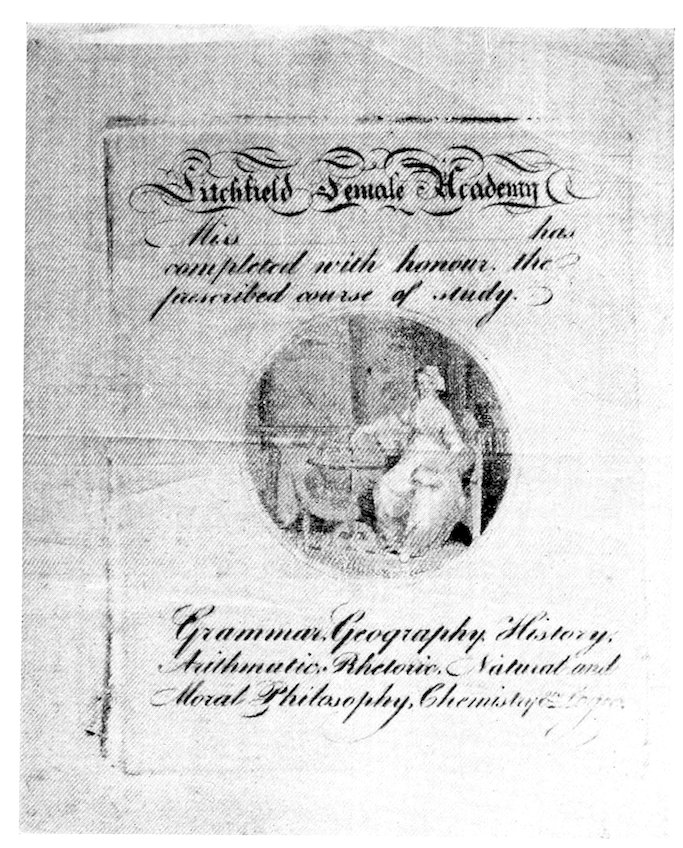
Pl. XXI.—First Known Diploma on Twilled Silk Probably engraved by Tisdale
109Constantia.
What a pretty bird! It is a goldfinch, I see.
Harriet.
Yes, and a fine songster, I assure you.
Constantia.
Did you take him from the nest?
Harriet.
No, he was about a year old when I had him. Ned caught him in a trap in the winter.
Constantia.
Poor thing was he not very uneasy when he was first confined?
Harriet.
Oh, I don’t know; he used to flutter about sometimes, but we did not mind that.
Constantia.
He is very tame now; he does not seem at all disturbed when I stand by the cage.
Harriet.
That is because he does not see you.
Constantia.
Not see me! How is that?
Harriet.
Because he is blind.
Constantia.
Blind! Ah, poor little creature. By what accident did that happen?
Harriet.
No accident at all; Ned did it on purpose.
Constantia.
On purpose; oh, how could he be so cruel?
Harriet.
He did it to make him sing the better, with a red hot knitting needle.
110Constantia, (pale and shuddering.)
Oh, how shocking. Were you not grieved?
Harriet.
Not I; I liked it, because it is my bird. If I had not liked it, it should not have been done, I promise you.
Constantia.
Is it possible you should have given your consent? Oh, if you knew how melancholy it is to be blind!
Harriet.
La! Why a bird does not mind, you know.
Constantia.
Not mind! Do you think, then, they do not feel? Do you think they have no pleasure in seeing the light? Why then, do they sing when it first dawns?
Harriet.
Oh, that is because it is natural to them.
Constantia.
Yes, to rejoice in the daylight! Ah, poor little wretch! Would I could restore you to sight!
Harriet.
But you cannot think how much better he sings!
Constantia.
I should not wish to hear him; I should think every note a melancholy expression of his sorrow, or a reproach to me for having caused it.
Harriet.
What odd notions you have! Where did you pick them up?
Constantia.
If you mean the notion of hurting no creature whatever, I gained it, as I did all I know, from my father and mother.
Harriet.
Well, I declare I am sorry; but nobody ever told me it was cruel, so how should I know?
111Ned. (without)
Harriet, Harriet, come here. I have something droll to show you. The cat is playing with a mouse.
(Mrs. Leyster, Alicia, Constantia and Helen. Constantia seated at a table, drawing.)
Alicia.
Cousin, do you draw?
Constantia.
A little, but I am very fond of it.
Alicia.
So am I, though I have not practised lately; if you will give me a pencil I will try.
Constantia.
Oh, willingly.
(They sit down to draw.)
Helen.
Come, Constance, tell us what you did at Mr. Sydney’s last night.
Constantia.
Nothing agreeable, I can assure you. I went with Miss Sydney into her playroom, but her books were torn to pieces, and then we came back into the drawing-room to see the cat play with a mouse.
Helen.
The cat play with a mouse; but did she not hurt it? Mama always says “poor thing” when old Tom catches one.
Constantia.
Oh yes, she hurt it enough, I believe, but they did not mind that, as Miss Sydney said, when I asked her if her goldfinch was not unhappy, when they first confined him.
Helen.
Not mind hurting anything! I fancy this Miss Sydney is not very good!
Constantia.
No, truly, for if you had been there, when she first came into the room!
112Helen.
Why, what did she do?
Constantia.
Her hat was half torn off, her hair was tangled, and her face was dirty; and she came in bawling, just like this, (mimicking) “Mama, Ned says he won’t come.”
Alicia, (laughing)
Ah! that is just like her, with her arms swinging and her mouth open.
Helen.
But did she not speak to you.
Constantia.
No, nor to Mamma, neither; and then she almost cried because she wanted to help her brother to make a cart!
Helen.
To make a cart! Was that a proper employment for a young lady?
Constantia.
No, indeed! and when she was told to speak to me, she came with her head poking down, and her finger in her mouth, muttering so, “How d’ ye do, Miss?”
Helen.
Oh dear, how strange!
Alicia.
Ah, that is exactly her; but now, Constantia, tell us how she looked when her mamma asked her, if she would not like to help her brother beat Jack Williams.
Constantia.
Oh, she pouted out her lips so; then she crammed her fingers into her mouth; and then leered round to see if I was looking at her! But, Alicia you remained in the parlour, how did Mr. Ned get his mouse again?
Alicia.
Oh, you never saw such a cowardly fellow; when he overtook the boy and found the mouse’s leg was broke, he beat and scratched the boy without mercy and the boy durst not return the blows because Mr. Sydney was by. At last Mr. Sydney said, “Come away, Ned, 113let him alone now; but if he affronts you again, I will horsewhip him handsomely.” “Do it now, Papa,” said Ned, “Do it now!” and Mr. Sydney never told him he was wrong.
Mrs. Leyster.
In telling us that, Alicia, have you not told us the very reason of Master Sydney’s behavior?
Alicia.
What, that his father did not teach him better? Yes, I believe so!
Mrs. Leyster.
Tell me, then is he most an object of ridicule or pity?
Alicia, (after hesitating a moment.)
Of pity, to be sure!
Mrs. Leyster.
And Constantia, do you not think the same cause may have produced the same effect in Miss Sydney?
Constantia.
Yes, Mamma, for she said nobody had ever told her it was wrong to torment her bird.
Mrs. Leyster.
Then why have you ridiculed her?
Constantia.
I—I—did not mean any harm, Mama!
Mrs. Leyster.
Did you not mean to make her appear an absurd, ridiculous character? Did you not mean to make your cousin and sister laugh at her?
Constantia.
Yes, Mama.
Mrs. Leyster.
Could you have done her a greater unkindness? In making people ridiculous, we injure them extremely. If your cousin and sisters were to hear of Miss Sydney ten years hence, they would connect with her name the awkward, disagreeable idea you have given them of her character. They might unguardedly express the opinion they 114had formed of her to others, and thus punish her for faults she had long since corrected. Do you perceive to what an extent this might injure her?
Constantia.
I have indeed been very wrong. I beg of you to forgive me.
Mrs. Leyster.
I allow that Miss Sydney’s conduct was very blameable and therefore to me, in whom you have a perfect confidence, I admit you to remark upon it, but not with ill-nature or severity. I expected from the goodness of your heart, pity and generous allowance for the faults of Miss Sydney, who wants the advantages you are more happily possessed of. Do you believe that without better instruction and example, you would have conducted better than Miss Sydney?
Constantia.
Oh, no indeed, I must be both ungrateful and presumptuous if I could believe it.
Mrs. Leyster.
Personal ridicule, in general arises from envy or ill-nature, a mean desire of lowering those virtues we cannot reach, or a mean vanity of exposing those follies from which we feel ourselves free. Who is there in whom nothing ridiculous can be found?
Constantia.
I see, Mamma, I have committed a great fault. Will you forgive me?
Mrs. Leyster.
Since you have not been wilfully and obstinately wrong, I forgive you. But you must remember mine is not the only forgiveness you must seek.
Constantia.
Miss Sydney’s, you mean, Mama?
Mrs. Leyster.
No, that would wound her feelings. But do you remember who has said, “Do unto others as you would wish others to do unto you?”
Constantia.
Yes, I see how very guilty I have been and I pray God to forgive me.
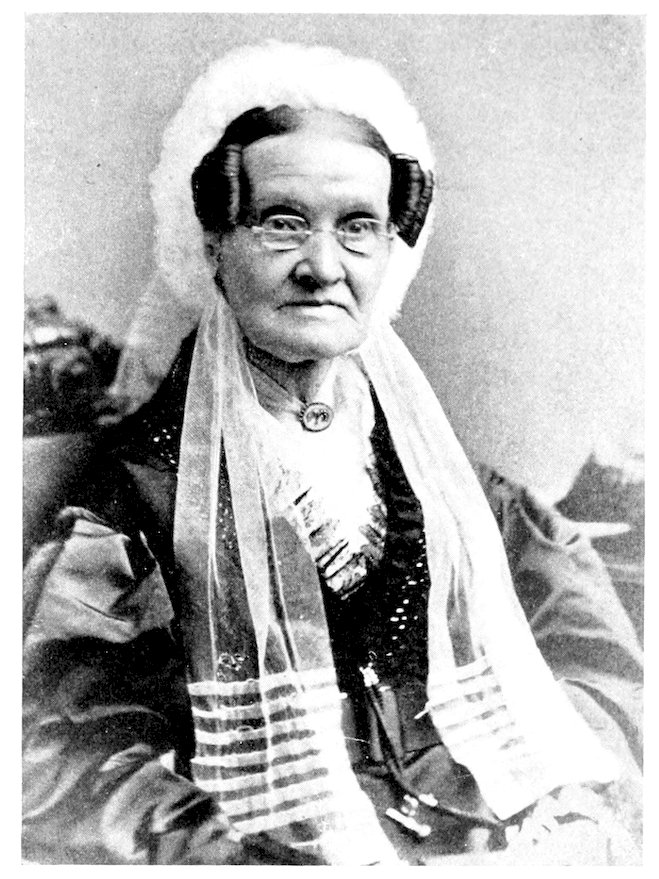
Pl. XXII.—Mrs. Punderson, Pupil
115Helen.
Permit me to observe, since I do not do it from perverseness, on what you said, what is there ridiculous in you?
Mrs. Leyster.
You pay me a great compliment, Helen, which for once I will accept. But you will perhaps scarcely believe so striking a picture was once drawn of me, by a young mimic of my acquaintance, who was not aware of my seeing her, that I could not help laughing at it myself. My little cough, the trick I have of leaning my head forward, and the slow manner I have in talking, were imitated and made to appear ridiculous.
Helen.
Oh, Mama, but these are not ridiculous.
Mrs. Leyster.
Not in themselves perhaps, but by a little exaggeration which a true mimic never spares, they become so.
Constantia.
Oh Mamma, what an odious character. I shall never mimic anybody again.
Alicia, (during this scene, is greatly affected.)
Constantia.
My dear cousin, what is the matter with you?
Alicia.
Nothing.
Constantia.
Alicia, that cannot be.
Mrs. Leyster.
My dear child, compose yourself, and don’t strive to conceal an emotion, which does you so much credit. You have been affected by the reproof I have given Constance. Is it not so?
Alicia.
Oh yes ma’am, it is so like I have been, so faulty, so absurd.
Mrs. Leyster.
Since you feel that my dear girl, you sufficiently prove that your heart was not wrong.
116Alicia.
Ah madam, you are very good, you read my heart and I am afraid you despise me; you must, for I have shown such contempt of all that is rational.
Constantia.
Dear Alicia, I am sure Mama loves you.
Mrs. Leyster.
To own an error is the surest sign of amendment.
Alicia.
How good you are to encourage me. Yes, if you can forgive and love me, I shall be happier than I have ever been.
Mrs. Leyster.
We cannot be happy with a sense of an error in the heart, however stifled by pride. Shall I tell you, my dear niece, in what respect I think you most blameable?
Alicia.
I shall be willing to hear and I hope to amend.
Mrs. Leyster.
I have avoided hitherto, my dear, speaking of the cause which brought you here; till I could gain your confidence, till Constantia could gain your love. I hope you now consider her as your sister and me as your maternal friend.
Alicia.
Ah, if you will permit me.
Constantia.
Oh, my dear cousin, what joy you give me.
Mrs. Leyster.
Henceforth, I hope we shall be happy in each other. Permit me then, my dear girl, to tell you, you have never seemed sufficiently sensible of the fault which brought you here, till this morning. Am I deceived, or may I attribute the tears you have shed, as tokens of sorrow for having betrayed your mother’s confidence?
Alicia.
No my dear aunt, you are not deceived. When you reproved Constance for a slight indiscretion compared to mine, I felt how greatly 117I had offended my affectionate mother, whose forgiveness I never sought, but with sullen pride, left her reluctantly.
Mrs. Leyster.
There is yet one thing of which I fear you are not yet fully sensible. I mean the fault of contracting debts.
Alicia.
But—you think—perhaps—
Mrs. Leyster.
Hear me, my dear. In the first place, the allowance your mother made you, was really an ample one. Even if it had not been, as she who knew what you could afford to spend, thought it such, you had no right to exceed it. To be happy, we must learn to live within our income. Not only justice requires this, but our own comfort, for nothing can be so harassing as a consciousness of owing what we have not been able to pay.
Alicia.
Oh, I am well aware of that, but I knew I should be able to pay at some time or other.
Mrs. Leyster.
Yes my dear, but consider if everybody acted thus; those you employ would have no ready money to pay those who work for them. Many poor persons, who live by their daily earnings, must perish with want. Add to this, you pay more than you ought for every article and are entirely precluded giving anything in charity.
Alicia.
Pardon me, dear aunt; I always gave a little out of what I had.
Mrs. Leyster.
But what right had you to give money, which of right belonged to another? Every person should pay their honest debts, before they can be truly charitable. You feel this mortifying, but is it not just?
Alicia.
I believe so—
Mrs. Leyster.
It is indeed humiliating to feel that one has wantonly thrown themselves on the forbearance of others, who if they please, may expose 118us to everybody, as a person who wants justice so much as to contract debts they know they cannot pay.
Constantia.
Oh, Mama.
Alicia.
Nay, I deserve it all; I feel that I do.
Mrs. Leyster.
Believe me, my dear Alicia, my earnest manner arises only from my sincere wish to convince you of your error. When once a person has contracted a habit of buying whatever strikes their fancy, or of overstepping their income a little every quarter, ruin is the certain consequence. The sum though trifling at first, will accumulate every year and finally consume the principal. Add to this the distress our extravagance or carelessness may bring upon the labouring poor, and you will say the want of economy is no trifling sin.
Alicia.
Ah madam, I am fully convinced. I will immediately write to my mother and tell her so. I will acknowledge my punishment is just. But why do I say, punishment? I am convinced this visit, which I thought such a misfortune, will prove the happiest event of my life.
Constantia.
I am sure it will of mine, since of a cousin I had never seen, I hope I have now a friend whom I shall always love.
Alicia (looking at Mrs. Leyster.)
Am I worthy to be her friend?
Mrs. Leyster.
Yes, my dear girl, you have an excellent heart, and that is the great security for all.
Alicia.
Ah, then, embrace me, my dear cousin, my friend, my sister! Now for the first time in my life, I know what friendship is.
Mrs. Leyster (wiping her eyes.)
It is true, virtue alone is the sure basis of friendship. Without it, we may form intimacies, connections and even unworthy confidences, but friendship can only subsist between those who love virtue.
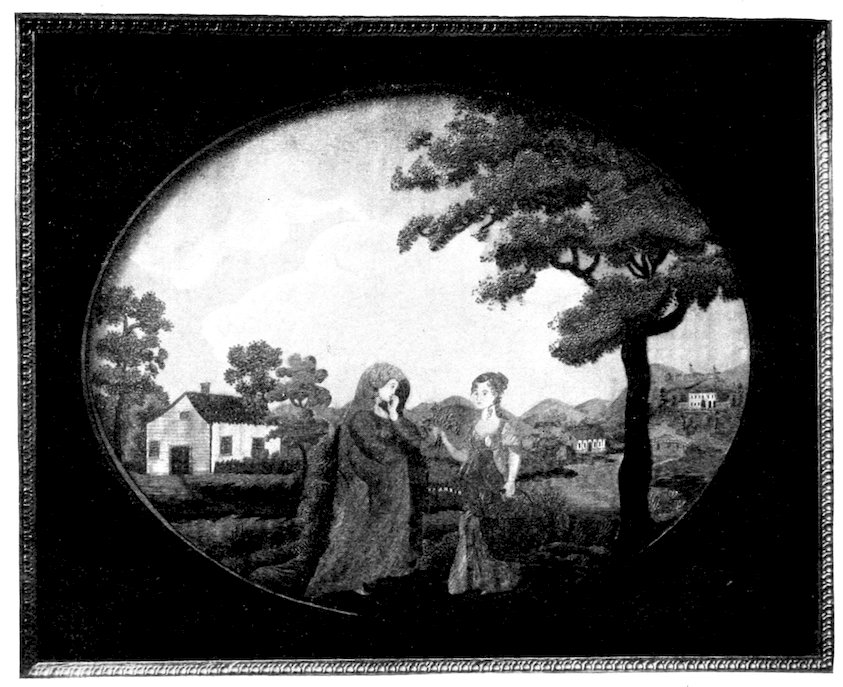
Pl. XXIII.—Embroidered by Mrs. Punderson while at the School
119
JEPHTHAH’S DAUGHTER.[39]
Mostly, as far as I can judge, in Miss Sarah Pierce’s handwriting. (Mrs. Gray.)
In another copy (written, evidently for use, in a schoolgirl’s hand) the characters are entered as,—
Jephthah W. Talmadge
Bethulah C. Beecher
Elizabeth A. P. Brace
Mahalah J. Parmelee
Tirzah M. Buel
Pedazar J. C. Landon
Elzaphan H. Gould
Agnes E. Verplank
PERSONS OF THE DRAMA.
Jephthah Judge of Israel,
Pedazar One of the rulers of Israel,
Elzaphan A priest,
Bethulah Wife to Jephthah,
Elizabeth Daughter to Jephthah,
Mahalah The widow of Jephthah’s brother,
Tirzah Mahalah’s daughter,
Agnes A convert from a heathen family,
Three small children from heathen families under the care of Agnes.
Attendant.
Act I.
Scene 1.
(Bethulah discovered in melancholy attitude; Elizabeth singing at her work.)
SONG.
SILENT O MOYLE.
Silent, oh Jordan, be the roar of thy waters,
Break not ye breezes, your chain of repose,
While murmuring mournfully, Jephthah’s lone daughter,
Tells to the night star her tale of woes.
1202
When shall she hear the jubilee ringing,
When, O! peace thy white flag unfurled,
When with God’s own people, praise be ringing,
Ah, will it be in this stormy world?
3
Sadly, oh Jephthah, thy daughter sits weeping,
While far from loved Israel, her days pass away,
Yet still her dear country she visits, while sleeping,
Sweet visions that flee the dawning of day.
4
When will the star o’er Ephraim’s mount shining,
Give to these eyes the friends held most dear,
Oh, when shall we in sweet praise combining,
Tune our loved harps unwet by a tear.
Elizabeth.
Why is my mother’s brow o’ercast with grief
Why wells the frequent tear adown her cheek?
Has thy Elizabeth done aught to pain thee,
Or has my song awaked the fond remembrance
Of thy loved country and thy happy home.
My father too, of late seems lost in thought
Nor heeds my prattle that was wont to please
Would I were worthy to partake thy sorrows
To share thy confidence, divide thy cares,
And prove the filial love which warms my heart.
Bethulah.
My child, our woes are not of that light nature
Which fond solicitude, by sharing lessens
Else would thy mother tell each secret grief
And on thy filial bosom rest for comfort.
Then seek not to distress thy gentle nature
With tales of woe which thou cans’t not redress
But let the wretched heathen of this valley
Employ thy care; on them bestow thy pity
Haply some not born for eternal glory
May hear thy voice, and learn that Israel’s God
121Formed yon bright orbs which they now vainly worship
One precious soul rescued by thy instruction,
From idol worship, will sooth thy latest hour
And gild with brighter joys the bliss of heaven.
Elizabeth.
Mother, dearest mother, trust me I pray,
Thy secret grief consumes thy precious life
And can I rest while ignorant of the cause?
The sad reality will pain me less
Than the vague terrors which now haunt my mind.
Does any new misfortune threat my father,
Or is our country scourged with foreign foes?
Is any secret great event impending
O’er my loved father or my country’s peace?
Thy precepts graved upon my inmost soul
Have taught me truth and prudence doubly shine
When in one breath they blend their useful empire
And though presumption is the fault of youth
Yet still methinks I shall not shame thy council
If thou wilt trust me with the secret cause
Which clouds my father’s face and thine with grief.
Bethulah.
No secret woes, my child, oppress our hearts,
The cause, alas, is known to neighboring nations
And even remotest climes have heard of Israel
Her highly favored tribes, her grievous sins
And the just vengeance of offended heaven
We hid thy country’s sufferings from thy knowledge
Wishing to spare thy youthful mind from anguish
We would not blast the opening bloom of youth
By unfolding scenes which riper reason shuns
As filled with woes too mighty to be borne
But since thy gentle spirit feels such alarm
I briefly will relate the direful tale
Which fills with keen distress all Jacob’s race.
Thy infant mind can scarce retain the time
When Jephthah lived, first of the race of Gilead
Till envious hate of his most cruel brethren
Drove him amidst their desert wilds and forests
122To seek that shelter Israel would not give
Here we have lived a peaceful, happy life.
The rude inhabitants, thy father’s virtues
Have humanized, refined and taught the worth
Of civil laws and righteous government.
Their barbarous manners softened into virtue,
They look to Jephthah as friend, a father,
And next thyself and country share his love.
To me was left the pleasing, anxious task,
Of teaching thy young mind the path of knowledge
And if a sigh has e’er escaped my lips
When thinking what my early fortune promised
Twas for thy sake, bred in this lonely station,
Whose birth was hailed first of the maids of Gilead.
Elizabeth.
My dearest mother, let no thought of me
Disturb the tranquil hours of this sweet vale
What is there to be envied midst the great
Can costly domes or splendid garbs avert
The shafts of envy or the touch of pain
Or make one honest heart respect their owners
Had my dear father still remained in Israel
The affairs of state befitting his high rank
Would with unceasing care have filled his mind
And robbed domestic life of half its comforts.
The frequent woes which harass Jacob’s race
Would perhaps e’er this have laid him with his fathers
And made the humble shepherd’s lot our envy.
Bethulah.
Most true, my child. In this discern the cares
Which with unwonted gloom our brows o’erspread
Israel ungrateful to their Heavenly Father
Forsake his altars and forget his laws
Pride violence and rapine waste the land.
To inbred evils terrible to bear
Are joined proud Ammon’s and Philistia’s bands
Who waste the land, and spare nor sex nor age.
The few who still remember their Creator
In sackcloth clad, raise the repentant voice,
123Implore his mercy a forgiving grace.
As former sins afflict their guilty minds,
The injustice done thy father, stings their conscience
As humble suppliants they implore forgiveness
And entreat your sire to lead his chosen troops
To shield his country from proud Ammon’s force
His doubtful mind now ponders their request
His patriot bosom burns to save his country
But latent fears of their returning hatred
Repress the generous ardour of his soul.
Elizabeth.
Ah, sure he will not hesitate to fly
When his loved Israel calls for succour
When thousands of our nation ask for aid
Who ne’er united with his envious foes
To persecute and drive him from his country
But now I rejoiced in this obscurity
Which saved my father from dread war’s alarms
But since my suffering brethren need his aid
Dear as he is I yield him for their safety
And my suppliant voice unite with theirs
To urge his presence in the tented field.
(Enter an attendant.)
Attendant.
Madam two women ask to be admitted
And to your private ear relate their sorrows
Bethulah.
Whence come they, what is their dress and mien?
Attendant.
They both are clothed in Israel’s mourning garb
One venerable by years, but more by grief
The other young and beauteous as the morn
Her gentle mien, a face bedewed with tears
Melt every heart to pity, may they have leave to enter?
Bethulah.
Conduct them hither. Thy outcasts Israel
Shall find a shelter in my humble shed.
124Elizabeth.
Some sad, disastrous tale of wrongs and woe
I stand prepared to hear, Oh my loved country
Tho’ a stranger to thee, thou still art dear
“Dear as the blood which mantles in my heart.”
(Enter Mahalah and Tirzah.)
Bethulah.
What do I see, the stern Athobat’s wife
Mahalah here.
Mahalah.
Yes, the proud Mahalah who spurned thy virtues,
And despised thy tears. An humble suppliant now
Implores thy succour and forgiving love,
If stern revenge is harbored in thy breast
Our mighty woes will drive the demon hence
And thou wilt own our crimes are fully punished
More full than bitterest enemies could wish.
Then, oh forgive the many wrongs I did thee
And give repentant enemies a shelter.
(Bethulah during this speech looks with an air of stern incredulity, then turns to hide her emotions.)
Tirzah.
If gentle pity ever touched thy bosom
If soft humanity e’er sway’d thy mind
Let their soft whispers move thy soul to pardon
Look on thy child whose years agree with mine
If thou hast felt a mother’s joyful pride
To see her virtues far exceed thy hopes
Then fear’d those virtues might be early blasted
By dire misfortune or unfeeling foes
Deaf to the voice of innocence and age
Ah then with mercy greet that wretched mourner
(Kneeling,) Oh, for my sake who never injured thee
Forgive the many wrongs which thou hast suffer’d
And snatch repentant enemies from want.
125Bethulah.
Arise sweet maid, I do forgive thy parents
Tho’ they have driven me far from friends and country
An exile mid a savage heathen race
Yet we should forgive, as we hope to be forgiven.
Tirzah.
A thousand blessings crown the generous deed.
Bethulah.
No not a generous deed. I let thee kneel
Solicit pardon, tho’ your penitence
Spoke in each feature and implored forgiveness
I should have met thee with a friends embrace
And gave a pardon e’er thou hadst time to ask it.
Elizabeth embrace thy new found cousin
And make her welcome as a friend and sister.
Elizabeth.
Dear sister of my soul, I feel I love thee
And that this love will increase with waning time.
Bethulah.
Sister why are thine eyes bent on the earth
Does dark distrust still lurk within thy breast
Tho’ thou hads’t been tenfold more cruel to me
Thy penitence would claim my full forgiveness
Accept my friendship and dismiss thy fears.
Mahalah.
Remorse and not distrust has chained my tongue
Oh when to me thou fled’st for friendly succour
I scorn’d thy merit and thy grief derided
But Heaven’s just wrath avenged thy injuries
And brought our pride to moulder in the dust
Bethulah.
Rumor has spread your numerous woes abroad
The huge tongued goddess has I hope increased
The sad detail, but still my beating heart
With anxious fear enquires the full recital
126Of every outrage our dear nation suffers
Which thou a witness, can’st with truth relate.
But chiefly what distress drove thee from home
To seek a shelter in this lonely vale.
Mahalah.
Backsliding Israel, faithless to the Lord
Forsook his altars and despised his laws
To Ammon’s Gods they bowed the knee profane
And made their children pass through fire to Moloch
To Belial also paid the rite obscene
And all the various Gods which Egypt owns
Engaged their fickle worship, ever changing
Prone to rebellion, a stiff-necked race
They refused to obey the laws of God and man
Our rulers warned, our prophets preached in vain
Abused by vulgar tongues, by riotous disorder
Rob’d of their hard earned gains, the honest Jews
Escaped to foreign lands to seek that safety
Israel would not give to wretched
Bethulah.
Wretched country, stain to our chosen race
When virtue flies to heathen lands for safety.
But say what next ensu’d, how long have sinners sway’d
Our happy land, happy I fear no more.
Mahalah.
At first the populace with impious mirth
Exulted in their fancied happiness
Their boisterous pleasure pain’d the honest ear
Oppression next, with wild misrule upbourne
Seiz’d their defenceless, and deluded victims
Now they who erst in splendid robes array’d
Those delicate limbs ne’er felt the sun’s broad ray
With patient labor seek and seek in vain
A pittance in the field. They whose delicious board
With luxuries full up o’er flowed
Now ask for bread and no one breaks it to them
The infants’ cries each hour assail the ear
Their tongues for thirst, cleave to their little mouths
127Mothers with frantic pity slay their babes
To save them from famine’s slow and cruel tortures
The blushing maiden and chaste matron now
To caves and desert woods for safety flee.
Not safely even the traveller wends his way
In public roads his necessary steps
But in by-paths, avoids the murderous bands
Which lawless range through our most wretched country.
Where once the crowded street, the city rose
The rank grass waves its head, o’er fallen walls
The thorny thistle shakes in the sullen blast
Each face a cloud of deepest sadness wears
For even the base are caught in their own snares
Yet still our stubborn hearts refused to bend
To an offended God, or ask his mercy
Till Ammon’s troops and proud Philistia’s bands
With war’s dread scourge, fill’d up heaven’s cup of wrath
This roused the stupid, and abashed the bold
They seiz’d their arms and flew to oppose the foe
But all in vain, the foe swept down whole ranks
Our cities bend beneath the conqueror’s sword
From Jordan’s streams and Judah’s fruitful plains
To where proud Ephraim once securely dwelt
My husband fell amidst the foremost ranks
And Jephthah’s cruel brethren wished too late
For his brave hand to save the race of Gilead
Amid the lawless ruin of my country
I scarce found shelter neath Athobat’s arm
Since he is gone, I durst not stay in Israel
Beset by foes both foreign and domestic.
Bethulah.
Oh Israel, sinful but much lov’d country
My heart drops blood at thy calamities.
Will not these evils bend their stubborn souls
And turn them to the Rock of their defense
Their only hope amid the tempest.
Mahalah.
With many tears they seek to avert the wrath
Of their offended, but merciful Creator.
128They have at last perceived their idols could not save
Have cast them and their altars in the dust
With ardent zeal some seek the good old paths
Saying where’s the right way, let us walk therein
The path which our forefathers wisely trod
But what is man, can he arrest God’s arm
When crimes like ours call forth his righteous vengeance
Ah see where Jephthah comes. Wilt thou entreat for me
I cannot meet his eye.
Bethulah.
Retire with me, and let our daughters plead
Thy moving cause their eloquence will gain,
An easy pardon from thy generous brother
(Exit Bethulah and Mahalah.)
(Enter Jephthah.)
Elizabeth.
Father I bring an humble suppliant
Who entreats thy pardon for once guilty parents
Who sorrowing, for all the wrongs they brought on thee
Implores through us forgiveness and protection.
Jephthah.
My protection?
Who has sunk so low as to sue for Jephthah’s favor
An outcast wanderer, without power or fortune.
Tirzah.
One who while living should have called thee brother
Dying bequeath’d his orphan to thy care
Bidding thee recollect the infant friendship
Which warm’d your hearts, e’er envy and ambition
Crept in and blasted every noble feeling.
Jephthah.
And is Athobat dead, my once lov’d brother
His cruel treatment I’ll no more remember
But view him only as the dear companion
The much lov’d partner of my infant sports
129Our joys our hopes our wishes all the same
And thou his daughter, welcome to my cottage
Next my Elizabeth in dear affection.
Take her my daughter as an only sister
And may your friendship meet no cruel blast
From rancorous envy, or misplaced ambition.
Elizabeth.
My heart already owns her for a sister
I hope by acts of kindness soon to win
An equal place within her gentle bosom.
Tirzah.
Thy kindness has already won my heart
And wak’d my sorrowing soul anew to pleasure.
Jephthah.
But where’s thy mother? is she here with thee
Or dost thou mourn her with my fallen brother.
Tirzah.
Fearing thy wrath too justly merited
She retir’d to hide her keen remorse from thee
I’ll seek her to relate thy generous pardon
And let her thanks repay thy boundless goodness
Which my full heart refuses words to express.
(Exit Elizabeth and Tirzah.)
(Enter Elzaphan and Pedazar.)
Jephthah.
Welcome Elzaphan, my friend Pedazar
What news from our unhappy country?
Pedazar.
On Jordan’s banks proud Ammon’s banner waves
Judah already bends before his arms
While Benjamin to stern Philistia yields
Who threats all Israel with her galling yoke
Elzaphan.
Our country torn by faction
Our land by faction torn, bleeding at every pore
130By foreign and domestic woes oppress’d
Have sent us here as messengers of grace
For all the past they humbly sue for pardon
And beg thou’lt lead their armies to the field
Secure of victory neath thy powerful arm.
Jephthah.
When fortune smil’d and plenty fill’d your dwellings
And youthful vigor prompted me to enjoy
Each social pleasure, and my warm heart
O’erflow’d with kindness to ye. Ye hated me
Drove me from friends, from my lov’d country
From all the joys my ardent nature priz’d.
Then why do ye come to seek me in distress.
My youthful arm oft quell’d your powerful foes
And this lone desert all the reward obtained.
I scorn those friends, who fawn in times of trouble
But mid prosperity forget past favors.
Pedazar.
Tis not thy ungrateful friends alone implore thee
Thy country’s voice proclaims thee as her chief.
Not against thee alone our elders sin’d
Our ungrateful hearts forgot the Rock of Ages
His great deliverance and his boundless blessings
All, all ne’er made our stubborn hearts obey
Fill his just vengeance, clothe the land in mourning
Then by our humble prayers and deep repentance
We sought his pardon and obtained forgiveness.
His gracious voice is heard again in Israel
For not like man the Almighty holds resentment
How can weak man whose virtues all are frail
To near approach his Heavenly Maker’s image
As by kind mercy delegate of heaven
Who bids us pardon even our enemies.
Jephthah.
Should I return would you indeed prove true
Is no conceal’d no treacherous snare employ’d
To work my ruin by my envious foes.
131Pedazar.
No treachery believe me waits thy steps
Dost thou think so meanly of Pedazar’s heart
As to suspect he would join in bare deceit
To work the ruin of his bitterest foe
Much less the man once rank’d among his friends.
Jephthah.
Pedazar pray forgive my unjust suspicions
My former fortunes render me distrustful
And if the Lord give Ammon to my hands
Shall I retain my place as Israel’s judge
Swear that ye will not drive me again to exile.
Elzaphan.
Here in our country’s name we solemn swear
And call heaven’s thunders to attest the oath
That Jephthah’s chosen judge of Israel
To rule in peace and war with equal sway
And may heaven’s vengeance blast the guilty wretch
Who dares oppose what Israel has decreed.
Pedazar.
Come let us haste, the expectant army waits
With keen impatience for their gallant leader
And Israel’s prayers attend us to the field.
Jephthah.
Go tell our warriors Jephthah soon will join them
And while life’s current warms this heart to action
Ammon shall feel the fury of this arm.
(Exit Elzaphan and Pedazar.)
Jephthah.
Great God, if thou indeed wilt crown my arms
With wish’d success against our impious foe
And make ungrateful Israel feel my wrongs
Then will I offer on thy altar, Lord
What e’er comes first from out my house to meet me
To hail my joyful conquest o’er the foe
Ammon destroyed and Israel bless’d with peace.
(End of the first act.)
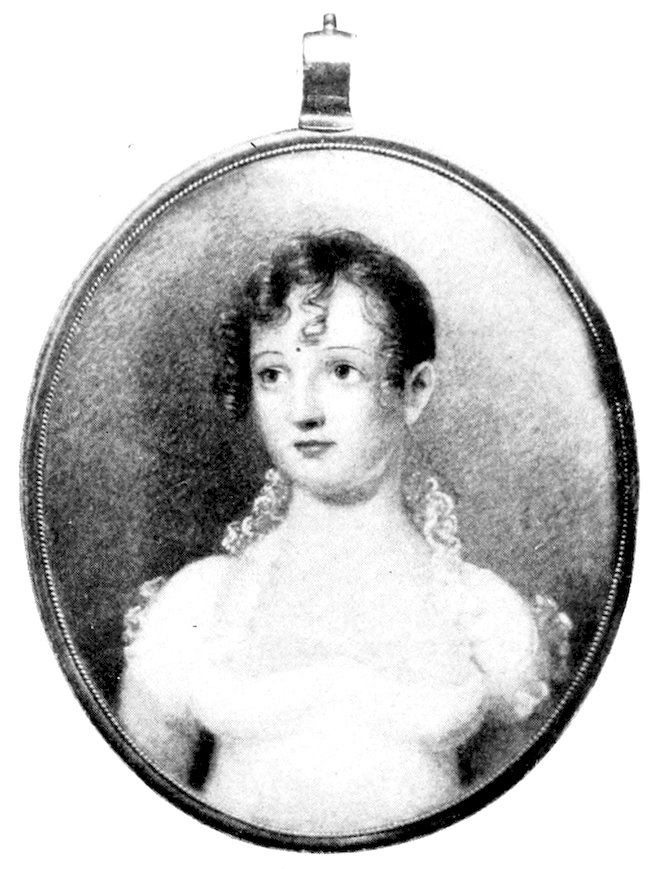
Pl. XXIV.—“The Rose of Sharon,” Pupil about 1814 From a miniature painted by Dickinson Elizabeth Hannah Canfield, daughter of Judson Canfield and Mabel Ruggles, of Sharon, Conn. She married Frederick Augustus Tallmadge, son of Col. Benjamin Tallmadge. She was called “The Rose of Sharon” by the law students, from her beauty and her birthplace, her sister Julia receiving the title of “The Lily of the Valley,” from her fair skin and want of color. The two sons of Gov. Edward Telfair, of Georgia, who attended the law school, were in love with her,—Thomas and Alexander. The latter offered himself and was refused. He afterwards walked the twenty miles from Litchfield to Sharon only to gaze at the light in her window and walk back again.
132Act II.
Scene I.
(Jephthah’s house at Mizpeh, Elizabeth, Tirzah and several young women singing).
SONG.
Guide our troops O great Jehovah
Save this sinful, war worn land.
We are weak; but thou art mighty,
Save us by thy powerful hand.
King of heaven, king of heaven
Save us, and we ask no more.
2
Shield our fathers in the strife,
Guard our brothers, we implore
Give them victory, freedom, life
Drive our foes far from this shore.
King of heaven, king of heaven,
Dry our tears, and hear our prayers.
(Enter Mahalah and Bethulah.)
Mahalah.
With anxious heart I mark each slow pac’d hour
While Israel’s bands engage our numerous foes
Should Jephthah fall our shield our last defense
Our tribes must wear the galling yoke of slaves
More fear’d than death, more gloomy than the grave.
Bethulah.
Sister what words have pass’d thy lips unweigh’d
Is Jephthah’s arm the only hope of Israel
Wilt thou on him an arm of flesh rely
When that great Being who controll’st the heavens
Who exalts proud tyrants to afflict the earth
Or driv’st them headlong from their envied greatness
Who mak’st weak insects his commissioners
To humble the power of strongest nations
When this great Being is our covenant God
Gave this fair Canaan to the seed of Jacob
Drove out great nations for his chosen people
133Has said the sceptre shall not fail in Judah
Till that great prince the Almighty Shiloh come.
On him rely even in the darkest hour
Whose word is sure, whose power is infinite
And though dark clouds conceal his deep decrees
His chast’ning rod is ever rais’d in mercy.
Mahalah.
Thy just rebuke confirms my wav’ring faith
Subdues my terrors and inspires new confidence.
Elizabeth.
I wish some news would reach us from our army
Jephthah may fall even in the arms of victory.
Methought last night I saw our bands triumphant
And my lov’d father crowned with wreaths of glory
I flew to clasp him, when an envious fiend
Rush’d in and snatch’d me far from him and Israel
Mid desert lands I wander’d lone and wretched
Till on a cloud I saw thy father Tirzah
With smiles benign, inviting me to heaven
I strove to join him, and the effort wak’d me.
Tirzah.
Thy mind intent on Jephthah’s danger rests
Awake or sleeping thou art ever with him.
Elizabeth.
Hark, what shout is that I hear?
(Enter Pedazar.)
Pedazar.
Victory crowns our arms, Jephthah returns triumphant.
Oh praise the Lord who guides our hosts to battle
Whose mighty arm has wrought this great deliverance
Come my young companions prepare the timbrel
Let’s haste with joyful songs and comely dance
To hail our heroes glorious from the war
Take each a wreath of laurel, to bind the victor’s brow
And name each gallant hero in our song.
(Elizabeth and her companions form a procession.)
134
SONG. STRIKE THE CYMBAL.
Act III.
Scene I.
(Enter Jephthah followed by Elizabeth and Tirzah.)
Elizabeth.
My father why avert thy clouded brow
Why turn thine eye with horror from thy daughter
Ne’er till this hour was Elizabeth unwelcome.
Jephthah.
Oh my child thou hast brought me low
Low even to the ground thou hast bow’d thy father
Oh thou hast filled my soul with anguish
For to the Lord I vowed, oh dreadful vow
And I must pay it with thy precious blood.
Elizabeth.
My father let thy vow be cheerful paid
Tho’ my heart’s blood must seal the solemn oath
A little boon to pay the mighty debt
Of thy success and Israel’s great deliverance.
(Enter Bethulah, Mahalah, Pedazar, and Elzaphan.)
Bethulah.
What do I hear! is then my darling child
My life’s best comfort and my dearest treasure
Devoted to thy rash and bloody vow
Oh Jephthah, Jephthah must this glorious morn
This day of joy to happy Israel’s race
Be only dark in cruel Jephthah’s house
Must its bright hours be stained with guiltless blood
The light of life torn from a mother’s arms
No human victims the Almighty claims
Tis heathen gods who boast such horrid rites
Offensive to our great Jehovah who delights in mercy.
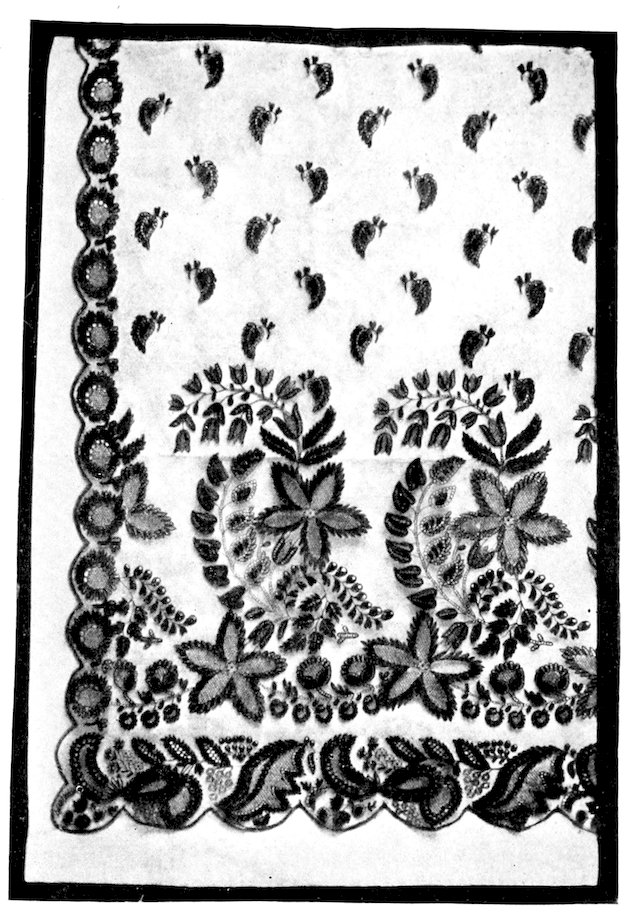
Pl. XXV.—Black Lace Veil made by “The Rose of Sharon”
135Elizabeth.
My dearest mother do not yield to grief
Collect thy wonted firmness
And give thy bright example to thy daughter.
Oh see’st thou not my father’s wounded spirit
Claims thy support
And thy distress adds anguish to his wounds.
Think of Abraham our noble ancestor
No sigh escaped, no tear bedewed his cheek
When his lov’d Isaac follow’d to the altar
And mildly ask’d where is the lamb for sacrifice.
Bethulah.
Twas no rash vow made by our rev’rend father
But God’s express command, his child to offer
To show the world one truly faithful saint
At God’s command thy precious life I’d yield
Without a murmur crown the sacred victim
But now, oh now a mother’s tears are just
My cries shall rend the air and know no pause
Till Heaven in mercy move stern Jephthah’s heart
To revoke his cruel his unlawful vow.
Will not whole hecatombs of bulls suffice
Will not some other blood atone for thine
Behold me here oh! most unjust of fathers
Kneeling I ask to spend my life for hers.
Elizabeth.
Mother most rever’d most lov’d of mortals
Do not in pity, do not melt me thus
Nor rend my father’s heart by thy reproaches
Lest grief so poignant snap the chord of life
And bleeding Israel mourn their gallant leader.
Jephthah.
No let her just reproaches have full vent.
I deserve her hatred, thine and my country’s
What right had I to vow a sacrifice
Which might have fallen upon another’s head
Had any of my menial train advanc’d
136With joyful greetings at their master’s glory
They had been sacrificed to my dread oath
And grief like mine torn the fond bosoms
Of their hapless friends
Oh God most holy, wise are thy decrees
I kiss the rod and own thy just correction.
Mahalah.
Is there no offering can atone to heaven
No blood of beasts to save this precious child
Speak holy father thou art read in the laws
Can nothing save this guiltless valued maid?
Elzaphan.
Nothing can save her, naught devote to God
Or man or beast or field can be redeemed
Nor can a generous friend a ransom give
The life so offer’d or the thing so chang’d
Are both devote to God.
Our holy laws ordains no change in this
Tho’ common offerings are by gifts redeemed
A sacred vow must ever be rever’d (turn to the end) x x x
So dear Bethulah strive against thy grief
Which adds fresh anguish to the wounded heart
Shall Jephthah ruler of our chosen race
Infringe the law and break a solemn oath
Would not the people taught by his example
Deem their oaths light, which bind them to his sway
Think o’er the woes which now, oppress our land
But recent sav’d from powerful Ammon’s yoke
Still bleeding with the wounds of bloody faction
And numerous ills bro’t on by disobedience
Jephthah’s example now must save or crush us
Ah better that thy daughter rich in worth
And lov’d thro’ Israel as a child of light
Better that she, with all her virgin train
Give their pure lives to fulfill a solemn vow
Than we our rulers, and our numerous tribes
Be taught by Jephthah to offend our God
Dreadful in anger terrible in vengeance.
137Bethulah.
Forgive me heaven if I have grown rebellious
Forgive me Jephthah and forgive me Israel
My brain grows wild, I can’t endure the light.
ACT
Scene I.
(Jephthah and Elizabeth.)
Elizabeth.
Permit me lov’d father ere I quit the world
To pay a parting tribute to the cot
Which shelter’d us during our days of exile
Where unambitious happiness was ours
There with my young companions let me wander
Amid the mountain groves I lov’d so well
And take a last farewell of this world’s joys
There mourn my sins. Prepare my mind to meet
The awful hour, which fills my feeble soul
With new felt terror.
Jephthah.
My child; pride of my life
Once hop’d the staff of my declining years
Thy slightest wish is sacred to thy father
Go with thy virgin train, take leave of time
Its joys are fleeting as the morning dew
Tho’ to thy youthful mind they now appear most fair
But why should’st thou be terrified at death
Thou whose pure life? unblemished by a crime
Scarce tinctur’d with the stain of Adam’s race
Hast lived a miracle of sweetness
Can thy chaste bosom feel a thought of fear
At entering thy heavenly Maker’s presence
It is my pride my only consolation
To think that death’s a glorious boon to thee
Snatching thy virtues from the numerous ills
Which wait frail man even in his happiest state.
138Elizabeth.
No heart so innocent but feels most vile
When ent’ring the dread presence of its maker
Whose eye discerns the faults of spotless angels
Who chargest his minist’ring spirits with folly
What then is man, a creature form’d of dust
To dare plead innocence before the Eternal
Even Abra’m friend of God, and Moses sin’d
What then am I a frail a feeble woman
Whose idle thot’s, and vain desires betray,
This foolish heart, each day to guilt and error
But God is mercy, and I trust his grace
Will pardon the sins and errors of my youth
Reform my virtues, and inspire my soul
With heavenly wisdom and immortal love.
(Enter Bethulah, Mahalah and Tirzah.)
Bethulah.
Lead on my sister here’s our darling child
Our lost Elizabeth.
Elizabeth.
Not so my mother rather say she’s found
Will not thy child be sav’d from many sorrows
Is not a virtuous death an envied lot
Perhaps God kindly calls me from a world
Where luring pleasure might deprave my mind
Its yet untasted bliss might stain my life
With vain ambition, pride and love of wealth
Perhaps the sins of Israel are not full
And fell destruction waits to scourge the land
Then when thou seest the matron vainly sueing
For pity to the vile and murderous band
Then wilt thou rejoice thy Elizabeth is safe.
Bethulah.
Vainly my child thou striv’st to sooth my woe
I still must grieve, thou art my only hope
E’er since the hour I clasp’d thy infant form
With that fond transport mothers only know
139I envied not the world its pomp or riches
The greatest monarch that ere rul’d the world
Was not so happy mid his days of triumph
Viewing his vast domains, and countless treasures
As I with my sweet lovely smiling infant
And each revolving year increased the treasure
And must I now, oh must I part with thee?
Yes I submit, since tis the will of heaven
But ask me not to bear the stroke with firmness
A mother’s heart must feel a mother’s woe.
Elizabeth.
Think me not dead but in a happier country
Where grief’s not known but joy succeeds to joy
Perhaps our gracious God, will permit me
To watch thy secret steps, and whisper peace
When sad calamity corrodes thy bosom
To hover o’er thy walks a guardian spirit
To pour the balm of joy on all thy anguish
And wing thy soul at thy last hour to heaven
Tirzah must be thy child, my friend and sister
Must fill my place in thy maternal heart.
Tirzah.
Oh were I worthy to fulfill that office
But if affection, sympathising love