LIST OF PLATES.
Reading edition
The Duke gives the magic word, “The whole line will advance!” (Coloured) Frontispiece
Sergeant Ewart capturing the eagle at Waterloo (Coloured) To face p. 62
The stormers dashed over the débris of the breach To face p. 132
Simultaneously followed the levelled bayonets of Suchet’s division (Coloured) To face p. 190
The Fifth Division storming by escalade the ramparts of San Vincente To face p. 262
When the remnant of the Guard was seen clearing a way for the Emperor there was a rush To face p. 326
BATTLES OF THE NINETEENTH CENTURY
INTRODUCTION
BY MAJOR ARTHUR GRIFFITHS
“BATTLES OF THE NINETEENTH CENTURY”—the words are like a trumpet-call, summoning up in array before us a hundred familiar forms of great soldiers—Napoleon and Wellington, Grant and Moltke, MacMahon and Garibaldi—great soldiers of all nations—great soldiers long dead, and great soldiers still living. Let us glance for an instant or two, in this introduction, at the individual careers of some of the most famous of them ere we pass on to the pages which shall deal with their exploits, battle by battle, and shall tell in detail of their skill and prowess, and their fortunes of war, their victories and their defeats.
The earliest wars of the present century were the nursery of military reputations, and in them several great soldiers grew on to imperishable fame. Two figures stand out prominently, a head and shoulders above all the rest—Napoleon and Wellington. It is needless to compare or contrast them—Napoleon, the Emperor-General, sole arbiter of the fate of millions; Wellington, the loyal servant of his country, who put duty before mere glory, and whose first thought in his triumphs was the vindication of the national honour and the re-establishment of peace.
Napoleon was all for self; but this very selfishness re-acted on his surroundings, and elicited an unbounded, unquestioning devotion to his person, which was the parent of many heroic deeds. Men suffered themselves to be cut to pieces to win a word of his approval; the wounded raised themselves in their agony to cheer on their comrades; the dying with their last gasp cried “Vive l’Empereur!”
Over and above the glamour of his personal ascendancy, and his long-sustained prestige, Napoleon had a still stronger hold upon his followers, in that he held the supreme power in his own hands, the sole and exclusive right to reward or blame. Small wonder, therefore, if the soldiers of the First Empire were among the finest types of their class. No military régime has ever brought better men to the front or secured them more rapid advancement. Promotion to the very highest grades was to be had for the earning of it. How fast men rose from the lowest rungs to the top of the ladder will be understood from a few prominent cases. Marshal Ney was the son of an old soldier, and threw up a small appointment to enlist as a private hussar; Massena, the Prince of Essling’s father, kept a wine-shop in Nice, and the marshal had begun life as a cabin-boy; Lannes’ father was a livery stable-keeper, and Augereau the son of a mason. Junot was a sergeant of artillery at the siege of Toulon, who first attracted Napoleon’s attention by his coolness under fire: a round shot kicked up the dust close to where Junot was receiving an order in writing, and the young sergeant, unmoved, merely said, “That will do to dry the ink.”
Wellington could not have made use of such incentives to valour as Napoleon did, even if he had had them at his command. But he did not need them. It was with the British rank and file as with their generals: they did their best because it was their duty, and it was there to do. They fought because they were expected to fight, and fought well, because they liked it. So it was that throughout the long campaign in Spain the British were almost invariably successful. Wherever they met the enemy, they beat them. Even at Corunna, after a long and disastrous retreat, overmatched by numbers, led for a time by Napoleon himself, Sir John Moore turned on his pursuers, and snatched a difficult victory at the expense of his own life. He was struck down just as the French were repulsed, but his troops, undismayed, continued the action, which ended entirely in our favour, and permitted us to re-embark without loss. Moore’s death on the battle-field has been honoured in song; it was a hero’s death, and to the last moment he would not surrender his sword, although the hilt had entered the wound. His body had to be buried on the battle-field; and it is greatly to the credit of a chivalrous foe that the French, recognising his merit, raised a monument over his remains.
Wellington’s career was one of almost unequalled success. If he was compelled to retreat more than once, it was only to make a newer and a bolder advance. In all his battles he was victorious: thanks to his own great genius and the matchless bravery of his troops. The Peninsular records are full of great deeds done on great battle-fields, in combats, charges, and on the deadly breach; and in this book of ours we shall have pictured to us fully and completely the scenes of these deeds of valour and heroism: but here let us just glance at two or three of Wellington’s victories to see what stuff he and his troops were made of. That passage of the Douro, for instance, in 1809, when he crossed in the face of Soult and a veteran army—one of his most brilliant exploits. Do you remember how Colonel Waters, one of his staff-officers, got over alone in a skiff and brought back three barges, and how, when the first boat was ready with its petty complement of twenty-five, he said simply, “Let the men cross”; and how this handful gained a foothold which they never relaxed till their comrades followed in thousands, and the surprised French were driven out of the town?
Talavera was both a general’s and a soldiers’ battle: the first because Wellington (then only Sir Arthur Wellesley) showed that imperturbable coolness and self-reliance, mixed prescience of danger and promptitude in meeting it, which are the highest qualities of leadership; the second, because it was won mainly by a single regiment, which acted with marvellous precision and courage at the decisive point just in the nick of time. The French in this battle were the assailants: the genius of their soldiers is for onslaught, and their greatest deeds have been in attack. But they were met and repulsed. It was of Talavera that Jomini, the well-known military writer, said it proved that the British infantry could dispute the palm with the best in Europe. Another instance of its prowess of another kind was shown at Talavera, when Crawfurd’s famous Light Brigade of the 43rd, 52nd, and 95th Regiments came up, determined at all costs to take part in the action. They met crowds of Spanish fugitives, who declared the English army was defeated, its general a prisoner, the French only a few miles off. But still they pressed on undaunted, and “leaving only seventeen stragglers behind,” says Napier, “in twenty-six hours crossed the field of battle, a compact body, having during the time marched sixty-two English miles in the hottest season of the year, each man carrying from fifty to sixty pounds weight.”
At Busaco, again, the French were the assailants: veteran troops led by some of the bravest of French generals; and their numbers gave them the advantage. But the British were strongly posted on a craggy ridge of hills, so strongly that it was thought the French leader, Massena, would not attack. “But if he does, I shall beat him,” replied Wellington quietly; and he did. The French fought with signal bravery, but the ascent was toilsome, and they were met by men as brave.
In the retreat before the battle, two affecting incidents occurred which showed the quality of the soldiers Wellington commanded. There was a man in the famous 43rd, named Stewart, only nineteen years of age, but of gigantic strength and stature, whose comrades called him “The Boy.” He was deeply chagrined, and at a bridge which he was the last to cross, he turned, and facing the French advancing columns, he was heard to say: “So, this is the end of our boasting! This is our first battle (Talavera), and we retreat. The boy Stewart will not live to hear that said.” “Then,” says Napier, “striding forward in his giant might, he fell furiously on his nearest enemies with the bayonet, refused the quarter they seemed desirous of granting, and died fighting in the midst of them.”
The other story tells of a still finer instance of the noble spirit of the British soldier. It was at the passage of the Coa, a month before Busaco, when the 52nd would have been cut off from the bridge but for the gallantry with which McLeod of the 52nd came back rushing at full speed with a couple of companies, which charged “as if a whole army had been at their backs,” and repulsed the enemy. One of McLeod’s officers was the afterwards famous Sir George Brown, at this time only sixteen, who was leading his men gallantly up a slope, at the top of which were a couple of Frenchmen with muskets levelled at him. A sergeant interposed—M’Quade, himself only twenty-four—and, pulling his officer back, with the words, “You are too young, sir, to be killed,” offered himself as a target, and fell dead, pierced by both bullets.
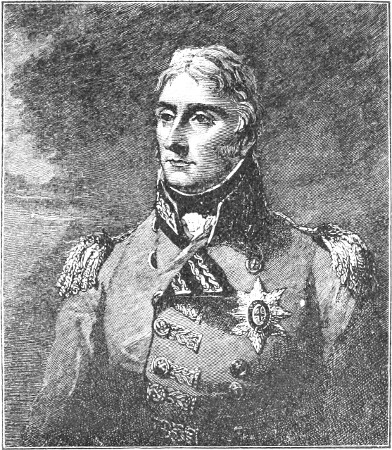
SIR JOHN MOORE.
(After the Engraving by C. Turner.)
Three great sieges, ending in the storming and capture of three strong, almost impregnable, fortresses, were among the laurels gained in Spain—laurels tarnished, unhappily, by the shameful excesses of the victorious troops. When the breaches at Ciudad Rodrigo were declared practicable, Wellington’s order was simply, “The place must be stormed this evening”; his soldiers’ still simpler comment, “We will do it.” The forlorn hope raced up to their death, followed by the no less eager body of stormers, and the main breach was carried with a furious shout. At Badajoz, Phillipon, the brave Frenchman, stood at bay to the last, and the “possession of Badajoz had become a point of personal honour with the soldiers of each nation.... Ridge had himself placed a ladder where the wall was low, and climbed it; a second ladder alongside gave access to another officer, Canch; and as soon as these two were on the ramparts the stormers followed, and gained possession.” Yet the fight elsewhere continued for hours, and Wellington had to organise a second assault, and the captors of the castle were in some danger, although inside the town. Badajoz was taken, but at tremendous cost. No age, no nation, ever sent forth braver troops to battle than those who stormed Badajoz.
In the course of this book we shall hear much more of these triumphs of Wellington: how at Salamanca he caught Marmont in an egregious tactical error, fell upon him in flank, and defeated 40,000 men in forty minutes; how at Vittoria he routed King Joseph, beating him at every point, and capturing everything the French possessed: “all their equipages, all their guns, all their treasure, all their stores, all their papers”; how, in the Pyrenees, pitted against Soult, Napoleon’s ablest lieutenant, he won battle after battle: at Sauroren, at the Bidassoa, at the Nivelle, and finally, invading France, at Orthez and Toulouse. The passage of the Adour was a combined military and naval operation, carried out in the teeth of a fierce February storm. The bridge of boats which the British staff corps formed across the river was a “stupendous undertaking” which ranks amongst the prodigies of war; for the tide rose and fell fourteen feet, and large boats could only be employed. It was at Orthez that Soult, thinking victory secure, put forward all his reserves too rashly. Then Wellington, as he watched him, smote his thigh, and cried exultingly, “At last I have him!” On the spur of the moment he changed his plan of battle, and by a turning movement cut off Soult’s line of retreat.
The greatest of all the great achievements of the great duke was, of course, his victory at Waterloo—a battle which will always rank among the most important and decisive that have been fought, because so much depended upon the issue. The only hope of securing peace to Europe was in beating Napoleon, and it was not easy to do it. There were moments in the brief campaign, both before and during the great battle which finished it, when victory hung in the balance and inclined to the French. At the outset, Napoleon stole a march upon the Allies; he placed his whole force at a point between them, whence he might separate and roll up each in turn. He beat the Prussians badly at Ligny, but Ney was checked by our tenacious resistance at Quatre Bras. Still, the British and the Prussians retired divergently, as it is called; and had Napoleon followed up quickly, he might have fought them one by one. But Wellington drew off, retreating—not without danger—upon Waterloo; and Blucher, recovering his communications with us, was able to come up at the close of the great fight, and make victory the more complete.
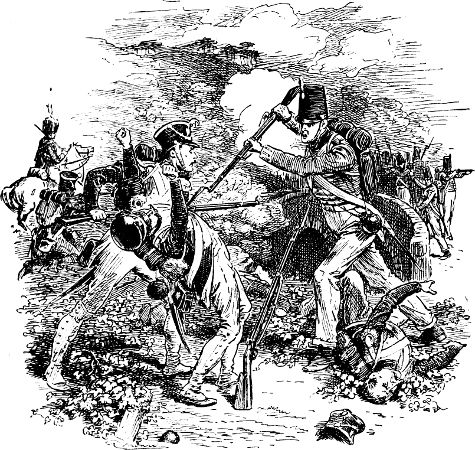
“HE FELL FURIOUSLY ON HIS NEAREST ENEMIES” (p. 2).
By degrees new men, imbued with much the same high qualities, replaced the veterans of Spain and Waterloo; but till more than half the century was ended it was the generals who had been trained to war under Wellington who chiefly led the troops to victory and maintained British prestige. Charles Napier in Scinde, Hugh Gough in the Punjaub, Fitzroy-Somerset (Lord Raglan) in the Crimea, Colin Campbell, afterwards Lord Clyde, in China, the Crimea, and India, had all learnt and practised their profession in the early wars. They were all, however, men advanced in years before they came to a supreme command in the field. The long peace after Waterloo, lasting some thirty years, denied soldiers all chance of active service, and it was not till Sir Charles Napier was sixty years of age that he found himself winning battles on his own account. Sir Hugh Gough was older by five years when he led an army against the Sikhs, and began the difficult conquest of the Punjaub. Lord Raglan was also an aged man when he was selected to command our armies in the Russian war of 1854–5.
Both Napier and Gough had won early laurels in Spain, and both as majors, temporarily in command of their regiments, had helped to win great battles, and paid in their persons for their valour. Napier was with Sir John Moore at Corunna, and at the head of the 50th (the gallant “Half-hundred”) had repulsed the French attack at one important point. Then when—to quote another Napier, his brother, and the famous historian of the war—“he was encompassed by enemies and denied quarter, he received five wounds. But he still fought and struggled for life till a French drummer, with a generous heart and indignation forcibly rescued him from his barbarous assailants.” The wounds he received were terrible: he had his leg broken by a bullet, a sabre-cut laid open his head, and he had had a bayonet stab in his back. It was at this battle of Corunna, when the young major (he was only twenty-six at the time) took command, that he found his men of the line wavering under the fierce fire. In order to steady them, he put them through several movements of the manual exercise, ordering them to “Slope arms!” “Carry arms!” and so on, until they recognised his voice and hardened under his hand.
Hugh Gough like Charles Napier, owed to the chance absence of his colonel the opportunity of winning early distinction. As a major, of barely thirty, he was in command of his regiment—the gallant 87th, long famous as the Irish Fusiliers—at the battle of Talavera, where he was severely wounded, but so distinguished himself as to earn promotion; he was at the head of the 87th when they made their famous charge at Barrosa, which decided the fate of that hard-fought day; and he was so foremost in the repulse of the French from Tarifa that he received the sword of the French leader when he failed in his assault upon the town.
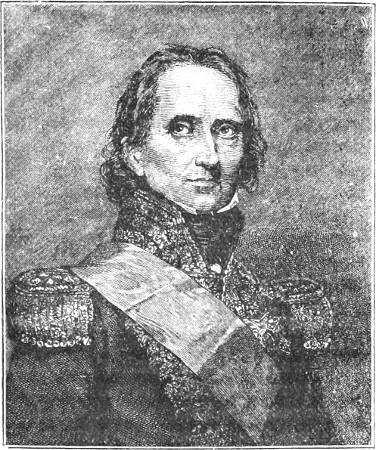
MARSHAL SOULT.
(From the Portrait by Rouillard.)
Lord Raglan had never commanded troops in the field, but he had been the secretary and close confidant of the Iron Duke, his companion in every campaign; as Fitzroy-Somerset, he rode by Wellington’s side through the day at Waterloo, and was one of the few survivors of his staff. But he lost his arm by a shot—one of the last fired—just after his chief had run imminent danger, and had been warned to withdraw, but held his ground, saying, “Never mind; let them fire away. The battle’s won; my life is of no consequence now.” The duke turned to ride off the field, when a stray bullet shattered Lord Fitzroy’s arm at the elbow. It was the right arm unfortunately, and it had to be amputated at once; but Wellington retained his services as secretary, and Lord Raglan soon learnt to write with his left hand, so as to become a neat, rapid penman.
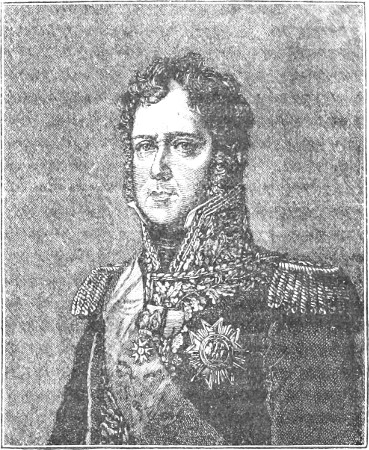
MARSHAL NEY.
(From the Painting by F. Gérard.)
Colin Campbell was junior in years and rank to the three great soldiers just mentioned, but he graduated in the stirring school of war when he was but sixteen, and learnt hardihood as a stripling. It was the custom in those days to send boys into the army at an age when many nowadays are still at school. They were brave boys, as their successors of to-day will admit. Let me tell you how young Campbell behaved in his first encounter with the enemy. To be shot at for the first time is a startling experience. Young Campbell, at Vimiera, suffered like many more, but his captain, an old and war-hardened campaigner, seeing his trouble, took him quickly by the hand, and led him out into the front of the regiment, upon which the enemy’s guns had just begun to play, and for several anxious minutes walked him up and down under fire. The treatment calmed him completely, and he never knew the want of confidence again. On the contrary, Colin Campbell, just five years later, performed prodigies of valour in leading the forlorn hope at the storming of San Sebastian. He had just forced his way to the summit of the breach, when he fell back, desperately wounded in the hip; but finding he could still move forward, he re-climbed the breach, to be fully disabled by another shot in the thigh. Three months later he lay in hospital, with his wounds but half healed, when he heard that Wellington’s army was on the point of invading France, and he resolved to be one of the party. Escaping from hospital, with an equally ardent comrade, “by dint of crawling and an occasional lift from vehicles proceeding along the road, they made their way to the 5th division in which the 9th were brigaded, and were in action (on the Bidassoa) on the following day.”[1] His desertion from hospital was a breach of discipline, and Campbell would have been sharply dealt with; but in the fight he led his company so gallantly, and was again so badly wounded, that it was impossible to do otherwise than praise his bravery and ignore his bad conduct.
They were giants, these soldiers of the Peninsula, setting an example of courage and endurance to their successors for all time: an example which you may be sure has always, and will always, be followed by British troops of all ranks, from leader to fighting-man. Wellington’s veterans never fell away from the traditions in which they had been raised, and which they bequeathed. Sir Charles Napier, at sixty, began his Scinde campaign with a daring operation which ranks with the boldest in war. His march upon the desert fortress of Emaun Ghur, with a few hundred English soldiers carried on camels—a lonely journey of eight days—was a feat, both in its performance and its consequences, which is not outdone by Wolfe’s scaling of the Heights of Abraham, the great American General Sherman’s march from Atlanta to the sea, Drury Lowe’s and Herbert Stewart’s raid upon Cairo after Tel-el-Kebir, when 1,500 horsemen galloped into the old capital of the Caliphs and seized it for the Queen. At that moment Cairo was held by a garrison of 10,000 of Arabi’s men.
Again, Napier’s victory at Meanee was a triumph over the most tremendous odds, when 2,400 British troops, 500 of whom alone were white, the rest native sepoys, encountered, attacked, and defeated 36,000 Beloochees in the open field. Napier would not stand on the defensive—that might have seemed to imply fear of the result, and injuriously affect the spirit of his native troops—so he resolved to attack, instead of waiting to be attacked. They met in mid-shock—for the Beloochees made a counter-attack; and for three hours the unequal contest went on with a foe as brave and undaunted as ourselves. It was long a hand-to-hand fight, bayonet against sword and spear; but at the critical moment Napier sent all his cavalry against the enemy’s right, and broke it. Then the 22nd charged home with tremendous force, and the battle was won. Not the least brilliant feat in this glorious victory was the self-sacrificing devotion of a captain of the 22nd—Tew by name—who gave his life for his duty. Before the fight, Napier had discovered that some 6,000 of the enemy occupied a building surrounded by a high stone wall, through which there was but one egress—a narrow doorway, which could, he thought, be completely blocked by a few determined men. Captain Tew was posted there with his company, and told he must die, if need be, but that he must never give way. He died where he was posted; but with his handful of men he closed the opening throughout the fight, and thus paralysed the action of a large portion of the enemy.
Sir Hugh Gough—afterwards Lord Gough—had long to wait for promotion to the higher ranks, and he was more than sixty when he commenced the campaigning in China which led to the cession of Hong-Kong. Soon afterwards he won the hard-fought battle of Mahrajpoor, in Gwalior, against that warlike and turbulent race the Mahrattas, whose subjugation had cost so much in the earlier days of the century. Gough won Mahrajpoor by a direct attack, marching right up to the enemy’s position, and trusting to the British bayonet for success. “Nothing,” as he himself wrote in his dispatch, “could withstand the rush of the British soldiers. They drove the enemy from their guns, bayoneting the gunners at their posts.” Two officers—Stopford and Codrington—were found lying wounded just under the muzzles of the Mahratta artillery. The same tactics—for Gough was essentially a forward fighter—served him well at Moodkee, the first of the battles in the Sikh war.
The campaign was forced upon us suddenly. Gough was called up to support Lord Hardinge, the Governor-General, who, when making a progress through the Punjaub, found the Sikhs on the point of declaring war. The force which Gough collected numbered only 14,000 men, and it had to traverse 150 miles to reach the scene of action. It was a toilsome march, under an Indian sun; water was scarce; the troops reached Moodkee worn-out with privations and fatigue; but when they heard their enemy was in front of them, they went, without resting, straight into the fight. The Sikhs—splendid soldiers, trained by European officers—were more than double our numbers, with a fine cavalry and many guns; but the British infantry, “trusting to that never-failing weapon the bayonet,” drove the Sikhs out of their positions.
A second battle—a greater trial of strength, demanding higher qualities of fortitude and endurance—was near at hand. Gough moved forward at once, and attacked the Sikh entrenchments at Ferozeshah, Sir Henry Hardinge, who was with him, waiving his rank of Governor-General, and serving under Gough, in command of the left wing. The struggle was terrific: the Sikhs fought with splendid courage, and when night fell the battle was not ended. It was a drawn game so far, and some despondent spirits in the camp suggested retreat—the rash and inglorious course of cutting a road through to Ferozepore. Gough would not agree. “I tell you, my mind is made up. If we must perish, our bones must bleach honourably where we are.” Hardinge was no less firm. When an officer told him that Sir Hugh Gough feared it would be a fatal risk to renew the battle, Sir Henry scouted the idea. “Gough knows,” he cried, “that a British army must not be foiled; and foiled this army shall not be.” The contest, when it recommenced, was most unequal. Fresh reinforcements reached the enemy, but our troops met them undaunted, and went forward nobly to the attack. In the end, a turning movement of cavalry on both flanks, followed by a fresh infantry charge, decided the day in our favour, and the Sikhs were routed with tremendous loss.
These victories did not end the war or complete the conquest of the Punjaub. The Sikhs fell back upon the Sutlej, and established an entrenched camp in front of the village of Sobraon: they did not care to meet us again in the open field, but they stood a gallant siege at Sobraon, which had to be stormed like a fortress. A curious feature in this battle was the great charge of cavalry made through the breaches, in which the horsemen cut down the defenders at their guns. Another interesting fight was that at Aliwal, won by Sir Harry Smith as a detached operation, in which the 16th Lancers greatly distinguished themselves. These various victories broke the courage of the Sikhs, but only for a time; and the peace that followed was of short duration.
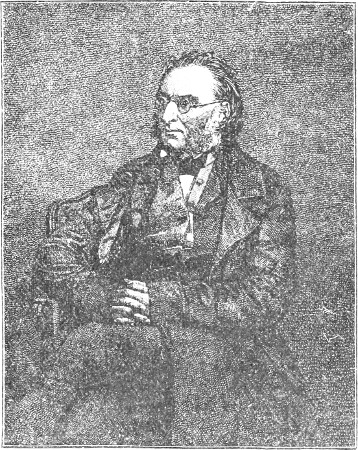
SIR CHARLES NAPIER.
It was abruptly ended by a deed of treachery such as has not been uncommon in our Eastern Empire: the British resident and another officer were murdered in Mooltan, and it was necessary to resume active operations. But the occasion furnished an opportunity of distinction to a gallant young officer, Lieutenant Herbert Edwardes, who, without waiting for orders, united his small detachment, posted on the Indus, to that of Colonel Courtrand, and fell upon the Sikhs, forcing them to retreat into Mooltan. Then followed the gathering of forces anew on both sides, and fresh battles, achieving at first but incomplete and unsatisfactory results. The name of Chillianwallah and the misfortune of that day will not be readily forgotten. It was a day of carnage, disaster, and disgrace; for an English cavalry regiment, weakened by previous losses and fearing an ambuscade, gave way to panic and galloped off the field. It may, however, be said, in extenuation of this happily unusual military crime, that an injudicious order given by the brigadier originated the stampede. The consequences in any case were disastrous, and it followed upon the nearly complete massacre of a line regiment—H.M.’s 24th, that which suffered afterwards so terribly at Insandlwana—which, emerging from a swampy jungle, was all but cut to pieces, because it paused to spike guns it had captured from the Sikhs.
A storm of indignation arose in England, and the public discontent was poured out on the Commander-in-chief. Lord Gough was immediately superseded by Sir Charles Napier, his previous brilliant services being entirely ignored; but before the conqueror of Scinde could reach India, Gough had completely vindicated our arms and his own reputation. Mooltan was carried by storm, and the final decisive victory at Goojerat—at first an artillery duel, in which our guns showed their marvellous superiority—completed the discomfiture of the Sikhs. From that time forth the Punjaub was incorporated in our British Indian Empire. The Queen has no more loyal subjects, no more devoted soldiers in her ranks, than the descendants of our former sturdy foes.
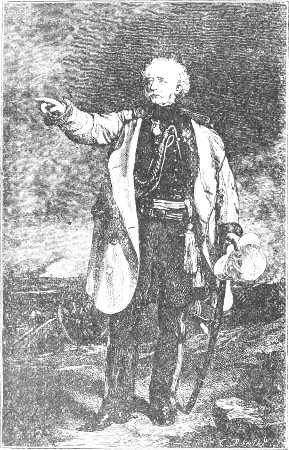
LORD GOUGH.
(After the Painting by Sir Francis Grant, P.R.A.)
The time was approaching when England was to be once more engaged in European war. Just when the nations hoped they had reached an era of universal peace, the clouds collected quickly, and two traditional foes joined hands to attack Russia. The expeditionary force which left these shores for Turkey in 1854, and which ere long won new victories, but at a terrible outlay of men and material, was one of the finest, as regards physique and fighting power, that England has collected. It was well armed, as the time went, and well commanded. Lord Raglan was at its head, and his lieutenants were mostly Peninsular veterans: Sir George Brown, already mentioned for his gallantry at the Coa; Sir De Lacy Evans, who had fought in Spain and America, and at Waterloo; Sir George Cathcart, who had been on Wellington’s staff; Sir Colin Campbell, of whom more directly; and Sir John Burgoyne, a famous engineer officer, who had helped to construct the lines of Torres Vedras, and had served in the great sieges of Ciudad Rodrigo, Badajoz, Burgos, and San Sebastian. But the army was unprovided with the trains, transport services, and means of supply which are of little less importance than valour in the field; and for the want of them, bravery was as nought, victories were wasted, and men’s lives poured out like water.
The three principal battles fought in the Crimea by the English were essentially triumphs for the rank and file. At the Alma it was sheer hard slogging, headlong rushes against a strong position, which was carried, in spite of all resistance. The fighting fell mostly to the share of the 1st and 2nd Light Divisions, the Guards, the Highlanders, and the Fusilier and Rifle battalions; and it was done in the famous old formation—the thin red line. At one time the Guards were hard pressed, and they came to Colin Campbell, who commanded the 2nd Brigade, saying the Guards would be destroyed if they did not fall back. “Better that every man of Her Majesty’s Guards should be dead on the field than that they should turn their backs upon the enemy,” replied Campbell, as he hastened with his Highlanders to their support.
At Balaclava, when “some one had blundered,” and the gallant Six Hundred went into the jaws of death, the English light cavalry were all but destroyed, but it won imperishable renown. “Magnificent, but not war,” was the French general’s comment on the mad charge: an attack by cavalry on guns in position; but the whole of these reckless horsemen went forward with the same spirit that animated their leader, Lord Cardigan, who, rising in his stirrups, cried, “Here goes the last of the Brudenells!” It was a hopeless enterprise, but it was performed; and all the world wondered.
Inkerman, again, was pre-eminently the soldiers’ battle—a hard personal hand-to-hand fight, where the Russians numbered thousands to our hundreds, and it was no less the almost impudent courage of the British than the impossibility to believe that so few could resist so many, except backed up by strong reserves, that prevented the Russians from carrying all before them. The attack was made at daylight, when the mists still lay thick on the ground, and concealed the meagreness of our forces; the Russian hosts came on in dense columns along a narrow front which prevented their opening out, and our men in the proverbial “thin line” could hit the head of the advance with tremendous effect. The onslaught fell first on Pennefather, who had won early fame at Meanee against overwhelming odds; now, with a bare 3,000 men all told, he hurried down, and came to immediate blows against the Russians, nearly 20,000 strong, with powerful artillery. It was so throughout the battle. Attack was met by counter-attack; our handfuls constantly met the shock of great masses, checked them, drove them back, and followed, fighting lustily. The Light Division, under Codrington—1,400 men, no more—was as daring and tenacious. Until half-past seven, for nearly a couple of hours, these two kept the whole of the attackers at bay. Fresh troops then began to come up on both sides; another Russian general’s corps, that of Dannenberg—19,000 men—renewed the assault; the Guards and 4th Division came up to stiffen Pennefather. It was at this period that the gallant general made a famous reply to General Cathcart, who had asked where he could give best assistance. “Get in anywhere,” cried Pennefather; “there’s lots of fighting going on all round.”
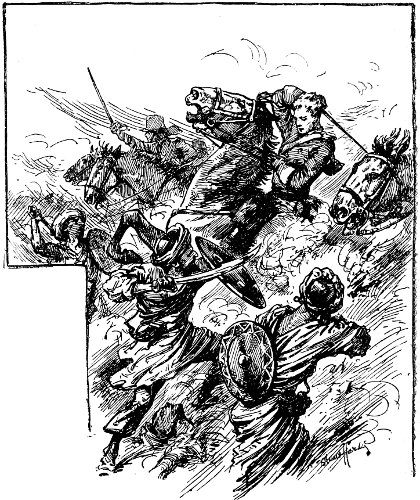
CHARGE OF CAVALRY THROUGH THE BREACHES AT SOBRAON (p. 7).
The final Russian attack was made about 10 a.m., the sharpest and best intentioned of any in the day, but by this time the opponents were more equal in numbers. Bosquet’s Frenchmen had come up to support, and we had gained the help of the two celebrated 18-pounder guns under Collingwood Dickson, which 150 artillerymen themselves dragged from the 1st Division camp to the field. This, with two batteries of French Horse Artillery, pushed gallantly forward to the “bare slopes fronting the enemy,” had readjusted the balance of artillery fire; and at last the Russians fell back, sullenly, overmastered, but they were followed by no final charge. “When hopeless of success,” the enemy “seemed to melt from the lost field; the English were too few and too exhausted; the French too little confident in the advantage gained to convert the repulse into a rout.” The victory at Inkerman was but the prelude to terrible sufferings during the long-protracted siege, but these could be borne with patience, because Inkerman had proved that we were more than a match for the Russians in the open field. Had we not won the battle, the whole of the allied armies, taken in reverse, would have been swept off the plateau in front of Sebastopol right into the sea.
The fortress itself proved a very hard nut to crack, and although frequently assaulted, was never actually taken by force of arms. The winter troubles, the inclement weather, the difficulties of supply which starved the troops and reduced the siege into a mere blockade, forbade attack. On the contrary, the besieged displayed such activity under the intrepid Todleben, that the initiative often passed to them, and by bold sorties they gained ground rather than lost it. Even our incessant bombardments, causing terrific carnage, did not dismay the defenders, and fresh reinforcements constantly arrived. It was not till June that the first real assault was delivered, and then only through the indomitable determination of the allied generals. The French were especially hampered by the interference of the Emperor Napoleon, who, with no military knowledge, claimed to control and advise from Paris. It was the first occasion on which the telegraph line began to be largely used in campaigning, a practice greatly calculated to paralyse the action of generals in the field. Napoleon was all in favour of leaving the siege to linger on, while field armies cut off the supplies to the fortress; but Pelissier, the French general, was a strong man who held to his own views, and he persisted in attacking Sebastopol.
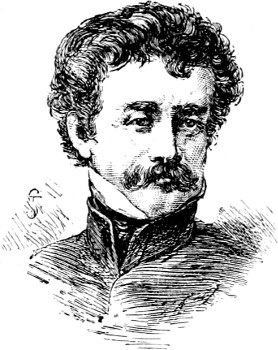
SIR COLIN CAMPBELL (AFTERWARDS LORD CLYDE).
Early in June the French took the Mamelon, the English “the Quarries,” important outworks, and it seemed as if the end was near. But a second assault, delivered within a week or two upon the Malakoff and the Redan, was repulsed with terrible loss; only a detached attack, under the English General Eyre, upon the Cemetery succeeded, and for a time we were actually within the walls. But we could not stay there. Two months more elapsed, chequered by the death of Lord Raglan, who had won the love and respect of all, and by another fierce effort, made upon our communications. The battle of the Tchernaya was fought nearly on the same ground as Balaclava, and was won by the French and the newly-arrived Sardinian troops. Then, finally, on the 8th September, the French stormed the Malakoff again, and this time took it. The English had the more difficult task, because the Redan, which they attacked, was constantly reinforced by the masses driven out of the Malakoff. But our assault had not been planned on a big enough scale; it was not properly supported, although the trenches behind were crammed with reserves, and it failed. That night the Russians, feeling that in the Malakoff they had lost the key of their defence, evacuated the town, but not before they had blown up the forts, and set the whole place on fire. The sight will never be forgotten by those who saw it, as did the writer. The town in flames, great forts crumbling to pieces as though by magic, heavy columns of Russians crossing the bridge under an incessant fire from the allied batteries.
Peace with Russia had not long been signed when the British Empire was threatened in a most vulnerable place. For a time it seemed as though we might lose India. The revolt of the native or sepoy army burst out so suddenly—it was marked with such base treachery, disgraced by such cold-blooded atrocities—that the world still shudders at the details. The English were everywhere outnumbered; our hold on India depended greatly on prestige; implicit faith had been placed in these very mutineers. The force of white troops at hand was very small; very soon Upper India was in the hands of the insurgents: only here and there little groups, generally isolated and surrounded, fought with desperate courage against overwhelming odds, almost against hope. No page in our national annals is more glorious than that which enshrines the heroism of those who then saved India. Not only were soldiers brave, but civilians, unused to arms, showed dauntless pluck—frail women performed, too, great deeds in defence of their honour.
Although the whole country was more or less involved in the struggle, the principal interest was centred in the three great cities which were the scene of the fiercest efforts: at Delhi, Cawnpore, and Lucknow the conflict was long-sustained. Delhi, the seat of the new Empire, was thronged with mutineers from many neighbouring garrisons. It was held by numbers of disciplined, well-armed troops, with powerful artillery, to the use of which they had been fully trained, and it stood a long siege in which, at first, owing to the weakness of our forces, the besiegers were themselves besieged. But the little army was a band of braves led by heroes. Such men as the Nicholsons and the Chamberlains roused them to superhuman efforts; and when the place was captured, after a three months’ siege, it was carried by the assault of four weak columns of barely a thousand each.
Cawnpore was another large station, which fell at once into the power of the miscreant, Nana Sahib, who has earned for himself undying execration as the most cruel and unprincipled of our foes. But the handful of Europeans would not easily yield; many were only women and children; the fighting men were few; yet they held out in rough entrenchments for nineteen days, standing a siege under the tropical sun of June, and displaying a calm fortitude beyond all praise. Gentle ladies gave their stockings to make cartridge-cases; they nursed the wounded, fed the troops. One brave woman—a soldier’s wife—mounted sentry, sword in hand, over a number of sepoy prisoners. The roll of heroes was well filled at Cawnpore. Such soldiers as Moore (of the 32nd), Jenkins, Mowbray Thomson; such civilians as Heberden and Moncrieffe, make us proud of our race. Who shall forget the cool courage of Delafosse, who stood over a tumbril of ammunition, the woodwork of which had been set alight by the enemy’s fire—stood over it in imminent peril, while he tore off the burning timbers, and stifled the danger with earth? And yet the defenders could not escape their fate. When resistance became hopeless, they capitulated under promise of a safe conduct to Allahabad, and a general massacre followed, from which only two or three of these devoted martyrs escaped.
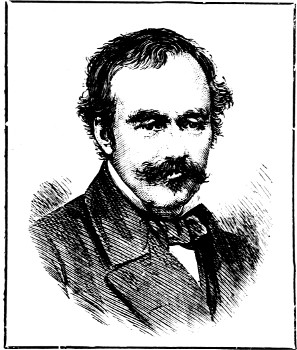
SIR JAMES OUTRAM.
The story of Lucknow is very similar; it is no less harrowing, but a source of equal pride in our race. The siege of the Residency, into which Sir Henry Lawrence retired with all his force and all their dear ones, was protracted to the utmost limits of endurance. Lawrence himself was struck down by an exploding shell; but the legacy he left his comrades was the watchword “No surrender!” His dying words were: “Let every man die at his post, but never make terms. God help the women and children!” Lucknow held out till it was relieved by Havelock and Outram in September, only to be again besieged when the relieving force had got within the lines. It was not until November, when Sir Colin Campbell advanced with all the reinforcements that could be got together at Calcutta—bluejackets from the men-of-war, regiments detained on their way to China, a small band of volunteer cavalry recruited in the capital. He had to fight his way in. First, there was the relief of the Alum Bagh, which was held, although the enemy were in an entrenched position before it; then the capture of the Dilkhoosha Palace; then the Martinière Palace, which the enemy occupied with guns in position; after that the Secundra Bagh, where the 92nd and the Sikhs raced up to the breach neck-and-neck. Other buildings were stormed—the Mess House, the Moti Mahal—and from the latter an entrance was effected into the Residency, which at last was relieved.
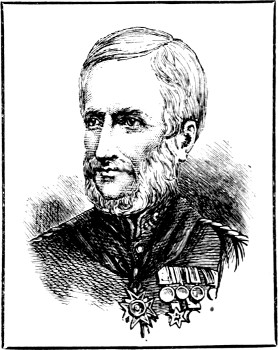
SIR HENRY HAVELOCK.
Assuredly there has been no falling off in the spirit of the British soldier, singly or collectively, whatever his rank. Our most recent military annals record episodes as gallant and as creditable to the pluck and manhood of our race as any that have gone before. Every form of courage has been displayed: reckless daring enterprise, calm self-reliant heroism in the most despairing situations. Who shall forget the 24th at Insandlwana, massacred to a man by the countless Zulu hosts? A brave, pitiless, but chivalrous foe, who could pay the following tribute to their fearless demeanour in that unequal conflict: “Ah, those red soldiers! How few they were, and how they fought! They fell like stones, each man in his place.” There is nothing finer, again, in war than the manner in which another British regiment—the 66th (Berkshire)—met death to a man at Maiwand, in Afghanistan. The general reporting it wrote that “history does not afford a grander instance of devotion to Queen and country.” The 66th, although outnumbered a hundred to one, received undaunted the furious attacks of the Ghazis or Mohammedan fanatics vowed to slay the infidel, and were gradually slaughtered till only eleven officers and men remained. This small band stood back to back, unconquerable, still facing and keeping the foe at bay, until they were finally shot down from a distance.
Another famous story is that of Rorke’s Drift, when two young subalterns, Chard and Bromhead, holding a river ford which was the only possible line of retreat for Lord Chelmsford’s force, were threatened by overwhelming numbers. The Zulus were quite 3,000 strong, and the little English garrison no more than 139, of whom thirty-five were on the sick list. But there was no thought of surrender. A line of trenches was hastily contrived with biscuit-boxes and flour-bags, behind which our men fought gallantly the whole night through. At one time the hospital was a sheet of fire, and the feeble breastwork had been penetrated in more than one place. But the garrison never quailed: their heroic subaltern leaders never despaired, and they had beaten off their assailants when at daylight relief arrived.
The only parallel to Rorke’s Drift is the gallant defence of Arrah during the Indian Mutiny, when a handful of English civilians defended a detached two-storeyed house for seven days against an army of sepoy mutineers. The collector, Mr. Wake, with fifteen other civilians, fifty Sikh police and one faithful Mohammedan, composed the garrison, and the assailants numbered 3,000, with two field-pieces. They had but little food, a motley lot of arms, unlimited ammunition, and there was not a military man among them. But they held out till they were relieved by a man as gallant as themselves, Major Vincent Eyre, who was ascending the Ganges with a battery of artillery when he heard of the siege. He steamed back at once to Buxar, collected a small force of infantry, 154 bayonets in all, marched fifty miles to Arrah, was met by the enemy, twenty times his strength, but at once attacked them, and put them to flight. The sepoys could not face us in the open, even in such disproportionate numbers.
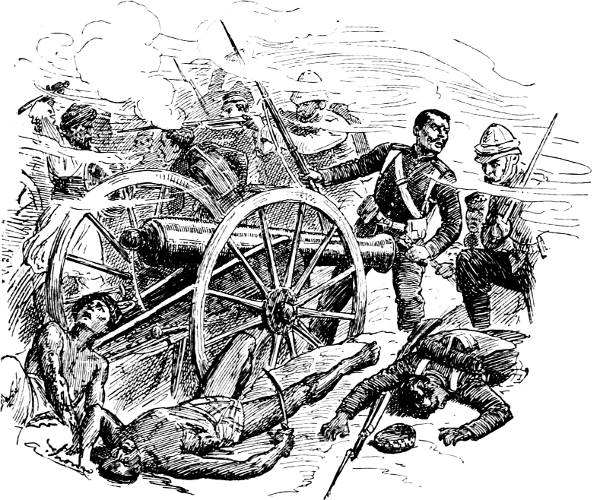
“‘THIS GUN BELONGS TO MY REGIMENT—2ND GOORKHA, PRINCE OF WALES’S!’”
The spirit shown collectively has, perhaps, been outdone by individuals. Endless instances of personal heroism exhibited singly might be quoted. What British boy can read without a thrill of the little Scotch drummer on the march with Roberts to Cabul, who, weary and footsore, refused to fall out, saying, “Nae, nae, I’ll nae fall out till I’ve washed my hands in the waters of the Caspian”? What of Major White, of the 92nd Highlanders, the present commander-in-chief in India, who cried to his men in the battle of Candahar: “Highlanders! will you take those guns”—which were galling them terribly—“if I give you the lead?” What of the men who followed him to their very mouth? What, especially, of the little Goorkha warrior who went up with his Scotch friends, and who took one of the first of the guns, shouting as he thrust his cap into the muzzle in sign of proprietorship, “This gun belongs to my regiment—2nd Goorkha, Prince of Wales’s!” What of Sergeant Cox, of the 72nd, bringing in wounded officers to Sherpur, and who, with only ten men, faced the whole garrison of the Bala Hissar and forced his way through, advancing firing, till the enemy broke and fled? The dhoolie bearers (the natives carrying the officers) would have set down their loads and fled, but Cox threatened to shoot them if they did not do their duty. Sergeant Cox, by his coolness and intrepidity, set such a good example that his men seconded him admirably, and all the wounded were brought in safe to the cantonments. Cox had already received the distinguished service medal for his gallantry in the campaign.
We have, of course, no monopoly in brilliant feats of arms. Other nations have shown equal prowess, whether against us or each other. Bravery, indeed, will never go out of fashion; the will and power to show it, as well as the spirit to appreciate it, may be met with in every civilised country. Other nations, moreover, have been tried more seriously than ourselves in longer, larger, and more portentous struggles. France sacrificed much treasure and many men in assisting the Italians to throw off the Austrian yoke, and the campaign of 1859 was distinguished by at least two great battles. Both are, perhaps, better remembered by the colours called after them; but Magenta was a narrowly lost battle, and Solferino was gained by the devoted gallantry of the French troops. Austria was an intruder, and had no heart in the struggle.
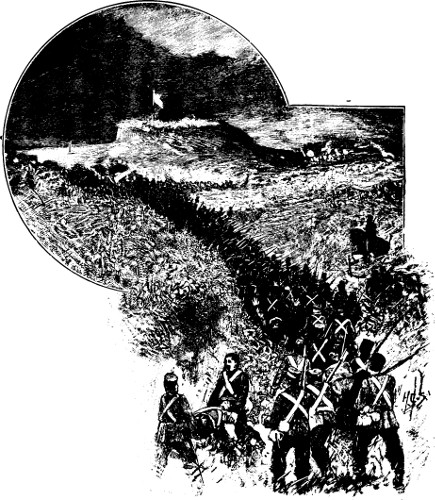
THE MAORI WAR: ATTACK UPON THE ORAKAO BAH.
The War of Secession between the Northern and Southern States of America was a deplorable civil struggle fought out to the bitter end, but it was full of pregnant military lessons, full of strange vicissitudes in which victory inclined to either side, of tremendous conflicts over a vast extent of country. It was a war which embraced almost a whole continent: the whole of America was affected, from the gulf of Mexico to the Rocky Mountains. The campaigns and battles were commensurate with the territory affected. In the first instance the two capitals of the opponents—Washington and Richmond—were chiefly threatened. Both lay comparatively near their respective frontiers; both were in imminent danger more than once. McClellan, after Fredericksburg was in striking distance of Richmond and Lee, but for Gettysburg, would have swooped down on Washington.
But as General Grant rose in fame and authority through his splendid successes in the west, he urged upon the Federal Government the necessity for more comprehensive operations. The Confederates, as the Southerners were called, could only be conquered by something like extermination; they must be attacked with equal vigour on every line, isolated alike from supplies and from supports. The North commanded endless resources, unlimited credit, the means of purchasing recruits without number, any quantity of munitions of war. The South, shut in within narrow limits, saw its population drained of fighting men, and was dependent upon blockade runners for powder and shot. Grant was absolutely right, as the end proved. When Sherman, having triumphed in the west, made the famous flank march from Atlanta to the sea, he could swing round and threaten Richmond from the south. This was the beginning of the end. Grant now reaped the benefit of his long-protracted, bitterly-contested campaign in the “Wilderness,” north of Richmond, and the armies closing round Richmond, the surrender of Lee became inevitable, and the Confederacy collapsed.
The war had brought forward many heroes, and several great commanders: Grant, Lee, “Stonewall” Jackson—the name he earned, some say (for there is another version of the story), because once, when hardly pressed, he said his men would stand like a stone wall—Stuart, the Southern cavalry raider; Sheridan, a cavalry leader, hardly inferior to Seidlitz or Murat; Sherman, Johnson, Hooker, and many more. Some of them were recurring types—Grant, silent as Moltke, and as tenacious and prescient; Robert Lee, the patriot soldier, who thought only of his country, a man of duty like Wellington; Jackson, who might have been a Puritan Cromwellian, praying and fighting by turns, a Charles Gordon in his absolute trust in Divine help, an Ironsides in his eagerness to smite the foe. The rank and file comprised all classes of the community—artisans, handicraftsmen, scientists—and not the least remarkable features in the war were its engineering achievements: miles of road made in a single night, bridges built, forests removed, extensive entrenchments thrown up as if by magic when the order was given.
The “Seven Weeks’ War,” as it has been styled by its historian, Colonel H. M. Hozier, was the first of the short, sharp, and decisive conflicts which are to be the rule in modern campaigns. It was between the Prussians and the Austrians, and it was fought for the future supremacy in the great empire of Germany. Before it no one knew how marvellously the Prussians had improved in the science and practice of war; how admirably their troops were trained, how splendidly armed, and with weapons of the newest invention. Still less was it expected that untried Prussian leaders would develop such unexpectedly superior generalship. From first to last this rapidly successful war was a surprise. It was carried into the enemy’s country with extreme boldness and celerity; the young soldiers of Prussia, under grey-haired but mostly inexperienced officers, soon established a marked superiority over Austrian veterans who had served in many hard-fought campaigns. It was proved in the earliest engagements that the possession of the needle-gun, the breech-loading rifle long carried by a portion of the Prussian army, but never hitherto used, put the Austrians, with their muzzle-loaders and their traditional belief in the bayonet, on very unequal terms. In the fight Austrian soldiers could not stand before the Prussians at all. Then the Prussian generals always out-manœuvred the Austrian; they largely used a system of flanking attack, of turning the enemy’s position at one end or side of it, while he was occupied and engaged by another attack on the front.
These were the tactics that led to the crowning victory of Sadowa, or Königgrätz, as it is sometimes called. After it the Austrians had no hope of success, and a retreat began, which soon after was completed by the ending of the war. At this battle the Austrians lost 40,000 men, the Prussians barely 6,000. Such is often the effect of superior generalship and better morale.
Not the least interesting part of this great battle was that Englishmen assisted in it as something more than mere spectators. The war correspondents of the Times on either side were both English officers. Captain Hozier rode with the Crown Prince of Prussia through the day, sharing his dangers as he noted the varying fortunes of the fight. On the Austrian side, Colonel C. B. Brackenbury was close by Benedek’s side from first to last; and the Austrian commander-in-chief, in spite of his misfortunes, found time to ask for “his Englishman,” and to praise him for his gallantry in facing the risks of the battle.
War is said to be full of surprises; and, again, that success is earned by the general who makes fewest mistakes. Napoleon III felt the bitter truth of both these sayings. The Franco-German war was a terrible surprise to him, and both the Emperor and his generals made innumerable mistakes. The French began by expecting a “walk over”—a parade march to Berlin; they found they had caught a Tartar, and that they could not keep the Germans out of France. Napoleon had been assured that everything was ready for the campaign: not a “single button was wanting on a single gaiter” was the boast of his War Minister, General Le Bœuf. Yet, when the first blow was struck, inextricable confusion still reigned within the French army—neither men nor supplies were properly organised; while, from the very first collision, it was clear that the science was all on the German side. Man to man, the French fought as well as their opponents; but they were never manœuvred wisely nor judiciously led.
On the other hand, from the moment war became inevitable, everything worked with clocklike precision. It is said that von Moltke, the famous chief of the Prussians, had only to touch a bell and all went forward. Anyhow, the Prussians and their allies were quickly mobilised, and able to take the field long before the French. The Crown Prince fell upon the French general when still unprepared, won the first battle, and held the advantage from then to the end.
It was a strategical advantage; in other words, the general movements of the armies put them in superior strength at decisive points, and this secured success all along the line.
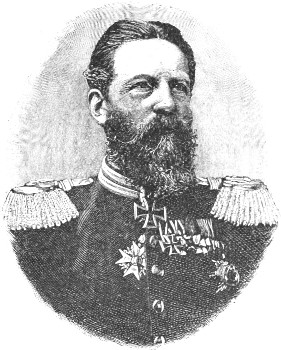
[Photo.: Reichard & Lindner, Berlin.
FREDERICK, CROWN PRINCE OF PRUSSIA (AFTERWARDS GERMAN EMPEROR).
Marshal MacMahon, beaten at Worth, had to retire, and become separated both from Bazaine about Metz and the army of the South. In between, the “Red Prince,” with the 1st German army, held Bazaine; and, after a series of fierce conflicts, the famous battles of Vionville, Gravelotte, and Mars La Tour drove him under the walls of the great fortress. MacMahon, frantic to regain communication with Bazaine, made a long detour—a dangerous flank march, as it was called—and found himself “headed off” at Sedan, with the Germans circling round him, and the neutral territory of Belgium, which he was forbidden to enter, in his rear. The surrender of the French army at Sedan, with the Emperor Napoleon at its head, was a disaster from which France never recovered. It was followed by the surrender of Metz and the whole of Bazaine’s army. Within five weeks France had been defeated in eight pitched battles; the bulk of the French regular troops were prisoners of war. France was not yet conquered. While the Germans pressed on to invest Paris—while their armies moved north, south, and west—the new Government which had replaced the fallen Emperor made the most heroic and unheard-of efforts to improvise new levies. To place recruits and moblots—youths half-trained and inexperienced civilians—in the front line against regular troops flushed with victory, seemed hopeless enough. It is to the undying credit of the French nation that it was able to maintain the struggle for so many months longer, and to the sturdy patriotism of such men as Thiers and Gambetta, who never despaired. France fought it out alone: she had no allies, or the result might have been different. There are those who say that the intervention of a couple of English army corps in favour of France would have changed the situation. But it was not our quarrel, and England could not have thrown her weight into the scale, except on the most sentimental and insufficient grounds.
Nearly five-and twenty years have elapsed since this great struggle occurred, and its legacy of hate still rankles unappeased. France is once more as strong as her late foe—stronger, perhaps—and she is still pining to regain her provinces and her prestige. It may be that her rulers and her people are loth to be the first to draw the sword: the cost of unsuccessful war is a dear price in these latter days; and when she fights again it will be at the most fitting opportunity, when chance and a better cause than last time may be on her side. But that she will fight some day is nearly certain; and it is this conviction which keeps Europe on tenter-hooks, and converts the whole Continent into a standing camp.
England, happily, has been spared any life and death contest, any war on the gigantic scale of the foregoing. But while her neighbours have been at each other’s throats, she has been engaged in numerous “little wars”—wars misnamed little, indeed, for the issues have often been immense and the efforts made most severe. In an empire so extensive as ours, causes of conflict abound, and fighting must be frequent. Since the Crimea and the Indian Mutiny, we have had at least half a dozen campaigns. A diplomatic war with China, a war for supremacy in New Zealand, a war for the deliverance of captives in Abyssinia, of retaliation in Ashanti, of self-defence in Zululand, against a too-powerful neighbour, of aggression followed by “scuttle” in Afghanistan, of interference in Egypt, followed by the dire necessities of occupation.
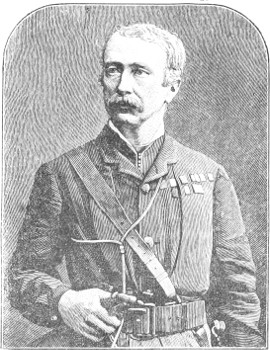
[Photo: Fradelle & Young, Regent Street.
SIR GARNET (AFTERWARDS VISCOUNT) WOLSELEY.
In many of these the chief work lay in combating the physical and climatic difficulties. There was not much fighting in the march to Magdala, but it was a stupendous undertaking to convey a British army across the “mountains of Rasselas,” to the nearly inaccessible stronghold of King Theodore. When Sir Robert Napier reached his goal, his troops had only four days’ rations left, other than meat, and everything had been carried up from the sea on mule- or donkey-back. In Ashanti there was the same urgency as regards supplies, but as no four-legged animals will live on the Gold Coast, the only means of conveyance was on the heads of native men and women. The organisation of transport was one of the greatest, although not the only difficulty. There was also the climate, which was at times, and in most places, pestilential. There was the absence of all means and appliances, almost of food, and there was the certainty of encountering a brave, if savage, enemy in the field. How well the Ashantis fought was shown by their stubborn stand at Amoaful, and again in front of Coomassie.
The most trying phases of the campaign were those anticipatory to the arrival of the white troops. A small and select band of staff-officers, under the then new and little tried General Sir Garnet Wolseley, were sent out to prepare the way, to make roads and bridges, secure native allies, carriers, and last, not least, to hold their own as best they could against the enemy, who was close at hand and threatening the very existence of the Cape Coast Colony. Within five months the whole of the arrangements were completed; two good black regiments had been organised and drilled under Colonels Evelyn Wood and Baker Russell, Rait’s artillery was an effective body, and with these and a few sailors and marines from the fleet, the Ashantis had been driven back to the bush.
A good hard road had been made to the Prah, a rapid river which the engineers—under the indefatigable Colonel Home—had bridged, and when the English regiments arrived they had simply to go in and win. Two sharp engagements checked their progress, but only for a time, and Coomassie fell directly our army arrived before it.
Afghanistan is a country that will be always memorable in British military annals for the vicissitudes that have marked our operations. The earliest war in 1839 was a rapid and brilliant success; within a short year, through the treachery of our Afghan foes, thousands of our countrymen, their wives and children, were slaughtered in the mountain passes, and the
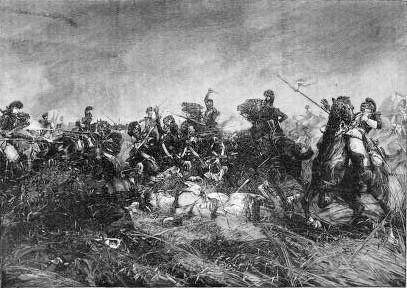
THE “BLACK WATCH” (42ND ROYAL HIGHLANDERS) AT BAY AT QUATRE BRAS.
(From the Painting by W. B. Wollen, R.I.)] country had to be re-conquered only to be again abandoned. The Afghans were always troublesome neighbours, and again in 1878 the insolence of the Ameer led to a new invasion. It was called a triumphal progress; but there was some hard fighting—some brilliant feats of arms. The capture of the fort of Ali Musjid by Sir Sam Browne’s column, the crowning of the Peiwar Kotal, and the opening of the Shuturgardan Pass by General Roberts were successful operations that were followed by the flight of the Ameer, and paved the way to the treaty of Gandamak, by which we placed a new Ameer on the throne and stationed a British resident at his court.
The second invasion of Afghanistan, in the autumn of 1879, was to revenge the base murder of this resident, Sir Louis Cavagnari, in Cabul, and it resulted in important operations. Sir Frederick Roberts, who advanced through the Shuturgardan Pass, direct upon Cabul, reached the capital after fighting the successful battle of Charasia, and was occupied in meting out punishment and strengthening his hold until the winter set in. But with the early snows there came very serious troubles. Nearly the whole of the Afghan tribes had been aroused to a jehad, or holy war, and the Ghazis gathered round the flag of a chief named Mohammed Jan to the number of 40,000. It was said that 100,000 might be expected to take up arms. Roberts’ whole force, English and native, was barely 5,000, but the former were veteran troops, and the latter made up of Sikhs and Goorkhas, the bravest of our Indian levies. The force now arrayed against us was so threatening that he withdrew entirely within our lines, and there, practically besieged, held the enemy at bay. It was a humiliating change for an invading army, but it was the only safe course to pursue. At last, Mohammed Jan was rash enough to attack Sherpur, and was repulsed with tremendous loss. We had not been strong enough to go out and meet him in the field, but he was much too weak to capture our entrenchments.
Our restored supremacy was not again affected until the chiefs at Ghazni showed signs of turbulence, and a force was detached from Cabul to join hands with one coming from Candahar to punish the offenders. The battle of Ahmed Khel, fought and won by Sir Donald Stewart, was a brilliant victory over a most determined foe. Never in the annals of Afghan warfare had Ghazis shown such indomitable courage. They came right in among our men, fighting hand to hand, pistol and sword against breechloader and bayonet, selling their lives so dearly that they did great mischief before they were repulsed. A thousand dead Ghazis were counted on the field, and some of them were women.
But this did not end the fighting, nor did success always smile upon our arms. Another Afghan army, advancing from Herat under Ayoub Khan, was met on the Helmund by General Burrows from Candahar, and a deplorable defeat followed. The causes of the already mentioned disaster at Maiwand were bad generalship and imprudence, but the sting of the defeat was somewhat taken out of it by the devotion displayed. Maiwand imperilled Candahar, which was speedily invested by the triumphant Ayoub, and the garrison was in some danger. Two armies were at once set in motion to relieve the place. General Phayre moved up from Quetta; Sir Frederick Roberts was sent from Cabul, to perform the great forced march which has become famous in military history. Cutting himself adrift from his base—an act which is deemed most rash and generally unjustifiable in military science—he started off with 10,000 men, hampered by 8,000 baggage animals to carry food and indispensable supplies, with 8,000 camp followers, to march 300 miles across an enemy’s country. His troops were the flower of the Indian army, their temper was the finest; no privations checked, no terrors daunted them; they bore without flinching the wide changes of temperature—between 45 degrees at daybreak and 105 degrees at noon; they were never sure of food, and they knew that certain death awaited them if they lagged behind.
The march from Cabul to Candahar was accomplished in twenty days, making an average of fifteen miles daily march during that time: a splendid feat in pluck and unyielding endurance; and they reached Candahar travel-stained but unwearied, ready to join issue with the enemy directly they met him. Ayoub had raised the siege at the approach of Roberts, but he awaited him in a strong position; and then followed the decisive victory of Candahar, fought under the walls of the city, in which the defeat at Maiwand was fully avenged.
The Zulu war will be remembered with mixed feelings: sorrow for grave and regrettable disasters, pride at great achievements, which in a measure atoned for and avenged them. We entered into the struggle a little too lightly, perhaps, although enough must have been known of our opponents to have exacted respect for their prowess. The Zulus were a military nation, every able-bodied man was a soldier, trained in the skilful use of his weapons, light of foot, ardent for glory, highly disciplined and drilled. The Zulu generals were admirable tacticians, and their now well-known plan of attack with centre held back and two great horns thrust out on each flank was quite scientific. Cetewayo, the king, a despot who could deal with his braves as he pleased, could send some 50,000 of them into the field, all ready to sacrifice their lives for him.
Lord Chelmsford, when the invasion of Zululand was decided upon, did not command more than 16,000 men, of whom 9,000 were native levies. His plan of operations covered a wide front: his forces marched in five columns, widely apart, from the sea-mouth of the Tugela River to Luneberg and the borders of the Transvaal. The centre, which he led himself, was the first to suffer, and barely escaped annihilation while the general-in-chief was out on a reconnaissance with half his whole force. The enemy he was looking for, some 20,000 Zulus, swooped down upon the other half in an open undefended camp and destroyed it. The massacre of Insandlwana, when a battalion of the 24th Regiment and a number of native troops were cut to pieces, would have been avoided with proper precautions. What even light entrenchments could do to stave off even overwhelming attack was seen the same day at Rorke’s Drift.
Retreat after Insandlwana was imperative. At one time it seemed as though the Zulus would pursue, and invade the colony of Natal. Fortunately, our arms were upheld elsewhere. The Tugela, or sea-coast column, under Colonel Pearson, had advanced some way towards Ulundi, and had established itself at Ekowe when the news arrived of Lord Chelmsford’s misfortune. After a short debate, it was wisely and bravely resolved to stand firm. Ekowe was roughly fortified and bravely held against thousands of Zulus for more than three months, until it was at last relieved by Lord Chelmsford in person, who on his way up had fought and won the battle of Ghingilovo.
Another column, under Sir Evelyn Wood, the nearest to the two overwhelmed at Insandlwana, had also been hardly pressed. Wood was active, and his attitude firm. At the action called that of the Zlobane Mountain he was for a time surrounded, but in the subsequent fight, when he was attacked in “laager” at Kambula, his force gallantly repulsed quite ten times their number. Two companies of the 80th, with the fifth column, were, however, unfortunate, and one of the detachments sent out to escort waggons coming in with supplies was surprised and destroyed upon the Intombi River. The Zulus had come upon them unawares in the mist—4,000 men to 150—and none of the British escaped alive.
Presently reinforcements began to arrive, and before May the army numbered 22,000 men, of whom 17,000 were Europeans. A new general—the then Sir Garnet Wolseley—was also sent out to supersede Lord Chelmsford; but the latter, utilising his greater means, was able to recover his prestige before the arrival of his successor. Fresh columns were organised; Generals Newdigate and Wood converged upon Ulundi from the north side; General Crealock was to advance from the Tugela (but never got very far); General Marshall, with a cavalry division, joined in with Wood.
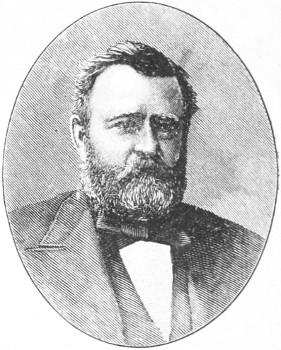
GENERAL GRANT.
The battle of Ulundi, when the king’s kraal was captured and burned, ended the war. The Zulus by this time had lost much of their spirit; they were “beginning to be frightened,” as one of their own chiefs said; and no doubt they now realised that the strength was on our side. Cetewayo was for some time a fugitive after Ulundi, and his pursuit and eventual capture by Colonel Marter and Lord Gifford were not the least exciting episodes of the Zulu war.
This was not to be our last campaign in South Africa. The war with the Boers, which followed, is not a brilliant chapter in our military history. In the Transvaal, as in Zululand, we began by under valuing our enemy, and time was not allowed to recover our reputation. The fate of the general whose name will always be associated with the Boer war was its saddest episode. Misfortune pursued Sir George Colley: he was one of the “unlucky.” Opinions differ concerning his latest failure, but there are many who hold that the story of Majuba—of the craggy and, seemingly, inaccessible hill climbed by Colley and his devoted band, only to find death and defeat on the top—ought, with better fortune, to have ranked with Wolfe’s scaling of the Heights of Abraham, or Charles Napier’s desert march on Emaum Ghur.
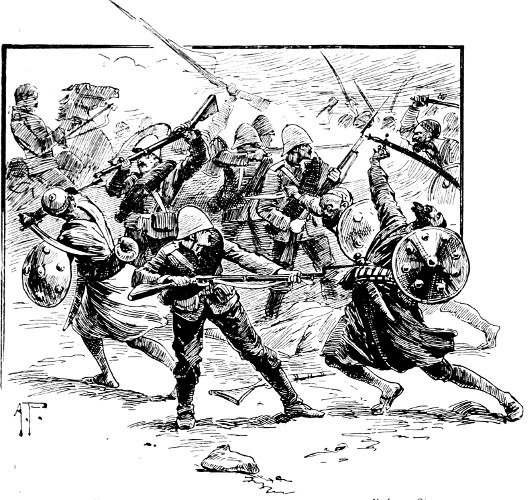
“THEY CAME RIGHT IN AMONG OUR MEN” (p. 18).
Egypt has been our latest battle-ground. The campaign against Arabi and his insurgent troops may not seem a very glorious achievement, but the Egyptians were well disciplined; they had admirable weapons, and they fought behind strong entrenchments, armed with most powerful artillery.
The cavalry combat at Kassassin, the storming of the lines of Tel-el-Kebir, were very successful feats of arms. Fighting of a much more serious character was in store for us before we were long in Egypt. The Great Nile Expedition, for the relief of the ill-fated hero Gordon, was akin to those to Magdala and Coomassie, but it differed rather in scope and greatly in results. To ascend a mighty river, running down with a steady stream five miles an hour and barred at intervals by cataracts and rapids, was a greater task than scaling mountains or penetrating the bush. The enterprise was further hampered by the opposition of a most determined and courageous foe. “Fuzzy Wuzzy,” as our soldiers christened the shock-headed Soudanese warrior, was an opponent worthy of our steel. His contempt for British squares and British breechloaders has been sung in strong language by Kipling, the soldier’s poet, and was shown by the recklessness with which he threw himself on the one and faced the other. Of all the brilliant battles fought by British soldiers, they may be most proud of Abu-Klea, Tamai, and El-Teb.
It has been often said in disparagement of our small wars, that they have been mostly waged against savage foes. But this is surely to our soldiers’ credit, for they have, in this way, encountered some of the most warlike races in the world, many of impetuous, of reckless fanatical bravery, who accepted none of the recognised canons and conventions of civilised warfare. To kill or be killed was the only watchword of the Afghan Ghazi, the stalwart Zulu, or the irrepressible Soudanese. There was no quarter, no making prisoners, except for subsequent butchery. In these desperate campaigns, our men fought with their lives in their hands. It was truly war to the knife, and called for the highest courage.
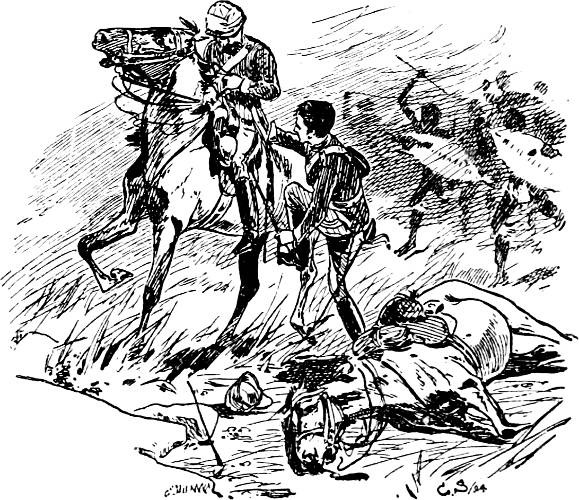
Nothing shows this better than the many deeds of heroism recorded in these wars, deeds that earned the most coveted of English military distinctions—the Victoria Cross. A chaplain, Mr. Adams, in the first fight outside Sherpur, bravely extricated a trooper who was under his dead horse in a mêlée, and who would certainly have been slain. In the Mutiny, Sir Charles Fraser, now a gallant general, won both the cross and the Humane Society’s medal at one and the same time for saving, under a heavy fire, a man who was drowning. In the closing affair of the Zulu war, before Ulundi, Lord William Beresford gallantly picked up a trooper, whose horse had been shot under him, and carried him off behind him on his own horse. The Zulus were near at hand in great numbers, and the fate of the fallen man would have been sealed. Commandant D’Arcy, of the frontier Light Horse, exhibited the same self-sacrificing courage on this occasion, but his own horse was wounded and fell under the double weight, whereupon D’Arcy mounted his man upon another trooper’s horse, and saw them safely off before he rode away.
Well, we have had our glance at the wars of the century—a cursory glance enough, and attracted chiefly by the red coat of the British soldier; let us now turn over the leaves of our book, and pass from battle to battle. We shall “go as we please”—passing from Plevna to Austerlitz, from Bull Run to Gravelotte, just as the spirit moves us, and unfettered by sequence either of date or place. Now we shall follow the fortunes of the Great Napoleon, now of Napoleon “the Little”; now of Wellington, now of Roberts and Wolseley; now of Moltke, Skobeleff, MacMahon, Sherman, Garibaldi. At one moment we shall be listening to the thunder of a broadside from the Victory, at the next to the bombardment of Alexandria. We shall pass from the shots and shells of civilised warfare to the assegais and spears of the Zulu, the hatchets of the Maori, the knives of the Soudanese. We shall see all the glories of war, deeds of daring and heroism, acts of noble self-sacrifice and devotion; but we shall see also that reverse side of the picture which should indeed be engraved still deeper on our minds: we shall see that its glories are outweighed by its horrors, its sufferings, its pitifulness.

Saarbrück
The Baptism of Fire
By Archibald Forbes
THE PRINCE IMPERIAL

The pleasant little frontier town of Saarbrück was a very interesting place at the beginning of the Franco-German war. Within the distance of a mile from the low heights covering Saarbrück towards the west, ran the frontier line dividing France from Germany. The place was being held “on the bounce,” for its garrison consisted merely of one battalion of the Hohenzollern infantry regiment and two squadrons of the 7th Rhineland Uhlans. All along this frontier line down in the broad smooth valley between the Saarbrück heights and the loftier and more abrupt Spicheren heights inside of the French border, the hostile piquets and videttes confronted each other.
As one stood in front of the little “Bellevue” public-house on the Reppertsberg, one saw in the plain below among the trees a Prussian piquet of Uhlans and infantry; and on the little knolls further in advance the videttes circling singly, their lance-pennons fluttering in the wind. Several hundred yards further away, by the side of the Forbach road, was the frontier custom-house which the French now used as a piquet house. Outside of it the red-breeched linesmen were to be seen sitting or lounging about in considerable numbers. In their front was the chain of their videttes. All along the frontier line, to the right and left of this point, there ran this arrangement of outposts confronting each other. On the Spicheren upland a French force was gradually gathering until, by the end of July, the whole of Frossard’s army corps was massed on the Spicheren, within gunshot distance of the low heights covering Saarbrück.
In those pleasant early days, while as yet there were no graves on the Spicheren Berg and no shattered men lying in the Saarbrück hospitals or littering the platform of the Saarbrück railway station on the blood-stained stretchers, the opposing piquets and videttes formed quite the diversion of the Saarbrück people. After the day’s work was over, the labouring folk used regularly to stroll up to the “Bellevue” to watch, as they drank their beer, the dropping fire, fain to see a German marksman proving his skill by hitting a Frenchman. Both sides were very cautious and few casualties occurred. As yet the Saarbrück hospital contained but two wounded Germans, both linesmen of the Hohenzollern regiment. The French were reputed to be in force in Forbach as well as on the Spicheren Berg—as many, it was said, as 15,000 men. Saarbrück, however, was in no trepidation and kept a good face with its little garrison of some 1,200 men all told.
It was on one of the earliest of those early days that the midday table d’hôte in the Rheinischer Hof was broken up abruptly by the report that French cannon were being moved forward to the edge of the Spicheren Berg. Immediately the drummers paraded the town, beating to arms. A company of the Hohenzollerns occupied each of the two bridges and a third marched up the hill and took up a position among the trees skirting the exercise-field. A detachment of the Uhlans rode up on to the heights, while the rest stood to their horses in the Central Platz. From the “Bellevue” the French cannon were easily discernible through the field-glass, as they were being drawn forward into position by infantrymen.
Almost immediately came a puff of white smoke from the mouth of one of the guns, and a shell struck on the road close by the little beer-house, bursting as it fell. There was a stampede on the part of the civilians from their beer-mugs in the “Bellevue,” and they hurried into cover behind the crest of the height. They were only just in time. Another shell, ricocheting off the road, struck the front of the beer-house, went through the wall as if it had been paper, and burst inside, blowing out the windows and part of the roof. Four more shots were fired, and then the French withdrew their cannon. Their practice, no doubt experimental, was very good—of the six shells fired, three struck the “Bellevue.” Two rooms of it had been blown into one, the bar knocked into little pieces, the furniture wrecked, and a great gap in the floor made by a shell on its way to the cellar to cause a smash-royal among the bottles.
The outposts blazed away at each other until dusk. One of the last shots killed a soldier on patrol—he was the first man killed in the war. The poor fellow was hit full on the forehead, and he must have died instantaneously. His comrades carried in the corpse on a stretcher improvised of their rifles. The drops of blood pit-patted on the road as they carried him past, the moonbeams falling on the pale dead face. Quite a lad he was, with the down hardly grown on his face—likely enough a mother might have been thinking of and praying for her lad, little knowing that he was lying stark and cold, waiting for a grave.
The slow days passed in a strange bewildering calm, unbroken save by the trivial skirmishes occurring in the course of the constant reconnaissances and patrolling parties.
Frossard lay passive on the Spicheren save for the “potato-reconnaissances” his hungry soldiers occasionally made, sending out a screen of skirmishers to the front while the working parties dug potatoes with great industry.
Brave old Major von Pestel of the Lancers, who commanded the handful of men holding Saarbrück, had received an order from Moltke to evacuate a place which was regarded as untenable; but von Pestel pleaded successfully to be left where he was, on the undertaking that he would not compromise his little command, but would fall back as soon as serious danger threatened.
Meanwhile he was never out of the saddle. Every afternoon he would come cantering over the Bellevue height with his cheery greeting and his shout, “Come along, English sir! I go to draw de shoots of de enemy!” The French marksmen expended a considerable quantity of ammunition on the worthy major; but the range was long and they never succeeded in hitting him, although certainly he gave them plenty of chances.
But in spite of Major von Pestel’s cordiality, it was rather a tedious time. Men asked each other if it were possible that the French on the Spicheren were not aware of the weakness of the land on the other side of the frontier. The Prussian infantrymen and Uhlans, it was true, were manipulated dexterously and assiduously to make a battalion seem a brigade and a couple of squadrons a powerful cavalry force; yet it was felt that the place was being held only by dint of sheer impudence—for there were no supports as yet nigh at hand—and that the bubble must burst summarily if Frossard should abandon his unaccountable inactivity. Why the soldiers in red breeches lay so long basking lazily in the sun on the Spicheren slopes the men of Saarbrück could not comprehend; but the day must surely be near now, they said one to the other, when the red-breeches would gird up their loins and roll their columns on over the Reppertsberg, the exercise-ground, and the Winterberg, and across the Saar into the Köllerthaler Wald or the Pfalz. In their path—surely they must have known it—there stood but an open town, a couple of bridges partially barricaded with barrels, a single battalion of infantry and two reasonably strong squadrons of Uhlans.
The 1st of August, while the French on the Spicheren Berg were still supine, brought to near Saarbrück what all hoped was the earnest at last of a host, not alone of resistance, but also of invasion. On the afternoon of that day, the 1st and 3rd battalions of the Hohenzollern regiment, with a battery of artillery, reached the vicinity and bivouacked on the edge of the forest at Raschpfuhl, some two miles north-west of the town. General Gneisenau also arrived and assumed the command.
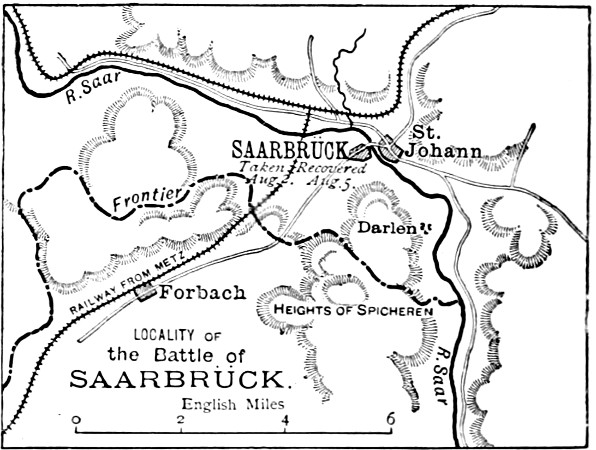
LOCALITY of the Battle of SAARBRUCK
On the morning of the 2nd, when the Hohenzollerns were basking in their sunshiny bivouac, the French Emperor, with his son, was travelling by train from Metz to Forbach. The German videttes down the valley heard the gusts of cheering with which Frossard’s soldiers welcomed the Head of the State and his heir. Ignorant of the cause, some attributed the cheering to the announcement of a French success somewhere; others ascribed it to an extra issue of wine. How were the honest Uhlans to discern that the imperial parent had come to the frontier to make a military promenade wherewithal to throw dust in the eyes of his Parisians, and that “Lulu,” as they impertinently styled the heir of the dynasty, accompanied his father that he might receive his “baptism of fire”?
The night had passed in quiet along the frontier, and in the morning it seemed as if the 2nd of August was to be as monotonous as had been the 1st. General Gneisenau and old von Pestel, now a lieutenant-colonel, had made a reconnaissance from the “Bellevue” and had come back to a leisurely breakfast. The soldiers in the barrackyards and in the several posts on the environs of the town, slept and smoked and gossiped, their arms stacked as usual; the officers sat under the trees drinking their Rhine wine, and the whole place seemed oppressed by the drowsiness of a fervently hot day.
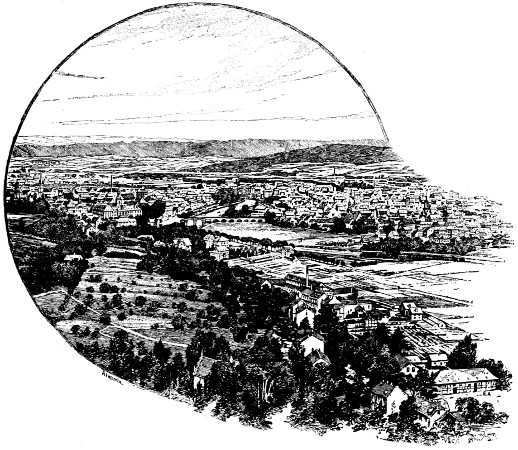
SAARBRÜCK.
But the torpor was soon to give place to alert activity. At ten a.m. Saarbrück awoke at the announcement sent in from the outposts that the enemy was at last advancing. The two companies in front of Saarbrück moved at once into the line of defence. The company from St. Johann hurried by at the double to occupy the “Red House.” Major von Horn hastened to strengthen the post on the Winterberg, which was most imminently threatened. Captain Gründer occupied the Löwenberg, and moved with Leydecker’s company and the rest of his own out to St. Arnual, where his rifle fire and the fire of two guns sent to him from Raschpfuhl gave a warm reception to the enemy debouching from the Stiftswald. As some English spectators hurried up to the “Bellevue” height, there rattled past them at a sharp trot a couple of guns which the general had ordered to be put in position on the Exercise Platz. The battery chief waved his hand cheerily as he galloped to the front.
From the “Bellevue” one looked upon an imposing spectacle. Three roads, crossing the plain from the wooded heights on the French side of the frontier, converge on Saarbrück. One of these is the great post-road from Forbach. Another, starting from the village of Spicheren, winds tortuously down the right flank of the precipitous “Rothe Berg”—the “Red Crag”—crosses the hollow and enters Saarbrück between the Reppertsberg and the Nussberg. The third, further to the east, is a mere green track of considerable breadth, which falls abruptly down into the valley by the poplar-clad slope from the plateau towards St. Arnual.
Down all these three roads were flowing from the upland dense and glittering streams of French troops, the stream on the great road flowing swiftest and fastest. The sunrays flashed on the bright bayonets, and threw up from the green or grey background the red and blue of the uniforms. The troops came on in the true careless, irregular French style, with scarcely a pretence of formation, but with a speed that was remarkable. The moment that the head of a column reached the valley, it broke into spray. As file after file reached a certain point, it became dissipated; the nimble linesmen extended further and further to right and left, till by the time that the heads of all three columns were in the valley, an unbroken but loose chain of skirmishers was drawn across the plain several hundred yards in advance.
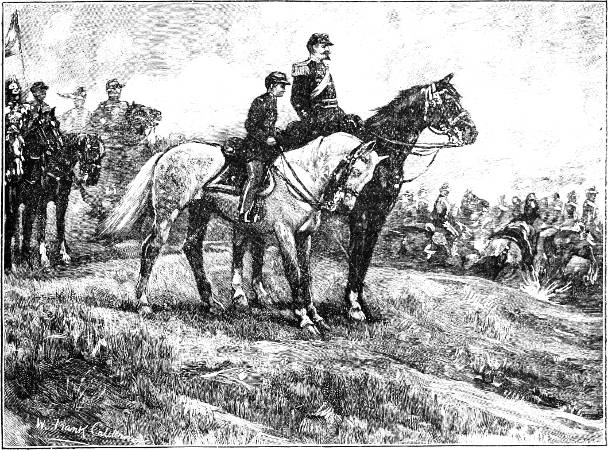
LULU’S DÉBUT.
Then began the steady deployments of company after company, battalion after battalion, regiment after regiment; and almost before one had realised the situation, a long dense line had been ruled along the valley behind the more ragged line of the skirmishers. Squadrons of cavalry streamed down, and forming line at a gallop, rapidly overtook the infantry. Passing through the intervals, they re-formed and pushed on to occupy and cover the flanks of the advance.
While all this was going on in the valley, the streams from behind the wood and the hill seemed to flow from a source that never would run dry. It was hardly a break that was caused in it by the two batteries that came down and wheeled off the road on to the verge of the plateau, the gunners unlimbering and standing ready by the venomous pieces that presently gave fire from their wicked black, mouths. Higher up on the crest were visible other batteries, apparently of larger guns. The peculiarity of the movements described was their perfect quietness and uninterruption. The French tirailleurs had already begun to breast the gentle slope leading up to the positions held by the Germans, when the chassepots began to give tongue; and then the silence gave place to a steady rattle of musketry fire, through the smoke of which the main advance moved steadily and swiftly forward.
Bataille’s division formed the first line; of it Bastoul’s brigade on the right of the main road moved against the Reppertsberg, the Winterberg, and St. Arnual; Pouget’s brigade on the left of the road moved towards the exercise-ground. In the second line were the brigades of Michelet and Valazé; the remainder of Frossard’s corps, the strength of which reached 35,000 men, followed in reserve. An army corps was marching against a couple of battalions.
Despite the disproportion, the Prussian defence was obstinate. It was only after a brisk combat that the weak detachment were driven from St. Arnual, the Winterberg, and the Reppertsberg. On the latter height a Prussian half-company met the French skirmishers with the bayonet, and then held them for a time at bay by a fire from behind the hedges.
The final withdrawal was conducted slowly, in excellent order. Baron von Rosen held his company to the last on the exercise-ground. His steadfast soldiers, lying down between the trees, waited until Pouget’s skirmishers were within 300 yards, and then poured in a fire so heavy that the French assailants were compelled to halt and lie down for a time.
It was just as Rosen had received a peremptory order to retire that the few spectators who waited to accompany that movement witnessed the descent from the Spicheren height of a great cortège of mounted officers. The glittering procession rode forward at a slow trot, crossed the intervening level, and then ascended the slope of the Folster height, around which was massed the regiments of Valazé’s brigade.
The cortège halted on the low crest of the Folster height; and through the telescope one saw the group open out and leave isolated two personages on horseback, one of whom was clearly discerned to be Napoleon III. The boyish figure on the smaller horse, whose gestures were so animated, was presumed to be the young Prince Imperial; and the cheers which rose above the din of the musketry-fire were taken to indicate the congratulations of the soldiers at the Prince’s receiving his “baptism of fire”—which, indeed, it has been supposed, was the object of the otherwise pointless demonstration. Not on the Folster Höhe, but nearer to Saarbrück, under the trees of the exercise-ground, is now a stone with a somewhat brusque inscription, which being translated reads:—“Lulu’s Début, 2nd August, 1870. Erected by H. H. Baumann, Veteran of 1814–1815.”
It was just as Rosen was withdrawing his company from the immediate front of Pouget’s advance that a curious and characteristic incident occurred. Among the few civilians who remained on the exercise-ground to the bitter end was a gallant British officer, Wigram Battye of the famous “Guides,” who died fighting in Afghanistan in the campaign of 1878. A soldier was shot down close to him, whereupon Battye, who had been rebelling against the retirement, snatched up the dead man’s needle-gun and pouch-belt, ran out into the open, dropped on one knee, and opened fire on Pouget’s brigade. Pouget’s brigade replied with alacrity, and presently Battye was bowled over with a chassepot bullet in the ribs. A German professor and a brother Briton ran out and brought him in, conveyed him later to a village in the rear, plastered successive layers of brown paper over the damaged ribs, and started him off in a waggon to the Kreuznach hospital.
The French did not press upon the orderly Prussian retirement, and, indeed, both of the bridges across the Saar remained in the possession of the Prussians. The firing had almost died out when, soon after noon, the French began to bombard the lower bridge and the railway station from three batteries which they had brought up on to the heights overhanging Saarbrück. One of these was a mitrailleuse, the storm of bullets from which swept the bridge so that nothing could live on it, and an unfortunate burgher, who did not believe in the mitrailleuse, had to alter his views on this subject when the lower part of his person was riddled by the bullets it poured forth. The Prussian artillery about Malstatt tried with four guns to make head against the French batteries, but had to give up the attempt and retire. The final detachment of Prussians remained under the shelter of Hagen’s Hotel while the French were shelling the railway station, but ultimately ran the gauntlet and found refuge in the Köllerthal. The casualties of the day were trivial. The Prussians had eight men killed, four officers and seventy-one men wounded. The French loss amounted to six officers and eighty men.
During their short stay in and about Saarbrück the French behaved with great moderation. General Frossard, on the evening of the attack, sent for the Mayor of Saarbrück, and told him that his orders were very strict against marauding, and that if any cases occurred the townspeople were to take the numbers on the caps of the evil-doers, when the fellows would be severely punished. But there was little occasion for complaint: the French soldiers paid their way honestly. They did, to be sure, drink a brewery dry, but the brewer refrained from reporting them. A corporal attempted to kiss pretty Fräulein Sophie—the dame du comptoir of the Rhinescher Hof; but a captain caught him in the act, ran him off the premises, and himself kissed the winsome lass. On the morning of the 6th the Prussian troops were back again in Saarbrück: the French had gone back to the Spicheren position on the previous night.

THE STORMING OF THE TAKU FORTS
BY A. HILLIARD ATTERIDGE
“There’s many a victory, surely, decisive and complete, As meant a sight less fightin’ than a hardly fought defeat; And if people do their duty, every man in his degree, Why defeat may be more glorious than a victory needs to be.”
These lines from a modern ballad put very clearly a truth that is too often forgotten. Victories are remembered and commemorated by medals and names inscribed in letters of gold on our regimental colours; but people do not talk about defeats. Yet when brave men fail against desperate odds, the story of their gallant efforts to carry their flag to victory is quite as well worth the telling and the remembering as if the chance of war had given them the coveted prize of success.
So it is that among the battles of the century that should not be forgotten we count the one solitary defeat that English sailors or soldiers ever suffered at the hands of the Chinese—Admiral Hope’s failure to force the entrance of the Pei-ho River at the Taku Forts on June 25th, 1859: a failure amply avenged by the gallant storming of the same forts in the following year.
Taku is a town near the mouth of the Pei-ho (i.e. the “North River”), which, flowing between low, muddy banks, runs into the Gulf of Pe-chi-li. Thirty-four miles higher up the river is Tien-tsin, built at the junction of the Pei-ho with the Grand Canal. It is the port of Pekin, and a busy and prosperous place. Pekin, the capital, is some eighty miles still further inland. In the year 1858 the French and English had forced their way to Tien-tsin, passing the forts near Taku at the river mouth with but little difficulty, for the works were badly armed and held by an irresolute garrison which made but a poor defence.