LIST OF PLATES. (continued 3)
Reading edition
Continuing again, still southward, you will pass La Belle Alliance and Genappe, and nine miles from the cross-roads before Mont St. Jean is Quatre Bras.
Rolling ridges of waving grain, some woods in all their summer beauty, a gabled farmhouse, and a few cottages where four ways meet—that is one’s impression of Quatre Bras, which Ney had orders to take, and drive out Perponcher’s Dutch Belgians posted there; but we arrived to their assistance, corps after corps, at intervals, and forming up in line and square, repulsed the Cuirassiers and Lancers who charged through the tall rye.
The crops were so high that the gallant French cavalry had to resort to a curious device in singling out our regiments. A horseman would dash forward, find out the position, plant a lance in the ground, and disappear; then, in a few moments, guided by the fluttering pennon, his comrades would burst upon us—invisible until within a few horse-lengths.
Waterloo has put Quatre Bras into the shade, but few conflicts have been more brilliant.
Our 69th—thanks to Orange, who interfered with its formation just as the 8th Cuirassiers came through the corn—lost its only colour, taken by Trooper Lami, although Volunteer Clarke received twenty-three wounds and lost the use of an arm in its defence.
The 69th’s other colour had been captured at Bergen-op-Zoom, and was hung in the Invalides.
By four o’clock the 44th had upwards of 16 officers and 200 men killed and wounded.
A grey-headed French lancer drove his point into Ensign Christie’s left eye, down through his face, piercing his tongue and entering the jaw; but in that shocking condition he still stuck manfully to the colour-pole, until, finding himself overpowered, he threw the colour down and lay upon it, and some privates of the regiment closing round the Frenchman, lifted him out of his saddle on their bayonet points!
The 92nd Highlanders—the old Gordons of Peninsular fame—were the last of Picton’s men to reach the field, and were formed up in line.
“Ninety-second, don’t fire till I tell you!” cried Wellington, as a mass of Cuirassiers charged them in his presence; and the word was not given until the dashing horsemen were within twenty yards.
A little later, the duke said again: “Now, 92nd, you must charge these two columns of infantry”; and charge they did, over a ditch, driving the French before them, but their beloved colonel, Cameron, received a death-wound from the upper windows of a house.
His horse turned and bolted with him, back along the road, until he came to his master’s groom holding a second mount, when, stopping suddenly, the dying man was pitched on his head on to the stone causeway. But he had been terribly avenged; for the kilted Highlandmen burst into the house with a roar and put every soul inside to the bayonet.
“Where is the rest of the regiment?” asked Picton in the evening. Alas! upwards of half the “gay Gordons” had perished in the fray.
Through the broiling heat of that summer day our infantry stood firm, growing stronger as regiment after regiment arrived, and fresh batteries unlimbered in the trampled corn, until at night Ney fell back, leaving us in possession; our cavalry came up, jaded by their long marches; and we bivouacked on the battle-field, cooking our suppers in the cuirasses of the slain.
Meanwhile, Napoleon had beaten Blücher a few miles away at Ligny, but had neglected, in most un-Napoleonic fashion, to follow up his advantage, and the wily old hussar—he was over seventy-three—slipped off in the dark and retreated on Wavre.
When Wellington learned this next morning, he said to Captain Bowles: “Old Blücher has had a —— good licking, and has gone back to Wavre. As he has gone back, we must go too. I suppose in England they will say we have been licked. I can’t help that.” So back we went, along the Brussels road, our cavalry covering the retreat until we reached the stronger position before Mont St. Jean, where we halted and faced about, and glued ourselves on the ridge across the causeway in such a manner that all the magnificent chivalry of France could never move us.
During the retreat from Quatre Bras on the 17th, all went well until the middle of the day. The wounded had been collected; the columns filed off along the road; one of the regiments even found time to halt and flog a marauder: when, the enemy’s cavalry pressing our rear-guard too closely, some Horse Artillery guns opened fire, and the discharge seemed to burst the heavy rainclouds.
It poured down in torrents; roads were turned into watercourses, the fields and hollows became swamps; we had a smart brush with some Lancers at Genappe, where our 7th Hussars and 1st Life Guards charged several times; the 10th Hussars had also occasion to dismount some men and line a hedgerow with their carbines; but the main feature of the retreat was a weary tramp in a deluge of rain. The cavalry had their cloaks, it is true, but the greatcoats of the foot-soldiers had been sent back to England. Soaked to the skin, we arrived at the ridge above La Haye Sainte, and prepared to pass the night without covering of any kind. The French advanced almost up to us, and Captain Mercer was giving them a few rounds from his 9-pounders when a man in a shabby old drab overcoat and rusty round hat strolled towards him and began a conversation. Mercer, who thought him one of the numerous amateurs with whom Brussels was swarming, answered curtly enough, and the stranger went away.
That shabby man was General Picton, who fell next day on the very spot where he received this unmerited snubbing. He fought at Quatre Bras in plain clothes, having joined the army hurriedly in advance of his baggage, and there is good reason to believe that he wore the same dress at Waterloo.
Now commenced preparations for a dismal bivouac. The French fell back and did not disturb us again, they too suffering from the drenching rain, which beat with a melancholy hissing on the cornfields, the clover, the potato patches and ploughed land which formed both positions.
Some of our officers found shelter in neighbouring cottages; Lord Uxbridge, afterwards Marquis of Anglesey, crept into a piggery and sipped tea with Waymouth of the 2nd Life Guards; but most of them cowered with their men round wretched fires which here and there were coaxed into burning.
One of Mercer’s lieutenants had an umbrella, which had caused much merriment during the march, but he and his captain found it a haven of refuge under the lee of a hedge that night.
The cavalry stood to their horses, cloaked, with one flap over the saddle; some few were lucky enough to get a bundle of straw or peasticks to sit down upon, and all looked anxiously for the dawn—fated to prove the last to thousands of them. With morning the rain gradually declined to a drizzle, which finally ceased; fires sprang up, arms were cleaned, and a buzz of voices rose along the line as tall Lifeguardsmen went down behind La Haye Sainte to dig potatoes, where, a few hours later, they were charging knee to knee, and every one made shift to get what he could—with most it was only a hard biscuit—and to dry himself, which was a still more difficult matter.
Wet to the skin, splashed from head to foot in mud and mire, cold, shivering, unshaven (the foundation laid of acute rheumatism, to which a pension of five pence a day, in some cases ten pence, was applied by a grateful country, to its indelible disgrace), such was the condition of those brave hearts who were about to make the name of “Waterloo-man” a household word for all the ages.
The Brussels road runs across a shallow valley, three-quarters of a mile in width, all green and golden with the ripening grain, dipping sharply into it by the white-walled, blue-roofed farmstead of La Haye Sainte, and rising gently out again at the cabaret of La Belle Alliance on its way to the frontier beyond Charleroi.
The valley is bounded by two ridges: on the northern one along the cross road which runs nearly the whole length of the position, our army was posted in the form of a thin crescent; on the southern ridge and the slopes leading down into the valley the French forces were afterwards distributed, also, to some extent, in crescent shape.
These crescents had their tips advanced towards each other, and enclosed in the oval thus formed were two important strongholds—La Haye Sainte, in advance of our left centre, and the château of Hougoumont, some distance in front of our right wing; while away to the extreme left, the white buildings of Papelotte partly concealed Ter La Haye farm and the red-tiled hamlet of Smohain, the end of our line in that direction.
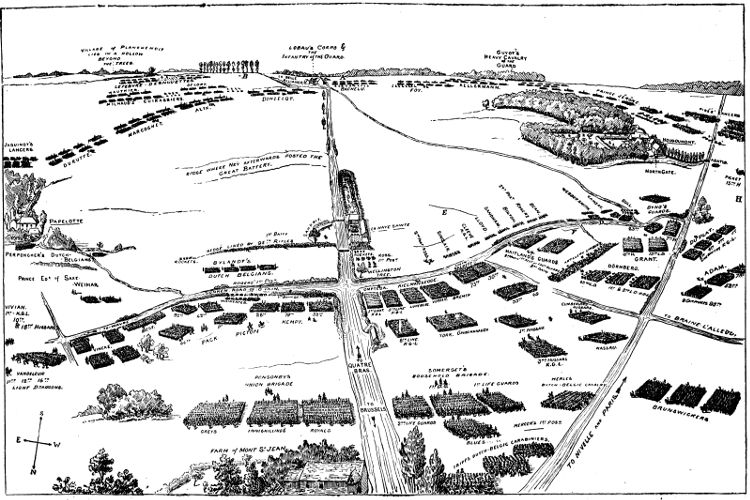
D. H. Parry, inv.] R. Simkin, del.
THE FIELD OF WATERLOO ON THE MORNING OF THE BATTLE, SUNDAY, JUNE 18, 1815.
A and B, Napoleons first and second positions; C, Napoleon’s last position, from which he saw the defeat of the Imperial Guard; D, Wellington’s position when the battle began; E, where Wellington stood when he ordered the whole line to advance; F, Mercer’s post when he repulsed three charges of the Guard; G, post of 27th Regiment when Lambert’s Brigade came into the front line; H, the 23rd Regiment, of Mitchell’s Brigade, is shown, behind Byng, the others are out of plan at H, except company of 51st keeping the abattis. The spectator is supposed to be behind Mont St. Jean farm, a little to the left, and raised above the field.
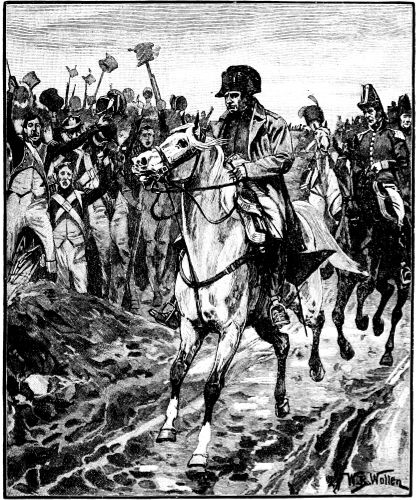
“A SHOUT OF ‘VIVE L’EMPEREUR!’ ROLLED ALONG THE FIELD” (p. 58).
The cross-road which I have mentioned as lying along our position, and which was the celebrated “sunken road of Ohain,” runs in some places between banks, at others on the level; it is paved down its centre, like most Belgian roads, with irregular stones, terrible to traverse for any distance, and it undulates gently, as the ridge rises and falls, until it joins the Nivelle chaussée beyond Hougoumont. Hougoumont, surrounded by a quadrangle of tall trees, lies in a hollow in front of our ridge, perhaps halfway between it and the enemy’s line. A Flemish château with a garden laid out in the French style, and a smaller garden full of currant bushes; barns and quaint outbuildings clustering round the château, a brick wall about the height of a tall man, built on lower courses of grey stone, enclosing the garden, and at the east end of it a large open orchard; from the north-west corner, an avenue of ancient poplars winding into the Nivelle road with an abattis of tree trunks there, held by a company of the 51st Light Infantry; between the south wall and the French, a beech wood, through which one could see the corn-clad slopes beyond: and that was Hougoumont on the day of the battle.
The beech wood has been cut down, the apple-trees are sparse and scanty now, the château was burned by the French shells, and the garden is a grassy paddock; but the rest remains, loopholed and pockmarked with balls, a monument to the gallantry of two brave nations. The light companies of the Foot Guards occupied it on the 17th, and all night long they were busy, boring walls, barricading the gateways and erecting platforms from which to pour their fire.
On the high ground behind Hougoumont on our side the 2nd Brigade of British Guards was posted, having Maitland’s Guards on its left; beyond Maitland was Alten’s Infantry and Kielmansegge’s Hanoverians, flanked in their turn by the gallant King’s German Legion, in the pay of England, whose left rested on the Brussels chaussée, behind La Haye Sainte. On the other side of the chaussée was Kempt, then Pack’s Highlanders, the Royal Scots, and 44th Regiment, some more Hanoverians, under Best, the 5th Hanoverians of Vincke, Vandeleur’s Light Dragoons, and Vivian’s Hussar Brigade.
The 2nd Rifles of the German Legion held La Haye Sainte, three companies of our 95th occupying a knoll and sandpit on the other side of the road, and Papelotte was garrisoned by Dutch Belgians, who behaved with the greatest gallantry.
Along the front of this, our first fighting line, the artillery was posted at intervals, and sufficient justice has not been done to the brave gunners, the duke always being unfairly severe on that arm of the service. Our heavy cavalry stood, in hollows behind the line, right and left of the great road in front of the farm of Mont St. Jean, already full of the Quatre Bras wounded. Other troops were in reserve out of sight of the enemy, behind our ridge, ready to advance and fill up any gaps, and we had a strong force in and about Braine l’Alleud, two miles to our right, in case the French should try to turn us there.
Crops, as at Quatre Bras, covered the valley and ridges, and the whole plain undulated in every direction. The battle-field to-day is full of surprises. Sudden dips occur where the land seems flat from a little distance; tongues of ground and barley-covered hillocks rise unexpectedly as you approach them; and it is possible to lose sight of the entire field by a few yards of walking in some directions; so that, flat as Belgium is generally considered, it is not astonishing that the survivors of Waterloo could only speak to events in their own immediate vicinity.
Between nine and ten there was loud cheering, as the Duke of Wellington rode along the line with his Staff. He wore a blue frock coat, white cravat, and buckskin breeches, with tasselled Hessian boots; a short blue cloak with a white lining, and a low cocked hat with the British black cockade, and three smaller ones for Spain, Portugal, and the Netherlands. He was mounted on his favourite chestnut, Copenhagen, a grandson of Eclipse, and carried a long field-telescope drawn out for use.
At nine o’clock there was a movement on the opposite side of the valley; columns debouched into the fields right and left of the chaussée, and took up their positions as orderly as if upon parade; glittering files of armoured Cuirassiers trotted through the corn, and formed behind the infantry, lance-pennons fluttered on each flank, and by half-past ten 61,000 French soldiers were drawn up in battle array, their right opposite Papelotte, their centre at La Belle Alliance, their left wing somewhat beyond Hougoumont.
The two greatest living commanders were about to measure swords for the first and only time; and as Napoleon galloped along his line, the music of the French bands was distinctly heard; helmets and weapons were brandished in the air, and a shout of “Vive l’Empereur!” rolled across the field.
Blue-coated infantry formed their first ranks, with batteries of brass cannon dotted here and there; behind stood the heavy cavalry with more guns, supported, on their right, by the gay light horse of the Guard, on the left by the heavy cavalry of the Imperial cohort, and in rear of the centre about the farm of Rossomme, stood the invincible infantry of the Guard, the most renowned body of warriors in Europe.
Napoleon was unwell.
At two in the morning he had been reconnoitring, and his horses were ordered for seven; at ten he still sat in an upper room in an attitude of bodily and mental suffering.
A little later he came down the steep ladder, and as his page, Gudin, was helping him into the saddle he lifted the Imperial elbow too suddenly, and Napoleon pitched over on the offside, nearly coming to the ground.
“Allez” he hissed, “à tous les diables!” and away he started in a great rage.
The page stood watching the cortège with tearful eyes, but when it had gone some hundred yards the ranks of the Staff opened, and Napoleon came riding back alone.
With one hand placed tenderly on the lad’s shoulder he said, very softly, “My child, when you assist a man of my girth to mount, it is necessary to proceed more carefully.” Yet it was of this man that Wellington could say, in after years, “The fellow was no gentleman”!
The page became a general, and fell in a sortie from Paris during the Franco-Prussian war.
There was a lull before the storm, and the duke went to have a final look at Hougoumont, where, in addition to the Guards, he had posted, in the woods and grounds, some Nassauers, Hanoverians, and Luneberg riflemen.
These foreigners were dissatisfied at their position, and as Wellington rode away several bullets came whistling after him! “How can they expect me to win a battle with troops like those?” was his only comment.
About half-past eleven came the First Attack!
One booming cannon echoed dully in the misty Sabbath morning, and a cloud of dark-blue skirmishers ran forward against Hougoumont, firing briskly into the wood.
Puffs of white smoke issued from the trees; here and there a blue-coat turned a somersault and lay still; but the cloud increased, and a loud rattle of musketry was kept up on both sides, which lasted, with short intervals, the whole day.
Our men fell back upon the buildings through the open beech-trees, and in twenty minutes the French supporting columns were pouring up the hill towards the château grounds.
Cleeve’s German battery opened on them, and his first shot killed seventeen men, the guns checking the advance and sending the column, broken and bleeding, down the ridge again.
Our batteries on the right now began; the French artillery replied; Kellermann’s horse batteries joined in, and the infernal concert was in full blast.
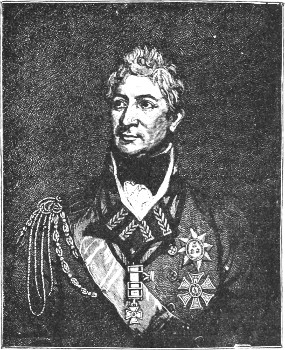
SIR THOMAS PICTON.
(From the Painting by Sir M. A. Shee, P.R.A.)
The green Lunebergers and the yellow knapsacks of the Hanoverians came helter-skelter back across the orchard, but the Foot Guards went forward at a run and drove the enemy off.
Bull’s howitzers sent a shower of 5½-inch shells over the château into the wood, and as often as the death-dealing globes fell crashing through the branches, so often did the enemy retire in confusion, until Jerome Bonaparte, ex-king of Westphalia, who was in command at Hougoumont, brought up Foy’s Division to help the attack.
Bravely led by their officers, the tall shakoes and square white coat-facings of the line regiments, the dark-blue and black gaiters of the light infantry, pressed through the wood until they reached a stiff quickset hedge, separated by a thin strip of apple orchard from the long south wall, over which peeped the head-gear of our Guardsmen, and in the confusion of smoke and skirmish the bright-red brickwork was mistaken for a line of British—you can see to-day where the French balls crumbled that barrier. But soon discovering their error, the brave fellows struggled through the hedge and rushed forward.
A line of loopholes perforated the wall about three feet from the ground, crossed bayonets protruded viciously from the openings, and a hail of bullets poured forth with such ghastly effect that in half-an-hour there were fifteen hundred of God’s creatures dead and dying on the green grass in the orchard, and still the others came on.
Some got as far as the loopholes, and seized the bayonets; others struck with their gunbutts at the men, who, on platforms behind the wall, fired down over the top, piling up the dead in dreadful heaps—privates and officers, conscripts and veterans.
From time to time our Foot Guards charged over the large orchard at the east end of the enclosed garden, and also at the south-west angle of the farm buildings, where a haystack helped to cover them until the French burned it; and this repulse and attack went on, time and again, until the evening, the enemy gaining no advantage but the beechwood for all their desperate valour.
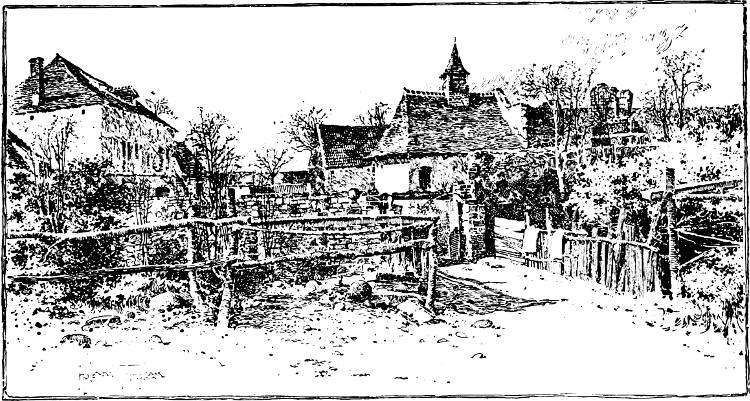
THE FARM OF HOUGOUMONT.
The rest of our line had remained passive listeners to the firing, except for a little skirmishing here and there, but a hurricane was brewing and about to burst against our left and centre.
La Haye Sainte was a farm, lying like Hougoumont in a hollow; it was on the Brussels road, and was built with barn and stabling round three sides of an oblong yard, the fourth side being a high white wall, with a gate and a piggery alongside the roadway.
Towards the French position stretched a long orchard, a small garden lay behind the house, and a large double door opened from the yard into the fields on the Hougoumont side, half of which door had been burned for bivouac fires the night previous. The 2nd Rifles of the German Legion, dressed like our own in green with slate-coloured pantaloons, held the post, and held it like the heroes of old, three companies in the orchard, two in the building, and one in the garden, Major Baring, who had two horses shot under him, being in command.
The post was not as strong as Hougoumont, all the pioneers having been sent to fortify the latter place, and the “Green Germans” had a very insufficient supply of ammunition; Wellington afterwards admitting that he had neglected to make the most of the position there.
At 1:30 p.m. Marshal Ney had gathered seventy-four guns, mostly 12-pounders, on a ridge very near to La Haye Sainte on the French right of the road, and this was known as the “Great Battery.”
Behind the guns the whole of D’Erlon’s Corps, together with Bachelu’s Division, was massed in columns for the attack twenty regiments, Bachelu being in reserve. Ney sent to the Emperor to tell him all was ready, and with an appalling cannonade on our left and centre, they commenced the Second Attack.
When the smoke which hung about the guns had drifted slowly away across the slopes we could see four massive columns, led by the brave Ney, pouring steadily forward straight for our ridge.
The firing became general as we opened on the advance; men had to shout to be audible to their neighbours; long lanes were ploughed through Picton’s Division, and the balls went tearing through our cavalry in reserve, many of them striking the hospital farm, and some even travelling into the village beyond.
Bylandt’s Dutch Belgians, posted in front of the cross-road, forgot their gallantry at Quatre Bras, and bolted, almost running over the Grenadiers of our 28th, who were restrained with difficulty from firing into them. One ball cut a tall tree into half at the hedgerow above the sandpit, bringing the feathery top down and half-smothering two doctors of the 95th, who had stationed themselves beneath it.
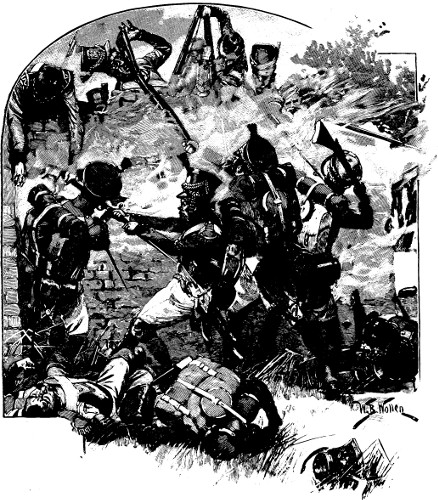
“SOME GOT AS FAR AS THE LOOPHOLES AND SEIZED THE BAYONETS” (p. 59).
Nearly 24,000 men advanced, with loud cries and the hoarse rolling of drums, in four masses: Durutte against Papelotte, Alix and Marcognet in front of Kempt and Pack, Donzelot upon the devoted Rifles in La Haye Sainte, the shock taking place about two o’clock, and lasting for more than an hour.
Durutte took Papelotte, but was driven out again; Alix and Marcognet breasted the rise, and gained the ridge under a murderous discharge; the smell of trampled corn mingling with the powder smoke as the Great Battery ceased firing lest it should kill its comrades, and with shouts of “Vive l’Empereur!” the two columns hurled themselves against the steel barrier of bayonets on the hedge-lined bank above them.
Hand to hand, no quarter asked or given, veteran and conscript came on yelling like mad, Picton’s Division meeting them in line.
Some of Marcognet’s fellows crossed the Wavre road and blazed into the 92nd; but our men advanced, after a withering volley, and, jumping into the cross-road, went at them with a will. Cameron Highlanders, 32nd and 28th, Scots Royals, and Black Watch, Gordons and 44th, with colours waving and courage high, over the causeway they rushed, into the wheat and barley.
“Charge, charge! Hurrah!” cried Picton, his little black eyes sparkling, his florid complexion redder with excitement—a ball struck his right temple, he fell dead from his horse, and his men passed over him driving the foe down hill.
A mounted French officer had his horse shot, and getting to his feet seized the regimental colour of the 32nd, which was nearly new. Belcher, who carried it, grasped the silk and the Frenchman groped for his sabre hilt, but Colour-sergeant Switzer thrust a pike at his breast. “Save the brave fellow!” was the cry, but it came too late; a private, named Lacy, fired point blank into him, and he fell lifeless.
Ney stood in the road beyond La Haye Sainte watching Donzelot’s attack on the farm, where the “Green Germans” were forced, after a struggle, out of the long orchard into the buildings, and simultaneously a mass of Cuirassiers tore past the Hougoumont side and rode at the ridge.
Our Household Cavalry and Ponsonby’s Heavies had walked on foot to the height overlooking the struggle; the trumpets rang out “Mount,” and swinging into their saddles they swooped down into the thick of it. With a clatter across the causeway, and the muffled thunder of hoofs on the ground beyond it, the scarlet-coated Life Guards, wearing no armour then, and mounted on black horses, dashed past the Wellington tree into the potato field, with the Blues and King’s Dragoon Guards, swinging, slashing, stirrup to stirrup, to meet Kellermann’s troopers and Ordoner’s Cuirassiers. There was the snort of eager horses, the creaking of leather, the clash of sword on steel cuirass, the yell of passion and the scream of agony; a seething mass of fighting-men and steeds, glinting and gleaming, swaying this way and that way, but always onward, jostling down the hill.
The 1st Lifes got jammed in the road beyond the farm with a body of Cuirassiers, on the spot where Ney had just before been standing, voltigeurs firing into them, on friend and foe alike!
Their Colonel, Ferner, led eleven charges, although badly wounded by sabre and lance.
The King’s Dragoons jumped their horses over a barrier of trees which our Rifles had built across the causeway and went thundering along that way, while the Blues were reaping a harvest of glory in another direction, and the 2nd Life Guards charged to the left for a great distance beyond the sandpit alongside the farm, where Corporal Shaw met his fate after slaying nine of the enemy singlehanded.
After the battle men remembered this mighty swordsman, and told in solemn voices his deeds of derring-do. One cuirassier sat, out of the mêlée, coolly loading his carbine and picking off our troopers, and it is believed he gave Shaw his mortal hurt.
A survivor narrated how, exhausted at nightfall, he had lain down on a dung-heap, when Shaw crawled beside him, bleeding from many wounds. In the morning the life-guardsman was still there, his head resting on his arm as if asleep, but it was the sleep which knows no waking.
Ponsonby’s Union Brigade was meanwhile making its immortal onslaught, more towards Papelotte, the ground they went over being billowy, and the troops before them infantry of the line.
The Royals gave a ringing cheer; “Scotland for ever!” was the war-cry of the Greys; and the Inniskillings went in with an Irish howl.
As they passed the 92nd, many of the Highlanders caught hold of their stirrup-leathers and charged down with them; the very ground seemed trembling under the iron hoofs; Marcognet and Alix were broken and trampled, and in three minutes more than 2,000 prisoners were wending their disconsolate way to the rear.
“Those beautiful grey horses!” said Napoleon, as he watched the charge.
Did he see that struggle round the Eagle of his 45th, I wonder—that famous “Battle for the Standard” which Ansdell has painted so well?
What says Sergeant Ewart, the hero of the incident? “It was in the charge I took the Eagle from the enemy. He and I had a hard contest for it. He made a thrust at my groin; I parried it off, and cut him down through the head. After this a lancer came at me; I threw the lance off by my right side, and cut him through the chin and upwards through the teeth. Next a foot-soldier fired at me, and then charged me with his bayonet, which I also had the good luck to parry, and then I cut him down through the head. Thus ended the contest.”
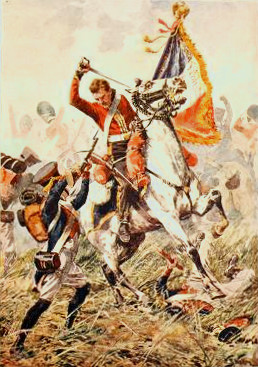
Sergeant Ewart Capturing the Eagle at Waterloo (p. 62).
(From a Painting by W. B. Wollen, R.I.)
Captain Clarke and Corporal Styles, of the Royals, took an Eagle from the 105th between them—a glorious gilded thing, embroidered with the names of Jéna, Eylau, Eckmühl, Essling, and Wagram—the gallant captain losing the tip of his nose in the struggle.
A man of the Inniskillings named Penfold claimed to have taken that colour; but his story is vague, and I incline to think that a blue silk camp-colour of the 105th, now at Abbotsford, was the one that Penfold seized and afterwards lost in the fray.
Sir William Ponsonby led the charge on a restive bay hack, and was killed; while some of the Greys got as far as the Great Battery, disabling many of the guns, and getting slain in the end.
Part of the 28th lost its head, and charged with the brigade; Lieutenant Deares of that regiment being taken prisoner, stripped of his clothes, rejoining at night in nothing but shirt and trousers.
Tathwell, of the Blues, tore off a colour, but his horse was shot and he lost it; and the greater part of the two brigades rode along the battery until heavy bodies of Cuirassiers and Lancers came to drive them back.
Vandeleur charged to their relief with his Light Dragoons—the 12th with bright yellow lancer facings, the 16th with scarlet, the buff 11th remaining in reserve.
“Squadrons, right half-wheel! Charge!” and the sabres of our light horsemen were soon busy in the valley below. The ground was very soft, for a month after the battle some of the holes made by horses’ feet were measured, and found to be eighteen inches deep, and in speaking of artillery movements it must be remembered that the guns were at times up to the axle in clay.
The heavy cavalry regained our position; but so much had they suffered that, later in the day, when they were drawn up in line to show a bold front, there were only fifty of them; Somerset, who led the “Households,” losing his hat, and wearing the helmet of a life-guardsman, with its red and blue worsted crest, until nightfall.
The attack had failed, and there was a long pause, broken only by the firing at Hougoumont and some feeble attempts on La Haye Sainte; but it was now the turn of our troops in the centre, from the chaussée to the back of the château; and a terrible time they had!
A renewal of the cannonade—a forming of our regiments into squares and oblongs—and then the grandest cavalry affair in history, as forty squadrons of Cuirassiers and Dragoons crossed from the French right in beautiful order, wheeled up until they almost filled the space from Hougoumont to La Haye Sainte, and, about four o’clock, put spurs to their horses and began the Third Attack!
A forest of sword-blades, an undulating sea of helmets, a roar of mighty shouting as they came through the yet untrampled grain.
Wave after wave, far as the eye could scan, now glinting with thousands of bright points as the sullen sun shone for a moment upon them, now grey and sombre as the clouds closed together again. Nearer! nearer! nearer! Men clutched their muskets tighter and breathed hard; gunners rammed home and hastened to re-load before the smoke had drifted from the cannon.
Suddenly they left their guns, and ran to the infantry for protection as the sea burst upon us, and our ridge became alive with furious horsemen, surging and foaming round and round the squares. There were many who thought that all was over, but the little clumps of scarlet fringed with steel were impenetrable.
In vain the moustached troopers cut desperately at the bayonets; in vain they rode up and fired their pistols into the faces of our lads. For three-quarters of an hour they expended their strength in a hopeless task; and when our fresh cavalry from Dörnberg’s and Grant’s Brigades charged them, they went down the slope again, leaving the ground dotted with dead and dying.
A moment’s respite to re-form in the hollows below, and back they came once more, in the face of a fearful fire from our artillery, whose guns were double-shotted—some loaded with scattering grape and canister. Lanes, sickening to behold, were torn through the squadrons; but Milhaud’s men were not to be daunted, and the same strange scene was repeated many times.
A small body of Cuirassiers that had surrendered was being escorted to the rear by a weak party of the 7th Hussars, when they made a bold dash for liberty along the Nivelle road, stampeding, ventre à terre, until they reached the abattis at the end of the Hougoumont avenue.
Here they met Ross’s company of the 51st, who killed eight men and twelve horses, the rest—about sixty—surrendering again.
One artilleryman was seen, under his gun, dodging a French trooper, who tried to reach him with his long sword.
After some moments the cuirassier’s horse was shot, and the gunner, sallying out, hit him over the head with his rammer, and packed him off to the rear with a parting kick.
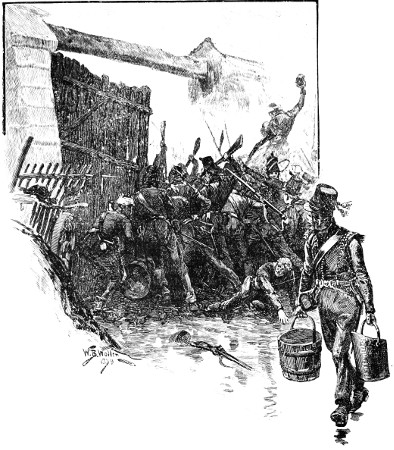
DEFENCE OF LA HAYE SAINTE BY THE GERMAN LEGION (p. 66).
The ridge was once more cleared, and Mercer’s battery brought into the front line. The whole field was now littered with corpses and accoutrements. Gaily-dressed trumpeters, and officers on whose breasts hung crosses of the Legion of Honour, lay bleeding in the barley among hundreds of dead and wounded horses. Here a lancer in green and light blue, there a heap of cuirassiers of the 1st Regiment, mown down by grape shot; yonder a chasseur-à-cheval, propped against his charger, while swords and cuirasses were almost as numerous as the stalks of corn.
All the slope was torn and trampled; flies were busy in the now loathsome hollows; there was constant firing still at Hougoumont and La Haye Sainte, when the trumpets sounded again, and with seventy-seven squadrons, including the cavalry of the Guard, France returned to the charge. Every arm of the mounted service was represented in this attack, the beauty and brilliancy of the uniforms baffling description. Carabiniers, white-coated, with brass cuirasses and red-crested helmets; Lancers, Dragoons, and Chasseurs in green, with facings of every hue; the Red Lancers of the Guard, clad in scarlet from head to heel, and Napoleon’s own favourite Chasseurs-à-cheval, with hussar caps and red pelisses, richly braided with orange lace; tall bearskinned Horse Grenadiers, with white facings to their blue coats; the Cuirassiers, dark and sombre looking; the high felt shakoes of the Hussars—it was as though a flower garden in all its summer dress were moving at a slow trot upon us, heralded by the thunder of hell from the batteries behind it.
When the thunder stopped, which it always did as the leading files reached the crest of the ridge, our men could hear in the momentary intervals of their own firing the jingling of bits and scabbards, and the heavy breathing of the horses. Mounted skirmishers came close to the batteries and commenced firing at the gunners, who were literally dripping with perspiration from the exertions they made. One fellow took several pot-shots at Captain Mercer, who was coolly walking his horse backwards and forwards along a bank to set an example to his men. He missed each time, and grinned grimly as he reloaded, but as the head of the squadrons closed up the skirmishers vanished and were succeeded by the rush which threatened death to every soul on the plateau. Wellington’s orders were to retire into the squares and leave the batteries, but Mercer’s men stuck to their guns, repulsing three charges of the Horse Grenadiers, and dealing such slaughter that the position of “G Troop” was known next day by the enormous heap of slain lying before it, visible from a considerable distance.
The carnage on the slope was shocking—the oldest soldiers had seen nothing like it: men and horses lay piled one on another, five and six in a heap, every fresh discharge adding to the ghastly pyramid. The 1st Cuirassiers numbered 300 of the Legion of Honour in its ranks—it lost 117, including two lieutenants and the brave Captain Poinsot, page to the Emperor in 1807, wounded at Moscow and Brienne. One officer, finding the fire from a particular gun playing havoc with his men, rode straight at it and was blown to atoms.
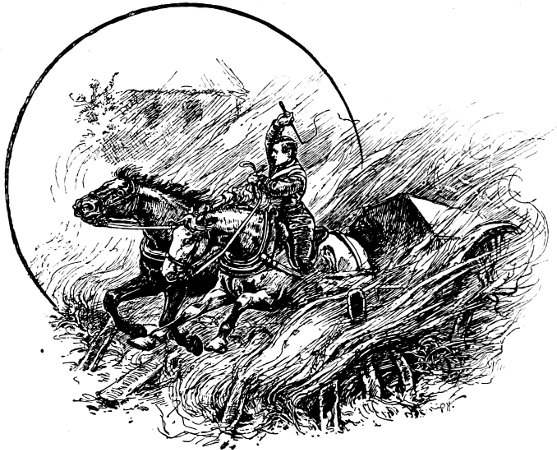
“A GALLANT ARTILLERY DRIVER RUSHED HIS HORSES TO THE WALL” (p. 66).
The horses during the battle suffered cruelly, and some of the details are heartrending: the charger of a very stout officer with the Duke’s staff, probably Müffling, was seen to rear for some time without the rider being able to bring it down—its front legs had been both shot off. Another trooper’s horse was seen next morning sitting on its tail, its hind legs gone; and one poor beast ran for sympathy to six guns in succession, and was driven off from each with exclamations of horror until it reached “G Troop,” where they mercifully killed it: the whole of its face below the great brown pleading eyes had been carried away by a round shot!
After a repulse and a re-attack, the remnant of the seventy-seven squadrons reeled back to their own lines: the cavalry of France, magnificent, irresistible, brave as lions, and nobly led, had shattered itself without result, and the third great attempt had failed!
All the afternoon there had been great doings at Hougoumont. About one o’clock Colonel Hepburn had relieved Saltoun in the large orchard with a battalion of the 3rd—now the Scots Guards—and the combat on that side became a long succession of advances with the bayonet to the front hedge and retirings into a green dry ditch, which is known to us as the “friendly hollow-way.” When our men fell back, a terrific fire from the short east wall would stagger the foe, and the Scots, having formed again, would scramble out of the hollow and clear the orchard of all but the dead.
Along the terrible south wall a staff-officer, who had been through all the Peninsula battles, afterwards said that the slain lay thicker than he had ever seen them elsewhere.
The château and barns were now burning furiously, fired by Haxo’s howitzers at Napoleon’s orders, and many of our wounded perished in the flames; some officers’ horses tore out of the barn, galloped madly round the yard, and rushed into the fire again to be destroyed.
Twice the enemy got in: once by a little door in the west wall, through which they never got out alive; and the second time, when our Guardsmen had sallied out into the lane to drive off a body of infantry, about fifty French entered on their heels through the north gate. Then, by main strength of arm, Colonel Macdonell, Sergeant Graham, and three or four more, shut and barred the wooden gate in the faces of the others, and those inside were all shot down.
A brave fellow climbed on to the beam that crossed the gateway; but Graham fired, and he dropped with a scream on to the heads of his comrades outside the wall.
The fire stopped at the door of the château chapel, which was full of wounded, and a wooden figure of our Saviour had the feet nibbled by the flames, at which the superstitious marvel greatly to this day.
Columns of smoke hung over everything. A gallant artillery driver rushed his horses to the wall, and flung a barrel of welcome cartridges over into the yard. At the corner, before the gardener’s house, Baron de Cubières lay wounded under his horse; afterwards, when Governor of Ancona, he expressed himself very grateful that we had not fired on him!
Crawford of the 3rd Guards was killed in the kitchen garden, Blackman of the Coldstreams died in the orchard; but the attack and repulse grew gradually weaker, as both sides tired of the hideous slaughter.
Meanwhile, a serious trouble which had been menacing the Emperor on his right flank for some time at last grew terribly imminent.
The Prussians were coming in spite of Grouchy, who had been sent in their pursuit.
They should have arrived about one o’clock; but, thanks to the bad roads, a fire in the town of Wavre, which had to be extinguished before the ammunition-waggons could be got through, and some hesitation on the part of Gneisenau, Blücher’s Chief of Staff, who doubted Wellington’s good faith, it was half-past four when part of Bülow’s corps came out of the woods at St. Lambert and confirmed Napoleon’s previously awakened fears.
In the hazy weather they thought it was Grouchy, and a false report was afterwards sent through the French army to cheer the wearied men; but the Emperor and Soult knew otherwise, and the line of battle was weakened by a strong force being detached to meet the new arrivals.
There was no time to be lost; drums rolled and trumpets sounded again, and the last remnants of the cavalry had not regained their position when the Fourth Grand Attack began with a fury that even exceeded the others.
While fresh bodies of horse and foot advanced up the ridge, a most determined rush was made on La Haye Sainte. Baring had been reinforced, it is true; but, although he sent time after time for more ammunition, not a single cartridge was forthcoming!
A feeble excuse has been made that there were no means of getting it into the building; but a large door and several windows faced our line at the back of the house then, as now. They may still be seen by the visitor to Waterloo.
A horde of French infantry flung themselves on the buildings, setting the barn on fire, and besieging the broken gateway.
While the brave Germans filled their camp-kettles from the pond and extinguished the flames, others, with their bayonets only, kept the door leading into the field. Seventeen corpses they piled up there in a few minutes, one gallant fellow defending a breach with a brick torn from the wall! The individual acts of heroism on authentic record would fill many pages: but, without ammunition, they were at a fearful disadvantage.
The voltigeurs climbed on to the roof of the stable, and shot them down at their ease: the half barn-door is preserved to the present day, with eighty bullet-holes in it! Alten sent the brave Christian Ompteda to their aid, if practicable, with the 5th Battalion. He pointed to an overwhelming force; but the irrepressible Orange repeated Alten’s suggestion in a tone that brooked no delay, and Ompteda went down with his 5th Battalion, and they died, almost to a man!
Baring dismounted to pick up his cap, knocked off by a shot; four balls had lodged in the cloak rolled on his saddle-bow, and a fifth then pierced the saddle itself, while the Scotch Lieutenant Græme, sitting on the rafters of the piggery, in which a calf was lowing, raised his shako to cheer his men, and his right hand was taken off at the wrist. He was only eighteen.
It was hopeless. “If I receive no cartridges,” said Baring in his last appeal, “I not only must, but will abandon the post!” And very soon those neglected heroes retreated slowly through the house and out through the garden beyond, the French, bursting into the yard, chasing the remnant round and round and bayoneting them on the dungheaps.
A roar of cheering rang above the battle. At last they were victorious, and the French had taken La Haye Sainte.
Without a moment’s hesitation their conquest was turned to the best possible advantage. Smart red-braided Horse Artillery galloped down the causeway, dragging their guns to the knoll above the sandpit, from which our 95th had been driven, and, unlimbering, opened fire at sixty yards range on to our line.
Skirmishers filled the hedgerows and the farm buildings. The Great Battery renewed its work of death, and in a few moments there was a serious gap in the centre of our position.
Lambert’s brigade had been brought up before this, and suffered terribly.
The 27th, which had lain down and slept soundly behind Mont St. Jean until after three o’clock, lost 478 out of 698 in its new quarters; and the 40th thirteen officers and 180 rank and file, one round shot taking off the head of Captain Fisher and killing twenty-five men.
Ompteda’s brigade mustered a mere handful, Kielmansegge was almost destroyed, Halkett had two weak squares, one of his regiments being very shaky indeed, and, altogether, things were unpleasant when the Duke came up with reinforcements to patch our front as best he could.
Far off on our right Chassé’s Dutch Belgians had arrived, shouting and singing, from Braine l’Alleud, very drunk, narrowly escaping a volley from us, as they wore the French uniform; and at this time, by reason of the bolting of Hake’s Cumberland Hussars and some of our supports, with the enormous losses from the six hours of carnage, the British affairs were in bad case.
Halkett’s 30th and 73rd in square had been charged no less than eleven times: the Duke pointed to a scarlet mass in front through the smoke, and inquired what regiment it was. It was the dead and wounded of those two corps, huddled together where they had fallen.
The green-faced 73rd was at one time commanded by Lieutenant Stewart, all the other officers having been killed or wounded; and at half-past seven the colours of both regiments were sent to the rear.
The 2nd Line Battalion of the German Legion went into action with 300 men, but mustered only six officers and thirty-six privates after the battle; but Blücher was now nearing the French right rear with nearly 52,000 troops and 104 guns, and the Emperor was obliged to send General Duhesme with eight battalions of the young Guard down into the straggling village of Planchenoit to help to check them.
He had been at La Belle Alliance all day, and Prussian shot were now falling about him.
Marshal Ney sent for more infantry to renew the attack. “Où voulez vous que j’en prenne: voulez vous que j’en fasse?” was the Emperor’s impatient reply—“Where can I get them: do you wish me to make them?”
The long June day was drawing into evening, and shadows began to lengthen across the fields. Wellington, who had always been seen where the fire was hottest, rode with a calm, inscrutable face, followed by a sadly diminished staff, his eagle eye taking note of the strength and weakness of our line.
The Hussars had been moved in rear of the centre; and Adams’ Brigade took position immediately behind the ridge. In front of the clover field where the 52nd stood in square, a pretty little tortoiseshell kitten, which had been frightened out of Hougoumont by the firing, lay dead—a strange feature in the scene of destruction.
The men were growing accustomed to the hideous sights and sounds around them, and became impatient at the inactivity which doomed them to endure without reprisal. Suddenly the brass guns blazed forth once more upon us; the pas de charge was rolling from a thousand drums; a serried line was seen advancing along our entire front, and, led by the Emperor himself, on his grey charger Marie, his famous redingote gris open and showing the well-known dark-green chasseur coat, the Grenadiers of the Guard marched in solid columns into the valley.
Two winding serpents of determined men; ten battalions in tall black bearskins, white facings and dark-blue pantaloons—that was their dress at Waterloo—with Friant and Morand, Petit, whom Napoleon had kissed at Fontainebleau, Poret de Morvan, and old Cambronne. The élite of the French army, the Grenadiers and Chasseurs of the Old and Middle Guard, marching sternly to victory or death. Marcognet, Alix, and Donzelot, with their remnants, against our reeling left; Reille, Foy, and Jérôme renewing on Hougoumont—cavalry in the gaps and spaces—a simultaneous, mighty LAST ATTACK!
The yet unbroken Imperial Guard set their faces towards the spot where Maitland’s, Adams’ and Byng’s redcoats looked to their priming and closed their ranks: had Napoleon hurled them against the cross road behind La Haye Sainte, the story of Waterloo had been written differently.
He missed his chance; he threw away his final hope. The greatest of his many mistakes was committed, and, handing over the leadership to Ney, he remained on a hillock above the farm, and watched the downfall of France and the death-blow of his empire! For the last time in this world their Emperor addressed them, pointing towards the heights with a gesture all could understand.
“Déployez les aigles. En avant! Vive l’Empereur!” and with a great shout they quickened their pace, passing proudly, unheeding, over the bodies of those comrades who had gone before.
Red tongues of flame burst from the smoke of our guns; whiz came the fiery rockets, darting into their ranks, scorching, blinding, and burning in their course; humming shells dropped among them with terrible destruction; but the Old Guard pressed on, and began to mount the ridge.
Ney’s horse fell—the fifth killed under him that day, and the “bravest of the brave,” went forward on foot. Alas, would that it had been to death!
Our Guards were lying down to avoid the hurricane from the French artillery. A shell dropped in one of the squares, and Colonel Colquitt, picking it up, fizzing and fuming, walked to the edge and flung it outside to burst harmlessly. Another officer, mortally wounded, said faintly:
“I should like to see the colours of the regiment again before I quit them for ever”: they were brought and waved round his body, and with a smile, he was carried away, to die.
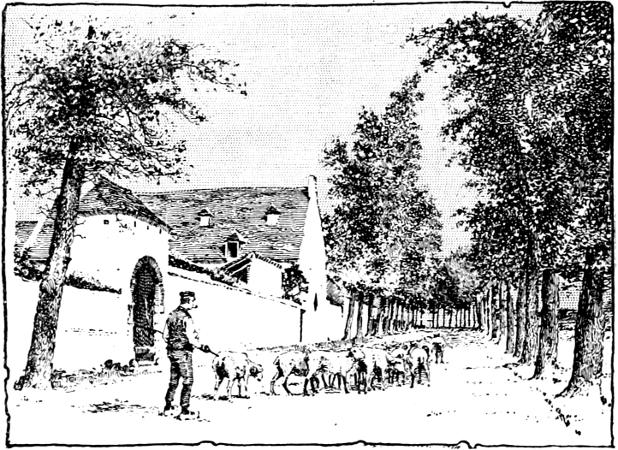
LA HAYE SAINTE.
It was men like those that the oncoming columns had to face, and batteries as famous as those of Bull and Bolton, of Norman Ramsay, Whinyates, and Webber Smith, with guns double shotted and served as on parade; no need to sight so carefully, for the moving target is a wide one, and they hit in every time!
Now the skirmishers run out, shouting and firing as before, and when they have said their say, they fall back leaving all clear for the others; but the columns seem to get no nearer, though they are marching steadily; front rank after front rank is blown to shreds—that is why they appear stationary!
The gunners have done their work; the guns recoil, and are left there: it is the turn of the infantry now, and the time has come for that historic signal, “Up, Guards, and at ’em!” which in reality was never said.
But whatever the word was, they do “up,” and they do “at ’em”; and again it is bayonet to bayonet, and man to man.
One Welsh giant, named Hughes, six feet seven inches in height, is seen to knock over a dozen of the Old Guard single handed; the redcoats and the blue-coats mingle for a moment and the blue-coats melt away.
The second column, a little behind the other, is in good order: it has suffered less from the cannonade, and is full of fire and fury; but so also are our 52nd lads, who advance down the slope with three tremendous cheers.
Colborne is leading, and when they get abreast of the column he cries—
“Halt! Mark time!”
The men touch in to their left, and regain their dressing; Colborne’s horse is shot, and he comes forward wiping his mouth with a white handkerchief, still wearing Ensign Leeke’s blue boat-cloak.
“Right shoulders forward!”
The regiment swings round, and, four deep, faces the column’s flank two hundred yards away.
“Forward, 52nd—charge!” and the Foot Guards, who are back on the ridge again, behold a noble spectacle.
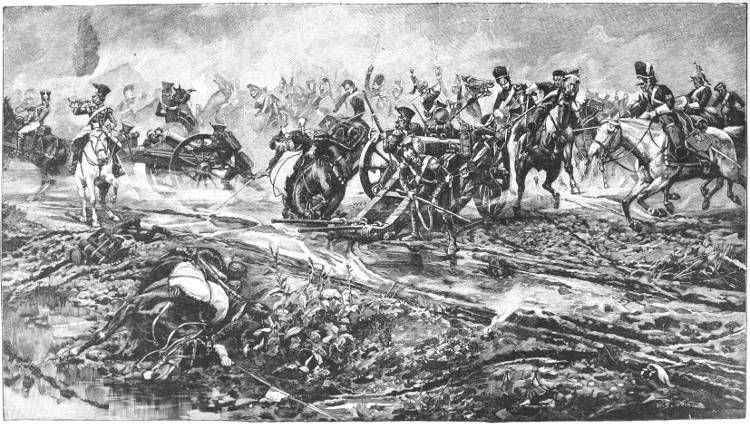
THE UNION BRIGADE CAPTURING THE FRENCH GUNS AT WATERLOO.
(From the Picture by W. B. Wollen, R.I.)
The crash is terrific; the Imperial phalanx is taken in flank. The contest is fierce, but it is soon over.
Brave Michel, in response to our officers, replies with glorious esprit de corps, “The Guard dies, and never surrenders!” his words instantly fulfilled, as he falls lifeless, sword in hand, while Cambronne, grown old in the service (to whom these words have been falsely attributed), gives up his weapon to William Halkett.
Halkett’s horse is shot, and Cambronne hastens away, but his captor is too quick for him, and seizing his gold aiguillette, hands him to a sergeant to be taken care of.
On presses the 52nd, driving the broken Guard before it: it is a sight probably never repeated in history—one regiment traversing the field alone, in sight of the army; sending the foe like sheep into the hollow; dispersing and pushing them relentlessly back, until they turn and fly, and other corps make haste to join in that glorious progress.
There is a movement along the ridge as the setting sun shines out in a burst of sinking splendour, and the Duke, with cocked hat raised above his head, gives the magic word, “The whole line will advance!” and then spurs down after the 52nd.
On the rising ground near La Haye Sainte, Napoleon sits on horseback, close to a small battalion which has formed square.
Jérôme, his brother, bleeding and exhausted, is with him, with honest old Drouot in his artillery uniform, in the pocket of which is a well-worn Bible; Soult and Gourgaud, Bertrand and brave young La Bédoyère are there, too: but the English Hussars are coming on at a fast trot.
All day long the waves of valour have been rolling northward, and breaking against an iron-bound shore; now the tide has turned, and rushes madly south again.
Nothing but confusion meets the eye: everywhere the French are in full retreat—solitary men, groups of three and four, ruined regiments, and the skeletons of squadrons.
Jérôme rides close to his brother, and says in a meaning tone—
“It were well for all who bear the name of Bonaparte to perish here!”
Napoleon orders some guns to open on the Hussars, and one shot hits Lord Uxbridge on the right knee as, mounted on a troop horse belonging to a sergeant-major of the 23rd Light Dragoons, he is leading the pursuit.
“Here we must die on the field of battle,” exclaims the Emperor, preparing to head the weak column; but Soult seizes his bridle, saying, “They will not kill you: you will be taken prisoner”; and, held up in the saddle by two faithful officers, for he is worn out, Napoleon is galloped away in the gathering darkness.
On the left of the Brussels road some Prussian guns had come up and fired on our men.
They were the sole representatives of Blücher’s force present before Mont St. Jean until after the retreat had begun; and they had been far better absent, as their pounding was cruelly felt by Mercer’s battery and several of our regiments.
They were induced, after some time, to change the direction of their range, and then all went well. The 52nd still pursued its march, halting for a moment near La Haye Sainte to face and charge some rallying squares, where a Belgian soldier was seen killing a wounded Frenchman, and was run through by an officer of the regiment.
Leeke, who carried the King’s colour, found a foot and a half of the pole wet with blood; Holman, the brother of the blind traveller, had three musket balls through his sword blade, and wore it for many years; Colborne and Major Rowan, being both dismounted, jumped on to two horses attached to an abandoned gun, calling to their men to cut the harness; but the advance continuing, they had to dismount with a hearty laugh and march on again on foot.
It was getting dark, and our Hussars were clearing the field in splendid style, the 10th, whose sabres were soon red as their scarlet cuffs, engaging with some strong remnants of the Old Guard and losing two officers.
Major Murray, of the dashing 18th, met a gun going at full speed, and leaped his charger over the traces, between the leaders and wheelers, while his men proceeded to cut the gunners down.
Colquhoun Grant, who had lost five horses and was then mounted on a magnificent chestnut, sent the gallant remains of his brigade at the retreating foe; and until it was impossible any longer to pick one’s way among the vast heaps of dead, disabled cannon, and miserable wounded—in short, the absolute wreck of an army—our light cavalry went wheeling and slashing right and left, hurrying on the veteran, the conscript, the artillery driver and the officer alike, all the French accounts doing justice to these light horsemen. It is only in private letters, hardly in the official documents, that England can learn the heroism of her Hussars at Waterloo.
Meanwhile the 52nd had crossed to the left of the road and scattered a column debouching from Planchenoit, behind the buildings of La Belle Alliance, in front of which a mass of guns had been left to their fate. The regiment passed on, and on its return found them marked with the numbers of other corps that had succeeded them.
All the causeway was crammed with flying troops: a terrible struggle for liberty took place, in which discipline gave way to terror. General officer and baggage waggon fled side by side; rifles and accoutrements were thrown away that their owners might hurry faster. The fields, the by-lanes, the woods, were all filled with fugitives—even the Emperor had to turn aside in order to get past.
Marshal Ney was one of the last to go. He had joined the army on the 15th, without money, without horses, almost without a uniform. He was to be found everywhere on that dreadful 18th, planting batteries, heading charges, rallying, raging, facing death at every stride, and when it was over he tottered exhausted away on foot, leaning on the shoulder of a compassionate corporal.
Now the Prussians have arrived in force. Planchenoit, its churchyard and crooked street, its orchards and barnyards, are full of French and Prussian slain.
The young Guard fought well, but they were outnumbered, and Blücher rides into the chaussée at La Belle Alliance.
A Uhlan band plays “God Save the King,” and farther along the road they meet the Duke returning on his way in the dark to write his despatches announcing the victory.
The two soldiers embrace, and sit talking for ten minutes while the stream goes hurrying by. Then the fiery old German follows up the retreat with a fury that is incredible.
At Genappe the Silesians have taken the Emperor’s baggage; Gneisenau mounts a drummer on one of the cream-coloured carriage horses, and away they go into the darkness after the fugitives, driving them from seven bivouacs, slaying, hacking, giving no rest, until the land is strewn for leagues with dead men, fallen under the Prussian steel.
Merciless it may seem to us, looking back with fourscore years between us and that moonlit night; but such was the vitality of the French that the most drastic steps were necessary to prevent their army mustering again.
What can I say of the battle-field, after the pursuit had rolled away, and it was left to the searcher and the plunderer?
If I could re-create one tithe of the horror those slopes and roads revealed you would sicken and turn away in disgust.
Prussian, Belgian, and British, there were, out on the plain that night, bent on no errand of mercy; stragglers and camp-followers creeping from group to group, tearing the rings from the fingers, and the teeth from the jaws!
Many a life was foully taken that tender nursing might have saved; but there were some groups who sought for a lost comrade or a favourite officer, and women there were, with woman’s gentle sympathy, soothing and tending as only they can soothe.
The bulk of the British force had gone to bivouac beyond and about Rosomme, which was behind the French position; but some detached portions remained where they had fought, too weary to advance with the others.
Mercer was one of these, and creeping under the cover of a waggon, worn out with slaughter, he slept—waking to find a dead man stark and stiff beneath him! His men came to him in the morning, and asked permission to bury one of their comrades.
“Why him in particular?” asked the captain, for many a bearskin-crested helmet was empty in “G Troop.”
Then they showed him the horror of it.
The whole of the man’s head had been carried away, leaving the fleshy mask of what had been a face, from which the eyes were still staring wildly.
“We have not slept a wink, sir,” they said. “Those eyes have haunted us all night!”
With daybreak men stood aghast at the spectacle of that battle-ground.
The losses have never been satisfactorily reckoned; but I have seen it stated, curiously, that of the redcoats 9,999 were actually killed there. The French loss for the four days’ campaign has been counted as 50,000; and you can tell off the survivors of both armies to-day, perhaps, on the fingers of one hand.
Every house in the neighbourhood was full of wounded. For three days, the doctors tell us, they were being brought in by the search parties, a sharp frost having congealed the wounds of many and so saved them, and lines of carts jolted the shrieking wretches over that dreadful causeway to Brussels in endless succession.
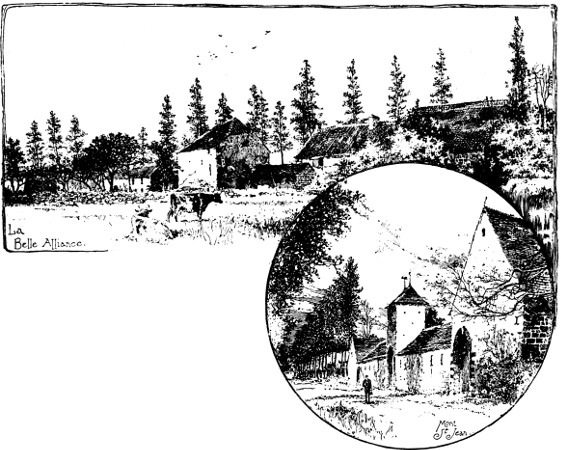
At Hougoumont, where the orange-trees were in blossom, they flung three hundred bodies down a well: it was a simple method, saving time and trouble; but a dark tradition lingers that voices were heard afterwards, faintly imploring, from the cavernous depths.
Wild strawberries hung their red clusters, and the little, blue forget-me-not peeped in the woods; birds of prey came croaking on the wing; and within twenty-four hours ten thousand horses had been flayed by the Flemish peasants, many of whom made fortunes by plunder!
Men gathered jewelled decorations and crosses by handfuls: it was impossible to take three strides without treading on a sword, a broken musket, a carbine, or a corpse!
Near La Haye Sainte they found a pretty French girl in hussar uniform, and the farm itself was encrusted with blood; tufts of hair adhered to the doorways, the yard presenting a sight never to be forgotten. A pole to which a scrap of torn silk clung was picked up under the body of Ensign Nettles: it was the King’s colour.
The remains of three French brothers named Angelet were among the slain, and the history of one was most romantic. Wounded in some of the Napoleonic wars, where he had lost a leg, he was taunted by a lady with the fact that he could only talk of what he had done for France—that he could do no more. The brave fellow seized his crutches, limped after the army, and met his fate at Waterloo.
Picton’s body—wounded at Quatre Bras, though none but his valet knew it—was taken to England, and by a strange coincidence was laid, at the Fountain Inn, Canterbury, on the very table at which he had dined, a fortnight before, on his way to join the army.
Byng of the Guards said to Sir John Colborne in Paris: “How do your fellows like our getting the credit of what you did at Waterloo? I could not advance because our ammunition was all done.”
The Foot Guards got their bearskins as a well-merited reward, only the Grenadier companies wearing them during the battle. The 52nd, for their great share in the closing scene, received—nothing! and the Duke, when approached on the subject of that glaring injustice, said, “Oh, I know nothing of the services of particular regiments. There was glory enough for all!”
They are nearly all gathered to the “land o’ the leal” now. The last of Hougoumont’s defenders—Von Trovich of the Nassauers—died in 1882; Albemarle, who fought with the 14th Foot, passed away quite recently; while the Guards turned out to bury a veteran not long since who paraded for the last time in Caterham workhouse! In 1894 John Stacey, aged ninety-six, of the German Legion, walked from Yorkshire to London to see if his tenpence a day might not be increased.
For thirty years you could mark, by the deeper colour of the corn, where they had buried the dead in greatest numbers: they still find buttons in the plough-land after rain, with bullets cut in half against our sword-blades, and sometimes bones! Ten thousand people, on an average, visit the field each year; and, though the land lies dozing under its wealth of crops, and the lark trills his requiem where the guns once thundered, and the herdboy’s song rises in place of “Vive l’Empereur!”—never will the nations forget that fearful Sunday or the names of Wellington and Waterloo.
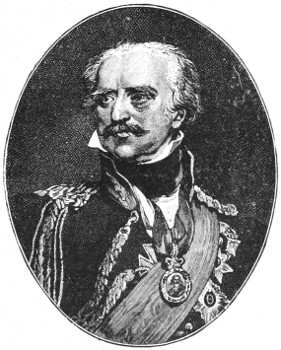
MARSHAL BLÜCHER.
(After Sir Thomas Lawrence, P.R.A.)
Königgrätz
By Charles Lowe
King William I of Prussia
The Emperor Francis Joseph of Austria
Not since the “Völkerschlacht,” or Armageddon of the nations at Leipzig, in 1813, when the allies overthrew the hosts of Napoleon, had Europe witnessed such a stupendous conflict as was fought near Königgrätz, on the Upper Elbe, in Bohemia, on the 3rd July, 1866. This battle was called of Königgrätz by the Prussians, of Sadowa by the Austrians; and, as a matter of topographical fact, the latter was the more correct title, just as the field of Waterloo is known as Mont Saint Jean to the French, and Belle Alliance to the Prussians—in both cases with more justice. At Leipzig about 430,000 men had mingled in fight, while at Königgrätz, as we shall call it in compliment to our ancient and honoured allies the Prussians, the total number of combatants was about 435,000, or close on half a million of men.
What had called these armed hosts into the field? Briefly put, it was the question which was to be the leading Power among the German-speaking peoples—Austria or Prussia. For centuries the former had asserted this position of proud pre-eminence, but there came a time when this claim of the Hapsburgs was no longer allowed by the great and growing monarchy of the Hohenzollerns. Austria wanted to have everything in Germany done after her particular way of thinking, and Prussia began to find it quite incompatible with her honour and her self-respect to be thus lorded over by a State which in many respects she deemed to be her inferior in point of light and leading. Thus it came to pass that these two rival Powers began to lead a very cat-and-dog life at the council-board of the Germanic Confederation of States; and Bismarck, who was the rising statesman of his time, prophesied that this condition of things could go on no longer, and that the only remedy for this eternal quarrelling between the two was a policy of “blood and iron” on the part of Prussia.
Once, however, they seemed to have suddenly become the best of friends. This was when they joined their forces, in 1864, to snatch Schleswig-Holstein, or the Elbe Duchies, as they were called, from the rule of the Danes. Bismarck was the great champion of “Germany for the Germans,” and he thought it scandalous and unreasonable that a foreign people like the Danes should continue to domineer over the Teutons in the Elbe Duchies. Prussia and Austria, therefore, at his far-seeing instigation, combined to oust the Danes from the Duchies, and this they finally did after storming the Danish redoubts at Düppel.
But the worst of it was that the conquerors could not agree as to their spoil. Prussia wanted to do one thing with the Duchies, and Austria another. It is a common enough thing for thieves to fall out over the distribution of their booty, and this was precisely what the rival German Powers did with regard to Schleswig-Holstein. Bismarck, the long-headed statesman that he was, clearly foresaw that they must and would do so, and this was the very thing he wanted. He wished to have a good pretext for going to war with Austria, in order that this Power might be altogether excluded from the German family of nations, and that Prussia, taking her place, might inaugurate a new and better era for the Teutonic peoples. Austria had fallen into the trap which he had laid for her, and she had no choice but to fight. Each, of course, claimed to be the injured party, and the old game of the wolf and the lamb was played over again to the amusement of all Europe. Some of the other German States sided with Austria, and some with Prussia, but the former were soon defeated and disarmed, and then Prussia was free to direct her whole strength against the Austrians.
It was known that the latter were collecting all their strength in Bohemia, and King William, who had General von Moltke, the greatest soldier of his time, for his Chief of the Staff, or principal counsellor in affairs of war, resolved to make a dash into this province before its Austrian defenders knew where they were, and smite them, as David did the Philistines, hip and thigh. Accordingly, he divided the forces of his kingdom into three main armies, each composed of several Army Corps. The command of the First, or centre, Army, numbering about 93,000, was entrusted to the King’s nephew, Prince Frederick Charles, called by his soldiers the “Red Prince,” from the scarlet uniform of the Zieten Hussars which he generally wore; the Second, or left-hand Army, totalling 100,000 men, was given to the King’s high-souled and chivalrous son, the Crown Prince, Queen Victoria’s son-in-law; while the Third, or right-hand host, called of the Elbe, fell to General Herwarth von Bittenfeld, who fought throughout the campaign with a courage worthy of “Hereward, the last of the English.” But these three huge armies did not invade Bohemia in one overwhelming mass. Moltke, the great “battle-thinker,” the “Silent One in Seven Languages,” as his friends fondly called him, knew a trick worth two of that. His maxim was, “march separately, strike combined”; and yet it behoved him to keep the Austrians in perfect ignorance of where he meant to strike. The Crown Prince, on the left, started with his army from Silesia; the Red Prince set out from Lusatia, while Herwarth’s point of departure was Thuringia.
Did Moltke himself also take the field? No, not at once; for it meanwhile sufficed this great military chess-player, this mathematical planner of victory, to sit quietly among his maps and papers at the offices of the Grand General Staff in Berlin, with his hand on the telegraph wire, and direct the movements of the three armies of invasion. Take the following description that was penned by an English witness of the crossing of the frontier by the army of the Red Prince:—“It was here” (at a toll-house gate) “that Prince Frederick Charles took his stand to watch his troops march over the border. He had hardly arrived there before he gave the necessary orders, and in a few moments the Uhlans, or Lancers, who formed the advance guard of the regiments, were over the frontier. Then followed the infantry. As the leading ranks of each battalion arrived at the first point on the road from which they caught sight of the Austrian colours that showed the frontier, they raised a cheer, which was quickly caught up by those in the rear, and repeated again and again till, when the men came up to the toll-house and saw their soldier-prince standing on the border line, it swelled into a rapturous roar of delight, which only ceased to be replaced by a martial song that was caught up by each battalion as it poured into Bohemia. The chief himself stood calm and collected; but he gazed proudly on the passing sections, and never did an army cross an enemy’s frontier better equipped, better cared for, or with a higher courage than that which marched out of Saxony that day.”
Over the picturesque hills of Saxony, over the Giant Mountains into the fertile plains of Bohemia, swiftly sped the three superbly-organised armies like huge and shining serpents; and ever nearer did they converge on the point which, with mathematical accuracy, had been selected as the place where they would have to coil and deliver their fatal sting of fire. Hard did the Austrians try to block the path of the triune hosts and crush them in detail; but the terribly destructive needle-gun, with the forceful lance of the lunging Uhlan and the circling sabre of the ponderous Cuirassier, ever cleared the way, and a series of preliminary triumphs marked the progress of the three armies towards junction and final victory. By the 29th the Red Prince had reached Gitschin, the objective point of the invasion, while his cousin the Crown Prince lay at Königinhof, on the left, a long day’s march distant. Meanwhile the Austrians had all retired under the shelter of the guns of Königgrätz, a strongly fortressed town on the left bank of the Upper Elbe, there to take their final stand, with their backs, as ’twere, to the wall.
The Austrians were commanded by Feldzeugmeister Benedek, and their army had been reinforced by the troops of the King of Saxony, who had sided with the foes of Prussia in the impending conflict, and were sure to give a good account of themselves. An equally stubborn resistance was to be expected from the Hungarian subjects of the Emperor Francis Joseph, who were second to none in all his polyglot dominions in respect of that ancient valour and other chivalrous qualities which had caused this gallant people to be called the “English of the East.” Finer horsemen than the Hungarians existed in no army in all the world; and in this campaign, as in every other in which they had ever been engaged, the Austrians were particularly strong in cavalry. But, on the other hand, the Prussians were known to be armed with the lately-invented breech-loading needle-gun, while the Austrians still clung to the older-fashioned muzzle-loader, and professed to make light of their opponents’ new-fangled rifle. They were soon to be shown convincingly which was the better weapon.
It was not till June 30th that King William and his paladins, Moltke, Bismarck, and von Roon, left Berlin by rail for the seat of war. They had scorned to witness the preliminary heats, so to speak, and only wanted to be present at the grand final. On July 2nd, after reaching Gitschin, which was near the headquarters of the Red Prince, Bismarck wrote to his wife: “Just arrived from Sichrow. The field of battle there is still covered with corpses, horses, and arms. Our victories (so far) are greater than we thought. It appears that we have over 15,000 prisoners, while the loss on the Austrian side is still greater in dead and wounded, being no less than 20,000. Two of the Army Corps are utterly scattered, and some of the regiments are wiped out to the last man. I have, indeed, up till now seen more Austrian prisoners than Prussian soldiers.”
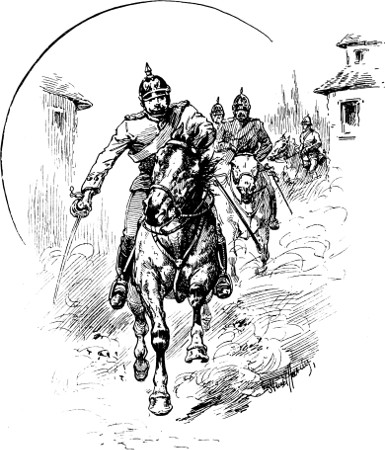
“MAJOR VON UNGAR CAME SPURRING IN WITH A GREAT PIECE OF NEWS” (p. 77).
On the night of the same day (2nd July) King William, now in his seventieth year, had retired to rest in a little room of the “Golden Lion,” which overlooks the market-place of Gitschin—a quaint little old town nestling among the hills of Northern Bohemia, on the southern side of the Giant Mountains. Wearied out with the fatigues of the day, he had hardly closed his eyes in sleep when he was unceremoniously woke up. His Majesty opened his eyes, and found Moltke standing by his bedside, the bearer of most important news, which General Voigts-Rhetz had just brought in from the Red Prince, whose headquarters were some six miles further to the east, at the château of Kamenitz on the Königgrätz road. Voigts-Rhetz had first of all carried his momentous news to Moltke, who lodged on the opposite side of the square, and who was the real ruler of Prussia’s battles, now and after in the French war. The King did nothing without consulting Moltke, nor did his Majesty ever issue an order that was not based on the well-thought-out advice of his Chief of the Staff.
The message of the Red Prince was of the very highest importance, for it upset all the resolutions which had previously been taken at the Prussian headquarters. Early in the day the exact whereabouts of the Austrians was unknown. It was supposed that they were on the left, or eastern, side of the Elbe, furthest from the Prussians, with their right and left flanks resting on two strong fortresses—Josephstadt and Königgrätz, respectively—a position which it would have been terribly difficult, if not impossible, for their adversaries to assail; so that, pending the discovery of their real whereabouts, it had been resolved to let the Prussian troops rest on the 3rd, as they had been wearied out by their incredible feats of marching and fighting. Presently, however, “from information received,” this resolution was revoked and replaced by another which deprived the fagged-out Prussians of the prospect of their much-needed day’s rest; and a bold and rapid rider—Lieutenant von Norman—was despatched across country to the Crown Prince at Königinhof to ensure his co-operation with the Red Prince in a particular manner on the morrow.
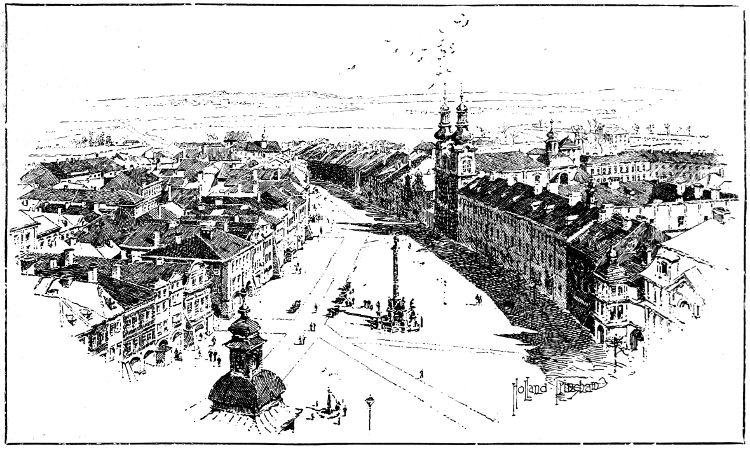
KÖNIGGRÄTZ.
But von Norman had barely started on his long and perilous ride when, lo and behold! another officer, Major von Ungar, came spurring in to the quarters of the Red Prince with a great piece of news. Attended by only a few dragoons, this officer had gone out scouting in the direction of Königgrätz, and discovered that the bulk of the Austrian army was without doubt on the right, or Prussian, side of the Elbe, holding a strong position on the further bank of the Bistritz brook, which ran very nearly parallel with the Elbe at a distance from it of some four miles. The position was strong, but not half so much so as the dreaded one beyond the Elbe, and the hearts of the Prussians jumped for joy. It seemed to them as if God had already delivered the Austrians into their hands, as Cromwell avowed of the Scots when they left their high ground at Dunbar and descended to meet his Ironsides on the plain. After gleaning this priceless intelligence, von Norman had to ride for his life. A squadron of Austrian cavalry made a dash to catch him, but he rode like an English fox-hunter, and only left behind him, as a souvenir of his audacious visit to the enemy’s lines, a part of his tunic which had been carried away by an Austrian lance-thrust.
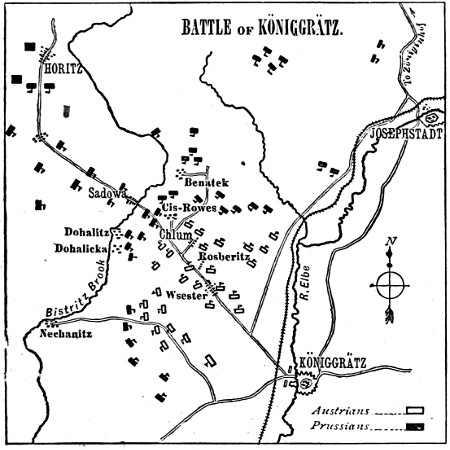
BATTLE OF KÖNIGGRÄTZ.
This, then, was the news which Voigts-Rhetz had brought to Moltke and the King at Gitschin, and then the situation underwent an immediate and final change. It was resolved to assail the Austrian position early on the morrow with the whole force of the united Prussian armies, and another message to this effect, cancelling all previous ones, as a codicil does a will, was at midnight despatched to the Crown Prince on one hand and Herwarth on the other, informing them of the altered state of things, and desiring them on the morrow to assail the flanks of the Austrians as fast and furiously as ever they could; while the Red Prince would apply his battering-rams to their elevated and strongly entrenched centre. This urgent message was entrusted to Colonel von Finckenstein, who, after a very dark and dangerous ride of twenty miles, reached the Crown Prince’s quarters about four o’clock on the morning of the 3rd July.
That fateful morning was a very wet and raw one, pretty similar to that which, after a rainy night, had dawned upon the English at Waterloo. Long before midnight the troops had all been in motion to the front. The moon occasionally blinked out, but was mostly hidden behind clouds, and then could be distinctly seen the decaying bivouac fires in the places which had been occupied by the troops along the road from Gitschin to Sadowa and Königgrätz. These fires looked like large will-o’-the-wisps as their flames flickered about in the wind and stretched for many a mile, for the bivouacs of so large a force as that of the Red Prince’s army of nearly 100,000 men spread over a wide extent of country. With the first signs of dawn a drizzling rain came on, which lasted until late in the afternoon. The wind increased and blew coldly upon the soldiers, and they were short of both sleep and food, while frequent gusts bore down the water-laden corn on both sides of the ground along the way.
Moltke and his staff had left Gitschin by four o’clock, driving to Horitz, where, mounting their horses, they rode on to Dub and joined Prince Frederick Charles. For this was the centre point of assembly. “A few short words,” wrote the Times correspondent, “passed from the Commander of the First Army to his Chief of the Staff; a few aides-de-camp, mounting silently, rode away; and, as it were, by the utterance of a magician’s spell, one hundred thousand armed Prussian warriors, springing into sight as if from the bowels of the earth, swept over the southern edge of the Milowitz ravine towards the hill of Dub.”
About eight o’clock, King William, with Bismarck and others of his great men, arrived upon the scene. Behind the King, besides his staff, were his royal guests, with their numerous retinues of adjutants and equerries, grooms and horses, in number equal unto about a couple of squadrons—making a fine mark for the shells of the Austrians. Before mounting his good mare “Fenella”—thenceforth to be called “Sadowa”—the King had got into his great-coat and put on goloshes over his boots. A wrong pair of spurs had been brought from Gitschin and would not fit. A groom whipped his off, and strapped them on over the royal goloshes; and thus equipped, with a field-glass slung round his neck by a long strap, the King rode away to view the course of the terrific fight, being everywhere received with tremendous cheering by his enthusiastic troops. For it touched their hearts to see so hoary a king come forth at the head of his “Volk in Waffen” or people in arms, to do strenuous battle with the alien. No roi fainéant, or stay-at-home monarch he, but one of the good old sort, like our own royal Edwards and Harries, under whose personal leadership the French were “beaten, bobbed, and thumped” at Crécy and at Agincourt.
It had been thought incredible by the Prussian leaders that the Austrians should have waived the advantages of a position behind the Elbe, and come forward several miles on its hither bank so as to meet their adversaries on the terms of the latter. But a closer inspection of their line of battle showed that it had been singularly well chosen. Along their front ran the boggy Bistritz brook, its banks dotted with farmsteads, villages, and clumps of wood, forming fine cover for infantry; while beyond this the ground rose in gentle undulations till it finally assumed the appearance of a commanding swell or ridge, from which Benedek’s batteries could pour down death and destruction on the advancing Prussians over the heads of his own infantry when engaging the helmeted wielders of the needle-gun. From the top of the slight elevation whereon stands the village of Dub the ground slopes gently down to the Bistritz, which the road crosses at the village of Sadowa, a mile and a quarter from Dub. From Sadowa the ground again rises beyond the Bistritz to the little village of Chlum (mark that village!), conspicuous by its church-tower crowning the gentle hill, a mile and a half beyond Sadowa—a beautiful bit of country not unlike some parts of England with its hill and dale, clustering cottages, peeping châteaux, hedgerows, groves, and waving grain-fields. Profiting to the full by the defensive advantages of this terraced terrain, the Austrians had seamed it with entrenched batteries, and palisaded their approaches with felled trees and intertwisted branches, making of the whole a natural fortress formidable to their assailants.
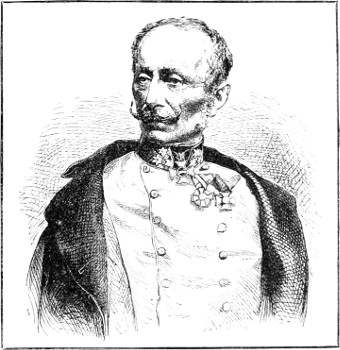
GENERAL BENEDEK.
But nothing could daunt the hearts of the Prussians. They had got to beat Benedek and his 220,000 men, and the sooner the better. The Red Prince was afraid that, after all, Benedek might seek to retire behind the Elbe, and this had to be prevented at all costs and hazards. The Prince might not be able to beat him off-hand, but he could at least fasten on Benedek like a bulldog and hold him fast there till the arrival of the Crown Prince, when the bull could be altogether felled and laid upon its back. Bang, therefore, went the Prussian batteries, and presently the whole sinuous line of battle, extending about five miles from Cistowes (opposite Chlum) on the Prussian left, to Nechanitz on the right, began to be wrapped in wreathed cannon smoke. The Austrians returned shot for shot, and neither side either gained or lost ground. In the centre the Prussians pushed battery after battery into action, and kept up a tremendous fire on the Austrian guns; but these returned it with interest, knowing the ground well, and every shell fell true, heaping the ground with dead and wounded men and horses.
While this furious cannonade was going on, columns of Prussian infantry were moved down towards the Bistritz, with intent to storm the line of villages—Sadowa, Dohalitz, and Dohalicka—on the further side. Shortly before their preparations were complete, the village of Benatek, on the Austrian right, caught fire, and the 7th Prussian Division made a dash to secure it; yet the Austrians were not driven out by the flames, and here, for the first time in the battle, it came to desperate hand-to-hand fighting. But the bloody mêlée here was nothing to what was now mixing up the combatants in the wood of Sadowa, and converting it into a perfect slaughter-house and hell upon earth. Boldly the Prussians advanced upon this village and its wood, plying the rapid needle-gun with awful effect upon the wood’s defenders. But nothing could have exceeded the splendid courage with which the Austrian battalions clung to their cover, and their volleys, supplemented as they were by a truly infernal fire from the batteries behind and above, seemed to mow down whole ranks of their assailants. But neither bullets nor shells could decide the fierce struggle; the bayonet had to be called in to do this. And now ensued most horrible scenes of carnage, which ended, however, before eleven o’clock, in the capture by the Prussians of the aforesaid villages. And no wonder that the Austrians chose to call the tremendous battle after the village and wood where they had made so glorious but ineffectual a stand.
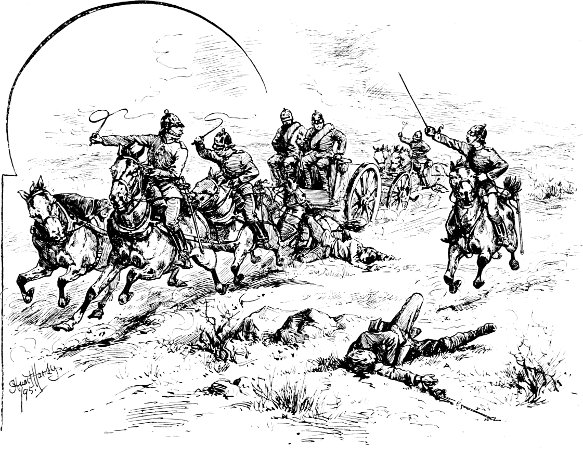
“THE PRUSSIANS PUSHED BATTERY AFTER BATTERY INTO ACTION” (p. 79)
Moltke himself afterwards related that, while he was watching the progress of events in front of Sadowa wood some roe-deer, startled from their leafy glades by the infernal pother around them, came bounding out and past him; and also how, when he and his suite rode forward a little way along the Lissa road to reconnoitre the Austrian position, he encountered an ownerless ox plodding along, serenely indifferent to the shells that were bursting all around it. Opposite the Sadowa wood on the Lissa heights, the Austrians had planted a most formidable entrenched line of guns, and Moltke afterwards told how he succeeded in getting the King to counter-order a command to storm these entrenched batteries from the front, which could only have ended in the bloodiest of disasters to their assailants.
About this time Bismarck, seeing how little headway the Prussians were making, began to be rather apprehensive as to the general result, fearing even that, if the Crown Prince came not up soon, they might, after all, be beaten. But one little incident gave him fresh hope. Taking out his cigar-case he offered a weed to Moltke, who deliberately chose the best of the lot. “Oh,” thought Bismarck to himself, “if Moltke is calm enough to do that, we need have no fear after all.”
The coming of the Crown Prince, with his additional hundred thousand men, had been as anxiously looked for as the arrival of Blücher on the field of Waterloo, and in truth the two situations were closely alike. Suddenly Bismarck, who had been looking intently in the Crown Prince’s direction, lowered his glass and pointed to certain lines in the far distance, but these the others pronounced to be furrows. “No,” said Bismarck, looking again, “the spaces are not equal: they are advancing lines.” And so they were; and by eleven o’clock the smoke of some Austrian batteries furnished a convincing proof that their fire was directed, not against the Red Prince’s, but “Unser Fritz’s” army; and the words “The Crown Prince is coming!” passed from lip to lip. But, some time before his advance had thus been signalised, Moltke made answer to the King, who had been questioning him as to the prospects of the fight, “To-day your Majesty will win, not only the battle, but also the campaign.”
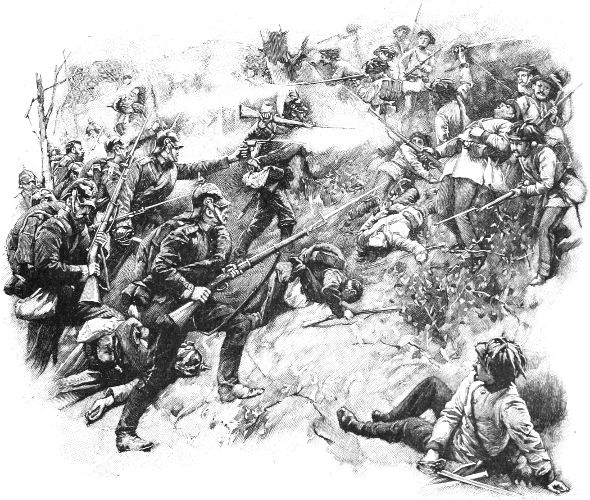
“BOLDLY THE PRUSSIANS ADVANCED UPON THIS VILLAGE AND ITS WOOD” (p. 80).
“The Prussian reserves,” wrote a correspondent with the Austrians, “were once more called upon; and from half-past twelve till nearly one o’clock there was an artillery fire from centre to left for six miles or more, which could not well have been exceeded by any action of which history makes mention. The battle was assuming a more awful and tremendous aspect, and the faint rays of sunshine which shot at intervals through the lifting clouds only gave the scene a greater terror.” About this time, also, “Benedek and his staff passed through the 6th Corps, which was in reserve. As the green plumes were seen rapidly advancing, the bands broke forth into the National Anthem, and the men cheered their commander with no uncertain note. Faces broke into broad smiles; Jäger hats were thrown into the air; all seemed joyous in the anticipation of an approaching triumph. Benedek, however, waved to them to cease shouting, saying, in his peculiar tone of voice, ‘Not now, my children: wait till to-morrow.’” And it was wise advice; for by this time Benedek had begun to suspect that he and his men would soon all have a very different song to sing.
The storm and stress of battle were now beginning to tell heavily on the Austrians. They were, it is true, still holding their own, or something like it, on the line of the Bistritz; but what is that which suddenly attracts the attention of Benedek and his staff behind the village of Chlum? They gallop away thither to inquire into the cause of all this new turmoil, and are greeted with a destructive volley from the needle-guns of “Unser Fritz,” who had by this time, after a forced march of frightful difficulty across the sodden country from Königinhof, come upon the scene with his Guards, and not only turned the flank, but positively fastened on the rear of the Austrian fighting line, at which he was now hammering away with might and main. But his path, so far, had been encumbered with corpses and mutilated bodies in sickening masses. “Around us,” he wrote in his Diary, “lay or hobbled about so many of the well-known figures of the Potsdam and Berlin garrisons. A shocking appearance was presented by those who were using their rifles as crutches, or were being led up the heights by some other unwounded comrades. The most horrid spectacle, however, was that of an Austrian battery, of which all the men and horses had been shot down.... It is a shocking thing to ride over a battle-field, and it is impossible to describe the hideous mutilations which present themselves. War is really something frightful, and those who create it with a stroke of the pen, sitting at a green-baize table, little dream of what horrors they are conjuring up.... In Rosberitz, where the fight must have been frightfully bitter, to judge from the masses of dead and wounded, I found my kinsman, Prince Antony of Hohenzollern, who had been shot in the leg by three balls,” and died of his wounds soon after.
With the turning of the Austrian right by the Crown Prince, the battle was virtually won. On the extreme left, Herwarth had played similar havoc with the Saxons, in spite of the heroic desperation with which they fought; and by four o’clock the Prussian line of attack resembled a huge semi-circle hemming in the masses of battered and broken Austrian troops. Half an hour later the latter, perceiving that victory had at last been snatched from their grasp, began to give way all along their line; and then, with drums beating and colours flying, the Red Prince’s men, with one accord, rose from their positions and began a general advance. Perceiving his opportunity, the King now gallantly placed himself at the head of the whole cavalry reserve of the First Army, which “charged and completely overthrew,” to quote his Majesty’s own words, a similar mass of Austrian horsemen.
The nature of the ground had hitherto prevented the cavalry of either army from acting in masses, but the country was more open on the line of retreat to Königgrätz, and it now became the scene of several splendid lance and sabre conflicts. As the squadrons of the 3rd Prussian Dragoons were rushing forward to charge some Austrian battalions near the village of Wiester, an Austrian Cuirassier brigade, led by an Englishman of the name of Beales, charged them in flank. They drove the Prussians back, and, smiting them heavily with their ponderous swords, nearly destroyed the dragoons; but Hohenlohe’s Prussian Uhlans, seeing their comrades worsted, charged with their lances couched against the Austrian flanks, and compelled them to retire. Pressed by the Lancers they fell back, fighting hard, but then the scarlet Zieten Hussars charged them in turn in the rear. A fierce combat ensued, and the gallant Beales himself was borne wounded to the ground.
But all would not avail. The Austrians were in full flight towards the fortress of Königgrätz, pursued by cavalry, volleyed at by infantry, and exposed to ever-increasing showers of shell-fire. Yet from some positions of advantage they continued to retaliate in kind; and it was while standing watching the pursuit that King William and his suite became exposed to a terrific counter-fire of shells. Bismarck, who was still with him, ventured to chide his Majesty for thus exposing his precious person so unnecessarily. “Does your Majesty, then, think they are swallows?” asked Bismarck, on the King affecting to make light of the whizzing of shells and bullets. “No one,” wrote Bismarck to his wife, “would have ventured to speak to the King as I did, when a whole mass of ten troopers and fifteen horses of a Cuirassier regiment lay wallowing in their blood close to us, and the shells whizzed in unpleasant proximity to the King, who remained just as quiet and composed as if he had been on the parade-ground at Berlin.” In spite of all remonstrances the King would not budge, so, edging up on his dark chestnut behind the King’s mare, Bismarck gave her a good sly kick with the point of his boot, and made her bound forward with her royal rider out of the zone of fire.