LIST OF PLATES. (continued 12)
Reading edition
Two years later, when he had recovered from his wounds, he visited England, a country which had always taken the keenest interest in his adventures, and even sent him volunteers, as well as a doctor to attend him in his illness. High and low welcomed him with the warmest enthusiasm, and the attentions that were rained upon the Hermit of Caprera culminated in a grand banquet given in his honour by the Lord Mayor and City of London.
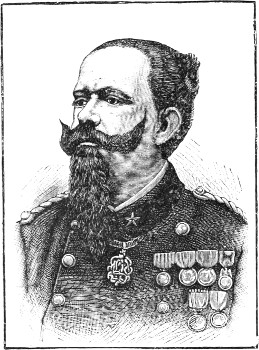
KING VICTOR EMMANUEL.
Napoleon’s Moscow Campaign
By D.H. Parry.
One must go back through centuries of history to find anything approaching the horrors of the Russian War of 1812.
Towards the end of June, 610,058 armed men and an enormous multitude of non-combatants—women and children—crossed the broad Niemen, joined afterwards by 37,100 more, making a total of 647,158; and on the 13th December—or rather less than six months later—16,000 alone repassed that river with weapons in their bruised and frozen hands, almost the sole remains of a magnificent army whose bones are to this day turned up by the plough of the Russian peasant.
The Niemen flows between Prussia and Poland; and in the forest of Pilwisky, behind the rocky heights on the Prussian side, a multitude of men lay concealed, speaking a score of tongues, and wearing a strange variety of uniform, many nations having sent their best and bravest to swell the ranks of the Grande Armée.
The famous Imperial Guard was sleeping in the green corn, dreaming of future conquests, and that mighty host awaited the word of one man to embark on a campaign whose disasters have had no equal—one little pale-faced man dressed now in a long grey riding-coat and a Polish cap—the man who, by the force of his own intellect and the marvellous power of using men and circumstances to his own ends, had ground the whole of Europe—England alone excepted—under the heel of his military boot!
At two o’clock in the morning of June 23rd Napoleon mounted his horse and rode off to reconnoitre the river, his charger stumbling and throwing him on to the sandy bank.
A voice exclaimed in the darkness: “That is a bad augury: a Roman would go back.” But no one knew who had spoken, and, after ordering three bridges to be constructed for the following night, the little party returned to its quarters, the words sinking ominously into their hearts.
Next evening some sappers, with their white leather aprons and keen axes, crossed in a boat, and were met by a Cossack officer, who rode forward alone to inquire what they wanted in Russia.
“We are Frenchmen,” said one of the sappers, “come to make war upon you—to take Wilna—to liberate Poland!”
The solitary horseman disappeared without a word, and the sappers fired their muskets into the silent woods.
For three whole days the tramp of men and the heavy rumble of guns filled the air as the army filed down to the banks, and poured across the bridges—Grenadiers, Voltigeurs, Chasseurs, and Dragoons, regiment succeeding regiment, corps after corps. Now the scarlet and green of the 8th Hussars; again the heavy squadrons of Sebastiani’s Cuirassiers, smart Polish Lancers of the Guard and Line, Carabineers with brass body-armour and snow-white uniforms, long trains of lumbering artillery, waggons and field-forges, carriages, and caissons, the sutler’s cart jostling the caleche of the general officer, a sultry sun overhead, and the river dancing in merry ripples beneath them as the bridges trembled under the tread of the marching thousands.
Napoleon crossed at Poniemen with his Guard, the corps of Marshals Davout, Oudinot, and Ney, and Murat’s dashing cavalry; Prince Eugène, with the army of Italy, passed at Piloni on the 29th; and Jérôme Bonaparte’s Westphalians advanced upon Grodno which they reached on the 30th.
To the north Macdonald attacked Riga on the Baltic, and Prince Schwartzenberg marched through Galicia in the south; but it is the army of the centre, under the Emperor himself, whose fortunes we shall most closely follow, omitting the marches of the thirteen divisions into which the invading forces were formed, and not pausing to notice the minor actions in which they were sooner or later engaged.
Hardly had Napoleon gained the enemy’s side than a black cloud gathered in the sky, and a furious storm broke over the country for fifty leagues right and left. The rain descended with surprising violence, the air grew piercingly cold, and the flat land covered with tall black pine-trees became a swamp, through which they splashed dismally onward.
Ten thousand horses died, heated by the green corn which formed their forage, and then chilled by the rain as they stood shivering in their exposed bivouacs.
The bridge across the Vilia having been destroyed by retreating Cossacks, Napoleon impatiently ordered a squadron of the Polish Lancers of the Guard to swim the swollen stream, and, clad in crimson uniforms, faced with dark blue and laced with silver, they gained the centre, only to be carried away by the current, and many of them drowned, crying “Vive l’Empereur!” as their heads disappeared under water.
Beyond Wilna, Octave de Ségur (brother of the historian) and his 8th Hussars drew first blood from the Russians, and were sadly cut up; but Oudinot drove Witgenstein back at the same moment, and, sending Murat in pursuit, the Emperor returned to Wilna, to waste twenty days in raising unsatisfactory levies, and to disgust the Poles with disappointing hopes of liberty.
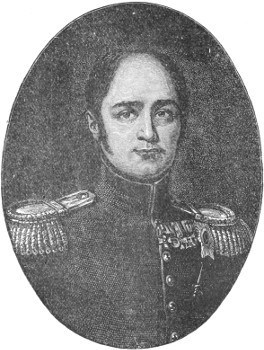
ALEXANDER I., CZAR OF RUSSIA.
Russian proposals of peace were rejected by Napoleon, whose entire conduct during the campaign has baffled his friends and foes; and leaving Wilna at half-past eleven at night on the 16th July, he marched to attack Barclay de Tolly, provided he could find him.
Two hundred and fifty thousand Russians had been formed into three distinct armies—the First Army of the West under De Tolly; the Second, under Prince Bagration; and the Third, which was not then completed, under the cavalry general Tormasoff; 18,000 Cossacks being distributed among them, those of the Hetman Platoff especially destined to win a terrible renown.
The infantry wore green, with slate pantaloons and mud-coloured greatcoats, the officers affecting wasp waists, tremendous curled whiskers, and gold rings in their ears. The Cossacks of the Line were dressed for the most part in blue, with fur caps and long lances; generally swarming with vermin, they were mounted on active little horses, which they urged on with whips, there being also bands of wild horsemen called Baskirs, who used bows and arrows with a precision that caused mourning in many a French home.
The war assumed a curious character: on through the swamps and lonely forests of Lithuania, interspersed here and there by deserts of choking sand, the long columns wound; the Russians burning their villages as they retired, the French in their turn destroying what the Russians had left, devastation and disorder marking every league of the way; the roads dotted with the bodies of dead men and horses, who had sunk with fatigue, and the rear-guard of the enemy disappearing as the French advance-guard came in sight of it.
Napoleon derided the foe as arrant cowards; but the persistent retreat was all part of a wise policy, originated by De Tolly, to draw them into an unknown country, far from their magazines, until hunger, forced marches, the burning heat of the days followed by nights of intense cold, and last of all the terrible winter of those latitudes, should crumble away the army and utterly destroy it.
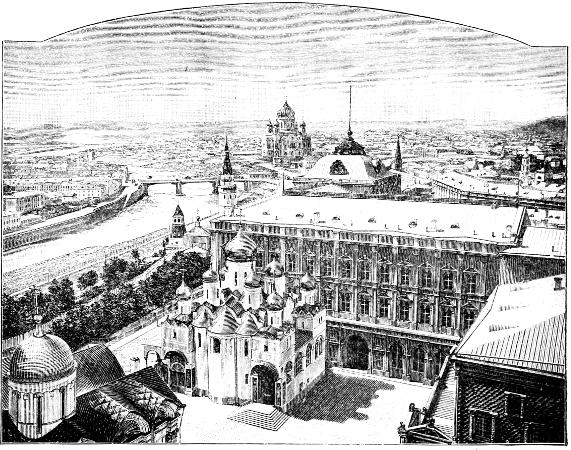
GENERAL VIEW OF THE CITY OF MOSCOW.
The young blood of Russia naturally revolted at such a course and wished to fight, but results have justified its adoption, the significant fact remaining as additional proof of its wisdom, that in nearly every instance during the advance, where the two forces came into contact, the French proved victorious.
At Ostrowno the remnants of the 8th Hussars came up with three Russian cavalry regiments, and routed them in quick succession among the birch woods; Murat ordering some Poles of the Line to charge, and being obliged to lead them, although, as commander, he should have kept out of danger.
The lances were lowered in a glittering row behind him, and the troopers, gay in blue and yellow, came thundering on. From the nature of the ground escape was impossible, so, making a virtue of necessity, the King of Naples flourished his famous riding-switch, galloped at their head, and the charge was successful: the 106th took the Russians on one side, Piré’s Hussars and 16th Chasseurs on the other. The French artillery resumed its fire; and falling back in disorder, the foe melted away into the forest that hid Witepsk.
At that place De Tolly made a stand, hearing that Bagration was about to join him; and Napoleon saw the sun glinting on the arms of eighty thousand men on a bright July morning, as two hundred voltigeurs of the 9th crossed a narrow bridge and formed in front of the Russian horse.
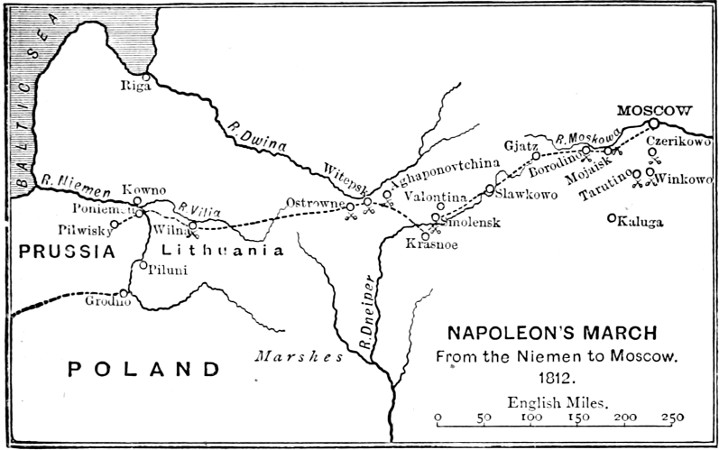
NAPOLEON’S MARCH
From the Niemen to Moscow.
1812
Murat sent the 16th Chasseurs-à-cheval at the enemy, without any support; but though their sky-blue facings had figured in almost every campaign since 1793, they had no chance singlehanded on broken ground, and the Cossacks of the Guard put them to the right-about, pursuing as far as a hill on which the Emperor stood, and only being driven off by the carbines of his personal escort. On their way back the Cossacks attacked the voltigeurs with great fury, the army holding its breath and regarding them as lost; but the little band took post in some brushwood, and routed the Lancers in full view of both forces, the French clapping their hands and cheering their comrades to the echo, Napoleon sending to inquire to what corps the heroes belonged.
“To the Ninth,” was the reply; “and three-fourths of us are lads of Paris.”
“Tell them that they are brave fellows,” said the Emperor to his aide-de-camp, “and that they all deserve the Legion of Honour”—one account stating that every man received it.
Murat, Eugène, and Lobau rushed on the enemy’s left, and compelled him to retire behind the Luczissa; but believing that De Tolly meant at last to stand his ground, Napoleon stopped the conflict, although it was only eleven o’clock, saying to Murat: “To-morrow at five you will see the sun of Austerlitz.”
The morrow came; the sun rose redly through the mists; but the wise Barclay had vanished, having learned during the night that Bagration had been worsted, the French discovering one Russian asleep in a thicket, and not a reliable trace of the direction the others had taken.
The expedition had never been popular, either with officers or men, and they began to grumble with good cause; for an army that had conquered Prussia in fourteen days, and whose standards were heavy with the gilded names of a hundred glorious victories, had now penetrated for more than a month into a land teeming with discomforts. Many of the regiments were shoeless, the cavalry horses died by dozens every day, the hospitals were full of sick; extremes of heat and cold, bad food and little of it, blinding dust, a draught of muddy water to wash it down—all this and more had been their daily lot since they crossed the Niemen, and there had been no great battle to revive their drooping hearts; besides which, the rye bread seriously disagreed with them, and dysentery and deadly typhus laying its wasting hand upon them, had already sadly thinned their ranks.
Their pride, too, sustained a shock when news came that the advance-guard had been repulsed at Aghaponovtchina; and at length awaking from a lethargic dream, the Emperor sent the various corps into cantonments on the skirts of Poland, Russia proper still before them; and returning to Witepsk with his Guard, took off his sword and laid it on his maps, saying: “Here I halt.... The campaign of 1812 is over; that of 1813 will do the rest!”
But his ambition gave him no peace. Murat came riding in from the front, his green surtout all laced and bejewelled, and urged his brother-in-law to action; and although Napoleon went daily to inspect the huge ovens, where 39,000 loaves of bread were baked at a time, and arranged that theatrical companies should come from Paris to enliven the dreary winter months, his suite soon began to find him bending down to his maps again, turning his eyes towards Smolensk and Moscow.
Soon afterwards he came across a proclamation calling upon Russia to rise and exterminate the invaders, and containing some very forcible hometruths which enraged him; and hearing, to his great chagrin, that Alexander had made peace with Turkey, he gathered up his legions in four days, left Witepsk to join them on the 13th of August, and rushed headlong into difficulties and disaster, from which neither he nor his army ever recovered.
By one of those masterly movements of his (so conspicuously absent during the rest of the war), he crossed the front of the Russian army unknown to them, and two days later fell unexpectedly on their left flank at Krasnoë.
Ney forced the town, to find General Néwérowskoi beyond it, with 6,000 infantry and Cossacks belonging to Bagration, which formed into a square of such thickness that the French cavalry sabred its way far in without being able to break it, and the tall corn, now mellowed by Autumn’s breath, saw some ghastly work as Néwérowskoi came to a strong palisade and had to halt; his rear ranks facing round to fire on the Wurtemberg Horse, while the front-rank tore down the obstacle; the body succeeding in their escape, although they left 1,200 dead, 1,000 wounded, and eight guns in the hands of the French, who fired a salute in honour of the victory, which happened to have fallen on Napoleon’s birthday.
The good folk of Smolensk were coming out of church, where they had been returning thanks somewhat prematurely, when Néwérowskoi’s fugitives poured panting into the city, closely followed by Marshal Ney, who, receiving a ball in the neck, lost his temper, and led a battalion at the charge against the citadel, under a hail of musketry that slew two-thirds of them.
Falling back to a hill whence he could reconnoitre, he conducted Napoleon thither, who exclaimed, “At last I have them!” as several immense columns of men were seen hastening towards them on the other side of the Dnieper, being nothing less than Barclay and Bagration with 120,000 troops, coming on at a run, after learning how the Emperor had outwitted them, and arriving out of breath to succour the threatened city.
Some sanguinary fighting took place, and a great battle was expected for the next day; but the wily De Tolly again retreated, his black columns being discovered on the opposite bank marching swiftly away, to the mortification of the invaders.
Even the fiery Murat tired of the campaign, and at length urged Napoleon to stop; but the Emperor persevered, and the King of Naples, exclaiming prophetically as he strode out of Napoleon’s tent, “Moscow will be our destruction!” galloped to the front of a Russian battery, flung himself from his horse, and waited for a ball to kill him.
A violent attack was made on the city; twenty-two men fell by a single shot from a Russian gun, while Murat, who courted death, was unhurt. The gorgeous artillery of the Guard pounded unceasingly. An attempt to storm the place was baffled by the defenders, and when night descended, Smolensk was seen to be in flames, the army finally entering the city to find it a heap of smouldering ruins, and the state of the army itself truly terrible.
General Rapp, who had ridden post to join Napoleon, and who consequently followed their route, gave a vivid recital of the misery and devastation he had witnessed in the rear. Sebastiani revealed the condition of affairs in the heavy cavalry, and the Emperor could close his eyes no longer.
“It is frightful, I am fully aware,” he said. “I must extort peace from the enemy, and that can be done only at Moscow.”
At the hill of Valoutina a shocking conflict was waged by the gallant Ney far into the night, both sides fighting with terrible fury. Junot, Duke of Abrantes, the Emperor’s old companion-in-arms, showed symptoms of the insanity that caused him to commit suicide not long after; and failing to charge at the right moment, the enemy saved his baggage and wounded. General Gudin was killed, the whole army mourning the loss of as gallant and good a man as ever fell in action.
Lieutenant Etienne, of the 12th, took the Russian General Toutchkoff, in the middle of his troops. Napoleon gave eighty-seven crosses to Gudin’s regiments, and presented an eagle to the 127th with his own hands; but the misery of the troops outweighed the glory they had gained: they had seen seven hundred wounded Russians left untended for three days at Witepsk, and the French surgeons tearing up their own shirts for bandages; at Smolensk, fifteen large brick buildings saved from the fire were then full of groaning men, Lariboissiere’s gun-wadding and the parchments in the city archives being used to dress their wounds. There, also, a hospital containing a hundred sick was overlooked for three days, until Rapp discovered it by chance. Eleven thousand Bavarians had been marched to death without firing a shot, and discipline was so lax that at Slawkowo the Guard burnt for firewood the only bridge by which the Emperor could continue his route next day.
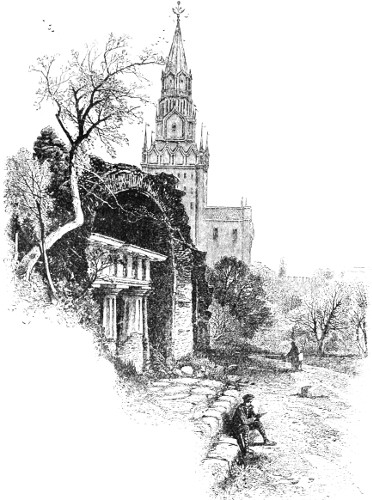
GARDENS OF THE KREMLIN.
Many Cuirassiers rode on native ponies, regiments straggled along and pillaged without check, Davout’s corps alone preserving anything like its usual order: the popular impression that the French disasters began with the winter’s snow is utterly false; the Army of the Centre alone, under Napoleon in person, having lost 105,500 in fifty-two days, and advancing on Moscow with only 182,000, after deducting 13,500 left at Smolensk.
Everything pointed to a decisive battle to restore the morale of the Grande Armée, and Napoleon seemed for the moment to pull himself together, if we may be permitted a homely phrase. Countless orders were despatched, every carriage was to be destroyed that was likely to retard the advance, and meeting with that of his aide-de-camp Narbonne, he had it burned before his eyes, without allowing the general to remove a single article.
A change came over the Russian tactics at the same time: all ranks clamoured for a leader who would fight and not retreat, and consequently De Tolly was replaced by old Kutusoff, who, notwithstanding his defeat at Austerlitz, was a Russian, and beloved by the army for his superstitious practices, and an affectation of Suvarrow’s eccentricity of manner.
The French advanced in three columns, and troops of Cossacks began to hover round them threateningly. Beyond Gjatz, Murat became so annoyed at the hordes of those filthy, unkempt horsemen, that he rushed forward, and standing in his stirrups, with the very sublimity of conceit, waved them back with his sword, and they retired in astonishment and admiration.
But soon the high road debouched on to a natural battle-ground, and dark masses of troops were seen drawn up in solid bodies, there being no longer any doubt that the Russians intended fighting to cover “The Holy City,” Moscow, a large field-work commanding the road itself, bristling with cannon in a threatening manner.
The army attacked without delay, and drove the foe back to a range of hills, General Compans leading the 61st, with bayonets fixed, against the fortification.
Three times they took it, and three times they were dislodged; but at length, other positions being forced in their rear, the brave garrison evacuated the blood-stained ramparts, and Compans retained possession.
Among the heaped-up slain inside, a Russian artilleryman, decorated with several crosses, lay beside his gun, grasping it even in death with one hand, and clenching the hilt of his broken sword with the other; while next day, when Napoleon reviewed the survivors of the 61st, he asked, with surprise, what had become of the 3rd Battalion.
“It is in the redoubt,” said the colonel grimly.
A cold drizzle began to fall that night, and Napoleon, through the striped curtains of his tent, pitched in a square of the “Old Guard,” saw a great semi-circle of fire from the Russian bivouacs.
He slept little, and went early in his grey riding-coat to reconnoitre once more, afraid even then that the foe might retreat; but when morning came the huge force was still in position, extending for six miles, the flanks retired, and the centre advanced towards him.
Its right was protected by a marsh, its centre strongly entrenched, a strong redoubt mounting twenty-two guns frowned near the left centre, and the entire left wing was on lower ground, terminating on the old Moscow road, with two more redoubts before it. To turn that left wing, storm the works, and drive the Russians into the marshes on the opposite flank was the Emperor’s plan, the battle proving one of the most murderous ever fought by the Grande Armée, and known afterwards by them as the “Battle of the Generals,” from the number who fell there, or, officially, the Mosqua, from the river flowing near—the Russians naming it after the village of Borodino, where some of the hardest fighting took place.
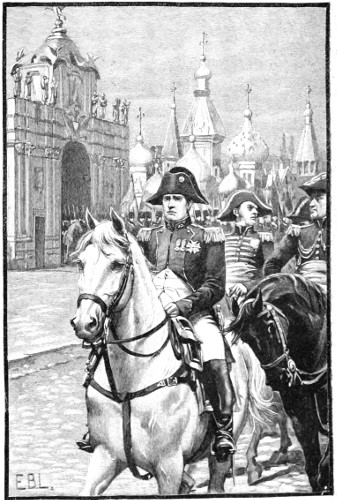
NAPOLEON’S ENTRY INTO MOSCOW.
Marmont’s aide-de-camp arrived with the news of that marshal’s defeat at Salamanca, but the disaster was forgotten in another incident—namely, the unexpected receipt of a portrait of Napoleon’s little son, the King of Rome, which he showed to the grenadiers at his tent door.
A proclamation was issued to the army, beginning: “Soldiers! behold the battle which you have so ardently desired! Victory now depends on yourselves,” and concluding with the words, “Let it be said of you—‘he was in the great battle under the walls of Moscow’;” but being distributed late, many regiments went into action without reading it.
It was the 7th September. A sky of cloudless blue stretched over the amphitheatre of hills, where the leaves were already falling, and at six o’clock Count Sorbier opened fire. Pernetty and Compans were in full march; the Russian processions of priests in glittering vestments that had chanted hymns and invoked the aid of Heaven retired precipitately, and an hour later Davout had his first horse killed under him as the fighting became general.
Compans’ division found itself before one of the enemy’s works, and Charriere, colonel of the famous 57th, gave the simple command, “To the redoubt!” the regiment running briskly forward up the slope with a shout.
Compans fell wounded, Dessaix had his arm broken a little later, and Rapp took command.
“Grape shot, grape shot—nothing but grape shot!” cried Belliard to the artillery, as a heavy column of Russians poured down to resist the attack. Within sixty minutes Rapp was hit four times, the fourth time on the left hip—the twenty-second wound received in his exciting career; and while Poniatowski struggled with his weak corps among the pine-trees on the Russian left, Delzon advanced with drums beating, on the village of Borodino, where Plauzonne was killed at the head of the 116th, and where the 30th had to fight its way out, leaving General Bonnomy badly wounded, Morand’s eighty guns tearing the dense mass before him, and Ney seizing the heights of Chewarino.
The fiercest conflict raged about the redoubts. Two were retaken by the Russians, and the third was in danger, when Murat dismounted and, waving his plumed cap with one hand, laid about him with a private’s musket.
So terrible was the carnage that one colonel ordered his men to retire, and Murat, seizing him by the collar, demanded what he was doing.
“We can stay here no longer,” said the colonel, pointing to half his regiment dead on the trampled ground.
“I can stay here very well myself,” exclaimed Murat.
“Eh bien,” replied the officer, looking steadily at him: “soldiers, face to the foe—to be slain!”
Rapp, carried wounded before the Emperor, had said to him, “The Guard is required to finish it,” but Napoleon shook his head, saying, “No, I will not have that destroyed—I will gain the battle without it.”
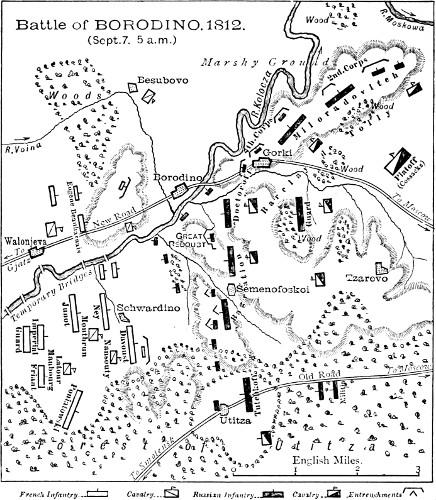
Battle of BORODINO. 1812.
(Sept. 7. 5 a.m.)
It was noon, and though the Russian left had been forced, they still stood their ground obstinately. Murat sent four times for the Guard, but Napoleon paced slowly up and down, always returning to his chair, some cannon shot rolling almost to his feet; and it was obvious that he was not himself, he saying repeatedly during the day that “he did not see the moves clearly on his chess board,” the old activity of mind and body having apparently forsaken the greatest warrior that Europe has ever produced.
The thunder of a thousand guns boomed and echoed far and near, the French alone firing ninety thousand rounds and many millions of ball cartridge.
The Russians re-formed for the third time, and General Montbrun, at the head of the heavy cavalry, was killed by a ball from the great redoubt.
“Do not weep,” said Auguste Caulaincourt, who took command, to Montbrun’s aides. “Follow me, and avenge him!” and crying to Murat, “You shall see me there immediately, dead or alive!” he placed himself at the head of the 5th Cuirassiers, whose long swords gleamed in the bright sunshine, and turning to the left, entered by a gorge, and took the work, falling mortally wounded at the moment of victory, and dying within an hour. He was only thirty, and had left Paris to join the army on his wedding day.
Dense smoke clouded the heights, rolling into the ravines to shroud the wretched wounded; flames showed where villages were blazing, the crash of muskets and the shouts of 250,000 men only diminishing as they fell by thousands to redden the soil, or to crawl shrieking to the rear, where the surgeons, under Baron Larrey, were busy from morning until long after darkness came.
Kutusoff had made so sure of victory that he was feasting with his staff well out of danger, the bulletin announcing a French defeat already written, when officers came crying for reinforcements, the conceited old man at first refusing to listen to any details that differed from his own idea of what ought to be taking place, his long pigtail wagging incredulously the while. But the reports were true. The French had won the plain, and were battling for the heights with irresistible fury.
Eugène improved Caulaincourt’s success; Belliard shattered the last Russian attack with the concentrated fire of thirty guns; Lauriston galloped up the reserve artillery, and did tremendous execution; and Grouchy—so well known in after years from the undeserved abuse showered on his brave head—had swept the high road and the plain beside it. The Russians, beaten in detail, retired to a second range of heights, from which the army was too exhausted to dislodge them without the assistance of the Guard, and night saw the two battered and bleeding forces still facing each other amid a fearful débris of slain.
On the French side Davout had been hit three times; Generals Montbrun, Caulaincourt, Plauzonne, Huard, Compere, Marion, and Lepel were killed; Nansouty, Grouchy, Rapp, Cempans, Dessaix, Morand, Lahoussaye, and many more—some forty in all—had been hit; and of the soldiers 35,000 lay dead and wounded, mangled by the showers of grape and the large musket balls used by the Russians.
They, on their side, counted three generals, 1,500 officers, and 36,000 men killed and wounded, accounts varying greatly as to the number of prisoners taken by the French, some making them 5,000, others 700 or 800 at the most.
Riding slowly across the battle-field, when the surgeons and the burial-parties were doing their ghastly work, the hoof of Napoleon’s charger brought a groan from a prostrate form, and one of the staff remarked in his hearing, that “it was only a Russian”!
“After a victory,” exclaimed Napoleon severely, “none are enemies, all are men.”
The army advanced and fought a sharp action at Mojaisk, where the Emperor lay for three days, burnt up with fever, and compelled, notwithstanding, to transact enormous arrears of business—dictating to seven people at once, and, when his voice left him, explaining with difficulty by writing and signs.
He left Mojaisk on the 12th of September to join the advance-guard in that famous travelling-carriage which Londoners know so well, his legions reduced to 198,000; and two days later, having mounted his horse once more, he saw the goal of his ambition, the ancient capital of Russia, glowing in the light of the afternoon sun.
In the centre of a vast plain, and built, like Rome, on seven hills, the two hundred and ninety-five churches and countless magnificent buildings of the “city of the gilded cupolas,” twenty miles in circumference, with a river meandering through it, burst on the view of the army as it crested the “Mount of Salvation,” and a shout went up of “Moscow! Moscow!” as the soldiers cheered and clapped their hands; whole regiments of Poles falling on their knees to thank the God of Battles for delivering it into their grasp.
Fairy-like it stretched before them, dazzling with the green of its copper domes and the minarets of yellow stone. Oriental in its architecture, and constructed in Asiatic style with five enclosures one within the other, it was like some fabled city of the Arabian Nights, sparkling with brilliant colours, the famous Kremlin towering above the palaces and gardens.
The advance-guard under Murat mingled with bands of Cossacks, who applauded him for his known valour, and the King distributed his jewellery and that of his staff among them; but an officer arrived from Miloradowitch with a threat of burning the city if his rear-guard were not allowed time to evacuate it.
Napoleon stayed his march therefore, and the day wore on. When Murat at last entered by the Dorogomilow Gate, he found that Moscow was deserted: the streets were empty, the houses closed, a few loathsome wretches released from the prisons, and a handful of the lowest of the low, alone surged round their horses near the Kremlin; but the inhabitants were gone, in a cloud of dust that hid the retreating Russian army, towards Voladimir. The gates of the Kremlin were battered open by cannon shot, a convoy of provisions captured, some thousands of stragglers were afterwards taken, but that was all; and on the gate of the Governor’s mansion at Voronowo, the following notice was found in French:—
“I have passed eight years in embellishing this retreat, in which I have lived happily in the bosom of my family; the inhabitants of this property, to the number of seventeen hundred and twenty, quit it at your approach, and I set fire to my house in order that it may not be defiled by your presence. Frenchmen, I have abandoned to you my two houses in Moscow, with furniture to the value of half a million of roubles. Here you will find nothing but ashes.—Rostopschin.”
With the army singing the “Marseillaise” Napoleon entered at night, and appointed Marshal Mortier governor, saying: “No pillage—your head shall be responsible for it.” And though several French residents acquainted him with the Russian intention of burning the city—that the senate had agreed to it with only seven dissentient voices, that all the engines had been removed, and they were treading on the brink of a volcano—he refused to believe it, and tried in vain to sleep.
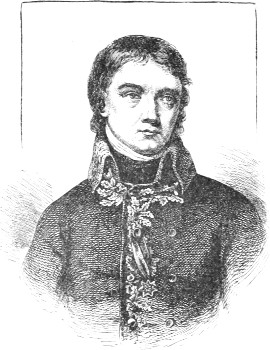
GENERAL JUNOT.
At two o’clock in the morning they brought him news that Moscow was on fire!
When daylight came he hurried to the spot to reprimand Mortier and the Young Guard, but the marshal showed him that black smoke was issuing from houses that had not been opened, and the whole affair had evidently been carefully planned.
He went to the Kremlin—a vast structure, half palace, half castle, surmounted by the great Cross of Ivan, and built on a hill—from which he wrote overtures of peace to the Czar, overtures that received no attention.
In spite of the efforts of the soldiers the flames spread, a ball of fire had been let down into Prince Trubetskoi’s palace, the bazaar was in a blaze, and the strong north wind blew towards the Kremlin itself, which, report whispered, was undermined.
Murat, Eugène, and Berthier urged the Emperor to leave the city, without success: he had come there, and there he would remain—a conqueror in the very centre of the Russian empire. But the cry arose that the Kremlin itself was on fire: a police-agent was discovered near the burning tower, and bayoneted by the Old Guard almost in Napoleon’s presence. There was no longer time for hesitation, or dreams of empty glory, and passing down the northern staircase, where the massacre of the Strelitzes took place under Peter the Great, he left the city for the castle of Petrowsky, a league on the St. Petersburg road.
The army also marched out, encamping in the fields, eating their horseflesh from silver dishes and swathing their wounds with costly silks, the rain falling in torrents, and Moscow a sheet of fire for four days.
Much has been written of Napoleon’s escape by a postern, of hurried wanderings through burning lanes, past convoys of powder, which the whirling sparks might have ignited at any moment, and various dramatic situations dear to the French historian. In point of fact, he ran little personal risk, and left the Kremlin by the great gate, returning thither when the flames had abated, and ordering the Guard to occupy the ruins of the city on the 20th and 21st.
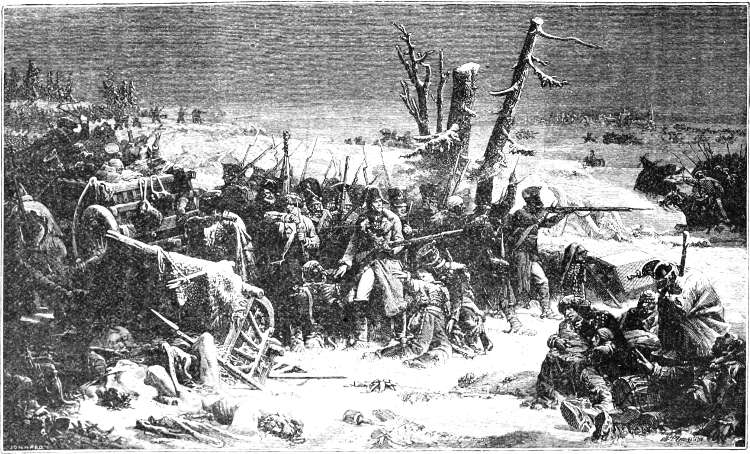
By permission of the Council of the Manchester City Art Gallery.
THE RETREAT FROM MOSCOW.
(From the Painting by Adolphe Yvon.)
About a tenth of the houses remained intact, especially in the Kitaigorod, or Chinese quarter; many rich merchants’ dwellings, and here and there a palace or church reared their barbaric forms amid the general chaos; gay flower-beds still bloomed in the suburbs, and the old red wall that surrounded the Kremlin was comparatively unharmed; but the aspect of the place, which should have furnished winter quarters for the Grande Armée, struck a chill into the hearts of all, and caused the Emperor to say that “the commerce of Russia was ruined for a century, and the nation had been put back fifty years.” In six, however, a new Moscow had arisen and Napoleon was a captive in St. Helena!
Six thousand Russian wounded are said to have been in the city when the French entered: what became of them one dare not contemplate.
On the return of the troops universal pillage became the order of the day, and readers of the early French editions of Labaume’s narrative will understand why I pass much over in silence. Some of the inhabitants had returned, others had been concealed in the vaults of churches and the cellars of their homes; but the grenadiers routed them out and committed unmentionable excesses.
In the camps and quarters all the wealth of the East lay scattered about under foot: priceless carpets, velvet hangings, lamps of gold and silver set with gems, ecclesiastical vestments and works of art, became the prey of settlers and the riff-raff of Parisian slums; choice wines and liqueurs flowed like water; lace, linen, and ladies’ jewellery were taken from carved chests and coffers of exquisite workmanship, for the household effects had been left untouched when the city was abandoned.
Drunken sappers lolled on sofas covered with costly satin, and muddy boots were cleansed on rich furs and Cashmere shawls of enormous value: seldom had an army, famed for its rapacity, had such an opportunity for its gratification, while, with the Russian forces, white bread was six shillings a loaf, sugar ten shillings a pound, and butter unprocurable at any price.
In the midst of this disorder, the real originator of it all dated his correspondence from the Kremlin Palace, and thought of pushing on to St. Petersburg. A march of nine hundred leagues, with sixty conflicts en route, had produced nothing, difficulties were increasing, winter was coming fast. Still the Czar kept an ominous silence, and although an armistice had been declared, the Russians daily cut off the foraging parties, and the peasantry rose to arms.
“Take your three-pronged forks,” wrote Rostopschin in his proclamation to them. “A Frenchman is no heavier than a sheaf of corn!”
Murat, always to the front, had followed Kutusoff in his circuitous march round Moscow, and lay observing him between that city and Kalouga, fighting two sharp but indecisive actions—Czerikowo and Winkowo.
During the truce the Russian officers asked the French if they had not corn, and air, and graves enough in their own country; adding, “In a fortnight the nails will drop from your fingers.”
The little pale-faced man grew visibly paler with anxiety, and went on hoping against hope; discussing poetry just arrived from Paris, drawing up regulations for the Comédie Française, and trying to reassure himself that the winter was still far off by poring over the almanacks for forty years back, and trusting to the hot sun that still shone in a blue sky above him.
Chef d’escadron Marthod, with fifty Dragoons of the Guard—his Guard, so seldom defeated—had been cut off while foraging. A slight fall of snow lay white for a few hours on the plain—a foretaste of what was coming. No message arrived from Alexander, and one day, to crown all, while he was reviewing some troops, young Beranger galloped in with the alarming news that Murat had been overthrown at Tarutina, near Winkowo, two generals being killed, the King wounded, and the advance guard almost destroyed.
It was clearly time to go, and dismissing the troops, Napoleon issued orders for immediate departure, leaving Moscow late the same evening, October 18th, or, as some say, before dawn on the 19th, Marshal Mortier remaining behind with the Young Guard to cover the retreat and blow up the Kremlin.
Where are the words that will paint that enormous and disorderly throng moving in a ragged column over the plain to the south of the ruined city? Coats and gaiters were patched and mended; shakoes assumed every shape but the regulation one; brass no longer shone, and steel had grown rusty, as the troops straggled onward, their knapsacks bulging with plunder; bearskin-capped grenadiers pushing wheelbarrows full of gold and silver plate, and the ambulance waggons creaking and groaning with costly brocade, household furniture, pictures, statuary, and every conceivable articles of value the pillagers could carry away.
Napoleon set the example; for the huge Cross of Ivan, torn down by his orders, lumbered along with many other trophies, under a strong escort, and miles of carts of every description thronged the road and the fields on either side.
The French residents fled in the wake of the army; delicate ladies, clad in thin dresses and stuff shoes, peering at the strange procession from the windows of travelling-carriages; wounded soldiers jolted by, lying on piles of loot, their aching limbs ill-tended amid the lavish profusion of spoil, for never has man’s selfishness displayed itself more forcibly than during that terrible retreat.
Night fell, and the host halted only a league from the city. With the 103,000 men who marched, more than 500 guns were dragged by lean horses, the Emperor insisting that they should not be abandoned; but at the present moment the bulk of them are ranged in rows in the great square of the Kremlin—a lasting memorial of that awful war.
Two roads led from Moscow to Kalouga, and Napoleon pushed along the old one, on which Kutusoff awaited him; but at Krasno Pachra, the Emperor turned off to the right and crossed the fields to the new road, in the rain, which hampered the artillery and lost much time; but once on the causeway, which they gained on the 23rd, they set their faces towards Kalouga again, trusting to pass Kutusoff undetected in one day’s march.
Napoleon slept at Borowsk that night, and Delzons had occupied Malo Jaroslavetz, four leagues in advance.
In the early morning, however, Doctoroff, with the 6th Corps of Kutusoff’s army, came shouting out of the woods, drove Delzons down the steep hill, and commenced one of the fiercest battles of the campaign.
At sunrise Delzons forced the town again, and the victory seemed won, but a ball through the head slew him. His brother tried to carry him out of the mêlée, and another ball laid him lifeless. Guilleminot placed a hundred grenadiers in the churchyard on the left of the road, and for hours it became a mimic Hougoumont, the Russians alternately charging past it and being driven up again, exposed to a hot fire from the loopholed wall.
The whole of the 14th Division was engaged, and the fight surged along the high road, now on the heights, now in the valley by the river; the wooden town ignited by the howitzers, and burning the wounded, while the guns, breasting the hill at a gallop, scrunched the charred corpses, grinding the living and the dead into a sickening pulp.
The 15th Division, mostly Italians, attacked the burning town and suburbs, and took it for the fourth time, but were driven back to the foot of the slope, and as a last resource, Eugène advanced with his Guard. The 13th, 14th, and 15th Divisions rallying, and Colonel Peraldi charging bravely with the Italian Chasseurs, they gained the heights for the last time, and the Russians, 50,000 strong (some say 90,000), retired from their vantage ground before 18,000 men, who had fought uphill against the most stubborn resistance.
All the eye witnesses speak of the awful sight presented by the high road and churchyard. The brothers Delzons were buried in one grave, and the Grenadiers of the 35th fired a salute over General Fontane; while Napoleon himself had a narrow escape as he hurried towards the sound of the cannonading.
The road was blocked by the baggage train; stragglers marched along in safety in the midst of the army, when the Emperor, Rapp, Berthier, and a few officers, having outstripped the escort, saw bands of Cossacks darting out of the woods, between the rear of the advance-guard and the head of the Grande Armée.
“Turn back!” shouted Rapp; “it is they!” and grasping the bridle, he pulled the Emperor’s charger round.
Reining in by the roadside, Napoleon drew his sword, and they awaited the attack, Rapp riding forward to shield his Emperor.
A Cossack’s lance penetrated six inches into the chest of Rapp’s horse and brought him down, but the staff rescued him, and unconscious of the prize within their reach, the Cossacks rode for the baggage waggons, until the cavalry of the Guard came up and drove them into the woods again. They were 6,000 of Platoff’s men, and Napoleon’s life had hung in the balance!
That night, in a weaver’s hut, filthy beyond expression, an emperor, two kings, and three marshals of France held a stormy council of war, at which Murat and Davout quarrelled, as was their wont, and which Napoleon broke up by saying, “It is well, messieurs—I will decide,” electing eventually to retreat by the most difficult road—that which the army had wasted on its advance.
It was the last time that they had any option in the matter. A few days more, and the retreat became a disorderly rout—emperor, kings, marshals, and men glad to seize the first road that led them from their remorseless enemies.
On the 23rd, at half-past one in the morning, a hollow boom had startled their ears, even those who were expecting it. The capitaine Ottone, of the Naval Artillery, had fired his train. Mortier’s orders were executed, and the Kremlin had been partially blown up by 180,000 lbs. of gunpowder, Mortier rejoining, to the surprise of all, at Vereia with 8,000 men, mostly dismounted cavalry.
At Vereia there was another brush with Platoff, and his son, mounted on a magnificent white Ukraine horse, was killed by a Polish trooper.
On a hill covered with sombre fir trees the Cossacks buried the dead boy, riding slowly round him with lances lowered, uttering wild cries of grief, and then filing silently away with vengeance in their hearts.
Every village at which the French halted was burned on their departure, each succeeding corps helping to complete the devastation, so that the route was marked by ruined homes, huge dogs from each hamlet following the army until they increased to enormous packs, living on the dead who lined the road, and adding a new terror to the retreating invaders.
At Mojaisk the sky lost its intense blue, and the landscape became gloomy, the cold wind sobbing and wailing down the avenues of melancholy pines, and the men drawing closer to each other as they marched.
The columns debouched on to the field of Borodino, and sad memories were aroused at every step; for, although thousands of bodies had been burned by the Russians, the plain, the heights, and especially the redoubts were littered with broken weapons and innumerable accoutrements, the hands and feet of the hastily buried slain protruding from the sandy soil in all directions.
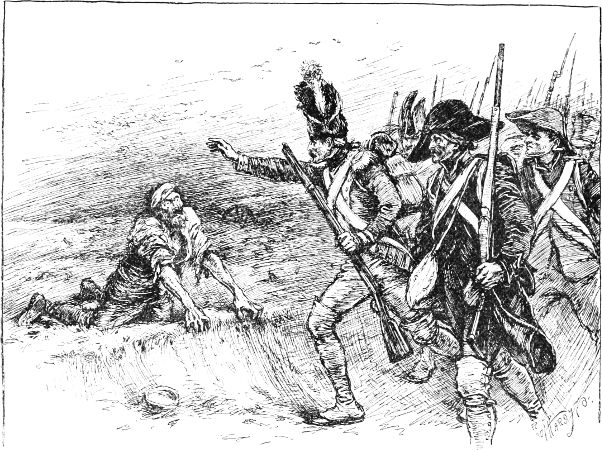
“A MUTILATED SPECTRE CRAWLED TOWARDS THE STARTLED SOLDIERS.”
One ghastly incident, vouched for by the great majority of writers, occurred as the head of the army traversed the field. Cries were heard, and a mutilated spectre crawled towards the startled soldiers. It was a Frenchman, whose legs had been broken during the battle more than seven weeks before, and who, unaided, had lived on the putrid flesh around him, sleeping in the stinking carcase of a disembowelled horse.
Taking him tenderly up, the army hurried on. The skeletons they were leaving behind grinned silently as the straggling band passed by. A little further on, the wounded at the abbey of Klotskoi held out their hands beseechingly, and an order was issued that every vehicle should carry at least one of them, the weakest being left to the tender mercies of the Russians.
Every now and again a dull explosion came from the line of march as caisson after caisson was blown up when the horses became too weak to drag them; and a few miles on the road to Gjatz a terrible outcry arose as wounded men were found lying on the ground, having been thrown out of the sutler’s carts in order that the vile wretches might save their plunder—one sufferer, a general, living just long enough to tell the tale.
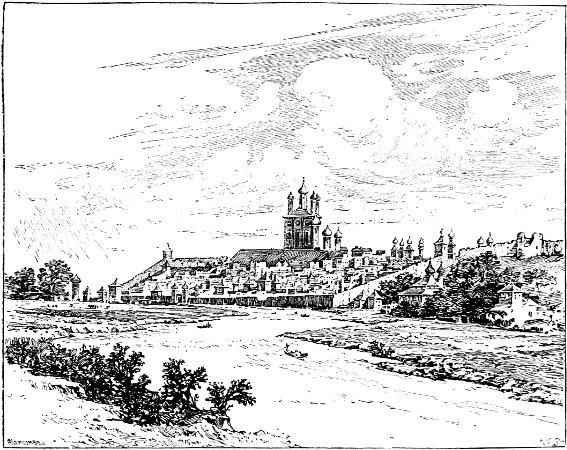
SMOLENSK, FROM THE BANKS OF THE DNIEPER, IN 1812.
(From a Contemporary Print.)
As evening drew down and Napoleon approached Gjatz a fresh horror awaited him; for Russian dead, still warm, and with their brains battered out in a peculiar manner, were met with at every few yards. The escort of Poles, Portuguese, and Spaniards told off to guard the prisoners had chosen that method of ridding themselves of the weakly ones who lagged behind.
A stringent order went forth, and the murders ceased; but every night the miserable captives were herded together like cattle, without fire, on the bare ground, a meagre ration of raw horseflesh served out to them, and when that failed the frantic wretches turned cannibals and devoured each other.
The 4th Corps, under Eugène, meanwhile followed the Imperial column, and Davout commanded the rear-guard, five days’ march behind.
Intense cold had now set in, and the land was icebound; violent winds fluttered the ragged uniforms, the fifteen days’ rations brought from Moscow were exhausted, and the depth of misery seemed to have been reached. Yet all this was as nothing to the sufferings in store.
Napoleon waited thirty-six hours at Wiazma for the rear-guard to come up, and seeing no sign of it, left Ney there to relieve it, and marched for Dorogobouje on the 1st November; while Eugène and Davout, arriving at Wiazma on the 3rd, found Ney hotly engaged with Miloradowitch, the Russian Murat, who opposed further advance.
A battle ensued, lasting many hours. Great heroism was displayed, especially by the 25th, 57th, and 85th Regiments, and at length Eugène got away through the town; Davout, in his turn, retiring step by step before 20,000 men and the crashing fire of twenty-four guns, was met by another force in the winding streets, and only extricated himself after tremendous loss, the bulk of the Russians under old Kutusoff remaining motionless within earshot, in spite of all the efforts of Sir Robert Wilson to induce him to attack.
During the fourteen days since the Grande Armée left Moscow it had lost 43,000 men, reducing its numbers to 60,000; and its condition may be understood from the fact that the day after Wiazma a little flour, carefully measured out in a spoon, formed the only food of the officers of the 4th Corps.
The dogs howled round the tail of the straggling columns, croaking ravens followed in black flocks. When a horse fell the hungry soldiers rushed upon it and tore it to pieces before life was extinct; and on the 6th November the sun disappeared, a grey fog enveloped the troops, the wind dashed them one against the other as they stumbled mechanically along, AND IT BEGAN TO SNOW!
Whirled on the storm wind, the flakes shut out the country on either hand. No sooner had a waggon—a gun carriage—a decimated regiment gone by than it was instantly lost to sight. The road vanished, the hollows were filled up; one could pass within twenty yards of a log hut and not see it. Everything became white—a pitiless, monotonous, dead level of snow, and strong men sobbed struggling onward—as they hoped—towards that Belle France that not a third of their number were destined to reach again.
Napoleon was on the heights above Mikelewska when the snow began, and news of the most serious import reached him at the same moment, Count Daru arriving with the account of General Mallet’s attempted conspiracy in Paris.
Surrounded by a circle of his Chasseurs, shivering in their scarlet pelisses, the Emperor listened to the startling narrative, the storm howling round him as he bent over the neck of his horse; and even when he retired into a posthouse to digest the alarming intelligence his cup of bitterness was not full, for Colonel Dalbignac came from the rear-guard, which Ney had taken over, with a terrible report of the disorder that the marshal had discovered at Dorogobouje.
“I do not ask you for these details, colonel,” said Napoleon; but some waggons arriving from Smolensk laden with provisions, he waved Bessières, who wished to keep them for the Guard, aside, and sent them on to Ney, saying, “Those who fight shall eat before the rest,” begging him, if possible, to check the foe, and allow the main body some time to reorganise at Smolensk.
The bulk of the Russian spoil, including the great Cross of Ivan, had been sunk in the lake of Semlewo, and cannon were abandoned at every mile. Generals and staff officers marched in bands, without men, without thought of anything but their own preservation. Twelve to sixteen horses were required to draw a single gun up the slightest hill, slippery as glass, and, with the thermometer registering twenty-eight and thirty degrees of frost, 10,000 wretched animals died in a single night—the terrible night of sixteen hours of darkness. In some Italian villages they still speak with horror of “the night of the fifteen hundred frozen”—that being the number of Italians that died on one occasion between sunset and sunrise.
Even the Russian Miloradowitch suffered from a frozen eye, and men who sat to rest a moment on the snow fell back in a stupor, a little blood gushed from mouth and nose, and their earthly woes were over.
Horrible the fate of those who straggled from the track and fell in with the villagers. Sir Robert Wilson at one place saw sixty naked Frenchmen laid in a row, their necks on a felled tree, while men and women hopped round them, singing in wild chorus, and battering out their brains in succession with faggot sticks.
At Wiazma fifty were burned alive; at Selino the same number, still breathing, were buried, the dog belonging to one of them returning daily to the graveside for a fortnight before the peasants slew it.
Yet amid all this misery, his men wearing bed quilts, pieces of carpet, women’s clothes from the baggage waggons which they began to pillage on the 7th November, and existing too often on the bodies of their comrades roasted by the flames of a burning log hut. Marshal Ney, well styled “the bravest of the brave,” set his face to the foe, and fought for ten days and nights against Cossacks—artillery, horse, foot, and dragoons—and, worst of all, the terrible Général Morizov, as the Russians called the frost. Holding each wood, contesting every hill, knowing that he was virtually sacrificed to save the wreck of the army, his men deserting, despairing, dying, he fought on foot to give them courage, his face livid with the cold, and almost unrecognisable from the long red beard he had allowed to grow.
Some idea of the stubborn character of those wild Cossacks may be formed from one little incident. One of them came into the Russian camp, having ridden twenty miles after being hit by a cannon shot. His arm was taken out at the shoulder-joint by the famous Doctor Wiley, who afterwards amputated Moreau’s legs at Dresden. During the operation, which lasted four minutes, the man never spoke, the next morning walked about his room, and drank tea, and, getting into a cart which jolted him fourteen miles over a Russian road, was afterwards heard of, many hundreds of miles on his journey homeward to the Don, doing well!
Small wonder, then, that the hoarse hourra struck terror into the fugitives, and that half a dozen of the barbarians would send a battalion of bleeding conscripts flying for their lives down the glittering aisles of drooping birches, whose fairy-like branches glistened with magic beauty in the wintry sunshine.
Eugène was attacked as his corps crossed the Wop with five or six thousand soldiers under arms, double that number of stragglers and wounded, and more than a hundred guns. The ford became blocked, the current was very rapid, and the river only partially frozen. A shameful pillage of the waggons took place, gold, silver, and costly plunder being scattered in the mud; and it was not until a brave Italian colonel named Delfanti crossed up to his waist in the floating ice that the others took heart and followed him.
Colonel Labaume tells us that he picked up a magnificent cup of splendid workmanship, drank some muddy water out of it, and flung it aside with indifference; but others, thinking only of gain, exchanged silver money for gold at a great sacrifice, secretly laughing at their comrades, who soon sank under the weight, while they escaped with the lesser bulk.
One officer, apparently lifeless, felt a man pulling off his boots, and exclaimed, “Ah, rascal, I have still need of them. I am not quite dead.”
“Eh bien, mon général,” said the soldier, coolly sitting down beside him, “I can wait.”
Napoleon rested five days at Smolensk; but so neglected had been his orders that no meat was found there—only rye flour, rice, and brandy—and the army fought desperately at the doors of the magazines, killing many men, raging at the Guard, whom they accused, with great reason, of being unduly favoured, and breaking out into excesses of every kind.
On the 14th November, at four o’clock in the morning, the main column left for Krasnoë, leaving little or nothing behind them for Eugène, Davout, and the valiant Ney, who had instructions to evacuate the city with a day’s interval between each corps, Ney to blow up the place when he took his departure.
Out of 37,000 dashing cavalry who had crossed the Niemen only eight hundred remained mounted at Smolensk, the 20th Chasseurs being credited with a hundred; and this remnant was collected under Latour-Maubourg, a brave and very popular officer, who, on losing a leg at Leipzig the following year, said to his weeping servant, “Mon ami, why do you grieve? In future there’s only one boot to clean.”
The army was now 42,000 strong, having lost 18,000 in the previous eight days; but it was estimated that 60,000 unarmed stragglers still impeded the march. Before leaving Smolensk, however, a reinforcement brought the force up to 47,000, to meet four Russian armies, one of them with 90,000, under Kutusoff, another commanded by Miloradowitch with 20,000 men.
The artillery of the Guard took twenty-two hours to do the first five leagues out of Smolensk. One company of sturdy Wurtembergers mustered four men, and when Eugène reached the abandoned city in a furious gale his men had to mount the slippery hill literally on their knees.
Beyond Korythnia Miloradowitch opened on the Imperial column, and Napoleon rode in the centre of the Grenadiers of the Old Guard. He seemed to bear a charmed life, for three times a certain Captain Finkein had penetrated Moscow to kill him, and he was often under fire during the retreat. This time, however, he had to pass a hill bristling with cannon, and the band struck up a then well-known air, “Where can one be happier than in the bosom of his family?”
“Stop,” cried Napoleon, fearful of the memories it might raise in the minds of the men. “Rather play, ‘Let us watch over the safety of the Empire.’” And to that air they marched past the batteries, soon leaving the danger behind them.
When the column had gone, Miloradowitch descended from the hills, drew across the road, and cut off the rear corps, who had to fight their way through with terrible loss.
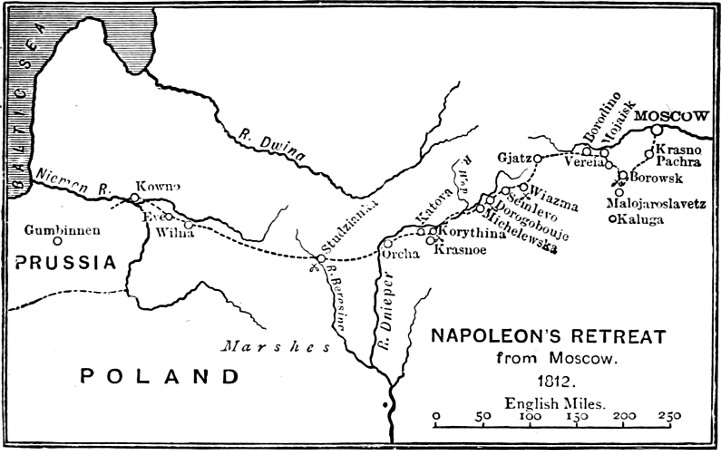
NAPOLEON’S RETREAT from Moscow. 1812.
Eugène tried to force a passage, but failed; and leaving his fires burning—and what miserable fires they were!—turned the flank of the Russians, and got by in the night.
At the critical moment the moon shone out, and the wretched band was challenged.
“Hist, fool,” whispered a Polish officer named Klisby in Russian. “Do you not see that we belong to Suvarow, bound on a secret mission?” And so, without interruption save from the Cossacks, the Viceroy joined his stepfather at Krasnoë, where Napoleon made a retrograde march to succour Davout, who came in, his baggage gone, his marshal’s baton taken, his men reduced to a few platoons, and with no news of Ney, who was reluctantly left to his fate, the army moving on Orcha, Mortier and the wreck of the Young Guard retiring slowly in the rear, after holding Krasnoë as long as possible, Laborde saying to the troops, “The marshal orders the ordinary time—do you hear?—the ordinary time, soldiers,” although under a heavy fire of balls and grape shot.
At Orcha Napoleon destroyed his papers. At Lubna the twenty-one staff officers of the 4th Corps crouched round a miserable fire in a cart-shed, with their horses behind them. At Krasnoë the brave Delfanti limped along on the arm of Villeblanche. A round shot struck him between the shoulder blades, carried off Villeblanche’s head, and they fell dead on the snow. Wherever one turned it was horror upon horror. Delicate women and little children lay by the roadside. The Cossacks stripped everyone they found.
Wilson has some dreadful details in his interesting diary. At one place a number of naked men sat round a burning hut, their backs quite frozen, when, turning to warm them, the fire caught the congealed flesh and roasted it in his presence.
Again, he saw four wretches huddled together, hands and limbs immovable, but minds yet vigorous, with two dogs snarling and tearing at their frozen feet; while nearly all the dead he came across seemed to have been “writhing with some agony at the moment their heart’s blood congealed.”
Woe to the man who lost his bivouac, and strayed to another fire. He was driven away with blows and curses from one after another until he sank and died. If anyone fell on the march, and implored a helping hand, the passers-by shook their heads and passed on, although many were still laden with plunder.
An awful thing occurred as Ney left Smolensk, showing the depths to which human nature can sink, a female sutler being seen to throw her little five-year-old boy off her heavily-laden sledge and leave him. Twice the marshal had him placed in her arms, and twice she flung the child from her, saying, “He had never seen France, and would never regret it, while she was resolved to see it again.” The soldiers could stand it no longer, They carried the boy safely through the rest of the march, and left the unnatural woman to perish in the snow!
Ney’s retreat with the rear-guard was one of the great events in French history, and has never been exceeded by any general for courage, determination, and self-reliance.
With barely 6,000 men, twelve guns, and 300 crawling skeletons—which it is a mockery to call horses—and burdened with 7,000 stragglers, whose wants and selfishness added greatly to the difficulties, he followed the traces of the Grande Armée, easily recognisable by the burnt-out bivouacs with their circles of dead—the white mounds that indicated where a cuirassier, a dragoon, a barefooted voltigeur, slept his last sleep, and the patches of trampled, blood-stained snow strewn with helmets and corpses, over which the dogs wrangled and the ravens croaked in the dull light that showed a battle-ground.
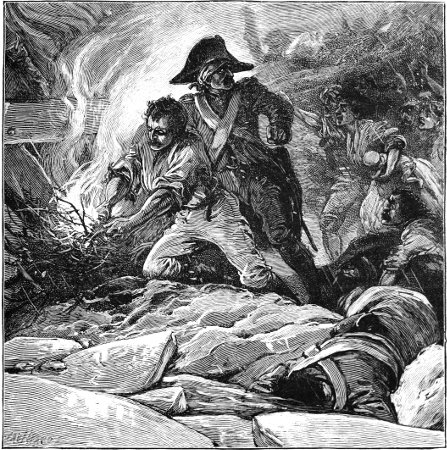
“THE ENGINEER SET FIRE TO THEIR SOLE MEANS OF ESCAPE” (p. 327).
Beyond the plain of Katova, where, three months before, they had driven Newerowskoi through the cornfields, they were summoned by an officer in the name of Kutusoff; but while he was speaking forty guns opened on the French, and Ney exclaimed, “A marshal never surrenders—you are my prisoner,” the astonished Russian marching with them for twenty-six days without attempting to break his parole.
Ney boldly attacked the eighty thousand men, heading his feeble band in person. They broke the first line, and were rushing on the second when the guns began again, sweeping the columns and killing some women in the waggons.
The French fell back in confusion, but Ney rallied them again, replying with his six remaining guns, and showing his teeth with the two thousand ragged wretches who kept their ranks. If Kutusoff had sent a single corps against them, not a man would have survived to tell the tale. As it was, when night fell Ney turned his back on them, and retreated towards Smolensk.
After an hour’s dreary march they halted, Ney, as usual, in the rear; and breaking the ice on a streamlet to find which way the current ran, followed its course through the silent forests until they reached the Dnieper.
Guided by a lame peasant, they found a spot where the ice would bear them, although a thaw was setting in; and, after lighting fires to deceive the hovering Cossacks, the intrepid marshal rolled himself in his cloak and slept on the river bank for three hours.
At midnight they began to cross, the ice parting and letting many of them in as they crept in single file. An attempt was made to get the wounded over in the waggons, but the treacherous blocks gave way, and they were drowned with heartrending screams, Ney himself rescuing one survivor, an officer named Brigueville.
Using the cowardly stragglers as a shield, by placing them between his men and the foe, he pursued his way, taking advantage of the woods, surrounded by 6,000 Cossacks, and repeatedly played upon by cannon; lying in the forests by day, and marching when darkness had set in, until, with 1,500 men under arms, most of the stragglers slain or taken, and all his guns and baggage gone, he rejoined the wreck of the army at Orcha on the 20th November, Napoleon well saying before his arrival, “I have two hundred millions (francs) in the cellars of the Tuileries, and I would have given them all to save Marshal Ney.”
Oudinot and Victor also joined the wreck about this time, bringing up the total number to 30,000 or thereabouts, the Emperor’s column mustering only seven thousand men and forty thousand stragglers, mingled with the enormous baggage train of the 2nd and 9th Corps that had escaped much of the previous disaster; and closely pressed on each flank by the immense armies of Kutusoff and Witgenstein, the doomed men prepared to cross the Berezina in the face of Admiral Tchitchakof, who lined the opposite bank.
Latour-Maubourg had only 150 horsemen left, and Napoleon formed 500 mounted cavalry officers into what he called his Sacred Squadron, Grouchy and Sebastiani commanding it, and generals of division serving in it as captains; but in a few days this last romantic idea had crumbled away.
Corbineau, with the remains of the 8th Lancers and 20th Chasseurs, saw a peasant riding a wet horse, and compelled him to show them the ford opposite to Studzianka; and while the French made all the parade they could lower down the river to attract Tchitchakof’s attention, the brave engineer Eblé arrived at Studzianka in the dark winter evening of the 25th November with two field forges, six chests of tools, some clamps made from waggon tyres, and a few companies of pontoniers, and began to make a bridge, the water rising, the ice floating in blocks, and the men working up to their necks without even a draught of brandy to protect them from the cold.
As the grey dawn broke, the first pile was driven; eight hours’ work was required before the bridge would be practicable, and the haggard fugitives waited with agonised hearts for the cannonade that would destroy their last hope; but to the astonishment of all, the admiral was seen in full retreat on the farther bank, disappearing into the woods with all his guns.
A caricature exists, showing Kutusoff and Witgenstein tying Napoleon up in a sack, while Tchitchakof is cutting a hole in the bottom of it; clearly indicating the Russian view of that individual’s conduct.
Napoleon wished to question a prisoner, and two officers swam their horses across, through the ice, Jacqueminot, Oudinot’s aide-de-camp, seizing a Russian, holding him on his saddle-bow, and swimming back with him.
When an old man he mounted to the top of Strasbourg Cathedral, and hung fearlessly from an arm of the cross with hundreds of feet of space beneath him: it was natures like his alone that survived the retreat.
Chef d’escadron Sourd, with fifty men of the 7th Chasseurs, carried some infantry over behind them, and two rafts conveyed four hundred more across to defend the bridge head. A second bridge for artillery and baggage was finished at four o’clock; it broke twice during the night, and again the following evening: all was confusion and disorder. The Russians were expected any moment on the heights that commanded the low-lying snow-covered shore, yet the stragglers waited fatuously until the morning of the 27th, and then all attempted to cross at the same time.
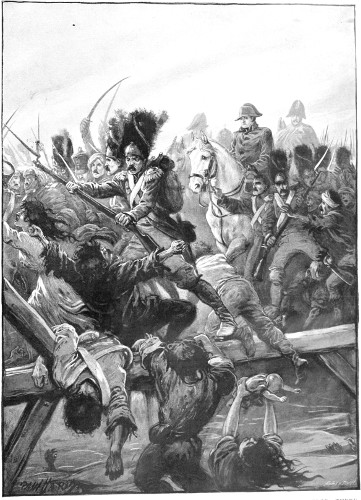
“WHEN THE REMNANT OF THE GUARD WAS SEEN CLEARING A WAY FOR THE EMPEROR, THERE WAS A RUSH” (p. 326).
When the remnant of the Guard was seen clearing a way for the Emperor, there was a rush; the bridges were blocked—men, women, and children were crushed to death and many drowned. Yet that night—the panic over—thousands returned to the bivouacs of Studzianka, and the bridges were deserted again.
Victor, with 6,000 men, kept Witgenstein in check; Tchitchakof, a martyr to the cold, who had by that time warmed his toes thoroughly, returned to the opposite shore and began firing, and another terrible rush was made for the frail structures on the 28th, while Ney, across the river, was repulsing the admiral, and Victor fought all day long to give the wretches time.
The waggons and carriages were more than could have crossed in six days, said Eblé—who died soon after from exposure. Ney wished them burned, but Berthier, who was little better than a writer of reports and a species of machine actuated by Napoleon himself, opposed it on his own responsibility, and caused the death of a multitude of sufferers in consequence; for when the shot and shell began to fall in the river and splinter the ice, the drivers charged down on the bridges, tearing their way remorselessly through the living obstacle.
Sword in hand, single horsemen cut a passage for themselves; women, waistdeep in the water alongside, were frozen with their arms raised to preserve their children, who were too often left to freeze there by the passers-by.
The Countess Alesio—a young Italian bride of eighteen, who had accompanied her husband on that ghastly wedding-trip—survived all these horrors, and lives, as I write these lines, full of terrible memories of the retreat.
Selfishness and heroism went hand in hand. An artilleryman jumped from the bridge to save a mother and her two little ones, succeeding in rescuing one boy; others pushed their comrades off to find room for themselves. And even when the early night settled down, the Russians knew where to point their guns by the screams and curses that rang over the waste amid a fearful snowstorm.
When the 4th Corps reached the other side, their only fire was a miserable blaze lighted for Eugène, of wood begged from some Bavarians, and his officers ran about all night to keep warm.
The artillery bridge had long since broken down—hundreds being engulfed—and only one remained, leading into a marsh choked with carriages, guns, waggons, wounded, dead and dying; across which, at nine o’clock, Victor’s shattered battalions had to force their way over with their bayonets.
One instance of remarkable coolness is recorded of an artillery officer named Brechtel, whose wooden leg was smashed by a cannon ball. “Look for another leg in waggon No. 5,” he said to a gunner; and when it was brought, he screwed it on, and calmly continued his firing.
Ney’s pay-waggons were crossing at the same time under the care of Nicolas Savin, a hussar who had been at Toulon in 1793, in Egypt with Bonaparte, at Austerlitz, Iena, and in the Peninsula; but through a breakage of the bridge he and his gold were taken by Platoff’s Cossacks, and marvellous to relate, the veteran died in Russia, during the winter of 1894, at the extraordinary age of 127.
In vain Eblé urged the fugitives to fly—many still lingering on, until at half-past eight on the morning of the 29th, the engineer set fire to their sole means of escape on the approach of the enemy.
Heartrending was the scene; language fails to describe it, though many men of many nations have poured forth all their eloquence upon the theme.
Snow, flames, round shot and shells; the half-frozen river, the army already passed on its way; France, friends, home, everything gone. A father on one bank, a mother on the other, never to meet again in this world; brothers, children, old men and young girls, the bridges blazing, and the hoarse “Hourra!” of the Cossacks as they tore down the bank among the forsaken crowd like vultures on a carcass.
A little while and the frozen land was still again; the wolves came out of the woods to sniff at the ghastly heaps; the white dogs, no longer lean and famished, wrangled with each other for the choicer morsels, finding the mother and the babe more to their liking, and leaving the war-worn veteran to the carrion crows.
When spring thawed the ice, thirty thousand bodies were found and burned on the banks of the Berezina; and happy they whose troubles had ended there. For the weather grew colder, the storms were more frequent, hundreds of miles had yet to be traversed; the Old Guard had lost from cold and missing a third of its diminished numbers, the Young Guard half, and the army was reduced to a wandering mob of nine thousand, twenty-one thousand having fallen in three days and four actions.
Over the marshes in the keen north wind they hurried, Ney still commanding the rear-guard; on the 30th, Oudinot, badly wounded, defended himself in a wooden house with seventeen men for several hours, and drove the Russians out of the village.
The sun shone out to mock them; there was hard fighting almost every day; and at length, when the main body reached Smorgoni, the Emperor resolved to put in practice an intention he had formed some time before of hurrying secretly to Paris to forestall the real truth of his disasters.
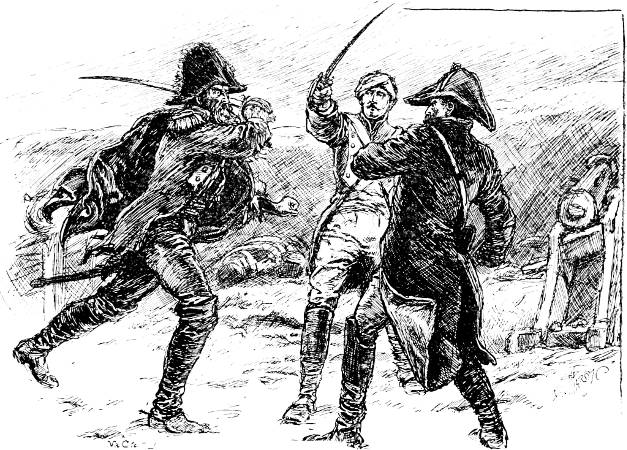
“IN A TOWERING PASSION THE MARSHAL DREW HIS SWORD” (p. 329).
He has been unjustly accused of deserting his men when they were at their last gasp; but in reality no blame attaches to him, as his presence in France was absolutely necessary, and had he remained with the army he could have done nothing to restore it, for things had gone too far. To what extent he had contributed to those disasters is, of course, another matter.
After revising his 29th Bulletin, and appointing Murat to the chief command, he got into his carriage with Caulaincourt (brother of Auguste), Rustan the Mameluke, and Captain Wukasowitch sitting on the box, Duroc and Lobau following in a sledge, and escorted by some Polish lancers, drove off in the dark on the night of the 5th December.
Later on he exchanged the carriage for another sledge, the peasant driver of which died in Bavaria as recently as 1887, preserving to the last some of the coins Napoleon had given him.
On the 18th the Emperor arrived in Paris. The day after his departure the cold increased to a frightful degree; men lost their reason, and sprang into the burning huts. At Wilna, where there were great stores of food, they pillaged without check; and even the Old Guard paid no heed to the générale. All Napoleon’s linen and his state tent were burned there, and the few remaining trophies, drawings being made of them before their destruction by his orders.
The Jews committed nameless cruelties on the French wounded, and although Durutte’s division increased the army by 13,000, they died by hundreds, immense numbers having been frozen and suffocated at the gate of the city in their mad attempt to get in.
The day after their arrival the Russians were on them again. De Wrede’s Bavarians were routed, Murat lost his head and bolted, and everything devolved on the heroic Ney, who volunteered again for rear-guard duty, keeping Kutusoff at bay while the army retreated on the road to Kowno, the last Russian town before they could reach the Niemen, 4,000 men alone preserving an orderly demeanour under arms.
At the hill of Ponari the Cossacks fell foul of them, and, while under fire, Napoleon’s private treasure was portioned out equally among such of the Guard as remained, every man who survived afterwards accounting for his share to the last coin.
The final scene may be summed up by a brief narration of the fabulous gallantry of Marshal Ney.
It had been his invariable custom to halt and rest from five in the evening until ten, and then resume the march; but at Evé, near Kowno, he woke up to find his fourth rear-guard gone, their arms still piled, and glistening in the frosty night.
When he overtook them they were in disorder, and could not be rallied, Ney entering the town attended only by his aides, but instantly setting to work to form a fifth guard.
He found 2,000 drunken men dead on the snow, and the fugitives gone on to the river; but with 300 German Artillery and 400 others, under General Marchand, he set about to defend Kowno.
The last remnant, having crossed the Niemen, were flying through the Pilwisky forest, from which they had issued five months before in very different plight, only 13,000 in reality mustering behind that river. Kowno was attacked on the morning of the 14th December, and hastening to the Wilna Gate, Ney found the German artillery had spiked their guns and fled.
In a towering passion the marshal drew his sword and rushed at the officer in command, who still remained there, and, but for his aide-de-camp averting the blow, would have slain him. The officer escaped, and Ney summoned one of his two weak battalions, also German, and after a spirited address, formed them behind the snow-capped palisade as the enemy approached, but fate was against him.
A ball broke the colonel’s thigh, and he blew out his brains before his men, who instantly threw down their guns and fled, leaving Ney alone.
Gathering all the muskets he could reach, the marshal fired them through the palisade—one man against thousands—until others came to his help; the town was attacked on the opposite side at the same time, and though he maintained his post with thirty ragged scarecrows until dark, he had to retreat step by step, through the town and across the Niemen, the last man, after forty days’ and nights’ incessant fighting with the rear-guard, to leave the Russian shore.
In Gumbinnen, Mathieu Dumas was sitting down to breakfast, when a man in a brown coat entered, his beard long, his face blackened and looking as though it had been burnt, his eyes red and glaring.
“At length I am here,” he exclaimed. “Don’t you know me?” “No,” said the general. “Who are you?” “I am the Rear-Guard of the Grande Armée; I have fired the last musket-shot on the bridge of Kowno; I have thrown the last of our arms into the Niemen, and come hither through the woods. I am Marshal Ney.”
Macdonald, in the North, was reduced by hardship and the defection of the Prussians; Schwartzenberg, in the South, had been obliged to retire, and the magnificent army of the Centre, led by masters in the art of war, under the Emperor himself, we have seen dwindled down to 13,000 in less than six months. It was not altogether the Russians, it was not entirely the frost, although both contributed to its destruction: when all laws, physical and moral, are transgressed, when flesh and blood are tried beyond the limits of possible endurance, and wild ambition takes the place of common-sense, something will give, and disaster is certain in the long run.
By one of the most careful of contemporary computations it is concluded that 552,000 unfortunate creatures who had marched under the eagles of Napoleon never returned from that campaign, and the medal struck by Alexander to commemorate it, sums up the whole case in a sentence of singular piety.
On one side, in a triangle surrounded by rays, is the Eye of Providence, with the date beneath it; on the other, the inscription: “Not unto us; not unto me; but unto Thy Name.”

Rorke’s Drift
BY C. STEIN.

At the end of 1878 there stood upon a rocky terrace on the Natal side of the Buffalo River two stone buildings with thatched roofs, which had formed a Swedish mission station, one of them having been used as a church and the other having been the dwelling of the missionary. These two humble edifices were destined to be, on the 22nd January, 1879, the scene of the most brilliant feat of arms performed during the whole Zulu War—a defence by a small determined force against the attack of vastly superior numbers, an exploit whose lustre, relieving a period of disaster, maintained the prestige of British arms, and whose success, there can be little doubt, secured Natal from invasion when failure would have laid the colony open to the advance of a savage enemy. So perfect was the conduct of the officers and men concerned in the episode, and so well conceived and executed were the measures adopted, that even foreign military books quote the exploit as an example of the value of improvised fortifications when they are held by brave men.
When war was declared by Sir Bartle Frere, the High Commissioner for South Africa, against Cetewayo, the Zulu king, the conduct of operations was placed in the hands of Lieutenant-General Lord Chelmsford, K.C.B., as Commander-in-Chief. It was determined to invade Zululand, and all the forces available for this purpose were moved to the frontier. They were divided into five columns, of which three were to advance into the enemy’s country from different points, with the intention of finally concentrating at Ulundi, the Zulu capital, while the other two were in the first instance to guard the frontier against possible Zulu raids. The third column, under the command of Colonel Glyn, C.B., the centre of the three columns of invasion, was to assemble near Rorke’s Drift and cross the Buffalo River at that spot, within a mile of the old Swedish mission station.
The river at Rorke’s Drift was, like most African streams, an impassable torrent after rain, but the flood quickly ran off, and a passage could then be effected by the “drift,” or ford. There had also been established two ponts, or big, flat-bottomed ferry-boats, each of which could transport an African wagon or a company of infantry.
Colonel Glyn’s column crossed the river on the 11th January, 1879, and from that time was engaged in operations in Zululand. Its line of communications with Pietermaritzburg, the chief city of Natal, was through Rorke’s Drift to Helpmakaar, and thence by Ladysmith and Estcourt, or by the shorter, though more difficult, route through Greytown. Rorke’s Drift, as the actual starting-point of invasion, was formed into a depôt of stores and a hospital. The deserted mission-station buildings were utilised for this purpose, the old church being converted into a storehouse and the missionary’s dwelling forming the hospital. As a garrison for this important post and to secure the passage across the river, Colonel Glyn left B Company of the second battalion of the 24th Regiment, under command of Lieutenant Gonville Bromhead. With him were also Major Spalding, who was in general charge of the line of communications, Lieutenant Chard, Royal Engineers, Surgeon Reynolds, Army Medical Department, and other officers. This garrison was encamped near the store and hospital.
For some days after the departure of the third column, which was also accompanied by Lord Chelmsford and the Headquarter Staff, the quiet routine of duty was pursued. Letters were passed to and from the front, necessary stores and supplies were sent on, and the men wounded in the first engagements were received into the hospital. Among these last was one of the enemy, who had been shot through the thigh at Sirayo’s kraal, and who was treated and nursed with the same care and attention as the Englishmen against whom he had fought. On the 20th January, however, a large portion of the second column, under Colonel Durnford, Royal Engineers, arrived at Rorke’s Drift and encamped. Their stay was brief, for they were summoned to the fatal camp of Insandhlwana on the morning of the 22nd, Colonel Durnford leaving a company of the Natal Native Contingent, under Captain Stephenson, to strengthen the little post. It became evident from various circumstances that Colonel Glyn’s column was encountering a stronger resistance than had been anticipated, and that, as the enemy were in force within a few miles, they might make a rapid descent upon the weakly-guarded line of communications. It was known that two companies of the first battalion of the 24th were at Helpmakaar, ten miles distant, and Major Spalding resolved to go there at once in order to bring them up as a reinforcement to Lieutenant Bromhead’s force. In his absence, Lieutenant Chard became senior officer at Rorke’s Drift, and responsible for its well-being.
Although on the 22nd January there was thus a feeling of uneasiness at the river post, nothing had occurred till some hours after midday to cause any special alarm to its garrison. We may believe that a general plan of action had been considered if an attack should be made upon it, but in the meantime all the officers and men were engaged in their usual employments. Lieutenant Chard was at the ponts, and Lieutenant Bromhead was in his little camp hard by the store and hospital. Shortly after 3 p.m. two mounted men were seen galloping at headlong speed towards the ferry from Zululand. There is little difficulty in recognising messengers of disaster, the men who ride with the avenger of blood close on their horses’ track, and Chard, as he met them, knew that something terrible had happened. His worst anticipations were more than realised when the two fugitives—Lieutenant Adendorff, of the Native Contingent, and a Natal volunteer—told their story: the camp at Insandhlwana had been attacked and taken by the enemy, of whom a large force was now advancing on Rorke’s Drift. The Natal volunteer hurried on to give the alarm at Helpmakaar; but one man was enough for this service, and Adendorff—gallant fellow!—said that he would remain at Rorke’s Drift, where every additional European would be a valuable reinforcement, and cast in his lot with its defenders. Chard at once gave orders to the guard at the ponts to strike their tents, put all stores on the spot into the wagon, and withdraw to the main body of the post. Now occurred the first incident which testified to the spirit which animated the small force on the banks of the Buffalo. The ferryman—Daniells—and Sergeant Milne, of the 3rd Buffs (who was doing duty with the 24th), proposed that they should be allowed to moor the two ponts in the middle of the river, and offered, with the ferry-guard of six men, to defend them against attack—a brave thought, indeed, but it was put aside. Chard was too good a soldier to divide his few men in any way. He saw at once that the commissariat stores and hospital would require every available rifle for their defence, and that the safety of every other place was comparatively a very minor consideration.
While he was giving his orders an urgent message came from Bromhead asking him to join him at once. To Bromhead also had come several mounted men fleeing from Insandhlwana, bearing the same dread intelligence which Adendorff had brought to the ferry, and the trained officer of engineers was required to concert and decide upon measures of defence. But when he joined the infantry subaltern he found that the latter, aided by Assistant-Commissary Dunne and Assistant-Commissary Dalton, had already set to work, and that there was nothing to change, if much was still left to complete. The three officers held a hurried consultation, and prompt use was made of all ordinary expedients of war, while materials never before employed in fortification were pressed into service. The store and hospital were loopholed and barricaded, the windows and doors blocked with mattresses; but it was necessary to connect the defence of the two buildings by a parapet. There were no stones at hand with which to build a wall, and if there had been, there was no time to make use of them; the hard rocky soil could not be dug and formed into ditch and breastwork; but there was a great store of bags of mealies, or the grain of Indian corn, which had been collected as horse provender for the army. Assistant-Commissary Dalton suggested that these should be used in the fashion of sandbags for the construction of the required parapet. Everybody laboured with the energy of men who know that their safety depends on their exertions. Chard and Bromhead, Reynolds, Dunne, and Dalton not merely directed, but engaged most energetically in the work of preparation. When the alarm was first given it was intended to remove the worst cases from the hospital to a place of safety, and two wagons were prepared for the purpose; but it was found that the attempt to move the patients at the slow pace of ox-teams when the Zulus were so close at hand would only result in offering them as easy victims to the murderous assegai. The two wagons were therefore used as part of the defences, and mealie bags were piled underneath and upon them, so that each formed a strong post of vantage.
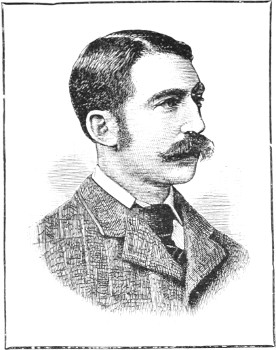
LIEUTENANT CHARD.
(Photo, J. Hawke, Plymouth.)
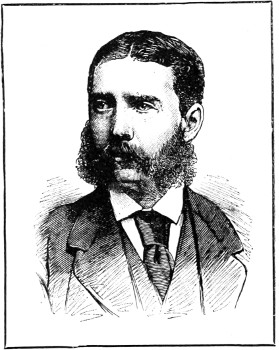
LIEUTENANT BROMHEAD.
(Photo, Elliott & Fry, Baker Street, W.)
The ferry-guard had joined the rest of the force at 3.30 p.m., and a few minutes later an officer of Durnford’s Natal Native Horse, with a hundred of his men who had been heavily engaged at Insandhlwana, rode up and asked for orders. Chard directed him to watch for the approach of the enemy, sending out vedettes, and when he was pressed, to fall back and assist in the defence of the post. So far it seemed certain that when the threatened Zulu attack developed itself against the Rorke’s Drift fortifications they would be found, though hurriedly devised and executed, to be adequately defended by the company of the 24th, Captain Stephenson’s company of the Native Contingent, and about a hundred Basutos of the Natal Native Horse. But if the gallant English officers who had striven so hard and with so much military genius to make their position tenable looked forward to this amount of support, they were destined to grievous disappointment and mortification. At 4.15 p.m. the sound of firing was heard behind a hill towards the south, and told that the vedettes of the Native Horse were engaged with the enemy. Their officer returned, reporting that the Zulus were close at hand, and that his men would not obey orders. Chard and his comrades had the sore trial of seeing them all moving off towards Helpmakaar, leaving the garrison to its fate. Nor was this all. The evil example was only too soon followed. Captain Stephenson’s company of the Native Contingent also felt their hearts fail, and, accompanied by their commander, also fled from the post of duty. For the Native Horse there is some excuse to be made. They had been in the saddle since daybreak; they were the survivors of a terrible defeat and massacre; they had seen a large number of their comrades slain, and they were demoralised by the loss of their beloved commander, Colonel Durnford. If on this occasion their valour failed them, it is to be remembered that they had behaved nobly in the early part of the day, and that in later episodes of the war their gallantry and self-devotion were proverbial. But for the Native Contingent company nothing can be said. They were fresh, and as yet unscathed by war; they had the best example in the calm demeanour of their English comrades, and they had many causes of feud and quarrel with the enemy. But, as in all other occasions of the war where Natal Kaffirs were employed, they gave way in time of stress, and the greatest shame of the matter was that their colonial European officer now shared their misconduct.
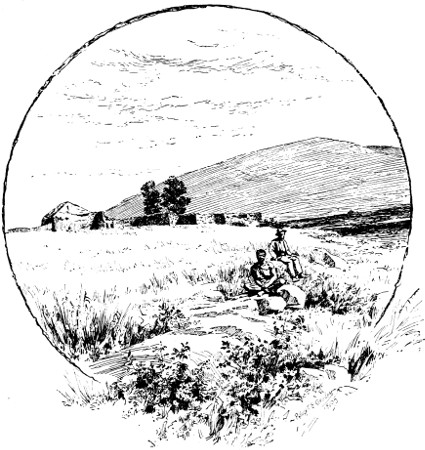
RORKE’S DRIFT AT THE PRESENT TIME.
(From a Photo by Mr. G. T. Ferneyhough, Pietermaritzburg, South Africa.)
The garrison at Rorke’s Drift was now reduced to Bromhead’s company of the 24th—about eighty strong—and some men of other corps, the total number within the post being 139, of whom thirty-five were sick or wounded men in hospital. The original scheme of defence had provided for a much larger force, and Chard recognised that it would now be impossible long to occupy effectively the range of parapets and loopholes which had been prepared. There was nothing for it but to form an inner line of defence, to which the garrison might fall back when the outer line became untenable. He decided that, if necessary, the hospital must be abandoned, and that the defence must be restricted to the store and the space in front of it, including a well-built stone kraal or enclosure which abutted on it to the eastward. To carry out this plan he commenced an inner retrenchment, forming a parapet of biscuit-boxes across the larger enclosure. This was only about two boxes high when the expected flood of attack hurled its first waves against the frail solitary bulwark which stood between Natal and savage invasion.
About 4.30 p.m. five or six hundred of the enemy appeared, sweeping round the rocky hill to the south of the post, and advancing at the swift pace characteristic of the Zulu warriors against the south wall which connected the store and hospital. But they had to deal with stern men who were braced up for the encounter by feelings of duty, patriotism, and the long habit of regimental discipline and comradeship which makes each feel assured and confident that all are striving shoulder to shoulder, and that none will blench from his appointed place. From the parapet of mealie bags and from the hospital poured forth a heavy and well-sustained fire, which was crossed by a flanking discharge from the store. No man wasted a shot, and the aim was cool and deliberate. Even Zulu valour and determination could not face the deadly leaden hail, and the onslaught weakened and broke within fifty yards of the British rifles. Some of the assailants swerved to their left, and passed round to the west of the hospital; some sought cover where they could, and occupied banks, ditches, bushes, and the cooking place of the garrison. But this first attack was only the effort of the enemy’s advanced guard. Masses of warriors followed and flowed over the elevated southward ledge of rocks overlooking the buildings. Every cave and crevice was quickly filled, and from these sheltered and commanding positions they opened a heavy and continuous fire. It was fortunate that the spoil in rifles and ammunition taken at Insandhlwana was not yet available for use against the English, as at Kambula and later engagements, but the enemy’s firearms were still the old muskets and rifles of which they had long been in possession. Even so, at the short range these were sufficiently effective, and, in the hands of better marksmen than Zulus usually are, might have inflicted crushing losses.
The first attack repulsed, a second desperate effort was made by the enemy against the north-west wall just below the hospital; but here again the defenders were ready to meet it, and again the assailing torrent broke and fell back. Such of the sick and wounded in the hospital as were able to rouse themselves from their beds of pain had by this time seized rifle and bayonet and joined their comrades; but though every man was now mustered, the total number was all too small for the grim task before them. The misfortune of the extreme hurry in the preparations for defence was now painfully apparent. In strengthening any position for defensive occupation one of the first measures taken by a commander is to clear as large an open space as possible round the parapet or fortifications which he proposes to hold. All ditches and hollows should be filled up; all buildings, walls, and heaps of refuse should be pulled down and scattered; all trees, shrubs, and thick herbage should be cut and removed; so that no attack can be made under cover, no safe place may be found from which deliberate fire may be delivered, or any movement can be made by an enemy unseen, and therefore unanticipated. At Rorke’s Drift, not only were the buildings and parapets overlooked and commanded to the southward by a rocky hill full of caves and lurking-places, but there was a garden to the north, a thick patch of bush which was close to the parapet, a square Kaffir house and large brick oven and cooking trenches, besides numerous banks, walls, and ditches, all of which offered a shelter to the enemy, which they were not slow to profit by. The post was encircled by a dense ring of the foe, and from every side came the whistle of their bullets.