LIST OF PLATES. (continued 9)
Reading edition
But not content with this, Austria and Prussia, the leading members of the Diet, also resolved to take the field, as executive bailiffs, so to speak, of the judgment of the German Court; and this they did at the beginning of 1864 with a united force of about 45,000 men. That was not so very large a force, considering the size of modern armies, but it was much larger than that opposed to it by the valiant Danes, about 36,000 in number, who were commanded by General de Meza. The Austrians were commanded by Field-Marshal von Gablenz, and the Prussians by their own Prince Frederick Charles, surnamed the “Red Prince,” from the scarlet uniform of his favourite regiment, the Zieten Hussars.
The Commander of the combined Austro-Prussian army was the Prussian Field-Marshal von Wrangel—“old Papa Wrangel,” as he was fondly called—who looked, and spoke, and acted like a survival from the time of the Thirty Years’ or the Seven Years’ War. He was a grim old beau sabreur, who, in his later days, used to grind his teeth (what of them were left) and scatter groschen among the street arabs of Berlin, under the impression that he was sowing a crop of bullets that would yet spring up and prove the death of all democrats and other nefarious characters dangerous to military monarchy and the rule of the sword in the civil state.
“In Gottes Namen drauf!”—“Forward in God’s name”—“Papa” Wrangel had wired to the various contingents of his forces on the 1st February, when at last the Danes had replied to his demands with an emphatic “No!” and then the combined Austro-Prussian army swept over the Eider amid a blinding storm of snow.
The Prussians took the right, the Austrians the left of the advance into the Duchies; and after one or two preliminary actions of no great moment, the invaders reached the Danewerk, a very strong line of earthworks which had taken the place of the bulwark thrown up by the Danes in ancient times against the incursions of the Germans. Here the Prussians prepared for a stubborn resistance, but what was their surprise and their delight, on the morning of the 6th February, to find that the Danes had evacuated overnight this first bulwark line of theirs, leaving 154 guns and large quantities of stores and ammunition a prey to their enemies! Caution, not cowardice, had been the motive of this retreat of theirs, for they saw that, if they had remained, they would have run the risk of being outflanked and outnumbered; so they determined, from reasons of military policy, to retire further northward and take up their dogged stand behind their second line of entrenchments at Düppel, there to await the assault of their overwhelming foes.
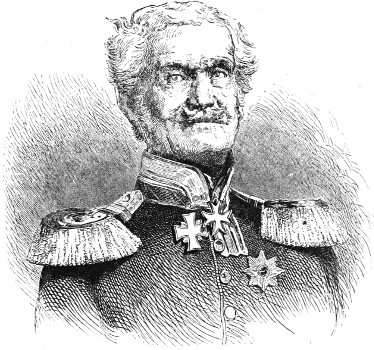
FIELD-MARSHAL VON WRANGEL.
Sending on the Austrians on the left into Jutland to dispose of the Danes in that quarter, “Papa” Wrangel selected the “Red Prince” and his Prussians to crack the nuts which had been thrown in their way in the shape of the redoubts of Düppel. Prince Frederick Charles was one of the best and bravest soldiers that had been produced by the fighting family of the Hohenzollerns since the time of Frederick the Great. A man about the middle height, strongly built, broad-shouldered, florid-faced, sandy-bearded, bull-necked, rough in manner and speech, and homely in all his ways—he was just the sort of leader to command the affections and stimulate the courage of the Prussian soldier. There was much of the bulldog in the “Red Prince,” so he was the very man to entrust with such a task as that of hanging on to the Danes at Düppel.
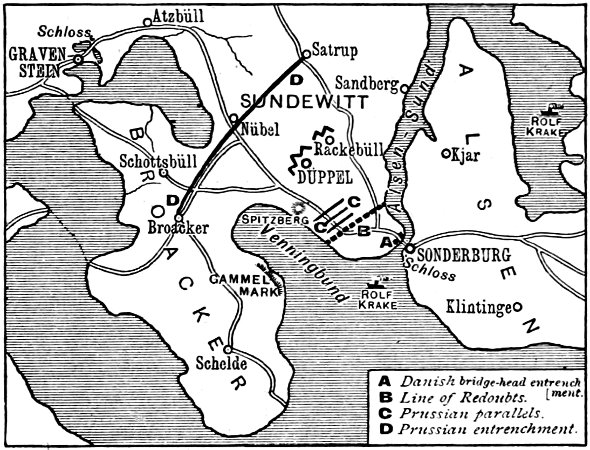
Yet this task was one of exceeding difficulty, for the redoubts of Düppel formed such a formidable line of defence as had rarely, if ever, before opposed the advance of an invading army in the open field. All the natural advantages of ground, with its happy configuration of land and water, were on the side of the Danes, whose main object it was to prevent their foes from setting foot on the Schleswig island of Alsen, forming a stepping-stone, so to speak, to Denmark itself, much in the same way as the island of Anglesey does to Ireland. To continue the comparison, the Menai Strait corresponds to the Alsen-Sund which separates the mainland of Schleswig from the island of Alsen. Of this island the chief town is Sonderburg, which was connected by the mainland, into which it looks over, by two pontoon bridges, at the end of which the Danes threw up a tête-du-pont, or bridge-head entrenchment, to defend the approach and passage; while about a couple of miles further inland they had constructed a chain of no fewer than ten heavy forts, or redoubts, all connected by lesser earthworks and entrenchments.
This line of redoubts, about three miles long, ran right across the neck of a peninsula of the mainland, called the Sundewitt, one end resting on the Alsen-Sund and the other on a gulf, or bay, of the Baltic, called the Wenningbund. The redoubts were placed along the brow of a ridge which overlooked and commanded all the undulating country for miles in front, while in the rear again the ground dipped away gently down towards the Alsen-Sund and its bridge-head, affording fine shelter and camping-ground to the Danes. A lovelier or more romantic-looking region, with its winding bays and silver-glancing straits, its picturesque blending of wood and water, could scarcely be imagined.
Such a position as that which the Danes had taken up would have been of no value whatever against foes like the English, seeing that the latter might have gone with their warships and shelled the Danes clean out of their line of redoubts without ever so much as landing a single man, for, as already explained, the line of forts rested on the sea at both ends. But at this time, fortunately for the Danes, the Prussians had little or nothing of a navy, so that they must needs essay on land what they could not attempt by sea; while the Danes, on the other hand, though weaker on land, were decidedly superior to their foes on water. In particular, they had one warship, or monitor, the Rolf Krake, which gained immortal fame by the bold and devil-may-care manner in which it worried, and harassed, and damaged, and kept the Prussians perpetually awake. It lurked like a corsair in the corners of the bays, and creeks, and winding sea-arms of that amphibious region, and darted out upon occasion to shell and molest the Prussians in their trenches before the Düppel lines.
For the Prussians had soon come to see that it would be quite impossible for them to capture the Düppel redoubts save by regular process of sap and siege. The redoubts proved to be far more formidable than they ever fancied; and it would have involved an enormous sacrifice of life on the part of the Prussians to rush for them at once. The pretty certain result of such impetuosity would have been that not a soul almost of the stormers would have lived to tell the tale. For three whole years the Danes had been at work on these redoubts, and what it takes three years to construct cannot by any possibility be captured in as many days. Much had to be done by the Prussians, then, before sitting down before the redoubts. If a simile may be borrowed from the game of football, the “forwards” of the Danes had first to be disposed of. For not only did they occupy the redoubts, but likewise all the strong points in the country for two or three miles in front of them, just as modern ironclads hang out nets to guard their hulls from the impact of torpedoes. In a similar manner the Danes had thrown out a network of men to fend off all hostile approach to their forts and prevent the Prussians from settling down near enough to them for the purposes of sap and siege.
While, therefore, the Prussians were busy bringing to the front their heavy guns and other siege-material, others of them were set to the work of sweeping clean, as with a broom of bayonets, the open positions in front of the redoubts held by their defenders. But this sweeping process was by no means either an easy or a bloodless task. For while the Danes numbered 22,000 troops, the “Red Prince” in front of them disposed at this time (though later he was reinforced) of no more than 16,000 men, and there was always the danger that the Danes, assuming the offensive, would sally out of their lines and seek to overwhelm their numerically weaker foes. Consequently the Prussians had recourse to the spade in order to supplement the defensive power of their rifles, and thus they first of all took up an entrenched position running in a long semi-circle from Broacker on their right to Satrup on the left, at a distance of about three miles or more from the real object of their ambition—the line of Danish redoubts.
Two positions in front of these redoubts—the villages of Düppel and Rackebüll—were fiercely contested by the Danes; but on the 17th of March, after fighting in a manner which gave their foes a very high opinion of their courage, they retired behind their earthworks with the loss of 676 men, while the Prussians, on their part, had to pay for their victory by only 138 lives. This disparity in loss was doubtless due to the fact that, while the Danes were only armed with the old smooth-bore muzzle-loading musket, the Prussians had adopted the new Zündnadelgewehr, or needle-gun, the parent of all modern breech-loading and repeating rifles, which gave them a tremendous advantage over their opponents. In one of the preliminary encounters above referred to, a party of Danes, against whom a superior force of Prussian light-infantry (Jäger) was advancing, threw down their arms in token of submission; but as the Prussians came forward, they snatched them up again, fired a volley, and rushed on with the bayonet. The Prussians let them come to within twenty-yards’ distance, and then, raising their deadly needle-guns, shot them down to a man. The treacherous conduct of the Danes above referred to caused great bitterness among the Prussians; but, even after death, the latter showed their foes the respect which brave men owe to one another, and in West Düppel they raised a cross with this inscription:—“Here lie twenty-five brave Danes, who died the hero’s death, 17th February, 1864.”
The result of these preliminary tussles was that the Danes attempted no more outfalls, and from the 17th to the 28th of March one might almost have concluded that an armistice had been agreed to but for an occasional sputtering and spitting of rifle-fire between the foreposts, who thus employed their time when not exchanging other courtesies in the form of pipe-lights, tobacco-pouches, and spirit-flasks. But now the time was come when it behoved the Prussians to get as close to the redoubts as possible, for the purpose of opening their siegetrenches, and General von Raven’s Brigade was selected to sweep the ground in front of the Danish position of all its outposts. It was an early Easter this year, and just when the preachers were proclaiming to their congregations that the season of peace and goodwill to all men had now again come round, the Danes and Prussians were lighting like fiends under cover of the darkness.
The 18th Prussian Fusiliers had crept forward as far nearly as the wire-fencing and palisades in front of the redoubts, when the dawn suddenly revealed them to the Danes; and just at this moment, too, what should appear upon the scene but the ubiquitous Rolf Krake, which, at a distance of about five hundred yards, opened upon the advancing Prussians such a shower of shell and grape-shot as forced them to retire, causing these baffled fusiliers to curse the very name of the ship-builder who had ever laid the keel of such a bold and bothersome vessel.
At length, during the night of the 30th March, the Prussians managed to open their first parallel at a distance of about eight hundred paces from the line of the redoubts, and now, so to speak, they had reached the beginning of the end. The men on duty in this parallel, or shelter-trench (about eight feet deep), were relieved at first every forty-eight hours, and then every twenty-four, the former period having been found to be too great a strain on the soldiers, who, in consequence, had soon as many as ten per cent. on the sick list. For nothing could have been more trying to the constitution than this trench-life, with its cold nights, and rain, and mud, and manifold wretchedness.
Yet the Prussian soldiers, who were all very young fellows—mere boys some of them—kept up their spirits in the most wonderful manner, and indulged in all kinds of fun—mounting a gas-pipe on a couple of cart-wheels, and thus drawing the fire of the Danes, who imagined it to be a cannon; making sentries out of clay, and otherwise indulging in the thousand-and-one humours of a camp. They were also cheered by frequent visits from their commander, the “Red Prince,” who—although housed in most comfortable, not to say luxurious, quarters at the Schloss, or château, of Gravenstein, about six miles to the rear—failed not to ride to the front every day and acquaint himself with all that was going on. With such a commander soldiers will do anything, and hence the whole Prussian force in front of the Danish redoubts began to burn with a fighting ardour which neither cold, nor wet, nor knee-deep mud could in the least degree damp or depress.
On the other hand, the Danes, though better off for shelter in their blockhouses, wooden barracks, and casemates, were not in such good spirits. One of the few things, apparently, that cheered their hearts was the sight of the numerous English tourists—“T. G.’s,” or “travelling gents,” as they used to be called in the Crimea, and Kriegsbummler, or war-loafers, as they are dubbed in Germany—who, arrayed in suits of a most fearful and wonderful make, streamed over to the Cimbrian Peninsula in quest of sensation and adventure, exposing themselves on parapet and sky-line to the shells of the Prussians with a devil-me-care coolness which proved a source of new inspiration to the Danskés.
Simultaneously with the pushing on of their parallel work, the Prussians kept up a tremendous fire on the forts, but the Danes showed their good sense by lying quietly in their casemates and scarcely noticing the storm of missiles directed against them. These missiles did them and their earthworks very little harm, and they were not to be terrified by mere noise. Before the Prussians had settled down to their trench-work, their batteries over the bay at Gammelmark firing day and night had in the course of a fortnight thrown about 7,500 shot and shell into the Danish redoubts, yet not more than seventy-five officers and men had been killed or disabled by all this roaring volcano of heavy guns; and, indeed, it was computed about this time that the Prussians were purchasing the lives of their enemies at about 500 cannon-shots per head. “The huge earthen mounds or humps (of forts),” wrote a correspondent, “might have marked the graves of an extinct race, or been the result of some gigantic mole’s obscure toil,” for all the signs of life which the Prussian bombardment drew from the redoubts.
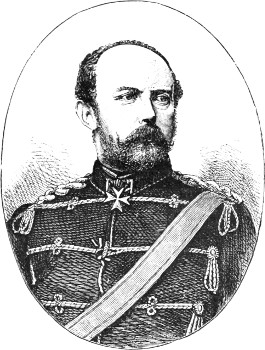
PRINCE FREDERICK CHARLES.
One night a curious thing happened to a company of the 60th Prussian regiment. In the course of some skirmishing it got too far forward, and, when day broke, it found itself in a slight hollow of the ground so near to Forts 1 and 2 that, had it tried to return to its own lines, it must have been annihilated by the grape-shot of the Danes. The shelter afforded it by the nature of the ground was so trifling that the men were forced to lie down flat upon their bellies to avoid being shot. In this unpleasant position they lay the whole day, for the Danes, strange to say, did not seek to sally out and capture them; and it was not till late in the evening that the company, under cover of the darkness, was able to rejoin their friends. They had eaten nothing in the interval, for, though they had provisions in their pockets, or haversacks, the least movement they made to get at this provender exposed them to the enemy’s fire.
The first parallel had been opened on the 30th of March, and the second was accomplished in the night of the 10th of April. It was now expected that the “Red Prince,” without more ado, would make a rush for the forts and be done with them—the more so as there now began to be whisperings of a political conference of the Powers which might meet and baulk the Prussian soldier of the final reward of all his toil. But still Prince Frederick Charles gave not the signal for the assault, and then it oozed out that this delay was simply due to the command of his royal uncle, King (afterward Kaiser) William, a very humane monarch, who, wishing to spare as much as possible the blood of his brave soldiers, had directed that still another—a third—parallel should be made, so as to shorten the distance across which the stormers would have to rush before reaching the redoubts. Meanwhile the Prussians prepared themselves for the assault, among other things by getting up sham works in imitation of those they had to attack, where the battalions destined for the purpose were practised in breaking down palisades and using scaling-ladders, as well as in disposing of chevaux de frise and other impediments usual in the defence of forts. The Danish redoubts were known to the Prussians as Nos. 1, 2, 3, 4, 5, 6, 7, 8, 9, and 10, beginning from their—the Prussian—right on the sea, and their foremost parallel fronted this line of forts from 1 to 6. Against these forts the Prussians had thrown up twenty-four batteries mounting ninety-four guns, and now at last these guns were to give voice in a chorus such as had not rent the sky since the fall of Sebastopol.
But just as every storm is preceded by a strange delusive silence, so the day before the assault on the Düppel redoubts—the 17th of April—was a beautifully calm, sunny Sunday, with earth and sky embracing in a common joy over the birth of spring, and the encircling sea smooth as glass—a lovely day, and the last but one that many a brave man was doomed to see. For the order had gone forth from Prince Frederick Charles that at 10 o’clock precisely on the following (Monday) morning the redoubts should at last be stormed. At dawn of day the whole line of Prussian batteries should open fire on the forts, pouring upon them one continuous cataract of shot and shell till 10 o’clock, when the storming columns would start out of their trenches and “go for” the redoubts with might and main.
At 2 o’clock a.m. these columns—six in number, drawn by lot from the various brigades so that all might have an impartial share in the honour of the day—emerged from the Büffell-Koppel wood well in the rear, and silently marched in the darkness to the parallels. Each of these six columns was thus composed:—First of all a company of infantry with orders to take extended front about 150 paces from its particular redoubt, and open fire on the besieged. Following these sharpshooters, pioneers and engineers with spades, axes, ladders, and all other storming gear, including bags of blasting powder, and after them, at 100 paces distance, the storming column itself, followed at 150 paces by a reserve of equal strength, together with a score of artillerists for manning the captured guns of the Danes.
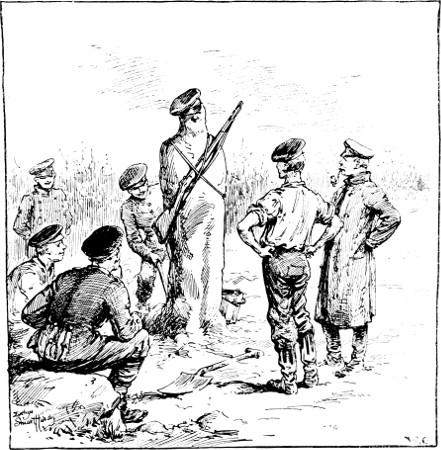
THE GERMAN SOLDIERS MAKING SENTRIES OUT OF CLAY (p. 227).
The Danes, in the darkness of the night, knew nothing whatever of all these preparations, and it was only when the first streaks of dawn began to chequer the eastern sky that they were aroused out of their sleep by such an infernal outburst of cannon-thunder all along their front as had never before, in lieu of the twittering and chirping of birds, greeted the advent of a beautiful day in spring. For six long mortal hours did the Prussians continue this terrific cannonade, of which the violence and intensity may be inferred from the fact that during this time no fewer than 11,500 shot and shell were hurled at and into the Danish redoubts. The material damage done to these redoubts was less, perhaps, than the demoralisation thereby caused to their defenders; but the latter was the result which the Prussians, perhaps, aimed at and valued most.
Shortly before ten the awful cannonade suddenly ceased, and was followed by a few minutes’ painful silence. During this brief interval the field-preachers, who had given the Sacrament to all the stormers the night before, now again addressed to them a few fervid words of religious encouragement, and then at the “Nun, Kinder, in Gottes Namen!” (“Now, my children, away with you in God’s name!”) of their commanders, the six storming columns, raising a loud and simultaneous cheer, dashed out of their trenches and across to their respective redoubts to the stirring music of the Preussenlied played by the bands of three regiments—“Ich bin ein Preusse: kennt Ihr meine Färbe?” (“I am a Prussian: know ye then my colours?”)
For a few seconds the Danes seem to be taken aback by this sudden onrush of their foes, and then they recognise that this is no mere outpost affair such as caused them some time before to boast that they had repulsed a Prussian attack all along their line. They look and comprehend; and by the time their Prussian assailants have half covered the distance between the trenches and the forts, their parapets are fringed with the smoke of sharp-crackling volleys of musketry, for, strange to say, they do not use their guns and dose their assailants with destructive rounds of grape. The Prussians rush forward, and many of them fall. Their pioneers cut down the wires, hack and blow up the palisades, tug, strain, and open up a passage for the stormers, who swarm down into the ditch and up the formidable face of the breastwork.
The Crown Prince, at the side of “Papa” Wrangel, is looking on from the Gammelmark height on the opposite side of the bay, while his cousin, the “Red Prince,” and his staff have taken their stand on the Spitzberg, well to the rear of the line of zigzags. The stormers swarm up the breastworks like ants, and some of them fall back upon the heads of their comrades mortally struck by Danish bullets. At last they reach the top of the parapets and see the whites of their enemies’ eyes, and a short but desperate hand-to-hand encounter ensues. Many of the Danes, seeing the foe thus upon them, throw down their arms and surrender, but many will not give in, and are shot or struck down with bullet, bayonet, and butt.
At Fort 2 the Prussians cannot force their way through the palisades, and are consequently slaughtered as they stand. “Better one of us than ten!” cries a pioneer, Klinké by name (for a monument now stands to his memory on the exact scene of his heroism), who rushes forward with a bag of powder and blows at once the palisades and his own person into atoms—sacrificing himself to save his comrades, and thus secure himself a golden register in the annals of the Prussian army. The stormers now dash on and up, and presently the black-and-white flag of Prussia is seen waving on the parapets of the redoubt. It sinks again, but is once more raised to remain, and in less than a quarter of an hour from the time that the stormers sprang out of their trenches they are masters of six redoubts. It was all done, so to speak, in the twinkling of an eye—short, sharp, and decisive. From the six redoubts thus so swiftly rushed, the Prussians made a sweep to the rear of the others, and captured them in much the same manner, though one fort spared them the necessity of fighting for it by surrendering.
As it was at Fort 2 where the highest act of individual heroism had been performed on the side of the Prussians by brave pioneer Klinké, so it was also within this redoubt that Danish courage found its most brilliant exponent in the person of Lieutenant Anker. The Prussians were quite aware that a man of more than usual bravery was posted here, for they had admired the stubborn valour with which the redoubt had always been defended. And when at last they had stormed their way behind its parapets, they beheld the man himself whose acts had hitherto moved their admiration. He had spiked some of his guns, and was in the act of firing another when a Prussian officer sprang upon him, and, clapping a revolver to his breast, cried, “If you fire, I fire!” Anker hesitated, and finally desisted. But just afterwards he took up a lighted match and was making for the powder magazine, when the Prussian officer cut him over the head with his sword, only just in time to prevent him from blowing up himself and a considerable number of his foes. He was then taken prisoner, and his lifelike figure may now be seen on the fine bronze bas-relief of the Storming of the Düppel Redoubts, which adorns the Victory Column in Berlin.
The Danes had been defeated—not so much because the Prussians were braver men, which they were not, as because the latter were armed with better guns and rifles, and more expert at handling them; but, above all things, because they had taken their foes by surprise. For it cannot be doubted that this was the fact. Said a Danish officer who was taken prisoner: “We waited all morning, thinking the assault might still be given, although we had expected that it would take place still sooner; we waited under the terrific cannonade kept up against us, while hour after hour passed slowly away. At last we said to ourselves that we must have been misinformed, or that the Prussians had changed their minds, and the reserves were withdrawn. It was past nine o’clock when I left the forts and went back to breakfast. While thus engaged, I heard somebody utter an exclamation of dismay. ‘What is that? The Prussian flag floats over Fort 4!’ And so it was—the forts were lost.”
But there was still another and a better reason for concluding that the Danes had not yet awhile expected the Prussian assault, and that was the circumstance that the Rolf Krake, most daring and deviceful of warships, did not immediately appear upon the scene to pour its volleys of shell and shrapnel into the flanks of the storming columns. True, it was lying at the entrance to the bay (Wenningbund), like an ever-vigilant watch-dog; but by the time it had got its steam up and come to where it was most wanted, the Prussians were already within the Danish redoubts, and, after firing a few ineffectual rounds, the monitor had to retire again well battered with Prussian cannon-balls, but by no means beaten yet like the battalions which had held the forts.
Yet even these battalions, when beaten out of the redoubts, continued to cling tenaciously to the ground behind them, and once or twice they even made a counter-attack with the object of recovering their lost positions. But Prussian ardour proved too much for Danish obstinacy; and at last the Danes in the country behind the forts, after several hours’ fighting, were all swept back to the bridge-head in their rear, and then over into the island of Alsen, leaving their foes undisputed masters of all the field.
This latter phase of the fight was well described by a correspondent with the Danes, who wrote:—“Düppel was lost, but the battle was by no means at an end. Indeed, as we watched the terrible cannonade from 12 at noon till 3 or 4 p.m., the violence of the fire seemed to increase at every moment. Anything more sublime than that sight and sound no effort of imagination can conjure up, and we stood spellbound, entranced, rooted to the spot, in a state that partook of wild excitement and dumb amazement—a state of being which spread equally to the dull hinds, ploughmen, woodmen, and the foresters, and their families of wives and children, as they emerged from fields, woods, and huts, and clustered in awestruck, dumbfounded groups around us. The flashes of the heavy artillery outsped the rapidity of the glance that strove to watch them; the reports were far more frequent than the pulsations in our arteries, and the reverberation of the thunder throughout the vast spreading forest lengthened out and perpetuated the roar with a solemn cadence that was the grandest of all music to the dullest ear. The air seemed all alive with these angry shells. I have witnessed fearful thunderstorms in my day in southern and in tropical climates; but here the crash and rattle of all the tempests that ever were seemed to be summed up in the tornado of an hour. Nor was all that noise by any means deafening or stunning. It came to us lingering far and wide in the still air, softened and mellowed by the vastness of space, every note blending admirably and harmonising with the general concert—the greatest treat that the most consummate pyrotechnic art could possibly contrive for the delight of the eye and ear.”
Many of the Danes surrendered, but many more were taken prisoners; and as they came along the Prussian soldiers shook them good-naturedly by the hand and tried to cheer them up. Few of the men seemed to want cheering up, being only too glad, apparently, to have escaped with their lives, though their officers looked gloomy enough over their defeat. The Prussians found these captive Danes “sturdy fellows, but by no means soldierly-looking,” with their “rich sandy hair reaching far below the nape of their necks.” And, to tell the truth, their victors, no less than their admirers throughout Europe, expected that they would have made a far more vigorous defence; for desperate a defence could scarcely have been called which resulted in the capture of their chief redoubts within the brief space of about ten minutes.
The Prussians had won a glorious victory, but a dear one; for in dead they had lost 16 officers and 213 men, and in wounded 54 officers and 1,118 men. Among the officers who were wounded—mortally, as afterwards proved—was the brave General von Raven, who, as he was being borne to the rear, exclaimed: “It is high time that a Prussian General should again show how to die for his King.” On the other side General du Plat was also killed, while in dead and wounded officers and men and prisoners the Danish loss otherwise amounted to about 5,500. Among the trophies of victory which fell into the hands of the Prussians were 118 guns and 40 colours.
On being informed of all this, King William telegraphed from Berlin—“To Prince Frederick Charles. Next to the Lord of Hosts, I have to thank my splendid army under thy leadership for to-day’s glorious victory. Pray convey to the troops the expression of my highest acknowledgment and my kingly thanks for what they have done.” On seeing that victory was his, the “Red Prince” had bared his head and muttered a prayer of thanksgiving to the Lord of Hosts, while some massed bands played a kind of Te Deum. “In the broad ditch to the rear of Fort No. 4,” wrote Dr. Russell, “the bands of four regiments had established themselves, and while the cannon were firing close behind them, they played a chorale, or song of thanksgiving, for the day’s success. The effect was striking, and the grouping of the troops and of the musicians, with their smart uniforms and bright instruments, standing in the deep trench against the shell-battered earthwork, and by palisades riven and shattered and shivered by shot, was most picturesque.”
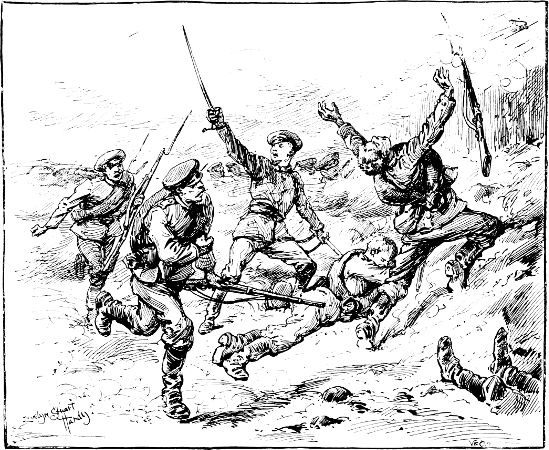
THE PRUSSIANS ATTACKING THE DANISH BREASTWORKS (p. 230).
But King William was not content with telegraphing to his troops, through his nephew Prince Frederick Charles, his acknowledgment of their bravery. Following hard on his telegram his Majesty himself hurried to the seat of war, with his “blood-and-iron” Minister, Bismarck, at his side, and passed in review the troops who had so stoutly stormed the redoubts of the Danes. These troops appeared on parade in the dress and equipment they had worn on the day of their great feat, and in the course of their march past jumped a broad drain to show his Majesty how nimbly they had stormed in upon the Danes. A fortnight later a select number of the Düppel stormers escorted into Berlin the guns—more than a hundred in number—which they had captured from the Danes, and were received with tremendous enthusiasm.
But this popular jubilation grew louder still when a few weeks later the war was ended altogether by the storming of the island of Alsen, into which the Danes had retired after their defeat at Düppel and entrenched themselves down to the water’s edge. In the deep darkness of a summer night (June 29th) the Prussians, in 160 boats, crossed the channel—about eight hundred yards broad—between the mainland and the island, though not without the usual amount of harassing opposition from the Rolf Krake, and under a murderous fire jumped ashore and made themselves master of the position in a manner which made some observers describe the affair as a mere “skirmish and a scamper.”
But all the same it was a feat which recalled the “Island of the Scots,” as sung by Ayton, and will always live in military history as a splendid feat of arms.
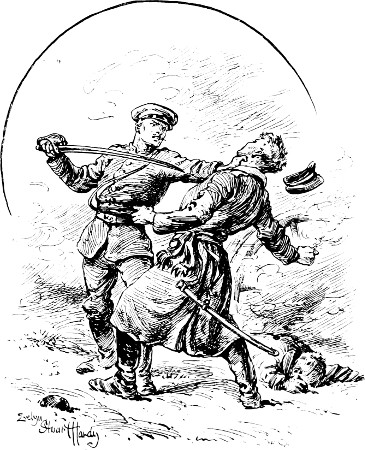
LIEUTENANT ANKER TAKEN PRISONER (p. 230).
ROBERTS’ BATTLES ABOUT CABUL
BY ARCHIBALD FORBES
LORD ROBERTS OF CANDAHAR & WATERFORD

The Afghan War of 1878–79 was terminated by the completion of what is known as the “Treaty of Gundamuk,” which was signed at that place in May, 1879, by Yakoub Khan—who, on the flight of his father, Shere Ali, had succeeded that ill-starred potentate as Ameer of Afghanistan—and by Major (afterwards Sir Louis) Cavagnari, representing Lord Lytton, the Viceroy of India. This treaty gave practical—although, as it turned out, only temporary—effect to the “scientific frontier” of North-Western India, on the attainment of which the late Lord Beaconsfield, when Prime Minister, greatly plumed himself. The “scientific frontier” detached from Afghanistan and annexed to British India for the time being a large tract of territory. The Treaty of Gundamuk stipulated that a British envoy should thenceforth be resident in the Afghan capital; and to the onerous and dangerous post, at his own request, was assigned the resolute and cool-headed officer to whose wise and calm strength of will was mainly owing the accomplishment of the treaty. Sir Louis Cavagnari took with him to Cabul a subordinate Civil Servant, a surgeon, and a small escort of the famous “Guides,” commanded by the gallant Hamilton.
On the night of September 4th, 1879, a weary trooper of the Guides—one of the few who had escaped the slaughter—rode into a British outpost on the Shutargurdan height, with the startling tidings that Sir Louis Cavagnari, the members of his mission and the soldiers of his escort, had been massacred in the Balla Hissar of Cabul on the 3rd. The news reached Simla by telegraph on the morning of the 5th, and next day Sir Frederick Roberts, accompanied by Colonel Charles Macgregor, C.B., was speeding with relentless haste to the Kurum valley, the force remaining in which from the previous campaign was to constitute the nucleus of the little army of invasion and retribution, to the command of which Roberts was appointed. In less than a month he had crossed the Shutargurdan, and temporarily cutting loose from his base in the Kurum valley, was marching swiftly on Cabul, whence the Ameer Yakoub Khan had fled and thrown himself on Roberts’ protection.
All told, the army which Roberts led on Cabul was the reverse of a mighty host. Its entire strength was little greater than that of a Prussian brigade on a war-footing. Its fate was in its own hands, for, befall it what might, it could hope for no timely reinforcement. It was a mere detachment marching against a nation of fighting-men plentifully supplied with artillery, no longer shooting laboriously with jizails, but carrying arms of precision equal or little inferior to those in the hands of our own soldiery. But the men of Roberts’ command, Europeans and Easterns, hillmen of Scotland and hillmen of Nepaul, plainmen of Hampshire and plainmen of the Punjaub, strode along buoyant with confidence and with health, believing in their leader, in their discipline, in themselves. Of varied race, no soldier who followed Roberts but came of fighting stock; ever blithely rejoicing in the combat, one and all burned for the strife now before them with more than wonted ardour, because of the opportunity it promised to exact vengeance for a deed of foul treachery. Roberts’ column of invasion consisted of a cavalry brigade, commanded by Brigadier-General Dunham Massy, and of two infantry brigades, the first commanded by Brigadier-General Macpherson, the second by Brigadier-General Baker, with three batteries of artillery, a company of sappers and miners, and two Gatling guns.
The soldiers had not long to wait for the first fight of the campaign. At dawn, of October 6th, Baker marched out from Charasiah towards his left front, against the heights held by an Afghan host in great strength and regular formation. Sweeping back the Afghan hordes with hard fighting, Baker wheeled to his right, marched along the lofty crest, rolling up and driving before him the Afghan defence as he moved towards the Sung-i-Nagusta gorge, which the gallant Major White[5] had already entered. While Baker had been turning the Afghan right, White and his little force had been distinguishing themselves not a little. After an artillery preparation, the detached hill covering the mouth of the pass had been won as the result of a hand-to-hand struggle. Later had fallen into the hands of White’s people all the Afghan guns, the heights to the immediate right and left of the gorge had been carried, the defenders driven away, and the pass opened up. Artillery fire crushed the defence of a strong fort commanding the road through the pass. The Afghans were routed, and on the following day the whole division passed the defile and camped within sight of the Balla Hissar, and the lofty mountain chain overhanging Cabul. In the fight of Charasiah less than half of Roberts’ force had been engaged, and this mere brigade had routed the army of Cabul and captured the whole of the artillery the latter had brought into the field. The Afghan loss was estimated at about three hundred; the British loss was twenty killed and sixty-seven wounded.
On the 9th the camp was moved forward to the Siah Sung heights, a mile eastward from the Balla Hissar (the palace and citadel of Cabul), to dominate which a regiment was detached; and a cavalry regiment occupied the Sherpur cantonment, the great magazine of which had been blown up, and whence the regiments which had been quartered in the cantonment had fled.
It was a melancholy visit which Sir Frederick Roberts made to the Balla Hissar on the 11th. Through the dirt and squalor of the lower portion, he ascended the narrow lane leading to the ruin which a few weeks earlier had been the British Residency. The commander of the avenging army looked with sorrowful eyes on the scene of heroism and slaughter, on the smoke-blackened ruins, the blood-splashes on the white-washed walls, the still smouldering débris, the half-burned skulls and bones in the blood-dabbled chamber where apparently the final struggle had been fought out. He stood in the breach in the quarters of the staunch and faithful Guides, where the gate had been blown in after the last of the sorties made by the gallant Hamilton, and lingered in the tattered wreck of poor Cavagnari’s drawing-room, its walls dinted with bullet-pits, its floor and divans brutally defiled. Next day, under the flagstaff from which waved the banner of Britain, he held a durbar in the audience chamber of the palace—in front and in flank of him the pushing throng of obsequious sirdars, arrayed in all the colours of the rainbow; behind them, standing immobile at attention, the guard of British infantry, with fixed bayonets which the soldiers longed to use.
Promptitude of advance on the part of the force to which had been assigned the supporting line of invasion by the Khyber-Jellalabad route was of scarcely less moment than the rapidity of the stroke which Roberts was commissioned to deliver. But delay on delay marked the mobilisation and advance of the troops operating by the Khyber line. There was no lack of earnestness anywhere, but the barren hills and rugged passes could furnish no supplies; the country in rear had to furnish everything, and there was nothing at the base of operations, neither any accumulation of supplies nor means to transport supplies if they had been accumulated. Communications were opened from Cabul with the Khyber force and India, it was true, but no reinforcement came to Roberts from that force until the 11th December, when there arrived the Guides, 900 strong, brought up by Jenkins from Jugdulluck by forced marches. Five weeks earlier, when the Kurum line of communication was closed for the winter, Roberts had received the welcome accession of a wing of the 9th Lancers, Money’s Sikh regiment, and four mountain guns: his strength was thus increased to about 7,000 men.
For some weeks after Roberts’ arrival at Cabul, almost perfect quiet prevailed in and around the Afghan capital, but the chief was well aware how precarious and deceitful was the calm. When the impending announcement of Yakoub Khan’s dethronement and deportation should be made, Roberts knew the Afghan nature too well to doubt that the tribal blood-feuds would be soldered for the time, that Dooranee and Baraksai would strike hands, that Afghan regulars and Afghan irregulars would rally under the same standards, and that the fierce shouts of “Deen! deen!” would resound on hill-top and in plain. He was ready for the strife, and would not hesitate to strike quick and hard, for Roberts knew the value of a resolute and vigorous offensive in dealing with Afghans. But it behoved him, above all things, to make timely choice of his winter-quarters where he should collect his supplies and house his troops and their followers. After careful deliberation the Sherpur cantonment, a mile outside of Cabul, was selected. It was overlarge for easy defence, but hard work, skilled engineering, and steadfast courage would remedy that evil. And Sherpur had a great advantage in that, besides being in a measure a ready-made defensive position, it had shelter for all the troops and would accommodate also the horses of the cavalry, the transport animals, and all the needful supplies and stores.
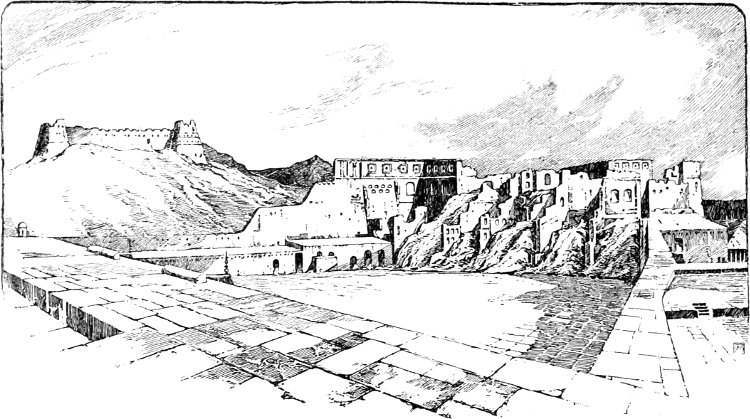
THE BRITISH RESIDENCY AFTER THE ATTACK.
The deportation to India of Yakoub Khan and his three principal ministers was the signal for a general rising. The Peter the Hermit of Afghanistan in 1879 was the old Mushk-i-Alum, the fanatic chief moulla (or priest) of Ghuznee, who went to and fro among the tribes proclaiming the sacred duty of a religious war against the unbelieving invaders. The combination of fighting tribes found a competent leader in Mahomed Jan, a Warduk general of proved courage and capacity. The plan of campaign was comprehensive and well devised. A contingent from the Logur country south of Cabul was to seize the Sher Darwaza heights, stretching southward from Cabul toward Charasiah. The northern contingent from the Kohistan and Kohdaman was to occupy the Asmai heights north-west of the city, while the troops from the Maidan and Warduk territory away to the south-westward of the capital, led by Mahomed Jan in person, should come in by Urgundeh across the Chardeh Valley, take possession of Cabul, and rally to their banners the disaffected population of the city and the surrounding villages. The concentration of the three bodies effected, Cabul and the ridge against which it leans occupied, the next step was to be the investment of the Sherpur cantonment, preparatory to an assault in force upon that stronghold.
The British general, through his spies, had information of those projects. To allow the projected concentration would be fraught with mischief, and both experience and temperament enjoined in Roberts a prompt initiative. He resolved, in the first instance, to deal with Mahomed Jan’s force, which was reckoned some 5,000 strong; the other contingents might be disregarded for the moment. On the 8th of December Baker marched out with a force consisting of 900 infantry, two and a half squadrons, and four guns, with instructions to break up the tribal assemblage in the Logur valley, march thence south-westward, and take a position across the Ghuznee road in the Maidan valley, on the line of retreat which it was hoped that Macpherson would succeed in enforcing on Mahomed Jan. Macpherson was to move westward with 1,300 bayonets, three squadrons, and eight guns, across the Chardeh valley to Urgurdeh, where it was expected that he would find Mahomed Jan’s levies, which he was to attack and drive southward to Maidan upon Baker. Should this combination come off, the Afghan leader would find himself, it was hoped, between the upper and the lower millstone, and would be punished so severely as to hinder him from giving further trouble.
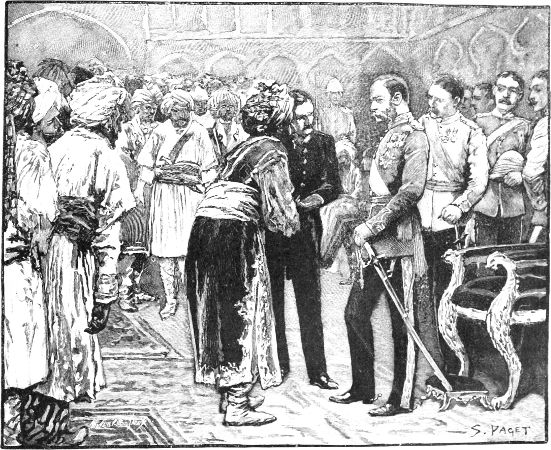
“HE HELD A DURBAR” (p. 235).
It happened, however, as Macpherson was about starting on the 9th, that a cavalry reconnaissance found the Kohistanee levies in considerable strength about Karez Meer, some ten miles north-west of Cabul. It was imperative promptly to disperse them, and Macpherson, on the 10th, had to alter his line of advance and move against the Kohistanees, a divergence from the original plan which had the effect of wrecking the previously arranged combined movement and bringing about a very critical situation. After a sharp fight Macpherson routed the Kohistanees, and halted on the ground for the night. In the hope that the combination might still be effected, he was ordered to march south-west toward Urgundeh on the morning of the 11th, where it was hoped he would find Mahomed Jan and drive him towards Baker. Macpherson had left his cavalry and wheeled guns at Aushar on the eastern edge of the Chardeh valley; and he was informed that they would leave that place at 9 a.m. of the same day, under the command of Brigadier-General Massy, and move across the valley in the direction of Urgundeh, where Macpherson, it was expected, would re-unite himself with them. Massy’s orders were to proceed cautiously to join Macpherson, but “on no account to commit himself to an action until the latter had engaged the enemy.”
Macpherson marched from Karez Meer at eight a.m. of the 11th. Massy left Aushar an hour later, and went across country instead of keeping to the road. His force consisted of two squadrons 9th Lancers, a troop of Bengal Lancers, and four horse artillery guns. Near Killa Kazee his advance guard sent back word that the hills in front were occupied by the enemy in considerable force. Massy halted when he saw some 2,000 Afghans forming across the road, and from the hills to right and left broad streams of armed men pouring down the slopes and massing in the plain. The surprise was complete, the situation full of perplexity. There was no Macpherson within ken of Massy. If he retired, he probably would be rushed. If, on the other hand, he should show a bold front, and, departing from his orders in the urgent crisis face to face with which he found himself, should strain every nerve to “hold” the Afghan masses in their present position, there was the possibility that he might save the situation and give time for Macpherson to come up. Massy, for better or for worse, committed himself to the offensive, and opened fire on the Afghan masses. But they were not daunted, and the guns had again and again to be retired. The outlook was ominous when Roberts arrived on the scene. He acted promptly, as was his wont, directing Massy to retire till he found an opportunity to charge; he sent General Hills back to Sherpur to warn its garrison to be on the alert, and to order the despatch at speed of a wing of the 72nd Highlanders to the village of Deh Mazung in the throat of the gorge of the Cabul river, which the Highlanders were to hold to extremity.
The moment seemed to have come for the action of the cavalry. Colonel Cleland led his lancers straight for the centre of the Afghan line. Captain Gough, away on the Afghan left, eagerly “conformed,” crushing in on the enemy’s flank at the head of his troop. There have been few forlorner hopes than the errand on which, on this ill-starred day, over 200 troopers rode into the heart of 10,000 Afghans flushed with unwonted good fortune. Through the dust-cloud of the charge were visible the flashes of the Afghan volleys and the sheen of the British lance-heads as they came down to the “engage.” There was a short interval of suspense, the din of the mêlée faintly heard, but invisible behind the bank of smoke and dust. Then from out the obscurity of the battle riderless horses came galloping back, followed slowly by broken groups of dismounted troopers. Gallantly led home, the charge had failed. What other could have been the result? Sixteen troopers had been slain, seven were wounded; two brave young officers lay dead where they fell. Cleland came out with a sword cut and a bullet wound, which latter gave him his death a few months later. The Afghans pressed on. A gun had to be spiked and abandoned, its officer, Lieutenant Hardy, remaining by it until killed; three other guns stuck fast in a watercourse. All four were gallantly recovered by Colonel Macgregor the same afternoon by a most skilful and daring effort, which only he would have ventured upon. The retreat was stubborn and orderly; but there was an anxious interval at Deh Mazung until the Highlanders came through the gorge at the double; when, after a short interval of firing, the Afghans climbed the slopes of the Sher Derwasa heights, and occupied the summit of the Tahkt-i-Shah. Macpherson, marching in, struck and broke the Afghan rear. On the 12th, Baker fought his steadfast way back to Sherpur. The casualties of the 11th were not light—thirty men killed and forty-four wounded. The Afghans were naturally elated by the success they had achieved, and it was clear that Mahomed Jan had a quick eye for opportunities and some skill in handling men.
From the Sher Derwasa heights Macpherson, with barely 600 men, attempted, on the morning of the 12th, to carry the rocky summit of the Tahkt-i-Shah, but after a prolonged and bitter struggle it had to be recognised that the direct attack by so weak a force, unaided by a diversion, could not succeed. Macpherson remained on the ground he had actually won, informed that on the following morning he was to expect Baker’s co-operation from the south. The casualties of the abortive attempt included three officers, one of whom—Major Cook, V.C., of the Goorkhas, than whom the British army contained no better soldier—died of his wounds.
The lesson of the result of attempting impossibilities had been taken to heart, and the force which Baker led out on the morning of the 13th was exceptionally strong, consisting as it did of the 92nd Highlanders and the Guides infantry, a wing of the 3rd Sikhs, a cavalry regiment, and eight guns. Marching in the direction of the lateral spur stretching out from the main ridge eastward towards Beni Hissar, Baker observed that large masses of the enemy were quitting the plain villages in which they had been spending the winter night, and were hurrying upward to gain and hold the summit of the spur, which constituted the main defensive position of the Afghan reserve. His opportunity flashed upon the ready-witted Baker. By gaining the centre of the spur he would cut in two the Afghan mass, holding its continuous summit, and so isolate and neutralise the portion of that mass in position from the centre of the spur to its eastern extremity. To effect this stroke it was, however, necessary that he should act with promptitude and energy. His guns opened a hot fire on the Afghan bodies holding the crest of the spur. His Sikhs, extended athwart the plain, protected his right flank; his cavalry on the left cut into the groups of Afghans hastening to ascend the eastern extremity of the spur. With noble emulation the Highlanders and the Guides sprang up the rugged slope, their faces set towards the centre of the summit line. Major White, who had already earned many laurels in the campaign, led on the 92nd; the Guides, burning to make the most of their first opportunity to distinguish themselves, followed eagerly the gallant Jenkins, the chief who had so often led them to victory on other fields. Lieutenant Forbes, a young officer of the 92nd, heading the advance of his regiment, reached the summit accompanied only by his colour-sergeant. A band of Ghazees rushed on the pair, and the sergeant fell dead. As Forbes stood covering the body, he was overpowered and slain. The sudden and bloody catastrophe staggered for a moment the soldiers following their officer, but Lieutenant Dick Cunyngham rallied them immediately and led them forward at speed. For his conduct on this occasion Cunyngham worthily received the Victoria Cross.
With rolling volleys the Highlanders and the Guides reached and won the rocky summit. The Afghans momentarily defended the position, but the British fire swept them away, and the bayonets disposed of the Ghazees, who fought and died under their standards. The severance of the Afghan line was now complete. A detachment was left to maintain the isolation of some 2,000 of the enemy who had been cut off; and then swinging to their right with a cheer Baker’s regiments swept along the spur towards the main ridge and the Takht-i-Shah. As they rushed forward they rolled up the Afghan line, and the enemy fled in panic flight. Assailed from both sides, for Macpherson’s men were climbing the north side of the peak, and shaken by the fire of the mountain guns, the garrison of the Takht-i-Shah evacuated the position. Baker’s soldiers toiled vigorously upward towards the peak, keen for the honour of winning it; but that honour justly fell to their comrades of Macpherson’s command, who had striven so valiantly to earn it on the previous afternoon, and who had gained possession of the peak and the standards left flying on its summit a few minutes in advance of the arrival of White’s Highlanders and Jenkins’ Guides. As the midday gun was fired in the Sherpur cantonment, the flash of the heliograph from the peak told that the Takht-i-Shah was won.
While the fight was proceeding on the mountain summits, another was being fought on the Siah Sung upland springing out of the plain, within artillery range of Sherpur. On this elevation had gathered masses of Afghans from the turbulent city and from the villages about Beni Hissar, with intent to hinder Baker’s return march. The Sherpur guns shelled them, but they held their ground, and the cavalry galloped out from the cantonment to disperse them. The Afghans showed unwonted resolution; but the British horsemen were not to be denied. Captains Butson and Chisholme led their squadrons against the Afghan flanks, and the troopers of the 9th Lancers swept their fierce way through and through the hostile masses. But in the charge Butson was killed, and Chisholme and Trower were wounded; the sergeant-major and three men were killed, and seven men were wounded. Brilliant charges were delivered by the other cavalry detachments, and the Siah Sung heights were ultimately cleared. The Guides’ cavalry attacked, defeated, and pursued for a long distance a body of Kohistanees marching north apparently with intent to join Mahomed Jan. The casualties of the day were sixteen killed and forty-five wounded—not a heavy loss, considering the amount of hard fighting. The Afghans were estimated to have lost in killed alone from 200 to 300 men.
The operations of the 13th were successful so far as they went, but the actual results attained scarcely warranted the belief that the Afghans had suffered so severely that they would now break up their combination and disperse to their homes. The General, indeed, was under the belief that the enemy had been “foiled in their western and southern operations.” But the morning of the 14th effectually dispelled the optimistic anticipations indulged in overnight. At daybreak large bodies of Afghans, with many standards, were discerned on a hill about a mile northward of the Asmai heights, from which hill and from the Kohistan road they were moving on to the Asmai crest. They were presently joined there by several thousands climbing the steep slopes rising from the village of Deh Afghan, the northern suburb of Cabul. It was estimated that about 8,000 men were in position on the Asmai heights, and occupying also a low conical hill beyond their north-western termination. The array of Afghans displayed itself within a mile of the west face of the Sherpur cantonment, and formed a menace that could not be brooked. To General Baker was entrusted the task of dislodging the enemy from the threatening position, with a force consisting of about 1,200 bayonets, eight guns, and a regiment of native cavalry. Baker’s first object was to gain possession of the conical hill already mentioned, and thus debar the Afghan bodies on the Asmai heights from receiving accessions either from the hill further north or by the Kohistan road. Under cover of the artillery fire, the Highlanders and Guides occupied the conical hill after a short conflict. A detachment of all arms was left to hold it, and Colonel Jenkins, who commanded the attack, set about the arduous task of storming from the northward the formidable position of the Asmai heights. The assault was led by Brownlow’s brave Highlanders of the 72nd, supported on their right by the Guides operating on the enemy’s flank, and the Afghan position was heavily shelled from the plain and the cantonment.
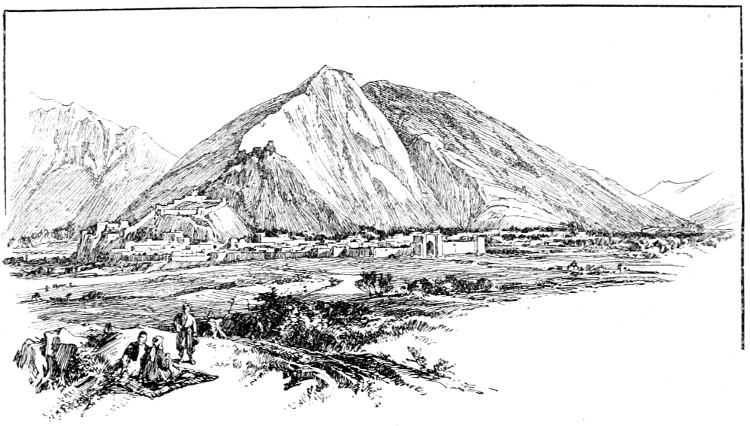
CABUL.
In the face of a heavy fire the Highlanders and Guides climbed the rugged hillside leading up to the Afghan breastworks, on the northern edge of the summit. The British shrapnel fire had driven many of its defenders to seek shelter down in Deh Afghan; but the Ghazees in the breastworks fought desperately, and died under their standards as the Highlanders carried the defences with a rush. The crest—about a quarter of a mile long—was traversed under heavy fire, and the southern breastwork on the Asmai peak was approached. It was strong, and strongly held; but a cross-fire was brought to bear on its garrison, and then the frontal attack, led gallantly by Corporal Sellar of the 72nd, was delivered. After a hand-to-hand grapple, in which Highlanders and Guides were freely cut and slashed by the Ghazees, the position, which was full of dead, was carried, but with considerable loss. The Afghans streamed down from the heights, torn as they descended by shell-fire and musketry-fire: when they took refuge in Deh Afghan that place was heavily shelled. The whole summit of the Asmai heights was now in British possession, and it seemed for the moment that a decisive victory had been won.
But scarcely had Jenkins found himself in full possession of the Asmai position, when the fortune of the day was suddenly overcast. A great host of Afghans, estimated to number from 15,000 to 20,000, had debouched from the direction of Indiki into the Chardeh valley, and was moving swiftly northward with the apparent object of forming a junction with the masses occupying the hills to the north-west of the Asmai heights.
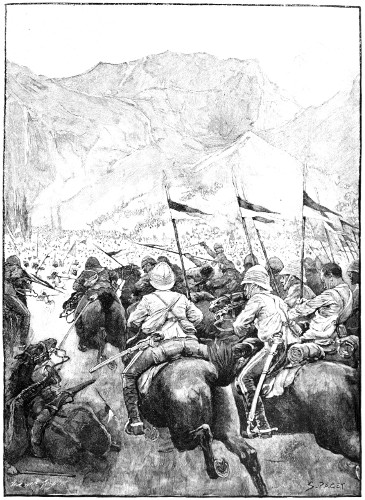
“COLONEL CLELAND LED HIS LANCERS” (p. 238).
Cavalry scouts galloping from the Chardeh valley brought in the tidings that large bodies of hostile infantry and cavalry were hurrying across the valley in the direction of the conical hill, which was being held by Lieutenant-Colonel Clark, with only 120 Highlanders and Guides. Baker, recognising Clark’s weakness, reinforced that officer with four mountain guns and 100 bayonets—a reinforcement which proved inadequate. The guns, indeed, opened fire on the Afghan bodies crossing the valley and drove them out of range; but these bodies coalesced dexterously with the host advancing from Indiki, and then the great Afghan mass, suddenly facing to the right, struck the whole range of the British position, stretching from near the Cabul gorge on the south to and beyond the conical hill on the north. The most vulnerable point was about that eminence. Baker sent Clark a second reinforcement, and 200 Sikhs doubled out from Sherpur to further strengthen him. But the Afghans, swarming up from out the Chardeh valley, had the shorter distance to travel, and were beforehand with the hurrying reinforcements. As the Afghan front and flank attacks developed themselves, they encountered from the garrison of the conical hill a heavy rifle fire, and shells at short range tore through the loose rush of Ghazees; but the bhang-maddened fanatics sped on and up without wavering. As they gathered behind a mound for the final onslaught, Captain Spens with a handful of his Highlanders, charged out on the forlorn hope of dislodging them. A rush was made on the gallant Scot; he was overpowered and slaughtered after a desperate resistance, and the charge of the infuriated Ghazees swept up the hillside. In momentary panic the defenders yielded the ground, carrying downhill with them the reinforcement of Punjaubees which Captain Hall was bringing up. Two of the mountain guns were lost, but there was a rally at the foot of the hill, under cover of which the other two were extricated. The Afghans refrained from descending into the plain, and directed their efforts towards cutting off the British troops still in position on the Asmai heights.
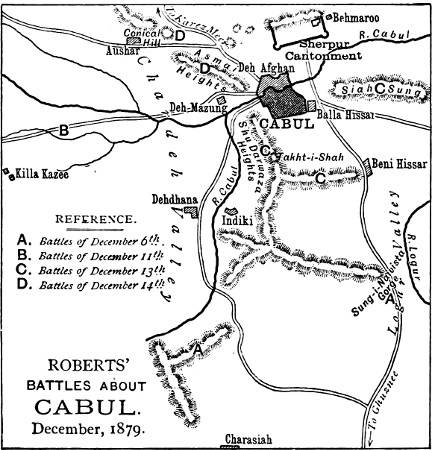
ROBERTS’ BATTLES ABOUT CABUL.
December, 1879.
It was estimated that the Afghan strength disclosed this day did not fall far short of 40,000 men; and General Roberts, reluctantly compelled to abandon for the time any further offensive efforts, determined to withdraw the troops from all isolated positions and to concentrate his whole force within the protection of the Sherpur cantonment. The orders issued to Baker and Macpherson, gradually to retire into the cantonment, were executed with skill and steadiness. Macpherson coolly marched through Deh Afghan, his baggage sent on in front under a guard. Jenkins’ evacuation of the Asmai position was conspicuously adroit. Baker held a covering position until all the other details had steadily made good their retirement, and he was the last to withdraw. By dusk the whole British force was safely concentrated within the cantonment, and the period of the defensive had begun. The casualties of the day were serious—35 killed and 107 wounded. During the week of fighting the little force had lost altogether, in officers and men, 83 killed and 192 wounded.
Although overlarge for its garrison, the Sherpur cantonment possessed many of the features of a strong defensive position. On the southern and western faces the massive and continuous enceinte made it impregnable against any force unprovided with siege artillery; but on the eastern face the incomplete wall was low, and the northern line of defence on the Behmaroo heights was defective until strengthened by a series of blockhouses supporting a continuous entrenchment studded with batteries. The space between the north-western bastion and the heights was closed by an entrenchment supported by a laager of Afghan gun-carriages and limbers; the open space on the north-eastern angle was similarly fortified; the unfinished eastern wall was heightened by built-up tiers of logs, and its front, as elsewhere, was covered with abattis wire entanglements, and other obstacles. The enceinte was divided into sections, to each of which was assigned a commanding officer with a specified detail of troops; and a strong brigade of European infantry was under the command of Brigadier-General Baker, ready at short notice to reinforce any threatened point. Before the enemy cut the telegraph wire, in the early morning of the 15th, Sir Frederick Roberts had informed the authorities in India of his situation and need for reinforcement.
During the 15th and 16th the Afghan troops were busily engaged in sacking the Hindoo and Kuzzilbash quarters of Cabul, in looting and wrecking the houses of chiefs and townsfolk who had shown friendliness to the British, and in fiercely quarrelling among themselves over the spoil. On the 17th and 18th they made sundry ostentatious demonstrations against Sherpur, but these were never formidable. Although they made themselves troublesome with some perseverance during the daytime, they consistently refrained from night-attacks, to which ordinarily the Afghan hillmen are much addicted. There never was any investment of Sherpur, nor indeed any approximation to an investment. The Afghan offensive was not dangerous, but annoying and wearisome. It was pushed, it was true, with some resolution on the 18th, when several thousand men poured out of the city, and skirmished forward under a cover of the gardens and enclosures on the plain between Cabul and the cantonment. Some of the more adventurous were able to get within four hundred paces from the enceinte, but could make no further headway, although they long maintained a brisk fire. The return fire was chiefly restricted to volleys directed on those few of the enemy who offered a sure mark by exposing themselves; and shell-fire was chiefly used to drive the Afghan skirmishers from their cover in the gardens and enclosures. On the morning of the 19th it was found that in the night they had occupied the Meer Akhor fort, a few hundred yards in front of the eastern face of the enceinte. Baker went out on the errand of destroying it, with 880 bayonets, two guns, and a party of sappers. In the approach through the mist, a sudden volley struck down several men, and Lieutenant Montenaro, of the mounted battery, was mortally wounded. The fort was heavily shelled, its garrison was driven out, and it was blown up.
For the moment circumstances had enforced on Roberts the wisdom of accepting the defensive attitude, but he nevertheless knew himself the virtual master of the situation. He had but one anxiety—the apprehension lest the Afghans should not harden their hearts to deliver a real assault on his position. That apprehension was not long to give him concern. On the 20th the enemy took strong possession of the Mahomed Shereeff fort on the southern face of Sherpur; and they maintained themselves there during the two following days against the fire of siege guns mounted on the bastions of the enceinte. On the 21st and 22nd large numbers of Afghans quitted the city, and passing eastward behind the Siah Sung heights, took possession in great force of the forts and villages outside the eastern face of Sherpur, which should have been destroyed previously. On the afternoon of the 22nd a spy brought in the intelligence that Mahomed Jan and his brother chief had resolved to assault the cantonment early on the following morning. His tidings were true; and the spy was even able to communicate the details of the plan of attack. The 2,000 men who were holding the King’s Garden and the Mahomed Shereeff post had been equipped with scaling-ladders, and were to make a false attack, which might become a real one, against the western section of the front. The principal assault, however, was to be made against the eastern face of the Behmaroo village, unquestionably the weakest part of the defensive position. The 23rd was the last day of the Mohurrum—the great Mahomedan religious festival—when fanaticism would be at its height; and further to stimulate that incentive to valour, the Mushk-i-Alum was his holy self to kindle the beacon fire on the Asmai height which would be the signal to the faithful to rush to the attack.
The information proved perfectly accurate. All night long the shouts and chants of the Afghans filled the air. Purposeful silence reigned throughout the cantonment. In the darkness the soldiers mustered and quietly fell into their places. The officers commanding sections of the defence made their dispositions. The reserves were silently standing to their arms. Every eye was toward the Asmai height, shrouded still in the gloom of the night. A long tongue of flame shot up into the air, blazed brilliantly for a few moments, and then waned. At the signal a fierce fire opened from before one of the gateways of the southern face, the flashes indicating that the marksmen were plying their rifles within two hundred yards of the enceinte. The bullets sped harmlessly over the defenders sheltered behind the parapet, and in the dusk of the dawn reprisals were not attempted. But this outburst of powder-burning against the southern face was a mere incident. What men listened for and watched for was the development of the true assault on the eastern end of the great parallelogram. The section-commanders there were General Hugh Gough, in charge of the eastern end of the Behmaroo heights, and Colonel Jenkins from the village down past the native hospitals to the bastion at the south-eastern corner. The defending troops were the Guides from Behmaroo to the hospital, in which were 100 Punjaubees; and beyond to the bastion the 67th reinforced by two companies of the 92nd. From beyond Behmaroo and the eastern trenches and walls as day broke, there came a roar of voices so loud and menacing that it seemed as if an army 50,000 strong was charging down on our thin line of men. Led by Ghazees, the main body of Afghans, who had been hidden in the villages and orchards on the east side of Sherpur, rushed out in one dense horde, and every throat was filling the air with shouts of “Allah-il-Allah!” The roar surged forward as the line advanced, but it was answered by such a roll of musketry that it was drowned for the moment, and then merged into the general turmoil of sound that told our men with Martinis and Sniders were holding their own against the assailants.
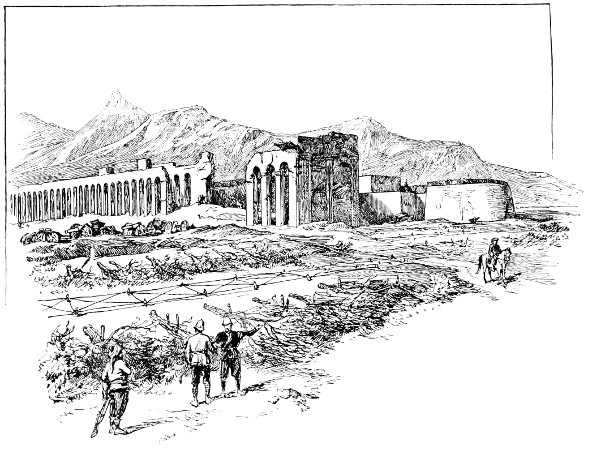
NORTH END OF SHERPUR ENTRENCHMENTS, CABUL.
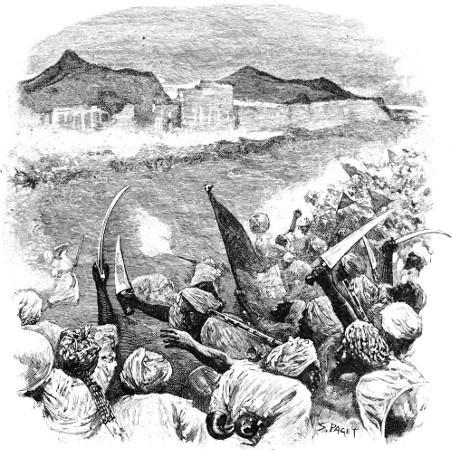
“THE ROAR SURGED FORWARD” (p. 243).
When the first attack was made the morning was so dark and misty that the outlook from the trenches was restricted, and the order to the troops was to hold their fire until the enemy should be distinctly visible. The Punjaubee detachment in the hospital opened fire prematurely, and presently the Guides, holding Behmaroo and the trenches on the slopes, followed the example, and sweeping with their fire the terrain in front of them broke the force of the attack when its leaders were still several hundred yards away. Between the hospital and the corner bastion, the men of the 67th and 92nd awaited with impassive discipline the word of permission to begin firing. From out the mist at length emerged dense masses of men, some of whom were brandishing swords and knives, while others loaded and fired when hurrying forward. The order to fire was not given until the leading Ghazees were within eighty yards, and the mass of assailants not more than two hundred. Heavily struck by volley on volley, they recoiled, but soon gathered courage to come on again; and for several hours there was sharp fighting, repeated efforts being made to carry the low eastern wall. So resolute were the Afghans that more than once they reached the abattis, but each time they were driven back with heavy loss. About ten o’clock there was a lull, and it seemed that the attacking force was owning the frustration of its attempts; but an hour later there was a partial recrudescence of the fighting, and the assailants once more came on. The attack, however, was not pushed with much vigour, and was soon beaten down, but the Afghans still maintained a threatening attitude, and the fire from the defences was ineffectual to dislodge them. The General then determined to take them in flank, and with this intention sent out into the open through the Behmaroo gorge four field-guns escorted by a cavalry regiment. Bending to the right, the guns came into action on the Afghan right flank, and the counterstroke had an immediate effect. The enemy wavered, and soon were in full retreat. The Kohistanee contingent, some 5,000 strong, cut loose and marched away northward with obvious recognition that the game was up. The fugitives were scourged with artillery and rifle fire; and Massy led out the cavalry, swept the plain, and drove the lingering Afghans from the slopes of Siah Sung. The false attacks on the southern face from the King’s Garden and the Mahomed Shereef fort never made any head. Those positions were steadily shelled until late in the afternoon, when they were finally evacuated, and by nightfall all the villages and enclosures between Sherpur and Cabul were entirely deserted. Some of these had been destroyed by sappers from the garrison during the afternoon, in the course of which operation two gallant Engineer officers, Captain Dundas and Lieutenant Nugent, were unfortunately killed by the premature explosion of a mine.
Mahomed Jan had been as good as his word: he had delivered his stroke against Sherpur; and that stroke had utterly failed. With its failure came promptly the collapse of the national rising. Before daybreak of the 24th the formidable combination, which had included all the fighting elements of North-Eastern Afghanistan, and under whose banners it was believed that more than 100,000 armed men had mustered, was no more. Not only had it broken up—it had disappeared. Neither in the city itself nor in the adjacent villages, nor on the surrounding heights, was a tribesman to be seen. So hurried had been the Afghan dispersal that the dead were left to lie unburied where they had fallen. His nine days on the defensive had cost Sir Frederick Roberts singularly little in casualties: his losses were eighteen killed and sixty-eight wounded. The enemy’s loss in killed and wounded, from first to last of the rising, was reckoned to be not under 3,000.
On the 24th the cavalry rode far and fast in pursuit of the fugitives, but they overtook none, such haste had the fleeing Afghans made. On the same day Cabul and the Balla Hissar were reoccupied, and General Hills resumed his functions as military governor of the city, vice the old moulla Mushk-i-Alum, departed precipitately to regions unknown. Cabul had the aspect of having undergone a siege at the hands of an enemy; the bazaars were broken up and deserted. After making a few examples, the General issued a proclamation of amnesty, excluding therefrom only five of the principal leaders and fomenters of the recent rising. This policy of conciliation bore good fruit; and a durbar was held on January 9th, 1880, at which were present about 300 sirdars, chiefs, and headmen from the various provinces. Although the country remained disturbed, there were no more outbreaks. Cabul and Sherpur were strongly fortified, military roads were made, and all cover and obstructions for the space of 1,000 yards outside the enceinte of Sherpur were swept away. In March the Cabul force had increased to a strength of about 11,500 men and twenty-six guns; and General Roberts formed it into two divisions, one of which he himself commanded, the other being commanded by Major-General John Ross.
On 2nd May, Sir Donald Stewart arrived at Cabul from Candahar, and took over from Sir Frederick Roberts the command in North-Eastern Afghanistan.
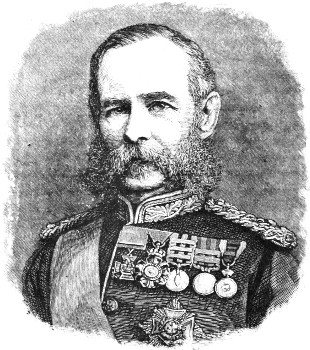
[Photo., Lock & Whitfield. Regent St., W.
SIR FREDERICK ROBERTS IN 1880.
CUSTOZZA.
By A. Hilliard Atteridge.
When Nicholas Nickleby suggested to Mr. Vincent Crummles that the “terrific broadsword combat” on his stage would look better if the two adversaries were more of a size, the veteran manager replied that the remark showed how little he knew about the business. What the public really liked to see was the little fellow getting the better of the big one. And Mr. Crummles was right. Most men have a “weakness for the weaker side,” and if there is one thing they like better to see than a fair and even fight, it is the spectacle of a victory won by skill and pluck against superior strength. Such was the victory that splendid old soldier the Archduke Albert of Austria won at Custozza during the brief campaign of Northern Italy in 1866.
As it happened, it was—so far as tangible results were concerned—a barren success. The prize that was fought for was the possession of Venice and its territory; and by the course of events this went to Italy at the close of the war, notwithstanding her defeats by land and sea. But for all that, Custozza and Lissa were a solid gain to Austria, for they enabled her to yield to fate without losing heart and hope for the future. Broken as her power was on the wider field of the struggle with Prussia, she could yet trust to sailors of the stamp of Tegethoff, soldiers like the Archduke Albert, to secure for her the respect even of the victors, and to ensure that before long she would again be a factor to be reckoned with in the councils of Europe.
The Archduke Albert was the son of a famous soldier, the Archduke Charles, who was one of the most formidable opponents of the Great Napoleon, and who by the victory of Aspern brought him within sight of ruin many years before Waterloo was fought and won. The Archduke Albert had distinguished himself in the campaigns of Italy in 1848 and 1849, taking part in more than one hard-fought action on the very ground which he held in 1866. When, in that year, Italy began to prepare to take the field against Austria as the ally of Prussia, the Government at Vienna concentrated the bulk of its forces on the northern frontiers of the empire to meet the more formidable attack that was threatened from Berlin, and the Archduke was left to hold Venetia against the Italians with very inferior forces. It was this marked inferiority that gave special interest to his successful campaign against the great armies that were marshalled against him.
At the end of the month of May the Italians had concentrated a main army of 140,000 men in Lombardy, and a second force of about 60,000 between Ferrara and Bologna in the Romagna. The army in Lombardy was commanded nominally by the King, Victor Emmanuel; really by his chief of the staff, the veteran General La Marmora, the same who had commanded the Sardinian contingent in the Crimea. The army was divided into three corps under Durando, Cucchiari, and Della Rocca. The King’s eldest son, Prince Humbert, then Crown Prince and now King of Italy, commanded a division in Della Rocca’s corps. His brother, Prince Amadeo, afterwards King of Spain, commanded a brigade of Grenadiers in the first corps. This army was destined to cross the little river Mincio, which formed the boundary between Lombardy and Venetia, thus attacking the Austrians in front; while the second army of 60,000 men under Cialdini would be in a position to cross the lower course of the Po, and fall upon their flank. On the left of the royal army Garibaldi was assembling a third force of between 30,000 and 40,000 men, with which he was to invade the Tyrol.
To meet these three armies—amounting in all to at least 235,000 men—the Archduke Albert had nominally at his disposal a force of 135,000. Thus he had a majority of 100,000 against him at the very outset, but even this does not represent the whole deficiency. First he had to detach 12,000 men for the defence of the Tyrol. These were expected to be able to deal with Garibaldi’s 30,000 or 40,000 volunteers; 12,000 more were assigned to the defence of Istria and the neighbourhood of Trieste and Pola, where, considering the strength of Italy on the sea, there was supposed to be some danger of a naval descent; 40,000 were employed in the garrisons of the Quadrilateral (Mantua, Verona, Peschiera and Legnago) and in the fortresses of Rovigo and Venice; finally 6,000 had to be left to guard his communications with Austria. This reduced the field army to a little over 60,000 men, and with these he had to meet the 200,000 of Italy.
The Italians had divided their forces, and the Archduke saw that his best chance of success would lie in an attempt to deal with one of their armies before the other could come to its assistance. In order to do this it would be necessary from the very outset to conceal his own position and movements, and be fully informed of those of his opponents. Therefore, concentrating his army in a central position behind the Adige, a little to the east of Verona, a point from which he could move either against the King or against Cialdini, he left only a screen of cavalry outposts along the Mincio, between Peschiera and Mantua, and along the north bank of the Po, opposite Ferrara. Once war was declared they allowed no one to pass the frontier in either direction, and even before that only those few privileged persons who had obtained a special passport from the Austrian military authorities were allowed to cross.
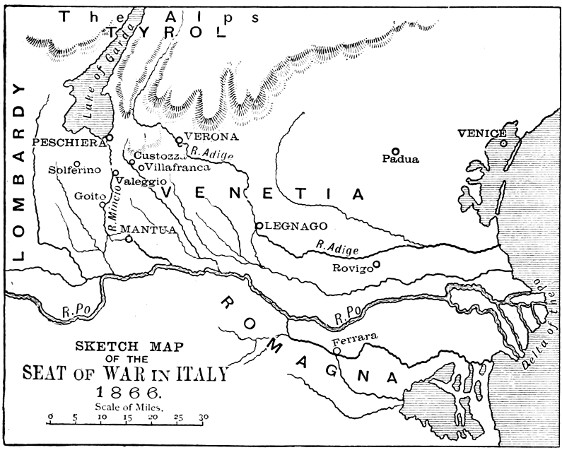
SKETCH MAP OF THE SEAT OF WAR IN ITALY 1866.
The cavalry scouts and vedettes did their work to perfection. They prevented the Italians from obtaining any information as to the plans or movements of the Archduke, and they kept him well informed as to all that was going on upon the Lombard shore of the Mincio. The Archduke had in the last few days before the declaration of war made up his mind to attack the King’s army. If Victor Emmanuel crossed the Mincio he would fall upon him on the ground between that river and the Adige; or if the Italians remained in Lombardy he intended himself to cross the Mincio, trusting to be able to defeat them, and then return in time to deal with Cialdini. In both cases he would have the advantage of being able to make one or other of the four fortresses of the Quadrilateral the base of his attack. On June 20th he received notice that war had been declared. On the same day he had reports from his cavalry outposts to the effect that both the Italian armies were preparing to advance. From the westward the King’s army was closing in upon various points on the Mincio, and to the southward Cialdini was collecting material to construct bridges across the Po at Francolinetto, and had actually occupied an island in the middle of the wide stream at that point. The Archduke remained quiet near Verona for nearly two days longer. His plan was to lull his enemy into a false sense of security, and then strike swiftly and sharply. All the bridges on the Mincio were left standing, and the screen of cavalry posts received orders not to oppose the Italians seriously at any point when they tried to cross. When the invaders entered Venetia the Austrian horsemen were to fall back before them, to do as little fighting as possible, but never to lose sight of them.
On Thursday, June 22nd, the royal army of Italy was concentrated on the right or Lombard bank of the Mincio. At Monzambano the engineers were at work constructing bridges. At Valeggio and Goito the cavalry of De Sonnaz was ready to seize the existing bridges as soon as the word was given to advance. In the grey of the early morning of Friday they crossed the river at both points. The Austrian cavalry, under Colonel Pulz, fell back without firing a shot. Avoiding the hills that lie northward towards the Garda lake, Pulz retired across the level ground of the plain of Villafranca. The plain is thickly populated. There are numerous villages and hamlets, and plenty of roads, footpaths, and tracks; but it is difficult country to manœuvre in, for everywhere the ground is cut up with small watercourses and irrigation channels—hedgerows, orchards, and plantations restrict the view. Along the course of the streams are swampy rice-fields, and on every stretch of sloping ground there are thickly-planted vineyards. Pulz was able to make the Italians very slow and cautious in their advance. It was the afternoon before he retired from Villafranca, and behind the little country town he made a stand with his horsemen and a battery of artillery; and though he again retreated after a short skirmish, the result was that the Italian cavalry of De Sonnaz did not push their explorations any further that day. They reported to the royal headquarters that the Austrians had no force between the Adige and the Mincio beyond a couple of regiments of cavalry and a battery of horse artillery; and this confirmed La Marmora in his idea that the Archduke would be compelled by his inferior numbers to remain on the defensive near Verona.
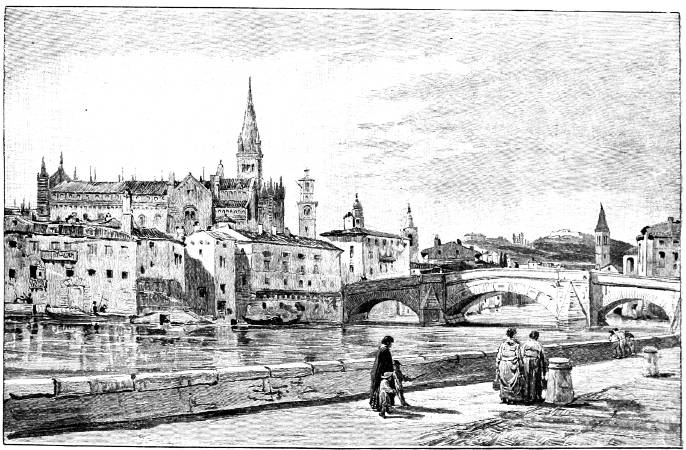
VERONA.
All day the Italian army had been pouring across the bridges of the Mincio, and advancing by the hot, sandy roads—the right into the plain of Villafranca, the left towards the low hills that border it on the northward, stretching from the lake of Garda to Custozza and Somma Campagna. General La Marmora was confident of victory. He was occupying the very ground where the allied armies of France and Italy had stayed their onward march in 1859. He was going to take up the work of conquest where Napoleon III. had left off, and he hoped to complete it by entering Venice as a victor. North and south and away to his front lay the famed fortresses of the Quadrilateral, the keys of Northern Italy; but their garrisons were cowering behind the ramparts, and doing nothing to disturb his movements.
On the Saturday night about half the Italian army was across the river, and the rest was close up to the bridges, ready to follow in the morning. The troops were to be moving by 3.30 a.m., and La Marmora had issued orders for an advance upon Verona. The right was to move by the plain of Villafranca to the hills round Somma Campagna; the left was to enter the hill country, more directly marching from Monzambano and Valeggio on Castelnuovo and Sona. The object of the movement was to occupy the mass of hills to the south-east of the lake of Garda, cut off Peschiera from Verona, and threaten the positions held by the Archduke near that fortress.
On the Sunday morning the Italians were under arms at half-past three, and soon after their columns were on the move. The men had no breakfast before starting, beyond a piece of bread or a biscuit taken from the haversack and eaten as they waited for the order to march off. It was intended to halt later on for breakfast, but the Italian staff was anxious to get the march over as early as possible, as it was expected that it would be a very hot day. So sure were they that the enemy would not be encountered in force that no cavalry were sent out to scout in front. In front of each column there was an advance guard; but so badly was the march arranged, and so loosely was the connection between the advance guards and those that followed them kept up, that the vanguard of Sirtori’s division, consisting of some 2,500 men with six guns, took the wrong road, and got in front of the vanguard of Cerale’s division; while, by a blunder of the leading portion of Cerale’s column, his main body wandered on to the road assigned to General Sirtori. Thus there was the singular spectacle of two advance guards following each other on one road, while their main bodies calmly marched in long procession along another.
The start had been made shortly before four o’clock. The march had proceeded for a little more than an hour, and five had just struck from the village bell towers, when General La Marmora, who was riding with centre, was surprised at hearing far away to the right, in the direction of Villafranca, the roar of guns in action. The two divisions of the Italian third corps, commanded by the Crown Prince Humbert and by General Bixio, had been attacked by Austrian cavalry and horse artillery. The Italians behaved well. The infantry formed into squares, and beat off three cavalry charges; the artillery galloped up, unlimbered, and drove away the Austrian guns with a few well-aimed shells. By six o’clock the fight was over, and the enemy was in retreat. La Marmora had ridden towards the firing, and when he received the report of what had happened, he at once made up his mind that the affair was of very little importance. He felt sure that the Austrian force consisted only of Pulz’s regiments, the same which had been watching the river two days before, and had retired through Villafranca when the Italians advanced on the Saturday.
The divisions of his first corps on the left had now entered the hilly country, and at half-past six, a good half-hour after the last shot had been fired at Villafranca, there was a still more startling incident on the left. Sirtori was marching his division across the deep little valley through which the Tione flows, and the leading regiment was ascending the slope beyond its left bank. Sirtori himself rode near the head of the column. Suddenly a volley was fired at the leading ranks by riflemen lying in ambush among the trees and enclosures of a farmstead at the top of the slope. Sirtori, pulling up his horse, looked through his field-glasses at the wreaths of smoke that hung in the still, clear morning air; but so well hidden were the riflemen that he could not make out their uniforms. Nevertheless, he felt so sure that the Austrians were not in front of him, and he so little suspected that his vanguard was on another road, that he told those near him that the ambushed foes must be their own comrades of the vanguard firing on them by mistake, and he sent two of his officers galloping forward to stop the fire. They came careering back down the slope to tell him that they had narrowly escaped being killed or captured by a regiment of Austrian Jagers, and the next minute the sight of guns unlimbering on the ridge told the startled Italian general that he had come upon a hostile army in battle array. A minute more and the deep voice of the first gun told even La Marmora that he had made a terrible mistake, and that the Austrians were in action on his left as well as his right.
What had happened? The Italian columns working their way into the hills—one by this road, another by that, with no connection between them, with no concerted plan of action, and, what was worse, with the men fasting and unprepared for a long day’s battle, were one by one coming into collision with the army drawn up to receive them under the cover of the first ridges of the hills. Late on the Friday the Archduke had learned of the Italian advance, and had given orders for the crossing of the Adige, near Verona. On the Saturday, while the Italians believed he was still inactive behind the river, he had got his whole army across it, and he bivouacked for the night within striking distance of the royal army, in which no one, from the King to the youngest soldier, had an idea that 60,000 foes were so close in their front. Considering how densely peopled the whole district is, it is a marvel that none of the inhabitants warned the Italians of their danger. If any of them made an effort to pass the Austrian outposts, the attempt was a failure. At midnight the Archduke received a telegram from General Scudier, who commanded on the lower Po. It informed him that Cialdini’s vanguard was crossing the river, and the Austrians were slowly retiring before his advance. But this made no change in the arrangements for next day. The Archduke still counted on smashing up the King’s army before the two Italian armies could get near enough to help each other. He believed the King’s plan would be to march direct through the plain of Villafranca to the Adige; and his own orders for next day were that the various corps were to face southward and westward, moving from their camps at 2 a.m., gaining the hills, and then sweeping round, so as to descend on the flank of the Italian advance. Although he had not completely divined the plans of the Italians, his own plans were so sound that they met even their altered arrangements. Instead of falling on their flank, he struck the heads of their ill-connected columns as they strove to gain the hills. His own march had begun at 2 o’clock, in the darkness of a midsummer night. There was soon enough light to move rapidly and surely. At five the sound of guns engaged in the brief action at Villafranca led the Austrians for awhile to believe that the main Italian advance was in the plain; but their scouts soon brought them news of the real direction in which the enemy was moving, and when the Italians entered the hills they blundered into a fight for which they were not prepared, while the Austrians met them with a well-organised battle line, every unit in which worked well with those to the right and left of it, and proved once more that even enormous numbers count for less than discipline and union under one strong will directed by a clear and well-trained mind.
So far as the Italians were concerned, Custozza was a series of detached fights; for the Austrian commander it was a tremendous struggle, of which he controlled and co-ordinated all the parts.
Let us return to the fight at the point where it began on the Italian left. As soon as Sirtori found that he had an Austrian force to deal with, he got his division into line on the very unfavourable ground on which its leading battalion stood when the first shots were fired, and made repeated efforts to drive the enemy from the farm and the ridges round Pernisa. Soon he heard firing away to the left and right. The battle was becoming general. To the left, about a mile and a half away, his advanced guard, under General Villahermosa, had come upon the Austrian reserve division holding the slopes of Monte Cricol, a bold ridge over which the Valeggio road runs about two miles to the south of Castelnuovo. The fight here had a very important effect on the fortunes of the day. Villahermosa, believing that he had the whole of Sirtori’s division close behind him, resolved to clear the way for it by driving the Austrians from the hill, and sent forward his riflemen—the famous Bersaglieri—whose ordinary marching pace is a smart run. They made a gallant dash at the Monte Cricol, but the attack was a failure. Outnumbered and over-weighted, the Italian riflemen fell back, and then the Austrians came charging down the hill after them, and began to drive Villahermosa and his vanguard along the Valeggio road. More than an hour had passed in this fight in front of Monte Cricol, when again the tide was turned by the arrival of the leading troops of General Cerale’s division, which had marched towards the firing. The division consisted of some 12,000 men, with eighteen guns. First came General Villarey, a Savoyard soldier, with two battalions of Bersaglieri as the vanguard. Then came the rest of Villarey’s brigade—eight battalions—and behind it the guns and a brigade of eight more battalions under General Dhô. As Cerale brought his division into action he saw not only the victorious Austrians in front, but other white-coated columns moving on the hills to his right, beyond the Tione. These were part of the corps that was attacking his colleague Sirtori, but they brought their guns to bear even upon the Valeggio road, so that Cerale had to turn some of his own artillery upon them. His main force he threw against the Austrians in front, in order to rescue Villahermosa, and for the moment superior force was on the side of the Italians. They cleared the road, captured two guns, and, pushing boldly on, got to the crest of the Monte Cricol, and also turned the enemy out of Mongabia on the right of the road. It looked as if here, on the extreme western edge of the battle, the Italians were winning.