LIST OF PLATES. (continued 5)
Reading edition
Major Forbes, hemmed in as he was by the enemy’s impi, would have been guilty of extreme rashness had he ventured to take his whole force and his Maxims across a difficult river and through dense bush on a dark night, when the Matabele could have easily rushed the column with their assegais and annihilated it; but he at once despatched Captain Borrow to Major Wilson with a reinforcement of twenty men, while he explained in a letter that he would cross the river at daylight with the column to join him.
At dawn, the column under Major Forbes prepared to advance, and, while doing so, heavy firing was heard across the river, showing that Wilson’s party was already in action with the enemy. Major Forbes followed the King’s spoor towards the Shangani drift, and no sooner had the column reached the high river bank than a heavy fire was opened on it by the enemy concealed in the surrounding bush. The troopers were quickly formed up, the Maxims were got into action, and a smart skirmish ensued, in the course of which the white force lost sixteen horses, and had five men wounded. At last the enemy’s fire was silenced, and Major Forbes was able to retire along the river bank and take up a better position where bush afforded cover.
In every way luck seemed to be against the white men on this fatal day; for it was now observed that the Shangani, which had been easily fordable on the previous day, had, as is the way of African rivers, suddenly swollen by the morning to a broad, deep, and rushing flood, across which it would be impossible to take a body of armed men, to say nothing of the Maxims. Heavy storms had been raging on the distant hills, and all the rivers were up, so that the main column and the patrol were cut off from one another.
But while the action I have described was taking place, three men had succeeded with some difficulty in swimming the Shangani. These were three troopers from Wilson’s party. They rode up to the column with haggard faces that plainly told of disaster, and one of them—Burnham, the American scout—came up to Major Forbes, and said with breathless emotion: “I think I may say that we are the sole survivors of that fight.”
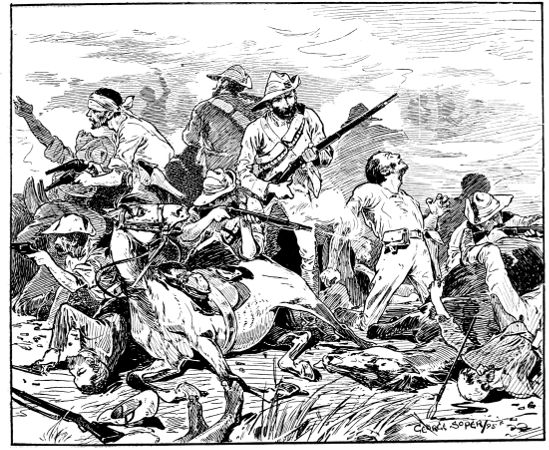
“THEY FOUGHT ON GRIMLY” (p. 118).
Then he told his story. Captain Borrow and the reinforcement had reached Major Wilson’s camp on the previous night, without falling in with the enemy.
At dawn, Major Wilson decided to make a rush on the King’s waggons. The whole force galloped up to within a few yards of the scherm, and then halted, while the interpreter shouted out to the King to come out and speak with the white men. The reply was a heavy fire from the King’s scherm and from the bush on either side. The fire was returned by our men; but, finding that the enemy were surrounding him, Major Wilson retreated for about half a mile, and took up a position on one of the gigantic ant-heaps which are frequent in this part of Africa. Here the action was carried on for some time, the Matabele fire being very wild and-producing little effect; but as the enemy were again surrounding him, under cover of the dense bush, Major Wilson ordered his men to remount, and the party commenced their retreat towards the river, retracing their way along the spoor of the King’s waggons.
Major Wilson then asked Burnham to make an attempt to reach the column and inform Major Forbes of the position of affairs. Burnham took with him two of the best-mounted troopers, and the three galloped off. They had not ridden far before they came upon a large body of Matabele, which was evidently marching to cut off Major Wilson’s retreat. The three troopers rode for their lives through the storm of bullets that was directed upon them, and contrived to escape uninjured to the river-bank. As they rode, they heard a heavy firing behind them, which told them that the body of the enemy they had just passed had attacked Wilson’s party. Burnham said that the patrol must have been completely surrounded by several thousands of Matabele warriors, and that it was impossible that a single trooper could escape; for the patrol, as he explained, could only retreat slowly, if at all—it could not cut its way through the Matebele: several of the horses had been killed, so that some horses had to carry two men; most of the horses were worn out, and there would be wounded men also to carry off. True, the best-mounted men might have galloped through and saved their lives; but a sauve qui peut is an expedient not resorted to in African warfare by white men, and still less so by men of the stamp of Wilson and his companions: they would certainly have stood by each other to the end.
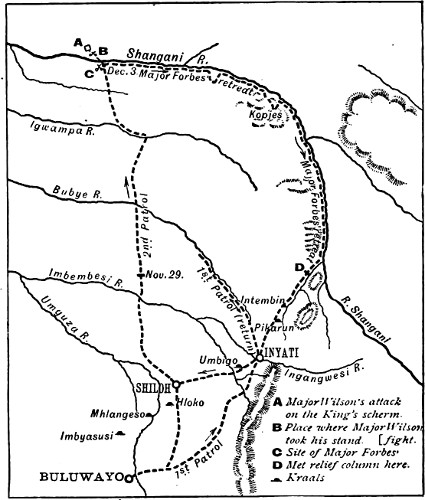
THE SHANGANI PATROL.
On reaching the river at the point they had crossed it on the previous day, Burnham and his two companions found it in flood, and had to follow the bank for a considerable distance before they came to a place where they could swim across.
There was now nothing left to Major Forbes but to save the remnant of his force, and retreat on Inyati and Buluwayo. The river was still up, and might remain so for days. It was absolutely impossible to transport Maxims across it, and to have sent men over the river without Maxims would have been to condemn them to certain slaughter. Major Forbes remained where he was for one day, in the hope of hearing some news of Wilson’s party; but none came. He then commenced his retreat along the left bank of the Shangani river, having first despatched two troopers to find their way to Buluwayo and ask Dr. Jameson to send reinforcements, food, and ammunition to meet him.
The hazardous retreat to Inyati occupied eleven days. The column suffered great privations, and was perpetually harassed by the Matabele, who hovered round it, creeping along through the bush on either side of the line of march, watching for an opportunity to rush the white men, but having a due respect for the Maxims. They occasionally opened a hot fire on the troopers and their horses, they attempted surprises, and were not repulsed without further loss to the already weakened column. In these skirmishes, the enemy succeeded in shooting a number of the horses, while many other horses died, or became so feeble that they had to be abandoned on the way: in all, about 130 horses were lost. The wounded men rode, but the troopers who were not ill and Major Forbes himself were now without mounts, and had to march over such rough ground that their boots soon wore out, and many of the men were walking in their wallets. At last there were no horses left sufficiently strong to carry the Maxims, so the gun-carriages were abandoned, and the Maxims were carried by men on foot. All baggage also was thrown away, the men retaining but a blanket each.
The men were worn out by the hard marching and constant anxiety, but displayed an admirable spirit. All supplies had run out, and they lived on the tough flesh of their exhausted horses. On one occasion they captured some of Lobengula’s cattle; but the enemy then fell on the column, and, during the progress of a smart skirmish, recovered the cattle and drove them all off again.
At last, when they were within a day’s march of Inyati, the troopers met the relief column that had been sent from Buluwayo with a good supply of food: they had now done with their privations and alarms, and reached Buluwayo without further difficulties.
At the end of January another patrol of 180 troopers of the Bechuanaland Border Police, under Colonel Gould Adams, with two Maxims, set out for the scene of the Shangani disaster, with the object of recovering the remains of Major Wilson’s party and the abandoned gun-carriages. It was also the aim of this expedition to follow up the Matabele amajakas—who were still holding out in force on the Shangani, and were preventing others from coming in—and to bring the King to terms if possible. This patrol, which I accompanied, did not get farther than Inyati. Very heavy rains made it impossible to push beyond that point for some weeks, and then, as the rainy season had set in in earnest, and the men, bivouacking night after night on the muddy ground, would have suffered much from the lowland fever, the Imperial authorities countermanded the patrol.
Dr. Jameson was still very anxious to enter into communication with Lobengula, whose whereabouts was unknown. There could be no secured peace until he had come to terms. Several natives whom the Administrator had sent with messages to the King failed to reach him; they came back and confessed that when they had fallen in with raiding parties of young warriors from the King’s force they had been afraid to go further, lest they should be put to death as spies of the white men.
As native messengers, not unnaturally, shirked the duty, it became apparent that Lobengula could only be approached by some white man who happened to be a persona grata to the King, and who was willing to undertake the perilous adventure. Mr. James Dawson—a Scotchman, who had for some years been residing in Buluwayo as a trader, respected by both white and black, a man possessed of the tact so necessary to one negotiating with suspicious savages, and whose relations with the King had always been most friendly—now pluckily volunteered to go to the King himself and deliver Dr. Jameson’s message. He accordingly set out with a Scotch cart on February the 4th, 1894, accompanied by one other brave white man, Mr. Patrick Riley, also an old resident in Matabeleland and a friend of Lobengula’s.
We waited anxiously until March the 7th, on which day Messrs. Dawson and Riley, having successfully accomplished the objects of their hazardous mission, returned to Inyati. As it came in there were signs to show that the party had had a very rough journey. The Scotch cart, dilapidated, its tent-cover torn by the thorny bush, was slowly drawn towards the camp by weary oxen; while the natives, who had set out from here thirty-two days before, active, well-nourished, and cheerful, now painfully crawled along with a miserable air, lean, haggard, their wasted limbs aching with the fever of the pestilential region they had traversed.
Mr. Dawson told me the story of his journey. The heaviest rains of the season fell while he and his companions were away, and their progress was very slow. Four days after their departure they came to an uninhabited country, where they travelled with difficulty among rocky kopjies or across deep morasses, often having to cut a way through the dense bush. Here wild beasts abounded, and each night numbers of lions roared around their camp. On reaching the banks of the Shangani they fell in with small parties of Matabele, who had decided to “come in,” and were on their way to Buluwayo. From these Dawson first learnt that the King was dead, and that his message would, therefore, have to be delivered to the chief indunas. On February 13th the mission arrived at the Shangani drift, and there found a number of natives suffering terribly from disease and lack of proper food: they had no grain of any sort, and had been subsisting on flesh alone. They were all anxious to “come in,” but had been afraid to do so, thinking that the white men would kill them in revenge for the cutting off of Major Wilson’s party. They were delighted to see Dawson and to hear his reassuring promises.
On the further side of the river was stationed a large force of Matabele, the amajakas of the Royal Regiment and others. These young warriors, suspecting that the two white men were the scouts of some patrol that was advancing to attack them, at first made hostile demonstrations; and it was, possibly, fortunate for Dawson and Riley that the Shangani was full at the time and quite impassable. The river did not subside until February 22nd; but in the meanwhile Dawson and the indunas of the regiments opposite communicated with each other by shouting across the swollen stream. Dawson thus succeeded in delivering his message of peace, allayed the apprehension of the Matabele, and established friendly relations with them. On the 22nd some men swam across the river to Dawson, and he was enabled to more fully explain to them the treatment they would receive if they “came in.”
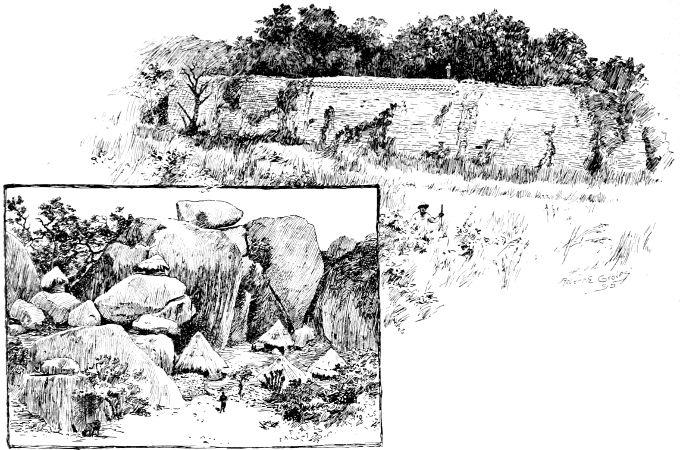
Left: ZIMBABWE KRAAL.
Right: ZIMBABWE TEMPLE.
On February 23rd the two white men crossed the river. This district must be excessively pestilential, for out of the thousands of Matabele whom Dawson found on the further bank of the Shangani, there was scarcely a man who was not down with fever, while numbers had perished. Their condition was most pitiable: many looked more like skeletons than men. Dawson found that even the young amajakas, weakened and dispirited by the sufferings they had undergone, had no heart for further fighting, but were anxious to “come in.” Dawson succeeded in convincing them that the white men, far from wishing to kill those who had fought in the war, respected these men most, and would treat them honourably. Umjan, who conducted the negotiations, was rejoiced to hear this, and said he knew the white indunas meant the Matabele well, for had they not sent to them as envoys the old friends of their people, Dawson and Riley, whom they trusted, and not strangers? So all agreed to go in and lay down their arms. The object of the mission was thus effected, and the rapid pacification of the country was insured.
Dawson found at this deadly spot not only Umjan, the old commander-in-chief, but several others of the leading indunas. He learnt that a number of people of note had died of disease or had committed suicide, and on Lobengula’s death several of his wives had hung themselves. Umjan told Dawson the story of the King’s decease and obsequies. Lobengula was suffering from fever and smallpox, but his heart was broken because the amajakas of his own—his favourite regiment, the Imbezu—had deserted him after the last fight: he contemplated suicide. Buzungwan, the head dance-doctor, or master of the ceremonies at the great festival of the first fruits, was the only man of note with the dying King. Umjan was sent for, but arrived too late to see Lobengula alive. “It is now time for your work—to bury the King,” said Buzungwan to him, pointing to the corpse. Umjan performed this honourable duty according to the traditional custom. He carried the body to a hollow under a precipice, and placed it on a stone so that it sat upright with the face turned towards the rising sun. He put upon it the richest royal raiment and ornaments, and placed the King’s war assegais in the dead hands. After piercing the body with an assegai, Umjan built a chamber of stones around it, with one great flat stone at the top, and then went away leaving Lobengula, the Calf of the Great Elephant, sitting in state, just as he was wont to do when alive.
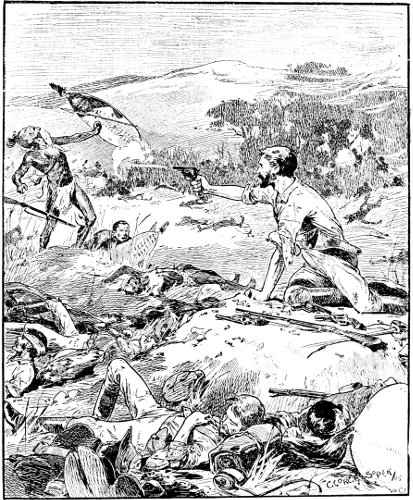
“HE SOLD HIS LIFE DEARLY” (p. 119).
All the people now prepared to leave the deadly banks of the Shangani and “come in.” Numbers were too weak to travel, so Dawson promised that food and medicine should be sent to them without delay. Some of the indunas accompanied him back to Inyati to represent the others. I was present when they were brought before Dr. Jameson. The Administrator explained to them that there would be no more king, and the white men would govern the country, but the indunas who behaved well would still rule their people, being answerable to the white magistrates; and there must be no more killing or witchcraft. He promised them full protection, and told them to return to the cultivation of the lands they had occupied before the war. He assured them that the white men bore no grudge against those of the Matabele who had taken up arms against them and killed their soldiers. White men knew they must lose some of their number when they went to war. The man he respected most in the whole country was old Urnjan, who had fought hardest against us, and had stood by his King to the very end. Dr. Jameson then asked the indunas if they had anything to say. They replied that, having no other road to go, they had come to lay down their heads before the great white chief, who could kill them or not. They were pleased with the treatment they had received at the hands of the white man. “And now we can sleep,” they concluded by saying—the usual Zulu method of expressing relief from anxiety. Often when men came in to surrender at Buluwayo, and Dr. Jameson asked them what they wanted, they would reply: “We have come to learn if we may sleep.”
When Dawson and Riley were on the Shangani, the natives took them to the spot where Wilson’s party had fallen—about four miles from the river-bank. They found the bones of the thirty-four troopers lying close together where the men had stood at bay and died fighting. Dawson buried these remains temporarily under a mopani tree, on which he cut the simple inscription: “To brave men.” He described the trees and bushes all round this spot as being cut about by what must have been a tremendous fire. It is estimated that the thirty-four white men killed ten times their number of the enemy, at least, on that day before they were slaughtered.
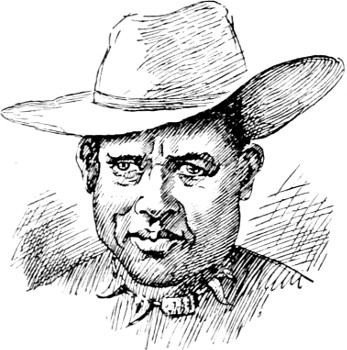
LOBENGULA.
(From a sketch from life by Mr. A. E. Maund.)
The fine old warrior, Umjan, whom I met at Buluwayo when he “came in” to surrender to the Administrator, gave a graphic and clear account of all that occurred. Umjan said that the King was not with his waggons when Major Wilson’s party attacked them: he had fled the day before with several of his indunas. Umjan had been sent by Lobengula on December 2nd with a strong impi to fall on Forbes’ column in the dense bush. Finding the column encamped in the open near the river, Umjan had to alter his plans. He left a portion of his force to lie in ambush on either side of the drift, and returned with the remainder to guard the King.
On the night of the 3rd, Umjan returned to the King’s waggons and learnt that the King had gone, and he was informed that Major Wilson’s patrol was encamped not far off in the bush. Umjan decided to do nothing that night, and await dawn. Wilson’s party was thus caught in a trap: behind it was the force ambushed at the drift, which had allowed the white men to ride by; in front was the force with Umjan.
In the morning Major Wilson attacked the waggons, and was repulsed in the manner described by Burnham. Umjan said that the white men retreated towards the river for about three miles, fighting gallantly all the while; and it was then that their further retreat was cut off by the other Matabele force which had crossed the river in the night, and which, hearing the heavy firing, had left the drift and was hurrying along the King’s spoor to take part in the fight.
Umjan and those with him saw Burnham and the other two troopers ride off just before the white men were completely hemmed in by overwhelming numbers. The Matabele did not understand that these three men had been despatched to obtain reinforcements, and marvelled that those others of the white men who had horses did not also “take refuge in flight instead of fighting by the side of their comrades until all were dead together.” We have only the Matabele account of what took place subsequent to the riding off of Burnham. Umjan said that the white men made several desperate attempts to break through the encircling swarms of Matabele, who were continually being reinforced by fresh arrivals.
At last, having lost several horses and having some men wounded, the troopers determined to sell their lives dearly. They formed into a close ring and, under cover of their fallen horses, opened a deadly fire on the Matabele whenever a rush was attempted. Umjan spoke with keen enthusiasm of the grand standing at bay of his white foemen. As they repelled each fresh attack with rifles and revolvers, and added to the heaps of Matabele dead that surrounded them, the troopers, said Umjan, “cheered and jeered at us as cowards, challenging us to come nearer.” The Matabele perpetually raised their guttural war-cry, “Shzee! shzee!” while, from under cover of the bush, they poured a constant fire into the thick of the white men. There was no crying for quarter on the part of the latter. They fought on grimly: when a man was wounded he laid down and continued to fire, or, if he was unable to fight, handed up his ammunition to his companions. “The white men are indeed the right men to meet in battle, even when they have no Maxims!” exclaimed old Umjan with flashing eyes.
And so they fought on, until at last all were either killed or wounded so severely that they could not fight longer, with the exception of one big man “who would not die.” “We could not kill him, often though we wounded him,” declared Umjan, “and we thought that he must have been a wizard.” This man, who was never identified, stood on the top of a large ant-heap, which was in the centre of an open space. He had collected round him the revolvers and the rifles, and ammunition of several of his dead comrades, and he killed a number of his assailants. The Matabele could not muster courage to approach him, for, according to their description, “he picked up weapon after weapon and fired rapidly, and with wonderful accuracy in all directions—in front of him, to the side of him, and over his shoulders—whenever Matabele ventured to come out of the bush into the open.” After killing many of them, he was at last shot in the hip, and had to fight sitting down. He sold his life dearly, and it was not till he sank exhausted from loss of blood from many wounds, that the Matabele made a rush on him, and stabbed him to death with their assegais. Even then it was not all over, for some of the dying troopers summoned sufficient strength to fire their revolvers at the approaching Matabele; and by this time the indomitable resistance they had met with, and the extent of their losses, had so awed and scared the enemy that they fled precipitately into the bush from that narrow circle of dead and dying Englishmen, and did not come back until some hours later when they found all was quiet: not one of their brave foemen was left alive.
Umjan, himself a gallant leader, far superior to his degenerate Zulu warriors, who often refused to follow him, thoroughly appreciated the dogged valour displayed by Wilson and his men. These were men after his own heart. Speaking to some of his amajakas in Dawson’s hearing, he said: “We were fighting then with men of men, whose fathers were men of men before them. They fought and died together: those who could have saved themselves chose to remain and die with their brothers. Do not forget this. You did not think that white men were as brave as Matabele; but now you must see that they are men indeed, to whom you are as but timid girls.”
Our men, it appears, did not exhaust their ammunition before they were slaughtered, as was at first reported, and Dawson found cartridges in the pouches and in the revolvers of the dead troopers; so it is more than probable that Wilson and his comrades gave a very good account of themselves, and sold their lives dearly as they fell, man after man, to the very last; and it is certain that they did not die before they had killed some four hundred of the enemy.
Dawson made a second journey to the banks of the Shangani, to carry supplies of food and medicine to the suffering Matabele, and brought back with him several leading natives and the surviving queens of Lobengula. The appearance of these people fully bore out his description of their condition. Though he had selected the strongest and most fit to travel, they were frightfully emaciated, some being reduced by famine and fever to the nearest approach to skeletons possible for a living creature: despite all his care, twenty-five people perished on the journey. On this occasion, Dawson disinterred the remains of Wilson’s party, and brought back with him the thirty-four skulls, most of which, we observed, had been pierced by bullets. These skulls are to be buried in consecrated ground near those grand remains of an unknown civilisation and religion—the ruins of the Zimbabwe temple. Here Mr. Cecil Rhodes proposes to raise a granite monolith to the memory of these brave men. I have seen the site, than which none more suitable could have been selected—a bare rocky mound rising above a wilderness of dense tropical bush and flowering trees, halfway between the pagan temple on the plain and the rugged Zimbabwe kopjie, crowned with massive fortifications of immense antiquity. A monument of simple dignity, standing amid these mysterious ruins, and surrounded by this wild and lonely scenery, will produce a most impressive effect.
THE SIEGE AND STORMING OF DELHI
BY CHARLES LOWE

Delhi, the ancient and magnificent capital of the Grand Moguls, or Mahomedan rulers of India, became the focus of the great and ever-memorable mutiny which made our Indian Empire run with blood during the year 1857. Of this mutiny among the native Indian troops, or sepoys, in British pay, some ugly signs had already been observed early in the year; but it was only on the 10th of May that military revolt openly raised its terrible head at Meerut—a place about forty miles north-east of Delhi. There were several causes of this rebellion, but perhaps the chief one was the fact that the native troops had been forced to use greased cartridges, which their religious principles or prejudices forbade them even to touch, as being encased with the fat of so unclean an animal as a pig. Out of respect for their scruples on this head, new rules had been made allowing the sepoys to tear, instead of bite, off the ends of the cartridges; but even this concession did not satisfy them, and, for positively refusing to touch the cartridges that were offered them, about a squadron of native cavalry at Meerut were sentenced to ten years’ penal servitude. In presence of the whole garrison, they were stripped of their uniforms, fitted with fetters, and marched off to prison, yelling out curses at their colonel as they went. Next evening the storm of evil and long-pent-up passions broke loose. The sepoy regiments at Meerut rose in open revolt, rushed to the gaol and released their comrades, murdered some of their English officers and their wives, plundered and slew like demons, and, leaving the place running with blood and wrapt in flames, fled to Delhi, the great stronghold of the Mahomedan dynasty and faith. So sudden and sanguinary had been this outburst against the British rule and name that the English commanders—all but a few whose energetic counsel was rejected—lost their heads completely for the time being, as if paralysed with astonishment and unbelief; and by the time they had recovered their senses the fugitive mutineers were safe within the walls of Delhi.
Standing on the right, or western, bank of the Jumna, which is here about a quarter of a mile broad, Delhi had a circumference of about seven miles and a population of nearly 200,000. In its palmiest days the city was said to have covered an area of twenty square miles. At the time of the mutiny it formed a magnificent collection of temples, mosques, and palaces. Of the mosques the chief was that of the Jumma Musjid, or great Mahomedan cathedral—a truly noble structure, towering above the rest of the city. Again, there was the mosque of Roushan-ud-Daulah, where, in 1739, Nadir Shar sat and witnessed the massacre of the unfortunate inhabitants. But that was nothing to what the present king of Delhi, Bahadoor Shah, was now about to look upon. Under the English, this descendant of Timour the Tartar had become the mere shadow of a king, and the thought that he was no longer a potentate, but a mere puppet in the hands of the real masters of India, had inflamed his heart against them with a passion which only needed a spark of fire to set it in a blaze. That spark was supplied by the sudden advent of the mutineers from Meerut on the 11th of May.
Crossing the Jumna by the bridge of boats they swarmed into the courtyard of the palace, where they were eagerly joined by the royal guards. Captain Douglas, the commander of these guards, rushed down from the presence of the King to quiet the turmoil, but his presence only made it worse. He was joined by Mr. Fraser, the Commissioner, and Mr. Hutchinson, the Collector; but the surging, roaring crowd closed in upon them with murder in their eyes The Englishmen attempted flight, Captain Douglas flinging himself into the moat; but he was badly hurt by his fall, while Mr. Hutchinson was also wounded. As these two were being carried to the apartments over the palace gateway, Mr. Fraser made one last effort to appease the multitude; but while in the act of speaking he was cut down and hewn to pieces. The whole ferocious crew then rushed to the upper rooms, where Mr. Jennings, the Chaplain, his daughter, and a young lady friend were tending the wounds of Captain Douglas and Mr. Hutchinson. Bursting open the doors, the dark, demoniacal throng poured in and hacked them to pieces. Then the sepoys, maddened with blood, streamed forth from the palace, and, accompanied by the scum of the city—the very vilest of mankind—flew to the European quarters, where they slew, burned, ravished, and raged without mercy—tossing English babies up on the points of their bayonets, and committing the most inhuman barbarities on their mothers, of which the very description would still bring burning tears to the eyes. An English telegraph clerk heard the awful uproar, but even when the flood of murder came surging towards him he went on with his work—click, click, click—flashing his warning message up to the authorities at the various military stations in the Punjab. “The sepoys,” he wired, “have come in from Meerut and are burning everything. Mr. Todd is dead, and, we hear, several Europeans. We must shut up.” The last click died away. The red-handed rebels burst in, and the staunch, cool-headed signaller died at his post, as most of his English countrymen did, and all were prepared to do, on that awful day of blood.
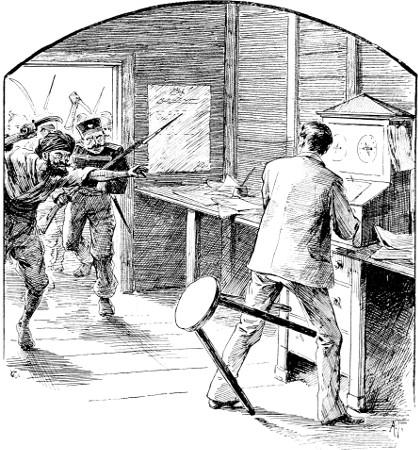
“THE COOL-HEADED SIGNALLER DIED AT HIS POST.”
Among these Englishmen in Delhi none acted with greater heroism than Lieutenant Willoughby—a “shy, refined, boyish-looking subaltern,” scarce capable of saying “Bo!” to a goose in piping times of peace, though his friends well knew what his spirit could be in the hour of danger. On this terrible day Willoughby chanced to be in charge of the magazine, containing vast stores of ammunition which he knew would be coveted by the mutineers. At once taking in the situation, he sent for help to Brigadier Graves, who was in command of the native garrison outside the city in its cantonments; but no help came, and for the simple reason that at this very time the English officers of this garrison were being massacred by their mutinous men. Willoughby could not trust his own native troops, but he had eight of his own countrymen, whom he knew to be as staunch as steel—Lieutenants Forrest and Raynor, Conductors (i.e. warrant-officers of the Ordnance Department) Buckley, Shaw, and Scully; Sub-Conductor Crow; and Sergeants Edwards and Stewart. Barricading the outer gates of the magazine, Willoughby placed guns there, double-charged with grape, which made the mutineers pause: but not for long.
Encouraged by the reports of their scouts, who had been sent out to see whether there was yet any prospect of English succour arriving from Meerut, they at last sent to demand the surrender of the magazine, “in the name of the King of Delhi,” who had meanwhile assumed the title of Sovereign of all Hindostan. To this insulting request only one answer was possible—none at all. Then the red-handed hordes of murderers came on against the magazine with ladders to scale the walls, and were mown down by the grape-shot of Willoughby’s guns. But the gaps made in their ranks were swiftly filled by fresh men swarming up the ladders, and within fifty yards they poured upon the “noble nine” Englishmen below a deadly shower of bullets. Two of them fell mortally wounded, but Forrest and Buckley, heedless of the leaden hail, continued to work their guns with a coolness as if on parade. At last they were struck—one in the hand and another in the head, and the guns could now be worked no longer. A loud shout of triumph rose from the mutineers, but this was shouting before they were out of the wood.
Willoughby saw that his case was now indeed desperate. He had kept the rebels at bay for about three hours, during which time he had repeatedly run to the bastion to strain his eyes and see whether he could discern the coming of any English help from Meerut. But neither from Meerut nor from the cantonments outside the city walls did any help make its appearance; and now the rebels were bursting in upon him in a roaring, bloodthirsty crowd. His countrymen at Meerut had not been true to him; but he would be true to himself. Foreseeing the possibility of his defences being forced, he had taken other measures of precaution. A train had been laid from the powder store to a tree standing in the magazine yard, and by this tree stood Conductor Scully, who had heroically volunteered to fire the train at a given signal from his chief. For this signal the time had come when the guns of Willoughby could no longer be worked. Then he quietly gave the order to Buckley, who raised his hat to Scully, who in turn fired the train; and in a moment more the city of Delhi was shaken to its foundations as with the shock of an earthquake, accompanied by a terrific roar of thunder and the flames and smoke of a volcano.
Scully fell an immortal martyr to the cause of his country, but with himself he blew into the air more than a thousand rebels, and, above all things, baulked the mutineers of their inestimable prey—the magazine. Four of the “noble nine,” wounded, shattered, and bruised, made good their retreat from the ruins; but the heroic Willoughby only survived to be murdered on his way to Meerut. Never has the Victoria Cross been given for a more heroic deed than the defence and blowing up of the Delhi magazine; and it was well said that the 300 Spartans, who in the summer morning sat “combing their long hair for death” in the passes of Thermopylæ, have not earned a loftier estimate for themselves than these nine modern Englishmen.
While the fight for the magazine had been going on, a tragedy of equal horror was taking place at the Cashmere Gate, and in the cantonments beyond the city walls. At both these places the sepoys had shot down or bayoneted their English officers, and when the magazine blew up, the natives of the 38th Regiment, throwing off the mask, suddenly fired a volley at their officers, three of whom fell dead. “Two of the survivors,” writes an historian of that awful time, “rushed up to the bastion of the main guard and jumped down thirty feet into the ditch below. The rest were following, when, hearing the shrieks of the women in the guard-room, they ran back under a storm of bullets to rescue them. The women were shuddering as they looked down the steep bank, and asking each other whether it would be possible to descend, when a round shot whizzing over their heads warned them not to hesitate. Fastening their belts and handkerchiefs together, the officers let themselves down, and then, having helped the women to follow, carried them with desperate struggles, up the opposite side,” whence the fugitives could reach the jungle. At the cantonments the fate of the English—women, children, and a few surviving officers—was something similar, and then began that piteous flight, with all its frightful sufferings, which hardened the hearts of the British to inflict a terrible revenge.
Meanwhile, in the city of Delhi itself rebellion was triumphant and merciless. All the Europeans that could be found were massacred and tortured in the most barbarous manner. Some fifty of them at the first sound of alarm had barricaded themselves—men and women—in one of the strongest houses of the English quarter. But they were ill-armed and without supplies, and what could they do against the furious rabble or ruffians who besieged them? They were dragged to the palace and lodged in a dungeon without windows, and with only one door. After five days these were all taken out into a courtyard and butchered in cold blood, their mangled bodies being piled on carts and thrown into the Jumna. That was on the 16th May—five days after the arrival of the mutineers from Meerut; and now Delhi had been cleansed of its last Christian. Murder and rapine, arson and outrages which cannot even be named, had done their fell work, and the English Raj, or rule, had been trampled underfoot no less at Delhi than at Cawnpore, Lucknow, and other centres of revolt. The climax of the rebellion had now been reached, but there still had to come the inevitable anti-climax. The blood of hundreds of English men, and women, and children, wantonly slaughtered, was crying aloud for vengeance, and a terrible vengeance it would be.
The mill-wheels of God, it has been said, grind slowly if surely; but rarely had they turned round so slowly as they now seemed to be doing after the terrible news from Delhi reached Meerut and the chief places in the Punjab. The mutiny had broken out so suddenly that the authorities were at first quite unable to cope with it, and precious time had to elapse before the army of retribution could be got to take the road. But meanwhile a cheerful and plucky spirit prevailed both amongst officers and men, notwithstanding all their fatigues, privation, and sickness; and if there was one man more than another, as his brother afterwards wrote of him, who helped to inspire and keep up this spirit—if there was one more than another who merited that which a Roman would have considered the highest praise, that he never despaired of his country—it was Lieutenant Hodson, of the 1st Bengal Fusiliers, formerly of the Guides. “I can but rejoice,” he wrote, “that I am employed again; certain, too, as I am, that the star of Old England will shine brighter in the end, and we shall hold a prouder position than ever. The crisis is an awful one, but with God and our Saxon arms to aid us, I have firm faith in the result.”
“Hodson is at Umballa, I know,” wrote an officer at Meerut; “and I’ll bet he will force his way through, and open up communication between the Commander-in-Chief and ourselves. At about 3 o’clock that night I heard my advanced sentries firing. I rode off to see what was the matter, and they told me that a part of the enemy’s cavalry was approaching their post. When day broke in galloped Hodson! He had left Kurnal (seventy-five miles off) at 9 o’clock the night before, with one led horse and an escort of Sikh cavalry, and, as I anticipated, here he was with despatches for Wilson! How I quizzed him for approaching an armed post at night without knowing the parole! Hodson rode straight to Wilson, had his interview, a bath, breakfast, and two hours’ sleep, and then rode back the seventy-five miles, having to fight his way for about thirty miles of the distance.” It was no wonder that another officer, writing to his wife at this time, said: “Hodson’s gallant deeds more resemble a chapter from the life of Bayard or Amadis de Gaul than the doings of a subaltern of the nineteenth century. The only feeling mixed with admiration for him is envy.” “The pace pleased him” (the Commander-in-Chief, General Anson), wrote Hodson himself, “for he ordered me to raise a Corps of Irregular Horse, and appointed me its commandant.”
At last, after a delay which nearly fretted to death the hearts of men like Hodson, the bulk of the army of vengeance started from Umballa under General Anson, who was presently, however, stricken down with cholera and carried off. He was succeeded by General Sir Henry Barnard in the chief command of the Delhi field force, consisting of only three Brigades, totalling about 3,000 Europeans, 1,000 native troops, and twenty-two guns—a poor enough army, surely, to be sent to recapture Delhi, with its hordes of highly-disciplined and well-armed sepoys behind its cannon-bristling walls. The plan of operations was that the two Umballa Brigades should advance to Baghput, where they would be joined by the Meerut Brigade, under Archdale Wilson, and then sweep on to the work of vengeance at Delhi. As it was the hottest season of the year, with its burning suns and blistering airs, the men rested in their tents during the day, and marched by night. “The nights were delicious,” wrote one who took part in the campaign; “the stars bright in the deep dark sky, the fireflies flashing from bush to bush, and the air, which in Europe would have been called warm and close, was cool and refreshing to cheeks that had felt the hot wind during the day. Along the road came the heavy roll of the guns, mixed with the jingling of bits, and the clanking of the steel scabbards of the cavalry. The infantry marched on behind with a dull, deep tread; long lines of baggage-camels and bullock-carts, with the innumerable sutlers and camp-servants, toiled along for miles in the rear, while the gigantic elephants stalked over bush and stone by the side of the road.”
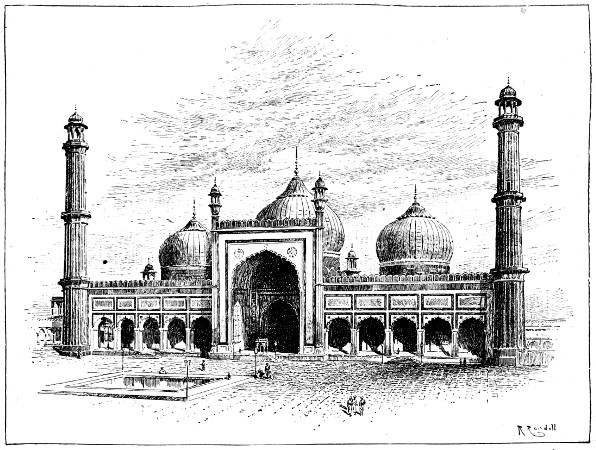
[Photo.: Frith, Reigate.
JUMMA MUSJID, DELHI.
The Meerut Brigade, being much nearer Delhi, set out on its march some days later than the Umballa force, and it had to fight its desperate way to the point of junction. After three nights’ marching the Meerut column, at dawn on May 30th, reached the village of Ghazi-ud-din-Nagar, near the river Hindun, about ten miles from Delhi; and here the bugler had barely time to call to arms when the rebels opened fire with heavy guns placed on a ridge. “The first few rounds from the insurgent guns,” wrote an eye-witness, “were admirably aimed, plunging through our camp; but they were ably replied to by our two eighteen-pounders in position, under Lieutenant Light, and Major Tombs’ troop, most admirably led by Lieutenant-Colonel Murray-Mackenzie, who, raking them in flank with his six-pounders, first made their fire unsteady, and in a short time silenced the heavy guns.” At the same time the 60th Rifles went for the rebels in a most spirited manner, and captured several of their heavy guns. But in doing so Captain Andrews and four of his men were blown up by the explosion of an ammunition waggon fired by one of the mutineers. The 6th Dragoon Guards, or Carabineers, then charged and completed the rout of the rebels, who left in the hands of their victors all their ordnance, ammunition, and stores. That night the officers drank in solemn silence to the memory of their brave departed comrades, who were buried at dawn beside a babool tree.
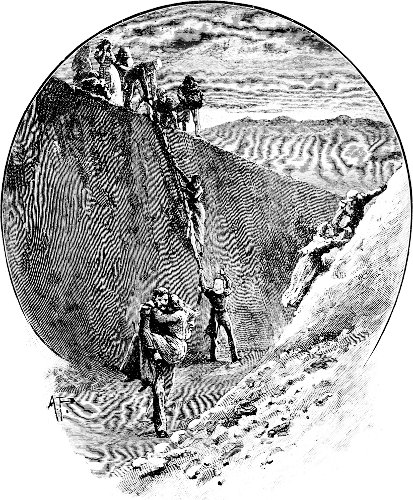
“THE OFFICERS THEN, HAVING HELPED THE WOMEN TO FOLLOW, CARRIED THEM UP THE OPPOSITE SIDE.” (p. 123).
Next day, which was Whit-Sunday, the rebels again returned to the attack, for they had been taunted with cowardice on presenting themselves at Delhi, and reinforced in order that they might redeem their reputation by hurling back the advancing force of Feringhees, or hated Franks—the name by which the English were known in India. But again the hurling back was all on the side of the sepoys, and once again they were sent scampering home to Delhi, though the English, at death’s door almost with the scorching heat and their parching thirst, were unable to follow up this second victory of theirs by pursuit. Twenty-three of the enemy lay together in one ditch, and for three miles the road to Delhi was strewn with dead bodies. The English had to mourn the loss of four officers and fifty men—among the former being Napier, an ensign of the Rifles, so active, so full of life, so brave, that he won the love and admiration of all. A bullet struck his leg, and the moment he was brought into camp it had to be amputated. During the operation never a sigh betrayed any sensation of pain. “I shall never lead the Rifles again,” he plaintively murmured; “I shall never lead the Rifles again.” A few weeks later the brave and generous lad was laid in his grave.
Next day the Meerut Brigade, which had done all the fighting hitherto, was reinforced by a battalion of Goorkhas, who were so overjoyed at the prospect of another fight that they threw somersaults and cut capers like so many mountebanks. But, much to their disappointment, the enemy did not return. Six days later the whole Meerut force crossed the Jumna and joined General Barnard’s Umballa Brigade at Alipur, being loudly cheered as they marched into headquarters camp with the captured guns and other trophies of their victories.
A day or two previously the intrepid Hodson had again been on the war-path. It was impossible for Barnard to move forward on Delhi without knowing something of the positions of the rebels in front of the city, and who but Hodson should volunteer to ride on and discover all that his commander wished to know! Taking with him a few troopers, he rode, as he wrote, “right up to the Delhi parade-ground, and the few Sowars (or native horsemen) whom I met galloped away like mad at the sight of one white face. Had I had a hundred Guides with me I would have gone up to the very walls.” A day or two later (8th July) he wrote:—“Here we are, safe and sound, after having driven the enemy out of their position in the cantonments up to and into the walls of Delhi. I write a line in pencil on the top of a drum to say that I am mercifully untouched, and none the worse for a very hard morning’s work. Our loss has been considerable, the rebels having been driven from their guns at the point of the bayonet.”
This was a reference to the battle of Badli-Ki-Serai, where the 75th (Stirlingshire) Regiment and the 60th Rifles again carried the day by a magnificent bayonet charge, though at a cost of 53 killed and 130 wounded, while the rebel loss amounted to about 1,000. The British loss had been severe; but the victory was worth the price, for the enemy had now been forced to surrender to their conqueror a commanding position, from which he could attack them with the greatest advantage, and the rebels had been driven ignominiously by a force far inferior to their own to take refuge within the walls of the city from which they had but lately expelled every Christian whom they had not slaughtered.
So here then, at last, on the 8th of June, our tiny British force had established itself in front of walled and embattled Delhi. Had anything so audacious, not to say impudent, ever been heard of before in the annals of warfare? Troy, surely, was mere child’s play to this, and Sebastopol a game of battledore. But weakness of numbers can sometimes be made up for by strength of inspiration; and every British soldier felt his heart swell to the size of that of twenty men when he looked around the cantonments before Delhi and beheld the still extant traces of the late massacre of his countrymen—the marks of blood, the broken furniture, the blackened walls, the shreds of ladies’ dresses, and even the locks of their hair, and, more maddening than all, the tiny boots of English babies who had been barbarously slaughtered and tossed up on the bayonets of the rebels. What the British soldiers, heroically strong in their numerical weakness, now longed with a fierce and overmastering desire to do was to cross bayonets with those incarnate fiends whom they had already swept back behind the walls of Delhi.
These walls, with a circumference of about seven miles, were made of large blocks of grey freestone, crowned by a good loopholed parapet. At intervals along the circumference they were provided with bastions, each armed with ten, twelve, or fourteen guns, a hundred and fourteen in all, in addition to sixty field-guns. The city had ten gates, strong, and aptly named after the cities or provinces towards which they opened—Cashmere, Cabul, Lahore, etc. The walls were about twenty-four feet in height, while in front ran a dry ditch, twenty-five feet wide and about twenty feet deep. The counter-scarp—i.e. the outer side of the ditch—and the glacis, or smooth open slope leading away from the edge of the ditch, were such as to move the admiration of the English engineers. One side of the city, the eastern, was washed by the broad and deep Jumna, and could not be thought of. On the other hand, with his tiny force, it was equally impossible for Barnard to invest the whole place. So he selected the northern front of the city as the object of his attack when he should be in possession of heavy enough siege-artillery to breach the wall and let in the avenging flood.
Meanwhile his position was the famous “Ridge”—a rocky elevation of about sixty feet above the general level of the city, extending along a line, obliquely to the front of attack, of a little over two miles, its left resting upon the Jumna some three miles above Delhi, and its right approaching the Cabul gate at a distance of about a thousand yards. Prominent points on this “Ridge” were the Flagstaff Tower, a ruined mosque, an ancient observatory, Hindoo Rao’s House, and Swami House, which, in the mouth of Tommy Atkins, speedily became “Sammy” House. These were all good points in favour of the British. But, on the other hand, the rebels, sallying out of the city, could profit by the cover afforded them by the suburban villages (Subzee Mundee, or “vegetable market,” the chief of them), gardens, groves, house-clusters, and walled enclosures, to indulge in a perpetual series of attacks on the British position. For though the English had come to besiege, the fewness of their numbers and the temporary want of heavy guns reduced them at first to the position of besieged; and for a long time—more than three months, in fact—their energies were consumed in fending off the ferocious sorties of the Delhi garrison. These sorties they began on the very day after the sitting down of the British on the “Ridge,” but were sent packing back again with serious loss. The repulse of their first sally was mainly due to the bravery of the famous Corps of Guides, composed of stalwart frontier men of all races, arrayed in their own loose, dusky shirts, and sun-proof, sword-proof turbans, who had marched into camp with a swinging stride that very morning, after moving for twenty-seven miles a day for three weeks, at the hottest time of the year—one of the greatest feats of the war. Three hours after their arrival they were launched against the rebels, whom they pursued up to the city walls, but at the cost of their dearly-loved commander, Lieutenant Quintin Battye. “Now I have a chance of seeing service,” he had joyfully exclaimed on setting out with his regiment, for he was a keen soldier, a good swordsman, and a splendid rider. But he fell in his very first fight, saying gaily to a comrade as he breathed his last: “Well, old fellow, dulce et decorum est pro patriâ mori; you see it’s my case.”
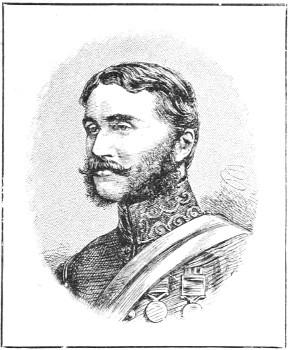
MAJOR TOMBS.
A few days after this General Barnard, believing with Macbeth that “’twere well it were done quickly,” had yielded to a scheme for storming the city offright—a scheme in which the bold and fiery Hodson had a prominent share. Under cover of the darkness, two columns were to steal up to as many gates, blow these in with gunpowder, and then rush into the city. But owing to a misunderstanding on the part of one of the commanders, the plan had finally to be abandoned—much to the disgust of the younger members of Barnard’s staff, who were simply dying for the performance of such a feat. Another council of war debated the chances of its success; but cautious—call it not timorous—counsels meanwhile prevailed, for the news of a repulse, following upon an ill-advised assault, would have added fresh fuel to the fire of the mutiny, which was now blazing up more furiously than ever, beyond the extinguishing power of rivers of blood, over the length and breadth of Hindostan.
From every part of the country the mutineers continued to stream in to Delhi, and ever, as fresh contingents arrived, they were sent out to try their prowess on the holders of the “Ridge”; and hold it they did with a tenacity which neither wounds, nor death, nor disease, nor pestilence could in the least degree relax. In the men’s tents they made merry, and, like the Greeks before Troy, had their sports just as if they had been far away at home on the village-greens of Old England. Stricken to death, the soldier told his officer he would soon be up again and ready for another brush with the mutineers. In the space at our disposal we cannot detail, we can scarcely enumerate, the actions that were fought in front of Delhi—more than thirty of them in twelve weeks, and all to the glory of the British name. Let one or two instances of conspicuous personal valour before the foe serve to illustrate the spirit which animated all our little besieging army.
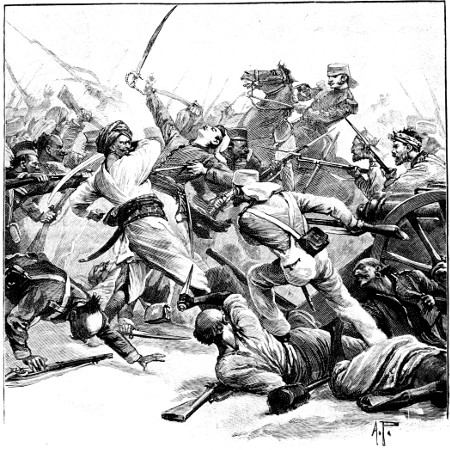
“IT WAS BAYONET TO BAYONET” (p. 130).
“I must tell you,” wrote an officer, “of a noble action of Lieutenant Hills of the Artillery (a young man who only four years ago had been a pupil at the Edinburgh Academy). He was on picket, with his two horse-artillery guns, when the alarm was sounded and an order sent him to advance, given under the impression that the enemy were at some distance. He was supported by a body of Carabineers—eighty, I believe, in number. He advanced about 100 yards, while his guns were being limbered up to follow, and suddenly came on about 120 of the enemy’s cavalry close upon them.
Disgraceful to say, the Carabineers turned and bolted. His guns being limbered up, he could do nothing, but, rather than fly, he charged them by himself. He fired four barrels of his revolver and killed two men, hurling the empty pistol in the face of another and knocking him off his horse. Two horsemen then charged full tilt at him, and rolled him and his horse over. He got up with no weapons, and, seeing a man on foot coming at him to cut him down, rushed at him, got inside his sword, and hit him full in the face with his fist. At that moment he was cut down from behind, and a second blow would have done for him had not Tombs, his captain, the finest fellow in the service, who had been in his tent when the row began, arrived at the critical moment and shot his assailant—by a splendid shot, fired at thirty paces. Hills was able to walk home, though his wound was severe; and on the road Tombs saved his life once more by sticking another man who attacked him. If they don’t both get the Victoria Cross, it won’t be worth having.” But they both did.
Another personal exploit of a similar kind was thus recorded by an officer:—“We took Khurkonda by surprise, and Hodson immediately placed men over the gates and we went in. Shot one scoundrel instanter, cut down another, and took a ressaldar (native officer) and some sowars prisoners, and came to a house occupied by some more, who would not let us in at all. At last we rushed in, and found the rascals had taken to the upper storey, still keeping us at bay. There was only one door and a kirkee (window). I shoved in my head through the door, with a pistol in my hand, and got a clip over my turban for my pains. My pistol missed fire at the man’s breast, so I got out of that as fast as I could, and then tried the kirkee with the other barrel, and very nearly got another cut. We tried every means to get in, but could not, so we fired the house, and out they rushed—running amuck among us. The first fellow went at Hugh (the writer’s brother), and somehow or other he slipped and fell on his back. I saw him fall, and, thinking he was hurt, rushed to the rescue. A Guide got a chop at the fellow, and I gave him such a swinging back-hander that he fell dead. I then went at another fellow rushing by my left, and sent my sword through him like butter, and bagged him. I then looked round and saw a sword come crash on the shoulders of a poor little boy—oh, such a cut! and up went the sword again, and the next moment the boy would have been in eternity; but I ran forward and covered him with my sword and saved him.”
“What a sight our camp would be,” wrote another officer, “even to those who visited Sebastopol! The long lines of tents, the thatched hovels of the native servants, the rows of horses, the parks of artillery, the British soldier in his grey linen coat and trousers, the dark Sikhs with their red and blue turbans, the Afghans with the same, their wild air and coloured saddle-cloths, and the little Goorkhas, dressed up like demons of ugliness in their black worsted Kilmarnock bonnets and woollen coats. In the rear are the booths of the native bazaars, and further out, on the plain, thousands of camels, bullocks, and horses that carry our baggage. The soldiers are loitering through the lines or in the bazaars. Suddenly an alarm is sounded, and everyone rushes to his tent. The infantry soldier seizes his musket and slings on his pouch; the artilleryman gets his gun horsed; the Afghan rides out to explore; and in a few minutes everyone is in his place.”
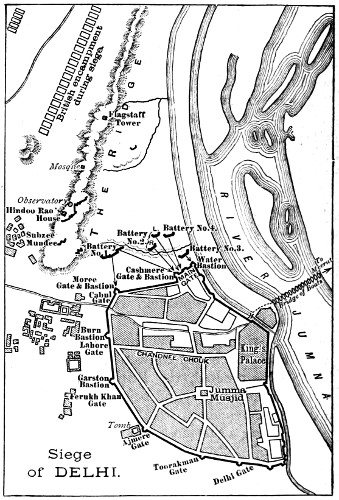
Siege of DELHI.
Such was the state of the camp in repose. And now for a picture, from another hand, of the same camp when roused into action. “I was out this night,” wrote an officer, “in one of our principal batteries with a party of my Guides, placed there to protect the guns; and I shall never forget the scene at two o’clock in the morning. The sight was a most magnificent one—all our batteries and all the city ones were playing as hard as they could, the shells bursting, round shot tearing with a whooshing sound through our embrasures, the carcasses (or large balls of fire) flying over our heads, the musketry rolling and flashing, made the place as light as day. The noise was terrific, though the roar of the cannon was frequently drowned in the roar of human voices, for, when the whole city turned out, there could not have been less than 20,000 voices all screaming at once. The mutineers’ yell of ‘Allah! Allah! Allah Akbar! Allah Akbar!’ was answered by our jolly English hurrahs, and the din was most frightful. I never remember seeing such a beautiful sight or hearing such a noise. The mutineers, though they tried very hard to take our batteries, could not succeed, though some of them got up near enough to throw hand-grenades into them. The grand attack lasted about two hours, when the enemy gave in a little, though they didn’t retire. The fighting went on all the rest of the night, and up to two o’clock next day, when both sides retired. We were all glad of a little rest, as most of us had been fighting for upwards of thirty hours.”
It was only after the 23rd of June that the prospects of the besiegers had begun to brighten. This was the hundredth anniversary of the day on which Clive, at Plassey, had founded British rule in India; and there had been a superstitious belief among the natives that on this centenary the English Raj would also come to an end. Accordingly, the Delhi mutineers, hounded on by their priests and astrologers, as well as encouraged by copious draughts of bhang (the native intoxicant), made an unusually vigorous push for the British position with intent to turn it and assail it in the rear; but they were finally repulsed with great slaughter, carrying back with them the bitter conviction that, far from being exterminated, the British Raj was now again in a fair way of being restored to its previous supremacy.
But perhaps the most brilliant action fought in front of Delhi—or, rather, several miles to the west of it—was that of Nujuf-gurh. The mutineers had got to know that our heavy siege-train, with but a slender escort, was at last approaching, and they determined to make a dash for it. But this was a game at which two could play, and Brigadier Nicholson, one of the greatest heroes of the war, who had by this time come down from the Punjab to take part in, and indeed conduct, the siege, was despatched with the Movable Column to do diamond cut diamond against the rebels. He found them in a very strong position, and greatly superior to him in numbers and guns. But what did that matter? Turning to his infantry, whom he ordered to lie down to avoid the showers of grape, Nicholson thus addressed them: “Now, 61st, I have but a few words to say. You all know what Sir Colin Campbell said to you at Chillianwallah, and you must also have heard that he used a similar expression (to his Highlanders) at the Alma: that is, ‘Hold your fire till within twenty or thirty yards of the battery, and then, my boys, we will make short work of it.’”
Let one of Nicholson’s officers now take up the tale:—“Our guns went away to the flank. We got ‘Fix bayonets; quick—march!’ On we went, in a beautiful line, at a steady pace. On we went, and we got within some fifty yards of them, when the men gave a howl, and on we dashed, and were slap into them before they had time to depress the guns. It was bayonet to bayonet in a few moments, but we cut them up and spiked the guns. We had very few men killed in the charge, as we got in before they fired the grape. Lieutenant G., 61st, was bayoneted by a sepoy after cutting down two. N. shot the man that did it. He had his horse shot under him, and I saw him hand-to-hand with a sepoy, whom he polished off with his sword.... On we went after the brutes, and cut up a heap at the serai and behind it. We then drew up in line, rallied, and went at the camp, took it, sent a party to take the village, and then we went and took the guns at the bridge, over which the enemy was bolting in thousands. Here we took six guns more. Up came our guns, and blazed away at the enemy, and off they went, leaving a host of stores, etc., all along the road.... I was so tired that I lay down on a hide and fell asleep. Next morning the work of destruction was finished, and off we marched with a lot of treasure, etc., and thirteen guns, and brought all safe into camp, after a hard march, arriving at the camp-bridge just in the cool of the evening, when the camp turned out to meet us, and gave us ‘three times three,’ and played us in with some lively airs, with a final ‘Hip—hip—hurrah!’ for the gallant 61st, who had reserved their fire, as the Highlanders of the ‘thin, red line’ had done at Balaclava, until they had almost seen the whites of their enemy’s eyes, and then ‘given them beans’ with bullet and bayonet.”
On the 4th of September the siege train, each gun drawn by twenty pairs of bullocks, at last arrived, and the hearts of all the British beat high at the thought that the assault must now soon be delivered on the doomed city. Two days later also considerable reinforcements came in, bringing up our little siege army to 6,500 infantry, 1,000 cavalry, and 600 artillery—of which only 3,317 were British troops, and the European corps were now mere skeletons of their former selves. In order to stimulate the spirits of this miscellaneous host, Wilson issued a general order, in which he expressed his assurance that “British pluck and determination will carry everything before them, and that the bloodthirsty and murderous mutineers whom we are fighting will be driven headlong out of their stronghold and exterminated”; but, to enable them to do this, he warned the troops of the absolute necessity of their keeping together, and not straggling from their columns. By this only could success be secured. “Major-General Wilson,” he continued, “need hardly remind the troops of the cruel murders of their officers and comrades, their wives and children, to move them to the deadly struggle. No quarter should be given to the mutineers! At the same time, for the sake of humanity and the honour of the country they belong to, he calls upon them to spare all women and children that may come in their way.”
Meanwhile the Engineers, directed by Baird-Smith, another of the giants of this Trojan-Delhi fray, set to work in the darkness and silently traced out the siege-batteries. A long string of camels brought in fascines and sandbags, and hundreds of men exerted themselves to the utmost in raising them, as the work had to be completed before dawn. Showers of grape-shot were rained on them from the battlements, but our devoted men worked on with a will, and by morning Battery No. 1 was in working order and belching forth its eighteen-pound shot at such a rate that the Moree Bastion soon became a heap of ruins. This battery was commanded by Major Brind, of whom it was said that “he never slept,” and would say to his men as he shouldered a musket—“Now, you lie and rest; your commandant will defend the battery.” “We talk about Victoria Crosses,” said someone; “Brind should be covered with them from head to foot!” Battery No. 2, of eighteen guns, was constructed in two portions on the left about 500 yards from the Cashmere Gate, its task being to knock away the parapet right and left that gave cover to the defenders, and to open the main breach by which the city was to be stormed. Conspicuous for his cool bravery in this battery was a young lieutenant—Roberts—who had some very narrow shaves during the siege, but luckily escaped death in all its various forms to become one of the most distinguished fighters ever produced by India, that cradle of great soldiers, and to gain for himself an immortal name as the hero of the famous march from Cabul to Candahar.
Two other batteries, Nos. 3 and 4, were also raised, one of them mounting six eighteen-pounders; and at eight o’clock on the morning of the 11th of September a terrific roar announced that our biggest breaching-guns had opened fire. A loud cheer, sending the smoke whirling away in eddies, burst from the throats of our artillerymen as they saw how well their fire had taken effect, and beheld huge blocks of stone tottering and tumbling down from the parapets of the walls. Cheer after cheer went up at this most gratifying sight, and in about ten minutes the enemy’s counter-fire from the bastions had been completely silenced. Yet they did not at once give up the artillery duel. For what they could not do from the walls they tried to compass in the open, and ran out several guns, with which they did great damage by enfilading our batteries. They also sent out rockets from their Martello towers, and kept up a storm of musketry from their advanced trench as well as from the walls, causing us severe loss. But who cared for loss when Delhi was there to be won? Night and day, day and night, did our siege-batteries belch forth their thunderbolts against the city walls; and by the 13th of September it was concluded that the long-wished-for time had at last arrived. Yet it behoved the besiegers to proceed with caution, and so four Engineer officers were selected to steal forward to the Cashmere and Water Bastions and find out whether the breaches there were now big enough to allow of the assault.
There was no moon, but the sky was bright with stars, and with the lurid light of flashing rockets and fire-balls. Suddenly, as the clock struck ten, the thunder of the guns ceased, and then the explorers, drawing their swords and feeling for their revolvers, began to creep towards the ditch. Medley and Lang, Home and Greathed were the officers who had volunteered for this perilous service. The two former got down into the ditch undiscovered; but then, to quote the words of Medley himself, “a number of figures appeared on the top of the breach, their forms clearly discernible against the bright sky, and not twenty yards distant. We, however, were in the deep shade, and they could not apparently see us. They conversed in a low tone, and presently we heard the ring of their steel ramrods as they loaded. We waited quietly, hoping they would go away, when another attempt might be made. Meanwhile, we could see that the breach was a good one, the slope easy of ascent, and that there were no guns on the flank. We knew by experience, too, that the ditch was easy of descent. It was, however, desirable to get to the top, but the sentries would not move.” Medley then gave the signal, and the party started to return to the camp. But the sound of their departing feet betrayed them. “Directly we were discovered a volley was sent after us; the balls came whizzing about our ears, but no one was touched.” A favourable report being also received from Home and Greathed, orders were given for the assault at dawn.
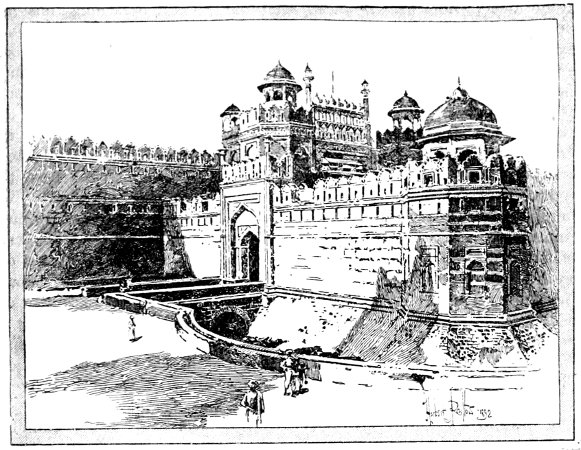
THE PALACE, DELHI.
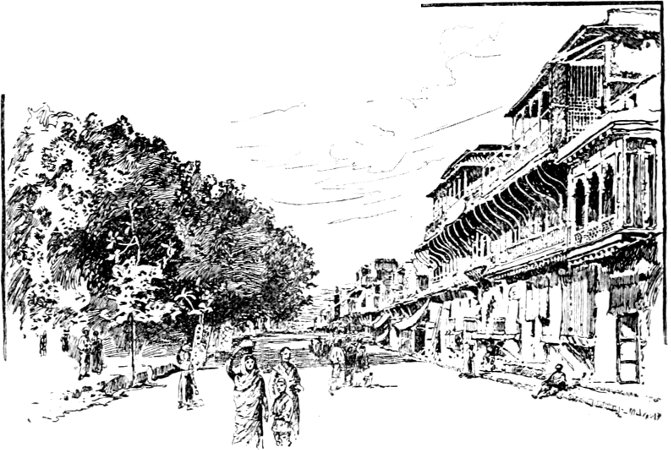
[Photo: Frith & Co., Reigate.
THE CHANDNEE CHOUK, DELHI.
The infantry of the storming force was divided into five columns, the duty of the first, under Brigadier Nicholson, being to storm the breach near the Cashmere Bastion. The second, under Brigadier Jones, had likewise to storm the Water Bastion. To the third, commanded by Colonel Campbell, fell the task of storming through the Cashmere Gate after it had been blown in; while the fourth column, under Major Reid, was told off to assault the suburb of Kissengunge and support the main attack by effecting an entrance at the Cabul Gate after it should be taken; and the fifth, under Brigadier Longfield, was to follow the first and act according to circumstances.
By three o’clock the whole camp was astir. Many of the officers and men had taken the Holy Communion the night before, and in some tents the Old Testament lesson for the day had been read—the chapter being that in which the doom of Nineveh was foretold. Some 6,000 men, of whom only about 1,200 were British soldiers, were going to take a walled city defended by 30,000 desperate and disciplined rebels. The news of the foul and treacherous massacre at Cawnpore by the Nana Sahib had by this time reached the soldiers, and inflamed their hearts anew with the desire to take fearful vengeance on such barbarous foes. They had suffered more than tongue could tell; but the hour of their retribution and their great reward was now at hand.
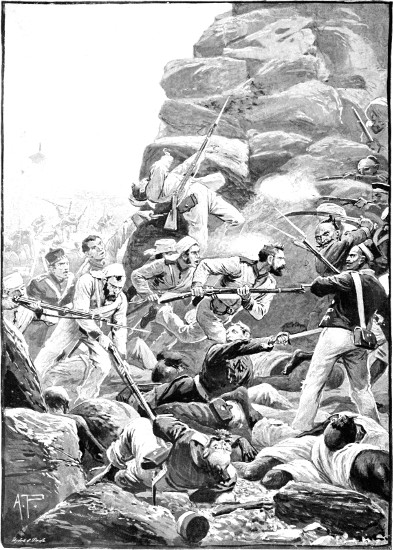
“THE STORMERS DASHED OVER THE DÉBRIS OF THE BREACH” (p. 133).
Suddenly the roar of the guns ceased, and the columns started to their feet as the Rifles, with a loud cheer, dashed to the front in skirmishing array. In a stern silence the storming columns tramped away towards the ditch; but it was now bright day, for, owing to some hitch, they had not been able to move with the dawn. The consequence was that before they had reached the crest of the glacis, with the Engineers and laddermen in front, numbers of them had fallen under the truly infernal shower of bullets that was rained upon them from the walls. For several minutes the first column found it impossible to lower the ladders and descend into the ditch while the fiendish-looking rebels cursed and yelled at them from the other side, daring them to come on. Presently the ladders were thrown into the ditch, and the men, leaping down after them, planted them against the scarp and swarmed up. Nicholson himself, the “Lion of the Punjab,” as he was well called, was the first to mount the breach, waving with his sword for his men to follow. In a similar manner Lieutenant Fitzgerald led the escalade of the adjoining bastion and fell mortally wounded. With a rousing cheer the stormers dashed over the débris of the breach like an irresistible wave bursting in a breakwater wall. For a few minutes there was a wild chaos of cheers, groans, yells, blazing of musketry, and clash of crossing bayonets, and then the rebels turned and fled like a pack of wolves, leaving this portion of their ramparts in possession of the victorious Nicholson.
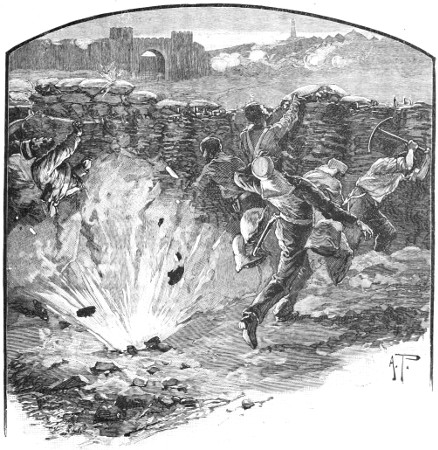
“OUR DEVOTED MEN WORKED ON WITH A WILL” (p. 131).
Meanwhile, the second column on the extreme left had carried the Water Bastion by an equally successful, but an equally sacrificial, rush. For of the thirty-nine laddermen preceding the column, twenty-nine were struck down in a few minutes; but their comrades seized the ladders and reared them up against the scarp, while others rushed up the breach, and bayoneting all before them, drove the rebels from the walls. Then, turning to the right, the stormers swept along the ramparts towards the Cashmere Bastion, where they were joined by some of Nicholson’s men, and, rushing ever along the walls, reached the Moree Bastion, where they slew the gunners and leapt on to the parapets, sending up a cheer and waving their caps to their comrades on the Ridge as a signal of victory.
All this work had been short and sharp, and done with a splendid courage. But perhaps the scene of the finest acts of individual heroism was the Cashmere Gate, where the third column, under Colonel Campbell, had meanwhile also forced an entrance in the following manner: Covered by the fire of the 60th Rifles, a party of sappers and miners advanced at the double toward the Cashmere Gate. Lieutenant Home, with Sergeants Smith and Carmichael, and Havildar Mahoo leading and carrying the powder-bags, followed by Lieutenant Salkeld, Corporal Burgess, and some others. They reached the gateway unhurt, and found that part of the drawbridge had been destroyed; but passing by the precarious footing supplied by the remaining beams, they proceeded to lodge their powder against the gate. The wicket was open, and through it the enemy kept up a heavy fire upon them. Sergeant Carmichael was killed while laying his powder, but when this was at last laid, the advanced party slipped down into the ditch to allow the firing party, under Lieutenant Salkeld, to do its duty. While endeavouring to fire the charge, Lieutenant Salkeld was shot through the leg and arm, and handed over the match to Corporal Burgess, who fell mortally wounded just as he had successfully done his duty. Then a terrific thunder-roar and explosion, scattering large masses of masonry, and mangled human forms in all directions, announced that these acts of heroism had been crowned with success. Lieutenant Home now ordered Bugler Hawthorne to sound the regimental call of the 52nd Regiment as the signal for the advance of the column; and this was thrice repeated, lest, amid the noise and tumult of the assault, the tones of the trumpet should not be heard. Then, after having thus coolly blown his bugle, the brave Hawthorne turned to Lieutenant Salkeld and bound up his wounds under a heavy musketry fire, thus ensuring for himself the Victoria Cross, which was also conferred on the few survivors of this “glorious deed—the noblest on record in military history,” as Baird-Smith justly called it when bringing it to the notice of his chief. “Salkeld mortally wounded,” said another writer, “handing over the portfire and bidding his comrade light the train, is one of those incidents which will remain till the end of time conspicuous on the page of history.”
With a way thus opened up for it, Colonel Campbell’s storming column now burst into the city, slaughtering all it met; and was only stopped in its career of conquest when it reached the Chandnee Chouk, or Piccadilly of Delhi, running right through the city from the Lahore Gate to the Palace.
In the meantime Major Reid’s fourth column, whose task was to advance against the Cabul Gate, had been less successful—had, in fact, come to grief. For having to fight his way through some suburbs affording splendid cover to the rebels, his men were very much cut up, and, on the fall of their leader, had to retire. At one time it was gravely feared that the enemy, elated with their success at this point, would issue in overwhelming numbers and seek to turn the flank of the British outside position and thus threaten the camp. But at the critical moment Hope Grant brought up the Cavalry Brigade, which had been covering the assaulting columns, and made the rebels pause. For two hours the troopers, drawn up in battle array, sat like statues, while the ranks were every minute rent by musket ball and grape. Not a man flinched from his post, though under this galling fire for two hours. Of Tombs’ troop alone twenty-five men out of fifty, and seventeen horses were hit. The 9th Lancers had thirty-eight men wounded, sixty-one horses killed, wounded and missing, and the officers lost ten horses. Nothing daunted by these casualties, these gallant soldiers held their ground with a patient endurance, and on their commander praising them for their good behaviour they declared their readiness to stand the fire as long as ever he chose. Against such firmness the foe could make no headway, and outside the city their counter-attack was at last foiled.
It would take a volume to describe the course and incidents of the conquering career of the various storming columns which had forced their way into the heart of the city; but let the following description of the doings of Nicholson’s first column serve as a sample of the fighting which had still to be done. The writer, Mr. Forrest, drew up his narrative after visiting the spot in the company of Lord Roberts.
“On reaching the head of the street at the Cabul Gate, the enemy again made a resolute stand, but were speedily driven forward. A portion of the first column was halted here, and proceeded to occupy the houses round the Cabul Gate, while the remainder continued the pursuit. As the troops advanced up the Rampart Road, the enemy opened a heavy and destructive fire from the guns on the road and a field-piece planted on the wall. The English soldiers, raising a shout, rushed and took the first gun on the road, but were brought to a check within ten yards of the second by the grape and musketry with which the enemy plied them, and by the stones and iron shot which they rolled on them. Seeking all the scanty shelter they could find, the men retired, leaving behind the gun they had captured. After a short pause they were re-formed, and the order given to advance. Once again the Fusiliers, scathed with fire from both sides, rushed forward and seized and secured the gun. They plunged forward, and had gone but a few yards when their gallant leader, Major Jacob, fell mortally wounded. As he lay writhing in agony on the ground, two or three of his men wished to carry him to the rear; but he refused their aid, and urged them to press forward against the foe. The officers bounding far ahead of their men, were swiftly struck down, and the soldiers, seeing their leaders fail, began to waver. At this moment the heroic Nicholson arrived, and, springing forward, called with a stentorian voice upon the soldiers to follow him, and instantly he was shot through the chest. Near the spot grows a tall, graceful tree, and Nicholson ordered himself to be laid beneath its shade, saying he would wait there till Delhi was taken. But for once he was disobeyed and removed to his tent on the Ridge.”
Had Nicholson been allowed to lie under the tree, he would have had to wait several days yet before the capture of the city was completed. So far the besiegers had done little more than effect a foothold within its walls, and at a cost of 66 officers and 1,100 men in killed and wounded—or about two men in nine. The bullets of the rebels had worked sad havoc among the stormers, and what these bullets had spared drink and debauchery threatened to destroy. For, knowing the weakness of the British soldier for strong drink, the rebels had cunningly strewn the deserted shops and pavements with bottles of beer, wine, and spirits; and now there ensued scenes of revelry and abandoned indulgence in liquor which recalled to mind the assault and capture of Badajoz. But the demon of destruction filled the breast of the British soldier as well as the demon of drink, and though, true to the injunction of his commander, he spared, and was even kind to, women and children, he slaughtered without mercy all the males who crossed his avenging path. But if provocation be any excuse for massacre, or blood be the just equivalent of blood, then certainly the British soldier in Delhi must have had many apologists.
The task of carrying the rest of the town was carried out day by day with skill and caution. From the first a continuous fire from our guns was kept up on all the remaining strongholds of the rebels—the Palace, Jumma Musjid, etc.; and at dawn on the 16th the magazine was stormed and taken with but slight loss. The same day the rebels evacuated the suburb Kissengunge. On the evening of the 19th the Burn Bastion was surprised and captured by a party from the Cabul Gate, and early next morning the Lahore Gate, to which the Engineers had sapped their way through the adjacent houses, was taken, as well as the Garsten Bastion; finally, on the same afternoon, the gates of the Palace, which had witnessed the cruel murder of English officers, women, and children, were blown in, and our troops raised a final shout of victory before the throne of Bahadoor Shah. That shadow of a monarch had fled and taken refuge in the tomb of the Emperor Humayoon, outside the city; but here he was sought and found by Lieutenant Hodson, who, escorted by only a few sowars, undertook the exceedingly dangerous task of capturing the king.
The story of this capture, as told by one of Hodson’s comrades, reads like a romance. After securing his captives, “the march towards the city began—the longest five miles, as Hodson said, that he had ever ridden; for, of course, the palkees only went at a foot-pace, with his handful of men around them, and followed by thousands, any one of whom could have shot him down in a moment. His orderly told me it was wonderful to see the influence which his calm, undaunted look had on the crowd. They seemed perfectly paralysed at the fact of one white man carrying off their king alone. Gradually, as they approached the city, the crowd slunk away, and very few followed up to the Lahore Gate. Then Captain Hodson rode on a few paces, and ordered the gate to be opened. The officer on duty asked simply as he passed what he had got in his palkees. ‘Only the King of Delhi,’ was the answer, on which the officer’s enthusiastic exclamation was more emphatic than becomes ears polite. The guard were for turning out to greet him with a cheer, and could only be repressed on being told that the king would take the honour to himself. They passed up the magnificent deserted street to the Palace Gate, where Captain Hodson met the civil officer, and formally delivered over his royal prisoner to him. His remark was amusing: ‘By Jove! Hodson, they ought to make you Commander-in-Chief for this.’”
Next day Hodson returned for the king’s sons, but to them he was less merciful. “I came,” he wrote, “just in time, as a large mob had collected and were turning on the guard. I rode in among them at a gallop, and in a few words I appealed to the crowd, saying that these were the butchers who had slaughtered and brutally ill-used helpless women and children, and that the Government had now sent their punishment. Seizing a carbine from one of the men, I deliberately shot them one after another. I then ordered the bodies to be taken into the city, and thrown out on the ‘Chiboutra,’ in front of the ‘Kotwalie,’ where the blood of their innocent victims could still be traced. The bodies remained before the Kotwalie until this morning, when, for sanitary reasons, they were removed. Thus in twenty-four hours, therefore, I disposed of the principal members of the house of Timur the Tartar. I am not cruel, but I confess I did rejoice at the opportunity of ridding the earth of these wretches.”
This summary act of vengeance aroused much difference of opinion as to its justice and humanity, but Hodson himself wrote: “I am too conscious of the rectitude of my own motives to care what the few may say, while my own conscience and the voice of the many pronounce me right.”
That same night the toast of “Her Majesty the Queen,” proposed by the conqueror of Delhi, was drunk with all honour in the Dewan-i-Khas by the headquarters staff. Never had the old building re-echoed with any sound half so fine. The cheer was taken up by the gallant Goorkhas of the Sirmoor Battalion who formed the General’s personal guard, and was, indeed, soon re-echoed all over India, all over the English world.
Thus, then, ended this famous siege, one of the greatest and most memorable in the history of England—a siege which, out of an effective force that never amounted to 10,000 men, entailed a loss of 992 killed and 2,845 wounded, apart from all those who died from disease and exposure; but a siege, at the same time, which added an imperishable leaf to England’s laurel crown, and enabled her to retain her imperial hold on Hindostan.
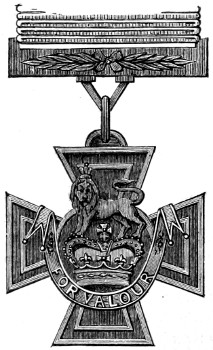
THE VICTORIA CROSS.

Gislikon by A: J: Butler
“What battle is this?” we can conceive our readers asking; “and where is Gislikon?” The form of the name may put some on the right track. In one of the most frequented regions of Switzerland “-ikons” are as common as “-inghams” in England, and no one who has travelled over any of the railways about Zürich or Lucerne can have failed to notice some instance of the odd-looking termination. Switzerland is indeed the country to which we are going, and among those of our readers who have already visited that “playground of Europe,” we will venture to say that at least one-half have been close to, if they have not actually passed over, the field on which the battle that we are going to describe was fought. For Gislikon lies not more than six miles from the top of the world-famous Rigi; it is a station on the not less famous St. Gotthard railway.
Having got so far, we are prepared for further inquiries, not unmixed with incredulity. It is hard for us to realise that a battle has been fought in Switzerland during the last fifty years. One can almost as easily imagine a battle in England as in that prosperous little country, which many of us look upon as almost an appendage to England, and associate with nothing more serious than holidays and hotels and mountain-rambles. The better-informed have heard of cantons, and probably think that they are something equivalent to English counties or French departments; while they suppose that the country called “Switzerland” has always been much where it is now, with the same frontier and the same territory. How many, we wonder, realise when they cross the well-known Gemmi Pass from Leukerbad to Kandersteg that they are passing from one sovereign State, with its own laws, into another, and that while the State into which they are going, Bern, has been part of the Confederation which is now called Switzerland for more than 500 years, the one which they are leaving, Valais, only became so at a date when Mr. Gladstone was already six years old? So it is, however, and men much younger than Mr. Gladstone can remember a time when Bern and Valais were actually at war with each other, just as, a few years later, Pennsylvania and Louisiana were at war. Happily, in the case of Switzerland the war was quickly finished, lasting hardly as many weeks as the greater conflict lasted years, and involving, as we shall see, a far smaller loss of life and property than many wars which have had far less important results. It is probably not too much to say that had the battle not been fought where it was, or had the issue been different, there would now be no Switzerland at all on the map of Europe.
Before describing the battle, we must give some account of the events which led to it. The years of peace which followed the battle of Waterloo, were by no means years of domestic tranquillity for most of the Continental States. The various absolute governments had been thoroughly frightened by the events of the French Revolution, and ruled more absolutely than ever. The rearrangement of Europe also, which followed the fall of Napoleon, had, in many cases, produced much discontent; and, in one way or another, every country was going through a critical period. Kings were driven from their thrones; men were constantly punished for the mere expression of their opinions; secret societies were formed, and assassinations were frequent.
Switzerland, too, had its troubles, though as the form of government in every canton was already republican, these took the shape rather of fights between contending parties than of rebellion followed by repression. One great cause of difference was to be found in the various views as to a revision of the “Federal Pact,” or treaty, which governed the relations of the States to the Confederation, the Liberals wishing to see these drawn closer, while the Conservatives favoured cantonal independence. Other differences were due to local causes. Thus in Schwyz a serious quarrel arose over the use of the common pastures. The wealthier men who could keep cows were thought to have unfair privileges over those who had only sheep and goats. The former were known as “horn-men,” the latter as “hoof-men.” They represented the Clerical (or Conservative) and Liberal parties respectively, and the Federal Diet had, in 1838, to interfere to keep the peace between them. The comparative strength of parties varied very much in the different States, and even in the same State sudden changes of feeling were not infrequent. Moreover, matters were complicated by religious differences. Some of the cantons were Catholic, some Protestant, while in others the population was more or less evenly divided between the two forms of faith. It by no means followed that the political divisions went on the same lines as the religious; and in almost every canton there were representatives of both parties. Lucerne was the most powerful of the Catholic cantons, and until 1841 had been on the Liberal side, and in favour of a revision of the Federal Pact. In that year, however, the Government was utterly overthrown at the polls, and the Clerical party came into power, headed by Constantine Siegwart, an able and ambitious man, who had formerly been strong on the other side. The neighbouring canton of Aargau, which was divided between Catholics and Protestants, and which had only joined the Confederation in 1803, had in the previous year found it necessary to suppress its monasteries, which had fomented opposition to the Government. Lucerne made a strong effort to persuade the Federal Diet to treat this as a breach of the Constitution, according to which all religions were to be respected; and Aargau, although many of the Catholic inhabitants were in favour of the suppression, only escaped stronger measures by consenting to restore some of the monasteries. This business, which was not finally settled till 1843, embittered the feeling between the two cantons, and in Switzerland generally. Seven cantons—Lucerne, Uri, Schwyz, Unterwalden, Zug, Fribourg, and Valais—made a formal protest against the decision of the Diet to leave Aargau alone; and subsequently formed themselves into a separate league, “for the protection of the Catholic religion.” This league was known as the Sonderbund.
AT BERN.
Events now began to move rapidly. In May, 1844, fighting took place in Valais, not far from the spot where tourists now go to see the “Gorge of the Trient,” and the Liberals, who had been in power until the previous year, were driven out, not without bloodshed; the leaders only escaping by swimming the Rhone. About the same time Lucerne called in the Jesuits to direct education in the canton. There has always been in Switzerland a good deal of suspicion of this order, who have been, rightly or wrongly, believed to exercise a considerable underhand influence in politics; indeed, the recent conflict in Valais was thought to have been instigated by them; and though they already had a footing in some cantons, their introduction into what was at this time the leading State of the Federation was viewed with alarm, even by many Catholics and Conservatives; while it grievously offended all the cantons in which there was a Liberal majority. Matters were not improved when the Lucerne Government seized and imprisoned its leading opponents. In the following winter and spring armed bands of irresponsible volunteers from Aargau, Bern, and other cantons, with some exiles from Lucerne, made attempts to invade that State. In the second and more serious of these 3,600 men, under Colonel Ochsenbein (who, a year or two later, was President of the Diet), succeeded, on March 31st, 1845, in getting within a few miles of the city of Lucerne, but were beaten back by the cantonal troops, with a loss of 140 killed and 1,800 prisoners. Herein they got no more than they deserved; but the Lucerne Government put itself in the wrong by the extreme severity, amounting to a Reign of Terror, with which it now proceeded to treat its opponents, and by the undisguised manner in which it promoted the organisation of the separate league. The Government also began to intrigue with foreign powers, especially France and Austria, obtaining arms from the former and money from the latter. Three thousand muskets with ammunition which the Austrians attempted to forward from Milan, were impounded by the authorities of Canton Ticino; and so audacious were the Lucerne Government grown, that they actually complained of this as a violation of State rights.