LIST OF PLATES. (continued 10)
Reading edition
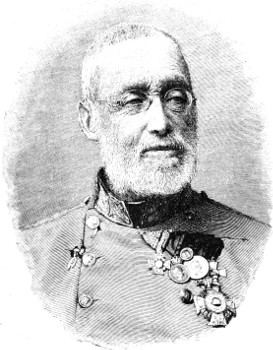
ARCHDUKE ALBERT.
But now came an incident which shows how, even in modern war with tens of thousands in the field, a handful of brave men can change the whole aspect of a battle. Across the Tione, to the right of this portion of the fight, there was a regiment of Austrian cavalry, known as the Sicilian Uhlans (lancers, who had formerly had the King of the Two Sicilies for their honorary colonel). Colonel de Berres, who commanded the lancers, had been watching through his field-glass the fight for the Monte Cricol, and seeing that the Austrian brigade, which was now retiring before the Italians, was hard pressed, he thought he could help his friends by a sudden charge on Cerale’s flank. One Italian brigade was in line of battle driving in the Austrians; the other was in a long marching column on the road. Berres called up one of his captains—Bechtoldsheim—and ordered him to take three troops and attack the enemy on the road. The three troops numbered exactly 103 officers and men. The brigade of General Dhô was at least 5,000 strong, but the hundred without a moment’s hesitation trotted off to charge the 5,000. They descended the slope to the Tione, found a ford, got across, and quietly made their way up the hill to the right of the Italians. These seem not to have had the least warning of the coming attack. They were moving slowly forward in column when the handful of splendid horsemen came rushing down the hill like a hurricane. Generals Cerale and Dhô, with their staff, were riding at the head of the column. The Uhlans, falling on the flank of the foremost regiment, crashed through it with levelled lances, and then rode for the crowd of officers, and scattered them right and left. The two generals escaped with difficulty. Cerale was hit by a revolver bullet in the mêlée, and Dhô received three lance wounds. Two guns which were on the road just behind the staff were galloped back to the rear by their teams, and battalion after battalion broke and ran as the lancers dashed down the road cheering and striking right and left with their lances, the retiring guns being now the main object of their charge. At last the frightened gunners cut the traces, and the guns were overturned in the press. But, with the exception of one battalion, Dhô’s division was now a panic-stricken mob. On both sides of the road the valley was full of men who had thrown away their arms and were running for their lives. Two thousand of them did not stop till they had put the bridges of Monzambano and Valeggio between them and the enemy. And yet that enemy consisted only of a handful of lancers. If one company had stood its ground and fired one steady volley the charge would have been stopped. When the lancers at last pulled bridle and turned to ride back they had not lost a score of their small number. Captain Bechtoldsheim, their brave leader, had had his horse killed under him, but close by an Italian major had just been run through with a lance, and Bechtoldsheim caught the horse of his fallen foe and again put himself at the head of his men. But as they rode back they found the one Italian battalion that had kept together had lined the ditches on both sides of the only possible track. The lancers had to gallop through a sheet of flame from the hostile rifles, and the road was strewn with men and horses. When Bechtoldsheim regained the hill there were only sixteen of his brave Uhlans beside him. They had left two officers, eighty-four men, and seventy-nine horses in the valley, killed and wounded; but they had done their work, and their charge had decided the fortune of the day.
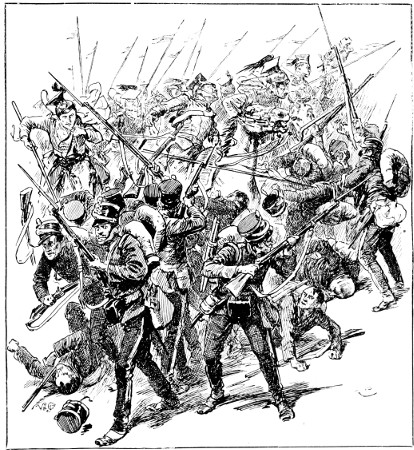
THE CHARGE OF THE AUSTRIAN LANCERS (p. 252).
Villarey’s brigade was now all that was left of Cerale’s division. The Austrians had been reinforced, and they promptly attacked and retook the Monte Cricol, and drove the Italians down the hill and along the same valley which had just witnessed the charge of the lancers. The Italians tried more than once to make a stand, but they were driven from position after position, and their commander, Villarey, was shot dead while forming the 30th Regiment for a counter-attack on the victors. After his fall there was nothing but wild confusion on the Italian left. Here and there, however, handfuls of brave men acted in a way that did something to redeem the honour of the Italian arms. A little group of ten officers and thirty men of the 44th Regiment, finding that they were abandoned by their panic-stricken comrades, threw themselves into a farmhouse, taking the flag of the regiment with them. They held it for two hours against the Austrians, and only surrendered it when the building was set on fire. But their flag was not captured. They had cut it into forty pieces, and each of them took a piece. When they came back from Austria after the war the pieces were sewn together, and the flag was restored to the regiment.
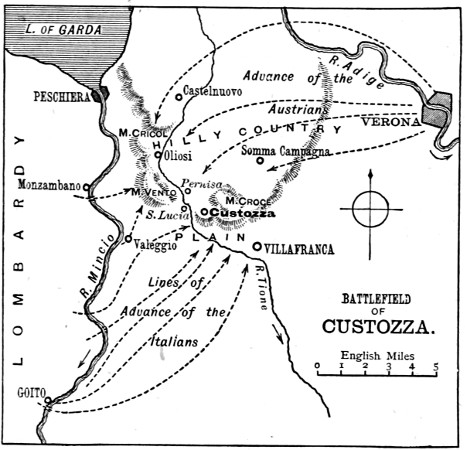
BATTLE-FIELD OF CUSTOZZA.
The village of Oliosi, between the Valeggio road and the Tione, was held by the Italians, and afforded some protection to their retreat from the disastrous fight before the Monte Cricol. It was stormed by a column of two Austrian regiments under General Piret, which crossed the river, and cleared the village without much difficulty. In one house—the presbytery, near the village church—the Italians held out for nearly two hours. When the house was all but demolished the little garrison surrendered, and five officers and forty-nine men were made prisoners.
What was left of Cerale’s division, together with part of Sirtori’s vanguard, now rallied on the bold ridge of Monte Vento. To their left General Pianelli’s division, which had just crossed the Mincio, was coming up from the bridges of Monzambano, bringing some 12,000 fresh men to support them. The Austrians were pushing in between the hill and the river; and one of their rifle regiments advancing over-boldly, was surrounded by Pianelli’s troops, and the 700 Jagers were all either shot down or captured. The reserve of the Italian 1st corps, consisting chiefly of Bersaglieri, was also directed upon Monte Vento. On the possession of this ridge the safety of the whole army depended, for if the Austrians took it they would be in a position to cut off the Italians from the bridges over the Mincio.
So far the fight on the left had gone by ten o’clock. On the rest of the field it was the same. Everywhere the Italians had come into action piecemeal against solid masses of Austrians, and in every one of the detached fights that was in progress from left to right they were being pushed back. In the Tione valley Sirtori had failed to carry the ridge near Pernisa. He had himself been routed and driven across the river by the advancing Austrians, and had lost three guns. He had rallied his men and crossed the stream a second time, only to be a second time driven back. Still further to the right among the hills towards Custozza Brignone’s division had come to grief. The Italians had fought well and lost heavily, Prince Amadeo and General Gozzani both falling severely wounded at the head of their brigades. About ten, La Marmora was so alarmed by the reports that reached him from every side that he told the King he thought it was a lost battle, and was on the point of giving the order to retire to the bridges when an encouraging message from Durando, who was bringing the reserves into action on the left, led him to change his mind, and continue the fight. Having made at the outset such a terrible mistake as to the position of the Austrians, he seemed all day to be expecting some new surprise and disaster; and though really there were only Pulz’s cavalry in the plain to his extreme right, he was so anxious about a possible attack in that direction that he kept Bixio and Prince Humbert’s division inactive all day at Villafranca. They had not fired a shot since the short skirmish with the cavalry in the early morning, and all through the blazing heat of the day the men sat or lay stretched in the shadows of the trees, listening to the roar of the fight in the hills, while their officers impatiently waited for orders to move. The only order they got was a message that all was lost, and the moment had come to retreat. But this was some hours later. By eleven o’clock the Austrians had disposed of Sirtori’s division, and crossing the river after his retreating battalions, they stormed the strong position of Santa Lucia, thus almost interposing between the Italian left and right. Artillery was massed against Monte Vento, and further westward a column of attack moved forward to attempt to seize the bridges on the Mincio at Monzambano. On the right the two fresh divisions of Cugia and Govone strengthened the Italian line, and delayed for a while the advance of the Austrians, whose object in this quarter was the capture of the village of Custozza, which stands on a bold hill overlooking the plain of Villafranca.
The loss of Santa Lucia made it very difficult for the Italians to hold on to Monte Vento. General Durando was actually discussing the question of retiring when he was shot down, and General Chilini, who had assumed the command in his stead, abandoned the position as soon as the Austrians advanced upon it. This made the defeat of the whole Italian army inevitable, for the Austrians could now advance and seize the ground between Monte Vento and the Mincio, the very ground over which the Italian army must retire if it was to withdraw to its own territory, and across which it would have to keep up its communications with Lombardy, even if it could maintain itself in Venetia.
On the right the Italians had been driven back upon Custozza. It was near four o’clock. The Austrians had every available man and every gun in action. Their men were weary with the night march and the long fight among the hills under the blazing midsummer sun, which shone in a cloudless sky. But it was worse for the Italians. Most of them had eaten nothing all day, and they had none of the inspiration of success. They had been losing ground all day, and they had lost all confidence in their chiefs and in themselves. Yet they had still forty thousand men who either had not fired a shot or had not been seriously engaged. These were the two divisions at Villafranca (Bixio’s and the Crown Prince’s) and the two reserve divisions of Cucchiari’s corps, which were struggling along roads so encumbered with a confused mass of baggage and ammunition waggons that it was only when all was over that they approached the field. It would be difficult to find more striking proof of the hopeless incapacity of La Marmora and his staff.
At five o’clock the village and hill of Custozza were stormed with a fierce rush by the columns on the Austrian left. The hills were now completely in the possession of the Archduke. He had driven the last of the Italians on to the low ground, and everywhere they were retiring towards the river, thousands having already streamed across the bridges in a confused and disorderly march. The Austrians were so exhausted with their nineteen hours of marching and fighting that there was no pursuit. If the Archduke had had a few thousand fresh troops he might have captured whole masses of the fugitives, who were huddled together along the Mincio, waiting to cross. Next day the Austrian cavalry pushed into Lombardy, and such was the impression made on the Italian army by the collapse of Custozza that La Marmora made no effort to stop them, but retired first behind the Chiese and then behind the Oglio, abandoning a considerable part of Lombardy. Meanwhile, the Archduke had marched from the scene of his victory back to the Adige, in order to be able to fall on Cialdini if he persisted in his invasion of Venetia. But the lesson of Custozza was enough to make the second Italian army withdraw into the Romagna.
The Austrians lost in the battle 960 killed, 3,690 wounded, and some hundreds of prisoners, chiefly the Jagers captured by Pianelli’s division. The Italian loss in killed and wounded was not quite so heavy, the killed being 720 and the wounded 3,112, but they lost in prisoners and missing 4,315 officers and men. On the Italian side General Villarey was killed, and Generals Dhô, Durando, Gozzani, and Prince Amadoe were wounded. But a mere comparison of losses can give no idea of the effect of the battle on the two armies. The Austrian army was for all practical purposes intact, full of confidence in itself and in its leader. A great part of the Italian army had degenerated into something like an armed mob, all confidence in the generals was gone, and, instead of talking of a march upon Venice, men were asking themselves if they could hold Northern Italy against an Austrian invasion. Custozza had given one more proof of the fact that victory is not always with the big battalions, and that a skilful leader can bring to nought the onset of less ably handled troops, though they outnumber his own by tens of thousands.

The Taking of Badajoz
By D. H. Parry
On the 16th of March, 1812, when the poplar trees that fringed the Guadiana were bending under a tempest of wind and rain, a British force some 15,000 strong, with a battering train of fifty-two guns, reached Badajoz—a strongly-fortified Spanish town near the frontier of Portugal—the bugles of the “95th” playing “St. Patrick’s Day” as they faced the furious equinoctial gale.
About a year before, the scoundrel Imas had delivered up the place to Marshal Soult, whose clubfoot did not prevent his being one of the most active men and fearless riders in the French service; and although we had made two attempts to retake it, we had failed on each occasion after heavy losses, our battering train being shamefully insufficient, and the enemy very much on the alert; the third time we were successful, and it is of this I am about to tell.
Badajoz was the pax augusta of the Romans, and a granite bridge with twenty-eight arches, dating from Roman times, still spanned the sluggish river on the north-west; but, save that the town had been frequently taken and retaken by Moors, Goths, and Spaniards, and was the birthplace of Morales, the painter, there was nothing very remarkable about its quaint, crooked streets and massive cathedral beyond the natural strength of its position, rising some 300 feet above the marshy plain, with eight bastions and their connecting curtains to protect it from attack.
It remained for Philippon and his gallant garrison, and our veteran troops under the Earl of Wellington—as he was then styled—to render Badajoz immortal, and bring a flush of pride and a thrill of horror to future generations who may read the tale.
The General of Brigade Philippon, colonel of the 8th of the French Line, and member of the Legion of Honour, commanded in Badajoz with a force of 4,742 men—composed partly of the 9th Light Infantry, the 88th Regiment, the Hesse-Darmstadt, some dragoons and chasseurs, artillery, engineers, and invalids, and seventy-seven Spaniards who ought to have been fighting on the other side.
Although somewhat short of powder and shell, Badajoz presented a formidable task to a besieging army, being protected on one side by the river, 500 yards wide in places, and having several outworks, or forts, notably one called the Picurina, on a hill to the south-east, whose defenders could be reinforced along a covered-way leading to the San Roque lunette close to the town walls.
Philippon had, moreover, taken every means possible to strengthen his post: mines were laid, the arch of a bridge built up to form a large inundation, ravelins constructed and ramparts repaired, ditches cut and filled with water, and that he should have no useless mouths to fight for, the inhabitants were ordered to lay up three months’ provisions or march out there and then.
Such was Badajoz when Picton’s 3rd, or “Fighting,” Division; Lowry Cole’s 4th—or, as they were nicknamed at the close of the war, “Enthusiastic”—Division; and the Light, known as “The” Division, invested it in the rain.
The rest of the army watched Soult’s movements closely, and prepared to oppose the relief of the town if that should be attempted, and the 5th Division was on its way from Beira to assist the siege.
As soon as darkness had fallen on the night of the 17th, 2,000 men moved silently forward to guard our trenching parties, and, with mattock and shovel, we began to break ground, 160 yards from the Picurina, the sentinels on the ramparts hearing nothing, as the howling of the wind drowned the sound of digging, and the sputtering rain fell incessantly into the works. So well had the volunteers from the 3rd Division laboured, for we had no regular sappers, that the light of the misty March morning revealed 4,000 feet of communication, and a parallel 600 yards long, on perceiving which the garrison opened a tremendous fire of cannon and musketry. The deafening roar of the heavy guns and the crack of rifles and smooth-bores continued with little cessation for many days, increasing as we finished battery after battery and brought them to bear upon the doomed town.
The condition of our siege artillery would hardly be credited were it not borne out by the unanimous published statements of credible witnesses.
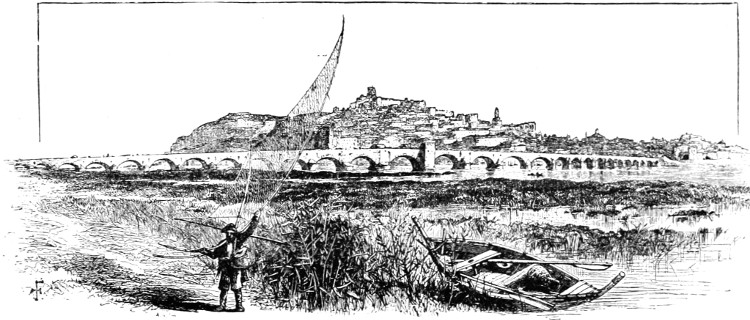
BADAJOZ.
Of the fifty-two pieces, some dated from the days of Philip II. and the Spanish Armada; others were cast in the reigns of Philip III. and also John IV. of Portugal, who reigned in 1640; we had 24-pounders of George II.’s day, and Russian naval guns; the bulk of the extraordinary medley being obsolete brass engines which required seven to ten minutes to cool between each discharge, lest the overheating should cause the muzzles to drop.
The ammunition was little better, and an engineer officer tells us that his 18-pound shot was of three distinct sizes, which had to be sorted out and painted different colours, while it was often possible to put a finger between the ball and the top of the gun, when the former was placed ready for ramming. Yet, with this miserable matériel we were expected to fight the most intelligent army in Europe!
Wellington learned from his spies that the garrison were to make a sally on the 19th, and at 1 o’clock the Talavera Gate suddenly opened, a little body of horsemen jingling out, followed by 1,300 infantry, who concealed themselves in the covered trench connecting San Roque with the Picurina.
The cavalry pretended to skirmish, and, dividing into two parties, one pursued the other towards our lines, where they were challenged, and allowed to pass, on replying in Portuguese.
There was some excuse for the conduct of our pickets, as the French dragoons, in consequence of the difficulty of procuring new uniforms from France, were allowed to use the brown cloth so general all over the Peninsula, and were thus easily mistaken for our Portuguese allies, some of whom also dressed in brown. But we were soon undeceived, for the troopers dashed at the engineers’ park, cut down some men, and galloped off with several hundreds of the entrenching tools, for which Philippon had offered a large reward.
Simultaneously the infantry sprang out of the covered-way with a part of the Picurina garrison, and, rushing forward, began to destroy our works.
We drove them back almost to the walls of Badajoz, killing thirty and wounding 287. But we lost heavily, for it was a sharp encounter; and, unhappily, our chief engineer, Colonel Fletcher, was badly hit, a bullet striking a silver dollar in his fob and forcing it an inch into the groin, confining him to his tent until the latter end of the siege, the Earl going each morning to consult about the day’s operations.
Our movements were by no means faultless, Wellington having great difficulties to contend with in many directions; in fact, during the whole of the Peninsular War he may be said to have fought the French with one hand, and Spanish pride, obstinacy, and selfishness with the other—fortunate indeed in possessing a genius which was ever at its best the more trying the emergency. We stationed a cavalry regiment to prevent any further surprises, and continued our digging, the pitiless rain slanting unceasingly on the trench guards in their grey overcoats and oilskin shakoe-covers, while the working-parties shovelled and measured, and piled up long ridges of earth, standing ankle-deep in the water which filled the saps and trenches.
Many a man of the 3rd Division spun round and fell on the wet ground, for the enemy kept up a steady fire, and one shell dropped, fizzing, into a parallel and exploded, killing fifteen of the workers in a moment.
The Guadiana, too, rose in full flood and tore away the pontoon bridge which connected us with our stores at Elvas: it was replaced, however, and the garrison of Badajoz saw us creeping nearer and nearer to their walls, until, at last, our men finding the fire from the Picurina terribly galling, it was decided to storm that fort on the 24th.
The rain had ceased, and the dark mass of the fort, held by some of the Hesse-Darmstadt Regiment, loomed up, stern and silent, as five hundred of Picton’s Division mustered before it about nine o’clock on a fine night.
A hundred men were kept in reserve, while the remainder, divided into two bodies, were to advance against the right and left flanks, also securing the communication with San Roque to prevent any succour coming from the town.
Scarcely had the word to march been given, when soaring rockets went up from the ramparts, port-fires illuminated the darkness in places, and the stillness became a babel of sounds, as shells came hissing towards us, drums rolled, and the bells of Badajoz rang wildly amid the deep booming of the heavy cannon. Red flashes streamed through the openings in the palisading, the Hesse-Darmstadt opened a murderous fire, but we swarmed irresistibly up the rocks and groped for the gate, the pioneers of the Light Division leading with their axes.
Down in the communication our fellows repulsed a battalion coming to the rescue, but it seemed for a time as if we had been baffled; the sides of the hill were dotted with our dead. Oates, of the Connaught Rangers, three engineer officers, with Majors Rudd and Shaw, who commanded the attack, and many a private soldier had fallen there. But as Powis, of the 83rd, brought up the reserve and forced the palings in front, the pioneers discovered the gateway on the town side, and, battering it down, rushed in with a shout.
Nixon, of the 52nd, was shot two yards within the entrance, and we fought with gun-butt and bayonet against a most heroic resistance; but at last they were overpowered, and half the garrison slain. One officer and thirty men floundered through the inundation and gained Badajoz in safety, but brave Gaspard Thierry, with the eighty-six survivors, were compelled to surrender, and the death-dealing Picurina was ours.
The firing from the town ceased at midnight, but with the dawn of day they turned their guns on to the captured fort, driving us out and crumbling it to pieces.
Philippon had hoped to have held the work for four or five days, while he completed certain partially-finished defences, and its capture and destruction were a severe blow to him. But he urged his garrison to fresh efforts by reminding them of the English prison-hulks, which, as Napier justly says, were a disgrace to our country.
Three breaching-batteries were now constructed, one against the Trinidad bastion, another to shatter the Santa Maria, and the third—which consisted of howitzers—was to throw shrapnel into the ditch, and so prevent the garrison from working there. We had been eleven days before the town, and in spite of all the obstacles had made considerable progress, although latterly a bright moon had interfered with our nocturnal operations.
Overcoats were laid aside, and our men appeared in the well-worn scarlet coatee with white-tape lace, and the black knee-gaiter, which was the dress of a British-infantry private at that time. Pigtails had been done away with four years previously, and the well-known grey trousers were not issued to the troops until the following September. The Rifle Corps wore dark green, and used a wooden mallet to drive the ball down the grooved barrel; fusiliers and the grenadier companies of the line had bearskin caps, and light infantry were distinguished by green tufts in their felt shakoes, while our Portuguese friends were mostly clad in blue or brown, with green for the caçadores, or riflemen, each man carrying—including knapsack, accoutrements, kit, and weapons, etc.—a weight of seventy-five pounds twelve ounces, or ten pounds more than their opponents. The soldiers were enraged at the inhabitants of Badajoz for admitting the French, a sentiment which boded ill to them if we took the town. But, in the meantime, many instances of pluck on both sides were exhibited. One morning, early, before the working-party arrived, a brave fellow crept out of Badajoz and moved a tracing-string nearer to the walls, so that when we began digging in fancied security, their guns suddenly opened and bowled the men over like nine-pins. Another time, two of our officers and some men stole forward in the night, gagged a sentry, and laid barrels of powder against the dam which confined the inundation, and got back in safety; but the explosion did not have the desired effect.
At last, the stones began to fall from the Trinidad bastion, amid clouds of dust, as ball after ball went home with terrific force; the Santa Maria also crumbled under the cannonade, but, being casemated, it resisted better than the other, which, by the 2nd of April, yawned in a manner that must have dismayed the garrison, for they commenced to form what is known as a retrenchment, or second line of defence, within the walls, by levelling houses behind the growing breach. In places where the fortifications had not been completed the energetic Frenchman hung brown cloth which resembled earth, and his men were able to pass freely along; they also made a raft with parapets and crossed the inundation to our side. But all their efforts were useless: the breaches became larger as masses of stone and rubbish fell like mimic avalanches into the fosse below; and, on the 6th, a tremendous gap showed in the ancient masonry of the curtain between the two bastions which had not been renewed when the bastions themselves were rebuilt about 1757.
Then came a moment’s pause. Soult, Drouet, and Daricau were advancing: a battle was imminent, and would need all our forces. In twenty-one days we had expended 2,523 barrels of gunpowder, each barrel containing ninety pounds, and we had fired 35,346 rounds of ammunition. Badajoz must be taken at all risk; and orders were now given for the most terrible of all species of warfare—the night-attack by storm!
Wellington’s commands were precise and to the point, but they were terribly eloquent to those who read them. I have extracted a few paragraphs from the original memorandum, and give them word for word:—
“1. The fort of Badajoz is to be attacked at 10 o’clock this night (6th of April). 2. The attack must be made on three points—the castle, the face of the bastion of La Trinidad, and the flank of the bastion of Santa Maria. 3. The attack of the castle to be by escalade; that of the two bastions, by the storm of the breaches.... 20. The 4th Division must try and get open the gate of La Trinidad; the Light Division must do the same by the gate called the Puerta del Pillar. 21. The soldiers must leave their knapsacks in camp.... 24. Twelve carpenters with axes, and ten miners with crowbars, must be with the Light, and ditto with the 4th Division.”
The time had been altered from 7.30 to 10 o’clock, and during that interval the French placed the celebrated chevaux-de-frise of sharpened sword-blades in the gap we had made in the connecting curtain; piles of shot and shell were laid along the ramparts, with beams of wood, old carriage-wheels, and every conceivable missile that their ingenuity could devise; each soldier had three loaded muskets beside him, and, as the unusual stillness in our trenches warned them that something was in preparation, an officer tried to reconnoitre us with a little escort of cavalry, but we drove him back, and all was quiet once more.
It was the calm before the storm, and men grew silent and thoughtful as the time drew near.
Letters were written home by hands that would never use pen again; absent friends were talked of in hushed voices, wills hastily made as in the presence of death; the married soldiers lingered in their quarters till the last moment, and then gave it out that they were “going on guard”!
The April day drew into evening; a grey mist rose from the river and stole among the trenches and the marshy ground, where frogs piped dismally and field-crickets kept up their perpetual chirp; then night came, still and cloudy, not a star visible, but here and there lights flitted along the ramparts, and the challenge of the sentries could be distinctly heard.
There was no bustle to show that eighteen thousand men were forming for a desperate attack; company after company they mustered and got under arms silently, words of command being given in a whisper.
Picton had been hurt by a fall, and his famous 3rd Division was led by Kempt in consequence.
Its destination was the castle, whose walls were from eighteen to twenty-four feet high; and the regiments which formed it were the 5th, 45th, 74th, 77th, 83rd, 88th, and 94th British, and the 9th and 21st Portuguese.
The 5th Division, under Lieutenant-General Leith—composed also of English and Portuguese—had to make a feint upon the Pardaleras outwork to the left, and then march round and storm the San Vincente bastion in rear of the town, while General Power made a false attack on the bridge-head beyond the Guadiana.
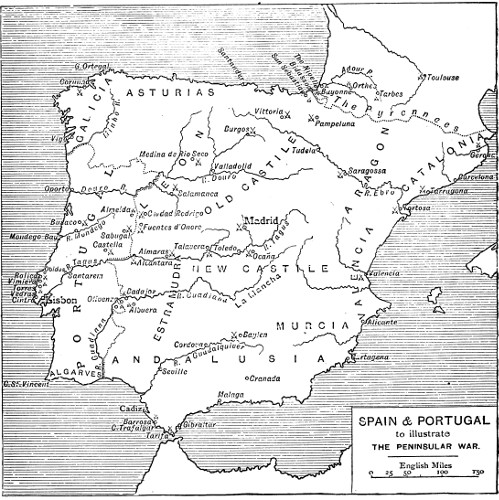
SPAIN & PORTUGAL to illustrate THE PENINSULAR WAR.
The Light Division and the 4th, under Generals Colville and Barnard, were to tackle the trenches, and were composed of the following corps—the Light having the 43rd, 52nd, and 95th British, the 1st and 3rd Portuguese Caçadores; and the 4th Division, the 7th, 23rd, 27th, 40th, 48th, and 97th British, with the 11th and 23rd Portuguese, and the 1st Battalion of the Lusitanian Legion.
The trench-guards and the “forlorn hope” fell in, and about 9 o’clock four companies of the 95th Rifles crept forward and lay down, under the crest of the glacis, within a few yards of the French sentinels, whose heads could be seen, passing to and fro, against the sky.
Not a word was spoken as they crouched, unnoticed, in the mist that veiled their dark uniforms. They waited the arrival of the “forlorn hope” to begin the attack. At length a sentry peered over the parapet: something had caught his quick ear, for he cried “Qui vive?” and there was a moment of keen suspense.
Not satisfied, he again challenged, and, receiving no reply, fired his musket into the darkness; and instantly the drums of Badajoz beat to arms.
Still, for ten minutes more the riflemen lay motionless, until the “forlorn hope” came up, and then, each man sighting carefully at the heads above the rampart, they poured in a volley, and the attack began.
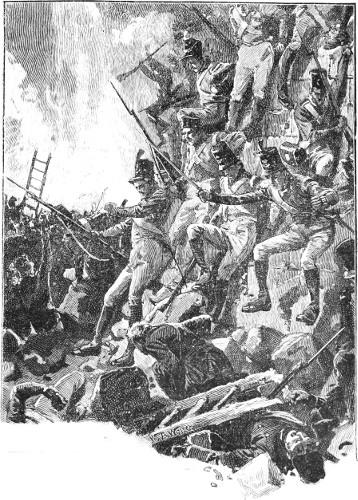
“THE NEXT THEY WERE LEAPING, SLIDING, CLIMBING” (p. 262).
It was unfortunate—as it happened—for Wellington wished all our assaults to take place simultaneously, but it could not be undone; moreover the garrison threw a huge mass of combustibles, called “a carcass,” from the walls, and by its powerful blaze they saw the 3rd Division drawn up under arms; so, “Stormers to the front!” was our cry, and we rushed on with an uproar of cheers and shouting.
The ladder-parties and those carrying the grass-bags ran forward, scrambling across the trenches and broken ground, and, filing over the Rivillas by a narrow bridge, reached the foot of the castle wall under a heavy fire.
Brave Kempt, who afterwards fought at Waterloo, fell, badly wounded, and as they carried him back he met Picton hurrying to take command with his sword drawn.
The 3rd Division had only twelve ladders, and eighty to a hundred men were all that could mount at a time; but they reared them against the masonry, and fought with each other who should be first to ascend.
Stones, earth, live shells, beams, heavy shot, and a rain of musket balls poured down; those who reached the top were stabbed and flung on to the others behind them—here a cheer as a man grasped the coping—there a howl of rage as the ladder was hurled broken from the wall and all its occupants flung in a heap below.
“Forward the 5th Fusiliers—Come on, Connaught Rangers.” A corporal of the 45th fell wounded on hands and knees, a ladder was placed on his back in the confusion, his comrades mounting above him, and he was found next day crushed to death, the blood forced from his ears and nose.
Several of the ladders were broken, and those that remained were flung off repeatedly by the garrison on the ramparts, until the French cried “Victory,” and the 3rd Division retired for a moment, to re-form under the crest of the hill.
Meanwhile, the 4th and Light Divisions, after a double allowance of grog had been served out, marched quickly on to the breaches, and the trench-guard rushed at San Roque with such fury that they bayoneted its defenders and carried the lunette without a rebuff.
As the stormers of the Light Division moved off, Major Peter O’Hare—who had risen from the ranks to a commission in the 95th (a most unusual thing in those days), and who was, moreover, one of the ugliest men and one of the bravest in the army—shook hands with George Simmonds, of the Rifles, saying—“A lieutenant-colonel or cold meat in a few hours!” They found him next morning stone dead and stark naked, with nearly a dozen bullets in his gallant frame. Officers were divided into two categories by the Peninsular soldiers—the “Come on” and the “Go on.” O’Hare was one of the former.
As the firing commenced at the castle, the heads of the double columns reached the glacis to find all quiet and the place wrapped in profound gloom.
The ditch yawned beneath them, and the stormers threw their grass-bags, which measured some six feet by three feet, into it, lowered the five ladders which did duty for both divisions, and the “forlorn hope” of the Light Division descended into the chasm, doomed to a man!
A musket-shot told them that the silence was a treacherous one; but none were prepared for the awful scene that followed. The ditch was crowded with the stormers, and men waited their turn to follow down the ladders, when all at once a tongue of flame lit up the darkness, a terrific explosion seemed to rend the earth itself, and five hundred brave fellows were blown into eternity under the eyes of their comrades on the glacis above them.
One second’s space the Light Division stood aghast, the next, they were leaping, sliding, climbing, never heeding the depth, into the gory grave that lay between them and the breaches, with a roar that went echoing along the walls of Badajoz—a roar of fury never to be appeased until bayonet should meet bayonet on the towering ramparts, fringed with the foe, beyond.
Down poured the 4th Division and mingled with them: the ditch was full of shouting redcoats, all struggling, regardless of rank, to get at the French, who, yelling defiance in their turn, showered grape, round shot, canister, hand grenades, stones, shells, and buckshot upon them; rolling huge cannon-balls from the parapet, sending baulks of timber thudding into the tumult, and coach-wheels that acquired a fearful velocity as they bounded down the rocks into the living mass of British valour pent up in the deathtrap below.
Bursts of dazzling light were succeeded by moments of intense darkness; for an instant the huge bastions showed, bristling with armed men, to be lost again in a Stygian gloom, re-illumined the next minute by the flashing guns—by wavering port fires, and trailing rockets. A hundred Albuera men of the Fusiliers were drowned in an unexpected water-ditch; the air was heavy with gunpowder smoke and the sickening stench of the stagnant pools; individuals and regiments alike surged and scrambled to find a passage; until at last, getting on to an unfinished ravelin, mistaken in the confusion for a breach, both divisions were jumbled together, and great disorder ensued.
Wellington, watching from a hill, and seeing the pause, exclaimed repeatedly: “What can be the matter?” sending aide-de-camp after aide-de-camp to report progress, as the glare revealed the faces on the ramparts and the peculiar hollow booming reached him, caused by the garrison firing down into the cavernous depths of the ditch.
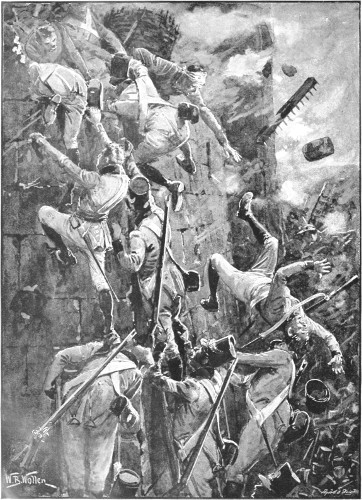
THE 5TH DIVISION STORMING BY ESCALADE THE RAMPARTS OF SAN VINCENTE (p. 263).
At length there was a rush for the great breach. Officers and men, having extricated themselves from the carnage below, rushed on, to find an impenetrable barrier of sword-blades fixed in wooden beams and set firmly across the opening, while the débris in front was strewn with planks covered with spikes: if a soldier trod on one of them it slid down, either throwing him on the spikes or sending him back on to the bayonets of his comrades; and, to crown all, the garrison rolled barrels of powder into the middle of us, which exploded with shocking effect, filling the nostrils with the smell of burning flesh and singed hair, and strewing the breach with scarlet figures in every conceivable attitude of agony and death!
Our gallant fellows charged madly in masses, in groups, and even singly, one private of the Rifles forcing himself among the sword-blades, where the enemy shattered his bare head with their musket-butts.
It was not until the cruel slaughter had lasted two hours that the diminished divisions withdrew to the bottom of the slope and stood furious and exhausted, but powerless to effect their aim, and still under a fire that was thinning their broken ranks, while the enemy cried mockingly down to them, “Why don’t you come into Badajoz?” Captain Nicholas, of the Engineers, gathered a few men and made frantic efforts to force the Santa Maria breach, and he was joined by Lieutenant Shaw, of the 43rd, who collected fifty men from various regiments and struggled over the broken masonry with them, but, two-thirds of the way up a hail of balls and hissing grape-shot mowed them nearly all down, and the divisions remained stolidly confronting inevitable death, unable to advance, unwilling to retire, for the bugles sounded twice unheeded, while, strange irony it seemed, a bright moon shining peacefully overhead, the Santa Maria, or “Holy Mary,” looking down upon them on the one hand, La Trinidad, “The Trinity,” on the other, and all around an Inferno such as Dante never dreamed of! About midnight Wellington ordered them back to re-form for another attack, and in the meantime Picton’s Division, whom we left also re-forming, had rushed forward again, led by Colonel Ridge, who placed a ladder against the castle wall, where an embrasure offered a chance of foothold. A grenadier officer named Canch reared a second one alongside it, and the two mounted together, followed by their men, securing the ramparts after a desperate hand-to-hand conflict, and driving the enemy out of the castle into the town.
The garrison sent a reinforcement, and there was a sharp passage of arms at the gate, our redcoats firing from one side almost muzzle to muzzle with the blue-clad, square-shakoed French on the other; but we kept the castle, though, unhappily, the gallant Ridge was slain.
Our reserves found the two ladders still standing, the top rungs of one being broken; and when the 28th Regiment practised storming a dry bridge with these, a couple of months afterwards, they were even then covered with blood and brains!
It was about half-past eleven when the 3rd Division succeeded in their escalade, and, retarded by unforeseen obstacles, it was not until the same hour or thereabouts that the 5th Division, under Lieutenant-General Leith, came under the breastwork before San Vincente at the west end of the town. As the 1st, 4th, 9th, 30th, 38th, and 44th Regiments, with a Portuguese brigade, halted, undiscovered, a few yards from a guard-house where the French could be heard talking, the roar of a distant explosion sounded, and the men whispered among themselves, “It is at the breaches!”
All was intensely silent around them; the murmur of the river rose on their left, the fortifications showed clearly before them as the moon came out; they knew that their comrades far off on the other side of the citadel were engaged, and an eager thrill went through the ranks. A sentinel discovered the mass of men and the glint of the moonbeams on the bayonets at the moment when our engineer guide exclaimed “Now’s the time!” and as he fired we ran forward against the gateway.
Seized by a sudden panic the Portuguese ladder-party bolted, but we snatched up the heavy ladders and our axemen chopped fearlessly at the gate and wooden palings that fringed the covered-way, while from the walls which towered thirty-one feet overhead, the same tempest of beams, and shot, and bags of powder showered down on the heads of the 5th Division.
We cleared the paling and jumped into the ditch, crossing the cunette with difficulty and finding the ladders too short for our purpose; the engineer was killed, and a small mine exploded under our feet, but, as luck would have it, the ramparts at San Vincente had been thinned of some of their defenders, who had gone off at the double to attack Picton’s men in the castle, and we placed three ladders under an embrasure where there was a gabion instead of a gun, and where the scarp was only twenty feet high.
Hand over hand, the troops clambered up under a concentrated fire that dropped them off by dozens, and the topmost stormers had to be pushed up by those behind before they could reach the embrasure, as the ladders were all too short; but at last the bold fellows got a foothold, and pulled the others up alongside them, until the redcoated mass grew larger and larger, and half the King’s Own charged the houses while the rest of the division went roaring along the ramparts, Brown Bess in hand, hurling the stubborn garrison out of three bastions in succession. There was a great shouting, mingled with the scream of the grape-shot and the whistling hum of shells; yells, howls, prayers and curses were drowned or half-heard amid the boom of cannon and the incessant bang-bang of the deadly muskets fired at close-quarters.
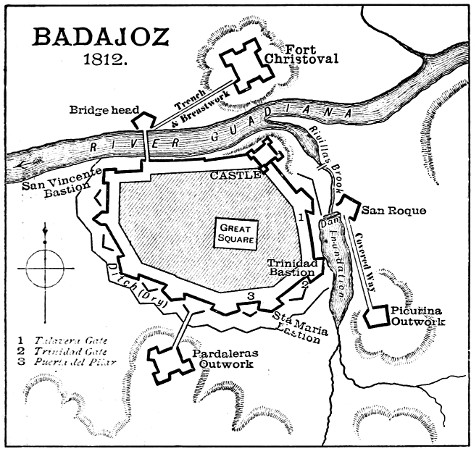
BADAJOZ
1812.
The awestruck watchers on the hill above our camp stood in an agony of suspense, spectators of the terrific struggle; the entire citadel seemed full of flame and noise, as mine after mine exploded, and fire-ball after fire-ball was flung over the walls to light the besieged in their heroic resistance: never had Napoleon’s soldiers fought with more determined gallantry, officer and man vying with each other in their efforts to keep us out, and as we drove them from one defence they retired into another and stood once more at bay.
Philippon, and Vielland, the second in command, though both wounded, flew from rampart to rampart, sword in hand, encouraging their brave fellows by word and deed, while the solemn chime of the cathedral rang out unnoticed hour after hour of that night of horrors.
A strange incident occurred at San Vincente when General Walker fell riddled with balls on the parapet: either by accident or design, he made a masonic sign as he staggered backwards, and a brother-mason in the French ranks dashed aside the threatening bayonets of his countrymen and saved him: afterwards, it is said, the general found his preserver a prisoner-of-war in Scotland, and procured his exchange in remembrance of his chivalry on the ramparts of Badajoz.
The 5th Division had obtained firm hold, knowing nothing of what was happening at the castle or the breaches, and as a portion of them were pursuing the enemy along the walls they rounded an angle and came upon a solitary gun with one artilleryman, who flung a portfire down as they approached.
Instantly there arose a cry of “A mine! a mine!” and our fellows retired helter-skelter, followed by a fresh body under Vielland, who drove them back to the parapet again and pitched several over into the ditch, but a reserve of the 38th, under Colonel Nugent, about two hundred strong, poured a volley into them, and we rallied and charged along the wall towards the breaches.
The King’s Own had entered the town at the first onslaught of Leith’s Division, and a strange contrast they found it to the uproar of the bastions, as, with bayonets fixed and bugles blowing, they filed through the streets, silent and deserted as the tomb; every door shut, lamps alight in many of the windows, but not a soul abroad, except some soldiers leading ammunition mules, who were promptly taken prisoners.
Sometimes a window opened and was immediately closed again; voices were heard, but the speakers were invisible; a few shots came from beneath the doors, but they were unheeded, and the adventurous 4th continued its march into the great square, where the same silence reigned, although the houses round it were brilliantly lighted.
The renewed fury at the breaches turned their steps in that direction, and they hurried off to take the garrison in rear: the attempt was well meant, but they were met by a fire that repulsed them, and they continued their wandering down streets and lanes, but the French began to be disheartened, as well they might.
The castle in our possession they could possibly have besieged from the town side, as there was only one gate by which the 3rd Division could have issued; the Trinidad and Santa Maria were also well-nigh impregnable in spite of their shattered condition, had the garrison been able to concentrate there, but the forcing of San Vincente had let us in behind them, and the struggle was only a matter of time; so, brave Philippon and Vielland, with their remnants, forced the bridge and shut themselves up in San Christoval across the Guadiana, sending a few horsemen on the spur to carry news to Soult, and, the bleeding 4th and Light Divisions scrambling up again and rushing the breaches, Badajoz was ours!
As the heavy firing died away towards morning, a mighty shout arose inside the walls, caught up and echoed far and near by our victorious soldiery, “Hurrah! hurrah! the town’s our own, hurrah!” and the carnage-maddened men, breaking from all control, began a wild orgy, which lasted for two days and two nights, indelibly sullying the glory of our triumph.
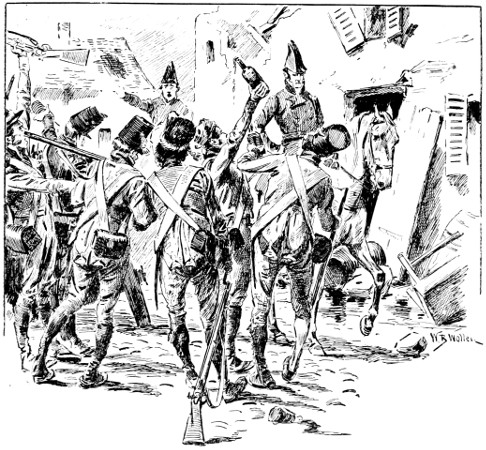
“‘ILL YOU DRINK, OLD BOY?’” (p. 266).
Churches and mansions were entered and pillaged; costly sacramental plate and silver money from the military chest strewed the rugged pavement of the town; wine flowed down the gutters as freely as blood had done on the ramparts, and men staggered along with their shakoes full of liquor. One bestrode a cask with a loaded musket and compelled officer and private alike to drink as they passed him; here a group fired aimlessly down a street, caring little whom they hit, others blazed away at the convent bells, while some masqueraded in court-dresses, in French uniforms, and monks’ cowls, howling, singing, dancing, like men possessed.
Many of the wretched inhabitants placed lighted candles and flasks of aquadienta on their tables and sought to hide themselves, hoping the marauders would drink and go away; they drank, but every cranny of the house was ransacked before they took their leave, and things were done of which we cannot speak, for the sake of humanity and the honour of the army.
“The town is ours, hurrah!”
Women and children ran shrieking to the officers for protection, which, alas, it was not always in their power to afford. Many an indignant subaltern risked his life among his own men in frantic attempts to recall them to order; an officer of the Brunswickers was shot while struggling for the possession of a canary bird; one party was seen tormenting a wounded baboon that had belonged to the colonel of the 4th French Regiment. And breaking open the jail, they liberated the prisoners, some of the 5th and 88th holding candles aloft as the scum of a Spanish prison poured out to add to the disorder. Wellington himself was surrounded by a mob of drunkards, who fired their muskets to his infinite peril, shouting as they brandished bottles of wine and brandy—“Will you drink, old boy? The town’s our own, hurrah!”
At length a gallows with three nooses reared its ominous form in the square, and a man named Johnny Castles, of the 95th, was placed beneath it; but no one was hanged, and by degrees the troops were drawn out of the town, credited with having murdered eighty-five of the inhabitants—in actual fact, the number being thirty-two. In fearful contrast to the licence within the walls was the scene outside. Philippon had surrendered to the future Lord Raglan, and retired from the service, in 1816, a General of Division, Baron of the Empire, and wearer of the Legion of Honour and the Order of St. Louis. The ditch, the slope, from the edge of the glacis to the top of the bastions, resembled a huge slaughter-house, nearly 2,500 of our men having fallen between the Santa Maria and La Trinidad alone, within a space of a hundred square yards; the 43rd and 52nd, respectively the gayest and the most sedate regiments in Spain, losing 670 men between them, and the place presenting an unusually shocking appearance from the explosions which had taken place there.
In one place the wife of a grenadier of the 83rd moaned over the corpse of her husband; in another a little drummer-boy of the 88th lay with his leg broken beside his dead father; the most heartrending sights were witnessed as the women and children sought frantically for their dear ones amid thousands of bodies, and the mangled fragments of what had once been living men.
Amid the horror of it all, two Spanish ladies came out of the town and implored two officers of the Rifles to assist them: one of them, Donna Juana Maria de los Dolores de Leon, afterwards married her protector, who became Sir Harry Smith, of Aliwal fame, and was long a prominent figure in English society—a curious instance of the “romance of war.”
We took the colours of the garrison and the Hesse-Darmstadt, but there were no eagles in the town. The first man to die at the Santa Maria was a Portuguese grenadier, and there was a story current in the army that José de Castro, bugle-boy of the 7th Caçadores, had sounded the French “recall” at a critical moment, for which he received a hundred guineas from the Earl of Wellington: certain it is that when a very old man, gaining a bare living by teaching the cornet in the town of Golega, he was still petitioning the Portuguese Government for a pension.
Five generals wounded, five thousand officers and men fallen during the siege—that is the story of Badajoz. And when Wellington stood in the breach and looked around him, stern Spartan though he was, he burst into tears.
The Blockade of Callao
BY W. B. ROBERTSON

At the invitation of the newly-created Republic of Chili, Admiral Thomas Cochrane, tenth Earl of Dundonald, sailed from England in the month of August, 1818, in the Rose, merchantman, to organise and take supreme command of the Chilian navy. With him he took, besides his wife and two children, English naval officers upon whom he could rely in the arduous fighting he was soon to engage in against the superior armaments of Spain. He landed on November 28th at Valparaiso, whither General O’Higgins, Supreme Director of the Chilian Government, had come to receive him. His reception was so warm both at Valparaiso and at Santiago, the capital, and the continuation of proposed festivities in his honour threatened to be so prolonged, that he had to remind his Excellency O’Higgins that he had come to Chili to fight, and not to feast.
Preparations were accordingly pushed forward to get such ships of war as the Chilians possessed into some kind of fighting order. These ships were the O’Higgins, formerly the Maria Isabel, a Spanish frigate of 50 guns, which the Chilians had captured and re-named after their adored chief; the San Martin, formerly the Cumberland, Indiaman, with 56 guns; the Lautaro, also a purchased Indiaman, with 44 guns; the Galvarino, recently the British sloop-of-war Hecate, with 18 guns; the Chacabuco, with 20 guns; and the Araucano, with 16 guns. This modest squadron of seven vessels was to contend with and conquer the Spanish fleet, made up of four frigates—the Esmeralda, 44 guns, the Venganza, 42 guns, the Sebastiana, 28 guns; four brigs—the Maipo, 18 guns, the Pezuela, 22 guns, the Potrillo, 18 guns, and another, whose name is not known; one schooner, name not known; six armed merchantmen—the Resolution, 36 guns, the Cleopatra, 28 guns, La Focha, 20 guns, the Guarmey, 18 guns, the Fernando, 26 guns, and the San Antonio, 18 guns; and twenty-seven gunboats.
Such were the opposing forces, whose operations for the next two years now were to command the attention of the civilised world. Under any other but Cochrane’s leadership the result could never have been doubtful. Cochrane, however, had already shown under the British flag that odds made no difference to him—a reputation that he was still further to maintain.
It is necessary here to say that though Chili had vanquished the Spanish forces in the interior and had overthrown the Spanish Government, her long line of coast was still exposed to attacks from the Spanish fleet. Besides, the enemy still held the impregnable forts that commanded the port of Valdivia. These advantages, added to the fact that her power in Peru was still intact, made Spain even yet a formidable foe to the newly-acquired liberties of the Chilians. Thus, before Chili could rest assured that Spanish dominion would not again be re-asserted over her, she must break the power of the Spanish navy, clear the Spanish garrisons out of Valdivia, and see her neighbour, Peru, liberated. It was to contribute to the accomplishment of these ends that Admiral Cochrane had now conferred upon him by commission the titles of “Vice-admiral of Chili” and “Admiral and Commander-in-Chief of the Naval Forces of the Republic.”
On December 22nd, nearly a month after his arrival at Valparaiso, Cochrane hoisted his flag on the O’Higgins, named, as already mentioned, in honour of the Supreme Director, who was the son of an Irish gentleman of great distinction, who had risen so high in the Spanish service as to occupy the position of Viceroy of Peru—the highest post at that time in South America. The son, however, on the outbreak of revolution, joined the patriots, and, as a reward for his signal services in the field, was chosen head of the young Republic.
Resuming our narrative, we find Cochrane sailing from Valparaiso on January 16th, 1819, with only four ships—the other three being not yet ready. On that day Lady Cochrane with the children had come on board to bid him adieu. She had gone ashore, and the last gun to summon all hands on board had been fired, when suddenly a loud hurrah near the house in which she was residing made her go to the window to see what the matter might be. She was petrified at the sight that met her gaze. Her little boy of five years, who had slipped away from her unperceived, was perched on the shoulders of Cochrane’s flag-lieutenant who was hurrying with him down to the beach. The excited populace were shouting and hurrahing, while the little fellow, who had begged of the by no means unwilling lieutenant to be taken aboard, was waving his cap over their heads and crying “Viva la patria.” Before Lady Cochrane could interfere, the two were being rapidly rowed off in a small boat to the flagship which was already under weigh. It was thus impossible, to the delight of the sailors as well as the youngster, for him to be sent back; and though he had only the clothes that were on him, which were altogether insufficient, the sailors said that didn’t matter—they would make him others!
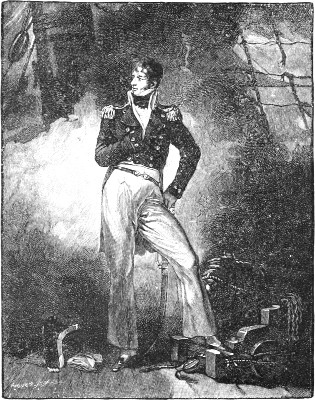
LORD COCHRANE.
(From the Painting by Stroehling.)
During this cruise Cochrane inflicted so many disasters upon the Royalist cause, as to become known amongst the Spaniards by the title “El diablo.” These disasters cannot be given in detail: so we pass to the end of February, when he entered the port of Callao with the O’Higgins and Lautaro under American colours. In this port was practically concentrated the naval force of Spain in the Pacific; yet such was the terror with which Cochrane had already inspired them, that the Spaniards dared not go out to meet him. Instead of this they dismantled their ships of war, and with the topmasts and spars made a double boom across their anchorage to prevent his approach. An unimportant action, however, took place, and at the commencement of the firing Cochrane locked his little boy in the after-cabin. In the middle of the engagement a round shot took off a marine’s head. This attracted Cochrane’s attention to the spot, where he was horror-stricken to see his son, close by the decapitated marine, and covered with blood. The boy had escaped from his confinement through the quarter-gallery window, and throughout the fight, in the little midshipman’s uniform that the seamen had made for him, had been busily engaged in handing powder to the gunners. His father now thought him killed. But it was only the blood and brains of the unfortunate marine that he was bespattered with, and up he ran to his agonised father. “I am not hurt, papa; the shot did not touch me: Jack says the ball is not made that can kill mama’s boy.” “Mama’s boy,” however, was forthwith ordered to be carried below.
It may here be pardonable to cite a few words as showing what kind of “mama” that boy had. By a writer in the North British Review, we are told that one night whilst Lord Cochrane was in command of the Chilian fleet, “his ship got becalmed under a battery from which he was assailed with red-hot shot. His men were seized with a panic and deserted their guns. If the fire from the shore were not returned, it would speedily become steady, sustained, and fatal. He went down to the cabin, where her ladyship lay: ‘If a woman sets them the example, they may be shamed out of their fears: it is our only chance.’ She rose and followed him upon the deck. We have heard her relate that the first object that met her eye was the battery with its flaming furnaces, round which dark figures were moving, looking more like incarnate demons than men. A glance at her husband’s impressive features and his ‘terrible’ calmness reassured her. She took the match, and fired the gun when he had pointed it. The effect on the crew was electrical: they returned to their posts with a shout, and the battery was speedily silenced.”
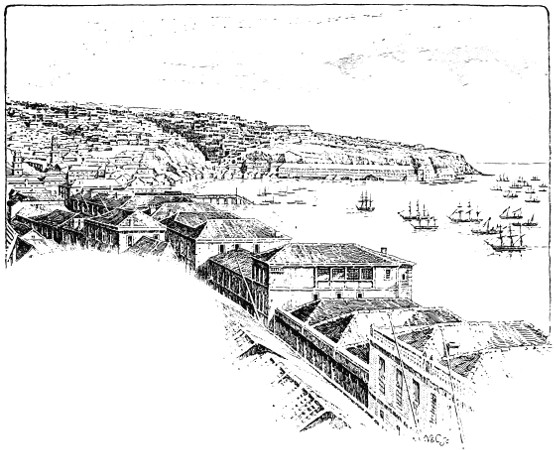
VALPARAISO.
One more glimpse at Lady Cochrane. General Miller—subsequently the hero of Ayacucho, and as brave an officer as ever unsheathed sword—was on one occasion sent on a secret service under the orders of Lord Cochrane. With his force, comprising 600 infantry and sixty cavalry, he proceeded to Huacho, a little to the north of Lima. “On the day after his arrival there,” the account proceeds, “and whilst he was inspecting the detachments in the Plaza, Lady Cochrane galloped on to the parade to speak to him. The sudden appearance of youth and beauty on a fiery horse, managed with skill and elegance, absolutely electrified the men, who had never before seen an English lady. ‘Que hermosa! Que graciosa! Que linda! Que airosa! Es un angel de cielo!’ were exclamations which escaped from one end of the line to the other. Colonel Miller, not displeased at this involuntary homage to the beauty of his countrywoman, said to the men, ‘This is our generala;’ on which Lady Cochrane, turning to the line, bowed to the troops, who no longer confining their expressions of admiration to suppressed interjections, broke out into loud ‘vivas.’”
After the action in Callao Harbour, already referred to, Lord Cochrane, on March 2nd, sent Captain Foster with a Spanish gunboat and crew they had captured, and the launches of the O’Higgins and Lautaro, to take possession of San Lorenzo, a small island about three miles distant. Here they found thirty-seven Chilians, who had been taken prisoners eight years before, and who, all that time, had worked in chains under the supervision of a military guard. The military guard were now taken prisoners, and the Chilians released.
These showed their liberators the filthy shed in which, chained by one leg to an iron bar, they had been compelled to sleep. From them, too, it was learnt that the patriot prisoners in Lima were in a more deplorable plight still, and that the fetters on their legs had worn their ankles to the bone. The pitiful tale told by these men moved Cochrane to send a flag of truce to the Viceroy in Lima, with a request for an exchange of prisoners, and complaining of the harsh treatment accorded the Chilian prisoners, while the Spanish prisoners in Chili were well treated. To this message the Viceroy replied that he had a right to treat the prisoners as pirates, and that he was surprised that a British nobleman should be found in command of the maritime forces of a Government “unacknowledged by all the Powers of the globe.” So he refused to treat for an exchange of prisoners. To the Viceroy, Cochrane replied that a British nobleman was a free man, and therefore had a right to adopt any country which was endeavouring to re-establish the rights of aggrieved humanity, and that he had, hence, adopted the cause of Chili with the same freedom of judgment that he had previously exercised when refusing the offer of an admiral’s rank in Spain, made to him not long before by the Duke de San Carlos in the name of Ferdinand the Seventh.
So ended Cochrane’s humane endeavour on behalf of the prisoners of both parties. Meanwhile, with the rather contemptible force and appliances at his command being unable to successfully attack the Spanish fleet, which lay under the shelter of the guns of the forts of Callao, he put to sea and made some important captures. Among these was a vessel laden with treasure lying in the river Barrança; another on the way from Lima to Guambucho with 70,000 dollars, the pay of the Imperial troops; and on April 10th the Gazelle, with 60,000 dollars. He also landed parties at various points on the Peruvian coast, routed the different Spanish garrisons with his marines, and captured their military stores. In this way he was able to make the enemy provide for the wants of his squadron, and his extraordinary success was due to his treatment of the natives. These he always paid for everything required from them. He also paid them highly for any information they might bring him regarding the movements of the enemy. Thus the natives became a kind of detective force working on his behalf. On June 16th he returned to Valparaiso, where, laden with the spoils of many victories, he was received with loud and warm acclamations.
It was not for these, however, that he had returned. It was to organise a more effective force, whereby he might not only blockade—that was too slow and luxurious a method of fighting for him—but even drive the enemy out of Callao, and so himself command the approach to Lima from the sea. His plan was, by means of rockets and explosives, to blow up the booms protecting the enemy’s ships to seaward, and to burn the shipping. To superintend the making of the rockets Mr. Goldsack, principal assistant of Sir William Congreve, at Woolwich, was engaged, and to actually make the rockets the Government foolishly employed the prisoners-of-war. These prisoners, knowing that the explosives they were engaged in making were intended for the destruction of their own friends, put sand, sawdust, manure, and whatever other rubbish they could find, at intervals in the tubes, which should otherwise have contained a continuous packing of gunpowder. The result was that when, some months later, Cochrane again found himself before Callao, and proceeded to put his scheme into execution, the rubbish in the rockets prevented the progress of their combustion, and reduced his elaborate design to a fiasco. It was then the Spaniards fired red-hot shot upon him, and, after losing twenty men and a lieutenant, who was cut right in two by a round shot, he was forced to abandon the attempt.
However, he did not proceed home until he had gathered fresh laurels, equipped though he was with weapons more useless than toys. He captured one or two treasure-ships, of which one, the Potrillo, had on board 30,000 dollars, the pay of the garrisons at Valdivia; he also captured Pisco, in the square of which town General Miller was shot with three bullets—one entered the arm, another entered his chest and passed out at his back, while the third shattered his left hand. He even captured Valdivia itself—a feat that was considered impossible.
The result of all these achievements was that, when he again put in at Valparaiso, he was covered with fresh glory, to the discomfiture of those who had been sedulously seeking to discredit him and to put upon him the entire blame of the failure of the expedition against Callao. Strange to say—and, indeed, mortifying to those who would entertain favourable views of human nature—Cochrane’s brilliant exploits and consequent popularity had awakened feelings of jealousy against him amongst political intriguers at Santiago. Their machinations drove him to offer his resignation. Thereupon the officers of his fleet tendered him their commissions, with the assurance that under him, and him alone, would they serve. This brought his enemies to their senses. He was implored to withdraw his proffered resignation, and induced to do so by the promise of more earnest support.
The Chilian Government had not behaved well to the sailors who had been fighting so bravely for them under Cochrane. These sailors actually had not been paid their wages, and had not received their proper prize-money, though their captures of money and stores had been more than sufficient to keep the squadron afloat. The result was that, when preparations for the next expedition were nearing completion, seamen, naturally, refused to enlist. To overcome this difficulty the following proclamation was issued:
“On my entry into Lima I will punctually pay to all foreign seamen who shall voluntarily enlist into the Chilian service the whole arrears of their pay, to which I will also add to each individual, according to his rank, one year’s pay over and above his arrears, as a premium or reward for his services, if he continue to fulfil his duty to the day of the surrender of that city and its occupation by the liberating forces.
“(Signed) Jose de San Martin.
“Cochrane.”
General San Martin signed this proclamation as commander-in-chief; but his signature alone would not have moved the men. They knew Cochrane was their friend. In him they had faith; on him they could rely to do whatever he promised, if it were humanly possible. Consequently, on the appearance of this proclamation the crews were immediately completed, and the squadron sailed, amid the enthusiastic plaudits of the people, on August 21st, 1820.
Under convoy Cochrane had transport vessels, laden with 4,200 troops under the command of General San Martin. These troops were to be disembarked in close proximity to Lima, and to march upon the city by land, while the ships-of-war engaged the enemy by water at Callao. Differences between Cochrane and San Martin early developed themselves. Cochrane was for an immediate attack upon Lima. San Martin delayed, and was landed, according to his varying wishes, now here and now there, all the while accomplishing nothing; so that at last Cochrane lost patience, and on the 30th of September they parted company in the roads of Callao. Cochrane had reconnoitred the fortifications, and urged San Martin to immediately disembark and storm the forts of Callao. He himself would see that the troops were safely landed. San Martin, however, shrank from the undertaking, and insisted on being landed at Ancon, a little to the north. Cochrane, having no power as regarded the disposition of the troops, detached from his squadron the San Martin, Galvarino, and Araucano to convoy the transports to Ancon. He himself retained the O’Higgins, Independencia (an American-built corvette that had been added to the squadron in the previous year), and Lautaro, under the pretence of continuing the blockade. In reality, he had, while reconnoitring the fortifications, formed a daring plan of attack, which he kept concealed even from the commander-in-chief. That plan was nothing short of capturing the brigs-of-war in Callao harbour, moored though they were beneath the ordnance of the surrounding forts, putting their crews to the sword, cutting adrift or burning the entire shipping of the enemy, and getting possession of a treasure-ship on which he had learnt was embarked a million of dollars, kept in readiness in case it should be necessary for the authorities at Lima to seek safety in flight. How far he succeeded in carrying out his ambitious design, it now remains for us to describe.
The attack was to begin on the Esmeralda—a frigate of 44 guns and manned by 370 picked sailors and marines, who slept every night at quarters in readiness against surprises. The Esmeralda, with two other frigates, lay under the protection of 300 pieces of artillery mounted in the batteries ashore. Surrounding her, in semi-lunar shape, were 27 gunboats and armed blockships; and exterior to them, as the first line of defence, was a strong boom with chain moorings. How on earth was Cochrane to capture this, the finest ship on the Pacific Ocean? How even was he to get near her, situated amid such defences? As well try, one would think, to capture the Castle of Callao itself by proposing to creep into the mouths of the cannon and pluck out the charges! However, Cochrane went to work; and for three days, without divulging his design to anyone, continued to make ready for the final coup. Let it here be said that two neutral warships were lying in Callao—the British man-of-war Hyperion and the American Macedonian.
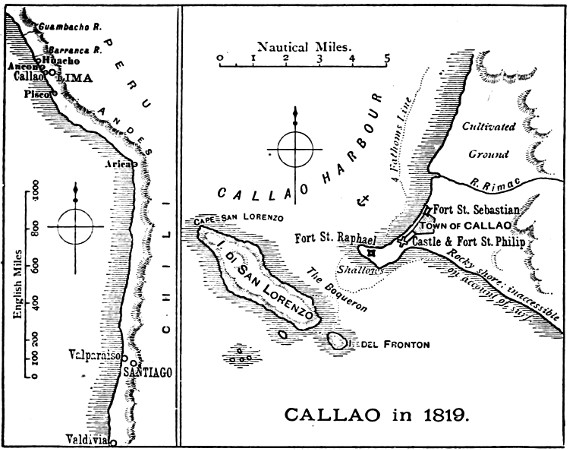
CALLAO in 1819.
On the evening of November 5th, Cochrane’s intentions were revealed with this proclamation, which was posted up on his own ship, the O’Higgins, and sent to be similarly posted up on the other two, Independencia and Lautaro, which comprised his squadron:
“Marines and seamen! This night we are going to give the enemy a mortal blow. To-morrow you will present yourselves proudly before Callao, and all your comrades will envy your good fortune. One hour of courage and resolution is all that is required of you to triumph. Remember that you have conquered in Valdivia, and be not afraid of those who have hitherto fled from you.
“The value of all the vessels captured in Callao will be yours, and the same reward in money will be distributed amongst you as has been offered by the Spaniards in Lima to those who should capture any of the Chilian squadron. The moment of glory is approaching, and I hope that the Chilians will fight as they have been accustomed to do, and that the English will act as they have ever done at home and abroad.
“(Signed) Cochrane.”
While the men on the different ships, gathered in groups, discussed the proclamation, it was announced that Cochrane was to lead the attack in person, and volunteers were invited to come forward, as he would lead no man unwilling to go into so hazardous an undertaking. A buzz of excitement followed this, and the whole of the marines and seamen on the three ships stepped forward. As it was impossible to take them all, the captains of the ships were ordered to select men from each crew—the total not to exceed 160 seamen and 80 marines. These having been assembled on the flagship, Cochrane gave the signal for the Independencia and Lautaro to weigh anchor with all haste, and put off to sea as if in pursuit of some vessel in the offing. This manœuvre had the desired effect. The look-out on the Esmeralda reported the departure of the two vessels, and the officer in command, as he received the report, observed: “Ah, well, then we may sleep soundly to-night!” It had been all along the constant fear of the Spaniards that Cochrane would spring a night-attack upon them; and, in the case of such, an arrangement had been made with the two neutral vessels, the Hyperion and Macedonian, that they should display certain peculiar lights, so as not to be mistaken for the enemy by those directing the fire from the batteries ashore.
The Spanish officer had scarcely finished his comforting remark, “We may sleep soundly to-night,” when the picked men from Cochrane’s crews, who had been receiving minute instructions as to what each was to do, were paraded on the deck of the O’Higgins. It was now dark; so the enemy, however keen their vision, could see no movement. The men presented a ghostly appearance as they moved quietly to the ship’s sides and dropped into the fourteen boats arranged below to receive them. Not a word was spoken, not even an order given. Besides, the men were draped in white with a blue band round each left arm—this, that in the conflict so soon to stain the waters of Callao Harbour, and in the blindness of their ferocity, with their blood boiling, they might not in mistake fall upon and slay one another. In each right hand was a gleaming cutlass and in each left a loaded pistol. In each man’s ears, too, still lingered Cochrane’s last command, given below: “Not a word, not a sound, not a whisper; use your cutlasses alone: now come and do your duty.” It must have been a weird sight that band of 200 white-sheeted men, in the darkness of night, dropping silently and stealthily into the boats.
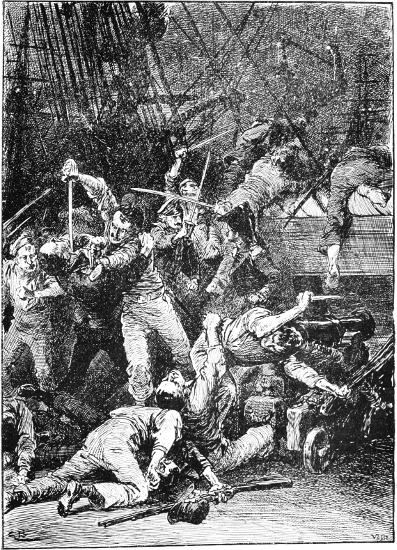
“THE CHILIAN CUTLASSES SWEPT THE DECK” (p. 274).
By ten o’clock this strange company, every one with visage firmly set, began to move slowly towards the small opening left in the boom for the enemy’s own convenience. Cochrane’s boat led the way. The boats were in two divisions—the first commanded by Flag-Captain Crosbie, the second by Captain Guise. One division was to board the Esmeralda at different points on one side, while the other division was simultaneously to board her from the other side. Thus, in the same instant of time upon the unsuspecting Spaniards would rush from every point a couple of hundred armed and determined men. Meanwhile, these daring seamen have more than two hours’ silent rowing—for the oars are muffled—before them, and during their progress to the scene of action we shall give an extract from the orders issued, as revealing somewhat of Cochrane’s full design. “On securing the frigate,” runs the order, “the Chilian seamen and marines are not to give the Chilian cheer; but to deceive the enemy, and give time for completing the work, they are to cheer ‘Viva el Rey.’ The two brigs-of-war are to be fired on by the musketry from the Esmeralda, and are to be taken possession of by Lieutenants Esmonde and Morgell, in the boats they command; which, being done, they are to cut adrift, run out, and anchor in the offing as quickly as possible. The boats of the Independencia are to turn adrift all the outward Spanish merchant-ships; and the boats of the O’Higgins and Lautaro, under Lieutenants Bell and Robertson, are to set fire to one or more of the headmost hulks; but these are not to be cut adrift so as to fall down upon the rest.” This shows that Cochrane meant nothing less than clearing out the entire port so far as Spain was concerned in it.
Just on midnight, to return to our surpliced dare-devils, they are nearing the opening in the boom and are challenged by the vigilant gunboat set to guard it. Cochrane himself is well in front of his party, and in a low voice, but with a look that means all he says, gives the watch to know that instant death will follow any attempt at raising the alarm. So no alarm is raised, and in a few minutes the boats are in line alongside the unsuspecting frigate. Another moment and that peaceful deck is the scene of a hundred fights. The Chilian crews have swarmed up her sides, and their bare cutlasses are already drenched in blood. Cochrane, boarding her by the main chains, has been knocked back by the butt-end of a sentry’s musket and has fallen on the thole-pin of his boat. The pin has entered his back near the spine, and inflicted a severe injury. He feels it not, however, and, recovering his feet, re-ascends. This time he reaches the deck, and is immediately shot through the thigh. Hastily a handkerchief is bound round the bleeding wound and he takes his place in the fight, hewing down Spaniards till he meets Captain Guise with his party hewing them down from the other side. Together they drive them back now, and the Spaniards retreat to take their final stand on the forecastle. Meanwhile Cochrane hails the foretop, and receives an “Ay, ay, sir,” from his own men; he similarly hails the main-top, and is similarly answered. So far his orders have been carried out, and his men have got possession of the ship.
The Spaniards, however, entrenched on the forecastle have yet to be overcome. The Chilians charge them with their cutlasses, and are driven back scorched with their fire. The Spaniard, as the Chilian knows by experience, cannot face cold steel; so another charge immediately follows, and again the Chilians have to retire. It is only for a second, and, at the third charge, the Spanish musketry being spent, the Chilian cutlasses sweep the deck. At this juncture it became known that this scene of carnage had its onlookers. The British ship Hyperion was so near the Esmeralda that those on board witnessed the whole proceeding, and a midshipman standing at the gangway so far forgot his neutrality as to cheer at the way Cochrane cleared the forecastle. For this he was immediately ordered below by his commander, Captain Searle, and, further, threatened with arrest.
After the forecastle was cleared as described, the fight was renewed on the quarter-deck—only for a moment, however, the Spanish marines who did not leap overboard or into the hold being instantly cut down. Meanwhile, the last quarter of an hour’s uproar had attracted the attention of the garrisons ashore, and these, presuming that what had been so much dreaded—viz., the capture of their frigate—had been accomplished, opened fire upon the Esmeralda. For this, however, Cochrane was prepared. He knew the arrangement made with the neutral vessels whereby they were to be distinguished by carrying certain lights, so he hoisted similar lights on the captured frigate. The result was that the garrisons were puzzled, and struck the neutral vessels oftener than they did the Esmeralda. This made these vessels cut their cables and move away.
Now it was that Cochrane’s orders began to be departed from. Wounded twice, as we have already seen, he was at length obliged to retire from the direction of the conflict. The command, accordingly, fell upon Captain Guise, who gave orders to cut the Esmeralda’s cables. This done, there was nothing for it but to loose her topsails and follow the retiring neutrals. Captain Guise’s excuse for so violating his superior’s commands was that he had lost all control of the men, who had burst into the spirit-room of the Esmeralda, and had otherwise broken up into disorganised bands bent solely upon pillage. But for this, seeing that they had succeeded in capturing the Esmeralda, with her picked and specially equipped crew, they might surely have chased the Spaniards from the other ships, one after another, as fast as their boats would take them, and so the whole fleet might either have been seized or burned. This was Cochrane’s intention, and to this end all his previous plans had been laid. But Cochrane now lay a wounded and exhausted man, and perhaps, under any other leadership, his daring design—if attempted in full—would have ended disastrously.
As it was, their prize was no mean one. They certainly missed the treasure-ship with its million of dollars, which the captured frigate, provisioned for three months and with stores sufficient for a two years’ cruise, was meant to convoy. Aboard, however, they found and made prisoner the Spanish admiral, with his officers and 200 seamen. The rest of the 370, who had originally manned her, had been either killed or drowned. On Cochrane’s side the losses were eleven killed and thirty wounded. The whole affair, from the moment of boarding to the cutting of the frigate’s cables, occupied only a quarter-of-an-hour. Yet in that quarter-of-an-hour, according to Captain Basil Hall, who at the time was commanding the British warship Conway in the Pacific—Cochrane had struck “a death-blow to the Spanish naval force in that quarter of the world; for although there were still two Spanish frigates and some smaller vessels in the Pacific, they never afterwards ventured to show themselves, but left Lord Cochrane undisputed master of the coast.”
The bitter feelings aroused in the breasts of the Spaniards by the disaster of that night received brutal exemplification next morning. Then, as usual, the market-boat put off from the United States ship Macedonian for the shore for provisions. As the boatmen jumped ashore they were surrounded with an angry crowd, who began to accuse them of assisting the Chilians the previous night. The boatmen’s denials were made in vain, and were answered with the confident and positive statement that, without such assistance, the feat had been impossible. Then the mob, their anger increasing and their belief in the charges they were making becoming more assured by the mere force of repetition, set upon the innocent boatmen and foully massacred them.
After this, Cochrane tried hard to draw the Spaniards from the shelter of their guns by placing the Esmeralda in positions that might tempt them to try to recapture her. Only once, when she was placed in a more than usually tempting position, did they venture out with their gunboats, and an hour’s sharp firing followed. As soon, however, as they saw the O’Higgins manœuvring to cut them off, they hastily retreated. Thus, finding it impossible to draw the enemy into an engagement afloat, Cochrane induced General San Martin to lend him 600 soldiers, and with these and the ships of his squadron he so harassed the Peruvian coast from Callao to Arica, that he virtually compelled Lima to capitulate on July 6th, 1821. Three weeks later, on the 28th of July, the national flag was hoisted in the city of the Incas and in these words Peruvian Independence declared:—
“Peru is from this moment free and independent by the general vote of the people and by the justice of her cause, which God defend.”
The Taking of the Gate Pah
by A. Hilliard Atteridge

“A poor benighted heathen, but a first-rate fighting-man,” is the description of a savage adversary which Mr. Rudyard Kipling puts into the mouth of Tommy Atkins. The New Zealanders who fought against us in the sixties were not all of them “poor benighted heathens”: some of them had been pupils in the mission schools, others had come into the mission stations as grown men to learn something of the religion of the white men. When the everlasting quarrel between natives and settlers over land rights led to strife and bloodshed, and the Maories, or natives, took to the bush, most of them forgot what Christianity they had learned, though some of them clung to the old observances; and it is said that when one of their forts was surprised on a Sunday morning, they told the victors that, had it not been for a service which they were holding, they would have been at their posts, and that the English must be strange Christians to fight on Sunday. But whatever were the opinions of the Maori tribesmen in such matters, there is no doubt the second part of the description applied to them. They were “first-rate fighting men.” They had a skill in constructing earthworks which no other race has ever surpassed, and they held them with desperate courage. Frequently when they abandoned them it was not from any fear of their adversaries, for it was one of the principles of their mode of warfare that the rapidly constructed pah, or fort, was only to be held long enough to inflict labour, delay, and loss upon the enemy, and then it was to be secretly evacuated and another work of the same kind held further inland. Of all the battles they fought against us, none displayed their soldierly qualities in a higher degree than the fight at the Gate Pah, which for a time seemed likely to end in a serious disaster to a force that far outnumbered the Maori garrison of the pah, and that brought against it all the resources of modern civilised warfare.
The fight was one in a long series, all of which ended in successes for our arms. Sir Duncan Cameron, who commanded the British forces operating against the rebel Maories in the North Island of New Zealand, was a brave and skilful Highland soldier, and the temporary check at Gate Pah was no fault of his, for he had done everything to ensure success, and it was the first time that there was anything like failure in his whole career. In the spring of 1864, which in that southern climate is the late summer and early autumn of the year, he had made Auckland his base of operations, and while the navy blockaded the coast to prevent arms and ammunition being conveyed to the rebels, he had made a successful expedition up the valley of the Thames, and with very little bloodshed had broken up the Maori power on that river and on the Waikato.
Early in April all fighting was over in the province of Auckland and the district of the Thames. The natives who had been in arms against the Government had returned to their allegiance. General Cameron was discussing with the local authorities the steps to be taken for the further pacification of the North Island, when news arrived that there was a considerable gathering of armed natives near Tauranga, in the Bay of Plenty, and the General resolved to transfer the forces under his command from Auckland and the mouth of the Thames to this new centre of disturbance. A detachment of the 68th Regiment, under Colonel Greer, was already encamped near the mission station of Tauranga. With the help of the naval squadron on the coast, the troops were rapidly transferred from the Thames Estuary to the Bay of Plenty, and by April 26th General Cameron had collected at Tauranga a formidable little force of nearly 1,700 men, including a naval brigade of 400 men and officers, the 68th Regiment, 700 strong, the 43rd, nearly 300 strong, detachments of the 14th and 70th Regiments, each about 100 strong, and a small force of the Royal Artillery, with two 40-pounder Armstrongs, and two 6-pounders, two 24-pounder howitzers, and eight mortars. In the harbour, or close at hand and within call, was a strong naval squadron made up of her Majesty’s ships Curaçoa, Esk, Miranda, Harrier, and Eclipse, under the command of Commodore Sir William Wiseman, and there was a small garrison at Maketu.
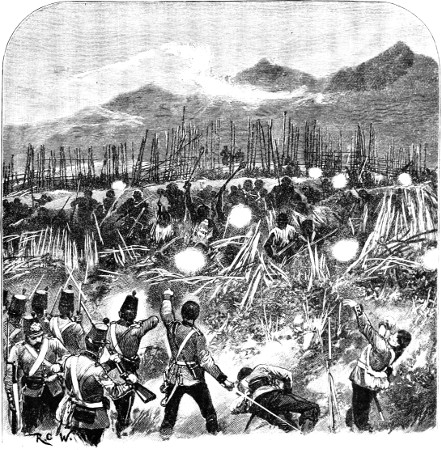
THE ATTACK.
The enemy had taken up a position about three miles and a half from the Tauranga mission station, on a neck of high ground about 500 yards wide, over which ran the road or track from Tauranga to the interior. The ridge was a swell of the ground about fifty feet high. On both sides it sloped easily to a tract of swampy land very difficult to pass anywhere, even by men on foot. To the right beyond the swamp was one of the inlets of Tauranga Harbour. The Maories had rapidly fortified the high ground, the spot where they fixed their pah, or earthwork, being evidently suggested to them by the fact that just below the highest swell of the ridge it was crossed by a three-foot trench, which marked the boundary between the mission station property and the bush and native lands. They deepened and widened this trench, carrying it down to the swamp on either side. Behind it they dug out their pah—an oblong enclosure, about eighty yards long by thirty wide. The military despatches of the time describe it as a “redoubt,” but the word is rather misleading. The Maori pah in this case, as in all others, was a series of trenches, one within the other, and communicating by cross cuts, and looking at first sight like a labyrinth. In the sides of the trenches shelters were hollowed out so that the garrison could crouch in them until the assault was actually begun. Further shelter was secured by roofing in the trenches with wattle hurdles, made with twigs and branches, thatching over this with ferns, and sometimes shovelling earth upon it. The eaves of the roofs were kept up by posts at a height of six or eight inches above the edge of the trench, so that the garrison could sweep the ground in front with their guns. At the Gate Pah, as this improvised fortress was called, there were three tiers of rifle-pits or trenches, one within the other, all having a zigzag trace, so that it was all the more difficult to make out at first sight their general plan. On either side of the ridge, a line of trenches or rifle-pits ran down the hill towards the swamps, so as to sweep with their fire the approaches to the flanks of the main work. In these rifle-pits, at intervals, traverses or banks of earth lying across the general direction of the trench, had been erected to protect them from flanking fire. In front of the works a light, open fence of posts and rails, a kind of loosely-constructed stockade, had been erected to impede the rush of a storming party. The whole was a work which would have done credit to European engineers. The garrison was certainly not more than 400 natives, perhaps less. They had very few rifles, their favourite firearm being double-barrelled shot-guns, which they were able to load and fire much more rapidly, and at close quarters quite as effectively, as the old-fashioned muzzle-loading Enfield rifle then carried by the soldiers. They loaded with slugs and bullets, and sometimes even with buckshot. For the fight at close quarters they had their spears of hard wood, small axes, or tomahawks, sometimes of stone, and the beautiful greenstone or jade war-clubs or merés of the chiefs.
On Thursday, April 27th, General Cameron began his preparations for the siege of the pah. The naval brigade had made a formidable addition to his artillery force by getting ashore from one of the ships an Armstrong 110-pounder gun, then the heaviest gun in the service, and probably the heaviest gun ever used on shore against a tribe of half-savage warriors. On the 27th the 68th Regiment, and a detachment of 170 men under Major Ryan, of the 70th, moved up to a point about 1,200 yards from the front of the pah and encamped there. As the Maories had no artillery, and no long-range rifles, and were not likely to risk a sortie, the camp was safe from disturbance. On that and the following day the guns and mortars were being got into position for the attack, the handy bluejackets from the fleet lending, as they always do on such occasions, invaluable assistance. During the day it was ascertained that at low water it was possible to pass along the beach outside the swamp on the enemy’s right, and so get to the rear of his position. Acting on this information, Colonel Greer, with the 68th Regiment, left the camp after dark on the Friday evening and slipped down to the beach, working along quietly in the dark, so as to outflank the Maories. To prevent the garrison of the pah from paying any attention to chance noises coming from the beach and so discovering this move, the main body at the camp pushed forward a few riflemen, who fired long-ranging shots at the stockade, from which the double-barrelled guns of Maori sentries answered with random shots fired in the dark, without much idea of range, or even of direction. This firing was soon over, and meanwhile Greer’s men had got round the back of the swamp and were settling down for the night among the tall ferns to landward of the enemy’s position. At the camp the sailors and gunners spent the dark hours making the last preparations for next day’s bombardment. When the sun rose, the Armstrong guns, including the big 110-pounder, besides a battery of mortars, were in position, waiting for the word to open fire. Inland the 68th held a position from which they could shoot down any of the garrison of the pah who ventured out of the work to get water from the stream behind it, or who attempted to escape inland.
At half-past six a thin line of skirmishers pushed forward to the edge of the swamp on the left of the pah and in front of the British right. General Cameron thought it possible that the enemy would abandon the work and bolt across the swamp, and took this means of hemming them in on all sides. The natives in the rifle-pits on the slope above thought this move must be the beginning of an attack, and fired ineffectually at the redcoats. This was taken as the signal for opening fire from the batteries, and guns and mortars began to send their shells roaring through the air. Over the pah a red flag waved on a tall mast. From the batteries this seemed to be the centre of the pah, and at first most of the gunners took it for their mark in laying their pieces. When the pah was captured, it was discovered that the flagstaff really stood, not in the centre of the pah, but further off, just behind its rearward stockade. The result of this mistake was that for the first two hours many of the shells passed harmlessly over the Maori position.