LIST OF PLATES. (continued 8)
Reading edition
But his defeat at Alexandria, far from breaking the power and pride of Arabi, had the effect only of deepening his hatred of the English, and he retired into the interior with the view of organising further opposition to our arms. He had thrown down the gauntlet, and England could not refuse to pick it up. As our fleet could not sail up the Nile to Cairo, it behoved us to equip and send out an army which should land in Egypt, seek out Arabi wherever he was to be found, and make an end, once and for ever, of him and his rebellious force. This army was entrusted to the command of Sir Garnet (afterwards Viscount) Wolseley, who had already distinguished himself in so many of our “little wars” that he was facetiously termed “our only General.”
Nor could the command of the expedition have been given to a better man. Sir Garnet was a tried soldier, and now he became a prophet as well. Before leaving England he had laid his hand, with remarkable foresight, upon the map, and, pointing to Tel-el-Kebir, said that he would engage and beat the army of Arabi there, about the 13th September; and he kept his word to the very letter. At first the French seemed inclined to share with us the work of restoring order in Egypt; but at the last moment they stood aside and left England to deal with the task of quelling Arabi.
To accomplish this task, England at once began to bring together in Egypt an army—or Army Corps—of about 40,000 men. Some came from our garrisons in the Mediterranean—Malta, Cyprus, and Gibraltar—others were brought from India, and the remainder sent out straight from England.
Being gathered, as it was, from so many different sources, this huge force could not, of course, all land at once; but the marvel was that its component parts reached the trysting-ground in Egypt so soon as they did, and it was admitted on all hands that no other nation in the whole world could have performed such a difficult transport operation so swiftly and so well.
It was known that Arabi had about 60,000 fighting men at his disposal, which was 20,000 more than were commanded by Sir Garnet Wolseley; and if these two armies had met one another in full force, there is no saying but that the result of the campaign might have been different. But the beauty of Sir Garnet’s war-policy was that he kept his opponent so long in the dark as to where he meant to strike; with the natural result that Arabi, deeming it wise to be prepared on every hand, had his 60,000 men portioned out at the likeliest places, all over the Delta—some in the neighbourhood of Alexandria, some at Cairo, and some at Tel-el-Kebir, a commanding point on the railway between Ismailia, on the Suez Canal, and the capital. This suited Sir Garnet to perfection, and his great aim was to make Arabi think that he meant to land the bulk of the British force in Alexandria, and challenge him to battle at the Egyptian lines of Kafr Dowar.
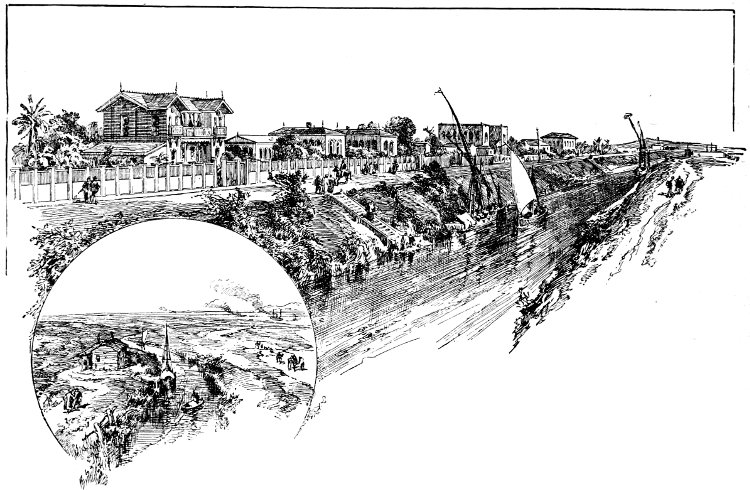
Top: THE SWEET-WATER CANAL, AT ISMAILIA.
Bottom: THE SWEET-WATER CANAL.
In order to encourage this delusive belief in the mind of the rebel Pasha, a considerable force had already landed here and indulged in feints against the foe. Sir Garnet had craftily caused it to be spread abroad that the gross of his force aboard the transports in the bay was going to be put ashore; but what was the surprise of everyone—for the secret had been in the keeping of only one or two—to behold one night the magnificent flotilla of troopships, escorting-ironclads and all, steaming away in majestic procession towards the east and the mouth of the Suez Canal!
Ismailia, on the Canal, midway between Port Said and Suez, had been aimed at by Sir Garnet from the beginning; and here, in truth, on the 20th August—only a short eighteen days after he had left England by the sea route—the British army began to disembark on the burning sands of Egypt.
Among these burning sands water was more precious than gold and silver to the British soldier; but the only source of its supply was the Fresh-water Canal running through the arid desert from the Nile to Ismailia alongside of a railway line, and it therefore behoved the English commander to secure the water in this canal from being cut off by the enemy. But to do this it was necessary above all things to push forward an advance force about twenty miles into the very heart of the desert as far as a place called Kassassin, where there was a lock, and accordingly this was done with the utmost courage and promptitude.
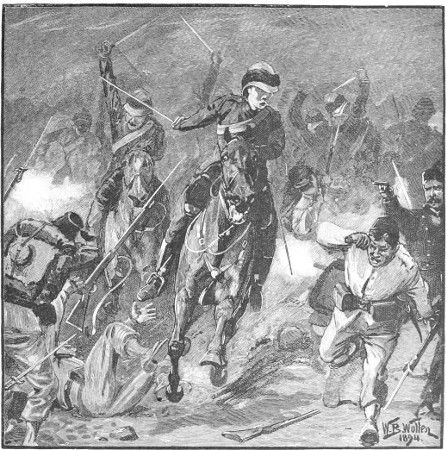
“THE EGYPTIAN BATTALIONS ... HAD BEEN TRAMPLED AND SABRED INTO POSITIVE ANNIHILATION” (p. 199).
At Mahuta the Egyptians had made an attempt to bar this advance, but their opposition was swept away like chaff, and soon thereafter General Graham reached Kassassin Lock with his vanguard, entrenching himself in that position with strict orders to hold it against all comers. Well aware of the importance of this position for the British, the Egyptians made several attempts to drive them out of it and back to Ismailia before reinforcements could reach them; but each time they recoiled from the enterprise with the bitter conviction that British bullets and sabres were things on which no one could reasonably hope to whet his teeth and thrive. Two main actions were fought at Kassassin—though these formed the mere prelude, so to speak, to the grand spectacular drama that was presently to be enacted at Tel-el-Kebir.
The chief of these preliminary actions, fought on the 28th August, will always be memorable for the grand cavalry charge which closed it. Early in the morning General Graham had become aware that the Egyptians were making preparations to attack him from a circle of sand-hills which formed a kind of amphitheatre around Kassassin. Graham’s force was by no means a large one, but it was impossible for the Egyptians to make out how strong it really was, and it is always half the battle to be able to conceal your plans and numbers from the enemy. A few days previously Arabi had sent out his second-in-command, Mahmoud Fehmi Pasha, a great engineer and reader of military signs, to discover the strength and dispositions of Graham, but by a curious accident he fell into the hands of the English and never returned to his own side. To this capture Arabi himself afterwards attributed the sole blame of his not having been able to oust the audacious English from their advanced post at Kassassin—and the incident will show how very important it must always be in warfare to seize and detain spies.
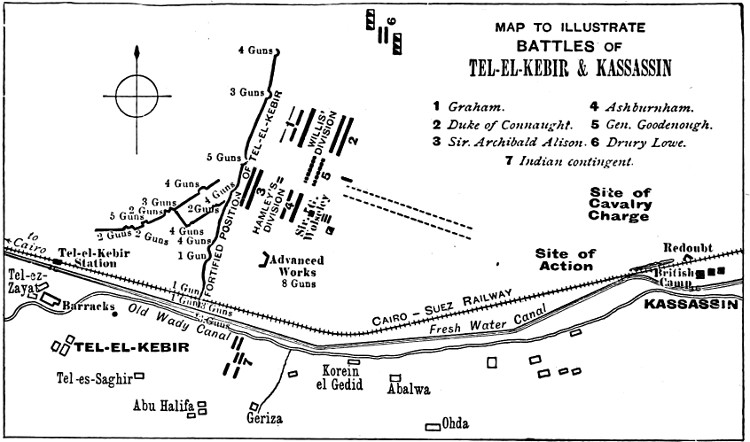
MAP TO ILLUSTRATE BATTLES OF TEL-EL-KEBIR & KASSASSIN
Graham’s force at Kassassin was not a large one (under 2,000), consisting mainly of a company of Royal Marine Artillery, the Duke of Cornwall’s regiment, the York and Lancasters, with some mounted infantry and a few guns, one of which, under Captain Tucker, was mounted on a railway truck. But the Egyptians, taking a leaf out of our own book of war, had by this time imitated us in this respect—though they were very bad range-finders, and did us little harm.
Drury Lowe’s Cavalry Brigade, consisting of the 7th Dragoon Guards and three squadrons of Household Cavalry (contributed by the 1st and 2nd Life Guards, and “Blues,” or Horse Guards, respectively) were stationed some miles to the rear at Mehsameh, and Graham heliographed to these splendid troopers to come and help him on his right flank in the impending battle. Come they also did with right good will, for they were all burning for a fight, but only to hear that the Egyptians, after using their guns for some time, had apparently retired again behind their sand-hills; so back they went to Mehsameh and off-saddled again.
The heat was terrific, and bucketfuls of water from the canal had to be poured on the heads of the English artillerists to enable them to stick to their guns. Sunstrokes were numerous, but our men bore all their sufferings with a fortitude truly heroic. The scorching heat was probably the reason why the Egyptians had drawn off from their first attack on Kassassin, but towards the cool of the evening they again began to push forward from their sand-hills and threaten the British position. The left of this position was well protected, but the right less so; and, indeed, General Graham expressly made such a disposition of his force on the latter flank as might tempt the enemy down from his sand-hills so as to essay a turning movement, when they would be caught in the trap which he was preparing for them.
To this end, about 5.20 p.m., he despatched his aide-de-camp, Lieutenant Pirie, 4th Dragoon Guards, with a message to Drury Lowe, in the rear, at Mehsameh, or wherever he should be found, “to take the cavalry round by our right, under cover of the hill, and attack the left flank of the enemy’s skirmishers.”
But when Lieutenant Pirie did at last reach Lowe, after a long and fatiguing ride through the arid desert sand—in the course of which his horse fell under him from sheer exhaustion and he had to borrow another mount from a gunteam—he delivered his message in this altered form, that “General Graham was only just able to hold his own, and wished General Drury Lowe to attack the left of the enemy’s infantry skirmishers.” The famous cavalry charge at Balaclava had been due to a similar mistake in the delivery of a verbal order, though at Kassassin, as it turned out, the repetition of this mistake did not result in disaster, but in victory. So far was Graham from not being able to hold his own that, about two hours after despatching Lieutenant Pirie for the cavalry, he had ordered a counter-attack and a general advance of his line, which had meanwhile been reinforced by a fresh battery, for his other guns had been obliged to retire out of action, owing to want of ammunition, it having been found impossible to drag the battery carts through the deep and yielding sand.
It was while Graham was engaged in this general advance that at last Drury Lowe arrived upon the scene with his cavalry. The sun had now set, but a bright moon was shining, and the flashes from the Horse Artillery and infantry afforded some guide for the movement of the British horsemen, which was directed on the evening star—the orbs of heaven being the only landmarks in the nocturnal desert. Suddenly the cavalry came in sight of the extreme left of the Egyptians, and was at once exposed to a heavy fire. “Shells screamed and shrapnel bullets tore up the road on either side of us.” Rushing to the front, the guns of the Horse Artillery attached to the Cavalry Brigade unlimbered and belched out several rounds of shell on the Egyptian masses. Then the front of these British guns was rapidly cleared, and Drury Lowe gave the Household Cavalry the order to charge.
Led on by Colonel Ewart, away with a wild cheer went the three ponderous squadrons of clanking giants straight at the Egyptian battalions, which in a few more moments had been trampled and sabred into positive annihilation. “Now we have them!” Sir Baker Russell had cried out to the men; “trot—gallop—charge!” Sir Baker’s own horse was shot under him, but he caught another, and was soon again in the thick of the fray. Many were the feats of personal adventure in connection with this glorious charge. Some of the troopers were killed, some lost themselves in the darkness and were taken prisoners, happy to escape the barbarous mutilations that were perpetrated by the Egyptians on the British dead and wounded.
The cavalry charge at Kassassin was a splendid feat of arms, but it somehow or other became the subject of as curious a myth as that which gathered round the sinking of the Vengeur on the “glorious 1st of June.” At Balaclava the Light Brigade had ridden down upon the Russian guns, and nothing would content the chroniclers of Kassassin but the performance of a similar act of glory. The illustrated papers of the day which had artists in Egypt gave stirring pictures of our Life Guardsmen dashing through the smoke of the Egyptian batteries, slashing and thrusting at the gunners as they crouched for shelter beneath their pieces. But this was pure imagination. If commanded to do so the Life Guards would have charged into the very “mouth of hell,” not to speak of Egyptian guns. But what they were ordered to “go for” was the Egyptian infantry, which was considerably in front of its guns, and these had limbered up and retired from action, rendering it impossible for our victorious troopers to see and capture them in the darkness. But the day had been won all the same, and another bright name blazoned on the victory roll of the British army.
A few days later, on 9th September, another attack of the Egyptians on Kassassin was beaten off in the most brilliant manner, the 13th Bengal Lancers, in their picturesque turbans, especially distinguishing themselves; and there were many who thought that Sir Garnet Wolseley ought to have rushed the not far-distant entrenchments of Tel-el-Kebir there and then. But though this might certainly have been done, there were certain weighty reasons of military policy against the step. For a commander must not be too much of a Hotspur, but think of ulterior aims as well as of present opportunities. It is the man who can bide his time that will ultimately win.
Foiled in their repeated attempts to bar the British advance, Arabi and his Egyptians now finally withdrew behind the entrenched lines of Tel-el-Kebir, there to stand on the defensive and await attack. These formidable lines, which ran along a ridge of rising ground, presented a front of about four miles long, and had been constructed according to the most advanced principles of military engineering. The Egyptians are great hands at the spade, being constantly employed in the throwing up of waterdams and the like, and many thousands of willing hands had been at the disposal of Arabi in the task of raising his famous line of earthworks. How many men of all kinds—Egyptians, Nubians, Bedouins, etc.—Arabi had behind the shelter of these parapets Sir Garnet Wolseley did not exactly know, but concluded that the number could not be far short of 22,000.
On the other hand, the English commander had now with him about 17,000 officers and men, with sixty-seven guns, wherewith to crack the nut that was presented by Arabi’s entrenchments, and these Sir Garnet resolved to storm at the hour when darkness was beginning to glide into dawn—for the reasons that at this cool hour his troops would naturally fight much better than under the roasting rays of the sun, that they would be less exposed to the enemy’s fire in the faint light, and that they would also profit by the demoralisation which invariably seizes upon soldiers when set upon unawares. But, to make the surprise complete, it was necessary that the very utmost care should be taken to give no indication to the watchful Egyptians behind the earthworks of the stealthy approach of their British foes. When ranked into line, the storming columns were to advance—not to the word of command, but by the mere guidance of the stars, like so many ships at sea. Not a pipe was to be lit, not a whisper heard in the ranks, and one man of the Highland Light Infantry, whose high-strung feelings found vent in sudden shouts, only escaped bayoneting on the spot by being chloroformed to keep him still and left behind.
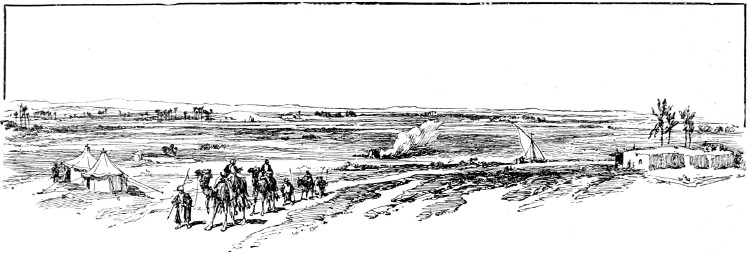
SABA BIER.
The Valley of the Saba Bier (Seven Wells), along which the troops marched on the advance upon Tel-el-Kebir.
The night (September 12–13) was more than usually dark, and it was some time before the troops could be placed in the positions assigned them. On the right marched the 1st Division, commanded by General Willis, the front, or leading Brigade, under Graham, consisting of the Royal Irish, Royal Marines, York and Lancasters, and Royal Irish Fusiliers. Behind them, at a distance of about a thousand yards, was the Brigade of Guards (Grenadiers, Scots, and Coldstreams), under the Queen’s soldier-son, the Duke of Connaught. The left of the attacking line was occupied by the 2nd Division, led by General Hamley (a great writer on the art of war), the front position of honour and of danger being accorded to the Highland Brigade of one-armed Sir Archibald Alison (son of the celebrated historian of “Europe”), composed of the famous Black Watch, Gordon Highlanders, Cameron Highlanders and Highland Light Infantry, four of the finest battalions that ever wore the kilt and trews or thrilled to the stirring strains of the Celtic war-pipe. Behind these Scottish battalions marched, as a reserve, Ashburnam’s Brigade of the King’s Royal Rifles and Duke of Cornwall’s Infantry, while in the interval between the two Divisions was placed General Goodenough’s crushing mass of artillery of forty-two guns. On the extreme right rear flank of the assaulting force marched Drury Lowe’s cavalry heroes of Kassassin, already spoiling for another charge; while on the extreme left of the British line, on the other side of the Fresh-water Canal, followed the Indian contingent of General Macpherson, consisting of the Seaforth Highlanders, three battalions of native infantry, Bengal Cavalry, and some mountain guns, the task of this contingent being to turn Arabi’s right flank, which rested on the canal.
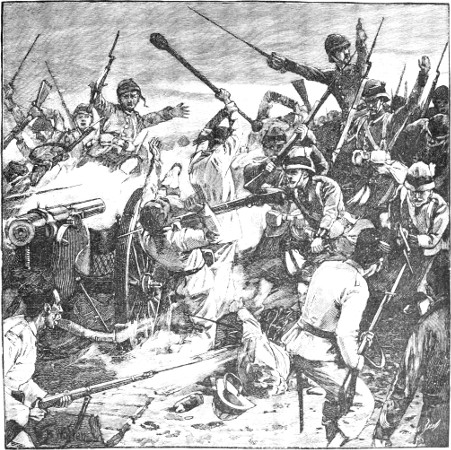
“CARRYING THEM WITH THE BAYONET” (p. 203).
Arabi and his men fondly believed that all this British force was sleeping the sleep of wearied soldiers at Kassassin and other points between that place and the Suez Canal. As a matter of fact, it was marshalling itself in line of battle array as above detailed on an elevation called Ninth Hill, about five and a half miles from Arabi’s lines, from which it remained hidden by the impenetrable curtain of the night. Some of the regiments—notably the Highlanders—had but a few hours before hurried up to the front from Ismailia[4]; yet, though wearied by the long and strenuous march, they were all eager to be led on to the fight without further delay. Until the hour of starting, all the men stretched themselves on the sand to snatch what brief and hurried sleep they could. From previous experience it was reckoned that the actual progress over the desert, with its darkness and other difficulties, would be about one mile per hour—just think of that!—so that by starting at 1.30 a.m., Sir Garnet calculated to reach the enemy’s works just before the first gleam of dawn—so nicely was everything planned beforehand. “The long sojourn at Ninth Hill,” wrote General Hamley, “while waiting for the moment to advance was of a sombre kind: we sat in silence on our horses or on the sand, while comrades moving about appeared as black figures coming out of the darkness, unrecognisable except by their voices. A skirmish had taken place some days before near this spot, in which men and horses were slain, and tokens of it were wafted to us on the breeze.” Once there was a false alarm on the right, and the prostrate men sprang to their feet; but it turned out to be only a body of British cavalry moving across the front of the line.
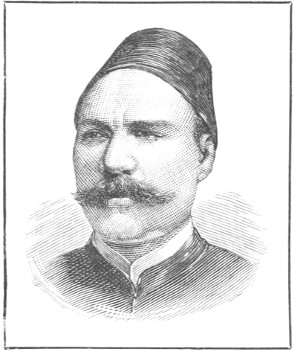
ARABI PASHA.
At last, in the lowest undertone, word was passed along all the line to advance, and soon nothing was heard but the “swish-swish” of the battalions footing it warily across the sand as if it had been snow—silence otherwise and darkness around and above, with the stars shining down as they had done in the time of the Pharaohs and the other dynasties of Egyptian kings lying entombed in the Pyramids. Well might the British troops have been impressed with the suspense of the moment and the awful solemnity of the scene. Directing poles had been previously fixed in the sand by the Engineers, but they proved of little or no use, the only effective finger-posts being the everlasting stars, and even these were now and then obscured by clouds. Sometimes the mounted men of the Headquarters’ Staff, moving up to the columns with whispered instructions, were mistaken for prying Bedouins; but silence and discipline were wonderfully well preserved, and forward, ever forward, moved the invisible and barely audible masses of fighting men. Once the Highland Brigade lay down to rest for twenty minutes, and this was the occasion of some confusion which was like to have ended in a calamity. For the order thus given in the centre of the Highland line did not reach the outer flanks, by reason of its being so cautiously passed from mouth to mouth, till some time after, the consequence being that as the flanks continued to step out, while maintaining touch with the recumbent centre, those flanks lost their direction and circled round in such a manner that the Brigade finally halted in a crescent-shaped formation, with the right and left almost confronting each other; and but for the intelligence and efforts of the officers, these opposing flanks, mistaking each other for enemies, might have come to actual blows.
With great difficulty the proper march-direction was restored, and on again swept—or, rather, crept—the whole line, like thieves in the night. Weird and ghostly was the effect of the dim streaks, looking like shadows of moving clouds, but which were really lines of men stealing over the desert. All these men knew that they were forbidden to fire a single shot until within the Egyptian lines, and that these were to be carried with a cheer and a rush at the point of the bayonet; so that they almost held their breath with eagerness, and plodded ever on like phantoms of the desert—silent, resolute, and prepared. For nearly five hours they had thus advanced, and then they knew that the supreme moment must now be near. Nearer, indeed, than they fancied! For, to use again the words of General Hamley, who was riding behind his Highlanders: “Just as the paling of the stars showed dawn to be near, but while it was still as dark as ever, a few scattered shots were fired in our front, probably from some sentries, or small pickets, outside the enemy’s lines. No notice was taken of this, though one of the shots killed a Highlander; the movement was unchanged, and then a single bugle sounded within the enemy’s lines. These were most welcome sounds, assuring us that we should close with the foe before daylight, which just before seemed very doubtful. Yet a minute or two of dead silence elapsed after the Egyptian bugle was blown, and then the whole extent of entrenchment in our front, hitherto unseen and unknown of, poured forth a stream of rifle fire. Then, for the first time that night, I could really be said to see my men, lighted by the flashes. The dim phantom lines which I had been looking on all night suddenly woke to life as our bugles sounded the charge, and, responding with lusty, continued cheers, and without a moment’s pause or hesitation, the ranks sprang forward in steady array.”
It was as if the footlights of the rebel Pasha’s long-extended stage had suddenly flashed out with blinding flame; and now the vast and solemn theatre of the desert, which a moment before had been wrapped in the deepest silence and darkness, grew luminous with lurid jets of fire and resonant with the deafening rattle of Egyptian musketry and the roar of guns—a transformation scene as sudden as it was impressive. Never had British soldiers been actors on such a grandly picturesque stage. But do you suppose that these soldiers returned the volleys rained on them by the Remingtons of Arabi’s men? Not a bit of it. Not a single shot was fired from our lines; but bayonets were fixed, and away like an avalanche dashed the redcoats on the foe. Their distance from the blazing line of entrenchment was deemed to be about 150 yards, and in the interval nearly 200 men went down, the 74th (Highland Light Infantry) on the left losing five officers and sixty men before it got to the ditch. This was six feet wide and four feet deep, and beyond was a parapet ten feet high from the bottom. The first man to mount this parapet was Private Donald Cameron, of the Cameron Highlanders, a brave young soldier from the braes of Athol; but he at once fell back among his struggling comrades with a bullet through his brain, dying the noblest of all deaths. Little wonder that, on passing the 79th, after the battle, General Alison exclaimed, “Well done, the Cameron men! Scotland will be proud of this day’s work!”
It so happened that in the darkness the Highland Brigade, which formed the left of the attack, had got considerably in front of the rest of the line, so that it was the first, so to speak, to break its bayonet-teeth on Arabi’s entrenchments; and the seizure of these works for the first ten minutes to a quarter of an hour of the fight was the history of the advance of the kilted warriors from the North. They had not fought better even at Fontenoy, Quebec, and Quatre Bras; nor were their present foes to be despised, seeing they were allowed by all to have borne the charge with a discipline and a desperation worthy of the best troops. “I never saw men fight more steadily,” said Sir A. Alison. “Five or six times we had to close on them with the bayonet, and I saw those poor men fighting hard when their officers were flying before us. All this time, too, it was a goodly sight to see the Cameron and Gordon Highlanders—mingled together as they were in the stream of the fight, their young officers leading in front, waving their swords above their heads—their pipes playing, and the men rushing on with that proud smile on their lips which you never see in soldiers save in the moment of successful battle.”
When the Black Watch had reached the crest of the works, and were being re-formed to attack some other guns in the interior entrenchments, a battery of the newly-formed Scottish Division of the Royal Artillery swept past them, shouting out “Scotland for ever!” as the Greys and the Highlanders had done on the ensanguined slopes of Waterloo. Here the Black Watch had to mourn the death of Sergeant-Major MacNeill, who fell pierced by three bullets after laying low six of the enemy with his good claymore. There is a story that at one time some confusion was caused in the onward rushing ranks of the Camerons by some voices shouting “Retire! retire!” and that these cries were found to have emanated from a couple of “Glasgow Irishmen”—Fenians who wished no good to the cause of England and her army—and that they were put an end to there and then, meeting with the just fate of all traitors. But this has been shown to be incorrect. There were no traitors at Tel-el-Kebir. The Irish soldiers did their fair share of the fighting. The Royal Irish on the extreme right, with a wild yell, and all the splendid valour of their nation, went straight as a dart at their particular portion of Arabi’s works, carrying them with the bayonet, and turning the flank of his position.
All along the line the engagement now became general, our men plying butt and bayonet upon the Egyptians, who fell in scores—in swarms. At the bastions stormed by the Highland Brigade the enemy lay in hundreds. On the other hand, the total losses of the British army at Tel-el-Kebir amounted to 339, of which 243 occurred in the Highland Brigade, leaving 96 to represent the losses of the rest of the force.
Under the Queen’s soldier-son the Guards were in the second line as a reserve, but so quickly and successfully had the works been stormed that they were not required to fire a shot. Some, however, were wounded (Father Bellew, their Roman Catholic chaplain, and Colonel Sterling amongst others), for Arabi’s men shot high, sometimes over the heads of the attacking party. On the other side of the canal, the Indian contingent, with the Seaforth Highlanders, the bronzed companions of Roberts in his immortal march from Cabul to Candahar, had met with less opposition, and came up just in the nick of time to turn Arabi’s right flank and complete the rout of his broken men. His camp, stores, and ordnance were all captured, and he himself fled alone from the field of battle on a swift steed.
It was asserted by some of our ill-natured foreign critics who were rather jealous of our brilliant victory, that we had dimmed its lustre by massacring many of the wounded Egyptians. But this was not true in the sense implied. None but savage nations commit such barbarities, and British troops have never been wanting in a humanity equal to their courage. Certainly some of the wounded soldiers of Arabi had to be bayoneted as they lay, but this was simply owing to the fact that when our triumphant troops were rushing on through the prostrate ranks of their foes, numbers of the latter, feigning to be dead, suddenly raised themselves and fired at the backs of our forward-bounding men. There was even one case, at least, where a wounded Egyptian did this after being treated to a pull from the water-bottle of a kind-hearted Highlander (the Sergeant Palmer to whose account of the battle reference has already been made in a note); and for such an act of base ingratitude and treachery, there could only have been one possible answer—the bayonet point. By the time the action was over, our own men were suffering frightfully from thirst, nor could many of them be restrained from rushing to quench their thirst in the adjacent canal, although the water was almost putrid from the corpses of men and the carcases of animals.
The battle had been won by the British infantry, but the artillery and cavalry (as well as a splendid body of Blue Jackets) came up to carry on the pursuit of the flying foe and pluck the fruits of victory, which, on the night of the following day, fell into the hands of the English, when their cavalry, after a splendid forced march of about forty miles under a blazing sun, entered Cairo just in time to save the city from destruction and capture Arabi himself.
After Waterloo we sent the despot Napoleon to St. Helena, and after Tel-el-Kebir we sent the rebel Arabi to Ceylon, where he had leisure enough to reflect on the folly of having called out into the field against him as finely-organised a force as ever added lustre to the British arms.
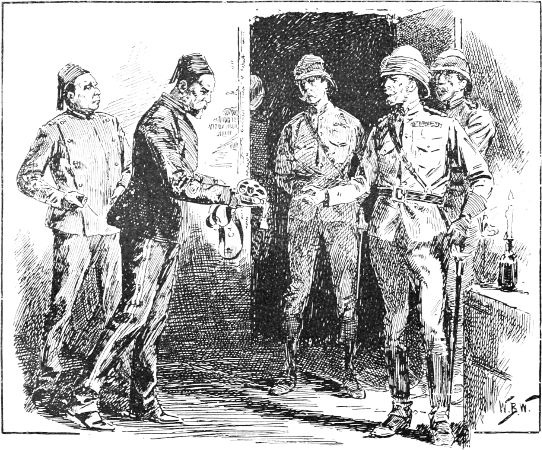
ARABI SURRENDERING TO GENERAL DRURY LOWE.

SHILOH
BY ANGUS EVAN ABBOTT
It must have seemed to the people of the United States as if Sunday was to be for them a day of fate. Bull Run, the initial battle of the Civil War, was fought on a Sunday, and Shiloh, the battle which may be considered the second clear point of the great struggle, began on a Sunday. But here coincidences between the battles did not end. A General Johnston (Albert Sidney at Shiloh and Joseph Eggleston at Bull Run) and General Beauregard commanded the Southern forces on both occasions; moreover, each battle may be said to have had two clearly defined parts, and in each first appearances, as is so often the case in things civic or military, proved deceptive. At noon on the Sunday of Bull Run the Federals had carried all before them; and at noon on the Sunday of Shiloh the South was in as favourable a position. Yet, in the end, the North suffered defeat at Bull Run, as did the South at Shiloh.
The fortunes of war, ever fickle, went sadly against the Confederates at Shiloh. Skilfully planned and boldly executed by the Southern leaders, if luck had been at all equally divided between the two armies, the Confederates must surely have won. But in the thick of the action, when Sherman had been driven back step by step, when Prentiss and his whole command had been captured, and when nothing seemed able to stay the march of the South, and none to withstand their savage charges—when, in fact, it looked as though Grant and his army must inevitably be annihilated or swept into the Tennessee River—then it was that a rifle-bullet struck General Johnston. The leader of the Confederate army fell, and in a few minutes bled to death.
The news ran along the Southern line, and to everyone who heard it, foretold disaster. It checked the charges of the South more effectively than ten thousand Federals could have done. The men from the South lost heart. Their ardour cooled, and the partial cessation of the fight allowed the Northerners the breathing-time they so sorely needed.
To add to the confusion of the Confederates, General Beauregard, second in command to Johnston, could not at once be found, and for a time the army was leaderless. When Beauregard learned of the death of his chief, he hastened to assume command; but before he could get his army in hand, two invaluable hours were lost. This left him with far too short a spell of daylight before him to successfully accomplish all that was needed to be done for victory. Night came on, and with the night came General Buell and 30,000 men to the relief of Grant.
Next day General Beauregard found himself outnumbered, an army of fresh men opposing him, and the victory so nearly won was snatched from him.
The defeat of the Federal forces at Bull Run came as a great humiliation to the North, but it served a good purpose nevertheless. Up to the destruction of McDowell’s army at Bull Run, the people of the Free States had looked upon the rebellion of the Slave States as a trivial matter, of little moment, scarcely a rebellion at all. But when the dead, wounded, and missing of Bull Run were counted, the gravity of the situation came home to a people unused to war. It was then recognised that the enlisting of 75,000 men, and these for three months only, had been but trifling with a situation full of grave danger. President Lincoln called for 500,000 men to serve for three years, and this call was answered by close upon 700,000. These men enlisted in all sincerity, and from that day to the close of the war there were no longer lighthearted, boisterous mobs, tramping gaily to the South, but armies moving seriously, and fully recognising that a stubborn contest lay ahead. Bull Run was fought near Washington on the Atlantic slope, but Shiloh brings us to the Mississippi Valley. The battle-field is in the State of Tennessee, near to the border of the State of Mississippi, and rests on the Tennessee River at a place called Pittsburg Landing. Indeed, the battle would have been more appropriately named the Battle of Pittsburg Landing—many do speak of it as such.
Leading up to the Battle of Shiloh were several important movements and events. In the first place, at the outbreak of rebellion, the State of Kentucky, to use an American expression, attempted to “sit astraddle the fence.” A majority of those in authority in that important State, sympathising with the South, but recognising that the people of the State were largely in favour of maintaining the Union, tried to induce them to declare neutrality—to notify both North and South that any attempt to send troops into Kentucky would be resisted by the troops of the State.
This, on the face of it, was an impossible position. If President Lincoln had recognised the right of a State to remain neutral, and to forbid the passage across it of national troops, he would soon have found a barrier of such States running clear across the continent, and in the end he would have been unable to stamp out the rebellion at all. Lincoln refused to recognise such a position, and the people of Kentucky, thinking better of it, declared their loyalty and offered service.
When those at the head of Southern affairs saw that Kentucky could not be hoodwinked even by such a plausible plea as negative action, General Polk, commanding a Southern force of considerable dimensions, was ordered to push up into the State. This he did, and seizing Columbus, an important town some twenty miles or so south of the junction of the Mississippi and Ohio rivers, established there his headquarters.
Another force of Southern troops took possession of Bowling Green, an important centre on the far east of Kentucky. Between these two Confederate centres the rivers Tennessee and Cumberland flowed, the rivers themselves and their valleys forming natural highways to the very heart of the South. To prevent any such use being made of these by the Federals, the Confederates built two forts—Fort Henry on the Tennessee River, and Fort Donaldson on the Cumberland River. These were placed at points where the two rivers were only twelve miles apart; and a line drawn from General Polk’s headquarters, Columbus, on the Mississippi east to Bowling Green, intersecting the two forts, would be the line between the North and the South.
This General Polk, commanding at Columbus, was a character in his way. When war broke out it found him Bishop of the Episcopal Church in Louisiana; and without resigning his ecclesiastical position—intending, in fact, to again resume active work when the war should be over—he accepted command of a Confederate force and served with considerable distinction, effectively checking Grant at the Battle of Belmont, and holding Columbus until the capitulation of Fort Donaldson, when he fell back to join General Johnston at Corinth, which movement brought him on the field of Shiloh. He was killed on Pine Mountain by a cannon shot in 1864.
When Polk and his Confederates seized Columbus, a Federal force was massed at Cairo, in the State of Illinois, not many miles north of the Confederate headquarters. Among the officers stationed at Cairo there was one who, although as yet in a comparatively subordinate position, was destined to become the central figure of the war. Before the struggle ceased the name Ulysses S. Grant became known throughout the length and breadth of the land.
Like a large majority of the officers engaged in the war, Grant had served through the Mexican campaign, and at the taking of Mexico won personal compliments from General Worth for, among many other remarkable deeds, mounting a Howitzer in a church belfry, and from that elevation firing upon the enemy. When the Mexican war collapsed, Grant retired from the army and lived in obscurity, at one time tilling a small farm near St. Louis, at another clerking in a hardware store, and again, earning his living as a carter; but when the civil strife began, the Governor of Illinois appointed him mustering officer, and step by step he advanced until the capture of Fort Donaldson brought his personality vividly before the people of America. From that day his fame as a leader spread. After years of fighting he brought the war to a conclusion, and before he died had been twice elected President of his country.
But stationed at Cairo, and confronting General Polk, he had his reputation still to make. The headquarters of the Northern forces were at St. Louis, General Halleck being then the commander of the Federals in that part of the country. To him Grant proposed a scheme, and applied for permission to break the Southern line by an attack and capture of the twin forts, Henry and Donaldson. Supplementing Grant’s appeal, this plan was urged upon Halleck by many prominent military experts in the North.
For a long time General Halleck did not even reply to Grant’s request. However, on February 1st, 1862, Grant obtained the permission for which he sought, and, marching against Fort Henry, quickly reduced it. Without losing a moment’s time he pushed across the twelve miles intervening, and set about the taking of Fort Donaldson. This proved a much more difficult undertaking than Fort Henry had been, but on account of divided authority among the Confederates holding the fort, and excellent fighting by the Northern forces, this in time fell. For these successes General Halleck was assigned to the command of the Department of the Mississippi, and Grant, raised to the rank of major-general, assigned to the command of the military district of Tennessee.
Polk evacuated Columbus, made a stand at “Island No. 10,” was driven from there, and the Southern line was shattered.
Grant drove the Southern forces out of the State of Kentucky and across the whole breadth of the State of Tennessee.
General Johnston, the Southern commander, ordered a concentration at a place called Corinth, near the border-line of Tennessee and Mississippi, and the Northern forces concentrating at Savannah, twenty-three miles farther north, made the battle of Shiloh inevitable.
On March 11th President Lincoln in a war order commanded, “That the two departments now under the respective commands of Generals Halleck and Hunter, together with so much of that under General Buell as lies west of a north and south line indefinitely drawn through Knoxville, Tennessee, be considered and designated the Department of the Mississippi, and that, until otherwise ordered, Major-General Halleck have command of said Department.” Halleck was an exacting officer, who carried caution and prudence to such an extent that they ceased to be virtues. About the time Lincoln issued this war order, Grant in some way had offended Halleck, and, as a consequence, had been superseded for the time being in the command by General C. F. Smith, a sturdy soldier, held in high esteem by his superiors. Smith was first ordered to Savannah, and when there, General Halleck instructed him to search out a fit position in the vicinity to assemble the Federal army preparatory to advancing on Corinth. Pittsburg Landing, nine miles south of Savannah on the Tennessee River, and on the direct line to Corinth, was the chosen spot, and thither General Grant, reinstated in his command, proceeded to take up his position to await the arrival of General Buell and 22,000 Northern troops who were on their way to reinforce him before he advanced to Corinth. Both North and South, recognising the inevitability of a decisive battle, set about the amassing of troops at their respective centres—Pittsburg Landing and Corinth.
Albert Sidney Johnston, a general who had seen much service against the Mexicans and Indians, and who was looked upon as the most brilliant of all the Southern leaders, had his headquarters at Nashville, Tennessee, when the crushing news of the capture of Forts Henry and Donaldson reached him. He saw that he must without delay fall back and at some point consolidate the scattered forces of the South. On February 18th he moved out, evacuating Nashville, and leaving in that city only a small company to preserve order, made Corinth his object point. General Beauregard, second in command at this time as at Bull Run, was guarding the Mississippi, and Johnston now set about joining their two armies to check the advance of the Federals under Grant. To accomplish this it was imperative that Johnston should give up his hold either on the Mississippi or Central Tennessee, and he decided to hold the Mississippi at all hazard. For this purpose, and to retain control of railways indispensable to the South, he decided that Corinth was the proper point for concentration. Picking up on his way all those who had escaped capture at Fort Donaldson, he arrived at Corinth on March 24th with 20,000 men. To meet him came General Bragg, from Pensacola, with 10,000 men; General Polk, from Columbus; General Ruggles, from New Orleans; and General Beauregard, commanding the whole. In all, his force numbered about 50,000 men. General Grant, already stationed on what was destined to be the field of the Battle of Shiloh, had about 38,000 men, and General Buell, marching to reinforce Grant, had something like 22,000 men. Johnston’s troops as a whole were poorly armed. Thousands of them were, in fact, practically without arms, and many regiments were under the necessity of borrowing rifles from other regiments with which to do their drills. Moreover, there was a serious deficiency in ammunition, and the clothing of the majority of the troops was in a deplorable condition. But Johnston and his officers set to work with the greatest determination. Green regiments were broken into their duties, the country was scoured for volunteers, and train-loads of arms were hurried from the Atlantic coast. Johnston strained every nerve to complete arrangements and to get his army in a proper state to admit of his attacking Grant and beating him, before Buell could arrive with reinforcements. He had been so fortunate as to effect the concentration of his forces first, and there was, so it seemed to him, a good chance of finding himself in a position to fight the Northern army in sections. If he could but come at Grant before Buell arrived he entertained no fears of the results. Grant once beaten, a highway to the north would be thrown open to him. Buell, as it happened, was being seriously delayed by broken bridges and roads well-nigh impassable from heavy rains and overflowing streams; but Grant, with false security, awaited his coming with no impatience. It seems never to have crossed Grant’s mind that there existed a possibility of Johnston attacking him. He erected no breastworks, nor does he seem to have taken the simple precaution of keeping a sharp look-out with scouts or pickets at a reasonable distance in front of him. The absence of ordinary prudence must have cost him thousands of lives in this, the Battle of Shiloh.
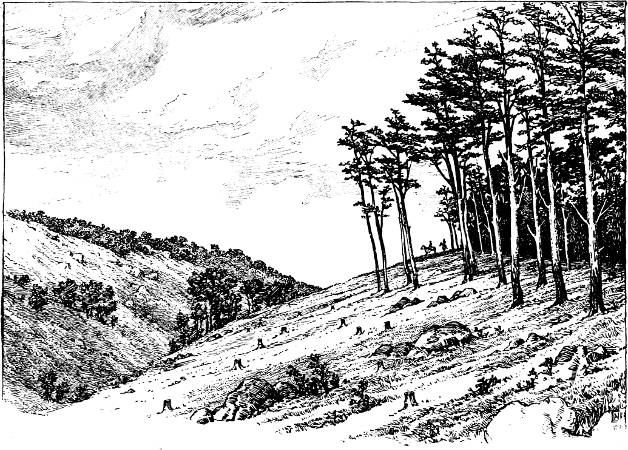
SHILOH BATTLE-FIELD: SCENE ABOVE THE RIVER WHERE THE CONFEDERATES’ ADVANCE WAS CHECKED IN THE EVENING OF THE FIRST DAY.
All matters carefully arranged, Johnston determined to strike at Grant without further delay, issuing marching orders on the afternoon of April 3rd, and the Confederate army set out to surprise the Federal army as it lay on the banks of the Tennessee. The marching force consisted of 40,000 men divided into three corps, commanded by Generals Bragg, Hardee, and Polk; Breckenridge commanding the reserve. Johnston, of course, assumed supreme command, and Beauregard was second in command, without specific orders. Hardee led the van, Bragg followed, and Polk and Breckenridge on the left and right brought up the rear.
As it turned out, the march to Shiloh was one of galling hardship. Blinding sleet, and snow, and rain beat upon the advancing hosts that struggled along knee-deep in slush and mire, painfully dragging after them ladened waggons and heavy guns. Ill clad, poorly fed, and sore-footed from long marches to the place of concentration, the soldiers of the South still made the best of matters, and seemed as eager as their commander to strike the blow before it would be too late. Johnston hoped to reach a position to permit of his attacking Grant early on Saturday, April 5th; but when he saw the slow progress his men made along roads that were nothing but stretches of quagmire, he almost despaired of ever covering the miles that lay before him, and, indeed, gave up all hope of surprising the Federals. That Grant would fail to hear of his approach he could not believe. But in this he was mistaken. Grant seemed to have abandoned all caution, and to have made very little, if any, attempt to keep himself in touch with the movements of the Confederates.
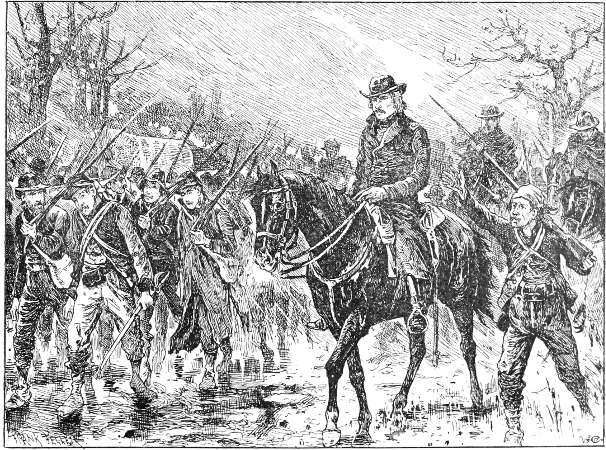
THE MARCH TO SHILOH.
After two days wallowing through the mire, Johnston bivouacked his army within four miles of the Federal camp, and neither Grant nor his officers knew anything about the movement.
To show how completely in the dark the Federal commander must have been, it is only necessary to look at official reports.
Sherman on Saturday reported to Grant—“All is quiet along my line”; and later, “I do not apprehend anything like an attack upon our position.”
The same day Grant, reporting to his superior, Halleck, wrote—“I have scarcely the faintest idea of an attempt being made upon us”; and in an earlier telegram he said—“The main force of the enemy is at Corinth.”
When he was writing these words the Confederate army, 40,000 strong, was at his very door.
It clearly could never have entered the head of General Smith, when he picked upon Pittsburg Landing as the proper camping-place for the Northern army until such time as accumulated forces warranted a march against Corinth, that there was a ghost of a chance of the South assuming the offensive. Three sides of the camp were bordered by waterways impassable to troops. To the rear of the camp the broad Tennessee River flowed, to the right Snake Creek, to the left Lick Creek—both deep, sluggish, and unfordable. The ground enclosed by these waters was high, and in places deeply scarred with gullies. The situation was a cul-de-sac, the only opening that towards Corinth. And when on that Sunday morning General Johnston’s army suddenly appeared, stretching across this opening, the army of the North found itself in a trap from which, if beaten, there could be no escape. Retreat was utterly impossible. There was nowhere to retreat. Never was an army more hopelessly hemmed about than the army of Grant at Shiloh.
Shiloh Church stood at what may be called the entrance to the cul-de-sac. Against it, forming the right wing of Grant’s army, lay Sherman, clearly the hero of the battle. In the centre, and on a line with Sherman, was stationed Prentiss, while at the extreme left near Lick Creek lay Stewart. To the left and rear of Sherman was McClernand, while in the rear lay the divisions of Generals Hurlbut and W. H. L. Wallace. Another General Wallace, Lewis by name, with 5,000 reserves, was encamped some miles distant on the northern side of Snake Creek. On the Tennessee River, opposite Pittsburg Landing, a few gunboats rode at anchor, and these, later in the day, played a prominent part in the action.
It was a few minutes after five o’clock on Sunday morning, April the 6th, that Johnston ordered his army to advance. A short distance from the Northern army the Federal pickets were encountered. These were brushed aside, and the Southern soldiers came cheering and firing through the wood. Before the Federals encamped on the banks of the Tennessee were rightly awake, the Confederates came charging down upon the camp. Sherman’s men were the first encountered. The firing of the pickets and the subsequent cannonading had awakened this general to the situation, and he called his men under arms, and drew them up to resist the attack. Sherman’s brigades standing firm as a rock, the Confederate attack glanced off his ranks and struck Prentiss with irresistible force. This unfortunate general attempted to stay the charge, and for some minutes his men, half-dressed and in confusion, fought valiantly; but in a very short time Prentiss himself and whole companies of his men were surrounded and taken prisoners, his guns captured, and his camp overrun and destroyed.
Grant on Saturday had received a request from General Buell to meet him at Savannah on this Sunday morning. Little thinking that an engagement was imminent, Grant had gone thither to keep the appointment, and the first news he had of the Confederate movements was conveyed to him by the thundering of the cannon. Listening, he soon realised that a serious engagement was beginning. Taking steamer to Pittsburg Landing, he arrived on the scene of battle at eight o’clock, and found the whole Confederate army about his ears. With 33,000 men, to all intents and purposes men who had been taken by surprise, he had to fight 40,000, who for days had been looking forward to the fray. Already his men had been driven back all along the line. The situation was desperate, Sherman alone having for the three hours made a good struggle of it. Stubbornly fighting against overwhelming odds, himself sorely wounded, and his men falling by scores about him, General Sherman held his ground so that those behind him might have time to get into line and take up favourable positions. Hard pressed, and in the thick of the fire, he rode up and down the lines, personally supervising every detail of the fight, and nerving his men to the great occasion. But the soldiers of the South were not to be gainsaid. Like a wedge, they drove themselves between Sherman and Prentiss, being slaughtered by hundreds in the process; but, unflinchingly persevering, they assailed Sherman’s left so savagely that the general was in the end forced to use his right as a pivot, and in that way to swing his whole command into a fresh position to save his left being turned. In the process he lost two of his batteries and his camp. This movement of Sherman’s permitted General Johnston to hurl his forces against McClernand, who, unable to withstand the ferocity of the charge, was driven far back. Stewart, who held the extreme left near Lick Creek, also fell back, and Hurlbut in the centre was only saved from annihilation by General W. H. L. Wallace’s division coming to his succour, and allowing his command to retire from the open ground into a wood, where all the day he was obliged to fight like a tiger, withstanding charge after charge delivered by the fiery Southerners. In the defence of this position General W. H. L. Wallace was killed.
General Lewis Wallace, in command of the Federal reserves—5,000 men—lay the other side of Snake Creek, and for his arrival Grant waited with impatience, for matters were becoming desperate. The only way Wallace could possibly reach the scene of battle was by means of a bridge across Snake Creek, and so it seemed to Grant the existence of his army now depended on this bridge being held against capture. Sherman knew this, too, and he gradually fell back, until to fall back any further meant the loss of the bridge. Then he took up as favourable a position as he could find, and refused to retreat one step more, although one-half of the Confederate army dashed against his lines. During the long hours that he stood there, waiting for Lewis Wallace and the reserves, it seemed as though his whole command must be wiped out of existence.
Drawn up in the partial cover of a wood, with before them open rough country, across which the enemy’s forces must rush, and with the knowledge that should they allow themselves to be forced back their whole army would be exterminated, each Federal under Sherman and McClernand stood and fought with the desperation of a trapped and stricken tiger. General Johnston, hoping to force the position, hurried forward brigade after brigade, and hurled them against the soldiers of the North. Again and again the van of the Confederates pierced the ranks of the Federals, fighting hand to hand and face to face, with thrust of bayonet and crash of clubbed rifle, but pierced the line only to be blotted out of existence by the men who stood, as it were, with their backs to a wall, and who fought the fight of grim despair. This was the first great slaughter-pen of the bloody battle of Shiloh. Whole companies of Southern troops, bareheaded, barefooted, in rags, hungry, and ill-equipped, but undaunted and determined, rushed headlong across the rugged ground, and with the fury of fanatics flew at the hemmed-in ranks of the North, only to be beaten back by those who could go back no farther. The men of the North grimly held to their position, trusting that fate would soon bring Lewis Wallace and his reserves on the scene to succour an already defeated army.
The South fought for victory, but the North fought for time, for darkness, for life.
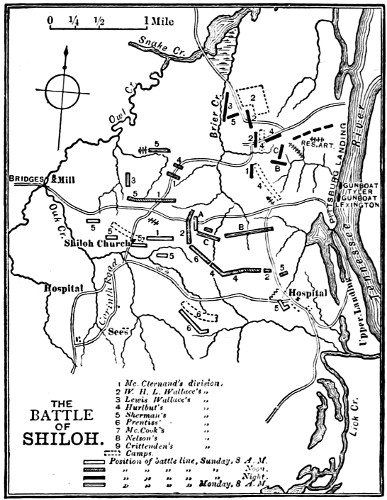
THE BATTLE OF SHILOH.
At ten o’clock in the morning General Johnston had the satisfaction of knowing that all his plans had worked out to a nicety. He had forced Grant into a corner, carried position after position, captured many guns, and taken prisoners by hundreds. Grant’s army was now confined in a space of not more than 400 acres. At eleven o’clock there came a lull in the fight. The time had arrived for General Johnston to begin the second movement of his plan of battle. This was to turn Grant’s left, sweep him from Pittsburg Landing, and crush the left against Sherman on the right. To do this the Confederates must advance across open ground in the very teeth of batteries and entrenched infantry. In the thick of this, the most difficult work of the day, the South suffered a sudden and irreparable loss. General Johnston while directing the movement was struck by a rifle-bullet. He fell, and almost immediately died. The news ran from lip to lip, and checked the charge. And, to add to the confusion, General Beauregard, on whom the command devolved, could not at once be found to be told that his chief was dead. The fight still continued, but during the time it took to find Beauregard, and the further time that elapsed before he could get the strings of battle into his hands, the Southerners fought themselves into some confusion, and Grant was able to re-form and tighten up his lines. Moreover, the Southerners had driven the Federals so close to the river that they themselves, in following up their successes, found themselves within range of the guns aboard the boats on the Tennessee River, and shells from the gunboats began to play havoc in the Confederate lines. But this could not be helped. It was the price of success. The afternoon was advancing, and Beauregard hastened to the task of the turning of the left before darkness should make further fighting impossible. Across the ground that divided Federal from Confederate ran a deep scar, and on the shoulder of the opposite bank of this Grant had thrown up some hasty breastworks. When the Southerners dashed into this gully, shot and shell from the gunboats on the river shrieked up the length of it, and an appalling rifle-fire came down the slope and into the mass of men that struggled forward to take the breastwork. The Federals were at their last resource. If the breastwork should be taken, and their left turned, it meant the end of all things to them. The Confederates, too, were in desperation, for night was falling upon the land, and victory still unwon. Into the valley they poured, and up the bank they struggled and scrambled, but scarcely one of them reached the top. Shot and shell and bayonet-thrust soon filled the valley with Southern dead and wounded; and while the fight still continued, darkness fell, and put an end to the day’s struggle. Beauregard, reporting the state of things after the first day’s fight, said:
“At six o’clock p.m. we were in possession of all his encampments between Owl (a tributary of Snake Creek) and Lick Creeks but one, nearly all his field artillery, about thirty flags, colours, and standards, over three thousand prisoners, including a division commander (General Prentiss) and several brigade commanders, thousands of small-arms, an immense supply of subsistence, forage, and munitions of war, and a large amount of means of transportation—all the substantial fruits of a complete victory—such, indeed, as rarely have followed the most successful battles.”
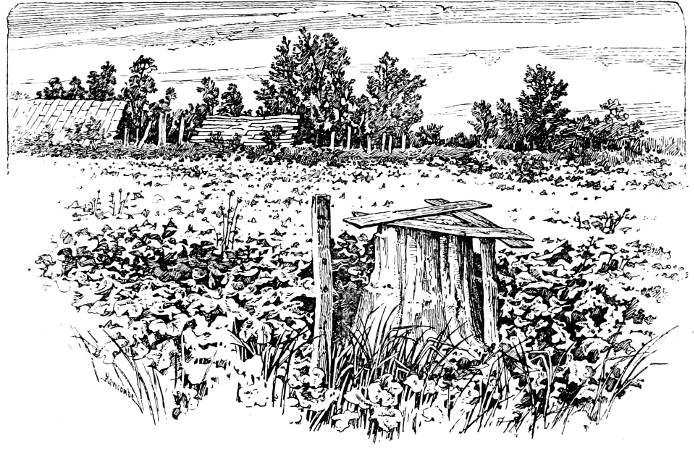
SHILOH BATTLE-FIELD: SCENE WHERE GENERAL JOHNSTON FELL.
But this was to be the end of the fruits of victory for the South.
When the bugles rang out on the evening air the order to cease fighting, the soldiers of the North, as well as those of the South, sank to the ground in hopeless exhaustion. They had fought like fiends from early morning, travelled miles of country, scrambled through thickets, across quagmires and stagnant waters, hauling guns and waggons and stores, assisting the wounded, savagely attacking and repulsing attack; and now that a truce for the night had been declared, the soldiers found themselves so worn and weak that many paid no attention to the cravings of hunger and the urgings towards material comforts, but lay down on the ground and bivouacked where they had stood when the order to cease fighting reached them.
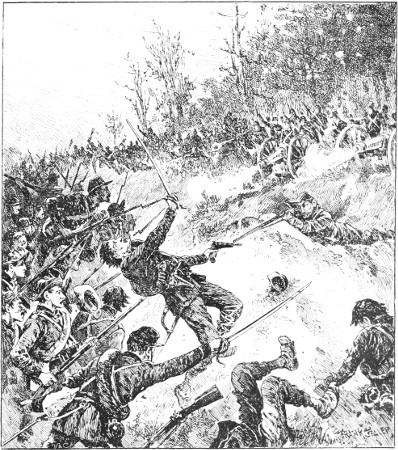
“UP THE BANK THEY STRUGGLED AND SCRAMBLED” (p. 212).
All the dark, stormy night it rained a chilling rain. A cold wind moaned through the trees, and so exhausted were the unwounded that the wounded lay in the main unattended. Grant himself lay with no other covering than the clothes he wore, his head to the stump of a tree, and passed the night as best he could. To add to the horrors of the night, the two gunboats, riding safely upon the bosom of the Tennessee, kept up a deafening bombardment of the Confederate quarters throughout the whole of the night, the shells shrieking and crashing among the trees, hurling great limbs, and even whole tree-tops, to the ground, and finally setting fire to the leaves that were on the ground and the underbrush, until the badly wounded were burned where they lay.
It was indeed a night of horror, of suffering, and of despair.
But worst of all for the South, in the middle of the night Buell arrived, and had the field of battle explained to him; and when the morning dawned, his army—22,000 men—fresh and eager to fight, marched upon the scene, together with General Wallace’s 5,000 reserve. When Beauregard arose to continue the battle, he found himself hopelessly outnumbered, and, fighting bravely still, was rapidly driven from all the advantages he had gained, and in the end routed. His men marched a miserable march to Corinth, again through sleet and mire, but, fortunately for them, the North had been too sorely cut up to follow for any great distance. In this woeful retreat 300 men died of cold and privation.
In this Battle of Shiloh about 100,000 troops all together were engaged, and of these 23,269 were killed, wounded, or missing. It was simply a hard, stubborn fight from start to finish; and the death of Johnston, and Buell’s fortunate arrival in the nick of time, in all likelihood saved the Northern army from a most disastrous defeat. The Confederates fought with the fury that distinguished them all through the war. On the other hand, the Federals fought with the dogged determination which ultimately won them the rights for which they had taken up arms. Draper, in his history of the American Civil War, gives the following as the Federal and Confederate losses:—
In Grant’s army there were six divisions. Their losses, in killed and wounded, were:—
1st. McClernand’s, loss both days 1,861
2nd. W. H. L. Wallace’s, loss both days 2,424
3rd. Lewis Wallace’s, loss second day 305
4th. Hurlbut’s, loss both days 1,985
5th. Sherman’s, loss both days 2,031
6th. Prentiss’ (no report), loss estimated 2,000
Aggregate loss 10,606
Of Buell’s army, four divisions had marched to Grant’s aid; of these, three were engaged:—
2nd. McCook’s loss 881
4th. Nelson’s loss 693
5th. Crittenden’s loss 390
Aggregate loss 1,964
The Confederate losses were 1,728 killed, 8,012 wounded, 959 missing. Total, 10,699.
General Beauregard, after Shiloh, retired from the command of the Confederate forces on the plea of ill-health, and General Bragg was made permanent commander.
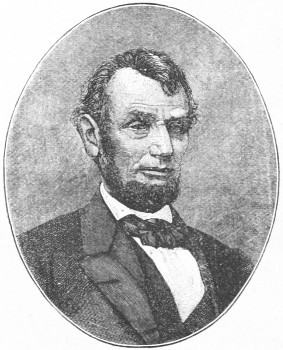
[Photo., Handy, South Washington, D.C.
PRESIDENT LINCOLN.

AMOAFUL
BY G. A. HENTY

The 31st of January, 1874, will long be a day noted in the memories of the people who were, prior to that time, a scourge to their neighbours and a standing menace to the native tribes under the British protectorate at Cape Coast. It is probable that the exact date itself has long ere this been forgotten, even if—which is very doubtful—the Ashantis possess a calendar, or have any means of calculating the dates of events, unless these happen to occur on the longest or shortest day, or, perhaps, on the occasion of a new or full moon. The memory of the battle, however, owing to a singular custom that prevails among them and the other peoples of the coast, will never be lost as long as the Ashantis remain a tribe. As the Greeks and Romans used to swear by their divinities, the Ashantis swear by their misfortunes; and the most solemn oath that can be taken by a king or chief of these peoples is a national defeat or disaster. Assuredly, then, Amoaful will for many generations be one of the most binding oaths among the Ashantis.
Ashanti had long shared with Dahomey the reputation of being the most warlike and bloodthirsty of the peoples of West Africa; they were constantly at war with their neighbours, the object of the incursions committed being not so much the extension of territory as the carrying away of large numbers of prisoners, to be sacrificed on the occasions of their solemn festivals. They had long borne ill-will to the British at Cape Coast, because of the protection granted by us to the Fanti tribes; and from the commencement of the present century hostilities have broken out at frequent intervals, and more than once the Ashantis have carried fire and sword up to the very walls of Cape Coast, and on one occasion defeated and destroyed a British force under Sir Charles Macarthy.
This state of occasional warfare might have continued indefinitely, had not the British exchanged some possessions with the Portuguese, acquiring by this transaction the town of Elmina, some five miles north of Cape Coast Castle, and the protectorate of the district lying behind it. The tribe of this district had been allies of the Ashantis, and Elmina itself had been their port of trade. The Portuguese had been in the habit of paying a small annual sum to the Ashanti; this sum was considered by them to be a present, but was regarded by the Ashantis as a tribute. Ashanti, therefore, objected to the transfer, and marched an army across the Prah to the assistance of their allies in the districts dependent on Elmina. Early in June, having brushed aside the resistance of the Fantis, the invading army reached Elmina, being joined by all the tribes in its neighbourhood. A small party of Marines and Marine Artillery were landed from the ships on the coast, and inflicted a severe blow on the invaders as they were on the point of entering the town.
The position was so serious that the British Government sent out Sir Garnet Wolseley, with some twenty British officers, to organise, if possible, a native force to cope with the enemy; or, if this could not be done, to prepare the way for the landing of a British force of sufficient strength to strike a heavy blow at the Ashantis in their own country. Just as the party left England, a disaster befell us. Commodore Commerell started to ascend the Prah with boats from the squadron on the coast. They had gone but a short distance when they were fired upon by the Ashantis, in ambush behind the bushes lining the bank of the river. Commodore Commerell was severely wounded, as were other officers and many seamen, and the expedition was forced to return.
The attempt to get up a large native force failed; but an expedition was undertaken from Elmina, composed of bluejackets and marines, and a portion of the 2nd West Indian Regiment, and this, after a sharp brush with the enemy, burnt several villages and cleared the neighbourhood of the Ashantis, who had been suffering very much during the wet season from disease and the want of food. An attack on Abra Crampa, whose king had joined us heartily, was repulsed; there was sharp fighting at Dunqua and other skirmishes; and the Ashantis, disheartened by want of success, and more than decimated by fever, fell back across the Prah. The invasion had, thus far, been repelled solely by the naval forces, aided by the 2nd West Indian Regiment and two native regiments commanded by Sir Evelyn Wood and Major Baker Russell, each of whom had some eight English officers under him.
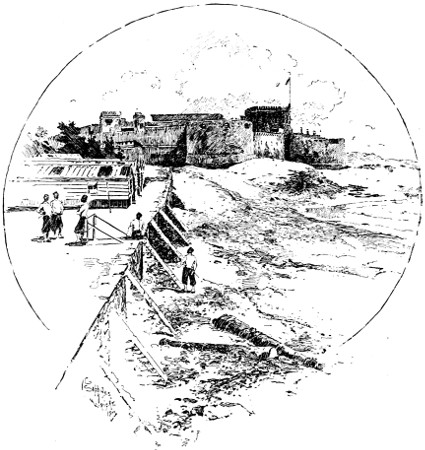
CAPE COAST CASTLE.
A road was made to the Prah, huts erected at suitable distances for the use of the white troops, and when these landed, early in January, all was ready for their advance. The force consisted of a battalion of the Rifle Brigade and the 42nd; the 23rd Regiment remained on board the transport that had brought them, it being considered that it was better for them to stay in reserve, as the difficulties of carriage were so great that the fewer the number of men taken up the better. There was also a naval brigade, composed of bluejackets and marines, some companies of the 1st and 2nd West Indian Regiments, Wood and Russell’s native regiments, and a battery of little mountain guns commanded by Captain Rait, and manned by natives trained by him, and a small party of Royal Engineers. After a few skirmishes of no great importance, the force made their way nearly to Amoaful, where it was known that the Ashanti army was assembled in force to oppose their further advance.
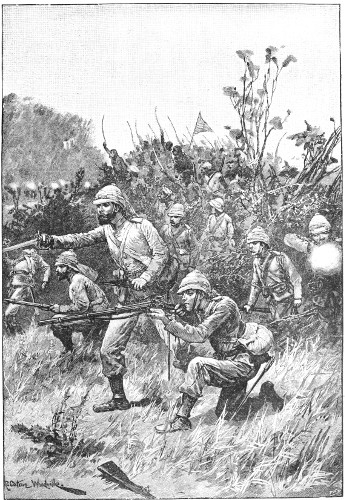
“THE BONNY MEN LED THE ADVANCE” (p. 221).
The white regiments halted at Ingafoo, while the two native regiments, with the Engineers and Rait’s artillery, marched forward to Quarman, a little more than half a mile from the enemy’s outposts. Lord Gifford, who commanded the scouts, lay all day in the bushes within sound of the voices of the Ashanti, while Major Home, R.E., with the sappers, cut paths almost up to the edge of the bush. At half-past seven on the morning of the 31st of January, a naval brigade, with two companies of the 23rd who had just come up, the 42nd, and Rifle Brigade, arrived at Quarman and marched on without a halt, followed by the force already in the village, where a garrison was left with the baggage. The two native regiments were now reduced to but seven companies altogether, owing to the necessity for leaving garrisons at the various posts along the road. The plan of operations had already been determined upon. The 42nd Regiment were to form the main attacking force. They were first to drive the enemy’s scouts from the little village of Agamassie, just outside the bushes where Gifford’s scouts were lying, and were then to move straight on, extending to the right and left of the path, and, if possible, to advance in a skirmishing line through to the bush. Two guns of Rait’s battery were to be in their centre, and to move upon the path itself. Half the naval brigade and Wood’s regiment were first to cut a path out to the right, and then to turn parallel with the main path, so that the head of the column should touch the right of the skirmishing line of the 42nd, while the other half of the naval brigade, with Russell’s regiment, was to proceed in similar fashion on the left.
The two companies of the 23rd were to come on behind the headquarter staff; the Rifle Brigade were to remain in reserve. The intention was that the whole should form a sort of hollow square, the column on the right and left protecting the 42nd from the flanking movements upon which the Ashantis were always accustomed to rely for victory. With each of the flanking columns were detachments of Rait’s battery with rocket tubes.
The 42nd, as they burst out from the bush, encountered but little opposition; the eight or ten houses composing the village being occupied by but a small party of the enemy, who fled at once into the bush beyond. This was so thick, and the open ground round the village so small, that it was necessary to clear away a space for the bearers of the litters, surgical appliances, and spare ammunition, and it was nearly half an hour before the rest of the force issued from the narrow path into the open.
The pause had been a trying one, for a tremendous roar of fire told that the Black Watch were hotly engaged, and, indeed, had gained but a distance of a couple of hundred yards while the native labourers were clearing the bush round the village. As soon as they reached the open space, the flanking columns turned off to the right and left, and it was not long before the increasing roar of musketry showed that they, too, were engaged.
The scene bore little resemblance to that presented by any modern battle-field. The Ashanti bush consists of a thick wood of trees some forty or fifty feet high, covered and interlaced with vines and creepers, while the heat and moisture enable a dense undergrowth to flourish beneath their shade. Above all tower the giants of the forest, principally cotton trees, which often attain a height of from 250 to 300 feet.
Progress through this mass of jungle and thorn is impossible even for the natives, except where paths are cut with hatchet or sword. These paths are generally wide enough only for a single file, and two persons meeting in opposite directions have a difficulty in passing each other, the more so as long use wears down the soft, moist earth until the tracks are converted into ditches two or three feet deep. The ground across which the 42nd were trying to force their way was more open than usual, owing probably to the undergrowth having been cleared away to furnish firing to the little village. It was somewhat undulating, and the depressions were soft and swampy. Each little rise was held obstinately by the enemy, who, lying down beyond the crest, behind trees, or in clumps of bush, kept up an incessant fire against the Black Watch; and even the aid of Rait’s two little guns and two rocket troughs failed to overcome their resistance. The two flanking columns encountered even more strenuous opposition: before they could advance into the bush a way had to be cut for them by the natives under the orders of the Engineer officers. Although the troops endeavoured to cover this operation by an incessant fire into the bush on either side, the service was a desperate one. Several of the men fell dead from the fire of their hidden foes, others staggered back badly wounded, and Captain Buckle, of the Royal Engineers, one of the most zealous and energetic officers of the expedition, fell mortally wounded by two slugs in the neighbourhood of the heart.
Little wonder was it that, although the natives behaved with singular courage, at times they quailed under the fire to which they were exposed; consequently the advance of the two columns soon came to a standstill, and the men lying down kept up a constant fire on the unseen enemy, directing their aim solely at the puffs of smoke spurting from the bushes. So difficult was it to keep the direction in this dense bush that both columns had swerved from the line on which it was intended that they should advance. The roar of fire was so general and continuous that none of the three columns were in any degree certain as to the direction in which the others lay, and from each of them messenger after messenger was sent back to Sir Garnet Wolseley, who had taken up his position with his staff at the village, complaining that the men were exposed to the fire from the other columns.
The noise was, indeed, out of all proportion to the number of combatants. The Ashantis use enormous charges of powder—which, indeed, would be absolutely destructive to the old Tower muskets with which they were armed were these loaded with tightly-fitting bullets. This, however, was not the case, as on the powder three or four slugs of roughly chopped-up lead were dropped loosely down: the noise made by the explosion of the muskets so charged was almost as loud as that of small field-pieces; and, indeed, although but two or three hundred yards from the village the reports of Rait’s mountain guns were absolutely indistinguishable in the din. The trees broke up the sound in a singular manner, and the result was a strange and confused reverberation, mingled with the hissing sound rising from the storm of bullets and slugs mingled with that of the rockets. Well was it for our soldiers that the enemy used such heavy charges, for these caused the muskets to throw high, and the slugs for the most part whistled harmlessly over the heads of the troops and almost covered them with the showers of leaves cut from the trees overhead.
For an hour this state of things continued, the two companies of the 23rd were then ordered to advance along the main path and to aid the 42nd in clearing the bush, where the Ashantis still fought stubbornly not two hundred yards from the village. Two companies of the Rifle Brigade were sent up the left-hand road to keep that path intact up to the rear of the Naval Brigade, while on the right, the rear of Colonel Wood’s column was ordered to advance further to the right, so that the column might form a diagonal line, and firing to their right only, not only cover the flank of the 42nd, but do away with the risk of stray shots striking them. Wounded men were now coming fast into the village—42nd, Rifles, Naval Brigade, and natives.
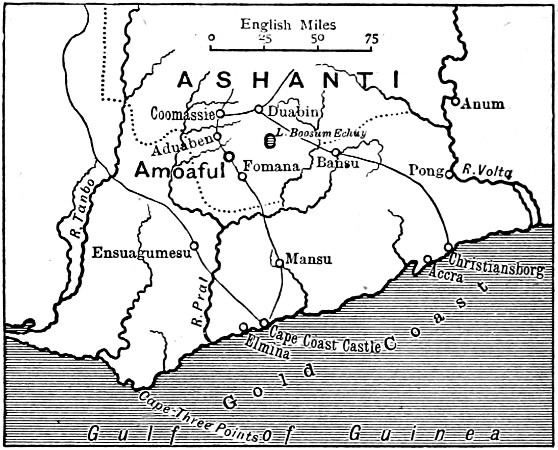
ASHANTI
On the left the firing gradually ceased, and Colonel McLeod, who commanded there, sent in to the general to say that he was no longer hotly attacked, but that he had altogether lost touch of the left of the 42nd. He was therefore ordered to cut a road north-east until he came in contact with them. He experienced a resolute opposition, but the rockets gradually drove the Ashantis back. In the meantime, the 42nd were fighting hard. In front of them was a swamp, and on the rise opposite the ground was covered with the little arbours that constitute an Ashanti camp. Not an enemy was to be seen, but from the opposite side the puffs of smoke came thick and fast, and a perfect rain of slugs swept over the ground on which the 42nd were lying. The path was so narrow that Rait could bring but one gun into position. This he pushed boldly forward, and, aided by Lieutenant Saunders, poured round after round of grape into the enemy until their fire slackened and the 42nd were again able to advance.
Step by step they won their way, each advance being covered by the little gun, which did terrible execution among the crowded, though unseen, ranks of the enemy. The camp was won; but beyond it the bush was thick and absolutely impenetrable for a white soldier, and it was necessary to advance solely by the narrow path. This was swept by a storm of slugs from the bush on either side, although the Snider bullets searched the bush and the guns poured in showers of grape. At last the Ashanti fire diminished, and the troops dashed forward up the lane, and the bush thickened on either side until too dense even for the Ashantis to occupy it. With a cheer the Black Watch issued from the upper end of the pass, and spread out into the wide open space dividing the village of Amoaful into two sections. For a short time the Ashantis kept up a fire from the houses and from the other end of the cleared space, but the 42nd soon drove them from the houses; and a shell from a gun fell among a group at the farther end of the clearing and killed eight of them, and the rest retreated at once. Major McPherson and eight other officers were wounded, and the total of 104 casualties in a force of 450 men showed how severe had been the struggle.
It was now twelve o’clock, and although they had lost their camp and village and had suffered terribly, the Ashantis were not yet finally beaten. The principal part of the force that had been engaged upon our left had swept round to the right, and were pressing hard upon our right column, and cutting in between them and the 42nd. Fortunately, however, the left column had cut its path rather too much to the east and now came into the main path, and so formed a connecting link between the 42nd at Amoaful and the head of the right column. Although the latter had been strengthened by the addition of a company of the Rifles, it suffered severely: Colonel Wood and six naval officers were wounded, together with some forty men. The fire of the enemy at last slackened, and it seemed as if all was over, when suddenly a tremendous fire broke out from the rear of the column, showing that the Ashantis were making a last and desperate effort to turn our right flank, and to retake the village from which they had been driven in the morning.
For a few minutes the scene in the village was exciting. So near were the enemy that the slugs came pattering down among the remainder of the Rifles still held in reserve there, and they and the guard of the reserve ammunition prepared to resist an attack, three companies of the Rifles at once moving out to prolong the rear of the right column, and so to cover that side of the village. For a while the roar of musketry was as heavy and continuous as it had been during the morning, and continued so for three-quarters of an hour. While it was going on another strong body of the enemy attacked Quarman, but the small force of forty men of the 2nd West Indian Regiment and half a company of Wood’s regiment, under the command of Captain Burnett, although taken by surprise—for with a great battle raging but half a mile away, they had no idea of being attacked—defended themselves with great gallantry, and even sallied out and brought in a convoy that had arrived near the village, and finally, being reinforced by a company of Rifles, took the offensive and drove off their assailants.
Finding themselves met on whatever side they attacked, the Ashanti fire began to relax. As soon as it did so, Sir Garnet gave the word for the line to advance, sweeping round from the rear so as to drive the enemy northward before them. The movement was admirably executed. A company of men who had been raised at Bonny, and who had fought steadily and silently all the time they had been on the defensive, now raised their shrill war-cry, and slinging their rifles and drawing their swords, dashed eagerly forward, while by their sides, skirmishing as steadily and quietly as if on parade, the men of the Rifle Brigade searched every bush with their bullets; and in five minutes from the commencement of their advance the Ashantis were in full retreat.
The number of casualties on the part of the white and native troops amounted to about 250—a very heavy proportion, considering the comparatively small number of the force engaged. Fortunately the wounds, for the most part, were comparatively slight: the flying slugs inflicted ugly-looking gashes, but seldom penetrated far. Captain Buckle, of the Engineers, was the only officer killed, but the number of wounded was large, and included two other Engineer officers out of the total of five engaged.
No one had shown more determined bravery than the natives, who worked as sappers under their orders. The work was trying enough for the men, who for five hours remained prone, returning the fire of their invisible foes. The natives, however, for the same time, were working continuously, cutting paths through the thick bush and exposed defenseless to the enemy’s fire. Nearly half their number were among the wounded. The total number of deaths did not exceed twenty. On the side of the Ashantis no accurate record was obtained of the number who fell. It is their custom always to carry off the killed and wounded, unless hotly pressed; and therefore, until the last rush of the Black Watch into Amoaful, they had ample time to follow their usual custom. Nevertheless, the number of dead found was very large, and the lowest calculation placed their loss at 2,000. Among these was Ammon O̰uatia, the general-in-chief of the Ashantis, and Aboo, one of the six great tributary kings of Ashanti. The Ashantis fought with extraordinary pluck and resolution; they, indeed, enormously outnumbered the little British force, and their position was admirably adapted for their peculiar method of fighting. But, on the other hand, they were wretchedly armed, and their old and worn-out muskets were poor weapons indeed compared with the breechloaders of the whites, who had, in addition, the assistance of their guns and rocket tubes.
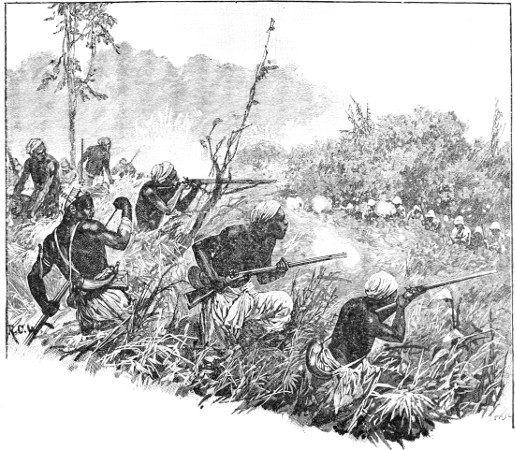
“EACH LITTLE RISE WAS HELD OBSTINATELY BY THE ENEMY” (p. 218).
Great credit was due to both sides: to the Ashantis for their obstinate and long-continued defence, and for the vigour with which, when their centre was penetrated, they strove to redeem the day by their flank attack upon us; to the British for their long endurance of a terrific fire from unseen foes, by the manner in which they fought under conditions so absolutely novel to them, and for the unwavering resolution with which they won their way through the bush and finally defeated a foe of ten times their own numerical force. The victory of Amoaful virtually decided the result of the campaign, for although the Ashantis fought again on the other side of the river Dah, the terrible punishment inflicted upon them at Amoaful had greatly reduced their spirit; nevertheless, they fought stoutly.
On this occasion the Bonny men led the advance up the path beyond the river, and before they had gone half a mile were hotly engaged. Lieutenant Saunders, with one of Rait’s guns, endeavoured to clear the bushes, but little progress was made for two hours, and Lieutenant Eyre, the adjutant of Wood’s regiment, fell mortally wounded when standing near the gun. The Rifles now relieved the Bonny men, and led the advance, and made their way slowly forward until within fifty yards of a large clearing, surrounding a village; then with a cheer they rushed forward, drove the enemy from the clearing, and occupied the village. But behind them the combat raged for another two hours. The troops lined the sides of the path, and repulsed all the efforts of the Ashantis to break through them, holding the position while the native carriers took the stores, spare ammunition, and medical comforts along the path and up to the village. As soon as the last of these had passed along, the troops followed, until the whole force were gathered in and round the village.
The loss of the Ashantis can have been but little inferior to that which they suffered at Amoaful, for they several times approached in such masses that the whole bush swayed and moved as they pushed forward. On the other hand, our casualties were very slight, for as the road was, like all the paths in the country, hollowed out by the traffic fully two feet below the general level, the troops lying there were protected as by a breastwork of that height. When the whole force were assembled in the village, the enemy still kept up serious and desperate attacks upon the rear, but were always repulsed by the Rifles, who lined the edge of the clearing. Mingled with the continued din of musketry was the lugubrious roar of the great war-horns throughout the woods, and the wild war-cry of the Ashantis.
The halt was a short one; Coomassie was still six miles distant, and soon after the force were gathered round the village the Highlanders, with Rait’s guns, moved forward along the path. For the first twenty minutes the fire of the enemy was very heavy, but when the Black Watch gained the crest of the rise beyond the village, the resistance became more feeble, and they dashed forward at the double, sweeping all opposition aside. The resistance of the Ashantis at once ceased; they had done all that was possible for them to do to oppose our advance, and had failed. Their main body was still in the rear of the village, engaged in unavailing attacks upon the force there. Probably their best and bravest troops were with this force, and at the rapid advance of the 42nd a panic seized the defenders of the path; those in the bush could not hope to move forward as rapidly as did the troops in the open, while those in the villages along the path, warned by flying fugitives of the rapid approach of the foe, joined in their flight. The road was strewn with articles of clothing, the stools of state of the chiefs, weapons, and food.
From this time no single shot was fired. The warriors in the bush, seeing that they could not hope to get ahead of the advancing force and make another effort to defend the capital, either went off at once to their villages, or made a wide circuit and came down behind Coomassie upon the road between that town and a spot, five miles away, where the kings of Ashanti were buried, and where, doubtless, another battle would have been fought had the troops advanced to the sacred spot. The 42nd halted at the last village before arriving at Coomassie, until they were there joined by the rest of the force; then, after crossing a deep and fetid marsh surrounding the town, they entered the capital of the enemy. It was not, as might have been expected, deserted: a good many of the inhabitants remained, some of the men being still armed, and watched with curiosity rather than with alarm, the entry of the white warriors who had broken the strength of their nation. Orders were given to disarm them at once; but as soon as they perceived that this was the case, they gradually withdrew, and in half an hour the whole of the natives of Coomassie had disappeared in the bush.
Several fires broke out in various parts of the town. Some of these may have been the work of the Ashantis themselves, but most of them were caused unquestionably by the native camp-followers, who, in spite of the stringent orders against looting, stole away in the darkness to gather plunder. Some of them were flogged, and one was hung, and then, after posting pickets thickly outside the town, the troops went off to sleep.
The next morning the captured town could be fairly seen. The streets were very wide; trees grew in them; and from the irregularity with which the houses were scattered about, it resembled a great straggling village rather than a town. The houses were of the kind with which the troops had already become familiar, and resembled the architecture of a Chinese temple rather than that of any other known building. Outside was an alcove with red steps, high raised floor, and white pillars supporting the roof. This formed the front of the house, and as there was no entrance from it into the interior, it was, in fact, a sort of summer-house and balcony, where the master must have sat to look at the passing world and chat with his acquaintances. Inside, the houses were all of the same character, comprising a number of little courts with alcoves on one or more sides. Everything in Coomassie bore signs of the superstitious belief of the inhabitants in fetish. Over every door was suspended a variety of charms—old stone weapons, nuts, gourds, amulets, beads, bits of china, bones, and odds-and-ends of all kinds. The principal apartments of the larger houses were lumbered up with drums, great umbrellas, and other paraphernalia of processions; but there were no real valuables of any kind.
The great objects of interest to the troops in the town were the palace and the great fetish-tree from which Coomassie took its name. In a large clump of bushes adjoining the latter were found the remains of some thousands of victims sacrificed in the bloody festivals. The majority were, of course, but skeletons; but there were hundreds that could have lain there but a few weeks, many which must have been sacrificed within a few days. The stench from this charnel-place was horrible, and pervaded the whole town. The palace occupied a very large extent of ground. It consisted of a central stone building of European architecture, which was used as a storehouse and was crowded with articles of furniture, silver plate, gold masks, clocks, glass, china, guns, cloth, and caskets, resembling in its confusion and the variety of its contents a succession of auction-rooms. The rest of the palace was of native work—similar, but on a much larger scale, to the houses of the great chiefs.
A horrible smell of blood pervaded the whole place—for many of the executions were held in the palace itself. During the day the rain fell in torrents; and as it became known that the king had gone right away into the interior of the country, as provisions were running very short, the troops were already feeling much the effects of the climate, and as the rains would swell every stream and fill every swamp, it was decided to make a start for the coast the next morning, after burning down the place that had been the scene of such countless horrors and atrocities. This was done as the column marched out of the town. The Engineers fired the houses and blew up the king’s palace; and a vast cloud of smoke rising high into the air must have told the Ashantis, scattered far and wide through the forests, that vengeance had at last fallen on the city that had for so many years been regarded by them as sacred, and had been the object of superstitious terror and hate to the tribes for hundreds of miles round.
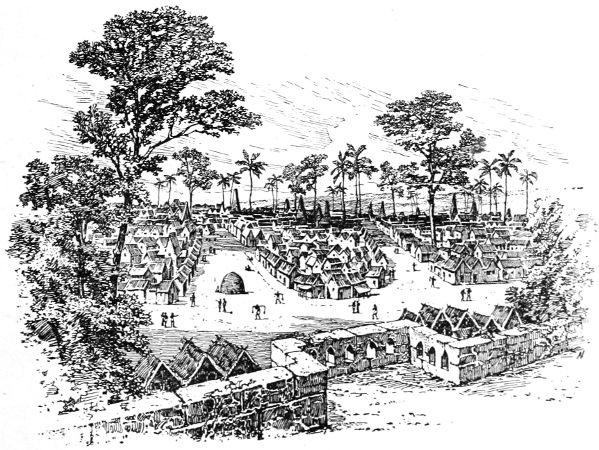
COOMASSIE.

THE REDOUBTS OF DÜPPEL
BY CHARLES LOWE

Schleswig-Holstein, the cradle of the Anglo-Saxon race, was the beautiful and interesting province which formed the bone of bloody contention between the Prussians and the Danes in the year 1864, just a year after the Prince of Wales had wedded the Danish “sea-king’s daughter from over the sea,” and made all Englishmen take the very deepest interest in the hopeless struggle of her undaunted countrymen against an overwhelming foe.
The cause of quarrel was one of the most complicated questions which ever vexed the minds of statesmen, and seemed so incapable of solution that an irreverent Frenchman once declared it would remain after the heavens and the earth had passed away. But on the death of Frederick VII. of Denmark, in November, 1863, Herr von Bismarck, who had the year before become Prussian Premier, determined that the difficulty should now be settled by “blood and iron.” Briefly put, the new King of Denmark, Christian IX., father of the Princess of Wales, wanted to rule over the Elbe Duchies, as Schleswig-Holstein was called, in a way, as was thought at Berlin, unfavourable to the rights and aspirations of their German population; while, on the other hand, the Germanic Diet, or Council of German Sovereigns at Frankfort, was resolved that this should not be so. And rather than that this should be so, it decreed “execution” on the King of Denmark, who had a seat in the Diet as for the Duchies, and selected two of its members, Hanover and Saxony, to enforce its decision.