LIST OF PLATES. (continued 2)
Reading edition
When Tien-tsin was occupied, the Chinese asked for peace, and a treaty was signed there containing, among other stipulations, an agreement that the envoys of England and France were to be received at Pekin within a year, and that the treaty was to be solemnly ratified there. Now the Chinese, as soon as the allies withdrew from Tien-tsin, began to regret having consented to allow the foreign ambassadors to enter their capital, and endeavoured to have it arranged that the treaty should be ratified elsewhere. But England and France insisted on the original agreement being carried out, and when the envoys of the two countries arrived off the mouth of the Pei-ho in June, 1859, and announced their intention of proceeding up the river to Pekin, they were escorted by an English fleet under the command of Rear-Admiral Hope.
It was found that not only had the forts at the river mouth, which had so easily been silenced the year before, been put into a state of repair, but that the river was blocked against anything larger than rowing-boats by a series of strong barriers. The admiral was informed that these had been placed on the river to keep out pirates and it was promised that they should be removed; but so far from keeping this promise, the local mandarins set to work to strengthen the defences of the river. On June 21st, the admiral sent the Chinese commander a letter warning him that if the obstacles were not cleared out of the channel of the Pei-ho by the evening of the 24th, he would remove them by force.
The three days’ grace thus given to the Chinese he employed in preparations to make good his warning message. He had several powerful ships in his squadron, but none of these could take a direct part in the coming fight, for the entrance to the Pei-ho is obstructed by a wide stretch of shallows, the depth of water on the bar being only two feet at low water, and hardly more than eleven at high tide; and this only in a narrow channel scoured out by the river. Thus, for the actual attack on the forts, he had to rely on the gunboats of his fleet, a number of small wooden steamers of light draft built during the Crimean war for service in the shallow waters of the Baltic and Black Seas. The gunboats with which Admiral Hope crossed the bar and anchored below the forts on the 23rd were the following:—
Plover, Bunterer, Forester, Haughty, Janus, Kestrel, Lee, Opossum, Starling, each of four guns; Nimrod and Cormorant, each of six guns.
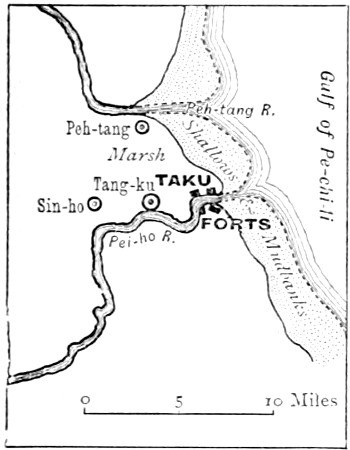
SCENE OF THE OPERATIONS OF 1859 AND 1860.
Each had a crew of forty or fifty officers and men, so that the eleven little steamers brought forty-eight guns and 500 men into action. The heavier ships outside the bar were to send in 500 or 600 more men, marines and bluejackets, in steam launches, boats and junks; this force being intended to be used as a landing party when the fire of the forts had been silenced. No one expected that this would prove a difficult business.
It was true that there was a big fort on the south side, with mud ramparts nearly half a mile long, and heavy towers behind them, and another large fort on the north bank, placed so as to sweep the bend of the river; but on all previous occasions the Chinese gunners had made very bad practice with their guns, and had soon been driven from them by the fire of English ships; and, besides, it was not supposed that there were any large number of guns in position on the forts, for very few embrasures had been cut in the mud walls, so far as anyone could see.
On the evening of the 24th, no answer having been received from the shore, it was announced that the attack would be made next day, and after dark the admiral sent in one of his officers, Captain Willes (now Admiral Sir George Willes, G.C.B.), to examine the obstacles in the river and see what he could do to remove them. Willes was accompanied by three armed boats, provided with explosives. Rowing up quietly under cover of the darkness the boats came first to a row of iron stakes, each topped with a sharp spike and supported on a tripod base, so that they were just in the proper position to pierce the side or bottom of a ship coming up the river at high water.
This first barrier was just opposite the lower end of the South Fort. Passing cautiously between two of the spikes, the daring explorers rowed up the river for a quarter of a mile, when they came to a second barrier, formed by a heavy cable of cocoa fibre and two chain cables stretched across the channel, twelve feet apart, and supported at every thirty feet by a floating boom securely anchored up and down stream. Two of the boats were left to fix a mine under the middle of this floating barrier, while Willes pushed on further into the darkness with the third. Just above the bend of the river he came to a third barrier, formed of two huge rafts, moored so as to leave only a narrow zigzag channel in mid-stream, this passage being still further secured with iron stakes.
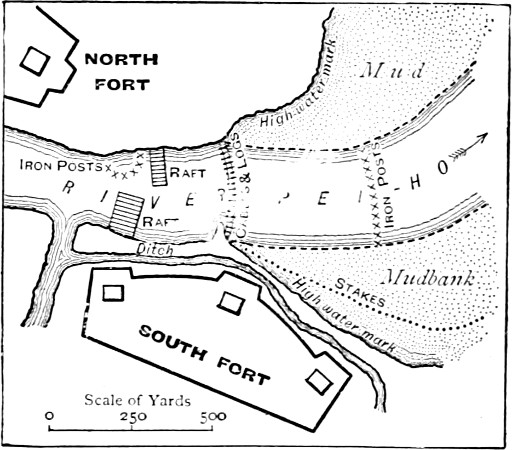
DEFENCES OF THE PEI-HO, 1859.
Willes got out on one of the rafts and, crawling on hands and knees, examined it carefully, and decided that mere ramming with a gunboat’s prow would not be enough to displace it. As he crouched on the raft he could see the Chinese sentries on the river bank, but was, happily, unseen by them. Returning to his boat, he dropped down to the second barrier. The mine was ready, and having lighted its fuse the boats pulled down the stream to the flotilla. The explosion revealed their presence to the Chinese, and a couple of harmless cannon shots were fired at them from the South Fort. The plucky little expedition had been a complete success; but before morning the Chinese had repaired the gap blown by the mine in the floating boom.
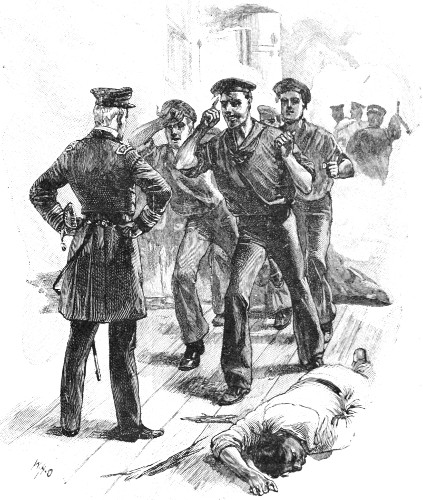
“‘WHAT HAVE YOU BEEN DOING, YOU RASCALS?’” (p. 30).
Early on Saturday, June 25th, the gunboat flotilla cleared for action. Admiral Hope’s orders were that nine of the ships should anchor close to the first barrier and bring their guns to bear on the forts, while the two others broke through the barriers and cleared the way for a further advance. High water was at 11.30 a.m., and it was expected that all would be in position by that time; but the difficulty of working so many ships in a narrow channel, not more than 200 yards wide, with a strong current and with mud banks covered by shallow water on each side, was so great that it was not till after one that the ships had anchored, and even then two of them, the Banterer and the Starling, were stuck fast on the mud in positions from which it was not easy to get their guns to bear.
All this time the forts had not shown the least sign of life. Their embrasures were closed; a few black flags flew on the upper works, but not a soul was to be seen on the mud ramparts. It was a bright summer day, blazing hot, with a cloudless sky of deep blue overhead, and all round the little flotilla the dark waters of the river came swirling down on the ebb, so that already patches of yellow mud were showing here and there under the rush-covered banks.
The Plover, with all steam up and the admiral on board, was close to the first barrier of iron spikes, and the Opossum, now commanded by Captain Willes, lay close by her, the special task of this ship being to deal with this first obstacle. At a signal from the admiral the Opossum hitched a cable round one of the iron stakes, and, passing it over one of her winches, reversed her engines and tried thus to tear the stake out of the river. But it was so well fixed that it was not until half-past two, after half-an-hour of anxious work, that the obstacle gave way.
The admiral in the Plover now steamed through the gap thus formed, followed by the Opossum. As the two little ships approached the floating barrier beyond, a flash from the long rampart on the left, the boom of a heavy gun, the whistle of a round shot in the air, warned them that the Chinese meant to resist.
Along the walls of the forts on either side banners were hoisted on every flag pole, embrasures were opened, guns run out, and from some six hundred yards of the rampart on the left, and from the North Fort out in front, the Chinese artillery, rapidly served and well laid, poured a storm of shot upon the leading ships.
Promptly came the English answer. Admiral Hope’s signal, “Engage the enemy,” flew from the masthead of the Plover; her four guns opened, three of them on the big fort away to the left, not more than two hundred yards off, the other replying to the North Fort, while the guns of the rest of the flotilla took up the loud chorus.
It was a fight at close quarters, and the English guns were worked by men who knew their business; but the Chinese fire, instead of slackening, seemed to grow heavier every minute. If a gun was silenced, if a shell burst in an embrasure and swept away all within reach of its explosion, another gun was promptly placed in battery, another band of daring gunners took the places of the slain. They fired so steadily and aimed so truly, that to this day many hold that they had trained European artillerymen helping them. The iron storm to which they were exposed began to tell upon the two leading ships. The Plover had thirty-one out of her crew of forty killed or wounded in the first half-hour. Her commander, Lieutenant Rason, was literally cut in two by a round shot; the admiral was wounded in the thigh, but refused to leave the deck; and Captain McKenna, who was attached to his staff, was killed at his side. Nine unwounded men only were left on board, but they, with the help of some of their wounded comrades, kept two of the guns in action, though they fought on a deck slippery with blood, and with the bulwarks, boats, and spars of their ship cut to pieces by the Chinese shot.
It was about this time that a boat flying the Stars and Stripes came pulling in from an American cruiser that lay outside the bar. Commodore Tatnall of the United States navy was on board, and he had come to the Plover, regardless of the Chinese fire, to offer some help to the English admiral. As a midshipman he had fought against the British in the war of 1812, but, as the old sailor said to Admiral Hope, “blood is thicker than water”; and though, as a neutral, he could not join in the attack, he offered to send in his steam launch and help to convey the wounded out of danger, an offer that was gratefully accepted. When he bade good day to the admiral and went back to his boat, he had to wait a little for his men. They came aft, looking hot and with the black marks of powder on their hands and faces. “What have you been doing, you rascals?” said Tatnall. “Don’t you know we’re neutrals?” “Beg pardon, sir,” said the spokesman of the party, “but they were a bit short-handed with the bow-gun, and we thought it no harm to give them a hand while we were waiting.” The incident is remembered in the navy to this day as a good deed done for the Old Country by Brother Jonathan.
At three o’clock Admiral Hope ordered the Plover, now almost disabled, to drop down the river to a safer station, and transferred his flag to the Opossum, the Lee and the Haughty steaming up to the place left vacant in the front of the fight. A few minutes more, and a round shot crashed through the Opossum’s rigging close to the admiral, knocking him down and breaking three of his ribs; but though suffering severely the brave commander made light of his injuries, a bandage was adjusted round his chest, and seated on the deck of the gunboat he still kept the command, and later on even insisted on being lifted into his barge in order to visit and encourage the crews of the Haughty and the Lee.
“Opossum, ahoy!” hailed an officer from the Haughty. “Your stern is on fire.”
“Can’t help it,” shouted back her commander. “Can’t spare men to put it out. Have only just enough to keep our guns going.” But, in her turn, the Opossum had to give up the fight for awhile and drop down to the first barrier. The Lee and the Haughty now bore the brunt of the fight, and suffered severely. Everything that could be smashed on their decks was knocked to pieces, and the Lee was hit badly in several places at and below the water-line. Woods, her boatswain, informed her commander, Lieutenant Jones, that unless the shot-holes could be plugged she would sink, as her pumps and donkey engine could not get the water out as fast as it came in. “Well, then, we must sink,” said the lieutenant; “you can’t get at the worst of the holes from inside, and I’m not going to order a man to go over the side with the tide running down like this, and our propeller going.” But Woods replied by promptly volunteering to go over the side and see what he could do. His commander warned him that the screw must be kept going, or the ship would drift out of her place—so, besides the chance of drowning, he would risk being killed by the propeller blades; but Woods, remarking that the chance of being killed was much of a muchness anywhere just then, went over the side, with a line round his waist and a supply of shot-plugs and rags in his hands, and, diving again and again, and more than once sweeping down with the tide under the stern and rising just clear of the wash of the screw, he successfully plugged several shot-holes. But for all that the ship continued to fill, and before long had to give up her place in the fight and run aground to prevent her sinking.
The Cormorant replaced the Lee, the admiral, by his own request, being seated in a chair on her deck. He had already once fainted, and the doctors now persuaded him to allow them to send him to the hospital ship on the bar, and Captain Shadwell, the next senior officer, took the command of the attack. At half-past five, when the battle had lasted three hours, the Kestrel sank at her anchors. Of the eleven gunboats, six were disabled or put out of action. But the fire of the Chinese batteries was slackening, and at 6.30, after a hurried council of war on board the Cormorant, it was resolved to bring in the marines and sailors who had been waiting in boats and junks inside the bar to act as a landing party, and try to carry the South Fort by a bold rush.
It was after seven, and very little daylight was left for the daring attempt, when the boats were towed in by the Opossum and the Toey ’Wan, a little Chinese steamer. Captain Shadwell took command of the landing party, which was made up of bluejackets under Captain Vansittart, and Commanders Heath and Commerell, R.N. Sixty French sailors, under Commander Tricault, of the French frigate Duhalya, the marines under Colonel Lemon, and a party of sappers with scaling-ladders, under Major Forbes, R.E.
As the boats pulled in to the shore, the fire from the North Fort had ceased, and only an occasional shot was fired from the long rampart of the South Fort. The landing place was five hundred yards in front of the right bastion of this fort. The tide had fallen so far that it was not possible to get any nearer, and the column had to make its way across these five hundred yards of mud covered with weeds and cut up with ditches and pools, the ground being so soft in places that the men sank to their waists in it. And as the first boat’s crew landed on this mud bank, suddenly, to the surprise of everyone, the whole front of the South Fort burst into flame.
The silence of its guns was only a clever ruse, to lure the British to a closer attack. Now every gun opened fire again, while the Chinese, regardless of the covering fire from the gunboats, crowded on to the crest of the rampart, and opened fire with small arms upon the landing party. As they struggled onwards to the river bank round shot and grape, balls from swivels and muskets, rockets, and even arrows, fell among them in showers. Captain Shadwell was one of the first to be wounded; Vansittart fell, with one leg shattered by a ball; dead and wounded men lay on all sides, and the wounded had to be carried back to the boats to save them from being smothered in the mud.
Three broad ditches lay between the landing place and the fort. Not 150 men reached the second of these, and only fifty the third, which lay just below the rampart. Several of this gallant band were officers—Tricault, the Frenchman, Commerell and Heath, Parke and Hawkey of the Marines, and Major Forbes of the Engineers. Their cartridges were nearly all wet and useless, and they had only one scaling-ladder. It was reared against the rampart, and ten men were climbing up it, when a volley from above killed three and wounded five of them, and then the ladder was thrown down and broken. There was no help for it but to retire.
It was now dark, but the Chinese burnt flaring blue lights and sent up rockets and fire-balls, and by their light fired on their retiring enemies. Sixty-eight men were killed and nearly 300 wounded, in the advance and retreat of the landing party. Several of the boats had been sunk, and many of the men had to wait up to their waists, and even their necks, in water, on the river’s brink, till they could be taken off.
It was 1 a.m. before Commanders Heath and Commerell, the two last of the party, reembarked. Then the gunboats slipped down to the bar, a party being sent in next day to blow up or burn those of the grounded ships that could not be got off.
So ended the disastrous battle on the Pei ho. Next year an allied force of British and French troops, under General Sir Hope Grant and General de Montauban, taught the Chinese that, notwithstanding their victory over Admiral Hope’s little gunboats, they were in no position to cope with the great Powers of the West. While the allied fleets watched the entrance of the river, 11,000 British and Indian troops and between 6,000 and 7,000 Frenchmen were landed at Peh-tang, some eight miles north of Taku. A wide expanse of marshes separated Peh-tang from the forts which were to be the first object of the allied operations; but these obstacles were turned by a march inland, in which the allies defeated the Chinese field-army at Sin-ho, on August 12th, and coming down the north bank of the Pei-ho, seized the walled town of Tang-ku, three miles above the forts, on the 14th.
These forts were four in number. There were, first, the North and South Forts, which Admiral Hope had attacked the year before, and a little higher up the river there were two others, known as the small North Fort and the small South Fort. They stood on opposite banks of the river, and were both alike—square structures enclosed by embattled walls of sun-dried mud, a few heavier guns being placed on a high platform in the centre, and the whole being surrounded with a double ditch, full of water, too deep to ford. Between the inner ditch and the rampart were broad belts of sharpened bamboo spikes, about fifteen feet wide. The swampy nature of the country rendered the approach to the forts difficult for artillery.
At first there was a difference of opinion between the two generals as to how the forts were to be attacked. It was agreed that as they were built to protect the river mouth, and their strongest fronts were toward the sea, they should be assailed from the land side; but General de Montauban wanted to cross the river, and take the great South Fort first of all. Sir Hope Grant, however, insisted that a much better plan would be to begin with the small North Fort, and predicted confidently that if it were taken all the other forts would be quickly surrendered, as each of them in turn could bring its fire to bear upon those still in the hands of the Chinese. Happily, this plan was adopted, though the French general was so dissatisfied with it that he only sent a few hundred men to help in the attack of the fort, and came to look on himself, without even wearing his sword, as if he wished to disclaim all part in the business.
The swamps so narrowed the available ground in front of the small North Fort that the attacking force was limited to 2,500 English and some 400 French. On the evening of the 20th of August, forty-four guns and three 8-inch mortars had been placed in battery before the fort.
At five a.m. on the 21st they began the bombardment, which was to prepare the way for the storming party. The English fire soon began to silence the Chinese guns, and about an hour after the bombardment began, a shell from the mortar battery penetrated into one of the magazines of the fort. It blew up with a deafening explosion, and so dense was the cloud of smoke that settled down upon the scene of the disaster, so utterly silent was every Chinese gun in the work, that at first it seemed as if the fort had ceased to exist; but as the smoke cleared the Chinese bravely reopened fire.
Down at the mouth of the river, Admiral Hope’s ships were once more engaging the two outer forts; but this was done merely to keep their garrisons well occupied, and to prevent them sending help to the smaller fort. Here, too, fortune helped the British, and one of Hope’s shells blew up a magazine in the South Fort, doing a fearful amount of damage to its defenders.
Soon after six o’clock the storming column was ordered to advance against the small North Fort, the English force being mainly composed of the 44th and 67th regiments. In front of the column a party of marines carried a pontoon-bridge for crossing the ditches; but as they approached the walls they were met with such a heavy fire of musketry that the attempt to bring up the pontoons was abandoned. Fifteen of the men carrying them fell under a single volley.
The French had adopted a simpler plan. They had bamboo ladders, which were carried for them by Chinese coolies. Heedless of the fire of their own countrymen, the coolies laid the ladders across the ditches, and, standing up to their necks in water, supported them while the Frenchmen scrambled across. “These poor coolies behaved gallantly,” wrote Sir Hope Grant in his journal, “and though some of them were shot down, they never flinched in the least.” The fact is, that a Chinaman does not seem to know what the fear of death is; and while these men were exposing their lives for a few pence, their countrymen on the ramparts were just as recklessly standing up on the very crest of the wall in order to get a better shot at the stormers.
The English crossed the ditches, partly by swimming and struggling through the muddy water, partly by the French ladders, partly over a drawbridge which Major Anson of the Staff very gallantly brought into use by crossing the ditch almost alone, and cutting through with his sword the ropes that held it up.
The stormers were now crowded together between the inner ditch and the rampart. The Chinese could no longer fire on them with their muskets, but they dropped cannon shot, big stones, explosive grenades, jars of lime, and stifling stink-pots on to their heads. The scaling ladders were replaced against the rampart, but the Chinese caught them and pulled them into the fort, or threw them down, spearing and shooting all who mounted them.
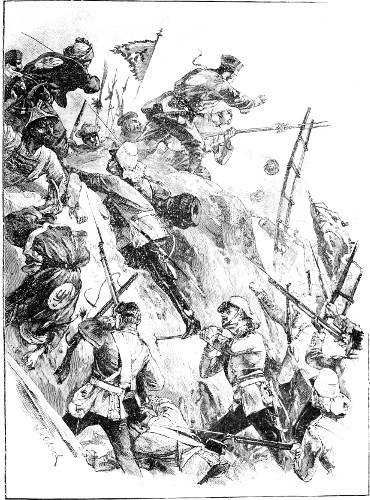
“ROGERS GOT IN, HELPED UP BY LIEUTENANT LENON” (p. 34).
Men and officers tried to scramble in where the bombardment had broken down the embrasures for the guns. One brave Frenchman reached the top of the wall, fired his rifle at the Chinese, took another which was handed up to him and fired it, and then fell speared through the face.
Another, pickaxe in hand tried to break down the top of the wall. He was shot dead, but as he fell Lieutenant Burslem, of the 67th, seized his pick and went on with the work.
He and his comrade—Lieutenant Rogers, of the same regiment (now Major-General Rogers, V.C.)—climbed into an embrasure, only to be thrown out; but Rogers got in through another, helped up by Lieutenant Lenon, who made a stepping-place for him by driving the point of his sword well into the mud wall, and holding up the hilt. Rogers helped up Lenon and the others near at hand, and at the same time Fauchard, a drummer of the French storming party, got in close by.
Behind him came the standard-bearer of his regiment (the 102nd of the Line), and as the Chinese gave way there was a race between the Frenchman and young Lieutenant Chaplin (now Major-General Chaplin, V.C.), who carried the colours of the 67th, to see who would first get a standard fixed on the top of the fort. Chaplin, though he was wounded in three places, won this gallant race, and planted the British flag on the high central battery of the fort.
“The poor Chinese now had a sad time of it,” writes Sir Hope Grant. “They had fought desperately, and with great bravery, few of them apparently having attempted to escape. Indeed, they could hardly have effected their retreat by the other side of the fort. The wall was very high, and the ground below bristled with innumerable sharp bamboo stakes. Then intervened a broad deep ditch, another row of stakes, and finally another ditch. The only regular exit—the gate—was barred by ourselves. Numbers were killed, and I saw three poor wretches impaled upon the stakes, and yet a considerable number succeeded in getting off. The fort presented a terrible appearance of devastation, and was filled with the dead and dying. The explosion of the magazine had ruined a large portion of the interior. Many of the guns were dismounted, and the parapets battered to pieces.”
The Chinese lost 400 men out of a garrison of 500. The English loss was 21 killed and 184 wounded. The loss would have been heavier if the Chinese had had better cartridges. Thus, for instance, Sir Robert Napier (afterwards Lord Napier of Magdala), who led the advance of the storming column, was hit in five places by bullets, but none of them had force enough to do more than inflict a bruise.
The capture of the remaining forts was an easy matter. The smaller South Fort, only 400 yards from the North Fort, and commanded by its guns, was at once abandoned by the Chinese, and white flags were hoisted on the two larger forts; but on the great North Fort being summoned to surrender the garrison sent back a refusal. The guns of the captured fort were turned on it; other guns were brought up from the English batteries, and the attack was about to be begun by a bombardment, when General Collineau, of the French army, noticing that there was no one on the rampart nearest him, marched forward rapidly with 600 men, sent a lot of them in through a big embrasure, opened a gate, and took the fort without firing a shot. About 2,000 prisoners were taken here, and, to their great delight, they were simply disarmed and told to go home. They evidently expected to be massacred. In the fort were some of the guns taken from the ships lost in the fight of June 25th, 1859.
In the afternoon the fort on the south bank was summoned to surrender, and, after some parleyings, Hang-Foo, the officer in command, agreed to hand it over next day. Early on the 22nd Sir Robert Napier took possession of the southern forts, in which he found no less than 600 guns, large and small.
The same day Admiral Hope’s gunboats steamed up the river, and cleared away the barriers below which the fierce fight of the year before had raged so long, and thus the defeat on the Pei-ho was avenged and the way to Tien-tsin and Pekin was open.
A few weeks later, the armies of England and France marched in triumph into the imperial city.

PALERMO:
THE COMING OF GARIBALDI
BY STODDARD DEWEY

The night of the 26th of May, 1860, came down on the city of Palermo, on the plains around it and on the hills which close it in beyond, amid anxious uncertainty everywhere. Everyone was asking, “Where is Garibaldi?”
The city itself was held in a state of siege by its king, Francis II. of Naples. The sympathies of the great mass of the inhabitants were known to be with the Thousand men of Garibaldi and the Sicilian insurgents who had joined him in his march from the western coast to the hills above Palermo.
No one was allowed to leave the city, or to walk through the streets by day in company with others, or by night without a lighted torch or lantern.
Soldiers were picketed at the corners of the unlighted streets; companies of soldiers guarded each of the city gates which had not been walled up; and two lines of military outposts surrounded the whole city without.
On the plain to the west and north of the city 20,000 soldiers of the king were in camp; 4,000 more had for some days been pushing back the insurgents in the hills. Their general imagined it was Garibaldi who was retreating before them. No military man could understand how a thousand foot-soldiers, aided only by a few thousand ill-armed and untrained recruits, could give the slip to the pursuing columns of regular troops, and surprise the entrance to a city guarded at every point by battalions of trained men and commanded by the artillery of the forts and the warships in the bay.
Even now the descent of the Thousand into Palermo does not become plain until we go over carefully the condition of the city on that fateful night, the situation of the various bodies of troops that were guarding it, and the movements down the mountain side of Garibaldi and his men.
I.—IN PALERMO.
The Bourbons had now ruled over Naples, with the whole southern part of Italy and the island of Sicily, for 125 years.
Ferdinand II., who was dead but a single year, had been peculiarly unfortunate through the whole of his long reign. During its first years, after 1830, the secret societies of carbonari conspiring against him multiplied everywhere in Sicily. The cholera year of 1837 reduced the pride of Palermo; but in 1848, when France again gave the signal of revolution, the city rebelled and held out for a year and four months. For four weeks King Ferdinand had the city bombarded from his fort in the harbour. This did not help to make the citizens love him the more when he finally conquered, and his name was handed down as “King Bomba.”
In 1859, his young and inexperienced son, Francis, found things in the worst possible condition.
In the north, Italians had united under the King of Sardinia against the Austrians and the petty princes who had so long divided up their country. With the help of France, the war was soon over. The Austrians were driven out of Lombardy; the Duchies of Parma, Modena, and Tuscany expelled their reigning houses; and a good part of the States of the Church was taken from the Pope.
All these, with Sardinia, now made up the one kingdom of Italy, with Victor Emanuel as constitutional monarch.
It was a long step forward toward the realisation of what had hitherto been but a dream—a united Italy. And Garibaldi had been the one hero of its making.
In Sicily a secret committee had been formed, under the name of the Buono publico (commonweal), to collect subscriptions among the nobles and property-holders for the purchase of arms and other munitions of war. It was in constant correspondence with the revolutionary committee existing at Genoa, of which Garibaldi was the soul. King Victor Emanuel was bound not to give open aid to any revolt against his cousin, the King of Naples, with whom he was supposed to be at peace. But it was known that his Government would put no hindrance in the way. Everyone knew also that no revolution would break out in Southern Italy except in the name of Victor Emanuel and Garibaldi.
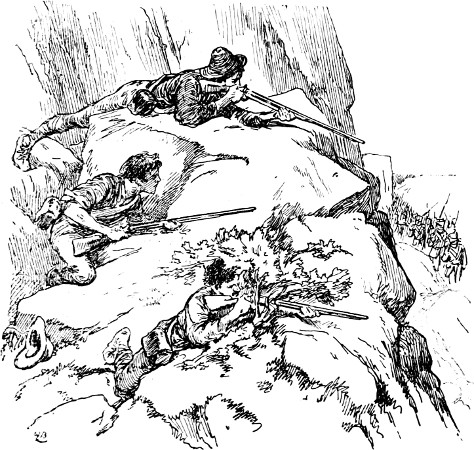
“THE PICCIOTTI PICKED OFF THEIR MEN (p. 38).
The counsellors of Francis II. had but one remedy for this evil state of things—the remedy of King Bomba and all the Bourbons before him. The city of Palermo was strongly garrisoned by troops from the mainland—Neapolitans or Swiss and Austrian mercenaries. Then fuller powers than ever were given to Maniscalco, the director of police, and his spies were placed everywhere. At Santa Flavia, eleven miles from Palermo by the sea, an armed insurrection suddenly broke out. It was crushed at once; but it was made the pretext for throwing several notable citizens into prison. Next Maniscalco was grievously wounded at the door of the cathedral, and, in spite of all the efforts of the police, the would-be assassin escaped with the help of the people. A reign of terror was now begun, especially against the nobles and the rich. In every house searches were made by Maniscalco’s shirri, or detectives, for guns and swords and bayonets. It was felt that, among the 200,000 inhabitants of Palermo, only the soldiers, the host of Government employés, and the countless members of the secret police were loyal to the king.
At last the Committee of Sicilian Liberties, as it was henceforth called, decided that the time had come to summon the citizens to revolt. Rizzo, a master mechanic of means, organised the movement. The rendezvous was given for the night between the 3rd and 4th of April, at the Franciscan convent of La Gancia, in the heart of the city. Rizzo’s house was next door, and the arms which had been gathered were secreted in an unused well of his courtyard. A communication had been broken through the wall of the convent church. The friars were in the secret and in full sympathy with the conspirators. There was but one exception. He carried the news of what was going on to Maniscalco.
It was eight o’clock in the evening when the betrayal was made. General Salzano, who was in command at Palermo, was notified at once, and the convent was soon surrounded by troops. Rizzo and twenty-seven of his companions were already inside waiting for the coming of the others. Day broke, and no one had arrived. Looking out through the shutters, the little band saw the soldiers under arms, and understood that they had been betrayed. They resolved to sell their lives dearly, and Rizzo opened fire from the windows.
The troops brought their cannon to bear on the great door of the convent. Two shots were enough to batter it down, and the soldiers charged with their bayonets. They were met by the father superior, and ran him through on the spot. The insurgents held them back for a time, firing from the shelter of the friars’ cells along the narrow corridors. Another friar was killed, and four more were wounded. Then Rizzo with his band made a last effort to escape in a determined sally through the courtyard, by the great door which the cannon had burst open. The troops were beaten back, but Rizzo fell with his leg broken by a bullet above the knee. The soldiers discharged their guns at him where he lay, inflicting lingering but mortal wounds. A dozen of his companions were taken prisoners with him; the others made good their escape.
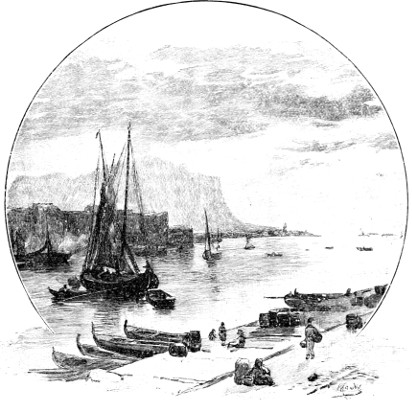
PALERMO HARBOUR.
(From a Drawing by J. W. McWhirter A.R.A.)
The citizens, without arms and without a leader, kept to the shelter of their houses. The soldiers shot at anyone showing himself at a window. All who were connected with the conspiracy fled from the town into the fastnesses of the hills. The insurrection was again over in Palermo.
The picciotti—young men from fifteen to twenty-five years of age—had long been ready to join in the uprising. In the large town of Carini, ten miles to the west of Palermo, the impatience was so great that they anticipated the signal to be given at La Gancia. On the 3rd of April the tri-coloured flag of United Italy was unfurled, and barricades were thrown up across the mountain roads. Misilmeri, a few miles to the east of the city, next took up the cry. With the two priests at their head, the insurgents drove out the Neapolitan garrison of four soldiers, eight mounted gendarmes, and eight of Maniscalco’s sbirri. On the 11th of the month the picciotti swept down on a body of troops and forced them back to the bridge over the Oreto, almost within gunshot of the city. Soon all the villages along the coast and in the surrounding country were in full insurrection. The city began suffering from this blockade on the side of the land. All its provisions had to be brought in the king’s vessels from Naples.
At Naples the news of the revolt led to the taking of extreme measures. The vessels of the royal marine, along with merchant ships appropriated by the Government for the occasion, were despatched to Palermo. All were filled with soldiers and munitions of war. In a few days there were 13,000 of the king’s troops in and around the city, to face the insurrection.
In spite of the vigilance of the police, a newspaper from northern Italy had been smuggled into Palermo, making known to the inhabitants that the committee at Genoa was organising an expedition to come to the aid of the Sicilian patriots. On the 10th of April a secret messenger, Rosolino Pilo, who had been under proscription in his native land for ten years, succeeded in landing safely at Messina. He made his way from village to village by night. In the morning the sign of his presence was found written on the walls—
“Viene Garibaldi! Viva Vittorio Emanuele!”
Soon, in Palermo itself, the very children cried after the sbirri as they passed—“Garibaldi is coming!”
Word was passed around that, on a certain day, all whose sympathies were with the revolution should walk in the fashionable promenade of the Via Maqueda—the broad, straight street that divides the city in two halfway up from the sea. Even the greatest ladies came on foot; there was no room for the splendid equipages for which Palermo has always been noted. No one was armed. All kept an ominous silence.
Maniscalco was at his wits’ end. He sent a band of soldiers and sbirri along the promenade to cry from time to time, “Viva Francesco Secondo!” There was no response from the crowd. Then the sbirri surrounded a group of the citizens and ordered them to repeat the cry, “Viva Francesco Secondo!” After a moment of deep silence one of the group, tossing his hat in the air, shouted, “Viva Vittorio Emanuele!” The soldiers bayoneted him on the spot, and then discharged their guns into the crowd. Two men were killed, and there were thirty women and children among the wounded. The mounted gendarmes charged on their horses, and swept the streets clear. But the next morning Maniscalco could read in huge red letters on every dead wall of the city, “Garibaldi viene!”—“Garibaldi is coming!”
II.—WITH THE KING’S ARMY.
The regular troops were now kept constantly on the alert, and daily and nightly drawn by new alarms from the city toward the mountains, it was useless for them to give chase to the picciotti in their retreat along the winding goat-paths of the hills. In return, they brought their artillery against houses sheltering the helpless women and children of the insurgent villages.
It was on the 9th of May that the demonstration of the Via Maqueda took place, followed by the bloody police outrage on the people and the threatening prophecy written by night upon the walls. On the 13th word passed through the city that the prophecy was fulfilled.
“Garibaldi has landed at Marsala!”
It was on the 11th of May that Garibaldi and his expedition of a thousand men succeeded in entering the island. Two English ships stood between him and the royal cruisers, which gave chase, until men and arms were all safely on shore. The two Genoese merchant vessels that had brought the expedition were abandoned to capture, and the march began across the island. Nothing was left to the adventurous Thousand—old revolutionists and young university students from northern Italy, Hungarian officers of 1848, and French and Polish sympathisers with all that invoked the name of liberty—but to take Palermo or die.
The next day they were at Salemi, where, on the 14th, Garibaldi proclaimed himself Dictator of the island in the name of King Victor Emanuel. The guerilla bands and the picciotti began coming in from every quarter.
On the 15th the Thousand came face to face with the royal troops, which had taken strong positions along the hills overlooking the road at Calatafimi, fifty miles from Palermo. The only pitched battle of the campaign took place here. The picciotti, with all their goodwill, showed that they would be of little use in open warfare. They could not endure the fire of regular soldiers, and still less execute the charges necessary for capturing the positions of the enemy. But the Thousand of Garibaldi were a host in themselves. The Genoese Carabineers were accustomed to his methods of fighting. Even the university students had been trained and hardened to practise his maxim, “Lose no time with artillery, but use your bayonets!”
General Landi and his thousands of regular soldiers were driven back, and the next day they beat a disorderly retreat as far as Palermo. The picciotti, from the shelter of every rock and clump of bushes, picked off their men by the way. The soldiers, in turn, sacked and pillaged the villages of Partanico and Borghetto. The Neapolitan officers complained bitterly that their mercenaries preferred pillage to fighting. Garibaldi, ever seeking to draw all Italians to himself, praised the bravery of the Neapolitans while congratulating his own army on its victory. It had cost him dear. There were eighteen of the Thousand among the killed, and 128 were wounded.
After a day of rest, Garibaldi marched forward, and on the 18th he was already on the mountains in sight of Palermo. There his men bivouacked in the rain. On the 20th he advanced his outposts to within a mile of Monreale, whence the high road leads directly down to Palermo, not five miles away. He now decided not to try to force an entrance into the city from the side of Monreale. He could not hope to make his way across the plain and past the headquarters of the royal army, even by night, without sacrificing half his men. He chose instead a movement that, perhaps, no other military man of the age would have attempted. Garibaldi himself said ever after that it could have been executed only in Sicily, under the circumstances of the time. To its success it was essential that the enemy, lying below in sight of his own camp fires, should have no knowledge of what was going on until all was over. The picciotti may not have been able to take their part in regular battle; but there were no traitors among them, nor in the mountain villages through which the expedition was to pass.
The evening of the 21st fell dark and rainy. With nightfall the Thousand set out on a toilsome march by unfrequented paths over three mountain tops to Parco. Garibaldi wished to move round from the west to the south of Palermo, nearer to the sea. Their few pieces of cannon were dismounted and carried on the backs of the men. At three in the morning the little army was at its destination, wet, and worn out with fatigue, but without a man or gun or precious cartridge missing. The picciotti had kept the camp fires blazing above Monreale. General Lanza, who had just been appointed the king’s alter ego in Sicily, was not to learn of the stolen march for many hours to come.
The day was passed in taking up positions along the zigzag mountain road leading up to Piana dei Greci, six miles further back from Palermo. Only then, after a night and a day of toil, the men bivouacked around their works.
At daydawn of the 23rd Garibaldi and Türr—the Hungarian, who was his other self in the expedition—climbed a summit whence they could command a view of Palermo and the plains around. The mayor of Parco had just provided the dreaded leader and his companion with sorely-needed trousers. They looked down on a gallant display of arms. With the exception of the necessary garrison for the forts and a few posts in the city, the royal troops were all in camp on the plains to the west and north of the city or by the headquarters of the general in the great place before the royal palace. Garibaldi’s practised eye estimated their number at 15,000 men, and new reinforcements were arriving. To oppose them in serious conflict he could count on not 800 valid men.
Even as they looked, a body of troops, 3,000 to 4,000 strong, began its march on Monreale. When they reached the hills their movements were impeded by the ceaseless fire of the picciotti sheltered behind the positions left by the Thousand. The firing continued during the day and into the night.
When the morning of the 24th came, Garibaldi could see that General Lanza, with thousands of men at his disposal, was carrying out a plan of attack skilfully designed to envelop and sweep away his little army. Beyond Monreale the corps which had marched out yesterday was rapidly advancing toward Piana to surround his left. From below another strong body of troops was marching directly on Parco. Türr was at once sent to save their few pieces of artillery, and, with the help of the Carabineers and picciotti, to guard the left. Garibaldi began hurrying on the march to Piana. Türr’s men were soon attacked by three times their number, and the picciotti fled in dismay. The Carabineers succeded in escaping amid the hills, while Türr, with two companies, held the enemy with his cannon.
At half-past two in the afternoon the whole army arrived safety in Piana. In the evening General Garibaldi held a council of war with his colonels, Türr, Sirtori, and Orsini, and with Signor Crispi, a long-exiled Sicilian lawyer whom he had made his Secretary of State. He proposed his final plan, which was to deceive again and divide the forces of the enemy. It was put in operation on the spot.
Orsini, with the artillery and baggage and fifty men for escort, began an ostentatious retreat along the road leading to Corleone, many miles further in the interior. For one half-mile the general and the bulk of the army followed after. The royal outposts on the left hastened to bring the information to General Lanza, who was commanding in person, and he at once sent his whole body of troops in cautious pursuit. In the dense wood of Cianeto, Garibaldi and his men left Orsini to draw the enemy further and further away, while they turned into a path that led to Marineo.
The night was clear, and Türr and Garibaldi, as they marched side by side, looked to the star of the Great Bear, which the latter had connected with his destiny from a child. “General,” said the Hungarian, “it smiles on you. We shall enter Palermo.”
At midnight the little army bivouacked in the forest. At four o’clock they were again on foot, and at seven they were at Marineo, where they passed the day. With the night they took up again their secret march, and at ten they reached Misilmeri. La Masa was there with a few thousand picciotti, and there were a few members of the Committee of Sicilian Liberties. These were told to notify their friends in the city that the attack would be made on the morning of the 27th. Türr sent word to Colonel Ebers, his compatriot and correspondent of the London Times in Palermo, to come out and share in the adventure.
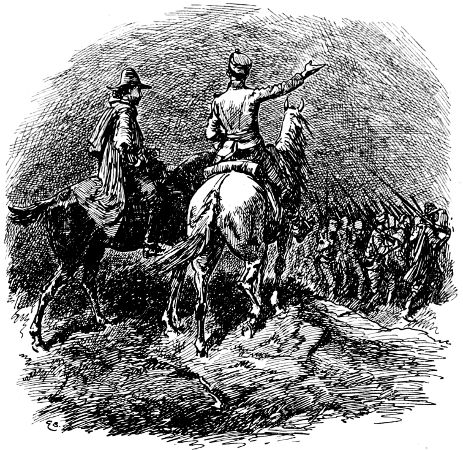
“‘GENERAL, IT SMILES ON YOU.’”
The day of the 26th was employed in making ready. Garibaldi passed the picciotti in review at their camp of Gibilrossa. Then he ascended Monte Griffone to study the city and plain beneath. The royal guards along this south-east side of the city were almost within hearing of a trumpet blast from his mouth. They did not dream that he was nigh.
III.—THE DESCENT OF THE THOUSAND.
The sun set on the evening of the 26th in a mass of red vapours, portending the heat of the night. The army of Garibaldi was already forming on the table land of Gibilrossa, in the order which they were to follow in their attack on the Porta di Termini of Palermo.
First came the leaders, with Captain Misori at their head, and three men from each company of the Thousand under the command of Colonel Tukery. They were in all thirty-two men. Immediately behind them was the first corps of the picciotti. The first battalion of the Thousand followed, under the command of Bixio, who was afterwards a famous general. Garibaldi came next, with Türr and the remainder of his Staff, followed by the Second battalion under Carini. Last of all was the second corps of picciotti and the Commissariat. In all they were 750 trained and veteran soldiers—all that was available of the original 1,065—with two or three thousand picciotti, preparing to face 18,000 regular troops of the King of Naples.
It was essential to the success of their enterprise that the alarm should not be given in Palermo until as late as possible. Even if they had wished to follow it, there was no direct road to the city. With as much order as might be, they clambered down the sides of a ravine which led to the valley opening on the highway. It was eleven o’clock when they arrived at this point. Tukery halted his men to see if order was being kept in the rear. The picciotti had completely disappeared. A false alarm on the mountain-side had sent them flying. Two hours were needed to re-form the line, when it was found that their numbers were now reduced to 1,300 men. With all these delays, at half-past one in the morning they were still three miles from the city.
They marched forward in close columns until they came up with the Neapolitan outposts. It was now half-past three, and still dark. The soldiers fired three gun-shots and retreated to their guard-house. This was enough to disperse two-thirds of the picciotti who remained.
The thirty-two men composing the vanguard of Garibaldi now dashed forward to the bridge over the Oreto. This Ponte dell’ Ammiraglio, by a strange coincidence, was the scene of the first combat of Robert Guiscard, the Norman, with the Saracen lords of Palermo, nearly 800 years before, and of Metellus with the Carthaginians 1,200 years before that. It was now defended by some 400 men. The soldiers of Garibaldi first attacked them by a running fire from behind the trees along the road, and then entered on a hand-to-hand fight. A single captain, Piva, was able to bring down four Neapolitans with six shots from his revolver. Misori hastened back to summon Bixio. The first battalion charged, followed by Türr at the head of the second. The bayonets now came into play, and the Thousand had won their first position.
The alarm was now thoroughly given. While the defenders of the bridge were fleeing to the right, a strong column of the royal troops advanced on the left. Türr sent thirty men to stop their advance, and the rest of the Thousand charged past with fixed bayonets.
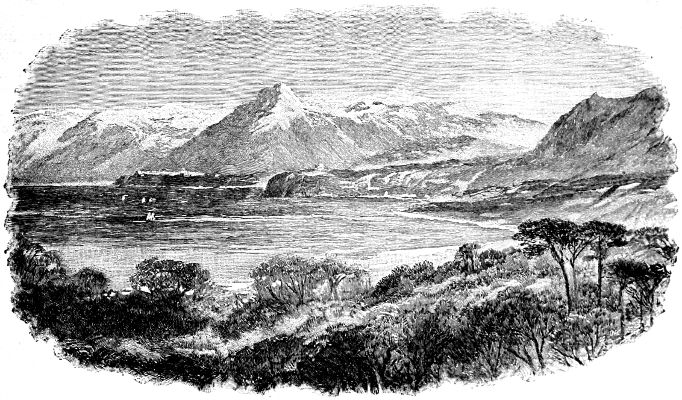
THE COAST OF PALERMO, LOOKING TOWARDS TERMINI.
The Neapolitans now fell back on the street leading to the gate of Sant’ Antonino, at the end of the Via Maqueda. This road was lined with the houses of a small suburb, and cut across the street of Termini, by which Garibaldi’s men hoped to enter the town. The old gate of Termini had been torn down by King Bomba, and the street leading to the bridge widened to facilitate the movement of his troops. It now served the purpose of those who were trying to overthrow the rule of his son. The Neapolitan commander had already placed two cannons in the Via Sant’ Antonino, and at every moment their shots swept across the path of Garibaldi. Even his veterans held back for a moment. A carabineer seated himself in a chair in full line of the firing, to persuade the picciotti to go on.
Garibaldi now came up, just as his faithful Tukery fell mortally wounded. As if animated by his death, one of the leaders seized the banner of United Italy, and bore it unharmed through the enemy’s fire. He was followed by five others, and, little by little, the whole line passed under the eyes of their general. He alone was on horseback, and the most exposed, as he urged his men forward.
Two hundred men were soon scattered through the different streets of the city, nearest to the gate; and their leaders penetrated to the old market, which had been the place of the revolution in 1848. Garibaldi soon arrived in the midst of the fire which the royal troops were keeping up on the rear of the little column. The members of the Committee of Palermo were waiting to receive him. He at once gave orders to make barricades behind, and thus entrenched himself in the midst of his enemies.
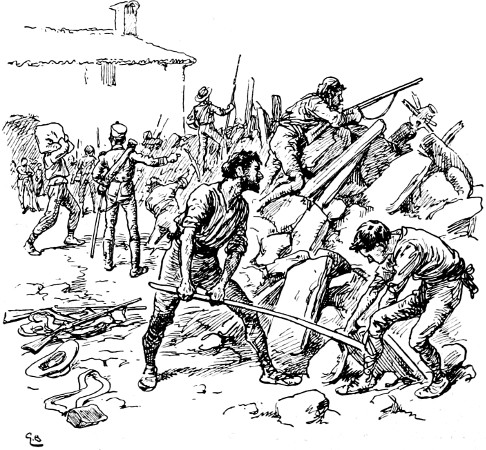
The people in the houses remained deaf to his first appeal; but by dint of calling they were at length induced to appear at the windows, where the sight of their deliverers gave them courage. Mattresses were flung from every window, and soon piled up over the barricades most exposed to the royal artillery. Then a few of the inhabitants began showing themselves in the streets. They had but one answer to give to the invitation to join with the invaders: “We have no arms.” But they lent themselves bravely to the tearing up of paving-stones for the barricades, and the soldiers of Garibaldi found places of vantage in their houses.
With a part of his men Garibaldi now made his way to the centre of the city, where the Via Maqueda is crossed at right angles by the long Via Toledo (now the Corso Vittore Emanuele), leading from the port through the whole length of the city to the Royal Palace. The number of his men was greatly exaggerated in the imaginations of his opponents, and he easily drove back the royal troops close to their general’s headquarters at the Palace. The Bourbon Government had just been paving this street with large flags. These were now torn up and built into barricades, while waggons and obstructions of every kind were thrown across the neighbouring streets.
At this moment the bombardment of the city began from the Fort of Castellamare, in the bay, and from the Royal Palace. The warships with their great guns swept all the streets within line of their fire. Three days were next taken up with the constant advancing and retreating of the now infuriated soldiers of the king, aided by the steady downpour of shot and shell on the quarters where the men of Garibaldi—the Italians, as they were now called, even by their enemies—had entrenched themselves. But the crumbling of walls only aided to the making of new barricades, and impeded all the movements of the regular troops. As the royal mercenaries abandoned their positions, they set fire to the buildings they had left. The convent of the White Benedictines was burned, with fifty of the prisoners who had been confined in it. All Palermo worked actively with Garibaldi and his men, in a fury of rage against the royal army. Soon there remained to the latter only the two forts of the harbour, the Royal Palace, and the post at the Flora below the Porta di Termini, by the bay. Even these could no longer communicate with each other nor receive provisions.
Garibaldi had now conquered once more. On the fourth day the king’s general asked for an armistice—to bury his dead. It was prolonged, and at last the king ordered that the troops should evacuate the city, provided that the garrison in the forts might depart with the honours of war. To save the lives of the prisoners still confined, this was granted. On the 20th of June the last Neapolitan soldier had left Palermo. Two days later the Thousand of Garibaldi were on the way to deliver Messina, the last hold of the Bourbons in Sicily.
The Red Man’s Last Victory:
The Fight of the Little Big Horn
By Angus Evan Abbott
The Red man has fought his last great fight. The long and bloody struggle waged between the White man and the Red for the possession of the North American continent has ended, and ended for all time: the weaker has gone to the wall. From the day in 1609 when Samuel de Champlain and his hardy followers burst upon the Iroquois at Ticonderoga, and, armed with sticks that spoke with fire and spat out unseen death he put these hitherto invincible warriors to flight, to the day when the United States were preparing to celebrate with unheard-of splendour the centennial of their independence, a ceaseless state of war existed between the children of the forest and prairie and the pale-faced usurpers. Every year had its tragedy, every mile its white gravestone in history. And as a fit ending to these centuries of conflict and bloodshed came the crimson tragedy of the blotting-out of Custer and his cavalrymen in the Bad Lands of the Yellowstone. Many notable tragedies, dramatic in execution as appalling in effect, marked the long years, but none struck home to the hearts of the American people with such searching directness and force as the finale to the Indian tragedy, in which Sitting Bull, chief of the Sioux, and General Custer, one of America’s most dashing cavalry leaders, played the leading rôles.
Surely never were such Aborigines as the North American Indian! Surely never in the history of the world did the White man encounter so nearly his match as when he first plunged into the forests of the New World. A mere handful in numbers were these Red men at the best, and yet it can hardly be said that they were ever subdued. In turn they met and fought the Spaniard, then in all his glory, the Frenchman, the Englishman—long and savage wars these—and when Spaniard, Frenchman, and Englishman as such disappeared and the American took their place, the Indian fought him more fiercely than ever. When one thinks of the White man’s countless numbers and the weapons which his ingenuity and handicraft supplied, the marvel is that the Indian has not long since disappeared from the face of the earth. But given their numbers and weapons and all, it has been estimated that in the wars which the White man waged against the Indians they lost more than ten killed to the Redskin’s one. Yet notwithstanding the skill, the craftiness, the sensible recognition of existing facts, the clever stratagem and resistless ferocity which characterises the Indian nature, the level-headed way in which he set about his wars, to kill and not be killed his motto: notwithstanding all this, the prophecy of the great orator Red Jacket has come true. He said, “When I am gone and my warnings are no longer heeded, the craft and avarice of the White man will prevail. My heart fails me when I think of my people so soon to be scattered and forgotten.”
The feud which began on the Atlantic coast hundreds of years before, was destined to end in the far North-West, away up in a corner of the United States then almost wholly unknown to the White man, an angle of territory bounded on the west by the Rockies, and on the north by what formerly was known as Rupert’s Land—British territory. The immediate cause of the trouble which led up to the massacre of Custer and his battalion was one which had often before provoked active hostilities. It was the refusal of sundry bands of Indians to settle down on the reservations placed at the disposal of the Indians by the United States Government. The Indians resented the attempt to confine them to restricted districts. The Red man of the prairie had been, from time immemorial, a notorious nomad. On his lean, shaggy, ungainly pony, his bow and quiver slung across his back, his buckskin breeches and shirt fringed with horsehair and painted in gaudy colours, his long, greasy black hair stuck full of the feathers of the turkey, hawk and eagle, he had for centuries roamed the vast prairie at will: now fighting his hereditary foe, and again camping for weeks at a time on the trail of the mighty herds of buffalo in their wanderings over the boundless prairie. For ages the chafings of restriction were unknown to him, until freedom had become almost as necessary to the savage of the plains as the air itself. This he enjoyed, until one day the advance guard of civilisation, a grizzly trapper, dressed in leather, and carrying a flintlock under his arm, peered out of the bushes and saw in astonishment the great rolling prairie, the home of the buffalo and the Sioux. The hardy pioneer soon followed, restless, and ever pressing westward; and one day, the Sioux, sitting astride his barebacked pony, saw in amazement the long train of white-topped waggons—the prairie schooner—drawn by oxen, trailing westward through the tall grass, and realised that his ancient fastness had been invaded. Immediately there began massacres on the one hand and retaliation on the other. The Sioux, the Bedouins of the prairie, were gradually driven back and back in the process. They strained fiercely at the bonds, but were unable to break them.
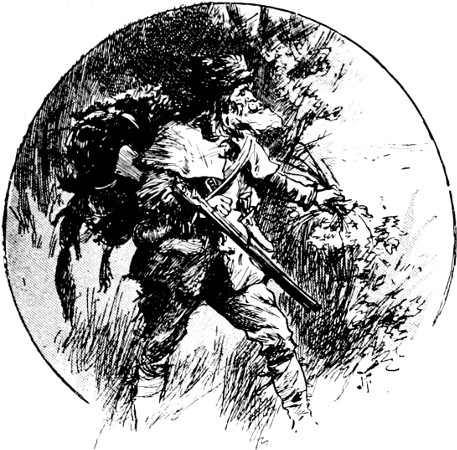
“UNTIL ONE DAY A GRIZZLY TRAPPER PEERED OUT OF THE BUSHES.”
During the winter of 1875–6 the authorities at Washington, after every peaceable means had been tried in vain, found it necessary to sanction the use of force to compel certain refractory bands of Indians to cease their wanderings and outrage, to place themselves under the control of the Indian officials, and to settle on the reservations set aside for their use. These recalcitrant savages were Sioux, than whom there were none more warlike and cruel, and in their raids they wandered over an area of something like 100,000 square miles in the then territories of Dakota, Montana, and Wyoming. There were a number of these bands of “Hostiles,” each having a chief of its own; but as dissatisfaction spread among them, all gradually centred around two great chiefs, “Sitting Bull” and “Crazy Horse.” “Sitting Bull,” at the time hostilities commenced, was with his band in the vicinity of the Little Missouri River in Dakota, and “Crazy Horse” and band were camped on the banks of the Powder River in Wyoming. The region was a wilderness: rugged, mountainous, and deeply scarred by rapid streams and small rivers, and, as has been told, totally unknown to the United States soldiers. As guides to this unfamiliar region and to scout by the way, the command took with it Ree Indians under “Bloody Knife” Chief, and Crows, led by Chief “Half-Yellow Face.” These Indians did the scouting well, but the Rees took the earliest opportunity afforded them to slip away when fighting began.
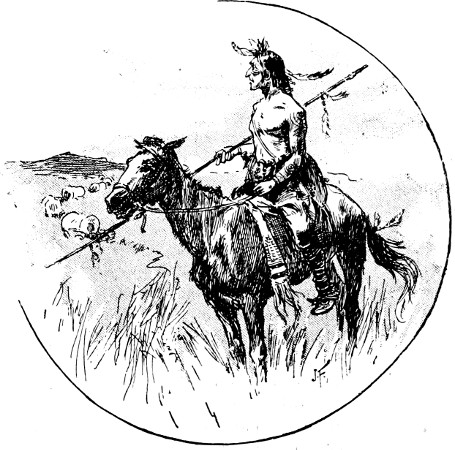
“AND THE SIOUX SAW IN AMAZEMENT THE LONG TRAIN OF WHITE-TOPPED WAGGONS.”
The first move made against these Sioux was on March 1st, 1876. General Sheridan, a distinguished leader in the American Civil War, was given the direction of the campaign, with headquarters at Chicago. General Terry held the active command of the troops in the disaffected country. Subordinate to Terry were Generals Custer and Crook, at the head of mounted columns. Terry ordered these leaders to move out against the “Hostiles,” specifying the route each was to take. Crook marched on March 1st, and on March 17th encountered “Crazy Horse” and his braves, and the command was so severely handled in the engagement that Crook fell back to his base. Custer had been unable to make a simultaneous advance with Crook, owing to the weather being so bad that it was found impossible to venture into the region of heavy snows and swollen rivers.
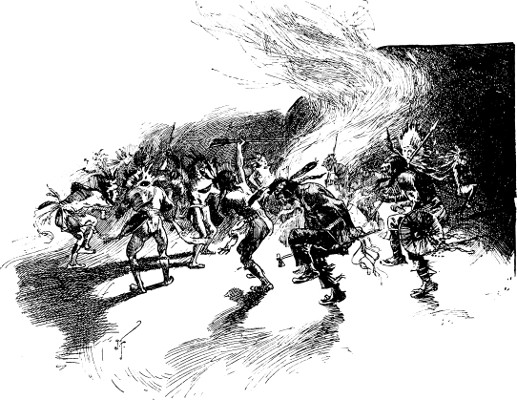
“THE WARRIORS DANCED THE WAR-DANCE.”
The news of Crook’s defeat spread like wildfire among the Indian agencies. Couriers sped from the camps of “Crazy Horse” and “Sitting Bull.” To every Indian encampment in that part of the States one or more messengers came, and squatting on the hardened earth of some smoky Tepee, to the listening braves told of the killing of the Paleface and the triumph of the Red, and before he had finished his tale, wigwams were struck and loaded to the patient ponies, the squaws strapped their papooses to their backs, and the warriors, with faces painted in ghastly and fantastical streaks, danced the war-dance, snatched up their rifles, and mounting their ponies, set out to take part in reaping the harvest of scalps.
The defeat of Crook made a long war inevitable. General Sheridan reinforced the troops in the disaffected region, and remodelled his plan of campaign. The troops were formed into three columns instead of two; and as soon as the weather moderated, so as to admit of favourable progress, all set out to trap the Indians. The three columns were commanded respectively by Generals Terry, Crook, and Gibbon. Custer would have led in place of Terry, had it not been that just before the setting out of the expedition he fell from the good graces of President Grant. Indeed, so displeased was Grant with Custer, that he sent definite instructions that Custer was not to be allowed to accompany the expedition; and it was only after a personal appeal to Grant by Custer, and the intercession of Sheridan, that the famous cavalry leader was allowed to take his place at the head of his regiment and march away, never to return.
George Armstrong Custer’s career, from the day he graduated at the United States Military Academy to the day of his death, fifteen years after, was one of meteoric brilliancy. A native of New Rumley, Ohio, he graduated at West Point on the very outbreak of the Civil War. From West Point he went direct to Washington, and on the day of his arrival at the capital he was entrusted by General Scott with despatches for General McDowell, then on his way with the army of the Potomac to fight the first general battle of the Civil War—Bull Run.
Custer arrived in the nick of time, was assigned to duty as lieutenant of the 5th Cavalry, and took his place in the company just in time to take part in the fight that followed. In his first battles he attracted the attention of his superior officers by his daring and dash and his brilliancy in handling men; and in 1862 his many exploits effected his promotion to the captaincy of the company. Immediately afterwards, by a clever ruse, he surprised the Southerners and captured the first colours taken by the army of the Potomac from the South in the war.
Continuing as he had begun, in each successive engagement he did some notable deed which brought him again and again to the attention of his superior officers, and in 1865 he had risen to the position of Brigadier-General of Volunteers, and was given command of the Michigan brigades.
He participated in all but one of the battles of the army of the Potomac, and was in a position to say with truth to his men: “You have never lost a gun, never lost a colour, and never been defeated; and notwithstanding the numerous engagements in which you have borne a prominent part, you have captured every piece of artillery which the enemy has dared to open upon you.” He was a man of close upon six feet in height, lithe, active, handsome, a staunch teetotaller, and abstainer from the use of tobacco. Such was the soldier who took his place in command of the 7th United States Cavalry and rode away to the Bad Lands of the Yellowstone.
On May 17th the column marched from Fort Abraham Lincoln, on the Missouri River, and proceeding by easy stages, crossed the Little Missouri River on May 31st, and camped on the banks of the Powder, a tributary of the Yellowstone. The 7th Cavalry was divided into two columns, commanded by Major Reno and Captain Benteen. As the Indian country had now been reached, on June 10th General Terry sent Major Reno with his command (six troops) to scout up the Powder, and General Custer, with the left wing of the 7th, marched to the mouth of the Tongue and there awaited Reno’s return. The major reached Custer’s camp on the 19th, and reported plenty of Indian “signs” leading up the banks of the Rosebud. The whole command set out at once for that stream and pitched tents at its mouth on June 21st, and made ready for immediate active operations. At a consultation between Generals Terry, Gibbon and Custer, it was arranged that the 7th United States Cavalry, commanded in person by General Custer, should set out on the trail Major Reno had discovered, overtake the Indians, corner them, and bring about a fight. This they did.
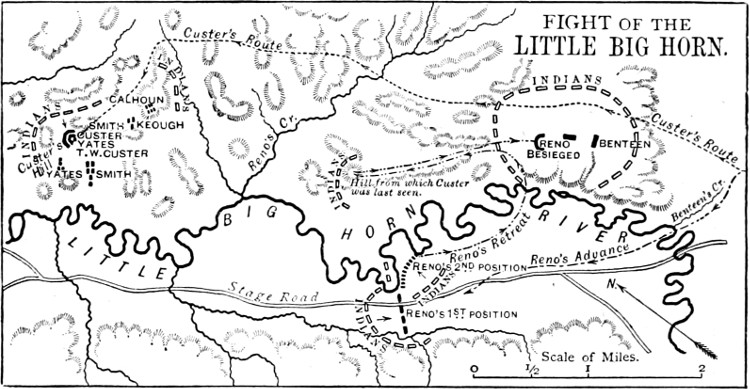
FIGHT Of the LITTLE BIG HORN
PLAN OF THE BATTLE-FIELD; SHOWING ROUTES TAKEN BY THE TWO DIVISIONS AND THE SPOT WHERE CUSTER FELL.
With truly Anglo-Saxon superiority the generals wofully underestimated the fighting strength of the foe. General Custer, with his 700 cavalrymen, believed he would be able to cope with more savages than he was likely to have the good fortune to meet, and his brother generals were under the same impression. They found out their mistake when too late.
“Sitting Bull,” chief of a band of Uncpapa Sioux Indians, was at this time forty-two years old. A great, squatty, hulking, low-browed savage, of forbidding looks and enormous strength, and in height as near as might be to five feet eight inches. He had the reputation among his own followers, as well as the warriors of other bands, of being a Medicine-man of mark, a dealer in omens, a conjurer of demons, a weaver of magic, a foreteller of dire events, and a familiar of departed spirits. Outside of his magic he was known as a coward, but this defect they overlooked in the belief that his soothsayings fully compensated for the deficiency in his personal valour. Their faith in his incantations was unbounded. In the fight of the Little Big Horn, “Sitting Bull” divided his energies between getting as far from the scene of strife as his fat legs would carry him, and performing fanatical rites to the confounding of the White man. The actual leaders in the fight were “Crazy Horse,” “Gall,” and “Crow King”; and in a lesser degree, “Low Dog,” “Big Road,” “Hump,” “Spotted Eagle,” and “Little Horse,” all chiefs of bands and men of ability and unflinching personal courage. These superintended the movements of the “Hostiles,” and by their personal feats of daring encouraged their followers, while “Sitting Bull” looked after the Fates and took the kudos of the game.
At noon on June 22nd Custer and his men set out for the wilderness. Warnings and omens do not seem to have been confined to the wigwam of the Red man, for on the fatal march to the Little Big Horn there were many that foretold disaster to the expedition.
Captain Godfrey, who marched with the columns, in his written account of the calamitous affair, mentions many incidents which were taken to point to disaster. He tells, for instance, that on the evening of the first day of their march Custer sent for his officers.
After a “talk,” Lieutenant Wallace said to Godfrey, as they walked away from the general’s tent, “Godfrey, I believe General Custer is going to be killed.” Asked his reasons for this belief, he simply answered: “I have never heard Custer speak in that way before.”
A little later in the evening Captain Godfrey came upon a camp-fire, around which sat “Bloody Knife,” “Half-Yellow-Face,” and the interpreter Bouyer. The half-breed asked the captain if he had ever fought against the Sioux. Answered in the affirmative, the interpreter gazed into the fire for a few moments before saying emphatically, “I can tell you we are going to have a —— big fight.”
Then again an ominous thing happened. The general’s headquarters-flag was blown down and fell to the rear, and in being replanted again fell to the rear.
These and many other eerie happenings seem to have sent a thrill of foreboding through the whole command as it went on its way to the unexplored valley of the Little Big Horn. In their tents, when night had fallen and the fires were out—for on this march no fire burned and nothing was done likely to attract the eye of any Indian who might happen to be roaming about in the vicinity—the men sat in the dark and told stories of scalpings and burnings at the stake. Even the Red scouts caught the prevailing current of premonition, and hastened to their Medicine-man to be anointed as a charm against the cruelty of the dreaded Sioux.
During the march up the Rosebud, Indian “signs” were met with at every turn. Camping-place after camping-place was found. The grass had been closely cropped by herds of ponies; the ashes of a hundred camp-fires lay grey on the bare ground. On June 24th the column passed a great camping-place, the gaunt frame of a huge sundance-lodge still standing, and against one of the posts the scalp of a White man fluttered in the wind.
Soon after this the Crow scouts, who had been working energetically, returned to the camp and reported to Custer that although they had come across no Sioux, still, from indications discovered, they felt sure that the command was in the neighbourhood of an encampment. That night the column was divided into two, so as to raise as little dust as possible, and made a forced march; and on the morning of June 25th Custer, in a personal reconnoitre, discovered the foe of which he was in search. Although he found himself unable to locate the actual village, he saw great herds of ponies, saw the smoke curling up in the air of morning, and heard the barking of the dogs, denoting the presence of a village behind a hill that lay in front of him. It had been Custer’s intention to remain quietly where his command rested until night fell, when he would advance his forces, and in the grey of morning sweep down upon the Sioux. But this plan miscarried. Word reached the leader that a Sioux Indian had discovered the presence of the United States troops and had galloped off to warn his tribe. Custer resolved to attack at once.
The command set out for “Sitting Bull’s” village shortly before noon. It was divided into three battalions—Major Reno commanding the advance, General Custer following with the second, and Captain Benteen the third, the pack train being under the charge of Lieutenant Mathey. Custer’s battalion consisted of Troops “C,” commanded by the general’s brother, T. W. Custer; “I,” Captain Keogh; “F,” Captain Yates; “E,” Lieutenants Smith and Sturgis; “L,” Lieutenants Calhoun and Crittenden; with Lieutenant Cook adjutant, and Dr. G. E. Lord medical officer.
The whole command marched down a valley for some distance and then separated, intending to strike the village at different points. Custer’s battalion took to the right to cross the hills and ride down upon the encampment, and Major Reno branched off to the left and forded the Little Big Horn—a stream that gives the battle its name—at the mouth of a stream now called Benteen’s Creek. As they were separating, Custer sent an order to Reno to “move forward at as rapid gait as he thought prudent, and charge the village afterwards, and the whole outfit would support him.”
After separation the only word received from Custer was an order signed by the adjutant, and addressed to Captain Benteen, which read: “Benteen, come on. Big village. Be quick. Bring Packs;” and a postscript, “Bring Packs.” About the time this message must have been despatched, those with Reno beheld the general and his men on top of a hill two miles or more away, looking down upon the village, and saw Custer take off his hat and wave it in the air, as if either beckoning the other battalions to his assistance or cheering his men.
The battalion disappeared over the brow of the hill, and after that no word or sign ever came from Custer or anyone of his whole command. Not a man of the hundreds that followed the general in the charge lived to tell the tale. The battalion was simply wiped out of existence. In after years, some of the Indians who took part in the massacre, laying aside their inbred taciturnity, consented to show a few United States officers over the field and explain what had happened and how it had happened; but beyond these meagre reports, and the position in which the bodies of the soldiers were found after the Indians had finished with their rejoicings and the mutilations of the dead, nothing is known of Custer’s last charge. But those acquainted with Custer and with Indian fighting are able to picture the scene.
When Custer reached the top of the hill, instead of a village of some 800 or 1,000 warriors, he saw beneath him a veritable city of wigwams spread out in the valley. The smoke from the fires clouded the sky, great herds of ponies cropped the grass as far as the eye could see, thousands of painted Sioux, armed, and astride their shaggy ponies, galloped in circles, working themselves into a frenzy of fury to fight the White man. Medicine-men danced and yelled their incantations, and squaws busily struck the tents and hurried their papooses and swarms of dusky children out of harm’s way. When this scene of angry life met his gaze, General Custer, old Indian fighter that he was, must have recognised that he was in for what seemed likely to be his last fight. But the mistake had been made. The time had passed for new plans of battle. He could not turn his back on the warriors to join his battalion with the others, for already the painted bucks were circling round him and firing into his ranks, and already, in all probability, he heard the crack of rifles to his left, telling him that the Indians were upon Reno. Hemmed in, retreat out of the question, and trusting that his other battalions would hurry to his support, he called to his men, and together they plunged into the shrieking, shouting, seething mass of painted and befeathered Red men—and died.
Reno acted differently. Whether or no he carried caution to an unjustifiable length is a question that has been fiercely discussed, at least some of the officers who were with him being his greatest denouncers. So bitter were the charges made against him that a Government inquiry was instituted, and, it is only right to say, it exonerated him from blame.
Reno’s battalion struck the Indians shortly after crossing the Little Big Horn, and the Ree scouts at once made for the rear to be out of danger. When the Sioux Indians appeared in considerable force on his front, instead of charging the village as Custer had ordered, Reno dismounted his troops to fight on foot, and taking advantage of timber he remained stationary for some long time in almost absolute security. Later he ordered a retreat to the Bluffs, and while executing this order, and in the preceding skirmishes, Lieutenants McIntosh and Hodgson, Dr. De Wolf, and twenty-nine men and scouts were killed.
Soon after reaching the Bluffs Captain Benteen’s battalion joined Reno, placing the latter in command of a larger force than Custer had with him; but notwithstanding this, no active measures were adopted, the two battalions standing nerveless and inactive, listening to heavy firing and much ominous noise in the direction of the village, where Custer was engaged in his death-struggle. True, an advance was made to a hill—the hill from which earlier in the day Custer had been seen to wave his hat. From the top of this elevation could be seen a great commotion in the valley, much riding and shouting and firing; but still Reno and his men were not near enough to the spot to make out what it was all about. The officers with field-glasses tried their best to find out where Custer and his battalion were, but, of course, this was impossible, for by this time every man, with Custer, had been slain.
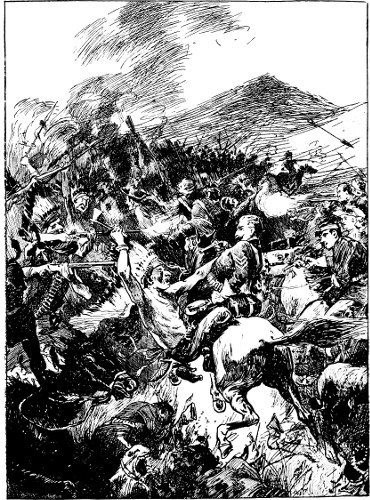
“THEY PLUNGED INTO THE SEETHING MASS OF PAINTED AND BEFEATHERED RED MEN” (p. 48).
Chief “Gall” afterwards said that the news of the two columns of troops advancing against the village struck consternation to the heart of the Indians, but when Reno was seen to dismount and remain stationary, they were glad, for it allowed the whole Indian force to be hurled against Custer. Him out of the way, they concentrated against Reno. When this latter movement took place Reno retreated again to the Bluffs, where close to the river he picked upon a strong position and successfully withstood all the afternoon a heavy fire. Darkness came down, and the troops spent an anxious night intrenching themselves, and wondering what had happened to their companions with Custer, but knowing nothing except that the general must have been defeated.
Lying under the stars, surrounded by the “Hostiles,” they passed a night of restlessness and alarm. The sky was aglare with light from the bonfires; the silence of the night pierced by many strange cries of exultation and hate, by shots, and the monotonous beating of the tom-tom for the scalp-dance. At times a nervous man would spring from his bivouac on the earth to shout that he heard the march of approaching relief, and bugles rang out a welcome that was only answered by the echoes from the hills.
When morning dawned the Sioux opened fire, and the day which followed was one of fevered sorties and galling waiting. On the stronghold that day Reno’s men lost eighteen killed and had fifty-two wounded, and they spent a second anxious night. But on the morning of June 27th General Terry raised the siege and rode into camp. Terry, in his journey, had come across more than a hundred dead, and that an awful tragedy had been enacted he knew. But he did not know the full extent of the slaughter. On the 28th the army marched to the battle-field of the Little Big Horn. Scattered on the slope of the hill they found 212 dead. General Custer, his brother—Captain T. W. Custer—Captains Keogh and Yates, Lieutenants Cook, Crittenden, Reily, Calhoun, Smith, and other officers of their men were found, each scalped and mutilated except Custer himself. He lay apparently as he had fallen, the Indians refraining from wreaking vengeance on the leader, who was well known to “Sitting Bull” and others of the chiefs. The bodies of Lieutenants Porter, Harrington, and Sturgis, and Dr. Lord, were never found.
The killed of the entire command was 265, and the slaying of Custer and his men was the crimson spot of the first Centennial Year of the United States.
It is also rendered memorable as being the last great victory the Red man achieved over the White in the fight for the American continent. For as though frightened at the thoroughness of their victory, and fearing as harsh a retribution, the followers of “Sitting Bull” afterwards flitted from place to place, refusing to join issues with the armies sent to catch them, and gradually melted away, breaking up into small bands, or returning to the agencies from which they had surreptitiously marched but a few weeks before. The great armies which, immediately the news of Custer’s massacre reached Washington, were sent to trap the Indians, marched up and down the Bad Lands; but in all their marching and countermarchings were never able to find an Indian to fight.
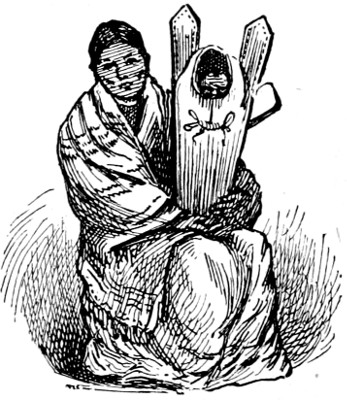
WELLINGTON
WATERLOO
BY D.H. PARRY
NAPOLEON
The great Imperial Eagle of France had been caught and caged at Elba, and after close on twenty-five years of storm and tumult, Europe was at peace.
The armies which had driven the Eagle out of France had marched home again, robbing the Eagle’s nest of many ill-gotten trophies and leaving in his place a horde of vultures who claimed the nest as theirs.
As is the manner of vultures, there was much gorging: Louis XVIII., the man “who had learned nothing, and forgotten nothing,” brought back in his train a host of hungry folk, princes of the blood royal, dukes, and noble dames; and France soon found that it would be made to suffer for its Revolution and its Republic, and that the victories of its Emperor were like to cost it dear. Royalists filled the high places in Church and State. Shameless rapacity and mean reprisals were seen on every side; and in the army the most scandalous injustices were unblushingly practised.
People began to look with regret towards the Mediterranean isle where the Eagle plumed his ruffled feathers moodily.
There were mysterious nods and glances, and allusions to a certain flower which a certain “little corporal” was known to have loved.
“He will return again with the violet,” they said in whispers.
Ladies affected violet-coloured silks, and rings of the same hue became fashionable, bearing the motto “It will re-appear in Spring.”
Nor were they wrong, for on the 1st March, 1815, at five o’clock in the afternoon, Napoleon the Great, with a hundred dismounted Lancers of the Guard, some veteran Grenadiers and a few officers, landed in the Gulf of San Juan, and began that triumphal progress which ended at Waterloo.
His advance is curiously recorded in the papers of the day: I quote from the Moniteur:—
“The cannibal has left his den.”
“The Corsican wolf has landed in the Bay of San Juan.”
“The tiger has arrived at Gay.”
“The wretch spent the night at Grenoble.”
“The tyrant has arrived at Lyons.”
“The usurper has been seen within fifty miles of Paris.”
“Bonaparte is advancing with great rapidity, but he will not set his foot inside the walls of Paris.”
“To-morrow Napoleon will be at our gates!”
“The Emperor has arrived at Fontainebleau.”
“His Imperial Majesty Napoleon entered Paris yesterday, surrounded by his loyal subjects.”
At midnight on the 19th March, Louis the Gross got into his carriage by torchlight, and was driven off to Lille; the Comte d’Artois and the Court followed an hour later, and the good citizens found when they rose next morning, two notices fastened to the railings of the Place Carrousel—
“Palace to let, well furnished, except the kitchen utensils, which have been carried away by the late proprietor.”
And the other—
“A large fat hog to be sold for one Napoleon.”
At eight o’clock that evening the Emperor was carried up the grand staircase of the Tuileries on the shoulders of his officers, and from that moment until the 12th June the master-mind was wrestling with a task vast enough to have discouraged twenty brains!
Out of chaos he produced order; a new Government was formed, a new army created: five days after his entry the Allied Sovereigns declared him an outlaw; on the 1st June he distributed Eagles to his troops, and took an oath of allegiance to the new Constitution. But Europe had meanwhile flown to arms, and 300,000 Austrians were to enter France by Switzerland and the Rhine; 200,000 Russians were marching on Alsace; Prussia had 236,000, half of whom were ready for action, so that, including our English 80,000, the Netherland contingent and the minor States of Germany, he had to face the onslaught of more than 1,000,000 men, with only 214,000 at his immediate command. England and Prussia were the first to arrive; it would be July before the others could reach the frontier, so, Napoleon, leaving armies of observation at various points, marched against Belgium, hoping to defeat Wellington and Blücher in time to turn about and face the storm clouds gathering in the east.
It was the month of June, and the weather was intensely warm. An army under Wellington, some 100,000 strong, including British, King’s German Legion, Hanoverian, Brunswick, Dutch, Belgian, and Nassau troops, was distributed in cantonments from the Scheldt to the Charleroi chaussée.
It was a heterogeneous force, hastily got together, and a large proportion of it by no means to be depended upon.
Of the British regiments, many were formed of weak second and third battalions which had never been under fire, and nearly 800 militiamen fought in the ranks of the 3rd Guards and 42nd Highlanders, those in the Guards actually wearing their Surrey jackets.
Blücher’s force, seasoned veterans for the most part, lay in four separate corps on the frontier south of Brussels, and so masterly were Napoleon’s movements, that until the lights of his bivouac fires were suddenly seen glowing redly in the darkness beyond Charleroi, no one knew exactly where he was.
Brussels swarmed with fashionable folk, and the families of officers who were with the army.
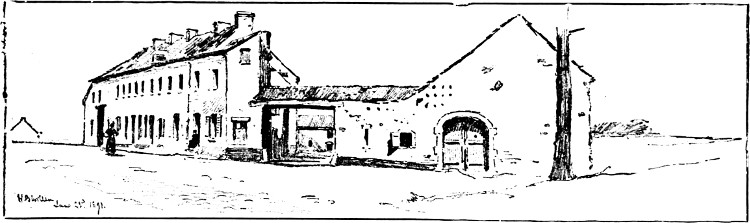
THE FARM OF QUATRE BRAS.
The Duchess of Richmond gave a ball on the night of the 15th June, the list of invited guests being curious, and not a little melancholy. Among the two hundred odd names we read those of Wellington, Uxbridge, and Hussey Vivian; two Ponsonbys, one of whom was to die three days later; Hay, the handsome lad who had won a sweepstake at Grammont the Tuesday before, and whose young life ebbed out on the Friday at Quatre Bras; Cameron, of Fassifern, who also fell there; Dick of the 42nd, killed at Sobraon in ’46; and aide-de-camp Cathcart, who lived till Inkerman, where a ball and three bayonet thrusts closed his strange career. These and many others of more or less note danced in the long, low-roofed, barn-like room which His Grace of Richmond had hired for the occasion from his neighbour, Van Asch, the coachbuilder.
About midnight Wellington, having already learned that the outposts had been engaged, went to the ball, where he found the Prince of Orange. Now, the Prince of Orange, who seemed fated to cause the useless sacrifice of valuable life, ought to have been at his post at Binche, and thither the duke promptly sent him, after first inquiring if there were any news.
“No, nothing, but that the French have crossed the Sambre, and had a brush with the Prussians!” Müffling had previously brought the intelligence, which should have arrived much sooner, the duke afterwards saying to Napier: “I cannot tell the world that Blücher picked the fattest man in his army to ride with an express to me, and that he took thirty hours to go thirty miles.”
Far from being surprised (as some writers have it), the duke’s orders were despatched before he went to that now historic entertainment, and the dancing continued long after he and his officers had left.
At two o’clock, while it was yet dark, strange sounds were heard under the trees—the shuffling of men’s feet, the ringing of musket-butts on the ground, short words of command, and the running ripple of the roll-call along the ranks.
People opened their windows and looked out; carriages returning from the ball drew up and waited: it was Picton’s Division off to the front.
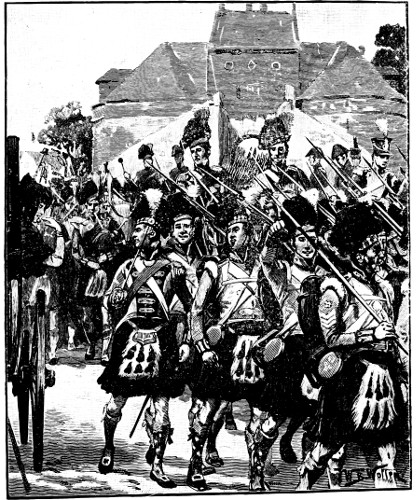
PICTON’S DIVISION OFF TO THE FRONT.
At four o’clock Pack’s Highlanders, in kilt and feather bonnet, swung across the Place Royale and passed through the Namur Gate—the rising sun glinting on their accoutrements, their bagpipes waking the sleeping streets. “Come to me and I will give you flesh,” was the weird pibroch of the Black Watch, and many a Highland laddie heard it that morning for the last time.
Some of the officers marched in silk stockings and dancing-pumps. Lingering too long at the ball, they had not had time—or perhaps, as the night was warm, they had not troubled—to change them; and there were not a few who never found time again.
Out in the early morning along the great highway they went, past lonely farms and clustering villages, through the grey-green gloom of the beech woods of Soigne to Mont St. Jean, where they halted for breakfast, and where about eight the duke passed them with his staff, leaving strict orders to keep the road clear; and at noon the troops were on the march again for Quatre Bras, which was the fiery prelude to the greatest battle fought in modern times.
The heat was so intense that one man of the 95th Rifles went mad, and fell dead in the road; but the others pushed on, and were soon afterwards under fire.
If you take a map of Belgium, placing your finger on Brussels, and pass it down the great road running south, you will find, some twelve miles from the capital, the village of Mont St. Jean; a little beyond which place a cross-road from Wavre intersects the chaussée, and at that point move your finger at right angles, right and left, for a mile or so each way, and you have, roughly, the English position on the 18th June.