LIST OF PLATES. (continued 11)
Reading edition
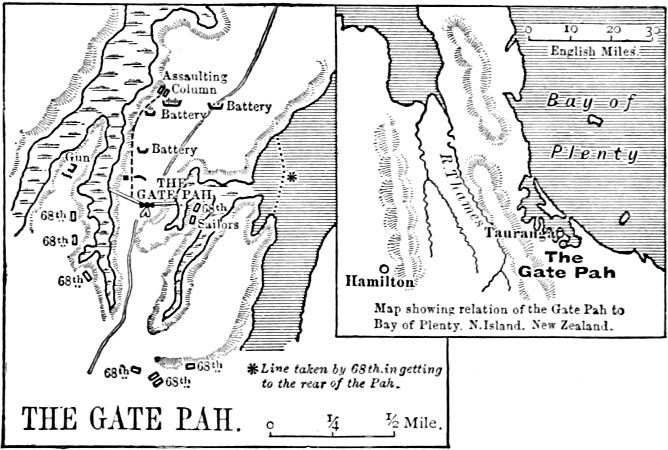
THE GATE PAH.
Not long after the artillery opened fire the Maori musketry ceased. The garrison had got under cover, but they were watching the proceedings of the besiegers, for when the guns were directed on the left angle of their fort in order to demolish the stockade and make a breach in the parapet, every now and then a brave rebel would creep up to the crumbling mound, shovel a few spadefuls of earth into the gap, and slip back again, heedless of the imminent danger of being blown to pieces by a bursting shell. Once a plucky fellow actually succeeded in hanging a blanket across the stockade, evidently to conceal the movements of those who were bringing up material to repair the breach close by. By this time the mortars had got the range, and were dropping shells into the work. The place was completely surrounded. The 68th and the naval brigade had closed in, and were firing at the pah on the right and in the rear. Twelve guns and mortars were blazing away at the front and breaching the left angle. A thirteenth gun had been got into position beyond the swamp on the left, so as to rake the rifle-pits on the slope, and thirty riflemen on the edge of the marsh were firing into the pah at a range of only 400 yards. Surrounded on all sides, and with shells bursting over the wattle roofs of their trenches, the garrison was in a position in which most European troops would have given up the defence as hopeless. The big Armstrong gun fired no less than a hundred 110-pound shells at the pah before it had to cease firing (towards 3 o’clock) for want of ammunition. The marvel is that the wretched little fort was tenable. But subsequent inquiry showed that the Maories had constructed their shelters so well, and lay so close in them, that they lost very few men. About noon they replied for awhile with musketry to the storm of bullets and shells that was pouring into the pah, but their fire was ineffectual. Indeed, in the earlier stage of the attack, the only losses of the assailants appear to have been three men of the 68th Regiment, wounded by shells that flew over the pah and burst close in their front.
Crouching in the hollowed sides of the trenches, or stealing round to the front to look out over the parapet, the Maories must have realised that before nightfall the storm of fire would suddenly cease to allow a superior force to rush their shattered fort with the bayonet. But they waited quietly for the supreme trial of strength, encouraged, doubtless, by finding that even the huge shells thrown by the white men, though they made a terrible noise, killed or wounded very few of the garrison against whom they were directed. It was an anticipation many years earlier of the experience of the Turkish garrison of the Gravitza redoubt at Plevna, who lost only a handful of men under the volcano-like fire of the great bombardment.
After three o’clock the bombardment slackened. The breach was considered to be wide enough to be rushed by a strong storming party on a broad front, and there were no obstacles on the slope before it. When, just before four o’clock, the stormers were drawn up behind the batteries and received the order to advance, the immediate capture of the Gate Pah seemed to be a certainty. The storming column was 600 strong. The vanguard, under Colonel Booth and Commander Hay, of H.M.S. Harrier, was made up of 150 men of the 43rd Regiment and as many more of the naval brigade. The support, which was led by Captain John Hamilton, of H.M.S. Esk, consisted of the rest of the seamen and marines and of the 43rd—in all, 300 men. At four o’clock General Cameron gave the word to advance, and, with a cheer, the men dashed up the slope. A few shots were fired from the pah, and some heavy volleys from the rifle-pits, but, until they were almost in, a swell of the ground gave some cover to the stormers, and the loss they suffered was trifling. Still cheering, they streamed in through the wide gap in the stockade, poured like a flood over the shattered parapet, and found themselves almost without opposition masters of the left corner of the pah.
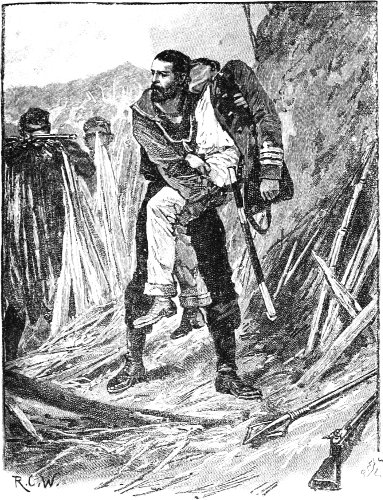
“THE BRAVE FELLOW BROUGHT HIM OUT AT CONSIDERABLE RISK” (p. 281).
What happened next will never be known with absolute certainty, for many of those who survived, after being in the thickest of the wild scene of slaughter that followed, give contradictory accounts of what occurred. It seems certain that a part of the garrison was attempting to retire by the back of the pah, when they were met by a sharp fire from the 68th Regiment, which was closing in upon the works, answering with a loud cheer the cheering of the stormers. The Maories, on this, rushed back into the pah, giving some of the stormers the impression that the garrison had been suddenly reinforced. When they first passed the parapet, all that the naval officers and those of the 43rd noticed of the garrison were a few wounded men lying near the breach. The openings of the trenches close by looked like a tangled labyrinth, and it was not easy to see which was the easiest way into the centre of the work. The roofs of the Maori shelters jutted up here and there, and the men seem in some cases to have broken their ranks, and even laid down their weapons under the impression that these were abandoned houses that could be safely entered in search of curios and plunder. Suddenly gun barrels were pushed out from under the eaves, and several officers and men dropped, struck by shots that appeared to come out of the earth. On all sides dusky figures sprang up as if from trapdoors, yelling, firing, flourishing spears and axes. From the rear of the work came a wild rush of spears and guns. The soldiers, especially those who had broken their formation, seemed seized with a sudden panic. They felt as if they had been led into an ambuscade. Instead of resistance being over, it was only beginning. Several of their officers had fallen at the first volley. A few men gave way to the surprise and terror of the moment, and then the panic spread with that mysterious suddenness with which it seems to be able to run through a mass of even individually brave men. What happened at the Gate Pah has happened in every army in the world; and if there was headlong panic among many of the men, there were many, too, who stood bravely. The officers and the sergeants of the 43rd, and the officers and leading seamen of the naval brigade, did their duty splendidly, and suffered losses that bore only too striking evidence to the tenacity with which they strove to restore the fortune of the fight. There was more than one cry to retire, though the officers were calling out to the men to push forward. At this moment Captain Hamilton brought up the reserve, pushed gallantly forward to the second line of trenches, and sprang upon the bank above them, waving his sword and calling out, “Come on, my men!” A shot struck him in the head and he fell, closing by an heroic death a career of high distinction and great promise. His fall renewed the courage of the defenders, the panic of the assailants. The struggling mass of sailors and soldiers streamed back out of the breach, leaving nearly all the officers of the 43rd and several of the naval officers dead and wounded in the pah. Major Ryan of the 70th Regiment and Captain Jenkins of H.M.S. Miranda were among the last to leave the work, after hopeless efforts to rally what were left of the six hundred stormers.
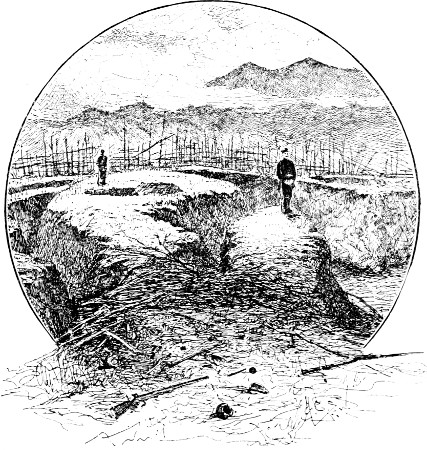
THE GATE PAH AFTER OCCUPATION.
How many brave deeds were done amid the wild panic in the breach of the Gate Pah would take a long time to tell. Two Victoria Crosses were won in the disaster, one of them by Surgeon Manley, R.A., who exposed himself most recklessly in order to remove and give first help to the wounded close under the fire of the victorious Maories. The other was secured by Samuel Mitchell, the captain of the foretop of the Harrier. He had entered the breach close beside Commander Hay, and when his officer fell mortally wounded, he took him up to carry him out of danger. Hay told Mitchell to leave him where he was, and take care of his own life; but the brave fellow brought him out at considerable risk to himself, and then dashed back into the fight. Watts, the gunner of the Miranda, charged by the side of Captain Hamilton. He marked out and cut down the Maori who had killed his leader, but the next moment he was himself brained with a tomahawk. James Harris, a seaman of the Curaçoa, actually dashed right through the pah. He chased a Maori out of the rear of the work, hunted him down to the position of the 68th Regiment, bayoneted him there, and was shot while making a reckless attempt to again traverse the pah and rejoin his comrades.
While the storming column was engaged with the enemy in the pah, the 68th had made an attempt to rush it in the rear, but were met with such a heavy fire that they gave up the attempt. The repulse of the attack was hailed with loud cheers by the garrison. The General with his staff rallied the storming column as it retired, and then rode forward to reconnoitre the pah. At this point someone told him that the troops had got into and were holding the rifle-pits on the left. Turning in this direction to verify the report, he was met by a volley which wounded his horse and put two bullets into the saddle of an officer who rode beside him. The enemy held all the works, from which they fired occasional shots at intervals for the rest of the evening. It was soon dark, and the night was cloudy and starless. In the dusk Captain Jenkins had a narrow escape. There had not been a shot for some time, and he went out to see if the pah had been abandoned. A volley fired at close quarters told him he was mistaken, and showed him that he had wandered into the lower part of one of the enemy’s trenches.
Dispirited by the collapse of the 43rd Regiment, the repulse of the whole column and the loss of so many officers, the troops spent a wakeful, anxious night. More than once after dusk the Maories called out to them in English, daring them to come on again; but Cameron had resolved not to make an attempt in the dark, which might only end in confusion and renewed disaster, but to rush the pah at daybreak. Meanwhile, the men were set to work to throw up a line of advanced entrenchments within about a hundred yards of the stockade, so as to maintain possession of all the ground that had been won. During this work, all fire having ceased from the pah, Major Greaves, of the staff, crept up the slope to see if the natives were retiring from it. In the dark he could make nothing out for certain. Just before midnight he went up again and penetrated into the breach. All was silent within, but away landwards, to the rear of the work, some shots were fired. The natives had scattered in small parties and withdrawn towards the interior, and the shots came from the outposts of the 68th, some of whose sentries heard the Maories stealing by in the dark, but could not stop them.
How little the officers relied upon their men after the previous day’s experience is shown by the fact that they did not venture to lead them into the fort until the first light of the dawn appeared on the early morning of the Sunday, 30th. When the pah was entered a grim sight met the eyes of the victors. A few yards inside the breach four captains of the 43rd lay heaped together: two were dead, killed by bullet wounds in the head and neck, another had been slain at close quarters with a tomahawk, which had cut through his shoulder into the chest; a fourth, struck in the head by a bullet, was still breathing when his comrades found him, but died before he could be removed. A little further on lay Colonel Booth, of the same regiment, shot in the spine and the right arm, still alive after that terrible night, but not far from his death. Captain Muir, of the 43rd, and Captain Hamilton, R.N., lay dead together well forward in the second trench, with no other bodies near them. A little to the left lay Lieutenant Hill, R.N., of the Curaçoa, shot in the neck and through both cheeks. He had been alive some time after he fell, for he had tied his handkerchief round his wounded face. Watts, the gunner of the Miranda, lay dead with his head split from crown to chin with a tomahawk. Another seaman had had his head cut in two crosswise by the same weapon, scattering all the brains. The body of a Maori was found in the centre of the pah fairly cut in two by a bursting shell. There, too, the chief, Reweti, or Davis of Tauranga, was picked up, with seven bullets in his body and his legs broken by a shell-burst, but still not only alive but ready to talk to the white men, and wondering why his countrymen had not carried him off with the other wounded, whom they had removed. In all, during the attack, 9 officers and 23 men had been killed, and 5 officers and 75 men wounded, a total loss of 112 officers and men, nearly all of whom fell in the actual assault, and most of whom would have come out of the affair, safe in life and limb, if the advanced party of the 43rd had stood by their officers. At the moment of the panic there is no doubt the stormers were well into the work, and standing as most of them did on the high ground between the trenches, they could have bayoneted the Maories as they scrambled out, or shot them through the roofs. Of the British wounded many died within a week of the fight.
The garrison had lost very few in killed and wounded. Twenty dead and six wounded men were found in the pah. Ten more were picked up dead in the swamp, and the retreating Maories must have carried some wounded men with them. But their whole loss seems to have been under fifty. The chief, Rawiri, who commanded the defence, escaped unhurt. The wounded chief, Davis, told the English that if his advice had been taken there would have been no such prolonged defence of the pah; but, he added, there were a lot of big chiefs present, and they wanted a fight. It is pleasant to be able to record that both sides acted with that chivalrous respect for each other which was worthy of brave men. The Maories had not touched the watches and chains or rings worn by the dead and wounded soldiers and sailors who fell in the pah, nor had they in any way injured the bodies. General Cameron showed his sense of this conduct on their part by ordering that the dead Maories should be given a respectful burial, and all possible care bestowed on the wounded men. Even the fragments of the body that had been torn by the shell were laid together in the row of dead outside the pah, and word was sent to some friendly Maories, belonging to a tribe which had helped to garrison the Gate Pah, that they might come in and bury their dead kinsmen, the messenger adding that, if they did not, the English would do it for them. Before noon on Sunday they came to the fort and dug a grave for the twenty dead warriors from the pah. In the bottom of it they laid the men of lower rank, that they might form a bed across which lay the corpses of the chiefs. “It is well that the warrior should die, to be a couch for his chief,” runs an old proverb of the warrior Maori race.
Later in the day the English dead were laid in rows of graves at the Tauranga mission station, under a great tree, not far from the beach, and the volleys rang out their parting salute to the men who had fallen so bravely trying to stem the tide of disaster. The struggle between the white man and the Maori has, happily, ended years ago, and now both parties to the quarrel remember only that it was bravely fought out, and that in the tribes of the North Island even British soldiers and sailors found foemen well worthy of their steel. The last traces of the Gate Pah have long since been removed from the ridge above Tauranga. A monument commemorates the gallant dead. Hamilton has found another memorial in a flourishing town on the Waikato River, founded and named after him by the colonists, in the very year of his death, in admiration of his splendid valour.
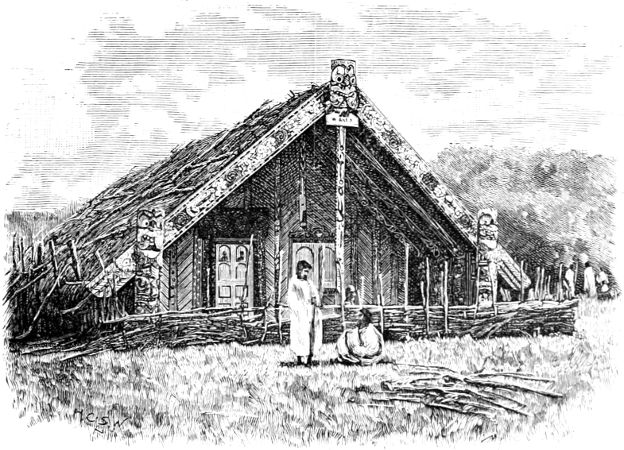
A MAORI DWELLING.
WARSAW
BY A.S. KRAUSSE

Throughout the summer of 1831 the city of Warsaw lay like a city of the dead. Its magnificent palaces appeared as though deserted; its streets were lonesome, and the few who ventured from within their dwellings moved about as though smitten.
Although not declared, Warsaw lay in a state of siege. The struggle for liberty, long maintained by the brave nation of Poles, was drawing to a close, and all felt that though hitherto victorious in the field, they must fall before the countless hordes of Russia in the end.
There had been a rising in the previous year. Undeterred by the knowledge that they were a handful against millions, and encouraged by the recent examples of France and Belgium, the Poles of Warsaw had risen in revolt against the despotism of Russia, as personified by Constantine, the ferocious governor of their city.
The direct cause of the outbreak was, as is usual in such cases, slight—a bogus trial on a popular officer for an imaginary offence. A verdict contrary to the weight of evidence, a street row among the military students, a dozen of whom were promptly flogged with the knout, while others were imprisoned, and the mischief was done. The young Poles rose in November, and without ceremony broke into the prison and freed their comrades. The gates of the palace were forced, and the governor sought; but without success, he having escaped. But while Constantine evaded the vengeance of his victims, his lieutenants fared otherwise, and many of them fell into the hands of their relentless enemies. For the moment the Polish capital was in the hands of the Poles. The Russian aristocracy disappeared, and at every street-corner meetings were held at which the proceedings were constantly interrupted by cries of “Niech zyie Polska”—Poland for ever!
This state of things continued throughout the winter of 1830. The icebound steppes forbade the Russians taking action. But the Czar vowed vengeance, and he kept his vow. In the first days of spring a large army was despatched against the rebel Poles under General Chlopicki, who, while in command of the thirteenth and fourteenth Army Corps, had earned for his troops the nickname of the Lions of Varna. The war was waged to the death. The Russian troops, well drilled and ably commanded, elated with the successes of the past, met the untutored Polish soldiers with a confidence bred of conceit. The Poles, imbued with a sense of patriotism, and recognising that it was to do or to die, fought each man for his own hand, neither giving nor expecting quarter, and the slaughter was frightful. Even at Ostralenka, where the Poles left seven thousand dead on the field, the Russian loss was over fifteen thousand; and at Waror the Poles took ten thousand Russian prisoners, besides a number of cannon, which were exhibited in the streets of Warsaw, amid the enthusiastic applause of the inhabitants.
After being beaten all along the line the Russian army withdrew, leaving the flower of its surviving officers imprisoned in Warsaw, and for a while the Poles had rest. But only for a while. In the early summer another army marched on the capital, and at the end of June General Paskewitsch, who had been specially chosen by the Czar, took the command. This officer enjoyed the personal friendship of the ruler of Russia, and he took the field with the express instruction from his master to teach the rebels a lesson which they would not forget. He lost no time in resuming operations, but changed his predecessor’s plans. Hitherto, all attempts on Warsaw had been made from the right bank of the Vistula. With the exception of the Praga suburb the city lies on the left or south bank, so that to capture it from the north the Russians would have to fight their way across the Vistula either through the streets and across the bridges of Praga, or under the fire of the guns in the Polish works. Paskewitsch decided upon making a flank march down the right bank of the river, crossing it near the Prussian frontier, where he had secretly arranged to obtain supplies and bridging material from the Prussian fortress of Thorn, and then marching up the south bank of the Vistula he could attack Warsaw on the side on which it was not protected by the broad river which had hitherto barred the Russian advance.
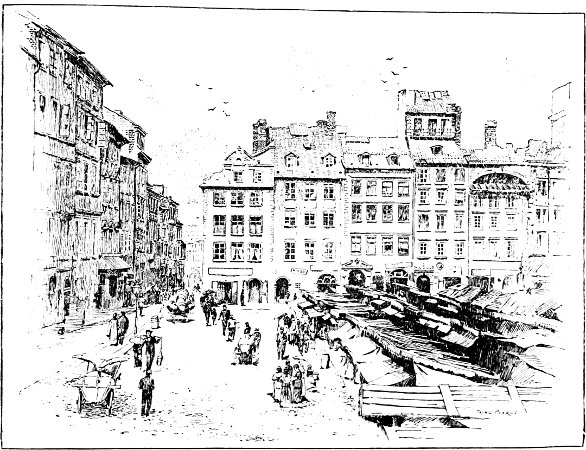
OLD TOWN, WARSAW.
The Polish Government was at this period presided over by General Skryznecki, a patriot of good family and education, and a man of the highest principle. Skryznecki recognised the danger too late. He hurriedly occupied a strong position on the line of the Bzura river with 30,000 men, in the hope of barring the Russian advance; but on August 15th the Russians, in overwhelming force, drove the Poles from the river bank and forced them back upon Warsaw. Their city was now threatened by 60,000 troops, who cut them off from the country to the south of the Vistula, from which they had hitherto drawn supplies and reinforcements. While Paskewitsch thus hemmed in the Poles on the south, another Russian army watched Praga; and thus by the end of August, while the roads for miles round were guarded by Russian legions, the Poles found themselves shut in like rats in a trap.
And now for the first time the Poles realised their position. Surrounded by a relentless horde, their supplies cut off, they realised the futility of the claims of a just cause against the exigences of necessity. The whole of the resources of Russia were against them; and while the sympathies of France and England went far to cheer the desperate band of patriots who yet fought for freedom, the fact that Prussia, though nominally a neutral state, was aiding the common enemy, was not reassuring. So far back as June this fact had been known, and General Skryznecki had written to the King of Prussia enumerating the various acts indulged in by his ministers, and demanding that they should cease. In this historic document the General proved that the Prussians were supplying the Russians with food from the storehouses at Thorn, that they had lent their skilled artillery to the Russians, that they had supplied ammunition and uniforms made in Prussia, and that most of the engineering works required by the Russians—including the bridge over the Vistula—had been executed by German engineers.
This letter was never answered, and Prussia continued in her breach of the laws of war, while the outlook in Warsaw became blacker every day. Nor were the dangers only from without. The Polish mob began to become turbulent, and necessitated the watching of soldiers who would have been better employed negotiating the enemy. But even these measures were insufficient to keep the rough element down. The irresistible descent of the Russian army was the excuse for an outcry against the noble Skryznecki; and in the hope of uniting the besieged he resigned his command of the Polish army, General Dembinski being appointed in his place.
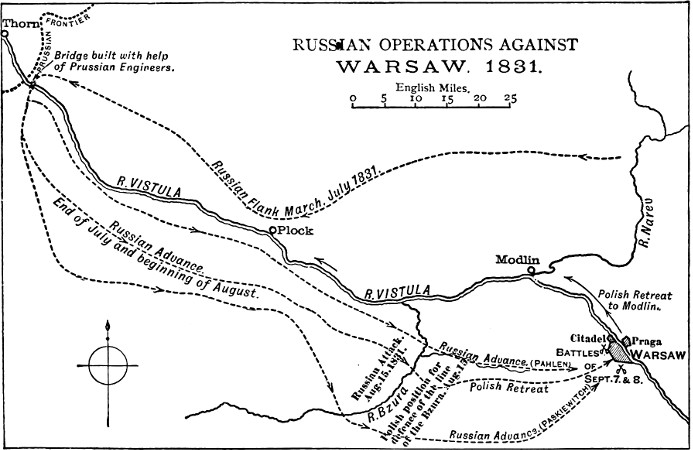
RUSSIAN OPERATIONS AGAINST WARSAW. 1831.
But even this step did not succeed in quieting the rabble. On the night of the 15th August the mob rose and marched to the State prison, where Russian officers who had been taken prisoners in the war had been incarcerated. The excitement of the mob was intense. Their blood was up, and this is the only excuse that can be urged for the foulest deed that blemishes the history of Poland. The gates of the prison were forced, and the prisoners led out and shamefully ill-treated. The crowd behaved like wild beasts, chasing and attacking the unfortunate Russians; and after being tortured in every way that occurred to the imagination of their captors, the miserable beings were butchered in the streets, the gutters literally running in blood. Among the victims of this tragedy were four Russian generals and several ladies of high birth, who had been suspected of sympathising with the enemy. All were brutally murdered, the atrocities being continued for two days. At length order was restored by the military, who were withdrawn from the defence of the city for this purpose.
While these events were taking place within the city General Paskewitsch was pressing on in pursuit of the Polish army, which he had compelled to retreat from the Bzura. But even here the defenders were unable to hold their ground, and on the 1st of September they retired behind the entrenchments which had been thrown up immediately before Warsaw. Here the final stand had to be made. The headquarters of the Russians was only three miles away from the city walls, and the capital was threatened on every side. The position was, in short, so acute that it is a matter of some surprise that the Poles did not retire within the city and stand a siege. This question has been ably discussed by a trustworthy historian, who writes as follows:—
“It would have been very easy,” says M. Brozozowski, “for the army to defend itself within the walls and from house to house. It had already performed more difficult feats, and Europe doubtless would have rung with its heroism if, after the example of Saragossa, it had buried itself under the ruins of Warsaw. But the Poles could not, for the sake of a mere empty renown, consent to the destruction of a city which is the hearth-stone of their patriotism and the centre of their nationality—a city which in future struggles is yet destined to play an important part, for the Poles are far from succumbing under their present misfortunes—very far from abandoning the hope of again becoming a nation.”[6]
But still, the attacking army waited before striking the final blow. Reinforcements from the south were expected. Several days were wasted pending their arrival, and when they arrived their pontoons stuck in the mud. But Paskewitsch did not mind the delay. He is reported to have said to one of his staff, “I await the aid of two armies—the army of the south and the army of famine.” Nor were these expectations vain. While beleaguered from without, the doomed city was ravaged within. Gaunt famine marched unchecked through the fine streets, and starvation claimed more victims than did shot or shell.
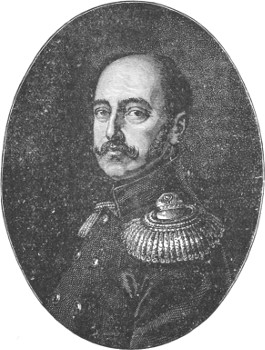
EMPEROR NICHOLAS.
Then it was that, recognising all resistance as futile, the Poles attempted to open negotiations with the enemy; but the mob would not have it, and the overtures made were cancelled in order to prevent a revolution, while an offer of terms made by Paskewitsch was rejected for a similar reason.
These preliminaries over, the attack upon Warsaw began in earnest on the morning of the 6th September. The fighting on this day was mostly at long range, but the Russian attack was so strong and the firing so fierce that the Poles had to abandon their first line of entrenchment. The assault then ceased, and both sides rested during the night; but at daybreak on the 7th the attack was renewed, and the slaughter was terrible. The Poles—especially the battalions occupying the redoubt on the Wola side of the Vistula—made an heroic resistance. The Russians had on this day no fewer than 386 guns in position, and the fire from them was so fierce and so continuous that nothing could stand before it. The Poles were ploughed down by the hail of projectiles, and those spared by the shells were despatched by small arms. After some hours of bombardment, when a mere handful of the garrison of the Wola redoubt remained, the Russians closed up in their strength and charged with their bayonets. The result was disastrous in the extreme. General Sowinski, who commanded the outpost, fell pierced through and through; and when the Russians finally occupied the redoubt only eleven men remained alive out of three thousand.
While this scene of carnage was being enacted outside, the city was itself the scene of intense excitement. The majority of the inhabitants foresaw that their fate was sealed. Their only chance of salvation—the interposition of England or France—had failed them. Were even that to come now it would be too late. The cannonade of the besiegers was continuous, and every now and again a stray shell would fall in the streets, scattering death and devastation around. And all that could be done in response was to fire occasional charges from the few guns left to the garrison. Men there were in plenty in Warsaw, and women, too, willing to play the man’s part in fighting for their country; but the guns were few, and it was no uncommon sight to see eager, able men tear the rifles from the hands of the wounded as they fell, in order that the most might be made of the slender sources at their disposal.
Amid all this scene of horror there was one item of news which caused rejoicing. Marshal Paskewitsch had been wounded. It was said that he was, indeed, disabled. This was the one cheering event of the 7th September.
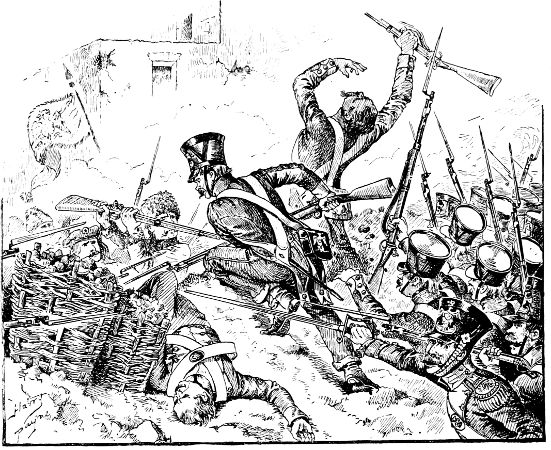
“THE RUSSIANS CLOSED UP IN THEIR STRENGTH AND CHARGED WITH THEIR BAYONETS” (p. 287).
The 8th opened still and fine, but it was destined to be a bitter day in the story of Poland. The Russians had moved up to the very gates of the town in the night, and only the innermost line of trenches and the shaky walls stood between them and the inhabitants. The cannonade recommenced soon after daybreak, and the attack was even more furious than on the previous day. At least, it seemed so to those within the doomed city. The men in the trenches were ploughed down like flies, but their bravery was indomitable, and as each man fell, another took his place, to be ploughed down in turn. The men finally stood upon the brink of their trenches, and used the dead bodies of their comrades as cover; but it was futile. On and on came the Russian host, back and back went the Poles, until only the gaunt walls of Warsaw stood between them and those they sought to save. The enemy fought with irresistible fury, carrying everything before them, inch by inch, at the point of the bayonet, while their guns were busied in sending missiles within the city, which spread fire and rapine in their train. The day was still undone when the walls were gained. The inmost line of defence was captured, its last defender slain. The plain for a mile around was strewn with the mutilated remains of what had once been brave men, and the tyrants of the North held Warsaw in their hands.
The city capitulated as the sun sunk in the west, and its inhabitants realised too late that their doom was sealed. What that doom was to be even the most imaginative failed to realise.
Having taken Warsaw, Paskewitsch spoke fair. He would, he declared, not enter the city till the following day, and meanwhile the Polish army, what was left of it, might retire to Plosk. The Marshal admitted to having 3,000 men and 63 officers killed, and 7,500 and 445 officers wounded, while the Polish loss was found to amount to 9,000 slain.
Defeated though they were, reduced in numbers, without the hope of succour, and exhausted by the events of the past few days, the Poles retained their heroism. The army, what was left of the 30,000 men of which the garrison had consisted, formed in order in the great place in the centre of the city, and marched towards the gate. But it did not march to Plosk. It went instead to the fortress of Modlin, and made preparations for a final stand—a forlorn hope—trusting to fortune to turn the Russians yet. But the scheme was foredoomed. Paskewitsch, whose wound was slighter than was supposed, heard of the move, and promptly despatched a brigade against the Polish remnant. The garrison of Modlin was promptly surrounded, all retreat cut off. Entrapped, defenceless, without guns or food, the band of heroes lay down their arms and sought refuge on neutral territory across the Prussian frontier.
It does not come within the province of this history to detail the events which followed the capture of Warsaw. So far as the military history of this, the last great struggle for Polish independence, is concerned, the battle of Warsaw brings the story to a close. The horrors that followed still linger in the memories of the very old. The fearful outbreak of Asiatic cholera which devastated Central Europe, the tragic fate of the thousands of Poles who, trusting in the charity of the King of Prussia, were hounded across the frontier into the hands of the Russians; the equally tragic fortunes of those who took the word of the Czar and gave themselves up to the authorities; and the bitter savageries committed by the Russians in compulsorily emigrating the bulk of the people of Warsaw, sending children away from parents and husbands from wives, even to the furthest parts of Eastern Russia, are all part of history. Of the civilising efforts of the Russians while in occupation of Warsaw, we have a sample in the fact that the conquerors took nearly a million volumes of books from the city—400,000 from the Zuluski Library alone.
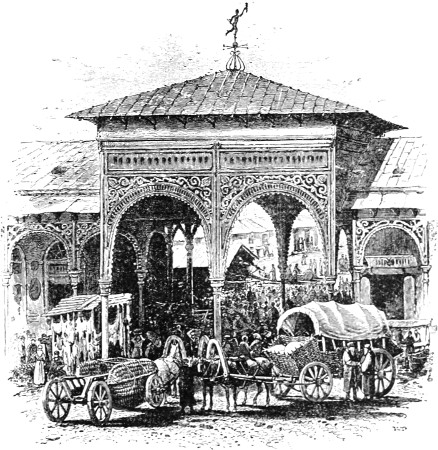
THE JEWS’ MARKET, WARSAW.

THE STORMING OF THE NILT FORTS.
BY E.F. KNIGHT.
Of our recent wars on the frontiers of India, the Hunza campaign was in many respects the most remarkable, and the storming of the enemy’s defences at Nilt afforded an ample proof of what excellent material our Indian army is composed. At the extreme north corner of British India, or rather of the territories of our feudatory the Maharajah of Kashmir, buried amid the loftiest and wildest mountains of the Hindoo Koosh, hemmed in by glaciers which are the vastest in the world outside the arctic regions, and by hundreds of barren leagues of rock and snow, are two little States of hereditary robbers, the Hunzas and the Nagars, the first occupying the right bank, the second the left bank of the Hunza or Kanjut torrent. These people belong to what is known as the Dard race, and are supposed to be of the purest Aryan stock: many of them have the features and the fair complexions of Europeans.
This inhospitable region is the very cradle, some say, of the Aryan race; and the Hunza-Nagars present one of the most interesting ethnological problems in the world—a problem, however, which up till now could only be studied from a safe distance, for the half-dozen or so of Europeans who had penetrated the Hunza valley previous to the campaign I am about to describe had done so at considerable risk to their lives. From the earliest times the Hunza-Nagars have engaged in organised brigandage and slave-hunting; they were the most redoubtable warriors of the Hindoo Koosh. The head waters of the Hunza and its tributaries are on the slopes of the Pamirs, and the tribesmen, ascending the passes that lead from their valleys on to the “roof of the world,” were wont to raid into Turkistan and fall on the caravans that carry on the trade between India and Yarkand. For hundreds of years they have thus amassed rich booty, and they sold all the prisoners they captured to the Kirghiz nomads. When the Kashmir State conquered the Gilgit district it did its utmost to quell these two lawless tribes, but all in vain: secure in their mountain strongholds, they successfully resisted the largest forces that were sent against them, and carried their forays both into Kashmir territory and into Central Asia, though a Kashmir garrison of 6,000 men was always stationed at Gilgit. It was estimated that the “thums,” or kings, of these two valley States could muster 5,000 fighting men, fairly well armed with native matchlocks, Martini-Henrys, Berdans (supplied by the Russians), Sniders, and other rifles. They also had some smooth-bore six or seven pound guns of their own manufacture.
When the Indian Government undertook to exercise a more direct control over the affairs of the grossly mismanaged State of Kashmir, an agency was established at Gilgit which then became the northernmost outpost of our Empire in Asia. The Hunza river flows into the Gilgit river two miles below Gilgit fort, and the frontier of the robber States is some thirty miles up the Hunza valley. The thums, though jealous of the establishment of British influence in their close vicinity, were persuaded by Colonel Durand, our agent at Gilgit, to enter into a treaty by which they recognised Great Britain as the suzerain power, and agreed to desist from raiding and slave-hunting, while the Indian Government was to pay the thums an annual subsidy each. But the thums, stirred up by Captain Gromchevtsky—who had visited the Hunza valley with a party of Cossacks, and had done his utmost to damage British prestige in these regions—soon broke their faith with Colonel Durand; they recommenced their evil practices, and in the spring of 1891, having first greatly strengthened their defences in the gorges near Nilt, they defied the Maharajah and the British agent, declared that they would renew their raids, threatened the Kashmir fortress of Chalt with a considerable force, and so endangered our position at Gilgit that the long-suffering Government of India found it necessary to send a punitive expedition into the Hunza valley.
At this time the Agent’s bodyguard consisted only of a score or so of Pathans of the 20th Punjab Infantry, while the Kashmir troops who garrisoned the forts were scarcely to be relied on, for these were the same men who had been repeatedly defeated by the Hunzas. They belonged, it is true, to regiments of the recently organised Imperial Service troops which the Maharajah had set aside for purposes of Imperial defence, and which had been trained for some months by specially selected British officers; but they had never been tried in actual warfare since the new system had been inaugurated, and it was therefore considered advisable to despatch from Abbotabad 200 men of our 5th Gurkha regiment, and two seven-pound guns of the Hazara mountain battery.
The present road from Kashmir to Gilgit had not then been completed, and great difficulties had to be overcome in sending even this small force to the North. The distance from Srinagur to Gilgit is 240 miles, or twenty-two marches. The track winds among the mountains, and crosses two high passes, one being over the main chain of the Himalayas, which divides Kashmir proper from the northern possessions of the Maharajah. These passes are only open for about four months; for the rest of the year they are closed by deep snow and are exposed to violent gales of extreme coldness, which prove fatal to travellers overtaken by them. One of these storms sprang up while the 5th Gurkhas and a number of transport coolies were on the march, and nearly 100 men perished of frostbite. Captain Barrett himself, who was in command, lost several toes on this occasion, and was incapacitated from taking part in the campaign. This dreary road traversed for many marches a rainless and almost desert region. Of wild vegetation there is scarcely any: it is only by means of artificial irrigation from the glacier streams above that the sparse population succeeds in raising scanty crops here and there. There are signs of a more extensive cultivation in the past, but the forays of the Shinakas—raiding tribes who occupy a little-explored region beyond the mountains that border the Gilgit road on the west—have long since made these valleys desolate. The road, where not winding over the barren mountain ridges, follows the bottoms of the gloomy ravines where the discoloured torrents rush between cliffs and huge slopes of fallen boulders. The country affords no supplies to an invading force, and even the forage for our horses had to be imported from a distance.
During the four summer months of 1891 thousands of coolies were employed in carrying up to Gilgit the supplies required for the expedition; but despite all the efforts of our transport officers, a large quantity of necessaries never crossed the Himalayas: an early winter and heavy snowstorms suddenly closed the passes, and our little force was cut off from all chance of reinforcement or communication with the outer world for several months. Isolated by impassable mountains, we were now left to fight it out, not only with the 5,000 Hunzas, but probably also with the Shinakas, who could put 15,000 men in the field, for they were known to have a defensive alliance with the Hunzas, and our line of communication was open to their attack at several points.
The force at Colonel Durand’s disposal consisted of three regiments of Kashmir Imperial Service troops, 188 men of the 5th Gurkha regiment, about thirty men of the Agency bodyguard, two guns of the Hazara mountain battery, and 160 irregulars from the mountains of Puneal—in all about 2,000 men. Of these 1,000 men were left to garrison the forts and to guard our long line of communication. The field force, therefore, numbered roughly 1,000 men, of whom more than 700 were untried sepoys of the Kashmir regiments (Dogras and Gurkhas), and quite untrained irregulars. Only thirteen British officers were with the field force. To Mr. Spedding, C.E., and his staff of six civilians, was entrusted the duty of opening out a road for the column: these civilians were on the roster, and had under them 200 Pathan navvies, who were armed with Snider carbines, and took part in the fighting.
Despite the rigour of the climate in these highlands, it was decided to prosecute the campaign in mid-winter, for it is only at that season that Hunza can be invaded with any hope of success. The tribesmen have purposely left the approaches to their country as difficult as possible. The awful gorges of the lower Hunza valley afford position after position that would be impregnable if properly held. A very narrow track, trying to the nerves of any but cragsman, was then the one route by which the valley could be ascended in the summer months; for at that season the torrent, swollen by the snows melting on the mountains, rages deep and unfordable, filling the bottom of the ravines from the precipices on one side to those on the other, so that one has no choice but to follow the dangerous path high up the hillside, in places crossing the precipices by frail scaffoldings of wood which a single man could in a moment dislodge and send tumbling into the torrent below, leaving impassable walls of rock to face the invader. But in the winter the difficulties are much lessened. The intense frost silences all the tributary streams, the Hunza torrent shrinks considerably in volume, is generally fordable, and it is possible in most parts of the valley to follow the dried margin of the river bed instead of scaling the precipices above.
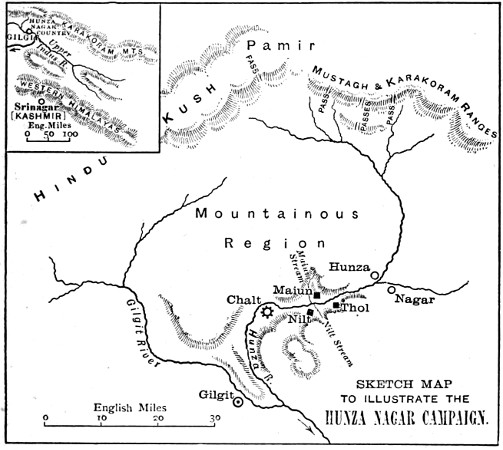
SKETCH MAP TO ILLUSTRATE THE HUNZA NAGAR CAMPAIGN.
Mr. Spedding and his men quickly opened out a road, just practicable for a mule battery, to Chalt, the last Kashmir fort in the valley. Here the field force collected, and all being ready, we crossed the river on December 1st, and having formed a zereba, encamped for the night in the enemy’s territory. The tribesmen were known to have gathered in force ten miles higher up the valley at a point where several large forts defended a naturally very strong position. It was Colonel Durand’s intention to make an immediate attack on the most important and the nearest to us of these forts—that of Nilt.
Accordingly, at daybreak on December 2nd, our force advanced; but it was not until midday that we reached our destination, for our road lay across very difficult ground, and at some precipitous places the enemy had broken away the track, so that the column had to halt while Spedding’s Pathans with pick, shovel, and gunpowder cleared the way. The enemy offered no opposition, and, indeed, we saw no signs of them until we had turned a rocky spur of the mountain side, when we suddenly beheld, right in front of us and only two hundred yards or so distant, the grey fortress of Nilt, with the quaint triangular flags of the Hunzas waving on its walls.
The illustration (on p. 297) will render clear the following description of the enemy’s position at what the tribesmen have for centuries considered to be the impregnable gateway of their country. On the right and left are the great gorges of Nilt and Maiun, which pour their tributary waters into the Hunza river. At the mouth of the Nilt gorge stands the fortress of Nilt, while on the cultivated terraces beyond the two gorges are the large fortresses of Thol and Maiun and several smaller forts. The two gorges descend from the glaciers and snowfields of mighty mountains whose peaks attain a height of 25,000 feet. The cliffs that fronted us on the opposite slopes of both gorges are inaccessible in most parts, and were lined at their summits from the edge of the glaciers high above down to the river bed with sangas, or stone breastworks, filled with the enemy’s marksmen ever ready to roll down avalanches of rocks on any foe that should attempt the scaling. The high cliffs also that fell from the cultivated terraces on either side forming the river banks were lined with sangas for several miles up the valley, so that an attempt to turn this formidable position by an advance up the river bed would be met by a withering fire on either flank. We were confronted, in short, by a line of defence which extended from the glaciers on one side to those on the other, held by some 4,000 determined men.
Our first object was to capture Nilt fort, the only one of the enemy’s defences which was on our side of the tributary gorges. Our troops had by no means an easy task before them. As the Hunzas and Nagars, when not united to raid on foreign soil or to repel an invader, used frequently to wage war on each other, all their villages are strongly fortified. Nilt consists of a congregation of stone houses, some of which are two or three storeys in height, all strongly built, and having flat roofs of large stones so well put together that our shells produced no effect on them. These houses are built close together, and often open out one into another, while a labyrinth of very narrow alleys intersects this human rabbit-warren. The town is enclosed by a massive stone wall nearly twenty feet in height and twelve feet in breadth, loopholed for musketry, with towers at intervals. This wall is surrounded by another loopholed wall eight feet in height, distant some six yards from the first wall. This outer wall, where it does not hang over the precipice, has a deep trench outside it, at the bottom of which the enemy had placed a strong abatis of branches lashed together, and, lastly, another abatis lined the outer edge of the trench.
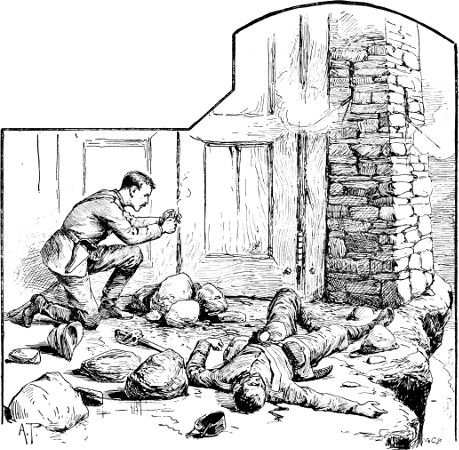
“CAPTAIN AYLMER IGNITED THE FUSE” (p. 294).
As soon as we turned the spur of the mountain the Hunzas opened fire upon us from their loopholes. Our troops deployed on to the flat terrace of irrigated fields and returned the fire. The 5th Gurkhas, who led the attack, made short rushes, section after section, availing themselves of the cover afforded by the low walls that divided the fields, and directed a brisk fire on the loopholes of the fort at 100 yards range. The Punialis and the men of the 20th Punjab Infantry scaled the steep mountain spur above the fort to the ridge on which we afterwards had our “ridge picket” (see illustration on p. 297), and fired down into the centre of the fort. The two seven-pounders took up a position about 150 yards from the fort, and opened fire upon it with shrapnel and shot, which appeared to produce no effect on the strong walls.
The action continued thus for about an hour. The loopholes of the fort offered but small targets to our riflemen, and the losses of the enemy must have been slight. On the other hand, our own men began to drop pretty fast, and it was soon obvious that the enemy’s marksmen were picking off the British officers, most of whom had narrow escapes. Colonel Durand himself was severely wounded in the groin, and the command devolved on Captain Bradshaw, 35th Bengal Infantry. The loopholes of Nilt were luckily but few in number, or our losses would have been very severe.
Just before he was wounded Colonel Durand ordered that an attempt should be made to blow up the main gate of the fort, and take the place by assault. The story of how this was carried out should be one to stir the blood of Englishmen, for few so gallant deeds have been recorded even in the glorious annals of our Indian warfare. Under cover of a very heavy fire opened upon the loopholes of the fort by the rest of the force the storming party of one hundred men of the 5th Gurkhas, led by Lieutenants Boisragon and Badcock, and accompanied by Captain Aylmer (on whom, as our engineer officer, fell the duty of blowing up the gate), made a rush on the outer abatis. Through this the kukris of the Gurkhas quickly clove a narrow opening, and then the three officers, followed by their men, leapt into the trench and began to cut their way through the other abatis at the bottom. The officers, with some half-a-dozen men at their heels, scrambled through first, climbed the side of the trench, and found themselves before the outer wall. They ran along it till they came to a small gate, through which they had little difficulty in hacking their way. Passing through this they found themselves between the two walls, and exposed to the fire from the lower loopholes of the main wall, which could not be silenced by the covering party. Turning to the right they followed the main wall till they came to a large and strongly-built wooden gate flanked by two towers. To cut through this gate, which had been barricaded within with a wall of stones, was impossible, so Captain Aylmer, accompanied by his Pathan orderly and a Gurkha sepoy, ran up to the foot of the gate, and as rapidly as possible made his preparations to blow it up, the enemy all the while firing at him through the loopholes of the towers and gate, and throwing large stones over the parapets upon him. His companions protected him as far as they could by firing into the loopholes at the range of a few feet, the officers using their revolvers. That a single man of this gallant handful escaped death is indeed marvellous.
Captain Aylmer, stooping down, removed some stones from under the foot of the gate, inserted his slabs of guncotton, packed them with stones, and ignited the fuse. While he was doing this he was shot through the leg from a loophole so near to him that his clothes and flesh were burnt; and of the two men who were in the gateway with him the Gurkha was shot dead, and the Pathan orderly was severely wounded in the head. Captain Aylmer and the orderly then crawled along the foot of the wall to a safe distance, and awaited the explosion. The given time elapsed, and there was no sound. It was obvious that the fuse had failed. So Captain Aylmer, wounded as he was, once more returned to an almost certain death, in order to complete his task. He cut the fuse with his knife, readjusted it, lit a match after several attempts, for the wind was strong, reignited the fuse, and again withdrew to safe shelter. This time while at work in the gateway he received a second wound. His hand and arm were very badly crushed by a large stone that was thrown at him over the walls.
This time, happily, the fuse did its work. There was a loud explosion; the stones came toppling down from the shaking walls, and it was seen that the gate and the barricade had been blown in. Then, even before the cloud of smoke and dust had cleared, the three British officers—for Captain Aylmer was ready for the fight, indomitable as ever, though streaming with blood from his wounds—and the five surviving sepoys rushed through the breach, and were within the fort. Here they at once engaged in a fierce hand-to-hand fight with the bravest of the enemy who flocked down the alleys leading to the gate. This handful of men, standing close together in this narrow place, resolutely held the position they had gained against the whole Hunza garrison. They gave a very good account of themselves, and killed a number of the enemy with bullet and cold steel: Lieutenant Badcock, with his revolver, shot the commander himself, Mahomet Shah, Wazir of Nagar. But the odds against them were too overwhelming: two more of the sepoys were soon killed, and nearly all were wounded. Captain Aylmer was now wounded for yet a third time, being shot through the arm with a jezail, while Lieutenant Badcock was severely wounded in the shoulder. It was evident that not one of the little party at the gateway would be left alive unless support came up quickly. They had thus been fighting for about a quarter of an hour, when Lieutenant Boisragon volunteered to go out and find his men, thus exposing himself both to the fire of the enemy and that of the covering party. He got through safely, and was very soon back in the fort at the head of a number of Gurkhas, eager to avenge their fallen comrades. They fought, as is their wont, like little demons with their deadly kukris. The tribesmen defended themselves with desperate valour, but they could not long withstand the fierce attack of the Gurkhas, who at last drove them back with great loss, and hunted them panic-stricken through the labyrinth of alleys into the surrounding gorges.
That the Gurkhas had not more quickly followed their officers and six comrades to the gateway was not due to any unreadiness on their part, for Gurkhas are never backward in a fight. It seems that after they had cut through the abatis and crossed the trench they were unable to see which way their officers had gone before them, and turning to the left, instead of to the right, had missed the gateway, and had been checked by a great abatis which extended from the wall to the brink of the precipice.
The storming of Nilt only cost our force six men killed and twenty-seven wounded. The enemy left about a hundred dead behind them in the alleys of the fort, and many were shot down while escaping to their defences beyond the gorge. Captain Aylmer and Lieutenant Boisragon were both decorated with the Victoria Cross in recognition of their gallantry on this day, and Lieutenant Badcock, who was also recommended for a V.C., received the Distinguished Service Order.
Thus fell Nilt Fort; but its capture was only the first step towards the subjugation of the Hunza-Nagars. The real strength of their position lay before us, and the enemy, not in the least disheartened by their defeat, prepared to make a resolute stand along their line of defence beyond the two gorges. They omitted no precaution: not only did they break away all the roads across the ravines, but, taking advantage of the hard frost, they turned the irrigation canals over the river cliffs where they were assailable, and so formed smooth ramparts of ice to oppose us.
For eighteen days we vainly endeavoured to turn this formidable position. On December 3rd an attempt was made to repair the road and push across the Nilt gorge; but no sooner did our men appear in the open than they were driven back by a volley from the sangas opposite, which killed three men and wounded six others, among the latter being Lieutenant Gorton. We now had five of our officers hors de combat, and in all forty men killed or wounded. Several reconnaissances were made by day and by night, to find out a weak spot in the enemy’s line of defence. Once a party explored the river bed for some distance, and found that it was obstructed by barricades that ran across the beach: a heavy fire from either bank compelled this patrol to beat a hasty retreat. It was quite evident that an attempt to advance that way would mean the annihilation of our force. On the night of December 8th another futile endeavour was made to force the mouth of the Nilt gorge. On one dark night a small party that had crossed the river to surprise Maiun was discovered and repulsed. We even attempted to find a way across the glaciers at the head of the gorge, but were frustrated by impassable crevasses. Whenever a night surprise was attempted at some point of the cliff that appeared accessible the ever-watchful enemy would roll down their avalanches of rocks and also great fire-balls of resinous wood, whose blaze disclosed the whereabouts of our men, and enabled the defenders above to open a deadly musketry fire.
Day after day our men were engaged in these perilous but fruitless efforts to force a way past these rocky bulwarks of the enemy. Still we were held in check, and our position became one of considerable peril. The Hunzas, emboldened by the success of their resistance, threatened our line of communication with Gilgit, and the Shinaka tribes also were mobilising with the intention of falling upon us from below. Had they done so our small force would have probably been caught in a trap and cut to pieces, even as was the fate of a far larger force of Kashmir troops some years before in this very valley. Shut out, as we were, from all hope of succour for several months by the wintry Himalayas, but one course lay before our commander—at all risks to force the enemy’s position before their Shinaka allies could come to their assistance.
To Nagdu, a gallant Dogra sepoy of one of the Kashmir Imperial Service regiments, the credit is due for having discovered what was possibly the only practicable method of effecting our object. This man, like all his race, a good cragsman, volunteered to explore the precipices on the further side of the Nilt gorge, with a view of finding a point at which they could be scaled by our troops. Night after night he did this at great risk, for the enemy, perceiving him, used to roll down rocks and fire upon him from above. At last on one dark night he actually succeeded in climbing quite alone from the bottom of the gorge to the top of the cliff, undetected by the enemy, and reached the foot of the four strong sangas indicated in the illustration. The enemy evidently considered this to be a vulnerable point, for we had observed that they used to roll down their rock avalanches from these sangas at intervals each night, until at last a regular chute was worn apparently as a light streak against the darker cliff. Nagdu climbed down again in safety, returned to camp, and propounded his scheme. Nagdu, of his own native wit, realised a truth the ignorance of which has on more than one occasion brought commanders to grief—namely, that an almost perpendicular cliff is but a treacherous position under certain circumstances, and proves a deathtrap to those who would defend its summit. Nagdu pointed out that the cliff was so steep that the enemy would have to come out of their sangas and lean over the edge of the precipice in order to fire at a scaling party, and this, he said, we ought to be able to prevent them from doing with a covering party of picked marksmen posted on our side of the gorge.
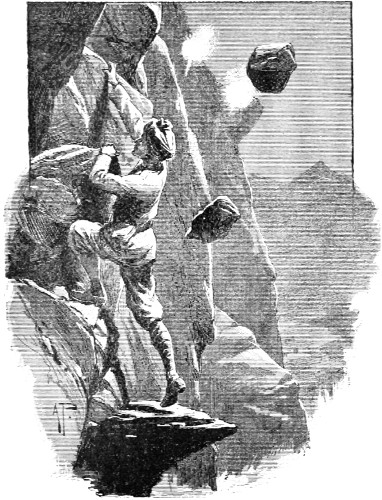
“HE ACTUALLY SUCCEEDED IN CLIMBING QUITE ALONE.”
Nagdu’s plan was so obviously the right one that it was adopted, and it was decided to storm the enemy’s position at this point in broad daylight. Captain Colin Mackenzie, of the Seaforth Highlanders, who was in command during Captain Bradshaw’s temporary absence at Gilgit, despatched this forlorn hope without any delay. The 5th Gurkhas had borne the brunt of the first action; it was now the turn of the Imperial Service troops. Accordingly, Lieutenant Manners-Smith and Lieutenant Taylor, with 100 men of the Kashmir Bodyguard Regiment, left the camp noiselessly on the night of December 19th, which was very dark, and bivouacked in the Nilt gorge at a spot sheltered from rock-rolling, and just below the precipice that Nagdu had scaled. That night in camp we listened anxiously for any sound, for had the enemy detected the party as it ascended the gorge the rock avalanches would have wrought great havoc at several exposed places on the way. But we had luckily at last caught the tribesmen off their guard, and all was quiet.
Before dawn on the 20th the covering party, consisting of 135 marksmen selected from the different regiments, ascended the ridge and took up a position near the block house indicated in the illustration. Our men lined the edge of the cliff, having been divided into four parties, each of which was instructed to open a steady independent fire upon one particular sanga of the four that were to be stormed. I was in command of one of these parties, and was therefore a spectator of what I am about to describe. The enemy opened fire upon us from the four sangas (which were about 450 yards from our ridge) and from other sangas that dotted the hillside. It was not long before the four sangas were completely silenced by the fire we directed upon them: not a defender dared stand behind a loophole. Then Lieutenant Manners-Smith commenced the difficult ascent, followed by fifty of the sepoys, Lieutenant Taylor coming after with the other fifty. We saw the men, forming a long scattered stream, slowly and with difficulty scale the 1,200 feet of precipice, often coming to a check and having to return some distance to try again at some more accessible point. Only cragsmen, such as these were, could have climbed this frightful wall of rock.
At last, when they were two-thirds of the way up, Lieutenant Manners-Smith came to a sheer precipice no man could scale: he tried to the right and left of it, but could find no way of getting by, and then, to our dismay, abandoned the hopeless attempt, and took all his men down again to the foot of the gorge. But Manners-Smith, himself an expert cragsman, was determined to scale the cliffs somewhere that day and to try conclusions with the enemy at close quarters. So he started again at a point higher up the gorge, and this time, as we fired over his head, we saw him and a few of the most active of his followers attain a ledge only sixty yards below one of the four sangas. Here he waited a few seconds until more of his men had come up, and then he rapidly clambered to the edge of the cliff.
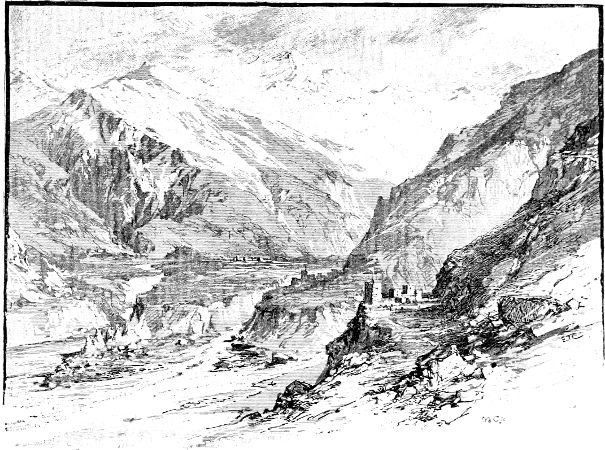
NILT FORTS, FROM THE SOUTH.
It was only at this moment, when the storming party had all but effected its task, that it became visible to the defenders of Maiun and of the other forts below, who, hearing the unwonted heavy firing, had come out upon the roof-tops and were gazing upwards at the ridge. They shouted a warning across the river, which was taken up by sanga after sanga on the cliff side, till it reached the men in the four sangas that were the object of our attack, who for the first time realised that a party of men were scaling the cliff beneath them. They then, but too late, made a desperate attempt to defend their position. They threw rocks over the parapets, and some brave Hunzas rushed boldly out of the sangas and rolled down the ready-piled-up mounds of stone, whose falling stirred great showers of rocks, ever increasing in volume as they thundered down the gorge. From our side we shot down each man as he appeared in the open, in most cases before he had time to roll down a single stone. Luckily, our men had by this time passed the most dangerous part of the ascent, and the greater portion of the stones rushed harmlessly to the left of them. Some men, however, were wounded, and Lieutenant Taylor was knocked down, but not severely injured, by a rock. Had the enemy received their warning but a few minutes earlier, the cataracts of rock would probably have swept a large proportion of the scaling party off the face of the cliff.
And now the order was given to the covering party to cease firing, and, as the smoke cleared, we saw Lieutenant Manners-Smith and a few men reach the foot of the sanga to the right. They ran quickly round to the opening at the back of the sanga, a few shots were fired by the attacking party and the defenders, and then the former, rushing in, took the sanga at the point of the bayonet, slaying most of those within. The rest of the sepoys now came up, and, despite the gallant stand of many of the enemy, sanga after sanga was taken by assault, and the whole hillside was covered with the flying tribesmen hurrying to the forts below. Upwards of 100 of them were shot down by our riflemen, but the greater portion escaped. This gallant forlorn hope had been rewarded with complete success, and the Kashmir Imperial Service troops had proved on this their first trial how well they could acquit themselves when properly led.
And now the defenders of Maiun, Thol, and all the fortifications on the plain below, seeing that their position—which they had deemed impregnable, and which from time immemorial had defied their enemies—had been actually turned, and knowing that we should cut off their retreat unless they escaped at once, lost heart, and, abandoning their posts, took to their heels. We saw the tribesmen in their hundreds fleeing up the valley for their lives on both sides of the river. They were not given time to recover from their panic and to organise a stand higher up. Our covering party was at once brought down the hill, our sappers quickly opened a rough track across the mouth of the gorge; we effected a junction with Lieutenant Manners-Smith’s party; and then, leaving baggage and commissariat behind, our whole force pushed up the valley in pursuit of the routed enemy. A forced march of thirty miles over the most difficult ground, along the face of precipices, across frozen torrents, glaciers, and wastes of rocky débris, brought us to the capital of Nagar in about twenty-four hours—a most creditable performance. The enemy offered no further resistance, and on the following day we occupied the thums’ hitherto inviolate citadel in the capital of Hunza.
The complete pacification of the country quickly followed. The Hunza-Nagars, having been treated with clemency, are now very well disposed to us. They acknowledge our suzerainty, but are ruled by their thums as of old; and we do not interfere with them in the least so long as they abstain from raiding and slave-hunting. The Hunza valley provides a new recruiting ground for India. When it was proposed to raise a Hunza levy for frontier defence, the young tribesmen gladly volunteered; and within a few months of the Hunza War, a small body of our recent foes, led by British officers, completely defeated a far superior force of Shinakas which had attacked our outposts on the Indus.
Lieutenant Manners-Smith, in recognition of his gallant leading of the forlorn hope on the 20th, received the Victoria Cross—the third that had been gained in the course of this short but memorable campaign.
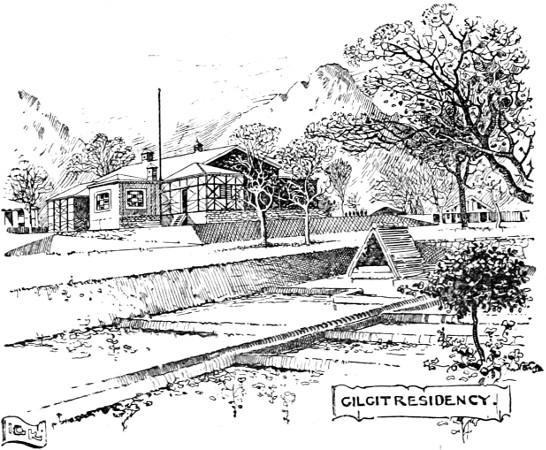
GILGIT RESIDENCY.

ASPROMONTE
BY CHARLES LOWE.

Giuseppe (or Joseph) Garibaldi was for many years the most picturesque and interesting figure in all Europe. He might be called the William Wallace, or the William Tell, of Italy. His name (which is still a common enough one in Genoa among all ranks of life) is said to have been a corruption of Garibaldo, i.e. “Bold in War.” At any rate, a warlike star presided over his birth (at Nice in 1807), for he first saw the light in the very house where, forty years before, Masséna, one of the Great Napoleon’s greatest generals, was born.
At the time of his birth his native country—Italy—was in a woful state of disunion, and much of it was under the yoke of the foreigner—the Austrians in particular. It was cut up into several conflicting monarchies; while the Pope, the spiritual head of the Roman Church, also claimed—and had his claim allowed—to be temporal sovereign of Rome. But as the century grew older, the Italian people began to be stirred with a deep desire for national unity, without which they knew they could never become great, strong, or respected; and of all who threw themselves into this movement, none did so with more ardour than the son of the humble Nice skipper who sailed his own little vessel all over the Mediterranean.
This son, Giuseppe, took to his father’s calling, and began life as a sailor. Once, when second in command of a brig, he was attacked by Greek pirates, after which he landed at St. Nicholas to re-victual without so much as shoes to his feet. An Englishman, taking pity on him, offered him a pair, and this touched him to the heart.
“When I look back upon it now,” wrote Garibaldi in 1870 to Cassell’s Magazine, “I cannot help remembering that it was the first of the many acts of kindness which bind me with such strong and lasting ties of gratitude to your noble nation.”
In 1836 he had joined a revolutionary movement, which failed; and, after many privations and vicissitudes, he finally sailed for South America, where for the next ten years he led a life of the most stirring excitement and adventure among the quarrelsome young Republics of that continent—fighting now on one side and then on the other, like Rittmeister Dugald Dalgetty in the Thirty Years’ War, and gaining a name for the greatest personal bravery. The wanderings and adventures of Ulysses were nothing to those of Garibaldi, which would fill volumes of as fascinating reading as can be found in the pages of a novelist.
When the revolutionary movement of 1848 swept over Europe—including Italy—Garibaldi returned home with a knowledge of guerilla—or irregular—warfare such as was possessed probably by no other man alive; and then, with his volunteers, he threw himself heart and soul into the movement for “making Italy free,” as the phrase ran, “from the Alps to the Adriatic.”
With his Red-Shirt Volunteers, Garibaldi took a prominent part in the fighting of 1848 and 1859, and with his “Thousand”—as famous a fighting force as Xenophon’s “Ten Thousand”—he, in 1860, attacked and conquered the Two Sicilies (i.e. the island of Sicily and Naples), and made a present of these kingdoms to his sovereign Victor Emmanuel, after which he returned to his solitary farm on the little island of Caprera. Here, on this rocky island—fifteen miles in circumference, and five in length—Garibaldi was monarch of all he surveyed.
“The absence of priests,” he wrote, “is one of the especial blessings of this spot. Here God is worshipped in purity of spirit without formalism, free from mockery, under the canopy of the blue heavens, with the planets for lamps, the sea winds for music, and the green sward of the island for altars.”
This was the den, so to speak, into which the lion-patriot retired when no political prey was stirring. But no sooner did he scent the opportunity for action than out again he would rush with a roar, which was sometimes just as disquieting to his friends as to his foes. This was more particularly the case on the occasion which led to Aspromonte. But, before proceeding to the tragic scene of this encounter, let us see what sort of fighters Garibaldi and his red-shirted followers were.
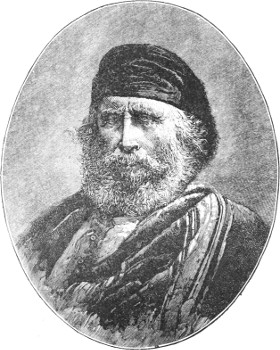
GENERAL GARIBALDI.
“Garibaldi,” wrote a correspondent of The Times, “was a middle-sized man, and not of an athletic build, though gifted with uncommon strength and surprising agility. He looked to the greatest advantage on horseback, since he sat in the saddle with such perfect ease, and yet with such calm serenity, as if he were grown to it, having had, though originally a sailor, the benefit of a long experience in taming the wild mustangs of the Pampas. But his chief beauty was the head and the unique dignity with which it rose on the shoulders. The features were cast in the old classic mould: the forehead was high and broad, a perpendicular line from the roots of the hair to the eyebrows. His mass of tawny hair and full red beard gave the countenance its peculiar lion-like character. The brow was open, genial, sunny; the eyes dark grey, deep, shining with a steady reddish light; the nose, mouth, and chin exquisitely chiselled, the countenance habitually at rest, but at sight of those dear to him beaming with a caressing smile, revealing all the innate strength and grace of his loving nature.
“His garb consisted of a plain red shirt and grey trousers, over which he threw the folds of the Spanish-American poncho—an ample upper garment of thin white woollen cloth with crimson lining, which did duty as a standard, and round which his volunteers were bidden to rally in the thick of the fight, as did the French Huguenot chivalry round Henry of Navarre’s ‘panache blanche.’ His sword was a fine cavalry blade, forged in England and the gift of English friends, and with it he might be seen at his early breakfast on the tented field cutting his bread and slicing his Bologna sausage, and inviting those he particularly wished to distinguish, to share that savoury fare. The sabre did good slashing work at need, however, and at Milazzo, in Sicily, it bore him out safely from the midst of a knot of Neapolitan troopers who caught him by surprise and fancied they had him at their discretion. Garibaldi carried no other weapons, though the officers in his suite had pistols and daggers at their belts; and his negro groom, by name Aguyar, who for a long time followed him as his shadow, like Napoleon’s Mameluke, and was shot dead by his side at Rome, was armed with a long lance with a crimson pennon, used as his chief’s banner.
“His staff officers were a numerous, quaint, and motley crew, men of all ages and conditions, mostly devoted personal friends—not all of them available for personal strength or technical knowledge, but all to be relied upon for their readiness to die with or for him. The veterans he brought with him from Montevideo, a Genoese battalion whom his friend Augusto Vecchi helped to enlist, and the Lombard Legion, under Manara, were all men of tried valour, well trained to the use of the rifle, inured to hardships and privations; and they constituted the nucleus of the Garibaldian force throughout its campaigns. The remainder was a shapeless mass of raw recruits from all parts of Italy, joining or leaving the band almost at their pleasure—mere boys from the Universities, youths of noble and rich family, lean artisans from the towns, stout peasants and labourers from the country, adventurers of indifferent character, deserters from the army, and the like, all marching in loose companies, like Falstaff’s recruits, under improvised officers and non-commissioned officers; but all, or most of them, entirely disinterested about pay or promotion, putting up with long fasts and heavy marches, only asking to be brought face to face with the enemy, and when under the immediate influence of Garibaldi himself or of his trusty friends seldom guilty of soldierly excesses or of any breach of discipline. The effect the presence of the hero had among them was surprising. A word addressed to them in his clear, ringing, silver voice electrified even the dullest. An order coming from him was never questioned, never disregarded. No one waited for a second bidding or an explanation. ‘Your business is not to inquire how you are to storm that position. You must only go and do it.’ And it was done.”
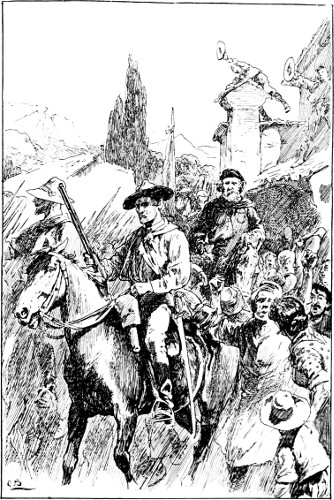
“EVERYWHERE THIS FREE-LANCE EVOKED ENTHUSIASM” (p. 302.)
“On the approach of a foe,” wrote one of his Lombard volunteers, Emilio Dandolo, “Garibaldi would ride up to a dominating point in the landscape, survey the ground for hours with the spyglass in brooding silence, and come down with a swoop on the enemy, acting upon some well-contrived combination of movements by which advantage had been taken of all circumstances in his favour.” And as this was his custom in the field of war, so it was ever also his habit in what must be called the field of politics. After finishing a campaign he would sheathe his sword and return to Caprera, there to stand and strain his eyes towards the mainland, watching for his next opportunity of action. Not an event escaped his notice, and he heard with a smile of contentment how Victor Emmanuel had stormed the fortress of Gaeta, and the two crowns of the Sicilies had been placed upon the head of the Piedmontese King. But the national unity was still far from complete. Above all things, Venice still remained under the yoke of the Austrians, while Rome was equally in the power of the French, who remained there to champion with their bayonets the pretensions of the Pope.
They had been there ever since 1849, when the Romans rose against the Pope, declared a Republic, and were supported by Garibaldi and his Red Shirts. But then the French rushed to the assistance of the Pope, and after a three months’ siege—during which the Garibaldians behaved with splendid bravery—at last stormed the city, restored the authority of the Pope, and compelled the Hero of Caprera to retire to the mountains.
“Soldiers!” he had said, on leading his men away from the Eternal City, “that which I have to offer you is this: hunger, thirst, cold, heat; no pay, no barracks, no rations; but frequent alarms, forced marches, charges at the point of the bayonet;” and 4,000 men had readily answered to this appeal.
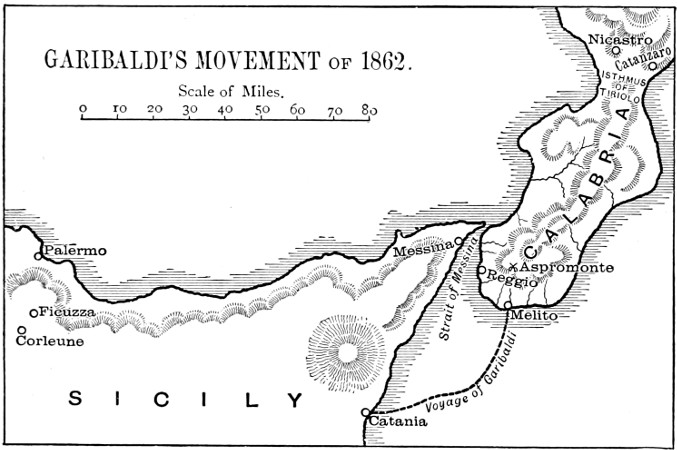
GARIBALDI’S MOVEMENT OF 1862.
The memory of this defeat rankled ever after in Garibaldi’s mind, and he determined to seize the first opportunity of retrieving it. This opportunity, he deemed, had at last come in the year 1862, soon after the death of the great statesman Cavour, who had been the Bismarck, so to speak, of Italian unity, as Victor Emmanuel had been its King William. But while Garibaldi had been their greatest support, he had also been the source of their greatest weakness. For he was not a regularly appointed servant of the Government, but the self-constituted soldier and champion of his country. He chose his own time for fighting, irrespective of what the King and his ministers wished, and thus often placed them in the greatest difficulty. So little, indeed, did Garibaldi consider his times and seasons for action, that he was said by many to have “an ass’s head linked to a lion’s heart.” He was nothing but a headlong soldier, who scorned the arts of statesmen; and his head was turned with his extraordinary popularity among the masses of the Italian people, who paid him something like Divine honours.
Everywhere this free-lance hero evoked far more enthusiasm than was even shown the King, who, naturally enough, followed Garibaldi’s movements with the greatest solicitude, whilst recognising that he had done so much for his country that the very greatest indulgence and forbearance had to be shown him.
But there came a time when it was thought that Garibaldi should not be allowed the free hand which had hitherto been granted him. This was when he announced his intention of placing the national flag on the walls of Rome, which still owned the dominion of the Pope, and was garrisoned by the French. However much Victor Emmanuel desired to see Rome become the capital of Italy, he could not forget the debt of gratitude which he owed the French, who had been his allies in the successful war against Austria in 1859; and when he heard of Garibaldi’s proposed enterprise, he issued a proclamation to his subjects, saying: “It is painful to me to see deluded and inexperienced young men forgetting their duties and the gratitude we owe our best allies, and making the name of Rome a watchword of war.... Italians! beware of guilty impatience and incautious agitation. When the hour to finish the Government work shall have come, the voice of your King will be heard among you. A call which does not come from him is a call to rebellion and to civil war. The responsibility and the rigour of the law will fall upon those who do not listen to my words.”
But this warning had no restraining effect on the eager Garibaldi, who only panted to recover for his country the Eternal City, exclaiming: “Rome! Rome! Who is not urged by thy very name to take up arms for thy deliverance?” At the same time, there is considerable reason for believing that the King and his Government had given secret encouragement to Garibaldi to embark upon his mad enterprise, in order to have a pretext for arresting the lion-hearted but inconvenient rebel. In any case, away to Sicily he went to make preparations for his Quixotic expedition. He probably calculated that the news of his enterprise would induce his countrymen to rise en masse, and that the French Emperor, seeing the enthusiasm of the Italian people, would withdraw his troops from Rome.
He landed at Palermo, whence a body of his volunteers marched to Corleone, a town of the interior, where they overpowered the National Guard and armed themselves with their muskets. Then they took up their quarters in a camp at Ficuzza, a forest district about twenty miles from Palermo. Here they were visited on August 1st by Garibaldi, who thus addressed them:
“My young fellow-soldiers! To-day again the holy cause of our country unites us. Again to-day, without asking whither going, what to do, with what hope of reward to our labours, with a smile on your lips and joy in your hearts, you hasten to fight our overbearing dominators, throwing a spark of comfort to our enslaved brethren.... I can only promise you toils, hardships, and perils; but I rely on your self-denial. I know you, ye brave young men, crippled in glorious combat! It is needless to ask you to display valour in fight. What I ask is discipline, for without that no army can exist. The Romans were disciplined, and they mastered the world. Endeavour to conciliate the goodwill of the population we are about to visit, as you did in 1860, and no less to win the esteem of our valiant army, in order, thus united with that army, to bring about the longed-for unity of the country.”
Garibaldi now went to Catania, where the royal troops already began to close round him with intent to take him prisoner. But many deserted to his side in the hope of sharing the martial glory which they believed to be again in store for the wayward Hero of Caprera. His force soon swelled to a very considerable body; but here it was on the island of Sicily, and how was it to get across to the mainland in order to commence its march on Rome? Garibaldi had no ships; but in the harbour of Catania there were lying three vessels—a French frigate, the Marie Adelaide; a French steamer, Le Général Abbatucci; and an Italian steamer, Il Dispaccio, belonging to the Florio Company. In addition to these vessels there was a royal Italian man-of-war—Il Duca di Genova—the commander of which gave out that he would fire on any of the other three ships which made bold to carry over Garibaldi and his Red Shirts to the mainland.
One day, however, the Duca di Genova took it into its head to go for a little cruise outside the Straits of Messina—probably, indeed, because it had received secret orders to do so, in order the better to lure Garibaldi into the trap which had been laid for him. On the disappearance of the Duca di Genova, Garibaldi stepped into a boat with several trusty followers, and was rowed off to the other three vessels above referred to, when he put their respective captains under arrest, and then proceeded to fill them up with his impatient Red Shirts.
“At five o’clock in the afternoon,” says one of his biographers, “the embarkation commenced, and the good people of Catania crowded the harbour, waving handkerchiefs and cheering. Menotti” (Garibaldi’s son) “and his ‘Guides,’ the Tuscans, and the flower of the Sicilian volunteers, moved off for Il Dispaccio; General Corrao, with some more Sicilians, occupied Le Général Abbatucci; whilst Garibaldi took the command of the former and put Burratini in command of the Marie Adelaide, with orders to get her filled with troops as soon as possible. During this time it had been growing dark, and each ship was filled to suffocation, no one being able to lie down, or get any rest, as boats were for ever arriving with their cargoes of men. About midnight the ships were got under way; and after crossing the Straits in the dark, without any mishap, the troops were all safely landed at Melito next morning, on the spot celebrated as the one on which the former expedition had gone ashore.”
Garibaldi landed in Calabria with a force of about 3,000 men—a very insignificant body, one would have thought, to march against walled and embattled Rome with its formidable French garrison. But by the time he came into collision with the royal troops, who had been sent after him to arrest his progress, his little army of Red Shirts had dwindled by about a half on account of the privations to which it was exposed and the rapid marches which had been exacted of it.
On hearing of Garibaldi’s naval coup-de-main at Catania, and his crossing over to Calabria, General Cialdini at once gave chase, and in order to catch the Hero of Caprera, he sent two of his generals—Revel and Vialardi—with a body of royal troops to draw a cordon across the isthmus of Tiriolo at its narrowest point, between Nicastro and Catanzaro, so as thus to bar the Rome-ward march of the Red Shirts. Having done this, he next ordered three vessels of war to cruise about the Straits so as to prevent Garibaldi from re-embarking, and then despatched Major-General Pallavicini, at the head of a considerable force, from Reggio, with instructions to drive the Red Shirts northwards in the direction of the aforesaid cordon on the isthmus, as game is driven by the beaters towards the sportsmen—Pallavicini’s instructions being to attack Garibaldi “anywhere and anyhow,” unless he consented to an unconditional surrender.
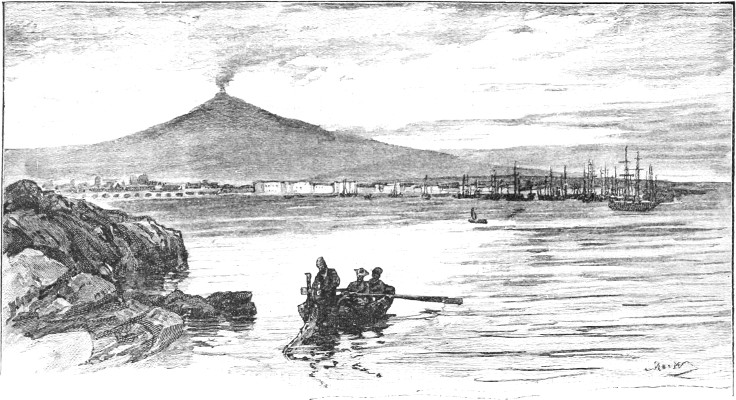
CATANIA.
Things had thus assumed a very serious aspect indeed for the disillusioned Hero of Caprera, who, on the evening of the 28th August, after a long and tiring day’s march, had pitched his camp on the brow of the far-famed hill of Aspromonte, on a plateau overlooking the sea, with a wood behind which connected it with a high range of the Apennines, and would afford ample shelter for his troops. The men were encamped al fresco under cover of this wood, whilst Garibaldi occupied one of two woodmen’s huts which were on the plateau, and gave the spot the name of “i forestali.” It was wet and gloomy, the rain put out the bivouac fires, every rag on their backs was soaked, and they had no provisions with them; so that the position of the volunteers was far from enviable.
Next morning General Pallavacini came up with the Red Shirts, and at once proceeded to carry out his orders. How he did this let us see from his own pen.
“On the morning of the 29th I set forth early, directing my course towards San Stefano, where I arrived at about half-past eight a.m. There, from secret information received, I knew that General Garibaldi had encamped with his force during the night on the plateau of Aspromonte. I ordered the troops to pursue the march until within a short distance of the plateau, and before allowing them to proceed I caused the troops to rest themselves, as they were excessively fatigued by a long march by abrupt paths. In the meantime I learned that only two hours previously General Garibaldi had encamped at the foot of the plateau of Aspromonte, and I saw that by two paths I could descend towards his camp.
“I then divided my troops into two columns, which arrived at the same time in view of the Garibaldian encampment, already abandoned by him, he having taken up a position on the crest of a rugged hillock to the east of the plateau of Aspromonte. I then sent an order to the commandant of the left column, while making the right column fall back by a rapid movement. I attacked the left flank of the rear of the rebels, in order to cut off their retreat. In the meantime, with a battalion, I caused the entrance of the valley to be occupied, that they might not regain the plateau. The left column, with the 6th Battalion of the Bersaglieri at their head, then attacked the rebels, and after a smart fire carried the position at the point of the bayonet with cries of ‘Viva il Re!’ ‘Viva Italia!’ while the left side was also attacked by our troops. General Garibaldi and his son Menotti” (who had written to a friend in Liverpool, “In three weeks we shall be in Rome!”) “having been wounded, and the rebels being surrounded on all sides, resistance became useless, whereupon the Garibaldians gave the signal to cease firing.”
Their own account of the engagement was somewhat different. Garibaldi himself wrote:—“They thirsted for blood, and I wished to spare it.... Yes, they thirsted for blood. I perceived it with sorrow, and I endeavoured, in consequence, to do my utmost to prevent that of our assailants from being shed. I ran to the front of our line, crying out to them not to fire, and from the centre to the left, where my voice and those of my aides-de-camp could be heard, not a trigger was pulled. It was not thus on the attacking side. Having arrived at a distance of two hundred metres, they began a tremendous fire, and the party of Bersaglieri who were in front of me, directing their shots against me, struck me with two balls—one in the left thigh, not serious; the other in the ankle of the right foot, making a serious wound.
“As all this happened at the opening of the conflict, and I was carried to the skirt of the wood after being wounded, I could see nothing more, a dense crowd having formed round me while my wound was being dressed. I feel certain, however, that up to the end of the line (of troops) which was at my litter, and to that of my aides-de-camp, not a single musket shot was fired.... It was not so on our right. The Picciotti, attacked by the regular troops, replied by a fire along the whole line, and, although the trumpets sounded to cease firing, there was at that spot a smart fusilade, which lasted not more than a quarter of an hour. My wounds led to some confusion in our line. Our soldiers, not seeing me, began to retreat into the woods, so that, little by little, the crowd around me broke up, and the most faithful alone remained.”
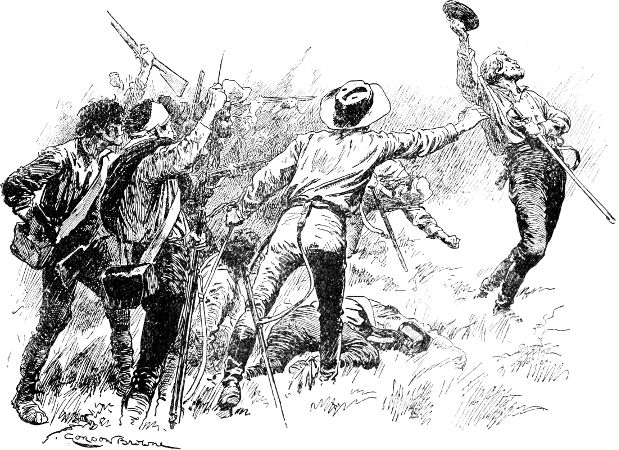
“RAISING HIS CAP IN THE AIR, HE CRIED ‘VIVA L’ITALIA!’” (p. 306).
A Garibaldian officer who was present thus wrote: “When the general received the bullet he was passing along our front, ordering the men not to fire. I saw a slight shiver pass through his body; he took two or three steps, and then began to stagger. We ran to him, holding him up; he was regardless of his sufferings. Raising his cap in the air, he cried ‘Viva l’Italia!’ I had his poor foot resting on my thigh; he called out to his assailants, and asked what they were doing with his people. I felt a shivering in all his limbs; and, reminding him of his wounds, I implored him to be quiet.”
While the surgeon was dressing his wounds, the sturdy soldier calmly produced a cigar and began to smoke, inquiring of the doctor whether he thought amputation would be necessary. Twenty minutes later he had an interview with his conqueror and captor, General Pallavacini, who assured him, with tears in his eyes, that this was the most miserable day of his life. Yet he had received certain orders, and he had no choice but to obey.
It was the bitterest of all moments for the hero of Italian unity when, staggering from the effects of his double wound, he fell forward upon the Italian soil to which he had devoted his whole life. Generals Cialdini and Pallavacini had been his friends and comrades, their troops were his compatriots and brothers-in-arms.
Two bullets had thus put an end, sudden and complete, to Garibaldi’s march on Rome, though he was to live to make another and an equally unsuccessful attempt upon the Eternal City. Meanwhile, the illustrious rebel was carried to prison at Spezzia, where he was, however, kept but a short time, and then removed to Pisa. There Dr. Nélaton, of Paris, who came all the way for the purpose, succeeded in extracting the bullet from Garibaldi’s ankle, for which bullet a hero-worshipping Englishman offered as much as 30,000 francs.