LIST OF PLATES. (continued 4)
Reading edition
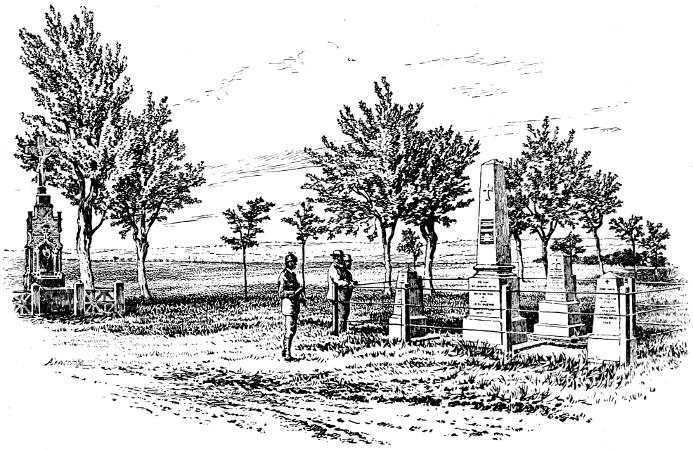
GRAVE-STONES ERECTED ON THE BATTLE-FIELD IN MEMORY OF THE FALLEN.
On coming up with the troops of the Crown Prince, the King had been nearly swallowed up by them for sheer joy. At sight of the venerable monarch, who had been exposing his person throughout the bloody fray like the most dutiful of his soldiers, battalion after battalion—some the mere shadows of their former selves—burst into frenzied cheering and rushed forward, officers and men, to kiss the hand, the boot, the stirrup of their beloved leader. But presently a scene more touching still was presented to the victorious Prussian troops, when the heroic Crown Prince rode up and met his father. “I reported to the King,” wrote the Crown Prince, “the presence of my army on the battle-field, and kissed his hand, on which he embraced me. Neither of us could speak for a time. He was the first to find words, and then he said he was pleased that I had been successful, and had proved my capacity for command, handing me at the same time the order ‘Pour le mérite’ (highest of Prussian war decorations) for my previous victories.” Earlier in the day “Unser Fritz” had met his cousin the Red Prince. “We waved our caps to one another from afar, and then fell into one another’s arms amid the cheering of the troops of my extreme right and his extreme left wing.... Two years ago I embraced him as victor at Düppel; to-day we were both victors: for, after the stubborn stand made by his troops, I had come to decide the day with my army.”
The battle had been won, but at what a terrible cost! Even the victors shuddered at the sight of the multitudes of bodies which heaped the bloody field. By superior arms, superior numbers, and superior strategy, Prussia, at the cost of 10,000 of her bravest sons, had won a crowning victory over her Austrian rival, who lost 40,000 men (including 18,000 prisoners), 11 standards, and 174 guns. “I have lost all,” exclaimed the defeated Benedek, “except, alas! my life!” The highest proportion of the Prussian loss of 10,000 had fallen on Franzecky’s Division, whereof 2,000, out of 15,000, had bitten the Bohemian dust. But “Franzecky vor!” (“Franzecky to the front!”) will always live in the Prussian soldier’s song as a memory of the ever-ready leader who bore the brunt of the awful struggle on the line of the Bistritz.
That same night the King slept at Horitz—not upon a bed, but on his carriage cushions spread out on a sofa. Bismarck’s couch was at first formed by a wisp of straw under the open colonnade of the same townlet, though afterwards he was invited to share the wretched room of the Grand Duke of Mecklenburg. Moltke rode back to Gitschin, a distance of about twenty miles from the battle-field, where a cup of weak tea was all the refreshment that could be got for him; and then, in a fever of fatigue, he threw himself down to sleep in his clothes, as he had to be up betimes and return to Horitz to procure the King’s sanction for his further plans.
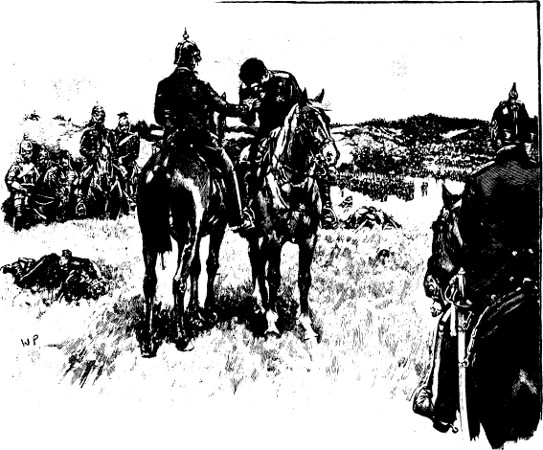
“THE CROWN PRINCE RODE UP AND MET HIS FATHER” (p. 83).
It was he, the “Great Silent One,” who had won the greatest and most momentous battle of modern times.
It had taken Frederick the Great seven long years to humble the pride of Austria; it took William the Victorious, with Moltke as his “battle-thinker,” but seven short days to achieve the same result. The Prussian soldier preferred to call the battle which he had just helped to win, Königgrätz, because this name sounded to his ears as but a pun on the words “Dem König geräth’s” (“The King will win”). But the King had only won by acting on the sage advice of his all-calculating Moltke, whose motto was “Erst wägen, dann wagen”—that is, “First weigh, then away!”
AYACUCHO
By W. B. ROBERTSON

That war whereby the power of Spain was broken in South America, is known as the South American War of Independence. On the one side was the imperial power of Spain fighting for supremacy; on the other side were her colonists—creoles, American natives of Spanish blood—fighting for freedom.
The first pitched battle was fought in Mexico near Aculco, in 1810; the last, on the plain of Ayacucho, in Peru, on December 9th, 1824.
Venezuela, Colombia, and Ecuador had already thrown off the Spanish yoke when General Bolivar, towards the end of 1823, arrived with his victorious army in Peru. He was hailed as “The Deliverer,” and addressed the National Congress at Lima in these words:—
“The soldiers who have come from the Plate, the Maule, the Magdalena, and the Orinoco as the deliverers of Peru will not return to their native country till they are covered with laurels, till they can pass under triumphal arches, nor till they can carry off as trophies the standards of Castille. They will conquer and leave Peru free, or they will die. This I promise.”
These words spoken, it remained to make them actualities; and how this was done will form our story.
In June of the following year Bolivar took the field with 10,000 infantry and 2,000 cavalry. His cantonments were at Truxillo, and from there he began to move southwards to meet the enemy. The Spanish troops comprised 3,500 at Cuzco under the Viceroy of Peru, Laserna; 6,500 at Arequipa and Jauja under Canterac, and 1,000 away in the remote south under General Valdez, who was soon to be recalled to assist his companions in arms. The Spanish force nearest to Bolivar was thus General Canterac’s. This force was remarkably efficient and in the highest state of discipline. Its equipments were superior and complete; its artillery and cavalry particularly well appointed; and, what was not always the case with the liberating army, the troops were paid with the greatest regularity—a strong conducive to good discipline and order.
On August 2nd Bolivar reviewed his army on the tableland between Rancas and Pasco, a little north of Reyes, situated at an altitude of 12,000 feet above the level of the sea, and amid a scene as majestic as may be found in the world. On the west rose the Andes, while on the east, and stretching away to the Brazils were the sublime ramifications of the Cordilleras. Surrounded by natural displays of such magnitude, Bolivar’s army, composed of veterans who had fought in the Peninsular War, seen the conflagration of Moscow and the capitulation of Paris—as well as purely South American troops—looked a mere handful. Still it was enthusiastic, and the hills rang with “Vivas” at the termination of the General’s stirring address that was read simultaneously to each corps.
“Soldiers,” so ran the address, “you are about to finish the greatest undertaking Heaven has confided to men—that of saving an entire world from slavery.
“Soldiers! the enemies you have to overthrow boast of fourteen years of triumphs; they are, therefore, worthy to measure their swords with ours, which have glittered in a thousand combats.
“Soldiers! Peru and America expect from you Peace, the daughter of Victory. Even liberal Europe beholds you with delight, because the freedom of the New World is the hope of the universe. Will you disappoint it? No! No! No! You are invincible.”
Meanwhile, Canterac, having united his forces at Jauja, was marching northwards to meet Bolivar. Between the two there lay a lake, and the patriot army marched south on the west side of this lake, while the Spanish army marched north on the east side. The result of this was to delay for four months the general engagement that was expected. Instead of the armies meeting face to face on the line of their march, only detachments entered into action on the plain of Junin, which lies to the south of the lake. It was purely a cavalry engagement, this—not a shot was fired; the lance and sabre alone were used. As it was, the Royalists were worsted, losing nineteen officers, 345 rank and file, and eighty prisoners. The Patriots lost only three officers and forty-two rank and file, with a few wounded. Canterac now fell back upon Cuzco, which he reached with less than 5,000 men, his ranks thinned mostly by heavy desertions. The Patriot army continued to advance towards Cuzco, falling in, however, with no enemy. In October, Bolivar, expecting no further engagements that year, left the army and set out for Lima to hasten forward reinforcements that were expected from Colombia. He gave instructions to his second in command, General Sucre, to go into cantonments at Andahuaylas and Abancay, and, as the rainy season was about to commence, to cease active hostilities for the time being.
Bolivar had not been gone three days, when General Sucre began to question in his own mind the wisdom of his superior officer’s instructions; so he called a council-of-war, at which, besides himself, were Generals La Mar, Lara, and Miller—the last, a distinguished British soldier. At this council-of-war it was agreed that if they did as Bolivar had commanded, and lay idle in their tents, the Spanish forces, recruited and united at Cuzco, would come upon them and annihilate them. The position was a delicate one, for obedience to a superior officer is a soldier’s first duty. Still, there was Valdez marching from the south to join Canterac and Laserna at Cuzco, and it was proposed to endeavour to intercept Valdez. Operations were thus entered upon in the face of Bolivar’s strict orders to the contrary, and these operations had the effect of drawing the enemy out of his stronghold.
Now followed two months of the most extraordinary manœuvring that ever preceded a battle. The Royalists, under the Viceroy Laserna, began to move in a westerly direction from Cuzco, and the Patriots to fall back. Twice the Patriot army offered battle, and twice it was refused. The Royalists, sure of success, sought to get behind the Patriots, thus cutting off their retreat and so annihilating them. At length, after several brushes—of which the most serious occurred in the Valley of Corpuguayco, where, besides losing their spare horses and some mules, the Patriots had 200 men killed, as against a death-roll of thirty on the other side—a position was reached which seemed to satisfy the requirements of both parties for the final grip. That position was on the plain of Ayacucho; and it is here that Bolivar’s address to the soldiers should have been delivered rather than on the eve of the affair of Junin: for it was here that the blow was struck that made the power of Spain in South America reel and totter to its fall.
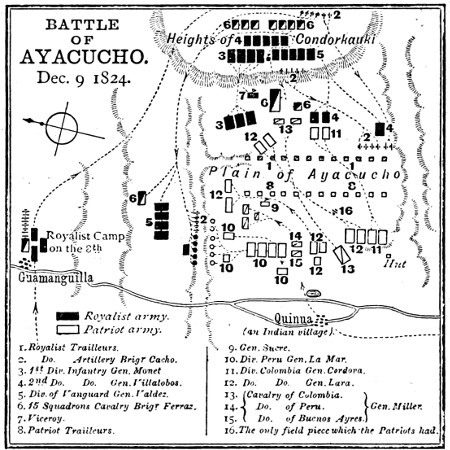
BATTLE OF AYACUCHO.
Dec. 9 1824.
The plain of Ayacucho is situated at an altitude of 11,000 feet above sea-level, in the Peruvian department of Ayacucho. It is square-shaped and about two or three miles in circuit. On its north and south sides it is flanked by deep and rugged ravines. On the west it descends gradually for a couple of leagues to what was then the high road to Lima, and which runs along the base of a lofty mountain range which rises like a wall. On this side was stationed the Patriot army, its retreat by this road cut off by detachments sent by the Spanish Viceroy to destroy the bridges and render the defiles impassable. On the east side the plain was terminated by the abrupt ridge of Condorkanki, and a little below the summit of this ridge the Royalist army bivouacked during the night preceding the fight. It was on the afternoon of the 8th of December that the respective armies reached these positions.
The eve of battle is worth describing. After the men on each side had been refreshed, and about two hours before sunset, a Spanish battalion of light infantry filed down into the plain and extended itself at the foot of the hill. A light infantry battalion of the Patriot army went forth to meet it. The opposing battalions, arrayed in extended files, engaged in skirmishing and performed evolutions to the sound of the bugle. The steadiness and behaviour of the men on each side were admired by the officers, and both parties agreed now and then to intervals of rest. During these intervals officers from the opposing sides approached one another and engaged in conversation. In the Patriot army was a Spaniard, Lieutenant-Colonel Tur, whose marriage to a beautiful woman of Lima had made him espouse the native cause. In the other army was his brother, Brigadier-General Tur, who sent a message to the former, saying how he regretted to see him, a Spaniard, in the ranks of rebels, and bearing arms against his king and country. “Yet,” the message continued, “you may rely upon my protection when the coming battle will have placed you at the mercy of the Loyalists.” The other brother was disposed to resent this message as an insult; still, they drew near to each other and ultimately embraced in view of both armies. When the shadows began to deepen across the plain, the different battalions retired to their quarters to waken to more serious work in the morning.
To waken, we have said. It is doubtful, however, if a single eye on Ayacucho were closed in slumber that night. All knew that they were about to engage in battle; none knew what the result might be, and whether this might not be his last night on earth. Both sides were wearied with the terrible marches and counter-marches, over mountains, down rocky defiles, and with the harassing watchfulness that had been continuously maintained. It was with the greatest difficulty that the officers of the Royalist army had kept their troops together. To prevent them from deserting, the different corps had habitually bivouacked in column, surrounded by sentinels, and outside of these again had been placed a circle of officers on constant duty. No soldier was allowed to pass the sentinels, who had strict orders to shoot down any one attempting to do so. Even detachments were not sent out for cattle and provisions, in case they should refuse to return; so the Royalists had been obliged to eat the flesh of horses, mules, and asses. These galling restraints the soldiers knew could be ended in only one way, and that was by a decisive engagement with the enemy. So eager were they thus rendered for the fray that they had begun to murmur against their leaders, and were loudly accusing them of cowardice in avoiding a conflict with the foe.
On the other side, the Patriots, too, were sick of manœuvring. They had been subject to constant harassing attacks from hostile Indians, who hurled stones down the mountain sides into their ranks while on the march, attacked detached parties, even made prisoners, whom they cruelly ill-treated. Again, their provisions were nigh exhausted, and so scarce had their horses become that many of the cavalry soldiers were mounted on mules. These matters, instead of improving, were with the progress of time only becoming worse. All, then, were anxious to have a termination put to the weary round of monotonous marching, with increasing exposure to dangers that from their continual presence had ceased to be exciting. Men so placed are not likely to sleep during the night preceding the day of battle. Besides, the distance between the two armies measured only a mile, and Sucre, fearing that the Royalists might descend from their heights to surprise them in the dark, kept his corps in close column ready for the attack. He also sent forward the bands of two battalions with a company to the foot of the ridge. These continued to play during the night while a sharp fire was kept up upon the Royalist outposts, the idea being to make believe that the Patriots were under arms waiting to join in fight. In this way a lieutenant-colonel and three men were killed in the Spanish camp by chance bullets, so near were the opposing armies.
Under Sucre were 5,780 men, and these were arranged on the plain in the following order:—
Bogota, Caracas, Voltigeros, and Pinchincha regiments, under General Cordova, on the right.
Hussars of Junin, Granaderos of Colombia, Hussars of Colombia, Granaderos of Buenos Ayres regiments, cavalry, under General Miller, in the centre.
Nos. 1, 2, and 3 Legions regiments, under General La Mar, on the left.
Bargas, Vencedores, Rifles regiments, under General Lara, in reserve.
Artillery: one 4-pounder in front, under Commandant La Fuente.
The Royalist army numbered 9,310, and was commanded by the Viceroy, Laserna. It was posted on Condorkanki—a division under General Valdez on the north side of the height or extreme right of the Royalists; next to him, and still on the Royalist right, a division of infantry under General Monet, in the centre cavalry, and on the left a division of infantry with seven pieces of artillery under General Villalobos. At dawn of day, an unperceived movement took place in the Royalist camp. The division under General Valdez, comprising four field-pieces, four battalions, and two squadrons of hussars, stole away to the north.
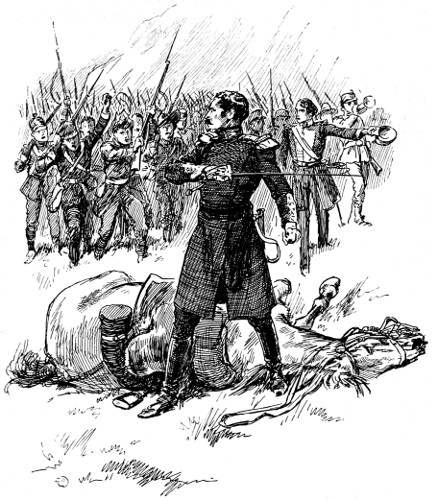
‘“THERE LIES MY LAST HORSE!”’ (p. 90).
It was a chilly morning while the men were buckling on their armour, saddling their horses, examining their bayonets, and putting in order their various accoutrements. Amongst the things that the Colombia cavalryman had to do on mounting was the fixing of his bridle reins above his knees. By this means he guided his charger, and so had his hands left free to wield his heavy lance—a strong, tough sapling from twelve to fourteen feet long. The Patriot cavalry, let it be mentioned, were the finest horsemen in the world, drawn from the gauchos of the pampas, the guasos of Chili, and the llaneros of Colombia—all accustomed to ride from childhood.
Well, while such little details as we have mentioned were in progress, and the mounting sun had tempered the chilly air, the men on both sides were observed rubbing their hands and in other trifling ways showing the satisfaction which the nearness of the onset gave them.
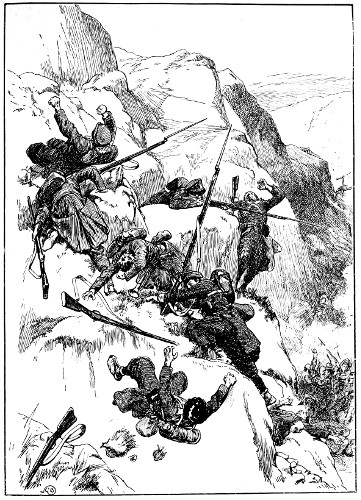
“THE ROUTED SPANIARDS CLAMBERED UP THE RUGGED SIDES” (p. 90).
At nine o’clock the first move forward began.
Then the division of infantry on the Royalist left under General Villalobos commenced to wind down the rugged side of Condorkanki. Laserna, the Viceroy, on foot, placed himself at the head of the descending files, and, obliquing to the left, led them into the plain. The other division of Royalist infantry, under General Monet, came down direct, while between these two divisions similarly descended the cavalry, the men leading their horses. As the different files reached the plain they silently formed into column. Meanwhile, General Sucre, of the Patriot army, rode along his line, and to each corps individually, in forcible words, recalled the achievements of the past. This done, he took up a position in the centre, and to his whole army in a loud voice, said: “Soldiers! Remember that upon the efforts of this day depends the fate of South America.”
Then began the forward movement of the Patriots, the division of infantry under General Cordova and two regiments of cavalry being ordered to advance. Cordova, in front of his division, now formed into four parallel columns with cavalry in the intervals, having gone a few steps, dismounted, and plunging his sword into his charger, exclaimed:
“There lies my last horse! I have no means of escape, and we must fight it out together.”
This display of spirit on the part of their leader roused the men to such enthusiasm that they became irresistible. They thought of the enemy, not as something to be feared, but only as something to be vanquished. The consequence was that, having discharged their muskets, and Cordova’s shout of “Onward, with the step of conquerors!” ringing in their ears, they pressed forward and crossed bayonets with the foe. For four minutes, which contained the work of hours, the two contending forces struggled, the mass swaying now this way and now that, so that it was impossible to tell which would give way. At an opportune moment the Colombian cavalry charged at full gallop, and with both hands free wielding their tough lances with such force that, their onset proved irresistible, and the Royalists lost ground. The vigour of the Patriots was only increased by this advantage, which they followed up with such effect that the Royalists were hopelessly driven back with terrible slaughter. Colonel Silva, who led the cavalry charge, had fallen, covered with wounds. Wounded now, too, and taken prisoner, was Laserna, the Viceroy himself—representative of the proud monarch of Spain. The routed Spaniards clambered up the rugged sides of Condorkanki, and the chasing Patriots deploying, fired upon the fugitives, whose lifeless bodies rolled down the height till stayed by jutting crags or bushes.
While the crags and bushes of Condorkanki are being thus bathed in Spanish blood, quite a different fortune is attending the Patriot arms on their left. As already mentioned, General Valdez, with four field-pieces, four battalions and two squadrons of cavalry, had stolen at dawn of day, unperceived by the Patriots, away northwards from the Spanish camp. The object of that manœuvre now became apparent. He had made a detour of several miles, and while the contest we have just witnessed was still in the balance, suddenly opened a heavy fire from his four field-pieces and a battalion in extended files upon the Patriot left. This obliged two battalions of General La Mar’s division, posted on the left, to fall back, and its retreat was not prevented by the battalion Bargas from General Lara’s division, which had been kept in reserve, sent to support it. Two of Valdez’s battalions had now crossed the ravine into the plain, and pressed at the double-quick upon the retiring Patriots. At this juncture General Miller, who held a portion of the Patriot cavalry in reserve, led the Hussars of Junin against the Spaniards, and drove them back across the ravine. This brilliant charge conducted by Miller saved the battle. La Mar’s division was thereby enabled to rally, and came to Miller’s support. The Patriots in this part of the field, animated by Cordova’s success against the Viceroy and the shouts of victory that were echoed back from Condorkanki, proved an easy match for Valdez’s now somewhat scattered forces, and the Spanish general, so famous for his marches and tactical skill, soon found his division broken, his artillery taken, his cavalry flying in disorder, and his infantry dispersed. The day was now lost and won in little more than an hour, and the vanquished Royalists flying in all directions.
Among the Hussars of Junin so effectively led by Miller at the critical moment, were twenty-five who, owing to the scarcity of horses, had no better steeds than baggage-mules. This was simply for display and to lead the enemy to think their cavalry numbered more than their horsemen actually did. These Hussars on mules were ordered to remain in the rear and not to take part in Miller’s charge. But they answered: “No; we will conquer or die with our comrades.” And their bravery was soon rewarded, for after the charge they were able to substitute good Spanish horses, whose riders had fallen, for their less nimble mules. Six weeks previously, when on a reconnoitring expedition towards Cuzco, General Miller had been surprised at a place called Chuquibamba, and his horse, which was the finest in the army, and which he had ridden at Junin, with an orderly, fell into the enemy’s hands. This horse was now seen amongst Valdez’s retreating troops. Its rider was immediately singled out for pursuit, cut down, and the horse restored to its old master. Another object of interest to the pursuing Patriots were the silver helmets of the Spanish Hussars. The landscape gleamed with these helmets wherever bodies of cavalry moved. These became so attractive to the enemy that many threw them off to stop the pursuit, and the gleam was quickly removed, the Patriots snatching them off and stowing them away in their valises.
At one o’clock on the day of the battle the divisions of the Patriot army, under Generals La Mar and Lara, reached the summit of Condorkanki. Here General Canterac was stationed, but before sunset he sued for terms of peace, and an hour later rode to General Sucre’s tent, where the terms were agreed to. By these terms Canterac, as supreme commander in Peru, agreed to surrender to the liberating army the whole of the territory possessed by Spain as far as the Desaguadero. So in effect ended the War of Independence, and so was extinguished the power of Spain across the seas.
The losses on that day, on the side of the vanquished, were 1,400 killed and 700 wounded. Amongst the captured, besides the Viceroy and generals, were 16 colonels, 68 lieutenant-colonels, 484 officers, and 3,200 rank and file. The victors won at a cost of 370 killed and 609 wounded. The battle of Ayacucho was regarded as the most brilliant ever fought in South America. The discipline of the troops, seasoned with years of fighting, was considered such as would have been creditable to the best European armies, while they were led by the ablest officers on both sides. Bravery was conspicuous on every hand, the victory being not a matter of chance, but of determination, fire, and valour.
Besides General Miller, who played so important a part in this action, other countrymen of ours were that day engaged fighting for the cause of Independence. Among them were Major-General Francis B. O’Connor, brother of Fergus O’Connor; Major-General James Whittle, Colonel William Ferguson, Lieutenant Martin, who was killed, Major-General Arthur Sand, Captain George Brown, wounded, Captain Henry Wyman, wounded, and Captain Miller Hallowes. These were chiefly officers in the Colombian battalion of Rifles, which was originally composed entirely of British subjects. During the long course of the war these had died or been killed, and the regiment was recruited from Colombian Indians, the officers, however, being still British. This regiment was the foremost in the fight amongst the troops that routed the divisions of Monet and Villalobos at the base of the Heights of Condorkanki.
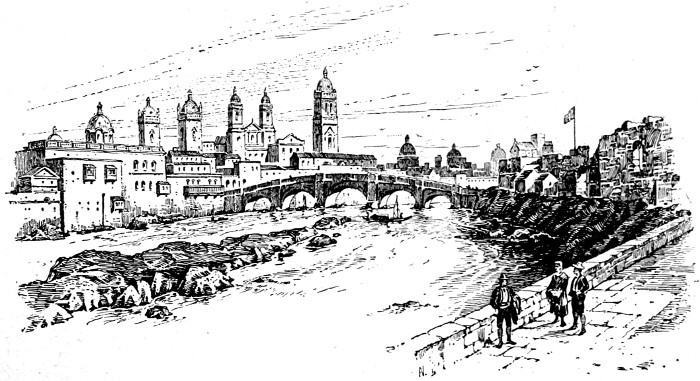
LIMA.
The first Battle of Bull Run.
By Angus Evan Abbott
Major-General Robert Patterson, sixty-nine years old, ripe with experience gained in at least two wars, but burdened it may be with more of the indecision and fears of old age than is the usual lot of man—seeing before him, in fact, bogey numbers of enemies—marched his army one day this way and the next day that; and frittering away the time, at length, instead of fighting, he allowed General Johnston and 9,000 Confederate soldiers to slip quietly away from him. The result was the result to be expected. General Johnston by a rapid march reached General Beauregard’s lines in time to turn the tide of battle in favour of the South, and the first decisive struggle of the American Civil War was scored to the credit of the Confederates.
Four o’clock on the morning of April 12th, 1861, the Civil War began. At that hour a shell fired from a battery on shore struck Fort Sumter, a tiny fort built on a mudbank in the very centre of Charleston harbour; and this shot opened hostilities that were destined to last for years. The next day, Saturday, the news reached Washington that Fort Sumter, in possession of a United States garrison, had been bombarded by Southern militia acting under instructions from the Governor of South Carolina. President Abraham Lincoln realised at once that the time for pacific negotiations had passed and the time for the employment of force had come. On Sunday he drew up his first proclamation relating to the war. It called for 75,000 militia to assemble under arms to “repossess the forts, places, and properties which have been seized from the Union.” In the two days which followed the issue of this call more than double the number of men asked for had volunteered for service. Every Free State in the Union responded with citizens eager to uphold the integrity of the Union. On the other hand, every Slave State insultingly refused her quota of the men required.
But ready and numberless as were the volunteers from the North, the resources of the States in the way of arms and ammunition, officers, and organisation, were utterly inadequate for the crisis. Although by many it had long been feared that the differences between the North and South were being accentuated to a dangerous degree, yet when the worst fears were realised and the actual outbreak of rebellion came, it took the country, as a country, completely by surprise. More than this, it caught those in authority unprepared. So it was that between the firing on Fort Sumter and the first great battle—Bull Run—three months elapsed. Those three months were spent in arming the volunteers—for the United States, then as now, had no standing army to speak of—in organising commissariat and other departments, transporting troops to various centres, and arranging the thousand and one details which, unless carefully attended to, would render the bravest army helpless.
But during the months of April, May, and June the absence of any organised body of opponents in the field allowed much telling work to be done by small parties of Southern soldiers. Unfortunately for the North, Washington, the capital of the Union, was to all intents and purposes within the sphere of Southern influence—on the one side the State of Virginia, among the first States to refuse troops to Abraham Lincoln, and on the other, Maryland, riotous and to all appearances likely to cast in her lot with the rebel States. Federal soldiers on their way to guard the capital were shot and trampled to death in the streets of Baltimore, Maryland, but a few miles north from Washington. On the same day the railway bridges of lines running northward were destroyed, thus completely cutting Washington off from the North. To complete the dangerous position of the capital, a force of Confederate soldiers seized Harper’s Ferry—the Harper’s Ferry of John Brown notoriety—then a famous national arsenal, and there established a Southern camp. Next the important navy yard at Gosport, after the officers in charge had attempted to destroy it by fire, was captured by Southerners; and a number of other important points bearing on the capital city falling into the hands of the Confederates, Washington was surrounded. The battle of Bull Run was brought on by the North with the intention of relieving the capital of the Union by dispersing the enemies that surrounded it.
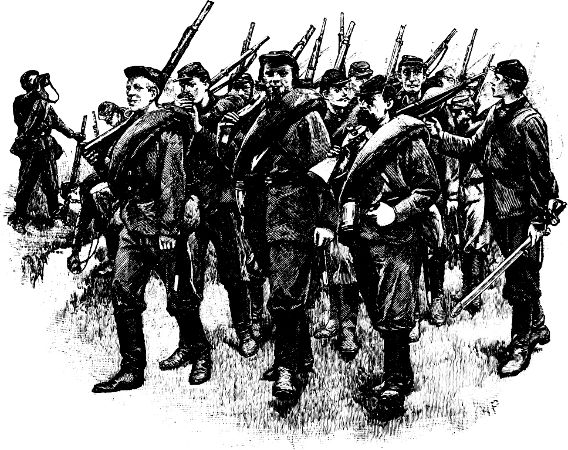
“THEY WOULD NOT KEEP IN RANK, ORDER AS MUCH AS YOU PLEASED” (p. 95).
Bull Run, the stream that gave its name to the battle, is a sluggish, uneven waterway running in a south-easterly direction, and at the point where the engagement took place some five-and-thirty miles from Washington. Its banks are steep and at some places rocky, with heights, densely wooded, on its western shore, and the stream itself deep and sullen, yet at points fordable. A short distance south of Bull Run is Manassas Junction—a railway junction—and here General Beauregard had his headquarters.
Pierre Gustave Toutant Beauregard, born in 1818, was a native of Louisiana, and passed through the United States Military Academy at West Point. Strangely enough, one of his class-mates at the Academy was the Federal general McDowell, who at this battle of Bull Run commanded the Northern forces. Beauregard had served through the Mexican campaign with distinction, taking part in the siege operations at Vera Cruz, and at Mexico he was twice wounded. To him fell the distinction of being chosen to open the war for the South, and it was he who bombarded and finally, captured Fort Sumter.
General Beauregard had assembled a strong force of Confederates at this point with the evident intention of marching upon Washington, but before he was ready to move on the capital, a large army of Northerners managed to reach the city, and Beauregard found his plans defeated. Consequently, he entrenched himself securely and waited for the time to arrive when, sufficient troops furnished him, he could carry out his plan to capture the capital. The position for encampment had been carefully chosen. Along the western bank of Bull Run, from Manassas Junction to a stone bridge some eight miles up stream, the Southern forces were posted, each ford strongly guarded, the rocky banks and the deep water forming a natural breastwork, and the dense woods a natural stockade. Across Bull Run, a few miles towards Washington, is the village of Centreville, and here the advance guards, or more properly, a scouting party, was stationed to give news of any movement that might be made by the North; and, central and convenient, the headquarters at Manassas commanded the whole.
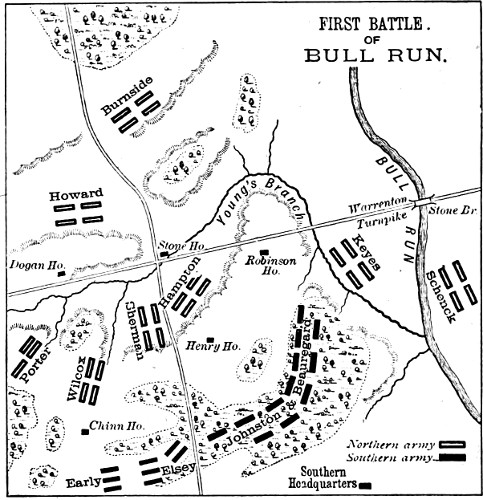
FIRST BATTLE OF BULL RUN.
POSITION OF THE FORCES AT NOON.
Woods, stream, and rolling country made General Beauregard’s position a peculiarly strong one. In fact, as General McDowell, the commander of the forces of the North, soon found, the position was well-nigh invulnerable. To attack the Confederates in front, fording Bull Run, scaling the high bank and charging into a wood, was out of the question. Moreover, to strengthen Beauregard’s hands, General J. E. Johnston, a soldier of energy and experience, was stationed at Winchester, to which town he had retreated from Harper’s Ferry when he found himself confronted by General Patterson. General Patterson’s orders from Washington were to retake Harper’s Ferry from General Johnston. But the Southern general, fully convinced that Harper’s Ferry was of no strategical importance, and more of a trap than anything else, fell back at Patterson’s approach, and entrenched himself at Winchester. To the Federals the great danger lay in the risk of Johnston by a forced march joining Beauregard, and opposing a united force to McDowell. To prevent this, General Patterson’s second orders were to hold Johnston in Winchester. Patterson had plenty of men for the purpose, but failed to do what was expected of him. When the crucial moment arrived, Johnston arrived with it and ruined McDowell’s chance of victory.
McDowell marched from Washington. It had originally been General Scott’s intention to give the command of the Federal forces to Robert E. Lee; but that officer, destined to become the most famous general of the South, resigned his position, and journeying south, took charge of the raising of Confederate soldiers. McDowell, however, was an officer in every way competent to worthily represent the North.
A civil war makes strange opponents. Men hitherto the closest friends, found themselves divided, friends still, but facing one another on the field of battle, and fighting to the death for what each considered the right. This curious division affected officers and men alike. In fact, a large majority of the officers who, at the outbreak of hostilities found themselves in charge of the newly-enlisted regiments, had been educated together at West Point, and together received their baptism of fire and learned what real war meant under the sweltering sun of Mexico. General Irvin McDowell, as has been told, stood side by side with General Beauregard at West Point, and side by side with him on the battle-fields of Mexico. For some years he acted as assistant-instructor in infantry tactics in the Military Academy, and when war broke out he was relieved of his duties in the Adjutant-General’s Department at Washington, and placed in command of the Army of the Potomac, now on its way to Bull Run.
When he set out from Washington he carried with him full instructions and the confidence of all concerned. Never was a battle more carefully planned. Every move likely to take place had been canvassed and discussed, President Lincoln and General Scott giving their personal consideration and assistance to McDowell. When the latter marched away at the head of his 30,000 men, it was thought that he had nothing to do but to act quickly and victory must rest with him. General Sherman afterwards said that Bull Run was one of the best planned and one of the worst fought battles of the Civil War.
On July 16th McDowell issued his orders to march. J. G. Nicolay, who was private secretary to Lincoln, gives this as the organisation of McDowell’s army:—
“First Division, commanded by Tyler: an aggregate of 9,936 men, divided into four brigades, respectively under Keyes, Schenck, Sherman, and Richardson.
“Second Division, commanded by Hunter: an aggregate of 2,648 men, divided into two brigades, under Porter and Burnside.
“Third division, commanded by Heintzelman: an aggregate of 9,777 men, divided into three brigades, under Franklin, Wilcox, and Howard.
“Fourth Division, commanded by Runyon: an aggregate of 5,752 men; no brigade commanders.
“Fifth Division, commanded by Miles: an aggregate of 6,207 men, divided into two brigades, under Blenker and Davies.”
From these figures, it will be seen that McDowell marched with more than 34,000 men. But as Runyon’s division was left to guard communications, and as some days before the fight a number of the volunteers were mustered out, their three months’ time having expired, defections left the Federal general in command of something like 28,000 men to meet an equal or larger number of Confederates, entrenched, as we have seen, in a strong position, and fully prepared for a stubborn fight.
When the news flashed across the length and breadth of the great continent that at last a Northern army was to attack the South, the question on everybody’s lips was “How will the American fight?” McDowell, in his army of 30,000, had but 800 regulars—the rest were volunteers who had never been trained to war. Raw, inexperienced, undisciplined, gathered from the four corners of the continent: rugged bushmen from the backwoods of Michigan, rough and restless men, hunters born and bred every one, marching side by side with workers from the Pennsylvania mines and New York factory hands; carters from Philadelphia and Chicago, farmers from Ohio and Illinois, clerks from Buffalo and Boston, all untried and untrained, having volunteered for what the most of them looked upon as a jaunt and picnic in the South, with, maybe, a little shooting by the way—all trudged merrily along under the sweltering July sun, joking and playing pranks as they turned their faces to the South, and paying but small heed to their officers’ attempts to keep them in order. McDowell, writing of this march to Bull Run, tells many strange things. He says that the advance was rendered tediously slow by the “fooling” of the men on the march. “They stopped every moment to pick blackberries or to get water; they would not keep in rank, order as much as you pleased; when they came where water was fresh, they would pour the old water out of their canteens, and fill them with fresh water. They were not used to denying themselves much; they were not used to journeys on foot.” Before the long war was ended the troops became very used indeed to denying themselves much, and to weary journeys on foot.
On Thursday, July 18th, Tyler, commanding the first division, moved warily on Centreville, only to find that the Confederates stationed there showed no disposition to fight, but that they fell rapidly back towards Bull Run. This being so, on towards Bull Run Tyler continued his march, his orders being to carefully observe roads, positions, and lay of the land, but under no circumstances to engage in battle. He was to scout, to gather information for future use. But Tyler’s enthusiasm got the better of his discretion, and, it is feared, caused him to forget his orders. He had seen the Confederates retreat before him from Centreville, as though fearing to fight, and then a temptation was thrown in his way in the shape of a favourable position for a battery from which a few shells could be dropped on the enemy. He planted a battery, and fired on a Confederate battery still on the Centreville side of Bull Run. The Southerners retired to Blackburn’s Ford, and Tyler threw forward skirmishers against the Confederate skirmishers, and these getting into a hot exchange, Tyler was soon forced to bring forward a brigade, and then a second; and almost before he knew what was happening he found his battery and his men in a trap. Before he managed to bring away his battery and withdraw his men, he lost close upon a hundred killed, and his soldiers retired in confusion, the officers chagrined over the first serious check of the war.
But disastrous as was this the first skirmish of Bull Run to the Northern cause, it on the other hand exposed to General McDowell the position of the Confederates, and showed to him the hopelessness of an attack in front. McDowell’s first plan of battle, perfected at Washington, was to make a vigorous attack on Beauregard’s front, and when this action raged, to cross Bull Run lower down, and while the Confederates were concerned about the safety of their van to fall unexpectedly upon Beauregard’s right and turn it. A personal reconnaissance, made at the moment of Tyler’s unfortunate experiment, proved to McDowell that this plan could not be carried out. The ground on Beauregard’s right was totally unsuited to the job. High hills, densely wooded and strongly held, rendered the scheme clearly unfeasible. Some other plan must be devised. He rode to Centreville with all speed, and there Tyler and his officers reported rifle-its and strong barricades, natural and artificial, in front of every ford, the one bridge spanning the stream strongly guarded and prepared for blowing up if need be, and not the slightest chance of his untrained soldiers carrying the position. These reports convinced McDowell that only a demonstration must be made in front, and his whole energies applied to reaching the southern side of Bull Run, and fighting the battle across fields instead of across deep water. Richardson’s brigade was ordered forward to continue the menace at Blackburn’s Ford, and the engineers were sent up stream to survey Bull Run for a ford. But a ford they were unable to find until Saturday, and the battle of Bull Run could not be fought before Sunday, July 21st. A fatal delay this proved to be. News of Tyler’s engagement at Blackburn’s Ford on the Thursday reached Johnston at Winchester, and that energetic officer, seeing that a general action must soon take place, slipped away from the aged General Patterson, and by a forced march through Ashby’s Gap of the Blue Ridge, he took train at Piedmont and marched most of his men into Beauregard’s camp on Saturday evening. One of his companies, indeed, did not arrive until Sunday afternoon, when by falling upon the Federals’ right, it gave the first intimation to McDowell that Johnston had given Patterson the slip.
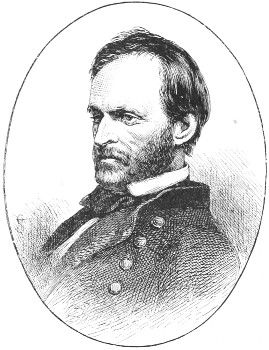
GENERAL SHERMAN.
A close, hot night preceded the eventful day. A mist, such as is so often seen on sultry nights in America, hung over the valley of Bull Run, blurring everything into a grey, indistinguishable mass, notwithstanding that the moon shone brightly. Shortly after midnight the Northern army bestirred itself to begin the work that lay before it. Tyler’s orders were to get away early from Centreville and to commence a hot attack on the stone bridge, as if it were McDowell’s intent to force his way across the stream at that point. As soon as Tyler and his men cleared the camp at Centreville, Hunter and Heintzelman were to march rapidly to the ford which the engineers had located, cross, and at the topmost speed consistent with a good formation advance upon Beauregard’s left, fall upon the rear of the defenders of the stone bridge and clear them away, and so allow Tyler to cross and join forces. McDowell hoped in this way not only to disorganise the Confederate arrangements, but also to prevent any chance of Johnston from Winchester joining Beauregard. He had no idea that Johnston had already effected the juncture. The Northern men, new to war, turned but drowsily from their sleep. It was night, and, unused to the necessity of quick and silent action, the men delayed and refused to be hurried. Consequently, before Tyler had got his men out of the way of Hunter, the hour for moving had long since passed. Tyler intended to attack the stone bridge at four in the morning. It was not until six that he fired his first gun. Hunter and Heintzelman were proportionately delayed.
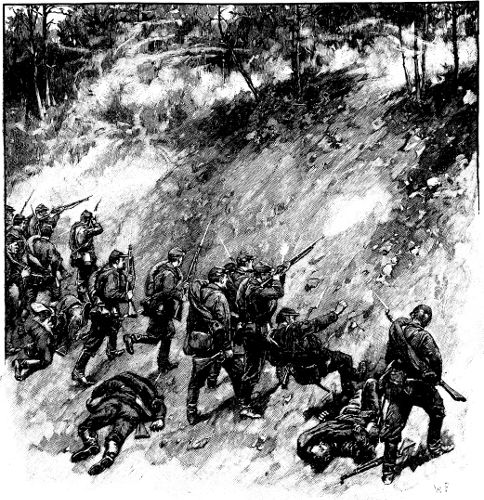
“TIME AFTER TIME THE ATTEMPT TO SCALE THE HEIGHT WAS MADE” (p. 99).
Strange to tell, it was Johnston’s intention to attack McDowell that very morning. This General Joseph Eggleston Johnston—Beauregard’s superior in rank, and an officer of energy, foresight, and initiative, fifty-four years old—besides having served through the war with Mexico, had seen much fighting with the Red Indians in many parts of America; and, as never were trickier fighters alive than the Red men, Johnston’s wits had been sharpened to a wonderful degree by his border experiences. He suffered desperate wounds at Cerro Gordo, and again at Chapultepec, was particularly active at Vera Cruz and in half-a-dozen battles in Mexico, and at the very outbreak of the Civil War captured Harper’s Ferry. In withdrawing his forces from Winchester to Bull Run—successfully outwitting General Patterson—he gave early proof of his skill in handling large bodies of men and readiness in rising to the occasion. He and Beauregard had planned on Saturday night to bring about a battle before it would be possible for General Patterson from Harper’s Ferry to join with McDowell, which, Johnston felt convinced, Patterson would hasten to do when he found that the Confederates had marched away from him. Johnston had already given the orders for an attack on McDowell, when the guns thundered out from the stone bridge. Instantly General Johnston countermanded the order to advance. As McDowell had begun the attack, it were better to fight the battle with all the advantages Bull Run gave to the South. He awaited developments.
Colonel Evans held the stone bridge for the Confederates. He had with him, behind the timber abattis, a regiment and a half and four guns; and when Tyler opened fire it seemed to him that a determined attempt would be made to force his position, and he prepared to hold it at all hazards. But after the fighting had lasted a short time, it occurred to Evans that the attack was conducted with nothing like the vigour he would have expected under the circumstances, and he cast about him for an explanation. An explanation was not long in coming. Scouts hurrying from the wood to his left told him that a large force of men had forded Bull Run some miles above the stone bridge and were marching to fall upon his rear. Without a moment’s hesitation, and waiting for no orders, Evans, leaving four companies with two guns to hold the bridge, posted the remainder of his men in as favourable a position to resist attack as he could come upon in the limited time at his disposal. When Hunter emerged from the wood, at ten o’clock in the morning, he found that his advance had been made known, and that there was now no chance of taking the Confederates by surprise.
First began an artillery duel. The sound of guns on his side of Bull Run told Johnston that the Federals had crossed the stream and had attacked his left. He hurried General Bee with four regiments and two companies to the support of Evans, already sorely pressed. Next Heintzelman, having now safely crossed the stream, came at the double-quick with a regiment to the assistance of Hunter, and joining forces, bore down upon the Southern lines. The front of battle at once changed from Bull Run stream to what had been the Confederates’ left.
And now began the battle proper. The men who, a few hours before had refused discipline and disregarded orders from whatever quarter given, at last, within shot of the enemy, faced the situation seriously and fought well. With now the advantage of position and numbers, the men from the North drove the Southerners steadily down the hill, the Confederates fighting every inch of the way with that fiery courage that distinguished them all through the war. Every fence, house, and wood, every hillock, every stone on the way, every hollow and every ditch, was made a standing-place by the South, and tenaciously held to as long as mortal could endure the hail of bullets and crash of cannon-ball. But the Federals fought splendidly, and carried position after position with the courage and dash of veterans. McDowell, coming upon the scene of action at this point, hurried word to Tyler to press his attack upon the stone bridge. This Tyler did not do, but instead, fording Bull Run a short distance above the bridge, came upon the rear of the defenders and swept them away from their stronghold. Then, marching towards the sound of the fighting, he safely joined his commander-in-chief. At noon McDowell had the satisfaction of knowing that not a hitch had taken place in his plans. The bridge had been cleared, the Confederates’ left turned, and his men had driven the enemy down the hillside, over a creek, across the valley, and up into a wood. The morning’s work was all the North could desire. Everything pointed to a Northern victory, full and complete.
Johnston and Beauregard now found a difficult task before them. Their men, numbers of them thinking all lost, were hurrying to the rear in dire confusion, throwing away their arms and accoutrements as they ran. Many companies were entirely disorganised, and others cut to pieces in the fight. But the two Southern generals, riding to the front, personally supervised the re-formation of the lines. On top of the hills up which the Confederates had been forced was a large plateau, thickly wooded, and on this plateau the generals checked the retreat, and swung their disorganised regiments into line. Early’s Brigade formed the left flank, and faced Wilcox and Porter, Elzey’s fronted Sherman, and Hampton lay nearest to Bull Run. The Confederate position for the renewal of the fight was clearly a strong one. Down in the valley lay the Federals. To reach the Southerners, they must charge up a hill and into a dense wood. This proved altogether too difficult a task. Sherman said afterwards that had McDowell ignored the partially defeated and strongly entrenched army of the South, and, instead of attempting to carry the plateau, marched around the hill and captured the enemy’s headquarters, Manassas Junction, the Southerners would have been defeated by the very act. But probably neither McDowell nor Sherman thought of this at the time. The order was to further rout the apparently routed, and the Federals dashed themselves to pieces in the attempt. When Johnston and Beauregard got their men ready, the latter took personal command, and Johnston—superior in rank—hastened to headquarters to superintend the whole.
The battle of the afternoon was a battle of hopeless confusion. No two on the Federal side could afterwards agree as to what had taken place. The want of cohesion, of discipline; the rawness of the troops, the ignorance and lack of executive ability on the part of the officers, added to the disadvantageous position, soon brought the army of the North into a state of helpless chaos. The Confederates, strongly situated, lay quietly in the wood firing grimly down the hill. When the Northerners were first ordered to charge, they did so with determination; but scarcely had they advanced a few hundred feet than they came under an appalling fire, volley after volley sweeping down the steep incline. Time after time the attempt to scale the height was made; and the right did at one time gain a footing, but to no purpose. It was a hopeless task from the first.
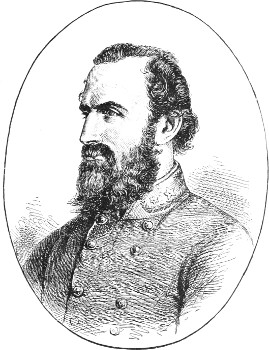
GENERAL “STONEWALL” JACKSON.
In the woods on top of the plateau lay Thomas Jonathan Jackson and his men. Jackson was of English descent, and having been left an orphan at seven, he grew to manhood on a rough farm in Western Virginia, joined the army, fought in Mexico, and after teaching school was with Johnston at Harper’s Ferry. Jackson’s brigade was the first to get into position and check the advance of the Federals, the panic-stricken Southerners rallying upon his line. During the crisis, General Bee, rallying his men, shouted: “See; there is Jackson, standing like a stone wall. Rally on the Virginians.” Immediately afterwards General Bee was shot dead; but the nickname “Stonewall” stuck to Jackson, and became probably the most familiar nickname of the war.
To the Confederate left stood Henry House. Built on a knoll, it commanded the whole field of action, and here McDowell deemed it important to plant a battery. To this ground two batteries were sent, and Ellsworth’s Zouaves ordered to support them. In making their way to the position the officers of the Zouaves mistook an Alabama regiment for a Northern one, and did not find out their mistake until they had exposed their men to a fire that wiped the regiment out of existence. Another and another regiment was sent to the support of the battery, and the battle raged its wildest around the knoll at Henry House. Keyes, on the right, after a successful charge was driven back, Sherman in the centre charged again and again up the hill, each charge only resulting in a heavier loss, and the batteries at Henry House were taken and retaken time and time again. As the afternoon grew older, confusion gradually settled on the Northern lines. Companies beaten back from the brow of the hill got mixed with companies charging up the hill; men lost their officers and officers their companies, until after a few hours’ fighting all was confusion, and the Northern army, victorious as it seemed a little earlier in the day, degenerated into a mob of struggling men, into which the South continued to pour a merciless fire.
Just when the army had been reduced to this pitiable state of confusion, a body of close upon two thousand fresh men came hurrying across the fields to take part in the conflict. They were the last arrivals from Winchester, Johnston’s men, who hearing the roar of battle, stopped their train at the nearest point to the scene of action, and running as fast as legs could carry poured a volley into the Federals’ right. This proved to be the last straw. Raising the cry: “Here’s Johnston from the valley!” the army of the North broke and fled panic-stricken across Bull Run, along the turnpike to Centreville and on to Washington, to let the President and the people of the North know that an appalling disaster had befallen the Federal cause. General McDowell tried his utmost to stay the flight, but to no purpose. It was every man for himself, and never was rout more complete.
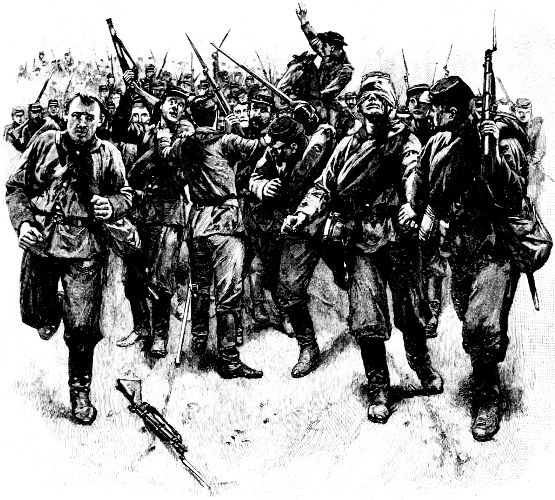
“THE ARMY OF THE NORTH BROKE AND FLED PANIC-STRICKEN.”
When the sum of battle came to be reckoned, it was found that the North had 481 men killed, 1,011 men wounded, and 1,461 taken prisoners; while the Southern loss was 387 killed and 1,582 wounded.
Public opinion held General McDowell responsible for the crushing defeat, and as a consequence he was superseded in his command by General McClellan; and although a capable and honourable officer, he played no great part in the subsequent events of the war. The first battle of Bull Run brought the seriousness of the situation vividly to the minds of the people of the North, and showed how fatally the position had been underestimated by everyone from President to peasant.
THE JULY BATTLES BEFORE PLEVNA
BY ARCHIBALD FORBES
In the early days of July, 1877, the soldiers of the Tzar were jubilant. So early as April Russian army-corps after army-corps had come tramping across the Pruth into Roumania, and in May the Danubian Principalities swarmed with sturdy Russian soldiers along the left bank of the great river, from Galatz on the east to Kalafat on the west. They gazed eagerly across the brown water of the Danube to the precipitous Bulgarian bank on the further side, but had to wait impatiently until the falling of the river gave them the opportunity for which they craved so ardently. At length, however, they had effected the crossing of the Danube from Simnitza to Sistova and from Braila to Matchin, and the whole Russian army was now on Turkish soil. By the middle of the month Gourko was beyond the Balkans on that adventurous raid of his which spread panic from Hankioj to Constantinople. “Hey for Adrianople!” was the hilarious and confident shout, as army-corps after army-corps started on the enterprise which seemed so ridiculously easy. Princes and staff-officers betted with each other in hundreds of dingy paper-roubles as to the day on which they would dine in Stamboul.
The route which the main advance over the Balkans was to take was by Tirnova and the Shipka Pass, and thence on Adrianople through the rose-gardens of Kazanlik and down the beautiful valley of the Tundja. Two corps had been sent to the left to protect the advance from the Turks holding the Bulgarian quadrilateral. Old Krüdener, the chief of the 9th Corps, had been sent off to the right, with the airy order to storm the fortress of Nicopolis and then to march to the Balkans without delay, leaving as he passed detachments in Plevna and Loftcha for the protection of the right wing, and to cross the great range into Roumelia by the Trajan Pass. “Grandfather” Krüdener, grimmest and toughest of warriors, began handsomely. He so smothered with shell-fire the obsolete and crumbling fortress of Nicopolis, that after two days’ endurance of the Russian cannonade the garrison capitulated. It was quick work, and there were not wanting hints that he had backed his shell-fire by a bribe to the pasha in command. Anyhow, Krüdener scored, when on the 17th there surrendered to him 7,000 men, including the pasha—the cost of the triumph 1,300 Russians killed and wounded, and the trophies of it, among other things, six flags and 110 guns.
FIRST BATTLE OF PLEVNA, JULY 20TH.
Next day the Grand Duke Nicolas telegraphed to Krüdener to “occupy Plevna as promptly as possible.” That smart old warrior had anticipated this order by pushing out towards Plevna, which is about twenty miles south-east of Nicopolis, an infantry regiment and the brigade of Caucasian Cossacks, and on the same day moved out General Schilder-Schuldner with an infantry brigade. In all this there was no apprehension in regard to Plevna; the order and movements just mentioned were simply in the line of fulfilment of the original instructions that Krüdener should hasten to cross the Balkans by the Trajan Pass.
But no Russian troops were to enter Plevna for six long months to come. Osman Pasha, whose fame was soon to ring through Europe, was on the march down the Bulgarian bank of the Danube from Widdin, with an army of 40,000 of the best troops in Turkey. Learning that the Russians had already crossed the Danube, he had turned inland, reached Plevna on the 17th, and, recognising the strategical and defensive characteristics of the place and its immediate surroundings, settled himself there, and promptly set about throwing up a line of entrenchments along the northern ridge from the village of Bukova eastward to the site of the subsequently famous Grivitza redoubt.
In utter ignorance that Plevna was already in Osman’s occupation, Schilder-Schuldner advanced in its direction without the commonest precautions. He made no reconnaissances, for he had no cavalry with his main body; and the result of this stupid neglect was that, as he was unconcernedly crossing the Verbitza heights, he was suddenly halted by Turkish artillery fire from the Grivitza ridge. He had already sent the Kostroma regiment eastward to Zgalevitza, and the Caucasian brigade to Tutchenitza, actually south-east of Plevna. The disposal of his little force by Schilder-Schuldner for the night of the 19th July was a lively instance of an almost comic inability how to make war. His troops—6,500 men all told, with forty-six guns—were distributed over a distance of seventeen miles. Osman Pasha must have smiled as he posted his 40,000 men and ninety guns in the shelter-trenches and battery-emplacements with which his northern and eastern front was already garnished. Schilder-Schuldner scouted the suggestion that he should wait for reinforcements. No! He had his orders to attack on the morning of the 20th; he had always obeyed orders, and he meant to do so now!
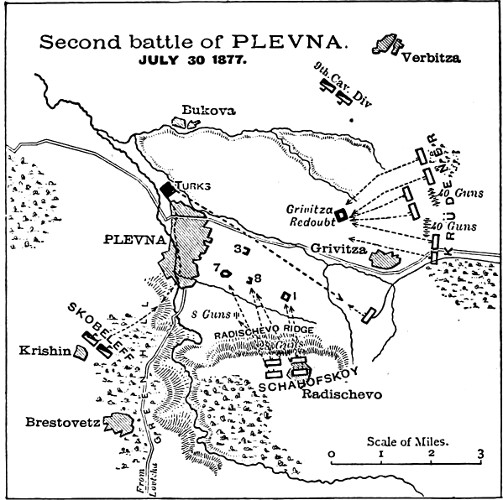
Second battle of PLEVNA.
July 30th 1877.
PLEVNA: THE POSITION OF THE RUSSIANS.
Accordingly, at daybreak of that morning, he moved forward from Riben, three batteries in the centre, a regiment on either flank. After an hour’s cannonade, the troops moved forward and assailed the Grivitza heights. The western extremity of the trenches was carried after a desperate struggle, in which both sides freely used the bayonet. The Vologda regiment, with part of the Archangel regiment on its left, notwithstanding a withering fire from the Turkish shelter-trenches, was able to continue the advance; and, after repelling a succession of attacks made by Turkish battalions, the Vologdas and Archangels fought their way to the northern outskirts of Plevna, where, at seven o’clock, they were brought to a halt by a very hot fire from behind the hedges and ditches on the edge of the town. They nevertheless hung on here for some hours, fighting hard and losing heavily, until about eleven o’clock they received the order to withdraw.
The Kostroma regiment, coming from Zgalevitza, advanced from the south-east on the Grivitza position, where the subsequently famous redoubt had as yet scarcely been traced, and after a short cannonade delivered its assault in columns of companies. Over and over again the successive tiers of trenches were taken and retaken at the point of the bayonet and with cruel slaughter. A moment’s hesitation in front of the last and strongest line of defence ended in the breaking up of the regiment into small columns of attack. The lines of those columns were strewn with dead and wounded, and all the superior officers went down. There was, therefore, no one who could order a retreat, and the troops charged forward under the command of a simple lieutenant, and finally carried the last Turkish entrenchment. They then chased the Turks right up to the edge of the town, where the latter found prepared positions in the gardens and houses of the eastern suburb, whence a cross-fire of artillery caused terrible losses in the Kostroma ranks. These losses, the exhaustion of ammunition, and the lack of reserves compelled its reluctant retreat, which was followed by heavy swarms of Turkish skirmishers and by volley after volley of artillery.
The Russian troops had been engaged to the last man for hours, and were worn out with their exertions. A general retreat was, therefore, wisely ordered at about noon; but in effecting it heavy losses were sustained by the sallies made by the Turks, who, however, did not pursue beyond their trenches. The Russians left on the field all their dead and most of their wounded, as well as two guns, twenty ammunition waggons, and all the baggage of the Kostroma regiment. Their losses were close on 3,000 men; nearly two-thirds of the officers and over one-third of the men were hors de combat. There are no data from which to estimate the Turkish loss. The Russians reckoned it about 4,000; the Swiss writer Le Compte calls it “about 200”—a wide discrepancy indeed. The Russian army was furious against Schilder-Schuldner, and there was a great clamour for a court-martial; but he was not even called upon to resign, and he blundered cheerfully along to the very end of the campaign. There is no need to point out his faults and errors. Without having learned anything about the strength or position of the enemy, and with no reserves, he sent his troops blindly to the assault in two lines which had no communication with each other, and against an enemy more than four times their own strength. He had the doubtful and dangerous virtue of acting on his orders to their very letter. True, that is one way of avoiding responsibility.
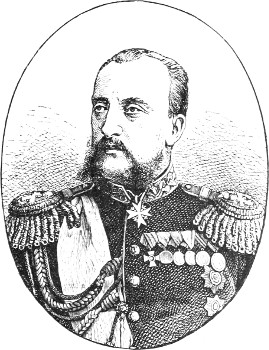
GRAND DUKE NICOLAS.
THE SECOND BATTLE OF PLEVNA, JULY 30TH.
The Grand Duke Nicolas, commander-in-chief of the Russian armies in Bulgaria, was an obstinate and narrow-minded man. He would not believe that the Turks were in force in Plevna, notwithstanding the crushing defeat which Schilder-Schuldner had received on July 20th. He would not take the trouble to come down from Tirnova to the Plevna front, contenting himself with ordering Krüdener to make a renewed attack on Plevna with his own corps (the 9th), strengthened by the addition of an infantry and a cavalry brigade from the 11th corps, under the command of Lieutenant-General Prince Schahofskoy, and of the 30th division (4th corps), which had just crossed the Danube. Krüdener had reconnoitred the Plevna position with great care; and on account of its natural strength and the force of the enemy, which he estimated at not less than 50,000 men, he did not at all fancy the task laid upon him. He had even ventured to remonstrate against the risk of failure which he apprehended; but he received a peremptory and even angry order from the Grand Duke to obey orders without delay, and not bother the headquarters with any more querulous croaking. Krüdener now became furious; he had the full belief that with 30,000 men in the open field against 50,000 in a strong fortified position, he was bound to be beaten disastrously, a belief which the event justified—but he was resolved to put in his last man, and as regarded himself he would rather prefer that he did not come out of the business alive. Throughout the Russian camp there was little of that excitement of anticipation which had been manifest on the evening before the crossing of the Danube. The Russian officer, subject of a despot though he is, has a habit of speaking his mind; and on the eve of this battle the ears of the Grand Duke Nicolas would have tingled had he heard the comments made upon him. Meanwhile the Turks were working with the utmost diligence upon their fortifications, confident that they would be again attacked in the course of a few days. By the 30th, the day of the battle, the Grivitza redoubt and four redoubts of the “middle group” east of Plevna were in condition for defence.
Krüdener was in chief command of the assailing forces. His orders for the 30th were that the troops of his own corps, forming the right wing, should advance to the attack of the Grivitza redoubt and the adjacent positions on the northern heights, the 31st division to lead, the 5th to follow in support; and that the left wing under Schahofskoy, consisting of two infantry brigades, should occupy the Radischevo ridge to the south-east of Plevna, and assail the redoubts of the “middle group” on the lower swell, due east of the town. Krüdener’s whole army was a little over 30,000 men, consisting of 36 battalions, 30 squadrons, and 176 guns; of which 24 battalions, 110 guns, and 10 squadrons belonged to his own (the right) wing, 11 battalions, 54 guns, and 8 squadrons constituted Schahofskoy’s (the left) wing, and 1 battalion, 12 guns, and 12 squadrons was Skobeleff’s detached command on the extreme left. The main fault of the dispositions was that Krüdener and Schahofskoy were practically independent of each other, so that the two attacks were far apart and with no connecting link; but the gravest evil was the weakness of the assailing force. The key of the Turkish position was the Grivitza redoubt.
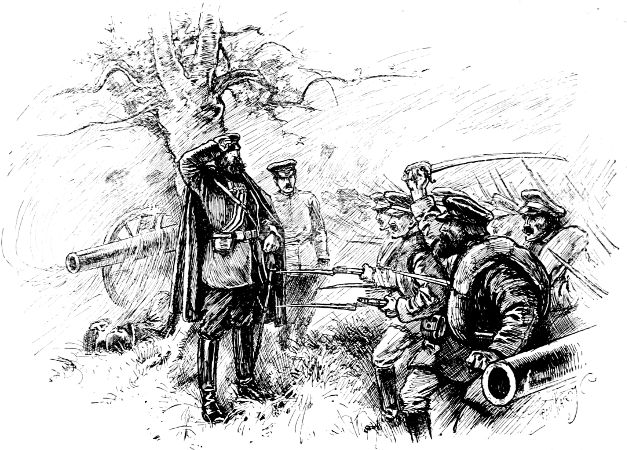
“THE GENERAL HAD RISEN, AND WAS STANDING AGAINST A TREE” (p. 106).
Schahofskoy’s advance from Poradim began at 6 a.m. As the infantry went swinging past their general, they cheered vigorously, and seemed ready for anything. After a two-hours’ march the head of the column reached the upland in front of Pelischat, whence the whole Plevna region lay before it. The headquarter stood temporarily halted near the apex of a great horse-shoe, closed in at the heel by a wooded valley running north and south, in the centre of which lay the town of Plevna, its white minarets, on which the sun was shining, visible above the encircling trees. On the long ridge forming the northern section of the horse-shoe were discernible the tents of the Turkish camps, and on its nearer shoulder lay the Grivitza redoubt, of which later the world was to hear so much. Now it did not seem very formidable—merely a rough parallelogram—all of defence visible being a bank of earth with a ditch at its outer foot, a few guns here and there, and a good many Turks inside the work. To his left front, as Schahofskoy looked toward Plevna, he saw the long ridge of Radischevo, forming the southern edge of the horse-shoe, and the valley behind it into which his advance troops were already moving.
Some of the gay young officers of Schahofskoy’s staff would have it that slow old Krüdener had not yet got out of bed. But the old warrior was wide awake and well to the front. About 9 a.m. the Turkish guns opened fire on him from the Grivitza redoubt. Answering smoke rose to the eastward, and the cannon thunder came booming down on the wind.
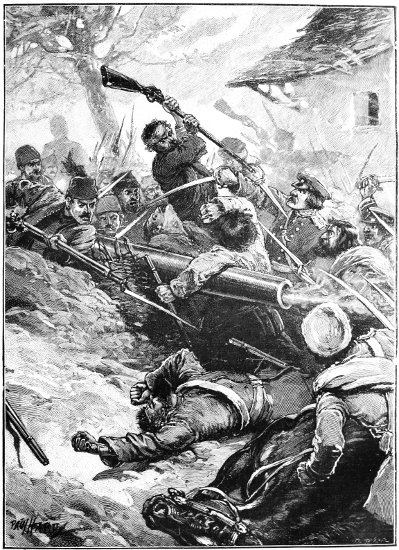
“THEN THERE FOLLOWED A HEADLONG RUSH” (p. 107).
Krüdener’s guns were in action, playing fiercely on the Grivitza redoubt. The artillery duel between the Turks and Krüdener lasted until after two p.m. Then the Russian, infantry were sent forward to the attack. The brave Penza regiment led the way. Its first battalion carried the first line of trenches, a thousand yards north-east of the redoubt; the second line was carried by the second battalion, and the two battalions drove the Turks at the bayonet point across the intervening ravine, when three companies made a rush for the redoubt and actually reached the parapet, where, however, all perished. In a few minutes, so fierce was the Turkish fire, the three Penza battalions lost thirty officers and 1,006 men—half their officers and more than one-third of the men. Officers of the two regiments in reserve, looking through their telescopes, swore that they saw the blood of the Penzas flowing in streams down the outer face of the parapet of the Turkish redoubt. The Kosloff regiment followed the Penzas up to the second line, and a few men of it did reach the redoubt, but only to meet their death. Then the supports, consisting of the 17th and 18th regiments, made their effort, only to fail; the bitter and steadfast rifle from the redoubt struck them down by ranks. The left column, the Tamboff and Galitz regiments, tried to storm the southern face of the redoubt, but only filled with their dead bodies the outlying trenches. At sundown the stubborn Krüdener gave orders for a final general assault. It was made with such desperation that a general officer was killed within a few paces of the redoubt; but the attack utterly failed with terrible slaughter. Then Krüdener gave the order to retire; but so maddened were the troops that the fighting lasted all night, and the withdrawal was not completed till after daybreak of the 31st. In fine, the attack of the right wing had been an utter and bloody failure.
On the left wing, about ten a.m., Schahofskoy sent twenty-eight guns up on to the crest of the Radischevo ridge, which promptly opened fire on the Turkish positions of the “middle group,” whence a fire was as promptly returned. The infantry moved forward into the valley in rear and into the glades about the village of Radischevo, about which were falling many Turkish shells which had flown over the ridge crowned by the Russian artillery. It was strange to witness the peasant villagers standing in scared groups in front of their cottages, shuddering as the shells crashed into the place, while the children were playing about the dust heaps without any sense of their danger. A couple of correspondents, leaving their horses in the village, went up to the storm-swept crest where the Russian batteries were in action, and lay down between two guns to watch the scene. From their point of vantage they looked right down into the Turkish positions. Several guns in an earthwork (Redoubt No. 1) about a hamlet or farmhouse, which seemed the most advanced of the Turkish works on the central elevation, were vigorously replying to the Russian fire. On its right were three more redoubts reaching backward to the edge of the valley in which the roofs and spires of Plevna sparkled in the sunshine from out the cincture of verdure. The place seemed so near that a short ride might bring one there to a sorely needed breakfast; but thousands of men were to die and many months were to elapse before Plevna should be accessible to others than Turks. As the watchers lay by the guns men were falling fast around them; for the elevated position was greatly exposed and the Turkish practice was most uncomfortably true.
Two o’clock came. Schahofskoy rode up the slope from the village to see for himself from the crest how things were going. As he reached the sky line the Turks marked the mounted group, and a volley of shell-fire was directed upon it. Schahofskoy promptly rolled out of the saddle and crept forward to where the two correspondents were squatting. His eyes were blazing and his face was flushed, as he swore most vigorously in the colloquial Russian of the common soldier. He looked at his watch; it was a few minutes past two. Krüdener seemed, after all these long hours, to be making no headway. Schahofskoy in his impatience threw his orders to the wind and determined to act independently. He turned to his Chief of Staff and shouted, “Bring up the 125th and 126th regiments at once! Quick!” These were his own two regiments which had accompanied him from the foot of the Balkans. General Tchekoff, the brigade commander, came up the slope at a canter and told the Prince the two regiments were following close. They came up with swift swinging stride and deployed just before reaching the crest, breaking to pass through the intervals between the guns. The General had risen, and was standing against a tree saluting his soldiers as they streamed past him. His guns recommenced firing as soon as the infantrymen were descending the further slope, and continued their fire while the regiments were crossing the intervening hollow to the assault of the Turkish positions. The Turkish shells crashed through the ranks as the regiments pressed forward; men were already down in numbers, but the long, undulating line pushed through the undergrowth of the descent and then tramped steadily over the stubble-fields below. No skirmishing line was thrown out in advance. The fighting line retained its formation for a time till, what with eagerness and what with men falling, it broke into a ragged spray of humanity and surged on swiftly, but with no close cohesion. It was a rush of vehement fighting-men on which the spectators looked down with eyes intent—a helter-skelter of men impelled by a burning ardour to get forward and come to close quarters with the enemy calmly firing upon them from behind the shelter of his earthworks. The Turkish position was neared; and now men held their breath. The crackle of the musketry fire rose in a sharp continuous peal. The clamour of the cheering of the fighting-men came back on the wind, making the blood tingle with excitement. The wounded were beginning to withdraw, limping and groaning; the dead and the more severely wounded lay where they fell among the stubbles and amidst the maize. The living wave of fighting-men was pouring over them ever on and on. Suddenly the disconnected men were drawing together, the officers signalling for the concentration by the waving of their swords. Then there followed a headlong rush, led by a brave colonel. The Turks in the shelter trench held their ground, firing steadily and with terrible effect into the advancing assailants. The colonel staggered a few paces and then fell—he was a dead man.
His men, bayonets at the charge, rushed to avenge their gallant dead leader. They were over the shelter trench and over the parapet, and then down in among the Turks like an avalanche. The first redoubt was thus taken; but the Turks had got away ten guns; leaving only two in Russian hands. The captured redoubt was No. 1, which had fallen to the 126th regiment, the right regiment of Schahofskoy’s first line. His left regiment, the 125th, was advancing simultaneously on Redoubt No. 8, about midway between No. 1 and Plevna, but No. 8 was much the stronger, an isolated mamelon with batteries on the rearward slope. Schahofskoy sent forward to No. 1 two batteries and two battalions, and a third battalion to strengthen his left flank, and then he ordered both his front line regiments to converge on redoubt No. 8 and to carry it, no matter at what cost. One could see through the glass Turkish officers on horseback standing behind its parapet and watching the oncoming Russian forces. Presently two rode away at a gallop and immediately returned with a swarm of men on foot, who clapped tackle on the guns in the redoubt and withdrew them all before the Russians took it. The capture at the last was curiously sudden. All of a moment along the lip of the Turkish parapet there was a final spurt of white smoke, through which were visible dimly swarms of dark-coated men scrambling over the ditch and up the outer slope of the work. On the crest of the parapet itself there was a short but sharp struggle. Then through the telescope was seen a crowd of men in lighter blue in apparent full flight across the great stretch of vineyard behind the redoubt.
The Russians, then, at about half-past five of this bloody afternoon, had possessed themselves of two of the Turkish redoubts, but their tenure was very precarious. The Turks had not fled far from the second redoubt, about the northern and western faces of which they hung obstinately, while their cannon from further rearward dropped shell after shell into it with extraordinary precision. Schahofskoy sent forward eight guns to an intermediate knoll, to cover the troops in the redoubt and cope with the Turkish artillery fire which was punishing them so severely; but about six o’clock the Turks pressed forward a strong body of infantry to its recapture. The defence was stubborn, but the Moslems were not to be denied; and in spite of the stubborn Russian resistance, they reoccupied the redoubt half an hour later. In the course of the original advance on it, part of the troops of Schahofskoy’s left had penetrated by a ravine up to near the south-eastern verge of Plevna. From the first, this body was very hard pressed by fresh Turkish reserves issuing from the town. The Russians, bent on entering the place, charged again and again till they could charge no more for sheer fatigue; and then the stubborn, gallant fellows stood leaderless—for nearly all the officers were down—sternly waiting death there for want of leaders to march them back. To their help Schahofskoy sent in succession the two battalions which were his last reserve; but all that these could do was to maintain a front with cruel losses, until the darkness would permit of a retirement to the Radischevo ridge. The ammunition had failed, for the carts had been left far in the rear; and all hope died out of the most sanguine as the sun sank in lurid glory behind the blood-stained and smoke-mantled field.
Then the Turks struck without stint. They had the upper hand now, and were clearly determined to show that they knew how to make the most of it. Through the dusk they advanced in swarms into their original first positions, and recaptured their two guns which the Russians had taken in their first assault, but which they had found no opportunity to withdraw. Turkish shells now again began to whistle and yell over the Radischevo ridge, and to crash into the village behind, by this time crammed with wounded men. The streams of wounded were incessant. The badly-wounded lay where they fell, and were butchered ruthlessly by the Turkish irregulars, who swarmed over the battle-field and slaughtered indiscriminately. The moon rose on their bloodthirsty devilry; and in the hot, still night-air one could hear—and shuddered in the hearing—the shrieks of pain, the futile entreaties for mercy, and the yells of cruel, fanatical triumph.
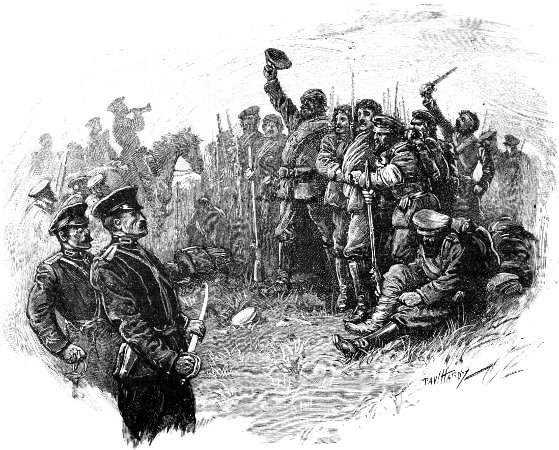
“THEY GATHERED TO THE SOUND.”
The Russian defeat was complete. The remains of the army came sullenly back, companies that had gone down hundreds strong returning by tens and twenties. For three hours there had been a steady current of wounded men up from out of the battle to the reverse slope of the Radischevo ridge, to which Schahofskoy still held on grimly. All round, the air was heavy with the moaning of the wounded who had cast themselves down by the fountain at the foot of the slope, craving with a pitiful longing for a few drops of the scanty water. In this awful hour Schahofskoy’s attitude was admirable: now that the day was lost beyond remedy, he was cool and collected. To protect his wounded, and rally what remained of his force, he was determined to hold the ridge to the last extremity. He ordered his bugle to sound the “Assembly.” They gathered to the sound, singly and by twos and threes, many bleeding from flesh-wounds, yet willing still to fight on. But it appeared scarcely a company that came together; it seemed as if the rest of the army was quite dispersed. Schahofrkoy was loth to fall back, for he still hoped that belated troops would come back out of the valley of the shadow of death down below him; but he was disappointed. Meanwhile, as the ambulance work was going on apace, and the wounded withdrawn into the comparative safety of the village in the valley behind, the Turks continued to pour on the ridge a heavy fire of shells and bullets. At length, near midnight, Schahofskoy and his staff quitted the front, now protected, after a fashion, by a cordon of cavalry. As the forlorn cortège rode slowly away in the moonlight, an aide-de-camp remarked in an undertone to his neighbour: “We are following a general who has lost his army going in search of an army which has lost its general, who now, to make the day’s loss complete, has lost his way.” It was a miserable business.
But it was in a measure retrieved by the conduct of Skobeleff. His orders were to prevent any reinforcement from Loftcha from entering Plevna, and in general to cover the extreme left flank of Schahofskoy. For this wide range of duty he had at his disposal one infantry battalion, twelve squadrons of Caucasian Cossacks, and twelve 4-pounder horse-guns. His first undertaking was to make a reconnaissance on Plevna from the south-west, till he looked down on the place from a height within three hundred yards of it. When Schahofskoy began his cannonade on the redoubts, Skobeleff opened fire on the town, and drew upon himself a large body of Osman’s forces. When attacked in strength he, of course, had to withdraw to his main force at Krishin; but he discovered that, from a hill two miles south of Plevna the Turks could enfilade Schahofskoy’s line, and take his advance in reverse. To hinder the enemy from occupying this point he resolved to attack energetically; and he was able, by dint of skill and dexterity, to keep up an active fight throughout the day and on until after nightfall, and also to remove all his wounded. After dark, he made good his retreat to Krishin, and re-assembled there what remained of his little command. He had not spared it, for fifty per cent. was hors de combat. But he had gained his object in keeping the Turks away from the Green Hill, from which, had they occupied it, they would have cut Schahofskoy’s force to pieces.
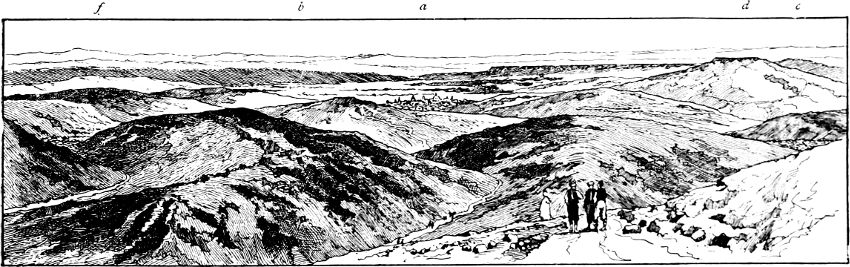
ENVIRONS OF PLEVNA.
a, Plevna; b, Plevna Redoubt; c, Grivitza Village; d, Grivitza Redoubt; e, Radischevo Ridge; f, Balkan Mountains in distance.
The Russian losses were 169 officers and 7,136 men, out of a total of 30,000 engaged. Of this number, 2,400 were killed and left on the field. One of Schahofskoy’s regiments (the 126th) had 725 killed and over 1,200 wounded—a total loss of about 75 per cent. of its strength. Over their respective responsibility, Krüdener and Schahofskoy quarrelled bitterly. Schahofskoy complained that Krüdener had not supported him. Krüdener retorted that Schahofskoy had disobeyed his orders in assaulting without permission. But the real responsibility for the defeat rested on the shoulders of the Grand Duke Nicolas, who had given peremptory orders from a distance to attack a position of which he knew nothing, and in the teeth of a remonstrance on the part of a commanding-officer who had carefully studied the subject.
THE SHANGANI PATROL
BY E. F. KNIGHT

“They were men of men, and their fathers were men before them,” were the words of old Umjan, the chief induna of the Imbezu Impi—Lobengula’s Royal Regiment—as he described the gallant stand of that handful of men under Major Allan Wilson which was cut to pieces by the Matabele, hard by the Shangani river, on December 4th, 1893. Umjan, a full-blooded Zulu warrior, who, as a stripling, had taken part in the conquest of Matabeleland with Moselekatse’s raiding horde, led the force that slaughtered Major Wilson’s party, and the terms of keen admiration which he employed when speaking of those brave men but represented the feeling of his whole people. That day’s fight produced a deep impression throughout the country. Till then the Matabele were inclined to despise the white men, and considered them weak and timorous. True, the Matabele had been vanquished; but they argued that they had not been routed in fair fight, but by the aid of witchcraft—by the deadly fire of those invincible Maxims, which spirits had manufactured for the white men; they boasted that without Maxims the white men would never have had the heart to face the valorous amajakas of Lobengula. But they were undeceived by the brave doings of December 4th, which cannot rightly be called a day of disaster—valuable though were the lives we lost—when it is remembered how glorious was that gallant stand, how far-reaching were its results. That engagement brought the war to a sudden conclusion, and obviated further bloodshed. It inspired the Matabele with a profound respect and regard for their conquerors, which our previous victories alone would not have given them. Without that sacrifice it would have been long before we had brought about a true peace. Our vanquished foes would have regarded any clemency on our part as a sign of cowardice; the young amajakas would have bragged at their periodic beer-drinkings, and organised risings against the white men. But having suffered so severely from that stubborn resistance to the death of a handful of white men unprovided with Maxims, they realised the hopelessness of again trying conclusions with the Chartered Company’s forces; they were terrified at their own victory, and, as I myself experienced, it was possible, immediately after the Shangani fight, for a white man to travel alone and unarmed with safety throughout the greater portion of Matabeleland. The death of Wilson and his men brought a complete peace to the land, so they did not fall in vain. The story of the Shangani will be told in many a kraal; and the prestige these Britons won for their countrymen will go far to check the ardour of turbulent tribes and to preserve the peace of Africa.
Not one man of Wilson’s party survived to tell the tale of that hopeless but fierce stand of the thirty-four against thousands; but various native rumours reached us. I was at Inyati when Dawson, some three months after the fight, returned from his mission to the Shangani: he gave me the full details he had gathered from Matabele who had taken part in the fight; and later on old Umjan himself came in, and told us all that had taken place, extolling the bravery of the white men with a simple but most impressive eloquence. It is his narrative I purpose to repeat here.
It will be well first to recall the events that led up to the despatch of Wilson’s patrol. Lobengula’s impis had been broken in two decisive battles; Buluwayo had been occupied by the Company’s troops; a considerable proportion of the disheartened Matabele, having been offered by Dr. Jameson easy terms of peace, and, realising that they would be treated with generosity, were quite ready to “come in,” but dared not so long as the King was still holding out with a large force of his followers. It was therefore essential that the King should be captured or be induced to submit, in order to effect the pacification of the country and avoid further bloodshed. Lobengula, in reply to Dr. Jameson’s messages inviting him to surrender and guaranteeing his safety, had at first promised to “come in,” but had subsequently either altered his intention, or had been constrained by his warlike following. Spies brought in information that he was retreating to the north with a considerable force consisting of the remnants of his broken impis, with the object either of organising a stand further on, or of crossing the Zambesi to establish another military despotism beyond the great river.
Dr. Jameson accordingly sent a force, under Major P. W. Forbes, in pursuit of the King; but this column failed to come up with the fugitive, for, having exhausted its supplies, it was compelled to retire on Inyati, a mission station forty miles to the north-east of Buluwayo. It was afterwards ascertained that Lobengula was only three miles away when his pursuers turned back.
Reinforcements with food and ammunition were then sent to Shiloh, another mission station between Buluwayo and Inyati, and from this place Major Forbes set out afresh with 300 men, on November 25th, to overtake the King. There had been very heavy rains, and the roadless wilderness through which they had to go was little better than a morass, almost impassable for waggons. They had made but little progress by November 29th, and Major Forbes, finding that his horses and oxen were becoming exhausted and realising that the King would never be caught unless the column travelled faster, sent all his waggons and a considerable portion of his force back to Inyati, only retaining 160 men, mounted on the best of the horses, of whom sixty were troopers of the Bechuanaland Border Police, the remainder volunteers of the Salisbury, Victoria, and Tuli columns. He took with him two Maxims, and horses carrying ten days’ rations for each man. This little force then pushed on rapidly, despite the heavy rains and the fever that prevails at that season in the lowlands. They were on a hot scent, and knew that the King could not be far ahead of them. Each day they came to his recently abandoned camps, and found frequent signs of his retreat. They thrust their way through the thick bush and across the swamps, following the spoor of the King’s three waggons, occasionally capturing stragglers from his force or some, of his cattle. The Matabele hovered round, watching them all the while; but no attack was made upon them, though the scouts had narrow escapes.
At last, on the 3rd of December, they came to a valley near the banks of the Shangani and found a scherm (enclosure of bushes), which had evidently been vacated but a very short time before, for the fires were still burning within it. A chiefs son, who was captured at this place, confessed that the King had slept there on the previous night, and was not far off. This was good news, and all hoped that they would be rewarded for the privations they had undergone by the speedy capture of Lobengula. But it was now five o’clock in the evening, and darkness would soon make it impossible for the column to proceed; so Major Forbes, having selected a strong position in which to laagar for the night, decided to send Major Allan Wilson with a party of about twenty men, to reconnoitre. Among those who volunteered to go on this patrol were several officers and some of the leading settlers in Mashonaland: it consisted, indeed, of the very pick of frontier manhood. Major Wilson’s instructions were to follow the King’s spoor and ascertain his whereabouts, and to return to the laagar before dark. It was Major Forbes’s intention to remain where he was until dawn, and then to make a final dash for the King. Supplies were now running short, and unless Lobengula was captured on the morrow the chase would have to be abandoned, and the column would have to return to Inyati. Shortly after the patrol had set out, a native prisoner gave Major Forbes reliable information to the effect that an impi of about 3,000 Matabele was then hemming in his force, so extra precautions were taken to guard the laagar against surprise during the night, which was an exceedingly dark one.
Early in the night, two of Major Wilson’s party rode in with a message for the commanding officer. They reported that the patrol had crossed the Shangani, and that Major Wilson, having ascertained that the King, accompanied by but few of his followers, was only a short distance ahead of him, had thought it best not to return that night, but would bivouac where he was, close on the King’s heels.
Before midnight three more men came in from Major Wilson. They corroborated the report that the King had sent his impi to surround the column and prevent its crossing the river. They said that the patrol had found a native to guide them, had followed the King’s spoor for some distance, and passed several scherms full of women, children, and cattle. Then they fell in with some of the King’s men, who offered no resistance, possibly imagining that this was the advance guard of the whole column, and that the dreaded Maxims were close behind. An officer, who was acting as interpreter, shouted to the natives that the white men would not injure them, but wanted to talk to the King. Just as it was getting dark, they approached some scherms, in one of which, the guide told them, was the King himself. A number of armed Matabele came out with threatening action ready to protect the waggons, and were surrounding the patrol. A heavy rain-storm now rendered the obscurity intense, so Major Wilson was compelled to retire, and took up his position for the night in the bush half a mile away.
MR. RILEY. UMJAN. MR. DAWSON.
(The waggon is the one in which Messrs Dawson and Riley returned from the Shangani with the King’s wives as described.)