LIST OF PLATES. (continued 6)
Reading edition
It was obvious that the remaining fifteen cantons, comprising nearly five-sixths of the whole population, could not long tolerate the presence of this hostile league in their midst. A glance at the map will show that of the seven cantons composing it, one, Fribourg, lies apart, while the others stretch continuously from the extreme south-west of Switzerland, near Chamonix, away to the Lake of Zürich. Not only do they divide the Confederation almost in two, but they hold three out of the five main roads which lead through Switzerland into Italy, including the two which at that time were, and probably still are, by far the most frequented—the Simplon and the St. Gothard. Moreover, the attitude of the Great Powers showed plainly that the very existence of Switzerland as a separate and independent nation was at stake. None of the Continental Governments had any love for the little State, which, besides showing that men could live and thrive under a republican constitution, was always ready to offer shelter to those of their subjects whose political views made residence in their native countries unsafe. Accordingly, we find the Protestant King of Prussia no less anxious than the Protestant M. Guizot, Minister of Louis Philippe, for the success of the Catholic Sonderbund; while Austria and Sardinia, who a few months later were to be at each other’s throat, agreed at least in sending help to Lucerne.
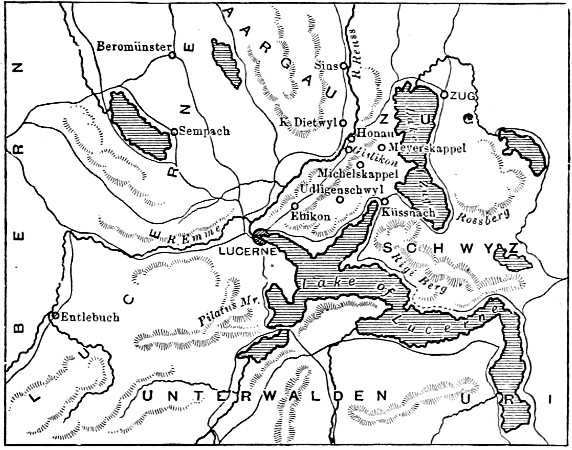
LUCERNE AND SURROUNDING DISTRICT.
The task of the loyal cantons was not easy. In several of them parties were very evenly divided. The only central authority at this time consisted of the Federal Diet, in which every canton, no matter what its size, had an equal representation, while the members were only deputies, bound to vote as the majority of their State directed them. The important canton of St. Gallen, the fifth in numbers, and one of the wealthiest, was long in deciding. The Catholics form about three-fifths of the population there, and it was not till May, 1847, that the local elections resulted in a Liberal majority, and consequently the return of a Liberal member to the Diet. On July 20th the Diet was at last able to pass a resolution calling upon the Sonderbund to dissolve itself, as being in contravention of the Federal Constitution. The next three months were spent in efforts to bring this about peaceably, but the leaders had gone too far to retreat. They relied, also, not merely on the intervention of the Great Powers, but on their own favourable position in a district almost inaccessible from most sides, on the ancient reputation of the so-called “Forest Cantons”—Schwyz, Uri, Unterwalden, and Lucerne, which had been the original cradle of Swiss liberty.
AT FRIBOURG.
On October 29th the Sonderbund deputies offered to dissolve their league, but only on conditions which were equivalent to a concession by the other side of all the claims to assert which the league had been formed, and on the rejection of these terms by the majority, they left the Diet, Bernard Meyer, the deputy from Lucerne, calling upon God to decide between them. “You had better not speak of God,” exclaimed the deputy from Catholic Solothurn; “this business is not His, but the Devil’s work.” On November 4 the Diet finally resolved that the Sonderbund be put down by force of arms, that the frontiers of the seceding cantons be occupied, and all intercourse with them be broken off.
The command of the Federal forces had been entrusted to Colonel William Henry Dufour, of Geneva. Switzerland possesses no standing army; but every able-bodied man goes through military training, and there is a permanent staff of superior officers, on which Dufour held the post of Quartermaster-General. He was now sixty years old; and though in his youth he had served in the French army during all the time of Napoleon’s great campaigns, and risen to the rank of captain, he had seen no active service, having passed those stirring years as an engineer-officer in the island of Corfu, which for most of the time was blockaded by the English fleet. When Geneva became part of Switzerland, in 1815, he transferred his services to the Confederation, and gained a considerable reputation as a student and teacher of military science. He was also at the head of the Commission which from 1833 onwards was engaged in the production of the finest map of any country which up till then had existed—the Ordnance Map of Switzerland. Only a few days before he had remarked to one of his officers that it was lucky for them both that their duties would prevent them from taking an active part in the conflict! As the result showed, no better man could have been chosen. On October 25th he received the rank of General, and took the oath of office as Commander-in-Chief. In a few days he had under his orders a force of nearly 100,000 men and 174 guns.
The Sonderbund leaders had been unable to find a commander among the citizens of the seceding cantons. Their choice finally fell upon Colonel Ulrich Salis-Soglio, of Chur in Graubünden. Like Dufour, he was an elderly man, but had had the advantage of actual military experience. He had served in the Bavarian army during the Leipzig campaign, and had distinguished himself at the battle of Hanau. For twenty-five years he had been an officer in the Swiss regiment in the Dutch service. He is described as a man of charming manners and chivalrous courage; but by no means Dufour’s equal as a strategist. Curiously enough he was a Protestant. The Sonderbund forces amounted in all to about 78,000 men and 72 guns. He commanded only the forces of the “Forest Cantons” and Zug. General Maillardoz commanded in Fribourg, General Kalbermatten in Valais.
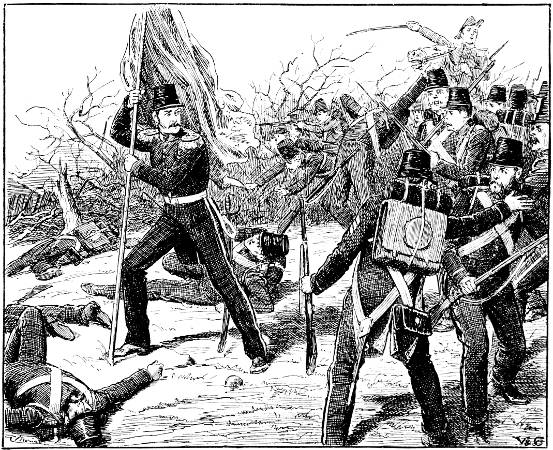
“MAJOR SCHERRER SEIZED THE COLOURS” (p. 144).
Dufour’s first care was to secure himself from attack in the rear by subduing Fribourg, which, as we have said, is separated by the cantons of Bern and Vaud from the rest of those composing the Sonderbund. His strategy for this purpose was simple, but effective. The town of Fribourg is not more than sixteen or seventeen miles from Bern, in a westerly direction. It was strongly fortified, and defended by a force of from 12,000 to 15,000 men. The defenders naturally expected that the attack would come from the direction of the Federal capital, and they had made their arrangements to resist it on that side by throwing up batteries and blocking the roads with trees. Dufour caused his first division, under Colonel Rilliet, to advance in three brigades from Vevey, Moudon, and Payerne, in Canton Vaud, with instructions to reach Matran, some four miles south-west of Fribourg, on November 12th. This manœuvre was executed punctually. At the same time Colonel Burckhardt’s division, which had been stationed in Canton Bern, instead of advancing directly upon Fribourg, made a night-march to the right, and took up a position about the same distance north-west of the town. Lastly, Colonel Ochsenbein was directed to make a demonstration on the side of Bern, so as to draw off the attention of the defenders from the movements on the west and north, and at the same time to watch the approaches from the south. These dispositions were all so accurately carried out that on the morning of November 13th Dufour was able to send a missive to the mayor of Fribourg, pointing out that his city was surrounded by superior forces—they were from 25,000 to 30,000 men, with sixty guns—and that under the circumstances he could surrender without discredit. The authorities of the city saw the force of his arguments, and agreed to an armistice for twenty-four hours; and on the following day a capitulation was signed, the first article of which bound Fribourg to leave the Sonderbund forthwith. This success was not quite bloodless, for on the afternoon of the 13th some of the outposts of the first division who were stationed in a wood on the west of a town, and had not heard of the armistice, made, under some misconception, an attack upon a redoubt which was close in front of them. The artillery on both sides came into action, and the Federal troops lost seven killed and fifty wounded.
The fall of Fribourg, says Dufour, fell like a thunderclap on the Sonderbund, and astonished the rest of Europe. His own task became much easier, owing to the spirit of cheerfulness and unanimity which now took the place of the indecision and even reluctance which had been felt in many quarters. He lost no time in grappling with the more arduous part of his work—the subjection of Lucerne. Hitherto he had given strict orders to his subordinate commanders that they were to act entirely on the defensive, and his orders had been obeyed, though to do so must have required some self-restraint on the part of those officers. For the Sonderbund forces were by no means inactive. The canton of Aargau runs down in a long tongue between Lucerne and Zug, forming the district known as the Freiamt. At the northern end of this tongue, where it widens out to the full breadth of the canton, is the village of Muri, where one of the suppressed monasteries had been situated. Perhaps the Sonderbund expected to find some sympathisers in that district. At all events, on November 12th a strong force, in two columns, under General Salis and his Chief of the Staff, Colonel Elgger, respectively, entered Aargau, with the intention of marching by different routes upon Muri. The General, starting from Gislikon, entered the Freiamt at its southernmost point; while Elgger, keeping within the territory of Lucerne, was to take a parallel line and approach Muri from the south-west. It was a foggy day, and the two columns, separated by a range of lofty hills, completely lost touch of each other. In the afternoon, Salis made an attempt to destroy a bridge which the Federal engineers had thrown over the river Reuss, to connect Zürich with Aargau. But he was met with a stout resistance, and compelled to retire. Near Muri he again fell in with troops from St. Gallen and Appenzell, who received him with a vigorous fire, and he found nothing to do but return to his starting-point. Colonel Elgger was at first more fortunate, and drove the Aargau troops back with some loss. His own son, who was acting as his aide-de-camp, got a bullet in his head, but lived to edit the Swiss Military Gazette thirty years later. Presently an order to the artillery to retire in order to take up a better position, caused a panic among some troops from Valais, who probably did not understand the words, and only saw the movement. They fled, and Elgger, having lost a part of his force and hearing the sound of Salis’ guns grow fainter and fainter, had nothing to do but to withdraw. A third column, which was to have invaded Aargau further to the westward, succeeded in surprising the Federal outposts and bombarding an unfortified village; but did not wait for the arrival of the Aargau battalions, which hastened up at the summons of the alarm-bells.
In the south, where the Federal strength was less, matters for a few days looked more promising for the Sonderbund. On November 17th a body of 2000 men, with four guns, crossed the St. Gotthard Pass in a storm of wind and snow, and fell upon Airolo. The Ticino troops, who were holding that place, 2700 strong, hardly expected a visit in such weather, and allowed themselves to be surprised. Before they knew what was happening, the village was surrounded by the riflemen of Uri, and cannon-balls were crashing through the snow-covered roofs. They fled in disorder to Bellinzona, with a loss of six killed and thirty wounded, leaving weapons, ammunition, baggage, even their colonel’s despatch-boxes and dressing-case, in the enemy’s hands. This was the nearest approach to success which the Sonderbund had. It was hoped that Ticino, being a Catholic canton, at least a portion of the population might welcome the invaders; but they received no encouragement, and in a few days the approach of the Federal army to Lucerne rendered their retreat necessary.
For Dufour did not let the grass grow under his feet. Two days after the capitulation of Fribourg had been signed, his headquarters were at Aarau, the capital of Aargau, and all his dispositions made for striking the decisive blow. Lucerne is very well situated for defence against an enemy approaching from the north. The stream of the Reuss, flowing out of the lake towards the north-west, presently sweeps round to the north-east. Just at the angle the smaller River Emme joins it from the south-west, so that a continuous obstacle is offered to an attacking force. Between the Reuss and the Kussnacht arm of the lake (which washes the foot of the Rigi) is a range of lofty wooded hills called the Rooterberg, which continue almost to the Lake of Zug; and in the other direction, a similar line of hills, cut by deep gorges, runs parallel to the Emme. It was on this latter side that the ill-starred attempt of the Free Corps had been made in 1845. Dufour determined on this occasion to approach from the other direction, along the line of the Reuss, and between that river and the Rooterberg. It was a hazardous operation: in his own words, “taking the bull by the horns.” Gislikon, the point where the main road crosses the river, while that on the right bank comes close to it, was strongly fortified; and the Rooterberg afforded an admirable position for sharpshooters and artillery. But by advancing from this side he would, if successful, separate Lucerne and Schwyz, and would strike at the heart of the secession. Therefore, while ordering all the five divisions which he intended to employ, to converge by various roads on Lucerne, from east, north, and west, he resolved to make his main attack with the fourth and fifth, under Colonels Ziegler and Gmür. Of these, the former was at present quartered in Aarau, the latter between the Reuss and the Lake of Zürich.
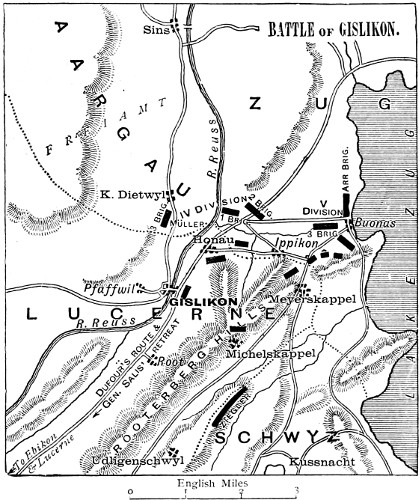
BATTLE OF GISLIKON.
The attack was fixed for November 23rd. Two days before, the little canton of Zug, which had entered the Sonderbund somewhat reluctantly, seeing that further resistance was useless, capitulated, thereby relieving Dufour of anxiety for his left flank. On the 22nd the General issued a proclamation to his troops, reminding them that they were performing a duty to their country, and bidding them lay aside all feeling of hostility as soon as the victory was won. They were specially enjoined to respect all churches and buildings used in the service of religion, and to see that no injury was done to non-combatants or to private property.
That evening Colonel Ziegler’s division bivouacked in the “Freiamt,” right up to the frontier of Lucerne. It was a clear night, and round the Lake of Zug they could see the watch-fires of the fifth division, which was now occupying that canton. In the early morning of the 23rd the Aargau engineers threw a bridge of boats over the Reuss at Sins, another being placed a couple of miles higher up, at Oberrüti. Ziegler, with two brigades of his division, under Colonels Egloff and König, crossed to the right bank, and came into touch with Colonel Gmür and the fifth division, advancing from the Lake of Zug. The third brigade, under Colonel Müller, was to remain on the left bank, and attack Gislikon from the direction of Klein Dietwyl. It should have acted in conjunction with the third division, under Donatz, which occupied the next place to the westward, but bad roads hindered that commander from arriving in time to take part in the main action. About nine in the morning the batteries of Gislikon opened fire upon Müller’s brigade, compelling it to retire for a time. One of the first shots killed Captain Buk, a refugee from Lucerne, who was marching with the column. Colonel Ziegler, meanwhile, was making progress on the other side of the Reuss. In spite of the fire from the Rooterberg, and from the Lucerne artillery in front of the village of Honau, he pressed on, and presently his guns coming into action caused the enemy’s batteries to retire. They made a short stand in Honau, but were soon forced back upon Gislikon, where regular earthworks had been thrown up. Here they made a resolute defence, the battery under Captain Mazzola specially distinguishing itself. On the other side, Rust’s battery (from Solothurn) galloped through Honau, leaving the infantry behind, and took up its position in an orchard, five hundred paces—this was before the days of rifled cannon—from the earthworks. Its first shot killed and wounded five men in Hegi’s company, which retired, leaving Mazzola’s left flank uncovered. Mazzola, however, literally “stuck to his guns,” though the artillery on the further side of the Reuss was now playing upon him, and presently compelled Rust to retire behind the fighting line, barely saving his guns from capture by the Lucerne chasseurs. A plucky action on the part of one of his subordinates is recorded. Just after the Solothurn guns had retired, a body of troops was seen in the spot they had occupied. In the smoke and haze of the November day, it was not certain whether they were friend or foe. Corporal Pfiffer asked his captain’s permission to go and ascertain, which Mazzola willingly gave. Pfiffer left the battery, and went forward till he could see the others clearly; then, waving his sword, cried: “Fire, Captain; it is the enemy!” and made his way back. General Salis, who had taken up his position in the battery, pressed a piece of gold into his hand; but the sturdy Swiss rejected it, saying: “No need for that, General; I only did my duty.” The narrator of this story, himself a bitter partisan on the Catholic side, adds that Pfiffer was a well-known adherent of the Liberals. Here, as later in the American Civil War, when hostilities had once begun, men put the defence of their homes first, and let their private opinions wait for quieter times.
The troops whose identity Corporal Pfiffer had ascertained were some battalions of Egloff’s and König’s brigades. These were Appenzellers under Benziger, and Aargauers under Häusler. The former could not face the storm of grape with which they were received, and took shelter in some gravel-pits. Häusler’s men, with whom the Brigadier-Colonel Egloff was himself riding, began in their turn to waver. At this moment Major Scherrer, whose own battalion was also unsteady, seized the colours, and fixing them into the ground, cried out: “Switzers, do you know what that means?” Thus encouraged, Häusler’s men held their ground, and, presently, through the personal efforts of Egloff and his staff, the fugitives were rallied, and the line restored. Meanwhile, the Lucerne and Unterwarden companies had pressed too far in the direction of the Rooterberg, allowing the Federal skirmishers to penetrate between them and the artillery, so that the earthworks were denuded of all covering infantry. Egloff at once ordered up three batteries, and under the fire of these, combined with that from others on the other bank, the intrepid Mazzola, after nearly an hour’s duel between his one battery and five or six of the enemy’s, was compelled to withdraw, and abandon Gislikon. General Salis, too, who had taken up his position in the battery, had been severely wounded in the temple by a grape-shot, though he made light of his wound, and refused to leave the fight.
König’s brigade, meanwhile, to which had been assigned the duty of clearing the west slopes of the Rooterberg and sheltering Egloff’s left flank, had met with a sudden resistance. Again and again they had to fall back, until Ziegler himself, dismounting and leading the right wing, succeeded in pressing the enemy so far up the hill as to secure Egloff from a flank attack, and set part of his own main force to operate against Mazzola. König, with the left wing, attempted to force the position of Michelskappel, on the crest of the ridge, but could not succeed in dislodging the troops from Schwyz who held it. Gmür’s division, meanwhile, had captured Meyerskappel, on the eastern side of the ridge, and was advancing upon Lucerne by the road between the hills and the lake.
But the retreat from Gislikon had decided the battle. At 3 p.m. General Salis gave the order to retire upon Ebikon, a village not more than three miles from Lucerne. In the city itself men had been listening all day long, with painful anxiety, to the thunder of the cannon, but no news of the fight had reached them. At four, arrived an orderly from the General, bringing a message couched in the form usual with defeated commanders, to the effect that he had been compelled to retire temporarily upon Ebikon, but hoped to maintain his ground there for a time. He added, however, that the loss of Gislikon had rendered the position of Lucerne very precarious. A steamer had been in readiness all day, and on the receipt of this news, the Council-of-War, with Siegwart and Meyer at its head, went on board, taking the military treasury and all documents, papers, etc., with them, and steamed up the lake to Flüelen, leaving orders to General Salis to arrange for an armistice. The General himself arrived about 8 p.m., suffering from his wound, and after giving the requisite instructions, departed to Unterwalden. As an old soldier, he doubtless knew that further resistance meant useless bloodshed. Colonel Elgger, his Chief of the Staff, had been for two days maintaining a stout resistance in the Valley of Entlebuch, west of the city, to the seventh Federal division, under Colonel Ochsenbein—who had his former defeat on almost the same ground to avenge—and had hastened back to Lucerne, when night put an end to further fighting on the 23rd. He was at first in favour of defending the city; but was soon convinced of the hopelessness of the situation, and agreed to communicate with Dufour. At 9 in the morning of the 24th came the reply that it was too late to countermand the advance, but that if the Federal troops were allowed to enter peaceably, and the Federal flag was displayed, no warlike measures would be taken.
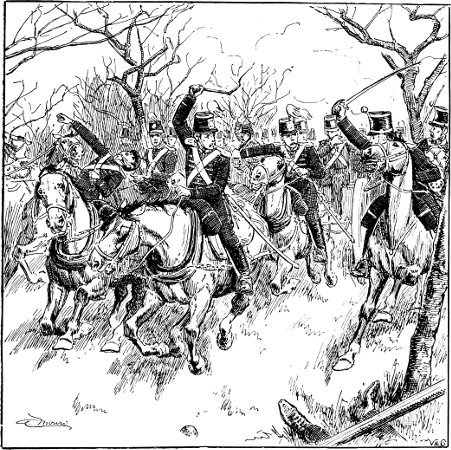
“RUST’S BATTERY GALLOPED THROUGH HONAU” (p. 144).
Accordingly, at midday on the 24th, the Federal forces marched into Lucerne by all the gates. Twenty days had finished the civil war. The total losses were, on the Federal side, 60 killed and 386 wounded; on that of the Sonderbund, 36 and 119. Dufour attributes the smallness of these figures to the fact that the fighting took place in a broken and thickly-wooded country, where cover was plentiful. Something was, no doubt, also due to the inexperience of the gunners.
Great care was taken to prevent any excesses on the part of the victors. The Bern division, between whom and Lucerne bitter feelings had existed ever since 1845, was not allowed to take part in the entry into the city, but had to remain, by Colonel Ochsenbein’s orders, in the suburbs. Dufour ordered a joint “Church-parade” to be held, the Catholic troops attending Mass in the chief church of Lucerne, while a service was held in the open-air for the Protestants. Subsequently he wrote, “The troops on both sides showed by their conduct that every Swiss is a born soldier.”
The Confederation had had a narrow escape. On the day when war had been declared, M. Guizot had, on behalf of France, proposed to the other Great Powers that a joint note should be sent to the Swiss Diet calling upon them to submit the questions at issue to foreign arbitration. As it was hardly doubtful that the proposal would be rejected, this meant armed intervention, with the certainty of an ultimate partition of Switzerland. The Continental Powers were ready enough, but Lord Palmerston, then English Foreign Secretary, who had, as he said, “no wish to see Switzerland made a Poland of,” managed, by objections and suggestions, to postpone the delivery of the note till November 30th. By that time the Diet was able to reply that there was no longer any Sonderbund. In the course of the following year, Prussia, Austria, and France had matters enough of their own to attend to; and the Swiss were able to proceed unmolested with the revision of their Constitution into the form under which the country has prospered ever since. Formerly a Confederation of States, they have since 1848 been a Confederated State.
The conflict left—except, perhaps, among a few of the Sonderbund leaders—no ill-feeling behind. Some years later Dufour could write: “The citizens of the old cantons (i.e. the Forest Cantons) nearly all have pipes with my picture on them, and call me ‘Our little Dufour.’” His long and useful life ended in 1875.
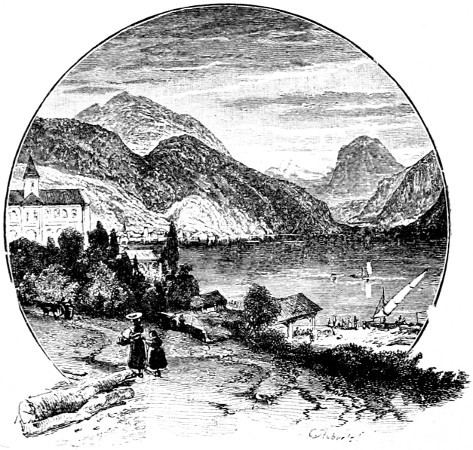
LAKE ZUG.

INSANDHLWANA
BY C. STEIN

About ten miles from the Buffalo river, which forms the eastern frontier of Natal, rises conspicuous a tall, rocky, precipitous hill, called in the language of the natives “Insandhlwana,” or “The place of the little hand,” from a fancied resemblance in its form to an outstretched hand. Near this hill was fought, on the 22nd January, 1879, one of the most desperate actions ever engaged in under the British flag. Here, overwhelmed by numbers, an English force suffered a complete and most disastrous defeat, and here, bravely facing inevitable overthrow and death, English soldiers sternly answered to the call of duty and fell with honour, grimly defiant to the last.
Of the actual details of the battle there are no complete records. The men who could have furnished them lie under the shade of the hill, and the veldt grass grows green over their silent and glorious bed. But sufficient is known, as much from the subsequent testimony of their gallant foes as from the words of the few survivors of the fatal field, to tell us how determined, though unavailing, was the courage, how great the self-abnegation, of the warriors who then maintained the honour of our country.
Let us tell the story as far as it can be gathered, and if it ends with no shout of victory, at least we can impress on our minds that the heroic dead left a memory of which we may be sadly proud, and that they were not found wanting in carrying on the noblest traditions of the English people.
The Zulu kingdom was a military power that, under a line of despotic and warlike sovereigns, had long been a standing menace to the English colony of Natal and to the Transvaal, the Dutch Republic, which in 1878 was annexed by England. The first king of Zululand, Chaka, had so organised his realm that it was always ready for war at short notice, and his system was maintained by his successors—Dingaan, Panda, and finally Cetewayo, who became monarch in 1872. Every able-bodied Zulu was enrolled in one or other of the king’s regiments, and no one was allowed to marry without the king’s permission. The permission to marry was generally given as a mark of favour to a whole regiment at once for long or good service, particularly if it had “bathed” its assegais—or, in other words, had covered them with blood in conflict. The discipline of the Zulu army was the sternest. Implicit obedience was required, and every fault was punished with death. Cowardice was unknown, for the coward dare not meet the vengeance and wrath of his king. The saying of each man was, “I am the king’s ox”—meaning, I accept life or death as the king may award, and my only business is to carry out his orders without question. The burden of one of their war-songs was, “If I go back I am killed; if I go on I am killed. It is better to go on.” With such feelings, added to their natural fierceness and hardihood, influencing a peculiarly powerful and athletic race of men, it may be conceived how formidable was the Zulu array, and with how much truth it came to be called “a very perfect man-slaying machine.”
The war-dress worn by the Zulu soldiers made them striking and alarming-looking figures. On the head of each man was a plume of feathers, or sometimes a single beautiful feather, taken from the bell crane, rising a good two feet into the air. Round his waist hung a kilt of white oxtails, and beneath his right knee and shoulder were small circles of white goat’s hair. For the rest, he was naked; unless he was a chief, in which case he wore a leopard’s-skin kaross, or cloak, as an emblem of authority. In his left hand he carried a fighting shield made of oxhide, of which the colour varied according to the regiment to which he belonged. In his right hand he held his great broad-bladed “bangwan,” or stabbing assegai. He also had three lighter and smaller assegais for throwing as javelins, and a “knobkerrie,” or club, made of hard “umzimbete” wood. Many of them had rifles, but very few were good shots, and their fire only became formidable when they had a broad mark, like a body of men, to aim at.
The Zulu tactics were always the same. They always tried to attack in a half-circle, throwing forward both flanks of their fighting force, like two horns, which strove to encircle and threaten the rear of their enemy, while their centre, in successive waves of men, charged to their front with irresistible determination.
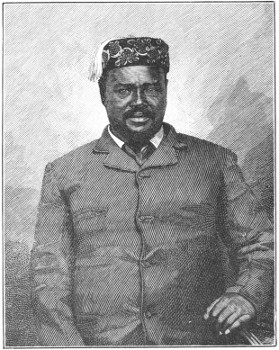
[Photo.: Crewes.
KING CETEWAYO.
It has been said that the warlike Zulu kingdom had been a standing menace for years to the European colonies on its frontier. Except in the towns these colonies were only occupied by farmers, whose solitary homesteads were scattered over the country at wide distances from each other, each European’s house having near it a small “kraal,” or village, where lived the peaceful and unwarlike Kaffirs who formed the native population. In days not long gone by, the first settlers had frequently been obliged to fight for their lives, and the Dutch names of such places as “Weenen” (weeping) kept alive the memory of old Zulu incursions. Many were the alarms which spread through the country from time to time lest these incursions should be renewed, and many were the frontier farms which had been, in consequence, deserted by their owners. Causes of dispute had arisen, moreover, with Cetewayo, and the savage potentate had showed that war would be far from unwelcome to him. The English Governor and High Commissioner in South Africa in 1878 was Sir Bartle Frere, one of the ablest of the many able politicians and administrators who have been produced by our Indian Empire, and he did all in his power to induce the Zulu king to come to such terms as might secure the continuance of peace—to no purpose. Finally, an ultimatum was sent to Cetewayo, and he was warned that if it was not complied with before the 11th January, 1879, operations against him would be at once commenced.
It had long been foreseen in Natal that war was almost inevitable, and all the available troops had been massed along the frontier, under the command of Lieutenant-General Lord Chelmsford, K.C.B. The whole resources of the colony had been organised and prepared for a campaign. There were seven regiments of English regular infantry, a naval brigade, seventeen guns and a rocket battery Royal Artillery, and two companies Royal Engineers. There was no regular cavalry, but there were two squadrons of mounted infantry, and nearly 800 colonial volunteers and police, besides more than 300 native Basuto horse. There was also a native contingent, about 9,000 strong. The whole amounted to 6,639 Imperial and colonial troops, 9,035 native contingent, with 802 conductors and drivers in charge of nearly 700 waggons, forming the transport train.
The period allowed to Cetewayo for reply to the ultimatum having expired, a declaration of war was made by Sir Bartle Frere, who then placed in the hands of Lord Chelmsford the further enforcement of all demands.
Lord Chelmsford’s army as detailed above was divided into five columns, which were to march into Zululand at different points, and to move on Ulundi, Cetewayo’s capital, where they were expected to be able to concentrate victoriously. For our present purpose we need only consider the 2nd and 3rd columns, as the others were in no way involved in the operations which led to the battle of Insandhlwana. The 2nd column, under Colonel Durnford, R.E., was almost entirely composed of natives, and was, in the first instance, more intended to be used as support and communication between the 1st and 3rd columns than for any other purpose. The 3rd column was the strongest and most important, and to it Lord Chelmsford attached himself and his staff. It was under the immediate command of Colonel Glyn, C.B., and was formed by six guns, R.A., one squadron mounted infantry, the 1st battalion 24th Regiment, the 2nd battalion 24th Regiment, about 200 Natal volunteers, 150 Natal police, three battalions of the native contingent, and some native pioneers. This force crossed the Buffalo river on the 11th of January, and encamped on the further side. The rainy season was not yet over, and not only was there some difficulty and even danger in crossing the flooded river, but the broken country in front of the column was nearly impassable from swamps and heavy ground, so that much road-making had to be undertaken to enable the guns and transport to push forward.
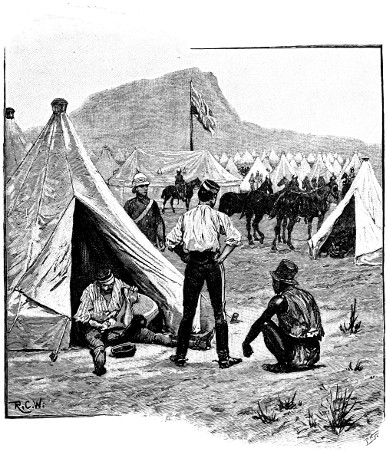
“THE CAMP WAS A PICTURESQUE SIGHT” (p. 150).
A successful attack was made on the 12th against the Isipezi Hill, but the stubborn resistance that was then made by the induna, or chief, Sirayo and his followers showed that no final success was to be hoped for except at the cost of hard fighting. Several long reconnaissances were made by the mounted men into Zululand, and shots were exchanged with detached parties of the enemy, but there was nothing to show how fearful a storm was gathering in the horizon and was nearly ready to burst.
By the 20th of January all the first difficulties had been overcome, and the 3rd column was encamped at the foot of the Insandhlwana Hill. The position of the camp was thus described:—“We had a small ‘kopjie’ (stony hillock) on the right of our road, and then about fifty yards to our left rises abruptly the Insandhlwana mountain, entirely unapproachable from the three sides nearest to us, but on the further—viz., that to the north—it slopes more gradually down, and it is there connected with the large range of hills on our left by another broad neck of land. We just crossed over the bend, then turned sharp to the left, and placed our camp facing the valley, with the eastern precipitous side of the mountain behind us, leaving about a mile of open country between our left flank and the hills on our left, the right of the camp extending across the neck of land we had just come over, and resting on the base of the kopjie before mentioned.”
The camp was a martial and picturesque sight in the glow of the African sunset. Here were the tents of the Queen’s Infantry, the men busy cleaning their arms and cooking their rations, there the long lines of picqueted horses, there the gun-park, there the swart native contingent, as savage-looking as the foe that they had come to fight, while the flag of England waved over the marquee of the general, speaking pride and defiance to all assailants. There was one fatal mistake, however. The waggons, which should have been ranged end to end in front of or round the camp, in the fashion called in Africa a “laager,” forming a defensible barricade against sudden assault, were drawn up uselessly in line behind the camp, and many a veteran of the old colonial wars saw with apprehension that old lessons were neglected, and that undue confidence had taken the place of the caution taught by experience.
It was known that, at about twelve miles from Insandhlwana, there was, on the Inhlazatye range of hills, the stronghold of a chief called Matyana; and on the 21st two separate parties were despatched from the camp at an early hour to reconnoitre and, if possible, attack the place. One of these parties consisted entirely of mounted men—Natal volunteers and police—under Major Dartnell, the other of two battalions of the native contingent under Commandant Lonsdale. Major Dartnell, the head of the police, was an experienced soldier, who had served with the highest credit in the English army, and had taken part in several campaigns. Commandant Lonsdale was also an old soldier of proved knowledge and judgment. Major Dartnell’s force encountered Matyana’s men about ten o’clock in the morning, and, though the enemy appeared anxious to fight, it was not considered prudent to engage them without supports. The Zulus occupied a rugged “kloof,” or cleft in the hills; and whenever the mounted men approached they sallied out in large numbers. Mr. Mansel, of the police, a most daring officer, was sent forward with a small body to try to make them show their force, and succeeded in this, as the Zulus advanced to attack, throwing forward their two “horns” and trying to surround Major Dartnell. The volunteers and police then retired before superior numbers, and joined Commandant Lonsdale’s men about three miles from the kloof.
The native contingent had shown on several occasions that they were subject to panics, and were not to be depended upon; so Major Dartnell decided that he and Lonsdale would bivouac for the night where they were, and sent a messenger to Lord Chelmsford asking for the assistance of some regular infantry to enable them to storm Matyana’s position.
In the middle of the night Dartnell’s communication was received, and, as it told of the enemy being in far greater numbers on the Inhlazatye hills than had been supposed, the general considered that an overwhelming strength should be brought against them, and that an opportunity was presented of striking a paralysing blow against an important part of the Zulu army. He therefore ordered the 2nd battalion 24th Regiment, the mounted infantry, and four guns to be put under arms at once in readiness to march, and, placing himself at their head, he moved with the first faint grey of morning to join Major Dartnell. As this detachment would considerably weaken the camp, Lord Chelmsford at the same time sent orders to Colonel Durnford—who, with a portion of the 2nd column, was now near Rorke’s Drift—telling him to move at once to Insandhlwana with the rocket battery and the Basuto horse.
Lieutenant-Colonel Pulleine, of the 24th Regiment, was left in command of the camp. He had with him six companies of the 24th, two guns R.A., about eighty mounted men, including mounted infantry, police, and volunteers, and four companies of the native contingent. His orders were to draw in his line of defence and infantry outposts, but to keep his mounted vedettes still far advanced.
After the departure of Lord Chelmsford with the detached column, nothing unusual occurred in the camp till between seven and eight o’clock, when it was reported from a picquet about 1,500 yards to the north that a body of the enemy could be seen approaching from the north-east, and the appearance of various other small bodies was subsequently noticed. Then, in the camp, there was all the bustle of quick preparation for battle. Lieutenant-Colonel Pulleine put every available man under arms. The draught oxen, which had been grazing, were driven into camp and tied to the yokes; the native contingent was pushed forward on advanced duty on the hills to the left; the guns were put in position on the left of the camp; the mounted men stood ready by their horses; and the 24th were formed up, awaiting the duty which the turn of events might bring.
About ten o’clock Colonel Durnford arrived in camp, and, as the senior officer, became by right the commander. He did not, however, take the dispositions out of Colonel Pulleine’s hands, and the two officers worked cordially together. Colonel Durnford had served for more than six years in South Africa, knew the natives and their customs thoroughly, and, with the most undaunted valour, which he had proved in war and to which a disabled arm bore testimony, he combined a chivalrous and sympathetic heart towards all who were brought in contact with him, whether Europeans or natives. A handsome, soldier-like man, with a long, fair moustache, he had an anxious expression of face, as of one who is born to misfortune.
Repeated and more or less conflicting reports now came rapidly from the outposts on the left: “The enemy are in force behind the hills;” “The enemy is in three columns, one moving to the left rear, and one towards the general;” “The enemy is retiring in all directions.” The estimates of the enemy’s strength were most varied, but none approximated to the real numbers that were threatening the doomed English force, and the full extent of the danger was not realised.
On hearing these reports Colonel Durnford sent one troop of his Natal Native Horse to reinforce his baggage-guard, which had not yet joined him, and two troops, under Captains G. Shepstone and Barton, to the hills on the left, while he himself determined to go out to the front with the remaining two troops, which were to be followed by Major Russell’s rocket battery, escorted by a company of the native contingent.
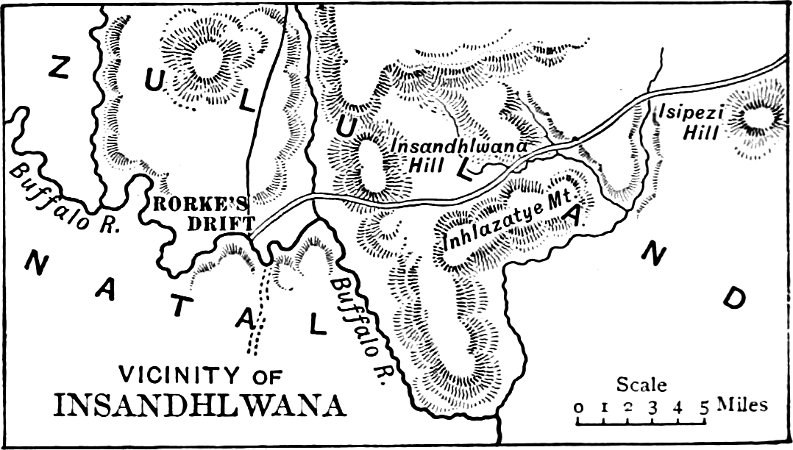
VICINITY OF INSANDHLWANA
It is here worth while to say a word about the Natal Native Horse, than which no corps fought more loyally, bravely, and disinterestedly during the troubles in South Africa. They were principally recruited in Edendale, a Basuto agricultural settlement formed by Wesleyan missionaries, who had recognised that Christianity could best be taught to people who had given up a savage life, and had been trained in and appreciated the arts of peace. The good missionaries had taught the wild Basutos to build houses, to make waggons, and to cultivate the ground scientifically, and, in conjunction with these benefits, had inculcated the Christian’s moral law and the Christian’s sentiments. The settlement at Edendale flourished exceedingly, and the Basutos became not only prosperous citizens, but God-fearing men. When war threatened, they were appealed to to give their services to the Queen, and they eagerly responded. As soldiers, they were like the old Covenanters. Every morning they assembled round their head-man for prayer, during the day no troops were more daring and trustworthy, and at night, before they lay down to rest, they again assembled for united worship. In truth, they were soldiers whom any general would be glad to command, and disciples whom any religious body would be proud to claim.
Colonel Durnford had asked Colonel Pulleine to let him have two companies of the 24th, but when it was represented that they could ill be spared, the request was not pressed.
As has been said, the full amount of the impending danger was not realised, and there was no expectation of an attack on that day. As a precautionary measure, however, a company of the 24th, under Lieutenant Cavaye, was sent out as a picquet about 1,200 yards north of the camp, while the remainder of the troops were dismissed from parade, but to remain in readiness to fall in at a moment’s notice.
The two troops which had been sent out under Shepstone and Barton had proceeded about five miles from the camp, when they met a large Zulu force on the march. Captain Shepstone at once ordered a retreat, and himself rode in with the warning that an attack was probably imminent, but the appearance of masses of the enemy surging over the hills had already given the alarm. Meantime, Colonel Durnford had, with two troops, moved to the front at a canter, followed by the rocket battery at a slower pace. After he had proceeded some miles, his advanced files reported an immense “impi” behind the hills, and almost immediately the Zulus appeared in force on his front and left in loose order, ten or twelve deep, with heavy masses in support. They opened fire and advanced with the startling rapidity which marked all their movements. Colonel Durnford retired a little way behind the shelter of a “donga,” a ravine-like crack in the plain. There he extended his men and commenced a steady fire, but the numbers against him were so overwhelming that he had to continue his retreat, only to find that the enemy had been beforehand, and had annihilated the rocket battery, slaying its commander, Major Russell, with all his gunners. Deserted by the escort of the native contingent, the battery had fought with unflinching courage, but had been overwhelmed by the fierce charge. Durnford, sorely pressed, disputed every inch of ground until he reached another donga, where he found himself in line with the camp troops, and was reinforced by thirty or forty Natal Volunteers, under Captain Bradstreet. Here his last desperate stand was made.
Two companies of the 24th, under Captains Mostyn and Younghusband, had been pushed forward to the support of Cavaye’s picquet, but they were too weak for the gigantic task, and all were driven in upon the main body.
The situation was now this: The usual Zulu attack in half-circle was being made on the camp, while a whole Zulu regiment, the Undi, was pushing round the English left to gain possession of the waggon road and line of retreat upon Rorke’s Drift.
The two guns and the whole of the 24th were in line, the native contingent was on the right of the 24th, and then came Durnford’s shattered and weary band. All were doing their duty manfully and well. The guns were in action, served coolly and steadily as on a home parade. The 24th, one of the smartest battalions in the service, was dealing withering volleys, and Basutos and Volunteers fought stubbornly for the homesteads of Natal. The enemy fell in hundreds, but kept on advancing with undiminished resolution. Rank after rank of the foremost were swept away, but still others pressed forward. The air was rent with the roar of battle. The guns, which had been firing shell, now at such close quarters were pouring in case, and each shot of the infantry told on the dense masses. Even Zulu courage could not maintain an advance against the deadly hail, and Cetewayo’s chosen warriors wavered and lay down, seeking shelter and covering the valley in detached groups to the depth of three-quarters of a mile. It almost seemed for a space as if English tenacity was once again, as in the past, to be rewarded with victory.
But the dire crisis of the day was at hand. The widespread horns of the Zulu army had worked their way round the flanks, and were even now showing themselves in rear of the English position. The native contingent had always been a broken reed upon which to lean, and it now broke and fled in the utmost disorder, thus laying open the right and rear of the 24th. The ammunition began to fail, and the Zulu opportunity had come. Nor were their chiefs slow to note and profit by it. Hitherto the attack had been made in the silence of perfect discipline. Now, as the iron-hearted warriors recovered from their momentary check they raised the ominous Zulu war-shout, and dashed forward in a last irresistible charge. They poured through the fatal gap in the line of defence, and in a moment the English soldiers were lost in the midst of the seething savage crowd.
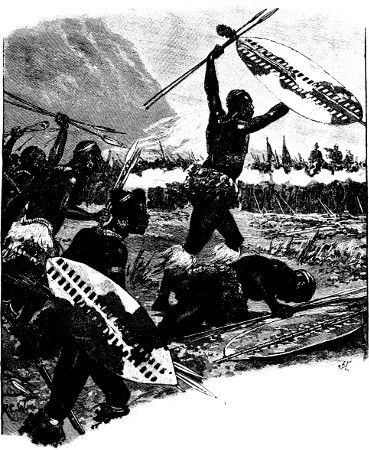
“THEY RAISED THE OMINOUS ZULU WAR-SHOUT, AND DASHED FORWARD” (p. 152).
So sudden was the catastrophe, so rapid the charge, that but few of the English soldiers had time to fix their bayonets and prepare for the hand-to-hand struggle. Many a brave heart among the defenders was cold in death long ere this, and sadly reduced were the numbers that strove desperately against the nervous Zulu arms and the assegais thirsting for blood. The savage warriors closed upon the doomed men with a shout of “Bulala umlongo!”—Kill the white man! Then followed a scene of direst confusion. Horse and foot, English and Zulu, friend and foe, in one writhing slaughtering mass, slowly pushed through the camp towards the road to Rorke’s Drift, the road of retreat to safety. But of the 24th, few, if any, left the ground where they had fought so well. The battalion fell and lay by companies, surrounded by slain enemies. When the battle-field was revisited, the remains of officers and men were all found in the line of their last parade. No man had flinched, and all had died as they had lived, shoulder to shoulder. When all was lost, the artillery had limbered up and striven to save the guns, and the mounted men who were yet unwounded forced their way, weapons in hand, through the press. But the right of the enemy already occupied the waggon road and barred the outlet. There was no safety except in seeking another passage to the Buffalo River, and the ground to be traversed was rugged, boulder-strewn and broken. None but mounted men had escaped from the precincts of the camp, and the ground was such that an active Zulu could cover it even faster than a horse. The guns were soon hopelessly impeded, and the drivers were assegaied in their saddles. The long ravine, which has since been called the “fugitives’ path,” was a scene of continuous slaughter, and even when the Buffalo was reached, it ran swift, deep and fordless, an alternation of boiling current and sharp rocks. Not half even of those who arrived on its bank succeeded in crossing. Many were drowned, many assegaied, some were shot, and the unrelenting pursuit continued even into Natal. The only troops which had maintained a semblance of cohesion were some of the Natal Native Horse. These gallant Basutos assisted many in the flight, which they covered as well as they could under Captain Barton, who rendered essential service by checking the pursuit on the Natal bank of the Buffalo.
Such a day as that of Insandhlwana could not pass without the performance of many deeds of gallantry and devotion, but the actors and spectators in too many cases were left among the slain, and their voices are dumb. We know of the heroic death of Captain George Shepstone, who, having disengaged his men, and finding that Colonel Durnford was still among the foe, said, “I must go and see where my chief is,” and turned his horse again into the mêlée, there to lay his body with that of his friend and leader. Private Wassall, of the mounted infantry, gained the Victoria Cross by plunging a second time into the torrent of the Buffalo, under a heavy fire, to save a wounded comrade, who would otherwise have been lost. Captains Melville and Coghill, of the 24th, who were both mounted, saved the Queen’s colour of their regiment after they had fought to the last in its ranks. They made their way to the river, and Coghill managed to get to the further side. Melville lost his horse, and was left struggling in the swift current. With sublime chivalry Coghill rode back to his assistance, when his horse also was shot. Both these brave officers succeeded in reaching the Natal shore, but, exhausted and wounded, they could do no more, and were overtaken and killed, fighting till the fatal “bangwan” did its work.
In this terrible disaster there perished twenty-six imperial officers and 600 non-commissioned officers and men, while the loss of the colonial forces was not less severe, twenty-four officers being among the slain. All the waggons and oxen, two guns, 1,200 rifles, and an immense quantity of ammunition and commissariat supplies, were also lost.
Of all the regiments in the Queen’s army, the 24th has perhaps paid as high a price as any for the glorious legends inscribed on its colours. Insandhlwana was the second battle-field in which a battalion had been practically annihilated. About thirty years before, at Chillianwallah, thirteen officers and the greater part of the non-commissioned officers and men had laid down their lives for the honour of England. Then the cheers of victory had been raised over the dead. The evening of the second fatal day in the regimental history closed in gloom and unrelieved sorrow.
We must return to Lord Chelmsford and the column which he had led forth in the morning to the support of Major Dartnell. Between six and seven in the morning the general had joined the force, which had bivouacked out during the night, and operations against what was then supposed to be the main portion of the Zulu army were at once commenced. The mounted infantry were despatched to the left front to press the enemy seen in the distance, while the general with the main body and the guns, protected on the right by the police and volunteers, moved up the valley against the position which had checked Dartnell on the previous day. That “kloof” was now found deserted, but a strong force was seen to be established on the mountain spurs. It was engaged and driven back with heavy loss. Everywhere the English troops gained ground; everywhere the Zulus retired before them. But it is more than probable that the retirement was a piece of elaborate strategy, intended to draw the general farther and farther away from his camp and thus reduce the force available for its defence. Whether such was the case or not, the result was the same, and at midday the general found himself twelve miles from Insandhlwana, looking for a spot on which to form a second camp. Several messengers had been despatched to him by Colonel Pulleine, telling of the threatened attack, but by fatal mischance none of them reached him. Between twelve and one reports were brought in by scouts that firing had been heard at Insandhlwana, but when, from the top of a hill, careful examination had been made with a powerful telescope, nothing unusual could be detected, and, consequently, no uneasiness was felt. The presence of large bodies of Zulus on the plain which had been traversed in the morning was now announced, and Lord Chelmsford resolved to retrace his steps with the mounted men and the native contingent, leaving the artillery and the second battalion of the 24th in bivouac. At four p.m., when he was within six miles of the camp, a solitary horseman met him, reeling in his saddle and riding at a foot’s pace. It was Commandant Lonsdale, who, having been taken ill with fever in the morning, had sought medical aid. He brought the ghastly news, “The camp is in possession of the enemy.” It appeared that when, riding in the half-lethargy of sickness, he was entering the camp, he was startled by a shot fired at him. He looked up and saw, sitting in and around the tents, groups of redcoats. He then saw a gigantic Zulu stalking out of a tent with a blood-smeared assegai in his hand. Looking more carefully, he saw that the wearers of the red coats were black men, and black men only. The real state of the case flashed upon his mind, and he turned and galloped off under a scattered fire. Providentially he was not hit, and was able to meet the general and prevent him from riding with his staff into the trap of destruction.
Orders were at once sent to the guns and the 24th to join the general, but it was six o’clock before they came. The force then collected was in little case for much exertion. They had covered nearly thirty miles under an African sun with only the slight supply of food which each man carried in his haversack. They knew that a nearly equal force of their comrades had been destroyed, and that a victorious army was between them and support. English soldiers never lose heart, however, in the hardest straits, and Lord Chelmsford’s men did not fail to respond gallantly to the call which he made for renewed effort. The march was resumed, and at nightfall they were again beneath the “little hand.” There was no sign of life or movement, but the enemy might be lying hidden ready to break forth. Two or three rounds of shell were fired, but they only awoke the slumbering echoes. Then two companies of the 24th, under Major Black, ascended to the neck of ground south of the great hill. The enemy had gone, bearing with them their blood-stained plunder.
The night had fallen, and the silence of death was around. There was nothing for it but to bivouac on the spot. No one who shared that bivouac will ever forget its horrors. The air was heavy with the scent of blood, and mangled corpses of English soldiers and Zulu warriors lay thickly around. It was well that the shades of night hid the blood-curdling details. The infantry lay down grasping their rifles, and the mounted men held the reins of their horses during the long, anxious night. Shots were fired and alarms spread at intervals, but it is doubtful whether the enemy wished to make any real attack. If they had, though each man was prepared to die in his place, the attempt would in all probability have been successful.
With the earliest light of morning the retreat to Rorke’s Drift was continued unmolested. Bodies of the enemy were seen on the hills overhanging the road, but no collisions with them took place. When the Buffalo River was reached a first gleam of encouragement and hope for the future came from the British flag, still waving over the feeble fortifications which Lieutenants Chard and Bromhead had so resolutely made good against the long assault by a numerous and determined foe.
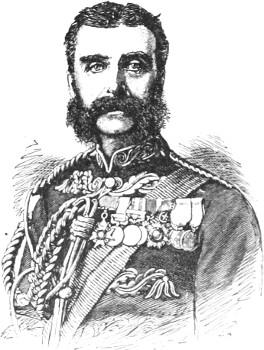
LORD CHELMSFORD.
LISSA
BY A HILLIARD ATTERIDGE

“Give me iron in the men, and I shall not mind much about the iron in the ships,” said the American admiral Farragut, when some of his officers were discussing the changes that would be introduced into naval warfare by the new ironclad navies. And Farragut was right in holding that, whatever the ships might be made of, the most important thing was to have enough “iron in the men” who worked and fought them. We are sometimes too apt to think that the power of rival fleets can be estimated by setting off their weight of guns and thickness of armour in two parallel columns, and striking a balance, as if it were an account in a ledger. But all naval history goes to prove that, within certain wide limits, the power of navies depends chiefly upon an element that can only be tested by the stress of storm and battle—namely, the courage, the nerve, and the “grit” of their officers and men.
No more striking proof of this was ever given than that which is afforded by the sea-fight of Lissa, the only battle between ironclads that has yet taken place in European waters. In ships, in guns, in armour the Italian fleet was superior to the Austrian. On paper there could be no doubt on which side lay the power that would secure, in event of war, the command of the Adriatic. The war came, and its grim reality showed how fallacious was the comparison made beforehand. The object of the Italians in 1866 was to drive the Austrians out of Venetia, by attacking them there while they were occupied elsewhere by the struggle with Prussia. The Italian plan of campaign was to march against the Austrians in northern Italy, and, after defeating their land army, besiege Venice by sea and land. The fleet was to crush the Austrians at sea, in the early days of the war, so to be ready to co-operate in the operations against Venice. It all worked out beautifully on paper. But the plan was never reduced to practice. War was declared on June 20th, and four days later the Italian field army was defeated by the Austrians at Custozza.
Nearly a month before war was declared, Count Persano had been placed in command of the Italian fleet, and ordered to prepare it for active operations in the Adriatic, making Ancona his headquarters. On June 20th, the day of the declaration of war, eight ships (including two ironclads) were at Ancona. Persano with the main body of the fleet, consisting of ten wooden ships and nine ironclads, was still at the naval arsenal of Taranto. Admiral Tegethoff, the Austrian commander, was getting his fleet ready for sea at Fasana and Pola, at the head of the Adriatic. He had taken command on the 9th of May, and ever since had been hard at work fitting out his ships and training his crews. The only effective portion of the fleet was a squadron of seven ironclads, broadside ships, with thin armour, and no guns of really heavy calibre. At first, the Austrian Admiralty suggested that the fleet should consist only of these ironclads and a few light steamers to act as scouts and despatch-vessels. But there were lying in the dockyard at Pola and in the port of Trieste an old wooden screw line of battle-ship, the Kaiser, and six wooden frigates. Tegethoff asked for these to be added to his command. “Give me every ship you have,” he said: “you may depend on it I will find good use for them.” He was given a free hand, and he organised his fleet in three divisions. The first was composed of seven ironclads. The second, under his friend Commodore Petz, consisted of the seven wooden ships. The third was made up of gunboats, paddle-steamers, and other light craft. The crews were rapidly recruited among the fishing population of the Dalmatian coast, and the sailors of Trieste and Pola. So new were many of them to work on board a man-of-war that they were not even uniformed when the fleet sailed, and they still wore at Lissa the clothes in which they enlisted. But they were brave and hardy seamen to begin with, and Tegethoff had given them some weeks of training in which the crews were busy from morning to night at target practice, the captains of the guns being taught to lay a whole broadside so as to converge on a single mark; and there was also practice in manœuvring under steam, in which great stress was laid on the importance of rapid turning so as to avoid the enemy’s rams, and use the same weapon successfully against them. The result was that even the newly-enlisted men learned confidence in themselves and in the brave and skilful leader who commanded them.
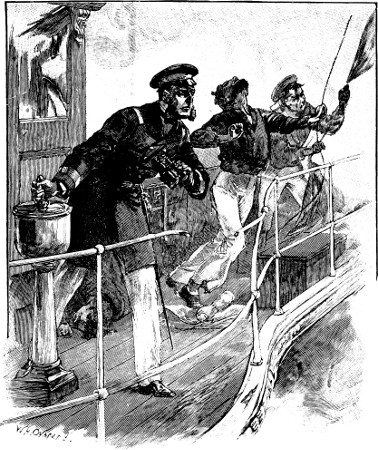
“FROM THIS POINT TEGETHOFF KEPT ON THE BRIDGE>” (p. 160).
As soon as war was declared, Tegethoff sent one of his steamers out with orders to reconnoitre the Italian coast from Ancona southwards as far as Bari. On June 23rd she returned to the Admiral’s headquarters at Fasana, and reported that there were only a few ships at Ancona, and no sign yet of the enemy’s main fleet coming up the coast. Tegethoff, on this, resolved to see if it was possible to make a rapid attack on Ancona, and on the 26th he put to sea with thirteen ships, including six of his ironclads. He arrived off Ancona next day, and saw for himself that in the meantime Persano had collected his entire force in the harbour. But the Italians showed no signs of coming out to meet him, and he had no intention of fighting both their forts and their ironclads at one and the same time. So he steamed back to Fasana.
Persano’s orders were “to clear the Adriatic of the enemy’s fleet by destroying it or blockading it in its harbours.” But though he had on his side superior numbers, heavier guns,[2] and thicker armour, he seemed very reluctant to begin. The fact is, he had not much confidence either in his own powers or in his officers and men. He remained at Ancona till July 8th, and only put out to sea on that day because he had received a telegram from the Government bidding him to look for the Austrian fleet, and blockade it if it was still at Pola. But even then all he did was to steam across to the Dalmatian coast and come back to Ancona on the 13th, after practising some fleet manœuvres. The appearance of his fleet off the island of Grossa was telegraphed to Tegethoff, who, however, refused to sail from Fasana till he knew clearly what were the plans and destination of the enemy.
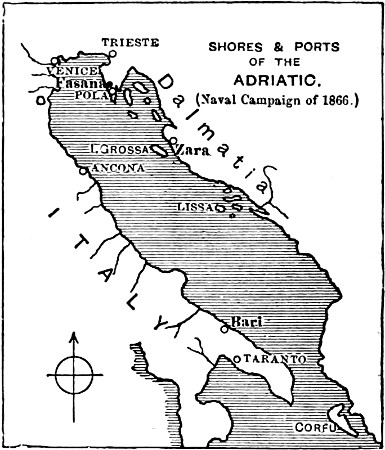
SHORES & PORTS OF THE ADRIATIC.
(Naval Campaign of 1866.)
Two days after the Italian fleet returned to Ancona its admiral received a peremptory message from his Government informing him that, after the great hopes that had been built upon the fleet, everyone was disappointed with his inactivity, and that if he did not do something at once he would be removed from the command. It was suggested that he should attempt to capture by a coup-de-main the fortified island of Lissa on the Dalmatian coast, and several battalions were placed at his disposal to act as a landing party in case he decided to adopt this plan.
Persano was thus driven to venture upon what has always been recognised as one of the most dangerous of naval operations. He was to escort a fleet of transports across the Adriatic, and co-operate with the troops embarked in them in an attack upon a maritime fortress, having all the time a hostile fleet watching for the opportunity to fall upon him, while he was engaged in the siege. True, the Austrian fleet was supposed to be inferior to that which he commanded; but, if this was so, the sound course for him was to blockade it in its harbours or crush it if it tried to come out. The enemy’s fleet ought to have been dealt with before anything else was attempted. If he was not strong enough to do this, he could not hope to reduce Lissa and keep Tegethoff at bay at the same time. But the fact is, he was not acting on any sound principle of naval war. He was merely trying to “do something” to satisfy public opinion; and there was just the chance that he might reduce Lissa before the Austrians arrived, or that Tegethoff might shrink from attacking him; or, if there was a battle, he might still hope that numbers and weight of metal would give Italy the victory over Austria.
Lissa is an island about thirty miles from the Dalmatian coast, and one hundred and thirty from Ancona. As the nearest of the Dalmatian Islands to Italy, it has always been a naval station of some importance when a war has been in progress in the Adriatic; and in our last war with France its waters were the scene of a brilliant frigate action in which our sailors defeated a much superior French force. In 1866 the chief harbour of Lissa, that of San Giorgio, and the neighbouring inlet of Porto Carober were protected by strong batteries. There were also batteries on the high rocks at Porto Comisa and at Manego. The signal station on Monte Hum, the highest point in the island (about 1,600 feet above the sea), commanded in clear weather a view of both sides of the Adriatic, and the island was connected by a submarine cable with the neighbouring island of Lesina and the Dalmatian coast. The garrison of Lissa consisted of 1,800 men, with eighty-eight guns, commanded by Colonel Urs de Margina.
On July 17th Persano steamed round the island, reconnoitred its defences, and decided on his plans for the attack. Next day Admiral Vacca, with three of the Italian ironclads and one wooden ship, attacked the batteries of Porto Comisa. The main body of the fleet closed in upon the harbour batteries of San Giorgio, in order to keep the garrison there as much occupied as possible while Admiral Albini, with another squadron, brought six large screw steamers crowded with troops into the bay at Porto Manego in order to effect a landing there. At Porto Comisa, Vacca found he could not elevate his guns sufficiently to do any serious damage to the high batteries, and he was driven off by their shells. At Porto Manego, a heavy surf on the beach and the fire of the Austrians from the shore made the landing impossible. At San Giorgio, Persano silenced the low-lying batteries at the harbour mouth, blowing up two of their magazines, but the inner batteries prevented his ships from entering the port. During the day one of his steamers had gone in to the neighbouring island of Lesina and cut the telegraph cable there. While the Italians were in possession of the telegraph station at Lesina, a message from Tegethoff came through. It was addressed to Colonel de Margina, and told him to hold out to the last, promising that the fleet would come to rescue him. Persano tried to persuade himself that this message was intended to fall into his hands, and was a piece of mere “bluff” on the part of his opponent.
On the following day he renewed the attack on Lissa, but again failed to force his way into the harbour, while an attempt to land troops at Porto Carober was repulsed with heavy loss. On this same day, July 19th, Tegethoff put to sea with every ship he could muster. His last order to his captains was to close with the enemy before Lissa, and once the battle began, to “Ram everything painted grey.” This was the colour of the Italian ships. He gave his own hulls a coat of black paint before they started, in order to make it easier to distinguish friends from foes in the coming mêlée.
On the evening of the 19th Persano was undecided what to do next day. He had been two days in action, and though his ships had received only slight injuries, his supply both of coal and ammunition was running short. Yet if he went back to Ancona without having obtained a decided success he would be deprived of his command. So he at last resolved to capture Lissa by a combined attack by land and sea. Early next day he signalled to his colleague Albini to prepare for the landing. It was a fine morning, with a good deal of white haze on the sea shutting off the distant view. Albini was getting the soldiers into the boats, and two of his frigates were standing in towards the creek of Carober to clear the way for the landing. A hospital ship had joined the fleet and was taking its wounded on board. The ironclads had assembled, and were getting up anchor for the attack on San Giorgio. It was eight o’clock: the attack was to begin at nine; but suddenly out of the haze to the north-westward appeared the frigate Esploratore, which had been scouting in the offing. She was steaming her fastest, and as she came nearer, Persano was able to read the signal she was flying. “Suspicious-looking ships are in sight.” He knew at once that he had to deal with the Austrian fleet.
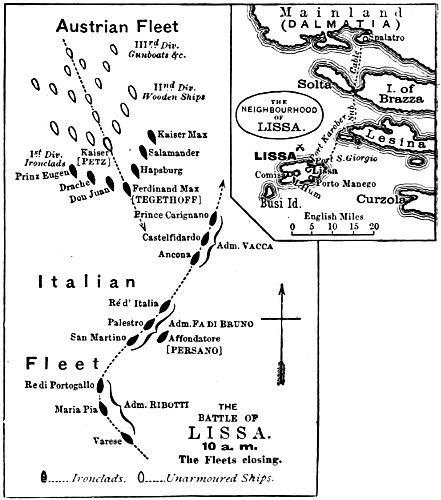
Top: THE NEIGHBOURHOOD OF LISSA.]
Bottom: THE BATTLE OF LISSA. 10 a. m.
The Fleets closing.
Tegethoff’s fleet had been steaming all night in three lines, the ironclads leading, the wooden ships and gunboats following. The despatch-boat Stadion was out ahead, and at seven a.m., long before Persano knew what was coming, six of his ships were sighted by the keen eyes of the look-out at the masthead of the leading Austrian ship. She signalled to her consorts, “Six steamers in sight.” Then the haze closed down ahead, and Tegethoff slackened speed in hopes it would clear, for in such thick weather he did not care to venture into the narrow waters between Lissa and Lesina. He formed for battle, each of his lines throwing forward its centre so as to assume the shape of a flattened wedge. He led the first line in the Ferdinand Max, with three ironclads on either beam. The second line also consisted of seven ships, Petz in the Kaiser leading, with three frigates on each side. Thus the squadron moved towards Lissa under easy steam. The haze was breaking up: it was a hot summer day, and a little before ten o’clock the sky was bright, the air clear, and the sea smooth; and close ahead the Austrians saw the forts of Lissa with the imperial flag still waving over them, and in front of the harbour mouth the mass of wooden ships, transports, and small craft, interrupted in their preparations for the landing, and nearer still the Italian ironclads steaming out in one long line ready for battle.
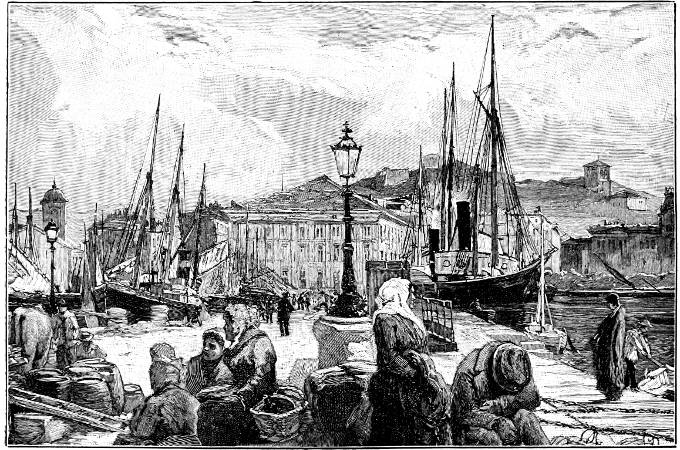
TRIESTE HARBOUR.
Persano, regarding his wooden ships as useless, had decided to take only his ten ironclads with him, believing that they would be able to deal with the seven which Tegethoff was bringing against him. He formed his ironclads in three divisions, each of three ships, with the turret ship and ram Affondatore, then the most powerful vessel in the Adriatic,[3] on the starboard side of the central division. The Affondatore, with her ram and her heavy turret guns (two 300-pounders), was to come to the help of whichever of the three divisions was in need of succour. At the last moment he himself went on board of her—an unfortunate move, which led to much confusion during the battle, as his captains were mostly unaware that the Ré d’Italia, a large broadside ship, which had till then been flagship, no longer carried the Admiral.
When the haze cleared, the Italian fleet was steaming across the Austrian front. Tegethoff had already signalled to clear for action. He now signalled to open fire with the bow guns, and the distant shots from the leading Austrian ships were answered by the broadsides of Admiral Vacca’s division, which led that of Italy. But the range was fully two miles, and these “long bowls” did no harm. The fleets were wrapped in drifting clouds of smoke, and geysers of foam shot up here and there from the blue water in the space between. “Full steam ahead,” signalled Tegethoff. The fleets were closing, the Italians still keeping their broadsides to the advancing foe. The fire was closer, and now spars and ropes were cut away, boats and wooden fittings were knocked to splinters, and signalmen and others who had not yet got under cover were wounded or killed by bursting shells. “Ironclads will ram and sink the enemy,” signalled Tegethoff, the last order he gave till the battle was won. From this point he kept on the bridge of the Ferdinand Max, regardless of personal danger, and led his fleet by showing his consorts what a well-handled battle-ship could do. Two of his captains, Molb of the ironclad Drache, and Klint of the Novara, were killed as the fleets came to close quarters, Molb being struck down by the first Italian shot that fell on board his ship.
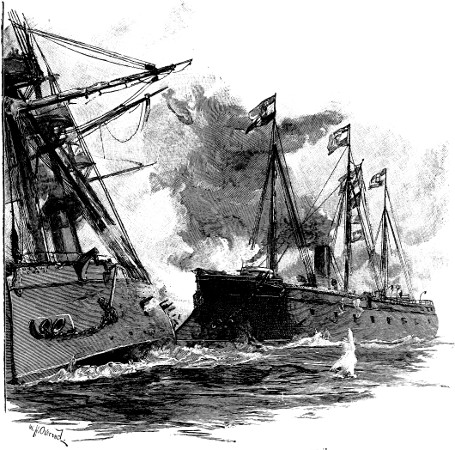
“THE RAM CRUSHED IN HER IRON SIDE.”
The two lines of ironclads closed amid thick clouds of smoke. The Austrian ships broke into the gap between Vacca’s three ironclads and the rest of the Italian fleet, and Petz, with the wooden ships coming up on their right, co-operated with them in their attack on the Italian centre. In a moment all order was lost, and the battle became a mêlée. The Ferdinand Max twice rammed a grey ironclad without succeeding in sinking her, when suddenly up out of the smoke loomed the tall masts of the Ré d’Italia, which came up to the rescue of her consort. Tegethoff, thinking he was dealing with the Italian flagship, charged her full speed and struck her fairly amidships. This time he had succeeded: the ram crushed in her iron side, and the tall masts toppled over as the ironclad went down with her crew of 600 men. The Ferdinand Max had reversed her screw to clear the wreck, when another Italian vessel, the name of which could not be made out by the Austrians, came bearing down upon her, trying to ram. The Austrian flagship just avoided the collision, and the two ships grazed past each other almost touching. As she thus ranged up alongside, the Italian ship fired a broadside. What followed would be incredible, only for the clear evidence which supports the Austrian record. So close were the muzzles of the Italian guns to the side of the Austrian flagship that the smoke of the broadside poured in through the open portholes of the Ferdinand Max and made her gun-deck for the moment dark as night. But neither the ship nor the men were injured, for in their hurry and confusion the Italian gunners had fired a broadside of blank cartridge!
Admiral Ribotti, with the rearward division of the Italian fleet, as he came into the fight encountered only the wooden squadron of Commodore Petz. Ribotti ought to have sunk them one by one, but the Austrians evaded his attempts at ramming, and Petz in the Kaiser boldly drove the oaken bows of his battle-ship against the iron sides of his adversaries. He was not able to do them much damage. He hit the Ré di Portogallo, Ribotti’s own ship, one good blow, that left its mark on her armour, but in doing so his own ship was disabled. The bowsprit was carried away, the foremast fell across the funnel, and the wreck of mast and spars took fire. The Kaiser, her crew working hard at cutting away the débris and putting out the fire, steamed through the Italian fleet and stood in to the harbour of Lissa, exchanging shots with some of the Italian wooden vessels. Cheered by the garrison, she passed the harbour mouth and anchored under the guns of the forts, the first of the relieving squadron to arrive at San Giorgio.
Meanwhile the mêlée continued. While Tegethoff was in the thick of the fight, Persano made the great ram Affondatore nearly useless by persisting in keeping on the outskirts of the conflict. If he had ventured in with her it is very likely he would have been sunk by the better-handled Austrian ships. The Palestro, which had gone into action immediately astern of the Ré d’Italia, had been almost as severely handled as her leader. She had been rammed. Her steering gear and rudder had been knocked to pieces, and her gun-decks were on fire. She drew out of the fight, her commander getting his steam hose to work to drown the magazine. The Austrian ships were now clearing the Italian line, and steering for Lissa. The mêlée, which had lasted for rather more than half-an-hour, was over. The position of the two fleets was reversed. The Austrians with their left near Lissa, were forming up in line across the channel between that island and Lesina. Everyone of their ironclads was still in good condition, and even the disabled Kaiser, which had gone into the harbour with her foremast burning and her decks strewed with nearly two hundred killed and wounded, was again clearing for action. The Italian wooden ships were assembling off the western end of the island. To the northward the ironclads were scattered here and there, on the waters that had just been the scene of the fight. As the smoke cleared, Persano signalled to the nearest ship—“Where is the Ré d’Italia?” and got for answer, “Sunk to the bottom.” Close astern of the Affondatore lay the Palestro, the black smoke pouring from hatchway and porthole. Her crew believed that the magazine had been successfully drowned, and that they were getting the fire under. As they recognised Persano on the bridge of the Affondatore, they gave him a cheer. His own crew were answering it when there was a burst of flame and a volume of dense smoke from the Palestro, and an explosion louder than all the din of battle went echoing over sea and shore. It was the death-knell of 400 men, for the Palestro had blown up with all on board.
Admiral Vacca, thinking that Persano had gone down with the Ré d’Italia, had signalled to the fleet to re-form in line of battle. The same signal from the Affondatore showed him where his commander was. And the ironclads, now reduced from ten to eight, re-formed in line. It was noon on a blazing hot day, and for some time the two fleets watched each other across the sunny space of open water that divided them. Persano had still the advantage of numbers, and everyone expected that he would signal to renew the attack. But if he had very little confidence in his fleet before the battle, he was now reduced to a condition of something like despair. Even the wooden ships of the Austrian squadron had passed in safety through his line, while their ironclads had destroyed two of his ships and more than a thousand of his men. It must be added that he had now been three times in action, and his stock of both coals for his engines and ammunition for his guns must have run very low. In this state of affairs, he persuaded himself that he need not actually attack the Austrians; all that honour demanded of him was to give them the opportunity of renewing the trial of strength if they wished. So for another hour he remained in line of battle, just out of long range of his enemy’s guns.
But Tegethoff had accomplished the task assigned to his fleet. He had relieved Lissa, by bringing the guns, the men, and the supplies of his fleet to the help of its brave little garrison. He had done this, too, not by slipping past the Italians in the morning fog, but by fighting his way through their most powerful squadron, making them pay dearly for their attempt to intercept him. Why should he renew the fight when there was nothing more to be gained for the moment?
Persano at last decided that he, too, had done enough for honour. He signalled to the fleet to steam away to the north-west, and shortly after altered his course for Ancona. He anchored there next day, and added to all his previous blunders the final folly of sending to his Government, and wiring all over Italy, the report that he had fought a pitched battle with the Austrians, and won a victory over them in the waters of Lissa. That night Florence (then the capital) was illuminated in honour of his “triumph.” Next day the facts began to be known. It was impossible to deny that the Austrian fleet was intact; that the Italians had lost two ships, and had been forced to raise the siege of Lissa. It was in vain that Persano argued that he was the victor because he had remained in possession of the waters in which the battle had been fought, and that he had for a whole hour dared the Austrians to come on again. There was the obvious reply that a naval battle is not fought for the possession of a stretch of open water; that Persano had tried to prevent the Austrians reaching Lissa, that they had gone there in spite of him; and that they would have been fools to come back in order to show twice over that they were not afraid to fight him. There was a wild outburst of indignation against the unfortunate admiral; there were riots at Florence, and a royal decree removed him from the command of the fleet. As if to add to the general collapse of the Italian navy, the Affondatore, supposed to be its most powerful ship, whether through injuries received at Lissa, or through mere defects in her structure, sank at her anchors in the harbour of Ancona.
On the side of Austria, there were rejoicings in which the name of Tegethoff was celebrated as that of an heroic sailor who had given his country the consolation of a naval victory at a time when her fortunes on land were at the lowest. He had won his great victory with comparatively little loss. The Kaiser was the only ship that suffered at all heavily. In some of the ironclads there were only a few wounded, and every one of the ships was in a position to continue the fight when the Italian fleet retired. The battle was the first that had been fought by ironclad fleets in European waters, and the impression it made upon naval experts was that the ram would be the chief weapon of future battles on the sea. Yet, though we have by no means clear or full accounts of what happened in the mêlée while the two fleets were passing through each other’s lines, it is certain that the number of attempts to ram made by the Austrians was out of all proportion to their two successful attacks. All the attempts of the Italians to ram ended in failure. It must be remembered that since Lissa a great change has come over naval tactics, through the development of the torpedo and the quick-firing gun, and it is now generally recognised by naval men that to attempt to ram an adversary till he is disabled by gunfire or otherwise is to invite failure and disaster. Tegethoff regarded the ram as his chief weapon. Nowadays it is looked upon as the means of giving the coup de grâce and completing a victory that is already half won.
The victor of Lissa was rightly honoured by his sovereign and his countrymen, while Admiral Persano was put on his trial on the charge of having lost the battle through cowardice and incompetence. He was acquitted of the charge of cowardice, but found guilty of having sacrificed his fleet through his incompetent conduct at Lissa, and he was deprived of all rank and dismissed from the navy. There is no doubt that although he alone was condemned, he was not the only officer of the Italian fleet who was responsible for the defeat of Lissa. Throughout there was a lamentable want of energy, pluck, and decision. Otherwise the Austrians would not have achieved their victory with so slight a loss. Albini’s conduct in looking on idly with his frigates while Petz on the Austrian side was leading his wooden squadron against Ribotti’s ironclads, is a good instance of this.
Indeed, the Battle of Lissa, considered in its details, shows that success on the sea, as well as on land, is primarily a question of brave and competent leadership. Good officers are the first condition of naval success; well-trained and disciplined crews the second; powerful ships are the third. Public opinion is often so ill informed as to put in the first place what really stands last; but none of these elements of naval power can be safely neglected by a maritime State, and one which claims the Empire of the Sea must spare no effort to possess all three, and to possess them in abundance.
MacMahon at Magenta
BY STODDARD DEWEY
It was noon of the 4th of June, 1859, before the French general, Trochu, at the head of his division, could move out in turn from Novara along the high road leading to Milan across the river Ticino. The Emperor, Napoleon III., was commanding in person the united French and Italian armies. He had gone on ahead, and was himself preceded by several divisions of the French troops. It was known, in a general way, that the Austrian enemy was not far distant to the south and eastward beyond the river. An attack was expected, but it was uncertain where it would be made.
Suddenly the noise of cannon was heard from the front, several miles away. It went on steadily increasing.
“What is the meaning of that?” inquired Trochu of an officer he met watering his horse by the roadside.
“At first we thought it was a fight,” was the answer; “but it is only General Lebœuf trying his cannon.”
“Cannon would not thunder like that under trial,” replied Trochu. “Those guns are loaded with something heavier than powder.”
He hastened the march of his troops with not a little anxiety. Soon another officer, in the sky-blue uniform which marked the personal staff of the Emperor, dashed up.
“Ah, General, what a fearful surprise! The Emperor has been attacked by the Austrians when he least expected them. We are all but beaten.”
“Where is MacMahon?” asked the General.
“MacMahon had orders to march forward, no matter what happened, to the church-tower of Magenta.”
“Then nothing is yet lost. MacMahon is not a Cæsar, but he is stubborn. If he has been told to march on the tower of Magenta, he will reach it in spite of all. And then it is we who shall have outflanked the Austrian army.”
Several hours passed before the guns of MacMahon made themselves heard. It was late at night before the Emperor learned what MacMahon and his men had been doing. Generals and soldiers, wearied out with the afternoon’s bloody fighting by the river, could not believe that a great victory had been won in the evening without them over by Magenta. In the morning, when they looked for the battle to be renewed, they found that the enemy was indeed drawing off, sullen and beaten.
Even afterwards, when each movement of the hostile troops was known and could be followed on the map, great authorities in practical warfare, like the Prussian general, von Moltke, criticised the winning of the battle. MacMahon at Magenta is an instance of a battle won contrary to rule.
I.—The Preparations of Battle.
The enmity between Austrians and Italians was of old date. It belonged to the great popular movement in favour of a common government for all of the Italian race and language. Until now the whole of Italy had been divided up piecemeal among many rulers. To the north-west Victor Emanuel had his kingdom of Sardinia, or Piedmont. He represented the Italian hopes in this war with Austria which held possession of the rich provinces of Lombardy and Venice to the east of his dominions. Toward the south were the petty duchies of Parma and Modena, the grand-duchy of Tuscany, the States of the Church, and the kingdom of Naples, or the Two Sicilies. All these were at one with Austria in striving to keep things as they had been so long; but their people were ripe for the revolution which was bound to come. Magenta was the first decisive victory won, after an invasion of the Austrian territory, in the name of United Italy.
The war had been long preparing. In 1849 the Austrians crushed for a time the Italian uprising by a victory over the Sardinians here at Novara. For many years nothing could be done but by way of diplomacy. This was the work of Cavour, the Minister of King Victor Emanuel. From 1852 he had been persuading the governments of Europe that there was an Italian question which would soon have to be settled.
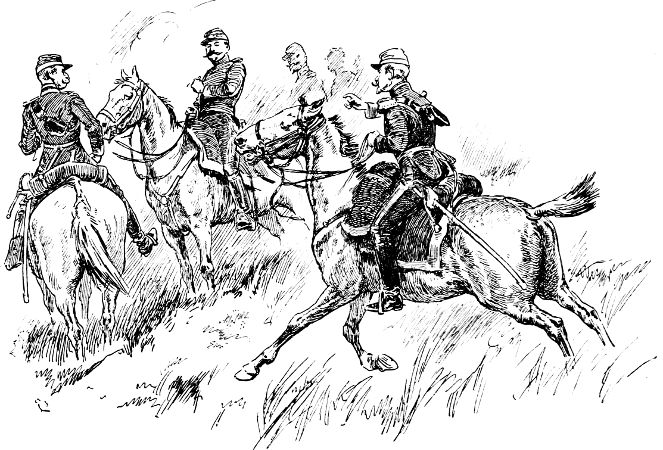
“GENERAL LEBŒUF ... DASHED UP” (p. 166).
Louis Napoleon, who was now Emperor in France, had himself been a revolutionist in Italy when he was only a needy adventurer. That was in 1831, when he took part in an insurrection in the Papal States. He then became a carbonaro, or member of one of those secret societies in which the chief obligation was to forward the cause of Italian unity. For a long time after he became emperor he shrank from precipitating the war to which his oath obliged him. The explosion of a bomb under his carriage in Paris by Orsini, the son of the man who had stood sponsor for him in the revolutionary society, reminded him that the carbonari were relentless in their vengeance on traitors to their cause. In July, 1858, it was made known that the Emperor of the French had entered into close alliance with the King of Sardinia.
Austria, seeing that war was inevitable, preferred that it should come sooner rather than later. On the 19th of April, 1859, she summoned Sardinia to put her army on a peace footing within three days. Cavour refused, and on the 29th the Austrian commander Gyulaï invaded the Sardinian territory.
Napoleon III. now announced that the acts of Austria constituted a declaration of war on France, the ally of Sardinia. At once he set about organising his army for the Italian campaign. On the 4th of May his troops were entering the valley of the Po, along which lay the open way to Lombardy. On the 10th the Emperor himself left Paris for the seat of war, to command the allied armies in person.
The news of Napoleon’s coming was enough to send Gyulaï back from the threatening movement which he had already made on Turin, the capital of Sardinia. Napoleon had not yet his artillery, but the Austrian commander did not know the essential weakness and confusion of the forces that were coming to meet him. Until the battle of Magenta, when consistent and energetic measures were already too late, the Austrian movements were a strange alternation of forward marches leading to no decisive action, and of hasty and fatiguing retreats when no enemy pursued.
General Gyulaï’s mind in the matter is now known. He was continually urged from Vienna, and afterwards from Verona, in Italy, where the Austrian Emperor had placed himself to direct the campaign, to push forward with his numerous, well-drilled, and well-equipped troops, and take the offensive. He himself was beset with fears that the enemy might pass him by and take Lombardy unprotected. He was not reassured when a division of his army in the north had succeeded in driving the free bands of Garibaldi to the very edge of the neutral Swiss territory. He gradually drew back to the region where the river Ticino, in its lower course, separated Lombardy from Sardinia. There he gave all his attention to concentrating his forces around the strong defensive positions which he had already prepared. But all this gave time to the French army to perfect its order and equipment, and to concentrate its own strength in line with the Sardinian troops.
Such was the general situation of things on the 1st of June, when Napoleon was directing the main body of the allied troops along the great highway leading to Milan, the capital of Lombardy, only twenty miles beyond the Ticino. On that day Gyulaï again retreated with all his forces, leaving the astonished French Emperor free to enter Novara. Napoleon could not believe that the Austrians would long delay their attack. On both sides the service of scouts was so ill-organised that neither commander had any clear idea of the other’s strength and position.
On the 2nd of June Napoleon sent forward two divisions of MacMahon’s corps to see what was awaiting them along the Ticino. General Camou reached the river, with his light infantry, at Porto di Turbigo, six miles to the north-east of Novara. He found no one facing him from the Austrian side but the single Customs officer, who was still faithful to the post which he had occupied in time of peace. From the yellow and black flagstaff beside him floated the double-headed eagle of Austria. Camou ordered first one, and then a second cannon-shot to be fired. The functionary disappeared open-mouthed. General Lebœuf, who was in command of the artillery, dashed up, pale with indignation.