LIST OF PLATES. (continued 13)
Reading edition
Up till this time, though several men had been wounded, no one had been struck dead. Suddenly a whisper passed round among the 24th, “Poor old King Cole is killed.” Private Cole, who was known by this affectionate barrack-room nickname, was at the parapet when a bullet passed through his head, and he fell doing his duty—a noble end.
If the Zulu fire was telling, however, the steady marksmanship of the English officers and men was still more effective. Private Dunbar, of the 24th, laid low a mounted chief who was conspicuous in directing the enemy, and immediately afterwards shot eight warriors in as many successive shots. Everywhere the officers were present with words of encouragement, exposing themselves fearlessly and showing that iron coolness and self-possession which rouses such confidence and emulation in soldiery on a day of battle.
Assistant-Commissary Dalton was continually going along the parapet, cheering the men and using the rifle with deadly effect. There was a rush of Zulus against the spot where he was, led by a huge man, whose leopard-skin kaross marked the chief. Dalton called out “Pot that fellow!” and himself aimed over the parapet at another, when the rifle dropped from his hand, and he spun round with suddenly pallid face, shot through the right shoulder. Surgeon Reynolds was by his side at once, and bound up the wound.
Unable any longer to use his rifle, Dalton handed it to storekeeper Byrne, but continued unmoved to superintend the men near to him and to direct their fire. Byrne took his place at the parapet, and his bullets were not wasted. In a few minutes Corporal Scammel, Natal Native Contingent, who was next to him, was shot through the shoulder and back. He fell, and crawling to Chard, who was fighting side by side with the men, handed him the remainder of his cartridges. In his agony he asked for a drink of water. Byrne at once fetched it for him, and whilst handing it to the suffering soldier, was himself shot through the head, and fell prone, a dead man.
While fighting was thus going on all round the post, a series of specially determined attacks was made against the northern side. Here the Zulus were able to collect under cover of the garden and patch of bush, and from that shelter were able to rush untouched close up to the parapet. Soon they were on one side of the barricade, while the defenders held the other, and across it there was a hand-to-hand struggle of the bayonet against the broad-bladed bangwan, the stabbing assegai. So close were the combatants that the Zulus seized the English bayonets, and in two instances even succeeded in wrenching them from the rifles, though in each case the breechloader took a stern vengeance. The muzzles of the opposing firearms were almost touching each other, and the discharge of a musket blew the broad “dopper” hat from the head of Corporal Schiess, of the Natal Native Contingent. This man (a Swiss by birth), who had been a patient in hospital, leaped on to the parapet and bayoneted the man who fired, regained his place, and shot another; then, repeating his former exploit, again leaped on the top of the mealie bags and bayoneted a third. Early in the fight he had been struck by a bullet in the instep, but though suffering acute pain, he left not his post, and was only maddened to perform deeds of heroic daring.
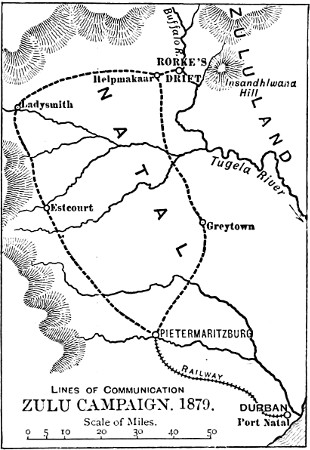
LINES OF COMMUNICATION
ZULU CAMPAIGN. 1879.
The struggle here was too severe and unequal to be long continued. Besides the ceaseless attacks of their enemy in front, the defenders of the parapet were exposed to the fire which took them in reverse from the high hill to the south. Five soldiers had been thus shot dead in a short space of time. At six p.m. the order was given to retire behind the retrenchment of biscuit-boxes. When the defence of the parapet was thus removed, the dark crowd of Zulus surged over the mealie bags to attack the hospital; but such a heavy fire was sent from the line of the retrenchment that nearly every man who leaped into the enclosure perished in the effort. Again and again they charged forward, shouting their war-cry “Usutu! Usutu!” and ever the death-dealing volleys smote them to the ground.
The story has now been told of the struggle during the first hour and a half about the storehouse and large enclosure, till the moment came when it was no longer possible to hold the whole of the defences as they were at first organised, and Chard was constrained to withdraw behind the biscuit-box retrenchment which his foresight had provided. All this time the enemy had been making fierce and constantly reiterated attempts to force their way into the hospital, which was at the west end of the enclosure. Here Bromhead personally superintended the resistance, and here such deeds of military prowess, cool presence of mind, and glorious self-devotion were performed as our nation may well inscribe on its proudest records. It has been said that the building had a thatched roof, and the Zulus not only strove to force an ingress, but used every expedient to set the thatch on fire, and thus to destroy the poor stronghold which so long mocked at their attempts to take it. While many of the patients whose ailments were comparatively slight had risen from their pallets and taken an active part in the defence, there were several poor fellows, utterly helpless, distributed among the different wards; and it is difficult to conceive a situation more trying than theirs must have been, listening to the demoniac yells of the savages, only separated from them by a thin wall, thirsting for their blood. At every window were one or two comrades, firing till the rifles were heated to scorching by the unceasing discharge. Bullets splashed upon the walls, and the air reeked with dense sulphurous smoke. The combatants may have been excited and carried away by the mad fury of battle; but to men depressed by disease, weakened and racked with pain, truly the minutes must have been long and terrible in their mental and physical suffering. Shortly after five o’clock the Zulus had been able so far to break down the entrance to the room at the extreme end of the hospital that they were able to charge at the opening; but Bromhead was there, and drove them back time after time with the bayonet. As long as the enclosure was held, they failed in every fierce attempt. Private Joseph Williams was firing from a small window hard by, and on the next morning fourteen warriors were found dead beneath it, besides others along his line of fire. When his ammunition was expended, he joined his brother, Private John Williams, and two of the patients who also had fired their last cartridge, and with them guarded the door with their bayonets. No longer able to keep their opponents at a distance, the four stood grimly resolute, waiting till the door was battered in and they stood face to face with the foe.
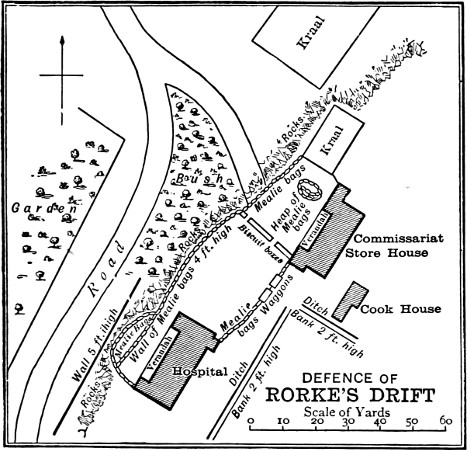
DEFENCE OF RORKE’S DRIFT.
Then followed a death struggle. The English bayonet crossed the broad-bladed bangwan, the stalwart Warwickshire lads met the lithe and muscular tribesmen of Cetewayo, and the weapons glinted thirsty for blood. In the mêlée poor Joseph Williams was grappled with by two Zulus, his hands were seized, and, dragged out from among his comrades, he was killed before their eyes. But now it was known that the hospital must be abandoned, and as the usual path was occupied by the enemy, a way had to be made through the partition walls. John Williams and the two patients succeeded in making a passage with an axe into the adjoining room, where they were joined by Private Henry Hook. John Williams and Hook then took it in turn to guard the hole through which the little party had come, with the bayonet, and keep the foe at bay, while the others worked at cutting a further passage. In this retreat from room to room, another brave soldier, Private Jenkins, met the same fate as did Joseph Williams, and was dragged to his death by the pursuers. The others at last arrived at a window looking into the enclosure towards the storehouse, and leaping from it, ran the gauntlet of the enemy’s fire till they reached their comrades behind the biscuit-box retrenchment. To the devoted bravery and cool resource of Privates John Williams and Hook, eight patients, who had been in the several wards which they had traversed, owed their lives. If it had not been for the assistance of these two gallant men, all the eight would have perished where they lay. These, however, were only some of the hairbreadth escapes from the hospital, and only some of the deeds of stubborn hardihood performed in it.
A few of the sick men were half carried, half led by chivalrous comrades across the enclosure to the retrenchment, but many had to make their own way over the space now swept by the Zulu bullets, and that that space was clear was due to the steady fire maintained by Chard, which prevented the Zulus themselves from leaving the spots where they were under cover. Trooper Hunter, Natal Mounted Police, a very tall young man, who had been a patient, essayed the rush to safety, but he was hit and fell before he reached his goal. Corporal Mayer, Natal Native Contingent, who had been wounded in the knee by an assegai-thrust in one of the early engagements of the campaign, Bombardier Lewis, Royal Artillery, whose leg and thigh were swollen and disabled from a wagon accident, and Trooper Green, Natal Police, also a nearly helpless invalid, all got out of a little window looking into the enclosure. The window was at some distance from the ground, and each man fell in escaping from it. All had to crawl (for none of them could walk) through the enemy’s fire, and all passed scathless into the retrenchment except Green, who was struck on the thigh. In one of the wards facing the hill on the south side of the hospital, Privates William Jones and Robert Jones had been posted. There were seven patients in the ward, and these two men defended their post till six of the seven patients had been removed. The seventh was Sergeant Maxfield, who, delirious with fever, resisted all attempts to move him. Robert Jones, with rare courage and devotion, went back a second time to try to carry him out, but found the ward already full of Zulus, and the poor sergeant stabbed to death on his bed.
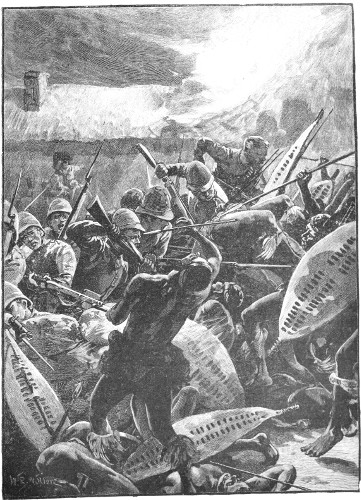
“THERE WAS A HAND-TO-HAND STRUGGLE” (p. 335).
It has been mentioned that a wounded prisoner was being treated in the hospital. So much had he been impressed by the kindness which he had received, that he was anxious to assist in the defence. He said “he was not afraid of the Zulus, but he wanted a gun.” His new-born goodwill was not, however, tested. When the ward in which he lay was forced, Private Hook, who was assisting the Englishmen in the next room, heard the Zulus talking to him. The next day his charred remains were found in the ashes of the building. That communication was kept up with the hospital at all, and that it was possible to effect the removal of so many patients, was due in great part to the conduct of Corporal Allen and Private Hitch. These two soldiers together, in defiance of danger, held a most exposed position, raked in reverse by the fire from the hill, till both were severely wounded. Their determined bravery had its result in the safety of their comrades. Even after they were incapacitated from further fighting, they never ceased, when their wounds had been dressed, to serve out ammunition from the reserve throughout the rest of the combat.
When the defence of the hospital was relaxed, it had been easy for the enemy to carry out their plan of setting fire to the thatched roof, and now the whole was in a blaze, the flames rising high and casting a lurid glare over the scene of conflict. The last men who effected their retreat from the building had as much to dread from the spreading conflagration as from the Zulu assegais. We have seen that, from the want of interior communication, it had been necessary for those who did escape to cut their way from room to room. Alas! to some of the patients, it had been impossible for the anxious leader and his staunch, willing followers to penetrate. Defeated by the flames and by the numbers of their opponents, Chard records in his official despatch, “With the most heartfelt sorrow, I regret we could not save these poor fellows from their terrible fate.”
While in the hospital the last struggle was going on, Chard’s unfailing resource had provided another element of strength to his now restricted line of defence, and had formed a place of comparative security for the reception of his wounded men. In the small yard by the storehouse were two large piles of mealie bags. These, with the assistance of two or three men and Assistant Commissary Dunne, who had from the first been working with energy and determination, he formed into an oblong and sufficiently high redoubt. In the hollow space in its centre were laid the sick and wounded, while its crest gave a second line of fire, which swept much of the ground that could not be seen by the occupiers of the lower parapets. As the intrepid men were making this redoubt, their object was quickly detected by the enemy, who poured upon them a rain of bullets; but Providence protected them, and unhurt, they completed their work. The night had fallen, and the light from the burning hospital was now of the greatest service to the defenders, as it illumined every spot for hundreds of yards round, and gave every advantage to the trained riflemen of the 24th. The Zulu losses had been tremendously heavy; but still they pressed their unremitting attack. Rush after rush was made right up to the parapets so strenuously held, and their musketry fire never slackened. The outer wall of the stone kraal on the east of the store had to be abandoned, and finally the garrison was confined to the commissariat store, the enclosure just in front of it, the inner wall of the kraal, and the redoubt of mealie bags. But the steadfastness of the defenders was never impaired. Still every man fired with the greatest coolness. Not a shot was wasted, and Rorke’s Drift Station remained still proudly impregnable. At 10 p.m. the hospital fire had burnt itself out, and darkness settled over defence and attack. It was not till midnight, however, that the Zulus began to lose heart, and give to the garrison some breathing space and repose. Desultory firing still continued from the hill to the southward, and from the bush and garden in front; but there were no more attacks in force, and stress of siege was practically over. The dark hours were full of anxiety, and even the stout hearts which had not quailed during the long period of trial that was past must have had some feeling of disquietude for the morrow, lest wearied, reduced in numbers, and with slender supply of water, they should be called upon to meet renewed efforts made by a reinforced foe.
The dawn came at last, and the eyes of all were gladdened by seeing the rear of the Zulu masses retiring round the shoulder of the hill from which their first attack had been made. The supreme tension of mind and body was over, and if the struggle had been long and stern the victory was for the time complete. How bitterly it had been fought out was shown by the piles of the enemy’s dead lying around, and by the silence of familiar voices when the roll was called. There was yet no rest. The enemy might take heart and return, for, though many of their warriors had seen their last fight, still their numbers were so overwhelming, and they must have known so well how close had been the pressure of their attack, that they might well think that, with renewed efforts, success was more than possible. Patrols were sent out to collect the arms left lying on the field. The defences were strengthened, and, mindful of the fate of the hospital, a working party was ordered to remove the thatch from the roof of the store. The men who were not employed otherwise were kept manning the parapets, and all were ready at once to snatch up their rifles and again to hold the post which they had guarded so long. A friendly Kaffir was sent to Helpmakaar, saying that they were still safe, and asking for assistance. About 7 a.m. a mass of the enemy was seen on the hills to the south-west, and it seemed as if another onslaught was threatened. They were advancing slowly when the remains of the third column appeared in the distance, coming from Insandhlwana, and, as the English approached, the threatening mass retired, and finally disappeared.
Lord Chelmsford, Colonel Glyn, and that part of their force which, having been engaged elsewhere, had not been in the Insandhlwana camp when it was attacked and taken, had passed the night in sad and anxious bivouac among the dead bodies of their comrades and the débris of a most melancholy disaster. Full of disquietude about the fate of the post at Rorke’s Drift, and the line of communications, they had pushed on with earliest dawn. Their advanced guard of mounted men strained eager eyes towards Rorke’s Drift. The British flag still waved over the storehouse, and figures in red coats could be seen moving about the place. But smoke was rising where the hospital had stood, and, remembering that the victorious Zulus at Insandhlwana had clad themselves in the uniforms of the dead, there was a moment of dread uncertainty to the officer who was leading the way. But surely that was a faint British cheer rising from the post! A few hundred yards more of advance, and it was known that here at least no mistake had been made; here courage and determination had not been shown in vain; and that here something had been done to restore the confidence in British prowess which had just received so rude a shock elsewhere. What a sight was the spot in the bright morning sunlight! There lay hundreds of Zulus either dead or gasping out the last remains of life; there was the grim and grey old warrior lying side by side with the young man who had come “to wash his assegai”; there a convulsive movement of arm or leg, the rolling of a slowly glazing eye, or the heaving of a bullet-pierced chest showed that life was not quite extinct; and there were the defenders wan, battle-stained, and weary, but with the proud light of triumph in their glance, standing by the fortifications which they had so stoutly held—fortifications so small, so frail, that it seemed marvellous how they had been made to serve their purpose. The skeleton of the hospital still was there, but its roof and woodwork had fallen in, and in the still smoking pile men were searching for the remains of lost comrades. And there, in the corner of the enclosure, reverently covered and guarded, were the bodies of the dead who had given their lives for England and sealed their devotion to duty with their blood. Well might Lord Chelmsford congratulate the defenders of Rorke’s Drift on the brilliant stand that they had made, and well might the colony of Natal look upon them as Heaven-sent saviours from cruel invasion.
In telling the story of the events of the 22nd, it has been said that Major Spalding left Rorke’s Drift to seek reinforcements at Helpmakaar. There he found two companies of the 24th, under Major Upcher, and with them he at once commenced to march to the river post. On their way they met several fugitives who asserted that the place had fallen, and when they arrived within three miles of their destination, a large body of Zulus was found barring the way, while the flames of the burning hospital could be seen rising from the river valley. It was only too probable that if they went on, they would merely sacrifice to no purpose the only regular troops remaining between the frontier and Pietermaritzburg. Helpmakaar was the principal store depôt for the centre column, full of ammunition and supplies, and it seemed best that its safety should, at any rate, be provided for as far as possible. The two companies were therefore ordered to return, and preparations for the defence of the stores were commenced.
Many names have been mentioned of men who, when all did their duty nobly, were particularly remarkable in the duty which they did and in their manner of doing it. Two men have not, in this narrative, been yet specially named, but they were each as heroic as any of those who stood behind Chard’s improvised defences. Theirs was not the duty of handling deadly weapons; theirs was not the lot to meet the enemy hand to hand. It was for them to comfort the dying, to tend the sick, to give aid to the wounded—and right worthily they played their part. The Rev. George Smith, acting chaplain to the forces, and Surgeon Reynolds, Army Medical Department, were exposed to all the dangers that surrounded every man of the garrison, and to every man they showed the example of treating those dangers with a grand indifference. Besides performing to the full the tasks of their noble professions, they were constantly present among the soldiers with words of cheer and encouragement. They distributed such poor refreshment as was available, and were indefatigable in supplying reserve ammunition to those whose cartridge-boxes were empty. Never can British soldiers hope to have with them, in a time of trial, better men than the Rev. George Smith and Surgeon Reynolds.
According to the closest estimate, the number of Zulus who attacked Rorke’s Drift was about 4,000, composed of Cetewayo’s Undi and Udkloko regiments, and about 400 dead bodies were buried near the post after the attack. The wounded were all carried away from the field. The loss of the garrison was fifteen killed and twelve wounded, of whom two died almost immediately.
No military rewards could have been too great for the glorious actions at Rorke’s Drift, and of rewards there was no niggardly distribution. Lieutenants Chard and Bromhead became Captains and Brevet-Majors. The Rev. George Smith, a missionary chaplain in Natal, received a commission as Army chaplain. Every officer was promoted in his corps or department, and besides the decorations given to others, Chard, Bromhead, and Dalton, Corporal Allen, Privates John Williams, Henry Hook, William Jones, Robert Jones, and Frederick Hitch received the Victoria Cross; Colour-Sergeant Brown and eight men received medals for distinguished service in the field.
Many brave exploits have been performed by men of the English army, and we may believe that the scroll of glory is not yet complete; but whatever the future may have in store, it would be difficult to find in past history any action which excels in brilliancy the defence of Rorke’s Drift.
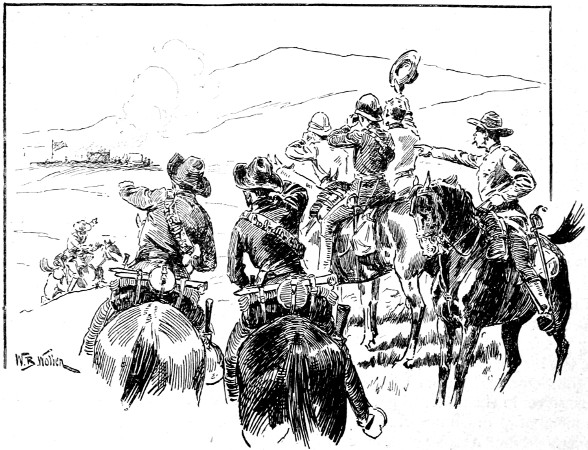
“THE BRITISH FLAG STILL WAVED OVER THE STOREHOUSE” (p. 339).
Mars-la-Tour
By Charles Lowe

“Look out for cavalry!” Such was the cry that was raised on the sanguinary field of Vionville-Mars-la-Tour oftener than in any other battle of the Franco-German war.
When France declared war against Germany in July, 1870, she sent all her available troops—numbering about 300,000 men—as fast as ever she could to her eastern frontier, where they formed themselves into what was called the “Army of the Rhine,” under the supreme command of the Emperor Napoleon. This “Army of the Rhine” was composed of eight separate Army Corps, or Corps d’Armée, commanded by Marshals Bazaine, MacMahon, and Canrobert, and by Generals Bourbaki, Frossard, Ladmirault, Failly, and Félix Douay.
On the other hand, the Germans divided their forces into three main armies—each also consisting of several Army Corps—of which the combined strength was about 384,000 men; and so quickly had the Germans—who are famous for their powers of organisation—done the difficult work of mobilising their forces (that is to say, preparing them to take the field), that, within a fortnight after the order for this process had been issued, no fewer than 300,000 helmeted defenders of the Fatherland stood ranked up and ready along the Rhine. Old King William of Prussia assumed the nominal command of all this tremendous fighting force; but in reality the man who directed and controlled its movements was Field-Marshal Count von Moltke, who was perhaps the most studious and scientific soldier the world had ever seen. He had divided all the field strength of Germany into three separate armies—each also composed of several Army Corps. The First Army, on the right, was commanded by General von Steinmetz; the Second, in the centre, by Prince Frederick Charles, known as the “Red Prince,” and the Third, on the left, by the Crown Prince, son-in-law of Queen Victoria.
The Crown Prince was the first to draw blood, on the 4th August (war had only been formally declared on the 19th July), when he won the great battle of Weissenburg, and on the 6th at Wörth, when he completed the defeat of Marshal MacMahon’s army. On this very same day, too, Steinmetz, on the right, had stormed the heights of Spicheren at a very great sacrifice of life, causing Frossard, who held these heights, to fall back on the excessively strong fortress of Metz, which stands in the lovely valley of the Moselle. MacMahon had retreated towards the great training camp—the Aldershot, so to speak, of France—at Châlons; while the rest of the “Army of the Rhine” meanwhile retired on Metz, and thither the Germans now also began to push with might and main.
It was thought probable by Moltke, from all appearances, that the French meant to make a desperate stand in front of Metz. But he met with less resistance there than he expected; and on the 14th August a victory gained by the Germans at Colombey-Nouilly had the effect of making all their opponents in the open field thereabouts withdraw towards the fortressed city. This battle had been fought on the east of Metz, while on the west side ran the high road to Verdun and Paris. On the 15th the Germans came to the conclusion that the French in Metz, not wishing to expose themselves to the risk of being cooped up and rendered useless within their fortress, meant to escape towards Verdun, to join hands with MacMahon’s beaten forces, and then give battle to the advancing Germans in the plain.
For the French were confident that they could give a good account of their hitherto victorious foes, could they but meet them on pretty equal terms in the open. The Germans saw very well that the object of the French at Metz was to escape to the west, and they therefore determined to strain every nerve to prevent this. Yet they sadly feared they would not succeed, for they were on the right, or east, bank of the Moselle, while the French were on the left, or west side; and it was necessary for their pursuers to make a wide sweep in order to cross the river and insert themselves in good time between Metz and Paris, so as to have the retreating Frenchmen face to face.
As early as the evening of the 15th a Division of Cavalry—the 5th, under Rheinbaden—had crossed the Moselle, and pressed round and forward with prying intent as far as the village of Mars-la-Tour, on the Verdun road, where it bivouacked for the night. It had seen certain masses of French troops away in the direction of Metz, but was unable to conclude whether this formed the rear-guard of the French army retreating on Verdun, or only its vanguard. As a matter of fact, this army was still struggling with the difficulties of getting away from Metz.
Early on the morning of the 16th the French Emperor, escorted by two brigades of cavalry, had driven away to Verdun by the Etain road, which was still comparatively safe, leaving the command of the Metz army to Marshal Bazaine.
All the roads from Metz were blocked by heavy baggage, and the French army could not get away from the fortress with expedition and method. The left wing of the army was ready to march, but not the right; and so the left had been sent back to its bivouacs until the afternoon. Thus Bazaine lost much valuable time, and what he lost the “Red Prince” won. For by 10 a.m. on the morning of the 16th August, the 3rd, or Brandenburg, Army Corps—one of the best and bravest in all Germany—had come within sight of the Verdun road, marked at intervals of about a mile by the successive villages (coming from Metz) of Gravelotte, Rezonville, Vionville, and Mars-la-Tour, which the German soldiers punningly called Marche-rétour after the French had been finally beaten back on Metz. It was an excessively hot day, the sun pouring down its rays on field and wood with almost tropical force; and by the time the brave Brandenburgers of General von Alvensleben, who had crossed the Moselle at Novéant the previous night, and resumed their forced march after a brief snatch of rest—by the time, I say, they had threaded the wooded glen of Gorze, leading right on to the Verdun road, they beheld to their great joy that a French force was in front of them.
After some preliminary skirmishing and wood-fighting, Alvensleben came to the conclusion that he had to deal with the whole, or at least the greater part, of Bazaine’s army, which had thus not escaped after all. But before the arrival of Alvensleben’s Corps on the scene, the action had been opened by the horse-batteries of Rheinbaden, which, advancing from Mars-la-Tour towards Vionville, opened a destructive shell-fire on Murat’s dragoons, who, encamped thereabout, were engaged in cooking. A regular stampede ensued, the dragoons bolting through the camp. But the French infantry were quickly on their guard, and opened so heavy a fire on the audacious German horsemen—who had, of course, followed their guns—that the latter were soon driven to seek shelter in hollows and behind copses.
It was at this time that Alvensleben’s Corps made its timely appearance, and began to enter into action, although it could not doubt that it had to contend against desperate odds. But it had been sent forward by its old commander, Prince Frederick Charles—who still wore the scarlet uniform of one of its Hussar (Zieten) regiments, and hence was known as the “Red Prince”—to seek out and hold Bazaine at bay, as a bulldog would a bull, until the arrival of reinforcements; and the doughty Brandenburgers were ready to resist to the very last man, if they must die for it. What would their beloved “Red Prince” say if they allowed the game to escape? Their only chance lay in the hope that Bazaine would not be able to concentrate all his colossal host and hurl it against them at once, and that the 10th Prussian Corps, with other parts of their army which they knew to have been despatched on the same errand as themselves, would meanwhile hurry up to their assistance and save them from complete annihilation.
The infantry part of the battle began on some wooded hills above the village of Gorze, about eight miles south-west of Metz, on a stream running from Mars-la-Tour into the Moselle at Novéant. “The Prussians,” said a correspondent of the Daily News, “pushed into the woods, gradually, by dint of numbers and sheer hard fighting, driving the French skirmishers from them. What happened in this part of the battle no one knows or can know, as it was entirely in the woods and valleys, and no general view of it could be obtained. The French position here was a most formidable one, and the wonder is, not that it took the Prussians seven hours to take it, but that they ever got it at all. The woods above Gorze extend to within about two miles of Gravelotte, behind which village the French lay in the morning, as also at Rezonville, another village higher up on the road from Metz to Verdun. Nearly the whole of the Prussian second position was backed by the thick woods they had got possession of in the morning.
“The plain on which the battle was fought extends from the woods to the Verdun road, about one mile and a half, and is about three miles in length. On the French right the ground rises gently, and this was the key of the position, as the artillery, which could maintain itself there, swept the whole field. More towards the centre are two small valleys, one of which, being deep, was most useful to the Prussians in advancing their troops. In the centre of the field is the road from Gorze to Rezonville and Gravelotte, joining the main road to Verdun between the two villages.[7] From the woods to Rezonville, on the Verdun road, there is no cover, except one cottage midway on the Gorze road. This cottage was held by a half-battery of French mitrailleuses, which did frightful execution in the Prussian ranks as they advanced from the wood.”
The Brandenburg Corps consisted of two Divisions, one (the 5th) commanded by Stülpnagel, and the other (the 6th) by Buddenbrock. The latter was on the right of the German line, and it fought its way to the front with desperate courage, but with varying fortune. One regiment in particular—the 52nd—lost heavily in recovering some ground which had been wrested from it by the French. Its first battalion lost every one of its officers, the colours were passed from hand to hand as the bearers were successively shot down by the bullets of the chassepôts, and the commander of the brigade, General von Döring, fell mortally wounded. General von Stülpnagel rode along the line of fire to encourage the men, while General von Schwerin collected the remnants of the troops bereft of their leaders, and held the most commanding point on the field of battle until reinforced by a portion of the 10th Corps.
But it was Buddenbrock’s Division, on the left wing, which began to be so sorely pressed. This Division had been ordered to advance on the old Roman road, also leading from Metz to Verdun, on the assumption that Bazaine might choose this as his main line of retreat. But on approaching Tronville, near Mars-la-Tour, it was quick to see how matters stood, and then, wheeling to the right, it advanced with the most death-despising courage against Vionville and Flavigny.
It is impossible in the space at my disposal to describe all the ins and outs of the tremendous conflict which now ensued; I can only give its salient points and incidents. When Bazaine had seen the Germans advance from the direction of Verdun, whither he himself was bound, he muttered to himself: “C’est une reconnaissance” (“It is only a scouting affair”). But he was quickly undeceived, and saw that he would have to fight and conquer before he could continue his westward march. The position of the French was one of great advantage, their left flank being protected by the fortress of Metz and their right by formidable batteries along the old Roman road, while they also had at their disposal a very strong force of cavalry (three and a-quarter Divisions to two German ones), so that they could thus afford to wait an attack on their centre.
The two Infantry Divisions of the Germans began to get very much mixed; but, by taking advantage of every rise in the ground for cover, the regimental officers got their men steadily forward in spite of the very heavy fire from the French infantry and guns. Flavigny was taken by assault, and one cannon, with a number of prisoners, fell into the hands of the brave Brandenburgers. Slowly, but surely, the Prussians made their way beyond Flavigny and Vionville, and, assisted by a heavy fire from their artillery, compelled the right wing of the 2nd French Corps to retire on Rezonville—a movement which turned into a perfect flight when the French generals Bataille and Valazé had been killed.
To regain the lost ground, the French Cuirassier Guards turned resolutely on their Prussian pursuers; but their charge was cut short by the schnellfeuer (or rapid fire) of two companies of the 52nd Regiment, drawn up in line (like the 93rd Highlanders at Balaclava), who waited until the rushing horsemen, with their flashing swords and waving plumes, were within 250 yards, and then poured a murderous volley into the teeth of their assailants. The latter, parting to right and left, rushed past and into the fire of more infantry behind, leaving 243 of their horses and riders lying on the plain. These French Cuirassiers barely escaped complete annihilation; for scarcely had they turned to retire when they were set upon by Redern’s Horse Brigade (of Rheinbaden’s Division), consisting of the 11th Black Brunswickers—Prussia’s “Death or Glory” boys—and 17th Hussars, who, emerging from a hollow behind Flavigny, dashed straight at the flying foe and cut many more of them out of their saddles.
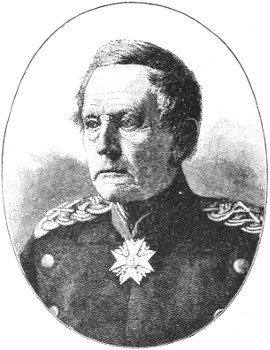
COUNT VON MOLTKE.
But their pursuit was presently checked by a French battery in front of Rezonville, which began to blaze away at them; and for this battery, in turn, they went like the wind. Shots and sabre-cuts are exchanged in the wild mêlée, the gunners are cut down, and only a knot of mounted French officers remain. One of them—a short, broad-shouldered, bull-necked man, with drawn sword—is evidently a general of high rank from the richness of his uniform. As a matter of fact it is Bazaine himself, the commander-in-chief of the French army, who has placed this battery in position. A knot of the Black Brunswickers make a dash at him, but his Staff surrounds him, parrying the sabre-thrusts and cuts of the Hussars, till at last he is rescued by a timely charge of the 5th French Hussars forming his escort, and many of the Brunswickers straightway find death as well as glory.
But now the 6th Cavalry Division of the Prussians—Cuirassiers, Lancers, and Hussars—led on by the Duke of Mecklenburg-Schwerin, rushes up in turn to repel this cavalry counterstroke of the French which had the effect of rescuing Bazaine; and then is seen another surging mass of mounted combatants mingling in a “murder grim and great.” Presently the eye is diverted from this dust-enveloped spectacle by the sight of the red-tunicked Zieten Hussars—so called after the Great Frederick’s greatest horse-captain—emerging from the dust-clouds and dashing themselves with a wild cheer at a line of French infantry—Grenadier Guards—in their front. But at about 500 paces distance they are received with a truly infernal fire from chassepôt, field-gun, and mitrailleuse, and their colonel—also a Herr von Zieten—falls dead out of the saddle, while Captain von Grimm is mortally wounded, and the horse of the adjutant, Lieutenant von Winterfeldt, is literally torn to pieces by a shell. The bravest men on earth cannot face such a fire; so the Zieten Hussars wheel round and rush back to their lines, leaving the ground strewn with scarlet uniforms, as if it were an English battle-field. The French fire is too murderous; the Germans must check their advance; the battle for some little time after becomes an artillery duel.
It was now two o’clock. So far, Alvensleben had skilfully deceived the enemy, with regard to the slender number of his troops, by incessant assaults. But the battle was now at a standstill, the battalions visibly thinned by four hours of the hardest and bloodiest fighting, while the infantry had almost exhausted their cartridges. There was not a battalion, not a battery, left in reserve all along the exposed line. Nevertheless the Brandenburgers would not yield a single inch of the ground they had so bravely won.
Presently, however, they were threatened with a new danger. Their left wing at Vionville was very much exposed to the French artillery on the Roman road, and they were threatened with a turning of this weakest flank. At the same time Marshal Canrobert, our old Crimean ally, discerned from his position in the centre the true moment to make a push for Vionville with all his forces. Ruin or retreat stared the Germans in the face. It looked as if they were going to be completely overwhelmed in this part of the field. The reinforcements from the 10th Corps, which they were so anxiously awaiting, had not yet made their appearance, and the French were assuming an ever more threatening attitude. What was to be done?
In a hollow behind Vionville was standing Bredow’s heavy Cavalry brigade, consisting of the 7th Magdeburg Cuirassiers (Prince Bismarck’s regiment) and 16th Uhlans, or Lancers, both of the Old Mark of Brandenburg. The former was commanded by Colonel Count von Schmettow, the latter by Colonel von der Dollen. The regiments were in a reduced condition, having only three squadrons each instead of five. Before them were the enemy’s guns, and behind these, dense masses of infantry, fresh to the front. “That infantry over there must be broken!” said an aide-de-camp to General von Bredow. “That infantry?” echoed the General, in some surprise, as his eye ranged along its bristling front behind the guns. “The fate of the day depends upon it,” was the brief reply.
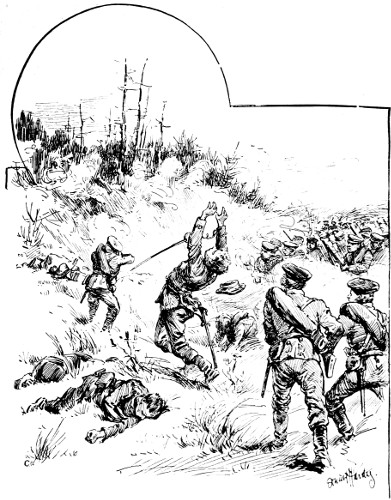
“THE PRUSSIANS PUSHED INTO THE WOODS ... DRIVING THE FRENCH SKIRMISHERS FROM THEM” (p. 342.)
That was quite enough. Leading his brigade out of the hollow in column, he quickly formed it into line of squadrons—the Cuirassiers on the left and the Uhlans on the right, a little thrown back—and then, with a “Forward!” “Trot!” “Charge!” while their thrilling clarions rang out above the din of battle, away dashed the devoted troopers with a loud and long-continued roar more than a cheer. It is Balaclava over again. In a few moments they are among the first French guns, sabring and stabbing the gunners; and then, in the teeth of a frightful hail of bullets from cannon, musket, and mitrailleuse, they storm across to the next infantry line, with which they play equal havoc. The second infantry line was next broken through by the ponderous horsemen, many of whom had already fallen, and the panic they created by their heroic Todtenritt, or ride to death, even spread to the remoter line of batteries, which prepared to limber up. In its excitement the brigade, like the Scots Greys at Waterloo, rode far beyond its mark, and, like the gallant Greys, it suffered terribly for its excess of ardour.
After charging on thus for about 3,000 paces, it was set upon in the most furious manner by an overwhelming force of French horsemen—the cavalry brigades of Murat and Gramont, and the entire division of Vallabreque. Thinned as Bredow’s ranks now were, and exhausted by their exertions so far, how were they to cope with such hordes of horsemen? Yet cope they did with them stoutly and gallantly, like Scarlet’s Heavy Brigade at Balaclava, riding in and out of the ranks of their assailants and bearing many of them to the ground.
And as “Scotland for Ever!” was the cry of the “Greys,” both at Waterloo and Balaclava, so Scotland is also again to the front on this battle-field of Vionville in the person of one of her adventurous sons. This is young Campbell of Craignish, in the shire of Argyll, who is serving as a lieutenant in the Bismarck Cuirassiers, and who, rushing where the fight is thickest, captures a French eagle after cutting down its bearer. Then he is set upon by a crowd of French troopers, who are determined to win this darling badge of honour back. It is the one French standard which has been captured, and at all costs it must be recovered. A pistol-shot shatters Lieutenant Campbell’s hand, and he has to relinquish his trophy. But some of his men, hewing their way into the circle of his assailants, succeed in cutting him out of the mêlée.
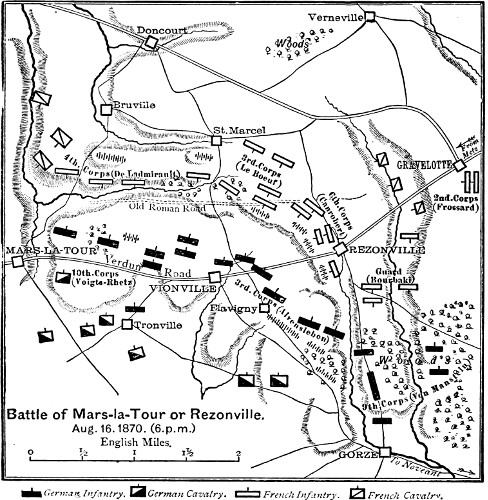
Battle of Mars-la-Tour or Rezonville.
Aug. 16. 1870. (6. p.m.)
All that the little remnant of the brigade could now do was to rally as well as possible and sabre its way back to its own lines. This it did, pursued by the masses of French horsemen, volleyed at by infantry, and rained upon by mitrailleuse bullets, but game to the last. Less than half of the men returned to Flavigny alive, where they were reorganised into two squadrons—two, instead of six. Of 310 Cuirassiers who had gone into action, only 104 came out of it; while only 90 Uhlans answered to the roll-call. Of our Light Brigade charge at Balaclava, Marshal Canrobert observed that it might be magnificent, but it certainly was not war. But the charge of Bredow’s Heavy Brigade at Vionville, which was equally witnessed by Canrobert, was both one and the other, as the gallant Marshal himself must have been the first to admit. It had been beautiful to look at, and it had entailed a fearful sacrifice of life; but it had achieved its object, which was to save Buddenbrock’s infantry Division and give it breathing-time. The French had received such a shock from the charge of Bredow’s Brigade that, for the present, they abandoned their attempt to encircle the German left and advance on Vionville and Flavigny. The loss of life had been immense, but it had been justified by the result; and, after all, that is the main thing in war.
General Henry, of Canrobert’s Corps, afterwards said: “On taking position with my battery nothing was to be seen of Prussian cavalry. Where in the world had these Cuirassiers come from? All of a sudden they were upon my guns like a whirlwind, and rode or cut down all my men save only one. And this one was saved by Schmettow. The gunner ran towards the Cuirassiers, crying ‘Je me rends! je me rends!’ But the Prussians, not understanding this, were for despatching him, and were only prevented from doing so by their colonel, Count von Schmettow.” The man lived to tell the tale, and to receive the golden medal. General Henry continued: “It was only by the skin of my teeth that I myself escaped as the mass of furious horsemen swept past me, trampling down or sabring the gunners. But it was a magnificent military spectacle, and I could not help exclaiming to my adjutant as we rode away, ‘Ah! Quelle attaque magnifique!’”
On the other hand, Count von Schmettow, who commanded the Cuirassiers, gave the following account of their “death-ride”:—“Every one of the gunners of the first battery on which the troopers fell were cut down or pierced” (the Count himself striking down the captain). “In approaching the second battery my helmet was pierced by two bullets, and my orderly officer thrown from his horse, wounded in two places. Lieutenant Campbell, the Scottish officer, when the French Cuirassiers fell in turn upon us, seized the eagle of the regiment in his left hand, which was at once shattered by a bullet, and he was surrounded by the French horsemen; but some of our own Cuirassiers cut their way desperately towards him, and saved him. Never shall I forget the moment when I gave the order to the first trumpeter I met to sound the rally. The trumpet had been shattered by a shot, and produced a sound which pierced us to the quick.” This incident has been immortalised by the great German poet Freiligrath in the following ballad, entitled “The Trumpeter of Mars-la-Tour”—the spirited English version being by his daughter, Kate Freiligrath-Kroeker:—
Death and destruction they belched forth in vain, We grimly defied their thunder; Two columns of foot and batteries twain— We rode and cleft them asunder. With brandished sabres, with reins all slack, Raised standards, and low-couched lances, Thus we Uhlans and Cuirassiers wildly drove back, And hotly repelled their advances. But the ride was a ride of death and of blood; With our thrusts we forced them to sever, But of two whole regiments, lusty and good, Out of two men, one rose never. With breast shot through, with brow gaping wide, They lay pale and cold in the valley, Snatched away in their youth, in their manhood’s pride— “Now, Trumpeter, sound to the rally!” And he took the trumpet, whose angry thrill Urged us on to the glorious battle, And he blew a blast—but all silent and still Was the trump, save a dull hoarse rattle; Save a voiceless wail, save a cry of woe, That burst forth in fitful throbbing— A bullet had pierced its metal through, For the Dead, the wounded was sobbing! For the faithful, the brave, for our brethren all, For the Watch on the Rhine, true-hearted!— Oh! the sound cut into our inmost soul!— It brokenly wailed the Departed! And now fell the night, and we galloped past, Watch-fires were flaring and flying, Our chargers snorted, the rain poured fast— And we thought of the Dead and the Dying!
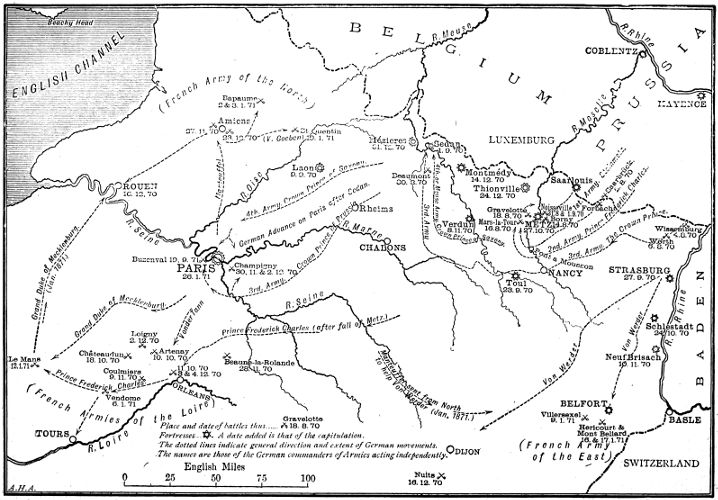
MAP SHOWING SCOPE OF OPERATIONS OF THE FRANCO-GERMAN WAR OF 1870–71.
Note.—Many battle-fields are called by some authorities by their German names and by others by their French names, thus: Spicheren = Forbach; Wörth = Reichshoffen; Colombey-Nouilly = Borny; Rezonville = Mars-la-Tour or Vionville; Gravelotte = St. Privat. In all these names the German precedes the French.
Then take the following from a correspondent of The Times, who was a witness of the battle:—“The want of infantry caused a somewhat serious sacrifice of cavalry, which had repeatedly to charge both infantry and artillery to hold them in check. The men do not ride particularly well to look at, but the manner in which they ride into the jaws of death is really quite à la Balaclava. One regiment—the 7th Cuirassiers—was ordered to charge a battery of artillery, and actually got into it, one of the first in, I am proud to say, being a young Englishman, who has taken service in the Prussian army, and has just got his lieutenancy. It went in some 300 strong, and what its loss is I tremble to say. When I next saw it, it scarcely seemed to me a hundred all told. At 2.30 the reserve artillery was brought up, and the cannonade became heavier than ever. The sun, too, at this moment seemed to have come nearer to us, as if to see this fearful butchery of mankind, and the heat became tremendous. Then, wherever you went, came the pleading cry of ‘Water! water! For pity’s sake give me water!’ The Krankenträger, or bearers of the sick, had now more than they could do, admirable as the whole machinery of the corps is worked.... The positions of both the combative forces were perfectly stationary for about an hour, a sort of duel being carried on between them, which, though at some distance, was quite near enough to have fearful results. I saw a whole string of (French) prisoners brought in of every description. There was the burly giant of cuirassiers beside the little French liner, the green-jacketed hussar, and the artilleryman—all chattering away, and seeming to me uncommonly glad to be out of the affair at any price.
“Seeing some of the infantry engaged on the extreme right, I went there, and met one regiment just coming out of action to recruit, being at that moment commanded by a youth of nineteen, having lost thirteen of its officers since the morning. The number of it was the 52nd, and to the usual inquiring glance that all officers who had not seen me before threw over my most unregimental attire, I replied by offering him a drink of some of the dirtiest water I ever saw, which I had procured from a pond, and which to both of us was better than the best iced champagne. There was no inquiring then. I was instantly the best fellow he ever saw, and he told me all about what fun it was to be in command, and that he was sure to get something now, and that he meant to have another go in directly, etc. He was the most thoroughly English-German boy I ever saw. We stood under a tree together, and I gave him some cigars and left him. Two hours afterwards I saw his dead body laid out with others in a row, the cigars still stuck between the buttons of his coat. This one little anecdote—when I say it is but a fair sample of other regiments—will show how fearful the loss has been on the Prussian side.”
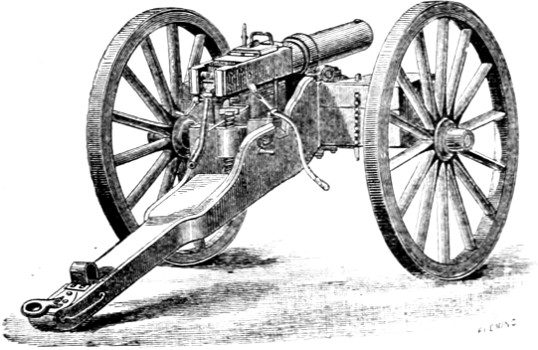
MITRAILLEUSE (BACK VIEW).
At a subsequent roll-call near Tronville it was found that the 24th Regiment had lost 1,000 men and 52 officers, while every officer of the 2nd battalion of the 20th Regiment was killed. It was not till three in the afternoon that the 3rd Corps, which had been fighting singlehanded for five hours against a fivefold force, received any efficient assistance from the 10th Corps, which was now to the Brandenburgers what Blücher’s army had been to Wellington at Waterloo. It was only the devotion of the artillery which had meanwhile saved the infantry from complete annihilation. For, after recovering from the shock of Bredow’s brigade, the French had again concentrated their attack on the German left, and compelled it to retire, fighting as it went.
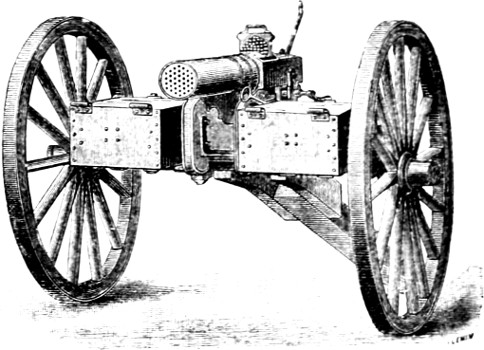
MITRAILLEUSE (FRONT VIEW).
But presently reinforcements from the 10th Corps began to come up, and these were followed by the arrival of a man who was a host in himself—Prince Frederick Charles. His headquarters were away at Pont-à-Mousson, about fourteen miles to the south; and on hearing rather late in the day that his own Brandenburgers were up to the hilt in action and so hotly pressed, he mounted his horse and galloped away, without ever once drawing rein, to the field of battle. And now let Mr. Archibald Forbes, the famous war-correspondent, give us one of his telling battle-pictures:—
“It was barely four o’clock when he” (the “Red Prince”) came galloping up the narrow hill road from Gorze, the powerful bay he rode all foam and sweat, sobbing with the swift exertion up the steep ascent, yet pressed ruthlessly with the spur, staff and escort panting several horse-lengths in rear of the impetuous foremost horseman. On and up he sped, craning forward over the saddle-bow to save his horse, but the attitude suggesting the impression that he burned to project himself faster than the beast could cover the ground. No wolfskin, but the red tunic of the Zieten Hussars, clad the compact torso; but the straining man’s face wore the aspect one associates with that of the berserkar. The bloodshot eyes had in them a sullen lurid gleam of bloodthirst. The fierce sun and the long gallop had flushed the face a deep red, and the veins of the throat stood out. Recalling through the years the memory of that visage with the lowering brow, the fierce eyes, and the strong-set jaw, one can understand how to this day the mothers in the French villages invoke the terrors of ‘Le Prince Rouge,’ as the Scottish peasants of old used the name of the Black Douglas to awe their children wherewithal into panic-stricken silence.
“While as yet his road was through the forest, leaves and twigs cut by bullets showered down upon him. Just as he emerged on the open upland a shell burst almost among his horse’s feet. The iron-nerved man gave heed to neither bullet-fire nor bursting shell; no, nor even to the cheers that rose above the roar of battle from the throats of the Brandenburgers through whose masses he was riding, and whose chief he had been for many years. They expected no recognition, for they knew the nature of the man—knew that, after his fashion, he was the soldier’s true friend, and also that he was wont to sway the issues of battle. He spurred onward to Flavigny, away yonder in the front line; the bruit of his arrival darted along the fagged ranks; and strangely soon came the recognition that a master-soldier had gripped hold of the command as in a vice.”
With the arrival of the “Red Prince” and of reinforcements, the battle now again took the form of a desperate infantry fight. Let me notice only one of its leading incidents, which was graphically described by Moltke. When General von Wedell’s Brigade, no more than five battalions strong, advanced to the attack by way of Tronville, he found himself in front of the extensive line of the 4th French Brigade. The two Westphalian regiments advanced steadily under the storm of shell and mitrailleuse fire until they suddenly reached the edge of a deep ravine. This, however, they soon crossed; but, after scaling the opposite bank, they were met by a murderous shower of bullets from the French infantry, who were everywhere close upon them. Almost every one of the generals and officers were killed, the remnant of the broken battalions fell back into the ravine, and 300 men—unable to re-ascend the steep southern slope after the fatigue of a twenty-four-miles march, almost at the double—were taken prisoners. Those who escaped mustered at Tronville around the bullet-riddled colours which Colonel von Cranach—the only officer who still had a horse under him—brought back in his hand. Seventy-two officers and 2,542 men were missing out of 95 officers and 4,546 men—more than a half.
And now there occurred another of those magnificent cavalry charges in which the battle of Vionville-Mars-la-Tour was so sacrificially rich. Raising a shout of triumph over the repulse—almost the annihilation—of Wedell’s brigade, the French infantry advanced at the double for the purpose of completing the wreck of the German left, and all seemed lost. But just at this critical moment out rushed the 1st Dragoon Guards in their sky-blue tunics and dashed straight at the pursuing foe, who poured into the ranks of their assailants a murderous bullet-fire, while shrapnel played upon their flanks. But “immer vorwärts!” stormed the devoted dragoons, and plied their sabres on the French fantassins with terrible effect.
Again this cavalry regiment had achieved its object—which was to save its own infantry from destruction—but at a frightful cost. Colonel von Auerswald was mortally wounded, and it was reserved for the youngest Captain, Prince Hohenlohe, to rally the remnants of the brave regiment and lead it out of action. Only about a third of the troopers afterwards answered to the roll-call. The regiment had left on the field 15 officers, 11 non-commissioned officers, 7 trumpeters, 103 privates, and 250 horses. The importance of this great sacrifice of life may be gathered from a remark made by the Emperor William two years later, on the occasion of a visit he paid to the barracks in Berlin. “Gentlemen,” he said, “but for your gallant attack at Mars-la-Tour, who knows whether we should have been here to-day?” This gallant regiment afterwards became the “Queen of England’s Own,” and a higher military compliment could scarcely have been paid her Majesty by her German grandson, William II.
Among the ranks of the 1st Dragoon Guards at Mars-la-Tour were the two sons of Prince Bismarck, riding as private troopers; for this happened to be the year in which they were doing their compulsory term of military service. The Chancellor’s sons—one in his twenty-first, the other only in his eighteenth year—behaved in action with a courage worthy of their father. The elder, Herbert, had received no fewer than three shots, one through the front of his tunic, another in his watch, and the third in the thigh; while his brother William (Count “Bill” he was always called) had come out of the deadly welter unscathed. “During the attack at Mars-la-Tour,” said Bismarck once, “Count Bill’s horse stumbled with him over a dead or wounded Gaul, within fifty feet of the French square. But after a few moments he shook himself together again, jumped up, and not being able to mount, led the brown horse back through a shower of bullets. Then he found a wounded dragoon, whom he set upon his horse, and, covering himself thus from the enemy’s fire on one side, he got back to his own people. The horse fell dead after shelter was reached.”
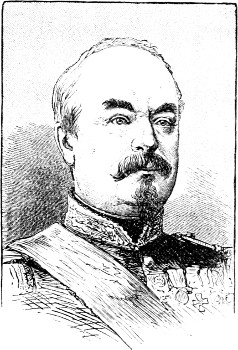
MARSHAL BAZAINE.
But the charge of the 1st Dragoon Guards was scarcely over when it became apparent that the French were preparing for another attack on the invincible left wing of the Germans by hurling upon it a stupendous mass of their cavalry. Three regiments of Le Grand’s Division, and both regiments of the Guards Cavalry Brigade, were seen trotting up to the west side of the Grayère ravine. Opposite to them stood the whole of the Prussian cavalry, concentrated to the south of Mars-la-Tour, in the first line being the 13th Uhlans, 4th Cuirassiers, and 19th Dragoons, and behind them the 16th Dragoons and 10th Hussars. The 13th Uhlans dashed straight against the foremost French cavalry line; but the regiment had become somewhat disordered, and the French Hussars rode right through it. Then, however, the 10th Hussars turned up for the second time, and repulsed the enemy’s cavalry. The two evenly-balanced masses of horsemen rushed upon each other in an awful cavalry mêlée. But, as a mighty cloud of dust concealed the ensuing hand-to-hand encounter of 5,000 men swaying to and fro, it was impossible to follow with minuteness the incidents of the conflict.
Fortune gradually decided in favour of the Prussians, for, man to man, they were heavier than their opponents. General Montaigu was taken prisoner, severely wounded, and General Le Grand fell while leading his Dragoons to the assistance of the Hussars. This, the greatest cavalry combat of the war, had the effect of making the French right wing give up all attempts to act on the offensive. But out of this gigantic combat of horsemen the victorious Prussians had again emerged with great loss; and among those who had fallen was Colonel Finckenstein of the 2nd Dragoon Guards, who had been the midnight bearer of Moltke’s momentous message from Gitschin to Königinhof during the Bohemian campaign of 1866.
Darkness was now approaching, and the battle had practically been won by the Germans. The troops were utterly exhausted, most of the ammunition spent, while the horses had been saddled for fifteen hours without anything to eat. Some of the batteries could only be moved at a slow pace, and the nearest Prussian troops on the left bank of the Moselle were a day’s march off. Nevertheless the impetuous Red Prince, desiring to increase the moral impression of the day’s endeavours, and, if possible, destroy altogether the internal cohesion of the French, ordered a general advance against their position. But the poor Prussian troops were too utterly fagged out by their incessant exertions during the day to do much more than make a formal response to this cruel and unnecessary command; and, again, they suffered great loss without inflicting a corresponding one on the French.
Fighting did not entirely cease till ten o’clock—that is to say, the bloody battle had lasted for twelve long hours, entailing a loss of about 16,000 officers and men on either side. But the Germans had won the battle. For they had achieved their object—which was to prevent the escape of Bazaine. Yet, in his despatch to the Emperor, Bazaine had made bold to assert that “the enemy, beaten, retreated on all points, leaving us masters of the battle-field.” Moltke, on the other hand, wrote that “the troops, worn out by a twelve-hours’ struggle, encamped on the victorious but bloody field immediately opposite the French lines.” And Moltke wrote the truth. Bazaine had evidently learned the habit of lying about his reverses from the Great Napoleon, and even from Napoleon the Little.
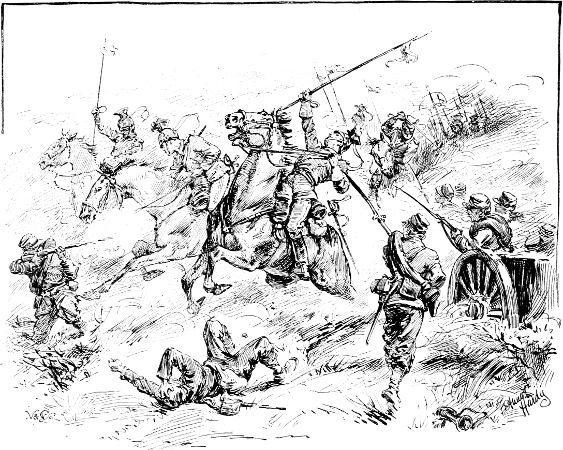
CHARGE OF THE 16TH UHLANS (p. 346).
Yet Mars-la-Tour was only the prologue to the still bloodier and more decisive drama of Gravelotte two days later. “The battle of Vionville,” said the Emperor William II. once, “is without a parallel in military history, seeing that a single Army Corps, about 20,000 men strong, hung on to and repulsed an enemy more than five times as numerous and well equipped. Such was the glorious deed that was done by the Brandenburgers, and the Hohenzollerns will never forget the debt they owe to their devotion.”
Several years later I visited the field of battle just described. Leaving Gorze, with its gilded statue of la Sainte Vierge on the brow of a beetling cliff, I passed up the steep and wooded defile through which the Brandenburgers pressed on the 16th of August, and here the first affecting relics of the bloody strife appeared. In a little, lonely green valley skirted by the road, a few grassy mounds luxuriant with the crimson poppy and the wild fern, each being surmounted by a white wooden cross, told where the tapfere Krieger began to drop from the bullets of the chassepôt. But when the summit is reached, what a touching sight! The rising plateau on every side is dotted with white crosses, which thicken, thicken, thicken as you advance, and the not far distant horizon edge is bristling with obelisks and stone memorials of more pretentious and lasting form, making the whole region look like one colossal cemetery. An involuntary sadness comes over the traveller, and when approaching every tomb and commemorative tablet he feels instinctively moved by the mute appeal contained in the inscription: “Sta, viator, heroen calcas!” The graceful obelisk, with its lengthy death-roll of officers and men, the railing-encircled and ivy-grown mound looking like a well-filled family vault, the silver-edged cross still hung with withered oaken wreaths and immortelles, the slender column snapped in twain to indicate the fate of hopeful youth suddenly cut off, the neatly-trimmed sepulture and the graveyard plot of flowers—conceive all these objects scattered over the summit of a bare plateau facing northwards to the west of Metz, and you will have some idea of the scene.
On an eminence behind Vionville, which formed the centre of the German position, is a pyramidal kind of monument of roughly-hewn stone, surmounted by the Hohenzollern eagle, and surrounded by a railing hung with shield-like tablets bearing the multitudinous names of those officers of the 5th Division who fell on that fatal day. The reverse and coverless side of the plateau—densely dotted with mounds and monuments testifying to the terrible losses of the brave Brandenburgers—leads you down to the village of Vionville, where tombstones on the public highway point to where the dust of Gaul and German is commingled in the reconciliation of death. “Mit Gott für König und Vaterland” is the recorded war-cry on the monument of one Teutonic soldier; while at its side there stands a marble cross, tastefully wreathed with flowers, to the memory of one brave and noble young lieutenant of the Empire who died on the field of honour with these words, preserved in golden letters, on his lips: “Dites à ma mère,” he cried, “que je meurs en soldat et en chrétien. Marchez en avant!”—“Tell my mother that I died like a soldier and a Christian. Forward!”
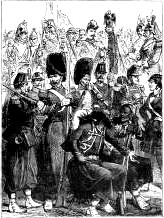
FRENCH UNIFORMS IN 1870.
THE RETREAT OF CORUNNA
BY D. H. PARRY
SIR JOHN MOORE

East of the kingdom of Portugal lie the great plains of Leon, bordered north and south by mighty mountain ranges; and in the short December days of 1808, when wintry winds swept howling through the passes and across the level land, and the red roofs of Salamanca were covered with snow, a small British army, some 23,000 strong, was preparing to assist Spain against Napoleon.
Led by the gallant Lieutenant-General Sir John Moore, and wearing the red cockade out of compliment to the nation, we had been received with great enthusiasm, and were given to understand that the country burned with patriotic zeal and had large forces, perfectly equipped; but this was soon found to be untrue, for, while the Spaniards were ready for any amount of castanet playing and looking-on, the English were expected to do their fighting for them.
Their magnificent army dwindled upon investigation to half its supposed numbers, and, with a few honourable exceptions, proved itself one of the wretchedest collections of ragamuffins of which history bears any record, so that Sir John Moore found himself in as awkward a position as ever fell to the lot of a British general. Nevertheless, in spite of the severity of the weather, the impertinent meddling of Mr. Frere, the English Minister at Madrid, the poor equipment of our troops and the absence of Spanish aid, we marched boldly out of Salamanca on the 11th December to attack Soult in the north, and afterwards succour the capital if that should be practicable.
It was a brave little army, and its doings are deeply carved on the pillar of British fame. There were five cavalry regiments, all Hussars, dashing fellows in braided pelisses, and mounted on active nagtailed horses: viz., the 7th, 10th, 15th, and 18th, with the 3rd of the King’s German Legion.
Artillery, Engineers, Waggon Train, and a detachment of the scarlet-coated Staff Corps filed out across the plain, white and monotonous under a gloomy sky.
Two battalions of the 1st Guards and thirty-two of the Line completed our force, including amongst others such splendid regiments as the Royal Scots, the 4th, 5th, and the 9th, nicknamed the “Holy Boys,” because they afterwards sold their Bibles for wine; the Welsh Fusiliers and 28th “Slashers,” the Black Watch, the Fighting 43rd, the 71st Glasgow Highland Light Infantry, now the strictest regiment in the service, the Cameron Highlanders, and the green 95th Rifles.
General Baird was hastening from Corunna to join us, and we had already advanced several marches towards the enemy, when a blustering French aide-de-camp got himself murdered in a village; his papers were purchased for twenty dollars, and Sir John Moore learned for the first time the true extent of the overwhelming odds against him.
Madrid, which was to have made such a brave defence, had held out one day; the shops were open and the people tranquil; Toledo, Ocaña, and the whole of La Manche were in the hands of the French; a strong force was about to march on Badajoz, and the Emperor Napoleon was reviewing 60,000 veteran troops, including part of his famous Imperial Guard, at the capital.
Two hundred and fifty-five thousand men were mustering to oppose us; their cavalry alone exceeded our entire army by 12,000, and to linger on the plains with such a horde closing round us would have been absolute madness. There was nothing for it but to show a bold front to Soult, and gain the sea with as much honour as possible before the others could come up; and though the word “retreat” has an unpleasant sound to English ears, when it is attended with as great a display of heroism as upon that unfortunate occasion, it becomes a page in British annals which we could ill afford to spare.
The Reserve, on whom, with the cavalry, most of the fighting devolved until the army reached Corunna, was formed of the 20th and 52nd, and the 28th, 91st, and 95th, under Generals Anstruther and Disney. First blood was drawn at Rueda, where the 18th Hussars took fifty prisoners, and the same evening the band of the 7th Hussars played the Reserve into Toro, on the Douro.
Paget, afterwards Marquis of Anglesea, whose brother, Lord Edward, was in command of the Reserve, marched the 10th and 15th Hussars on a bitter and intensely dark night to Sahagun, arriving in the grey dawn to find the place full of French cavalry. Without a moment’s hesitation the 15th charged and overthrew them, taking thirteen officers and a hundred and fifty-four men in twenty minutes.
The 15th was the Duke of Cumberland’s regiment, and one of the most expensive in the army.
Napoleon heard of our advance on the same day that Sahagun was fought, and, leaving 10,000 men to overawe Madrid, marched with 50,000 to cross the Guadarama range.
Pushing on in the depth of winter—the Spaniards forced to cut roads through the snow for them—they reached the passes, and toiled up for twelve hours without the advance guard being able to gain the summit; but so tremendous was the wind that the Emperor had to dismount and struggle forward on foot, holding on to the arms of Marshals Lannes and Duroc, the staff following linked together, with heads bent before the driving snow.
Half-way up they stopped, the generals exhausted in their heavy jack-boots, and bestriding some brass guns, Napoleon and his officers in that manner arrived at the top, seeing through the whirling flakes the plains of Leon far below them.
Scrambling down, he hurried the jaded troops ten and twelve leagues a day until he came within three miles of the river Esla—only to find that we had already crossed it, and had had two days’ rest at Benevente.
Furious at our escape, he sent his favourite Chasseurs-à-Cheval of the Guard in hot pursuit, with a support of infantry; but without waiting for the foot-soldiers, the gallant Charles Lefebvre Desnouettes splashed through the fords with his horsemen into the open fields full of camp-followers, and drove our pickets back towards the town.
Six hundred of those splendid troopers, in green jackets and red pelisses, careered magnificently over the trampled snow; but behind some straggling houses Paget was waiting with the 10th Hussars, until they should have got sufficiently forward.
Then a line of blue and silver, and curving sabres and brown busbies, tore out of the concealment, gathered up the retiring pickets, and rushed upon the Chasseurs. There was slashing and shouting and riding down, and the French squadrons returned through the fords again at full gallop, leaving fifty-five killed and wounded, and seventy prisoners.
They re-formed on their own side, and for a moment it was thought they would charge us, but a couple of guns put them to the right-about, and their leader remained in our hands.
Private Levi Grisdale, of the 10th, saw him riding for the river, in a green frock, with a hat and feather, and, spurring after him, dodged a pistol-ball and cut him over the left cheek.
Grisdale was promoted, although the 3rd Germans claimed that a private of theirs, named Bergmann, had taken the general; but the uniforms of the two regiments were very similar then, both being in blue with yellow facings and white braid, and it is difficult to distinguish things accurately in the hurry of a combat.
Desnouettes lived at Malvern and Cheltenham, where he made many friends, until May, 1812, when, breaking his parole, he escaped to France, only to be taken again at Waterloo, where Grisdale also fought as a sergeant, and the unlucky general was eventually drowned off the Irish coast in 1822.
At Benevente the 3rd Hussars alone lost forty-six men and twenty-two horses, with forty-seven more wounded; but we had checked the Guard and shown our teeth; and when the night winds were howling among the porcelain friezes and broken porphyry columns of the old castle on the hill, we withdrew cautiously in a thick fog and continued our retreat.
Captain Darby and seventeen privates of the 10th died of fatigue during the march to Bembibre, and they shot sixty horses that could go no farther.
Deep snow lay on the ground, rutted and trampled by the passage of the guns and bullock carts; this had frozen like iron, and then been concealed by another snowstorm, so that men and horses stumbled and lamed themselves at every stride.
One officer lost a boot among the ruts on Christmas morning, and marched all day without it!
Every regiment had received a new blanket per man and a hundred and fifty new soles and heels, but the execrable roads quickly wore out the leather.
Astorga was found to be full of miserable Spanish soldiers, who had eaten up most of the stores, and whose condition was summed up in their own words: “Very hungry—very sick—very dry!”
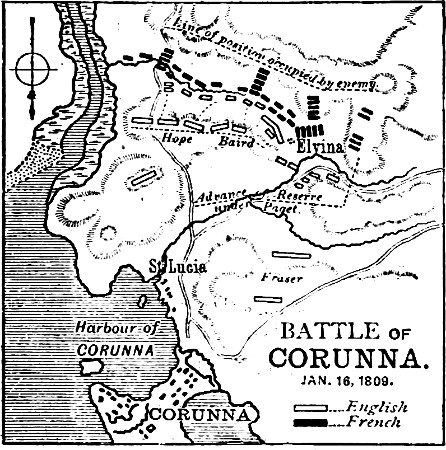
BATTLE OF CORUNNA.
JAN. 16, 1809.
A number of women and children followed the army, and their sufferings were truly terrible. Soldiers began to fall out, unable to keep up with the columns, and the rear-guard passed scores of poor wretches frozen to death in the snow, while at Bembibre, where there were large wine-vaults, discipline began to relax its hold, and shameful drunkenness stained the hitherto excellent record of the troops.
Meanwhile, Napoleon made the most strenuous efforts to overtake us.
He insisted on marching from Benevente to Astorga in one short winter day, a distance of thirty odd miles, under an icy rain, the infantry being obliged to strip five or six times and scramble through the streams, holding their clothing and ammunition above the water.
So exhausted was his army that three veteran grenadiers of the Old Guard blew out their brains, unable to go on, and knowing that the sullen peasants in their sheepskin capas would murder them if they lagged behind.
Napoleon was much affected, but he still pushed forward, and late at night, drenched to the skin, and attended only by Lannes, the staff, and a hundred Chasseurs, he dashed into Astorga. Had Paget, who was only six miles off, learned this, he might have swooped down with the Hussars and changed the future fate of Europe by capturing the Emperor himself. Napoleon had marched two hundred miles in ten days with 50,000 troops in the depth of winter, but for all his haste, we had eluded him and gained the mountains, and at Astorga the Emperor handed the reins to Soult, reviewed his legions, and returned to Valladolid, leaving the Marshal Duke of Dalmatia to drive us into the sea.
The features of the retreat now underwent a change: our columns began to ascend into a wild and dreary region, the road winding along the mountain sides halfway between the summits and the rushing water in the valleys below.
Here and there a solitary cottage showed its slate roof; at intervals the weary leagues were marked on stone pillars by the way; the droning hum of the axles of the bullock carts could be heard for a great distance, and slanting rain beat on the tired stragglers, whose numbers were by this time terribly increased.
Bembibre, when the Reserve entered it on New Year’s Day, was full of drunken soldiers from Baird’s divisions; officers and men grew careless, and thought only of themselves, and it was found necessary to flog and hang to restore some semblance of order, with an active enemy on our very heels.
The light troops had marched for Vigo, whither Sir John Moore intended to follow, but at Orense a message overtook them, bidding them send the transports round to Corunna, and Captain Heisse, after a hard gallop through the snow, was just in time to despatch the vessels before an unfavourable wind set dead into the harbour mouth.
At Calcabellos, while Lord Edward Paget was haranguing the Reserve on the subject of the growing insubordination, two plunderers were caught in the act. The troops were instantly formed in hollow square round a tree to witness their execution, when a hussar dashed in with news that the enemy were upon us.
“I don’t care if the entire French cavalry are here,” roared the general; “I’ll hang these scoundrels!”
They were lifted in the arms of the provost-marshal’s men, the ropes were adjusted, and in another moment they would have dangled in mid-air, when a second hussar came up, and carbine shots rang out from the 3rd Germans at the bridge.
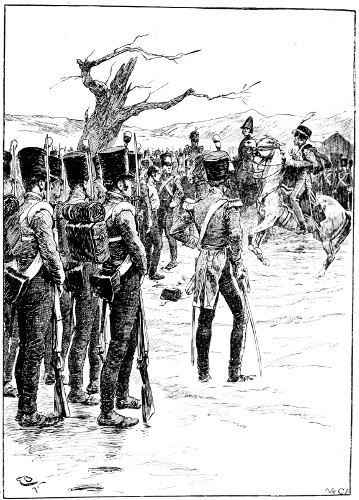
“A HUSSAR DASHED IN WITH THE NEWS THAT THE ENEMY WERE UPON US!” (p. 356).
“Soldiers,” cried Lord Edward, “if I pardon these men will you promise better behaviour for the future?”
“Yes,” was the unanimous reply.
“Say it again!”
“Yes, yes!” from a thousand throats.
“A third time!”
It was done with a cheer, the men were released, and the troops went off at the double towards the firing.
Colbert attacked us there with a large body of cavalry, and our Rifles, posted in a vineyard, emptied a score of saddles as the French dragoons and light horse tore up the road to the bridge-head. Colbert was not only a splendid soldier, but a good man, in an army where, unfortunately, virtue was at a low ebb, and two days before, at the review, Napoleon had said to him, “General, you have proved in Egypt, Italy, and Germany that you are one of my bravest warriors: you shall soon receive the reward due to your brilliant successes.”
“Make haste, sire,” replied Colbert, “for, while I am not yet thirty, I feel that I am already old.”
At Calcabellos, an Irishman of the 95th, named Tom Plunkett, ran out and threw himself on his back in the snow. Passing the sling of his rifle over his foot, he sighted and fired, and Colbert fell from his horse. Jumping up Plunkett cast about and reloaded, firing again and killing the aide-de-camp who had rushed to his general’s assistance, after which the lucky marksman rejoined his comrades in safety (only to be discharged some years afterwards, without promotion, a victim to drink, that curse of our Peninsular armies).
Wherever the danger was pressing, Sir John Moore was to be found—nothing could exceed his personal exertions on the retreat.
At Villa Franca, romantically situated in a deep valley, with the pointed turrets of a Dominican convent rising against a background of bare hills, and where the ferocious Duke of Alva once had a castle, the army committed great disorders, and Sir John had a man shot in the market-place as a warning to the others.
Although we checked the enemy wherever the rear-guard faced about, the march had not been resumed long when their horsemen were again riding among the stragglers, cutting them down without mercy—man, woman, and child!
The 28th, with its brown calfskin knapsacks, taken from the French stores in Egypt, toiled over the snow, and the handsomest man of the Grenadier company, named McGee, fell lame and dropped behind, his comrades carrying his pack and musket for him, but two French troopers came up, and, unarmed as he was, slashed him to pieces almost in sight of his company.
Misery and disorder increased; the cavalry were sent on ahead, with the exception of a part of the 3rd Hussars, and the rear-guard fought every yard of the way until they reached Lugo, where Sir John drew up in order of battle, and discipline was again restored.
All day, in the drenching rain, we waited for the French to attack, but Soult was too wary; and at night, leaving the fires burning, the army continued its retreat, gaining several hours’ start before the enemy became aware of it.
The pay-waggons, heavily laden with silver dollars, were abandoned, as the oxen were quite used up, and Lieutenant Bennet stood with a drawn pistol and orders to shoot any soldier who lingered there.
Hugo, of the 3rd Hussars, gave an equal proportion to each man of his detachment, and it was carried in their corn-sacks to Corunna and delivered to the Commissariat; but the rest—£25,000 worth—was pitched over into the valley, the barrels breaking on the rocks and sending a silver cascade far down beyond the reach of the marching army.
The stragglers crowded round and fought for the money spilled on the road, one woman—wife of Sergeant Maloney, of the 52nd—making her fortune for life; but, stepping from the boat on to a transport at Corunna, she slipped, and the weight of the stolen treasure took her to the bottom of the harbour, never to rise again!
While the miserable wretches were scrambling in the snow, the enemy came up and slaughtered without mercy, stopping in their turn to gather up the spoil, and giving us a little breathing-time.
Farther on we met some Spanish troops discharging their muskets briskly, as though skirmishing, and it was feared that the French had intercepted us, but on getting closer we were told that the contemptible riff-raff were “only firing to warm their hands!”
At Lugo Sir John Moore had issued an order in which he said: “It is evident that the enemy will not fight this army, notwithstanding the superiority of his numbers, but will endeavour to harass and tease it on its march.... The army has now eleven leagues to march; the soldiers must make an exertion to complete them. The rear-guard cannot stop, and those that fall behind must take their fate!”
Many of the troops were now barefooted, and all were more or less in rags. Far too many camp-followers had been allowed to accompany us, and all were starving in a wild and sterile country, where a yellow fowl was often the only result of a plundered cottage.
The 28th found nothing at Villa Franca but one piece of salt pork, which Major Browne tied to his holsters—to lose it in the night-march to Herrerias.
The same officer, on embarking, exchanged his horse for a pig, but in the confusion the major was shipped on board one transport and the pig on to another!
Small wonder that the “Slashers,” on finding some Spaniards frozen to death among the débris of two bread-waggons, moved the corpses to hunt ravenously for the crusts among which they were lying!
At length it was the custom to stop all stragglers and take from them a proportion of the food they carried, and by that means they collected sufficient to serve out a ration to every man of the rear-guard!
At Nogales—where the country reminds one of Glencoe—a private who had been sent on ahead found a quantity of potatoes, which he boiled, and as the 28th filed past the house he distributed three or four to officer and man alike, without distinction; and at the same place some officers of the “Slashers” went into a cottage where there was a fire, and where they stripped to dry their clothes.
A Spanish general was sleeping snugly in an inner room, well wrapped in furs, and his two aides-de-camp were standing by the fire.
One of the “Slashers” laid his valuable watch down, and, returning from the door, where he had been directing some stragglers, found that one of the aides-de-camp had walked off with it!
“I cannot be held responsible for all the people about me,” was the grumpy remark of the Spanish general. What could be expected from an army whose officers were thieves?
The last halt was made at Betanzos, and while the rear-guard covered the partial destruction of the bridge there, the army marched in column to Corunna, only to find the Atlantic roaring on the rocks, but not a sail in sight!
The French were in great force at Betanzos, and furious at our continued escape. One sergeant charged alone in advance of his squadron, to the centre of the bridge, but a private of the 28th, named Thomas Savage, stepped out and shot him, securing his cloak before the others came up.
The Engineers bungled the bridge, and blew up one of their officers with it, while we had to fall back on Corunna before it was properly destroyed.
Fine weather now dried our rags. On the 11th January the Guards were quartered in the town, the Reserve near St. Lucia, and the other regiments posted in strong positions. Vast stores were meanwhile destroyed in Corunna, and two hundred and ninety horses of the German Legion shot in the arsenal square at St. Lucia, amid the tears of the brave troopers.
The 12th proved damp and foggy, and no trace of the fleet could be seen. The French still held back, our officers exchanging pot-shots with them until Paget put a stop to it; and on the 13th a terrific explosion from 4,000 powder-barrels caused something very like a panic in both armies. Corunna was shaken, its windows smashed, and a rain of white ashes fell for a considerable time.
At last, on the afternoon of the 14th, the transports hove in sight, and as soon as they were anchored we began to embark the wounded and the guns, the cavalry being ordered to ship thirty horses per regiment and shoot the rest as there was not time to get them on board with a heavy sea running. The 15th Hussars brought four hundred to Corunna, and landed in England with thirty-one! The 10th—the Prince of Wales’s particular regiment, and the first in our service to wear the showy Hungarian dress, which its hussar troop had adopted in 1803 and the entire corps two years later—began the campaign with six hundred handsome chargers and took thirty home again.
The greatest confusion took place among the camp-followers, but by degrees the embarkation proceeded, our gallant tars going in some cases two days without food in their noble efforts to help us.
There was a little skirmishing, but no very decided movement, until the 16th—in fact, French officers were seen picking up shells on the sands at low water within range of our muskets—but at last the infantry alone remained on shore, and the 28th, among others, was ordered to fall in at two o’clock on the 16th to march down to the boats.
Scarcely had they mustered when, a violent cannonade being opened upon us, and a forward movement being observed, they went off at the double towards the enemy again. They had done eighty miles in the last twelve days, standing several nights under arms in the snow; they had repulsed the French seven times, and the 28th alone had lost more than two hundred men; yet, when the battle of Corunna began, the Reserve had fewer men missing than any other division!
CORUNNA.
Some of the generals wished Moore to come to terms with Soult, but nothing was farther from the brave Scotchman’s thoughts.
Circumstances had compelled us to retreat, but it was no part of a British soldier’s training to shirk a battle at the last moment; consequently, the low hills behind Elvina were soon echoing to the rattle of musketry as our black-gaitered infantry opened fire on the French columns.
There was little or no manœuvring during the engagement: Soult advanced in three masses, driving our pickets out of the village of Elvina.
Baird, of Seringapatam fame, held the right of our line, Sir John Hope formed the centre and left with his division, while Paget and Fraser were in reserve before Corunna: 14,500 men in all, facing 20,000.
Sir John Moore sent the 50th and 42nd to retake Elvina, which was rendered formidable by sunken lanes and stone walls, but after a brave scrimmage which lasted half an hour, the French were driven out and the Guards advanced to take up the position originally occupied by the two regiments.
The Black Watch having exhausted their cartridges fell back, thinking the Guards were marching to support them, and the enemy returned in force and entered the village again.
Sir John rode up to the 42nd, and learning that their ammunition was expended, said, “You have still your bayonets, my brave Highlanders—remember Egypt!” and with a yell the Black Watch rushed forward once more.
While Sir John Moore was watching the struggle, a round shot struck him on the left breast and dashed him out of the saddle; but without a groan, he sat up, resting on his arm and for a moment gazed intently at the Highlanders driving the French steadily back.
Then, as a happy look came into his handsome face, the staff crowded round him and saw the shocking state of his wound. The shoulder was completely shattered, and the left arm hung by a piece of skin; the ribs over the heart were broken and bared of flesh, while the muscles of the breast were torn into shreds and strips, among which the hilt of his sword had got entangled.
“I had rather it should go out of the field with me,” said the dying hero, as Hardinge made an attempt to disengage it.
Men of the 42nd and Guards carried him tenderly in a blanket, taking an hour to reach Corunna, the general frequently making them halt and turn him round.
Like Wolfe at Quebec, his anxiety was for the success of the army, and like Wolfe his last moments were cheered by the knowledge that we had beaten the French.
Soult had fallen back, General Baird was badly wounded, and Hope carried out Sir John’s original plans for the embarkation.
“I hope the people of England will be satisfied,” said the dying man. “I hope my dear country will do me justice. Oh, Anderson!” he whispered to his friend, “you will see my friends at home; tell them everything—my mother——” then he broke down.
He was believed to be devotedly attached to Lady Hester Stanhope, eldest daughter of the third Earl Stanhope, famous alike for his eccentricity and his study of the electric fluid; and Moore’s last recorded words were in remembrance of her, addressed to her brother, his aide-de-camp.
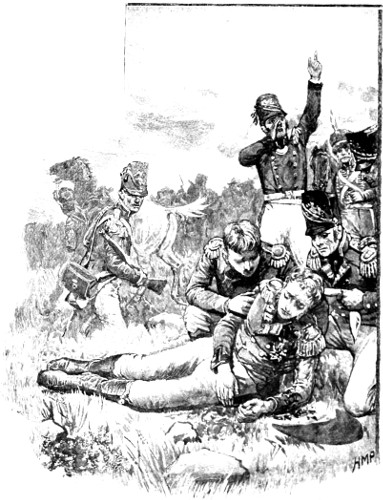
DEATH OF SIR JOHN MOORE.
He passed away very quietly in his forty-eighth year, and England lost one of her most chivalrous soldiers.
His burial, in the citadel at night by some men of the 9th, has been described in a poem which does immortal honour to the Irish clergyman who penned it, and the gallant enemy flew the tricolour halfmast high on the citadel and fired a salute over his grave, Marshal Soult afterwards erecting a tomb to his memory.
Our loss at Corunna was 800, the French, from their own accounts, 3,000.
Six cannon, 3-pounders, sent on without Sir John’s orders, had been abandoned during the retreat, and nearly 4,000 men left their bones to whiten the plains of Leon and the rugged roads of Gallicia; but the retreat won praise from Wellington and Napoleon alike, and not a regimental colour remained in the enemy’s hands.
The 95th was the last regiment to enter Corunna, the 23rd the last to leave it.
Great confusion existed on board the vessels, and an attempt to transfer the men to their respective ships was prevented by the enemy opening fire from St. Lucia. The cables were cut, and the three hundred transports put to sea on the 17th, convoyed by several men-of-war, the old Victory amongst them, and after cruising about in the offing for two days, they put helm up for England, where the army landed in a wretched condition.
All the clothing of the Rifles was burned behind Hythe barracks, in a state that spoke volumes for the misery undergone.
The Smallbridge went ashore near Ushant, and over two hundred of the German Legion were drowned. Then the newspapers began to raise a disgraceful outcry against the whole expedition, and the good name of Sir John Moore was placed under a cloud by men whose information was false, and whose opinion was of no more value than a spent cartridge.