Chapter IX · THE ORDER UNGULATA
Reading edition
Under this term may be included provisionally a large and rather heterogeneous group of mammals, the existing members of which form the Pecora and Belluæ of Linnæus, the Ruminantia and Pachydermata of Cuvier. A few years ago it was found convenient to restrict the order to a well-marked and distinctly circumscribed group, comprising the two sections known as Perissodactyla and Artiodactyla, and to leave out such isolated forms as the Elephant and Hyrax; but the discovery of a vast number of extinct species, which could not be brought under the definition of either perissodactyle or artiodactyle Ungulates, and yet are evidently allied to both, and to a certain extent bridge over the interval between these and the isolated groups just mentioned, makes it necessary either to introduce a number of new and ill-defined ordinal divisions, or to widen the scope of the original order so as to embrace them all.
The existing forms are all animals eminently adapted for a terrestrial life, and in the main for a vegetable diet. Though a few are more or less omnivorous, and may under some circumstances kill living creatures smaller and weaker than themselves for food, none are distinctly and habitually predaceous. Their teeth are markedly heterodont and diphyodont,—the milk set being well developed and not completely changed until the animal attains its full stature. The molars have broad crowns with tuberculated or ridged surfaces. There are no clavicles.[173] Their toes are provided with blunt, broad nails, or in the majority of cases with hoofs, more or less enclosing the ungual phalanges. The scaphoid and lunar bones of the carpus are always distinct. The humerus has no entepicondylar foramen. The number of digits varies from five to one; and the radius and ulna may be united together.
The more generalised of the fossil forms do not conform in all respects to the above-mentioned characters; clavicles being present in Typotherium, and perhaps in some of the Condylarthra, while in the latter group the humerus may have an entepicondylar foramen, and thus approximate to the corresponding bone of the Carnivora. Wide as is the gap between existing Carnivores and Ungulates, there are indeed more or less strongly marked evidences of affinity between the earlier members of the two orders, as will be again noticed under the head of the suborder Condylarthra. A departure from the normal type of foot-structure is exhibited by the extinct Macrotherium, provisionally included in the Perissodactyla, where the digits terminated in long and curved claws.
As a general rule, the cheek-teeth have distinct roots, and in those of the existing suborders a gradual increase in the height of the crowns of these teeth may be noticed in passing from the more generalised to the more specialised types. Those teeth in which the crowns are low, and their whole structure visible from the grinding surface, are termed brachydont (Fig. 122); while those with higher crowns, in which the bases of the infoldings of enamel are invisible from the grinding surface, are known as hypsodont (Fig. 123). Again, when the tubercles on the crowns of the molars are more or less cone-like in form the tooth is said to be bunodont; but when they are expanded in an antero-posterior direction and curved into a crescent shape the tooth is described as selenodont.
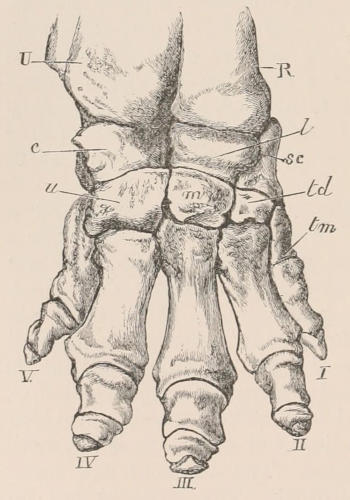
Fig. 98.—Right fore foot of Indian Elephant. × ⅛. U, ulna; R, radius; c, cuneiform; l, lunar; sc, scaphoid; u, unciform; m, magnum; td, trapezoid; tm, trapezium; I to V, first to fifth digit.
The whole order may be divided into the Ungulata Vera, containing the suborders Perissodactyla and Artiodactyla, and a somewhat heterogeneous assemblage of animals which may be called Subungulata or Ungulata Polydactyla. Cope has pointed out a character in the structure of the carpus by which the latter are differentiated from the former. Thus in all the Subungulata the bones of the proximal and distal row retain the primitive or more typical relation to each other (see Fig. 98); the os magnum of the second row articulating mainly with the lunar of the first, or with the cuneiform, but not with the scaphoid. But in the group to which the vast majority of modern Ungulates belong the second or distal row has been shifted altogether towards the inner side of the limb (see Fig. 99), so that the magnum is brought considerably into relation with the scaphoid, and is entirely removed from the cuneiform, as in the great majority of existing mammals.
It will be on the whole more convenient to commence our survey of the members of this suborder with the more specialised group of the Ungulata Vera, in which the Artiodactyla will be taken first.
Ungulata Vera.[174]
In the typical Ungulata the feet are never plantigrade, and the functional toes do not exceed four—the inner digit being suppressed, at all events in all forms which have existed since the Upper Eocene period.[175] The os magnum of the carpus articulates freely with the scaphoid. The allantois is largely developed, and the placenta, so far as is known, is non-deciduate; the chorionic villi being either evenly diffused or collected in groups or cotyledons (in Pecora). The testes descend into a scrotum. There is never an os penis. The uterus is bicornuate. The mammæ are usually few and inguinal, or may be numerous and abdominal (as in Suina), but are never solely pectoral. The cerebral hemispheres in existing Ungulates are well convoluted.
The group is now, and has been throughout almost the whole of the Tertiary period, composed of two perfectly distinct sections, differing from each other, not only in the obvious characters of the structure of the limbs, but in so many other parts of their organisation that they must be considered as of the rank at least of suborders. The characters of these divisions, first indicated by Cuvier, were thoroughly established by Owen, by whom the names whereby they are now generally known were proposed.
Suborder Artiodactyla.
This is a well-defined group, traceable from the Eocene period, though then apparently by no means so numerous as the Perissodactyles. Some of its types, as that represented in the existing Swine, have retained to the present time much of the primitive character of the group; but others have been gradually becoming more specialised and perfected in structure, and its latest modification, the Cavicorn Ruminants or Bovidæ (Antelopes, Sheep, and Oxen), are now the dominating members of the great Ungulate order, widespread in geographical range, rich in generic and specific variation, and numerous in individuals—forming in all these respects a great contrast to such decadent types as those represented by the Tapirs and Rhinoceroses.
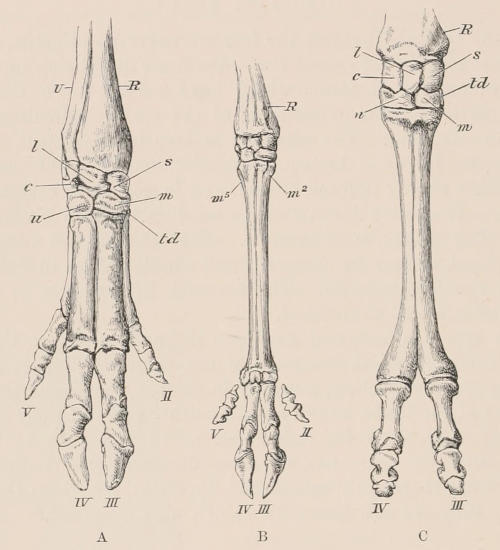
Fig. 99.—Bones of right fore foot of existing Artiodactyles. A, Pig (Sus scrofa), × ⅓; B, Red Deer (Cervus elaphus), × ⅐; C, Camel (Camelus bactrianus), × ⅛. U, Ulna; R, radius; c, cuneiform; l, lunar; s, scaphoid; u, unciform; m, magnum; td, trapezoid; tm, trapezium. From Flower’s Osteology of Mammalia.
The principal anatomical characters by which the Artiodactyles are distinguished from the Perissodactyles are as follows. The premolar and molar teeth usually not alike, the former being single and the latter two-lobed. The last lower molar of both first and second dentition almost invariably three-lobed; and the first tooth of the upper cheek series always without a milk-predecessor. Nasal bones not expanded posteriorly. No alisphenoid canal. Dorsal and lumbar vertebræ together always nineteen, though the former may vary from twelve to fifteen. Femur without third trochanter. Third and fourth digits of both feet almost equally developed, and their ungual phalanges flattened on their inner or contiguous surfaces, so that each is not symmetrical in itself, but when the two are placed together they form a figure symmetrically disposed to a line drawn between them. Or, in other words, the axis or median line of the whole foot is a line drawn between the third and fourth digits, while in the Perissodactyles it is a line drawn down the centre of the third digit. Distal articular surface of the astragalus divided into two nearly equal facets, one for the navicular and the other for the cuboid bone. The calcaneum with an articular facet for the lower end of the fibula. Stomach almost always more or less complex. Colon convoluted. Cæcum small. Placenta diffused or cotyledonary. Mammæ few and inguinal, or numerous and abdominal.
In treating of many sections of mammals, it is only from the existing species that our characters and classification can be derived, and to these chiefly our observations upon the group must be directed, many of the extinct forms being so little known that they can only be referred to incidentally. With the Ungulata, however, it is quite otherwise. The history of the Artiodactyla throughout the Tertiary period is now well known, and throws great light upon the position and relations of the existing groups.
The principal modifications which have taken place in the type from its earliest known and most generalised manifestation have been the following:—
1. As regards the teeth. Assumption by the grinding surfaces of the molar teeth either of a bunodont or of a selenodont form. Modification of the latter from a brachydont to a hypsodont type. Loss of upper incisors. Development of canines into projecting tusks. Loss of anterior premolars.
2. As regards the limbs. Reduction of the ulna from a complete and distinct bone to a comparatively rudimentary state, in which it coalesces more or less firmly with the radius. Reduction of the fibula till nothing but its lower extremity remains. Reduction and final loss of external pair of digits (second and fifth), with coalescence of the metapodial bones of the two middle digits. Union of the navicular and cuboid, and sometimes the ectocuneiform, bones of the tarsus.
3. Change of form of the odontoid process of the axis vertebra from a cone to a hollow half-cylinder.
4. Development of horns or antlers on the frontal bones, and gradual complication of form of antlers.
5. By inference only, increasing complication of stomach with ruminating function superadded. Modification of placenta from simple diffused to cotyledonary form.
The primitive Artiodactyles, with the typical number (44) of incisor, canine, and molar teeth, brachydont molars, conical odontoid process, four distinct toes on each foot, with metapodium and all carpal bones distinct, no frontal appendages, and (in all probability) simple stomach and diffused placenta, were separated at a very early period into Bunodonts and Selenodonts, although there is evidence of intermediate forms showing a complete transition from the one modification to the other. These and other fossil forms so completely connect the four groups—Suina, Tylopoda, Tragulina, and Pecora—into which the existing members of the suborder have become divided, that in a general classification embracing both living and extinct forms these divisions cannot be maintained. In the present work, however, it will be convenient to retain them, mention being made of some of the chief annectant forms in separate sections.
Suina.
The existing members of this group are characterised by their bunodont molars, and the absence of a complete fusion of the third and fourth metapodials to form a “cannon-bone.” The full Eutherian dentition is very frequently present.
Remains of very generalised swine-like animals have been abundantly found in Tertiary formations both in America and Europe. In the former continent they never (so far as present evidence indicates) underwent any great diversity of modification, but gradually dwindled away and almost died out, being only represented in the actual fauna by the two closely allied species of Peccary, among the smallest and most insignificant members of the group, which have existed almost unchanged since the Miocene age at least, if the evidence of teeth alone can be trusted. In the Old World, on the other hand, the swine have played a more important part in recent times, having become widely distributed, and throwing off some curiously specialised forms. At the present time, though not very numerous in species, they range through the greater part of the Old World, except within or near the Arctic Circle, although, in common with all the other members of the great Ungulate order, they were completely absent from the whole of the Australian region, until introduced by man in very recent times.
The existing swine-like animals may be divided naturally into three families:—I. Hippopotamidæ; II. Suidæ, or true Pigs; III. Dicotylidæ, or Peccaries.[176]
Family Hippopotamidæ.
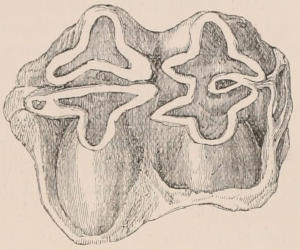
Fig. 100.—Grinding surface of a worn molar of Hippopotamus amphibius. (From Owen.)
Muzzle very broad and rounded. Feet short and broad, having four subequal toes, with short rounded hoofs, all reaching the ground in walking. Incisors not rooted, but continuously growing; those of the upper jaw curved and directed downwards; those of the lower straight and procumbent. Canines very large, curved, continuously growing; those of the upper jaw directed downwards. Stomach complex. No cæcum.
Hippopotamus.[177]—This genus may be taken to include all the known members of the family; it appears to have been always confined to the Old World. The dentition may be expressed by the formula i ²⁻³⁄₁₋₃, c ¹⁄₁, p ⁴⁄₄, m ³⁄₃. The crowns of the molars (Fig. 100) when worn present trefoil-shaped surfaces of dentine; and those of the premolars are sharp. The facial portion of the skull is much elongated, the orbits are tubular and very prominent, and the mandible has a large rounded descending flange at its angle. The ears are small, the tail is short, and the legs are likewise so short that the belly is raised but a little distance above the ground. The brain is not richly convoluted, and differs very considerably from that of the Pigs, approximating in some respects to that of the Camel and Giraffe, but on the whole standing very much by itself. The stomach of the common species is of enormous dimensions, having an axial length of 11 feet, and measuring upwards of 15 feet along the greater curvature. Its axis is longitudinal, the pylorus being situated almost in the pelvis, and it is divided into three distinct compartments, of which the third is cylindrical. The liver of the adult is of extremely simple form, elongated transversely, and narrow from above downwards. With the exception of a few tufts of hair on the lips, on the sides of the head and neck, and at the extremity of the short compressed tail, the skin of the hippopotamus, some portions of which are two inches in thickness, is entirely destitute of covering.
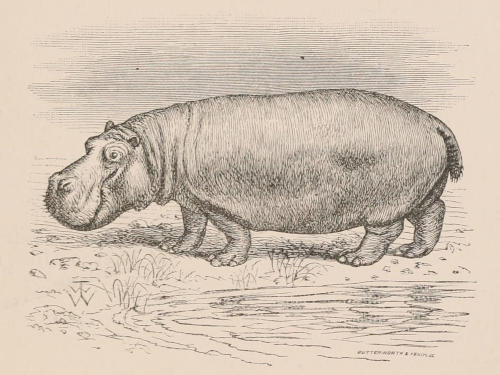
Fig. 101.—The Hippopotamus (Hippopotamus amphibius).
The common Hippopotamus (H. amphibius), widely distributed in the rivers and lakes of the African continent, is a huge bulky animal, characterised by having only two incisors on either side of each jaw; the central lower pair being very much larger than the outer ones. A male from the Upper Nile which lived for nearly thirty years in the gardens of the Zoological Society of London measured 12 feet along the back from the nose to the root of the tail.
The Hippopotamus lives in herds of from twenty to forty individuals on the banks and in the beds of rivers, in the neighbourhood of which it finds its food. This consists chiefly of grass and aquatic plants, of which it consumes enormous quantities, the stomach being capable of containing from 5 to 6 bushels. These animals feed principally by night, remaining in the water during the day, although in districts where they are undisturbed by man they are less exclusively aquatic. In such regions they put their heads boldly out of the water to blow, but when rendered suspicious by persecution, they become exceedingly cautious, only exposing their eyes and nostrils above the water, and even this they prefer doing amid the shelter of water plants. In spite of their enormous size and uncouth form, they are expert swimmers and divers, and can remain under the water from five to eight minutes. They are said to walk with considerable rapidity on the bottoms of rivers, beneath at least a foot of water. At nightfall they come on land to feed; and when, as often happens on the banks of the Nile, they reach cultivated ground, they do immense damage to growing crops, destroying by their ponderous tread even more than they devour.
A much smaller species, known as the Pigmy Hippopotamus (H. liberiensis), inhabits some of the rivers of Western Africa, and is characterised by having only a single pair of lower incisors. Mainly on this account, it has been proposed to regard this species as representing a distinct genus, under the name of Chœropsis; but since it agrees so essentially in other characters with the common form, and sometimes has two incisors on one side of the lower jaw, it appears preferable to include it in the type genus. The greater relative size of the brain-cavity as compared with the facial portion of the skull renders, indeed, the contour of the skull decidedly different from that of H. amphibius, but this is a feature generally found in young individuals of larger species, and also in the adults of allied smaller forms.
Both the existing species are now exclusively confined to Africa, but in the Pleistocene and Pliocene periods the genus was widely spread over the Old World. Thus in the Upper Pliocene of the Continent and the Pleistocene of England we meet with remains of a very large fossil Hippopotamus which cannot be specifically distinguished from H. amphibius. In the Pleistocene and Pliocene of India there are two species having three pairs of incisors in both jaws. Of these H. palæindicus has the second pair in the lower jaw very minute, and evidently just about to disappear; from which we learn that it is this pair which is missing in H. amphibius. In the still more generalised H. sivalensis the three incisors in the lower jaw are of equal size. Hexaprotodont species also occur in the Upper Tertiaries of Burma and Algeria. Small tetraprotodont species (H. pentlandi and H. minutus) have left their remains in enormous quantities in the caves and fissures of Sicily and Malta.
Family Suidæ.
An elongated mobile snout, with an expanded, truncated, nearly naked, flat, oval terminal surface in which the nostrils are placed. Feet narrow; four completely developed toes on each. Hoofs of the two middle toes with their contiguous surfaces flattened. The outer (second and fifth) digits of existing forms not reaching to the ground in the ordinary walking position. Teeth variable in number, owing to the suppression in some forms of an upper incisor and one or more premolars. Incisors rooted. Upper canines curving more or less outwards or upwards. Stomach simple, except for a more or less developed pouch near the cardiac orifice. A cæcum. Colon spirally coiled. Confined to the Old World.
The mandible has no descending flange at the angle. The crowns of the molars do not wear into such distinct trefoils as in the Hippopotamus, and are oblong in shape. The last molar of both the upper and lower jaw (Fig. 102) has an additional hinder lobe or talon, varying in size in the different species. The upper premolars are simpler than the true molars.
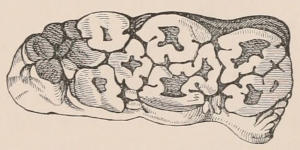
Fig. 102.—Grinding surface of a worn third right lower molar of the Wild Boar (Sus scrofa). After Owen.
Sus.[178]—Dentition: i ³⁄₃, c ¹⁄₁, p ⁴⁄₄, m ³⁄₃; total 44. Upper incisors diminishing rapidly in size from the first to the third. Lower incisors long, narrow, closely approximated, and almost horizontal in position, their apices inclining towards the middle line; the second slightly larger than the first, the third much smaller. Canines strongly developed and with persistent roots and partial enamel-covering, those of the upper jaw not having the usual downward direction, but curving strongly outwards, upwards, and finally inwards, while those of the lower jaw are directed upwards and outwards with a gentle backward curve, their hinder edges working and wearing against the front edges of the upper canines[179]. They appear externally to the mouth as tusks, the form of the upper lip being modified to allow of their protrusion, but are much less developed in the females than in the males. The teeth of the molar series gradually increase in size and complexity from first to last, and are arranged in contiguous series, except that the first lower premolar is separated by an interval from the second. First and second upper premolars with compressed crowns and two roots. The third and fourth have an inner lobe developed on the crown, and an additional pair of roots. The first and second true molars have quadrate crowns, with four principal obtuse conical cusps, around which numerous accessory cusps are clustered. The length of the third molar is nearly equal (antero-posteriorly) to that of the first and second together, its crown having, in addition to the four principal cusps, a large posterior talon or heel, composed of numerous clustered conical cusps, and supported by several additional roots. The lower molar teeth resemble generally those of the upper jaw, but are narrower. Milk dentition: i ³⁄₃, c ¹⁄₁, m ³⁄₃; total 28,—the first permanent premolar having no predecessor in this series. The third incisor, in both upper and lower jaws, is large, developed before the others, and has much the size, form, and direction of the canine. Vertebræ: C 7, D 13-14, L 6, S 4, C 20-24. The hairy covering of the body varies much under different conditions of climate, but when best developed, as in the European Wild Boar, consists of long stiff bristles, mostly abundant on the back and sides, and of a close softer curling undercoat.
The skull of the Pigs (Figs. 103-105) has the axis of the face bent down upon the basicranial axis, as is also the case with the Sheep. Its most striking feature is the elevation and backward slope of the occipital crest formed by the union of the supraoccipital and parietals. The broad and flat frontals have small postorbital processes, which do not join the zygomata, so that the orbits are open behind. The nasals are very long and narrow; and the premaxillæ send up long nasal processes, stopping short of the frontals. A peculiar prenasal bone is developed at the anterior extremity of the mesethmoid, which serves to strengthen the cartilaginous snout. The palate is long and narrow, and extends behind the last molar tooth. In most species the occipital crest is more nearly vertical than in the skull represented in Fig. 104.
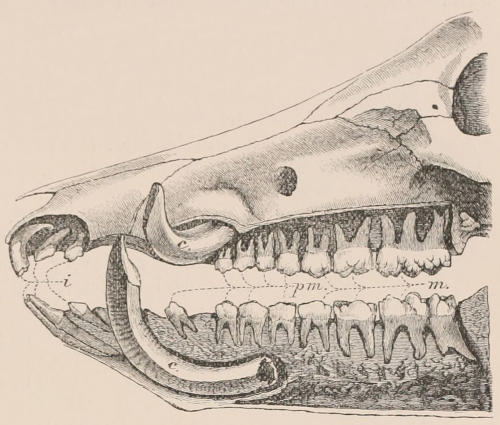
Fig. 103.—Left lateral view of the dentition of the Boar (Sus scrofa), the roots of the teeth being exposed by removing the external lamina of bone.
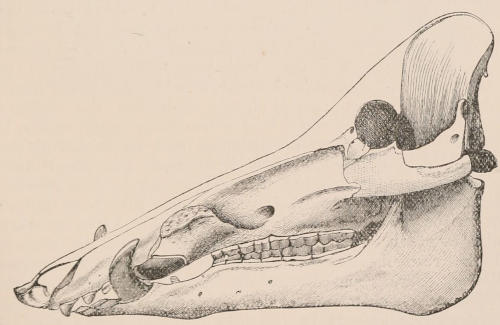
Fig. 104.—Left lateral view of the skull of Sus longirostris. ⅕ natural size. (From Nehring.)
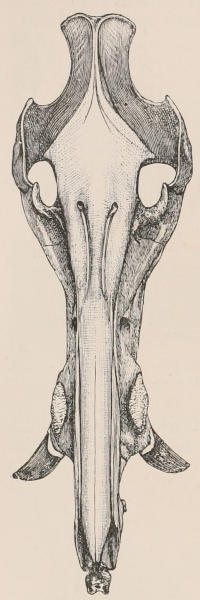
Fig. 105.—Frontal aspect of the cranium of Sus longirostris, ⅕ natural size. (From Nehring.)
This genus occurs at present under three principal modifications or subgenera.
A.—Sus proper comprises a number of animals found in a wild state throughout the greater part of Europe (except where exterminated by human agency), the north of Africa, southern continental Asia, and the great islands of the Malayan archipelago, Formosa, and Japan. The following among others have been admitted by many zoologists as distinct species:—Sus scrofa, the Wild Boar of Europe, Asia Minor, and North Africa, once common throughout the British Isles; S. sennaarensis, North-East Africa; S. cristatus, India; S. vittatus, Java, Borneo, Amboyna, Batchian; S. papuensis, New Guinea; S. timorensis, Timor and Rotti; S. andamanensis, Andaman Islands; S. taëvanus, Formosa; S. leucomystax, Japan; S. verrucosus, Java, Borneo, Ceram; S. barbatus, Borneo; S. celebensis, Celebes, Philippines, and Moluccas; S. longirostris, Borneo and Java. The last four species form an allied group in which the facial portion of the skull may be greatly elongated; S. barbatus, and S. celebensis being characterised by the small size and simple structure of the talon of the third molars. The skull of S. longirostris is shown in Figs. 104 and 105. The small S. andamanensis also has very simple third molars. S. vittatus, S. leucomystax, S. cristatus, S. taëvanus, and S. papuensis form another group, in which the third molar is generally of very complex structure, more or less closely allied to the Wild Boar; and Dr. Nehring is inclined to think that the whole five might be included under a single specific name. This list will give some idea of the geographical distribution of wild Pigs, but it must be borne in mind that through the whole of this region, and in fact now throughout the greater part of the habitable world, Pigs are kept by man in a domesticated state, and it is still an open question whether some of the wild Pigs of the islands named above may not be local races derived originally from, or crossed with, imported domestic specimens. In New Zealand a wild or rather “feral” race is already established, the origin of which is of course quite recent, since it is well ascertained that no animal of the kind ever lived upon the island until after its settlement by Europeans. Whether the various breeds of domestic Pigs have been derived from one or several sources is still unknown. As in so many similar cases, there is no historic evidence upon the subject, and the researches of naturalists, as Nathusius, Rütimeyer, Rolleston, Nehring, and others, who have endeavoured to settle the question on anatomical evidence, have not led to any satisfactory conclusions. It is, however, tolerably certain that all the species or forms of wild Pigs enumerated above and all the domestic races are closely allied, and it is probable (though of this there has been no opportunity of proof) will breed freely together. It is a curious circumstance that the young of all the wild kinds of Pigs (so far as yet is known) present a uniform coloration, being dark brown with longitudinal stripes of a paler colour, a character which completely disappears after the first few months. On the other hand, this peculiar marking is rarely seen in domestic Pigs in any part of the world, although it has been occasionally observed. It is stated by Darwin that the Pigs which have run wild in Jamaica and the semiferal Pigs of New Granada have resumed this aboriginal character, and produce longitudinally striped young; these must of course be the descendants of domestic animals introduced from Europe since the Spanish conquest, as before that time there were no true Pigs in the New World. Another character by which the European domestic Pig differs from any of the wild species is the concave outline of the frontal region of the skull, a form still retained by the feral Pigs in New Zealand.
B.—The diminutive Pig of the Nipal, Terai, and Bhutan, Sus salvanius, has been separated from the rest by Hodgson under the generic name of Porcula, but all the alleged distinctive characters prove on more careful investigation to have little real value. Owing to its retired habits and power of concealment under bushes and long grass in the depths of the great Sal Forest, which is its principal home, very little has been known of this curious little animal, scarcely larger than a hare. The acquisition of living specimens in the London Zoological Gardens has, however, afforded opportunities for careful anatomical observation.[180]
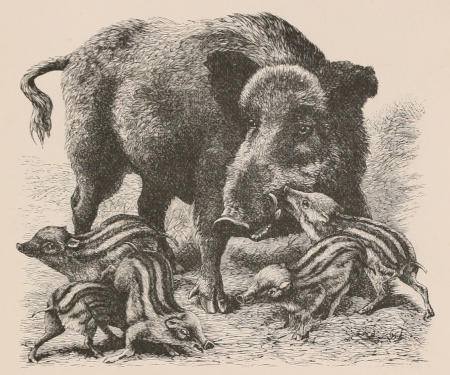
Fig. 106.—Wild Boar and Young.
C.—Two well-marked species of African Swine have been with more reason separated under the name of Potamochœrus. The dentition differs from that of the true Sus, inasmuch as the anterior premolars have a tendency to disappear; sometimes in adult specimens the first upper premolar is retained, but it is usually absent, as well as the first and often the second lower premolars. The molar teeth are also less complex: the last especially having a much less developed talon. There are likewise characteristic cranial differences. The two species are very distinct in outward appearance and coloration. One is S. africanus, the South African River-Hog, or Bosch-Vark, of a gray colour, and the other S. porcus, the West African Red River-Hog (Fig. 107), remarkable for its vivid colouring and long pencilled ears. It should be noted that the young of both these species, as well as of the pigmy S. salvanius, present the striped character of the true Sus, a strong indication of close affinities, whereas in all the following forms this is absent.
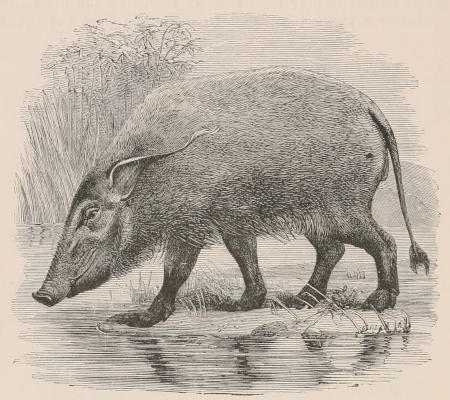
Fig. 107.—The Red River-Hog (Sus porcus). From Sclater, Guide to Animals in Zoological Society’s Gardens, 1883, p. 183.
The genus Sus, in the above extended sense, is well represented in the Tertiaries of the Old World from the period of the Lower Pliocene upwards. In the Pliocene and Pleistocene of India S. falconeri and S. karnuliensis are characterised by the extremely complex structure of the molars, in which they show decided signs of approximation to the Wart-Hogs; the same feature being exhibited by S. phacochœroides of the Algerian Pliocene. S. titan and S. giganteus, of the Indian Pliocene, together with S. antiquus and S. erymanthius, of the corresponding European deposits, are very large species characterised by their comparatively simple molars; S. titan being fully as large as a Tapir. S. hysudricus of the Pliocene of India, and S. palæochœrus of that of Europe, are smaller allied species not improbably related to S. andamanensis, with which they agree in molar structure. S. arvernensis, of the Upper Pliocene of France, appears to be allied to S. africanus; while in the diminutive S. punjabiensis of the Pliocene of North-Western India we probably have the direct ancestor of S. salvanius.
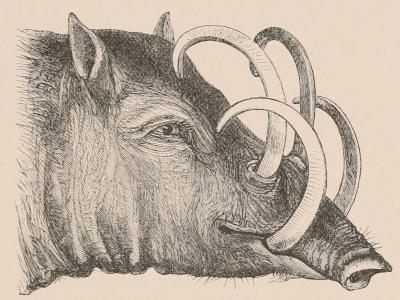
Fig. 108.—Head of Babirusa (Babirusa alfurus).
Babirusa.[181]—Dentition: i ²⁄₃, c ¹⁄₁, p ²⁄₂, m ³⁄₃; total 34. The total number of teeth is therefore considerably reduced, the outer upper incisor and the two anterior premolars of both jaws being absent. The molars, especially the last, are smaller and simpler than in Sus; but the great peculiarity of this genus is the extraordinary development of the canines of the male. These teeth (Fig. 108) are ever-growing, long, slender, and curved, and entirely without enamel covering. Those of the upper jaw are directed upwards from their base, so that they never enter the mouth, but piercing the skin of the face, resemble horns rather than teeth, and curve backwards, downwards, and finally often forwards again, almost or quite touching the skin of the forehead. Vertebra: C 7, D 13, L 16, S 4. There is but one species (B. alfurus), found only in the islands of Celebes and Buru. Its external surface is almost entirely devoid of hair. With regard to the curiously modified dentition, Wallace (Malay Archipelago, vol. i. p. 435) makes the following observations:—“It is difficult to understand what can be the use of these horn-like teeth. Some of the old writers supposed that they served as hooks by which the creature could rest its head on a branch. But the way in which they usually diverge just over and in front of the eye has suggested the more probable idea, that they serve to guard these organs from thorns and spines while hunting for fallen fruits among the tangled thickets of rattans and other spiny plants. Even this, however, is not satisfactory, for the female, who must seek her food in the same way, does not possess them. I should be inclined to believe rather that these tusks were once useful, and were then worn down as fast as they grew, but that changed conditions of life have rendered them unnecessary, and they now develop into a monstrous form, just as the incisors of the Beaver and Rabbit will go on growing if the opposite teeth do not wear them away. In old animals they reach an enormous size, and are generally broken off as if by fighting.”
Phacochœrus.[182]—The Wart-Hogs, so called from the large cutaneous lobes projecting from each side of the face, have the teeth still more remarkably modified than in Babirusa. The milk-dentition, and even the early condition of the permanent dentition, is formed on the same general type as that of Sus, except that certain of the typical teeth are absent, the formula being i ¹⁄₃, c ¹⁄₁, p ³⁄₂, m ³⁄₃, total 34; but as age advances all the teeth have a tendency to disappear, except the canines and the posterior molars, which in some cases are the only teeth left in the jaws, and attain an extraordinary development. The upper canines especially are of great size, and curve outwards, forwards, and upwards. Their enamel covering is confined to the apex, and soon wears away. The lower canines are much more slender, but follow the same curve: except on the posterior surface, their crowns are covered with enamel. Unlike those of the Babirusa, the canines of the Wart-Hog are large in both sexes. The third molar tooth of both jaws is of great size, and presents a structure at first sight unlike that of any other mammal, being composed of numerous (22-25) parallel cylinders or columns, each with pulp-cavity, dentine, and enamel covering, and packed together with cement. Careful examination will, however, show that a similar modification to that which has transformed the comparatively simple molar tooth of the Mastodon into the extremely complex grinder of the Indian Elephant has served to change the tooth of the common Pig into that of Phacochœrus, and, as already mentioned, some of the fossil Indian and African species of Sus indicate the mode in which this transition came about. The tubercles which cluster over the surface of the crown of the molars of the common Pig are elongated and drawn out into columns in the Wart-Hog, as the low transverse ridges of the Mastodon’s tooth become the leaf-like plates of the Elephant’s.
Two species of this genus are commonly but rather doubtfully distinguished:—P. africanus, Ælian’s Wart-Hog, widely distributed over the continent; and P. æthiopicus, Pallas’s Wart-Hog, confined to South-Eastern Africa. In specimens attributed to the latter species the dentition reaches its most complete reduction, as in adult animals the upper incisors are absent and the lower ones worn down to the roots.
Family Dicotylidæ.
Snout as in Suidæ. Dentition: i ²⁄₃, c ¹⁄₁, p ³⁄₃, m ³⁄₃; total 38. Incisors rooted; upper canines directed downwards, with sharp cutting hinder edges. Toes, four on the fore feet and three on the hind feet (the fifth wanting). Stomach complex. A cæcum. Confined to the New World.
Dicotyles.[183]—The teeth of the Peccaries (Dicotyles) differ from those of the true Pigs (Sus) numerically in wanting the upper outer incisor and the anterior premolar on either side of each jaw, and also in the circumstance that the last premolar is nearly as complex as the molars. The upper canines have their points directed downwards, not outwards or upwards as in the Boars, and are very sharp, with cutting hinder edges, and completely covered with enamel until worn. The lower canines are large, directed upwards and outwards, and slightly curved backwards. The premolar and molar teeth form a continuous series, gradually increasing in size from the first to the last. The true molars have square quadricuspidate crowns. The stomach is much more complex than in the true Pigs, almost approaching that of the ruminants. In the feet the two middle (third and fourth) metapodial bones, which are completely separate in the Pigs, are united at their upper ends, as in the ruminants. On the fore foot the two (second and fifth) outer toes are equally developed as in Pigs, but on the hind foot, although the inner (or second) is present, the outer (or fifth) toe is entirely wanting, giving an unsymmetrical appearance of the member, very unusual in Artiodactyles. Vertebræ: C 7, D 14, L 5, S 4, C 7. As in the Pigs, the snout is truncated, and the nostrils are situated in its flat, expanded, disc-like termination. The ears are rather small, ovate, and erect; and there is no external appearance of a tail. The surface of the body is well covered with thick bristly hair, and rather behind the middle of the back is a large and peculiar gland, which secretes an oleaginous substance with a powerful musky odour. This was mistaken by the old travellers for a second navel, a popular error which suggested to Cuvier the name of Dicotyles. When the animal is killed for food, it is necessary speedily to remove this gland, otherwise it will taint the whole flesh so as to render it uneatable.
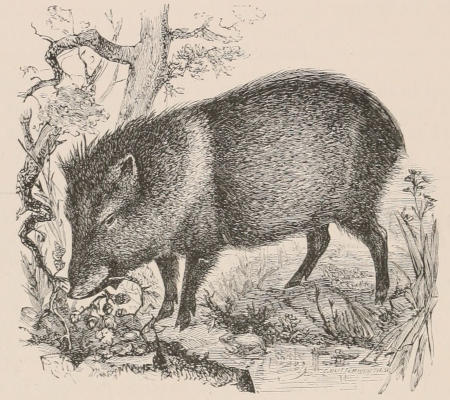
Fig. 109.—The Collared Peccary (Dicotyles tajacu).
There are two species,[184] so nearly allied that they will breed together freely in captivity. Unlike the true Pigs, they never appear to produce more than two young ones at a birth. The Collared Peccary (D. tajacu, Linn., torquatus, Cuvier), Fig. 109, ranges from the Red River of Arkansas through the forest districts of Central and South America as far as the Rio Negro of Patagonia. Generally it is found singly or in pairs, or at most in small herds of from eight to ten, and is a comparatively harmless creature, not being inclined to attack other animals or human beings. Its colour is dark gray, with a white or whitish band passing across the chest from shoulder to shoulder. The length of the head and body is about 36 inches. The White-lipped Peccary or Warree (D. labiatus, Cuvier) is rather larger, being about 40 inches in length, of a blackish colour, with the lips and lower jaw white. Its range is less extensive, since it is not found farther north than British Honduras or south of Paraguay. It is generally met with in large herds of from fifty to a hundred or more individuals, and is of a more pugnacious disposition than the former species, and capable of inflicting severe wounds with its sharp tusks. A hunter who encounters a herd of them in a forest has often to climb a tree as his only chance of safety. Both species are omnivorous, living on roots, fallen fruits, worms, and carrion; and when they approach the neighbourhood of villages and cultivated lands they often inflict great devastation upon the crops of the inhabitants.
Remains of the two existing species of Peccary, as well as of one much larger extinct form, are found in the cavern-deposits of Brazil; while large Peccaries also occur in the Pleistocene of the United States, which, although they have been referred to a distinct genus, Platygonus, on account of their relatively smaller incisors and somewhat simpler premolars, may well be included in Dicotyles.
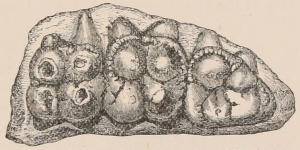
Fig. 110.—The three left upper molars of Hyotherium perimense, from the Pliocene of India.
Allied Extinct Genera.—In the Tertiary deposits of both the Old and New World occur remains of Pig-like animals which, so far as we can judge, appear to connect the Peccaries so closely with the true Pigs as to render the Dicotylidæ really inseparable from the Suidæ. Of these the American genus Chænohyus has the lower canine with a triangular cross section and received into a notch in the upper jaw, as in the Peccaries, but the fourth upper premolar is simpler than the molars, as in the under-mentioned genus Hyotherium. The typical forms have only three premolars, but in others, which it has been proposed to separate generically as Bothriolabis, there are four of these teeth. Hyotherium, of the Pliocene and Miocene of the Old World, is a generalised form allied both to Sus and Dicotyles as well as to certain extinct genera. The upper molars (Fig. 110) are characterised by their square crowns, the last having no distinct third lobe, and coming into use before the first is much worn, while the last premolar is simpler than the true molars. The canines, which have an oval section and are scarcely larger than the incisors, are not received into a notch in the upper jaw. In the Pliocene of India there occurs an apparently allied genus known as Hippohyus, in which the crowns of the molars are much taller, and have lateral infoldings of the enamel, producing a very complex pattern on the worn crowns. The European Miocene genus Listriodon, with the dental formula i ³⁄₃, c ¹⁄₁, p ³⁄₃, m ³⁄₃, differs from all the preceding in having the anterior and posterior pairs of tubercles of the molars united into ridges running across their crowns, so that these teeth resemble the lower molars of the Tapir. The genus is also found in the Lower Pliocene of India.
Extinct Transitional Artiodactyles.
In this place it will be convenient to notice briefly a few of the extinct types of Tertiary Artiodactyles which connect the existing bunodont Suina with the more specialised selenodont groups mentioned below so closely as to show that in a strictly palæontological classification such groups cannot be maintained. It should be mentioned that while some of these extinct forms were in all probability actual ancestral links between the bunodonts and selenodonts, others, like the Anoplotheres, died out entirely without giving rise to any more specialised descendants.
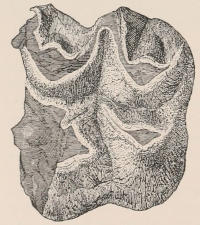
Fig. 111.—The imperfect third left upper molar of Hyopotamus giganteus, Miocene, India. (From the Palæontologia Indica.)
Chœropotamidæ.—In this family the molars are intermediate in structure between those of the Suidæ and the next family. The upper ones have very broad crowns, with the five columns arranged as in Anthracotherium; while the premolars are not secant, and may be very large. The best known forms are the small Cebochœrus of the Phosphorites of Central France; Chœropotamus of the Upper Eocene, the type species of which was of the size of a large Pig, with the dental formula i ³⁄₃, c ¹⁄₁, p ⁴⁄₃, m ³⁄₃, and no distinctly selenodont structure in the molars; the much larger Elotherium, from the Upper Eocene and Lower Miocene of both the Old and New Worlds, which presents the very rare feature of the absence of a third lobe to the last lower molar; and the equally large Tetraconodon of the Pliocene of India, in which this third lobe was present and the premolars were of enormous size. The remarkable North American Eocene genus Achænodon should perhaps also be placed here.
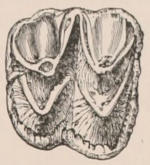
Fig. 112.—A right upper molar of Merycopotamus pusillus, Pliocene, India. (From the Palæontologia Indica.)
Anthracotheriidæ.—The genera Anthracotherium and Hyopotamus, of the upper Eocene and Miocene, have the typical Eutherian dental formula; the upper molars (Fig. 111) carrying three columns on the anterior and two on the posterior half of the crown, all of which are of a more or less decidedly selenodont structure. The mandible has a descending flange at the angle. The figured tooth (in which the antero-internal and antero-median columns are imperfect) may be compared with the diagram given in Fig. 5, p. 32, when the homology of the columns or tubercles will be at once apparent, the broken antero-median column representing the protoconule. Some of the species are of large size, while others are comparatively small.
Merycopotamus.—The genus Merycopotamus of the lower Pliocene of India may be regarded as an Anthracotheroid which has lost the antero-median column to the upper molars (Fig. 112), so that these teeth are consequently quadrituberculate; and may thus be regarded as typical examples of the brachy-selenodont modification of molar structure.
Cotylopidæ.—The Miocene genus Cotylops (Oreodon[185]) is the type of a large American family in which the upper molars are selenodont and usually have four columns, while the lower canine is approximated to the incisors and its form and function assumed by the first premolar. The last upper premolar is simpler than the molars. There is no flange to the angle of the mandible; and the feet have four digits. The affinities of this peculiar family are probably widely spread, but they may have been derived from the Anthracotheriidæ. The type genus has the full Eutherian dentition, but in some of the more specialised forms (Cyclopidius) the upper incisors may be wanting, and large vacuities occur in the lachrymal region. The generalised genus Protoreodon, of the Upper or Uinta Eocene, has five cusps on the upper molars, arranged as in the Anthracotheriidæ. The pollex is retained in the manus of the type genus.
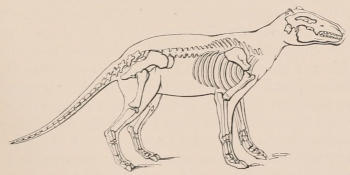
Fig. 113.—Restoration of Anoplotherium commune (Upper Eocene). Cuvier.
The family may be divided into subfamilies as follows:—
I. Upper molars with four columns. 1. Orbits open, no lachrymal fossa, a diastema, the last upper premolar with two outer columns, outer wall of upper molars concave and inclined inwards.—Agriochœrinæ (Agriochœrus). 2. Orbits closed, a lachrymal fossa, no diastema, the last upper premolar with one outer column; outer wall of upper molars flattened.—Cotylopinæ (Cotylops, Eporeodon, Merycochœrus, Cyclopidius, etc.)
II. Upper molars with five columns.—Protoreontinæ (Protoreodon).
Anoplotheriidæ.—This family includes several Upper Eocene European genera, with selenodont upper molars, carrying five columns arranged as those in Anthracotherium. One of the earliest known, Anoplotherium, was fully described by Cuvier from remains found in the Paris gypsum-beds (Upper Eocene). Its forty-four teeth formed a series unbroken by a gap or diastema, and were of uniform height (as in Man alone of existing mammals). Its tail was long, with large chevron bones underneath, not usually found in Ungulates, and there were either three or two toes on each foot. It was in many respects a much-specialised form, apparently not on the line of descent of any of the existing groups.
Dacrytherium is an allied genus whose dentition leads on to that of the smaller Xiphodon. The latter genus is characterised by the compressed and elongated form of the crowns of the first three premolars, which thus approximate to those of the Chevrotains. There were only two functional digits to the feet. The so-called Hyopotamus picteti, of the Swiss Eocene, is a species of Dacrytherium.
Cænotheriidæ.—The typical representatives of this family are small animals not larger than the Chevrotains, with the full complement of teeth, generally no marked gap in the series, and the crowns of the upper molars carrying two columns on the anterior and three on the posterior half of the crown—precisely the reverse of the arrangement obtaining in the Anthracotheriidæ. The known forms are from the Upper Eocene and Lower Miocene of Europe. In Cænotherium the molars are selenodont, while they are bunodont in Dichobunus. Homacodon, of the Bridger Eocene of the United States, is closely allied to the latter. The first lower premolar of Dichobunus assumes the form and function of a canine. Spaniotherium (Metriotherium) is a much larger form, in which the molars are not unlike those of Anthracotherium, if the arrangement of the cusps were reversed; it occurs in the Eocene Phosphorites of France. It is suggested that the Tylopoda may have originated from this group.
Tapirulus is a small Eocene Artiodactyle with the columns of the upper molars, which are somewhat like those of Hyopotamus, tending to form transverse ridges; its family position is uncertain.
Dichodontidæ.—The European genera included in this family all have quadritubercular selenodont molars, and show signs of approximating more or less closely to existing types. Dichodon, from the Upper Eocene and Lower Miocene, has the full complement of teeth, which show no diastema, and have low crowns. The fourth upper premolar has four columns, like the true molars, and the corresponding lower tooth three complete lobes; these features being unknown in any other Selenodonts. In Lophiomeryx, of the same beds, the somewhat higher crowns of the molars approximate to those of the Cervidæ, but the hinder lobes of the upper ones are imperfectly developed; the genus may be allied, to the Tragulidæ. In the small Gelocus, of the Lower Miocene, the molars are not unlike those of Dichodon; but the navicular and cuboid bones of the tarsus were fused together, and the metatarsals had united to form a “cannon-bone,” although the metacarpals still remained distinct. It is not improbable that upper incisors were wanting; and it has been suggested that we have in this genus the ancestral type of the Tragulidæ and Cervidæ.
Tylopoda.
Family Camelidæ.
This group is represented at the present day by the two species of Camels of the Old World and the Llamas of South America, collectively constituting the family Camelidæ. The special characters which the Llamas and Camels have in common, and the combination of which distinguishes them from the rest of the Artiodactyles, are as follows. The premaxillæ have the full number of incisor teeth in the young state, and the outermost is persistent through life as an isolated laniariform tooth. The canines are present in both jaws, and those of the mandible are differentiated from the long, procumbent, and spatulate incisors, being suberect and pointed. The crowns of the true molars belong to the crescentic or selenodont type, and are very hypsodont; but one or more of the anterior premolars is usually detached from the series, and is of simple pointed form. The auditory bulla is filled with cancellous tissue. The hinder part of the body is much contracted, and the femur long and vertically placed, so that the knee-joint is lower in position, and the thigh altogether more detached from the abdomen than in most quadrupedal mammals. The limbs are long, but with only the third and fourth digits developed; no traces of any of the others being present. The trapezoid and magnum of the carpus, and the cuboid and navicular of the tarsus are distinct. The two metapodial bones of each limb are confluent for the greater part of their length, though separated for a considerable distance at the lower end. Their distal articular surfaces, instead of being pulley-like, with deep ridges and grooves, as in other recent Artiodactyles, are simple, rounded, and smooth. The proximal phalanges are expanded at their distal ends, and the wide, depressed middle phalanges are embedded in a broad cutaneous pad, forming the sole of the foot, on which the animal rests in walking, instead of on the hoofs. The ungual phalanges are very small and nodular, not flattened on their inner or opposed surfaces, and not completely encased in hoofs, but bearing nails on their upper surface only. The cervical region is long and flexuous, and the vertebræ of which it is composed are remarkable for the position of the canal for the transmission of the vertebral artery, which does not perforate the transverse process, but passes obliquely through the anterior part of the pedicle of the arch (a condition only found in two other genera of mammals, Macrauchenia and Myrmecophaga). There are no horns or antlers. Though these animals ruminate, the stomach differs considerably in the details of its construction from that of the Pecora. The interior of the rumen or paunch has no villi on its surface, and there is no distinct psalterium or manyplies. Both the first and second compartments are remarkable for the presence of a number of pouches or cells in their walls, with muscular septa, and a sphincter-like arrangement of their orifices, by which they can be shut off from the rest of the cavity, and into which the fluid portion only of the contents of the stomach is allowed to enter.[186] The placenta is diffuse, as in the Suina and Tragulina, not cotyledonary, as in the Pecora. Finally, the Camelidæ differ not only from other Ungulates, but from all other mammals, in the fact that the red corpuscles of the blood, instead of being circular in outline, are oval, as in the inferior vertebrated classes.
Camelus.[187]—Dentition of adult: i ¹⁄₃, c ¹⁄₁, p ³⁄₂, m ³⁄₃; total 34. First upper premolar simple, placed immediately behind the premaxillæ, and separated by a long diastema from the penultimate tooth of that series. Lower incisors somewhat proclivous, the outermost the largest. Skull elongated, with an overhanging occiput, orbits completely surrounded by bone, and the premaxillæ not articulating with the arched and somewhat elongated nasals. Vertebræ: C 7, D 12, L 7, S 4, C 13-15. Ears comparatively short and rounded. One or two dorsal adipose humps. Feet broad, with the toes very imperfectly separated. Tail well developed, tufted at the end. Hair nearly straight, and not woolly. Size very large and bulky.
The genus is now represented by two species, viz. the single-humped Arabian Camel (Camelus dromedarius), and the double-humped Bactrian Camel (C. bactrianus, Fig. 114).[188] The former is quite unknown in a wild state, but it is reported that wild Bactrian Camels occur in the more remote parts of Turkestan. The latter species is found in a domesticated state throughout a large portion of Turkestan and the neighbouring region, extending as far as the Crimea in the west and to Lake Baikal and Pekin in the east. It is a heavier and more clumsy animal than the Arabian Camel, with thicker hair, shorter legs, and the feet more callous and better adapted to a hard ground. The hair is most developed upon the top of the head, neck, humps, arm, and wrist. Bactrian Camels are occasionally brought over the stupendous mountain passes south of Yarkand to within a few days’ journey of Leh, in Kashmir territory.
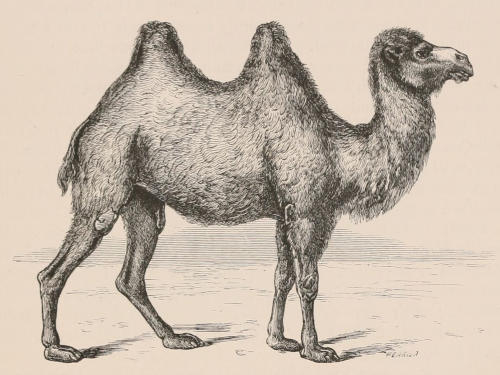
Fig. 114.—The Bactrian Camel (Camelus bactrianus).
The Arabian Camel is commonly employed as a beast of burden in Africa and India, and has of late years been introduced into Australia for the same purpose; it is especially valuable in crossing long stretches of arid desert from its power of existing for a considerable period of time without water. The female goes fully eleven months with young, and produces but a single calf at a birth, which is suckled for a whole year. In disposition the Camel is surly and subject to furious outbursts of temper, especially during the rutting season. At such periods the male utters a peculiar and highly disagreeable bubbling noise in its throat, well known to all who have travelled in India with Camels as their transport. It has been said that the Camel is docile, but Palgrave observes:—
“If docile means stupid, well and good; in such a case the Camel is the very model of docility. But if the epithet is intended to designate an animal that takes an interest in its rider so far as a beast can, that in some way understands his intentions, or shares them in a subordinate fashion, that obeys from a sort of submissive or half-fellow-feeling with his master, like the horse or elephant, then I say that the camel is by no means docile—very much the contrary. He takes no heed of his rider, pays no attention whether he be on his back or not, walks straight on when once set agoing, merely because he is too stupid to turn aside, and then should some tempting thorn or green branch allure him out of the path, continues to walk on in the new direction simply because he is too dull to turn back into the right road. In a word, he is from first to last an undomesticated and savage animal, rendered serviceable by stupidity alone, without much skill on his master’s part, or any co-operation on his own save that of an extreme passiveness. Neither attachment nor even habit impress him; never tame, though not wide-awake enough to be exactly wild.” The two species breed together freely, and among the Yourouks of Asia Minor, hybrids, or mules, the produce generally of a male Bactrian and a female Arabian camel are preferred to either of the pure breeds.
Fossil remains of Camels are found in the Pliocene of the Siwalik Hills in Northern India. These differ from the existing representatives of the genus in having a vertical ridge at the antero-external angle of the lower molars, whereby they resemble Auchenia; their cervical vertebræ are also intermediate in structure between those of the latter and the existing Camels. A fossil Camel is also found in the Pleistocene of Algeria.
Auchenia.[189]—Dentition of adults normally: i ¹⁄₃, c ¹⁄₁, p ²⁄₂, m ³⁄₃; total 32—one of the lower premolars may, however, be wanting. In the upper jaw there is a compressed, sharp, pointed laniariform incisor near the hinder edge of the premaxilla, followed, in the male at least, by a moderate-sized, pointed, curved true canine in the anterior part of the maxilla. The isolated canine-like premolar which follows in the Camels is not present. The teeth of the molar series, which are in contact with each other, consist of two very small premolars (the first almost rudimentary) and three broad molars, constructed generally like those of Camelus. In the lower jaw the three incisors are long, spatulate, and procumbent; the outer ones being the smallest. Next to these is a curved, suberect canine, followed after an interval by an isolated, minute, and often deciduous simple conical premolar; then a contiguous series of one premolar and three molars, which differ from those of existing species of Camelus in having a small accessory column at the anterior outer edge. The skull generally resembles that of Camelus, the relatively larger brain-cavity and orbits and less developed cranial ridges being due to its smaller size. The nasal bones are shorter and broader, and are joined by the premaxillæ. Vertebræ: C 7, D 12, L 7, S 4, C 15-20. Ears rather long and pointed. No dorsal hump. Feet narrow, the toes being more separated than in the camels, each having a distinct plantar pad. Tail short. Hairy covering long and woolly. Size (in existing forms) smaller, and general form lighter than in the Camels. At present and within historic times the genus is entirely confined to the western side and southernmost parts of South America, but fossil remains have been found in the caves of Brazil, in the pampas of the Argentine republic, and in Central and North America.
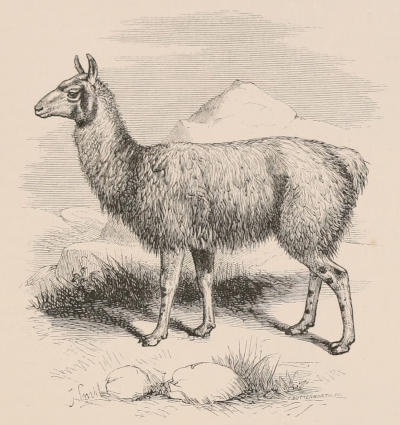
Fig. 115.—Llama (Auchenia glama), from an animal living in the Gardens of the Zoological Society of London.
The word Llama, sometimes spelt Lama, is the name by which the Peruvians designated one of a small group of closely allied animals, which, before the Spanish conquest of America, were the only domesticated hoofed mammals of the country, being kept, not only for their value as beasts of burden, but also for their flesh, hides, and wool,—in fact, supplying in the domestic economy of the people the place of the horse, the ox, the goat, and the sheep of the Old World. The word is now sometimes restricted to one particular species or variety of the group, and sometimes used in a generic sense to cover the whole. Although they were often compared by early writers to sheep, and spoken of as such, their affinity to the camel was very soon perceived, and they were included in the genus Camelus in the Systema Naturæ of Linnæus. They were, however, separated by Cuvier in 1800 under the name of Lama, changed by Illiger in 1811 to Auchenia (in allusion to the great length of neck, αὐχήν), a term afterwards adopted by Cuvier, and almost universally accepted by systematic zoologists, although there has been of late a disposition to revive the earlier name.
In essential structural characters, as well as in general appearance and habits, all the animals of this genus very closely resemble each other, so that the question as to whether they should be considered as belonging to one, two, or more species has been one which has led to a large amount of controversy among naturalists. The question has been much complicated by the circumstances of the great majority of individuals which have come under observation being either in a completely or partially domesticated state, and descended from ancestors which from time immemorial have been in like condition, one which always tends to produce a certain amount of variation from the original type. It has, however, lost much of its importance since the doctrine of the distinct origin of species has been generally abandoned.
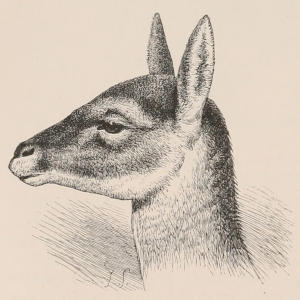
Fig. 116.—Head of Vicugna, from an animal living in the Gardens of the Zoological Society of London.
The four forms commonly distinguished by the inhabitants of South America are recognised by some naturalists as distinct species, and have had specific designations attached to them, though usually with expressions of doubt, and with great difficulties in defining their distinctive characteristics. These are (1) the Llama, Auchenia glama (Linn.), or Lama peruana (Tiedemann); (2) the Alpaca, A. pacos (Linn.); (3) the Guanaco or Huanaco, A. huanacus (Molina); and (4) the Vicugna, A. vicugna (Molina), or A. vicunna, (Cuv.) The first and second are only known in the domestic state, and are variable in size and colour, being often white, black, or piebald. The third and fourth are wild, and of a nearly uniform light-brown colour, passing into white below. They certainly differ from each other, the Vicugna being smaller, more slender in its proportions, and having a shorter head (Fig. 116) than the Guanaco (Fig. 117). It may therefore, according to the usual view of species, be considered distinct. It lives in herds on the bleak and elevated parts of the mountain range bordering the region of perpetual snow, amidst rocks and precipices, occurring in various suitable localities throughout Peru, in the southern part of Ecuador, and as far south as the middle of Bolivia. Its manners very much resemble those of the Chamois of the European Alps; and it is as vigilant, wild, and timid. The wool is extremely delicate and soft, and highly valued for the purposes of weaving, but the quantity which each animal produces is not great.
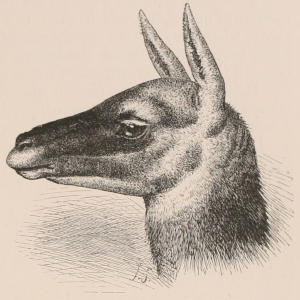
Fig. 117.—Head of Guanaco, from an animal living in the Gardens of the Zoological Society of London.
The Guanaco has an extensive geographical range, from the highlands of the Andean region of Ecuador and Peru to the open plains of Patagonia, and even the wooded islands of Tierra del Fuego. It constitutes the principal food of the Patagonian Indians, and its skin is invaluable to them, as furnishing the material out of which their long robes are constructed. It is about the size of a European Red Deer, and is an elegant animal, being possessed of a long, slender, gracefully curved neck and fine legs. Dr. Cunningham,[190] speaking from observation on wild animals, says:—
“It is not easy to describe its general appearance, which combines some of the characters of a camel, a deer, and a goat. The body, deep at the breast but very small at the loins, is covered with long, soft, very fine hair, which on the upper parts is of a kind of fawn-colour, and beneath varies from a very pale yellow to the most beautiful snow-white. The head is provided with large ears, in general carried well back, and is covered with short grayish hair, which is darkest on the forehead. Occasionally the face is nearly black. As a rule it lives in flocks of from half a dozen to several hundreds, but solitary individuals are now and then to be met with. They are very difficult to approach sufficiently near to admit of an easy shot, as they are extremely wary, but, on being disturbed, canter off at a pace which soon puts a safe distance between them and the sportsman, even though he should be mounted. Despite their timidity, however, they are possessed of great curiosity, and will sometimes advance within a comparatively short distance of an unknown object, at which they will gaze fixedly till they take alarm, when they effect a speedy retreat. Their cry is very peculiar, being something between the belling of a deer and the neigh of a horse. It would be difficult to overestimate their numbers upon the Patagonian plains; for in whatever direction we walked we always came upon numbers of portions of their skeletons and detached bones.”
Darwin, who has given an interesting account of the habits of the Guanaco in his Naturalist’s Voyage, says that they readily take to the water, and were seen several times at Port Valdes swimming from island to island.
The Llama is only known as a domestic animal, and is chiefly met with in the southern part of Peru. Burmeister, a very competent writer on the subject, says that he is perfectly satisfied that it is the descendant of the wild Guanaco, an opinion opposed to that of Tschudi. It generally attains a larger size than the Guanaco, and is usually white or spotted with brown or black, and sometimes altogether black. The earliest and often-quoted account of this animal by Agustin de Zarate, treasurer-general of Peru in 1544, will bear repeating as an excellent summary of the general character and uses to which it was put by the Peruvians at the time of the Spanish conquest. He speaks of the Llama as a sheep, observing, however, that it is camel-like in shape though destitute of a hump:—
“In places where there is no snow the natives want water, and to supply this they fill the skins of sheep with water and make other living sheep carry them; for, it must be remarked, these sheep of Peru are large enough to serve as beasts of burden. They can carry about one hundred pounds or more, and the Spaniards used to ride them, and they would go four or five leagues a day. When they are weary they lie down upon the ground; and as there are no means of making them get up, either by beating or assisting them, the load must of necessity be taken off. When there is a man on one of them, if the beast is tired and urged to go on, he turns his head round and discharges his saliva, which has an unpleasant odour, into the rider’s face. These animals are of great use and profit to their masters, for their wool is very good and fine, particularly that of the species called Pacas, which have very long fleeces; and the expense of their food is trifling, as a handful of maize suffices them, and they can go four or five days without water. Their flesh is as good as that of the fat sheep of Castile. There are now public shambles for the sale of their flesh in all parts of Peru, which was not the case when the Spaniards came first; for when one Indian had killed a sheep his neighbours came and took what they wanted, and then another Indian killed a sheep in his turn.”
The disagreeable habit here noticed of spitting in the face of persons whose presence is obnoxious is common to all the group, as may be daily witnessed in specimens in confinement in the menageries of Europe. One of the principal labours to which the Llamas were subjected at the time of the Spanish conquest was that of bringing down ore from the mines in the mountains. Gregory de Bolivar estimated that in his day as many as three hundred thousand were employed in the transport of the produce of the mines of Potosi alone; but since the introduction of horses, mules, and donkeys the importance of the Llama as a beast of burden has greatly diminished.
The Alpaca, though believed by many naturalists to be a variety of the Vicugna, is more probably, like the Llama, derived from the Guanaco, having the naked callosities on the hind limbs, and the relatively large skull of the latter. It is usually found in a domesticated or semi-domesticated state, being kept in large flocks which graze on the level heights of the Andes of southern Peru and northern Bolivia at an elevation of from 14,000 to 16,000 feet above the sea-level, throughout the year. It is smaller than the Llama, and, unlike that animal, is not used as a beast of burden, but is valued only for its wool, of which the Indian blankets and ponchas are made. Its colour is usually dark brown or black.
Mention has already been made of the occurrence of fossil Llamas in America, but some diversity of view obtains as to the generic position of some of these forms, owing to variations in their dental formula. Remains apparently referable to the existing species occur in the cavern-deposits of Brazil. In the Pleistocene of Mexico we meet with A. (Palauchenia) magna, which attained the size of a Camel, and had always two, and occasionally three, lower premolars; while in one South American Pleistocene species, which has been generically separated as Hemiauchenia, there were invariably three premolars in each jaw. In A. (Holomeniscus) hesterna, from the Pleistocene of North America, which was equal in size to A. magna, the premolars were reduced to one in each jaw; and the same condition obtains in A. (Eschatius) vitakeriana, where, however, the upper one is of simpler structure.
Extinct Cameloids.—Until within the last few years the existence of two genera having so very much in common as the Camels and the Llamas, and yet so completely isolated geographically, had not received any satisfactory explanation; for the old idea that they in some way “represented” each other in the two hemispheres of the world was a mere fancy without philosophical basis. The discoveries made mostly within the past twenty years of a vast and previously unsuspected extinct fauna in the American continent of the Tertiary period, as interpreted by Leidy, Cope, Marsh, and others, has thrown a flood of light upon the early history of this family, and upon its relations to other mammals.
There have been found in these regions many Camel-like animals exhibiting different generic modifications; and, what is more interesting, a gradual series of changes, coinciding with the antiquity of the deposits in which they are found, have been traced from the thoroughly differentiated species of the modern epoch down through the Pliocene to the early Miocene beds, where, their characters having become by degrees more generalised, they have lost all that specially distinguishes them as Camelidæ, and are merged into forms common to the ancestral type of all the other sections of the Artiodactyles. Hitherto none of these annectant forms have been found in any of the fossiliferous strata of the Old World; and it may therefore be fairly surmised (according to the evidence at present before us) that America was the original home of the Tylopoda, and that the true Camels have passed over into the Old World, probably by way of the north of Asia, where we have every reason to believe there was formerly a free communication between the continents, and then, gradually driven southward, perhaps by changes of climate, having become isolated, have undergone some further special modifications; while those members of the family that remained in their original birthplace have become, through causes not clearly understood, restricted solely to the southern or most distant part of the continent. The occurrence in the dentition of the fossil Siwalik Camels of a feature now found only in Auchenia is especially interesting from this point of view.
Briefly referring to some of these fossil types, we may note that Pliauchenia, of the Loup Fork beds (Lower Pliocene) of the United States, has three lower premolars, while in Procamelus there were four of these teeth. In Protolabis of the Miocene we have a more generalised form, in which the dental formula is i ³⁄₃, c ¹⁄₁, p ⁴⁄₄, m ³⁄₃; and from this type a transition may be traced to Poëbrotherium, which, while having the same dental formula, was no larger than a Fox, and had the third and fourth metacarpals separate, with rudiments of the fourth and fifth. The earliest undoubted representative of the group is Leptotragulus, of the Uinta Eocene, which appears to have been closely allied to Poëbrotherium. It is, however, probable that the first lower premolar was wanting; while the other premolars of the mandible were much shorter antero-posteriorly than in the last-named genus. The manus, moreover, appears to have been less reduced, the second metacarpal retaining its connection with the magnum. It is suggested that Leptotragulus may have been derived from the Bunodont genus Homacodon of the Bridger Eocene, mentioned among the Cænotheriidæ.
Tragulina.
Family Tragulidæ.
No teeth in premaxillæ. Upper canines well developed, especially in the males; narrow and pointed. Lower canines incisiform. No caniniform premolars in either jaw, all the premolars except the last in the upper jaw being secant. Molariform teeth in a continuous series, consisting of p ³⁄₃, m ³⁄₃. Odontoid process of axis vertebra conical. Fibula complete. Four complete toes on each foot. The middle metapodials generally confluent, the outer ones (second and fifth) very slender but complete, i.e. extending from the carpus or tarsus to the digit. Navicular, cuboid, and ectocuneiform bones of tarsus united. Tympanic bullæ of skull filled with cancellar tissue. No frontal appendages. Ruminating, but the stomach with only three distinct compartments, the manyplies or third cavity of the stomach of the Pecora being rudimentary. Placenta diffused.
This section is represented only by the single family Tragulidæ, containing a few animals of small size, commonly known as Chevrotains, intermediate in their structure between the Deer, the Camels, and the Pigs. The large size of the canines of the male and the absence of horns caused them to be associated formerly with Moschus, one of the Cervidæ; hence they are often spoken of as “Pigmy Musk-Deer,” although they have no musk-secreting gland, or, except in the above-named trivial external characters, no special affinities with the true Musk-Deer. There has scarcely been a more troublesome and obdurate error in zoology than in this association of animals so really distinct. It has been troublesome, not only in preventing a just conception of the relations of existing Artiodactyles, but also in causing great confusion and hindrance in palæontological researches among allied forms; and most obdurate, inasmuch as all that has been recently done in advancing our knowledge of both groups has not succeeded in eradicating it, not only from nearly every one of our zoological text-books, whether British or Continental, but even from works of the highest scientific pretensions.
The family is now generally divided into two genera.
Tragulus,[191] containing the smallest of the existing Ungulates, animals having more of the general aspects and habits of some Rodents, as the Agoutis, than of the rest of their own order. The best-known species are T. javanicus, T. napu, T. stanleyanus, and T. memmina. The first three are from the Malay Peninsula, or the islands of the Indo-Malayan Archipelago, the last from Ceylon and India. A fossil species occurs in the Pliocene of the latter country.
Dorcatherium[192] is distinguished chiefly by the feet being stouter and shorter, the outer toes better developed, and the two middle metacarpals not ankylosed together. Its dental formula (as that of Tragulus) is usually i ⁰⁄₃, c ¹⁄₁, p ³⁄₃, m ³⁄₃ = 34. Vertebræ: C 7, D 13, L 6, S 5, C 12-13. The only existing species, D. aquaticum (Fig. 118), from the west coast of Africa, is rather larger than any of the Asiatic Chevrotains, which it otherwise much resembles, but it is said to frequent the banks of streams, and have much the habits of Pigs. It is of a rich brown colour, with back and sides spotted and striped with white. It is evidently the survivor of a very ancient form, as remains of the type species (D. naui), only differing in size, occur in the lower Pliocene and Miocene of Europe; fossil species are also found in the Indian Pliocene. In D. naui there are, at least frequently, four lower premolars, while the existing species has but three of these teeth.
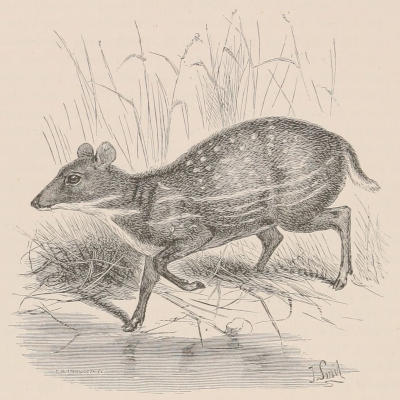
Fig. 118.—The African Water-Chevrotain (Dorcatherium aquaticum).
Extinct Traguloids.—A number of small selenodont Artiodactyles from various Miocene and Pliocene deposits appear to connect the modern Tragulina so closely with Gelocus (p. 294), and thus with the ancestral Cervidæ, that their classification is almost an impossibility. Thus Leptomeryx, from the Miocene of the United States, is regarded as a Traguloid, having four premolars in each jaw and with the metatarsals fused into a cannon-bone. Prodremotherium, of the Upper Eocene Phosphorites of France, differs in that the metacarpals also form a cannon-bone; while in the American Hypertragulus, both metacarpals and metatarsals remain separate. Bachitherium, of the French Phosphorites, apparently presents affinity with Gelocus, Prodremotherium, and Dorcatherium. In this genus the first of the four lower premolars assumes the character and function of a canine, the true canine being incisor-like, and there are traces of minute upper incisors.
Pecora, or Cotylophora.
No premaxillary teeth or caniniform premolars. Upper canines generally absent, though sometimes largely developed. Inferior incisors, three on each side with an incisiform canine in contact with them. Molariform teeth consisting of p ³⁄₃, m ³⁄₃, in continuous series. Auditory bullæ simple and hollow within. Odontoid process in the form of a crescent, hollow above. Distal extremity of the fibula represented by a distinct malleolar bone of peculiar shape, articulating with the outer surface of the lower end of the tibia. Third and fourth metacarpals and metatarsals confluent. Outer or lateral toes small and rudimentary, or in some cases entirely suppressed; their metapodial bones never complete in existing forms. Navicular and cuboid bones of tarsus united. Horns or antlers usually present, at least in the male sex. Left brachial artery arising from a common innominate trunk, instead of coming off separately from the aortic arch as in the preceding sections. Stomach with four complete cavities. Placenta cotyledonous.[193]
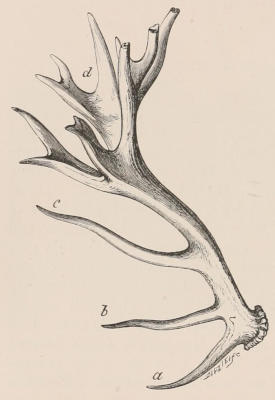
Fig. 119.—A shed right antler of the Red Deer (Cervus elaphus), found in an Irish lake. a, Brow tine; b, bez tine; c, tres tine; d, crown or royal tine. (After Owen.)
The Pecora or true Ruminants form at the present time an extremely homogeneous group, one of the best-defined and most closely united of any of the Mammalia. But, though the original or common type has never been departed from in essentials, variation has been very active among them within certain limits; and the great difficulty which all zoologists have felt in subdividing them into natural minor groups arises from the fact that the changes in different organs (feet, skull, frontal appendages, teeth, cutaneous glands, etc.) have proceeded with such apparent irregularity and absence of correlation that the different modifications of these parts are most variously combined in different members of the group. It appears, however, extremely probable that they soon branched into two main types, represented in the present day by the Cervidæ and the Bovidæ,—otherwise the antlered and horned Ruminants. Intermediate smaller branches produced the existing Musk-Deer and Giraffe, as well as the extinct Helladotherium inclining to the first-named group, and the extinct Sivatherium, Brahmatherium, Hydaspitherium, and others more allied to the latter, although upon the true relationship of these forms there is a difference of opinion.
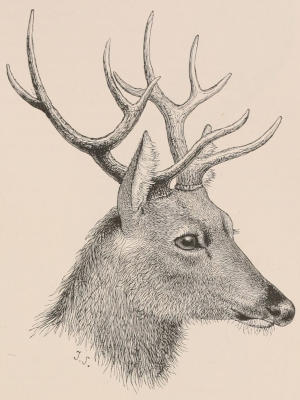
Fig. 120.—Head of Deer (Cervus schomburgki), showing antlers. From Sclater, Proc. Zool. Soc. 1877, p. 682.
The earliest forms of true Pecora, as Palæomeryx, generally had no frontal appendages, and some few forms continue to the present day in a similar case. In the very large majority, however, either in both sexes or in the male only, a pair or occasionally two pairs (Tetraceros and the extinct Sivatherium) of processes are developed from the frontal bones as weapons of offence and defence, these being almost always formed on one or other of two types.
1. “Antlers” are outgrowths of true bone, covered during their growth with vascular, sensitive integument coated with short hair. When the growth of the antler is complete, the supply of blood to it ceases, the skin dies and peels off, leaving the bone bare and insensible, and after a time, by a process of absorption near the base, it becomes detached from the skull and is “shed” (Fig. 119). A more or less elongated portion or “pedicle” always remains on the skull from the summit of which a new antler is developed. In the greater number of existing species of Deer this process is repeated with great regularity at the same period of each year. The antler may be simple, straight, subcylindrical, tapering and pointed, but more often it sends off one or more branches called “tines” or “snags” (Fig. 119). In this case the main stem is termed the “beam.” Commonly all the branches of the antler are cylindrical and gradually tapering. Sometimes they are more or less expanded and flattened, the antler being then said to be “palmated.” In young animals the antlers are always small and simple, and in those species in which they are variously branched or palmated, this condition is only gradually acquired in several successive annual growths. An interesting parallel has been observed here, as in so many other cases, between the development of the race and that of the individual. Thus the earliest known forms of Deer, those of the Lower Miocene, generally have no antlers, as in the young of the existing species. The Deer of the Middle Miocene have simple antlers, with not more than two branches, as in existing Deer of the second year; but it is not until the Pliocene and Pleistocene times that Deer occur with antlers developed with that luxuriance of growth and beauty of form characteristic of some of the existing species in a perfectly adult state. Among recent Cervidæ, antlers are wanting in the genera Moschus and Hydropotes; they are present in both sexes in Tarandus (the Reindeer), and in the male sex only in all others.
In those forms with the most complex antlers (Figs. 119, 120) the tine immediately over the forehead is termed the brow tine, the next one the bez tine, and the third one the tres tine; the mass of points at the summit of the antler being termed either the royal and surroyal tines, or collectively the crown. The nodulated bony ring at the base of the antler, just above the point at which it separates from the pedicle when it is shed, is termed the burr.
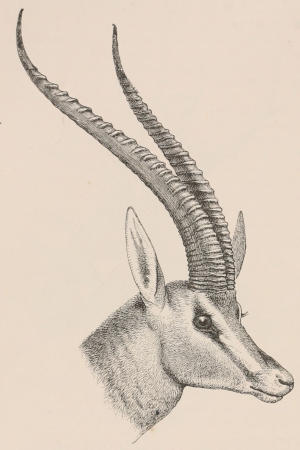
Fig. 121.—Head of Antelope (Gazella granti), showing horns. From Sir V. Brooke, Proc. Zool. Soc. 1878, p. 724.
2. The horns of the Bovidæ consist of permanent, conical, usually curved bony processes, into which air-cells continued from the frontal sinuses often extend, called “horn-cores,” ensheathed in a case of true horn, an epidermic development of fibrous structure, which grows continuously, though slowly, from the base, and wears away at the apex, but is very rarely shed entire. The only existing species in which the latter process occurs regularly and periodically is the American Prong-Buck (Antilocapra), in which the horns also differ from those of all others in being bifurcated. Horns are not present at birth, but begin to grow very soon afterwards. The males of all existing Bovidæ possess them, and they are also present (though usually not so fully developed) in the females of all except the genera Boselaphus, Strepsiceros, Tragelaphus, Antilope, Æpyceros, Saiga, Cobus, Cervicapra, Pelea, Nanotragus, Neotragus, Cephalophus, and Tetraceros; as well as in some species of Gazella, such as G. picticandata and G. walleri.
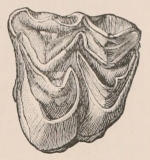
Fig. 122.—Crown surface of a worn left upper molar of Palæomeryx sivalensis, to show brachydont type. (From the Palæontologia Indica.)
Another character by which different members of the Pecora can be distinguished among themselves is derived from the nature of the molar teeth. Although there is nothing in the general mode and arrangement of the enamel-folds, or in the accessory columns, absolutely distinctive between the two principal families, existing species may generally be distinguished, inasmuch as the true molars of the Cervidæ are more or less brachydont, and those of the Bovidæ generally hypsodont, i.e., the teeth of the former have comparatively short crowns (Fig. 122), which, as in most mammals, take their place at once with the neck (or point where the crown and root join) on a level with or a little above the alveolar border, and remain in this position throughout the animal’s life; whereas in the other forms (Fig. 123), the crown being lengthened and the root small, the neck does not come up to the alveolar level until a considerable part of the surface has worn away, and the crown of the tooth thus appears for the greater part of the animal’s life partially buried in the socket. In this form of tooth (which is almost always most developed in the posterior molars of the permanent series) the constituent columns of the crown are necessarily nearly parallel, whereas in the first-described they diverge from the neck towards the free or grinding surface of the tooth. In the completely hypsodont form the interstices of the lengthened columnar folds of enamel and dentine are filled up with cement, which gives stability to the whole organ, and is entirely or nearly wanting in the short-crowned teeth. The same modification from low to high crowns without essential alteration of pattern is seen in an even still more marked manner in some of the Perissodactyle Ungulates, the tooth of the Horse bearing to that of Anchitherium the same relation as that of an Ox does to the early selenodont Artiodactyles. A parallel modification has also taken place in the molar teeth of the Proboscidea.
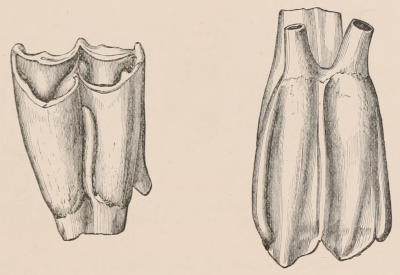
Fig. 123.—Inner and outer aspects of an almost unworn left upper molar of the Nilghai (Boselaphus tragocamelus), to show hypsodont type. (From the Palæontologia Indica.)
As the hypsodont tooth is essentially a modification of, and, as it were, an improvement upon, the brachydont, it is but natural to expect that all intermediate forms may be met with. Even among the Deer themselves, as pointed out by Lartet, the most ancient have very short molars, and the depressions on the grinding surface are so shallow that the bottom is always visible; while in the Cervidæ of the more recent Tertiary periods, and especially the Pleistocene and living species, these same cavities are so deep that whatever be the state of the dentition the bottom cannot be seen. Some existing Deer, as the Axis, are far more hypsodont than the majority of the family; and, on the other hand, many of the Antelopes (as Tragelaphus) retain much of the brachydont character, which is, however, completely lost in the more modern and highly specialised Sheep and Oxen.
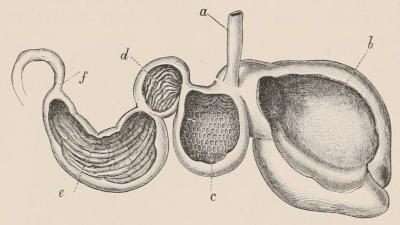
Fig. 124.—Stomach of Ruminant opened to show internal structure. a, Œsophagus; b, rumen or paunch; c, reticulum or honey-comb bag; d, psalterium or manyplies; e, abomasum or reed; f, duodenum.
The complicated stomach of the Pecora (Fig. 124), which is necessary for the performance of the peculiar function known as “chewing the cud”—a function common also to the Tragulina and Tylopoda—is divided into four well-defined compartments, known as (1) the Rumen or Paunch, (2) the Reticulum or Honey-comb Bag, (3) the Psalterium or Manyplies, (4) the Abomasum or Reed. The paunch is a very capacious receptacle, shaped like a blunted cone bent partly upon itself. Into its broader base opens the œsophagus or gullet at a spot not far removed from its wide orifice of communication with the second stomach or honey-comb bag. Its inner walls are nearly uniformly covered with a pale mucous membrane, which is beset with innumerable close-set, short, and slender villi, resembling very much the “pile” on velvet. The honey-comb bag is very much smaller than the paunch. It is nearly globose in shape, and receives its name on account of the peculiar arrangement of its mucous membrane which forms shallow hexagonal cells all over its inner surface. Running along its upper wall there is a deep groove, coursing from the first to the third stomach. This groove plays an important part in the act of rumination. Its walls are muscular, like those of the viscus with which it is associated, which allows its calibre to be altered. Sometimes it completely closes round so as to become converted into a tube by the opposition of its edges. At others it forms an open canal. The manyplies is globular in form, and its lining membrane is raised into longitudinal folds or laminæ arranged very much like the leaves of a book, and very close together. Their surfaces are roughened by the presence of small projections or papillæ. The reed is the proper digestive stomach, corresponding with the same organ in man. Its shape is somewhat pyriform, and its walls are formed of a smooth mucous membrane, which secretes the gastric juice.
When the food is first swallowed it is conveyed into the paunch, and after undergoing a softening process there it is regurgitated into the mouth, and undergoes a further trituration by the molar teeth and mixture with the secretion of the salivary and buccal glands. It is then swallowed again, but now passes directly through the before-mentioned groove into the manyplies, and, after filtering through the numerous folds of the lining membrane of this cavity, finally reaches the fourth or digestive stomach.
The placenta of the Pecora is characterised by the fœtal villi being collected into groups or cotyledons, which may present either a convex or a concave surface to the uterus. These cotyledons are received into permanent elevations in the mucous membrane of the uterus, the surfaces of which present a curvature which is the reverse of the cotyledons.
Family Cervidæ.
Frontal appendages, when present, in the form of antlers. First molar, at least, in both jaws brachydont. Two orifices to the lachrymal duct, situated on or inside the rim of the orbit. An antorbital or lachrymal vacuity of such dimensions as to exclude the lachrymal bone from articulation with the nasal. Upper canines usually present in both sexes and sometimes attaining a very great size in the male (see Fig. 134). Lateral digits of both fore and hind feet, almost always present, and frequently the distal ends of the metapodials. Placenta with few cotyledons. Gall-bladder absent (except in Moschus). This family contains numerous species, having a wide geographical distribution, ranging in the New World from the Arctic Circle as far south as Chili, and in the Old World throughout the whole of Europe and Asia, though absent in the Ethiopian and Australian regions.
It may be divided into two subfamilies.
Subfamily Moschinæ.—This subfamily is represented solely by the Musk-Deer, which differs so remarkably from the true Deer that it is considered by several writers as the representative of a separate family. The late Professor Garrod even suggested that it should be regarded as an extremely aberrant member of the Bovidæ.
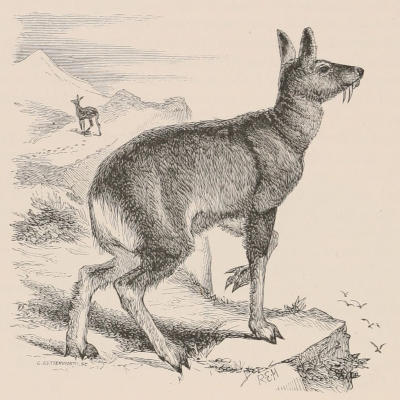
Fig. 125.—The Musk-Deer (Moschus moschiferus).
Moschus.[194]—The Musk-Deer (Fig. 125) in many respects stands by itself as an isolated zoological form, retaining characters belonging to the older and more generalised types of ruminants before they were distinctly separated into the horned and the antlered sections now dominant upon the earth. One of these characters is that both sexes are entirely devoid of any sort of frontal appendage. In this, however, it agrees with one existing genus of true Deer (Hydropotes); and, as in that animal, the upper canine teeth of the males are remarkably developed, long, slender, sharp pointed, and gently curved, projecting downwards out of the mouth with the ends turned somewhat backwards. Vertebræ: C 7, D 14, L 5, S 5, C 6. Among the anatomical peculiarities in which it differs from all true Deer and agrees with the Bovidæ is the presence of a gall-bladder. The hemispheres of the brain are but slightly convoluted, and the cotyledons of the placenta are arranged in a peculiar linear manner.[195]
Although, owing to variations of colour presented by different individuals in different localities and seasons, several nominal species have been described, zoologists are now generally agreed that there is but one, the Moschus moschiferus of Linnæus. In size it is rather less than the European Roe Deer, being about 20 inches high at the shoulder. Its limbs, especially the hinder ones, are long. The feet are remarkable for the great development of the lateral pair of hoofs, and for the freedom of motion they all present, so that they appear to have the power of grasping projecting rocky points,—a power which must be of great assistance to the animal in steadying it in its agile bounds among the crags of its native haunts. The ears are large, and the tail quite rudimentary. The hair covering the body is long, coarse, and of a peculiarly brittle and pith-like character, breaking with the application of an extremely slight force; it is generally of a grayish-brown colour, sometimes inclined to yellowish-red, and often variegated with lighter patches. The Musk-Deer has a wide distribution over the highlands of central and eastern Asia, including the greater part of southern Siberia, and extends to Kashmir on the south-west and Cochin-China on the south-east, always, however, at considerable elevations,—being rarely found in summer below 7000 feet above the sea-level, and ranging as high as the limits of the thickets of birch or pines, among which it mostly conceals itself in the daytime. It is a hardy, solitary, and retiring animal, chiefly nocturnal in its habits, and almost always found alone, rarely in pairs, and never in herds. It is exceedingly active and sure-footed, having few equals in traversing rocky and precipitous ground; and it feeds on moss, grass, and leaves of the plants which grow on the mountains among which it makes its home.
Most of the animals of the group to which the Musk-Deer belongs, in fact the large majority of mammals, have some portion of the cutaneous surface peculiarly modified and provided with glands secreting some odorous and oleaginous substance specially characteristic of the species. This, correlated with the extraordinary development of the olfactory organs, appears to offer the principal means by which animals in a state of nature become aware of the presence of other individuals of their own species, or of those inimical to them, even at very great distances, and hence it is of extreme importance both to the well-being of the individual and to the continuance of the race. The situation of this specially modified portion of skin is extremely various, sometimes between the toes, as in Sheep, sometimes on the face in front of the eyes, as in many Deer and Antelopes. Sometimes it is in the form of a simple depression or shallow recess, often very deeply involuted, and in its fullest state of development it forms a distinct pouch or sac with a narrow tubular orifice. In this sac a considerable quantity of the secretion can accumulate until discharged by the action of a compressor muscle which surrounds it. This is the form taken by the special gland of the Musk-Deer, which has made the animal so well known, and has proved the cause of an unremitting persecution to its possessor. It is found in the male only, and is a sac about the size of a very small orange, situated beneath the skin of the abdomen, the orifice being immediately in front of the preputial aperture. The secretion with which the sac is filled is of dark-brown or chocolate colour, and when fresh described as being of the consistence of “moist gingerbread,” but becoming dry and granular after keeping. It has a peculiar and very powerful scent, which when properly diluted and treated forms the basis of many of our most admired perfumes. When the animal is killed the whole gland or “pod” is cut out and dried, and in this form reaches the market of the Western World, chiefly through China.
Subfamily Cervinæ.—This subfamily includes all the true Deer. According to the arrangement proposed by Sir V. Brooke[196] the existing Cervinæ may be divided into the sections Plesiometacarpalia and Telemetacarpalia.
Plesiometacarpalia.—In this section, which is mainly characteristic of the Old World, the proximal portions of the lateral (second and fifth) metacarpals persist, and the vomer is never so ossified as to divide the posterior osseous nares into two distinct passages. The premaxillæ nearly always articulate with the nasals.
Cervulus.[197]—Antlers half the length of the head, placed on pedicles nearly equal to them in length. Brow tine short, inclined inwards and upwards; terminal extremity of beam unbranched, and curved downwards and inwards. Lachrymal fossa of skull very large, and extending into facial part of jugal; lachrymal (antorbital) vacuity moderate. Ascending portion of premaxillæ at least as long as nasals. A permanent ridge extending from each pedicle over the orbit, lachrymal fossa and vacuity. Auditory bulla much inflated. Upper canines of males very large. Ectocuneiform united with naviculo-cuboid of tarsus. No traces of the phalanges of the lateral digits.
The native name Muntjac has been generally adopted in European languages for a small group of Deer indigenous to the southern and eastern parts of Asia and the adjacent islands, which are separated by very marked characters from all their allies. They are also called “Kijang” or “Kidjang,” and constitute the genus Cervulus of Blainville and most zoologists;—Styloceros of Hamilton-Smith, and Prox of Ogilby. They are all of small size compared with the majority of Deer, and have long bodies and rather short limbs and neck. The antlers, which as in most Deer are present in the male only, are small and simple, and the main stem or beam, after giving off a very short brow tine, inclines backwards and upwards, is unbranched and pointed, and when fully developed curves inwards and somewhat downwards at the tip. These small antlers are supported upon pedicles or permanent processes of the frontal bones, longer than in any other Deer, and the front edges of which are continued downwards as strong ridges passing along the sides of the face above the orbits, and serving to protect the large supraorbital glands lying on their inner sides. The lachrymal fossa of the skull, in which is lodged the large suborbital gland or crumen, is of great depth and extent. The upper canine teeth of the males are strongly developed and sharp, curving downwards, backwards, and outwards, projecting visibly outside the mouth as tusks, and loosely implanted in their sockets. In the females they are very much smaller. The limbs exhibit several structural peculiarities not found in other Deer. The lateral digits of both fore and hind feet are very little developed, the hoofs alone being present and their bony supports (found in all other Deer) wanting. There is a tufted gland on the outer side of the metatarsus.