Chapter IX · THE ORDER UNGULATA (continued 4)
Reading edition
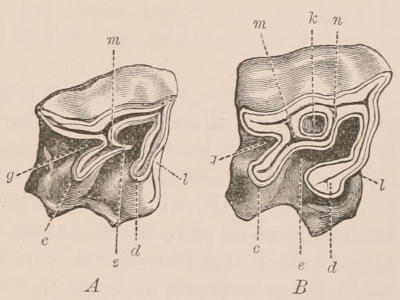
Fig. 168.—A partially worn second right upper molar of (A) Rhinoceros sondaicus, and (B) R. unicornis. k, Fossette cut off from median valley; m, crotchet; n, crista, or combining-plate; e, anterior valley; l, anterior intermediate column. Other letters as in Fig. 155, p. 375.
The large lower cutting teeth of the typical Rhinoceroses have been very generally regarded as incisors, but comparison with fossil allied types, in which three lower incisors and canines are present, leaves little doubt but that they are really canines. The upper molar teeth present some amount of specific variation; thus while one type (Fig. 168, A) has only a simple “crotchet” projecting from the posterior transverse ridge into the median valley, in others (Fig. 168, B) this crotchet joins a “crista,” or “combing-plate,” projecting from the outer wall to cut off a distinct fossette from the median valley. Occasionally, however (as in Fig. 167), the crotchet and combing-plate do not completely join, although the fossette is distinctly indicated. The first upper premolar may occasionally be preceded by a milk-tooth. The Rhinoceroses differ from the Horses and agree with the Tapirs in the direction of the cæcum.
The living species of Rhinoceros are all animals of large size, but of little intelligence, generally timid indisposition, though ferocious when attacked and brought to bay, using the nasal horns as weapons, by which they strike and toss their assailant. Their sight is dull, but their hearing and scent are remarkably acute. They feed on herbage, shrubs, and leaves of trees, and, like so many other large animals which inhabit hot countries, sleep the greater part of the day, being most active in the cool of the evening or even during the night. They are fond of bathing and wallowing in water or mud. None of the species have been domesticated. Animals of the group have existed in both the Old and New Worlds since the latter part of the Eocene period. In America they all became extinct before the end of the Pliocene period. In the Old World their distribution has become greatly restricted, and they are no longer found in Europe and North Asia, but only in Africa and portions of the Indian and Indo-Malayan region.
Existing Species.—The existing (as well as many of the extinct) species of Rhinoceroses naturally divide into three groups, which are regarded by some zoologists as of generic value.
Rhinocerotic, or Typical Group.—The adults with a single large compressed incisor above on each side, and occasionally a small lateral one; below, a very small incisor and a very large, procumbent, pointed canine. Nasal bones pointed in front. A single nasal horn. Skin very thick, and raised into strong, definitely arranged ridges or folds.
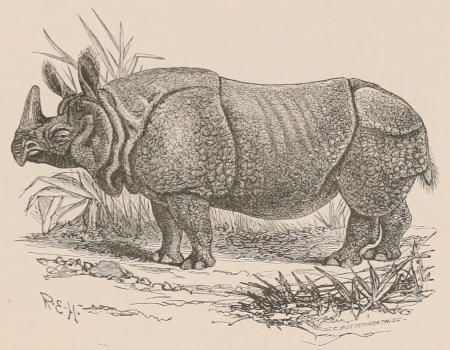
Fig. 169.—Indian Rhinoceros (Rhinoceros unicornis). This figure, and also figures 170, 172, are reduced from drawings by J. Wolf, from animals living in the London Zoological Society’s Gardens.
There are two well-marked species of one-horned Rhinoceroses. (1) The Indian Rhinoceros, R. unicornis (Fig. 169) of Linnæus,[268] the largest and best known, from being the most frequently exhibited alive in England, is at present only met with in a wild state in the terai region of Nipal and Bhutan, and in the upper valley of the Brahmaputra or province of Assam, though it formerly had a wider range. The first Rhinoceros seen alive in Europe since the time when these animals, in common with nearly all the large remarkable beasts of both Africa and Asia, were exhibited in the Roman shows, was of this species. It was sent from India to Emmanuel, King of Portugal, in 1513; and from a sketch of it, taken in Lisbon, Albert Dürer composed his celebrated but rather fanciful engraving, which was reproduced in so many old books on natural history. Both in this and the following species the post-glenoid and post-tympanic processes of the squamosal bone of the skull unite below so as to completely surround the external auditory meatus. The molar teeth are hypsodont, and have a horizontal plane of wear; those of the upper jaw (Fig. 168, b) being characterised by the presence of a combing-plate joining the crotchet, and the absence of a distinct buttress at the antero-external angle. The stomach departs from the ordinary Perissodactyle type. The small intestine is beset over most of its surface with long and fine villi; and the Spigelian lobe of the liver is well developed. There is a gland behind the foot. Teeth from the Pleistocene of the Narbada valley in India apparently indicate the existence of the Indian Rhinoceros at that epoch. (2) The Javan Rhinoceros (R. sondaicus, Fig. 170) is a smaller form, readily distinguished by dental and internal characters, as well as by the different arrangement of the plications of the skin (as seen in the figures); the horn in the female appears to be very little developed, if not altogether absent. This species has a more extensive geographical range, being found in the Bengal Sunderbans near Calcutta, Burma, the Malay Peninsula, Java, Sumatra, and probably Borneo. The molar teeth have shorter crowns than in the preceding species, and wear into ridges; those of the upper jaw (Fig. 168, a) having no combing-plate, and a strongly marked buttress at the antero-external angle (not distinctly shown in the figure). The visceral anatomy, according to Beddard,[269] does not differ materially from that of the next species. In respect to its dentition and anatomical characters this species is indeed more nearly allied to the Sumatran than to the Indian Rhinoceros; and thereby indicates that the division of the existing Rhinoceroses into separate genera is not advisable.
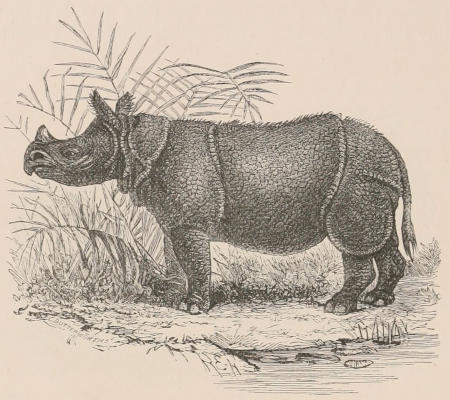
Fig. 170.—Javan Rhinoceros (Rhinoceros sondaicus).
Ceratorhine Group.—The adults with a moderate-sized compressed incisor above, and a laterally placed, pointed, procumbent canine below, which is sometimes lost in old animals. Nasal bones narrow and pointed anteriorly. A well-developed nasal, and a small frontal horn separated by an interval. The skin thrown into folds, but these not so strongly marked as in the former group. The smallest living member of the family, the Sumatran Rhinoceros, R. sumatrensis, Cuvier, now represents this group. Its geographical range is nearly the same as that of the Javan species, though not extending into Bengal; but it has been found in Assam, Chittagong, Burma, the Malay Peninsula, Sumatra, and Borneo. So far as can be determined during the life of the type specimen, it appears that the hairy form from Chittagong, described as R. lasiotis, is only a variety of this species.[270] The molar teeth of the Sumatran Rhinoceros are almost indistinguishable from those of the Javan species, and reference has already been made to the resemblance between the visceral anatomy of these species.[271] The form of the stomach is very similar to that of the Horse. The liver (Fig. 171) has a comparatively large caudate lobe, but is chiefly remarkable for the peculiar shape of the Spigelian lobe, which mainly consists of a thin strip of tissue, 8 inches long, ¾ inch wide, and ¼ inch deep. The small intestine, in place of the villi of R. unicornis, has throughout the greater part of its length a uniform series of thin and nearly or quite continuous transverse foldings, like the valvulæ conniventes of the human small intestine. There is no gland behind the foot. The post-glenoid and post-tympanic processes of the squamosal do not unite below the auditory meatus. The presence of a lateral nasal diverticulum, like that of the Horses and Tapirs, has been verified only in this species, although it doubtless occurs in the others.
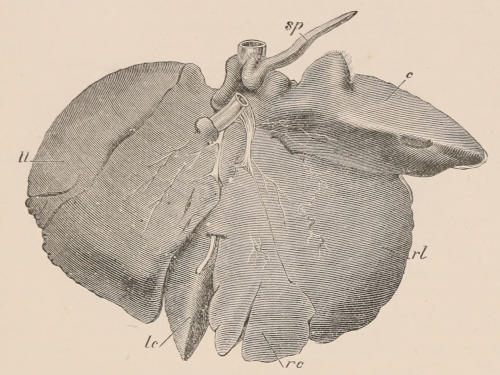
Fig. 171.—Posterior aspect of the liver of Rhinoceros sumatrensis. rc, Right central lobe; rl, right lateral lobe; lc, left central lobe; ll, left lateral lobe; c, caudate lobe; sp, Spigelian lobe. (From Garrod, Proc. Zool. Soc. 1873, p. 102.)
Atelodine Group.—In the adults the incisors and canines quite rudimentary or entirely wanting. Nasal bones thick, rounded and truncated in front. Well-developed anterior and posterior horns in close contact. Skin without any definite permanent folds.
The two well-marked existing species are peculiar to the African continent.
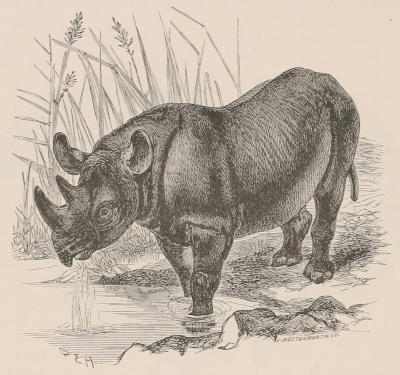
Fig. 172.—Common African Rhinoceros (Rhinoceros bicornis).
The common Two-horned Rhinoceros, R. bicornis, is the smaller of the two, with a pointed prehensile upper lip, and a narrow compressed deep symphysis of the lower jaw. It ranges through the wooded and watered districts of Africa, from Abyssinia in the north to the Cape Colony, but its numbers are yearly diminishing, owing to the inroads of European civilisation, and especially of English sportsmen. It feeds exclusively upon leaves and branches of bushes and small trees, and chiefly frequents the sides of wood-clad rugged hills. Specimens in which the posterior horn has attained a length as great as, or greater than, the anterior have been separated under the name of R. keitloa, but the characters of these appendages are too variable to found specific distinctions upon. The Common African Rhinoceros is far more rarely seen in menageries in Europe than either of the three Oriental species, but one has lived in the gardens of the London Zoological Society since 1868. The molar teeth of this species are of the general type of those of R. sondaicus, having no combing-plate to join the crotchet in those of the upper jaw. The conch of the ear is much rounded at its extremity, and edged by a fringe of short hairs; while the nostrils are somewhat rounded. The eye is placed immediately below the posterior horn.[272] Both in this and the following species the post-glenoid and post-tympanic processes of the squamosal do not unite below the auditory meatus. Nothing is known of the anatomy of the soft parts of either of them.
Burchell’s or the Square-mouthed Rhinoceros (R. simus), sometimes called the White Rhinoceros, though the colour (dark slate) is not materially different from that of the last species, is the largest of the whole group, and differs from all the others in having a square truncated upper lip and a wide, shallow, spatulate symphysis to the lower jaw. In conformity with the structure of the mouth, this species lives entirely by browsing on grass, and is therefore more partial to open countries or districts where there are broad grassy valleys between the tracts of bush. It is only found in Africa south of the Zambesi, and of late years has become extremely scarce, owing to the persecutions of sportsmen; indeed, the time of its complete extinction cannot be far off. No specimen of this species has ever been brought alive to Europe. Mr. F. C. Selous[273] gives the following description of its habits from extensive personal observation:—
“The square-mouthed rhinoceros is a huge ungainly-looking beast, with a disproportionately large head, a large male standing 6 feet 6 inches at the shoulder. Like elephants and buffaloes they lie asleep during the heat of the day, and feed during the night and in the cool hours of early morning and evening. Their sight is very bad; but they are quick of hearing, and their scent is very keen; they are, too, often accompanied by rhinoceros birds, which, by running about their heads, flapping their wings, and screeching at the same time, frequently give them notice of the approach of danger. When disturbed they go off at a swift trot, which soon leaves all pursuit from a man on foot far behind; but if chased by a horseman they break into a gallop, which they can keep up for some distance. However, although they run very swiftly, when their size and heavy build is considered, they are no match for an average good horse. They are, as a rule, very easy to shoot on horseback, as, if one gallops a little in front of and on one side of them, they will hold their course, and come sailing past, offering a magnificent broadside shot, while under similar circumstances a prehensile-lipped rhinoceros will usually swerve away in such a manner as only to present his hind-quarters for a shot. When either walking or running, the square-mouthed rhinoceros holds its head very low, its nose nearly touching the ground. When a small calf accompanies its mother it always runs in front, and she appears to guide it by holding the point of her horn upon the little animal’s rump; and it is perfectly wonderful to note how in all sudden changes of pace, from a trot to a gallop or vice versâ, the same position is always exactly maintained. During the autumn and winter months (i.e. from March to August) the square-mouthed rhinoceros is usually very fat; and its meat is then most excellent, being something like beef, but yet having a peculiar flavour of its own. The part in greatest favour among hunters is the hump, which, if cut off whole and roasted just as it is in the skin, in a hole dug in the ground, would, I think, be difficult to match either for juiciness or flavour.”
The molar dentition is of the type obtaining in R. unicornis, so that in this respect R. simus has the same relation to R. bicornis as is presented by R. unicornis to R. sondaicus. The ear-conch of the Square-mouthed Rhinoceros is very large, elongated, and pointed at its extremity, which bears only a slight tuft of hair; it is much expanded in the middle, and the lower portion has its edges united to form a short tube. The nostrils have a long slit-like aperture; and the eye is situated behind the posterior horn.
Extinct Species.—Using the generic term Rhinoceros in its widest signification, a very large number of fossil forms may be referred to it, the earliest of which date from the Upper Eocene (Oligocene) Phosphorites of Central France. Only a few of the more important of these types can, however, be even mentioned in this place.
In the Pliocene Siwaliks of India R. sivalensis appears to have been the direct ancestor of R. sondaicus; while R. palæindicus was probably nearly related to R. unicornis, although the upper molars had not developed a combing-plate.
R. schleirmacheri, of the Lower Pliocene of Europe, falls into the Ceratorhine group, although differing from R. sumatrensis by the union of the post-glenoid and post-tympanic processes of the squamosal beneath the auditory meatus. The Middle Miocene R. sansaniensis was a closely allied if not identical form.
The Atelodine group was very widely spread in past epochs. Thus the huge R. platyrhinus of the Indian Pliocene, and the equally large R. antiquitatis of the Pleistocene of Europe, were specialised forms with a dentition resembling that of R. simus, to which they were probably allied. An upper molar of R. antiquitatis—the so-called Tichorine, or Woolly Rhinoceros—is shown in the woodcut on p. 402. Of this species nearly whole carcases, with the thick woolly external covering, have been discovered associated with those of the Mammoth, preserved in the frozen soil of the north of Siberia. In common with some other extinct species it had a solid median wall of bone supporting the nasals, from which it is inferred that the horns were of a size and weight surpassing that of the modern species. In the Lower Pliocene of Attica R. pachygnathus appears to have been closely allied to R. bicornis. Several species such as R. leptorhinus (Fig. 173), R. megarhinus, and R. etruscus, occur in the European Pleistocene which do not present a marked relationship to any of the living forms. This group is also represented in the Pleistocene of Southern India by the small R. deccanensis and R. karnuliensis.
In the Upper Miocene, or Lower Pliocene, of North America numerous Rhinoceroses with incisor teeth occur which have no nasal horn, although in those forms of which the limbs are known the fore feet resembled those of existing species in having only three digits. These species have been generically separated as Aphelops, but so closely do they resemble existing Rhinoceroses that at one time Professor Cope proposed to refer the hornless female of R. sondaicus (described by Lesson as R. inermis) to the same genus. If these American types be included in Rhinoceros there seems no valid reason for separating the European Lower Pliocene and Miocene forms described as Aceratherium, at least some of which have four digits in the manus. This group is represented in the Upper Eocene Phosphorites of France, and also by a very large species in the Pliocene of India. Lastly, R. minutus, of the Lower Miocene of France, and an allied North American species are distinguished by carrying a pair of very small horns placed transversely across the nasals, from which feature it has been proposed that they should be separated genetically as Diceratherium.
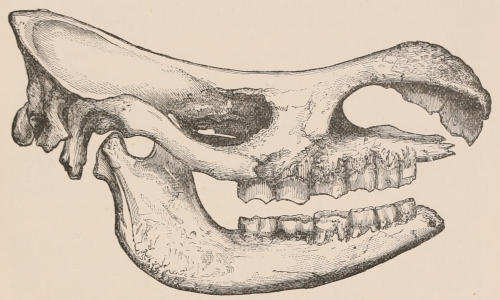
Fig. 173.—Skull of Rhinoceros leptorhinus, from the Pleistocene of Essex. About ⅛ natural size.
Extinct Generic Types.—The Tertiary deposits of different parts of the world have yielded remains of many extinct forms more or less closely related to the Rhinoceroses, and some of which should certainly be included in the same family; although others perhaps form the types of one or more distinct families. One of the most remarkable of these extinct types is the huge Elasmotherium, from the Pleistocene of Siberia, in which the dentition was reduced to two premolars and three molars on either side of each jaw. The structure of the skeleton is essentially rhinocerotic, the skull having an ossified nasal septum, and a huge frontal prominence for the support of a very large horn. The teeth are extremely hypsodont, with the enamel plicated to a remarkable degree, and unlike those of Rhinoceros. The genus is evidently a very specialised one.
The other genera we have to notice are more generalised types. Of these the North American Hyracodon, with the full typical number of teeth, and without nasal horn, appears to connect the Rhinoceroses with the Lophiodont Hyrachyus. The genera Amynodon and Metamynodon (Fig. 174), from the American Tertiaries, are forms allied to the Rhinoceroses, with the full number of incisors and canines, and the hinder lobe of the last upper molar not aborted. The lower canines are either upright, or less proclivous than in the Rhinoceroses; in Metamynodon the premolars are reduced to ³⁄₂. Molar teeth from the Phosphorites of Central France, described under the name of Cadurcotherium, are constructed on the general plan of those of the Rhinoceroses, although distinguished by their extreme narrowness; this type of tooth being very similar to that found in Homalodontotherium from Tertiary deposits in Patagonia. The latter has the full number of teeth, without any diastema in the series. Until we have some knowledge of the skeleton of these remarkable forms nothing definite can be said as to their serial position.
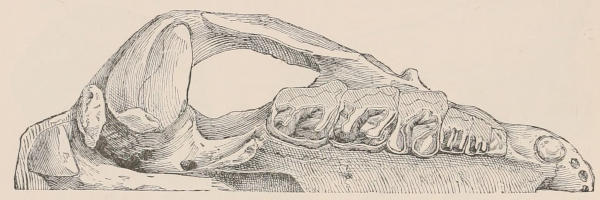
Fig. 174.—Right half of the palatal surface of the cranium of Metamynodon planifrons, from the Upper Miocene of North America. (After Scott and Osborn.)
Families Lambdotheriidæ, Chalicotheriidæ, and Titanotheriidæ.
These families contain a large number of more or less nearly related extinct types from Tertiary beds of both the Old and New Worlds, some of which present most remarkable deviations from the ordinary Ungulate structure. All are characterised by their brachydont molars, which depart widely from the normal lophodont type. The upper molars consist of four columns, of which the two external ones are expanded to form an outer wall; the posterior pair being connected in some cases by an oblique transverse ridge, while there may be traces of an anterior ridge. The premolars are simpler.
Lambdotheriidæ.—This family is confined to the Upper Eocene and Miocene of North America, where it is represented by Lambdotherium, Palæosyops, and Limnosyops; it presents the normal type of foot structure, and all the genera except the first have the full complement of teeth. There were four digits in the manus. The last lower molar has a third lobe. Limnosyops differs from Palæosyops in having two inner columns to the last upper molar.
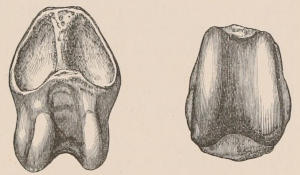
Fig. 175.—Anterior and distal aspects of a phalangeal bone of Chalicotherium sivalense. (From the Palæontologia Indica.)
Chalicotheriidæ.—The genus Chalicotherium, which is found in the Tertiaries of Europe, Asia, and North America, differs so remarkably in the structure of the feet from all other Ungulates that it has been proposed to regard it as the representative of a distinct order, Ancylopoda. The molars are, however, almost indistinguishable from those of the preceding and following families; while the cervical vertebræ and portions of the limbs are of a Perissodactyle type. On the other hand, the femur has lost its third trochanter; while the phalanges are strangely modified, the terminal ones forming long curved claws, while the others (Fig. 175) have strong ginglymoid distal articulations. These phalanges were, indeed, long regarded as referable to Edentates, being described in Europe as Macrotherium, and in the United States as Morotherium and Moropus. Ancylotherium, of the Grecian Pikermi beds, is founded upon phalanges which indicate an allied genus. The Indian species of Chalicotherium is distinguished by the loss of the incisors and the upper canine; while all the species want the first premolar.
Titanotheriidæ.—This exclusively North American family includes gigantic forms closely allied to the Lambdotheriidæ, but with the last upper premolar as complex as the molars, and frequently with large bony protuberances in the nasal region. The best known genus, Titanotherium (Menodus,[274] Brontotherium, Symborodon, Allops, etc.), may either have the full complement of teeth, or the incisors may be reduced to ²⁄₀. The canines and incisors are small, and there is no diastema when the full dental series is developed. The skull is very like that of the Rhinoceroses; but has a transverse pair of large bony prominences on the nasal region, varying considerably in shape and size in the different species, which in the living animal were probably covered with horny sheaths. The third trochanter of the femur was aborted. These huge animals—inferior in size only to the Elephant—appear to have been abundant in the United States during the Miocene period.
Family Macraucheniidæ.
This extinct South American family is best known by the genus Macrauchenia, as represented by M. patachonica and M. boliviensis, which are apparently from Pleistocene formations. They are very singular and specialised forms, quite out of the line of descent of any of the existing Perissodactyles, and the steps by which they are connected with the rest of the group have not yet been discovered. Of the larger species, M. patachonica, the skeleton is completely known. It had the full number of forty-four teeth, forming an almost uninterrupted series. The cervical vertebræ resemble those of the Camels in the position of the vertebrarterial canal, but the ends of the centra are flat, and not opisthocœlous as in the allied forms. In some of the limb characters it resembles the Equidæ, but in the articulation of the fibula with the calcaneum it agrees with the Artiodactyles. The structure of the feet is, however, distinctly Perissodactylate, there being three toes on each. The teeth approximate to a Rhinocerotine structure; and the incisors have an infolding of the enamel of their crowns, as in those of the Horses. The nares open on the top of the skull, and it is probable that the muzzle was produced into a short proboscis. Several other South American forms have been referred to this family, some of which have received distinct generic names, but further evidence is required before many of them can be accepted. Possibly Homalodontotherium should be placed here.
Family Proterotheriidæ.
Proterotherium.—Here may be noticed certain very remarkable Perissodactyles from the South American Tertiaries, for which the name Proterotherium has been proposed. The cheek-teeth are so like those of Anchitherium that they have been described under that name. The upper jaw has one pair of canine-like incisors and no canines, while the lower jaw carries two pairs of incisors. In the skull the orbits were completely closed, as in the Horses. The feet were tridactyle, like those of Hipparion, but the tarsus was constructed on an Artiodactyle type.
Subungulata.
By far the greater number of the Subungulata are extinct, and of many of those whose former existence has been revealed, chiefly by the labours of the American palæontologists, our knowledge is at present necessarily imperfect, though daily extending. It will only be possible here to give details of some of the more interesting or best-known forms.
The characters by which the skeleton of the feet of the Subungulata are distinguished from those of the Ungulata Vera have been already mentioned on p. 275. In addition to these it may be observed that the feet frequently have five functional digits, and may be plantigrade; while the upper surface of the astragalus is generally flattened, instead of presenting the strongly-marked pulley-like ridges and groove so characteristic of the Ungulata Vera.
Suborder Hyracoidea.
Family Hyracidæ.
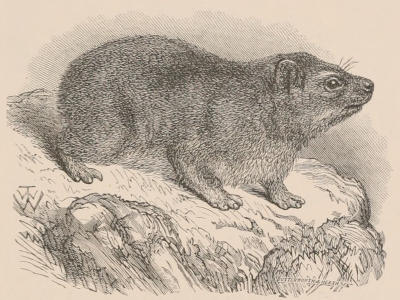
Fig. 176.—Hyrax capensis.
This division is constituted to receive a single family of mammals, the affinities of which have long constituted a puzzle to zoologists. They were first placed among the Rodents, to which animals their small size and general appearance and habits give them much superficial resemblance. Cuvier’s investigations into their anatomical structure, and especially their dental characters, led him to place them among the Ungulates, near the genus Rhinoceros, a position long accepted by many zoologists. Further knowledge of their organisation and mode of development caused Milne-Edwards, Huxley, and others to disassociate them from this connection, and, failing to find any agreement with any other known forms, to place them in an order entirely apart. Palæontology has thrown no light upon the affinities of this anomalous and isolated group, as no extinct animals possessing their distinctive characters have as yet been discovered.
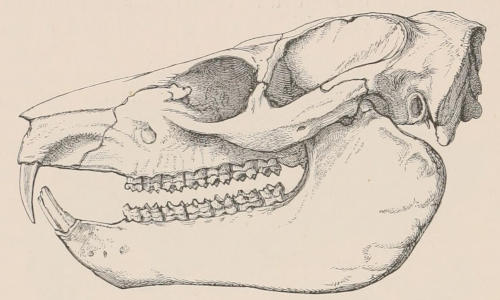
Fig. 177.—Skull and dentition of Dendrohyrax dorsalis. × ⅔.
The dentition, according to the usual interpretation, consists only of incisors and molars, the formula in all known species being i ¹⁄₂, c ⁰⁄₀, p ⁴⁄₄, m ³⁄₃. The upper incisors have persistent pulps, and are curved longitudinally, forming a semicircle as in Rodents. They are, however, not flattened from before backwards as in that order, but prismatic, with an antero-external, an antero-internal, and a posterior surface, the first two only being covered with enamel; their apices are consequently not chisel-shaped, but sharp pointed. They are preceded by functional, rooted milk-teeth. The outer lower incisors, which should perhaps be regarded rather as canines, have long tapering roots, but not of persistent growth. They are straight, procumbent, with awl-shaped, trilobed crowns. Behind the incisors is a considerable diastema. The molars and premolars are all contiguous, and formed almost exactly on the pattern of some of the Perissodactyle Ungulates. The hyoid arch is unlike that of any known mammal. The dorsal and lumbar vertebræ are very numerous, 28 to 30, of which 21 or 22 bear ribs. The tail is extremely short. There are no clavicles. In the fore foot the three middle toes are subequally developed, the fifth is present, but smaller, and the hallux is rudimentary, although, in one species at least, all its normal bones are present. The ungual phalanges of the four outer digits are small, somewhat conical, and flattened in form. The carpus has a distinct os centrale. There is a slight ridge on the femur in the place of a third trochanter. The fibula is complete, thickest at its upper end, where it generally ankyloses with the tibia. The articulation between the tibia and astragalus is more complex than in other mammals, the end of the malleolus entering into it. The hind foot is very like that of Rhinoceros, having three well-developed toes. There is no trace of a hallux, and the fifth metatarsal is represented only by a small nodule. The ungual phalanx of the inner (or second) digit is deeply cleft, and has a peculiar long curved claw, the others have short broad nails. The stomach is formed upon much the same principle as that of the Horse or Rhinoceros, but is more elongated transversely and divided by a constriction into two cavities—a large left cul de sac, lined by a very dense white epithelium and a right pyloric cavity, with a very thick, soft, vascular lining. The intestinal canal (Fig. 178) is long, and has an arrangement perfectly unique among mammals, indeed among vertebrated animals, for, in addition to the ordinary short, but capacious and sacculated cæcum (cm) at the commencement of the colon, there is, lower down, an additional pair of large, conical, pointed, supplemental cæca (c). The liver is much subdivided, and there is no gall-bladder. The brain resembles that of the typical Ungulates far more than the Rodents. The testes are permanently abdominal. The ureters open into the fundus of the bladder, as in some Rodents. The female has six teats, of which four are inguinal and two axillary; and the placenta is zonary, as in the Elephant and Carnivora.
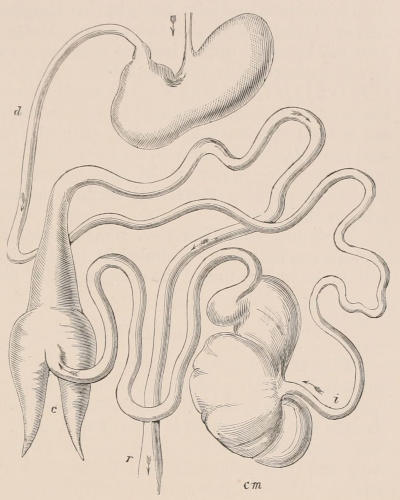
Fig. 178.—Diagrammatic view of the alimentary canal of Hyrax capensis, the intestines being somewhat abbreviated. d, Duodenum; i, ileum; cm, cæcum; c, supplemental colic cæca; r, rectum.
There are two distinct forms of Hyrax, differing both in structure and habits, which may be accorded generic rank.
Hyrax.[275]—Molar teeth having the same pattern as those of Rhinoceros. Interval between upper incisors less than the width of the teeth. Lower incisors slightly notched at the cutting edge. Vertebræ: C 7, D 22, L 8, S 6, C 6. Of this form the earliest known species, H. capensis (Fig. 176) is the type. There are several other species, as H. habessinicus and syriacus, from Eastern Africa and Syria. They inhabit mountainous and rocky regions, and live on the ground.
Dendrohyrax.[276]—Molar teeth having the same pattern as Palæotherium (except that the third lower molar has but two lobes). Interval between upper incisors exceeding the width of the teeth. Lower incisors with very distinctly trilobed crowns. Vertebræ: C 7, D 21, L 7, S 5, C 10. The members of this section frequent the trunks and large branches of trees, sleeping in holes. There are several species, not distinctly defined, from western and south Africa, as D. arboreus and D. dorsalis. The members of both groups appear to have a power like that possessed by the Lizards called Geckos of clinging to vertical surfaces of rocks and trees by the soles of their feet.
It should be added that some writers separate three of the African species usually included in Hyrax (viz. H. bocagei, H. bakeri, and H. blainvillei) under the designation of Heterohyrax.[277]
Suborder Proboscidea.
This name has been appropriated to a well-marked group of animals, presenting some very anomalous characters, allied in many respects to the typical Ungulata, but belonging neither to the Artiodactyle nor Perissodactyle type of that order. It has been thought that they possess some, though certainly not very close, affinities with the Rodentia, and also with the Sirenia. It is certain, however, that the two species of Elephant, which are the sole living representatives of the group, stand quite alone among existing mammals, differing widely from all others in many points of their structure. In some respects, as the skull, proboscis, and dentition, they are highly specialised; but in others, as in the presence of two anterior venæ cavæ and in the structure of the limbs, they retain a low or generalised condition. A considerable series of extinct forms, extending back through the Pliocene and Miocene epochs, show the same type under different modifications, and in still more generalised outlines; and certain forms from the Eocene of North America, if their affinities are rightly interpreted, appear to link the true Proboscidea to some unknown primitive type of Ungulata.
The following are the principal characters common to existing, and, by inference, to the extinct, Proboscidea. The nose extended into a long, muscular, very flexible and prehensile proboscis, at the end of which the nostrils are situated, and from which the name given to the group is derived. The teeth consisting of ever-growing incisors of very great size, but never exceeding one pair in each jaw, and often present in one jaw only; no canines; large and transversely ridged molars. No clavicles. Limbs strong, the upper segment, especially in the hind limb, the longer. Radius and ulna distinct, the latter articulating extensively with the carpus. Fibula and tibia distinct. Astragalus very flat on both surfaces. Manus and pes short, broad, and massive, each with five toes, though the outer pair may be more or less rudimentary, all encased in a common integument, though with distinct, broad, short hoofs. Third digit the largest. Two anterior venæ cavæ entering the right auricle. Stomach simple. A capacious cæcum. Testes permanently abdominal. Uterus bicornuate. Placenta non-deciduate and zonary. Mammæ two, pectoral.
With regard to the teeth, the incisors,[278] which project largely out of the mouth, and are commonly called “tusks,” are of an elongated conical form, and generally curved. They are composed mainly of solid dentine, the fine elastic quality and large mass of which renders it invaluable as “ivory” for commerce and the arts. A peculiarity of the dentine of most Proboscidea is that it shows, in transverse fractures or sections, striæ proceeding in the arc of a circle from the centre to the circumference in opposite directions, and forming by their decussations curvilinear lozenges, as in the “engine-turning” of the case of a watch. The enamel-covering in existing species is confined to the extreme apex, and very soon wears off, but in some extinct species it forms persistent longitudinal bands of limited breadth. The tusks have small milk-predecessors, shed at an early age.
The molar teeth present a remarkable series of modifications, from the comparatively simple form in Dinotherium, with two or three strongly pronounced transverse ridges and a normal mode of succession, to the extremely complex structure and anomalous mode of replacement found in the true Elephants. The intermediate conditions occur in the various species of Mastodon. In this genus the enamel-covered transverse ridges of each tooth are generally more numerous than in Dinotherium, and often complicated by notches dividing their edge or by accessory columns attached to them, but in the unworn tooth they stand out freely on the surface of the crown, with deep valleys between (Fig. 179, I). In the Elephants the ridges are still further increased in number, and consequently narrower from before backwards, and are greatly extended in vertical height, so that, in order to give solidity to what would otherwise be a laminated or pectinated tooth, it becomes necessary to envelop and unite the whole in a large mass of cement, which completely fills up the valleys, and gives a general smooth appearance to the organ when unworn; but as the wear consequent upon the masticating process proceeds, the alternate layers of tissue of different hardness—cement, dentine, and enamel—which are disclosed upon the surface form a fine and very efficient triturating instrument. The modification of the tooth of a Mastodon into that of an Elephant is therefore precisely the same in principle as that of the molar of a Palæotherium into that of a Horse, or of the corresponding tooth of one of the primitive Artiodactyles into that of an Ox. The intermediate stages, moreover, even in the present state of our knowledge, are so numerous that it is not possible to draw a definite line between the two types of tooth structure (see Fig. 179, I, II, III, IV).
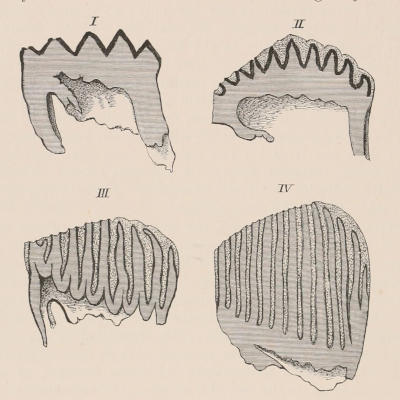
Fig. 179.—Longitudinal sections of the crown of a molar tooth of various Proboscideans, showing stages in the gradual modification from the simple to the complex form. I, Mastodon americanus; II, Elephas insignis; III, Elephas africanus; IV, Elephas primigenius. The dentine is indicated by transverse lines, the cement by a dotted surface, and the enamel is black.
As regards the mode of succession, that of modern Elephants is, as before mentioned, very peculiar. During the complete lifetime of the animal there are but six molar teeth on either side of each jaw, with occasionally a rudimentary one in front, completing the typical number of seven. The last three represent the true molars of ordinary mammals; those in front appear to be milk-molars, which are never replaced by permanent successors, but the whole series gradually moves forwards in the jaw, and the teeth become worn away and their remnants cast out in front, while development of others proceeds behind. The individual teeth are so large, and the processes of growth and destruction by wear take place so slowly, that not more than one, or portions of two, teeth are ever in place and in use on either side of each jaw at one time, and the whole series of changes coincides with the usual duration of the animal’s life. On the other hand, the Dinotherium, the opposite extreme of the Proboscidean series, has the whole of the molar teeth in place and use at one time, and the milk-molars are vertically displaced by premolars in the ordinary fashion. Among Mastodons transitional forms occur in the mode of succession as well as in structure, many species showing a vertical displacement of one or more of the milk-molars, and the same has been observed in one extinct species of Elephant (E. planifrons) as regards the posterior of these teeth.
All known Proboscideans are animals of comparatively large dimensions, and some are the most colossal of land mammals. The head is of great proportionate size; and, as the brain case increases but little in bulk during growth, while the exterior wall of the skull is required to be of great superficial extent to support the trunk and the huge and ponderous tusks, and to afford space for the attachment of muscles of sufficient size and strength to wield the skull thus heavily weighted, an extraordinary development of air-cells takes place in the cancellous tissue of nearly all the bones of the cranium (Fig. 180). These cells are not only formed in the walls of the cranium proper, but are also largely developed in the nasal bones and upper part of the premaxillæ and maxillæ, the bones forming the palate and the basicranial axis, and even extend into the interior of the ossified mesethmoid and vomer. Where two originally distinct bones come into contact, the cells pass freely from one to the other, and almost all the sutures become obliterated in old animals. The intercellular lamellæ in the great mass which surrounds the brain cavity superiorly and laterally mostly radiate from the inner to the outer table, but in the other bones their direction is more irregular. Like the similar but less developed air-cells in the skulls of many other mammals, they all communicate with the nasal passages, and they are entirely secondary to the original growth of the bones, their development having scarcely commenced in the new-born animal, and they gradually enlarge as the growth of the creature proceeds towards maturity. The nasal bones are very short, and the anterior narial aperture is situated high in the face. The zygomatic arch is slender and straight, the jugal bone being small, and forming only the middle part of the arch, the anterior part of which (unlike that of typical Ungulates) is formed only by the maxilla. The maxillo-turbinals are but rudimentary, the elongated proboscis supplying their place functionally in warming and clearing from dust the inspired air.
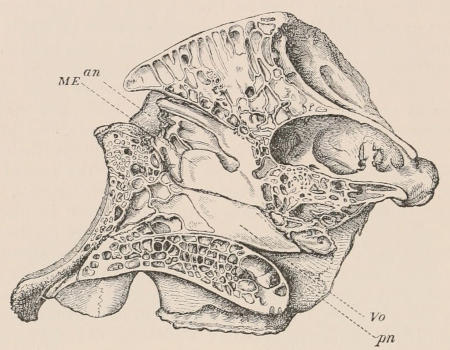
Fig. 180.—A vertical section of the skull of the African Elephant (Elephas africanus) taken to the left of the middle line, and including the vomer (Vo) and the mesethmoid (ME). an, Anterior, and pn, posterior narial aperture. ¹⁄₁₂ natural size. (From Flower’s Osteology of the Mammalia.)
The neck is very short. The limbs are long and stout, and remarkable for the great length of the upper segment (especially the femur) as compared with the distal segment, the manus, and pes. It is owing to this and the vertical position of the femur that the knee-joint in the hind leg is placed much lower, and is more conspicuous externally than in most quadrupedal mammals; and this having been erroneously compared with the hock-joint or ankle of typical Ungulates, the popular fallacy that the joints of the Elephant’s leg bend in a contrary direction to that of other mammals has arisen. There is no round ligament in the hip-joint, or third trochanter to the femur. The radius and ulna are distinct, though fixed in a crossed or prone position. The fibula also is quite distinct from the tibia. The feet are short and broad, the carpal and tarsal bones being very square, with flattened surfaces for articulation; the astragalus especially differs from that of typical Ungulates in its flatness, in the absence of a distinct pulley-like articular surface at either extremity, and in having no articular facet for the cuboid. The fibula articulates with the calcaneum, as in Artiodactyles. Of the five toes present on each extremity (see Fig. 98), the middle one is somewhat the largest, and the lateral ones smallest, and generally wanting (especially in the hind foot) the complete number of phalanges. The ungual phalanges are all small, irregular in form, and late in ossification. The whole are encased in a common integument, with a flat, subcircular, truncated sole, the only external indication of the toes being the broad oval nails or hoofs arranged in a semicircle around the front edge of the sole. The hind foot is smaller and narrower than the front. The liver is small and simple, and there is no gall-bladder. In form the brain resembles that of the Rodents and other lower orders of mammals, the cerebellum being entirely behind and uncovered by the cerebrum, but the hemispheres of the latter are richly convoluted.
The Proboscidea are exclusively vegetable feeders, living chiefly on leaves and young branches of forest trees and various kinds of herbage, which they gather and convey to their mouth by the very mobile proboscis, an organ which combines in a marvellous manner strength with dexterity of application, and is a necessary compensation for the shortness and inflexibility of the neck, as by it many of the functions of the lips of other animals are performed. By its means the Elephant is enabled to drink without bending the head or limbs; the end of the trunk being dipped into the stream or pool, a forcible inspiration fills the two capacious air-passages in its interior with water, which, on the tip of the trunk being turned upwards and inserted into the mouth, is ejected by a blowing action, and swallowed; or if the animal wishes to refresh and cool its skin, it can throw the water in a copious stream over any part of its surface. Elephants can also throw dust and sand over their bodies by the same means and for the same purpose, and wild animals have been frequently observed fanning themselves with leafy boughs held in the trunk. The species are at present limited in their geographical distribution to the Ethiopian and Oriental regions, but they formerly had a far more extensive range.
Family Elephantidæ.
Cheek-teeth succeeding one another in an arc of a circle, and portions of only two, or at most three, of the hinder teeth in use at any one time. Premolars frequently lost, and in any case of no functional importance.
Elephas.[279]—Dentition: i ¹⁄₀, c ⁰⁄₀, dm ³⁄₃, m ³⁄₃ = 26. The incisors variable, but usually of very large size, especially in the male sex, directed somewhat outwards, and curved upwards, without enamel except on the apex before it is worn. The molars composed of numerous flattened enamel-covered plates or ridges of dentine, projecting from a common many-rooted base, surrounded and united together by cement, and extending straight across the crown, without (in most forms) any median division into inner and outer columns. The number of plates increases from the anterior to the posterior molar in regular succession, varying in the different species, but the third and fourth (or the last milk-molar and the first true molar), and these only, have the same number of ridges, which always exceeds five. Premolars nearly always wanting. Skull of adult very high and globular. Mandible ending in front in a short, deflected, and spout-like symphysis. Vertebræ: C 7, D 19-21, L 3-4, S 4, C 26-33.
The existing species of the genus differ so much that they have been referred by some writers to distinct genera; fossil forms show, however, such a transition from the one to the other that it is scarcely possible to regard them even as the representatives of distinct groups.
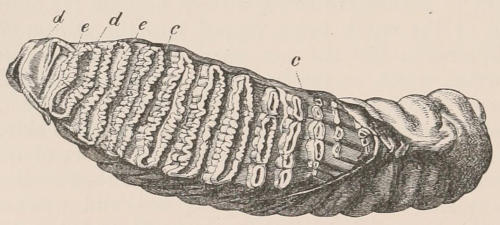
Fig. 181.—Grinding surface of a half-worn lower molar of the Indian Elephant (Elephas indicus). d, Dentine; e, enamel; c, cement. (From Owen.)
In the well-known Indian or Asiatic Elephant (E. indicus) the average number of plates of the six successive molar teeth is expressed by the “ridge-formula,” 4, 8, 12, 12, 16, 24. The plates are compressed from before backwards, the anterior and posterior surfaces (as seen in the worn grinding face of the tooth, Fig. 181) being nearly parallel. Ears of moderate size. Upper margin of the end of the proboscis developed into a distinct finger-like process, much longer than the lower margin. Five nails on the fore feet, and four (occasionally five) on the hind feet.
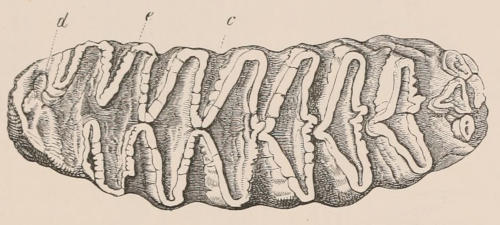
Fig. 182.—Grinding surface of a partially worn right upper molar of the African Elephant (Elephas africanus). Letters as in the preceding figure. The left side of the figure is the front of the tooth, and the lower side the outer border. (From Owen.)
This species inhabits in a wild state the forest lands of India, Burma, the Malay Peninsula, Cochin China, Ceylon, and Sumatra. The elephants from the last-named islands, presenting some variations from those of the mainland, have been separated under the name of E. sumatranus, but the distinction has not been satisfactorily established. The appearance of the Asiatic Elephant is familiar to all. Though rarely breeding in captivity, it has been domesticated from the most remote antiquity, and is still extensively used in the East as a beast of burden. In the wild state it is gregarious, associating in herds of ten, twenty, or more individuals, and though it may, under certain circumstances, become dangerous, it is generally inoffensive and even timid, fond of shade and solitude and the neighbourhood of water. The height of the male at the shoulder when full grown is usually from 8 to 10 feet, but occasionally as much as 11. The female is somewhat smaller.
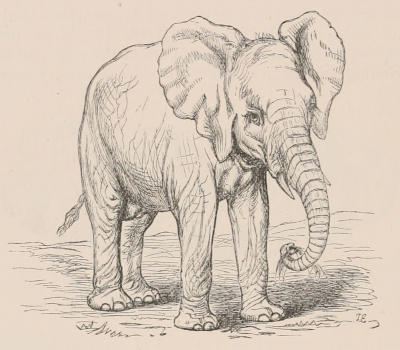
Fig. 183.—African Elephant (Elephas africanus). From a young specimen in the London Zoological Gardens.
In the African Elephant (E. africanus) the molars (Fig. 182) are of coarse construction, with fewer and larger plates and thicker enamel. Ridge-formula: 3, 6, 7, 7, 8, 10. The plates not flattened, but thicker in the middle than at the edges, so that their worn grinding surfaces are lozenge-shaped. Ears very large. The upper and lower margins of the end of the trunk forming two nearly equal prehensile lips. But three hoofs on the hind foot. This species now inhabits the wooded districts of the whole of Africa south of the Sahara, except where it has been driven away by human settlements. Fossil remains of Pleistocene age, undistinguishable specifically, have been found in Algeria, Spain, and Sicily. It was trained for war and show by the ancient Carthaginians and Romans, and recent experience of the species in captivity in England shows that it is as intelligent as its Asiatic relative, if not more so, while surpassing it in courage, activity, and obstinacy. Nevertheless, in modern times, no people in Africa have been sufficiently civilised or enterprising to care to train it for domestic purposes. It is hunted chiefly for the sake of the ivory of its immense tusks, of which it yields the principal source of supply to the European market, and the desire to obtain which is rapidly leading to the extermination of the species. In size the male African elephant often surpasses that of Asia, but the female is usually smaller. The circumference of the fore foot is half the height at the shoulder, a circumstance which enables the hunters to judge from the footprints the exact size of the animals of which they are in pursuit. The African Elephant also differs from its Indian congener in having tusks in both sexes, whereas in the latter the male only is so armed. Moreover, the eye is relatively larger, the forehead more convex, and the colour somewhat darker. Whereas the Indian Elephant frequents the depths of forests and seldom leaves their shade during the daytime, the following account by Sir Samuel Baker indicates different habits in the African species. This traveller observes: “In Africa, the country being generally more open than in Ceylon, the Elephant remains throughout the day either beneath a solitary tree or exposed to the sun in the vast prairies, where the thick grass attains a height of from nine to twelve feet. The general food of the African Elephant consists of the foliage of trees, especially mimosas. Many of the mimosas are flat-headed, about thirty feet high, and the richer portion of the foliage confined to the crown. Thus the Elephant, not being able to reach to so great a height, must overturn the tree to obtain the coveted food. The destruction caused by a herd of Elephants in a mimosa forest is extraordinary, and I have seen trees uprooted of so large a size that I am convinced no single elephant could have overturned them. I have measured trees four feet six inches in circumference and about thirty feet high uprooted by elephants. The natives have assured me that the elephants mutually assist each other, and that several engage together in the work of overturning a large tree.”
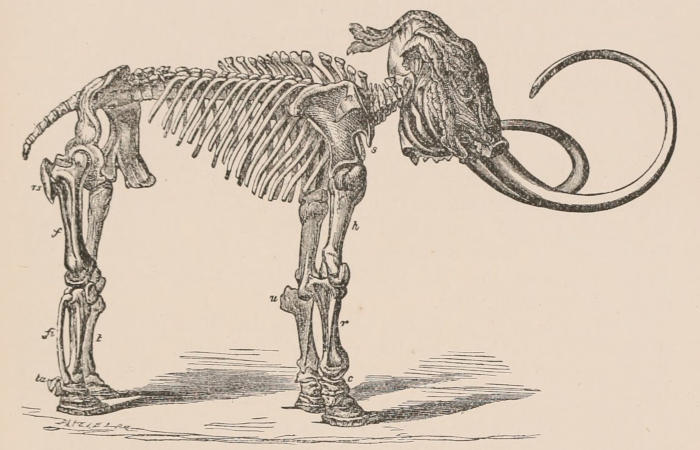
Fig. 184.—Restored skeleton of the Mammoth (Elephas primigenius). From Tilesius in Mém. Acad. Imp. Sc. St. Pétersbourg, vol. v. (1815). s, Scapula; h, humerus; r, radius; u, ulna; c, carpus; rs, ischium; f, femur; t, tibia; fi, fibula; ta, tarsus.
Extinct Species of Elephant.—Abundant remains of Elephants are found embedded in alluvial gravels, or secreted in the recesses of caves, into which they have been washed by streams and floods, or dragged as food by Hyænas and other carnivorous inhabitants of these subterranean dens. Such remains belonging to the Pleistocene and Pliocene periods have been found in many parts of Europe, including the British Isles, in North Africa, throughout the North American continent from Alaska to Mexico, and extensively distributed in Asia, where the deposits of the sub-Himalayan Siwalik Hills, and equivalent deposits in the Punjab, Perim Island,[280] and Burma, belonging to the earliest Pliocene, are rich in the remains of Elephants of varied form. These species are chiefly known and characterised at present by the skulls and teeth; some of the latter resemble the existing Indian and some the African type, but the majority are between the two, and make the distinction between the two existing species as of generic importance quite impracticable. Others again approach so closely in the breadth and coarseness of the ridges and paucity of cement to Mastodon as to have been placed by some zoologists in that genus. These form the subgenus called Stegodon by Falconer, and may be regarded as a distinct group of the genus.
Among the best known extinct Elephants is E. primigenius, the Mammoth,[281] very closely resembling the existing Indian species, and one of the most recently extinct and extensively distributed of all the fossil forms. Probably no animal which has not survived to the historic period has left such abundant and well-preserved evidence of its former existence. The discovery of immense numbers, not only, as in the case of most extinct creatures, in the form of fragmentary bones and teeth, but often as more or less nearly entire carcases, or “mummies,” as they may be called, with the flesh, skin, and hair in situ, in the frozen soil of the tundras of Northern Siberia, has for a long time given great interest to the species, and been the cause of many legendary stories among the natives of the lands in which they occur. Among these one of the most prevailing is that the Mammoth was, or still is, an animal which passes its life habitually in burrows below the surface of the ground, and immediately dies if by any chance it comes into the upper air.
Of the whole group the Mammoth is in many respects, as in the size and form of the tusks, and especially the characters of the molar teeth, the farthest removed from the primitive Mastodon-like type, while its nearest surviving relative, E. indicus, has retained the slightly more generalised characters of the Mammoth’s contemporaries of more southern climes, E. columbi of America, and E. armeniacus of the Old World, if, indeed, it can be specifically distinguished from them.
The tusks or upper incisor teeth were doubtless present in both sexes, but probably of smaller size in the female. In the adult males they often attained the length of from 9 to 10 feet measured along the outer curve. Upon leaving the head they were directed at first downwards and outwards, then upwards and finally inwards at the tips, and generally with a tendency to a spiral form not seen in other species of Elephant. Different specimens, however, present great variations in curve, from nearly straight to an almost complete circle.
It is chiefly by the characters of the molar teeth that the various extinct modifications of the Elephant type are distinguished. Those of the Mammoth (Fig. 185) differ from the corresponding organs of allied species in the great breadth of the crown as compared with the length, the narrowness and close approximation of the ridges, the thinness of the enamel and its straightness, parallelism, and absence of “crimping,” as seen on the worn surface, or in a horizontal section of the tooth. Dr. Falconer gave the prevailing “ridge-formula” as 4, 8, 12, 12, 16, 24. Dr. Leith Adams, working from more abundant materials, has shown, however, that the number of ridges of each tooth, especially those at the posterior end of the series, is subject to very great individual variation, ranging in each tooth of the series within the following limits: 3 to 4, 6 to 9, 9 to 12, 9 to 15, 14 to 16, 18 to 27, excluding the small plates called talons at each end of the tooth. Besides these variations in the number of ridges or plates of which each tooth is composed, the thickness of the enamel varies so much as to have given rise to a distinction between a “thick-plated” and a “thin-plated” variety—the latter being most prevalent among the specimens from the Arctic regions, and most distinctively characteristic of the species. From the specimens with thick enamel plates the transition to the other species or varieties mentioned above, including E. indicus, is almost imperceptible.
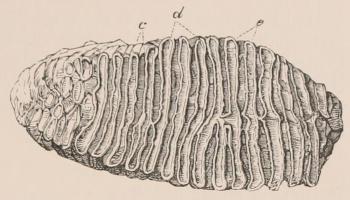
Fig. 185.—Grinding surface of upper molar of the Mammoth (Elephas primigenius). c, Cement; d, dentine; e, enamel. (From Owen.)
The bones of the skeleton generally more resemble those of the Indian Elephant than of any other known species, but the skull differs in the narrower summit, narrower temporal fossæ, and more prolonged incisive sheaths required to support the roots of the enormous tusks. Among the external characters by which the Mammoth was distinguished from either of the existing species of Elephant was the dense clothing, not only of long coarse outer hair, but also of close woolly under hair, of a reddish-brown colour, evidently in adaptation to the colder climate which it inhabited. This character, for a knowledge of which we are indebted to the well-preserved remains found in Northern Siberia, is also represented in the rude but graphic drawings of prehistoric age found in caverns in the south of France.[282] In size different individuals varied considerably, but the average height does not appear to have exceeded that of either of the existing species of Elephant.
The geographical range of the Mammoth was very extensive. There is scarcely a county in England in which some of its remains have not been found either in alluvial deposits of gravel or in caverns, and numbers of its teeth are from time to time dredged up from the bottom of the sea by the fishermen who ply their trade in the German Ocean, having been washed out of the water-worn cliffs of the eastern counties of England. In Scotland and Ireland its remains are less abundant, but they have been found in vast numbers at various localities throughout the greater part of Central Europe (as far south as Santander in Spain and Rome), Northern Asia, and the northern part of the American continent, though the exact distribution of the Mammoth in the New World is still a question of debate. It has not hitherto been met with in any part of Scandinavia or Finland.
In point of time, the Mammoth belongs exclusively to the Pleistocene epoch, and it was undoubtedly contemporaneous with man in France, and probably elsewhere. There is evidence to show that it existed in Britain before, during, and after the glacial period.
As before indicated, it is in the northern part of Siberia that its remains have been found in the greatest abundance, and in quite exceptional conditions of preservation. For a very long period there has been from that region a regular export of Mammoth ivory in a state fit for commercial purposes, both eastward to China and westward to Europe. In the middle of the tenth century an active trade was carried on at Khiva in fossil ivory, which was fashioned into combs, vases, and other objects, as related by Abu’l Kásim, an Arab writer of that period. Middendorff reckoned that the number of tusks which have yearly come into the market during the last two centuries has been at least a hundred pairs, and Nordenskiöld, from personal observation, considers this calculation as probably rather too low than too high. They are found at all suitable places along the whole line of the shore between the mouth of the Obi and Behring Straits, and the farther north the more numerous do they become, the islands of New Siberia being now one of the most favourite collecting localities. The soil of Bear Island and of Liachoff Islands is said to consist only of sand and ice with such quantities of Mammoth bones as almost to compose its chief substance. The remains are not only found around the mouths of the great rivers, as would be the case if the carcases had been washed down from more southern localities in the interior of the continent, but are imbedded in the frozen soil in such circumstances as to indicate that the animals had lived not far from the localities in which they are now found, and they are exposed either by the melting of the ice in unusually warm summers or by the washing away of the sea cliffs or river banks by storms or floods. In this way the bodies of more or less nearly perfect animals, often standing in the erect position, with the soft parts and hairy covering entire, have been brought to light.
References to the principal recorded discoveries of this kind, and to the numerous speculations to which they have given rise, both among ignorant peasants and learned academicians, will be found in Nordenskiöld’s Voyage of the Vega (English translation, vol. i. 1881, p. 398 sq.) and a series of papers in the Geological Magazine for 1880 and 1881, by H. H. Howorth, as well as in a separate work on the Mammoth by the same writer. For the geographical distribution and anatomical characters, see Falconer’s Palæontological Memoirs, vol. ii. 1868; Boyd Dawkins, “Elephas primigenius, its Range in Space and Time,” Quart. Journ. Geol. Soc. xxxv. p. 138 (1879); and Leith Adams, “Monograph of British Fossil Elephants,” part ii., Palæontographical Society (1879).
E. antiquus, of the European Pleistocene, has a lower ridge-formula than in the Mammoth, the molars being narrower, and approximating to those of the African Elephant in structure. Small allied forms occur in the rock-fissures and caverns of Malta, and have been described as E. mnaidriensis and E. melitensis; some of the individuals of the latter not exceeding 3 feet in height. The European E. meridionalis is a southern form of somewhat earlier age, very common in the Upper Pliocene of Italy and France, and also in the so-called Forest-bed of the Norfolk coast. It attained very large dimensions, its height being estimated at upwards of 15 feet. The ridge-formula is lower than in E. antiquus, the molars are broad, with the worn enamel-discs generally expanded in the middle, and the enamel itself is crenulated.
Elephant remains are very abundant in the Pleistocene and Pliocene deposits of India, those from the latter beds being the oldest representatives of the genus. Of these the Pleistocene E. namadicus appears closely allied to E. antiquus, from which it is distinguished by a bold ridge across the forehead. Among the Pliocene forms E. hysudricus may be an ancestral type allied to the Indian Elephant; while E. planifrons is closely related to E. meridionalis, although retaining the ancestral feature of developing premolars.
The Stegodont group is peculiar to the eastern parts of the Old World, and, as already observed, connects the true Elephants intimately with the Mastodons. The molars (Fig. 179, II) are characterised by the lowness of the ridges, while the intervening valleys may have but little cement, and there may be a more or less distinct longitudinal groove in the crown dividing each ridge into an inner and an outer moiety. In species like E. insignis the ridge-formula is nearly the same as in E. meridionalis, but in E. clifti some of the molars carry only six ridges, and premolars were present, so that we thus have such a complete transition to the next genus that it is very difficult to know where to draw the line between the two.
Mastodon.[283]—Dentition: i ¹⁄₁₋₀, c ⁰⁄₀, dm ³⁄₃, m ³⁄₃. Upper incisors large, as in Elephas, sometimes with longitudinal bands of enamel, more or less spirally disposed. Lower incisors variable; when present comparatively small and straight, sometimes persistent, sometimes early deciduous, and in some species never present. Grinding surface of molars with transverse ridges, the summits of which are divided more or less into conical or mammillary cusps, and often with secondary or additional cusps between and clustering against the principal ridges; enamel thick; cement very scanty, never filling up the interspaces between the ridges. The third, fourth, and fifth cheek-teeth (i.e. the last milk-molar, and the first and second molars) having the same number of ridges,[284] which never exceeds five.
In the upper jaw the incisors, though of large size, were apparently never so much curved as in some species of Elephant, and they often have longitudinal bands of enamel, more or less spirally disposed upon their surface, which are not met with in Elephants. Lower incisors were present throughout life in some species, which have the symphysis of the lower jaw greatly elongated to support them (as in M. angustidens, M. pentilici, and M. longirostris). In the common North American species (M. americanus) the mandibular symphysis is short, but it may have a small incisor on one side. In other species no inferior tusks have been found, at all events in adult life (see figure of M. arvernensis).
The molar teeth increase in size from before backwards, but as many as three of these teeth may be in place in each jaw at one time. There is in many species a true vertical succession, affecting either the third, or the third and second, or (in M. productus) the first, second, and third of the six molariform teeth. These three are therefore reckoned as milk-molars, and their successors as premolars, while the last three, which are never changed, correspond to the true molars of those animals in which the typical dentition is fully developed. The study of the mode of succession of the teeth in the different species of Mastodons is particularly interesting, as it exhibits so many stages of the process by which the very anomalous dentition of the modern Elephants may have been derived by gradual modification from the typical heterodont and diphyodont dentition of the ordinary mammal. It also shows that the anterior molars of Elephants do not correspond to the premolars of other Ungulates, but to the milk-molars, the early loss of which in consequence of the peculiar process of horizontal forward-moving succession does not require, or allow time for, their replacement by premolars. It must be noted, however, that, in the Mastodon in some respects the least specialised in tooth-structure, the M. americanus of North America, no vertical succession of the molars has yet been observed, although vast numbers of specimens have been examined.
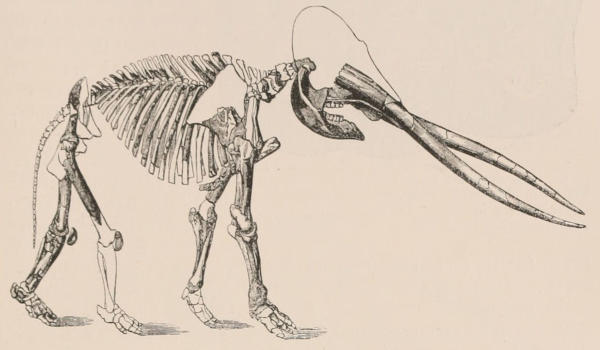
Fig. 186.—Restoration of the skeleton of Mastodon arvernensis, from the Pliocene of Europe, (After Sismonda.)
The Mastodons have fewer ridges on their molar teeth than the Elephants; the ridges are also less elevated, wider apart, have a thicker enamel-covering, and scarcely any cement filling up the space between them. Sometimes (as in M. americanus) the ridges are simple transverse wedge-shaped elevations, with straight or concave edges. In other species the summits of the ridges are more or less subdivided into conical cusps, and may have accessory cusps clustering around them (as in M. americanus, see Fig. 187). When the apices of these are worn by mastication, their surfaces present circles of dentine, surrounded by a border of enamel, and as the attrition proceeds different patterns are produced by the union of the bases of the cusps, a trilobed or trefoil form being characteristic of some species (Fig. 188).
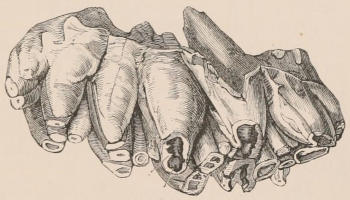
Fig. 187.—Oblique side and crown view of the last upper molar of Mastodon arvernensis. (From Owens.)
As already mentioned, certain of the molariform teeth of the middle of the series in Mastodons have the same number of principal ridges, those in front of them having fewer and those behind a greater number. These teeth were distinguished as “intermediate” molars by Dr. Falconer, and are three in number, namely the last milk-molar and the first and second true molars (or the third, fourth, and fifth of the whole series). The number of ridges on these intermediate molars is nearly always three or four, and the tooth in front has usually one fewer and that behind one more, so that the ridge-formula of most Mastodons can be reduced either to 1, 2, 3, 3, 3, 4, or 2, 3, 4, 4, 4, 5. The former characterises the section called Trilophodon (of which an intermediate molar is shown in Fig. 188), and the latter that called Tetralophodon by Dr. Falconer. These divisions are very useful, as under one or the other all the present known species of Mastodon can be ranged, but observations upon a larger number of individuals have shown that the number of ridges upon the teeth is not quite so constant as implied by the formulæ given above. Their exact enumeration is even difficult in many cases, as “talons” or small accessory ridges at the hinder end of the teeth occur in various stages of development, until they take on the character of true ridges. Transitional conditions have also been shown, at least in some of the teeth, between the trilophodont and the tetralophodont forms, and again between the latter and what has been called a “pentalophodont” type, which leads on towards the condition of dental structure characteristic of the true Elephants.
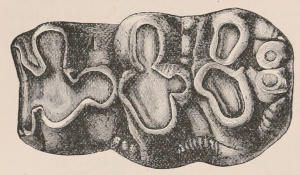
Fig. 188.—Grinding surface of the partially worn last left lower milk-molar of Mastodon angustidens, from the Upper Miocene of India. The lower side of the figure is the outer border of the tooth.
The range of the genus Mastodon in time was from the middle of the Miocene period to the end of the Pliocene in the Old World, when it became extinct; but in America several species—especially the one best known, owing to the abundance of its remains, which has been variously called M. americanus, M. ohioticus, and M. giganteus—survived to a late Pleistocene period.
The range in space will be best indicated by the following list of some of the better known species. (1) Trilophodont series—M. angustidens,[285] borsoni, pentelici, turiensis, from Europe; M. falconeri and pandionis, from India; M. americanus, obscurus, and productus, North America; and M. cordillerum and humboldti, South America. (2) Tetralophodont series—M. arvernensis, M. longirostris, from Europe; M. latidens, sivalensis, and perimensis, from India; M. mirificus, from North America. Mastodon arvernensis and M. longirostris, together with a trilophodont species, occur in the crag-deposits of Norfolk and Suffolk.
Family Dinotheriidæ.
An extinct family distinguished from the Elephantidæ by the whole series of permanent cheek-teeth being in use at the same time.
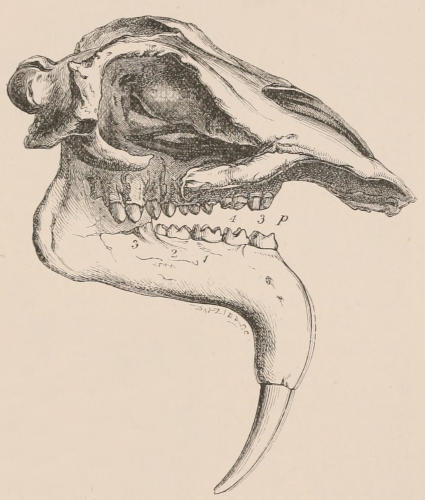
Fig. 189.—Skull of Dinotherium giganteum, from the Lower Pliocene of Eppelsheim, Hessen-Darmstadt. (After Kaup.) p, 3, 4, premolars; 1, 2, 3, molars.
Dinotherium.[286]—Dentition of adult: i ⁰⁄₁, c ⁰⁄₀, p ²⁄₂, m ³⁄₃ = 22; all present at the same time, there being no horizontal succession, but the premolars replacing milk-teeth in the ordinary manner. The presence or absence of upper incisors has not yet been clearly ascertained. Lower incisors large, conical, descending, and slightly curved backwards, implanted in a greatly thickened and deflected beak or prolongation of the symphysis. In section they do not show the decussating striæ characteristic of Mastodons and Elephants. Crowns of molars carrying strong transverse, crenulated ridges, with deep valleys between, much resembling the lower ones of the Tapirs. Ridge-formula of the permanent molar series: 2, 2, 3, 2, 2. The three ridges of the first true molar are constant in both upper and lower jaws, although it is quite an anomalous character among Proboscideans for this molar to have more ridges than those which come behind it. The last milk-molar has also three ridges, the penultimate but two. The cranium is much depressed, with comparatively little development of air-cells. The remainder of the skeleton is imperfectly known, but apparently agrees in its general character with that of the other Proboscideans.
Remains of Dinotherium giganteum, an animal of elephantine proportions, strikingly characterised by the pair of huge tusks descending nearly vertically from the front of the lower jaw, were first discovered at Eppelsheim, near Darmstadt, and described by Kaup. They have since been met with in various Lower Pliocene and higher Miocene formations in the south of Germany, France, Greece, and Asia Minor. Closely allied forms also occur in the Lower Pliocene and Upper Miocene of India, but none are known from America.
Suborder Amblypoda.
Uintatherium.[287]—Among the most remarkable of the comparatively recent discoveries in the higher Eocene formations of the western states of North America has been one of a group of animals of huge size, approaching that of the largest existing Elephants, presenting a combination of characters quite unlike those known among other recent or extinct creatures, and of which there were evidently many species living contemporaneously, but all of which became extinct before the close of the Eocene period. To form some idea of their appearance, we must imagine animals very elephantine in general proportions and in the structure of their limbs. The feet had five short toes. The tail, as in the Elephants, was long and slender, but the neck, though still short, was not so much abbreviated as in the Proboscideans, and there is no evidence that these animals possessed a trunk. The head differed greatly from that of the Elephants, being long and narrow, more like that of a Rhinoceros, and, as in that animal, was elevated behind into a great occipital crest, and it had developed upon its upper surface three pairs of conspicuous, laterally diverging protuberances—one pair in the parietal region, one on the maxillaries in front of the orbits, and one (much smaller) near the fore part of the elongated nasal bones. Whether these were merely covered by bosses of callous skin, as the rounded form and ruggedness of their extremities would indicate, or whether they formed the bases of attachment for horns of still greater extent, like those of the Rhinoceros or of the Cavicorn Ruminants, can only be a matter of conjecture. There were no upper incisors, but usually three on each side below, of comparatively small size, as was also the lower canine. A huge, compressed, curved, sharp-pointed canine tusk, very similar in form and position to that of the Musk-Deer, descended from each side of the upper jaw. These were present in both sexes, but very much smaller in the female, as was also the flange-like process of the lower jaw by which they were guarded. Behind these, and at some distance from them, were on each side above and below six cheek-teeth, of comparatively small size, placed in continuous series, each with a pair of oblique ridges conjoined internally and diverging externally in a V-like manner, and provided with a stout basal cingulum. The normal dental formula was therefore i ⁰⁄₃, c ¹⁄₁, p ³⁄₃, m ³⁄₃ = 34; and the dentition had thus already attained a remarkable degree of specialisation, although the brain was smaller and more rudimentary in characters than in almost any other known mammal. In its comparative length and the absence of a third trochanter the femur of these animals resembles that of the Proboscidea. The first discovered evidences of the existence of animals of this group were described by Leidy in 1872, under the name of Uintatherium (from the Uinta mountains, near which they were found). Subsequently the names Dinoceras, Tinoceras, Loxolophodon, etc., have been applied to various members of the group, but the characters by which they are distinguished do not seem of sufficient importance to allow of their separation from the type genus Uintatherium.[288]
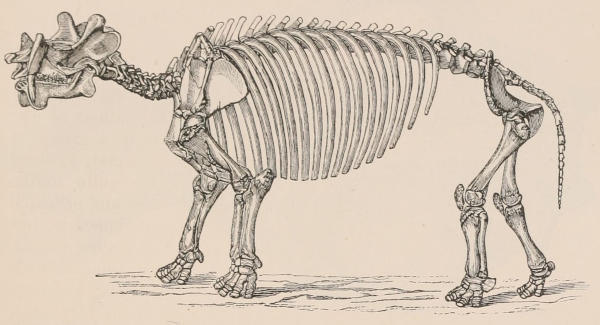
Fig. 190.—Skeleton of Uintatherium mirabile. ¹⁄₃₀ natural size. (From Marsh, Am. Journ. Sci. vol. xii. p. 2.)
Coryphodon.[289]—Another interesting form referred to this suborder is Coryphodon, which appears to connect the Uintatheriidæ with the most primitive Perissodactyla. It was first described by Owen in 1846 from a fragment of a jaw from the London Clay. Other remains were afterwards discovered in France, and lately in great abundance, indicating many species from the size of a Tapir to that of a Rhinoceros, in the Lower and Middle Eocenes of New Mexico and Wyoming in the United States. Coryphodon had forty-four teeth; the canines of both jaws were large and sharp pointed, and the molars had strongly pronounced oblique ridges. The general proportions were those of a Bear, but the tail was of moderate length, and the feet short and wide. The femur had a third trochanter; and the cranium was devoid of protuberances. The genus should be regarded as the type of a distinct family Coryphodontidæ.
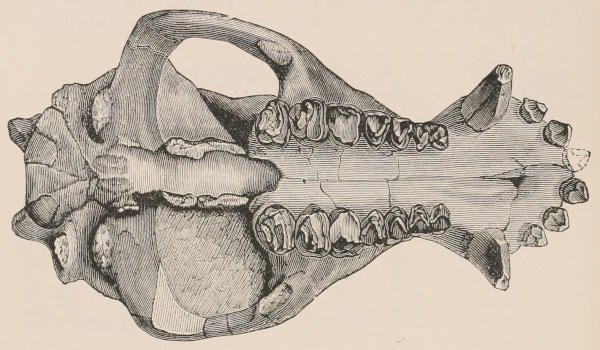
Fig. 191.—Palatal aspect of the cranium of Coryphodon hamatus, from the Wasatch Eocene of New Mexico. ²⁄₉ natural size. (After Cope.)
Suborder Condylarthra.
The term Condylarthra has been proposed by Professor Cope for a number of generalised and mostly comparatively small Ungulates, which were probably allied both to the Perissodactyla and Artiodactyla, but present characters separating them from those divisions as commonly defined. In the structure of the carpus and tarsus these forms (which are chiefly known to us from the Eocene of the United States) come nearer to the Hyracoidea than to any other existing type. As a rule they have the full dental formula; the molars are brachydont, generally bunodont, and in many instances also tritubercular; while the premolars are always simpler than the molars.
The humerus is quite peculiar among Ungulates in having an entepicondylar foramen; the femur has a third trochanter; and the form and relations of the astragalus are similar to those obtaining in the Carnivora. The feet are usually furnished with five functional digits, of which the ungual phalanges are pointed. In many respects the skeleton of these remarkably generalised Ungulates approximates so decidedly to a Carnivorous type as to have led palæontologists to conclude that the Ungulata and Carnivora are branches of an original common stock.
In this work space only permits of allusion to a few of the more important types of this group. Periptychus, which occurs in the lowest Eocene of New Mexico, is a bunodont type readily distinguished by the vertical flutings of the premolars, and the small size of the incisors and canines. It has been suggested that this genus is closely related to the stock of the bunodont Artiodactyla. Of greater interest is the genus Phenacodus, which is regarded as the lowest factor in the series from which the modern Horse has been evolved, where it holds the position immediately below Hyracotherium or, Systemodon (see p. 374). One of the species was about the size of a Bull-dog, while another might be compared to a small Leopard. The structure of the cheek-teeth is such as might readily be modified into that obtaining in Hyracotherium; all the feet had five fully developed digits, and the tail was long. Meniscotherium and Hyracodontotherium are more specialised forms of somewhat later age, with a lophodont dentition: the latter genus being European.
Suborder Toxodontia.
In addition to the Macraucheniidæ and certain other forms noticed under the head of the Perissodactyla, the Tertiaries of South America have yielded some very remarkable forms of mammalian life, the nature and affinities of which have greatly puzzled all zoologists who have attempted to unravel them.
Nesodon and Toxodon.—Among these Nesodon, from Patagonia, has the full typical Eutherian number of teeth; the crowns of the incisors being short, and the molars having a complex rhinocerotic type of structure somewhat intermediate between Homalodontotherium (p. 412) and the following genus Toxodon. The typical species of Nesodon was about as large as a Sheep, but nothing more is known of it than the teeth and portions of the skull.
Toxodon is an animal about the size of a Hippopotamus; it was first discovered by Darwin, and many specimens have since been found in Pleistocene deposits near Buenos Ayres, and described by Owen, Gervais, and Burmeister. The teeth consist of large incisors, very small lower canines, and strongly curved molars, all with persistent roots, the formula being apparently i ²⁄₃, c ⁰⁄₁, p ⁴⁄₃, m ³⁄₃ = 38. The cranial characters exhibit a combination of those found in both Perissodactyles and Artiodactyles, but the form of the hinder part of the palate and the absence of an alisphenoid canal belong to the latter; and the tympanic, firmly fixed in between the squamosal and the exoccipital, ankylosed to both, and forming the floor of a long upward-directed meatus auditorius, is so exactly like that of the Suina that it is difficult to believe it does not indicate some real affinity to that group. These characters seem to outweigh in importance those by which some zoologists have linked Toxodon to the Perissodactyla, and the absence of the third trochanter and the articulation of the fibula with the calcaneum tell in the same direction. According to the recent observations of Ameghino the hind feet were certainly tridactylous, and the front feet probably so. The earlier allied genera Protoxodon and Adinotherium are definitely known to have tridactylous front and hind feet, which conform to the Perissodactylate type, the bones of the proximal and distal rows of the carpus interlocking. Acrotherium, which has similar feet, differs from all other Ungulates, and indeed from all Eutherians except some individuals of the existing carnivorous genus Otocyon, in having eight cheek-teeth, five of which have been reckoned as premolars.
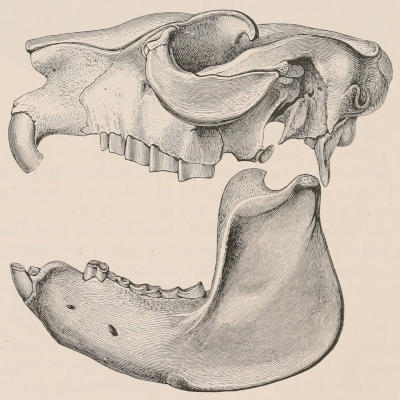
Fig. 192.—Cranium and Lower Jaw of Typotherium cristatum. ¹⁄₃ natural size. From Gervais.
Typotherium.—Typotherium (Fig. 192), also called Mesotherium, from the same locality as Toxodon, was an animal rather larger than a Capybara, and of much the same general appearance. Its skeleton is completely known, and shows a singular combination of characters, resembling Toxodon or a generalised Ungulate on the one hand, and the Rodents, especially the Leporidæ, on the other. In the presence of clavicles it differs from all known Ungulates, and in having two pairs of lower incisors from all Rodents. The teeth are i ¹⁄₂, c ⁰⁄₀, p ²⁄₁, m ³⁄₃ = 24.
From the Tertiaries of various parts of South America a number of forms more or less closely allied to Toxodon and Typotherium have been recently described, but as many of them are very imperfectly known, and there is much doubt as to their generic position, it will be unnecessary to refer to them further.
It will thus be seen that, although our knowledge of many of these forms is still very limited, we may trace among them a curious chain of affinities, which would seem to unite the Ungulates on the one hand with the Rodents on the other; but further materials are required before we can establish with certainty so important a relationship, one which, if true, would alter materially some of the prevailing views upon the classification of mammals.
Group Tillodontia.
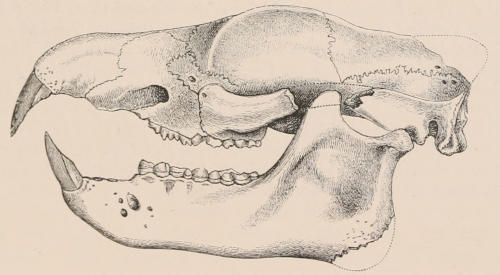
Fig. 193.—Skull of Tillotherium fodiens. ⅙ natural size. From Marsh.
Here may be noticed a remarkable group of animals, called by Marsh, Tillodontia, the remains of which are found abundantly in the Lower and Middle Eocene beds of North America. They seem to combine the characters of the Ungulata, Rodentia, and Carnivora. In the genus Tillotherium of Marsh (probably identical with the previously described Anchippodus of Leidy) the skull (Fig. 193) resembled that of the Bears, but the molar teeth were of the Ungulate type, while the large incisors were very similar to those of the Rodents. The dental formula is i ²⁄₂, c ¹⁄₁, p ³⁄₄, m ³⁄₃. The first pair of incisors was very small; the upper molars were tritubercular, while the lower ones had crescentoid ridges as in Palæotherium. The skeleton resembled that of the Carnivores, but the scaphoid and lunar bones were distinct, and there was a third trochanter on the femur. The feet were plantigrade, and each had five digits, all with long pointed claws. In the allied genus Stylinodon all the teeth were rootless. Some forms were as large as a Tapir.
These, with other more or less closely allied animals, such as Calamodon and Psittacotherium, constituting a group called Tæniodonta, are included by Cope in his large order Bunotheria, to which also the existing Insectivora are referred. The dentition of some of these forms makes a remarkable approximation towards a Rodent type, while it has been suggested that there are also signs of remote Edentate affinities. The constantly increasing knowledge of these annectant forms adds to the difficulty so often referred to in this work of establishing anything like a definite classification of the heterodont mammals. An incisor tooth from the Swiss Eocene has recently been referred to Calamodon.
Bibliography of Ungulata.—In addition to the works and memoirs mentioned under the different sections of the order, the following may be referred to:—W. Kowalevsky, “Monographie des genus Anthracotherium,” Palæontographica 1873; Id. “Sur l’Anchitherium aurelianense et sur l’histoire paléontologique des Chevaux,” Mém. de l’Acad. Imp. des Sciences de St. Pétersbourg, 1873; Id. “On the Osteology of the Hyopotamidæ,” Philosophical Transactions, 1873; L. Rütimeyer, “Versuch einer natürlichen Geschichte des Rindes.” etc., Neue Denks. der allgem. Schweiz. Gesellsch. für Naturwissenschaften, 1867; Id. “Die Rinder der Tertiär-Epoche,” Abhand. der Schweiz. Paläont. Gesellsch. 1877 and 1878; Id. “Beiträge zu einer Natürliche Geschichte der Hirsche,” ibid. 1880-1881; C. J. Forsyth-Major, “Beiträge zur Geschichte der Fossilen Pferde,” ibid. 1880; M. Schlosser, “Beiträge zur Kenntniss der Stammesgeschichte der Hufthiere und Versuch einer Systematik der Paar- und Unpaarhufer,” Morph. Jahrb. 1886; E. D. Cope, “The Perissodactyla,” Amer. Natural. 1887; M. Pavlow, “Études sur l’histoire paléontologique des Ongulés,” Bull. Soc. Imp. Naturalistes Moscow, 1887-1890. W. B. Scott and H. F. Osborn, “The Mammalia of the Uinta Formation,” Trans. Amer. Phil. Soc. vol. xvi. (1889).