Chapter XI · THE ORDER CARNIVORA (continued 3)
Reading edition
In geographical distribution the Martens are limited to the northern hemisphere, ranging throughout the greater part of the temperate regions of both Old and New Worlds, as far north as conditions of existence suited to their habits are met with, and southwards in America to 35° N. lat., while in Asia one species is met with as far in this direction as the island of Java.
The various species appear to be very similar in their habits. They live in woods and rocky places, and are thoroughly arboreal, spending most of their time in trees, although descending to the ground in quest of prey. They climb with great facility, and are agile and graceful in their movements. Some species are said occasionally to resort to berries and other fruit for food, but as a rule they are strictly carnivorous, feeding chiefly on birds and their eggs, small mammals, as squirrels, hares, rabbits, and moles, but chiefly mice of various kinds, of which they destroy great numbers, and occasionally snakes, lizards, and frogs. In proportion to their size they are among the most bloodthirsty of animals, though less so than the true Weasels. The female usually makes her nest of moss, dried leaves, and grass in the hollow of a tree, but sometimes in a hole among rocks or ruined buildings, and produces several young at a birth, usually from four to six. Though wild and untameable to a great degree if captured when fully grown, when taken young they are very docile, and have frequently been made pets of, not having the strong unpleasant odour of the smaller Mustelidæ. The common European Marten appears to have been partially domesticated by the Greeks and Romans, and to have been used to keep houses clear from rats and mice before cats were introduced.[511] In the same way, according to Hodgson, the Yellow-bellied Weasel (M. cathia) “is exceedingly prized by the Nipalese for its service in ridding houses of rats. It is easily tamed; and such is the dread of it common to all Murine animals that not one will approach a house where it is domiciled.” It is, however, to the great value attached to the pelts of these animals that their importance to man is chiefly due. Though all yield fur of serviceable quality, the commercial value varies immensely, not only according to the particular species from which it is obtained, but according to individual variation, depending upon age, sex, season, and other trifling circumstances. The skins from northern regions are more full and of a finer colour and gloss than those from more temperate climates, as are those of animals killed in winter compared with the same individuals in the summer season. The caprices of fashion have, moreover, set wholly factitious values upon slight shades of colour, recognised and named by experienced furriers, but not indicating any specific or other distinctions of which zoologists have any cognisance. Enormous numbers of animals are annually caught, chiefly in traps, to supply the demand of the fur trade, Siberia and North America being the principal localities from which they are obtained.
With the exception of the Pekan (M. pennanti) all the Martens are so much alike in size, general colouring, and cranial and dental characters that the discrimination of the species, and assignment of the proper geographical distribution to each, has been a subject which has sorely perplexed the ingenuity and patience of zoologists. The following description by Dr. Elliott Coues of the external characters of the American Pine Marten (M. americana) will apply almost equally well to most of the others: “It is almost impossible to describe the colour of the Pine Marten, except in general terms, without going into the details of the endless diversities occasioned by age, sex, season, or other incidents. The animal is ‘brown,’ of various shades from orange or tawny to quite blackish; the tail and feet are ordinarily the darkest, the head lightest, often quite whitish; the ears are usually rimmed with whitish; on the throat there is usually a large tawny-yellowish or orange-brown patch, from the chin to the fore legs, sometimes entire, sometimes broken into a number of smaller, irregular blotches, sometimes wanting, sometimes prolonged on the whole under surface, when the animal is bicolor like a Stoat in summer. The general ‘brown’ has a grayish cast, as far as the under fur is concerned, and is overlaid with rich lustrous blackish-brown in places where the long bristly hairs prevail. The claws are whitish; the naked nose pad and whiskers are black. The tail occasionally shows interspersed white hairs, or a white tip.”
The species generally recognised as distinct are the following, the first five belonging to the Old and the last two to the New World:—
M. foina, the Beech Marten, Stone Marten, or White-breasted Marten.—Distinguished from the following by the greater breadth of the skull, and some minute but constant dental characters, by the dull grayish-brown colour of the fur of the upper parts, and the pure white of the throat and breast. It inhabits the greater part of the continent of Europe, but is more southern than the next in its distribution, not being found in Sweden or Norway, nor, according to the investigations of Mr. Alston, in the British Isles, although included in their fauna by all earlier writers; to the eastward it ranges into Afghanistan and the Himalaya.
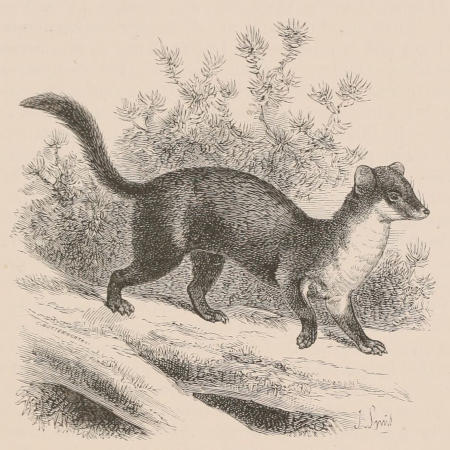
Fig. 267.—The Pine Marten (Mustela martes).
M. martes, the Pine Marten (Fig. 267).—Outer fur rich dark brown; under fur reddish-gray, with clear yellow tips; breast spot usually yellow, varying from bright orange to pale cream-colour or yellowish-white. Length of head and body 16 to 18 inches; of tail (including the hair) 9 to 12 inches. This species is extensively distributed throughout northern Europe and Asia, and was formerly common in most parts of Great Britain and Ireland. Though commonly called “Pine Marten,” it does not appear to have any special preference for coniferous trees, except that, inasmuch as they constitute the greater proportion of the forests of the countries which it inhabits, it is more often met with in them than in any other. With regard to its recent occurrence in the British Isles, Mr. Alston writes in the Proc. Zool. Soc. 1879:—
“Although greatly reduced in numbers by persecution, it still maintains its ground in the wilder districts of Scotland, the north of England, Wales, and Ireland; and occasionally specimens are killed in counties where the species was thought to have been long extinct. In Scotland it is still found, though comparatively rarely, in the Lews and in most of the Highland mainland counties, being perhaps most abundant in Sutherland and Ross-shire, especially in the deer forests. In the Lowlands a Marten is now a very great rarity; but a fine example was killed in Ayrshire in the winter of 1875-76. In the north of England Mr. W. A. Durnford says the species is still plentiful in the wilder parts of Cumberland, Westmoreland, and Lancashire, and in Lincolnshire several have been recorded, the latest killed in 1865, by Mr. Cordeaux. In Norfolk one was shot last year; and I have myself examined a fine example which was shot in Hertfordshire, within 20 miles of London, in December 1872. In Dorsetshire the last is said to have been killed in 1804; but a specimen occurred in Hampshire about forty years ago, and another in Surrey in 1847. In Ireland the following counties were enumerated by Thompson as habitats of this species: Donegal, Londonderry, Antrim, Down, Armagh, Fermanagh, Longford, Galway, Tipperary, Cork, and Kerry. The Cat-crann is probably now a rarer animal in Ireland than it was when Thompson wrote; but it still exists in various districts, especially in County Kerry, whence the society has received several living examples; and Professor A. Leith Adams states that it has been seen of late years even in county Dublin.”
M. zibellina, the Sable (German, Zobel and Zebel; Swedish, sabel; Russian, sobel, a word probably of Turanian origin).—Closely resembling the last, if indeed differing from it except in the quality of the fur, which is the most highly valued of that of all the group. Found chiefly in Eastern Siberia.
M. flavigula, the Indian Marten.—Inhabits the southern slopes of the Himalaya, the Nilgiri Hills, the interior of Ceylon, the Malay Peninsula, and Java. The coloration of this species is very striking, the upper parts being blackish-brown, and the throat and breast yellow or orange, in the bright coloured variety. It differs from the other species in having the soles of the feet more or less naked.
M. melampus.—Japan.
M. americana, the North-American Sable or Marten.—A species so closely allied to the European Pine Marten and Asiatic Sable that it is very difficult to assign constant distinguishing characters between them. The importance of the fur of this animal as an article of commerce may be judged of from the fact that 15,000 skins were sold in one year by the Hudson’s Bay Company as long ago as 1743, and the more recent annual imports into Great Britain have exceeded 100,000. It is ordinarily caught in wooden traps of very simple construction, being little enclosures of stakes or brush in which the bait is placed upon a trigger, with a short upright stick supporting a log of wood, which falls upon its victim on the slightest disturbance. A line of such traps, several to a mile, often extends many miles. The bait is any kind of meat, a mouse, squirrel, piece of fish, or bird’s head. It is principally trapped during the colder months, from October to April, when the fur is in good condition, as it is nearly valueless during the shedding in summer. Dr. Coues tells us that, notwithstanding the persistent and uninterrupted destruction to which the American Sable is subjected, it does not appear to diminish materially in numbers in unsettled parts of the country. It holds its own partly in consequence of its shyness, which keeps it away from the abodes of men, and partly because it is so prolific, bringing forth six to eight young at a litter. Its home is sometimes a den under ground or beneath rocks, but oftener the hollow of a tree, and it is said frequently to take forcible possession of a squirrel’s nest, driving off or devouring the rightful proprietor.
M. pennanti, the Pekan or Pennant’s Marten, also called Fisher Marten, though there appears to be nothing in its habits to justify the appellation.—This is the largest species of the group, the head and body measuring from 24 to 30 inches, and the tail 14 to 18 inches. It is also more robust in form than the others, its general aspect being more that of a Fox than a Weasel; in fact, its usual name among the American hunters is “Black Fox.” Its general colour is blackish, lighter by mixture of brown or gray on the head and upper fore part of the body, with no light patch on the throat, and unlike the other Martens generally darker below than above. It was generally distributed in wooded districts throughout the greater part of North America, as far north as Great Slave Lake, 63° N. lat., and Alaska, and extending south to the parallel of 35°; but at the present time it is almost exterminated in the settled parts of the United States east of the Mississippi.
Fossil remains of a Marten from the Pliocene Siwaliks of India indicate a species which cannot be distinguished from those now inhabiting the same region; while remains of M. martes occur in European cavern-deposits, and in the fens of Cambridgeshire.
With the Putoriine group (genus Putorius) we come to those smaller forms distinguished by having only three premolars in each jaw, by the absence of an inner cusp to the blade of the lower carnassial, as well as by certain external characters. This group contains a few species known as Minks, differing from the rest by slight structural modifications, and especially by their semiaquatic habits. They are distinguished from the Polecats, Stoats, and Weasels, which constitute the remainder of the group, by the facial part of the skull being narrower and more approaching in form that of the Martens, by the premolar teeth (especially the anterior one in the upper jaw) being larger, by the toes being partially webbed, and by the absence of hair in the intervals between the naked pads of the soles of the feet. The two best-known species, so much alike in size, form, colour, and habits that although they are widely separated geographically some zoologists question their specific distinction, are M. lutreola, the Nörz or Sumpfotter (Marsh-Otter) of Eastern Europe, and M. vison, the Mink of North America. The former inhabits Finland, Poland, and the greater part of Russia, though not found east of the Ural Mountains. Formerly it extended westward into Central Germany, but is now very rare, if not extinct, in that country. The latter is found in places which suit its habits throughout the whole of North America. Another form, M. sibirica, from Eastern Asia, of which much less is known, appears to connect the true Minks with the Polecats.
For the following description, chiefly taken from the American form (though almost equally applicable to that of Europe), we are mainly indebted to Dr. Coues’s Fur-bearing Animals of North America. In size it much resembles the English Polecat,—the length of the head and body being usually from 15 to 18 inches, that of the tail to the end of the hair about 9 inches. The female is considerably smaller than the male. The tail is bushy, but tapering at the end. The ears are small, low, rounded, and scarcely project beyond the adjacent fur. The pellage consists of a dense, soft, matted under fur, mixed with long, stiff, lustrous hairs on all parts of the body and tail. The gloss is greatest on the upper parts; on the tail the bristly hairs predominate. Northern specimens have the finest and most glistening pellage; in those from southern regions there is less difference between the under and over fur, and the whole pellage is coarser and harsher. In colour different specimens present a considerable range of variation, but the animal is ordinarily of a rich dark brown, scarcely or not paler below than on the general upper parts; but the back is usually the darkest, and the tail is nearly black. The under jaw, from the chin about as far back as the angle of the mouth, is generally white. In the European Mink the upper lip is also white, but as this occasionally occurs in American specimens it fails as an absolutely distinguishing character. Besides the white on the chin, there are often other irregular white patches on the under parts of the body. In very rare instances the tail is tipped with white. The fur, like that of most of the animals of the group to which it belongs, is an important article of commerce.
The principal characteristic of the Mink in comparison with its congeners is its amphibious mode of life. It is to the water what the other Weasels are to the land, or Martens to the trees, being as essentially aquatic in its habits as the Otter, Beaver, or Musk-Rat, and spending perhaps more of its time in the water than it does on land. It swims with most of the body submerged, and dives with perfect ease, remaining long without coming to the surface to breathe. It makes its nest in burrows in the banks of streams, breeding once a year about the month of April, and producing five or six young at a birth. Its food consists of frogs, fish, freshwater molluscs and crustaceans, as well as mice, rats, musk-rats, rabbits, and small birds. In common with the other animals of the genus, it has a very peculiar and disagreeable effluvium, which, according to Coues, is more powerful, penetrating, and lasting than that of any animal of the country except the Skunk. It also possesses the courage, ferocity, and tenacity of life of its allies. When taken young, however, it can be readily tamed, and lately Minks have been extensively bred in captivity in America, both for the sake of their fur and for the purpose of using them in like manner as Ferrets in England, to clear buildings of rats.
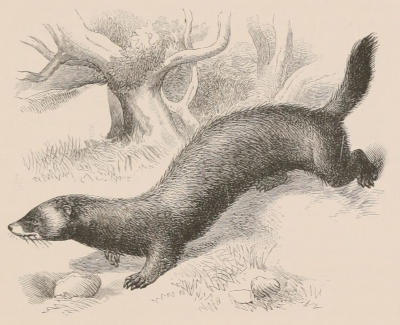
Fig. 268.—The Common Polecat (Mustela putorius).
The Polecats include four species confined to the northern hemisphere, the best known of which is the Common Polecat (M. putorius, Fig. 268). The Ferret is a domesticated variety of this species, generally of a yellowish-white colour; whereas the Wild Polecat is dark brown above and black beneath, the face being variegated with dark brown and white markings.
The skull is rough, strongly ridged, and of a far more powerful type than that of the Stoats, Weasels, or Martens; being in the female much smaller and lighter than in the male. The fur, which is long, coarse, and of comparatively small value, changes its colour very little, if at all, at the different seasons of the year.
The distribution and habits of this species have been described by Blasius, the following being an abstract of his account. The Polecat ranges over the greater part of Europe, reaching northwards into Southern Sweden, and in Russia to the region of the White Sea. It does not occur in the extreme South, but is common everywhere throughout Central Europe. In the Alps it ranges far above the tree-line during the summer, but retreats in winter to lower ground. In fine weather it lives either in the open air, in holes, fox-earths, rabbit-warrens, under rocks, or in wood-stacks, while in winter it seeks the protection of deserted buildings. During the day it sleeps in its hiding-place, sallying forth at night to plunder dovecots and hen-houses. It climbs but little, and shows far less activity than the Marten. It feeds ordinarily on small mammals, such as rabbits, hamsters, rats, and mice, on such birds as it can catch, especially poultry and pigeons, and also on snakes, lizards, frogs, fish, and eggs. Its prey is devoured only in its lair, but, even though it can carry away but a single victim, it commonly kills everything that comes in its way, often destroying all the inhabitants of a hen-house in order to gratify its passion for slaughter. The pairing time is towards the end of the winter, and the young, from three to eight in number, are born in April or May, after a period of gestation of about two months. The young, if taken early, may be easily trained, like Ferrets, for rabbit catching. The Polecat is very tenacious of life, and will bear many severe wounds before succumbing; it is also said to receive with impunity the bite of the adder. Its fetid smell has become proverbial.
Four other species of Polecats are known, viz.—The Siberian Polecat (M. eversmanni) of Western and Northern Asia is nearly allied to the European species, but the head and back are almost white, and the skull is stouter and more constricted behind the orbits. The Tibetan M. larvata is distinguished from the last by the presence of a process connecting the pterygoid with the auditory bulla, and by a difference in the shape of the upper molar. The American Polecat (M. nigripes), inhabiting the central plateau of the United States, and extending southwards into Texas, is another closely allied species, although some zoologists have made it the type of the genus Cynomyonax. Finally, the Mottled Polecat (M. sarmatica) is a species sparsely distributed in Eastern Europe and parts of Western Asia, but common in Southern Afghanistan. Its skull, although smaller, resembles that of the common species; but the coloration is very different, all the upper parts being mottled with large irregular reddish spots on a white ground, and the under side, limbs, and tail deep shining black. The tail is long.
The Common Polecat occurs in a fossil condition in the cave-deposits of Europe.
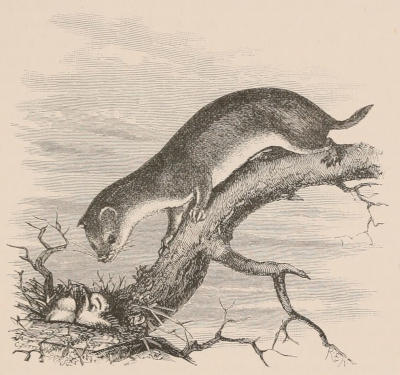
Fig. 269.—The Common Weasel (Mustela vulgaris).
The remaining members of the genus comprise the true Weasels and Stoats, which are of almost cosmopolitan distribution. In the Common Weasel (M. vulgaris, Fig. 269) the upper parts, outside of limbs and tail, are a uniform reddish-brown, the under parts pure white. In very cold regions, both in Europe and America, it turns completely white in winter, but less regularly and at a lower temperature than the Stoat, from which it is easily distinguished by its smaller size, and by its wanting the black end of the tail. The length of the head and body of the male is usually about 8 inches, that of the tail 2½ inches; the female is smaller.
This species is pretty generally distributed throughout Europe, Northern and Central Asia, British North America, and the northern portions of the United States. It possesses in a full degree all the active, courageous, and bloodthirsty disposition of the rest of the genus, but its diminutive size prevents it attacking and destroying any but the smaller mammals and birds. Mice, rats, voles, moles, and frogs constitute its principal food. It is generally found on or near the surface of the ground, but it can not only pursue its prey through very small holes and crevices of rocks and under dense tangled herbage, but follow it up the stems and branches of trees, or even into the water, swimming with perfect ease. It constructs a nest of dried leaves and herbage, placed in a hole in the ground or a bank or hollow tree, in which it brings up its litter of four to six (usually five) young ones. The mother will defend her young with the utmost desperation against any assailant, having been often known to sacrifice her own life rather than desert them.
The Stoat or Ermine (M. erminea) has nearly the same distribution as the Weasel, but in Asia it is said to extend into parts of the Kashmir Himalaya. Its size, as already mentioned, considerably exceeds that of the Weasel; and its most distinctive feature is the black tip at the end of the tail, which remains when the rest of the pellage turns white. The white winter skins from the northern regions of its habitat, where the fur is thick and close, form the well-known and valuable ermine of commerce. Remains of the Stoat are found in the Pleistocene cavern-deposits of Europe. The other species of Weasels are very numerous and widely distributed.
Extinct Mustelines.—A number of European Miocene Carnivores may be referred to the genus Mustela in its wider sense, and serve to confirm the propriety of this use of the term. Thus M. sectoria is a species of somewhat larger size than the Stoat, with p ⁴⁄₄, while in M. angustifrons the number of premolars is ³⁄₄, and in M. mustelina ⁴⁄₃; the latter species agreeing very closely in size with the Stoat. The extinct Plesictis, in which there are p ⁴⁄₄ and the lower carnassial has a large inner cusp, is distinguished from Mustela by the circumstance that the temporal ridges of the skull never unite to form a sagittal crest. Moreover, the inner tubercular portion of the upper molar (as in some of the Miocene species of Mustela) is shorter in an antero-posterior direction than the secant outer moiety; and the auditory bulla is more inflated than in Mustela, although it has no septum. Both these features indicate a decided approximation to the Viverroid genus Stenoplesiotis (p. 539); and since there are no well-marked characters of family value by which these two genera can be distinguished the available evidence points to a transition from the Viverroid to the Musteloid type. Mustela larteti, of the Middle Miocene of France, should perhaps be referred to Ictonyx.
Pœcilogale.[512]—This genus has been made for the reception of the South African Mustela albinucha, in which the coloration is similar to that of Ictonyx, but the number of cheek-teeth is usually reduced to p ²⁄₂, m ¹⁄₁, although there may be a second lower molar. The auditory bulla is quite flat.
Lyncodon.[513]—This name has been proposed for a small Musteline from Patagonia, with p ²⁄₂, m ¹⁄₁, which Mr. O. Thomas suggests may be nothing more than an aberrant southern form of Mustela (Putorius) brasiliensis. The auditory bulla is more inflated than in the typical Weasels. This animal is somewhat larger than the Stoat.
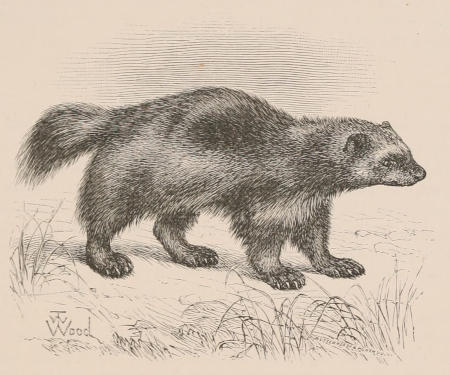
Fig. 270.—The Wolverene (Gulo luscus).
Gulo.[514]—Dentition: i ³⁄₃, c ¹⁄₁, p ⁴⁄₄, m ¹⁄₂; total 38. Crowns of the teeth very stout. Upper molar very much smaller than the carnassial. Lower carnassial large, with very small talon and no inner cusp. Third upper incisor unusually large, almost like a canine. The dentition, though really but a modification of that of the Weasels, presents a great general resemblance to that of the Hyæna. Palate prolonged somewhat behind the last molar. Humerus with an entepicondylar foramen. Vertebræ: C 7, D 15, L 5, S 3, C 15. Body and limbs stoutly made. Feet large and powerful, subplantigrade, with large, compressed, much curved, and sharp-pointed claws. Soles of the feet (except the pads of the toes) covered with thick bristly hairs. Ears very small, nearly concealed by the fur. Eyes small. Tail short, thick, and bushy. Fur full, long, and rather coarse. The one species, the Wolverene or Glutton (G. luscus, Fig. 270), an inhabitant of the forest regions of Northern Europe, Asia, and America, much resembles a small Bear in appearance. It is a very powerful animal for its size, climbs trees, and lives on grouse, squirrels, hares, foxes, beavers, reindeer, and is said to attack even horses and cows. The Wolverene has a curious habit of stealing and secreting articles of which it can make no possible use, as is exemplified in the following instance related by Dr. Coues: “A hunter and his family, having left their lodge unguarded during their absence, on their return found it completely gutted—the walls were there, but nothing else. Blankets, guns, kettles, axes, cans, knives, and all the other paraphernalia of a trapper’s tent had vanished, and the tracks left by the beast showed who had been the thief. The family set to work, and, by carefully following up all his paths, recovered, with some trifling exceptions, the whole of the lost property.” The pairing season occurs in March, and the female, secure in her burrow, produces her young, four or five at a birth, in June or July. In defence of these she is exceedingly bold, and the Indians, according to Coues, “have been heard to say that they would sooner encounter a she-bear with her cubs than a carcajou (the Indian name of the glutton) under the same circumstances.”
Fossil remains of the Wolverene are found in cavern and other Pleistocene deposits in various parts of Europe.
Suborder Pinnipedia.
The Eared-Seals, Walruses, and Seals differ from the rest of the Carnivora mainly in the structure of their limbs, which are modified for aquatic progression,—the two proximal segments being very short and partially enveloped in the general integument of the body; while the third segment, especially in the hinder extremities, is elongated, expanded, and webbed. There are always five well-developed digits on each limb. In the hind limb the two marginal digits (first and fifth) are stouter and generally longer than the others. The teeth also differ from those of the more typical Carnivora. The incisors are always fewer than ³⁄₃. The cheek series consists generally of four premolars and one molar of very uniform characters, with never more than two roots, and with conical, more or less compressed, pointed crowns, which may have accessory cusps, placed before or behind the principal one, but are never broad and tuberculated; and there is no differentiated carnassial tooth. The milk-teeth are very small and simple, and are shed or absorbed at a very early age, usually either before or within a few days after birth. The brain is relatively large; the cerebral hemispheres being broad in proportion to their length, with numerous and complex convolutions. There is a very short cæcum. The kidneys are divided into numerous distinct lobules. There are no Cowper’s glands. The mammæ are either two or four, and abdominal in position. No clavicles. Tail always very short. Eyes very large and exposed, with flat cornea.
The animals of this group are all aquatic in their mode of life, spending the greater part of their time in the water, swimming and diving with great facility, feeding mainly on fish, crustaceans, and other marine animals, and progressing on land with difficulty. They always come on shore, however, for the purpose of bringing forth their young. They are generally marine, but they occasionally ascend large rivers, and some inhabit inland seas and lakes, as the Caspian and Baikal. Though not numerous in species, they are widely distributed over the world, but occur most abundantly on the coasts of lands situated in cold and temperate zones. The suborder is divisible into three well-marked families: the Otariidæ, Fur-Seals or Sea-Bears, which form a transition from the Fissiped Carnivora to the Seals; the Trichechidæ, containing the Walrus; and the Phocidæ or typical Seals.
The resemblances between the skull and other parts of the body of the Fur Seals and the Ursoid true Carnivora is suggestive of some genetic relationship between the two groups, and Professor Mivart[515] expresses the opinion that the one group is the direct descendant of the other. The same writer goes on to suggest that if the Eared-Seals have been derived from Bear-like Carnivores this need not necessarily hold good with the true Seals, which may have had another, and possibly Lutrine, origin. The presence of an alisphenoid canal in Ursus and the Otariidæ, and its absence in Lutra and the Phocidæ, together with other osteological features, are cited in support of this view; but although these resemblances and differences are certainly remarkable, yet much more evidence is required before the hypothesis can be accepted as even a probable one. It must, moreover, be borne in mind that the true Bears are a very modern group; and there is a possibility that the Pinnipeds may prove to have been independently derived from the extinct Carnivora noticed below under the name of Creodonta.
Family Otariidæ.
When on land the hind feet are turned forwards under the body, and aid in supporting and moving the trunk as in ordinary mammals. A small external ear. Testes suspended in a distinct external scrotum. Skull with postorbital processes, and an alisphenoid canal. Angle of mandible inflected. Palms and soles of feet naked.
Otaria.[516]—Dentition: i ³⁄₂, c ¹⁄₁, p ⁴⁄₄, m ¹⁻²⁄₁; total 34 or 36. First and second upper incisors small, with the summits of the crowns divided by a deep transverse groove into an anterior and a posterior cusp of nearly equal height; the third large and canine-like. Canines large, conical, pointed, recurved. Molars and premolars usually ⁵⁄₅, of which the second, third, and fourth are preceded by milk-teeth shed a few days after birth; sometimes (as in Fig. 271) a sixth upper molar (occasionally developed on one side and not the other); all with similar characters, generally uniradicular; crown moderate, compressed, pointed, with a single principal cusp, and sometimes a cingulum, and more or less developed anterior and posterior accessory cusps. Vertebræ: C 7, D 15, L 5, S 4, C 9-14. Head rounded. Eyes large. Pinna of ear small, narrow, and pointed. Neck long. Skin of all the feet extended far beyond the nails and ends of the digits, with a deeply-lobed margin. The nails small and often quite rudimentary, especially those of the first and fifth toes of both feet, the best developed and most constant being the three middle claws of the hind foot, which are elongated, compressed, and curved.
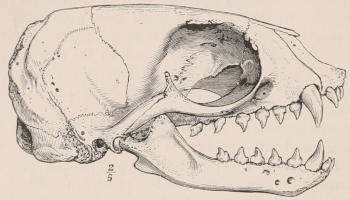
Fig. 271.—Skull of Otaria forsteri. (From Gray, Proc. Zool. Soc. 1872, p. 660.)
The Eared-Seals, commonly called Sea-Bears or Sea-Lions, are widely distributed, especially in the temperate regions of both hemispheres, though absent from the coasts of the North Atlantic. As might be inferred from their power of walking on all fours, they spend more of their time on shore, and range inland to greater distances, than the true Seals, especially at the breeding time, though they are obliged always to return to the water to seek their food. They are gregarious and polygamous, and the males are usually much larger than the females, a circumstance which has given rise to some of the confusion existing in the specific determination of the various members of the genus. Some of the species possess, in addition to the stiff, close, hairy covering common to all the group, an exceedingly fine, dense, woolly under fur. The skins of these, when dressed and deprived of the longer harsh outer hairs, constitute the “seal-skin” of commerce, so much valued for wearing apparel, which is not the product of any of the true Seals. The best-known species are O. stelleri, the Northern Sea Lion, the largest of the genus, from the North Pacific, about 10 feet in length; O. jubata, the Patagonian or Southern Sea Lion (Fig. 272), from the Falkland Islands and Patagonia; O. californiana, from California, frequently exhibited alive in menageries in Europe; O. ursina, the common Sea-Bear or Fur-Seal of the North Pacific, the skins of which are imported in immense numbers from the Prybiloff Islands; O. pusilla, from the Cape of Good Hope; O. forsteri and others, from the coasts of Australia and various islands scattered over the southern hemisphere. These have been grouped by some zoologists into many genera, founded upon very trivial modifications of teeth and skull. In a recent memoir Mr. Beddard[517] concludes that if the genus be split up at all, it should be divided into Otaria, containing only O. jubata (with its numerous synonyms), and Arctocephalus, comprising all the other species. The latter group is distinguished by the more narrow and pointed nose, the longer ears, the palate not excavated nor truncated posteriorly, the presence of a hook-like process to the pterygoids, and by the posterior border of the nasals extending behind the zygoma.
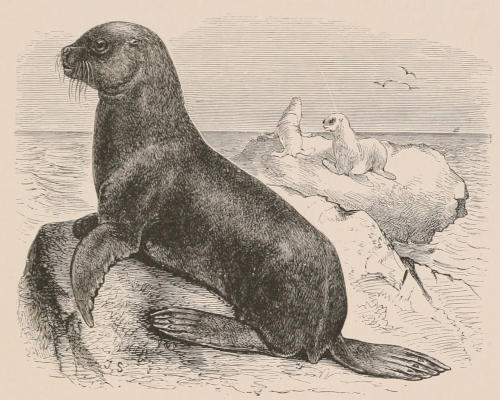
Fig. 272.—The Patagonian Sea-Lion (Otaria jubata). From Sclater, Proc. Zool. Soc. 1866, p. 80.
The following account of O. ursina in the Prybiloff Islands is taken, with slight verbal alteration, from Nordenskiöld’s Voyage of the Vega: “The Sea-Bears are found year after year during summer at certain parts of the coast, known as ‘rookeries,’ where, collected in hundreds of thousands, they pass several months without the least food. The males or ‘bulls’ come first to the place, most of them in the month of May or in the beginning of June. The most violent conflicts, often with a deadly issue for one of the parties, now arise regarding the space of about a hundred square feet which each bull-seal considers necessary for his home. The strongest and most successful in fight retain the best places near the shore; the weaker have to crawl farther up on land, where the chances of getting a sufficient number of spouses are not particularly great. The fighting goes on with many feigned attacks and parades. At first the contest concerns only the proprietorship of the soil. The attacked, therefore, never follows his opponent beyond the area he has once taken up, but haughtily lays itself down, when the enemy has retired, in order to collect strength for a new combat. The animal in such a case grunts with satisfaction, throws himself on his back, scratches himself with his fore feet, attends to his toilet, or cools himself by slowly fanning with one of his hind feet; but he is always on the alert and ready for a new fight, until he is tired out and meets his match and is driven farther up from the beach. In the middle of June the females come up from the sea. At the water’s edge they are received in a very gallant way by some strong bulls that have succeeded in securing for themselves places next the shore, and now are bent by fair means or foul on annexing the females for their harem. But scarcely is the female that has come up out of the water established with male No. 1 than he rushes towards a new female on the surface of the water. Male No. 2 now stretches out his neck and without ceremony lays hold of the female of No. 1, to be afterwards exposed to a similar trick by No. 3. In such cases the females are quite passive, never fall out with each other, and bear with patience the severe wounds they often get when they are pulled about by the combatants, now in one direction, now in another. All the females are finally distributed in this way after furious combats among the males, those of the latter who are nearest the beach getting from 12 to 15 consorts to their share. Soon after landing the females bring forth their young, which are treated with great indifference, and are protected by their adopted father only within the limits of the harem. Next comes the pairing season, and when it has passed there is an end to the arrangement and distribution into families at first so strictly maintained. The males, rendered lean by three months’ absolute fasting, by degrees leave the rookery, which is left in possession of the Walruses and the young Sea Bears, including a number of young males that have not ventured to the place before. In the middle of September, when the young have learned to swim, the place is quite abandoned, with the exception of single animals that have for some reason remained behind.”
Family Trichechidæ.
In many characters the single genus representing this family is intermediate between the Otariidæ and Phocidæ, but it has a completely aberrant dentition. It has no external ears, as in the Phocidæ; but when on land the hind feet are turned forwards and used in progression, though less completely than in the Otariidæ. The upper canines are developed into immense tusks, which descend a long distance below the lower jaw. All the other teeth (Fig. 273), including the lower canines, are much alike, small, simple, and one-rooted, the molars with flat crowns. The skull is without postorbital process, but has an alisphenoid canal.
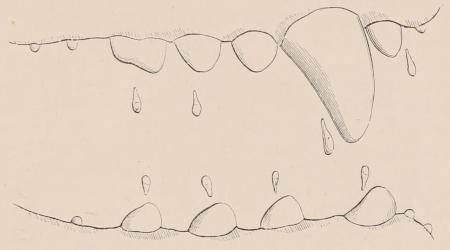
Fig. 273.—Diagram of the dentition of the Walrus (Trichechus rosmarus). The denticles placed apart from the others are milk-teeth, and disappear soon after birth. The small teeth in connection with the jaws frequently persist throughout life.
Trichechus.[518]—Dentition of young: i ²⁄₂, c ¹⁄₁, p and m ⁵⁄₄. Many of these teeth are, however, lost early or remain through life in a rudimentary state concealed by the gums. The teeth which are usually developed functionally are i ¹⁄₀, c ¹⁄₁, p ³⁄₃, m ⁰⁄₀; total 18. Vertebræ: C 7, D 14, L 6, S 4, C 12. Head round. Eyes rather small. Muzzle short and broad, with on each side a group of long, very stiff, bristly whiskers. The remainder of the hair-covering very short and adpressed. Tail very rudimentary. Fore feet with subequal toes, carrying five minute flattened nails. Hind feet with subequal toes, the fifth slightly the largest, having cutaneous lobes projecting beyond the ends as in Otaria; first and fifth with minute flattened nails; second, third, and fourth with large, elongated, subcompressed pointed nails.
Trichechus is the almost universally accepted generic name by which the Walrus or Morse[519] is known to zoologists, but some confusion has been introduced into literature by the revival of the nearly obsolete terms Rosmarus by some authors and Odobænus by others. T. rosmarus is the name of the species met with in the Arctic seas; that of the North Pacific, if distinct, is T. obesus. The preceding and following descriptions will apply equally to both. A full-grown male Walrus measures from 10 to 11 feet from the nose to the end of the very short tail, and is a heavy, bulky animal, especially thick about the shoulders. The soles of both fore and hind feet are bare, rough, and warty. The surface of the skin generally is covered with short, adpressed hair of a light, yellowish-brown colour, which, on the under parts of the body and base of the flippers, passes into dark reddish-brown or chestnut. In old animals the hair becomes more scanty, sometimes almost entirely disappearing, and the skin shows ample evidence of the rough life and pugnacious habits of the animal in the innumerable scars with which it is usually covered. It is everywhere more or less wrinkled, but especially over the shoulders, where it is thrown into deep and heavy folds.
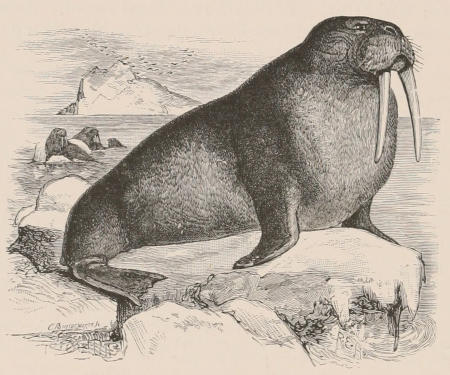
Fig. 274.—The Walrus (Trichechus rosmarus).
The tusks are formidable weapons of defence, but their principal use seems to be scraping and digging among the sand and shingle for the molluscs and crustaceans on which the Walrus feeds. They are said also to aid in climbing up the slippery rocks and ledges of ice on which so much of the animal’s life is passed. Although this function of the tusks is affirmed by numerous authors, some of whom appear to have had opportunities of actual observation, it is explicitly denied by Malmgren.
Walruses are more or less gregarious in their habits, being met with generally in companies or herds of various sizes. They are only found near the coast or on large masses of floating ice, and rarely far out in the open sea; and, though often moving from one part of their feeding ground to another, they have no regular seasonal migrations. Their young are born between the months of April and June, usually but one at a time, never more than two. Their strong affection for their young, and their sympathy for each other in times of danger, have been particularly noticed by all who have had the opportunity of observing them in their native haunts. When one of their number is wounded, the whole herd usually join in a concerted and intelligent defence. Although harmless and inoffensive when not molested, they exhibit considerable fierceness when attacked, using their great tusks with tremendous effect either on human enemies who come into too close quarters or on Polar Bears, the only other adversaries they can meet with in their own natural territory. Their voice is a loud roaring, and can be heard at a great distance; it is described by Dr. Kane as “something between the mooing of a cow and the deepest baying of a mastiff, very round and full, with its bark or detached notes repeated rather quickly seven or nine times in succession.”
The principal food of the Walrus consists of bivalved molluscs, especially Mya truncata and Saxicava rugosa, two species very abundant in the Arctic regions, which it digs up from the mud and sand in which they lie buried at the bottom of the sea by means of its tusks. It crushes and removes the shells by the aid of its grinding teeth and tongue, swallowing only the soft part of the animal. It also feeds on other molluscs, sand-worms, star-fishes, and shrimps. Portions of various kinds of algæ or sea-weeds have been found in its stomach, but whether swallowed intentionally or not is still doubtful.
The commercial products of the Walrus are its oil, hide (used to manufacture harness and sole-leather and twisted into tiller ropes), and tusks. The ivory of the latter is, however, inferior in quality to that of the Elephant. Its flesh forms an important article of food to the Eskimo and Tchuktchis. Of the coast tribes of the last-named people the Walrus forms the chief means of support. “The flesh supplies them with food, the ivory tusks are made into implements used in the chase and for other domestic purposes, as well as a affording a valuable article of barter, and the skin furnishes the material for covering their summer habitations, harness for their dog-teams, and lines for their fishing gear” (Scammon).
Geographically the Walrus is confined to the northern circumpolar regions of the globe, extending apparently as far north as explorers have penetrated, but its southern range has been much restricted of late in consequence of the persecutions of man. On the Atlantic coast of America it was met with in the sixteenth century as low as the southern coast of Nova Scotia, and in the last century it was common in the Gulf of St. Lawrence and on the shores of Labrador. It still inhabits the coast round Hudson’s Bay, Davis Straits, and Greenland, where, however, its numbers are daily decreasing. It is not found on the Arctic coast of America between the 97th and 158th meridians. In Europe occasional stragglers have reached the British Isles, and it was formerly abundant on the coasts of Finmark. It is rare in Iceland, but Spitzbergen, Nova Zembla, and the western part of the north coast of Siberia are still constant places of resort, in all of which a regular war of extermination is carried on. The North Pacific, including both sides of Behring’s Strait, northern Kamschatka, Alaska, and the Pribyloff Islands, are also the haunts of numerous Walruses, which are isolated from those of the North Atlantic by the long stretches of coast, both of Siberia and North America, where they do not occur. The Pacific Walrus appears to be as large as, if not larger than, that of the Atlantic; its tusks are longer and more slender, and curved inwards; the whiskers are smaller, and the muzzle (of the skull) relatively deeper and broader. These and certain other minor differences have induced some naturalists to consider it specifically distinct under the name of Trichechus obesus. Its habits appear to be quite similar to those of the Atlantic form. Though formerly found in immense herds, it is rapidly becoming scarce, as the methods of destruction used by the American whalers, who have systematically entered upon its pursuit, are far more certain and deadly than those of the native Tchuktchis, to whom, as mentioned before, the Walrus long afforded the principal means of subsistence.
Fossil remains of Walruses and closely allied animals have been found in the United States, and in England, Belgium, and France, in deposits of Pliocene age.
Family Phocidæ.
The true Seals are the most completely adapted for aquatic life of all the Pinnipeds. When on land the hind limbs are extended behind them and take no part in progression, which is effected by a series of jumping movements produced by the muscles of the trunk, in some species aided by the fore limbs only. The palms and soles of the feet are hairy. There is no pinna to the ear, and no scrotum, the testes being abdominal. The upper incisors have simple, pointed crowns, and vary in number in the different groups. All the forms have well-developed canines and ⁵⁄₅ teeth of the cheek-series. In those species of which the milk-dentition is known, there are three milk molars (Fig. 275), which precede the second, third, and fourth permanent molars; the dentition is therefore p ⁴⁄₄, m ¹⁄₁, the first premolar having as usual no milk-predecessor. The skull has no postorbital process and no alisphenoid canal; and the angle of the mandible is not inflected. The fur is stiff and adpressed, without woolly under fur.
Subfamily Phocinæ.—Incisors ³⁄₂. All the feet with five well-developed claws. The toes on the hind feet subequal, the first and fifth not greatly exceeding the others in length, and with the interdigital membrane not extending beyond the toes.
Halichœrus.[520]—Dentition: i ³⁄₂, c ¹⁄₁, p ⁴⁄₄, m ¹⁄₁; total 34. Crowns of molars large, simple, conical, recurved, slightly compressed, with sharp anterior and posterior edges, but without accessory cusps, except sometimes in the two hinder ones of the lower jaw. With the exception of the last one or two in the upper jaw and the last in the lower jaw they are all uniradicular. Vertebræ: C 7, D 15, L 5, S 4, C 14.
One species, H. grypus, the Gray Seal of the coasts of Scandinavia and the British Isles (see page 604.)
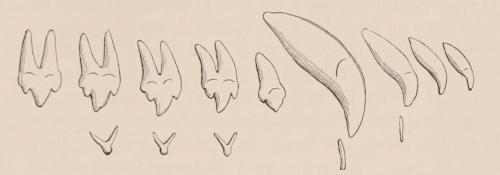
Fig. 275.—Upper permanent and deciduous dentition of the Greenland Seal (Phoca grœnlandica). The first and second deciduous incisors are already absorbed.
Phoca.[521]—Dental formula as the last. Teeth smaller and more pointed. Molars (Figs. 275 and 276) with two roots (except the first in each jaw); and their crowns with accessory cusps. Vertebræ: C 7, D 15, L 5, S 4, C 12-15. Head round and short. Fore feet short, with five very strong, subcompressed, slightly curved, rather sharp claws, subequal in length. On the hind feet the claws much narrower and less curved. The species of this genus are widely distributed throughout the northern hemisphere, and include P. barbata, the Bearded Seal; P. grœnlandica, the Greenland Seal; P. vitulina, the Common Seal (Fig. 277); and P. hispida, the Ringed Seal of the North Atlantic; P. caspica, from the Caspian and Aral Seas; and P. sibirica, from Lake Baikal.
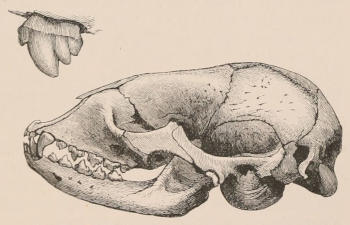
Fig. 276.—Skull of Common Seal, showing form of teeth.
Although the members of this subfamily swim and dive with the greatest ease, often remaining as much as a quarter of an hour or more below the surface, and are dependent for their sustenance entirely on living prey captured in the water, yet they frequently resort to sandy beaches, rocks, or ice-floes, either to sleep or to bask in the sun, and especially for the purpose of bringing forth their young. The latter appears to be the universal habit, and, strange as it may seem, the young seals—of some species at least—take to the water at first very reluctantly, and have actually to be taught to swim by their parents. The number of young produced is usually one annually, though occasionally two. They are at first covered with a coat of very thick, soft, nearly white fur, and until it falls off they do not usually enter the water. This occurs in the Greenland and Gray Seal when from two to three weeks old, but in the Common Seal apparently much earlier. One of this species born in the London Zoological Gardens had shed its infantile woolly coat and was swimming and diving about in its pond within three hours after its birth. The movements of the true Seals upon the ground or ice are very different from those of the Eared-Seals. Thus the hinder limbs (by which mainly they propel themselves through the water) are on land always perfectly passive, stretched backwards, with the soles of the feet applied to each other, and often raised to avoid contact with the ground. Sometimes the fore limbs are equally passive, being placed close to the sides of the body, and motion is then effected by a shuffling or wriggling action produced by the muscles of the trunk. When, however, there is any necessity for a more rapid mode of progression the animals use the fore paws, either alternately or simultaneously, pressing the palmar surface on the ground and lifting and dragging the body forwards in a succession of short jumps. In this way they manage to move so fast that a man has to step out beyond a walk to keep up with them; but such rapid action costs considerable effort, and they very soon become heated and exhausted. These various modes of progression appear to be common to all species so far as has been observed.
Most kinds of Seals are gregarious and congregate, especially at the breeding season, in immense herds. Such is the habit of the Greenland Seal (Phoca grœnlandica), which resorts in the spring to the ice-floes of the North Sea, around Jan Mayen Island, where about 200,000 are killed annually by the crews of the Scotch, Dutch, and Norwegian sealing vessels. Others, like the Common Seal of the British islands (P. vitulina), though having a wide geographical range, are never met with in such large numbers or far away from land. This species is stationary all the year round, but some have a regular season of migration, moving south in winter and north in summer. They are usually harmless, timid, inoffensive animals, though, being polygamous, the old males often fight desperately with each other, their skins being frequently found covered with wounds and scars. They are greatly attached to their young, and remarkably docile and easily trained when in captivity; indeed, although there would seem little in the structure or habits of the Seal to fit it by nature to be a companion of man, yet there is perhaps no wild animal which attaches itself so readily to the person who takes care of and feeds it. Seals appear to have much curiosity, and it is a very old and apparently well-attested observation that they are strongly attracted by musical sounds. Their sense of smell is very acute, and their voice varies from a harsh bark or grunt to a plaintive bleat. Seals feed chiefly on fish, of which they consume enormous quantities; some, however, subsist largely on crustaceans, especially species of Gammarus, which swarm in the northern seas, also on molluscs, echinoderms, and even occasionally sea-birds, which they seize when swimming or floating on the water.
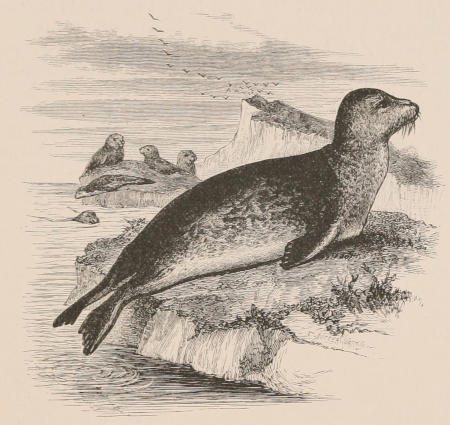
Fig. 277.—The Common Seal (Phoca vitulina).
Although the true Seals do not possess the beautiful under fur (“seal-skin” of the furriers) which makes the skin of the Sea-Bears so precious, yet their hides are still sufficiently valuable as articles of commerce, together with the oil yielded by their fat, to subject them to a devastating persecution, by which their numbers are being continually diminished.
Two species of seals only are met with regularly on the British coasts, the Common Seal and the Gray Seal. The former (Fig. 277) is a constant resident in all suitable localities round the Scottish, Irish, and English coasts, from which it has not been driven away by the molestations of man. Although, naturally, the most secluded and out-of-the-way spots are selected as their habitual dwelling-places, there are few localities where they may not be occasionally met with. Within the writers’ knowledge one was seen not many years ago lying on the shingly beach at so populous a place as Brighton, and another was caught in the river Welland, near Stamford, 30 miles from the sea. They frequent bays, inlets, and estuaries, and are often seen on sandbanks or mudflats left dry at low tide, and, unlike some of their congeners, are not found on the ice-floes of the open sea, nor, though gregarious, are very large numbers ever seen in one spot. The young are produced at the end of May or beginning of June. They feed chiefly on fish, and the destruction they occasion among salmon is well known to Scottish fishermen. The Common Seal is widely distributed, being found not only on the European and American coasts bordering the Atlantic Ocean, but also in the North Pacific. It is from 4 to 5 feet in length, and variable in colour, though usually yellowish-gray, with irregular spots of dark brown or black above and yellowish-white beneath. The Gray Seal (Halichœrus grypus) is of considerably larger size, the males attaining when fully adult a length of 8 feet from nose to end of hind feet. It is of a yellowish-gray colour, lighter beneath, and with dark gray spots or blotches, but, like most other Seals, is liable to great variations of colour according to age. This species appears to be restricted to the North Atlantic, having been rarely seen on the American coasts, but not farther south than Nova Scotia; it is chiefly met with on the coasts of Ireland, England, Scotland, Norway, and Sweden, including the Baltic and Gulf of Bothnia, and Iceland, though it does not appear to range farther north. It is apparently not migratory, and its favourite breeding places are rocky islands; the young being born in the end of September or beginning of October.
Subfamily Monachinæ.—Incisors ²⁄₂. Cheek-teeth two-rooted, except the first. On the hind feet the first and fifth toes greatly exceeding the others in length, with nails rudimentary or absent.
Monachus.[522]—Dentition: i ²⁄₂, c ¹⁄₁, p ⁴⁄₄, m ¹⁄₁; total 32. Crowns of molars strong, conical, compressed, hollowed on the inner side, with a strongly marked lobed cingulum, especially on the inner side, and slightly developed accessory cusps before and behind. The first and last upper and the first lower molar considerably smaller than the others. Vertebræ: C 7, D 15, L 5, S 2, C 11. All the nails of both fore and hind feet very small and rudimentary. One species, M. albiventer, the Monk-Seal of the Mediterranean and adjacent parts of the Atlantic.
The other genera[523] of this section have the same dental formula, but are distinguished by the characters of the cheek-teeth and the feet. They are all inhabitants of the shores of the southern hemisphere.
Ogmorhinus.[524]—All the teeth of the cheek-series with three distinct pointed cusps, deeply separated from each other; of these the middle or principal cusp is largest and slightly recurved; the other two (anterior and posterior) are nearly equal in size, and have their apices directed towards the middle one. Skull much elongated. One species, O. leptonyx, the Sea-Leopard, widely distributed in the Antarctic and southern temperate seas.
Lobodon.[525]—Cheek-teeth with much-compressed elongated crowns and a principal recurved cusp, rounded and somewhat bulbous at the apex, and one anterior, and one, two, or three posterior, very distinct accessory cusps. One species, L. carcinophaga.
Pœcilophoca.[526]—Cheek-teeth small, with simple, subcompressed, conical crowns, having a broad cingulum, but no distinct accessory cusps. One species, P. weddelli.
Ommatophoca.[527]—All the teeth very small; those of the cheek-series with pointed recurved crowns, and small posterior and still less developed anterior accessory cusps. Orbits very large. Nails quite rudimentary on front, and absent on hind feet. The skull bears a considerable resemblance to that of the members of the next subfamily, towards which it may form a transition. There is one species, O. rossi, of which very little is known.
Subfamily Cystophorinsæ.—Incisors ²⁄₁. Teeth of cheek-series generally one-rooted. Nose of males with an appendage capable of being inflated. First and fifth toes of hind feet greatly exceeding the others in length, with prolonged cutaneous lobes, and rudimentary or no nails.
Cystophora.[528]—Dentition: i ²⁄₁, c ¹⁄₁, p ⁴⁄₄, m ¹⁄₁; total 30. The last molar has generally two distinct roots. Beneath the skin over the face of the adult male, and connected with the nostrils, is a sac which, when inflated, forms a kind of hood covering the upper part of the head. Nails present, though small, on the hind feet. One species, C. cristata, the Hooded or Bladder-Nose Seal of the Polar Seas.
Macrorhinus.[529]—Dentition as the last, but cheek-teeth of simpler character, and all one-rooted. All the teeth, except the canines, very small relatively to the size of the animal. Hind feet without nails. Vertebræ: C 7, D 15, L 5, S 3, C 11. Nose of adult male produced into a short tubular proboscis, ordinarily flaccid, but capable of dilatation and elongation under excitement. One species, M. leoninus, the Elephant Seal, or Sea-Elephant of the whalers, the largest of the whole family, attaining the length of nearly 20 feet. Formerly abundant in the Antarctic Seas, and also found on the coast of California.
Extinct Seals.—Remains of animals of this group have been found in late Miocene and Pliocene strata in Europe and America, the most abundant and best-preserved being those of the Pliocene Antwerp Crag, the subject of an illustrated monograph by Van Beneden. Nothing has, however, yet been discovered which throws any light upon the origin of the group, since all the extinct forms at present known come within the definition of the existing families; and, though annectant forms between these occur, there are as yet no transitions to a more generalised type of mammal. Indeed, all those of which the characters are best known belong to the completely developed Phocine or Trichechine, and not to the Otariine, type. The typical genus Phoca occurs in the Antwerp Crag, while remains of Seals provisionally referred to this genus are found in the Pliocene of the Crimea and the Miocene of Malta and Virginia. Of the other Antwerp forms Callophoca is said to be allied to Phoca grœnlandica, Platyphoca to Phoca barbata, Phocanella to Phoca foetida, Gryphoca to Halichœrus, Palæophoca and Monatherium to Monachus, and Mesotaria to Cystophora; while Prophoca does not appear to come very close to any existing form. It should be observed that it is extremely doubtful whether all these fossil Seals are really entitled to generic distinction.
Bibliography of Pinnipedia.—J. A. Allen, History of North American Pinnipeds, 1880; St. George Mivart, “Notes on the Pinnipedia,” Proc. Zool. Soc. 1885, p. 484; P. J. Van Beneden, Ossements fossiles d’Anvers, in the Mém. Acad. Roy. d. Belgique.
Suborder Creodonta.
The discovery of fossil remains in Eocene and early Miocene formations both in Europe and North America shows that numerous species of terrestrial carnivorous animals existed upon the earth during those periods which cannot be referred to either of the sections into which the order has now become broken up. By some zoologists these have been supposed to be Marsupials, or at least to show transitional characters between the Metatherian and Eutherian subclasses. By others they are looked upon as belonging altogether to the latter group, and as the common ancestors of existing Carnivores and Insectivores, or perhaps rather as descendants or relatives of such common ancestors, retaining more of the generalised characters than any of the existing species. They shade off almost insensibly into numerous other forms less distinctly carnivorous, to the whole of which, including the modern Insectivora, Cope (to whom we are indebted for much of our knowledge of the American extinct species) gives the name of Bunotheria, those more specially related to the existing Carnivora forming the suborder Creodonta. These are instances, however, in which the application of the principles of classification adopted in the case of existing species, of which the entire structure is known, and which have become divided into isolated groups by the extinction of intermediate forms, is almost impossible. If the generally accepted view of evolution is true, and the extreme modifications pass insensibly into each other by minute gradations (a view the palæontological proof of which becomes strengthened by every fresh discovery), there must be many of these extinct forms which cannot be assigned to definitely characterised groups. There are, however, some which stand out prominently from the others as formed on distinct types, having no exact representatives at present living on the earth.
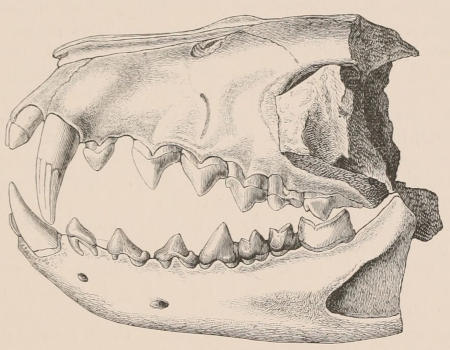
Fig. 278.—Anterior portion of the skull of Hyænodon leptorhynchus. (After Filhol.)
The more typical Creodonts appear, however, to be so closely related to the true Carnivora through the extinct Miacidæ (p. 539), that it is on the whole advisable to regard them as representing a distinct suborder of Carnivora. In the strong development of the canines (Fig. 278) they are distinguished from the modern Insectivora; and they also differ from the latter and resemble the true Carnivores in the form of the incisors, the second one in the lower jaw (when three are present) being thrust up above the level of the other two in the manner obtaining in most of the modern Carnivora. Some of the most generalised forms included in the present group approximate so closely to the Condylarthrous Ungulates as to indicate that both groups have probably had a common origin.
The Creodonta as a whole are characterised by the small size of the brain, the absence of a single differentiated carnassial tooth, and the triangular form or secant character of their upper molars. In the carpus the scaphoid and lunar were usually distinct; the femur has a third trochanter; the upper or tibial surface of the astragalus usually wants the groove found in modern Carnivores: and the feet were plantigrade. The curious resemblance of the molars of many of these forms to those of the Marsupials may indicate a genetic relationship between the two groups; but, on the other hand, the presence of a full set of milk-teeth and the absence of palatal vacuities, or of an inflection of the angle of the mandible, sharply distinguishes them from that order. Space permits of a notice only of the more interesting forms.
Hyænodontidæ.—This family is taken to include some of the more specialised types, such as the European and American Hyænodon and Oxhyæna and the European Pterodon. In Hyænodon (Fig. 278) the dental formula is i ³⁄₃, c ¹⁄₁, p ⁴⁄₄, m ²⁄₃; the fourth premolar above and the first true molar below being formed upon the “carnassial” plan, but the teeth behind these, instead of being tuberculated as in all existing Carnivora, repeat the characters of the carnassial, and also increase in size, especially in the lower jaw, from before backwards. The last lower molar differs from the two preceding teeth, and is very like the carnassial of Felis. The scaphoid and lunar of the carpus were fused together. Some species, as H. leptorhynchus, were as large as a Wolf, while others did not exceed a Fox in size. Pterodon is readily distinguished by having m ³⁄₃, by the larger size of the inner tubercles of the upper molars, and the similarity in the form of the three lower molars. In some species there were only two upper incisors, and the first lower premolar may be wanting. Oxhyæna is a specialised form with i ²⁻³⁄₀, c ¹⁄₁, p ⁴⁄₄, m ²⁄₂, and a very long mandibular symphysis.
Proviverridæ.—The European and American genus Proviverra (Cynohyænodon or Stypolophus) may be regarded as representing a second family. The dental formula in this genus is the typical i ³⁄₃, c ¹⁄₁, p ⁴⁄₄, m ³⁄₃, the upper molars have a large inner tubercle, while the lower molars are differentiated into a blade and talon, the blade having a large inner cusp. The upper teeth closely resemble the molars of Dasyurus, while the lower molars are like the lower carnassial of Cynodictis and Viverra; and thus indicate how the Creodonts may have passed into the true Carnivores through the extinct Miacidæ.
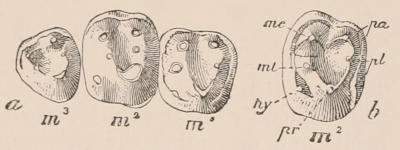
Fig. 279.—The three right upper molars of Arctocyon dueli (a), and the second of A. gervaisi (b); from the lowest Eocene of Rheims. pr, protocone; pa, paracone; me, metacone; hy, hypocone; ml, metaconule; pl, paraconule. (From Osborn.)
Arctocyonidæ and Mesonychidæ.—The first of these families is represented by Arctocyon primævus, one of the oldest known Tertiary mammals, from the lowest Eocene beds of La Fère, department of Aisne, France, and also by other species from corresponding beds at Rheims. The dental formula is i ³⁄₃, c ¹⁄₁, p?⁄₃₋₄, m ³⁄₃. The upper molars (Fig. 279) are tritubercular, with an incipient postero-internal column (hypocone); the lower are quadritubercular; and the premolars simple. The typical species was of large size, but the two of which the teeth are figured were considerably smaller. In the American Mesonyx the dental formula was the typical one, the jaws were comparatively short, the mandibular symphysis was elongated, the cheek-teeth were of simple structure, and resembled the premolars of many of the true Carnivora, and the astragalus had a grooved tibial surface and distinct distal facets for the cuboid and navicular, resembling in the latter respect the corresponding bone of a Perissodactyle Ungulate. The terminal phalanges had deeply fissured extremities, and are said to be more like those of Rodents than true Carnivores. Mesonyx ossifragus was larger than a Grizzly Bear. Amblyctonus, of the same deposits, differs by the smooth tibial face of the astragalus and the development of an anterior cusp to the lower molars.