Chapter X · THE ORDER RODENTIA (continued 2)
Reading edition
Dolichotis.[416]—Characterised by the great length of the ears and the short tail. The palate is so much contracted in front that the premolars of opposite sides touch by their antero-internal edges. Vertebræ: C 7, D 12, L 8, S 3, C 10.
The Patagonian Cavy (D. patachonica)—the only living representative of the genus—is rather larger than a Hare, which it somewhat resembles in external appearance. It inhabits the dry sterile districts of Patagonia and La Plata, disappearing wherever the country becomes more humid. This animal burrows in the earth, although in districts where the Viscacha is found it is said to avail itself of the works of the latter. Unlike other cavies, its eyes are protected from the glare of the sun by prominent eyelashes. The body is covered with a long dense fur of a rusty colour. Two young are produced at a birth. Three species of Dolichotis have been described from the Brazilian cave-deposits, one of which is probably not really separable from the existing form.
Hydrochœrus.[417]—A large aquatic form with all the feet fully webbed; the skull (Fig. 213, p. 481) large, with enormous paroccipital processes; and the molars very complex, the third upper one having some twelve transverse laminæ. Upper incisors grooved. Vertebræ: C 7, D 14, L 6, S 3, C 8.
The Capybara (H. capybara) is the largest existing Rodent, and the only living representative of the genus. It is a bulky and stoutly built animal, and attains a length of about 4 feet. The body is covered with long and coarse hair, reddish-brown above and brownish-yellow beneath. Capybaras are found over the whole of the eastern part of South America, and to the westward range into Bolivia and Peru. They frequent the borders of rivers and lakes, concealing themselves among reeds and other water plants. Remains of Hydrochœrus are found in the cavern-deposits of Brazil, which are probably referable to the existing species; one extinct species from the Pleistocene of Buenos Ayres is estimated to have attained a length of 5 feet, while H. magnus of the same deposits was of still larger dimensions. The genus is also represented in the Pleistocene of South Carolina and the infra-Pampean beds of Parana.
Extinct Genera.—A number of South American fossil Rodents have been referred to extinct genera of Caviidæ. Thus Plexochœrus, from the Tertiary of Argentina, differs from Hydrochœrus in having only nine laminæ in the last upper molar; Cardiomys, Cardiatherium, etc., from the infra-Pampeans are also stated to be allied to Hydrochœrus, while Contracavia, of the same deposits, is related to Cavia, but of larger size. Microcavia, again, from the Pleistocene of Argentina, is regarded as connecting Cavia with Dolichotis. The Tertiary European genera Issiodoromys and Nesocerodon are apparently referable to the present family.
Suborder Duplicidentata.
Two pairs of incisors in the upper jaw (the second very small, and placed directly behind the large first pair), the enamel of which extends round to their posterior surfaces. At birth there are three pairs of these incisors, but the outer one on each side is soon lost. Incisive foramina large; and usually confluent; bony palate very narrow from before backwards; no true alisphenoid canal; fibula ankylosed to the tibia, and articulating with the calcaneum. Testes permanently external. This suborder includes the Picas, Hares, and Rabbits, all of which are strictly terrestrial.
Family Lagomyidæ.
Complete clavicles, subequal limbs, no external tail, and short ears. Skull depressed, frontals contracted and without postorbital processes; p ¹⁄₁ or ²⁄₂; molars rootless, with transverse enamel-folds. Palæarctic and Nearctic.
Lagomys.[418]—Represented by about a dozen species of small Guinea-Pig-like animals, inhabiting chiefly the mountainous parts of Northern Asia (from 11,000 to 14,000 feet), one species only being known from South-East Europe, and another from the Rocky Mountains.
The Picas, or Tailless Hares, live in holes among the rocks of their native mountains, and are agile and shy little creatures. The genus is well represented through the upper and middle Tertiaries. It has been proposed to separate those fossil forms with p ²⁄₁ as Myolagus, and those with p ¹⁄₁ as Titanomys, but this seems scarcely advisable.
Family Leporidæ.
Imperfect clavicles, elongated hind limbs, short recurved tail, and long ears. Skull (Fig. 216) compressed, frontals with large wing-shaped postorbital processes p ³⁄₂; molars as in the Lagomyidæ. Cosmopolitan (except Australasia). Vertebræ: C 7, D 12, L 7, S 4, C 13-15.
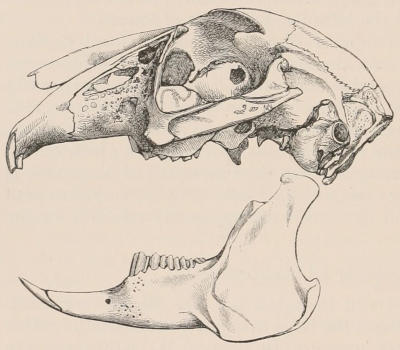
Fig. 216.—Skull of Hare (Lepus timidus).
Lepus.[419]—The single genus Lepus includes about twenty species, all of which resemble one another in general external characters. In all the fore limbs have five and the hind only four digits, and the soles of the feet are densely clothed with hairs similar to those covering the legs; the inner surface of the cheeks is also hairy. Although the family has such a wide distribution, the greater number of the species are restricted to the Palæarctic and Nearctic regions, only a single species (L. brasiliensis) extending into South America, where it has existed since the date of the Pleistocene deposits of the Brazilian caves.
The Common Hare (L. timidus[420]) may be taken as a typical example of the genus, and is characterised by the great length of the ears and hind limbs. It is found in all parts of Europe except the north of Russia, the Scandinavian peninsula, and Ireland. Its fur is usually of a tawny gray colour above and white beneath, with the upper surface of the short tail and the tips of the ears black. The colour of the fur differs, however, considerably in different latitudes and at different seasons of the year; showing a tendency to become white during winter in northern countries, while assuming a reddish-yellow hue in the more genial climate of southern Europe. The Hare is a nocturnal animal, remaining during the day on its “form,” as the slight depression is called which it makes in the open field, usually among grass.
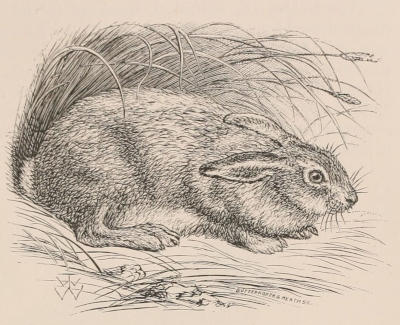
Fig. 217.—The Common Hare (Lepus timidus).
The Mountain Hare (L. variabilis) is found throughout the northern part of the Palæarctic region, ranging from Ireland in the west to Japan in the east, and also occurring in several of the more southerly mountain ranges, such as the Pyrenees, the Alps, and the Caucasus. It is smaller than the common species, with a smaller and more rounded head, and shorter ears, tail, and hind limbs. In cold climates the colour of the whole animal changes in the winter to a pure white (as in Fig. 218), with the exception of the tips of the ears, which remain black. In Ireland no winter change of colour takes place.
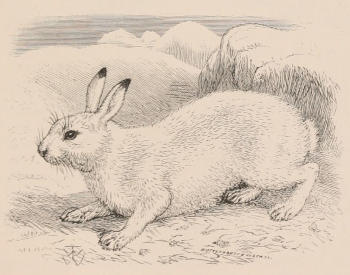
Fig. 218.—The Mountain Hare (Lepus variabilis).
The Rabbit (L. cuniculus), speaking of the wild race only, is distinguished from the Hare externally by its smaller size, shorter ears and feet, the absence or reduction of the black patch at the tip of the ears so characteristic of the Hare, and by its grayer colour. The skull is smaller and lighter, with a slenderer muzzle and a longer and narrower palate. Besides these characters, however, the Rabbit is sharply separated from the Hare by the fact that it brings forth its young naked, blind, and helpless; to compensate for this, it digs a deep burrow in the earth in which they are born and reared, while the young of the Hare are born fully clothed with fur, and able to take care of themselves in the “form” in which they are born. The weight of the Rabbit is from 2½ to 3 lbs., although individuals perfectly wild have been recorded up to more than 5 lbs. Its general habits are too well known to need a detailed description here. It breeds from four to eight times a year, bringing forth each time from three to eight young. Its period of gestation is about thirty days, and it begins to breed when six months old. It attains to an age of about seven or eight years.
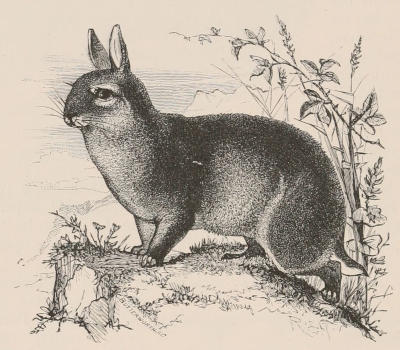
Fig. 219.—The Rabbit (Lepus cuniculus).
The geographical distribution of the Rabbit presents many most interesting peculiarities. It is believed to be originally a native of the western half of the Mediterranean basin only, and still abounds in Spain, Sardinia, Southern Italy, Sicily, Greece, Tunis, and Algeria; and many of the Islands adjoining these countries are quite overrun with it. Thence it has spread, partly by man’s agency, northwards throughout temperate Western Europe, increasing rapidly wherever it gains a footing; and this extension is still going on, as is shown by the case of Scotland, in which sixty years ago Rabbits were little known, while they are now found in all suitable localities up to the extreme north. It has also gained admittance into Ireland, and now abounds there as much as in England. Out of Europe the same extension of range has been going on. In New Zealand and Australia Rabbits, introduced either for profit or sport, have increased to such an extent as to form one of the most serious pests that the farmers have to contend against, as the climate and soil seem to suit them perfectly, and their natural enemies are too few and too lowly organised to keep their numbers within reasonable bounds. In other cases Rabbits introduced into islands have become or remained more or less distinct from their parent stock; thus the Rabbits both of the Falkland Islands and of Jamaica still show traces of their descent from domesticated varieties, and have never reverted to the ordinary brownish-gray type. And again, as was pointed out by Mr. Darwin,[421] the Rabbits in the island of Porto Santo, near Madeira, whose ancestors were introduced from Spain in 1418 or 1419, have formed quite a distinct diminutive race, barely half the bulk or weight of English Rabbits, and differing in certain slight details of colour and habits.
Bibliography of Rodentia.—G. R. Waterhouse, “Observations of the Rodentia,” Mag. Nat. Hist. iii. (1839); Id. Ann. Nat. Hist. viii. and x. (1839-42); Id. “On the Geographical Distribution of the Rodentia,” Proc. Zool. Soc. 1839, pp. 162-174; Id. Natural History of the Mammalia, vol. ii. “Rodentia” (1848); Gervais, Dic. Univ. d’Hist. Nat. xi. p. 202 (1848); Brandt, “Untersuchungen über die craniologischen Entwickelungsstufen und Classification der Nager der Jetzwelt,” Mém. de l’Acad. Impér. de St. Pétersbourg (1855); Lilljeborg, Systematisk Œfversight af de Gnagnde Däggdjuren, Upsala, 1866; Alston, “On the Classification of the Order Glires,” Proc. Zool. Soc. 1876, pp. 61-98; Trouessart, “Catal. de Rongeurs, Vivants et Fossiles,” Bullet. Soc. d’Études Scient. d’Angers, 1880-1881; Coues and Allen, “Monographs of North American Rodentia,” United States Geol. Surv. of Territories, vol. xi. (1877); Winge, “Rodentia pa Lagos Santa, Brazil.” Mus. Lund. vol. iii. (1887); various papers by Peters in Monatsber. Ak. Berlin, and by Alston, Anderson, Blanford, Dobson, Milne-Edwards, Thomas, and others, in Proc. Zool. Soc., Journ. Asiat. Soc. Beng., Ann. Mag. Nat. Hist., etc.