Chapter XI · THE ORDER CARNIVORA
Reading edition
Though the existing Carnivora as at present restricted[422] form a very natural and well-defined order among the Mammalia, it is difficult to find any important common diagnostic characters by which they can be absolutely separated; so that, as in the case of so many other natural groups, it is by the possession of a combination of various characters that they must be distinguished. Thus they are all unguiculate, and never have less than four well-developed toes on each foot, with nails more or less pointed, rarely rudimentary or absent. The pollex and hallux are never opposable to the other digits. They are regularly diphyodont and heterodont, and their teeth are always rooted.[423] Their dentition consists of small pointed incisors, usually three in number, on either side of each jaw, of which the first is always the smallest and the third the largest, the difference being most marked in the upper jaw; strong conical, pointed, recurved canines; cheek-teeth variable, but generally, especially in the anterior part of the series, more or less compressed, pointed, and trenchant; if the crowns are flat and tuberculated they are never complex or divided into lobes by deep inflexions of enamel. The condyle of the lower jaw is a transversely placed half-cylinder working in a deep glenoid fossa of corresponding form. The brain varies much in relative size and form, but the hemispheres are never destitute of well-marked convolutions (Fig. 23, p. 71). The stomach (Fig. 234) is always simple and pyriform. The cæcum is either absent or short and simple (Fig. 235), and the colon is not sacculated, or greatly wider than the small intestine. Vesiculæ seminales are never present. Cowper’s glands are present in some, absent in other groups. The uterus is bicornuate. The mammæ are abdominal, and very variable in number. The placenta is deciduate, and almost always zonary. The clavicle is often entirely absent, and when present is never complete. The humerus often has an entepicondylar foramen. The radius and ulna are distinct. The scaphoid and lunar bones are united into one, and there is never a distinct os centrale in the adult. The fibula is always a distinct slender bone.
Several of these characters are, however, not applicable to all the members of the extinct group of Carnivores for which the name Creodonta has been proposed, as will be noticed in the sequel.
The large majority of the species composing this order subsist chiefly upon some variety of animal food, though many are omnivorous, and some few chiefly, though not entirely, vegetable eaters. The more typical forms live altogether on recently killed warm-blooded animals, and their whole organisation is thoroughly adapted to a predaceous mode of life. In conformity with this manner of obtaining their subsistence they are generally bold and savage in disposition, though some species are capable of being domesticated, and when placed under favourable circumstances for the development of such qualities exhibit a very high degree of intelligence and fidelity. The existing representatives of the order are naturally divided into two suborders, the members of the one being the more typical, and mainly terrestrial in their mode of life; while those of the other are aberrant, having the whole of their organisation specially modified for living habitually in water. These are called respectively the True, or Fissiped, and the Pinniped Carnivora.
Suborder Carnivora Vera.
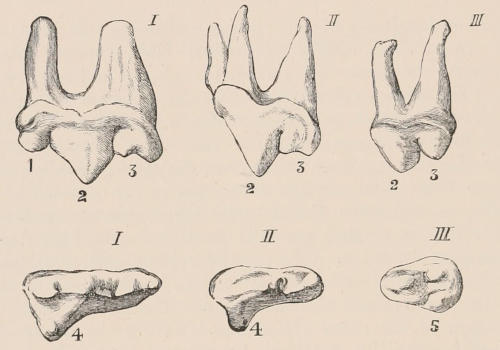
Fig. 220.—Left upper carnassial teeth of Carnivora. I, Felis; II, Canis; III, Ursus. 1, Anterior, 2, middle (paracone), and 3, posterior (metacone) cusp of blade; 4, inner tubercle (protocone) supported on distinct root; 5, inner cusp posterior in position, and without distinct root, characteristic of the Ursidæ.
Generally adapted for terrestrial progression and mode of life, though some may be partially aquatic in their habits. The fore limbs never have the first digit, or the hind limbs the first and fifth digits, longer than the others. Incisors ³⁄₃ on each side, with very rare exceptions. Cerebral hemispheres more or less elongated; always with three or four gyri on the outer surface forming arches above each other, the lowest surrounding the Sylvian fissure. The molar series of teeth have not the uniform characters of those of the Pinnipedia. There is always one tooth in each jaw which is specially modified, and to which the name of “sectorial” or “carnassial” tooth has been applied. The teeth in front of this are more or less sharp pointed and compressed; while those behind it are broad and tuberculated. The characters of the carnassial teeth deserve special attention, as, though fundamentally the same throughout the suborder, they are greatly modified in different genera. The upper carnassial is the most posterior of the teeth which have predecessors, and is therefore reckoned as the last premolar (p ⁴⁄ of the typical dentition). It consists essentially of a more or less compressed blade supported on two roots and an inner tubercle supported by a distinct root (see Fig. 220). The blade when fully developed has three cusps or lobes (1, 2, and 3), but the anterior is always small, and often absent. The middle lobe is conical, high, and pointed; the posterior lobe has a compressed straight knife-like edge. The inner tubercle (4) varies very much in extent, but is generally placed near the anterior end of the blade, though sometimes it is median in position. In the Ursidæ alone both the inner tubercle and root are wanting, and there is often a small internal and posterior cusp (5) without root. In this aberrant family also the carnassial is relatively to the other teeth much smaller than in the rest of the Carnivora. The lower carnassial (see Fig. 221) is the most anterior of the teeth without predecessors in the milk-series; it is therefore reckoned the first true molar (m ¹⁄). It has two roots supporting a crown, consisting when fully developed of a compressed bilobed blade (1 and 2), a heel, or talon (4), and an inner cusp (3). The lobes of the blade, of which the hinder (2) is the larger, are separated by a notch, generally prolonged into a linear fissure. In the most specialised Carnivora, as the Felidæ (I), the blade alone is developed, both talon and inner cusp being absent or rudimentary. In others, as Meles (V) and Ursus (VI), the heel is greatly developed, broad, and tuberculated. The blade in these cases is generally placed obliquely, its flat or convex (outer) side looking forwards, so that the two lobes are almost side by side, instead of anterior and posterior. The inner cusp (3) is generally conical, pointed, and placed to the inner side of the hinder lobe of the blade. The special characters of these teeth are more disguised in the Sea Otter (Latax) than in any other form, but even in it they can be traced.
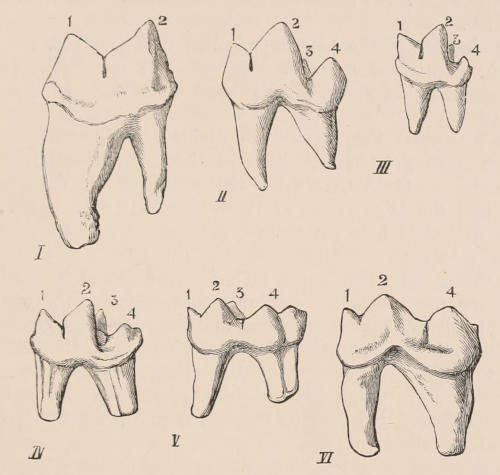
Fig. 221.—Left lower carnassial teeth of Carnivora. I, Felis; II, Canis; III, Herpestes; IV, Lutra; V, Meles; VI, Ursus. 1, Anterior lobe (paraconid) of blade; 2, posterior (protoconid) lobe of blade; 3, inner cusp (metaconid); 4, talon (hypoconid). It will be seen that the relative size of the two roots varies according to the development of the portion of the crown they have respectively to support.
The homology of the various parts of the Carnivorous carnassial with the primitive tritubercular type (p. 30) is indicated in the figures. It may be observed, however, that the anterior lobe of the three-lobed upper carnassial is an element added on to the more primitive two-lobed type. When the talon of the lower carnassial, as in Canis, consists of a large outer and small inner cusp, the latter (not seen in the figure) is the entoconid.
The toes are nearly always armed with large, strong, curved, and tolerably sharp claws, ensheathing the ungual phalanges, and held more firmly in their places by broad laminæ of bone reflected over their attached ends from the bases of the phalanges. In some forms, most notably the Felidæ, these claws are retractile; that is to say, the ungual phalanx, with the claw attached, folds back in the fore foot into a sheath by the outer or ulnar side of the middle phalanx of the digit, being retained in this position when the animal is at rest by a strong elastic ligament. In the hind foot the ungual phalanx is retracted on to the top, and not the side of the middle phalanx. By the action of the deep flexor muscles, the ungual phalanges are straightened out, the claws protruded from their sheath, and the soft “velvety” paw becomes suddenly converted into a most formidable weapon of offence. The habitual retraction of the claws preserves their points from wear in ordinary progression.
The skeleton of the Lion represented in Fig. 15 (p. 45) illustrates the digitigrade mode of progression of the Felidæ, as well as the essential characters of the bony framework of a typical Carnivore.
The Fissipedal Carnivora were divided by Cuvier into two groups, according to the position of the feet in walking,—the Plantigrada, or those that place the whole of the soles to the ground, and the Digitigrada, or those that walk only on the toes; and the difference between these groups was considered of equal importance to that which separated the Pinnigrada or Seals from both of them. The distinction is, however, quite an artificial one, since every intermediate condition exists between the extreme typical plantigrade gait of the Bears and the truly digitigrade walk of the Cats and Dogs; in fact, the greater number of the Carnivora belong to neither one form nor the other, but may be called “subplantigrade”; often when at rest applying the whole of the sole to the ground, but keeping the heel raised to a greater or less extent when walking.
An amended classification of the existing forms is into three distinct sections, of which the Cats, the Dogs, and the Bears may be respectively taken as representatives, and which are hence called Æluroidea, Cynoidea, and Arctoidea. This division is founded mainly on characters exhibited by the base of the skull, but is corroborated by the structure of other parts.[424] The presence or absence of a bridge of bone, covering the external carotid artery in a part of its course by the side of the alisphenoid bone, and enclosing the “alisphenoid canal” (see Fig. 8, p. 38), a character to which the late Mr. H. N. Turner first drew attention, might seem unimportant at first sight, but it is curiously constant in certain groups, which we have other reasons, derived often from a combination of less easily definable characters, to regard as natural. It is therefore generally mentioned in the following family definitions.
It must, however, be stated that while the arrangement is a convenient one as regards the existing Carnivores, it will not hold good when the fossil forms are included. Thus there is ample evidence to show that the Dogs and Bears were formerly so intimately connected that in a palæontological classification the Canidæ cannot be satisfactorily separated from the Ursidæ; while in another direction the Canidæ were closely allied to the ancestral Viverridæ. The most important objection against this classification is, however, the apparent intimate connection exhibited by fossil forms between the Viverridæ and the Mustelidæ, which, so far as the present evidence goes, tends to show that the latter are derived from the former. If this be eventually fully proved, it would seem to indicate that the Arctoidea are not a natural group; and that the resemblances between the Ursidæ and Mustelidæ have been independently acquired, in the course of the descent of the one family from a Canoid, and of the other from a Viverroid stock.
Section Æluroidea.
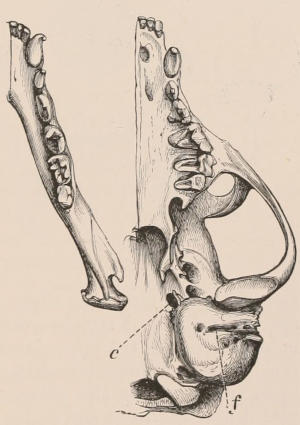
Fig. 222.—Left side of the palatal aspect of the cranium and mandible of the Suricate (Suricata tetradactyla). c, Carotid foramen; f, fissure in floor of auditory meatus. From Mivart, Proc. Zool. Soc. 1882, p. 184.
The Æluroidea or Cat-like Carnivores include the Felidæ, Viverridæ, Proteleidæ, and Hyænidæ. The existing representatives of this section present the following common features. Auditory bulla (Fig. 222) much dilated, rounded smooth, thin-walled, and (except in the Hyænidæ) divided into two chambers, by a septum. Bony auditory meatus short. Paroccipital process applied to, and spread over the hinder part of the bulla (Fig. 222). Mastoid process never very salient, and often obsolete. Carotid canal (Fig. 8, p. 38, car) small, sometimes very inconspicuous. Condyloid and glenoid foramina concealed or wanting. Cæcum small, rarely absent. Os penis generally small and irregular (large in Cryptoprocta). Cowper’s glands present; prostate distinctly lobed. Some details of the anatomy of the soft parts will be found under the head of Genetta.
Family Felidæ.
In all the forms, both recent and fossil, which can be included in this family the canines are strongly developed, there are never more than one upper and two lower molars, and the three lower incisors are placed in the same horizontal line. With one exception, the humerus has an entepicondylar foramen.
The following characters are common to all the existing members. True molars reduced to one above and below, that of the upper jaw very small and transversely extended. Only two inferior premolars. Upper carnassial with three lobes to the blade; lower without talon or inner cusp. Auditory bulla not externally constricted. No alisphenoid canal. Carotid canal very minute. Digits 5-4. Dorsal vertebræ 13.
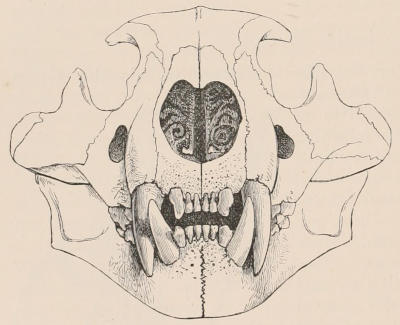
Fig. 223.—Front view of skull of Lion (Felis leo).
Felis.[425]—The whole structure of the animals of this genus exhibits the Carnivorous type in its fullest perfection. Dentition: i ³⁄₃, c ¹⁄₁, p ³⁄₂, m ¹⁄₁; total 30. A distinctly cusped inner tubercle to the upper carnassial. Claws completely retractile. The upper anterior premolar (p. 2), always small, and may be absent without any other modification in the dental or other structures. Such a variation should not therefore be considered as of generic importance. Incisors very small. Canines large, strong, slightly recurved, with trenchant edges and sharp points, and placed wide apart (Fig. 223). Premolars compressed and sharp pointed. The most posterior in the upper jaw (the carnassial), a very large tooth, consisting of a subcompressed blade, divided into three unequal lobes supported by two roots, with a very small inner tubercle placed near the front end of the tooth and supported by a distinct root (Fig. 220). The upper true molar a very small tubercular tooth placed more or less transversely at the inner side of the hinder end of the last. In the lower jaw the true molar (carnassial) reduced to the blade alone, which is very large, trenchant, and much compressed, divided into two subequal lobes. Occasionally it has a rudimentary talon, but never an inner cusp. The skull is generally short and rounded, though proportionally more elongated in the larger forms. The facial portion is especially short and broad, and the zygomatic arches are very wide and strong. The auditory bullæ are large, rounded, and smooth. Vertebræ: C 7, D 13, L 7, S 3, C 13-29. Clavicles better developed than in other Carnivora, but not articulating with either the scapulæ or sternum. Limbs digitigrade. Anterior feet with five toes, the third and fourth nearly equal and longest, the second slightly and the fifth considerably shorter; the pollex still shorter, not reaching as far as the metacarpo-phalangeal articulation of the second. Hind feet with only four toes. The third and fourth the longest, the second and fifth somewhat shorter and nearly equal; the hallux represented only by the rudimentary metatarsal bone. The claws all very large, strongly curved, compressed, very sharp, and exhibiting the retractile condition in the highest degree. The tail varies greatly in length, being in some a mere stump, in others nearly as long as the body. Ears of moderate size, more or less triangular and pointed. Eyes rather large. Iris very mobile, and with a pupillary aperture which contracts under the influence of light in some species to a narrow vertical slit, in others to an oval, and in some to a circular aperture. Tongue thickly covered with sharp-pointed, recurved horny papillæ. Cæcum small and simple.
As in structure so in habits, the Cats may be considered the most specialised of all the Carnivora. All the known members of the genus feed, in the natural state, almost exclusively on warm-blooded animals which they have themselves killed. One Indian species (F. viverrina) preys on fish and even (it is said) on freshwater molluscs. Unlike the Dogs, they never associate in packs, and rarely hunt their prey in open ground, but from some place of concealment wait until the unsuspecting victim comes within reach, or with noiseless and stealthy tread, crouching close to the ground for concealment, approach near enough to make the fatal spring. In this manner they frequently attack and kill animals considerably exceeding their own size. They are mostly nocturnal, and the greater number, especially the smaller species, more or less arboreal. None are aquatic, and all take to the water with reluctance, though some may habitually haunt the banks of rivers or pools, because they more easily obtain their prey in such situations.
The numerous species of the genus are very widely diffused over the greater part of the habitable world, though most abundant in the warm latitudes of both hemispheres. No species are, however, found in the Australian region, or in Madagascar. Although the Old-World and New-World Cats (except perhaps the Northern Lynx) are all specifically distinct, no common structural character has been pointed out by which the former can be separated from the latter. On the contrary, most of the minor groups into which the genus has been divided have representatives in both hemispheres.
Notwithstanding the considerable diversity in external appearance and size between different members of this extensive genus, the structural differences are but slight, and so variously combined in different species that the numerous attempts hitherto made to subdivide it are all unsatisfactory and artificial. The principal differences are to be found in the form of the cranium, especially of the nasal and adjoining bones, the completeness of the bony orbit posteriorly, the development of the first upper premolar and of the inner tubercle of the upper carnassial, the length of the tail, the form of the pupil, and the condition and coloration of the fur, especially the presence or absence of tufts or pencils of hair on the external ears. Writing in 1881 Professor Mivart[426] gave the number of existing species of Felis as 48, but by Mr. Blanford’s reduction of the number of Indian species[427] the list may now be diminished to some 41. The following account is chiefly devoted to some of the more important and better known species.
A. Old World Species.—The Lion (F. leo, Fig. 224) has been well known to man from the earliest historic times. Its geographical habitat made it familiar to all the races among whom human civilisation took its origin, and its strongly marked physical and moral characteristics have rendered it proverbial, perhaps to an exaggerated degree, and have in all ages afforded favourite types for poetry, art, and heraldry. The literature of the ancient Hebrews abounds in allusions to the Lion; and the almost incredible numbers that are stated to have been provided for exhibition and destruction in the Roman amphitheatres (as many as six hundred on a single occasion by Pompey, for example) show how abundant these animals must have been within accessible distance of the capital of the world.
The geographical range of the Lion was once far more extensive than at present, even within the historic period covering the whole of Africa, the south of Asia, including Syria, Arabia, Asia Minor, Persia, and the greater part of Northern and Central India, and also the south-eastern portion of Europe, as shown by the well-known story told by Herodotus of the attacks by Lions on the Camels which carried the baggage of the army of Xerxes on its march through the country of the Pæonians in Macedonia. The very circumstantial account of that historian shows that the animal in his time ranged through the country south of the Balkans, through Roumania to the west of the River Carasu, and through Thessaly as far south as the Gulf of Lepanto and the Isthmus of Corinth, having as its western boundary the River Potamo and the Pindus mountains. The whole of the evidence relating to the existence of Lions in Europe, and to their retreat from that continent shortly before the commencement of the Christian era, has been collected in the article on “Felis spelæa” in Boyd Dawkins and Sandford’s British Pleistocene Mammalia (1868). Fossil remains attest a still wider range, as it is shown in the same work that there is absolutely no osteological or dental character by which the well-known Cave Lion (F. spelæa), so abundantly found in cave-deposits of the Pleistocene age in Western Europe, can be distinguished from the existing F. leo.
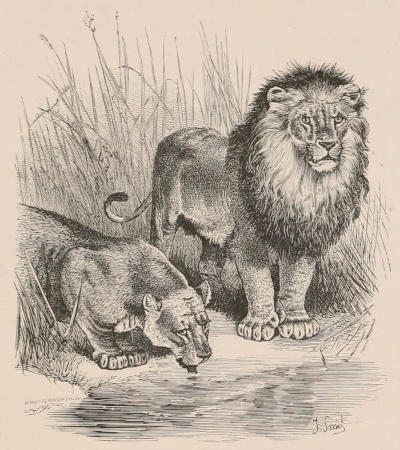
Fig. 224.—Lion and Lioness, after a drawing by Wolf in Elliot’s Monograph of the Felidæ.
At the present day the Lion is found in localities suitable to its habits, and where not exterminated (as it probably was in Europe) by the encroachments of man, throughout Africa from Algeria to the Cape Colony, and in Mesopotamia, Persia, and some parts of the north-west of India. According to Blanford,[428] Lions are still very numerous in the reedy swamps bordering the Tigris and Euphrates, and also occur on the west flanks of the Zagros mountains and the oak-clad ranges near Shiraz, to which they are attracted by the immense herds of swine which feed on the acorns. The Lion nowhere exists in the table-land of Persia, nor is it found in Baluchistan. In India, where it is verging on extinction, it appears now to be confined to parts of Kattywar and Rajputana, though within the present century its range extended through the north-west part of India, from Bahawalpur and Sind to at least the Jumna (about Delhi), southward as far as Khandesh, and in Central India through the Saugor and Narbada territories, Bundelkund, and as far east as Palamau. It was extirpated in Harriana about 1824. One was killed at Rhyli, in the Dumaoh district, Saugor and Narbada territories, so late as in the cold season of 1847-48; and one was shot in 1810 near Kot-Deji, Sind.[429]
The great variations in external characters which different Lions present, especially in the colour and the amount of mane, has given rise to the idea that there are several species, or at all events distinct varieties peculiar to different localities. It was at one time supposed, on the authority of Captain Walter Smee,[430] that the Lion of Gujerat differed essentially from that of Africa in the absence of a mane, but subsequent evidence has not supported this view, which was probably founded upon young specimens having been mistaken for adults. Lions from that district as well as from Babylonia, which have lived in the gardens of the London Zoological Society, have had as fully developed manes as any other of the species. Mr. F. C. Selous[431] has shown that in South Africa the so-called Black-maned Lion and others with yellow scanty manes are found, not only in the same locality, but even among individuals of the same parentage.
The Lion belongs to a well-defined group, containing the largest members of the genus, and differing from the others in the well-marked character that the anterior cornu of the hyoid arch is but little ossified, so that this arch is connected with the cranium by a long ligament, instead of by a continuous chain of bones, and by the less important one that the pupil of the eye, when contracted, is a circular hole, instead of a vertical slit as in the cat. The Lion agrees with the Tiger and the Leopard in these respects, but differs from them in its uniform style of colouring, and from all the other Felidæ in the arrangement of its hairy covering; thus the hair of the top of the head, chin, and neck, as far back as the shoulder, is not only very much longer, but also differently disposed from the hair elsewhere, being erect or directed forwards, and so constituting the characteristic ornament called the mane. There is also a tuft of elongated hairs at the end of the tail, one upon each elbow, and in most lions a copious fringe along the middle line of the under surface of the body, wanting, however, in some examples.[432] It must, however, be observed that these characters are peculiar to the adults of the male sex only, and that young lions show indications of the darker stripes and mottlings so characteristic of the greater number of the members of the genus.
The usual colour of the adult is yellowish-brown, but it may vary from a deep red or chestnut brown to an almost silver gray. The mane, as well as the long hair of the other parts of the body, sometimes scarcely differs from the general colour, but it is usually darker and not unfrequently nearly black. The mane begins to grow when the animal is about three years old, and is fully developed at five or six.
In size the Lion is only equalled or exceeded by the Tiger among the existing Felidæ; though both species present great variations, the largest specimens of the latter appear to surpass the largest Lions. A full-sized South African Lion, according to Selous, measures slightly less than 10 feet from nose to tip of tail, following the curves of the body. Harris gives 10 feet 6 inches, of which the tail occupies 3 feet. The Lioness is about a foot less. The tongue, like that of the other species of the genus, is long and flat, and remarkable for the development of the papillæ of the anterior part of the dorsal surface, which (except near the edge) are modified so as to resemble long, compressed, recurved, horny spines or claws; these, near the middle line, attaining the length of one-fifth of an inch. They give the part of the tongue on which they occur the appearance and feel of a coarse rasp, and serve the purpose of such an instrument in cleaning the flesh from the bones of the animals on which the Lions feed.
The habits of the Lion in a state of nature are fairly well known from the united observations of numerous travellers and sportsmen who have explored those districts of the African continent in which it is still common. It lives chiefly in sandy plains and rocky places interspersed with dense thorn-thickets, or frequents the low bushes and tall rank grass and reeds that grow along the sides of streams and near the springs where it lies in wait for the larger herbivorous animals on which it feeds. Although it is occasionally seen abroad during the day, especially in wild and desolate regions, where it is subject to but little molestation, the night is, as in the case of so many other predaceous animals, the period of its greatest activity. It is then that its characteristic roar is chiefly heard, as thus graphically described by Gordon Cumming:—
“One of the most striking things connected with the Lion is his voice, which is extremely grand and peculiarly striking. It consists at times of a low, deep moaning, repeated five or six times, ending in faintly audible sighs; at other times he startles the forest with loud, deep-toned, solemn roars, repeated in quick succession, each increasing in loudness to the third or fourth, when his voice dies away in five or six low muffled sounds very much resembling distant thunder. At times, and not unfrequently, a troop may be heard roaring in concert, one assuming the lead, and two, three, or four more regularly taking up their parts, like persons singing a catch. Like our Scottish stags at the rutting season, they roar loudest in cold frosty nights; but on no occasions are their voices to be heard in such perfection, or so intensely powerful, as when two or three troops of strange Lions approach a fountain to drink at the same time. When this occurs, every member of each troop sounds a bold roar of defiance at the opposite parties; and when one roars, all roar together, and each seems to vie with his comrades in the intensity and power of his voice. The power and grandeur of these nocturnal concerts are inconceivably striking and pleasing to the hunter’s ear.”
“The usual pace of a Lion,” C. J. Andersson[433] says, “is a walk, and, though apparently rather slow, yet, from the great length of his body, he is able to get over a good deal of ground in a short time. Occasionally he trots, when his speed is not inconsiderable. His gallop—or rather succession of bounds—is, for a short distance, very fast—nearly or quite equal to that of a horse. Indeed, unless the steed has somewhat the start when the beast charges, it will be puzzled to escape. Many instances are on record of horsemen who have incautiously approached too near to the Lion, prior to firing, who have been pulled down by him before they could get out of harm’s way. Happily, however, the beast soon tires of the exertion of galloping, and unless his first rush succeeds he, for the most part, soon halts and beats a retreat.” “The Lion, as with other members of the feline family,” the same writer tells us, “seldom attacks his prey openly, unless compelled by extreme hunger. For the most part he steals upon it in the manner of a cat, or ambushes himself near to the water or a pathway frequented by game. At such times he lies crouched upon his belly in a thicket until the animal approaches sufficiently near, when, with one prodigious bound, he pounces upon it. In most cases he is successful, but should his intended victim escape, as at times happens, from his having miscalculated the distance, he may make a second or even a third bound, which, however, usually prove fruitless, or he returns disconcerted to his hiding-place, there to wait for another opportunity.” His food consists of all the larger herbivorous animals of the country in which he resides—buffaloes, antelopes, zebras, giraffes, or even young elephants or rhinoceroses, though the adults of these latter he dare not attack. In cultivated districts the cattle, sheep, and even human inhabitants are never safe from his nocturnal ravages. He appears, however, as a general rule, only to kill when hungry or attacked, and not for the mere pleasure of killing, as with some other carnivorous animals. Moreover, he by no means limits himself to animals of his own killing, but, according to Selous, often prefers eating game that has been killed by man, even when not very fresh, to taking the trouble to catch an animal himself. All books of African travel and sport abound with stories, many of which are apparently well authenticated, of the lion’s prodigious strength, as, exemplified by his being able to drag off a whole ox in his mouth to a long distance, even leaping fences and dykes with it.
The Lion appears to be monogamous, a single male and female continuing attached to each other irrespectively of the pairing season. At all events the Lion remains with the Lioness while the cubs are young and helpless, and assists in providing her and them with food, and in educating them in the art of providing for themselves. The number of cubs at a birth is from two to four, usually three. They are said to remain with their parents till they are about three years old. The following account by an eye-witness gives a good idea of Lion family life[434]:—
“I once had the pleasure of, unobserved myself, watching a lion family feeding. I was encamped on the Black Umfolosi in Zululand, and towards evening, walking out, about half a mile from camp, I saw a herd of zebra galloping across me, and when they were nearly 200 yards off, I saw a yellow body flash towards the leader, and saw him fall beneath the lion’s weight. There was a tall tree about 60 yards from the place, and anxious to see what went on, I stalked up to it, while the lion was still too much occupied to look about him, and climbed up. He had by this time quite killed the beautifully striped animal, but instead of proceeding to eat it, he got up and roared vigorously, until there was an answer, and in a few minutes a lioness, accompanied by four whelps, came trotting up from the same direction as the zebra, which no doubt she had been to drive towards her husband. They formed a fine picture as they all stood round the carcase, the whelps tearing it and biting it, but unable to get through the tough skin. Then the lion lay down, and the lioness driving her offspring before her did the same four or five yards off, upon which he got up, and, commencing to eat, had soon finished a hind leg, retiring a few yards on one side as soon as he had done so. The lioness came up next and tore the carcase to shreds, bolting huge mouthfuls, but not objecting to the whelps eating us much as they could find. There was a good deal of snarling and quarrelling among these young lions, and occasionally a stand-up fight for a minute, but their mother did not take any notice of them, except to give them a smart blow with her paw if they got in her way.... There was now little left of the zebra but a few bones, which hundreds of vultures were circling round waiting to pick, while almost an equal number hopped awkwardly about on the ground within 50 or 60 yards of it, and the whole lion family walked quietly away, the lioness leading, and the lion, often turning his head to see that they were not followed, bringing up the rear.”
Though not strictly gregarious, Lions appear to be sociable towards their own species, and often are found in small troops, sometimes consisting of a pair of old Lions, with their nearly full-grown cubs, but occasionally of adults of the same sex; and there seems to be good evidence that several Lions will associate together for the purpose of hunting upon a preconcerted plan. As might be supposed, their natural ferocity and powerful armature are sometimes turned upon one another; combats, often mortal, occur among male Lions under the influence of jealousy; and Andersson relates an instance of a quarrel between a hungry Lion and Lioness over the carcase of an Antelope which they had just killed, and which did not seem sufficient for the appetite of both, ending in the Lion not only killing, but even devouring his mate. Old Lions, whose teeth have become injured with constant wear, often become “man-eaters,” finding their easiest means of obtaining a subsistence in lurking in the neighbourhood of villages, and dashing into the tents at night and carrying off one of the sleeping inmates. Lions differ from most of the smaller Felidæ in never climbing trees; indeed, as mentioned before, they are rarely found in forests.
With regard to the character of the Lion, those who have had opportunities of observing it in its native haunts differ greatly. The exaggerated accounts of early writers as to its courage, nobility, and magnanimity have led to a reaction, which causes some modern authors to speak of it in language quite the reverse, and to accuse it of positive cowardice and all kinds of meanness. Livingstone goes so far as to say, “Nothing that I ever learned of the lion could lead me to attribute to it either the ferocious or noble character ascribed to it elsewhere,” and he adds that its roar is not distinguishable from that of the ostrich. Of course these different estimates depend to a great extent upon the particular standard of the writer, and also upon the circumstance that Lions, like other animals, undoubtedly show considerable individual differences in character, and behave differently under varying circumstances. They are certainly not so reckless as to be entirely devoid of the instinct of self-preservation, and if one, perhaps satiated with a good meal the night before, unexpectedly disturbed in the daytime, will occasionally retreat when confronted, even by an unarmed man, that is scarcely a reason for assigning cowardice as one of the characteristics of the species. The latest authority, Selous, while never denying the daring courage of the Lion when hungry or provoked, and vindicating the awe-inspiring character of the roar of several Lions in unison, when heard at close quarters, as the grandest sound in nature, says with regard to its outward aspect:—
“It has always appeared to me that the word ‘majestic’ is singularly inapplicable to the lion in its wild state, as when seen by daylight he always has a stealthy furtive look that entirely does away with the idea of majesty. To look majestic a lion should hold his head high. This he seldom does. When walking he holds it low, lower than the line of his back, and it is only when he first becomes aware of the presence of man that he sometimes raises his head and takes a look at the intruder, usually lowering it immediately, and trotting away with a growl. When at bay, standing with open mouth and glaring eyes, holding his head low between his shoulders, and keeping up a continuous low growling, twitching his tail the while from side to side, no animal can look more unpleasant than a lion; but there is then nothing majestic or noble in his appearance.”
Notwithstanding this evidently truthful description of the animal when seen under what may be called unfavourable circumstances, no one with an eye for beauty can contemplate the form of a fine specimen of a Lion, at all events in a state of repose, even though in the confinement of a menagerie, without being impressed with the feeling that it is a grand and noble-looking animal.
The Tiger (F. tigris) is so closely related to the Lion that it is chiefly by external characters that the two species are distinguished. There are, however, slight distinctions in the proportionate size of the lower teeth, the general form of the cranium, and the relative length of the nasal bones and ascending processes of the maxillaries by which the skull of the Lion and Tiger can be easily discriminated by the practised observer.
Although examples of both species present considerable variations in size, and reliance cannot always be placed upon alleged dimensions, especially when taken from skins stripped from the body, it seems well ascertained that the length of the largest-sized Bengal Tiger may exceed that of any Lion. According to Mr. W. T. Blanford,[435] adult males measure from 5½ to 6½ feet from the nose to the root of the tail; the tail itself measuring some 3 feet in length. Measured along the curves of the head and back to the tip of the tail, males usually give a length of from 9 to 10 feet, but some specimens reach to 12 feet. The female is somewhat smaller, and has a lighter and narrower head. The Tiger has no mane, but in old males the hair of the cheeks is rather long and spreading. The ground colour of the upper and outer parts of the head, body, limbs, and tail is a bright rufous fawn, and these parts are beautifully marked with transverse stripes of a dark, almost black colour. The markings vary much in different individuals, and even on the two sides of the same individual. The under parts of the body, the inside of the limbs, the cheeks, and a large spot over each eye are nearly white. The Tigers which inhabit hotter regions, as Bengal and the south Asiatic islands, have shorter and smoother hair, and are more richly coloured and distinctly striped than those of Northern China and Siberia, in which the fur is longer, softer, and lighter coloured.
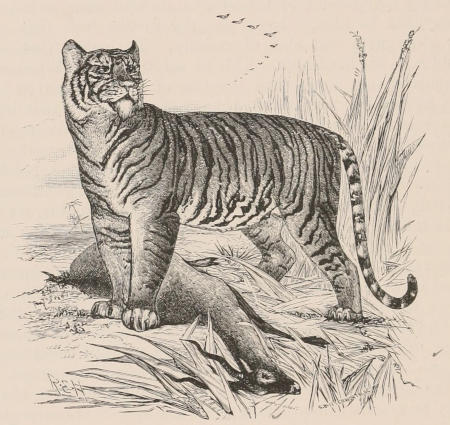
Fig. 225.—The Tiger (Felis tigris).
The Tiger is exclusively Asiatic, but has a very wide range in that continent, having been found in almost all suitable localities south of a line drawn from the river Euphrates, passing along the southern shores of the Caspian and Sea of Aral by Lake Baikal to the Sea of Okhotsk. Its most northern range is the territory of the Amur, its most southern the islands of Sumatra, Java, and Bali. Westward it reaches to Turkish Georgia and eastward to the island of Saghalin. It is absent, however, from the great elevated plateau of Central Asia, nor does it inhabit Ceylon, Borneo, or the other islands of the Indo-Malayan Archipelago, except those above mentioned. Its absence from Ceylon leads Mr. Blanford to conclude that the Tiger has only recently migrated into Southern India.
The principal food of the Tiger in India is cattle, deer, wild hog, and pea-fowl, and occasionally human beings. The regular “man-eater” is generally an old Tiger whose vigour is passed, and whose teeth are worn and defective; it takes up its abode in the neighbourhood of a village, the population of which it finds an easier prey than the larger or wilder animals named above. Though chiefly affecting grassy plains or swamps, it is also found in forests, and seems to be fond of haunting the neighbourhood of old ruins. As a rule, Tigers do not climb trees; but when pressed by fear, as during an inundation, they have been known to do so. They take to the water readily and are good swimmers. The Tigers of the Sundarbans (Ganges delta) continually swim from one island to the other to change their hunting-grounds for deer. The following extract on the habits of the Tiger is taken from Sir J. Fayrer’s Royal Tiger of Bengal (1875):—
“The tigress gives birth to from two to five, even six cubs; but three is a frequent number. She is a most affectionate and attached mother, and generally guards and trains her young with the most watchful solicitude. They remain with her until nearly full grown, or about the second year, when they are able to kill for themselves and begin life on their own account. Whilst they remain with her she is peculiarly vicious and aggressive, defending them with the greatest courage and energy, and when robbed of them is terrible in her rage; but she has been known to desert them when pressed, and even to eat them when starved. As soon as they begin to require other food than her milk, she kills for them, teaching them to do so for themselves by practising on small animals, such as deer and young calves or pigs. At these times she is wanton and extravagant in her cruelty, killing apparently for the gratification of her ferocious and bloodthirsty nature, and perhaps to excite and instruct the young ones, and it is not until they are thoroughly capable of killing their own food that she separates from them. The young tigers are far more destructive than the old. They will kill three or four cows at a time, whilst the older and more experienced rarely kill more than one, and this at intervals of from three or four days to a week. For this purpose the tiger will leave its retreat in the dense jungle, proceed to the neighbourhood of a village or gowrie, where cattle feed, and during the night will steal on and strike down a bullock, drag it into a secluded place, and then remain near the ‘marrie,’ or ‘kill,’ for several days, until it has eaten it, when it will proceed in search of a further supply, and, having found good hunting ground in the vicinity of a village or gowrie, continue its ravages, destroying one or two cows or buffaloes a week. It is very fond of the ordinary domestic cattle, which in the plains of India are generally weak, half-starved, under-sized creatures. One of these is easily struck down and carried or dragged off. The smaller buffaloes are also easily disposed of; but the buffalo bulls, and especially the wild ones, are formidable antagonists, and have often been known to beat the Tiger off, and even to wound him seriously.”
In many districts of India the number of Tigers has been very considerably diminished of late years. In some other countries they appear, however, to be on the increase; thus according to one of the administration reports of Java laid before the Dutch Chambers, portions of that island are being depopulated through Tigers. In 1882 the population of a village in the south-west of the Bantam province was removed and transferred to an island off the coast in consequence of the trouble caused to the people by Tigers. These animals have now become an intolerable pest in parts of the same province. The total population is about 600,000, and, in 1887, sixty-one were killed by Tigers, and in consequence of the dread existing among the people, it has been proposed to deport the inhabitants of the villages most threatened to other parts of the country where Tigers are not so common, and where they can pursue their agricultural occupations with a greater degree of security. At present they fear to go anywhere near the borders of the forest. The people seem disinclined, or they lack the means and courage, to attack and destroy their enemy, although considerable rewards are offered by Government for the destruction of beasts of prey. In 1888 the reward for killing a Royal Tiger was raised to two hundred florins. It appears also that the immunity of the Tiger is in part due to superstition, for it is considered wrong to kill one unless he attacks first or otherwise does injury.
The Leopard (F. pardus, Fig. 226), although belonging to the same restricted group as the two preceding species, is distinguished from both by its inferior size, and its coloration. The animal now commonly known as the Leopard was called Pard (πάρδος and πάρδαλις) or Panther (πάνθηρ) by the ancients. Leopard (leo-pardus) is a later term, originally applied, it is believed, to the Cheeta or Hunting Leopard, upon the supposition that it was a creature intermediate between the Lion and the true Pard. If so it has been completely transferred to the more common species, and though in this sense a perfectly unnecessary and unmeaning term, has gradually superseded those by which this was originally known. Pard, so commonly used by Elizabethan authors, is now nearly obsolete in the English language, and Panther has either become synonymous with Leopard, or is used vaguely for any similar large feline animal, even the Puma of America.
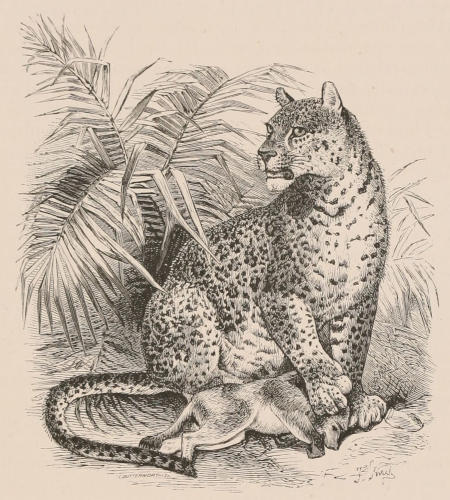
Fig. 226.—The Leopard (Felis pardus).
Owing to their extensive geographical range, and the great variations, both in size, form, and coloration to which Leopards are subject, zoologists have scarcely decided whether all the forms popularly referred to this animal should be regarded as specifically alike, or whether they should constitute several distinct species, but the prevailing opinion is in favour of the former view. The attempts to separate a larger and more robust variety, under the name of Panther, from a smaller and more graceful form, to which the term Leopard might properly be restricted, have failed, owing to the existence of intermediate conditions which cannot be assigned definitely to either one or the other form.[436] The most marked anatomical difference yet noted in different varieties of leopard is in the length of the tail as compared with that of the body, even the number of the caudal vertebræ showing variation, though within what limits, and whether correlated with other characters, has not yet been clearly ascertained. The fur of those specimens which inhabit the most northern confines of its range of distribution, as North China, is longer and softer, and the markings are consequently less distinct than on those from more congenial climates, and the well-marked variation thus produced has given rise to the idea of specific distinction.
The size of different individuals, as before said, varies greatly, the head and body usually measuring from 3½ to 4½ feet in length, and the tail from 2½ to 3 feet, but specimens have been met with which fall short of or exceed these limits. The ground colour of the fur varies from a pale fawn to a rufous buff, graduating into a pure white on the under parts and inside of the limbs. This is spotted over with dark brown or black; the spots on the back and sides being arranged in rosettes or broken rings, which vary greatly in size and distinctness in different individuals, but are without the central spot seen in those of the Jaguar. The spots on the under parts and limbs are simple and blacker than those on the other parts of the body. The bases of the ears behind are black, the tips buff. The upper side of the tail is buff, spotted with broken rings like the back, its under surface white with simple spots. The hair of the cubs is longer than that of the adults, its ground colour less bright, and its spots less distinct. Perfectly black Leopards, which, however, in certain lights show the characteristic markings on the fur, are not uncommon. These appear to be examples of melanism, occurring as individual variations, sometimes in one cub out of a litter of which the rest are normally coloured, and therefore not indicating a distinct race, much less a species. These are met with chiefly in Southern Asia. We are not aware of any recorded case from Africa, though there seems no reason why they should not occur.
In habits the Leopard resembles the other large Cat-like animals, yielding to none in the ferocity and bloodthirstiness of its disposition. It is exceedingly quick and active in its movements, but seizes its prey by waiting in ambush or stealthily approaching to within springing distance, when it suddenly rushes upon it and tears it to the ground with its powerful claws and teeth. It preys upon almost any animal it can overcome, such as antelopes, deer, sheep, goats, monkeys, peafowls, and is said to have a special liking for dogs. It not unfrequently attacks human beings in India, chiefly children and old women, but instances have been known of a Leopard becoming a regular “man-eater.” When favourable opportunities occur, it often kills many more victims than it can devour at once, apparently to gratify its propensity for killing, or only for the sake of their fresh blood. It generally inhabits woody districts, and can climb high trees with facility if necessary for its safety when hunted, but usually lives on or near the ground, among rocks, bushes, and roots and low branches of large trees.
The present geographical range of the Leopard is very extensive, as it is met with in various suitable localities, where not too much interfered with by human cultivation, throughout the greater part of Africa from Algeria to the Cape Colony, and through the whole of the South of Asia from Palestine to China, including all India south of the Himalaya, and the islands of Ceylon, Java, Sumatra, and Borneo. Fossil bones and teeth, indistinguishable from those of existing Leopards, have been found in cave-deposits of Pleistocene age in Spain, France, Germany, and England. The evidence of the former existence of the Leopard in England is described at length by Boyd Dawkins and Sanford in their British Pleistocene Mammalia.[437]
The Ounce, or Snow Leopard (F. uncia), inhabits the highlands of Central Asia, from the lofty mountains of Tibet to the southern parts of Siberia, at altitudes of from 9000 to 18,000 feet above the sea. It is about the size of the common Leopard, but lighter in colour, with longer fur, less distinct spots, and a long thick tail. Its skull differs in shape from that of all the other Felidæ; the facial portion being very broad, the nasal bones especially being wide and depressed, and the zygomatic arches very strong and deep. The Clouded Tiger (F. nebulosa[438]) is a beautifully marked species, with elongated head and body, long tail, and rather short limbs. The canine teeth are proportionally longer than in any existing member of the genus. It is thoroughly arboreal, and is found in the forests of South-East Asia and the islands of Sumatra, Java, Borneo, and Formosa. F. serval, the Serval, from South Africa, is yellow with black spots, and has a short tail and large ears. Numerous smaller species called Tiger Cats and Wild Cats, of which the Oriental F. marmorata (Fig. 227) is a good example, are found throughout the warmer parts of Asia and Africa. The Wild Cat of Europe, F. catus, still inhabits the mountainous and wooded parts of Great Britain.
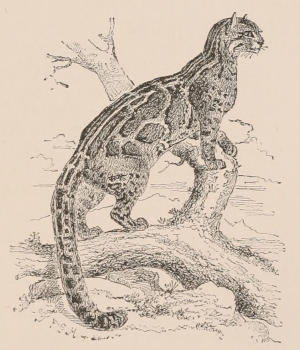
Fig. 227.—The Marbled Cat (Felis marmorata). From Blanford, Mammalia of British India, p. 74, after Elliot.
The Caffre Cat (F. caffra[439]), of Africa and Southern Asia, was the species held in veneration by the ancient Egyptians, and immense numbers of its mummified remains have recently been found in Egypt, whence they have been imported in large quantities to this country for manure. This species is generally regarded as the main ancestral stock from which the European Domestic Cat has been derived; one of the arguments in support of this opinion being that the whole of the sole of the hind foot of F. caffra is black, and that the same feature obtains in the darker varieties of the Domestic Cat; while in F. catus there are only spots of black upon this portion of the limb. Remains of the Caffre Cat occur in the Pleistocene cave-deposits at Gibraltar. The Indian F. rubiginosa is the smallest species of Cat.
The Caracal or Persian Lynx (F. caracal) is an animal about the size of a fox, of slender build, with a moderately long tail, reaching down to the heels. It is of a uniform vinous or bright fulvous brown colour above, and is paler, sometimes almost white, beneath. It is quite or almost entirely unspotted. The tail has a black tip, and the ears are black externally, long, upright, pointed, and surmounted by a pencil of fine black hairs. It inhabits Central and North-West India, Persia, Arabia, Syria, and the greater part of Africa.
The true Lynxes comprise various species or varieties found in the northern and temperate regions of both the Old and New World, all larger than the true Wild Cats, with long limbs, short stumpy tail, ears tufted at the tip, and pupil of the eye linear when contracted. Their fur is generally long and soft, varying, however, according to season and locality, and always longish upon the cheeks. Their colour is always light brown or gray, and generally more or less spotted with a darker shade. The naked pads of the feet are more or less covered by the hair that grows between them. The skull and skeleton do not differ markedly from those of the other cats, but the small anterior upper premolar tooth found in many other species is usually wanting; and the lower carnassial has a rudimental talon. Their habits are exactly those of the other Wild Cats, and they are exceeded by none in the untameable savageness of their disposition. They capture their prey in the same manner, either lying in wait, or noiselessly stealing within reach, and then making a sudden rush or spring upon it. Their food consists of any mammals or birds which they can overpower. In inhabited countries they commit extensive ravages upon sheep, lambs, and poultry. Lynxes generally frequent rocky places and forests, being active climbers, and passing much of their time among the branches of the trees. Their skins are of considerable commercial value.
Zoologists are by no means agreed at present as to the specific distinctions, if any really exist, between the various modifications of this group. As many as eight species are sometimes recognised, four belonging to the Old and four to the New World. The former are F. lynx, of Scandinavia, Russia, Northern Asia, and till lately the forest regions of Central Europe; though not an inhabitant of Britain during the historic period, its remains have been found in cave-deposits of Pleistocene age; F. cervaria, Siberia; F. pardina, Turkey, Greece, Sicily, Sardinia, and Spain; and F. isabellina, Tibet. The American varieties are F. canadensis, the most northern species, and F. rufa, the American Wild Cat or Bay Lynx, extensively distributed from the Atlantic to the Pacific throughout nearly the whole latitude of the United States, but replaced in Texas and southern California by F. maculata, and in northern Oregon and Washington territory by F. fasciata.
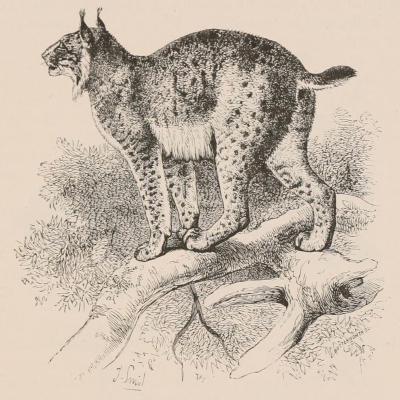
Fig. 228.—European Lynx (Felis lynx). From a drawing by Wolf in Elliot’s Monograph of the Felidæ.
In both cases, as might be supposed, specimens obtained from the more southern climates are shorter in their fur, more brightly coloured, and more distinctly spotted than those from colder regions. When only a few individuals of each most markedly different form are examined the distinctions are sufficiently evident. The occurrence, however, of transitional or intermediate forms makes it extremely difficult to draw the line between the different varieties or species, or to assign definite characters by which they can be separated. Wherefore it is best at present to accept the so-called species as only provisional, and wait until more abundant materials, with fuller knowledge of the localities from which they are derived, and of the variations due to age, sex, season, and climate, have been more carefully studied. We shall then probably come to the conclusion that all or nearly all the existing forms of northern Lynxes, whether American or Eurasian, belong to what may fairly be called a species, which is becoming by degrees differentiated into several more or less strongly marked local varieties. Mr. W. T. Blanford has indeed shown that the Tibetan Lynx (F. isabellina) is inseparable from F. lynx; the specimens from Gilgit being intermediate in colour between the typical forms of the two races. On the other hand, from the evidence of cranial characters, Professor Mivart is disposed to regard F. pardina as a valid species.
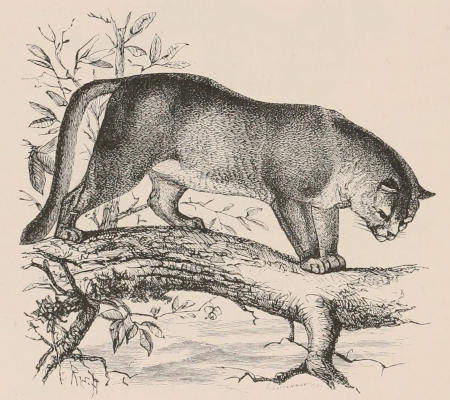
Fig. 229.—The Puma (Felis concolor).
B. New World Species.—The Puma or Couguar (F. concolor, Fig. 229), commonly called “Panther” in the United States, is about the size of a Leopard, but of an uniform brown colour. It usually measures from nose to root of tail about 40 inches, the tail being rather more than half that length. The head is rather small compared with that of other Cats and has no mane. The ears are large and rounded. The tail is cylindrical, with some bushy elongation of the hairs near the end, but not forming a distinct tuft as in the Lion. The general colour of all the upper parts and sides of the adult is a tawny yellowish-brown, sometimes having a gray or silvery shade, but in some individuals dark or inclining to red. The lower parts of the body, inner surface of the limbs, the throat, chin, and upper lip are dirty white; the outside of the ears, particularly at their base, and a patch on each side of the muzzle black; the end of the tail dusky. The young are, when born, spotted with dusky brown and the tail ringed; these markings gradually fading, and quite disappearing before the animal becomes full-grown.
The Puma has an exceedingly wide range of geographical distribution, extending over a hundred degrees of latitude, from Canada in the north to Patagonia in the south, and was formerly pretty generally diffused in suitable localities from the Atlantic to the Pacific Ocean, but the advances of civilisation have in recent years considerably curtailed the extent of the districts which it inhabits. In Central America it is still common in the dense forests which clothe the mountain ranges as high as 8000 or 9000 feet above the sea-level, where the hideous sound of its howling is said to be almost continuously heard at night during the breeding season. Though an expert climber, it is by no means confined to wooded districts, being frequently found in scrub and reeds along the banks of rivers, and even in the open pampas and prairies. Its habits much resemble those of the rest of the group to which it belongs; and, like the Leopard, when it happens to come within reach of an abundant and easy prey, as the sheep or calves of an outlying farming station, it kills far more than it can eat, either for the sake of the blood only or to gratify its propensity for destruction. It rarely attacks man, and, when pursued, escapes if possible by ascending lofty trees. Several instances have occurred of Pumas becoming tame in captivity. Edmund Kean, the celebrated actor, had one which followed him about like a dog. When caressed they express their pleasure by purring like a domestic cat.
F. onca, the Jaguar, is a larger and more powerful animal than the last, and more resembles the Leopard in its colours. It also is found in both North and South America, but with less extensive range, reaching northwards only as far as Texas, and southwards nearly to Patagonia. It climbs as well as the Puma, and preys to a great extent upon monkeys. Several allied smaller elegantly spotted forms inhabiting the intratropical regions of America are commonly included under the name of Ocelot or Tiger Cat, though zoologists are still undecided whether under this designation several distinct species have not been confused, or whether all the Ocelots are to be referred to a single species (F. pardalis) showing great individual or racial variation. Their fur has always a tawny yellow or reddish-gray ground colour, and is marked with black spots, aggregated in streaks and blotches, or in elongated rings enclosing an area which is rather darker than the general ground colour. They range through the wooded parts of tropical America, from Arkansas in the north as far south as Paraguay, and in their habits resemble the other smaller members of the Cat tribe, being ready climbers and exceedingly bloodthirsty.
F. yaguarundi, rather larger than the Domestic Cat, with an elongated head and body, and of a uniform brownish-gray colour, ranges from Matamoras to Paraguay. F. eyra is a small Cat, very Musteline in form, having an elongated head, body, and tail, and short limbs, and is also of a uniform light reddish-brown colour. It is a native of South America and Mexico. F. pajeros is the Pampas Cat. The American Lynxes have been already noticed with those of the Old World.
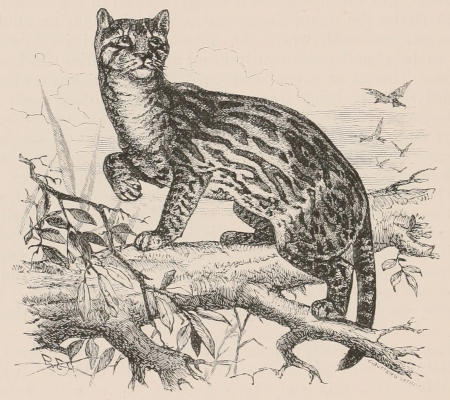
Fig. 230.—The Ocelot (Felis pardalis).
C. Fossil Species.—It has been already incidentally mentioned that several of the existing species of Felis, such as the Lion, Leopard and Caffre Cat, are met with in a fossil condition in the European Pleistocene deposits, and it may be added that the Pardine Lynx has left its remains in the cavern-deposits of Gibraltar. The caves of Brazil have yielded remains of the Jaguar and Ocelot; while the Puma is found in the Pleistocene of the United States. Existing species now inhabiting India are met with in cavern-deposits in Madras. In the Pliocene Siwaliks of Northern India the huge extinct F. cristata shows characters connecting it both with the Tiger and the Jaguar; and the same deposit also contains the remains of a small species of the size of F. bengalensis. In Europe numerous species occur in the Upper and Lower Pliocene, some of which were as large as a Leopard. F. atrox and F. augusta, of the Pliocene of the United States, were of the dimensions of the Lion.
Cynælurus.[440]—The Cheeta or Hunting Leopard (C. jubatus) is distinguished from the other Felidæ by the inner tubercle of the upper carnassial, though supported by a distinct root, having no salient cusp upon it; by the tubercular molar being more in a line with the other teeth; and by the claws being smaller, less curved, and less completely retractile, owing to the feebler development of the elastic ligaments. The skull is short and high, with the frontal region broad and elevated in consequence of the large development of the frontal air-sinuses. The head is small and round, the body light, the limbs and tail long. Its colour is pale yellowish-brown with small black spots. The Cheeta is less savage and more easily tamed than most of the Cats. In Asia it has been trained for the chase of the Antelope. It has rather an extensive geographical range from the Cape of Good Hope, throughout Africa and the south-western parts of Asia, as far as Southern India.
Extinct Genera.—A number of forms are gradually becoming known, especially through the researches of American palæontologists, which, though evidently animals of the same general type, and therefore to be placed in or near the family Felidæ, depart so much in various details of structure that they must be referred to different genera. As one of the points in which Felis manifests its specialisation is the reduction of the number of the molar series of teeth, with concomitant shortening of the jaws, it might be supposed that in the earlier and perhaps ancestral forms these teeth would be more numerous and approach more nearly to the primitive or typical number of the heterodont mammals, viz. seven on each side. This is actually the case. Similarly we find that many of these forms exhibit a less specialised structure of the teeth themselves, as is shown by the absence of the anterior lobe of the upper carnassial, and the retention of the hind talon in the corresponding lower tooth. Again, some of them have an alisphenoid canal in the skull; while the femur may have a third trochanter, and the claws be very imperfectly retractile.
An extremely generalised form is the small Proælurus, from the Upper Eocene and Lower Miocene, with p ⁴⁄₄, m ¹⁄₂, an alisphenoid canal, and a third trochanter to the femur. Dinictis, of the North American Miocene, is a larger allied form, with p ³⁄₃, m ¹⁄₂; the upper carnassial having no anterior lobe, and the ungual phalanges being devoid of bony sheaths. The characters of the base of the skull, and the form and relations of the astragalus, differ very considerably from Felis. Pseudælurus, from the French Miocene, is another very generalised Feline, in which there may be either three or four premolars, and the lower carnassial may retain its inner cusp. Ælurictis, of the French Phosphorites, with p ³⁄₃₋₄, m ¹⁄₁₋₂, together with several American Miocene genera, such as Nimravus (p ³⁄₂, m ¹⁄₂), Archælurus (p ³⁄₃₋₄, m ¹⁄₂), Pogonodon (p ³⁄₃, m ¹⁄₁), and Hoplophoneus (p ²⁻³⁄₂, m ¹⁄₁), approach more closely to the modern Cats, although many or all of them retain the alisphenoid canal, and have not yet developed the anterior lobe to the upper carnassial, or lost the talon to the lower one. Hoplophoneus has a descending flange to the mandible; and its scapholunar bone has a line indicating its dual origin; while the femur still retains the third trochanter, of which all traces are lost in the modern Cats.
On the other hand, some of the extinct Felidæ show a most remarkable tendency towards a specialisation not occurring in any of the surviving members of the family, viz. an enormous development of the upper canines, with which is usually associated an expansion downwards and flattening of the anterior part of the ramus of the lower jaw, on the outer side of which the canine lies, when the mouth is closed. In Machærodus næogeus, the Sabre-toothed Tiger, from the caves of Brazil and also from Pleistocene deposits near Buenos Ayres, an animal about the size of a Tiger, these teeth are 7 inches in length, greatly compressed, and finely serrated on the trenchant anterior edges. Similar serrations are seen on a much fainter scale in the unworn teeth of modern Tigers. Many modifications of this commonly-called “machærodont” type have been met with both in the Old and New World. In M. cultridens, of the Upper Pliocene of Italy and France, the upper canine is long and narrow, with smooth cutting edges; the smaller form described as M. meganthereon being apparently the female of this species. M. crenatidens, of the same deposits, is distinguished by the shorter and broader upper canine, in which both edges are strongly serrated; the same feature occurring in the closely allied or identical M. latidens of the English cavern-deposits. The Italian Pliocene form described as M. nestianus has serrations only on the hinder edge of the upper canine, and the third lower premolar is separated by a long interval from the fourth. M. necator, of the Pleistocene of South America, is remarkable as being the only member of the family in which the humerus has no entepicondylar foramen. A very remarkable form, Eusmilus, from the Upper Eocene Phosphorites of Central France, differs from all other known Felines in having only two pairs of incisors in the lower jaw, and a small canine separated by a very long diastema from the cheek-teeth, which consist only of one premolar and one sectorial true molar. The lower jaw is enormously expanded towards the symphysis to protect the large upper canines. This animal then, although of Eocene age, appears to form the culminating development of the sabre-toothed or machærodont dentition, the most specially carnivorous type of structure known.
Other species of Machærodus are found in the Pliocene deposits of Europe and Asia. The accompanying woodcut exhibits the last two upper teeth of the Indian M. sivalensis, from which it will be seen that the inner tubercle of the carnassial is much reduced in size, while the molar is very minute.
Family Viverridæ.
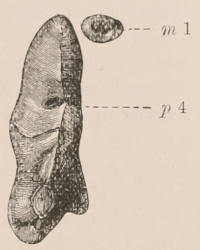
Fig. 231.—Oral surface of the left upper carnassial and molar of Machærodus sivalensis.
Premolars ³⁄₃ or ⁴⁄₄. Molars ¹⁄₁ or ²⁄₂. Upper carnassial usually without an anterior lobe, and the lower one with a well-developed talon; second lower incisor (as in all the following families) raised above the level of the first and third. Auditory bulla externally constricted, and divided by a septum. An alisphenoid canal (with very rare exceptions). Carotid canal distinct as a groove on the side of the bulla. Humerus usually with an entepicondylar foramen. Digits usually 5-5, but sometimes the pollex or hallux or both may be wanting. Dorsal vertebræ 13 or 14. Limited in distribution to the Old World.
The subfamily Cryptoproctinæ contains the single genus Cryptoprocta.[441] Dentition: i ³⁄₃, c ¹⁄₁, p ⁴⁄₄, m ¹⁄₁; total 36. The teeth generally closely resemble those of the Felidæ. The first premolar of both jaws is very minute and early deciduous. The upper carnassial has a very small inner tubercle, quite at the anterior part of the tooth. The true molar is very small and placed transversely. The lower carnassial has a large trenchant bilobed blade, and a very minute talon, but no inner cusp. Skull generally like that of Felis, but proportionately longer and narrower. Orbit widely open behind. Vertebræ: C 7, D 13, L 7, S 3, C 29. Body elongated. Limbs moderate in size. Feet subplantigrade; five well-developed toes on each, with sharp, compressed, retractile claws. Ears moderate. Tail long and cylindrical.
The only known species, C. ferox, the “Foussa” of the Malagasy, is peculiar to Madagascar, being the largest carnivorous animal in the island. It is about twice the size of the common Cat (5 feet from nose to end of tail), with short close fur of nearly uniform pale brown. Little is as yet known of its habits, except that it is nocturnal, frequently attacks and carries off goats, and especially kids, and shows great ferocity when wounded, on which account it is much dreaded by the natives.
The remaining numerous specific and generic modifications found in the existing animals belonging to this family seem to arrange themselves mainly into two tolerably distinct groups, distinguishable by the characters of the auditory bulla and neighbouring parts of the base of the skull, and by the structure of the feet. The one form has the genus Viverra or Civet Cats for its most typical representative, and the other Herpestes or the Ichneumons.
Subfamily Viverrinæ.—Auditory bulla oval, or rather conical, broad and truncated and not everted behind, narrow in front and more or less compressed at the sides. The outer or anterior chamber very small and flat. The meatus with scarcely any inferior lip, its orifice being close to the tympanic ring. Paroccipital process triangular, its apex projecting slightly beyond the bulla. Claws strongly curved and more or less retractile. Perineal scent-glands generally present.
This subfamily includes both Ethiopian and Oriental forms, but the former are the more numerous.
The typical section, which includes five genera, has the following characters. Dentition: i ³⁄₃, c ¹⁄₁, p ⁴⁄₄, m ²⁄₂ (¹⁄₂ in Prionodon); total 40. Skull elongated; facial portion small and compressed. Orbits well-defined but incomplete behind. Teeth always sectorial, never very small. Vertebræ: C 7, D 13, L 7 (or D 14, L 6), S 3, C 22-30. Body elongated and compressed. Head pointed in front; ears rather small. Extremities short. Feet small and rounded. Toes short, five on each foot. First toe both on fore and hind feet much shorter than the others. Palms and soles covered with hair, except the pads of the feet and toes, and in some species a narrow central line on the under side of the sole, extending backwards nearly to the heel. Tail moderate or long; usually marked with dark and light rings. A pair of large glandular follicles situated on the perineum (in both sexes), and secreting in most species an oily substance of a peculiarly penetrating odour.
The numerous species of this section form a large series, the two extremes of which differ considerably, but the several genera into which they may be divided blend so into one another that it is difficult to differentiate them sharply.
All the animals of this section are, for their size, extremely active, fierce, and rapacious. They feed chiefly on small mammals and birds.
Viverra.[442]—This includes the largest species. The teeth (Fig. 232) are stouter and less compressed than in the other genera; the second upper molar being especially larger. The auditory bulla smaller and more pointed in front. Body shorter and stouter; limbs longer; tail shorter, tapering. Under side of tarsus completely covered with hair. Claws longer and less retractile. Fur rather long and loose, and in the middle line of the neck and back usually elongated so as to form a sort of crest or mane; neck with a black gorget. Pupil circular when contracted. Perineal glands greatly developed. These characters apply especially to V. civetta, the African Civet, or “Civet-Cat” as it is commonly called, an animal rather larger than a common Fox, and an inhabitant of intratropical Africa. V. zibetha, the Indian Civet, of about equal size, inhabits Bengal, China, the Malay Peninsula, and adjoining islands. V. tangalunga, from Java, Sumatra, Borneo, and the Philippines, and V. megaspila, from Burma, are smaller but nearly allied animals; the latter being more distinctly spotted than either of the others. From these species and the next the civet of commerce, once so much admired as a perfume in England, and still largely used in the East, is obtained. The animals are kept in cages, and the odoriferous secretion collected from the interior of the perineal follicles with a spoon or spatula.
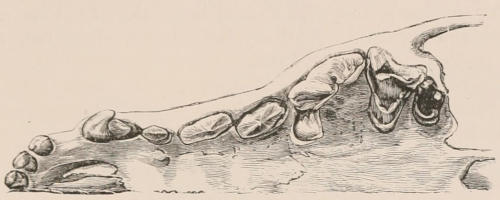
Fig. 232.—The left upper dentition of the Indian Civet (Viverra zibetha). From the Palæontologia Indica.
The Rasse or Lesser Indian Civet (V. malaccensis) may be regarded as the representative of a distinct group of Viverra, although often referred to a separate genus (Viverricula). The size of this animal is smaller than in the typical group, the build is slighter, the muzzle finer, the claws sharper and more curved, and there is no erectile mane along the back. Generally there is an alisphenoid canal in the skull; and the anterior chamber of the auditory bulla is much more inflated than the hinder one, so that the apparent length of the whole bulla is increased. This species is found over the greater part of India, and extends to the Malay Peninsula and Southern China.
Large species of Viverra occur in the Pleistocene and Pliocene of India, and also in the Pliocene of France, which approximate in some characters of the dentition to the extinct genus Ictitherium, mentioned at the end of the family. Species of this genus have also been described from the Miocene and Upper Eocene of Europe. The Lower Miocene V. antiqua has an alisphenoid canal, and all the other cranial characters of the typical forms.
Fossa.[443]—The Fossa of Madagascar comes so close to the Rasse that its right to generic distinction seems doubtful. There is, however, no scent-pouch. The limbs are slender; and there are two small bare spots on the sole of the hind foot, above the plantar pads. There is no dark line along the back; the throat gorget of Viverra is absent; and in the tail the spots only tend to form rings, which are not complete. The skull has an alisphenoid canal, and a large bulla as in the typical group of Viverra.
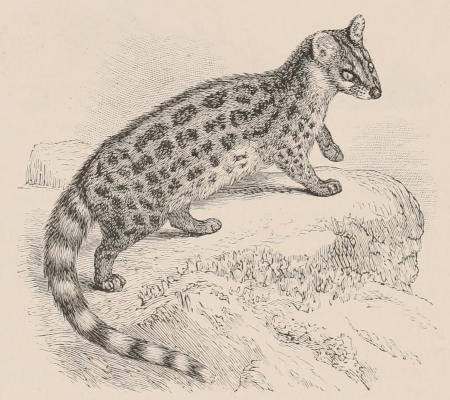
Fig. 233.—The Common Genet (Genetta vulgaris).
Genetta.[444]—The Genettes are smaller animals, with more elongated and slender bodies, and shorter limbs than the Civets. Skull elongated and narrow. Auditory bulla large, elongated, rounded at both ends. Teeth compressed and sharp pointed. The inner side of the third upper premolar has a tubercle not present in the previous genus, and the talon of the lower carnassial is larger. Pupil contracting to a linear aperture. Tail long, slender. Fur short and soft, spotted or cloudy. Under side of the tarso-metatarsus with a narrow longitudinal bald streak. No pouch for storing the secretion of the scent-gland. G. vulgaris, the common Genet (Fig. 233), is found in France south of the river Loire, Spain, South-Western Asia, and Africa from Barbary to the Cape. G. felina, senegalensis, tigrina, and pardalis are other named species, all African in habitat.
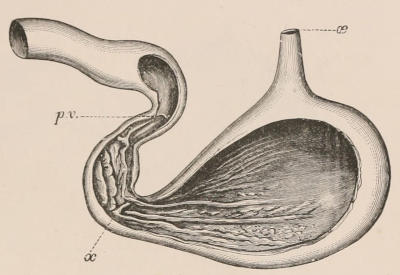
Fig. 234.—Stomach of Genet cut open. œ, Œsophagus; pv, pyloric valve; x, sudden bend where the internal folds are interrupted. (From Mivart, Proc. Zool. Soc. 1882, p. 505.)
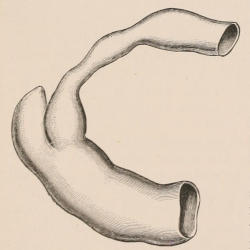
Fig. 235.—Cæcum of Genet. (After Mivart, loc. cit. p. 508.)
A few details (taken from Professor Mivart’s memoirs on the Æluroidea) of the anatomy of the soft parts of the Genet may be given as illustration of these parts in the Carnivora generally, and of this family and genus in particular. The salivary glands are shown in Fig. 19 (p. 56), and these conform to the general type prevalent in the Æluroidea. Thus there is a distinct zygomatic gland; the parotid with its (Steno’s) duct is well developed; and there is a small submaxillary gland. The stomach (Fig. 234), while conforming to the simple type characteristic of the Carnivora, is much larger than in the Cat; it is characterised by the presence of some strongly marked internal folds near the pyloric extremity, which stop suddenly at a point where the stomach makes an abrupt constriction and flexure. Beyond this point there are three other longitudinal folds; and the pyloric valve is small. The allied genera present modifications from this form of stomach. The cæcum (Fig. 235) is short, thick, and pointed. The liver (Fig. 236) much resembles that of the Cat, but differs in that the left lateral lobe is undivided, although having a small groove on its posterior or abdominal aspect, while the cystic fissure is less deep, and situated more to the right. The caudate lobe is relatively longer, has a deep concavity, and runs uninterruptedly into the Spigelian; the latter being relatively somewhat larger than in the Cat, with a deep groove dividing the proximal third from the distal two-thirds. In Viverra the right lateral and right central lobes are nearly equal in size. The variations in the form of the liver of the allied genera are detailed in Professor Mivart’s memoir. The brain of the Genet is shown in Fig. 23 (p. 71); the small depression d placed on the superior lateral gyrus appears to be the sole representative of the distinct crucial sulcus which distinguishes the brains of the Felidæ from those of all other members of the Æluroidea.
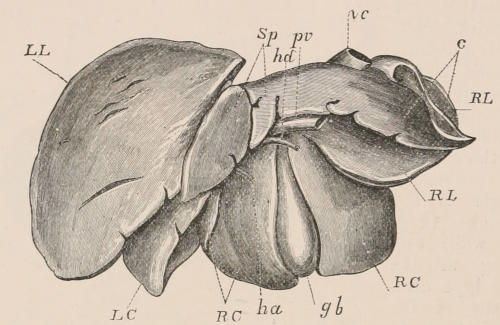
Fig. 236.—Abdominal aspect of the liver of the Genet. c, Caudal lobe; gb, gall-bladder; ha, hepatic artery; hd, hepatic duct; LC, left central lobe; LL, left lateral lobe; pv, portal vein; RC, right central lobe; RL, right lateral lobe; Sp, Spigelian lobe; vc, vena cava. (From Mivart, Proc. Zool. Soc. 1882, p. 510.)
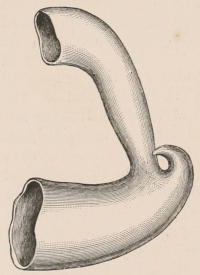
Fig. 237.—Cæcum of Prionodon. (From Mivart, Proc. Zool. Soc. 1882, p. 508.)
Prionodon.[445]—This and the following genus comprise the beautiful Linsangs (Fig. 238), which are distinguished from the preceding genera by the loss of the second upper molar, which is, however, very small in some of the Genets. In the present genus the ground colour is whitish or yellowish with brown or black markings, which may either form broad continuous patches across the hinder part of the body, or may be broken up into spots. The tail is very long, the limbs comparatively short, and the fur very short and close. The pollex and hallux are well developed; the claws are almost completely retractile; and the tarsus and metatarsus are completely haired. The pupil is round. The cæcum (Fig. 237) is remarkably small. This genus is exclusively Oriental, and comprises P. gracilis from Borneo, Java, and (?) Sumatra, P. pardicolor from Nipal, and P. maculosus from Tenasserim; the head and body of the latter measuring from 18 to 20 inches in length. Speaking of P. pardicolor, Mr. Hodgson observes that it is “equally at home on trees and on the ground; it dwells and breeds in the hollows of decayed trees. It is not gregarious at all, and preys chiefly upon small birds, which it is wont to pounce upon from the cover of the grass. The times of breeding are said to be February and August, and the litter to consist of two young, there being two litters each year.”
Poiana.[446]—This African genus, represented solely by one species, P. poënsis (Fig. 238), from Fernando Po, is very closely allied to the preceding, but the spots are smaller, and show no tendency to run into transverse bands or stripes, except in the region of the head and shoulder; while the sole of the foot has a narrow bald band running up towards the tarsus, as in Genetta. The length of the head and body is 38 inches, and that of the tail about 40 inches. It is probable that this animal should really be regarded as a slightly aberrant species of the genus Prionodon.
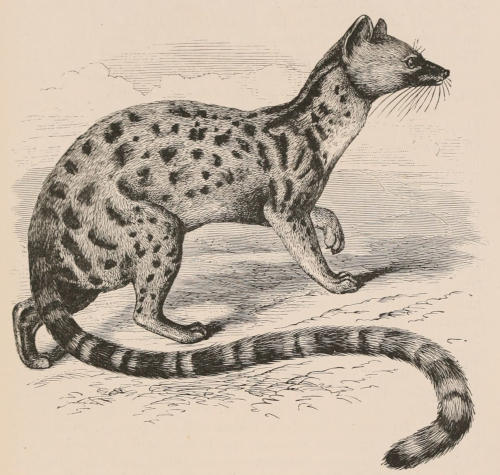
Fig. 238.—The African Linsang (Poiana poënsis). From Mivart, Proc. Zool. Soc. 1882, p. 160.
The five following genera differ in several important respects from all the preceding, and collectively constitute the Paradoxurine section of Professor Mivart. With the exception of one African form, they are mainly Oriental. In this section the auditory bulla is frequently in two portions, the posterior moiety in one case being unossified, and it is always much narrowed in front (Fig. 239). The palate (as in the figure) may be much produced behind the molars; and the teeth are often but slightly sectorial, and may be very small. The long tail is in most cases not ringed.
Paradoxurus.[447]—Dentition: i ³⁄₃, c ¹⁄₁, p ⁴⁄₄, m ²⁄₂; total 40. The blunt and rounded form of the cusps of the hinder premolar and the molar teeth distinguishes this genus from most of the members of the family. Vertebræ: C 7, D 13, L 7, S 3, C 29-36. Head pointed in front. Ears small, rounded. Body long. Limbs moderate. Palms and soles almost entirely naked, and joining the foot-pads without the intervention of any hairy space. Claws completely retractile. Pupil vertical. Tail long, non-prehensile; in the Indian species without rings. The Paradoxures or Palm-Civets are less strictly carnivorous than the other members of the family. They are mostly about the size of the common Cat, or rather larger, and are partly arboreal in their habits. The species are rather numerous, and present considerable variations in the details of the form and size of their molar teeth; in only a few does the bony palate extend behind the molars. They are restricted geographically to Southern Asia and the Indo-Malayan archipelago. The best known species[448] are P. niger, P. hermaphroditus, P. jerdoni, P. aureus, P. grayi from India and Burma, P. philippinensis of the Philippines, P. larvatus of Southern China and Formosa, P. leucomystax of the Malay Peninsula, Sumatra, and Borneo, and P. musschenbroeki of Celebes. The name Paradoxurus was applied from the mistaken notion that the tail was prehensile. Mr. Blanford[449] gives the following account of the habits of P. niger: “The common Palm-Civet, Tree-Cat, or Toddy-Cat, is a familiar animal in most parts of India, though, being thoroughly nocturnal in its habits, it is but rarely seen in the daytime. It is arboreal, passing the day generally in trees, either coiled up in the branches, or in a hole in the trunk, and in places where cocoa-nut palms are common it frequently selects one of them for a residence. Mango groves are also a favourite resort. It not unfrequently takes up its abode in the thatched roofs of houses; Jerdon found a large colony established in the rafters of his own house in Tellicheri. It even occurs in large towns; I have known of one being caught in the middle of Calcutta.”
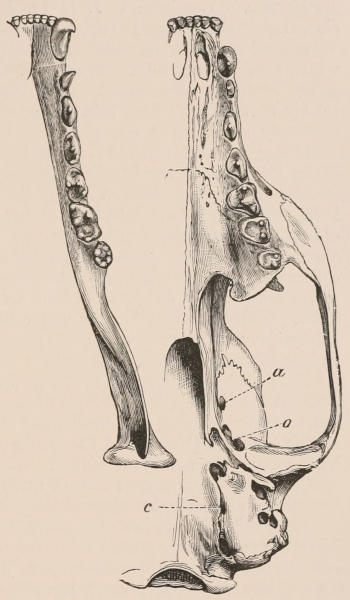
Fig. 239.—Palatal aspect of the left side of the cranium and mandible of Arctogale leucotis. a, Anterior opening of alisphenoid canal; o, foramen ovale; c, carotid canal ¹⁄₁. (From Mivart, Proc. Zool Soc. 1882, p. 165.)
Arctogale.[450]—This genus—represented only by A. trivirgata of Java, and A. leucotis of Burma, Tenasserim, Sumatra, Java, etc.—is chiefly distinguished from Paradoxurus by the extremely small size of the cheek-teeth (Fig. 239), which are often not in contact with one another; the upper carnassial being almost triangular in shape. Palate frequently convex longitudinally between the carnassials, and greatly produced behind the last molar, with a very narrow bony aperture of the posterior nares. The soles of the feet are still more naked than in Paradoxurus; and the pollex and hallux are more divergent. In A. leucotis the length of the head and body is 26·5 inches, and the tail 27 inches. In many specimens the three dorsal stripes are much less distinctly marked than in others, and tend to break up into spots; while the general coloration is considerably lighter.
Hemigale,[451] another modification of the Paradoxure type, contains one species, H. hardwickei, from Borneo and Malacca, an elegant-looking animal, smaller and more slender than the Paradoxures, of light gray colour, with transverse broad dark bands across the back and loins; the proximal portion of the tail being ringed. The tarsus is hairy. The general cranial characters are those of Paradoxurus, but the auditory bulla is ankylosed into a single piece.
Arctictis.[452]—Dentition: i ³⁄₃, c ¹⁄₁, p ⁴⁄₄, m ²⁄₂; total 40. The posterior upper molar and the first lower premolar very often absent. Cheek-teeth generally small and rounded, with a distinct interval between them, but formed generally on the same pattern as Paradoxurus. Vertebræ: C 7, D 14, L 5, S 3, C 34. Body elongated. Head broad behind, with a small pointed face. Whiskers long and numerous. Ears small, rounded, but clothed with a pencil of long hairs. Eyes small. Limbs short. Soles and palms broad, entirely naked. Tail very long and prehensile; thickly covered with long hair. Fur long and harsh. Cæcum extremely small. But one species is known, A. binturong, the Binturong, an inhabitant of Southern Asia from Nipal through the Malay Peninsula to the islands of Sumatra and Java. Although structurally agreeing closely with the Paradoxures, its tufted ears, long, coarse, and dark hair, and prehensile tail give it a very different external appearance. It may be regarded as a very aberrant Paradoxure, connected, so far as dental characters are concerned, with Paradoxurus by means of Arctogale. The bony palate also extends considerably behind the last molar, as in the latter. The Binturong is slow and cautious in its movements, chiefly if not entirely arboreal, and appears to feed on vegetable as well as animal substances.
Nandinia[453] contains one species, N. binotata, a somewhat aberrant Paradoxure, from West Africa. It is rather smaller than the true Paradoxures, with smaller and more pointed molar teeth, and no cæcum. The wall of the hinder chamber of the auditory bulla remains through life unossified.
The dentition appears to be of a more decidedly carnivorous type than in the other members of the section.
Cynogale.[454]—This remarkable genus is regarded by Professor Mivart as representing a third section of the Viverrinæ; it contains one species, C. bennetti (described by S. Müller under the name of Potamophilus barbatus), from Borneo, Sumatra, and the Malay Peninsula. This is a curious Otter-like modification of the Viverrine type, having semiaquatic habits, both swimming in the water and climbing trees, living upon fish, crustacea, small mammals, birds, and fruit. The number and general arrangement of its teeth are as in Paradoxurus, but the premolars are peculiarly elongated, compressed, pointed and recurved, somewhat as in the Seals, though the molars are tuberculated. The head is elongated, the muzzle broad and depressed. Whiskers very long and abundant. Ears small and rounded. Toes short and slightly webbed at the base. Tail short, cylindrical, covered with short hair. Fur very dense and soft, of a dark brown colour, mixed with black and gray. Humerus without entepicondylar foramen.
Subfamily Herpestinæ.—Auditory bulla very prominent, and somewhat pear-shaped, the posterior chamber being large, rounded, and generally with its greatest prominence to the outer side. The anterior chamber considerably dilated, and produced into a short inferior wall to the auditory meatus, in which is a depression or vacuity just below the centre of the opening of the meatus. Sometimes this vacuity is continued into the meatus, forming a narrow fissure. The paroccipital process does not project beyond the bulla, but is spread out and lost (in adult animals) on its posterior surface. Toes straight; claws lengthened, exserted, non-retractile. No perineal glands. The dentition is always of a markedly sectorial type; and the orbit may be surrounded by bone. Very generally the anus opens into a sac-like depression. The majority of the genera are Ethiopian; the type genus alone extending into the Oriental and Palæarctic regions.
Herpestes.[455]—Dentition: i ³⁄₃, c ¹⁄₁, p ⁴⁄₄, sometimes ³⁄₃, m ²⁄₂; total 40 or 36. Teeth of molar series generally with strongly developed, sharply-pointed cusps. Skull elongated, constricted behind the orbits. Face short and compressed. Frontal region broad and arched. Postorbital processes of frontal and jugal bones well developed, generally meeting so as to complete the circle of the orbit behind. Vertebræ: C 7, D 13, L 7, S 3, C 21-26. Head pointed in front. Ears short and rounded. Body very long and slender. Extremities short. Five toes on each foot, the first, especially that on the hind foot, very short. Toes free, or but slightly palmated. Palms generally naked. Distal portion of soles naked, under surface of tarsus and metatarsus usually clothed with hair, but considerable specific variation in this respect. Tail long or moderate, generally thick at the base, and sometimes covered with more or less elongated hair. The longer hairs covering the body and tail almost always annulated. This genus contains a very large number of animals commonly called Ichneumons, or in India Mungooses, varying in size from that of a large Cat down to a Weasel. They are widely distributed over the African continent and the southern parts of Asia, especially India and the Indo-Malayan archipelago, one species occurring also in Spain. They are mostly terrestrial in their habits, feeding on small mammals and birds, reptiles, especially snakes, eggs of birds and reptiles, and also insects. Some species are partially domesticated, being used to keep houses clear of rats, mice, and snakes. H. ichneumon was a sacred animal to the ancient Egyptians. They vary considerably in appearance, some, as H. galera and H. urva (Fig. 240), are larger and heavier, with stouter body, longer limbs, and stronger teeth. The common Indian Mungoose (H. mungo) is considerably smaller than the Egyptian form; its fur is of a pale gray colour, the hairs being largely white ringed, while the cheeks and throat are more or less reddish. Like the Egyptian species, it is frequently domesticated, and put to a similar use. It is especially serviceable in India as a serpent-killer, destroying not only the eggs and young of these creatures, but attacking without hesitation and killing the most venomous adult snakes. The fact that it invariably survives those encounters has led to the belief that it either enjoys immunity from the effects of snake-poison, or that after being bitten it has recourse, as the natives maintain, to the root of a plant as an antidote. Neither of these suppositions has stood the test of scientific examination, for it has been found that when actually bitten it falls a victim to the poison as rapidly as other mammals, while there is no trustworthy evidence of its seeking a vegetable antidote. The truth seems to be that the Mungoose, by its exceeding agility and quickness of eye, avoids the fangs of the snake while fixing its own teeth in the back of the reptile’s neck. One large species, believed to be from Africa, recently described as H. grandis, is remarkable for the extreme complexity of the cusps on the molars, and also for the absence of an entepicondylar foramen to the humerus; the latter feature also occurring in the allied H. albicaudatus. The Oriental H. urva (Fig. 246) is stated to be somewhat aquatic in habits, and to feed on frogs and crabs.
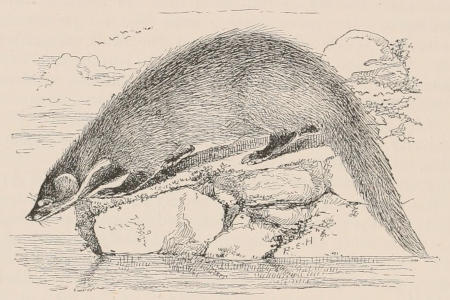
Fig. 240.—The Crab-eating Mungoose (Herpestes urva). From Blanford, Mammalia of British India, p. 130.
Remains of the small H. nipalensis occur in the cavern-deposits of Madras. Viverroids from the Miocene and Upper Eocene of Europe, which agree with Herpestes in the presence of an inner tubercle to the third upper premolar and of a hinder cusp to the fourth lower premolar, have been referred to the existing genus. The species which have been separated generically under the three following names are very closely allied to Herpestes.
Helogale,[456] premolars ³⁄₃, without diastema between first and second; soles of feet completely naked. Contains two small South-African species, H. parvula and H. undulata.
Bdeogale[457] contains also two small Ichneumon-like animals, B. crassicauda and puisa, differing from Herpestes proper in having only four toes on each foot, both pollex and hallux being absent. The orbit is nearly complete, the tail of moderate length and rather bushy.
Cynictis.[458]—Pollex present, but hallux absent. Skull shorter and broader than in Herpestes, rather contracted behind the orbits, which are large and complete behind. Face short. Anterior chamber of the auditory bulla very large. Front claws elongated. C. penicillata, from South Africa. The cæcum (Fig. 241) of this genus is longer than in any other member of the family.
All the foregoing Herpestines have the nose short, with its under surface flat, bald, and with a median longitudinal groove. The remaining forms have the nose more or less produced, with its under side convex, and a space between the nostrils and the upper lip covered with close adpressed hairs, and without any median groove.
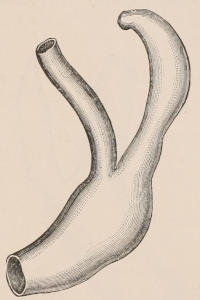
Fig. 241.—Cæcum of Cynictis penicillata. (From Mivart, Proc. Zool. Soc. 1882, p. 508.)
Rhinogale.[459]—Toes 5-5. Claws of fore feet short, compressed, acute. Under surface of tarsus hairy. Palate flat. Founded on a single specimen from East Africa, R. melleri.