Chapter IX · THE ORDER UNGULATA (continued 2)
Reading edition
The Muntjacs are solitary animals, very rarely even two being seen together. They are fond of hilly ground covered with forests, in the dense thickets of which they pass most of their time, only coming to the skirts of the woods at morning and evening to graze. They carry the head and neck low and the hind-quarters high, their action in running being peculiar and not very elegant, somewhat resembling the pace of a sheep. Though with no power of sustained speed or extensive leap, they are remarkable for flexibility of body and facility of creeping through tangled underwood. They are often called by Indian sportsmen “Barking Deer,” a name given on account of their alarm cry, a kind of short shrill bark, like that of a fox but louder, which may often be heard in the jungles they frequent both by day and by night. When attacked by dogs the males use their sharp canine teeth with great vigour, inflicting upon their opponents deep and even dangerous wounds.
There is some difference of opinion among zoologists as to the number of species of the genus Cervulus. Sir Victor Brooke, who investigated this question in 1878 (see Proceedings of the Zoological Society of London for that year, p. 898), came to the conclusion that there are certainly three which are quite well marked, viz.—
C. muntjac (Fig. 126), found in British India, Burma, the Malay Peninsula, Sumatra, Java, Hainan, Banca, and Borneo. The general colour is a bright yellowish-red, darker in the upper parts of the back; the fore legs from the shoulder downwards and the lower part of the hind legs, dark bluish-brown; anterior parts of the face from the muzzle to between the eyes, brown—a blackish line running up the inside of each frontal ridge; chin, throat, inside of hind legs, and under surface of tail white. The female has a black bristly tuft of hair on the spot from which the pedicles of the antlers of the male grow. The average length of the male, according to Jerdon, is 3½ feet, tail 7 inches, height 26 to 28 inches. The female is a little smaller. The specimens from Java, Sumatra, and Borneo are of larger size than those from the mainland, and may possibly be of distinct species or race.
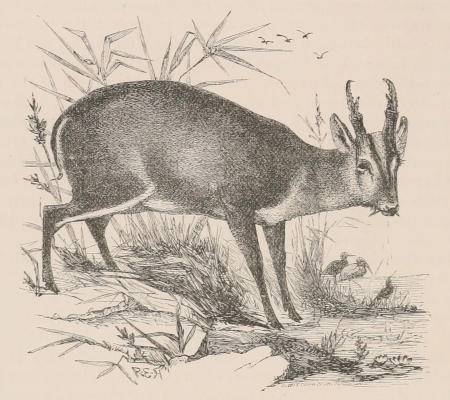
Fig. 126.—The Muntjac (Cervulus muntjac).
C. lacrymans of Milne-Edwards, or Sclater’s Muntjac of Swinhoe, from Moupin, and near Hangchow, China.
C. reevesi, a very small species from southern China.
Subsequently the name C. crinifrons has been applied to a Muntjac from Ningpo, China, readily distinguished from all other species by its bushy forehead and long tail. Another species from Tenasserim has been described as C. feæ.
Small Deer from the European Pliocene have been provisionally referred to Cervulus, but the so-called Prox furcatus, of the Miocene, is now included in Palæomeryx.
Elaphodus.[198]—Antlers very small, unbranched, supported on long, slender, converging pedicles. Ascending rami of premaxillæ shorter than nasals. No supraorbital ridges or frontal glands. Upper canines of male long, but not everted. A distinct frontal tuft of hair. Other characters as in Cervulus.
This genus (which has also received the name of Lophotragus) is represented by a small Deer (Fig. 127) from China of about the same size as the Indian Muntjac. The male has minute simple antlers and very large canine teeth. There are no supraorbital glands, nor is there a tufted gland on the metatarsus. The limbs have the same peculiarities as in Cervulus, but the mesocuneiform may also ankylose with the ectocuneiform, and traces of the metacarpals may remain. The hair is coarse and somewhat quill-like.
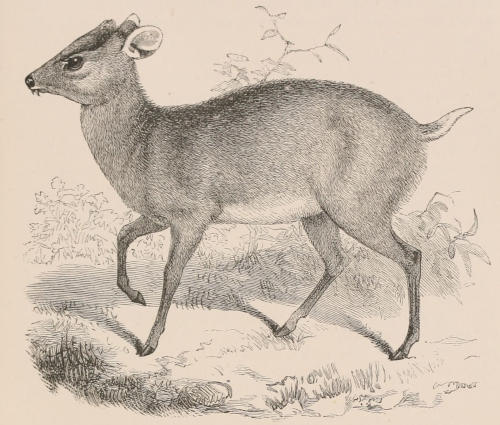
Fig. 127.—Male of Elaphodus michianus. From Sclater Proc. Zool. Soc. 1876, p. 273.
Cervus.[199]—The great majority of the Deer of the Old World may be included in this large genus, which is one not easy of definition. The antlers of the male are, however, large, and two or three times the length of the head, and may be either rounded or palmate; the canines are never large; the ectocuneiform of the tarsus remains distinct from the naviculo-cuboid; the lateral digits are represented by their phalanges; and the skull does not carry prominent frontal ridges. Vertebræ: C 7, D 13, L 6, S 4, C 11-14. The size of the lachrymal fossa and vacuity, and the degree of inflation of the auditory bulla, are subject to variation in the different groups into which the genus may be divided.
The Rusine group is characteristic of the Oriental region, where it is typically represented by the Sambur (C. aristotelis) of India, Burma, and China. The antlers are rounded, and often strongly grooved, without a bez tine, and with the beam simply forked at the extremity, upright, and but slightly curved; the angle formed by the brow tine, which rises close to the burr, being acute. The molars are markedly hypsodont, with small accessory columns. The lachrymal fossa is deep and the vacuity large; the auditory bulla is slightly inflated and rugose. Tail moderate; neck maned.
The Sambur, which is abundant in hilly districts, is a fine animal, standing nearly 5 feet in height, and of massive build; the general colour being deep brown. C. equinus, of Borneo, Sumatra, and Singapore, C. swinhoei, of Formosa, C. philippinus, and C. alfredi of the Philippines, are closely allied species, of which the two latter are of smaller dimensions. The Indian Hog Deer (C. porcinus) is a still smaller form, not larger than the Roe. C. hippelaphus of Java, C. timoriensis, and C. moluccensis are distinguished by the posterior branch of the beam of the antler being considerably larger than the anterior.
The Rucervine group is another strictly Oriental one, and is represented by the Swamp Deer (C. duvaucelli) of India, the closely allied C. schomburgki of Siam, of which the antlers are shown in Fig. 119 (p. 309), and C. eldi of Burma and Hainan. The beam of the antler is somewhat flattened, and more curved than in the Rusine group; the large brow tine is given off from the beam at an obtuse angle and curves upwards; the beam bifurcates into two branches, which again divide. Skull as in the Rusine group, but relatively narrower. Tail short; neck maned.
The Swamp Deer is somewhat smaller than the Sambur, and of a full yellowish colour. Fossil representatives of this group occur in the Pliocene of India.
The Elaphurine group is represented only by the very aberrant C. davidianus of Northern China. In size and proportions this species approximates to the Swamp Deer, but the antlers are peculiar in rising straight from the brow and then giving off a long and straight back tine (correlated by Sir V. Brooke with the posterior branch of the Rusine antler); the summit of the beam is forked, and in old individuals the two tines of the fork may again branch. Nasals long, and much expanded between the lachrymal vacuities, of which they form the inner border; lachrymal fossa large and deep. Tail long; neck maned.
The Axine group includes only the well-known Axis of India, readily distinguished by the white spots with which the body is marked. Antlers of a Rusine type, the beam being much curved, and the brow tine usually given off at an acute or right angle. Molars very hypsodont. The coloration of the Axis is more brilliant than that of any other member of the family.
Here may be noticed a group of Deer mainly characteristic of the eastern Palæarctic region, frequently known as the Pseudaxine group, which appears to connect the Axine with the Elaphine type. Well-known representatives of this group are C. sika (Fig. 128) of Japan, C. mantchuricus of China, and C. taëvanus of Formosa. The antlers have a brow and tres tine, and then a forked beam, of which the posterior tine is the smaller. The lachrymal vacuity and fossa are of moderate size; and the auditory bulla is only moderately inflated, and quite smooth externally. Tail moderate; neck maned. In summer the coat is spotted, but is plain in winter. A herd of C. sika have been acclimatised in Ireland by Viscount Powerscourt, at Powerscourt, County Wicklow. A number of Deer from the Pliocene of Europe, such as C. perrieri and C. etueriarum, appear to be allied both to the Pseudaxine and Axine groups.
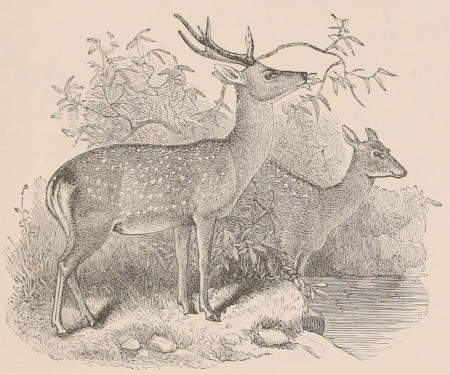
Fig. 128.—The Japanese Deer (Cervus sika). From Lord Powerscourt, Proc. Zool. Soc. 1884, p. 209.
The Elaphine or typical group is at once characterised by the presence of a bez tine to the antlers (Fig. 129), in which the beam is rounded, and splits up near the summit into a larger or smaller number of snags, often arranged in a cup-like manner. Skull as in the preceding group. All the species large. The Red Deer, C. elaphus, which is dark brown in colour, with a light patch on the rump, inhabits Europe, Western Asia, and Northern Africa—the so-called Barbary Deer not being specifically distinct. A full-grown Scotch Stag is fully 4 feet in height at the withers. The antlers are shed between the end of February and the early part of April; old animals shedding earlier than younger ones. The young, which (as in all the members of the genus except some of the Rusine species) are spotted, are born at the end of May or the beginning of June. The points on the antlers increase in number with the age of the creature, and when twelve are present it is known in Scotland as a “royal stag.” This number, however, is sometimes exceeded, as in the case of a pair of antlers, weighing 74 lbs., from a stag killed in Transylvania, which had forty-five points. The antlers during the second year consist of a simple unbranched stem, to which a tine or branch is added in each succeeding year, until the normal development is attained, after which their growth is somewhat irregular. Many of the antlers dug up in British peat-beds (as Fig. 118) are larger than those of living individuals, and in the cave-deposits of England and the Continent antlers are met with rivalling those of the Wapiti in size; these large fossil antlers probably indicating the ancestral form from which the Red Deer and several of the allied species are descended.
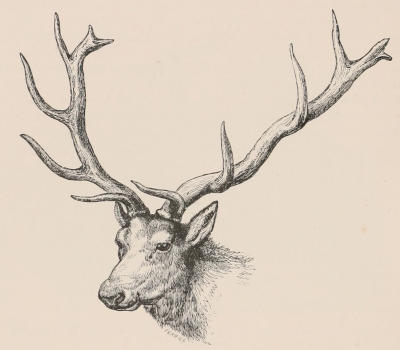
Fig. 129.—Head of the Wapiti (Cervus canadensis).
The North American Wapiti (Cervus canadensis, Fig. 129), the Persian Maral (C. maral), the Kashmir Stag (C. cashmeerianus), as well as C. affinis of Tibet, are all closely allied to the Red Deer, but are of larger size, this being especially the case with the first two. A fine example of the antlers of the Wapiti is shown in the accompanying woodcut, and exhibits the absence of a cup at the surroyals, by which this species is distinguished from the Red Deer.
The last, or Damine group of existing Deer includes the Common and the Persian Fallow Deer. These are readily characterised by the palmation of the antlers in the region of the surroyals and the spotted coat. The Common Fallow Deer (C. dama) stands about three feet in height. The Persian Fallow Deer (C. mesopotamicus) is very closely allied, differing only in its slightly larger size and the form of the antlers, the two breeding together. The common species, although now kept in English parks, does not appear to be a native of this country, having probably been introduced from the regions bordering the Mediterranean. The fur is of a yellowish-brown colour (whence the name “fallow”), marked with white spots; there is, however, a uniformly dark brown variety found in Britain. The bucks and does live apart, except during the pairing season; and the doe produces one or two, and sometimes three fawns at a birth. The Fallow Deer from the Pleistocene and Pliocene deposits of the East Coast described under the names of C. browni and C. falconeri appear to have been closely allied to the existing species. The remarkable C. verticornis, of the Norfolk Forest-bed, is regarded as an aberrant member of this group, in which the antlers are very short and thick, with the brow tine cylindrical and downwardly curved, and the beam expanded above the tres tine into a crown with two points.
The extinct Irish Deer (Cervus giganteus), of which the skeleton is shown in the woodcut (Fig. 130), is the only representative of the Megacerotine group. The antlers, which may have a span of over 11 feet, are enormously palmated, and have a bifurcated brow tine, a small bez tine, and a third posterior tine. The skeleton measures upwards of 6 feet at the withers. Remains of this species are especially common in the peat-bogs of Ireland, but are also met with in Pleistocene deposits over a large part of Europe. In addition to the forms already mentioned there are many other fossil species of Cervus, some of which, like the English Pleistocene C. sedgewicki, cannot be included in any of the existing groups. There is no conclusive evidence of the existence of any species of Cervus before the Lower Pliocene period.
Telemetacarpalia.—This section includes all the Deer of the New World, together with some Old World forms, and is characterised by retaining the distal extremities of the lateral (second and fifth) metacarpals. With the exception of Alces, Capreolus, and Hydropotes (which are either partly or entirely Old World types), the vomer is so much ossified as to divide the posterior bony nares into two distinct orifices (Fig. 132).
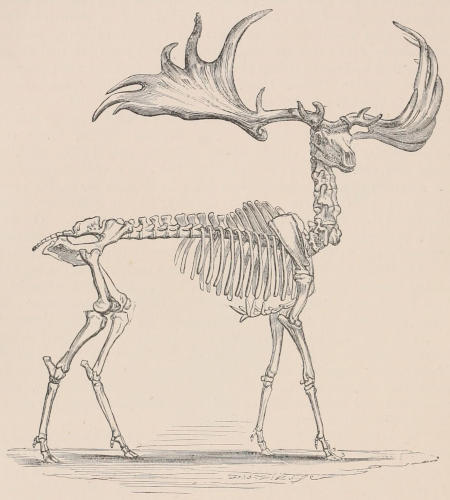
Fig. 130.—Skeleton of the Gigantic Irish Deer (Cervus giganteus). After Owen.
Rangifer.[200]—The Reindeer, or Caribou as it is termed in North America, is the sole representative of the genus Rangifer, which is sufficiently distinguished from all its allies by the presence of antlers in both sexes. The lachrymal vacuity is small. This animal is distributed over the northern parts of Europe, Asia, and America; the differences which may be observable in specimens from different regions not being sufficient to allow of specific distinction. The Reindeer is a heavily built animal, with short limbs, in which the lateral hoofs are well developed, and the cleft between the two main hoofs is very deep, so that these hoofs spread out as the animal traverses the snow-clad regions in which it dwells. The antlers (Fig. 131) are of very large relative size. There is a bez as well as a brow tine, which are peculiar in being either branched or palmated. In the American race (Caribou), as well as in some of the specimens found fossil in the English Pleistocene (Fig. 131), one of the brow tines is generally aborted to allow of the great development of the other. The dentition of the Reindeer is frequently remarkable for the very small size of the posterior lobe of the last lower molar. Vertebræ: C 7, D 14, L 5, S 5, C 11.
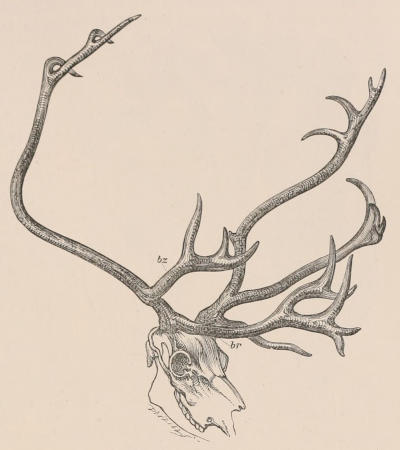
Fig. 131.—Skull and antlers of the Reindeer (Rangifer tarandus), from an English Pleistocene deposit. br, Brow tine; bz, bez tine. (After Owen.)
The Reindeer has long been domesticated in Scandinavia, and is of especial value to the Laplanders, whom it serves as a substitute for the Horse, Cow, Sheep, and Goat. It is capable of drawing a weight of 300 lbs., and its fleetness and endurance are remarkable. Harnessed to a sledge it will travel without difficulty 100 miles a day over the frozen snow, on which its broad and deeply cleft hoofs are admirably adapted for travelling. During the summer the Lapland Reindeer feeds chiefly on the young shoots of the willow and birch; and since at this season migration to the coast seems necessary to the well-being of this animal, the Laplander, with his herds, sojourns for several months in the neighbourhood of the sea. In winter its food consists chiefly of the so-called reindeer-moss and other lichens which the animal makes use of its hoofs in seeking for beneath the snow. The wild Reindeer grows to a much greater size than the tame breed; but in Northern Europe the former are being gradually reduced through the natives entrapping and domesticating them. The tame breed found in Northern Asia is much larger than the Lapland form, and is there used to ride on. Remains referable to the existing species are found in the cavern and other Pleistocene deposits of Europe.
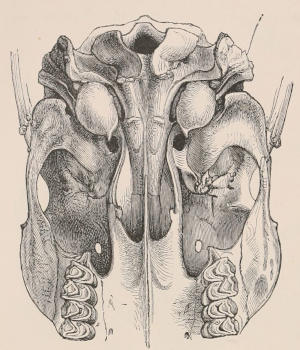
Fig. 132.—Hinder part of the base of the cranium of the Virginian Deer (Cariacus virginianus). From Garrod, Proc. Zool. Soc. 1877, p. 13.
Alces.[201]—The Elk or Moose (Alces machlis) has the same general distribution as the Reindeer, and is likewise the single existing representative of its genus. It is the largest existing member of the family, attaining sometimes a height of 8 feet at the withers. The antlers (Fig. 133) have neither brow nor bez tine, but form an enormous basin-shaped palmation, primarily composed of an anterior and a posterior branch; their weight may be as much as 60 lbs. The nasal bones are very short, and the narial aperture of great size. The Elk is covered with a thick coarse fur of a brownish colour, longest on the neck and throat. Its legs are long and its neck short, and as it is thus unable to feed close to the ground, it browses on the tops of low plants, the leaves of trees, and the tender shoots of the willow and birch. Its antlers attain their full length by the fifth year, but in after years they increase in breadth and in the number of snags, until fourteen of these are produced. Although spending a large part of their lives in forests, Elks do not suffer much inconvenience from the great expanse of their antlers, as in making their way among trees they are carried horizontally to prevent entanglement with the branches. Their usual pace is a shambling trot, but when frightened they break into a gallop. The natural timidity of the Elk forsakes the male at the rutting season, and he will then attack whatever animal comes in his way. The antlers and hoofs are his principal weapons, and with a single blow from the latter he has been known to kill a wolf. The female often gives birth to two fawns, and with these she retires into the deepest recesses of the forest, the young remaining with her till their third year. The Elk ranges, but in scanty numbers, over the whole of Northern Europe and Asia, as far south as East Prussia, the Caucasus, and North China, and over North America from the New England States westward to British Columbia. Fossil species are found in the Pleistocene deposits of Europe.
Cervalces.[202]—A remarkable extinct Deer from the Pleistocene of North America, described as Cervalces, appears in some respects (although a true Telemetacarpalian) to connect Alces with Cervus. Thus the palmated antlers are divided into anterior and posterior branches, but below this division there are two tines apparently corresponding to the bez and posterior tines of Cervus giganteus (Fig. 130).
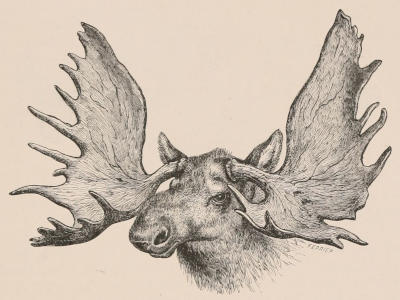
Fig. 133.—Head of Elk (Alces machlis).
Capreolus.[203]—Antlers (in the existing species) less than twice the length of the head, usually with three tines on each. Brow tine developed from the anterior surface of the upper half of the antler, and directed upwards. Lachrymal vacuity small. Premaxillæ not always articulating with nasals. Auditory bullæ slightly inflated, rugose externally. Vertebræ: C 7, D 13, L 6, S 6, C 8. Tail very short. Glands in fore feet rudimentary; large in hind feet.
The Roe, or Roe Deer (Capreolus caprea), is a small form distributed over Europe and Western Asia, being one of the species found in the British Isles. The male is somewhat over two feet in height at the withers, of a dark reddish-brown colour in summer, with a white patch on the rump. The small antlers are approximated at their bases, and consist of a rugged beam rising vertically for some distance, then bifurcating, and the posterior branch again dividing. The Roe dates from the Pleistocene period. Extinct Deer from the Continental Pliocene have been provisionally referred to Capreolus.
Hydropotes.[204]—No antlers in either sex. Lachrymal fossa deep and short (Fig. 134); lachrymal vacuity of moderate size. Orbits small and but slightly prominent. Auditory bulla much inflated. Angle of mandible much produced backwardly (Fig. 134); alveolar margins of mandible in diastema sharp and everted. Canines of male very large, and slightly convergent. Vertebræ: C 7, D 12, L 6, S 4, C 10. No tufts on metatarsals. Foot glands small in fore feet, deep in hind ones.
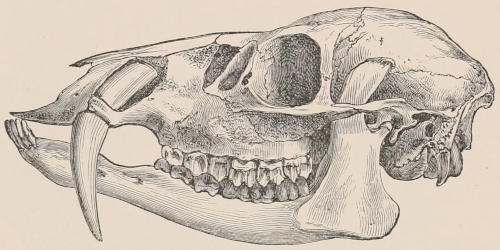
Fig. 134.—The left lateral view of the skull of a male Chinese Water Deer (Hydropotes inermis), with the wall of the maxilla cut away to show the root of the canine. ½ natural size. (From Sir V. Brooke, Proc. Zool. Soc. 1872, p. 524.)
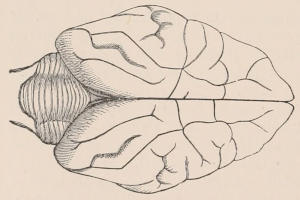
Fig. 135.—Upper surface of the brain of Hydropotes inermis. (From Garrod, Proc. Zool. Soc. 1877, p. 792.)
The Chinese Water Deer (H. inermis) is the sole representative of this genus. In the absence of antlers and the large canines of the male it resembles Moschus, although very different in other respects. Thus the brain (Fig. 135) has the hemispheres much convoluted, as in other Cervinæ, and approximates to that of Pudua; while the placenta and viscera likewise agree with those of the true Deer. In the total absence of any ossification of the vomer to divide the posterior nares Hydropotes resembles Capreolus and differs from all the following genera. The Chinese Water-Deer is nearly of the same size as the Indian Muntjac. It has short legs and a long body, the hair covering the latter being of a light reddish-brown. It is a remarkably prolific animal, differing from all other Deer in producing five or six young at a time.
The mandible of a ruminant from the Middle Miocene of Gers in France, described under the name of Platyprosopus, presents such a marked resemblance to Hydropotes in the form of the angle as to suggest a more or less intimate affinity.
Cariacus.[205]—Skull (Fig. 132) with the vomer dividing the posterior nares into two distinct chambers; premaxillæ not reaching nasals. Antlers never greatly exceeding the length of the head. Lachrymal vacuity very large, and lachrymal fossa small. Auditory bullæ slightly inflated. Vertebræ: C 7, D 13, L 6, S 4, C 13. Tail long or short. Colour uniform in adult.
This genus, which agrees with the Reindeer in the division of the posterior nares by the ossified vomer, comprises a number of species confined to the New World, none of which attain very large dimensions, and the antlers of which are relatively smaller than in the existing species of Cervus. The genus may be divided into groups.
The typical Cariacine group, as represented by C. virginianus, has well-developed antlers, with a short brow tine rising from the inner side of the beam, and directed upwards, and several branches; a long tail; and no upper canines. In this species, as well as in C. mexicanus and other forms, the antlers do not divide dichotomously, and the lachrymal fossa is of moderate depth. The Mule Deer (C. macrotis) of North America is distinguished by the dichotomous branching of the antlers and the deeper lachrymal fossa. The Virginian Deer is somewhat smaller than the Fallow Deer, and of a uniform reddish-yellow colour in summer, and light gray in winter.
The Blastocerine group of South America is represented by C. paludosus and C. campestris, and has dichotomous antlers, with no brow tine, and the posterior branch the larger, a short tail, and no upper canines. The Furciferine group includes C. chilensis and C. antisiensis, confined to western South America. The antlers are not longer than the head, with a large anterior tine curving forwards at right angles to the simple posterior one. Auditory bullæ slightly inflated, and rugose. Upper canines may be present. The species are of medium size. C. clavatus, of Central America, while resembling this group in the characters of the skull and the arrangement of the hair on the face, agrees with the next one in having simple spike-like antlers.
The South American Coassine group comprises the small forms known as Brockets, in which the antlers form simple spikes not exceeding half the length of the head. Some six species are known.
Remains of Cariacus, mostly or entirely referable to existing species, are of common occurrence in the Brazilian cave-deposits. Blastomeryx, of the Pliocene of North America, is believed to be an allied type.
Pudua.[206]—Antlers in the form of minute simple spikes. Distinguished from the Coassine group of Cariacus by the articulation of the premaxillæ with the nasals (as in the Furciferine group), and the coalescence of the ectocuneiform with the naviculo-cuboid, as well as by various external characters. No upper canines. Represented only by the very small P. humilis of the Chilian Andes.
Extinct Genera.—In the European and other Tertiary deposits several genera of extinct Cervidæ occur, of which the more important may be briefly mentioned. Amphitragulus, of the Lower Miocene of the Continent, has four lower premolars, brachydont molars, and no antlers; the largest species being somewhat bigger than the Musk-Deer. The closely allied Palæomeryx (Dremotherium or Micromeryx) generally has but three lower premolars, and the brachydont upper molars (Fig. 122), like those of Amphitragulus, want the small accessory inner column[207] found in modern Deer. In P. feignouxi, of the Lower Miocene, the lateral metacarpals, although slender, were complete, and the males had large canines, but no antlers. P. furcatus, of the Middle Miocene, had small antlers, and the canines appear to have been reduced in size. This genus, besides being represented in the European Miocene, also occurs in the Pliocene of India and China; some of the species being as large as the Red Deer.
Family Giraffidæ.
In the existing genus the frontal appendages consist of a pair of short, erect, permanent bony processes placed over the union of the frontal and the parietal bones, ossified from distinct centres, though afterwards ankylosed to the skull, covered externally with a hairy skin, present in both sexes, and even in the new-born animal. Anterior to these is a median protuberance on the frontal and contiguous parts of the nasal bones, which increases with age, and is sometimes spoken of as a third horn. Skull with a lachrymal vacuity. No upper canines. Molars brachydont, with rugose enamel; the upper ones having no inner accessory column. Lateral digits entirely absent on both fore and hind feet, even the hoofs not developed. Humerus with double bicipital groove. Vertebræ: C 7, D 14, L 5, S 3, C 20. Gall-bladder generally absent. Male reproductive organs and placenta of a Bovine type. Dentition: i ⁰⁄₃, c ⁰⁄₁, p ³⁄₃, m ³⁄₃.
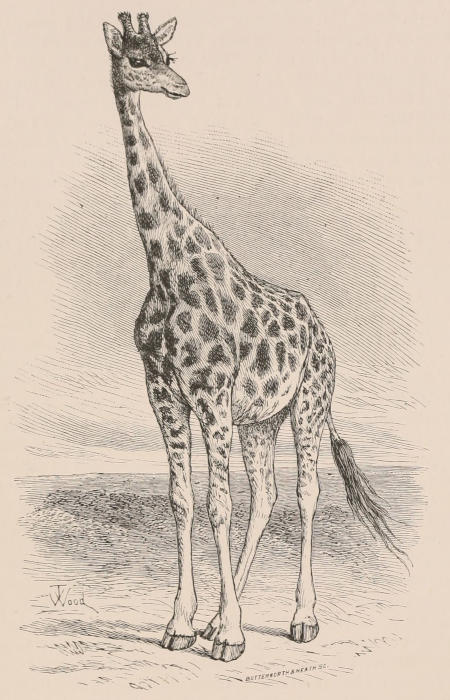
Fig. 136.—The Giraffe (Giraffa camelopardalis).
Giraffa.[208]—The Giraffe (G. camelopardalis) is the sole existing representative of the genus, now confined to the Ethiopian region.
In addition to the characters noticed above, the Giraffe is characterised by its great size and peculiar proportions; the neck and limbs being of great length, and the back inclining upwards from the loins to the withers.
To produce the extremely elongated neck the seven cervical vertebræ are proportionately long, which gives a somewhat stiff and awkward motion to the neck. The ears are large, the lips long and thin, the nostrils closable at the will of the animal, the tongue very long and extensile, and the tail of considerable length, with a large terminal tuft. An adult male may have a total height of 16 feet. The coloration consists of large blotches of darker or lighter chestnut-brown on a paler ground, the lower limbs and under parts being of a uniform pale colour. The Giraffe feeds almost exclusively on the foliage of trees, showing a preference for certain varieties of mimosa, and for the young shoots of the prickly acacia, for browsing on which its prehensile tongue and large free lips are specially adapted. It is gregarious in its habits, living in small herds of about twenty individuals, although Sir S. Baker, who hunted it in Abyssinia, states that he has seen as many as a hundred together.
Fossil species of Giraffa occur in Pliocene deposits over Greece, Persia, India, and China, thus affording one of many striking instances of the former wide distribution of the generic types now confined to the Ethiopian region.
Allied Extinct Types.—The Pliocene deposits of many parts of the Old World yield remains of a number of large Ruminants which show such evident signs of affinity with the Giraffe that it is difficult to draw up a definition by which they can be separated in characters of family value from that genus. On the other hand, some of these forms approximate in the characters of the skull to some of the brachydont members of the Bovidæ, although it is quite clear from the nature of the cranial appendages that they cannot be included in that family. All these forms have brachydont molars, with rugose enamel, like those of the Giraffe; while several of them have limb-bones approximating to those of the latter—the humerus, when known, having a double bicipital groove. The nature of the cranial appendages (when present) is not fully understood, but it appears that in some cases these approximated more to the type of an antler than to that of a horn; although, from the absence of a “burr,” they appear never to have been shed. A gradual diminution in the length of the limbs and neck can be traced from the more Giraffoid to the more Bovoid forms of this extinct group; and it is manifest that if these animals be included in the Giraffidæ the definition of that family as given above must be somewhat modified. Only brief mention can be made of the more important genera.
The imperfectly known Vishnutherium, of the Pliocene of India and Burma, seems to make the nearest approach to the Giraffe, but the limbs and cervical vertebræ were decidedly shorter, although of a similar slender type. Helladotherium, of the Pliocene of Greece and India, is represented by a species of considerably larger size than the Giraffe, with no appendages or lachrymal vacuity to the skull, and with shorter and stouter limbs and neck.
Hydaspitherium, Bramatherium, and Sivatherium are Indian genera, characterised by the presence of large palmated and antler-like cranial appendages, varying considerably in arrangement. The former genus has a large lachrymal vacuity which is absent in the two latter. In the first and second genera all the appendages rise from a common base; but in Sivatherium there is a pair of simple horn-like projections on the orbits in addition to the posterior palmated antlers. Sivatherium was an animal of huge bulk, being the largest known representative of the Pecora.
Another apparently allied type is Samotherium, of the Pliocene of the Isle of Samos, which appears also to have some affinity with the Antelopes. The skull is nearly as large as that of the Giraffe, and is of the same elongated shape, although depressed between the conical horn-cores, which rise vertically above the orbits, and without a median bony prominence on the frontals. The horn-cores form mere processes of the frontals. The diastema and the mandibular symphysis are shorter than in the Giraffe, and the latter is less deflected. The teeth, although larger, are almost indistinguishable from those of the Giraffe, the only well-marked difference being that the last lower premolar has a double in place of a single postero-internal column.
Family Antilocapridæ.
Closely allied to the Bovidæ, but the horns deciduous and branched.
Antilocapra.[209]—The Prong-buck, or Prong-horned Antelope (Antilocapra americana), as the single existing member of this family is called, is an animal of nearly the same size as the Fallow Deer, but of a lighter and more graceful build. It is an inhabitant of the prairies of North America, where it is one of the few representatives of the Cavicorn Pecora. The bony horn-cores are unbranched, and form vertical, blade-like projections immediately above the orbit. The horns themselves are compressed, and nearly one foot in length, having a gentle backward curvature, the short branch arising somewhat above the middle of its height, and inclining forwards. When the horn is about to be cast off it becomes loosened, and a new one is formed upon the bony core beneath it. The ears are long and pointed, and the tail is short. The neck has a thick mane of long chestnut-coloured hair, and there is a white patch on the rump.
Family Bovidæ.
Frontal appendages, when present, in the form of non-deciduous horns. Molars frequently hypsodont. Usually only one orifice to the lachrymal canal, situated inside the rim of the orbit. Lachrymal bone almost always articulating with the nasal. Canines absent in both sexes. The lateral toes may be completely absent, but more often they are represented by the hoofs alone, supported sometimes by a very rudimentary skeleton, consisting of mere irregular nodules of bone. Distal ends of the lateral metapodials never present. Gall-bladder almost always present. The number of cotyledons in the placenta generally varies from 60 to 100; whereas in the Cervidæ the number is usually from 5 to 12, Capreolus and Hydropotes having the fewest. In Giraffa the number is upwards of 180. The nature of the horns and horn-cores has been already explained; in the majority of genera these appendages are present in both sexes, although much larger in the male (see p. 310).
The Bovidæ, or hollow-horned Ruminants (Cavicornia), form a most extensive family, with members widely distributed throughout the Old World, with the exception of the Australian region; but in America they are less numerous, and confined to the Arctic and northern temperate regions, no species being indigenous either to South or Central America. There is scarcely any natural and well-defined group in the whole class which presents greater difficulties of subdivision than this; consequently zoologists are as yet very little agreed as to the extent and boundaries of the genera into which it should be divided. For the present the genera provisionally adopted may be arranged under a number of sections or groups, which some writers regard as subfamilies. The series may be commenced with the Antelopes, the greater number of which are now characteristic of the Ethiopian region.
Alcelaphine Section.—Includes large African Antelopes, of which the type genus ranges into Syria; generally characterised by their great height at the withers as compared with the rump. Skull with large frontal sinuses, extending into the horn-cores, and the horns lyre-shaped or recurved, and more or less approximated at the base. No large pits at apertures of supraorbital foramina in frontals; upper molars hypsodont and narrow. Horns in both sexes. General colour mostly uniform.
Alcelaphus.[210]—If Damalis be included, this genus is represented by some nine or ten living species. Head more or less long and narrow, with the muffle moderately broad and naked. Nostrils approximated, edged with stiff hairs. Horns compressed and ringed at the base, more or less lyrate, and bent back at the tips. Hoofs small. Tail of moderate length, and heavy. Two mammæ.
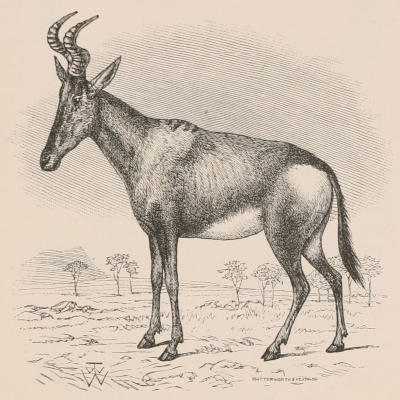
Fig. 137.—The Harte-beest (Alcelaphus caama).
In the typical forms, such as the Bubaline Antelope (A. bubalinus), the Harte-beest (A. caama, Fig. 137), and the Tora Antelope (A. tora, Fig. 138), the horns, which present the peculiar curvature shown in the figures, are situated on a crest at the vertex of the skull, and the facial portion of the cranium is greatly elongated. The Harte-beest, which is found throughout Central and Southern Africa, stands nearly 5 feet high at the withers, and is a somewhat ungainly looking animal, with short hair, which is grayish-brown above and nearly white beneath. In the Pliocene of the Siwalik Hills in Northern India there occur remains of an Alcelaphus (A. palæindicus) in which the skull had the long facial portion characteristic of the typical group, while the horns approximate to those of the Bontebok. The Blessbok (A. albifrons) and Bontebok (A. pygargus), belonging to the genus Damalis of many authors, have the facial portion of the skull shorter, the horns situated more in advance of the plane of the occiput, and inclining regularly backwards. Of the Blessbok Mr. C. J. Anderson observes that “it is of a beautiful violet colour, and is found in company with black Wildebeests and Springboks in countless thousands on the vast green plains of short crisp, sour grass occupying a central position in South Africa. Cattle and horses refuse to pasture on the grassy products of these plains, which afford sustenance to myriads of this Antelope, whose skin emits a most delicious and powerful perfume of flowers and sweet-smelling herbs.” Since the time this was written these Antelopes have been greatly reduced in number. A. (Damalis) hunteri, from East Africa, appears to be allied to A. senegalensis, but in the more elongated facial portion of the skull approximates to the Harte-beest, and thus confirms the view that Damalis should not form a distinct genus.
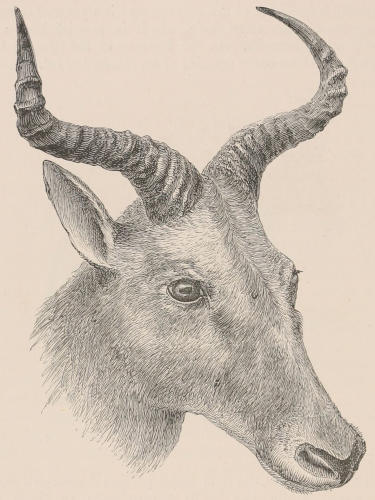
Fig. 138.—Head of Alcelaphus tora. From Sclater, Proc. Zool. Soc. 1873, p. 762.
Connochætes.[211]—Head short and massive, with the muffle very broad and bristly. Nostrils widely separated, hairy within. Horns on the vertex of the skull, immediately over the occiput, approximated at base, cylindrical, bent outwards, and recurving upwards at the tip. Extremities of premaxillæ much expanded laterally, and firmly ankylosed. Vertebræ: C 7, D 14, L 6, S 4, C 16. Hoofs very narrow. Tail very long, covered throughout with long hairs. Four mammæ. Two species, C. taurina and C. gnu (Fig. 139), both from South Africa. The former, or Brindled Gnu, is distinguished by the absence of long hair on the face, the black (instead of white) tail, and the presence of dark vertical streaks on the shoulders; it is never found to the south of the Orange River.
The White-tailed Gnu stands about 4 feet 6 inches at the withers. These animals were formerly found in large herds, and are remarkable not only on account of their peculiar form, but also for their grotesque actions when alarmed. Some interesting observations have recently been published upon the mode of development of the horns of the Gnu,[212] from which it appears that in very young individuals the horns are straight and divergent, situated some distance below the vertex of the head, and separated by a wide hairy interval. These young horns form the straight tips of those of the adult, the basal downwardly curved portion being subsequently developed. In the fully adult animal the base of the horns forms a helmet-like mass on the forehead which completely obliterates the hairy frontal space of the young.
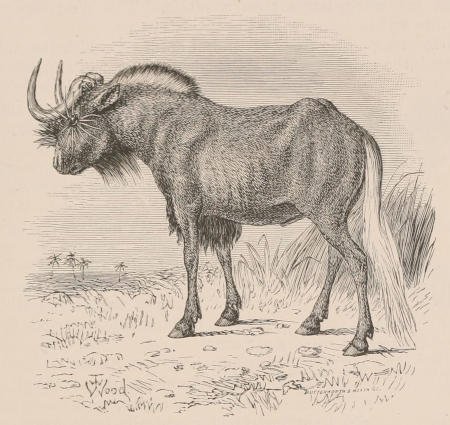
Fig. 139.—The White-tailed Gnu (Connochætes gnu).
Cephalophine Section.—Small or medium-sized African and Indian Antelopes, with simple horns present only in the males, a more or less elongated suborbital gland, a lachrymal depression in the skull, and square-crowned upper molars (Fig. 140). Lateral hoofs well developed.
Cephalophus.[213]—One pair of horns, arising far back on the frontals, conical, short, angulated at the base, and erect or recurved. Suborbital gland opening in the form of a slit, or as a row of pores. Auditory bulla divided by a distinct septum. Muffle large and moist. Tail very short. Head tufted. Upper molars of larger species with an accessory internal column. Dorsal vertebræ fourteen in number. Some sixteen species, confined to southern and tropical Africa.
The Duikerboks, as the members of this genus are called, are among the most graceful of the African Antelopes, the smallest species not being larger than a rabbit. The West African C. sylvicultor and C. longiceps are the largest species.
Tetraceros.[214]—Two pairs of conical horns, of which the anterior are much the smaller. Suborbital gland elongated, and lachrymal fossa very large. Upper molars (Fig. 140) without accessory internal column. One existing Indian species (T. quadricornis).
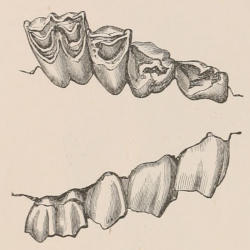
Fig. 140.—Palatal and outer aspects of the three right upper premolars and first molar of the Four-horned Antelope (Tetraceros quadricornis). From the Palæontologia Indica.
The Four-horned Antelope is found throughout the peninsula of India in jungle. The general colour is brown, lighter beneath and on the inside of the limbs. Remains of this species are found fossil in the cave-deposits of Madras, and a small Ruminant from the Pliocene of the Siwalik Hills has been provisionally referred to this genus.
Cervicaprine Section.—Small or large Antelopes now confined to the Ethiopian region, with horns present only in the males, lachrymal vacuity generally large, more or less distinct pits at the apertures of the supraorbital foramina in the frontals, and narrow upper molars in which there is no accessory internal column.
Neotragus.[215]—Distinguished from the next genus by having the crown of the head tufted, muzzle hairy, premaxillæ long and reaching the lachrymals, nasals very short, mesethmoid much ossified, third lobe of last lower molar either absent or very small, and the hinder lobe of the corresponding upper molar much reduced.
Three species, Salt’s Antelope (N. saltianus), from Abyssinia, and also N. kirki and N. damarensis; the two latter having a small third lobe to the last molar. Writing of the first-named species, Mr. W. T. Blanford[216] observes that “the Beni-Israel, or Om-dig-dig, one of the smallest Antelopes known, abounds on the shores of the Red Sea and throughout the tropical and subtropical regions of Abyssinia. It is occasionally, but rarely, found at higher elevations; I heard of instances of its being shot both at Serafie and Dildi, but it is not often seen above about 6000 feet. It inhabits bushes, keeping much to heavy jungle on the banks of water-courses, and is usually single, or in pairs, either a male and female or a female and young being found together; less often the female is accompanied by two young ones, which remain with her until full grown.”
Nanotragus.[217]—Horns small, parallel with frontals, and rising immediately above postorbital process of frontals, in front of the fronto-parietal suture. Lachrymal fossa very large, suddenly descending in front of the orbit, and extending on to the maxilla; lachrymal vacuity small. Auditory bulla large and smooth, without internal septum. Nasals of moderate length. Crown of the head smooth; naked part of muffle small; aperture of suborbital gland small. Lateral hoofs small or absent. Nine species.[218]
The typical species is the Royal Antelope (N. pygmæus) of Guinea, the smallest existing representative of the Pecora. This species, together with N. moschatus and N. tragulus have no lateral hoofs, or tufts on the knees. In the Scopophorine group, comprising N. scoparia, N. montanus, and N. hastatus, both these appendages are present; while in the Oreotragine group (N. melanotis and N. oreotragus) the former are present and the latter absent.
Pelea.[219]—Horns rather small, compressed, upright, scarcely diverging, and placed immediately over the orbits. No suborbital gland, nor lachrymal fossa; premaxillæ not reaching nasals. Tail short and bushy. Colour uniform. One species—the Rehbok (P. capreola), South Africa, is nearly of the size of a Fallow Deer, although more resembling a Chamois in build and habits. The colour is of a uniform light gray. This animal inhabits bare rocky districts, and thus differs widely from the Water-buck and its allies.
Cobus.[220]—Large Antelopes, with the horns large, elongate, sublyrate, and ringed at the base, and with rudimentary suborbital glands. Skull with a deep frontal hollow, no lachrymal depression, large lachrymal vacuity, and the premaxillæ reaching the very long nasals. Tail long, with a ridge of hair above, and slightly tufted at the end. Colour uniform. Six species, African.
The Antelopes of this genus are water-loving animals, the Water-buck (C. ellipsiprymnus) and the Singsing (C. defassus) being well-known examples. Both these species are much alike, standing as much as 4 feet 6 inches at the withers. The Water-buck of South and Eastern Africa is characterised by the coarseness of its long hair; while in the Singsing of West and Central Africa the hair is remarkably fine and soft. Fossil Antelopes from the Pliocene of India are referred to Cobus. Helicophora, from the Lower Pliocene of Attica, is regarded as allied to Cobus, but it has no distinct supraorbital pits.
Cervicapra.[221]—An allied South African genus in which the tail is short and bushy and the premaxillæ do not reach the nasals. Three species.
The Reitbok (C. arundineum) is of a grizzly ochre colour; it stands nearly 3 feet in height, and has horns about 1 foot in length. The Nagor (C. redunca) is about 6 inches shorter, with horns of half the length, and fulvous brown above and white below; the West African C. bohor being rather larger.
Antilopine Section.—A large group of moderate-sized or small Antelopes, most abundant in the deserts bordering the Palæarctic, Oriental, and Ethiopian regions. Horns generally compressed and lyrate, or recurved, or cylindrical and spiral, ringed at base, sometimes present in both sexes. Skull with large pits at apertures of supraorbital foramina of frontals, and generally a distinct lachrymal fossa. Molars of upper jaw narrow, without inner accessory column, and resembling those of the Sheep and Goats. Tail moderate, compressed, hairy above.
Antilope.[222]—Horns, present only in the male, long, cylindrical, subspiral, and diverging. Suborbital gland large, with a somewhat linear opening; lachrymal depression of skull very large, and a small lachrymal fissure. Glands in the feet; lateral hoofs present. One species, India.
The well-known Black-buck (A. cervicapra) is found on open plains all over India, except in lower Bengal and Malabar. Old males are deep blackish-brown in colour on the back and sides and the outer surfaces of the limbs, the under parts and inner surfaces of the limbs white, and the back of the head, nape, and neck yellowish. Young males and females are fawn-coloured above. Very large herds are seen in the plains about Delhi and Mattra, which are said in some instances to reach to thousands. Horn-cores are found in the Pleistocene deposits of the valley of the Jumna which cannot be distinguished from those of the existing species.
Æpyceros.[223]—Horns compressed, lyrate, and wide-spreading; present only in male. No suborbital gland, or lachrymal depression in the skull. No lateral hoofs. Two species; one from South and the other from West Africa.
The Palla (Æ. melampus) is a large Antelope standing over 3 feet high at the withers, and readily distinguished by its dark red colour, gradually shading to white below. It is usually found on or near hills in herds of from twenty to thirty. Æ. petersi is from the Congo.
Saiga.[224]—Nose very large, convex, and inflated. Supraorbital gland present. Lachrymal fossa of skull small, and fissure absent; narial aperture very large; nasals extremely short; supraorbital pits rather small. Horns yellow, lyrate, of moderate length; present only in male. Vertebræ: C 7, D 13, L 6, S 4, C 10. One species, Eastern Europe and Western Asia.
The Saiga (S. tatarica) is a clumsily built and somewhat sheep-like Antelope inhabiting the steppes; it occurs fossil in the Pleistocene of France and England.
Pantholops.[225]—Allied in the characters of the head and skull to Saiga, but the nose less convex, the nostrils of the male more swollen, and the horns of that sex black, very long, compressed, and lyrate; those of female very short. One species, Central Asia.
The Chiru (P. hodgsoni) inhabits the highlands of Western Tibet and Turkestan. In the former area it generally goes in small herds of from three to six, and in the summer may be found grazing in early morning on the level spaces frequently found in the river valleys at elevations of about 15,000 feet. It is excessively shy and difficult to approach. The large size of the narial aperture in the skull of Chiru is suggestive of a connection with respiration at a high altitude, but this appears to be negatived by the occurrence of the same feature in the Saiga.
Gazella.[226]—Delicately built and sandy-coloured Antelopes, with lyrate or recurved horns, which may be absent in the female, and are always smaller and simpler in that sex than in the male. Skull with moderate lachrymal fossa, and a distinct lachrymal fissure. Vertebræ: C 7, D 13, L 6, S 4, C 14. Suborbital gland frequently small, and covered with hair. Face with a white streak running from the outer side of the base of each horn nearly down to the upper end of each nostril, cutting off a dark triangular central patch, and bordered externally by a diffused dark line (see Fig. 121, p. 310). The Gazelles, of which there are some twenty-four existing species, are typically Palæarctic desert forms, the Springbok (G. euchore) being an outlying South African species. G. picticaudata and G. gutturosa are respectively found in Western Tibet and Mongolia, the former at great elevations. The majority of the Gazelles do not exceed 30 inches in height, although G. mohr is 36. Sir Victor Brooke classifies[227] the Gazelles as follows:—
A. No stripe on back; three lower premolars. a. White of rump not encroaching on the fawn of the haunches. I. Female with horns. 1. Horns lyrate or sublyrate—G. dorcas, G. isabella, G. rufifrons, G. lævipes, G. tilonura, G. naso. 2. Horns non-lyrate—G. cuvieri, G. leptoceros, G. spekei, G. arabica, G. bennetti, G. fuscifrons, G. muscatensis. II. Female without horns. G. subgutturosa, G. gutturosa, G. picticaudata. b. White of rump projecting forwards in an angle into the fawn colour of the haunches. Horns in both sexes. G. dama, G. mohr, G. soemmerringi, G. granti (Fig. 121), G. thomsoni.
B. A white stripe down the back, two lower premolars. Horns in both sexes.—G. euchore.
The East African G. walleri is an aberrant species, in which the females are hornless, which has been made the type of the genus Lithocranius. It is characterised by the extreme density of the horns and skull, the slenderness of the mandible, and the small size of the cheek-teeth, the upper molars being relatively broader and lower than usual. The cranium is remarkable for the shortness of its facial portion, the large size and production backwards of the supraoccipital, and for the circumstance that the long basicranial axis is nearly parallel with the plane of the palate.
Fossil species of Gazella are found in the Pliocene and Pleistocene deposits of Europe and India. G. deperdita (brevicornis), of the Lower Pliocene of France and Greece, appears to be a generalised species in which the lower molars frequently have accessory columns, traces of which are found in some of the existing forms.
Hippotragine Section.—Includes very large African Antelopes, with long horns, present in both sexes, which are placed over or behind the orbit, and are either recurved, straight, or subspiral. Skull with no distinct pits at apertures of supraorbital foramina in frontals, no lachrymal fossa, and only a small lachrymal fissure. No suborbital gland. Tail long, cylindrical, and tufted at the end. Upper molars extremely hypsodont, very broad, and with large accessory columns, thus closely resembling those of the Oxen. Some authorities divide this section into two. In the Pliocene it occurs in India and Europe.
Hippotragus.[228]—Horns stout, rising vertically from a crest over the orbit at an obtuse angle to the plane of the nasals, then recurved; lachrymal fissure in some instances almost obliterated. Neck with an erect recurved mane. Tail very distinctly tufted. Four species, tropical Africa and south to the Cape.
The Sable Antelope (H. niger) is one of the best-known examples of this genus, occurring in South and East Africa. It stands upwards of 4½ feet in height at the withers, and, except for some white streaks on the face and the whole of the under surface of the body, is of a black colour. The Blaubok (H. leucophæus) is distinguished by the glaucous hue of the hair. The other species are the Equine Antelope (H. equinus) and Baker’s Antelope (H. bakeri) from the Sudan, both closely allied, but the latter distinguished by its pale fulvous colour, pencilled ears, and black stripes on the shoulder.
Skulls of fossil Antelopes from the Pliocene of India have been referred to Hippotragus (H. sivalensis), and Sir V. Brooke suggests that the European Pliocene Antilope recticornis is not generically separable.
Oryx.[229]—Horns long, slender, nearly straight or somewhat recurved, rising behind the orbit, and inclining backwards in the plane of the nasals; lachrymal fossa distinct. Nape maned; tail long, and more haired than in Hippotragus. Four species, ranging over all the African deserts to Arabia and Syria.
The Gemsbok (O. gazella, Fig. 141), is a South African species characterised by its straight horns, the presence of a tuft of hair on the throat, as well as by the large patches and stripes of black on the head, back, limbs, and flanks. It stands nearly 4 feet in height at the shoulder, and the horns are 2 feet 9 inches in length. The colour of the upper part of the body is a rusty gray, and of the under part white, while these are separated from each other by a well-defined black band on either side. These bands unite on the breast, and are continued as a single black band until reaching the lower jaw, where they again divide and form two transverse bands on the head, terminating at the base of the horns. The head otherwise is white, as also are the limbs, with the exception of the thighs, which are black. The Gemsbok generally goes in pairs, or in small herds of three or four. The Beisa (O. beisa) of Abyssinia is distinguished by the absence of the tuft of hair on the throat. Writing of this species in his Geology and Zoology of Abyssinia, Mr. W. T. Blanford observes that “the appearance of a herd of Oryx is very imposing. They are some of the most elegant and symmetrical of animals, the motions being those of a wild Horse rather than of an Antelope. Their favourite pace appears to be either a steady quick walk or a trot; they rarely break into a gallop unless greatly alarmed. When frightened they dash off, sometimes snorting and putting their heads down as if charging, raising their long tails, and looking very formidable. They are wary animals, though far less so than some other Antelopes. It is said that they frequently attack when wounded, and their long straight horns are most deadly weapons.” The Arabian Beatrix Antelope (O. beatrix) is a much smaller animal, with the black markings confined to the head, fore limbs, and flanks. Finally, the Leucoryx (O. leucoryx) of North Africa, while agreeing in size with the Beatrix, differs by its curved horns and uniform coloration.
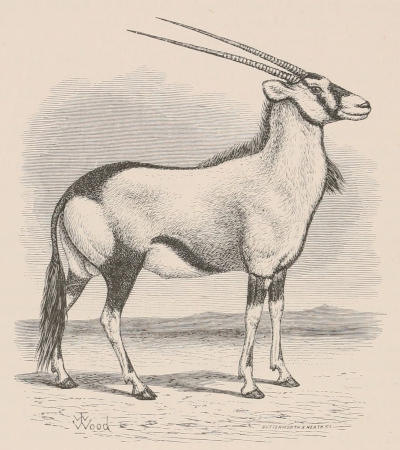
Fig. 141.—The Gemsbok (Oryx gazella).
The extinct Palæoryx, of the Lower Pliocene of Europe and the Isle of Samos, appears to have been an ancestral form of Oryx, said to show some signs of affinity with Hippotragus.
Addax.[230]—Horns with the same inclination as in Oryx, but with a slight spiral twist. No mane on nape, but a slight one on the throat. Hoofs rounded. One species (A. nasomaculatus), from North Africa and Arabia, the colour of which is nearly white.
Tragelaphine Section.—Includes large, so-called Bovine, Antelopes now mainly characteristic of the Ethiopian region, but with one Oriental genus. Horns usually present in the male only (if developed in the female smaller), with a more or less distinct ridge in front, and usually twisted spirally, the front ridge twisting outwards from the base of the horn. Skull without lachrymal fossa, but with a large or small lachrymal fissure; usually large pits at the apertures of the supraorbital foramina on the frontals; premaxillæ reaching nasals. Muffle large and moist; nostrils approximated. Molars hypsodont or brachydont. Vertical white stripes frequently present on the body.
a. Hind limbs much shorter than the fore. Horns behind the orbit, short, conical, faintly angulated. Nose bovine. Body without vertical stripes. Molars (Fig. 123, p. 311) hypsodont, with a large accessory column in those of the upper jaw. One Oriental genus.
Boselaphus.[231]—The one genus of this subsection is represented only by the well-known Nilghai (B. tragocamelus) of India. The male stands over 4 feet in height at the shoulder, with horns about 8 inches in length; the hornless female being about one third smaller. Both sexes have a short erect mane, and the male has also a tuft of hair upon the throat. When adult the sexes are very different in colour, the male being of a dark iron gray or slate colour, approaching black on the head and legs, while the female and young are of a bright light brown or fawn colour. In both male and female at all ages the lips, chin, and under parts, as well as two transverse stripes on the inner sides of the ears and rings on the fetlocks, are white, and the mane and tip of the tail black. The Nilghai is one of the few Antelopes occurring in India, where it is found from near the foot of the Himalaya to the south of Mysore, though rare to the north of the Ganges and also in the extreme south. It is most abundant in Central India, and does not occur in Assam or the countries to the east of the Bay of Bengal. It frequents forests and low jungles, though often found in tolerably open plains, associating in small herds. One, or very often two, young produced at a birth. Fossil remains of species of this genus occur in the Pleistocene and Pliocene deposits of India.
b. Fore and hind limbs equal. Horns long, and spirally twisted. Nose cervine, and aperture of suborbital gland very small. Body generally striped. Molars brachydont, those of the upper jaw in existing forms with a smaller inner accessory column. Three existing Ethiopian genera.
Tragelaphus.[232]—Female hornless. Horns of males (Fig. 142) over orbit, with one or two spiral turns, obscurely ridged, the posterior ridge being more developed than the anterior. Skull with small supraorbital pits, very small lachrymal fissure, and no deep intercornual depression in the frontals. Neck maned or smooth. Hoofs short or long. Coloration usually brilliant, differing markedly in the two sexes, and the white bands on the body, when present, numerous and distinct. Seven species.
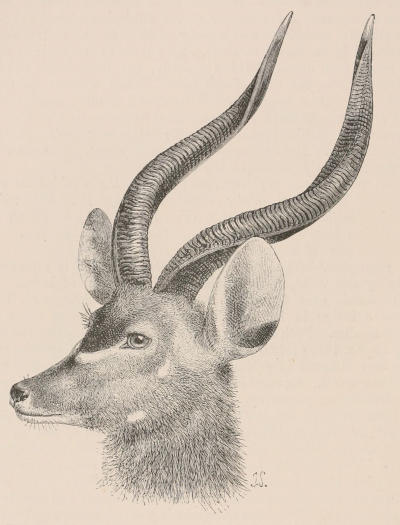
Fig. 142.—Head of Tragelaphus gratus. From Sclater, Proc. Zool. Soc. 1883, p. 36.
The Harnessed Antelopes are among the handsomest of the whole group. The small Guib (T. scriptus) is not larger than a Goat, but T. angasi is 3 feet 4 inches in height at the shoulder. In T. scriptus, T. angasi, and T. euryceros, the two sexes differ in colour, the body is marked by white stripes descending from a white dorsal streak, and the hoofs are short; the third species differing from the others by the absence of a mane on the neck, back, and belly. T. gratus agrees with this group in coloration (the mane being absent), but differs in the extreme elongation of its hoofs. The Nakong, T. spekei, while having the long hoofs of T. gratus, has a perfectly plain body coloration, with a mane on the neck. The two species with elongated hoofs inhabit swampy districts, for which this peculiar structure is admirably adapted; and the Nakong, when frightened, will rush into the water and leave only its nostrils and the tips of the horns above the surface. The small Bushbuck (T. sylvaticus) of South Africa has no stripes, and short hoofs.
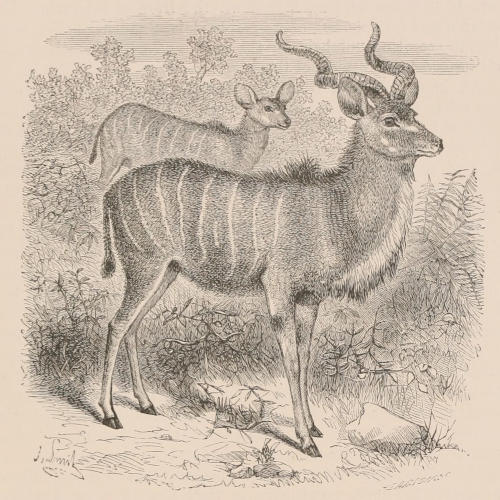
Fig. 143. The Kudu (Strepsiceros kudu). From Sclater, List of Animals in Zoological Society’s Gardens, 1883, p. 136.
Strepsiceros.[233]—Females hornless. Horns (Fig. 143) more twisted than in Tragelaphus, forming an open spiral, with the anterior ridge very strongly developed, and rising at an obtuse angle to the plane of the nasals. Skull with large supraorbital pits, large lachrymal fissure, and deep intercornual depression. Hoofs short. Body with white vertical stripes descending from a longitudinal dorsal streak. Two existing species.
The Kudu (S. kudu, Fig. 143) extends from South Africa to Abyssinia, and is only inferior in size to the Eland. The horns are about 4 feet in length, and form a very open spiral, and there is a fringe of long hair down the front of the neck. The Lesser Kudu (S. imberbis), of Somali-land is a much smaller form, without the fringe of hair on the neck, and with a much smaller axis formed by the spiral of the horns.
An imperfect skull from the Pliocene of Northern India has been referred to Strepsiceros.
Oreas.[234]—Females horned. Horns twisted on their own axis, with very strong ridges, inclining upwards and outwards in the plane of the nasals. General characters of skull as in preceding genus. Stripes on body, if present, very faintly marked. One existing species.
The Eland (O. canna) is the largest of all the Antelopes, the males standing nearly 6 feet at the withers. One variety from South Africa is of a uniform pale fawn colour, while the Central African form is of a bright tan colour, marked by a number of thin pale vertical stripes descending from a dark dorsal ridge—these markings fading more or less in the adults. The males have a large dewlap, a tuft of brown hair on the forehead, and a small mane on the neck. The straight black horns of the male are usually about 18 inches long. Elands were formerly extremely abundant in Southern and Eastern Africa, but their destruction has been so relentless that they have totally disappeared from extensive areas, and are daily becoming scarcer.
Portions of upper jaws from the Pliocene deposits of India appear to indicate the former existence in that area of large Antelopes closely allied to the Eland, but distinguished from the living species by the greater size of the inner accessory column in the upper molars.
Allied Extinct Types.—Large Antelopes with spirally twisted horns appear to have been common over Southern Europe in Pliocene times, but their exact affinity is in many cases difficult to determine. Of these, Palæoreas, which occurs in the Lower Pliocene of Europe and Algeria, appears to present affinities both to Oreas and Strepsiceros, and may have been the ancestral type from which these two genera are derived; the upper molars have well-developed accessory columns.
The so-called Antilope torticornis, of the French Pliocene, resembles Tragelaphus in the greater development of the posterior as compared with the anterior ridge of the horn-cores, and has accordingly been referred to that genus. Protragelaphus, of the Lower Pliocene of Attica, differs from all the other types in the absence of the anterior ridge on the horn-cores and of the supraorbital pits, while it has a distinct lachrymal fossa.
In this place it will be convenient to notice certain fossil forms which do not accord with any of the existing sections of the family, and for the reception of which the Palæotragine section has been formed. In these types the horn-cores are laterally compressed like those of the modern Goats, but the upper molars resemble those of the brachydont Antelopes. The earliest of these genera, and the first representative of the Antelopes yet known, is Protragoceros, of the Middle Miocene of France, first described as Antilope clavata; Palæotragoceros and Tragoceros, of the Lower Pliocene, are distinguished by their larger horns and wider molars.
A remarkable large Antelope from the Lower Pliocene of the Isle of Samos, in the Turkish Archipelago, proposed to be described as Criotherium, appears to be unlike any other form. The horns, which are placed on the extreme vertex of the skull, are very short, tightly twisted, and project in front of the forehead. The upper molars have short and broad crowns, with no accessory column on the inner side.
Rupicaprine Section.—The Caprine Antelopes, as the typical members of this section may be termed, appear to connect the true Antelopes with the Goats. They are mostly small or medium-sized forms, inhabiting portions of the Palæarctic and Oriental regions, with one outlying North American genus. The typical forms present the following features. Horns present, and of nearly equal size in both sexes, rising behind the orbits, short, ringed at the base, conical or somewhat compressed, and recurved. Suborbital gland generally present, in some cases small. Build clumsy; hoofs large; tail short, tapering, hairy above. Skull with lachrymal fossa, but no fissure. Molars as in the Caprine section.
Rupicapra.[235]—Horns short and cylindrical, rising perpendicularly from the forehead for some distance, then bending sharply backwards and downwards, forming hooks with pointed tips. Premaxillæ not reaching the nasals. One species, Palæarctic.
The Gemse, or Alpine Chamois (R. tragus), inhabits the high mountains of Europe from the Pyrenees to the Caucasus. It stands about 2 feet in height at the withers. The body is covered in winter with long hair of a chestnut-brown colour, that of the head being paler, with a dark brown streak on each side. At other seasons the colour is somewhat lighter, in spring approaching to gray. Underneath the external covering the body is further protected from cold by a coat of short thick wool of a grayish colour. The tail is black; the ears are pointed and erect; the hoofs have the outer edges higher than the soles, and are thus admirably adapted for laying hold of the slightest projection or roughness on the face of the rocky precipices it frequents. The Chamois is gregarious, living in herds of fifteen or twenty, and feeding generally in the morning or evening. The old males, however, live alone, except in the rutting season, which occurs in October, when they join the herds, driving off the young males, and engaging in contests with each other that often end fatally. The period of gestation is twenty weeks, when the female, beneath the shelter of a projecting rock, produces one and sometimes two young. In summer the Chamois ascends to the limits of perpetual snow, being only outstripped in the loftiness of its haunts by the Ibex; and during that season it shows its intolerance of heat by choosing such browsing grounds as have a northern exposure.
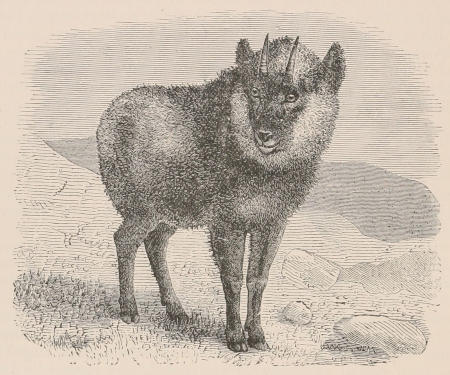
Fig. 144.—Nemorhædus crispus. From Sclater, List of Animals in Zoological Society’s Gardens, 1883, p. 151.
Nemorhædus.[236]—Horns rounded, gradually recurving, without distinct hook at the end. Suborbital gland small or wanting; ears large; skull with a large lachrymal depression, and the premaxillæ not quite reaching the nasals. Some nine species, ranging from the Eastern Himalayas to North China and Japan, and southwards to Formosa, the Malay Peninsula, and Sumatra. The smallest species is the Himalayan Goral (N. goral). Of the larger forms we may mention the Himalayan Serow (N. bubalinus) the Cambing-Utan (N. sumatrensis) of Sumatra, and the Japanese N. crispus (Fig. 144). Of the Serow, Colonel Kinloch remarks that “it is a large and powerful beast. The body is covered with very coarse hair, which assumes the form of a bristly mane on the head and shoulders, and gives the beast a ferocious appearance, which does not belie its disposition. The colour is a dull black on the back, bright red on the sides, and white underneath, the legs also being dirty white. The ears are very large, the muzzle is coarse. The Serow has an awkward gait, but in spite of this can go over the worst ground; and it has perhaps no superior in going down steep hills. It is a solitary animal, and nowhere numerous.”
Haploceros.[237]—The Rocky-Mountain Goat (Haploceros montanus), inhabiting the northern parts of California, appears to be very closely allied to Nemorhædus. The horns are somewhat compressed at the base; there is no suborbital gland; and the ears are small. The hair, which is whitish in colour, is very long, and especially abundant in the region of the throat, shoulders, flanks, and tail. The animal is about the size of a large Sheep.
Budorcas.[238]—The Takin (B. taxicolor) of the Mishmi Hills in Assam, and an allied species from Eastern Tibet, are larger forms apparently related to Nemorhædus, but with a much greater development of the horns. The horns of what is considered to be the male[239] arise from the vertex of the skull, and are nearly in contact in the middle line; they first bend outwards and downwards, and then suddenly upwards and backwards. Those regarded by Mr. Hume as referable to the female are directed at first outwards, and then gradually curve upwards and backwards, without any downward flexure or angulation. The horns of the male may be 2 feet in length, with a basal diameter of 13 inches. The muzzle is hairy, with a small naked muffle. There appear to be considerable seasonal and sexual variations in colour; the body being in some cases of a yellow dun, while in others it is a dusky, reddish-brown, with much black intermingled. The heads of large males are blackish.
Scarcely anything is known of the habits of the Takin, which never appears to have been seen alive by Europeans.
Caprine Section.—Both sexes with horns, but those of the female small. Horns usually compressed, triangular, with transverse ridges, and either curving backwards or spiral. Muzzle hairy, without naked muffle. Suborbital gland small or absent; lachrymal fossa of skull present or absent. Tail short and flattened. Foot-glands frequently present. Molars very hypsodont; those of the upper jaw being narrow, without an accessory internal column. Mainly Palæarctic, but with some outlying forms.
This section includes the Goats and Sheep, which are so closely connected that it is difficult to give well-marked generic characters that will hold good for all the species. They seem to be one of the latest developments of the Bovidæ, since they are unknown before the Pliocene period; and are essentially mountain forms.
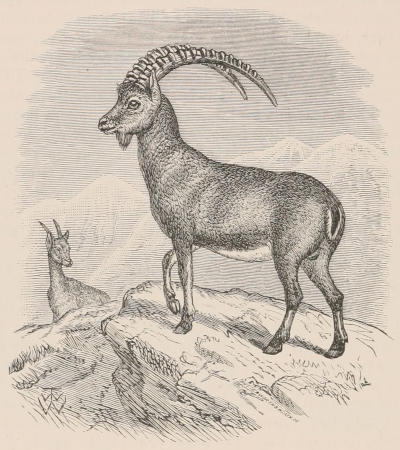
Fig. 145.—The Alpine Ibex (Capra ibex).
Capra.[240]—Horns flattened from side to side, and either curving backwards (Fig. 145) or spirally twisted. No suborbital gland, and no lachrymal fossa in the skull. Foot-glands, if present, only in the fore feet. Chin more or less bearded. Males with a strong odour. Vertebræ: C 7, D 13, L 6, S 4, C 9-13. Some dozen species, ranging over all the higher mountains of Southern Europe, from Spain to the Caucasus; also found in Abyssinia, Persia, Sind, and Baluchistan, thence through the higher Himalaya, and so on to Tibet and Northern China. One outlying species occurs in the Nilgherries of Southern India.
The European Ibex or Steinbok (Fig. 145), which may be taken as a typical Goat, stands about 2½ feet in height at the shoulder. In summer the hair is short and smooth, and of an ashy-gray colour, but a long coat is developed in winter. The horns of the male rise in a bold backward sweep from the forehead, and are characterised by the strong transverse ridges on the broad and flat anterior surface. They are said to be not more than some 2 feet in length, but these dimensions are greatly exceeded by the horns of the Himalayan Ibex. The Alpine Ibex lives at a greater height than the Chamois, spending the day just at the limit of perpetual snow, and descending at night to graze at lower levels. Both this and the Himalayan species generally live in small herds of from five to fifteen or more; they are wary animals, although not so much so as many of the wild Sheep. The following list, mainly taken from two papers by Mr. Sclater,[241] gives the distribution of the various species of Goats, with some remarks on their peculiarities:—
(1) C. ibex, confined to the Alps of Switzerland, Savoy, and the Tyrol, and now nearly extinct, except where artificially preserved. (2) C. sibirica, closely allied to the preceding, but with larger horns, occurs in the Altai Mountains, and throughout the Himalaya from Kashmir to Nipal, and northward towards Turkestan. (3) C. sinaitica, of the mountains of Upper Egypt, the Sinaitic Peninsula, and Palestine, is allied to the two preceding species, but has the horns somewhat more compressed, with a difference in the ridges on the front. (4) C. caucasica, a very distinct species, confined to the Caucasus, where it inhabits the western part of the Great Caucasus; with thick horns curving backwards and outwards in one plane, with the exception of their tips, which incline inwards.[242] (5) C. pallasi is an allied species from the Eastern Caucasus, distinguished, among other features, by the curvature of the horns, which lie flatter and twist more outward from the forehead, with a greater terminal inward bend. (6) C. pyrenaica, of the Pyrenees, and the higher ranges of Central Spain, Andalusia, and Portugal, is another nearly related species. (7) C. ægagrus, formerly abundant over the Grecian Archipelago, but now restricted in Europe to Crete and some of the Cyclades, is found throughout the mountains of Asia Minor and Persia, and thence to Baluchistan and Sind. The horns are thinner and sharper in front than in the Ibexes, and this species is generally regarded as the ancestral stock of the various breeds of domestic Goats. (8) C. dorcas, a Goat from the island of Jura, near Eubœa, has been described under this name, and is apparently nearly allied to C. ægagrus. (9) C. walie, an apparently well-characterised species from the highest ranges of Abyssinia. (10) C. falconeri; the Markhoor differs from all the preceding species by the spiral twisting of its horns, which attain enormous dimensions. It occurs in the Pir-Panjal range south of Kashmir, and thence into Afghanistan and the Suleiman range, and northwards to Astor, Gilgit, and Scardo (Baltistan). The specimens from the Suleiman range have the spiral of the horns very close, somewhat as in the Eland; while in those from Astor, Gilgit, and Scardo it is very open, as in the Kudu. The Pir-Panjal race occupies a somewhat intermediate position in this respect. (11) C. jemlaica, the Thar, inhabits suitable regions along the whole range of the Himalaya from Kashmir to Bhutan. Together with the next species, it differs from the more typical Goats in its short, thick, and much compressed horns, the anterior border of which is keeled, and the moist naked muffle. There are no glands in the fore feet. It was generically separated by Gray as Hemitragus. (12) C. hylocrius, the so-called Ibex of the Nilgherries, Anamallays, and other adjoining ranges of Southern India, is an outlying species, apparently allied to the preceding, but with somewhat different horns, in which the external angle in front is much rounded off.
Of fossil Goats we have but little knowledge. Remains of C. pyrenaica are found in cave-deposits at Gibraltar; and it is not improbable that the genus is represented in the Upper Pliocene of France. Several species occur in the Pliocene of India, C. sivalensis being apparently closely allied to C. jemlaica, while another has horns resembling those of C. falconeri, and it is possible that a third may be more nearly related to the Ibexes.
Ovis.[243]—Horns curving backwards and downwards in a bold sweep, with the tips everted, generally with more or less prominent transverse ridges, and brownish in colour. Suborbital gland and lachrymal fossa usually present, but generally small. Foot-glands in all the feet. Chin not bearded;[244] males without a strong odour. Vertebræ: C 7, D 13, L 6, S 4, C 10-14. Some twelve species, mainly Palæarctic, but extending into the adjacent portions of the Oriental region, and with one outlying species in North America.
The more typical Sheep are closely connected with the Goats by the Himalayan Bharal (O. nahura) and the Aoudad (O. tragelaphus) of Northern Africa, both these species having no suborbital gland and no lachrymal fossa, while their comparatively smooth and olive-coloured horns show a decided approximation to those of the Goats. Both present, however, the ovine character of glands in all the feet. In the typical Sheep the basioccipital of the skull is wider in front than behind, with the anterior pair of tubercles widely separated and much larger than the posterior pair. The Bharal, however, resembles the Goats in having an oblong basioccipital, with the posterior tubercles larger and more prominent than the anterior ones, both being situated in the same antero-posterior line. These transitions towards the caprine type are, however, not sufficient to support the view that the Bharal should form the type of a distinct genus (Pseudois), more especially since some of the typical Sheep, like O. canadensis, have the lachrymal fossa of the skull very much reduced in size.
The distinction of the various permanent modifications under which wild Sheep occur is a matter of considerable difficulty. Trivial characters, such as size, slight variations in colour, and especially the form and curvature of the horns, are relied upon by different zoologists who have given attention to the subject in the discrimination of species, but no complete accord has yet been established. The most generally recognised forms are enumerated below.
The geographical distribution of wild Sheep is interesting. The immense mountain ranges of Central Asia, the Pamir and Thian-Shan of Turkestan, may be looked upon as the centre of their habitat. Here, at an elevation of 16,000 feet above the sea-level, is the home of the magnificent Ovis poli, named after the celebrated Venetian traveller Marco Polo, who met with it in his adventurous travels through this region in the thirteenth century. It is remarkable for the great size of the horns of the old rams and the wide open sweep of their curve, so that the points stand boldly out on each side, far away from the animal’s head, instead of curling round nearly in the same plane, as in most of the other species. A Sheep from the same region, in which the horns retain their more normal development, has received the name of O. karelini, but, according to Mr. W. T. Blanford,[245] is not distinct specifically from O. poli. Eastward and northward is found the Argali (O. argali), with a wide and not very well determined range; it formerly occurred in the Altai, but is now found in Northern Mongolia. Still farther north, in the Stanovoi Mountains and Kamschatka, is O. nivicola, and away on the other side of Behring’s Strait, in the Rocky Mountains and adjacent highlands of western North America, is the “Bighorn” or Mountain Sheep (O. canadensis), the only member of the genus found in that continent, and indeed—except the Bison, Musk-Ox, Mountain Goat (Haploceros), and the Prong-buck (Antilocapra)—the only hollow-horned Ruminant, being like the rest obviously a straggler from the cradle of its race. The two last-named species are nearly allied, and are characterised by the slight development of the ridges on their horns and the very shallow lachrymal fossa. Turning southward from the point from which we started, and still a little to the east, in Nipal and Western Tibet, is the Himalayan Argali (O. hodgsoni), having massive and strongly curved horns, with bold ridges, like those of the true Argali. Indeed, were it not for their isolated areas there would appear to be no grounds for distinguishing these two closely allied forms, and it is not improbable that they are really identical. O. brookei, appears to have been founded on a hybrid between O. hodgsoni and O. vignei. In the same districts, and also in Southern Ladak, there occurs the Bharal (O. nahura), with smaller, smoother, and more spreading horns. Passing in a south-westerly direction we find a series of smaller forms, O. vignei of Ladak, O. cycloceros of Northern India, Persia, and Baluchistan. O. gmelini of Asia Minor and Persia, O. ophion, confined to the elevated pine-clad Troodos Mountains of the island of Cyprus, and said at the time of the British occupation in 1878 to have been reduced to a flock of about twenty-five individuals, and O. musimon, the Moufflon of Corsica and Sardinia (see Fig. 146), believed to have been formerly also a native of Spain. In the three latter species the females are hornless. Lastly, we have the somewhat aberrant, Goat-like Aoudad (O. tragelaphus), of the great mountain ranges of North Africa, in which, as already mentioned, the skull and horns resemble those of the Bharal, although the tail is longer, and there is a thick fringe of long hair on the throat, chest, and fore legs.
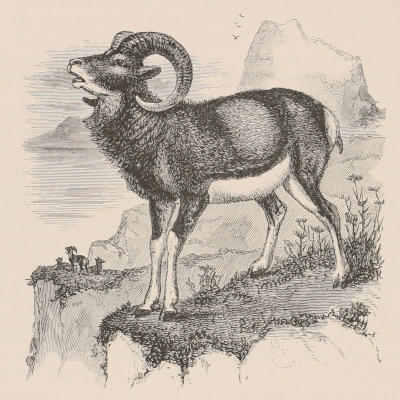
Fig. 146.—The Moufflon (Ovis musimon). From a living animal in the London Zoological Gardens.
We thus find that Sheep are essentially inhabitants of high mountainous parts of the world, for dwelling among which their wonderful powers of climbing and leaping give them special advantages. No species frequent by choice either level deserts, open plains, dense forests, or swamps. By far the greater number of species are inhabitants of the continent of Asia, one extending into North America, one into Southern Europe, and one into North Africa. No wild Sheep exist in any other part of the world, unless the so-called Musk-Ox of the Arctic regions, the nearest existing ally to the true Sheep, may be considered as one. Geologically speaking, Sheep appear to be very modern animals, or perhaps it would be safer to say that no remains that can be with certainty referred to the genus have been met with in the hitherto explored true Tertiary beds, which have yielded such abundant modifications of Antelopes and Deer. They are generally considered not to be indigenous in the British Isles, but to have been introduced by man from the East in prehistoric times. A fossil Sheep (Ovis savigni), apparently allied to the Argali, has, however, been described from the so-called Forest-bed of the Norfolk coast.
The Sheep was a domestic animal in Asia and Europe before the dawn of history, though quite unknown as such in the New World until after the Spanish conquest. It has now been introduced by man into almost all parts of the world where settled agricultural operations are carried on, but flourishes especially in the temperate regions of both hemispheres. Whether our well-known and useful animal is derived from any one of the existing wild species, or from the crossing of several, or from some now extinct species, is quite a matter of conjecture. The variations of external characters seen in the different domestic breeds are very great. They are chiefly manifested in the form and number of the horns, which may be increased from the normal two to four or even eight, or may be altogether absent in the female alone, or in both sexes; in the form and length of the ears, which often hang pendent by the side of the head; in the peculiar elevation or arching of the nasal bones in some Eastern races; in the length of the tail, and the development of great masses of fat at each side of its root, or in the tail itself; and in the colour and quality of the fleece.
Ovibos.[246]—This genus is generally considered to be a connecting link between the Caprine and Bovine sections, but should rather be regarded as an aberrant type of the former. Horns of adult male rounded, smooth, and closely approximated at their bases, where they are depressed and rugose; curving downwards, and then upwards and forwards. Muzzle caprine; no suborbital gland, no lachrymal fossa or fissure in skull; orbits tubular; a large narial aperture and very short nasals; premaxillæ not reaching nasals. Tail short, and molar teeth caprine. One existing and two fossil species, Palæarctic and Nearctic.
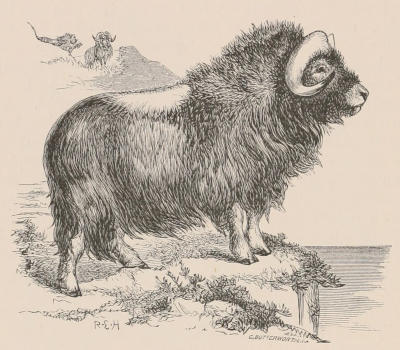
Fig. 147.—The Musk-Ox (Ovibos moschatus).
The animal commonly known as the Musk-Ox (Ovibos moschatus), though approaching in size the smaller varieties of Oxen, is in structure and habits closely allied to the Sheep, its affinities being well expressed by the generic name Ovibos bestowed upon it by De Blainville. The specific name, as also the common English appellatives “Musk-Ox,” “Musk-Buffalo,” or “Musk-Sheep,” applied to it by various authors, refer to the musky odour which the animal exhales. This does not appear to be due to the secretion of a special gland, as in the case of the Musk-Deer; but it must be observed that, except as regards the osteology, very little is known of the anatomy of this species. It about equals in size the small Welsh and Scotch cattle. The head is large and broad. The horns in the old males have extremely broad bases, meeting in the median line, and covering the brow and whole crown of the head. They are directed at first downwards by the side of the face and then turn upwards and forwards, ending in the same plane as the eye. Their basal halves are of a dull white colour, oval in section and coarsely fibrous; their middle part smooth, shining, and round; their tips black. In the females and young males the horns are smaller, and their bases are separated from each other by a space in the middle of the forehead. The ears are small, erect, and pointed, and nearly concealed in the hair. The space between the nostrils and the upper lip is covered with short close hair, as in Sheep and Goats, without any trace of the bare muffle of the Oxen. The greater part of the animal is covered with long brown hair, thick, matted, and curly on the shoulders, so as to give the appearance of a hump, but elsewhere straight and hanging down,—that of the sides, back, and haunches reaching as far as the middle of the legs and entirely concealing the very short tail. There is also a thick woolly under-fur, shed in the summer. The hair on the lower jaw, throat, and chest is long and straight, and hangs down like a beard or dewlap, though there is no loose fold of skin in this situation as in Oxen. The limbs are stout and short, terminating in unsymmetrical hoofs, the external one being rounded, the internal pointed, and the sole partially covered with hair.
The Musk-Ox is at the present day confined to the most northern parts of North America, where it ranges over the rocky barren grounds between the 60th parallel and the shores of the Arctic Sea. Its southern range is gradually contracting, and it appears that it is no longer met with west of the Mackenzie River, though formerly abundant as far as Eschscholtz Bay. Northwards and eastwards it extends through the Parry Islands and Grinnell Land to North Greenland, reaching on the west coast as far south as Melville Bay; and it was also met with in abundance by the German polar expedition of 1869-70 at Sabine Island on the east coast. No trace of it has been found in Spitzbergen or Franz Joseph Land. As proved by the discovery of fossil remains, it ranged during the Pleistocene period over northern Siberia and the plains of Germany and France, its bones occurring very generally in river deposits along with those of the Reindeer, Mammoth, and Woolly Rhinoceros. It has also been found in Pleistocene gravels in several parts of England, as Maidenhead, Bromley, Freshfield near Bath, Barnwood near Gloucester, and also in the lower brick-earth of the Thames valley at Crayford, Kent.
It is gregarious in habit, assembling in herds of twenty or thirty head, or, according to Hearne, sometimes eighty or a hundred, in which there are seldom more than two or three full-grown males. The Musk-Ox runs with considerable speed, notwithstanding the shortness of its legs. Major H. W. Feilden, naturalist to the Arctic expedition of 1875, says: “No person watching this animal in a state of nature could fail to see how essentially ovine are its actions. When alarmed they gather together like a flock of sheep herded by collie dog, and the way in which they pack closely together and follow blindly the vacillating leadership of the old ram is unquestionably sheep-like. When thoroughly frightened they take to the hills, ascending precipitous slopes and scaling rocks with great agility.” They feed chiefly on grass, but also on moss, lichens, and tender shoots of the willow and pine. The female brings forth a single young one in the end of May or beginning of June after a gestation of nine months. According to Sir J. Richardson, “when this animal is fat its flesh is well tasted, and resembles that of the Caribou, but has a coarser grain. The flesh of the bulls is highly flavoured, and both bulls and cows when lean smell strongly of musk, their flesh at the same time being very dark and tough, and certainly far inferior to that of any other ruminating animal existing in North America.” The carcase of a Musk-Ox weighs, exclusive of fat, above 3 cwt. On this subject, Major Feilden[247] says: “The cause of the disagreeable odour which frequently taints the flesh of these animals has received no elucidation from my observations. It does not appear to be confined to either sex, or to any particular season of the year; for a young unweaned animal, killed at its mother’s side and transferred within an hour to the stew-pans, was as rank and objectionable as any. The flesh of some of these animals of which I have partaken was dark, tender, and as well flavoured as that of four-year old Southdown mutton.”
Remains of two fossil species of this genus (O. bombifrons and O. cavifrons) have been described from Pleistocene beds in the United States, the one from Kentucky and the other from the Arkansas River. Both (if indeed they be valid species) appear closely allied to the living form.
Bovine Section.—Horns present and of nearly equal size in both sexes; in form rounded or angulated, placed on or near the vertex of the skull, extending more or less outwards, and curving upwards near the extremities; external surface comparatively smooth and never marked by prominent transverse ridges or knobs. Muzzle broad, with large naked muffle; nostrils lateral; no suborbital gland. Skull without any trace of lachrymal fossa or fissure. Tail long and cylindrical; generally tufted at the extremity, rarely hairy throughout. Males usually with a dewlap on the throat. No foot-glands. Molar teeth extremely hypsodont; those of the upper jaw with a nearly square cross-section, and a large accessory inner column.
The section is abundantly represented in the Palæarctic, Oriental, and Ethiopian regions, with one Nearctic species and an outlying and aberrant species in Celebes.
Bos.[248]—The whole of the species of Oxen were included by Linnæus in the single genus Bos, and although the species have been distributed by modern zoologists in several genera—such as Anoa, Bubalus, Bison, Poëphagus, Bibos, and Bos—the characters by which they are separated are so slight that it seems, on the whole, preferable to retain the old genus in its original wide sense. Using then the term Bos in this sense, it will include all the representatives of the section—about a dozen in number—and may be divided into several groups.
The first group includes the Buffaloes (genus Bubalus), chiefly characterised by their more or less flattened and angulated horns, which incline upwards and backwards, with an inward curve towards their tips, and are placed below the plane of the occiput, or vertex of the skull. The premaxillæ reach to the nasals, and the vomer is peculiar in being so much ossified as to join the posterior border of the palate. The back has a distinct ridge in the region of the withers; and the forehead is frequently convex. Oriental and Ethiopian region, and Celebes.
The most generalised representative of this group is the small Anoa (B. depressicornis) of Celebes, the type of the genus Anoa or Probubalus, which has the same cranial structure as in the more typical Buffaloes, to the young of which (as was pointed out by the late Professor Garrod) it presents a striking resemblance. Its colour is black; and the short and prismatic horns are directed upwards from the forehead. In the Pliocene Siwaliks of India there occur the remains of larger Buffaloes (B. occipitalis and B. acuticornis) closely allied to the Anoa, but with longer and more distinctly angulated horns. The still larger B. platyceros of the last-named deposits, in which the horns are wide-spreading and much flattened, appears to be in some respects intermediate between the preceding and following forms. The typical Indian Buffalo (Bos buffelus), which has been domesticated over South-East Asia, Egypt, and Southern Europe, is, in the wild state, a gigantic animal with enormous horns. These horns are longer, more slender, and more outwardly directed in the female than in the male; and in the former sex may have a length of more than 6 feet from base to tip. They are widely separated at their bases, the forehead is very convex, and the ears are not excessively large, and have no distinct fringe. These Buffaloes frequent swampy and moist districts in several parts of India, but it is in many instances difficult to decide whether they belong to really wild or to feral races. Very large skulls, specifically indistinguishable from those of the existing form, occur in the Pleistocene deposits of the Narbada valley in India; while an allied, if not specifically identical form, occurs in the Pliocene of the same country. There is some doubt whether B. antiquus of the Pleistocene of Algeria is most nearly related to the Indian or to the African species.
In Africa two species of Buffalo are recognised by Sir Victor Brooke,[249] namely the large B. caffer, occurring typically at the Cape, but said by this writer to range to Abyssinia, and the smaller B. pumilus, which seems to have a very wide distribution. The skulls of both these forms are shorter than in the Indian species, while the horns are also shorter, much more curved inwardly, and more approximated on the forehead. In the large typical form of B. caffer from South Africa the colour is black, the horns of the male are very thick, much reflected, and closely approximated on the forehead, where they form a helmet-like mass.[250] The large northern form described as B. æquinoctialis has the horns somewhat less thick, and thus approximates to the so-called B. pumilus.
The latter occurs typically in Western Africa, where it has also been described as B. brachyceros. In the typical form the horns are thinner and less reflected than in B. caffer, and in some specimens they are more widely separated on the forehead, and are marked at their bases by distinct rugæ. The colour is ruddy brown, inclining to rufous in one specimen. The skulls of Buffaloes from West Africa, probably referable to the form described as B. centralis, appear to connect B. pumilus with B. caffer, as shown by their larger size and the form of their horns; so that further observations are required to show whether the smaller form is really entitled to rank as a distinct species, or merely as a well-marked local race.
The second group comprises the Bisons, which are more nearly allied to the true Oxen, having similar rounded horns, but the skull being less massive, with a longer and more tapering frontal region, and a wider frontal diameter. The superior part of the forehead is transversely arched, the intercornual space elevated in the middle, the horns situated below the plane of the occiput, and the orbits more or less prominent. The premaxillæ do not extend upwards to reach the nasals. The Bisons (Fig. 148) have the body covered with short, crisp, woolly hair, while on the head and neck there is an abundance of much longer and darker hair, which forms a mane concealing the eyes, ears, and the bases of the horns. There is also a long beard beneath the chin; while a line of long hair extends from the head nearly to the tail, the latter being tufted at the extremity. The withers are much higher than the hind quarters, so that there is a kind of hump at the shoulders.
The group is represented by two species—the European and the American Bison. The former is the Bos bonasus of Linnæus, and is also identical with the Bos bison of Ray. The German name Wisent is the equivalent of the Greek Bison. The American species is the Bos americanus of Gmelin. Both species are closely allied, but the American Bison is slightly the smaller animal of the two, and is shorter and weaker in the hind quarters, with a smaller pelvis; its body is, however, more massive in front; and the hair on the head, neck, and fore quarters is longer and more luxuriant. A large bull American Bison, preserved in the Museum at Washington, stands 5 feet 8 inches in height at the withers. The European Bison appears to have been formerly abundant over a large portion of Europe in the Pleistocene period—the fossil race described as B. priscus not being specifically distinct; but at the present day it exists only in the primeval forests of Lithuania, Moldavia, Wallachia, and the Caucasus, where it is artificially preserved.