Front matter
Reading edition
THE MACMILLAN COMPANY NEW YORK · BOSTON · CHICAGO ATLANTA · SAN FRANCISCO
MACMILLAN & CO., Limited LONDON · BOMBAY · CALCUTTA MELBOURNE
THE MACMILLAN CO. OF CANADA, Ltd. TORONTO
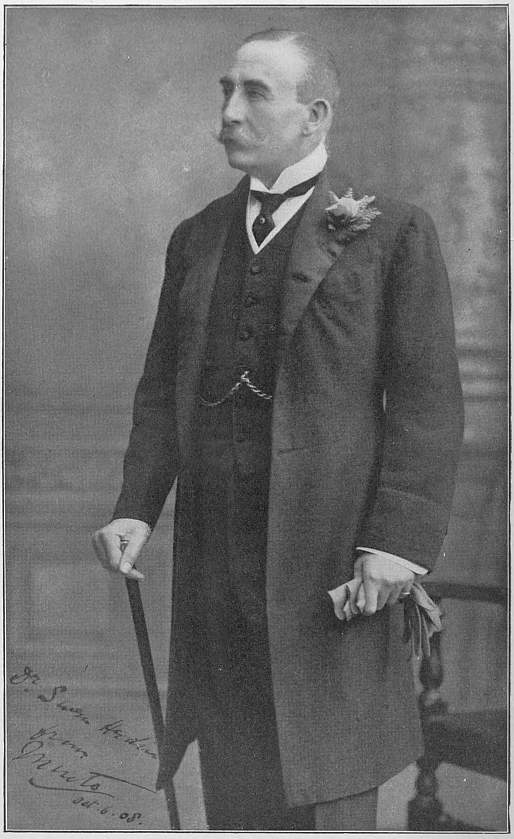
1. Lord Minto, Viceroy of India.
Frontispiece
TRANS-HIMALAYA
DISCOVERIES AND ADVENTURES IN TIBET
BY
SVEN HEDIN
WITH 388 ILLUSTRATIONS FROM PHOTOGRAPHS, WATER- COLOUR SKETCHES, AND DRAWINGS BY THE AUTHOR AND 10 MAPS
IN TWO VOLUMES VOL. I
New York
THE MACMILLAN COMPANY
1909
All rights reserved
Copyright, 1909, By THE MACMILLAN COMPANY.
Set up and electrotyped. Published December, 1909.
Norwood Press
J. S. Cushing Co.—Berwick & Smith Co. Norwood, Mass., U.S.A.
TO
HIS EXCELLENCY
THE EARL OF MINTO
VICEROY OF INDIA
WITH GRATITUDE AND ADMIRATION
FROM THE AUTHOR

PREFACE
In the first place I desire to pay homage to the memory of my patron, King Oskar of Sweden, by a few words of gratitude. The late King showed as warm and intelligent an interest in my plan for a new expedition as he had on former occasions, and assisted in the fulfilment of my project with much increased liberality.
I estimated the cost of the journey at 80,000 kronor (about £4400), and this sum was subscribed within a week by my old friend Emmanuel Nobel, and my patrons, Frederik Löwenadler, Oscar Ekman, Robert Dickson, William Olsson, and Henry Ruffer, banker in London. I cannot adequately express my thanks to these gentlemen. In consequence of the political difficulties I encountered in India, which forced me to make wide detours, the expenses were increased by about 50,000 kronor (£2800), but this sum I was able to draw from my own resources.
As on former occasions, I have this time also to thank Dr. Nils Ekholm for his great kindness in working out the absolute heights. The three lithographic maps have been compiled from my original sheets with painstaking care by Lieutenant C. J. Otto Kjellström, who devoted all his furlough to this troublesome work. The astronomical points, nearly one hundred, have been calculated by the Assistant Roth of the Stockholm Observatory; a few points, which appeared doubtful, were omitted in drawing the route on the map, which is based on points previously determined. The map illustrating my narrative in the Geographical Journal, April 1909, I drew roughly from memory without consulting the original sheets, for I had no time to spare; the errors which naturally crept in have been corrected on the new maps, but I wish to state here the cause of the discrepancy. The final maps, which I hope to publish in a voluminous scientific work, will be distinguished by still greater accuracy and detail.
I claim not the slightest artistic merit for my drawings, and my water-colours are extremely defective both in drawing and colouring. One of the pictures, the lama opening the door of the mausoleum, I left unfinished in my haste; it has been thrown in with the others, with the wall-paintings and shading incomplete. To criticize these slight attempts as works of art would be like wasting gunpowder on dead crows. For the sake of variety several illustrations have been drawn by the British artists De Haenen and T. Macfarlane, but it must not be assumed that these are fanciful productions. Every one of them is based on outline drawings by myself, a number of photographs, and a full description of the scene. De Haenen’s illustrations appeared in the London Graphic, and were ordered when I was still in India. Macfarlane’s drawings were executed this summer, and I was able to inspect his designs and approve of them before they were worked up.
As to the text, I have endeavoured to depict the events of the journey as far as the limited space permitted, but I have also imprudently allowed myself to touch on subjects with which I am not at all familiar—I allude in particular to Lamaism. It has been unfortunate that I had to write the whole book in 107 days, during which many hours were taken up with work connected with the maps and illustrations and by an extensive correspondence with foreign publishers, especially Albert Brockhaus of Leipzig, who never wearied in giving me excellent advice. The whole work has been hurried, and the book from beginning to end is like a vessel which ventures out into the ocean of the world’s tumult and of criticism with many leaks and cracks.
My thanks are also due to my father, who made a clean copy from my illegible manuscript; and to my mother, who has saved me from many mistakes. Dr. Carl Forstrand has revised both the manuscript and the proof-sheets, and has compiled the Swedish index.
The seven and thirty Asiatics who followed me faithfully through Tibet, and contributed in no small degree to the successful issue and results of the expedition, have had the honour of receiving from His Majesty the King of Sweden gold and silver medals bearing the portrait of the King, a crown, and an inscription. I humbly beg His Majesty to accept my warmest and most sincere thanks for his great generosity.
The book is dedicated to Lord Minto, as a slight testimony of my gratitude for all his kindness and hospitality. It had been Lord Minto’s intention to further my plans as Lord Curzon would have done if he had still been Viceroy of India, but political considerations prevented him. When, however, I was actually in Tibet, the Viceroy was free to use his influence with the Tashi Lama, and the consequence was that many doors in the forbidden land, formerly tightly closed, were opened to me.
Dear reminiscences of India hovered about my lonesome years in dreary Tibet like the pleasant rustling of palm leaves. It will suffice to mention men like Lord Kitchener, in whose house I spent a week never to be forgotten; Colonel Dunlop Smith, who took charge of my notes and maps and sent them home, and also forwarded a whole caravan of necessaries to Gartok; Younghusband, Patterson, Ryder, Rawling, and many others. And, lastly, Colonel Longe, Surveyor-General, and Colonel Burrard, of the Survey of India, who, with the greatest kindness, had my 900 map-sheets of Tibet photographed, and stored the negatives among their records in case the originals should be lost, and who, after I had placed my 200 map-sheets of Persia at the disposal of the Indian Government, had them worked up in the North-Western Frontier Drawing Office and combined into a fine map of eleven printed sheets—a map which is to be treated as “confidential” until my scientific works have appeared.
It is with the greatest pleasure that I avail myself of this opportunity of expressing my sincere gratitude for all the innumerable tokens of sympathy and appreciation which I received in all parts of the United Kingdom, and for all the honours conferred on me by Societies, and the warm welcome I met with from the audiences I had the pleasure of addressing. I shall always cherish a proud and happy remembrance of the two months which it was my good-fortune to spend in the British Isles; and the kindness then showered upon me was the more delightful because it was extended also to two of my sisters, who accompanied me.
Were I to mention all the ladies and gentlemen to whom I am especially indebted, I could fill several pages. But I cannot let this book go forth through the English-speaking world without expressing my sincere gratitude to Lord Curzon for the great and encouraging interest he has always taken in myself and my journeys; to Lord Morley for the brilliant speech he delivered after my first lecture—the most graceful compliment ever paid me, as well as for many other marks of kindness and sympathy shown to me by the Secretary of State for India; to the Swedish Minister in London, Count Herman Wrangel, for all the valuable services he rendered me during and after my journey; to Major Leonard Darwin and the Council and Members of the Royal Geographical Society, to whom I was delighted to return, not as a strange guest, but as an old friend; to the famous and illustrious Universities of Oxford and Cambridge, where I was overwhelmed with exceptional honours and boundless hospitality; to the Royal Scottish Geographical Society, where twice before I had received a warm reception. Well, when I think of those charming days in England and Scotland I am inclined to dwell too long upon them, and I must hasten to a conclusion. But there is one more name, which I have left to the last, because it has been very dear to me for many years, that of Dr. J. Scott Keltie. The general public will never know what it means to be the Secretary and mainspring of the Royal Geographical Society, to work year after year in that important office in Savile Row, to receive explorers from all corners of the world and satisfy all their demands, without ever losing patience or ever hearing a word of thanks. I can conceive from my own experience how much trouble I have caused Dr. Keltie, but yet he has always met me with the same amiability and has always been a constant friend, whether I have been at home or away for years on long journeys.
Dr. M. A. Stein started and returned from his splendid journey in Central Asia at the same times as myself. We crossed different parts of the old continent, but we have several interests in common, and I am glad to congratulate Dr. Stein most heartily on his important discoveries and the brilliant results he has brought back.
It is my intention to collect in a third volume all the material for which there is no room in Trans-Himalaya. For instance, I have been obliged to omit a description of the march northwards from the source of the Indus and of the journey over the Trans-Himalaya to Gartok, as well as of the road from Gartok to Ladak, and the very interesting route from the Nganglaring-tso to Simla. I have also had to postpone the description of several monasteries to a later opportunity. In this future book I will also record my recollections of beautiful, charming Japan, where I gained so many friends, and of Korea, Manchuria, and Port Arthur. The manuscript of this later volume is already finished, and I long for the opportunity of publicly thanking the Japanese, as well as our representative in Japan and China, the Minister Extraordinary, Wallenberg, for all the delightful hospitality and all the honours showered down on me in the Land of the Rising Sun.
Lastly, the appetite of young people for adventures will be satisfied in an especial work.
I am glad to be able to announce at the eleventh hour that the Madrassi Manuel, who in Chapter IX. was reported lost, has at length been found again.
In conclusion, I must say a few words of thanks to my publishers, and first of all to Herre K. O. Bonnier of Stockholm, for his valuable co-operation and the elegant form in which he has produced my book, and then to the firm of F. A. Brockhaus, Leipzig; the “Elsevier” Uitgevers Maatschappij, Amsterdam; Hachette & Cie, Paris; “Kansa,” Suomalainen Kustannus-O-Y, Helsingfors; the Robert Lampel Buchhandlung (F. Wodianer & Söhne) Act.-Ges., Budapest; Macmillan & Co., Ltd., London and New York; J. Otto, Prague; Fratelli Treves, Milan.
SVEN HEDIN.
Stockholm, September, 1909.
CONTENTS
CHAPTER I
PAGE
Simla 1
CHAPTER II
Departure from Srinagar 21
CHAPTER III
The Road to Leh 35
CHAPTER IV
The Last Preparations 46
CHAPTER V
The Start for Tibet 60
CHAPTER VI
To the Edge of the Tibetan Tableland 72
CHAPTER VII
Over the Crest of the Karakorum 84
CHAPTER VIII
To Lake Lighten 97
CHAPTER IX
On the Lake in a Storm 106
CHAPTER X
Death in the Jaws of Wolves—or Shipwreck 119
CHAPTER XI
Great Losses 132
CHAPTER XII
In Unknown Country 146
CHAPTER XIII
Unfortunate Days 158
CHAPTER XIV
In the Land of the Wild Yak 171
CHAPTER XV
The First Nomads 181
CHAPTER XVI
Our Fortunes on the Way to the Bogtsang-tsangpo 196
CHAPTER XVII
Christmas in the Wilds 211
CHAPTER XVIII
Ten Days on the Ice of Ngangtse-tso 223
CHAPTER XIX
Driven Back 236
CHAPTER XX
Onwards through the Forbidden Land 249
CHAPTER XXI
Over the Trans-Himalaya 264
CHAPTER XXII
To the Bank of the Brahmaputra 276
CHAPTER XXIII
Down the Tsangpo by Boat—Entry into Shigatse 288
CHAPTER XXIV
The New Year Festival 301
CHAPTER XXV
The Tashi Lama 317
CHAPTER XXVI
The Graves of the Pontiffs 329
CHAPTER XXVII
Popular Amusements of the Tibetans 340
CHAPTER XXVIII
Monks and Pilgrims 347
CHAPTER XXIX
Walks in Tashi-lunpo—The Disposal of the Dead 361
CHAPTER XXX
Our Life in Shigatse 374
CHAPTER XXXI
Political Complications 388
CHAPTER XXXII
Tarting-gompa and Tashi-gembe 402
CHAPTER XXXIII
The Raga-tsangpo and the My-chu 415
CHAPTER XXXIV
To Linga-gompa 427
ILLUSTRATIONS
PAGE
1. Lord Minto, Viceroy of India Frontispiece
2. Colonel Sir Francis Younghusband, Commander of the English Expedition to Tibet, Resident in Kashmir 10
3. Colonel J. R. Dunlop Smith, Private Secretary to the Viceroy 10
4. Viceregal Lodge in Simla 12
5. Lady Minto and the Author on the Terrace of the Viceregal Lodge 14
6. Herbert, Viscount Kitchener of Khartum, Late Commander-in-Chief of the Indian Army 18
7. The Maharaja of Jammu and Kashmir 22
8. Palace of H.H. the Maharaja of Kashmir in Srinagar 26
9. The Jhelam in Srinagar 28
10. The Start from Ganderbal 30
11. My Escort 30
12. My Three Puppies 32
13. Robert, the Eurasian 32
14. Ganpat Sing, the Rajput 32
15. Manuel, the Cook 32
16. In Front of Nedou’s Hotel in Srinagar 34
17. Some of our Mules 34
18. An Amateur Photographer photographed 34
19. The Road to Baltal 38
20. Kargil 40
21. Chhorten in Lamayuru 40
22. Church Music in Lamayuru 42
23. Portrait of a Lama 42
24. Portrait of a Lama 42
25. The Sumto Valley 44
26. Bridge of Alchi 44
27. Girl in Niemo 44
28, 29. Palace of the Kings of Ladak in Leh 44
30. Muhamed Isa 46
31. Guffaru 52
32. The Raja of Stok 56
33. Portal of the Palace in Leh 56
34. View over the Indus Valley from the Roof of the Palace in Leh 56
35. Lama of High Rank in Leh 56
36. Monuments to Stoliczka and Dalgleish, Leh 58
37. Religious Objects from Sanskar 60
38. Images of Gods. A miniature Chhorten on the right. Holy Books, Temple Vessels. On either side of the small Altar-table wooden blocks with which the Holy Books are printed 60
39. Tikze-gompa, Monastery in Ladak 62
40. Masked Lamas in the Court of Ceremonies in Hemis-gompa (Ladak) 64
41. Group of Masked Lamas in Hemis-gompa 64
42. From Singrul, looking towards the Pass, Chang-la 66
43. View from Sultak, August 17, 1906 66
44. Drugub 66
45. My old friend Hiraman from Ladak 70
46. Chiefs of Tankse and Pobrang; Muhamed Isa, the Caravan Leader, in the Background 70
47. The Way to the Marsimik-la 74
48. Spanglung 74
49. Spanglung 78
50. Camp near Pamzal 78
51. The Chang-chenmo and the Way to Gogra 78
52. Muhamed Isa in the River Chang-chenmo near Pamzal 80
53. Rabsang, Adul, Tsering, and Muhamed Isa 82
54. Our Horses at the Karakorum 82
55. In the Snow, N.E. of Chang-lung-yogma 86
56. My Tent 86
57. Lake Lighten 86
58a, 58b. Pantholops Antelope 90
59, 60. Ovis Ammon 90
61. A Gully at Camp 8 (Aksai-chin) 94
62. The hired Ladakis and the Provision Sacks in North-West Chang-tang 98
63. Namgyal with a Sack of Yak-dung 98
64. Shelter of Provision Sacks 100
65. Camp in a narrow Valley, Camp 41 100
66. Robert, Muhamed Isa, and two Servants by a Fire 100
67. The large piebald Yarkand Horse 104
68, 69. The Slain Yaks; Tundup Sonam, the Hunter on the left in 68 104
70. Rehim Ali, one of my Ladakis on the First Crossing of Tibet 108
71. Starting on a Voyage 110
72. In Peril on Lake Lighten 112
73. The Author and Rehim Ali pull the Boat out of the Waves up on to the Shore 116
74. Camp at the Yeshil-kul 118
75. The Pul-tso, looking East 118
76. Horses and Mules in open Country 118
77. Death in the Jaws of Wolves—or Shipwreck 122
78. A Dangerous Situation on the Yeshil-kul. In Moonshine 126
79. At Deasy’s Camp 132
80. Afternoon Tea in the open Air 132
81. Melting Snow for Drinking-Water 132
82. Preparations for Dinner at Camp 41 152
83. The Author, Robert, and Rehim Ali attacked by a wounded Yak 170
84. Rehim Ali falls to the Ground and thus rescues us from the furious Yak 174
85, 86. The First Tibetans 180
87. Smoking Camp-fires in the Heart of Chang-tang 186
88. Our Yaks, bought from the First Tibetans 186
89. “Where are you going?” they asked me 200
90. Near the Dangra-yum-tso 216
91, 92, 93. On the Ngangtse-tso 226
94. In a Snowstorm on the Ice of the Ngangtse-tso 234
95. Hlaje Tsering and his Travelling Companion, a Lama, at my Tent on the Ngangtse-tso 242
96. Servants of Hlaje Tsering 252
97. Messenger with Letters from Home, and his Travelling Companion 252
98. Hlaje Tsering setting out 252
99. Three Tibetans saluting 264
100. Pass of La-rock. Mani Heap with Fluttering Prayer-Streamers 274
101. On the Bank of the Tsangpo (Brahmaputra) 274
102. The Tsangpo with Floating Ice 282
103. The Valley of the Tsangpo above Shigatse 282
104. House in the Village of Rungma 286
105. Garden of the Tashi Lama in the Village of Tanak 286
106. Ferry-Boats 290
107. Pilgrims on the Way to Tashi-lunpo 290
108. Court of Religious Ceremonies in Tashi-lunpo 296
109. Religious Decorations on the Roofs of Tashi-lunpo to exorcise Evil Spirits 296
110. The Upper Balcony of the Court of Ceremonies in Tashi-lunpo 300
111, 112. The Profanum Vulgus at the New Year Festival in Shigatse 304
113. Lama with Shell-Trumpet 306
114. Lama with Flute used in Religious Services 306
115, 116, 117. Lamas in Dancing Masks 308
118. View of Tashi-lunpo 310
119. Street in Tashi-lunpo, with Lamas 312
120. Street in Tashi-lunpo 314
121. The Labrang, the Palace of the Tashi Lama 316
122. Interior of the Palace of the Tashi Lama 322
123. View of a Part of Tashi-lunpo, with the Façade of a Mausoleum of a Grand Lama 324
124. Façade of the Mausoleum of the First Tashi Lama. The Court of Ceremonies in the Foreground 326
125, 126. Interiors of two Mausoleums of Grand Lamas in Tashi-lunpo 328
127. The Kanjur-lhakang in Tashi-lunpo 330
128. Portal of the Mausoleum of the Third Tashi Lama in Tashi-lunpo 332
129. The Namgyal-lhakang with the Figure of Tsong Kapa, in Tashi-lunpo Coloured 334
130. Reading Lama with Dorche (Thunderbolt) and Drilbu (Prayer-Bell) 336
131. Lama with Prayer-Drum 336
132. Entrance to the Tomb of the Fifth Tashi Lama in Tashi-lunpo Coloured 338
133. Staircase to the Mausoleum of the Fifth Tashi Lama in Tashi-lunpo 340
134. Shigatse-dzong (the Fortress) 342
135. Shigatse, Capital of the Province of Chang (11,880 feet) 344
136. Chinese New Year Festival in my Garden 346
137. Some of the Members in the Shooting Competition at the New Year Festival 346
138. Popular Diversion in Shigatse 348
139. Nepalese performing Symbolical Dances at the New Year Festival 350
140. Dancing Nepalese at the New Year Festival, Tashi-lunpo 352
141. The Kitchen in Tashi-lunpo 354
142. Colonnade in Tashi-lunpo 354
143. Lamas drinking Tea in the Court of Ceremonies in Tashi-lunpo 358
144. Part of Shigatse 362
145. The Tashi Lama returning to the Labrang after a Ceremony 362
146. The Panchen Rinpoche, or Tashi Lama 366
147. Portrait of the Tashi Lama 370
148. Lamas with Copper Tea-pots 374
149. Female Pilgrim from Nam-tso and Mendicant Lama 374
150. The Great Red Gallery of Tashi-lunpo 376
151. Chhorten in Tashi-lunpo 378
152. Portal in Tashi-lunpo 380
153. Group of Lamas in Tashi-lunpo 380
154. Lecture in Tashi-lunpo 382
155. Female Pilgrims from the Nam-tso 384
156. Tibetans in Shigatse 384
157, 158, 159. Tibetan Girl and Women in Shigatse 386
160. A Chinaman in Shigatse 388
161. A Tibetan in Shigatse 388
162. A Lama in Tashi-lunpo 388
163. Door-keeper in Tsong Kapa’s Temple 388
164. Dancing Boys with Drums 390
165. Wandering Nun with a Tanka depicting a Religious Legend and singing the Explanation. (In our Garden at Shigatse.) 394
166. Gandän-chöding-gompa, a Nunnery in Ye 394
167. Duke Kung Gushuk, Brother of the Tashi Lama 398
168. The little Brother of the Tashi Lama, the Wife of Kung Gushuk, and her five Servants 402
169. The little Brother of His Holiness with a Servant 404
170. The Author drawing the Duchess Kung Gushuk 406
171. Major W. F. O’Connor, British Trade Agent in Gyangtse, now Consul in Seistan 408
172. Captain C. G. Rawling 408
173, 174. Tarting-gompa 410
175. Linga-gompa 410
176. Lung-Ganden-gompa near Tong 410
177. Inscription and Figure of Buddha carved in Granite near the Village of Lingö 410
178. Tarting-gompa 412
179. Sego-chummo Lhakang in Tarting-gompa 412
180. Bridge to the Monastery Pinzoling (on the right) 414
181. Group of Tibetans in the Village of Tong 418
182. Inhabitants of the Village of Govo 418
183. Lama in Tong 422
184. Old Tibetan 422
185. Strolling Musicians 424
186. The Handsome Woman, Putön 426
187. On the My-chu near Linga 430
188. Village and Monastery of Linga 430
MAPS
1. The Latest Map of Tibet.
2. Carte Générale du Thibet ou Bout-tan.
3. Map of Southern Tibet (Hodgson).
4. The Source-Region of the Brahmaputra (Nain Sing).
5. Sketch-Map of Webber’s Route in 1866.
6. Saunders’ Map of South Tibet.
7. The Source-Region of the Brahmaputra (Ryder).
(At end of Volume.)
CHAPTER I
SIMLA
In the spring of the year 1905 my mind was much occupied with thoughts of a new journey to Tibet. Three years had passed since my return to my own country; my study began to be too small for me; at eventide, when all around was quiet, I seemed to hear in the sough of the wind a voice admonishing me to “come back again to the silence of the wilderness”; and when I awoke in the morning I involuntarily listened for caravan bells outside. So the time passed till my plans were ripened and my fate was soon decided; I must return to the freedom of the desert and hie away to the broad plains between the snow-clad mountains of Tibet. Not to listen to this secret voice when it speaks strongly and clearly means deterioration and ruin; one must resign oneself to the guidance of this invisible hand, have faith in its divine origin and in oneself, and submit to the gnawing pain which another departure from home, for so long a time and with the future uncertain, brings with it.
In the concluding lines of my scientific work on the results of my former journey (Scientific Results) I spoke of the impossibility of giving a complete description of the internal structure of Tibet, its mountains and valleys, its rivers and lakes, while so large a part of the country was still quite unknown. “Under these circumstances,” I said (vol. iv. p. 608), “I prefer to postpone the completion of such a monograph till my return from the journey on which I am about to start.” Instead of losing myself in conjectures or arriving at confused results owing to lack of material, I would rather see with my own eyes the unknown districts in the midst of northern Tibet, and, above all, visit the extensive areas of entirely unexplored country which stretches to the north of the upper Brahmaputra and has not been traversed by Europeans or Indian pundits. Thus much was à priori certain, that this region presented the grandest problems which remained still unsolved in the physical geography of Asia. There must exist one or more mountain systems running parallel with the Himalayas and the Karakorum range; there must be found peaks and ridges on which the eye of the explorer had never lighted; turquoise-blue salt lakes in valleys and hollows reflect the restless passage of the monsoon clouds north-eastwards, and from their southern margins voluminous rivers must flow down, sometimes turbulent, sometimes smooth. There, no doubt, were nomad tribes, who left their winter pastures in spring, and during the summer wandered about on the higher plains when the new grass had sprung up from the poor soil. But whether a settled population dwelt there, whether there were monasteries, where a lama, punctual as the sun, gave the daily summons to prayer from the roof by blowing through a shell,—that no one knew. Tibetan literature, old and recent, was searched in vain for information; nothing could be found but fanciful conjectures about the existence of a mighty chain, which were of no value as they did not accord with the reality and were not based on any actual facts. On the other hand, a few travellers had skirted the unknown country on the north and south, east and west, myself among the number. Looking at a map, which shows the routes of travellers in Tibet, one might almost suppose that we had purposely avoided the great white patch bearing on the recently published English map only the word “Unexplored.” Hence it might be concluded that it would be no easy feat to cross this tract, or otherwise some one would ere now have strayed into it. In my book Central Asia and Tibet I have fully described the desperate attempts I made in the autumn and winter of 1901 to advance southwards from my route between the Zilling-tso and the Pangong-tso. One of my aims was to find an opportunity of visiting one or more of the great lakes in Central Tibet which the Indian pundit, Nain Sing, discovered in 1874, and which since then had never been seen except by the natives. During my former journey I had dreamt of discovering the source of the Indus, but it was not then my good fortune to reach it. This mysterious spot had never been inserted in its proper place on the map of Asia—but it must exist somewhere. Since the day when the great Macedonian Alexander (in the year 326 B.C.) crossed the mighty stream with his victorious host, the question of the situation of this spot has always stood in the order of the day of geographical exploration.
It was both impossible and unnecessary to draw up beforehand a complete plan of a journey of which the course and conclusion were more than usually uncertain, and depended on circumstances quite beyond my control. I did, indeed, draw on a map of Tibet the probable route of my journey, that my parents and sisters might know roughly whereabouts I should be. If this map be compared with my actual route it will be seen that in both cases the districts visited are the same, but the course and details are totally different.
In the meantime I wrote to Lord Curzon, then Viceroy of India, informed him of my plan, and begged for all the assistance that seemed to me necessary for a successful journey in disturbed Tibet, so lately in a state of war.
Soon after I received the following letter, which I reproduce here with the consent of the writer:
Viceregal Lodge, Simla,
July 6, 1905.
My dear Dr. Hedin—I am very glad that you propose to act upon my advice, and to make one more big Central Asian journey before you desist from your wonderful travels.
I shall be proud to render you what assistance lies in my power while I still remain in India, and only regret that long before your great expedition is over I shall have left these shores. For it is my intention to depart in April 1906.
Now as regards your plan. I gather that you will not be in India before next spring, when perhaps I may still see you. I will arrange to have a good native surveyor ready to accompany you, and I will further have a man instructed in astronomical observations and in meteorological recording—so as to be available for you at the same time.
I cannot say what the attitude of the Tibetan Government will be at the time that you reach India. But if they continue friendly, we will of course endeavour to secure for you the requisite permits and protections.
Assuring you that it will give me the greatest pleasure in any way to further your plans,—I am yours sincerely,
Curzon.
It may easily be conceived how important this active protection and help on the part of the Viceroy was to me. I was especially pleased that I was allowed to take with me native topographers experienced in survey work, for with their co-operation the maps to be compiled would be far more valuable, while, released from this complicated work which takes up so much time, I could devote myself entirely to researches in physical geography.
With this kind letter at starting I commenced my fifth journey to Asia. Lord Curzon had, indeed, when I reached India, already left his post, and a new Government was shortly to take the helm in England with Sir Henry Campbell-Bannerman as premier. But Lord Curzon’s promises were the words of a Cæsar, and I had not the slightest doubt that a Liberal Government would respect them.
On October 16, 1905, the same day on which I had started twelve years before on my journey through Asia, I again left my dear old home in Stockholm. This time it seemed far more uncertain whether I should see all my dear ones again; sometime or other the chain that binds us must be broken. Would it be granted me to find once more my home unchanged?
I travelled viâ Constantinople and the Black Sea, through Turkish Armenia, across Persia to Seistan, and through the deserts of Baluchistan to Nushki, where I reached the most western offshoot of the Indian railway system. After the dust and heat of Baluchistan, Quetta seemed to me a fine fresh oasis. I left this town on May 20, 1906, descended in four hours from a height of 5500 feet to a country lying only 300 feet above sea-level, and found in Sibi a temperature of 100° F. in the evening. Next day I passed along the Indus and Sutlej through Samasata and Batinda to Ambala, and I was now, in the hottest part of the year, the only European in the train. The temperature rose to 107°, the height I had shortly before recorded in Baluchistan, but it was much more endurable in the shady carriage, which was protected by a roof and hanging screens from the direct heat of the sun; it was well, however, to avoid touching the outside of the carriage, for it was burning hot. Two window openings are covered with a tissue of root-fibres which are automatically kept moist, and a wind-catcher sends a draught into the carriage through the wet matting. At a window like this the temperature even at noon was only 81½°, and therefore I had nothing to complain of. At some stations there are excellent restaurants, and natives travelling on the train sell on the way lemonade and ice as clear as glass.
Nevertheless in India’s sultry dried-up plains one longs for the mountains with their pure cool air. From Kalka a small narrow-gauge railway carries one in 6½ hours to a height of 7080 feet, and one finds oneself in Simla, the summer residence of the Viceroy and the headquarters of the Indian Army. The road is one of the most charming and magnificent in the world. The little railway climbs up the steep flanks in the boldest curves, descends the slopes into deep and narrow ravines, passes along steep mountain spurs, where the train seems as though it would plunge into space from the extreme point; then the train crosses bridges which groan and tremble under its weight, enters pitch-dark tunnels, and again emerges into the blinding sunshine. Now we run along a valley, catching a glimpse of the bottom far below us, then mount upwards to a ridge affording an extensive view on both sides, then again traverse a steep slope where several sections of the marvellously winding line can be seen below. The scene changes every other minute, new contours and landscapes present themselves, new points of view and lights and shades follow one another, and keep the attention of the traveller on the stretch. There are 102 tunnels on the route, most of them quite short, but the longest has a length of three-quarters of a mile.
We pass through one zone of vegetation after another. The flora of the plain is left far behind; now the eye notices new forms in new zones—forms characteristic of the various heights of the southern slopes of the Himalayas—and at last appear the dark deodar forests, the royal Himalayan cedars, with their luxuriant green foliage, amidst which are embedded the houses of Simla like swallows’ nests. How fascinating is this sight, but how much more imposing as a symbol of the power of the British Empire! Here the eagle has its eyry, and from its point of vantage casts its keen eyes over the plains of India. Here converge innumerable telegraph wires from all the corners and extremities of the British Empire, and from this centre numerous orders and instructions are daily despatched “On His Majesty’s Service only”; here the administration is carried on and the army controlled, and a host of maharajas are entangled in the meshes like the prey in the nest of a spider.
I approached Simla with some anxiety. Since Lord Curzon’s letter I had heard nothing more from the authorities in India. The singular town on its crescent-shaped ridge appears larger and larger, details become clearer and clearer, there remain only a couple of curves to pass, and then the train rolls into the station at Simla. Two servants from the Foreign Office, in scarlet liveries, took possession of my luggage, and I was welcomed in the Grand Hotel by my old friend Colonel Sir Francis Younghusband—we kept Christmas together in Kashgar in 1890, and he was just as friendly and pleasant as then. I was his guest at dinner in the United Service Club. During half the night we revelled in old reminiscences of the heart of Asia, spoke of the powerful Russian Consul-General, Petrovski, in Kashgar, of the English expedition to Lhasa, which was led by Younghusband, of life in Simla and the coming festivities in the summer season—but of my prospects my friend did not utter a word! And I did not ask him; I could believe that if everything had been plain and straightforward he would have told me at once. But he was silent as the grave, and I would not question him, though I was burning with impatience to learn something or other.
When I went out on to my balcony on the morning of May 23, I felt like a prisoner awaiting his sentence. Below me the roofs of Simla glittered in the sunshine, and I stood on a level with the tops of the cedars; how delightful it was here far above the heavy sultry air of the plain. To the north, through a gap in the luxuriant woods, appeared a scene of incomparable beauty. There gleamed the nearest ranges of the Himalayas covered with eternal snow. The crest shone white against the turquoise-blue sky. The air was so clear that the distance seemed insignificant; only a few days’ journey separated me from these mountains, and behind them lay mysterious Tibet, the forbidden land, the land of my dreams. Later on, towards mid-day, the air became hazy and the glorious view vanished, nor was it again visible during the few weeks I spent in Simla. It seemed as though a curtain had fallen between me and Tibet, and as though it had been vouchsafed to me to see only once from a distance the mountains over which the road led into the land of promise.
It was a sad day; at twelve o’clock I was to hear my sentence. Younghusband came for me and we went together to the Foreign Secretary’s Office. Sir Louis Dane received me with great amiability, and we talked of Persia and the trade route between India and Seistan. Suddenly he became silent, and then said after a pause:
“It is better you should know at once; the Government in London refuses you permission to pass into Tibet across the Indian frontier.”
“Sad news! But why is this?”
“That I do not know; probably because the present Government wishes to avoid everything which may give rise to friction on the frontier; the granting of your request throws responsibility on us should anything happen to you. Yes, it is a pity. What do you think of doing now?”
“If I had had any suspicion of this in Teheran, I would have taken my way through Russian Asia, for I have never met with any difficulties from the Russians.”
“Well, we have done out here all we could to forward your plans. The three native surveyors Lord Curzon promised you have been trained for six months, and hold themselves in readiness at Dehra Dun. But probably this too will be countermanded from London. Still, we have not yet given up all hope, and we expect the final answer on June 3.”
To have to wait eleven days for the final decision was unbearable. Perhaps a personal application might have a favourable effect. I therefore sent the following telegram to the English Prime Minister:
The friendly words, in which your Excellence referred two years ago in Parliament to my journey and my book, encourage me to apply direct to you, and to beg you in the interests of geographical science to grant me the permission of your Government to pass into Tibet by way of Simla and Gartok. I propose to explore the region, mostly uninhabited, to the north of the Tsangpo, and the lakes lying in it, and then to return to India. I am thoroughly acquainted with the present political relations between India and Tibet, and as I have held peaceful intercourse with Asiatics since my twenty-first year, I shall also this time behave with circumspection, follow the instructions I am given, and consider it a point of honour to avoid all disputes on the frontier.
And now we waited again; the days passed, my three native assistants held themselves ready in Dehra Dun for the journey, the Commander-in-chief, Lord Kitchener, assured me that he should be pleased to place at my disposal twenty armed Gurkhas—only the permission sought from the Secretary of State for India, Mr. John Morley, must first arrive; for it was he who held the keys of the frontier, and on him everything depended. Lord Minto, the new Viceroy of India (Frontispiece), did everything in his power. He wrote long complete statements of affairs and sent one telegram after another. A refusal could not discourage him; he always sent off another despatch beginning with the words: “I beg His Majesty’s Ministry to take once more into consideration that,” etc. When the assurance was given from London that the refusal was not intended for me personally, but that the same answer had been communicated to several British officers, Lord Minto in his last telegram begged that I might be permitted to accompany the British officer who was to travel to Gartok in summer to inspect the market there. But the Secretary of State kept immovably to his resolution, and I received the following reply to my telegram in a despatch of June 1, 1906, from the Secretary to the Viceroy:
The Prime Minister desires that the following message be communicated to Sven Hedin: “I sincerely regret that I cannot, for reasons which have doubtless been explained to you by the Indian Government, grant you the desired assistance for your journey to and in Tibet. This assistance has also been refused to the Royal Geographical Society in London, and likewise to British officers in the service of the Indian Government.”
The contents of the last London telegram intimated, then, that nothing was conceded to me. The Indian Government and the Viceroy could, of course, do nothing but obey, as usual, the orders from London. They were willing to do everything, and displayed the warmest interest in my plans, but they durst not help me. They durst not procure me a permit or passport from Lhasa, they durst not provide me with an escort, indispensable in the insecure country of Tibet, and I lost the privilege of taking with me three efficient topographers and assistants in my scientific observations, from which both sides would have derived advantage. But this was not all. Should I fall in with circumstances and cross the frontier with a party of natives on my own responsibility, the Indian Government had orders to stop me. Thus Tibet was barred to me from the side of India, and the English, that is, Mr. John Morley, closed the country as hermetically as ever the Tibetans had done. I soon perceived that the greatest difficulties I had to overcome on this journey proceeded not from Tibet, its rude climate, its rarefied air, its huge mountains and its wild inhabitants, but—from England! Could I circumvent Mr. John Morley, I should soon settle with Tibet.
Hope is the last thing one resigns, and so I still hoped that all would turn out well in the end. Failure spurred my ambition and stretched my powers to the uttermost tension. Try to hinder me if you can, I thought; I will show you that I am more at home in Asia than you. Try to close this immense Tibet, try to bar all the valleys which lead from the frontier to the high plateaus, and you will find that it is quite impossible. I felt quite relieved when the last peremptory and somewhat curt refusal came and put an end to all further negotiations. I had a feeling as though I was suddenly left in solitude and the future depended on myself alone. My life and my honour for the next two years were at stake—of course I never thought of giving in. I had commenced this fifth journey with a heavy heart, not with trumpets and flourishes as on the former expeditions. But now it was all at once become my pet child. Though I should perish, this journey should be the grandest event of my life. It was the object of all my dreams and hopes, it was the subject of my prayers, and I longed with all my soul for the hour when the first caravan should be ready—and then every day would be a full chord in a song of victory.
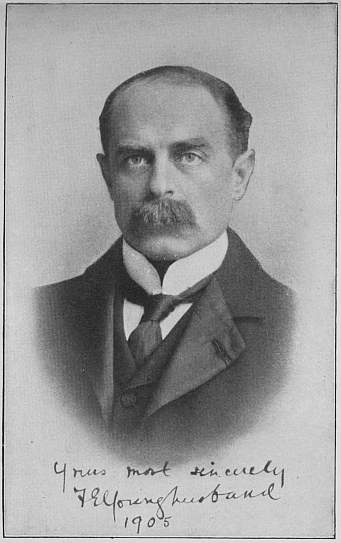
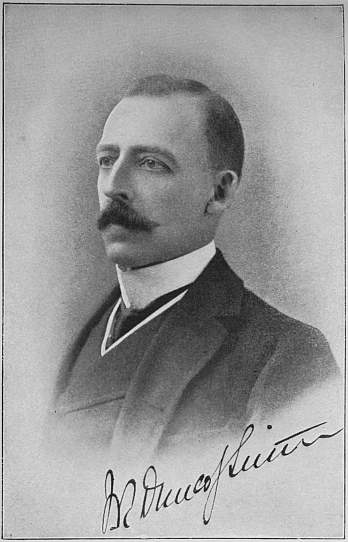
2. Colonel Sir Francis Younghusband, Commander of the English Expedition to Tibet, Resident in Kashmir. 3. Colonel J. R. Dunlop Smith, Private Secretary to the Viceroy.
I do not venture to pass an opinion on the policy which then piled up in my way obstacles apparently insurmountable. It was at any rate prudent. For the future it will be necessary. If I had gone under British protection and accompanied by British subjects and then been killed, probably a costly punitive expedition must have been sent out to make an example; whether I were a Swede or an Englishman would have made no difference in this case. The view the English Secretary of State took of the matter is shown in his answer to Lord Percy’s question a month after I had received my answer: “Sven Hedin has been refused permission to penetrate into Tibet for political reasons, in accordance with which even British subjects are not allowed to visit that country. The Indian Government favours the expeditions of experienced explorers, but the Imperial Government has decided otherwise, and considers it advisable to continue the isolation of Tibet which the late Government so carefully maintained.”
During this time I received many proofs of sympathy and friendship. I had true friends in India, and they felt it hard that they could not help me. They would have done it so gladly. I durst not ask them for anything lest I should place them in an awkward, troublesome position. Sir Louis Dane had informed me that if my petition were granted I should have to sign a bond, but what this would have contained I have never found out. Perhaps it dealt with some kind of responsibility for the men who accompanied me, or a promise not to visit certain districts, and a pledge to place the results of my journey at the disposal of the Indian Government—I know not. But now I was absolved from all obligations; freedom is after all the best, and he is the strongest who stands alone. Still, it would be exaggeration to say that I had then any great affection for the name of Mr. John Morley. How could I foresee that I should one day reckon him among my best friends, and think of him with warm respect and admiration?
After my first visit to the Foreign Office, Younghusband (Illustration 2) conducted me to the Viceregal Palace, to enter my name in the visiting list of Lord and Lady Minto. Younghusband is a gallant man, a type of the noblest that a people can produce. He was more annoyed than myself at the refusal of the Government; but he had in this connection a far more bitter experience—his expedition to Lhasa, which ought to have thrown open Tibet to scientific exploration, had been in vain. He took me on the way to Lord Minto’s private secretary, Colonel J. R. Dunlop Smith (Illustration 3), in whom I found a friend for life. He is one of the finest, noblest, most generous, and learned men that I have ever met. He is well educated in many subjects, and has a thorough knowledge of India, for he has lived there four-and-twenty years. When we see such men in the most responsible posts, we can well conceive that the ruling race will weather many a violent storm, should they arise, among the three hundred millions of India.
My life at this time abounded in contrasts. How little did my sojourn at Simla resemble the years of solitude and silence that awaited me beyond the mountains veiled in dark masses of cloud! I cannot resist recalling some reminiscences of these extraordinarily delightful days.
Go with me to the first State dinner on May 24, 1906. Along the walls of the great drawing-room in the Viceregal Palace are assembled some hundred guests—all in full dress, in grand uniforms of various colours, and glittering with orders. One of them is taller than the rest by a whole head; he holds himself very upright, and seems cool-headed, energetic, and calm; he speaks to no one, but examines those about him with penetrating, bright bluish-grey eyes. His features are heavy, but interesting, serious, impassive, and tanned; one sees that he has had much experience and is a soldier who has stood fire. His uniform is scarlet, and a whole fortune in diamonds sparkles on his left breast. He bears a world-renowned, an imperishable name: Lord Kitchener of Khartum, the conqueror of Africa and Commander-in-chief of the Indian Army.
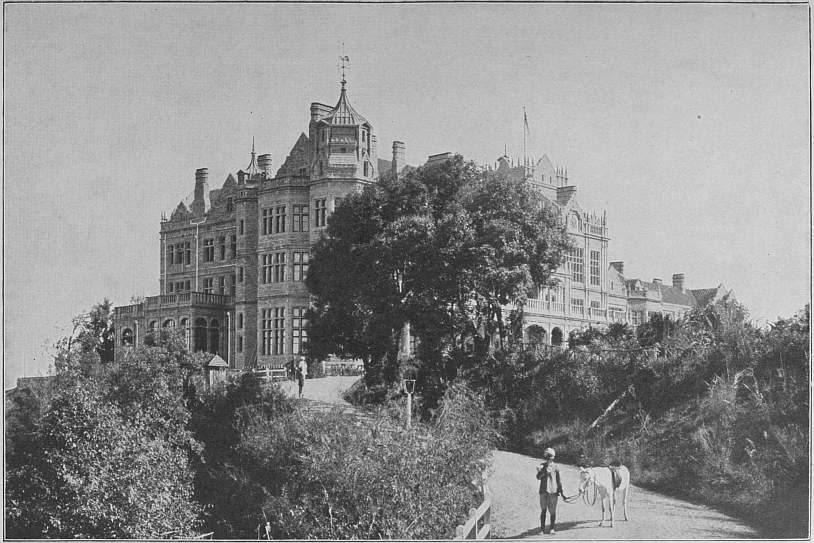
4. Viceregal Lodge in Simla.
A gentleman comes up to me and asks if I remember our having sat together at a banquet of Lord Curzon’s. The Lieutenant-Governor of the Punjab is also one of my old acquaintances, and Sir Louis Dane introduces me right and left. A herald enters the room and announces the approach of the Viceroy, and Lord Minto, accompanied by his staff, makes the round of the room, greeting each one of his guests, myself only with the words, “Welcome to Simla.” The melancholy tone of the words did not escape me; he knew well that I did not feel as welcome as he and I should have wished. To the sound of music we move to the dining-room, are regaled with choice French dishes, eat off silver plate, and then rise again to take part in the levée, at which five hundred gentlemen are presented to the Viceroy, who stands at the steps of the throne. Their names are called out one by one as they pass rapidly in front of the throne. Each one halts and turns to the Viceroy, who returns his deep reverence: he bowed this evening nine hundred times! When Indian princes or Afghan ambassadors pass before him, he does not bow, but lays his hand on the hilt of his guest’s sword as a sign of friendship and peace.
Next day I was invited to transfer my quarters to the palace (Illustration 4), and henceforth I was the guest of Lord and Lady Minto. The time I spent with them I shall never forget, and these weeks seem to me now like a dream or a fairy tale. Lord Minto is an ideal British gentleman, an aristocrat of the noblest race, and yet simple and modest. In India he soon became popular owing to his affability and kindness, and he does not think he occupies so high a position that he cannot speak a friendly word to any man out of the numerous tribes of the immense Empire committed to his rule. Lord Minto formerly served in India, and took part in the campaign against Afghanistan; after various experiences in three continents he was appointed Governor-General of Canada. In 1904 he returned to his estate of Minto in Scotland, intending to spend the remainder of his life there; then the King of England and Emperor of India invested him with the office of Viceroy and Governor-General of India. He is not the first Earl of Minto who has held this post, for his great-grandfather was Governor-General of the British possessions in the Indian peninsula a hundred years ago. Then one had to sail round the Cape of Good Hope in order to reach the country of the Hindus, a long, troublesome voyage. Therefore the first Lord Minto left his family at home. The letters exchanged between himself and his wife are still extant, and display an affection and faithfulness quite ideal. When his period of service in India had at length expired, he embarked on a vessel which carried him over the long way to his native land, and he hurried with the first coach straight to Minto. There his wife expected him; she looked along the road with longing eyes; the appointed time had long passed, and no carriage could be seen. At length a rider appeared in a cloud of dust, and brought the news that Lord Minto had died only one post stage from his house. A small label on the packet of letters bears the words “Poor fools.” They were written by the first Lady Minto.
But now a new Minto family has blossomed into life. Comfort, simplicity, and happiness prevail in this charming home, where every member contributes to the beauty of the whole. A viceroy is always overwhelmed with work for the welfare of India, but Lord Minto preserved an unalterable composure, and devoted several hours daily to his family. We met at meals; some guests were usually invited to lunch, but at dinner we were frequently alone, and then the time passed most agreeably. Then Lady Minto told of her sojourn in Canada, where she travelled 116,000 miles by rail and steamer, accompanied her husband on his official tours and on sporting expeditions, shot foaming rapids in a canoe, and took part in dangerous excursions in Klondike. We looked over her diaries of that time; they consisted of thick volumes full of photographs, maps, cuttings, and autographs, and were interspersed with views and descriptions of singular interest. And yet the diary that Lady Minto had kept since her arrival in India was still more remarkable and attractive, for it was set in Oriental splendour and the pomp and gorgeousness of Eastern lands, was filled with maharajas bedecked with jewels, receptions in various states, processions and parades, elephants in red and gold, and all the grandeur and brilliancy inseparable from the court of an Indian viceroy. Three charming young daughters—the Ladies Eileen, Ruby, and Violet—fill this home with sunshine and cheerfulness, and, with their mother, are the queens of the balls and brilliant fêtes. Like their father, they are fond of sport, and ride like Valkyries.
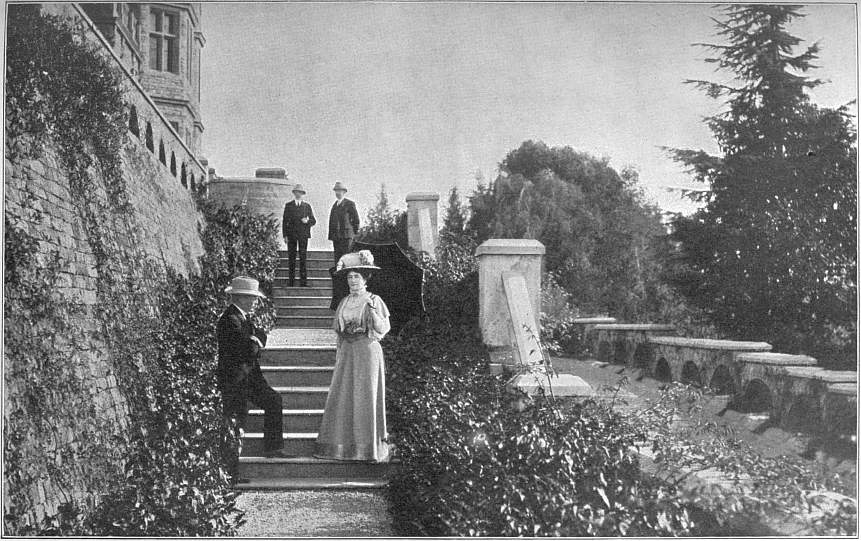
5. Lady Minto and the Author on the Terrace of the Viceregal Lodge.
Is it to be wondered at that a stranger feels happy in this house, where he is surrounded daily with kindness and hospitality? My room was over the private apartments of the Viceroy. On the ground-floor are State rooms, the large and elegant drawing-rooms, the dining-room, and the great ball-room decorated in white and gold. The various rooms and saloons are reached from a large antechamber adorned with arms and heavy hangings; here there is a very lively scene during entertainments. An open gallery, a stone verandah, runs round most of the ground-floor, where visitors, couriers, chaprassis, and jamadars, wearing red viceregal uniforms and white turbans, move to and fro. Behind is the courtyard where carriages, rickshaws, and riders come and go, while well-kept paths lead to quiet terraces laid out from Lady Minto’s designs. Behind these terraces begins the forest with promenades in the shadow of the trees (Illustration 5).
From the great hall in the middle of the house a staircase leads to the first storey, where the family of the Viceroy occupy rooms which surpass all the rest in the tastefulness of their decoration. Two flights up are the guest-rooms. From an inner gallery you can look down into the great hall, where the scarlet footmen glide noiselessly up and down the stairs. Outside my window was a balcony, where every morning I looked in vain for a glimpse of the mountains on the borders of Tibet. The highest official of Peshawar, Sir Harold Deane, with his wife, and the Maharaja of Idar, were guests in the palace of the Viceroy for a couple of days. Sir Harold was a man one never forgets after once meeting him; strong, tall, manly, and amiable. The half-savage tribes and princes on the frontier of Afghanistan fear and admire him, and he is said to manage them with masterly tact. This meeting was very important to me, for Sir Harold gave me letters of introduction to the Maharaja of Kashmir and his private secretary, Daya Kishen Kaul. At my return to India, Sir Harold was, alas! dead. In him India has lost one of its best guardians.
The Maharaja of Idar was a striking type of an Indian Prince: he had a very dark complexion, handsome features, and an energetic bearing; he dressed for entertainments in silk, gold, and jewels, and altogether made an appearance which threw all Europeans quite into the shade. Yet he was exceedingly popular with them, and always a welcome guest. He is a great sportsman, a first-rate rider, and an exceedingly cool-headed hunter. He owes his great popularity to the following incident: Once when an English officer died in the hot season near his palace, there was difficulty in finding a man to bury the corpse. As every one else refused, the Maharaja undertook the odious task himself. Scarcely had he returned to his palace when the steps were stormed by raving Brahmins, who cried out to him, with threats, that he had forfeited his rank, must be ejected from his caste, and was unworthy to have rule over the state. But he went calmly up to them and said that he knew only of one caste, that of warriors; then he ordered them to go away, and they obeyed.
I met many men in Simla whom I shall always count among my best friends—Generals Sir Beauchamp Duff and Hawkes, with their amiable consorts, and Colonel Adam and his wife, who spoke Russian; he was Lord Minto’s military secretary, and died during my absence; also Colonel M’Swiney and his wife. I was their guest at Bolaram, near Haidarabad, in 1902, and I had met the Colonel in the Pamirs in 1895; he, too, has been called away by death, only a month before he would have received his expected promotion to the command of the Ambala brigade. He was an exceptionally excellent and amiable man. I also made acquaintance with many members of Younghusband’s Lhasa expedition, one of whom, Captain Cecil Rawling, ardently wished he could get back to Tibet. We often met and concocted grand plans for a journey together to Gartok—hopes which all ended in smoke. The German Consul-General, Count Quadt, and his charming wife were also especial friends of mine. Her mother belonged to the Swedish family of Wirsén, and we conversed in Swedish. I shall never forget a dinner at their house. Dunlop Smith and I rode each in a rickshaw along the long road to Simla, through the town and as far again on the other side, to Count Quadt’s house, which was the Viceregal residence before Lord Dufferin built the new palace, the “Viceregal Lodge,” in the years 1884-1888. The road was dark, but we had lamps on the shafts; our runners strained at the carriage like straps, and their naked soles pattered like wood on the hard earth. We were late; Lord Kitchener was there already, and every one was waiting. After dinner the guests were invited to go out into the compound forming the summit of the hill on which the old palace is built. The light of the full moon quivered through the mild intoxicating air, the hills around were veiled in mist and haze, and from the depths of the valleys rose the shrill penetrating rattle of grasshoppers. But this hill, where lively laughter resounded and conversation was stimulated by the effects of the dinner, seemed to be far above the rest of the world. Here and there dark firs or deodars peeped out of the mist with long outstretched arms like threatening ghosts. The night was quiet, everything but ourselves and the grasshoppers seemed to have gone to rest. Such an impression is never effaced. Etiquette forbade that any one should leave before Lord Kitchener—he had to give the signal for breaking up the party; but he found himself very comfortable here, and we talked in French with the wife of Colonel Townsend, drawing comparisons between the matrimonial state and the advantages of uncontrolled freedom. It was after midnight when the dictator of the feast rose, and then ladies and their cavaliers could make for their rickshaws. Silence reigned on the moonlit hill; only the shrill song of the grasshoppers still rose to heaven.
A couple of State balls also took place during my stay in the Viceregal Lodge. Then an endless succession of rickshaws streams up to the courtyard, winding like a file of glow-worms up Observatory Hill. One is almost astonished that there are so many of these small two-wheeled vehicles in Simla, but only the Viceroy, the Commander-in-chief, and the Governor of the Punjab are allowed to use horse carriages, because of the narrowness of the roads. Then elegant ladies rustle in low dresses of silk, with agrafes of diamonds in their hair, and pass through the entrance and hall escorted by cavaliers in full-dress uniforms. One is frightfully crushed in this flood of people who have spent hours in adorning themselves so brilliantly, but the scene is grand and imposing, a non plus ultra of gala toilets, a kaleidoscope of many colours, of gold and silver; the red uniforms of the officers stand out sharply against the light silk dresses of the ladies in white, pink, or blue. Here and there the jewelled turban of a maharaja hovers over a sea of European coiffures. Then there is a sudden silence, a passage is opened through the crowd; the herald has announced the advent of the Viceroy and his party, and the band plays “God save the King.” The Viceroy and his lady walk slowly through the ranks, saluting on both sides, and take their seats on the thrones in the great ball-room; then the first waltz is played. The illustrious hosts summon first one and then another of their guests to converse with them; there is a rustling of silk, a humming and buzzing, shoe-soles glide with a scraping noise over the floor, and the dance-music hurries on its victims with irresistible force. The guests flock in small parties or large groups into the adjoining dining-room, and there sup at small tables. At length the ranks grow thin, the hosts retire, the wheels of the last rickshaw rattle over the sand of the courtyard, the electric lights are extinguished, and the palace is quiet again.
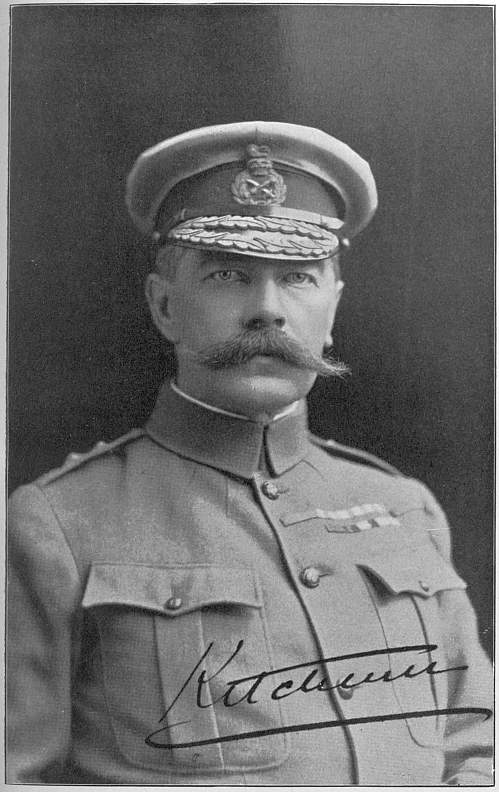
6. Herbert, Viscount Kitchener of Khartum, Late Commander-in-Chief of the Indian Army.
Lord Kitchener’s residence stands at the end of the town of Simla, and is called Snowdon. The visitor enters first a large ante-room, which, with its tasteful arrangement and decoration, makes rather the impression of a reception room or a hall of honour bedecked with trophies. A fine portrait of Gordon Pasha is placed on an easel; opposite stand busts of Alexander and Cæsar. In the wainscot of the staircase is inserted the arm of the presidential chair which Uncle Kruger used in Pretoria, and on the tables, shelves, and friezes are valuable Chinese vases of the Kang-hi (1662-1722) and Kien-lung (1736-1795) periods; for Lord Kitchener is an enthusiastic collector of old Chinese porcelain, but only the very finest finds favour in his eyes. But what strikes the stranger most in this unique hall, and above all attracts his attention, are the trophies and flags from Lord Kitchener’s victories in the Sudan and South Africa. They hang down from their staves from an upper gallery, among them the standards of the Mahdi and the dervishes of Omdurman and Om Debraket, besides several Boer flags from the Transvaal and the Orange Free State. In the inner drawing-room we find the same luxurious decoration with Chinese porcelain vases and rare ethnographical objects, among which certain Tibetan temple friezes carved in wood are of great value; they were brought by Younghusband’s Lhasa expedition. On the tables lie albums of photographs of Lord Kitchener’s numerous tours of inspection in India, and of his journey through the cold Pamir. At receptions the table is adorned with costly services in solid gold, gifts of the English nation to the victor of Africa (Illustration 6).
My time in Simla came to an end; it was useless to stay any longer after I had received the last decisive answer from London. On June 9 I took leave of the Viceroy and his youngest daughter, who were going to ride to Mashroba and pass the Sunday there. I cannot describe the leave-taking; it was so warm and hearty. Lord Minto wished that I might still carry out my intentions, and he hoped sincerely that we should again meet in India. I could not on the point of departure express all the gratitude I felt. He had done all that was in his power to help me, and had exposed himself to unpleasantnesses on my account. He had played an important part in my life’s course, and I knew that I had gained in him a lasting friend. It was a trial to have to say good-bye to him. He was more grieved than myself that our plans had miscarried, and for my part I felt that my honour now demanded that I should do my best.
On Sunday morning Lady Minto and her two eldest daughters also drove off to Mashroba. I bade them a last farewell, and thanked them for the boundless hospitality I had enjoyed in the Viceregal Lodge. The moment of parting was fortunately short; bitter it certainly was. Two fine carriages drove up with outriders, and escorted by native cavalry soldiers in red and gold, carrying lances in their hands. The ladies, in light bright summer toilets and hats trimmed with flowers, took their seats—the group of ladies of bluest blood, which through centuries and generations had been ennobled and refined, seemed to me like a bouquet of flowers themselves. I remained on the lowest step as long as I could catch a glimpse of the waving sunshades, but soon the red uniforms of the soldiers disappeared among the leafy trees of the avenue which leads down to the main guard, and the romance was at an end.
When I again entered my room the royal palace seemed lifeless and desolate, and I had no heart to remain any longer. I packed my things, hurried into the town and paid a couple of short farewell calls, made arrangements for my heavy luggage, and was soon ready to start. On the 13th I went off. The number thirteen plays a rôle of some importance in this journey: on November 13 I left Trebizond on the Black Sea; on December 13 I reached Teheran, the capital of Persia; and on June 13 I left Simla; but I was not superstitious. Younghusband was the first to welcome me and the last to say good-bye; I was soon to see him again in Srinagar. Then the train sped downwards through the 102 tunnels. From a bend in the road I caught sight of the Viceregal Lodge with its proud towers and lofty walls, the scene of so many joyful reminiscences and disappointed hopes.
CHAPTER II
DEPARTURE FROM SRINAGAR
Manuel was a singular fellow. He was a Hindu from Madras, small, thin, and black, spoke good English, and with his parents had joined the Roman Catholic Church. He had presented himself at the last moment with a huge packet of testimonials and declared confidently: “If the gentleman thinks of making a long journey, the gentleman will want a cook, and I can cook.” I took him into my service without looking at his testimonials (Illustration 15). He behaved well, was honest, and gave me more satisfaction than annoyance. The worst he did was to get lost in Ladak in some mysterious way, and to this hour I have heard nothing more about him.
In my compartment we sat as close as herrings in a barrel. The air became hotter and hotter; from the pleasant coolness of the heights we came again into the oppressive heat of the Indian plains. Passing Kalka, Ambala, and Lahore I came to Rawalpindi, where I put up at a passable hotel. But the room was hot and stuffy, and the punkah, the great fan hanging down from the ceiling, was in motion all through the night, but did not prevent the gnats from paying me importunate visits.
On June 15 a tonga and three ekkas stood before the hotel; I took my seat in the former, and the baggage was securely packed on the latter—and Manuel. The road runs between fine avenues of trees straight to the foot of the mountains. The traffic is lively: carts, caravans, riders, tramps, and beggars. Before us lie slopes of no great height, and beyond the higher mountains of the Himalayas. Are they walls erected across my path by hostile spirits, or do they await my coming?
Beyond Malepur the tonga, drawn by two spirited horses, passes through the first hills with dark and light tints of luxuriant green. The road winds up among them, and I am glad to leave the fiery glow of the plains behind; certainly the sun is still burning, for the air is clear and the first forerunners of the cloud masses of the south-west monsoon have not yet appeared. Thus we pass one stage after another. We have often to drive slowly, for we meet long trains of native soldiers in khaki uniforms with forage and munition waggons, each drawn by two mules—how glad I should have been to possess a couple of dozen of these fine animals! Cool winds blow in our faces and conifers begin to appear among the foliage trees. We leave the summer station Murree behind us, and now the snow-clad mountains at Gulmarg are visible. After crossing a pass near Murree we ascend again. Beyond Bandi we reach the right bank of the Jhelam, but the river lies far below us; the scenery is beautiful, and its grandeur and magnificence defy description. Lower and lower we go, drive close along the river’s bank, and pass the night in the dak bungalow of Kohala.
Next day we cross a bridge and slowly mount the slopes of the left bank. The morning is beautifully fine, and the not over-abundant vegetation of the hills exhales an agreeable summer perfume. On our left rushes the stream, often white with foam, but its roar strikes our ears only when we make a halt; at other times it is drowned by the rattle of the tonga. I follow with the closest attention the changes of scenery in this wonderful country. The road is carried through some of the mountain spurs in broad vaulted tunnels. The last of these is the longest, and opens its gaping jaws before us like a black cavern. Within it is delightfully cool; the short warning blasts of the signal horn reverberate melodiously in the entrails of the mountain.
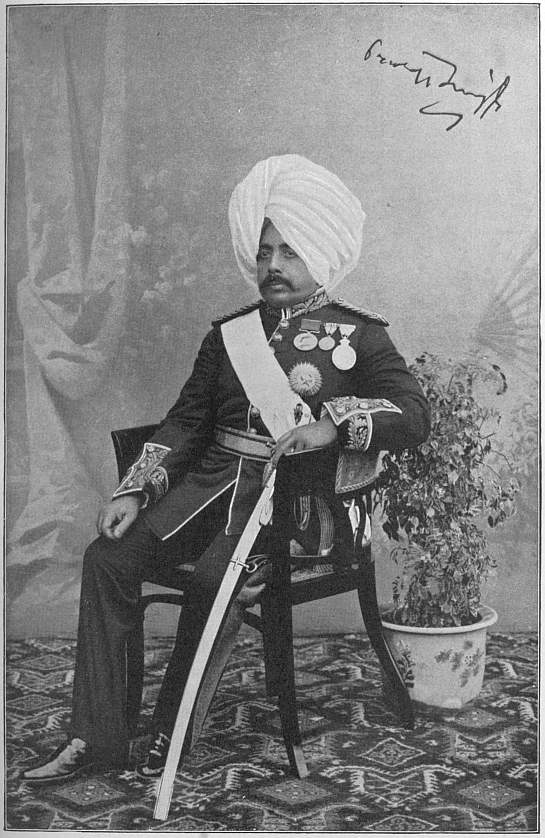
7. The Maharaja of Jammu and Kashmir.
In Gurie we breakfast, and rest a quarter of an hour on a comfortable couch in the verandah. Here, four years previously, I spent a memorable hour with Sir Robert and Lady Harvey. The wind whistles through the same poplars, elms, and willows to-day; I feel extraordinarily forlorn and melancholy. Then I had come from a great journey, now the future seems to me hopelessly dark. Before me rise the softly rounded but steep slopes of the wooded mountains on the right side of the valley; down yonder the village of Gurie lies on both sides of the river. The air is mild. I dream of eternal spring and forget my cares. Beyond Chinawari tall conifers are again seen on the cliffs. My driver, who speaks Persian, points to a huge block of stone embedded in the margin of the road; ten days ago it fell and killed a man and two horses. At dangerous spots, where landslips may be expected, small white flags are stuck up. The mountain landscape becomes wilder, and its sharp outlines become more distinct in the shades of evening. We come to Urie and Rampur and often drive through dense forest. When we arrive at Baramula we have covered 106 miles in fourteen hours.
On June 17 it rained in torrents, but we determined in spite of it to travel the last six stages to Srinagar. We canter along the straight road between endless rows of poplars. The mud splashes up, the rain beats on the roof of the tonga, heavy clouds involve us in semi-darkness, and there is not a trace of the mountains to be seen. The weather suits the mood in which I arrive at Srinagar, the capital of Kashmir on the bank of the Jhelam. Here I had to make several preparations for my journey—to Turkestan, it was stated officially; there was no more talk of Tibet. The persons whom I called upon on the first day of my sojourn in the capital of the Maharaja were away, but at last I found the superintendent of the Mission Hospital in Srinagar, Dr. Arthur Neve. In 1902 he had treated my sick cossack, Shagdur, and rendered me many other services, for which I owe him an eternal debt of gratitude. One of my best friends in India had advised me to try to persuade Dr. Arthur’s brother, Dr. Ernest Neve, to accompany me, but now I learned that he too had applied for permission to visit western Tibet, chiefly in connection with missionary work round about Rudok, and had likewise met with a refusal; he was now on his way back from the Tibetan frontier above Leh. Dr. Arthur Neve is one of the men I most admire. He has devoted his life to the Christian Mission in Kashmir, and his hospital is one of the best and most completely equipped in India. There he works indefatigably day and night, and his only reward is the satisfaction of relieving the sufferings of others.
This day everything seemed to go wrong, and out of spirits I returned to Nedou’s Hotel just as the gong announced eight o’clock. I sat down at the long table among some thirty ladies and gentlemen, all as strange to me as I to them. But in some of the parties the conversation turned on me.
“Have you heard that Hedin is in Srinagar?”
“No, really? When did he come?”
“To-day. Of course he wants to go to Tibet.”
“Yes, but he has been forbidden, and the Government has orders to prevent him crossing the frontier.”
“Well, then, he can pass round Tibet and enter it from the north.”
“Yes, he has done it before, and can of course find the way again.”
It was exceedingly unpleasant to have to listen to this conversation, and I almost drowned myself in my soup-plate. I could scarcely understand how I could be thus spoken of. It seemed as though the dreams and illusions of my soul were sorted out, named, and ticketed, while my corporeal part sat at the table d’hôte and swallowed soup. When we had happily arrived at the coffee I quietly withdrew, and thereafter always ate in my own room. My position was such that I had to avoid all contact with Englishmen; they could do me no service, and I would on no account reveal my real designs. What a difference from any former journeys, which I had always commenced from Russian soil, where every one, from the Czar to the lowest chinovnik, had done everything to facilitate my progress!
Next day I called on the private secretary of the Maharaja, the Pundit Daya Kishen Kaul, a stately, distinguished man who speaks and writes English perfectly. He carefully read through my letter of introduction, and kindly promised to get everything ready for me as quickly as possible. During the conversation he took notes. His agents were to receive his orders on that same day, mules would be procured, four soldiers be told off to accompany me during my whole journey, provisions, tents, and pack-saddles be bought, and he would find a pleasure in fulfilling all my wishes. No one would have an inkling that all this was done for me; every outlay would be lost among the heavy items entered under the heading “Maintenance of the Maharaja’s Court.” And Daya Kishen Kaul kept his word and became my friend. The business proceeded slowly, but still it did go forward. Not a word was spoken of Tibet. I was ostensibly getting ready for a journey to Eastern Turkestan, but his meaning smile told me that he divined my intention.
Even at a base of operation where one has full liberty it is not quite easy to get a caravan ready for the march; how much more difficult here where I was in the midst of intrigues and political vexations. But my self-respect and energy were stimulated, and I felt certain of succeeding in the end. The whole affair reminded me of a drama with an interminable list of rôles; the complications were great and I longed only for action. One act of the play was performed at Srinagar, and I cannot pass it over, as it had a sequel later on. When everything else had been denied me from London the road to Eastern Turkestan still lay open.
On June 22 I received from the Resident, Colonel Pears, the following letter:
The Indian Government has ordered me by telegraph not to permit you to cross the frontier between Kashmir and Tibet. They have no objections to your travelling to Chinese Turkestan, taking it for granted that you have a Chinese passport. But as you have lately informed me that you do not possess such a document, I have telegraphed to the Indian Government for further instructions.
Now I telegraphed to the Swedish Minister in London, Count Wrangel, and begged him to procure me a passport for Eastern Turkestan, a country I never thought of visiting, and then informed the Government in Simla of this step and of the satisfactory reply. Nineteen days later I received the following letter from Sir Francis Younghusband, who meanwhile had arrived in Kashmir as the new Resident:
I have received a telegram from the Government informing me that you may set out before the arrival of the Chinese passport, but on the condition that you do not travel beyond Leh. As soon, however, as the Chinese Government, or the Swedish Minister (in London), telegraphs that your passport is drawn out, you may cross the Chinese frontier at your own risk; your passport will then be sent after you.
Then I telegraphed to Count Wrangel again, asking him to assure the Indian Government that the passport had really been granted me and was already on the way. It was already awaiting me in Leh when I arrived there. It was a pure formality, for I did not need it, and it would have to be decided first where the boundary lay between Eastern Turkestan and Tibet. The representative of China in London subsequently expressed his astonishment to Count Wrangel that I was travelling about in Tibet with a passport made out for Eastern Turkestan, but Count Wrangel replied very justly that he could not possibly control me and the roads I followed in Asia. The English Government had done its best to prevent my travelling through Tibet, and so there was no resource left but to outwit my opponents. How I succeeded will appear in the pages of this book.
On one of the first days, accompanied by Daya Kishen Kaul, I called on the Maharaja of Jammu and Kashmir, Sir Pratab Sing, whose brother, Emir Sing, was also present. His Highness is a little middle-aged man of dreamy, melancholy aspect (Illustration 7). He received me with great friendliness, and promised to meet my wishes in every respect. He had heard of my journey through the desert in 1895, and when I had narrated its incidents I had won him over to my side; he would be pleased, he assured me, to see my new expedition start from his territory.
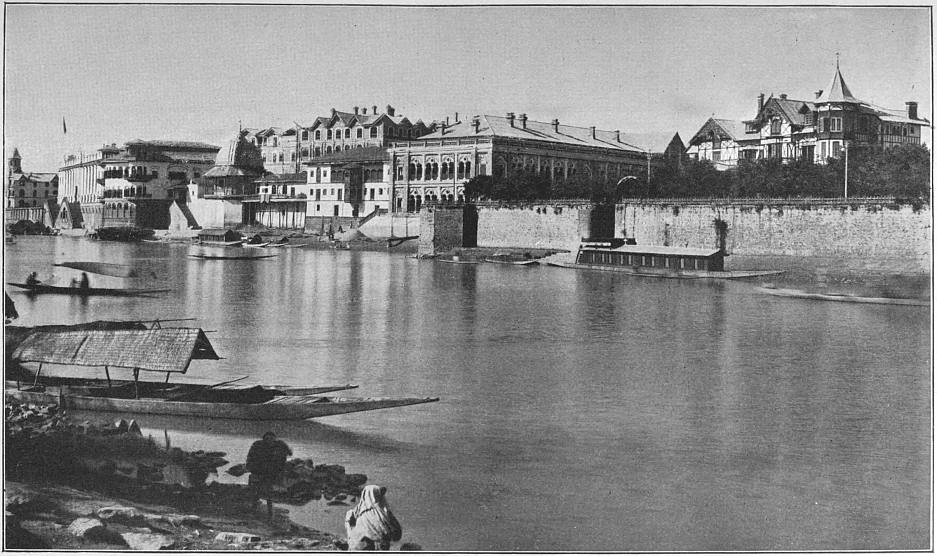
8. Palace of H.H. the Maharaja of Kashmir in Srinagar.
On June 29 I was invited to a great fête at the Maharaja’s palace in honour of the Emperor’s birthday. The birthday of the King of England falls on November 9, but the Emperor of India was born on June 29. How that happens I do not know. At the appointed time I went to Younghusband, and at the quay of the Residence we were taken on board a shikara of the Maharaja—a long, elegantly decorated boat, with soft cushions and an awning with hanging fringes and tassels, and manned by about twenty rowers in bright red clothing. We glide swiftly and noiselessly down the Jhelam, see palaces, houses, and thick groves reflected picturesquely in the swirling ripples, sweep past numerous house-boats and canoes, and come to a halt a little below the bridge at the staircase to the palace, where Emir Sing received us on the lowest step in the red uniform of a major-general. On the platform above the steps the Maharaja awaited us. And then we mingled with the varied crowd of Englishmen and natives, all decked out in their best. Then a court was held; all the guests filed past in slow single-file, and His Highness distributed friendly shakes of the hand and nods. Then in the same order all sat down in rows of chairs, just as in a theatre. But we did not rest long, for soon dinner was announced, and we made free with what kitchen and cellar provided. After the feast was over, the Maharaja, his brother, and his little nephew, the heir to the throne, entered the hall and took their places at the middle of the table at which we sat. The Maharaja called for a cheer for the King-Emperor, another toasted Younghusband, who returned thanks in a neat and partly humorous speech. Then the guests were invited to go out into an open gallery with thick pillars, where they witnessed a display of fireworks. Between suns and Bengal fires, rockets and serpents flew into the air from boats lying on the river, and on the further bank “God save the King-Emperor” was spelled out in red lamps. Taste and elegance had been less studied than noise; there were detonations and sprays of fire in every nook and corner, and the whole gave an impression of unswerving loyalty. When we went down to our boat again all around was veiled in darkness; brilliant light streamed only through the colonnade of the palace façade. We rowed upstream and enjoyed a more beautiful and quieter illumination; the moon threw sinuous lines of gold across the ripples of the river, and flashes of blue lightning darted over the mountains on the horizon.
The Pundit Daya Kishen Kaul Divan Sahib was unwearied in his kind efforts. He procured me forty mules, which he bought from the Raja of Poonch. I rejected four; the rest were in good condition, but they were of a less sturdy breed than the Tibetan, and all foundered in Tibet. He also furnished me with an escort of four soldiers who had been in the service of the Maharaja. Two of them, Ganpat Sing and Bikom Sing, were Rajputs, and spoke Hindustani; they had certificates of good conduct, and the former wore a service medal. Like the cook Manuel, they declared themselves prepared to sacrifice their lives for me, but I calmed them with the assurance that our campaign would not be so bloody. Fortunately both belonged to the same caste, so that they could mess together; but, of course, they could not eat with other mortals. In camp I always saw them seated at their own fire a good distance from the others. The two others were Pathans, Bas Ghul from Cabul, and Khairulla Khan from Peshawar. Daya Kishen Kaul provided all with guns and ammunition at my expense, and their pay was fixed. They also received money for their outfit, and I prepared them to expect cold. My amiable benefactor looked after tents for me, saddles, pack-saddles, and a number of other necessary articles. Meanwhile I made purchases myself in the bazaars. I got about twenty yakdans, small leather-covered wooden boxes such as are used in Turkestan; kitchen utensils and saucepans; furs, ordinary blankets and frieze blankets; a tent-bed with mattress and a gutta-percha undersheet; warm material and bashliks; caps, Kashmir boots, cigars, cigarettes and tobacco for a year; tea, and several hundred boxes of preserved meat; also woven stuffs, knives, daggers, etc., for presents, and no end of other things (Illustrations 10, 14).
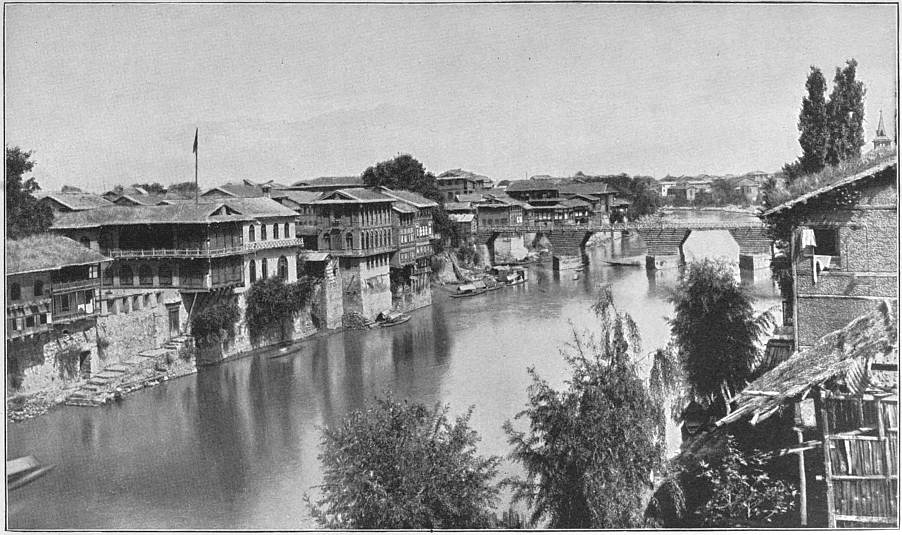
9. The Jhelam in Srinagar.
In all my purchases and transport arrangements I received invaluable help from Cockburn’s Agency. It provided me with stores of rice, maize, meal and barley; for it was impossible to get together sufficient quantities in Leh. It also looked after the transport of this heavy baggage, and I had every reason to be satisfied with its arrangements. I had myself brought a boat with oars, rudder, mast, sails, life-buoys and centre-board, in the large chests I had sent out to India. Then I had the same scientific instruments as before: an alt-azimuth, two chronometers, meteorological instruments, compasses, photographic apparatus and plates, writing-blocks, sketch-and note-books, writing materials, field-glasses, hunting-rifles, revolvers, etc.
Burroughs and Wellcome of London had been so kind as to present me with an unusually complete medicine-chest, which was in itself a tasteful and elegant work of art, and contained drugs specially selected for a high, cold, and dry climate. All the remedies were in tabloids, well and orderly packed, and could easily be found with the aid of a printed catalogue. The whole was carefully stowed in a pretty aluminium chest which shone like silver. The medicine-chest was from the first exceedingly popular in the caravan; every one had a blind confidence in it. I had a suspicion that many ailments were feigned just to get another look at the chest. At any rate it contained the best portable medical outfit I have ever seen.
I had some difficulty in finding an assistant for meteorological observations. There was none at the Central Institute in Simla, and therefore I applied to the Meteorological Station in Srinagar. The chief recommended a youngster to me who had been assistant at the station and had been baptized under the name of Rufus, but he was a fat Bengali, who always walked about with an umbrella even when it did not rain. I was not troubled about his corpulence; he would soon be cured of that on the mountains; but, what was worse, he had certainly never seen an aneroid barometer, and I could not, try as I would, teach him to read it. I therefore dismissed him, for at the worst I could read the instruments, though I had a superabundance of other things to do.
Then just at the right moment a Eurasian, three-and-twenty years old, presented himself, named Alexander Robert. In his first letter to me he gave himself no other title than the very correct one of a “stranger in Srinagar”; this indicated modesty. He came to my hotel, showed me his testimonials, which were all excellent, and he struck me as a pleasant, strong, and healthy man. Among other employments he had worked on the railway at Peshawar and had been an assistant in Dr. Neve’s hospital. Dr. Neve recommended him most warmly, and as, besides, he acquired a good knowledge of the instruments after a single lesson and needed only a few days’ practice in Srinagar in handling and reading them, I was very glad to engage him. He left his mother and young wife at home, but they were in no straits, and a part of his wages was paid to him in advance. I did not regret taking him, for he had a knowledge of many things, was capable, cheerful, and ready for work of any kind. When I knew him better I entrusted all my cash to his care, and could do it without hesitation, for his honesty was beyond suspicion. He was a companion to me during the long winter evenings, was a favourite in the caravan and among the Tibetans, and carefully watched that every one did his duty. Robert was only once a cause of grief to me, when he left me in December 1907, in consequence of sad news he received of his family through Gartok (Illustration 13).
After Robert joined me matters went on more easily. He superintended the packing of the baggage and the weighing of it out into equal loads, and helped me in stowing and distributing the heavy money-bags which held 22,000 silver and 9000 gold rupees. Thus the days passed, and at last the hour of release struck. I had longed for it as for a wedding feast, and counted the intervening hours. I took leave of my old friend Younghusband, who at the last moment recommended to me a caravan leader, Muhamed Isa of Leh, and bade farewell to the Maharaja, Emir Sing, and Daya Kishen Kaul; and Mrs. Annie Besant, who on several occasions had shown me great kindness, expressed the best and most sincere wishes for the success of my journey.
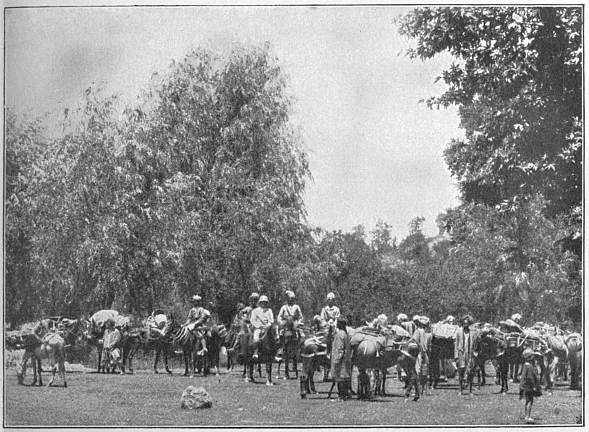
10. The Start from Ganderbal.
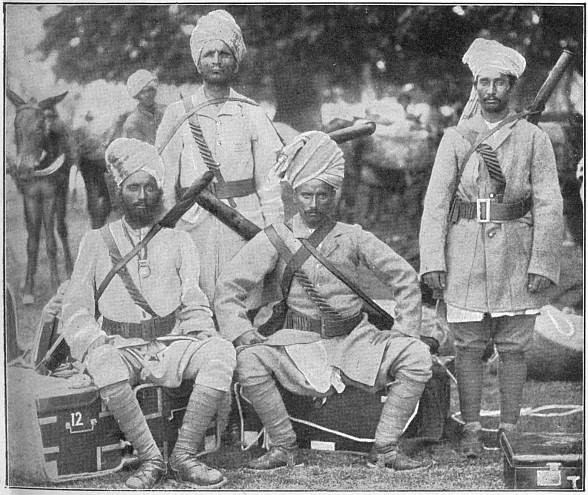
11. My Escort.
My people were ordered to be ready on the morning of July 16, 1906, in the courtyard of the hotel (Illustration 16). The start should be delayed not a day longer; I had now waited long enough. It was evident that some hours would be required to get all in marching order for the first time. At eight o’clock the men from Poonch came with their mules, but only to tell me that they must have 5 rupees each for new clothes. The purchase of these articles of clothing took up four more hours, and in the afternoon the preparations had progressed so far that there was only the loading-up to see after. Some hours elapsed before the pack-saddles and loads had been adjusted. The mules were very excited, danced round in circles, and kicked so that the boxes flew about, and at last each animal had to be led by a man (Illustration 17). The hired horses were more sensible. Manuel on his steed presented rather a comical appearance: he had never mounted a horse in his life, and he looked frightened; his black face shone in the sun like polished iron. The whole company was taken by at least half-a-dozen amateur photographers (Illustration 18). At length we moved off in detachments, exactly twelve hours behind time; but the long train was at any rate on the way to Gandarbal and Tibet—and that was the main thing. What did it matter what time it was? Feeling as though my prison doors were opened, I watched my men pass along the road (Illustration 10), and the whole world lay open before me.
Of all these men none knew of the glow of delight within me; they knew me not, and I did not know them; they came from Madras, Lahore, Cabul, Rajputana, Poonch, and Kashmir, a whole Oriental congress, whom chance had thrown together. They might as well be robbers and bandits as anything else, and they might think that I was an ordinary shikari sahib whose brain was filled with no other ideal but a record in Ovis Ammon’s horns. I watched the start almost pitifully, and asked myself whether it would be vouchsafed to them all to return home to wife and child. But none was obliged to follow me, and I had prepared them all for a trying campaign of eighteen months. What would it have profited me to have made them anxious by anticipating troubles? Trying days would come soon enough.
I was most sorry for the animals, for I knew that famine awaited them. As long as there were opportunities they should satiate themselves with maize and barley that they might subsist as long as possible afterwards on their own fat.
At length I stood alone in the yard, and then I drove to Dal-dervaseh, where a long, narrow, five-oared boat awaited me at the stone steps, and placed myself at the tiller, when the boat put off and I was at last on the way to the forbidden land. All the long journey through Persia and Baluchistan had been only a prologue, which had really no result except to land me in the spider’s nest in which I found myself caught in India. Now, however, I was free, out of the reach of all that is called Government; now I could rule, myself.
The canal, on the bright mirror of which we now glided along, was varied by water plants, ducks, and boats, almost sinking under their loads of country produce. On the banks washerwomen crouched, and here and there a group of merry children were bathing; they scrambled up projecting points and mooring places, let themselves tumble into the canal, splashed and threw up the water like small whales. The canal becomes narrower, only a few yards broad, our boat takes the ground, and the oarsmen get out and draw it over the shallows. The waterway is very winding, but runs on the whole to the north; the water is shallow, but the current is with us. On either side stand picturesque houses of wood and stone as in a street of Venice. At every corner the eye encounters a new charming subject for the brush, which gains additional effect from the motley figures, the vegetation, and the light lancet-shaped boats. The lighting up of the picture is also fine now that the sun is setting, bathing everything in its warm glowing beams, and causing the outlines to stand out clearly against the deep shadows. Between the houses the water is as black as ink. We draw near to a small projecting height, behind which the road runs to Kangan and Leh. Side branches debouch into the canal, but we make for a lake called Anchar; its water is greyish blue, and comes from the Sind, or Send as they here pronounce the name of the river.
After a while eddies and sandbanks show that we are in the river. The sun has set; the summer evening is quiet and peaceful, only the gnats buzz over the water.
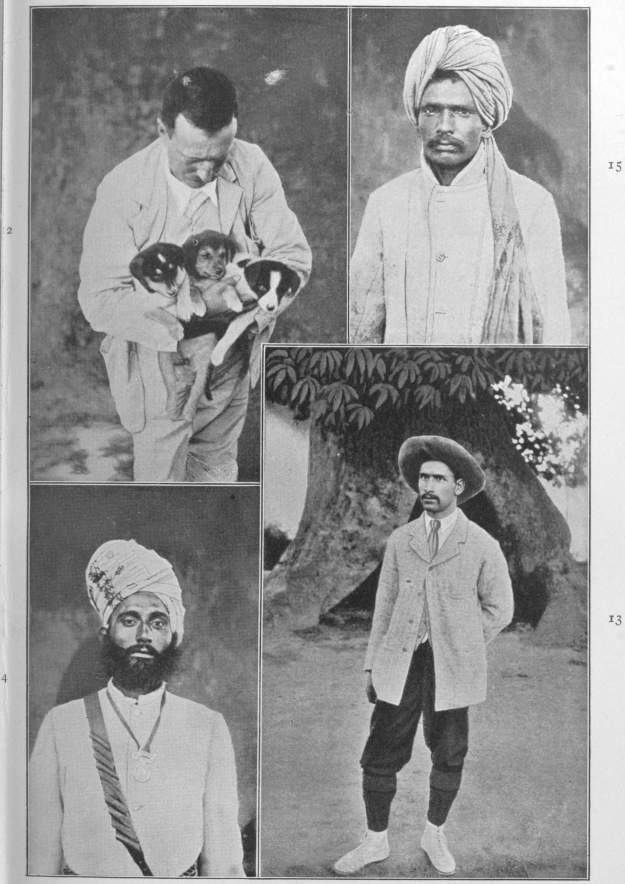
12. My Three Puppies. 13. Robert, the Eurasian.
14. Ganpat Sing, the Rajput. 15. Manuel, the Cook.
Prominent Members of the First Expedition.
Though the rowers work steadily, putting forth all their strength, we make slow progress, for the current is strong against us. I have therefore opportunity to peep into the domestic affairs of a whole series of English families in the house-boats. It is just upon nine o’clock and the inmates are gathered round the table in dress coats and elegant toilets. At one table sat three young ladies; I thought that they had spent too much trouble over their toilet, for there was nowhere any sign of a cavalier to be charmed with their appearance. Through the open windows the glaring lamplight fell on the water; they saw us pass, and perhaps puzzled their heads over the reason of so late a visit. Now the century-old planes of Gandarbal appear, we row into a creek of stagnant water and go on shore.
This was my first day’s journey, but the day was far from being over. Scouts were sent out, but not a soul was to be found at the appointed halting-place. We settled down between mighty tree-trunks and lighted a blazing signal fire. After a time Bas Ghul comes like a highway pad into the light of the flames; he leads a couple of mules, and at ten o’clock Robert and Manuel also lie beside our fire. But the tents and provisions are not yet here. At eleven scouts are sent out again, and we do not see or hear of them again before midnight; they report that all is well with the caravan and that it will soon be here. But when one o’clock came another scout vanished in the darkness and it was not till a quarter to three that my people arrived, after I had waited quite five hours for them. But I was not at all angry, only happy to be en route. New fires and resinous torches were lighted, and illuminated brightly the lower branches of the plane trees, while through the crowns the stars twinkled above our first bivouac on the way to Tibet.
What noise and confusion in this throng of men and baggage animals! The place was like a fair where all scold and scream and no one listens. The escort tried in vain to get a hearing, the Rajputs were quieter, but the Pathans abused the disobedient Kashmiris and the saucy men from Poonch as robbers and murderers. The animals were tethered with long cords to the foot of the trees, and on a small open space my tent pegs were for the first time driven into the ground. The tent was a present from my friend Daya Kishen Kaul, and was my home for a long time. The baggage was piled up in walls of provision sacks and boxes, and Manuel got hold at length of his kitchen utensils and unpacked his enamelled ware. The animals neighed and stamped and occasionally gave their neighbours a friendly kick, but when the barley nose-bags were carried round and hung on their necks only a whinnying was heard, which signified impatience and a good appetite. And then these children of the East, this gathering of dark-skinned men who strode about in the red firelight with tall white turbans—what a fine striking picture on the background of a pitch-dark night! I smiled to myself as I saw them hurrying hither and thither about their numerous affairs.