Front matter (continued 8)
Reading edition
“The Panchen Rinpoche (the Holy Teacher, the Tashi Lama) must have been informed of my coming some months ago. His Holiness also knew from which direction I should come, or he could not have sent my mails to the Dangra-yum-tso.”
“The Panchen Rinpoche never meddles with worldly matters; these are looked after by his brother, the Duke (Kung Gushuk).”
“Still, I must see His Holiness, for I know that he expects me.”
“It is vouchsafed only to a small number of mortals to appear before the face of the Holy One.”
Now the letter of the Raja of Stok and the Chinese passport came into my mind. The letter made no impression on them; but the young Chinaman, when the passport with its blue border and red stamp was unfolded before him, became very interested, and opened his eyes wider the farther he read. He read it once through, and then translated it slowly to Lobsang Tsering.
“Why,” they then both asked, “did you not show us this paper at once? It would have saved us all discussion.”
“Because the passport is made out for Eastern Turkestan and not for Tibet,” I answered truthfully.
“That does not matter, now that you are here. You have an excellent Chinese passport, and therefore are under Chinese protection.”
The young Chinaman took the passport and went off with it, while Mr. Lobsang Tsering put further questions to me and examined our weapons and other articles. At last I asked him whether he would like to see our garden, and I hurriedly ate my breakfast during his absence. Then the Chinaman came back and declared shortly that I might attend the festival, that especial seats were reserved for myself and a couple of my people, and that a chamberlain of the Tashi Lama’s court would call for us at the proper time. Now I blessed the Chinese passport which had caused me so much vexation at the time, and I blessed the Indian Government which had forced me to procure it; I blessed Count Wrangel, who had obtained it so quickly, and I blessed the Chinese ambassador in London, who had written out the passport with permission of his Government. But I had never dreamed that it would be of the slightest use to me, being issued for another country than Tibet.
This was our entry into Shigatse, and these were our first experiences there. Not a finger had been raised to stop us, no inquisitive people had jostled us in the streets to gaze at us. But now, when we had already set up house in the town, our presence in the place excited as general astonishment as if we had dropped down straight from heaven. That this stroke had succeeded, and through no action of mine, was due to certain peculiar circumstances. Hlaje Tsering had himself for some unexplained reason reopened the bag in which he had caught us, and the chieftains dwelling south of the Ngangtse-tso probably thought: “If the Governor of Naktsang lets them pass, we cannot stop them.” It was also lucky for us that some of these chiefs had betaken themselves to the New Year festival at Tashi-lunpo, and that we ourselves were lost in the crowd of other pilgrims when we came to the great highway; for during the days of the New Year the Tibetans are like capercailzies at breeding time: they neither see nor hear. And, lastly, I, the only European of the caravan, had ridden into the town when night had already spread a veil of darkness over the earth.
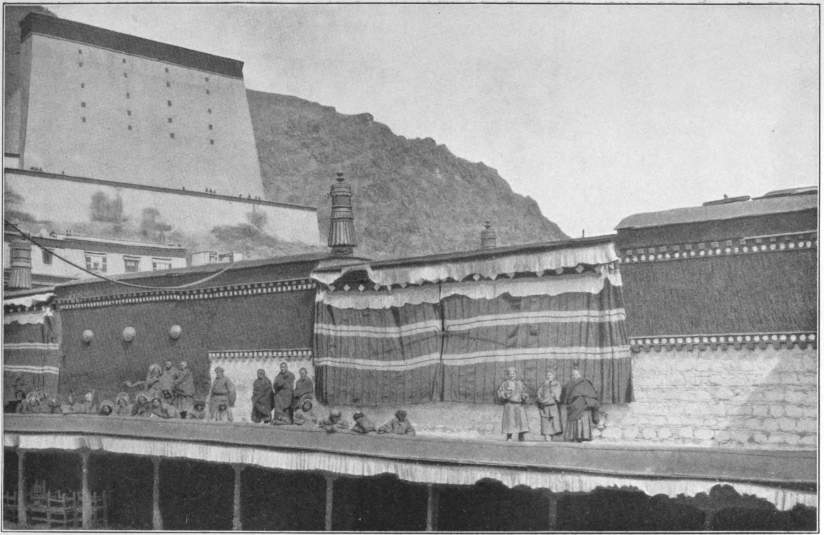
110. The Upper Balcony of the Court of Ceremonies in Tashi-lunpo.

CHAPTER XXIV
THE NEW YEAR FESTIVAL
The Lamaist Church has, in addition to the monthly festivals, four great annual ceremonies, and the greatest is the New Year feast, the Losar, which is celebrated in remembrance of the Sakya-muni, Buddha’s victory over the six heresies, the victory of the true religion over infidelity. It is always held at the beginning of February, and is therefore a festival of spring and light, in which the children of Buddha welcome the victory of the lengthening days over the darkness of winter, the passing away of the cold weather, the awakening of life and of the sprouting seeds after the winter sleep, and the approach of spring, when mild breezes, heralds of a warmer, brighter season, play with the streamers on all the temple roofs. The Losar is therefore an extraordinarily popular feast, which for quite fifteen days draws the labourer from his work, the herdsman from his yaks, and the merchant from his counter; a season of joy and pleasure, of feasting and dancing; a time for paying and receiving visits, and of giving and receiving presents; when the houses and temples are swept and garnished, and the best clothes and ornaments are taken out of the trunks; when friends gather to drink together in their apartments, and then in humble meditation squash their noses against the floor before the images in the dark temple halls; when broad anecdotes and strange stories of robbers are related to visitors from a distance, frequently interrupted by the hum of the prayer mills and the eternal truth “Om mani padme hum.”
All are admitted to the great temple festivals: no distinction is made between clergy and laity, monks and nomads, rich and poor, men and women, greybeards and children. A begging woman clothed in rags is seen beside a duchess loaded with precious stones. The Losar is a feast of the whole people, a carnival of Lamaism, like the Lupercalia and Saturnalia in ancient Rome.
It was my good fortune to arrive just in time for the greatest annual festival of Lamaism, and to be present at its celebration in the monastery town of Tashi-lunpo. At half-past ten appeared Tsaktserkan, a young chamberlain from the vatican, in a very elegant yellow robe of silk and a hat like an upturned dish, with a hanging tassel, and announced that he had come from His Holiness to fetch me to the festival, and that he was commissioned by the lama Lobsang Tsering to attend on me during my sojourn in Shigatse. He requested me to put on the finest clothes I had with me, for I should sit where I could be seen during the whole time from the seat of the Grand Lama. At the bottom of my box I had an old dress coat, several dress shirts, and patent leather shoes, which I had brought especially for the benefit of the Tashi Lama, and when Robert had rummaged out my shaving implements from another box, I assumed the appearance of a European gentleman among the bare mountains of Tibet. But I could not compare in gorgeousness with my interpreter Muhamed Isa, for his gold-embroidered turban surpassed everything. Of the rest only Robert, Tsering, Rabsang, and Namgyal were allowed to accompany me.
We mount the new horses from the Ngangtse-tso and ride to the monastery, a distance of twelve minutes. We leave on the right the Shigatse-dzong, which stands picturesquely on its hill in the sunshine, and reminds me of the palace at Leh. Our way passes across an open place, by detached houses and courtyards, fields, pools, and ditches; the crowd increases, the road becomes narrower; people stream in dense masses to the monastery—townsmen and nomads, pilgrims from distant lands and dirty ragged beggars; and old women sit at every corner offering with loud voice sweetmeats and cakes for sale. Boys, dogs, and Chinamen are all mingled together as in a huge ant-heap. But Tsaktserkan and his marshals open a way for us and we ride up the lane, beside which rows of great upright prayer mills are enclosed in white-washed masonry. A little higher the way becomes a proper street with tall white houses containing the cells of the monks, and we dismount at one of the chief entrances, a large gateway. High above us rises a brick-red temple building, the Tsogla-kang, and above all shines the white façade of the Labrang with a black frieze on the top and with awnings before its windows. We admire the imposing singular architecture, visible in all its lines and details and making an impression of uniformity and solidity. It is, perhaps, owing to my affection for Tibet that everything in this wonderful land is bewitching and magnificent in my eyes.
Now we mount up to the holy dwellings; the steep, corridor-like passages between the mysterious walls are paved with flagstones, varying in form and dimensions, but all smooth and bright as metal, though very uneven and worn, for they have been trodden for centuries by the feet of innumerable pilgrims and the soles of hurrying monks. Sometimes the crowding in this tightly packed stream of pilgrims is very uncomfortable, and in the lanes there is a musty odour of human beings. We mount higher and higher, go along winding passages, turn frequently at right angles left or right, pass through a gateway roofed over and with a massive threshold, and follow passages and corridors, dimly lighted, dark or pitch-dark, crowded with lamas in red togas, who have one or both arms bare, closely cropped hair, and no covering on their heads. They welcome us with kindly good-tempered smiles, and then move aside to let us pass. Where treacherous steps lurk in the darkness, I feel a strong arm ready to support me in case I stumble; it is some attentive lama at my elbow.
Now it becomes lighter in the monastery walks, and the profiles of the monks stand out black against the light. We enter a gallery with massive wooden pillars, and we take our places in a balcony shut off from the gallery by curtains of yak’s wool with horizontal white stripes at the bottom. An arm-chair of European form was placed for me, and I needed it; for this day’s spectacle, the grandest of the whole New Year festival, lasted three hours. Here we sat as on the second tier of an open-air theatre, and had an excellent view of the scene of action, like a rectangular market-place, and surrounded by open platforms or terraces supported by colonnades of wooden pillars. The whole reminded me of a vast roofless auditorium. In the centre of the paved court rose a tall mast which had suffered severely from the wind, and had been fissured by many summers and the frosts of the succeeding winters, and from its top long flags hung down to the ground. Immediately below our balcony ran the uppermost terrace, and beyond its edge we looked down over the whole courtyard where the religious ceremony was to take place, and over the galleries opposite and at the sides, one storey above the court below (Illustration 108).
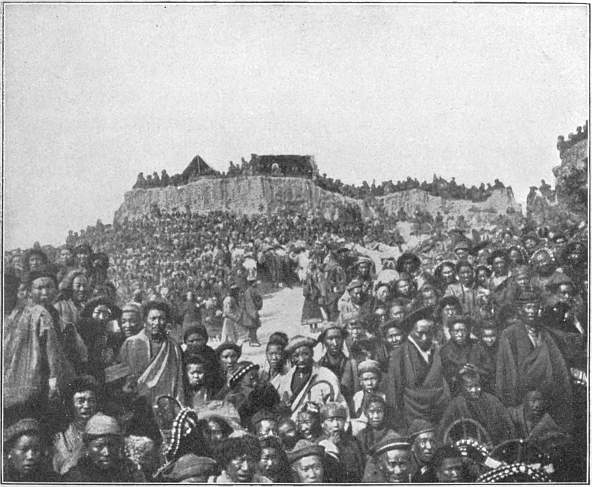
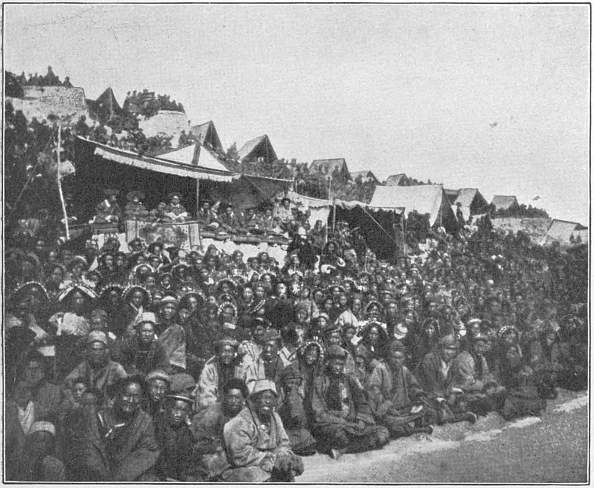
111, 112. The Profanum Vulgus at the New Year Festival in Shigatse.
Everywhere, on all the balconies and roofs, on all the projections and terraces, even right up under the gilded roofs curved in the Chinese style of the mortuary chapels, where departed Grand Lamas sleep, the people swarmed. From our elevated point of vantage we looked down on a sea of heads, a conglomeration of human beings, a mosaic of vivid glaring colours, an exhibition of national costumes, among which the Tibetan dress was certainly the most conspicuous, but where the eye lighted on figures hailing from Bhotan and Sikkim, Nepal and Ladak, while Chinese merchants, or soldiers and pilgrims from the grassy steppes of Mongolia, were easily distinguishable. An old lama of high rank, who had shown us to our places, informed us that there were more than 6000 spectators present, and this estimate was below rather than in excess of the truth. Right in front of the highest platform opposite us sits the Consul of Nepal, a young lieutenant in a round black cap with a gold band but no peak. He blows rings from his cigarette, and is the only one guilty of such a desecration of the holy place. Behind him sit a number of other Nepalese and representatives of other Himalayan countries attracted hither by business affairs or religious zeal. To the left of them are long rows of men in dresses entirely of red or of yellow, long kaftans with coloured girdles and sashes round the waist, and mushroom-shaped hats, also red or yellow, which have the circumference of a parasol and are fastened with a string under the chin; they are officials of different ranks, are either the city fathers, or are attached to the civil court of the Lama, or to the administrative bodies of the province Chang. On the gallery below them sit their wives and other ladies of rank, quite buried under the most varied and extraordinary adornments: their dresses are red, green, and yellow; they wear necklaces and silver pendants, silver cases inlaid with turquoise, and at the back of the neck tall white aureoles, thickly set with jewels and other ornaments. Their coiffures are of various forms: some have a parting in the middle, and hair, like polished ebony, puffed up at the sides; others have the hair plaited in a number of thin switches, which are fixed up and decorated with beads, etc. There are seated women from Pari and Kamba-dzong, from Ngari-khorsum in the west and Kham in the east, and from the black tents on the shores of Tengri-nor. They remind me of Leksand, Mora, and Vingåker, for there is life and colour in these female groups. Beauty, according to European ideas, will be sought in vain, but many seem agreeable and merry; they are healthy, strongly and symmetrically built, and evidently are much pleased with their pretty dresses. But if their relationship to the Venus de Milo is very remote, they are at any rate women; they talk and chatter, nibble dried peaches and sweets, blow their noses with their fingers, and throw glances at their neighbours which betray their firm conviction that they have outstripped their sisters in the elegance of their attire. How very different these ladies are to the women we have seen in Chang-tang! They do not, indeed, wash themselves every day, but to-day they have washed their faces for the festival, and one is astonished to see so many fair complexions—quite as fair as with us, with scarcely a tinge of yellow, and often with a colour on the cheeks as fresh as an apple.
On the platform under our balcony there are no dignitaries: there the people sit sociably together, there the profanum vulgus has its place; there sit country mothers hushing their crying children, and there stand ragged beggars leaning on their sticks, or sit on the ground with their backs against the wall, while they hum their usual begging songs, which are lost in the confusion of voices. Many have brought small cushions, or folded clothes to make a comfortable seat. In some groups tea is drunk out of wooden cups, in others acquaintances meet and lay their heads alternately in one another’s laps. Fresh spectators are constantly coming on to the platforms, and the crush becomes dreadful. The railing is low, so as not to hide the view of the scene below. The last-comers have to look for a place against the house wall, and stand that they may see over the heads of those seated before them. Some places right up under the roofs seem rather dangerous, but the people behave well and with great self-control; there is no jostling, no fighting for places, no one falls over the low balustrades, but the greatest harmony and the most perfect order prevail everywhere (Illustrations 111, 112).
The weather was all that could be desired for an al fresco festival. What an unpleasant odour must rise from the crowds of human beings when it rains during a festival in late summer! Towards the end a slight wind arose, causing the flags which hung down from the galleries to unfold and blow out. To-day every one was in a holiday mood, and little attention was paid to us, though we sat in the full sunlight in a position where we could be seen from all sides. Occasionally some one turned towards us and made a remark which caused merriment among the others.
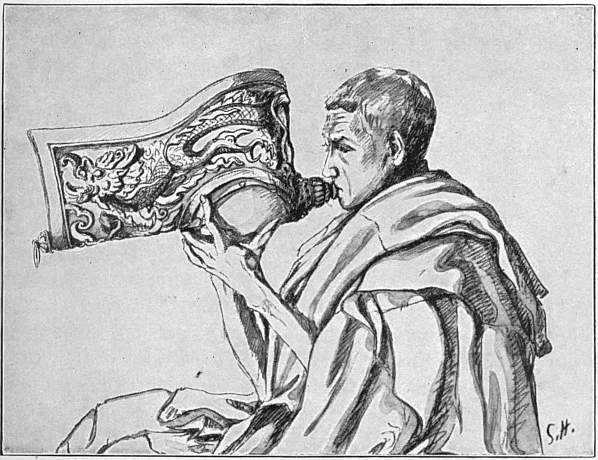
113. Lama with Shell-Trumpet.
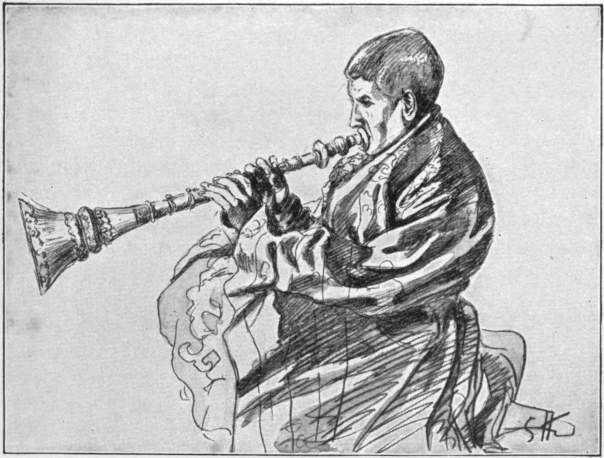
114. Lama with Flute used in Religious Services. Sketches by the Author.
As in the two preceding years the New Year festival of 1907 was of a more solemn character than usual, and had attracted larger bands of pilgrims, for the Dalai Lama had taken flight when the English advanced to Lhasa, and this cowardly pope dwelt, misunderstood and despised, in Urga in Mongolia, after abandoning his country, where all was in confusion, to the mercy of the invaders. Many a pilgrim, who would otherwise have gone to Lhasa, now resorted to Tashi-lunpo in preference, where the Panchen Rinpoche, the Pope of Chang, had stuck to his post when the country was in danger. The Chinese had posted up a long proclamation at all the street-corners in Lhasa, in which they declared that the Dalai Lama was deposed because he had exposed his people to danger instead of defending them, and appointed the Tashi Lama in his place as the highest administrator of the home affairs of Tibet. True, the mob had torn down this proclamation and trampled it in the dust, and the Tashi Lama had refused his acquiescence, but nevertheless it was still apparent, two and a half years later, that the Tashi Lama enjoyed a far higher reputation than the Dalai Lama. For though the Dalai Lama was supposed to be omnipotent, all-seeing, and omniscient, his troops had been defeated by infidel strangers; although he had promised his warriors invulnerability, they had been shot down like pheasants by the English machine guns; although he had solemnly sworn that no harm could befall Lhasa, the abode of the gods, the enemy had occupied the town, while the invincible one, the almighty, the incarnation of the deity, had taken to headlong flight like the most cowardly of marauders, more cowardly and meaner than the worst mercenary from Kham. The Tibetans may be forgiven for beginning to doubt the infallibility of the Dalai Lama after the butchery at Guru and Tuna, though the priests were ready with plausible explanations of these events.
The Tashi Lama, on the other hand, had stuck to his post, and was the object of the reverence and respect traditionally paid to the chief priests in Tashi-lunpo. He was the highest prelate in Tibet, while the Pope of Lhasa was wandering a homeless fugitive about Mongolia. At the New Year festival of 1907 it was easy to perceive what great prestige and what boundless confidence were attached to the person of the Tashi Lama. The crowds in festive robes who thronged the platforms and balconies were soon to behold with their own eyes the holiest of the holy in Tibet. And the nearer the time approached, the greater became the excitement and expectation. They had been sitting here for hours, for weeks and months they had toiled through desolate mountains, and now——
Suddenly from the uppermost platforms on the roofs ring out deep, long-drawn-out blasts of horns over the country; a couple of monks show themselves against the sky; they blow on singular sea-shells, producing a penetrating sound, which is echoed back in shrill and yet heavy tones from the fissured rocks behind the convent; they summon the Gelugpa, the brotherhood of yellow monks, to the festival. The venerable lamas whose duty it is to attend on me, explain everything to me, but I do not find it easy to follow them, especially as their words are translated to me by a Mohammedan. They say that this first blast gives notice that the monks are drinking tea together. Then a shout of joy bursts forth from the lips of all the assembled multitude, for now the ceremonies begin.
On the right hand, on the other side of the court, a gallery is placed obliquely resting on five pillars, and from it a stone staircase of eleven steps leads down to the court. The gallery is now concealed by heavy black curtains characteristic of all lama monasteries. Invisible choristers, among whom we seem to distinguish voices of men and youths, now intone a mystic chant. It is subdued, deep, and slow; it quavers in religious enthusiasm beneath the dark vaults of the gallery, and seems to proclaim with full conviction:
“In every land the whole world round This song of praise shall soon resound.”
The murmuring voices are silent and the chant swells up crescendo and then falls again, and seems to die out in some distant under-world, as though the singers had reached the portals of Nirvana. Enthralling, mystical, full of yearning and hope is this wonderful Losar hymn in Tashi-lunpo. Nothing of the kind I have heard, neither the chanting in the Isaac Cathedral in St. Petersburg, nor in the Uspenski Sobor, the cathedral of Moscow, has made a deeper impression on me; for this chant is grand and powerful, and yet at the same time soothing as a cradle song, intoxicating as wine, and sedative as morphia. I listen to it with a solemn feeling, and miss it when the murmur of voices begins again, drowning the final notes.
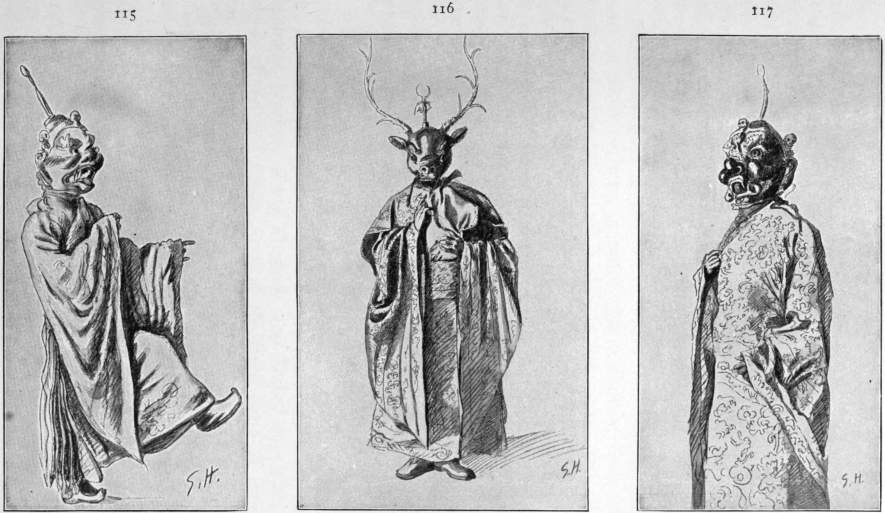
115, 116, 117. Lamas in Dancing Masks. Sketches by the Author.
Above this gallery is a second, which is open to the Dojas-chimbo, as the court is called. Only the middle is covered with a curtain of yellow silk with red stripes, and with heavy gold fringes and tassels at the bottom. Behind this curtain the pope takes his place; he is so holy that his whole person may not be exposed to the gaze of the multitude, but a small rectangular opening is made in the curtain that he may be able to watch the proceedings. After an interval, long copper trumpets give forth a new signal; the holy one has left the Labrang, and is on his way to the performance. A procession of high lamas enters the gallery, each bearing some of the robes and pontifical insignia of the Tashi Lama. A low, reverential, and subdued murmur is heard, the multitude rises, on the tip-toe of expectation, all is still as the grave, and all eyes are turned towards the door of the gallery through which the procession enters. He comes, he comes! Then there is a murmur more reverential than before among the crowd, who all rise and remain standing, with their bodies bent and their hands on their knees, inspired with deep devotion at the approach of the Panchen Rinpoche. He walks slowly to his place, sits down with crossed legs on a couple of cushions, and then only his face can be seen through the opening in the silken curtain. Apparently he is rather a young man; on his head he wears a large yellow mitre, which, however, resembles a Roman helmet or a French infantry helmet; his pontifical robe is of yellow silk, and in his hand he holds a rosary. At his right hand sits his younger brother, Kung Gushuk, the Duke, our host, in a dress of red and yellow, and at the right hand of the latter we see three other secular lords in yellow. To the left of the Tashi Lama sits the minister of state, Lobsang Tsundo Gyamtso, a little fat cardinal with a head like a billiard ball, and beside him the tutor of the Tashi Lama, Yonsin Rinpoche, and his deaf and dumb mother Tashi Lamo, a little woman with a shaven head and a red and yellow dress embroidered with gold—I should have taken her for a man if I had not been told who she was. In the semi-darkness behind them is a row of high lamas, all in yellow garments—their ordinary dress is red. It is truly an imposing scene. We seem to have before us the whole conclave of venerable cardinals of Buddhistic catholicism. And this impression is not weakened by the way in which they move and speak. One can imagine how softly they speak to one another in the presence of His Holiness; their movements are dignified and formal, slowly and gracefully they assume the sitting posture of Buddha; their gestures are noble; when they converse, bending slowly towards one another, an air of genuine striking nobility pervades the whole picture without the slightest touch of anything that can be called vulgar.
The crowd has seated itself again, but frequently pilgrims from far-distant lands stand up embued with religious awe, bow, fall on their knees, press their foreheads against the ground, and pay homage to the Grand Lama as to a god. My eyes frequently meet his; apparently he is extremely interested in his guests. Before the commencement of the spectacle he had sent a lama to my garden to present me with a large kadakh, a long narrow piece of fine white silk, as a greeting of welcome and a polite token of esteem. Now several monks came gently behind my chair; a table, or more correctly a stool, was set down, and a whole collection of brass bowls were placed on it, filled to overflowing with the finest mandarin oranges from Sikkim, dried fruits from Nepal, raisins from India, figs from Si-ning-fu, sweetmeats from Bhotan, dried peaches from Baltistan, and Tibetan cakes. And tea-cups of Chinese porcelain were filled again and again with thick buttered tea. They said: “The Panchen Rinpoche begs you to partake of these.” I immediately caught his eye, rose and bowed, and he nodded to me with a friendly smile. All the refreshments left over—and the quantity was not small—were given to my companions.
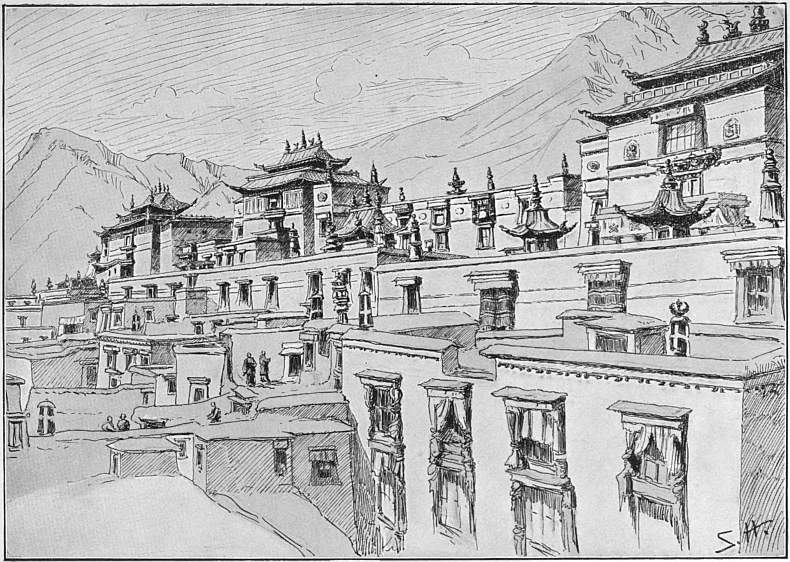
118. View of Tashi-lunpo. Sketch by the Author.
Now the religious ceremonies begin. The Tashi Lama takes off his mitre and hands it to an acolyte. All the secular lords on the open platforms also take off their mushroom-shaped hats. Two dancers with gruesome masks, in coloured silken dresses with wide open sleeves, come forth from the lower gallery, the curtain being drawn aside, and revolve in a slow dance over the quadrangle. Then the Grand Lama is saluted by the eleven principal standards in Tashi-lunpo; every idol has its standard, and every standard therefore represents a god of the copious Lamaistic mythology, but only the standards of the eleven chief deities are brought out. The flag is square, but strips or ribands of a different colour protrude at right angles from the three free edges; there are white flags with blue strips, blue flags with red ribands, red with blue, yellow with red strips, etc. The flag is affixed in the usual way to a long painted staff, round which it is wrapped when a lama brings it out. He marches solemnly up, halts before the box of the Tashi Lama, holds out the staff horizontally with the assistance of a second lama, and unrolls the flag, and then the emblem of the god is raised with a forked stick to salute the Grand Lama. It is then lowered again, the flag is rolled up, and the staff is carried sloped on the shoulder of the bearer out through a gate beneath our balcony. The same ceremony is observed with all the standards, and as each is unfolded a subdued murmur of devotion rises from the assembly.
After a short pause the trumpets sound again, and now appear some lamas with white masks and white robes, heralding a procession of monks, each of whom carries some article used in the ritual of Buddhism, holy temple vessels, golden bowls and chalices, censers of gold swinging in their chains and emitting clouds of sweet-smelling incense. Some of these monks appear in harness and accoutrements; three masked lamas almost collapse under the weight of their exceedingly costly vestments of red, blue, and yellow gold-embroidered silk. Behind them six copper trumpets, 10 feet long and bound with brass, are carried, and are so heavy that their sound-bells must be supported on the shoulders of young novices. They are followed by a group of flutists, and then come forty men in fanciful motley costly dresses, who bear drums held up vertically on carved poles, and beat them with drumsticks resembling a swan’s neck. Now come the cymbals clashing loudly and in regular time in the hands of monks clothed in red silk. Nakchen, “The Great Black Man,” is the name of a dressed-up monk who bears a hand-bell. Below, at the stone steps, the court is spread with a square of carpets. There the orchestra seats itself, the forty drums are held up parallel to one another, and likewise the trumpets, which are now allowed to slope down to the pavement. All the musicians wear yellow mitres somewhat like the mitre of the Grand Lama. Three monks of high rank come out on the gallery, which is situated on the short side of the quadrangle immediately above the arena. They wear yellow vestments and yellow mitres, and ring from time to time brazen bells which they hold in their hands. Each of them, I am told, is the superior of a thousand monks; only three are present, for the fourth is ill. Tashi-lunpo has 3800 monks at the present time.
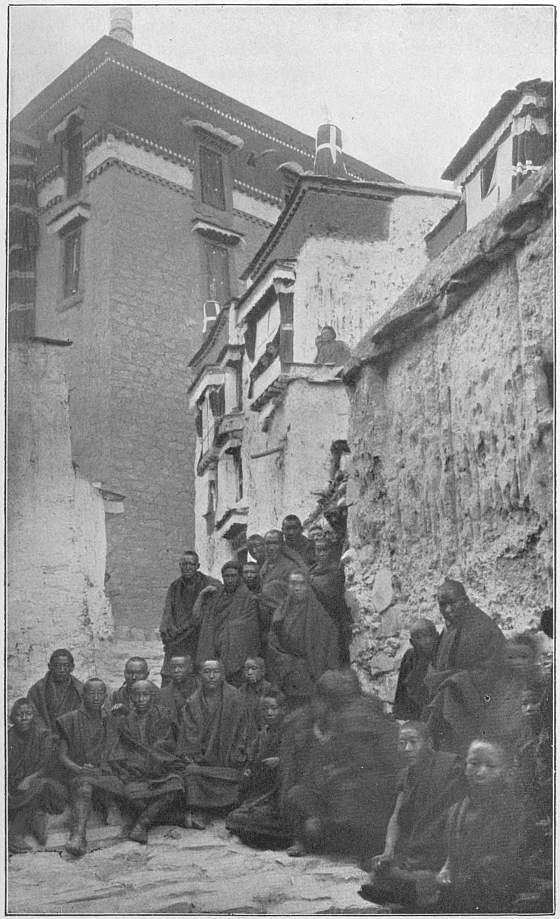
119. Street in Tashi-lunpo, with Lamas.
The curtain at the top of the stone staircase is opened and a masked figure, named Argham, comes out with a bowl full of goat’s blood in his hand. He holds it horizontally with outstretched arms while he executes a mystic dance; suddenly he pours the blood over the steps. With both arms extended, holding the bowl upside down, he continues his dance, while some serving brothers hurry up to wipe up the blood. Undoubtedly this ceremony is a relic of the time when the original Bon religion prevailed in Tibet, before the Indian monk Padma Sambhava in the eighth century A.D. laid the foundation stone of Lamaism by introducing Buddhism into Tibet; for Lamaism is only a corrupt form of pure Buddhism, and under an outward varnish of Buddhistic symbolism has incorporated a number of Sivaistic elements, and has also retained the superstitions which in pre-Buddhistic times found expression in wild fanatical devil dances, rites, and sacrifices. The object of these ceremonies was to exorcise, banish or propitiate the powerful demons which reign everywhere, in the air, on the earth, and in water, and whose only function is to plague, torture, and persecute the children of men. At that time the god of war and the demons were appeased by human sacrifices, and the ceremony I have just described is certainly a relic of these offerings. Of course Buddhism had a better prospect of becoming popular in Tibet if as much as possible of the old religion were incorporated in the new. But the first command of the fundamental law of Buddhism forbids to “quench the vital spark,” to kill. This does not, however, prevent the monks from eating meat or making use of goat’s blood in certain religious rites—the sheep and goats are killed by ordinary butchers, while the lamas themselves do not transgress the commandments of the law.
Bagcham is the name of a dancer in a frightful devil’s mask; as he circles over the quadrangle, pieces of coloured cloth flutter about on all sides. He is followed by eleven masked lamas who execute the same movements. They are joined by a troop of new performers in coloured garments with necklaces, beads, and ornaments. They wear a square collar with a round hole in the middle, which is passed over the head, so that the collar rests on the shoulders and stands out horizontally when they dance. A great number of strips tied about the body swing out like the skirts of a ballet-dancer when the dancers spin round. They hold in their hands various religious objects and long light strips, ribands, and streamers.
Again the curtain parts asunder, and preceded by two flutists Chöjal Yum appears at the top of the steps, the impersonation of a female spirit, and with a trident in his hand performs a dance on the topmost step. Lastly, lamas dance in hideous masks with large evil eyes and Mephistophelian eyebrows, distorted features, and huge tusks; others represent mythical wild beasts, all equally terrible (Illustrations 115, 116, 117). At every new number the three high priests ring their bells, and the music continues without interruption, the discordant noise awakening a thundering echo from the stone façades of the narrow court. The drummers beat their instruments slowly and in strict time, accompanied by the clash of the cymbals, the weird, prolonged blasts of the trumpets, and the more agreeable notes of the flutes. But now and then the time is accelerated, the beats of the drum follow one another more and more closely, and the claps of the clashing basins pass into one continuous resonance. The musicians seem to stimulate one another, and there is a great crescendo; there is more than enough noise to deafen one, so it is useless to attempt to speak to one’s neighbour. The dancing becomes more furious, and undoubtedly the fanatical spectacle makes a deep impression on the spectators. Now and then a fanatic is overpowered by it, jumps up, and, turning towards the Tashi Lama, grabs at his head with his hands, falls forward with his hands and forehead on the ground, and repeats this obeisance thrice—he has a deified man before him. A greybeard from Chang-tang, sitting in his fur coat just below our balcony, is unwearied in these observances, and is constantly jumping up to make his reverence to the Grand Lama; but once he slips on a piece of mandarin peel and makes a frightful contortion, to the great amusement of his neighbours. Other pilgrims take from their girdles a small bag of rice or barley, and throw a pinch or two into the court. This is an offering to the temple, and is appropriated by the pigeons and sparrows.
Only the northern third of the quadrangle is required for the religious diabolical masquerade; the other two-thirds are left free for the poor of Shigatse and its environs. There the crush is terrible, but now and then lictors, as they may be called, armed with whips and rods, clear a space. They strike right and left, and all the people bend their backs under the blows, but their interference seems only to increase the disorder. Among the pilgrims on the platforms tea is distributed gratis by monks of low rank; they carry large brass-bound copper cans on the right shoulder, from which they fill the wooden cups held out by their guests. Panem et circenses! The monks know how to treat their lambs. What does it matter to them if they give a few yak-loads of brick tea once or twice a year, when they live exclusively at the expense of the people and from the Peter’s pence which flow continuously from the bags of pilgrims into the temple treasury?
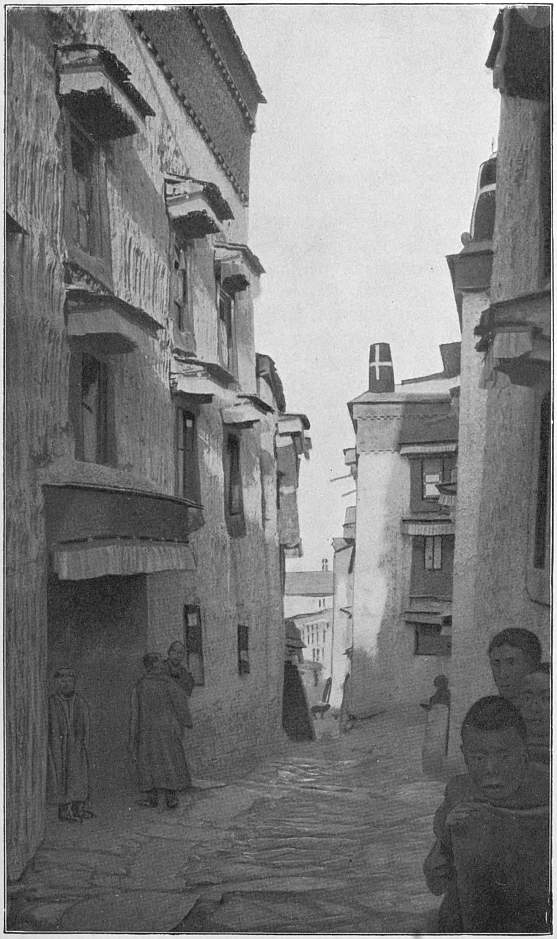
120. Street in Tashi-lunpo.
At length the lictors clear a space in the crowd below us, where a fire is lighted. Two monks step forward and hold a large sheet of paper horizontally over the fire at as great a height as possible; on this paper is written down all the evil from which protection is desired during the year now commencing, and all the affairs in which a triumph is hoped for over the designs and influence of wicked demons. The paper also represents the past year with all its sufferings and all its sins. A lama walks up to the fire with a wand in one hand and a bowl in the other. He recites some formulæ of incantation, performs all kinds of mystical hocus pocus with his arms, and throws the contents of the bowl, some inflammable stuff, into the flames, which blaze up brightly and consume in a moment the paper, the passing year with its sins, and all the power of the demons. All the spectators rise and break out into prolonged shouts of rejoicing, for now evil is crushed and every one may rest in peace. The last number of the day’s programme was a general dance of all the lamas in the courtyard.
Now the Tashi Lama rises and slowly retires from the scene of the festival, followed by his retinue. After his departure the pilgrims withdraw in perfect order, quietly and without crushing, and take their way down to Shigatse in a black stream of humanity. When the last have disappeared, we look for our horses, accompanied by our new friends.
The jugglery we had witnessed was in every respect brilliant, gorgeous, and splendid, and it is easy to imagine the feelings of humility such a performance must inspire in the mind of the simple pilgrim from the desolate mountains or the peaceful valleys. While the original signification of these dramatic masquerades and these mystic plays is the exorcising and expelling of inimical demons, they are in the hands of the clergy a means of retaining the credulous masses in the net of the Church, and this is a condition of the existence both of the Church and of the priests. Nothing imposes on ignorance so thoroughly as fearful scenes from the demon world, and therefore devils and monsters play a prominent part in the public masquerades of the monasteries. With their help and by representations of the King of Death, Yama, and of restless wandering souls vainly seeking new forms of existence in the sequence of transmigrations, the monks terrify the multitude and render them meek and subservient, and show many a poor sinner what obstacles and what trials await him on the rough road to Nirvana through the valley of the shadow of death.
On our way back we returned the visit of my friend Ma. His yamen was built in the usual Chinese style and was surrounded by a wall. I was invited to take my place on the seat of honour beside a small table, on which attentive servants placed tea, sweetmeats, and cigarettes. The whole room was full of Chinamen, but Ma was as amiable as before.
Lobsang Tsering and Tsaktserkan were waiting in my garden. They had brought a whole caravan of mules laden with tsamba, rice, meal, dried fruit, and barley for our horses—supplies sufficient for our whole party for a full month. They also handed me 46 silver tengas (barely 20 shillings) wrapped in paper, with which, they believed, we should buy meat, for the Tashi Lama must have no hand in anything which involved the extinction of the vital spark. The envoys also said that His Holiness expected me at nine o’clock the following morning, and that they would come to fetch me. But I was not to tell Ma or any one else that the Tashi Lama was going to receive me. For the rest, I had only to say a word and all my wishes would be fulfilled. Later in the evening a subordinate official presented himself with the information that no one would fetch me; I was to be at the great portal at nine o’clock—for the Chinese might become suspicious. At night I took out of Burroughs and Wellcome’s large medicine chest all the drugs which I thought we might want, and we packed them in labelled bags. The chest itself, of aluminium, and all its elegant tabloid boxes, bottles, cases, bandages, and instruments were rubbed and polished up till they shone like silver, and then wrapped in a large piece of yellow silk which Muhamed Isa had picked up in the bazaar, for it was next day to be my friendship’s offering to the Panchen Rinpoche.
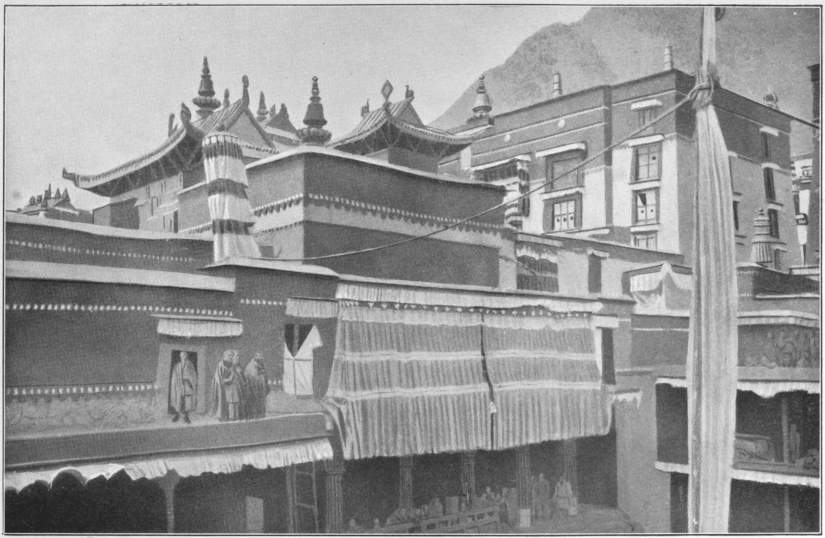
121. The Labrang, the Palace of the Tashi Lama, to the Right. In the foreground, a part of the Court of Ceremonies.
CHAPTER XXV
THE TASHI LAMA
The 12th of February came, the day on which I was to be received by the holiest man in Tibet. I therefore made myself as spruce as I had ever done for a ball in a British Government House, and then, accompanied by the same men as to the performance, rode up to the main entrance to Tashi-lunpo, where Tsaktserkan, Lobsang Tsering, and some monks awaited us. In their company we ascended to the higher regions, through a labyrinth of gloomy lanes and dark narrow cloisters, to the Labrang, where the Tashi Lama lives—the Vatican, with its white façade, its large quaint windows, and its solid balconies standing high above this town of temple buildings (Illustration 121). Our conductor leads us into cold dark rooms, up unusually steep staircases. The steps, in which the soles of the monks have worn deep hollows, are edged with iron, and the round bars of the balustrade are polished by innumerable hands. The steps are dark, and our friends warn us to mount slowly and cautiously. Then there is light, and we are taken out on to a gallery, a roof, but only to plunge again into a maze of dark passages and flights of steps. I am asked to wait in a room with red cushions on the floor. Before long we are informed that the man next in rank to the Tashi Lama, the honourable fat little lama, who holds the post of a minister of state, is ready to receive us. His audience chamber, or rather his private cell, is quite a small room, but from its single window he enjoys a beautiful view over the sacred town of Shigatse and the rocky mountains of the neighbourhood. The room is fitted up with solid, unpretentious, and genuine Lamaist luxury. Red carpets lie on the floor, and the ceiling and walls are also red, that is, all that can be seen of them, for most of the walls are hidden by artistically carved cabinets with red lacquer, and decorated in colours and inlaid metal work. On these stand large silver gaos containing images of the gods, and before them smaller ones of solid gold, between bowls with offerings or wicks burning with a dull flame in butter. Other objects may be seen which the monks use in their services: bells, cymbals, holy water vessels, and a dorche, the thunderbolt, emblem of power, which resembles a sceptre. To the left, in a window niche, hangs a flag-like picture (tanka) of the first Tashi Lama, and to the right a similar portrait of the ecclesiastical prince Sakya Pandita.
The venerable prelate sat cross-legged on a bench fixed against the wall and covered with red cushions, and before him stood a small, yellow, carved table with silken material inserted in the top. He beamed with fat, inward complacence and goodwill, like any other cardinal; his features were finely cut, and his eyes indicated great intelligence. When I entered he rose with a polite smile and invited me to be seated on a chair by the table, whereupon the inevitable tea was served. Just as indispensable is it to exchange kadakhs and presents. I gave him an engraved dagger from Kashmir, and he presented to me a gilt idol—there is the difference between secular and ecclesiastical presents. We talked about an hour over one thing or another, and His Eminence begged me to excuse the delay, but the Panchen Rinpoche was absorbed in meditation and occupied with his daily prayers, and might not be disturbed till he himself gave a sign.
This moment came at length: a lama whispered to the cardinal that I was expected. We go still higher up smooth steep staircases to open landings, up more steps, higher and higher to the holiest of holies in the monastery of Tashi-lunpo. The conversation is carried on in lower, more subdued tones, one dares no longer speak loud; small groups of lamas stand in the corridors and passages, silent as statues, and look at me as I pass by. Lobsang Tsering tells me in a whisper that we are now in the last antechamber, where I can make myself ready and put on the black shoes. Here my servants are ordered to remain, except Robert and Muhamed Isa. If I could have dispensed with interpreters His Holiness would have seen me quite alone.
We enter, not without feeling solemn. I make a deep bow at the door, and two more before I stand before him. The Tashi Lama is sitting on a bench in a window recess and has in front of him a small table with a tea-cup, a telescope, and some printed sheets. He is dressed as simply as an ordinary monk, wears a cerise costume of the usual style, coat, waistcoat, vest, and the long scarf which is thrown over the shoulder and wound round the body like a toga; between its folds peeps out a yellow under-vest with gold embroidery; both arms are bare and the head is uncovered.
His complexion is fair, slightly inclining to yellow; he is somewhat below the middle height, is well proportioned, looks healthy, and at his twenty-fifth year, lately completed, has every prospect of attaining a good old age. In his small, soft, delicate hands he holds a rosary of red beads. His short-cropped hair is black, and there is scarcely any down on his upper lip; his lips are not thick and full like those of other Tibetans, but thin and gracefully formed, and his eyes are of a chestnut-brown colour.
Nodding kindly, he gives me both his hands and invites me to sit in an arm-chair beside him. The apartment, in which he spends the greater part of the day, is astonishingly plain, quite a contrast to that of the cardinal in the lower regions. It is small and consists of two parts: the outer is a kind of roofless ante-room, exposed to all the winds of heaven, to the snow in winter and the pouring rain in autumn; the inner is raised a step, and is again separated by a division ending in a grille, behind which his bedroom is situated. There is not a single idol, no wall painting or other mural decoration, no furniture except what has been already mentioned, not a thread of carpet, only the bare stone floor—and through the window his melancholy and dreamy, but clear and open, glances wander over the golden temple roofs, over the town below them with its dirt and sinfulness, over the dreary mountains which bound his earthly horizon, and away through the azure-blue sky to a Nirvana invisible to us, where his spirit will one day find rest. Now he descended from his heaven and became a man for a moment. But all the time he preserved a wonderful calmness, a refined, amiable politeness and dignity, and spoke in a charmingly soft and subdued voice, modest, almost shy; he spoke quickly and in short sentences, but in a very low tone.
What did we talk about? Why, about all kinds of things in heaven and earth, beginning from his own religion, in the Pantheon of which he himself takes the highest rank among living prelates, down to the yaks that roam wild over Chang-tang. He displayed an alertness, an interest in everything, and an intelligence that surprised me in a Tibetan. I have never been interviewed so thoroughly and with so much tact. Firstly, he inquired if I had suffered much from the cold and hardships in Chang-tang, and whether we had had great losses. Then he hoped I would excuse the sorry entertainment I had met with; it was all owing to my having arrived quietly and unnoticed, and no one knew whether I was the man who was expected and of whose probable arrival information had been received from India. But now everything possible should be done for my welfare and convenience, and he wished and hoped that I should carry back with me a pleasant remembrance of his country.
Then followed inquiries about my name, my age, my caravan, the routes by which I had come; my country, its size and population, its position with regard to Russia and England; whether Sweden was dependent on a neighbouring country or had a king of its own; the best way to travel to Sweden, how long it took to travel there, and what season was the most suitable—just as if he intended to return my visit. Then he asked about the various European countries and their rulers, their relative power and extent; about the war between Russia and Japan, about the great naval battles and the armoured vessels which had sunk; the effect the result of the war would have on Eastern Asia; about the Emperor of Japan and the Emperor of China—apparently he had the greatest respect for the latter. He asked what countries I had visited, and whether I had seen much of India, where he had been so well received a year ago. He spoke with pleasure of his impressions of India, of the large cities with their fine buildings, of the Indian army, the railways, the splendour and wealth everywhere apparent, and the hospitality shown him by the Lord Sahib (the Viceroy). “Promise me to greet the Lord Sahib from me when you write, and tell him that I still think of his kindness, and greet Lord Kitchener;” and then he showed me a photograph with the autograph of the great General. He was particularly pleased at having been able to visit the holy places he knew so well from descriptions and pictures, which were connected with the great founder of his religion, Buddha, especially Buddh Gaya in Magadha, where Prince Sarvarthasidda, the son of Buddha, had passed six years in solitude and meditation, overcome Mâra, the tempter, the ruler of the world of lust, and had attained to perfect wisdom.
To the Tashi Lama, then, the journey to India had been of the nature of a pilgrimage, though from the English point of view the invitation had been rather connected with political considerations. It was, of course, important to the English in India to have a neighbour on their northern frontier on whose faith and friendship they could rely in unsettled times. As long ago as the year 1774 the great Warren Hastings had sent Bogle as ambassador to the third Tashi Lama, to obtain information about the country, and, if possible, to establish commercial relations. And in 1783 he had sent Turner to the fourth Tashi Lama. Now, 120 years later, the sixth Tashi Lama had been invited to visit India himself, that he might observe with his own eyes the wealth, might, and prestige of the English. No efforts were spared to make a lasting impression on the influential ecclesiastical prince. Later events have proved that this project has failed. The journey of the Tashi Lama to India met with great opposition in Tibet, and gave rise to much suspicion. And great was the joy when he returned in safety; for the Church could not afford to lose, perhaps, the Tashi Lama also, when the Dalai Lama had disappeared from the country. What would become of the re-incarnation when no one knew where the two popes were dwelling?
Then he turned the conversation to the European Powers, and thought that Europe was a singular mosaic of states. He brought out a picture showing all the more powerful supreme rulers of the earth. Under each portrait the name and country were written in Tibetan characters. He put many questions about each monarch, and showed the liveliest interest in their fortunes—he who is more powerful than all the kings of the world, for he rules over the faith and the souls of men from the Kalmucks on the Volga to the Buryats on Lake Baikal, from the shores of the Arctic Ocean to the burning sun of India.
I am not the first European whom Tubden Chöki Nima Gelég Namgyal, the sixth Tashi Lama, has received in the Labrang at Tashi-lunpo. After Younghusband’s expedition, Major W. F. O’Connor was admitted to an audience in the autumn of 1904 as representative of the Indian Government, and on this occasion he was accompanied by four officers of the Gartok Mission, Major Ryder, Captains Rawling and Wood, and Lieutenant Bailey. O’Connor, who knows the Tibetan language, was Younghusband’s interpreter in Lhasa and the Tashi Lama’s in India, and in his capacity as British Trade Agent in Gyangtse had frequently occasion to negotiate with the pope in Tashi-lunpo. Also, immediately after his return home in 1906, the Tashi Lama received Captain Fitzgerald, Lord Kitchener’s aide-de-camp, and Mr. David Fraser.
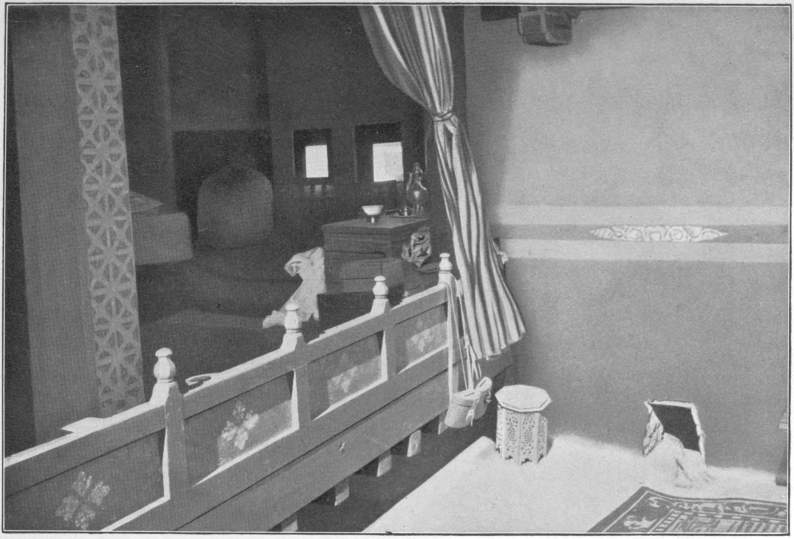
122. Interior of the Palace of the Tashi Lama. The little corner near the two windows is the place where Tashi Lama passes his free time.
Of the two supreme pontiffs of the yellow-caps Köppen says: “Of these the Panchen Rinpoche at Tashi-lunpo is usually supposed to be an incarnation of the Dhyani Buddha of the present age of the world, Amitabha, but also an incarnation of the Bodhisattvas, Manjusri and Vajrapani, and lastly almost as a re-birth of the reformer Tsong Kapa, the founder of the yellow-caps; the Dalai Lama, on the other hand, is always held to be a re-incarnation of the Bodhisattva Avalokiteshvara (Padmapani)....” In the same work the functions of teacher and king are divided between the two Lamaist popes, the former being especially assigned to the Panchen, the latter to the Dalai Lama. And this is also signified by the titles of the two potentates, for the former is called Panchen Rinpoche, “the Great Precious Teacher,” and the latter Gyalpo Rinpoche, “the Precious King.” In consequence of this idea the Dalai Lama has at length become the temporal ruler of the greater part of Tibet, though he owes his position more to the situation and historical connections of his capital than to this scholastic theory of sanctity, just as the Vicar of Christ on the seven hills owes his supremacy to the importance of the city of Rome. The great teacher (the Tashi Lama) has therefore for the present to content himself with a comparatively small territory, combined with a reputation for sanctity and omniscience, and the privilege of acting as tutor and guardian to an infant Dalai Lama.
And Waddell says of the respective spheres of the two popes: “The Tashi-lunpo Grand Lamas are considered to be, if possible, holier even than those of Lhasa, as they are less contaminated with temporal government and worldly politics and more famous for their learning.”
I shall show later that this relation between the two Lamaist popes underwent great modifications in favour of the Tashi Lama during the period of my last journey. The expectations of the English, that they would gain an influence in Tibet through the friendship of the Tashi Lama, were to a certain extent justified; but they had not taken into consideration that the temporal power lost by the Dalai Lama by no means passed over to the Tashi Lama, whose temporal authority was confined within the boundaries of the province Chang, and even there was limited by the universal supremacy of China. The Dalai Lama accordingly had much to lose, the Tashi Lama little or nothing. The Dalai Lama was an ambitious intriguer, who by his incautious policy provoked the offensive measures of Lord Curzon so disastrous for Tibet, and thereby lost almost everything. And if the Tashi Lama had already enjoyed a greater reputation for holiness and learning than his colleague in Lhasa, his renown and his spiritual influence were much enhanced when the result of the war proved that the fine promises of the Dalai Lama were all lies and humbug, and only tended to secure more firmly the heavy yoke of the Chinese on the necks of the Tibetans. Shortly before my visit the Tashi Lama had had an opportunity of reminding the Lamaist hierarchy of his illustrious existence. When he reached the age of twenty-five he sent presents of money to all the monasteries of Tibet, inviting all the monks to a great banquet in their own convents at his expense; a special embassy of monks was despatched to Ladak, and others to Lhasa, Sekiya, Tashi-gembe, and other places. The twenty-fifth anniversary of his birth was celebrated throughout the Lamaist world.
But we will return to the audience. Lamas, walking on their toes and silent as phantoms, handed us tea and fruits continually. The Tashi Lama drank a sip from his plain cup with me, as though to show that he did not consider himself too holy to sit at table with an unbeliever. Some Lamas who stood in the room at a distance were now and then dismissed by a wave of the hand when he wished to put some question he did not want them to hear. This was particularly the case when he requested me not to let the Chinese know that he had entertained me, though it could hardly escape their penetration.
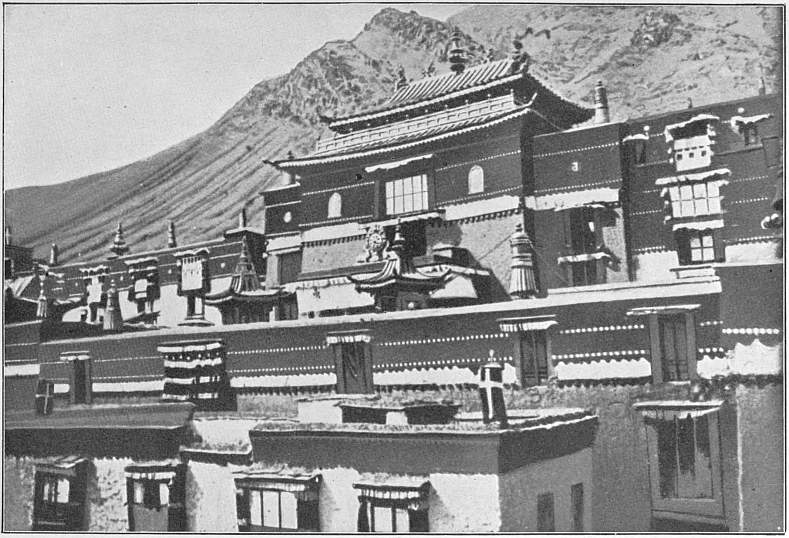
123. View of a Part of Tashi-lunpo, with the Façade of a Mausoleum of a Grand Lama.
I seized the opportunity to beg for certain favours. I asked permission to photograph him. Oh, certainly, I might come again with my camera, if I liked. I asked to be allowed to see the whole of Tashi-lunpo, and to draw and photograph in the cloister town at my pleasure. “Yes, by all means; I have already ordered the lamas to show you everything.” And, finally, I begged for a passport for future journeys in his country, for an official of the Labrang, and some reliable men as escort. This, too, was granted me, and all was to be in order when I had fixed the day of my departure. All these promises were fulfilled to the smallest detail, and if China had not just at this time seized Tibet more tightly than ever in its dragon’s claws, the Tashi Lama would certainly have been powerful enough to throw every door open to me. But at any rate his friendship and favour were an excellent recommendation in all my subsequent journeys, and extricated me from many a difficult situation. Pilgrims from all parts of Tibet had seen with their own eyes how well I was received. They had boundless respect for the Tashi Lama, reposed in him the most sincere confidence, and reasoned as follows: “Whoever this stranger may be, he must be an eminent lama in his own country, or the Panchen Rinpoche would never have treated him as his equal.” And then these pilgrims returned to their black tents in distant provinces and related to others what they had seen, and when we arrived with our small caravan all knew who we were. Eighteen months later it came about that chiefs and monks said: “Bombo Chimbo, we know that you are a friend of the Tashi Lama, and we are at your service.”
When we had conversed for two hours, I made a move to leave him, but the Tashi Lama pushed me back on to the chair and said: “No, stay a little longer.” And this was repeated till quite three hours had passed. How many millions of believers would have given years of their lives for such a privilege! The pilgrims who had travelled hundreds of miles to get a sight of him must be content with a nod of the head and a blessing from a distance.
Now was the time to present my offering. The elegant English medicine chest was taken out of its silk cloth, opened and exhibited, and excited his great admiration and lively interest—everything must be explained to him. The hypodermic syringe in its tasteful aluminium case with all its belongings especially delighted him. Two monks of the medical faculty were sent for several days running to our camp to write down in Tibetan the contents of the various tabloid boxes and the use of the medicines. But I warned them, as well as the Tashi Lama, against making a trial of their effect before consulting Major O’Connor’s physician in Gyangtse. There was not much danger, however, for the lamas believe that their medical knowledge is much superior to that of Europeans.
Wonderful, never-to-be-forgotten Tashi Lama! Never has any man made so deep and ineffaceable impression on me. Not as a divinity in human form, but as a man, who in goodness of heart, innocence, and purity approaches as near as possible to perfection. I shall never forget his expression: it displayed unbounded kindness, humility, and philanthropy; and I have never seen such a smile, a mouth so delicately formed, so noble a countenance. His smile never left him: he smiled like a sleeper dreaming of something beautiful and desirable, and whenever our eyes met, his smile grew broader, and he nodded kindly and amiably, as much as to say: “Trust in my friendship implicitly, for my intentions are good towards all men.”
The incarnation of Amitabha! The earthly shell in which the soul of Amitabha lives on through time! Therefore a deity full of supernatural wisdom and omniscience. The Tibetans believe that he knows not only what is and has been, but also all that is to come. Can he be Amitabha himself? This much is certain, that he is a very extraordinary man, a singular, unique, and incomparable man. I told him that I thought myself fortunate to have seen him, and that I should never forget the hours I had spent in his company; and he replied that he should be very pleased if I came back again.
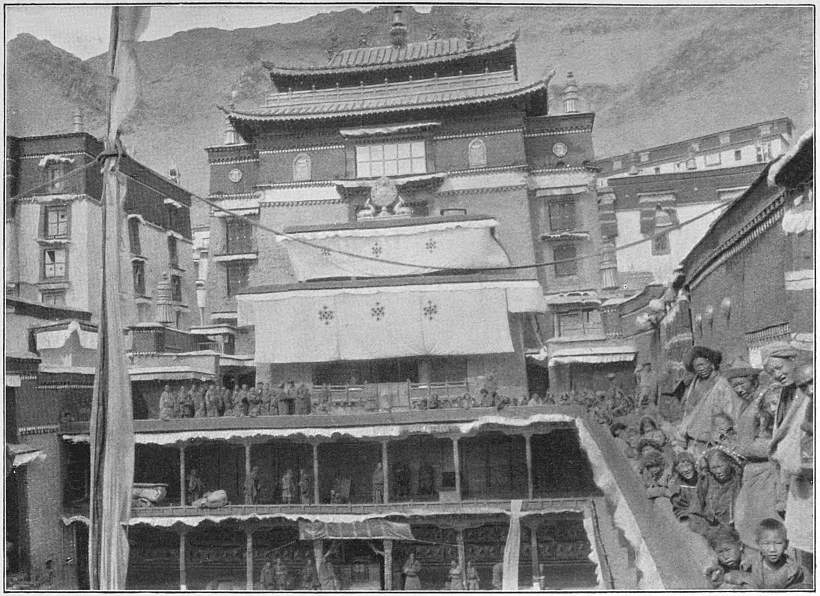
124. Façade of the Mausoleum of the First Tashi Lama. The Court of Ceremonies in the Foreground.
After I had thanked him once more for his generous hospitality and kindness, he called some lamas and ordered them to show me the temples. Then he gave me both his hands, and followed me with his wonderful smile as I bowed myself out. His friendly eyes did not leave me till I had passed through the door leading into the ante-chamber. At the foot of the first staircase several lamas were waiting; they smiled in silence, and with wide-opened eyes, no doubt thinking that so long an audience was an unusual favour. Henceforth they all treated me with greater respect, and it was evident that very evening that the whole bazaar and all the town of Shigatse knew that I had spent three hours with the holy one. For my part I could hardly think of anything else but the Tashi Lama and the powerful impression he had made on me. I left the Labrang, his cloister palace, intoxicated and bewitched by his personality. This one day was worth many days in Tibet, and I felt that I had now beheld what was most remarkable in the country, scarcely surpassed by the massive mountains with their snow-capped summits, which from remote periods have looked down on the births and deaths of generations in the valleys which wind about their feet.
During our sojourn in Shigatse we made many friends among the monks of Tashi-lunpo, who gave us right willingly all the elucidations we asked for. One told us that a Tashi Lama, when he feels the approach of death, must in accordance with the directions of the holy law remain in a sitting position, with his legs tucked under him and his hands palms upwards in his lap, for he must die in the same attitude as the meditating Buddha. His last moments are soothed by a number of monks who surround him on all sides, fill the air with the murmur of their prayers, and continually prostrate themselves with their hands and foreheads on the ground, paying divine honours to him and his departing spirit. When he has lost consciousness, has no longer any control over his body, and becomes limp, he is held up, and when life has flown he is so placed that he grows rigid in the orthodox position. The corpse is clothed in priestly vestments, all new and never worn before, and then the tall mitre is placed on his head. Prayers for the dead are recited, mystic rites are performed, and the corpse is placed as quickly as possible, still in a sitting posture, in a metal vessel which is filled with salt and hermetically sealed. Then his mortuary chapel must be prepared, and as this must be erected in a massive stone building, and be decorated within with great art and expense, it may be a long time before his dust is finally laid to rest. The cost is borne by the pilgrims and devotees of the country, and in consequence of his death the Peter’s pence flow in more plentifully than ever, for it is a good deed to contribute to the interment of a Tashi Lama. Such liberality secures privileges to the donor in his soul’s wanderings.
After the decease, Amitabha clothes himself in the body of a newly born boy, and the difficulty is to discover where this boy is. Therefore letters are sent to all parts of Tibet and to all the adjoining Lamaist countries, in which inquiries are made whether a child of the male sex, endowed with extraordinary spiritual gifts, has appeared. Numerous replies come in. After one after another has been rejected, the boy must certainly be among the remainder, and the right one has to be found out. The names of the boys are written on strips of paper, which are rolled up and deposited in a covered bowl, and this is placed before the image of one of the chief gods, probably before Amitabha or Tsong Kapa, whereupon high cardinals offer up prayers before the bowl, recite appropriate texts from the holy scriptures, present gifts to the gods, burn incense and perform other ceremonies, and then the cover is removed, and the first ticket taken out gives the name of the new Panchen Rinpoche. The decision of this lottery must, however, be ratified by the Dalai Lama before it can have legal force, and from him the new pontiff, an innocent child, receives his consecration. If the Dalai Lama is absent, or is himself a minor, this is conferred by a conclave of the higher priests.
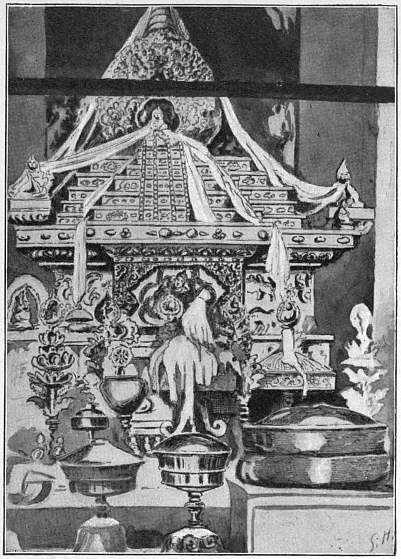
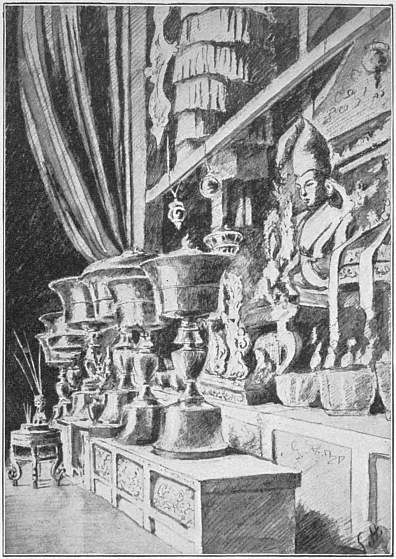
125, 126. Interiors of Two Mausoleums of Grand Lamas in Tashi lunpo. Sketches by the Author.
CHAPTER XXVI
THE GRAVES OF THE PONTIFFS
Volumes would be required in which to describe a monastery such as Tashi-lunpo in all its details, its intricate conglomeration of stone buildings connected with one another by passages, corridors, staircases, and terraces, or separated by narrow deep lanes or small open squares; its many temple halls with an innumerable host of images; its monks’ cells, lecture halls, mortuary chapels, kitchens, factories, warehouses for provisions and materials; its complicated organization in spiritual and temporal affairs, its festivals and ceremonies. Such a description could only be compiled by an intimate acquaintance with the Lamaist hierarchy and Church, and this knowledge could only be attained by the ardent study of a whole lifetime; for those who would penetrate deeply into the mysteries of Lamaism must gain a thorough knowledge of Buddhism and its relations to Brahminism and Hinduism, and understand the influence which Sivaism has exerted on the religion of the Tibetans, and must be familiar with the elements of the ancient Bon religion and its fetichism and Shamanism, which have crept in and corrupted the Lamaistic form of Buddhism. Such a task lies beyond the scope of this work for many reasons, not least because I have only a dim conception of the essentials of Lamaism.1 I shall therefore content myself with depicting the system from its picturesque side, and describing the outward ordinances I had an opportunity of observing personally. I shall write the names phonetically, without all the silent consonants which render a conscientious translation unintelligible to those who have not devoted much time to the study of the Tibetan language.
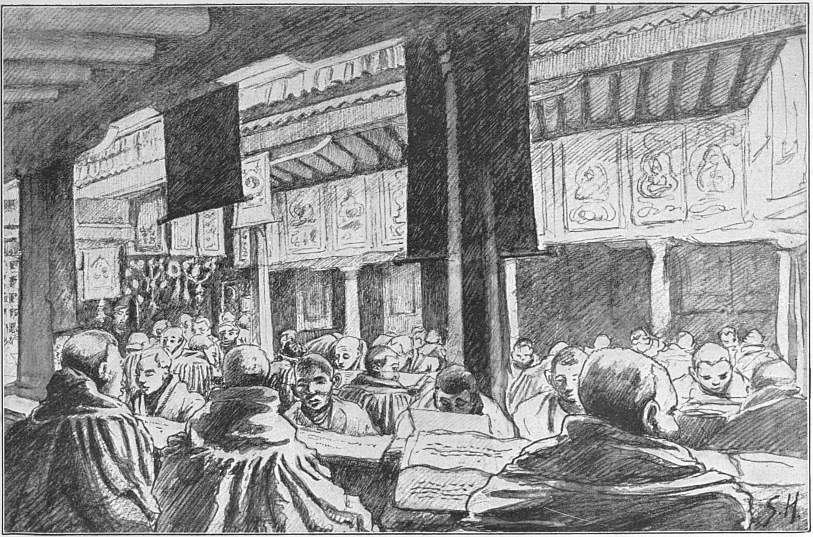
127. The Kanjur-Lhakang in Tashi-lunpo. Sketch by the Author.
Tashi-lunpo must not be conceived as a single vast block of buildings, but as a cloister town within an enclosing wall, a town of at least a hundred separate houses, very irregularly built and grouped, joined together in rows divided by narrow lanes (Illustration 118). On the south side of the Tsangpo a rocky spur projects from the mountains eastwards into the valley of the Nyang-chu; below and to the east of this cliff lies Shigatse in the broad valley on the northern, left bank of the river, while the monastery is built on the lower part of the southern slope of the ridge, and therefore faces south. Looking from the plain to the south of the monastery at this conglomeration of white houses, one notices at once some striking features which facilitate the orientation. On the extreme right is a high thick wall without windows, from the top of which large pictures are exposed to view during certain summer festivals. A little to the left of it, the grand white façade of the Labrang, with its solid, simple, and tasteful architecture, rises above all the cloister town, and in front of and below the Labrang five buildings, quite alike in appearance, catch the eye—massive towers with golden roofs in the Chinese style. They form a line running from west to east, and are the mausoleums of the five earlier Tashi Lamas. The remaining space within the wall around and below them is occupied by all the other houses, and wherever you stand on their flat roofs the first and the last objects you see are these mausoleums; for Tashi-lunpo has also a system of aerial streets and places, as they may be called, that is, the roofs protected by low parapets. In the deep lanes one is quite unable to find the way unless one is very familiar with them, for only the nearest high walls can be seen, consisting either of an unbroken smooth surface or interrupted by large long windows in black frames. The walls all slope a little inwards, so that all the lanes between the houses are narrowest at the bottom. The pavement is irregular, worn, and smooth; some lanes and open squares are not paved at all. All these constructions are solidly and firmly built, and planned so as to defy time as well as the rude climate of Tibet.
Tashi-lunpo was founded in the year A.D. 1445 by Ge-dun-dup, the nephew of Tsong Kapa, who in the year 1439 was installed as Grand Lama of the Gelugpa sect, though he did not yet bear the title of Dalai Lama. The present Grand Lama of Lhasa, Ngavang Lobsang Tubden Gyamtso, who has now held the office for thirty-four years, is the thirteenth in succession. This number is not to be compared with the long list of Roman Popes. The first Panchen Rinpoche of Tashi-lunpo was named Panchen Lobsang Chöki Gyaltsan, and held the dignity of pope from 1569 to 1662, or ninety-three years—certainly a world record. His mortuary chapel, Chukang-sher, or the East Tomb, is the one to which we shall first direct our steps.
Its façade faces the rectangular court where the ceremonies are performed, its portal stands at a level with the uppermost platform for spectators, and above the door hang large white awnings beneath a symbolic decoration—a wheel between two gilded stags. The roof is made of gilded copper sheeting, and is divided into two sections by a platform with a parapet (Illustration 124).
The interior of the mausoleum is a cubical room, illuminated only by the daylight, which enters through the portal and mingles effectively with the pale gleam of the butter-fed wicks in a row of silver saucers and brazen bowls. The middle bowl is larger than the others, is like a caldron, and has a cover with a round hole through which a sacrificial flame rises from the melting butter. Before this cordon of butter lamps, on a rather higher super-altar, stand a row of pyramidal figures of baked paste, painted in front with various colours and representing different Lamaistic symbols. Behind them is a row of bowls and chalices of solid gold and silver, donations of wealthy pilgrims. They contain pure water, meal, barley, rice, and other edible offerings.
The tomb itself, in the interior, is a chhorten in the form of a pyramid with steps, ledges, and cornices, and may be 20 to 23 feet high. All the front is decorated with gold and silver in arabesques and other designs, and is studded with precious stones. At the very top stands a gao, a yard high, somewhat like a sentry-box, with a front of lotus leaves, and in it sits a statue of the deceased wearing the usual mitre, with which Tsong Kapa is always represented, and of which we saw so many specimens during the festival. A number of long silken kadakhs have been placed in the uplifted hands of the statue, and hang down over the monument in long festoons and streamers. This is also draped with a multitude of tankas, temple banners which are painted in Lhasa and Tashi-lunpo, and represent scenes from the life of the founder of the religion and of the Church fathers. Among and behind them also hang standards and pennants of coloured cloth narrowing to a point at the bottom, and all are old, dusty, and dingy (Illustrations 125, 126).
This chhorten with its richly decorated front and its motley surroundings stands alone in the cubical chapel, and a narrow, pitch-dark passage runs round it; at the back, by the light of a paper lantern, the solid foundation of masonry, on which the monument rests, may be seen. The pilgrims circle round it, the more times the better, and the orthodox “Gelugpa,” members of the “sect of virtue,” always walk in the direction of the hands of a watch, that is, they turn on entering to the left. The monks, who act as guides, insist that we also shall conform to this regulation.
Now we cross again the court of ceremonies, and are conducted slowly through narrow corridors to a somewhat lighter gallery, where we can look down into a dukang, a hall where the high office is performed five times a day. Red mattresses, much the worse for wear, lie in rows on the smooth stone floor, on which the monks sit cross-legged during the mass. In the middle of the shorter side stands a papal throne, with back and arms, and covered with yellow silk—it is the seat of the Grand Lama, who on certain occasions teaches and preaches here.
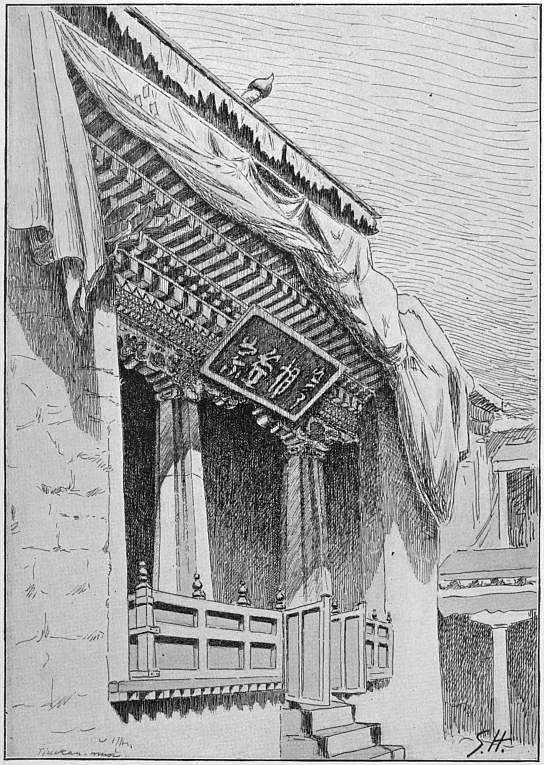
128. Portal of the Mausoleum of the Third Tashi Lama in Tashi-lunpo. Sketch by the Author.
Then we are led to the Yalloa-champa, a holy apartment with a curtain formed of a network of iron rings, through which we catch a glimpse of some dark idols and a quantity of Chinese porcelain bowls. Illuminated by butter lamps and draped with long silken cloths, here stands a figure of Dolma, one of the two wives of Srong Tsan Ganpo, the first Tibetan king, both very popular in Tibet, and immortalized in most Lama temples. It is said of the statue here that it once exchanged words of wisdom with a monk. In another compartment we find Tsong Kapa’s statue veiled in silken draperies, and also a figure of the second Tashi Lama, the Panchen Lobsang Yishe.
The library is called Kanjur-lhakang, and here the bible of the Tibetans in 100 to 108 folios, the Kanjur, is kept, studied, and explained. It contains a collection of canonical works which were translated from the Sanscrit originals in the ninth century. The hall is as dark as a subterranean crypt, its red-painted wooden pillars are hung with unframed pictures, tankas, painted with minute artistic detail, and on the walls also a host of gods are depicted in colours. At the upper, shorter side is a row of altars, with images of gods in niches, and figures of Tashi Lamas and other great priests. Before these, too, butter lamps are burning, and smooth bright brazen bowls are filled to the brim with offerings. The illumination is scanty and mystical as everywhere in Tashi-lunpo; it seems as though the monks needed darkness to strengthen their faith in the incredible and supernatural literature that they read and study here (Illustration 127).
Proceeding westwards along the lane which runs in front of the mausoleums, we look into the monument of the second supreme pontiff and then into that of the third. They were named Panchen Lobsang Yishe (1663-1737) and Panchen Lobsang Palden Yishe (1737-1779). The mausoleums are built after the pattern of the one already described, but between the entrance pillars of the third hangs a shield bearing the name of the Emperor Kien Lung in raised characters. Köppen gives in his book some interesting information about the relations of the great Manchu Emperor with this Tashi Lama. Kien Lung (1736-1795) sent many letters to the Grand Lama from the year 1777 inviting him to come to Pekin, but the latter suspected treachery and made all kinds of excuses. But the Emperor was so persistent that at length in July of the year 1779 the prelate had to set out. After a journey of three months he reached the monastery Kum-bum. Wherever the holy caravan passed crowds of pilgrims collected to worship the Grand Lama and offer him presents. He passed the winter at Kum-bum, and made daily several thousand impressions of his hand on paper, which were well paid for as relics. One rich chief alone is said to have presented him with 300 horses, 70 mules, 100 camels, 1000 pieces of brocade, and 150,000 shillings in silver. Escorted by princes, governors, officials, and soldiers, and also by the chief court lama of the Emperor, Chancha Khutukhtu, he reached, after a further journey of two months, Kien Lung’s summer residence, where he was received with magnificent pomp and state and brilliant fêtes. The Son of Heaven was pleased to allow himself to be instructed by the holy man in the truths of religion. While the Emperor was visiting the tombs of his ancestors in Mukden, the Tashi Lama made his triumphal entry into Pekin, where all, from the imperial princes to the mob in the streets, wished to see him and receive his blessing. Even the imperial favourites insisted obstinately on seeing His Holiness, on which occasion he sat dumb and motionless behind a transparent curtain, casting down his eyes so as not to be polluted by the sight of beautiful women.
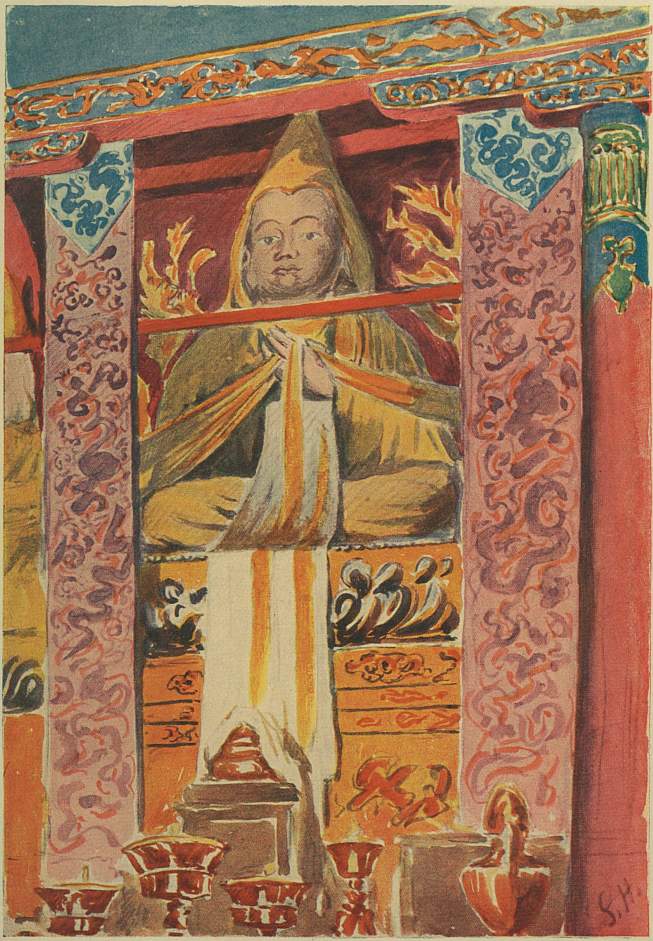
129. The Namgyal-lhakang with the figure of Tsong Kapa, in Tashi-lunpo. Water-colour Sketch by the Author.
But all this worldly glory came to a sudden and deplorable end. The Tashi Lama fell ill and died, and it was affirmed that the powerful Emperor had caused him to be poisoned, because he suspected him of a design to free himself from the supremacy of China with the help of the Governor-General of India; for it was to this third Tashi Lama that Warren Hastings had sent Bogle as ambassador six years previously. If our friend, the present Tashi Lama, had thought of this circumstance he would perhaps have preferred to omit his visit to India. The Emperor pretended to be inconsolable, had the body embalmed, and masses said for three months over the golden sarcophagus, and then the body was carried on men’s shoulders all the way to Tashi-lunpo, the journey lasting seven months, and was there deposited in the splendid mausoleum to which we paid a flying visit (Illustration 128).
Our next visit is to the so-called Namgyal-lhakang, the temple of Tsong Kapa, a large pillared hall with a huge statue of the reformer; before it and its companion images stand the usual battery of lamps, sacred vessels, and Lamaistic emblems. The temple watchman, housed in a small recess in the entrance hall, is a jovial septuagenarian who has lived sixteen years in Mongolia, and always comes out to inquire after my health when I pass the temple of Tsong Kapa on my way from or to the western buildings of Tashi-lunpo (Illustrations 129, 163).
Tsong Kapa’s name is as famous and as highly revered in the Lamaistic Church as that of Buddha himself: I cannot recall to mind that his statue is absent in one of the many temples I have visited in Tibet. He was born in Amdo in the year 1355, and of course his birth was attended by all kinds of supernatural circumstances. At the age of three years he decided to retire from the world, and therefore his mother cut off his hair, which became the roots of the famous miraculous tree in Kum-bum (the temple of the “hundred thousand statues”), on the leaves of which Father Huc read with his own eyes holy inscriptions. Unfortunately my own visit to Kum-bum was in the winter of 1896 when the holy tree was leafless. After a thorough course of study Tsong Kapa formed the resolution of reforming the dissolute and corrupted Lamaism, and in several public conferences he silenced, like Luther, all his opponents. The number of his followers rapidly increased, and in the year 1407 he founded the monastery Galdan, near Lhasa, becoming its first abbot, and subsequently the equally large and famous monasteries Brebung and Sera. Tsong Kapa introduced celibacy among the monks of his sect, which he called “Gelugpa,” the sect of virtue, and whose badge was the yellow cap; for yellow was the sacred colour of the old Buddhist monks. Among other precepts he enunciated was the regulation that the virtuous monks should retreat into solitude at certain times, to give themselves up to meditation and study, and prepare themselves for disputations. At the present day the yellow-caps are much more numerous in Tibet than the red-caps. Tsong Kapa died in the year 1417, and lies buried in Galdan, where his sarcophagus or chhorten stands in the open air. He is regarded as an incarnation of Amitabha, and at the same time of Manjusri and Vajrapani, and he still lives on, therefore, in the person of our friend the present Tashi Lama, after living in the other five Tashi Lamas in succession, whose graves we have just visited. No wonder, then, that he is in exceptionally high repute in Tashi-lunpo.
As we were sitting before the statue, contemplating Tsong Kapa’s kind smiling features under the usual pointed mitre, young lamas appeared with fruits, sweetmeats, and tea, and with greetings from the Tashi Lama, who hoped I would not overtire myself. Some monks sat by the wall in the semi-darkness reading aloud from their holy scriptures, which lay before them on small stools; they held in the hand a dorche, the symbol of power, and a bell which they rang from time to time (Illustration 130). When we again went out into the sunshine the Indian elephant of the Tashi Lama was taking exercise in the lane; he is the only one of his species in the whole country, and is said to be a present from a wealthy merchant, who brought him from Siliguri.
The fourth Tashi Lama, Panchen Tenbe Nima (1781-1854) has also a mausoleum, similar to those of his predecessors. At either side of the entrance are seen on the walls of the ante-chamber painted portraits, double life size, of the “four great kings,” Namböse, Yukorshung, Pagyepo, and Chenmigsang, whose duty it is to ward off the demons and prevent them from disturbing the peace of the temple. They are painted in staring colours and have a hideous appearance, are armed with sword, bow, and spear, and surrounded by a confusion of clouds, waves and tongues of flame, tigers, dragons, and other wild beasts. These four figures are hardly ever absent from the entrance to a temple in Tibet, and one of these four guardian kings is represented in relief on each of the four sides of the five mausoleums.
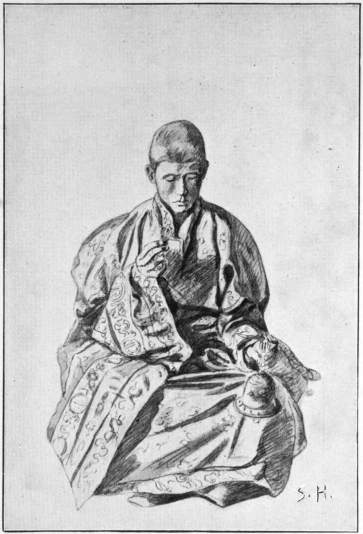
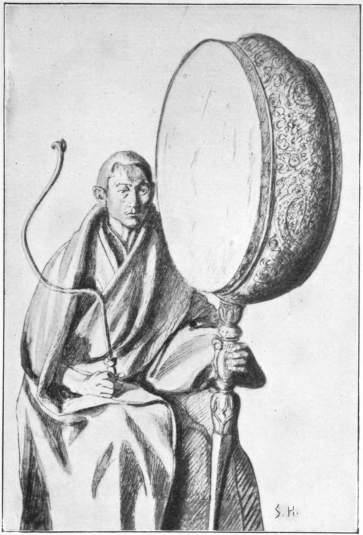
130. Reading Lama with Dorche (Thunderbolt) and Drilbu (Prayer-Bell). 131. Lama with Prayer Drum.
Sketches by the Author.
Our guides told us that this mausoleum was erected the same year in which the fourth Tashi Lama died. On either side of the chapel proper is a smaller shrine, to the left the Yamiyang-lhakang, with several images, and an altar front decorated with gilded sphinxes having red wings on the back, nape of the neck, and paws. On the right stands the Galdan-lhakang, with an image of Tsong Kapa projecting from the petals of a lotus flower, which indicates his heavenly origin.
Lastly, we turn our steps to the chapel in which the fifth Tashi Lama, Panchen Tenbe Vangchuk (1854-1882) sleeps his last sleep. As this mausoleum is only about twenty years old, it looks fresher and cleaner than the others, and is particularly richly and gorgeously decorated without and within. The front of the chhorten glitters with gold, turquoise, and coral. A glass candelabrum from India looks out of place amid the pure Lamaist convent style, as also some common balls of blue glass and looking-glass—cheap wares, such as are seen in country gardens and in front of village inns. They hang from a ledge in front of the sarcophagus receptacle. On the altar stand the usual votive vessels, many of them strikingly elegant and tasteful. A large bowl on a tall foot is of gold, and contains a burning wick. On the right, on nails, hang simple gifts of poor pilgrims—cheap kadakhs like gauze bandages, bangles, necklaces, amulet cases, rosaries—all of the cheapest kind, and all presents from pilgrims who, carried away by their enthusiasm, offered up the insignificant ornaments they happened to be wearing. Here we see the impression of a child’s foot on a tablet of stone in a red and yellow frame; a full description in raised letters informs us that it is the print of the foot of the present Grand Lama when he was a child six months old. To this tomb gifts flow more profusely than to the others, for there are still many people living who remember the deceased.
The first four tombs were secured by many solid complicated locks, were opened to admit us, and were closed again when we left. But the chapel of the fifth Grand Lama stood open to the public, and a string of pilgrims passed to and from it. The monks accompanying us wished to drive them away, but I would not suffer them to be disturbed; it was, moreover, interesting to observe their worship for a while. Murmuring “Om mani padme hum,” they stand with bent head before the sepulchral monument, fall on their knees, let their hands slide forward over the stone floor until they lie full-length, touching the ground with their foreheads; then they get up and repeat this gymnastic feat again and again. Afterwards they bow before the idols, lay a handful of rice or meal in the offerings bowls, and go round the dark passage about the monument.
In each of these monuments the Grand Lama is interred at the top, in the pyramid behind his own image. From the street in front of the mausoleums you ascend some stone steps to a portal which gives access to a paved forecourt surrounded by a gallery resting on wooden pillars. Within the pillars the walls are adorned with frescoes representing smiling gods and dancing goddesses like nymphs and odalisks, historical and legendary personages, wild animals, allegorical figures, and the circular disc which betokens the universe with the worlds of the gods, men, and devils. The walls in the forecourt of the fifth tomb were remarkable for the fresh bright colours of their bold effective decoration, while those in the others had suffered from the action of time, and in parts were so much obliterated that they were almost past restoration. When age has set its mark equally on the whole painted surface the picture gains in beauty, for its colours are more subdued and less crude, but the worst is, that frequently the whole decoration has fallen off. A large bronze bell hangs in front of each mausoleum.
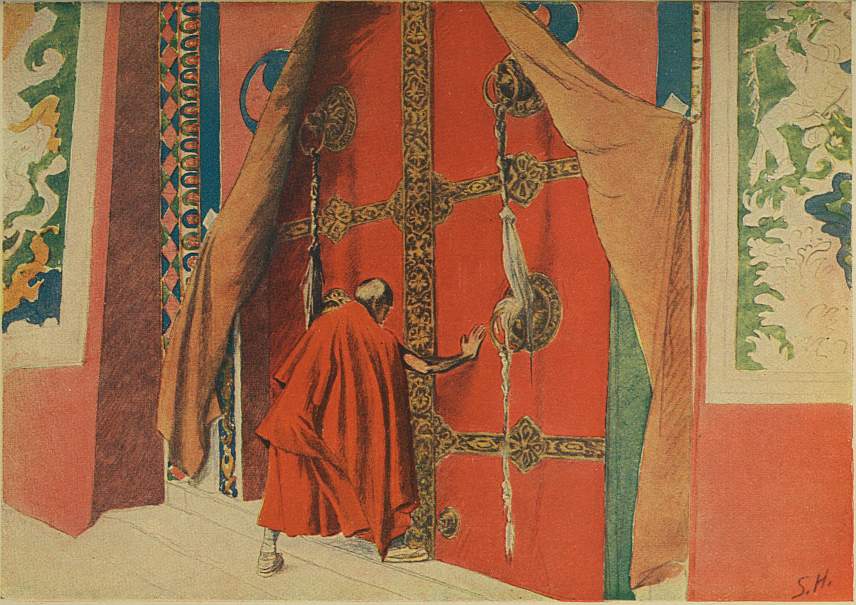
132. Entrance to the Tomb of the Fifth Tashi-Lama in Tashi-lunpo. Water-colour Sketch by the Author.
The outer courts are so small that the elegant portals cannot exhibit their full beauty; they are too near, and they are seen much foreshortened. From the outer court of the fifth tomb a wooden staircase leads up to the entrance hall; the staircase consists of three divisions, and has therefore four banisters, the two in the middle being closed at the top and bottom by ropes. The middle steps may only be used by the Tashi Lama himself, while those at either side are free to Tom, Dick, and Harry, and therefore are much worn—almost hollowed out. When the visitor reaches the top of the staircase, he has the door of the mausoleum in front of him, and to the right and left the short sides of the entrance hall, each with a figure of one of the four spiritual kings, while the two others are painted on the wall at either side of the massive door-posts. The entrance hall opens on the forecourt, and its richly carved lintel and beams are supported by two red polygonal wooden pillars with carved and painted elongated capitals. Before the door hangs heavy drapery of a coarse pattern. The very massive heavy panels of the door are lacquered dark brick-red, shine like metal, and are ornamented with mountings, shield-shaped plaques, and rings of yellow brass partly blackened with age. A pair of tassels hang from the rings of the shields. When the two doors are opened the mysterious gloom of the sepulchral chamber and the flickering lamps are exposed to view (Illustrations 132, 133).
Our first inspection of Tashi-lunpo was now ended, and, satiated with strange impressions, we betook ourselves in the twilight to our tents in Kung Gushuk’s garden. Darkness fell sooner than usual, for a storm was gathering in the west, and it came down on us before we reached our camp.
1 I would especially recommend the following works to those who desire to make a thorough study of Lamaism: Köppen’s Die Lamaistische Hierarchie und Kirche; Waddell’s The Buddhism of Tibet; and Grünwedel’s Mythologie des Buddhismus in Tibet und in der Mongolei. I have borrowed much of the historical and ritualistic information in the following pages from these works.
CHAPTER XXVII
POPULAR AMUSEMENTS OF THE TIBETANS
The credulous people at whose expense the monks live in laziness—and live well—are not satisfied with religious spectacles alone, which minister only to their spiritual needs; they must also be amused with profane exhibitions, which are more congenial to their lower instincts, and are more adapted to stimulate the senses. On February 15 an exhibition of this kind was to take place on the plain outside the town of Shigatse, and I and my people were invited. We mounted our horses in good time and rode northwards through the small town, which has not more than 300 houses—towns in Tibet are few and insignificant. The houses are white, with a black or red band at the top; with few exceptions they are only one storey high; the roof is almost always flat and guarded by a parapet; the windows and doors are in the same style as those of the monastery. From the street you enter into a yard where generally a large savage dog is chained. The roofs are adorned with a forest of bundles of twigs and rods hung with prayer streamers in all the colours of the rainbow; their object is to drive away devils. Between the irregular lines of houses run narrow lanes and roads, where black swine wallow among the discarded refuse, dead dogs lie about, and stinking puddles stagnate; and we also pass open squares, sometimes with ponds.
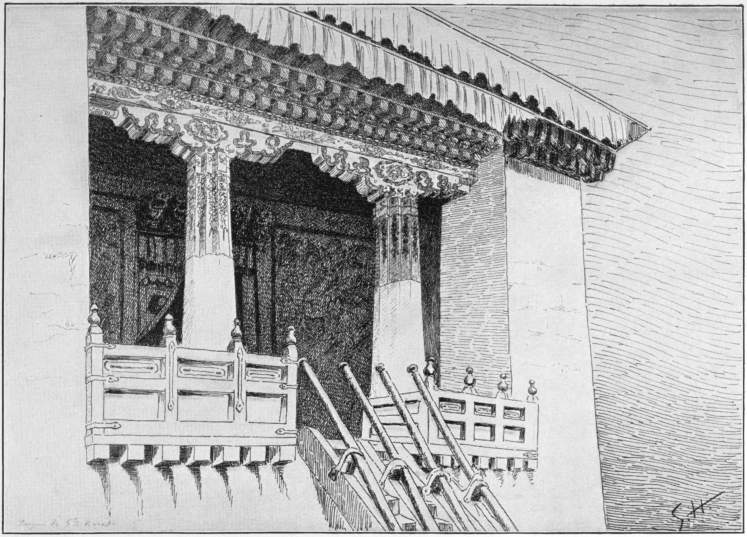
133. Staircase to the Mausoleum of the Fifth Tashi Lama in Tashi-lunpo. Sketch by the Author.
There is something uniformly dull about the whole town, in vivid, humiliating contrast to the dzong (Illustration 134), the castle proudly enthroned on its rock, and the golden temple roofs of Tashi-lunpo at the foot of the mountain. The ground is yellow dust, and here and there we pass abrupt terraces of löss; dust whirled up by the wind lies on all the houses and roads.
A black, continuous procession of pleasure-seekers streams out to the great plain on the north-east of the dzong; the farther we go the thicker it grows; most are on foot—men with prayer mills and tobacco pipes, women with round red aureoles at the neck and crying children in their arms, boys, beggars, monks, and all the pilgrims from neighbouring countries. Here and there rides a fine gentleman with one or more attendants, while hawkers transport dried fruit and sweetmeats on mules to sell among the people.
Arrived at the show-ground, we leave our horses in charge of Rabsang, and watch with keen interest the curious festive scene presented to our sight. It is a sea of human beings, thousands and thousands of Tibetans and travelling strangers in varied costumes, any one of whom is a subject worthy of an artist’s brush. Before us, to the east, we have the gardens of the villages at the foot of the mountains in the Nyang-chu valley, and behind us stretches a whole town of blue-and-white tents with spectators of more or less importance, and in the best position stands a blue-and-white tent open towards the show-ground—there sit, cross-legged, on soft rugs, the officials of the dzong in yellow raiment, solemn as statues of Buddha, and take refreshments now and again. All these tents rise like islands above the sea of heads.
Right through the crowd from north to south runs a race-course, only 6 or 7 feet broad, and flanked on both sides by ridges of earth a foot high. The ground slopes down from the canvas town to the course, and the spectators collected here, ourselves among the number, have seated themselves in groups; but on the east side, where the ground is level, they remain standing. And here the crowd is separated into three divisions by two broad clear lanes. At the end, close to the race-course, two targets are erected, consisting of round discs suspended from poles with a white and a black ring, and a red spot in the middle. The lanes are kept clear lest any one should be hurt during the shooting. Policemen in red-and-white coats with yellow hats, and pigtails both in front and behind, keep the people in order; the pigtail swings backwards and forwards, while a rope’s end is in constant use to drive too inquisitive spectators off the course. Two of these policemen are attached to me, to keep me a clear view, but they cause me more annoyance than satisfaction, for I have constantly to restrain them when they would strike half-naked youngsters who are not at all in the way.
Now the show commences! All eyes are turned to a troop of seventy cavaliers in extraordinary motley costumes, who ride slowly in single file northwards along the race-course, so slowly that there is plenty of time to examine the various dresses. All wear red flat mushroom-hats with waving, drooping plumes, white thin vests with a waistcoat over them, and white trousers with patches on the knees. But in some details there is a great variety. One rider, for instance, is dressed in a white silk waistcoat bound with black, over a yellow silken jacket with wide rucked sleeves; while another wears a bright blue jacket on a yellow vest, and has also blue knee-caps on his yellow pantaloons. In general the knee patches are red. The quiver, covered with red material, hangs from a shoulder-belt, and is decorated with shining metal plates, shields, and buttons, and contains a bundle of long arrows tipped with single feathers or tufts. The saddle with its clumsy high wooden frame rests on a saddle-cloth worked in colours. The tail of the horse is wrapped round with red, yellow, and blue ribands terminating in a tassel, which is stretched out by a ring of wire so as to be more effective. A similar rosette also adorns the root of the tail, and from it ribands and cross strips running along the flanks of the horse are attached to the saddle, and flutter in the wind. Between the ears the horse carries a towering plume of peacock’s feathers stuck in a bunch of down; on the forehead is a bundle of strips of material of various lengths and colours; the bridle is thickly studded with plates of metal, and across the chest is a broad belt with bells, which ring at the slightest movement.