Front matter (continued 9)
Reading edition
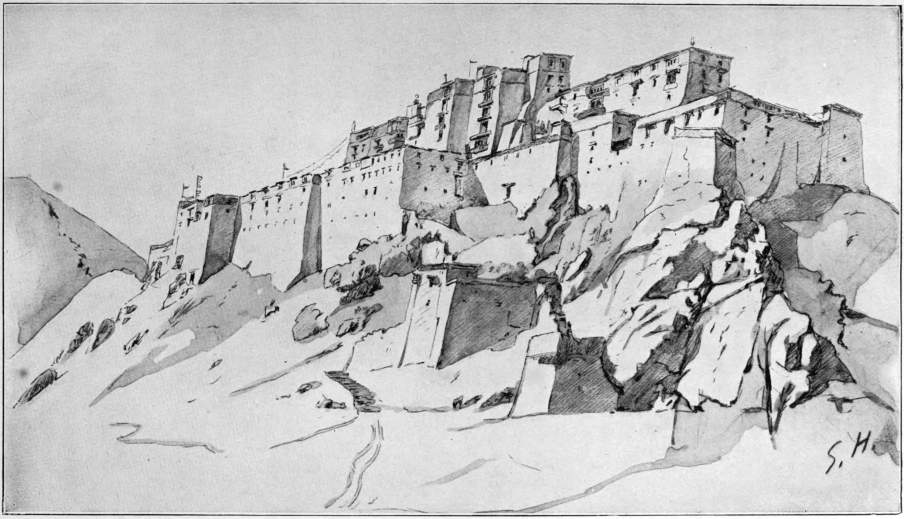
134. Shigatse-dzong (the Fortress). Sketch by the Author.
The party is therefore decked out fantastically in rich colours, and now it turns and rides along the course in the reverse direction, but this time in full career. They ride as fast as the horses can gallop, fling their legs and elbows up and down, the plumes wave, the quivers rattle, and all the tassels, streamers, and ribands fly and flutter in all directions during this wild career. The horses snort, the bridles are covered with flakes of froth, and each rider leaves a cloud of dust for the one behind him. This evolution is repeated twice, and then at the third lap the riders shoot with their long bows at the two targets. The distance between the two is about 60 yards, and an arrow is aimed at each target. The first shot is easy, but then the shooter must be very smart in his movements to catch hold of the quiver, swinging and jumping on his back, take out the arrow, place it against the string and discharge it before he is past the second target. Many marksmen hit both targets, others sent the first arrow into the target, but the second into the ground. Sometimes the arrow glanced against the wooden frame of the target, while some of the riders got over the difficulty by turning round and discharging the arrows backwards, to the great danger of the spectators (Illustrations 137, 138).
The horses are small and active, some of them half-wild and fiery; they have long hair, are badly groomed and shaggy. During the shooting their legs are at full stretch, and the reins hang loose on their necks.
At the fourth career the riders shot with loose powder, and at the fifth with the gun at the first target, and with the bow at the second. They use long, heavy, clumsy muskets, and have not even taken off the inconvenient crutch. A ball of crushed-up paper is inserted in the mouth of the barrel, which is scattered around when the shot is fired—to make a show. The start is made at a considerable distance, and the rider is at full gallop when he comes up to the first target. He holds the gun in the left hand, raises it slowly and gracefully to the right shoulder, grasps the butt with his right hand, holds the muzzle in front of him in the direction of the course, and at the moment he is flying past the target turns the barrel towards it and fires, the match having been lighted at starting. Many produced a red cloud from the target, all a white, of paper, if the gun went off; for it failed when the tinder was not held at the right moment to the touch-hole. Some marksmen discharged their guns a little too late, when they were past the target, and then the spectators most exposed to danger began to rush away in all directions, for they had good reason to fear that their eyebrows would be singed. Immediately the shot is fired the gun-sling is quickly thrown over the shoulder, and now there are two seconds in which to catch hold of the quiver, take out an arrow, and discharge it at the second target. The interval was so short that most of the riders missed; when one made a hit, the crowds gave vent to prolonged applause, and a miss caused still more delight. It must be very hot and trying work to ride in this gorgeous costume with gun, bow, and quiver in full sunshine, every now and then buried in a cloud of dust. Some horses were so restive that their riders could not shoot, and that caused great amusement to the people. One of the marksmen loses his hat, and the next horse shies at it when he is opposite the target, and, leaving the marked course, springs into the crowd of sightseers. Another handles his gun well and raises a red cloud from the target, and also hits the second, but in his hurry has discharged two arrows. One shatters the target and another breaks his gun, and rides on with only the butt in his raised hand, all to the great amusement of the people. Attendants collect the arrows, repair the targets, and fill in the bull’s eyes with fresh powder (Illustration 138).
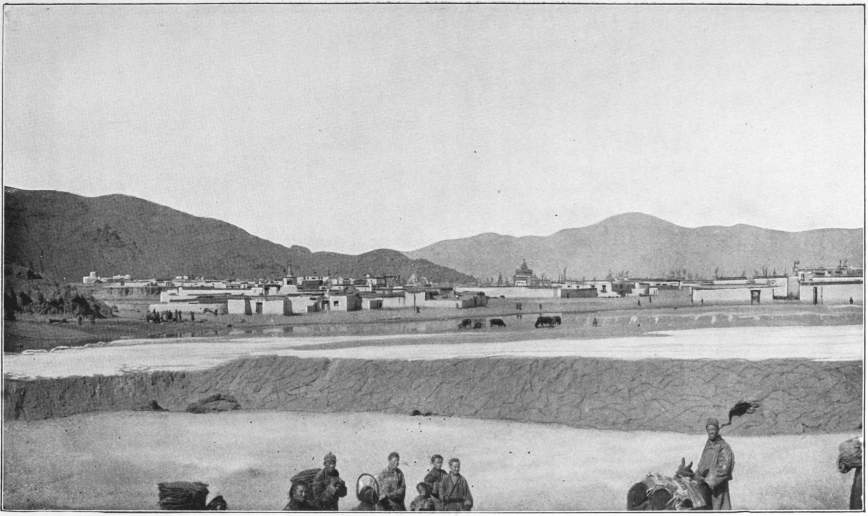
135. Shigatse, Capital of the Province of Chang, 11,880 Feet.
This is a Tibetan popular diversion, fresh, rich in colouring, and picturesque. The spectators have evidently their favourites among the competitors, as may be gathered from the increased buzz of voices when certain cavaliers draw near. Others are not expected to win laurels, for they are received with bursts of laughter. The people are all eyes and ears as they stand or sit for hours together, eating nuts and sweet stuff. In the crowd we see many old acquaintances from the monastery, and also lamas from Ladak, who are studying in the theological seminaries of Tashi-lunpo; merchants from Nepal and Bhotan, Mongolian pilgrims in fur caps with large ear-flaps of fox-skin, and about a score of merchants from Ladak and Kashmir, in tall white turbans and black kaftans with waist-belts. The Chinese, who play the same part in Tibet as the English in India, sit in small groups, smoking their pipes; they seem to take no interest in the prize-shooting. They wear blue dresses, black vests, and black skull-caps with a coral button on the top.
Two horses, which probably had never before taken part in such sports, took fright, rushed among the crowd on our side, knocking down some and jumping over others, and were caught at length when they had fallen down entangled in human bodies and clothing. Last of all, a ragged fellow jolted along the course on a wretched brute, causing great merriment. This was the signal that the sports were ended, and now the riders dismounted and passed in a long procession before the dzong tent, where each bowed his head before the “Chairman of the Town Council,” and a kadakh was laid over his neck. This inexpensive mark of favour was also bestowed on them by their friends and acquaintances, and some favourites went about with as many as sixty white neck-cloths. I treated the whole party to tea, and gave them a present of money for the amusement they had afforded myself and my retinue. When we at last rode into Shigatse, we were escorted by quite a host of black Tibetans.
On February 21 Ma Daloi invited me to witness some performances in the inner court of his yamen in commemoration of the Chinese New Year. The performers were to be soldiers of the garrison, but the spectacle was put on the stage by the four Chinese temples in Shigatse. It was late at night and pitch dark, and the whole effect depended on the illumination. Two chairs with a table between them were placed in the verandah, and while Ma regaled me with genuine Chinese tea, cakes, and cigarettes, twenty men entered, each carrying two large lanterns of white material in the form of a clover leaf, and painted with flowers and dragons. In the centre a wick is so fixed, that the lanterns do not catch fire when they are swung round. The men dance, and swing their lanterns in an advancing line of uniform undulations; they then place themselves so that the lanterns form various patterns, constantly changing; they whirl themselves round with lightning speed, and the bright lanterns resemble great fireballs hovering about in the darkness. All the time squibs and crackers are thrown about, and fizz and explode among the legs of the spectators, for the court is full of Tibetans who come in quite at their ease. Lastly, the lanterns are left standing and a gigantic bird with a long movable tail and a long curved neck stalks solemnly across the court. The next item is performed by Nepalese. Each of them carries two lanterns like beehives; the top of the one in front consists of a horse’s head, with a full flowing mane of paper, and at the point of the hinder hangs a paper tail. Therefore they seem to be riding on horses illuminated from within, as they execute a very lively dance round the court. They sing all the while a melancholy song in slow time. And now a green and yellow dragon comes writhing on to the scene. His head is of wood and paper, and is borne by a man from whose back a painted cloth, the body of the dragon, hangs down and envelops a second crouching man. The dragon dances, twists itself about, opens its jaws, and makes as though it would swallow all present. During the play, weird noisy music drones from drums, cymbals, and flutes, which produce notes like those of a bagpipe. These buffoons present themselves in the courts of all people of rank during the New Year season, to make a little money. They threatened us one evening, but I begged them to come in the daytime, that I might immortalize them on a photographic plate (Illustration 136).
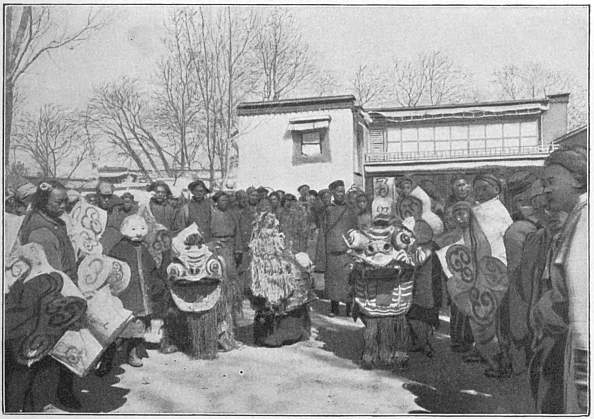
136. Chinese New Year Festival in my Garden.
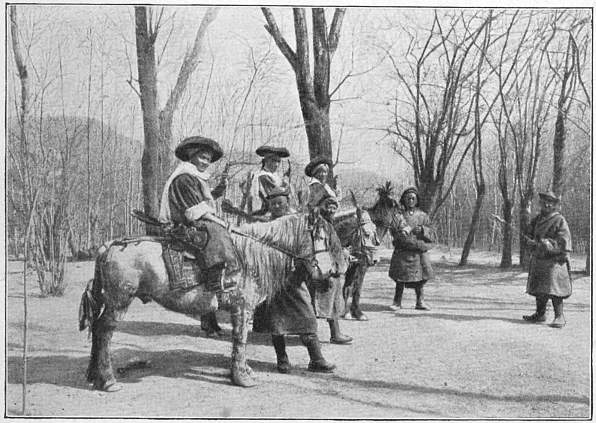
137. Some of the Members in the Shooting Competition at the New Year Festival.

CHAPTER XXVIII
MONKS AND PILGRIMS
During the period of forty-seven days which the force of circumstances compelled me to spend in Shigatse, I had an opportunity of making numerous visits to the monastery, of drawing and photographing interesting details, of making myself familiar with the daily life and habits of the monks, being present at their studies and recitations, and ever increasing my knowledge of the hierarchical metropolis. I used to ride up to Tashi-lunpo with one or two attendants, and pass the whole day in its dark sepulchral chapels and temples. At twilight some of my men came for me with horses. I will recall a few of the impressions I received on these visits, before we start again on our travels.
On February 14 I sat on the uppermost of the western galleries and drew a sketch of the façade of the eastern tomb (Illustration 124), but the pilgrims who were assembling this day for a religious spectacle proved so inquisitive that I had to stop my work and postpone it till a more favourable occasion. I then ascended to a roof platform in front of the Labrang, protected with a balustrade, and posted sentinels at the foot of the steps to prevent the people from following me. Up there the eye falls on a number of cylindrical frames, a couple of yards high, some covered with black and white materials, others enveloped in folded draperies of different colours and length, very like petticoats (Illustration 109). Between them gilded tridents, flagstaffs, and other holy symbols protrude, which protect the temples from demons. While I was sketching a view of the façades of the middle three mausoleums, the head steward of Tashi-lunpo appeared, who supervises the provisioning, cleaning and lighting, etc., caused rugs and cushions to be laid down, and set out the usual refreshments. He is an old lama who has already served thirty years in Tashi-lunpo, after preparatory studies in the monastery Tösang-ling.
From our point of view we can see several smaller gilded copper roofs in Chinese style, standing in front of the façades of the mausoleums and rising directly from flat roofs without any intervening course. Under each roof is ensconced an idol of importance in a temple hall.
We moved about on the roof and enjoyed the wonderful view over the cloister town and its forest of roof ornaments, and came to a place where groups of clerical tailors were sewing together pieces of coloured materials with a zeal and despatch as if their lives depended on it. Had it not been for the religious environment and the waving emblems, one might have thought that they were busy with dresses for a ballet or masquerade. Oh, no, the idols were to have new silken dresses, and were to be hung round with new draperies and standards in honour of the twenty-fifth anniversary of the birth of the Tashi Lama. The clerical knights of the needle sat in the full sunshine, sewed, chattered together, and seemed quite happy. They boldly asked me for money to buy tea, and I gave them a handful of rupees.
Below the place where we had first seen the Tashi Lama at the performance, lies an open gallery, a colonnade looking on the court; the pillars are of wood, and are wound round with red stuff at the top and white below. This gallery is very picturesque, especially the part where the statues of the four spirit kings are placed. The pillars stand out dark against the light background of the open court, and among them move figures which are far from marring the picture, namely, monks in red garments and pilgrims in motley attire (Illustration 142).
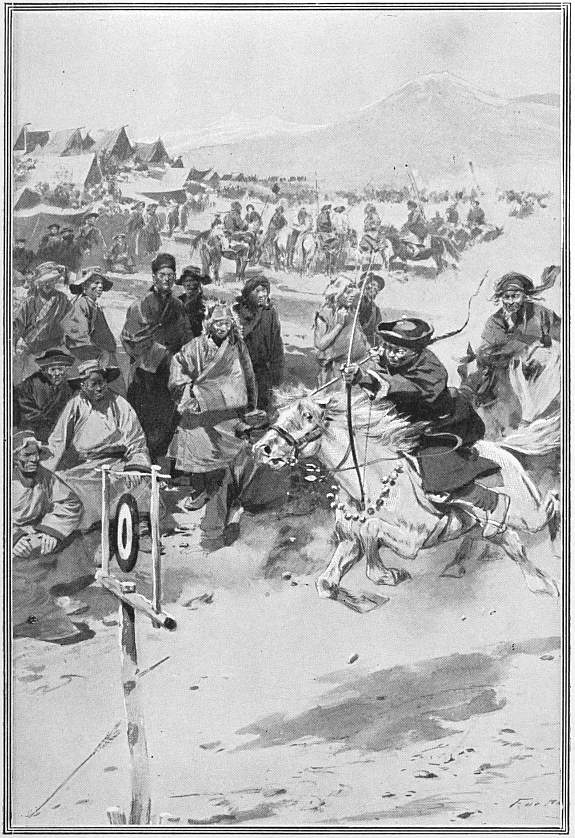
138. Popular Diversion in Shigatse.
Now, too, a religious ceremony was being held in the court. A kind of throne was erected on the northern, shorter, side, and on both sides of it sat monks in yellow kaftans. Two lamas, also clothed in yellow, advanced bare-headed to the throne and remained there motionless with their bodies bent. Then three lamas in red togas and yellow skull-caps walked slowly over the quadrangle with shrill cries and singular gestures, took off their caps and put them on again with mystical movements. This ceremony was continued so long that we followed the example of most of the pilgrims and left the clergy to their own devices.
Next day another ceremony took place, of which, unfortunately, I could obtain no trustworthy explanation. The Tashi Lama took his seat on the throne of yellow silk, on the short side of the court, in full pontificals, and two monks in red dresses came before him in tall red helmet-shaped head-coverings. After His Holiness had greeted them, one advanced to the eleven steps of the stone staircase and stationed himself on the lowest, whereupon a very curious conversation began. The lama on the step calls out something, probably a quotation from the holy scriptures, or, perhaps, puts a question, claps his hands so that the court rings with the sound, and makes a movement with the right hand as though he were throwing something straight at the head of the other monk. This one replies in the same loud tone and also claps his hands. Occasionally the Tashi Lama puts in a word himself. Lobsang Tsering, who is with me, says that this ceremony is a kind of disputation, and that the two disputing monks will attain a higher degree in the scale of the priesthood if they pass the examination satisfactorily.
Below, to our left, six monks in yellow garments sit on a carpet. Between the pillars the gallery is packed with lamas of lower rank in red dresses, and before them sit superior monks in red kaftans richly worked in gold. Beside the Tashi Lama, on his right, is the seat of Lobsang Tsundo Gyamtso. The dark-red and straw-yellow robes are very effective against the dirty-grey colour of the court.
Now a number of serving brothers come on the scene and set long rows of small tables on the open space in front of the Tashi Lama, which are immediately covered with bowls of dried fruits, confectionery, and mandarin oranges. And now begins a feast in honour of the graduation. When the tables and bowls are emptied, they are removed as quickly as they were brought, and then comes a solemn procession of monks with tea-pots, and a kind of tea ceremony begins, less complicated but quite as imposing as in Japan. Two priests of high rank place themselves in front of the Tashi Lama and remain there, bending a little forwards, and quite as motionless as the priests praying at the altar in our own churches. It is their duty to serve tea to His Holiness. The first monk in the procession bears a pot of solid gold, which one of the monks before the throne takes from him to fill the cup of the Tashi Lama. The other monks in the procession carry silver pots, each of which is valued at £45, and from these tea is poured out for all the other monks who are not re-incarnations. Every monk carries his own wooden cup in the folds of his toga, and holds it out when the monk who pours out the tea comes round with his pot (Illust. 143).
All through the ceremony the two candidates continue to dispute and clap their hands without intermission. After sitting cross-legged for three hours, as motionless as a statue of Buddha, His Holiness leaves the throne, and, supported by two monks, slowly descends the staircase, on which a narrow strip of coloured carpet is laid; for the Tashi Lama may not touch the unclean earth with his holy feet. Behind him walks a monk, holding above his head a huge sunshade of yellow silk with hanging fringes. One can hardly help feeling that the little man in papal robes and the yellow mitre, who disappears in the darkness among the pillars of the gallery, while the deepest silence prevails, is really a saint, and one of the most powerful in the world. He is now going up to his apartments in the Labrang, where he can pass his time in peace till some new ceremony calls him forth to discharge his ecclesiastical duties (Illust. 145).
A gloom seemed to fall over the whole quadrangle after he had withdrawn. The monks, who had but just been so quiet, began to talk and laugh, the younger ones played and wrestled together, and dirty bare-armed novices drove away with sticks two mangy dogs which had found their way into the holy place.
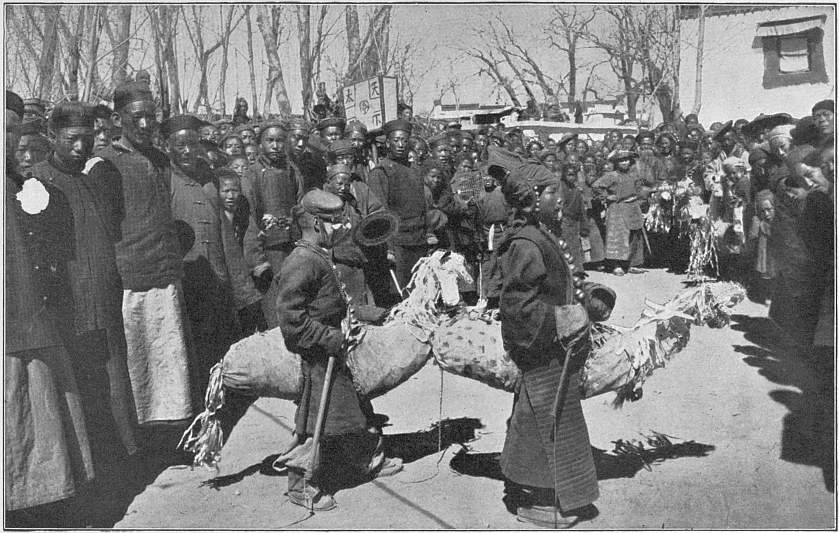
139. Nepalese Performing Symbolical Dances at the New Year Festival.
It was, however, not only the absence of the Tashi Lama that relieved the gloom of the quadrangle: clouds of yellow dust were being swept by a westerly storm over Tashi-lunpo. All the streamers, window curtains and awnings, and the long white flags, began to flutter and clap, and the strokes of the thousand temple bells were blended into one clang, which filled the air and seemed to rise like a hymn to the dwellings of the gods; for at all corners, projections, and cornices are hung brazen bells with clappers attached to a spring, so that a very slight breeze is sufficient to produce a sound. It is very pleasant to listen to this great carillon played by the wind as one wanders through the maze of Tashi-lunpo.
A lama from Ladak, who had been studying for five years in Tashi-lunpo, informed me that there are four different grades of learned priests. If there are several sons in one family, one must always be devoted to the monastic life. In order to be received into a monastery he must first take the oath, binding him to live in chastity and abstinence, not to drink, to steal, to kill, etc. He is then admitted as a novice into the fraternity of the yellow monks. After preliminary studies he attains to the first order in the priesthood, which is called the Getsul, and it is his duty to study certain holy writings and listen to the instruction imparted by a Kanpo-Lama. He is also bound to perform certain services, present tea to the superior monks, carry wood and water, see after the cleaning of the temples, fill the votive bowls, snuff the butter lamps, etc. The next order, the Gelong, has three subdivisions: Ringding, Rikchen, and Kachen, of which the last qualifies a member to act as teacher. Then comes the rank of Kanpo-Lama, or abbot, and lastly the Yungchen, who stands next to the Panchen Rinpoche.
The Getsul-Lama has to pay a fee of 20 rupees in order to be promoted to the rank of a Ringding-Lama; it is only a question of money, and the rank may be conferred on a monk a month after he enters the convent, but may be postponed for years if he is penniless. A Ringding-Lama must study a great number of scriptures and pay 50 or 60 rupees before he can become a Rikchen-Lama, and other 300 to become a Kachen. According to another informant the Ringding and the Rikchen are attached to the Getsul order, and only the Kachen belongs to the Gelong order. In these orders, however, it is easier to collect the necessary fees, for the monk has now an opportunity of exercising his sacerdotal office among the people. No payment is demanded on promotion to the rank of Kanpo-Lama, but this appointment is in the hands of the Tashi Lama; it is comparatively seldom conferred, and great learning is a necessary condition. On his appointment the lama receives a certificate bearing the seal of the Tashi Lama. A thorough knowledge of the holy books is required for the rank of Yungchen, and a conclave of high priests present recommendations for the conferment of the dignity.
At the present time there are 3800 monks in Tashi-lunpo, but during festivals the number rises to 5000, for then many come in from the neighbouring convents. Of the 3800 there are, it is said, 2600 of the Getsul and 1200 of the Gelong order. The Gelong Lamas are not obliged to meddle with worldly matters, but have only to superintend the temple services and take part in the rites. There are four only of the Kanpo order now in Tashi-lunpo and two of the Yungchen: one from the Chang province, and the other from Kanum in Beshar, the convent where the Hungarian Alexander Csoma Körösi lived as a monk eighty years ago in order to study the records of Lamaism. This Yungchen-Lama, who is named Lotsaba, is abbot of the monastery Kanum and of three others near the Sutlej. He came as a nine-year-old boy to Tashi-lunpo, and has lived here twenty-nine years. He longs to return to his home, but the Tashi Lama will not let him go thither until the Dalai Lama has returned to Lhasa.
Of the 3800 monks, 400 in all come from Ladak and other lands in the western Himalayas; a few are Mongolians and the rest Tibetans; 240 monks provide the church music, and dancing is performed by 60. They dance only twice a year. In the intervals their valuable costumes are deposited in sealed chests in a store-room called Ngakang. As they are little worn they last for centuries.
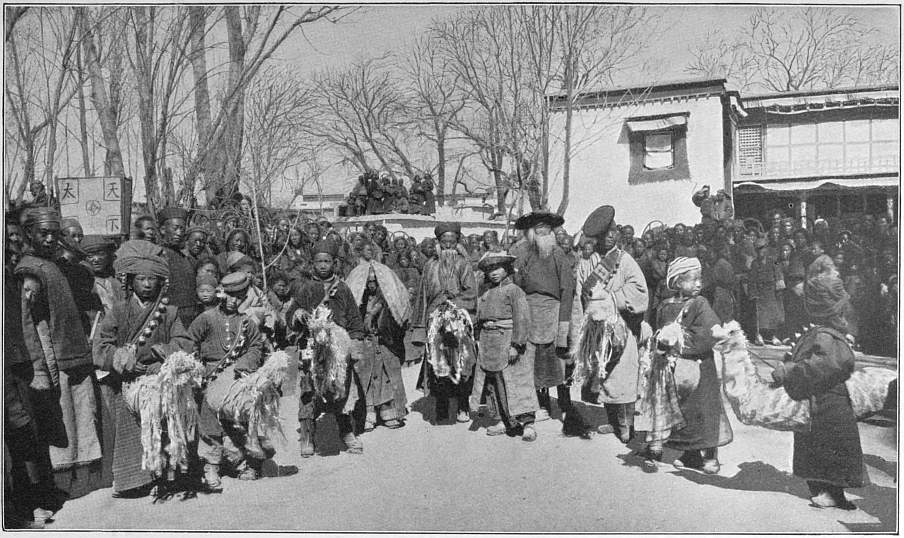
140. Dancing Nepalese at the New Year Festival, Tashi-lunpo.
The disputation just described is connected with promotion to the Kachen order, the graduation taking place only during the New Year festival, when eighteen lamas are annually promoted from the rank of Getsul to that of Gelong. The ceremony lasts three days: on the first day two graduate in the morning and two in the afternoon; on the second day six, and on the third day eight.
On February 16 I again rode up to the monastery to sketch gateways and photograph the Tashi Lama, who had sent me word in the morning that this day would suit him if I had time to spare. The weather was all that could be wished, calm and clear. There was a dense crowd on the uppermost platform, in a broad open space before the eastern mausoleum. It was particularly interesting to see an interminable procession of nuns, who had come in from the neighbouring temples to seek the blessing of the Tashi Lama for the new year. All ages were represented, from wrinkled old women to quite young girls. They were fearfully ugly and dirty, and in the whole collection I could find only two who were fairly good-looking. They had short hair and were dressed like the monks: some I should have taken for men, if I had not known that they were women. But, unlike the monks, they wore small yellow caps with turned-up brims, red on the underside.
Lamas and pilgrims swarmed on the courts, platforms, roofs, and staircases—all come to receive the sacred blessing; the devout and patient assembly, here forming queues, made a deep impression on the spectators. To us they intimated a long wait, and therefore we went to the tomb of the Grand Lama, and I drew the handsome portal. I had scarcely finished when Tsaktserkan appeared to inform me that His Holiness was waiting for me, so we hurried up the staircases, past the usual groups of monks, who were loitering all about and appeared to have little to do. On the great quadrangle preparations were being made for the disputation ceremonies.
This time Muhamed Isa accompanied me, and the Tashi Lama received me in the same half-open roof chamber as on the former occasion. He was as charming as ever, and again turned the conversation to distant countries far remote from this carefully isolated Tibet. This time he spoke chiefly of Agra, Benares, Peshawar, Afghanistan, and the road from Herat to the Khyber Pass.
“What lies to the west of Yarkand?” he asked.
“The Pamir and Turkestan.”
“And west of that?”
“The Caspian Sea, which is navigated by large steamers.”
“And west of the Caspian Sea?”
“The Caucasus.”
“And where do you come to when you continue to travel westwards?”
“To the Black Sea, Turkey, Russia, Austria, Germany, France, and then to England, which lies out in the ocean.”
“And what is there to the west of this ocean?”
“America, and beyond another ocean, and then Japan, China, and Tibet again.”
“The world is immensely large,” he said thoughtfully, and nodded to me with a friendly smile.
I asked him to come to Sweden, where I would be his guide. Then he smiled again: he would like to travel to Sweden and London, but high sacred duties kept him constantly fettered to the convent walls of Tashi-lunpo.
After tea and refreshments he walked about his room like an ordinary man, and asked me to get my camera ready. A yellow carpet was laid in the sunny part of the room, and a chair was placed on it. He did not, alas! wear his refined, charming smile when the three plates were exposed, but had a solemn look—perhaps he was considering whether it might not be dangerous to allow an unbeliever to take his portrait in the midst of his own cloister town (Illustration 146). A tall young lama with a pleasant countenance knew how to take photographs, and took a couple of portraits of me for the Tashi Lama. He had a dark room, where we could develop our plates—Lamaist temples are excellently adapted for dark rooms.
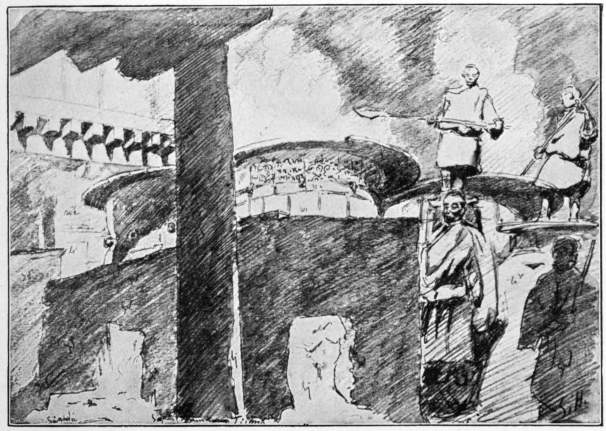
141. The Kitchen in Tashi-lunpo.
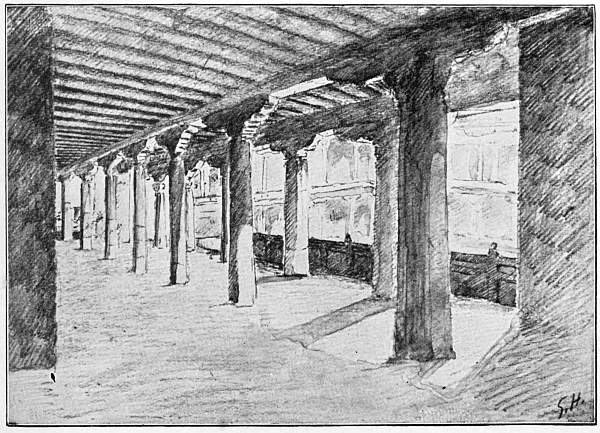
142. Colonnade in Tashi-lunpo. Sketches by the Author.
Then we resumed our seats, and the Tashi Lama inquired how I had liked the show of riders on the preceding day. I answered that I had never experienced such amusement. He had never attended these worldly spectacles, for he was always engaged in his religious duties on that day. Then he made a sign, and some monks brought in a gift of honour for me: two bundles of cerise-coloured woollen material, woven in Gyangtse; some pieces of gold-embroidered stuff from China; two copper bowls with silver edges, and a gilded saucer for a porcelain cup, with a cover to match. With his own hands he gave me a gilded image clothed in red and yellow silk, and a large light-yellow kadakh. The image he gave me, a seated Buddha with blue hair, a crown, and a bowl in the hands, from which a plant sprouts, he called Tsepagmed. This, according to Grünwedel, is the form of the Amitabha Buddha, called Amitayus, or “he who has an immeasurably long life.” It is significant that the Tashi Lama selected this particular image to give me, for he is himself an incarnation of Amitabha, and he is almighty. The figure of the Tsepagmed was therefore intended as a pledge that a long life was before me. This I did not understand at the time; it was only when I looked through Professor Grünwedel’s Mythologie that I grasped the significance of the present.
This time the audience lasted two and a half hours, and it was the last time I saw the Tashi Lama face to face; for afterwards all sorts of political complications arose which might have been dangerous to him—not to me—and I considered myself bound not to expose him to any annoyance through my visits, which might excite the suspicion of the Chinese. But it grieved me to stay near him for weeks, knowing that he saw every day my tent from his small cloister window, and yet not be able to visit and converse with him; for he was one of those rare, refined, and noble personalities who make other people feel that their lives are fuller and more precious. Yes, the memory of the Tashi Lama will cleave to me as long as I live. His friendship is sincere, his shield is spotless and bright, he seeks for the truth honestly and humbly, and knows that by a virtuous and conscientious life he renders himself a worthy temple for the soul of the mighty Amitabha.
The Tashi Lama was six years old when destiny called him to be the Pope of Tashi-lunpo, a dignity he has held nineteen years. He is said to have been born in Tagbo, in the Gongbo country. He, like the Pope, is a prisoner in the Tibetan Vatican in spite of his great religious influence, and leads a life prescribed by religious regulations, every day of the year having its particular ecclesiastical functions and occupations. For instance, on February 20, he must bow the knee before the graves of all his predecessors, accompanied by all the superior clergy. When I asked where he himself would be interred when it pleased Amitabha to be re-incarnated in a new Tashi Lama, I was told that a sepulchre would be erected for him as handsome as the others, and that a conclave of the higher priests would select the site. Either the sixth mausoleum will be erected on the west side of the others in a line with them, or a new row will be commenced in front of the former.
One day all my Lamaist followers were admitted to the presence of His Holiness. It was agreed beforehand that they should not pay more as temple offerings than three rupees per man. Of course I paid for them, and they afterwards assured me that the sacred blessing would benefit them during the rest of their lives.
I did not succeed in getting information as to the number of pilgrims who flock annually to Tashi-lunpo. When I made inquiries on the subject I was answered with a laugh, and the statement that they were so numerous it was quite impossible to count them. Pilgrims of rank and fortune make large contributions; others only a small silver coin, or a bag of tsamba or rice; and others again come in companies in the train of some well-to-do chief who pays for them all. If the concourse is too large, the blessing is imparted by the higher monks through laying on of hands; when the numbers are smaller, they receive the blessing from the Tashi Lama himself, not with the hand, but with a staff bound with yellow silk. He only blesses people of position and monks with his hand.
We saw laymen as well as clergy among the pilgrims. We have already seen the nuns forming a queue and waiting for the blessing. Four hundred nuns had come in from the neighbouring convents. During their stay they receive free lodging in the Chini-chikang, a building in Tashi-lunpo, free board, and a small present of money at their departure. They do not appear every year, but this year they arrived on the second day of the festival and departed on February 18.
We also saw novices from other monasteries, who are regaled with tea at stated times; but they must be content to sit on the ground in front of the kitchen, where they fill the narrow lane, so that it is difficult to get past.
There are also wandering lamas among the pilgrims. One day I made a sketch of one who had roamed far and wide. He wore a rosary round his neck, a necklace of shells, and a gao with an idol, which had been given him by the Tashi Lama. Not long before he had performed a prostration pilgrimage round all the monasteries of Lhasa, and had just completed this feat, so acceptable to the gods, round Tashi-lunpo. He moves in the direction of the hands of a watch, and measures the distance round the monastery with the length of his body. He folds his hands over his forehead, sinks on his knees, lays himself full length on the ground, stretches both arms forward, scratches a mark in the soil, stands up, steps up to the mark and falls again on his knees, and repeats this process till he has gone all round the monastery. Such a circuit of Tashi-lunpo demands a whole day, but if he also goes into the lanes and round all the mausoleums and temples, this religious gymnastic feat requires three days. We saw daily whole rows both of clerical and lay pilgrims encompassing Tashi-lunpo and all its gods in this fashion. I asked several of them how many times they prostrated themselves on the ground during a circuit, but they did not know; for, they said, “We pray all the time, Om mani padme hum; there are twenty manis to each prostration, and we cannot therefore count the prostrations as well.” Many of them encircle the wall several times.
This wandering lama was one of a brotherhood of nine monks, who often visited us in our garden, sat down in front of the tents, turned their prayer mills, and sang. They had free lodging in a building in Tashi-lunpo, called Hamdung. Another member was the seventeen-year-old Tensin from Amdo, who had taken four months to travel thence to Tashi-lunpo. They had come for the festival, and intended to return home through Lhasa and Nakchu (Illustration 216).
The contributions of the pilgrims are one of Tashi-lunpo’s chief sources of revenue. But the monastery also possesses extensive estates and herds, and certain monks, who superintend the agricultural affairs and have the disposal of the produce, also carry on trade with the neighbourhood and with Nepal. The produce of the whole of Chang is devoted to the use of Tashi-lunpo, which is therefore wealthy. Each of the 3800 monks, irrespective of rank, receives 15 rupees annually, and, of course, lives gratis in the convent.
Another large source of income is the sale of amulets, talismans and relics, idols of metal or terra cotta, sacred paintings (tankas), joss-sticks, etc. The priests also get very good prices for small, insignificant, almost worthless clay idols, and paper strips with symbolical figures, which the pilgrims carry round the neck as talismans, when these things have been duly blessed by the Tashi Lama.
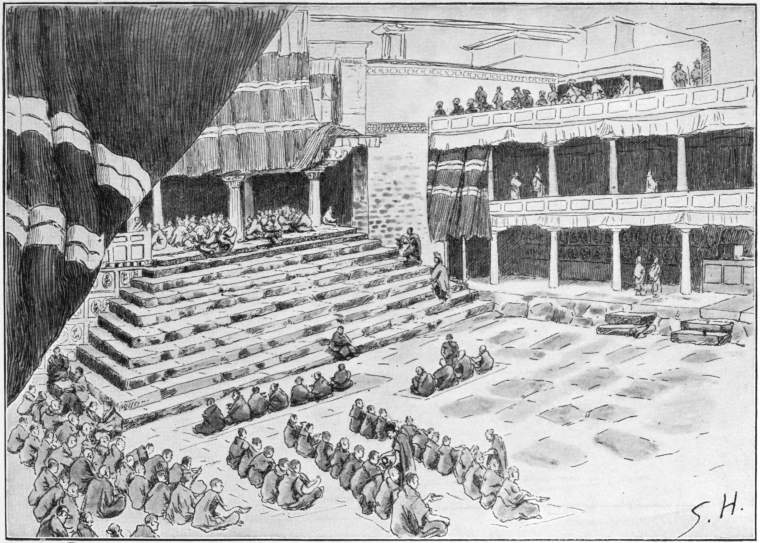
143. Lamas Drinking Tea in the Court of Ceremonies in Tashi-lunpo. Sketch by the Author.
On February 21 I spent nearly the whole day in parts of the monastery I had not previously seen. We wandered through narrow winding corridors, and lanes in deep shadow, between tall white-washed stone houses, in which the monks have their cells. One of the houses was inhabited by student monks from the environs of Leh, Spittok, and Tikze, and we went into the small dark cubicles, hardly larger than my tent. Along one of the longer sides stood the bed, a red-covered mattress, a pillow, and a frieze blanket. The other furniture consisted of some boxes of books, clothing, and religious articles. Holy writings lay opened. A couple of bags contained tsamba and salt, a small altar with idols, votive vessels, and burning butter lamps, and that is all. Here it is dark, cool, damp, and musty—anything but agreeable; very like a prison. But here the man who has consecrated his life to the Church, and stands on a higher level than other men, spends his days. Monks of lower rank live two or three in one cell. Gelongs have cells to themselves, and the chief prelates have much more elegant and spacious apartments.
Each monk receives daily three bowls of tsamba, and takes his meals in his own cell, where tea also is brought to him three times a day. But tea is also handed round during the services in the temple halls, in the lecture-rooms, and in the great quadrangle. No religious rite seems to be too holy to be interrupted at a convenient time by a cup of tea.
One day from the red colonnade (Kabung) I looked down on the court full of lamas, who were sitting in small groups, leaving only narrow passages free, along which novices passed to and fro with hot silver and copper pots, and offered the soup-like beverage stirred up with butter. It had all the appearance of a social “Five o’clock tea” after some service. But the meeting had a certain touch of religion, for occasionally a solemn, monotonous hymn was sung, which sounded wonderfully beautiful and affecting as it reverberated through the enclosed court. On March 4 the quadrangle and other places within the walls of Tashi-lunpo swarmed with women—it was the last day on which the precincts of the monastery were open to them; they would not be admitted again till the next Losar festival (Illustration 150).
The young monk who, when accompanying the Tashi Lama in India, had had an opportunity of learning about photography, had his dark room beside his large elegant cell. I, too, was able to develop my plates there. He asked me to come frequently and give him instructions. He had solid tables, comfortable divans, and heavy handsome hangings in his room, which was lighted with oil lamps at night. There we sat and talked for hours. All of a sudden he took it into his head to learn English. We began with the numerals, which he wrote down in Tibetan characters; after he had learned these by heart he asked for other of the more common words. However, he certainly made no striking progress during the few lessons I gave him.
Care is necessary in walking through the streets of the cloister town, for the flags, which have been trod by thousands of monks for hundreds of years, are worn smooth and are treacherous. Usually there is a good deal of traffic, especially on feast days. Monks come and go, stand talking in groups at the street-corners and in the doorways, pass to and from the services, or are on their way to visit their brethren in their cells; others carry newly-made banners and curtains from the tailor’s shop into the mystical twilight of the gods; while others bear water-cans to fill the bowls on the altars, or sacks of meal and rice for the same purpose. Small trains of mules come to fill the warehouse of the convent, where a brisk business is going on, for a family of 3800 has to be provided for. And then, again, there are pilgrims, who loiter about here only to look in on the gods, swing their prayer mills, and murmur their endless “Om mani padme hum.” Here and there along the walls beggars are sitting, holding out their wooden bowls for the passer-by to place something in, if it is only a pinch of tsamba. The same emaciated, ragged beggars are to be found daily at the same street-corners, where they implore the pity of the passengers in the same whining, beseeching tone. In the narrow lanes, where large prayer mills are built in rows into the wall, and are turned by the passers-by, many poor people are seated, a living reproof of the folly of believing that the turning of a prayer mill alone is a sufficiently meritorious action on the way to the realms of the blessed. In one particularly small room stand two colossal cylindrical prayer mills before which a crowd is always collected—monks, pilgrims, merchants, workmen, tramps and beggars. Such a praying machine contains miles of thin paper strips with prayers printed on them, and wound round and round the axis of the cylinder. There is a handle attached, by which the axle can be turned. A single revolution, and millions of prayers ascend together to the ears of the gods.
CHAPTER XXIX
WALKS IN TASHI-LUNPO—THE DISPOSAL OF THE DEAD
Immediately below the red colonnade stands the Sokchin-rungkang-chimbo, the kitchen, with its walled-up stove of colossal dimensions and six huge caldrons embedded in masonry. The first supplies all the 3800 monks with tea at one boiling. On the part of the caldron which rises above the masonry are inscriptions and cast ornaments (Illustration 141). Each caldron has a wooden cover which is put on when the caldron is not in use. Tea was being prepared in two of these gigantic pots; probably allowance was made for any chance guests. Glowing, blazing fireplaces yawn below the caldrons, and faggots of branches and sticks are thrust in with long iron forks. There is an opening in the roof for the smoke, which rises up in grey rings and produces a picturesque illumination in the holy kitchen. A continuous succession of young lamas and workmen ascend the steps leading up from the street, carrying on their backs water-tubs of different capacity according to the strength of the bearer; for there are quite small boys among them, who have recently been consigned by their relations to the care of the monks. One after another tips his tub over the edge of the caldron, while the stoker thrusts fresh faggots of wood into the stove. Other serving brothers bring in a quantity of cubes of brick tea which they throw into the boiling water, whence clouds of steam ascend and mingle with the smoke. At the side of the caldron stand two cooks, who stir with huge staves larger than oars, and disappear in the rising steam, becoming visible again, like shadow figures lighted from above, when a slight draught from the door clears the air. They sing a slow rhythmical song over their work.
When the tea is ready, it is poured into large bright copper pots with shining yellow brass mountings, handles, and all kinds of ornamentation. Novices carry the vessels on their shoulders to all the various halls and cells. A loud signal is given on a sea-shell from a temple roof that the monks may not miss their tea, but may be on the look-out. I frequently looked into the kitchen, the scene was so picturesque, and the cooks were ready for a joke and were not averse to being sketched (Illustration 148).
Two large and several small chhortens are erected on an open square in front of the mausoleums, of exactly the same design as those so frequently seen in Ladak. There are also stone niches filled with idols and other objects. A crowd of people was collected on the terrace when I was sketching, and it was not easy to get a clear view. It was a striking picture, with all the red and many-coloured garments against the background of the white-washed walls of the memorial towers (Illustration 151).
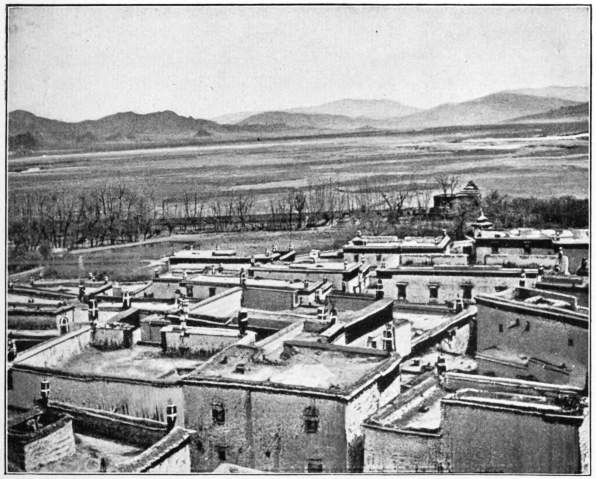
144. Part of Shigatse.
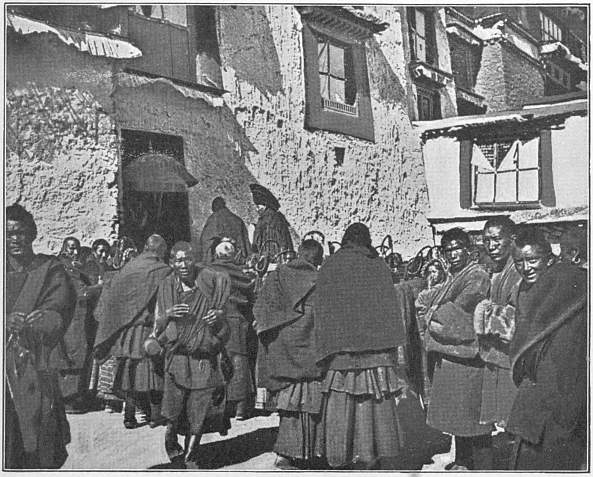
145. The Tashi Lama returning to the Labrang after a Ceremony.
One day when I had sat a long time talking in the cell of the photographing lama, it was dark when I went home. We passed, as we often had before, the entrance gate to the forecourt of the Namgyal-lhakang, the temple in which the Tashi Lama had once provided us with refreshments. There the evening service was in full swing, and of course we entered to look on. The illumination was more dimly religious than usual, but we could at any rate make out our surroundings after coming straight out of the outer darkness. The monks sat on long red divans, and their black profiles were thrown up by the row of forty flames burning in bowls before the altar. The gilded lotus blossoms of the pedestal were brightly lighted, and the yellow silken scarves in the hands of Tsong Kapa’s statue and the garlands draped over the images stood out conspicuously. But the upper parts of the figures under the roof were plunged in darkness, and Tsong Kapa’s countenance, with plump rosy cheeks and broad nose, was so curiously lighted up from below that his smile was not perceptible. The four coloured pillars in the middle of the hall appeared black against the altar lamps. The monks wore yellow robes, sat bare-headed, and chanted their melancholy litanies, now and then interrupted by ringing of bells and the roll of drums. At first the leather head of the drumstick falls slowly and regularly on the tight skin, then the beats become more and more frequent, and at last the drum becomes silent in an instant. A monk recites “Om mani padme hum” in rising and falling tones with the rapidity of an expert, and the others join in, making some kind of responses. The recitation passes into a continuous hum, in which often only the words “Om mani” are heard aloud, and the word “Lama” uttered more slowly. The whole ritual has a singularly soporific effect; only Tsong Kapa listens attentively, sitting dreamily with wide staring eyes, and ears hanging down to the shoulders. Here, too, the indispensable tea is handed round; a monk with an oil lamp attends the server that he may be able to see the cups. The monks were now quite accustomed to my visits and took no particular notice of me, but they always greeted me politely and asked what I had been sketching during the day.
A lama gave me information about a remarkable custom. Certain monks consent of their own free will to be walled up in dark grottoes or caves for the space of three, six, or at most twelve years. Near a small monastery, Shalu-gompa, a day’s journey from Tashi-lunpo, there is a monk who has already spent five years in his grotto, and is to remain there seven more. In the wall of the grotto is an opening a span in diameter. When the twelve years are over, and the hermit may return to the light of day, he crawls out through this opening. I insinuated that this was a physical impossibility, but the lama replied that the miracle does take place, and, besides, the enclosed monk has become so emaciated in the twelve years that he can easily slip through the opening. One of the monks of the monastery goes daily to the grotto with tea, water, and tsamba, and pushes these provisions through the opening, but he may not speak to the prisoner or the charm would be broken. Only sufficient light penetrates through the opening to allow the anchorite to distinguish between day and night. To read the holy scriptures, which he has taken with him into the cave, he must use an oil lamp, and a fresh supply of oil is placed from time to time in the opening. He says his prayers all day long, and divides the night into three watches, of which two are spent in sleep and one in reading. During the twelve years he may not once leave his grotto, never look at the sun, and never kindle a fire. His clothing is not the usual monk’s dress, but a thin cotton shirt, and a girdle round the body; he wears no trousers, head-covering, or shoes.
Among other abstruse subjects, this penitent must study a composition on some kind of magic, which renders him insensible to cold and almost independent of the laws of gravity. He becomes light, and when the hour of release arrives, travels on winged feet: whereas he used to take ten days to journey from Tashi-lunpo to Gyangtse, he can now cover the distance in less than a day. Immediately the twelve years of trial are ended, he must repair to Tashi-lunpo to blow a blast of a horn on the roof, and then he returns to Shalu-gompa. He is considered a saint as long as he lives, and has the rank of a Kanpo-Lama. No sooner has he left his grotto than another is ready to enter the darkness and undergo the same test. This lama was the only one in this neighbourhood then confined in a grotto, but there are hermits in abundance, living in open caves or small stone huts, and maintained by the nomads living near them. We were later on to hear of fanatical lamas who renounce the world in a much stricter fashion.
In Tashi-lunpo the cloister rule seems to be strictly enforced: there are especial inspectors, policemen and lictors who control the lives of the monks in their cells and take care that no one commits a breach of his vows. Recently a monk had broken the vow of chastity; he was ejected for ever from the Gelugpa confraternity and banished from the territory of Tashi-lunpo. He has, then, no prospect of finding an asylum in another monastery, but must embrace some secular profession.
One day we visited the Dena-lhakang, a temple like a half-dark corridor, for it is lighted only by two quite inadequate windows. In the middle of the corridor there is a niche which has doors into the hall, for the walls are very thick. Thus between the doors and the window is formed a small room in which the lama on duty sits as in a hut. He belongs to the Gelong order, is named Tung Shedar, came from Tanak, and is now seventy years old, has short white hair, and a skin as dry as an old yellow crumpled parchment.
On entering, one sees on the right a bookcase with deep square pigeon-holes, in which holy books are placed. On the outer, longer wall, banners painted with figures hang between the two windows, in the deepest shadow, most of which are of venerable age, and are dusty and faded—a Lamaist picture gallery. Pillars are ranged along the longer wall, of red lacquered wood, and between them is suspended trellis-work of short iron rods, forming geometrical figures. They are intended to preserve the valuables from theft. In such a niche we see hundreds of small idols set round in rows, four to eight inches high, in silken mantles. Before them are taller statues of gods, and Chinese vases of old valuable porcelain. Especial reverence is shown to a cabinet with an open door, within which is preserved a tablet, draped with kadakhs, and inscribed with Chinese characters, in memory of the great Emperor Kien-Lung who was admitted by the third Tashi Lama into the confraternity of the yellow monks. Above, covering the capitals of the pillars, is hung strange, shabbily-fine drapery, of pieces of variously coloured cloth and paper strips. For the rest, the hall abounds in the usual vessels, brazen elephants with joss-sticks, large chalices and bowls, small and large flags, and other things.
Another time I had been drawing in a sepulchral chapel and taken the opportunity of making a sketch of some female pilgrims who were praying there. When the work was finished, we crossed a paved court fully 20 yards broad by 90 long, which was situated just under the façade of the Labrang. It was full of people waiting to see the Tashi Lama, who was to pass by on his way to some ceremony. He came in a red monk’s frock and the yellow mitre; above his head was held the yellow sunshade, and he was accompanied by a train of monks. He walked with his body slightly bent and an air of humility. Many fell down before him full-length and worshipped him, while others threw grains of rice over him. He did not see me, but his smile was just as kind and mild as when we last met. So he is evidently affable to all alike.
I made daily visits to the monastery and so gained a thorough knowledge of the solitary life of the monks. Gompa signifies “the abode of solitude,” or monastery; the monks in the convent certainly live isolated from the outer world, its vanities and temptations. Once, in the Kanjur-lhakang, I purposed to draw the images with the lamps burning before them on the innermost, darkest wall, but just as I was about to begin monks filled the hall. Their places on the long divans were made ready for them, and before each seat a huge volume of the holy scriptures, the Kanjur, lay on a long continuous desk. The large yellow robes which are put on at service time, but may not be worn in the open-air, were laid ready. The young, brown-skinned, short-haired monks entered in red togas, threw the yellow vestments over their shoulders, and sat down cross-legged before the books. An older lama, a Kanpo, mounted the pulpit on the shorter wall and intoned the sacred text in a harsh, solemn, bass voice. The pupils joined in a monotonous rhythm. Some read from the pages in front of them, while others seemed to know the words of the chant by heart—at any rate they looked all about. Exemplary order is not observed. Some young fellows, who certainly were much more at home in the world than in the Church, talked during the chant, giggled, and buried their faces in their robes to stifle their laughter. But no one took any notice of them; they caused no disturbance. Others never raised their eyes from the book. The hall was as dark as a crypt, being lighted only by a narrow skylight, and through two small doors (Illustration 154).
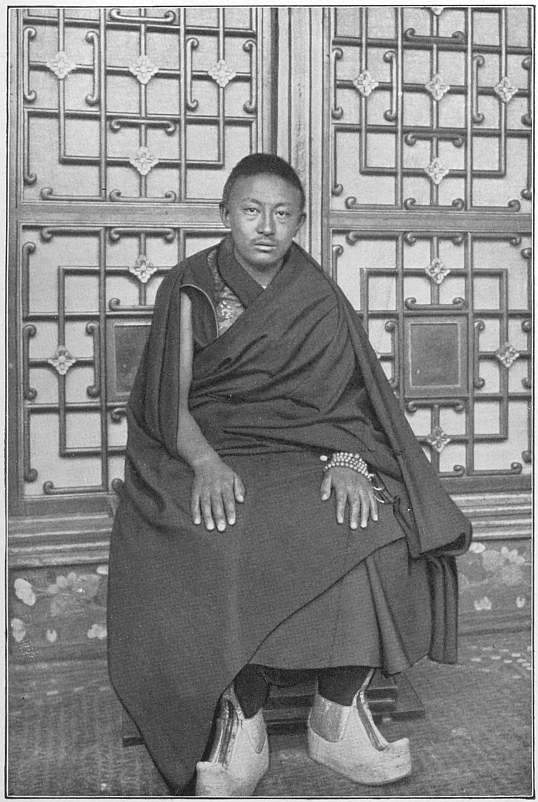
146. The Panchen Rinpoche, or Tashi Lama.
After they had sung awhile there was an interval, and lama boys passed along the gangways between the rows of benches and poured tea, with wonderful adroitness and without spilling a drop, into the wooden cups held out to them. But almost before the pupils have begun to drink, the deep bass of the leader drones out in the gloom above, and the proceedings recommence. Meanwhile pilgrims pass along the gangways to the altar and place small heaps of tsamba or meal in the bowls standing before the images, from the bags and bundles they bring with them.
A tall lama stands erect at the entrance door. A pilgrim says to him: “I will pay 3 tengas for a blessing.” The lama sings out aloud the contribution and the purpose for which it is given, and then a strophe is sung especially on behalf of the pilgrim, after which all the monks clap their hands. This is repeated whenever fresh pilgrims come up. I myself paid 5 rupees for a blessing, and received it together with a noisy clapping. For ten minutes the lamas stand up, run along the passages outside the lecture-hall, or take stock of me while I am sketching the schoolroom and the pupils. Often a handful of rice rains down upon the youths—some pilgrim is passing by the window opening. At these readings and at the high mass the monks who have been longest in the monastery occupy the front seats, and the last-comers the back seats. When the lecture is over the Kanpo-Lama counts the receipts that have flowed in from the pockets of the pilgrims, wraps the coins in paper, which is sealed up and conveyed to the treasury, and enters the amount in a large account book.
The images on the altar table of the Kanjur-lhakang are small, and composed of gilded metal, and most of the other idols in Tashi-lunpo are of the same kind. Some are of carved wood, and a few, like the great statue of Tsong Kapa, are composed of powdered spices cemented together by a gum extracted from roots of plants. The statue of Tsong Kapa is said to have been constructed seventy-two years ago, and to have cost as much as one of gold. The Tashi Lama has 1500 small gods cast for the New Year festival, each costing 7 rupees; they are manufactured in Tashi-lunpo, and are given away or sold. The manufacture of these images is regarded as a peculiarly blessed work, and the lamas engaged in it may count with certainty on a long life. Especially is this the case with those who make images of the Tsepagmed. The oftener they utter his name and produce his likeness from the rough metal, the longer it will be before their poor souls have to set out on their travels again. No idol, however, possesses any miraculous power or the slightest shadow of divine influence unless it is properly consecrated and blessed by an incarnated lama.
I must by this time have tried the patience of my readers with my personal recollections of the monastery of Tashi-lunpo. I have unintentionally tarried too long with the fraternity of the yellow-caps, and quite forgotten events awaiting our attention elsewhere. I might have remembered that temples and monks’ cells may not have the same interest for others as they have for myself, but the remembrance of this period is particularly dear to me, for I was treated with greater friendliness and hospitality in Tashi-lunpo than in any town of Central Asia. We came from the wastes of Tibet to the greatest festival of the year, from solitude into the religious metropolis swarming with thousands of pilgrims, from poverty and want to abundance of everything we wanted, and the howling of wolves and storms gave place to hymns and fanfares from temple roofs glittering with gold. The balls in Simla and the desolate mountains of Tibet were strange contrasts, but still greater the solitude of the mountain wilderness and the holy town, which we entered in the garb of far-travelled pilgrims, and where we were hospitably invited to look about us and take part in all that was going on.
It is now time to say farewell to Tashi-lunpo, its mystic gloom and its far-sounding trumpet blasts. I do so with the feeling that I have given a very imperfect and fragmentary description of it. It was not part of my plan to thoroughly investigate the cloister town, but on the contrary it was my desire to return as early as possible to the parts of Tibet where I might expect to make great geographical discoveries. Circumstances, however, which I shall hereafter refer to in a few words, compelled us to postpone our departure from day to day. As we were always looking forward to making a start, our visits to the monastery were curtailed. Moreover, I wished, if possible, to avoid exciting suspicion. Tashi-lunpo had on two occasions, more than 100 years ago indeed, been pillaged by Gurkhas from Nepal. The English had quite recently made a military expedition to Lhasa. Many monks disapproved of my daily visits, and regarded it as unseemly that a European, of whose exact intentions nothing was known, should go about freely, sketch the gods, see all the treasures of gold and precious stones, and make an inventory. And it was known that the dominant race in Tibet, the Chinese, were displeased at my coming hither, and that I had really no right to sojourn in the forbidden land. If, then, I wished to accomplish more, I must exercise the greatest caution in all my proceedings.
A few words on funeral customs before we take leave of Tashi-lunpo.
South-west of Tashi-lunpo lies a small village, Gompa-sarpa or the New Monastery, where, according to tradition, a temple formerly stood which was plundered by the Dzungarians. Here is now the cemetery of Shigatse and of the monastery, the Golgotha where the bodies of monks and laymen are abandoned to corruption in the same fashion.
When the soul of a lama grows weary of the earthly frame in which it has spent its human life, and the lama himself, after living perhaps fifty years in his dark cloister cell, perceives that the lamp of life is going out for want of oil, some brethren gather round his sick-bed, recite prayers, or intercede with the gods set up in his cell, whose prototypes in Nirvana or in the kingdom of the dead have something to do with death and the transmigration of souls. As soon as life is extinct, special prayers for the dead are recited to facilitate the severance of the soul from the body, and console it during its first steps on the dark road beyond the bounds of this life. The corpse of a lama lies in his cell for three days, that of a layman as long as five days, that there may be sufficient time for all the funeral rites and services. Rich people retain the corpse longer in the house, which is certainly more expensive, but allows more time for prayers which will benefit the deceased. Monks fix the date of interment and the moment when the soul is actually freed from its earthly fetters and soars up in search of a new habitation.
The dead lama in a new costume of the ordinary cut and style is wrapped in a piece of cloth and is carried away by one or two of his colleagues; a layman is borne on a bier by the corpse-bearers. These are called Lagbas, and form a despised caste of fifty persons, who live apart in fifteen small miserable cabins in the village Gompa-sarpa. They are allowed to marry only within the guild of corpse-bearers, and their children may not engage in any other occupation but that of their fathers, so that the calling is hereditary. They are obliged to live in wretched huts without doors or windows; the ventilators and doorways are open to all the winds of heaven and all kinds of weather. Even if they do their work well they are not allowed to build more comfortable houses. It is their duty also to remove dead dogs and carcasses from Tashi-lunpo, but they may not enter within the wall round the convent. If they have any uneasiness about their souls’ welfare, they pay a lama to pray for them. When they die, their souls pass into the bodies of animals or wicked men. But in consequence of the afflictions they have endured they are spared too hard a lot in the endless succession of transmigrations.
The Lagbas have only to hack in pieces lamas, their own relations, and the bodies of the homeless poor. Well-to-do laymen have this operation performed for their own people without calling in professional aid.
When the monks come with a dead brother to the place of dissection they strip him completely, divide his clothes among them, and have no compunction in wearing them the very next day. The Lagbas receive 2 to 5 tengas (11d. to 2s. 3d.) for each body and a part of the old clothing of a lama; in the case of a layman the Lagba receives all the raiment of the deceased, and the ear-rings and other simpler ornaments of a woman. The monks who have brought the body hurry off again with all speed, partly because the smell is very bad and partly that they may not witness the cutting up of the corpse, at which only the Lagbas need be present; even when the body is that of a layman, it is divided only in the presence of Lagbas.
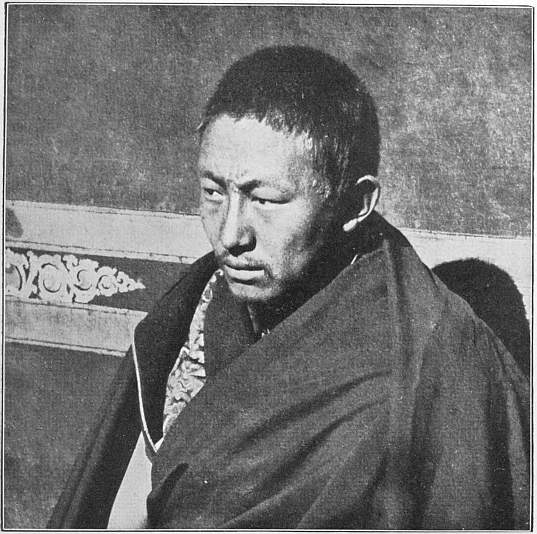
147. Portrait of the Tashi Lama. (before retouching.)
A cord fastened to a post driven into the ground is passed round the neck of the corpse, and the legs are pulled as straight as possible—a feat requiring great exertion in the case of a lama, who has died and become rigid in a sitting posture. Then the body is skinned, so that all the flesh is exposed; the Lagbas utter a call, and vultures which roost around come sailing up in heavy flight, pounce down on the prey, and tear and pluck at it till the ribs are laid bare. There are no dogs here as in Lhasa, and even if there were, they would get no share in the feast, for the vultures do their work quickly and thoroughly. We afterwards visited convents where sacred dogs were fed with the flesh of priests. The Lagba sits by while the vultures feed, and these are so tame that they hop unconcernedly over the man’s legs.
The head is usually cut off as soon as the body is skinned. The skeleton is crushed to powder between stones, and is kneaded with the brains into a paste, which is thrown to the birds in small lumps. They will not touch the bone-dust unless it is mixed with brains. The guild of corpse-cutters pursue their task with the greatest composure: they take out the brains with their hands, knead it into powder, and pause in the midst of their gruesome employment to drink tea and eat tsamba. I am exceedingly doubtful if they ever wash themselves. An old Lagba, whom I summoned to my tent to supplement the information I had received from the monks, had on that very morning cut up the body of an old lama. Muhamed Isa held his cap before his face all through the conversation, and had at last to go out, for he began to feel ill. The man had an unpleasant rough aspect, wore a small grey soft cap, and was dressed in rags of the coarsest sacking. He had his own theories of post-mortem examination and anatomy. He told me that when an effusion of blood was found in the brain it was a sign that the man had been insane, and that when the substance of the brain was yellow the man had been an habitual snuff-taker.
In some cases, so a monk assured me, the corpse is not skinned, but the head is cut off, the trunk is divided in two along the spine with a sharp knife, and each half is cut into small pieces, and the vultures are not called till this has been done. Small children and grown-up men are cut up in the same manner. There is not the least respect shown for the nakedness of dead women. The whole aim of this method of disposing of the body is that the deceased may have the merit of giving his body to the birds, which would otherwise be famished. Thus even after his death he performs a pious deed which will promote the peace of his soul. The vultures here act the same part as in the Towers of Silence among the Parsees of Bombay and Persia.
As soon as the demands of religion are fulfilled, the relatives take leave of the deceased. He is then gone away, and his body is quite worthless; when the soul has recommenced its wanderings, the body may be consigned to the brutal treatment of the Lagbas without the least hesitation. No one follows the corpse to the home of the vultures when it is carried out of the house at night to be cut up before the sun rises. There is no legal regulation, and when the bodies are numerous, the sun has generally risen before the work is finished. After that, one, or at most two, of the corpses are left till evening and are taken in hand after sunset. This is also because the vultures are satiated with their morning’s feed and must have a rest before supper. It is seldom that more than two deaths are reported in Gompo-sarpa in one day. About twelve years ago when an epidemic of smallpox raged in Shigatse, forty to fifty bodies were removed daily. Then, after the vultures had gorged themselves, the rest of the bodies were wrapped in thin shrouds and buried.
One would suppose that the dying man would shudder at the thought that, at the very moment when the gates of death were opened for him, his body, with which he was so closely connected during his life, which he had cared for so anxiously, endeavouring to shield it from danger and sickness, nay, from the slightest pain, would be consigned to such barbarous treatment. But probably he thinks more of his soul in his last moments, and counts up the good deeds he has performed and the millions of manis he has recited.
There is, then, not the slightest touch of sentiment in the funeral customs of the Tibetans and their attitude towards the dead. The children of Islam visit the graves of their loved ones and weep out their sorrow under the cypresses, but the Tibetans have no graves and no green-covered mounds where they may devote an hour to the remembrance of a lost happiness. They weep not, for they mourn not, and they mourn not, because they have loved not. How can they love a wife whom they possess in common with others, so that there is no room for the idea of faithfulness in marriage? The family ties are too loose and uncertain, and the brother does not follow his brother, the man his wife, and much less his child, to the grave, for he does not even know if the child is really his own. And, besides, the corpse in itself is a worthless husk, and even a mother who has tenderly loved her child feels not a shadow of reverence for its dead body, and has no more horror of the knife of the corpse executioner than we have of the doctor.
CHAPTER XXX
OUR LIFE IN SHIGATSE
The time that was not taken up by visits to Tashi-lunpo I occupied in many ways. We had friends to visit us, and I frequently spent many hours in transferring types of the people to my sketch-book, and I found good material among the citizens and vagrants of the town and the monks of the convent.
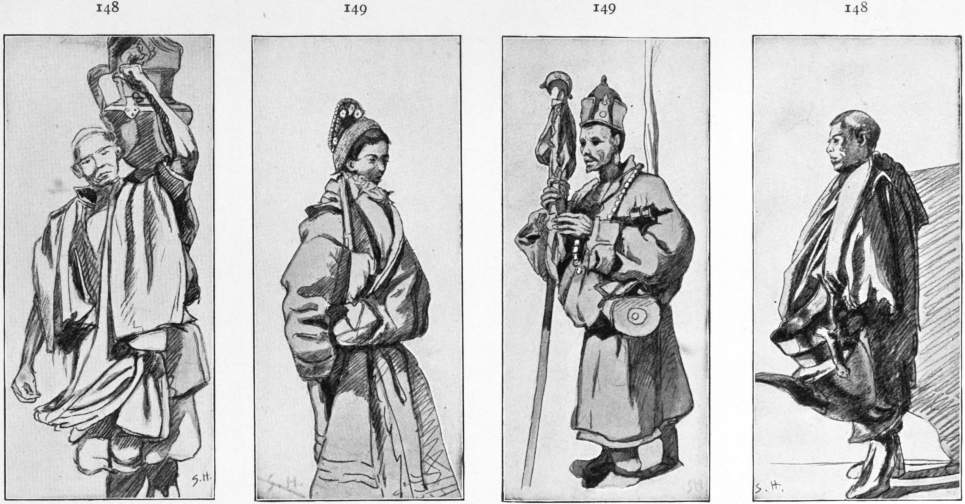
148. Lamas with Copper Tea-Pots. 149. Female Pilgrim from Nam-tso and Mendicant Lama. Sketches by the Author.
On one of the first days the Consul of Nepal paid me a visit. He was a lieutenant, twenty-four years old, was named Nara Bahadur Chetteri, and bore between his eyes the yellow marks of his caste. He was dressed in a black close-fitting uniform with bright metal buttons, and a round forage cap on his head without a shade, but with a gold tassel, and in front the sun of Nepal surrounded by a halo of rays. He had been four months in Lhasa and two here. He and his young wife had taken two months to travel from Khatmandu; they had ridden the first week, but had then sent their horses back, and had tramped through very dangerous, pathless, mountainous regions for fifteen days; the rest of the journey they had accomplished on hired Tibetan horses. Here he had to protect the interests of the 150 Nepalese merchants and assist the pilgrims of his country when they were in difficulties. The merchants have their own serai, called Pere-pala, for which they pay an annual rent of 500 tengas; they buy wool from the nomads in the north, and pay for it with corn and flour, which therefore is scarce and dear in Shigatse, especially during the festival time when so many pilgrims flock in. The Consul received 200 tengas a month, or rather less than £60 a year, and considered that the Maharaja paid him very badly. Bhotan has no consul in Shigatse, though many pilgrims come from that country.
On February 14 I received a very unexpected visit, a lama and an official from Lhasa. When the Devashung, the Government, had received the letter of Hlaje Tsering announcing my arrival at the Ngangtse-tso, the Chinese Ambassador and the Government, after consulting together, had despatched these two gentlemen in forced marches to the lake, where, however, they arrived several days after my departure. Singularly enough they had been given quite erroneous information about the route we had taken, perhaps because our wanderings over the ice across the lake in all directions had confused the nomads. Therefore they had sought for us for twenty-two days on the shores of the Ngangtse-tso and the Dangra-yum-tso, until they had at length discovered that we had gone off southwards a long time before. Then they had followed our track and had made further inquiries among the nomads, all of whom said that they had been kindly treated, and well paid for all they sold us. The gentlemen rode on, and heard in Yeshung that we had passed through a couple of days before; our camp-fires were scarcely cold. They changed horses, and spurred them on at a faster pace, for they had been ordered to force us at any cost to return northwards by the same way we had come. But I had got the better of them, for they did not reach Shigatse till thirty-six hours after us, and another party sent from Lhasa to intercept us by a more direct road had quite lost our trail in the labyrinth of valleys and mountains into which we had plunged.
“We have carried out our mission as well as we have been able,” they said, “and it only remains for us to ask for your name and all particulars of your journey and companions.”
“I have already communicated everything to Ma Daloi and Duan Suen, who have seen my passport, but if you want a second edition, you are welcome to it.”
“Yes, it is our duty to send a report to the Devashung. In virtue of the treaty of Lhasa only the market-towns of Yatung, Gyangtse, and Gartok are free to the Sahibs under certain conditions, but no other routes. You have come by forbidden roads and must turn back again.”
“Why did you not close the way to me? It is your own fault. You can inform the Devashung that I shall never be content till I have seen the whole of Tibet. Besides, the Devashung will not find it worth their while to place obstacles in my way, for I am on good terms with your gods, and you have seen yourself how friendly the Tashi Lama has been to me.”
“We know it, and it seems as though you bore the sign of the favour of the gods on your forehead like caste-markings.”
“How is Hlaje Tsering getting on?”
“He is suspected of receiving a bribe from you; he has been dismissed, and has lost his rank and all his property.”
“It is very mean of the Devashung to persecute him. But the Government is composed of the most despicable rogues in all Tibet. You ought to be glad that you are at length properly under Chinese protection.”
At first they exchanged meaning looks, but gradually they came round to my opinion and admitted that their Government was a disagreeable association. The reason they had not shown themselves immediately after their arrival was that they wished first to spy out our occupations and our associates; for, if they found out that we had friends, these would of course be denounced. Otherwise they were decent men, and readily partook of tea and cigarettes. Unfortunately Tsaktserkan was just then with me, and he must have thought the affair serious, for he made himself scarce as soon as they entered my tent, but afterwards asked me to tell him what they had said.
It impressed them most of all that, in spite of all the ambushes and traps in the form of scouting patrols, who were on the look-out for us, we had after all succeeded in advancing to Shigatse. Now they would wait for orders from Lhasa. No heed was paid to the Dalai Lama, who was as good as dead and buried.
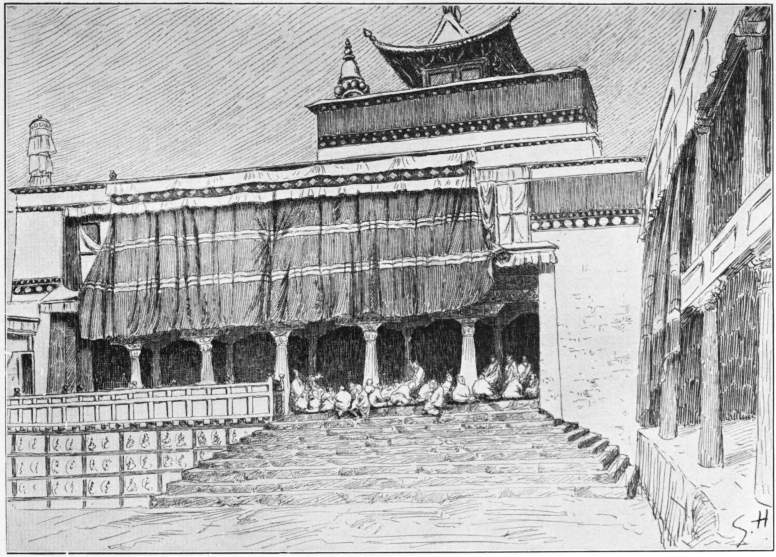
150. The Great Red Gallery of Tashi-lunpo. Sketch by the Author.
They came frequently during the following days to greet us, and then expressed their opinions of their superiors more and more frankly. Their remaining on the scene proved, however, that both the Chinese and the Government had their eyes on me. I wondered how the affair would terminate.
When I returned from the equestrian performance on the 15th, I found a large packet of letters from Major O’Connor, and greedily seized letters from home and from friends in India, Lady Minto, Colonel Dunlop Smith, Younghusband, and O’Connor himself, who welcomed me most heartily, and expressed a hope that we should soon meet. He had also kindly given me a great surprise with two boxes containing preserved meats, cakes, biscuits, whisky, and four bottles of champagne. Fancy my drinking champagne alone in my tent in Tibet! I drank a glass at dinner every day to the health of Major O’Connor as long as the supply lasted.
In the chapter on Leh I mentioned the Hajji Nazer Shah and his son Gulam Razul. The old Hajji had another son in Shigatse, named Gulam Kadir, who had been ten years in Tibet and now managed the branch in Shigatse. He sold chiefly gold-embroidered stuffs from China and Benares, which the lamas bought for state robes, and he told me that he made a yearly profit of 6000 rupees. A bale of such material as he showed me was worth 10,000 rupees. Gulam Kadir rendered me many services at this time, and supplied us with anything we wanted.
There is a fine view from the roof of his house of the Dzong, or fort, the stately front of which seems to grow out of the rock. The windows, balconies, roof decorations and streamers have a harmonious and picturesque effect. In the middle of the structure is a red building; all the rest is white, or rather an undecided greyish-yellow colour, which the plaster has assumed in the course of time.
At the southern foot of the Dzong hill lies the open market-place, where trade was carried on two hours a day. There are no tables and stands, but the dealer sits on the dusty ground and spreads out his wares on cloths or keeps them beside him in baskets. In one row sit the dealers in implements and utensils, in others boards and planks are sold, ironware, woven goods, coral, glass beads, shells, sewing thread, needles, dyes, cheap oleographs, spices and sugar from India, porcelain, pipes, figs and tea from China, mandarins from Sikkim, dried fruits and turquoise from Ladak, yak hides and tails from the Chang-tang, pots, metal dishes, covers and saucers manufactured in the town, religious books and other articles for the use of pilgrims, etc. Straw and chaff, rice, grain, tsamba and salt are sold by many traders. Walnuts, raisins, sweets, and radishes are other wares in which there is a large trade. Horses, cows, asses, pigs, and sheep are also on sale; for the last, 7 rupees a head are asked. In Chang-tang we had paid at most 4 rupees, and a sheep can be got for 2 rupees. Every kind of ware has its particular place, but the traders, so far as I could see, were all Tibetans; for the merchants of Ladak, China, and Nepal have shops in their own houses.
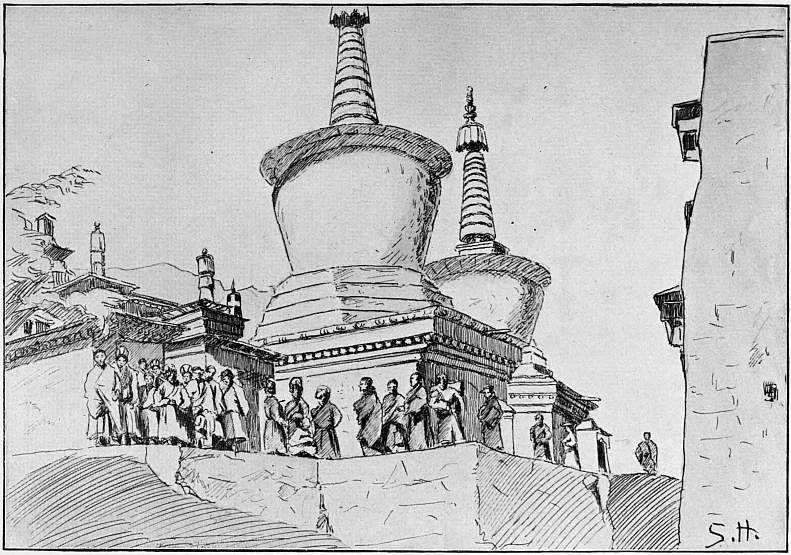
151. Chhorten in Tashi-lunpo. Sketch by the Author.
Most of the traders are women, and they sell even hay, firewood, and meat. They wear huge coils of hair with inferior turquoise, glass beads, and all kinds of pendants, which contrast strongly with their faces smeared with black salve. If they would dispense with this finery and give themselves a good washing instead, some of them would perhaps look quite human. What was the original colour of their clothes is hard to guess, for they are now caked with dust, soot, and dirt. But these hucksters are always polite and obliging; they sit in rows parallel to the north wall of the Chinese town, which is little more than a ruin. Now and then a mule caravan passes along the pathway between the rows, bringing new goods to market. Frequently gentlemen partly dressed in Chinese fashion ride past from the Dzong; and among the swarms of customers are seen all kinds of people—clergy and pilgrims, children of the country and strangers, white turbans from Ladak and Kashmir, and black skull-caps from China. In the market all the gossip of Shigatse is hatched; all sorts of reports more or less probable reach us from there. As soon as any one comes from Lhasa he is driven almost frantic with questions, for all take a deep interest in the new Chinese régime. It was current in the bazaar that lamas in Lhasa were organizing a bloody insurrection against the Chinese, because the latter had demanded that half the lamas should serve in the army. It was further reported that I and my companions would soon be compelled to leave the country, and that before very long the English commercial agency in Gyangtse would be closed. Every one who has heard anything fresh carries it at once to the market, where the visitors who come to hear news are as numerous as those who make purchases. In a word the market is Shigatse’s only newspaper.
Gulam Kadir told me that the two gentlemen from Lhasa employed spies, who reported daily all that they could find out about us. These men used to come as hawkers into our tents and sit there by the hour. Ma also encompassed us with spies. With the help of Gulam Kadir I set two Ladakis as spies to spy upon the spies of the Lhasa spies. We could now be on our guard, for we knew what was going on around us.
My own Ladakis enjoyed in Shigatse a very necessary period of rest. I gave them money for new clothes, which they made up themselves; in a few days they appeared in all the glory of a new outfit from head to foot. Nor could I refuse them a jug of chang daily; they very seldom drank too much, after one of them one day under the influence of beer painted his face black, and in this guise made ridiculous pirouettes about the court. Muhamed Isa happened to come home from the market just at the moment, and, catching hold of the dancer, gave him such a thorough drubbing that he never thought of painting himself again. Both Chinamen and Tibetans said that the conduct of my men was exemplary and gave no cause for quarrels. But to hear Tsering’s singing in the evening! It was like the creaking of a badly oiled wicket-gate to a shed in my own country, and therefore I listened with pleasure to his rude song. When he had sung for three hours on end, it became a little too much, but I put up with it—it is so pleasant to have cheerful, contented men about one.
Under February 19 the following entry stands in my diary: “In spite of the windy, dusty weather I have all day long been sketching various types, chiefly women, who sat for me as models in front of my tent.” The first were from Nam-tso (Tengri-nor) (Illustration 155), wore head-dresses decorated with shells, china beads, and silver spangles, and in their sheepskins trimmed with red and blue ribands looked like girls from Dalecarlia. They had large bones, were strongly built, looked fresh and healthy, and their broad faces were remarkably clean. The women of Shigatse, on the other hand, had smeared their faces with a brown salve mixed with soot which looked like tar. This mask makes them hideous, and it is impossible to tell whether they are pretty or not; the black colour interferes with the lights and shadows, and confuses the portrait painter. One had painted only her nose and rubbed it bright as metal. This singular custom is said to date from a time when the morality of the Lhasa monks was at a low level, and a Dalai Lama issued orders that no female should show herself out of doors unless painted black, so that the charms of the women might be less seductive to the men. Since then the black paint has remained in fashion, but seems now to be going out.
The clothes are always black with age, dirt, and soot. The women pay most attention to their head decoration, and the higher they are in the social scale the more profusely they deck their coiffures with bows, pendants, and jewelry. The hair is frequently so closely entwined with all this finery that it can scarcely be let down every night, but only when it becomes so entangled that it must be put straight. Those who are rich wear large heavy ear-rings of solid gold and a few turquoises, but others simpler and smaller rings. On the neck are worn chains of various coloured beads and gaos, small silver cases studded with coral and turquoise and containing amulets. Poor women have to be contented with copper gaos of the clumsy kind so common among the Tsaidam Mongols.
A woman of forty belonging to Shigatse was named Tashi-Buti; she looked sixty, for women age very soon here. Above her ordinary clothing she wore a coarse shawl over the shoulders, fastened in front with brass clasps, plates, and rings.
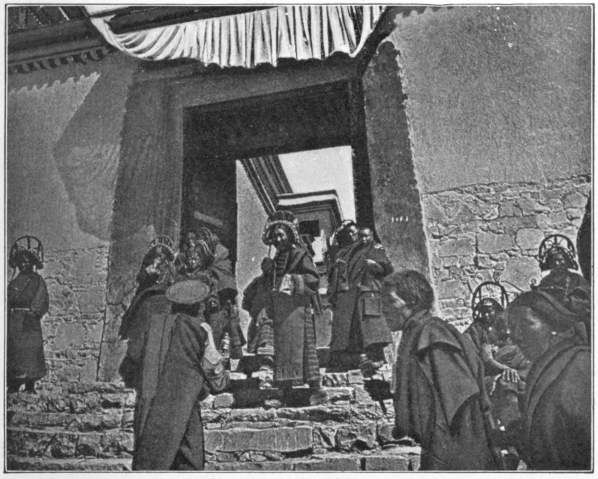
152. Portal in Tashi-lunpo.
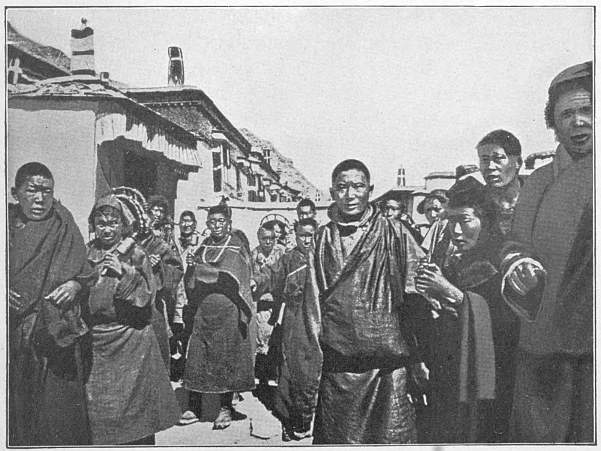
153. Group of Lamas in Tashi-lunpo.
A nomad woman from Kamba had the right arm and shoulder bare, and was as powerfully and muscularly built as a man, but was so horribly dirty that it was impossible to perceive her complexion. She had no head-dress; but the dark hair was plaited into innumerable thin rat’s tails hanging over the shoulders, and tied together on the forehead into a mane of cords. She would have been good-looking if her features had not been so masculine; she sat still and solemn as a statue of Buddha. A fifteen-year-old girl had a parting in the middle, and her hair frizzed in two pads down to the ears, which were combed, oiled, and shiny like those of a Japanese, and she wore a diadem studded with coral. She was dainty and clean and had rosy cheeks (Illustrations 157, 158, 159).
Burtso was a little Shigatse lady of seventeen summers, and bore the dirt of those seventeen summers on her face. Like most of the others her features had the sharply marked characteristics of the Mongolian race—oblique narrow eyes contracting to a point at the sides, and the lower part of the eyelid telescoped into the upper so that a slightly curved line is formed and the short lashes are almost covered; the iris is dark chestnut brown, and appears black within the frame of the eyelids; the eyebrows are usually only slightly marked, are thin and irregular, and never form the finely curved Persian and Caucasian arch like a crescent. The cheek-bones are rather prominent, but not so high as with the Mongolians; the lips are rather large and thick, but the nose is not so flat as among the Mongols. Faces with handsome features are seen among the male Tibetans. But the differences between individual Tibetans are often as great as between Tibetans on the one hand and Mongols, Chinamen, and Gurkhas on the other. The nomads of the Chang-tang are apparently a tribe of themselves, and seldom, if ever, intermarry with the others. Otherwise the Tibetan people is undoubtedly much mixed with neighbouring elements. Chinamen living in Lhasa and Shigatse marry Tibetan women. In the Himalayas, south of the Tibetan frontier, live the Bothias, a mixed people, sprung partly from Indian, partly from Tibetan elements. The people of Ladak have mingled to a large extent with their Aryan and Turkish neighbours, because they have been in closer and more active contact with them. The Tibetan people present remarkable and peculiar problems in anthropological, ethnographical, and linguistic science, which must be solved by future investigation.
I drew on and on, and one type after another found its way into my sketch-book. The expression of my models is listless and devoid of animation; they seem absent-minded and passionless. They take little interest in the proceedings; all they care about is to pocket the rupees after the sitting. They sit motionless, without laughing or complaining. They are rather too solemn, and not a smile plays round the corners of their mouths when their eyes meet mine. I passed the greater part of the day in this silent, apathetic female society.
Now and then comes a party of inquisitive people to watch me, Tibetans, Chinamen, or pilgrims who want to have something to tell when they get home again to their black tents. They stand round me, wondering whether it is dangerous to be drawn by a European and what is the object of it. Of course there are many spies among them. There is an endless variety of types and costumes, and as I ride through the streets and see the inhabitants at their various occupations, I feel oppressed by the thought that I have not time to draw them all. Here stands a man splitting wood, there come two young fellows driving before them asses laden with twigs and branches. There go a couple of women with large water-jugs on their backs, while small girls collect cattle dung from the street. Here a group of officials approaches in yellow garments on fine horses, while some lamas stroll slowly towards the monastery. All is so picturesque, so charming for the pencil; one is constantly delighted with attractive subjects, genre pictures of unusual character, strikingly grouped parties of salesmen and customers; one could spend months here, drawing again and again. I am grieved at the prospect of an early departure.
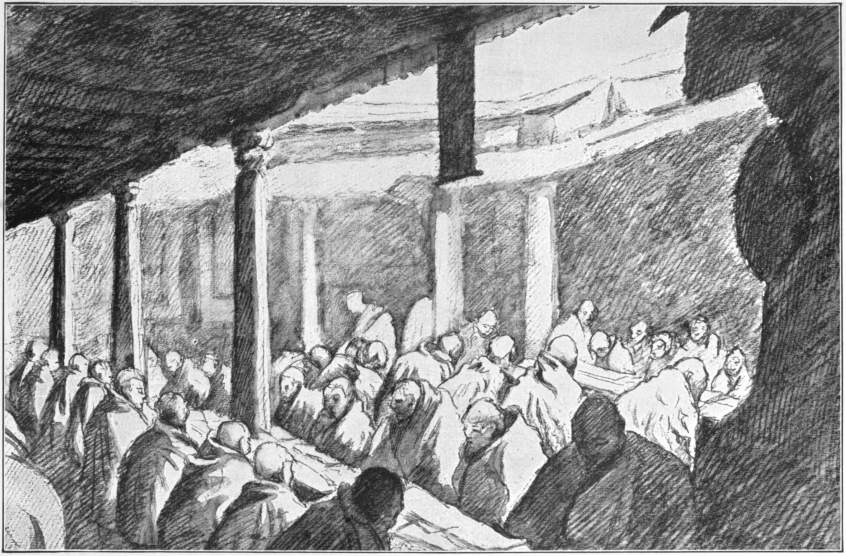
154. Lecture in Tashi-lunpo. Sketch by the Author.
In the afternoon a company of dancers, male and female, frequently appears in the court and gives no despicable performances, reminding me strongly of the dances in Leh. They are always introduced by our little old mother Mamu, who has the management of the garden, and hops about smiling and friendly as a sparrow. She speaks Urdu, so Robert employs her as interpreter. Then come caravans, bringing hay, firewood, chaff, and barley for our remaining animals, or provisions for ourselves, and people are constantly coming to sell all kinds of goods—chickens, eggs, butter, or fish from the Tsangpo; milkmen run with their clattering metal cans, and stringed instruments and flutes make music in our groves. A beggar comes up like a troubadour to my tent with a lute, and sings a melodious air. When I look at him he stops singing and puts out his tongue. Barefooted boys, who could be no blacker if they were drawn twice up a chimney, run about laughing loudly, and peep out from among the trees. Three of them perform on a tight rope, dance like professional rope-dancers, and beat drums, while they turn summersaults all mixed up together (Illustration 164).
Pious visitors also frequent my courtyard: two nuns, for instance, with a large tanka representing a series of complicated episodes from the holy scriptures. While one chants the explanation, the other points with a stick to the corresponding picture (Illustration 165). She sings so sweetly and with so much feeling that it is a pleasure to listen to her. Or a mendicant lama comes with his praying mill in his hand and two hand-grooves hung by a strap round his neck. In these he pushes his hands as in a curry-comb, when he prostrates himself on the ground in making a circuit of the temple. They are much worn, and this moves the hearts of the people to generosity, so that his alms bowl is filled daily.
These pious men are the parasites of Tibet, living at the expense of the working population. And yet they are endured and treated by every one with the greatest consideration and respect. To give them a mite brings a blessing on the giver. The people are kept by the lamas in spiritual slavery, and the lamas themselves are docile slaves to those tomes of narrow-minded dogmas which have been stereotyped for centuries, which may not be interfered with or criticised, for they are canonical, proclaim the absolute truth, and stand in the way of all free and independent thought. The clergy form a very considerable percentage of the scanty population of this poor country. Without the Peter’s pence Tibet could not make both ends meet. Tashi-lunpo is, then, a huge savings-box, in which the rich man places his pile of gold, the poor man his mite. And with what object? To propitiate the monks, for they are the mediators between the gods and the people. Scarcely any other land is so completely under the thumb of the priests as Tibet. And while the people toil, the monks gather round their tea-pots and bowls of tsamba at the summons of the conch.
On three evenings in succession large numbers of wild-geese have flown low over our garden from north-west to south-east. The ravens are as bold as usual; of other birds only sparrows roost in our trees. Our camp within the wall is quiet, but we have posted a night-watch outside, for in a town like Shigatse, full of all sorts of vagabonds, there are many scoundrels. Two monks, who were with me one evening to answer my inquiries, durst not return to Tashi-lunpo in the dark, unless I sent some of my men armed with guns to take them home. Recently a lama was attacked at night between the town and the monastery and stripped to the skin.
On February 20, after only 17.6 degrees of frost, it snowed all day long, the wind howled dismally through the poplars, and the snow fell on my tent. Nothing was to be seen of the golden temple roofs, and the ground and the mountains were white; there was no one in the bazaar, and no inquisitive visitors pestered us. It was just as in the Chang-tang.
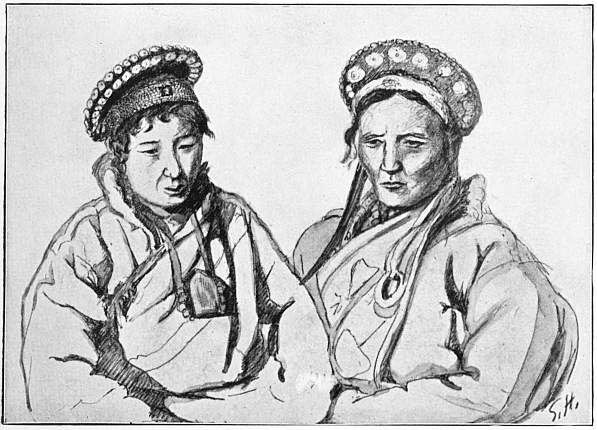
155. Female Pilgrims from the Nam-tso.
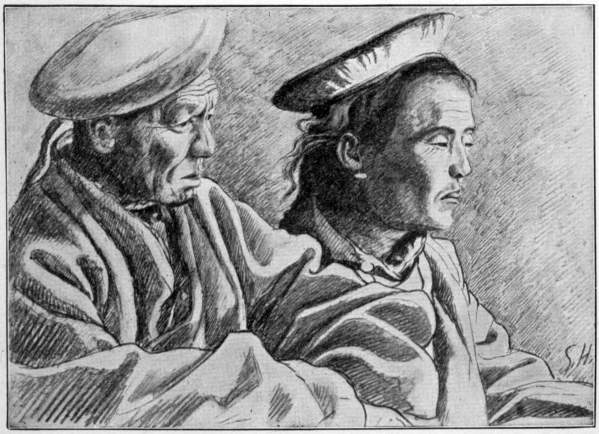
156. Tibetans in Shigatse. Sketches by the Author.
On March 4 Gulam Kadir paid me a farewell visit, for he was going next day to Lhasa, which, according to his reckoning, was nine days’ journey distant. As he would pass through Gyangtse, he took a large letter-bag to Major O’Connor. On the day before, he had sent off a caravan of 201 yaks laden with brick tea to Ladak. A yak carries 24 bricks, and a brick costs in Shigatse 6 rupees, but in Ladak 9 to 11. It is only the refuse of the tea, which is despised in China, but is good enough for Tibetans and Ladakis. Gulam Kadir hires the yaks at a cost of 5 rupees a head to Gartok—uncommonly cheap, but they follow the mountain paths and their keep costs nothing. They are five months on the way, for the caravan makes short marches and stays at places where grass grows luxuriantly. From Gartok, where the Hajji Nazer Shah has a large warehouse, managed by Gulam Razul, the tea is transported on other yaks. By a single caravan of this kind the commercial house of the Hajji makes a very large profit. Musk, coral, Chinese textiles, and other valuable goods are forwarded on mules along the great highway which runs along the Tsangpo and the upper Indus.
I had on several occasions met Kung Gushuk, the Duke, in the monastery, and had thanked him for his kindness in sending my letters to the lakes, but it was not till March 7 that I paid him a visit in his house. The walls in the entrance hall are painted with tigers and leopards. In the court, round which the stables and servants’ quarters are situated, a large black watch-dog, with red eyes and a red swollen ring round his neck, is chained up, and is so savage that he has to be held while we pass. After mounting two ladder-like staircases we come to the reception-room, which is very elegant, and has square red pillars with carved capitals in green and blue. Along the walls stands a row of shrines of gilded wood with burning butter-lamps in front of them, and over them hang photographs of the Tashi Lama which were taken in Calcutta. The rest of the walls are draped with holy banners (Illustration 167).