Front matter (continued 5)
Reading edition
Two of the missing men turned up in the forenoon, carrying boxes. A horse had been left behind. Islam Ahun, who had led the horse caravan, had cleverly conducted them down by the shortest way to the lake, and had encamped there beside good pasture. Muhamed Isa and his companions had lost themselves in the night, and had slept beside a fire, with nothing to eat or drink but snow. But they, too, found their way to us again, and so the remnants of the caravan were gathered together to one place.
Here everything was sorted out that could be spared: sacks, bags, ropes, horse-shoes, tools, and cooking utensils. Boxes were burned after their contents had been transferred to others; no one was allowed to burden the caravan with unnecessary articles. The rejected goods formed a large heap, and we thus got rid of two horse loads. Then we took stock, and found that we had still 32 loads including the boat. We had 20 mules, of which 2 were on their last legs, and 21 horses also, including 2 ready to drop, or 37 serviceable animals in all. Only Robert and I were allowed to ride, so that we had 3 spare horses; but in the evening the loads were so distributed that all the animals carried something, except the sickly ones. Four animals were to be laden with maize and barley, the rice made seven loads more, the meal five, the bread one, and the butter, which the Ladakis took in their tea, only half a load. We estimated that the meal would last a month longer; five loads of rice were to be given up to the animals, and I directed all the men to take the greatest care of the veterans. Tundup Sonam shot three antelopes just when our meat was finished. Some of the Ladakis had to cut them up, and at even when they returned with the spoil they intoned the antiphonal song they sing when they carry a dandy, or an ordinary load, at home in Ladak. One of the antelopes, however, was all devoured by the wolves before they found it.
We decided to rest a couple of days at the next camp, and Tundup Sonam undertook to conduct us to a small lake lying to the east, where the grass was particularly good.
In the night of October 24 a horse and two mules died, so we had 38 animals. “The strongest are still living,” said Muhamed Isa as usual.
To the north rose the lofty mountain system which had caused us so much suffering, and its crests were seen stretching to the east. We advanced over even ground, and after a short march reached a small round lake firmly frozen over, and surrounded by yellow grassland. Water was supplied by a spring which filled a small frozen basin; the animals drank as much as they would from a hole cut through the ice; they had had no water for three days. The sandy soil was frozen so hard that the iron tent-pegs bent when they were driven into the ground. The sky was overcast, and there was a strong wind, but the ground to the east-south-east seemed favourable. The four tents stood in a row, mine to windward, that I might not be annoyed by the smoke of the other fires.
At ten o’clock at night a flock of wild geese passed over our camp in the brilliant, silvery-white moonshine. They flew very low, and quacked the whole time. Probably they intended to settle at the spring, but went on when they found the place occupied. “There is plenty of light, and in a short time we shall be at the next spring.” Such, we may suppose, was the gist of the conversation between the leading goose and the others. No doubt it had given its orders at sunset, remarking: “To-night we will stay at the spring on the shore of the small lake, where we rested last spring.” All were agreed, and the flock, flying in a wedge, had gradually dipped lower towards the ground. But when they had passed over the hills which concealed the spot from view, and saw the frozen lake glancing like a mirror in the moonshine, the leading goose called out, “Men! we cannot stay so near to tents and fires. Up again, and onwards.” And all the flock answered: “We can rest at the next spring in the valley behind the hills to the south.” That was the conversation I heard above my tent when all was quiet in the camp. Perhaps the lively chatter was about something else, but I think that I interpreted the wild geese correctly. For it is quite certain that they hold consultations on their long journeys, and discuss their plans. And why should they not be endowed with intelligence? Why should they speed away at random like soulless flying-machines? They are just as dependent as ourselves on the earth and winds. If they can cover 120 miles on a clear, calm day, they must take a longer time over the same distance when storm and contrary winds prevail. Therefore they cannot every year pass the nights at the same springs, but must adapt their arrangements to circumstances. But the wild geese know every spring along the course they follow twice a year, and when they are tired they settle at the first they come to. On my travels in various parts of Tibet I have come to the conclusion that the same parties or tribes of wild geese, which have for generations bred at the same watercourses, follow always the same routes through Tibet. The geese which we saw on this occasion came, let us say, from one of the lakes along the Tarim river below Shah-yar, and intended to spend the winter in the neighbourhood of Khatmandu, the capital of Nepal. In spring they return to the Tarim lakes, and follow exactly the same course as in autumn, and so on from year to year. The young ones, which are born on the Tarim, make the journey over the mountains for the first time in autumn, but they remember the way in the following autumn, and afterwards the time comes when they in turn teach their young ones the position of the sources. Thus the knowledge of the route is never lost in the family, and the leading geese would never dream of trying any other course. We had already on several occasions seen wild geese flying southwards, but they had certainly taken other roads, come from other breeding-places, and had other destinations. They belonged to other tribes. If it were possible to draw on a map of Tibet all the tracks of the various tribes of geese, they would form a whole system of lines running more or less in a meridional direction. Perhaps many of these lines would in parts merge into one another like the fine ripples on the surface of a sand-dune. Perhaps now and then a line runs in sharp zigzags. It may then be taken for granted that it was thus drawn in the most remote antiquity when the patriarchs of each tribe first sought out the way from one spring to another. Each tribe is divided into a number of communities, and each of these into families. Probably all the geese of one community are closely related to one another. Each community remains together on the journey, but how do they choose a leader? It may be supposed that the oldest goose flies at the head of the flock, for it must be the most experienced, and if it dies the next oldest is its natural successor. I am fond of the wild geese, and admire their intelligence and their wonderful bump of locality; we shall hereafter come into closer contact with them.
In camp 48 we remained fully three days inactive, and the south wind howled continuously: “Patience! Patience!” To us the days seemed very long, but the animals must have rest. On the first morning horse No. 39 lay dead on the ground, and was entered with the same number in the list of the dead.
The wolves were impudent, and howled just outside our camp, but they were more polite after Tundup had shot a brute, which ran off on to the ice, and lay down to die in the middle of the lake. The scoundrel soon had as companion a raven, which had taken into his head to peck the manes of the living horses and disturb them while grazing. At nine o’clock in the evening the thermometer indicated −6°, and in the night −18½°.
In the morning Muhamed Isa reported that the dung-gatherers had discovered something which they described as ruins of stone houses. Robert and I went at once to look at them. We found that there actually were three quadrangular walls constructed of slabs of schist, probably of very ancient date. They rose but just above the ground, and on digging we discovered that they went down fully 3 feet. Probably they had been constructed only as foundations and wind screens for permanent tents, for such walls were afterwards met with on several occasions. There was no trace of a hearth. The Ladakis, who had travelled much in west Tibet, thought that the place had once been the permanent abode of some Changpas who had wished to avoid paying taxes to the Devashung, or the Government in Lhasa.
At any rate this discovery had a very encouraging effect on us. We had not seen men for 65 days, and now we found the first sign indicating their proximity. We felt invigorated, and the tale-teller in Muhamed Isa’s tent in the evening was longer winded than ever. He sang a song, all joining in the chorus. Now we must keep a sharp look-out in the country before us, for this first sign of man must surely be succeeded by others.
The caravan moved on towards the east-south-east on October 28 in a very violent south-west storm. A mule had died in the night, and so we had 36 baggage animals, but since the last inspection the provisions had diminished by nearly three loads. In this camp, also, superfluous articles were left behind. I threw away Sonja, by Blicher-Clausen. Robert and I sat at the morning fire, while the men saddled the horses, and I amused myself by tearing out one leaf of the book after another and throwing the whole collection into the air, where the wind swept the flying leaves with tremendous velocity to the north-east. The ten ravens puzzled their heads as to what new species of flying creatures they could be, but made little effort to get out of their way, and the dogs soon gave up the attempt to pursue the leaves; but one of Tsering’s pack-horses was so alarmed that it shied, broke loose, and rushed up the hills, and was not caught again for a good half hour. Meanwhile Sonja swept on, fluttering over mountain and valley, much to my satisfaction, for I had felt annoyed the evening before because she left her good-hearted husband. When and where would these leaves come to rest after flying over endless stretches of unknown country? Certainly a book has seldom had so wide a distribution.
We follow the track of the caravan in an open, flat valley between low mountains. After riding some hours we were so perished that we had to make a halt in a hollow way and light a fire. My small white Ladak horse was in excellent condition; he treated the cold and other disagreeable incidents with philosophical calmness. The tall dapple-grey which I had ridden from Leh was usually off duty, for he showed symptoms of exhaustion. At this day’s camp there was no water, only snow in a cleft of the mountain. Yet we were in very high spirits, for the men had seen fireplaces built of three stones laid crossways, which were intended to hold a kettle. It must have been a long time, however, since they were used, for neither ash nor soot was seen among them. An iron ladle, too, was found, such as the Tibetans use to melt lead for bullets. So either robbers or hunters must have halted here sometime or other.
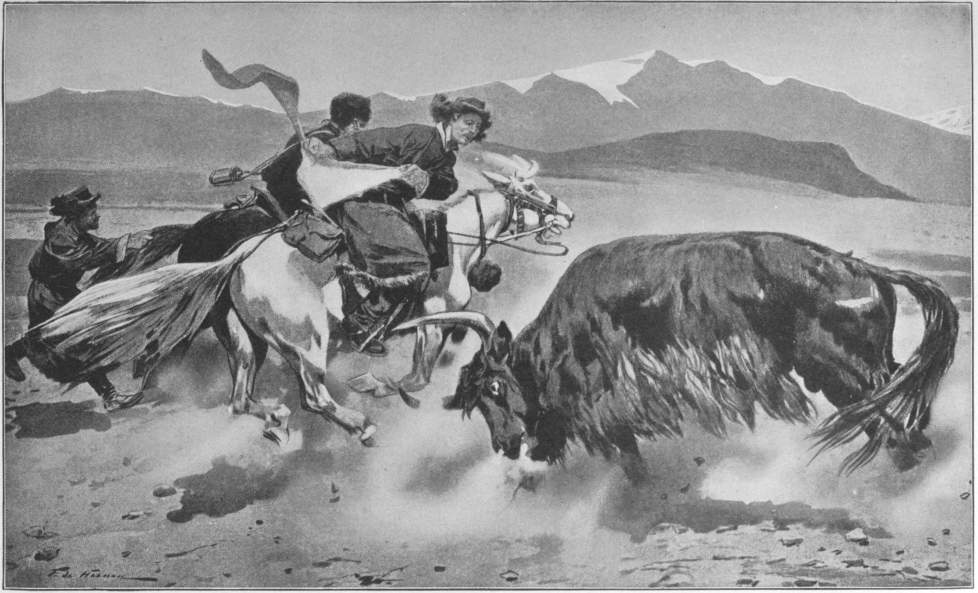
83. The Author, Robert, and Rehim Ali attacked by a Wounded Yak.

CHAPTER XIV
IN THE LAND OF THE WILD YAK
We broke up our camp on the morning of October 29, after a night of 49 degrees of frost, at an early hour, so as to find water for our thirsty animals as soon as possible. A small lake and two springs we passed were frozen as hard as rock; beside one lay the skull of a yak, which had evidently had its throat cut with a knife; we also saw two fireplaces on the way, and at camp No. 50 a path, which, however, might have been worn by wild yaks. We therefore were no doubt coming near to other men, and we were always on the look-out for tents.
Next day the storm increased in strength, and it was only with the greatest effort of will that I could use my hands for map-sketching. We seemed paralyzed and could no longer think clearly. We were like the field-mice, which run from one hole to another seeking to find shelter from the wind and cold.
On arriving at a spring I slipped down wearily from my horse, and thought I should be frozen before the fire was kindled. Muhamed Isa, also, and four other men, were ill, and could not assist in setting up the tents. When my tent was ready, I crept into bed in my clothes, boots and all. While Robert and Tsering were covering me up with warm wraps I was seized with violent ague, my teeth chattered, and my head ached terribly. Robert, who had been trained in nursing in Dr. Arthur Neve’s school, now proved an excellent doctor, and took every care of me. As soon as we were under cover he plunged into the study of Burroughs and Wellcome’s medical instructions. The Tabloid Brand Medicine Chest stood open, as frequently happened, in my tent. Stanley, Emin Pasha, Jackson, Scott, and many other travellers have prized this ideal travelling dispensary as highly as myself. My case, a present from the English firm, had been filled with especial regard to the climate of Tibet.
At ten o’clock at night Robert and Tsering undressed me. There were 47.9 degrees of frost in the night, and the storm howled dreadfully. Robert took my temperature every two hours, and it rose to 106½°, high-fever mark. As he told me after, he pondered whatever he was to do if I remained for good at camp No. 51. I could not sleep, and Robert and Tsering watched beside my bed in turn; glowing lumps of fuel were brought in all through the night, and a burning candle was placed behind a box, where it was protected from wind and draught. I was constantly delirious and the men were much concerned, for they had never seen me ill before.
Next day the fever had slightly abated, when Muhamed Isa slipped gently into my tent to inquire how the Sahib was. He informed us that the wounded yak was dead, and that, in cutting it up, two Tibetan bullets had been found; also at three places hearths had been seen, which could not be more than two months old, for ashes still lay among the stones. So hunters had been here in autumn, and he was quite convinced that we should soon meet with the first nomads.
It was still as the grave, only the storm howled and moaned. All the men in the camp were afraid of disturbing me, but I gave orders in the evening that they should sing as usual. I could not lift an arm without help, and I lay hour after hour watching the curious lights in the tent. Within, the stearin candle emitted a dull light, and the yellowish-red blaze of the fire and the bluish moonlight penetrated from without. The singing sounded melancholy and wistful, and was accompanied by the howling of the storm.
On November 2 the storm still raged, having now continued to the sixth day. I had slept a few hours, though the cold sank to 52° below freezing-point. I was getting a little better, but I was still extremely weak. Robert, who was troubled because his horse had died in the night, read to me one of the novels we had stolen from Deasy’s depôt. Tsering and Rehim Ali massaged me in the Asiatic manner to restore my strength. And so we arrived at the fourth evening. I had been confined to my bed for four-and-eighty hours, the soil of Tibet seemed determined to keep me, and perhaps I should be allowed only to dream of the forbidden land at a distance.
Surely on November 3 the god of the winds must have said to the westerly storm, “Six days shalt thou labour—on the seventh thou shalt become a hurricane.” Dust and sand penetrated the thin canvas and covered everything in the tent. The men, who had led the animals to water, had rings of dust round their eyes, and their faces were ashy grey. For my part I felt like one of our poor worn-out brutes, which does not know whether he will reach the next camp. Then I decided to remain here with some of the men and some provisions, while Robert and Muhamed Isa went in search of natives, whom they might send to fetch me. But no; I would try to hold myself in the saddle, for I did not wish to remain in this miserable fever-camp. I wore a whole wardrobe of winter clothes: several trousers, my leather jersey, the ulster, fur coat, cap, and bashlik; it was a heavy weight for my weak, tottering legs as I walked to my horse and was lifted into the saddle.
We followed the shore of the small lake near our camp. But I soon perceived, after nearly falling again and again, that the exertion was too much for me, so we halted and lighted a fire. After a short rest we rode on, and were delighted when at length we saw the smoke of our caravan rising behind a hill, where it had camped by a source and had found fireplaces erected last summer, with skulls and horns of tame sheep around them. Yak dung was very plentiful; the source was, therefore, a watering-place of wild yaks. A third of the men were really ill, most of them suffered from headache, and all were more or less indisposed. Robert alone was in good health, and he nursed us.
On November 5 the tracks of men became more frequent. A yak’s skeleton lay beside a hearth, and the ashes piled up among the stones could not have been cold longer than the day before. We climbed up troublesome hills and then descended into a gully leading down to a large valley begirt with fiery red heights. A number of excavations, each with a heap of sand beside it, attracted our attention. The sand contained gold, so not ordinary nomads but gold-seekers had been here, probably every summer, to dig for gold.
In the lower part of the valley warm springs burst forth with a temperature of 57°, so that the water seems quite hot. A few yards farther, however, it forms a large sheet of ice.
In the next valley, a hollow between precipitous terraced slopes, a huge wild yak lay dead on the ground with twelve of our men standing round it. Tundup Sonam had surprised a whole herd which had come down into the valley to drink. The other animals had torn up the valley in headlong flight, but this one, struck by a bullet, had made for the hunter, and Tundup clambered up the edge of a terrace only just in time. The yak remained at the foot, uncertain what to do, and received a second shot in the heart.
I photographed him from several points of view before he was skinned. It was not easy to raise him into a suitable posture; the twelve men had to put forth all their strength. The raven-black coat of the beast formed a strong contrast to the red soil; his long side fringes serve him as a mattress when he lies down (Illustrations 68, 69).
On November 7 we skirted a lake; to the right we had steep mountains with disagreeable cones of sharp-edged débris. Two troops of fine Ammon sheep, numbering nine and five respectively, skipped with bold leaps over the smooth abrupt rocks. Large numbers of hares were seen, and frequently the holes of marmots where the inmates were still hibernating. Two Tibetan cairns proved to us that we were on the right way, that is, the one the gold-diggers use.
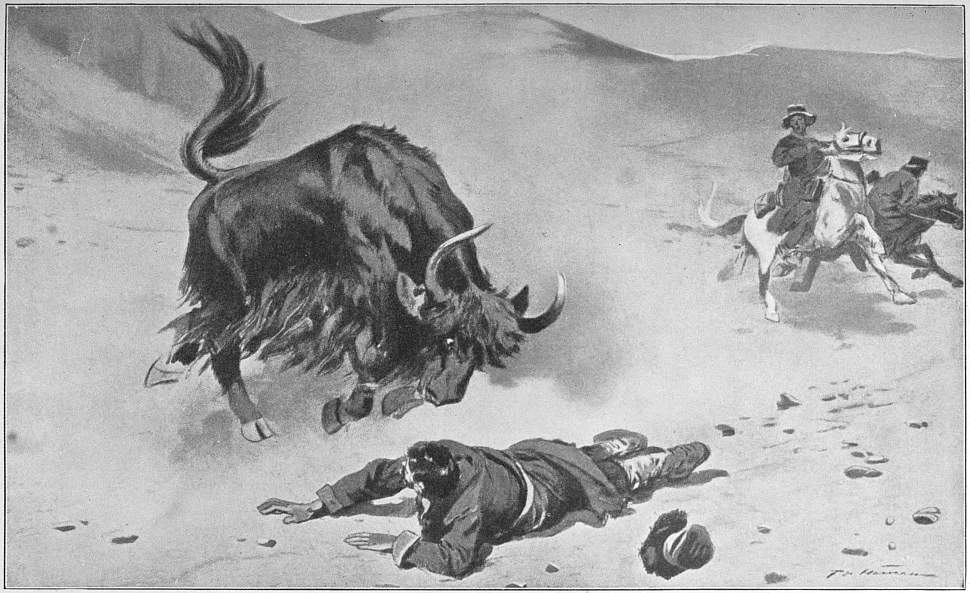
84. Rehim Ali falls to the Ground and thus rescues us from the Furious Yak.
Now we leave this part of the mountains on the right, and proceed along the southern, open and extensive plain by the lake shore. There grazed a herd of perhaps fifty yaks. Twenty antelopes, probably frightened by the caravan, scampered away with elastic springs like the shadow of clouds moving over the earth. Soon the tents and all the details of camp No. 56 could be clearly distinguished, and we had only a few minutes’ march more, when even this short distance would have been too far for one of us, if fate had so willed.
For close beside the tents, near our animals, a large black yak appeared. Rehim Ali drew our attention to it, but we took no farther notice of it. I took my last bearing of the tent, and was in the act of laying down the ground on my map-sheet, when a shot cracked from Muhamed Isa’s tent, and the yak, evidently hit, rushed madly northwards. We followed him with our eyes, expecting to see him fall. But no; he turned and came running wildly towards us. Rehim Ali’s face was contorted with frantic fright, and he raised his hands to heaven, crying out, “Allah, Allah, we are lost!” The brute drew near in a cloud of dust, his fringes waved and flew about, and he lowered his horns for a rush. I did not move, for I thought that he had not seen us and would turn back again, but he held on his way and grew larger to the sight. Rehim Ali ran screaming to the tents, but suddenly turned round, and as our horses took fright and galloped off, he caught hold of the tail of Robert’s steed, hoping to follow us at a run. The wild chase swept quicker and quicker over the plain, and the yak changed his course and made a circuit towards us in a mad rage. His breath rose like clouds of steam from his nostrils, his muzzle almost grazed the ground—he was ready to catch his victim on his horns, toss him into the air, and stamp him to a jelly under his forefeet. Nearer and nearer I heard him, panting and gasping like a steam saw. Turning in my saddle I saw him about twenty yards off, his small, fierce eyes blazing with fury and madness and rolling so as to show the blood-stained whites. It was a question of a second. I rode straight to the right; my horse and I would be the first to be caught on the horns of the yak. Now the horses stretched their legs like bow-strings. I tore off my red bashlik and waved it behind me to attract the yak and stop him, but he did not look at it. Then I tore my belt off in order to take off my fur coat and throw it over the yak’s eyes and blind him, just when he was on the point of thrusting his horns into the belly of the horse and stiffening the muscles of his neck for the toss. A second more and the yak would hoist the horse, break my back, and trample on my chest—I seemed to hear the cracking and breaking of my ribs, and I well deserved it, for it was my fault alone that all the animals left behind us had to suffer so much. Then was heard a heart-rending cry of despair. As I turned quickly round, I saw Rehim Ali with uplifted arms fall senseless to the ground, and the yak turn and rush at him. He remained prostrate, a lifeless mass, and I saw the yak, with lowered horns, and his purple tongue hanging far out of his mouth, dash down upon him in a cloud of dust. Now all the horses made off, and I had some difficulty to keep my seat on my grey Ladaki. When I looked round again, a second later, the yak was running up the valley with his dust cloud about him.
“Turn back and see if there is still a spark of life in Rehim Ali, and if he can still be saved,” I called out.
“Master, it is too dangerous, the yak is still near, and may come back. Muhamed Isa and all the rest are running out of the camp to look after Rehim Ali.”
But I had already turned, and I rode to the fallen man. He lay dead on his face with arms outstretched—both Robert and I thought, at any rate, that he was dead. But when we had dismounted beside him he slowly turned his head, and with a look of horror waved his hand, as much as to say: “Do not trouble about me, I am dead as a mouse.” We could not repress a smile when, turning him over like a joint at the fire, we examined his bones and joints, and found that the fellow was still sound, though severely bruised. The yak had trodden upon the inner side of the left shank, where a bloody stripe showed the mark of his hoof.
Two strong men bore the fallen hero to Muhamed Isa’s tent, where he was well tended by Robert. He seemed stupefied for several days, and we feared that his adventure had affected his brain. He did not eat or speak, and had to travel on horseback, and one of his fellow-countrymen was told off to attend on him. After some time, when his head was clear again, he was able to tell us his impressions. When he saw the yak preparing to attack my horse, he turned round and threw himself flat on the ground. Perhaps irritated by the red and violet chapkan floating about in the air, the yak left me, made an unexpected change of front, and rushed with lowered horns on the fallen man. He had half unconsciously made a quick movement to one side, and the horns had struck the ground instead of entering his body, and so close beside his head that Rehim Ali felt the panting breath of the brute in his face. Then he lost consciousness, and did not revive till we came up, and then he thought that the yak was on him again. He had intended to save himself by this manœuvre, and thereby had become our deliverer. After the adventures he had taken part in lately he had an immense horror of Tibetan lakes and wild yaks (Illustrations 83, 84).
Temperature—16½° on the night of November 28. One would expect that the temperature would fall with the advance of winter, but it remains constant, owing in great measure to our progress southwards. Beyond a small pass we came to a new longitudinal valley, where the country was open towards the south-east. Game was abundant, spoors crossed one another in all directions, and two bold yaks awakened in us greater respect than before. At six places we saw large herds of wild asses, and antelopes grazed on the plains. We lost a mule here, and had now 16 animals of both kinds.
Another day’s journey across flat country. We were traversing the large white patch of unknown land, and were approaching Bower’s route at an acute angle, though we were still rather far east of it. A wild yak ran across our path, and we wondered if it were our enemy of the previous day. Where we pitched our camp, No. 58, we found some hearths which could not be more than a couple of days old. Our excitement and eagerness increased day by day; now the uttermost margin of inhabited Tibet could not be far distant. As I let my eyes rove over these red or black, snow-capped or bare crests, I could fancy I could perceive a whole host of dancing notes of interrogation, some in fantastic draperies, mocking us because we had ventured without an escort into the forbidden land, others motioning us onwards, but all doubtful and speculative. Step by step, day by day, with failing strength, we approached the solution of all these questions. Any moment a troop of mounted men might appear on the horizon, bringing orders from the Devashung that we must immediately evacuate the country and retire northwards.
I was still convalescent, went to bed at seven o’clock, and was not much the better for it, for I always felt terribly languid. Tsering was very despondent because I did so little honour to his cooking. “How can the Sahib regain his strength if he eats so little?” he used to remind me. He was a comical fellow, Tsering, as he marched day after day with his stick in his hand at the head of his detachment, self-conscious and pompous as a chanticleer.
Late at night we heard the dismal, long-drawn howling of wolves close at hand. We could tell from the wild complaining tone that hunger had made the brutes bolder and that the odour of fresh meat excited them. They were on the other side of the source, and Tundup Sonam stole off to scare them away by firing into the troop, though there was small chance of hitting one in the darkness. The brutes retired, but in the night chased our animals, which scampered off to the north as though there were a fire behind them. But the men followed their trail, and found them at dawn a good day’s journey from the camp.
On November 10 we had good ground again, and saw to the east-south-east a lake which looked like a bright white ring, the middle being deep blue. Near this day’s camp, No. 59, were clear traces of a man who had driven five tame yaks to the lake. The footprints were at most three days old, and excited a great stir in the caravan. We were undoubtedly close to human dwellings, and I thought with regret of the interval of nearly three months during which we had no cause to dread hostile tribes. We held a council of war: should we as long as possible avoid contact with men, and keep out of the way of their tents, so that we need not turn back until further progress became quite impossible? Or should we seek out the nearest nomads at once, and beg them for assistance? At this moment Tundup Sonam ran up out of breath. He had been scouting to the west and had descried a black tent. I immediately sent him to it with two other men, and gave them a handful of rupees. But the news they brought from this first meeting with human beings was not particularly interesting.
The tent was inhabited by a woman and her three children. She had come from the district of Gertse in the south-west, and had covered the distance in twenty-five short days’ marches. She had arrived seventeen days before with her two husbands, but both had returned a few days ago to Gertse, after they had filled the tent for her with wild-ass meat. She was daily expecting her parents, who were to keep her company for three months, during which time they would live on game—yaks, kiangs, and antelopes. She owned a few yaks and a small flock of sheep, which she and the oldest child tended and milked. The inside of the tent was very wretched, but a warm fire burned in the centre. She knew that four more tents were standing in a neighbouring valley. When Tundup Sonam told her that we were a party of Ladakis on a pilgrimage to the holy places, she replied that we had chosen a very bad route, and would have done better to take a more southern road where there were men. Her geographical knowledge was limited. The country in which we were now she called Gomo-selung. The gold placers we had passed lay in the La-shung country, and the lake at camp No. 55 she called La-shung-tso. My servants, who had already been in Tibet, held that this information was reliable, for they had heard the names before.
Now, then, the ice was broken. After seventy-nine days of complete isolation from the outer world, some of our men, at least, had seen human beings. But other connections would soon follow this lonely woman, this daughter of the wilderness, this real lady of the mountains, and again we discussed the line of policy we must adopt. The woman dwelt alone, and no news of our approach could be conveyed through her instrumentality to the south. We could, then, take the matter for the present quite coolly as heretofore, and when we were surrounded on all sides by nomads, among whom reports are rapidly dispersed, we must then think of hastening our movements.
We granted the animals a day’s rest, for the pasturage was good, and it was pleasant to spend this day under canvas. The storm whistled and howled through the grass and round the stones. Everything that was light and loose was blown away, and the ground was swept clean. The sky was cloudless and the air clear, the wild commotion was only in the layer of air close to the ground, and the important part played by the wind in the deformation of the surface was evident; in such a storm huge masses of material must be removed from their original position.
In the night the storm ceased all of a sudden, and it became so still all at once that I awoke. It was as though we had encamped by a waterfall which in an instant ceased to roar. One starts up and wonders what has happened, but one soon becomes accustomed to the stillness, and finds the absence of the noise and the draught a relief.
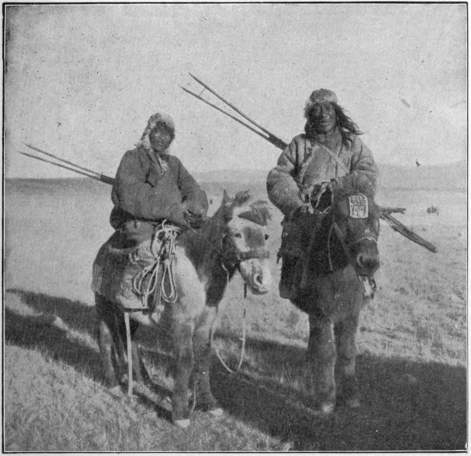
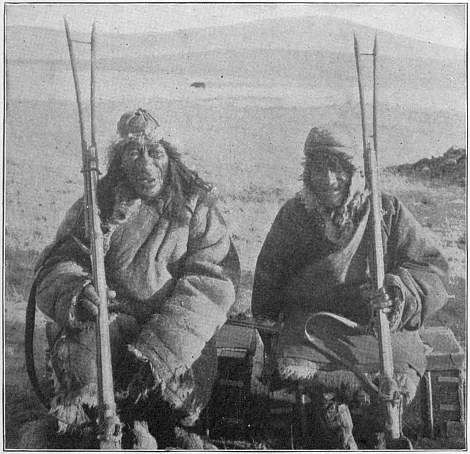
85, 86. The First Tibetans.
CHAPTER XV
THE FIRST NOMADS
Sad news again on the morning of November 12: two of our best horses were dead, and a third, which had carried two boxes, made in Stockholm, all the way from Leh, was at the point of death. All three had been sound on the preceding evening, and they died with exactly the same symptoms. They became giddy, lost control of their legs, fell down, and were unable to get up again. I hoped to rescue the remnants of my caravan, and was already thinking of the time when I could lead the poor beasts to mangers in Shigatse full of sweet-smelling clover, and now those that we had reckoned the strongest had broken down. Now only 13 horses were left, and the loads would soon be too heavy for the survivors.
But it had not come to that yet, for this day, which commenced so sadly, brought us joy before the sun went down. Following the track of the caravan we rode among hills, and saw below us camp No. 60 in a deep valley. I had just entered my tent when Muhamed Isa announced that Tundup Sonam was coming from the upper valley in the company of two Tibetans, one mounted, the other on foot. Timorous, and doubtful whether Tundup Sonam had allured them to a robber band, the Tibetans laid their long clumsy guns on the ground and came forward cautiously. Tundup had needed all the fascinations of his eloquence to induce them to come with him. He had told them that we were pilgrims accompanying an eminent lama from Ladak to the holy places: Then they had answered that they would come and show their reverence for His Holiness, and bring with them a sheep’s stomach full of butter, and another with goat’s milk, as a testimony of their deep respect. Muhamed Isa, who was accustomed to deal with Tibetans, allayed their fears, taking them into his tent and talking and joking with them. Then they were brought to me, and they laid their presents on the ground, fell on their knees, put out their tongues, and made a low obeisance. Instead of a holy man they found a European, but seemed by no means displeased with the change. Muhamed Isa acted as interpreter. They must first give us information on the geography of the country and the character of the land through which our route lay. The information received from the lady of the mountains was confirmed in every respect, and they told us that we should meet with no men for several days, but after that should pass black tents daily.
Our guests might be fifty and forty years old respectively. The elder was quite a typical specimen, more like an ape than a man; the younger looked as though he had already met with many adventures, and he would have passed very well for a robber chief (Illustrations 85, 86).
The conversation now commenced may have little intrinsic interest, but to us in our condition it was as exciting as a tale—our salvation was involved.
“How long is it by the nearest way to Shigatse?’’
“Four long, or five short, days’ march.”
“Will you guide us?”
“Yes, if we are paid to do so.”
“How much do you want?”
“That the Bombo Chimbo (great chief) shall decide himself.”
“Have you any horses you can sell us?”
“We have two, but we will not sell them.”
“Have you any yaks for sale?”
“Yes, we will sell five, if we get 20 rupees for each.”
“Will you give us some of your sheep?”
“You may have six, if you will pay 4 rupees a head.”
“Good. Bring all the animals you are ready to sell, and if we are satisfied with them you shall be well paid.”
“The Bombo Chimbo must remain here till to-morrow if we are to do this.”
It was then agreed that we should remain. But I knew the Tibetans, and was aware that they promise much and perform little. We therefore kept the fellows with us for the night, and they slept in Muhamed Isa’s tent. In the evening they were enraptured by the tones of our flutes, and felt so much at home that their tongues were loosened, and rattled like praying-mills. I heard their cackling until I went to sleep.
And this night I slept well. After eighty days of complete solitude we again had men as guests in our tents; we had obtained fine, rich goat’s milk, and next day we should feast on well-fed mutton; we had received information about the country and the marches before us on the way to our far-off destination. And what was best of all, our veterans, our caravan animals, would get help. And this help was a boon from heaven; for this day, after we had lost three more horses at once, and when Rehim Ali must unfortunately be reckoned among the baggage, the loads had become too heavy for the animals. The future seemed more promising. Certainly the ridge of the Samoma-sakcho mountains did not exhibit a more purple colour in the evening light than the mountains which we had seen glowing in a grand display of colours on many a lonesome night; the blue smoke of the camp-fires danced a fairy dance on the steppe grass just as before, and the night came down just as dark and cold over the mountains to the east, but all around us to-day inspired us with cheerfulness and hope.
The new day had hardly broken when our two Changpas set out homewards with some of the Ladakis, to make preparations for the great business transaction. Two hours later we were the fortunate owners of five fine yaks, which, the Tibetans affirmed, could easily carry four boxes each, whereas our horses and mules had carried only two. One of the yaks was to take over the boat, and the horse which had carried it from Lake Lighten was relieved of the work. I breathed freely again when I saw the faithful animal without anything to carry. Then we bought four sheep at 4 rupees each, and exchanged our last three sheep for two fresh ones, paying 2 rupees in addition. At the Gomo lake our last eight goats obtained their well-earned rest, being exchanged for as many Tibetan and a money payment of 1 rupee a head. In the evening I had three times as much milk as usual, and richer and better than our exhausted goats had supplied. Both parties were thoroughly satisfied with the bargain (Illustration 88).
Good old Changpas! The wandering cavaliers of the wilderness came to us, looking picturesquely savage with their black coarse hair hanging down over their shoulders and back, and making their furs greasy, with long, dark matchlocks on their shoulders, clumsy sabres and knives in their belts, and mounted on small, tough, long-haired horses. Though wild and dirty, they were yet kindly, friendly and good-tempered, and were certainly not cold in their old dingy fur coats. The elder wore a small round fur cap, the younger a bashlik of fur, which covered his whole head except the face. They had their provisions and all kinds of other articles they wanted on their journey stuffed into their fur coats in front, and from the belts which held their fur coats together, hung knives, awl, flint and steel, pipe and tobacco pouch, which swung and knocked together at every step. They wore felt boots, originally white, but now black and worn-out, but had no trousers—it must be far too cool to sit trouserless in the saddle with 36 degrees of frost.
As they came from Gertse, the country to the south-west, they had hardly any knowledge of the region through which we were to travel, but they thought that we should require at least fifty days for the journey to Shigatse. They pass the winter in the Gomo district, living on the game there. They could easily serve a little breakfast with which the most exacting gourmand might be satisfied. Is not the following menu tempting?
A bowl of goat’s milk with rich yellow cream.
Yak kidneys, fried a golden yellow in fat.
Marrow from yak bones, toasted over the fire.
Small, delicate pieces of tender, juicy meat from the vertebræ of the antelope, laid before the fire and slowly browned.
Antelope head, held in the flames with the hide and hair on till it is blackened with soot.
Their taste is in general very different from ours. When they have killed a wild ass, they cut it up and keep the pieces in the tent, piled up around it as far as possible from the fire. The longer it has lain there, the better it is supposed to taste. The Changpas prefer to eat their meat raw, hard, dry, and old. They take out from the recesses of their fur coats a yak’s rib, which looks more like a piece of blackened wood than anything edible. Then the knife is brought out, and the hard meat is removed in strips or lumps from the bone. Chinese brick-tea is their greatest luxury, and the thicker and dirtier it is, the better they like it. They stir it up with a piece of butter.
Like the wild geese, they have learned by traditional experience where the best camping-grounds are. One may be sure that their tent is always pitched at places where there is little or no wind; that there is good pasture at hand for their tame yaks, sheep, goats, and horses, if they have any; that good hunting-grounds are to be found not far from the tent, and that water is always to be had. At the Gomo lake they have excellent table-salt cost free. When their domestic animals have eaten up the grass around, and the game has been frightened away, they transfer their camp to another district. The tents are set up at the same spots where their forefathers have pitched them for innumerable generations, and where frequently old votive cairns have been erected of loose stones to propitiate the spirits that rule over mountain and dale.
To the Changpas, or “inhabitants of the north,” who spend the winter in the north, the chase is the chief resource, and cattle-breeding is of secondary importance. The Tibetans in Gertse and Senkor, on the Bogtsang-tsangpo, or in Naktsang, who own large herds, do not move northwards in winter, for with them hunting is an occasional occupation. The hunting tribes pursue the yak, the kiang, and the antelope. In hilly country they stalk them against the wind. Constant life in the open air has wonderfully sharpened their intelligence. They know the peculiarities and habits of the yak as well as he does himself, and know how far they may go without overstepping the limits of his acuteness. They know that his senses of sight and hearing are not particularly well developed, but that he soon scents the huntsman, so that the attack must be made from the lee side. Though he goes on the chase in his thick fur coat, the huntsman creeps as noiselessly and as lithe as a panther till he approaches within range of his prey. Then he lays his gun on the rest, strikes fire from the flint with his steel, catches it in tinder, sets light to the end of the match, and sees that the hammer brings the fire at the right moment into the touch-hole. All is done so quietly, so deliberately and carefully, that the hunter has every prospect of bringing down the game.
Another time he watches for hours together behind a wall which he or his forefathers, perhaps his great-great-grandfather, has built beside a spring, and waits with angelic patience for a troop of wild asses, which come at sunset to quench their thirst. But the antelopes, wild sheep, and gazelles are too wide-awake to be caught by the most skilful hunter. Yet the antelopes do not always succeed in escaping his cunning toils. He lays nooses for them on the old established antelope paths; among the hunting nomads in the interior of Tibet, the quantities of antelope meat garnishing the sides of the tents are astonishing.
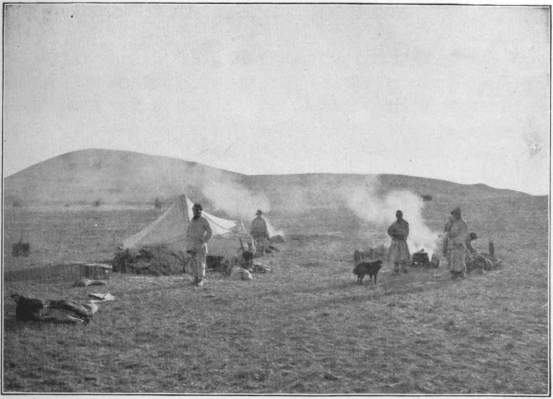
87. Smoking Camp-Fires in the Heart of Chang-tang.
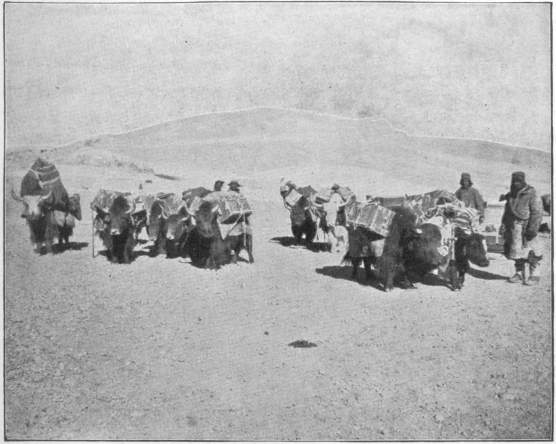
88. Our Yaks, bought from the First Tibetans.
While the men are away, the women look after the yaks and sheep, and when the hunter returns at sunset he sees the former chewing the cud in front of the tent, while the latter are shut up in a pen-fold of stone. The yaks remain at night near the tents, and hence the dung, the only fuel of the nomads, has not to be carried far. When it is dark, all gather round the fire on which the tea-kettle boils. Then they talk of the monotonous incidents of their life, of the day’s bag, the condition of their herds, and the work of next day. One mends his soles with sinew and an awl, another dresses a yak hide with his hands, and a third cuts straps from the skin of a wild ass. Their life seems void and uneventful, but they have no wants—they know nothing better. They have a severe struggle for life in this unproductive corner of the world, which is called the Chang-tang, or the north plain, where it has been their fate to be born. Amidst poverty and danger they live victorious in God’s free Nature; the awful storms are their brothers, the lordship of the valleys they share with the wild beasts of the desert, and at night the everlasting stars twinkle over their black tents. If they were given comfortable huts down south in the shade of walnut trees, they would always be longing for the grand solitude of the mountains, for the icy cold, the drifting snow, and the moonlight of the peaceful winter nights in Tibet.
Then Death comes one day and looks in through the tent door; in vain is the constant prayer “Om mani padme hum” repeated; vain are all attempts to conjure or propitiate the evil powers that are inimical to the children of men. Bent, wrinkled, and grey the old hunter finishes his course, and is borne on strong shoulders to some shallow cleft near the mountain crest, and there abandoned to the wolves and birds of prey. When his grandchildren are grown up, they do not know whither he has been taken; in life he had no abiding dwelling-place, and after death he has no grave. And no one asks where the bones of the dead are bleaching, for the place is haunted by evil spirits.
November 14. Calm! In the night there were again 49 degrees of frost, but it was fairly warm riding southwards towards the sun. The two horses of the Tibetans had stampeded. But if this were a trick contrived to give them an excuse for making off themselves, it did not succeed this time; for I sent off one of them with two of my men to look for the horses, while the other had to accompany me and tell me the names of the places we passed. We did not know our men yet, and therefore did not dare to let them out of our sight, or they might have despatched mounted messengers to give information to the authorities in Gertse. Then we should have been ordered to halt sooner than it suited us. Now we could feel easy, at least till we came to the next tent. But the horses were recovered, and the old man stumped after us leading them by the bridle. Then we rode together between the hills and over small passes. Here, too, gold occurred in two places. Men come every summer, dig up the sand, throw it into the air, and collect the grains of gold on a cloth spread out on the ground. If the output is abundant, the number of gold-diggers is doubled the following summer.
In camp No. 61, also, the Tibetans showed no desire to desert us; they were friendly and attentive, helped us in unloading and setting up the tents, collected fuel, and undertook to be answerable for the horses. They seemed not to have the slightest suspicion that the country was forbidden to us, and not an echo of any especial orders had reached them from the south. I could not learn how matters stood. The plan of my journey had been alluded to in the Indian press, and there was nothing to prevent tidings being carried to Lhasa through Darjiling or Pekin; and I knew also from experience how soon an order against a European is handed on among the nomads. I had counted on hurrying on, like a thief in the night, as soon as possible after the English mission to Lhasa, and appearing on the scene before the Tibetans had quite made up their mind about the political state of affairs. But perhaps I was wrong, perhaps stricter regulations than ever had been passed.
The western shadows move over the plain; only in the east are the hills deep crimson, in the west they show a pitch-black outline. Another night spreads out its dark-blue pinions, and rises up to the zenith, driving before it an expiring reflexion of the setting sun. When the stars begin to shine we are out of doors examining the animals, which rejoice at being more lightly loaded on the march. At seven o’clock I am massaged and go to bed. At nine o’clock Robert comes with the hypsometer, and we talk for an hour. Then the light is allowed to burn till it flickers out. I lie a long time awake, watching the shadows come and go, as the wind shakes the canvas. I gaze at them till they turn into monsters and wild yaks, dancing mockingly round my prison. Now it is striking midnight in the towns of Siberia and India which lie on our meridian, and at length comes the deliverer sleep and drives away the shadow-pictures: they melt away and vanish on the horizon, which recedes more and more into the distance, no longer bounded by the thin web of the tent. Now a low murmur seems to call to mind forests, meadows, and small rocky islands. I dream that a strong hand leads me to a parting in the ways. It points to a road, and a voice tells me that this will lead me to a land of peace, hospitality, and summer, while the other leads to dangers and privations among dark lofty mountains. When Tsering brought the brazier in the morning, I was glad that I had in my dream chosen the latter road without hesitation.
We penetrated further and further into this mysterious Tibet. During the next day’s march we passed a succession of deserted fireplaces, and in some places saw rows of stone cairns to entice the antelopes into snares. Then we ascended a valley, in which a small strip of ice gradually expanded into a cake, filling all the space between the firm slabs of greenstone. The Seoyinna came in sight—a dark mountain to the south, which would remain visible for a couple of days longer.
Our Tibetans are already as intimate with us all as though we had been friends from childhood, and say that they have never met with such decent people. The elder is called Puntsuk, the younger Tsering Dava. We sit for hours together at Muhamed Isa’s fire and talk pleasantly, and I take notes as they describe to me in detail all the routes in Tibet they are acquainted with. Tsering Dava has accomplished the pilgrimage to Tso-rinpoche, or the holy lake Manasarowar, which I long to reach, and which has been the subject of my dreams for many a day. The two men were to accompany us only three days more; they had left their yaks and sheep to the care of their wives and children, and wolves were extraordinarily numerous; otherwise they would have travelled any distance with us. They had arrived from Gertse nineteen days before, and intended to stay six months; forty or fifty parties come every year from Gertse to this country.
They told us that the Tokpas, or gold-diggers, when they go up to the goldfields for two or three months, take as provisions meal and meat, which are carried by their sheep and yaks. When the provisions are consumed they return home, passing the salt lakes, where they load their animals with salt, which they barter in inhabited districts for barley. Thus they make a twofold profit on their journey, and can live the rest of the year on their gains.
In the evening a dead horse, emaciated and wretched, lay on the ice in our valley. I had procured him for 70 rupees from a dealer in Leh, who in December 1901 had bought my last nine camels. Next morning a mule died just as unexpectedly. He looked brisk and sound, and allowed himself to be loaded as usual, but had not gone a hundred paces when he fell dead. The two small Tibetan horses, which travel with us, take a great interest in their fellows; but they do not seem quite sure that the animals, so thin and wretched, are really horses. At this day’s camp, No. 63, we saw them run up to their masters for two large pieces of frozen antelope flesh, which they eagerly ate out of their hands like bread. They are just as fond of yak or sheep’s flesh, and the Tibetans say that this diet makes them tough and hardy. We cannot help liking these small shaggy ponies, which live to no small extent on the offal of game, are at home in the mountains, and bear rarefied air with the greatest ease; their lungs are as well adapted to it as those of the wild asses. The cold does not trouble them in the least: they remain out all through the night without a covering of any sort, and even a temperature of −22.7°, which we had on the night of November 17, does not affect them. Though they are not shod, they run deftly and securely up and down the slopes, and the men on their backs look bigger than their horses. We notice with great amusement how heartily they greet each other at every camp. Puntsuk, who shows Muhamed Isa the way, rides a small bay pony, which is already grazing when we appear. As soon as the pony catches sight of his grey comrade with Tsering Dava he neighs with delight, cocks his ears, and runs up to him; and the grey one exhibits just as much satisfaction. This is very different from the conduct of our dogs, which fight wildly as soon as they see each other.
Now we passed the Seoyinna mountain; one flank was dotted over by numerous wild yaks engaged in feeding, and Tundup Sonam shot two. My men took the best joints with them, the rest of the meat our guides would fetch on their way home. They were evidently much impressed by Tundup Sonam’s skill, but Dava Tsering declared that he had shot more than three hundred yaks in his lifetime, which was probably no exaggeration, seeing that these men live on the products of the chase.
Now we ascend rapidly to the Chak-chom-la pass. Tsering Dava rides in front. His little pony trots up the ascent. When we have still a good distance to cover, we see the profile of the man and his horse on the summit, sharply defined against the sky. There stands a cairn of granite blocks, and many trails of gold-diggers run at a height of 17,825 feet. Sitting beside a fire, rendered necessary by the cold and the wind, we gaze southwards over a vast extent of country, a chaos of yellow, reddish, and black crests. No plains appear between them, and we suspect that we have troublesome ground before us. Near at hand, towards the south-south-east, a flat basin with a small lake occupies a large expanse. We ride down a very steep path to the camp where the Tibetans proposed a day’s rest on behalf of the yaks we had purchased.
In the course of the day we settled accounts with our guides, who had been so friendly and helpful, and who now wished to return to their bare cold mountains where the winds and wolves howl in rivalry. They received each 3 rupees a day as recompense, and a sheath-knife from Kashmir, and a whole heap of empty tin cigarette-boxes, which seemed to please them more than the money. And then they vanished, swiftly and lightly as the wind, behind the nearest hills, and we were alone again.
With 36 degrees of frost our nine Mohammedans celebrated their “Aid” after Ramazan with flute, dance, and song, and with a freshly slaughtered sheep. In the night the thermometer fell to −23°. The ink was always freezing in my pen, even when I sat bending over the brazier; after a few minutes my washing-basin contained only a mass of ice.
After a few hours’ march we descried from a pass 22 grazing horses, 300 sheep, and some evidently tame yaks, and these were near a tent. Farther to the west 500 sheep and a number of yaks were feeding. Five more tents were pitched in a sheltered place in a deep valley, and a troop of snarling dogs ran out to meet us. Men, women, and children turned out to see what was the matter. The caravan encamped near, on the western shore of the lake Dungtsa-tso, and presently received a visit from four Tibetans. These, too, came from Gertse, had arrived ten days previously, and intended to stay three months. The six tents contained 40 inmates, who possessed together 1000 sheep, 60 yaks, and 40 horses. The oldest of our new friends was a lame man of fifty-three years of age, and was named Lobsang Tsering. He presented to me a dish of sour milk and a bundle of joss-sticks, such as are used in temples. He was willing to sell us three large yaks for 23 rupees, and we took them without a moment’s hesitation.
When the caravan had set out next morning two other Tibetans presented themselves, very eager to sell us two more yaks. When I told them that our money was on in front, they asked permission to go with us to the next camp, where the purchase might be completed. That evening, then, we were the fortunate owners of ten excellent yaks, and Tundup Sonam was appointed to be their chief and leader. Our remaining mules and horses now carried only very light loads, and I was rejoicing that I could keep them all alive. But at this very spot another mule was frozen to death; true, there were 59.2 degrees of frost.
Our day’s march ran round the lake and into a broad valley extending in a south-easterly direction. Some 150 kulans were peacefully grazing among the tame yaks of the nomads. A youth acted as guide to the caravan, and old Lobsang Tsering rode like a herald before me, mounted on a fine yellowish horse, which he would not sell at any price. As he rode he muttered prayers at an incredible pace—it sounded like the buzzing of a swarm of midges about a lime tree on a summer evening. I myself rode my dapple-grey from Yarkand again, in order that my small white Ladaki might have a couple of days’ rest.
The camp was pitched beside a pool of fresh water, where the most wonderful sounds were emitted from the firm ice all night long. It cracked and clappered, gurgled and snorted like camels and yaks, and one might fancy that a bevy of water-nymphs were dancing under the icy roof. The dogs barked furiously at the ice till they at last perceived that this noise must be put up with like everything else.
At the evening fire Lobsang Tsering asked Muhamed Isa whether we had met with Changpas at the Gomo. But Muhamed Isa had promised Puntsuk and Tsering Dava not to betray them. Then Lobsang winked an eye and said that Islam Ahun had already told him that we had not only seen nomads, but had bought yaks from them and had taken them as guides for several days. Muhamed Isa tried to turn the affair into a joke, and answered laughing that Islam Ahun had concocted the story himself. But the old man was sharp; he smiled cunningly, and seemed to regard the first version as the more probable. It was a great advantage to us that we had first come into contact with Gertse nomads, who were themselves strangers in the country we passed through. They had received no orders from Lhasa concerning us, and were beyond all comparison better disposed and more friendly than the eastern Tibetans, who on my former journey had sent off messengers at once to the south. But we now found that the Gertse nomads were afraid of one another; the first had begged us to tell no one that they had helped us, and had turned back at the right moment in order not to be seen by their fellow-tribesmen from Gertse.
Lobsang Tsering did not seem to be of a timid disposition; he led us to other tents, gave us instructions about the way to Bogtsang-tsangpo, and was able to give us much interesting information. He told us, for instance, that nearly four thousand sheep and several hundred yaks are yearly employed in transporting salt from the lakes we had lately passed, and that the salt was carried to Shigatse and Lhasa. From these towns came most of the gold-diggers, and in the north were many other gold-placers which we had not seen.
We soon perceived that Lobsang was a man of importance, for all showed him the greatest respect, and we could see from his camp that he was rich. He spoke with dignity, and with an educated, refined accent. In his appearance he reminded me of a decayed actor, without a trace of beard, and with an animated expression in his dirty, copper-coloured face. Unlike the rest, who wore sheepskin caps, he sported a red turban, and his fur coat was trimmed with red woollen stuff. In the front of his coat all sorts of things were stuffed, among them a vile pocket-handkerchief—a thick, coloured, square rag, constantly in use, but never washed. There also he kept his snuff-horn, which he could handle even in a wind with a certain dexterity. The fine yellow snuff was scooped up on the tip of the forefinger under the protection of the thumb-nail, and conveyed to its destination somewhat noisily.
Every evening Muhamed Isa made his report. This time he presented himself with the following statement: “Sahib, Rehim Ali is still bad, and he begs permission to offer a sheep to Allah.”
“Very well, if he will be any the better for it.”
“Oh yes, certainly, Sahib.”
“I think it is all humbug, but it will do him no harm and the Mohammedans will get an extra meal. I will give the sheep then.”
“No, Sahib, that will not do; then the sacrifice would have no effect.”
“Indeed. Can I have the kidneys for dinner to-morrow?”
“No, Sahib, only Mohammedans may eat of a sheep offered in sacrifice.”
“Just so; of course in your opinion I am a kaper” (heathen).
He laughingly protested, but changed the subject. “Now we have 13 mules and 11 horses, or 27 animals altogether, of the original caravan.”
“Thirteen and eleven make only twenty-four,” I replied.
“Oh! then I must count them again,” said my conscientious caravan leader, and he gave himself much unnecessary trouble to make the figures agree. At last it proved that we had still twenty-five animals beside the yaks.
CHAPTER XVI
OUR FORTUNES ON THE WAY TO THE BOGTSANG-TSANGPO
During the preceding five days we had covered forty-two miles in a direction 33 degrees east of south, and on November 22 travelled a little farther on the same course. We are now on a great, easily recognizable road, consisting of about fifty paths running parallel to one another, which have been worn by the sheep of the salt caravans and the yaks of the gold-diggers. In the country Kebechungu, where nomads were encamped, our new friends turned back. In this part of Tibet the sharply-defined configuration of the mountains occurring farther east, where longitudinal valleys alternate with lateral ranges, does not prevail. Here one travels day after day among crowded hills of gentle outline, and small, level expanses are much less common. No lofty commanding mountain masses rise above this maze, and the eye searches in vain for the isolated, glaciated summits seen in East Tibet.
The weather had been quite calm during the season of severe cold, but when the storms returned at night, the temperature fell only to −4.7° Next day it was hard riding. We marched to the south-south-east in a strong south-west storm, and were almost suffocated in the gusts of dust-laden air which swept along the ground. We suffer greatly and cannot use our hands, the map-sheet is torn in pieces, and we wonder if we shall live to reach the next camp. Our faces are distorted and assume quite a different expression, for we involuntarily draw the facial muscles together in the wind, to protect the eyes, producing a quantity of fresh wrinkles which are filled with white dust. The eyes are bloodshot and water, tears run down the cheeks, catch the dust, and freeze. The lips swell and burst, and the skin round the nails cracks so that the finger-tips bleed.
At last, more dead than alive, we reach the camp, where the men have, with great exertion, set up Muhamed Isa’s tent, and after many attempts have induced the fire to burn, which, now that it has caught, blazes with flickering tongues of flame and scatters sparks all round into the gyrations of the whirlwind. We hasten to restore our circulation, but that takes time. By degrees our facial muscles recover their elasticity and return to their proper position, and we regain our former aspect; there is no longer a twitch at the corners of our mouths when we laugh, though, indeed, we have precious little cause for laughter. Half-a-dozen of our remaining mules come up, attracted by the warmth. Sonam Tsering wishes to drive them away, but I let the poor frozen creatures stay. The fewer they become, the more carefully we look after the survivors, and are always hoping to reach more hospitable country. There is, indeed, little hope of it; the barley and maize are almost consumed, and there is only one sack of rice left.
In such nights one longs for a warm bed. The noise outside is as though artillery waggons were racing over a pavement of undressed stones. The wind comes in gusts as though driven by pulsations. A gust is heard whistling through the grass and dying away in the distance, only to be followed by another which rushes down the mountains like a waterfall, and seems determined to carry away the tent with it in its headlong flight. One does not look back with regret on the day now drawing to a close, but longs to get away—away from the Chang-tang.
November 24. In a month it will be Christmas Eve. Shall we remain together so long? At the former camp the animals had no water, and at to-day’s camping-place also we found nothing but hard ice at the mouth of a very narrow gorge, and consequently two mules passed away in the night, and a third followed them in the morning. My dapple-grey was suffering; I now rode a tall, yellowish horse which had carried the boat, and afterwards the box of cooking utensils. The latter was transferred to a mule, but he died before the next camp and a horse had to fetch the box.
Four mules in one day! We had now only eight. The yaks, the splendid yaks, carried all the baggage. When we left the bodies a troop of wolves sneaked out of the ravines. Islam Ahun, who had travelled with Robert and myself since Rehim Ali’s adventure, tried to frighten them away, but in vain. Four great vultures had already mutilated one of the corpses; they must have begun early, for they were already satiated, and staggered slowly away as we rode past. The ravens waited at some distance for their turn to come.
Of 58 horses and 36 mules, 12 and 8 respectively now remained. The ratio between the survivors was therefore nearly the same as between the original numbers. It would, however, be hasty to infer that mules are as efficient as horses in the highlands of Tibet. Had we had small, tough Sanskar horses in the place of the Yarkand horses, the result would certainly have been in favour of the horses. On the other hand, our mules came from Poonch. Had we had Tibetan mules, they would probably have held out better than the horses. But Tibetan mules are seldom to be found in Ladak.
Lower down the valley we came to a mani-ringmo, a stone cist covered with mani slabs, and our men became quite lively at the sight, for it reminded them of their home. We rode up a height with an extensive view. To the south-east appeared rather a large lake, begirt with white fields of gypsum and terraces. Crossing three rocky ridges running out to its western shore, we reached the southern bank, where we encamped. This must be the Rinakchutsen (“The hot spring of the Black Mountain”), for every detail agreed with the description given us by Lobsang Tsering.
The date is November 25, the day I had fixed on, when with Colonel Dunlop Smith, as the most likely date of our arrival at the Dangra-yum-tso. The post must therefore be at the lake long before us. The post? We did not know whether we should find on the shore a hospitable tent or an impenetrable wall of soldiers and horses and a fence of matchlocks.
This is the lake which Dutreuil de Rhins discovered in 1893 and named “Lac Ammoniac.” We did not cross his route, for he skirted the lake on the east, we on the west side. But just to the south of the lake we crossed Bower’s route of the year 1891. We shall again remain for some days in unknown country until we intersect Littledale’s track of the year 1895, mine of 1901, and Nain Sing’s of 1873.
In the night the temperature sank to −27.8°, the greatest cold we had hitherto experienced. We were, however, advancing southwards to lower regions. Though the winter still continued, it could scarcely bring us lower temperatures. For four days we travelled towards the noonday sun, slowly marching over passes and through winding valleys, over small plains, where kiangs enjoyed their free delightful life, over a hard-frozen river, and by springs, round which emerald-green ice glittered in the sun, past a flock of sheep and four tents, and finally we emerged on to an open plain, enclosed by mountains, which sloped towards the south and contained in the middle a lake nearly dried up, where the crystallized salt and gypsum emitted a brilliancy like that of fresh-fallen snow.
The country was called Mogbo-dimrop; at the foot of the red mountains we descried six black tents surrounded by stone walls. Namgyal and Tundup Sonam found only eight inhabitants, children, boys, and old men, for the strong men and women had gone out with the cattle. These nomads belonged to the province of Naktsang, and were under the rule of the Devashung, the Government in Lhasa, and therefore could give us no information about the country near the Dangra-yum-tso, where the nomads are under the administration of Tashi-lunpo. They would be very glad to sell us yaks and sheep if we would be so good as to wait here till the next day.
Then Muhamed Isa went off to the tents, and came back full of gloomy forebodings. An elderly man from a neighbouring group of tents had come to warn the others. He had declared in sharp commanding tones: “We know that you have a European with you, and to such our land is closed. We cannot stop you at present, but we shall take care not to sell you yaks or sheep, and we cannot give you any information. It would be better for you to make haste back again, or you will get into trouble.”
“We are on the way to the Tashi Lama, who is expecting us.”
“Here we have nothing to do with the Tashi Lama; we are under the direct rule of the Government in Lhasa.”
Tundup Sonam, who had also gone to the tents, noticed that two youths were absent, and was convinced that they had been despatched as express messengers to the nearest Bombo or chief, in the south. We must therefore make all haste to reach a district which was under the control of Tashi-lunpo.
Later on a wanderer came to our camp. He was ragged and miserable, and said that he was one of a party of 35 pilgrims from Nakchu, who with 600 sheep and 100 yaks had visited the holy lake and mountain in Ngari-korsum, and were now on their way home to Nakchu, where they would arrive in three months. The pilgrimage takes two years or more to accomplish, for the people remain for days, and often weeks, together where there is good pasturage. They followed the north side of the Chargut-tso along an old established pilgrim route.
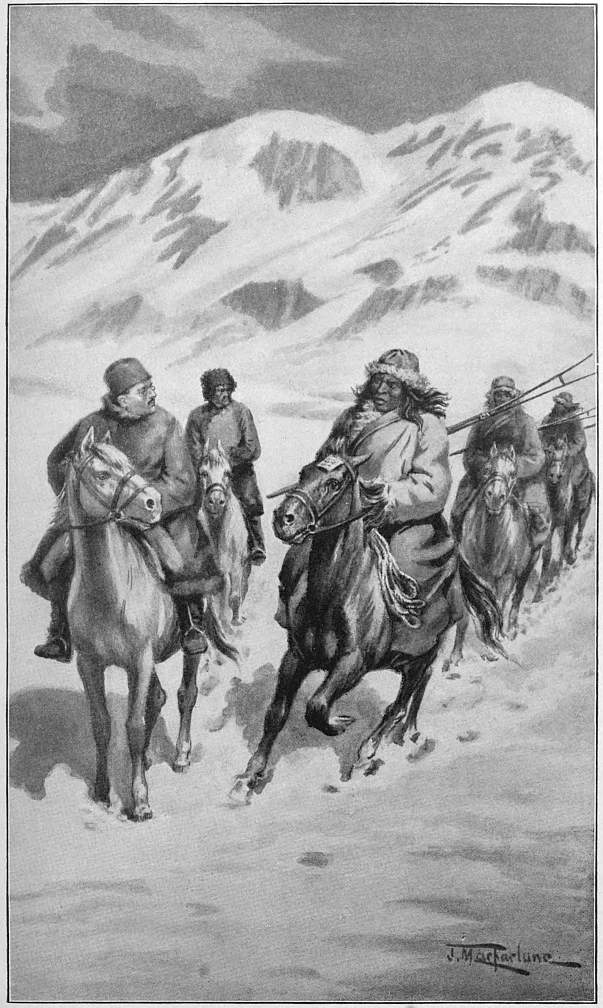
89. ”Where are you going?” they asked me.
We broke up our camp early on December 1, with a temperature of −24.2°, which cost us the loss of another mule. He was at once devoured by the wolves, which were so bold that they did not go away when we rode past. When we had accomplished about half our march we came to a tent of which two snappy light yellow dogs seemed to be the only masters. But no doubt the inmates were afraid to show themselves, and examined us only through their spy-holes. Near this day’s camp there were more tents, and my usual dealers obtained two yaks, three sheep, and a can of dirty milk. Before the Tibetans would deal, they first inquired whether there was not a Peling (a European) in our party, and declared that they would visit our camp to convince themselves that such was not the case. The answer given them was that the principal personage in our company was a Kalun, or high official, from Ladak, and that we had several dangerous dogs. On that they gave up their visit. But when we started off two of them were present, one of whom Muhamed Isa took as a guide. The other remained standing by us and looked at me, trying to find out whether I was a Peling or a Kalun. He was certainly doubtful, for he looked exceedingly disturbed as we rode off.
This day Robert and I lost our way. We had taken the Hajji as guide, but he lost the trail, and stupidly wandered about aimlessly. As he had to seek for the track again, we settled down on an open space beside a fire, while the storm roared above our heads and dark threatening snow-clouds swept over the mountains to the north. At last Muhamed Isa became uneasy and sent out scouts, who at length found us out.
Camp No. 77 was situated in the higher part of a lateral valley, where a spring was frozen into huge clumps of ice. At the fire we encountered two strangers in red turbans, round which their locks were twisted, with ivory rings, silver image cases, and fur coats trimmed with red and green ribands; they were armed with sabres encased in silver-mounted scabbards, richly encrusted with inferior coral and turquoise; they wore new coloured felt boots, and had their black muskets hanging from their shoulders. They belonged to the troop of pilgrims from Nakchu. Our Ladakis, however, were convinced that they were come to spy upon us. If we seemed too strong for them, they would only ask—as, in fact, happened—if we had anything to sell; otherwise they would steal our horses. Meanwhile they behaved very civilly, were exceedingly friendly, and promised to return next morning with some yaks and sheep, which we might buy.
“We will remain near you till it is dark and will return before daybreak, for if any one saw us trading with a Peling, we should pay dearly for it.”
“You need not be afraid, we shall not betray you,” I said.
“Even if you did betray us, Bombo Chimbo, we should not be easily caught. There are many pilgrims on the way to the holy mountain Kang-rinpoche (Kailas).”
“You may be quite at ease. Come with your animals, and you shall be well paid.”
“Good. But tell me, are you not the Peling who came five years ago with two companions to Nakchu, and was compelled by the Governor to turn back?”
“Yes, that was I.”
“We did not see you ourselves, but all the province was talking about you, and you had Shereb Lama as a guide. You had also a large caravan with camels and several Russians in your service.”
“How can you remember all that?”
“Oh, it was repeatedly said that it would be a marvel if you escaped the robbers.”
I clearly perceived from this not very flattering popularity that, if the common people were so well informed of my doings, the authorities would find it easy to follow my track. Now the Tibetans knew that it was I, and no one else, who was penetrating to the heart of the forbidden land. How speedily this fact would be transmitted to the south! How quickly would the Devashung bring us to a halt! Where would our grand progress come to a standstill, checked by a peremptory “Thus far and no farther,” backed up by muzzle-loaders and sabres? Ah, where would my dreams again be shattered and my aspirations cease to pulsate?
In the morning, when the pilgrims had returned, I was waked early and went out to view the market that had been created in the wilderness as by an enchanter’s wand. The sun had not yet risen above the mountains, the camp lay in icy-cold shadow, and the air was dull and raw. The smoke circled round the fires in suffocating density, and through it I saw six splendid yaks with wooden saddles. The Tibetans in their picturesque costume, with sabres jingling at their sides, knives and amulets, gesticulated vehemently, and in a torrent of well-chosen words extolled the exceptional qualities of the grunting oxen. The result of the affair was that all six yaks passed into our possession, and we also bought two packets of brick-tea, a bag of Bhotan tobacco, and a couple of bladders of butter. Robert piled up the shining silver coins in rows at the door of my tent, and the eyes of the Tibetans shone with delight at the sight of so much money, and at hearing the ring of the silver. An empty tin and a tin cigarette box found their way, as usual, into the front of their fur coats.
“Do you know the way to the south?” I asked.
“Yes, we know it well.”
“If you are disposed to accompany us, you shall receive three rupees a day.”
“We should like to, but we dare not.”
“What are you afraid of?”
“We have heard that to the south of this pass the country has been roused and that soldiers are being collected to render your further journey impossible. We must go quickly northwards. Our people are already ahead.”
“Where do you think that the soldiers are waiting for us?”
“That no one knows, but it is certain that they are gathering together.”
“What, in your opinion, do they mean to do with us?”
“They will prevent you going farther southwards, but will do you no harm.”
“How do you know that?”
“Because the Bombo Chimbo was friendly last time, and did not refuse to march westwards when he was required to do so.”
“Which way will they ask us to take this time?”
“Probably the same as before, to Ladak.”
The silver money rattled in the tin boxes as they mounted and disappeared down the valley, while we, now owners of eighteen fine yaks, struggled laboriously up the small steep pass overlooking camp No. 77. We had a wide view southwards over side ranges separated from one another by broad valleys. But it was not long before heavy snow drove us away. Numbed with cold, we rode down to the level country.
From the plain the Hajji pointed back to the pass, where three riders showed black against the snow; they rode down at a smart trot and soon overtook us. Their black, snorting horses steamed, they carried guns at their shoulder-belts, and sabres in their girdles. Their reddish-purple mantles were rolled up on the saddle behind them, and they rode in sheepskins, black and greasy from the soot of camp-fires, and the blood and fat of slaughtered game, which in the course of years had hardened into a smooth crust intersected with cracks. As we were the object of their ride, they followed at our heels, slackened their pace, and rode up to my side. A coarse fellow asked shortly and boldly (Illustration 89):
“What are you?”
“Pilgrims.”
“Where do you come from?”
“From Ladak.”
“Whither are you travelling?”
“To the Dangra-yum-tso.”
“People from Ladak never come from the north.”
“That is quite possible, but we come from the north. Where have you been yourself?”
“With relatives who are camping to the east. We have two more days’ journey before we reach home.”
Then they spurred their horses and rode after the caravan, which was encamped at the foot of a rock. Here they let their horses graze, behaved as though they were at home, and subjected Muhamed Isa to the same cross-examination. Shortly before sunset they rode off westwards. We had an uncomfortable feeling that something ominous, something decisive, was brewing, and that our fate might perhaps be settled next day. For it was clear as day that the men must have been spies. They were a patrol of the numerous express messengers sent into all the valleys by orders from Lhasa to beat up the men fit for military service. Soon these incorruptible riders would crop up like mushrooms from the ground.
The camp No. 78 and the weather were in harmony with our mood as we awaited our fate. There was no pasturage, only ice, and the fuel was scanty. Opaque clouds obscured the sky, snow was falling on the mountains, the north-west storm moaned round the corners, and whirled the ashes and scraps of dung about so that they found their way into my tent, where the dogs lay rolled in a corner to keep themselves warm.
Again, on December 4, we left a mule behind. The land was covered with snow, and the ride was fearfully cold, icicles hung from my moustache, and my right foot lost all feeling. Hundreds of antelopes and kiangs were grazing to the left of our road; the dogs dashed at them, but soon came back again, for the animals would not move an inch. No men appeared, and we thought that the real opposition would be encountered at the Bogtsang-tsangpo, that is, where I had last time been forced to turn westwards.
The next day’s march took us over rather tiring hills where small points of weathered porphyry cropped up here and there out of the ground. Spoors of wild animals ran in all directions, and cattle and sheep tracks were equally numerous.
But not even at the Bogtsang-tsangpo did anything suspicious appear. We calmed down again and rested here on the 6th. Our store of rice and flour was consumed; there was only a little for me, so that I had my freshly-baked bread every morning and evening. The others had to live exclusively on mutton, so that every day one sheep at least was needed. Just as Tundup Sonam and two other men returned from a foray, bringing with them six fat sheep, we saw six men on foot coming to our camp. Our grand vizier, Muhamed Isa, received them before they were brought before me. The principal among them thus introduced himself:
“I am the Gova (District Chief) of this country, and have received tidings from the north that you are on the way southwards. You passed through here five years ago with twenty-five camels. I am now come to inquire your name, how many servants and pack-animals you have, and whither you intend to go.”
“Why do you put these questions?”
“Because I must forward information to the Governor of Naktsang; if I do not, he will cut my head off.”
He was given the particulars he wanted, and then he asked:
“Will the Bombo Chimbo be so kind as to wait here until the answer comes back?”
“Where is the Governor of Naktsang?”
“In Shansa-dzong on the Kyaring-tso.”
“How long will it take a messenger to reach him?”
“Ten days.”
“Then the answer will be here in twenty days. No, thank you, we have no time to wait so long.”
“But you must wait three days, until I have sent for a man who can write.”
“No, we are off to-morrow.”
So far all had passed off well. Instead of encountering an armed force, we found the country open for twenty days longer. But after that things would be different; the Governor of Naktsang would not let me take another step farther southwards; I knew him in the year 1901 and found him inflexible. The least we could expect was that he would detain us till the answer of the Government was received. Like Dutreuil de Rhins and Grenard, I should have to wait one, perhaps even two, months.
Our chief, however, pursued a little private policy of his own, and said that the relations of the Devashung and India were now friendly, and therefore he would treat us as friends. He dared not sell us baggage animals or provide us with guides without the consent of the Governor, but he would gladly impart to us all the information we desired. He mentioned some names according with those given by Nain Sing, and showing how conscientiously the celebrated Pundit had performed his task. The conical height to the north of our camp he named Tugu-lhamo; the Gobrang is a ridge to the north-east of it, and a side valley is called Ragok. Nain Sing gives the names Dubu Lhamo, Gobrang, and Ragu. He reckons the distance to the Dagtse-tso, the salt lake by which I encamped in 1901 at the mouth of the Bogtsang-tsangpo, at nine days’ journey. It is easily explained how Nain Sing fell into an error here, and also represented the river as flowing into the Chargut-tso, for he was not there himself and trusted too much to the frequently unreliable information of the chiefs.
In the course of the evening the chief became still more friendly, and proposed to travel with us for three days under the pretence of keeping an eye on us. He would, however, keep some distance from us, and, like a night-owl, join us only when it had become quite dark. In the night he pitched his chieftain’s tent, green above and white below, beside ours.
We passed quickly eastwards along the Bogtsang-tsangpo in only five and a half short marches, partly close beside the river, partly along parallel valleys which skirt its southern bank. On December 7 we lost sight of it, but in the district Pati-bo it again emerged from a narrow transverse valley. Eastwards the fall is extremely slight, and the river winds in most capricious curves, so that the path touches the bank only at the southern bends. A quantity of hearthstones and fenced-in sheepfolds show that many nomads spend the summer on the Bogtsang-tsangpo. The volume of water is very insignificant, for the river is principally fed by sources which are called into existence only by the autumn rains, and fail in winter. Thick ice lies over it all, and is deeply hollowed by the constant fall of the river. The ranges on both sides run in an east and west direction, and frequently three such crests are seen at the same time towards the south. One is often astonished at the whim of the stream in turning sharply to cut through a rocky crest, whereas it would seem much easier to flow on along the open longitudinal valley. But, like most mountainous countries, Tibet presents many such puzzling problems, difficult of solution. At a place where comparatively warm rivulets flow in on our side there is a short, wide reach of the river where Robert caught fish, a very welcome variation in our monotonous diet.
In the night we had 54 degrees of frost, and on December 12 the thermometer sank to −24.7°. The caravan now consisted of 11 horses and 4 mules, besides the 18 yaks. The yaks are not accustomed to long day’s marches, so we proceeded very slowly eastwards. We could not hurry our marches, much as we should have liked to do so. There were several men sickly, and the medicine chest was in great demand. Muhamed Isa especially suffered from headache, and many a time as we passed by he was lying on his back on the ground. He was dosed with antipyrine and quinine, and I advised him to walk as little as possible.
The chief became more and more at home with us, and no longer observed his former caution. He sometimes called on nomads on the way, but his tent was always set up among ours. Every day he brought to me one or two nomads, who gave me information about the country and sold us milk and sheep. Several were from Ombo, a village and district on the north shore of the Dangra-yum-tso, where a couple of stone huts stand and barley is cultivated. The pasturage round the lake is said to be so poor that the inhabitants of its shores have to migrate northwards with their flocks in winter. Unfortunately they had not heard of a post messenger from Shigatse, but they were equally ignorant of any order directed against us.
On December 12 we left the Bogtsang-tsangpo and directed our steps towards the south-east. At night a violent storm arose, but the minimum temperature was only 13.5°; the night before there were 56.7 degrees of frost.
Another mule died in the night, and the surviving animals had to be carefully guarded from the wolves, which were unusually daring. We started on December 13 to the pass La-ghyanyak (16,932 feet high), where a pyramidal cairn marks the divide between the Bogtsang-tsangpo and the Dangra-yum-tso. The former can be seen meandering along its valley to its termination in the lake Dagtse-tso; the latter is not yet visible, but we can guess where its basin lies among the huge mountain massives. Yonder lay the holy lake Dangra-yum-tso, which had long been our aim, and whither I had requested Colonel Dunlop Smith to send my letters. To the south-west arose two dominating snowy peaks above a sea of mountainous undulations, and in the same direction lay a small round lake, the Tang-yung-tsaka, already seen by Nain Sing, and named by him Tang-yung-tso (Illustration 90). The country seemed desolate and uninhabited, and no riders spurred through the valleys to block our way. Farther down we passed two tents, where the inmates told us we were on the wrong way if we wished to go to the Dangra-yum-tso, for it could be reached in a direction due south in four short marches. All Naktsang knew, they said, that a Peling was coming, a report that, however, had probably spread from the north, not from the south. If the mail-runner had actually reached the lake, he would hear that we were not far off, and would look out for us.
Now the thermometer sank to −24° again, and we let the animals rest a day. Meanwhile I, with Robert and Shukkur Ali, made an excursion on foot through a singularly wild romantic valley, which was little over a yard broad in some places, and was cut out between vertical walls. Often the bottom is filled with fallen blocks, which obstruct the way, but elsewhere it is occupied by a brook, now frozen up. The rapids and waterfalls of this brook are also congealed into glassy ice, and shine with a bluish-green tinge in the depth of the valley, where the summer flood has excavated curious caves. Here the wind is confined as in a pair of bellows, and roars and whistles round the cliffs. In an expansion of the valley we kindle a fire and take a rest. Along the precipice above us six proud eagles soar with motionless wings.