Front matter (continued 6)
Reading edition
According to previous arrangement Rabsang came to meet us with some of our yaks, so that we could ride back. He brought us disturbing news. At the tents we had seen farther up the valley on the day before, twelve armed men had collected to waylay us. An express messenger had, it seems, brought word from Shigatse that we must be driven back to the north. I did not question him further, and we rode home in silence. It was a bitter experience now, when we had looked down from La-ghanyak on the great unknown country crossed only by Nain Sing’s route of the year 1874, which we had intended to intersect at one point only, to see all the grand discoveries, of which I had dreamt so long, blown away like mist. And it was especially irritating to think that others might come here later and rob me of these conquests. Reminiscences of the past autumn and early winter came into my head; we had successfully executed an immense traverse over the Chang-tang, and at the critical moment the nomads had come to our assistance. It had been a splendid bold journey hitherto, but I had always considered it only as a prologue to the grand plans which kept me awake at night and had occupied my thoughts during the long weary ride. And now they would receive their death-blow. Now my dreams of victory would be resolved into blue haze, like the smoke of the camp-fire which marked the southernmost point of our advance into the forbidden land.

CHAPTER XVII
CHRISTMAS IN THE WILDS
Much depressed but outwardly composed, I dismounted from the yak and entered my tent just as Tsering brought in the brazier. The tent seemed more dismal than usual, the brazier made me feel weary, and at this moment I seemed to realize how lonely and dull my life had been all through the winter; but Tsering was as tranquil as usual, and raked the fire with the tongs to remove some still smoking dung.
“Now you see that I was right; how often have I told you that we should be ordered to halt at the Bogtsang-tsangpo?” I said.
“Ordered to halt?” exclaimed Tsering in astonishment.
“Yes, now we are stuck fast, but I will not move a step from the spot until the Tibetans have provided me with a new caravan, though I have to wait all the winter. Then we will go north-eastwards, look for the Mongolian pilgrim road, and hasten to Pekin. I will force the Mandarins to allow me to see the parts of Tibet where no European has yet been.”
“I do not understand what the Sahib means; hitherto no one has hindered us, and the country southwards lies open before us.”
“What are you talking about? Have they not come this very day to stop our further progress?”
“No, on the contrary, three Tibetans are sitting with Muhamed Isa, and they are most civil and friendly.”
“Has, then, Rabsang played a trick on me and the Babu Sahib?”
“Ah,” replied Tsering, laughing, “now I understand the matter. Rabsang was up at the tents this morning, and allowed himself to be frightened by a Tibetan, who told him that we should be forced to remain where we are, for we had no right to travel southwards to Naktsang. But that was only the Tibetan’s own notion, and Rabsang, who had to go immediately after to the valley with the yaks, had not heard how matters really stood with us.”
“Bravo, Tsering, slay the fattest sheep we have got, and invite every one to a feast. I will have the kidneys fried in their own fat.”
Now the storm-beaten tent seemed more comfortable and the brazier sent out a pleasant kindly heat. I sat buried in thought, wondering whether this were a good omen, when Muhamed Isa announced a visit of the three Tibetans. I invited them to take a seat at the fire. Turning to the chief man, who wore a blood-red fur coat and a brick-red fox-skin cap, I asked him who he was.
“I am Karma Tamding from Tang-yung,” he answered; and I was astonished that he gave his name at once, for the Tibetans are generally shy of doing so, lest they should bring upon themselves retaliation on the part of their superiors when their names are known.
“We are, then, in the province of Tang-yung?”
“Yes, Bombo Chimbo, the pass you crossed yesterday is its northern boundary; to the west Tang-yung extends for three days’ journey, and as far to the east, and southwards to the Dangra-yum-tso.”
“Why have you come to my tent, Karma Tamding? Has one of your superiors sent you?”
“No, but idle rumours have been current here for some time. First it was an old woman, who would have it that two hundred men were coming down from the north. Large bands of robbers from Nakchu have plundered the nomads in the north, and we felt sure that they were robbers who were coming into our country. The day before yesterday we heard that it was only a peaceful European, who took, indeed, yaks, sheep, butter, and milk from our people, but always paid well for them. I am now come to see our guests with my own eyes, and I am very glad to find you instead of a robber band.”
“You have not heard, then, that any messenger from Shigatse has been inquiring about us?”
“No, not a word. But this very day I have heard that an express has been sent from the Bogtsang-tsangpo to Shansa-dzong, and that messengers will travel thence to Lhasa.”
“Will you be so good as to sell us yaks, Karma Tamding?”
“Yes, willingly. I saw you five years ago at the Bogtsang-tsangpo. Then you were conducted over the frontier by a large escort and two officers, but now Europeans seem to be privileged to pass through the country.”
“Will you procure us guides?”
“Certainly; but which way do you think of taking? If you wish to go to the Dangra-yum-tso, you must cross the Kam-la, which lies a little farther up this valley. But if you prefer the route to the Ngangtse-tso, you must travel on eastwards. It is all the same to us which way you take, but I must know for certain. I will ride back to my tent and fetch parched meal, which you can buy when I overtake you in a few days. The yaks I will send to-morrow morning.”
Karma Tamding seemed so trustworthy that I handed him half the purchase money in advance, and the next day we bought 3 yaks at 20 rupees a head, and received a guide, who conducted us over two difficult passes, eastwards to the Rara country, and on December 16 over the Pike-la, a gap in a longitudinal valley running parallel to the Bogtsang-tsangpo.
We were compelled to camp early by one of our three mules, which could not travel any farther. He came up to the fire with trembling legs and laid himself down. “The news of his death will be the first I shall hear in the morning,” I thought, but I had not to wait so long, for before the stars had begun to twinkle he lay stiff and cold in the smoke of the camp-fire. Only two of the Poonch mules were left.
Then Karma Tamding rode up with twelve other Tibetans, two of them women. They sat down by the fire and looked at me; and I looked at them. The older woman had a fine sheepskin, and on the forehead an ornament of pendent coral and silver coins from Lhasa. The younger was similarly dressed, and had a huge lambskin cap. Little could be seen of her, but the little that was visible was dirty beyond belief. The men were strongly built and well proportioned—one could perceive that, when they drew off the right sleeve and exposed their breasts to the heat of the fire.
When we had gazed at one another long enough, and I had learned that the small lake near by was called the Tarmatse-tso, the whole party crawled into Muhamed Isa’s tent to offer their edibles for sale. And there parched meal and barley was bought to the value of 68 rupees; it was quite a pleasure to see with what an appetite our last twelve animals emptied their bags of barley; they had so long had to put up with the execrable grass of the desert.
Next day we took leave of honest Karma Tamding. “On the boundary of Naktsang you will meet with an elderly man, named Chabga Namgyal, who is just as nice as I am,” were his last words. We continued our long winter journey through Tibet eastwards along the same convenient longitudinal valley, and bivouacked in the district Neka, an ominous name (it means in Swedish to refuse), which might perhaps have brought us bad luck had the supreme chief of Tang-yung, whose headquarters are here, been at home at the time. Fortunately he had a short time before set out with his wife and children to Tashi-lunpo for the New Year festival, and had consigned his large herd of yaks and flock of sheep to the care of his servants and his herdsmen. They sold us milk and butter, but disapproved of my disturbing the gentle fish in a neighbouring pool. Within an hour I had twenty-five on dry land, which were a great treat at dinner. Robert had been unwell for some days, and now developed high fever, which confined him to his bed. Sonam Tsering suffered from a curious mountain sickness, in consequence of which all his body swelled up and assumed a livid hue. Two others were unwell, and the medicine chest stood open again. Sonam Tsering’s tent was like an hospital, where all the sick found shelter as soon as they were incapacitated. Only old Guffaru was still healthy, did the work of two, and had at present no use for the shroud he brought from Leh. His large white beard had turned yellow in the smoke of the fires, and his hands, frost-bitten in winter, were dark and hard as iron. We stayed two days in camp No. 90, to give the invalids a rest. My dapple-grey from Yarkand was nearly drowned in a spring; fortunately he was seen from the camp, and ten strong men pulled him out of the mud. Then he was dried at the fire, rubbed well down, and covered with cloths. But his days were numbered.
On December 20 we ride on along the longitudinal valley parallel to the Bogtsang-tsangpo, and encamp at the mouth of a transverse valley, which belongs to the southern mountains, and is called Kung-lung. Frozen springs are seen on all sides; the farther we advance southwards the more the country is fertilized by the monsoon rains. The ground is honeycombed by millions of mouse holes; they are so close together that there is no room for more. The field-mouse here does the work of loosening and ploughing up the ground that the worm does in our soil. But the herbage derives no benefit from it, for the mice subsist on the roots and destroy the grass.
When we had passed the boundary between Tang-yung and Naktsang, and had just pitched our camp at the source of the brook draining the Kung-lung valley, three riders with guns suddenly appeared, who were making for the same spot, and behind them came a dark group, perhaps soldiers. Probably they were about to arrest us here, at the first camp in Naktsang. No; another false alarm. They were simply peasants from the Bogtsang-tsangpo, who had been to Naktsang to barter salt for tsamba (parched meal) and barley, and were now on their homeward journey. The troop consisted of members of several tent villages, among which the goods would be distributed. The tsamba and the barley were carried by yaks, horses, and sheep, and seemed sufficient to last many households all the winter.
Here I heard for the first time of the lake Shuru-tso, but I little thought that I should bivouac on its shore next spring. The range on the north, in which the Keva is the highest summit, is the water-parting between the Dagtse-tso and the Kung-tso, a lake visible to the east. On the south we had the range which we had first seen at the Dangra-yum-tso, and which afterwards skirts the south side of the Tang-yung-tso.
In the night the continued westerly storm increased to a hurricane, which blew down my tent. It was fastened up again, but at dawn I was awakened by a report like a gunshot, for one of the strained tent ropes broke, and another tore itself out of its iron cap, which fell with a sharp clatter against the tent. A shower of stones and coarse sand beat about my airy dwelling, so that it required a certain amount of resolution to issue forth in weather worse than we had experienced in Chang-tang.
“How much longer will the storm last?” I asked our guide, as he joyfully and thankfully pocketed his 18 rupees after he had handed us over to another guide of the Naktsang tribe.
“Six months,” he replied.
We marched eastwards, gradually diverging to the south, and thus passed round the chain which had hitherto lain on our right. On the way we found Adul in a hollow, and asked him how he was.
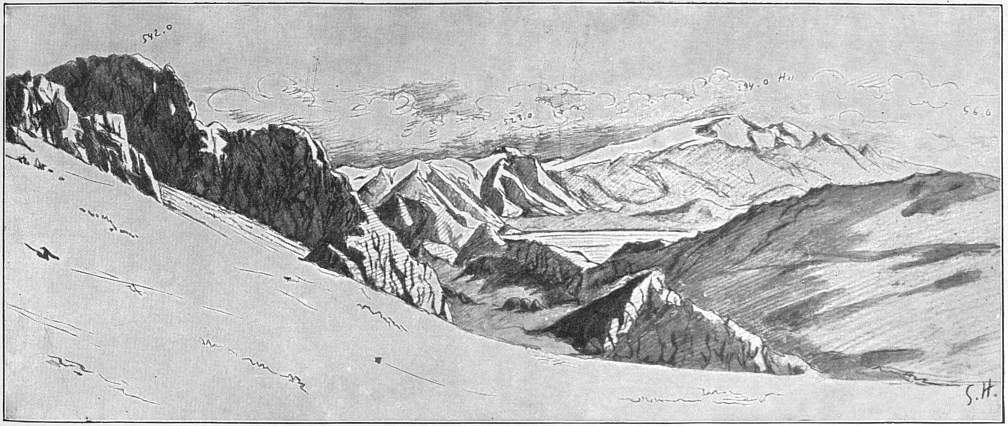
90. Near the Dangra-yum-tso. In the Valley below is seen the Little Lake Tang-yung-tso. Sketch by the Author.
“I am dying,” he answered, without moving a muscle. I sent one of his comrades and a horse from the camp to bring in his corpse, but next morning he was as lively as a cricket. Such weather is certainly not enjoyable, but it is no use to complain of wind and weather. My horse staggers about as if he had drunk too much. At the opening of every lateral valley we may be sure of a buffet that will make us reel in our saddles. We bend sideways against the wind to help the horse in maintaining his equilibrium, and we draw ourselves together so as to present a smaller surface to the wind—indeed, we are like a sail that must always be set according to the direction of the wind, and we have to trim ourselves just as one would handle a sailing-boat in a high sea. We rested awhile in the shelter of a rock, to recover our breath, and when at length we reached the camp in Nadsum we had suffered as much as we were able to bear. To the north-east, beyond the mountains, lies the Dagtse-tso, which Bower, Dutreuil de Rhins, Littledale, and I have visited; on the way thither a lake is passed, called the Goang-tso.
On the 22nd we took our way to the south, where a range of considerable height bars the road to the Ngangtse-tso. We followed the river Sertsang-chu upwards; a little water still bubbled and trickled down under its thick covering of ice. In the evening we received a visit from eight Tibetans, two of whom had lost all their yaks by a kind of cattle-plague. We ascended the same valley for another day’s journey, and found five tents in an expansion of the valley which was called Torno-shapko; at several spots we saw large flocks of sheep guarded by dogs as snappy and impudent as the nomads themselves. Some of these fellows came into our camp and used very rude language, daring even to say that we must not remain here but must pack off with all speed. To buy milk and butter was out of the question. Muhamed Isa drove them away and threatened to report their conduct to the Governor of Naktsang. Our guide, a boy of fifteen, was frightened, but was persuaded to accompany us a day longer.
December 24. When I woke an old mendicant lama sat singing before my tent. He had a little withered woman with him, and their small light tent was pitched quite close to us. In his hand he held a staff bedecked with coloured strips and with brass plates, coral, shells, tassels, and other ornaments, which he made to spin round as he sang. The old man had in his lifetime wandered far and wide, begging his way from tent to tent, but when I asked him to accompany us and to bring in the Christmas festival with song at our camp at night he declared he was too tired.
The road led us higher up the same valley, soon leaving the sources behind. We passed two manis with prayers inscribed on the slabs, one of which was 23 feet long. Two tents stood at a spot where two large valleys converged. The unfriendly men we had met yesterday had gone on before us and had warned the people not to sell us anything if we asked them. Two of our men tried to trade, but met with a refusal, whereupon Muhamed Isa laid his riding-whip smartly across the backs of the mischief-makers. Then the whole company fell on their knees, became remarkably civil, and brought out at once all the butter and milk they had on hand.
Our valley now runs eastwards, and at last rises in a south-easterly direction to a pass. Evidently no great road runs over it, for there is no cairn on the summit. It turned out later that the youth had led us astray, omitting to turn aside through a southern valley to the pass Gurtse-la. However, it was of no consequence, for the view from our pass was grand, and below us lay a lake not marked on Nain Sing’s map. The valley descending from the pass is so deeply eroded that we had to keep for some distance to the heights on the right side. Islam Ahun led my tall dapple-grey, which was weak and sickly; he took only a few steps at a time, but he could still graze. We had made a long march, and the camp could not be far distant, so he would perhaps reach it. I therefore only stroked him as I passed, while he held his nose to the ground and plucked up the grass. But when I left him to his fate and rode on, he raised his head, sighed heavily, and gazed after me. I was deeply grieved afterwards that I did not remain with him. He had carried me faithfully on the long dreary journey from our departure from Leh until his back became one great sore; then he was not worked till his back was healed. Afterwards he was degraded to a pack-horse, but when our caravan was reinforced with yaks, he was exempted from work of any kind. Latterly we had had abundance of barley for the animals, but he had shown no signs of recovery. This day, however, he had managed to climb the pass, and would surely be able to get over the short remaining distance. But Islam Ahun came into camp alone. The horse had stumbled on a very steep descent, rolled over several times in the débris, and then remained lying. Islam, who had received strict orders to be careful of the dapple-grey, stood and waited, but the horse did not move again, and died where he was. Why did I not understand him when he so plainly said a last good-bye? I was much grieved at it, and for a long time could not forget the troubled expression of his eyes as he saw me ride away. The remembrance haunted me when it grew dark at night and the winter storm howled in cold dreary Tibet.
Down below in the valley basin lay the Dumbok-tso asleep under its ice mantle, out of which rose a small rocky ridge, the Tso-ri or “Lake Mountain.” Up above the heights were still bathed in sunshine. The Dumbok-tso was the most important discovery of the day. The watch-fires burned in front of the tents and threw a yellow light on the surroundings.
Then the day’s notes were filled in, and Robert, as usual, labelled the rock specimens we had collected. “Dinner is ready,” says Tsering, as he brings in fresh fuel, and the shislik and sour milk are served and placed on the ground before my bed. Then I am left alone with a thousand memories of Swedish Christmas feasts, and the words: “Christmas is now under every roof,” and “Frozen is the limpid lake, it waits for the winds of spring,” from the poet Topelius’ Christmas song, rings in my ears. The Christian community in our camp consisted only of Robert and myself, but we determined to celebrate the Christmas festival so that the heathen also might have their share in the enjoyment. For some time we had kept all the candle ends, and now had forty-one pieces of various lengths. We set up a box in the middle of my tent, and arranged the candles on it so that the largest stood in the middle, and the others became smaller and smaller towards the corners. That was our Christmas-tree. When all the candles were lighted we threw back the flaps of the front of the tent, and the Ladakis, who meanwhile had assembled outside, gave vent to a murmur of astonishment. They sang softly in rising and falling tones. I forgot for a time the solemnity of the moment, and gazing into the flickering flames of the candles let the minutes of the holy night glide slowly by. The sentimental air was now and then interrupted by a thundering khavash and khabbaleh in which all joined, howling like jackals. The flutes performed the accompaniment, and a saucepan served as a drum. Lamaist hymns at a Christmas festival under the constellation of Orion! Dimly illuminated from the tent, and flooded by the silvery light of the moon, my men presented a weird appearance as they turned themselves round in their native dance, keeping time to the noise of the saucepan. The Tibetans of the neighbouring tents perhaps thought that we had all gone mad, or perhaps that we were executing an incantation dance, and had lighted sacrificial lamps to propitiate our gods. What the wild asses, grazing on the lake shore, thought of it, no one can tell.
Our young guide, who had been placed in the middle of the tent door, caused us much amusement. He stared, now at the lights, now at me, without uttering a sound, sat like a cat on the watch with its fore-paws on the ground, and did nothing but gaze. He would have wonderful stories to tell his fellow-tribesmen, which would certainly lose none of their effect by the embellishments added by himself and amplified in the course of repetition. Perhaps the memory of our visit still survives in the country, in a legend of singular fire-worshippers who danced and bellowed round an altar adorned with forty-one burning candles. When the youth was asked how he liked the illumination, he made no answer. We laughed till our sides ached, but that did not disturb him; he continued to glare with eyes full of astonishment. When he had somewhat recovered his senses next morning, he told Tundup Sonam in confidence that he had had many experiences, but that he had never met with anything so extraordinary as the evening’s entertainment. He would not sleep with us that night, but went off to the tents of his people, and on the first holiday he begged permission to return home.
The lower the candles burned down, the brighter the stars of Orion shone into the opening of the tent. The corner lights had long gone out, and only a couple in the middle continued to flicker. Then I distributed a small sum of money among the men, beginning with Robert and Muhamed Isa. That was the only Christmas present. After this the men retired to their fires, which had in the meantime gone out. Two had to stay behind to explain to me one of the songs in which the word Tashi-lunpo had repeatedly occurred. It was more difficult than I expected to translate the song. In the first place, the men did not know it well themselves, and, secondly, they did not know the meaning of some of the words it contained. Other words they understood well enough, but they could not translate them into Turki or Hindustani. First we wrote out the hymn in Tibetan, then Robert translated it into Hindustani, and I into Turki, and finally from the two translations we concocted an English version which had no sense or meaning. But by repeatedly taking the song to pieces and analyzing it, we at last made out what the subject was—it was a glorification of the monastery Tashi-lunpo, which was the goal of our hopes. The learned who happen to be acquainted with ancient Tibetan hymns will be very much amused if they take the trouble to read the following translation. It certainly has the merit of forming a record in poetic license.
Now rises the sun shining in the east, From the eastern lands over the heights of the east. It is now the third month that the sun mounts up, Pouring forth floods of heat. First fall the beams on the temple, The house of the high gods, and caress The golden battlements of Tashi-lunpo, The roof of the venerable cloister temple, And with threefold brilliance glitter the pinnacles in the sun. On the highest meadows of the temple vale Shy antelopes graze in thousands. Hard is its crumbly soil, but still Rich is the vale and green and lovely, And grass thrives on its poor land, And brooks ripple down with cool water. The highest, ice-covered mountains glitter Like transparent glass. The nearer summits Rise like a row of lofty chhortens, And close at their feet beat the blue waves Of the Yum-tso, playing on the holy strand. Take water from the lake and fill The sacrificial bowls of the holy idols, Moulded of brass. Then decorate with silk cloths Of every kind and colour, which from Pekin come, And adorn also with veils the tall golden images of the gods, And fill the temple halls with hanging standards. Take kadakh cloths, holy and dear, Of best silk from the town of Lhasa, And lay them on the forehead of Buddha’s image.
So ended our Christmas Eve in the wilderness, and while the glow of the Christmas fire sank down in the ashes I read the old Bible passages relating to this day, put out my light, and dreamed of Christmas festivals in the north, and of Tashi-lunpo down in the south behind the mountains, the goal towards which we had been struggling amid suffering and privation all through the cold winter, and which was still far off and perhaps even beyond our reach.
CHAPTER XVIII
TEN DAYS ON THE ICE OF NGANGTSE-TSO
From the Christmas camp we travelled southwards over two passes, of which the second, called Laen-la, forms a watershed between the Dubok-tso and the Ngangtse-tso. The great lake itself we do not see yet, but a distant bluish background of mountain chain which rises from the southern shore of the lake. A yak was lost; he was not exhausted, but his fore-hoof had split so that he had become lame. When once he had laid himself down no power on earth could induce him to get up again; tugging at the rope, which was passed through his nasal cartilage, availed nothing. We therefore left him behind, and gave him to the natives nearest to our camp. Several yaks and the surviving veterans from Leh were in need of a thorough rest, so we decided to remain a fortnight at the great lake. It was certainly risky to linger so long at one place in Naktsang, where I had met with such determined opposition in the year 1901, for we should give the authorities time to make their preparations. But we must rest; we had no choice.
After a night temperature of −24.20° we marched down the longitudinal valley to a point immediately above the place where the valley emerges into the lake-plain, and bivouacked near a group of tents containing six households. The whole country is corroded with mouse holes, and sometimes they lie in stages one above another. If one reckoned in the central parts of Tibet only one field-mouse to the square yard, the resulting total would be marvellous. At camp No. 97, for instance, it was impossible to lay down my bed without covering several holes, and I was awaked in the morning by the mice, which were making a noise and squeaking beneath my bed, and wondering why they could not get out of their house door.
The nomads of the district were friendly disposed, and sold us sheep, butter, and milk. They said that the high road to Shigatse skirted the east side of the lake; another to the west of the Ngangtse-tso was much longer and more difficult. The highway to Lhasa runs eastwards through Shanza-dzong. Thus far it had been followed by Nain Sing, whose route we crossed here; for from the Marku-tso, a small lagoon on the north shore, the road he took passes to the west-north-west. Many nomad communities winter on the extensive plains of the lake shore, especially on the south side. The nomads never travel over the lake, the most direct and quickest way, for they mistrust the ice, and our last guide would on no account accompany us over the lake, but warned us of the thin ice. His statements seemed to me more probable when he said that the lake was salt, that the water was not fit for drinking, and that there were neither fish nor plants in it.
The long period of rest must be utilized somehow. It had, moreover, been one of the aims proposed in the original scheme of my journey, to investigate the country round the central lakes discovered in 1874 by Nain Sing, and to execute soundings in several of them. If the ice held firm we could go over the lake, and sound through holes. Two men were therefore sent out to examine the ice: 100 paces from the bank the ice was 11 inches thick, at 200 paces 10¼ inches, and even at 300 paces 10 inches; so I determined to commence at the nearest point to our headquarters.
Robert and Muhamed Isa were to remain behind to watch over our animals and attend to them. It might, indeed, be risky to split up our caravan just at this time, but I could not remain idle for a whole fortnight. There was everything we needed at the headquarters—nomads, pasturage, water, and fuel; the place seemed to be of some importance, for a round mani stood in the valley, and Robert found on a ridge a samkang, a hermit’s cave, with a small stone wall in front of it. There the lama Togldan was wont to dwell in summer, earning his bread from the neighbouring nomads by murmuring formulæ to conjure evil spirits, and offering up prayers for the prosperity of their flocks. We had an hour and a half’s journey to the northern shore, and there innumerable camping-places indicate summer visits of nomads. There the tents are situated among excellent pasture lands, exposed to the noonday sun, with the great lake, often agitated by boisterous storms, in front of them.
We got ready provisions for ten days for myself and half a dozen Ladakis. Two live sheep were taken. The men were to take Robert’s small tent, but I intended to sleep under a half of the boat, which was to be pushed over the ice as a sledge, laden with all the baggage, bed, furs, and instruments. The boat would also be a source of safety should we at any time venture on to too thin ice. The white puppy was to go with us to keep me company. During my absence Robert occupied my tent, where the barograph and the thermograph ticked on my boxes.
On the afternoon of December 29 I rode down to the Ngangtse-tso, where camp No. 98 was pitched on a lagoon under the shelter of a shore embankment. Towards the east-south-east the country is open as far as the sight can carry; the eastern shore of the lake is scarcely perceptible, the western not at all; in the south-west snow mountains rise up, which, I said to myself, must be Nain Sing’s “Targot Lha Snowy Peaks.” Rabsang was my valet, Bulu my cook; they arranged my improvised hut, and the building material consisted of half of the boat, the stand of my photographic camera, and a frieze rug. For dinner I was given leg of mutton, sour milk, bread, orange marmalade, and tea; and then I smoked an Indian cheroot and gazed at the lake, which was to be thoroughly investigated during the succeeding days.
The 30th of December, a Sunday, began brightly with 45.2 degrees of frost. Puppy had kept my feet warm. It was rather tight work washing and dressing in my den, but when at last I was ready, I could enjoy the fire, the sight of the sun and of the great lake. The baggage was quickly packed, and the boat was dragged on to the ice and kept in equilibrium by two runners, while six men pushed it forward. But the ice gave us much trouble. The salt separated out on freezing had collected on the surface like dry potato flour, sometimes forming continuous sheets, sometimes swept up into banks, ridges, and drifts, in which the runners and keel stuck fast. However, in spite of it, we worked our way on in a direction 9° east of south, where I had selected a small dark cliff on the south shore as a landmark. The first hole was cut out; the ice was 8½ inches thick, and the depth of the lake, reckoned from the edge of the ice, only 13 feet.
After we had wandered on for some time we held a council; I saw that we could not go on as we were. We took off the runners and put together three simple sledges, on each of which a third of the baggage was tied. And in this way we struggled on a short distance farther, while I went on foot. At the next hole the depth was 18.7 feet; probably we were on one of those extraordinarily shallow salt lakes, such as I had often met with in north-eastern Tibet. Again we held a consultation; our sledges made such slow progress that we should never get over the lake at all, far less traverse it several times. When two of the baggage sledges, which had lingered far behind, came up, I sent a message to Robert to send me more men and all the pieces of old boxes that were in the caravan.
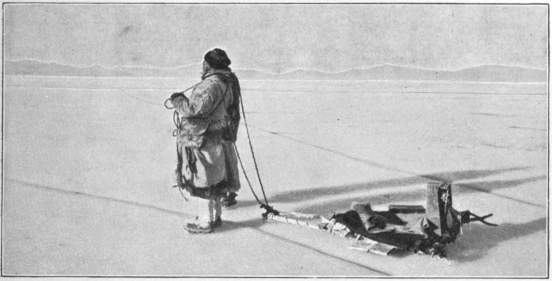
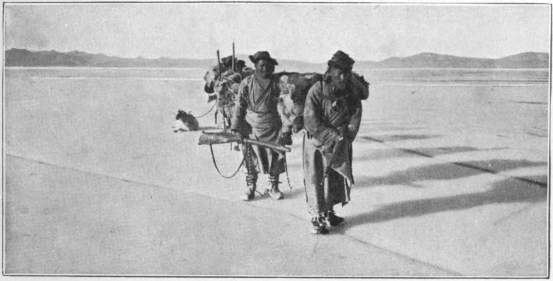
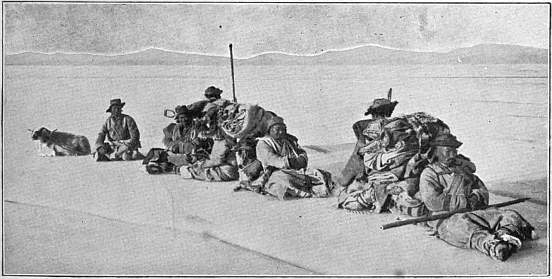
91, 92, 93. On the Ngangtse-tso.
Meanwhile we took off the two zinc runners, which were screwed into the gunwale and into which the mast thwart was fitted. They were then fastened as sledge cheeks to two benches bound together; to the sides of this singular vehicle two long poles were attached, meeting at an angle, through which the towing-rope was slung. A Caucasian burkha, which I had bought at Trebizond, was laid in several folds on the benches. For the sounding apparatus, the field-glass and other articles, we stretched a hammock between the poles. When the structure was complete it astonished us; for we had only to give this newly devised sledge a push and off it ran a good way by itself. Now the boat was contemptuously discarded, and when Rabsang with the towing-rope over his shoulder hurried off southwards over the ice unaided, the boat soon diminished to a black speck and disappeared. The others had orders to follow the track of the runners at their leisure; they would soon get help when the other men came (Illustrations 91, 92, 93).
Wrapped in my large sheepskin I sat cross-legged on the sledge, which glided merrily over the ice by the hour together, while Rabsang had no need to over-exert himself. The sledge cut through the salt ridges as though they were nothing, and bumped with a pleasant rumbling noise over the places where the ice was lumpy; it jumped over cracks and fissures, where the edges of the ice shone green, and clear as glass, and on smooth patches shot noiselessly forward, so that its point reached Rabsang’s heels if he did not jump on one side just when the line became slack.
It was really not dangerous on the ice, which was nowhere less than 7 inches thick. So the Tibetans’ dread of drowning was exaggerated. But they have always the greatest respect for the spirits inhabiting the lakes, and would rather go all round a lake than cross it, mistrusting the winter repose of the raging storm-beaten waves.
Many singular effects of congelation may be observed, which change their forms in various parts. Sometimes they are innumerable vertical figures in perfectly clear dark ice; seen from the side they have the form of oak leaves, but looked at from above they resemble stars with four arms thin as paper. At other places you find blocks of white porous ice embedded in clear ice, the result of a storm which has broken up the first ice-sheet of early winter, whereafter the blocks are enclosed in new ice on the final freezing over. Water is squeezed out through long narrow cracks, and is congealed into screens sometimes a yard in height, forming fantastic sheets and domes, and edges and points often as sharp as a knife. Rabsang has only to give them a kick to clear a passage for the sledge, but these thin ice-fences are very misleading, and render it difficult to estimate distances.
We sounded in eight holes, and the greatest depth was only 32 feet. The bottom consists of dark clay mud. It took a good quarter of an hour to cut out a hole in the ice with axes and crowbars. As soon as the last blow drove through the bottom of the ice, clear, cold, dark green water welled up and filled the cavity, and then the sounding weight was let down by its rope.
The first line of soundings had occupied far too long a time, chiefly owing to the interruptions and repeated rearrangement of the baggage at starting, and we were still far from the nearest shore when the sun set in clouds of red and gold. But the full moon shone in the heavens, the rocky promontory was sharp and clearly perceptible, and we made all haste we could. The ice was uncomfortably lumpy, so that I had to traverse long stretches on foot. Cold, white, and desolate the ice mantle of the lake extended on all sides; all was silent and quiet, only the crunching sound of our own footsteps could be heard. If nomads had pitched their tents on the shore we were approaching they would be much perplexed by the black specks moving out on the lake. But no fire illumined the night and no wolves howled. In the darkness we could, of course, gain no notion of how much further we had to go. At the last hole the promontory had not appeared much larger. And so we marched onwards until Rabsang suddenly came to a halt with the information that we were only a few hundred paces from dry land.
There we left the sledge and advanced to the outlying mountains, where several fallen blocks of stone lay at the foot. Under one of them we sat down to wait. Then Rabsang collected as much fuel as he could in the dark. We must light a signal fire to guide the others. At length they tramped up, Tashi, Ishe, Bulu, and Islam Ahun, all heavily laden, for they had preferred to leave the sledges behind and carry the baggage. Two hours later some dark points were noticed out on the ice; it was the reinforcement, and now I had ten men with me. They had seen from the lake fires at four places; we were therefore surrounded by nomads on all sides, but we had no need of them, so we did not trouble ourselves about them.
Profiting by experience, we made the most practical arrangements possible for our next day’s wanderings. Islam Ahun was to return to headquarters, collecting all the things we had dropped on our way, and was to see that the boat was fetched. Rabsang and Tashi drew my sledge, the others carried the baggage. At first they followed a road along the shore before taking to the ice and making for the goal for the day, in the north-west. We keep them in sight all day. They march in Indian file, trotting, swaying, and singing, and sometimes sitting down for a rest. Then they use the firmly tied bundles as back-rests. But they cannot get up again without help; it is very easy for six of them, but the seventh, that is, the one who has to get up first, finds it more difficult. He rolls over on to his stomach, wriggles up with the help of a stick, and when he has at length accomplished the feat, he helps the others to get on their feet.
The ice was excellent, far better than on the first traverse. Also the salt was less abundant, owing to the westerly storms which sweep it eastwards. For long distances the ice lay pure and smooth in front of us, and had a dark green colour. I did not know what to make of it when we tramped over the dark patches. Were there warm springs at the bottom which prevented the lake from freezing over in parts? But we soon became accustomed to the sight, the ice was firm and at least 6½ inches thick, while the greatest depth amounted to 31¾ feet. I sat like a statue of Buddha cross-legged on my toy sledge, smoked, took observations, made notes, and rejoiced that I could keep New Year’s Eve on the ice of Ngangtse-tso. About mid-day a south-westerly wind arose, and I had to ride backwards so as not to get frozen. A lead running north and south puzzled us greatly. It was 5 feet broad, and ran in either direction as far as the eye could reach; open water lapped between the margins of ice. Probably it had come into existence during a storm, when the whole ice-sheet was slightly disturbed towards the east, and had left behind it a yawning channel. After a long search we found a place where fresh ice was being formed below. Using the sledge as a bridge we crossed over dry-footed. How the others got over the difficulty I do not know, but they were not afraid of wetting their feet.
We went ashore rather early, at a place where 19 horses were grazing on the wide plain and a youth was watching 500 sheep. He scampered off in a hurry when he saw us coming, and I was not surprised that he was afraid when he saw ten great fellows stealing like ghosts over a lake that had never been trodden by human foot. The Ladakis sat round a large fire, sang, and blew their flutes, and the moonlight poured down a cold, peaceful flood of light over the unknown strand where a party of wandering strangers were passing a single night of their lives. It was the last night of the year 1906, and the camp was our hundredth.
A splendid New Year’s morning in 1907! With joyful hopes for the new year and its work I began the third line of soundings in a direction south, 19° E., towards a dark spur lying between two valleys where ice-clumps glistened in the sun. The spur seemed to fall steeply to the lake and the distance seemed tremendous, but it was an illusion: the low plain extending from the foot of the mountains to the lake could not be seen from the ice. We had to cross the fissure of the day before, but it had frozen over in the night. But water stood in many other fissures and spurted up as we passed over. This day our porters kept up with us, and their songs resounded far and wide over the ice-fields. At every new hole they settled down and awaited the result of the sounding with genuine interest. Singular men, always cheerful and contented, never down-hearted and complaining, taking everything as it comes, and calm and composed in all kinds of wind and weather.
Puppy has had enough of running over the ice, suffers from cold feet, jumps on the sledge as soon as it comes to a halt, but has a decided objection to riding.
A conical summit to the south of camp No. 99 dominates the whole lake like a lighthouse. Nain Sing, who touched the north shore of the Ngangtse-tso, has drawn the outline of the lake on the whole correctly, but has made the south-western part too broad. There also the sheet of water narrows down to a point, and the whole has the form of a half-moon. The mountains, which the Pundit has inserted in his map on the south side of the lake, are very erroneously portrayed, and no wonder—for he saw them only from a great distance, and could not possibly, in these circumstances, obtain any proper notion of their configuration. It is just as hard to form an idea of a lake by viewing it from the shore; this is possible only from a pass or a crest.
We wondered whether we could reach the southern shore before twilight, for the distance seemed still enormous. About noon the wind began to blow strongly, whirled up white clouds of dry salt, swept them along the ice, and obscured our view. Sitting on the sledge I was exposed to its full onslaught, and had to be careful not to open my mouth. Here and there the ice rose in undulations, as though it had been formed in a high sea; the ice-waves also have a steep slope towards east-north-east, the way of the wind. In the troughs between them the salt-dust driven by the wind collects, and lends to the ice-field a curious appearance like watered silk. All the eastern half of the lake is concealed by the rocky promontories near which our camp, No. 99, is pitched. We penetrate more deeply into the southern bay. Yaks graze on the slopes, and towards evening are driven down by a man. To the south also we catch sight of tents, yaks, and groups of kiangs. From our low point of view they seem to be moving in the midst of the lake; the acuteness of the angle of elevation deceives us. At the last sounding-hole the axe and crow-bar bored deeper and deeper into the ice without breaking through. Not till a depth of 17¼ inches was reached did the water burst violently up, full of the usual small red crustaceæ—the salinity of the lake cannot therefore be very great. Somewhat further the ice was found to lie directly on the clayey bottom without a layer of water beneath it. Then we came to the sterile shore, and were glad that we were this day independent of vegetation. We found fuel and obtained water by melting lumps of ice. The greatest depth on this line was 30.8 feet, or a little less than on the others.
We had another boisterous storm towards evening. The lake ice, only a couple of yards distant, vanished completely from sight, and the dung-gatherers suddenly emerged from the mist when they were only a few steps from the fire. I could not understand how they found their way in such a thick atmosphere. They erected a shelter from the wind with the sledge and three sacks of fuel, and sat behind it by their fire, the flickering flames almost singeing their faces. The group was exceedingly picturesque in the dark night and the struggling moon-beams. And how it blew! I could scarcely keep my feet when I read the thermometer, and my cap flew in all directions. In the night the men slept huddled up together in the shelter of the tent.
The temperature on January 2 was −8°. To-day the fourth line had to be executed; it was short, it is true—barely five hours, but trying. We had to march south-westwards, straight in the teeth of the wind. Moreover, the ice proved rough and heavy, doubtless in consequence of the slight depth of the lake. The maximum depth was 10.6 feet. In my diary, this day is described as one of the worst, if not absolutely the worst, day of the whole journey. But we always think that what is present is the worst, forgetting the horrors of the past. The storm drove the salt before it in thick clouds, which scoured the ice with a swishing sound and dashed into my face. When I ordered my two “towing horses” to keep the direction, a quantity of salt flew into my mouth, and I had the greater difficulty in getting rid of the disagreeable taste that the powder also made its way into my nose. My eyes became red, watered, and ached. My hands, from constant contact with the sounding-line for several days, were encrusted with salt, and the skin cracked so deeply that the blood ran. Sometimes my hands turned blue, were stiff, and lost all feeling, so that it was only with the greatest difficulty that I managed, holding the pen in the fist like a chisel, to jot down the results of the soundings, the times, and distances; other notes were not to be thought of. Rabsang and Tashi at all events kept themselves warm, for they had to put forth all their strength to drag the sledge against the storm. Where the ice was smooth they could not get firm foothold, slipped and fell; once Tashi was thrown into my lap, capsized by the gale. Often the wind was so strong that sledge, and team were driven backwards, and the men could only stop themselves by sitting down and planting their feet against a ridge of salt. I became so benumbed and helpless that I could not rise, and had to remain sitting while the holes were hacked out. But at one hole, which was broken in a field of ice as smooth as a mirror, the wind seized the sledge and myself and carried us in a dizzy race over the lake like an ice-yacht. I tried to put on the drag with my feet, but I had no power in them, and my boots of soft felt glided lightly and jauntily over the ice mirror without reducing the speed in the least. The runners were too short, and the sledge revolved in a circle, but still it moved onwards, and if the ice had been all smooth, the storm would have blown me back in a few minutes all across the lake to camp No. 98. Then my vehicle fortunately tilted over in a fissure, I was thrown out, shot a little way farther over the ice, and landed on a salt ridge. Rabsang hurried sliding after me, picked up me and the sledge, and drew me back to the hole unharmed (Illustration 94).
Our appearance was enough to frighten one another. We looked like swollen disinterred corpses, dried in the sun and daubed with white oil paint. Faces, hands, and clothes were white with salt. I could not wear my sheepskin again; it was stiff, had given way at the seams, and had to be thrown away with other clothes.
We had not yet covered half the distance. The men exerted themselves as though they had to struggle through water 3 feet deep. Oftentimes I could not see through the clouds of salt, and nothing was visible of the ice beneath the sledge; it seemed as though we stood still while a foaming white flood poured down on us ready to swallow us up. I wondered whether we should ever reach the shore alive. There was very little life in me when we at length landed. The sledge was anchored to prevent the storm carrying it away, and then we climbed five terrace banks, one after another, to seek shelter behind the wall of a sheepfold erected on the sixth. Fortunately we found dry yak dung there in great abundance, and soon had a roaring fire, at which I had to sit a good hour before my limbs became at all supple again.
From camp No. 102 to the southern extremity of the lake the distance measured 3260 paces. There large herds were feeding, and six tents were set up at the mouth of the valley. About five o’clock the storm ceased as suddenly as it had sprung up, and it became strangely calm. When I took the meteorological observations at nine o’clock all my men were lying in a row, with their heads against the wall, their foreheads on the ground, and their legs drawn up, and as close to one another as sardines in a tin. They slept well; that I could tell from the tunes their nasal organs emitted.
There were shells of freshwater molluscs on the strand, and a quantity of goose feathers in a bank formed of decaying algæ. At present the water of the lake is not fit to drink, but the Ngangtse-tso was a freshwater lake formerly, that is, when it still discharged into one of its neighbours.
Wearied by our exertions on the previous day we slept till late, and then started off in a north-easterly direction towards the red porphyry mountains which jut out into the lake to the west of camp No. 99. We had no storm, but a brisk wind, and when it blew at our backs we glided like oil over the ice. I had a pole to steer with.
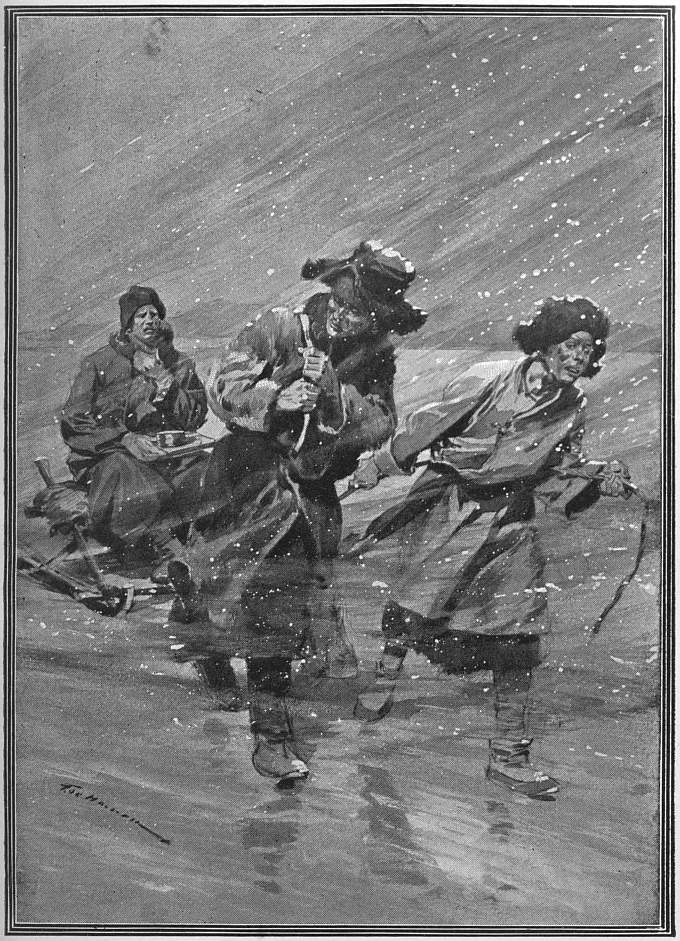
94. In a Snowstorm on the Ice of the Ngangtse-tso.
Beyond the promontory we encamped in a deep hollow to obtain shelter from the wind. A shepherd was feeding his sheep on a slope and tried to make his escape, but Rabsang overtook him. He thought we were robbers. He had nothing to sell, for he was in the service of another man. But Rabsang requested him to bring his master to us. Meanwhile the others had arrived, except Ishe, who had fallen ill, and was left lying in the middle of the lake. Two of his comrades fetched him in the evening. All were tired out, and begged that they might make a short march on January 4, and that suited us well, for the shepherd’s master came and sold us a sheep, butter, sour milk, and a bag of tobacco. It was high time, for the provisions were almost consumed. The tobacco was quite a godsend to the men, for latterly they had been reduced to smoking yak dung! The old man gave much interesting information about the Ngangtse-tso, and told us that there were then fifty to sixty tents pitched in the valleys of the southern shore. So far all was well, but the day was not yet ended.
CHAPTER XIX
DRIVEN BACK
A dismal, inauspicious day was January 4, 1907. Towards noon Islam Ahun appeared, half dead with weariness. He had left headquarters on the morning of the 2nd, and searched up and down the lake for us; had been on the west and on the south shore; and at last, following the most recent track of the sledge, had found us in our dell. He brought me a letter from Robert:
Yesterday, on January 1st, six armed men came to the camp, made a few inquiries, and went off again. To-day, the 2nd, they returned with some other men, and said the Governor of Naktsang had ordered them not to allow us to proceed further, because we had no passport from the Devashung, and that we must remain where we are. They wanted an answer from Master, in order to report to the Governor, who would communicate immediately with Lhasa. They are waiting impatiently for a reply, so I am sending off this letter.
After Islam Ahun had rested and eaten, he had to take back a letter to Robert at camp No. 97. Robert was to inform the ambassadors that I would not give an answer until I had seen them in person; if they were so anxious to hear it, they might come on the afternoon of the 5th to the northern shore at a distance of three miles from camp No. 98. If they did not, they must be answerable for the consequences. Muhamed Isa must come with them as interpreter.
Now matters were coming to a head. This time it was not a false alarm. Tidings of our journey had been sent to Lhasa, and we were in the hands of the Governor of Naktsang. I had put off the decisive moment in order to get time for at least one more line of soundings. If I could advance no farther in Naktsang, at any rate I would complete my investigation of the Ngangtse-tso. Afterwards the great retreat might commence. The intense excitement in which we had lived during the past months had now reached its culmination, and the Ngangtse-tso was to be the turning-point of our journey. I heard distinctly the creaking and grinding of the hinges as the great gates of the land of holy books, the forbidden land in the south, were slammed in my face.
At length we set off to camp No. 104, which was situated on the southern shore to the east of camp No. 99.
January 5. Every blade and stalk was covered with rime in the early morning when we marched over the ice in a direction north, 19° E. The day was fine and calm, the air pleasant, almost warm. Was the spring coming? Did spring set in so early in these more southern regions? It had seemed so far off that we had not thought of looking forward to its mild air while the long winter of Chang-tang still lingered in our limbs. We needed more warmth to thaw properly. The ice cracked and groaned wildly in the night, but it was not on that account that I slept badly.
Here the ice-fields form long waves; banks of water pressed up and then frozen, brittle as glass, came in sight every minute. The greatest depth, 32.9 feet, occurred when we were 6.6 miles from the shore, and was the deepest we sounded in the Ngangtse-tso. The lake is, then, deeper in the east; the west wind silts up its western half with sand and dust.
Half way across we saw a small dark speck on the ice in the direction of the Laen valley. It was the Hajji with a letter. The envoys had received fresh orders from the Governor of Naktsang. In four days he would appear in his own exalted person, and meanwhile his representatives were to watch us closely. Consequently they remained with the caravan, but they had allowed Robert and Muhamed Isa to transfer our headquarters to a place south-east of camp No. 97, where the pasturage was better. We had therefore freedom for a couple of days longer. The Governor of Naktsang! It was he who in 1901 had made me halt at the south side of the Zilling-tso. I could expect no mercy from him. On the contrary, I had on the former occasion given him so much trouble and annoyance that he would be furious at my return to his province.
On January 6 Ishe was so ill that the Hajji was obliged to take him home. Now we crossed the lake again in a direction north, 49° E. We had just arrived at our second sounding-hole when three men, who had followed our track, came in sight behind us. They made signs that we should stop, so fresh news must have arrived. We were able to cut out our hole and take a sounding before they came running up to us. They were Muhamed Isa with two other of my men, perspiring and breathless, and I invited them to make themselves comfortable on our lawn.
“What is the news?” I asked.
“Sahib, twenty-five Tibetans have pitched their tents round about ours. We wished this morning to move our headquarters to the shore, in order to be nearer to you. All the animals were laden, and we were about to set out, when the men came out of their tents and forced us to unload the animals again, and ordered us to stay where we were.”
“Have you heard anything more of the Governor?”
“He is to be here in three days. Mounted messengers are coming and going daily, often several in one day, and they seem to ride fast. They are in constant communication with the Governor and send him reports.”
“What do they say to my remaining away so long?”
“They are exceedingly astonished at it, and repeatedly ask us what the Sahib is doing out on the ice. They have had spies on the shore, and believe that the Sahib is dredging up gold through the holes from the lake bed.”
“Are they civil to you?”
“Yes, but determined and immovable. They say that the Governor himself will decide our fate. Their number has been greatly increased during the latter days, they have provisions brought to them, and they expect further reinforcements.”
“What is their intention, do you think, Muhamed Isa?”
“Ah, the outlook is not bright. They certainly intend to render our further progress impossible, and to force us to go northwards.”
“We have to thank for this that ill-omened fellow on the Bogtsang-tsangpo, who has despatched an express messenger to Naktsang. If we come to a deadlock here, they must provide us with a new caravan, and we will travel to Pekin. There I will procure permission from the Chinese Government to travel through Tibet. How is the caravan?”
“All’s well. A mule died the day before yesterday, and my black saddle-horse yesterday. Eight horses and a mule are left. The yaks are in splendid condition.”
“We shall have plenty of time to rest at this lake, for if we have to negotiate with Lhasa, it will be a couple of months before the question is settled. Now, go back and remember me to the others.”
We went on with our sounding and found a maximum depth of 27.4 feet. On the shore old banks were plainly perceptible; they have here been exposed to the breakers of the western storms. The highest might be about 50 feet high. There paced a solitary wolf, farther back 25 kiangs were grazing; they looked at us inquisitively for a long time, and then darted away as lightly and swiftly as the wind. We saw no sign of our porters, and on the shore, where we walked along the highest bank, we did not find a track. Why did they not signal by lighting a fire? At last we caught sight of them far off in a northerly direction. They were tired and lay down to sleep as soon as they reached land. I did not scold them, but Rabsang seized the first he could get hold of by the hair, and then gave them all a thrashing in turn, which, however, did not prevent them singing as merrily as usual in the evening.
Now my work on the Ngangtse-tso was finished, after marches over the ice aggregating 66 miles.
On January 7 the porters with all our belongings, except my tent, set off for headquarters. I waited for my riding horse, did not allow my mind to be disturbed, and was in no hurry to give myself up to the Tibetan militia—those horrid black riders who had so often interfered with my plans. No news came from Shigatse, no post from India. I had ordered it to arrive at the Dangra-yum-tso on the 25th of November, and now it was January 7. Had Ganpat Sing lost the letters, or had they never reached Leh? Was it, perhaps, impossible, for political reasons, to send me my letters from India?
I had to wait a long time. It was not till one o’clock that a man appeared with my horse, and at the same time a caravan of 50 yaks appeared on the inner terrace embankment, driven by Tibetans. We supposed that it was the Governor’s baggage train, but the Tibetans said that they were natives of Laen, and had been attending the market in Naktsang.
We were three hours from the camp. Seven wild asses trotted in front of us for an hour; the wind was strong against us. Clouds of sand and dust swept along the bank, the icy surface became invisible, and the wild asses disappeared like ghosts in the mist. The light was curious and confusing, the ascent became steeper, and fresh hills continually appeared out of the dense air, which was like muddy water. Often a small troop of Goa gazelles sprang lightly past. We did not see camp No. 107 until we were close upon it.
A deep erosion channel running towards the lake. On its right flank are our four tents, looking eastwards. Muhamed Isa stands at his fire, his hands in his pockets, his pipe in his mouth (Illustration 66). All the others come out. The Tibetans peer out of their tents like field-mice out of their holes. Robert reports: “All quiet on the Shipka pass.” The day before our horses, chased by wolves, had stampeded and had taken the Tibetan horses with them, but they were all found again in scattered groups along the shore.
I entered Muhamed Isa’s tent; when I was seated the principal Tibetans were summoned. They presented themselves immediately, bowed low, and thrust out their tongues as far as possible; this time this original mode of salutation seemed to me a mockery. A man with a red turban, dark-blue fur coat, and a sabre in his belt, had been in 1901 in Hlaje Tsering’s camp on the eastern shore of the Chargut-tso, when we encamped together, and he reminded me of that time.
“Is Hlaje Tsering still ruler of Naktsang?” I asked.
“Yes, it is he who is coming the day after to-morrow.”
“Is he bringing with him as large a following as last time?”
“No; he perceived then that the troops of mounted men did not frighten you, and he trusts that you will be amenable to his wishes.”
January 8 was spent in repacking the baggage, and on the 9th the Tibetans set up another tent, intended, they said, for the Governor’s kitchen. At dusk two riders arrived, who announced that the Governor begged to be excused for not arriving at the stated time. He was an old man, had had the storm against him on the way, and could only travel slowly, but he would certainly be here on the evening of the 12th.
Then I sent for the chiefs of the Tibetans, and told them that they would not be admitted to my presence again if they did not speak the truth this time.
“Bombo Chimbo,” they replied, “if the Governor is not here in three days you may cut off our heads.”
“That is not necessary; it will suffice if you bind yourselves in writing to pay me a fine of ten horses if the Governor is not here in three days.”
“We will give you twenty horses.”
“No, ten are enough.” And now the contract was drawn up and signed.
“Have you any fresh information?”
“Yes; the Governor has brought only his own twelve servants. He knows that the Bombo Chimbo is come back, for he received a letter from the Bogtsang-tsangpo, saying that the same traveller who had been there five years ago with a camel caravan was there again. Then he sent an express to Lhasa, and waited ten days for an answer, but at length decided to come himself.”
Our patience was put to the trial again, as though we had not had already occasion enough to exercise it. At last, on the 11th, a small group of cavaliers appeared against the hills, and soon after a blue-and-white tent stood in the camp of the Tibetans—they had now seven in all. Then followed a party of mounted men, one of whom sat very much bent, wore a red bashlik, and was carefully wrapped in furs. “That is Hlaje Tsering,” we were told. His followers carried guns decked with red pennants. They seemed very starved, quickly withdrew into their tents, and we heard nothing more of them.
January 12. All too soon a messenger came to ask if I would go to the Governor’s tent, or whether he should first pay me a visit. I sent an answer that I would let him know when I could receive him. My poor storm-beaten tent was made as fine as circumstances allowed; there was no room for more than two guests, but frieze rugs and cushions were laid down for them, and between these seats and my bed a large brazier was placed, so that the old man might get a good warm. My messenger was just gone, when two horses were led up to the blue-and-white tent, and the old man mounted one, a young lama the other; the horses were led by the bridle, the other Tibetans fell in on foot, and the procession moved off slowly to our tents.
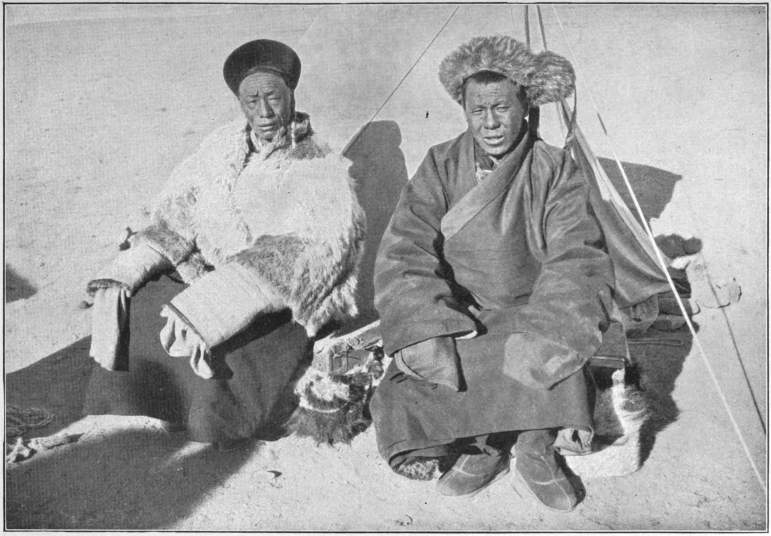
95. Hlaje Tsering and his Travelling Companion, a Lama, at my Tent on the Ngangtse-tso.
Hlaje Tsering, for it was really my old friend, came in a parade costume of Chinese cut, with a Chinese cap, decorated with two foxes’ tails and a white glass button, and in boots trimmed with velvet and with thick white soles. On his silken robe with wide hanging sleeves he wore a short collar of otter skin, and in the lobe of the left ear a large earring of pure gold studded with round turquoises. When he appeared I went to meet and salute him. We at once recognized each other, exchanged warm greetings, nay, almost embraced, and remarked how singular it was that we should meet here again in the midst of the wilderness after five long years. Holding his hand in mine, I conducted him to the modest seat of honour, and invited the lama, his secretary, a son of the Yunduk Tsering of 1901, to take a seat. I sat cross-legged on my bed beside him, Robert and Muhamed Isa in the tent door, while the rest of the space framed by the opening was filled with a mosaic of Tibetan heads. Muhamed Isa, the interpreter, wore a robe of ceremony presented to him by Younghusband in Lhasa: it was made of thick, cerise-coloured Tibetan woollen material, and was confined round the waist by a coloured girdle; on his head he wore a tall gold-embroidered turban from Peshawar. He put us all in the shade with his finery (Illustrations 30, 95.)
After I had taken out a box of Egyptian cigarettes, and Hlaje Tsering had for a time examined everything in the tent, he said with a solemn, troubled manner:
“In my capacity as Governor of Naktsang I cannot allow you to proceed further, to Shigatse or in any other direction within the boundaries of Naktsang. Soon after the English expedition to Lhasa I received orders from the Devashung to allow no European in future, as formerly, to travel about in Naktsang. My instructions are that if any European forces his way into Naktsang it is the duty of my office to stop him and force him to turn back.”
I replied: “It is impossible that the conditions remain the same as five years ago, when you held up my caravan with your militia of 500 men. Since then the Indian Government has concluded a treaty with the Devashung in Lhasa, and now the two Governments are on most friendly terms.”
“Hedin Sahib, you will remember what took place last time. You were then so kind as to turn back at my request, but you do not know what befell me. All the expenses of the levy raised against you I had to pay, and the Devashung demanded from me 2000 rupees in addition. I was ruined, while my colleague, Yunduk Tsering, enriched himself by exploiting the people, and now lives, a wealthy man, in Lhasa. We are old friends, but I cannot expose myself to new vexations on your account.”
“It is true, Hlaje Tsering, that we are old friends, but you cannot expect me to undergo another journey through Chang-tang on your behalf. I owned 130 animals when I left Ladak five months ago. Now, as you can see yourself, I have only 9. I will not be persuaded to return by the same way, and by the treaty of Lhasa you have no means of compelling a stranger by force.”
“The treaty of Lhasa was concluded with England. You are not an Englishman but a Swede-Peling.”
“You have the more reason to show me hospitality. England forced a war on you against your wishes; my country has not done so.”
“You are right; your people has never injured us. But in my instructions no distinction is made between different nations. I shall certainly not force you to retrace your steps to Ladak by the long troublesome route by which you came; I know that this is impossible without a large strong caravan. It is of no consequence to me whether you succeed in reaching Shigatse or not, but you must not travel thither through my province. In Naktsang there is only one road open to you, namely, the one by which you came. I do not mind what road you take afterwards, and if you can force your way to Shigatse from the northern and western shores of the Dangra-yum-tso, that is not my affair.”
“You know that the Tashi Lama was in India a year ago, and how well he was received there. He expects me in his capital, and no one else has the right to hinder me on my journey to him.”
“Naktsang is under the Devashung, not under the Tashi Lama.”
“The Dalai Lama took to flight when the English troops drew near to Lhasa. The Tashi Lama is now, therefore, Tibet’s foremost Grand Lama.”
“Quite right; we do not understand the action of the Dalai Lama, and do not approve of it. He should have been the first to protect his country from its enemies. But that has nothing to do with the question. I receive my instructions solely and only from the Devashung.”
“And I shall not leave Naktsang until the Tashi Lama has confirmed your statement that the way is closed. I will, then, forward a letter to the representative of the Indian Government in Gyangtse, Major O’Connor, and if he replies that the political situation forbids my travelling further, I will leave Tibet. I will await his answer here, at the Ngangtse-tso. And I have another reason for this resolution. I am expecting letters from India, which are to be forwarded through Major O’Connor. You will understand that I am not disposed to leave Naktsang before the arrival of my letters, which will doubtless be sent on by order of the Tashi Lama.”
“That is all very fine, but have you any proof that the Tashi Lama will assume the responsibility of forwarding your letters? You have no passport from the Devashung. Have you one from the Tashi Lama? It is not my duty to serve your pleasure. If I send your letter to Gyangtse on my own responsibility I shall lose my head.”
“I will send two of my own Ladakis with the letter.”
“No; the land is closed to them as much as to you. And, besides, how long do you expect to have to wait here for the answer? Several months?”
“Oh no; it is 165 English miles to Gyangtse, and the journey will not take more than twenty days, even with short marches.”
“I shall not leave this place till you have started northwards and passed the frontier of Naktsang.”
“And I will not start till I have received an answer to my letter from Gyangtse.”
“You cannot possibly remain here long. You cannot feed your men; there are no nomads here, and those who dwell in the neighbourhood are poor as rats.”
“I saw many tents on the southern shore and large flocks. At the worst we can live by hunting; there is plenty of game here. As I ask nothing but that you will allow me to wait here for an answer, you might oblige me so far.”
“There you make a mistake. In my position neither Shigatse nor Gyangtse has anything to do with me. When the English had evacuated Tibet the Devashung sent a proclamation round to every dzong (governor’s residential town) in Tibet that we had certainly been beaten, but that we had lost none of our territory and were still masters over it, so that the old regulations with regard to European travellers were still in force. I will try to meet you as far as I can, and will now withdraw to my tent to take counsel with my people.”
At the same time I held a council of war with Robert and Muhamed Isa. It was perfectly evident that we could not continue our journey southwards. On the other hand, it seemed possible that, making a detour to the Dangra-yum-tso, we might penetrate into the country on its west side, which was governed, Hlaje Tsering said, from Saka-dzong. Were we driven from there, we would direct our course to Pekin. Why? I am certainly very optimistic, but I had a conviction that I could befool the Chinese Emperor as Marco Polo did, and obtain his permission to travel about freely in Tibet, with some kind of special mission as a pretext. Muhamed Isa thought it was an enormous distance to Pekin, but Robert was enthusiastic about the journey. We would only take our best men; for the others I could procure permission to return to Ladak through Gartok. We should have a hard journey at first, but through Southern Mongolia we should fly on Bactrian camels like wild deer over the steppe. I would on no account return home vanquished. I tried to infect the two others with my enthusiasm, and depicted our camel ride as a fairy tale and a romance.
Now two of Hlaje Tsering’s men presented themselves, bringing a dish of rice and a lump of butter as a present from their master. The secretary lama sent an apron full of rice. In return I sent Muhamed Isa with a whole piece of pashmina cloth and a knife from Srinagar for the Governor, and a similar knife and a turban bandage for the secretary.
I returned the visit about three o’clock, accompanied by Robert and Muhamed Isa. Hlaje Tsering’s tent was large and handsomely fitted up, and all his secretaries and servants were sitting round the fire, which blazed up towards the upper opening. At the sides lay sacks of rice and tsamba, and several whole slaughtered sheep; everything showed that the old man was prepared for a long stay. Guns with rests and pennants, sabres and lances, harness, bridles, saddles and saddle-cloths, lent a picturesque and warlike aspect to this chieftain’s tent. Along the shorter side, opposite the entrance, thick cushions were piled up, and covered with small Lhasa rugs, and round cushions laid upon them served as supports for the back. I was invited to take my seat there beside Hlaje Tsering; a small red lacquered table was placed in front of us. On our right stood an altar shrine with gilded images of gods and gaos, small silver cases with figures of Buddha, which on a journey are suspended by a red strap from the shoulder. And before them flickered a wick, fed with butter, in a bright brass bowl.
A servant brought cups of Chinese porcelain on copper saucers and with silver covers. Another poured out of a picturesque tea-pot the thick tea mixed with butter which the Tibetans are so fond of, and which I now drank apparently with pleasure, though to me it tasted horrible—but Hlaje Tsering had lately praised my English tea.
The conversation was carried on calmly and agreeably as in my tent. But the negotiations made no progress, but rather the contrary, for Hlaje Tsering now said:
“I can on no account let you go to the Dangra-yum-tso; the lake is holy, and, besides, watchmen have already been posted there.”
“The road to the east is also barred?”
“Yes, the country is entirely closed to you on the south, west, and east, and I cannot, as I now perceive, send you back to the north.”
“Am I, then, to travel through the air, or sink down to the lower regions?”
“No, but you must wait here.”
“And you will send my letter to Gyangtse?”
“No, I will not do that, but I will not prevent you from sending two of your men on your own responsibility.”
“Will you sell me some horses for them?”
“No; then it would be said that we were in the same boat, and that I had allowed myself to be bribed.”
“You are a fine governor, Hlaje Tsering; you cannot even sell me a couple of horses. I shall consequently have to send my men on foot, and they will take twice as long.”
“Well, I will sleep on it, and let you know my decision in the morning.”
Rub Das and Tundup Galzan received their instructions in the evening. They were to take a letter to Major O’Connor in Gyangtse, and a sum of money was given them, which was sewed up in their girdles for safe keeping. They were to start on their adventurous journey the following evening as soon as it became dark.
CHAPTER XX
ONWARDS THROUGH THE FORBIDDEN LAND
January 13. Again this ominous number, which is regarded by so many people as unlucky, and is surrounded by a cloud of superstition! Would the 13th be unfortunate for us also?
The sun had scarcely risen when Hlaje Tsering sent to announce a visit. Accompanied by his private secretary, the lama Lobsang Shunten, and all the rest of his retinue, His Excellence the Governor of Naktsang came to my tent on foot. They took their seats on the cushions, and Hlaje Tsering opened the conversation with the following remarkable declaration:
“Hedin Sahib, we have, neither of us, time to stay here for weeks and months, waiting for an answer from Gyangtse. I cannot help you in your correspondence with Gyangtse. I have thoroughly considered the situation, and have discussed it with my secretaries, who, like myself, are responsible to the Devashung. We are of the opinion that all you can do is to pass southwards into the territory of the Labrang (Tashi-lunpo). I beg you to set out the day after to-morrow.”
What did this most unexpected change of front mean? Yesterday I was not to be allowed to take a single step southwards, and to-day I was requested to start as soon as possible to the forbidden land. Had Hlaje Tsering received secret orders from Lhasa? Had he been informed that the Tashi Lama was really expecting me? He said nothing on the subject, and I cautiously refrained from asking him. Or were we the victims of a ruse, and when we had been induced to travel with all speed to Gyangtse, should we be compelled to return thence to India through Darjiling? For there the Devashung could appeal to the terms of the treaty, in which it is emphatically stipulated that only those who are in possession of a passport from Lhasa have a right to travel about the country, and so my journey would be speedily ended.
Might it not be better to make for the unknown country west of the Dangra-yum-tso, which after all was the main object of my journey? Hlaje Tsering’s change of front was so absolutely at variance with my former experiences in Tibet, that I had some misgivings, and wondered whether I was about to fall into the jaws of the English, Chinese, and Tibetan authorities, and should shortly be delivered unconditionally into their hands.
But this opportunity must on no account be lost. Between the Ngangtse-tso and Shigatse stretches the eastern part of the great white patch north of the Tsangpo, which no European, no pundit, has trod, the land of which not even hazy and uncertain reports at second-hand have ever found their way into geographical text-books. Even if I had an opportunity of making only a single traverse over it, my labour would not be in vain. Nain Sing has two rivers on his map, which flow east and north-east to the Kyaring-tso, and their upper courses he places in the country south of the Ngangtse-tso. At present I knew nothing of them, but I should learn everything if I accepted Hlaje Tsering’s proposal. But I had already perceived that the mountains on the south side of the lake were quite fanciful and arbitrary as inserted in Nain Sing’s map. At any rate, I must not now betray my satisfaction, so I answered very calmly and thoughtfully:
“Well, I will march southwards the day after to-morrow if you will provide me with horses by then.”
“I have sent men into all the valleys in the neighbourhood with orders that all the available horses are to be brought here. Two roads lead from here to Shigatse. If you travel by the west side of the lake you will be in four days in the territory of the Labrang, but by the east side you will reach it in two days. You may choose yourself which way you will take, but I shall be better pleased if you decide on the eastern, for with me the main thing is that you should clear out of my province as quickly as possible.”
“No, I will fix on the western road, that I may be able to make an excursion to the Dangra-yum-tso; for I wish to see the lake, and also I must go there because I have given it as my postal address, and the messenger of the Tashi Lama is awaiting me there.”
This was a very undiplomatic utterance. I ought to have avoided disclosing my plans. Hlaje Tsering bristled up at once and exclaimed: “To the Dangra-yum-tso? Never! The lake is holy; the mountain Targo-gangri on its southern shore is holy, and there lies the great monastery Sershik-gompa, in which influential intriguing monks dwell. Your visit to the lake would lead to complications. No, if such is your intention, I will leave only one road open to you, namely, that along the eastern side of the Ngangtse-tso. I cannot and will not compel you, but I implore you to give me your word of honour that you will not go to the Dangra-yum-tso.”
Thus I lost the holy lake a second time; but I gave my word of honour, that I might not lose the important route still open to me. My premature candour vexed me at the time, but I was soon to have reason to be thankful for it. Had I gained an opportunity of visiting the holy lake at this time, I should certainly have been arrested on its shore; but that is another story which will be related in a later chapter.
“Tell me, Hlaje Tsering, do you think that I shall be stopped in the territory of the Labrang?”
“As you have not been arrested here, in Naktsang, probably you will not be there. I do not know how I shall get on, but I have been Governor for seven years, and my term of office expires in five months, so it is of no consequence if I lose my post. The Devashung has plundered me so thoroughly that I have few cattle and little other property left. Now, for instance, I am travelling in my province at the expense of the people; the nomads have to provide me with baggage animals and provisions for the whole time.”
“The Devashung must be a nice institution. How glad you must be that your time of service will soon expire.”
“Yes, but I must settle down in some place where I can live cheaply.”
“Does the Devashung know that I am here?”
“I have not heard anything from it up to the present, but I despatched another report on your affairs yesterday by express messenger. How they will treat you I do not know; I have gone as far as I could for old friendship’s sake.”
After that we again paid him a return visit. Some of Hlaje Tsering’s men had seen us engaged in rearranging our baggage, and this caused him to ask me if he could have an empty chest. Four of the best were given him, and also all kinds of other superfluous articles.
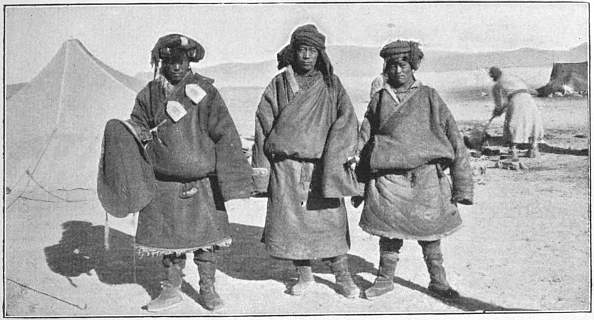
96. Servants of Hlaje Tsering.
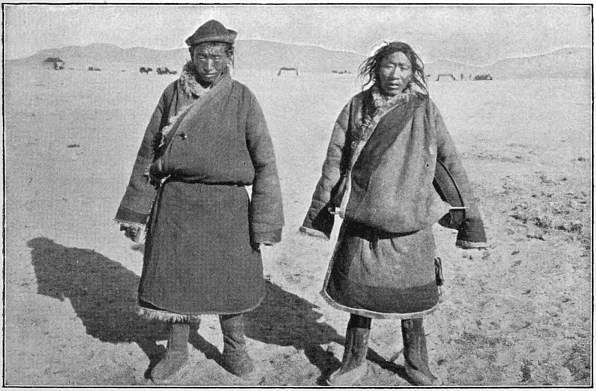
97. Messenger with Letters from Home, and his Travelling Companion.
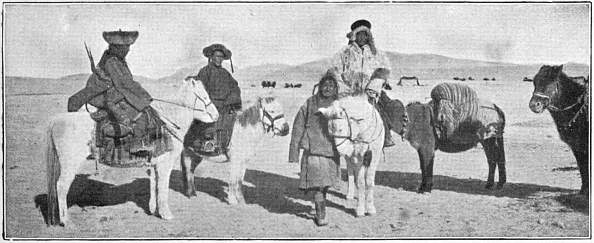
98. Hlaje Tsering setting out.
January 13 was a memorable day in our chronicles, and the 14th was to bring with it still more wonderful incidents. Our life during the past months had passed rather monotonously, but now the facts of our daily experience were stranger than fiction. The alt-azimuth had been placed on its tripod near my tent, and I had the chronometer, an aneroid, and a thermometer close at hand. There I stood for fully three hours, observing the phases of the eclipse of the sun. About nine-tenths of the sun’s disc were obscured. Shortly before the maximum the temperature of the air was 16.7°, and soon after the maximum 11.5°. The violet line of the thermograph fell sharply, and a slight breeze swept along the earth’s surface. Some Tibetans had betaken themselves to Muhamed Isa’s tent to sell us horses, but when the singular darkness fell, they shook their heads and returned to their tents. The Ladakis are outside, sitting at their fire and murmuring prayers. The ravens are quiet and do not move. An eagle circles with heavy pinions close above the ground. Our sheep come in of their own accord from the pastures, just as they are wont to do in the evening, and yet the vanishing sun stands at its mid-day altitude. The puppies break off their play, creep timidly into the tent, and lie down on my bed. Only the horses graze on and display no surprise that the day is so short. All is strangely still and quiet.
But then the small sickle of the sun, which has not been extinguished in interstellar space, increases again. It becomes lighter, and the shadows that have just before shown a double outline, become sharp again. The sheep stand a moment irresolute and then go slowly back to the pasture. The dogs return to their play, and the Tibetans, one after another, peep out of their tent doors. The ravens shake themselves and fly off croaking to a hill. The prayers of the Ladakis are heard no more, and the eagle is borne aloft by swishing beats of his wings to the sun, which again shines out in all its splendour.
Then old Karpun came to visit us, and was given some tea, tobacco, and a piece of cloth.
“Does the Bombo Chimbo remember that I tried to detain him five and a half years ago with a large levy?”
“Yes, on the north shore of the Selling-tso (Zilling-tso). I gave you a great deal of trouble then, and you could not induce me to stay.”
“The trouble is all forgotten, and I am very glad to see you again in good health and brisk.”
“We did not expect then that we should meet again. You, too, are looking well. But tell me why you are come just now.”
“I have brought a message to the Governor from Shansa-dzong. The officials remaining there have ordered me to call out the people. Now all the militia must stand under arms to——”
“You surely do not intend to detain me again?”
“By no means. But news is come from the black tents on the middle course of the Bogtsang-tsangpo that a large band of robbers has pillaged ten tents and driven off all the owners’ cattle and all the flocks of sheep.”
“When?”
“A few days ago.”
“Then we may thank our stars that we did not fall into their hands, for we passed along the middle course of the Bogtsang-tsangpo for five days, and we have a large quantity of silver money in our boxes.”
“The Bombo Chimbo is a friend of the gods. No harm can befall you.”
“In which direction have the robbers retired with their booty?”
“They are still in the territory of Naktsang. We shall pursue them, catch them, and cut off their heads.”
Then I visited Hlaje Tsering with the corner pillars of my caravan. He sat at his lacquered table drinking tea, and had his long Chinese pipe in his mouth.
“Why is it that it has just been so dark?” I asked him. “The gods of the Dangra-yum-tso are angry because you will not allow me to visit their lake.”
“No, certainly not. A big dog roams about the sky and often conceals the sun. But I and the lama Lobsang have prayed all the time before the altar, and have burned joss-sticks before the images of the gods. You have nothing to fear; the dog has passed on.”
“Very fine,” I cried, and made a desperate attempt to explain the phenomenon. Robert held up his saucer to represent the sun, and I took two rupees to represent the earth and moon crossing each other’s orbit. Hlaje Tsering listened attentively to Muhamed Isa’s translation of my demonstration, nodded approvingly, and finally expressed his opinion that all this might do very well for us, but that it did not suit Tibet.
At this moment the flap of the tent was thrown back, and Rabsang entered panting and calling out to me:
“The post is here!”
Muhamed Isa and Robert jumped up as though there were fire under their feet, and exclaimed, “We must be off.” I sat quite still, and thrust my feet against the ground so as not to show that I was trembling with excitement. Was it possible? Letters from home, from India, from Gyangtse, and perhaps from the Tashi Lama!
“Who has brought the mail?” I asked, as if nothing had happened.
“A man from Shigatse, accompanied by two others,” answered Rabsang.
“Where is he? Let him bring the mail-bag.”
“We have already told him to come, but he replies that he has strict orders to hand over the letters to the Sahib himself in his own tent. He refuses to do so in the tent of the Governor.”
“What is the matter?” asked Hlaje Tsering, astonished at the general commotion.
“I have news from the Tashi Lama,” I returned very coolly. It was now Hlaje Tsering’s turn to look disconcerted. The news made a very deep impression on him. He quickly gave an order, two men hurried out and returned with a confirmation of my statement. Then he gave me a friendly clap on the shoulder and said, smiling: