Front matter (continued 2)
Reading edition
But now dinner is ready in the lighted tent, and a box lid serves as a table. A carpet, a bed, two boxes for daily use, and the young dogs are the only furniture. There are three of the last, of which two are bitches. They are pariahs; they were enticed away from the street in Srinagar and have no trace of religion (Illustration 12). Robert and I, who always speak English, call the white and the yellow ones simply “Puppy”; the third soon received the name of “Manuel’s Friend,” for Manuel and he always kept together.
And all this company which the sport of fortune had collected around me was to be scattered again, one after the other, like chaff before the wind. I was the only one who, six-and-twenty months later, reached Simla again, and the last of all the men and animals who now lay in deep sleep under the planes of Gandarbal.
But I was not the last to lay myself down to rest on this first night, for when I put out my light at three o’clock the firelight still played on the side of the tent, and I seemed to feel the brisk life out in Asia like a cooling breath of pine forests and mountains, snowfields and glaciers, and of broad open plains where my plans would be realized. Should I be tired of it? Nay, should I ever have enough of it?
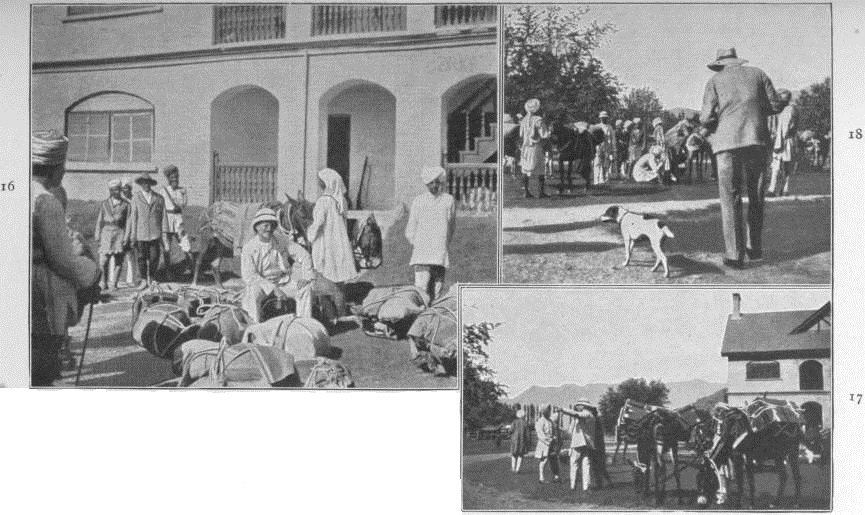
16. In Front of Nedou’s Hotel in Srinagar.
17. Some of Our Mules.
18. An Amateur Photographer Photographed.

CHAPTER III
THE ROAD TO LEH
The day ended late. Next morning I was awaked late, and the sun stood high in the heavens before we were ready to start. It took four hours to get the whole camp under weigh, to pack up and load the animals; but the work would be done more expeditiously when all knew their parts.
The long train begins to move, troop after troop disappears among the trees. On both sides of the road country houses and villages peep out between willows, walnut and apricot trees, and small channels of water murmur through the rice-fields, where men are hoeing, moving in regular order, and singing a rhythmical encouraging song; the singing lightens the work, for the weeds are torn up in time with the air, and no one likes to be behind another.
A bridge crosses the Sind, which rolls its greyish blue water, rushing and roaring, through several large arms. Now the road ascends the valley of the river, then we turn eastwards, and soon the broad valley of Kashmir with its level country disappears behind us. The rise is already noticeable, and we are glad of it, for the day is warm. Trees become fewer, and we ride for greater and greater stretches in the blazing sun; but all around us is green and abundantly watered, the mild air is full of life and productive energy, and the whole valley resounds with the roar of the river and the echo it calls forth. I have passed this way twice before, but on both occasions the Sind valley was covered with snow; now summer reigns in the deep hollows and on the heights.
At Kangan we pitched our tents in a thick copse. This time the camp was marked out and the tents set up fairly expeditiously. The Numberdar of the village procured us everything we wanted—we did not wish to touch our own stores until it became impossible to obtain local supplies. The four coolies who had carried the boat were here relieved by four others, who were to carry it up to Gunt.
So we had accomplished another day’s journey. We all delighted in the free, active life. But the day was declining, the shadows grew longer, the sun disappeared an hour sooner than usual, for it was concealed by the mountains, and after we had listened for a while to the plaintive bark of the jackals we also went early to rest. In the stillness of the night the roar of the stream sounded still louder; its water came from the heights which were the goal of our hopes; but with still greater longing would my eyes one day watch these eddies on their way to the sea.
When I came out of my tent in the cool of the morning the rest of the caravan had already set out, and the camp looked empty and deserted. The new day was not promising, for it rained hard, and thunder growled among the mountains; but the summer morning gave forth an odour of forest and fresh green vegetation, and after a good breakfast my detachment, to which Robert and Manuel belonged, started on its march.
The sun soon came out, and with the warmth great swarms of flies, which tortured our animals and made them restive. The road ran down to the river and through the trees on its right bank. On the crest of the left flank of the valley some patches of snow still defied the summer sun, and the wood opposite was much thicker than on our side. Here and there a conifer raised its dark crown above the lighter foliage. At the village Mamer, where a mill-wheel swished through the waterfall, and an open booth invited the traveller to refresh himself, Khairullah remained awhile behind in company with a smoking narghilé. At Ganjevan we crossed the river by three shaking bridges. In the background of the narrowing valley rose a mountain covered with snow. The scenery was fine, and we enjoyed a ride really elevating in a double sense. Our caravan had to halt several times when a mule threw off its load; but the animals were already quieter, and I looked forward with anxiety to the time when they would become meek as lambs, and when no objurgations would induce them to move on.
The camp at Gunt was already in order when we arrived. My first thought is always for the puppies; in the morning, during the first hours of the march, they whine, finding the movement of the mule very uncomfortable, but the rocking soon sends them to sleep. But as soon as they are taken out of the basket they fall foul of one another, and then they wander all the evening among the tents, gnawing and tearing at everything.
Even with a temperature of 52.2° F. I felt so cold in the night, after the heat of the plains, that I woke and covered myself with a fur rug. The river in the morning marked only 46.2°. Upstream the view became ever finer. Sometimes we rode through narrow defiles, sometimes up steep dangerous slopes, sometimes over broad expansions of the valley with cultivated fields. Then the precipitous rocks drew together again, and cool dense shadows lay among willows and alders. The roar of the stream drowned all other sounds. The river had now become smaller, so many tributaries having been left behind us, but its wild impetuosity and its huge volumes of dashing water were the more imposing; the water, greenish blue and white, foaming and tossing, boiled and splashed among huge blocks of dark green schist. In a gully, close to the bank, a conical avalanche still lay thawing, and up above small waterfalls appeared on the slopes like streaks of bright white paint. When we came nearer we could perceive the movement, and the cascades that resolved themselves into the finest spray.
Then the valley spread out again, and conifers alone clothed its flanks. We bivouacked at Sonamarg, where I set out some years before from the dak bungalow on a winter’s night, with lanterns and torches, for a venturesome excursion over the avalanches of the Zoji-la Pass.
The Governor of Kashmir had sent a chaprassi with me, and at a word from him all the local authorities were at our service. But it was not easy to keep some of the members of the caravan in order. Bas Ghul and Khairullah proved to be great brawlers, who began to quarrel with the others on every possible occasion. Bas Ghul evidently considered it his chief duty to appropriate a coolie for his own service, and Khairullah thought himself much too important to help in unloading. The others complained daily of annoyance from the Afghans, and I soon saw that this escort would give us more trouble than help. Among the rest, also, the Kashmiris and the men from Poonch, there were petty pilferers, and the Rajputs were ordered to watch that none of our belongings went astray. In Baltal there was a great commotion, for people from Sonamarg appeared and declared that my servants had stolen a saucepan as they passed through. And it was actually found among the Poonch men. The complainants received their pan back again as well as compensation for their trouble (Illustration 19).
The state of the road from Baltal over the Zoji-la Pass was very different now from what it was in the year 1902. Then the whole country was covered with snow, and we slided almost the whole way down over glaciated slopes. Now some five hundred workmen were engaged in mending the road up to the pass. Their industry was indicated by thundering blasts, and now and then great blocks of stone fell down uncomfortably near to us.
Now our heavily-laden caravan had to cross the pass. Slowly and carefully we march up over hard and dirty but smooth avalanche cones, in which a small winding path has been worn out by the traffic. Water trickles and drops in the porous mass, and here and there small rivulets issue from openings in the snow. After a stretch of good road comes a steep slope along a wall of rock—a regular staircase, with steps of timber laid across the way. It was a hard task for laden animals to struggle up. Now and then one of them slipped, and a mule narrowly escaped falling over—a fall from the steep acclivity into the deep trough of the roaring Sind would have been almost certain destruction, not a trace of the unfortunate beast would have been found again. From our lofty station the river looked like a thread. After some sacks of maize had fallen overboard, each of the animals was led by two men.
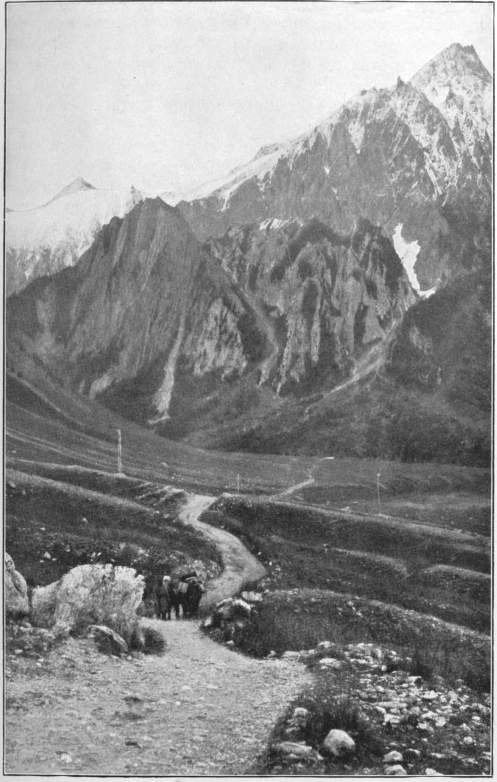
19. The Road to Baltal.
The train advanced slowly up. Piercing cries were constantly heard when one of the animals was almost lost. But at last we got over the difficulties, and travelled over firm snow and level ground. The thawed water from a huge cone of snow on the south side flowed partly to the Sind, partly to the Dras. The latter increased with astonishing quickness to a considerable river, and our small and slippery path followed its bank. A treacherous bridge crossed a wild tributary, with agitated waters of a muddy grey colour. One of the mules broke through it, and it was only at the last moment that his load could be saved. Then the bridge was mended with flat stones for the benefit of future passengers.
The Dras is an imposing river; its waters pour over numerous blocks that have fallen into its bed, and produce a dull grinding sound. And this mighty river is but one of the thousand tributaries of the Indus.
We reached Matayun in drizzling rain, and had scarcely set up our camp when the caravan-men came to loggerheads. We here overtook a hired contingent of 30 horses with forage. Their drivers had received orders to travel as quickly as possible to Leh; but now it appeared that they had remained stationary for several days, and wanted to be paid extra in consequence. The authorities in Srinagar had done their best to make my journey to Leh easy, but there is no order in Kashmir. In Robert I had an excellent assistant; he did everything to appease the refractory men. I now saw myself that stringent measures must be resorted to, and I waited impatiently for a suitable occasion for interference. About three-fourths of the Poonch men reported themselves ill; they wished to ride, and that was the whole cause of their illness. The mules, when not wanted, were to go unloaded, in order to economize their strength, and on that account we had hired horses in Srinagar. Some men had been kicked by our hot-tempered mules, and now came for treatment.
Then we go on to Dras and Karbu. On the heights above the Dras we pass the famous stone figures of Buddha, and then we descend a narrow picturesque valley to Karbu. The river constantly increases in volume, and presents a grand spectacle; small affluents fall between the rocks like silver ribands, and spread out over the dejection fans. The pink blossoms of the hawthorn wave gracefully in the wind, which cools us during the hot hours of the day. Fine dark juniper bushes, tall as cypresses, adorn the right bank.
In front of the station-house in Karbu an elderly man in a white turban came up to me. “Good day, Abdullah,” I said to him, for I immediately recognized the honest fellow who had helped me up over the snowfields of the Zoji-la on the former occasion.
“Salaam, Sahib,” he answered, sobbing, fell on his knees and embraced my foot in the stirrup, after the Oriental custom.
“Will you go on a long journey with me?” I asked.
“Yes, I will follow you to the end of the world, if the Commissioner Sahib in Leh will allow me.”
“We will soon settle that. But, tell me, how have you got on since we last saw one another?”
“Oh, I am the Tekkedar of Karbu, and provide passing caravans with all they want.”
“Well, then, think over the matter till to-morrow, and if you wish to accompany me, I have a post free for you among my people.”
“There is no need of consideration; I will go with you, though I only get a rupee a month.”
But Abdullah was too old and infirm for Tibet, and the conditions which he afterwards put before Robert were much more substantial than he had represented them in the first joy of meeting me again: 60 rupees monthly, everything found, his own horse, and exemption from all heavy work were now his demands. Consequently next morning we bade each other an eternal farewell.
Now a traveller turned up from the preceding station, and complained that the Poonch men had stolen a sheep from him. As they denied it, I made the plaintiff accompany us to Kargil, where the case could be tried before the magistrate.
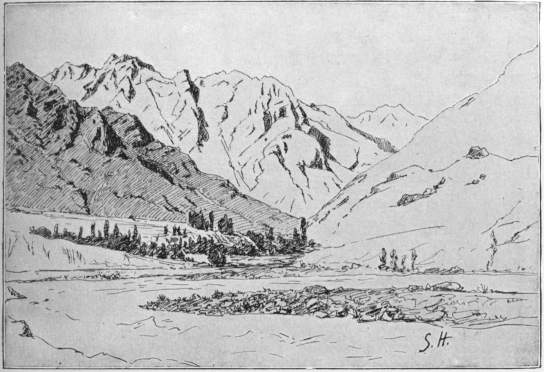
20. Kargil.
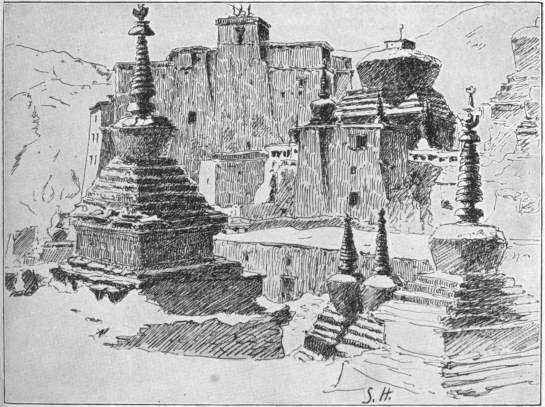
21. Chhorten in Lamayuru. Sketches by the Author.
We approached the striking spot, where two valleys converge and the Dras joins the Wakkha, passed the sharp rocky angle, and rode up close by the bank of the Wakkha. The valley has a very great fall, and the powerful stream rushes down in wild commotion, swells up and leaps over the blocks in its way, or breaks into foaming, tumultuous surge. Several old acquaintances and the Vezir Vezarat himself came to meet us, and before we reached Kargil we were accompanied by a whole cavalcade. We bivouacked in a cool grove of poplars and willows, and intended to rest the following day (Illustration 20).
This day brought some picturesque scenes. Surrounded by the authorities of Kargil with the pundit Lashman Das and the Vezir Vezarat at their head, I held judgment over the heterogeneous rabble which had caused so much embarrassment in the first week of my journey. Firstly, all the Kashmiris, with their leader Aziza, were dismissed. Then came the turn of their fellow-countrymen, who had transported hither on hired horses the maize and barley for our animals, and lastly we came to the Poonch men. As regards the sheep-stealing the following procedure was adopted. The suspected men were tied to a couple of trees, and though there was a cool shade, they grew weary, and after waiting three hours for a rescuing angel, confessed all, and were thereupon sentenced to pay double the value of the sheep. Then Khairullah stepped forward and interceded for his friend Aziza; as his request was not granted he was annoyed, and positively refused to undertake the night watch. So he, too, was dismissed, and was allowed to take with him the other Afghan, Bas Ghul, who suffered from periodical fits of insanity, and was moreover a rogue. It was quite a relief to me to get rid of these esquires of our bodyguard. Of the original “Congress of Orientalists” in Srinagar only four men now remained, namely, Robert, Manuel, Ganpat Sing, and Bikom Sing.
When we left Kargil on July 26 we took with us 77 hired horses with their leaders, and the forage of the animals formed 161 small heaps. A native veterinary surgeon was to accompany us to see that the mules were well tended. After we had bought all the barley we could get hold of, our caravan had much increased, and the weeding-out effected in Kargil made the succeeding days of our journey to Leh much more agreeable than the previous.
At Shargul we passed the first lama temple on this route; beyond Mullbe they gradually became more numerous. At every step one finds evidence that one is in the country of the lamas; the small white temples in Tibetan style crown the rocky points and projections like storks’ nests, and dominate the valleys and villages below them. But a monk in his red toga is seldom seen; the temples seem silent and abandoned among the picturesque chhorten monuments and manis. The whole relief of the country is now much more prominent than in winter, when the universal snow-mantle makes all alike and obliterates all the forms. The fantastic contours of the mountains stand out sharply with their wild pinnacles of rock and embattled crests, which above Bod-Karbu mingle with the old walls and towers, of which only ruins are now left.
On July 28 we crossed the river by a tolerably firm bridge, and continued to ascend the valley which leads to the Potu-la. Just beyond the pass the authorities of Lamayuru came to meet us with flowers and fruits, and each one, according to the custom of the country, offered a rupee, which, however, we needed only to touch with the hand. A little further the first chhorten appeared, followed by a long row of others; the stone heaps pointed towards the famous monastery of Lamayuru. Passing round a projecting corner a little farther on, we had a clear view of a small valley between lofty mountains, and here rose a precipitous terrace of detritus, on which the monastery is built. Some white buildings up there stood out sharply against a grey background, and in the depths of the valley cultivated fields spread out among a few groups of trees (Illustration 21).
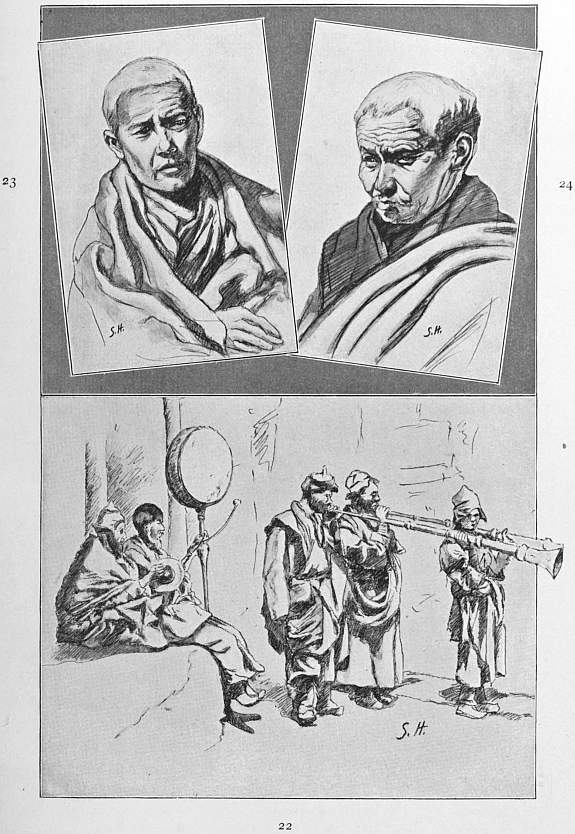
22. Church Music in Lamayuru. 23. Portrait of a Lama. 24. Portrait of a Lama. Sketches by the Author.
As soon as our party was visible from the valley, music was heard, and long brass drums boomed from the temple roofs with a deep, solemn, organ tone, which was joyously echoed among the mountains. Would the lama monasteries of Tibet give us such a friendly welcome? As we entered the village, there stood there about thirty women in their best clothes, in fur-trimmed coloured mantles, with blinkers firmly plaited into the hair, and with turquoises on the top. All the inhabitants had turned out, and formed a picturesque group round the band, which started a deafening tune with its flutes and drums (Illustration 22).
In the afternoon we went up to the monastery, where the prior and the monks received us at the main entrance. They led us into the open court of the monastery, surrounded by old buildings, chhorten, and flagstaffs. From here one has a grand view of the valley which slopes down to the Indus. Under dark masses of cloud, and in fine rain, seven monks executed an incantation dance; they had tied on masks of wild animals, evil spirits, and monsters with laughing mouths, tusks for teeth, and uncanny staring eyes. Their motley coats stood out like bells as they danced, and all the time weird music was played. How the monks must be wearied in their voluntary imprisonment! Evidently their only relaxation is to display their religious fanaticism before the inquisitive eyes of passing strangers.
Immediately beyond the village we descend a dangerously steep road in the small, narrow, and wild ravine which leads to the Indus. The deep trough of the Dras is crossed by small, neat wooden bridges, and after a couple of hours’ journey one rides as through a portal into the great, bright valley of the Indus, and has the famous river before one. It is a grand sight, and I halt for some time on a swinging wooden bridge to gaze at the vast volume of water which, with its great load and its rapid current, must excavate its channel ever deeper and deeper. The station-house, Nurla, stands just above the river, which tosses and roars under its windows.
The day had been broiling hot; the rocks and soil of this grey, unfruitful valley seem to radiate out a double quantity of heat, and even in the night the thermometer marked 61°. Even the river water had a temperature of 54° in the daytime, but still, though dirty-grey like porridge, it was a delicious drink in the heat.
As far as Saspul we rode along the right bank close to the river. Here the road is often dangerous, for it is cut like a shelf in the steep wall of rock, and one feels at ease only when the valuable baggage has passed safely. The danger is that a pack-horse on the mountain-side may thrust itself past another, and force this one over the edge of the rock, so that one may in a moment lose one’s instruments, photographic apparatus, or sacks of rupees.
At Jera a small emerald-green foaming torrent dashes headlong into the Indus, and is lost in its bosom—the clear green water is swallowed up instantaneously by the muddy water of the Indus. One is delighted by the constantly changing bold scenery and the surprises encountered at every turn of the road. The eyes follow the spiral of a constantly moving vortex, or the hissing spray which the wind whips off the crests of the waves. One almost envies the turbid eddies of this water which comes from the forbidden land, from Gartok, from the regions north of the Kailas mountain, from the unknown source of the Indus itself, whither no traveller has yet penetrated, and which has never been marked down on a map.
The bridge of Alchi, with its crooked, yielding beams, seemed just as dangerous as on my last visit, but its swaying arch boldly spans the interval between the banks, and during a pleasant rest in the shade the bridge was reproduced in my sketch-book. The waves dashed melodiously against the stone embankment of the road, and I missed the sound when the route left the bank and ascended to Saspul, where we were received with the usual music and dancing-women (Illustration 26).
Basgho-gompa has a fine situation in a side valley of the Indus. The monastery is built on the left side of the valley, the white walls of three storeys, with balconies, effective cornices and pennants, standing on a long cliff. A quantity of chhortens and manis surround Basgho. The sacred formula “Om mani padme hum” is carved on a slab of green slate, and lizards, as green as the stone, dart about over the words of eternal truth.
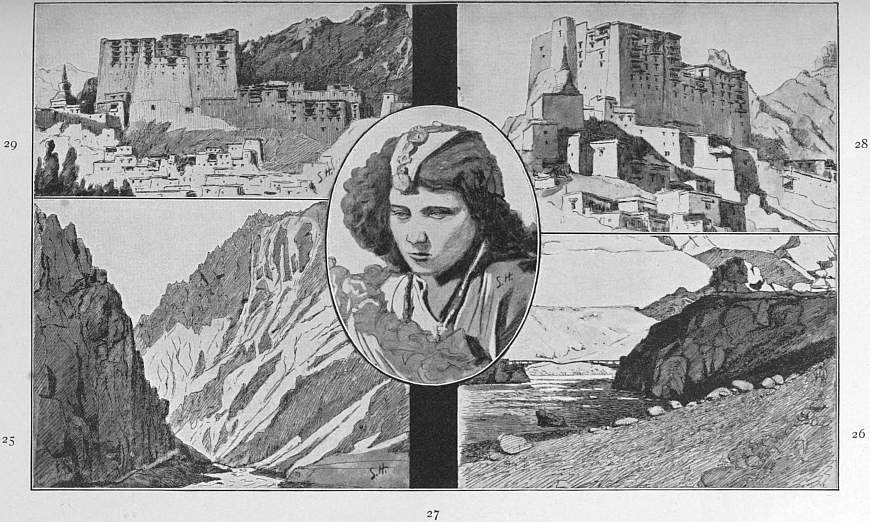
25. The Sumto Valley. 26. Bridge of Alchi. 27. Girl in Niemo. 28 & 29. Palace of the Kings of Ladak in Leh. Sketches by the Author.
The first of August was the last day of our journey to Leh. A bright, peaceful morning; the rays of the sun crept warm and agreeably through the foliage of the apricot trees, and threw green reflexions into the station-room. We rode near the Indus as far as where the monastery, Spittol, stands on its hill, beyond which the road turns aside from the river and runs straight up to Leh, which is visible from a distance, surrounded by verdant gardens. Mohanlal, a merchant of Leh, who had undertaken a large part of the final equipment of the expedition, came to meet us, and, as we rode past an enclosed field of fine clover, told me that he had bought it for my mules.
We dismounted at the gate of a large garden, and went in. In the midst of the garden stands a stone house among poplars and willows. It is usually the residence of the Vezir Vezarat, the representative of Kashmir in Ladak, but now it was to be my headquarters for twelve days. Here I had a roof over my head for the last time for two long years, and I found myself very comfortable in my study up one flight of stairs. Robert occupied another room, and an open, shady balcony was fitted up as a meteorological observatory. Manuel and the two Rajputs had the control of the ground-floor; in the courtyard purveyors and new servants were continually coming and going, and adjoining the garden was our stable, where the newly obtained horses were posted in the open air.
Leh is the last place of any importance on the way to Tibet. Here our equipment must be finally completed. Nothing could be omitted; if we forgot anything we could not obtain it afterwards. Here the silver stream of rupees flowed away without intermission, but I consoled myself with the thought that we should soon be in a country where, with the best will in the world, we could not spend a farthing. A large caravan sucks up money, as a vampire blood, as long as it remains in inhabited cultivated lands; but when all contact with human civilization is cut off, it must live on its own resources; consequently, it gradually dwindles and approaches its dissolution. As long as it is at all possible we let the animals eat all they can; the best clover to be had must be procured, and both horses and mules must be so well tended that they can afterwards live on their own fat and endure the hardships that await them.
CHAPTER IV
THE LAST PREPARATIONS
Captain Patterson was now Joint-Commissioner of the province of Ladak. He received me from the first with the greatest hospitality and kindness, and was one of the finest men I have ever come in contact with. Having a thorough knowledge of India, Ladak, and Tibet, he was able to give me valuable hints and advice, and was untiring in assisting to equip the great caravan, the object of which was still, officially, Eastern Turkestan, without overstepping his instructions by a hair’s breadth. I found in him a true friend, and after dinner, which I always took at eight o’clock in the evening, we often sat together till long after midnight, talking of the future of Asia and the doings of the world.
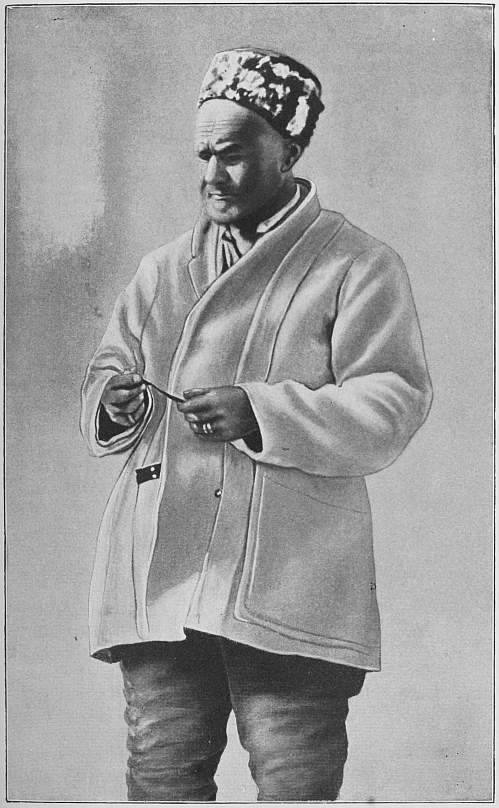
30. Muhamed Isa.
Sir Francis Younghusband had recommended to me a well-known caravan leader, Muhamed Isa. I had seen him in Kashgar and Srinagar, and knew that he had been present at the murder of the French explorer, Dutreuil de Rhins, on June 5, 1894. During about thirty years he had travelled in most parts of Central Asia, and was also acquainted with many parts of Tibet. Besides a number of shorter journeys which he had accomplished in the service of various sahibs, he had also been Carey’s and Dalgleish’s caravan leader on their great march through Central Asia, and had served a couple of years under Dutreuil de Rhins. He accompanied Younghusband on his famous march over the Mustagh Pass (1887), and had been his caravan leader in the campaign to Lhasa (1903-1904). On Ryder’s and Rawling’s journey in the valley of the upper Brahmaputra he had had the management of the baggage caravan. During all these journeys he had acquired experience which might be very useful to me, and I gratefully accepted Younghusband’s proposal, especially as Captain Patterson, in whose service Muhamed Isa then was, did not hesitate to place him at my disposal. Besides, Muhamed Isa spoke fluently Turki, Tibetan, and Hindustani, and wished for nothing better than to accompany me. Without knowing that he had been warmly recommended, he had earnestly begged his master to allow him to enter my service (Illustration 30).
His father was a man of Yarkand, his mother a Lamaist of Leh. The mixed race of such unions is called Argon, and is generally distinguished by physical power and extraordinarily well-developed muscular structure. Muhamed Isa also was a fine man, tall and strong as a bear, with great power of endurance, reliable and honest, and after a few days’ journey with him I found that my caravan could not have been entrusted to better hands. That the first crossing of Tibet was so successful was due in great measure to his services. He kept splendid discipline among the men, and if he were sometimes strict, it was for the good of the caravan, and he permitted no neglect of duty.
He entertained Robert and myself, and even the caravan men, for hours together with tales of his fortunes and his adventures in the service of other Europeans, criticising some of his former masters without much reserve. The remembrance of Dutreuil de Rhins especially seemed to affect him; he frequently returned to his account of the attack made on the unfortunate Frenchman. He was also a good boaster, and declared that once in midwinter he had carried a letter in ten days from Yarkand to Leh, with all his provisions on his back—a journey that an ordinary mortal takes a month to accomplish. But there was no harm in his exaggerations; he was always witty and amusing, always cheerful and ready for a joke, and kept up the spirits of the rest in depressing circumstances. Poor Muhamed Isa! How little we suspected, when he and I set out together, that he would never return to his wife and home!
I had scarcely taken possession of my new dwelling in Leh when Muhamed Isa appeared with a pleasant, kindly “Salaam, Sahib.”
“Peace be with you,” I answered; “you have not changed much in all the years since we met in Kashgar. Are you disposed to accompany me on a journey of two years through the high mountains?”
“I wish nothing better, and the Commissioner Sahib has allowed me to report myself to you for service. But I should like to know whither we are to travel.”
“We are going northwards to Eastern Turkestan; you will hear about our further movements when we have left the last villages behind.”
“But I must know the details of your plan because of the preparations.”
“You must take provisions for horses and men for three months, for it may happen that we shall be so long without coming into contact with human beings.”
“Then, surely, we must be making for Tibet—that is a country I know as well as my house in Leh.”
“What are your terms?”
“Forty rupees a month, and an advance of two hundred rupees to leave with my wife at starting.”
“All right! I take you into my service, and my first order is: buy about sixty strong horses, complete our store of provisions so that it may last three months, and get together the necessary equipment for the caravan.”
“I know very well what we want, and will have the caravan ready to march in ten days. But let me suggest that I be allowed to choose the servants, for I know the men here in Leh, and can tell which are fit for a long trying journey.”
“How many do you want to manage the caravan?”
“Five-and-twenty men.”
“Very well, engage them; but you must be responsible that only useful, honest men enter my service.”
“You may depend on me,” said Muhamed Isa, and added, that he knew it to be to his own interest to serve me well.
During the following days Muhamed Isa was always on his feet, looking out for horses. It was not advisable for many reasons to buy them all at once—for one thing, because the prices would then rise; so we bought only five or six each day. As, however, the peasants from the first asked exorbitantly high prices, a commission of three prominent Ladakis was appointed, who determined the real value of the horses offered for sale. If the seller were satisfied with the assessment, he was paid at once, and the horse was led to his stall in our open stable. Otherwise, the seller went away, but usually returned next day.
Altogether 58 horses were bought, and Robert made a list of them: 33 came from various villages in Ladak, 17 from Eastern Turkestan, 4 from Kashmir, and 4 from Sanskar. The Sanskar horses are considered the best, but are difficult to get. The Ladak horses, too, are good, for, being bred in the mountains, they are accustomed to rarefied air and poor pasture; they are small and tough. The Turkestan horses have, as a rule, less power of endurance, but we had to take them for want of better, and all ours had crossed the Karakorum Pass (18,540 feet) once or oftener.
As the horses were bought they were numbered in the list, and this number on a strip of leather was fastened to the mane of the horse. Afterwards I compiled a list of the dead, as they foundered, in order to ascertain their relative power of resistance. The first that died was a Sanskar, but that was pure chance—he died some days after we marched out of Leh, of acute disease. Later on the losses were greatest among the Yarkand horses. The prices varied considerably, from 37 to 96 rupees, and the average price was 63 rupees. A horse at 95 rupees fell after three weeks; another, that cost exactly half, carried me a year-and-a-half. The commission was very critical in its selection, and Muhamed Isa inspected every four-legged candidate before it was accepted. As a rule we did not hesitate to take horses ten or twelve years old; the tried horses were more reliable than the younger ones, though these often appeared much more powerful. But not one of them all was to return from Tibet; the lofty mountains let none of their prey escape. “Morituri te salutant,” said Captain Patterson forebodingly, as the first caravan passed out of Leh.
The caravan, then, consisted of 36 mules and 58 horses. It is always hard at the last to make up one’s mind to start; after a few days we should find ourselves in country where we could procure nothing but what grows of itself on the ground. Certainly we were in the very best season; the summer grass was now in the greatest luxuriance, but it would soon become more scanty, and in about ten days we should reach a height where there was no pasturage. Therefore it was necessary to take as much maize and barley as possible with us, and here a difficulty came in: we durst not overburden the animals with too heavy loads, for then the strength of the caravan would be broken in the first month, while, in the second month, it would come to grief if we should find ourselves, as was most probable, in a barren country. And as the days pass, the stores diminish and come to an end just when they are most wanted. In the first weeks we had the ascent to the border region of the Tibetan plateau before us, and had consequently to expect the most troublesome country to traverse just at the commencement of the journey. Therefore our first marches were short, and all the shorter because the loads were heavier. This is a pretty complicated problem for an army commissariat.
After consultation with Muhamed Isa I resolved to hire an auxiliary caravan of 30 horses from Tankse to accompany us for the first month and then return. Hence arose a financial problem. The men of Tankse asked 35 rupees a month for each horse, or 1050 rupees in all; of course they ran great risk, and I must therefore undertake to pay 30 rupees for every horse that fell on the outward journey, and 10 rupees for one that fell on the return home. In the worst case, then, the cost would amount to 1950 rupees. On the other hand, if I bought these horses at 60 rupees a head, the total expenditure would be 1800 rupees, and the horses would belong to me. Then the old problem was repeated: I should have to take fodder for these thirty horses, and engage ten men to attend to them, and for these men provisions must be obtained. After many pros and cons we at length decided to hire the horses only, for then their owners would accompany them at their own risk and supply themselves with rations carried by seven yaks. The provisions for the first month were to be taken from our own animals, to lighten their loads and economize their strength; for a horse or mule always gets tired at the beginning of the journey, and must be spared. But if one of the hired horses became exhausted, its owner was at liberty to send it home before the expiration of the month.
As forage and grazing was dear in Leh, we sent off as early as August 10, 35 mules and 15 horses with their loads, and 15 men and a chaprassi, to Muglib, which lies beyond Tankse and has good pastures. Sonam Tsering, whom Captain Rawling had strongly recommended, was chosen as leader of this caravan. He received 100 rupees for the expenses of the caravan. Muhamed Isa accompanied it part of the way to see that everything went on smoothly.
A few days after his engagement Muhamed Isa presented to me 25 men, who, he proposed, should enter my service. There was no difficulty in finding men willing to come; all Leh would have followed me if wanted. The difficulty was to make a proper choice, and appoint only serviceable men who could fill their posts and understood their duties.
It was a solemn moment when the main body of the caravan assembled in my garden, but the spectacle had its humorous side when Muhamed Isa, proud as a world-conqueror, stepped forward and mustered his legions. At my request Captain Patterson was present to have a look at the fellows; he now delivered a short address, and impressed on them how important it was for their own sakes to serve me honestly. Their pay was fixed at 15 rupees a month, and half a year’s pay was advanced to them. The Rev. Mr. Peter was so kind as to undertake to distribute the money to their families. Lastly, I promised each a present of 50 rupees for good behaviour, and bound myself to guarantee their journey home to Leh, with expenses, from whatever place we might separate.
In the course of my narrative I shall have abundant opportunities of introducing these men individually to my readers. Besides Sonam Tsering, already mentioned, who had served under Deasy and Rawling, I will here name old Guffaru, a greyheaded man with a long white beard, who thirty-three years ago accompanied Forsyth’s embassy to Jakub Bek of Kashgar. He had seen the great Bedaulet (“the fortunate one”) in all his pomp and state, and had many tales of his experiences on Forsyth’s famous journey. I at first hesitated to take with me a man of sixty-two, but he begged so earnestly; he was, he said, Muhamed Isa’s friend, and he was so poor that he could not live if I did not employ him. He had the forethought to pack up a shroud that he might be buried decently if he died on the way. That everything should be properly managed in such case, and that his outstanding pay might be transmitted to his family, he took his son, Kurban, with him. But Guffaru did not perish, but was in excellent condition all the time he was with me (Illustration 31).
Another, on whom I look back with great sympathy and friendly feeling, was Shukkur Ali. I had known him in 1890 in Kashgar, where he was in Younghusband’s service, and he, too, remembered that I had once drawn him in his master’s tent. He was so unconsciously comical that one almost died of laughter as soon as he opened his mouth, and he was my oldest acquaintance among this group of more or less experienced Asiatics. He had taken part in Wellby’s journey, and gave us the most ghastly descriptions of the sufferings the captain, who afterwards fell in the Boer War, and his caravan had to endure in North Tibet, when all the provisions were consumed and all the animals had perished. A year later he shared in my boating trips on the holy lake, Manasarowar, and was as useful as he was amusing. Shukkur Ali was an honest soul, and a stout fellow, who did his work without being told, quarrelled with no one, and was ready and willing for any kind of service. He was always in the highest spirits, even during a violent storm in the middle of the lake, and I saw him weep like a child on two occasions only—at the grave of Muhamed Isa, and when we said the last good-bye.
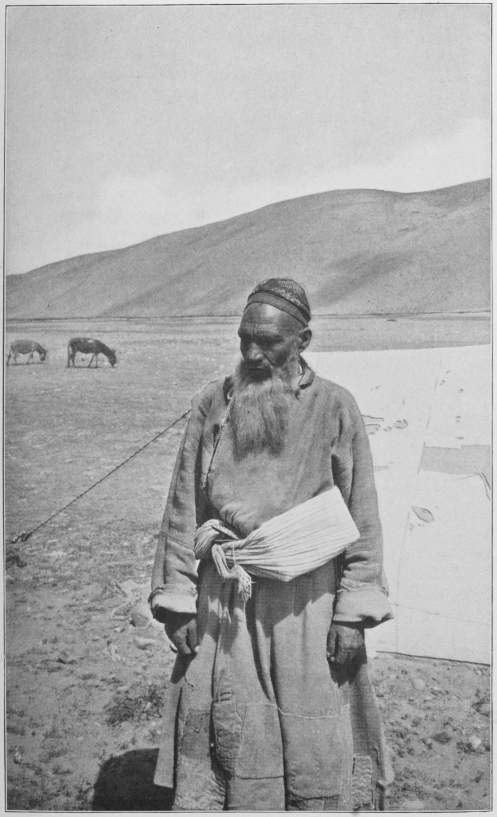
31. Guffaru.
These three were Mohammedans, as their names show. The caravan contained eight sons of Islam in all; the leader, Muhamed Isa, was the ninth. The other seventeen were Lamaists. Then came two Hindus, a Catholic, Manuel, and two Protestants, Robert and myself. I will not vouch for the religious convictions of the Lamaists. As regards some among them, I found that they sometimes changed their religion. For instance, Rabsang, when he travelled to Yarkand, was a Mohammedan and shaved his head, but on the way to Tibet he was just as zealous a believer in Lamaism.
The oldest of my companions was Guffaru, sixty-two, and the youngest Adul, twenty-two, and the average age of the whole company was thirty-three years. Eleven of these men came from Leh, the others from different villages of Ladak. Only one was a foreigner, the Gurkha Rub Das from the frontier of Nepal. He was quiet and faithful, and one of my very best men. It was a pity he had no nose; in a hot scuffle in Lhasa an opponent had bitten off that important and ornamental organ.
I may pass quickly over the equipment; it is always the same. For the men rice, flour, talkan, or roasted meal, which is eaten mixed with water, and brick tea in bulk were taken. For myself several hundred tins of preserved meat, tea, sugar, tobacco, etc., all provided by the merchant Mohanlal, whose bill came to 1700 rupees. New pack-saddles, ropes, frieze rugs, horse-shoes, spades, axes and crowbars, bellows, cooking-pots, copper cans, and the cooking utensils of the men with other articles cost nearly a thousand rupees. The pack-saddles we had bought in Srinagar were so bad that we had to have new ones made, and Muhamed Isa enlisted some twenty saddlers, who sewed all day under the trees of the garden. But everything was ready in time and was of first-rate quality. Captain Patterson declared that a better-found caravan had never left Leh. How stupid I had been to linger so long in Srinagar and associate with the lazy gentlemen of the Maharaja. Everything that came from there was either exorbitantly dear or useless. Only the mules were good. Yet I always remember my sojourn in Srinagar with feelings of great thankfulness and pleasure.
The Moravian missionaries in Leh rendered me invaluable service. They received me with the same hospitality and kindness as before, and I passed many a memorable hour in their pleasant domestic circle. Pastor Peter had endless worries over my affairs; he managed both now and afterwards all the business with the new retainers. Dr. Shawe, the physician of the Mission, was an old friend I had known on my former journey, when he treated my sick cossack, Shagdur, in the excellent Mission Hospital. Now, too, he helped me both by word and deed. He died in Leh a year later, after a life devoted to suffering humanity.
Many of my dearest recollections of the long years I have spent in Asia are connected with the Mission stations, and the more I get to know about the missionaries the more I admire their quiet, unceasing, and often thankless labours. All the Moravians I met in the western Himalayas are educated to a very high standard, and come out exceptionally well prepared for the work before them. Therefore it is always very stimulating and highly instructive to tarry among them, and there is none among the Europeans now living who can vie with these missionaries in their knowledge of the Ladak people and their history. I need only mention Dr. Karl Marx and Pastor A. H. Francke as two men who are thoroughly at home in strictly scientific archæological investigation.
Some young coxcombs, to whom nothing is sacred, and whose upper storeys are not nearly so well furnished as those of the missionaries, think it good form to treat the latter with contemptuous superiority, to find fault with them, to sit in judgment on them, and pass sentence on their work in the service of Christianity. Whatever may be the result of their thankless toil, an unselfish struggle for the sake of an honest conviction is always worthy of admiration, and in a time which abounds in opposing factors it seems a relief to meet occasionally men who are contending for the victory of light over the world. In Leh the missionaries have a community which they treat with great gentleness and piety, for they know well that the religion inherited from their fathers has sunk deep into the bone and marrow of the natives, and can only be overcome by cautious, patient labour. Even the Ladakis who never visit the Mission stations always speak well of the missionaries, and have a blind confidence in them, for apart from their Mission work they exercise an effect by their good example. The Hospital is made great use of, and medical science is a sure way of access to the hearts of the natives.
During the last days of my stay in Leh I saw my old friends again, Mr. and Mrs. Ribbach, in whose hospitable house I had spent many pleasant winter evenings four years ago.
One day Captain Patterson proposed that I should go with him to call on the wealthy merchant Hajji Nazer Shah. In a large room on the first floor, with a large window looking over the Indus valley, the old man sat by the wall, on soft cushions, with his sons and grandsons around him. All about stood chests full of silver and gold-dust, turquoise and coral, materials and goods which would be sold in Tibet. There is something impressively patriarchal about Hajji Nazer Shah’s commercial house, which is managed entirely by himself and his large family. This consists of about a hundred members, and the various branches of the house in Lhasa, Shigatse, Gartok, Yarkand, and Srinagar are all under the control of his sons, or their sons. Three hundred years ago the family migrated from Kashmir to Ladak. Hajji Nazer Shah is the youngest of three brothers; the other two were Hajji Haidar Shah and Omar Shah, who died some years ago leaving numerous sons behind them.
The real source of their wealth is the so-called Lopchak mission, of which they possess a monopoly. In accordance with a treaty nearly 200 years old, the kings of Ladak sent every third year a special mission to the Dalai Lama, to convey presents which were a token of subjection to the supremacy of Tibet, at any rate in spiritual matters. However, after Soravar Sing, Gulab Sing’s general, conquered Ladak in 1841 and annexed the greater part of this country to Kashmir, the Maharaja of Kashmir took over the duty of carrying out the Lopchak mission, and always entrusted it to one of the noblest, most prominent families of Ladak. For some fifty years this confidential post has been in the family of Nazer Shah, and has been a source of great profit to them, especially as several hundred baggage animals are provided for the mission gratis, for the journey from Leh to Lhasa. A commercial agent is also sent yearly from Lhasa to Leh, and he enjoys the same transport privileges.
The mission had left eight months before under the charge of one of the Hajji’s sons. Another son, Gulam Razul, was to repair in September to Gartok, where he is the most important man in the fair. I asked him jokingly if I might travel with him, but Hajji Nazer Shah replied that he would lose the monopoly if he smuggled Europeans into Tibet. Gulam Razul, however, offered me his services in case I should be in the neighbourhood of Gartok, and I afterwards found that this was not a mere polite speech. He will play a most important part in this narrative. After my return to India I had an opportunity of drawing attention in high quarters to the importance to English interests of his commercial relations in Tibet, and I warmly recommended him as a suitable candidate for the much-coveted title of Khan Bahadur, which he, indeed, received, thanks to the kind advocacy of Colonel Dunlop Smith.
Now, too, he rendered me many valuable services; perhaps the greatest was to take a considerable sum in Indian paper in exchange for cash, part of which consisted of a couple of bags of Tibetan tengas, which proved very useful four months later.
The old Hajji was a fine Mohammedan of the noblest type. He obeyed faithfully the commands of the Koran, and five times daily tottered into the mosque to perform his devotions. He had more than enough of the good things of this world, for his extensive business connections brought him in yearly a net profit of 25,000 rupees, and his name was known and respected throughout the interior of Asia. Before my return he had left the stage and taken possession of his place, with his face turned towards Mecca, in the Mohammedan graveyard outside the gate of Leh.
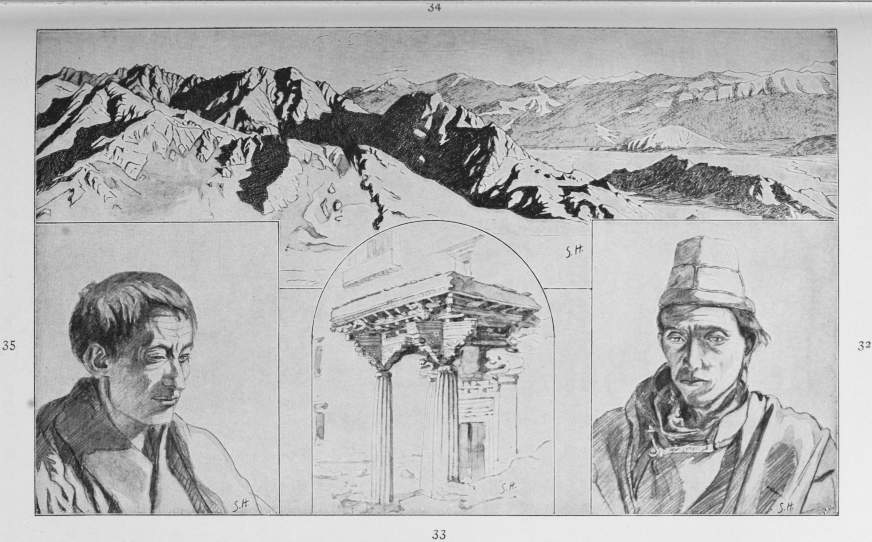
32. The Raja of Stok. 33. Portal of the Palace in Leh. 34. View over the Indus Valley from the Roof of the Palace in Leh. 35. Lama of High Rank in Leh. Sketches by the Author.
The small town itself is full of the most attractive and fascinating examples of Tibetan architecture. On all sides are seen quiet nooks with motley figures, temple portals, mosques, houses rising one above another, and open shops, whither customers flock; and the traffic became brisker every day after the summer caravans from Yarkand over the Kardang Pass began to arrive at Leh. Round the town stands a crescent of bare, lumpy, sun-lighted hills; to the south and south-east the dry gravelly plain slopes down to the Indus, where a series of villages among green fields and woods impart some life to the picture. On the farther side is seen the Stokpa, a lofty summit, below which the village Stokpa peeps out of a valley mouth. Here resides an ex-king of the third generation, the Raja of Stok, whose grandfather ruled as king of Ladak but was deprived by Soravar Sing of his dignity and State.
The Raja of Stok, or, to give him his full name and title, Yigmet Kungak Singhei Lundup Thinlis Zangbo Sodnam Nampar Gelvela, Yagirdar of the state of Stok, awakes one’s sympathy in his somewhat sad position; he is evidently painfully sensitive of the loss of the honour and power which fate has denied him. He was on a visit to Leh, for he owns an unpretending but pretty house in the main street. The Tibetans still look upon him as the true and rightful king, while the ruler of the country, the Maharaja of Kashmir, is only a usurper in their eyes. We therefore concluded that a letter of recommendation from this Raja of Stok might be very useful some day or other. He was evidently flattered by my request and quite ready to grant it. In his open letter he ordered “all men in Tibet of whatever rank, from Rudok, Gartok, and Rundor to Shigatse and Gyantse, to allow Sahib Hedin to pass freely and unmolested, and to render him all necessary assistance.” This highly important document, with the date and the red square seal of the Raja affixed, was afterwards read by many Tibetan chieftains, on whom it made not the slightest impression. They quietly answered: “We have only to obey the orders of the Devashung in Lhasa.” (Illustration 32.)
The old palace of Leh stands on its rock like a gigantic monument of vanished greatness. From its roof one has a grand view of the town, the Indus valley, and the great mountains beyond the river. In the foreground stretch fields of wheat and barley, still staringly green amidst the general grey, small groups of garden trees, groves of poplar, farm-houses, and small knobly ridges, while the dreary Mohammedan graveyard stands out sharply and obtrusively in the evening sunshine. Immediately below us lies a chaos of quadrangular houses of stone or mud, with wooden balconies and verandahs, interrupted only by the main street and the lanes branching out of it. On the point of a rock to the east is seen a monastery, for which a lama gave the name of Semo-gungma. Semo-yogma stands in the palace itself. The temple hall here is called Diva, and the two principal images Guru and Sakya-tubpa, that is, Buddha. The portal of the palace with its pillars has a very picturesque effect. Through this portal you enter a long, dark, paved entrance and then pass up a stone staircase and through gloomy passages and corridors, with small offshoots running up to balcony windows; in the interior, however, you roam about through halls all equally dark. No one dwells now in this phantom castle, which fancy might easily make the scene of the most extravagant ghost stories. Only pigeons, which remain for ever young among the old time-worn monuments, coo out their contentment and cheerfulness (Illustrations 28, 29, 33, 34).
Still the palace, in spite of its decay, looks down with royal pride on the town far below, with its industry and commercial activity, and on this central point on the road between Turkestan and India. The wind sweeps freely over its roof, its flat terraces, and breastwork with prayer strips flapping and beating against their sticks. A labyrinth of steep lanes lead up to it. Wherever one turns, the eye falls on some picturesque bit: whole rows of chhortens, one of which is vaulted over the road, small temples and Lama houses, huts and walls.
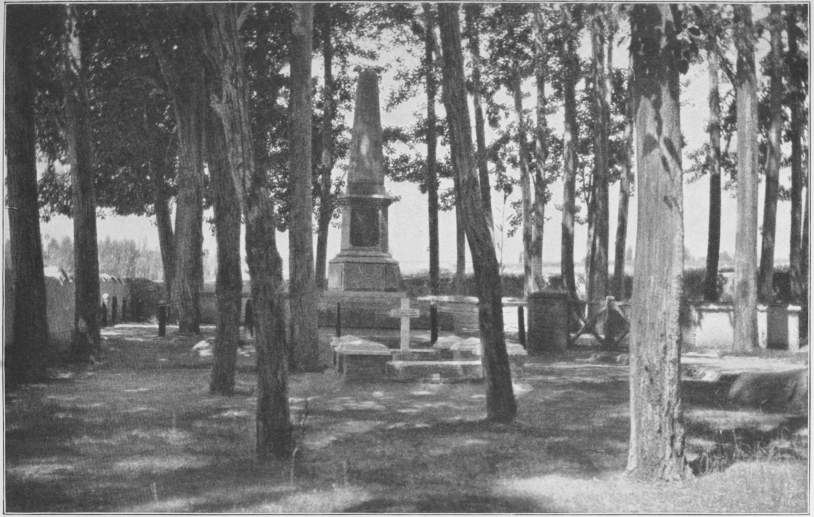
36. Monuments to Stoliczka and Dalgleish, Leh.
On the hill behind Captain Patterson’s bungalow lies a burial-ground with the graves of five Europeans: the names Stolicza and Dalgleish especially attract our attention. Over Stolicza’s grave a grand monument has been erected. The inscription on a tablet in front informs us that he was born in June 1838 and died in June 1874 at Murgoo, near the Karakorum Pass. The Indian Government erected the memorial in 1876 as a mark of respect and gratitude for the service which Stolicza had rendered during the journey of Forsyth’s embassy. The same inscription is repeated on the other side in Latin. Dalgleish’s tombstone is simpler, but is also adorned with a tablet of cast-iron. He was born in 1853 and was murdered on the Karakorum Pass in 1888. Both terminated their life pilgrimage in the same country high above the rest of the world, and both sleep their last sleep under the same poplars and willows. Now the evening sun gilded the mountain crests, reddish-yellow light fell on the graves and the trunks of the poplars, a gentle wind murmured softly through the tree-tops, and spoke in a melancholy whisper of the vanity of all things; and a short time later, when the lamps in the Government buildings had been lighted, champagne corks popped at the farewell dinner given by Captain Patterson to another pilgrim who had not yet ended his lonely wanderings through the wide wastes of Asia (Illustration 36).
CHAPTER V
THE START FOR TIBET
The time at Leh passed quickly, as we were working at high pressure, and the result of our efforts was a splendid caravan in excellent order for the march. Robert and Muhamed Isa seemed to be infected by my eagerness to start, for they worked from morning to night and saw that every one did his duty. I took leave of Captain Patterson, who had helped us in so many ways, and on August 13 the loads of the second great caravan stood in pairs in the outer yard, and had only to be lifted on to the pack-saddles of the horses.
Muhamed Isa started at four o’clock next morning, and I followed a few hours later with Robert and Manuel, four riding horses, and nine horses for our baggage. Hajji Nazer Shah and his sons, our numerous purveyors, the officials and pundits of the town, and many others, had assembled to see us off, and sent us on our way with kind wishes and endless “Salaams” and “Joles.”
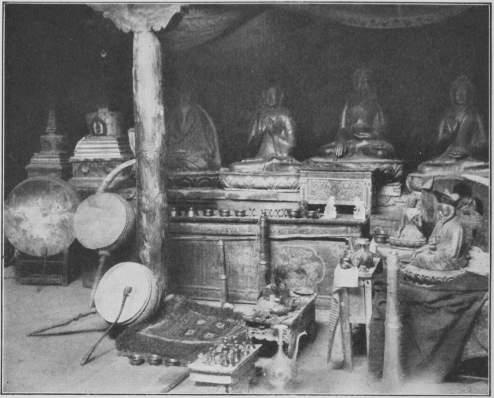
37. Religious Objects from Sanskar.
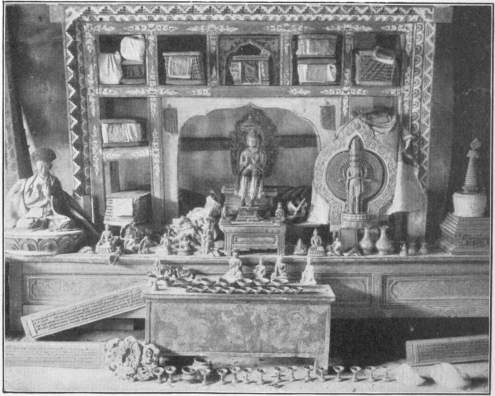
38. Images of Gods. A Miniature Chhorten on the Right. Holy Books, Temple Vessels. On Either Side of the Small Altar-Table Wooden Blocks with which the Holy Books are Printed.
A crowd of beggars escorted us along the main street, the merchant Mohanlal bowed to us from the steps of his house, and we passed through the gate of the town into the lanes of the suburbs. At the first turn the horse which carried my boxes of articles for daily use became tired of his burden and got rid of it at once. They were put on another horse, which seemed quieter and carried them as far as the Mohammedan burial-ground, when he, too, had enough of them, shied, broke loose, disappeared among some chhortens, and flung the boxes so violently to the ground that it was a marvel that they did not fly to pieces among the pebbles and blocks of stone. The jade got clear of all the ropes in a second, and galloped, with the pack-saddle dragging and dancing behind him, among the tombs in which the Mohammedans sleep. That the boxes might not be quite destroyed we hired a quiet horse for the day. This is always the way at first, before the animals have got used to their loads and pack-saddles. Here a couple of buckets rattle on the top of a load, there the handle of a yakdan, or, again, a pair of tent-poles jolt up and down and knock together at every step. The rest in the stable had made the horses nervous, the fragrant trusses of juicy clover had made them sleek and fat, strong, lively, and ready to dance along the road. Every horse had now to be led by a man, and at length we came to the open country, and our companions left us one after another, the last to say farewell being the excellent, noble-hearted Mr. Peter.
Then we went down from Leh past innumerable mani ringmos and through narrow gullies between small rocky ridges, and so drew near to the Indus again. A rocky promontory was passed, then another close to a branch of the river, and then Shey came in sight with its small monastery on a point of rock. The road runs through the village, over canals by miniature stone bridges, over grassy meads and ripening cornfields; here and there lies a swamp formed by overflowing irrigation water. To our left rise granitic rocks, their spurs and projections ground down and polished by wind and water.
After we had lost sight of the river and ridden through the village, where the people almost frightened our horses to death with their drums and pipes, we found ourselves in front of the monastery Tikze on a commanding rock, with the village Tikze and its fields and gardens at the foot. The tents were already pitched in a clump of willows. The highway and its canal ran past it, and here stood our mules and horses tethered in a long row before bundles of fresh grass. The puppies were released immediately; their basket was already too small for them; they grew visibly, could bite hard, and began already to guard my tent—barking furiously when they smelled anything suspicious.
Barely half an hour after the camp is set in order comes Manuel with my tea and cakes. He is rather sore after his day’s ride, and looks dreadfully solemn, dark-brown and shiny; he is darker than usual when he is cross. Robert is delighted with his horse, and I have every reason to be content with mine—a tall, strong, dapple-grey animal from Yarkand, which held out for four months and died on Christmas Eve. At Tikze we are much lower than at Leh, and then we begin to mount up again. The day had been very hot, and even at nine o’clock the thermometer stood at 70° F. Muhamed Isa is responsible for my twenty boxes; he has stacked them up in a round pile and covered them with a large tent, and here he has fixed his quarters with a few other chief Ladakis. Robert and Manuel have a tent in common; the kitchen, with its constantly smoking fire, is in the open air; and the rest of the men sleep outside (Illustration 39).
Now the new journey had begun in real earnest—we were on the way to the forbidden land! I had had to fight my way through a long succession of difficulties and hindrances before reaching this day. Batum was in open insurrection; in Asia Minor Sultan Abdul Hamid had provided me with a guard of six mounted men to protect me from robbers; in Teheran revolutionary tendencies were even then apparent; in Seistan the plague was raging fearfully; and in India I encountered the worst obstacle of all—an absolute prohibition to proceed into Tibet from that side. Then followed all the unnecessary complications in Srinagar and on the way to Leh, and the stupid affair of the Chinese passport which I did not need, but had so much trouble to obtain. Does not this remind one of the tale of the knight who had to overcome a lot of hideous monsters and hindrances before he reached the princess on the summit of the crystal mountain? But now at last I had left behind me all bureaucrats, politicians, and disturbers of the peace; now every day would take us farther and farther from the last telegraph station, Leh, and then we could enjoy complete freedom.
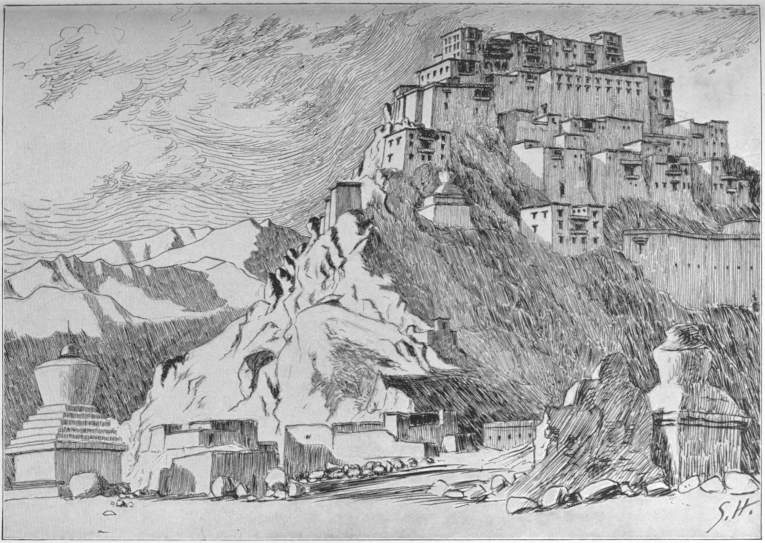
39. Tikze-gompa, Monastery in Ladak. Sketch by the Author.
On August 15, exactly twenty-one years had elapsed since I started on my first journey in Asia. What would the next year bring? the culminating point of my career or a retrogression? Would opposition still continue, or would the Tibetans prove more friendly than Europeans? I knew not: the future lay before me as indistinct as the Indus valley, where dark masses of cloud swept over the mountains and the rain beat on the tent canvas. We let it rain, and rejoiced to think that, if the precipitation extended far over Tibet, the pasturage would be richer and the springs would flow more freely.
After a short march we come to the village Rambirpur, reconstructed thirty years ago, and to the right of the road the small monastery Stagna-gompa stands on a pinnacle of rock. On the left bank is seen the village Changa, and a little higher up the well-hidden, small, and narrow valley where the famous temple of Hemis lies concealed. Thunder rumbles over its mountains as though the gods stormed angrily on their altar platform.
At a corner where a small, shaky, wooden bridge spans the Indus, stand some more long mani ringmos; they are covered with well-cut stone flags, on which the letters are already overgrown by a weathered crust, and stand out dark against the lighter chiselled intervals. Former kings of Ladak caused them to be constructed as a salve to their consciences, and to gain credit in a future life. They are a substitute for the work of the Lamas; every one is at liberty to propitiate the divine powers by this means. Thus the monks acquire a revenue, and every one, travellers and caravans included, rejoices at the pious act, while the stone slabs speak in their silent language of bad consciences and manifold sins, in rain and sunshine, by day and night, in cold and heat.
Now we leave the Indus for good and all. “Farewell, thou proud stream, rich in historical memories. Though it costs me my life I will find some day thy source over yonder in the forbidden land,” I thought, as, accompanied by jamadars and chaprassis of the Kashmir state and some of my men, I turned the rocky corner into the side valley through which the road runs up past the monasteries Karu and Chimre to the Chang-la Pass. The road now becomes worse; every day’s journey it deteriorates, sometimes changing into an almost imperceptible footpath, and at last it disappears altogether. The great road to Lhasa along the Indus and to Gartok was closed to us.
Our company makes a grand show; a sheep is killed every evening, and the pots boil over the fires in the centre of the various groups which have combined into messes. I make no attempt to learn the names of my new servants; coolies and villagers are always moving about among them, coming and going, and I scarcely know which are my own men. It must be so in the meantime; the time will soon come for me to know them better, when all outside elements are removed. A melancholy air is heard in the darkness; it is the night watchmen who sing to keep themselves awake.
At Chimre we are at a height of 11,978 feet, and we ascend all the day’s journey to Singrul, where we find ourselves 16,070 feet above sea-level. The road keeps for the most part to the stony barren slopes on the left side of the valley, while the brook flows nearer to the right side, where bright green fields appropriate so much of its water that little is left to flow out of the valley. A path to Nubra follows a side valley on the right. In Sakti we wander in a labyrinth of narrow passages and alleys between huts and chhortens, boulders and walls, mani ringmos and terraces which support cultivated patches laid out in horizontal steps. Above us is seen the Chang-la, and we are quite giddy at the sight of the road that ascends to it with a tremendously steep gradient (Illustration 42).
Tagar is the last village before the pass; here I had halted twice before. Its wheat-fields extend a little distance further up the valley and then contract to a wedge-shaped point, continued by a narrow winding strip of grass along the central channel of the valley bottom. The sections of the caravan climb higher and higher, some are already at the goal, and we have overtaken the hindermost. The path runs up steeply between huge blocks of grey granite, so that our Ladakis have to take care that the boxes do not get banged.
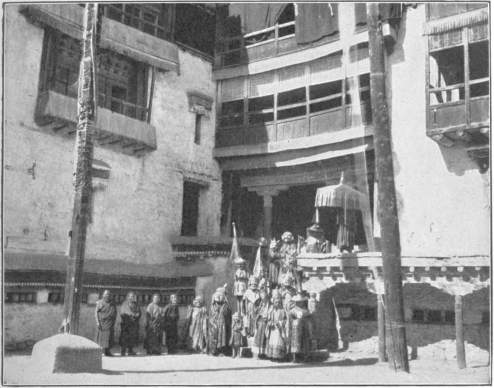
40. Masked Lamas in the Court of Ceremonies in Hemis-gompa (Ladak).
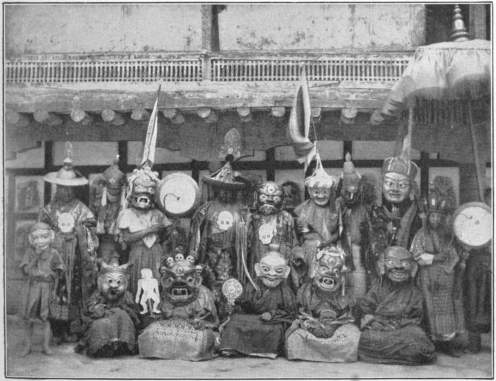
41. Group of Masked Lamas in Hemis-gompa. (Taken by a photographer in Srinagar.)
After four-and-a-half hours we are up on the small terrace-shaped halting-place, Singrul, and the bluish-grey smoke of the fires of yak dung floats over the soil, scantily carpeted with grass and traversed by a rivulet of crystal clear water. An alpine, cold, barren landscape surrounds us. Muhamed Isa sits enthroned like a pasha in his fortress of boxes and provender sacks, the usual sheep is killed and cut up, and is then thrown into the general cauldron, stomach, entrails, and everything. The head and feet are broiled before the fire on stones. Some of the men take possession of the skin, and spend the evening in rubbing it and making it soft—probably it is for use as bed furniture.
The two Rajputs sit a little apart from the rest by their own small cooking-pot, and, I perceive, make a very light meal of spinach, bread, and rice. The rarefied air seems to be of no consequence to them, nor the cold; the puppies, on the other hand, were very down-hearted when the thermometer in the evening marked only 45°; they howled piteously, and, crawling under my tent bed, rolled themselves up together. The four coolies, who carried the boat, went beyond Singrul to a cave, where, they said, they would be more protected from the cold in the night. Towards evening the brook rose, and one of its arms made straight for my tent, which had to be protected by a temporary dam. The Ladakis sat till late and sipped their red tea mixed with butter, and at many points reddish-yellow fires illumined the night.
The temperature fell to 21°, and it was really very uncomfortable in this high, raw region where the wind had free play and the sun had not yet got the better of the snow; rather large snowdrifts still lay on the ground, and clear streamlets trickled down from their edges, juicy moss and grass sprouting up beside them and forming a fine grass lawn. Accustomed to the heat of India, we feel the cold particularly severe on rising, when the snow particles beat like grains of sugar against the tent. A bluish-black raven sits on a stone, sometimes flying down to examine what we have left, snaps his beak loudly, and seems contented with his morning’s catch.
Slowly and heavily the horses and mules zigzag up through the grey granitic detritus and round the boulders on the way. Our troop is considerably strengthened, for the animals need help on the acclivities and the loads easily get out of place. To climb up these heights with loads on their backs, as our coolies do, they must have especially constructed lungs, good chests, and strong hearts. We mount higher and higher to the pass in the mighty range which separates the Indus from its great affluent, the Shyok. We still see the green fields down below at the bottom of the valley, the bird’s-eye view becomes more and more like a map, and the landscape behind us grows more distinct and extensive. Sharply marked orographical lines indicate the direction of the Indus valley, and the great range on its farther side rises darkly before us and covered with snow. Fifty mules from Rudok laden with salt threaten to block our way, but are driven to one side by our men. From time to time we call a halt to allow our animals to recover their wind. Then we go on a little farther; the rests become more frequent; the horses puff and pant and distend their nostrils. And then on again to the next halt.
At last we were at the top, 17,585 feet above sea-level. Certainly the thermometer marked 41.4°, but the wind was in the north, thick clouds obscured the sky, sweeping over the crest of the mountains, and soon hail came down, slashing us like a whip. On the summit of the Chang-la Pass stands a stone heap with sacrificial poles, which are decked with ragged streamers torn by the wind. All these streamers bear in Tibetan characters the prayer of the six sacred letters; coloured or faded, they flap and rustle in the wind as if they would drive the prayers up higher and higher by unknown paths to the ears of the gods. Horns and skulls adorn this elevated altar. Here all our Ladakis in turn come to a halt, raise a cheer, dance, swing their caps, and rejoice at having reached this critical point without mishap.
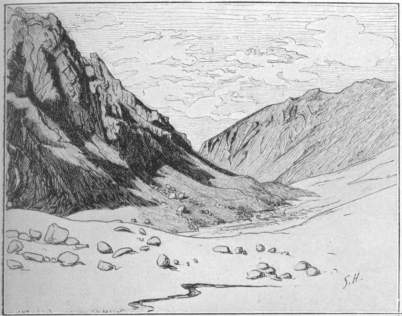
42. From Singrul, looking towards the Pass, Chang-la. Sketch by the Author.
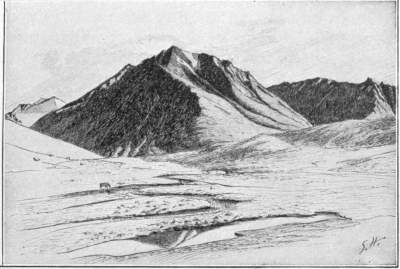
43. View from Sultak, August 17, 1906. Sketch by the Author.
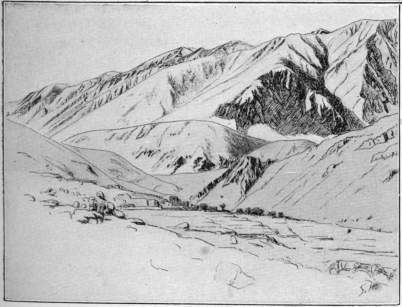
44. Drugub. Sketch by the Author.
The descent, however, on the eastern side of the pass, is still worse: nothing but detritus, boulders of all sizes, sharp-edged pieces of granite, and between a muddy paste in which our horses flop and splash at every step. Sometimes the path is more like a rough staircase, where you might fall headlong, but our horses are sure-footed and accustomed to bad ground. It is cold, dreary, raw, and grey—how different from the warm, sunny country we have so lately left!
At the foot of the descent from the actual pass old Hiraman, a friend of mine on former journeys, was waiting. The old man was just the same, perhaps a little more wrinkled than before (Illustration 45).
After a night with 12.8 degrees of frost we rode on from Sultak by a small lake dammed up by moraines, and down a valley full of detritus. Now the puppies had to run alone, and they did the short day’s march without complaining, but they were heartily sorry for their exhibition of strength when we got to Drugub, and were so tired out that they omitted to ferret about as usual (Illustrations 43, 44).
Drugub lies at a height of 12,795 feet, and on the short way to Tankse we ascended only 299 feet; from there, however, the route again ascends slowly until at length one reaches the great open plateau, where the differences of elevation show little alteration in a month of marching. Beyond Tankse a massive, finely sculptured mountain rises in the background; deep valleys open on either side; through the southern runs a road to Gartok, which I was to follow later; through the northern, the road to Muglib, which I had travelled by before; this I was to take now, and for two days keep to roads I was well acquainted with.
The Tankse river has a fair volume of water; we crossed it at a broad, shallow place, where the fall is very slight. The water is almost quite clear, of a bluish-green tinge, and glides noiselessly as oil over its gravelly bed. The whole village was on foot, and watched the pitching of my tent in a small clump of willows, which had resolutely struggled against the elevated situation and severe climate. These, however, were the last trees, worthy the name, that we saw for half a year.
We rested a day in Tankse, and settled with the men who were waiting with their thirty hired horses. On the early marches one gains all kinds of experience, and now we had to make one or two alterations. Muhamed Isa set up for the caravan men a large Tibetan tent with a broad opening in the roof to let out the smoke. The sacks of provender were to form round the inside a protection against the wind, and at the same time be themselves sheltered from rain. Furthermore, roasted meal, spices, and tobacco were purchased for the men, and all the barley that could be procured in the neighbourhood. The headmen of Tankse and Pobrang offered to accompany us for some days on a pleasure trip, and to see that everything went on smoothly.
Late in the evening a bright fire in Muhamed Isa’s camp lighted up the surroundings, and the noisy music sounded more merrily than ever. The caravan men held a jollification on taking leave of civilization, and had invited the notables of the village and the dancing-girls to tea and music. It was a very jovial party; the barley beer, chang, Ladak’s national drink, raised the spirits of guests and hosts, and as I went to sleep I heard female voices and the notes of flutes and bagpipes echoed back from the mountain flanks.
On August 21 we were again on the move; at our departure all Tankse turned out, besides the natives who had come in from the surrounding villages, and all sent us off with friendly cries of “Jole” and “A good journey.”
Here I commenced to draw my first map-sheet, being the first stroke of a work that for more than two years kept my attention riveted on every mile of the route and on every object that could be seen from it. At the same time the collections of rock specimens was begun. Specimen No. 1 was of crystalline schists in situ, while the bottom of the valley was still covered with large and small blocks of granite.
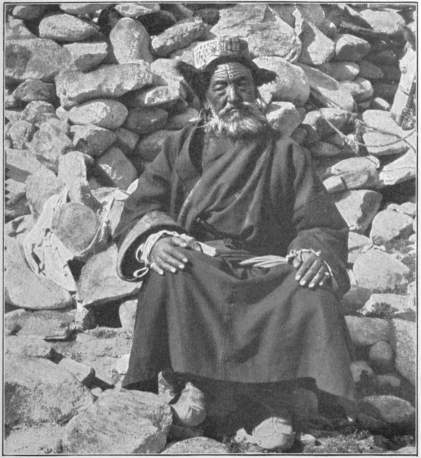
45. My old Friend Hiraman from Ladak.
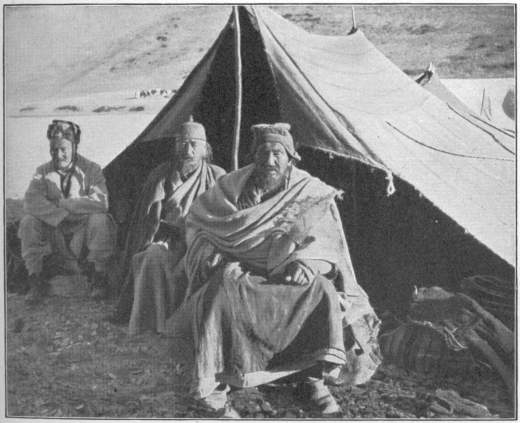
46. Chiefs of Tankse and Pobrang; Muhamed Isa, the Caravan Leader, in the Background.
We left the Tankse monastery on its rocky spur to our left, and henceforth kept to the right side of the Muglib brook, now at the foot of the mountain and past its cones of detritus, now over easily recognizable denudation terraces, and again along the bank of the brook, where here and there we came across a miniature meadow. Down in the valley at Muglib there is good rich pasture; close by the brook the meadows are swampy and treacherous, but higher up the soil is sandy, and even thistles crop up among the grass.
Here our 130 animals grazed and were hurriedly inspected. Sonam Tsering had to give a report of his stewardship, which he had managed admirably, and our mules looked fat and plump after grazing for five days on the open pastures of Muglib. Our camp was now for the first time fully mustered, and with its four tents and its various groups of men seated round, the camp-fires had a very imposing appearance. Horses neigh and mules bray on all sides, the men remove the pack-saddles to see that the under side is smooth and cannot rub and cause sores, the animals are groomed and fed, their hoofs are examined and re-shod, if the old shoes are worn out on the stony ground.
The village of Muglib consists of three wretched huts, and its twelve inhabitants cultivate barley and peas. The barley harvest was expected in ten days, but the peas were still in full blossom, and would not be ripe before the frosts set in. They are then used as horse fodder while they are still soft and green. I asked some Muglib men what they did in winter. “Sleep and freeze,” they answered.
Next morning the sun had not risen when a shouting and jingling, loud voices, and the stamping and neighing of horses woke me out of sleep—the heavy cavalry was marching off under the command of Muhamed Isa. Then the puppies discovered that my bed was a grand playground, and left me no more peace. Manuel’s fire in the kitchen began to crackle, and a fragrant steam gave notice that there were mutton cutlets for breakfast. I was accustomed to camp life, but I had never been so comfortable before and had never had so large and perfect a caravan.
Beyond the village we crossed the brook six times; it is quite small, and seems always to contain the same amount of water, for it comes from a small lake, where I had encamped on the eastern shore in December 1901. Now we followed the northern shore over many very difficult mountain spurs of black schist and quartzite; the ground is covered with gravel, sometimes with small patches of coarse grass, and then again is very sandy. Sometimes torrents of clear water gush down from the mountains, where huge fan-shaped cones of dejection descend from the mouths of ravines to the valley.
A heap of stones bedecked with flags and a mani mark the point of hydrographical importance, which is the watershed between the Panggong-tso and the Indian Ocean; here the height is 14,196 feet. From this point the valley descends slowly to the lake, and we ride in the channel through which at one time it discharged itself into the Shyok and Indus.
Now, the Panggong-tso is cut off from the Indus and consequently contains salt water. Behind a spur on the right side of the valley which hides the view, the western extremity of the lake peeped out, and a few minutes later a grand panorama unfolded itself before us; the great bluish-green lake between its colossal cliffs. Five years before I had skirted its northern shore with my camels, my old sturdy veterans, which caused so much excitement in Ladak that there I was still called the Camel Lord.
Just where the Pobrang river enters, forming a flat delta full of lagoons, we halted for a while to control our determination of heights by a boiling-point observation, and then rode along the river, which in 1901 was choked up with drifted sand, but was now full of water. When the drainage water fails in winter, the bed is at once filled up with sand, but the dunes are swept away again as soon as the spring flood sets in.
Lukkong is a small village with a couple of stone huts, a field of barley, a chhorten, a meadow, and a stunted mountain poplar. From this place the road runs north and north-east through the broad pebble-strewn valley, where we have a foretaste of the flatter conformation of the Tibetan plateau. We are in a region which has no drainage to the sea; we have already crossed three important thresholds, the Zoji-la, the Chang-la, and, to-day, the small Panggong Pass, but we have still two great passes in front of us before we finally enter the wide expanses of the tableland. Beyond the first we must again descend to the basin of the Indus, behind the second lies an enclosed hydrographical area which we must traverse in order to reach the country draining to the ocean through the upper valleys of the Brahmaputra.
From a small pass with a few stone cairns we had a surprising view over a valley which ran parallel to the one we had just travelled through, and was full of green meadows. Many tents and camp-fires were seen above and below the village Pobrang, and the meadow land was dotted over with dark caravan animals, for mine was not the only party that was paying Pobrang a flying visit: an English shikari, too, was there, a Mr. Lucas Tooth, who had been hunting in the mountains and was very well pleased with his collection of antelope horns. We talked in my tent till midnight, and he was the last European I saw for a space of more than two years.
CHAPTER VI
TO THE EDGE OF THE TIBETAN TABLELAND
We had another day’s rest in Pobrang; there we found the last good pasture land on the way to Tibet; it was, moreover, important that men and horses should gradually become accustomed to the increasing elevation. I had also received my letters from Sweden and India, and was a long time occupied with my letters and answers; the post-carrier was to return to Leh on the next day. But it was arranged that a mail-runner should be sent after us from there. From Pobrang he was to have a companion, for the country is infested with wolves. After the road came to an end the track of the caravan could easily be traced, and it was agreed that we should pile up small heaps of stones at doubtful points for the guidance of the letter-carriers. However, we never heard anything of them, and I do not know how they prospered. Pobrang, then, was the last point where I was in contact with the outer world.
Here we bought thirty sheep for fresh meat; we thought we should not want more, as the chase would yield us some supply, and some of my men were clever sportsmen.
At Muhamed Isa’s suggestion, Sonam Tsering’s pay was raised to 20 rupees, and he was appointed caravan-bashi of the mules. Old Guffaru was leader of the horse caravan, and Tsering, the short name we gave to Muhamed Isa’s brother, had the management of the small caravan which transported my daily necessaries, Robert’s tent, and the cooking outfit.
The jamadar, Rahman Khan, who had been my leader in 1902, and had come with us from Lamayuru, was discharged and well paid, and also the two chaprassis, Razul and Ishe. Old Hiraman insisted on keeping us company for another day’s journey, while the Numberdar of Pobrang and the Kotidar of Tankse were to remain with us, as already mentioned, up to the plateau. Thus our party was gradually lessened; last of all the hired horses and their ten attendants would leave us.
I consulted every evening with Muhamed Isa; Robert, too, was generally present, for he was the first of all my servants, conducted the business of the caravan, and kept accounts of the expenditure. We now resolved that some of the hired yaks should carry the boat, and that the last of the coolies should turn back. Then we took stock of our provisions: the maize and barley must last for 68 days; the meal for our thirty men would hold out for 80 days, and with economy for three months; the rice would not be all consumed for four or five months. But, however carefully calculations and estimates may be made, it is a risky, adventurous undertaking to cross the whole of Tibet, and the calculations seldom turn out correct. One may be sure of losing animals wholesale; matters may, too, come to a crisis, when the loads become too heavy for the surviving animals, and part of the baggage must be sacrificed. It may also happen that the provender diminishes more quickly than the animals, and then the latter must put up with smaller feeds, and at last find what nourishment they can on the ground.
My chief anxiety now was to maintain the caravan until we might meet the first nomads to the north of Bogtsang-tsangpo; had we good fortune so far, we should manage to get on by some means or other. I now drew up a provisional plan of campaign, the chief point being that it was based, not on time and distances, but on pasturage and water. The length of a day’s march was, then, fixed by the occurrence of these indispensable resources, and even a march of one hour in the day was enough when it led to tolerable pasture. Where, however, the land was quite barren we might travel any distance we liked. No one had any suspicion of my actual plans; I meant to reveal all only when the last men and their horses had left us. If I let anything transpire now, my plan would be made known in Ladak, and would reach the ears of my opponents. Then, as so often before, a merciless “Thus far and no farther” would have sounded in my ears even at Bogtsang-tsangpo.
On August 24 we left Pobrang, the last village, and rode up the valley. Fine tame yaks were sunning themselves on small grassy patches. To the left stretches out the Ldata valley, with good pasture lands in its lower part. Seen from a flat hilly rise with a couple of stone cairns, the country to the east assumes more of a Tibetan character, with low, rounded forms, and small, slightly marked open valleys and dried-up river beds. Everything seems dreary and barren; small hard yapkak plants are alone visible. The ascent is extremely slow, but the path is still easily perceptible in the tiring gravel or sand. Not a drop of water is to be seen. The weather is quite Tibetan: burning hot when the atmosphere is calm and clear; raw and cold when the sun is overcast, and the wind envelops horse and rider in sand.
At Lunkar we encamped near some deserted stone huts. A couple of hundred yards from us were grazing a pair of kulans or kiangs, as the wild asses are called in Tibet and Ladak. Nine fires lighted up the darkness, and snow hissed among the firebrands, continuing to fall, so the night watchman reported, till early morning.
Consequently in the morning was heard the crunching sound caused by footfalls on frozen snow; my tent bulged inwards under the burden, while all the landscape disappeared under a white wintry mantle, and dense clouds hung over all the crests. Manuel and Ganpat Sing had never seen snow falling before; they appeared extremely astonished and curious, and looked very cold in their pustins or Yarkand fur coats. The puppies were highly displeased at this new occurrence, and barked at the snow in their disgust till they found that it was no use. They also disapproved of our impudence in adding two large dogs from Pobrang to the caravan. Another reinforcement consisted of ten goats to supply me with milk, which were obtained in Lunkar.
We were all of a sudden transferred from the summer that reigned in Tankse to midwinter on the heights, and received a foretaste of the cold of the neighbouring Tibet. We saw little more of the summer this year—Pamzel might allow us to take a last farewell of the warm season.
The main caravan was still there when I left my tent, and we started all together. Old Hiraman took leave of us, and rode back down to his hut. The sun came out, and all around became dazzling white; even the Ladakis were forced to protect their eyes with a tuft of wool, which they fixed in front under their caps, and they looked very comical with this by no means becoming frontal decoration.
The long train now wound up to the pass like a huge black snake. The forty sheep and goats with their drivers led the way, but were soon overtaken by the mules, which now marched all day at the front. Next came Muhamed Isa with the horse caravan, and at his heels the hired horses with their leaders, and the yaks belonging to them. In their tracks followed our seven hired yaks, which carried the heaviest boxes and the boat; they did their work very well, and were first-rate animals—great black beasts; they did not seem to be affected by the high elevation of the pass, nor to feel the weight of the boxes; and kept up with the rear of the caravan all day long. Behind the yaks I rode, with Robert, the Kotidar of Tankse, and a runner who held my horse when I dismounted to search for rock specimens, take bearings, or make sketches. Last of all came Tsering and Manuel with my small caravan (Illustration 47).
We had not ridden far when we came up with the horse entered as number 52 on the list; it came from Sanskar, and cost 90 rupees. It had eaten nothing the day before, and was evidently on its last legs, for its leader could only make it stumble on a step at a time. It bled from the nostrils, its belly was swollen, and its muzzle was cold—all bad symptoms. It seemed to suffer from giddiness, and at last fell down and could not be induced to get up again. After a time, however, it raised itself up with a last effort, but rolled over again on the other side. We saw it from the pass still lying motionless, its attendant beside it; the latter overtook us later and reported that there was nothing to be done with the horse. So it was numbered 1 in the list of the lost, and we decided that the Kotidar might keep it, should it unexpectedly recover.
This pass, the Marsimik-la, had looked quite easy from our camping-ground at Lunkar, but now we found that it would be a very serious matter to cross it. The horses had to stop and recover their wind every five minutes at first, then every minute and a half, and at last they could not go more than a minute at a time, and then must stand still for as long. The snow now lay a foot deep, and the caravan marked out a coal-black winding line through the white expanse. Curious yellowish-grey and violet clouds rose above the mighty snowy range to the south and west. When the sun was visible our faces and hands were scorched; but when it was hidden behind clouds the day was pleasant, and the glitter of the sunshine on the snow, so trying to the eyes, was extinguished by the shadows of the clouds.
The caravan in front of us seems hardly to move, so slow is the progress in this highly rarefied air. Still it does move onwards, as we can tell by the constant shouts of the drivers. Some of the Ladakis sing together to lighten the toil of themselves and the animals. They are as cheerful and contented as though they were going to a harvest festival. From time to time Muhamed Isa’s voice growls forth like rolls of thunder, shouting out Khavass and Khabardar. We see him standing up above at the last turn up to the pass, and hear him distributing his orders from the centre of the semicircle now formed by the caravan. His sharp, practised eye takes in every horse; if a load threatens to slip down he calls up the nearest man; if there is any crowding, or a gap in the ranks, he notices it immediately. With his hands in his pockets and his pipe in his mouth he goes up quietly on foot over the Marsimik-la.
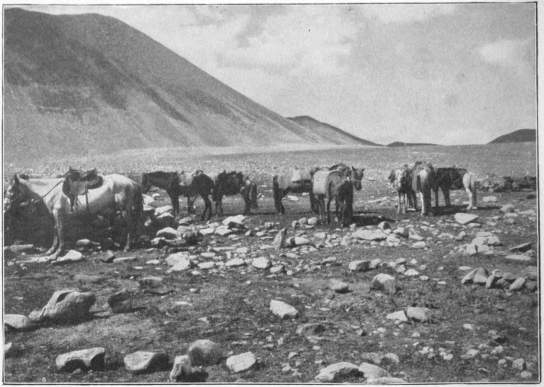
47. The Way to the Marsimik-la.
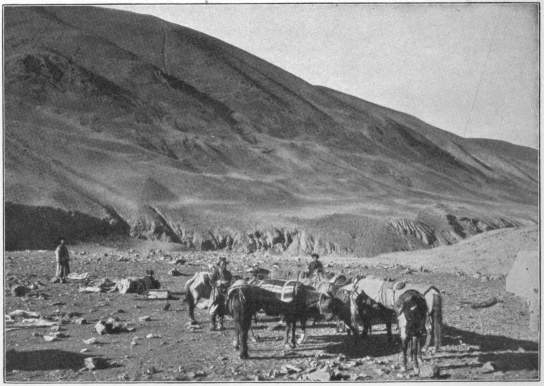
48. Spanglung.
Now the first column of mules reaches the ridge of the pass. A joyous shout goes out over the mountains; it is heard clearly and distinctly, but is indescribably thin, cold, and toneless, and at once dies away without awaking the feeblest echo; the air is too rare for that. Every detachment as it comes to the pass raises the same shout of triumph. With a feeling of relief I watch the last horse disappear below the white outline of the pass summit.
At the highest point I made, as usual, a fairly long halt to take observations, while Tsering’s detachment filed past me, and the yaks tramped, grunting, over the Marsimik-la. The absolute height was 18,343 feet, the sky was partly clear, and it was as warm as in an oven, though the temperature had risen only to 34.7°. Before we began to move again the tail of the procession had vanished behind the point of rock which marks the entrance to the valley that leads downwards. The fallen horse lay lonely and forlorn, a dark spot in the snow. It was the offering the gods of the pass had exacted as toll.
Eastwards the high range appears more uniform, as though planed down, and no prominent summit rises above the crest. The descent from the pass is bestrewn with pebbles and small blocks, which may be said to swim in mud. The snow thaws, and a continual trickling murmuring sound is heard. The route of the caravan is marked by an endless succession of small deep ditches filled with water, and meandering in dark lines through the white surface. Numerous trickles of water collect into a rivulet, which rushes down among the stones. Where the ground is level a swamp is formed, dome-shaped clumps of moss render it uneven, and between these stand pools, often of deceptive depth. For a long distance we follow a perfectly bare slope, and we are almost impatient at descending so slowly to the layers of denser air.