Front matter (continued 10)
Reading edition
The trellised window pasted over with paper, which occupies nearly the whole length of the wall towards the courtyard, and is draped with white curtains on the outside, is placed rather high above the floor. Immediately below the window runs a long divan mattress, on which a square cushion covered with panther skin marks the seat of honour. Before this cushion stand two small stool-like lacquered tables on golden feet. Seated here one has on the left hand, against the shorter wall, a cubical throne with steps leading up to it, and here the Tashi Lama takes his seat when he visits his younger brother, now twenty-one years of age.
Kung Gushuk is, then, quite young. He is very shy, and is evidently relieved when his guest talks and he is not obliged to strain his own small, poorly furnished brain. His recollections of India, whither he had accompanied his illustrious brother, were very hazy: he did know that Calcutta is a large town, and that the weather was excessively hot there, but for the rest the journey seemed to be to him only an unintelligible dream. He did not venture to give an opinion on the journey before me, but said openly that the lamas did not like to see me so often in Tashi-lunpo. His wife had sent to ask me if I would take her portrait, and I now begged to be told what time would suit her. “Any time.” When I went away, Her Highness was standing with her black court ladies at the other end of the open gallery surrounding a court (Illust. 168). I saluted her politely, and certainly fascinated the lady as I passed; there was no danger, as she was quite passée, for she had belonged in common to Kung Gushuk and an elder brother, who died in Sikkim on the return from India. It is said that she rules the house and keeps the finances in order, and with good reason, for Kung Gushuk leads a fast life, is over head and ears in debt, and plays hazard. This is bad form in a brother of the Tashi Lama.
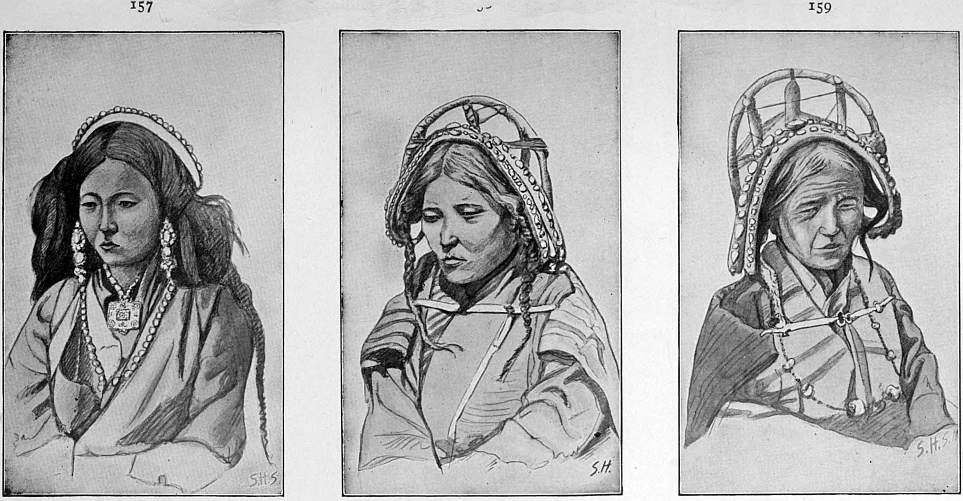
157, 158, 159. Tibetan Girl and Women in Shigatse. Sketches by the Author.
On March 22 the portrait-drawing came off; it was executed in the large saloon and in pencil. The Duchess is big and bloated, and asserted that she was thirty-three years old—I should put her down at forty-five. Her complexion is fair and muddy, the white of her eyes is dull. She had put on for this occasion all the finery she could find room for; a pearl pendant which hung on the left side of her façade had cost 1200 rupees. In her hair were thick strings of pearls, bunches of coral and turquoises. She was friendly and amiable, and said that she did not mind how long she sat, if only the result were good. Her small carpet-knight of a husband sat by and looked on, and round us stood the other inmates of the house, including a small brother of Kung Gushuk and the Tashi Lama. They drank butter tea, but did not offer me any, which made the visit all the pleasanter (Illustration 170).
Then we were shown the other apartments, which even on sunny days are dark as dungeons, for the windows are small, the paper thick, and the white curtains outside help to increase the gloom. A small oratory with red pillars was so dark that the images of the gods could scarcely be distinguished. In the study of the Duke a low divan stood at the window, with paper, inkstand, pens, and a religious book on a table in front of it. The bedroom was adorned with tankas, statues, and cups. Here and there butter-lamps struggled with the darkness, while braziers of brass on stands of dark carved wood were used to counteract the chilliness of the air. The whole house is like a temple, which is quite as it should be when the owner is brother of the Grand Lama.
Two passages connecting parts of the upper storey are not covered in, so are exposed to all the winds of heaven. A third staircase leads to the top of the roof, which is surrounded by a parapet a yard high, and is white-washed. A thicket of roof decorations and bundles of rods with streamers frightens away evil spirits. There was a violent wind, and dust and bits from the streets of Shigatse flew up in the air, so that our eyes received their share. With the portrait-drawing the visit lasted four good hours, and at the end I had become as intimate with the family as if I had known them from childhood.

CHAPTER XXXI
POLITICAL COMPLICATIONS
In the first chapters of this book I described very briefly the difficulties placed in my way by the English, and told how the Liberal Government in London had not only refused the favours I had asked for, but had even tried to suppress my expedition altogether. In consequence I had been compelled to make a wide detour all through the Chang-tang, where more than once our lives hung by a thread, and we had suffered great losses. Then we met with a weak resistance on the part of the Tibetans, but, nevertheless, came to Shigatse; it was pure good luck that the patrols sent out to intercept us had not fallen in with us. On February 14 the representatives of the Tibetan Government had intimated to me that I had no right to make a prolonged sojourn in Tibet, and that I must leave the country. As though I had not enough to do with the English, Indian, and Tibetan Governments, the Chinese Government also appeared on the scene on February 18. I was now opposed to a fourfold combination of Governments, and wished all politics and diplomatists at Jericho.
On this day the young Chinaman Duan Suen appeared on behalf of Gaw Daloi, the Chinese political agent in Gyangtse. He brought me a letter from him with the following curt contents:
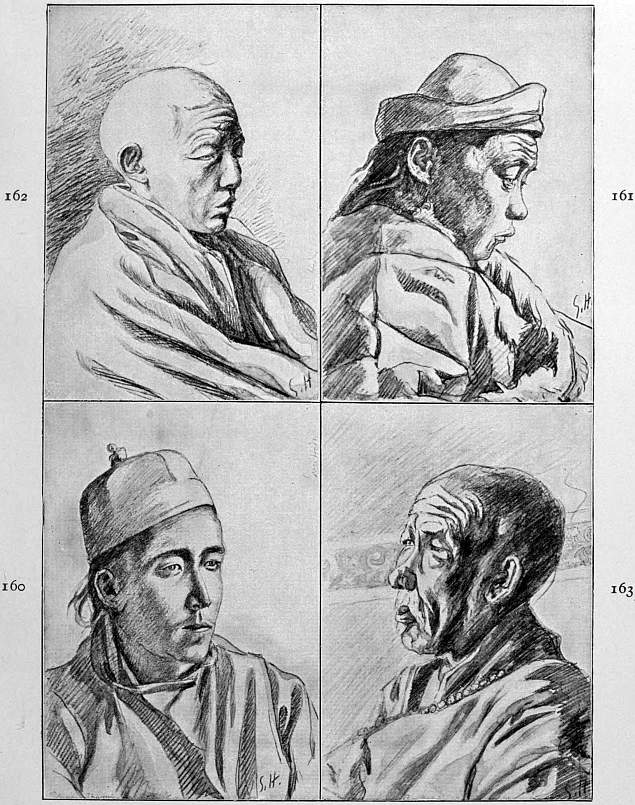
160. A Chinaman in Shigatse. 161. A Tibetan in Shigatse.
162. A Lama in Tashi-lunpo. 163. Door-Keeper in Tsong Kapa’s Temple.
Sketches by the Author.
Agreement between Great Britain and China, signed in Pekin in the year 1906, § 2: The Government of Great Britain binds itself not to annex any Tibetan territory, and not to interfere in the administration of Tibet. Convention concluded on September 7, 1904, § 9b: No representative or agent of any foreign Power shall receive permission to visit Tibet.
Duan Suen also conveyed to me by word of mouth Gaw Daloi’s message that I must on no account travel to Gyangtse, as I had forced my way to Shigatse without a passport or permit, and that only one route was open to me, that through the Chang-tang, by which I had come. I answered as curtly that Gaw Daloi should apply to Major O’Connor, the British representative in Gyangtse, if he wished to learn anything about me, instead of sending me impertinent letters.
It had been my plan and desire to visit O’Connor. I knew him very well by repute; he had loaded me with kindnesses, and I knew that he was one of the very few who had a thorough knowledge of Tibet.
We had been in constant correspondence with one another since my arrival. I had explained to him my ideas about the western continuation of the great mountain system, and O’Connor had replied that he had always longed to explore the extensive unknown parts in the interior of Tibet, and had long suspected the existence of a mighty mountain system to the north of the Tsangpo. I had still an imperfect knowledge of this system, and therefore I proposed to O’Connor that we should in future call the mountains Nien-chen-tang-la after the lofty peak on the south shore of the Tengri-nor. It would have been of the greatest advantage to me to meet a man like Major O’Connor just at this time (Illustration 171).
Meanwhile I soon began to regard the affair in a different light, for I perceived that in Gyangtse I should find myself in a worse position than in Shigatse. As long as I remained in Shigatse, the Chinese did not know what to do with me, but in Gyangtse the provisions of the treaty would at once become applicable to my case, and I might be obliged to retire southwards to India. Gaw Daloi’s prohibition with regard to Gyangtse irritated me a little, but I suspected him of using it as a stratagem, and all the more because the authorities of Shigatse offered at the same time to let me baggage animals on hire for my journey thither. Tsaktserkan, as well as Ma, knew that I had received a letter from Gaw, and Ma had long negotiations with the gentlemen from Lhasa. Evidently a political intrigue was going on, and all depended on my playing my cards well.
As early as February 20 I had noticed that the lamas were afraid of the Chinese because of my frequent visits to the monastery, and were becoming more reserved daily. I, however, quietly continued to place myself under their noses, and even to draw the Sakya-tubpa (Buddha). The Chinese pretended to fear that the English would reproach them with a breach of the treaty if they suffered me to sojourn on forbidden ground. My English friends, on the contrary, rejoiced at my success and hoped that I should continue to hold out. Meantime a change might come any day, and therefore I lived in the greatest agitation.
In my answer to Gaw Daloi I begged him to have no anxiety lest I, a Swede, should have any intention of annexing Tibetan territory, and as to § 9, he had not quoted it fully, for it ran as follows: “The Government of Tibet undertakes not to allow a representative or agent of any foreign Power to visit Tibet without the previous consent of the Government of Great Britain.” This paragraph did not apply to my case, for I was already in Tibet, and it did not concern me what agreements the two Governments had made together. My case must be treated from quite a different standpoint.
Ma had at first consented to send my letters to Gyangtse, but now he refused, with the excuse that he might seem too ready to oblige me. Therefore Muhamed Isa had to ride off on February 24 for Gyangtse, to carry my letter and passport to Gaw Daloi, and also to take 3000 rupees in sovereigns, which Major O’Connor had promised to exchange for silver coins.
I also sent a long telegram to the English Prime Minister, asking for the “consent of the Government of Great Britain,” as the Government of Tibet had hitherto placed no practical obstacles in my way. To this telegram I received no reply.
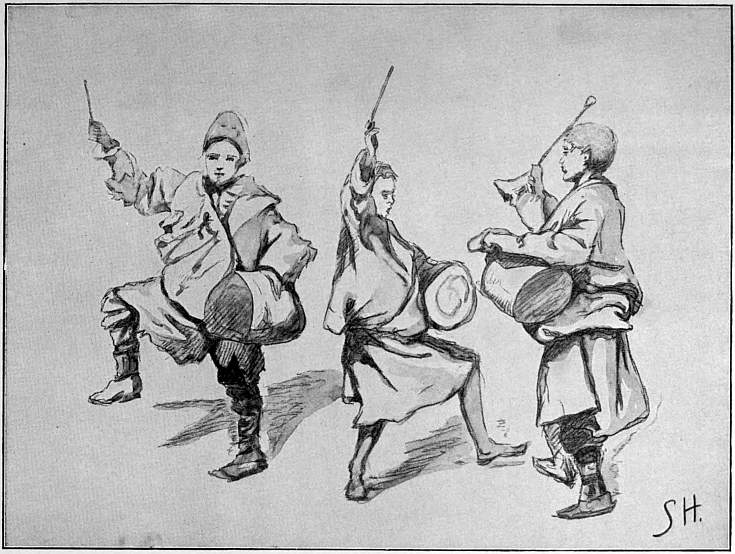
164. Dancing Boys with Drums. Sketch by the Author.
On February 27 Gaw’s answer arrived—not by Muhamed Isa, but by a special messenger; this was diplomatic but imprudent. Gaw wrote that he could not believe I would break a treaty between two great nations for the sake of scientific exploration, that my Chinese passport was not valid here, and that if I were allowed to travel about in Tibet, Russians and Englishmen might claim the same privileges. He concluded with the words: “I have received orders from my Government to arrest you at once, should you come to Gyangtse, and send you with a guard of soldiers across the Indian frontier.” I afterwards learned that he had not a single soldier, and that if he had had the whole Chinese army at his command, he could not have used it against me, if I were staying in Gyangtse as a guest in the British Agency. I replied, however, that I was quite willing to set out, in a north-westerly direction, if Gaw could provide me with a sufficiently large caravan.
On March 1 Ma visited me. He was quite beside himself. The Amban Lien in Lhasa had sharply reprimanded him because, with 1000 native and 150 Chinese soldiers under his command, he had not been intelligent and watchful enough to prevent my coming to Shigatse. He had now to inform me that I must leave the town at once, and asked me to tell him on what day I proposed to start. “Not for a good while yet,” I replied. “The caravan which is to take me back across the Chang-tang must be ready first.” The monks also had been advised from Lhasa to have as little to do with me as possible.
My sojourn in Shigatse had, then, given rise to an exchange of notes and telegrams between Lhasa, Gyangtse, Shigatse, Pekin, Calcutta, and London, and quite against my will I had become a small apple of discord among politicians. My position was so uncertain that I left no stone unturned. The Swedish Minister, Herr G. O. Wallenberg, did all he could in Pekin to obtain for me the permission of the Chinese Government and a passport; he spoke with all the high mandarins, but they with the greatest affability appealed to the treaties in force. The Japanese Embassy in Pekin also made representations, at the request of Count Otani (Kioto), but received the astonishing answer that, if I were in Tibet at all, which was very doubtful, I must be at once expelled from the country. So I met with refusals on all sides. But I was strong in one respect: I stood alone, while my opponents were hampered by having to pay respect to one another’s susceptibilities.
Meanwhile I was initiated little by little into the mysteries of Tibetan politics. Tsaktserkan, sent by the Tashi Lama, used to visit me at dusk. He asked me how it came about that, after the English had been victorious against Tibet, China reaped all the advantages of the victory, and China’s power increased in the country while England’s prestige declined. The Tashi Lama was much disturbed by the continued absence of the Dalai Lama. Immediately after his return from India he had sent presents to the Dalai Lama, and written several letters to him, but had never received a reply. The Dalai Lama had been his tutor, and he was grieved that he could not help him in his difficult situation. The authorities at Lhasa were incensed against Tashi-lunpo, and asserted that the Tashi Lama had been bribed by the English not to take part in the war. The Tashi Lama sent to ask me if I thought that the Emperor of China was angry with him because of his journey to India, to which I answered that in my opinion the Emperor would be pleased if the Tashi Lama maintained peace with his powerful neighbour to the south, and if there was a good understanding between Tibet and India.
Then on March 5 I received a remarkable letter from Gaw Daloi. He advised me “in strict confidence” to write to Chang Yin Tang (Tang Darin, or the Imperial Chinese Chief Commissioner in Tibet), and to the Amban Lien Yü in Lhasa, requesting Their Excellencies to grant me permission as a particular favour to travel through Gyangtse to Sikkim; he had no doubt that they would agree to the proposal. First, he had written to me that his Government had ordered him to arrest me if I came to Gyangtse, and now he advised me to go there. But by acting contrary to the orders of his Government, he gave me a dangerous hold over him: I had him now in my power, and regarded him as out of the running. I then learned in a roundabout way that his letter had been written in accordance with orders from Lhasa, where it was feared that I might not be easily got rid of if I were permitted to penetrate further into Tibet on my return journey. Ma informed me that he had orders to keep couriers in readiness for me, and that a letter would reach Lhasa in five days.
I now wrote to the Tang Darin, telling him that I would on no account act against the wishes of the Chinese Government by travelling through Gyangtse, but intended to return towards the north-west, if His Excellence would command that yaks should be placed at my disposal. As a Swede, I belonged to a country which had from ancient times been on friendly terms with China, and had no political interests in Tibet.
At the same time I wrote also to Lien Darin, and represented that neither the Chinese nor the Tibetan Government had any reason to complain of my journey to Shigatse; if my coming were displeasing to them, they should have prevented me in good time. On the contrary, they ought to be grateful to me for calling attention to the possibility of traversing their country, and I advised them to be more watchful in future if they wished to exclude Europeans. I should not think of travelling to India, for my people were mountaineers and would drop down in the heat like flies; they were, moreover, British subjects, and I was answerable for their safe return to Leh. It was impossible to travel through the Chang-tang, but I would willingly follow a route on the north side of the Tsangpo, where there were nomads. If they wished to get rid of me, they should not render my return more difficult, but rather facilitate it in every way.
When, therefore, the Lhasa gentlemen and the deputies from the Shigatse Dzong urged me that same day to start without delay, I was able to reply that it could not possibly be done till ten days later, for it would take so long to receive an answer from Lhasa.
Our position was still like an imprisonment, though everything was done to get rid of us. On March 4 I was in Tashi-lunpo for the last time. Now I was excluded from the monastery, for I had been expressly requested to cease my visits for fear of the suspicion of the Chinese. I promised, but on condition that I should first be permitted to see the Ngakang, where the vestments and masks are stored. When this was declared impossible, we at last came to an agreement that some vestments, masks, and instruments should be brought to my garden, where I should have an opportunity of sketching them. The objects were brought at night, and while I drew them in the daytime, a watch was kept round the house so that the lamas need not fear being caught. So we came to March 10, when Tashi arrived with my last 13 yaks, which were so worn out that they were handed over to a dealer at a nominal price.
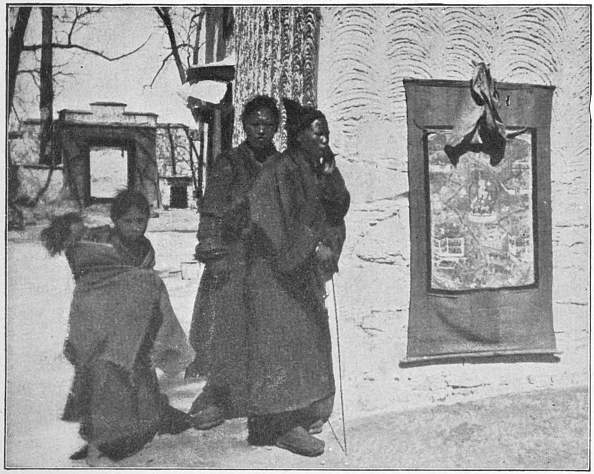
165. Wandering Nun with a Tanka Depicting a Religious Legend and Singing the Explanation. (In our Garden in Shigatse.)
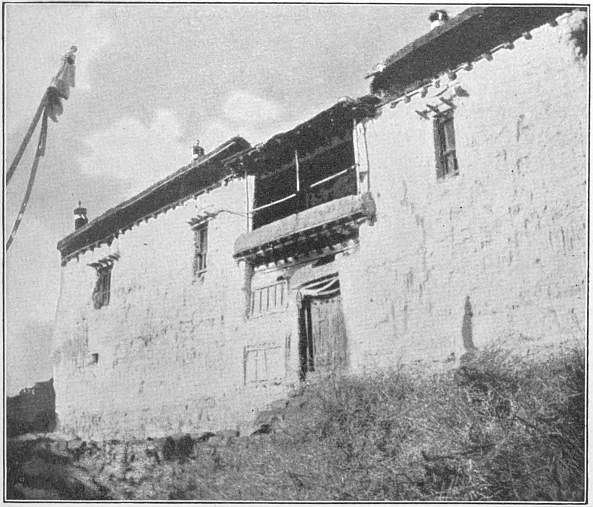
166. Gandän-chö-ding-gompa, a Nunnery in Ye.
Under March 12 the following entry appears in my diary: “In this holy land the spring is heralded in by kettle-drums and trumpets shriller than any that are sounded at dawn from the temple roofs, and summon the lamas to their first tea. Storms, dark masses of cloud, and dust whirling along the ground, and hiding all the environs except the Dzong fort, which peeps through dust-mist like a dismal phantom ship. The temperature rises, and in the day is several degrees above freezing-point, but there is no other sign of spring. It will come sometime or other, if it is now turning in bed and trying to rub the winter sleep out of its frozen eyes. To-day raged one of the most violent storms we have experienced. The bells of the monastery rang like storm bells, but their sound did not reach us amid the howling of the tempest. The kitchen has been removed into the house, no one is seen on the courtyard, and there is a cracking and whistling among the poplars. Now and then are heard the bells of a courier’s horse which canters by the outer wall, and perhaps brings new instructions regarding me. Ma makes no sign, Lobsang Tsering has disappeared, and Tsaktserkan comes only when I send to ask him. We are more and more isolated, no one dares associate with us. Our position is exciting and even interesting. It is evident that we must leave Shigatse, but by which route? I have already told them that I will not go through Gyangtse or Khatmandu (capital of Nepal), as Ma proposed to me, and to equip here a caravan for the Chang-tang is out of the question. I have only one goal, the north of the Tsangpo, where most important discoveries await me. At the moment we are on the point of leaving Shigatse we find ourselves for the first time actually prisoners; as long as we remain here we have at any rate freedom within our own walls. And as long as I am in Tibet, I am tabu to the English, but as soon as I cross the British frontier I am done for. I cannot go to Eastern Turkestan, for the Chinese Government has, as I hear from Gaw, cancelled my passport, because it has been used for another country. To travel direct to China with Ladakis will also not do. But if I am compelled to make for Sikkim, I must dismiss the Ladakis and travel alone to Pekin to explain the affair to the mandarins.”
On March 15 the two gentlemen from Lhasa came to me again. They had been to Gyangtse, and had received orders from Gaw to watch all my movements carefully. Again they wished to know the day of my departure, and I replied that I could come to no decision until I knew by what road I should travel. If it were to the Chang-tang, they might count on a long delay, and might meanwhile buy a house and marry at their leisure. They now complained themselves of the increased power of the Chinese in Tibet, and gave their opinion that only the unrest arising from the new strict régime in Lhasa had rendered it possible for me to travel across Tibet unnoticed.
In this they were probably quite right. The blunder of the Dalai Lama and the unexpected change of front on the part of the English had given the Chinese an opportunity of establishing their supremacy over Tibet more securely than they had been able to do since the days of Kang Hi and Kien Lung in the seventeenth and eighteenth centuries. Of the prestige of England I could not perceive a shadow, and I heard that the Tashi Lama regretted his journey to India. Perhaps it was prudent of the Liberal Government in London to give up Chumbi, and by barring the frontier to exclude all possibility of boundary disputes and friction on the Indian side; for in our times the old Asia is beginning to waken out of its deep sleep, and the Great Powers of Europe which have interests there should rather seek to retain what they already possess than endeavour to make fresh acquisitions. At any rate the Chinese statesmen exhibited on this occasion admirable prudence and vigilance, and gathered in all that the English gave up. If ever the Dalai Lama returns safely to Lhasa, he must content himself with the reverence accorded to him in the Potala as an incarnation, and he will not be allowed to have anything further to do with political affairs. The country of Tibet will doubtless in the future be closed as strictly as hitherto; for the supremacy over Tibet is a political question of the first importance to China, not only because Tibet is, as it were, a huge fortress with ramparts, walls, and ditches protecting China, but also on account of the great spiritual influence which the two popes exercise over all Mongolians. As long as China has the Dalai Lama in its power, it can keep the Mongols in check, while in other circumstances the Dalai Lama could stir them up to insurrection against China. And Mongolia is also the buffer state between China and Russia.
On March 19 our prospects grew bright at last. Ma had had a meeting with the two Lhasa gentlemen and the authorities of the Shigatse Dzong. The last came to me and begged me to inform them whither I meant to travel. I answered: “Along the Raga-tsangpo to its source.”
The gentlemen who had held the meeting, had meanwhile apparently come to the decision of taking the responsibility on themselves of the consequences of my journey to the west. But they firmly insisted that I must take exactly the same route back to Yeshung by which I had come, that is, through Tanak and Rungma, or they would get into trouble.
When it was thus settled that we were not to go to Gyangtse, I sent Muhamed Isa to Major O’Connor with all the maps, drawings, and the results hitherto acquired; the whole despatch afterwards reached Colonel Dunlop Smith in Calcutta in good condition. We had 3000 rupees more in gold exchanged for silver money, and I wrote a letter of farewell to my good friend O’Connor, and likewise to my numerous friends in India. I also wrote home, as usual, in the form of a complete journal.
On the 20th Ma came through our gate, triumphantly waving a letter with a large red seal, and called out from a distance: “From the Tang Darin.” The letter was dated on March 15 at Lhasa, and I reproduce it here as a specimen of Chinese diplomatic correspondence:
Dear Dr. Sven Hedin—I was much pleased to receive your letter of the 5th instant, and to hear that you are come to Shigatse in order to investigate the geography of the unknown parts of this country. I know that you are one of the famous geographers of Europe, that you move about here without meddling in the affairs of Tibet, political or otherwise, and carry out only geographical work.
I have a great respect for you as a man of science, who seriously advances the progress of earth knowledge. I always value such men most highly and show them the greatest reverence.
But, to my great regret, I must inform you that the last treaty between China and Great Britain contains a paragraph declaring that no stranger, whether he be an Englishman or Russian, an American or European, has any right to visit Tibet, the three market-towns, Gyangtse, Yatung, and Gartok, excepted. You are, then, not the only one to whom the country is closed.
I shall be glad, then, if you will return the same way you came, and you will thereby put me under a very great obligation.
China and Sweden are really friendly Powers, and both peoples are true brothers.
I hope you will not judge me harshly, for I am bound by the treaty not to suffer you to travel further.
I have issued orders to the Chinese and native authorities along your route to afford you all the facilities in their power.
Wishing you a successful journey, I am, yours truly,
Chang Yin Tang.
The letter leaves nothing to be desired as far as obliging amiability is concerned, but its contents are diplomatically obscure. Chinese and native authorities in the Chang-tang, where we had not seen a living soul for eighty-one consecutive days! Like Gaw, he falls back on the treaty signed by Great Britain to close the most interesting country in the world to exploration.
Ma knew the contents of the letter, and asked if it were still my determination to follow the Raga-tsangpo upwards. If so, the route was open to me. I answered in the affirmative, without showing any sign of my satisfaction, for this road was not sanctioned by Tang’s letter. Now some of the gentlemen of the Dzong had to look after the procuring of provisions—all by Tang’s orders.
All of a sudden the authorities of Shigatse became very polite, and showered down visits on me, after they found that I was in the good books of the most powerful man in Tibet in temporal affairs. Six sacks of tsamba, a sack of rice, and twelve cubes of brick tea were brought to my courtyard, and exact information was asked for as to the points I intended to touch on beyond the mouth of the Raga-tsangpo. However, I did not satisfy them, but said that not a single name up there was known to me. I thought to myself that it was most prudent not to excite suspicion by too many details; the farther we got away from the central authorities the greater prospect we had of being left alone. They inquired how many horses we wanted, and I at once said 65, so as to be well provided; they went away very quietly, as though they thought that this was a very large number.
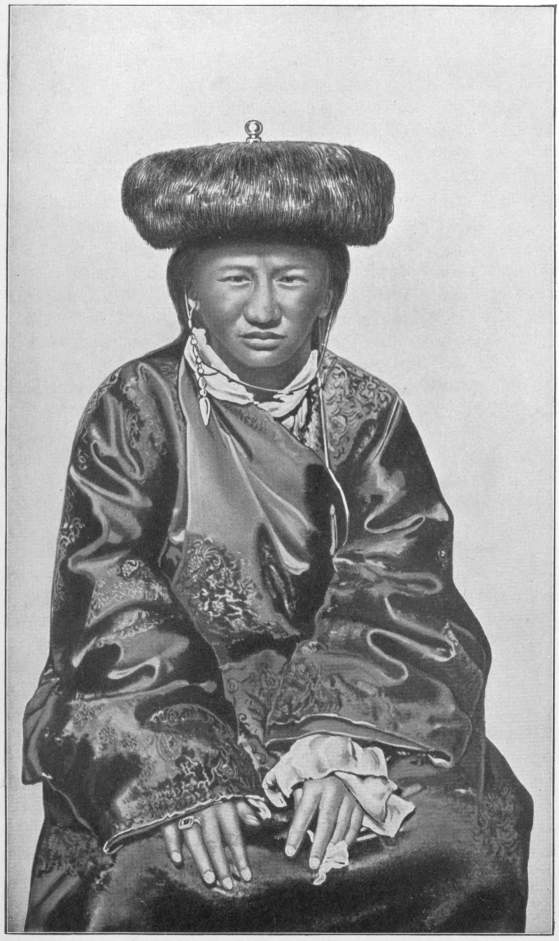
167. Duke Kung Gushuk, Brother of the Tashi Lama.
On March 24 Muhamed Isa came back with the silver money, more letters, and all kinds of articles which Major O’Connor, with his usual kindness, had procured for me. In the afternoon a great council was held: Ma, the two Lhasa gentlemen, the whole Shigatse Dzong, and Tsaktserkan—in all, nearly 20 officials, about 100 servants, Chinese soldiers, and newsmongers; so that the whole court was filled. The new passport was solemnly read to me. Therein the places were mentioned through which I might pass: the Raga-tsangpo, then Saka-dzong, Tradum, Tuksum, Gartok, Demchok, and the Ladak frontier. I must not stop at any point, must make long day’s marches, and travel straight along the valleys of the Brahmaputra and the Indus. I considered it useless to make any objections to the regulations; not a word was said of the country north of the Tsangpo, where I suspected the existence of the great mountain system. But I thought that we might contrive ourselves in some way or other an excursion thither, and resolved to give them plenty of trouble before they got rid of me. Two Chinamen, an official of the Labrang and one from the Shigatse Dzong, were to accompany me for the first part of the journey, and then be relieved by four others. The escort was introduced to me. The gentlemen insisted that we should start next day, but I declared that we required two days more to complete our preparations. All the provisions they had hurriedly collected were weighed in their presence, and paid for by me.
The brown puppy arranged for the morning of the 25th an interlude which certainly was not unexpected. Inspired by uncivilized ideas about the sanctity of my tent, the bitch had not ventured in for a long time, but now, just as I sat writing my last letter, she came and scratched a hole with her fore-paws in a corner of my tent, whined uneasily, laid her head on my knee, and looked very unhappy, as though she wished me to understand how helpless she felt. Before I was aware two very small puppies lay squeaking at my feet. While the young mother was licking her first-born with great tenderness, Muhamed Isa made a soft lair for the family. Puppy had scarcely taken her place on it when two more puppies made their entrance into this queer world. Then she probably thought that this was enough, for after a good meal of meat and a bowl of milk she rolled herself up with her well-tended young ones and went to sleep. The new puppies were black as coal and small as rats. I bought a basket for them to travel in until they could follow on foot the caravan in which they were born, and become good caravan dogs. We had tried here, too, in vain to get some good dogs, for our vagabonds from the Ngangtse-tso were good watch-dogs but unpleasant companions. Now we had suddenly a whole pack, and it would be an amusement to us to watch their development. Whatever might be our future fate, we could not reach Ladak in less than half a year, and by that time the puppies would have grown big and comical. Henceforth Puppy was allowed to live in my tent, and we became the best friends in the world, for I was as anxious and careful about the young ones as she. But she would not allow any one to approach who had no business here; scarcely half an hour after the catastrophe she dashed at two boys who were loitering about the court. There was a dreadful whining in the corner of the tent, but both the mother and young ones were as well as could be expected under the circumstances, as it is expressed in society bulletins.
In the meantime there was a very busy commotion in our courtyard. The heavy baggage was packed; rice and tsamba for the men, and barley for the horses, sewed up in bags accurately weighed; Chinese macaroni, cabbages, onions, fine wheaten flour, spices, potatoes, and as many eggs as we could get, were brought in from the market. The books, which I had received from O’Connor, filled a box to themselves, and would be thrown away, one after another, as soon as they had been read. When all had been packed up, my tent looked very bare.
On March 26, our last day in Shigatse, the packing was finished and Ma Chi Fu, a young official in Chumbi, came from Lhasa, bringing me greetings from Their Excellencies. He was a Dungan (Mohammedan), spoke gently and politely, and was one of the noblest, most refined, and sympathetic Chinamen whom I have known. He was also exceptionally handsome, had large bright eyes, which had scarcely any characteristics of his race, and pure Aryan features, and wore a valuable silken cloak. He regretted that he had had no opportunity of showing me hospitality, and begged me to believe that the escort would be only a guard; it was only to watch over our safety, and had orders to serve us to the best of its ability. Ma Chi Fu brought a kind letter from Lien Darin, the Amban of Lhasa, in which he wrote:
I knew that you were a learned geographer from Sweden. I am sorry that in consequence of the treaty I am not now able to make better arrangements for you in Tibet, but you are a wise man, and will therefore understand the difficulty in which I find myself much against my will.
In all my personal contact and correspondence with the Chinese they always showed me the greatest kindness and consideration. They were the masters of the country, and I had no right to travel about in Tibet, yet they never made use of hard words, much less of the means of actual compulsion that were at their command, but carried their hospitality as far as was consistent with loyalty to their own country. Therefore I retain the most agreeable memories of this and all my former travels.
In the evening I bade farewell to good old Ma, gave him three useless horses, which would, however, recover with good treatment, and thanked him for all his kindness to me. He expressed a hope that we might meet once more in this life. All who had been of service to us received considerable presents of money, and Kung Gushuk demanded 45 rupees as rent for his garden. I would have gladly given him several times the sum for the memorable days I had spent under the slender poplars, when the soughing of the spring winds roused me out of sleep.
CHAPTER XXXII
TARTING-GOMPA AND TASHI-GEMBE
I was awaked early on March 27. I mounted my horse, accompanied by Robert, Muhamed Isa, and three men of the escort, while the fourth had gone on with the caravan. Muhamed Isa conveyed my hearty greetings to the Tashi Lama, and my wishes that the course of his life might run as smoothly and happily as heretofore. Meanwhile, I paid a short return visit to Ma Chi Fu, and had not yet left him when my excellent caravan leader returned with the kindest greetings from the Tashi Lama and a large silken kadakh, which I keep as a souvenir with the image he presented to me. Then we rode in close order through the forbidden streets for the last time, and the golden temple roofs disappeared behind us. So, farewell for ever, grand, lovable, divine Tashi Lama!
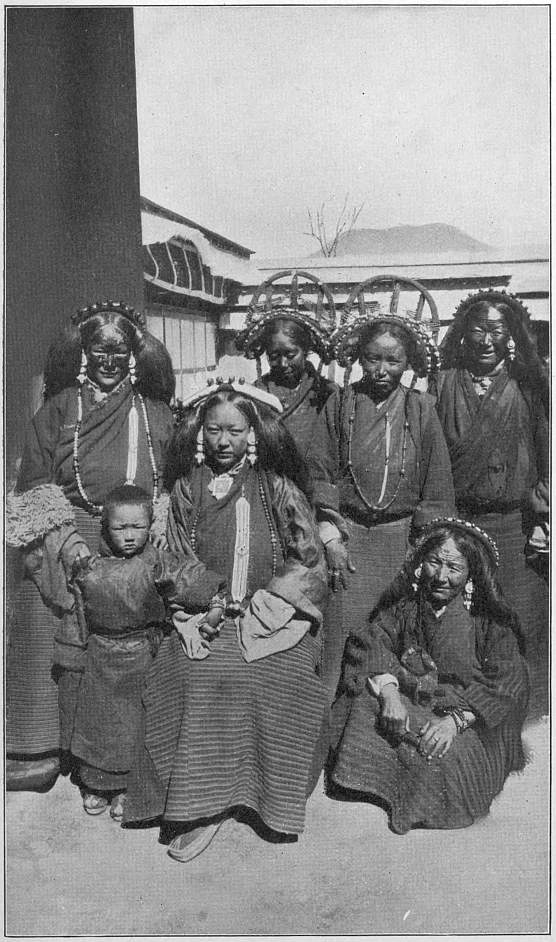
168. The Little Brother of the Tashi Lama, the Wife of Kung Gushuk, and her Five Servants.
When we left the side valley of the Nyang-chu and came out into the Tsangpo valley, we were exposed to the storm coming from the west and covering all the country with a thick cloud of dust. The long white foaming waves of the river rose so high that the farther bank was invisible. The horses were restless and would not go into the skin boat, but at last we brought them all safely over. I now rode a rather large brown horse which I had bought in Shigatse. My small white Ladaki was still in good condition, but he was exempt from work. Only three veterans from Leh remained, two horses and a mule. Robert rode one of the horses from the Ngangtse-tso, and Muhamed Isa a large white horse from Shigatse, where we had also bought two mules; the baggage was transported on hired horses and asses. The caravan had encamped in the village of Sadung on the north bank of the Tsangpo. Ishe had carried the four puppies in his dress on his breast, and had led Puppy with a string, that the young ones might be suckled on the way.
Next morning we awoke in beautiful weather. Eastwards were seen a series of brown mountain ridges with shading growing lighter and lighter as they dipped to the river, which stood out in still brighter colouring. The dwellers on the bank here called the Brahmaputra Tamchok-kamba, and said that it would fall for two months more, and would then rise till it attained its maximum at the end of July. Then it floods most of the valley bottom, and rolls majestically down, while all around assumes a fresher hue in the calm air of summer. At the end of September the level of the water becomes lower, and the river freezes only in cold winters.
We again retire from the holy districts, and ride through villages standing at the mouths of side valleys, past granitic promontories of the northern mountains, over fields and dunes, and camp, as before, in the garden of the Tashi Lama in Tanak. The four gentlemen that accompany us have brought their servants with them, and provide their own shelter, horses, and food. They have received on setting out a certain sum for this purpose, but for all that live at the expense of the villagers, eat and lodge free of cost, and order fresh horses for every day’s march without paying any hire. They keep their travelling money intact in their pockets, and are therefore well pleased with their commission.
Both on the 28th and on the 29th, when we bivouacked in Rungma, we had violent storms from noon onwards, which blew in our faces. Nothing could be seen of the surroundings, and frequently I could not perceive the man just in front of me. We were pestered with sand, which grated under our teeth, irritated our backs, and made our eyes smart. Where the valley was contracted, the compressed wind blew with double strength, and the sand-clouds rolled in a greyish-yellow mass along the Brahmaputra valley.
We went on the 30th on to Karu in brilliant weather, still along the Tsangpo, which, green and free from ice, gently lapped against the southern foot of the mountains. Occasionally a boat glided downstream. The wild ducks on the shore are very tame, for no one is allowed to kill them, and, indeed, no one wishes to do so. Only a slight local traffic is noticeable. We miss the pilgrims we saw on the journey down; they are now at home again. We leave on the right the small convent Chuding with its nine nuns. On the steep mountain flanks are rocky paths used during high water, for the road we follow is quite covered in summer when the river is 5 feet higher.
In Karu wheat, barley, peas, and radishes are cultivated. We had made a short march, and I had ample time to interrogate the wise men of the village about the geography of the country, the means of communication, the climate, the habits of the river, and the directions of the wind; but I have no room for such particulars in this book. I would rather, instead, introduce our escort to the reader. Vang Yi Tyn is a Dungan, born in Shigatse; Tso Tin Pang has a Chinese father and a Tibetan mother, has his home in Shigatse, holds the Lamaistic faith, and murmurs prayers on the way; Lava Tashi and Shidar Pintso are pure Tibetans. All four are friendly and ready to help, and tell me in confidence that they mean to do their very best, that I may be pleased with them and give them good testimonials.
The last day of the month of March is marked in my journal with an asterisk. While the caravan marched straight towards Ye, the rest of us rode up a side valley, at the mouth of which lies the village Tarting-choro, surrounded by fields and willow trees. A small well-kept mani-ringmo is covered with stones polished by the river, in which the usual formula is not incised, but another in red and blue characters, namely, “Om mati moyi sale do.” The figure is many times repeated, and indicates a connection with the Pembo sect, while the figure is a mark of the orthodox yellow-caps.


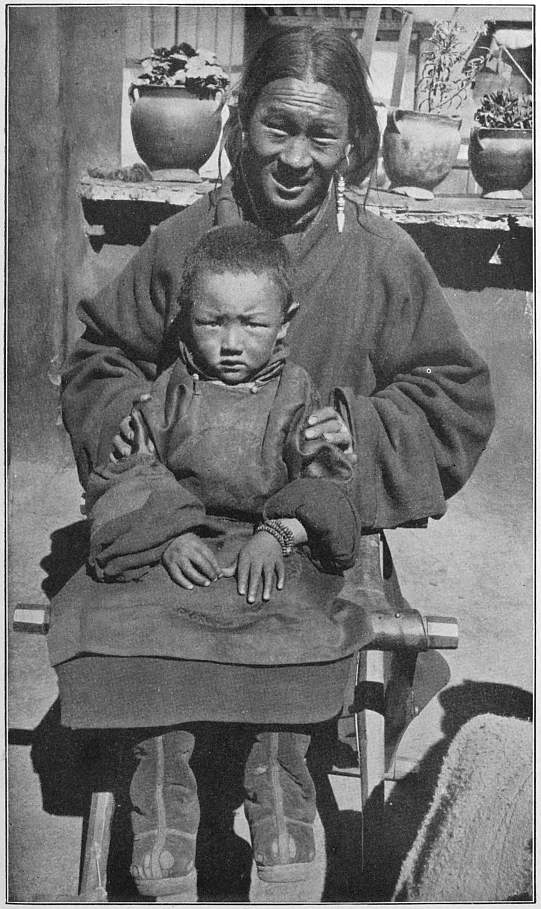
169. The Little Brother of his Holiness with a Servant.
Farther up lies another village, having a chhorten with a gilded turret in a copse of old trees. A red house is the lhakang (God’s House) of Tarting-gompa, and behind stands the house of the Grand Lama, picturesque and unique, built in the usual cubical style, with white steps and flat roof. Above it Tarting-gompa is throned on its hill like Chimre or Tikze in Ladak (Illustrations 173, 174, 178).
We enter the court of the lhakang with its red walls; on two sides a roof is supported by posts, a shed for the riding horses, pack-mules, men and women who carry firewood and goods—a cloister and a caravanserai at the same time, where labour finds harbourage under the protection of religion—and over it waves a long flag from a tarchen, a mast standing in the midst of the court. The convent dog is chained up. The gate has an unusually high threshold; on the side walls of the entrance a tiger is painted in fresh colours. We now enter the lhakang, and I must confess that I started with surprise in the portal, for we had seen many halls of the gods in Tashi-lunpo, but never yet one so large, ancient and so wonderfully fascinating in its mysterious light.
What rich and subdued colouring! The Sego-chummo-lhakang, as it is called, is like a crypt, a fairy grotto, recalling to mind the rock temples of Elephanta; but here all is of red-painted wood, and 48 pillars support the roof. The capitals are green and gold, carved in intricate and tasteful designs, and carved lions, arabesques, and tendrils adorn the projecting beams of the ceiling. The floor consists of stone flags, their cracks filled up with the dust of centuries, so that it is smooth and even as asphalt. The daylight falls into the hall through a square impluvium, spanned by a network of chains. There stands the throne of the Tashi Lama, who visited the convent two years ago, and is expected again in two years, and opposite is a pyramidal stand, which is hung with lamps at certain festivals. A lama sits all day long at a tall prayer-cylinder (korlo or mankor) about 6 feet high, with a pile of loose leaves a foot high in front of him, which he turns over rapidly, and gabbles their contents so quickly that one wonders how his tongue can move so fast. Frequently he beats a drum, then he clashes cymbals, or turns the prayer-cylinder in the heterodox direction (Illustrations 179, 254).
In another saloon, beside this, repose Grand Lamas of the Pembo sect, high priests of Tarting-gompa. We find here the same four-sided passage as round the sepulchres of Tashi-lunpo. But as I was going, as usual, from right to left, lamas hurried up to stop me. The monuments are like chhorten, and are covered with gold plaques and precious stones. Twelve statues of deceased high priests have behind them huge gilded halos, richly carved with carefully executed detail. Beside Shen Nime Kudun’s monument lie two black smoothly-polished round blocks, apparently of porphyry or diabase. On one of them is seen the impression of the foot of the above-named Grand Lama. On the edge of the other are four impressions, his four fingers, just as though the flat hand with the fingers a little expanded had been pressed against a piece of hard butter. One can try it with one’s own hand; the fingers fit in exactly, and the hollows are about 3/4 inch deep. It is well and naturally executed—pia fraus!
“When was the monastery founded?” I asked.
“That was so long ago that no one now living knows.”
“Who founded it, then?”
“Gunchen Ishe Loto, long before Tsong Kapa’s time.”
The lamas spend all their lives in the convents, but have no idea how old these are.
Then we ascend to the top of the hill, where several convent buildings stand, and are received by a whole pack of vicious dogs. The chief temple hall, Dokang-chummo, is built on the same plan as the one below, and has numerous images, some of which are covered with strips and silver cases. We are led from one sanctuary to another, and are astonished at the extremely finely-executed frescoes that cover the walls. A temple in an elevated situation is surrounded by an uncovered passage with balustrades and prayer mills. A grand panorama of wild fissured mountains extends all round.
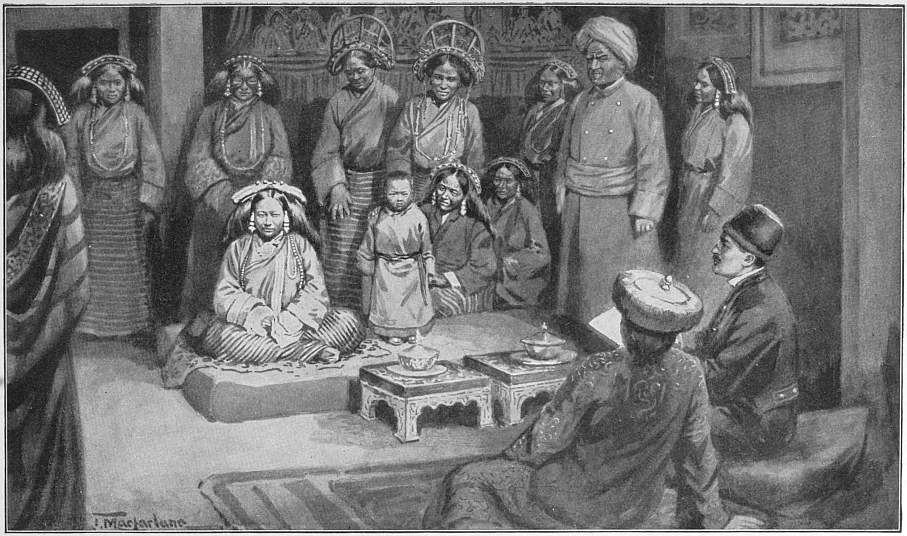
170. The Author drawing the Duchess Kung Gushuk.
We had heard that the evening before our arrival an octogenarian lama had died, and I begged to be allowed to see his cell. But the excuse was made that some monks were reciting the prayers for the dead, and must not be disturbed. However, the house of the deceased was pointed out to us, and we went and knocked at the door of the courtyard. After a long wait a man came and opened it. Half of the small court was occupied by a black tent, where two men and a woman were cutting chips of wood 2 feet long, on which prayers and holy texts would be written, and then they would be used to kindle the funeral pyre of the deceased. One was drawing religious symbols and circles on a large paper, which would also be burned. We mounted a short staircase and came to a narrow open verandah before a store-shed with leathern chests containing the clothing of the deceased, and a compartment where his servant lived, who was now engaged in printing prayers in red, on white paper, with a wooden stamp; 700 such strips of paper are burned with the body, and the prayers follow the soul through the unknown realms of space.
From here we reach his cell, which is little more than double the size of my tent. There sit two old monks, with their backs against the trellised window. Books containing the prayers for the dead lie on a table before them. Two others sit on the floor in the middle of the room. All four must pray thrice twenty-four hours, day and night, for the soul of the deceased. The cell has a pillar, and is full of idols, holy vessels, banners, and books—a small museum. I asked if I might buy any of the things, but was told that they must all be handed over to the monastery.
The divan bed, partly draped with red hangings, stood against the shorter wall, the head to the window. Here sat the body, bent very much forward and with the legs crossed, and the back to the light. It was dressed in coloured garments with shoes on the feet, a thin kadakh over the face, and a head-covering of red and blue stuff somewhat like a crown. Before it on the bed stood a stool with images, bowls, and two burning candles.
The body is not consumed in this dress. A white frock is put on, and a square cloth is spread over the knees, on which a large circle and other symbols are drawn. A crown (vangsha) of paper is set on the head, a square brimless hat, on which a button is fixed within eight broad teeth; it resembles an imperial crown. Thus attired the body, in a sitting position, is burned in the hollow of the valley below the temple. A lama carries the ashes to Kang-rinpoche (Kailas), where they are deposited in a holy chhorten.
At the age of five years this Yundung Sulting was consigned by his parents in the year 1832 to the care of the confraternity of Tarting-gompa, and his convent name was thenceforth Namgang Rinpoche. He, too, was an incarnation, and stood in high repute for his holiness, wisdom, and learning. On account of these merits he was burned, while the other monks in Tarting are cut in pieces. His sister and only relation, an old wrinkled woman, was present. The watchers of the dead were just in the act of eating their dinner, which was placed on a stool—cold dried meat, tsamba, and chang (beer). They were shy and astonished, had never seen a European, and did not know whether they should answer my questions as I sat by them on the floor and took notes. I noticed, however, that they were less concerned for themselves than for the deceased. Twenty-four hours out of the prescribed seventy-two had passed when I came to interrupt the masses for the dead, and to disturb the soul which was nearly set free. But Namgang Rinpoche sat still, meditating over the endless enigmatical perspective that the formula “Om mati moyi sale do” opened out to him; and as long as I remained in his cell, no awful wonders and signs were seen.
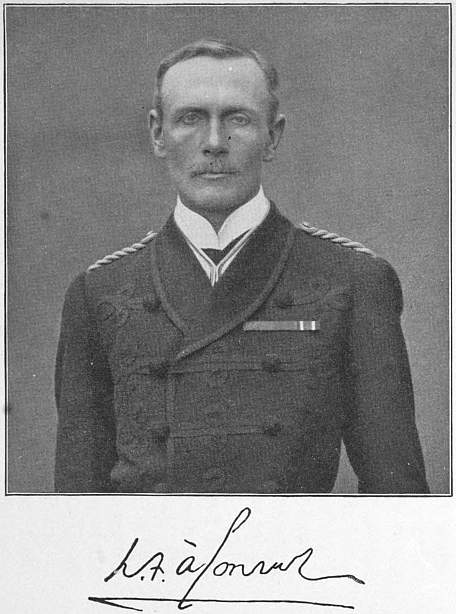
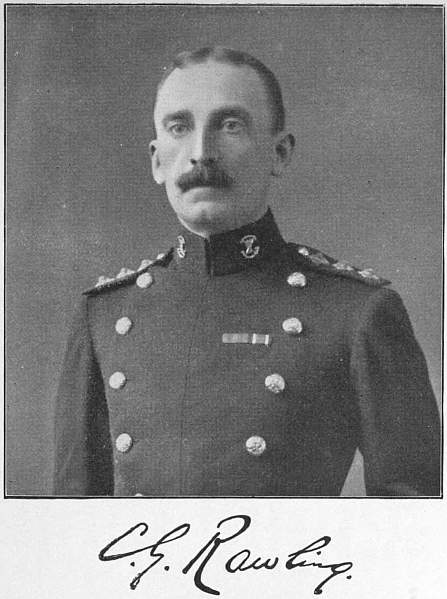
171. Major W. F. O’Connor, British Trade Agent in Gyangtse, now Consul in Seistan. 172. Captain C. G. Rawling.
For my part, I thought of the singular fate of the man whose life had come to an end the day before. As a novice he had left for ever in childhood the free existence among the black tents and grazing herds, said farewell to the world and its vanities, and was received into a community of monks, of whom none now remained alive. He saw his elders die one after another, the young ones grow up to manhood, and new recruits come in. They wandered for a season through the temple halls, lighted the candles, and filled the water-bowls before the statues of the gods, and then passed on to other scenes on the endless road to Nirvana. Seventy-five years he had been an inmate of the monastery, and had lived in the cell in which his body now lay. How many soles must he have worn out on the same stone floor! For seventy-five years he had searched the holy scriptures and had pondered over an easier existence beyond the funeral pyre; for seventy-five years he had seen the westerly storms driving the sand along the Brahmaputra valley. Only yesterday, at the point of expiring, he had listened to the sound of the temple bells, which, with their clappers bound with large falcon’s feathers, had rung in his passage to the world beyond. And then with tottering steps he had followed the uncertain track of the brethren who had passed away before him.
Such a life seems hopelessly sad and gloomy. And yet a man who will venture to shut himself day and night within the walls of a dim convent must possess faith, conviction, and patience, for it is a prison which he in the tumult of his mind has chosen of his own free will. He has renounced the world when he allows himself to be walled in alive in the dark courts of Tarting; and when the smoke of his pyre ascends, it must, if equal justice be meted out to all, be a pleasant savour before the eternal throne.
But evening was coming on, and we must set out again. Below in a field a woman was ploughing with two oxen. She was singing loudly and cheerily to lighten her work. We rode on between low mountains, leaving Tanka-gompa on our left. When we came down to the plain the darkness was impenetrable, being made denser by thick clouds. A violent north wind arose, bringing cold air from the Chang-tang. At length we caught sight of comet tails of shooting sparks—our camp-fire in the Ye, where we had halted for a night’s rest two months before.
We remained two days in the Ye or Yeshung, and here took some liberties which were not in accordance with the terms of our passport, but the escort made no protest. On the first day we rode to Tugden-gompa, a row of cubical, two-storeyed houses painted dark greyish-blue with vertical white and red stripes. The monastery is said to be of the same colour as the famous Sekiya, south-west of Tashi-lunpo, and also belongs to the sect which allows lamas to marry under certain conditions. The convent has thirty monks, and is directly under the Labrang (Tashi-lunpo). I will not enter into a full description, but will only say that the tsokang, the assembly saloon and reading-room of the lamas, had four red pillars, divans in the nave, and handsome banners on the walls of the side aisles, which were painted on Chinese silk, some with dragons on the lower border, some without. The statues for the most part represent monks of high rank (Lama-kunchuk, i.e. divine lamas or incarnations). Before the portal stands a huge bundle of rods with streamers in all the colours of the rainbow, which are already torn by the wind. In an upper hall is enthroned a figure of Hlobun-Lama, a regular bishop, with mitre, cassock, and crozier. Some of these statues are very comical—fat, jolly old boys with a divinely gentle smile on their rosy lips, wide-opened eyes, and chubby cheeks, sometimes with moustaches and imperials. The likeness is probably more than doubtful, but at any rate they are very unlike one another. Most of them are wrapped in silken mantles. The Labrang here was closed, for the head lama of Tugden was gone to the tent of a dying nomad to the north. We visited a monk’s cell instead. It had a yard, a stall for the monk’s horse, a small dark closet for a kitchen, where a cat kept company with two pots, and a large lumber-room crammed with clothes, rags, images of Buddha, books, and tools, in which a novice, the pupil of the monk, lodged.
Immediately to the south-east of Tugden a small poor nunnery, Ganden-chöding, lies buried among hills. The dukang, a dark crypt with red pillars and neatly carved capitals, is reached through an unpretending portal in the middle of the façade. Beggarly offerings, scraps of iron and other rubbish, are hung on nails driven into the pillars. The serku-lhakang, the holy of holies, receives its light from the larger hall, and as this is dark, it must be pitch dark in the inner shrine. The statues of Chenresi (Avalokiteswara) and of the Tsepagmed (Amitayus) can only be seen with a lamp.
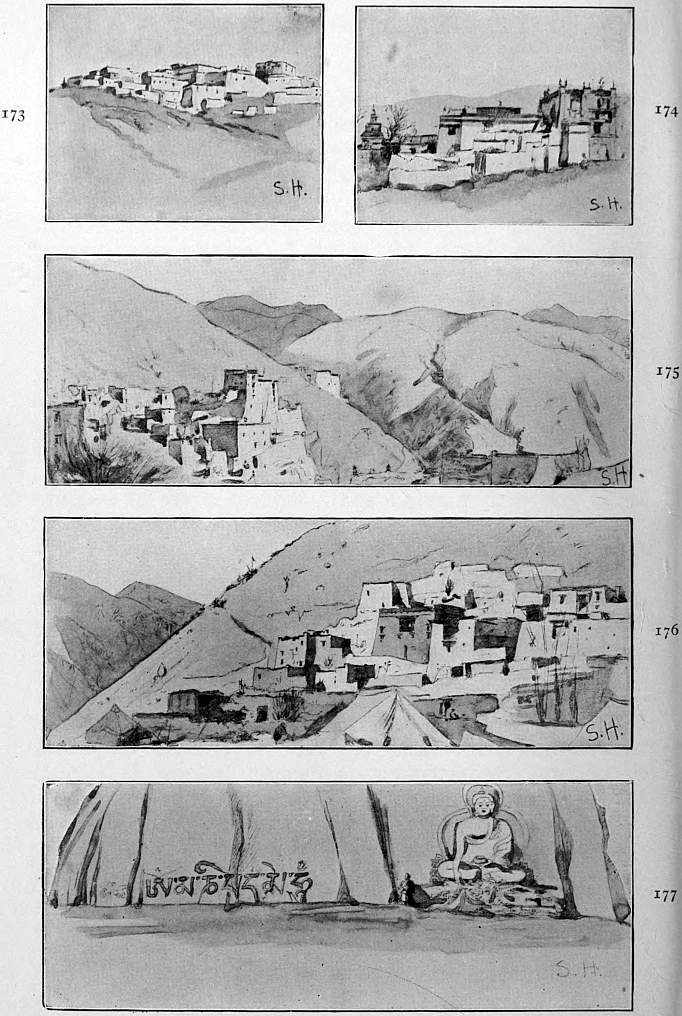
173, 174. Tarting-gompa. 175. Linga-gompa. 176. Lung-Ganden-gompa near Tong. 177. Inscription and Figure of Buddha carved in Granite near the Village of Lingö. Sketches by the Author.
The sixteen nuns of the convent are under the control of Tashi-lunpo, and the Tashi Lama provides them with tea once a day; the rest of their food they must beg in the houses and tents, so that some of them are always on the road. Now there were only five sisters at home, all dirty, with short hair, and poorly clad. Two were young and shy, the others were old wrinkled women with silvery-grey bristles, and in clothes which had been red once, but were now black with dirt, partly soot from the kitchen—a miserable hole, where they spend most of the day. I asked them whether they had attended the festival in Tashi-lunpo, but they replied that their means would not allow them except when a charitable person gave them travelling money. I always left a few rupees in the convents I visited, and the inmates were never too holy to take the valuable metal from the hands of an unbeliever.
The whole broad valley at Ye is begirt by a circle of monasteries. Our Chinamen had given notice of my visit on April 2 to Tashi-gembe, a large convent of 200 monks, who belong to the same colour as the monks of Tashi-lunpo. We had an hour’s ride to this town of white sanctuaries, which are erected at the foot of a mountain spur. About 100 brethren gave me a civil greeting at the entrance, and led me to the paved court of ceremonies, which has the same appearance as the one in Tashi-lunpo, is surrounded by pillared galleries, has numerous pictures of Buddha painted in fresco on the walls, and a throne for the Tashi Lama, who celebrates a mass here once a year. By a staircase of wood and stone, between two pillars of the entrance hall, where the four spiritual kings keep watch on the walls, we enter into a dukang, with the usual pillars and divans. On two of these pillars hang complete suits of armour with shirts of mail, casques and tasses of iron scales fastened together with iron rings, maces, spears, tridents, and lances; on one of these lances hangs a white pennant with a brown border; on the pennant are written characters, and on the point of the lance a skull is placed. Among the harness tankas are suspended, which, surrounded by silken cloths, look like escutcheons. Amid this harness and weapons, which are worn by divine powers when contending with devils, one may fancy oneself suddenly transplanted into an ancient Asiatic castle.
A gallery runs round three sides, and standards and banners hang down from it, all in fresh colours, tasteful and handsome. In the middle of the altar rank is enthroned Sakya-tubpa, the Buddha, and before the statues stands a row of polished brass bowls with lights which, mingling with the daylight, cast a magic gleam over the dusky hall. Some are filled with crystal-clear water, the nectar of the gods.
On one of the longer sides the folios of the Kanjur, the collection of canonical books contained in 108 volumes, as many as the beads in a rosary, are arranged in pigeon-holes. The Tanjur, the other collection, consists of 235 folios—a caravan of about 150 horses would be necessary to carry the two bibles of the Tibetans. Only rich monasteries are able to keep both. The thought that no one but themselves has waded through these endless scriptures must inspire a feeling of security in the monks. A layman is unable to confound a monk; he has never had an opportunity of dipping deeply into these everlasting truths.
Above the idols and the altar runs a frieze of small Buddha images forming, perhaps unintentionally, a highly decorative element of the internal architecture of the hall.
Beside it lies the Kasang-lhakang, a temple with sixteen pillars and a statue of the Sakya-tubpa. The hall is well lighted with skylights, and abounds in gold and valuables, climbing flowers, sacred trees, and lacquered shrines inlaid with gold. Here, too, are holy writings with unusually elegant margins; an embroidered silk cover is laid over each volume. A copper gong is sounded whenever fresh water is poured into the votive bowls.
The Tsokang is a more elevated hall, which is draped with black hangings striped white at the bottom.
Monks were sitting in a small open space with a quantity of small articles before them; it was an auction, at which the worldly goods of a departed brother were being sold. I acquired some wooden blocks with which the holy scriptures are printed by hand.
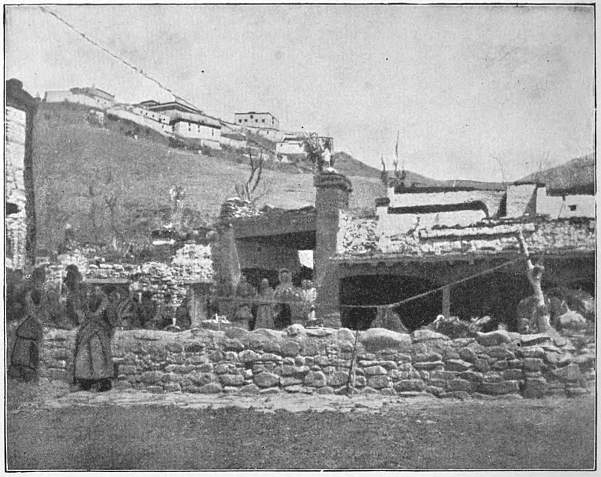
178. Tarting-gompa.
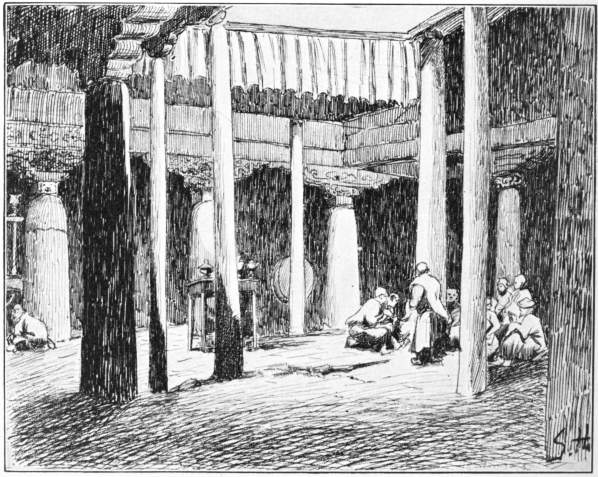
179. Sego-chummo Lhakang in Tarting-gompa. Sketch by the Author.
In the Ganden-lhakang we see two chhortens of gold and precious stones. In one of them are preserved relics of a Grand Lama, some of his blood, his bones, and his intestines. In a room situated beside this hall we saw with surprise six curious figures of cast iron, representing Europeans in the dress of the thirties of the nineteenth century, with tall chimney-pot hats, stiff folded neck-cloths, upstanding collars, and dress coats with high collars, whiskers, and moustaches. They had come from Pekin, and were quite out of place here before the tasteful group of Buddhas, which was set up in a red lacquered niche, where climbing plants, dragons, and small figures like Cupids or angels were beautifully carved.
The Mankang-lhakang has figures of the higher gods on the walls, and in the middle a prayer cylinder rises from the floor up to the ceiling, 11½ feet high, and of such circumference that I laid my outstretched arms four times round it, measuring from finger-tips to finger-tips. Its red surface is covered with gigantic golden characters, and round the middle of the cylinder dances a string of goddesses. A smaller hall of the same kind is called Mankang-chang. On the upper edge of its prayer cylinder is a peg which, as the cylinder revolves, strikes against the clapper of a bell. An old lama sat before it and kept the cylinder in constant motion by means of a string attached to a crank on the iron axle. It is the duty of himself and another monk to keep this monstrosity humming all the day and half the night, or from sunrise to midnight. As he sat turning, he said his prayers, but he did not murmur them in the usual way. No, he bellowed, he howled out inarticulate sounds, so that he foamed at the mouth, perspired, and groaned, throwing himself violently back at each revolution, and then bending forward again. He was, so I was told, in a religious ecstasy, and did not hear, however loudly one shouted to him. I should prefer the oar of a galley slave to this monster, which cripples any capacity of thinking freely in the darkness of the crypt, where only musty dumb gods can be witnesses of its rotations. I looked at my watch; the bell sounded nine times in a minute, so that the machine makes 10,000 revolutions before the midnight hour comes to release the weary monk.
We passed the whole day in the wonderful monastery Tashi-gembe, which, after Tashi-lunpo, is the richest and finest I have seen in Tibet. As to cleanliness and good taste, it surpasses all. The temple halls were well lighted by numerous windows, the mid-day sun shone in between the pillars and produced a bewitching play of light and shade, and revealed a charming arrangement of colours between red and gold. Some monks sat on a divan and conversed with our companions; they made a clear and effective picture in the sunlight, red on a red background. Others leaned against the pillars, solemn as Roman senators in their togas, in a flood of sunshine, while a dense group of their brethren was dimly seen under the shadows of the gallery. And where the sunbeams played on the gold of Buddha’s robe and broke on the leaves of the golden lotus-flower, out of which he rises, reflexions were scattered through the fairy hall, and the pillars shone like transparent rubies. We were dazzled by these effects of light, and might have been transplanted to the halls of the gnomes.
In contrast to all this wealth, an old blind man of eighty sat at a street-corner with a staff in each hand, and sang a beggar’s ditty. Beside him lay a half-starved dog, his only friend in this world. The pitying love of Sakya-muni did not extend so far as to release this old man from the bonds of age and suffering. He also found a place in the picture gallery of my sketch-book, which on this memorable day received considerable additions. As ever, I felt myself to be only a passing pilgrim, a wanderer who had crossed the threshold of Tashi-gembe for a few hours, and a stranger and guest in the dreary valleys of Tibet and its mysterious enchanting temples.
The sun had set when we rode home, but the crests of the eastern mountains still glowed as in a rain of transparent gold. In the gently rippling water-channels the wild-geese gathered, screaming, for their spring migration, and the shadows of evening fell over the wide fields of Yeshung.
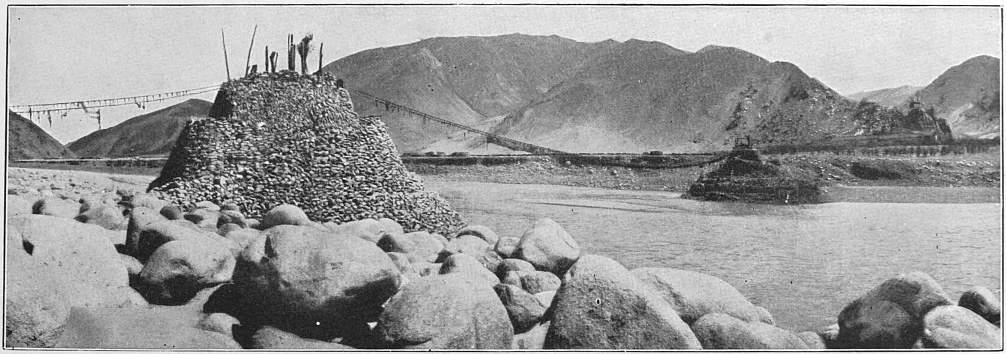
180. Bridge to the Monastery Pinzoling (on the right).
CHAPTER XXXIII
THE RAGA-TSANGPO AND THE MY-CHU
On April 3 we journeyed steadily along the way to the west by smiling villages and small convents, and again we approached the bank of the Tsangpo, at a place where a swaying rope-bridge is stretched between two loose blocks on the banks. Here the river forms rapids, and above this point it is only 50 yards broad, often still less, and the valley above the Yeshung expansion is narrow and confined. From the village Pusum, where we encamp, is seen the mountain Nayala, one of the fixed points in Ryder’s triangulation. His and Rawling’s expedition travelled to the south of the Tsangpo, and it would be two months more before I should first come in contact with their route. The river will rise a month longer in consequence of the melting of ice in the higher parts of its course in the distant west.
The village Pusum lies on a steep terrace above the river. Cones of detritus descend to the bank, and steep mountains rise on the southern side. The valley is narrow and quite straight, so that Pinsoling, the end of the next day’s march, can be seen from Pusum; it is perched on its rocky promontory like a castle on the Rhine. The path passes over steep disagreeable slopes of pebbles. Only grey and red granite, with black schist, is seen both in the solid rock and in the débris.
Almost immediately south of Chagha, a village of a couple of stone houses in a grove of old willows, the monastery and dzong of Pinzoling appear on the right bank. The river is narrow, and the bank full of round granite boulders a yard in diameter, so the necessary material for a bridge is at hand. Two huge pyramids of stone are erected on the banks, and two smaller ones behind them. Two thick chains are stretched between them, which pass on to the smaller pyramids, and are made fast again to them. Between the chains a network of ropes is stretched like a hammock, and on this narrow planks are laid; on these passengers walk, using the chains as hand-rails. The Pinzoling bridge has not been used for three years; any one who wants to cross to Pinzoling from Chagha must go upstream to Ladse-dzong and make use of the ferry there. I inquired how old the bridge was. “As old as the monastery,” was the answer. “And how old is the monastery?” A villager answered at random, “A thousand years.” Another said that this was an exaggeration, for the monastery had been founded two hundred and fifty years ago by a lama named Yitsyn Tara Nara. Two hundred monks belong to the monastery of Pinzoling, but half of them had gone on their travels. An official of the dzong, with the title of Dsabo, lived in Chagha, and examined our passport (Illustration 180).
The river was at its lowest level, but during high-water it is said to come up to the chains of the bridge, which seems to me improbable, for they hang fully 6 feet above the surface of the water at their lowest part. A channel remains open in the middle of the river even in cold winters. Boats reach the side valley in which Shigatse lies in four to five days, but during the summer in two or three days, for then the river flows down with tremendous velocity. It is considered less dangerous to travel in a high flood, for then the boats glide smoothly over boulders and sandbanks, and it is said that a man is very seldom drowned, or a boat’s cargo lost.
Black and dark-purple mountains rise around the village, their surface only visible in some places in strips between belts of drift-sand; they are like tiger skins. Near a ridge to the south-west lies a large dune as though it were attached to it.
The order of the day for April 5 was that Muhamed Isa with the hired animals and the baggage should encamp at the point where the Raga-tsangpo flows into the upper Brahmaputra. The rest of us rode up to a small pass, Tsukchung-chang, on a spur of the mountains which extends to the bank of the main river. From the summit there is a grand view over the main valley and its stream, which meanders over gravel and sand in two arms. Below we caught sight of mule caravans, mere specks, but their bells filled the valley with their noise. The way runs headlong down to the valley bottom so that we had to engage extra men to carry the baggage, with which the horses could not clamber down the precipitous slopes. Large dark fish swam in a stopped-up arm of the river, and here sat Shukkur Ali with his rod. Sand-dunes ten feet high are a common occurrence, and on the steep side, turned from the wind, that is, the east side, pools are often formed.
To the south-west opens a large portal with shelving mountains in the background and short side valleys, the whole forming a beautiful scene. Through this portal the Brahmaputra comes down towards the Raga-tsangpo, but this river is known here in its lowest course by the name Dok-chu, while the main river is known as the Dam-chu (= Tamchok). At the confluence no tents were to be seen, and Muhamed Isa told me afterwards that he could not stay there as the country was quite barren. We therefore rode up the Dok-chu valley to the village Tangna, consisting of ten stone houses. The inhabitants cultivate peas, wheat, and barley, but cannot count with certainty on a harvest.
I would on no account miss seeing the confluence of the two rivers, and therefore ordered my men to descend the Dok-chu valley next day to this point. But the escort would not hear of it. It was clearly stipulated in the passport that we must not go backwards and forwards as we liked, but must march straight to Ladak. At last they yielded under the condition that the excursion should not last more than one day.
In the morning Muhamed Isa took the boat and the oars down to the river, while ropes, stakes, axes, poles, and provisions were carried by Ladakis down to the confluence by the way we had come the day before. On arriving at the bank I found the boat already put together, and took my seat in it with a Tibetan who was familiar with the river and handled the oars as skilfully as though he had done nothing else all his life, but he was accustomed to steer his own boat between the banks at Tangna, and knew the channel downstream.
Our voyage through the rapids is exciting and adventurous. The fall of the river is by no means uniform, but changes from place to place, roaring rapids alternating with deep quiet basins. Large and small boulders have fallen into the river from the mountain flanks and sometimes it seems impossible to get through them. But the oarsman knows how to steer the boat. We hear the roar of the next rapid from a distance, and keep a sharp look-out in front. Some of our Ladakis run along the path on the bank and warn us of serious dangers.
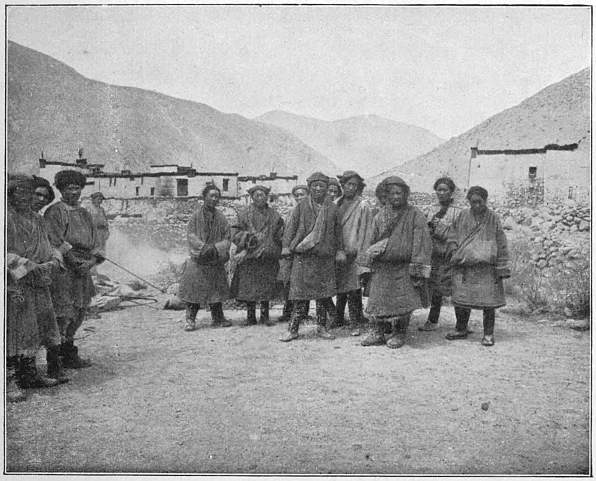
181. Group of Tibetans in the Village of Tong.
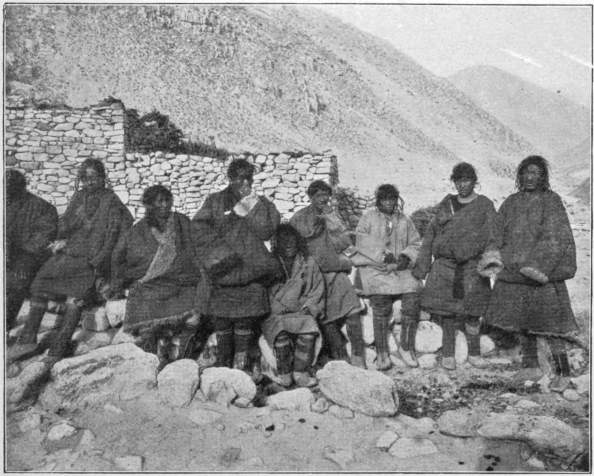
182. Inhabitants of the Village of Govo.
The boat rushes flying downstream. The boatman sits silent with his teeth clenched and his feet firmly planted against the bottom, and grasps the oars so tightly in his horny hands that the knuckles become white. We had passed successfully several rapids and were gliding pleasantly over a reach of smooth water, when we heard the warning roar of the next rapids, this time louder than ever, and two Ladakis stood shouting and gesticulating. I got up in the boat and saw that the Dok-chu split into two arms, and that the water dashed foaming among dark sharp-edged boulders. The place looked impassable, the intervals between the boulders seemed much too narrow for the boat, which might any moment have its bottom torn by treacherously hidden stones; over some of these the water poured in bright-green hillocks, and then was scattered into foaming spray. “I shall be glad if all goes well,” I thought, but I left the boatman to his own devices. We were soon in the sucking current, which endures no resistance, and flew quicker and quicker towards the two rapids. With powerful strokes the oarsman forced the boat to enter the left branch. The Ladakis stood speechless on the bank, and waited till we were wrecked to wade into the rapids and rescue us. Now we dashed towards the first block, but the boatman guided his boat into the deepest water and let it slip down a small waterfall, after which we received a thrust from the other side. Now the channel became broader but also shallower, and we grazed the bottom, fortunately only with the keel and without springing a leak. The current was strong enough to carry us away over stones and rubbish.
After a while the two arms re-unite and the river becomes smooth and deep. The boatman has never changed countenance, and now he helps on with the oars. We are on the north side of the valley, and just at the bend where the river turns southwards the water rages and boils more furiously than ever, and here the undaunted boatman declares that we can go no farther. I hold my breath at the sight of the white foaming water which breaks over the threshold of the fall; the boat will be carried away in a second by the suction of the water and will be infallibly capsized. But just at the right moment the boatman steers our nutshell aside into a bay with a back current, and we are able to land. The Ladakis hurry up, draw the boat ashore, and set it afloat again below the waterfall.
Now we float pleasantly past the steep rocky walls of the southern bank, where the depth is sometimes 5 feet, and sometimes less than a foot. I have a pole and help to hold off the boat from the bank. Again we are carried to the northern side of the valley and dance and rock through a series of small lively rapids, usually quite deep enough. Now and then we graze the bottom, but the wooden keel resists the thumps. Below a gigantic boulder lying in the middle of the stream is a sucking whirlpool, into which we nearly stumble, but we get past safely, and at last arrive at the point where the Dok-chu pours its snow-fed waters into the flood of the Brahmaputra.
The tributary here forms a delta with two branches between gravelly banks 5 feet high. A post was driven in on the left bank of the main arm, to which we fastened one end of a rope, with the other end I rowed over to the right bank, where the rope was fastened to another post. The breadth was 59 yards. Then I measured the depth at eleven points at equal distances apart, and found that it did not exceed 31⁄3 feet. The velocity was measured on the surface, half-way down, and at the bottom, with Lyth’s current meter. Taking the breadth and the average velocity we arrive at the discharge, which in the two arms of the Dok-chu amounted to 1165 cubic feet per second.
Where the two streams unite the Dok-chu is rapid and tumultuous, the Brahmaputra slow, deep, and quiet. Its breadth was 50 yards and its maximum depth 15.3 feet; the bed is therefore narrow and very deeply excavated. The discharge amounted to 2966 feet in the second, or two and a half times that of its tributary the Dok-chu.
When I had finished this work, our friends Tso Ting Pang and Lava Tashi accompanied me on a short excursion down the main stream, and then we landed on a promontory where our men lighted a fire and served up the best provisions we had, namely, hard-boiled eggs, slices of cold chicken, and milk. A cordial and mixed party, a Swede among Tibetans, Chinamen and Ladakis, we partook of our late dinner amidst the grandest, and most boldly sculptured landscape conceivable. While the others smoked their pipes and sipped their greasy tea, I drew a sketch of the mighty gate of solid granite through which the Brahmaputra rolls its volumes of water on its way to the east, to the valley of the Dihong and the plains of Assam. We should have liked to stay here longer, watching how moment after moment the insatiable stream gathers in its abundant tribute from the Dok-chu, but it was growing dark and we had a long way to go back, so we packed up our boat and stowed it on hired horses with the other baggage, mounted into the saddle, and rode up the valley. As had often happened before, we were to-day overtaken by the darkness. Rabsang went in front with a Tibetan on either side, and all three bellowed as loud as they could. All were in excellent spirits, it was so fresh and pleasant under the twinkling stars, and the merry singers, accompanied by the jingle of the bells on the Chinese horses, awoke a shrill echo in the recesses of the mountains. At a dangerous place near a village, where the road runs above the river over a ledge built up of stones, men came to meet us with paper lanterns, and soon after we sat resting in our tents after a hard but very instructive day’s work. Next day we marched gently up the Dok-chu valley in a north-westerly direction, a charmingly beautiful road, where one would like to dismount repeatedly to enjoy conveniently the wild mountain scenery.
But now I cannot loiter; one page after another of my journal must be turned over if I am ever to come to an end of my description of this journey on which so many hard experiences and disagreeable adventures awaited us.
We ride through rubbish and coarse sand, the weathering products of the grey granite, and pass a succession of transverse valleys and several picturesque villages. One of these, Machung, is finely situated at the foot of steep rocks on the northern side of the valley, from which an oval block has fallen down and stands like a gigantic egg in the sand, a pedestal waiting for an equestrian statue. On its eastern side, smoothly polished by wind and weather, a regular tricolour is painted, white in the middle, red on the left and blue on the right, but neither Bonvalot nor Dutreuil de Rhins has left this memorial behind, for no traveller has ever been in the neighbourhood. It is the inhabitants of the village who have made this flag, and beside the tricolour is another symbolical painting, a white cross on a black field. Near the village some gnarled trees are reflected in a pool. The villagers stand staring at the corners and in the house-doors, and a man offers my servants a drink of chang from a wooden bowl. The rocks are sculptured into singular forms; the granite is in vertical dykes and stands in perpendicular crags in the valley. We often pass by mani cists, for we are in a country where monasteries are numerous and the whole road is adorned with religious tokens. At every cist the road divides, for no one, except adherents of the Pembo sect, omits to pass it on the left, the direction in which the prayer mills revolve. On the tops of many of the rocks are seen ruins of walls and towers, a proof that the valley in bygone times was more densely peopled. At two places sheltered clefts in the rock harbour some stunted juniper trees. On the northern side of the valley the river has at some time polished the base of the granite wall, and on the smooth surface two rock drawings have been executed. They consist of outlines of Buddha pictures, and are very artistically drawn. The western has two others beside it, now scarcely traceable, and below them all kinds of ornamentation, tendrils, and designs are hewn in the granite. We encamped just above this spot in a very picturesque and interesting expansion of the valley at the village Lingö.
Part of the inhabitants of Lingö migrate in summer with their herds, six or seven days’ journey northwards, for the soil round Lingö is very poor and the harvest cannot be depended on. The Dok-chu cannot be crossed here in summer except by boat; in the winter it freezes over, but seldom so firmly that the ice will bear. The interesting point about this expansion is that the Dok-chu, or Raga-tsangpo, coming from the west, here unites with our old friend the My-chu, which discharges 534 cubic feet a second. I had the day before calculated 1165 feet as the discharge of the Dok-chu, so the difference of 631 cubic feet is the volume of water brought down by the Raga-tsangpo, and consequently the My-chu is only a tributary. On the other hand the Dok-chu pours through several delta arms with rapids into the My-chu which lies lower and flows more gently, and by this test the My-chu should be the main river; it is all a question of choice.
We had another fine day on April 8, 52.5° in the shade at one o’clock. We were to make a closer acquaintance with the My-chu, a river we had hitherto known only from hearsay, but we had more knowledge of its eastern tributaries which we had crossed on our journey south. As usual we change our baggage horses in almost every village at which we encamp, and Robert pays the hire to the villagers, that the escort may not have an opportunity of putting it into their own purses, at any rate not in our presence. Generally the caravan marches a little in advance, while two villagers come with me and give me information about the country.
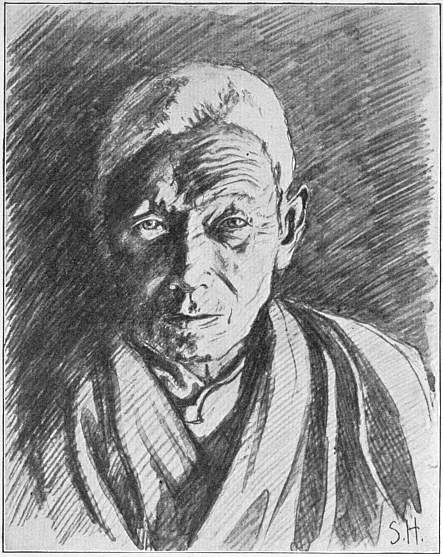
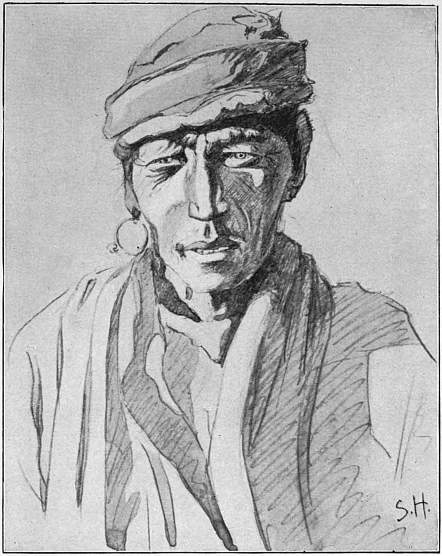
183. Lama in Tong. 184. Old Tibetan.
Sketches by the Author.
Immediately beyond Lingö we turn into the My-chu valley, riding northwards, and now leave behind the westerly valley of the Raga-tsangpo. Right at the turn we come to a colossal cone of round blocks of granite, among which the path winds up and down in zigzags, sometimes transformed to a staircase, which laden animals cannot possibly pass. We therefore take with us some peasants from the village to help in carrying the baggage. We have the river on our left, deep and sluggish. The fallen boulders of grey granite contrast strongly with the dark-green water in which whole shoals of black-backed fishes swim and rise. On a surface of granite is a Buddhist rock-drawing half obliterated by time. Then follows one mani after another. A smith is housed in a cave with a vaulted roof blackened with soot, and sheltered by a small screen of stones, and offers his services to travellers. High up on a rocky terrace stands Gunda-tammo, a small nunnery, and below a chain bridge between two stunted pyramids spans the river. It is only for foot passengers. The river bed is deeply excavated between its bank terraces, and two strips of clear green ice yet remain. The bed is as regular as a canal. On a rocky wall at the entrance of a side valley a face 6 feet in diameter is painted in black, with eyes, nose, and mouth in red.
The farther we go up the more frequently we are reminded that we are on a hallowed road leading from one temple to another, a sacred way of the monks, a pilgrim route on which “Om mani padme hum” is murmured more repeatedly than on ordinary roads. Sometimes boulders and cliffs are painted red, sometimes cairns are heaped beside the way, now we see chimney-like monuments with bundles of rods decked with streamers, then again long mani mounds, one of them nearly 400 feet long. Two blocks lying on the road are covered all over with raised characters—a formidable piece of work. We are also in a great commercial artery, more frequented than the bank of the Tsangpo. We constantly meet caravans of yaks and mules, mounted men and foot-passengers, monks, peasants, and beggars. They salute me politely, scratching their heads with their right hands, while they hold their caps in their left, and putting their tongues far out of their mouths, and they call out to me: “A good journey, Bombo!”
Clear rivulets trickle across the road, the valley contracts and its contours become bolder and more pronounced; the granite ceases and is replaced by fine-grained crystalline schist. In the district of Tong, where several villages stand high above the river, we encamp below the monastery Lun-ganden-gompa (Illustration 176), in which 21 monks of the Gelugpa sect live, and, as usual, a prior of Kanpo rank dwells in the Labrang. We paid them a visit, but preferred the lovely view over the valley to the images of the gods in the darkness. The brethren are maintained partly by the Tashi Lama, and obtain the rest of their food from the produce of their fields, for the convent has large glebe lands. A blind man, who was not of the fraternity, sat like a machine at the prayer mill, turning it for the monks, and complained of his hard lot. The Gova, the district chief, of Tong rules over several villages in the neighbourhood, and lives like a prince in his solid house.
On April 10 we continued along the course of the My-chu, past villages and convents hitherto unknown. The villages stand just below the mouths of side valleys where the water can be most effectively applied to irrigation. A caravan of about 100 yaks, driven by men and women and some carrying riders, had been at Tok-jalung and had sold there tsamba from Tong; they had spent three months on their return from those gold-diggings in western Tibet. They follow a route through the mountains where there is suitable pasture for yaks. Thus the produce of the soil in the more favoured parts of the country reaches the nomads, who give in exchange for it wool, hides, and salt. After a short march we bivouacked in Ghe, which has nineteen houses. An angdi (musician) scraped and plucked a two-stringed instrument (Illustration 185), while his wife danced before us.
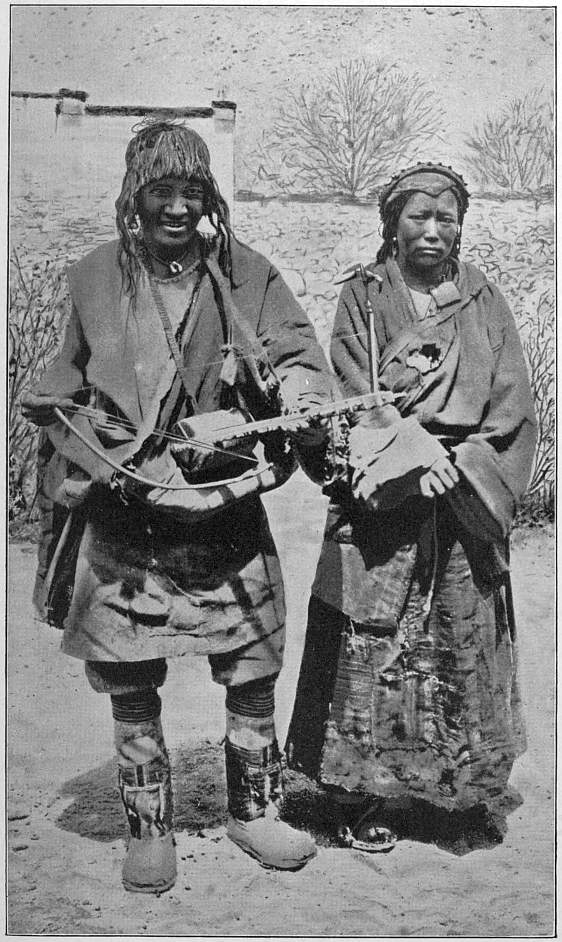
185. Strolling Musicians.
Here our escort from Shigatse turned back, after handing our passport to four other men, the chief of whom was the Gova of Tong. They had done us excellent service, so I gave them good testimonials and presents. They were satisfied and would pray for my prosperity till their lives’ end. I felt particular sympathy for one of the Tibetans who had lost his two sons in the battle at Guru; the one was twenty-three years old, and the other twenty-five, and the father could not understand why they had fallen, for they had done nothing wrong.
Next day the escort, jingling like a sledge party, accompanies us up the My-chu, which retains the same character. Granite and schists alternate. The river tosses about, though it has occasionally quiet reaches. In the background of the side valleys are often seen great mountains lightly covered with snow, and at their entrances villages with stone houses and fields where only barley and peas are grown, seldom wheat. The black tents we see occasionally belong to merchants who are on their way from or to western Tibet. Bridges cross the affluents, flat slabs of stone on a pair of beams between rather high slightly overhanging piers of stone. The religious stone heaps are still numerous; one has caused a sand-dune to be formed. Wild ducks, wood pigeons, and partridges occur here, and the latter, sorely against their will, make acquaintance with Tsering’s kitchen. In the village Sir-chung the population is large, for here several routes and side valleys converge. Among the crowds of spectators was a young woman so extraordinarily pretty that I took two photographs of her. She was twenty years old and was named Putön (Illustration 186).
The day following we visited the adjacent monastery Lehlung-gompa, where the twenty-six monks belong to some heterodox sect, for they recognize neither Tsong Kapa nor the Tashi Lama; the prior had shut himself up in his dwelling sunk in deep speculations. A lama and three inhabitants of the neighbouring village Nesar had died the day before, so our Tibetan escort warned us not to go up to the monastery lest we should catch the infection, and when we nevertheless went, they begged to be allowed to stay behind. This dreary dilapidated monastery stood proudly on its point of rock, pretty far up a side valley which descends from the left to the My-chu. From its flat roof we had a splendid view and could make out the topography of the My-chu valley. A novelty to us was a row of stuffed yaks, hard as wood and dry as bone, with their horns, hoofs, and hides, hung up on the ceiling of a verandah. None of the monks could remember when they had been hung up. They looked very old, and apparently were for the same purpose as the four ghostly kings and the painted wild animals, that is, to scare away evil spirits.
Below the monastery twenty-four manis stand close together in a row like a parish boundary on a topographical map. All the way up these sacred structures are so numerous that they even outnumber those near Leh. The country assumes a more alpine character, and the valley becomes wilder and more desolate; but some trees form a small thicket at Lehlung-gompa. At length we ride over a pebble terrace, perhaps 130 feet above the stream, which now pours over small falls and murmurs pleasantly among boulders. The caravan has pitched its tents in the narrow valley on the bank of the My-chu and not far from the side valley Kathing. Most of the luggage has been carried by Tibetans, for no pack animals were to be had, and now some hundred black-headed fellows sit in groups by their fires among the large boulders.
Here we were at a height of 13,875 feet, and therefore had only mounted up 1175 feet from Shigatse (12,700 feet). But the air was cooler; the night before we had noted 23 degrees of frost.
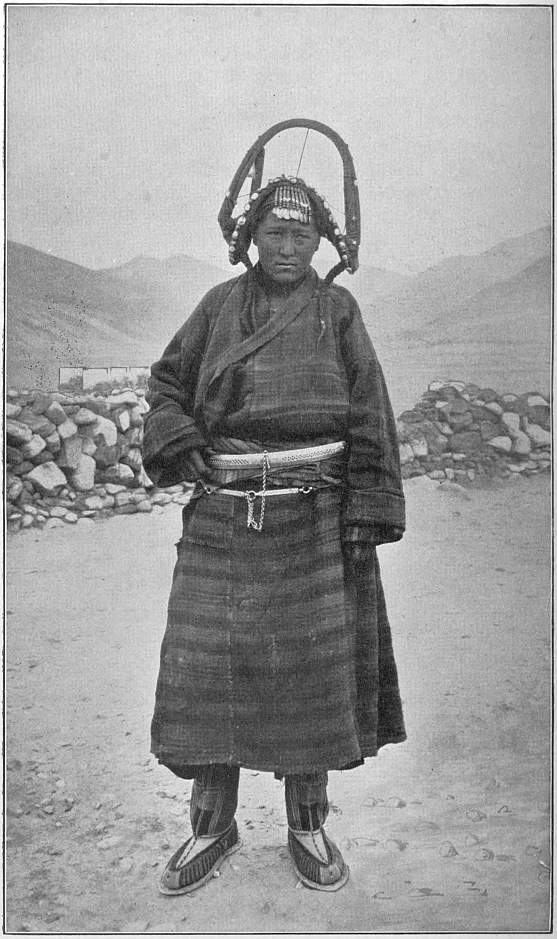
186. The Handsome Woman, Putön.
CHAPTER XXXIV
TO LINGA-GOMPA
The day’s march on April 13 takes us along the valley of the My-chu like a hollow way excavated in the solid rock of fine-grained granite, porphyry and crystalline schist, and the landscape is one of the grandest I have ever seen. We follow the western bank, from which rise wild precipitous rocks like the ruins of old walls and embattled forts. A footpath runs along the left bank also, and looks extremely dangerous, passing up above abrupt walls of rock. Here and there valleys open out on the west side, affording views of part of a snow-covered crest in the background. This is, however, a subsidiary range, for it branches off from the Trans-Himalaya southwards and borders the basin of the My-chu on the west. It in turn sends out ramifications eastwards, between which flow the western tributaries of the My-chu. And these again give out branches of the fourth and fifth order; the whole appears in a plan like a tree with its branches and boughs.
The road runs on steep pebble terraces high above the river, which here rages among the boulders in its deeply eroded bed and forms whirlpools. On our left rocky precipices tower above our heads, and avalanches of detritus have slipped down from them and fallen across the road. Many are quite fresh; in other places there has been time to set up the blocks in protecting walls on the inner side and in a breastwork at the outer. And often we pass places where a new landslip may take place at any moment, and where huge blocks are poised in the air and seem ready to roll down the declivity. Flourishing hawthorns in large numbers grow on the stony banks, and high up above rock pigeons have built their nests. Still higher eagles soar with outspread pinions along the mountain flanks. We are 150 feet above the river, where here and there on the bank is room for small tilled fields; a juniper bush has in some places struck root in a fissure of the rock.
The valley is like a trough, and I obtain fine views of constantly changing scenes. We might fancy we were passing through a Gothic cathedral with a colonnade of huge shafts attached to the walls and spanned by a roof of grey and white canvas, the clouds to wit, between which small patches of light blue cloth appear.
The guide, accompanying us on this day, is a half silly old fellow, who laughs and chatters continuously, and frequently begins to dance on the road, flinging his legs about, stamping on the ground and turning round so quickly that his long pigtail flies round him. He tells us in confidence that his wife is a wicked hideous old dragon, whom he has long wished to carry off to the home of the vultures, for there will be no peace in his house till he has done so. When I halt to sketch, he takes his breakfast out of his coat, lays it out on the sand, fetches water from the river in a small bag, shakes tsamba from another into a wooden dish, pours water over it, stirs it with his forefinger and then swallows bowl after bowl of this delicious mixture. He hopes to receive so much pay, that for once he can afford himself a plentiful meal while his old woman cannot see him eat. As often as one looks at him, out shoots his tongue and hangs like a fiery red flag in the middle of his black face. When he has finished he licks his plate clean and rubs it with sand to dry it. Then he wraps his things up in a bundle and hides it under the stones. When Robert tells him that people are about who have seen him hiding it, he quickly takes his bundle out again, thinks over the matter for a while, rummages about and at last finds another hiding-place. Then he sits down beside me, puts out his tongue as far as it will go, winks at me with his little pig’s eyes and takes a large pinch of snuff. When he walks in front of my horse, he turns round every hundred paces and puts his tongue out at me—a token of pure goodwill and deep respect.