Front matter (continued 7)
Reading edition
“Hedin Sahib, this news is of much greater importance to me than to you. It is of no consequence what kind of tidings you receive, but the arrival of the post from the Tashi Lama is, in itself, a proof that His Holiness is actually expecting you, that Labrang is open to you, and that I acted rightly when I told you that you might continue your journey. If I had not already granted you permission yesterday, I should do so now.”
“I have always said that I should receive my letters from the Tashi Lama.”
“That is true; but now I have for the first time tangible proof, now I am perfectly satisfied, and do not intend even to wait for your departure. I shall travel back to Shansa-dzong the day after to-morrow.”
Now I could no longer curb my impatience. I took leave and hurried to my tent, whither the post-messenger was summoned. He was a young powerful Tibetan, a servant of Kung Gushuk, one of the highest officials in Shigatse, and younger brother of the Tashi Lama. Lieutenant Bailey, who had taken the place of Major O’Connor, absent on furlough, had, according to orders from India, sent the carefully packed post-box to the Tashi Lama with a request that he would forward it to me. The forbidden Dangra-yum-tso appeared in the Tibetan address also. By command of the Tashi Lama the man was furnished with an open passport from the Labrang, the Vatican of Tashi-lunpo, which empowered him to demand horses and provisions along the route. The men with him were the nomads who had last supplied him with horses at the Dangra-yum-tso, and now that they were sure of tips would not leave him. He had taken eighteen days to travel to the holy lake, and had looked for us there for three days, when he heard by chance that we were encamped on the Ngangtse-tso. Then he had hastened to us in order to execute his commission. But why was he so late? I had arranged for November 25. Yes, but Kung Gushuk had let the box lie for forty days, and Kung Gushuk is a blockhead. But this was a piece of good luck. Had Kung Gushuk done his duty, the post would have arrived at the right time, while I only reached the place agreed upon at the end of December. A higher providence had overruled the whole affair, and everything turned out well (Illustration 98).
Now the box was broken open. What excitement! It contained packets of letters from my home, from the Government House in Calcutta, from Colonel Dunlop Smith, and many other friends. I first ascertained from the last letter that all were well at home, and then read all the letters in chronological order with the most eager interest. The letters were the more welcome that they contained nothing but good news. I received a quantity of Swedish newspapers; they were old as the hills, but I should now have no lack of reading on my way to Shigatse.
The caravan did not see much of me that evening. I lay on my bed engaged in reading, and made my men heat the tent well. The Ladakis, too, were merry, kindled a large fire, danced and sang. I was invited to go and look on at their merry-making for a moment, and availed myself of the opportunity to make a short speech, in which I told them that they had all served me well and faithfully, and that hitherto we had met with good fortune. Now the road to Tashi-lunpo was open to us, and they would attain their wish of making a pilgrimage to the holy town. There they would rest after their exertions. Then I returned to my letters, and read on till the day dawned in the east, till long after the brazier had grown cold, and there were 45 degrees of frost in my tent. But I was well wrapped up in furs and did not feel the cold. Near my tent a troop of wolves made such a noise that Tsering had to go out and silence them with a few shots.
On the 15th I still lay down and read. On the 16th Hlaje Tsering paid me his farewell visit. We talked very pleasantly together, joked, and wondered whether fate would ever bring us together again. Then I attended him to his horse, which was snowy white, had a crimson saddle-cloth, and was bedecked with ornaments of shining brass and a chest-cloth with jingling bells. He mounted into the saddle, gave me both his hands at parting, and disappeared with his small retinue behind the hills. Then I again went back to my letters, but I felt a dull void now that the amiable Governor of Naktsang was gone (Illustration 97).
January 17. What did it matter if the day were gloomy, if freshly fallen snow veiled the surrounding mountains, and heavy greyish-blue clouds rolled over the lake as though to hide it from our sight at the moment of our departure? To us everything seemed bright, cheerful, and smiling. A powerful governor had come to prevent us from travelling further, and yet the route to the south was as free to us as the uninhabited Chang-tang had lately been. But now we were much better off. We should pass black tents daily, be able to buy all we wanted, and have no cause for alarm because we had provisions for only five days longer. We enjoyed unlimited freedom, and had not a single man with us as escort or watchman. Before us lay a country which might be said to be the most interesting in the world from a geographical point of view, and in which every day’s journey might lead to discoveries of the highest importance. What did we care if the air was raw and cold? Spring must come sometime. We could count on warmer weather for three reasons: we were advancing to more southern climes, we should soon reach districts at a lower level, and the spring was daily approaching. And for three reasons the Ngangtse-tso would ever be memorable in the diary of my reminiscences: there freedom of movement had been unexpectedly accorded to us, there connection with the outer world had been again established, and there I had an opportunity of determining the depth of the lake by a complete series of soundings, and of drawing its contours in a map.
We had obtained three new horses fairly cheaply, on which Robert, Muhamed Isa, and Tsering rode, while I kept to my small Ladak white. Accompanied by the post-messenger and his two comrades, we rode in a south-easterly direction down to the lake, and along the eastern shore to the southern part, where we bivouacked near two black tents. Kiangs and wolves were frequently seen. A kiang had been torn in pieces by the wolves, and the white puppy and the Pobrang dog remained by the body to enjoy a good feast. We were terribly starved during the long march of 13.2 miles, and in the night the thermometer marked 61.9 degrees of frost, the worst cold of the whole winter.
The next day’s march took us up a transverse valley of the mountains which rise on the south shore of the Ngangtse-tso. It was rather narrow, and a small source murmured under its covering of ice. We followed a plainly marked path, leaving a couple of tents behind us, and passed sheepfolds, grassy plots, and dark spots where tame yaks had lain and worn off the grass; everything was black, the tents, the Tibetans, the half-naked children, and the dogs. At length the gully turned westwards; just at the bend was a waterfall congealed into milky white ice. Far up the valley we encamped on a plateau, where we had a very interesting view to the north-east. We could see almost the whole of the lake which Nain Sing left at some distance to the south of his route, and which he called Daru-tso. I cannot dispute its correctness, but none of the Tibetans whom I questioned had ever heard this name for the lake; they called it Marchar-tso, and it now figures in my map under this name. It often happens that a lake has different names among different nomad tribes. In camp No. 109 it lay just below us as on a map; its form is not so simple as on Nain Sing’s map, but abounds in peninsulas and bays, and it is extremely narrow in the middle. The isthmus between the Ngangtse-tso and the Marchar-tso is only a few miles broad; at the highest point the old shore terraces of the two lakes touch one another. At the time when the water stood higher the two lakes were therefore connected. The Marchar-tso is said to be as salt as its neighbour, but its ice was smooth and blue, and we saw no fields of free salt on its surface.
We had seen nothing of the white puppy and the Pobrang dog after we had left them behind, so I sent the Hajji back to the lake. But he came back without having found any sign of them. We never saw them again, and I sorely missed the white puppy, who had been a faithful friend in the tent and on the march. Either they had had a fight with wolves and got the worst of it, or they had lost our track and had been adopted by nomads. The former was the more probable, for the Hajji when he came to the lake saw a troop of wolves careering over the ice.
On the 19th we surmounted the neighbouring pass, the Chapka-la (17,474 feet), on which a stone pyramid is erected in honour of the gods. As a watershed it is only of secondary importance, for the water from both sides flows to the Ngangtse-tso. The valley leading down makes a curve to the south; in the Lamblung valley we had eleven tents as neighbours, and were able to provide ourselves with all we needed for several days. The country was still in the Naktsang territory, but the nomads were subjects of the Labrang, and paid their taxes to Tashi-lunpo.
We remained here two days, which we ought not to have done, and we would not if I had properly considered the matter. It was not the furious snowstorm which caused us to waste forty-eight hours, but Ngurbu Tundup, the postman. I had intended to keep him with us as long as possible, for it would evidently be an advantage to us, and would increase our dignity, to have with us a servant of one of the highest officials of Shigatse. He was our living passport; if he were not with us, we might perhaps again be regarded as freebooters, and be ordered to stop by some despotic chief. But Ngurbu Tundup was deaf to our entreaties, and declared that he had strict orders to return immediately his task was accomplished, and give in his report. He had already disobeyed his orders and had lost several days, but he consented to remain with us if we would rest in the Lamblung valley. I had great need of the time to get all my huge correspondence ready. On January 20 I wrote for sixteen hours, and by noon of the 21st the mail was ready and packed up. Ngurbu received a present of 82 rupees for his excellent service, and if he handed over the packet of letters to the British commercial agent in Gyangtse he was to receive further especial reward, when we met again at Shigatse. But he was to make all speed, changing his horse several times a day. If he loitered and covered only 18 miles a day, that is, reaching Gyangtse in ten days, he was to expect only 10 rupees. If he completed the journey in nine days, he was to receive 20, and if he accomplished his task in eight days, I would give him 30 rupees, and so on, at the rate of 10 rupees for every day saved. He actually arrived in eight days. I really committed a blunder in making this arrangement, for I gave notice of our approach to the south, and it might have happened that the Tibetans might have conceived evil designs against us. Nay, had the Chinese received news of our march, we should most certainly have been very soon stopped.
When Ngurbu had ridden off over the hills, we were again cut off from contact with the outer world, and were left to ourselves.
The following morning we ascended eastwards along the valley in which we had encamped, and where some mani cists stand, the longest of which measures 33 feet, and is covered with slabs of sandstone bearing the holy formula in incised letters. Continual snowstorms and huge masses of cloud with or without snow—that was the characteristic weather in January.
The Pongchen-la (17,621 feet) is a low threshold, like the preceding of secondary importance. On its summit stands a votive stone heap, with a bundle of rods, on which pennants, cloth rags, and ribands flutter. Smaller cairns radiate out from it. Here we had a last glimpse of our dear old Ngangtse-tso, and to the north-east a valley ran down to the Marchar-tso. To the south-east rose a dark range with several snowy peaks, which is called Pabla. The valley we traversed is broad and open, and is enclosed in low mountains. We saw no tents all the day, but numerous traces of summer encampments. Namgyal, however, who is a quick intelligent man, spied out two tents in the neighbourhood of our camp No. 111, which was pitched in a district called Namachang, and there bought some sheep, parched meal, barley, milk, and sour milk. He also brought a young Tibetan with him, who was good-looking, honest, and gentle, and did all we asked him willingly and pleasantly. His accent was so soft and refined that it was a pleasure to hear him speak. He gave me a quantity of credible information and promised to accompany us a day’s journey.
It snowed so thickly all night and the following day that I frequently could not see Rabsang, who marched with the Tibetan guide just in front of my horse. The snow enveloped us, whirled about us, and piled itself into small drifts on the sheltered side of every stone, grassy hillock, and hollow. The valley slopes gently to the south-east, and its frozen river is called Buser-tsangpo, and is a tributary of the Tagrak-tsangpo, which debouches into the south-western corner of the Ngangtse-tso. We are therefore still in the basin, of which the lake occupies the lowest part, and of which the border on the north-west and east lies close to the lake, but on the south is removed many days’ journey from it. The camping-ground this day is called Kapchor; eastwards extends an open longitudinal valley, through which runs the road to Shansa-dzong; on the north side also of the Ngangtse-tso and Marchar-tso a road runs thither, and by this Hlaje Tsering had reached our camp in twelve days. This road is known from Nain Sing’s journey in 1873-74.
On the morning of the 24th we were nearly blinded on going out of our tents, so brilliant was the reflexion from the thousands of small facets of the snow crystals which had spread their white cloak over hill and valley in a thick continuous sheet. The sky was clear, and blue as the purest turquoise from Nishapur, but the wind swept bitterly cold over the snowfields a night old. Our route ran south-eastwards to the exit of the narrow valley where the Tagrak-tsangpo, now frozen to the bottom, rested mute and motionless in the arms of winter. We followed the river, the largest watercourse that we had seen since the Chang-chenmo, upwards. At some places small nomad communities had their winter pastures, and there large herds of yaks and flocks of sheep roamed over the slopes. The name of the valley is Kayi-rung, of the spot where camp 113 was pitched Kayi-pangbuk, and of the district Tova-tova. Nain Sing’s Dobo Dobá Cho, from which he brings the river Para-tsangpo to the Kyaring-tso, was not known to the inhabitants. The Pundit makes the water drain eastwards, but as a matter of fact it runs westwards and north-westwards to the Ngangtse-tso. This is due to his not having been here himself, for the statements of the natives are usually very unreliable.
Immediately beyond the camp we crossed on the 25th a small saddle, where we obtained an instructive insight into the lie of the land. The eyes swept unhindered over all the wide plain, with the three streams forming the Tagrak-tsangpo meandering over the level ground in capricious curves and bends like silver ribands in the brown and grey country. Close to us on the south-east is the Kesar-tsangpo, which receives the Naong-tsangpo at the foot of our gap, and then cutting through our mountain begins its course in the Kayi-rung valley. Farther off to the north-east the Naong-tsangpo has already absorbed the waters of the Kung-tsangpo, and with them makes its way to the Kayi-rung valley and the Ngangtse-tso. The great plain is enclosed by moderately high, rounded mountains and hills.
After crossing the Kesar-tsangpo we follow the right bank, upwards as far as Toa-nadsum, where we bivouac. A quadrangular wall of earth marks the spot where the bombo, or chief of the district, usually erects his tent; now he is in Tashi-lunpo to pay his tax. In the adjoining valleys there are at the present time twenty-two tents, but only four near our camp, and in these beggars are wintering in great poverty. The country is said to be noted for its cold, raw climate even in summer. It rains in June and July, but the fall varies very much from year to year. If it rains hard for a long time, all the rivers swell, draining water from a thousand valleys, and the Tagrak-tsangpo is then sometimes unfordable.
When we started on the following day in a twilight caused by heavy clouds, the poor natives came up holding out their hands for tsamba or money, and each received a coin. Our way ran to the east-south-east, to the Naong-rung valley, traversed by the Naong-tsangpo, now frozen to the bottom. We now ascended gradually, and at camp No. 115 found ourselves at a height of 16,844 feet.
Two large black nomad dogs fell in love with the brown puppy, and followed us as though they belonged to the family. One limped, having at some time hurt his leg; he was old and shaggy, and was received with stones and abuse. Yet he clung to us faithfully, and put up with hard words from the men and the offal from slaughtered sheep. He was at last admitted a member of our travelling company, and hobbled, with drooping head and tongue hanging out, over lofty passes and through deep valleys, and answered to the name of “Cripple.” As he was old he often lagged behind, but in spite of his slow pace he always turned up and took his place before Muhamed Isa’s tent. He was the grand dog of our tent court, and was much concerned about us when danger threatened. Naturally he became a friend of us all, was allowed to eat as much as he liked, and acquired a position in the caravan. Then we would gladly have forgotten we had had the heart to beat him, and to greet him with stones and whips—he, our Cripple, who had come to us of his own accord to defend us and guard our tents, only asking free board in exchange; for free lodging of course he had under the everlasting stars in great desolate winterly cold Tibet.

CHAPTER XXI
OVER THE TRANS-HIMALAYA
January 27. Storm as usual. We march in a south-easterly direction, guided by the river system of the Tagrak-tsangpo, which branches off into smaller and smaller ramifications, and no one interferes with us or takes the slightest notice of our advance. From a small pass we look down on the two tributaries of the Naong-tsangpo, the Pupchung-tsangpo, and the Kelung-tsangpo, and follow the latter. It conducts us to a second saddle with a stone cairn and prayer streamers; from a pole in the middle strings radiate out to the four cardinal points, bearing rags and ribands, and fastened to the ground by small stones. From a third watershed of secondary rank the guide points out a pass of the first order in the Pabla mountains which we shall cross to-morrow. We now find ourselves in a high alpine region without herbage; only moss grows among the pebbles. Camp No. 116 is pitched in the valley of the Pupchung-tsangpo. The brook descends from the Pupchung-ri, a part of the main crest. To the south-east we see the two mountains Tormakaru and Sangra covered with snow. Here nomads never encamp, for the elevation is too great. Only when officials from Tashi-lunpo travel here on duty are the nomads living nearest obliged to set up tents for them.
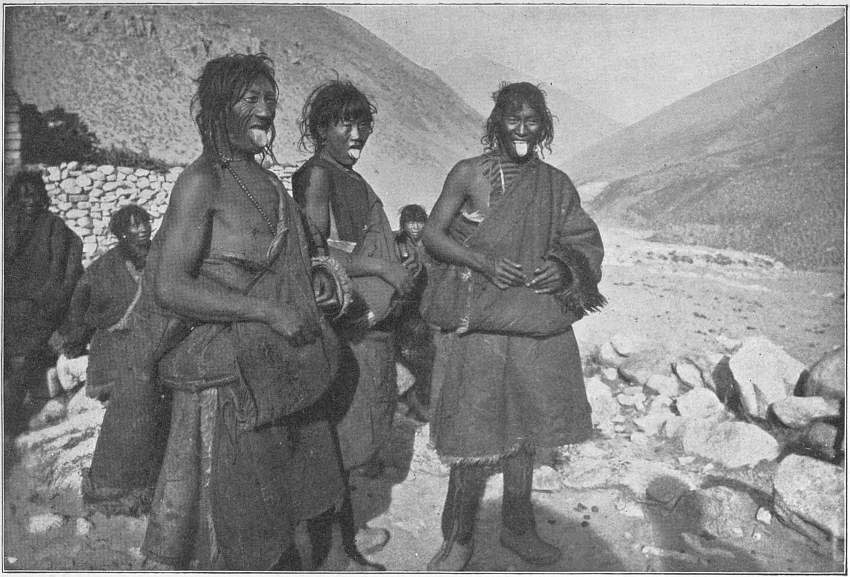
99. Three Tibetans saluting.
The wind sank in the evening, and the sound of the flutes echoed clearly and sweetly in the valley. The moon rose high, and poured down its light over the peaceful wondrous land. The night advanced cold and silent, and the thermometer fell to −29°. At such a temperature there is no need of draughts through the chinks to cool the sleeping-tent. The cold wakes me up, and I have to wrap myself more closely in my blankets.
January 28 was a great day in our records. We knew that we had a trying way before us, and therefore we made an early start. The horse that bore the number 22 on the label attached to his mane lay before my tent frozen hard, with his legs stretched out; he had served us faithfully for nearly half a year. Seven horses and a mule were left. They carried nothing but the cloths that protected them from cold in the night. The new Tibetan horses were in splendid condition: they were fat and sleek compared to our old horses, which had passed through the winter on the Chang-tang.
Even at ten o’clock the wind is icy cold, and not the smallest cloud floats over the earth. Dull weather is much better if the air be still. Now the sun looks down sneeringly on our sufferings and makes no attempt to lighten them. We march towards the east-south-east, over an endless, slightly undulating plain, where the ground consists of troublesome moss-grown stones and sharp débris. On our right is the Sangra peak and other parts of the Pabla crest, whence short transverse valleys descend, and are continued over the plain in insignificant furrows of erosion. To the left the land is undulating, where the affluents of the Naong-tsangpo wind among softly rounded hills. Higher hills and ridges, lying to the north of the right bank of the Naong-tsangpo, intercept the view in this direction.
So we mount slowly up till a deeply eroded valley suddenly and unexpectedly appears on the right side of our route. It is not included in the Ngangtse-tso basin. I am about to leave the isolated hydrographic region, and puzzle my head about the surprises that await me. The valley is called Sangra-palhe, runs south-eastwards, and receives the southern transverse valleys of the Pabla, which are just as deeply excavated. To the south-east we see the dark extremity of a spur of the Pabla, round which the great main valley and its stream bend towards the south and pass on—but whither? On this point the guide could give us no information; we were to find out later. Farther on we reach a valley running in a northerly direction, and therefore connected with the Naong-tsangpo. Northwards the country slopes gently, but steeply, to the south, and we ascend to the low pass forming the watershed. Immediately beyond the hill Sereding we march up a steep ascent towards the conical mountain Serpo-tsunge, which we afterwards leave close on the right of our road. From its western and eastern sides, and also from the gap where we now stand, a number of deep erosion valleys run down to the Sangra-palhe. To the left of our route a valley, which still belongs to the system of the Naong-tsangpo, slopes to the north-west. We are therefore on the water-parting ridge. The Serpo-tsunge is a geographical boundary pillar, and marks where the domain of the Ngangtse-tso ends. The whole configuration is singularly complicated.
Here we left one of our yaks, which could not be induced by coaxing or scolding to move a step farther, but lowered his horns and rushed at those who attempted to drive him on. He was abandoned, the second animal of his kind. He had here abundance of yak-moss, snow, and fresh air, and would probably fall into the hands of the nomads some time or other.
A little higher and we stood on the very summit of the pass, marked by a pole with streamers, which flap and flutter in the wind. It was quite time that we made a small fire, for we were half dead with cold. It was not easy to make the hypsometer boil. Robert sat on the ground and improvised a tent round the instrument with furs and a rug, while I lay on my stomach on the lee side and read the thermometer through a small opening. The temperature was 15°, with a west-south-west wind No. 8, that is, half a gale. The valley leading down, the Sele-nang, lay now, at mid-day, in dark shadow. Through its opening appeared a vast sea of rigid mountainous undulations, steep cliffs, and deep valleys, no level stretches, no vegetation, only a labyrinth of mountains, a much bolder, more marked, and wilder relief than we had seen in Chang-tang. The nearer parts of the Pabla ridge intercepted the view to the west.
The pass, where we now were, is called the Sela-la, and attains the great height of 18,064 feet above sea-level. I perceived clearly that it must be situated in the main chain, which, farther east, bears the well-known peak Nien-chang-tang-la on the south shore of the Nam-tso or Tengri-nor, and has been crossed by a few Europeans and pundits. It is one of the greatest and grandest watersheds of the world, for from its northern flank the water flows down to the undrained lakes of the plateau, and from its southern flank to the Indian Ocean. The course of this watershed and the configuration of the mountain system crossed by our route between the Ngangtse-tso and Yeshung on the Tsangpo was till this January of 1907 as unknown to geographers of European race as the side of the moon turned away from the earth. On the other hand, the seas and mountains seen in the full moon have been known from ancient times much better than the region of the earth’s surface whither it is my good fortune to be able to conduct my readers. I venture to describe this geographical problem that I have succeeded in solving as one of the finest, perhaps the most striking, of all problems connected with the surface of our earth that awaited solution.
But on the Sela-la we crossed the immense watershed only at a single point. I will not anticipate events. We must first muster our acquisitions in order, and then we will draw our conclusions from the material collected. And now we will continue our arduous passage through the unknown world of mountains which still separates us from the great river.
After I had hastily sketched the panorama with hands turned blue with cold, inserting the names the guide was able to give me, we hurried down the slopes of detritus, partially covered with snow, on the south side of the pass. In the valley bottom, with its patches of ice, we mounted our horses again, and met three mounted Tibetans driving before them eight loose horses. As soon as they caught sight of us they turned aside and made a great detour to avoid us. We supposed that they belonged to a band of robbers, who wished to escape with their booty by untrodden paths.
It was delightful this evening to sit at length in the warmth of the camp-fire. In silent meditation my eyes swept from the rocky crests, brightly lighted by the moon, down to the dark shadowy depths of the valley, where there were only wolves crouching in their holes. It seemed as though all belonged to me; as though I had marched into this land a conqueror at the head of victorious legions, and had crushed all opposition. Oh, what splendid legions! Five-and-twenty ragged fellows from Ladak, ten lean jades, and about twenty worn-out yaks. And yet I had succeeded! Marius could not have been prouder of the triumphs he achieved in the war against Jugurtha than I was when I had won my first victory over the “Trans-Himalaya” at the Sela-la, that Sela-la which, now bathed in moonlight, seemed to us the extreme outpost on the limits of boundless space.
Our march on January 29 was pleasant. We were sheltered from the wind in the deep valley, travelled towards the sun, and felt the first touch of the approaching spring. We rode at first towards the east-south-east, but gradually made a curve round to the south. Just at the bend the valley Tumsang runs in, and in the background we again caught a glimpse of a part of the great range we crossed at the Sela-la. Innumerable valleys such as ours must descend from the crest more or less parallel to it. The valley becomes broader, and the ice strip of the Sele-nang winds along the middle. We see no tents, but places where they are pitched in summer, and some manis are erected for the edification of travellers. Camp No. 118 is pitched in an expansion of the valley called Selin-do.
During the past days we had often remarked how desirable it would be if we could hire some yaks from the nomads. Our own were exhausted and kept us back, and in the high country with its abundant detritus, where we were now travelling, their hoofs became sorer every day. As long as the land lay open before us we must make all haste we could. Delay might be dangerous, but the yaks marched as though they had a log at their heels. We saw no tents in Selin-do, but Namgyal came in the evening with two Tibetans he had met in a side valley. They were willing to provide us with 25 yaks, if they were paid a tenga (about 5½ d.) for every day’s march, and they reckoned eight days’ march for the journey to Yeshung on the Tsangpo. They would accompany us themselves only for one day, and insisted that other men should take their place when they turned back. We could not do any better; we should spare our own animals, make longer marches, and obtain good guides as well.
In the evening we received a visit from seven well-armed riders in search of a band of robbers who had stolen several horses from them. We informed them of the party we had met the day before and they rode off, thanking us warmly, up the valley.
January 30. In the morning our new friends turned up with the yaks; when all was in order we found that we possessed only eighteen loads of the heavy baggage with which we set out from Leh. Our last two guides were paid, and immediately set out for the Sela-la.
Immediately below camp No. 118 the Selin-do valley unites with the Porung valley, along which we again ascended to the south-east. I was surprised that our guides tramped up to higher ground again, but they followed a plainly marked path, while the valley that we left on the right seemed to slope down to the west-south-west and south-west. They said that it debouched into the valley of the My-tsangpo, a northern tributary of the Yere-tsangpo (the upper Brahmaputra). I had afterwards an opportunity of ascertaining that their statements were correct. But now, on first crossing the country, the arrangement of the mountain ranges and watercourses was ill-defined and confusing to me. At every camp I interrogated Tibetans who seemed reliable, and made them draw small maps with their fingers in the sand, which I copied into my diary. But the map changed every day, even if the chief lines remained the same.
From the point where we began to ascend again a desolate chaos of mountains is visible towards the south-west. On the right bank of the Porung several warm springs well up from the pebble bed, containing sulphurous water at a temperature of 127.9° and filling basins in which the hot steaming water simmers and bubbles. The place is called simply Tsaka-chusen, or “The Hot Salt Water.” The terraces of the valley indicate powerful erosive action. Side valleys run in on both sides; sometimes we cross the frozen stream, sometimes pass over steep mountain spurs. At a bend in the way we meet a party of armed riders who are on the way to Chokchu, a country west of the Dangra-yum-tso.
We come to an expansion in the valley, a very important spot, for here several valleys converge to a gigantic focus of erosion in this sea of wild mountains. The largest is the Terkung-rung, which, joined by a whole series of side valleys, descends from the main crest of the Pabla in the north-east. The track through the valley passes several large summer pastures. I made a long halt on a broad rocky projection with a mani to get my bearings in this extremely interesting country. Here, too, we met a mounted party, which was in pursuit of a freebooter who had eloped with another man’s wife—just as with us. The injured husband was in the party and looked very furious. Then we met a caravan of 55 yaks laden with great bales of Chinese brick tea from Lhasa, which they were carrying to the Chokchu province. A dozen dark bare-footed men followed the animals, singing and whistling, spinning woollen thread with the help of vertical rotating spools, or engaged with their prayer mills. They hired their yaks, and were to exchange them for fresh animals at Selin-do. They had also 50 sheep with them, carrying small loads of barley. The farther we advanced the more lively became the traffic.
Small footpaths from the side valleys join our road, which is now broad and shows signs of considerable traffic. All our guides tell us that this is the great highway to Shigatse, and is also a section of the main road connecting Chokchu with the capital of the country. The road is a collection of parallel footpaths, and where it crosses slopes and steep declivities appears like stripes on the ground.
We continue our ascent in a south-south-easterly direction, and find ourselves about 100 feet above the valley bottom, which is occupied by a huge ice-belt of uniform breadth resembling a great river; we could fancy ourselves transplanted to the Indus valley in its winter dress as seen from Saspul. But the resemblance is only apparent, for after we have passed some rather large side valleys we reach the abundant springs of Mense-tsaka with warm freshwater at a temperature of 118°, which farther down forms pools where small fishes dart about among slimy weeds. The water gradually cools down and forms ice, and runs down over it farther and farther until, as now in the end of January, it has filled the whole valley bottom from the foot of one flank to the other.
From the great meeting-place of the valleys we have passed four manis, in general not more than 10 feet long, but covered with unusually well-dressed slabs of red, white, or green sandstone and slate. On the former, the letters in the weathered crust stand out bright red against the chiselled intervals with their white surface. We are tempted to take away some specimens, but we shall probably have later opportunities of committing sacrilege.
In front of us stands the trough up to the pass; surrounded by the concave crest, where the caravan is seen on the top, the pass seems unpleasantly steep. Above the valleys Shib-la-yilung and Chugge-lung the ascent is difficult, and the horses often pause on the slopes of detritus. At last, however, we are up at the votive cairn with its streamer pole amongst smaller pyramids of stones. This is the Shib-la, which has a height of 17,549 feet. The view is magnificent and is free on almost all sides, for no summits in the foreground obstruct it. Down in the valleys we were sheltered from the wind, but up on the summit it sweeps unhindered over the agitated sea of crests.
The guide points south-westwards to the next pass we have to cross. Between it and the Shib-la stretches a deep boldly eroded ravine, sloping to the west-south-west. Its river, or rather its ice-belt, unites with all the watercourses we have crossed this day—with all, indeed, that we have met with since the Sela-la. We have therefore crossed a number of tributaries, but the main stream, which receives them all, lies to the west of our route and is not visible from any point. It is the river called My-chu, My-tsangpo, or My-chu-tsangpo.
We had still a fairly long march to the camp. It grew dusk. We descended the steep slope on foot, stumbling over the rubbish and the mouse-holes. Darkness came on, but a white streak was seen in the valley, the ice of the river. The light of the camp-fire looked tempting in the cold and darkness. But nothing is so deceptive as a blaze of light in the darkness; you go on and on, but the fire seems no larger. At last, however, tired and starved, we arrived at the camp and sat as close as possible to the glowing argol, and the conversation with Muhamed Isa began—cheerful and animated, as usual.
Four of our spare yaks were thoroughly exhausted and must have a day’s rest. Had I known what was coming behind in our track, I would have left them and hurried off next morning. But we knew nothing, and spent the last day of January quietly in camp No. 119. The thermometer fell to −29.9°: the third time we had recorded the same reading.
I spent the leisure day in studying the maps I had drawn, and endeavouring to form a clear conception of the mountains and valleys among which we had been wandering. This much was evident, that the great watershed between the isolated lake basins of the Chang-tang and the Indian Ocean ran along the main Pabla range, and that this was the immediate western prolongation of the mighty chain Nien-chen-tang-la. We had crossed the Pabla mountains at the Sela-la, and were now in the wide-stretching intricate river system of the My-chu. Nearly parallel to the My-chu flows farther east the Shang-chu, and along its valley the Pundit Krishna (A. K.) travelled in the year 1872 and Count de Lesdain in 1905. Between the My-chu and the Shang-chu there must therefore be a secondary watershed and a considerable mountain elevation, which is really nothing else than an offshoot from the main range of the Pabla. All the watercourses we had crossed from the Sela-la onwards flow westwards, and the secondary watershed, where they take their rise, lies to the east of our route. It is, however, possible that between the My-chu and the Shang-chu another, or perhaps several valleys lie, equal in importance to the valleys of these rivers.
The Pabla is only a part of the main chain of the “Trans-Himalaya,” and the Trans-Himalaya is not only a watershed of the first rank, but is also a geographical boundary of exceptional importance. I have now and then wandered through mountain regions of awful grandeur, but have never seen anything to equal the country to the south of the Trans-Himalaya. In Chang-tang the predominating lines of the landscape are slightly undulating and horizontal; now we had reached the peripheral regions, having a drainage to the sea, and immediately vertical lines came into prominence. On the south side of the Trans-Himalaya the valleys are much more boldly excavated in the rock masses than in any part of the plateau country. And why? Because the precipitation from the monsoon clouds is incomparably more abundant on the south side of the Trans-Himalaya than on the northern flank. It is the same in the Himalayas, where the south side, facing the west monsoon, catches the lion’s share of the precipitation, and is irrigated by much more abundant and more continuous rains than the northern. Now we found springs, brooks, and rivers in every valley, while not very long before we were always in danger of finding no water. In climatic relations, then, the Trans-Himalaya is a boundary line equalled in magnitude and importance by few on the earth’s surface.
My excitement and expectation were constantly increasing; every day I saw plainer indications of the proximity of a religious metropolis—votive cairns, manis, travellers, caravans were all signs of it. My Ladakis were inspired by the same feeling of exultation which the pilgrims of Islam experience when they approach the Arafat mountain, and remember that from that elevation they will behold for the first time the holy Mecca.
Early in the forenoon fresh men with fresh yaks presented themselves to take over our loads on February 1. I could not understand why the nomads were ready to serve us without the slightest suggestion. Certainly the highway is divided into stages, and fresh yaks are kept in readiness for the transport of baggage and goods, but these advantages are intended only for Tibetans, not for a European caravan, which had not even a passport. At any rate Ngurbu Tundup had done us no harm; on the contrary, it was known everywhere that I was coming, and that he was a messenger sent to me by the Tashi Lama. At every halting-place we were told how many days ago he had passed through the place. The readiness of the nomads to provide us with yaks was due in no small degree to the good pay and kind treatment they received. Now our own yaks travelled without loads, and also the seven Ladak horses and the last surviving mule. But we were prepared for any emergency. We had agreed that if we could not at any time find transport animals, I, with Muhamed Isa and Namgyal, would ride on our three Tibetan horses in forced marches to Shigatse, while the caravan would follow slowly under Robert’s command.
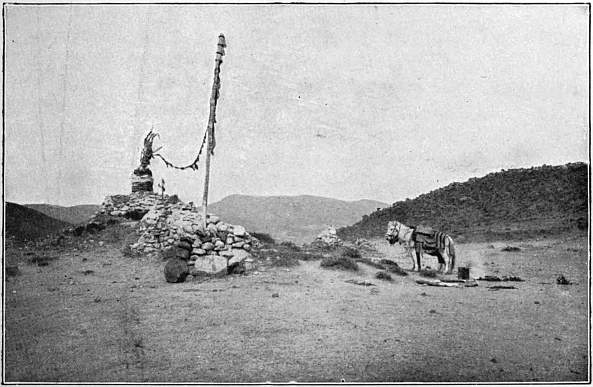
100. Pass of La-rock. Mani Heap with Fluttering Prayer-Streamers.
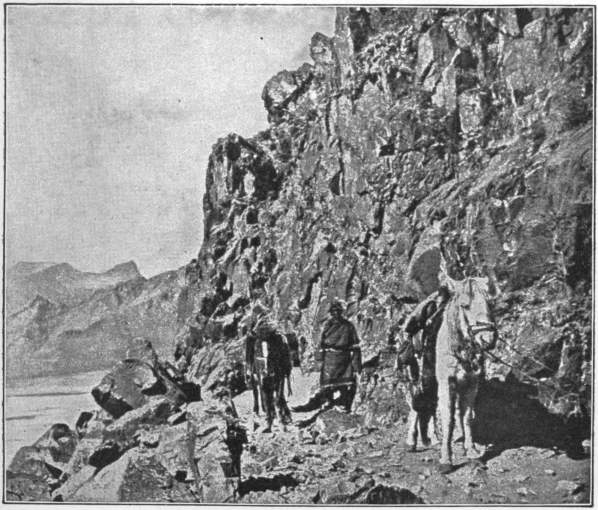
101. On the Bank of the Tsangpo (Brahmaputra).
We had 58½ degrees of frost in the night, and the morning was horribly cold, dull, and stormy. We ascended to the next pass along a new valley. We had not gone far before we were half dead with cold; Robert wept, he was so frozen. When it was warmest, there were still 27½ degrees of frost, and a biting wind blew in our faces. Our faces, and especially our noses, would have been frost-bitten if we had not constantly put them in the openings of our long fur sleeves, where, however, the breath turned so quickly to ice that the sleeve froze on to the moustache. It is not easy to do map work under such circumstances. Before I have taken my observation and looked at the watch my left hand is dead; and, however much I hurry, I have not recorded the result before my right hand has lost all feeling. It is impossible to march on foot in face of the storm up a steep ascent and in the rarefied air if one has the least respect for one’s heart. We crept into a cave and crouched down on the sheltered side; we thrust our hands between the horse and the saddle-girth to thaw them; we stamped our feet, and looked intensely miserable when the muscles of our faces were so benumbed that we could hardly speak. “Let us ride on; we will light a fire up above.” And so we struggled painfully up through sharp-edged detritus and among stones.
At last we are up on the flat arch of the Chesang-la at an absolute height of 17,599 feet. This pass is therefore a little higher than the Sela-la, but nevertheless it is only a pass of the second rank, for it separates two of the affluents of the My-chu. When we came up, there were three large grey wolves on the pass, but they quickly took to flight. Here the storm raged in uncontrolled freedom, and we could scarcely keep on our feet. Robert and I crouched on the ground on the sheltered side of the large cairn, while Rabsang and our Tibetan guide collected dry yak-dung. We set it alight with the help of flint and steel, and then we all four cowered over the fire. We opened our fur coats to let a little heat penetrate our clothes and took off our boots to warm our feet, but we sat an hour and a half before we felt anything like human beings again. Then we hastened down in a south-south-westerly direction and encamped in the Sham valley near some wretched stone huts.
CHAPTER XXII
TO THE BANK OF THE BRAHMAPUTRA
The Sham valley narrows like a pear, and at the entrance of this funnel huts stand at three different spots, and large herds graze on the mountain slopes. A mani, 148 feet long by 5 feet high, was covered with clods to protect the upright stones sculptured with prayers. At length the Sham valley enters a large valley coming from the east, which occupies a prominent place in this river system. It is traversed by the Bup-chu-tsangpo, the largest river we have yet seen. Immediately below the place where the two valleys unite is the confluence of a third river, which is called Dangbe-chu and flows from the south-east. Thus three considerable streams meet in this small expansion of the valley. The explanations of my guide made this complicated river system of the My-chu-tsangpo clear to me. The sources of the Bup-chu-tsangpo lie two long days’ march to the east, and are of course to be found in the great offshoot of the Pabla which forms on the east the watershed of the My-chu-tsangpo. From the confluence where we now stood the Bup-chu-tsangpo continues its course for two short days’ journey south-westwards, and then at the monastery Linga-gompa enters the My-chu-tsangpo, which has its source in the main range of the Pabla.
The Bup-chu-tsangpo was at this season converted into a huge sheet of ice, but had an open water channel. We crossed dry-footed at a place where the ice formed a bridge all across the bed of the stream, and then marched in a south-easterly direction through the narrow Dangbe valley.
At camp No. 121, on February 3, we left Tundup Sonam and Tashi behind with our own yaks, which were so exhausted that they could be driven only very slowly. The men were given money for their keep, and were ordered to move on towards Shigatse at a very slow pace. The rest of the caravan set out early, in good weather and at a minimum temperature of only 11.3°.
Our course is south-south-east and afterwards east. All the valleys are full of ice, which we strew with sand as the caravan passes. The pass to-day is the Dangbe-la, decorated, as usual, with a cairn and streamers; its height is 17,224 feet, or much less than that of the preceding pass. It is interesting, as lying on the watershed between the Bup-chu (My-chu) and the Rung-chu. The latter river does not unite with the My-chu, but takes its own course direct to the upper Brahmaputra. When I asked why we could not descend the Rung valley to avoid the two passes in front of us, I was told that the valley is very narrow, is confined by precipitous mountains, and is filled with ice. There is, however, a path used in summer which runs sometimes along the slopes, sometimes over the valley bottom, but is hard to follow after rain, for then large volumes of water pour down the valley, thundering over falls and rapids.
We bivouacked in a locality called Ngartang in the Rung valley, where twelve tents remain standing all through the year. The valley is considered cold, whereas the Sham is reputed warm. Indeed, we had found there some juniper bushes, and were so delighted at seeing them that we had adorned the inside of our tents with branches. It never snows in summer in the Sham valley, but it does in the Rung valley. In many years there is much rain in both valleys.
As though to prove the truth of the Tibetans’ assertions, the thermometer again fell in the night to −19.1°. We were prepared for a long day’s journey and a difficult pass, and therefore it was still dark when I heard the yaks being driven into the camp. After we have left the Ma-lung river behind us we ride up hills consisting of firm soil overgrown with moss, and an inextricable entanglement of mountains is displayed to our view. We ride steeply upwards along the valley coming down from the pass, passing over detritus and among boulders, with votive cairns here and there. A stretch of almost level ground follows, and then at last the path rises steeply to the pass, which is strewn with innumerable blocks of grey granite. This is the Ta-la or “Horse Pass,” and its absolute height is 17,835 feet.
If the ascent among the boulders is troublesome, and both horse and rider have to twist their bodies in all kinds of acrobatic feats, the pilgrim is richly rewarded when he stands at the top of the Ta-la beside the streamer-decked cairn; for anything grander and more overpowering I have never yet seen, unless it were on the top of the Chang-lung-yogma. The panorama to the south-east and east-south-east is so fascinating that we almost forget to dismount. We command a somewhat limited portion of the horizon, for two peaks of the Ta-la crest, like the portal of a great temple, close in the landscape in front of us. Below is a zone of reddish-brown, dome-shaped hills, behind them a nearly black spur, intersected by numerous short transverse valleys, and farther in the background a dark grey ramification. All seem to run westwards and from the watershed, which we have supposed to lie to the east of our route since we crossed the Sela-la. Such scenery as this we had gazed upon time after time. But high above the dark-grey ridge rises a world of mountains which seems to belong to the heavens rather than the earth, so lightly and airily is it poised above the rest of the earth under a canopy of white clouds. It is so far from us that the individual contours are indistinguishable, and it rises like a wall of a universal light blue hue, which, however, is a little deeper than the colour of the sky. The boundary between the two expanses of blue is sharply marked by an irregular bright white line; for what we see before us is the snow-covered crest of the Himalayas, and behind it lies India with its eternal summer. These are the most northern chains of the Himalayas, on the frontier between Tibet and Bhotan. Between them and the dark grey crest, comparatively near to us, yawns an abyss, a huge fissure on the earth’s crust, the valley of the Brahmaputra or Tsangpo. The river itself is not visible, but we feel that we are now not far from our destination. Ah, you fearful ranges and passes which we have surmounted in the Chang-tang, where dead horses mark the miles and show in which direction we travelled, at last we have you behind us, and only a single mountain system, the Himalayan, separates us from India! This view strikes us dumb, and it seems wonderful to me that I have succeeded in forcing my way so far.
Tsering and Bolu now reach the pass with the small caravan. They fall on their knees before the heap of stones and recite their prayers, and Tsering tears a strip off his ragged coat to tie as an offering on to one of the strings. We all feel as though we were on a pilgrimage. The Tibetans who let their yaks on hire see after the loading and unloading, gather fuel, and relieve the Ladakis of many of their duties. The older men of our own people are allowed to ride. They have easier work in every way, but still they are pilgrims on the way to one of the greatest centres of Lamaism. Old Tsering holds his cap in his hand as he goes over the pass, and cannot turn his eyes aside from the dreamy light-blue mountains which gleam in the distance among the clouds. He reminds himself that they rise far beyond Tashi-lunpo and that we have not to cross them to reach our longed-for destination.
But we must leave this grand pass, the never-to-be-forgotten Ta-la. Down we go on a break-neck descent among boulders, between steep cliffs, over landslips and spurs, and the Himalayas gradually vanish from sight. Now we see only the line of the crest tipped with eternal snow; after we have descended a couple of slopes, it also is concealed by the dark grey ridge, and our horizon is bounded by its sharp outline. Kabbalo is a village of two tiny stone cabins in the Permanakbo-tang valley where we encamp. Several Tibetans are out of doors and stare at us; for dinner I have butter and radishes, and see no more of the perpetual mutton.
On February 5 we made a short march down the same valley, which is called Dokang, where we set up our camp No. 124. Forty Tibetans stood at the camp-fire. When I rode up they all thrust out their tongues as far as they would go, and their bright red colour formed a strong contrast to the dirty faces. Those who wore caps took them off with the left hand and scratched their heads with the right—another form of salutation. When we spoke with them they repeatedly shot out their tongues, but only from politeness and friendliness; they could not do enough to show their goodwill. Near the camp are the ruins of a dzong, or fort, which is called Dokang-pe, and a deserted village called Arung-kampa testifies that the valley was formerly more densely populated than now.
The march on the 6th is one I shall never forget; for now we rode down the gigantic staircase, the edge of the Chang-tang, into the Ginunga gap which we had seen from the Ta-la, and in the depths of which flows the upper Brahmaputra. From the camp we marched towards the south-south-east, leaving our river on the right, which, cutting through the mountains in a deep ravine, flows to the Rung-chu. At the entrance of the narrow valley stands a small temple, the Chega-gompa. A pack of wolves howled dismally in a gorge. The ascent to the pass La-rock (14,567 feet) is short and easy, and before we were aware we were up at a great cairn amid smaller heaps of stones, where the tarpoche (votive pole) stands grey and cracked, and much worn by wind and weather (Illustration 100). Several blocks of stone lying in heaps on the east side of the pass were white-washed on their upright sides. We had to cross over two more smaller ridges before we had a free and uninterrupted view. The scene is grand, and reminds one of the landscape seen from the palace at Leh. The northern ranges of the Himalayas were distinctly visible, but heavy clouds rested like a canopy on their peaks. Mount Everest, therefore, the highest mountain of the world, could not be seen. The Tsangpo appeared as a very small bright riband, still at a considerable distance. Below us flowed the Rung-chu, which we could see from the place where it emerges from the mountains. Most imposing are the colossal offshoots and ramifications of the mountains lying to the east and west of our position, which fall suddenly to the valley of the Brahmaputra like an endless row of tiger’s claws.
The plain stretched out before us is a very large expansion of the Brahmaputra valley, and is named Ye, or Yeshung, while the river is here called the Yere-tsangpo. It is densely peopled; the great number of dark specks are all villages. To the right, at the foot of a mountain spur, stands the large monastery Tashi-gembe, which with its numerous white-washed houses has the appearance of an Italian coast town. Thence a road runs to the famous monastery Sekya. A fine line meandering towards the south-east is the great highway to Shigatse, Tashi-lunpo, and Lhasa.
From the last platform the path plunges down headlong, so we descend on foot these steep slopes of grey granite rounded by wind and weather. Where loose material fills up the interstices the path is sunk in to the depth of a yard. Many pilgrims, horses, and yaks have passed here before the path became so small. Sometimes we have abysses beside us, sometimes we slide down over the sheets of granite, sometimes we step down as on a staircase, but down we go, ever downwards, and we rejoice to think that every step brings us nearer to warmer, denser air, where we can breathe more easily. Here and there tower up great round granite blocks on a pedestal of loose rubbish, like glacier tables; rain and wind have sculptured out these singular forms.
At last we are down on the great plain into which all the valleys open. We ride past barley-fields, poplar groves, farms and villages with white houses, where blue and red pennants and flags decorate the roofs. We leave the monastery Tugden on our left; a little farther, at the foot of a mountain spur, Muhamed Isa had made a halt. About a hundred Tibetans of all ages and both sexes, exceedingly black and dirty, but very friendly, surrounded the tents. They sold us sheep, fowls, milk, radishes, and malt beer (chang), and our tired animals were supplied with plenty of hay and barley. Women with a round arch on their necks by way of ornament, carried wicker baskets of dung to the fires, and were never tired of sitting with us, astonished at us and our wonderful occupations. Here Ngurbu Tundup presented himself and gave me the welcome information that his master, Kung Gushuk, would forward my correspondence. He received only a part of his reward at present, and the remainder would be paid him as soon as I had news that the letters had actually reached Gyangtse. He handed me a kadakh, or cloth of welcome, from his master, and said that he was ordered to accompany us and assist us on the way to Shigatse. This was most important news. It signified that we should meet with no obstructions.
Here the absolute height was 12,956 feet, and the air was warm and pleasant. At nine o’clock we had only 5½ degrees of frost, and therefore the tent flap was left open. I held a long consultation with Robert and Muhamed Isa. Should we spend ten days instead of only one in this delightful locality, where there was all we wanted and where the animals could recover their strength, while I visited the curious monasteries perched like storks’ nests on rocky promontories, or glittering white at the mouths of valleys? No; we knew nothing definite about the reception that awaited us; it was only eleven days’ journey to Lhasa, and we could reach our destination, Shigatse, in three days. We had heard nothing from the Government, but we were expected in Shigatse. Any moment might bring a change unfavourable to us. We would not therefore lose a single precious day, but would start early in the morning, and hurry on as long as the road was open to us.
Our excitement was becoming acute. After all the severe trials and adventures we had experienced should we succeed in reaching our goal? At night the Ladakis sang their Tashi-lunpo hymn more softly and earnestly than ever. At midnight they were singing still, and I listened attentively, though I had so frequently heard the song on the Chang-tang.
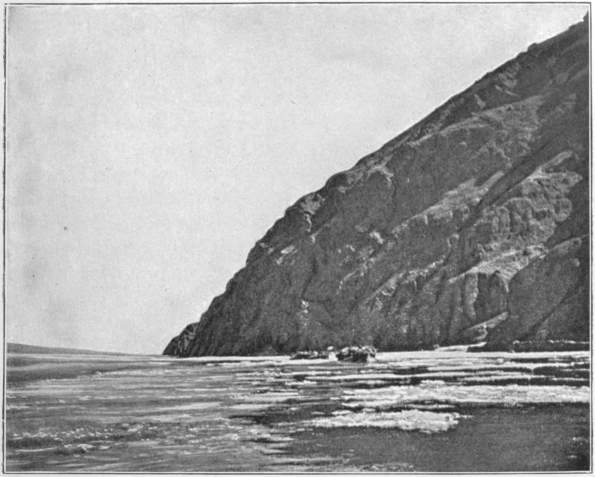
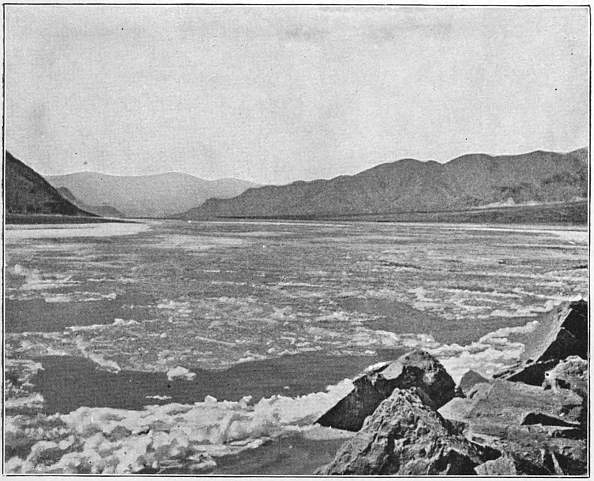
102. The Tsangpo with Floating Ice.
103. The Valley of the Tsangpo above Shigatse.
Then the fires went out in our first camp in the valley of the Brahmaputra. The crowd collected before the tents on the morning of the 7th was a very mixed one. Horses, mules, and cows were to carry the luggage, for there were no yaks here. A south-west storm blew when I started fully an hour later, and the whole population of the neighbourhood collected to witness our departure. Just as I was mounting into the saddle three emissaries appeared from a certain Cheppa Deva, a friend of Kung Gushuk. They brought me a present from him consisting of a whole slaughtered sheep, a thick sweet cake, with figures in relief and preserved fruits on the top, three large lumps of butter, and thirty eggs. I could not send any present in return, for the caravan was already gone on, but I gave them 15 bright rupees and begged them to convey my hearty greeting to the unknown Cheppa Deva. Then the chief of the three said: “We must hand over this money to our master, and therefore it would be well if the Bombo Chimbo would give us an extra tip.” This was a cute, sensible speech; they received an additional sum of money and went away contented.
A number of other people accompanied us, giggling and chattering, as far as the highroad to Shigatse. The attractive monasteries on the right and left of the road passed out of sight, and we rode through part of the village Dzundi, inhabited by smiths, and past a warm medicinal spring, over which a bath-house is erected—unfortunately it was just then occupied by a patient, and we could not enter; white clouds of steam issued through the roof, windows, and doors. And further proceeds our picturesque party, through more villages and barley-fields, past fresh monasteries, rocky cliffs and valley openings, till the road winds over a barren plain more and more to the south, towards the Brahmaputra, just as one approaches the Indus from Leh, and, as there, loose stones have been removed from the road and lie along the sides.
Where the valley contracts we have the large monastery Tarting-gompa on its rock to the left, and on the right or southern bank of the river the village Rokdso with its ferry; and now we reach the first granitic spur, which extends to the neighbourhood of the river. Beyond the village Karu with its cornfields and small gardens we ride through a hollow way 13 feet deep, a corridor in the yellow löss; here and there the banks are broken through by rain gutters, and through the gaps, as from the windows of a gallery, we have a glimpse of the great side valley So, which drains from the south into the Tsangpo. The rain has modelled the loam into pyramids, sometimes as much as a yard high, like a forest of gigantic mushrooms. We meet dark bare-headed peasants, driving before them laden horses and mules, and women and children with baskets on their backs, containing fuel or roots. An old woman sat astride on her mule and rose in her saddle with the step of the animal; a man of higher position, on horseback, accompanied his wife; some country people whistled as they followed their cows laden with hay; a party of men and women in picturesque costumes of blue, red, and yellow were making a pilgrimage to the New Year’s festivities in Tashi-lunpo, which my Ladakis had long hoped to attend. All the traffic was making eastwards, and we met only men who were going on business from one village to another.
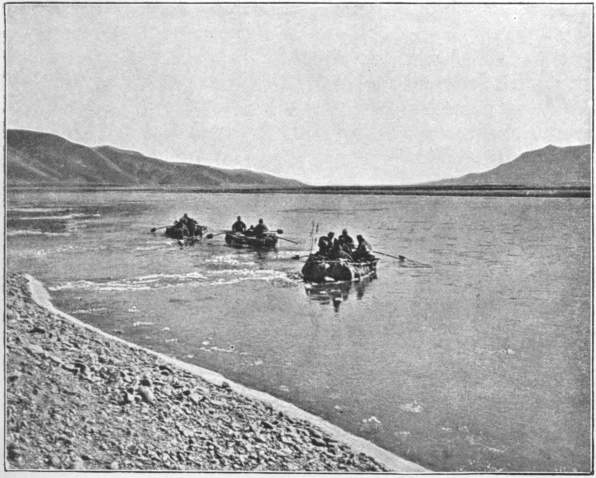
The road now runs over low land which is flooded in summer, so that those who pass this way are then obliged to travel along the flanks of the mountains. Even now the Tsangpo is an imposing stream, and we rest for a while on its bank, which our road touches for the first time. For the first time in my life I drink of the holy water of the Brahmaputra. Bluish-green and almost perfectly transparent, it flows slowly and noiselessly in a single bed to the east, while here and there fishes are seen rising. Only a very thin crust of ice confines the water at the margin, but a bright clump of ice, like a mountain crystal, frequently sweeps past us. A raft laden with barley floats down on the way to the great market in Shigatse, and soon vanishes round the next corner, where the steersmen with their long poles must keep a good look-out—a sight reminding me vividly of my voyage on the Tarim in the year 1899.
To the east of this point the soil is sandy and rises into barren dunes 6 feet high. One can tell at the first glance how they are formed, especially on a day like this, when the westerly storm sweeps the drift-sand before it in clouds, often hiding completely the steep rocky walls on the right bank of the river. During high-water the river deposits quantities of mud and sand on the shallows, which are exposed and dry up in winter. The west wind carries away the silted material to pile up dunes farther east; where these lie low enough, the next high-water clears them away, and when it has fallen the process is repeated. Thus in the valley of the Tsangpo a continuous displacement of solid matter from west to east is going on. It is not alone that the river excavates the bed with its own weight, and loads its water with masses of mud; but also the material deposited at the banks is borne away by the wind which comes to the help of the water. Wind and flowing water work together in harmony to the same end, washing out this gigantic drainage channel deeper and deeper. They have laboured at the work for untold thousands of years, and the result is the Tsangpo valley as we see it to-day.
After a ride of eight hours we came to a small village composed of thirty houses, called Rungma (Illustration 104), where the tents were set up in a garden among poplars and willows. How pleasant it seemed to us, who had passed a whole half-year on the desolate Chang-tang plateau, to hear the wind soughing again through the leafless branches of the trees! Now the fires were no longer fed with dried dung; dry faggots crackled between the tents and threw a bright light on the trees and the Tibetans.
On February 8 we had another long ride. Ngurbu Tundup complained that his mule had run away, so that he must stay behind, and begged me to pay him the remainder of the reward I had promised. But this trick was too transparent.
We suspected that the letters had not reached Gyangtse after all. However, we were not far from the village when Ngurbu came riding after us on a borrowed horse with jingling bells. When we had pitched our camp, Ngurbu was immediately sent off as a punishment to Shigatse, to inform Kung Gushuk that we should arrive the next day, and that I wished to have a good house prepared for me. That was a thoughtless step, for if Kung Gushuk had told what he knew to a Chinaman, we should have been stopped at the last moment before reaching the town.
The winding highway runs further and further eastwards along the northern bank of the Tsangpo, past fields laid out in terraces and watered by the river. It is astonishing to find in Tibet so much cultivable land, and such a number of inhabited villages with solid stone houses and gardens.
At Lamo-tang the river washes the mountainous foot of the left bank, and here a narrow break-neck path runs in zigzags up the slopes. But it need not be used except when the water is high. Now we travel along the embankment beside the river. The river has quite a different appearance to-day: its surface is half covered with porous ice-blocks, but then at night there were 33.8 degrees of frost. Leaping and clattering they drive downstream and graze the fringe of ice attached to the bank, piling up on it small white walls of ice. They keep in the line of the strongest current, and often remain stranded on sandbanks which show a reddish-brown tinge amid the clear green water. A grand landscape under a blue sky and among ponderous fissured mountain masses! In the afternoon the drift-ice had decreased in quantity, and in the evening, before our camp, had disappeared altogether (Illustration 101).
Upwards over the extreme point of a rocky projection by a stony staircase where we prefer to go on foot. Then we descend again to the level valley-bottom, past more villages and monasteries, always surrounded by chhortens and manis, and often, like the Tikze-gompa in Ladak, perched on rocks. Tanak-puchu is a great valley coming down from the north, and its river irrigates the fields in Tanak. I could not obtain a clear description of this valley: all I heard was that it came from a pass to the north; so I do not know whether it comes from the Trans-Himalaya, like the My-chu and Shang-chu valleys. If such is the case, however, then the eastern watershed of the My-chu is a hydrographic boundary between it and the Tanak-puchu, not the Shang-chu. The question can only be solved by future investigations on the spot.
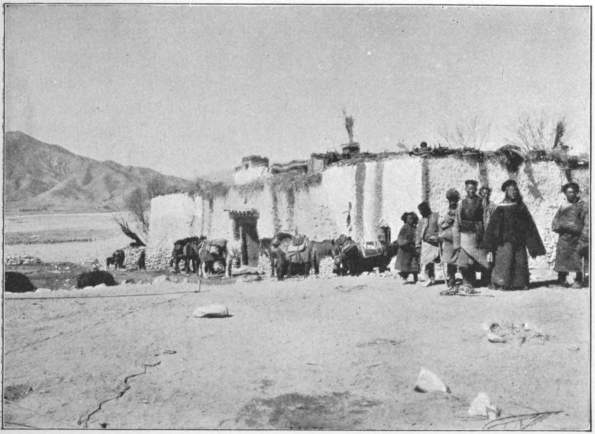
104. House in the Village of Rungma.
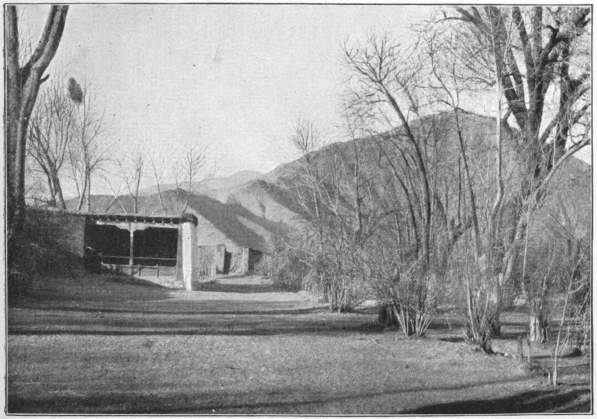
105. Garden of the Tashi Lama in the Village of Tanak.
In the Tanak (“The Black Horse”) valley we encamped in a pretty garden (Illustration 105), where a small house with a gaily painted verandah is occupied by the Tashi Lama, when the prelate pays his annual visit to the temple Tashi-gembe. The garden is situated on a terrace of detritus, which descends sheer down to the river and affords a magnificent view of the Tsangpo. The river is here called Sangchen, or sometimes Tsangpo-Chimbo, that is, the great river. The Tsangpo is the river of Tibet par excellence. According to Waddell this name is sometimes so written that it is a strict translation of the name Brahmaputra, which means “Son of Brahma.” We have already mentioned the name Yere-tsangpo, and farther westwards we shall meet with other names. In the lower part of its passage through the Himalayas it is called Dihong, and it assumes the name of Brahmaputra only when it emerges from the mountains to water the plains of Assam.
CHAPTER XXIII
DOWN THE TSANGPO BY BOAT—ENTRY INTO SHIGATSE
The 9th of February dawned, the great day on which our caravan of yearning pilgrims would reach the goal of their dreams. The day before had been stormy, and in the evening a strange reddish-yellow light spread over the valley in consequence of the dust that floated about in the air; the mountains were indistinct, and the horizon to the east was quite invisible. But the morning was beautiful and the day was calm. Early in the morning Sonam Tsering and some Ladakis went on board two boats with part of the baggage, while Muhamed Isa and Tsering kept along the road with the caravan. That was a stratagem we had devised. If any one appeared at the last moment ordering us to halt, the prohibition would only affect Muhamed Isa and the caravan, while I should slip into Shigatse by water unnoticed.
All the others were on the way when Robert, Rabsang, and I made our way from the terrace down a steep gully, and stepped on board the excellent boat that was to bear us down the holy stream. These Tsangpo boats are both simple and practical. A skeleton, or rather framework, of thin tough boughs and laths is tied fast together, and is covered with four yak hides sewed together, which are attached to a rim of wood forming the gunwale—and the boat is ready. It is very dumpy, of a long rectangular shape, but somewhat smaller in front than behind. It is not heavy, being only an ordinary load for a man. All the boats now descending the river with pilgrims going to the New Year festival, and the boats which convey country produce or fuel to Shigatse and Tashi-lunpo, will be carried back by the owners along the river-bank. A large proportion of the inhabitants of Hlindug-ling, the part of Tanak where we had encamped, gain their living by such transport. These boats are very buoyant; there were four men in mine, and it could have borne a much heavier load.
The rower sits on a thin board and rows continuously, but faces forwards, for he must be able to see the waterway downstream. The blades of the oars are divided like a fork, and a piece of leather is sewed between the prongs like the web of a duck’s foot. Our boatman is a self-confident fellow, and receives my advice with a smile of superiority when I venture to air my experience in river navigation. The current does most of the work, but the oars are in constant use to keep the boat under control.
At first we glided along slowly till we came to the village Segre, with white, clean, and neat houses standing picturesquely on the left bank, and a short distance beyond, to where the river washes the foot of a steep mountain spur. But then the velocity of the boat increased, amounting on an average to 4 feet a second. I was able to look down the river, note the intervals of time, take my bearings, measure the velocity, and draw a map of the river’s course, just as I had before done on the Tarim. We passed no cataracts, but the water formed small rapids in narrow contracted reaches, and seethed round the bends. It was a splendid voyage, the most delightful that I have experienced. The last day’s journey could not have passed more pleasantly. In Tibet, where hitherto Nature had only placed obstacles in our way, we were now borne along by one of Nature’s forces. During half a year we had worked our way through Chang-tang with constant losses, and now the gates stood wide open and I glided as smoothly as on oil to my destination. One of the greatest erosion valleys of the world displayed its wonderful panorama, the air was so still that not the slightest ripple ruffled the surface of the Tsangpo. Undisturbed by the winds of heaven, the emerald-green water gives itself up to the sport of silent eddies, which, coming into existence at cliffs and projecting points, dance rapidly downstream in ever wider circles, and finally vanish altogether. They are born and die, come and go, and the same tongue of land calls forth new ones to life, but every new vortex whirls its spirals in other water of the holy river, which has for thousands of years pursued its course to the mysterious narrows of the Dihong.
What an intoxicating pleasure to be borne along eastwards by the Tsangpo! Is the river one of the forbidden paths of Tibet? If they come now and stop me I shall return: “I am not in Tibet; I am on the holy river of the Hindus; let me alone.” The view changes with quite perplexing frequency: we have a dark wall of rock in front of us; at the next turn it has disappeared, and another comes into sight on the opposite side of the stream. We often wonder what above and below mean here; we seem to remain motionless while the panorama revolves round us. Robert is plunged in thought, looks over the gunwale, and, misled by the water and ice-blocks about us, exclaims with astonishment: “Why, Master, surely we are not moving.” “Look at the sandbank yonder on the left,” I reply, and he is puzzled at seeing it move upstream. And where the river is shallow and the bottom can be seen, it seems as though the gravel, rounded stones, and sandbanks were all passing upwards underneath the boat.
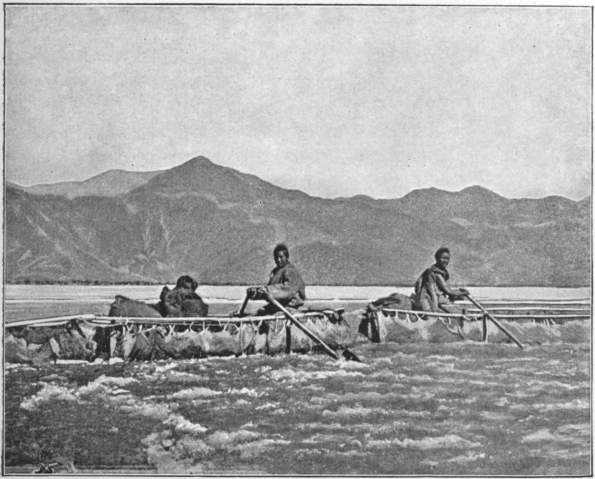
106. Ferry-Boats.
107. Pilgrims on the Way to Tashi-lunpo.
We fall into reverie on this fairy-like voyage. A thought occurs to me: shall we travel on to the mouth of the Ki-chu and thence go up to Lhasa on foot? We can travel by night, and hide ourselves during the day; and Tibetan is Rabsang’s mother-tongue. But it passes away as quickly as the eddies beside the boat. In Lhasa I could add nothing to the knowledge acquired by Younghusband’s expedition two years before; my hopes were fixed on the friendship of the Tashi Lama. On the Sela-la I had conceived a great fancy for the Trans-Himalaya, and no geographical problem on earth had greater attractions for me. All my future enterprises should have the object of making as thorough a scientific investigation of the Trans-Himalaya as could possibly be accomplished by one man in a single journey. Yes, this task was so tremendous that my former longing for Lhasa died away like the red of even in the Tsangpo valley, this gigantic colonnade of granite, this royal highway of Buddha, which, breaking through the mountains and becoming hazy in the far east, leads direct to the mouth of the Lhasa valley, while we now glide along on its floor of liquid emerald to the holiest town of Lamaism. Fascinating and attractive as fairy dances the current carried my thoughts eastwards, but it also prompted new plans of campaign in districts which had hitherto lain outside my sphere of interest. In the valleys which pour their water to the My-chu, I had heard more than once of Nain Sing’s Raga-tsangpo, which some Tibetans had described as quite as important as the Tsangpo itself. Was, perhaps, the Raga-tsangpo the main stream? Had it, perchance, tributaries deriving their water from the heart of the mysterious country to the north? Not an evening had passed during the whole winter when I had not studied attentively Ryder’s and Nain Sing’s maps. Was it certain where the source of the Brahmaputra lay? Had I not here a task before me much more profitable than following in the steps of Tommy Atkins to Lhasa? The sun-lighted waters bearing our boat brought me intelligible messages from distant ravines, from the melting margins of perpetual fields of firn, from bluish glaciers and green ice grottoes in the heaven-kissing crest of the Himalayas, nay, a sonorous echo from the valley where the source of the Brahmaputra bursts out from the rock.
But we must not forget the demands of the present amid dreams of the future. The golden gods of Tashi-lunpo expect us at their festival. Sometimes the river contracts and deepens, and the bottom ceases to be visible, sometimes it spreads out and the velocity decreases. Below the village Pani, where a valley opens out, the river makes a bend to the south-east, but quickly turns eastwards again, where it traverses the great bed which in summer lays almost the whole breadth of the valley bottom under water. We seldom pass a high, clearly defined bank covered with grass, which is not flooded at high-water. From time to time the river sends out a side channel, which, however, soon rejoins the main bed. Wild-geese stand on the bank and scream as we pass by; black and white ducks, herons and other waterfowl, are fearless and trustful, as though they well knew that it is strictly forbidden in Tashi-lunpo to quench the light of life in any living thing.
Just as we were leaving Tanak a dozen boats passed the village; some were tied together in couples so that they could not capsize. The passengers were pilgrims from farther up the river on their way to the New Year festival. There women sat in their most elegant holiday attire, with necklets of coloured glass beads from which little silver boxes containing images and relics or silver coins were suspended, and with high arched frames at the back of the neck covered with red woollen material and adorned with turquoise and coral. There sat greybeards, men, and boys, and a couple of lamas in their red togas had joined the party of laymen. Most of the boats carried small prayer streamers on rods tied to the gunwale, and small reliquaries hung over it to bring a blessing on the boat journey. In some boats sand was laid on the bottom and slabs of stone, where a fire could be kindled and tea infused. They took little notice of us, but talked and gossiped continually and seemed very merry. Evidently the passengers of some boats were well known to one another, and were travelling together from the same village. All the boats on the river were engaged on a day like this, and a continuous succession of pilgrims streamed down the water highway to the holy monastery. Where the banks were low these small black points could be seen both up and down stream (Illustrations 106, 107).
We float past a sandbank, where some blocks of ice are stranded, warning us of danger. The boat only twice grazes the bottom, for our boatman is watchful and steers well. He knows the way, too, and here it is not so easy as it looks to find the course; for the river splits into arms, and only a boatman acquainted with them all can choose the best and shortest. Sometimes he guides us into a narrow channel where the water rushes swiftly.
Now the river turns towards the right, southern side of the valley, where a mountain falls sheer to the water, leaving only sufficient room on the bank for a road buttressed up with stone blocks. There a dozen boatmen are carrying their skin boats on their backs, and, seen from behind, resemble a row of gigantic beetles. And in the other direction caravans of mules laden with firewood are being driven to Shigatse. Here begins a succession of views of inconceivable grandeur, picturesqueness, and wildness. One cliff after another falls steeply to the river, and is washed by the water murmuring at its foot. Often a block of ice is tilted up in a whirlpool, rises above the surface, brightly glistening in the sun, and then falls back again.
We waited for an opportunity of landing, but the current was too strong. At length the boatman succeeded in getting us into a backwater, and I got out on to a promontory just as a party of pilgrims were passing by, and was in time to take them with my camera. They could not make out what I was doing, and they ceased talking; they seemed relieved, and breathed freely again, when they found that they had got off with a whole skin, and that my camera was not a firearm. Wherever I turned my eyes new subjects presented themselves and invited me to stay sketching all day long. But there was no time; it was my last day, and I had ventured on too great a game to let everything depend on a single card. “It is still far,” the skipper said, pointing at starting to a point behind which lay the Shigatse valley, a considerable distance off (Illustration 103).
When we come again into the middle of the valley the river becomes as broad as a lake, is smooth as a mirror, grand and majestic, flows slowly as oil, and reflects the forms of the mountains and the boat. The spurs and cliffs of the mountains on the northern bank have a rosy hue, the water, usually green, shines blue from the reflexion of the sky, and all is solemnly quiet and peaceful. Robert and Rabsang sleep in a corner, but I grudge to lose a minute of this pilgrim voyage. Here and there stands a cairn with a streamer-decked rod—these are the places where routes cross the river. At one ferry a large caravan of yaks were halting, and their loads of sheep’s wool were piled up in a wall on the bank. The black men stood out sharply against a background of yellow sand dunes. Farther down Tsering was engaged in getting his detachment into a boat, while his horses were being driven on to another by coaxing and scolding. Here the great road from Tanak crosses the river, and Tsering shouted to us as we shot rapidly past that Muhamed Isa was far ahead. Fishermen in two boats were at work with their net in a bay of the river, trying to drive the fish into the net by throwing stones; they had a poor catch, but promised to bring us fish for sale in the morning to Shigatse. We again make a bend to the south-east and approach the mountains of the southern side, at the foot of which we pass the villages Chang-dang, Tashi-gang, and Tang-gang, prettily situated among gardens. The river now flows slowly in a single channel, as though it must be careful in passing the mouth of a valley leading to a monastery.
There is much life and movement at the foot of the next promontory; many boats laden with barley, straw, firewood, and dung are on the point of putting in, and from others the cargo is being cleared amid shouts and singing. Rows of boats are drawn ashore, and lie turned upside down like large hairy toads. The boatman who has conveyed us to the mouth of the Nyang valley receives four times the usual pay, and can scarcely believe his eyes. He will be able to give himself a day’s rest to-morrow.
At this singular landing-stage Guffaru is waiting with our horses. I mount my small white Ladak horse and Robert his Tibetan bay, and while the sun is setting we ride up the Nyang valley with Rabsang as outrider. We soon plunge into a labyrinth of hollow ways and fissures in yellow loam. But we do not need a guide, for several travellers and mule-drivers are on their way, and give us instructions, and none is uncivil. A little to the left of our road flows the Nyang-chu, the river of Gyangtse, one of the largest southern tributaries of the Tsangpo, with several villages on its banks. Twilight falls; I feel my heart beating; shall we succeed? It becomes dark; a large white chhorten stands like a ghost close on the right of our way. Rabsang asks a belated wanderer how far it is, and receives the answer: “Follow the road and you will come soon to a lane.” On the right rises a hill, and on its summit the outlines of the Shigatse-dzong, the Council House, are faintly seen against the sky. Now we are between white houses and follow a narrow lane, in which it is still darker. In an open place some Chinese stand and stare at us. Snappy dogs come out of the houses and bark at us. Otherwise the town is asleep, and no popular assembly witnesses our entry. But where are our men? We do not know where they are quartered. Ah! there stands Namgyal, waiting to show us the way, and he leads us to a gate in the wall behind which Kung Gushuk’s garden lies.
Here Muhamed Isa and all the other men meet and greet us, as though they would offer me their congratulations on a great triumph. We dismount, and cross the court to the house which Kung Gushuk has placed at my disposal. But it is cold and cheerless, and I prefer my tent set up under the poplars of the garden. While we are waiting for Tsering we sit by a large fire of brushwood, whither also several Tibetans gradually gather. I pay no heed to them; I am too much engaged with my own thoughts. I had been fortunate, and after a six months’ journey through Tibet had reached my first goal. It was late at night when my dinner was ready; it was very welcome, for we had had no provisions on the boat. Then I had two hours’ good work at the notes I had made during the day. But I was disturbed by a gentleman who belonged to the secular staff of the Tashi Lama. He said that he was not acting upon orders, but that he had been told that an unusual visitor had arrived, and he begged me to furnish him with particulars. Then he wrote down the names and nationality of us all, and the size of the caravan, and inquired by which way we had come, whither we intended to travel, and what was the object of my visit to Shigatse. He was exceedingly polite, and hoped that we had not suffered too severely in the cold of Chang-tang. He was, he said, an official of too low a rank to venture to address the Tashi Lama, but he would communicate the information he had obtained to his superiors. I never heard anything more of him. Seldom have I slept so well as on this night—yes, perhaps, when I had fortunately completed my college course.
When the next day passed without any one, lay or spiritual, giving himself the least trouble about us, I sent Muhamed Isa up to Tashi-lunpo. Its golden roofs shone fierily in the rays of the evening sun on a slope in the west close to our garden, which was situated in the southern suburb of Shigatse. My excellent caravan leader sought out a lama of high position, who answered that he would send some one next day to inquire particularly about my intentions and he would then communicate with me further. At the same moment a Chinaman of high rank named Ma paid me a visit. He introduced himself as the commander of the lansa, or detachment of 140 Chinese soldiers, which, it seems, garrisons Shigatse. Ma, who was a Dungan and a follower of Islam, became my particular friend from the first moment, and smirked with good temper and cheerfulness. He had arrived from Lhasa five days previously, and was to stay until the Amban, the Governor-General, Lien Darin, recalled him.
“It is inconceivable,” said Ma, “how you have contrived to get through to Shigatse without being stopped.”
“Yes, to speak frankly, I had expected all kinds of annoyances, if not sooner, at any rate a couple of days’ journey from here.”
“I did not hear a word of your coming; if I had known that you were approaching the town, it would have been my duty to stop you.”
“Then it is fortunate for me that you are strange here.”
“Yes, but the worst is, that I shall come off badly as soon as the Amban hears that you are living here, in Shigatse. But now it is too late; I cannot help it now.”
“Tell me, Ma Daloi, do you think that the Tashi Lama will receive me?”
“I doubt it. Immediately on my arrival I begged for an audience with the Grand Lama, but he has not even condescended to give me an answer. And yet I am a Chinese officer.”
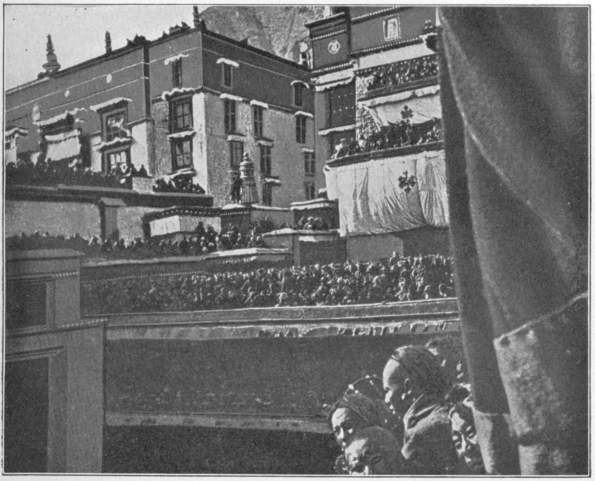
108. Court of Religious Ceremonies in Tashi-lunpo.
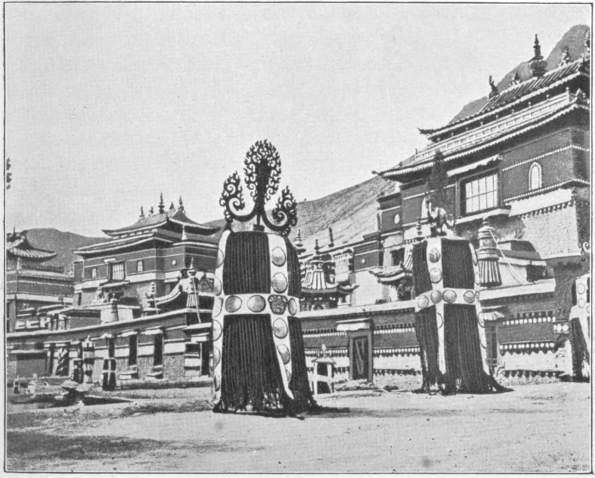
109. Religious Decorations on the Roofs of Tashi-lunpo to exorcise Evil Spirits.
This was little encouraging to me, a stranger, who had come from the north without permission, and of whom no one knew what spirit he was. And then next day was the New Year festival, which I could not attend without some understanding, especially as the Tashi Lama himself would be present. But he must know something about me, or how could Ngurbu Tundup’s arrival at Ngangtse-tso with the letters be explained?
Meanwhile we awaited the course of events, and went out with a paper lantern to inspect one of the horses which had died in his stall and must be removed. Why could he not remain alive now, when the mangers were so full of barley, straw, and chaff, and the animals stood against a wall which sheltered them from cold and wind, and had an idle time before them? Five of the veterans and the last mule from Poonch were still living, the last six of the splendid caravan which had set out from Leh six months before. All the rest lay in Chang-tang and the storms roared above them. These six should be cherished as the apple of my eye and be well cared for. Their sore backs should be washed and rubbed, their flanks groomed, at night they should sleep in cloths, and of barley and chaff they should have abundance. The ground beneath them should be strewn with straw, and they should be led to water at regular times. I stroked my small grey, but he bit and kicked as usual. He, of all the veterans, was in the best condition, and Guffaru declared that he could cross the Chang-tang again if necessary.
We were very comfortable in the garden. To right and left of my tent stood Robert’s and Muhamed Isa’s, and that of the Ladakis a little farther off, and huge fires burned as usual before the latter two. A man and woman of Kung Gushuk’s household lived in a wretched hut in the entrance gate, and procured for us anything we wanted. The woman was old and infirm, and her face was bedaubed with black, but she was exceedingly friendly. She was always coming to my tent, bowing, giggling and grinning out of pure goodwill.
On February 11 I was awaked at half-past six with the news that two men wished to speak to me at once. The brazier and warm water were brought, I dressed in great haste, the tent was swept and put in order, and then I sent to invite my guests to enter. The one was a tall lama of high rank, named Lobsang Tsering, and he was a secretary of the Tashi Lama; the other, Duan Suen, was a Chinaman, with handsome and refined features. Both were extremely polite and had polished manners. We talked for two hours on all kinds of subjects. Singularly enough, my arrival in Shigatse seemed to be a complete surprise to both gentlemen. They inquired my name, the route by which I had come, and my intentions, and, of course, had never heard of poor little Sweden; but they wrote down the Swedish, English, and Chinese names of my country.
“I intend to be present to-day at the New Year festival,” I said. “I cannot leave Shigatse without witnessing one of the greatest church feasts.”
“A European has never attended our festivals, which are intended only for Tibetans and pilgrims of our faith, and permission will never be granted to witness them.”