Front matter (continued 3)
Reading edition
At length we go down steeply into the valley over a disagreeable slope of detritus crossed by a number of small water channels. On the left opens a large trough-shaped valley, where we can perceive in the upper part three snow-covered glacier tongues with fissures in the ice-front standing out clearly. From these a large brook issues, which unites with the brook from the pass into a greenish-grey foaming river. From their confluence we see the whole length of the valley which we must traverse to reach our camping-ground. It is deeply and boldly eroded; the foaming river occupies the whole of its bottom. We must therefore keep to the steep banks on the right side, 300 to 600 feet above the river. Here the ground is detestable—coarse, sharp pebbles forming the edge of a terrace—and as we have to ride along the outer edge we should roll down the slope and break our necks if the horses made a false step.
Here one of the Pobrang dogs came towards us; he made a wide detour to avoid us, and did not once look at us when we tried to coax him. Probably he suspected that we were on the way to inhospitable regions, and thought he could lead a more peaceful life at the miserable huts of Pobrang. At length we came down over swampy moss-grown rubbish mounds to the camp, which was situated just where our valley ran at an angle into the Spanglung valley, in the midst of lofty mountains where nothing could be heard but the monotonous roar of the two streams. Wearied out, we threw ourselves into our tents and enjoyed the pleasant heat of the brazier. Bikom Sing went up the mountains and shot at an antelope, but missed. Muhamed Isa said jestingly that hitherto the Rajputs had done no more than the puppies. He did not include them at all in our muster roll; in his opinion they did nothing but consume our stores of meal and rice; but he was unjust in condemning them before they had had an opportunity of distinguishing themselves (Illustrations 48, 49).
The moon shone, a cold pale sickle, over the mountains, and we were glad to get to rest; after such a day the night comes as a friend and deliverer.
Our route to Pamzal continued downwards along the Spanglung valley, sometimes about 150 feet above the bottom, where some snowdrifts resisted the warmth of the short summer, sometimes on sharply defined terraces forming several steps. The road was bad, for the whole country was full of detritus. On the right opened the Lungnak valley with small snowy peaks in the background, and before us towered the great dark range lying on the north side of the Chang-chenmo valley. The Manlung valley runs up from the south-west, and its stream contributes a large addition of muddy water to our valley.
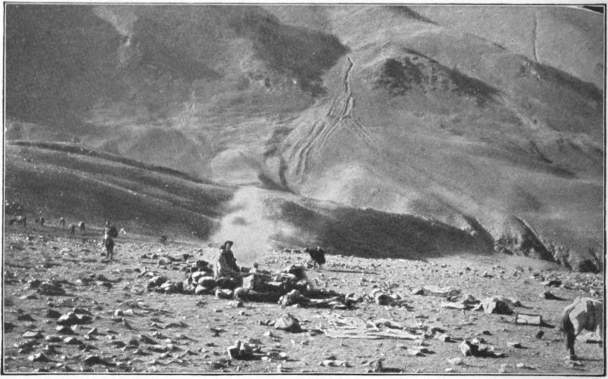
49. Spanglung.
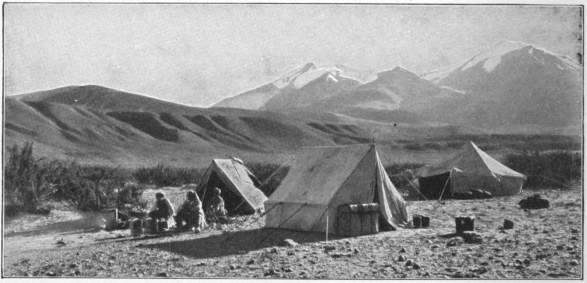
50. Camp near Pamzal.
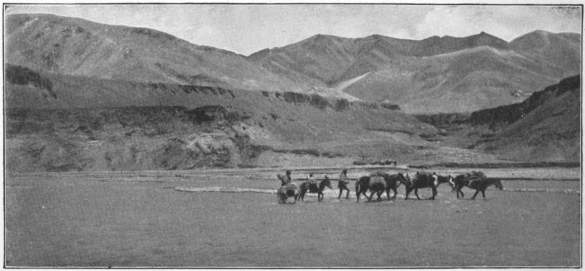
51. The Chang-chenmo and the Way to Gogra.
As we advanced farther, other grand snowy mountains and jagged peaks came into view—these are the heights that enclose the Chang-chenmo valley. At last the path turned into this valley, and we bivouacked on the small strip of vegetation on the left bank of the river (Illustration 50).
Towards evening the river rose considerably; when we measured its volume next morning we found the discharge to be 494 cubic feet a second, and large strips of the stony bed were still wet from the high-water in the night. In summer one cannot ride through the river at this place; then it rolls enormous floods down to the Indus. Its name is Kograng-sanspo, while Chang-chenmo denotes rather the whole country around. The Ladakis said that the summer would here last twenty days longer; after that the nights would become cold but the days remain fairly warm; then, however, winter would come with ever-increasing rigour.
Eastwards five days’ march brings one to the pass Lanak-la, which belongs to the colossal ridge of the Karakorum mountains running right through Tibet. Some English travellers have crossed this pass. To me the road was closed. I had promised Lord Minto not to act against the wishes of the English Government, but I should like to know who could have prevented me now.
On August 28 we left this pleasant, quiet spot, and now it would be long before we came again to so low a level. We were constantly increasing the distance from roads and human dwellings; for some time yet we were to remain in known country, and then the vast unknown land in the east awaited us. The day was fair and warm when I set out with my usual companions, Robert, Rehim Ali, one of our Mohammedans, and the two drivers from Tankse and Pobrang.
The terrace on the left bank, on which we ride, is washed by a branch of the stream which is very muddy, forms small rapids, and usually divides into several arms. The whole of the valley bottom is grey with rubbish; the river water has much the same colour, and therefore is not conspicuous in the landscape. There is no living thing anywhere around, neither tame yaks nor wild animals, and not a sign of men. But a faintly beaten footpath shows that mountaineers occasionally wander here. It guides us down to the river again, at a point opposite the narrow, deep, and boldly sculptured transverse valley Kadsung with the usual terraces, from which emerges a brook of clear, blue, beautifully fresh water and mingles with, and is lost in, the dirty grey water of the main stream. Here the path again turns upwards and affords a short cut over a small pass to our camp for the night. We could see at a distance that in the middle of the steep slope where the path runs there had been a landslip, and a deep fissure formed which we could hardly cross until some alterations had been effected. A troop of men were sent in advance with spades and pick-axes, and meanwhile the various sections of the caravan collected together on the bank.
Some men examined the ford on foot, for here we had to cross the main stream. The water certainly foamed up to the houghs of the horses as they were led over in long files, but the depth was nowhere more than 2½ feet, and all came safely to the other bank. The yaks evidently liked the bath; they waded through the water as slowly as possible, and my boat was poised over its own element without touching it. The most difficult task was to get the sheep and goats over. The whole flock was driven to the water’s edge, and some were seized by the horns and thrown into the river, though they struggled frantically. But the rest found the situation too disagreeable, turned tail and made a wild dash up the nearest terrace. Again they were all driven to the bank, and were there shut in by a line of men and pushed into the water, and as the first had now made up their minds to wade, the others followed and bravely struggled against the current (Illustrations 51, 52).
Immediately after, the caravan was seen labouring up the steep slope; it was a pretty sight, but not without danger. The sheep did not keep to the path, but climbed about in search of food.
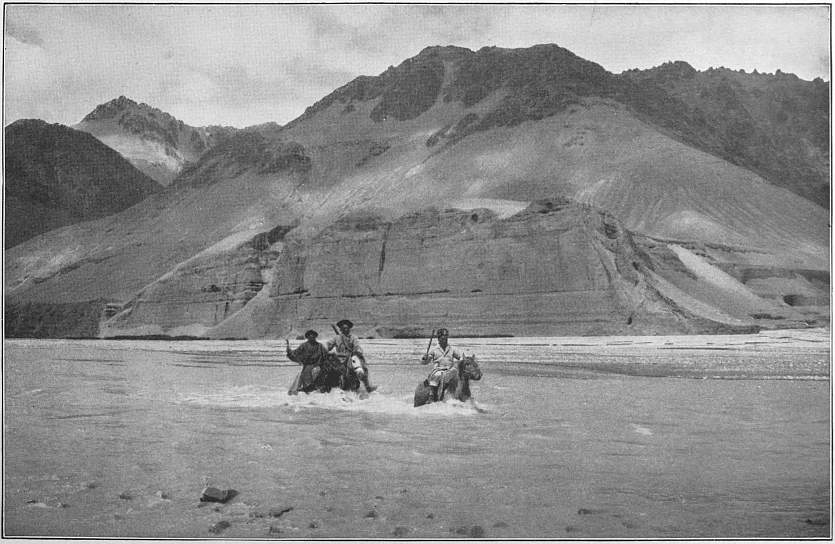
52. Muhamed Isa in the River Chang-chenmo near Pamzal.
A couple of minutes after the little pass Mankogh-la is left behind there is a bird’s-eye view of the valley of the Kograng-sanspol, at any rate of the upper part, which we had followed from Pamzal; it makes here a sharp turn, and we came over hills and spurs down again to the river-bank. The camping-ground, which has fairly good pasturage, is called Gogra. From here two valleys run up to the main crest of the Karakorum range, the Chang-lung-barma and the Chang-lung-yogma or “the middle and the lower north valleys.” Both valleys would take us to a nasty pass; we chose the second. We must get over somehow or other, and at dangerous places the most valuable baggage could, if necessary, be carried by men. With his cap on the side of his head, his fur coat thrown negligently over his shoulders, and the inevitable pipe in his mouth, Muhamed Isa stalked like a field-marshal through the smoke of the camp-fires and issued his orders for the next day’s march. None of our men, indeed, knew the road, but from their uncertain reports we could gather that we had a nasty bit of work before us.
We did not reach a much greater height during our march, but we had to go up and down over so many hills and steep declivities that the day’s journey was as trying as though we had surmounted a number of passes. The river was now considerably smaller, as many of its tributaries had been left behind. Nevertheless, it was more troublesome to ford than before, for the whole volume of water was confined to one channel, and the fall was greater. It seemed hopeless to drive the sheep into the cold water where the current would carry them away. The shepherds were at a loss what to do when I lost sight of them, and I do not know how the passage was accomplished; but they came across somehow, for they reached the camp all safe and sound. The dark-green schists in this neighbourhood are partly much weathered, partly hard and untouched. A large cairn stands on a hill, and one of the men asserted that an old road to Yarkand ran past here, while Guffaru affirmed that some, at least, of Forsyth’s companions travelled through this country.
The headwaters of the river flow from a large valley to the north-west, its background formed by snow mountains, while we follow the heights above a side valley, which, seen from above, has a grand and almost awesome aspect. A small, clear brook murmurs melodiously along the bottom. Then again we descend over soft red dust and rubbish. Small cairns mark the route, and guide us down to the bottom of the valley, here very narrow, and confined between steep, dark schistose rocks. A little higher up the rocky walls are perpendicular, and the river finds its way through a dark gorge. We therefore have to climb up the right side to avoid the difficult spots, and the ascent is very steep. Here the caravan came to a standstill; Muhamed Isa’s gigantic form was seen at the worst point of the ascent. Every horse had to be assisted up by five men. One tugged at the bridle, two supported the load at either side to prevent it slipping off, and two pushed behind; as soon as somewhat easier ground was reached the baggage was put to rights and the cords tightened, and then the horse had to get along the track without help.
In the Chuta district, where we again find ourselves at the valley bottom, warm springs of sulphurous water rise out of the earth. One of them has built up a pyramid 10 feet high, somewhat like a toad-stool; the water bubbles up from the centre of the crown, and drops down the sides, forming a circle of stalactites around. The water as it leaves the orifice has a temperature of 124° F. Another spring, which sends a jet of water right into the river, has a heat of only 108°. At many places on the bank and in the river-bed the water bubbles up with a simmering noise.
After more rugged slopes of rubbish and loose yellow dust we arrived at last in the Chang-lung-yogma valley, where the pasturage was very scanty. In the evening it snowed hard, and the valley was veiled in a mystic light, which was perhaps a faint reflexion of the moon. A couple of fires flashed out of the mist and lighted up the large tent of the Ladakis. Only the murmur of the brook broke the silence. Suddenly, however, repeated shouts resounded through the stillness of the night—perhaps some horses had taken into their heads to stampede to more hospitable regions.
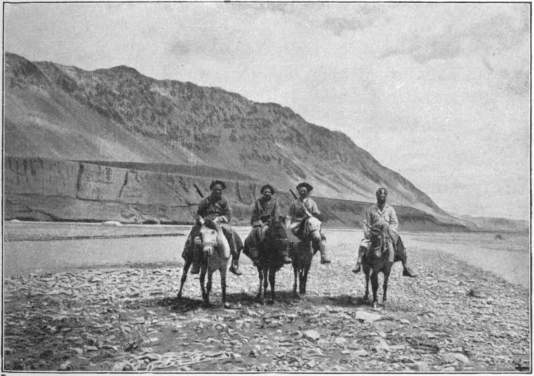
53. Rabsang, Adul, Tsering, and Muhamed Isa.
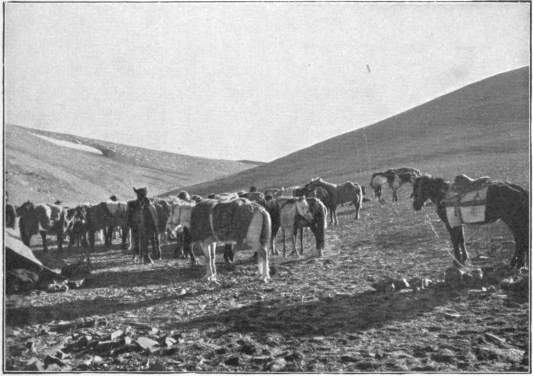
54. Our Horses at the Karakorum.
We needed a day’s rest in this camp, for before us was the high pass which forms a watershed between the Indus and the isolated drainage of the plateau. Muhamed Isa and Sonam Tsering rode up the valley to reconnoitre, and, meanwhile, Robert and I repacked my boxes amidst alternations of sunshine and snowfalls; winter clothing and furs were taken out, and the tent bed was put aside; henceforth my bed was to be made on the ground, on a foundation consisting of a waterproof sheet and a frieze rug; by this method it is much easier to get warm.
On the last day of August the ascent was continued. The country was white with snow, but before noon the ground was clear again. I now rode a small, white, active Ladak pony; it was sure-footed, and we were soon good friends. A small stone wall at a bend of the route shows that men have been here; but many years have probably elapsed since their visit, for there is no sign of a path or other indications of their presence. All is barren, yet it is evident that wild yaks have been here not long ago. Muhamed Isa set up three cairns at the mouth of a very small insignificant side-valley for the guidance of the expected post-runners. Here we turned aside from the main valley. The contours of the mountains now become more rounded, the relative heights diminish, and the valleys are not so deeply excavated as on yesterday’s ride. The rivulet, which we follow up to its source in the main ridge, is the last connected with the system of the Indus, but still it is a child of the Indus, and carries to the sea news of this elevated region. Winter will soon chain up its waters, soon it will fall asleep in the cold and frost, until the sun calls it to life again in spring (Illustration 55).
An old yak skull was set up on a rocky projection and grinned at us—another of Muhamed Isa’s waymarks. There were several yapkak plants, hard as wood, in a small hollow, but even this meagre forage was no longer to be despised. We therefore pitched our camp here at a height of 16,962 feet, or about 1300 feet higher than Mont Blanc. This camp was distinguished as No. 1, for we were now in a country beyond the range of topographical names. A huge stone pyramid was erected among the tents, for the men had nothing else to do while the animals were gnawing at the yapkak stalks close by.

CHAPTER VII
OVER THE CREST OF THE KARAKORUM
We had a hard day on September 1. The ground was white, and the sky had a threatening aspect, but a small blue strip to the south gave hopes of fine weather. We started early, and as I jumped into the saddle I saw the whole narrow valley filled with the various sections of the caravan. When I consigned my tent to its fate, that is, Tsering and the Hindus, our deserted camp-fires were still smoking, and the new cairn stood out black against the snow. We left camp No. 1 with some excitement, for now we were approaching wild lands in real earnest, and were to cross a pass of the first rank, which none of my people was acquainted with, and of which we knew only that it was called Chang-lung-yogma; it lies a little east of the pass marked on the large English map of north-east Ladak, and, as far as I know, no European has yet made use of it.
The terraces along the river bank gradually come to an end, and, where they do occur, they are only a couple of yards high, and disturbed by frequent landslips. Our route runs to the north-east. In front of us appears a pure white saddle, now flooded with sunshine; we take it for the pass; but no, the mules, as shown by their tracks in the snow, have turned in another direction.
The flanks on both sides consist of loose, extremely fine material, wet and crossed by clefts a foot deep. At the edge of some spurs these clefts run like the curved fissures of a glacier tongue. The ground is unstable; the slopes slip down and are displaced by their own weight, for they are soaked through, and there are no roots to hold the fine material; they are in a state of motion, and the gently rounded forms prevailing in the landscape are the result of this phenomenon.
The silence of the desert reigns in this country where the feet of man have never wandered; only now and then are heard the warning shouts of the caravan men. Not one of the animals is left behind, all goes on satisfactorily. May all this hard day’s march pass fortunately! The valley becomes quite narrow, the water trickles out of the gravelly soil in quantities barely sufficient to form a brook. But even on this gravel the animals sink in the mud.
At the foot of a trough leading up to a side-pass, which had led us astray, the caravan came to a halt, and an accessible passage was searched for.
I rode forwards up innumerable zigzags, and stopped at every corner to take breath. Muhamed Isa reported that the true pass had been found, but I rode with Robert up to a height rising above all the land around, to reconnoitre.
The view from this point was far too striking to be sought merely for the purpose of orientation. Above and behind the mountains in the foreground, some of them coal-black, appeared a white horizon and a jagged line of mighty Himalayan peaks. A really magnificent landscape! The sky was almost clear; only here and there floated a few white clouds. Down below us lay the small valley through which we had struggled so laboriously; here it looked ridiculously small, an insignificant drain in a world of gigantic mountains. Some detachments of the caravan were still toiling up the narrow way, and the shouts and whistles of the men mounted up to us. The horizon was quite clear, not enveloped in haze, as it frequently was; its outlines were exceedingly sharply drawn; silver-white, sun-lighted summits towered up above and behind one another; generally the fields of eternal snow gleam in blue tints of varying intensity, now dull and now dark according to the angle of the slope in relation to the sun’s altitude; now shade and light pass gradually and insensibly into each other, now they are sharply defined. Here physical laws work out their perfect complicated scheme, exacting absolute obedience. On a shelf below us a part of the caravan halts and puffs; the animals appear like black spots on the snow. Up here the south-west wind enwraps us in swiftly passing clouds of whirling snowflakes.
All this agitated sea of the highest mountains in the world seems singularly uniform as the eye passes unhindered over its crests. You conceive that no summit rises above a certain maximum height, for before its head lifts itself above the crowd, wind and weather, denudation, have worn it down. In this the mountains are like ocean waves; when these, too, rise in foaming wrath, their undulations, seen from the ship’s deck, are of equal height, and the horizon is a straight line; and it is just the same with the small ridges between the furrows thrown up by the plough, which are all of uniform height; so that the field seems in the distance quite level.
The horizon seemed to be very far off; nearer heights broke the sky-line only to the north and north-east, hiding those behind, and in this direction thick clouds were hanging, white above and dark and bluish underneath, and lay like soft cushions on the earth. There was, then, no suggestion of a plateau, but far in the north a mountain range seemed to rise right up to heaven. In the north-west a main crest was plainly visible, starting from our point of observation, that is, the height on which we stood. This is the Karakorum range. The whole ridge here took the form of a rounded back, without solid rock, and intersected by numerous small valleys, all starting from the crest, and cutting gradually deeper and deeper into its flanks. The main ridge winds like a snake over the highlands, and the erosion valleys diverge on all sides like the boughs of a tree. Here horizontal lines predominate in the landscape, but lower down, in the peripheral region, vertical lines catch the eye, as in the Chang-chenmo lateral valleys. Down there the scenery is more imposing and picturesque, up here the surface of the earth appears rather flat; here is the abode of storms, and their boundless playground in the long dark winter nights.
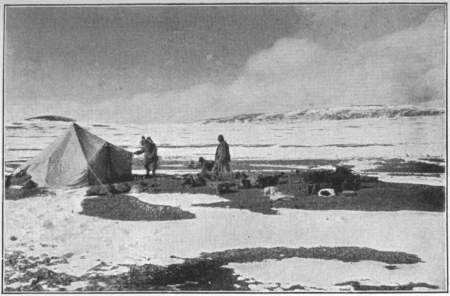
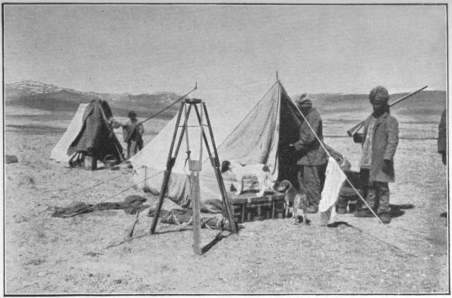
55. In the Snow, N.E. of Chang-lung-yogma. 56. My Tent.
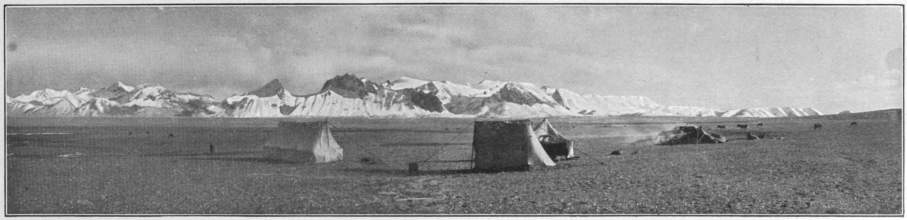
57. Lake Lighten.
Chilled through to the bones we walked down to the pass gap, where the whole caravan was assembled; here the height was 18,963 feet, and the temperature 2° above freezing-point. The men were too tired to sing, but we had good reason to be satisfied, for all the animals had got up safely with their burdens. We slowly descended along a small valley running northwards. The ground consisted entirely of mud, in which the animals sank at every step, and in the footprints they left behind muddy grey water collected immediately. Round about us lay a chaos of comparatively low, flat hills, furrowed everywhere by clefts which indicate landslips. A tiny rivulet winds silently down the middle of the valley without forming rapids. For the rest, all the country was flooded, and so we had no immediate fear of scarcity of water.
Where we encamped not a blade of grass could be seen; there was, therefore, no object in letting the horses run about loose, so they were tied together in couples, and had to stand waiting till the sun went down. Then Guffaru sat down on a rug, had a sack of maize placed before him, filled a wooden bowl with the grain, and emptied it into a nose-bag, which a Ladaki hung on the muzzle of a horse. And so the men ran about till all the animals had received their rations, and the dry, hard maize corns cracked under the teeth of the hungry beasts. The Ladak horses positively refused to eat maize, and were given barley instead; they whinnied with delight when the bags were brought, but the pleasure did not last long; the chewing gradually ceased, and with lowered heads and blinking eyes they wearily waited for the long night.
Some spare horses were laden with dry yapkak plants; at camp No. 2 there was not a particle of fuel. We were now at a height of 18,215 feet.
In the morning we took leave of Chenmo, the Kotidar of Tankse, and Zambul, the Numberdar of Pobrang, who turned back here. They would be able to enjoy warm winds and bright sunny days again. Besides a liberal reward for their valuable services they each received a testimonial in flattering terms. They took my letters with them, and were to give the messengers instructions about the route, should they fall in with them. Our party was thereby diminished by six men, three horses, and seven yaks (Illustration 46).
There were now only three men in my detachment, namely, myself, Robert on horseback, and Rehim Ali on foot. We turned with the brook to the north, and had hilly elevations on both sides. The country was, as it were, dead—not a blade of grass, not a track of a strayed antelope; all organic life seemed to be banished from the neighbourhood. But when we had advanced a little further we found signs of the visits of man. A faint light streak on the ground seemed to be a path which had not been used for a long time, and beside it stood a cylindrical cairn surmounted by a slab of stone. At one spot, too, lay several skulls of horses and yaks; yet hunters, they say, never wander hither. Perhaps it was a memento of the cartographical work of the Survey of India, or was connected with the European pioneers who many years ago travelled backwards and forwards between Eastern Turkestan and India.
The weather was quite Tibetan. One shower of hail after another chilled us through, and drove a cold douche into our faces, but the sun was always shining somewhere within sight. Long sheets of hail fell from the clouds, which seemed of very insignificant volume, but they could not whiten the ground. It seemed dry as tinder, in contrast to the wet slopes on either side of the Karakorum Pass. Dust even rose now and then behind the horses. Far in front of us we saw two dark points on the yellowish-grey land—they were a horse and its guide which had lingered behind the others.
The long procession of the caravan moved extremely slowly along the descent. It made a halt, so pasturage had been found! Ah, no—the soil was just as barren here as along the other 12 miles we had travelled this day. So, as yesterday, the horses had to stand tied together, and the nose-bags of barley and maize were strapped round their necks.
In the twilight I summoned Muhamed Isa to a council of war.
“How long can the animals hold out, if we find no pasture?”
“Two months, sir; but we shall find grass before then.”
“If the marches are no longer than to-day’s we shall take ten days to reach Lake Lighten, which Sahib Wellby discovered twenty years ago, and the route lies through Ling-shi-tang and Aksai-chin, which are some of the most desolate regions in all Tibet.”
“Then we will try to make forced marches, to get through the bad country as quickly as possible; in the neighbourhood of Yeshil-kul the grazing is good, according to Sonam Tsering, who has been there.”
“How goes it with the animals?”
“They are in good condition—only a horse and a mule are tired out, but we will let them travel awhile without loads. As for the rest, their loads are a little heavier now that we no longer have the seven yaks. But that will soon right itself.”
“How are the hired horses?”
“They are all right except two, which are on their last legs, and which we shall soon lose.”
“See that the animals are spared as much as possible and are well cared for.”
“You may depend on me, nothing will be neglected. In camps like this they get more maize and barley than usual, but where there is pasturage we will be more sparing of our supplies.”
On September 3 the level plateau was hidden in snowdrift and mist, and it was hard to decide in which direction to proceed: we agreed, however, that none of us should lose sight of the brook, for apparently no other water was to be found. We had not gone far when snow began to fall, a sharp south-west wind arose, and the whirling snowflakes hid even the nearest hills. It now snowed so thickly that we were afraid of missing the track of the caravan, which was far in front of us. According to the English map we could not be far from a small salt lake, but in this weather we were unable to obtain any notion of the lie of the land, and it was no use to climb a hill in order to look round. We sat in the saddle pelted with snow, but the snow soon thawed on our clothes, leaving an unpleasant smell of dampness behind.
But this weather did not last long; the heavy dark blue and purple clouds parted asunder like curtains, and continued their rapid course to the east; the view was clear again. Some scouts, who had gone in advance, discovered some fine yapkak plants on the left bank of the river, and our hungry animals were glad to put up with these. Three antelope tracks we crossed were regarded as a good sign; there must be pasturage somewhere about, but where?
The next day’s march led us over an apparently level plain, begirt by a ring of mountains, and our direction was on the whole north-east. We started simultaneously. I rode all along the caravan, which made a fine show. The animals did not march in file but in scattered troops, and their footprints combined to form a broad highway. The mules keep up bravely, and are always in the van. Several of the horses are suffering, and lie down from time to time, only to be roused up immediately by the Ladakis. Muhamed Isa leads the way on foot; he is the lodestone which draws after it the whole company.
Now we tried to cross the broad swampy bed of the stream. Muhamed Isa mounted his horse, but his steed sank in up to the belly; we had to give up the attempt and follow the bank instead. At times we had to cross side channels with the same treacherous ground. When the pilot had shown the way, some laden mules followed; then the other animals came all together. They sank up to the knee in the squelching ooze, and the ground behind them looked like an indiarubber sponge.
At ten o’clock the daily storm set in. In the north-west its outer margin was marked with great sharpness. It rolled, huge, black, and heavy, over the plateau. Now the storm is over our heads and its first black fringes swallow up the blue expanses of the sky. Two ravens, which have faithfully followed us for some days, croak hoarsely; a few small birds skim twittering over the ground. The hail lashes us with terrible violence; it comes from the side, and the animals turn their tails to the storm, and thus leave the trail, and have to be driven again into the right direction. We do not know where we are going. I halt with Muhamed Isa for a moment’s rest on a hill.
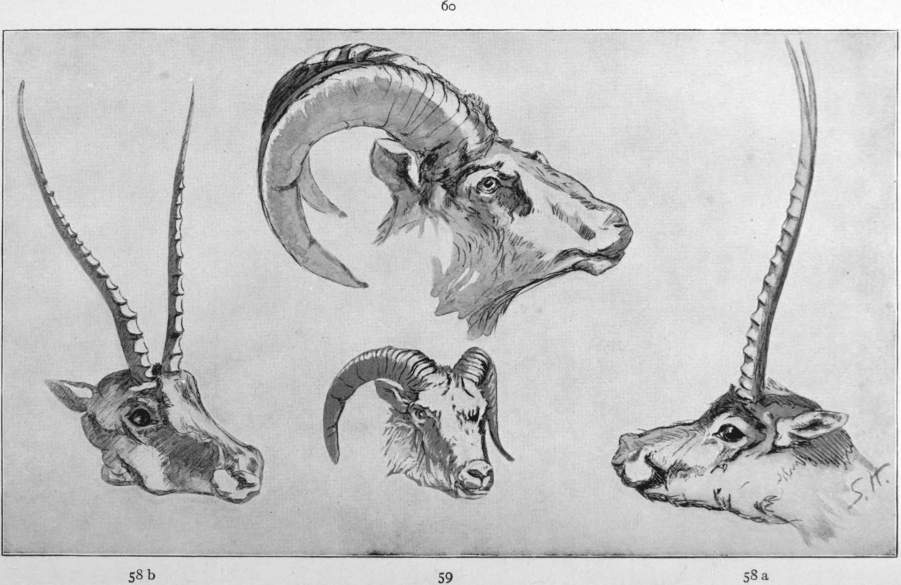
58 a, 58 b. Pantholops Antelope. 59, 60. Ovis Ammon. Sketches by the Author.
“It would be better if we filled some goatskin sacks with water, in case we lose sight of the stream,” he suggests to me.
“No, let us go on; it will soon clear up, and then we can consider the matter.”
And the train moves on in spite of the drifting snow and the wintry darkness. It grows light, and the eyes survey unhindered the dreary, hilly, snow-covered land; westwards extend the plains of Ling-shi-tang; to the south-east stretches the immense Karakorum range with peaks covered with eternal snow, where thunder rolls among blue-black leaden clouds. Soon this storm also reaches us, and we are enveloped in dense, fine, dry snowflakes, while the darkness of night reigns around us. I am riding at the tail of the train. The caravan is divided into four columns. We travel in the wake of the last, which looks almost black through the mist; the one in front of it appears as a dirty grey patch; the next is hardly perceptible, and the foremost is almost quite invisible. Muhamed Isa has vanished. The snow now changes into large feathery flakes, which sweep almost horizontally over the ground. All is silent in our company; no one speaks: the men walk with their bodies bent forward and their fur caps drawn over their ears. The whole party looks now like snow men, and the snow makes the loads heavier for the animals than they need be.
At last our old friend, the brook, peeped out again from the duskiness, and we pitched our camp on the bank. Tsering discovered abundance of yapkak plants close at hand—some green, to which the animals were led, others dry, and very acceptable as fuel. In the evening there were 5½ degrees of frost. The moonlight fell in sheaves of rays through an atmosphere full of fine snow crystals. Absolute silence! One can hear the puppies’ hearts beat, the ticking of the chronometer, the cold of night descending and penetrating into the earth.
The country we marched through on September 5 was good and level, especially near a small lake, which now showed its blue surface in the south-east. Like all other salt lakes in Tibet it seems to be drying up, for we travelled for some distance over its dry muddy bed, and saw, higher up, plainly marked old terraced banks. Muhamed Isa reported that an exhausted mule would probably not be able to cross a pass in a small ridge which barred our way. It managed, however, to get over, and came into camp in the evening, but was thin and exhausted. Two Pantholops antelopes, easily distinguishable by their long, lyre-shaped horns, sped away southwards, and we came across a wolf’s spoor. In some spots the pasture was so good that we halted a few minutes to let the animals feed. We were sometimes tempted to pitch our camp, but yet we passed on. At last we bivouacked in an expansion of the valley with a stagnant creek, yapkak, and thin grass. We had scarcely hoped to find these three things so necessary to us—pasturage, fuel, and water, so soon and so close to the Karakorum. In this camp, No. 6, we decided to give the animals a day’s rest after all their exertions (Illustrations 58 a, 58 b).
On September 7, at daybreak, six miserable jades were picked out from the hired horses, and, as their loads were already consumed, were allowed to return home with their two guides. The sick mule lay dead. The sky was perfectly cloudless and the day became burning hot. In another respect we entered on new conditions, for, though we had covered 19 miles, we had not seen a drop of water before we reached the place where our camp was pitched. It seemed not unlikely that the monsoon clouds would come no more over the Karakorum, and then scarcity of water might render our situation very critical.
The direction of the march was determined for us by open country lying between low, round, reddish hills. The ground would have been excellent if field-mice had not undermined it, so that the horses continually stepped into the holes and almost fell on their noses. The mice certainly did not show themselves, but it was too early in the year for their winter sleep. The broad valley opened into a colossal cauldron, skirted on all sides by grand mountains, a regular Meidan, as the men of Turkestan call such a valley. To the north the mountains between the Karakash and Yurungkash lift up their lofty peaks, and in the south the Karakorum diverges farther and farther from our course.
Antelopes career over the plain in light flying leaps; they stand motionless, watching us, but as soon as we come near dart off as though on steel springs, and soon vanish in the distance.
A mountain spur in front of us seemed a suitable point to make for, where water would surely be found. But hours passed and it seemed no nearer. A dying horse detained me; he was relieved of his load, but he was quite done for. I was very sorry for him, and regretted that he could not come with us any farther. I stayed awhile to keep him company, but the day was passing, and the two men who were with him were ordered to cut his throat if he could not get on. My Ladakis thought it dreadful to desert a horse as long as it lived; its death-struggle might last for hours, and its last moments would be horrible if wolves got wind of it. It was a tall, black Yarkand horse; in the evening its number was entered in the list of the dead.
The caravan was moving in a black line to a ravine between the hills, where a faint greenish tinge seemed to indicate grass. A short time after, however, it came down again and marched out of sight; probably there was no water there. Another fairly long space of time went by before we distinguished on the plain westwards small black spots and lines, whether wild asses or our own mules we could not determine. The field-glass would not reach so far. At the foot of a mountain in the west shone a silvery brook, but it was a long way off, and all distances were so great that the atmospheric effect misled us, and what we took for a caravan might be only a shadow on an erosion terrace.
But Robert’s sharp eyes detected the smoke of a signal fire at the foot of the mountain. The caravan had, then, reached it and set the camp in order, and after a ride of an hour straight across the plain we joined it. Here the height was 16,250 feet.
We were now in a country belonging to the unannexed region Aksai-chin, in north-west Tibet. Or tell me to what Power this land belongs? Does the Maharaja of Kashmir lay claim to it, or the Dalai-Lama, or is it a part of Chinese Turkestan? No boundaries are marked on the map, and one looks in vain for boundary stones. The wild asses, the yaks, and the swift-footed antelopes are subject to no master, and the winds of heaven do not trouble themselves about earthly boundary marks. From here, therefore, I could move eastwards without acting in direct opposition to the wishes of the English Government, and the Chinese would certainly forgive me for not using their passport.
The distant mountains in the north, which had but now stood out in rosy colours like rows of houses in a great city, now grew pale in the grey twilight, and the grand contours were obliterated as another night spread its dark wings over the earth. A flute sounded softly and sweetly among the tents, and its tones lulled our weary wanderers to rest.
The following morning the camp looked unusually small, for the hired horses and mules had remained behind on the plain, where their guides had found water by digging. They were thus spared a considerable detour. As a precaution we took a couple of goatskin vessels full of water, and filled all the bottles and cans. Just before starting we saw our Ladakis lying full length by the overflow of the spring thoroughly quenching their thirst, and the horses were allowed as much water as they liked.
This day’s route was excellent, firm and level; the great trunk road in India could not be better, and hardly a highway in Sweden. Masses of clouds appeared from the east round to the south-west; a storm was probably raging in the Karakorum, but its outskirts never reached us. Here the ground was dry, and the exceedingly fine dust stirred up by the caravan hung like steam over the earth. The other columns, like ourselves, made for a goal previously agreed upon, a mountain spur in the north-east. As we approached it, we speculated whether we should see beyond it Aksai-chin, the lake Crosby passed in 1903.
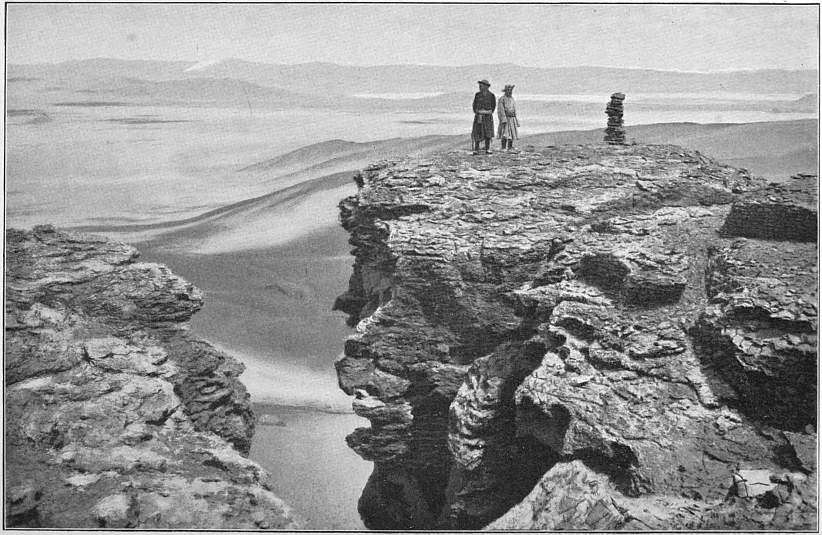
61. A Gully at Camp 8 (Aksai-chin).
North of the spur a large flat plain extends, and here the mirage was marvellously perplexing. The mountains seemed to be reflected in a perfectly calm lake, but the surface did not look like water—it was bright, light and airy; it was as transitory as a play of colours in the clouds, and seemed as though it had a foundation of transparent glass. The mule caravan, now in front of us, was also the sport of the mirage: we saw it double as if it also were passing beside a lake.
At last we reached the spur and rested there awhile. Robert climbed up the side to look for the expected lake; as he came down the detritus began to move, our horses were frightened and wildly stampeded towards the east. Fortunately, they followed the track of the caravan, which was in the act of pitching the camp. The grazing at camp No. 8 was the best we had seen since Pobrang, and water was obtained by digging at a depth of 22 inches. Kulans had supplied the fuel, for their dung was plentiful. The place was so comfortable that we remained here the following day, and made an excursion to an elevation of sandstone and conglomerate almost in the form of an upturned dish, which stands on the south of the plain and turns its sharply clipped margin to the north. On the top Muhamed Isa erected a cairn—he had a mania for cairns. Little did I dream then that I should see these landmarks again a year and a half later (Illustration 61).
At dawn next day we made another advance into the forbidden land. The air was not quite clear, and we saw it quivering over the ground; but above it was clearer, for the crests of the mountains were more sharply defined than their feet. We marched eastwards; on our right was blood-red conglomerate, which lay upon green schists. On the left the lake was now visible, its deep blue surface contrasting vividly with the dull tones which prevailed elsewhere. The sight of a lake was refreshing; it gave the crowning touch to the scene. The country was open eastwards to the horizon; only in the far distance one snowy mountain appeared in this direction, but probably our longitudinal valley extended along the north or south side of this elevation. In short, the land was as favourable as it was possible to be, and remained so for several days; and I suspected that Lake Lighten, the Yeshil-kul, and the Pul-tso, known from Wellby’s, Deasy’s, and Rawling’s travels, lay in this valley, which in every respect was characteristic of the Tibetan highlands.
The ground was like a worm-eaten board; the holes of the field-mice lay so close together that all attempts to avoid them were vain. Even on the intervals between them one was not safe. Frequently the roof of a subterranean passage, consisting of dry loose soil mixed with gravel, broke in. Robert once made a somersault with his horse. These troublesome rodents, which live on the roots of the yapkak plants and grass, are very irritating.
The caravan had camped close to the shore, beside splendid water, which a brook poured down in great abundance into the salt lake. Late in the evening we saw a fire burning in the far distance. Was it another traveller, or had hunters wandered thus far? No, it was some of our own people, who were watching the animals and had kindled a fire to keep themselves warm. There were no men in this desolate country but ourselves.
CHAPTER VIII
TO LAKE LIGHTEN
We left camp No. 9 (16,171 feet) with a feeling of satisfaction, for the country, as far as the eye could reach, was quite level; its elevation above the lake shore was so insignificant that it could not be detected without instruments. The atmosphere was hazy; the pure blue of the lake, a reflexion of the sky, had quite disappeared, and now the water looked dull and grey. One of the hired horses was left behind at the camp; its owner hoped to save it, but he was disappointed, and he also betrayed the horse, for he took another way home and mercilessly abandoned the poor animal to solitude and the wolves.
We rode a long distance on the old lake bottom and perfectly level stretches of clayey mud. Afterwards the soil was of fine gravel, and as hard as though it had been compressed by the weight of a steam-roller. Only in an isolated drainage basin can such level expanses occur among huge mountains. Weathering, precipitation, flowing water, storm and wind work together in levelling the land. All heights and ridges are thereby reduced, all hollows are filled up with mud, sand, and rubbish. Far in the east the country is quite open. Here giants riding on Indian elephants would have room enough to play a game of polo in grand style, and the swift-footed Jambas dromedaries might run till they were tired, for even the restless west wind finds no obstacle in its path. Antelopes and kulans appeared in timid herds. Of human beings not a sign. Yesterday some of the men saw three stones placed together to form a hearth; perhaps they had to do with Crosby’s expedition (1903), for he, too, passed eastwards from the Aksai-chin lake to Lake Lighten.
In the north, on the left side of our route, we could descry three stages or crests; nearest to us a row of small dark-green hills; farther off a continuous chain without snow on it, and quite in the background a main range with a number of snowy peaks. On the south our longitudinal valley was bordered by mountains gradually increasing in height towards the east. At camp No. 10 we found all we wanted, though the water was a little salt. Good luck followed us, and we had reached, quite fortuitously, a much more kindly country than we had ventured to expect.
Near the camp we crossed a stagnant creek and we passed several others on September 12. It soon turned out that a large river-bed, containing, however, little water, ran to the lake, and all day long we fell in with indications of its proximity. The landscape was monotonous, and showed little variety during the day’s march. But the ground was all that could be desired, and if it so continued, it would help us to make good progress into the heart of the forbidden land. Grass now cropped up in larger quantities than we had hitherto met with. It thrived best where the soil was sandy. It grew in small tufts, green and succulent only in the middle, for the rest was yellow and hard from the frosts at night. The west wind, which swept all day over Tibet, rustled pleasantly through the grass. Who would have looked for a true prairie up here in North Tibet? The ground was of a deep straw-yellow, but the vault of heaven above us was clear and blue in spite of the wind; it seemed to me as though an immense flag of the colours of my native country enveloped heaven and earth. North and south rose dark purple, greyish-yellow, red, and white-capped mountains.
The land was so level that the caravan, though it was an hour’s march ahead, was visible as a short, narrow black line against the horizon, not the slightest rise ever hiding it from sight. In consequence of the mirage it seemed to hover a little above the surface, and the animals looked like fantastic long-legged camels.
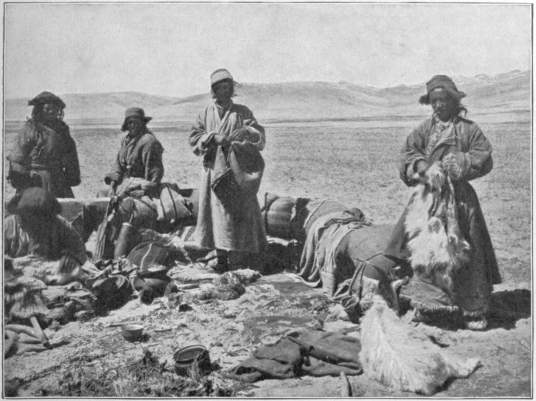
62. The Hired Ladakis and the Provision Sacks in North-West Chang-tang.
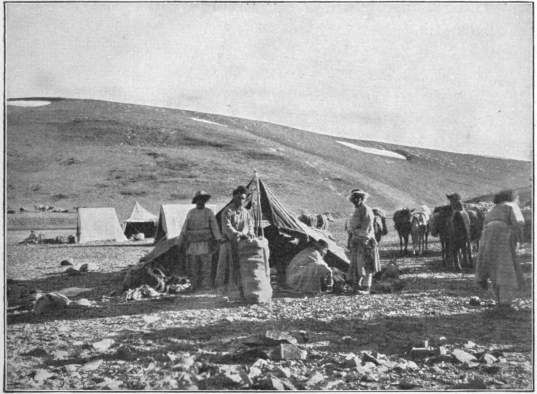
63. Namgyal with a Sack of Yak-Dung.
At a spot where the grass was unusually good the hired detachment had made a halt; it had lost another horse, and wished to try and save two other death candidates. The packs were strewed about the ground, the animals were grazing eagerly, and the men sat at the fire with their backs to the wind and smoked in turns from a common pipe.
Salt made the soil in some places white as chalk, in others a thin layer of coarse quartz sand occurred with a tendency to form dunes. The caravan had encamped, and small scattered black points showed us that the animals were grazing. A couple of spots, which were far removed from the others, were riders in search of water. It was not easy to pitch the tents; all the men must hold on with all their strength, lest the canvas should be blown away or torn into shreds, and at the same time coarse sand blew into their faces. We were glad to get under cover at last, but even then the wind roared and whistled through all the holes and chinks, and the puppies were very uneasy. But such a westerly storm has one advantage: it makes the march easier, pushing on behind. One needs only to turn and try riding against the storm to learn the difference.
The 13th began badly, for nine horses had made off in the night, and Muhamed Isa with some Ladakis had gone in search of them. Meanwhile we waited in a regular snowstorm. Manuel was engaged in a very lively dispute with Ganpat Sing; it was about a pair of stockings which the latter had bought from our cook in Leh. But now Manuel found that he could use them himself, and talked over Ganpat Sing to retract the bargain. Manuel often amused Robert and myself with his broken English. If it snowed, he said “The dew falls”; if it stormed, “There seems to be a breeze in the air to-day”; and when we left the lake he asked when we should come to the next “pond.” He thought the Aksai-chin lake a wretched puddle compared with the boundless ocean at Madras.
After five of the lost horses had been caught I started on the track of the mules. The land rose as slowly as before, nothing was seen of the mountains through the drifting snow; we might as well have been on the plains of Mongolia or the Kirghiz steppe. The camp this day was pitched by a source at the foot of the mountains on the northern side of the valley, where there was good pasture. In the absence of a tent we were housed in Sonam Tsering’s round fortification of provision sacks, where a fire burned in the middle and we were sheltered from the wind. Towards evening Muhamed Isa sent word that another horse had been recovered, but that it was impossible to look for the others in the driving snow, and he asked for furs and provisions from the main camp. The man, however, whose unenviable duty it was to return with these things to camp No. 11 through the darkness and snow, could not find the caravan-bashi and his companions, who had therefore to spend the night in the open, exposed to the frost and without food and drink. They were much exhausted when they rejoined us next day with all the missing horses. I gave my night watchmen a scolding, and insisted strongly that this must not occur again, for the animals were tired by these wanderings and exposed to the attacks of wolves, and the march was delayed. It was, however, really wonderful that we had so far lost only a mule and two horses (Illustration 64).
And now we went on eastwards, still in the same great longitudinal valley. The river contained more water the higher we mounted, for below the water was lost by evaporation and percolation into the ground.
The red conglomerate continued on our right, on the left were green schists. In the midst of the sterile valley we passed a small round oasis of grass, like a coral island in the ocean. The day’s storm brought us rain and muggy weather; about mid-day it poured down and the thermometer marked 39°. All was uncomfortably wet and dirty when we formed our camp, and the damp fuel would not catch fire. Then it began to snow, and late in the evening the country was again clothed in wintry white. We had hoped in vain to reach the saddle whence Lake Lighten might be seen. According to Wellby’s map it might be still a couple of days’ march off, but under favourable circumstances it must be visible from a long distance.
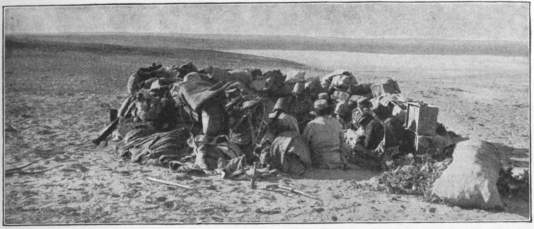
64. Shelter of Provision Sacks.
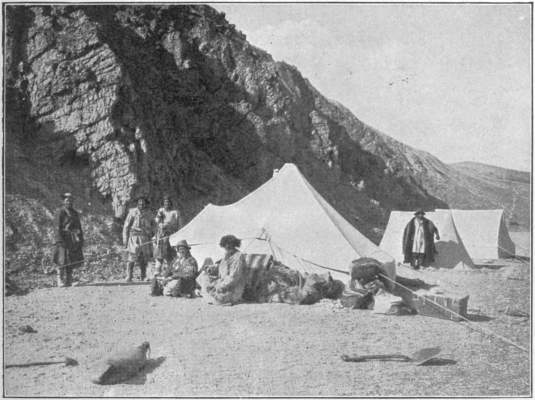
65. Camp in a Narrow Valley (Camp 41).
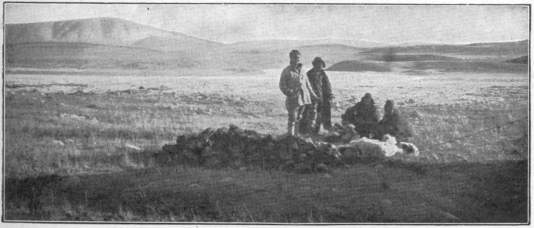
66. Robert, Muhamed Isa, and Two Servants by a Fire.
Icy east wind blew next day. It was cold and raw as it passed over the snowfields, and the vile weather was not only uncomfortable physically, but it had a depressing effect on the spirits, so that we sat listlessly in the saddle, were sleepy and indifferent, and longed for the brazier in the evening. The antelopes were bolder than usual; at this season they are fat and strong. We rode past a horse which had fallen and died on the track; nothing could have been done for him. He lay with wide-opened eyes as though looking for a land in the east, and he was still quite warm. The pack-saddle had proved useful, for Muhamed Isa had thoughtfully had all the saddles stuffed with hay for future use. So the animals could little by little consume their own pack-saddles. In camp two sheep were slaughtered, for they showed signs that they would not hold out much longer.
In the morning a dying horse lay among the tents. A wolf crouched in a side valley, watching our departure and looking forward to a grand meal; but he would not have the pleasure of killing the horse, for we put an end to its life with a knife. We had now entered on a critical period, for scarcely a day passed without our losing one or more of our animals.
We still mounted slowly eastwards, and, trusting to Wellby’s map, I had promised my people that they should this day get sight of a lake. We ascended a rise in the ground, but from the summit only another was visible, which quite blocked up the view, and when we had surmounted this there was a third in front of us. Now, however, our expectations were no longer to be disappointed. Part of the blue lake appeared in the east-south-east, encased in hills. On its southern shore, where Wellby had travelled in 1896, rose singular irregular points and groups, the continuation of the red snowy range which we had seen for several days past, and now, in fine weather, stood out in all its wild beauty. We had mounted for six days towards the expected pass, and found it just above the lake. Its height was 17,300 feet.
Now the horses were so exhausted that we must find good pasture at any cost, and let the animals rest a few days. Camp No. 15 was pitched on the strand, and afforded a view over all the lake. To the south rose the singular range in shades of yellowish-red and scarlet, pink, and light brown, and fantastic precipitous rocks stood out between soft snowfields of a glistening bluish tinge.
Camp No. 15 was to be a notable station in our bold raid into the forbidden land (Illustration 57). We had scarcely got things in order when the last eight of the hired Tankse men, attended by Muhamed Isa, appeared before my tent, fell on their knees after the Ladak custom, touched the ground with their foreheads, and then sat motionless as images while their leader and foreman spoke as follows:
“Sahib, we have nineteen horses left; eight of them are still strong, but the rest will not last much longer. Oh, Sahib, let us return home before winter comes and our animals perish.”
“It was agreed that you should accompany us as far as the Yeshil-kul; do you mean to break your word?”
“Sahib, we know that we are in your hands, and are dependent on your favour; our provisions will not last more than ten days; if we go as far as Yeshil-kul we shall all die on the return journey. Oh, Sahib, have pity on us, and let us go home.”
“Very well. If I let you go, which road will you take?”
“Sahib, we will travel over the mountains here in the south, and pass by Arport-tso to the Lanak-la, which one can reach in ten days.”
“Can you find your way, and are you sure that your supplies will last out?”
“Yes, sir.”
“Then make ready to start.” Turning to Muhamed Isa I continued: “Manuel and the two Rajputs cannot bear this climate, and it is best to let them go also before the cold winter comes.”
Muhamed Isa was a diplomatist, and tried to conceal his satisfaction as he answered: “Yes, if we take them with us farther into the country in winter they will freeze to death. Already they crawl together like marmots to the fire, and yet their teeth chatter and they tremble from cold in their furs.”
“We can easily do without them.”
“Hitherto they have done no more work than the puppies, or, rather, less, for they are either too lazy or too grand to collect fuel for their own fire; two of our Ladakis have to attend on them and their horses. It would be a great gain if we were quit of them.”
“Let them go, and then we shall have the use of their horses, for I can hire some of the Tankse horses to be at their disposal on the journey to Ladak.”
“Yes, sir, they have three saddle-horses, besides two others for their baggage. We are now losing the Tankse horses, some of which, indeed, have only carried fuel, but, by their departure, the baggage to be carried by our own horses will be increased by fifteen other packages. Therefore the black men’s horses are a very necessary reinforcement.”
Next day the plates and rock specimens, to be forwarded to Srinagar, were packed up, and I wrote letters home and to friends in India. I begged Colonel Dunlop Smith to send after me, in October, to the neighbourhood of Dangra-yum-tso, with the permission of the Viceroy, all letters that had come for me up to that time. They must be sent through Gyangtse and Shigatse, and the Tashi Lama, who had recently been so well received in India, would certainly be very pleased to see that the post-bag was transmitted to me. I thought that, even if I were forbidden to travel further in the interior of Tibet, my letters would not be held back—at the worst I could make the forwarding of the mail a condition of the acceptance of the demands of the Tibetans. I accordingly requested that a post-runner should receive orders to reach Dangra-yum-tso at the end of November, there to await my arrival.
On the morning of September 17 three of our own horses lay dead among the tents. The following night the great spotted Yarkand horse, which had carried our boat, died (Illustration 67). When the sun rose on the 19th two more victims had followed the others, and lay, with neck and legs outstretched, frozen hard after a night frost of a degree below zero. I summoned Muhamed Isa.
“How many more animals have we?”
“We have 83: 48 horses and 35 mules; 10 horses and a mule have died.”
“It will be bad if this dying goes on at the same rate as in the last three days.”
“I do not think it will, Sahib; the weakest have succumbed, the strongest remain.”
“But six horses are gone, and that means six more loads for the survivors, besides the fifteen of the Tankse horses.”
“The six fallen horses have carried nothing during the last few days.”
“But at any rate the loads will now be heavier.”
“Since we have been camping here I have given the animals double measures of maize and barley, partly to strengthen them, partly to lighten the loads. On the first days, when we start from here, we must make short marches, and rather let the horses eat their fill than throw away a single sack of barley.”
“Good. We have 510 English miles before us to the Dangra-yum-tso, and that makes 51 days’ marches at the rate of 10 miles a day. If 15 days of rest be added, we should arrive at the lake on November 25, that is, in two months and six days. The mules seem hardier than the horses; we must try to keep a stock of strong mules; later on we shall contrive something when we have met the first nomads.”
“Oh, yes, if it comes to the worst the Ladakis can carry what is absolutely necessary, and we can all go on foot.”
“Yes, Muhamed, remember that I shall certainly not turn back unless I am compelled by superior force.”
“No, I know that; all will be well.”
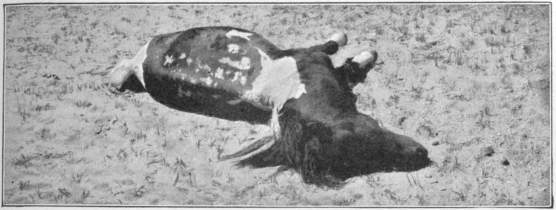
67. The Large Piebald Yarkand Horse.
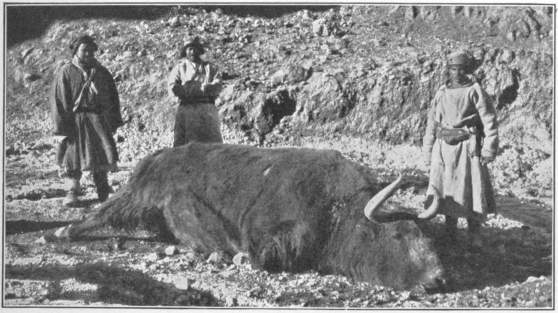
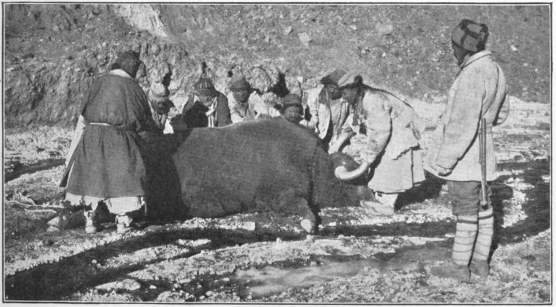
68, 69. The Slain Yaks: Tundup Sonam, the Hunter, on the Left in 68.
Four horse-loads of maize and barley were consumed in this camp; and henceforth a horse-load would be used daily, not including the men’s rations. But probably we should also lose a horse a day, often, perhaps, two or more. Still, there always remained a chance of finding better pasturage, where the horses might recover their strength, when we turned off to the south-east. We had at present no ground for complaint. The hired horses had done us very great service. We were able to leave the western shore of Lake Lighten with 83 laden animals. Two horses were required for our boat and all its appurtenances, but I intended to spare them a couple of days, and let the boat be taken over the lake.
So far we had succeeded in keeping our stages well in advance, and that was good. Wellby, Deasy, Rawling, and Zugmayer, who were all in this region, and brought back such excellent, meritorious results, had here and at Yeshil-kul caravans in a far less efficient condition than mine. Leh and Tankse were my starting-points. But the last connections with them were severed at Lake Lighten, and here commenced a bold march towards an unknown destiny.
CHAPTER IX
ON THE LAKE IN A STORM
On September 19 we took leave of the Hindus and the natives of Tankse. I was sorry for the former; it was not their fault that they could not bear the climate, and they had had no opportunity of showing what they were worth. On the last evening Bikom Sing had sung his swan-song in our party, the same monotonous, melancholy Sanskrit hymn which had so frequently reminded himself and his fellow-countrymen of a warm country with pleasant huts in the shade of palms and mango trees, of laden ox-carts on dusty roads, and of the warning growl of the royal tiger in the jungle by the river bank, when the full moon shines from heaven on mild spring nights. I thanked them for their good, faithful, and honest services, paid them well, provided for their return journey, and handed them good testimonials. They received supplies of meal, sugar, tea, and rice, and a sheep for butcher’s meat. Manuel was allowed to take with him one of the puppies which he was fond of. Muhamed Isa had sewed together a tent of empty corn sacks, to protect them from the frosts at night.
They intended to travel on the first day only to the foot of the red mountain chain, and the day was already far advanced when they shook hands and mounted their horses. We remained standing awhile, watching the little party grow smaller under the sun in the south-west, and soon disappearing behind the nearest hills.
I have never heard anything more of them. Eighteen months later Manuel’s father wrote to inquire where his son was, but I did not know. So much I ascertained, that he had arrived safely at Leh, but I could not track him any farther. However, I hope that he will turn up all right at home after his wanderings. We missed them sorely, but we consoled ourselves with the boat, which was unpacked and put together on the bank.
A bright clear day after 30 degrees of frost. The rivulet at our camp was frozen into a shiny riband, meandering to the strand, and along the bank a belt of ice two yards broad flapped up and down under the beat of the ripples. The water of the lake may be drunk in case of necessity; probably its affluents reduce the salinity along our shore, where the river descending from the pass and numerous springs pour into it. The sand on the bottom of the lake is finely and sharply rippled by the oscillating movement of the waves, and the water is crystal clear.
Now our horses, which had lost another comrade in camp No. 15, were laden with heavy packs. The caravan had orders to skirt the northern shore of the lake, and to encamp at some suitable spot near it. Robert was to draw a rough sketch of the shore-line; Tsering, Muhamed Isa’s brother, accompanied me at his own request. And so we left at the same time this dreary place, where we had parted with our companions and had lost seven horses. Amid the silence of the desert it lay rocked to sleep, as it were, by the murmur of the waves against the shore—a burial-ground forgotten by gods and men.
Tsering soon got used to the oars, and afterwards the west wind came to our assistance. We made across to the north-western corner of the lake, and had a much less distance to cover than the caravan, which had to make a wide detour. The sail was only a trial trip, but I was delighted from the first moment with the English boat, which was solid and comfortable, and easy to steer. The greatest depth we measured was 159 feet. After rounding a promontory we caught sight of the bluish-grey smoke of our camp a little distance from the shore, drew the boat on to the beach, and rejoined our people.
The camp was arranged as follows: Muhamed Isa, Tsering, two other men, and the kitchen were accommodated in a large tent, quadrangular below and pyramidal above. The principal Ladakis lived in the Tibetan tent, while the rest found shelter within the ramparts of the provision sacks. Robert had Manuel’s tent to himself, and he had piled up so many boxes of all kinds round his bed that it looked like a Parsee tomb. Outside, on the right wing, stood my tent, a little apart from the others. The black Pobrang dog was missing; probably he was enjoying a feast on the seven dead horses; and so it was in fact: when Muhamed Isa sent a man back to camp 15 there was the dog fat and bloated, like a tightly stuffed bag, and so lazy and stupid that he could hardly move. He had thoroughly overeaten himself, and would not look at his food for a whole day after.
September 21 was a memorable day in our chronicles. The boat lay on the shore ready to sail, and I resolved to spare the horses its weight once more. Eastwards the lake seemed quite small, and it could not be far to its eastern bank, near which the caravan could encamp wherever there was passable grazing. If it became too dark before they heard anything of me, they could light a beacon fire on the shore. But, of course, we should turn up in good time. We looked upon the trip as a mere trifle, and did not think of providing ourselves with food, drinking-water, fuel, and warm clothing for the night. I was dressed as usual, wore my leathern vest, and took my ulster with me, and a fur coat was spread over the back bench only to make a soft seat.
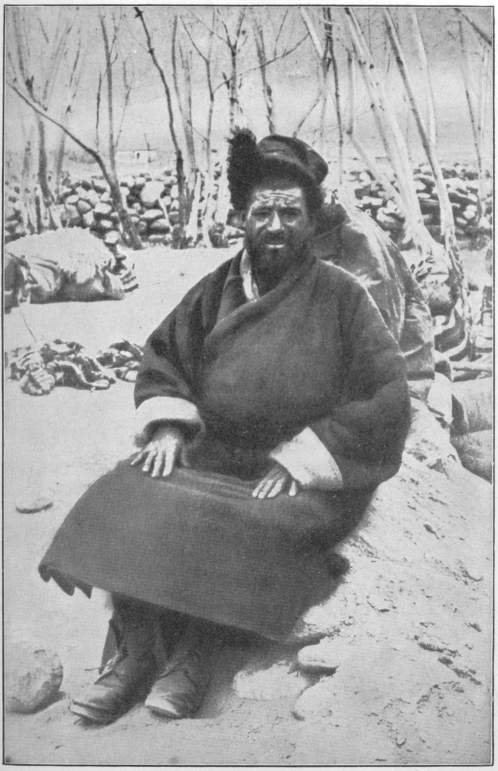
70. Rehim Ali, one of my Ladakis on the First Crossing of Tibet.
Yes, we were too thoughtless on this occasion. In the forenoon I inspected the animals, as usual, and then gave Rehim Ali a lesson in rowing, for he was to come with me this time, and he did so well that he was solemnly appointed Kemibashi, or admiral of the fleet. Just at starting I decided to row across the lake, to sound its depth and ascertain its breadth. The distances, or, more correctly, the course, I measured with a log by Lyth of Stockholm, and the depths were to be sounded every quarter of an hour. We should certainly reach the rendezvous before dark. At eleven o’clock the temperature of the water was 43° F., and it rose afterwards a few degrees higher. The day was bright and quite calm; at one o’clock we noted 53° F. I took the dark opening of a bank terrace as the point to steer for. We could do without drinking-water, for the hydrometer marked 1000 in the lake; it therefore floated as low as in fresh water (Illustration 70).
The lagoons on our shore were covered with ice fully half an inch thick. Six wild yaks were seen at the foot of the mountain to the north. The lake lay deceptively quiet and smooth; only a slow gentle swell, the last reminder of the effect of the expiring night wind, could be felt. Not a wisp of cloud, not the slightest breeze—weather all the more enjoyable after the storms of the past days. The lake shone against the light turquoise-blue vault of heaven, when we looked southwards, with as bright a green as the tender foliage of birches in the spring.
For a few minutes we heard the bells of the mules as they tramped off, but the black line of the caravan soon vanished in the hilly lands along the shore. Rehim Ali rowed like a practised boatman. At the second sounding-station the depth was 115 feet, and at the third 161. When my oarsman shipped his oars the next time the sounding-line, 213 feet long, did not reach the bottom; unfortunately we had no reserve lines, for I had never found before such great depths in a Tibetan lake.
“This lake has no bottom at all,” groaned Rehim Ali.
“Of course it has a bottom, but we have no more line.”
“Does not the Sahib think it dangerous to go further when the lake is bottomless?”
“There is no danger on that account; we can row to the shore, which is not far, and then we have only a short distance to the camp.”
“Inshallah, but it may be farther than it looks. Bismillah,” he cried, and he set to work again.
About two o’clock the lake was as smooth as a sheet of glass, and showed curious confused reflexions of the mountains. We became quite dizzy in the head; the lake had now assumed the same colour as the sky, and we might have been soaring in a space of bright blue ether within a magical spherical planet. Behind us, to the north, the panorama of a mighty crest unrolled itself, with flattish lofty domes covered with eternal snow. The sun was scorching hot, Rehim Ali wiped his brow, the smoke of my cigarette hung motionless in the air, there was not a ripple except those produced by the boat and the oars—it was a pity to spoil the surface. All was quiet and peaceful as a day in late summer which had lingered among the mountains.
“God protect us from the darkness,” said Rehim Ali; “it is dangerous to be on the water after the sun has set.”
“Do not be afraid.”
Now the sounding-line touched the bottom at 95 feet, and next time at 34 feet. A quarter of an hour later we jumped ashore.
I drew a panorama of the northern mountains, while Rehim Ali munched a piece of bread which he had providently brought with him.
It was a quarter to four when we put off again. In two hours it would be dark, but then we should see the camp-fire on the shore. The east end of the lake seemed quite close, but we were easily deceived by the mirage. We rowed for a while east-north-eastwards along the shore. It would be extraordinary if the west wind did not get up on this day. I asked Rehim Ali repeatedly, for he had the western horizon in front of him, if the view was clear in that direction, or if the westerly storm was making its appearance.
“No, there is no storm,” he answered quietly.
“Yes, now it is coming,” he said, after a short interval; “and it will be a bad one.”
I turn round and see in the west, above the pass we had crossed some days before, high, light-yellow vortices of sand and dust, which soon tower up to 30° above the horizon; they rise rapidly, condense into a dark cloud, and hide the view of the western heights. Yes, that is a westerly storm coming on.
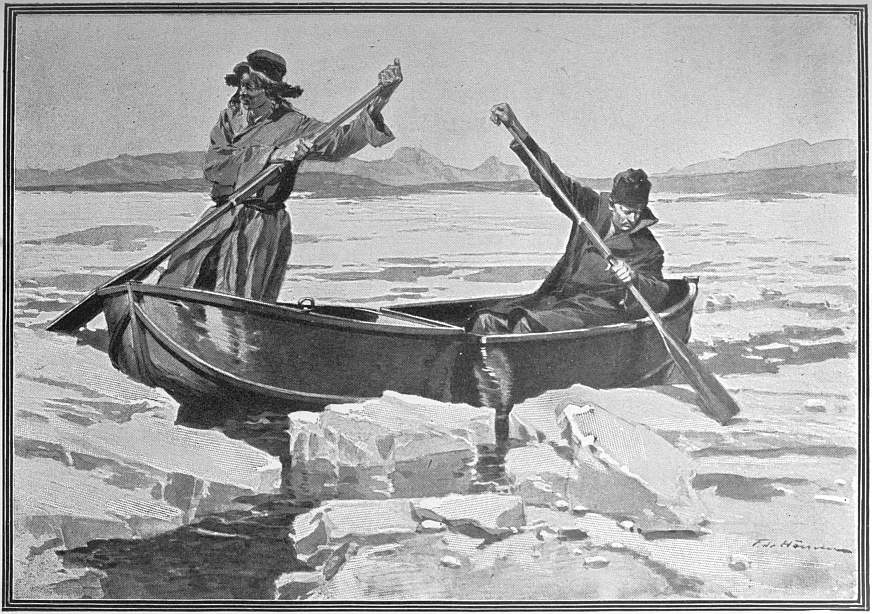
71. Starting on a Voyage.
But the danger to us is not great; we can land wherever we like; we have matches to light a fire, and sufficient yapkak can be found, so we shall not freeze even with 29 degrees of frost; and we can do without food for once.
But we will not land; perhaps the camp is close to. “Row on, Rehim Ali—no, wait a moment, set up the mast and loose the sail before the storm breaks, and then we shall get help for a part of the way. If the storm becomes too violent we will go ashore.”
It is still deadly quiet. But now comes the first forerunner—a ripple skims over the surface, the wind catches the sail, puffs it out like a ball, smoothing out all its folds, the boat darts forwards, and a whirling, boiling track is formed in our wake. We keep to the southern shore; there lie a series of lagoons and spits of sand and pebbles. A pair of black geese sit on one of these spits; they gaze in astonishment as we pass; they perhaps take us for a huge water-bird which cannot fly, because it has only one wing. The lake is getting rougher; we fly towards a spit to the north-east; oh, heavens! the water is only 3 feet deep under our keel. If we run aground the boat will be dashed to pieces; its oiled sailcloth is as taut as a drum-skin. I put the helm over as far as possible, and graze the spit amidst the raging surf; the manœuvre succeeds, and the next minute we are in deep open water where the waves are more moderate.
Now a spit shows itself to the east-north-east projecting far into the lake, but it is a long distance off, and we are out on the agitated lake, where the white horses are getting higher and higher and their roar becomes louder and louder; the whole lake is in the wildest commotion; if we can only reach that landspit safe and sound we can get under its lee and land safely. Yes, we must land by hook or crook, for the storm is upon us; it becomes more violent every moment and the mast cracks; I dare not sail any longer with the sheet made fast. We have a grand sailing wind, the water roars and rages under the stem and boils and bubbles behind us. We have to look out, for if the mast breaks, which already bends like a whip, the boat will tip over, will fill in a moment, and will be sunk by the weight of the centre-board, which is not in use but is carried as cargo. We have two life-buoys as a last resource.
Rehim Ali sits in the bow. He clings to the mast, keeps a look-out forwards, and reports that the lake beyond the landspit is as extensive as in the west. We have been the victims of an illusion, and cannot reach the eastern shore before complete darkness overtakes us. Would it not be better to land and wait for the day? Yes, let us land and get into the lee of the landspit. The sun sinks, the storm grows in strength, we can hear it howling through the chasms to the south; fine spindrift flies like a comet’s tail over the crests of the waves; it is a most critical and trying moment. The dust clouds have disappeared, and the western horizon is dimly perceptible. The sun sinks to its rest, a ball of liquid gold, and a weird, mysterious gleam spreads over the whole country. Everything is coloured red except the dark-blue white-edged lake. The night rises out of the east, dark purple shades lengthen out behind the mountains, but the most easterly pinnacles and the summit T, rising above all the others with its glittering snowfields, stands out fiery red against the dark background, like volcanic cones of glass lighted within by glowing streams of lava; a couple of riven clouds rush eastwards, their crimson colour vying in beauty with the snowfields and glaciers below them. All shades of rose-colour play on the sail, and a purple foam quivers on the crests of the waves as though we were being driven over a sea of blood.
The sun sinks; now the sail and spray turn white, and soon only the last tint of the evening red lights up the highest snowfields. The night spreads further westwards, and the last glow, the final glimmer of day, dies out on the summits in the south-east.
Rehim Ali crouches at the bottom of the boat while we shoot towards the landspit, tossing, rolling, and pitching. All outlines are still sharp and clear. I steer the boat out of the surf round the landspit, but then pause a moment; it would be easy to get into lee-water; but no, all is well now—the moon shines brightly, and before it goes down we may perhaps reach another point.
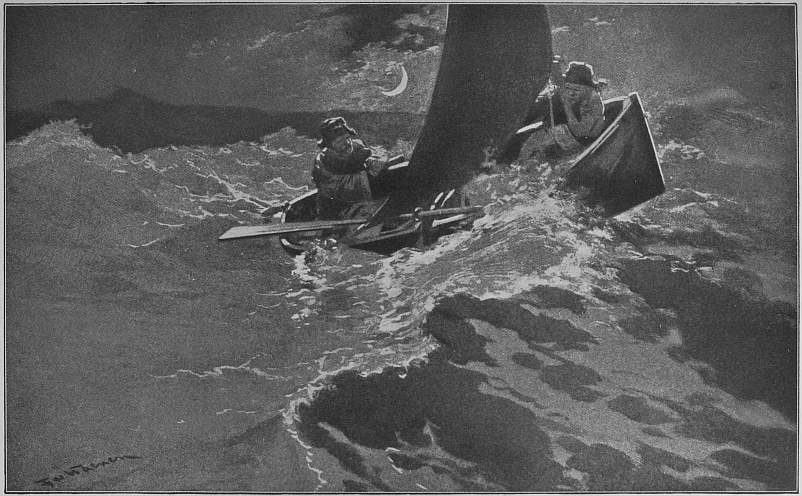
72. In Peril on Lake Lighten.
Through driving spume and hissing foam we fly past the point, and in a second it is too late to get under its lee, however much we might wish to do so, for the roar of the surge dies away behind us, and open water again yawns before us black as night, bounded in the distance by a scarcely perceptible strip of land, another spit of the gravel so abundant on the southern shore.
So we speed over the disturbed lake. We start with a fright, for we hear the huge waves rolling over behind us. The dull droning comes nearer, and I turn round—we must inevitably be buried under the heavy, rolling crests. A faint gleam of the dying day still lingers in the west. The spray, driven by the storm, gives us a cool bath. Then the waves reach us, but they lift up the boat gently, and then roll on towards the eastern shore, which Rehim Ali does not expect to reach.
Now the sail is white in the moonshine, and my shadow passes up and down it with the movement of the boat. Rehim Ali is almost dead of fright; he has rolled himself up like a hedgehog on the bottom of the boat and buried his face in my ulster, so as not to see the agitated water. He says not a word, he is quite resigned and is awaiting his last moments. The distance to the eastern shore cannot be estimated, and it is certainly impossible to effect a landing there without shipwreck. If there are cliffs and reefs on the shore we shall be mangled and crushed amid the breakers, and if the strand slopes down gently we shall capsize, and be thrown ashore by the great rolling billows like a piece of cork (Illustration 72).
In the midst of the dark, indistinct chaos the surf at the point of the landspit flashes out; it is more furious than at the other point, for the waves have become larger as we have left a wider expanse of lake behind us. I try to get into the lee, but the storm drives us out again, and we are away from the land before we are aware. It now becomes colder, but I do not feel it, the excitement is too great, and our lives are at stake. I look in vain for the beacon of my servants; have they not obeyed my orders, or are they so far from the shore that the fire is invisible? I succeed in removing the back bench and sit on the bottom, where I am somewhat protected from the cutting wind. Behind us, the broken streak of moonlight on the water makes the waves look more weird than before; they have become gigantic, and the nearest hides all behind it.
The hours pass one after another; the moon sets. Now all is pitch darkness; only the stars flicker like torches over our heads, otherwise the deepest blackness surrounds us. My right hand is gone to sleep, cramped with grasping the rudder; the boat seems to dart eastwards, but the waves roll past us—they are still quicker than we. Now and then I ask Rehim Ali whether his cat’s eyes can see the breakers on the eastern shore. He casts a hurried glance over the gunwale, answers that they are still very far off, and buries his face again in the ulster. The tension becomes more acute; whatever happens we are certainly approaching the moment when the boat will be cast helpless on the strand. I hope that the lake is so broad that we may continue our wild career till daybreak. But no, that is incredible, for there are no lakes so large in Tibet. We have the whole night before us, and in this flying course we can cover immense distances.
There is something uncanny and awe-inspiring in such a sail, when the crests are visible in the darkness only when they lift the boat, to roll onward the next moment. We hear nothing but their swish, the howling of the wind, and the hissing of the foam under the stem.
“Look out, Rehim Ali,” I call out; “when you feel that the boat has grounded, jump out and pull it with all your strength to the beach.” But he makes no reply; he is quite paralyzed with fear. I pack up my drawings and sketch-books in a small bag.
But what is that? I hear a thundering roar that drowns the growling of the storm, and in the pitch-black darkness I see something like a bright streak close to us. That must be the surf on the shore. “Loose the sail!” I cry, so loudly that my throat nearly cracks, but Rehim Ali is helpless and does not move an inch. I undo the rope and let the sail flap and beat just as the boat grinds against the bottom and suddenly sticks fast.
“Jump into the water and draw the boat up,” I shout, but he does not obey; I poke him in the back, but he takes no notice. Then I seize him by the collar and throw him overboard just as the next roller dashes up the beach, fills the boat, turns it over, and soaks me to the skin. Now I may as well jump out myself, but Rehim Ali at last realizes the situation and helps me to draw the boat beyond the reach of the waves (Illustration 73). The fur coat and ulster are as wet as myself, and only after a long search do we recover all the things that have been scattered in our shipwreck.
We were half-dead with weariness and excitement; one almost loses one’s breath altogether with such exertions in this rare atmosphere. We mounted a sandy hillock and sat down, but the cutting icy wind drove us away. Could the boat provide us with shelter? We must draw out the bolts which held the two halves together, and at last we succeeded with the help of the centre-board. Uniting our forces we heaved up one half of the boat, propped it up with a plank, and crept under its shelter. We were quite numbed; no wonder, for the water froze in our clothes so that they crackled when touched. The water on the bottom of the boat turned to ice; my fur coat was as hard as a board, and was absolutely useless. Hands and feet were stiff and had lost all feeling; we must get up again or we should be quite frozen. There was only one thing to do. In the shelter of the boat I took off my Kashmir boots and my stockings, and Rehim Ali shampooed my feet, but I felt no life in them till he had opened his chapkan and warmed them for a long time against his naked body.
There was no sign of life anywhere about. Amid the roaring of the surf we had to shout to make ourselves heard. How were we to pass the night with 29 degrees of frost, and wet clothes already stiffened into cuirasses of ice? Could we keep alive till the sun rose? Rehim Ali disappears into the darkness to search for fuel, but he comes back empty-handed. To my joy I discover that my cigarette-case and matches are still available; I had stood in the water only up to my breast, even when the last breaker had done its best to wet me through. So I light a cigarette and give one to Rehim Ali to cheer him up.
“Is there nothing here, then, that we can burn? Yes, wait, we have the wooden roller of the sounding-line and the frame in which it is fixed. Fetch them at once.”
We ruthlessly break up this masterpiece of Muhamed Isa’s skill in carpentry, and hack in pieces the frame with our knives; we lay aside the wet shavings, and use the dry, inner sticks as firewood. They make a very tiny heap. Only a couple are sacrificed at once, and I get them to burn with some blank leaves from my note-book. Our fire is small and insignificant, but it warms us famously, and our hands thaw again. We sit close over the fire, and keep it up with the greatest economy, putting on one splinter at a time. I take off my clothes to wring them as dry as I can; Rehim Ali dries my ulster, on which I depend for the night; the fur coat is left to its fate. How long is it to the dawn? Ah, several hours yet. The roller and the handle are still in reserve, but this small stock of wood cannot last long, and I look forward with trepidation to the moment when the cold will compel us to sacrifice the mast and the benches. The time passes so slowly; we say little to one another, we long for the sun. As soon as our clothing is a little dry we can boil water in the baler, so as to get something warm into our bodies.
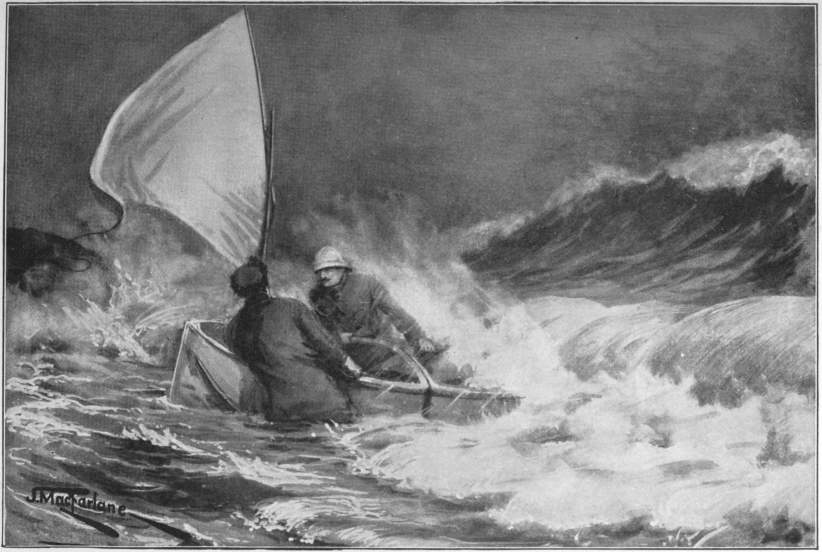
73. The Author and Rehim Ali pull the Boat out of the Waves up on to the Shore.
However, we had good reason to rejoice that we had got off so well. I shall never forget Lake Lighten, Wellby’s and Deasy’s lake. It had kept us company for several days, we had lost seven horses on its banks, and our friends had left us with the last letters. We had seen this lake strikingly beautiful in bright light hues, but also pitchy black, like a tomb, in the arms of night; it had lain smooth and shining in the burning sunshine, but it had also shown us its teeth, white shining teeth of foam and spindrift. Not long ago we were almost roasted in the heat of the sun on its unknown depths of crystal-clear, vernal-green water; now we were on its bank nearly frozen in the bitter, wintry cold; then it lay so still that we hardly ventured to speak lest we should disturb its peaceful repose; now it raved in unbridled fury. Its shores had yielded us grass, spring-water, and fuel, but to the voyagers in the night it had seemed almost boundless: the eastern bank had retired before us all day long; we had seen the sun rise, sink and set in a sea of purple and flames, and even the moon accomplish its short journey before we reached our goal where the surf thundered and folded us in a wet and cold embrace. We had made a notable voyage in the small boat, full of variety and excitement; thrice our lives had hung by a hair as we almost ran aground on the landspits, for had we capsized there we could hardly have reached land before our hands were paralyzed on the life-buoys in the icy-cold water. Wonderful lake! Only yaks, wild asses, and antelopes find freedom on thy shores; only glaciers, firn-fields, and the everlasting stars are reflected on thy surface; and thy silence is only interrupted by the music of thine own waves and the victorious war-song that the western tempest plays on thy strings of emerald-green water.
At any rate we were still alive and on land without any broken limbs. We longed for the grey of dawn, and kept a tight hand on the fire, feeding it only now and then with a fresh chip to prevent its going out altogether. Sleep was out of the question, for we should be frozen. Sometimes we nodded a moment while we sat cowering over the flickering flames, and Rehim Ali occasionally hummed an air to make the time pass.
I am just thinking how I should enjoy a cup of hot tea, when Rehim Ali gives a start, and cries out:
“A fire in the distance.”
“Where?” I ask, somewhat incredulous.
“Yonder, northwards, on the shore,” he replies, pointing to a feebly luminous point.
“That is a star,” I say, after searching through the darkness with a field-glass.
“No, it is on this side of the mountains.”
“Why, then, have we not seen the fire before? They would not light a beacon fire in the middle of the night.”
“It is not a fire, it is a lantern; I see it moving about.”
“Yes, indeed, it is a light which changes its position.”
“Now it is gone.”
“And it does not appear again; perhaps it was only an optical illusion.”
“No, there it is again.”
“And now it is gone again.”
And it remained so long invisible that we lost hope, and cowered over the embers of the last chips of the roller.
“Does not the Sahib hear something?”
“Yes, it sounds like the tramp of horses.”
“Yes, and like men’s voices.”
The next moment the shadowy outlines of five large horses and three men appear against the sky. The riders dismount and approach us with joyful, friendly greeting. They are Muhamed Isa, Rabsang, and Adul. They sit down by us and inform us that camp No. 18 lies an hour’s journey to the north, a little distance from the shore. As soon as the camp was pitched they had sent out men to look out for us, but had given up the search, as these men had found no signs of us and had seen no fire. Late at night, however, Robert, feeling uneasy because of the storm, had climbed a hill, and had seen our small fire. He at once sent the three men after us. They said that they had kept up a large beacon fire all the evening, but apparently the inequalities of the ground had concealed it; certainly we could not see it from the lake.
I borrowed two sashes from the men to wind round my feet. Then we mounted, and with the lantern in front the little cavalcade moved off northwards to the camp, while the billows continued their ceaseless race towards the shore.
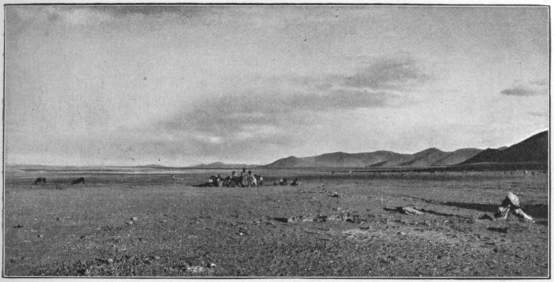
74. Camp at the Yeshil-kul.
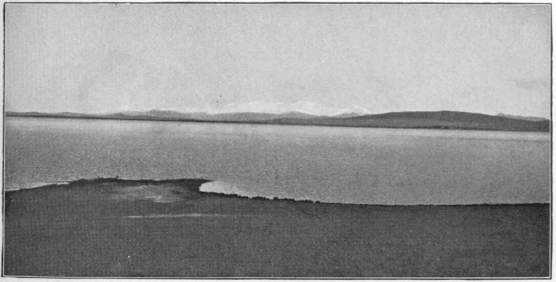
75. The Pul-tso, looking East.
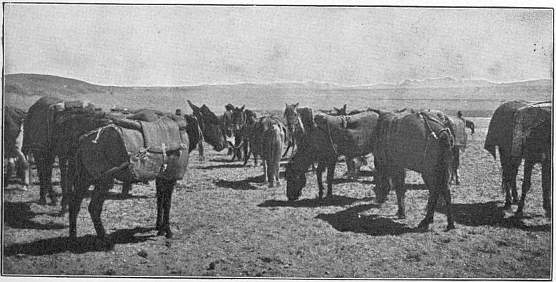
76. Horses and Mules in Open Country.
CHAPTER X
DEATH IN THE JAWS OF WOLVES—OR SHIPWRECK
When we marched on September 22 over the old terraces of the lake and up to the threshold of the pass separating its basin from that of Yeshil-kul, the view of Lake Lighten opened up more the higher we rose, and at length the whole of the great blue lake in all its beauty lay before us at the foot of the snowy mountains. The pasturage was excellent everywhere, and the Pantholops antelopes in their surprise and perplexity often did not know in which direction to make their escape, and prompted by curiosity came thoughtlessly to meet us. The pass has a height of 17,392 feet. We had proceeded only a few paces on the other side when a complete change of scenery presented itself, as though a leaf of a large book had been turned over. The forms which had hitherto riveted our attention vanished forever, and new mountains lay before us, a new basin, and a new turquoise-blue lake—the Yeshil-kul. To the south and south-west of the lake extend great flats of pure white salt; concentric rings and isolated pools indicate that Yeshil-kul also is contracting (Illustration 75).
During the following days we encamped in a country where the grazing was good but the water slightly salt. On the wide, flat plains on the west side of the lake stand long rows of cairns, heaps of earth or skulls, piled up at a distance of two or three yards apart. They look like boundary marks, but, in fact, have been erected by antelope hunters of the Changpa tribe, Tibetan nomads, who are the “Northmen,” or natives of the northern plateau, Chang-tang, and who in this way drive the game into their nooses laid in a hole. It should be explained that antelopes have a decided objection to leaping over such lines, and will rather run along them till they come to the end. But before they reach it one of them has had the misfortune of putting his foot in a ditch with a noose in it. Only a son of the wilderness, who passes his life in the open like the wild animals, could devise such a mode of capture. My Ladakis informed me that the Changpas no longer hunt here, for fear of the people of Eastern Turkestan, who have often shown themselves hostile.
The 24th of September was another memorable day—my sails on Tibetan lakes, curiously enough, almost always ended in adventures. Of my Ladakis five had been in the service of Deasy and Rawling, and two of them affirmed that a shiny spot east-south-east was the spring where Captain Deasy had encamped for ten days in July 1896, and which he names in his narrative “Fever Camp.” Their indication agreed with Deasy’s map; so Muhamed Isa was ordered to lead the caravan thither, light a large beacon fire on the nearest point of the shore as soon as darkness set in, and keep two horses in readiness.
Our plan was to sail in an east-north-easterly direction for the northern shore, and thence southwards again to the signal fire. Rehim Ali was on this occasion assisted by Robert, who subsequently developed into an excellent boatman. The lake was nearly quite calm; its water, owing to its small depth, is greener, but quite as clear as that of its western neighbour. It is so salt that everything that touches it, hands, boat, oars, etc., glitters with crystals of salt. The shore and bottom of the lake consist chiefly of clay cemented together by crystallized salt into slabs and blocks as hard as stone, so that great care must be exercised when the boat is pushed into the water, for these slabs have edges and corners as sharp as knives. The lake is a salt basin of approximately elliptical outline with very low banks; nowhere do mountains descend to the strand. The three-foot line runs about 100 yards from the shore; but even 650 yards out the depth is only 15 feet. We executed our first line of soundings across the lake in the most delightful calm, and I steered the boat towards the point I had fixed by observations. At one o’clock the temperature was 49° F. in the water, and 50½° in the air. The depth increased very regularly, the maximum of 52.8 feet occurring not far from the northern shore. Robert was much delighted with the sail, and begged that I would always take him with me in future, which I the more readily granted that he was always cheerful and lively, and that he gave me valuable help in all observations. A little bay on the north shore served us as a landing-place. We surveyed the neighbourhood, and then hurriedly ate our breakfast, consisting of bread, marmalade, pâté de foie, and water. My companions had brought sugar, a tea-pot and enamelled bowls, but left the tea behind; but this forgetfulness only raised our spirits.