Front matter (continued 4)
Reading edition
Then we put off again to make for the spring to the south-east. A row of stone blocks and lumps of salt ran out from the landing-place east-south-eastwards, and the water here was so shallow that we had to propel our boat with great care. Just as we had passed the last rock, of which I took a specimen, the west wind got up, the surface of the lake became agitated, and a couple of minutes later white horses appeared on the salt waves.
“Up with the sail and down with the lee-boards.”
The lake before us is tinted with shades of reddish purple, a reflexion from the clayey bottom; there it must be very shallow, but we shall soon pass it.
“Do you see the small white swirls in the south-west? Those are the forerunners of the storm, which stirs up the salt particles,” I said.
“If the storm is bad, the boat will be broken on the sharp ledges of the bottom before we can reach land,” remarked Robert.
“That is not clouds of salt,” said Rehim Ali; “that is the smoke of fires.”
“But Muhamed Isa should be camping at Sahib Deasy’s source; that lies towards the south-west.”
“There is no smoke there,” replied Robert, who had the field-glass; “perhaps they have not been able to cross the salt flats on the south of the lake.”
“Then it is their beacon fires which we see; but we cannot cross over in this boat in a storm.”
“Master,” suggested Robert, who always addressed me thus, “would it not be more prudent to land again before the storm reaches its height? We should be safe behind the stones, and we can gather a quantity of fuel before sunset.”
“Yes, that will perhaps be best; this lake is much more dangerous in a storm than Lake Lighten. We have, indeed, no furs, but we shall manage. Take in the sail and row behind the boulders. What are you gazing at?”
“Master, I see two large wolves, and we have no guns.”
He was right; two light, almost white, Isegrims were pacing the shore. They were so placed that they must be able to scent us in the boat; the odour of fresh live meat tickled their noses. When we stopped they stopped too, and when we began to move they went on close to the margin of the water. “Sooner or later you must come on shore, and then it will be our turn,” perhaps they thought. Rehim Ali opined that they were scouts of a whole troop, and said it was dangerous to expose ourselves to an attack in the night. He had only a clasp-knife with him, and Robert and I only pen-knives in our pockets; we had, therefore, little chance of defending ourselves successfully. Robert, for his part, preferred the lake in a storm to the wolves. I had so often slept out of doors unarmed, that I no longer troubled myself about them. But in the midst of our consultation we were suddenly compelled to think of something else. The storm came whistling over the lake.
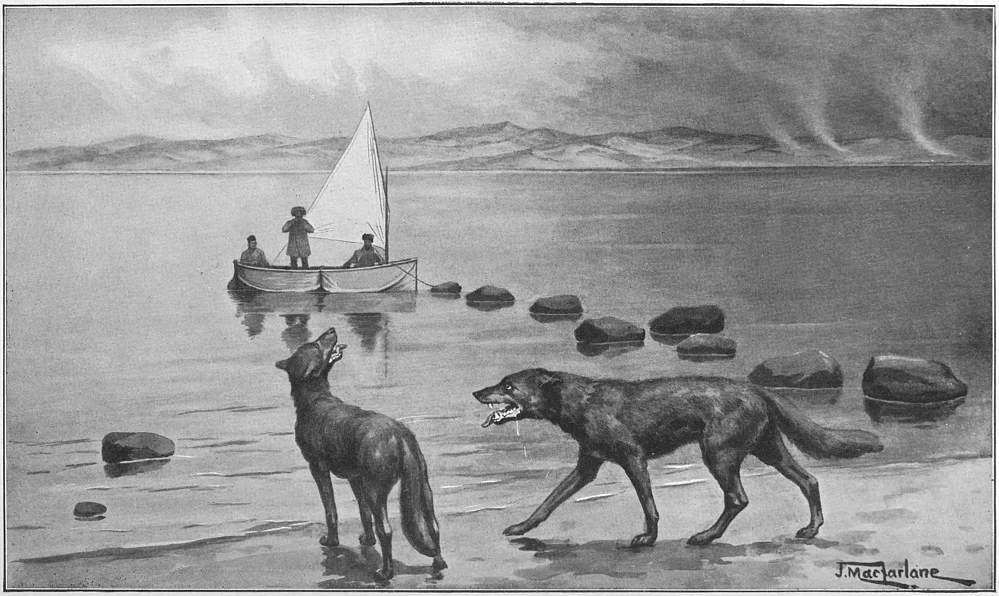
77. Death in the Jaws of Wolves—or Shipwreck.
Fortunately, the sail was still standing and the centre-boards were down; the wind caught the canvas, the water began to rush under the stern, and we shot smoothly southwards with a side wind. Robert gave vent to a sigh of relief. “Anything but wolves,” he said. I made Robert and Rehim Ali row to save time, and soon the two beasts were out of sight. “They will certainly gallop round the lake, they know quite well that we must land somewhere,” said Robert. He was quite right, the situation was exceedingly unpleasant; we had only a choice between the storm and the wolves. We could not depend on our people; they were evidently cut off from us by salt morasses, which it was dangerous to venture into. We would therefore try to reach a suitable point on the south shore before dark (Illustration 77).
The hours fled past, and the sun sank in glowing yellow behind the mountains. For two hours we held on our course towards Deasy’s camp, but when the beacon fires became more distinct in the gathering twilight we changed our direction and steered southwards to reach our people. The distance, however, was hopelessly long, and just from that direction the storm blew, and in the broken, freakish light of the moon the waves looked as weird as playing dolphins. Sometimes I was able to take some rapid soundings; they gave depths of 32 and 36 feet. Our fate was just as uncertain as on the former occasion on Lake Lighten; we steered for the shore, but did not know how far off it was. Rehim Ali judged from the length of the path of moonlight on the water that it was a long distance. Two more hours passed. I gave my orders to the oarsmen in English and Turki. We had now the waves on our quarter, and if we did not parry their rolling, foaming crests they would fill the boat and sink it; so we had to sail straight against them.
The situation was not a little exciting, but good luck attended us. The boat cut the waves cleanly, and we got only small splashes now and then. The spray trickled down our necks, was pleasantly cool, and had a saline taste. I again took soundings, and Robert read the line: 33 feet, then 25, and lastly 20.
“Now the southern shore cannot be very far,” I said; but my companions remained still and listened. “What is it?” I asked.
“A heavy storm from the west,” answered Rehim Ali, letting his oar fall.
A regular humming noise was heard in the distance, which came nearer and nearer. It was the storm, which swept over the lake with redoubled violence and lashed up foam from the waves.
“We shall not reach the shore before it overtakes us. It will be here in a minute. Master, we shall capsize if the waves become twice as high as they are now.”
The waves swelled with incredible rapidity, the curves in the streak of moonlight became greater and greater, we rocked as in a huge hammock. The sounding-line had just marked 20 feet. How long would it be before the boat would ground on the hard, salt bottom, if it found itself in a trough between two waves? The lee-boards beat against the sides, the boat pitches and rolls, and any one who does not sit firmly and stiffen himself with his feet must go overboard. A terrible wave, like an all-devouring monster, comes down upon us, but the boat glides smoothly over it, and the next moment we are down in a trough so deep that all the horizon is concealed by the succeeding crest. We were not quick enough in negotiating this new wave; it ran along the gunwale and gave us a good foot-bath (Illustration 78).
“Master, it looks dangerous.”
“Yes, it is not exactly pleasant, but keep quiet. We cannot land in such a sea. We must turn and make for the open lake. About midnight the storm may abate, and then we can land.”
“If we can only keep on rowing so long.”
“We will help ourselves with the sail.”
“I am not tired yet.”
To land on the southern shore would be certain shipwreck; we should all be drenched to the skin, and that is dangerous on this night when we cannot reckon on the slightest help from the caravan. We shall be frozen before the dawn. To look for fuel before the sun sets is not to be thought of, for the saline plains in the south are absolutely barren. No, we will turn.
At the same moment we felt a violent blow, which made the boat tremble. The larboard oar, which Rehim Ali worked, had struck against the ground and started loose from the screw which fastened it to the gunwale. Rehim Ali managed to catch hold of it just in time, while he shouted, “It is only a stone’s throw to the land.”
“Why, how is this?—here the lake is quite smooth.”
“A promontory juts out into the lake. Master, here we shall find shelter.”
“All right, then we are saved; row slowly till the boat takes ground.” That soon happened, the sail was furled, the mast unshipped. We took off our boots and stockings, stepped into the water, and drew the boat on to dry land. My feet were so numbed in the briny water, cooled down to 41°, that I could not stand, and had to sit down and wrap my feet in my ulster. We found a patch of lumps of salt, thoroughly moist, indeed, though drier than elsewhere, and the best spot to be had; for water lay all around us, and the bank was extremely low. How far it was to really dry ground we could not ascertain; the moon threw a faintly shining strip of light for a considerable distance farther towards the land.
While I endeavoured to restore life to my feet by friction, the others carried our belongings to our wretched salt island. Then the boat was taken to pieces, and the two halves were set up as shelters. At nine o’clock we noted 31° on the thermometer, and at midnight 17½°; yet it was warmer now than on the previous days, for the water of the lake retains some of the heat of the summer air. Muhamed Isa had made a new roller for the sounding-line, with frame and handle, out of an empty box; it was of course immediately utilized as fuel.
The provision bags and the water-cans were brought out again, and we drank one cup of hot sugar-and-water after another, and tried to imagine it was tea. As long as the fire lasted we should not freeze—but then, what a night! Towards ten o’clock the wind abated—now came the night frost. We lay down on the life-buoys to avoid direct contact with the briny soil; Robert had the fur coat, I the ulster, and Rehim Ali wrapped himself in the sail. He slept huddled up together, with his forehead on the ground, as is the Mohammedan custom, and he did really sleep. Robert and I rolled ourselves together in a bunch, but of what use was it? One cannot sleep just before freezing. My feet were, indeed, past feeling, but this consolation was a sorry one. I stood up and stamped on the salt patch, and tried to walk without moving, for the space was very limited. I sang and whistled, I hummed a song, and imitated the howl of the wolves to see if they would reply. But the silence was unbroken. I told anecdotes to Robert, but he was not amused by them. I related adventures I had had before with wolves and storms, but they had little encouraging effect in our present position. We looked in vain for a fire; there was nothing to be seen in any direction. The moon slowly approached the horizon. The wind had sunk entirely. Little by little the salt waves, splashing melodiously against the shore, also sank to rest—an awful silence reigned around. We were too cold to think much of the wolves. Twice we raised a wild scream, but the sound of our voices died away suddenly without awaking the slightest echo; how could it reach the camping-ground?
“Now it is midnight, Robert; in four hours it will be day.”
“Master, I have never been so starved in my life. If I get back to India alive, I shall never forget this dreadful night on Yeshil-kul and the hungry wolves on the shore, though I live to a hundred.”
“Oh, nonsense. You will think of it with longing, and be glad that you were here.”
“It is all very fine to look back on, but at present I should be delighted to have my warm bed in the tent and a fire.”
“Life in Tibet is too monotonous without adventures; one day’s journey is like another, and we want a little change occasionally to wake us up. But we will take tea and firewood with us next time.”
“Shall you have more of such lake voyages, Master?”
“Certainly, if there is an opportunity; but I fear that the winter cold will soon make them impossible.”
“Will it, then, be still colder than now?”
“Yes, this is nothing to what the cold will be in two months.”
“What time is it, Master?”
“Two o’clock; we shall soon have been lying six hours on the morass.”
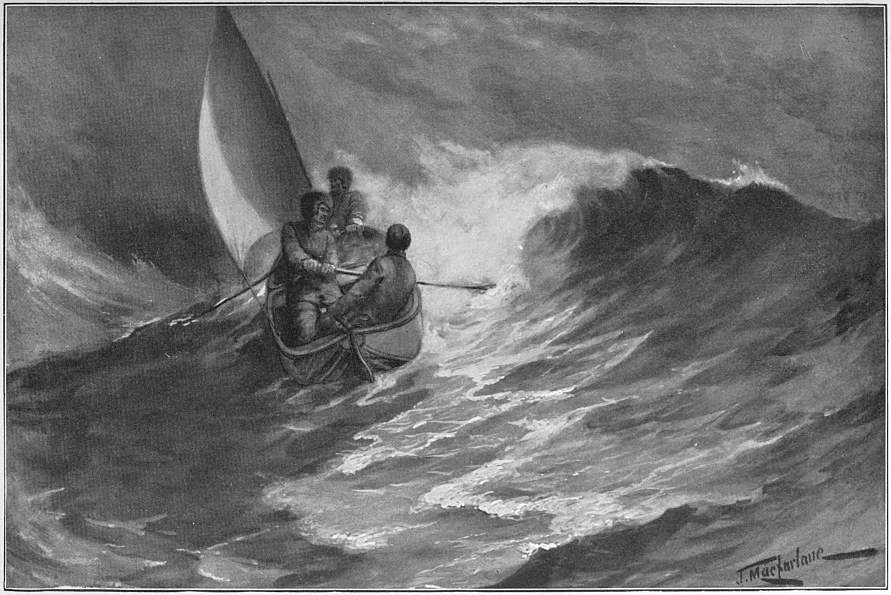
78. A Dangerous Situation on the Yeshil-kul. In Moonshine.
We nodded a little once more, but did not really sleep for a minute; from time to time Robert told me how badly his feet were frozen. At three o’clock he exclaimed, after a long silence: “Now I have no more feeling in any of my toes.”
“The sun will soon come.” At a quarter past four begins a faint glimmer of dawn. We are so chilled through that we can hardly stand up. But at length we pull ourselves up and stamp on the ground. Then we cower again over the cold ashes of our fire. We constantly look to the east and watch the new day, which slowly peeps over the mountains as though it would look about before it ventures out. At five o’clock the highest peaks receive a purple tinge, and we cast a faint shadow on the bottom of the boat, and then the sun rises, cold and bright-yellow, over the crest to the east. Now the springs of life revive. Rehim Ali has disappeared for an hour, and now we see him tramping through the swamp with a large bundle of wood, and soon we have kindled a sparkling, crackling fire. We undress to get rid of our wet and cold clothes, and warm our bodies at the flames, and soon our limbs are supple again.
Then Muhamed Isa’s tall figure appears on horseback in the distance. He ties a cord to the foreleg of his horse and leaves it at the edge of the swamp, while he proceeds on foot. When I was suffering most severely from cold I had composed a sharp curtain-lecture for him as soon as we met. But now when I caught sight of my excellent caravan leader I forgot it all, for I had to admit the validity of his reasons for delay. The caravan was long detained in dangerous, unstable ground, and the men had to carry everything. We went together to Deasy’s camp, which the caravan reached also. When the sun attained its highest altitude at mid-day, it found me still in the arms of Morpheus. I take it for granted that my two companions also requited themselves for the loss of their night’s rest.
On the morning of September 26 two horses were nearing their end; they could not get on their feet and had to be killed; one had died in the previous camp, and one fell on the march. We had lost 15 horses out of 58, and only 1 mule out of 36; these figures are distinctly in favour of the mules.
We now rode along the great longitudinal valley, where favourable ground made our progress easy, and passed a salt basin, with a pool in the middle surrounded by concentric rings of desiccation as regular as the benches of an amphitheatre. Before us in the distance was seen the caravan in two detachments, appearing like two small black spots in the boundless open landscape. I was deeply impressed by my own insignificance compared to the distances on the earth’s surface, and when I remembered that we travelled at most 13 miles a day, I was overwhelmed at the thought of the length of way we must traverse before we had crossed Tibet. Wolves were seen at the foot of a hill; perhaps they were our acquaintances of yesterday. We had to leave them, much against our will, an abundant banquet at the last camp, where six ravens had swooped down on our fallen horses.
One of the uppermost “benches,” which stood some 160 feet above the surface of the pool, afforded a capital road. Round about the soil was chalky white with salt. To the right of us was a low, brownish-purple ridge. Soon, with my usual companions, Robert and Rehim Ali, I came up with a worn-out horse. He did not look at all emaciated, but he had been relieved from duty for several days in hopes of saving his life. His guide came into camp in the evening, and reported that he had collapsed on the road and expired. The country is somewhat hilly, but solid rock seldom crops out, and then it is limestone and light-green clay-slate.
The camping-ground on this day, No. 22, had an interest of its own. Captain H. H. P. Deasy, on his remarkable expedition through West Tibet and Eastern Turkestan during the years 1896-1899, had great difficulties to contend with, and lost so many animals that, in order to save the expedition and its results, he had to leave behind a large part of his baggage and provisions, in short, everything that could be spared at all. In the year 1903 Captain Cecil Rawling made an equally meritorious journey of exploration through the same parts of Tibet, and as he found himself in a very critical situation through want of provisions, he decided to search for Deasy’s depôt, which, according to the map, must be somewhere in the neighbourhood. Two of Rawling’s men, Ram Sing and Sonam Tsering, had also accompanied Deasy, and Sonam Tsering was able to point out the place where the baggage and provisions had been buried. Thanks to the stores of rice, meal, and barley, found there in the wilderness, Rawling was able to save his horses, which would otherwise have been lost, and a small bag of horse-shoes and nails came in very usefully for their hoofs.
Sonam Tsering now accompanied me on my expedition. I had ordered him in the morning to halt at Deasy’s and Rawling’s camp, and therefore he marched on this day in the front with the mules. It was, of course, of great importance for my route survey to visit a spot so accurately fixed.
There was not the slightest difficulty in finding the spot, and when we reached the camp, which lay on a small flat space between gently rounded hills, Muhamed Isa had already digged out seven boxes. One of them contained flour, which had gone quite bad in the long interval, and probably was already spoiled when Rawling was here three years before. Only one box was of Tibetan workmanship, for Rawling, as Sonam Tsering informed me, had exchanged some of his worn-out Kashmir boxes for Deasy’s Turkestan chests, which were much better. But even Rawling’s boxes were better than the easily damaged wooden boxes from Leh, in which we kept candles and tinned meats. We therefore appropriated some of them and used our own as firewood. After all, Rawling had so thoroughly ransacked the depôt that there was very little left for me; but I was not in such urgent need of the goods. Some boxes of American beef were very welcome to the dogs, but the men despised them as long as we had fresh mutton. Cubical tins, which had contained Indian meal, lay all about the place. One of the boxes held a quantity of empty cartridge-cases; they had not been used, and Sonam Tsering believed that the Changpas had been here a couple of years after Rawling, and had picked out the powder; he pointed out to me one or two fireplaces, which seemed much more recent. In another box we found a shipping almanac and some map-sheets of Upper Burma—Deasy had planned to pass into that country, but had been prevented by sickness and death in his caravan. A packet of blotting-paper came in very handy, for Robert had started a herbarium for me; and Muhamed Isa discovered some ropes in good condition. Besides these things, we took only a couple of novels and Bowers’ description of his journey in Tibet in 1891, a welcome addition to my very scanty library (Illustration 79).
We were now in a country which several travellers had visited before me. Wellby and Malcolm, who discovered Lake Lighten, a lake already touched by Crosby, I have already mentioned. Dutreuil de Rhins, Wellby and Malcolm, Deasy, Rawling, and the Austrian naturalist, Zugmayer (1906), had been at Yeshil-kul. I crossed the route of the last a couple of months after his journey; he, like the Frenchman and the English explorer, has written a valuable book on his observations. At the time I knew nothing of his journey, but now I find that I crossed his route only at one point. Wellby’s and Dutreuil de Rhins’ paths I crossed only once, but Deasy’s at two points. In the following days it was harder to avoid the districts where Wellby and Rawling had been, and where the latter especially, with the help of native surveyors, had compiled such an accurate and reliable map that I had no prospect of improving it.
Consequently, I longed for country which had never been touched by other travellers. My camp 22 was identical with Rawling’s No. 27, and his expedition had skirted the lake Pul-tso, which lay a day’s march in front of us, both on the northern and southern side. Therefore, to avoid his route, I made for the middle of this lake, which stretches north and south, an unusual orientation.
When the great caravan is loaded up, and starts at sunrise, the camp is usually full of noise and commotion. In consequence of our daily loss of baggage horses the loads have always to be re-arranged; when, however, the crowd has moved off, all is quiet again, the iron brazier and the hot bath-water are brought, and in my tent, with its opening turned to the east, because the prevailing wind blows from the west, it is soon as hot as in a vapour bath. This heat often tempts one to put on lighter clothing, but one soon regrets it, for it is always cold outside. Then we go on through the desolate country where three expeditions have converged to the same point.
The soil is brick-red, the pasturage good everywhere. To the south lie low hills with arched tops, to the north stretches the immense mountain system of the Kuen-lun with several imposing mountain masses covered with eternal snow, and just in front of us rises the colossal dome-shaped, snow-covered massive, which Rawling named the “Deasy Group.” We had seen this gigantic elevation from Yeshil-kul, and it would serve us for a landmark for several days to come.
The caravan encamped on the bank of the Pul-tso (16,654 feet) near a small rock of limestone. Tundup Sonam, the “Grand Court Huntsman” of the caravan, begged to be allowed to go out shooting, and was given four cartridges. After a few hours he returned with three cartridges, and showed a yak’s tail as a proof that he had killed a huge beast, which he had found grazing peacefully by itself behind the hills to the south. Now the caravan had fresh meat to last ten days; “and when it is consumed, Tundup will shoot us another yak,” said Muhamed Isa, who was always much pleased when men he had picked out made a good job of their work. I had marrow from the yak’s bones for dinner—a dish that would not have disgraced the table of Lucullus (Illustrations 68, 69).

CHAPTER XI
GREAT LOSSES
We had scarcely pitched our camp on the west shore of the Pul-tso when Muhamed Isa came to ask for a day’s rest. The grazing, he said, was good, fuel abundant, and the animals needed a little time to recover. I fell in with his wishes the more readily that they fitted in with my own plans—another lake voyage. I intended to go with Robert and Rehim Ali early in the morning across the lake in the direction of a precipitous mountain which lay 56° east of north; then we would sail over to the south bank and pass the night at a mountain 62° east of south. The following morning we expected to reach the north-east corner of the lake, where the caravan would wait for us on the yellowish-green pastureland. We should thus take two days on the lake to cover a distance which the caravan would traverse in one day. We would take with us food, warm clothing and bedding, and a quantity of fuel, that we might not be in such straits as last time. Water was not wanted; the lake water was potable, though it had a rather queer taste.
The lake looked very inviting and picturesque at even, its perfectly smooth mirror lying dark, dreamy, and silent between the mountains capped with eternal snow. Great, reeking fires of dung burned cheerfully among the tents, the men prepared their supper, or mended the pack-saddles, chatting merrily the while; all was quiet and peaceful, and the moon floated, silvery white and cold, among rose-coloured clouds.
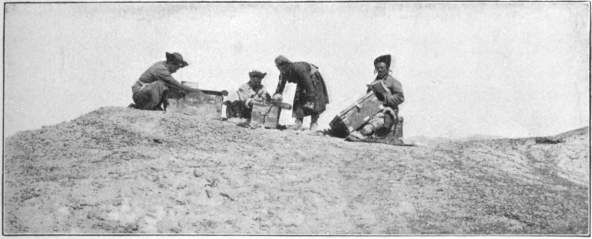
79. At Deasy’s Camp.
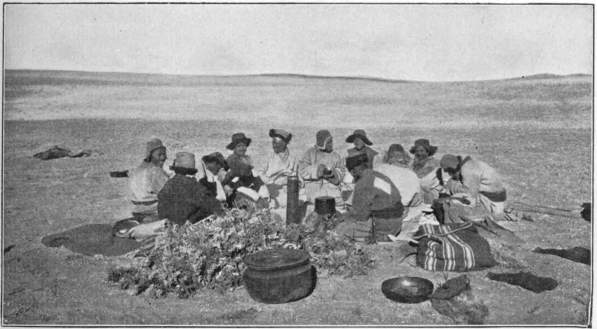
80. Afternoon Tea in the Open Air.
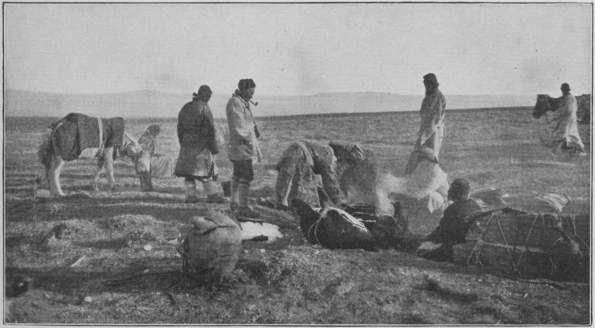
81. Melting Snow for Drinking-Water.
Then I hear far in the east a droning sound, which swells up rapidly, comes nearer, and changes into deafening thunder, and in a moment a very violent storm sweeps over the shore. I call men to close the opening of my tent. I hear Robert raise a whoop as his airy dwelling flaps about and threatens to split up into shreds. But a dozen men set it to rights again. Then my tent is strengthened with sand heaps and boxes; I am shut in with my brazier, but a small spy-hole is left in the tent opening. The moonshine glistens on the surf of the billows rolling against the shore—a grand spectacle—wild, weird, almost theatrical in its beauty. A storm of unsurpassed violence rushes ruthlessly along. It sounds like express trains rolling through covered stations; it lashes, roars, and howls, and dashes the surf thundering against the beach. The fires, but now flickering so cheerfully, are put out; the spray is spurted out like rockets; I hear Muhamed Isa’s tent flapping about; then the sound of men’s voices is heard no more, only the howling of the storm and the thunder of the waves disturb the silence of the wilderness. If I do but look out of my spy-hole I am almost suffocated by the pressure of the condensed air. Only the yaks delight in such weather; they grunt and snort with pleasure when the long black fringes of hair on their flanks flutter in the gusts.
September 28, however, was clear, the storm had sped off on its course to the west, and the dull splashing of the swell on the beach was all that was left of its fury. Before we were half way along the first line of soundings, the lake was again as smooth as a mirror; it was only flecked with small flakes of foam left behind by the storm. The water had been too thoroughly stirred up to be clear. We took little more than an hour to reach the rocky promontory, sounding on our way a maximum depth of nearly 56 feet. We left on the north a considerable bay which the caravan would have to go round.
After a short rest we continued our voyage to the south-east, and were well helped on our way by a gentle northerly breeze. This time we reached the shore without any adventures and before sunset. We landed with all our belongings. Rehim Ali collected heaps of dry dung, Robert set the camp in order, and I cruised about in the evening breeze till twilight came, and cold and darkness surrounded our bivouac. We sat down by the fire, talked, and cooked. The mince of fried sheep’s brains and kidneys tasted delicious in the open-air. To the west we could see the fires at camp No. 23. Later in the evening a strong east wind rose up again, and the waves dashed against the shore barely two yards from us. We rolled ourselves in our furs and gazed into the fire; the head is never so full of projects and aspirations as when the eyes follow the play of the blue flickering flames and the fiery forms that arise in the glow.
But the storm increased in violence, we could hardly keep the fire alive, and soon we crept under the boat, which we used as a shelter without taking it to pieces. We all three lay in this improvised tent, and strengthened it with the sail and two tarpaulin cases, which covered the halves of the boat on the march, and which we had brought with us to protect our night wraps and beds in bad weather. Above us hung a lantern which we extinguished when we were ready; now the moon shone on the sail, the tempest howled and moaned round the boat, and the surf soon lulled us to sleep.
The minimum thermometer marked 14°; it is always warmer near lakes. We were early on our feet, a good fire put new life into us, and we breakfasted beside it, the sun looking on. Our berth for the night was restored to its element, the baggage was packed in, we stepped on board and steered eastwards to the entrance of a passage which divides the Pul-tso into two basins. Its breadth is about 65 yards; in the southern basin the water was often almost red with small crustaceæ. We crossed it south-westwards, and found depths of barely 46 feet. Then a strong breeze came up from the north-west, and the waves splashed and lapped against the boat. If we only got a south-west wind we could easily sail to the appointed rendezvous. We would wait a little by the shore. It curves gracefully, and has four terraces, each about two yards high.
On the sail back a new line was sounded, the maximum depth being about 60 feet. Now we had a favourable wind on the quarter, let down the weather-board, hoisted the sail, and danced along to the strait. As we came up to its eastern point, a rider with spare horses and several men on foot came in sight. It was Muhamed Isa coming to meet us. Now Rabsang relieved Rehim Ali, but he was so awkward with the oars, that we preferred to take back our old oarsman. We said good-bye to the rescue party, and steered northwards over the northern basin of the lake, where the depths were 10 feet at most. Unfortunately the wind veered to the north, so that we were thoroughly chilled through during the two hours’ sail to the north shore.
Muhamed Isa had brought us sad news: two more horses and a mule had died at camp No. 23; in the evening another horse died. Otherwise the caravan at camp No. 25 was sound and lively. Therefore we were the more astonished to see a large fire at the abandoned camping-ground in the west. The caravan had started towards eight o’clock in the morning, and now it was four o’clock in the afternoon. Not a soul had remained behind in camp No. 23, and yet there was the fire; we saw flames and smoke, which hung like a great veil over the shore. Rehim Ali thought that the post from Ladak had caught us up at last.
“No, that is impossible; a post-runner cannot travel so far and carry his rations with him.”
“But the camp-fire must have gone out immediately after the departure of the caravan. A fire does not burn so brightly with no one to attend to it.”
“The smoke of camp No. 25 can be plainly seen from camp No. 23. If the post had reached camp No. 23 it would not have stayed there a minute, but would have hurried on to join us before night.”
“Yes, Sahib, but perhaps the messenger is so exhausted that he is signalling for help.”
“May it not be Changpas?” remarked Robert.
“Yes, certainly, it may be Tibetans, sent from the south to order us to stop, or at least to watch us, and report to the nearest headman.”
“Master, perhaps we shall have to stop sooner than we think. What is to happen then?”
“I do not think that the Tibetans can interfere with us so far to the north; they cannot force us to turn back. At the worst we shall have to pass eastwards through Central Tibet to China or Burma, as Bower did.”
“Look, now, how it smokes; this great fire must mean something.”
“Yes, it is a regular will-o’-the-wisp, a Saint Elmo fire. The gods of the lake have lighted it to lead us astray.”
“I believe it is the post, but the fire looks uncanny,” said Rehim Ali, and rowed with all his might.
“Do not disturb yourself. If it is the post we shall hear of the messenger before evening; I believe that the camp-fire has not gone out, but has smouldered on in a sheltered spot all day long; when the wind changed, some reserve heap of dung caught fire, and, fanned by the north wind, it has burst into flames.”
At six o’clock we were home again. After I had taken a much-needed meal I summoned Muhamed Isa and Sonam Tsering to a consultation.
“How many horses have we left?”—“Forty.”
“How many mules?”—“Thirty-four.”
“Are they in fairly good condition?”—“No, Sahib, not all; four of my horses and six of Sonam’s are at the point of death, and five mules.”
“We shall, then, have more losses soon?” “Yes, alas! But to save all we can, the strongest animals must now have maize and barley; the sickly ones must forage for themselves till their hour comes. They are certainly doomed.”
“That is barbarous; give them at least something. Perhaps some may be saved.”—“We must be very sparing with the forage, Sahib.”
The management of the caravan-bashi was prudent, but cruel.
At seven o’clock the storm came. It was the third evening we had had violent east winds, a direction exceedingly infrequent in Tibet. It came like a stroke, and put an end to all our peacefulness, stopped all conversation, interfered with all kinds of work, extinguished the camp-fires, blew sand and dust into my tent, and prevented the tired animals from grazing; for they will not feed in a storm. They place themselves with their tails to the wind, keep all four legs as close together as possible, and hang their heads. So they remain standing, and wait till it is quiet again. They had to wait all night long, and perhaps, sleepy and heavy-headed, dreamed of the heartlessness of men and the peaceful, sunny slopes at Tankse and Leh. In the evening Muhamed Isa and I inspected them. The moon shone brightly, but its cold, bluish light made the piercing wind seem more icy than usual. The animals stood, like ghosts, so motionless in the night, that one would think that they were already turned into ice. Not the cold, but the wind, kills our horses; all my people say so. Winter was coming down upon our mountains in all its severity. The rarefaction of the air and the scanty pasturage were the worst troubles.
The wind whistled mournfully round the corners as I went to sleep, and the same sound fell on my ear in the morning as Tsering, muffled up in a thick fur coat, brought the brazier in. A dreary morning! Everything in the tent was buried under a thick layer of dust and drift sand, and I was thoroughly frozen before I had dressed. The horses and mules had gone forward eastwards, but I did not start till nine o’clock—in a furious storm. Just outside the camp the last horse that had perished lay cold and hard as ice. Tsering told me that he was scarcely a stone’s throw from the body when the wolves had already crept up to feast on it.
The ground is good, sand, dust, and fine gravel. Afterwards the soil becomes brick-red. One cannot see far, the air is hazy and the sky overcast, but as far as the sight can carry, only low mountains are visible. One or two brooks, almost frozen up, run out of side valleys on the north. We slowly ascend to a pass, whence the country eastwards seems just as level and favourable as hitherto. Here I am following Rawling’s route; his map corresponds to the actual conditions in the smallest details.
It is quite a different thing to ride against the storm over rising ground, and to have the wind on one’s back going downhill. We work our way through the wind, which penetrates our furs, and in ten minutes are quite numbed. I can scarcely use my hands for mapping work; now and then I thrust them into the sleeves of my coat, lean far forwards, and let the horse find its own way. Two more horses die before the evening; a third was led nearly to the camp; he looked fat and sleek, but he tumbled down.
When I rode into camp I had had more than enough of this terrible day. A bright fire was burning in the fort of provision boxes, by which we chatted awhile, waiting for Tsering. The camp fort shrank up day by day at an alarming rate, but the animals died so quickly that the loads were, nevertheless, too heavy. But it was Muhamed Isa’s opinion that enough mules would be left till we got to the Dangra-yum-tso, and that no baggage need be left behind. In case of necessity the boat and a couple of tents might be sacrificed. Empty provision chests were consumed at once as firewood. Undoubtedly we should reach the distant lake in a state of utter helplessness. Without assistance we could proceed no further. Then the Tibetans could easily stop us. We were therefore a prey to great anxiety, which increased every day.
“If the animals founder at the same rate as at present, we shall not reach the nearest nomads.”
“Sahib, the strongest are still alive.”
“Yes, that is always your consolation; but in a few days some of the strongest will be dying.”
“The wind kills them. If we had only a few days of calm weather!”
“There is no prospect of that at this season of the year. This storm has now lasted 27 hours. Then come the winter storms from the south-west.”
On October 1 I wrote in my diary: “What will be our experiences in this new month? At eight o’clock the tempest still raged, and the ride to-day was worse than before.”
Flat, open country. Only one or two hills of red sandstone and conglomerate with green schist—otherwise no hard rock. The Deasy Group, towering to the south, seems nearer and nearer. The horse, No. 27, lies in a pool of frozen blood, cold and bare, for the pack-saddle has been removed for the sake of the hay. During the night three horses had stampeded, and were searched for by Muhamed Isa and three Ladakis. Stupid animals, to tire themselves out for nothing! Some unaccountable restlessness seemed to have driven them from the spot where they were unloaded. The poor things perhaps thought they could find better grass than our hard-heartedness allowed them.
We approached a very small freshwater lake, by which both Wellby and Deasy had rested. A fourth of its surface was frozen over, and on its west bank the storm had reared up a wall of ice fragments a foot high. An icy brook descended from the Deasy Group into the lake. The water of the lake was cooled down below freezing-point; a few more hours of perfect calm and the whole lake would be frozen over. On the bank Sonam Tsering found three old tent-poles with the iron rings still on them. He could not remember that Rawling had left them here: probably they were a memento of Wellby’s visit.
Tundup Sonam had killed an antelope, and for my dinner I was served with fragrant shislik roasted on a spit. Tsering knew his work; he had been cook to Beach and Lennart, whom I met in Kashgar in 1890, and was more skilful than “the black fellow,” as Muhamed Isa contemptuously styled the late Manuel.
The Lamaists among my Ladakis told me in confidence that they prayed every evening to their gods for a lucky journey. They were just as eager as myself to reach Shigatse and the holy monastery Tashi-lunpo, where the Tashi Lama resides. For then they would receive a title of honour, just as a Mohammedan becomes “Hajji” when he has been in Mecca. They would willingly pay their Peter’s pence, seven rupees for butter for the altar lamps, nay, would give up a whole month’s pay as a present to His Holiness, the Tashi Lama. Their aim was to bring a pilgrimage to a successful termination; mine to fill up as many blanks as possible in the map of Tibet. We must succeed! Heaven befriend us!
No one minded that we had not a single man as escort. Yet with every day we were getting nearer to inhabited country, and were advancing into a land which had recently (1904) been at feud with its powerful neighbour on the south. The Tibetans were ever hostile to Europeans, and after the slaughter at Guru and Tuna they would probably be still more bitter against them. We had neither passport nor permission to enter the forbidden land. How should we prosper? Our excitement was always increasing. Should we be received as open enemies, and after all wish ourselves back with the wolves on the banks of Yeshil-kul?
October 2. Thirty-six degrees of frost in the night—and we hear nothing of Rabsang! Has anything happened to him? Shukkur Ali is sent back along the caravan track with meat, tea, and bread. A mule, which can no longer keep on its feet, is killed in the camp. When the wind falls occasionally, it is singularly quiet. The landscape is still monotonous—a boundless, gently rising plain. North and south the two mountain ranges with their snow-peaks still run on. Grass and yapkak grow on all sides. Hour after hour we ride east-north-east without any change of scenery. I look forward to the moment when we shall turn towards the south-east, but that is far off, for I must first pass round all the region that Rawling explored. The animals will then have still harder work, for we shall have to cross several passes. The ranges run from east to west; meanwhile we are marching between two of them, later on we shall have to go over them. I examine the animals daily with great anxiety, and fix my hopes on the strongest, the select troop which will hold out to the last. How depressed I feel when one of them slips its collar.
At camp No. 28, beside a salt pool, the animals are mustered as usual. They understand the summons when the corn-bags are ready. Then they are turned out to graze. Empty provision sacks and pack-saddles serve as cloths to protect the animals from the cold at night. For the mules small triangular pieces are cut to bind over their foreheads, where they are supposed to be most susceptible to cold. Outside the Ladakis’ enclosure stand our twenty goats and sheep, tied head to head into a compact group, so that they may keep one another warm.
This day the moon rose blood-red over the mountains in the east. It became quickly paler the higher it rose, and the snowy mountains shone as white as the steam of an engine. The evening was calm, and the tent was easily heated in camp No. 28. Yet the temperature sank to −8°—and Rabsang was still missing. Had the wolves torn him in pieces?
Next morning, however, he turned up in Shukkur Ali’s company, but without the horse. He had followed the trail of the wandering animal for a long distance, and in the sand on the shore of the small lake had been able to read the story of a tragic incident with almost dramatic vividness. The tracks showed that the horse had galloped madly about, pursued by a troop of wolves on either side. They had chased their victim on to a narrow strip of mud ending in a point. There he had found only one track of the horse, which disappeared in the slowly deepening bed of the lake. But the wolves had left a double track—they had come back. They thought to fall upon the horse on the landspit, where he could not run further, but they had made a mistake. Rabsang maintained that their confusion was reflected in their backward trail. The helpless horse, driven to desperation by the wild and hungry jaws opened wide to devour him, plunged into the water, preferring to drown rather than fall into the clutches of his persecutors. Not a drop of blood could be seen. If he had attempted to swim across the lake, he must have died of cramp; if he had turned back to the shore, the wolves would have waited for him and not have retired into the mountains. He was a hero, and now I felt his loss doubly; he was one of the best in the caravan, a Sanskari, and had long carried the heaviest boxes of silver. The picture of his bold spring into the water, and of his desperation bordering on frenzy, long haunted my imagination, when I lay awake at night, and I thought of the horse on which Marcus Curtius plunged into the abyss.
The day’s march took us further along the same even plain, where at length every trace of vegetation ceased. At camp No. 29 there was, alas! no pasturage, and so we had to lead the horses to the foot of the mountains where grass grew sparingly.
October 4. We continue our journey to the east-north-east, and there is not the slightest change in the country. Like a squirrel in a revolving cage, we go on and on and yet find ourselves always in the same country; north and south the same summits appear, and their profiles change but slowly. Deasy named this great open longitudinal valley “Antelope Plain.” Rawling traversed its south-western portion in two directions, and my route runs between them on the left bank of its very broad, but now waterless, drainage channel. We suppose that the salt lake, which Wellby skirted on the south, must lie to the east-north-east, but it is not yet visible. Yellow grass again appears on both sides, and the camp is pitched beside a small basin of splendid spring-water. As soon as the animals are relieved of their loads and let loose, we notice that a third begin to graze at once, another third stand resting with drooping heads, and the remaining third lie down immediately. The first are the best and strongest horses, the last those that are most exhausted. Among these is horse No. 10, which has to be killed next morning; he is entered in the list of dead as No. 25.
Muhamed Isa does not now set out before half-past eight in the morning. He has noticed that the animals feed with a better appetite in the early hours after sunrise. The broad, hard river-bed is an excellent road, quite a highway, descending with an extremely slight gradient. During the last days the needles of the aneroids have remained almost stationary at the same figure. To the north we have still the Kuen-lun, sometimes as masses of dark rock, sometimes with snow-capped, rounded summits.
At one o’clock I always make a short halt with Robert and Rehim Ali to read the meteorological instruments. The journal is kept by Robert with the greatest care. I draw a panorama and take bearings, while our horses stray about grazing. We take no food at that time, for we eat only twice a day—at eight o’clock in the morning and six in the evening. Yet the short mid-day rest is very welcome. We are by that time thoroughly frozen; we can more easily keep ourselves warm on the ground than in the saddle, where we are fully exposed to the wind.
We have not seen a drop of water all day long, and the caravan is evidently looking for a spring, for we see scouts making off from time to time to the right and left. At length they discover a large pond, and there the tents are set up. We have marched lately about nine miles a day—we cannot do more.
We had scarcely set out on the morning of October 6 when the camping-ground was inspected by wolves on the look-out for another horse. They follow us as faithfully as the ravens, and perhaps receive reinforcements from time to time. Strict orders are issued that the night watch must be responsible for the animals, and will be punished if we suffer any loss from the wolves. The six ravens also still stick to us. They settle when we encamp, they set out with us, and follow us all day long with their hoarse croaking.
We pass over the river-bed, now containing water and ice, but still the low hills hide the expected lake. Otherwise the ground is level, so level that only the languid movement of the stream shows in which direction the land dips. Yellow sand-whirls in the north-west indicate the approach of a storm, which comes upon us out of a clear sky. Within half an hour it passes into an easterly storm, a typical cyclone. Worn out with the cold we arrive at camp No. 32.
The puppies are now quite big, and up to all kinds of mischief. It is recorded against the white puppy that she has torn up one of my map-sheets. Fortunately, none of the fragments is wanting. Tsering also found a toothbrush in front of my tent, which the silly dog must have considered superfluous. The brown puppy bit in two a hydrometer, which was lying about in its leathern case. Their education is very defective, but they are foundlings from the streets of Srinagar, and we cannot therefore expect much of them. They have not the slightest notion of discipline, and they do not obey when they are called. But when Tsering brings the dinner they come to heel at once, put on a show of amiability, and force themselves to the front by some means or other. They are not of much use; they keep my feet warm at night, for then they lie rolled up together on my bed.
Forty-five degrees of frost in the night! That was perhaps why I had such a horrid dream: a whole host of dark Tibetans came to meet us, and drove us back to the north. The water in the basin and the ink are lumps of ice.
Now we have left Rawling far behind us, and Wellby and Malcolm’s is the last route which has been traversed in this region. We are still following the same valley as that expedition.
Our store of yak meat was just at an end when Tundup Sonam killed an antelope. A second, unfortunately, he only wounded, and it escaped on three legs. One of our wolves was pacing about on a hill. He had closely watched the chase, and the wounded animal would probably become his prey.
Muhamed Isa, in his thick grey winter suit and with his pipe in his mouth, moves about, and is guiding the caravan up between the hills when we overtake him. We ascend to the summit of a hill. A white line appears, and below it a bluish-green stripe which gradually increases in dimensions. After a few minutes we have the salt lake we have been looking for immediately below us, for the hills slope steeply to the southern shore. Now the Ladakis commence one of their finest march songs in soft, melting tones; they are glad to have reached this lake which I have spoken of constantly, and, like myself, remind themselves that we have reached another stage on the long journey to Dangra-yum-tso. To the north-west the scenery is grand, with the great mountains, their snow-capped peaks and great glaciers. Continuing the direction of the sea westwards is flat land white with salt, and there white eddies dance, whirling along the dismal shore.
East-north-east the longitudinal valley is as open as before; there Wellby travelled. We can now, if we wish, turn aside to the south-east without again coming in contact with Rawling’s route. There new country awaits us, the great triangle between Wellby’s, Bower’s, and Dutreuil de Rhins’ routes. It had been one of my most cherished hopes to cross, at least once, the great white patch which bears on the English map of Tibet nothing but the one word “Unexplored.”
CHAPTER XII
IN UNKNOWN COUNTRY
In the middle of the night I was awaked by seven mules, which stood close to my tent stamping about on its ropes. I went out to drive them away, but when I saw how piteously cold they were, and how closely they crowded together, I let them alone. One of them lay dead in the morning beside my tent, with its belly swollen all out of shape.
Green schists form small ledges and strips on the otherwise soft ground, so that at a distance the land seems striped with black. Here and there veins of quartz crop out. Reddish-purple hills appear on the western horizon, and the country becomes more uneven. After a while we pass the sheep driven by the men in the wake of the caravan. They travel very slowly, grazing as they go; we have still 18 left. To-day the water is a difficulty. Some is found by digging at a depth of a foot, but it is briny. The day’s march is therefore longer than usual, 12 miles, but then we come to a spring.
On the eve of a day of rest we feel as though it were Saturday evening and there were no school next day. We intended to spend October 9 in camp No. 34; I had not given a day’s rest for 17 days. All were delighted, and the Ladakis, in anticipation of the day of rest, arranged an al fresco feast round a great camp-fire. The refreshments were the same as usual: tea in wooden bowls, parched meal, and roasted antelope meat—spirituous liquors of any kind were prohibited in our caravan. But, nevertheless, the men were in a right jovial mood; they danced round the fire, and sang a lively song with a chorus culminating in barbaric, shrill-sounding laughter. They rejoiced that they had proceeded so far and still possessed sufficient power of resistance to undergo severe hardships. We have travelled 331 miles from the Karakorum, and there are 400 more to the Dangra-yum-tso. But we are nearer the lake than we are to Leh, and so have really more than half the journey behind us.
After 41 degrees of frost in the night, October 10 dawned with brilliant weather, sunny and calm. Horse No. 3 was the twenty-sixth martyr of the caravan; he lay dead on the field. We passed another which was reduced to a skeleton and never reached the camp. We travelled east-south-east, and had now to leave the longitudinal valley through which Wellby had traversed the whole of north Tibet. A small hollow in the ground was crossed, and the camp was pitched among the hills on its south side. The brown puppy had behaved so disgracefully that she had to lie outside as a punishment. She howled and whined piteously, but slept after she had been covered with a frieze rug. Next day she had to travel with the mules to her shame. In the night another horse died.
Red and yellowish-grey hills begirt the way, which led up in three hours to a small flat saddle, whence the view eastwards seemed boundless. Had it been our intention to proceed farther in this direction we should have encountered no difficulties in the nature of the ground for many days to come, but my unalterable goal was the Dangra-yum-tso, and therefore we must direct our course south-eastwards. There a dark chain with an irregular, toothed crest soon came into view. Between its summits were seen deeply-cut saddle-formed gaps; but, to our chagrin, they were more difficult to surmount than they appeared, and the slightest rise in the ground was felt by our caravan in its prostrate condition.
The ground was all honeycombed with the holes of the abominable field-mice, but the holes were not so treacherous now, for the soil was frozen, and held firm when we rode over the subterranean catacombs connected by a network of passages.
Again we mounted a small swell in the ground (17,234 feet). We saw before us a dark point in the track of the caravan; it was a dead mule, which slept his last sleep with wide-open eyes beside his pack-saddle. Behind a hill we surprised a large, handsome fox, which made off in a great hurry as we drew near. But he could not refrain from frequently turning round and staring at us; he had probably never seen a human being before.
At camp No. 36 there was not a drop of water, but we were not able to travel further. We had with us two goat’s leather bottles filled with ice which sufficed for our tea; but the animals had to go without water. However, we could not complain; it was the first time since Leh that we had had no water.
An unusual sight greeted us on the morning of October 12; the whole country was covered with snow. But scarcely had the sun mounted up, when the snow melted and the ground was dry. The caravan set out early for the sake of the thirsty animals. Now we kept on a south-easterly course, leaving out of the range of our vision the lake discovered by Rawling, and named “Lake Markham” after the former distinguished President of the Royal Geographical Society in London.
Again we pass a horse with its throat cut; it is reddish-brown, and contrasts strongly with the grey, sandy soil. The eyes have already been picked out by the six ravens which sit like black ghouls round the fallen beast and hold a wake. A little farther something suspicious again appears in the track of the caravan—it is the sixth mule. He has collapsed on the march and has not to be killed; he is still soft and warm, and his eyes have not lost their brightness, but the ravens will soon be here, for they follow the caravan like dolphins in the wake of a vessel. For every animal that falls there is a horse-cloth to spare for his comrades. They will need it when the severe cold of winter comes. The two victims to-day have long been released from duty, but they had to follow on till they died, for there was always a hope that they would recover—a vain one, indeed.
The trail leads us to the mouth of a valley, where we soon come up with the caravan—all the animals have their heads in a brook, they have had to thirst so long. The valley must come down from a pass, so we march up it. It becomes narrower and narrower, till at length there is a passage only five yards broad between walls of schists tilted up vertically. By the brook lay the bleached skull of an Ammon sheep with fine horns (Illustrations 59, 60). We found shelter from the cutting wind at the foot of a precipitous wall of rock on the left side of the valley, and there set up our tent poles. Muhamed Isa climbed a height opposite, taking the field-glass. “A labyrinth of small mountains,” was his unsatisfactory report. By this time we had lost 29 horses and 6 mules, and had only 29 horses and 30 mules. “The strongest animals are still living,” was Muhamed Isa’s consolation.
October 13. The night with 39 degrees of frost deprived us of another horse and a mule. Their bones are bleaching in camp No. 37, and are tokens of our visit. A heavy march over very undulating ground. We had to cross over three small, trying passes. A good deal of snow still lay on the ground. To our right extended a red mountain crest, and in a gorge a waterfall was congealed into a mass of ice. Muhamed Isa had erected three cairns to show us the way where the track of the caravan became indistinct on pebbly ground. On the first pass the prospect was dreary, nothing but pink, purple, and yellow mountains. On the north the Turkestan mountains still dominated the landscape with their majestic peaks, a row of imperial crowns far above the rest. Fifty degrees east of north we fancied we perceived a large lake, but it might equally well be a plain transfigured by the mirage. Many of the hills and spurs consist of creeping soil from above, which in consequence of its slow motion is frozen into concentric rings and other patterns. The third pass rises in perfectly barren land. Here Tsering gave himself enormous trouble in setting up a cairn, which was quite unnecessary, for no one would come after us; but it was an act of homage to the gods of the mountains, an earnest prayer that they would let us pass safely.
At last we came down into open country, a main valley running eastwards, where there was a glimpse of yellow grass in the distance. Tundup Sonam shot two Ammon sheep, and their flesh prolonged the lives of our 18 sheep. In this cold, windy weather we are never properly warm. When I sit, sketching the panorama of the mountains or taking a solar observation, I must have the brazier beside me to warm my numbed hands a little, so that I can use them. Only Muhamed Isa, Tsering, Sonam Tsering, and Guffaru are exempt from night duty; all the rest are obliged to turn out into the cold, dark, wintry night. When darkness falls I fill up the drawings I have sketched in the day, study maps, or read light literature, or Supan’s Physische Erdkunde, and a couple of books on Buddhism and Lamaism. At nine o’clock Robert takes meteorological readings, and sets up the hypsometer, which I read off in my tent. Then we talk awhile and go to sleep. My bed is laid on an India-rubber sheet and two folded Turkestan frieze blankets. On these is laid a great square of goatskins sewed together. I lay myself down on one half of the square and cover myself with the other, and then Tsering tucks in the edges under the felt blankets, so that the whole is converted into a sack. Lastly, he spreads two more felt blankets, my ulster, and my fur coat over me. I have my fur cap on my head and a bashlik; otherwise I undress as usual. In stormy weather the morning bath is not exactly pleasant; my clothes have become icy cold during the night. The Ladakis have no notion of cleanliness, and consequently carry about with them small colonies of vermin, for which I have not the least use. But those who make my bed, clear up, and wait on me in my tent, cannot help giving me a most liberal share of their surplus, and therefore my underclothing has to be frequently washed in boiling water. My sensitiveness in this respect is a wonderful source of amusement to the Ladakis; I hear them laughing heartily at my horror of all kinds of blood-sucking creatures. But I tell them that I feel comfortable only when I am quite alone in my clothes.
The winter evenings grew longer and longer, and our life passed in monotonous solitude. The worst was that my light reading was put a stop to. To occupy the leisure hours I made the Ladakis relate to me traditions and legends of their own country, and noted some of them down. I also made each of my servants narrate his own experiences; but the notes I made of them were not very remarkable, for the men had not much to tell, and thought it all quite natural and unimportant. You must question and draw them out, and even then the result is unsatisfactory. They very seldom know the name of a European whom they have served for months, and they cannot state their own age. But they know exactly how many horses there were in a caravan they accompanied years ago, and the colour of each horse. One Ladaki, who has traversed the inhabited parts of western Tibet, can tell me the name of every camping-ground, describe it accurately, and tell me whether the pasture there was good or bad. They have also a marvellous memory for the character of the ground.
Having regard to the compass of this narrative, I cannot allow myself to wander into diffuse biographical notices, but I must very briefly introduce my little party to the reader. We will begin, then, with Rabsang, who went in search of the horse that was baited by the wolves. He is a Bod, or Buddhist, strictly speaking a Lamaist; his father is named Pale, his mother Rdugmo, from the village Chushut-yogma in Ladak. By occupation he is a zemindar or farmer, grows barley, wheat, and peas, owns two horses and two yaks, but no sheep, pays 23 rupees (about 31 shillings) in taxes to the Maharaja, but no contributions to the lamas. Once a year he travels in the service of Afghan merchants to Yarkand, and receives 50 rupees for the whole journey. The merchants carry clothing materials, coral, tea, indigo, etc., to Yarkand, where they put up in the serai of the Hindus, and stay twenty days to sell their goods and purchase silk, felt rugs, ordinary rugs, etc., which they get rid of in Peshawar. Rabsang had served chiefly the Hajji Eidar Khan, a rich merchant of Cabul. Six years ago he had an adventure on the Suget-davan, where twelve Badakshan men, who owed the Hajji money, met the caravan. The twelve men had led a wild life in Yarkand, and could not pay their debts The Afghans, who numbered five, fell upon them and a violent scuffle ensued, ending in bloodshed. That was Rabsang’s worst adventure. He had served Captain Deasy five months and another Englishman as long. When he was away himself, his wife and a brother tilled his land and looked after his affairs.
“Can you depend on your wife’s faithfulness for so long a time?”
“No,” he answered, “but we do not think much of that in Ladak.”
“What happens if she misconducts herself with another man?”
“Then he must give me a sheep as compensation.”
After this not a word more could be extracted from Rabsang.
In our caravan he is under Tsering’s immediate command, and leads the four horses which carry my tent, my bed, the four boxes of articles for daily use, and the kitchen utensils. He is assistant to the head cook, and has to keep me supplied all the evening with fuel. He brings Tsering fuel and water for cooking, and is an exceedingly sturdy, useful fellow. A year later he had a prominent part to play.
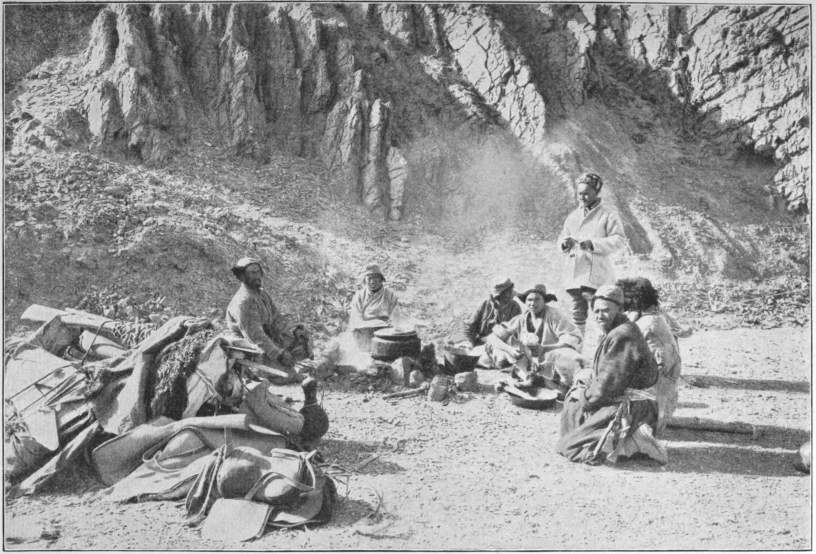
82. Preparations for Dinner at Camp 41.
I have already spoken of the Mohammedan Rehim Ali. He is my right-hand man on the march. Guffaru is the oldest of the company, and guide of the horse caravan; consequently the more horses die, the less he has to do. The Hajji Gulam Razul has been twice in Mecca; he is Muhamed Isa’s cook. Shukkur Ali has made many remarkable journeys, which would fill a whole chapter themselves; with us he is leader of a section of the horse caravan, but has now only two charges. Gaffar is a young Mohammedan, who follows the horses, gathers fuel, and fetches water. Young Tsering has the same occupations, and Ishe, Tundup, and Adul belong also to this party; the last, a hard-working, sturdy man, has entered my service in order to buy himself a house in Leh and to enable him to marry. Islam Ahun is horse watchman. Bolu belongs to my caravan, and is one of Tsering’s assistants. Galsan, who has travelled much in western Tibet, serves as a mule-driver. Ishe Tundup is responsible for the sheep. Lobsang Rigdal, nicknamed the Lama, has to attend to my horses. He is come with me to earn money to give to his father and elder brother, because they have always taken good care of him. He is the jester of the caravan, and has a very comical appearance. Tashi, who accompanies the horses, is one of our best men. Tundup Sonam keeps up the sporting reputation of the caravan and provides us all with fresh meat. He scarcely ever misses, and is as quiet and composed as a pan of clotted milk. He had served under me before, in the winter of 1902, when I travelled from Leh to Yarkand. Gartyung belongs to the mule caravan, and entered my service to restore order in his financial affairs. A small, short, black-bearded fellow, fifty years of age, answers to the name of Tashi Tsering; formerly he was called Islam Ahun, he says, so he has changed his religion, though it seldom happens that a Mohammedan goes over to Lamaism. He also leads a troop of horses. Rub Das is a Gurkha from Sitang, and does all sorts of work; he is silent and works like a slave, without needing the slightest reminder. Tundup Geltsan is the reciter of tales, whose voice is heard when all the day’s work is over; he is also chief cook in the black tent of the Ladakis. Namgyal is a mule-driver, and one of our best; Sonam Tsering is overseer of the mules, Kurban nothing but Guffaru’s son, and Tsering is my head cook.
Herewith the list closes. Each of these men had his duty to perform; all were willing and good tempered, and quarrels and disputes were never heard. But Robert and Muhamed Isa knew excellently well how to maintain discipline. Every man had a warm sheepskin, and they made themselves bedding of the skins of the slaughtered sheep or the wild animals that were shot; as the winter cold abated they used empty provision sacks as blankets. As they all travelled on foot they soon wore out their soft Ladak boots, and they had to re-sole them repeatedly; for that purpose they utilized pieces of skin with the wool turned inwards.
On October 14 we passed a series of large river-beds which intersect the ridge to the south along flattish valleys. Kulans and antelopes were grazing in large numbers. At the camp, situated between reddish hills, the grass was good. Our direction was east-south-east. In the night a horse died. The country preserves henceforth the same character: it consists of a number of small ridges extending from east to west, and much time is lost in crossing them; between them lie longitudinal valleys. Not infrequently we can count southwards three or four such ridges, and we have to pass over them all. We have lost ourselves in a sea of rigid undulations; we are like a ship that has lost its rudder and is on the point of sinking: no islands of refuge, no ships coming to meet us, boundless sea on all sides. We should like to pour oil on this rough sea; we long for calm waterways, but as long as a plank remains we will cling fast to it. At camp No. 40 there was good grazing, and water we could obtain from ice.
The men have sewed up a felt coat for the brown puppy, which they put on her when it is cold at night. She looks very ridiculous in her new night-dress when she runs about, steps on a corner, and then rolls over. The white puppy sits at first quite disconcerted and gazes at her, but then finds the sight so alluring that she cannot refrain from making fun of her comrade, dancing about her and biting her cloak. The brown one, on the other hand, sits resolutely quiet and lets the white one sport about her.
We penetrate further into the forbidden land. On October 16, the anniversary of my departure from Stockholm, we had still 380 miles to travel to Dangra-yum-tso, but now were seldom able to march more than 7½ miles a day. In Camp No. 41 (Illustration 65) some articles that we could spare were left behind, to lighten the loads, among them several books that I had read and Bower’s narrative, which had now served their turn in my travelling library. The tents were set up in a sheltered valley at the foot of a rock. Tundup Sonam had gone in advance, and had surprised a four-year-old yak which was lying on a slope in the sun. Taking advantage of inequalities in the ground, the sportsman had crept up quite close to it. The first ball had entered the pelvis. The yak, thus unpleasantly aroused from his meditation, sprang up and received a second bullet in his hough. Then he rushed down the slope, turned a somersault on to the bottom of the valley, and lay dead as a mouse; and here, therefore, the tents were pitched. He was already skinned and cut up when we arrived, and the dark-red flesh with a purplish tint at the legs lay in the sun. The stomach was immense, and full of grass, lichen, and moss—no wonder that the animal needed rest after such gourmandizing. The head was set up as a decoration at the foot of a mountain spur, and the hunter was photographed beside this trophy. The Ladakis were ordered to eat their fill of the meat, for we could not burden ourselves with any extra weight. All the fat, however, was taken with us, and the marrow was reserved for me. When we left the place, there was not much left of the yak, and I have my suspicion that the Ladakis carried some fine pieces with them in their private bags.
The ravens, in company with an eagle, sat feasting round the bloody skeleton. Now there are eleven of them, and their wings shine in the sun like blue steel. They feel, alas! quite at home in the caravan and are half tame. The dogs take no notice of them, and are treated by the ravens with sarcastic contempt.
October 17 was a trying day; there was a strong wind from the west, and the temperature did not rise above 23° at noon. We were approaching a pass, but we encamped before reaching the summit. At nine o’clock the thermometer marked 9.3°, and I could make it rise in the tent only to 24.5°, for the little warmth radiating from the brazier was at once driven out by the wind. The minimum thermometer stood at −18.8°, the lowest temperature that we had hitherto recorded. A white mule, which had carried no load for the past ten days, was frozen to death. Now I had 27 mules, 27 horses, and 27 servants in the caravan. We had not seen a man for 57 days. Should we all remain together till we fell in with the first nomads?
Antelopes and yaks were grazing on the slopes of the pass, the height of which is 17,575 feet. A labyrinth of mountains spreads itself out in the direction of our march, and therefore we turn aside to the north-east and encamp in the mouth of a valley. The white puppy, which faithfully follows Robert and myself, is always soundly thrashed by her brown sister when we arrive in camp. She has no hope of defending herself, so she lies quietly on her back as if she were made of papier maché, and does not dare to utter a sound. Now they are both bloated from over-indulgence in yak flesh; but however bad the brown puppy may feel, her little sister must get her licking as soon as she appears.
In the night of October 19 two more of our horses were frozen to death, and a sheep. Of the latter we had now only 16; puffed up with gas the three dead animals lay on the slope and stared at us with dark blood-stained eye-cavities; the ravens had already been at them. The ground was very difficult, constantly sloping upwards and then down again. We saw the caravan struggle up to a pass, but beyond appeared another still higher, with patches of snow. The crests of the mountains in this country run in general to the east-north-east. In the south lies a lake at a distance of about 20 miles, but it is far to the right of our route.
When we reached camp No. 44, at a height of 17,539 feet, in the midst of terrible mountains, it was announced that Muhamed Isa was ill. He had suffered for some days with severe headache, and had been well dosed with quinine. As he could not reconnoitre as usual, Robert asked permission to climb the high pass which barred the way to the east, and to look around. He did not come back till dark, and then informed us that we should soon emerge from these troublesome mountains if we turned to the south-east. Muhamed Isa therefore received instructions for the following day in accordance with this information.
What a difference from the previous evening when the stars twinkled down from a blue-black sky and the fires blazed bright and red! Now heavy masses of cloud lie over mountain and valley, so low that they seem almost within reach of the hand. It snows unusually thickly; the ground is white, and the inequalities and tufts of moss throw long shadows about the fires. A pale light rises out of the provision fortress, now reduced to small dimensions, and casts a feeble glow on the black tent of the Ladakis. Tsering sits with his men round the kitchen fire, wrapped in furs, and delivers a lecture more than two hours long, without pausing a second. His tongue is like a windmill in a breeze. They have all known one another for years. What on earth can he have to tell them that they have not heard already twenty times over? But Rabsang, Rehim Ali, and a couple of other men listen attentively, and express their satisfaction from time to time. I join them for a while. They rise to greet me, and lay a fresh armful of dry dung cakes on the fire. The flickering flames throw a glaring light over the snow, which crunches under the feet of the men. But the brightness does not extend far, and, beyond, the darkness of night yawns on all sides. The grazing animals can neither be seen nor heard, but the snow hisses as it falls continuously into the blaze of the yak-dung fire.
CHAPTER XIII
UNFORTUNATE DAYS
October 20, 1906, was a bad day. The snow lay three inches deep, and all around was dazzling white in the sunshine; only to the west blue shadows spread over the slopes. We were to cross the pass. In the universal whiteness the distance seemed short, but after the caravan had advanced half way, the pass still appeared as a small, black, fixed point. The field-mice were awake and scurried about between their holes in the snow, which became deeper as the way became steeper. It was soon a foot deep, and we had to keep carefully in the track of the caravan, lest we should roll over into the snowy abyss. Spots of blood were seen; one of the animals had hurt its foot against the sharp-edged detritus. Step by step we mount upwards, blue-black clouds gather threateningly together behind us, and in an instant we are enveloped in the wildest driving snow: the dry particles, fine as flour, whirl round us, like comet tails, with a rushing sound. They collect into drifts, the track of the caravan is hidden, and we can no longer see how far it is still to this deadly pass.
A dead horse lies on the way, without its eyes—the wicked ravens must always have the eyes while they are still warm and soft. The wind had driven the snow over his back and neck, as though to make him a nice and comfortable couch. He lay as on a bed of state, exposed to all the winds of heaven, with clean white pall, and the black ravens as a guard of honour—the only thanks he got for his services.
On the pass we make the usual halt for observations; the height is 18,409 feet; it blows and snows, with 18 degrees of cold. We perceive, however, some sign of the saddle to the south-east which Robert reconnoitred yesterday, and which is supposed to lead down into level country. But Muhamed Isa has taken his own way down a valley running north-east, and that is serious for us. Far in front as he is, we must, though much against our will, follow his track, lest we should lose one another. It is now difficult to see whither the caravan had marched. If we lose one another in such country, and the snow continues to fall, we are done for.
So we follow him down the valley. The pass behind us looks weird—a white saddle against a background of blue-black clouds, which resemble whirling, suffocating smoke. Tsering reaches the pass with his two men and four horses, and salutes it with a loud salaam. Treacherous frozen rivulets are crossed, as hard as glass and as smooth as cooling grease; our riding horses stumble and slide. It is very seldom that a small hill of dark schist peeps out above the snow.
As the valley runs too much to the north, the caravan perceives its mistake, turns aside to the east, and buries itself in a labyrinth of hills where not a blade of grass grows. We ride past the shepherd with the 16 sheep and the goats; the white puppy teases them as usual, till a bold wether puts her to flight. The goats are remarkably hardy and get on splendidly, and yield me a cup of milk every morning and evening.
We found the caravan behind a second saddle. The camp was formed, but in a most unfavourable spot; there was neither grass nor yapkak, neither dung nor water—absolutely nothing. The animals stood in a dark group, standing out sharply against the white snow. Thus they had to stand, quietly and patiently, all night long, and doubtless felt how slowly the time passed, how hunger and thirst increased, and the cold again diminished. They had to wait standing for the morning red, which might perhaps fail to appear, for dark masses of cloud still covered the sky.
Robert and I took refuge in the tent of the Ladakis, where a fire burned, which was fed with fragments of a box and antelope dung. We could at any rate obtain water by melting snow; my dinner consisted of parched meal, bread, and coffee, for nothing else could be cooked. In the twilight Rabsang appeared and asked me to come outside. Two large wild yaks stood on a neighbouring hill and gazed at our camp with astonishment. But we left them in peace, for we did not want their flesh, and would not add to our loads. They trotted slowly away when they were convinced that we were not of their species. The night was pitch dark, so that I had to inspect our weary beasts with a lantern.
We set out early from this unlucky camp, where a mule had fallen at his post. The footprints between the tents, made in the snow the evening before, were filled up with fresh snow, and a new set of paths had been formed. Scarcely two minutes’ walk from the camp a horse lay dead, which had carried his load only the day before, and the black corpse-watch was beside it. A dead wild-duck also lay in the snow. Is there a lake in the neighbourhood? No; the ducks come long distances, and this one had probably lost its way.
Now the sun burns, now a snowstorm envelops us in its fine dust, now we are roasted, now chilled through—regular Tibetan weather, unreliable and changeable. Another dead horse! The men had cut its throat to shorten its sufferings; swiftly whirling snow covers the stream of blood that congeals in the cold. We make our way up to a pass, and then follow a ridge, but the ground is frightful. At length we ride down a flat valley which gradually winds round to the north; on the south rises a formidable crest. Muhamed Isa had orders to take, if possible, a south-easterly direction, but as he was not sure of the way, he had encamped at the bend of the road. He had gone forwards with two men to reconnoitre. Towards four o’clock he returned, and reported that we should reach open country within three hours. My first thought was to set out at once, for in camp No. 46 there was no grass, and the animals were so hungry that they bit one another’s tails and the pack-saddles. One horse had actually not a hair left on his tail, but that one had been eaten up the night before. The old, experienced hands, however, gave their opinion that it would be better to start in the early morning.
I therefore gave orders to reserve as much rice as we should require for forty days, and to give the rest, mixed with barley and maize, to the animals. While, however, they were eating from their nose-bags, the men changed their minds, and Muhamed Isa asked if they might make a start.
“I am quite willing, but it will be pitch dark in an hour.”
“I will find the way. You have only to follow the trail in the snow.”
Then began the tumult of breaking up camp, and the sound of tramping in the snow; but there was no singing. There were 27 degrees of frost with a boisterous wind from the west. Everything was taken except my things and Robert’s and the cooking utensils. A mule, which refused to move, remained with us. No fires lighted up the dark procession led by the horses and closed by the sheep. It moved off slowly, and the shouts of the men reached us more and more feebly till at length the caravan disappeared in the pale moonlight. I entered my tent stiff with cold. A quarter of an hour later a man came back with another mule which could not get on any further. So we had two dying animals with us.
And then came the night. The air was clear and calm, the stars twinkled like diamonds in the brightness of electric light, and the cold settled keenly round our tent. Outside, Tsering, Rabsang, Rehim Ali, and Bolu had rolled themselves together into a heap under all their belongings. As long as I was awake I heard the irrepressible Tsering telling his tales in the depth of his cave of furs, and the others occasionally giving vent to a subterranean giggle. Curious fellows, these Ladakis! No amount of cold seems to affect them, while I, in my tent, can only sleep a minute at a time.
An awful, terrible night in the lonely mountains of Tibet. The temperature sank to −17°, and that was too much for the two mules which had been left behind. One expired about midnight; he was the animal which Sonam Tsering had wished on the first day to send back to Leh as useless. We tried then to exchange him for a horse, but as no one would have him, he had to come with us after all. He was accustomed to travel with horses, and later on always went with them. To the astonishment of all he became strong and led the van—a good example for the horses. Now he lay cold and hard as iron, with his legs stretched out; if he had been lifted on to his feet he would have remained standing. Sonam Tsering wept when he heard that the animal was gone.
The other mule was heard moving about in the night and nibbling at the yak grass, which is too short for other animals except the yak; the tongue of the yak is provided with horny barbs which pluck up the fine velvety grass. Early in the morning I heard the mule squeal, and was glad that one at least still survived. But when the sun rose his strength too was spent, and when Tsering woke me he said that the animal was dying. He looked healthy and well nourished, but we tried in vain to raise him up and feed him with maize, and he was sacrificed to the gods of this valley of death. He did not move a limb or twitch an eyelid as the blood spurted out on to the snow; he seemed only to experience a welcome sense of peace and resignation, while his eyes were turned full on the sun.
As we were on the point of leaving this horrible camp, there came fresh tidings of misfortune. Tundup Sonam appeared to show us the way, and reported that the horse caravan had wandered off too far to the left, while the mules under Muhamed Isa had taken the opposite direction. Muhamed Isa, as soon as he found out his mistake, had descended into the first valley he could find, to wait there for the dawn. As for the flock of sheep, Tundup Sonam could only say that it had at first followed the track of the horses, but had afterwards turned away. The greatest confusion reigned everywhere, but the worst news Tundup Sonam kept to the last: four more mules had died during the night.
Our situation was desperate. We could not go on much longer; we were coming to a crisis. The ground, the weather, and the cold were all against us, the horses died wholesale, and it might be a hopeless distance to the nearest nomads. What did it matter whether the Tibetans would be friendly or hostile? Now the only question was: should we be able to drag ourselves along to inhabited districts? For, if these losses continued a few days longer, we should soon be compelled to abandon all the baggage and continue our journey on foot. But could we carry ourselves enough provisions to last us through this uninhabited country? Should we perish one after another in these icy deserts of the Tibetan Alps? And if at length, in a wretched, half-dead condition, we met with Tibetans, they could do what they liked with us. At any rate we could not force our way through to Shigatse and the unknown country to the north of the Tsangpo, the goal of all my most cherished dreams.
A journey straight across Tibet looks pleasant and easy on the map. In reality it is a serious and difficult undertaking, costing suffering, excitement, and tears. The meandering line is drawn in red on the map, for it is really marked with blood. We set out under the guidance of Tundup Sonam, and it soon became evident that we should never have found the way without him. Up and down, over hills and through valleys we threaded this intricate maze, where the deep snow smoothed down the inequalities and quite misled us in estimating the heights of the steep declivities. We left the track of the horses on our left; there a load of maize was left, but Tundup Sonam assured me it would be fetched. To the right appeared the high ground where the mules had wandered in the night trying their strength uselessly. An icy south-west wind blew over the bitterly cold snowfields. From time to time Tundup Sonam reared up a slab of schist to show the way to Tsering, who was coming behind without a guide.
Now we cross the trail of the mules and see the valley where they have passed the night. “Yonder, on the slope, lies a mule,” says Tundup Sonam, “and two behind the hill, and a little farther on a fourth.” We could not see them from where we were, but the ravens resting here, sleepy and satiated, confirmed his words.
At last we reached the pass, whence we caught sight of the plain and a small lake to the south-east. The height was 18,048 feet. At one o’clock there were 18 degrees of frost, the wind was high, and it snowed so thickly that the view disappeared again. We did not stay a minute longer than was necessary for observations, and then rode down a steep descent. We rested at the first grass we came to; the horses were almost mad with delight when they saw it—their stomachs were so empty.
Now we saw five men on a height. They were Muhamed Isa and four companions, who had come out to look for the missing men and animals—14 horses, 8 men, 16 sheep, and 2 dogs. We were able to inform them that their track ran north-eastwards, and after they had given directions how to find the camping-ground of the mules they vanished again in the snow. After searching in vain for the track and looking out for the smoke of the camp-fire, we came to a halt on a smooth plateau, where the grazing was good, and collected dung for a fire—it was high time, for Robert and I were half dead with cold.
We were in a terribly sad plight. We did not know where the mules were encamping, and had not the slightest notion where the horses had gone. The sheep, in this country swarming with wolves, were probably lost. Tsering had remained behind, and might easily miss our track in the snowstorm. We could do nothing but thaw our clothes. After we had been sitting an hour, and had somewhat recovered in the heat of the fire, the “Lama” came over the plain bringing with him Sonam Tsering, who had been camping with the mules behind some hills. The good fellow wept bitterly at our losses; Muhamed Isa had proved a bad pilot this time, he complained. Nine mules had perished within a few hours in these frightful mountains, which were probably the western prolongation of the system called by the Mongols, dwelling farther to the east, Buka-magna, or the “Head of the Wild Yak.” Twenty mules still remained, but two of them had received their death-warrant. Of the twenty-three surviving horses one was left behind with his pack-saddle in a hollow, and was probably dead by this time. At a late hour of the night only one of the missing ones, namely, Tsering, had put in an appearance.
Under these circumstances it was a matter of course that we should have a day’s rest in camp No. 47. When day broke, I was awakened by the bleating of sheep. The shepherd had at first followed the track of the horses, but soon abandoned it when he noticed that the mules were not there, and he began to look for the track of the latter. In the darkness he got completely lost, and in a pass one of the sheep had refused to go any farther. He had carried it awhile, but as he soon felt that it had become cold and stiff he threw it away as dead. Frightened of the darkness and the wolves, he had taken refuge in a gorge, tied together the sheep and goats in a circle, and set himself in the middle to keep himself warm and look out for the wolves. However, they had not ventured to attack him. In the morning twilight he had found one of the many tracks leading to camp No. 47.