Front matter (continued 11)
Reading edition
Beyond the nunnery Döle-gompa the valley of the My-chu unites with the large side valley Lenjo running in from the west, in which, farther up, three villages are situated. From this valley the My-chu receives a very considerable tributary, which is crossed by a solid bridge of three arches resting on four stone piers; thick belts of ice still lie along the banks. Here we find two fine manis with turrets at both ends, where six-pointed stars are cut into the flat stones. These perpetual manis often stand in long rows so near together that they look like a long luggage train, and one expects to see them move and start off for the abodes of the blessed. Everything here denotes a great highway, a mighty commercial artery connecting the sedentary people of the lower-lying lands with the nomads of the plateaus. The road itself is the largest and best kept that I have seen in all Tibet. Bridges span all the affluents which might interrupt the traffic in summer and autumn, and wherever a landslip has occurred, the road is repaired at once. Sacred cairns, walls, and streamers indicate to the traveller at every step that a monastery is near, where the monks expect a visit and a present of money. We are always meeting caravans, riders, peasants, and beggars who extort money from merchants returning home after a good stroke of business. Many of these beggars turn into robbers and pillage undefended huts, but when they meet us they begin to hobble, gasp, and whine. After the harvest the traffic will be still more active than now.
The valley now contracts to a corridor, and the broad shallow stream occupies all its bottom. On the right side, which we follow, the cliffs of schist fall perpendicularly to the river, and the dangerous, narrow road runs like a sill along the wall of rock. Here nature has opposed endless insurmountable obstacles to the engineering skill of the Tibetans. The baggage has to be carried past these dangerous places, and it is astonishing that the horses can get past. Flat slabs of schist, branches, and roots have been inserted into cracks and fissures of the precipice 120 feet above the river, and on these planks, poles, and stones are laid forming a gutter a foot broad, without a scrap of railing, where one must even keep one’s tongue in one’s mouth lest one should lose one’s balance. Of course we traverse this stretch of road, called Tigu-tang, on foot, leaning inwards and supporting ourselves by the rock. We breathe freely again when we are safely over, and the great basin lies before us where, at Linga, two important valleys converge.
Here is the confluence of the My-chu with a river flowing from the east, the Sha-chu, which farther up is called Bup-chu, and which we crossed two and a half months before on its thick coating of ice. On April 15 the Bup-chu brought down 215 cubic feet of water and the My-chu 222, so the rivers were nearly equal, but the ratio may of course vary considerably according to the distribution of the precipitation.
In a short valley in the western mountains the monastery Linga-gompa is placed on the uppermost ledge of a steep flight of terraces, and is as fantastic, fascinating, and attractive as a fairy castle. Its white houses are perched like storks’ nests on mountain pinnacles; a row of manis points out the way up to where the pious, blameless saints dwell in deep silence, far above the riot and tumult of the villages and the roaring and tossing of the stream. Below the monastery stands the village Linga-kok, where our camp is pitched not far from a bridge of ten arches on eleven piers which crosses the My-chu. A crowd of Tibetans, black as Moors, dirty, ragged, capless and trouserless, watch our arrival in silent amazement (Illustration 188).
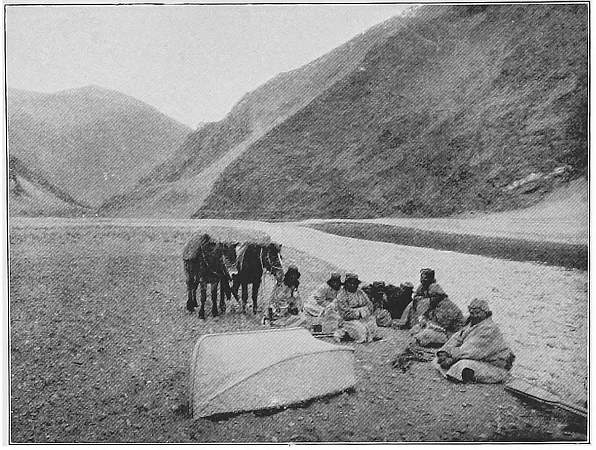
187. On the My-chu near Linga.
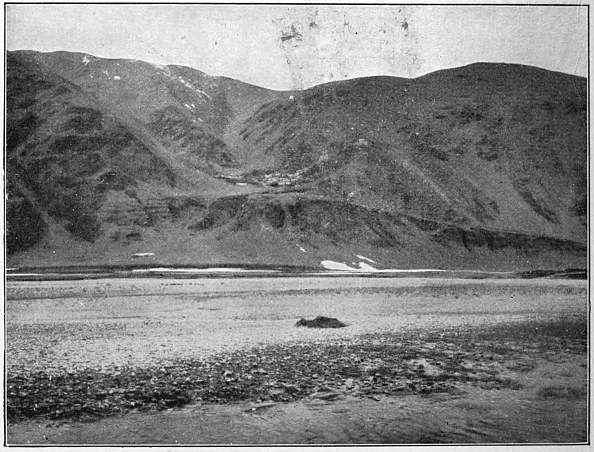
188. Village and Monastery of Linga.
Not a single tree is seen in the neighbourhood; only up at the monastery there are two. This consolation, then, is no more, and only in our memory do we hear the thick foliage of tree-tops rustling in the wind. Again we may expect the moaning of the storm on the passes of bare alpine ranges. Moreover, the spring has not set in in earnest, for in the night there were still 30 degrees of frost.
I spent all Sunday till twilight in the monastery, with Rabsang and Tundup Sonam. We mounted the acclivity past rows of well-kept manis, which had the appearance of broken-down walls, with red-painted inscriptions chiselled out of the blocks of schist and framed in red. Then we passed through a gate in the convent wall, and mounted higher and higher between forty old and more recent white houses clinging to the rock. The situation is like that of the Hemis monastery in Ladak, but there the houses are not so scattered. Several of them are unoccupied, for the custom prevails here that, when a lama dies, his relations claim possession of his house, lock the door and take away the key. His movable property reverts to the convent. If a newly-come lama takes a fancy to an empty house, he can buy it from the heirs of the former owner; a good house is worth 100 rupees (Illustration 175).
Linga has thirty monks, some of whom accompanied us on our rounds and were always pleasant and friendly, and never bold like the monks in Kum-bum, which I visited in the year 1896. The monastery is subordinate to Sekiya, and the Sekiya-Lama is its highest spiritual superior and contributes towards its maintenance. Linga-gompa also possesses lands, which, however, have not yielded much of late, for the crops have failed several years in succession. The monks are not dependent on the Tashi Lama, and have not a single statue of Tsong Kapa, whence it may be concluded that their sect is older than the reformed church. But it was, as usual, impossible to get any information about the age of the monastery. It seems to be in the interest of the monks to date back its origin to the remotest antiquity, of which no human records are extant. I was told, however, that the abbot, Yimba Tashi, knew its age, which was recorded in an old chronicle of the monastery. Unfortunately, he was not at home, having gone northwards to a district called Kumna, there to track out a band of robbers who had plundered him the year before and carried off all his caravan animals.
Down below the convent is a gorge with a black slope of schist on its side, on which the six holy characters are exhibited in fragments of white quartz, and call out to heaven the eternal truth, “Om mani padme hum,” in all kinds of wind and weather.
A staircase of flags of schist leads up to the Dopcha, an open platform paved with flagstones where the religious spectacles take place on feast days. The usual flagmast stands in the centre, but there is no breastwork of any kind, so that one dares not go there after dark, for bottomless abysses yawn round the open sides. Here the monks had laid carpets and cushions and invited me to tea. I enjoyed for a while the fine view over the valley, the confluence of the two streams, the scattered villages, and the fields like chessboards. Far to the east, behind the Bup-chu valley, the lofty mountains are seen over which we travelled on the way from the Ngangtse-tso.
On the south side of the square is the entrance to the chief temple (dukang), which in all monasteries is in a red-painted stone building. We enter, look round, and are carried away by the singular mysteriousness, though we have often seen it before with trifling variations. I sink on a divan and fancy myself in a museum crammed full of modern trophies and flags of victory, where impenetrable darkness lurks among the pillars, and rows of drums, gongs, prayer cylinders, and trombones are set up. The hall is darker than usual, but bright light falls through a skylight on to the images of the gods. They seem to be soaring from their pedestals in the darkness into the glorious light of the upper regions. The monks glide inaudibly like ghosts and shadows among them, busied with the votive bowls. A wonderfully weird scene! We have wandered into a cavern where gnomes and hobgoblins creep about.
This grotto resounds the whole time with the chant of the monks on the divans, which rises and falls in rhythmical waves, like the roar of the billows and the lapping of ripples on a strand. They sing in unison, keeping faultless time and without exerting themselves, though with astonishing rapidity. Among them are greyheaded men with cracked voices, men in the prime of life, and youths and boys with fresh young voices. The sound is like horses trotting quickly over an endless wooden bridge; all the monks clap their hands and then the horses seem to trot over a paved street, but the next moment they are on the bridge again and the consonants roll like peas out the monks’ lips. Now and then a bass voice rises above the din calling out “Laso, Laso” (an exclamation of thanksgiving). During a short pause there is tea. Then the chant goes on again. There is no excitement, no hurrying of the tempo, all goes on in the same even quick trot. The monks have no books before them; they know their liturgy by heart. But the charm of the rhythm seems to render them oblivious of time and space; they do not suffer themselves to be disturbed, but trot on over the bridge that leads to the home of the gods and to Nirvana. As we go out again we hear the chant die away like the humming in a bee-hive.
We visited some other halls, where I noted down the names of the images. At length there remained only two convent buildings on a sharp ridge of rock. The first was named Chörigungkang, and had a sort of shed in which swords, guns, drums, masks, tiger-skins, and other lumber were stored. In the very front, on the point of the rock, is a cubical house called Pesu. It is surrounded on three sides by a gallery without balustrades, and here the abyss is deeper than elsewhere. Here I stayed to sketch the panorama, but the weather was anything but pleasant, and snowstorms veiled the mountains from time to time. Nevertheless it was hard to leave this terrace. The flat roofs down below look no larger than postage-stamps. Bright as silver, or dark, according as they are lighted, the two rivers hasten to meet each other. Then I could not help thinking how singular it was that the loftiest and grandest alpine country in the world, which must surely impress the human mind more than any other, had not been able to instil into the Tibetans a higher, nobler form of religion than this narrow, limited, dogmatic Lamaism. I grant that it was imported from India more than a thousand years ago and was first modified into the so-called northern Buddhism, but after all it flourishes vigorously in Tibet. One would think that the ancient Bon religion with its copious demonology, its widespread superstition, and its spirits haunting all the mountains and lakes, would be more suitable here. But we have indeed, discovered that Lamaism has absorbed many of its elements. At any rate the Linga monks have a splendid view of an artistically sculptured corner of the world. From their loopholes of windows and their flat roofs they can see winter spreading its white carpet over the mountains and putting the rivers in fetters, and then the spring shedding its gold over the valleys, the summer conjuring out new fresh grass, and lastly the rain torrents of early autumn washing the slopes and swelling the rivers.
We now ascended, as if the mountain itself were not high enough, two steep pitch-dark flights of steps, where it is easy to break one’s neck, into the entrance hall of the Pesu temple. In a smaller room the flame of a butter-lamp struggled vainly with the darkness, casting its dull light on some idols. Pesu is the hall of the gods par excellence, with innumerable statuettes of metal, very old, artistically worked and certainly very valuable. Some figures were of medium size. I stood in front of the altar rank and inspected the gods. Tankas and long narrow scarves in many colours hung from the ceiling. On the right was the small, dark room, and on the left was a shutter creaking as it banged to and open in the wind. Before the gods stood a row of bowls with barley, wheat, maize cobs, and water. I asked a monk who had come up with me how long it took the gods to eat it all. He smiled, and answered evasively that the bowls must always be full; but on entering I had caught sight of some mice which quickly scuttled away in the darkness. What cruel irony, what a picture of self-satisfied vanity and religious humbug! The serving brother has been in the Pesu, has filled the bowls and said his daily prayers, has descended the steps and locked the door behind him. When all is quiet the mice come out of their holes. They climb upon the altar table, stand on their hind-legs, curl their tails round the votive bowls, and consume the nectar and ambrosia of the gods.
Could I not buy some of these charming figures? No, it could not be. The monk showed me a label which is attached with wire to each image. Every object belonging to the furniture of the convent has its number, and this number is entered in the general inventory. The prior is usually elected for a fixed term of years, and when he resigns his office he hands the list to his successor to be checked. If any object is missing, he is responsible and must pay the value.
A monk came up to bring tea for Rabsang and Tundup, who had seated themselves in the outer hall. I remained alone and gazed at the gods, mesmerized by their smiling gilded faces, their portly double chins, and their arched eyebrows. Then something wonderful happened. Their features changed and all turned their heads and looked at me. A curious feeling of awe took possession of me; had I insulted them through some want of delicacy? No, next moment they turned their heads away again and stared straight at the opposite wall. It was only a banner which in the draught from the window had moved so as to alter the shadow on the faces and give them an appearance of motion.
Linga is a ghostly castle, but Pesu was the most ghostly part of it all. There large drums and grinning masks shimmered like ghosts in the gloom, and the wind whistled mournfully through all the loopholes and openings. A man of strong nerves would get the horrors if he were compelled to spend a stormy autumn night alone in this hall of the gods, with the light of the moon falling through the loopholes on the images. He would listen with bated breath for every sound and crack. If the door below banged against its frame, he would hear some one entering the ante-chamber, and when the streamers on the roof fluttered in the wind, he would imagine the unknown person was approaching the hall with light steps and would in a second be bending over him; and the mice running over the floor, and the shutters swinging in the wind on creaking hinges, and the wind moaning in the window recesses and among the rafters, all would strain his imagination to the utmost and make him count the minutes till the dawn. After the gods had turned their heads towards me I felt that I should not like to be in such a position, but would rather go down again to my tent in the valley and sleep.
END OF VOL. I

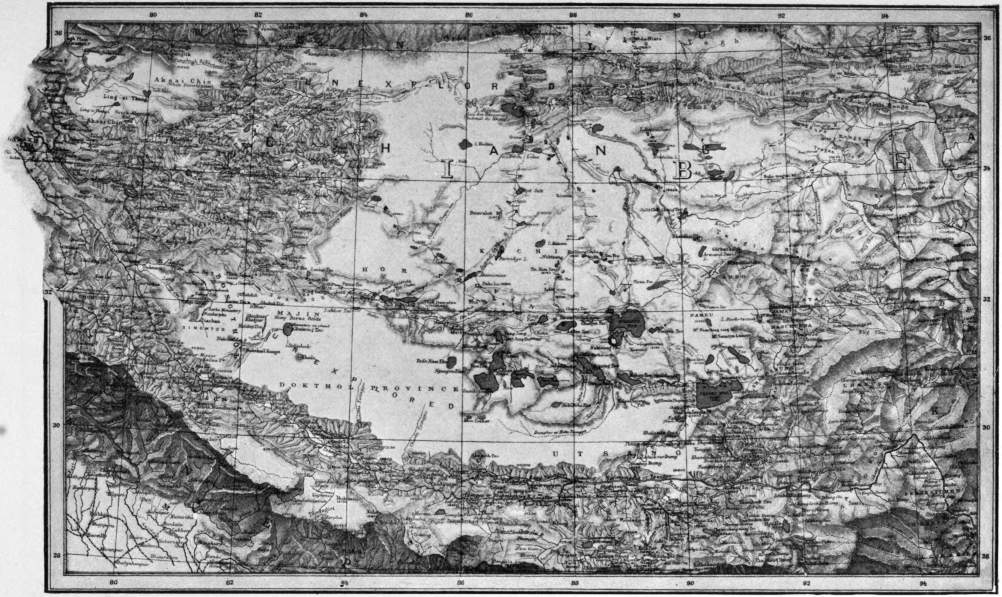
1. The Latest Map of Tibet. From the Geographical Journal, 1906. Note the blank space north of the Upper Brahmaputra with the word “Unexplored.”
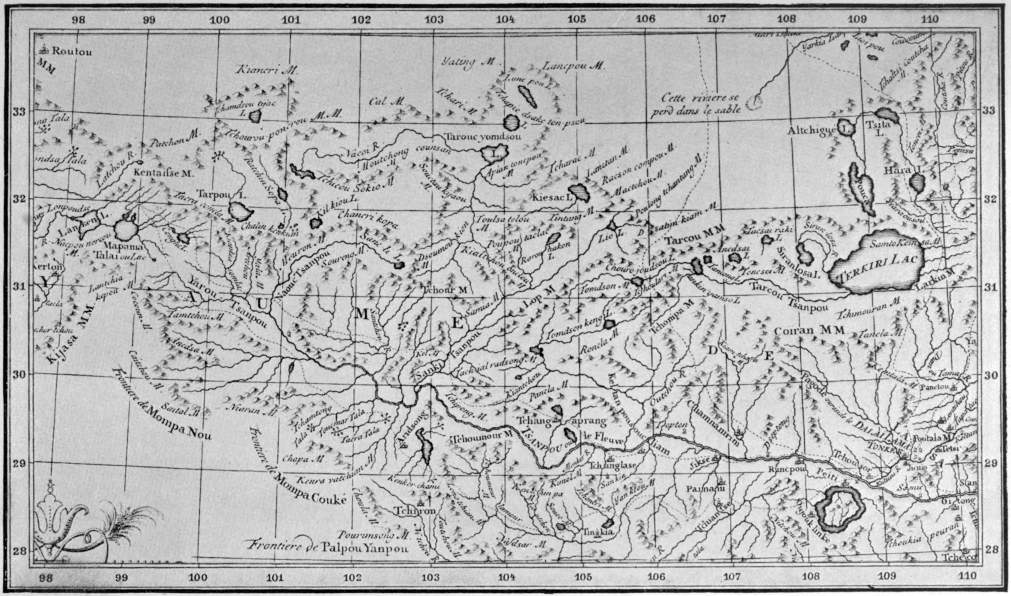
2. Carte Générale du Thibet ou Bout-tan. (Avril 1733.) D’Anville, Nouvel Atlas de la Chine, etc. Paris 1737.
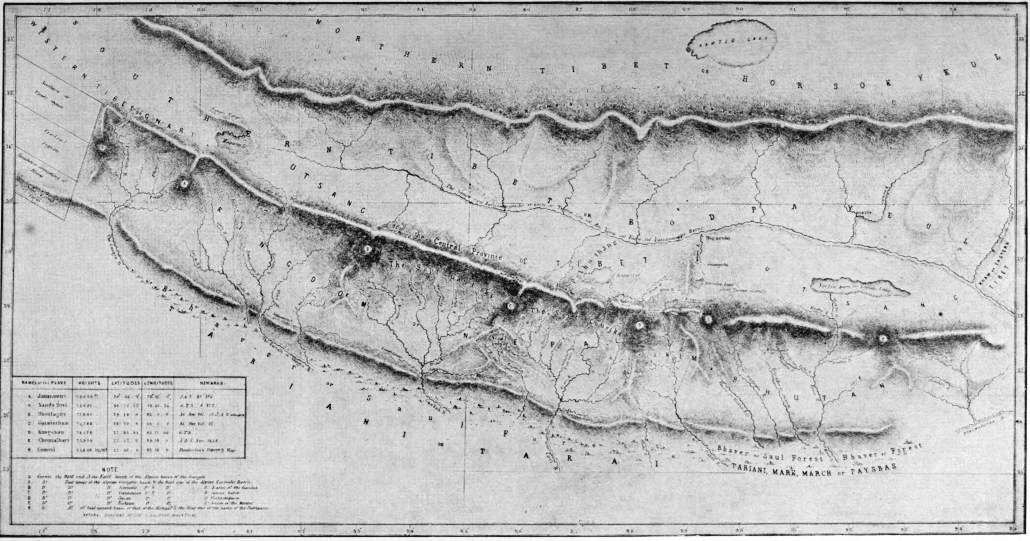
3. Map of Southern Tibet. From Selections from the Records of The Government of Bengal. No. XXVII. Papers relative to the Colonization, Commerce, Physical Geography, etc. etc. of the Himalaya Mountains and Nepal. By Brian Houghton Hodgson, Esq., M.R.A.S. Calcutta, John Gray, Calcutta Gazette Office, 1857. Hodgson’s “The Nyenchhen Thangla Chain, separating southern from northern Tibet” is only hypothetical, and does not represent the actual configuration.
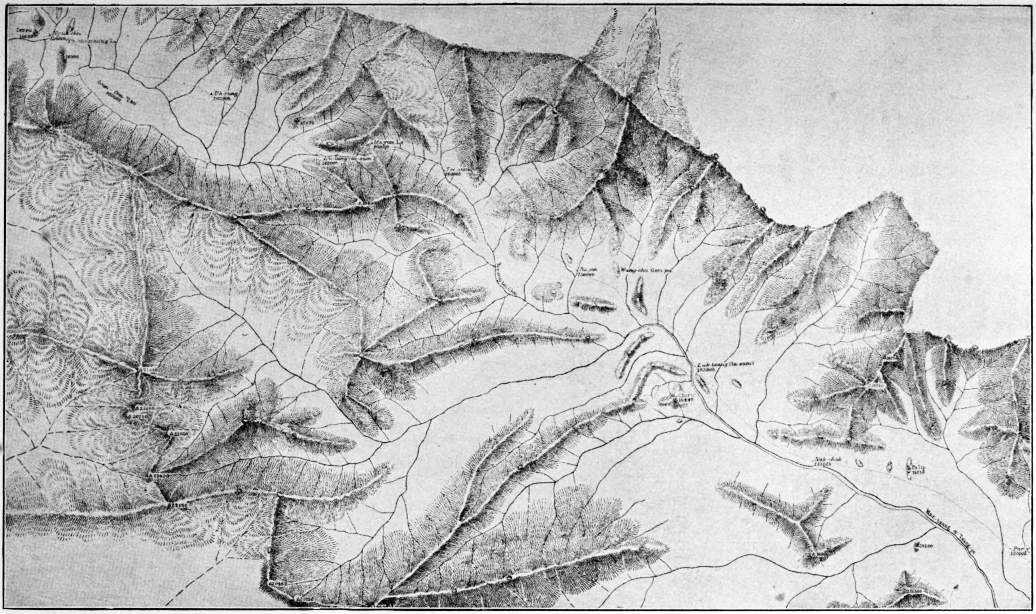
4. The Source-Region of the Brahmaputra. After Major Ryder, 1904. The Chema-yundung is drawn as the main river, while the Kubi-tsangpo is shown as an affluent. In reality the Kubi-tsangpo is the source-stream, and the Chema-yundung, which receives the Marium-chu, only a tributary.
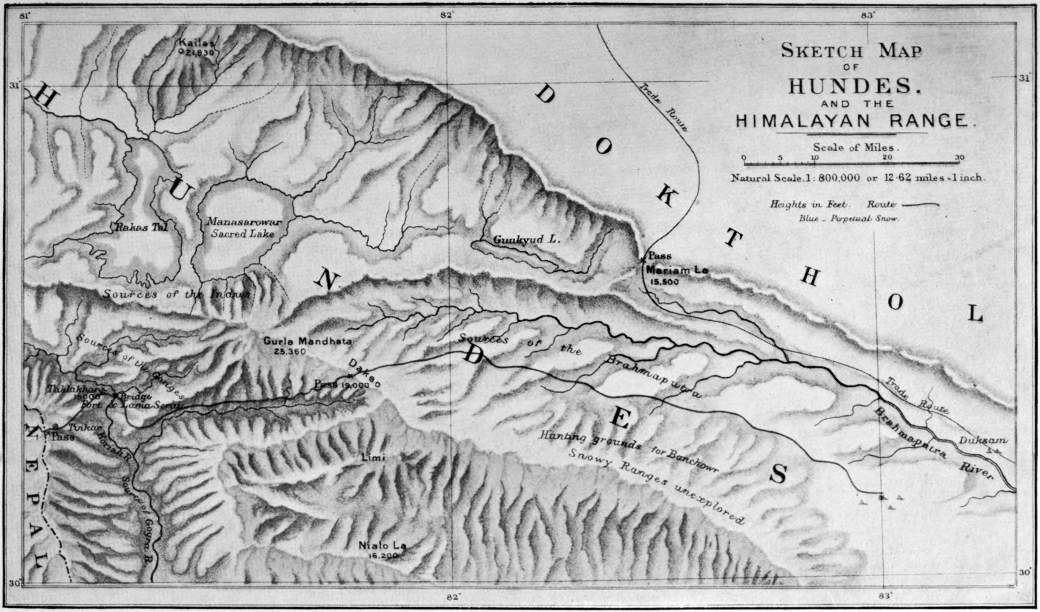
5. Sketch-Map of Webber’s Route in 1866. The Forests of Upper India. By Thomas W. Webber. London, Edward Arnold, 1902.
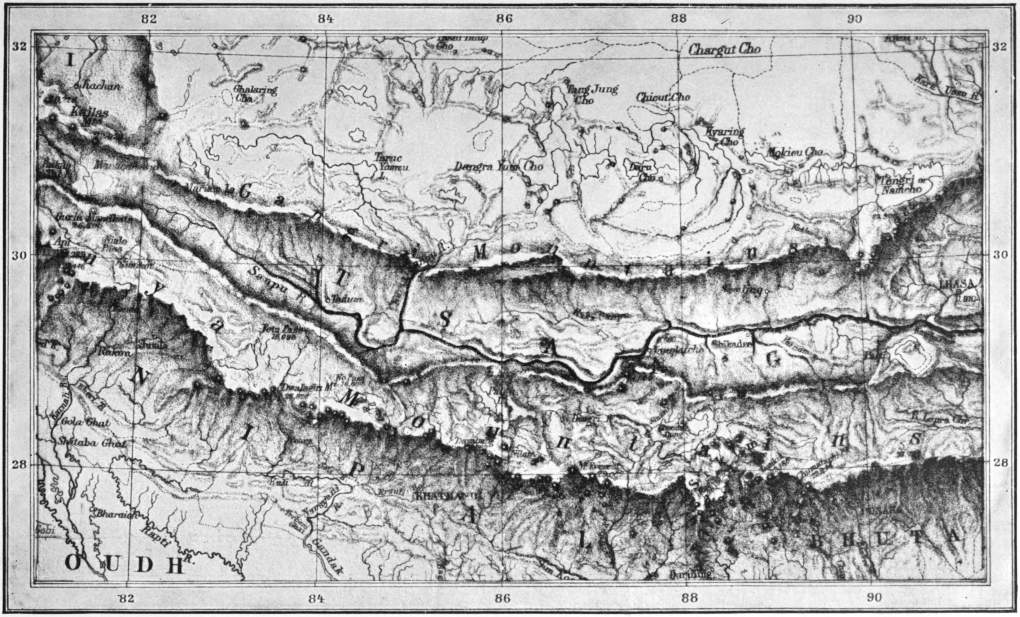
6. Saunders’ Map of South Tibet. From Narratives of the Mission of George Bogle to Tibet and of the Journey of Thomas Manning to Lhasa. By Clements Markham. London, Trübner and Co., 1879. Hypothetical form of the Trans-Himalaya (“Gangri Mountains”) from 81° to 88½° E. long. Quite incorrect.
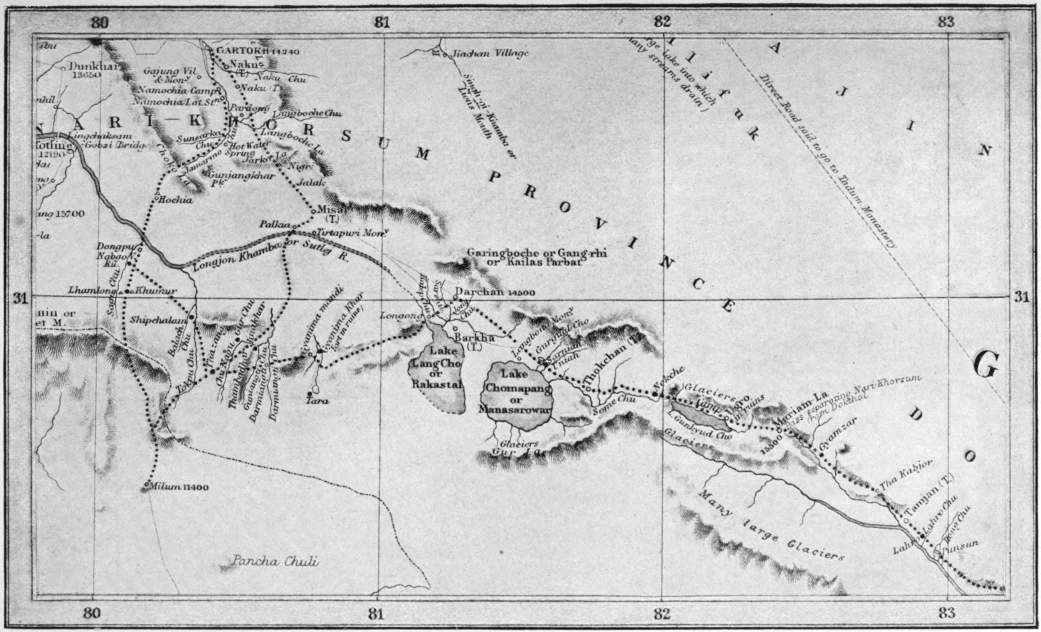
7. The Source-Region of the Brahmaputra. After Nain Sing, 1865. His route is shown by a dotted line.
SIR FRANCIS YOUNGHUSBAND’S
Kashmir
With 70 plates by Major E. Molyneux
Cloth, 8vo, $6.00 net
Kashmir is renowned throughout the world for the beauty of its natural scenery and the salubrity of its climate. It is a Switzerland in Asia, but on a grander scale, with loftier mountains and more wide-flung landscapes. The present book describes with pen and brush the variety of natural beauty in the different seasons of the year. It also gives some account of the chief places of interest, of the people, and of their government. The seventy full-page color illustrations are all of remarkable excellence.
A. V. W. JACKSON’S
Persia, Past and Present
Illustrated, cloth, 8vo, $4.00 net
“Professor Jackson’s account admirably fulfils the promise of the title of the volume. Saturated with the history and literature of the ancient kingdom, before making his personal acquaintance with the country under its modern aspects, the author was able to assimilate his often hazy impressions with a thoroughness impossible to the ordinary traveller.”—New York Tribune.
FREDERICK MOORE’S
The Balkan Trail
Illustrated, cloth, 8vo, $3.50 net
“Mr. Moore writes his story so that the reader almost sees what the author saw. He describes the outrages by the Turks, the murders by the brigands, and little humorous incidents with equal facility, and he finds an abundant variety of topics during his expedition.”—Boston Transcript.
HENRY SAVAGE LANDOR’S
Tibet and Nepal
Colored illustrations, 8vo, $5.00 net
“The book is decidedly agreeable and even exciting reading, and presents in many ways an intimate picture of the life of the Tibetans and their innumerable curious customs. The colored pictures are striking and effective.”—The Outlook.
Published by
THE MACMILLAN COMPANY
64-66 Fifth Avenue, New York
JACOB RIIS’S
The Old Town
Illustrated, cloth, 12mo, $2.00 net
In this delightful book Mr. Riis writes of his boyhood home, the queer old city of Ribe. The historical interests and landmarks of Ribe are many, and here they are set before us with that same sympathy, expression, and care for detail which enabled Mr. Riis to picture in so graphic a manner the life of the New York City slum dwellers. Vivid portrayals of life in the old days, of the sports and pranks of children, of the curious and quaint customs of their elders, abound in every chapter and proclaim the “message of the old town.” Mr. Benda in his pictures has been strikingly successful in supplementing Mr. Riis’s work.
E. V. LUCAS’S
A Wanderer in Paris
Colored illustrations, cloth, 12mo, $1.75 net
“Mr. Lucas seems never to have forgotten anything that he has once read, and he has all his resources on tap at the right moment; yet one never feels a sense of suffocation from his profusion. One’s dearest wish may be that Mr. Lucas shall live long enough to go on ahead to all the cities one wants to know in the way he alone of guides is able to instruct us.”—Literary Digest.
CECIL HEADLAM’S
Venetia and Northern Italy
Old World Travel Series
Illustrated, cloth, 8vo, $2.50 net
“Cecil Headlam has a happy art of making books about places, in which he mingles history and art with scenery and personal impressions.... The impression he makes is that of an intelligent and sympathetic companion, who never discourses long enough on any subject to weary his hearers.... There are twenty-five full-page illustrations in color by Gordon Home.”—The New York Post.
GORDON HOME’S
Along the Rivieras of France and Italy
Old World Travel Series
Illustrated, cloth, 8vo, $2.50 net
“It has always been Mr. Home’s pleasant habit to illustrate his books of travel with his own pictures, and its pursuance in ‘Along the Rivieras of France and Italy’ has produced a volume in which the brilliant descriptions of the text are rivalled by twenty-five colored plates, many of them extraordinarily happy in their reproduction, and about twenty drawings in black and white.... A better guide for comfortable library or study travel could not be devised.”—The Boston Transcript.
Published by
THE MACMILLAN COMPANY
64-66 Fifth Avenue, New York
WILLIAM E. CARSON’S
Mexico, the Wonderland of the South
Illustrated, cloth, 12mo, $2.25 net
Mr. Carson knows Mexico thoroughly, and he has drawn an accurate and fascinating pen picture of the country and of the people, of their everyday life and the everyday sights and scenes. It would be hard to discover anything worth seeing that he has not seen. He has wandered around the Mexican capital and other old cities; he has explored the gold and silver mines and visited some of the quaint health resorts; he has gone mountain climbing and tarpon fishing—and he tells of these many experiences in a most engaging manner. Many pictures of curious and out-of-the-way places add greatly to its beauty and to the value of the book for travellers and general readers.
DR. WILFRED T. GRENFELL’S
Labrador: The Country and the People
Illustrated, cloth, 8vo, $2.25 net
In this volume Dr. Grenfell supplies the only full and adequate account of Labrador—the country, its natural resources, the climatic conditions, and its people. In addition to the main body of the book, with its chapters on Physiography, the People of the Coast, the Missions, the Dogs, the various Fisheries, there are short chapters on the Flora, the Fauna, the Geology, etc., each by a scientific author of standing. The volume, profusely illustrated from photographs in the author’s own collection, reveals an unknown land to the vast majority of readers.
ELLA HIGGINSON’S
Alaska: The Great Country
Illustrated, cloth, 12mo, $2.25 net
“No other book gives so clear an impression of the beauty and grandeur and vastness of our northernmost territory, nor so inspires one to explore its vastnesses. She has mingled enough of history and statistics to make it authoritative, and has embellished the tale with stories and anecdotes to prevent its being dull, and has succeeded in writing what might well be called a great book on a great subject.”—The Boston Evening Transcript.
JAMES OUTRAM’S
In the Heart of the Canadian Rockies
Illustrated, cloth, 8vo, $2.50 net
“It is so inspired with the glories of the mountains, their sublime solitudes and silences, and their fascinating perils that it might well be called the epic of American mountaineering.”—World To-day.
Published by
THE MACMILLAN COMPANY
64-66 Fifth Avenue, New York
CLIFTON JOHNSON’S BOOKS
Among English Hedgerows
With an introduction by Hamilton W. Mabie, and over 100 illustrations
Cloth, 8vo, $2.25 net
“This book deserves to succeed, not only in America but in the country which it so lovingly depicts.”—The Spectator, London.
Along French Byways
Fully illustrated, cloth, 8vo, $2.25 net
“Gives a singularly faithful and complete and well-balanced idea of the French peasantry and French rural life, manners, and customs.”—Boston Herald.
The Isle of the Shamrock
Fully illustrated, cloth, 8vo, $2.00 net
“A most interesting book, full of lively sketches and anecdotes.”—London Daily News.
The Land of Heather
Fully illustrated, cloth, 8vo, $2.00 net
“Not only Scotchmen, but every student of human nature will be pleased with this entertaining book. It describes typical people and scenes with much sympathy and appreciation.”—Brooklyn Standard Union.
AMERICAN HIGHWAYS AND BYWAYS SERIES
Highways and Byways of the Mississippi Valley
Illustrated, cloth, 8vo, $2.00 net
Highways and Byways of the South
Illustrated, cloth, 8vo, $2.00 net
Highways and Byways of the Pacific Coast
Illustrated, cloth, 12mo, $2.00 net
New England and Its Neighbors
Illustrated, cloth, 8vo, $2.00 net
The Picturesque Hudson
Illustrated, cloth, 12mo, $1.25 net
Published by
THE MACMILLAN COMPANY
64-66 Fifth Avenue, New York