PART IV CONTRIBUTIONS FROM THE JOURNAL: MISCELLANEOUS MATTER
Reading edition
ACETPHENETIDIN AND PHENACETIN—THEIR RELATIVE PURITY
Until six years ago the chemical product known as phenacetin was patented both as to process and to product. As the patent ran out at that time, anyone, of course, could manufacture it. It was placed in the Pharmacopeia under the name “acetphenetidin.” It is on the market now under both names, “phenacetin” and “acetphenetidin.” The price of the former is five times130 that of the latter, hence it is rather important to know whether or not one is, in any way, better or purer than the other. The original patentees or manufacturers, the Farbenfabriken of Elberfeld Company, market the product under the name “phenacetin” and also under the official name “acetphenetidin,” the former at about 33 cents an ounce and the latter at about 6 or 7 cents an ounce. Evidently these people believe that acetphenetidin is all right since their price-list says: “Our product is of the highest standard of purity,” and in another place: “On account of the low price of acetphenetidinum, U. S. P., it is especially suitable for the manufacture of medicinal specialties, such as headache powders, etc.” Remember that it is the manufacturers of phenacetin who say this.
The question arose whether or not phenacetin differs from acetphenetidin. If it does, then physicians should know it. An inquiry was addressed to Farbenfabriken of Elberfeld Company and also to Lehn & Fink, two firms which market the product in this country under both names, asking in what respect the two products differ. No answer was received from either firm. With the object of answering the question our chemists have investigated the preparations on the market, both those sold under the name “phenacetin” and those under the official title “acetphenetidin.” The following is a summary of their report:131
THE CHEMISTS’ REPORT
Physical Appearance.—All the specimens were found to be fine white crystalline powders, differing somewhat in appearance as follows: Four specimens—Acetphenetidin (Farbenfabriken), Phenacetin (Specimen 1132—Farbenfabriken), Phenacetin (Specimen 2132—Farbenfabriken) and Acetphenetidin (Squibb)—appeared very much alike, each being a very fine crystalline powder, differing only slightly as to fineness. Five other specimens—Phenacetin (Lehn & Fink), Acetphenetidin, U. S. P. (Lehn & Fink), Acetphenetidin (Merck), and two specimens of Acetphenetidin (Powers-Weightman-Rosengarten), had the same general appearance, each consisting of a fine crystalline powder containing a considerable proportion of large rectangular plates. Three specimens—Acetphenetidin (Mallinckrodt) and two specimens of Acetphenetidin (Powers-Weightman-Rosengarten)—had the same general appearance, being a moderately fine and homogeneous crystalline powder. When examined microscopically with a low-power lens the Mallinckrodt product appeared to consist principally of rectangular prisms and the Powers-Weightman-Rosengarten product to be made up largely of plates.
Identity.—All of the specimens when tested side by side responded to and complied with the identity tests of the United States, British, German, Swiss, Dutch, Swedish, Spanish, and Danish pharmacopeias. The reactions given by the several specimens were all the same, showing no difference in any case.
Melting-Points.—As a further proof of identity and similarity the melting-points of the different specimens were taken and found to be: Acetphenetidin (Farbenfabriken), 134.2 C.; Phenacetin (Specimen 1—Farbenfabriken) 133.7 C.; Phenacetin (Lehn & Fink), 134.7 C.; Acetphenetidin (Lehn & Fink) 134.9 C.; Acetphenetidin (Powers-Weightman-Rosengarten), (1) 134.3 C., (2) 133.6 C., (3) 134.7 C., (4) 134.7 C.; Acetphenetidin (Squibb) 134.2 C.; Acetphenetidin (Merck), 134.8 C., and Acetphenetidin (Mallinckrodt), 134.2 C. The melting-point is given as 135 C. in the British, French and Spanish pharmacopeias, and as 134 to 135 C. in the United States, German, Swiss, Danish, Swedish and Dutch pharmacopeias. Thus all comply with the standard given in our pharmacopeia and most foreign pharmacopeias with two exceptions and those respectively only 0.3 C. and 0.4 C. low.
Absence of Acetanilid.—The absence of acetanilid in all the specimens was indicated by the bromin test of the United States, British, German, Swiss, Dutch, Swedish and Danish pharmacopeias.
Absence of Carbonizable Matter.—The absence of carbonizable matter was shown in all specimens by the sulphuric acid test of the United States, British, German, French, Swiss, Dutch, Swedish and Spanish pharmacopeias.
Water-Soluble Matter.—All specimens when tested for excess of water-soluble matter came well within the limit (0.50 per cent.) set by the French pharmacopeia, the greatest amount being 0.20 per cent.
Ash.—When heated, all the specimens were found to yield practically no ash, the residues from 1 gm. samples weighing in no case more than 0.0004 gm.
Absence of Paraphenetidin.—When tested by the methods of the United States, British, German and French pharmacopeias, the absence of an impurity of paraphenetidin was shown in all specimens, with the exception of one specimen obtained from Powers-Weightman-Rosengarten Co., which gave a positive, though not strong, reaction and two other specimens of the same firm which reacted still more faintly.
TABLE SHOWING RESULTS OF ANALYSES OF VARIOUS SPECIMENS OF ACETPHENETIDIN AND PHENACETIN*
NamePhysical AppearanceMelting Point (Corr.) C.Water-Soluble Matter in, per Cent.Ash, per Cent.Para- phenetidin, U. S. P. Test†Para- phenetidin, Swiss Test†
Acetphenetidin (Farbenfabriken) (1)Very fine homogeneous crystalline powder134.20.170.02–+
Phenacetin (Farbenfabriken)Very fine homogeneous crystalline powder133.70.060.00–+
Phenacetin (Lehn & Fink)Fine crystalline powder, not uniform134.70.110.02–+
Acetphenetidin (Lehn & Fink)Fine crystalline powder, not uniform134.80.130.00–+
Acetphenetidin (P. W. R.) (1)Homogeneous crystalline powder134.30.190.03++
Acetphenetidin (P. W. R.) (2)Homogeneous crystalline powder134.70.160.02++
Acetphenetidin (P. W. R.) (3)Homogeneous crystalline powder134.70.140.02++
Acetphenetidin (P. W. R.) (4)Fine crystalline powder133.60.200.01––
Acetphenetidin (Squibb)Fine crystalline powder134.30.190.00–+
Acetphenetidin (Merck)Fine crystalline powder134.80.150.03––
Acetphenetidin (Mallinckrodt)Fine crystalline powder134.20.110.01––
* In all cases identity was confirmed; acetanilid was absent; carbonizable matter was absent.
† In this column plus indicates presence; minus, absence.
While this firm’s product alone gave any reaction whatever when the U. S. P. test for paraphenetidin was applied with the test of the Swiss pharmacopeia, all but Acetphenetidin (Mallinckrodt), Acetphenetidin (Merck) and one specimen of Powers-Weightman-Rosengarten Co. gave positive, though very faint, reactions, indicating that the majority of specimens, including those of the original manufacturer, contain a minute trace of this impurity.
Our findings regarding the product of Powers-Weightman-Rosengarten Co. having been communicated to this firm, their correctness was acknowledged. At the same time the firm wrote: “All that we have on hand now gives negative tests for paraphenetidin, and we believe our present records are correct when we state that all lots which we are supplying now, and have been supplying for some time past, answer all U. S. P. requirements.”
This examination appears to demonstrate that the chemical substance, para-acetphenetidin, whether sold as acetphenetidin, U. S. P., or as phenacetin, is practically identical. The impurity of the product of some of the specimens coming from Powers-Weightman-Rosengarten Co. is too slight to be considered dangerous. Furthermore, a comparison of the “lot numbers” indicates that this firm has been improving its product steadily so that in the future its assurances of an unimpeachable product may be relied on. Inasmuch, therefore, as acetphenetidin complies with all the pharmacopeial requirements as to identity and purity, in just the same way as phenacetin, which sells for as high as five times the price of acetphenetidin, physicians need not hesitate in using the title of the U. S. P. “acetphenetidin” when prescribing this produce.—(From The Journal A. M. A., March 16, 1912.)
Acetphenetidin and Phenacetin
A physician-pharmacist writes: “If a prescription calls for ‘phenacetin,’ should the pharmacist dispense ‘phenacetin-Bayer’—that is, the phenacetin manufactured by the original patentee—or would he be justified in dispensing the official acetphenetidin, manufactured by any reliable chemical or pharmaceutical house?”
Unless the pharmacist happens to know that the physician in writing the prescription desired the Bayer brand, he would be justified in dispensing acetphenetidin, U. S. P. As a general thing, physicians use the word “phenacetin” without intending to prescribe any particular brand or make, simply because they are familiar with this word and are not familiar with the official term “acetphenetidin.” They will doubtless continue to use the term “phenacetin” and we know of no sufficient reason for doing otherwise. During the life of the patent the word “phenacetin” became a familiar one, and the product became generally known by this term. But a coined name for a patented article loses its proprietary character and becomes the common name of the article when the patent expires. In other words, when the patent expires, not only the product but also the name itself becomes common property. This principle has been recognized by the courts. Those who formerly controlled the product and the name “phenacetin” evidently recognized this principle, for they have taken no steps to prosecute a firm in this country which sells the product openly under the name “phenacetin.” It might be added that the preparation is official in most foreign pharmacopeias under the name “phenacetin.” In agreement also with this principle the Council on Pharmacy and Chemistry (The Journal, April 27, p. 1298) lists in New and Nonofficial Remedies such products as “lanolin,” “phenacetin,” “sulphonal” and “trional” as non-proprietary names applied to Adeps lanæ hydrosus, U. S. P., Acetphenetidinum, U. S. P., Sulphonmethanum, U. S. P., and Sulphonethylmethanum, U. S. P., respectively.
In view of these facts—and also bearing in mind the findings of the Association’s Chemical Laboratory (The Journal, March 16, p. 801) that the preparations on the market under the title “acetphenetidin” are of equal quality with the preparations sold under the name “phenacetin”—the pharmacist should recognize that acetphenetidin is identical with phenacetin, is prescribed, provided, of course, that no special brand of phenacetin is ordered.
It is the physician’s privilege, of course, to specify the goods of a particular manufacturer, but in view of the fact brought out above that all brands of this chemical have tested up to the U. S. P. standard, it is placing an unnecessary burden on the pharmacist to require him to have on hand many different brands of one substance. The physician should save this privilege for use when prescribing some product that differs materially in its various forms on the market, as for example in the case of certain fluidextracts.
Physicians will doubtless find that the above comments will interest their local pharmacists. It is of mutual value for physicians to talk these matters over with their pharmacists.—(From The Journal A. M. A., Oct. 5, 1912).
CLEAN ADVERTISING
It is individual effort that counts for most in every movement for better things—socially, economically or politically. Realizing this, The Journal repeatedly urges physicians who write regarding various fraudulent advertisements to enter their individual, personal protest against the continuation of such advertisements.
Within the past few months The Journal has had brought to its attention a good example of what may be accomplished by personal effort in cleaning up the advertising pages of a fraternal publication. The Royal Neighbor, official organ of a fraternal organization, until comparatively recently, carried numerous fraudulent medical advertisements. Fake liquor cures, rheumatism cures, tapeworm expellers, tobacco-habit cures, asthma and hay-fever cures, epilepsy cures, etc., disgraced its advertising pages. These called forth protests from Dr. E. A. Hall, Henry, Ill., who addressed letters to the official physicians of the fraternal order that the Royal Neighbor represents, objecting to such advertisements. These letters in turn reached the advertising manager, and it was not long before the board of managers took the matter up for consideration and decided to eliminate this class of advertising from their official organ. By December, 1913, the Royal Neighbor came to its readers clean. There is no doubt that the same results can be duplicated in similar cases. Whether they are will depend on the amount of active work done by individuals interested in the question of clean advertising.—(From The Journal A. M. A., Feb. 14, 1914.)
LIPPINCOTT’S MAGAZINE
Its Advertising—a Protest and an Excuse
A few days ago a physician wrote to The Journal enclosing two advertisements taken from the current issue of Lippincott’s magazine. One of these was a half-page advertisement of that outrageous fraud, the “Oxydonor;” the other was a full-page advertisement of J. B. Lippincott Company, Philadelphia, calling for salesmen “to present standard medical books to physicians only.”
The physician sending in this material asked us to send to Lippincott’s a pamphlet showing the fraudulence of the Oxydonor. Instead of doing so, we sent the pamphlet to the physician and suggested that he write a personal letter in the belief that individual missionary work is the most effective way of fighting fraud. Accordingly the doctor wrote to Lippincott’s and received in reply this letter from the advertising department of that publication:
“Your letter of the 23d received, and in reply beg to say that we do not approve of fraudulent advertising, and we have never before been advised that the advertisement to which you call our attention was objectionable. In fact, we know nothing whatever about it. [Italics ours.—Ed.] It came to us, as do most of the others, through an advertising agency, and while we do not willingly publish anything that is fraudulent or objectionable, it is not our custom to verify the claims of advertisers [Italics, again, ours.—Ed.] especially when the same copy is being run in almost every other high-grade publication.
“We have a very high regard for the American Medical Association, and they undoubtedly are doing a splendid work in ridding the country of fake medical preparations, but the mere fact that they condemn some of our advertisers is hardly sufficient proof for us to refuse the advertising, because, if the advertiser desires to do so, he can make us prove in the courts that he is a faker, or claim damages from us for refusing to publish his advertisement. [Our italics.—Ed.] If the American Medical Association will guarantee to protect the publishers against loss from damage suits brought by advertisers whose business they refuse to accept, then, we believe that the publishers would gladly reject them, but not many of the publishers are in a position to investigate the merits of all the advertising that is offered, especially when the claims are backed up by affidavits of reputable people who believe themselves to have been cured by the preparation.
“We certainly do not wish to jeopardize our medical publications by advertising fake schemes or propositions of any kind, and we thank you for writing us concerning the matter and will now look into this particular case.”
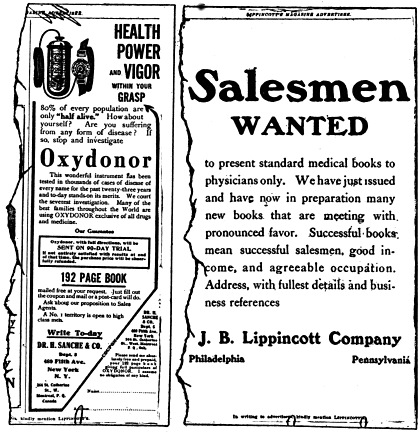
Photographic reproduction (much reduced) of two advertisements from January, 1914, Lippincott’s. One of a fraudulent quasi-medical device, the “Oxydonor”; the other, calling for salesmen to introduce “standard medical books to physicians.”
This letter discloses the workings of the brain of an advertising man of the old school. The principles enunciated therein are those that dominated the advertising field until quite recently. They represent the laissez faire doctrine as applied to advertising. At that time the only unacceptable advertising copy was that which would debar the publication using it from the United States mails. This was the yardstick by which all advertising was measured at that time.
The economic conscience has since awakened. There are few reputable magazines today, we venture to believe, that would be willing to go on record to the effect that it is not their “custom to verify the claims of advertisers.” The modern, progressive advertising man recognizes not only the responsibilities his profession imposes, but also realizes that, from the narrower view of enlightened self-interest, the greatest menace to the future of modern advertising is the fraudulent advertisement.
The claims on the part of the advertising department of Lippincott’s that it dares not refuse to accept fraudulent advertisements because the advertiser might bring suit against it for refusing to accept his advertisement is a statement whose falsity is exceeded only by its silliness. Equally preposterous is the statement that Lippincott’s will willingly refuse to accept fraudulent advertisements provided the American Medical Association will guarantee to protect the Lippincott Company against loss from damage suits that may be brought by the exploiters of the frauds whose advertisements are refused.
It may be news to Lippincott’s to learn that there are a score and more of newspapers and magazines that are accepting the findings of the American Medical Association on medical frauds and rejecting advertisements of such frauds. There are many newspapers that send us the medical advertising “copy” submitted to them and ask for an opinion on it. When that opinion is unfavorable, these papers refuse such advertisements. This is being done daily. We have yet to hear of any “patent medicine” faker or quack even threatening to bring suit because his advertisements have been rejected.
The advertising department of Lippincott’s may therefore take heart. When an advertisement of an outrageous fake like the Oxydonor is submitted to it, instead of accepting the money for it, meantime muttering an inaudible protest at the unfortunate position in which it has been placed, it may look the fraud in the eye and say Boo! The faker will not bite.
Before leaving the subject, we are constrained to refer to Lippincott’s medical publication, the Annals of Surgery. We begin to realize now why that journal offers a welcome haven to such products as Sal Hepatica, Bromidia, Papine, Gray’s Glycerin Tonic, Fellows’ Syrup of Hypophosphites, et al. Presumably the same “custom” obtains in the acceptance of advertising for the Annals of Surgery as for Lippincott’s, namely that the Lippincott Company does “not verify the claims of advertisers.” Possibly the Annals of Surgery is afraid that, should it reject the Sal Hepatica advertisement, for instance, it might he haled into court! Let us trust, for their peace of mind, that the publishers of the Annals of Surgery do not receive an advertisement from Old Doc Hartman for a full page display of Peruna. The mental anguish they would undergo in reluctantly accepting this advertisement—under the fear that Hartman would “claim damages” if it were rejected—is painful to contemplate.—(From The Journal A. M. A., Feb. 7, 1914.)
MEDICAL JOURNAL ADVERTISING
And Methods of Obtaining Paid-Up Subscribers
Time was when the postal authorities were lenient with publishers. The names of individuals who had ever subscribed for publications of a certain class were carried on the books indefinitely, whether they paid their subscriptions or not. This permitted a padding of the circulation figures. Of late years, however, the postoffice department requires publishers to have bona-fide paid-up subscriptions if they wish their publications to be carried at the low second-class rate. Certain medical journals have been hard put to it to get a circulation that would be at all attractive to the advertisers, on whose money they depend for continued existence.
Many and various have been the schemes devised whereby the dwindled circulation might be “boosted.” Subscriptions could not be given away because the postal laws forbade it. One ingenious method of obviating this difficulty is worked in this fashion: Dr. John Doe writes an article that appears in a reputable medical journal. A few days after its appearance, Dr. Doe receives a letter from the editor and publisher of a medical journal that is in need of a subscription list. He is told that the editor has read his article with much interest and would appreciate receiving from Dr. Doe a brief abstract of it. He does not expect the doctor to go to the trouble of making this abstract for nothing. He will, therefore, on receipt of the abstract credit Dr. Doe with three years’ subscription for himself or for one year for himself and one year for each of any other two doctors he may name. For every doctor that bites on this scheme the publisher increases his circulation by three copies and the federal officials are assured that they are paid-up subscriptions—not paid for in cash, it is true, but in “abstracts.”
All of this preliminary to a letter recently received:
To the Editor:—Enclosed find letter which speaks for itself. Now what I should like to know from you is the following: Is the Charlotte Medical Journal all it should be? Should a doctor contribute to a journal—thereby adding to its prestige and circulation—that carries questionable matter in the advertising pages? If the above journal is off color, does that act as a bar for good men to contribute?
Very truly yours,
L. J. Genella, M.D., New Orleans, La.
The letter which our correspondent encloses is on the stationery of the Charlotte Medical Journal and signed by the editor of that journal. Here it is:
“My Dear Doctor Genella:—I have just looked over an article of yours published in the New Orleans Medical and Surgical Journal entitled ‘Clinical Studies in Pituitary Irritation, with Report of Case.’ I would be very glad indeed to have you send me a manuscript or article for the Charlotte Medical Journal. Your style of writing is very attractive.
“If you will send me an article for the journal, I will be glad to publish same and will place your name on my complimentary mailing list. Under separate cover I am sending you a copy of the journal.
“Of course I will expect the article to be typewritten.”
Whether or not this is a modification of the “abstract” scheme or an attempt to boost the circulation of the Charlotte Medical Journal are questions we shall not attempt to answer. As to the questions propounded by our correspondent, they have been answered many times in these pages. We turn to one of the recent copies of the Charlotte Medical Journal and examine its advertising pages. On one of the first we find Anasarcin, a product whose fraudulent character was described at some length in The Journal, May 4 and 11, 1907. On another page we find Tongaline, which has also come in for a fair share of attention (see The Journal, Sept. 23, 1906, and May 10, 1913). A little farther over we find a half-page advertisement of Bannerman’s Intravenous Solution, a nostrum first exploited as a “consumption cure” and now as a cure-all (see The Journal, May 31, 1913). Cactina Pillets (see The Journal, March 12, 1910), Hagee’s Cordial of the Extract of Cod-Liver Oil (see The Journal, Oct. 13, 1906), Burnham’s Soluble Iodin (see The Journal, March 28, 1908), Ecthol (see The Journal, March 13, 1909), Bromidia (see The Journal, April 21, 1906), Papine (see The Journal, April 29, 1911), Phenalgine—two advertisements (see The Journal, Jan. 13, and 27, 1906, and Jan. 27, 1912) and Sal Hepatica (see The Journal, March 26, 1910) are some more products which have attained unenviable notoriety but found a safe haven in the advertising pages of the Charlotte Medical Journal. Neither must we fail to refer to the advertisement of Duffy’s Malt Whiskey (see The Journal, Nov. 23, 1912), which looks thoroughly at home.
Does our correspondent—in fact, does any conscientious physician having the interest of scientific medicine at heart—want to do anything that will tend to perpetuate therapeutic fraud? Subscribing for or contributing to medical journals whose income is largely derived from nostrums that are as vicious as many of the “patent medicines” advertised in the daily press hampers the medical profession in its fight for honesty in therapeutics and renders largely abortive its fight against fraudulent “patent medicines.” So long as the accredited organs of the medical profession tolerate fraudulent “ethical proprietaries” in their advertising pages, just so long will the protests of physicians against the swindling advertisements of “patent medicines” in the daily press fall largely on deaf ears—and justly so.—(From The Journal A. M. A., Oct. 11, 1913.)
A Physician Places the Responsibility for Fraudulent Advertising Where It Belongs
“To the Editor:—The Journal has had much to say in recent years regarding the ethics, or lack of same, in advertising matter exploited by its contemporaries. It has been criticized by many for the stringency of its attack; it has been criticized by very few because it did not go far enough. Is it not about time to get to the root of the matter?
“In the last number [see p. 426, this book] dissatisfaction is expressed with the advertising policy of the Medical Times. Nothing finer! Go to it! But is the method of attack right? I have before me a sample copy of the American Journal of Surgery. Among other articles is one on diseases of joints and the bone marrow by a man very favorably known in Denver. He was ‘ethical’ enough to be accorded a place on the program in the Section on Medicine at Minneapolis. Another contributor from Baltimore remarks that he took a patient to the University Hospital. Can it be possible that Johns Hopkins is admitting men to its wards and clinics that are below par in professional morals? Another article appears from a well-known orthopedic man of Washington, D. C. Personally, I see very little to commend in the advertising columns of the American Journal of Surgery.
“I, who confess to a state bordering on youth, may be very wrong; but I believe that the trouble will be solved only when men who claim to have any professional distinction refuse to contribute to journals whose pages are not clean from cover to cover. Pardon the presumption, Mr. Editor, but were you ever tempted to print anything like this:
“‘Last week’s issue of the New York Medical Squall contains an article on “Duodenal Ulcer” by John Doe, the well-known Chicago surgeon. Dr. Doe doubtless knows as well as any one the disreputable character of the Squall’s advertising matter, but like most of our great men, is unable to restrain his appetite for journalistic publicity.’
“Physicians read medical journals because they contain literature that is worth while. Jump on your erring editorial brethren, Mr. Editor, but please remember that the problem of eliminating bogus advertisements will be solved when the so-called leaders of our profession show enough manhood to refuse literary support to publications whose columns are in disrepute. While castigating the little sinner, please don’t let the big sinner go scot free.
“Clinton E. Harris, M.D., Grinnell, Iowa.”
Dr. Harris sums up the situation correctly. No small degree of responsibility rests on the prominent members of the medical profession who lend their support either as subscribers for or contributors to those medical journals whose advertising pages are a stench in the nostrils of thinking physicians. Dr. Harris asks why The Journal does not condemn the advertising columns of the American Journal of Surgery. The Journal has done so more than once and in no uncertain terms, both in the Propaganda department and editorially. At one time it said:
“In circular letters and in an editorial announcement in its December issue, the American Journal of Surgery ‘features’—to use a newspaper term—some of the contributors to its January issue. The list comprises men who hold, or have held, high offices in the American Medical Association. Presidents, vice-presidents, chairmen, secretaries and members of sections of the Association—these are some of the men whose names appear as contributors to this nostrum-promoting publication. Is it any wonder that the proprietors of the American Journal of Surgery assume an attitude of indifference to the class of proprietary preparations which they admit to the pages of their publication?”
What was the result of The Journal thus directing the attention of its readers to the American Journal of Surgery? In the next issue of the American Journal of Surgery appeared a seven-column editorial tirade, entitled “An Unwarranted Attack on the President and Other Eminent Members of the American Medical Association and on the Leading Medical Journals of the Country.”
On many and various occasions has The Journal called attention to the very evils that Dr. Harris deplores, and for the benefit of those who care to look up the matter these references to some of the articles are appended:
“The Mote and the Beam,” editorial, Nov. 18, 1911.
“Activity or Passivity—Sympathy or Sacrifice,” editorial, Dec. 9, 1911.
“Cui Bono,” editorial, Dec. 16, 1911.
“Medical Journals and the Great American Fraud,” Propaganda Department, Dec. 16, 1911.
“The Profession Must Apply the Penalty,” editorial, Jan. 13, 1912.
“Fraudulent Advertising in High-Class Medical Journals,” editorial, Jan. 4, 1913.
“Demand Clean Advertising,” editorial, Jan. 4, 1913.
“Medical Journals and the Great American Fraud,” editorial, Jan. 18, 1913.
“A Good Principle to Apply,” editorial, May 13, 1913.
“Medical Journal Advertising,” Propaganda Department, Oct. 11, 1913.
“Medical Journals and the Great American Fraud,” Propaganda Department, Oct. 18, 1913.
“Medical Journals and the Great American Fraud,” Propaganda Department, Nov. 1, 1913.
“The Medical Times’ Advertisements,” Propaganda Department, Nov. 8, 1913.
In another letter on the same subject its writer says: “I think the time has arrived when we have a right to expect real leadership from the ‘big men’ of the profession.”—(From The Journal A. M. A., Nov. 22, 1913.)
MEDICAL JOURNALS AND THE GREAT AMERICAN FRAUD
How the Medical Times Aids and Abets Quackery, with the Moral Support of Members of the Medical Profession
Two letters have been received, both from physicians. One comes from New York City and the other from Alexandria, Va. Each letter contained an advertisement of the Kellam Hospital, Richmond, Va., cut from the Medical Times. Here is the New York letter:
“To the Editor:—I am enclosing an advertisement clipped from the Medical Times. It seemed to me an especially flagrant example of what may happen in the absence of proper supervision of the advertising pages of a medical magazine. The condition would seem all the worse in this instance as among the ‘Board of Contributing Editors’ are listed men like Howard Lilienthal of New York and Almuth C. Vandiver, who is Counsel for the Medical Society of the County of New York. The Medical Times is sent to two of the physicians who live at this address without charge and without solicitation. Many advertisements of proprietary preparations are inserted in type indistinguishable from that of the body of the magazine and it is of course possible that its financial backing comes entirely from the manufacturers of these drugs.”
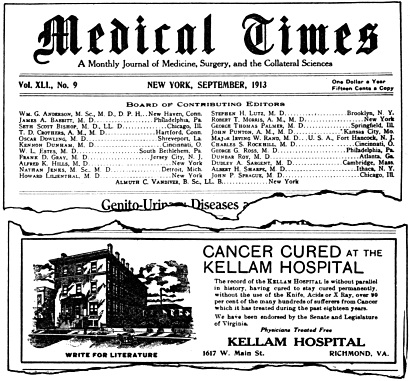
Fig. 1.—Photographic reproductions from the Medical Times. Do the gentlemen whose names appear in the list of the “Board of Contributing Editors” realize that they are lending an air of respectability to an otherwise disreputable business?
And this is from Virginia:
“To the Editor:—The statements made in the advertisement of the Kellam Hospital in the October number of the Medical Times are so out of the ordinary that I ask you to tell us something if you can of their institution and its methods of cure. Can such things as are stated in this advertisement be true? ‘Physicians Treated Free?’ ‘Endorsed by the Senate and Legislature of Virginia?’ What can all this mean to the sufferer from cancer? If true, let the whole world of sufferers know the glorious news.”
Collier’s paid its respects to the Kellam concern some time ago and we cannot do better than quote from its pages. Thus:
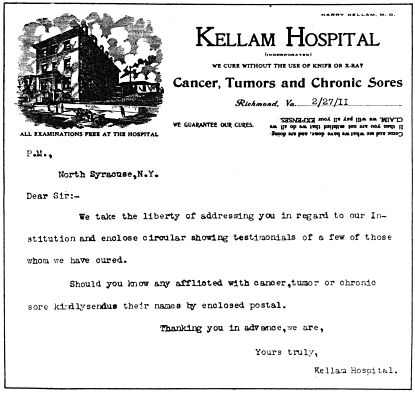
Fig. 2.—One way of drumming up trade in the “cancer cure” business! The Kellam Hospital sends letters like this to the postmasters of small towns asking these government officials to furnish it with what, in the parlance of quackery, is known as a “sucker list.” A delightful business, isn’t it? And this, gentlemen of the “Board of Contributing Editors,” is the sort of thing to which you are lending your influence and good names!
“Grief is the portion of the Kellam Cancer Hospital, of Richmond, Virginia, because in these editorials it has been grouped with other exemplars of the Great American Fraud. It offers the invariable and hollow mockery of testimonials and endorsements, which, as has been repeatedly shown, can be wheedled, browbeaten or bribed out of the victims of any form of quackery. It, of course, courts the fullest investigation, and desires that we send a representative to investigate whether its claims are not well founded. Unsuspected by the Messrs. Kellam, our representative has already investigated their claims, notably their statement that they are endorsed by the Legislature of the State of Virginia. Upon request for a copy of the endorsement they forwarded a weak subterfuge, and finally, on pressure, admitted that they could not produce the proof they had boasted. For their further consideration we present a brief parallel:
FROM THE KELLAM CIRCULAR FROM A KELLAM LETTER
The Cancer is removed without the use of the knife or X-Ray ... No roots or fibers left; hence it can not return. We do not claim to “cure them all.” We go further, and on our part, we agree to treat, free of charge, any patient who suffers a recurrence after having been treated by our method.
“The italics are our own, but we cheerfully present them for elucidation to the Kellam Hospital. A little careful thought devoted to reconciling the irreconcilable may help them to forget their woe. Meanwhile, they make themselves out worse than they really are by pretending to withhold from the bitter need of humanity a true, non-surgical cure for cancer. If this were true; if, indeed, they had solved the problem which has baffled the greatest minds of modern science; if, having a genuine cure for the dreadful ailment which claims its increasing thousands of tortured victims yearly, they secrete their discovery for the sake of a few paltry dollars, then they are as cold-hearted as the sailors who pass within fair hail of the naked island on which some shipwrecked crew is starving, and keep their stony eyes on the compass. They have not even the excuse of the fanatical among the Christian Scientists who, denying the existence of pain, refuse to take measures to ease the cancer victim’s suffering even at the last. Human nature is seldom so callous.”
As for the Medical Times: This publication for years contained comparatively little advertising. Then it came into the hands of Romaine Pierson, who also owns the Practical Druggist. Mr. Pierson is not a physician and to him the medical profession is but a commercial problem. He is publishing a medical journal for the money there is in it, and for this he is not to be censured. Questions of advertising policy, in such circumstances, are determined on a commercial basis. When an advertising contract is submitted, for a product that physicians would know to be fraudulent, the question that arises is, “Can it be put over?” Manifestly, a medical journal published purely as a business venture would not dare long to fly in the face of the opinions of those from whom it received its support—its subscribers and contributors. If our correspondents will go through the advertising columns of the Medical Times they will find many, many other frauds, less cruel perhaps than the Kellam advertisement, but no less disreputable or discreditable to the medical profession.
After all is said and done, it is enlightened public opinion that is causing publishers of lay magazines and newspapers to eliminate fraudulent “patent medicine” and quack advertisements. Until the medical profession takes an equally enlightened stand, physicians may expect to be afflicted with such commercial medical journals as the Medical Times, the International Journal of Surgery, the American Journal of Surgery, American Medicine, and several other papers that are published primarily in the interest of the advertiser. When such journals as these find they cannot get a circulation among physicians so long as they carry advertisements similar to many now appearing in their pages, these advertisements will be eliminated, but not before. Many physicians are receiving such journals at a nominal price or, as one of our correspondents notes, free. The physician who permits such journals to come to his office must share with the paid subscribers the responsibility for the low standard of medical journalism.—(From the Journal A. M. A., Oct. 18, 1913.)
Two Physicians Express Themselves on the Ethics of Medical Journalism
After the preceding article was in type, we received, in the same mail, two letters that are so apropos that we reproduce them. The first was from a town in Illinois, and was dated October 11. Here it is:
To the Editor:—About two weeks ago, a representative of the Surgery Publishing Company, New York, N. Y., came to —— Ill. soliciting subscriptions for the American Journal of Surgery. Together with numerous others I subscribed—chiefly on the strength of the contributors whose articles appeared in the sample numbers shown by the agent.
Since receiving the first number (October) one look at the advertising pages has shown me why the subscription price for a year and a quarter is one dollar. Anasarcin, Tongaline, Cactina Pillets, Hagee’s Cordial of Ext. Cod Liver, Burnham’s Soluble Iodin, Papine, Phenalgine, Anusol, etc., etc.
I have written to the Surgery Publishing Company, telling them in no uncertain language that there is no room on my reading desk for such. Have you ever exposed this journal, and the attitude of our big, brilliant, eminent men in permitting their articles—presumably original—to fill space in such a journal? [Yes! The Journal, Dec. 16, 1911, pp. 2,000 and 2,013.] This letter is not for publication—at least not with name of city. Keep up the good work....
The other, dated October 10, follows:
To the Editor:—That little story about medical journal advertising and methods of obtaining paid-up subscribers, in this week’s Journal makes me blush (p. 422, this book). I am guilty. Unlike Dr. Genella, I swallowed the bait—but the bait was even more tempting in my case; the flattering “editor” offered me twenty-five subscriptions to distribute among my friends, all for an “abstract.” Thank goodness, I only accepted five subscriptions, but worse luck, I sent them to young men by preference. So I am a deep-dyed offender indeed. Extenuating circumstances affected my susceptibility somewhat, however. I have noticed that prominent men like Beverly Robinson, A. Rose, Tom A. Williams, Wayne Babcock, and Morris—the latter, at least, a really able man and a brilliant writer—contribute to these peanut journals occasionally. If they do, why not I? There’s nothing like being in big company, you know.
So far as I know, my “abstract” has not yet been published. On looking over the sample copy of this monthly I found an advertisement printed right in the list of contents—in fact, it was the second “original article” in the issue, as brave and respectable as you please! Then, with characteristic Hibernian impetuosity I got out my machine and pounded that editor a strong protest with a dire command not to use my “abstract” in his miserable organ. But I have never received the manuscript, nor any reply to my stern rebuke. I wish I had been cautious like Dr. Genella.
Wm. Brady, M.D., Elmira, N. Y. —(From The Journal A. M. A., Oct. 18, 1913.)
The Responsibility of Physicians
The responsibility of medical journals for the continued existence of at least a part of the “great American fraud,” has been referred to in these pages many times. Within the past few weeks The Journal has called attention to the inconsistency of reputable physicians of high ideals lending their moral, and often financial, support to those medical journals whose advertising pages are a disgrace to the profession. Specifically, the Medical Times—originally a homeopathic medical journal—has been referred to, among others, as an example of this type of journalism. It must, however, be regarded simply as a type, for it is no better and no worse than many other medical journals. Several letters have been received on the subject, some of which we reproduce. The first one is from Dr. George G. Ross of Philadelphia:
“I was very much jarred on receiving the last issue of The Journal to find under the Propaganda for Reform an article concerning the Medical Times, among the list of whose contributing editors my name appears. I enclose you herewith a copy of my letter of resignation to the Medical Times. I have a very dim recollection of what occurred at the time that I was asked to give my name as a contributing editor. As I recollect it, however, at that time the journal was a respectable and ethical publication. I had been asked by a friend of mine to write an article giving my opinion of the effects of college athletics on undergraduates. This was at the time that Dr. Stokes had issued his order about athletics at Annapolis. I want personally to thank you and the committee for the exposure of this journal and for having drawn my attention to the fact that I was unwittingly aiding and abetting such a journal. I trust that if you have space in some future number of The Journal, you will do me the justice to publish all or part of this letter.”
Because he feels that he has “unwittingly been put in an unfavorable light,” Dr. James A. Babbitt, also of Philadelphia, sends The Journal a copy of a letter written by him to the editor of the Medical Times. Here it is:
“For reasons of which you are probably cognizant, I deem it advisable to resign from the board of contributing editors of the Medical Times, and desire that this resignation be accepted at once and my name not appear in further issues.”
What shall be done, asks Dr. Sidney Thompson of Humboldt, Tennessee, in such cases as the following? Says Dr. Thompson:
“In the Propaganda for Reform, in The Journal, October 18, 1913, in closing your article on ‘Medical Journals and the Great American Fraud,’ you say: ‘The physician who permits such journals to come to his office must share with the paid subscribers the responsibility for the low standard of medical journalism.’ Now I agree with you in everything you have said about the Medical Times, but what I want to know is how to keep such journals from coming into your office. The Medical Times has been coming to me for a number of years with repeated duns for the subscription price. I have written to them several times that I did not want the journal and never expected to pay for it, but still it comes. I have a vague recollection that I bit at an offer to send it three or four months free, not knowing what it was, but I never authorized them to enter my name as a regular subscriber.”
The simplest course in such a case as that described by Dr. Thompson, is to write on the unwelcome publication the word “refused” and either drop it in the nearest mail-box or hand it back to the postman. The courts have held that a person who continues to accept publications is legally liable for the payment of such publications. The postoffice department, however, has ruled that a magazine—either monthly or weekly—may not be sent at second-class rates for more than one year after the expiration of a bona fide subscription. At the expiration of that time, stamps must be affixed and the publications sent at third-class postal rates.—(From The Journal A. M. A., Nov. 1, 1913.)
Medical Journals and Sanatogen[AR]
We have frequently referred to the inquiries that are received by this office from newspaper and magazine editors asking for information about products whose advertisements they have been offered. One of the greatest difficulties in the way of accomplishing the good that such inquiries otherwise might lead to is the lack of uniform action on the part of the medical press of the country. A specific instance may be given. A layman wrote to a high-glass{sic} weekly magazine published in New York City protesting against an advertisement of Sanatogen which the magazine was carrying, and sending a reprint of The Journal’s article on this product. The advertising manager of the magazine in question wrote back that he had seen The Journal’s article, but had sought further information regarding the preparation from the editor of a medical journal in his city. The medical editor recommended that the magazine accept the Sanatogen advertisement, so the advertising manager said, and in view of this, the manager suggested that possibly the article published by the American Medical Association in its journal was inspired by some “personal prejudice.” Giving weight to the probability that the advertising manager went for his information to a source that he knew would be favorable to the acceptance of the advertisement, the fact remains that it is a disgraceful state of affairs when editors of medical journals will give vicious advice in matters on which they are supposedly competent to pass. The probability is, of course, that the medical journal whose editor was questioned contained the self-same advertisement that the lay magazine was carrying. And the advertising manager of the magazine was willing to accept—because such information coincided with his wishes—information that on its face must be biased, and rejected advice—that did not meet his approval—because of a purely supposititious “personal prejudice.” It is probably asking too much to expect advertising managers not to go to sources that are likely to be favorable for information about products whose advertisements are offered to them. But we have a right to expect that physicians, editors of medical journals, should no longer be participes criminis in the furtherance of the great American fraud. If our strictures on Sanatogen are unfair, if the Council on Pharmacy and Chemistry rejected the product in mere pique, if the opinions of such men as Billings, Cabot, Hektoen and Lusk are to be brushed aside as “personal prejudice,” if this mixture of cottage cheese and glycerophosphates really is the marvelous product which its exploiters claim—then indeed not only have the editors of medical journals a right to praise it, but it is also their duty to proclaim these wonders in their editorial pages. If, on the other hand, this much-vaunted preparation is a very ordinary mixture sold at an extraordinary price, if indigent consumptives and others are being inveigled into spending dollars for a preparation whose food value could be duplicated for a few cents—then in the name of humanity and common decency let the editors of medical journals proclaim these facts, and not let their scientific judgment be blinded by the glitter of advertising contracts.—(Modified from The Journal A. M. A., Jan. 18, 1913.)
THE ARMY AND NAVY MEDICAL RECORD
A Fraudulent Publication Whose Editorial Opinions Are for Sale
Whenever a business assumes certain proportions, subsidiary businesses spring up to cater to the needs of the larger enterprise. For some years the nostrum business has grown so large that it has furnished a more or less precarious life for many individuals who have catered to it. There are, for instance, men whose trade it is to obtain testimonials; others, claiming a long string of imposing degrees, will furnish fake reports and bogus analyses; still others issue at irregular intervals publications with high-sounding names which sell editorial indorsement to the products of concerns such as are willing to pay the price asked. “Journals” of this type have been called to the attention of our readers at different times; the New York Health Journal and the United States Health Reports come to mind at this moment. Both of these had their day and died a natural death, as all such publications must when once the public is cognizant of their true character.
TWO LETTERS
More recently the attention of The Journal has been called to a publication calling itself the Army and Navy Medical Record. A physician in the South sends a letter he has received from the Army and Navy Medical Record reading as follows:
“We have had many favorable reports reach us relative to your most excellent institution, and, as you are doubtless aware, we come in direct contact with a large number of Army and Navy and other government attachés who have sons that they desire to provide with a medical education combined with the higher course included in your up-to-date laboratory methods and the sciences incidental to clinical medical practice.
“If you will regard the proposition as confidential, we will agree to carry a one-fourth page advertisement of your university at the nominal rate of $38 per year, provided this amount is forwarded in advance at the time copy is furnished; and we will further promise to editorially indorse and recommend your school and its methods without qualification or exception. [Our italics.—Ed.] This article you should be able to use (and are authorized to do so) after publication for advertising purposes.
“We will also be able, and are willing, to furnish you with a desirable list of probable candidates from time to time.
“Kindly let us hear from you at once, if interested, and oblige,
“Yours with best wishes, “The Army and Navy Medical Record, “Arthur G. Lewis, Managing Editor.”
The physician to whom this was addressed made a notation on the letter to the effect that “this looks crooked.” A few weeks later, Dr. V. C. Vaughan, dean of the University of Michigan, Department of Medicine and Surgery, sent in a letter from the Army and Navy Medical Record which he had received in his official capacity at the university. Here is the letter; again the italics are ours:
“We are gratified to advise you that in our efforts to select a strictly ethical and high-grade institution of medicine that this magazine could consistently indorse and recommend, we have decided on the University of Michigan, Department of Medicine and Surgery, as the institution in your territory to whom our special publicity concession will be made this year.
“You are doubtless aware that we come in direct contact with a very large number of Army and Navy and other government attachés, also physicians in private practice who have sons that they desire to provide with a medical education, combined with the higher courses included in your up-to-date methods.
“For personal reasons we are particularly anxious to favor your institution, and frankly believe that we can prove of material service to you. The special proposition, to be regarded by you as strictly confidential, is that we will publish a full one-half page announcement of your institution for the term of one year, you to merely pay a nominal expense charge of $38 for the year’s service. As our regular rate is $125 per annum for this service, the necessity of regarding the matter between ourselves is apparent. [Transparently so.—Ed.] We further propose, without expense to you, to editorially indorse and recommend your institution and its methods without qualification or exception. An electrotype illustration may be used, without charge.
“It is important, however, that we hear from you promptly. Awaiting your immediate reply, we are, with best wishes,
“Yours faithfully, “The Army and Navy Medical Record, “Arthur G. Lewis, Managing Editor.”
Dr. Vaughan, in forwarding the matter to The Journal, wrote that on receipt of the offer just given, he “was uncertain whether its writer was a knave or a fool.” After inquiring into the matter somewhat thoroughly, he concluded that “the managing editor of the Army and Navy Medical Record is both a knave and a fool.”
THE ARMY AND NAVY MAGAZINE
The Journal had the Army and Navy Medical Record under investigation before these two letters were received and, as a result, the following facts seem to be pretty well substantiated. Herbert C. Lewis, with his brother, Arthur G., conducted from Washington, D. C., a publication called the Army and Navy Magazine. In The Journal’s nostrum file there is a booklet put out by the Renova Distributing Company describing the wonderful virtues of its product, “Anti-Jag,” which, as its name might intimate, is a “liquor cure” of the fake variety. One page of this booklet is given over to what purports to be “A Letter from a Great Magazine Editor.” The letter is dated June 19, 1900, from Washington, D. C., and says that “the editor of the Army and Navy Magazine takes pleasure in stating that from his own personal knowledge he has found ‘Anti-Jag’ to be one of the most reliable medicines ever introduced for the permanent cure of drunkenness.” And more to the same effect. The letter is signed “Herbert C. Lewis, editor.”
The publishing offices of the Army and Navy Magazine are at 606 F Street, N. W., Washington, D. C. The building at this address is known as the Baltic Building. Herbert C. Lewis is said to be a printer by trade.
The Army and Navy Medical Record seems to have been started within the last few months by Arthur G. Lewis. It does business from two addresses, the Baltic Building, Washington, D. C., and the Maple Villa Sanitarium, Hammonton, N. J. Lewis is said to have purchased the Maple Villa Sanitarium recently, but apparently his chief source of income is the Army and Navy Medical Record. He is alleged to have claimed that some medical officials of the government are interested with him in this publication but that these officials do not wish their names known. We do not blame them.
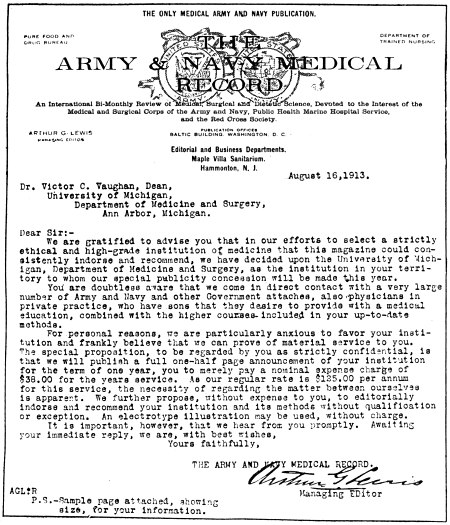
Photographic facsimile of a letter sent by the Army and Navy Medical Record to the dean of University of Michigan, Department of Medicine and Surgery, offering one hundred and twenty-five dollars’ worth of advertising space for a “nominal” thirty-eight dollars—with editorial indorsements and recommendations thrown in for good measure!
ADVERTISEMENTS AS EDITORIALS
A glance through two issues of the Army and Navy Medical Record makes perfectly plain the character of the publication. The January-February, 1913, number leads off with articles by well-known medical officers in the Army, the Navy and the Public Health Service. These have been copied from other publications. Then comes an editorial entitled “A Much Needed Dietary Reform,” devoted to the laudation of “Postum,” the widely advertised coffee substitute. Following this is an editorial on “The Philosophy of Hypnotics” in which aconitine, saline laxative and digitalin are each given a “boost.” Then comes an “original article” (save the mark!) entitled “The Physiological Pathology of Consumption.” This is by “Alfred S. Gubb, M.D., L.R.C.P., London, M.R.C.S., Eng., D.P.H., etc. etc., Aix-les-Bains, Savoie, France.” Two pages are devoted to this. The “joker” appears in the third paragraphs from the end—Fellows’ Syrup of Hypophosphites. Dioxogen receives more than three pages of editorial mention under the caption “The Sterilization of Milk with Dioxogen.” Under “Another New Electrical Wonder—Magnified Sound,” the “Acousticon” is given a two-and-a-quarter page write-up. “What Wise Men Wear” is the title of a four-page article—unsigned—devoted to the laudation of suspensories in general and the “O-P-C Suspensory” in particular. Dr. H. F. Boatman, Los Angeles, contributes a short article on “A Case of Advanced Pulmonic Tuberculosis Treated with Injections of Dioradin,” while our good old friend Willard H. Morse, M.D., “F.S.Sc. (Lond.),” the champion fake-testimonial-giver of the country, writes more or less entertainingly on “Putting on a Mustard Plaster.” The article has nothing to do with mustard plasters but has a good deal to do with “Zumota,” a nostrum recommended as a substitute for the mustard plaster. These are but a few of the nostrums to which the editorial and reading pages of the Army and Navy Medical Record are devoted.
In the June-July issue, Arthur G. Lewis becomes bolder. The leading article is entitled “First Aid in the Navy,” by C. F. Stokes, Surgeon-General, United States Navy. There is nothing to indicate that this article was not contributed to the Army and Navy Medical Record by its author. As a matter of fact, it originally appeared in an official publication, the United States Naval Medical Bulletin for January, 1913, and was reprinted by Lewis without credit and without permission. Following the article by Dr. Stokes is another, unsigned, entitled “The Passing of ‘The Pie Habit.’” This describes the surprise of the students of Harvard University at being served breakfast cereals instead of pie at their noonday meal and suggests that “Shredded Wheat Biscuits” make a “delicious dessert.” A two-and-a-half page article on the “Danger of Corrosive Sublimate in Vaginal Douche” is reprinted from the Lancet-Clinic of September, 1903. The reason for resurrecting this ten-year-old article becomes apparent before one gets half through it. It deals not so much with the danger of corrosive sublimate as with the marvelous—alleged—properties of Tyree’s Antiseptic Powder. Dr. Claude C. Keeler, Denver, has a three-page article on the “Medical Treatment of Pulmonary Tuberculosis.” The “medical treatment” referred to is Waterbury’s Compound. An editorial entitled “One Notch Ahead of Morphin” is devoted to that vicious morphin solution sold under the proprietary name “Papine.” Another on “The Treatment of Catarrh by Palliatives and Curatives” deals with a widely advertised “patent medicine,” “Kondon’s Catarrhal Jelly.” What appears to be a contributed article by Charles Wardell Stiles of the United States Public Health Service on “Country Schools and Rural Sanitation” has really been “lifted” from an official publication without credit and, needless to say, without Dr. Stiles’ permission.
But medicinal preparations are not the only things to which the Army and Navy Medical Record gives editorial indorsement. All advertising matter, apparently, is grist to its mill. Sandwiched in between articles on “Public Health Administrations” and “Important Army Medical Lectures” is a dissertation on “The Millennium of Shirt Construction,” in which are sung the virtues of the tailless shirt! A little farther along the Hawaiian pineapple is extolled, while the last pages of the issue are devoted to various banking concerns.
In addition to the advertisements appearing throughout the reading and editorial pages of these two issues of the Army and Navy Medical Record, there are a number of display advertisements. There is no reason to suppose, at least in the majority of cases, that the advertisers had the slightest reason to suspect the nature of the Army and Navy Medical Record. Several pages are devoted to financial advertisements, there being more than forty banks that have “fallen for” the wiles of Arthur G. Lewis. In view of the letters received by the deans of medical colleges and other educational institutions, the display advertisements of schools and colleges have a special interest to physicians. Schools for girls, polytechnics, colleges of music, veterinary, dental and medical schools—all are to be found in this cosmopolitan publication.
Among the therapeutic products advertised—in the advertising pages—are:
Fellows’ Syrup of Hypophosphites1cover page
Kondon’s Catarrhal Jelly1⁄2page
Expurgo Anti-Diabetes1⁄2page
Laxol1⁄2page
Campho-Phénique1⁄2page
Palpebrine1⁄2page
Zumota1⁄2page
Sanmetto1⁄4page
While in the reading pages the following products are puffed:
Tyree’s Antiseptic Powder.Dioxogen.
Waterbury’s Compound.Palpebrine.
Papine.Bannerman’s Intravenous Solution.
Kondon’s Catarrhal Jelly.Daniel’s Concentrated Tincture of Passiflora.
Ranier Natural Soap.Peacock’s Bromides.
Iodia (Battle).Aletris Cordial Rio.
Creo-Derma.Gonosan.
Fellows’ Syrup of Hypophosphites.Digipuratum.
Tannalbin.Dioradin.
Expurgo Anti-Diabetes.Pepto-Fer.
Zumota.Lactol.
Sulfothen.Campho-Phénique.
Summed up: The Army and Navy Medical Record is but another of the parasites of quackery. It is not entered as second-class matter and it has probably no bona-fide circulation. While it is claimed to be “Devoted to the Interest of the Medical and Surgical Corps of the Army and Navy, the Public Health Marine Hospital Service and the Red Cross Society” it is actually devoted to none of these. It is devoted to the exploitation of the advertising public for the special financial benefit of the man who calls himself its editor—Arthur G. Lewis. Advertising contracts are obtained under false and fraudulent pretenses. In brief, Arthur G. Lewis is using the good name of the various medical services of the United States government to further his swindling operations. He has written letters to honorable physicians making dishonest and insulting propositions to deceive and defraud the public. Editorial indorsements of the Army and Navy Medical Record mean nothing except that money has been paid for them. In short, the Army and Navy Medical Record is a fraud, and its “editor,” Arthur G. Lewis, a faker.—(From The Journal A. M. A., Oct. 25, 1913.)
THE MEDICAL TIMES ADVERTISEMENTS
In Which Are Discussed Some “Oversights” and the Ethics of Journalism
Two or three weeks ago we published letters from two physicians calling attention to an advertisement of a “cancer cure” hospital appearing in the Medical Times. As a result of The Journal’s comments, some of the physicians who were listed as “contributing editors” of the Medical Times wrote that they had requested that their names be withdrawn from this list. In reply to at least some of these letters, the editor of the Medical Times wrote asking them to reconsider their decision and offering as an excuse the statement that the appearance of the “cancer cure” hospital advertisement was an oversight. In this connection the following letter from the Medical Times, addressed to The Journal of the American Medical Association, is pertinent:
“Gentlemen:—We note in your issue of October 18 an article calling attention to an advertisement which appears in the columns of this journal, and to which your editor rightly objects.
“The advertisement in the Times was the result of an oversight, and it will not reappear.
“While we are indebted to you for thus bringing the matter to our attention, we cannot but feel that a letter written to us would have been more in keeping with the ethics of journalism.
“Very truly yours,The Medical Times.”
It will be noticed that this letter, like the letters sent to other physicians, ignores altogether the most important point made by The Journal in its criticism of that publication’s advertising policy. The Journal said in this connection:
“If our correspondents will go through the advertising columns of the Medical Times they will find many, many other frauds, less cruel perhaps than the Kellam advertisement, but no less disreputable or discreditable to the medical profession.”
The Medical Times apologizes for the advertisement of the Kellam Cancer Cure Hospital but ignores altogether the fact that the hospital advertisement was but one of many equally discreditable. We turn to recent issues of the Medical Times and we find it fairly reeking with advertisements of proprietary preparations that are a disgrace to the medical profession, many of them having been repeatedly exposed in The Journal. We find, for instance, a quarter-page advertisement of the Expurgo Manufacturing Company. “Expurgo Anti-Diabetes,” we are solemnly told in the pages of the Medical Times is:
“The only reliable and thoroughly tested remedy for the cure of Diabetes Mellitus and Insipidus.”
This wretched fraud, which also is advertised in true “patent medicine” style direct to the public, is presented to a presumably intelligent profession as a “cure” for a disease which so far has baffled the best brains in the scientific world.
“Expurgo Lapis” we are told, also via the Medical Times is:
“The only known cure for gall-stones, kidney and bladder stones, gravel and all kidney trouble arising from uric-acid origin.”
Did Kilmer’s Swamp-Root ever claim more? “Diabetes is no longer an incurable disease” runs the advertisement of the Jireh Diabetic Food Company, yet the editor of the Medical Times must know that in The Journal133 and in the reports of state chemists the Jireh diabetic foods have been shown time and again to be among the most dangerous and fraudulently exploited products sold to the unfortunate diabetic.
Phenalgin,134 twin brother to the Antikamnia fraud, shouts its inferential falsehoods in a half-page display. Micajah’s Wafers,135 the alum-borax mixture long advertised as a cure for gonorrhea, endometritis, etc., may also be found, as well as many other preparations exposed at various times by The Journal. For example: Anasarcin,136 Campho-Phenique,137 Papine,138 Bromidia,139 Cactina Pillets,140 Pluto Water,141 Prunoids,142 Sanatogen143 and Sal Hepatica.144
What excuse can the Medical Times offer for the presence of these frauds in its pages? Are these, too, “the result of an oversight”? Presumably for thus bringing to its attention these various other disreputable advertisements, The Journal will be accused again of violating “the ethics of journalism.” If calling attention to fraudulent advertisements is out of keeping with the ethics of journalism, what, pray, must be said of publications that are willing to share in the profits of such fraudulent exploitation? But, and we cannot repeat it too often, the Medical Times is but one of a class, neither worse nor better than many other medical journals whose financial support comes from the proprietary interests rather than from the medical profession. The responsibility for the existence of these journals really rests not on the business men who conduct them on a commercial basis, but on the physicians who tolerate or encourage them in any way.—(From The Journal A. M. A., Nov. 8, 1913.)
CAUSE FOR OPTIMISM
A Clean Medical Journal—the South Texas Medical Record
Fortunately, there are forces at work in the medical profession that make for optimism. An editorial in the last issue—April, 1915—of the South Texas Medical Record, the official organ of the South Texas District Medical Association, is especially significant. While not a large journal, the South Texas Medical Record could well stand as an example to medical publications of a much more pretentious character. Its advertising pages are above reproach and the journal is a credit alike to its editors and to those members of the profession whose support makes its existence possible. In the editorial referred to, entitled, “Honest Advertising—Let Us Cleanse Our Own Linen First,” the editor-in-chief, Dr. W. Burton Thorning, says:
“A recent editorial, entitled ‘Honest Advertising,’ in a daily newspaper, furnished the occasion for an editorial comment in the January number of the Southwestern Hospital Reporter. The latter, while taking the ground that the newspaper was inconsistent in uttering high editorial sentiments and in adjoining columns printing patent medicine advertisements, implied that newspaper men should be allowed some latitude in the matter of accepting advertising, on the plea of being laymen and therefore not expected to possess the same amount of information concerning patent ‘dope’ that medical men have.
“It would appear to be a fair assumption that a layman, even though a highly educated and able editor of a great newspaper, does not know, and cannot be expected to know, the depth of depravity to which the consumption cure faker and the cancer quack can descend.
“Granting that the newspaper man accepts the advertisements through ignorance of the facts concerning their possibilities for evil, what can be offered in defense of the medical editor who accepts advertising matter equally pernicious in its influence?
“Indeed, it is not so many years since many of the so-called ethical medical journals carried the ads of some of the most notorious quacks this country has ever known.
“Doubtless there are few, if any, who do so at the present time, but, on the other hand, there are only a few who do not advertise unethical institutions, and questionable proprietary medicines. As a matter of fact some of the most widely advertised patent medicines of today were formerly advertised as ethical proprietaries in medical periodicals, the great majority of which are still serving as a sort of preparatory school for advertisements that will presently appear in the lay press.
“What shall be offered in defense of the medical publication which continues to publish the advertising matter of hundreds of proprietaries which the Council on Pharmacy and Chemistry of the American Medical Association has shown to be either generally worthless or an out and out fake?
“Can the medical editor plead ignorance? Hardly. To do so would be to admit utter incapacity. There is only one inference to be drawn; the publication needs the money and is not overparticular regarding its source.
“There is a remedy, however, a remedy absolutely certain in its results. If every physician in the United States for a period of three months would positively refuse to receive at his desk a medical journal containing questionable advertising, this blotch on medical journalism could be erased.
“It is true that many of them would sink, never to rise again, but the profession would be better off without those whose existence depends upon ‘phoney’ advertising. There are, unfortunately, several American journals whose reading pages are well and carefully edited and a credit to medical literature, whose advertising pages carry such undesirable matter that the educated physician can only feel a sense of disgust.
“Such journals could very well succeed on the quality of their reading matter and undoubtedly would increase their circulation enough to more than offset the loss in advertising.”—(From The Journal A. M. A., May 29, 1915.)
THE COMPARATIVE NUTRIENT VALUE OF COD LIVER OIL AND COD LIVER OIL CORDIALS [AS]
John Phillips Street, M.S.
Chemist, Connecticut Agricultural Experiment Station
NEW HAVEN, CONN.
For a long time cod liver oil has been recognized as an easily assimilable nutrient and reconstructive and of special value in wasting diseases. The unpalatability of the oil, however, has led to various devices to make it tasteless or to render it more acceptable to the stomach. Emulsions containing the oil in mixture with other substances were exploited, and doubtless served a useful purpose. The oil, however, but imperfectly concealed, was still disagreeable to many, and other preparations began to appear on the market, which claimed to retain the therapeutic virtues of cod liver oil without its disagreeable characteristics. This practice has been carried so far that now we find for sale cod liver oil preparations from which the oil has been removed in its entirety, and only the name remains. Certain of these products claim to “represent” the oil and to retain all its virtues; others are said to contain oil, while still others claim “all the valuable constituents” of the oil without the oil itself.
In the past, cod liver oil has been considered a food rather than a medicine, and its value attributed to the easily digestible and metabolizable oil it contains. This position, however, has been disputed. By some its therapeutic value has been attributed to the small amount of iodin present in the oil, but in recent years the suggestion has been made that its special potency depends on its peculiar fatty acids. In this connection the U. S. Dispensatory145 says:
“Other oleaginous substances, certainly not less nutritious, have not been equally efficient, though taken in much larger quantities. If this be the true explanation, persons living chiefly on milk, which abounds in oil, or on fat pork, ought to show a special exemption from scrofulous complaints. The probability appears to us to be that, in consequence of some peculiar principle or principles it contains, it exercises a stimulant and alterative influence on the processes of assimilation and nutrition, thereby aiding in the production of healthy tissue.”
Indeed, Osborne and Mendel146 have shown in their experiments on albino rats that by substituting cod liver oil for a portion of the lard in their standard diets, growth was resumed after failure on foods containing commercial lard alone as the source of fat. Similar results were secured with butter-fat and egg yolk fat.
In the light of the theories advanced for the therapeutic value of cod liver oil, and the results secured by Osborne and Mendel with the oil itself; it seemed a profitable study to examine some of the prominent “oilless” preparations on the market to determine whether or not the claims made for them as nutrients were justified. Certain of the so-called cod liver oil preparations are termed “extracts” of cod liver oil, and are not made from the oil, but from the cod livers instead. As has been well said,147 “They are preparations, which, if honestly made, might be worthy of trial, but they are improperly called ‘extracts’ of cod liver oil, since they do not contain the fat, which is the active constituent of the oil, but the extractives from the liver, which may or may not possess therapeutic virtues. So far as we know, however, no satisfactory evidence is forthcoming to indicate that such extractives have any therapeutic value.”
It was with preparations of this class that our experiments were made. Four of the more extensively advertised brands were selected, as they represent rather distinct types of this class of products, as the following claims of their label will show:
Hagee’s Cordial of the Extract of Cod Liver Oil, Compound.—“Tonic, stimulant, alterative, reconstructive, nutritive and digestive.” “Each fluid ounce represents the extract obtainable from 1⁄3 fluid ounce of cod liver oil (the fatty portion being eliminated), 6 grs. calcium hypophosphite, 3 grs. sodium hypophosphite, 1⁄2 gr. salicylic acid (made from oil wintergreen), with glycerin and aromatics.”
Vinol.—“The modern tonic reconstructor containing the medicinal extractives of fresh cod livers with peptonate of iron.” “When the blood is poor, when more fresh blood is needed, when the weak need strength, when the throat and lungs are affected, TAKE VINOL.”
Wampole’s Perfected and Tasteless Preparation of an Extract of Cod Liver.—“Contains a solution of an extractive obtainable from fresh cod livers, the oily or fatty portion being afterward eliminated. This extractive is combined with liquid extract of malt, fluid extract of wild cherry and compound syrup of hypophosphites (containing calcium, sodium, potassium, iron, manganese, quinine and strychnine).”
Waterbury’s Compound, Plain.—“Made from cod liver oil, digestive ferments, malt extract unfermented, hypophosphites comp. special, ext. cherry, eucalyptus, aromatics, etc.”
Thus we have represented in our experiments an “extract” with hypophosphites, one with peptonate of iron, one with malt extract and hypophosphites and the alkaloids quinin and strychnin, and one with malt extract and hypophosphites without alkaloids.
In order to prepare a dry ration of suitable keeping properties, it was necessary to remove the alcohol and water from the various preparations. This was done by evaporation under reduced pressure at from 40 to 55 C. (104 to 131 F.). In the case of Hagee’s Cordial it was claimed that one fluidounce of the preparation represented 1⁄3 fluidounce of cod liver oil, and in the subsequent substitution for cod liver oil in our rations, this ratio was used for all four products.... These are very dissimilar preparations, the alcohol ranging from 7.50 to 18.69 per cent., the extract from 8.72 to 39.53 per cent. (10.81 of the 13.18 gm. of extract in Hagee’s Cordial being glycerin), the ash from 0.305 to 1.967 per cent., the reducing sugars from 1.35 to 17.10 per cent., and the glycerin from a trace to 10.81 per cent. Wampole’s contained quinin and strychnin, the others no alkaloids; salicylates were present in all but Wampole’s; saccharin in Hagee’s. The Pettenkoffer test for biliary acids gave a negative result in Hagee’s and Wampole’s; in Vinol and Waterbury’s, small amounts of fatty acids were obtained, amounting to 0.016 and 0.032 gm. per hundred c.c., respectively, quite insignificant amounts.
The feeding experiments were made on albino rats of both sexes, which were placed, when about 6 weeks old, on a standard ration, No. 7, and after several months, when a failure to maintain weight was indicated,148 an amount of dealcoholized cordial extract equivalent to 18 per cent. of cod liver oil was substituted for a portion of the lard, the cordial extract later being replaced by an equivalent amount of cod liver oil.
*******
SUMMARY
Table 11 gives a summary of the actual gains of the fifteen rats on the four rations, compared with the gains shown by cod liver oil and those shown by normal rats at the same period of their life history.
TABLE 11.—SUMMARY OF RESULTS*
RationsTotal Normal Gain, Gm.Total Actual Gain, Gm.Average Normal Gain, Gm.Average Actual Gain, Gm.
Hagee ration24-36.26-9.1
Cod liver oil ration114156.428.5 39.1
Vinol ration42-1.510.5-0.4
Cod liver oil ration4287.510.521.9
Wampole ration8351.420.812.9
Cod liver oil ration6281.515.520.4
Waterbury ration320.310.70.1
Cod liver oil ration4287.41429.1
* In this table are given the totals and averages of the figures already presented in Tables 4, 6, 8 and 10.
In considering the effect of these preparations as general medicines, their alcohol content must not be overlooked. Hagee’s Cordial contains 7.50 per cent. of alcohol by volume, Vinol 18.60 per cent., Wampole’s Preparation 16.59 per cent., and Waterbury’s Compound 11.25 per cent. Full strength whisky contains 50 per cent. of alcohol by volume. By following the doses prescribed by the manufacturers of these preparations, the user would consume daily the following equivalents of full strength whisky:
In Hagee’s Cordial0.24fluidounce
In Vinol0.8 fluidounce
In Wampole’s Preparation0.7 fluidounce
In Waterbury’s Compound0.6 fluidounce
These amounts of alcohol are by no means negligible and doubtless explain to a considerable extent the source of the alleged tonic virtues of these preparations.
The results of the experiments may be summarized as follows:
Hagee’s Cordial failed to sustain rats during periods of seven and fourteen days, the rats showing a loss in weight of 36.2 gm., instead of the normal gain of 24 gm.
Vinol in two cases sustained and in two cases failed to sustain growth during periods of from eleven to thirty-five days, the net loss in weight of the four rats being 1.5 gm., instead of the normal gain of 42 gm.
Wampole’s Preparation in three Cases sustained and in one case promoted growth in rats during periods of eighteen and thirty-nine days, showing, however, only 51.4 gm. gain in weight instead of the normal 83 gm.
Waterbury’s Compound in two cases sustained and in one case failed to sustain rats during periods of fourteen and thirty days, the net gain in weight, however, being but 0.3 gm. instead of the normal 32 gm.
Cod liver oil showed a gain of 42.4 gm. over the normal, while with the same rats Hagee’s Cordial showed a loss of 60.2 gm. Cod liver oil showed a gain of 45.5 gm. over the normal, while with the same rats Vinol showed a net loss of 43.5 gm. Cod liver oil showed a gain of 19.5 gm. over the normal, while with the same rats Wampole’s Preparation showed a loss of 31.6 gm. Cod liver oil showed a gain of 45.4 gm. over the normal, while with the same rats Waterbury’s Compound showed a net loss of 31.7 gm.
Not only did cod liver oil show a marked superiority as a source of nutriment over Hagee’s Cordial, Vinol, Wampole’s Preparation and Waterbury’s Compound, but it also showed a remarkable reconstructive and recuperative power in its ability to enable rats to gain weight rapidly and steadily after having suffered from a deficiency in nutriment when fed the four preparations named above.—(Abbreviated from The Journal A. M. A., Feb. 20, 1915.)
DIABETIC FOODS OFFERED FOR SALE IN THE UNITED STATES
A Preliminary Report
John Phillips Street, M.S.
Chemist, Connecticut Agricultural Experiment Station
NEW HAVEN, CONN.
Recent references in The Journal to gluten flours and certain other foods offered for the use of diabetics suggest that a preliminary report of an investigation just about completed in my laboratory by Prof. L. B. Mendel and myself might be useful to many diabetics and to physicians who are called on to arrange their dietaries.
In 1906 this laboratory, then under the direction of Dr. A. L. Winton, who is now with the Department of Agriculture, made its first examination of commercial diabetic foods. In nearly every year since it has analyzed various other brands as they appeared on the market. The demand for the reports on these foods and the many inquiries directed to us have led us to make a more extensive review of the situation, and to collect as far as possible all information as to the quality of the so-called “diabetic” foods offered to the American public. That the present state of the market is unsatisfactory is well known, and the inferiority (from the diabetic’s point of view) of many of the products at present offered is unfortunately familiar to all careful dietitians. The most dangerous feature of the present situation is that the unsuspecting patient is led to purchase foods, generally at an exorbitant price, which are not only misrepresented but which may be positively harmful to him. In this day of self-medication this condition is all the greater menace to the diabetic.
Without any attempt to suggest methods of treatment for diabetes, which is the province of the physician, I may say that it is well recognized that diabetes is primarily a disturbance of nutrition, in which the normal ability of the body to make use of carbohydrates is more or less completely impaired. All recent authorities agree in placing the chief emphasis on the role of diet in the management of this disease. Janeway, Benedict, Joslin, Futcher, Falta, Strauss, von Noorden and other writers on diabetes could be quoted at length in support of this view. The importance of a restriction of the carbohydrates in certain cases and certain aspects of diabetes is admitted by practically all competent authorities. In order to prescribe a starch-free and sugar-free dietary, which at times is necessary, and to know accurately the actual amount of these carbohydrates contained in the various available foods, the physician must rely on the cooperation of the chemist to furnish this requisite information. This is our excuse, if any be needed, for our present investigation.
There seems to be some uncertainty as to what sort of preparation is entitled to be sold as a “diabetic” food. Granting the desirability of feeding the patient all the carbohydrate he can tolerate, and recognizing the possible value of the oatmeal, potato, rice and other treatments, in which a relative abundance of carbohydrate is fed for a limited period, it would seem that a low percentage of carbohydrates should be a requisite for a “diabetic” food. Certainly no special food containing nearly as much carbohydrate as a normal food of the same class should be entitled to this appellation. Flours, breads, biscuits, chocolates, breakfast-foods, macaroni, etc., containing only a slightly lowered percentage of carbohydrates, are no more entitled to be called “diabetic” foods than the normal foods themselves. It is true that, when a patient’s carbohydrate tolerance is well established, the use of foods containing 20, 25 and even 35 per cent. of carbohydrates might be permissible, when used under the direction of a competent physician; but when a strict diet is necessary, such as is required to determine this tolerance, even these relatively low percentages are objectionable, if not dangerous.
It has been our purpose to include in this investigation, as nearly as possible, all available data on the composition of all diabetic foods sold in America. Our report, therefore, will be in part compiled, but in greater part will consist of our original analyses. It will show 539 analyses of about 400 brands, 200 of which are our own new analyses and 110 those made in this laboratory in previous years.
While the purpose of this preliminary note is to call attention to the better preparations rather than to emphasize those which are obviously objectionable and fraudulent, it may not be out of place to summarize briefly our findings in general. The full details of the investigation are now being prepared for publication and will shortly be issued as a report from the Connecticut Agricultural Experiment Station.
One hundred and eight samples of sixty-eight brands of flours and meals are included in the report. Sixty-seven of these were sold as “gluten” flours, twenty of which did not even satisfy the low government standard of 35 per cent. protein. Twelve samples contained less than 13 per cent. carbohydrates, while the remaining gluten flours ranged from 28 to 76 per cent.
The soy bean flours contained from 23 to 26 per cent. of carbohydrates, the almond meals 17 per cent., and a cotton-seed flour 21 per cent. Other “diabetic” flours, not specifically sold as “gluten” flours, contained from 67 to 80 per cent.
The purchaser of gluten flours at the present time may obtain preparations containing from 87 to 11 per cent. of protein and from 4 to 76 per cent. of carbohydrates, at a cost of from 9 cents to $1.56 per pound.
In view of the government’s low standard for gluten flour, and because of the wide variations in composition found in the brands at present on the market, proper protection of the diabetic demands that the manufacturers of these flours should be required to state on the label the guaranteed percentages of both protein and carbohydrates.
Three samples of American soft gluten breads contained from 35 to 37 per cent. of carbohydrates; two other brands contained 49 and 54 per cent., little, if any, lower than found in ordinary wheat bread.
One hundred and forty-eight analyses of 112 brands of hard breads, biscuits, rusks, cakes and other bakery products are included. Eight brands of Luftbrot, or aerated bread, are reported; two of these contained from 9 to 12 per cent. of carbohydrates, one 20 per cent., two from 31 to 33, and the other three from 44 to 54 per cent.
A number of the brands of rolls, biscuits, breads, etc., showed satisfactorily low percentages of carbohydrates, thirty-five samples containing from 1 to 25 per cent., forty-four samples containing from 35 to 55 per cent., and forty-one over 55 per cent., seven of the latter exceeding 72 per cent.
The cost of the Luft breads ranged from 71 cents to $2.33 per pound. Biscuits, containing 11 per cent. or less of carbohydrates, cost from 72 cents to $3 per pound. A number of brands, containing from 43 to 77 per cent., cost from $3 to $3.60 per pound. Even the cheaper preparations, containing from 50 to 77 per cent., no better, and in some cases even worse, for the diabetic’s use than ordinary bread, cost from 30 to 41 cents per pound.
Fourteen samples of breakfast-foods were analyzed, five of which contained from 44 to 54 per cent. of carbohydrates, somewhat lower percentages than normal. Seven of the ten brands of recommended macaroni, noodles, etc., contained over 70 per cent. of carbohydrates, the other three from 42 to 51 per cent.
The analyses are given of fourteen samples of peanut butter, five of almond paste and butter, two of pine-nuts, one of almonds and ten of miscellaneous nut foods. As was to be expected, most of these preparations proved to be suitable diabetic foods. The peanut butters contained from 12 to 20 per cent. of carbohydrates, with an average of 15 per cent. The three almond pastes contained from 30 to 40 per cent., one showing an addition of 11 per cent. cornstarch. The two almond butters contained only 7 and 8 per cent., the pine-nuts from 3 to 8 per cent., and the almonds 16 per cent. The other nut preparations contained from 6 to 44 per cent. carbohydrates.
Seven brands of diabetic chocolates contained from 10 to 50 per cent. carbohydrates, while four cocoas contained from 21 to 51 per cent. The chocolates cost from $1.63 to $2.06 per pound, and the cocoas were similarly expensive.
Two sugar-free milks were examined which were true to name, containing only the merest traces of carbohydrates. One “diabetic” baking-powder examined contained no starch, another brand from 14 to 16 per cent. Various jams, preserves and other fruit products were examined which contained from 1.24 to 7 per cent. of invert sugar, percentages far below the normal. A currant-juice contained only 0.85 per cent. of invert sugar. Four of the fruit preparations were artificially colored with a coal-tar dye—a permitted color to be sure, but seemingly quite out of place in foods intended primarily for the use of invalids.
As already stated, the main purpose of this investigation was not so much to detect fraud as to secure information which would be of benefit to the diabetic and to the physician who seeks foods suitable for a low carbohydrate diet. In the accompanying tabulations a summary is given of the brands, sold as diabetic foods, which showed less than 35 per cent. of carbohydrates, arranged in the order of their carbohydrate149 content. A date in parentheses following a brand name signifies that the brand named showed variations in different years; in other cases, in which the agreement was close, the results have been averaged.
BRANDS SHOWING UNDER 5 PER CENT. OF CARBOHYDRATES
Per Cent.
Casoid Baking Powder .0
Dr. Bouma Sugar-Free Fat-Milk .0
Whiting’s Sugar-Free Milk .0
Rademann’s Currant Juice “ohne Zucker”0.9
Kalaria Batons (1909)0.9
Glidine1.0
Casoid Sugarless Marmalade1.2
Casoid Sugarless Jam1.5
Kalari Biscuit1.7
Casoid Dinner Rolls2.1
Casoid Flour2.2
Jireh Diatetic Pine Nuts3.4
Rademann’s Preserved Fruits, “entzuckert”3.5
Kellogg’s Protose3.6
Barker’s Gluten Food “A”4.1
Kellogg’s Pine Nuts4.2
Kellogg’s 80 Per Cent. Gluten Biscuit4.4
Bischof’s Gluten Flour5.0
BRANDS SHOWING FROM 5 TO 10 PER CENT. OF CARBOHYDRATES
Per Cent.
Casoid Biscuits No. 25.6
Rademann’s Preserved Fruits “in eigenen Saft”5.7
Barker’s Gluten Food “B”5.9
Kellogg’s Nuttolene6.3
Nashville Sanitarium Nutcysa6.3
Huntley and Palmer’s Akoll Biscuit6.5
Nashville Sanitarium Nutfoda6.8
Rademann’s Preserved Fruits “ohne Zucker”7.0
Muller’s Tomatoes für Diabetiker7.3
Barker’s Gluten Food “C”7.7
Kalari Batons (1913)7.7
Casoid Biscuits No. 37.8
Kellogg’s 80 Per Cent. Gluten (1912)7.9
Casoid Biscuits No. 18.0
Kellogg’s Almond Butter8.2
Fromm’s Uni Bread9.0
Metcalf’s Vegetable Gluten (1913)9.8
BRANDS SHOWING FROM 10 TO 15 PER CENT. OF CARBOHYDRATES
Per Cent.
Kellogg’s Pure Gluten Biscuit (1906)10.2
Health Food Pure Washed Gluten Flour (1913)11.1
Health Food Alpha Diabetic Wafers11.3
Loeb’s Imported Gluten Flour11.8
Health Food No. 1 Proto Puffs11.9
Kellogg’s Potato Gluten Biscuit (1906, 1909)11.9
Kellogg’s Nut Meal12.1
Kellogg’s 80 Per Cent. Gluten (1909)12.5
Nashville Sanitarium Nut Butter13.0
Kellogg’s Nut Butter13.9
Bischof’s Diabetic Gluten Bread14.3
Jireh Diabetic Baking Powder15.0
Peanut Butter (range from 12 to 20)15.0
BRANDS SHOWING FROM 15 TO 20 PER CENT. OF CARBOHYDRATES
Per Cent.
Casoid Chocolate Almonds16.1
California Paper Shell Almonds16.3
Callard’s Cocoanut Biscuit16.4
Rademann’s Diabetiker-Chokolade16.9
Health Food Almond Meal16.9
Callard’s Ginger Biscuit18.1
Callard’s Prolactic Biscuit19.3
BRANDS SHOWING FROM 20 TO 25 PER CENT. OF CARBOHYDRATES
Per Cent.
Callard’s Almond Shortbreads20.7
Callard’s Casoid Rusks20.8
Rademann’s Diabetiker-Makronen20.8
Health Food Protosoy Diabetic Wafers21.2
Jireh Patent Cotton-Seed Flour21.3
Casoid Lunch Biscuit21.6
Rademann’s Diabetiker-Chokolade Biscuit21.9
Cereo Soy Bean Gruel Flour23.7
Health Food Salvia Sticks24.0
Health Food Protosoy Soy Flour24.5
Metcalf’s Soja Bean Meal25.0
BRANDS SHOWING FROM 25 TO 35 PER CENT. OF CARBOHYDRATES
Per Cent.
Jireh Soja Bean Meal25.8
Brusson Chocolat with Added Gluten26.4
Rademann’s Diabetiker-Stangen27.0
Rademann’s Diabetiker-Dessert-Gebäck27.5
Nashville Sanitarium Malted Nut Food27.5
Metcalf’s Vegetable Gluten (1906)28.1
Health Food Pure Washed Gluten Flour (1906)29.5
Fromm’s Luft Bread30.7
Spencer’s Almond Paste31.6
Fromm’s Conglutin-Diabetiker-Schokolade32.7
Health Food No. 2 Proto Puffs33.3
Ferbuson Gluten Bread33.6
Gum Gluten Breakfast Food34.2
—(From The Journal A. M. A., June 28, 1913.)
THE JIREH DIABETIC FOOD COMPANY
The Company Rises to Explain in a Brief Note of One Thousand Words
Exploiters of fraudulent and dangerous pharmaceutical products have no love for The Journal. When such products are exposed in these pages, their manufacturers seldom reply to the criticisms except through indirect channels. Then the replies are frequently replete with billingsgate and denunciation of The Journal and its editor, the Association and the medical profession generally.
We have, at different times, had to call the attention of the public and the medical profession to the fraudulence and dangers of some of the products of the Jireh Diabetic Food Company. We have shown that the Jireh company lied boldly and directly so long as it could do so without getting into the courts, and that it lies inferentially still; we have shown that Jireh flour had practically as much carbohydrate as ordinary flour; we have shown that, probably to escape prosecution under the Food and Drugs Act, the Jireh concern has coined the word “diatetic” and substituted it for the word “diabetic,” which used to appear in its advertisements; we have shown that the claim made for the Jireh products that they are “starch-changed” was a false one, and that the company has modified this to “starch-treated,” presumably to avoid being haled into the courts under the “pure food law;” we have shown, in short, the unreliability both of the Jireh concern and of its products.
Two or three weeks ago a New York physician wrote to The Journal for information regarding the Jireh products. We sent him such matter as had been published on the subject, and he showed this material to a patient who was using the Jireh products. The patient, in turn, expressed her opinion of the product to the retailer from whom she had been purchasing it. A day or two later she received a letter from the Jireh Diabetic Food Company, which, in spite of its length and discursiveness, we publish in full, so that physicians may know just what this company thinks of them. The letter, which is dated Nov. 20, 1913, really belongs in the “Knocks and Boosts” department, but its length prevents its use there. Here it is:
“We learned through Mess. Cushman Co. that you are a constant user of Jireh Foods for some time past, and that recently a certain derogatory statement was brought to your attention relative to our product. We feel an explanation is due you for two reasons.
“First, because we want you to continue using Jireh Foods and thus receive the benefits of the same; and second, that the remarks called to your attention are not only libelous, but are in no way pertinent enough to detract from the value of our product. In the first place, we want to state that the particular journal in question has been endeavoring to injure our business for some time past and that we are not the only descent [sic] manufacturers of foods that are suffering in this way at the hands of the editors of this particular magazine. Since you are interested in the Jireh Foods, you may be more interested to learn why this particular magazine is so anxious to injure our reputation. The reason is very obvious if you will take into account the fact that this magazine is the official journal of the medical association of this country which is known as the backer of the medical trust. It is very clear to you, no doubt, that there are some physicians, particularly those that are associated with the magazine, who are anxious to stamp out of existance [sic] such concerns that offer a bona fide product, a meritorious product which actually produces the required results, without the aid of medicine.
“For the particular maladies for which we offer our foods, we have been very successful, consequently the antagonism on the part of this particular journal is the logical thing. In addition to this, however, and perhaps more important to us, is the fact that the editors of this magazine have made it known to us that they will not approve of our product until such time that we care to be dominated by the moving influence of the magazine in question. They want us to supply them with the private formula which we use for manufacturing our foods and to enlighten them and show them the various processes applied to our products to produce the required results. As a bona fide and ethical business house, we absolutely and unqualifiedly refuse to comply with this wish, and will always refuse to do so, no matter how often they may attack us. We stand strictly on principle in this matter and propose to run our business in our own way, and will not, under any circumstances, allow a magazine or anybody else dictate to us under what conditions we are allowed to do our business.
“The remarks which they make would perhaps hurt us some if they emanated from a source that was qualified to judge the merits of our food. The absurd side of the issue, and perhaps the comical side of it, is the fact that the honorable gentlemen who assume to condemn a product, know less about the disease for which the product is offered, and much less about diet and foods than the average layman. Consequently, we consider it simply absurd to allow them to step into our business and dictate policy to us. This is the jist [sic] of the discontent that prevails between the magazine editors and ourselves, and as long as we refuse to comply with their wish, we certainly cannot expect them to speak well of us. It has become a notorious fact in the medical profession that their criticisms are almost valueless, inasmuch as they stop at nothing in order to create sensationalism, and have attacked not only ourselves, but every bona fide manufacturer of foods and drugs in this country who has refused to fall in line with them.
“This explanation, we trust, will appeal to your good judgment and will convince you of what is said about us is untrue. Furthermore, our business has grown to colossal proportions, notwithstanding their endeavors to crush us. We call your attention to a most peculiar fact: that is, that they make no comment whatsoever as to the product and its therapeutic value in the treatment of diabetes. You notice they make an awful play on our literature, which was changed merely to suit conditions in business. We also wish to call your attention to another peculiar fact, and that is that a great majority of the physicians who are in with this magazine readily recommended our foods, and we also believe that your physician, after reading this letter, will feel the same way as most physicians do in relation to our foods. We believe that your physician is perfectly willing to be convinced that our foods are as represented to be, and the very best clinical evidence as this is the effect our foods have had upon you. Finally, if the foods are palatable and wholesome and have alleviated the annoying symptoms of Diabetes, then why should you be guided by the opinions of demagogues and yellow journalists?