PART I COUNCIL REPORTS (continued 3)
Reading edition
GLYCO-HEROIN, SMITH
Report of the Council on Pharmacy and Chemistry
The following report was submitted to the Council by a referee and publication authorized.
W. A. Puckner, Secretary.
Glyco-Heroin, Smith (Martin H. Smith Co., New York) is marketed in a showy “patent-medicine” type of package, the label on which announces the presence of 1⁄2 grain of heroin to the fluidounce and admits the presence of 3.5 per cent. alcohol, an active ingredient that is not discussed in any way in the literature sent out by the manufacturer.
The composition of Glyco-Heroin, Smith, is given as follows: “Each teaspoonful represents: Heroin 1⁄16 grain, White Pine Bark 31⁄2 grains, Ammonium Hypophosphite 3 grains, Balsam Tolu 1⁄4 grain, Hyoscyamus 1 grain, Glycerin Q. S.” The alcohol is not mentioned in the formula.
The advertising matter says of the merits of the formula:
“Despite the fact that heroin, which is universally recognized as an invaluable respiratory sedative, is a conspicuous element of Glyco-Heroin, Smith, the other constituents, henbane, ammonia hypophosphite, balsam tolu and white pine bark are factors of no less importance; indeed, it is through the concerted action of its several ingredients that the preparation proves so notably beneficial in the class of affections in which it is indicated. The constantly increasing popularity of the preparation in the treatment of respiratory affections is the best adducible evidence of its value in such disorders.”
The absurdity of this assertion will be appreciated on comparing the nature, quantities and activities of the several ingredients. Thus, while heroin, a potent habit-forming drug, is present in unusually large proportions, tolu, an innocuous or comparatively harmless product, is said to be represented by 1⁄4 grain, a relatively small quantity, hardly sufficient to impart even a distinctive taste or flavor. Ammonium hypophosphite, in the amount said to be present, may be considered to be practically useless, while the dose of hyoscyamus, an additional narcotic, is fairly large. The white pine bark present is probably as active as would be a corresponding amount of white pine shavings or of turpentine sufficient to give the preparation a slight odor. The vehicle, glycerin, is claimed to be “notably advantageous,” but not a word occurs in the discussion by the manufacturer in regard to the presence of alcohol, which is certainly quite as active medicinally as the balsam of tolu and contributes fully as much to the flavor or taste of the preparation as does the white pine bark.
In prominent type on the outer label of the trade package we are told that the preparation is intended for the treatment of “COUGH, ASTHMA, PHTHISIS, PNEUMONIA, BRONCHITIS, LARYNGITIS, WHOOPING-COUGH AND KINDRED INFECTIONS.” In much smaller type: “Glyco-Heroin (Smith) is distinctly a product designed expressly for the use of physicians.” The circular included with the trade package, however, bears statements which would tend to encourage self-drugging by the layman, and in view of the manner in which the preparation is exploited are undoubtedly intended to do so. For instance:
“Bronchitis.—In the acute form of bronchitis, Glyco-Heroin (Smith) acts most happily. It tends to diminish the congestion and inflammation of the lining of the air passages, relieves the pain and institutes repair....
“Phthisis.—In the treatment of the cough of phthisis, Glyco-Heroin (Smith) is used with the most gratifying results. It checks the night sweats, acts favorably upon the reflexes, increases expectoration and induces refreshing sleep.
“Asthma.—The preparation diminishes the intensity of the paroxysms and lengthens the intervals between their recurrence. By the administration of the preparation, asthmatic attacks can frequently be aborted.
“Pneumonia.—In the initial stage of pneumonia, the preparation exercises a calming, antipyretic and sedative effect. In the latter stages of the disease, the analgesic and expectorant properties of the product are well displayed.
“Whooping-Cough.—Administered in doses of from five to ten drops this preparation affords surprisingly satisfactory results. The cough rapidly loses its spasmodic character and the frequency of the paroxysms is considerably diminished.”
How cruelly misleading the literature put out by the manufacturer of this nostrum is, will be apparent from a comparison of the rather large dose of heroin in a teaspoonful of the nostrum and the directions on the package that:
“The adult dose of Glyco-Heroin (Smith) is one teaspoonful repeated every two hours or at longer intervals, as the case may require. “Children of 10 or more years, from a quarter to a half-teaspoonful. “Children of 3 years or more, 5 to 10 drops.”
A WICKED FALSEHOOD
Included in much of the advertising matter that has been put out is the bare-faced untruth that the preparation does not produce narcotism or habituation. Here is a quotation from an undated circular:
“Glyco-Heroin (Smith) is decidedly preferable to preparations containing codeine or morphine, by reason of the fact that it does not produce narcotism, constipation, gastric disturbance nor habituation, even though its administration be protracted.”
That this assertion is not in keeping with facts is evidenced by the recent report of a study on the sale and use of heroin made by the U. S. Department of Agriculture. From the information gathered it appears that the sales of heroin and heroin-containing preparations have increased greatly, particularly in those states which have rigid laws preventing the indiscriminate sale of morphin and cocain. Investigation of the subject establishes the fact that many drug victims who formerly used morphin and cocain, and who under the new laws find it difficult to obtain these substances, have begun using heroin, the sale of which is not as yet carefully restricted under state laws. The drug is said to be fully as dangerous as morphin, and by many is held to be much worse, for the reason that it occasionally kills the victim outright, and its habitual use is far harder to overcome than that of other drugs.
Phillips,48 in discussing the prevalence of the heroin habit, reports, among others, the case of a physician aged 60 who began to take heroin because he suffered from a chronic cough and thought there was no danger of habit from the use of this drug because he believed the statements of various manufacturing firms who claimed that there was no danger of habit.
In a pamphlet now being distributed to the medical profession, entitled, “Glyco-Heroin (Smith), an exposition of its components together with references to its value in the treatment of Bronchitis, Cough, Cough of Phthisis, Laryngitis, Pneumonia and allied disorders of the Respiratory Tract,” the several alleged uses of the nostrum in the treatment of cough, “Regardless of the nature of its underlying cause,... whether of recent origin or of long duration,” are discussed at length, and eminent practitioners with degrees extending the width of the printed page are quoted in support of the statements made. While it may be permissible for a theoretically trained medical tyro who lays claim to the right of appending the abbreviations M.A., M.D., D.C.L., L.R.C.P. to his name to laud a heterogeneous habit-forming cough-syrup like Glyco-Heroin, Smith, similar testimonials from a man entitled to append Ph.G., M.S., M.D. to his name makes one doubt the value of the training, either scientific, pharmaceutical or medical, that has been given the poor unfortunate who, according to his own statements, indiscriminately doses a female patient of 7 and a male patient of 40 with huge doses of heroin every two, four or six hours.
The danger of contributing to the spread of the heroin habit by the use of preparations of this type is indicated by an editorial in The Journal of the American Medical Association,49 which points out that although heroin and its hydrochlorid have been in use but a few years they have already established themselves among the habit-forming drugs and have become sufficiently conspicuous in this respect to awaken the thinking public to the deplorable results for which they may become responsible. Phillips,49 in the article mentioned above, quotes Petty, who reports that in the last 150 cases of drug habit coming under his care he saw eight cases of heroin addiction. Three of these were initial cases; in one the patient had been cured of the opium habit, but following an operation heroin was prescribed, and the habit followed. The remaining four patients purposely substituted heroin for morphin, to which they had been addicted.
THE GROWTH OF HEROIN ADDICTION
The imminent danger of substituting heroin for either morphin or cocain is shown by the fact, reported by the U. S. Department of Agriculture, that during the early months of 1913 the coroner’s office in Philadelphia County, Pa., held inquests on five sudden deaths from heroin poisoning. In each case the victim was a heroin fiend and took an overdose. Drug fiends are apparently able to consume relatively large quantities of morphin or cocain, but any sudden and material increase in the amount of heroin taken is liable to prove fatal. As indicating the wide sale of this substance, it is known that one druggist in Pennsylvania whose store is located in an undesirable section of his city has been buying heroin tablets in 25,000 lots.
GLYCO-HEROIN, SMITH, A “PATENT MEDICINE”
The popularity of Glyco-Heroin, Smith, as a household nostrum is suggested by the fact that one of the larger department-store type of drug-stores in the city of Philadelphia lists this preparation in its “patent-medicine” catalogue at $1.75 per bottle and sells it freely to all who care to buy. This is due to the fact that Pennsylvania, like many other states, does not include heroin in the prohibited list of habit-forming drugs that can be supplied only on physicians’ prescriptions.
To what extent Glyco-Heroin, Smith, is responsible for developing the rapidly growing heroin habit is of course problematic. It is reasonable, however, to suppose that a preparation, each teaspoonful of which contains so large a dose of heroin as does this nostrum, when taken as repeatedly and as indiscriminately as is directed by the manufacturer, would offer possibilities for harm sufficient in number to induce the thinking medical practitioner to avoid its use altogether and at least to suggest to even the most commercial dabbler in the healing art the desirability of carefully considering its potency for harm before endorsing its use in the treatment of “cough and kindred affections.”—(From the Journal A. M. A., June 6, 1914.)
GLYCO-THYMOLINE
Report of the Council on Pharmacy and Chemistry
The Council, having voted that Glyco-Thymoline be refused recognition, authorized publication of the following report.
W. A. Puckner, Secretary
Glyco-Thymoline (Kress and Owen Company, New York) is a typical example of a “patent medicine” advertised to the public through the doctors. Bottles of the mixture with the name blown in the glass are issued to physicians for distribution to patients, and the circular which comes around the bottle more or less directly recommends it for use in almost every form of infectious disease.
COMPOSITION AND VARYING FORMULAS
Different formulas for Glyco-Thymoline have appeared. At one time it was said to contain:
“Sodium 24, Boric Acid 4, Benzoin 4, Acid Salicylic 0.33, Eucalyptol 0.33, Thymoline 0.17, Betula Lenta 0.08, Menthol 0.08, Pini Pumilionis 0.17, Glycerin and solvents, q.s.”
Another formula, which appeared about the same time, was:
“Benzo-Salicyl. Sod. 33.33, Eucalyptol 0.33, Thymol 0.17, Salicylate of Methyl from Betula Lenta 0.16, Pini Pumilionis 0.17, Glycerin and solvents q.s.”
A later formula was like the second except that it included “Menthol, 0.08.”
Analysis in the chemical laboratory of the American Medical Association showed that Glyco-Thymoline contained borax, but no boric acid; sodium salicylate, but no salicylic acid; sodium benzoate, but no benzoin; the compound benzo-salicyl. sod. could not be determined, but a mixture of sodium benzoate and sodium salicylate was demonstrable.50 Later Puckner pointed out51 that while such a combination as benzo-salicylate of sodium is known, it could not possibly be present in Glyco-Thymoline because the alkalinity of this mixture would decompose the compound. As the manufacturers evidently recognize that false formulas can no longer be made plausible, only vague statements as to the composition are now offered.
Two points should be noted in this connection:
1. Glyco-Thymoline conflicts with Rule 1 of the Council on Pharmacy and Chemistry, which declares that no article shall be accepted for inclusion with New and Nonofficial Remedies unless its composition be furnished.
2. No matter which published formula be accepted as correct, it is at best a weak antiseptic. The antiseptic ingredients present cannot act as germicides in the strength in which they are used, or in the alkaline solution on the unique virtues of which the circular lays so much stress (“the one antiseptic solution based on the alkalinity and saline strength of normal blood”). As shown by Verhoeff and Ellis,52 undiluted Glyco-Thymoline does not kill Staphylococcus aureus in four hours. It evidently, they say, “could have but little if any greater therapeutic value than sterile salt solution.”
DANGEROUS RECOMMENDATIONS
In Diphtheria: “Case-reports” in the advertising pamphlet describe the treatment of diphtheria with Glyco-Thymoline. It is surely unnecessary to point out that, whatever the possible merits of Glyco-Thymoline or its ingredients, they are utterly irrelevant here. But let a “case-report” be quoted:
“............., M.D., states: ‘I have many an interesting story of Glyco-Thymoline. I just finished up a family in which I was treating five cases of diphtheria—two of which presented diphtheritic membrane in nasal cavity. I decided not to use antitoxin in these cases. I used only the regular constitutional treatment and Glyco-Thymoline as a local antiseptic. I believe the Glyco-Thymoline worked wonders. My cases are all now in good health, with no after troubles. I think it an ideal antiseptic for every trouble in nose and throat.’”
Words of denunciation fall flat before the complacent self-revelation of the physician who “decided not to use antitoxin.” Surely if any other physicians have been misguided by this example, there must be many another “interesting story of Glyco-Thymoline” to tell—not to speak of other families that have been “finished up.”
In Ophthalmia Neonatorum: We gain from the same advertising pamphlet the following information on prophylaxis:
“The treatment in the past has consisted of instillation of silver nitrate, boric acid, salts of mercury, nucleinated salts of silver and mercury, etc. ..., but these agents have proved to be failures as an absolute specific.... During the past few months experiments have demonstrated the efficacy of a new mode of treatment that is both rapid and thorough, and devoid of danger in its use. This method consists of thorough irrigation of the eyes in fully developed cases of the disease with a solution of Glyco-Thymoline.”
At the very best, Glyco-Thymoline is a weak, a very weak antiseptic—not a germicide. To assert, or even to imply, that it is superior to the well-tried and efficacious Credé method of treatment for ophthalmia in the new-born is cruelly wicked.
In Consumption: This from the same pamphlet:
“The indifference of phthisical patients toward the maintenance of sanitary conditions is proverbial.
“That the environment of all such patients should be absolutely aseptic both for the good of the patient and for the welfare of those who are brought into contact with them is a well-established fact.”
It is, instead, an ill-established fiction. To talk about maintaining an “absolutely aseptic” environment under any practical conditions of daily life is to talk nonsense; the thing is impossible, even were it desirable. But, not to be distracted from the main issue by subsidiary falsehoods:
“In Glyco-Thymoline we have an antiseptic which, while mild and soothing ... is still a powerful agent for promoting asepsis, and a potent factor in the maintenance of sanitary environment in the sick room.
“Inhaled from a vaporizer or a fine spray atomizer, it will loosen the mucus in a marvelous manner and in a wonderfully short time, shorten the paroxysms of coughing to a marked degree, at the same time reducing the danger of contagion to a minimum.”
And this is the preparation, it will be remembered—this “powerful agent for promoting asepsis”—which, when applied in undiluted strength, was unable to kill Staphylococcus aureus in four hours!
It would be a waste of space to cite further evidence to show that the advertising of Glyco-Thymoline is in conflict with Rule 6 of the Council, which provides that no article shall be accepted “concerning which the manufacturer or his agents make unwarranted, exaggerated or misleading statements as to the therapeutic value.” It is further in conflict with Rule 4, against indirect advertising by means of the label, package or circular accompanying the package.
CLAIMS TO ORIGINALITY
Hatcher and Wilbert have pointed out that from a therapeutic point of view the composition of Glyco-Thymoline is based on the formula of the widely known “compound solution of sodium borate,” or Dobell’s solution. For the phenol in the original, a mixture of antiseptic acids and volatile oils has been substituted.
SUMMARY
Glyco-Thymoline is in conflict with Rules 1 and 4 of the Council on Pharmacy and Chemistry, because of its indefinite composition and the method of advertising it to the public. It is in conflict with Rules 10, 6 and 8, in that it is an unscientific, shot-gun mixture sold under unwarranted therapeutic claims and under a misleading name. Altogether it must be considered an unscientific heterogeneous mixture, in which a few valuable ingredients are hidden by the useless shrubbery which surrounds them.—(From The Journal A. M. A., Oct. 10, 1914.)
GLYCOZONE
Report of the Council on Pharmacy and Chemistry, with Comments
A number of specimens of Glycozone purchased in the open market were examined by a subcommittee. The product was found to be a mixture of approximately 90 per cent. glycerin, 5 per cent. glyceric acid, a small amount of water and traces of undetermined matter. The absence of hydrogen peroxid or other peroxids was demonstrated.
In its report the subcommittee held that: (1) The name of the product is objectionable and misleading; (2) the statements made in regard to its composition also are misleading; (3) the claims for its therapeutic value are exaggerated and untrue. Since the objectionable statements have been given wide publicity among physicians as well as among the laity, the subcommittee recommended that attention should be called to the matter in The Journal.
The report of the subcommittee was adopted by the Council.
W. A. Puckner, Secretary.
Comment:—While the name gives the impression that ozone or some similar substance is an essential constituent of Glycozone, or else that the preparation is a compound or derivative of ozone, and while the earlier advertisements stated that Glycozone was “glycerine combined with ozone,” the examination made by the Council shows that there is no basis of fact for such inferences.
In the advertisements the “chemical formula” C3H6O4 + C3H8O3 appears under the word Glycozone. From the Council’s report it is apparent that C3H6O4 stands for glyceric acid and the C3H8O3 for glycerin, and that these, therefore, indicate the chief constituents of Glycozone. Few, doubtless, would recognize the first formula as being that of a glyceric acid, a product practically unknown in medicine, nor would many associate glycerin with the second. The evident intent is that physicians should accept the formula as a badge of respectability.
According to the label on a trade package, Glycozone is “prepared only by Charles Marchand, chemist,” and is {“}an absolute cure for dyspepsia, catarrh of the stomach, ulcer of the stomach, heart-burn,” etc. The label further reads: “This remedy is positively harmless. By destroying the microbian element in the stomach it prevents the fermentation of food and stimulates digestion.” An examination of medical literature fails to reveal any basis for these claims. While glycerin possesses some antiseptic properties, it is evident that the glycerin which constitutes 90 per cent. of this remedy is not the agent that gives the glycozone such phenomenal virtues. General literature contains nothing that would indicate that glyceric acid in any quantity, with or without glycerin, possesses these miraculous properties. If by “microbian element” is meant microbic organisms, the statement is without foundation. There is nothing in this product which possesses these bactericidal powers.
The circular which accompanied a trade package envelops the preparation in an air of mystery. Derivation from, or close relation to, ozone and hydrogen peroxid is vaguely hinted at, without definite assertion. Thus, the chief therapeutic properties of glycozone and hydrozone are compared as follows:
“Hydrozone instantly destroys the microbian element, leaving the tissues beneath in a healthy condition.”
“Glycozone acts more slowly, but not less certain as a stimulant to healthy granulations.”
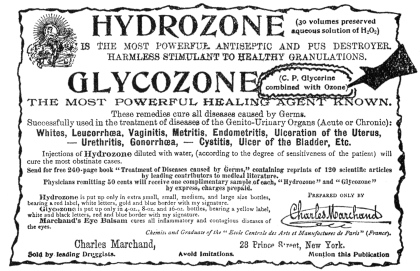
Much-reduced photographic reproduction of one of the older Glycozone advertisements. Attention is directed to the false claim that this nostrum is “glycerin combined with ozone.”
There is no similarity between the action of hydrozone, which is a hydrogen peroxid preparation, and glycozone, which consists of a mixture of glycerin and glyceric acid. The representation is false and misleading. The following statement, also, is an unwarranted exaggeration of the facts:
“As an internal medication in fermentation of food, catarrhal and inflammatory conditions of the stomach, and intestinal disorders, its action is prompt and effective, giving immediate relief to the patient.”
The following is another illustration of the vague statements made: After asserting that Glycozone is hygroscopic and that it will deteriorate by absorption of water unless securely corked, it is stated that “Its healing properties increase with age.” Whatever mysterious ingredient there may be present in this mixture to justify the statement that the healing properties increase with age can only be conjectured. To humbug the patient further, the circular advises him to use only a “silver, glass or hard rubber spoon.”—(From the Journal A. M. A., June 5, 1909.)
GARDNER’S SYRUP OF HYDRIODIC ACID
Report to the Council on Pharmacy and Chemistry
The following report on Gardner’s Syrup of Hydriodic Acid was submitted to the Council by a subcommittee:
This product was first taken under consideration in February, 1906. Reference to several committees was necessary, on account of the peculiar claims for the pharmaceutical, and especially the therapeutic, superiority of this preparation. At this time, as the Council did not have the necessary facilities for investigating therapeutic claims, the product was approved by the Council.
Since this time, however, the manufacturers have laid especial stress in their advertisements on some highly improbable claims, stating, for instance, that this Syrup of Hydriodic Acid possesses “all the advantages, with none of the objectionable symptoms caused by potassium iodid, or other forms of iodin medication.” To one with even an elementary knowledge of chemistry, the absurdity of this statement should be evident. The alkaline reaction of the tissues makes it impossible that hydriodic acid should persist as such in the body. In fact, the iodin must circulate in precisely the same form, whether administered originally as potassium iodid or as hydrogen iodid. The qualitative identity of the therapeutic actions is further proof of this fact, were such needed.
Since the most important objectionable symptoms of iodid medication arise after the absorption of the drugs, and since hydrogen iodid is conceded to be readily absorbed, it is evident that these symptoms must be equally liable to occur with hydrogen iodid as with potassium iodid, provided that equivalent doses of iodin are administered. An apparent difference in clinical results would arise if one drug were habitually given in smaller doses than the other. Since, however, the iodin is present in the body in precisely the same form, whether it is administered as a hydrogen iodid or potassium iodid, it is evident that a given degree of therapeutic effect would correspond to an identical tendency to iodism, whichever drug was used. If, as appears to be the case, the use of hydriodic acid is commonly restricted to those cases in which only minimal doses of iodin are required, the relative infrequency, or even absence of symptoms with such doses would not prove that the drug itself is less apt to cause them than is the potassium salt.
These facts are in reality self-evident; but since the Council now has proper facilities for obtaining the views and experiences of clinicians, it voted to submit the statement in question to its staff of clinical consultants, and to be guided by their advice.
OPINIONS OF THE CLINICAL STAFF
The following is an epitome of the replies of the eleven members of this staff who had used the article or who expressed an opinion to the questions sent out by the Council:
1. Query: “Do you think it possible that such a preparation could be devoid of the usual effects of iodin preparations?”
Eight reply that they consider this, a priori, impossible; three stamp the statement as highly improbable, but do not care to say that it would be impossible. One of the correspondents remarks: “While distinctly taking the position that under many conditions we must accept clinical results which we find not explainable by our theoretical knowledge, where the conditions are so simple as in this case and where we know that the iodin, whether administered as hydrogen iodid or potassium iodid, must behave in the same way, after absorption, I believe that no properly educated and correct thinking physician can or will, after due consideration, fail to reject the claims of superiority made by the proprietors of this preparation.”
2. Query: “Would you consider it necessary to make clinical experiments to settle this question?”
Seven of the correspondents consider this superfluous; four of these have had some experience with the article. Four, who have not used this product, consider a clinical test advisable. Under Query 3 we discuss the results of such tests.
3. Query: “When using Gardner’s Syrup of Hydriodic Acid, have you ever noticed from it any of the objectionable effects of iodin preparations?”
Six of the correspondents have not used it, or are uncertain whether or not they used the product made by Gardner. One correspondent remarks: “Never used it. Repelled by claims of superiority which exaggerate disadvantages of potassium iodid and overlook the small amount of iodin used in the preparation advertised.” The five clinicians who have prescribed the preparation report as follows: 1. Objectionable iodin effects in two cases, both patients being intolerant of all iodin preparations. 2. Has only prescribed it once or twice, but thinks he has seen iodism in one case, some years ago; does not recall clearly. 3. No; but has used this make very little, and then always in very small but continued doses. 4. No, always used it in small doses. 5. Yes, several cases in children; typical coryza, etc., with doses of three drams three times a day.
Conclusions: It appears that typical iodism occurred in several cases, after doses corresponding to 10 grains or less of potassium iodid per day, and this is a rather limited clinical material. Objectionable iodin effects are, therefore, not uncommon. Several correspondents remark that the relative infrequency of iodism is easily explainable by the fact that syrup is rarely employed in conditions which demand an active iodin medication and that it is, therefore, always taken in small doses. In fact, the main if not the only point of superiority of the syrup appears to be in its flavor.
These clinical opinions and experiences, therefore, are in complete agreement with the judgment of the committee, namely, that the therapeutic claims made by the manufacturers for this article are exaggerated and misleading.
OTHER MISSTATEMENTS
The above is by no means the only misstatement in the printed matter issued by this manufacturer. In the publication, “The Applications of Iodin,” issued in 1907, there occur the following misleading statements which, since they refer to plainly chemical facts, did not require submission to the clinical staff:
That the administration of potassium iodid after meals greatly impairs its physiologic action “by its chemical union with the various food products” (page 19). So far as the committee knows, potassium iodid does not combine with the food products in the stomach.
“Iodid of potassium, having an alkaline reaction, neutralizes the hydrochloric acid in the gastric secretions, causing indigestion, loss of appetite and depression” (page 19). The United States Pharmacopeia states, under Potassii Iodidum: “Its aqueous solution is neutral or has a slightly alkaline reaction on litmus paper.” The slight occasional alkalinity would be physiologically insignificant, and it is absurd to claim that this alkalinity causes “indigestion, loss of appetite and depression.”
“The dose of iodid of iron is so small that the amount of iodin contained therein is of little advantage” (page 19). As a matter of fact, the pharmacopeial average dose (1 c.c.) of the Syrup of Iodid of Iron contains as much iodin (0.85 grains) as a teaspoonful of Gardner’s Syrup of Hydriodic Acid (0.83 grains).
“In hydriodic Acid the iodin is in combination with hydrogen, one of the elements of the natural secretions of the body, and is, therefore, in physiologic harmony” (page 21). No comment is needed.
It is implied elsewhere (page 29) that potassium iodid decomposes more readily, with the liberation of iodin, than does hydrogen iodid. This is contrary to the prevailing opinion, and would require definite evidence before it could be accepted. It is also stated the large doses of potassium iodid in syphilis are necessary, because the gastric decomposition prevents complete absorption. This is certainly untrue, for potassium iodid is absorbed almost quantitatively.
These, and numerous other misstatements, constitute violations of Rule 6; and it is, therefore, recommended that Gardner’s Syrup of Hydriodic Acid be removed from the list of remedies approved by the Council; it is further recommended that this report be published.
The Council postponed final action on the report, pending its submission to R. W. Gardner. This having been done, and the reply of Mr. Gardner submitted to the Council, the above report was adopted and ordered published.
W. A. Puckner, Secretary.
(From The Journal A. M. A., Nov. 14, 1908.)
HYPEROL
Report of the Council on Pharmacy and Chemistry
The Purdue Frederick Company, exploiters of Gray’s Glycerine Tonic, have recently been advertising to the medical profession a nostrum called Hyperol. The following report to the Council, by the referee, was adopted and its publication authorized.
W. A. Puckner, Secretary.
According to the label, Hyperol is “A Utero-Ovarian Corrective and Tonic.” The circular accompanying the trade package states that it is:
“Indicated in all functional diseases of women such as: Amenorrhea, Dysmenorrhea, Menorrhagia, Metrorrhagia, Subinvolution, and in all conditions requiring a utero-ovarian corrective and tonic.”
From another circular we learn that:
“Hyperol is a combination of Hydrastine, Aloin, Iron, Apiol and Ergotin. Its components to a certain extent will indicate its action, but the therapeutic effects of each ingredient seem to be augmented to an unusual degree by use in this particular combination. The proportions of each have been determined by extensive clinical experimentation, and the formula seems to be exactly balanced to produce the best therapeutic effects in all derangements of the utero-ovarian functions.”
This “formula” is not very enlightening and a physician who wrote for further details was told that Hyperol contained:
Hydrastin1⁄40gr.
Aloin1⁄12gr.
Iron salts3gr.
Apiol (Special)3♏
Ergotin1gr.
And excipients.
If this is correct, then, so far as its active ingredients are concerned, Hyperol is but a mixture of well-known drugs, having contradictory properties. According to the claims in the circular quoted above, it is useful both in amenorrhea and in menorrhagia. The mixture is as unscientific as it is unnecessary. It cannot be adapted to any individual case; when ergot is indicated, apiol would naturally be contra-indicated; if aloes is appropriate, hydrastis may defeat the object sought. It is unnecessary because no intelligent physician would prescribe such a combination of drugs in any given case. The claims are exaggerated, improbable and foolish. Hyperol conflicts with the following rules of the Council:
Rule 4, in that statements on the label and in the circular enclosed with the trade package advertise it to the public in the treatment of diseases.
Rule 6, in that exaggerated and unwarranted claims are made for its therapeutic qualities.
Rule 8, in that the name of this pharmaceutical mixture fails to disclose the potent constituents.
Rule 10, in that it is unscientific.
It is recommended that publication of this report be authorized to call attention to the unscientific character of such complex mixtures.
[Editor’s Note: Hyperol is advertised in American Medicine and the St. Paul Medical Journal.]—(From The Journal A. M. A., April 18, 1914.)
INGLUVIN
Report of the Council on Pharmacy and Chemistry
A subcommittee of the Council reported that unwarranted claims and misrepresentation were made for Ingluvin by its manufacturers, William R. Warner & Co., recommended that the preparation be refused recognition and that the report be submitted to Warner & Co. for action.
The report was submitted to the firm, and after waiting one month and no acknowledgement or reply having been received, the Council directed its publication. It is as follows:
REPORT ON INGLUVIN
Ingluvin is manufactured by W. R. Warner & Co., chemists, Philadelphia, Pa. The printed matter contains numerous claims and representations of which the following are specimens:
“A positive specific for indigestion, dyspepsia and the most effective remedy in obstinate cases of vomiting of gestation.... A specific for vomiting in pregnancy in doses of from 10 to 20 grains, and a potent and reliable remedy for the cure of marasmus, cholera infantum, indigestion, dyspepsia, and sick stomach caused from debility of that organ. It is superior to the pepsin preparations since it acts with more certainty, and effects cures where they fail.... The natural glycocholic acid in Ingluvin is the active principle and the most efficient agent in the treatment of all stomachic and enteric disorders.”
Two samples were purchased at different times in the open market and on examination found to consist essentially of powdered meat fiber mixed with what appeared to {be} a membranous tissue resembling the lining of a gizzard. Both samples on being tested by the method prescribed by the U. S. Pharmacopeia for estimating the strength of pepsin were found to possess little, if any, proteolytic activity. In order to determine whether or not the lining of a fowl’s gizzard possesses proteolytic action, a fresh gizzard was secured, the lining washed slightly with water, then removed and on using one-half of same in place of pepsin as prescribed by the Pharmacopeial method, it was found to digest 10 grams of albumin within the time limit. Pepsin, when properly kept, does not lose its strength to any material extent.
A careful examination was made for the presence of glycocholic acid, claimed to be the active principle of Ingluvin, but its presence could not be established. Furthermore, the anatomic relations of the fowl are such as to preclude its presence.
The above shows that Ingluvin does not possess nearly as much proteolytic activity as ordinary saccharated pepsin recognized by the 1880 Pharmacopeia, which was prepared on the basis of digesting 300 times its weight of egg albumin. Inasmuch as no glycocholic acid is present in Ingluvin, it would seem that saccharated pepsin would be far more efficacious in treating the abnormal conditions for which Ingluvin is recommended in the advertising circulars. Furthermore, the claims made for the preparation are grossly extravagant.
A communication from Warner & Co. has been received since the above report was adopted, in which it is stated: “The reason that previous letter was not replied to was because we were desirous of securing all the information possible on the subject. Since that time we have made considerable research and also made laboratory investigation, and are enclosing the accumulated data with diagram of a part of the alimentary canal showing the esophagus, crop and gizzard.”
Much of the other matter submitted is immaterial. The following, so far as it means anything, seems to confirm the correctness of the report of the Council’s referee that Ingluvin is practically devoid of proteolytic activity: “... the therapeutic activity must be due to the bitter property, rather than any proteolytic activity, and it probably increases, thereby, the functional activity of the stomach, by which the normal digestive process is increased. Ingluvin in a 0.4 per cent. hydrochloric acid solution at 37 to 40 C. or if mixed with an aqueous solution of pepsin under the same conditions possesses an acrid, bitter taste and increases the secretion of the saliva and this is practically the same condition as when in the stomach, it no doubt stimulates the depressed mucosa peptic glands and increases gastric solution.”
W. A. Puckner, Secretary.
COMMENTS
The fallacies attending the use of digestive ferments in most stomach diseases have been previously noted in The Journal.53 In most digestive disorders a deficiency of the digestive ferment has not been proved. In cases in which pepsin is lacking, its administration is valueless unless it is combined with large doses of hydrochloric acid, and it is doubtful whether this combination is either necessary or conspicuously useful. There is, however, something so alluring about medication by digestive ferments which are assumed to supply a physiologic need, that since their discovery they have formed a fertile field for the activity of the manufacturer of proprietaries. As by scientific laboratory tests, it is possible to determine whether a given preparation has digestive power, the manufacturers of Ingluvin avoid this point by claiming that the remedy acts, not on the food, but on the stomach itself. That remedies may exist which act as stimulants to the digestive secretions can not be denied, although at the present time this power has not been satisfactorily demonstrated. The proprietors of Ingluvin, finding that proteolytic activity is not to be attributed to this preparation of chickens’ gizzards, announce a new therapeutic fact in the claim that “the natural glycocholic acid in Ingluvin is the active principle and the most efficient agent in the treatment of all stomachic and enteric disorders. According to the report made to the Council there is no glycocholic acid in this preparation, nor is it possible, from the anatomic arrangements of the fowl’s digestive apparatus, for it to get there. By all the tests which can be applied to determine its value this preparation is of much less value in digestive disorders than saccharated pepsin, which was discontinued in the Pharmacopeia because of its inferiority to the other forms of the ferment.
The repudiation, by the manufacturers, of the more absurd claims made for Ingluvin, shows the need of maintaining an attitude of healthy skepticism toward the advertised therapeutic virtues of proprietary preparations. If a physician is disposed to use digestive ferments, he should give preference to the official preparations, and ferments from other sources should be required to stand the exact tests which demonstrate the worthlessness of so many preparations on the market.—(From The Journal A. M. A., July 11, 1908.)
INTESTINAL ANTISEPTIC W-A
Report of the Council on Pharmacy and Chemistry
The Council voted that Intestinal Antiseptic W-A be refused recognition, and that the publication of the following report be authorized.
W. A. Puckner, Secretary.
The Abbott Alkaloidal Company advertises “Intestinal Antiseptic W-A” as
“... A scientifically blended and physiologically adjusted mixture, of the pure sulphocarbolates of calcium, sodium and zinc, grs. 5, with bismuth subsalicylate, gr. 1-4 and aromatics.”
This formula is in conflict with Rule 1 in that it does not state in what proportion the sulphocarbolates are present.
The name “Intestinal Antiseptic W-A” is in conflict with Rules 4 and 8, since it is therapeutically suggestive.
The preparation is in conflict with Rules 6 and 10, in that exaggerated claims are made for it, no evidence being submitted to prove the superior value of the mixture.
The most serious of these conflicts consists in the exaggerated and misleading therapeutic claims. The advertisements say:
“This combination has no equal as an antiseptic and inhibitive agent in typhoid fever, diarrhea, dysentery,” etc.
“Numerous cleverly devised and scientifically constructed intestinal antiseptics have been introduced to the profession, but not one of them has ever rivaled for one moment these salts in popularity.”
“... we are convinced that no small share of the credit for the reduction of the death rate in infantile diarrheas is due to the widespread application of this general method of treatment, associated of course with the calomel clean-out and the regulation of diet, now known to be essential.”
“But the use of the sulphocarbolates is not restricted to diseases of the alimentary canal, although in the summer diarrheas, gastric fermentation, intestinal indigestion, typhoid fever, dysentery—indeed in all alimentary disturbances—it is the one essential remedy. It is also indicated in practically all infectious diseases.”
“Typhoid Fever (in this disease the W-A Intestinal Antiseptic is of great value; used early, with the proper synergistic cleanout, it will often cut short the disease).”
These extreme claims exceed the limits of permissible optimism, unless they are supported by strong dependable evidence. They contrast sharply with the low esteem in which the phenolsulphonates (sulphocarbolates) are generally held. To accept these claims, and to justify encouraging physicians to rely on them, it would be necessary to establish:
First, that feasible concentrations have a distinct antiseptic action on cultures of intestinal bacteria. This experiment could be easily made, but the claims do not seem to be based on evidence of this kind.
Second, that the preparation actually checks putrefaction in the intestines. There are several methods by which this proof may be attempted; but the claims do not appear to be based on evidence of this kind.
Third, that the preparation actually has a favorable influence on the progress of diseases. This sort of evidence is exposed to so many fallacies that it would have to be gathered very carefully and critically, duly discounting the effect of other treatment; for instance, by comparison with similar cases which do not receive this preparation. This is especially important; and yet we find directions to use this preparation in conjunction with active cathartic treatment, which in itself has considerable influence on the conditions for which this preparation is recommended. No evidence of this kind is presented.
The testimonials contained in the advertisements cannot be considered as serious evidence. None present any indication of accurate record or proper control of conditions, or of the performance of control observations. They are superficial impressions, to which little or no weight can be attached.
It is recommended that Intestinal Antiseptic W-A be considered ineligible for New and Nonofficial Remedies.—(From The Journal A. M. A., Dec. 19, 1914.)
BANNERMAN’S INTRAVENOUS SOLUTION
Report of the Council on Pharmacy and Chemistry
Bannerman’s Intravenous Solution (Wm. Bannerman and Co., Chicago) was refused recognition because vague, indefinite and misleading statements were made regarding its composition, because it was recommended for anemia, tuberculosis and syphilis under grossly exaggerated and unwarranted claims and because the intravenous injection of complex and indefinite mixtures is unscientific and dangerous. Notice of the action of the Council having been sent to the Bannerman Company, the firm submitted a revised statement of composition and also a revised advertising circular.
The claim is made that Bannerman’s Intravenous Solution “is a compound of only the purest and proven efficient U. S. P. drugs.” According to the latest statement:
Each 10 c.c. of Bannerman’s Solution contains:
Hydrargyri Albuminas Mercury Content11-9Gr. or0.075 Gm.
Ferri Albuminas Iron Content41-4Grs. or0.286 Gm.
Sodii Chloridum61-5Grs. or0.412 Gm.
Calcii Salicylicum4Grs. or0.26 Gm.
Guaiacol4Grs. or0.26 Gm.
Creosote (Beechwood)5Grs. or0.32 Gm.
The solvent is said to be distilled water.
The formula is unsatisfactory in several particulars. The stated amounts of some of the ingredients are in excess of their solubility in water; the nature and amount of albumin contained in the “Hydrargyri Albuminas” and “Ferri Albuminas” are not given; the claim that the solution contains only U. S. P. drugs is not true. But the main objection to the preparation is its unscientific character and the unwarranted therapeutic claims made for it.
Even though a patient had all three diseases, syphilis, tuberculosis and anemia, it would be most irrational to use a shotgun prescription, containing, in fixed unvarying proportions, mercury for the syphilis, iron for the anemia and germicides for the tuberculosis. In syphilis the mercury-content of Bannerman’s Solution is inadequate; in anemia the intravenous administration of iron is unwarranted, and in tuberculosis there is no evidence that the injection of bactericides is efficient.
Exception must be taken, moreover, to the statement that “its use is absolutely safe.” The danger of anaphylaxis from repeated injections of albuminates cannot be disregarded, and as J. F. Anderson, director of the Hygienic Laboratory, has pointed out54 we know little of the secondary or remote effects of the intravenous injection of toxic substances; some of them probably do permanent harm.
Such claims as the following require no comment:
“It builds up and increases the hemoglobin in the blood. “It increases the number of red blood corpuscles. “It regulates the white cells. “It stimulates cell growth; therefore, it is reconstructive. “It is a powerful antiseptic. “It is useful in any septic condition.”
In view of the facts given, the Council again refused recognition to Bannerman’s Intravenous Solution.—(From The Journal A. M. A., Jan. 2, 1915.)
IODALIA[O]
Abstract of Report of the Council on Pharmacy and Chemistry
Iodalia is sold by Geo. J. Wallau, Inc., with the claim that because of the peculiar combination in which it contains iodin it is a valuable and efficient substitute for iodids. The preparation was examined in the Chemical Laboratory of the American Medical Association, which reported to the Council that, contrary to claim, iodin in the form present in Iodalia would, when administered, act like an ordinary iodid. Further the proportion of iodin present was so small that to administer the equivalent of 20 grains of potassium iodid it would be necessary to give the contents of a one-dollar bottle of Iodalia. In view of this report it is evident that the claim that Iodalia is “always well tolerated” and that it cannot produce “symptoms of iodism” is true only because of the small percentage of iodin it contains. The claims made in the advertising matter, that Iodalia is an efficient iodin medication in the treatment of syphilis, that it is a suitable substitute for cod-liver oil and that it may be used in anemia, dysmenorrhea, dyspepsia, malaria and diseases of the heart, are entirely unwarranted.
Iodalia is exploited in a way to suggest its use to the public for a host of diseases. Particularly reprehensible are the recommendations contained in a circular which accompanies the trade package that Iodalia:
“... offers the same protection against grippe, bronchitis, pneumonia, tuberculosis, pleurisy and other infectious diseases that vaccine does against small pox ...”
“It is also the best preventive against the slight infections and ailments to which debilitated and delicate children are subject.”
The Council voted that Iodalia be refused recognition.—(From The Journal A. M. A., Dec. 12, 1914.)
IODEX
Report of the Council on Pharmacy and Chemistry
Iodex is manufactured by Menley and James, Ltd., New York. It is advertised as
“... an embodiment of vaporized iodin in an organic base, reduced and standardized at 5 per cent. by incorporation with a refined petroleum product.”
The advertising conveys the impression that the effects of free iodin are to be obtained from the preparation; it is said to contain “5 per cent. Therapeutically Free Iodine,” and to do
“... everything the doctor expects of FREE iodin employed by inunction, without one physical or therapeutic drawback.”
The statements are also made that the preparation “neither stains, irritates, blisters or cracks the skin,” and that “thirty minutes after inunction iodin can be found in the urine.”
The following report of an examination made by the Chemical Laboratory of the American Medical Association has been submitted to the Council:
“Iodex is dark green, practically black. The green color is apparent when the ointment is rubbed on the skin, but disappears on continued rubbing. This nonstaining property is explained by the results of a test for free iodin, made on five specimens, four of which yielded only minute traces of free iodin, while the fifth yielded none. Of course, the statements that Iodex is an ‘Effective Free Iodin Application Without Drawbacks’ and also a means of ‘Really Efficient External Iodine Therapy Without Stain or Irritation’ contradict each other. Free iodin cannot be present in a sufficient quantity to be therapeutically efficient in any application which does not stain or irritate the skin.
“The total iodin content of the five specimens was found to be 2.63 per cent.—a little over one-half of the content claimed.
“Absorption and excretion experiments were performed to test the claim that ‘thirty minutes after inunction iodin can be found in the urine.’ In several subjects, from 1 to 2 gm. of Iodex was rubbed on the skin of the forearms, and the urine, for periods varying from seven to seventy-two hours, was collected and tested for iodin. In all of the tests the results were negative.”
Iodex is advertised as beneficial in muscular soreness, sprains, sciatica, neuritis, chronic rheumatism, enlarged glands, orchitis, epididymitis, gout, burns and dermatomycoses. It is also said to be “Indicated in Glandular Enlargements, Inflammatory Conditions, Various Joint Diseases, Rheumatism, Skin Diseases, Chilblains, etc., etc.”
To sum up:
1. As shown in the foregoing laboratory report, the composition is incorrectly stated, for the actual iodin content is only about half of that claimed.
2. It is not true that the action of Iodex is essentially that of free iodin, which is the impression conveyed by the advertising.
3. The assertion made in the advertising, that iodin may be found in the urine shortly after Iodex has been rubbed on the skin, has been experimentally disproved.
In view of these findings, the Council voted that Iodex be refused recognition for conflict with Rules 1, 4 and 6.—(From The Journal A. M. A., June 19, 1915.)
IODIA
Report of the Council on Pharmacy and Chemistry
The following report on Iodia was adopted by the Council and its publication authorized.
W. A. Puckner, Secretary.
Iodia is put on the market by Battle and Company, under the claim that it contains potassium iodid in combination with iron phosphate and vegetable “principles.” It is extravagantly recommended for use in many and varied conditions. For instance, it is “an unexcelled altero-reconstructive,” “almost a specific” in eczema and rheumatism and “a highly efficient form of iodin,” which will not produce iodism!
The therapeutic effects of iodids result from a chemical transformation by which molecular iodin is set free in the tissues, thus producing a mild degree of iodism. It follows, then, that a preparation which cannot give rise to the symptoms of iodism cannot be expected to produce the therapeutic effects of the iodids. The claim that Iodia is therapeutically efficient without producing iodism therefore justifies suspicion, to put it mildly.
In view of the exaggerated tone of the advertising, together with the fact that a report from the Chemical Laboratory of the American Medical Association showed marked discrepancies between the formula and the composition of Iodia, it seemed desirable to investigate this product. The report of the laboratory, which is given below, shows conflict with Rule 1 (secrecy of composition) and with Rule 2 (false claims of standardization). A discussion of the claims made for Iodia follows the report.
LABORATORY REPORT
The composition of Iodia is given thus:
“Formula.—Iodia is a combination of active principles obtained from the green roots of Stillingia, Helonias, Saxifraga, Menispermum and aromatics. Each fluid drachm also contains two and one-half grains Iod.-Potas. and one and one-half grains Phos.-Iron.”
We are told that:
“Its several ingredients are selected with scrupulous care, and the most exacting methods are constantly employed to insure absolute uniformity and maximum therapeutic potency.”
This “formula” is an absurdity: First, the amounts of the “active principles” of the plants named are not given; second, these “principles,” with the possible exception of menispermum alkaloids, have not been isolated; and, third, ferric phosphate and potassium iodid are incompatible! Incidentally, there are no methods whereby it is possible to secure “absolute uniformity” of a mixture such as Iodia is claimed to be.
Qualitative tests demonstrated the absence of iron and the absence of all but traces of phosphorus compounds (0.015 gm. phosphorus per 100 c.c.). Minute traces of alkaloids, possibly from menispermum, were found (that amount being about 0.004 gm. per hundred c.c. of the preparation). Therapeutically this quantity is entirely negligible. Determinations of iodid demonstrated the presence of only about 60 per cent. of the amount of potassium iodid claimed. The “formula” for Iodia is false and misleading.55
DANGEROUS RECOMMENDATIONS
One of the Iodia labels reads:
“Indications.—Syphilitic, scrofulous and cutaneous diseases, dysmenorrhea, menorrhagia, leucorrhea, amenorrhea, impaired vitality, habitual abortion and general uterine debility.”
Such recommendations are likely to lead to self-drugging in conditions that are not only dangerous to the individual but also a menace to the community. The preparation thus conflicts with Rule 4 of the Council. After admitting the need of efficient iodid medication in certain stages of syphilis and after exaggerating the frequence and severity of symptoms of iodism, an advertising circular entitled “Practical Therapeutics” asserts:
“Iodia then is the preparation of iodid of potassium to be preferred whenever it requires to be administered in large doses or for prolonged periods of time ...
“Not only does the association of the iodid of potassium with the vegetable alteratives offer a measure of protection against iodism but the latter exert depurative effects on their own account ...”
It is generally accepted that in certain stages of syphilis the only hope of success lies in efficient iodin medication. The exploiters of Iodia state that a dose of the nostrum contains 21⁄2 grains of potassium iodid; actually it contains only 11⁄2 grains. To urge physicians and the public to depend on this product for efficient iodid medication constitutes an unwarranted therapeutic exaggeration (Rule 6) which approaches criminality. The reason Iodia does not produce iodism is that, in the doses recommended, the iodin action is extremely feeble.
Likening the human body to a factory and discussing the “break downs” which are likely to occur, a circular entitled “Always Trustworthy” says:
“When administered in proper dosage, Iodia stimulates organic functions, promotes the elimination of waste products, and re-establishes metabolic activity. It increases the solvent properties of the blood, and arrests abnormal tissue metamorphosis. In other words, it lends material assistance to weakened cells and curbs those unduly active. Iodia, obviously, has a wide range of indications. It has been most generally and successfully employed, however, in Syphilitic, Scrofulous and Cutaneous Diseases, Rheumatic and Gouty Ailments, Dysmenorrhea, Menorrhagia, Leucorrhea, Amenorrhea, Impaired Vitality, Habitual Abortion and General Uterine Debility, and wherever a reliable altero-reconstructive is required.”
These recommendations show that in addition to the objections already given, this nostrum is an unscientific shot-gun mixture. This brings it in conflict with Rule 10 (unscientific articles inimical to the medical profession and the public).
It is recommended that Iodia be refused recognition.—(From The Journal A. M. A., Nov. 21, 1914.)
BURNHAM’S SOLUBLE IODINE[P]
Report of the Council on Pharmacy and Chemistry
The Council has authorized publication of the following report on Burnham’s Soluble Iodine.
W. A. Puckner, Secretary.
Burnham’s Soluble Iodine is offered to the medical profession by the Burnham Soluble Iodine Company, Auburndale, Mass., under the claim that by
“... a new process hitherto unknown to chemistry,... Iodine is converted into a soluble article—soluble in water and soluble in gastric secretions and in the tissues.”
Beyond this no statement as to the qualitative or quantitative chemical identity of Burnham’s Soluble Iodine is furnished; this secrecy, of course, has given the preparation a certain mysterious prestige among unthinking physicians.
Burnham’s Soluble Iodine was examined in the Chemical Laboratory of the American Medical Association some six years ago and was found to be an alcoholic solution of free iodin (approximately 3 gm. per hundred c.c.) and combined iodin in the form of iodid (equivalent to about 2 gm. of potassium iodid per hundred c.c.). Thus the total iodin content was somewhat less than half of that of the official Tincture of Iodin (Tr. Iodi), which contains 7 gm. of free iodin and 5 gm. of potassium iodid to each 100 c.c. The official tincture, diluted one-half, therefore, would be essentially equivalent to the Burnham preparation, both being miscible with water. The Burnham Soluble Iodine Company objected to the conclusions drawn, from this analysis, but admitted the correctness of the analysis itself.
Any one who gathered his first knowledge of the subject from the Burnham advertising might readily infer that no soluble iodin had been known prior to Burnham’s Soluble Iodine. This, of course, is not the case; the method of producing a solution of iodin by the use of an iodid has long been known.
The following statement is not only obviously untrue but also nonsensical:
“In all the history of iodin medication, covering a period of laboratory research of many years duration, every effort to produce a free iodin, prior to the evolution of Burnham’s Soluble Iodine, was attended by failure.”
The company lays stress on the assumed superiority over the iodids of a preparation containing free iodin. This assumption is based on a fallacy. Those who regard free iodin as superior to combined iodin forget that free iodin taken by the mouth is converted in the intestines, by the action of the alkaline intestinal secretions, into an iodid with a small amount of iodate, while administered intravenously (a procedure that, while advocated by the Burnham concern, is therapeutically indefensible), it enters into combination with the alkaline salts and proteins of the blood. The free iodin in Burnham’s Soluble Iodine must act in the system as an iodid, and the whole iodin content, to furnish a correct estimate of the value of the preparation, should be reckoned as an iodid.
Bearing this in mind, then, it is evident that the doses of Burnham’s Soluble Iodine recommended by the manufacturers are extremely small. They range from 20 minims (equivalent to 1 grain of potassium iodid) to 1⁄2 minim (equivalent to 1⁄40 grain of potassium iodid). From 5 to 20 minims (equivalent to about 1⁄4 to 1 grain of potassium iodid) is the dosage recommended for syphilis; from “1 to 3 minims [equivalent to from 1⁄20 to 3⁄20 grain of potassium iodid] three to six times daily” for typhoid and other intestinal diseases. No wonder the exploiters can say that this nostrum does not irritate the intestines, that it is “non-irritating to the weakest stomach” and that there is an “entire absence of toxic action from maximum doses”! Its alleged freedom from the irritating and untoward effects of ordinary iodids is due, not to any inherent superiority of the preparation, but to the insignificant amount of iodid present.
The preparation is advertised for use in an extremely wide range of diseases, in some of which iodid therapy is recognized as of value, while in others it is generally regarded as either worthless or harmful. Given orally or intravenously (the recklessness of the latter method should again be emphasized) Burnham’s Soluble Iodine is claimed to be of:
“... great utility as an internal antiseptic in tubercular affections ...”
Since, as previously explained, free iodin, when introduced into the body, enters into chemical combination before it has a chance to permeate the tissues, and since the alkali iodids possess very slight (in fact, for this purpose, negligible) antiseptic powers, it is evident that this claim is unfounded. So, for the same reason, is the claim that “as an intestinal antiseptic,” Burnham’s Soluble Iodine is:
“... efficient in Typhoid Fever, Enteritis and other intestinal diseases.”
It is recommended in exophthalmic goiter, notwithstanding that this condition is generally recognized as contraindicating the administration of iodids, which excite the action of the thyroid gland, and which therefore must be used with great circumspection. An especially indefensible recommendation is that 1⁄2 minim of Burnham’s Soluble Iodine (equivalent to 1⁄40 grain of potassium iodid) be administered every five minutes in “membranous croup”—diphtheria—until relief from dyspnea is obtained. But, of all the extravagant claims made for this preparation, perhaps the following is the most reprehensible:
“In the treatment of Phthisis, in its various forms, clinical evidence clearly indicates that the use of SOLUBLE IODINE affords the most potent method of treatment available. Dose—2 minims, increasing to 5 minims in four ounces water before meals.”
Remove the mystery and tell physicians that a dose of 1⁄10 or 1⁄4 of a grain of potassium iodid is “the most potent method of treatment available” in tuberculosis and the absurdity becomes self-evident. Nor is this the worst feature of the advice here offered. Iodin, by combining with the fatty acids of tuberculous tissues, promotes their autolysis and consequently their softening and breaking down. The products of this autolysis are carried by the lymphatics to healthy tissues and thus may spread the infection. Therefore the use of iodids in tuberculosis, even in small dosage, should not be undertaken lightly.
It is recommended that Burnham’s Soluble Iodine, a semi-secret preparation, exploited by means of extravagant and dangerous therapeutic claims, be held ineligible for admission to New and Nonofficial Remedies, and that this report be published.—(From The Journal A. M. A., May 15, 1915.)
IODOTONE[Q]
Abstract of Report of the Council on Pharmacy and Chemistry
Eimer and Amend, New York, who market Iodotone, state that it is a solution of hydrogen iodid (hydriodic acid) in glycerin, containing 1 grain of iodin to each fluid dram. The unwarranted assertion is made that Iodotone
“... will produce the constitutional effect of iodine in a shorter time than other preparations ...”
This cannot be true, for it is certain that, because of the alkaline reactions of the tissues, iodids, whether administered as hydrogen iodid or as alkali iodids, must circulate in precisely the same form and therefore exert the same therapeutic effects in precisely the same way.
Eimer and Amend further assert that the ordinary iodids may to advantage be replaced by Iodotone. The absurdity of this claim is apparent when it is considered that it will be necessary to administer nearly one fluidounce of glycerin to obtain an amount of Iodotone equivalent to a 10-grain dose of potassium iodid. The additional claim that Iodotone will not disturb the stomach or produce the usual disagreeable symptoms of iodism is evidently unwarranted, for it is generally conceded that symptoms of iodism can be avoided only at the risk of insufficient iodin medication. Because of these unwarranted and misleading claims and because the name Iodotone would tend toward the uncritical use of the preparation as a general tonic, the Council voted that Iodotone be refused recognition.—(From The Journal A. M. A., Dec. 12, 1914.)
IOSALINE
Report of the Council on Pharmacy and Chemistry
Iosaline is a rheumatism remedy for external application. In view of the misleading and unwarranted claims which are made for it, the Council voted that Iosaline be refused recognition and recommended publication of the Committee’s report which appears below.
W. A. Puckner, Secretary.
COMMITTEE’S REPORT
The following sweeping but rather indefinite claims are made for Iosaline.
“Iosaline is a penetrator and overcomes the objectionable escharotic properties of Iodine; it is readily absorbed and may be used without discomfort or discoloration.”
“The strong analgesic properties of Iosaline make it especially useful in controlling pain in cases of Neuralgia, Rheumatism, Gout, and Arthritis Deformans.”
As there are few, if any, known iodin compounds which are “readily absorbed” through the skin and which will not at the same time produce discoloration or discomfort, it was thought worth while to take up the examination of Iosaline. The results of this examination are reported by the Chemical Laboratory of the Association as follows:
Laboratory Report:—Iosaline is advertised by the Iosaline Company of New York, as a remedy for the treatment by external application, of rheumatism, gout, neuralgia, pneumonia and numerous other diseases. Concerning its composition the following statements are made:
“A transparent, non-staining gelatinoid of combined iodine with menthol and methyl salicylate. “Alcohol 070. per cent. “Chemical tests demonstrate the preparation to contain 5 per cent. of iodine.”
The placing of a cipher before the percentage figure for alcohol, though perhaps accidental and not meant to mislead, might cause a hasty or careless reader to understand 7 per cent. or .07 per cent., instead of 70 per cent., as the proportion of alcohol present.
The preparation examined was a very pale yellowish, translucent solid having a strong odor of methyl salicylate and a fainter odor of menthol. A package sold for 2 ounces contained 51.7 gm. Qualitative tests indicated the presence of alcohol, an iodid, menthol, methyl salicylate, potassium, sodium, combined fatty acids and a trace of glycerin. Thyroid extract was not found. Quantitative examination indicated the following approximate composition for Iosaline:
Alcohol (by weight)48.05per cent.
Menthol2.07per cent.
Methyl salicylate10.25per cent.
Potassium iodid (4.25 per cent. iodin)5.55per cent.
Soap12.68per cent.
Glycerina trace
Water and undetermined matter to make 100 per cent.
Iosaline, therefore, appears to be a solidified, watery-alcoholic solution of soap containing potassium iodid, menthol and methyl salicylate. Physiologic tests carried out by rubbing the preparation on the skin and afterward testing the saliva and the urine for an iodid indicated that none of the potassium iodid is absorbed. Since Iosaline is claimed to contain 70 per cent. of alcohol and 5 per cent. of iodin, the alcohol content is but 68.7 per cent. and the iodin content but 85 per cent. of the amounts claimed. The phrase “combined iodin” is evidently meant to mislead, and adds the element of mystery on which preparations of this class rely so largely.—(From The Journal A. M. A., March 15, 1913.)
Abstract of Report of the Council on Pharmacy and Chemistry
Nourry Wine (E. Fougera and Co., New York) is a proprietary iodin preparation said to contain 12 per cent. of alcohol and 11⁄2 grains of iodin in combination with tannin to the fluidounce. Experiments made in the A. M. A. Chemical Laboratory demonstrate that the iodin contained in Nourry Wine is present either in the form of iodid ions or in a form very readily yielding iodid ions and that therefore its action will be that of ordinary iodid. Yet a circular asserts:
“The Nourry Wine is the one preparation ... able to introduce into the organism the active metalloid liberated little by little from the organic combination....”
While Nourry Wine contains but an insignificant proportion of iodin, the circular claims that “Nourry Wine presents a high dose of iodin.” Further, the label on Nourry Wine and the circular which is wrapped with it suggests its use in a number of diseases in which iodin medication is considered of minor importance. These recommendations, bolstered up by testimonials from twelve to twenty-five years old, are likely to lead the public if not the medical profession to use this weak iodid wine where efficient treatment is called for. The attempt is made to give a further false value to Nourry Wine in the minds of those who prize everything that is foreign by the suggestion that it comes from France when in reality it is made in New York. In conclusion the Council held that, though the alcohol of the wine is the most potent constituent, the constant use in the advertising matter of the term “Nourry Wine,” unqualified by the adjective “Iodinated,” was mischievous as likely to lead to the thoughtless use of the preparation in cases unsuitable for iodin medication. The Council refused recognition to Nourry Wine.—(From The Journal A. M. A., Dec. 12, 1914.)
LABORDINE
A Report by the Council and Some Pertinent Comments Added Thereto
The following report was submitted to the Council on Pharmacy and Chemistry by the subcommittee which examined Labordine:
To the Council on Pharmacy and Chemistry:—Your subcommittee presents the following report on Labordine, sold by the Labordine Pharmacal Co., St. Louis.
Labordine is advertised to physicians as having the following composition:
Apium Graveolens (true active principle) “Process-Laborde”353⁄8
Gaultheria Fragrantissima (true active principle) “Process-Laborde”251⁄8
Acete Amide-Phenyle151⁄8
Quinina11⁄8
Benzoyl-Sulphyonic-Imide231⁄4
It is stated to be a “vegetable antipyretic”; that {“}it reduces temperature without heart depression,” and physicians are warned to “avoid acetanilid poisoning and danger from other coal-tar antipyretics.”
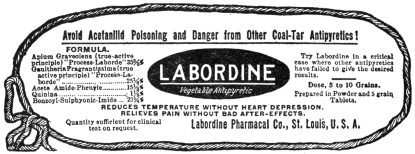
While the “formula” and the statement just quoted are sufficient evidence of the fraudulent character of the product, yet an abstract of the reports of the chemists who analyzed it is given further to demonstrate its character.
Taking the average of the reports of analyses, labordine contains:
Acetanilid37.9
Free salicylic acid6.9
Quininpresent
Corn starchpresent
Milk sugar34.7
This report of analysis only makes apparent that Labordine is not what it is claimed to be. While it is claimed to contain 231⁄4 per cent. saccharin, this substance was not present, or mere traces only. While, in a disguised way, it is stated to contain 151⁄8 per cent. acetanilid, it contained nearly 40 per cent.
It is recommended that Labordine be not approved and that this report be published.
The recommendation of the subcommittee was adopted by the Council, and in accordance therewith the above report is published.
W. A. Puckner, Secretary.
COMMENTS
A concrete illustration of some general principles previously laid down is furnished by a nostrum too unimportant to be of any value, save to “point a moral and adorn a tale.”
About thirteen years ago Labordine was advertised under the name of Analgine-Labordine, “A purely vegetable product,” “a combination of the active principles of Camellia Thea, Apium Graveolens, saccharin and carbohydrates,” “Superior to Antipyrine, Phenacetine, Antifebrine, Acetanilid”—note the use of two names for the same thing—“or any of their imitations,” and “unexcelled by any coal-tar product or their compounds.” In 1894 the name was changed to Labordine, in order, as its owner stated, to prevent its being mistaken for a coal-tar product of similar name.
What its composition was at this time we do not know, since there is no guarantee of the permanence nor stability of nostrum formulas except “the honor and reputation of the manufacturers,” which, as investigation has shown, is not always unimpeachable. There has been nothing to prevent alteration of the formula, if the proprietors desired, with every change in the moon. But the name and the general tone of the advertising has been the same. The claim of superiority over coal-tar products has been constantly made.
As to the present conditions, a circular enclosed with a sample of Labordine, recently sent from the St. Louis office, contains the formula given above in the report of the Council. In the same circular are also found these illuminating statements: “The medical profession has long appreciated the dangers involved in the administration of various mineral remedies now so commonly employed, and the value of a safe, effective and reliable vegetable antipyretic is universally recognized. Such a remedy is Labordine. It is purely vegetable in its composition and produces none of the evil after-effects of the coal-tar derivatives.... Labordine ... is a purely vegetable cardiac stimulant.... There is nothing mysterious about Labordine or its constituents.... The ‘Process-Laborde’ gives the true active principles of the Celery and Indian Wintergreen, something heretofore difficult to obtain. To this is added the fact that absolutely chemically pure Acet-Amide-Phenyle is used. The latter is the most valuable and, in fact, the only vegetable antipyretic known.”
The above report of the Council shows the following facts:
1. Apium Graveolens (true active principle), “Process-Laborde” is probably powdered celery seed. One chemist says: “The powder has the characteristic odor of celery, while a microscopic examination shows the presence of a substance having the characteristic structure of seeds in general.” If celery seed has any “active principle” it has never been isolated. As to its therapeutic value, nothing whatever is known. It is, we understand, highly beneficial in the case of singing canaries, but authorities in scientific therapeutics have never discovered that it possessed any remarkable medicinal qualities.
2. Gaultheria Fragrantissima (true active principle), “Process-Laborde,” is probably ordinary everyday salicylic acid. One analysis showed salicylic acid to be present to the amount of about 7 per cent. The question of whether or not salicylic acid could in any way be considered the “true active principle” of Gaultheria Fragrantissima, was submitted to Prof. John Uri Lloyd of Cincinnati, the eminent authority on the chemistry of the proximate principles of plants, who replies:
“The advertisement is evidently so worded that, although the name of the Indian plant Gaultheria Fragrantissima is employed, its true and active principle being wintergreen oil, the concoctor can mystify his patrons and at the same time use the well-known wintergreen oil, made in America, which in my opinion, so far as any chemical test might be concerned, could not be distinguished from the methyl salicylic acid (wintergreen oil) derived from the Indian plant. Concerning whether salicylic acid is a proximate constituent of Gaultheria Fragrantissima, in my opinion, it would be a misnomer to make such an announcement. Salicylic acid, per se, does not exist, in my opinion, in the plants mentioned, being made by chemistry.”
3. The third and most important ingredient in this “purely vegetable antipyretic” is brazenly announced as “Acet-Amide-Phenyle,” but it is only necessary to say that this imposing designation is an attempt to “Frenchify” a scientific name for acetanilid.
Analysis shows that this coal-tar product is present to the amount of 37.9 per cent., or 1.89 grains in a 5-grain tablet.56 In other words, this imposing Labordine, made by a mysterious and elsewhere unheard of “Process-Laborde,” is simply one more of the many acetanilid powders that have been foisted on our profession and that have filled our journals for years past. The only thing in it that is of practical therapeutic value is 2 grains of acetanilid to a 5-grain tablet. The statement that Labordine is a purely vegetable preparation is probably intended by the proprietors as a good joke on the medical profession. Acetanilid is not usually regarded as a vegetable product, at least it is not ordinarily found in market gardens. The only vegetable source from which acetanilid can be obtained is the beautiful flowering coal-tar bush, from which so many other nostrum vendors obtain their “perfectly harmless, purely vegetable antipyretics,” all composed of acetanilid and something to hide it. If the statements made by one of the company’s employees and quoted below are true, Labordine is not “manufactured and made chemically pure in the laboratories of the Labordine Pharmacal Company,” for this company has no laboratory, and its product is manufactured for it.
4. Our readers will be interested to know that the important ingredient entered under the imposing name of Benzoyl-Sulphyonic-Imide is simply a highly scientific name for saccharin. Even on this point, however, the formula is misleading, since it claims 231⁄4 per cent. of this substance, whereas the analysis shows that the presence of saccharin could not be proved. If it is present at all it is in quantities much less than stated, and so small as to be difficult of recognition. Instead it appears that the product contains common starch and about 35 per cent. of milk sugar.
THE COMPANY ITSELF
One of the humiliating phases of the proprietary medicine business is that, in many instances, these preparations are foisted on our profession by men who know nothing of medicine, pharmacy or chemistry, yet who not only presume to concoct our medicines for us, but also assume to instruct us how to use them.
Gould’s Commercial Register for 1907 gives the officers of the Labordine Pharmacal Company as H. M. Coudrey, president; M. Crawley, vice-president, and D. E. Gamble, Jr., secretary and treasurer. The place of business is given as 420 Market street, St. Louis. We are informed that Harry M. Coudrey is an insurance agent and the present member of Congress from the Twelfth Missouri District; that Mark Crawley is a clerk in the insurance office of H. M. Coudrey; and that Mr. Gamble is cashier in the same office. A recent visit of a representative of The Journal to 420 Market street, St. Louis, showed that the office of the Labordine Pharmacal Company is in Room 12 on the third floor of an old dilapidated building. There was no sign on the door of the office, but on the wall next to an old elevator was a very small sign which read “Labordine Chemical Company, Room 12.” The office at the time of the visit was apparently in charge of a young woman about 20 years old. Careful scrutiny of the furniture and fixtures showed that the room contained an old oak roll-top desk in one corner and a kitchen table, on which were piled about half a dozen packages of Labordine. The floor of the room was bare and very dirty. In an adjoining room, the door of which was open, was piled a lot of broken furniture. No laboratories nor chemical apparatus were visible. The young woman in charge stated that Labordine was made by the Mallinckrodt Chemical Works, at No. 3600 North Second Street, St. Louis.
This is a fair sample of nostrums and of the methods of exploiting them. The bitterly humiliating fact about the whole business is that a preparation, advertised under such palpably misleading claims, could actually be advertised in medical journals, even in journals of a supposedly high scientific standard, and could be bought and prescribed for years by supposedly intelligent and conscientious physicians. It is not supposed that every physician should be enough of a chemist to detect the ridiculous discrepancies between the published formula and the therapeutic claims made for such a mixture. But that members of a supposedly learned profession should fail to have enough interest in the preparations they prescribe for their confiding patients to find out that acetanilid is being masked under an obsolete and little used name, that under an imposing polysyllabic designation is hidden saccharin, that the so-called “active principle Process-Laborde” (whatever that may be), is equivalent only to one-third grain of salicylic acid in a 5-grain tablet, and that the advertising matter sent out for years by this company contained absolute falsehoods regarding the composition and therapeutic benefits of its preparation, is certainly just cause for shame and humiliation. If a physician, knowing the composition of Labordine, wishes to prescribe it and prescribes it intelligently, he has a perfect right to do so. If he wishes his patient to have 2 grains of acetanilid, 1⁄20 of a grain of quinin, and 1⁄3 of a grain of salicylic acid, and considers a mixture of ground celery seed, starch and milk sugar as a proper vehicle for this medication, no one will question his right to administer it. No physician, however, has any right, either moral or professional, to prescribe a preparation, concerning the ingredients of which he knows absolutely nothing.
Is it possible that such carelessness may be one of the causes of waning public confidence in our profession? We leave it to our readers to determine whether such a moral can be drawn from this typical nostrum story.—(From The Journal A. M. A., March 30, 1907.)
LACTOBACILLINE OMITTED FROM N. N. R.
Report of the Council on Pharmacy and Chemistry
The Franco-American Ferment Company has advised the Council on Pharmacy and Chemistry that, in advertising its products, it will no longer conform to the rules of the Council. This is evident. The Franco-American Ferment Company has distributed circulars in which the public is informed that auto-intoxication is the cause of innumerable ills ranging all the way from arteriosclerosis, rheumatism and gout to chronic headache, odorous perspiration, nervous disorders and melancholia; that the Bulgarian bacillus “is a wonderful corrective or remedy” for all these conditions, and that the Lactobacilline products are the only preparations of Bulgarian bacillus “to be had in America which bear his [Professor Metchnikoff’s] personal endorsement”—by inference, the only reliable products. In view of the action of the Franco-American Ferment Company, and of the tendency of their advertising to cause the public to exaggerate slight ailments into alarming conditions, the Council has voted that the several Lactobacilline products of this concern be deleted from New and Nonofficial Remedies.—(From The Journal A. M. A., April 17, 1915.)
REEXAMINATION OF LACTOPEPTINE[T]
Report to the Council on Pharmacy and Chemistry
In 1907 the Council on Pharmacy and Chemistry published a report on Lactopeptine. At that time it was shown that Lactopeptine did not have the composition claimed for it. The same claims as to composition are still being made for the product. In view of this fact, a second examination of Lactopeptine has been made and the result reported to the committee on chemistry. The report confirms the Council’s findings of six years ago. After adoption by the committee, it was adopted by the Council and its publication authorized.
W. A. Puckner, Secretary.
SECOND EXAMINATION OF LACTOPEPTINE
Two specimens of Lactopeptine in original unbroken packages were recently examined. One of these was an American preparation said to be produced by the New York Pharmaceutical Association at Yonkers and the other an English preparation from John Morgan Richards and Sons, London.
When Lactopeptine was first examined by the Council about six years ago, it was found to be little more than weak saccharated pepsin, and did not contain the other ferments which were claimed by the manufacturers to be present. A statement concerning this was published in the Council Reports for 1905–1908, p. 43. Because of claims recently made by the exploiters that this preparation contains not only pepsin but also pancreatin, diastase, lactic acid and hydrochloric acid, and that the failure to recognize these must be due to the lack of ability of the chemists making the examination, it seemed worth while to undertake a new series of tests on samples from two sources mentioned, the products on the British and American markets. The label on the British sample gives the following as the composition:
Sugar of Milk40ounces
Pepsin8ounces
Pancreatine6ounces
Ptyalin or Diastase4drachms
Lactic Acid5fl. drachms
Hydrochloric Acid5fl. drachms
The label on the American sample gives no quantities but states that it “represents a combination of the principal digestive and enzymogenic agents, Pepsin, Pancreatin, Diastase, Lactic and Hydrochloric Acids, in the proper proportion to insure best results.”
We have examined both preparations for starch-digesting power according to the methods employed in our previous examinations of such ferments and already reported. Diastase and the amylopsin of pancreatin seem to be completely absent, or, if present at all, in such minute traces that digestion of starch is not shown after one hour when quantities running from 60 mg. up to 150 mg. were allowed to act on 500 mg. of starch made up into paste. These tests were repeated, always with the same results, and were controlled by digestions of the same starch with other diastase preparations of known value.
Tryptic activity appears likewise to be absent, as in weak alkaline solution after fifteen hours’ digestion no effect on coagulated egg albumin or fibrin was observed when 100 mg. of each preparation was used with 1 gm. of the protein material.
As was found in the previous investigation the two products have some peptic activity, but this activity is comparatively weak, as about 200 mg. of each preparation are required to digest 10 gm. of coagulated egg albumin with 0.2 per cent. hydrochloric acid in three hours at 40 C. (104 F.), and 100 mg. portions were unable to completely digest 10 gm. portions of egg albumin with acid of the same strength in four hours at 50 C. (122 F.).
Hydrochloric acid is absent, as might be expected from the character of the preparation, and the amount of combined chlorid is small; but qualitative tests were obtained for organic acid resembling in behavior lactic acid, which is probably present in combined form.
It must be reaffirmed then that in digestive activity both the Lactopeptine purchased in the United States and that bought in England are essentially weak saccharated pepsins.
[Editorial Note.—The report of 1907 demonstrated that Lactopeptine was at that time a weak saccharated pepsin. The present report shows that Lactopeptine, as it is sold both in the United States and Great Britain, is still the same weak pepsin preparation. By the false statements which appear on the Lactopeptine labels the exploiters lay themselves liable to prosecution under the Food and Drugs Act—just as they have laid themselves liable for the past six years. The continued exploitation of this preparation warrants a restatement of facts that have been given many times before:
1. A preparation having the composition claimed for Lactopeptine—a powder containing pepsin, pancreatin, diastase, lactic acid and hydrochloric acid—cannot be produced commercially.
2. Even if such a combination were available, the acidity of the mixture itself and of the gastric juice would in all probability destroy the pancreatin before it could reach the intestinal tract.
3. Even if every constituent could exert its proper function at the right time, the administration of such a shotgun mixture would be unscientific and uncalled for.]—(From The Journal A. M. A., Aug. 2, 1913.)
MEAT AND BEEF JUICES[U]
Report of the Council on Pharmacy and Chemistry
The following was submitted to the Council by a subcommittee:
To the Council:—While meat extracts contain only traces of coagulable proteids and have little food value, meat juices are prepared by a process which ensures the presence in the finished product of considerable quantities of coagulable proteids and they therefore have considerable value as foods. Many preparations which are sold as beef juices or meat juices have no right to these designations. Since the public and physicians are likely to be misled by the names given to these products and by the false claims which are made for them as foods and depend on them in the nourishment of the sick, it is important that their composition and their value as foods should be known.
In the following report is presented the results of an examination of some of the commercial products found on the American market. The report shows that Wyeth’s Beef Juice (John Wyeth & Bro., Philadelphia), Bovinine (The Bovinine Co., New York), Carnine (Carnine Co., Fougera & Co., New York), and Valentine’s Meat Juice (M. J. Valentine, Richmond, Va.) are sold under names which are incorrect, that their composition is not correctly stated by the manufacturers and that false and misleading statements are made in regard to their value as food.
It is recommended that the products named be refused recognition for conflict with Rules 1, 6 and 8. Since these preparations are typical of many others on the market, and as their use is a menace to the public health it is recommended that the report be published.
This report was adopted by the Council.
W. A. Puckner, Secretary.
Beef or meat juices are clearly to be distinguished from beef or meat extracts. The word “juice” applies solely to the fluid portion remaining in fresh meat after proper cooling and storing and may be obtained by pressure or diffusion with or without a low degree of heat. Under heavy pressure freshly chopped meat will yield from 25 per cent. to 40 per cent. of a thick reddish juice and if the meat is previously frozen or heated to 60 C., as much as 50 per cent. may be obtained. This gives some idea as to the probable cost of preparing beef juice at home. The chief characteristics of meat juice are the presence of a considerable proportion of coagulable protein and a low content of meat bases. That above represents the nature of these commodities as usually understood by the medical profession, is clearly shown by this quotation:57
“One or two teaspoonfuls of this (meat juice) are added to a teacupful of cold or warm water, which, however, must not be boiling, or otherwise the albumin would be coagulated, but it may, however, be sufficiently warm to drink comfortably.”
Beef juice is considered by some physicians of much dietetic service and believed to represent liquid food in concentrated form. W. O. Atwater,58 relative to this product says:
“Beef juice obtained from the best steak which has been merely warmed through over the coals and then entirely deprived of soluble substance by a screw press, is undoubtedly the most concentrated of the liquid foods.”
The latter authority gives a number of analyses of beef juices prepared under known conditions.
DEFINITION OF MEAT JUICE
Meat juice is defined by the standards committee of the Association of Official Agricultural Chemists as the fluid portion of muscle fiber obtained by pressure or otherwise, and may be concentrated by evaporation at a temperature below the coagulating point of the soluble protein. The solids contain not more than 15 per cent. of ash, not more than 2.5 per cent. of sodium chlorid (calculated from the total chlorin present), not more than 4 nor less than 2 per cent. of phosphoric acid (P2O5), and not less than 12 per cent. of nitrogen. The nitrogenous bodies contain not less than 35 per cent. of coagulable proteins and not more than 40 per cent. of meat bases.
Meat juices of commerce are supposed to be made by subjecting properly prepared meat to heavy pressure with subsequent concentration of the juice in vacuo at a low temperature. The latter is necessary because if the temperature is raised to any material extent the valuable coagulable, soluble proteins referred to above are precipitated and lost. In order to establish a basis of comparison relative to the composition of natural raw beef juice a number of samples were prepared under known conditions and submitted to analysis. The results contained in the subjoined table clearly show that meat juices made under known conditions vary according to the mode of preparation, but it is evident that practically one-half of the nitrogen is present as coagulable protein.
FOOD VALUES
In order to arrive at the food value of any commodity it is necessary to consider its chemical composition, available potential energy, absorbability, etc. On referring to the analytical table it will be found that the amount of inorganic material in meat juices Nos. 7 and 10 is unduly high. It appears that sodium chlorid, per se, has been added to both Bovinine and Wyeth’s Beef Juice probably as a preservative in the latter and for condimental purposes in the former. The relative and absolute proportions of phosphatic material in both products is excessive. The other constituents present in the ash are those usually found in meat products.
The amount of sugar and glycerin in Carnine is interesting. These agents may be added for preserving purposes, but the resulting product, on account of its syrupy appearance, leads to the belief and is so represented, that it is a concentrated food. Glycerin is also present in Bovinine and Valentine’s meat juice. Bovinine in addition contains about 8 per cent. alcohol.
The total nitrogen content of the trade products excepting Carnine, is greater than the amount of nitrogen present in meat juices proper, but the relative amount of nitrogen present as coagulable protein—the valuable part of meat juice—is much greater in the latter. In fact, the amount of coagulable protein present in Valentine’s Meat Juice may be considered nil, which indicates that an unduly high temperature is used in its preparation. In this connection it should also be noted that even a moderate elevation of temperature influences the chemical composition of meat juices. For example, the coagulable matter present in Nos. 3, 4 and 5, is approximately one-half that present in Nos. 1 and 2, which appears to indicate that the best product can be made without the use of any heat whatever. Several of the trade products, namely Nos. 7, 8 and 9, contain about as much coagulable material as meat juice made by heating beef to 60 C. According to the formula appearing in a circular of the Bovinine Company, a part of the coagulable matter is present in the form of egg albumin, but the company claims egg albumin is not used at present. In the case of Carnine, the coagulable matter appears to be introduced by the use of blood itself. The exact nature of the coagulable protein matter in Wyeth’s Beef Juice has not been ascertained. It is well known to manufacturers and physiologic chemists that it is practically impossible to manufacture a genuine meat juice possessing a reasonable amount of coagulable proteins, which is stable without a preservative.
Meat juices, in addition to the coagulable protein material, contain other protein bodies such as albumoses and peptones. These bodies are largely formed from the original protein bodies present in the meat juice during the process of manufacture. They are highly nutritious and largely and readily absorbed from the alimentary canal, but the amount of these bodies present in the trade products is relatively small excepting in Bovinine, which is not a meat juice, particularly when the high prices are considered.
A considerable proportion of the nitrogenous matter contained in Valentine’s and Wyeth’s products is present in the form of amino bodies frequently included in the general term, “extractives.” These bodies may be oxidized in the body and thus supply heat in a manner similar to alcohol, but it should be remembered that there still appears to be a wide difference of opinion among various observers on this point. Some appear to be of the opinion that the amino bodies are devoid of food value in that these bodies appear in the urine practically unchanged. It would, therefore, appear that the value of the amino bodies is largely of a stimulant character.
The food value of meat juices, therefore, resides largely, if not solely, in the coagulable and other protein material present. Comparing the calorific value or potential energy available in meat juices proper on this basis with that present in the commercial products, excluding Bovinine, it will be seen that on the average the genuine meat juices—that is, those made by pressure, direct from the meat itself as wanted—are much superior to the commercial products, notwithstanding the marked concentration in some cases. The calories given in the accompanying table do not include sugar, alcohol or any other added material of this character.
WYETH’S BEEF JUICE
“Wyeth’s Beef Juice” is not a true beef juice, but resembles rather a diluted meat extract. It contains much added inorganic matter, is low in coagulable proteins, and considering the degree of concentration, relatively deficient in nutritive value. Some of the claims contained in the circular accompanying this preparation, in view of its composition set forth above, may be of interest:
“Wyeth’s Beef Juice ..., containing two fluid ounces and representing three pounds of prime lean beef,...”
“... beef extracts made by the Liebig process are utterly devoid of the valuable and nutritious albuminous constituents of meat,...”
[Wyeth’s Beef Juice] “should not be compared with ordinary beef extract,...”
COMPOSITION OF MEAT JUICES
Column Headings: 2 = Per cent. volatile matter 100 C. 3 = Per cent. inorganic matter 4 = Per cent. sodium chlorid 5 = Per cent. phosphoric pentoxid (P2O5) 6 = Per cent. ether extract, glycerol and undetermined matter 7 = Per cent. total nitrogen 8 = Per cent. coagulable proteins (N × 6.25) 9 = Per cent. other proteins (N × 6.25) 10 = Amino bodies (N × 3.12) 11 = Calories per 500 gm. obtained from protein factor 4.8 12 = Calories per 500 gm. obtained from amino bodies factor 0.56
Name of Preparation23456789101112
Trade Products:
Chuck beef, cold pressed86.851.86.20.311.321.746.132.94.90217.682.52
Round beef, cold pressed85.761.53.12.37.752.088.562.371.03262.322.88
Chuck beef pressed at 60 C.91.901.29.19.29.811.092.562.50.84121.442.35
Chuck beef pressed at 60 C.89.561.27.16.372.981.093.002.63.56135.121.57
Round beef pressed at 60 C.90.651.36.16.362.091.164.25.311.34109.443.75
Chuck beef heated six hours before pressing 60–100 C.98.11.39.05.12.25.24....1.00.2524.00.70
Made in Laboratory:
Beef Juice, John Wyeth & Bro., Philadelphia, Pa.58.8416.216.713.2712.513.15*2.883.566.00154.5616.80
Bovinine, The Bovinine Co., 75 W. Houston St., New York City80.40‡1.551.05.093.64‖2.363.3810.75.28339.12.78
Carmine Co., Lefranco, Paris, France; Imported by Fougera & Co., Agents, New York City24.80§.86.09.3368.94¶.962.252.56.59115.441.65
Meat Juice, M. J. Valentine, Richmond, Va.57.6410.261.773.4120.41#3.06†.195.446.06135.1216.97
*: Including 0.20 per cent. as NH3; ‡: 8.17 per cent. alcohol found; ‖: 3.1 per cent. glycerol found; §: vacuum 70 C.; ¶: 47.50 per cent. cane sugar—14.2 per cent. glycerol found; #: 8 per cent. of glycerol found. †: including 0.22 per cent. NH3;
The several samples of beef juice were prepared from practically fat free, finely comminuted, chuck and round beef, first by pressure at the ordinary temperature; second, by heating the prepared meat for several hours at 60 C., then submitting to pressure. Sample No. 6 was made from chuck beef, prepared as above, by heating six hours at from 60 to 100 C., and expressing after cooling. It is not a beef juice proper but was prepared, analyzed and added to the list for information. Its composition resembles several commercial articles closely. A number of products represented and sold as meat juice in the United States were analyzed and the results recorded in the accompanying table.