PART I COUNCIL REPORTS (continued 6)
Reading edition
When the preceding report was sent to Schering and Glatz, the firm expressed surprise that evidence of the absorption of selenium and vanadium should be requested. On June 8 the firm wrote that within a few days one or more tests would be sent by which the presence of selenium and vanadium in the urine could be demonstrated. These tests were not received. So far (November, 1914) no evidence of the value of the preparation either in carcinoma or in any of the very long list of other diseases in which it is recommended has been submitted, and, the pharmacologic evidence that such a preparation would be of value in such conditions being practically nil, the Council authorized publication of this report.—(From The Journal A. M. A., Nov. 21, 1914.)
UNICORN ROOT, WILD YAM AND WILD INDIGO
Report of the Council on Pharmacy and Chemistry
The Council has voted that recognition be refused to the following: Unicorn Root (Aletris farinosa), Wild Yam (Dioscorea villosa), and Wild Indigo (Baptisia tinctoria) and has authorized the publication of the following statements.
W. A. Puckner, Secretary.
Unicorn Root—Aletris Farinosa
Unicorn Root (Aletris farinosa) contains a bitter principle and starch. Remarkable powers as a uterine tonic have been ascribed to it but have not been realized by reliable observers, the drug being practically valueless in these conditions. It enters into the composition of a number of nostrums. As a bitter it is superfluous and it should not be included among non-official drugs.
Wild Yam—Dioscorea Villosa
Wild Yam (Dioscorea villosa) has been little used in medicine. It contains a saponin and an acrid resin, and is said to possess expectorant, diaphoretic and—in large doses—emetic properties. It has been recommended as a remedy in biliary colic and in muscular rheumatism. Its value in such conditions has not been verified to an extent entitling it to consideration as a useful remedy.
Wild Indigo—Baptisia Tinctoria
Wild Indigo (Baptisia tinctoria) has been in use—chiefly by the eclectics—for about three-quarters of a century, but there is no satisfactory evidence that it has any therapeutic value. The following text-books on pharmacology do not even mention wild indigo: Cushny, Brunton, Dixon, Binz, Sollmann. It is not official in the United States or other leading pharmacopeias.
A preparation of wild indigo is advertised with extravagant claims for its therapeutic action, but these claims are not supported by any substantial evidence. Other virtues ascribed to wild indigo are its properties as a cardiac and hepatic stimulant and its value in sepsis, particularly in typhoid fever. It actually has emetic and cathartic properties, but even these are inferior to those possessed by many other drugs.
It is very evident that a drug possessing the extraordinary merits that have been claimed for wild indigo would not have remained unnoticed by the leading authorities on pharmacology and therapeutics, especially after its prolonged use in medicine. Owing, therefore, to the lack of substantial evidence of its usefulness, baptisia is not considered as of sufficient importance to warrant its inclusion in the list of non-official drugs. It is probably entirely superfluous.—(From The Journal A. M. A., Jan. 22, 1910.)
PROPRIETARY VANADIUM PREPARATIONS
Report of the Council on Pharmacy and Chemistry on Products of Vanadium Chemical Co.: Vanadiol, Vanadioseptol, Phospho-Vanadiol, Vanadoforme, etc.
Vanadiol and preparations thereof, the products of the Vanadium Chemical Company, were submitted to the Council. After thorough investigation it was concluded that the company has not, and never has had, any reliable evidence for the therapeutic claims it has presented to the medical profession regarding these products. Accordingly the Council voted that the several products under consideration be not accepted for inclusion with New and Nonofficial Remedies. The findings of the Council having been submitted to the Vanadium Chemical Company and its reply considered, the Council authorized publication of the report which appears below.
W. A. Puckner, Secretary.
The Vanadium Chemical Company, Pittsburgh, Pa., submitted to the Council on Pharmacy and Chemistry for inclusion in New and Nonofficial Remedies the following products: Vanadiol, Vanadioseptol, Phospho-Vanadiol, Vanadium Solution for Intravenous and Hypodermic Use and Vanadoforme. At the same time, the company submitted statements and “literature” regarding the composition and therapeutic value of these products. The committee to which the matter was referred, after carefully considering both the matter presented and certain modifications in the advertising matter to which the company consented, reported that the evidence, especially that relating to the therapeutic value of the preparations, was insufficient to warrant the acceptance of the articles. Since the validity of therapeutic claims can be determined to a certain extent by experimental investigation, the Council decided to postpone final action until sufficient dependable evidence as to the therapeutic value had been submitted.
Accordingly, a series of questions was sent to the Vanadium Chemical Company for the purpose of learning on what pharmacologic evidence the therapeutic claims were based. After waiting several months, the information requested not being furnished, the Council took final action on the products. This action was based both on the evidence originally submitted and on the advertising matter being sent out by the company at the time.
Briefly, Vanadiol is said to contain a compound of vanadium with oxygen and chlorin, which gives up its oxygen to readily oxidizable substances, such as the blood. In addition to this compound it contains an oxidizing agent (sodium chlorate) which is said to serve as a source of oxygen, so that, according to the theory of the promoters, Vanadiol acts in the animal system as an oxygen-carrier.
The following is quoted from an advertising circular:
“Most thorough and conclusive physiological tests were made on guinea-pigs and other animals, which established undoubted evidence as to the truth of this theory.
“INFLUENCE
“Under the influence of Vanadiol and the other derivatives, the appetite is increased, there is greater ability to peptonize ingested proteid material, and, through the improvement in the assimilative powers and the checking of abnormal fermentations, leads to an increase in weight. A greater excretion of urea follows their use. Phagocytic action is promoted by an increase in the leucocytes. All phases of the elimination of waste materials are favored by the positive increase in the number of red blood corpuscles and the percentage of hemoglobin, hematogenesis being thereby rendered more perfect. The beneficent effect of nascent (active) oxygen, upon the red corpuscles and upon tissue cells of low vitality are matters of common knowledge. The results obtained from the vanadium derivatives are not drug effects, but are due to improved metabolism, which in turn is due to the removal of microbian toxins, and the general stimulation of cell activity.
“In a tubercular organism, the action of Vanadiol is two-fold. First, it acts as an antiseptic and antitoxin, combating the Koch bacilli and neutralizing their poison. Second, as a reconstituent of the economy, to which it furnishes nascent oxygen, fortifying the defenseless cells by the very element that is necessary to make them healthy and resistant.”
“In Anemia and Chlorosis, the blood cells lack oxygen, and in Neurasthenia the nerve cells are deficient. Vanadiol brings both blood and nerve cells from a condition of weakness and decay into vital energy, by furnishing them with active oxygen in a manner that had not been possible by any other medicine.”
“Vanadiol accelerates the work of digestion by producing HCl in small doses; it does not hinder the peptonization of albuminoids as do beta-naphthol, salicylic acid, boric acid, etc., when used as a stomachal antiseptic, but on the contrary it favors, by hydrochloric acid, the transformation of albuminoids into peptone without the assistance of pepsin. Thus, Vanadiol, when given to consumptives, favors the digestion of large amounts of proteid materials and causes oxidation of toxins of the stomach. The stomachic action is reflected in other parts of the organism by the stimulation of the chief functions; the pulse becomes stronger and muscular strength increases; and, last, but of greatest importance, is the tremendous increase which will be noted in the hemoglobin and the red cell count.”
“Phospho-Vanadiol, a combination of Vanadiol with an easily assimilable organic phosphorus, is an active accelerator of general nutrition with a special action on the nervous system.”
Such remarkable statements as these are past credence, certainly, unless they are supported by scientific evidence. And evidence, either in support or in contradiction of the claims made, could be obtained; for many of these actions, at least, are capable of proof by animal experimentation. The Vanadium Chemical Company was asked to furnish such proof but failed to do so. The inference is plain! The committee has concluded that the company has not, and never has had, any reliable evidence on which to base the therapeutic claims it has presented to the medical profession.
Here another fact should be noted. It is the connection shown in The Journal, June 22, 1912, of the general manager of the Vanadium Chemical Company, F. M. Turner, with a fraudulent obesity cure concern, the Dr. Turner Company of Syracuse, N. Y.
It seems, moreover, by all the evidence available, that F. M. Turner is not authorized to use the title M.D.; yet, under this title his name appeared on cards representing the Vanadium Chemical Company and under this title, also, he published an article in a medical journal recommending to the medical profession the use of Vanadiol. Later this article was distributed as an advertising circular by the Vanadium Chemical Company. Turner’s connection with the Dr. Turner Company is known and acknowledged by the Vanadium Chemical Company, yet it still retains him as general manager!
While there is not necessarily any direct relation between the personnel of a proprietary manufacturing company and the value of that company’s product, it is natural that the medical profession should view with distrust any concern managed by one who has previously been connected with such a fraud as the Turner obesity cure.
The committee therefore recommends that the preparations of the Vanadium Chemical Company be refused recognition, and that this report be authorized for publication.—(From The Journal A. M. A., Jan. 18, 1913.)
VENARSEN
Report of the Council on Pharmacy and Chemistry
The report which appears below was sent to the Intravenous Products Company for consideration. Having considered the firm’s reply, the Council has authorized publication of its report along with the explanation sent by the Intravenous Products Company in reference to the variable composition reported for Venarsen, namely, that “only the first few experimental ampules, sent to the doctors for clinical tests, were made without the Mercuric Iodide.”
W. A. Puckner, Secretary.
This product is prepared by the Intravenous Products Company, Denver. The advertising circulars contain inconsistent statements as to its composition. According to one circular Venarsen is
“... a comparatively non-toxic organic arsenic compound, 0.6 Gm. representing 247 Mg. (33⁄4 grains) of metallic arsenic in chemical combination....”
According to another circular Venarsen is
“... a comparatively non-toxic organic arsenic compound, 0.6 Gm., representing 247 Mg. (33⁄4 grains) of metallic arsenic and .78 Mg. (3⁄250 grain) metallic mercury in chemical combination.”
Neither one of these statements gives any information as to the actual composition of the product. Inquiry addressed to the manufacturers elicited the reply that:
“Venarsen contains in each 5 c.c. 0.6 Gm. Sodium Dimethyl Arsenate, .0016 grams of Mercuric Iodide, .0048 grams of Sodium Iodide in solution in a suitable vehicle for intravenous administration.”
The following report of the examination of Venarsen is submitted by the Association’s Chemical Laboratory:
LABORATORY REPORT
Three ampules of Venarsen were examined. The first ampule was labeled
“A comparatively non-toxic organic arsenic compound, representing 247 Mg. (33⁄4 grs.) of metallic arsenic in chemical combination. 5 c.c.—0.6 Gm.”
Practically the same statement appeared in an advertising circular wrapped around the ampule. The second and third ampules bore labels identical with the first. The circulars differed from that accompanying the first ampule in that the presence of mercury is also announced, thus:
“Venarsen is a comparatively non-toxic organic arsenic compound, 0.6 Gm., representing 247 Mg. (33⁄4 grains) of metallic arsenic and .78 Mg. (3⁄250 grain) metallic mercury in chemical combination and is so prepared and enhanced as to present the ingredients to the blood in their most acceptable form.”
Thus, although the potent elements said to be contained in Venarsen are named, its chemical character (the combination in which the elements occur) is not disclosed.
The ampules contained a transparent, odorless solution, possessing the yellow color of salvarsan solution (an aqueous solution of sodium cacodylate, mercuric iodid and sodium iodid in the amounts said to be present in Venarsen is colorless). Qualitative tests demonstrated the presence in each of the three ampules of sodium cacodylate (sodium dimethyl arsenate), and the absence of arsenites, arsenates, phosphates, arsanilates (atoxyl, soamin) and arsenphenolamins (salvarsan, neosalvarsan). Titrated with normal hydrochloric acid, using methyl orange as indicator (as outlined in New and Nonofficial Remedies, 1915, p. 40), the three ampules were found to contain the equivalent of respectively, 0.219, 0.253 and 0.216 Gm., or an average of 0.244 Gm. arsenic. (According to statements of the firm each 5 c.c. of Venarsen contains 0.6 Gm. sodium dimethyl arsenate [sodium cacodylate], equivalent to 0.247 Gm. arsenic or 41.66 per cent. Sodium dimethyl arsenate, as described in New and Nonofficial Remedies, contains 3 molecules of water and 35 per cent. arsenic. This indicates that the sodium dimethyl arsenate used in Venarsen contains less water of crystallization than the N. N. R. product).
Neither mercury nor iodid could be found in the first ampule. (The company has since explained that mercury was absent only from the first experimental samples.) The second and third ampules contained iodid and mercury in small amount. The exact quantity was not determined because, on the basis of the mercury content declared, a single accurate mercury estimation would have required the purchase of something like 25 to 100 ampules. As each ampule sells for two dollars, the cost of the material was considered prohibitive.
From the foregoing we conclude that the first ampule examined consisted essentially of a solution containing 0.625 Gm. of sodium cacodylate, N. N. R., while the second and third ampules contained 0.722 Gm. and 0.617 Gm. sodium cacodylate, respectively, and in addition, a mercury compound, probably mercuric iodid, dissolved by sodium iodid.
In other terms, Venarsen as now marketed is a simple solution containing approximately 9 grains of sodium cacodylate, 1⁄40 grain of mercury “biniodide” and 3⁄4 grain of sodium iodid to each full dose.
In the past the preparation has been in conflict—especially serious because of the potent character of the drug—with Rule 1 (secrecy of composition). The manufacturers have removed this conflict by furnishing a statement of composition; and it is to be expected that they will likewise take steps to remove the manifestly erroneous impression now likely to be gathered from the circulars, namely, that the preparation is rather analogous to salvarsan. These conflicts, however, call for comment, since physicians have doubtless used the material under misapprehensions.
As to therapeutic claims, the preparation is said to be effective and safe in syphilis; “lower toxicity and greater spirochaetacidal power than other known arsenic compounds” are among the claims. No real evidence for either of these claims is presented. Sodium cacodylate has been tried as an antisyphilitic, but with indifferent success; certainly the results have not been comparable to those of salvarsan. The mercury could conceivably enhance its effect, but the dosage appears too small and the course too short for this influence to be pronounced. Moreover, a careful physician would not give arsenic and mercury in fixed proportions.
The claim of comparative non-toxicity is probable enough from what is known about the cacodylate. No physician should feel “safe,” however, when injecting intravenously 0.6 gm. of sodium cacodylate every four to six days. Aside from the grave dangers of intravenous injection in general, the possibility of idiosyncrasies to arsenicals should always be borne in mind.
Finally, Venarsen is claimed to be “indicated” in pellagra, tuberculosis, anemia, etc. No evidence is presented on which to base an opinion as to its efficiency in pellagra. Those who have studied that disease would not be likely to resort to this treatment. In tuberculosis and anemia, there is no sufficient advantage in giving the cacodylate intravenously.
To summarize, Venarsen treatment consists essentially in the intravenous injection of large doses of sodium cacodylate. The other ingredients, as well as the name, merely constitute so much mystification. While the cacodylate probably has some effect on the conditions for which it is advised, there is no evidence that its value even approaches that of salvarsan in syphilis, or that the intravenous use is preferable to the ordinary methods. The dangers are manifest, although they may not be so great as with salvarsan. No justification has been established for its use in tuberculosis and pellagra.
Physicians who wish to try intravenous cacodylate administration should have a full realization of the dangers of such treatment, and in order to avoid further risks, will do well to refrain from combining other drugs with the cacodylate in fixed proportions.
It is recommended that Venarsen be held in conflict with Rule 6 (unwarranted therapeutic claims), Rule 7 (poisonous ingredients not stated on label), Rule 8 (name does not express the chemical composition) and Rule 10 (unscientific combination) and that this report be published.—(From The Journal A. M. A., May 22, 1915.)
VENODINE
Report of the Council on Pharmacy and Chemistry
Venodine (The Intravenous Products Co., Denver), according to information sent to the Council, is “an Intravenous Iodine Compound” put up in ampules each of which contains “28 grains of Sodium Iodide, 1⁄8 grain each of Beechwood Creosote and Guaiacol in a suitable vehicle, and excipients to enhance its compatibility with the circulating blood.”
The “Therapeutic Indications” include “infectious diseases, such as syphilis, tuberculosis, bronchitis, bacteraemias associated with chronic and acute nephritis (Bright’s disease), and other infections.” The Council held as unwarranted and grossly exaggerated the following therapeutic claims: (1) that the full therapeutic value of iodin medication cannot be readily obtained except by intravenous injection; (2) that Venodine is “of exceptional value in tuberculosis”; (3) that in pneumonia Venodine “combines the anaesthetic properties of creosote and guaiacol with the germicidal value of iodine”; (4) that “Venodine (or its iodine component) has long enjoyed an exceptional reputation” as of great value in many infectious diseases including bacteremias. The facts on these points are the following:
1. Since iodids are easily absorbed from the mucous membrane of the gastro-intestinal tract and are usually well tolerated by the stomach, there is no reason for resorting to intravenous injection in their administration.
2. The indiscriminate administration of iodids for pulmonary tuberculosis is strongly to be condemned. The cases in which they can be given to tuberculous patients without doing harm must be very carefully selected.
3. There is no evidence either that creosote is excreted by the lungs in sufficient quantity to exert an anesthetic influence or that iodin is present in the circulation of the lungs or in the bronchial secretions in a form which is capable of exerting any germicidal action whatever.
4. It is generally held that the systemic administration of iodin compounds in bacteremias is useless.
The Council also held the name “Venodine” objectionable in that it fails to indicate the chief ingredient (sodium iodid) of this simple pharmaceutical mixture. The statement in a circular that “Venodine is a sterile solution representing 1.54 Gm. (24 grains) of iodine in chemical combination together with creosote and guaiacol” is likely to lead physicians to use the preparation without considering that its chief constituent is the well-known substance sodium iodid, particularly so since no reference to sodium iodid is made in the circular.
Furthermore, the Council held that the combination of two such similar substances as creosote and guaiacol (the second a constituent of the first) as given in the published formula, stamps Venodine as unscientific; it adds mystery to the preparation, but does not increase its efficiency, and is therefore against the best interests of the public.
The Council voted that Venodine be held ineligible for conflict with Rules 6, 8 and 10.
This report having been submitted to the manufacturers, in accordance with the Council’s custom, and the reply affording no reason for modifying the findings, its publication has now been authorized.—(From The Journal A. M. A., June 26, 1915.)
VERACOLATE[AE]
Report of the Council on Pharmacy and Chemistry
“Veracolate (plain),” “Veracolate with Pancreatin and Pepsin” and “Veracolate with Iron, Quinine and Strychnine” are proprietary tablets marketed by the Marcy Company, Boston.
“Veracolate (plain).”—For this the following non-quantitative formula is given:
“A compound containing the bile acids, sodium glycocholate, sodium taurocholate with cascara sagrada and phenolphthalein.”
The dose is three tablets. Examination in the Chemical Laboratory of the American Medical Association of a specimen of “Veracolate (plain)” indicated that there was about 20 mg. (1⁄3 grain) of phenolphthalein to each tablet. One dose, therefore (three tablets), would contain 1 grain of phenolphthalein—an average dose.
“Veracolate with Pepsin and Pancreatin.”—The following “formula” is given for this mixture:
“Veracolate11⁄4grain
“Pure Pancreatin1 grain
“Pepsin aseptic (1:3,000)1⁄2grain
“Oil peppermint1⁄10min.”
(Note the presence of two mutually incompatible digestive ferments.)
“Veracolate with Iron, Quinine and Strychnine.”—This is stated to have the following “formula”:
“Veracolate11⁄8grain
“Reduced Iron1 grain
“Quinine Sulphate3⁄8grain
“Strychnine Sulphate1⁄100grain”
It will be noticed that these mixtures increase in complexity until a combination of seven diverse ingredients, a veritable shotgun mixture, is evolved. In none of the “formulas” are the proportions of the purgative drugs in Veracolate stated. In the second “formula,” the digestants might as well be omitted, for the pancreatin is destroyed by peptic digestion and hence cannot pass the stomach while the pepsin is useless without hydrochloric acid, and, at any rate, of no value in the intestine. If one is indicated, the other is not. Yet this unscientific and complex combination of purgatives, mutually incompatible digestive ferments, and oil of peppermint is called:
“A scientific Blending of Digestive Ferments, Cholagogues and Carminatives.”
“... for all forms of indigestion and dyspepsia.”
And the third, an equally irrational and complex combination, is termed “The Ideal Cholagogic Tonic”!
Extravagant and Misleading Claims.—True to type, the claims are magnified in accordance with the number of ingredients. For instance, of “Veracolate (plain),” we are told:
“Veracolate is a true cholagogue and biliary disinfectant as it directly stimulates the liver cells producing an increased flow of limpid bile. Although not a purgative, it moves the bowels and is definite and dependable in its action.”
“The action of Veracolate is to bring about a profuse flow of healthy bile which prevents bile stasis. As the flow of bile is stimulated so antiseptic action ensues, calculi softened and the concretion and mucous eliminated. Mucosal swelling is diminished and the infection which is usually present is antagonized. Relief is in plain evidence. As a result of the treatment the skin, eyes and urine become normal in appearance in a short time, the appetite and digestion improve and soreness in the region of the gall-bladder is entirely relieved.”
Similarly, it is said of “Veracolate with Pancreatin and Pepsin” that:
“It causes a natural flow of bile which checks fermentation, prevents the absorption of toxines and causes the food elements to be emulsified and thus rendered easy of assimilation. All this conduces to a natural movement of the bowels. Digestion is at once improved and the epigastric pain, nervous symptoms and headache disappear.”
“Veracolate with Iron, Quinine and Strychnine” is said to be indicated in:
“Hepatic Torpor accompanied by Anemia, Chlorosis, Debility, Neurasthenia and Neuroses.”
And the physician is asked to believe that it will:
“... give gratifying results in all nervous, anemic, and ‘run down’ conditions in which the liver function is usually subnormal.”
The objections to “Veracolate (plain)” are that it is semi-secret in composition, unscientific in combination and exploited under unwarranted claims. The same criticisms hold with reference to “Veracolate with Pancreatin and Pepsin” and “Veracolate with Iron, Quinine and Strychnine.”
These products are discreditable to the medical and pharmaceutical profession alike and their use is against the public good. The Council therefore refused recognition to Veracolate and its preparations.—(From The Journal A. M. A., April 24, 1915.)
HAYDEN’S VIBURNUM COMPOUND[AF]
Report of the Council on Pharmacy and Chemistry
The following report on Hayden’s Viburnum Compound was prepared by a member of the Council’s Committee on Therapeutics. The Council held the preparation in conflict with its rules and authorized publication of the referee’s report.
W. A. Puckner, Secretary.
Hayden’s Viburnum Compound, according to the advertising circulars, was first compounded in 1860 by W. R. Hayden. The medical profession is told that W. R. Hayden
“... found by his experiments that a combination of the active principles of Viburnum Opulus, Dioscorea Villosa, combined with aromatics, proved a valuable remedy for Spasmodic Dysmenorrhea.”
As in 1860 W. R. Hayden was not a physician (he received a diploma from the Eclectic Medical College, New York, in 1867), and, so far as we can learn, he was not a pharmacist or chemist, one wonders what kind of “experiments” he made. Hayden’s Viburnum Compound is put on the market by the New York Pharmaceutical Company of Bedford Springs, Mass. The name of this concern may sound imposing, until it is realized that it is merely a trade name adopted by Hayden in exploiting his nostrum.
The advertising matter formerly claimed that Scutellaria (skull-cap) was one of the ingredients of Hayden’s Viburnum Compound. As this is no longer mentioned, it is fair to assume that even the manufacturer does not consider the composition to be of vital importance. Stress is laid on the superior efficacy of viburnum opulus in the conditions for which the preparation is recommended; it is emphasized that it is viburnum opulus, and not viburnum prunifolium, that is the important ingredient of Hayden’s Viburnum Compound. The label, in accordance with the requirements of the Food and Drugs Act, declares that the preparation contains 50 per cent. alcohol. The claim is made:
“It is free from all narcotics and leaves no unpleasant after-effects.”
The medical profession is told that Hayden’s Viburnum Compound is a remedy in:
“Hysteria, Bilious Colic, Cramps of Cholera Morbus, Muscular Cramps,... Nervous Diseases of Pregnancy, Threatened Abortion, Post-Partum Pains, Puerperal Convulsions, Rigid Os, Dysmenorrhea, Menorrhagia.”
DISCUSSION OF ALLEGED INGREDIENTS
Viburnum Opulus (Cramp Bark).—Botanists and pharmaceutical chemists declare that this drug has not been on the American market for many years, if ever, and that the drug used and even described as viburnum opulus is really the bark of another plant. Viburnum opulus and its preparations are therefore to be dropped from the next United States Pharmacopeia. The principal constituents of viburnum opulus are stated to be a glucosid, viburnin, a bitter resin, and a little tannin, with small amounts of earthy carbonates and phosphates and organic acids (Culbreth, Ed. 4, 1906, p. 591). The glucosid and resin being bitter, the drug might have a slight stomachic action (if, indeed, any such effect is actually produced by “bitters”); the small amount of tannin might make it slightly astringent; its fruit acids (citric and malic) might make it slightly diuretic. Even if viburnum opulus were present in Hayden’s Viburnum Compound there is no clinical or laboratory proof that it, if given alone—without alcohol or other drug—has any antispasmodic or nervous sedative action.
Dioscorea Villosa (Wild Yam).—This drug contains a saponin and an acrid, irritant resin. It has never been proved clinically or experimentally that this drug has any action whatever except that its irritant resin might, if taken in sufficient quantity, cause irritation of the stomach and vomiting.
Aromatics.—The irritation produced by concentrated aromatics causes increased peristalsis and consequently may, if there is no obstruction, relieve intestinal stasis and intestinal colics. Therefore, a preparation containing large amounts of aromatics, especially if given in hot water, would have practically the same effects in the “cramps of a cholera morbus” or other forms of acute diarrhea as a home-brewed cup of spiced tea—and no more.
Alcohol.—This drug is a muscle relaxant, and sufficient doses might, by relieving spasm, relax a muscularly contracted os uteri and relieve post-partum pains. Alcohol dilates the blood-vessels both in the abdomen and on the surface of the body. It may thus either relieve uterine bleeding by lowering the blood-pressure and causing more blood to go to other parts, or increase uterine bleeding by relieving arterial and muscle spasm. Alcohol is also a habit-forming narcotic (Hayden’s Viburnum Compound is advertised as “free from all narcotics”!) and when habitually used by either males or females tends to impair the capacity to produce normal offspring.
Even if the manufacturer’s “formula” be accepted, Hayden’s Viburnum Compound contains no therapeutically active ingredient except alcohol and aromatics. The recommended dose of this preparation is “... two teaspoonfuls in six of boiling hot water or milk and one teaspoonful of sugar, every fifteen or twenty minutes until relief is obtained.”
“Frequently after taking the Viburnum Compound the patient will sleep soundly for several hours from the sudden cessation of pain; in such cases she should never be awakened through any fear of oversleeping, as Hayden’s Viburnum Compound does not contain any narcotic whatever, nor does it leave any disagreeable after-effects, and it may be given to a child when necessary without any special caution.”
Read the foregoing and then remember that it means that one teaspoonful of alcohol (the equivalent of two teaspoonfuls of whisky) is to be given in hot water, every fifteen or twenty minutes until relief is obtained and the patient is asleep. Why not use plain language and say “until she is drunk”?
The thoughtful physician would consider it decidedly unwise to give alcohol to a young girl, to a prospective mother, or to a young mother, except under extraordinary circumstances. He would know that the menstrual pains for which this preparation is recommended are likely to be recurrent, and that the repeated taking of alcohol for recurrent pain is fraught with danger—the danger of initiating the alcohol habit. If, however, a physician does elect to give alcohol as a drug, he must let the conditions that govern each individual case determine whether it is not better to give it as whisky, or to disguise it in a prescription of his own. Above all the physician should be conscious that he is giving the drug, alcohol; and this is not the case when he prescribes a ready-made nostrum. If he writes a prescription containing whisky or other alcoholic he will take measures to avert the dangers inseparable from the use of this drug.
CONCLUSIONS
1. Even if the manufacturer’s formula for Hayden’s Viburnum Compound be accepted, it is apparent that any therapeutic activity the preparation may have is due essentially to the alcohol and aromatics.
2. Alcohol is a narcotic drug, and a habit-forming drug. Physicians ordering this preparation may, by so doing, be initiating the alcohol habit.
3. Whatever result is obtained by the use of Hayden’s Viburnum Compound in the treatment of uterine or pelvic disturbances, is due to the alcohol it contains. The fact that menstrual pains are likely to recur might, when this preparation is relied on, become a factor in the formation of the alcohol habit.
4. Whatever result is obtained by the administration of Hayden’s Viburnum Compound in the treatment of gastro-intestinal disturbances is due to the alcohol and the aromatics it contains.
5. Whisky has the same alcoholic content (50 per cent.) as Hayden’s Viburnum Compound; the dangers in the use of whisky are well known and its value as a therapeutic agent is being questioned more and more every year.
Holding the exploitation of this proprietary a danger to the public and a detriment to scientific medicine, the referee recommends publication of this report as a protest against such irrational therapeutics. The profession should recognize that most, if not all, of the preparations recommended for painful menstruation and for all kinds of pelvic pain contain large percentages of alcohol, and that whatever physiologic effect is produced is, for all practical purposes, due to the alcohol.—(From The Journal A. M. A., Jan. 23, 1915.)
VIN MARIANI
Report by Council on Pharmacy and Chemistry—With Comments Thereon
This preparation was assigned to a subcommittee of the Council and the following is an abstract of the report of the committee:
Samples of Vin Mariani and of the literature distributed by the manufacturers were examined.
It appears that the beverage or medicine known as “Vin Mariani” is a preparation of red wine, apparently imported from Bordeaux, and fortified, in this country, by an alcoholic preparation of coca leaves or other parts of the coca plant.
The committee considered first, the character of the red wine as imported. A sample received from the port of New York, March 10, 1905, from Henry Clausel & Co., Bordeaux, and consigned to Mariani & Co., on analysis was found to have the following composition:
Specific gravity0.9959
Alcohol by volumeper cent.10.99
Extractper cent.2.279
Volatile acidsper cent.0.0914
Ashper cent.0.2801
Reducing sugartrace.
Pol. directdegrees—0.8
Pol. invertdegrees—0.7
K.SoM. per liter0.092
A sample of Vin Mariani, as bought in the open market in an original package, has also been analyzed and found to have the following composition:
Specific gravity1.0125
Alcohol by volumeper cent.16.15
Extractper cent.8.602
Ashper cent.0.277
Glycerinper cent.0.444
Volatile acidper cent.0.0747
Tartaric acidper cent.0.2400
Alkaloids (coca bases)per cent.0.0250
Cane sugarper cent.2.35
Reducing sugarper cent.3.38
The increased alcoholic strength of Vin Mariani over the Bordeaux wine from which it is made, as shown by this analysis, doubtless comes from the alcohol extract containing the coca bases, as already stated. Approximately 6 per cent. of sugar is also added to the wine. Judging from the analysis, therefore, Vin Mariani corresponds to a mixture of an alcoholic preparation of coca leaves and ordinary Bordeaux red wine, with the addition of about 6 per cent. of sugar.
Vin Mariani conflicts with Rule 5, which requires that “No article will be admitted or retained, concerning which the manufacturer or his agents make misleading statements as to geographical source, raw material from which made, or method of collection, or preparation,” by stating in the advertising literature that: “The United States government, under the Pure Food Law of March 3, 1903, further emphasizes all previous analyses of Vin Mariani by admitting Mariani’s wine as absolutely pure and unadulterated.”
Whatever may have been the intent of the above statement, its effect is to deceive. The conjunction of the terms “Vin Mariani” and “Mariani’s wine” can only be construed as meaning the same thing. Inasmuch as it does not appear that Vin Mariani is imported into this country, it would not have been possible for the United States government to inspect it, and as to the wine obtained from Henry Clausel & Co., from Bordeaux, it is not in any sense Mariani’s wine except that of ownership. It is the opinion of the committee that this phrase can only result in deception and the construction of the language strongly favors the supposition that it is intentionally meant to deceive.
This false claim is practically repeated in the other pamphlets published by the Vin Mariani Company, although not always in the same words.
This preparation also conflicts with Rule 6, which states that “No article will be admitted or retained of which the manufacturer or his agents make unwarranted, exaggerated or misleading statements as to therapeutic value,” in that the firm’s letter-heads have printed on them the following:
“Vin Mariani purifies the blood stream, strengthens the circulation, stimulates muscular fiber and nerve tissue, is a respiratory stimulant, strengthens the heart muscles, and is an emergency food in the absence of all other nutriment. Successfully employed as an adjuvant in anemia, debility, diseases of the chest, nervous troubles, muscular or mental overstrain, neurasthenia, and allied conditions, and in certain cases of protracted convalescence.”
The committee believes that Vin Mariani is intended as a beverage rather than as a medicine.
The report concludes:
“The committee recommends, therefore, that Vin Mariani be refused recognition and that this report be published in full or in part.”
In accordance with this recommendation the above extract of the report is herewith published.
W. A. Puckner, Secretary.
VIN MARIANI MADE IN THIS COUNTRY
According to the above report, Vin Mariani as imported is simply an ordinary cheap French wine, the preparation sold in this country as Vin Mariani being compounded in this country. Yet the advertising literature, the label on the bottle, etc., state directly or indirectly that it is a French preparation. Until recently—presumably until the vendors realized that the truth regarding this point would come out—the advertisements in medical journals contained an analysis made by a chemist in Paris. The shape of the bottle, the character of the printed matter accompanying the bottle, etc., are evidently intended to convey the impression that it is imported. So far, then, as this point is concerned, Vin Mariani is sold under gross misrepresentations and is a fraud.
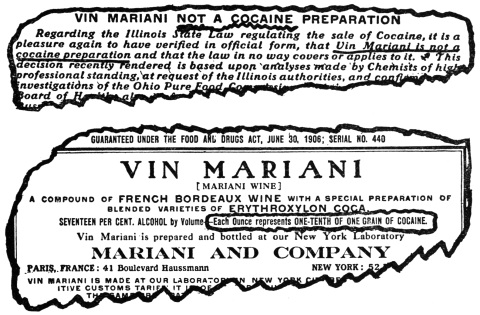
Advertisements of Vin Mariani before and after national Food and Drugs Act went into effect.
ADVERTISED TO THE PUBLIC
Vin Mariani was at one time advertised to the public in this country, but, so far as we know, it is not at the present time; at least, not directly. Yet it is most effectively advertised to the public indirectly, and this with little expense to the promoters, the cost of the circular around the bottle being the only expense—doctors who prescribe it do the rest. If those who are in the habit of prescribing Vin Mariani will examine the advertising that goes into the hands of their patients they will realize how true it is that our profession is responsible for much of the “patent-medicine” taking. Few laymen could withstand the temptation to buy the stuff for any ailment that comes along when they read in the circular that this “medicine,” which their doctor evidently thinks is a good thing, is so highly recommended, for all the ills that befall us mortals, by the Pope of Rome, the Czar and the Czarina of Russia, the Queen of England, the Shah of Persia, the King of Norway and Sweden, the Queen of Portugal, the Queen of Saxony, the Crown Prince of Cambodia, Ferdinand of Bulgaria, and by a whole list of ambassadors, generals, politicians, musicians, actresses, etc. The testimonials of these great men and women are enough to convince the most skeptical that this remarkable medicine will do everything but raise the dead—and under favorable circumstances accomplish even this. And still more—it will win battles! Witness this from the governor-general of Madagascar: “We were refreshed by Vin Mariani, and before morning carried the stronghold.” Alexander Dumas and Emile Zola are credited with calling it “the elixir of life.” One very strange thing about the testimonials in the circular used in this country is that all are written by foreigners. But Americans (President McKinley—think of it—among others) are honored by having their testimonials quoted in the circulars used on the other side of the Atlantic. Why? Is it possible that the testimonials are fakes?
AN ETHICAL CURE-ALL
Here are a few of the conditions that the circular says Vin Mariani is good for: “Anemia, winter cough, debility, vocal weakness, la grippe, continued fevers, bronchitis, nervous troubles, muscular weakness, diseases of the aged, malaria, melancholia, overwork, neurasthenia, impotence, malnutrition, depression, heart troubles, wasting diseases, mental overstrain, and in certain cases of protracted convalescence.”
The following quotations are taken from blotters—circulated in this country—which are evidently intended for the laity, as well as for physicians:
“Vin Mariani creates and sustains vigor and energy. Guards against wasting diseases. When everything else has failed try it to prove merits.”
“Lung, Throat and Stomach Troubles benefited by Vin Mariani; this Ideal French Tonic strengthens entire system of Body, Brain and Nerves.”
“Most Efficacious, Most Agreeable, Unequaled by anything in Fortifying, Strengthening, Refreshing.”
WHY BLAME THE LAYMAN FOR USING NOSTRUMS?
Can we blame the layman for using Peruna, Wine of Cardui, etc., simply because they are advertised, when there are physicians who, for the same reason, prescribe concoctions that are just as quackish and just as useless? And can editors of medical journals consistently find fault with newspapers for carrying advertisements of fraudulent “patent medicines” when they themselves admit to their pages advertisements of nostrums that are no less fraudulent and of no more value?
MEMBER OF PROPRIETARY ASSOCIATION
One word more: There is an organization known as the Proprietary Association of America, but it is usually referred to in common parlance as the “patent-medicine” men’s association. It will be remembered that last year we printed a list of the members of this body, among which was the Vin Mariani Company. It will be remembered also that in the list were the names of certain firms who were supplying medicines to physicians, but practically all these resigned from membership and their resignations were published by us. We have not had the pleasure of publishing the resignation of the Vin Mariani Company. On the contrary, we note that at the last annual meeting of the “patent-medicine” men’s association this firm was still an active member, Mr. A. L. Jaros, who stands for the Mariani Company in this country, being one of those registered at the meeting.—(From The Journal A. M. A., Nov. 26, 1906.)
VIROL
Report of the Council on Pharmacy and Chemistry
Virol, sold in the United States by the Etna Chemical Company, is put out by Virol, Ltd., London, England. It is said to be
“A preparation of bone marrow, red bone marrow of medullary structure of ox rib and calf bones, eggs, malt extract, and lemon syrup made from fresh fruit.”
“Marrow fat is emulsified with extract of malt, lemon syrup and eggs, it is further enriched with soluble phosphates of lime, iron and soda, and glycerine solution of red bone marrow.”
Many of the therapeutic claims made for Virol the Council considered grossly exaggerated; among them are the following:
“... a complete food for children.”
“... a complete nutrient.”
“The value of the Lime-Salts (representing the Egg Shells) contained in Virol is fully illustrated in its influence upon Rickets; whilst Struma, Chronic Bronchitis, Anaemia and Influenza are all combated by its use in a degree, which, we venture to say, has never been approached.”
“The fat, as represented by the Marrow-bone and Egg Yolk, is so minutely divided that it admits of even far more rapid absorption by the villi of the intestine than milk.”
“It is an ideal form of food, readily digested and assimilated in the weakest of conditions.”
“Virol has a marked effect on the metabolism of the body, increasing the production of opsonins and stimulating phagocytosis. As an adjuvant to the natural defensive processes of the patient in all diseases of bacterial origin its value can scarcely be over-estimated.”
The objections of the Council were transmitted to Virol, Ltd. The firm’s reply was reported to the Council by the referee of the Committee on Therapeutics who held that no adequate or satisfactory answer had been made to the objections raised against the advertising claims for Virol.
The claims made for Virol being unsubstantiated and unwarranted, the Council voted that the preparation be refused recognition.
In accordance with the practice of the Council, the exploiters of Virol were afforded an opportunity to comment on the foregoing statement before its publication. On their objecting to the findings, the entire matter was turned over to a second referee. This referee, in making his report, reviewed the claims made for Virol and commented on the lack of evidence to substantiate these claims. He stated that a chemical analysis of the preparation had yielded the following result:
“Sugar, as maltose60.0 per cent.
“Fat13.2 per cent.
“Proteins3.2 per cent.
“Ash1.6 per cent.
“Water and volatile matter21.6 per cent.
“There is no appreciable diastatic action. A little glycerol is present in the volatile matter. The preparation is therefore an extract of malt with fat and a small amount of protein.”
He then continues:
“That Virol has food value cannot be denied, but that it has sufficient value to warrant the claims of the manufacturers is not evident. Virol cannot be considered a complete food, as the advertising literature reiterates, or an ideal food for infants. The amount of protein is far too low in comparison with the carbohydrates to warrant this view. The dosage recommended is not large. Thirty gm. a day would furnish only about 1 gm. of protein and 4 gm. of fat. The 3 teaspoonfuls a day recommended for children would furnish protein and fat even below this.
“If employed alone it cannot be a complete or sufficient food, and if employed along with other articles of diet—milk and bread, for example—it is not easy to see wherein lies the efficacy of the small weights of fat and protein added in the form of Virol. Here the demand made on our credulity is too great, as the protein in the preparation is the familiar protein of eggs, meat and malt, and the fat largely that from the egg-yolk and marrow, according to the claims. It is not known that any specific virtues reside in these bodies, or in the egg-shells, also claimed as present.
“In the opinion of the present referee there is nothing in the composition of Virol to justify the claims made for it. The judgment and recommendations of the first referee follow from the facts and must be accepted by the Council.”
The Council directed that the previously prepared report be allowed to stand and that it be published along with a suitable reference to the report of the second referee.—(From The Journal A. M. A., Feb. 20, 1915.)