PART III CONTRIBUTIONS FROM THE JOURNAL: NOSTRUMS (continued 2)
Reading edition
GOMENOL
A correspondent sends some advertising matter on Gomenol and calls attention to the number of diseases for which the preparation is recommended:
Gomenol is apparently a volatile oil. It is a proprietary said to come from France, and to be prepared from a species of cajuput (Melaleuca viridiflora, Gaertn.). This plant is closely related to the cajuput tree or swamp tea-tree (Melaleuca leucodendron, Linné) from which the official oil of cajuput is obtained. The oils from these two plants are very similar in composition and presumably in therapeutic properties. The oil of the first-named plant appears not to be marketed except in the form of the proprietary, Gomenol. It probably has no advantage over the official oil of cajuput, while in the form of Gomenol it costs about four times as much. The following are some of the claims made for Gomenol in the advertising circulars. They need no comment.
“A real specific for suppurations and catarrh.... It immunizes tissues, excites their vitality and favors the formation of new cells....
“The least trace of Gomenol prevents the growth in vitro of the streptococcus, the tuberculous bacillus and the gonococcus.”—(From The Journal A. M. A., April 4, 1914.)
HEADACHE CURES[AL]
Harmful Effects of Acetanilid, Antipyrin and Acetphenetidin
The United States Department of Agriculture Bulletin107 No. 126, issued July 3, 1909, sets forth the results of an investigation conducted by the Bureau of Chemistry with regard to the harmful effects of acetanilid, antipyrin and acetphenetidin. During recent years the use of these remedies and preparations containing them by the people at large, without the supervision of the physician, has increased rapidly and investigation has shown that coincidently there has been a marked increase in the number of cases of poisoning reported, in the number of fatalities, and in the number of instances of habitual use.
Since the passage of the Food and Drugs Act, June 30, 1906, the attention of the Department of Agriculture has been directed to this subject, particularly in connection with the branding of drug products containing one or more of these agents, and an attempt has been made to obtain full and reliable data with regard to their poisonous qualities with the object of furnishing information to the public which would enable them to understand that these remedies should be employed with caution in the absence of reliable medical advice.
The information obtained with regard to the number of an inquiry addressed to medical practitioners in the United States with regard to their personal experience with these drugs; and, second, the study of the cases of poisoning recorded in medical literature. Nearly a thousand letters, each containing eighteen questions, were addressed by the department to physicians throughout the country, the object being to secure information which would represent as closely as possible the conditions existing among the people at large so far as the harmful effects of the drugs in question are concerned. Four hundred replies were received.
The information obtained with regard to the number of instances quoted in medical literature in which poisoning, death, or habitual use has been known to result from the administration of acetanilid, antipyrin, and acetphenetidin is set forth in Section A of the accompanying table. The information summarized in Section B is based on the data submitted by physicians. Granting that the 525 physicians who did not reply had no cases to report, the question may profitably be asked, if 925 physicians have observed 814 cases of poisoning by these drugs, 28 deaths which are attributed to their use, and 136 instances of habitual use, how many such cases have in all probability been observed by the 125,000 physicians scattered throughout the United States? The summary, C, includes both the number of cases recorded in medical literature and those reported by physicians.
POISONING BY ACETANILID, ANTIPYRIN AND PHENACETIN
A.—Cases Recorded in Medical Literature
POISONING.DEATH.HABITUAL USE.
Acetanilid2971332
Antipyrin48810..
Acetphenetidin7031
————
Total8552633
B.—Data Submitted by Physicians
POISONING.DEATH.HABITUAL USE.
Acetanilid61416112
Antipyrin10557
Acetphenetidin95717
—————
Total81428136
C.—Total Number of Cases
POISONING.DEATH.HABITUAL USE.
Acetanilid91129144
Antipyrin593157
Acetphenetidin1651018
——————
Total1,66954169
The bulletin contains information with regard to dosage, the extent to which these drugs are employed by physicians, poisoning and habitual use, the nature of the ill effects produced, etc. It also contains references to the recorded cases of poisoning, together with a brief abstract of each case.—(From The Journal A. M. A., July 31, 1909.)
Sanatoriums and the Acetanilid Habit
To the Editor:—I enclose herewith a “form” letter and question blank which I received recently from St. Louis. I may be entirely too wary but I am suspicious that this is a collection of “statistics” to combat the work of the medical profession in educating the physician and the laity in the harmfulness of acetanilid and similar preparations.
G. H. Benton, M.D., Chester, W. Va. Sterling-Worth Sanitarium.
Comment: The letter which Dr. Benton encloses is in facsimile form and purports to come from Uriel S. Boone, M.D., of St. Louis, who states that he is “preparing an exhaustive article for publication in a leading medical journal” on the question, “Is acetanilid a habit-forming drug?” To obtain the necessary data Dr. Boone is “writing to every hospital and sanitarium in the United States.” Examination of the question blank which accompanies the form letter discloses the fact that information is wanted regarding not acetanilid alone, but also antipyrin and acetphenetidin (phenacetin). The last question asked runs as follows:
“If your records [of cases of habitual use of these drugs] are incomplete, would you allow a reputable physician to investigate the above-mentioned cases so that he could write with positiveness about them, and, if necessary, make oath to the truth of his report?” [Italics ours.—Ed.]
Dr. Boone opines that the recipients of his queries “may hesitate to answer” the question just quoted, but he trusts that its importance will be evident when he explains that “it is currently reported that the manufacturers of acetanilid, phenacetin, etc., have decided to prosecute all libelers of these drugs” [Italics again ours.—Ed.] and he wishes to make no statement that he “can not substantiate under oath.” Surely the life {of} the collector of medical statistics is unusually hazardous.
For the purpose of aiding Dr. Boone in his arduous search for truth on the “much mooted question, ‘Is acetanilid a habit-forming drug?’” we direct his attention to a work that should prove of invaluable assistance. We refer to Bulletin 126 of the Bureau of Chemistry, entitled “The Harmful Effects of Acetanilid, Antipyrin and Phenacetin.” This interesting study to which we have previously called attention records 112 cases of the acetanilid habit. Of this number at least 50, or 44.6 per cent. of the cases were those of patients who took proprietary preparations of the drug.
From this we would not wish to give any bias to Dr. Boone’s statistics. We hardly expect, however, that such will be the case. Dr. Boone’s name appears as the author of an article entitled “A Therapeutic Study of Antikamnia and Heroin Tablets”—an article that has been very extensively “quoted” and has been sent out in its entirety by the Antikamnia Chemical Company. Under these circumstances we may be forgiven if we venture the opinion that Dr. Boone is not likely to be unduly prejudiced against “headache tablets” in general and fake “synthetic” coal-tar mixtures in particular. We await with breathless interest the appearance of Dr. Boone’s “exhaustive article” and we must confess to some degree of curiosity regarding the name of the “leading medical journal” in which these valuable data will appear.—(Modified from The Journal A. M. A., Aug. 14, 1909.)
HECTINE
Hectine is a French proprietary and is stated to be, chemically, sodium benzosulphoamino-phenyl-arsenate. If the asserted composition is correct, Hectine is similar to atoxyl, which is described in New and Nonofficial Remedies, 1914, page 38. Hectine has not been examined by the Council on Pharmacy and Chemistry.—(From The Journal A. M. A., Aug. 8, 1914.)
HYDRONAPHTHOL
A correspondent having requested information regarding the composition of “Hydronaphthol,” the product was investigated in the Association laboratory, which reports as follows:
Hydronaphthol is sold by Seabury & Johnson. The label on a trade package of Hydronaphthol gives no clew as to the nature of the product. The statements on the labels do, however, make the claim that Hydronaphthol is an antiseptic of great power, also that it is non-toxic and therefore may be used with impunity; thus the following statements are made:
“A harmless, practically odorless, non-poisonous, non-corrosive antiseptic....”
“... it is non-poisonous and can be employed with perfect immunity as a preservative....”
The substance has the characteristic appearance, odor and taste of naphthol. It responded to all the tests of the United States Pharmacopeia for betanaphthol, with the exception of the melting point, which was found to be 119 C. instead of 122 C., an indication of impurity. It is evident, therefore, that Hydronaphthol is merely a trade-name for betanaphthol. While resublimed betanaphthol is listed at 10 cents an ounce, Hydronaphthol is listed at 75 cents an ounce.
Hydronaphthol thus furnishes one more illustration of the fact that most proprietary medicines for which the most extravagant claims are made are but old and well-known remedies sold under a fancy name at a price far in advance of that charged for the constituent or constituents. The exploiters are extremely positive in their statements regarding the non-toxic character of the preparation. Yet, as a matter of fact, betanaphthol is by no means harmless; it has been absorbed by the diseased skin with injury to the kidney and with fatal results. In some cases injury to the eye has also occurred. These toxic actions should be known to the practitioner. From 3 to 4 gm. (1 dram) applied to the skin has produced death (Stern: Therap. Monatshefte, 1900, p. 165). When a manufacturer advertises a preparation which possesses potentialities for harm, and especially when he puts it out under a name which conceals its identity, it is incumbent on him to warn the customer of possible injurious or inconvenient actions instead of proclaiming that the preparation is harmless.—(From The Journal A. M. A., Sept. 3, 1910.)
HYDROZONE
The moral principle governing the action of secret proprietary and patent medicine men is an unknown quantity; sometimes it would seem to be a negative one. Just how much lower in the scale of humanity a man can go than to prey on the fears of a people in the time of a terrible epidemic for the sake of a few dollars we do not know. There may be something more despicable, but what is it? Two weeks ago we referred to the cold-blooded methods of the Peruna people; this week we reproduce an advertisement from the New Orleans States that tells another story of man’s inhumanity to man.
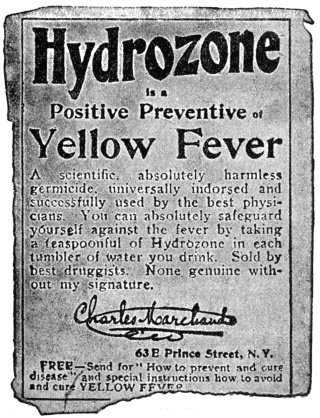
This brings up the problem that we are trying to solve, viz.: “What is the difference between a ‘secret proprietary medicine’ advertised in medical journals to physicians and a ‘patent medicine’ advertised in newspapers to the public?” Hydrozone is being advertised in nearly all medical journals, and at the same time in newspapers. Where shall we place it? And if hydrozone, with the methods recently adopted to exploit it, is tolerated in the medical press, why not peruna?
HYPOQUINIDOL
An examination of the advertising matter fails to show that R. W. Gardner makes any definite statement in regard to the nature or the composition of his Hypo-Quinidol. Certain statements made in the literature sound much as if the article might be some sort of a quinin hypophosphite preparation. But if this is true, its action would be the same as other salts of quinin and the extravagant claims made could not be substantiated. It is said to be a “non-toxic quinin.” It is safe to say that a quinin which will not produce the toxic symptoms—cinchonism—either is not absorbed in sufficient quantity or has been so changed that it no longer has the therapeutic properties of quinin. Altogether Hypo-Quinidol must be put down as a preparation the composition of which is kept secret and regarding which extravagant and highly improbable statements are made.—(From The Journal A. M. A., Jan. 10, 1914.)
IODONUCLEOID
An Iodin Product Under a Misleading Name
Information has been frequently asked concerning Iodonucleoid, a product not included in New and Nonofficial Remedies. The Association Laboratory after investigating this preparation reported as follows:
This preparation was at one time considered for inclusion with New and Nonofficial Remedies, and at that time was examined in this laboratory. The examination showed that iodonucleoid contains:
Phosphorus0.79per cent.
Calcium0.43per cent.
(Equal to 0.6 per cent. CaO).
Iodin24.2per cent.
When 2 gm. was dissolved in tenth-normal potassium hydroxid volumetric solution and acetic acid added until faintly acid, an abundant, white, flocculent precipitate formed. This precipitate was collected, washed with water, transferred to a beaker, phenolphthalein added and tenth-normal potassium hydroxid volumetric solution run in until a pink color was produced. This required 15 c.c. of tenth-normal alkali. Subtracting from the 2 gm. of iodonucleoid the 24 per cent. iodin, leaves 1.52 gm.; this divided by the c.c. of alkali used indicates an equivalent weight of 1013.
Authorities differ widely regarding the amount of phosphorus contained in nuclein from different sources, the figures ranging from 2.9 per cent. to as high as 10 per cent. If the nuclein from which iodonucleoid purports to be made contained but 2.9 per cent. phosphorus, the preparation, after allowing for 24 per cent. iodin, should still contain 2.2 per cent. phosphorus instead of the 0.79 per cent. found by analysis. A true nuclein should contain no calcium. If iodonucleoid is a casein compound of iodin we might expect to find, if the casein had been freed from milk by acidulation without further purification, both calcium and phosphorus. The equivalent weight of casein is given by Long (Jour. Am. Chem. Soc., 1906, xxviii, 372) as 1124. This figure was obtained on a casein of high purity, and the figure of 1013 given above agrees fairly well with Long’s figure for casein. The evidence, therefore, indicates that iodonucleoid is a compound of iodin and casein, and not a nuclein compound.
The findings of the laboratory were at that time submitted to Prof. John H. Long of Northwestern University, who said:
“We have also made a number of examinations of iodonucleoid. We determined in it the iodin and found the amount 24.2 per cent. by weight, which is a little more than that claimed by the manufacturer. We have also tested the solubility of this substance and find it to behave about as your laboratory did. As you know, we have been making a number of preparations from casein, and recently we have determined the combining power of casein with various acids, including hydriodic acid. This acid when evaporated in moderately strong solution with casein yields finally a hard, dry mass, which may be ground up to a powder resembling very closely the preparation under discussion. Various amounts of iodin may be combined here, depending on the strength of the iodin solution used, and we have secured some containing over 35 per cent. of iodin. Several of these preparations resemble closely iodonucleoid, so far as solubility, appearance and reaction with alkalies on titration are concerned. I am unable, therefore, to distinguish this preparation from the casein compounds which we are making.”
From this it would appear that iodonucleoid is not a compound of nuclein, as indicated by the name, but instead is a casein compound of iodin.
Iodonucleoid, then, seems to be another one of the many iodin “substitutes” which have been put on the market. Other iodin substitutes are Iodalbin, manufactured by Parke, Davis & Co.; Iodipin manufactured by E. Merck & Co., and Sajodin, manufactured by the Farbenfabriken of Elberfeld Co. As these products have been examined by the Council and found eligible for inclusion with New and Nonofficial Remedies, physicians who wish to use substitutes for potassium iodid would do well to use them instead of a product presented under a misleading name. Physicians should understand, however, that these organic iodin compounds are non-irritating because the iodin is held in such combination that it is much less active. It seems probable that they are therapeutically active only to the extent that the iodin content is dissociated from the organic compound and concerted into ionic iodin.
A discussion of a number of iodin substitutes is found in an article by von Notthafft (Monatsh. f. prakt. Dermat., Oct. 15, 1910, p. 343), which was abstracted and commented on in The Journal, March 4, 1911, p. 685. Von Notthafft believes that the lower degree of toxicity which these remedies exhibit has its basis in a feebler activity; either the substitutes evolve too little iodin or they split it off with greater difficulty. Physicians should, therefore, view with some distrust the claims of manufacturers that their products are not only non-irritating but at the same time possess unusual therapeutic efficiency. This will apply with especial force if there is any tendency to conceal the nature or origin of the combination.—(The Journal A. M. A., July 22, 1911.)
IRIDIUM
Dr. C. A. Dexter, Columbus, Ga., asks for information concerning the use of iridium in the treatment of acute and chronic rheumatism. Iridium is a well-known element although we have not found that it has been used as a medicine; however, we presume our correspondent refers to “Iridium (Medicinal),” sold by the Platinum Company of America. We are not able to locate this company, but in their advertising circular “Iridium (Medicinal)” is said to be “an agent for the blood, a laxative, an alterative, indicated in all disorders of the stomach, in Jacksonian epilepsy,” and “a specific in rheumatism.” As to its origin, it is said in the circular, “the platinum sands are associated with and composed of iridium” and some other elements, so that as far as the circular gives information the nostrum is alleged to contain the element iridium.
A few statements quoted from the circular will show that the person who wrote it knows nothing about medicine and cannot correctly use the English language: “The qualifications of Medicinal Iridium are its simplicity, purity, harmless under prolonged use, easily borne by the stomach.” “It has been observed that when Medicinal Iridium acts as a laxative, it will regulate the same.” “Called the family group, Iridium and Osmium are destined to become the world’s benefactors in medicinal properties, thereby creating a new chapter in medical science.” The circular quotes some supposed “excerpts from hundreds of letters on file, written by physicians, in the hope that they may attract your attention,” which bear marks of having been written by the same person who wrote the circular. Note the quality of the following statements: “Iridium has a power, purity and simplicity that pleases me; now I can make progress.” “I say to you frankly, Iridium is my standard. I can get results and make progress. I am confident it aids the fibrin in the blood.” “Dr. X is pushing Iridium on five or six cases.” It is not explained who Dr. X is, but it has this to say about him: “Dr. X is an eminent practitioner. He has made a remarkable record with Iridium and has so far never failed on cases of Jacksonian epilepsy; experimental tests have shown that Iridium increases blood-corpuscles.”
The man who signs himself president of the Platinum Company of America is said to be a lawyer, but is not working at it, and was formerly a promoter, fiscal agent, etc. It should not be difficult for the physician to fix the status of iridium under this sort of exploitation.—(From The Journal A. M. A., April 23, 1910.)
IRON TROPON
The composition of Iron Tropon seems to have varied from time to time. The manufacturers formerly stated that it contained fat, sugar, pepsin and iron in organic combination with albumin, and its use was advocated both as a food and as a medicine. It was not claimed to contain over 1 per cent. of pepsin, but tests failed to show that it contained any pepsin, or if any, such a small amount that there was not sufficient to digest the albumin in Iron Tropon itself. It was also claimed that the iron, being in organic combination with the albumin, possessed advantages over the widely used aromatic fluid preparations of iron. Tests, however, showed that the iron was not in organic combination, though even had it been, late investigations fail to demonstrate the superiority of the organic over inorganic iron compounds.
The manufacturers state in their later “literature” that Iron Tropon is a tonic and a food; that it is a compound of the food albumin tropon, 2.5 per cent. of iron in its most assimilable form, and enough chocolate to flavor it agreeably. It will be noted that they now make no claim for pepsin, nor do they state that it contains iron in organic form. In the dose recommended, a teaspoonful three times a day for an adult, the patient gets something over a grain of iron, and he might as well take an equivalent quantity of Blaud’s mass, the value of which has been proved.
As a food, Iron Tropon, weight for weight, is about equal to beans and a little better than flour, although it contains a larger percentage of protein than either. In the dose stated, an invalid would get about 50 calories, or about 1⁄40 the necessary nourishment for a day. Tests have also shown that the albumin is difficult of digestion. In spite of this fact, the advertisement of Iron Tropon states: “A patient who takes Iron Tropon receives not only the benefit of iron medication, but at the same time his economy is supplied with perfectly assimilable albumin in sufficient quantity.” It will thus be seen that the claim for pepsin in this preparation has been abandoned, that the statement as to the iron being in organic form has been modified, and that the food value of the albumin is exaggerated; but perhaps the manufacturers do not expect the physician to apply his arithmetic to such problems.—(From The Journal A. M. A., April 23, 1910.)
KUTNOW’S POWDER
Which Is It, a “Proprietary” or a “Patent Medicine”?
The term “patent medicine” has been applied, rather loosely, to those nostrums sold and exploited directly to the public, while the name “proprietary” has been given such preparations as are advertised only to the medical profession. As has been many times exemplified by reports in The Journal, the distinction is often a very fine one and the dividing line frequently reaches the vanishing point.
It is not unusual, for instance, for “proprietary” preparations to be foisted on the medical profession until a certain number of testimonials (of doubtful value, it is true, but still testimonials) have been ingeniously wheedled out of physicians and the product rather generously prescribed. When this objective point has been reached the manufacturer comes into the open and advertises the nostrum to the public direct and the testimonials previously given for the “proprietary” are used as advertising assets for the “patent medicine.”
Then again there are certain preparations which are “proprietaries” or “patent medicines” according to the location. On one side of the Atlantic the product is advertised to physicians only, while on the other side it runs indiscriminately on the billboards and in the newspapers. One of the best examples of this last class is Kutnow’s Powder. In England, where it originated, this preparation, which “dissolves and eliminates uric acid,” is consistently lined up with Beecham’s Pills and Pink Pills for Pale People. Full-page newspaper advertisements announce the fact that free samples will be
“SENT TO ALL APPLICANTS”
In the United States, however, Kutnow’s have learned from their wide advertising experience that a cheaper and surer way of introducing a nostrum to the public is to advertise it to the medical profession only. By means of advertisements in medical journals (whose space is much less expensive than that of the daily papers) and the liberal distribution of samples which are
“SENT FREE TO PHYSICIANS ONLY”
the medical profession becomes the unpaid “barker” for the nostrum manufacturer. At present, therefore, Kutnow’s Powder is—in the United States—an ethical (!) “proprietary.”
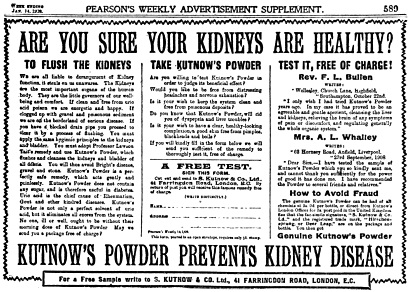
There exists in this country, as most of our readers know, an organization of “patent medicine” manufacturers whose “reason for being” is to get full value received for the $40,000,000 paid annually in advertising nostrums in the newspapers of the country. This organization is known as the Proprietary Association of America. The now familiar “red clause” in the advertising contracts by which the newspaper forfeits its contract if state laws are enacted that are inimical to the “patent medicine” interests, is a creation of this organization and has been most effective in making the newspapers the unpaid lobbyists of the nostrum interests. The “silence clause” is another “joker” in the contracts by which the agreement is canceled if matter detrimental to the nostrum “is permitted to appear in the reading columns” of the paper. It is little wonder that with such weapons the “patent medicine” manufacturer has assumed an arrogance that is as disgusting as it is serious.
Great Britain, too, has its “patent medicine” men’s organization, which is known as the Proprietary Articles Trades Association. Of both these honorable bodies Mr. S. Kutnow of Kutnow Brothers, Ltd., is, or was, a conspicuous member. At a recent meeting of the British organization, Mr. Kutnow worked himself into a fine frenzy of indignation because of some articles that had appeared in the Pharmaceutical Journal of London on the subject of “Secret Remedies and Proprietaries.” As these articles did not specifically mention Kutnow’s Powder, and as evidence was directed against only those preparations as were most disreputable, it is evident that Mr. Kutnow now appraises his own product at its face value. He gave his opinion of the Pharmaceutical Journal and told the meeting that when the advertising man for that journal solicited advertising he refused to have any more dealings with him owing to the articles that had appeared in the Pharmaceutical Journal. He declared that he was quite independent of any newspaper or journal, and was able to take care of himself.
Therein Mr. Kutnow is mistaken; he is not independent of newspapers and journals. On the contrary, he and others of his ilk are most subserviently dependent on them. Let reputable papers and medical journals refuse, for but one year, to carry the high-flown advertisements of his Anglo-American Patent-Proprietary, and his firm would perforce seek some worthier, if less profitable, line of business.
The editor of the Pharmaceutical Journal resents Mr. Kutnow’s “implied assumption that by inserting paid announcements in the advertising columns of a newspaper, he or any one else, can dictate the policy of that organ.”
The Pharmaceutical Journal, it should be said, is the official organ of the Pharmaceutical Society of Great Britain, and is the most influential organ of the drug trade in the British Isles. It is refreshing to note, in these days of “canned” editorials and paid “write-ups” masquerading as original articles, that there is still to be found a journal that can not be bought.
One wonders whether a large experience in the advertising world, and especially his membership in the Proprietary Association of America, has unconsciously led Mr. Kutnow to assume that muzzling the press is one of the perquisites of the large purchasers of advertising space.—(From The Journal A. M. A., Aug. 31, 1907.)
LYMPH COMPOUND R-H AND ORCHITIC FLUID TABLETS
A physician wrote The Journal:
“I have under my care a patient with chronic parenchymatous nephritis. Microscopic examination shows occasional epithelial casts, with hyaline and granular casts. The patient feels well and appears to enjoy the best of health. Please give me your opinion on the use, in such a case, of the lymph injections put out by the Animal Therapy Company of Chicago, from whom I have just received a supply of literature.”
The Journal replied as follows:
“The Council on Pharmacy and Chemistry took up for consideration the ‘Lymph Compound R-H,’ and ‘Orchitic Fluid Tablets,’ sold by the Animal Therapy Company and refused them recognition.
“The treatment of a case of chronic parenchymatous nephritis is a task requiring the best judgment and the greatest knowledge that the physician can command. From the first his aim should be to do no harm, and with this in view he will recognize that since we do not know the cause of this disease, and since we are unable to influence the essential process in the kidney, the administration of a remedy capable of doing harm should be undertaken only under the clearest indications. It is probable that the remedy proposed, containing, it is asserted, a mixture of foreign proteins, might injure healthy kidneys, to say nothing of sick ones. It is well known that foreign proteins, such as the white of egg, if they enter the circulation unchanged, are excreted by the kidney and are liable to produce serious irritation, which in the case of parenchymatous nephritis might easily aggravate the existing condition and frustrate all other efforts at a cure. More especially is it imperative to do no harm when, as in the case reported by our correspondent, the patient appears to be in good health. Two questions should be raised in that case. First, is there any evidence that the occasional excretion of a few casts, whatever may be their variety, is actually doing the patient any harm? And second, since there are no symptoms, what possible improvement could be expected from treatment? It is admitted that we have no remedy which can affect an essential change in the condition of the diseased kidney. What must be done in such a case is to spare the kidney—to require of it the minimum of functional activity. In such a case, the physician who introduces an animal protein, foreign to the human system, would be taking a serious responsibility. The chances are that it would do harm; how great, no one can tell. If the physician can really make up his mind to experiment at the risk of the life of his patient, this case appears to be one unusually favorable to the manufacturer of the serum. There are chances that the diagnosis may be incorrect and that such a condition of the urine does not indicate a serious condition of the kidney. It is frequently the case after an acute infection, or some similar irritation, that the kidney continues for some time to excrete albumin and casts, but the condition eventually clears up. In such a case, if the serum did no harm it would be given the credit of curing the patient, who recovers in spite of it. It is a little unfortunate, however, for the purpose of such demonstration that the patient is said to feel well. If only he could be persuaded that he has a serious disease so that he might be somewhat depressed mentally, the effect of the cure would be more remarkable!
“If the physician to whom such a patient comes for advice, instead of taking the wise course of seeking reliable information, were to take at their face value the statements of interested commercial manufacturers—if he were to administer this unknown and dangerous remedy, the effects of which he cannot predict—he would commit a breach of trust more culpable than the most vicious attempts of the nostrum-maker to mislead the physician and the public.”—(From the Journal A. M. A., Dec. 14, 1912.)
LYSOL-THE EVOLUTION OF A PROPRIETARY
Regarding certain proprietary preparations and their equivalents found in the pharmacopeias or other standard works of reference, it is often questioned whether the proprietary is the original and the official preparation the imitation, or vice versa. As a general proposition, medicinal compounds and preparations are not born but evolved, as in the case of epinephrin, in which the credit of discovery belongs to no one person, but to several.108 So it is often the case that the proprietary and official preparations may be based one on the other, while both are usually based on some preparation which antedates them. This is well illustrated by the proprietary preparation Lysol, the practical equivalent of which—liquor cresolis compositus—is official in the United States Pharmacopeia. After the discovery of phenol (carbolic acid) and the recognition of its germicidal value, it was gradually learned that other phenolic compounds occurring in the crude distillates from tar and wood were more efficient and less poisonous than phenol (carbolic acid). When this was discovered, attempts of course were made to utilize these higher and more efficient phenols, which meant that their insolubility in water had to be overcome. In these attempts there were efforts to form new compounds as well as a search for simple solvents. While the first failed, because these compounds were less efficient than the phenol from which they were made, a simple solvent was found in soap. The first attempt to utilize the solvent power of soap gave creolin, a mixture of the so-called crude carbolic acid (really containing but little phenol and consisting largely of higher phenols along with inert hydrocarbons) with soap. This was followed in 1884 by Schenkel’s discovery that a portion of this “crude carbolic acid” could be made soluble in water by treatment with soap. Schenkel was refused a patent on the ground that any soap manufacturer should be permitted to add phenol to his soap, but in 1889 a patent for a cresol-soap solution was granted to Damann, who used cresol, a constituent of “crude carbolic acid.” The preparation was put on the market and has since been widely advertised under the proprietary name “Lysol.”109 It is thus seen that Lysol is a good example of the way in which manufacturers appropriate the discoveries of others, develop them and turn them to proprietary use.
The ill-deserved patent protection for Lysol happily expired long ago and the product can now be made by anyone. In view of the non-descriptive character of the name “Lysol” and the danger in using such names in connection with potent and poisonous remedies, this cresol-soap solution has been admitted to pharmacopeias, not under the original name “Lysol,” but under descriptive names such as that in the United States Pharmacopeia—“liquor cresolis compositus.”—(From The Journal A. M. A., Dec. 14, 1912.)
THOMPSON’S MALTED FOOD COMPANY
And Its Blood, Nerve and Tissue Builder, “Hemo”
During the past eighteen months The Journal has received inquiries from physicians in various parts of the country asking for information regarding “Thompson’s Malted Food Company” of Waukesha, Wis., which for some time has been selling and trying to sell its stock to physicians and others. In reply The Journal called attention to the fallacy of any concern trying to induce people to purchase its stock on the ground that the Bromo-Seltzer company, the Postum Cereal company and others had been successful.
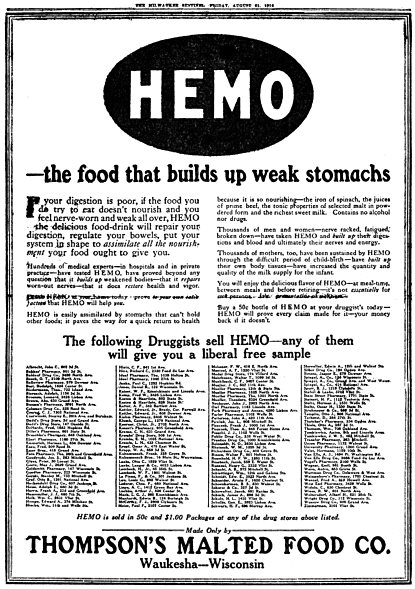
A miniature reproduction of a full-page advertisement of “Hemo” appearing in a Milwaukee paper. The original covered 341 square inches.
The earlier name for the Thompson concern was “American Malted Food Company” and originally it had its office and factory in Milwaukee. Its products are “Malted Milk,” “Malted Beef-Peptone” and “Hemo.” As long ago as 1911 the company was sending out glowing descriptions of the money that might be expected to be made by investing in the concern, which was then known as the American Malted Food Company. According to the company’s booklet it was estimated that in the United States and Canada alone $20,000,000 worth of dry malt food products were consumed annually. Further:
“On the most conserving estimate the American Malted Food Company will supply 5 per cent. of the demand or $1,000,000 of the consumption from the very outset....”
At the time this was written (1911) the company claimed that its stock had “been advanced over 100 per cent. in one year’s time” and that even then it had “found it advisable to curtail the sale of stock so as not to exceed the prescribed number of shares to any one person.” In 1914, however, the company still had its representatives in the field offering stock for sale.
In November, 1913, one physician wrote that three years previously he had purchased stock in the company and at that time (1910) was given to understand that dividends would be paid in at least a year! He has received no dividends to date. Other physicians have written that the company’s agents in attempting to sell stock have given the impression that the concern either is paying dividends or is about to pay dividends. Still other physicians say that the agents made no claim to them that the concern was paying dividends. To quote from a few of many letters together with the date of the communications:
“Alluring promises of big profits in the near future have been held out by the canvassers....” (September, 1913).
“No actual promise was made but it was ‘estimated’ that dividends would be declared ‘about the first of the year’” (November, 1913).
“After I said I wouldn’t buy any stock was told the company was already paying dividends and I was turning down a good thing.” (March, 1914).
“The agent gave me to understand that the profits of the company were enormous and that large dividends would be paid in the near future.” (March, 1914).
“Mr. —— [the agent] told me the company expected to pay dividends as soon as all the stock had been sold.” (May, 1914.)
“The agent gave me to understand that they were about to pay very generous dividends and that it was a chance to get in on the ground floor on a good thing.” (May, 1914).
The price asked for stock during the past year or more has been $1.50 a share, the par value of the stock being held at $1.00. At various times, however, the stock seems to have been purchasable from other sources at a much lower figure. A physician writing September, 1913, stated that he had just been solicited to purchase stock in the Thompson Malted Food Company at $1.50 a share, and that immediately he wrote to two firms, one in Chicago and one in Milwaukee, that sell unlisted securities, asking the price of Thompson’s Malted Food Company stock. Both brokers expressed the opinion, according to the physician, that at 90 cents a share the stock would be a “good buy,” and both offered to undertake to secure stock at that price. One of the concerns sent a circular to the physician offering the stock at 80 cents. The physician thereon canceled his order for stock which he had made at $1.50 and declared that if he bought at all he would buy from other sources.
HEMO
At the present time the product that Thompson’s Malted Food Company seems to be “pushing” is a product it calls “Hemo.” According to advertisements, Hemo is “the food that builds up weak stomachs.” Hemo, we are told, contains “the iron of spinach, the juices of prime beef, the tonic properties of selected malt in powdered form and the richest sweet milk.” Furthermore, “Hemo contains the active principle of selected barley malt ...”—whatever the “active principle” of barley malt may be.
According to the Thompson Malted Food Company “80 per cent. of the American citizens” are “troubled with anemia” and it is for them that “Hemo has been especially prepared.” In a sentence:
“It is a well-known fact that organic iron can be obtained from animal life as well as from vegetable life, and as the digestive organs of a majority of the people are not equal to the task of supplying their bodies with a sufficient amount of organic iron to maintain a supply of a good quality blood, the lack of which results in numerous nervous ailments—insomnia, diabetes, rheumatism, anemia, tuberculosis, etc., it has been found necessary to secure for mankind organic iron in a form that will be concentrated, palatable and most easily assimilated.”
This is a sample of the farrago of pseudo-scientific nonsense sent out by this concern in its attempt to sell “Hemo.” To continue the quotation:
“With this object in view, the laboratories of Thompson’s Malted Food Company have successfully produced and successfully tried out Hemo on the most desperate cases.”
In a letter addressed to a physician-stockholder, the statement is made: “Our Hemo-Malted Milk has never had and never will have an equal as a builder of blood, nerve and tissue ... it will build tissue, nerve and blood in less time than any other food heretofore known.”
Disregarding the question whether or not this is a stock jobbing scheme or whether the purchase of the stock is a good investment, there is another side to the matter. It must be evident that the public is not getting a square deal when physicians are financially interested in the products they prescribe for, or recommend to, the sick. Whatever the value of the Thompson products, the method of exploitation and the attempts on the part of the company to get physicians financially interested in its ventures, are to be deprecated. If laymen of a speculative turn of mind wish to invest in the stock of companies putting out “bottled energy,” “blood builders” and “nerve repairers” that is their business, but it is certainly neither conducive to the scientific practice of medicine nor to the interest of the public for physicians to be financially interested in products of this sort.—(From The Journal A. M. A., Oct. 24, 1914.)
MANOLA
Physicians as Unpaid Pedlers of Nostrums
One of the most disheartening features of the fight against the proprietary evil within the profession is the slowness with which physicians awake to their responsibilities in the matter. It is a notorious fact, familiar to physicians against advertising men alike, that the simplest and cheapest way to introduce a nostrum to the public is through the instrumentality of the medical profession. Ever since the birth of the proprietary evil in this country, shrewd manufacturers have persuaded doctors to act as unpaid pedlers for their wretched nostrums and to become particeps criminis in the exploitation of such wares.
Manola is an alcoholic nostrum with just enough more or less inert medicinal products added to exempt it from the internal revenue tax, but not enough to prevent its being used as a tipple by those who object to taking their “toddy” in a simpler form. It is prepared by the Luyties Pharmacy Company of St. Louis, a homeopathic concern whose hahnemannian leanings are not so strong but that it is willing to cater to the various sectarian schools of medicine as well as to the regular profession. Since the promoters realize, doubtless, that to put this stuff out under a homeopathic label might not be conducive to stimulating physicians’ confidence, Manola is labeled: “Prepared only by the Manola Company, St. Louis.” In other words, it is the old dodge of forming subsidiary companies for the purpose of hiding the identity of the real owners. In this connection, it is worth reminding our readers, incidentally, that the Walker Pharmacal Company, St. Louis, is another subsidiary concern of the Luyties Pharmacy Company, created for the purpose of pushing another nostrum—Hymosa.
Manola is seldom advertised in medical journals. Instead the Luyties Pharmacy Company has discovered a more effective method of “putting one over” on physicians and druggists. The method which has been pursued for years and which, under the same title and subtitle that head this article, was exposed in The Journal as long ago as May 6, 1905, consists in sending to physicians a letter containing three postcards—unstamped, of course. With the postcard there is a slip that reads:
INSTRUCTION FOR OBTAINING 3 BOTTLES OF MANOLA FREE
Dear Doctor: Fill out the attached cards Nos. 1 and 2. Mail No. 1 to us and hand Nos. 2 and 3 to your druggist. Impress upon him the necessity of mailing postal card No. 3 direct to us, and not to his jobber.
Yours truly, THE MANOLA COMPANY.
The postcards are numbered, respectively, 1, 2 and 3. Here is No. 1:
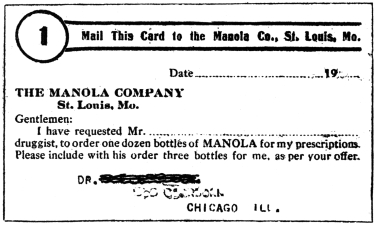
Dr Ezymark writes the name of his druggist on Card 1, puts a stamp on it and mails it to the Manola Company, alias Luyties Pharmacy Co.
Card 2, addressed to his druggist, also is filled out by Dr. Ezymark. Here it is:
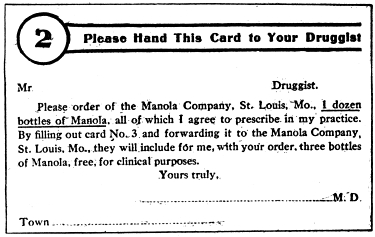
Then the doctor, acting the part of errand-boy, delivers Card 2 and also Card 3 to his druggist. Here is Card 3:
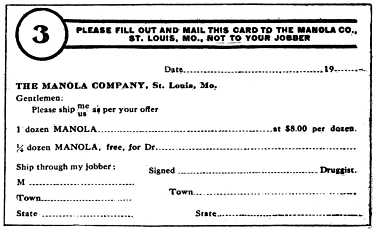
This, Mr. Goat, the druggist, has to fill out, affix a stamp and send to the Manola Company. In return for all this, Mr. Goat has his shelves loaded up with a dozen bottles of Manola and, for that privilege pays $8 out of his own pocket. Dr. Ezymark gets three free bottles. Incidentally, he also gets the contempt of his druggist—and of such patients as learn of it.
The only one who profits by all this is the Luyties Pharmacy Co., alias the Manola Co., alias the Walker Pharmacal Company.
Evidently this method of exploitation pays; that it does pay is a disgrace to the medical profession. To those physicians who have in the past acted as pedlers for Manola we would say: If your patients really need sherry wine let them purchase it under its own name and at the ordinary market price. You will then know what they are getting and you will be able to retain not only your own self-respect but also the respect of your druggist and the public.
The Composition of Manola
Examination of Manola in the Association laboratory indicates that its composition is consistent with its origin, for its medicinal ingredients are present in truly homeopathic quantities. The laboratory report follows:
An examination of an original bottle of Manola gave the following results:
Specific gravity at 25 C.1.0329
Alcohol18.00per cent. by vol.
Non-volatile matter (residue on evaporation)15.93gm. in 100 c.c.
Ash .96gm. in 100 c.c.
Phosphoric pentoxid (P2O5) .0668gm. in 100 c.c.
Total alkaloids .0047gm. in 100 c.c.
CalciumTraces.
MagnesiumTraces.
IronTraces.
SodiumTraces.
ArsenicTraces.
Manola is a light amber colored liquid having the odor and taste of sherry wine. The above analysis indicates that it is nothing more than wine, fortified with alcohol and a slight amount of medicinal substances added. The non-volatile matter appears to be nearly all sugar, glycerin, or some similar substance and the presence of less than one gram of ash to 100 c.c. excludes the presence of more than a small amount of organic salts. From the amount of phosphorus found there appears to be about one dose of phosphoric acid to a twenty-ounce bottle. Arsenic is present in such small amounts that the ordinary hydrogen sulphid test failed to show its presence and the delicate Gutzeit’s test had to be used to detect it.—(Modified from The Journal A. M. A., April 2, 1910.)
MERCOL
R. Hunt and A. Seidell, Washington, D. C., report the result of an examination of a preparation called Howell’s Mercol, manufactured by H. B. Howell & Co., Ltd., New Orleans, and claimed to be a 1 per cent. solution of mercuric iodid in a non-irritating neutral menstruum, and recommended for hypodermic use in the treatment of syphilis. Their examination indicates, as they say, “that although the manufacturers of Mercol may have used a mercuric iodid in its preparation, they have not succeeded in obtaining a 1 per cent. solution of this compound in their ‘non-irritating neutral menstruum.’ It is furthermore evident that the sample examined as above outlined contains none, or at most only traces, of biniodid of mercury.” It is stating it mildly to say that a manufacturer is careless who claims to make an efficient preparation of what is almost a specific for one of the most serious of diseases but which contains practically none of the essential active ingredient.—(Abstracted from The Journal A. M. A., Jan. 16, 1909.)
The Component Parts and the Finished Product
After the appearance of the first article, a physician wrote stating he had seen Mercol manufactured, following the process in detail and had himself weighed out a sufficient quantity of mercuric iodid to produce a 1 per cent. solution. He protested that the firm “had no desire to foist on the medical profession or the public a fraud.” With his letter he sent a sample of the particular batch of Mercol which he had seen manufactured. This sample was analyzed with the same care and thoroughness that the previous sample had been, and the practical absence of mercuric iodid was again demonstrated. While The Journal does not question the honesty and good faith of either the manufacturers or the physician, it maintains that claims for remedial agent should be based on the finished product rather than on the component parts used in its manufacture. Without attempting to explain what has become of the mercuric iodid, it insists that the important fact, and the one that vitally concerns both patient and physician, is that the finished product fails to contain it. If the manufacturer has made an honest mistake in supposing he could produce a 1 per cent. solution of mercuric iodid in liquid petrolatum, he will doubtless see that the mistake is corrected. If, on the other hand, he is governed by commercial considerations only, the misrepresentation will probably be perpetuated.—(From The Journal A. M. A., May 15, 1909.)
MIDOL AND NURITO
Pyramidon Entering the Patent-Medicine Field
Repeated warnings to the public of the dangers of acetanilid, antipyrin and acetphenetidin and the requirement in the Food and Drugs Act which makes it obligatory to declare the presence of acetanilid and acetphenetidin on the labels of “patent medicines,” have been responsible for the growing unpopularity of nostrums containing these drugs.
MIDOL
During the past few months advertisements have appeared in the newspapers of a new “headache cure,” the advertising slogan of which is that it “contains no acetanilid or phenacetin.”
The name of this preparation is Midol and it is sold under the following claims:
“Instantly relieves headache, neuralgia, toothache.”
“Has no depressing effect.”
“More effective than antipyrin, acetanilid, phenacetin or similar pain-relieving products.”
“Midol is the one safe-to-take aid of sufferers of headache.”
“Quickly relieves pain of whatever nature.”
“There is no cumulative action.”
“No bad effect upon the heart or other organs.”
An original package of Midol was purchased and examined in the Association laboratory. The chemists’ report follows:
“Midol is sold in the form of white tablets each weighing, on an average, 0.425 gm. or about six and one-half grains. The tablets are soluble in water, chloroform or benzene to the extent of about 80 per cent. The soluble portion appeared to be largely composed of starch, with about 4.5 per cent. of some inorganic matter, probably talc. The chloroform soluble portion was found to consist chiefly of pyramidon, chemically known as dimethyl-dimethylamino-pyrazolon. Besides pyramidon, the chloroform soluble matter contained a small quantity of caffein and may have contained small amounts of other substances.
“From examination it is concluded that Midol depends essentially on pyramidon for its therapeutic effect.”
Pyramidon is a proprietary preparation derived from, and having the antipyretic and anodyne properties of, antipyrin. While some observers have asserted that it is more likely to cause collapse than are either antipyrin or acetphenetidin there is no positive evidence of this assertion. That the use of pyramidon has been until recently practically restricted to physicians may account for the fact that its toxic effects are not as well known as are those of antipyrin, acetphenetidin, acetanilid, etc., which for some years have been indiscriminately used by the public. As the use of pyramidon as a “patent medicine” now bids fair to become as general as the better known antipyretics, it is probable that its toxicology will become better known.
It is interesting to note that pyramidon in the form of Midol is put on the American market by the General Drug Company, which also acts as a distributor of salvarsan (“606”). The General Drug Company is said to have for its president, W. M. Hoge, who was formerly employed in the comptroller’s office during the administration of Herman A. Metz, and the latter being employed by the Consolidated Color and Chemical Works and being president of Victor Koechl & Co. The General Drug Company, in its price list to physicians, lists the “ethical proprietary” pyramidon, but contains no mention of its “patent medicine” Midol.
NURITO
Midol is not the only “patent medicine” in which pyramidon is the essential drug. Nurito, which is advertised as “not a patent medicine but a proprietary preparation,” is a nostrum put on the market by the Magistral Chemical Co., New York. Here are some of the claims:
“Only U. S. P. ingredients are used in Nurito.”
“Guaranteed to relieve or your money refunded, Rheumatism, Sciatica, Neuritis.”
“There is no compound known in medicine that so rationally, scientifically and effectively removes waste and poisons from the human system as Nurito.”
The Association’s laboratory recently analyzed a specimen of Nurito. The report follows:
A dollar-size package of Nurito was purchased and found to contain seven powders. The powders ranged in weight from 9 to 12 grains, the average weight being nearly 11 grains. The presence of pyramidon, phenolphthalein and milk sugar was demonstrated. Alkaloids, acetanilid, acetphenetidin, chlorids, bromids, iodids, heavy metals, starch and sulphates were absent. Quantitative examination indicated that the composition of Nurito is essentially as follows:
Milk sugar34per cent.
Phenolphthalein6per cent.
Pyramidon60per cent.
Each powder, therefore, contains about 22⁄3 grains of milk sugar, 2⁄3 of a grain of phenolphthalein and 62⁄3 grains of pyramidon.
What was said of pyramidon in the preceding article applies equally well here. The claim that Nurito is composed of “U. S. P. ingredients” is evidently a falsehood. The chief therapeutic ingredients are pyramidon and phenolphthalein, neither of which is described in the United States Pharmacopeia.—(From the Journal A. M. A., Aug. 10, 1912.)
MU-COL
Salt and Borax as Wonder-Workers
“Mu-col, for Cleansing Mucous Membranes” is a nostrum put on the market by the Mu-col Company (Inc.), Buffalo, New York. As a specimen of the claims made for the preparation, the following is typical:
“Mu-col obtains most gratifying results in catarrhal inflammations of the mucous membranes. Leucorrhea, Tonsillitis, Sore Throat, Cystitis, Internal Hemorrhoids, Nasal Catarrh and Pus Cases respond at once to irrigation with Mu-col solution. Strong solutions of Mu-col have proven of sterling value in treating Hives, Prickly Heat, Ivy Poison, Sunburn, Eczema, Typhoid and Scarlet Fever.”
This, and much more Mu-col will do—according to its manufacturers! No wonder physicians want to know the composition of Mu-col. As the manufacturers do not give this information the aid of the Association’s Laboratory was invoked. Let the chemists speak:
LABORATORY REPORT
“The specimen examined was a white powder, and from the odor, thymol, eucalyptol, camphor and oil of wintergreen could be recognized. Qualitatively sodium, chlorid and borate were found. Zinc, benzoate, phenolsulphonate and sulphate could not be found. The solution was alkaline to litmus. Gravimetric determination of chlorid as silver chlorid and titration of borax by Thompson’s method indicated sodium chlorid (NaCl) 47.2 per cent., sodium borate (Na2B4O7+10H2O) 50.1 per cent.
“It thus appears that Mu-col is a mixture of ordinary salt and borax in equal parts with the addition of a small amount of aromatic substances.”
Mu-col will do just what a solution of salt and borax will do—no more, no less. And yet, it is claimed:
“Mu-col has been successfully used since the year 1900 by more than 50,000 physicians, which has proven it to be the most Efficient, Economical and acceptable, preparation in its field.”—(From The Journal A. M. A., Feb. 7, 1914.)
NARKINE
The Intangible Product of the Tilden Laboratory
A little book, published by the Druggists Circular, and called “Modern Materia Medica,” gives in dictionary form the information regarding new remedies which that journal publishes in its monthly issues. Such information is not always acceptable to the manufacturers of various preparations of doubtful value. A case in point is brought to notice with reference to a remedy called Narkine, put out by the Tilden Company of St. Louis. In this little book the following appears:
“Narkine is described as ‘an opium preparation from which all deleterious qualities have been eliminated’; an unsupportable claim, as all opiates and other hypnotics are essentially deleterious.”
The Tilden Company wrote to the Druggists Circular, stating that they guaranteed Narkine “to be absolutely free from coal-tar or opium derivatives,” yet the “literature” of the company describes it as
“a specially prepared product of opium devoid of the nauseating and disagreeable properties of this drug, yet possessing the anodyne and soporific principles of same in the highest degree.”
To remove from opium all its derivatives and yet retain the anodyne and soporific principles attached to nothing in particular, indicates a degree of pharmaceutical skill seldom attained. One is irresistibly reminded of the Cheshire cat in “Alice in Wonderland,” whose smile remained long after the cat had vanished.
The absurdity of the thing, however, has apparently not occurred to many physicians, for these disembodied spirits of the pharmacologic world are evidently being prescribed.
The Druggists Circular is to be congratulated on exposing this latest pharmaceutical freak. It does so in a rather striking manner by means of photographic reproductions of the claims of the Tilden Company.—(From The Journal A. M. A., Oct. 24, 1908.)
PAPINE
A Disguised Morphin Solution
To the thinking physician it should be evident that a preparation containing morphin must possess not only all of the valuable properties of this drug, but also all of the objectionable ones. There are still some physicians, apparently, who give credence to the assertions of the manufacturers concerning the morphin preparation from which, it is claimed, all of the undesirable morphin effects have been removed. The following query from a correspondent illustrates this fact:
“Will you inform me as to the contents of ‘Papine’? I have a case of chronic interstitial nephritis, and my consultant insists on giving this preparation. I asked him if he knew what drugs it contained and his answer was ‘one-eighth of a grain of morphin with the objectionable parts of the drug removed.’”
The query was referred to the Association Laboratory, which submitted the following report:
For many years Papine has been advertised by its makers, Battle & Company, St. Louis, as an anodyne. In the circulars Papine is described in part as follows:
“Papine represents in pharmaceutical form the purely anodyne principles of opium freed from the narcotic and tetanising constituents.”
“Papine is the anodyne or pain-relieving principle of opium, the narcotic and convulsive elements being eliminated. One fluid drachm is equal in anodyne power to one-eighth grain of morphin.”
“Through special methods of preparation, the anodyne and analgesic principles of Papaver somniferum are so extracted as to free them of the narcotic and convulsive elements that ever have been, and must ever continue to be serious objections to the use of opium and its common derivatives.... No demand is more regularly made on the physician than that for the relief of pain, and to be able to afford it promptly and completely, without the slightest deleterious action, is an advantage that cannot be overestimated.”
“Unlike most derivatives and preparations of opium, Papine neither nauseates nor constipates; nor does it inhibit the secretory functions of the body.”
“In conditions of extreme nervousness, especially in women, recourse to morphin is attended by the very real danger of the formation of a habit. Lastly, opium and its alkaloids must not be administered to persons whose kidneys are not in good working order on account of the risk of toxic accumulation.”
“No such restriction exists in respect of Papine, its action being exerted exclusively on the element pain; in other words, it is purely anodyne.”
“Papine does not nauseate, constipate nor create a habit.”
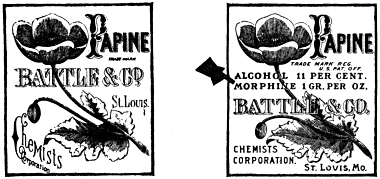
The Papine label before (on left) and after (on right) the passage of the Food and Drugs Act. And the exploiters of this morphin solution have the effrontery to claim that it does not create a habit!
From these statements the incautious physician might be led to infer that Papine is a preparation analogous or similar to the official tincture of deodorized opium. Formerly in the manufacture of the latter preparation, in addition to removal of the odorous substances, narcotin, then thought to be the principal convulsive alkaloid,110 was also removed. By the process for the manufacture of this tincture, which is now official in the United States Pharmacopeia, most of the narcotine is found in the finished preparation. While it is a comparatively simple matter to remove the narcotin from opium and its preparations, thus eliminating most of the commonly reputed “convulsive elements,”111 to remove the “narcotic elements” from opium would result in destroying the integrity of the product. The reasons for this are that morphin is the most powerful narcotic substance found in opium, and it is present in the largest proportion of any of the alkaloidal constituents. Its removal from an opium preparation would, therefore, render that preparation practically valueless.
From Papine, however, the morphin has not been removed, for since the passage of the Food and Drugs Act the label has to admit that Papine contains 1 grain of morphin in each ounce!
A specimen of Papine was examined and found to be nothing more than a simple aqueous-alcoholic solution of morphin, containing glycerin. The preparation is flavored to imitate cherry and colored with cochineal. With the exception of morphin, neither narcotin, codein nor other opianic alkaloids were found, while meconic acid, a characteristic constituent of opium, was absent. Since Papine is claimed not to cause constipation, and as is well known, this condition is frequently produced by morphin, it seemed possible that Papine might contain laxative substances. On examination, however, no cascara, rhubarb, phenolphthalein or laxative salts were found.
While Battle & Co. have persistently exploited Papine as being an opium preparation having none of the objectionable qualities of opium, the analysis shows that the paradoxical claims made for it cannot be substantiated. In prescribing morphin there is an abundance of official preparations to choose from, and there certainly is no necessity or excuse for resorting to the much more expensive and in no way superior Papine.—(From The Journal A. M. A., April 29, 1911.)
PASADYNE[AM]
A physician asks: “Can you tell me the formula of a preparation on the market called Pasadyne, put up by John B. Daniel, Atlanta, Georgia?”
According to the manufacturer Pasadyne is a tincture of passion-flower. Formerly this nostrum was sold under the title “Daniel’s Concentrated Tincture of Passiflora Incarnata.” While the manufacturer claims marvelous virtues for this preparation, made from “the fruit, roots and vines of the passion-flower or May-pop,” passiflora (passion flower) is now generally recognized as being of little if any value.
A circular makes the following absurd statement:
“Chloral and the bromids, before the recognition and advent into medicine of Pasadyne (Daniel’s Concentrated Tincture of Passiflora Incarnata), were widely employed in all turbulent states of the psyche and, notwithstanding their many untoward, even sometimes dangerous effects, were held in high favor by physicians. For that matter, they still retain some of their old-time popularity, but since the superior value of Pasadyne (Daniel’s Concentrated Tincture of Passiflora Incarnata) has been demonstrated to the profession’s satisfaction, the erstwhile high esteem in which chloral and the bromids were held, is fast waning and ere long Pasadyne will have crowded them out.”
The reasons why the drug passiflora was not deemed of sufficient value and hence, along with the Daniel preparation, was refused recognition, are given in a report of the Council on Pharmacy and Chemistry.—(Abstracted from The Journal A. M. A., March 8, 1913.)
PAS-AVENA
How Its Formula Evades the Food and Drugs Act
Pas-Avena is a widely advertised “nerve sedative and hypnotic.” The preparation is put on the market by the Pas-Avena Company of New York City. As a headliner the advertisements of the remedy state that the formula has always been on every bottle, and this, The Journal states, has a twofold object: It aims to give the impression that the preparation is non-secret, and it is calculated to inspire confidence in the—apparently—scientific nature of the product. As a matter of fact, it should do neither. The preparation is essentially secret in its composition because of the presence in the formula of an unknown quantity and the liability to change of formula at the whim of the manufacturer. On the bottles some time ago the following formula was given:
Each tablespoonful contains:
Passiflora20minims.
Avena sativa10minims.
Somnalgesine (C30H28N5O6)2grains.
The first two ingredients are plants in whose therapeutic value but little confidence is placed. Somnalgesine, the third constituent, is a secret preparation, the chemical formula of which the manufacturers were kind enough to add. To a chemist, however, the formula is absurd and impossible, and is included either because of the manufacturer’s ignorance or because of an intent to deceive the profession. Since the Food and Drugs Act became law, the label of Pas-Avena has been changed to read:
Alcohol8.37per cent. by volume.
Anilipyrine16.00grains per fluid ounce.
Guaranteed under the Food and Drugs Act of June 30, 1906.
Substitution of anilpyrine for somnalgesine gives little more information. Chemists may recognize this as a name applied to a mixture said to be formed by the fusion of two molecules of antipyrin and one molecule of acetanilid. To physicians, however, the name carries with it the same mystery as did somnalgesine. Attention is directed to the fact that by publishing the guarantee under the pure food laws the company presumes to disperse all doubt and criticism, assuming that the majority of physicians will be satisfied with the guarantee as it stands. Inasmuch as the preparation contains acetanilid and antipyrin, however, the manufacturers are disregarding that part of the Food and Drugs Act which requires that the name of the parent substance—in this case acetanilid and antipyrin—be put in parenthesis. The laws are so well defined that physicians appear to be content to do nothing, firmly believing that they are safe from the defrauding methods of unscrupulous manufacturers.—(Abstracted from The Journal A. M. A., March 7, 1908.)
Proprietary House Insolvent—and Physicians Lose?
The Pas-Avena Chemical Company, whose product, Pas-Avena, was exposed in The Journal a few months ago, has recently failed, according to our pharmaceutical exchanges. In recording the fact, one journal says:
“It is reported that considerable stock of this company had been sold to physicians.”
At this time, when physicians are importuned daily to invest money in various wildcat pharmaceutical concerns, this sentence might well be used “to point a moral or adorn a tale.”
PERTUSSIN
Dr. L. A. Roberts, Dorchester, Mass., writes: “Please tell me what the composition of Pertussin is.”
Pertussin is a proprietary whooping-cough remedy manufactured by the Kommandantan Apotheke, Berlin. A “physician’s sample” bottle of this preparation sent out by Lehn & Fink bears a label on which appears the following:
“100 parts Pertussin contains:
1⁄2Ol. Thymi, et Thymol
211⁄2Ext. Thymi ‘Taeschner’
50 Saccharum
2 Glycerinum
61⁄4Alcohol
193⁄4Aqua Destillata”
While it never has had much vogue in this country it has been and still is used in Germany. It belongs to that class of vegetable preparations which, since they contain no distinctive principle, are difficult to analyze—particularly as concerns the “joker” in the formula, in this case “Ol. Thymi, et Thymol” and “Ext. Thymi ‘Taeschner’”—hence there has been much dispute in Germany as to the composition of this nostrum. In general, it appears that whatever virtues it has are due to some preparation of common thyme in a menstruum containing water, sugar and alcohol. At one time the preparation was found to contain potassium bromid; but tests recently made in the A. M. A. Chemical Laboratory indicated the absence of either bromids or iodids.—(From The Journal A. M. A., March 8, 1913.)
PHENALGIN—A TYPICAL EXAMPLE[AN]
Last June112 we devoted considerable space to the extravagant therapeutic claims made for “Phenalgin” by its venders. At this time we propose to refer to the misinformation—to use a conservative term—that the Etna Chemical Company has promulgated regarding the composition of their preparation.
In June, 1905, the Council on Pharmacy and Chemistry officially published to the medical profession of the United States the information that repeated examinations showed that “Phenalgin” is a simple mixture of acetanilid and sodium bicarbonate or ammonium carbonate. So far as we know, no direct denial of the truth of this has been made. There has appeared what we presume is meant as an answer; it is couched in this sentence,
Phenalgin is just what we have always said it to be.
From this expression—which has been repeated in bold, black letters in practically all the advertisements since last June—we presume that we are to understand that in the past they have stated what it is.
It would have been just as easy and more satisfactory if the Phenalgin people, instead of saying: “Phenalgin is just what we have always said it to be,” had said what it is, since the average physician has neither the time nor the inclination to look up their literature.
For the benefit of those who desire to know what the venders of Phenalgin “have said it to be,” we have gone over their advertising literature of the past, with the following results, which are in the form of quotations from their advertisements:
An American Coal-Tar Product—Phenalgin—the only synthetic stimulant, non-toxic, antipyretic, analgesic and hypnotic.
Phenalgin is the ONLY ammoniated Synthetic Coal-Tar Product made from Chemically Pure Materials [What have the Ammonol people to say to this?—Ed.]
A synthetic Coal-Tar Product of the Amido-Benzine series, containing Nascent Ammonia.
These two chemicals [“stimulant ammonia of coal-tar origin” and “chemically pure phenylacetamid”] combine under certain conditions so as to obtain a produce which he [Dr. Cyrus Edson] named Phenalgin or Ammoniated Phenylacetamide.
Phenalgin is a compound of peculiar character which can not be extemporaneously made into tablets from the powdered drug, without seriously changing and impairing its medicinal qualities.
We believe these quotations are sufficient to show what the Etna Chemical Company has “always said it to be.” In going over the literature for several years past we find the above stated in the same, or similar, words in nearly all of it. From the above four statements may be deduced: 1. They have stated that Phenalgin is a synthetic113 preparation; 2, they have conveyed the impression that Phenalgin is a chemical compound; 3, they have announced repeatedly that it is the “only” preparation of the kind, and 4, they have claimed that Phenalgin is non-toxic.
We believe that these four statements represent in plain English what the above quotations mean. They are all absolutely false. Phenalgin is not synthetic; it is not a chemical compound; it is not the only ammoniated phenylacetamide, or the only acetanilid mixture containing carbonate of ammonium—and it is most positively toxic.
In one place it is stated that Dr. Cyrus Edson
Employed his great facilities for chemical research and opportunities for chemical experiment for the purpose of producing a formula for a combination of stimulant ammonia of coal-tar origin (sic) and chemically pure phenylacetamide, also a coal-tar product ... which he named phenalgin, or ammoniated phenylacetamide.
In another place we read that Phenalgin is made
Under the immediate personal supervision of the original inventor of ammoniated coal-tar products.
By comparing this last quotation—which is from a current—1905—advertisement—with the preceding one it will be noticed that we are asked to believe that Phenalgin is made “under the immediate supervision of” Dr. Cyrus Edson—and yet Dr. Cyrus Edson died Dec. 2, 1903. This is equal to Lydia Pinkham’s prescribing for the suffering women of America when the dear old soul had been dead for over twenty years.
We have before us a full-page advertisement taken from a recent number of a weekly medical journal, which possibly is meant as an answer to the announcement of the Council on Pharmacy and Chemistry that Phenalgin is a simple acetanilid mixture. The advertisement is divided into two parts; the first part is as follows:
Facts About Acetanilidum (Ancient History)
It has long been recognized that Acetanilidum and most other coal-tar products are apt to exert a depressing influence upon the heart, but there has never been any doubt about its great value as a pain reliever and temperature reducer. Its therapeutic value has, however, been practically nullified by the danger of cyanosis and other evils caused by its well-known depressant action and the difficulty of obtaining it in a pure state. It being known that certain deleterious substances are often to be found in Commercial Acetanilidum and that much of the injurious effect attributed to this drug is entirely traceable to these impurities.114
The above are also falsehoods. The therapeutic value of acetanilid is not “practically nullified ... by the difficulty of obtaining it in a pure state.” Neither is it true that “much of the injurious effect attributed to this drug is entirely traceable to these impurities.” While deleterious substances may be found in commercial acetanilid, they are not found in the substance offered as medicinally pure acetanilid by reputable firms. Pure medicinal acetanilid is a cheap article, costing less than 30 cents a pound, for it is a substance that is easily and cheaply purified. It is a fact that the injurious effects are in the acetanilid itself and not in the impurities it may occasionally contain.
The second half of the advertisement in part is as follows:
Facts About Phenalgin (Modern Science)
More than a decade ago the late Dr. Cyrus Edson, then Health Commissioner for New York City and New York State, recognizing the value of chemically pure Acetanilidum as a therapeutic agent, if it could be deprived of its depressant quality, employed his great facilities for chemical research and opportunities for chemical experiment for the purpose of producing a formula for a combination of Stimulant Ammonia of coal-tar origin and chemically pure Phenylacetamide, also a coal-tar product. These two chemicals combine under certain conditions so as to obtain a product which he named Phenalgin or Ammoniated Phenylacetamide.
There is more of the same character. In the first place, we call attention to the fact that “Phenylacetamide” is substituted for “Acetanilidum” when it is to go into Phenalgin. To mystify is one of the “tricks of the trade.” Few physicians keep up with chemical terms and, therefore, are not supposed to know that Phenylacetamide is one of the chemical names for Acetanilid.
The reference here to Dr. Cyrus Edson brings up another fact, and that is that the Etna Chemical Company tries to convey the idea that Dr. Edson was the originator of Phenalgin. We have always understood that Dr. Cyrus Edson had something to do with pushing Ammonol and, if we remember rightly, got into some trouble thereby. We do not know the exact facts, but the following letter shows that he had a leaning toward another “ammoniated phenylacetamid.” The letter is dated “New York, Oct. 6, 1894,” and is addressed to the “Ammonol Chemical Company.”
“During the past six or eight months I have used Ammonol extensively in my private practice. I have found it excellent in the treatment of neuralgias and for rheumatism. I have also verified your statement in two cases that were suffering from alcoholism. My experience justifies me in saying that it is the safest and best of the analgesic coal-tar derivatives.
“Very truly yours, Cyrus Edson, M.D.”
It may be of interest to know that the principal member of the firm of the Etna Chemical Company was at one time a member of the Ammonol Company, and it is usually understood, we believe, that Phenalgin is practically the same as Ammonol—in fact, the analyses published regarding the two preparations show this to be a fact.
We must make one more quotation:
It makes little difference to a physician whether Phenalgin is a mixture or a compound or a synthetic, with a name that would destroy the orthographic balance of the universe, provided it is just what he has always found it to be.
Very complimentary to the intelligence and common sense of physicians, is it not?
Suppose some fellow should get up a scheme to exploit a mixture of quinin and some cheap, harmless substance, say, starch—equal parts of each. Suppose he gives it a fanciful name, puts it on the market at a high price, say $1.25 an ounce, and announces it as a new synthetic with wonderful therapeutic qualities. Suppose that the schemer then adopts the nostrum vender’s methods of fooling physicians into using his product by getting some to give testimonials, others to furnish write-ups, and then subsidizes medical journals through liberal advertising to print both the testimonials and the write-ups. The preparation would, of course, prove to be a good thing if it were used in liberal quantities where quinin would ordinarily be used, and some patients using it would get well even if quinin were not indicated. Then with the psychologic effect of the testimonials, the write-ups, and good, strong claims rightly pushed, unthinking physicians would do the rest. And then, after a while, when the schemer had gotten to the point where, each year, he was making a fortune out of his preparation, suppose some “self-appointed chemists” should examine into the preparation and discover that it was nothing but quinin and starch, and so announce to the doctors of the country; what would the doctors say? That it makes little difference “provided it is just what he has always found it to be!”
This analogy is not far-fetched, for it is practically what has been done with Phenalgin. One difference is that since quinin costs as much per ounce as acetanilid does per pound, the profits on the acetanilid mixture would be sixteen times greater than that of our imaginary preparation. Another difference is that acetanilid is really a dangerous drug, unless used with care, both in its immediate and in its remote effects; quinin is far less so.
“Little difference” indeed, whether we are being buncoed or not! Evidently!
In conclusion, we charge the Etna Chemical Company with intentionally misleading and deceiving the members of the medical profession, in that the said company has in its literature and its advertisements conveyed the impression (whether directly stated or not): First, that its preparation, Phenalgin, is a synthetic compound; second, that Phenalgin requires special skill in its preparation; third, that Phenalgin has therapeutic values which it does not possess; and, fourth, that Phenalgin is non-toxic.
We also charge that on account of these and other misrepresentations, this company has inveigled physicians into prescribing and using a simple mechanical mixture of common well-known cheap drugs—for which an extravagantly high price is charged—under the supposition that this combination of cheap drugs is a chemical compound of special and peculiar merit as a therapeutic agent, and, therefore, worthy of their confidence.
Our object in again giving space to this preparation—and practically all we have said applies to the other acetanilid mixtures that are exploited under fictitious names or as chemical compounds (such as ammonol, antikamnia and salacetin or sal-codeia—Bell)—is to impress on physicians, by a typical example, the shamefulness of the deceptions practiced on them by nostrum manufacturers to the great injury of the public and of the medical profession.
A Pharmaceutical Secret Which Should Not Be Lost
Dr. Gregory Costigan, New York City, writes under date of January 21, as follows:
“I have been carefully reading and enthusiastically approving your articles on the nostrum evil, and have been impressed more than usual on the existence of quack advertising in medical journals as set forth in last paragraph and quotation on page 206, bottom of first column, of your issue of Jan. 20, 1906.
“In Merck’s Archives, page 11, we are told in an advertisement on ‘Phenalgin’ that it ‘is a compound of peculiar character which cannot be extemporaneously made from powdered drug’ and ‘our process of manufacturing tablets is coincident with the manufacture of Phenalgin and is the result of a long series of careful experiments by which we are able to produce tablets of Phenalgin in a friable condition without losing any of its volatile constituents or undergoing chemical changes from heat or moisture’! Inasmuch as Phenalgin tablets are not covered with a waterproof coating I think this is a remarkable statement to make, and the manufacturing of a drug coincident with the manufacture of a tablet must be a very remarkable performance, especially because it ‘retains the full therapeutic value of the drug unimpaired’ while the advertisement asserts that no other manufacturer is cognizant of this wonderful method. This ad. is for the perusal of physicians only. The Etna Chemical Company owes it to the medical and pharmaceutical world not to let this secret die with the company’s dissolution. It owes it as a duty to the coming generations of science immediately to jot down the full data of this wonderful performance, to put it away in an age-proof safe and not allow it to be lost to humanity as were a great many other arts that were well known to the ancients. Let them keep it secret now and profit by it, but do not let it be lost to posterity.”—(From The Journal A. M. A., Jan. 13, 1906, and Jan. 29, 1906.)
An Ethical (?) Proprietary Exploited Under Fraudulent and Lying Claims
“PHENALGIN IS JUST WHAT WE HAVE ALWAYS SAID IT TO BE.”
—Etna Chemical Co. in 1905.
“Phenalgin is a synthetic coal-tar product.” —Etna Chem. Co. in 1898. “Unlike the coal-tar synthetic, phenalgin is a stimulant rather than a depressant.” —Etna Chem. Co. in 1910.
TEMPUS OMNIA REVELAT!
“Phenalgin is a synthetic coal-tar product”—thus ran the advertisements some years ago, when the medical profession was willing to take—or was compelled to take—the word of the manufacturer of proprietary remedies at its face value. Then the Council on Pharmacy and Chemistry was brought into existence. One of the first pieces of work done by the Council was the publication of the results of a number of analyses of headache powders. Phenalgin was among them. Analysis showed that Phenalgin was not a synthetic but a simple mixture of the following ingredients in the proportions given:
Acetanilid57 parts
Sodium bicarbonate29 parts
Ammonium carbonate10 parts
The Etna Chemical Company, which puts out this product, was considerably disturbed by the Council’s exposure. It “came back” at the American Medical Association with the slogan “Phenalgin is just what we have always said it to be.” What, up to that time, the Etna Chemical Company had “always said” Phenalgin to be, was:
1.—Phenalgin is a synthetic. 2.—Phenalgin is the only preparation of the kind. 3.—Phenalgin is non-toxic.
These, in brief, were the three things that Phenalgin had been asserted to be. Each statement has been proved to be a definite and unequivocal falsehood. Phenalgin is not and never was a “synthetic.” Phenalgin is not and never was the only acetanilid mixture containing carbonate of ammonium. Phenalgin is not and never was in any sense of the word non-toxic. Phenalgin, in short, possesses the properties—both good and bad—that are common to acetanilid. It is a mixture that the merest tyro in pharmacy could dispense and for which any sophomore medical student could write a prescription without stopping to think. Acetanilid sells at 8 cents an ounce wholesale; Phenalgin at $1.00 an ounce, wholesale.
All these facts and many more were given to the profession by the Council on Pharmacy and Chemistry in The Journal more than six years ago—before even the Food and Drugs Act came into effect. After that law became operative, the Etna Chemical Company was compelled to say something on the label that it had never said before, namely, that Phenalgin contained 50 per cent. acetanilid. But the law not only required them to add a fact to their label, but it also compelled them to remove a falsehood. When the pure food law went into effect, Phenalgin was labeled a “malaria germicide.” It is not a malaria germicide and never was a malaria germicide, and the Etna Chemical Company dared not risk taking the question into court so it removed the statement.
Unfortunately the Food and Drugs Act exercises no control over the lying statements that may be made for drugs elsewhere than on the label. So it is that physicians within the last two or three weeks have received a booklet on Phenalgin containing the following assertions for this acetanilid mixture:
“Without the slightest harm, injury or depressing effect.”
“Is never followed by depression.”
“Its prolonged administration does not give rise to destructive blood metamorphosis.”
“Is of great value in the treatment of neuralgia (especially in the anemic.)”
“Freedom from the deleterious action or habit-forming tendencies of the opiates.”
“It aids in destroying the malarial parasite.”
“Safest and most dependable of analgesics.”
It will be seen by this that while the Food and Drugs Act has forced a certain degree of truthfulness on the Phenalgin labels, the advertising matter is as fraudulent and as untruthful as ever it was. It is true that the assertion that it is a synthetic is no longer made, possibly because the medical profession has been so thoroughly enlightened on the much-overworked “synthetic” fraud that the falsehood is no longer profitable. In other respects, the assertions are just as false as ever. It is said to have no depressing effect—and yet it is acetanilid. It is said to produce no habit—and yet it is acetanilid. It is said to have no injurious effect on the blood—and yet it is acetanilid. It is said to be the safest analgesic—and yet it is acetanilid. How long will the medical profession continue to be hoodwinked by means of such transparent falsehoods?
The Phenalgin concern takes much credit to itself because on the cartons in which the bottles of Phenalgin come, it is stated that the product is “for dispensing purposes only.” Yet, as a matter of fact, practically any layman can go to any drug store and obtain this product, for the druggist appraises this spectacular piece of Pecksniffian virtue at its face value—a joke. Why, if intended only for physicians, would it be necessary to include with every bottle a circular naming the diseases, for which this acetanilid mixture is supposed to be good—“headache,” “colds,” “lumbago,” “scanty menstruation,” “pain in any part of the body”—and why is the name of the product and of the firm making it blown into the bottle?
To sum up then, Phenalgin is as big a humbug as Peruna ever was. It is sold to-day under claims that are just as false as those used six years ago. The Etna Chemical Company is perpetrating a stupendous fraud on the medical profession to-day and it is doing it not only through the agency of the United States mail, but with the aid and support of the following medical journals—and others—in which the Phenalgin advertisement appears:
Medical RecordAmerican Journal of Obstetrics
New York Medical JournalMedical Century
PediatricsPacific Medical Journal
Lancet-ClinicDietetic and Hygienic Gazette
American Journal of SurgeryMedical Standard
International Journal of SurgeryEclectic Medical Journal
American MedicineAm. Jour. of Clinical Medicine
It is conceivable that in some cases it is not easy for those editors and publishers of medical journals who insist on relying on their own judgment to satisfy themselves that certain preparations are not worthy of being advertised. No such difficulty occurs in the case of Phenalgin. Here the issues are clear cut. The product is exploited under claims that are both false and vicious and their falsity and viciousness are perfectly evident to any freshman medical student. The only charitable explanation of the appearance of the Phenalgin advertisements in the medical journals listed is that the editors and publishers have not given the subject the attention it deserves and to which their readers are entitled. Perhaps it would help if their attention were called to the matter by their subscribers.—(From The Journal A. M. A., Jan. 27, 1912.)
PHENO-BROMATE
An analysis of this preparation made at the instance of the New Haven Medical Association, by its chemist, and sent by Dr. Charles J. Foote of New Haven to The Journal is in part as follows:
The package was marked “Sample package, Pheno-Bromate. The Pheno-Bromate Company, New York, U. S. A.” The box contained a number of tablets and a package of powders in papers marked, “Physicians’ 10 grain powders, Pheno-Bromate.” The substance in the papers was a white crystalline powder not homogeneous. It was completely soluble in hot water. The hot water solution on cooling yielded a mass of thin crystalline plates. This material was found to melt at 113.5 C. It gave no color with ferric chlorid and a positive isonitril test. The portion insoluble in ether amounted to 49.8 per cent. of the powder and consisted of potassium bromid. Quantitative determinations of potassium and bromin in the original solution confirmed this result. In my opinion, the powder consists of approximately equal quantities of acetanilid and potassium bromid. Qualitative tests of the tablets indicated that they had the same composition except for a small quantity of some excipient not entirely soluble in water. Yours truly,
Herbert E. Smith, Chemist New Haven Medical Association.
Before the Food and Drugs Act Pheno-Bromate was advertised as “a synthetic combination of the phenetidin and bromid groups, and not, as is the case with many analgesics and antipyretics, a mixture of various coal-tar derivatives” and as “the safest and best of all sedatives.” The dose recommended in most cases is 20 grains—equal to 10 grains each of acetanilid and potassium bromid. Since the Food and Drugs Act has gone into effect its label states that it is “a perfect combination of a phenol and bromin derivative containing 282 grains of acetphenetidin, U. S. P., per ounce.” What a boon it was to mendacious manufacturers that the patent rights on phenacetin expired before the Food and Drugs Act went into effect.—(Abstracted from The Journal A. M. A., July 14, 1906, and April 18, 1908.)
PHENOLPHTHALEIN
Phenolphthalein has long been used as an indicator in chemical reactions, but its use as a therapeutic agent115 is comparatively new. When its laxative properties were first discovered it was exploited as a proprietary in Germany, and it was not long before the enterprising manufacturers in this country saw in it a potential gold mine and now nearly every proprietary drug manufacturer in this country has coined a proprietary name for it and is exploiting it, either alone or in combination with one or more other laxatives, and with more or less unwarranted claims.
Phenolphthalein itself has certain pretty well defined properties, but when a little of some other drug has been added wonderful therapeutic possibilities are claimed for the combination. The drug also has a definite market value and the pure substance in the form of powder, tablets or pills could not be sold at a price greatly in excess of the market value. Thus manufacturers, from business policy, add to it other drugs. There are now on the market numerous more or less secret and “fancy” preparations of phenolphthalein for which a price is charged out of all proportion to the value of the preparation. Among these are:
Phenolphthalein Laxative (El Zernac Co.). Exurgine (Bischoff & Co.). Probilin (Schering & Glatz). Prunoids (Sultan Drug Co.). Laxine (Columbus Pharmacal Co.). Phenolax Wafers (Upjohn Co.). Laxaphen (Parke, Davis & Co.). Phenalein (Pax Chemical Co.). Thalosen (Abbott Alkaloidal Co.). Laxothalen Tablets (Pitman-Myers Co.). Veracolate (Marcy Co.).
And additional preparations are still coming out! Some of the preparations contain only the phenolphthalein with a coined non-descriptive proprietary name attached, but most of them contain in addition one or more of such drugs as cascara, sulphur, prune, senna, salicylic acid, ipecac and aromatics. The exploitation of phenolphthalein in this way gives opportunity to the manufacturers to make all sorts of strong claims, some of them directly contradictory, for their preparations. For instance, Phenolax, which is said to contain phenolphthalein and cane sugar, is claimed to be “a great success for all forms of constipation, intestinal atony and hepatic torpor.” Of Laxothalen, which is said to contain phenolphthalein, aromatics and sugar, it is stated that “its action is confined to the bowel and it has practically no hepatic action.” Of Prunoids, which is said to contain phenolphthalein, cascara, de-emetized ipecac and prunes, we have the old familiar statement that “the harmonious blending of the several ingredients will give results that cannot be obtained through their use separately, nor will their use be followed by after-constipation.”
At the time phenolphthalein was beginning to be exploited in this country The Journal116 suggested that physicians who wished to try the remedy should prescribe it under its own name and not under fancy, coined names. Since phenolphthalein occurs in the form of an insoluble and tasteless powder there is no reason why special pharmaceutical preparations of it should be placed on the market. It can be prescribed in powder form, in pills, capsules or tablets. Thus given, the true therapeutic action of the drug would be apparent and its actual value arrived at.
The vice of this unscientific habit of prescribing names instead of drugs is stated in a forcible way in a letter received from Dr. V. E. Simpson, a teacher of materia medica and therapeutics in the medical department of the University of Louisville. He says:
“Recently P. D. & Co.’s representative left on my desk a sample labeled ‘Laxaphen.’ The formula given is: phenolphthalein, gr. viii; salicylic acid, gr. 3⁄5, in each fluidounce, ‘incorporated in a palatable chocolate base.’ Now, in the first place, this name is one that the public will easily learn and will soon call for; in the second place, it is not a name that carries with it even a suggestion of its contents; and, finally, the physician acquires the habit of mechanically prescribing names instead of drugs, and in the burdening of his memory with the myriad of fantastic labelings he finds it impossible to remember even the drugs any one contains, much less the exact proportions of those drugs. Then suppose that a consultation is had; the consultant asks what is being given and the attendant answers that he is giving ‘laxaphen.’ The consultant, perhaps, has not been sampled and inquires about it; the attendant must answer. ‘Oh, it contains some phenolphthalein and a salicylate, but I have forgotten the exact proportions. I have the literature on my desk.’ Had he used U. S. P. and N. F. remedies, which the consultant and every other doctor in the land has access to and should have some knowledge of, this embarrassment would not occur.”
All of the above should remind the physician that he should write simple prescriptions, for drugs whose action he knows, adapted to the particular case and not for money-making combinations under fanciful, non-descriptive names exploited by the proprietary manufacturers. In this way he will not only save money for himself and his patients, but he will be giving them exact and effective treatment, he will know exactly what he is giving and learn for himself its effect, and he will be following the only method which entitles him to be called a scientific physician.—(From The Journal A. M. A., April 30, 1910.)
MIXED VACCINE AND PHYLACOGENS[AO]
The noted advance in therapeutics shown in the development of vaccine therapy has brought with it grave dangers as well as advantages. We have, on a number of occasions, discussed in special articles and in editorials the dangers which threatened from the rapid commercialization of this new method. The unscientific character of mixed vaccines and of the mixed filtered products of a number of vaccines marketed as “Phylacogens” has been especially emphasized and the danger from their indiscriminate use pointed out. A little over a year ago we published a series of articles dealing with the whole subject in which the nature of mixed vaccines was described117 as follows: