PART IV CONTRIBUTIONS FROM THE JOURNAL: MISCELLANEOUS MATTER (continued 2)
Reading edition
“You may be pleased to learn that our foods have received the attention of Dr. Wiley, the well-known chemist and food scientist of this country, and we have now in our possession his reports showing the very high standard of our foods. This, in our opinion, is of more consequence than all the harangue which those venerable gentlemen of the magazine may indulge in.
“We want to convince you without an atom of doubt that we are honest and bona fide in everything we say, and we extend to you a hearty invitation to call at the first opportunity and shall be glad to tell you anything you may wish to know. Thus awaiting the pleasure of this visit, we beg to remain
“Yours very truly, “Jireh Diabetic Food Co.”
We learn from this letter that The Journal’s “remarks” on the Jireh product are “libelous.” We have made them many times and for several years past; if libelous, the manufacturer has excellent grounds for damages. We learn, too, that our remarks “are in no way pertinent enough to detract from the value” of the Jireh products. Why, then, take any notice of them? We learn, moreover, for the hundred-and-first time, that The Journal is the official organ of the “medical trust,” and we are told that “there are some physicians” that are opposed to the Jireh Foods because these products cure diabetes without the use of medicine! The Journal, so the company says, wants the Jireh Diabetic Food Company to supply its “private formula” and to show the “various processes” by which the Jireh products are made. Such statements indicate that the Jireh Diabetic Food Company does not confine its mendacity to the mere advertising of its product, where the necessity for lying is naturally great.
The ambiguous remarks regarding Dr. Wiley are evidently intended to convey the idea that the doctor approves of the Jireh products. Dr. Wiley was sent a copy of the Jireh letter and his attention directed to the statements appearing therein regarding himself. He replied:
“In regard to the Jireh products and their claims that our reports show the very high standing of their foods, I would say that I consider such a claim entirely false.... We did examine five or six products in our own laboratory, however, and found them to be of very fair composition per se, but not of a composition that afforded any legitimate basis for their claims. We entirely disapproved ... three of the products making special claim as to their fitness for diabetics. [Italics ours.—Ed.] These were the Wheat Nuts, the Jireh Flour and the Patent Barley. Two of the other products were passed with a non-committal rating, which means that they are not actually disapproved, but the star marking is not accorded. These products were the dietetic Rusks and the Macaroni. For the latter especially no specific claims seem to be made. We called attention, however, to the generally objectionable juggling of terms indulged in by this company....”
The Jireh concern says that in spite of the efforts of The Journal to “crush” it, “our business has grown to colossal proportions.” Of this the New York physician who sends us the letter says: “Their ‘colossal proportions’ must have received a slight jar or they would not have taken time to write such a letter.”—(From The Journal A. M. A., Dec. 20, 1913.)
THE NAME “EPINEPHRIN” VERSUS THE NAME “ADRENALIN” [AT]
There are thirty or more different brands of the blood-pressure-raising principle of the suprarenal gland on the market, five being in this country alone. These products are identical so far as their chief constituent is concerned; they differ, however as to the solvent and preservative used. The processes of manufacture of some of them are patented; all of them are sold under trade names.
Until two years ago there was no common name applicable to this active principle; whenever reference was made to it a trade name had to be used. At that time the Council on Pharmacy and Chemistry, realizing the need of a generic term, adopted “epinephrin” as such a term. This name was selected in part because Abel had adopted it in 1899; in part because, so far as could be discovered, it was the name under which, through Abel’s publications, the substance first appeared in medical literature; and in part because it seemed to be the only suitable one not already appropriated by some commercial firm.
After the publication of the Council’s report, The Journal began gradually to use the term in those cases in which it seemed clear that the proprietary term was used in a generic sense. The substitution of the name “epinephrin” for “adrenalin” in the abstracts of certain foreign articles caused Parke, Davis & Co. to write a letter of protest which called forth the discussion appearing in the Propaganda Department of this issue.
The amount of space devoted to this matter may be criticized and considered unwarranted by those who do not realize the importance of the subject. The criticism is to a certain degree, just. The somewhat inordinate length of the article is due in part to the unfortunate fact that, in availing themselves of the courtesy extended by The Journal, Parke, Davis & Co., in their reply, have injected into the discussion side-issues, such as the priority of discovery, the superiority of their product, etc., whereas the question under discussion is simply that which relates to the name. It is, however, not altogether a matter for regret that the discussion has been thus broadened, for it brings before our readers many facts regarding the discovery of an important medicinal agent that are not generally known, at least by physicians.
Whether or not “adrenalin” is superior to “adrin,” “suprarenalin,” “suprarenin,” “adnephrin,” or to any other of the preparations is entirely immaterial in this connection. The point is that the active principle of the suprarenal gland is on the market under various trade names, and that a name common to all has been selected to be used when no particular brand is referred to. The fact that “adrenalin” is regarded by many, both here and abroad, as a common, generic name does not alter the fact that it is claimed as a trade name by a commercial house and, therefore, presumably at least, cannot be used except as such.
Among the facts brought out in this discussion, one stands out clearly: that Abel deserves as much credit for the discovery as any other man, if not more. Credit belongs to Takamine for making use of reactions which were already well known. His work was a step in the progress of knowledge of the substance, but it was a step which he could not have taken but for what others, Abel especially, had accomplished and published. Abel’s magnificent work, covering several years, deserves as much credit, to say the least, as that of Takamine. And it should be kept in mind that the former worked in the interest of science, and published his results for the benefit of all. He had no hope of pecuniary reward, asked for none, and received none.
Let us repeat, however, that these are side issues; the question is simply that of name. It cannot be too strongly emphasized that “epinephrin” is a true scientific name for the active principle of the suprarenal gland, and that it should be used on all occasions when the active principle and not some particular firm’s make is referred to.—(From The Journal A. M. A., March 25, 1911.)
THE HORD SANITARIUM
“Propaganda for Reform Department:—One often hears it declared that the present time is the worst ever known for a young man to make a fortune or get a start to one.
“All a mistake, as the enclosed letter from the Hord Skinatarium will certify. At $25 this equals $2,500 for 100 cases, $25,000 for 1,000 cases, and all any young doctor needs is a little push to be as rich as J. D. in a few months. If you know of any cases send ’em in and get your $25.
“K. T. Crossen, M.D., Carbondale, Ohio.”
With his letter Dr. Crossen encloses a circular letter from the Hord Sanitarium, “For Liquor and Drug Habits, A Cure Positively Guaranteed,” and an unsigned check on the Farmers National Bank, Shelbyville, Indiana, for $25 payable to himself. Printed on the check in large red letters is the statement:
“This check will be countersigned upon you bringing or sending us a patient.”
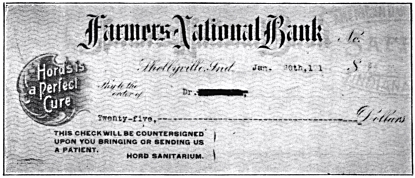
Fig. 1.—Photographic reproduction of the unsigned check that the Hord Sanitarium sends to physicians.
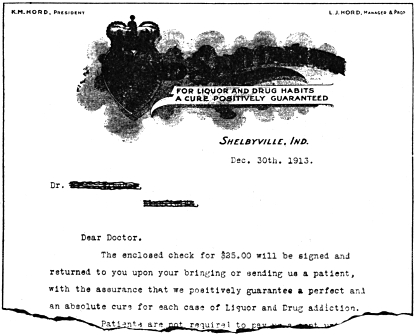
Fig. 2.—Part of the letter that accompanies the check for twenty-five dollars.
The Journal has received these circular letters and unsigned checks by the hundreds from physicians who have expressed very frankly their contempt of the kind of business the Hord Sanitarium is engaged in. These correspondents seem to have overlooked the fact that The Journal has already commented editorially on this particular insult to the medical profession. For this reason we reprint the editorial note, “Ethics!” from The Journal, Sept. 27, 1913:
“We will pay you $25 for each patient that you bring or send us.” Thus, to physicians, writes the Hord Sanitarium of Shelbyville, Indiana, and continues: “We have a perfect and an absolute cure for all liquor and drug addictions.” Fearing doubtless that those to whom these offers are made may be disgusted with the first proposition and will realize the evident falsity of the second, the concern encloses a list of references “showing the high moral and professional standing of our sanitarium.” The Hord Sanitarium emphasizes further that it does a strictly “no cure no pay” business. Suspiciously similar is the offer made by the Mizer Sanatorium of Coshocton, Ohio, Blake V. Mizer, manager. Not many months ago Mr. Mizer was running the Hord Sanitorium (the concern’s own spelling), which at that time advertised “the only guaranteed cure.” Now, Mr. Mizer hurls invectives at those concerns that make “unreasonable guarantees” and adds virtuously that “we resort to no such unethical and pretended guarantee in order to do business.” Nevertheless, in small type in the northwest corner of his stationery, Mr. Mizer admits that his “proposition” is no cure no pay. The fees of the Mizer Sanatorium “are $125 to $250, depending on the room.” The physician’s rake-off is “20 per cent. of the above.” “This,” explains Mr. Mizer blandly, “is simply a matter between ourselves and does not concern the patient in any way.” Of course not. All the patient has to do is to pay the bills. And the Mizer Sanatorium is “conducted along ethical ... lines”—Mr. Mizer says so. The Mizer Sanatorium has odd ideas of what constitutes ethics, medical or otherwise, for not long ago it advertised, in such medical journals as would accept its “copy,” that “medical ethics prevents the statement here of the whole truth about the Mizer treatment.” Of course medical ethics never prevented truthful statements of any kind. A dirty business; no other words express it. When the Hord Sanitarium and the Mizer Sanatorium claim to cure all cases of drug or liquor addiction, they make claims that are false—cruelly false. When these concerns try to drum up trade by offering secret commissions to physicians they insult an honorable profession. The fact that they send out this sort of advertising matter is presumptive proof that there are some physicians who will patronize them. Such as do so are unfair to their patients and untrue to the ideals of medicine.—(From The Journal A. M. A., Jan. 31, 1914.)
THE GERMAN PROPAGANDA FOR REFORM
Appreciation by a German Lay Publication
Of all those interested in the reform of the proprietary drug business, the patient has the most at stake—and the public is beginning to understand this fact. If physicians are slow in recognizing the necessity for improvement, laymen will eventually demand reform in their own interests. The movement, therefore, will not be halted by the indifference of the unprogressive element of the medical profession. New evidence of this fact is furnished by a recent editorial comment by the German lay periodical, Wohlfahrt und Wirtschaft (Public Welfare and Economics), on the Arzneimittel-Kommission, a German organization resembling in purpose if not in scope the Council on Pharmacy and Chemistry of the American Medical Association.
“One would suppose,” says this lay journal, “that medicinal preparations which did not win the approval of scientific medicine would not be used by any physician, but the contrary is the case. In fact, those new medicinal preparations or old ones with new names that flood the market far surpass the actual demand according to the judgment of all authorities. The impartial advisers in this field, practitioners and members of medical faculties, demand, as a matter of public welfare that this overproduction should be regulated in the interests of the sick, the consumers; but, unfortunately, a medical man, like any one else, is impressed by the suggestion from advertising done on a large scale.”
The movement for reform, Wohlfahrt und Wirtschaft goes on to explain, is not exclusively a medical one. It is a part of the reaction of “economic common sense” against a too individualistic commercial system which leads to overproduction. In other words, it is a reaction against the system of making things because they can be sold rather than because they are needed. The interests of producers need to be harmonized with those of consumers, not merely in the drug trade alone, but throughout the commercial world. Wohlfahrt und Wirtschaft quotes with unqualified approval the ArzneimittelKommission’s statement of its position: An industry which serves the science of healing must be guided by that science. (Eine Industrie die der Heilwissenschaft dient, hat sich nach der Heilwissenschaft zu richten.)
The movement for reform in Germany has apparently gathered sufficient impetus among the laity to go on of its own momentum, even though, with one exception, German medical journals, reluctant to lose the advertising of drug houses by publishing criticisms of their wares, have become lukewarm, if not antagonistic, to the efforts of the ArzneimittelKommission. The one exception is the Therapeutische Monatshefte, which, in its May issue, quotes in full the editorial just referred to and makes the following comment: “These lines reveal such intimate knowledge and correct judgment of existing conditions that the suggestions advanced in regard to possible reforms deserve serious consideration. For us physicians the editorial is important in that it recognizes that the efforts of the profession to accomplish the reforms aimed at are rational and beneficial from the standpoint of general economics and the public welfare.”—(From The Journal A. M. A., June 13, 1914.)
THE GERMAN COUNCIL ON PHARMACY AND CHEMISTRY
At the meeting of the German Congress for Internal Medicine in 1911, a German council on pharmacy and chemistry, Die Arzneimittelkommission des Kongresses für innere Medizin, was organized, with purposes similar to those for which the Council on Pharmacy and Chemistry of the American Medical Association was created. As practically nothing has been done to restrict the advertising of proprietaries in Germany, the task of the commission was tremendous. Its work has been noted in The Journal from time to time.150 A review of what has been done up to the present is given by Heubner,151 and indicates some differences between conditions in Germany and this country. The members of the commission found confronting them the same evils that met the early efforts of the American council, namely, dominant proprietary interests, a subservient and financially interested medical press and an indifferent profession. Moreover, the pecuniary interest of the editors of German medical journals in the profits of advertising seems to be more direct and more important than in America. The German commission, in Heubner’s opinion, was placed at a disadvantage compared with the American council from the first. Funds for investigation were lacking, and the commission had no journal in which its objects could be presented to the medical profession. At the beginning of its work the commission established rules very similar to those of the American Council on Pharmacy and Chemistry. It listed the articles advertised in German medical journals in three groups: (1) those which conformed to the rules of the commission in the method of advertising; (2) those which violated the rules, and (3) those whose classification could not be determined. This amounted to an attack on advertising in medical journals and was undoubtedly premature. It aroused at once the antagonism not only of the proprietary interests but also of the medical press.
“The establishment of the lists of medicines encountered opposition or hindrance from three sources,” says Heubner, “first, from the pharmaceutical and chemical manufacturing interests; second, from the medical press, and third, from the medical profession itself. The ‘trade’ naturally was irritated at any attempt to interfere with ‘business,’ and brought forward a number of reasons why the procedure adopted by the commission was especially calculated to injure the ‘general welfare.’ This opposition was to be expected and might be disregarded. The extent to which the medical press was dependent on the drug trade, however, had not been foreseen. The same journals in which for many years all sorts of articles on the evils in the trade in medicines had appeared showed themselves decidedly cool or emphatically critical toward the accomplished fact of the ‘lists of remedies.’ In hastily written articles a whole series of mistakes in general and in particular were published.... One thing, however, was not explicitly stated—namely, that in any event the lists of remedies must be rejected, and for this the cogent reason was anxiety in regard to advertisements. The editors had been sufficiently warned. The Therapeutische Monatshefte, which had not submitted to the wish of a great industrial firm in another matter, was punished for this offense by the withdrawal of all its advertisements. None of the other publishers wanted to risk such a reduction in income, and none of the editors was willing to undertake the risk to the extent of a conflict with his publisher. Curiously, the idea does not seem to have arisen that if the threatened publishers had made common cause they might have freed their editors from the distressing burden of improper advertisements with scarcely any risk at all.”
Heubner believes that another motive influencing the editors was the fact that their efforts in behalf of reform, sporadic and ineffective at the best, had been replaced by the propaganda of the commission. It seems clear that the opposition from the press was due not to principle chiefly but to financial pressure. The editors, however unworthy their motives, nevertheless exerted, as in other cases, a powerful influence on public opinion. Among the medical public, opposition was encountered because many physicians were interested—sometimes financially—in one or more of the discredited remedies. The mass of the profession either were not interested or misunderstood the position of the council.
Despite the obstacles encountered and the difficulties involved, the council and the Congress of Internal Medicine have not wavered. Heubner, however, sums up the work of the council in a rather pessimistic tone, as follows:
“What are the results of the great amount of labor, self-sacrifice, hopeful courage and wasted money? Two journals pretend to be doing wonders in that they are eliminating some of the worst misstatements, distortions, obscurations and concealments of truth in the advertisements. Physicians at certain intervals receive lists of preparations, the manufacturers of which as a rule do not need to pay any attention to the council because their dealings are directly with the public, because their advertisements are usually made to physicians by word of mouth, or their preparations have already a sufficient reputation—no matter for what reason....
“There is little doubt that the results have not paid for the efforts expended. There is no doubt that the whole enterprise will amount to nothing more than a splash in the water if the work is not extended, just as a preliminary skirmish must remain without effect unless followed up by the main army. The main army in this case is the German medical profession. However gratifying the progressive attitude of some individuals and, in fact, of some associations, such as that of Wurtemburg, may be, the fact remains that the profession [in Germany] is not advancing but rather tends to retrograde. The support which the executive committee of the Aerztevereinsbund at first accorded to the efforts of the council was later limited. All further progress depends on the developments of the near future. Will sufficient power be given to the German medical profession after settlement with the insurance societies to permit them to follow the example of their American colleagues?
“It should be made perfectly clear,” Heubner insists, “that we are concerned with questions of importance for the standing and influence of the medical profession among the people, and, consequently, for the conditions of its future existence. But even now the consequences of the prevailing indifference to the traffic in nostrums are making themselves felt. The prevalence of self-medication, which was lately recognized by a Berlin court as the normal for ‘slight’ affections and which has already been made an argument against the extension of the compulsory prescription law, is merely a result of the great evil based on the loss of control by the medical profession of the remedies it employs. Only centralized and energetic measures on the part of the organized profession can secure a reformation of the intolerable conditions that prevail in the field of modern industry in medicine and foodstuffs. The American Medical Association and the German Arzneimittelkommission have shown that a little sacrifice and energy can secure a condition in which the medical profession becomes a powerful factor, able to dictate in the field of the trade in medicine instead of letting itself be dictated to.”—(From The Journal A. M. A., April 18, 1914.)
GRAND PRIX AND GOLD MEDALS FOR SALE
Max Kaiser Offers to Procure “Awards of Merit” at Various International Exhibitions—Price, Four Hundred Dollars
There was a time when the manufacturer who could point to the “Grand Prix” or the “Gold Medal” his product had been awarded at some exhibition was considered to have a valuable advertising asset. Possibly there was a time when medals and prizes were awarded with an eye single to the excellencies of the goods and bore no relation to the amount of money paid by exhibitors to the organizers of the exhibition. Possibly there are, even today, occasional awards made on a basis of pure merit, but they are probably few and far between. The matter which follows throws an interesting light on this subject. Within the past two months manufacturers have received a letter on the stationery of the “International Exhibition, Paris, 1914.” The letter came from the “Commissioner-General” of the exhibition, one Max Kaiser, 24 Holborn, London, E. C. Here it is:
“Dear Sirs:—I beg to draw your attention to the great INTERNATIONAL EXHIBITION of Alimentation, Pure Food, Hygiene, Beverages, Drugs and allied trades, which will be held at Paris in March, 1914, inviting you to partake with your manufacture at this INTERNATIONAL EXHIBIT. I beg to point out that the aim of this Exhibition is to introduce Foreign Manufactured Goods, Proprietary Articles, Patents, etc., to the French and Foreign Markets, and to open up or extend new channels for such goods.
“A Commercial Office at the Exhibition Building, under the Commissioner General’s own supervision, with a well-trained staff, will do everything required in the interest of Exhibitors, such as effect sales by circularizing, or inviting prominent buyers to call at your particular stall to judge for themselves the merits of your Exhibit, and in this way bring the American Manufacturers in direct touch with the Foreign Markets and the Buying Public.
“This Commercial Office will also negotiate with the Representatives on your behalf: at the same time undertaking to arrange your Exhibit, supply all necessary fittings, decoration, the display, maintenance, repacking and returning of the Exhibit, and also to represent you before the Public and Jury in such a manner as to make certain that your Exhibit shall be awarded first honors (GRAND PRIZE OR GOLD MEDAL).
“You will understand that such an award obtained at this INTERNATIONAL EXHIBITION means an everlasting advertisement as an official acknowledgment and convincing proof to the Superior Quality of your goods, and will certainly put you in front of your competitors on the home market, and naturally increase your sales considerably.
“I might mention here that many a big business has been built up and small concerns been prominently brought to the notice of the Public by Exhibiting. In many cases I have been able to interest Authorities and Reigning Houses in Exhibits under my care, and I have opened up or extended markets for firms Exhibiting under my direction.
“I enclose herewith a list containing some of the most prominent American and English Firms whom I have represented at European Exhibitions and for whom I achieved splendid results.
“I could arrange your Exhibit for the amount of $400, to be paid one-half on allotment and the balance on receipt of an award (Grand Prize or Gold Medal).
“Trusting that this will be of interest to you, I shall be pleased to receive your reply by return mail, and give you any further particulars you may desire. Yours faithfully,
The Commissioner General. (Signed) Max Kaiser.
“I can also accept Exhibits on exactly the same terms for the INTERNATIONAL EXHIBITION, Rome, 1914.”
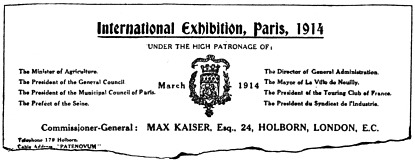
Photographic reproduction (reduced) of the letter-head of the stationery on which Max Kaiser offers to “make certain” that those who exhibit their products under his direction—price, $400—shall receive a Grand Prix or Gold Medal.
The list Mr. Kaiser enclosed with his letter was a printed sheet, giving the names of a number of American and British manufacturers whom Kaiser claims to have “represented” at various “International Exhibitions.” The majority of the concerns named are breweries, but there is a good sprinkling of “patent medicine” companies and a few miscellaneous manufacturers. In the American list there are two nostrum concerns named that will be more or less familiar to our readers. They are:
Alonzo O. Bliss Company, Washington, D. C. This company sells “the Great Blood Purifier, Kidney and Liver Regulator” known as “Bliss’ Native Herbs.” According to Max Kaiser, the Alonzo O. Bliss Company obtained one Grand Prize and one Gold Medal.
Waterbury Chemical Company, Des Moines, Iowa. This company exploits what used to be known as “Waterbury’s Cod-Liver Oil Compound,” which, from its lack of cod-liver oil,152 was impelled to change its name to “Waterbury’s Compound.” Kaiser states that the Waterbury Chemical Company received four Grand Prix and four Gold Medals.
Briefly the proposition submitted by Max Kaiser is this: For $400 he will make all arrangements for a manufacturers’ exhibit at one of the numerous “International Exhibitions.” Further, he practically guarantees that this exhibit will receive either a “grand prize” or a “gold medal”; in fact, the manufacturer need not complete the payment of Kaiser’s charges until the prize or medal has been awarded!
The value of “awards” obtained in this way is, of course, evident. As the public becomes better informed on the subject of international exhibitions, the grand prix, gold medals, and other “awards” made at such exhibitions will be appraised at their true value.—(From The Journal A. M. A., March 14, 1914.)
THE HYPOPHOSPHITE FALLACY
An Example of the Perpetuation of a False Theory by Advertising
A false therapeutic notion born of speculation soon dies a natural death if exposed unsupported to the cold world of facts, but when nursed by commercial interests it may be kept alive for generations. Interesting examples of this, to name but two or three, are the misconceptions perpetuated during the past half century concerning “lithia,” the “natural” salicylates and the hypophosphites.
Take, for instance, the lithia delusion. The supposed solvent powers of lithium compounds for uric acid were soon disproved to the satisfaction of scientists, but proprietors of lithia waters and nostrums for gout and rheumatism still harp on the old string and utilize long-exploded theories. Take, again, the alleged superiority of “natural” to “synthetic” salicylates. In spite of experimental proof to the contrary, proprietary interests have been able for twenty years to persuade a large part of the medical profession that the effects of pure salicylic acid made artificially differ from the effects of the same substance obtained from natural sources.
The altogether undeserved continued popularity of hypophosphites affords a striking example of the influence of advertising in perpetuating therapeutic error, for hypophosphites are given on a theory long since disproved. It may be interesting to trace the origin and history of the theory on which the practice of prescribing the hypophosphites is founded. The early part of the last century was prolific in chemical discoveries, and, as a corollary, in chemical theories of disease. Many of the theories arose from the hasty application of the chemical properties of new elements and compounds to the explanation of the processes in the living body, without due consideration of the conditions prevailing in the animal organism.
THE ELEMENT PHOSPHORUS
The element phosphorus is eager for oxygen and readily oxidizable. When taken into the system it acts as a violent poison, and, in view of this, it was at first supposed—although the supposition was based on no scientific data—that it would prove to be a powerful therapeutic agent when given in minute doses. In its elementary form, phosphorus is difficult to handle, and therefore not convenient for use. Hence it was natural that a compound should be sought which could be used as a substitute for the element.
Broadly speaking, phosphorus forms three classes of salts varying in the degree of oxidation: the phosphates, containing the most oxygen, the phosphites, containing less, and the hypophosphites, least of the three. The phosphates, being saturated with oxygen, undergo little change in the body, and because of this were thought to be of little value in therapeutics. The phosphites contain less oxygen, are unstable and are not used in medicine. The hypophosphites, containing still less oxygen, stand nearest to elementary phosphorus and are easily decomposed and readily oxidized to phosphates. Hence the theory that the hypophosphites would furnish an admirable source from which to obtain the action of the element phosphorus.
CHURCHILL’S THEORY
The hypophosphites were introduced into medicine about 1855, as a substitute for elementary phosphorus by a Dr. Churchill of Paris, and later of London, who advocated their use as a specific remedy for consumption. Churchill conceived the theory that phthisis is caused by a lack of oxygen in the tissues; he therefore sought an agent capable of increasing oxidation. He was led to the use of hypophosphites for this purpose on the supposition that phosphorus exists in the organism as a biologic element in a lower degree of oxidation than the phosphate. He supposed that this form of phosphorus acts by its chemical affinity as an initiatory agent in attracting and utilizing the inspired oxygen. He believed that when this form of phosphorus, which he called the “phosphide element,” is deficient in quantity (because it had been oxidized into phosphate, or because the supply from natural sources was deficient), the degree of oxidation of the tissues is less than normal. Therefore he advocated the use of hypophosphites to supply the lacking oxidizing constituent. He believed this “phosphide element” not only to be essential for the oxidation of the tissues, but also to be the source of energy of the nervous system.
THE FACTS
The theory was a pretty one; the facts, however, did not support it. Subsequent investigations indicate that instead of consumption being due to a lack of oxygen, there is in that disease really an increased oxidation; in other words, the respiratory exchanges in this disease are exaggerated. The existence in the system of a form of phosphorus less highly oxidized than the phosphates is unproved. No evidence has been produced to show that phosphorus acts as an energizer of oxidation. There is no proof that the hypophosphites enter into general metabolism or affect disease processes in any way. Not only is there no scientific evidence for the utility of the hypophosphites, but science has long since demonstrated their worthlessness.
In 1895 Boddaert153 published researches showing that hypophosphites are rapidly eliminated through the kidneys unchanged. Similar results have been reached by Paquelin and Joly, who attributed to the hypophosphites only the action of diuretics. In 1901 Massol and Gamel154 found by animal experimentation that the hypophosphites did not act as diuretics, but that the hypophosphorous acid was completely eliminated in the form of sodium hypophosphite. The urea was not increased and the relation of urea to total nitrogen remained the same. Their results indicated no increase of oxidizing actions within the system. Finally, Massol and Gamel examined the urine of patients taking hypophosphites and found the same conditions: the results were the same as in the experiments on animals.
PROPRIETARY THERAPEUTICS
In spite of these facts the hypophosphites continue to be employed by many practitioners. Why? Because the theory, being plausible at the time when such chemical theories were popular, gained a certain recognition and was accepted without scientific investigation. Thus the hypophosphites came into use. It was not long before they were taken up by certain manufacturers, and the theory on which their use was based became a commercial asset. As a result the theory, which uncommercialized would have died of inanition, was kept alive by continued advertisement.
The manufacturer of proprietaries having settled on a plausible theory on which to sell his products has no further need for science. Thus, while these theories are no longer to be found in accredited text-books, they are still preached by the proprietary interests. An elaborate pamphlet on “Iodine and Phosphorus,” containing statements which are known to be false, is one firm’s text-book supplied to physicians to-day, and contains long quotations from Dr. Churchill’s writings of sixty years ago. This book contains no intimation that these theories have been overthrown. It is poor economy to waste money in changing literature when the old theories and the old plausible reasoning will sell goods just as well. Consequently the old errors are drummed into those physicians who are willing to read their physiology from the neat monographs of proprietary literature and to sit at the feet of glib salesmen who expound to them the proprietary theory of therapeutics.—(From The Journal A. M. A., April 25, 1914.)
BUFFALO LITHIA WATER
Contains One-Fifth as Much Lithium as Potomac River Water
Some years ago, Alexander Haig evolved the theory that most diseases are due to uric acid. The data on which he founded his theory were not corroborated by scientific men, and investigation showed that his methods were unreliable. In spite of the fact that Haig’s theories are utterly discredited, and have been for years, the uric acid fallacy still persists, although it is now largely confined to the public. Shrewd business men, especially those who are more intent on making money than they are concerned with the manner in which that money is made, owe much to Haig’s theory. As a business proposition, uric acid has been one of the best-paying fallacies on the market—and possibly still is. It is only necessary to refer to The Journal’s recent article155 on the Turnock mail-order medical fraud to emphasize this fact.
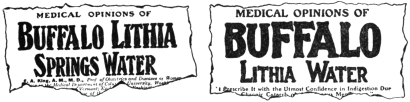
Showing how “Buffalo Lithia Water” in the course of time became “Buffalo Lithia Springs Water.” The government has shown that, to obtain a therapeutic dose of lithium from Buffalo Lithia Springs Water, it would be necessary to drink 200,000 gallons of the water. The government also declared that Potomac River water contained five times as much lithium as does Buffalo Lithia Springs Water.
Contemporary with, and to a certain extent a corollary of, the uric acid fallacy was another, viz., that lithium would eliminate uric acid. This at once gave a good working principle for the proprietary men. Uric acid, we were told, causes disease; lithium, we were also told, would eliminate uric acid; therefore, lithium is the new elixir of life! Could anything be simpler?
Accepting this theory, it was inevitable that mineral waters containing lithium salts should become highly popular. Many exploiters of mineral waters began to place most emphasis on the lithium salts in their waters even in those cases in which lithium was present in such infinitesimal amounts as to render its detection impossible by any but spectroscopic methods.
One of the best known, because most widely advertised, of the so-called lithia waters is Buffalo Lithia Water—or what used to be called Buffalo Lithia Water. After the Federal Food and Drugs Act came into effect, by which falsification on the label was penalized, the name of Buffalo Lithia Water was changed to Buffalo Lithia Springs Water. The reason for this change was that when Buffalo Lithia Water was subjected to examination by the government chemists it was found to contain so little lithium that the amount present was unweighable—it could be demonstrated only by the spectroscope. It was evidently, therefore, not a lithia water in that it did not contain—at least in quantities that could be consumed—an amount of lithium that would give the therapeutic effects of lithium: Possibly the company imagined that by changing the name from “Buffalo Lithia Water” to “Buffalo Lithia Springs Water” it had cleverly evaded the federal law. Their argument was to this effect: The springs from which this water is taken are known as Buffalo Lithia Springs; therefore, it is not a misstatement of facts to call this Buffalo Lithia Springs Water.
WHAT IS A LITHIA WATER?
The Supreme Court of the District of Columbia, holding a district court, has recently given an opinion on the Buffalo Lithia Springs Water case. The findings of the court are refreshingly simple, and characterized by that broad commonsense view that is becoming increasingly more common among modern jurists. Read Judge Gould’s opinion as to what constitutes a lithia water:
“Speaking generally, and as an individual of average intelligence and information, it would seem that if one were offered a water which the vendor told him was a ‘lithia’ water, one would have the right to expect enough lithium in the water to justify its characterization as such, thus differentiating it from ordinary potable water; and this amount would reasonably be expected to have some effect on the consumer of the water by reason of the presence of the lithium.”
Certainly a reasonable attitude, and one which the man in the street not only can understand but will agree with. Then came the question as to the actual lithium content of Buffalo Lithia Springs Water, and the court said:
“For a person to obtain a therapeutic dose of lithium by drinking Buffalo Lithia Water he would have to drink from one hundred and fifty thousand to two hundred and twenty-five thousand gallons of water per day. It was further testified, without contradiction, that Potomac River water contains five times as much lithium per gallon as the water in controversy.”
SOME TESTIMONIALS
Here, then, is a water that has for years been advertised first, in medical journals, and later, in lay publications, as a “lithia water” yet, actually, it contains less lithium, five to one, than is to be found in ordinary river water. This is a point for physicians to ponder well over. Turn to the back volumes of medical journals and read, both in the advertising and reading pages, the elaborate testimonials, given by men high in the medical profession, on the marvelous effects obtained by the use of Buffalo Lithia Water. Read the following in light of the fact that the water from the Potomac River contains five times as much lithium as Buffalo Lithia Water:
“In the class of cases in which lithia, soda and potash are regarded as most specially indicated, I have obtained far better results from the Buffalo Lithia Waters than from any of the preparations of the lithium salts of the Pharmacopeia.” (Statement by a member of the Faculty of Medicine of Paris, France, etc.)
“Its [Buffalo Lithia Water] therapeutic effects, in my practice, have been vastly superior to those obtained from Lithia Tablets or other Lithia preparations.” (Statement by an ex-president of the University College of Medicine, Richmond, Va., etc.)
“It [Buffalo Lithia Water] is strikingly superior to emergency solutions of lithia tablets and pure water, even where the said solution is an exceedingly strong one.” (Statement by a former Professor of Clinical Medicine of the College of Physicians and Surgeons, New York, and vice-president of the American Medical Association, etc.)
“When Lithia is indicated, I prescribe Buffalo Lithia Water in preference to the Salts of Lithia, because it is therapeutically superior to laboratory preparations of Lithia.” (Statement by a former professor in the Medical College of Virginia and ex-president of the Medical Society of Virginia, etc.)
“Buffalo Lithia Water ... by its richness of composition of Lithia, is of marvelous efficacy, in cases of gout, of chronic, articular, and muscular rheumatism ...” etc. (Statement by former Physician in Ordinary to the Pope; Member of Academy of Rome, etc.)
“I have tried carbonate of lithia dissolved in water in various proportions; but it certainly does not have the same effect as Buffalo Lithia Water.” (Statement by a former Surgeon-General of the U. S. Army, etc.)
These are but a few of many testimonials from physicians that might be quoted. They are interesting from many points of view. They show the worthlessness of testimony of this sort—no matter from what source—and the fallacy of that based on so-called clinical evidence.
To go back to the court’s findings: In the case of the government against Buffalo Lithia Springs Water, one other judicial opinion is worthy of attention, that referring to the attempt on the part of the exploiters of the water to circumvent, on a technicality, the evident intent of the Food and Drugs Act. Said Judge Gould:
“The argument seems to be that if Buffalo Lithia Springs are falsely named, being called ‘Lithia’ Springs, when they do not flow water containing lithium, therefore the proprietors have the right to sell the product as being Buffalo Lithia Springs Water, thus perpetuating on the public the misnomer connected with the origin of the water. It is not apparent how the deceit practiced on the public by the label is mitigated by carrying it back to the designation of the spring from which the water comes.”
For years no one, apparently, ever criticized the claims made for this product. Finally, we got the Food and Drugs Act and the federal officials, acting under the authority vested in them by that law, in December, 1910, declared Buffalo Lithia Water misbranded. Thus this old established vested interest was attacked. The company, of course, fought. It first demurred to the charge brought, and in April, 1912, the demurrer was sustained. At the same time an amended libel was filed by the government, which the company again demurred to. This demurrer was overruled in June, 1912, whereon the company in December, 1912, filed an answer denying that the water was misbranded. The question has now (1914) been finally decided by the court sitting as a jury, the matter having been submitted by agreement to the court.
Buffalo Lithia Water has been sold since 1878. During this period undoubtedly many physicians have prescribed enormous quantities of this water, and many more laymen have taken the water on their own initiative, based on the advertised claims made for it. Practically all who purchased the water, whether directly or on the advice of physicians, did so in the belief that they were getting lithium. Had they known that, to get a therapeutic dose of lithium they would have had to drink 200,000 gallons of Buffalo Lithia Water, they would have felt, and rightly so, that they were the victims of an expensive hoax.—(From The Journal A. M. A., June 13, 1914.)
MEAT EXTRACTS AND MEAT JUICES[AU]
Their Composition and Relative Values
The Bureau of Chemistry of the Department of Agriculture has recently given in Bulletin No. 114 much new and valuable data regarding the commercial meat products. The work contained in this bulletin is practically an elaboration or continuation of that published in The Journal of May 11, 1907, p. 1612. It was taken up to determine the condition and quality of meat preparations in general and from the results obtained to prepare tentative standards for the preparation and composition of such meat preparations. The results as well as the methods of analysis of many meat products are given, showing the composition and relative value of the various preparations. The comments of many investigators regarding the food value of such products is also a valuable contribution to the knowledge of meat extracts, and will help in deciding the real value of the preparations.
The preparations taken up are divided into three general classes (1) Solid and Fluid Meat Extracts; (2) Meat Juices; (3) Miscellaneous Preparations. For each of these the tentative standards submitted by the Committee on Food Standards of the Association of Official Agricultural Chemists are given along with the tabulated results of the chemical analysis. The preparations examined showed, for the most part, that they conformed to the standards, and only those which are at variance in one or more particulars will be mentioned in this review.
SOLID MEAT EXTRACTS
For solid meat extracts the following are the requirements:
“Meat extract is the product obtained by extracting meat with boiling water and concentrating the liquid portion by evaporation after removal of fat, and contains not less than 75 per cent. total solids of which not over 27 per cent. is ash and not over 12 per cent. is sodium chlorid (calculated from the total chlorin present), not over 0.6 per cent. is fat and not less than 7 per cent. is nitrogen. The nitrogenous compounds contain not less than 40 per cent. of meat bases and not less than 10 per cent. of kreatin.”
With the above as the standard, several of the solid meat extract preparations examined were not up to grade on one or more points, though in some cases it is true they were very slightly below the standard set. The following products were found wanting in some respects and the requirements which they failed to meet are given:
“Rex” Brand Beef Extract (Cudahy Packing Co., Omaha) contained 26.50 per cent. water instead of the standard 25 per cent.
Extract of Beef Premier (Libby, McNeil & Libby, Chicago) contained 30.92 per cent. of ash instead of the standard 27 per cent.; 18.32 per cent. of sodium chlorid (standard, 12 per cent.); 6.02 nitrogen (standard, 7 per cent.).
Beef Extract (Swift & Co., Chicago) contained 13.51 per cent. sodium chlorid (standard, 12 per cent.); 6.60 per cent. nitrogen (standard, 7 per cent.).
Beef Extract, Coin Special (G. H. Hammond Co., Hammond, Ind.) contains 13.25 per cent. of sodium chlorid (standard, 12 per cent.); and 6.86 per cent. nitrogen (standard, 7 per cent.).
With these few exceptions, the solid meat extracts were found to comply with the standards given.
FLUID MEAT EXTRACTS
For fluid meat extract the following standards have been suggested:
“Fluid meat extract is identical with meat extract except that it is concentrated to a lower degree and contains not more than 75 per cent. and not less than 50 per cent. of total solids.”
According to this standard all excepting one of the fluid meat extracts examined were found to be below grade in one respect, that of solids. The following are preparations examined and the percentage of solids found:
Per cent.
Concentrated Fluid Beef Extract (Armour & Co., Chicago)42.25
Meat Juice (Valentine’s Meat Juice Co., Richmond, Va.)42.36
Beef Juice (John Wyeth & Bro., Philadelphia)41.16
Vigoral (Armour & Co., Chicago)50.06
“Rex” Fluid Beef Extract (Cudahy Packing Co., Omaha)44.01
Fluid Extract of Beef (Cibilis Co., New York)35.37
Fluid Beef Jelly (Mosquera-Julia Food Co., Detroit)31.03
Special notice is directed to the price of some of these preparations, which in spite of their large water content, are higher priced than some of the solid meat extracts.
MEAT JUICES
The following is given as the standard for preparations of meat juice:
“Meat juice ... is the fluid portion of muscle fiber obtained by pressure or otherwise, and may be concentrated by evaporation at a temperature below the coagulating point of the soluble proteids. The solids contain not more than 15 per cent. of ash, not more than 2.5 per cent. of sodium chlorid (calculated from the total chlorin present), not more than 4 per cent. nor less than 2 per cent. of phosphoric acid (P2O5), and not less than 12 per cent. of nitrogen. The nitrogenous bodies contain not less than 35 per cent. of coagulable proteids and not more than 40 per cent. of meat bases.”
It is especially noticeable among the meat juices, so called, that none shows any appreciable amount of coagulable proteids. Valentine’s Meat Juice and Wyeth’s Beef Juice, besides being below the standard in total solids as fluid extracts, are misbranded when called meat or beef juices, as can readily be seen by comparing the results of the analyses and the standard.
Wyeth’s Beef Juice is advertised as containing “all the albuminous principles of beef in an active and soluble form” and “in an unaltered form”—two statements that are on the face of them untrue and misleading. To say that all the albuminous principles of meat are present is to say that not only the juice of the meat but all the fiber is present, which evidently is not true. Then again, to say that it is present in an unaltered form is far from the facts, for, as is stated on page 18 of the Bulletin: “It appears impracticable to prepare a true meat juice for market, as the temperature necessary for the preservation of food products in hermetically sealed packages coagulates the proteids and changes the nature of the product.” On page 55: “When prepared under the best possible conditions a commercial meat extract is, of necessity, in order that it may not spoil, deprived of the greater part of the coagulable proteids, which constitute the chief nutritious elements of the juice.”
On examining the tables of analysis, it is seen that Wyeth’s Beef Juice contains but 23 per cent. of its total proteids in a coagulable form, while the standard calls for 35 per cent., thus showing it to be no more valuable as a food product than any other so-called meat juice, the statements of the manufacturers to the contrary notwithstanding.
In the case of Valentine’s Meat Juice we note a large discrepancy between the standard requirements and the results of the government analysis, for instead of the proteid matter containing 35 per cent. in the coagulable form, it contains but 1.6 per cent. These figures show, then, that Valentine’s preparation contains practically no coagulable proteids, and since the quantity of these measures the food value of such preparations, the conclusion must be drawn that Valentine’s Meat Juice has practically no value as a food and should certainly not be classed as a meat juice.
Bovinine, another widely advertised meat preparation, which, according to statements on “The Bovinine Co.’s” letter head, is “a concentrated beef juice” and “the only perfect food in the world” was analyzed and found below the standard set for meat juices, since it contains only 3.38 per cent. of coagulable proteids. Yet in spite of this discrepancy, the manufacturers of Bovinine persist in exploiting it as a food, stating it to be “... a concentrated easily assimilable, nitrogenous food,” and in another place it is stated that Bovinine “is an ideal food.” As it is deficient in coagulable proteids and thus below the requirements as a food, it is misbranded when called a food of any sort, for to quote again the Bulletin, page 55: “... meat extracts ... must not be looked on as representing in any notable degree the food value of the beef or other meat from which they are derived”; and, again: “They are not, however, concentrated foods, having, on the contrary, but comparatively little nutritive value.”
Taken individually or as a class, meat extracts are not to be considered foods, and should, therefore, not be advertised as such, a conclusion which the government officials have come to and voiced in the conclusion of the Bulletin as follows:
VALUE AND LIMITATIONS
“It seems to be the consensus of opinion among scientific investigators who have studied this question that the food value of these meat extracts is rather limited, and although they are a source of energy to the body they must not be looked on as representing in any notable degree the food value of the beef or other meat from which they are derived. When prepared under the best possible conditions a commercial meat extract is of necessity, in order that it may not spoil, deprived of the greater part of the coagulable proteids, which constitute the chief nutritious elements of the juice.”—(From The Journal A. M. A., Jan. 23, 1908.)
PHARMACEUTICAL MANUFACTURERS AND THE GREAT AMERICAN FRAUD
At various times we have given more or less complete accounts of the prosecutions the United States Government has brought against nostrum exploiters under the Food and Drugs Act. One of the more recent of these, while of comparatively little interest per se, is of importance to the medical profession, because of certain elements connected with it. The case is known technically as “Notice of Judgment No. 284” and deals with the “Alleged Misbranding of Danderine.” The gist of the case is as follows: Casks of Danderine—a widely advertised “hair tonic”—were shipped in carload lots from Michigan to West Virginia, where the product was bottled, labeled and put in condition to be retailed. Danderine contains a percentage of alcohol which, while given on the labels of the bottles in which it is sold, was not stated on the casks in which the preparation was shipped in bulk. The government sought to confiscate, under the Food and Drugs Act, sixty-five casks thus shipped because the quantity or proportion of alcohol in the casks was not stated. The Knowlton Danderine Company resisted the confiscation and the court upheld the company’s claim.
The point in this case which is—or should be—of interest to the medical profession is to be found in the “statement of facts” presented by the Knowlton Danderine Company in its own defense. Here it is said that: “Parke, Davis & Co., who are mentioned in the said libel as shippers ... are under contract with the said Knowlton Danderine Company ... to compound the said formula ...” Elsewhere it is stated: “Parke, Davis & Co. were ... the manufacturing agents, under contract, of the owner, the Danderine Company ...”
This evidently means that Parke, Davis & Co., who are generally supposed to manufacture only “ethical” preparations—proprietary or otherwise—and as such to desire the respect and good wishes of the medical profession, are in the business of furnishing the supplies for nostrum venders. What Danderine is, it is hardly necessary to specify. The widely distributed advertisements of this “hair tonic” nostrum with the slogan: “Danderine Grows Hair and We Can Prove It” are sufficiently well-known to all who read to make a lengthy disquisition on the product unnecessary.
It is interesting in this connection to note that according to newspaper dispatches the Danderine Company has absorbed the Sterling Remedy Company, which exploits “Cascarets.” Three years ago a physician, who is also a pharmacist, wrote to the Medical World regarding the manufacture of Cascarets:
“... I have positive evidence, which I will gladly submit, that P., D. & Co., make all of them [Cascarets], and that they have a contract with the Cascaret people not to make anything similar for any one else.”
In the circular which comes in the Danderine packages two other “specialties” are advertised: “Neuralgine” for “sick, weak, tired nerves” and “Drake’s Palmetto Compound” for “weak stomachs, sluggish livers, disordered kidneys,” and various other derangements of the system. The question naturally arises, are these, too, shipped in casks from Parke, Davis & Co., and merely bottled and labelled in West Virginia?
Not that the Danderine case is the first one in which Parke, Davis & Co. have been exposed as manufacturers of nostrum supplies. “Vitaopathy” a method of “treatment” practiced by the notorious New York Institute of Physicians and Surgeons in the person of “Prof.” Adkin and apparently consisting of “absent treatment” and pills, was finally put out of business by a fraud-order from the post office department. The concern used to advertise:
“In Professor Adkin’s laboratory, his chemists are daily engaged in extracting the life-and-health-giving principle from rare vegetables, fruits and plants.”
“Prof.” Adkin had no laboratory; his chemists, according to the government report, were Parke, Davis & Co., from whom he purchased the tablets which formed part of his stock-in-trade of quackery.
The Nutriola Company of Chicago was declared fraudulent by the postal authorities and a full account of the methods of this fake medical concern appeared in The Journal, April 28, 1906. Nutriola was advertised as:
“The greatest Chemical-Medical Preparation ever prepared by the skill of man.”
“Nutriola and Nature are the only invincible conquerors of diseases ever known.”
The promoter of this scheme was one Edward F. Hanson, who was questioned by the government inspectors regarding the manufacture of the Nutriola nostrum. Quoting from the government report:
“Q. Please name the chemists who now manufacture the remedies of the Nutriola Company.”
“A. Parke, Davis & Company, Detroit; E. L. Patch Manufacturing Company, Stoneham, Mass.; Seabury & Johnson, New York.”
Not that the course pursued by Parke, Davis & Co. is by any means an exceptional one in the pharmaceutical world. It may be recalled that The Journal has previously referred to the fact that Sharp & Dohme are reported to make or to have made the “Getwell Tablets” for the “patent medicine” concern which exploits the nostrum; and that Frederick Stearns & Co. make or did make the widely advertised “cures” Shac and Zymole Trokeys also has been mentioned. That Seabury & Johnson made preparations for a fake medicine concern was brought to light by Mr. Adams in the “Great American Fraud” series. And unquestionably there are many others. The attitude taken by such houses seems to be that they are willing to furnish anything in the pharmaceutical line that anyone is willing to pay for, whether it is for legitimate use of the physician or pharmacist or for furthering the business by which the ignorant or gullible sick are humbugged and defrauded.—(From The Journal A. M. A., July 2, 1910.)
DOWD’S PHOSPHATOMETER
Dowd’s Phosphatometer, according to its inventor, is a device “for taking the phosphatic index or pulse of the nervous system.” Its originator, J. Henry Dowd, M.D., Buffalo, N. Y., writes enthusiastically of his instrument:
“Physicians who use the Phosphatometer are sending 50 per cent. less patients away for consultation, getting 75 per cent. better results at home, because the Phosphatometer tells the cause and what to do, and the Comp. Phosphorus Tonic gives results in 80 per cent. of all conditions of illness.”
The “Comp. Phosphorus Tonic” referred to in the above quotation is a sideline of Dr. Dowd’s, put out by the Richardson Company, of Buffalo. The stationery of the Richardson Company gives its address as 334 Franklin Street, but directs that all communications be addressed to 40 North Pearl Street, which is the private address of J. Henry Dowd. According to the Buffalo directories, 334 Franklin Street is the drug store of Arthur E. Reimann.
To those who read the Dowd “literature,” the Phosphatometer will appear to be either one of the wonders of the age or an unscientific absurdity. To the thinking man it will be the latter. It pretends to determine the amount of phosphates in the system. This is accomplished—alleged—by taking the second urine passed in the morning and mixing a portion of it in the instrument with a solution which is the well-known magnesia mixture. The height to which the crystals settle in ten minutes determines, according to Dowd, the amount of phosphates! Was ever a test devised that violated more of the first principles of quantitative chemical analysis? If so, we never heard of it. Dowd’s system does not require any determination of the amount of urine passed in twenty-four hours or even of the amount passed at the second micturition in the morning.
If a patient whose urine was being “tested” by the Dowd method, should drink two cups of coffee for breakfast instead of one, his urine might be so dilute that the phosphates would fall below the “normal” mark. Dowd says that his Phosphatometer “takes the pulse of the nervous system.” What about the patient who eats several eggs or consumes a sweetbread or other nuclein-containing articles of diet? The increased amount of phosphates in such a diet might easily lead to an apparent excess in the urine. Every physician, nay, every sophomore medical student, knows that the amount and kind of food ingested governs almost entirely the amount of phosphates excreted in the urine.
What actually does “Dowd’s Phosphatometer,” when used according to instructions, show? It shows the presence of phosphates in the urine; it permits a guess—with not the slightest claim to accuracy—as to the amount in the specimen tested; it gives no possible clue to the normal or abnormal relation of the phosphates in the urine or as to whether the source of the crystals precipitated is the nerve tissue or the food. Yet here are some of the claims made for it:
“The Phosphatometer shows nervous metabolism the same as the ureometer shows muscular; the former errs in about 3 per cent.; the latter in 40 per cent.”
“The Phosphatometer shows the amount of nerve food being used and present in the nerve cells.”
“Over 50 per cent. of pain and human suffering is due to the nerves crying for food; the Phosphatometer will show the true cause in ten minutes.”
“The Index not only tells the present condition, but foretells the future, thus preventing serious complications which might arise.”
“The Phosphatometer measures the amount of phosphorus in the system.”
“The Dowd Phosphatometer not only takes blood-pressure, it tells how to regulate it.”
“The Phosphatometer measures the amount of phosphorus in the nerve cells; it is as positive in nerve troubles as the x-ray in fractures.”
These claims are essentially false. As a matter of fact, a simple examination of the urine for phosphates cannot tell us the condition of the nervous system. This must be evident from the fact that only a portion of the phosphates is excreted in the urine, a very considerable part passing out with the feces. Further, the bulk of the phosphorus excreted comes from the food and only a small portion from the waste of the nervous system. The amount excreted by the urine which comes from torn-down nerve tissue is so small that it is practically impossible to estimate variations in it even by the most careful analytic methods.
In brief, Dowd’s “scientific method” is nothing more than unscientific humbug.—(From The Journal A. M. A., Dec. 20, 1913.)
AMORPHOUS PHOSPHORUS[AV]
A Practically Inert Substance Introduced as a Valuable Therapeutic Agent
Amorphous phosphorus is a chemical anomaly contrasting markedly with ordinary phosphorus in its physical, chemical and pharmacologic properties. Ordinary phosphorus is soluble in certain solvents, such as oil; amorphous phosphorus is insoluble. Ordinary phosphorus is poisonous; amorphous phosphorus is not poisonous. Ordinary phosphorus has been regarded as of some therapeutic value; amorphous phosphorus, because of its insolubility and other physical properties, has never been so regarded. Pharmacologists, therefore, have paid very little attention to it. Some of them do not even mention it, though there are a few accounts of experimental work.
Noé,156 in experiments on the action of phosphorus with yeast, found that yeast acted on ordinary phosphorus, producing PH3 (hydrogen phosphid), but on amorphous phosphorus it had no action. His experiments show that amorphous phosphorus was not toxic to animals.
Thornton157 quotes Reese as publishing a report of a case in which 30 grains of amorphous phosphorus were taken by a young woman with suicidal intent, but no toxic symptoms were manifested. Thornton found it non-toxic to animals.
Witthaus and Becker (Medical Jurisprudence, Forensic Medicine and Toxicology, iv, 635) say: “The form of phosphorus is practically non-poisonous, probably by reason of its insolubility. It has been administered to dogs to the extent of 200 gm. (nearly half a pound) in twelve days without causing poisoning.”
C. D. F. Phillips (Materia Medica, Pharmacology and Therapeutics, Inorganic Substances, Ed. 3, p. 46) makes the following statement: “Amorphous phosphorus has been, by some observers, credited with physiologic activity. Thus, Bednar used it for a long period in small doses, and observed symptoms of excitation, trembling and clonic convulsions; but as much as 1 ounce has been given to dogs without perceptible effect. Thompson, in twelve carefully observed cases, found its action nil, and plausibly attributes its supposed powers to a slight admixture of ordinary phosphorus (Pharm. Jour., 1875). I believe it is practically inert.”
HOW INTRODUCED
The foregoing represents our scientific knowledge as to the action of amorphous phosphorus. Now, however, comes Dr. I. L. Nascher and introduces amorphous phosphorus as a remedy of remarkable value for the arteriosclerosis of old age. The method of introduction is somewhat peculiar. The treatment seems first to have been brought to notice through a printed slip sent to medical journals generally. This slip consisted of an extract from Nascher’s book on old age, which at the time had not been published! Nascher also published an article on this subject in an obscure journal, the American Practitioner, for December, 1913. Neither the matter copied from his book nor the article referred to contain a single scientific fact that would warrant the claims made for it as a therapeutic agent. No record is given of animal experiments, and the clinical evidence presented certainly cannot be regarded as scientific.
As already stated, this form of phosphorus has not been previously used and has been regarded as without effect on the human system because of its insolubility in any of the liquids of the body. Nascher himself has not been able to find any new way to dissolve it. He says: “I made a number of experiments to find a solvent. The only substance which appears to dissolve it is serum, but I am still uncertain whether it is a solution or a very fine suspension. The phosphorus is precipitated in a few days, but the serum remains tinged.” The fact that it separates from the serum on standing is quite conclusive evidence that it is insoluble in that liquid. Since no way of making it soluble has been discovered, there is no reason for expecting it to have any effect on the system. An insoluble and non-absorbable substance can produce no general systemic effect; if, when ingested, it produces any effect whatever, this effect must be local and will be shown by symptoms of gastro-intestinal disturbance. Nascher, however, took 15 grains, and no symptoms of gastro-intestinal disturbance followed. Hence, we must conclude that it is without effect on the gastro-intestinal mucous membrane. While Nascher records no experiments on animals which is much to be regretted, he did experiment on himself and says:
“Ten grains produced a frontal headache, restlessness, excessive mental stimulation, ideas arising with such vividness as to appear as actual occurrences. There was a sense of weight or oppression in the stomach and priapism, the latter probably psychic, as I was looking for such a result. These symptoms passed away in a few hours.”
Without doubt his explanations of the priapism can be applied to the whole experience; whatever symptoms there were, they were unquestionably psychic. The consideration of these subjective symptoms may be dismissed, since it is reasonable to assume that an insoluble, unabsorbable substance which produces no disturbance of the gastro-intestinal tract will have no effect on the rest of the organism.
Amorphous phosphorus did not produce such symptoms as Nascher relates in experiments similar to his made by us. The drug was taken in 10-grain doses by six different individuals. In no case did the symptoms described by Nascher follow; in fact, there were no symptoms whatever.
NASCHER’S THEORY
Nascher, after relating his subjective experiences and those of his patients, proceeds to build a theory to account for the unproved action of amorphous phosphorus in disease, especially in arteriosclerosis. It would have been more appropriate if before advancing the theory, he had made some experiments to prove that the substance has some action. But we give his theory as found in the quotation from his book, sent to medical journals, as already referred to. Here it is:
“Amorphous Phosphorus in Senile Arteriosclerosis: The author has used the red amorphous phosphorus in senile arteriosclerosis for several years. Given originally as a substitute for ordinary phosphorus in senile debility, it was found that it was eliminated as amorphous phosphate of lime and that the lime elimination was thereby increased. Weil’s experiments showed that the lime elimination in arteriosclerosis was diminished. Phosphorus has the property of combining with lime and increasing the lime assimilation. In the small doses which can be given when the ordinary phosphorus is employed, the phosphorus will combine with the lime of the food and increase the amount of lime salts in the body. When given as amorphous phosphorus, the dose is 2 grains or more several times a day, and with a lime-free diet the lime required for the combination necessary to secure the elimination of the phosphorus excess is drawn from the abnormal lime deposits. This appears to be the rationale of the treatment and explains the good results obtained from its use. From ‘Diseases of Old Age,’ by I. L. Nascher, M.D., to be published shortly.”
Thus, according to Nascher, the phosphorus, after being oxidized to phosphoric acid, catches the calcium and drags it out of the system! What are the facts? The human body contains a large store of phosphates which are excreted in the urine in combination with sodium and potassium—and yet these do not draw the calcium from the blood, brain and bones! To be blunt, Nascher’s theory is absurd. The calcium in its various deposits in the body is already combined with phosphoric acid. Why should the phosphorus introduced take calcium from the phosphate radical with which it is already in combination? Nascher asserts that the phosphorus which is introduced as amorphous phosphorus is excreted as amorphous phosphate of lime within twenty-four hours. How does he know it is? It is, of course, very appropriate that amorphous phosphorus should form the amorphous phosphate of lime, but, unfortunately, phosphates made from the ordinary phosphorus also are precipitated in the amorphous condition. By what private mark does Dr. Nascher identify the amorphous phosphate produced by his amorphous phosphorus? Is it not a fact that he found the urine alkaline and detected a precipitate of amorphous calcium phosphate—always present in alkaline urine—and concluded that this must be his particular amorphous phosphorus in combination with calcium?
Dr. Nascher makes no record of examinations of the feces, although a great part—sometimes the greater part—of ingested phosphorus is found in the feces in experimental work on phosphorus metabolism. If he had examined the feces he would doubtless have found the total quantity of amorphous phosphorus unchanged.
Nascher refers to several cases in which he has used this remedy and states that he had the most gratifying results. So far as we can learn, the benefit was entirely in the subjective symptoms of the patient. It seems evident, therefore, that his claims for the value of this remedy rest on no better foundation than an unproved theory without experimental basis.
ITS COMMERCIALIZATION
Thus far we have considered only the scientific aspects of amorphous phosphorus therapy. It is unfortunate that we cannot stop here. Some of our readers will have seen in recent medical journals half-page advertisements of amorphous phosphorus reading:
The striking physical and chemical properties possessed by common phosphorus, together with the fact that phosphorus is one of the constituents of nerve-tissue, are probably responsible for the reputation which this element acquired generations ago as a remedy for sexual impotence and mental decay. Among scientific men this reputation was a fleeting one, for, when put to the test, the product failed. Like so many products with a similar history, the unearned reputation it obtained from medical men survived in the minds of the laity, and, as is always the case, the survival has been taken advantage of by quacks. Among charlatans and nostrum makers phosphorus is still in vogue. “Weak men’s specialists” and venders of “lost manhood” and alleged aphrodisiac drugs “play up” the phosphorus fallacy for all it is worth.
It is worth noting that the present exploitation of amorphous phosphorus is following along somewhat similar lines. The asserted actions of amorphous phosphorus are such as may be calculated to appeal to the sexual neurasthenic. There is no doubt that the Sharp & Dohme advertisements will bring about an extensive use of this remedy, especially by the uncritical. The psychic element—which plays so large a part in the sexual neurasthenic—will result in favorable reports being given on the drug. Articles may be expected to appear in a certain class of medical journals, telling of the marvelous results that Dr. John Doe has had in the use of “Pill Phosphorus Amorphous S. & D.” A luxuriant crop of testimonials may be expected to follow, and the tout ensemble will go far to sustain the Sharp & Dohme propaganda.
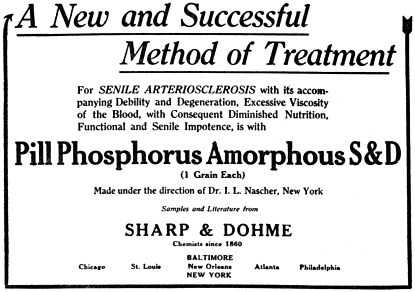
Reproduction—reduced—of half-page advertisement appearing in medical journals.
We are prompted to believe that Messrs. Sharp & Dohme do not fully realize the potentialities for harm that lie in their present exploitation of amorphous phosphorus. It hardly seems possible that a firm of standing would knowingly put on the market and advertise a worthless drug with an appeal to susceptible, infirm old men. The function of introducing new remedies to the medical profession is a responsible one, and a firm that assumes it should have among its officers some one sufficiently conversant with pharmacologic science to prevent such unscientific absurdities as that exhibited in the marketing of amorphous phosphorus, especially under such claims as those contained in the advertisements.—(From The Journal A. M. A., March 7, 1914.)
Dr. Nascher’s Reply to The Journal’s Article—Comments
To the Editor:—Regarding the article on Amorphous Phosphorus in the March 7 issue of The Journal of the American Medical Association, I want first of all to clear myself of the implied charge of commercialism in connection with the marketing of the Pill Phosphorus Amorphous by Sharpe & Dohme. I have never had anything to do with the manufacture or sale of those pills, never had any business dealings with Sharpe & Dohme and I have no commercial interest whatsoever in either this or any other drug or drug house. I knew nothing about the advertisement which you reproduced until I saw it in the medical journals. I immediately protested against this unwarranted use of my name and was assured that the statement “Made under the direction of Doctor I. L. Nascher, New York,” was not made for the purpose of misleading and that the ad. would be immediately withdrawn. I gave my approval to the pills made by this firm as I would give my approval to the pills made by any other reliable house for I claim the right to endorse any drug or preparation which I believe to be of value whether it is approved by the Council of [on] Pharmacy and Chemistry or not.
In your general charge of commercialism you make it appear that the exploitation of amorphous phosphorus had the ulterior purpose of appealing to the sexual neurasthenic along the lines of the “lost manhood” ads. So far as this relates to Sharpe & Dohme, I have no interest, but you have included me in your general denunciation. The only reference I ever made to aphrodisiac effects of Amorphous Phosphorus, in all my writings, is contained in these words in the four-page article in the American Practitioner, “In a few cases aphrodisiac effects were noticed.” I have never recommended amorphous phosphorus as an aphrodisiac and in the chapters on “Impotence and Neurasthenia” in my book on “Diseases of Old Age,” I have not mentioned amorphous phosphorus at all.
You say “the treatment seems first to have been brought to notice through a printed slip sent to medical journals generally.” This slip containing an extract from my book which was then in press was sent out about four months ago while I have referred to amorphous phosphorus repeatedly in medical articles during the past three years. In my paper on Senile Debility, Medical Record, Jan. 21, 1911, I said amorphous phosphorus had no effect, as I was then looking for the usual effects of the ordinary phosphorus. In a paper on Senile Mentality, International Clinics, Vol. 4, 21st series, I said I was using amorphous phosphorus but had not yet determined its value. I recommended it in several of my papers, articles and lectures in 1912 and 1913 after I had found that under its use in some cases of senile arteriosclerosis, symptoms were relieved. I sent these slips to the medical journals as a general reply to many inquiries I received about amorphous phosphorus and I stated this in the letters I sent with the slips to some editors. Further inquiries for more information led me to write the paper which appeared in the December issue of that “obscure journal” the American Practitioner. I felt that a medical journal which carried articles by Sir James Barr, ex-president of the British Medical Association, Sir R. W. Philip, R. Murray Leslie, Halliday Sutherland, and such American authorities as Adami, Hare, Brooks, Hirschberg, Knopf, Starkey, Ely, Bissell, Wilcox, Col. Maus, U. S. A., etc., was a representative high class journal and I was pleased to have my paper in it.
To take up the scientific criticism of amorphous phosphorus, permit me to say at the outset that I am a general practitioner, specially interested in geriatrics, and more concerned about obtaining favorable clinical results in my cases than in solving laboratory problems. Nevertheless I have tried for years to obtain the cooperation of expert laboratory workers to help me determine the properties, chemical, physical and physiological, of amorphous phosphorus. In 1909 or 1910 the Rockefeller Institute, in reply to my request for permission to experiment there with amorphous phosphorus, said it did not accept volunteer workers. Four heads of college laboratories could not spare the time. I asked the Council on Pharmacy and Chemistry last November to take up its investigation and was informed that it could not do so at present. I have been perforce compelled to depend mainly on empirical methods with such little experimentation as the facilities of the physician’s office permitted and such little literature as I could find.
You reject empirical methods as being unscientific notwithstanding the fact that most of our therapeutic knowledge is based on empiricism. (I use the terms empirical and empiricism here in the sense of knowledge obtained from experience and observation, not in the bad sense in which they might be construed.) It would therefore be folly on my part to argue with you that I have obtained beneficial results from amorphous phosphorus in many cases of senile arteriosclerosis. I did not obtain such results from a single dose, but gave it in some cases for many weeks or months. It is unfair to judge of the value of a drug from a single dose or several doses unless it is a drug which is expected to show immediate effects. It would be greater folly on my part to pit my knowledge of pharmacy and chemistry against the knowledge of your staff of experts. I can but repeat what I have said on many occasions that under the persistent use of amorphous phosphorus in cases of senile arteriosclerosis symptoms were frequently relieved. I never claimed that amorphous phosphorus will cure arteriosclerosis. In the chapter on Arteriosclerosis in my book I say: “Senile arteriosclerosis being a natural, normal condition, is incurable in the sense that it can be neither prevented nor removed. The best that we can hope for is to retard its progress and relieve disagreeable symptoms, etc.”
You say in reference to the elimination of the amorphous phosphorus as amorphous phosphate of calcium, “Is it not a fact that he (I) found the urine alkaline and detected a precipitate of amorphous calcium phosphate—always present in alkaline urine—and concluded that this must be his particular amorphous phosphorus in combination with calcium?” No. The specimens of urine were examined in reliable laboratories and I have reports showing acid and neutral urine as well as alkaline urine having the amorphous phosphate precipitate. Nor is the amorphous phosphate “always present in alkaline urine.”
As for the theory I advanced, it is simply a theory based on reasoning without facts to prove it. If I had facts to prove it, it would no longer be a theory or open for discussion. Being a theory, it is the province of the wise man to ridicule it and call it absurd. I will confess that your criticism of it is not clear to me and I still do not see its absurdity. I don’t see what relation your argument, that the phosphates of sodium and potassium do not draw the calcium from the blood, brains and bones, has to the theory I advanced. It is true that I have no private mark by which I can identify the amorphous phosphate produced by amorphous phosphorus, but such argument is puerile. When medical science has so far progressed that the physician will be able to put his tag on the molecule of drug substance and follow it through the various metabolic processes to its final elimination we will not need any Council on Pharmacy and Chemistry to decry what it cannot understand. Let me say here that scientific criticism does not stoop to ridicule for ridicule is usually based on animus or bias.
The conclusive proof of the value of a drug is not its action on the healthy dog, frog or guinea-pig but its action on the individual patient, and no amount of animal experimentation can dispose of the personal factor which is so marked in senile cases. This is no criticism of animal experimentation as a whole but of the insistence on animal experimentation to determine the value of a drug in a class of cases for which the healthy animal can furnish no comparison.
You say amorphous phosphorus is practically inert and quote Noé, Witthaus and Becker, Thornton and Phillips. The quotations of the first three are little more than statements that amorphous phosphorus is non-toxic. Phillips makes two references, one of which is to Badner who obtained decided effects from its prolonged use. Thornton, whom you quote in your contention that amorphous phosphorus is inert, says that on prolonged use in doses of 3⁄10 grains every two hours it produced headache, vertigo, mental excitement, priapism, etc. (See footnote under Phosphorus, U. S. Dispensatory). Shoemaker’s Materia Medica and Therapeutics says it is toxic and is called the servant-girl’s poison. Phillips suggested that Badner probably used an impure drug. I suggested that Thornton probably used an impure drug. On the other hand, Badner and Thornton obtained positive results from prolonged use, not from the single dose.
You say it has not been used on account of its insolubility in any of the liquids of the body. Roscoe and Schorlemmer, quoting Neuman, said if injected into the blood the usual symptoms of phosphorus poisoning appear. In a letter from Dr. Hatcher he says Nassé injected 0.2 gm. of the purest amorphous phosphorus into a rabbit’s vein and the animal presented the usual symptoms of phosphorus poisoning. There are also references to amorphous phosphorus action in Kobert’s Lehrbuch der Intoxicationen, in Blythe’s Poisons, etc.
You say of your four quotations, “the foregoing represents our scientific knowledge as to the action of amorphous phosphorus.” Did you not know of these other authorities, or are their statements unscientific, or were they omitted because they disprove your contention that amorphous phosphorus is practically inert?
Your denunciation of ordinary phosphorus has no bearing on the subject as I do not recommend the amorphous phosphorus as a substitute for the other.
I have worked for eight years to arouse medical and public interest in the aged and their ailments and I cannot afford charges of commercialism, foisting worthless drugs as aphrodisiacs or other unethical conduct to stand against me. As for the charge of unscientific work, I can only point to my work on Diseases of Old Age, and my medical papers, and express the hope that others better equipped for laboratory research will take up the laboratory investigation of amorphous phosphorus. I have faith in its therapeutic value and believe competent clinical observers will have favorable results from it in suitable cases.
I. L. Nascher, M.D., New York.
Comment.—Accompanying the preceding letter was a note from Dr. Nascher in which he says: “I want this published in full without elision or change. If you do not intend to publish it as written, I want it returned and enclose postage.” The letter therefore is given in full in spite of the fact that much of it is irrelevant to the question discussed.
Dr. Nascher’s protest to Sharpe and Dohme against the “unwarranted use” of his name in connection with “Pill Phosphorus Amorphous, S & D” seems to have resulted in various modifications of the phrases connecting his name with the exploitation of this pill. What was apparently the original advertisement, contained the phrase:
“Made under the direction of Dr. I. L. Nascher, New York.”
Later advertisements, while identical in all other respects with the first, had this phrase modified to read:
“Made at the suggestion of Dr. I. L. Nascher, New York.”
Still other advertisements, also identical with the first in other respects, are modified to read:
“Made with the approval of Dr. I. L. Nascher, New York.”
That Dr. Nascher was directly or indirectly connected with the commercializing of this product, The Journal has never suggested, inferentially or otherwise. That the exploitation of amorphous phosphorus by Sharpe and Dohme is one that appeals to the sexual neurasthenic, no one who has read the advertisements can deny. As a matter of fact, it would be difficult to sell phosphorus in any form as a medicament, without appealing to the sexual neurasthenic. The word “phosphorus” has become, in the minds of both laymen and physicians, more or less synonymous with the treatment of so-called sexual weakness and it is a practical impossibility to divorce the word from the idea suggested. How true this is, Dr. Nascher himself unwittingly admits when he tells that the result of his first experiment on himself with amorphous phosphorus was a priapism that he acknowledges was “probably psychic, as I was looking for such a result.” But the Sharpe and Dohme advertisements plainly state that the amorphous phosphorus pill they are marketing is a “new and successful method of treatment for ... functional and senile impotence....”
Dr. Nascher’s explanation of how he came to send out the slip regarding amorphous phosphorus to medical journals leaves him the victim of an unfortunate coincidence. It is at least unusual for authors to send out advance extracts from books that are about to be published, especially when such extracts deal wholly with a drug that is coincidently being introduced as a new proprietary product by some enterprising pharmaceutical house.
Dr. Nascher takes exception to our statement that the treatment seems first to have been brought to notice through the printed slip sent to medical journals, and states that he has “referred to amorphous phosphorus repeatedly in medical articles appearing during the last three years.” His articles for 1912 and 1913 have been examined for the purpose of learning when the treatment as now presented to the profession was first announced. In his article “Errors in the Treatment of Senile Cases,” New York Medical Journal, Oct. 12, 1912, he speaks of the iodids in senile arteriosclerosis, but says nothing about amorphous phosphorus. It may be assumed, therefore, that the treatment had not been brought to general notice at that time. The new treatment is very briefly described in the New York Medical Journal, July 13, 1913, in an article whose title, “Longevity and Rejuvenescence” gave no indication that it dealt with amorphous phosphorus. Under the circumstances, it is not strange that its therapeutic value was not learned of until Dr. Nascher’s printed slips were sent out.
Dr. Nascher admits that his theory is based on empirical methods. Most of the serious errors in therapeutics have had their origin in this very method. It was on just such methods that physicians reported wonderful results in the use of alleged “lithia waters” that actually contained less lithium than ordinary river water! So unscientific is the empirical method that it is hardly worth taking the space to demonstrate its imperfections.
Neither is it worth while to discuss the question of a constant occurrence of a sediment of amorphous calcium phosphate in alkaline urine. If there are exceptions to this rule, they must be rare indeed.
In The Journal’s article authors were quoted to show that amorphous phosphorus is regarded as inert. It was not suggested that the authorities referred to were all that could be found. Dr. Nascher refers to Thornton, Shoemaker, Neuman, Blythe and Kobert, and asks whether the various statements on the subject, made by these men, are unscientific or were “omitted because they disproved” the contention that amorphous phosphorus is practically inert. Thornton’s article was omitted because it is unscientific in that he does not report experiments made by himself, but refers to an unpublished paper by one Kelly. Who Kelly is, or was, he does not tell us. Kelly’s report, therefore, should be and was disregarded, since it is the work of an unknown author and there is nothing in the article to indicate that Thornton was in any position to vouch for Kelly’s work. Incidentally, it may be said that Kelly’s report merely recorded subjective symptoms; Dr. Nascher himself indicates his distrust of Kelly’s alleged results by suggesting that an impure preparation was used!
Shoemaker’s report was not given, for a similar reason. Shoemaker says:
“Amorphous phosphorus is almost completely destitute of taste or odor, has no immediate caustic effect, and is claimed to be less toxic than white phosphorus; but in the form of matches [Italics ours.—Ed.] has caused many deaths and is known as the ‘servant girls’ poison.’”
It is well known that commercial amorphous phosphorus is usually impure, and it is more than probable that if toxic effects were produced by the ingestion of match-heads, these matches were made either of white phosphorus or of very impure red phosphorus. In any case, Shoemaker’s statement has no bearing whatever on the pharmacologic action of pure amorphous phosphorus.
The statement of Neuman quoted from Roscoe and Schorlemmer, as well as that of Nassé, referred to by Hatcher, had no bearing on the question at issue, as these men injected the material into the blood-stream. If, when the amorphous phosphorus is injected into the blood, it produces the ordinary symptoms of phosphorus poisoning, one would naturally expect the same symptoms when the substance is given by mouth—if amorphous phosphorus were soluble or absorbable. The fact that such symptoms are not produced when amorphous phosphorus is taken into the alimentary canal, sustains the views held by chemists, pharmacologists and physicians, that the drug is practically insoluble and unabsorbable—in other words, inert.
Dr. Nascher declares that he “never claimed that amorphous phosphorus will cure arteriosclerosis.” Yet he insists that amorphous phosphorus removes lime from the “abnormal lime deposits” that occur in arteriosclerosis. What is this but claiming curative action?
Summed up, Dr. Nascher’s own admissions amply confirm the main contentions of The Journal’s article. He admits that he has no experimental basis for the use of this remedy; he admits that his theory “is simply a theory without facts to prove it.” The only conclusions that can be reached from his reply coincide closely with the very statement made by The Journal, and which we here reiterate:
“It seems evident, therefore, that his claims for the value of this remedy rest on no better foundation than an unproved theory without experimental basis.”—(From The Journal A. M. A., March 28, 1914.)