PART III CONTRIBUTIONS FROM THE JOURNAL: NOSTRUMS (continued 3)
Reading edition
“The mixed stock vaccine of commerce is a makeshift. It is offered as a substitute for correct diagnosis. Like all such makeshifts in science, it is doomed to failure.... A burden is being forced on the profession which will speedily assume the proportions attained by proprietary drug combinations. The menace cannot be counteracted unless physicians will accept the guidance of unselfish, non-commercial interests and refuse to purchase and use mixed commercial vaccines.”
This admonition to seek the guidance of unbiased scientific observers is deserving of special emphasis at the present time. Five weeks ago we published the address of the chairman of the Section on Pharmacology and Therapeutics, Dr. John F. Anderson,118 one of our foremost workers in this branch of biologic science, in which attention was very forcibly drawn to the dangers involved in the use of biologic products of non-specific character. He says:
“Bacterial therapy undoubtedly in some cases is a most valuable method of treatment; but when the claim is made that a combination of the dead bodies or the filtered products of a number of different bacteria are useful for the treatment of certain diseases with a different specific cause, it would seem that the suggestion closely approaches quackery.”
Further he says:
“Aside from the doubtful practice of the indiscriminate use of unproved methods of treatment, it has seemed to me that a great injustice is done the patient by their use, since some of the preparations that have been widely exploited have been shown to be harmful in certain instances and even to have caused death. So the first step in attempting to remedy conditions is to awaken the physician to the importance of ignoring the claims of those who are pushing these new methods until their usefulness and harmlessness has been clearly demonstrated by those best in a position to do so.”
As a result of scientific methods in teaching therapeutics, physicians have gradually given up almost entirely the use of “shotgun” prescriptions and now prescribe a drug or a combination of a few drugs, each given for the purpose of exerting a definite action. On the other hand, the purveyors of bacterial vaccines have gradually increased the number of different bacteria in their mixed vaccines until some of those now advertised for sale contain as many as seven different kinds of bacteria, and some of the “Phylacogens” contain the filtered products of at least eleven bacterial species!
Under the present federal laws there does not seem to be any way in which the federal government can do more than is being done at present. It is a case in which the physician becomes the sole guardian of the patient committed to his care. He is the one and the only responsible individual. He cannot throw the blame for bad results back to the manufacturer. When he subjects his patient to the possibility of harm by the use of these unscientific and dangerous preparations, the physician assumes the responsibility, whether he wants to or not.
If physicians would report their failures when these vaccines are used, and especially report the fatalities consequent on their use, with the name of the manufacturer of the particular product used, we are quite sure there would result lessening in the enthusiasm of the purveyors of these products.
When tempted by the optimistic statements of the interested manufacturer of these mixtures to give them a trial the physician should remember that the warnings of disinterested scientists are of far more value than uncritical clinical reports put out under commercial auspices.
This we quote from a recent book by Victor C. Vaughan,119 President of the American Medical Association:
“Every time an unbroken protein is introduced into the body it carries with it, and as a part of it, a poison. From the very careless, rash, and unwarranted way in which ‘vaccines’ of most diverse origin and composition are now used in the treatment of disease, this matter certainly cannot be understood or its danger appreciated by those who subject their patients to such risk. It should be clearly understood that all proteins contain a poisonous group—a substance which in a dose of 0.5 mg. injected intravenously kills a guinea-pig. This poison is present in all the so-called ‘vaccines’ now so largely used, and it is not strange that death occasionally follows the use of ‘Phylacogen’ or similar preparations. Not only do these proteins contain a poison, but when introduced parenterally the poison is set free, not in the stomach, from which it may be removed, but in the blood and tissues. It is possible that vaccine therapy may become of great service in the treatment of disease. Even now there are occasional brilliant results which are reported while the failures and disasters are not so widely advertised.”
Such a warning as this quotation contains, from a man so eminent as Dr. Vaughan, merits and should receive the careful attention of medical men; at least it should have as much weight as the “clinical evidence” spread broadcast among our profession by commercial houses.—(From The Journal A. M. A., Aug. 29, 1914.)
THE DANGER IN PROTONUCLEIN, A PREPARATION CONTAINING THYROID
Protonuclein was the subject of a little article in our Queries and Minor Notes Department, Nov. 16, 1912, page 1812. Dr. Reid Hunt, Washington, D. C., writes:
“To the Editor:—I have been requested by a physician to call your attention to certain statements which might well have been added to your reply to J. A. C. in regard to Protonuclein. Dr. Seidell and I examined several samples of Protonuclein some time ago120 and by chemical and physiologic tests found that they contained the equivalent of 10 per cent. thyroid of 0.1 per cent. iodin strength (the actual amount of thyroid may have been greater or less for we did not know the percentage of iodin in the thyroid used). The dose recommended on the bottle was 6 to 12 grains every three or four hours; this represents from 0.6 to 1.2 grains of some of the commercial thyroid powders, and is sufficient to cause pronounced thyroid effects in many conditions. Protonuclein was advertised as a ‘perfectly harmless antitoxin, tissue-builder,’ etc., although the dose of thyroid did not differ materially from that in ‘Rengo’ and ‘Marmola,’ two anti-fat nostrums which we examined at the same time. We called attention to the danger of using thyroid, the most powerful tissue-destroying drug known, in cases of typhoid, phthisis, etc., for which protonuclein was recommended, though these are conditions in which the physician is supposed to be exerting every effort to build up the tissues.
“You also speak of the ‘high’ nuclein content (0.28 per cent. phosphorus): the largest recommended dose would contain only about 1⁄3 grain of nucleic acid—an amount which probably has not the slightest effect, especially when given by the mouth.
“A sample of ‘Protonuclein Special’ was found to have twice as much thyroid as the ordinary Protonuclein; this also was stated to be ‘perfectly harmless.’”—(From The Journal A. M. A., Feb. 1, 1913.)
PURGEN
The physicians of the United States are receiving a neat package containing samples of a German proprietary—Purgen. The container is an ingenious one and, besides the tablets, includes a circular in English, although mailed in Europe, describing the remarkable virtues of this “new synthetic aperient.” It has been considered strange that this proprietary, which has been advertised so thoroughly in Europe, Australia, etc., should not have made its appearance in this country. Now it is here, and it is well that physicians should know what Purgen is and not be mystified and misled by the literature that they may receive regarding the preparation.
The following appeared in The Journal, Jan. 5, 1907, page 64, and is reprinted now as being especially timely:
The report of a case of poisoning by Purgen (phenolphthalein) is the occasion for some pertinent observations by Dr. G. Brasch as to the proper introduction of such remedies to the medical profession (Ztschrift für Medizinalbeamte, Abst. in Apotheker-Zeitung, No. 59, 1906). He agrees with Best that all such remedies should first receive a thorough trial in an institution subject to state supervision, before they are advertised to the medical profession, so that their harmlessness in appropriate doses may be ascertained by a method free from liability to error. The manner in which the manufacturers introduced Purgen to the profession and the laity is to be condemned, and probably led to the symptoms of poisoning exhibited in the case of Dr. Best and tends to discredit a remedy which is harmless and efficient if used in proper doses. The manufacturer of such a preparation is inclined, for obvious reasons, to put the dose of his preparation much too high. The most important point, however, is the objectionable character of the names given to such articles. The organic compound phenolphthalein has been known for a long time and has been widely used as an indicator. Accidentally it was discovered that phenolphthalein possessed laxative properties and thereon it was proposed (1901) as a medicine under the name “Purgen.” It is sold in tablets containing 0.05, 0.1 and 0.5 grain phenolphthalein mixed with sugar and flavored with vanilla. The author says: “But it is very desirable—and I regard this as the most important part of my communication—that phenolphthalein should be received into the materia medica under its own name. The addition of vanilla and sugar is to the highest degree superfluous and the arbitrary dosage in three strengths with the ridiculous designations, ‘baby,’ ‘for adults,’ ‘for patients confined to bed,’ are merely calculated to prejudice the physician who is accustomed to individualize in his prescriptions, against a remedy which is in itself an excellent one.”
As explanatory to the last sentence, it should be stated that in Europe Purgen is put up in three dosage forms, “infant Purgen for children,” containing 3⁄4 of a grain; “adult Purgen for chronic constipation,” containing 11⁄2 grains, and “strong Purgen for invalids,” containing 71⁄2 grains. The form in which it is being sampled in this country is in the medium dose, 11⁄2 grains.
Physicians should remember that the promoters of Purgen are simply introducing a chemical well known to laboratory workers for the last twenty years, which has been recognized as an aperient for at least seven years, and which can be purchased for 40 cents an ounce, whereas an ounce of phenolphthalein in the form of Purgen will cost $3.20 wholesale. The enthusiastic praise of the remedy, found in the advertising circulars, should be subjected to critical judgment on account of its source and motives.
It is undoubtedly true, however, as we have previously stated, that phenolphthalein is worthy of a trial. In the British Medical Journal, Oct. 18, 1902, F. W. Tunnicliffe speaks of the virtues of phenolphthalein, and the conclusions reached by him were that it is a useful aperient, without irritating action on the kidneys, and is especially valuable in jaundice, its depressing action on the circulation being less than sulphate of magnesia.
Phenolphthalein is not in the Pharmacopeia, but has been included in “New and Nonofficial Remedies” by the Council on Pharmacy and Chemistry. From this we quote:
Actions and Uses.—Phenolphthalein acts as a purgative, but appears to possess no further physiologic action. A case of poisoning from taking 1 gm. (15 grains) is reported. Dosage.—For adults the average dose is 0.1 to 0.2 gm. (1.5 to 3 grains) given as powder, in cachets, capsules or pills. It may be given with safety in doses of 0.5 gm. (8 grains), and these doses seem to be necessary to secure its effects in bedridden patients or in obstinate cases.
We have gone into this matter again so that our readers may have some knowledge of this remedy, and we hope that if they conclude to try it they will use the chemical itself and under its own name.—(From The Journal A. M. A., Sept. 14, 1907.)
PYO-ATOXIN
“To the Editor:—I am sending you a sample of a proprietary preparation that for the past two or three years has been largely retailed in the South and Southwest as a new combination that liberates larger amounts of formaldehyd, etc., in the genito-urinary tract than any known agent, that it is a methylene-formate, entirely new, etc.
“I asked the representative why he had not submitted a specimen to the Council, and his reply was that like Wyeth and others they did not get a fair report, or something to this effect. My reasons for trying to find the truth for their claims is that quite a number of general practitioners have asked me regarding this Pyo-Atoxin.
“W. P. Dey, M.D., Jacksonville, Fla.”
Dr. Dey sent with the foregoing letter a box of Pyo-Atoxin which bore this label:
Pyo-Atoxin Reg. in U. S. Pat. Office (Capsules) (Pheno-Methylene-Formate) “Hurley” An Antitoxic Agent Indicated in Gonorrhoea, Cystitis, Pyelitis and Bacteriuric Conditions. DOSE: One capsule four to six times daily, Followed by large glass of water. Guaranteed by H. O. Hurley, Manufacturing Pharmacist, Louisville, Ky. Under the Food and Drugs Act, June 30, 1906 Serial No. 1710.
The pseudoscientific synonym “pheno-methylene-formate” carries the idea that Pyo-Atoxin is a definite chemical substance. It is unnecessary to say that the term “pheno-methylene-formate” is a meaningless one and its use reminds one of those preparations exploited seven or eight years ago before the Council began to expose these mixtures masquerading as definite chemical compounds.
The chemical laboratory was asked to investigate this preparation and the following is a report of the chemists:
“The box contained thirty gelatin capsules coated with some black substance giving them the appearance of some of the popular gonorrhea nostrums. When the capsules were opened they were found to contain a powder—about 0.35 gm. or 5 grains per capsule—composed of large white or colorless crystals mixed with a smaller amount of a fine dark powder. The crystals when separated out and dissolved yielded the characteristic tests for hexamethylenamin. A solution of the entire capsule content was deep blue and responded to the U. S. P. tests for methylene blue.
“As a result of these and other tests it was concluded that Pyo-Atoxin consisted essentially of two pharmacopeial drugs—hexamethylenamin and methylene blue. A quantitative determination of the constituents was considered unnecessary. From its general appearance and properties, however, the hexamethylenamin probably constitutes approximately from 60 to 80 per cent. of the preparation.”
It thus appears that the capsules contain a mixture consisting essentially of two well-known official substances, the value and particularly the limitations of which should be known by physicians by this time. This nostrum is simply another example of how physicians are being humbugged.—(From The Journal A. M. A., Feb. 14, 1914.)
RESINOL
The Philadelphia branch of the American Pharmaceutical Association issued a pamphlet some two years ago in which the following appeared relative to Resinol and similar products:
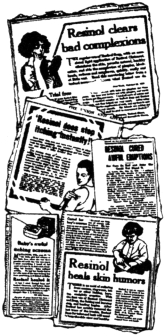
“Within recent years there have been introduced a number of compound ointments that in their supposed range of therapeutic usefulness are scarcely equaled and certainly not excelled by the magic unguents of the quacks and charlatans of continental Europe, who, several centuries ago, essayed to cure all manner of disease by inunction or the simple application of compound ointments of secret composition.
“As typical of this modern class of panaceas we may mention Resinol. This preparation is being widely advertised at the present time in the daily papers as a valuable adjunct to Resinol Soap in the treatment of all kinds and varieties of diseases of the skin. The makers of this particular mixture, in the form of an ointment, modestly assert that it will cure all skin diseases, and is also ‘Specific for Pruritus Ani, Itching Piles, and Pruritus Vulvæ.’”—(From The Journal A. M. A., Nov. 6, 1909.)
RESOR-BISNOL
Resor-Bisnol was considered by the Council and refused recognition. The following formula for Resor-Bisnol was at one time given in advertisements in a number of medical journals:
“A scientific combination, in nicely balanced proportions of Bismuth Salts of antiseptic acids of the aromatic series, and Resorcin.
“Each 100 parts contains 20 parts Resorcin, and 52 parts Bismuth Oxid, combined with antiseptic acids.”
Besides this formula other “formulas” equally indefinite, vague and misleading have been given in lieu of an actual statement of composition, thus:
“—— is a mixture of resorcin and bismuth salts of phenic acids such as salicylates, etc., and an aromatic alcoholate. Its composition is as follows.
Bismuth salts of phenic acids60per cent.
Aromatic alcoholate of bismuth20per cent.
Resorcin20per cent.”
The product was recently analyzed in our chemical laboratory. The chemists report as follows:
“A specimen of Resor-Bisnol examined by us consisted of a light brown powder possessing a characteristic odor and a taste at first sweetish and then bitter. It was found to be only partially soluble in water. The examination indicates that Resor-Bisnol is probably a mixture consisting essentially of a basic bismuth salicylate (bismuth subsalicylate), a basic gallate of bismuth (bismuth subgallate), a basic compound of beta-naphthol (bismuth betanaphtholate) and resorcinol (resorcin).”
It thus appears that Resor-Bisnol is probably a simple mixture of well-known substances. In other words, the Resor-Bisnol advertising and literature are typical of that issued by various nostrum houses: it conceals the truth in a mass of semi-scientific verbiage, and while not frankly false, it deceives by what is left unsaid rather than by what is said.—(From The Journal A. M. A., June 1, 1912.)
ROBINOL AND SEVETOL
Revamping Discarded Theories for Commercial Purposes
It is astonishing how rapidly medical hypotheses become theories and theories are accepted for established facts, when such alleged facts are favorable to commercial enterprise. Yet, as a matter of fact, the manufacturers of proprietary preparations are under a moral obligation, at least, to tell the truth with reference to the scientific basis for their claims. To draw from exploded theories reasons for the use of proprietary preparations is reprehensible, not only because it may lead physicians to use preparations which are worthless, but also because it tends to confirm in the physician’s mind opinions which science has discarded.
Robinol
John Wyeth and Brother put up a mixture of glycerophosphates which they call Robinol. In their description of the properties of this mixture they say:
“Phosphorus exists in the brain, nervous system, and vital organs as lecithin, of which glycerophosphoric acid is the most important constituent and is essential to the vital processes for the reproduction of life and maintenance of metabolism in old age, impotence, etc.”
The first impression on reading this sentence is that it suggests that glycerophosphates are essential to the vital processes, although the statement strictly applies to phosphorus. The next sentence confirms this impression and the mind glissades from the accepted fact of the existence of phosphorus in nervous tissue to the unfounded hypothesis that the glycerophosphates are necessary to supply the essential element. In the next sentence the circular continues:
“In nervous and general debility the glycerophosphates as exhibited in Robinol, are preferable to the mineral phosphates as they contribute the essential constituent of nerve tissue and are absorbed by the cells more readily than any phosphate of vegetable or inorganic origin.”
This statement is utterly unfounded. It is in direct opposition to the conclusions of pharmacologists. The glycerophosphoric acid radical is, to be sure, found in the lecithin of nervous tissues, but its source is not known. There is no evidence either that it must be present in the food or that it must be taken as medicine in order that the brain and nervous tissues shall be nourished. When the glycerophosphates are taken there is no evidence that they enter into the composition of the brain or nervous tissue. They are excreted in the urine and feces as phosphates. It has never been shown that glycerophosphates are absorbed any more readily than other phosphates.
But the advertising circular has still more information to impart to physicians:
“In that group of maladies characterized by faulty nutrition, due to the excessive elimination of phosphorus from the body, as is evidenced by the fatigue and weakness following acute attacks and present in many chronic affections, during the course of fevers and in the later stages of phthisis and all diseases of the nervous system, physicians will find the tonic chalybeate properties of the glycerophosphates of great value.”
Physicians know, if the nostrum makers do not, how difficult it is to determine whether there is an excessive elimination of phosphorus from the body. The bulk of the phosphates found in the urine are derived from the food and so little comes from the metabolism of the nervous system that it is not easy to prove that any disease is due to excessive elimination of phosphorus from the body. That fatigue and weakness are due to such a loss of phosphorus is mere assumption, a convenient theory for the exploiters of glycerophosphates. But admitting that nervous waste or faulty nutrition is characterized by the loss of phosphorus, it is easier, cheaper and more rational to supply such loss by the use of phosphorus-containing foods, such as milk and eggs, and there is not the slightest evidence that the loss of phosphorus will be influenced in any way by giving a supply in the form of glycerophosphates. Thus, in order to bolster up the sale of a simple solution of glycerophosphates, vague theories and improbable hypotheses are dressed in all the dignity of scientific facts.
Sevetol
There was a time, perhaps a generation ago, when physiologists taught that fats were absorbed into the blood in the form of a fine emulsion. This theory has been definitely disproved and it is now known that fats enter the blood only after a chemical splitting into glycerol and fatty acids, the latter being, to a large extent, combined with alkalies in the form of soaps.
“Sevetol,” another Wyeth preparation, is presented to the profession under the claim that it is a very fine emulsion of fats, every portion of which “is readily absorbed through the intestinal wall.” To quote:
“The administration of Sevetol, therefore, does not tax the digestive power of the patient, for it is absorbed with very little effort on the part of the digestive apparatus; and even if the organs of digestion be involved, neither the weakness of the patient nor the severity of the symptoms necessarily contra-indicates its use. The amount ingested is limited only by the power of assimilation exhibited in the tissues, and it may be given in large doses for a continued period of time, or until symptoms of overfeeding are produced, such as coated tongue, anorexia, constipation, headache and lassitude. When these symptoms appear, the administration of Sevetol should be temporarily discontinued and a mild but effective laxative given for several days, after which its use may be resumed.”
While the language just quoted is a little more exalted and dignified than that found in typical “patent medicine” advertisements, the thought it expresses qualifies it for a place in the “Lydia Pinkham” or “Peruna” class. Every sophomore medical student knows, if he gives the matter any thought, that Sevetol must undergo the same process of digestion as any other fat. It must be broken up into a fatty acid and glycerol, and saponified before it can be absorbed. It is plainly evident that the amount of Sevetol which can be taken is limited not only by the power of assimilation, but also by the power of digestion. The symptoms mentioned in the advertisement and ascribed to overfeeding, are the symptoms, not of a system saturated with absorbed fat, but of digestive organs rebelling against an unusual diet.
The exploitation of Sevetol is but one more case of turning to commercial account an exploded theory. Isn’t it about time that our profession demanded that the purveyors of medicinal products tell the truth? And isn’t it time, too, that we cease taking our pharmacology and therapeutics from proprietary manufacturers?—(From The Journal A. M. A., July 4, 1914.)
SALACETIN
Some time ago we wrote to Messrs. Bell & Co., calling their attention to the fact that we had made an examination121 of their product, salacetin, and that as a result of such examination it was found to be a mixture, which did not coincide exactly with their description of it. They replied: “Our description of salacetin is correct and we have nothing more to impart except that anyone publishing any different formula from that given in our circulars will be held responsible by us.”
The description they give is as follows:
Prepared by the interaction, with heat, of salicylic acid, glacial acetic acid, and purified phenylamine.
This sounds very scientific, but when we remember that acetanilid is a result of the action of glacial acetic acid on phenylamine (anilin) their description is cute, to say the least. Of course, there is “interaction with heat” when salicylic acid is combining with bicarbonate of sodium to form salicylate of sodium. Further, there is, no doubt, some “interaction with heat” when the substances are rubbed together in mixing them and when they are going through the mill to form tablets, not to mention the heated imagination of the promoters of this “synthetic.”
The following taken from the advertising literature furnished by the manufacturers and distributed by them, is quoted to show the claims made for this preparation:
Salacetin is free from Toluodine and produces no harmful cyanosis. In the treatment of Acute Bronchitis, Grippe, Influenza, Tonsillitis, Lithemic Headaches, Rheumatism and Neuralgias, it relieves pain, reduces inflammation and abnormal temperature, and eliminates uric acid more quickly and thoroughly than the salicylates, and without causing depression or stomachic or renal irritation.
Have personally interviewed thousands of physicians, including every prominent one in the East, and can honestly state that we have never known of anything at once so efficient and so unobjectionable in the removal of rheumatic and neuralgic pain and other symptoms of the uric-acid accumulation.... In La Grippe and Acute Bronchitis it relieves pain and coughing, reduces inflammation and temperature, makes the patient comfortable, and checks the progress of the disease. In Tonsillitis its action is specific.... In Acid Cystitis, it neutralizes acidity, reduces inflammation and removes irritation.... In Dysmenorrhea it relieves pain and congestion with no hallucinations, constipation or danger of a drug habit.
In Dysmenorrhea and Ovarian Neuralgias try Sal-Codeia—Bell. It will relieve the pain as well as morphia. It will not check any secretions, induce any habit, cause any depression or inconvenience of any kind.
Of course, it is well understood that acetanilid is a valuable remedy in many instances, if used with caution and when indicated. It certainly has some therapeutic value. There is no doubt that it relieves pain of various kinds. It is to be presumed that combining salicylate of sodium with it will have certain beneficial effects in certain rheumatic conditions, on the supposition that salicylate of sodium and acetanilid are both used with more or less success in certain of these conditions. Also, the combining of bicarbonate of sodium, carbonate of ammonium, caffein, citric acid, one or several of these, may result in a fairly good combination, but these combinations can be found in the list of preparations of all our large manufacturing pharmaceutical houses, which supply them at one-tenth of the cost of these secret remedies. The physician in using these preparations put out by reputable recognized manufacturing pharmaceutical houses not only is prescribing preparations that are non-secret, but is using remedies that cost one-tenth as much as the secret preparations, which are exploited under fanciful names and pushed by ridiculous claims.—(From The Journal A. M. A., July 1, 1905.)
SAL-CODEIA—BELL
According to the advertisements “Salacetin”
“... is a combination with heat of salicylic and glacial acetic acids with phenylamine, the irritating, depressing and blood-corpuscle destroying elements removed.”
According to the Committee on Chemistry of the Council on Pharmacy and Chemistry of the American Medical Association, whose report was published in The Journal of the American Medical Association June 3, 1905, p. 1791, “Salacetin” is a mixture of acetanilid, salicylate of sodium and bicarbonate of sodium. Sal-Codeia (Salacetin-Codein) therefore would be the same as above with codein added. Of course, acetanilid and codein will relieve pain (it could not do otherwise) and consequently make a very good combination in certain conditions, if not used too often and if used with care. Although the continued use of codein is not likely to produce a drug habit, it, as well as acetanilid, does so sometimes, and it must be remembered that codein is a motor paralysant, and is not the best combination to be used with acetanilid. For those who wish to give a combination of acetanilid, salicylate of sodium and codein, the following prescription is suggested:
℞ AcetanilidƷ i 4|
Sodii bicarbonatisƷ ss 2|
Sodii salicylatisƷ ss 2|
Codein sulph.gr. vi 0|4
M. et div. chart No. xxiv.
This will make five-grain powders which may be put in papers, capsules, cachets or tablets. Each will contain 21⁄2 grains (0.15 gm.) of acetanilid and 11⁄4 grains (0.075 gm.) each of sodium salicylate and sodium bicarbonate, with 1⁄4 grain (0.015 gm.) of codein.
The doses of acetanilid and of codein approximate the average adult doses, but the sodium salicylate, to have any appreciable effect, must be increased, for 11⁄4 grains of salicylate of sodium in a dose is insignificantly small. Sodium salicylate with acetanilid makes a fairly good combination in certain rheumatic troubles, but it is not indicated by any means as a cure-all, as one would judge from the literature sent out by the Sal-Codeia-Bell people.—(From The Journal A. M. A., Nov. 4, 1905.)
SANATOGEN
Cottage Cheese—The New Elixir of Life[AP]
The psychology of advertising is nowhere better exemplified than in the “patent medicine” and proprietary fields. The reason is evident. Knowing that the general tendency of the human organism is toward health rather than toward disease and that the “healing power of nature”—vis medicatrix naturæ—will account for a large proportion of recoveries from sickness, it is not to be wondered at that thousands of preparations sold for medicinal purposes receive credit that is entirely undeserved. The awarding of such undeserved credit is largely due to the universal tendency of those who are not trained in science to apply the post hoc, ergo propter hoc argument in all matters relating to health and disease.
John Smith suffers from a passing indisposition. When he recovers he credits his recovery to whatever he may have done just preceding that recovery. If he has received medical attention, the physician gets the credit; if he has taken “absent treatment,” Christian Science is responsible; if he has taken sugar pills, “Prof.” Munyon gets the praise—while, as a matter of fact, if he had taken none of these he would have recovered since he was only temporarily indisposed.
Nor are laymen the only ones that fall into such errors. Many physicians who prescribe new, widely-advertised preparations are likely to give those products credit for whatever favorable change may take place in their patients’ condition. This failing is not a modern one. In 1842 Dr. Benjamin Brodie wrote: “We have no doubt that many well-instructed medical practitioners have not sufficiently considered what course a given disease would take if it were left to itself; and as to others, it is not possible that they should have any real knowledge on the subject. With the majority of persons a recovery will generally pass for a cure.”
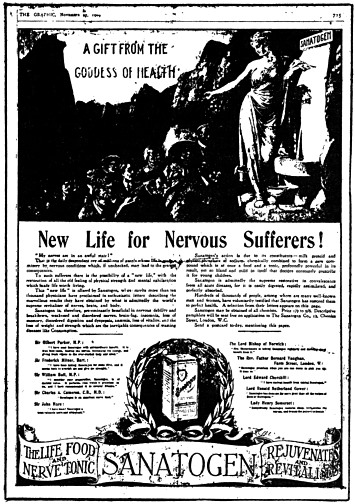
Greatly reduced photographic reproduction of a full-page Sanatogen advertisement appearing in the London Graphic. The Graphic was one of the London magazines that refused to accept an advertisement of the book issued by the British Medical Association, exposing “patent-medicine” frauds.
THE POWER OF ADVERTISING
While every physician is perfectly familiar with the facts just stated, it seems worth while to give them as a probable explanation of what is to follow. Within the last few years the medical profession and the public of this country have been asked to believe that a combination of cottage cheese—or its equivalent—with a small amount of glycerophosphates is capable, when sold under a proprietary name and with the right kind of advertising, of producing physiologic effects that are little short of marvelous.
The name of this elixir of life is Sanatogen, and it is doubtful if the history of modern advertising furnishes any more notable example of the commercial potentialities of publicity than that exhibited in the exploitation of this product. The Sanatogen advertising campaign is probably the most skilful piece of work of its kind ever done. On both sides of the Atlantic, every effort has been made to endow the advertisements with a dignity which, to those who know the very ordinary nature of the product advertised, is grotesquely out of keeping. Only the highest-class magazines and newspapers have been patronized; the “copy” has been so written as to appeal not to the ignorant but to the intelligent. Testimonials from men whose names are well known, even though by training and education they are incompetent to pass judgment on a product of this kind, and fulsomely laudatory letters from men whose education and training should have taught them better—both have been used with all the skill of the trained publicity man. In short, Sanatogen stands as a monument to the power of printers’ ink.
The claims for this product have already been referred to in The Journal, but it will do no harm to bring them again before our readers. Here are some taken from advertisements:
“The Re-Creator of Lost Health.”
“Sanatogen is ... a rebuilding food.”
“... revitalizes the overworked nervous system.”
“Specific nerve tonic action.”
“Most reliable and scientific of all nutrients.”
“... in certain diseases it exerts a specific action which renders it a valuable adjunct to other curative measures.”
“It stimulates metabolic activity of tissue cells and secures more complete oxidation of energy-yielding elements.”
“Sanatogen nourishes the system in a persistent, gradual, cumulative way, so that its best effects unfold themselves in a systematic, substantial progression to health and strength. It follows that a regular and prolonged administration of Sanatogen is necessary for the attainment of lasting results.”
“Sanatogen is a scientific compound, every particle of which represents the finest concentrated, tissue-constructing nutriment, endowed with unique revitalizing and rejuvenating powers.”
“Sanatogen contains over 700 per cent. more tissue-building, life sustaining nourishment than wheat flour.”
Truly a wonderful preparation—if these statements are true! But they are false—most of them at least. And in that many who can ill afford it may be led to pay a ruinously high price for a very ordinary food, the statements are viciously and cruelly false.
In view of the properties with which Sanatogen is credited, its composition is naturally a matter of more than ordinary interest. What is this life-giving product? A package of Sanatogen was purchased and subjected to examination and analysis in the Association’s laboratory. Our chemists report:
LABORATORY REPORT
Sanatogen is a fine, nearly white powder having a faint yellowish tinge. A circular which is enclosed in the package states:
“Sanatogen is a definite organic combination of 95 per cent. of pure, specially prepared casein and 5 per cent. of sodium glycerophosphate,...”
Qualitative tests indicated the presence in Sanatogen of casein, sodium, a phosphorous compound and glycerin or a glycerin compound. Starch and sugars were absent. Quantitative analysis showed that the composition of the specimen was essentially as follows:
Water (loss at 130 C.)8.60
Ash6.23
Casein and other proteins (N × 6.38)83.10
Casein (N in precipitated casein × 6.38)80.57
Proteins other than casein (by difference)2.53
Sodium glycerophosphate (NaC3H7O6P)
(P in filtrate from casein precipitation × 6.79)5.59
Insoluble matter0.84
Undetermined1.87
While these results show that the claims concerning the composition of Sanatogen are not entirely correct, they indicate that the essential element in Sanatogen is casein.
The slight variation between the composition claimed for Sanatogen and the composition as determined by chemical analysis is of minor importance. Whether there is 83 per cent. of casein as found by the Association’s chemists or 95 per cent. as asserted by the manufacturers matters little. The important fact is that casein makes up about nine-tenths of the preparation and, as must be perfectly evident, Sanatogen derives whatever food value it may have from that casein. Casein is known in its commonest form as the curd in milk, or as “cottage cheese.” After the cream has been separated, the milk which remains contains nearly all the casein and milk sugar originally present but practically none of the fat.
WHY NOT COTTAGE CHEESE?
Whence comes the stimulation of metabolic activity, the wonderful nourishment of the system, the marvelous revitalizing and rejuvenating power claimed for Sanatogen? Not from the sodium glycerophosphate, for the consensus of opinion among leading physiologists indicates that phosphorus in the form of glycerophosphates has little influence on metabolism. Not from the glycerin, surely, for even granting that glycerin has food value the amount present is so small as to be negligible. The real source of energy in Sanatogen, then, lies in the casein which comprises about nine-tenths of its ingredients.
Kind of Food MaterialPrice per PoundCost of 1,000 Calories EnergyCalories. Energy for One Dollar
Sanatogen$4.54$3.01332
Celery.05.771,300
Eggs ($0.36 per doz.).24.166,300
Milk ($0.07 per qt.).035.118,850
Pork, loin roast.12.1010,350
Butter.30.0911,250
Mackerel, salt dressed.10.0811,850
Beef, stew meat.05.0715,300
Wheat bread.06.0520,000
Rice.08.0520,250
Sugar.06.0329,200
Pork, fat salt.12.0329,500
Potatoes.01.0329,500
Beans, white.05.0330,400
Oatmeal.04.0245,000
Cornmeal.025.0265,400
Wheat flour.025.0265,400
Of course Sanatogen, being composed largely of casein, has some food value. What that food value is may be seen by the accompanying table which compares the yield of energy for Sanatogen with that of a number of staple food products, the figures for the latter having been adapted from Professor Atwater’s calculations. This table shows that, from the standpoint of economy in the purchase of energy, no other food in the list is so poor as Sanatogen. While the manufacturers claim that “Sanatogen contains over 700 per cent. more tissue-building, life-sustaining nourishment than wheat flour,” the table shows that one dollar’s worth of wheat flour contains as much energy as one hundred and ninety-seven dollars’ worth of Sanatogen!
AN INQUIRY
Like all “patent medicines,” Sanatogen is exploited by the testimonial route. Actors, authors, politicians and not a few physicians—the latter, to the credit of the American profession, be it said, being chiefly Europeans—have testified to the wonderful properties of this product. Believing that it would be of interest to learn what scientific men thought of Sanatogen a letter of inquiry was written to several men whose training particularly fits them to express an impartial opinion on a question of this kind. The following inquiry, expressed in practically the same words, was propounded:
Is it possible for a product, even if it has the composition claimed for Sanatogen, to have properties as a food and medicine which are claimed for this preparation?
The replies to this inquiry are interesting and instructive, although they are what might have been expected from men whose judgment has not been warped by the glittering claims of the Sanatogen publicity agents.
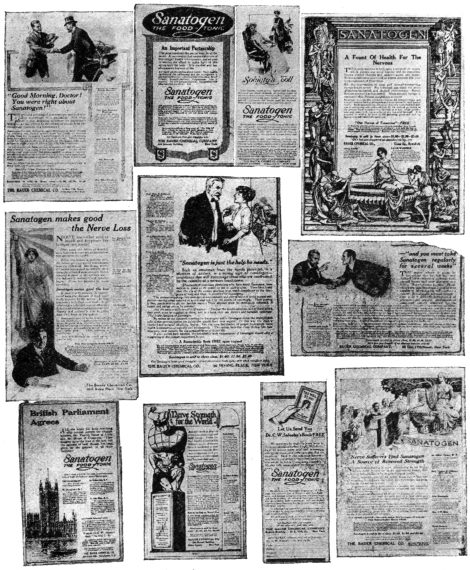
Some of the reasons for the sale of Sanatogen! A few specimen advertisements of Sanatogen’s enormously expensive advertising campaign.
THE REPLIES
Dr. Lewellys F. Barker, professor of medicine, Johns Hopkins University, medical department, says in part:
“If Sanatogen consists simply of casein and sodium glycerophosphate, it is pretty obvious that all of its good effects (except perhaps the psychic influence of taking an expensive and, to the layman, mysterious remedy) can be gotten by including milk and eggs in the food....
“The objection to Sanatogen lies, it seems to me, not in the assertion of its proprietors that it is a ‘food and a tonic,’ but in the misleading of the public and physicians into the belief that it possesses extraordinary powers which make it worth while to pay the price charged for it in order to get it. Very extravagant claims are being made for it in advertisements in the lay press. If just as much, and more, good in the form of ‘food and tonic’ can be obtained from a dollar’s worth of milk and eggs as from a dollar and ninety cents’ worth of Sanatogen, it is surely the duty of the medical profession to inform the public of that fact.”
Dr. Frank Billings, professor of medicine and head of the Department of Medicine, University of Chicago, expresses his opinion thus:
“Of course, the thing is a fraud both as a food and as a tonic. Even if it met all the requirements of the statements made of it by the makers, it would not be any more of a food than as much casein taken in milk and probably not as good; or any more than some other albumin taken in some other form. I do not know just what pharmacologists say of the glycerophosphate of soda, but so far as my own clinical observations go I never saw any result from its use that could be called specific, that is, due to the drug.”
Dr. Richard C. Cabot, assistant professor of clinical medicine, Harvard Medical School, says:
“In reply to your letter respecting the properties of Sanatogen, I would say that in my opinion it is vastly improbable that it has the properties claimed for it in the advertisements which you enclosed to me. I have no doubt that it is a fairly good food. I see no reason to believe that the phosphorus that it contains has any special action.”
Otto Folin, professor of biological chemistry, Harvard Medical School, expresses himself thus:
“For myself, or for any one who would take my advice, I would prefer a glass of milk to Sanatogen when hungry and plain glycerophosphate to Sanatogen when in need of a tonic.
“Medicated feed used to be sold for horses. To me the ‘food tonic’ combination represents one of the most unscrupulous fake ideas used by manufacturers of patented articles to fool the public.”
Ludvig Hektoen, professor of pathology, University of Chicago, says in part:
“In my opinion, no attention whatsoever should be paid to the claims advanced in favor of ‘Sanatogen’ as food and as medicine, because the statements made in the advertisements of this product are extravagant, misleading and quackish.”
J. H. Long, professor of chemistry and director of chemical laboratories, Northwestern University Medical School, expresses the following opinion:
“With every reading of the advertising literature of the Sanatogen Company I am more and more impressed by the gross exaggeration of the claims made for this mixture of casein and sodium glycerophosphate. Cow’s milk contains 31⁄2 to 4 per cent. of casein, associated with soluble phosphates. It is absurd to think that this casein after precipitation from the milk has a greater nutritive value than it has in its native condition. Casein, at best, is probably less valuable as a food than are certain other proteins, because of its lack of some of the amino groups essential in tissue building, and the addition of a glycerophosphate cannot supply this deficiency.
“This is not the first attempt to exploit casein preparations. The earlier efforts failed in practice because they were based on a wrong conception concerning the physiologic value and importance of this protein. The assumption that in the case of Sanatogen a ‘definite organic combination’ with the glycerophosphate is formed cannot be taken seriously by chemists. We have witnessed many such efforts to palm off mixtures as definite organic compounds, and in this way to claim for them a value in excess of that which they actually possess.”
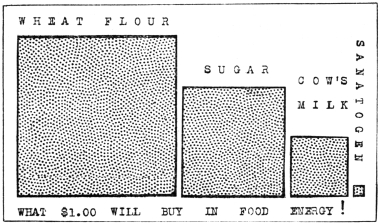
What one dollar will buy in food energy! A comparison of the caloric values of sanatogen, cow’s milk, sugar and wheat flour. Based on the table accompanying this article.
Graham Lusk, professor of physiology, Cornell University Medical College, after calling attention to the falsity of the claim that Sanatogen is “a life-sustaining agent in disease,” says:
“If one considers the casein content alone, the dose of Sanatogen recommended in the circular would furnish, at best, about what is contained in a pint of milk, or one-fourth of the total of the protein necessities of the body—using a low protein requirement. That sodium glycerophosphate has any distinctly beneficial physiologic action has never, to my knowledge, been shown.
“It is a great pity that the public does not realize the splendid and economical value of milk, bread and the ordinary vegetables, cereals and meats, as true ‘tonic food stuffs,’ in contradistinction to prepared nostrums whose sale depends on a psychic stimulus applied to a susceptible populace.”
H. Gideon Wells, associate professor of pathology, University of Chicago, says:
“There is nothing in my knowledge of physiologic chemistry which would lead me to believe that a mixture of chemically isolated casein and sodium glycerophosphate would possess any effect more favorable than that of a corresponding amount of milk. I can easily believe that it would be less valuable than milk. The successful practice of many commercial houses, of isolating one of the constituents of our food, and ascribing to it marvelous nutritive or therapeutic properties, is one of the most telling bits of evidence of the inadequacy of the education of the medical profession in physiology and physiologic chemistry that can be conceived.”
The consensus of opinion thus expressed is only what might have been expected from men who could discuss the problem in a purely judicial spirit and with a freedom from that bias which seems to be inseparable from the consideration of the simplest of mixtures that have been glorified by a proprietary name.
THE TYRANNY OF WORDS
Herr Teufelsdröckh was right when he panegyrized clothes. And the worship of clothes is carried to the extreme nowhere so much as in the case of word-clothes. The most plebeian things when bedecked in sufficiently imposing word-finery are endowed with the attributes of royalty before which the average intellect bows down. Neither cottage-cheese nor glycerophosphates, when exposed naked to the world, commands any overweening respect; combined and dressed in the magic word “Sanatogen,” they receive the homage of those whose judgment is blinded by the glittering trappings of word-finery. Some day, possibly, there will be a democracy of intellect which will refuse to prostrate itself before mere word-raiment and will insist on appraising things at their naked worth. When that day comes, proprietary humbugs like Sanatogen will have become as extinct as the dodo and the great auk.—(From The Journal A. M. A., April 20, 1912.)
The Bauer Chemical Company’s “Reply”
To the Editor:—Our attention has been called to a most unfair and unwarranted attack on Sanatogen which appears in your esteemed publication [April 20, p. 1216]. The article is such a perversion of the actual facts, and so completely—if not intentionally—misleading that we request, as a matter of common justice, that you give this reply equal publicity to your attack. The admiration and respect we have felt for your journal and our appreciation of the place it holds in the field of medical journalism, made your attack on a product like Sanatogen, representing so definitely the most painstaking and scientific research, the last thing expected. Indeed, it seems inconceivable that a journal apparently so alive to its responsibilities could publish broadcast an article so calculated to do harm, without first giving those whose interests are most at stake an opportunity to substantiate their claims.
There never has been a time that we have not been ready to meet any request from The Journal, or the respected gentlemen composing the Council on Pharmacy and Chemistry, for all information and data concerning Sanatogen. Had we had the slightest inkling that our product—or the claims made for it—were open to question or criticism, we would gladly have submitted all of the evidence, clinical, experimental, and theoretical, on which every statement, however simple, has been based.
To make a response is difficult, because your article is not written in a fair, unprejudiced spirit. In fact, although one would expect a sober, serious consideration of a matter so fraught with importance (if your contention is right) your whole attitude is one of ridicule and jocularity. Is it right to present scientific material in such a way and show so little respect for those who have offered you no affront or done you no injury? A little investigation would have shown you that the statements we have made about Sanatogen are based on the experiences and opinions of such men as von Noorden, C. A. Ewald, Duhrssen, Eulenburg, Neisser, Binswanger, von Leyden, Krafft-Ebing, Tillmanns, Tunnicliffe, and thousands of other earnest, reputable physicians. Any one might differ with their conclusions, but is it courteous or decent to hold them up to ridicule and contumely?
Can a discussion thus conducted hope to solve a scientific problem or accomplish any real good?
It would hardly seem so, and with all due respect we cannot help but feel that the situation has its analogy in the legal doctrine, “when you have no evidence, ridicule and abuse your opponent and his client.”
Sanatogen is a definite organic combination of (in round numbers) 95 per cent. casein and 5 per cent. glycerophosphate of sodium. The analysis as published in The Journal fails to show that this statement is untrue. The slight deviation as to the amount of casein present is explained by the fact that The Journal’s figures include the moisture, while ours are on the dry substance. Inasmuch as nearly all the moisture is absorbed after the product leaves the laboratories and is therefore added weight, the figures should be on the dry substance. It is hinted in the article that Sanatogen is a mere mixture of ingredients, in fact one of the gentlemen you quote openly intimates so. To this we say most emphatically that anyone asserting Sanatogen to be a mere mechanical mixture of ingredients and not a definite chemical compound either wilfully misstates the facts or does not know. Sanatogen represents a new idea or discovery in the domain of invalid dietetics and as such its process of manufacture as well as the product are protected by U. S. Letters Patent.
Assuredly it is the definite chemical combination found in Sanatogen on which the special value of this product as a medicinal food and tonic depends. A mere mixture of ingredients would represent only the sum-total of their individual virtues, but a definite combination of such ingredients means the formation of a new compound with properties of its own which far transcend those of any simple mixture of the original ingredients.
To compare Sanatogen to cottage cheese is the height of absurdity—as it was probably intended to be. The casein of Sanatogen is perhaps the most carefully purified milk protein available, and this fact is of essential importance when considering the value of Sanatogen as a medicinal food. To compare the casein of Sanatogen with crude commercial casein or with cottage cheese is as ridiculous as to compare a crude drug with the refined element. The same applies to the matter of cost. We suggest that an attempt be made to prepare purified casein according to Hammarsten’s method, if one wishes to determine what labor and expense is involved in the operation. Possibly it will be found cheaper to buy Hammarsten’s casein in the open market where the price is $3.50 per pound wholesale! And it is not a proprietary product, either.
Further, to compare the economic value of Sanatogen on the basis of calories is as unscientific as it is deliberately misleading. If the caloric standard only counted, a pound of oleomargarine would be as valuable as fifty eggs, a pound of laundry soap as valuable as a pound of choice beef. Sanatogen is not intended or recommended to replace ordinary foodstuffs. It is not recommended as a caloric or heat producer, but as a food-tonic supplying the essential elements of tissue construction and cell-repair in easily and perfectly assimilable form.
Digestibility, ease and completeness of assimilation count a great deal, and are the sole determining factors in cases of illness. Again, starch and fat are not essential substances to life. Without protein we cannot live. Exclude everything else from a patient’s dietary, and he will live. Exclude protein and it is only a question of time before he dies. It is evident, therefore, that to measure the value of a given food in calories only is misleading and dangerous, and an editorial in your valuable publication of November 4 last distinctly points this out.

Specimens of Sanatogen advertising—(1913).
According to the most careful and extensive experiments, covering a large number of scientifically studied cases, Sanatogen is not approached in the matter of rapidity of digestion and absorption by any other known foodstuff. That such a product does exert a definite stimulating or activating effect on the digestive and assimilative functions, thus promoting the digestion and appropriation of nutritive material has been demonstrated over and over again. That the organic phosphorus of Sanatogen is almost completely retained and assimilated has been proved beyond doubt by carefully conducted metabolism experiments. That from this, and from the stimulating action on phosphorus and nitrogen metabolism, a favorable effect on the nervous system could result, is conceivable. That such an effect does actually take place has been demonstrated clinically in literally thousands of cases.
As to our advertisements and literature: Every claim made emanates from the freely recorded statements of competent observers, checked and rechecked by men who have been absolutely free from all bias or prejudice. And these opinions, moreover, are not the superficial, passing views of a few physicians. Instead our claims are based on the voluntary, unbiased written reports of clinical experiences by over 15,000 practicing physicians—among whom a goodly proportion are members of your esteemed Association—and on over 150 published articles in the leading medical journals of the world, some of which your journal has considered of sufficient importance to present to its readers in abstract form, suppressing, it is true, all mention of Sanatogen, although thereby the original was sadly emasculated, if not actually falsified.
Among the physicians who have carefully tested Sanatogen and determined its dietetic and therapeutic properties are many men of truly international reputation, men who are as far above suspicion as was Caesar’s wife. At least one of these men was the honorary guest of your Association a few years ago.
It is such men that your article holds up to contempt and dishonor when you allow the false inference to go forth that Sanatogen is a mixture of casein and glycerophosphates. It is such men’s careful researches and experience that you attempt to offset by the snap judgment of men whom we claim, without the slightest intent of disparaging them, to be in the present instance unfitted to give an opinion on Sanatogen inasmuch as they—with perhaps one honorable exception—have never tested or used the product. Their lack of definite knowledge of Sanatogen is shown by their persistent references to casein and the glycerophosphates, as though these two ingredients were separate and not chemically combined. To consider Sanatogen a mixture is to lose the vital detail of its specific value.
Now after all, is this a fair, judicial spirit, is this true scientific enquiry? Are we to accept offhand judgments in preference to the opinions of those who speak from years of observation of the effects of Sanatogen? In the name of justice and fair play, is it right for the great Journal of the A. M. A. to ignore and suppress the accumulated evidence in favor of Sanatogen and cite instead the cursory opinions of men who have never seen Sanatogen, tested or observed its effect, who by the very nature of your enquiry must have been influenced subconsciously in favor of your side of the matter.
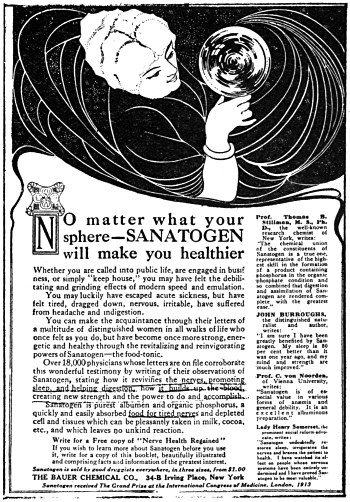
The above is a reduced reproduction of a full-page advertisement in a magazine devoted to pseudo-scientific fads. The advertising pages of this magazine reek with frauds.
During the twelve years Sanatogen has been used, prescribed and recommended by thousands of competent physicians, it has been free from all secrecy. The truth has been told at all times. From the first we have cooperated with the profession. Never have we failed to safeguard the doctor’s interests. Never have we suggested by word or inference that any person should employ Sanatogen to the exclusion of medical treatment. Not a day passes but we refer people who inquire about this or that bodily ill, to their physicians for advice.
We regret the length of this letter but feel that the scientific character of Sanatogen, its well-defined chemistry and the respect we owe to the men who have not hesitated to give their honest opinions concerning its food and tonic effects, make it imperative that we refute at once errors and misleading statements, and correct to the best of our ability the wrong impression you have allowed to go forth. The clinical reports and statements and the scientific evidence on which we have based our claims are constantly available and may be examined by any responsible person for verification or any other legitimate purpose.
We have tried to make this article temperate, fair and free from ill temper and ill feeling. We only ask for justice and feel that you will be willing—possibly anxious—to correct, so far as you can, the great wrong you have done us.
The Bauer Chemical Co. By F. W. Hehmeyer, Resident Manager.
[Comment: We devote considerable space to the above free advertisement of Sanatogen, as The Journal does not want to be accused of being unfair, even to patent medicine venders. As our readers will recognize, the above is simply a reiteration of the statements that have been published in the advertisements of Sanatogen. The song that runs through all the advertising matter is that Sanatogen is a chemical compound, and since it is a chemical compound it therefore possesses properties not to be found in the ordinary mixture. It is the old, old story; the “synthetic” argument is as hoary as the nostrum business itself but fortunately the medical profession is no longer easily fooled by it.
As a matter of fact, even assuming for the sake of argument that the casein and glycerophosphate in Sanatogen are in chemical combination, it would be a union of the loosest kind, which on entering the digestive tract must be broken up into its more stable components, casein and glycerophosphate. To claim that Sanatogen possesses any properties not possessed by its essential constituents is a silly piece of pseudo-scientific claptrap.
Of the testimonials on Sanatogen we shall at this time have nothing to say; The Journal has in the past repeatedly shown the worthlessness of this kind of evidence.
We have nothing to retract, rather we would emphasize and, had we space, enlarge on what we have already published, for we believe that a large and unfortunate portion of the public, that can ill afford it, is paying a ruinously high price for a substance having a very mediocre food value. That indigent consumptives, for instance, should be led by glittering falsehoods to squander on Sanatogen money that should go for “food tonics” of infinitely greater value, such as eggs, milk, vegetables and meats, is not only economic waste but inhuman cruelty.—Ed.]—(From The Journal A. M. A., May 18, 1912.)
The Sanatogen “Grand Prix”
A number of letters have been received recently expressing surprise that Sanatogen had been granted a “grand prix” at the Exhibition of Medical and Surgical Material held in London at the same time that the Seventeenth International Congress of Medicine was in session. The correspondents have asked what such an “honor” meant. The company which exploits Sanatogen in the United States has not been slow to apprise the American public of the award. It has gone further and has written the advertising managers of magazines—including those that had refused Sanatogen advertisements—directing their attention to the fact that Sanatogen was awarded a “grand prize” and opining that “this unusual distinction” should make plain “the desirability of the presence of Sanatogen in the advertising columns of your esteemed publication.”
Those familiar with the methods of awarding prizes, medals and certificates to commercial firms and their products at expositions and exhibitions attach little weight to the “honors” thus conferred. It is a fact that most purchasers of large—and expensive—exhibit space at such exhibitions receive some kind of award which, it is tacitly understood, will be a useful advertising asset. Every one can call to mind many food products of mediocre quality that have flaunted on their labels the gold medals received at various expositions.
Nevertheless, it seemed worth while to find out just what the connection was between the commercial exhibition at which Sanatogen received the grand prize and the Seventeenth International Congress of Medicine. The following facts were developed: The commercial exhibition was entirely distinct and separate from the scientific exhibit of the Congress. It was managed and conducted by a British drug journal which had been giving annual “exhibitions” of its own for some years past, and this took the place of its regular exhibition. Immediately after the awards were made public the advertising pages of this drug journal were filled with full-page advertisements of the various products that received prizes. It may interest our readers to know that while the cottage-cheese-glycerophosphate product Sanatogen received a “grand prize” two other proprietary cottage-cheese-glycerophosphate products received “gold medals” at the same time. In the pharmaceutical department of the exhibit a widely—and fraudulently—advertised “patent medicine” received a silver medal! From the facts given it should not be difficult to appraise at its right value the “honor” conferred on Sanatogen. The fact that the exploiters of this preparation are trying to make capital out of this “award” is significant.
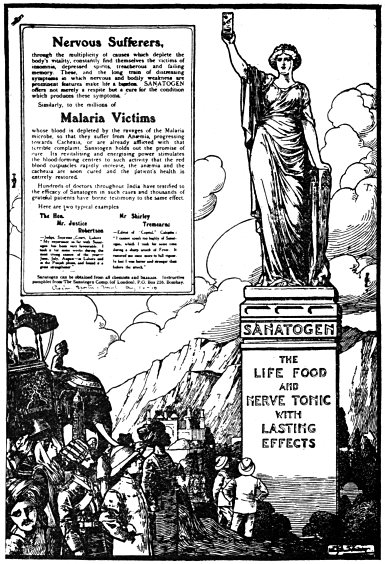
Nor is even the Asiatic neglected in the Sanatogen advertising campaign. Here is reproduced an advertisement appearing in an Asian sporting newspaper published in India. The original advertisement was 10 inches by 15 inches.
Among the members of the Award Jury whose names were given by this drug journal were three men of prominence in Great Britain, to whom we have written. A reply has been received from one, Dr. Stephen Paget, who says: “I was not on the jury, nor do I know anything about the matter.... I had nothing whatever to do with the awarding of prizes.”—(From The Journal A. M. A., Oct. 11, 1913.)
A Restatement of the Case
The case against Sanatogen has been pretty plainly given at different times in The Journal, but the sale of the stuff goes on—thanks to the power of advertising. One criticism that has been made of this patent medicine is the exorbitant price charged for it. This objection, although but an incidental one, is the one that apparently appeals to the layman more strongly than the much more serious criticism, fraud in exploitation. You arrest the attention of the average man when you appeal to his purse; he resents paying an exorbitant price for anything. This probably accounts for the fact that this particular criticism has apparently hurt the sale of Sanatogen to a greater degree than the more serious objections made to the preparation. This also accounts, doubtless, for the fact that the attempts to answer The Journal criticisms, by those who are selling Sanatogen, have been largely devoted to the one point—its outrageously high price.
The fundamental objection to Sanatogen is not its high price, but the attempt to ascribe to a mixture of casein and glycerophosphates powers not possessed by these ingredients—in other words, the misleading and fraudulent claims made for it. Even if it were sold at cost price, the stuff, as at present advertised, would still be a fraud. The nub of the whole matter is: The claims made for Sanatogen are unwarranted, misleading and fraudulent.
SOME FRAUDULENT CLAIMS
The constituents of Sanatogen are casein and sodium glycerophosphate. These two very ordinary substances possess, so the Sanatogen people would have us believe, peculiar properties when they are brought together in chemical combination. Sanatogen, they claim, is a chemical combination of these constituents. The claim may be a good “selling-point,” but it cannot be, and is not, seriously taken by chemists. But even supposing, for the sake of argument, that sodium glycerophosphate and casein could be combined, there is not a scintilla of evidence to show that such a combination could survive the destructive influence of digestion and be absorbed. Whether Sanatogen is a chemical combination of casein and sodium glycerophosphate or a mere mechanical mixture of these two substances is really immaterial. In either case, it would be separated into its constituent parts by the digestive juices and would have the properties of sodium glycerophosphate and casein, and nothing more.
Remembering this, let us examine once more some of the claims made for this patent medicine:
“Sanatogen is a nerve and tissue food for which the brain, spinal cord and the nerves have a special predilection.”
“... practically identical with the main ingredient of nerve and muscle cells....”
“Sanatogen stands pre-eminent in its power to feed the nerve centers, to promote healthy digestion, to give strength and endurance to the entire system.”
“... food for tired nerves....”
“... a rational, scientific nerve-food.”
To the physiologist, the term “nerve-food” is an absurdity. The processes of digestion reduce the albuminous substances (proteins, such as casein) of the food to simpler forms. This is true no matter what may be their source. Whether the proteins are derived from the gluten of wheat, the casein of milk or the albumin of egg, one will “feed the nerves” just as well as the other. And Sanatogen “feeds the nerves” no more than, in fact not as much as, do bread and meat and eggs. Of course, the casein in Sanatogen has food-value, but so has ordinary casein—cottage cheese, “pot cheese,” or the German Schmierkäse, for instance—and it is both false and fraudulent to claim for the casein in Sanatogen any greater nutritive value than that possessed by the casein in ordinary milk. To pretend that there are wonderful properties in the protein of Sanatogen when just as good protein can be purchased (for much less money) from the milkman, is to perpetrate a fraud on the purchaser. Here are some more claims:
“... marvelous revitalizer of nerve health.”
“... Sanatogen has positive reconstructive force in neurasthenia.”
“If You need New Strength and Vitality You should at once get acquainted with Sanatogen.”
Strangely like the “lost manhood” advertisements, this last. And this, also:
“... has brought new strength, new vitality and new relish of life to thousands upon thousands who suffered from starved nerves....”
“Countless people ... have regained fresh health and vigor through the vitalizing and invigorating effects of Sanatogen.”
Of course Sanatogen is not sold as a “consumption cure.” No such crude claims as these emanate from the skilled advertising agents employed by the Sanatogen people. If they did they could not get space in high-grade magazines! As a preventive of consumption, however, we find:
“Sanatogen ... creates new tissue and nerve capital ... This nerve capital will ... save the individual from attacks of acute disease. Against tuberculosis it is an excellent investment.”
Also, it is a pick-me-up! Thus:
“Sanatogen promises to pick you up when run down—it does so.”
Most people are under the necessity of working for a living. If we are to believe the Sanatogen advertisements, it seems remarkable that the human race has managed to jog along for so many centuries without this product, for we read:
“It is practically indispensable to all who are unable to take prolonged rest....”
Naturally we do not expect to find the coarse, “free-to-you-my-sister” type of claims in Sanatogen advertisements. Nevertheless:
“Women ... find in Sanatogen a genuine sustaining agent.”

Sanatogen is advertised heavily in the British Isles. Here are some greatly reduced advertisements appearing in British magazines. The three largest advertisements shown here measured in the original 10 inches by 14 inches, each.
Finally, we would respectfully direct the attention of those gentlemen of the medical profession who have so far forgotten the dignity of their calling as to give fulsome puffs for this casein-glycerophosphate product to the following claims and ask whether they really subscribe to them:
“... it revivifies the nerves, promoting sleep and helping digestion....”
“... it builds up the blood, creating new strength and the power to do and accomplish.”
“... Sanatogen is a natural, healthful food and tonic....”
“... a health and strength giving food and tonic composed of those very elements which make cell and tissue grow.”
“Blood and tissues alike hunger for Sanatogen as their concentrated nourishment.”
“Sanatogen is the one food tonic that commands your absolute confidence.”
How many intelligent physicians really believe that there is the slightest basis of fact for the claims we have quoted? Yet it is by means of these claims that Sanatogen is being foisted on a public that looks to the medical profession for enlightenment and truth. And every quotation in this article is taken from advertising matter issued during the current year, 1913!
In closing, let us reiterate: The objections to Sanatogen are primarily the objection to any fraud. It is being sold under unscientific, misleading and fraudulent claims; moreover, although this is of less importance, the purchaser pays an extraordinary price for a most ordinary product. We believe the time will come when even the artificial stimulus of vast advertising appropriations will be insufficient to overcome the inertia inherent in a product of small merit. When that time comes, Sanatogen will die a natural death. In the meantime, its exploiters are reaping a golden harvest, of which no small part is being divided among publishers, medical and otherwise. And the credulous among the sick and suffering pay the bills!—(From The Journal A. M. A., Dec. 6, 1913.)
SANATOGEN: A SCIENTIFIC INVESTIGATION OF ITS ALLEGED ACTION ON THE RECUPERATING POWERS OF THE BLOOD
Sanatogen, the new elixir of life compounded of casein and glycerophosphates, has been noticed in The Journal from time to time. It will be remembered that, while it has been claimed that “Sanatogen contains over 700 per cent. more tissue-building, life sustaining nourishment than wheat flour,” the facts are that one dollar’s worth of wheat flour contains as much energy as one hundred and ninety-seven dollars’ worth of Sanatogen! To this the manufacturers rejoin, in effect, that the casein and glycerophosphates in Sanatogen, being in chemical combination, possess a mystical and esoteric virtue not measurable in terms of the food-value of the several ingredients. The fact is, of course, that even assuming, for the sake of argument, that the ingredients of Sanatogen are in chemical combination, the compound cannot have any effect on the organism different from that of the uncombined casein and glycerophosphate, for the union must be of the loosest kind and must be broken up as soon as the preparation enters the digestive tract.
Testimonials are published in the Sanatogen “literature” which show results in a variety of conditions; cerebral concussion, alcoholic gastritis, anemia, etc. The patient is given a chance to recover with rest, proper diet—and Sanatogen. And the recovery which ensues is attributed to Sanatogen!
Not all of these testimonials are as naive as that of the Right Reverend the Bishop of Bath and Wells, who contributes the following bit of second-hand testimony:
“You may like to hear that I am informed by my private secretary that a member of his family has derived very remarkable benefit from using Sanatogen.”
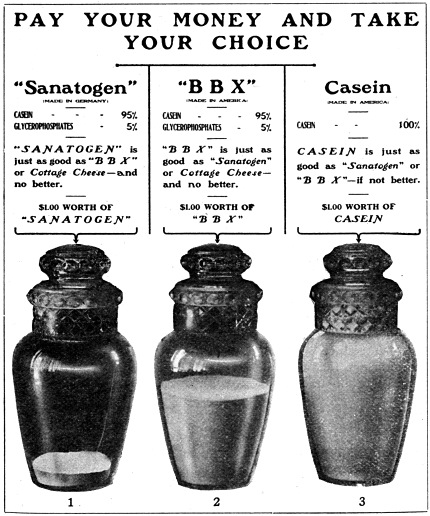
Above is a photographic reproduction of one of the exhibits made at Atlantic City at the last annual meeting of the American Medical Association.
Jar 1 contains 31⁄3 ounces of the casein-glycerophosphate combination made abroad and sold under the name “Sanatogen;” it costs One Dollar.
Jar 2 contains 2 pounds 131⁄2 ounces of a casein-glycerophosphate combination made by an American casein company; it costs One Dollar. For the same money, then, one gets nearly 15 times as much of this casein-glycerophosphate combination made in America as when the casein-glycerophosphate combination is sold under the name “Sanatogen” and manufactured abroad.
Jar 3 contains one dollar’s worth of pure casein. The casein entirely fills the jar, although the weight of the material is the same as the weight of the casein-glycerophosphate combination in Jar 2. Pure casein is more bulky than the casein-glycerophosphate combination.
Again we would emphasize that the chief objection to Sanatogen is not its high price, but the fraudulent claims under which it is sold.
The following selections perhaps fairly represent the value to science of the clinical evidence offered. Describing a case of vomiting from cerebral concussion:
“I ordered an ice-bag to the head, a mustard leaf to the epigastrium, absolute recumbency in bed and small feeds of Sanatogen with water. This diet was continued for three days, but the vomiting ceased the second day.”
And here a case of “hungry tired nerves”:
“I have just had a recovery in a remarkable case which scores a victory for Sanatogen. The patient, a man 63, had been treated for some years past for heart trouble. When he came to me, however, I diagnosed his trouble as ‘hungry tired nerves.’ I put him on Sanatogen and eupeptics. In a month he was much improved.”
In a serious case of the “American disease”:
“I tried Sanatogen on a woman suffering from extreme neurasthenia and debility. For the past six weeks I have had, and still have, her under rest-cure treatment, during which time I have given her Sanatogen. I have been very much elated with the treatment.”
Anemia in a girl of 23 working in a bookbindery:
“I promptly decided to use Sanatogen. In addition, I was able to secure the girl’s absence from work so that she had the advantage of outdoor life and sunshine. Improvement was rapid.... Both a priori and from results obtained it seems almost justifiable to speak of Sanatogen as a specific in ordinary uncomplicated anemia.”
Note that in all these cases two or more remedial factors were introduced, yet any favorable result is promptly ascribed to only one factor, Sanatogen! And the factor of spontaneous improvement irrespective of all remedial measures is also ignored.
A “SCIENTIFIC” TESTIMONIAL
Every physician knows that the kind of evidence just quoted has the same scientific value as that of the average “patent medicine” testimonial—none whatever. The exploiters of Sanatogen put forward some testimony, however, that purports to have a certain authority. This is a statement to the effect that “Sanatogen acts as a strong stimulus as far as the recuperative powers of the blood are concerned.”
This claim is based on biologic experiments carried out by two physicians, Drs. G. Mann and J. G. Gage, the record of whose work was published in the Lancet, Oct. 19, 1912. The article of Mann and Gage was gone over with some care and the experiments there described did not seem to justify the conclusions reached by the authors. As it had been published in the Lancet, a medical journal of standing, whose publishers apparently thought it of sufficient importance to warrant the expense of a colored plate insert, it seemed worth while to have the work of Mann and Gage reviewed and its conclusions checked by parallel experiments. A. J. Carlson, professor of physiology at the University of Chicago, was asked to do this work and kindly undertook it. His report follows:
Report of Professor Carlson
I am asked to review the work done by Drs. G. Mann and J. G. Gage, from which they draw the following conclusions:
“Sanatogen [sodium caseinogenate glycerophosphates] further stimulates blood cells to undergo nuclear division, which during the early period is mostly amitotic.... Therefore, it is evident that Sanatogen acts as a strong stimulus as far as the recuperative powers of the blood are concerned.”
Three series of experiments were made and reported by Drs. Mann and Gage, comparing the histology of the blood in starvation and during the height of digestion. The experiments of the first series were made on six students, the starvation period being thirty-six hours, ordinary food being taken after the thirty-six hours’ fast, so far as can be gathered from Dr. Mann’s report. It was found that during the height of digestion the nuclei of the lymphocytes and leukocytes stain more deeply, and that there is a slight decrease in the cytoplasm and consequent diminution in the size and number of the granules of the neutrophil and the eosinophil cells, in comparison with the blood during fasting.
The experiments of the second series were made on 100 frogs that had starved for months, blood-films being taken at varying periods after feeding 1 gm. Sanatogen. The changes noted in the white blood-cells of the frogs were practically identical with those described in the case of the six students. Increased cell division is stated to occur. The nuclei of the erythrocytes stain more deeply and the cells are increased in size, and exhibit increased cell division twenty-four hours after the feeding.
The third series consisted of one experiment on Dr. Mann himself. He fasted twenty hours and then took 15 gm. of Sanatogen in a cup of water. Practically the only change noted in the blood after the feeding was a deeper staining of the nuclei of the white cells. To quote:
“The changes in the granules of the polymorphonuclear leukocytes and in the eosinophils were much less marked than in the specimens supplied by the students, and the diminution in the size of the white cells was so insignificant as to be hardly noticeable.”
Assuming that the blood-changes reported are correct, is the conclusion warranted that Sanatogen is a powerful recuperative stimulant to the blood?
In the first place, it remains to be proved, for there is as yet positively no evidence, that the deeper staining of the nuclei during digestion and absorption of a protein meal represents “recuperative power of the blood” or processes of “feeding” on the part of the white cells. The actual significance of these changes requires further investigation. The increased division of the blood-cells described by Dr. Mann in the frogs was not observed by him in man. This phenomenon in the frogs is, in all probability, associated with the extraordinary length of the starvation period (months) and the well-known seasonal variations in the physiology of this species.
In the second place, waiving for the moment the question of the significance of the blood-changes observed, the evidence, so far as it goes, points to the conclusion that the greater affinity of the nuclei of the white cells for the stain is brought about by the feeding of any protein food. The experiments do not demonstrate any different or more marked effect from Sanatogen than from other protein foods.
The test on the six students with ordinary food can be considered as a control on the single Sanatogen test on Dr. Mann himself. The blood-changes in the students were more marked than in Dr. Mann.
Although Mann and Gage say that six frogs were used as controls, they do not say how the controls were treated, or draw any comparisons between the controls and the frogs fed with Sanatogen. So far as the report goes, therefore, the only basis for comparison is afforded by the work of one of Dr. Mann’s pupils, H. G. Butterfield. This worker, as quoted by Mann, found that on feeding newts after two weeks’ starvation with a worm the size of a wooden match, the nuclei of all tissues (excepting nerve cells) take a much deeper stain than in the control animals. To pronounce Sanatogen, on the basis of the facts reported, a “powerful stimulus” to blood-formation is a piece of special pleading, if not of downright disingenuousness. Considered on its own merits, the work would not have appeared to me worthy of being repeated for the purpose of checking up such obviously unwarranted conclusions. In order to comply with the request made of me, however, I have repeated Dr. Mann’s experiments:
EXPERIMENTS BY PROFESSOR CARLSON
I. TESTS ON MAN (A. J. C.)
1. Thirty-six hours’ fast followed by a meal of 25 gm. Sanatogen in water.
2. Thirty-six hours’ fast followed by a meal of 25 gm. casein in water.
3. Thirty-six hours’ fast followed by a meal of 200 c.c. of milk.
II. TESTS ON RATS
1. Four animals, seventy-two hours’ fast followed by a meal of Sanatogen in water.
2. Two animals, seventy-two hours’ fast followed by a meal of crackers and milk.
3. Two animals, seventy-two hours’ fast followed by a meal of casein in water.
4. Two animals, seventy-two hours’ fast followed by a meal of casein and sodium glycerophosphate in water.
Blood-films were taken at intervals during the fasting period and for twenty-four hours after feeding was resumed. The technic of fixing and staining given by Drs. Mann and Gage was followed in every detail in order to make my results comparable with their findings.
RESULTS
My results may be summarized as follows:
1. The only change in the blood-cells that could be detected with certainty in rats or in man, after feeding with Sanatogen or after feeding with other foods, was a deeper staining of the nuclei of the white cells in the films taken after feeding as compared with the films taken during fasting. This difference is generally distinct, and unmistakable, although individual cells can always be found in the fasting and the feeding preparations that show no difference in affinity for the dyes. To this extent my results confirm those of Mann and Gage. I was not able, however, to make out any constant difference in the size of the cells, quantity of cytoplasm, or size and number of cytoplasmic granules similar to those reported by Mann and Gage.
2. There was no difference in the affinity for stains on the part of the white blood-cells in films taken after feeding Sanatogen and those taken after feeding milk, crackers, casein, and casein and sodium glycerophosphate. This is true for the tests both on man and on rats.
3. The above-mentioned difference in the staining of the cell nuclei was somewhat more marked in the tests on rats than in the tests on man, probably owing to the longer starvation period in the case of rats.
It has already been stated that the significance of this increased affinity for dyes in the nuclei of the white blood-cells must be determined by further investigation. It may be related to the change in the titration alkalinity of the blood rather than an evidence of “recuperative power” on the part of the blood, as it is well known that starvation induces acidosis, while during digestion the alkalinity of the blood is distinctly increased. If we assume that increased staining reaction during digestion indicates “increased recuperative power of the blood” it follows that such common and inexpensive foods as milk, crackers and casein are just as “powerful stimuli” to this recuperation as Sanatogen.
The extensive researches of Mendel and Osborne have shown that casein is in a certain sense a perfect food in that it is, in normal animals, capable of promoting growth and maintaining nitrogenous equilibrium, at least for long periods of time. The burden of proof, however, rests with the promoters of Sanatogen to show that the casein in Sanatogen is superior to the natural product of the cow.
Conclusion
From the findings in Professor Carlson’s report on this disguised puff of a mendaciously exploited proprietary, about all that remains to be said is that it is humiliating to find such pseudo-science, not only built up by members of a profession trained in science, but also given currency and authority by a medical journal of high standing.—(From the Journal A. M. A., Sept. 26, 1914.)
As to Sanatogen
For several years it has been known by physiologists that all proteins taken into the stomach are disintegrated into their fundamental components, the amino-acids, and that they are not absorbed at all as proteins, except in most minute amounts under exceptional conditions. Therefore, no matter what protein is taken as food, the material obtained from this protein by the body is a group of amino-acids, always pretty much the same except in relative proportions, whatever the food. A few proteins lack certain essential amino-acids, but any ordinary diet supplies enough, and more than enough, of each and every amino-acid. Furthermore, since the proteins are completely disintegrated before absorption, it follows that any adventitious chemical substance that is bound to a protein taken in the food does not enter the blood and circulate in the body in the same protein compound.
All the facts stated above are elementary, and should be known by any and every physician who pretends to keep even approximately abreast of the science of medicine. If there are any who do not know these fundamentals, and from certain unwelcome evidence we fear there are, they must be resigned to being told just where they stand. Certainly they have no good excuse for their lack of information, for the physiologists and biochemists have informed them of modern advances in innumerable ways. For ten years and more these facts have been discussed and demonstrated in societies and in medical publications. And yet—there is Sanatogen, prescribed by Geheimrats, Hofrats and also by doctors, and testimonialed as abundantly by men with medical degrees as Duffy’s whisky is by centenarians. One can merely throw up his hands. If, as the exploiters of Sanatogen declare, the product “has been endorsed by von Noorden, Ewald, Duhrssen, Eulenburg, Neiser, Binswanger, Leyden, Krafft-Ebing, Tillmanns, Tunnicliffe and thousands of other earnest, reputable physicians,” we can only say that their earnestness has not been in the direction of grasping fundamental advances in medical sciences, however great the reputation they have gained may be.
The article by John Phillips Street that follows is another report of exact experimental observation which shows, as was obvious beforehand, that Sanatogen has the properties of its constituents, namely, casein and glycerophosphates. Nothing more nor nothing less could be the case. Bottling dried cottage cheese plus some glycerophosphates, and raising the price many times, may increase its psychic effect, but it will not alter its physiologic action. These facts we have presented often enough, but the amount of paid advertising the proprietors of this compound find it profitable to carry in the United States makes us feel obliged to give them this bit free. That laymen may be persuaded to purchase Sanatogen in the belief that it possesses some occult powers not to be found in its constituents is not surprising. By blatant and persistent advertising, the public can be fooled into buying any product—however valueless—for which medicinal claims are made. But that physicians should prove equally gullible is a sorry commentary on the scientific attainments of the followers of a learned profession.—(Modified from Editorial in The Journal A. M. A., Nov. 21, 1914.)
THE FEEDING VALUE OF SANATOGEN COMPARED WITH COMMERCIAL CASEIN WITH RESPECT TO MAINTENANCE AND GROWTH
John Phillips Street, M.S.
Chemist Connecticut Agricultural Experiment Station
NEW HAVEN, CONN.
The proprietary preparation “Sanatogen” is claimed to consist of about 95 per cent. casein and 5 per cent. sodium glycerophosphate. The analysis of C. B. Morison122 is as follows:
Water9.97
Total nitrogen12.81
Nitrogen, ppt. by acetic acid12.54
Casein80.01
Ether extract0.11
Ash5.59
Sulphur, total0.73
Sulphur in casein0.64
Phosphorus, total1.49
Phosphorus in casein0.69
Phosphorus in inorganic form0.11
In connection with the above analysis it was demonstrated that sodium glycerophosphate was present. Sanatogen, therefore, consists essentially, on the water-free basis, of about 90 per cent. casein and 5 per cent. sodium glycerophosphate, with a small amount of an unidentified nitrogenous compound containing both sulphur and phosphorus, and a small amount of phosphorus in organic combination. The manufacturers claim that the two essential ingredients exist in Sanatogen as a definite chemical compound. Certain authorities, on the other hand, have insisted that the casein and glycerophosphate have not been chemically combined and that Sanatogen is simply a mechanical mixture of the two. Which claim is correct we will not consider here, for indeed it is of little importance, for whether or not chemically combined the action of the digestive fluids of the body would speedily break down the alleged compound into its constituents, and the body would have casein and the glycerophosphate offered for its use, just the same as though they had been offered as a mere mechanical mixture.
It being apparent that Sanatogen consists almost entirely of casein and sodium glycerophosphate, the former well-known ingredient making up nine-tenths of its weight, the question naturally arises how a mixture of these two common substances can acquire, simply by that admixture, unusually valuable properties not possessed by the two components. Leading physiologists quite generally agree that phosphorus in the form of glycerophosphates influences metabolism very little. Furthermore, it is obvious that the food value of the small amount of glycerin present must be slight. It is apparent therefore, that whatever nutriment or energy Sanatogen supplies must be dependent on its main constituent casein.
Sanatogen is commonly sold at retail in 100 gm. or 200 gm. packages for $1 and $1.90, respectively. It is possible that in larger quantities these prices might be shaded somewhat, but the fact remains that the ordinary retail purchaser of Sanatogen pays for it about 1 cent per gram, or about $4.50 per pound. If the value of Sanatogen depends on its casein, one might ask, in all fairness, why should the patient pay $4.50 per pound for Sanatogen when he can secure ordinary commercial casein for 8.5 to 10 cents per pound! (The Casein Mfg. Co. of New York quoted to me their No. 60 casein at 10 cents per pound in 5-pound lots, 8.5 cents per pound f. o. b. Bainbridge, N. Y., in 100-pound lots, and 8.5 cents per pound, freight paid, in 500-pound lots.) I have purchased Sanatogen from a wholesale druggist at the rate of $2.75 for 400 gm., or $3.12 per pound, so that under the most favorable conditions the cost of Sanatogen is more than thirty times as great as the commercial casein in question.
Is the consumer justified in paying this exceedingly high price for purified casein? The following feeding experiments were carried out to answer this query.
FEEDING EXPERIMENTS
White rats were chosen for the experimental animals because of their adaptability for tests of this kind, as shown by the extended successful experience of Osborne and Mendel, and also because, by using white rats, I could take advantage of the equipment and the experience of my colleagues, Dr. T. B. Osborne, Prof. L. B. Mendel and Miss Edna L. Ferry.
The value of Sanatogen as compared with commercial casein was studied from two points of view:
1. Its value in maintaining the weight of mature rats.
2. Its value in promoting the growth of young rats.
I. THE MAINTENANCE OF WEIGHT OF MATURE RATS
The Sanatogen used contained 12.88 per cent. of nitrogen, and the casein, 12.82 per cent., so that from the point of view of nitrogen content they were practically equivalent, gram for gram.
Six healthy male animals were selected, Rats 1, 2 and 3 being fed the casein ration and Rats 4, 5 and 6 the Sanatogen ration. At the beginning of the experiment the casein rats were 257, 360 and 376 days old; the Sanatogen rats, 249, 321 and 275 days old, respectively. These weight conditions, if anything, slightly favored the Sanatogen rats, as they were slightly less mature, and a greater growth might naturally be expected.
The rations fed had the following percentage composition:
Ration 1 Ration 2
Casein20 Sanatogen20
Protein-free milk*28 Protein-free milk*28
Lard8 Lard14
Unsalted butter18 Unsalted butter18
Corn starch26 Corn starch20
* Osborne and Mendel: Feeding Experiments with Isolated Food Substances, Carnegie Inst. of Washington, Publ. 156, 1911, Part 2, p. 80.
The rats were weighed twice a week for nine weeks, a record of the food consumed also being kept. Table 1 shows the weekly weights of the casein rats, the weekly gain or loss, and the weekly consumption of food. Table 2 gives similar data for the Sanatogen rats.
TABLE 1.—WEIGHTS OF CASEIN RATS, ON RATION NO. 1, OVER A PERIOD OF NINE WEEKS*
DateRat 1Rat 2Rat 3
Weight, gm.Gain or Loss, gm.Food Eaten, gm.Weight, gm.Gain or Loss, gm.Food Eaten, gm.Weight, gm.Gain or Loss, gm.Food Eaten, gm.
1/2240.0..........264.6..........314.1..........
1/9250.8+10.873.7270.9+ 6.385.2314.6+ 0.595.7
1/16264.3+13.589.3284.9+14.099.2308.7- 5.9117.9
1/23274.9+10.690.7293.5+ 8.6107.7313.8+ 5.1116.5
1/30278.6+ 3.780.2304.5+11.0100.5322.2+ 8.4116.7
2/6278.3- 0.382.4294.2-10.397.0311.2-11.0119.9
2/13288.7+10.485.5281.5-12.794.2308.2- 3.0125.6
2/20286.4- 2.386.1293.3+11.886.8309.0+ 0.8126.8
2/27287.6+ 1.281.1297.6+ 4.3100.7303.4- 5.6129.3
3/6292.6+ 5.080.1307.4+ 9.8103.1292.4-11.0101.0
Total.....+52.6759.1.....+42.8874.4.....-21.71,049.4
Average per week.....+ 5.884.3.....+4.897.2.....-2.4116.6
* The growth curves of Rats 1, 2 and 3 are given in Chart 1.
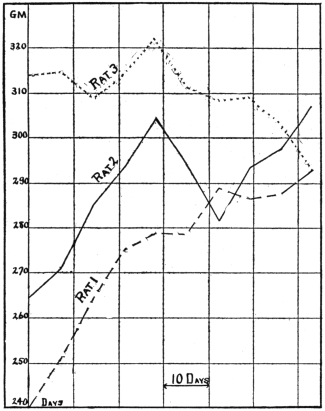
Chart 1.—Growth curves of Rats 1, 2 and 3, on Ration 1: Casein.
TABLE 2.—WEIGHTS OF SANATOGEN RATS, RATION NO. 2, OVER A PERIOD OF NINE WEEKS*
DateRat 4Rat 5Rat 3
Weight, gm.Gain or Loss, gm.Food Eaten, gm.Weight, gm.Gain or Loss, gm.Food Eaten, gm.Weight, gm.Gain or Loss, gm.Food Eaten, gm.
1/2251.8..........290.6..........294.0..........
1/9257.1+ 5.373.4297.2+ 6.686.3289.1- 4.958.4
1/16262.4+ 5.389.8292.4- 4.888.9286.1- 3.076.8
1/23274.4+12.097.3295.7+ 3.392.8287.6+ 1.585.8
1/30282.7+ 8.395.5299.5+ 3.892.3298.6+11.090.9
2/6279.8- 2.997.7284.2-15.387.7292.9- 5.789.8
2/13271.2- 8.696.1280.0- 4.294.9295.1+ 2.299.7
2/20257.5-13.791.6274.9- 5.196.4296.0+ 0.993.9
2/27258.0+ 0.593.5273.0- 1.9103.3295.0- 1.095.1
3/6270.9+12.994.8278.1+ 5.194.9306.3+11.389.4
Total.....+19.1829.7.....-12.5837.5..... +12.3779.8
Average per week .....+ 2.792.2.....- 1.493.1.....+ 1.486.6
* The growth curves of Rats 4, 5 and 6 are given in Chart 2.
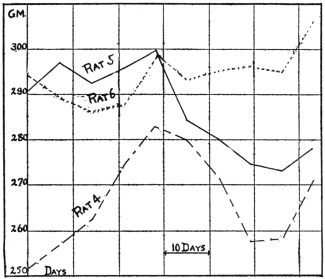
Chart 2.—Growth curves of Rats 4, 5 and 6, on Ration 2: Sanatogen.
Certainly the above data show no superiority of Sanatogen over commercial casein. In fact the results might be taken to suggest a slight advantage for the cheaper article, if one were warranted in drawing fine distinctions from a limited number of animals.
To conclude, a comparative feeding of six male white rats during nine weeks showed no nutritive superiority of Sanatogen, costing $3.12 per pound, over commercial casein costing 10 cents per pound.
II. THE PROMOTION OF GROWTH IN YOUNG RATS
In the second series of experiments ten male rats were used with four different rations. In these, casein and Sanatogen were compared, using both Osborne and Mendel’s “protein-free milk” and their “artificial protein-free milk IV.”123 Butter fat was also substituted for the unsalted butter used in Rations 1 and 2.
The percentage composition of the rations fed was as follows:
Ration 3 Ration 5
Casein20 Casein20
Protein-free milk28 Artificial p.-f. milk IV29
Lard8 Lard8
Butter-fat18 Butter-fat18
Corn starch26 Corn starch25
Ration 4 Ration 6
Sanatogen20 Sanatogen20
Protein-free milk28 Artificial p.-f. milk IV29
Lard14 Lard14
Butter-fat18 Butter-fat18
Corn starch20 Corn starch19
Two male rats were used with each of Rations 3 and 4, and three with each of Rations 5 and 6. They were all healthy young rats ranging from 57 to 71 days old. As in the first series of experiments the rats were weighed twice a week and a record kept of the food consumed. Rations 3 and 4 were fed for seventy-seven days, Rations 5 and 6 for thirty-five days.
Table 3 shows the weekly weights and gains or losses of the rats fed Rations 3 and 4.
Rat 8 suffered more or less from diarrhea during a considerable part of the experiment, covering a period from March 16 to April 9, and from April 13 to May 11. The food intake correspondingly decreased during those periods.
TABLE 3.—COMPARATIVE WEIGHTS OF RATS FED RATIONS 3 AND 4
DateWeights of Rats, Ration 3, Casein, Protein-Free MilkWeights of Rats, Ration 4, Sanatogen, Protein-Free Milk
Rat 7Rat 8Rat 9Rat 10
Weight, gm.Gain or Loss, gm.Weight, gm.Gain or Loss, gm.Weight, gm.Gain or Loss, gm.Weight, gm.Gain or Loss, gm.
3/9142.2.....108.0.....127.8.....107.0.....
3/16152.8+10.6120.3+12.3129.1+1.3116.0+9.0
3/23165.7+12.9135.1+14.8144.6+15.5134.5+18.5
3/30178.6+12.9140.4+5.3160.0+15.4149.8+15.3
4/6187.8+9.2148.8+8.4173.1+13.1143.8-6.0
4/13198.5+10.7157.6+8.8185.6+12.5166.1+22.3
4/20204.6+6.1164.6+7.0194.8+9.2179.4+13.3
4/27210.3+5.7167.2+2.6204.6+9.8191.0+11.6
5/4223.0+12.7179.6+12.4222.9+18.3204.7+13.7
5/11223.6+0.6191.6+12.0236.4+13.5210.8+6.1
5/18231.5+7.9203.6+12.0240.0+3.6218.6+7.8
5/25237.4+5.9213.9+10.3247.3+7.3226.7+8.1
Total.....+95.2.....+105.9.....+119.5.....+119.7
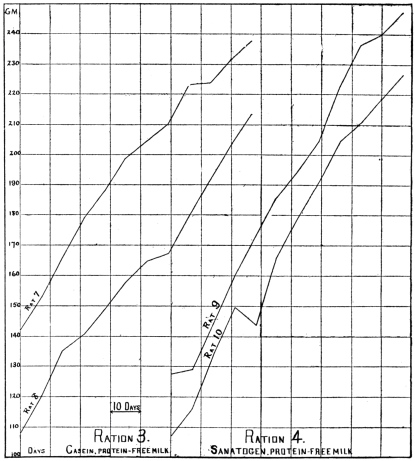
Chart 3.—Growth curves of Rats 7, 8, 9 and 10 on Rations 3, Casein, protein-free milk, and 4, Sanatogen, protein-free milk.
The difference in the gains in weight shown by the four rats are not great and certainly do not warrant the conclusion that Sanatogen possesses any marked superiority over the commercial casein in promoting growth. The slightly increased gains shown by Rats 9 and 10 are entirely incommensurate with the cost of the Sanatogen. All of the rats showed a vigorous growth and exceeded the average weight expected for rats of their respective ages, based on the long series of observations of Osborne and Mendel, as shown in Table 4.