PART III CONTRIBUTIONS FROM THE JOURNAL: NOSTRUMS (continued 4)
Reading edition
TABLE 4.—WEIGHT OF RATS 7 TO 10 COMPARED WITH AVERAGE WEIGHT OF RAT OF SAME AGE
RatAge in DaysFinal weight, gm.Average Weight for rat of Same Age, gm.
7148237204
8138214201
9145247204
10134227197
The results secured by Rations 5 and 6 compared with Rations 3 and 4, the only difference being that natural protein-free milk was used in the latter and artificial protein-free milk in the former, are most striking. Such results were anticipated from the experience of Osborne and Mendel in feeding similar materials. All of my rats, except Rat 13, a casein rat, showed a decided loss in weight after five weeks’ feeding on rations containing artificial protein-free milk. These losses amounted to 19.7, 9.0, 23.1, 6.7 and 27.6 gm., whereas rats fed on the same rations, except for the form of protein-free milk, gained, during the same period of five weeks, 56.3, 49.6, 57.8 and 59.1 gm. The fact that one casein rat fed on the artificial protein-free milk showed a substantial gain is without significance, as such exceptions to the general rule occur occasionally, and, furthermore, this rat also during the last week of the experiment likewise lost weight. The extent of these losses compared with what the average normal male rat weighs at a corresponding age is shown in Table 7.
TABLE 5.—WEIGHTS OF RATS FED RATION 5, CASEIN, ARTIFICIAL PROTEIN-FREE MILK*
DateRat 11Rat 12Rat 13
Weight, gm.Gain or Loss, gm.Weight, gm.Gain or Loss, gm.Weight, gm.Gain or Loss, gm.
3/9132.1.....110.0.....99.0.....
3/16130.4-1.7116.8+6.8110.3+11.3
3/23136.8+6.4130.8+14.0108.6-1.7
3/30137.1+0.3138.0+7.2100.2-8.4
4/6127.1-10.0143.9+5.995.5-4.7
4/13112.4-14.7143.6-0.390.0-5.5
Total.....-19.7.....+33.6.....-9.0
4/20146.7+33.7170.7+27.1104.0+14.0
* Date 4/20 covers use of mixed food.
Rat 13 suffered more or less from diarrhea throughout the whole experiment, and Rat 16 suffered similarly during the first two weeks.
TABLE 6.—WEIGHTS OF RATS FED RATION 6.—SANATOGEN, ARTIFICIAL PROTEIN-FREE MILK*
DateRat 14Rat 15Rat 16
Weight, gm.Gain or Loss, gm.Weight, gm.Gain or Loss, gm.Weight, gm.Gain or Loss, gm.
3/9118.4.....111.3.....101.3.....
3/16126.2+7.8116.2+4.9100.0-1.3
3/23126.6+0.4123.4+7.2 98.0-2.0
3/30124.7-1.9123.3-0.1 98.7+0.7
4/6110.2-14.5112.3-11.0 88.7-10.0
4/13 95.3-14.9104.6-7.7 73.7-15.0
Total.....-23.1.....-6.7.....-27.6
4/20130.3+35.0135.3+30.7106.4+32.7
* Date 4/20 covers use of mixed food.
Chart 4.—Growth curves of Rats 11, 12 and 13, on Ration 5: Casein, artificial protein-free milk. Chart 5.—Growth curves of Rats 14, 15 and 16, on Ration 6: Sanatogen, artificial protein-free milk.
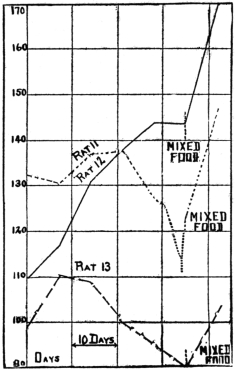
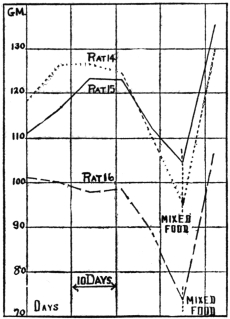
TABLE 7.—WEIGHT OF RATS 11 TO 16 COMPARED WITH AVERAGE WEIGHT OF RAT OF SAME AGE
RatAge, DaysFinal Weight, gm.Average Weight of Rat of Same Age, gm.
11106112167
12106144167
13 99 90162
14106 95167
15 92105153
16 96 74158
That these losses in weight were not due to any inherent weakness in the rats is shown by the fact that by feeding Rats 11 to 16 for one week after the termination of the experiment with Osborne and Mendel’s “mixed food” (a mixture of dog bread, sunflower seeds, vegetables and meat) very large gains were secured in every instance, ranging from 14 to 35 gm.
The growth curves for Rats 7 to 16 are shown in Charts 3, 4 and 5.
To conclude, a comparative feeding of four male white rats during eleven weeks, showed, if anything, a slightly greater, but insignificant, increase in weight for Sanatogen over commercial casein. In a ration in which artificial had been substituted for natural protein-free milk, Sanatogen showed no advantage over commercial casein in checking the failure in weight of the rats.—(From The Journal A. M. A., Nov. 21, 1914.)
POEHL’S SPERMIN IN ARTERIOSCLEROSIS
A physician addressed the following inquiry to The Journal:
“In a recent number of the Gazette méd. belge, I read a detailed report of five cases of arteriosclerosis in which the patients were all markedly improved and some of them apparently cured by a course of ‘Sperminum Poehl,’ an advertised remedy which I have always distrusted and never prescribed. I am now suffering myself from a somewhat advanced case of arteriosclerosis and would like to try this remedy if the Council has learned anything in favor of it and if there is no reason to fear bad effects from it.”
X. Y. Z.
The Journal replied:
Apparently the exploitation of Poehl’s spermin passed several years ago from the domain of experimental medicine to that of nostrums advertised to the laity. So far as we know, it has received no recent discussion from reliable clinicians or experimenters. In some medical journals, as also in lay journals, it is true, one still reads that Poehl’s spermin is successfully applied in “neurasthenia, senile marasmus, anemia, rachitis, gout, chronic rheumatism, syphilis, hysteria, tuberculosis, typhus, diseases of the heart, nephritis, tabes dorsalis, paralysis, neurasthenic impotence, overwork, acute diseases, and for convalescents.” Few quack advertisements would differ much from this puff of Poehl’s spermin. So far as we know, there is no reason to fear injurious results from the use of the remedy; neither might any good be expected from its use in arteriosclerosis.—(From The Journal A. M. A., April 15, 1911.)
SYRUP OF COCILLANA COMPOUND
A physician in a small town in Nebraska writes: “In looking over a prescription file not long ago I found a prescription which I copied and am sending to you. It is a good example of shotgun prescribing. I do not give the name of the prescriber, and you will please not mention from whence this comes. The doctor who wrote this has had about ten years’ experience.”
Here is the prescription given exactly as transmitted by our correspondent:
Sp. stictaGtt xv
Sp. ipecacGtt x
Sp. bryoniaGtt x
Sp. macrotysƷi
Bromoform Bronchial Anodyne℥ii
Syrup Cocillana Comp. q. s. ad℥vi
Teaspoonful every two or three hours.
It is evident that the prescriber is an eclectic. As a matter of fact, in a second letter from the physician who forwarded the prescription, we are informed that the prescriber is a graduate of an eclectic institution not a thousand miles from where he practices. The “Sp.” in the prescription does not mean “Spiritus,” but specific tincture. The prescriber is an advocate of specific remedies, one of which should fit the condition, but he is broad-minded enough to call help from the outside, and so adds fifteen other remedies to the specific selected, including alcohol. The inability of one mind to remember all the ingredients of so complex a mixture will explain the fact that ipecac is duplicated, occurring both as a specific tincture and as an ingredient of Bromoform Bronchial Anodyne. The latter, the manufacturers tell us, contains in one fluidounce:
Alcohol5per cent.
Bromoform8drops
Ipecac1⁄2gr.
Ammonium bromid24grs.
Benzoin1gr.
Syrup Cocillana Comp., one of the “elegant specialties” of Parke Davis & Co., of which they certainly ought to be very proud, contains, we are told, in one fluidounce:
Alcohol5per cent.
Heroin hydrochlorid8⁄24gr.
Tinct. of euphorbia pilulifera120min.
Syrup of wild lettuce120min.
Tinct. of cocillana40min.
Syrup of squill comp.24min.
Cascarin, P. D. & Co.8grs.
Menthol8⁄100gr.
This “elegant specialty” of Parke, Davis & Co. is not only a shotgun prescription, but has as one of its ingredients a mixture itself containing three ingredients, namely: Syrup Squill Comp. (Coxe’s Hive Syrup), making ten in all—a beautiful example of scientific pharmacy.
We wonder if our eclectic brother really appreciated that his prescription, written out, would be as follows:
Sp. stictaGttxv
Sp. ipecacGttx
Sp. bryoniaGttx
Sp. macrotysƷi
Alcohol5per cent.
Bromoform8drops
Ipecac1⁄2gr.
Ammonium bromid24grs.
Benzoin1gr.
Alcohol5per cent.
Heroin hydrochlorid8⁄24gr.
Tinct. of euphorbia pilulifera120min.
Syrup of wild lettuce120min.
Tinct. of cocillana40min.
Fluidextract of squill60min.
Fluidextract of senega60min.
Antimony and potassium tartate1gr.
Cascarin, P. D. & Co.8grs.
Menthol8⁄100gr.
To use a slang expression, this is certainly going some!—(From The Journal A. M. A., March 18, 1911.)
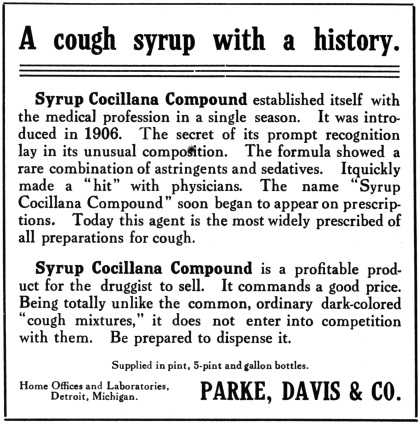
“A Cough Syrup with a History”
The following letter was received from Dr. Geo. P. Tolman, Watsonville, Cal.:
To the Editor:—The enclosed advertisement was underscored and mailed to me by my druggist. The properties of cocillana are similar to ipecac. The dose of the fluidextract is from 10 to 20 minims. Each fluidounce of the extraordinary (!) dark-colored cough marvel of P. D. & Co. contains 40 minims of the tincture. If the tincture of cocillana is 10 per cent. (the average tincture strength) you can see that to get a minimal dose of the drug you would have to take 21⁄2 fluidounces of the syrup.
“Query: Can we still hang on to the old-fashioned cough mixtures freshly compounded by our druggists or shall we put our shoulders to the wheel and help P. D. & Co. save the nation and make a few dollars for the druggist?”
“The secret of its prompt recognition lay in its unusual composition.” Nay; its prompt recognition lay in liberal and persistent advertising. “It quickly made a ‘hit’ with physicians”—because too many physicians, like other human beings, are susceptible to the psychology of advertising. Here is the “unusual composition,” as given by the manufacturers:
“Tinct. Euphorbia pilulifera, 120 mins.; Syrup Wild Lettuce, 120 mins.; Tinct. Cocillana, 40 mins.; Syrup Squill Compound, 24 mins.; Cascarin (P. D. & Co.), 8 grs.; Heroin hydrochloride, 8-24 gr.; Menthol, 8-100 gr.”
The following is a reproduction of the advertisement referred to:
As we have said above, Parke, Davis & Co. should be proud of this “elegant specialty.” It would be hard to find a better specimen of a shotgun prescription; not only does the prescription contain eight ingredients, but one of these ingredients (compound syrup of squill) itself contains three.
As our correspondent correctly states, the drug from which the name (not the action) of the preparation is derived comes from Bolivia and has properties similar—but evidently inferior—to ipecac. That it possesses but little therapeutic value is perhaps best evidenced by the fact that, in spite of the propaganda made for it by Parke, Davis & Co., neither the drug nor any preparation of it is listed, so far as we know, by any other large pharmaceutical house, with one exception. Besides cocillana the preparation contains two other obsolete drugs, wild lettuce and euphorbia pilulifera. The activity of the “cough syrup,” it is needless to say, depends in the main on the drug which is more or less buried in the published formula: heroin hydrochlorid. At one time Parke, Davis & Co. admitted that the preparation owed its chief value to heroin. In a letter to the Council on Pharmacy and Chemistry the firm said:
“The physiologic action of this syrup is that which would be suggested by the constituents. Because of its activity the most prominent action would be that characteristic of heroin hydrochlorid.”
Without doubt the important ingredient, from the point of view of therapeutic potency, is the heroin; and it is this drug doubtless, that makes the mixture a good “repeater.” Syrup Cocillana Compound is a nostrum sailing under false colors. Whether its continued use is due to its mysterious, meaningless, misleading name or merely to insistent and persistent advertising methods of Parke, Davis & Co. is a question. Neither explanation is any credit to the medical profession which tolerates it, or to the physician who prescribes it.—(From The Journal A. M. A., Feb. 15, 1913.)
AUBERGIER’S SYRUP OF LACTUCARIUM
That clause in the Federal Food and Drugs Act which requires certain potent drugs to be declared on the label of the proprietary mixtures containing them has been responsible for clearing up many mysteries. Physicians have frequently wondered why they were unable to obtain from the syrup of lactucarium, U. S. P., the therapeutic results which they were able to obtain from a proprietary product known as Aubergier’s Syrup of Lactucarium, sold by Fougera & Co. at an exorbitant price and put up in “patent-medicine” style. The milk-juice of lettuce once bore the reputation of being a soporific—a reputation that has been artificially maintained largely through the effects of the Aubergier preparation. With the advent of the Food and Drugs Act the secret of the soporific effect of the Aubergier product was explained—it contains morphin.124
The practical difficulties of making a satisfactory syrup of lactucarium are not realized by most physicians. To such the following note, presented at a meeting of the Pennsylvania Pharmaceutical Association by Mr. Louis Emanuel, president of the Pennsylvania Pharmacy Board, will prove enlightening:
“Did you ever make a syrup of lactucarium direct from the crude drug? If you did, shake hands, and let me hail you as a brother, a brother pharmacist in fact worthy of the title. If you did not, I am sorry for you; you have missed something worth knowing.
“The American Journal of Pharmacy tells us that in 1851 ‘Aubergier cultivated lactuca and poppy on a larger scale, in order to obtain lactucarium and opium. Please note the latter for further reference. In lactucarium he found lactucin, mannite, resin, cerin, asparmid, brown coloring-substance and oxalic acid.’ In 1860, in the same publication, Proctor says: ‘The attention of the medical practitioners has of late been turned to the syrup of lactucarium, and the preparation sold usually by apothecaries in this city is that known as Aubergier’s, a French preparation, made by dissolving 30 parts of alcoholic extract of lactucarium in 500 parts of boiling water, straining the liquor and adding 15,000 parts of boiling simple syrup, which is kept boiling, and albuminous water added from time to time until it is clarified.’ In ’66, ’77, ’78, ’82 and ’84 various writers produced elaborate dissertations on the supposed improved methods of making this syrup, but not one has had the temerity of inquiring into the therapeutic value of this preparation, or to examine the French preparation to ascertain whence comes its vaunted superiority.
“The French, it is said, are an impressionable people, but they appear to have a limit; they do not take any chances on plain syrup of lactucarium. Theirs contains the added product, extract of opium. This implies a lack of faith in soporific properties of lactucarium, and displays a recklessness in regard to cost and labor.
“The National Dispensatory, fifth edition, says:
“The utility of retaining lactucarium as an official medicine is very doubtful. It may possibly be desirable as a hypnotic for very impressionable persons, with whom faith in a remedy supplies its want of intrinsic efficiency.”
“The official modus operandi for making this syrup looks laborious, but the innocent-looking task of reducing the drug to a coarse powder is a revelation to the uninitiated.
“It was {a} hot day in July and it took my 175-pound clerk and me all that day to reduce 50 gm. of lactucarium to a satisfactory condition. The stuff looked like old pieces of discarded rubber shoes, and it really appeared to act like rubber. After perspiring all day with the Pharmacopeia and iron mortar, imagine our disgust, if you can, on reading in the National Dispensatory the following:
“This alcoholic preparation of lactucarium is quite as valueless and more objectionable than the syrup of the same drug.”
“Moral: Why pay $6.50 a pound for material that has no medicinal value, and is so hard to manipulate as lactucarium when decrepit rubber shoes are so cheap? You can have just as much fun on a hot summer day in reducing the latter to a coarse powder with clean sand in an iron mortar as you can with the more expensive material.”
One of the advantages claimed for ready-made prescriptions over the made-to-order variety, or even over pharmacopeial preparations, is that they are more elegant in appearance and less offensive to the nostrils and palate. This is the common experience of physicians who, having prescribed some ready-made mixture, wish to change the dose of one of its constituents and write a prescription or ask their pharmacists to prepare a similar preparation. The inability of the pharmacist to prepare a preparation even approaching the original in appearance, color or taste usually leads to increased confidence in the skill of the manufacturer of the proprietary and a correspondingly decreased belief in the pharmacist’s professional attainments. But these conclusions, although natural, are based on false premises. As the proprietary did not have the composition declared on the label, a mixture based on the formula differed more or less widely from the proprietary it was expected to resemble.—(From The Journal A. M. A., Nov. 9, 1912.)
A Protest and a Reply
Three months after publishing the foregoing we received a nine-page communication from Comar & Co. of Paris, the promotors of Aubergier’s Syrup of Lactucarium, in which they took issue with some of the statements in our article. The company claimed that a possible reason for the difficulty experienced by Mr. Louis Emmanuel in trying to make the Syrup of Lactucarium from the crude drug is that he did not use the same variety of Lactucarium that it employs. Furthermore, it said that the presence of morphin in the product was acknowledged before the passage of the Food and Drugs Act. On more careful investigation, we find that this is true—that the presence of “a certain proportion of extract of opium” in the preparation was mentioned even before the federal Food and Drugs Act compelled the morphin content to be published on the label. Technically, then, The Journal was incorrect in making the implication that the medical profession was not apprised of the fact that Aubergier’s Syrup of Lactucarium contained morphin; practically it was right. The information that Comar & Co. gave to physicians was buried in its advertising “literature” so that it is fair to assume that not one physician in ten thousand knew—previous to the Food and Drugs Act—that Aubergier’s Syrup of Lactucarium contained morphin.—(From The Journal A. M. A., Nov. 9, 1912.)
TARTARLITHINE
Tartarlithine was examined by two chemists whose reports indicate that it is an effervescing preparation composed approximately of 20 per cent. of carbonate of lithium and about 80 per cent. of tartaric acid. Thus it is simply another of the hundreds of lithia preparations on the market offered for the cure of rheumatism. This in spite of the fact that scientific investigation and clinical experience have demonstrated that lithia is of very little use in the treatment of that disease. While the advertisement carries the idea that Tartarlithine is a product of the Tartarlithine Company, and that McKesson and Robbins are simply selling agents, we are informed that the business is owned by McKesson and Robbins, who under this style manufacture a remedy for rheumatism.—(Abstracted from The Journal A. M. A., April 23, 1907.)
THOXOS
Thoxos is a “specialty” of John Wyeth and Brother. From an advertising circular we learn that it “offers to the physician a rational treatment for Rheumatism, both the Subacute and Chronic forms, Lithemia, Rheumatic Arthritis, Gout, Sciatica and the various manifestations of uric diathesis,” and that “it is a palatable solution of Strontium and Lithium soluble salts, thirty-two grains, combined with twenty-four minims Wine of Colchicum Seed and a vegetable alterative, in each fluidounce, flavored with aromatics.” This “formula” does not indicate the acid with which the metals strontium and lithium are combined, or what the “vegetable alterative” is; it is essentially a secret preparation. To learn what the missing and presumably active ingredients are an analysis was made by our chemists.
LABORATORY REPORT
One original bottle of Thoxos, John Wyeth and Brother, Philadelphia, was purchased and submitted to analysis. The bottle contained a brown liquid having an aromatic odor and a sweet taste. The specific gravity of the liquid was 1.118 at 15 C. (60 F.) The solution was acid to litmus. Qualitatively the following constituents were detected: strontium, potassium, sodium, lithium, ammonium, salicylate, iodid, glycerin, alkaloid, alcohol and water. By the smell and taste, oil of wintergreen, or methyl salicylate, and oil of sassafras were recognized. Positive tests for a saponin-like body indicated the probable presence of sarsaparilla.
Quantitatively the following results were obtained:
Ammonia (NH3)0.006per cent.
Lithium (Li)0.13per cent.
Sodium (Na)0.03per cent.
Strontium (Sr.)1.03per cent.
Iodid (I)0.46per cent.
Salicylate (C6H4.OH.COO)4.19per cent.
Glycerin19.2per cent.
From the analytic results it would appear that the preparation contains approximately potassium iodid, 0.67 gm. per hundred c.c., or 3 grains per fluidounce; lithium salicylate [Li(C7H5O3)], 0.9 gm. per hundred c.c., or 4 grains per fluidounce; strontium salicylate [Sr(C7H5O3)2-2H2O], 5.75 gm. per hundred c.c., or 26 grains per fluidounce, and some salicylic acid combined with sodium and also in the free state. The total salicylate found is equal to 5.47 gm. of sodium salicylate per hundred c.c., or 25 grains per fluidounce.
As strontium salicylate and lithium salicylate are now generally considered to differ but slightly, if at all, in their action from that of sodium salicylate, each dose of Thoxos, 1 teaspoonful or 4 c.c., may be considered the equivalent of 0.2 gm. or 3 grains of sodium salicylate with a fractional dose of colchicum. Hence this nostrum—for this is the correct definition—is a mixture of no more value than a prescription of sodium salicylate with a fractional dose of potassium iodid and colchicum, one that any doctor could write and any druggist dispense. Yet it is doubtless prescribed by physicians under the belief that it possesses some occult power not to be found in ordinary drugs and their combinations. To prescribe Thoxos is to prescribe a name, and the patient who takes it would be as well off if he went to the nearest drug store and purchased a bottle of any of the thousand and one rheumatism cures with which the country is flooded.—(From The Journal A. M. A., March 21, 1914.)
TRYPSOGEN
Besides exploiting a clay poultice—“Antithermoline”—the G. W. Carnrick Company appears to be chiefly concerned in the promotion of “internal secretion” specialties; a class of preparations the therapeutic value of which is problematical. Thus it markets the diabetes remedy, “Trypsogen” tablets, said to contain “the enzyme of the islands of Langerhans with the tryptic and amylolytic ferments of the pancreas” along with gold bromid and arsenic bromid; Secretogen Elixir, said to be “prepared from gastric secretin obtained from the pyloric antrum and pancreatic secretin from the duodenum, combined with the enzymes of the peptic glands, and one-twentieth of one per cent. HCl”; Secretogen Tablets, said to be “prepared from prosecretin and succus entericus obtained from the epithelial cells of the duodenum, combined with pancreatic extract”; Kinazyme, “a preparation of extract of spleen, reinforced with trypsin, amylopsin and calcium lactate.”
While great claims have been made for Trypsogen and while it has been most widely advertised, it is the consensus of opinion of the most eminent students of the question that pancreas is not really efficacious in diabetes. Were it of any value in this disease, it would have won world-wide recognition for itself ere now, in view of the great enthusiasm with which the discovery of the relation of the pancreas to diabetes was received and of the enormous amount of clinical, as well as animal, experimentation that followed. As the conditions of experiment in this question are extremely complex, it is not surprising that occasionally apparently positive results should have been obtained. Were it really useful, it should have yielded positive results much more uniformly.
Furthermore, if pancreas were really efficacious in the treatment of diabetes mellitus, the addition of arsenic, of gold, of bromid would be entirely unnecessary.
Even were it granted that pancreas extracts are valuable in the treatment of diabetes, and that gold and arsenic also have beneficial effects, it is our opinion that Trypsogen should be considered an unscientific shotgun mixture, because fixed combinations of remedies of different potencies, such as arsenic, gold, bromid and pancreas, are therapeutically erroneous, as they do not permit of that accurate adjustment of dosage of each ingredient that is indispensable to obtain maximum benefit with minimum danger of poisoning.
Antithermoline and Trypsogen were at one time described in New and Nonofficial Remedies. These preparations were omitted when the Council’s rules were revised some years ago.
When the Council was first organized it undertook only the correction of the most serious abuses that had become a part of the proprietary medicine business, and paid less attention to the therapeutic worth of a remedy; thus at that time it admitted both Antithermoline and Trypsogen to New and Nonofficial Remedies. Since then the Council has modified its rules to exclude unscientific mixtures marketed under names that are misleading or therapeutically suggestive. Accordingly it rescinded the acceptance of Antithermoline, which was essentially the official clay poultice, Cataplasma Kaolini, U. S. P. For similar reasons and because the therapeutic claims were held unwarranted Trypsogen has been omitted from New and Nonofficial Remedies.
It is to be regretted that the progress of research should be hindered and the value of genuine products of internal secretion be depreciated by confusion with such shotgun mixtures and asserted remedies, whose claims have received no scientific confirmation.—(From The Journal A. M. A., Nov. 1, 1913.)
TYREE’S ANTISEPTIC POWDER[AQ]
Now Advertised Direct to the Public as the “Best Preventative Known”
When the history of the “patent medicine” business comes to be written impartially and fairly, it will be realized that we, the medical profession, have been in no small degree responsible for its growth. Not a few widely advertised nostrums owe their commercial success solely to the ill considered use accorded them by physicians, to whom they were first exploited. As a well-known and brilliant advertising man once said:
“The patent medicine of the future is one that will be advertised only to doctors. Some of the most profitable remedies of the present time are of this class. They are called proprietary remedies. The general public never hears of them through the daily press. All their publicity is secured through the medical press, by means of the manufacturer’s literature, sometimes gotten out in the shape of a medical journal, and through samples to doctors.... The medical papers will reap the harvest and the physician himself, always so loud in the denunciation of ‘patent medicines,’ will be the most important medium of advertising at the command of the proprietary manufacturer. In fact, he is that to-day.”
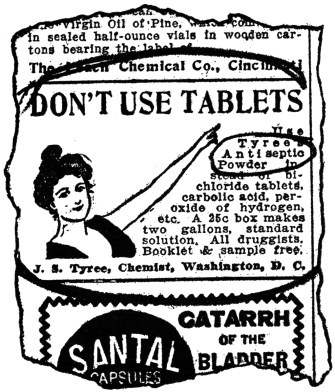
Advertisement from a newspaper—Tyree’s Powder as a “Patent Medicine” of the “Preventive” Type.
Of the conditions here described probably no better example can be found than Tyree’s Antiseptic Powder. For years this preparation was advertised to the medical profession under claims that were fraudulent as to both composition and therapeutic effect. Analysis published in The Journal125 proved that the formula given out by Tyree was absolutely false and that the preparation was, essentially, nothing but a simple mixture of sulphate of zinc and boric acid.
From the first it would seem that the manufacturers of this mixture had for their objective point that period when, thanks to the use of the nostrum by physicians, it would be widely purchased by the public. Lavish advertising was done in medical journals and Tyree’s Antiseptic Powder gained admission to the pages of even those journals which required the publication of a “formula”—for a formula was forthcoming. The Journal itself, until seven years ago, carried the advertisements with a “formula” until chemical examination proved the falsity of the formula, and of the therapeutic claims made for the product. The medical profession in its turn prescribed the nostrum and the “original package” scheme did the rest.
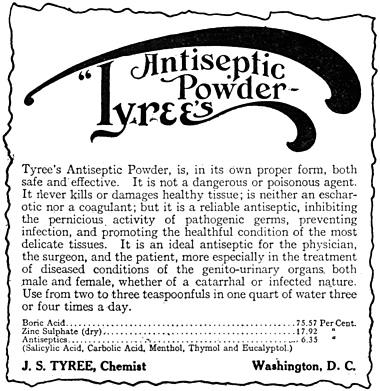
Advertisement from Medical Journal—Tyree’s Powder as a Highly Respectable “Ethical Proprietary.”
Now, it seems, Tyree considers his preparation so well known that he can be independent either of the assistance of the physician or of his good-will. For Tyree’s powder now goes to the public direct and newspaper readers find it advertised as:
“Ideal for douche.”
“Unequalled as a douche.”
“Best preventative known.”
“Unequalled as a preventative.”
“Has no equal as a preventative.”
And the following, whose very truth must bring the blush of shame to all physicians who have the interest of scientific medicine at heart:
“Prescribed by physicians all over the world for twenty-one years.”
“Ask your doctor or send for booklet.”
“Used by doctors for the last twenty-one years.”
“One of the highest tributes paid Tyree’s Antiseptic Powder is the fact that the most successful physicians have been using it for the last twenty-one years.”
Not that Tyree has entirely forsaken the medical journals, although he seems to be dropping them one by one. At the beginning of this year at least fifteen medical journals were carrying the Tyree advertisement; by March the number had fallen to seven, while in June the only journals carrying it were:
Medical RecordChicago Medical Recorder
American Journal of ObstetricsPacific Medical Journal
Those who answer the newspaper advertisements receive a free sample of the powder and several leaflets and circulars giving the various uses (?) of the nostrum. Incidentally these leaflets advertise, in addition, Tyree’s “Elixir Buchu and Hyoscyamus Comp.,” which is recommended, in various combinations, for such conditions as acute nephritis, epilepsy, neurasthenia, gonorrhea and delirium tremens.
Bearing in mind the claim that is made in the newspaper advertisements that Tyree’s Antiseptic Powder is the “best preventative” known, it is interesting to see what Tyree has to say to those druggists whom he offers to supply with circulars for free distribution:
“As these circulars deal with the care of rubber goods, for both medicinal and toilet purposes, they are of great value to the customer and will be retained for further reference. They are boosters for your rubber goods sales, too.”
That a nostrum of this sort should go to the public is not surprising, but that it should have reached the public through the instrumentality of the medical profession is a serious reflection on the judgment of physicians. But the incident has a bright side. That the exploiters of this nostrum no longer find it profitable to use medical journals as a means of getting their stuff to the public but must needs use the more expensive newspaper advertising, is cause for optimism. It means that physicians are no longer prescribing, indiscriminately, proprietary products and that they are refusing to be, what they have been in the past, the unpaid distributing agents for nostrum venders.—(From The Journal A. M. A., Aug. 24, 1912.)
VAPO-CRESOLENE
Vapo-Cresolene has been examined in the American Medical Association’s laboratory and the chemists’ report follows:
According to the statements on the trade package, Vapo-Cresolene “is a product of coal-tar possessing far greater power than carbolic acid in destroying germs of disease.” It is recommended as a remedy for a number of diseases, including croup, catarrh and diphtheria. According to the manufacturers, it should be used only in “the Cresolene vaporizer,” which makes it “unequaled for the disinfection of sick rooms” and the “safest and simplest method of destroying infection and purifying the air.” From the examination we conclude that Vapo-Cresolene is essentially cresol and corresponds in every respect to cresol U. S. P. (Physician’s Manual, page 36).
This report indicates that Vapo-Cresolene is a member of that class of proprietaries in which an ordinary product is endowed, by the manufacturer, with extraordinary virtues. The type is so common and has been referred to so frequently that but for the dangers attendant on the inhalation of any of the phenols, this particular product need not have been mentioned.—(From The Journal A. M. A., April 4, 1908.)
VASOGEN AND IODOVASOGEN
Another Case in Which Independent Analyses and Manufacturers’ Labels Disagree
Vasogen, a product of Pearson & Company, Hamburg, Germany, has been put on the market under the various designations, “oxygenated vaseline,” “water-soluble hydrocarbon” and “oxygenated carbon.” The manufacturers, and also their American agents, Lehn & Fink, claim that by a special process the apparent impossibility of saponifying petrolatum has been overcome with Vasogen as the result. Disinterested chemists who have analyzed Vasogen find that the product consists essentially of an ammonium soap and petrolatum—practically an ammonia liniment mixed with petrolatum.
Just as petrolatum under its various trade names was at one time recommended as a universal ointment base, so vasogen is recommended promiscuously as a vehicle for remedies applied externally and even for internal medication—needless to say in many cases in which it is directly contra-indicated.
Iodovasogen, recommended for external application as a substitute for tincture of iodin, was examined by Zernik in 1905, who found that the iodin existed not as a free iodin, but chiefly as ammonium iodid. The therapeutic character of the preparation is thus entirely different from that to be inferred from the labels and elsewhere, since the counter-irritant effects of free iodin are of course absent in ammonium iodid. Pearson & Co. now claim that when Zernik’s findings were published they immediately modified their statements on the label in accordance with the truth. This is denied by Dr. Lungwitz, the editor of the Therapeutische Rundschau (Apotheker Zeitung, 1908, p. 900), who vigorously criticizes the misrepresentation made by Pearson & Co. in regard to Iodovasogen. He calls attention to the fact that, while Zernick’s results were published over three years ago, the labels which are in use today still bear the statement that Iodovasogen consists of Vasogen 90 parts and resublimed iodin 10 parts, and Vasogen 94 parts and resublimed iodin 6 parts, respectively.
As Iodovasogen and Vasogen in various combinations are being advertised to the physicians in the United States, the above information from our German exchanges is worthy of consideration.—(From The Journal A. M. A., Feb. 13, 1909.)
VIBURNUM COMPOUND—AND OTHER NOSTRUMS
A number of drugs have some reputation for therapeutic value without there being any particular evidence to substantiate the claims. Viburnum, concerning which we recently received the following letter, is one of these drugs:
To the Editor:—Have you made an analysis of Viburnum Compound? Extravagant claims are being made for it and I cannot put my hand on any data. A patient has asked me concerning it and I wish to advise her honestly. I do not know but that there may be several “viburnum compounds.” I rarely use any of these “put-up” preparations, and hence know but little about them.
A. J. Hesser, M.D., Pittsburgh, Pa.
No analysis of Hayden’s Viburnum Compound, to which our correspondent refers, has been made in the Association laboratory. According to advertising circulars, the preparation contains American skullcap (Scutellaria lateriflora), cramp-bark (Viburnum opulus) and wild yam (Dioscorea villosa). Since these drugs contain no well-defined therapeutically active ingredients, an analysis of the preparation would necessarily be unsatisfactory.
A number of drugs have in some way obtained a reputation as being valuable in the treatment of diseases of women, without their therapeutic claims ever having been proved. It is said that some were used by the aborigines for such affections and we find a considerable number of them combined in various nostrums (sometimes with therapeutically active drugs) and exploited for the cure of female disorders, under most extravagant and usually absurd claims. Thus “Pierce’s Favorite Prescription” is advertised as containing black cohosh, blue cohosh, goldenseal, lady’s-slipper and false unicorn-root; “Dioviburnia” (Dios Chemical Co.) as containing American skullcap, cramp-bark, wild yam, blue cohosh, black haw, star-grass, trailing arbutus and false unicorn-root; “Viburnumal” (Louisville Pharmacal Works) as containing American skullcap, cramp-bark, wild yam, star-grass and motherwort.
Most pharmaceutical houses, following the lead of nostrum-makers, put similar mixtures on the market; for example: “Elixir of Viburnum Compound” (Nelson, Baker & Co.) is said to contain cramp-bark, American skullcap and wild yam; “Elixir of Hydrastis and Viburnum Compound” (Smith, Kline & French Co.), cramp-bark, goldenseal, Jamaica dogwood and pulsatilla; “Elixir of Hydrastis and Cramp Bark Compound” (Parke, Davis & Co.), cramp-bark, hydrastis, Jamaica dogwood and pulsatilla; “Fluid Extract of Cramp Bark Compound” (H. K. Mulford Co.), American skullcap, cramp-bark and wild yam; “Mother’s Cordial” (Eli Lilly & Co.), cramp-bark, blue cohosh, false unicorn and squaw vine; “Uterine Sedative Elixir” (Eli Lilly & Co.), cramp-bark, goldenseal, Jamaica dogwood and pulsatilla; “Vibutero” (Fred. Stearns & Co.), cramp-bark, wild yam, black haw, squaw vine, Jamaica dogwood, saw palmetto and pulsatilla. Practically all of these drugs except goldenseal are ignored in the standard works on pharmacology. Further, the results of careful examination by the Council on Pharmacy and Chemistry of the therapeutic claims made for most of them shows that these claims are not sustained by reliable clinical experience.
The fact is that the popularity of preparations of this kind is purely an artificially created one. A nostrum containing, let us say, extractives of some little-used or worthless drugs is put on the market and heavily advertised. Should it be advertised in a manner to make it sell, a host of imitations appear and the large pharmaceutical houses put out substitutes for it. The uncritical physician does the rest. He prescribes it indiscriminately in the class of cases for which it is advertised. Naturally, a certain proportion of the patients who take it recover, and the recoveries are credited to the nostrum. A vicious circle is thus established and the demand for the stuff increases. Its sale, together with the sale of similar products, continues until the overwhelming experience of those who have prescribed it proves its uselessness. In the meantime the manufacturers have reaped a harvest, at the expense both of the public and of the medical profession. And the manufacturers’ excuse for putting such absurd “specialties” on the market is that physicians prescribe them!—(From The Journal A. M. A., Aug. 31, 1912.)
WHEELER’S NERVE VITALIZER
Names of nostrums often mislead by the use of fake nomenclature giving erroneous ideas regarding the composition of the preparation or misrepresenting the true action of the nostrum. As an example of the latter class Wheeler’s Nerve Vitalizer was examined in the Association laboratory and found to be not a vitalizer, as the name implies, but rather a nerve sedative. The results of the examination follow:
Wheeler’s Nerve Vitalizer was packed in a carton bearing the name of the preparation, its manufacturers, “The J. W. Brant Co., Ltd., Albion, Mich.,” and an exhaustive list of the diseases for which the product is intended, besides the general statement that it is a cure for “all nervous diseases.” The “Vitalizer” is a brown, syrupy liquid having a peculiar salty taste partially masked by licorice. Qualitative tests showed the presence of sodium, potassium and bromin, and no other acid radicals except small quantities of chlorin. It was decided therefore that the preparation contained a mixture of sodium and potassium bromids. In order to separate the chlorin and bromin the preparation was evaporated, charred, extracted with water and acetic acid and potassium permanganate added and the mixture distilled with steam until all the bromin had been distilled over, thus leaving the chlorin in the distilling flask. The solution in the distilling flask was then treated with silver nitrate and the chlorin estimated in the usual way. The quantity thus obtained was subtracted from the total silver bromid and chlorin obtained by precipitating a solution of the preparation with silver nitrate and the remainder calculated to bromin.
By this method several samples of 5 c.c. each of the preparation yielded an average of 0.0059 cm. silver chlorid or 0.0012 gm. per c.c. The total silver haloids obtained by direct precipitation of the diluted preparation was found to be 0.3158 gm. per c.c., thus leaving 0.3146 gm. silver bromid to be calculated to bromin.
The total sodium and potassium was obtained in the usual way and the potassium determined as the chlor-platinate and the sodium calculated from the difference. By this method the quantity of sodium found calculated to sodium bromid gave the following results: (a) 0.0629 gm. and (b) 0.0632 gm., or an average of 0.063 gm. per c.c. From the potassium estimations the following were calculated: (a) 0.1264 gm. potassium bromid and (b) 0.1259 gm. potassium bromid per c.c., an average of 0.1261 gm. potassium bromid per c.c.
The bromids calculated from the sodium and potassium determinations were found to be 0.0630 gm. sodium bromid and 0.1261 gm. potassium bromid per c.c., the equivalent of 0.3139 gm. silver bromid. The total silver bromid obtained was 0.3146 gm., showing practical agreement with the total bromids calculated from the sodium and potassium determinations.
The preparation contained then 6.30 gm. sodium bromid and 12.61 gm. potassium bromid per 100 c.c., or 9.73 grains of potassium bromid and 4.86 grains sodium bromid, a bromid content equal to 15.35 grains potassium bromid per fluid dram.
ZYMOTOID
A Fraud of the Liquozone-Oxytonic-Septicide Type
Dr. Arnold’s Zymotoid, a nostrum manufactured by Arnold’s Zymotoid Company, Rockford, Ill., is claimed to be an “antiseptic, germicide and antiphlogistic” which “has absolutely no peer in medicine.” According to the statements of the manufacturer, Zymotoid is “successfully employed not only as an external dressing on all wounded and diseased surfaces, but in all zymotic conditions wherein a reliable antiseptic and germicide is needed internally.” And in telling physicians of the great value of Zymotoid the company says:
“We assured them that if they would simply place Zymotoid ‘next’ to any wounded surface—and nothing else—they would have no inflammation, no suppuration, no infection or blood poison. Its prompt use in all cases where such trouble arises gives immediate and certain relief.”
This is a large contract to be undertaken by Zymotoid—or any other preparation—which, as will be shown, consists principally of boric acid and water. The company also appends to its announcement concerning Zymotoid a number of the usual testimonials and a lot of alleged “case reports.”
Zymotoid seems to be exploited principally by circulars addressed to physicians and by agents who attempt to sell it to physicians. They also try to work factories and other large employers of labor. In their circular to physicians they claim that “Zymotoid is strictly ethical.” And “we publish its composition.” The composition given is: “sulphur, niter, cinnamon and boric acid in gaseous solution.” It is also claimed to be “a chemical compound—not a mixture—which is wholly non-toxic and can be used as freely as desired internally absolutely without harm to the smallest child.” On the label of the Zymotoid package is the following:
“Zymotoid is a concentrated chemical compound consisting of the solids and gases of sulphur, potassium nitrate, cinnamon and carbon held in a solution of boric acid.”
A specimen of Zymotoid was examined by our chemists and their report follows. As will be seen, it is simply another fraud of the Liquozone-Oxytonic-Septicide type.
LABORATORY REPORT ON ZYMOTOID
Zymotoid is a pale yellow liquid having a strong odor like sulphur dioxid. No odor suggestive of cinnamon was observed even after the sulphur dioxid had been fixed by the addition of an alkali. Qualitative tests indicated the presence of boric acid, sulphuric acid, sulphur dioxid and traces each, of a nitrate, potassium and some unidentified organic matter. Alkaloids, cinnamic acid, glycerin and soaps were absent. From the results of the quantitative examination it is concluded that the composition of Zymotoid is essentially as follows:126
Boric acid (H3BO3)0.637 gm.
Sulphur dioxid (SO2)0.129 gm.
Sulphuric acid (H2SO4)0.048 gm.
Potassium nitratetrace
Unidentified organic mattertrace
Water (by difference) to make100 c.c.
The analysis shows that but for the presence of boric acid the composition of Zymotoid is similar to other fraudulent “microbe killers” which have been exploited in recent years and of which some have been declared misbranded by the federal government. For example, “Radam’s Microbe Killer”127 was found by the federal chemists to be composed of water, containing small quantities of sulphur dioxid and sulphuric acid. “Liquozone,” another nostrum which was widely exploited a few years ago, is said to have a similar composition.128 According to an analysis made at the North Dakota Agricultural Experiment Station,129 “Oxytonic” has a similar composition. The nostrum “Septicide,” was found by the federal chemists to be composed of water with small quantities of sulphur dioxid, sulphuric acid and a trace of a nitrate.—(From The Journal A. M. A., April 6, 1912.)