PART I COUNCIL REPORTS (continued 2)
Reading edition
The physician who is competent to treat a case of gonorrhea does not need to be told that alum and zinc sulphate may be useful in such conditions, and he does not want them palmed off on him for something else under the name of Pinus Canadensis, Light, Abican or what not. Also, he prefers to use them, when they are needed, singly and in strength suited to the conditions of the individual case.
[Editorial Comment.—Celerina, Aletris Cordial and Kennedy’s Pinus Canadensis, Light and Dark, appear to be the entire output of the Rio Chemical Company, which was one of the earliest of the various companies organized by James J. Lawrence of Medical Brief fame. The business was moved from St. Louis to New York City in 1901. According to what we believe to be reliable information, the Rio Chemical Company is now composed of James P. Dawson, president; William W. Conley, vice-president and treasurer; and E. D. Pinkerton, secretary. These also constitute the directors. It appears that James P. Dawson is a member of the law firm of Dawson and Garven, St. Louis; E. D. Pinkerton is said to be Miss Effie D. Pinkerton, stenographer for Dawson and Garven. We know little concerning William W. Conley except that he appears to be in charge of the establishment in New York. We find no evidence that he is either a chemist or a pharmacist; his name does not appear in the membership list of the American Chemical Society or of the American Pharmaceutical Association, nor can we discover that he has published anything in the way of chemistry or pharmacy. As a matter of fact, the Rio Chemical Company is another of the pseudo-chemical companies created to exploit one or more proprietaries—in this instance Celerina, Aletris Cordial and Pinus Canadensis. The following medical journals carry advertisements of the Rio products (or did late in 1914): American Journal of Surgery, American Medicine, Denver Medical Times and Utah Medical Journal, Eclectic Medical Journal, International Journal of Surgery, Interstate Medical Journal, Massachusetts Medical Journal, Medical Brief, Medical Century, Medical Council, Medical Review of Reviews, Medical Sentinel, Medical Standard, Texas Medical Journal and Woman’s Medical Journal.].—(From The Journal A. M. A., Feb. 13, 1915.)
CINERARIA MARITIMA
Report of the Council on Pharmacy and Chemistry
Occasional inquiries in regard to the therapeutic value of Cineraria maritima caused the Council to consider the drug with reference to its fitness for inclusion in N. N. R. among non-official, non-proprietary remedies. The following report, having been submitted to the Council by a subcommittee, was adopted and its publication authorized.
W. A. Puckner, Secretary.
To the Council:—The juice of a plant referred to as Cineraria maritima was at one time supposed to be of value in the treatment of cataract and certain other affections of the eye. No scientific evidence is available to show that the drug is therapeutically active, and its value is no doubt correctly estimated by Dr. Casey Wood, who (“Ophthalmic Therapeutics,” p. 446; Cleveland Press, Chicago, 1909) says:
“Still, a few respectable names have been associated with its [Cineraria maritima] employment in that capacity and it only remains to be said that the instillation into the conjunctival sac of a preparation of this or any other member of the Senecio family has about as much effect on the resolution or dispersal of opacities due to organic changes in the lens as pouring the same down the back of the patient’s neck!”
The plant from which Cineraria maritima juice is claimed to be prepared is commonly referred to in literature as Cineraria maritima, but is more correctly described as Senecio cineraria, D. C.
It may be considered a matter of indifference whether a remedy like this be advertised for the treatment of such diseases as cataract, providing its application could do no harm, but it must be remembered that it is recommended also for other diseases of the eye in which its use, by postponing efficient treatment, would be the means of serious damage or even loss of vision.
Since there is no evidence to show that this drug is of any therapeutic value, it is recommended that it be not admitted to the list of non-official, non-proprietary remedies in N. N. R., and that the Council formally expresses its opinion that the drug, as judged by the evidence which is available, is without value in the treatment of cataract or similar diseases of the eye.
[Editorial Comment.—Cineraria maritima would long since have been relegated to the limbo of discarded and discredited drugs had it not been given a semiproprietary character by a St. Louis nostrum house—the Walker Pharmacal Company—which, like the Manola Chemical Company, is, we understand, practically a subsidiary concern of the Luyties Homeopathic Pharmacy Company. The Walker concern exploits this drug under the name Succus Cineraria Maritima (Walker). Its method of exploitation consists in publishing testimonials, which it dignifies with the name “clinical reports,” from men whom it designates as “representative physicians.” As indicative of what constitutes representative physicians, we find that of the seven testimonials given in their pamphlet the names of three of the signers are not to be found in any medical directory.
The exploitation of Succus Cineraria Maritima (Walker) is the oft-repeated story of the resurrection of discarded and worthless drugs for the purpose of creating proprietorship in a nostrum. Cineraria maritima is worthless; its therapeutic value is nil. By the prodigal use of printers’ ink, the medical profession—and through it the public—has been humbugged into believing that it possesses curative value.]—(From The Journal A. M. A., Nov. 11, 1911.)
HAGEE’S CORDIAL OF THE EXTRACT OF COD LIVER OIL COMPOUND [I]
Report of the Council on Pharmacy and Chemistry
This is one of the “oilless” cod liver cordials. Like other manufacturers of such extracts, the Katharmon Chemical Company, St. Louis, which owns Hagee’s Cordial, attempts to trade on the reputation long enjoyed by cod liver oil as a promoter of growth and nutrition. The following is the statement of composition furnished by the company:
“Each fluid ounce of Hagee’s Cordial of the extract of Cod Liver Oil Compound represents the extract obtainable from 1⁄8 fluid ounce of Cod Liver Oil (the fatty portion being eliminated), 6 grs. Calcium Hypophosphite, 3 grs. Sodium Hypophosphite, 1⁄2 gr. Salicylic Acid (made from Oil Wintergreen), with Glycerin and Aromatics.”
And here are some of the therapeutic claims:
“Tonic, Stimulant, Alterative, Reconstructive, Nutritive and Digestive.”
“Useful in phthisis pulmonalis, scrofula and all chronic pectoral complaints, coughs, colds, brain exhaustion, nervous debility, palsy, chronic cutaneous eruptions and impaired digestion.”
Of course, these absurd claims hark back to the time of the prevalence of the now discarded theory that the valuable properties of cod liver oil reside, not in the fat, but in certain nitrogenous, alkaloid-like constituents present in infinitesimal amounts. Further “playing up” this theory:
“The prescriber may know that in our preparation he is getting, in easily assimilable and palatable form, the very properties that make cod liver oil the best of reconstructives.
“When you prescribe cod liver oil you are after the active principles—why not give the active principles themselves.”
Proprietary manufacturers usually ignore scientific investigations which establish facts adverse to proprietary claims; but the same proprietary manufacturers are quick to seize on any theory that can be twisted into support of their interests. Thus, recent investigations having shown that cod liver oil, like butter and egg yolk, possesses certain growth-promoting properties not found in some other fats, the promoters of Hagee’s Cordial claim these properties of cod liver oil for their extract. They assert:
“Recent Chemical Investigations of Cod Liver Oil show that the active principles contain the nutritive qualities attributed to the whole oil.”
The Council has previously expressed the opinion19 that the preponderance of evidence indicates that whatever therapeutic value cod liver oil may have depends chiefly, if not entirely, on its fat (oil). There never was any evidence or scientific authority for the theory that the therapeutic value of cod liver oil was independent of its fat content. The fact that the fat is the growth-promoting element has already been shown, and J. P. Street, chemist for the Connecticut Agricultural Experiment Station (The Journal A. M. A., Feb. 20, 1915, p. 638), in a series of experiments on a number of the so-called extracts of cod liver or cod liver oil (including Hagee’s Cordial) has conclusively demonstrated that the growth-promoting properties of the oil are not to be found in the extracts. Street placed rats on a ration not sufficient to maintain normal nutrition and growth for an extended period. After the rats had been on this ration for some time and a failure to maintain weight was indicated, an amount of dealcoholized Hagee’s Cordial was substituted for a portion of the lard contained in the ration. Later Hagee’s Cordial was replaced by cod liver oil.
Street says:
“None of the four rats did well on Hagee’s Cordial; in fact, they lost 1.2 to 15.4 gm. during feeding periods of from seven to fourteen days.”
“The rats failed so quickly when put on Hagee’s Cordial that in two cases the animals did not recover even when put on the full cod liver oil ration.”
“... the four rats during the Hagee period, instead of gaining the normal 24 gm., actually lost 36.2 gm., while during the cod liver oil period instead of gaining 114 gm., they gained 156.4 gm.”
“The inferiority of Hagee’s Cordial as a reconstructive and a nutrient compared with ordinary cod liver oil is apparent.”
Hagee’s Cordial of the Extract of Cod Liver Oil Compound has neither the nutritive qualities nor the reconstructive efficacy of cod liver oil. This mixture is worthless for the conditions for which it is advertised, and is marketed under misleading and unwarranted claims. It is recommended that Hagee’s Cordial be held ineligible for New and Nonofficial Remedies.—(From The Journal A. M. A., April 10, 1915.)
WAMPOLE’S PERFECTED AND TASTELESS PREPARATION OF AN EXTRACT OF COD LIVER [J]
Report of the Council on Pharmacy and Chemistry
Wampole’s Preparation is another of the oil-free “extracts” of cod liver. The following formula (which, be it observed, is non-quantitative and therefore practically worthless) is published by the owners, Henry K. Wampole & Co., Inc.:
“Contains a solution of an extractive obtainable from fresh cod livers, the oily or fatty portion being afterward eliminated. This extractive is combined with Liquid Extract of Malt, Fluid Extract of Wild Cherry and Compound Syrup of Hypophosphites (containing Calcium, Sodium, Potassium, Iron, Manganese, Quinin and Strychnin).”
An alcohol content of 17 per cent. is declared on the label. The following claims are typical of those made for the preparation:
“This grease, or oil, is not present in Wampole’s Preparation of the Extract, which is palatable and, at the same time, very efficient as a stimulant to the centers of nutrition and assimilation. It is unsurpassed as a reconstructive tonic ...”
“[Cases] with a marked tendency to pulmonary troubles,... if a timely impulse be given them will easily shake off the impending evil. Wampole’s Preparation gives that timely impulse ...”
In the Council’s opinion, as previously expressed,20 such therapeutic value as there may be in cod liver oil is chiefly, if not altogether, due to the fat (oil). Lately, the investigations of J. P. Street of the Connecticut Agricultural Experiment Station have definitely disproved the claims made for the Wampole’s and similar preparations. In Street’s experiments, rats were placed on a ration insufficient for normal nutrition and growth. After the rats had been on the ration for a time long enough for inability to maintain weight to become evident, dealcoholized Wampole preparation was substituted for a portion of the lard contained in the ration. Later the Wampole preparation was replaced by cod liver oil. From these experiments it appears that, although the Wampole preparation is said to contain malt extract and sugar, it does not show the advantage over ordinary cod liver oil as a source of nutriment which is claimed for it by the manufacturers. Street emphasizes that the Wampole preparation does not possess to any marked degree the reconstructive properties of cod liver oil, butter fat and egg yolk, on which foods rats gain weight rapidly and steadily after having been on a deficient diet. Street calls attention to the fact that the amount of alcohol consumed daily by the user of the Wampole preparation (the equivalent of 0.7 fluidounces of whiskey) explains to a considerable extent the asserted tonic virtues of the preparation.
Though offered as an efficient substitute for cod liver oil, Wampole’s “Perfected and Tasteless Preparation of an Extract of Cod Liver” lacks both the nutritive and the reconstructive properties and is marketed under an indefinite name and unwarranted and untrue claims. It is recommended that Wampole’s Preparation be held ineligible for New and Nonofficial Remedies.—(From The Journal A. M. A., April 10, 1915.)
WATERBURY’S METABOLIZED COD-LIVER OIL COMPOUND [K]
Report of the Council on Pharmacy and Chemistry and Laboratory Contribution on Which It Is Based
The following report has been adopted by the Council and its publication directed
W. A. Puckner, Secretary.
To the Council:—Your committee on pharmacology has read with interest the contribution from the Association’s laboratory on Waterbury’s Metabolized Cod-Liver Oil Compound. The report shows that misleading and false statements are made in regard to the composition of the product and also that exaggerated and unwarranted claims are made for its therapeutic value. In view of the attempt of the Waterbury Chemical Co. to create a false impression in regard to the therapeutic value of the composition of its product, it is recommended that the following report be adopted and published:
The Council believes that there is a preponderance of evidence to indicate that whatever therapeutic value cod-liver oil has, that value depends chiefly, if not entirely, on its fat (oil). In the opinion of the Council, the word cod-liver oil should not be used in connection with any preparation unless it consists to a large extent (25 per cent. or more) of cod-liver oil. Since Waterbury’s Metabolized Cod-Liver Oil Compound contains no appreciable quantity of cod-liver oil, the name is incorrect and misleading, and as a cod-liver oil preparation it is believed to be wholly valueless. The Council has previously voted that Waterbury’s Cod-Liver Oil Compound be refused recognition because of conflict with Rules 1 and 6.—(From The Journal A. M. A., Oct. 9, 1909.)
[Contribution from the Chemical Laboratory of the American Medical Association]
Waterbury’s Metabolized Cod-Liver Oil Compound
W. A. Puckner and L. E. Warren
A full page advertisement of Waterbury’s Metabolized Cod-Liver Oil Compound appeared in the Iowa Medical Journal, March 15, 1909, in the form of a letter purporting to give the results of an analysis of the product made for the firm by a Chicago chemist. In this letter-advertisement the chemist states at the outset that the results of his examination “are somewhat at variance with the statements made in The Journal.” These statements he quotes as follows:
1. It is a clear liquid and no globules of oil are seen under the microscope. It is therefore not an emulsion.
2. It is of acid reaction when mixed with water and remains clear when strongly acidified. Hence it does not contain a soap, and is not a saponification of fat.
3. It mixes with water without precipitation, hence, it can not contain more than traces of a fatty acid.
The chemist admits in his letter to the firm that his analyses verify statements 1 and 3, but regarding statement 2 he says: “I find that your preparation is acid in reaction, but when strongly acidified gives a distinct turbidity within 10 minutes and a voluminous precipitate within 1 hour. This precipitate is shown to consist of fatty acids of cod-liver oil, which are thrown down by the splitting of the soaps, on acidifying either with sulphuric or hydrochloric acid.” From these results he states that to him it seems that the “preparation does not deserve the statement that it contains no soap, as there is no question whatever of the presence of cod-liver oil.”
While in the letter published in this advertisement the chemist claims to have demonstrated the presence in the product of “saponified cod-liver oil,” he omits to mention the quantities of the soap present. In the article that originally appeared in The Journal (Oct. 13, 1906), in addition to the three paragraphs quoted by the chemist, the following statements were made:
“By these simple tests a physician is easily able to demonstrate that the preparation does not contain cod-liver oil. It is therefore valueless for the purpose of nutrition for which we give the oil. More careful analysis confirms the results of these tests and shows that it contains no fat or fatty acids (except the merest traces)....”
At the time these statements were published in The Journal, the St. Paul Medical Journal, October, 1906, contained an advertisement for Waterbury’s Metabolized Cod-Liver Oil Compound, which contained this statement:
“The only tasteless preparation on the market which contains Cod-Liver Oil in its entirety. The metabolized product is obtained by the action of digestive ferments on pure Cod-Liver Oil.”
In the Ohio Medical Journal of Feb. 15, 1907, there appeared in the form of an advertisement what purported to be an analysis of Waterbury’s Metabolized Cod-Liver Oil Compound by Prof. C. N. Kinney of Drake University. While Professor Kinney made a quantitative analysis of the preparation, the quantities were omitted from the analysis as published. A footnote added by the Waterbury Chemical Company called attention to this fact and closed as follows:
“Any physician who is not satisfied with the analysis we will be only too glad to furnish the complete analysis by our representatives.”
If this weirdly constructed sentence meant anything, it meant that the complete analysis would be furnished on request. Such requests to the company, however, from various sources failed to elicit the information required nor was the “complete analysis” forthcoming. The inference to be drawn is fairly plain.
In a circular accompanying the product as sold at present, this statement occurs:
WATERBURY’S METABOLIZED COD LIVER OIL COMPOUND With Creosote and Guaiacol or Plain DOES CONTAIN COD LIVER OIL DOES ALLAY FERMENTATION DOES AID DIGESTION DOES ASSIST ASSIMILATION BUT DOES NOT DISTURB THE STOMACH
As previous examination disclosed only the merest traces of cod-liver oil in the product though claims were made that it “represents cod-liver oil in its entirety,” and in view of the fact, too, that present advertisements emphatically declare that cod-liver oil is present in the preparation as now sold, it was thought best to examine some of the preparation with especial reference to the quantities of fatty acids from cod-liver oil.
OLD LABEL NEW LABEL
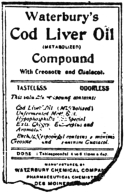
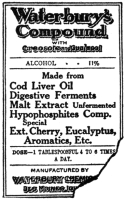
It is interesting in this connection to note that this product is no longer being sold under the name “Metabolized Cod Liver Oil Compound.” See the illustrations of the old and new labels.
The results of the examination are briefly as follows: The total quantity of acids isolated amounted to about 0.3 per cent., and of this amount about two-thirds was salicylic acid. Thus it appears from the examination of the specimens bought on the open market that the preparation contains at most but 0.1 per cent. of the fatty acids from cod-liver oil, a totally insignificant quantity.
Notwithstanding the protestations by the manufacturers, in the form of published analyses and circulars, it is seen that the statements published in The Journal, Oct. 13, 1906, p. 1207, are essentially substantiated; it is further evident that the product does not deserve to be designated as a cod-liver oil preparation. To obtain a medicinal dose of cod-liver oil the patient would be compelled to swallow the contents of a bottle of this mixture, and as the product contains 11 per cent. alcohol the patient who did so would probably experience a degree of exhilaration not referable to cod-liver oil.—(From The Journal A. M. A., Oct. 9, 1909.)
Declared Misbranded
This product of the Waterbury Chemical Company, of Des Moines, Iowa, was exposed in The Journal of the American Medical Association, October 9, 1909. In May, 1910, the United States Government issued a notice of judgment in which it was declared that Waterbury’s Metabolized Cod Liver Oil Compound was misbranded. The court rendered its decree of condemnation and forfeiture.—[Notice of Judgment, No. 303.]
WATERBURY’S COMPOUND
Report of the Council on Pharmacy and Chemistry
The Waterbury Chemical Company having requested that the Council reconsider its action of four years ago (see preceding report) on the product then known as Waterbury’s Cod-Liver Oil Compound, now called Waterbury’s Compound, the matter was submitted to a referee. The referee reported that the statement now made as to the composition of this product is as follows:
“Made from Cod Liver Oil, Digestive Ferments, Malt Extract Unfermented, Hypophosphites Comp. Special, Ext. Cherry, Eucalyptus, Aromatics, etc.”
He held that the Waterbury Chemical Company has not submitted satisfactory evidence to indicate that the objections of the Council’s former unfavorable report have been met; that there is no evidence that the product is a substitute for cod-liver oil in any way; and that under the present methods of exploitation it constitutes what is at least an inferential fraud; and recommended that no further consideration be given to Waterbury’s Compound. The report was adopted by the Council.—(From The Journal A. M. A., March 20, 1915.)
COLCHI-SAL
Report of the Council on Pharmacy and Chemistry
Colchi-Sal, said to be made by the Anglo-American Pharmaceutical Co., Ltd., New York, is advertised, sold and “guaranteed” (sic) by E. Fougera and Co., Inc., New York. According to the label of a recently purchased specimen:
“Each Capsule contains Cannabis Indica (Active Principle of) 1-500th Grain (1⁄8 Milligram); Colchicine (Crystallized) 1-250th Grain (1⁄4 Milligram); Methyl Salicylate 20 Centigrams.”
The advertising circular around the bottle adds that the mixture also contains “appropriate aromatic adjuvants.”
It is recommended in “Gouty and Chronic Rheumatic Manifestations,” “acute cases of Gout,” “intestinal auto-intoxication or dyspepsia,” “bilious headaches,” etc. Salicylates are generally recognized as valuable in acute manifestations of acute articular rheumatism; colchicum is useless in these conditions. Both salicylates and colchicum are practically useless in chronic rheumatic and in chronic gouty affections. For dyspepsia, bilious headache, etc., salicylates are distinctly contra-indicated and the drastic purgation produced by colchicum would not be thought desirable. Though methyl salicylate administered internally is not generally considered so efficient as sodium salicylate, it is asserted that the former
“... is found far more effective than salicylate of soda or other salicylic derivatives when given in conjunction with colchicine as Colchi-Sal.”
Further, the highly improbable and unsubstantiated claim is made that “the active principle of Cannabis indica” (whatever that may be) “corrects any tendency of the colchicine to irritate the gastro-intestinal tract” and that the “appropriate aromatic adjuvants” “prevent intolerance of the methyl salicylate.”
Colchi-Sal is put up in a way to appeal to the public; the bottle has the name “Colchi-Sal” blown in the glass; the label gives full instruction for the use of Colchi-Sal, and also the price, suggesting that the preparation may be freely purchased. Wrapped around the bottle is a circular advising its use in various affections.
The physician who acts on the advice that it is well to “insist on the pharmacist dispensing original bottles ...” of the “little green capsules” actually suggests to his patient the use of this preparation of methyl salicylate and colchicum in conditions in which these drugs may do much harm and in which proper treatment is imperative.
Colchi-Sal is typical of unscientific ready-to-take proprietaries. It was held ineligible for New and Nonofficial Remedies because of its secret composition, viz., the unknown nature of the “active principle of Cannabis indica” (Rule 1); because the circular in the package and the name blown in the bottle constitute advertisement to the laity (Rule 4); because the claim that cannabis indica removes the gastro-intestinal irritation, and the claim of the superiority of methyl salicylate are unwarranted therapeutic claims (Rule 6); because the name does not indicate the presence of the habit-forming cannabis indica, and because of its unscientific composition (Rule 10).—(From The Journal A. M. A., March 20, 1915.)
CYPRIDOL CAPSULES
Report of the Council on Pharmacy and Chemistry
Having voted that Cypridol Capsules be refused recognition, the Council directed that for the information of physicians publication of the following report be authorized.
W. A. Puckner, Secretary.
Cypridol Capsules, sold by E. Fougera & Co., New York, are stated to be “Bottled in the New York Laboratories of Vial, late Rigaud and Chapoteaut, Paris,” and to contain, in each capsule, 2 mg. (1⁄32 grain) mercuric iodid (biniodid of mercury) dissolved in a fatty oil. They are claimed to permit the administration of mercury without danger of salivation—an obvious misrepresentation.21 Cypridol Capsules are marketed in a way to appeal to the public. If they are once prescribed, the directions on the bottle and the full instructions for the treatment of syphilis by means of Cypridol and by other proprietaries sold by Fougera & Co. is likely to lead the patient to attempt the treatment of this malady on his own accord, and thus probably to forfeit his chances of cure. Cypridol is a vicious example of the “ready-to-take” proprietaries.
Cypridol Capsules are in conflict with the rules of the Council as follows:
Rule 4: The dosage, price, etc., on the label, and the name “Cypridol” blown in the bottle, all tend to a direct self-prescribing by the public. In addition to the objectionable statements on the bottle itself, the preparation is put up in patent medicine style and is accompanied by a circular giving full directions for the use of this and of other proprietaries for the treatment of syphilis in all of its stages. The circular states that “a 1 per cent. solution of bin-iodide of mercury in an aseptic oil” is “An Improved Specific in the Treatment of Syphilis,” and after lauding the virtues of Cypridol, gives full directions for the treatment of syphilis in its various stages by means of Capsules of Cypridol augmented, during periodical cessation of treatment, by “small doses of iodide of strontium (Paraf-Javal’s standard solution, thirty grains to the ounce).” Further, the circular expounds the need of “a toning up of the general system” and by means of obsolete theories and obviously untrue assertions recommends “Chapoteaut’s Wine [another of their proprietary preparations], each ounce of which contains 10 grains of phospho-glycerate of lime. This is a delicious, nutritive tonic. A pint bottle costs $1.00.”
Rule 6: Whereas it is evident that Cypridol, depending for its effects on mercuric iodid, the ordinary well-known hydrargyri iodidum rubrum of the U. S. Pharmacopeia, must naturally have the properties of a mercuric compound, unwarranted claims such as the following are made:
“CYPRIDOL does not render patients anemic. Ptyalism never follows the administration of the capsules or injections. On the contrary, patients rapidly put on flesh and keep well. There are no diarrhoeas or other symptoms of intolerance even when the dose is pushed.”
Rule 8: The non-informing name “Cypridol” for a mercuric iodid preparation is bound to lead to its use without consideration of the fact that a potent mercury preparation is being used, requiring a careful adjustment of dosage, a consideration of the needs of the individual case, a correct diagnosis, etc. While the advertising propaganda argues that “physicians recognize the advantage of prescribing this solution of mercuric iodide in an aseptic oil under the name of ‘Cypridol,’ because it does not betray to the laity the fact that mercury is being used,” not only the physician but also the patient has a right to know, and ought to know, the potent character of the remedy which is being administered.
It is recommended that Cypridol be refused recognition and that publication of this report be authorized.—(From The Journal A. M. A., Dec. 19, 1914.)
CYSTOGEN, CYSTOGEN APERIENT AND CYSTOGEN-LITHIA [L]
Abstract of Report of the Council on Pharmacy and Chemistry
Cystogen is the therapeutically suggestive name applied to hexamethylenamin by the Cystogen Chemical Company. While investigation has shown that hexamethylenamin yields formaldehyd only in the presence of an acid and consequently can produce an antiseptic effect only in the gastric juice and in the urine, it is claimed that Cystogen is an “intestinal antiseptic” and that it “bears its disinfectant and antitoxic qualities into well-nigh every important bodily cavity.”
As the sale of a simple drug even with the aid of the most extravagant claims probably did not offer sufficient opportunity for an extensive proprietary propaganda, the Cystogen Company has put out two other preparations, Cystogen Aperient and Cystogen-Lithia, and finds it an easy matter by means of extravagant claims, unwarranted assertions and pseudo-scientific arguments to recommend the use of one or another, or often all three, in a well-nigh endless number of diseases.
As the continued patronage of the medical profession cannot be relied on for proprietaries of this sort, the Cystogen Chemical Company takes good care that every Cystogen prescription is likely to spread the Cystogen gospel among the people. The Council has directed publication of its report on the Cystogen products to call attention to the way in which a simple drug of established value may be made the basis of an extensive proprietary propaganda. A conservative discussion of the action of hexamethylenamin appears in the Council’s publication, “Useful Drugs.” The Council therefore refused recognition to Cystogen, Cystogen Aperient and Cystogen-Lithia.—(From The Journal A. M. A., Dec. 12, 1914.)
CYSTO-SEDATIVE
Report of the Council on Pharmacy and Chemistry
Cysto-Sedative is sold by Strong, Cobb and Company, Cleveland, Ohio, with the claim:
“Each fluid ounce represents: Thuja Occidentalis, 31⁄2 grains. Pichi, 18 grs. Saw Palmetto berries, 36 grs. Triticum Repens, 36 grs. Hyoscyamus 8 grs. All inert extractive matter being eliminated.”
The therapeutically active constituents of arbor vitæ, pichi, saw palmetto and couch grass have never been isolated—indeed, it has not been proved that all of these drugs contain any therapeutically active constituents. Yet the absurd claims are made that all inert matter has been eliminated and each lot of drug used in the preparation of Cysto-Sedative is “tested in reference to its medicinal activity.” Equally preposterous is the claim:
“In formulating Cysto-Sedative each drug entering into its composition was subjected to careful study clinically to determine the exact proportion required when combined to increase their efficiency as a whole. Cysto-Sedative is scientifically prepared, the proportion of each individual drug being so finely adjusted as to increase their therapeutic action in the conditions for which they are intended, forming a preparation always reliable and of the very highest medicinal activity.”
Some other extravagant claims made for this complex unscientific mixture are:
“It gives relief in almost every form of cystitis and prostatitis....”
“The best results are obtained in the worst chronic cases of cystitis and prostatitis....”
“In Cystitis, Urethritis, Prostatitis, Inflammation of the Vesicle Neck, complicated with Gonorrhoea, Enuresis, Painful Micturition, the action of Cysto-Sedative is prompt.”
The Council voted that Cysto-Sedative be refused recognition.—(From The Journal A. M. A., Dec. 12, 1914.)
TAKA-DIASTASE AND LIQUID TAKA-DIASTASE
Report of the Council on Pharmacy and Chemistry
Some time ago it was decided that a reexamination should be made of Taka-Diastase and Liquid Taka-Diastase, both of which had previously been rejected, to ascertain whether or not the preparations were in accord with the claims made for them by the manufacturers. Accordingly, the matter was referred to a committee of the Council, and an examination of specimens of these two preparations bought in the market was made. The referee’s report, which appears below, according to the usual procedure, and before final confirmation by the Council, was first submitted to the manufacturers of Taka-Diastase for comment. The report recommends that the rejection of Taka-Diastase and Liquid Taka-Diastase be allowed to stand, and that the report be published. Parke, Davis & Co., in their reply, which is given in full below, claim that the report is unjust concerning Liquid Taka-Diastase, because the period of activity of the preparation has been greatly prolonged by reducing the amount of alcohol from 18 per cent. to 10 per cent. and by adding glycerin. They reiterate their claims for the digestive power of Taka-Diastase, but admit that it will not reduce the stated amount of starch to the colorless end-point in ten minutes (the standard method for the valuation of diastase). They further state that they would change the word “digest” on the label to “liquefy.”
The conclusion of the report having been questioned, the entire matter was referred to a member of the Council’s staff of clinical consultants. His report, which, also, is given in full below, states that the material before him was sufficient to decide the matter, and no further tests were necessary. He concludes that the claims of the manufacturers regarding the strength and properties of the material are erroneous and exaggerated; that the literature still sent out by Parke, Davis & Co. is misleading; and that if substitution of the word “liquefy” for “digest” were endorsed by the Council confusion would result which would give an exaggerated and false value to Taka-Diastase. He therefore recommends that the report of the reinvestigation of Taka-Diastase be accepted by the Council and published.
This report of the second referee was referred to Parke, Davis & Co. with the request that they state more definitely the actual amylolytic strength of their preparations. To this they replied that they had no desire to discuss the subject further, or to make any additional statements.
In accordance with the second referee’s recommendations, the Council confirmed its provisional action and voted that the rejection of Taka-Diastase and Liquid Taka-Diastase be allowed to stand, and that the report which appears below be authorized for publication.
W. A. Puckner, Secretary.
REFEREE’S REPORT ON TAKA-DIASTASE AND LIQUID TAKA-DIASTASE
Following is the report of the committee to which was referred the reexamination of Taka-Diastase and Liquid Taka-Diastase:
Some time ago a comparison was made of the various methods proposed for the valuation of preparations claimed to have amylolytic power. This work was reported in The Journal,22 and the method proposed for the testing of diastase preparations now appears in New and Nonofficial Remedies.23 In view of the incorrect and exaggerated claims made for Taka-Diastase, the Council in 1908 was obliged to rescind its acceptance and to direct its omission from New and Nonofficial Remedies. The report contained the following reference to Taka-Diastase (Parke, Davis & Company), a product that had been accepted for inclusion with New and Nonofficial Remedies:
“The widest discrepancy between the values as claimed by the manufacturer and those found by actual tests seems to be shown in the case of Taka-Diastase. The liquid preparation has been tested a number of times in different samples and has always been found weak. Some samples, in fact, were quite inert. This ferment appears to lose strength very rapidly in solution, as the manufacturers now concede. The stability of the solid product is also far from satisfactory, and appears to be less than that of the ferment as marketed some years ago. The two samples examined recently were weak.”
More than three years have now elapsed since the publication of the Council’s findings regarding Taka-Diastase—sufficient time, it is believed, for the manufacturers to modify either their claims or the product itself, and thus again make it eligible for inclusion with New and Nonofficial Remedies. With this idea in mind new specimens of Taka-Diastase and Liquid Taka-Diastase were purchased from a Chicago drug house and the preparations reinvestigated. The following is the report of this reinvestigation.
REPORT OF THE REEXAMINATION
In our report on the diastase preparations three years ago, it was recommended that Taka-Diastase be removed from New and Nonofficial Remedies, because the examinations showed that it did not have the digestive strength claimed for it. This was true both for Taka-Diastase itself and for Liquid Taka-Diastase. So far as the latter was concerned, the starch-converting power was practically nil in those preparations which had been in the drug stores for some months.
During the last few weeks new tests have been carried out with several samples of the Taka-Diastase preparations and the results obtained are essentially the same as those obtained in the former examinations. The liquid preparation is still extremely weak in starch-converting power, while we found that Taka-Diastase itself would convert only 16.6 parts of pure anhydrous starch to the colorless end-point in ten minutes, as explained below.
In our method of experimentation we determine the weight of the diastase in question which will convert a given weight of starch in uniform paste to the so-called colorless end-point in ten minutes, that is to the point where it will no longer give any color reaction with a standard iodin solution. The standard starch weight in 50 c.c. always is 1 gm. or 1,000 mg. and to a series of flasks containing this amount of starch, maintained at a constant temperature of 40 C., the diastase dilutions are added. These diastase dilutions are made by dissolving small, accurately weighed amounts of the sample in some small, constant volume of water, usually 5 or 10 c.c. and they are then poured into the starch flasks at the right temperature, and agitated regularly.
Tests are made by taking a few drops from each flask and mixing with the iodin solution. The end-point is reached when a dilution is found which, at ten minutes from the mixing time, gives no color with the iodin reagent. The first set of tests is taken as a general guide, and quite accurate results may be obtained in a second set of dilutions.
We first used a sample of Taka-Diastase bought in the open market. It was found that 140 mg. were required to convert the gram of starch as explained. This is equivalent to a conversion of 7.14 parts of starch by 1 part of the Taka-Diastase.
A new, and possibly fresher, sample was then obtained and the test repeated. With this new sample it was found that 60 mg. were necessary to convert the gram of starch to the colorless end-point in ten minutes, from which it follows that 1 part of the ferment will convert 16.6 parts of starch to the colorless end-point in the same time. With a new sample of Liquid Taka-Diastase obtained simultaneously it was found that 3.5 c.c. were necessary to convert 1 gram of starch to the colorless end-point in ten minutes. As a fluidounce of this liquid is said to contain 20 grains of the solid it will be seen that the results approximately agree with those of the first sample of the solid, and that they are both very low.
In the earlier tests 16 parts of starch converted by 1 part of the ferment was the value found. These results are in close agreement with values reported by Sherman (Jour. Am. Chem. Soc., xxxii, 1073) for a sample of recent purchase. He found a conversion of 51 parts of starch to the colorless end-point in thirty minutes for one sample, while for another he found 66 parts, in the same time. It will be noted that our time limit is ten minutes. It is worthy of note that for a perfectly fresh and specially prepared sample furnished by Dr. Takamine, a conversion of 278 parts in thirty minutes was found by Sherman. Taking the time into consideration, it will be seen that the results are about the same for the market samples as those found by us and much lower than claimed, as well as much lower than for other makes of similar products. The difference in the behavior of fresh specially prepared Taka-Diastase and the market sample is very clearly shown. No one questions the fact that fresh laboratory samples of Taka-Diastase may show a moderate converting power on starch. But we have to deal with the activity of market samples only, and Sherman’s work and our own show the low digesting power of the product as physicians may secure it on the market.
The marked difference in activity between perfectly fresh and ordinary market samples of Taka-Diastase is very clearly shown also in a recent paper published by Wohlgemuth.24 In the digestion of starch paste to the “dextrin” stage Wohlgemuth found in the commercial sample a strength approximately a hundred times less than that observed in a fresh sample sent him by Dr. Takamine.
Wohlgemuth’s results were obtained by a method not essentially different from ours, with this difference, however, that he digested through 24 hours in the cases reported, and carried the reaction to the “dextrin” stage only, in place of to a colorless end-point. Making the proper reductions, it is evident that the actual values found by him for the market samples bought in Germany are not greater than those reported by us.
The reference to the work of Sherman is made because, in a following paper in the same journal, he recommends the use of salt as an activator in finding the strength of certain diastase preparations. It is well known that dialyzed diastase preparations and starch of highest purity have but slight action on each other; a little salt increases the activity greatly, and also increases the activity of commercial diastase preparations. These facts Sherman utilizes in working out a method for valuation of commercial diastases. The facts were well known to us at the time of our former report, but it was not thought best to depart from the general method which had been in use by all analysts following the general scheme of Roberts. Quite recently, I. Bang has published a paper on the investigation of diastase (Biochem. Ztschr., xxxii, 417) in which he studies the behavior of sodium chlorid and other salts on the rapidity of starch conversion, and finds that a much smaller amount of salt than Sherman recommends brings the maximum increase.
The method employed in our former tests is a good comparative method, and this is all that may be claimed at present for any method. By adding salt to our starch solution the activity of Panase and other ferments is likewise greatly increased. For Panase, a preparation possessing rather high starch-converting power, we have recently found an increase of about 30 per cent. in the converting power, with salt present. Working to loss of blue color, merely, it is possible in this way to get a higher value than that claimed by the manufacturer. There is no practical gain in using the salt for our purpose as the methods are at best arbitrary, and the results only comparative.
Taking all the facts into consideration, it is recommended that the rejection of Taka-Diastase and Liquid Taka-Diastase be allowed to stand and that, in view of their extensive exploitation, this report be authorized for publication so that physicians may know the facts.
This report was referred to Parke, Davis & Co., and they made the following reply:
“The report submitted in your letter of the 23d is, we contend, erroneous and unjust: first, to our Liquid Taka-Diastase, because over three years ago we changed our formula, reducing the alcohol from 18 per cent. to 10 per cent., increasing the glycerin and thus prolonging greatly the period of activity.
“As for our regular Taka-Diastase, our claim is and has been for years simply that Taka-Diastase will digest or hydrolyze 150 times its weight of starch in ten minutes, under proper conditions. We do not claim, we do not permit our representatives to claim, that Taka-Diastase will completely transform starch, to the colorless end-point, into sugars. Taka-Diastase is used to supplement a deficiency of ptyalin and converts the starch into soluble material with great rapidity, thus giving the gastric fluid immediate access to the proteids.
“If in the enclosed labels the word ‘digest’ were replaced with the word ‘liquefy,’ the claim could not be assailed by the most carping critic. To save any possible question, we shall therefore make this change in our label, having it read: ‘Taka-Diastase will liquefy 150 times its weight of starch in ten minutes, under proper conditions.’ Is there the slightest question in your mind that this statement as just quoted is entirely correct and entirely supported by clinical experience?
“It is our conviction that Taka-Diastase has a very remarkable power to hydrolyze starch either in the test-tube or in the stomach, and that this property is of great utility in clinical work. We do not claim that its conversion of the starch into sugars is complete, to the colorless end-point of the Johnson test; and on this point we have been perfectly frank with the Council, as well as with every physician who has taken sufficient interest to inquire.”
In view of the above protest, the matter was submitted to a second referee, who reported as follows:
“Your referee on the matter of Taka-Diastase has made a careful investigation of the reports and correspondence submitted, and begs to make the following report:
“The question at issue, viz., whether Taka-Diastase should be included in New and Nonofficial Remedies, I believe, can be determined by the material before me, and further tests of the material are not necessary.
“The letter of the makers of Taka-Diastase admits that the early claims regarding the strength and properties of the material were erroneous and exaggerated. Since the product was once admitted to New and Nonofficial Remedies, it may be claimed that as the Council on Pharmacy and Chemistry must have been in error then, it may be now. Your referee does not consider this supposition worth discussing. The conclusion he draws is that the Council was too hasty in accepting the preparation, and that the incident shows how much better it would be in all cases to accept no remedy until sufficient time has been given for conclusive tests.
“The literature still sent out by Parke, Davis & Co. regarding Taka-Diastase is misleading and of a kind more appropriate for a nostrum than a standard chemical substance. What would we think if morphin, quinin or even heroin were advertised in the same way? I cite the statement, ‘Taka-Diastase digests starchy food with vigor and directness.’ It seems to the referee that the proposition to modify the label to indicate the amount of starch which is liquefied rather than the amount which is saccharified, in accordance with the Council’s standard, is bound to lead to confusion and to give an exaggerated and false value to Taka-Diastase.
“Your referee recommends that the report of the reinvestigation of Taka-Diastase which has been submitted to me, be made available to the medical profession, and that the rejection of Taka-Diastase and Liquid Taka-Diastase be allowed to stand.”
This report of the second referee was submitted to Parke, Davis & Co., with the request that they state more explicitly their claims regarding the activity of Taka-Diastase and Liquid Taka-Diastase, in order that, if they decided to revise their claims for the preparations, such revision of claims might be published along with the reports of the Council. They replied:
“Answering your note of the 15th instant: We have no desire to discuss further the subject of your letter of February 24, or to make any statement beyond that set forth in our letter to you of Dec. 27, 1911.”—(From The Journal A. M. A., July 6, 1912.)
DIGALEN OMITTED FROM N. N. R.
Report of the Council on Pharmacy and Chemistry
Digalen is a proprietary said to contain a soluble form (digitoxinum solubile Cloetta) of digitoxin, the chief active principle of digitalis. This preparation was accepted25 by the Council in 1909 for inclusion in New and Nonofficial Remedies. The Council had not at that time determined whether Digalen contained “soluble amorphous digitoxin,” as claimed, or not. The product was accepted merely as a standardized soluble and fairly stable digitalis preparation.
After the acceptance of Digalen, the therapeutic claims made for it by the manufacturers increased in extravagance. Meanwhile, evidence was brought forward by various independent investigators which tended not only to show that these therapeutic claims were unfounded, but also to discredit the claim that Digalen contained a principle chemically identical with digitoxin. In view of the obscurity of the whole subject of the chemistry of the digitalis principles, the latter claim (that Digalen was a solution of “amorphous digitoxin”) had been an academic issue at the time of the acceptance of the product. When, however, the manufacturers of Digalen sought to mislead physicians by increased and unwarranted therapeutic claims, the Council felt that investigation of the whole matter was imperatively demanded to decide whether or not Digalen should be retained in N. N. R.
The questions at issue were: (1) the presence in Digalen of “amorphous digitoxin”; (2) the constancy of composition and reliability of action of Digalen, and (3) the claim that it causes less gastric disturbance than digitoxin. No satisfactory proof has yet been offered that Digalen contains “amorphous digitoxin.” The mass of evidence tends to show that Digalen is not constant in composition or reliable in action, and that, when given in doses corresponding in therapeutic activity, Digalen causes quite as much gastric disturbance as the official galenical preparations of digitalis.
The outcome of protracted negotiations between the Council and the Hoffmann-La Roche Chemical Works may be summed up as follows: 1. The manufacturers promise to hold in abeyance the claim regarding the presence of “amorphous digitoxin.” 2. They refuse to concede the variable composition of Digalen. 3. They reassert the claim that Digalen is superior to other digitalis products with respect to liability to cause gastric irritation and consequent vomiting.
In view of the unsatisfactory character of the reply on the second and third points, the Council voted that Digalen be omitted from N. N. R. and that publication of the report on Digalen which appears below be authorized, as well as of the two reports26 (A and B) referred to therein.
W. A. Puckner, Secretary.
Referee’s Report on Digalen
Because of persistent conflict with Rule 6 (unwarranted therapeutic claims) and Rule 1 (composition) it is recommended that Digalen be omitted from New and Nonofficial Remedies; also that a copy of the report be sent to the manufacturers, and that publication of this report and the two previous reports submitted to the Council be authorized.
The nature of the problems involved necessitates a somewhat extended discussion of the subject.
Digalein (liquid) is said to contain 1 part of soluble amorphous digitoxin Cloetta in 1,000 parts of glycerin and 1,600 parts of water with 7.5 per cent. of alcohol. One c.c. is said to contain 0.0003 gm. of the amorphous digitoxin.
Digalen was accepted by the Council27 and the following footnote was appended to the description in New and Nonofficial Remedies:
“The Council has not determined whether digalen contains ‘soluble amorphous digitoxin’ or not, but accepts it simply as a soluble digitalis preparation.”
Tablets of Digalen were accepted by the Council as a dosage form of Digalen. Each tablet is said to represent 0.5 c.c. (eight minims) of Digalen (liquid).
One of the principal considerations which led the Council to accept Digalen was that it was regarded as affording a fairly constant and stable preparation of digitalis suitable for intravenous administration. If Digalen is not fairly stable and of fairly constant composition it has no obvious advantage over an active soluble digitalis preparation, such as digitalein.
The evidence now at hand seems to show: 1. Digalen is not of constant composition or activity. 2. The manufacturers, or their agents, continue to make misleading statements. 3. It is merely a solution of certain digitalis principles, probably of digitalen mainly, in impure form.
COMPOSITION
Cloetta28 prepared a soluble amorphous substance which he called “Digitoxinum solubile Cloetta,” but no information concerning the method of preparation has been published.
Cloetta reported the result of an elementary analysis of his product which he compared to the analyses of digitoxin (crystalline) made by Schmiedeberg and by Kiliani, and stated that there could be no doubt concerning the chemical identity of the two substances.
Kiliani29 characterized as preposterous Cloetta’s claim that the active constituent of Digalen is chemically identical with digitoxin and stated that Digalen was merely an impure digitalein. Kiliani has recently reiterated the statement that the so-called “amorphous digitoxin” is not identical with digitoxin.30
Cloetta’s failure to publish his method of preparing Digalen places an additional burden of proof on him (or the manufacturers of Digalen), concerning the identity of the product, and in the face of Kiliani’s denial of the correctness of Cloetta’s contention we must have strong corroborative evidence of Cloetta’s claim before we can accept it as being established.
The difficulties of dealing with the chemistry of digitalis are so well known that they hardly require further mention here, but under the circumstances Cloetta cannot be considered as being wholly unprejudiced, and, while the same might perhaps be said of Kiliani, such evidence as can be deduced tends strongly to support Kiliani’s view, and to disprove the contention of Cloetta.
There is much confusion regarding the names which have been applied to the various principles obtained from digitalis, and while it is undesirable that an established name should be given to a newly discovered principle, one might overlook this if no effort were made to associate the therapeutic actions of the two substances to an extent which the truth did not justify.
While the Council at that time did not challenge the existence of “amorphous digitoxin” and made no attempt to determine the identity with digitoxin of the substance forming the basis of Digalen, the manufacturers of Digalen have sought to show that Digalen and digitoxin were identical so far as their therapeutic actions were concerned, but that Digalen lacked the disadvantages of digitoxin. What was a purely academic question when the acceptance of Digalen was under discussion by the Council becomes a matter of very great practical importance when the manufacturers of Digalen seek to mislead the physician by these claims.
The evidence which lends support to the view that Digalen and digitoxin are wholly dissimilar may be summarized as follows: Digalen differs greatly in its physical properties from digitoxin and in certain of its physiologic actions, as the manufacturers themselves state, Digalen being amorphous, and soluble in water, while digitoxin is crystalline and insoluble in water. The manufacturers state that Digalen differs from digitoxin in certain of its physiologic actions, but the two substances do indeed differ far more than they admit.
Cloetta and the manufacturers of Digalen lay especial stress on the claim that Digalen is cumulative to a far less extent than digitoxin, and that it has far less tendency to cause gastric disturbance than the latter. The first of these claims is true; the second is the very opposite of the truth, as we shall show.
We know nothing of the structure of any of the digitalis principles, and even though one were to admit (purely for the sake of argument) that Digalen and digitoxin were chemical isomers, that fact could not be taken to lend any support to the contention that the two substances were identical, in the face of the established fact that they differ physically and physiologically in nearly every particular, and agree only in that they both cause standstill of the heart in the same way—an action possessed also by so dissimilar a substance as barium.
The manufacturers of Digalen support the claim of the identity of their product with digitoxin by stating that “Digalen is a solution of the most active glucoside of digitalis.”31 Of course, it is very generally admitted that digitoxin is the most active principle of digitalis, though there is some question concerning its glucosidal nature.
Digalen is in fact far less active than digitoxin, as has been shown by a number of independent observers[M] (Worth Hale, 1910; Hatcher and Brody, 1910; Neave, 1907; Miller, 1908; the referee; Weis, 1912).
The essential fact which appears from the investigation of Weis is that Digalen did not behave like digitoxin in any case.
Hale also found that Digalen gave atypical actions in which the effects on the central nervous system became prominent. The referee can corroborate these observations of Hale’s on frogs, but the convulsive symptoms were prominent with some specimens of Digalen on mammals, though not with others, the more recent specimens of the preparation showing the action prominently.
The results of all these biologic tests, as well as of the physical tests made by Weis, certainly lend no support to the contention of Cloetta that the potent constituent of Digalen is identical with digitoxin, but, on the contrary, they show conclusively that the two substances differ widely in many essentials, and the continued claim of the manufacturers that the “amorphous digitoxin” said to be contained in Digalen is the same as digitoxin, or that it is the most active glucosid of digitalis, can be considered only as misleading, and therefore in conflict with the rules of the Council.
CONSTANCY OF COMPOSITION AND ACIDITY
The manufacturers of Digalen continue to claim that it is of constant and uniform activity,32 and they imply this even when they do not state it in those words; for example, a substance cannot be considered reliable if it is variable in activity. “Digalen is Absolutely Reliable. It is Standardized and consequently always uniform. It does not produce gastric disturbances.”
That the foregoing is absolutely untrue can be shown abundantly. Hale33 found digalen not to be uniformly stable; Weis found very different degrees of activity for Digalen in the liquid and tablet forms, the tablets being but one-third as active as the liquid, and the referee found very great variations in the activity of different specimens of Digalen, one specimen being almost inert. The results obtained by Miller show that Digalen is sometimes very slightly active, or not at all so.
The foregoing citations show conclusively that Digalen is not of uniform activity. When reliability is claimed for Digalen in contrast to the known variability of digitalis, it must be considered as tantamount to the claim that Digalen is not subject to such variability and it must be held that the manufacturers make misleading statements when they assert that Digalen is absolutely reliable.
The manufacturers claim that Digalen does not produce gastric disturbances (see advertisement cited).
It is quite true that when small doses of Digalen are used therapeutically it fails to produce gastric disturbances because it is of such slight activity, as previously stated, but when it is used in amounts which correspond in activity to such doses of the ordinary galenical preparations of digitalis as commonly cause nausea and vomiting it does cause gastric disturbances quite as readily as the latter.
Among the clinicians who have found that Digalen causes gastric disturbances may be cited: Veiel,34 Mueller,35 Eichhorst36 and Teichmann.37
Eggleston and Hatcher38 compared the emetic and cardiac activity of Digalen and numerous other digitalis bodies and preparations and found that the emetic activity of Digalen was decidedly greater in proportion to its cardiac (or therapeutic) action than was that of digitalis or digitoxin.
In the absence of any evidence to controvert this clinical and experimental evidence, the continued claim that Digalen does not disturb the stomach must be looked on as deliberate misrepresentation.
MISLEADING THERAPEUTIC CLAIMS
The recommendation that Digalen be dismissed from N. N. R. is made with the full appreciation of the fact that the manufacturers of Digalen and their agents have repeatedly stated that they desired to comply with the rules of the Council, and that they have withdrawn several statements to which the Council has taken exception, but the fact remains that despite these reiterations the advertisements of Digalen continue to embody statements which the Council can only consider misleading.
The Council believes that the following advertisements constitute gross therapeutic exaggerations:
“Digalen a sheet anchor in pneumonia; a strong support to the heart in this deadliest of infectious diseases among adults. The prompt action of Digalen, by intravenous or intramuscular injection makes it possible to save lives which might be otherwise hopelessly lost. The best digitalis preparation which we have at the present time.”39
“The digitalis for children. Because its dosage can be controlled. Endorsed by pediatrists everywhere.”40
“The myocarditis of Tuberculosis so frequently encountered, especially in the advanced stage of the disease, may be controlled with the aid of Digalen. The standard digitalis preparation.”41
“Digalen is Absolutely Reliable. It is standardized and consequently always uniform. It does not produce gastric disturbances.”42
Digalen is not a sheet anchor in pneumonia, for there is no drug deserving such a title. Digalen has no action which other digitalis preparations lack, and cannot save lives otherwise hopelessly lost. The dosage of Digalen cannot be controlled any better than that of other digitalis preparations, since its activity is variable. We cannot control the myocarditis of advanced tuberculosis by this or any other means.
CLAIMED SUPERIORITY
Various digitalis principles, including digitoxin, digitalin (true) and digitalein, have been known for many years. Therapeutically they have been found wanting and there appears to be no basis for the continued claim that Digalen has any superiority over these several digitalis principles. On the contrary, the evidence is accumulating that Digalen has no advantage in any particular over a solution of digitalein, and misleading claims of the manufacturers and their agents certainly interfere with the formation of that calm and unbiased opinion on the part of the general practitioner, which, when applied to the non-proprietary digitalis principles has caused them to fall into disuse.—(From The Journal A. M. A., Sept. 5, 1914.)
DIORADIN REFUSED RECOGNITION
Report of the Council on Pharmacy and Chemistry
A preparation called Dioradin was placed on the market as a cure for consumption three years ago in Europe and somewhat later in this country. It was first submitted to the Council in July, 1911. Because of the manifestly unwarranted claims made for its use in the treatment of tuberculosis, the Council voted that the product be refused recognition for conflict with Rule 8, without at that time taking under consideration the question whether or not it was in conflict with other rules of the Council.
In June, 1912, further consideration of Dioradin was requested. The American agent having promised a reform in the methods of advertising, the Council considered the available evidence regarding the identity and value of the preparation. Examination of evidence regarding the composition of Dioradin—claimed to consist of radium chlorid, iodoform and menthol in an ether-oil solution—showed serious discrepancies as to the amount of radium as well as to the identity and amounts of other constituents. It was further found that the experimental evidence was insufficient and biased. Then, too, in view of the difficulty of judging the effects of medicines in tuberculosis, the clinical data were unconvincing. There was nothing to prove that the reported improvements, even if they actually occurred, were to be ascribed to the mixture as a whole rather than to any one of its constituents.
As a result of these findings, the Council voted that Dioradin be refused recognition and that the publication of these facts be authorized. In accordance with its regular procedure, it also submitted the report to the agent. In reply the agent submitted evidence which showed that he was not responsible for the misstatements about Dioradin but offered no facts that affected the Council’s findings.
The entire matter having been referred to a second referee, minor modifications of the first draft of the report were authorized. Since then the Dioradin Company has submitted two reports of examinations of Dioradin made for the company in Germany showing a higher radium content than that previously found. These reports do not alter the facts brought out in the report of the Council that the composition of Dioradin has been variable, which past variability arouses a feeling of uncertainty or lack of confidence. In view of this the amended report was ordered published and appears below.
W. A. Puckner, Secretary.
FIRST SUBMISSION OF DIORADIN
Dioradin, a preparation for the treatment of consumption originated by Dr. R. de Szendeffy, Budapest, Hungary, was submitted to the Council by Louis Gero, Ltd., New York, with the following statement of composition:
“A radio-active preparation of Menthol, Iodin and Radium Barium Chlorid 1⁄10 of a drop; in ether solution.”
A circular which accompanied the submission stated:
“Preparation No. 3 of Dioradin contains not only terpins but also iodin salts.... In view of the fact that emanations of the radium as well as the combinations of the evasive iodin terpins enter into the organism through the lung....”
Later these indefinite statements of composition were supplemented by the following:
“In 100 c.c. there are:
1gr. Iodoform.
5 " Menthol.
10drops Radium chlorid solution (1 milligr. in 100 c.c. of water).
5gr. ether.
90 " Oil (ol. amygd. frig. press).”
In a circular contained in the package these claims were made:
“The preparations of the Dioradin are based on the miraculous effects which scientific researches have shown in regard to the different sicknesses treated with radium.
“It is generally known that radium, even if externally employed, has proved itself to be a bactericidal remedy. Its effect is multiplied if one employs it internally even in infinitesimal doses, in consequence of its permanent action of emanation on the organism.
“The preparations of the Dioradin contain the radium itself. For this reason their antiseptic and bactericidal effect is much more intensive than with medicaments which contain only its emanation, which disappears in a short time.”
In view of the general extravagance of the claims made for its therapeutic action the preparation was rejected without considering other possible conflicts with the rules of the Council.
SECOND SUBMISSION OF DIORADIN
Having been advised of the rejection by the Council of Dioradin the American agency, which in the meantime had become the Dioradin Co., requested further consideration. The Council therefore took up the subject again. After certain typographical errors had been corrected the following was now given as the composition:
“1gram Iodoform.
5grams Menthol.
10drops Radium Chlorid Solution (containing 1 milligram of radium chlorid in 100 cubic centimeters of water).
5grams Ether.
89grams expressed oil of almond.
This liquid is put up in ampules containing one cubic centimeter of liquid.”
In support of the therapeutic claims for Dioradin the American agent submitted literature consisting chiefly of articles by Dr. Bernheim of Paris. Before reporting on the requested reconsideration of Dioradin the referee directed the secretary of the Council to point out to the American agent that in the formula given, the amount of non-volatile matter should be about 90 per cent., whereas the report of the Lederle Laboratories which accompanied the request for reconsideration states that but 72.08 per cent. was found in the analysis. In reply the agent stated that he had called the attention of Dr. Szendeffy (the originator of Dioradin) to the discrepancies concerning non-volatile matter and that he felt sure the discrepancy was wholly accidental (sic). In a later communication the agent submitted a statement of analysis from the Lederle Laboratories of a new specimen of Dioradin according to which the amount of non-volatile matter agreed essentially with the amount claimed by the agent.
The referee, having examined the evidence, is of the opinion that the statement of composition is misleading and that the therapeutic claims are unwarranted, thus:
DISCREPANCIES IN RADIUM CONTENT
The chief claims for its therapeutic value are based on the radium content, yet the discrepancies and contradictions, regarding this are serious.
In connection with the reconsideration of this product the agent presented a certificate of chemical examination by the Lederle Laboratories in which the following statement was made as to the radio-activity:
“Examination shows the preparation to possess slight radioactivity, corresponding in activity to less than 1-10,000 of 1 milligram of radium bromid per ampule. According to the sworn statement of Dr. A. de Szendeffy, the originator of Dioradin, the preparation contains 10 drops of radium chlorid solution (1 milligram in 100 cubic centimeters of water) in 100 cubic centimeters of the preparation. This would correspond to 5-1,000 milligram of radium chlorid in 100 cubic centimeters, or about 1-20,000 of 1 milligram per ampule.”
A cursory reading of this paragraph gives the impression that Dioradin possesses fully the amount of radio-activity claimed by its originator, Dr. A. de Szendeffy. This impression is greatly strengthened by the concluding paragraph of the Lederle report, which says:
“In conclusion, our examination shows that the preparation submitted to us as Dioradin possesses radio-activity, and contains a fixed oil (apparently expressed oil of almond), iodoform, menthol and ether, thus confirming the sworn statement of Dr. A. de Szendeffy in regard to the composition of this product.”
On inquiry as to the method used by the Lederle Laboratories, in determining radio-activity the agent submitted a further statement of the Lederle Laboratories which describes the gamma ray test by which the determination was made and a radium value equivalent to 0.000041 mg. of radium bromid per capsule was obtained. The report then says:
“The variations of the single measurements from the mean in the case of the natural leak and the leak with the Dioradin near were so large that we did not feel justified in assigning much accuracy to the figure, 0.000041, but stated that the amount of radium per capsule could not be greater than 0.0001 mg., with the possibility of there being a much smaller amount present.”
It is evident that the wording of the reports of the Lederle Laboratories is liable to give the impression that their examination confirms the claims made for Dioradin.
It is further evident from these reports that the amount of radio-active matter has not been definitely ascertained but that it is at the best very small. The unreliability of the claims for radium content of Dioradin was recently shown by Buechner,43 who found a specimen obtained from an apothecary to contain but 1-1,000 of the amount claimed.
VOLATILE AND NON-VOLATILE MATTER
The varying claims regarding the content of volatile and non-volatile matter throw doubt on the entire composition of Dioradin, for if the statement as to these is wrong the rest of the statement regarding composition cannot be given credence.
In the first submission of Dioradin about 89 per cent. of non-volatile matter was claimed but in the report of the analysis by the Lederle Laboratories, which accompanied the resubmission, only about 72 per cent. was found. Later the Lederle Laboratories reported that an examination of a new specimen of Dioradin had shown about 90 per cent. of non-volatile matter. The discrepancies between the composition claimed for Dioradin and that found for the product in the first Lederle report has shown that the agent was quite ignorant of the composition of the product which he was selling.
INDEFINITENESS OF THE IODIN CONTENT
The label on the trade package of Dioradin first submitted to the Council stated that the product contained iodoform; a similar statement was made in the submission of the product; the circular accompanying the first submission stated that “iodin salts” were contained in the product while the iodin content was referred to further on in this circular as “combinations of evasive iodin terpins.” In Bernheim’s papers, which have been used to advertise Dioradin, and which are referred to in the same circular, the iodin compound is called “iode peptonisé,” which, according to information stated by the American agent to have come from Budapest, is to be translated “iodized peptone.” What is the meaning of this confusion? One would naturally suppose that the preparation to be sold in this country contains iodoform in an ether-oil solution while the one used by Bernheim and Dieupart44 was stated to contain an ethereal solution of “iodized peptone.” This is another mystification, for an ethereal solution of any kind of peptone would be a novelty. The matter is of some importance, for Bernheim and Dieupart lay great stress on the difference between “peptonized iodin” and other iodin (loc. cit., p. 333) and of the superiority of ethereal over oily solutions (loc. cit., p. 334). The American agents, however, in the second submission, state that this is all a mistake; that the Dioradin used by Bernheim is the same Dioradin which was submitted to the Council; and that this does not contain, and never did contain, the ethereal solution of “iode peptonisé” to which Bernheim attached so great importance. Bernheim (report to Medical Congress of Lyons) himself has come to the same conclusion; for five months after his first paper he believes that the “special salt of radium” (sic) is the principal agent; so that the “peptonized iodin” must be unimportant, and in a cablegram of July 4, 1912, he now informs the Dioradin Company that the formula was incorrectly given in his first papers “owing to my ignorance of actual composition,” and that all the Dioradin used by him was of the composition stated in the submission to the Council.
While this vindicates the good faith of the American Dioradin Company, it does not clear up the mystery. The question occurs at once: What led Dr. Bernheim to make such positive statements? Was he drawing purely on his imagination? If so, why did his imagination take this peculiar special direction? Or if he did have some reason to imagine the “iode peptonisé,” who supplied this reason? And if, at that time, he was given to understand by Szendeffy, who must have supplied him with the material, that it contained the iodized peptone, how can he be positive at this time, that it did not contain it? Has he actually analyzed the old material?
There is also a further question which needs to be answered. Why has Dr. Szendeffy waited until Dioradin was rejected by the Council before correcting Bernheim’s serious misapprehension, in the meantime permitting the circulation of Bernheim’s paper?
Until these questions have been satisfactorily answered, the element of mystery about the composition of Dioradin cannot be cleared away.
EXPERIMENTAL EVIDENCE
The available experimental evidence regarding “Dioradin” is restricted to some quotations from its inventor Szendeffy, in the paper of Bernheim and Dieupart (p. 334). These, if confirmed, would show that radium alone has practically no effect on cultures of tubercle or colon bacilli; that 0.1 gm. of “iode-menthol” (concentration not stated) checks the growth of the acid-fast organisms; and that this antiseptic efficiency can be nearly doubled by the addition of a little radium. No quantitative data are given, so that it is difficult to judge the accuracy of the observation. Granting that it is correct, it would have little bearing on the therapeutic actions of Dioradin, for there is nothing to show that the effective test-tube concentration is reached in the pulmonary tissues.
It is also claimed that the injection of Dioradin prevents tubercle infection. The referee believes that the Council and the medical profession should hesitate to accept this conclusion without further details; and these would require confirmation by unprejudiced observers.
CLINICAL EVIDENCE
The Dioradin Company submits considerable clinical data in favor of Dioradin. It must be remembered that most favorable opinions have been published, from time to time, about scores of “consumption cures,” which have mysteriously lost their efficiency when their novelty wore away. There is no more reason to doubt the good faith of those who are enthusiastic about Dioradin than of those who have been enthusiastic about other “cures.” There appear to be features in the course of tuberculosis which make the judgment of therapeutic measures peculiarly difficult. It is possible that impartial clinical trials of Dioradin by tuberculosis experts appointed by the Council might facilitate judgment as to the actual efficiency of Dioradin. The referee doubts, however, whether this would advance the Council very much toward the acceptance of the substance. Such an investigation would be so lengthy that it should not be undertaken until the Dioradin Company itself has offered at least presumptive evidence in this direction, especially in view of the adverse report recently made by Cecil Wall.45 Ten tuberculous patients were treated by Wall in strict accordance with the method outlined to him by Bernheim, yet Wall concludes that none of the cases, though treated accurately in accordance with the instructions, can be quoted to justify any of the claims for the therapeutic efficiency of Dioradin. The Council cannot undertake lengthy investigations of this character until it is put in possession of data which would show to its satisfaction that such investigations would probably be fruitful.
CONCLUSIONS
From investigations made, it appears that the claims in regard to the composition of Dioradin have contained vague statements and contradictions which arouse a feeling of uncertainty and lack of confidence. Until this uncertainty is cleared away, Dioradin cannot be considered as complying with Rule 1. The experimental data are insufficient and unconvincing. Some favorable clinical reports have been submitted, but the accuracy of the observations is to be questioned and they are more than offset by the negative results observed by Cecil Wall. As might be expected, other negative results, if observed, have not been submitted and there is nothing in the manufacturer’s claim to show whether the improvement reported is really due to the peculiar mixture called Dioradin or to any one of its ingredients.
It is therefore recommended that Dioradin be not accepted for New and Nonofficial Remedies. In view of the extensive advertising of this preparation and because of the admittedly incorrect statements in the earlier papers it is recommended that publication of this report be authorized.—(From The Journal A. M. A., Oct. 26, 1912.)
ECHINACEA
Report of the Council on Pharmacy and Chemistry
The Council has voted to reject several non-proprietary articles and has recommended that the reasons for their rejection be given in The Journal; among these is echinacea. The following paper has been submitted by a subcommittee with the recommendation that it be published. This recommendation was adopted.
W. A. Puckner, Secretary.
Echinacea
When this drug was first introduced, it was a typical nostrum, with exaggerations regarding its therapeutic value that were somewhat more gross than usual. It was later adopted by the eclectic school without being freed from the stigmata of its origin. It was also pressed into use as the main ingredient of such proprietary preparations as Echafolta, Ecthol Eusoma, etc. Efforts have been made to get the regular profession to use it in these various forms.
According to J. U. Lloyd (Pharm. Review, vol. xxii, p. 9–14), the introduction of echinacea into eclectic medicine is due to the efforts of Dr. H. F. C. Meyer to increase the sale of Meyer’s Blood Purifier, a secret remedy containing it. The following is a literal copy of the label on this nostrum:
After Lloyd had identified the plant, Meyer put the preparation out under another form with the following label:
These absurd claims of an evidently ignorant man have passed into the more recent proprietary advertising matters and into much of the eclectic writings. Indeed, the seemingly impossible had been attained by even surpassing Meyer’s all-but-all-embracing claims. Not content with endorsing echinacea as a positive and speedy “specific” for rattlesnake bite, syphilis, typhoid fever, malaria, diphtheria and hydrophobia, later enthusiasts have credited it with equally certain curative effects in tuberculosis, tetanus and exophthalmic goiter, and with the power of retarding the development of cancer.
It is worth noticing—although it is not surprising—that these far-reaching claims have been made on no better basis than that of clinical trials by unknown men who have not otherwise achieved any general reputation as acute, discriminating and reliable observers. No attempt seems to have been made to verify these claims by accurate scientific methods, clinical or otherwise, although this could very easily have been done.
Not one of the eulogistic reporters and exploiters seems to have considered it worth while to determine by the simplest control experiments whether the drug possesses any bactericidal or antiseptic powers whatever. It is therefore not very strange that discriminating physicians have failed to show much enthusiasm. One of the warmest endorsers of echinacea, C. S. Chamberlain (who later became the president of the Eusoma Pharmaceutical Company), complains that he has been unable to interest regular physicians in the remedy. He reviews the statements of previous authors and reports eight cases of infection, only two being acute or extensive, in which he used it with asserted success.
In view of the lack of any scientific scrutiny of the claims made for it, echinacea is deemed unworthy of further consideration until more reliable evidence is presented in its favor.
REFERENCES
Meyer, H. F. C.: Eclectic Med. Jour., 1887; Goss: Chicago Med. Times, 1888; Hages: Eclectic Med. Jour., 1888; Shelly: Medical Gleaner, 1894; Lloyd, C. G.: Eclectic Med. Jour., 1897; Lloyd, J. U.: Eclectic Med. Jour., 1897; Lloyd, J. U.: Pharm. Review, xxii, 9–14; Schnitz, Elsie M.: Wis. Med. Recorder, 1898, ii, 202; White, J. N.: Texas Med. News, 1898, viii, 110–113; Stinson, J. C.: Therap. Gazette, 1900; Hale, E.: Lancet-Clinic, March, 1901; Thielen, B. F.: Echafolta, Its Uses in Dental Surgery, Dental Reg., 1903, vii, 462–465; Gorse, C. A.: New Albany Med. Herald, 1903–4, xxii, 384; Chamberlain, C. S.: Louisville Monthly Jour. Med. & Surg., 1904–5, xi, 219–223; Lancet-Clinic, 1905, M. S., liv, 279–283; Ellingwood, F.: Therap. Gazette, 1905, 3, S., xxi, 298–300; French, J. M.: Med. Brief, 1905, xxxiii, 537; Mathews, A. B.: Georgia Pract., 1905, i, 137–140.—(From The Journal A. M. A., Nov. 27, 1909.)
ECHTISIA, ECTHOL AND ECHITONE
Report of the Council on Pharmacy and Chemistry
Echtisia (Wm. S. Merrell Chemical Co.), Ecthol (Battle and Co.) and Echitone (Strong, Cobb and Co.) are proprietary preparations each of which is alleged to contain echinacea as its chief constituent. In 1909 the Council examined into the claims made for echinacea. This drug has been claimed to be a “specific” for rattlesnake bite, syphilis, typhoid fever, malaria, diphtheria and hydrophobia. Enthusiasts have credited it with equally certain curative effects in tuberculosis, tetanus, and exophthalmic goiter and with power of retarding the development of cancer. Of course there is no reliable or trustworthy evidence to substantiate these claims. Echinacea is not often prescribed under its own name, but is employed as an ingredient in proprietary preparations mixed with other little-used or obsolete substances. Thus Echtisia is said to contain echinacea, wild indigo, arbor vitae and poke root; Ecthol, to have echinacea and arbor vitae; Echitone, to consist of echinacea, pansy and blue flag. Naturally the manufacturers of such proprietaries make use of all available optimistic reports in promoting their sale, while each manufacturer ascribes special and peculiar virtues to the combination represented in his particular preparation. The Merrell Chemical Company claims that baptisia (wild indigo) is a “destroyer” of devitalizing elements in the blood “a vitalizer of the blood as well”; that thuja (arbor vitae) is a “perfect antiseptic and a generator of vital force in disorganized tissues,” and that a long list of diseases, including diphtheria, syphilitic sciatica and gonorrheal rheumatism, “are all more or less amenable to full doses” of phytolacca (poke root). Strong, Cobb and Co. maintain that Iris versicolor (blue flag) is “one of the most powerful excitants of the biliary, salivary and pancreatic secretions,” and that the “principal sphere of action of Viola tricolor [pansy] is in the gastro-intestinal canal and the skin.”
There is no satisfactory evidence that the claims for any of these substances are any more reliable than those for echinacea. Notwithstanding, Strong, Cobb and Co. claim for Echitone “not only the virtues of its constituent parts, but a wider field and a particular therapeutic value of its own”; Battle and Co., maintain that Ecthol is the “‘Ideal Corrector’ of depraved conditions of the fluids and tissues,” while the Merrell Company urges the virtues of Echtisia in a list of diseases ranging from acne to appendicitis and from gangrene to rattlesnake bite. The Council refused recognition to these three products and directed publication of reports to call attention to the exaggerated, unwarranted and often utterly absurd claims made for these and similar preparations.—(From The Journal A. M. A., Jan. 2, 1915.)
ERGOAPIOL[N]
Abstract of Report of the Council on Pharmacy and Chemistry
Ergoapiol (Martin H. Smith Co., New York) is a mixture put up in capsules, each of which is said to contain
Apiol (Special M. H. S.)5 grains
Ergotin1 grain
Oil Savin1⁄2grain
Aloin1⁄8grain
Examination discloses the fact that, contrary to the claim made, each capsule, instead of containing 5 grains of apiol, really contains some liquid preparation of the type of oleoresin of parsley seed. Ergoapiol is recommended (on the label) for such diseases as “Amenorrhea, Dysmenorrhea and other Menstrual Disorders,” while a circular enclosed in the package contains many suggestions that may be counted on to lead to its indiscriminate and uncritical use.
Ergoapiol is an unscientific, shot-gun mixture of drugs having widely different therapeutic effects. Where the action of parsley is desired, the effects of ergot would ordinarily, be contra-indicated; furthermore, neither aloin or savin would be called for in conditions that demanded the effects of apiol. It would be impossible to predict the action of a mixture of this kind in the varying conditions for which its use is advised by the manufacturers. To combine four drugs of dissimilar action in fixed proportions for the routine treatment of conditions which have little in common except that they involve the female generative organs, is unscientific and absurd. The Council refused admission to Ergoapiol.—(From The Journal A. M. A., Dec. 12, 1914.)
ERPIOL (DR. SCHRADER)
Report of the Council on Pharmacy and Chemistry
The original rules of the Council governing the acceptance of articles have recently been modified, particularly by adoption of Rule 10, which reads:
“Unscientific and Useless Articles.—No article will be admitted which, because of its unscientific composition, is useless or inimical to the best interests of the public or of the medical profession.”
In view of these modifications, the Council is reconsidering the articles already accepted with the view of determining their compliance with the rules as amended. In line with this the Council reconsidered Erpiol (Dr. Schrader), manufactured by the William S. Merrell Chemical Company, and from the evidence given below concluded that one of the constituents, gossypin, is inert and its use unscientific. The Council therefore voted that Erpiol (Dr. Schrader) be omitted from New and Nonofficial Remedies and authorized publication of the following report.
W. A. Puckner, Secretary.
Erpiol
In consequence of the more thorough scrutiny now given by the Council to the therapeutic value of the remedies admitted to New and Nonofficial Remedies, the Council has reconsidered Erpiol (Dr. Schrader), previously accepted for New and Nonofficial Remedies. Erpiol (Dr. Schrader) is the name applied to capsules containing apiol, ergotin and gossypin, which are sold as an emmenagogue. The first two ingredients have a recognized value in the treatment of diseases of the female generative organs. The third, gossypin, is a preparation from cotton-root bark, belonging to the somewhat indefinite class of pharmaceutical preparations known as resinoids.
Cotton-root bark (Gossypii radicis cortex, U. S. P.) has been credited by some with pharmacologic and therapeutic properties, similar to ergot, especially in its action on the uterus; experiments on pregnant animals do not confirm this view. Most authorities on gynecology either make no reference whatever to the drug or ascribe little or no value to it. The preparations from the dried bark are inert.
From reports made to him, Professor J. U. Lloyd concluded (Eclectic Med. Jour., 1876, xxxvi, 545) that a prime fluidextract of fresh cotton-root bark is an active therapeutic agent and deserving the attention of the medical profession, while that of the dry bark is inert and worthless. The gossypin on the market is made from the dried bark.
Professor Lloyd, who is considered an authority on eclectic medicine, says: “Were it left to me to admit or exclude it, by reason of its therapeutical position, I should exclude it, because, in my opinion, it has never been demonstrated, in clinical practice, to be worthy of any therapeutic recognition whatever.”
As the available evidence indicates that gossypin is an inert preparation, Erpiol (Dr. Schrader) was considered in conflict with Rule 10 and the Council has therefore voted that it be deleted from New and Nonofficial Remedies.—(From the Journal A. M. A., June 3, 1911.)
FALSE UNICORN (HELONIAS)
Report of the Council on Pharmacy and Chemistry
The Council voted to refuse to recognize false unicorn as a non-proprietary article and the following statements, submitted by a subcommittee, were ordered published.
W. A. Puckner, Secretary.
False Unicorn-Helonias
Helonias dioica, or more properly Chamælirium luteum, is a plant, preparations of which enter into various proprietary mixtures for diseases of the female pelvic organs. In the advertisements of these preparations it is usually credited with hemostatic powers and is asserted to be a uterine tonic.
There is practically no reference to this drug in reliable medical literature, and as there is no evidence worthy of credence to support the claims made for it, the drug was not considered deserving of a place in the Pharmacopeia. Hence, it may be regarded as a drug not worthy of attention of physicians.—(From The Journal A. M. A., Nov. 27, 1909.)
FORMUROL
Report of the Council on Pharmacy and Chemistry
Formurol, Citrocoll and Aspirophen were submitted to the Council by the Cellarius Company of San Francisco. The manufacturers having failed to substantiate the claims they make for these products, the Council has voted that the preparations be refused recognition. The Council also authorized the publication of the following report, which deals particularly with one of the preparations—Formurol.
W. A. Puckner, Secretary.
Formurol is the product of the Chemische Fabrik Falkenberg, Falkenberg-Gruenau, near Berlin, Germany. The Cellarius Company, San Francisco, acting as selling agents for the United States, submitted Formurol (along with Aspirophen and Citrocoll, also made by the same firm) to the Council, with the statement that it is “hexamethylentetraminsodium-citrate,” and that it has the following composition: “C6H7O7Na.C6H12N4.”
Zernik,46 who examined these products, reported that Aspirophen, Citrocoll and Formurol do not have the composition that is claimed for them by the Fabrik Falkenberg. Formurol, he states, is not a definite chemical compound, but a mixture of hexamethylenamin and sodium citrate. The agents were advised of this fact by the Council and were asked to submit evidence to substantiate their claims. No such evidence was submitted.
Since a compound having the composition that is claimed for Formurol is theoretically possible, the Council requested that the product be examined in the Association Laboratory to determine whether it still was the simple mixture reported by Zernik, or whether, perhaps, it now possessed the formula claimed for it. The following report was made by the Association chemists:
Formurol, as submitted to the Council, was in the form of tablets weighing about 1 gm. each and appeared to be composed of a fine white substance interspersed with some transparent particles. The tablets were readily soluble in water, were odorless and possessed a slightly acid taste. The aqueous solution responded to tests for hexamethylenamin, citrate and sodium. To determine whether hexamethylenamin was present in the free or the combined state, the method of Zernik was employed. This consists in the extraction of Formurol with chloroform, which dissolves out hexamethylenamin, leaving insoluble sodium citrate. As the use of the solvent, chloroform, would seem to preclude decomposition of such a hypothetical compound as “hexamethylenamin-sodium-citrate,” the extraction of hexamethylenamin from Formurol may be taken to demonstrate its presence in the free state.
That Formurol is not a compound of hexamethylenamin, but a mixture of hexamethylenamin and sodium citrate, was further indicated by the appearance of the crushed tablets described above. Further, on the low-power microscope the powder was found to be composed of transparent crystals and white opaque particles which appeared to be masses of minute crystals. When treated with chloroform the transparent crystals dissolved, leaving the white masses intact, demonstrating the presence of two distinct substances, one soluble and the other insoluble in chloroform. It having been demonstrated that the residue obtained by evaporation of chloroform could not be weighed as hexamethylenamin, due to enclosed chloroform, the amount of this substance in the residue was determined.
The method used has been described in the Report of the Chemical Laboratory of the American Medical Association, Vol. I, p. 55, and depends on the decomposition of hexamethylenamin by means of sulphuric acid to form ammonium sulphate and formaldehyd. From this solution the ammonia is liberated, distilled and determined by titration and from the ammonia found the amount of hexamethylenamin is calculated. By this method Formurol was found to contain (a) 35.42 per cent. and (b) 35.32 per cent., or an average of 35.37 per cent. hexamethylenamin. The residue insoluble in chloroform was shown to consist essentially of disodium hydrogen citrate by determining the amount of sodium (Na) contained in Formurol. The percentage of sodium calculated from the amount of sodium sulphate found was (a) 11.38 per cent. and (b) 11.20 per cent., or an average of 11.29 per cent., equivalent to 62.50 per cent. disodium hydrogen citrate.
As a check on this determination, the amount of material contained in Formurol which is insoluble in chloroform was determined. It was found to be (a) 63.23 per cent. and (b) 63.49 per cent., making an average of 63.36 per cent., and thus agreeing fairly well with the results obtained when the sodium content was assumed to be disodium hydrogen citrate. From this analysis it appears that Formurol is not a definite compound of hexamethylenamin and sodium citrate, but instead is a mixture of these substances consisting approximately of hexamethylenamin 35.37 per cent. and sodium acid citrate (disodium hydrogen citrate) 63.36 per cent., practically a mixture of 1 part hexamethylenamin and 2 parts sodium acid citrate. These results agree with those reported by Zernik47 and show that the product now, as then, is not true to claims.
In view of the findings of the laboratory, it is recommended that Formurol be refused recognition. As the exploitation of well-known remedies under false and misleading names is detrimental to the progress of medicine, it is recommended that publication of this report be authorized.
[Editorial Note: This report illustrates once more the value of the Council on Pharmacy and Chemistry and the Chemical Laboratory to the medical profession. Before the Council was organized there was no agency to protect the physician’s interests in the matter of pharmaceuticals. Under the old régime Formurol would have been heralded as a new “synthetic” of the most approved made-in-Germany type—and the claims would have gone unchallenged. To-day its status is made clear and the profession is informed. Only those who have closely studied the question can realize what a wonderful power for commercial probity the Council has proved. Under the laissez faire system of the past, many large pharmaceutical firms gave little attention to the accuracy of the claims made for their products. If the advertising gave good “pulling” results, that was all that was asked or expected. Within the past five years a wonderful change has taken place in this regard, and firms of the better class have so modified their advertising as to make it not only conservative in tone, but to approximate scientific accuracy.]—(From The Journal A. M. A., Jan. 21, 1911.)
GASTROGEN TABLETS
Report of the Council on Pharmacy and Chemistry
The Bristol-Myers Co., Brooklyn, N. Y., sells Gastrogen Tablets which are described as “A Neutralizing Digestive” to be “used in connection with Sal Hepatica.” Sal Hepatica, it will be remembered, is another product of the Bristol-Myers Company and has been the subject of previous unfavorable comment. The label on a recently purchased package of Gastrogen Tablets contains the following:
“For gastric distress, weak stomach and dyspepsia, one to two tablets after eating; repeat in half an hour if needed.
“Also indicated in nausea, flatulence, sour stomach and heartburn.”
While these recommendations sound as if they were addressed to the public, Gastrogen Tablets are advertised in medical publications and hence come within the scope of the Council. Gastrogen Tablets are said to be composed of pepsin, calcium carbonate, calcium phosphate and “aromatics.” As each tablet, according to the label, contains 7 grains of calcium carbonate (chalk), the recommended dosage would in most cases be sufficient to neutralize the gastric fluids in the stomach and would thus tend to prevent the pepsin from exerting its digestive effects. The means adopted to relieve one symptom of dyspepsia, in other words, defeats the action of the means for relieving the indigestion. The fact is that patients who need an antacid do not need pepsin, while those who need pepsin will be harmed by the administration of an antacid. Gastrologists hold that, except in rare cases, the evidence tends to show that wherever there is a sufficiency of hydrochloric acid there is a sufficiency of pepsin. When pepsin is lacking it should be administered along with hydrochloric acid to make it effective. The Council voted that Gastrogen Tablets be refused recognition.—(From The Journal A. M. A., Dec. 12, 1914.)