PART III CONTRIBUTIONS FROM THE JOURNAL: NOSTRUMS
Reading edition
ALLEOTONE
The formula of this preparation, given in the literature, reads as follows:
Alcoholici (Monatomic)gr.1⁄1000
Quininæ Sulphatisgr.1⁄384
Ac. Sulph. Dil. (10 per cent.)gtt.21⁄2
Ac. Nitrici Dil. (10 per cent.)gtt.1⁄77
Ac. Butanol-Dioicgr.1⁄3
Tr. Ferri Chloridigtt.1⁄26
Aquægtt.xx
The formula is worthless. It can only mislead and mystify and the greater part of the literature is a mere jumble of inaccurate and mystifying statements. The various constituents of the preparation are taken up as follows. The advertising literature states:
“Monatomic Alcohol is one of the constituents of all nerve tissue: It is a product of the replacement of one atom of hydrogen of the hydrocarbons by their hydroxyl group H.O.”
This information does not inform, since there is a vast number of monatomic alcohols and of every description. The assertion that the preparation “contains a salt” would be perfectly analogous and just as enlightening. Of “Ferri Chlo” the literature says:
“Ferri Chlo is found with all proteids and nucleins and herein acts as magnetic iron, aiding the play of the electrical travel.”
The first assertion is untrue, for iron does not exist as chlorid in the cells of the body, but as some organic iron compound; neither is it found in all proteids, but principally in nucleo-albumins; and not all proteids contain nucleo-albumins. The assertion that the iron chlorid “acts as magnetic iron aiding the play of the electric travel” is nonsensical and on a par with the electric belt method of exploitation, and suggests forcibly the class to which Alleotone belongs. The literature further states:
“Sulphuric and nitric acids act in removing hydrogen atoms and substitute atoms of the radical NO2; that is, as hydrogen tranquilizes the speed of burning or oxidation, its action is substituted by the atom nitrogen which is energy itself, nitrogen being the base of all explosives.”
Sulphuric acid is certainly an oxidizing agent and in virtue thereof removes hydrogen; but not in a solution whose concentration with respect to sulphuric acid is approximately only 0.82 per cent. The statement that nitrogen is the “base of all explosives” is another example of the methods of the promoters. As it is a well-known fact, however, that nitrogen itself is one of the least reactive of gaseous elements, little confidence can be placed in such remarks as “Nitrogen which is energy itself.” Another mystifying term used in the formula is “Ac. Butanol-Dioic,” which is a true chemical name, certainly, but it is one by which few physicians will recognize simple malic acid, an ordinary vegetable acid widely distributed in ripe fruits, such as apples and pears, and possessing the properties simply of a relatively weak organic acid. To describe it as exercising any potent influence “in the oxidation of the phosphorus as lecithin in the cell”—especially in the extremely low concentration in which it is stated to exist in Alleotone—is simply an absurd juggling with words. It is not much to be wondered at that the public should be taken in by pseudoscientific “literature”; but it is not only strange, it is discreditable to our profession, that among its members should be found any to accept such rubbish as the above quoted “literature” as information worth acting on—yet such there are, judging from the testimonials.—(Abstracted from The Journal A. M. A., Feb. 1, 1908.)
The Commercial Value of Adverse Criticism
For skilful attempts to convert a “knock” into a “boost,” commend us to the discredited nostrum exploiter. The federal Food and Drugs Act did much to bring out this amiable quality—possibly developed it. While somewhat ancient history, it is well to call to mind what happened when the excise authorities insisted either that the “patent medicine” booze, Peruna, have some medicine put in it, or else that its manufacturers should go into the saloon business. Hartman at once got out a new label stating that “for a number of years a multitude of grateful friends” had urged “that Peruna be given a slight laxative quality.” Thenceforth the innocents and near-innocents could get their perunaese jag only at the risk of a “bad quarter of an hour.”
One of the latest attempts to wriggle out of an uncomfortable position, and at the same time make capital out of the wriggling, is seen in the advertising of Alleotone, a nostrum of the pseudoscientific type, which was shown up in The Journal of Feb. 1, 1908. The “formula” furnished is for the most part a jargon of misleading and mystifying nonsense and fulfils the same purpose as the voluble “patter” of the gentleman who is manipulating three shells and a pea at the county fair.
Every constituent of the “formula” was discussed in The Journal and the absurdities and impossibilities of each dwelt on. Did the manufacturers of Alleotone feel downcast over the exposure of their humbug? Not to judge by their advertising, for they write to physicians that “since the A. M. A. analyzed Alleotone it has made great strides”—direction not specified. But the choicest piece of impudence, and one that but for its dishonesty would be laughable, is found in this portion of their advertising pamphlet:
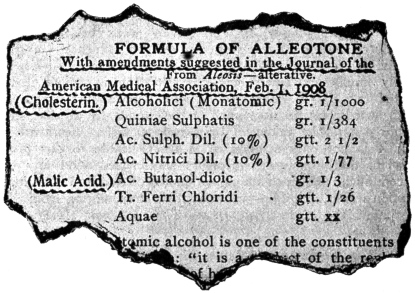
In the original, the words “With amendments suggested in the Journal of the American Medical Association, Feb. 1, 1908,” and also “(Cholesterin.)” and “(Malic Acid.),” which we have underscored in the illustration, are printed in red and have been added to the original “formula.” Such are the uses of adversity.
What claim, if any, the exploiter of this nostrum—B. F. Copeland—has to medical or pharmaceutical knowledge, we do not know. In fact, to be consistent with the “ethics” of the nostrum business he need have none. Such knowledge, indeed, tends to hamper that free play of the imagination so necessary in this work. We understand that he has at different times been in charge of a stave factory and connected with a brokerage firm, which may exert some subtle influence in developing the ability to relieve suffering humanity, though the connection is not quite clear. One would imagine, however, that the keen business instinct, untrammeled by any considerations of conscience, which is exhibited in the exploitation of Alleotone, would in purely commercial pursuits have long since assured a competence.—(From The Journal A. M. A., Oct. 17, 1908.)
BAUME ANALGESIQUE BENGUE
A physician writes asking for the formula of Baume Analgésique Bengué. This product is another of the “patent-medicine”–“ethical-proprietary” type of nostrums. In Great Britain, it is advertised to the public as “A Wonderful Remedy for Rheumatism, Gout, Neuralgia.” In this country, the exploiters find that space in cheap medical journals, reinforced by the aid of undiscriminating physicians, is a cheaper method of getting the stuff to the public. According to the statements of the manufacturers, Bengué’s Analgesic Balm contains “menthol, salicylate of methyl and lanolin.” When analyzed by the chemists of the British Medical Association, it was reported to have the following composition:
Menthol18per cent.
Methyl salicylate20per cent.
Lanolin, anhydrous54per cent.
A fat, apparently lard8per cent.
The estimated cost of the ingredients of a 50-cent tube of Bengué’s Analgesic Balm, according to the British chemists, is 21⁄2 cents. Evidently this imposingly named product is practically a lanolin ointment containing oil of wintergreen and menthol. Similar products are catalogued by various pharmaceutical houses under various names and with varying degrees of frankness concerning their composition. Two firms give the medical profession full details regarding the composition of their products: The H. K. Mulford Company, who sell it under the name “Methyl Salicylate Ointment,” and the Pitman-Myers Co., who name their product “Anodyne Balm, P-M Co.” Some other firms are not so frank. Parke, Davis & Co., for instance, sell “a combination of methyl salicylate and menthol with a lanolin base” under the name “Analgesic Balm,” but do not give the quantities of the ingredients; Frederick Stearns & Co. sell “Analgesic Cream, Stearns” without giving the quantities; Nelson Baker & Co. sell “Anti-Neuralgic Ointment,” and no quantities are given.—(From The Journal A. M. A., Dec. 14, 1912.)
ANTIDIABETICUM—BAUER
In Germany the makers of nostrums, their methods and their products are systematically exposed by the Society for the Suppression of Quackery (Deutsche Gesellschaft zur Bekämpfung des Kurpfuschertums) through its publication, the Geseundheitslehrer, under the aggressive editorship of Dr. Kantor.
Ludwig Bauer,104 the manufacturer of “Antidiabeticum,” inserted advertisements in daily papers asserting that for his “humanitarian efforts” the society “Opera Educativa pacifica” in Rome had granted him a diploma and placed his publications in the celebrated “Bibliotheca Marciazzi.” Dr. Kantor, editor of the Gesundheitslehrer, declared that, according to information received from the German Consulate in Rome, no such society existed there, and the library referred to probably was the Bibliotheca Marciana in Florence, which, like other public libraries, accepts all donations without critical examination. To offset these exposures, the promoter of Antidiabeticum published advertisements libeling Dr. Kantor and attacking the Society for Suppression of Quackery. This resulted in suits and counter-suits for libel between Dr. Kantor and the directors of the antiquackery society on the one side and the promoter of Antidiabeticum on the other. As a result of the recent combined trial, the court declared that Dr. Kantor’s charges had been substantiated and the manufacturer of Antidiabeticum was fined 600 marks or forty days’ imprisonment, while apparently on purely technical grounds Dr. Kantor was fined 50 marks or five days’ imprisonment. The costs were divided between Bauer and Dr. Kantor in the proportion of 11 to 1. As Bauer in the course of the trial made further libelous charges, Dr. Kantor has lately started new proceedings against Bauer. The incessant persecution of Dr. Kantor was described in an editorial in The Journal, May 20, 1911, p. 1486.
The persecution of Dr. Kantor previously described shows no signs of abatement nor has Dr. Kantor given evidence of loss of courage. Some of the German medical societies have subscribed for the Gesundheitslehrer for each of their members. It is written in popular style for the masses and is a sharp and effective weapon for the campaign against quackery.—(From The Journal A. M. A., April 27, 1912.)
ANTIKAMNIA
The Nostrum and Its Method of Exploitation
Our readers will be interested to learn some of the remarkable properties which, according to the statements of the manufacturers, this Antikamnia possesses. We quote from the advertising literature:
The well-known nerve specialist (?), Dr. Harley, in an interview published in the London Daily Express, says: “I have treated more than one American for nervousness and ‘brain fag’ directly due to their incessant energy. I had a young man in here this morning who complained of headache ‘in the back of the neck.’ He was threatened with congestion of the brain, and seemed somewhat aggrieved when I told him he had been trying to do too much. I also treated a young American woman who, since her arrival in London, had apparently been living on Antikamnia tablets by the advice of her physician. It was the only thing, she said, which kept her ‘braced up’ for the strain of sight-seeing.”
(Why did the young woman consult this Dr. Harley—for the drug habit?)
Note the following:
For the severe pains of rheumatism, dysmenorrhea, neuralgia, gout, sciatica and lumbago, as well as for the lightning pains of locomotor ataxia, there can be no quicker and more lasting relief obtained than by the administration of Antikamnia and codeine tablets.
Imagine an intelligent physician trying to treat the diseases mentioned below with the various impotent means of the pharmacopeia and physiological therapy when he might depend on Antikamnia! We quote again:
As a Pain Reliever.—In headache, cephalalgia, hemicrania, migraine [some other words might have been thrown in so as still more to emphasize the headache business], myalgia, coryza, la grippe and its sequelae, the lightning pains of locomotor ataxia and all pains due to irregular menstruation.
As an Anodyne or Sedative.—In alcoholic delirium, indigestion, cardialgia, gastralgia, dyspepsia, hysteria, insomnia, inebriety, car-sickness, sea-sickness, worry and sight-seer’s fatigue.
As an Antipyretic.—In typhoid, intermittent, puerperal and malarial fevers, bronchitis, pneumonia, pleurisy, and tuberculosis.
As an Anti-Neuralgic.—In acute or chronic neuralgia, facial neuralgia, earache, pain about the teeth, angina pectoris, neurasthenia, palpitation, pains of locomotor ataxia and sciatica.
As an Anti-Rheumatic.—In acute or chronic rheumatism and gout, fever and pleurodynia.
There is no remedy so useful and attended with such satisfactory results as Antikamnia tablets in the treatment of melancholia with vasomotor disturbances, anemic headaches, emotional distress, and active delusions of apprehension and distrust. They increase arterial tension and promote digestion, as well as being particularly serviceable in relieving the persistent headache which accompanies nervousness.
In neurasthenia, in mild hysteroid affections, and in the various neuralgias, particularly ovarian, and in the nervous tremor so often seen in confirmed drunkards, they are of peculiar service. In angina pectoris this drug has a beneficial action; it relieves the pain and distress in many cases, even when amyl nitrite and nitroglycerin have failed entirely. In pseudo-angina, frequently observed in hysterical women, its action is all that can be desired.
Patients who suffer from irritable, weak, or palpitating heart, needing at times a pain reliever, can take Antikamnia tablets, without untoward after-effects, knowing that the heart is being fortified. In delirium tremens, they relieve when there are great restlessness, insomnia, the general lowering of the nerve power.
Only the vivid picture of a crisis in locomotor ataxia or the agony of a true migraine, can impress the observer with the full value of this pain reliever.
The following testimonials are from physicians:
Dr. Caleb Lyon, an old Bellevue practitioner, in referring to antikamnia and codein tablets, says:
In my practice they accompany the maid from her virgin couch to her lying-in chamber, assuaging the perplexities of maidenhood and easing the trials of maternity with most gratifying results. I earnestly hope that the proprietors of this valuable remedial agent will keep it up to its present standard of purity and excellence.
Dr. Walter M. Fleming, A.M., M.D., New York City, writes:
... With all the experience of more than a quarter of a century, in the treatment of winter cough, and all its complications of laryngeal, bronchial and pulmonary irritability, dyspnea, asthmatic spasms, and finally whooping cough—usually the most persistent and tenacious of all these membranous maladies—I find no one remedy more strongly indicated, or which yields more prompt and satisfactory results than Antikamnia and heroin tablets, composed of Antikamnia 5 grains and heroin hydrochloride 1⁄12 grain.... Result: a prompt and efficient expectorant, at once relaxing the harsh and rasping cough, releasing the tenacious, sticky and gelatinous mucus which is soon readily expectorated, while the soothing influence of the Antikamnia is at once manifested, greatly to the comfort and contentment of the patient.
... Independent of the fact of the direct applicability of this remedy to the various membranous maladies of the lungs, bronchi, fauces and nose, it proves also, an invariable remedy in all febrile cases where anodyne is required. This, together with its analgesic and antipyretic merits, eminently qualify this combination for a responsive agent in the treatment of nearly all the numerous febrile attacks characterized by pain, nervousness, insomnia and their accompanying symptoms.
“Antikamnia and Quinin”
If there is any virtue in the particular combination known as “Antikamnia,” a physician prescribing the tablets supposed to contain combinations of “Antikamnia” and some other drugs should have some guarantee that they contain those remedies. Take, for example, the tablets advertised and sold as “Antikamnia and quinin.” It might reasonably be supposed that the tablets contained the combination known as “Antikamnia”; this, however, seems not to be the case. Previous analyses, as published105 by us, have shown that antikamnia contains approximately 20 per cent. of sodium bicarbonate, yet two chemists, working separately, have been unable to find this ingredient in the tablets advertised and sold as “Antikamnia and quinin.” Are we to understand, therefore, that the manufacturers do not consider the bicarbonate of sodium of importance in their preparation, Antikamnia; or are they guilty of misrepresentation and of misleading physicians in omitting this constituent from their product Antikamnia when that is combined with the bisulphate of quinin? The above statement regarding the omission of bicarbonate of sodium from the quinin combination may be verified by any physician who desires to make a few simple chemical tests—carbonic acid is not given off when the tablets are treated with dilute acids, as would be the case if sodium bicarbonate were present. Further, while the ordinary Antikamnia contains no constituent not soluble either in water or in chloroform, and while quinin bisulphate is readily soluble in water, the tablets said to contain Antikamnia and quinin bisulphate, when treated successively with water and with chloroform, leave a residue of more than 18 per cent.
One of the chemists who analyzed the preparation for us, in commenting on this in a letter, says: “The matter which is insoluble in water, alcohol or in chloroform, i. e., the substance which is neither ‘Antikamnia’ nor quinin bisulphate, amounts to more than 18 per cent. in ‘Antikamnia and quinin bisulphate tablets.’ The tablets weigh close to five grains and are said to contain 2.5 grains each of Antikamnia and quinin bisulphate. How is this possible when each tablet contains almost one grain of foreign substance (chiefly starch)?”
Further comment is superfluous. We have presented facts to our readers and leave, them to draw their own conclusions.—(From The Journal A. M. A., July 1, 1905.)
Adding Insult to Injury
When the Council on Pharmacy and Chemistry began its work of independent and scientific investigation of proprietary preparations, some of the questions asked were:
“What guarantee has the medical profession that the formulas of these proprietary medicines are not changed at the will of the manufacturers? How can the physician who confidingly prescribes them for his patients know that the preparation which he orders to-day is the same as that which was furnished him last year, or which may be given him next year, under the same name?”
At once a wail, as of injured innocence, went up from countless venders of proprietary medicines, who replied with one voice:
“The honor and reputation of the proprietors and manufacturers is sufficient guarantee of the stability and permanence of these preparations.”
So vehement were their protestations and so well simulated were their declarations of Pecksniffian virtue that many physicians were deceived thereby. Many medical journals (whose views were, perhaps, slightly biased by the consideration of fat advertising contracts) also were apparently convinced. But the fact was overlooked that guarantees based on honor are of value only in proportion to the amount and quality of honor possessed by the guarantors.
The enactment of the national Food and Drugs Act is bringing many things to light. Some of them are interesting, some would be amusing were they not so utterly despicable. Among other things, it has furnished a demonstration of the value of the “honorable assurances” of nostrum venders.
The nostrum Antikamnia has pointed out many a moral in the campaign in the last two years. It was hardly to be hoped that it would deliberately furnish a demonstration of the utter lack of honesty on the part of a certain class of proprietary manufacturers. Yet, relying apparently on the ignorance of the public and the long-continued lethargy of the medical profession, its promoters have, in the last few weeks, unwittingly convicted and stultified themselves. When the pure food law went into effect, the proprietors of this mixture found themselves in a sad dilemma; if they labeled their mixture in accordance with the provisions of the law they would have to admit that it contained acetanilid and that the charges against them were true. Failing to comply with the law, they must go out of business. The latter alternative was not to be thought of. The profits gained by selling, with the aid of careless or ignorant physicians, a five- or ten-cent mixture for $1 were too great to be surrendered without a struggle. The same brilliant intellect, perhaps, that first saw the commercial possibilities in the business said: “Change the formula. Phenacetin is about as cheap as acetanilid; the patent has just expired and consequently we can get it at a low price. Let us substitute phenacetin for acetanilid.”
As a result the profession is treated to an edifying exhibition of virtue triumphant, a wolf so completely covered by the harmless coat of a sheep that he flatters himself that his wolfish nature is completely concealed. No longer are skulls and skeletons sent out in calendar form as grinning advance agents to be displayed in every doctor’s office, but instead a beautiful domestic scene, showing a convalescent child nestling in the arms of its mother. The familiar “AK,” however, as usual, is in the lower right-hand corner. And what a change in labels! No longer is Antikamnia a chemical entity, but the label now openly but ingenuously declares that “Antikamnia tablets in this original package contain 350 grains of acetphenetidin, U. S. P., per ounce. Guaranteed under the Food and Drugs Act, June 30, 1906. Serial No. 10.” While, below, as an entirely unnecessary display of conformity to the Pure Food Act, appears this statement:
The Antikamnia tablets in this original ounce package contain no acetanilid, antifebrin, antipyrin, alcohol, morphin, opium, codein, heroin, cocain, alpha- or beta-eucain, arsenic, strychnin, chloroform, cannabis indica or chloral hydrate.
Truly, Satan is appearing as an angel of light. What a gratification it is to the long exploited profession to know that Antikamnia contains no alcohol, no chloroform, no cannabis indica, no chloral hydrate. How unfortunate that this spontaneous display of confidence is not carried far enough to inform the profession of the ingredients, aside from phenacetin, contained in the mixture!
The label is an admission that the nostrum does not contain what it was never supposed to contain, with the exception of acetanilid, and is directly an attempt to conceal the real contents. The proprietors know that the dear public, whose “pains, headaches, neuralgias, women’s aches and ills, grippal neuroses, nervousness, insomnia, rheumatism, lightning pains of locomotor ataxia, sciatica, etc.,” they are longing to assuage, will not know that acetphenetidin is the official designation for what is popularly known as phenacetin, and that this dangerous product is found in the new mixture in the proportion of approximately 4 grains to a 5-grain tablet. Evidently they also presume considerably on the ignorance of our profession, or why should they make the brazen statement that four grains of phenacetin is the “most reliable remedy” for the long list of diseases enumerated on their advertising calendar?
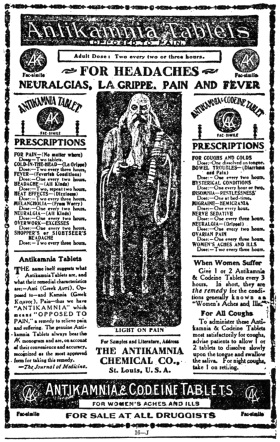
A reduced reproduction of a full-page Antikamnia advertisement appearing in the New York World Almanac, 1911.
When the formula for which such wonderful virtues were claimed was suddenly thrown overboard, was the medical profession, which by its short-sighted patronage had built up this business, notified in any way of the change? Search the new advertising matter of this nostrum from beginning to end and you will not find one word to show that “The Antikamnia tablets in this original ounce package” differ in the slightest particular from those sold to the profession and the public for years past. This being true (and the statements of the promoters themselves are our authority for it), what remains of the pratings of “honor” and the “guarantee of the manufacturers”? Has a physician no right to know when a change is made in the formula of a preparation which he has been prescribing for years?
What assurance has the profession that, at any moment, a cheaper or more dangerous drug may not be substituted for “acetphenetidin” if thereby the law can be evaded or the profits of the delectable business enhanced?
How can any conscientious physician prescribe, for those who confide their lives to his care, a preparation the stability of the formula of which must depend absolutely on its owner’s whim?
How can a physician with the slightest sense of responsibility to his patients allow his office to be used as a free advertising bureau for a preparation manifestly founded and developed on deceit and misrepresentation?
How can any medical journal, except those avowedly and unblushingly seeking to aid the nostrum maker to exploit the profession, whose interests they claim to serve, continue to carry the deceptive and misleading advertisement of a twice exposed fraud?
How can any physician with a particle of self-respect or manhood continue to support, by subscription or contribution, any medical journal which, by accepting such advertising, allies itself with the army of deceit and chicanery?—(Abstracted from The Journal A. M. A., Jan. 26, 1907.)
Still Further Duplicity
When the Food and Drugs Act went into effect the manufacturers of this preparation, instead of continuing to put out the same mixture as they had been doing radically changed the composition by substituting acetphenetidin (phenacetin) for acetanilid. By doing this the company avoided the disagreeable necessity for acknowledging on the label that the nostrum contained acetanilid, as was shown by the analysis published in The Journal, June 3, 1905. In addition to stating that the package of Antikamnia contained acetphenetidin, the company also stated that it contained no “acetanilid, antifebrin, antipyrin, alcohol, morphin, opium, codein, heroin, cocain, strychnin, chloroform, cannabis indica, or chloral hydrate.” Knowing that the nostrum was being advertised in Great Britain and Canada as well as in the United States, The Journal obtained some Antikamnia from London, and it was analyzed in the Association’s laboratory. As was suspected, the analysis showed that Antikamnia as sold abroad has the same composition now as it had in the United States before the Food and Drugs Act went into force, viz.: Acetanilid, 67.75 per cent.; caffein, 4.88 per cent., and citric acid and sodium bicarbonate, by difference, 25.36 per cent. This corresponds with the analysis previously made and published in The Journal, June 3, 1905. The Antikamnia on the market in this country was also analyzed and it was found to contain: acetphenetidin (phenacetin), 72.05 per cent.; caffein, 13.95 per cent.; citric acid and sodium bicarbonate, 14 per cent. The preparation sold as “Antikamnia and Quinin” was also analyzed, and it was found that starch had been substituted for the bicarbonate of sodium which is found in the Antikamnia itself. The details of the analyses are given with the following comments: “The above are brief statements of bald facts. Two of these should be emphasized: (1) When the Food and Drugs Act went into force, January, 1907, the manufacturers of Antikamnia, rather than acknowledge the truth of the past—we can imagine no other reason—materially and radically changed the composition of their preparation, and did this without notifying the medical profession or intimating in any way, so far as we can learn, that such a change had been made. We have no doubt they believed they had a right to do as they pleased with their own; that it was nobody’s business but theirs what they did with their own preparation, or how they changed it. As they never had told physicians what it contained, there was no reason why they should do so now. This is logical and we cannot blame the manufacturers so long as the medical profession is willing to be humbugged. (2) For the same reason, we presume, they claim that they have a right to continue to use acetanilid in the product for the foreign market. The Food and Drugs Act applies only to the United States, of course, and acetanilid being cheaper, why not use it? What is the difference if one is more dangerous than the other? The fact that the Antikamnia sold abroad differs from that sold in this country some may say is of no special interest to us. Still this fact is worth noting: The dose of acetphenetidin—phenacetin—(71⁄2 grains) is nearly double that of acetanilid (4 grains): one becoming accustomed to a certain dosage of the nostrum as sold in this country might, while abroad, unwittingly be led to take a double dose of acetanilid.—(Abstracted from The Journal A. M. A., Feb. 8, 1908.)
Samples, Form Letters and “Prescriptions” Sent to the Laity
To the Editor:—The enclosed “literature” is being sent broadcast to the laity by the Antikamnia people and still a great many of the physicians throughout the country are prescribing the preparation thus advertised. Will the time ever come when the medical fraternity will awaken to the fact that it has been humbugged by a great many manufacturing concerns? I certainly hope so.
J. W. DuVal, M.D., Wichita Falls, Texas.
Comment:—The “literature” referred to by our correspondent consists of a form letter and a small pamphlet. The letter was similar to the one reproduced herewith.
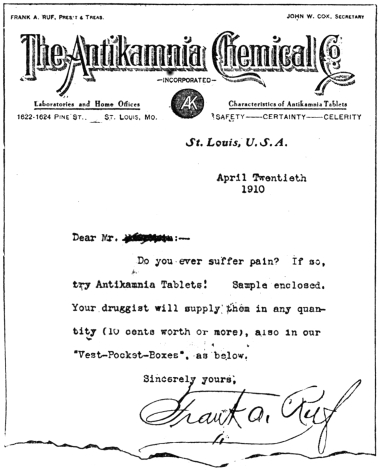
The pamphlet accompanying the letter is entitled “Practical Prescriptions,” and contains a list of diseases and morbid states arranged alphabetically from “Alcoholism,” “Asthma” and “Backache,” to “Wind,” “Women’s Pains” and “Worry.” For the one hundred and twenty-two conditions listed, “Antikamnia,” “Antikamnia and Codein” or “Laxative Antikamnia and Quinin” are prescribed, demonstrating that the “prescriptions” are more “practical” than scientific.
In many respects the methods of the proprietors of “headache powders” and “anti-pain pills” are less offensive to one’s sense of professional decency than the course pursued by the Antikamnia people. The former have at least never recommended their products as “ethical proprietaries”; they have not used medical men as their unpaid agents; the claims made for their products have been no more exaggerated; and they have not found it necessary, from the requirements of the Food and Drugs Act, to substitute acetphenetidin for acetanilid to avoid giving the lie to their former claims.
As to the query propounded by our correspondent: We are optimistic enough to believe that the time he longs for is already here. The fact that the proprietors of nostrums of the Antikamnia type are finding it necessary to advertise to the laity is, in itself, evidence of the diminishing demand for such products on the part of the medical profession.—(From The Journal A. M. A., April 18, 1908.)
Antikamnia in America and Great Britain
The following letter from the Antikamnia Chemical Company to The Journal was received about August 1, 1912:
“You have at various times represented in your Journal that the Antikamnia sold in foreign countries, particularly in Great Britain, has a different formula from the Antikamnia sold in the United States, and you have also published alleged formulas of each to show wherein they are supposed to differ.
“We hereby respectfully notify you that the Antikamnia formula is the same for all countries, and the publication of any statements to the effect that the formula of Antikamnia is different in Great Britain, or any other foreign country, from that sold in the United States is a libel, and will be prosecuted as such.”
On the receipt of this a letter was written to a correspondent in London requesting him to purchase in the open market a package of Antikamnia. This was done and the original sealed package reached the Association’s laboratory a few days ago. Careful analysis of this specimen shows it to contain acetanilid but no acetphenetidin, while the Antikamnia sold in the United States contains acetphenetidin but no acetanilid. The company’s protest to the contrary notwithstanding, the formula of some Antikamnia, at least, is still different in Great Britain from that sold in the United States. It is possible, of course, that some time in the future the composition of every package of this nostrum on sale in the United Kingdom will be similar to that of every package sold in the United States. It is even possible that “Antikamnia & Quinin” tablets will—or do—actually consist of quinin and the mixture called Antikamnia—although, as The Journal has shown, this has not been the case in the past. Since the patent expired on acetphenetidin, this drug has become so cheap—it can be bought at wholesale for less than 6 cents an ounce—that, commercially it must make very little difference whether acetanilid or acetphenetidin is used in the manufacture of Antikamnia. But the question arises: Have our British confrères been notified of the change in formula? A careful study of the Antikamnia advertisements in English medical journals shows that the British medical profession has been given no more consideration by this concern than was the American medical profession when the change in composition was made on this side. But then why should it be? Physicians, British or American, who are addicted to the prescribing of secret proprietaries such as Antikamnia have little need of formulas—“Theirs not to reason why!” The medical profession on both sides of the Atlantic has never known the exact composition of Antikamnia and does not know it now. Physicians who call for preparations of the Antikamnia type are prescribing names, not drugs.—(From The Journal A. M. A., Oct. 26, 1912.)
Again, Antikamnia
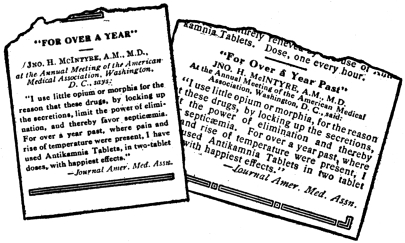
Reproductions of portions of pages in the booklets sent out by the Antikamnia Chemical Company to physicians (on the right), and laymen (on the left), respectively. Those who do not realize the character of the Antikamnia concern naturally imagine the quotation here given from The Journal is a comparatively recent one. Notice that no dates are given. As a matter of fact, it is twenty-two years old. Dr. McIntyre, who wrote it, has been dead eleven years.
In season and out of season The Journal has exposed the Antikamnia fraud until it would seem that its readers would become weary of the very name. There is nothing new to say about this dangerous stuff, and yet the number of inquiries indicates that thousands of The Journal’s readers do not know of the previous exposures. More than fifteen years ago The Journal ceased carrying the Antikamnia advertisement; more than ten years ago it notified its readers that the nostrum was being advertised to the public by means of circular letters; more than six years ago it proved that, when the Food and Drugs Act went into effect, acetphenetidin had been substituted for acetanilid in Antikamnia evidently in order that the presence of the older drug, of whose dangers the public had been made aware might not have to be admitted; more than five years ago The Journal showed that the Antikamnia sold in the British Isles still contained acetanilid, and as late as last October it verified this statement although threatened with prosecution for libel by the Antikamnia Chemical Company.
Yet, in spite of all these exposures, not a week passes that we do not receive one or more letters calling attention to the Antikamnia fraud. Most of these letters deal with one, or more, of three points: first, the fact that the stuff is being advertised to the public by means of circular letters and that sample “vest-pocket boxes” of this dangerous drug are being sent through the mail to laymen; second, that Antikamnia is being advertised in newspapers, and, third, that in the booklets sent out by the Antikamnia Chemical Company both to the medical profession and to the public, a paragraph is quoted from an article by Dr. John H. McIntyre that appeared in The Journal.
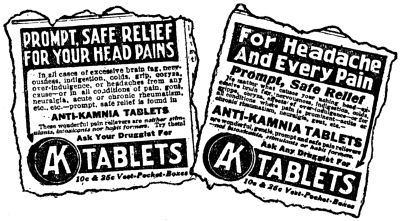
Photographic reproductions of two typical Antikamnia advertisements now appearing in newspapers all over the country. These tablets are advertised in various newspapers as being “safe” and neither “depressant” nor “habit-forming”—three separate and distinct falsehoods.
The first two points have already been discussed so frequently that it seems hardly worth while to take them up again in detail, though it might be said that the medical profession has at last become so familiar with this widespread humbug that the Antikamnia Chemical Company has finally gone over body and soul to the newspapers. So far as we can learn only three publications professing to be medical journals still carry the Antikamnia advertisement. These three are:
Southern PractitionerPacific Medical Journal
Therapeutic Record
As is usual in such cases, the British medical journals are not so particular, and we still find Antikamnia advertised in:
Medical Press and CircularLancet
Glasgow Medical JournalCanada Lancet
Journal Tropical Medicine and HygienePractitioner
Dublin Journal Medical Science
The reproduction of the McIntyre quotation is evidently adopted by the Antikamnia concern as a means of “playing even” with The Journal for the unpleasant things it has said about it. In quoting Dr. McIntyre, the Antikamnia Chemical Company carefully avoids giving the date on which the article appeared. As a matter of fact, the article was printed in The Journal over twenty years ago (July 4, 1891), and Dr. McIntyre himself has been dead for eleven years. Presumably, however, the Antikamnia Chemical Company will continue to mislead, either directly or by inference, until the end of the chapter.—(From The Journal A. M. A., April 12, 1913.)
ANUSOL SUPPOSITORIES
“In Hemorrhoids and all Inflammatory Rectal Diseases, let your first thought Continue to be Anusol Hemorrhoidal Suppositories; they have Earned your lasting Confidence.” Thus speaks an attractive folder recently sent to physicians. With a prodigal use of superlatives, the medical profession is told that these suppositories have for years “maintained their World-Wide Reputation” as the “Most Effective, the Safest ... the Most Economical and ... the Most Credit-Bringing of all Topical Rectal Remedies.” The short memory of the public is notorious; from the point of view of the proprietary exploiter, the short memory of the medical profession must be equally well known. How, otherwise, would a firm try to make physicians believe that a product had “earned” their “lasting confidence” when the result of an examination by the Association’s chemists, published in The Journal,106 had shown that Anusol Hemorrhoidal Suppositories contained practically no “anusol.” Moreover, as the Association’s findings were a practical verification of the findings of a foreign chemist who also had failed to find any “anusol” in Anusol Suppositories, it is not quite clear what is meant by the term “world-wide reputation.” Incidentally, the observant physician will notice that the list of the ingredients given on the Anusol Suppositories labels of 1913 differ from those of the vintage of four years ago. The label of the old boxes gave the ingredients thus:
Bismuth. iodo-resorcinsulfon (Anusol), Zinc oxydat. pur., Balsam Peruv., Ol. cacao, Unguent cereum.
On the latest label, however, we find these ingredients given:
“Bismuth oxyiodid and resorcinsulphonate with Zinc oxid and Balsam Peru, incorporated in suitable base.”
What will the formula be four years hence?—(From The Journal A. M. A., Oct. 11, 1913.)
ANUSOL SUPPOSITORIES
To the Editor:—In the “Propaganda for Reform” department of the October 11 issue of The Journal, you published a short notice on Anusol Suppositories. We desire to correct the impression which your readers may have received, viz.: that there is any actual difference between Anusol Suppositories of the present and Anusol Suppositories of the past. We wish, therefore, to state that the composition of Anusol Suppositories has not been changed; the only modification that we have made is a revision of the label to the effect that the active medicinal ingredient of the preparation is a mixture of bismuth oxyiodid and bismuth resorcinsulphonate in place of bismuth iodoresorcin-sulphonate. The latter was originally claimed by the manufacturers, discovered to be doubtful by an investigation in the laboratory of the American Medical Association, as well as by one on the part of a foreign chemist, and finally disproved to our satisfaction by an independent investigation on our part. We feel that the remark “What will the formula be four years hence?” will carry the impression to your readers that the composition has frequently been changed and is likely to be changed again, and it is for this reason that we request the above correction and an assurance to the contrary.
The statement in the note that “Anusol Suppositories have been proved to contain no Anusol” is also likely to create an entirely erroneous impression. We dropped the use of the word “anusol,” as designating a definite chemical substance more than two years ago, and changed all our propaganda matter accordingly. Schering & Glatz.—(From The Journal A. M. A., Jan. 31, 1914.)
ASPIRO-LITHINE
Aspiro-lithine is another comparatively new example of the custom of proprietary manufacturers in putting forward old drugs under a new name and with them bidding for the favor of physicians. An inquiry has been received concerning this mixture. It is prepared by McKesson & Robbins and is said to contain in each tablet 5 grains of acetysalicylic acid (aspirin) and 21⁄2 grains of acid citro-tartrate of lithium. It is recommended for all the purposes for which acetysalicylic acid is commonly used, and on account of the lithium added is claimed to have much greater virtues than either of these drugs alone or of both combined.
We had hoped that the time had passed for reputable houses to employ such time-worn methods, but probably they will not stop so long as physicians encourage them by continuing to use such preparations. Acetysalicylic acid is a good drug, whose value is pretty well known. It is further known that lithium salts do not possess any great medicinal virtue. Just what acid citro-tartrate of lithium may be is hard to tell, for chemistries do not recognize such a substance. The name presumably is intended to hide the real nature of the preparation.
But if there be any advantage in combining lithium salts with acetysalicylic acid in a prescription, it is a simple proposition and requires no great skill, either on the part of the physician who writes the prescription or on the part of the druggist who puts it up, and such mixtures as aspiro-lithine, with the exaggerated claims made for them, should be avoided in the physician’s prescribing.—(From The Journal A. M. A., May 28, 1910.)
BELL-ANS (PA-PAY-ANS, BELL)[AI]
Another “Patent Medicine” Foisted on the Public Through the Medical Profession
With such nostrums as Antikamnia and Resinol fresh in mind as flagrant examples of “patent medicines” introduced to the public through the medical profession, what follows regarding Bell-ans, or, as it is better remembered by physicians, Pa-pay-ans (Bell) will take on an added interest. Briefly, Bell-ans is the new name of a tablet that, according to chemists’ reports, is essentially charcoal, baking soda and ginger, flavored with oil of wintergreen. Its selling point, in the past at least, has been the alleged presence of papain. This drug, Bell & Co. allege, is present in their tablets and they claim is “the digestive principle obtained by our own exclusive process from the fruit of Carica papaya.” As long ago as 1909, the Council on Pharmacy and Chemistry attempted to find papain present in what was then called Pa-pay-ans (Bell) and to determine the digestive power of the tablets but with negative results.
The efforts of other chemists were equally unavailing.
In January, 1914, Bell and Company changed the name of the product “Pa-pay-ans (Bell)” to “Bell-ans.” As The Journal remarked soon after, it seemed probable that, as the name of a nostrum of this kind is the manufacturer’s most valuable asset, the name was hardly changed, as was alleged, for purely euphonious reasons. It seemed more likely that as analyses had indicated there was not, and probably never had been, any appreciable amount of papain in the product, the change of name might be due to the fear that some day the misleading name might bring the preparation in conflict with the federal Food and Drugs Act.
For years physicians have realized that the methods of exploitation of Pa-pay-ans (Bell) have been such as to make the medical profession a vast free advertising agency for the nostrum. So far as we know Pa-pay-ans (Bell) has never been advertised in lay journals—newspapers, etc. Certain medical journals, however, have, for a long time, carried the advertisements of Pa-pay-ans (Bell)—and later of Bell-ans—while Bell & Co. has been lavish in its distribution of free samples, blotters and other advertising paraphernalia direct to the medical profession.
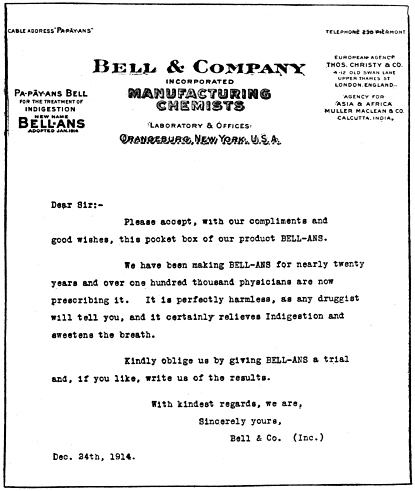
Miniature facsimile of a letter received by a layman. It was accompanied by a small box of Bell-ans. Two points are worth noting: “... one hundred thousand physicians are now prescribing it”; “any druggist will tell you” that it is perfectly harmless!
Now it seems Bell and Company are going direct to the public by means of vest-pocket samples and letters. The letter, a miniature facsimile of which we reproduce, is one addressed to laymen and accompanies a vest-pocket box of the nostrum.
Here are some of the things that Bell and Company claim Bell-ans will do:
“It removes flatulence, vertigo, weakness and other symptoms of indigestion quickly and pleasantly.”
“It relieves vomiting in pregnancy, alcoholism, seasickness and cholera morbus....”
“To promote appetite, digestion and the elimination of toxic and waste material prescribe the Bell-ans....”
“... prevent eruptions, nausea, vertigo, pain, etc. ...”
“... remove distention, pain, weakness, depression, etc. ...”
“There is no derangement of the digestive organs upon which the proper dose of Bell-ans (Pa-pay-ans, Bell) will not act quickly, pleasantly and favorably....”
There is no physician living who really believes such claims as these! Yet on the medical profession rests the responsibility for the exploitation of this nostrum. Those medical journals which accept advertisements for things of this kind are not so much to blame as those physicians who unprotestingly tolerate the journals that do so. Privately owned medical journals are published, usually, as a commercial proposition; they reflect, to a greater or less extent, the attitude of their readers, subscribers and contributors. There are at least three medical journals which carry the advertisements of Bell-ans. They are the New York Medical Journal, the International Journal of Surgery and the Massachusetts Medical Journal.
Bell-ans (Pa-pay-ans, Bell) possesses the virtues—and they are few—and the limitations—and these are many—inherent to a mixture of bicarbonate of soda, ginger and charcoal. Any druggist could put up just as good a remedy, and any physician could write a prescription for a better one in those cases in which he might think it indicated. The whole secret of the commercial success of Bell-ans lies in the mystery of its composition and the fraudulence of the claims that have been made for it. The same tablets put out under a non-proprietary name, as an open formula and with claims that were reasonable and true, would have had practically no sale. The commercial success of Bell-ans is a monument whose foundation rests equally on the unscrupulousness of the manufacturer and on the gullibility of a learned profession.—(From The Journal A. M. A., Jan. 16, 1915.)
BIOSOL
Dr. A. N. Lakin, State Line, Ind., writes:
“Kindly advise me concerning Biosol. I am sending you herewith a pamphlet describing this product. On the last page note clinical report from Dr. Buchman of the Indiana Medical Association and president of the Department of Public Health, Fort Wayne, Ind.”
H. Hille, once of Heidelberg, now of Oak Park, Ill., having reached the conclusion that mineral starvation is the cause of all diseases, devoted his talents to finding a remedy. He claims to have found it and calls it “Biosol.” He published his discovery in a pamphlet entitled “Facts of Modern Science,” and recently published an article in the Medical Record giving his ideas on this mineral point of view. Biosol is an indescribable mixture of alcohol, carbohydrates, and many and various mineral bodies—ranging all the way from sodium, potassium, calcium and magnesium to silicon, copper, uranium and thorium—the amount of each being in most cases extremely minute. It is said to be a valuable food as well as medicine. A dose of this food might keep a rabbit alive for several hours, and a man who could stand the expense and escape death from delirium tremens might live on three quarts of the mixture per day. Human beings have little occasion to fear mineral starvation, and may obviate whatever danger there may be with a drink of milk. Like other living creatures, we may be thankful that we are furnished in our own bodies with a living bioplasm which can use the minerals of the waters and the rocks and which has its own laboratory in which to prepare organic compounds to suit its needs.—(From The Journal A. M. A., March 8, 1913.)
BROMIN-IODIN COMPOUND
The Life-History of a Nostrum
A correspondent writes for information concerning a remedy known as Bromin-Iodin Comp., which he says is manufactured by the Bromin-Iodin Chemical Company, formerly of Binghamton, N. Y., but now located in San Diego, Calif. In The Journal for Feb. 5, 1898, appeared an article by Dr. C. W. Ingraham, Binghamton, N. Y., entitled “Five Years’ Successful Experience with a Special Mode of Treating Pulmonary Tuberculosis.” This “special mode” of treatment consisted in using what Dr. Ingraham called “bromin-iodin compound,” which he said had the following formula:
Iodingr.1⁄2
Bromingr.1⁄14
Phosphorusgr.1⁄100
Thymolgr.2⁄3
Sterilized oilfl. dr.1
This “hypodermic treatment of phthisis” was widely advertised in the late nineties by the Bromin-Iodin Chemical Co, Binghamton, N. Y., and was but one of the innumerable “treatments” for pulmonary tuberculosis that have risen, had their day and, more or less gracefully, retired. It was first sold “to physicians only” for hypodermic administration. In 1906, however, physicians were told by the company that “if we find it impossible to secure your cooperation ... we will be compelled to do business with the druggists in your locality ...” Apparently they found such cooperation impossible, because a leaflet was issued to the laity and the statement was made that they intended to advertise “all over North America in publications of national and international circulation, as well as in local newspapers ...” Naturally the laity couldn’t be expected to administer this treatment by the hypodermic method and it is not surprising to read that “experiment has proved that the same solution can be taken internally.” In addition to the advertising leaflet, the public also was provided with a “pocket calendar good for 200 years” which contained numerous testimonials from physicians laudatory of the “bromin-iodin” treatment. The layman who received one of the leaflets was told that if he was suffering from “asthma, bronchitis, colds, consumption, coughs, eczema, goiter, hay fever, neuralgia, rheumatism ... also constipation and kidney troubles,” and his recovery was “not as rapid as it should be,” should, moreover, his physician refuse to use the bromin-iodin compound “it might not be a bad idea to discharge him” and get a physician who would!
At the time this “treatment” was first tried by its “inventor,” the results given in fifty cases were: First stage, 90 per cent. cures; second stage, 50 per cent. cures; third stage, no cures, but improvement in several cases; this was in 1895. It now appears that this “treatment” has after a period of “patent-medicine” exploitation come back into the “ethical proprietary” field. Presumably a mixture such as that represented by the “formula” did not lend itself to administration by mouth; there was nothing to do, therefore, but enlist the aid of “easy” physicians in furthering its sale.—(From The Journal A. M. A., June 4, 1910.)
CALMINE
New Names for Old Drugs
“Calmine, the new Hypnotic,” is another example of the ingenuity of the exploiters of proprietary preparations in coining new names for old drugs and the recklessness with which exploiters herald forth renamed remedies to the profession and the public as new and wonderful discoveries.
This is what the promoters, sustained by a calm confidence in the credulity of the profession, have to say:
In the medical circles throughout the country a good deal of interest and even enthusiasm over this new hypnotic is noticeable. Very few drug products have attracted so much attention as this one.
A really satisfactory hypnotic and sleep-inducer, which Calmine certainly seems to be, has been awaited expectantly for many years. Of course, we have always had agents of this sort—a new one has come out at frequent intervals—but none of them have “filled the bill”; they have been prescribed only because there was nothing better to be had.
Now this new and wonderful discovery is nothing but Veronal-sodium (sodium diethyl-barbiturate) under another name. It is the sodium salt of the more or less favorably known hypnotic, Veronal (diethyl-barbituric acid). It is also sold as Medinal, and differs from Veronal only in that the combination with sodium has made it more readibly soluble, and thus, it is claimed, its absorption is more prompt. Veronal is protected abroad by a trade-mark and in this country by a patent, and this, undoubtedly, is responsible for the introduction of this sodium salt under these fanciful names, because Veronal could not be sold without infringing on the patent. This in turn induced the manufacturers of Veronal, in self-protection, also to put the sodium salt on the market, and now we have it under the name of Calmine. This probably is only the beginning; soon we may look for it under a host of other names and the usual result will follow: thoughtless physicians who have had poor results with it under one name will try it under others. Or worse still, physicians will thoughtlessly combine Veronal with Calmine or with Medinal in the same prescription, thus giving a dangerous dose.—(From The Journal A. M. A., Jan. 14, 1911.)
CAMPHENOL
Camphenol is made by Johnson & Johnson, New Brunswick, N. J. Under the name of the article on the carton appears the following formula: C10H16O─C6H4(CH3)OH═C6H5OH. This formula consists of the chemical formulas for camphor, cresol and phenol, written one after another, and from this one would conclude that Camphenol is a compound of camphor, phenol and cresol in molecular proportions. Examination shows, however, that Camphenol is but a modification of the well-known camphorated phenol (the liquid produced when solid camphor and phenol are triturated together). In Camphenol a part of the phenol, in the camphorated phenol, has been replaced by cresol, and this liquid has been diluted and emulsified with gelatin or some similar substance and perfumed. In other words, this preparation is an emulsion containing relatively small quantities of cresol, phenol and camphor and is another illustration of the attempts of would-be pharmaceutical houses to produce new synthetics in the simplest manner possible—that of writing the chemical formulas of the constituents of a remedy in a way to indicate a chemical combination.—(From The Journal A. M. A., Nov. 5, 1910.)
CHOLOGEN
The proprietary Chologen is interesting some of our readers and several have sent us samples and literature. Dr. Philip Marvel, Atlantic City, N. J., for example, writes:
“By the way, I am to-day sending you by mail a package which the Council on Pharmacy and Chemistry may care to tackle, or it may not. I shall not be insulted any way, but since these chologen preparations are being used a good deal by various globe trotters, who sometimes hook up for a short stay here, I feel it might be of some interest to know ‘what fools these mortals be’ and how much the profession is being fooled with them.”
Chologen as a medical treatment for gall-stones has been before the German public for a number of years, and it is somewhat singular that so simple a method, which could be easily prescribed by the physician if it had merit, should exhibit such remarkable vitality in proprietary form in spite of evidence going to show that it rests on erroneous principles. The Council rejected it as an unscientific mixture. The treatment is somewhat liberal, consisting of the use, in varying successions, of three kinds of tablets: No. 1, calomel and podophyllin; No. 2, calomel, and No. 3, calomel, podophyllin, camphor and menthol. The proprietors tell us that the treatment should be proceeded with in spite of disturbances, such as diarrhea and pain in the abdomen, and that it should be repeated regularly in intervals for some years, so long as any trouble exists or recurrence is threatened. “A course” of Chologen tablets should be taken two or three times a year, No. 1 being given for ten days, then Nos. 1 and 2 for forty days and No. 3 for ten days.
It is worthy of note that experimental work seems to have been performed in the attempt to show that bile produced by this remedy will cause the disintegration and solution of gall-stones. Normal bile has a certain solvent action on gall-stones, but calomel and podophyllin have no demonstrable effect in increasing the amount of bile. We had imagined that these facts were generally known.
It is somewhat discouraging to reflect that some physicians entertain so low an estimate of their ability to prescribe such well-known remedies as calomel and podophyllin that they must use them in the fixed combinations provided by Dr. Glaser. If the self-respecting physician does not consider himself insulted by a proprietary manufacturer who presumes to tell him how to use such well-known remedies, this is a good sign that he needs to take a postgraduate course in materia medica and elementary prescription-writing. We feel that medical writers must be short of subjects when they devote papers to the exploitation of proprietaries consisting of these simple ingredients.—(From The Journal A. M. A., Feb. 1, 1913.)
HAGEE’S CORDIAL OF COD-LIVER OIL [AJ]
Fraud and Deception Connected with So-Called Cod-Liver Oil Preparations
The introduction of cod-liver oil as a supposedly easily assimilable nutrient and reconstructive was followed by its extensive use in wasting diseases, especially in phthisis, in the treatment of which it came to be considered almost essential, as it was supposed to possess some mysterious power different from that of other oils. Its unpalatable character led to various devices to render it tasteless and make it more acceptable to the stomach. Emulsions containing the oil in mixture with other substances were put on the market and served a useful purpose. But the oily nature, imperfectly concealed, was disagreeable to many, and gradually other preparations appeared which attempted to retain the supposed therapeutic virtues of cod-liver oil while dispensing with its disagreeable character. This attempt has been carried to the extreme that in many of the cod-liver oil preparations now on the market the oil has been entirely eliminated and all that is left of the oil is the name. This is a species of fraud which has been tolerated too long, but which will be kept up so long as physicians are willing to be duped. Some of these articles are said to “represent” the oil and to possess all its virtues. Others are said to contain oil, while still others are stated to contain “all the valuable constituents.” What is the standard by which we may determine the true value of these preparations and by which we may determine whether or not we, and through us our patients, are being humbugged?
A FOOD OR MEDICINE—WHICH?
Is cod-liver oil to be considered a food or a medicine? A food, certainly. As a food its value will consist in the fats it contains. These fats are more easily oxidizable and are considered more digestible than other fats because of the presence of compounds derived from the liver which favor its emulsification and enable it to penetrate the mucous membrane more easily than other fats. Aside from their nutrient properties we have no evidence that the fats of cod-liver oil possess any therapeutic value; if the oil possesses therapeutic qualities they must reside in its non-fatty constituents, and the activity of these non-fatty constituents is not acknowledged by those who have investigated them scientifically. Most pharmacologists believe that whatever virtue there is in cod-liver oil depends on its qualities as an easily assimilable fat.
On the whole, we must conclude with Cushny that “cod-liver oil has not been shown to have any action apart from that of an easily digested food, and its superiority to some other fats and oils has not been satisfactorily established.”
If, then, the value of cod-liver oil depends on the presence of fat as its nutritive constituent, the amount of fat a preparation contains will determine the worth or worthlessness of such a preparation; at all events, a preparation claiming to represent cod-liver oil which does not contain fat in some form is fraudulent.
HOW TO PROVE OR DISPROVE THE PRESENCE OF COD-LIVER OIL
Fats may be changed to fatty acids or to soaps, as occurs under the influence of pancreatic juice in digestion, and still retain their nutritive value, but it is not possible to manipulate them in any way so that they are still valuable as food, and yet do not respond to easily applied chemical tests which demonstrate their fatty nature.
Any preparation of cod-liver oil in which fat or fatty acid is not recognizable by proper tests is valueless as food, since its food value depends on the amount of fat or fatty acid present. An elementary knowledge of chemistry and the application of a few simple tests will enable any physician to learn for himself whether or not a preparation contains fat or fatty acids.
The preparations claiming to “represent” cod-liver oil are in liquid form, and if they contain oil it must be one of the following forms:
1. An emulsion of the oil which may be miscible with water, but from which the fat tends to separate and rise to the top. In this form the fat can be seen as globules under the microscope.
2. A solution, resulting from the saponification of the oil, containing a soap which usually will be alkaline in reaction, especially when mixed with water, and from which fatty acids are separated as a precipitate when the solution is acidified.
3. A solution of fatty acids. This will be acid in reaction and will be precipitated by the addition of water, in which the fatty acids are not soluble.
Hagee’s Cordial of Cod-Liver Oil
Hagee’s Cordial of Cod-Liver Oil Compound is said to “represent 33 per cent. of pure Norwegian cod-liver oil,” with other ingredients, in perfect solution. It is also claimed, according to the advertising pamphlet, that “in this preparation we have every beneficial constituent of the best and purest Norwegian cod-liver oil.” Put to the above three tests, however, Hagee’s cordial of cod-liver oil is not, 1, an emulsion of cod-liver oil; 2, is not a saponification of cod-liver oil; and, 3, does not contain fatty acids. It therefore contains no cod-liver oil. The only nutrients in the mixture, revealed by analysis, are sugar, alcohol and glycerin, none of which is contained in cod-liver oil.
In this case the manufacturer misleads by the use of the word “represents”; he is careful not to say “contains,” although the average reader would not be apt to notice the nice distinction. The manufacturer unwittingly admits that it contains no oil when he says that it “contains everything of value except the grease.” What else there is of value in cod-liver oil besides the “grease” we do not know. Certainly, if we estimate the value of the remedy by its nutrient properties, it must be set down as practically worthless, if not fraudulent, for although a mixture of sugar, alcohol and glycerin does possess certain nutrient value, the materials can be purchased for it far more cheaply in the open market. It is evident that claims are made for this preparation which cannot be substantiated.
Again, some of the so-called cod-liver oil preparations are termed extracts of cod-liver oil, but are not in fact made from the oil, but from the cod-livers instead. They are preparations which, if honestly made, might be worthy of trial, but they are improperly called “extracts” of cod-liver oil, since they do not contain the fat, which is the active constituent of the oil, but the extractives from the liver which may or may not possess therapeutic virtues. So far as we know, however, no satisfactory evidence is forthcoming to indicate that such extractives have any therapeutic value.
The attempt to modify cod-liver oil for therapeutic purposes may be pronounced a failure and the large variety and extensive sale of these preparations appear to be owing to the fact that physicians do not recall the ordinary facts of chemistry and fail to apply simple tests with little technical skill, but too readily accept as facts the statements of the manufacturers.—(Modified from The Journal A. M. A., Oct. 13, 1906.)
WATERBURY’S COMPOUND ONCE MORE [AK]
Most of our readers will remember what The Journal has published about a product that used to be sold as “Waterbury’s Metabolized Cod-Liver Oil Compound.” Briefly, it was shown by a report of the Council on Pharmacy and Chemistry and a contribution from the Association’s laboratory, that this “Cod-Liver Oil Compound” contained practically no cod-liver oil! Later the federal government declared the stuff misbranded.
The product is now sold under the name “Waterbury’s Compound.” It was recently stated in this department that “Waterbury’s Compound” was one of the proprietary preparations advertised both in “display” form and also in the form of an “original article,” in the Army and Navy Medical Record—a fraudulent publication that offered its editorial pages for sale. Physicians are now receiving from the Waterbury Chemical Company a reprint of what purports to be an editorial from the Army and Navy Medical Record entitled, “One of America’s Most Valuable Preparations.” The preparation, of course, is “Waterbury’s Compound.” The company in sending out this reprint also reproduces on the reverse side the title-heading of the Army and Navy Medical Record. All of which goes to show that some concerns not only do not mind being found in bad company, but seem proud of it. By the way, we wonder whether those physicians who are still prescribing this nostrum think they are prescribing a preparation containing cod-liver oil!—(From The Journal A. M. A., Nov. 15, 1913.)
COLLYRIUM-WYETH
“I should be glad of any information about Wyeth’s Collyrium and would also like to know if the position taken by this concern measures up to the requirements of the Council on Pharmacy and Chemistry.”
This inquiry was received from a Boston physician, who enclosed with his note the letter quoted below that he had received from John Wyeth & Brother, Philadelphia, the makers of the preparation in question:
“We have your letter of the 22d inst., in which you request us to send to you formula for ‘Collyrium,’ and in reply thereto, beg to advise, being a corporation you will, we think appreciate why we are not at liberty to disclose the various formulas under which our preparations are made. Such is the competition in the trade that secrecy in this respect is a valuable asset.
“You will not for a moment think that we take this position through any distrust of your discretion or good faith, but because we feel that our duty to the stockholders of the company prohibits us from disclosing our formulas.
“Let us assure you however, that the eyewash contains only the simplest and most harmless remedies well known to the medical profession.”
John Wyeth & Brother seek the patronage of the medical profession and desire physicians to use their preparations, but “being a corporation” they “are not at liberty to disclose the various formulas” of these preparations. In other words, they expect physicians of the country to prescribe “patent medicines” of whose composition they must be ignorant and to rely wholly on the word of John Wyeth & Brother as to the innocuousness of these products.
The letter is an insult to the physician to whom it was written. If physicians were not so apathetic in cases of this kind, the corporation of John Wyeth & Brother would long since have been forced “off the fence”—it would have become either a “patent medicine” concern or would have confined its activities to the manufacture of pharmaceutical products and ethically exploited proprietaries. Now what about this Collyrium-Wyeth? It was analyzed in the Chemical Laboratory of the American Medical Association and the chemists report:
“The specimen of Collyrium-Wyeth examined was a clear, colorless liquid having a faint odor like benzaldehyd. Qualitative tests demonstrated the presence of antipyrin, free boric acid and sodium borate. Acetanilid, ammonium salts, glycerin, nitrates, phosphoric acid and pyramidon were absent. Such potent alkaloids as atropin, cocain, homatropin and pilocarpin, which are often used in ocular surgery, were not found. Preparations of goldenseal were not present. Quantitive examination indicated that the composition of the preparation examined is essentially as follows:
“Antipyrin0.41gm.
“Sodium borate0.55gm.
“Boric acid2.14gm.
“Water (by difference) to make100.00c.c.”
The secret of such a formula must indeed be a “valuable asset!” We venture the assertion that if the medical profession did its duty, the corporation of John Wyeth & Brother would find that its “duty to the stockholders of the company” constrained it to abandon secret “patent medicines” and to confine its activities to a legitimate line of pharmaceutical products. An examination of the firm’s pricelist reveals but a very few secret-formula preparations of the type represented by Collyrium, hence it would probably not seriously damage the business of the firm either to eliminate all such formulas from its pricelist or to enable the physician to use them intelligently, if they deserve it.—(From The Journal A. M. A., May 17, 1913.)
DIATUSSIN
Dr. I. Fleiss, New York, writes:
“Please state the value of Diatussin, of Bischoff & Co, in pertussis. Since pertussis is such an intractable disease, anything which promises improvement is apt to attract the physician’s attention.”
According to an advertising circular, issued by E. Bischoff & Co, purporting to be a “reprint from the Munich Medical Weekly,” Diatussin is “... a dialysate of Herbæ Thymi and Pinguiculae.” The latter is said to be known in the Alps as “blue fatweed.” The only further information as to the composition of this preparation is the statement that “the dialysate of this blue fatweed is said by the manufacturer to contain a proteolytic ferment.” The writer of the article recounts how, after trying a host of remedies, he finally had such success in the treatment of whooping-cough that “... a whole procession of mothers with children affected by whooping-cough came to me from a neighboring village, only because several children from this place had been quickly cured by the dialysate.” Nevertheless, while the “procession of mothers” appears to have been impressed by the virtues of Diatussin, the writer of the article, rather modestly for contributors of this sort, admits that “I am, of course, well aware, that the small number of cases under my observation allows of no decisive conclusion; it is only the object of these lines to interest a wider circle in tests.”—(From The Journal A. M. A., May 17, 1913.)
ENTERONOL
The “Greatest Germicide Known to Science!”
This preparation is put on the market by the Enteronol Company, Oswego, N. Y., which declares that Enteronol is “the greatest antiseptic and germicide known to science,” and that it “destroys the germs of typhoid fever, acute and chronic diarrhea, dysentery, cholera infantum, cholera morbus, summer complaint, Asiatic cholera, etc., within two hours.” The formula furnished by the company reads as follows: “Ipecac, sub. nit. bismuth, latalia rad., camphor, lupulin, caffein and rheum.” The attention of the Council on Pharmacy and Chemistry of the American Medical Association was directed to this preparation by a correspondent who had received a circular from the Enteronol Company. He sent a dollar to the company asking for a sample of “latalia rad.” that he might study the drug botanically, as he was unfamiliar with it. He expected to receive by return mail a sample of root or bark, but instead, he received three boxes of Enteronol and the information that as “latalia rad.” costs from $25 to $45 a pound the company could not afford to send samples. In a circular letter sent out by this company “latalia rad.” is said to grow on the sides of the Himalaya Mountains in India, and that the company is unable to obtain enough for its own use. This statement is probably correct, and no one else could secure the drug either. A sample of Enteronol was submitted to Professor Day, of the University of Illinois, and to Professor Kraemer of the Philadelphia College of Pharmacy. Professor Day reports that he was “unable to find any mention of the drug of ‘latalia rad.’ which is stated as one of the ingredients of this preparation. I have searched the usual works of reference on pharmacognosy without being able to find any reference to a drug of this name. A microscopic examination of the tablets shows the presence of rhubarb and of ginger, but no lupulin, at least not in substance; nor could I locate definitely any ipecac, also stated to be one of the ingredients. Since ginger is not stated to be one of the ingredients of the compound, it, perhaps, may be the mysterious stranger ‘latalia rad.’ I was unable to locate any of the ordinary astringent drugs, such as kino, krameria, or nutgall.” The results of Professor Kraemer’s examination were practically identical with those obtained by Professor Day. A report from the chemical laboratory of the American Medical Association states that as Professors Kraemer and Day suggested the presence of alum, tests were made for this substance. The analysis, details of which are given, leads to the conclusion that alum is the chief constituent of Enteronol. The report adds strongly to the impression that “latalia rad.” is simply a ruse to catch the unwary and trusting physician who lacks the time to look into the botany of every new plant discovered, and who is willing to trust the honesty of every manufacturer. Attention is also directed to the fact that while bismuth and caffein are mentioned as ingredients tests made in the laboratory failed to discover either of these substances. Since there is no lupulin, no ipecac, no caffein, no bismuth, and possibly no “latalia rad.” one is forced to the conclusion that the “formula” is meaningless and worthless, and that it is simply used to satisfy the demand for formulas for proprietary remedies. This is one more beautiful illustration of the absurdity of accepting a preparation because the “formula is on every package.”—(Abstracted from The Journal A. M. A., March 21, 1908.)
An Invitation to The Journal to Humbug the Profession
The Journal has received a circular letter from the Enteronol Company, in which the following liberal offer is made:
“We are willing to take one-fourth or one-half page ‘ad’ in your Journal for a year at the regular rate, on condition that you accept payment therefor in our GUARANTEED 7 per cent., preferred stock at par; or if you desire, in ENTERONOL at the net wholesale price to physicians.”
Not that this offer is made exclusively to The Journal:
“A large number of medical journals have accepted the foregoing proposition; many carrying this advertising for several years already.”
“Our company is cooperative; we paying no cash for advertising. The company is owned principally by physicians, medical journals, and druggists.”
The journals of which we have record that carry the enteronol advertisement are: Kansas City Medical Record, Milwaukee Medical Journal, Toledo Medical and Surgical Reporter, Proctologist, Pediatrics, and the Atlanta Journal-Record of Medicine. If the statements made by the Enteronol Co. are true, we might infer that these journals are being paid for advertising space either with “preferred stock” or with the nostrum itself. As we have previously shown, however, the veracity of the enteronol advertising matter is by no means unimpeachable.
Enteronol, it will be remembered, was exposed in The Journal, March 21, 1908. It is advertised as the “greatest antiseptic and germicide known to science,” and possesses (?) such remarkable power that it “destroys the germs of typhoid fever, acute and chronic diarrhea, dysentery, cholera infantum, cholera morbus, summer complaint, Asiatic cholera, etc., within two hours.” “The original product is found only high up on the sides of the loftiest mountains in the world—the Himalayas of India.”
THE “LITERATURE” FORMULA
Of course, it has a “formula”:
Ipecac Lupulin
Sub. nit bismuthLatalia rad. Caffein
Camphor Rheum
This seems very open and above board, except as to quantities, until one tries to find out what “latalia rad.” is; then it is discovered that it is the “mysterious stranger” of pharmacognosy. Experts to whom this “remedy” was submitted were unable even to find mention of such a drug or plant as “latalia rad.” Nor was this the only fake found concerning the stuff; carefully conducted experiments repeatedly carried out in the Association’s laboratory failed to disclose even a trace of bismuth subnitrate or caffein. These experiments did show, however, that the tablets contained an amount of aluminum corresponding to over 25 per cent. of crystallized alum. This led to the conclusion that alum, whose presence is not even hinted at in the “formula,” is the chief constituent of enteronol and as a corollary that the formula is meaningless and worthless.
THE LABEL FORMULA
There is a curious lack of coordination between the “formula” as printed on the label and that given in the “literature.” The Food and Drugs Act, it will be remembered, makes lying on the label illegal, and therefore dangerous; statements in advertising matter that does not accompany the product, however, are not controlled by that law. The “formula” in the “literature” we have already given; the “formula” on the label gives the following ingredients:
IpecacLupulin
Sub. nit. bismuthOpium, 1⁄4 gr.Caffein
CamphorRheum
Two things about this are worth noting: One is that the name of the ingredient on which the manufacturer lays so much stress—latalia rad., the mysterious Himalayan plant—is absent from the label. This would seem to indicate that what has already been intimated by The Journal—namely, that latalia rad. is a figment of the imagination—is a fact. The second noticeable thing about the label “formula,” as distinct from the “formula” in the advertising matter, is that on the label we find there is opium in the preparation. Why is no mention made of the presence of this potent drug in the advertising matter?
To determine how nearly the present statements made by the Enteronol Company approximate truthfulness, our chemists were asked to examine the nostrum as it is now sold. Their report follows:
LABORATORY FINDINGS
An original package of enteronol tablets was purchased on the open market and submitted to the Association laboratory for examination. In general appearance, odor and taste the new tablets are similar to those previously examined. The formula for the old tablets was given as “Ipecac, Sub. nit. bismuth, Latalia rad., Camphor, Lupulin, Caffein, Rheum,” and is still used in the circular. But the label on the trade package no longer mentions “latalia rad.” Since the presence of “latalia rad.,” in the old tablets, was questioned, and as new labels have ceased to display the name, it was thought possible that caffein and bismuth might now be constituents of enteronol, as the drugs are still mentioned in the new formula on the label. Accordingly, enteronol was examined chemically to verify the statements on the label regarding the presence of caffein and bismuth in the tablets.
The specimen submitted to the laboratory some time ago was found to contain neither bismuth nor caffein. By employing the same methods as were used before (the usual tests for detecting caffein and bismuth), neither caffein nor bismuth could be demonstrated. It is thus evident that this new specimen of enteronol, the statement on the label to the contrary notwithstanding, contains neither bismuth nor caffein—at least, in appreciable quantities.
One would think that the discrepancy between “formulas” and facts would prove of interest to the stockholders of the Enteronol Company, especially as we are told that the policy of the company is to have “practical men as stockholders.” We are informed:
“Therefore, we have physicians, advertising experts, printers, publishers, engravers, boxmakers, lithographers, druggists, lawyers, traveling salesmen, officers and men holding executive positions in various manufacturing and commercial corporations, editors of medical publications, bishops, clergymen and missionaries—men from all the fields particularly valuable commercially for our great enterprise.”
Yet if the physician-stockholders do not care to concern themselves about the composition of the nostrum from the sale of which they derive dividends, it can hardly be expected that the boxmakers or traveling salesmen will be interested.
STOCK FOR SALE
Medical journals are not alone in being invited to participate in the exploitation of this nostrum, vide a circular letter from the Enteronol Company addressed “To Investors”:
“We offer at par of $10 each, 1,000 shares of our Guaranteed 7 per cent. Preferred Stock, cumulative dividends, payable quarterly ... Profits on business done last year were 54 cents for every dollar expended ... We guarantee absolute security for your investment. Safer than a bank.” [Italics ours.—Ed.]
We are told that at present the Enteronol Company manufactures two products: a castor-oil preparation, known as fig-ol, and enteronol. Very shortly, however, the company expects to “add seven equally efficient products.”
“The average cost to manufacture, ready to ship, a dollar’s worth of these goods is less than ten cents.”
“In enteronol alone, the company has fortunes and the only thing needed to bring tremendous results and dividends of 100 per cent. is the proper amount of judicious advertising.”
Here are some samples of the judicious (?) advertising:
“One Christian missionary, the Rev. Paul Singh of Jubbulpore, India, testifies that he cured thirteen severe cases of Asiatic Cholera with a box containing less than thirty tablets” [of enteronol].
“Wm. F. Oldham, bishop of Southern Asia, writes us that enteronol cured nine cases out of ten of Asiatic Cholera. Now just think of India and China with their 800,000,000 people who are dying by the thousands of a disease which we have the power to cure so easily.”
How like a discourse by that delightful character of Mark Twain’s—the visionary Colonel Sellers—this reads. As he said about his “Infallible, Imperial, Oriental Optic Liniment”:
“Why in the Oriental countries ... every square mile of ground upholds its thousands on thousands of struggling human creatures—and every separate and individual devil of them’s got the ophthalmia.”
The prospective stockholder is told that an ordinary business concern reaches the limit of financial possibilities in a few years, but:
“Not so with the Enteronol Company—it is a mail-order business and the world is its territory.”
Even so with Colonel Sellers’ “Optic Liniment”:
“... it’s a patent medicine whose field of operations is the solid earth.”
And we are told elsewhere that “about four-fifths of the outstanding stock is held by the medical profession alone”!
And this stuff is advertised in medical journals!!
We are sometimes in danger of being too optimistic regarding the results of the propaganda for reform in proprietary medicine. Cases like this act as a corrective.—(From The Journal A. M. A., Nov. 20, 1909.)
EXPURGO (SANOL) ANTI-DIABETES
One More Fraudulent Nostrum for Diabetes
Expurgo Anti-Diabetes is sold and advertised in the United States by the Expurgo Manufacturing Company, Chicago. The concern is the United States branch of a Canadian company, the Sanol Manufacturing Company, Ltd., Winnipeg, which sells its product in Canada under the name of “Sanol Anti-Diabetes.” The parent company is said to have been incorporated under the Manitoba laws in 1912 and to have for its officers and directors the following men:
Charles Beyer, President. Frank Beyer, Vice-President. Charles Bauer, Secretary-Treasurer and Manager.
The manager of the United States branch in Chicago is said to be one E. M. von Amerongen.
The stuff is such an evident fraud that one would imagine that even intelligent laymen could not be deceived by it. Nevertheless medical journals both in the United States and Canada have accepted advertisements for this preparation and physicians—of a certain type—have been found to give testimonials for it. The medical profession is circularized widely by the concern and “write-ups” have appeared in pseudomedical journals. Some of the claims made for Expurgo Anti-Diabetes are:
“The only positive cure for Diabetes.”
“It never fails to effect a Cure in every case of this disease, in whatever form it may present itself provided the patient has not reached the last stages of the malady.”
“Expurgo Anti-Diabetes is the New Cure for this deadly affliction.”
“Diabetes is certainly curable by our new discovery—Expurgo Anti-Diabetes, provided that the course of the disease has not progressed to the extent that the vital organs are irreparably damaged.”
“... thanks to the discovery of Expurgo Anti-Diabetes, the cure of this dread disease is no longer a matter of doubt.”
“With the exception of very advanced cases of Diabetes ... all diabetes can be cured by Expurgo Anti-Diabetes.”
Such claims one would imagine would be more than sufficient to make plain, even to the most uncritical of physicians, the evident fraudulence of Expurgo Anti-Diabetes. Nevertheless, the advertisements of this fraud have appeared during 1913 in the following medical journals:
Medical TimesMedical Review
Medical BriefTherapeutic Record
Medical SummaryMedical Fortnightly
Buffalo Medical JournalIndianapolis Medical Journal
Louisville Monthly JournalSouthwest Journal of Medicine and Surgery
Iowa Medical JournalWestern Canada Medical Journal
Canada LancetDominion Medical Monthly
Detroit Medical JournalCanadian Medical Association Journal
Medical HeraldCanadian Practitioner and Review
Medical Review of ReviewsMassachusetts Medical Journal
Medical Standard
Physicians will recognize that, with but few exceptions, most of these journals are utterly unrepresentative of scientific medicine.
The Army and Navy Medical Record, shown in The Journal recently as a journalistic fraud, contained an editorial puff of Expurgo Anti-Diabetes. The fact that the Expurgo Company reprints the “editorial” from the Army and Navy Medical Record as a “voluntary and unsolicited reference” and distributes it among physicians, indicates how rotten are the props on which the superstructure of this fraud rest.
Another alleged “voluntary and unsolicited reference” used by the Expurgo Company is taken from the Therapeutic Record of Louisville, Kentucky. The advertising pages of the Therapeutic Record reek with frauds and it has more than once given editorial endorsement to some of the frauds that it advertises. The following enlightening letter is alleged to have been written by the editor of the Therapeutic Record to the Expurgo Company in February, 1913:
Gentlemen:—Your favor of February 14th came duly to hand. Let me advise you to pay no earthly attention to the proceedings of the Medical Society where your product was criticized. These people exert no influence with the practical up-to-date element of the profession and are doing you as they do others. Never fear—you will succeed—your remedy is all right. No man can talk down a meritorious product. I stand ready to help you in any way at any time.
With sincere regards, I am,
Robert C. Kenner, M.D., Editor, the Therapeutic Record.
This, it will be noticed, was written in February. Soon thereafter the Therapeutic Record was carrying the Expurgo advertisement, and the June, 1913, issue contained a puff on Expurgo, entitled “A Contribution to the Medical Treatment of Diabetes.” The quid pro quo is fairly evident.
THE ALLEGED FORMULA
The formula for this nostrum is never published, although in some of the advertising matter it is claimed that it is “at the disposal of physicians.” A physician wrote to the Expurgo Manufacturing Company, asking for the formula. He was told that the preparation was “exclusively derived from the vegetable kingdom,” from which one may recognize a family likeness to the “dope” put out by the immortal Lydia Pinkham. Further, to copy the letter exactly:
“The ingredients of which Antidiabetes is composed are chiefly: “fructus syzigii jambulani “cortex syzigii jambulani “flores Rosmarini “fructus Anisi stellati “Extr. fl. Colæ “Extr. fl. Condurango “Extr. fl. Chinæ spir. spiss. “Extr. fl. Calami “Extr. fl. Gentianæ.”
The recipient of this noncommittal and uninforming “formula” again wrote the Expurgo Manufacturing Company, asking for quantities. Evidently this nostrum concern considered such a request a piece of impertinent inquisitiveness, for it replied to the physician in these terms, given verbatim et literatim:
“Dear Sir:—Yours of the 16th duly to hand. We note that you state ‘... I do not like to be working in the dark, and you can readily see that this is the case unless I know how much of each ingredient I am giving....’
“In your letter of the 6th you asked for the composition, which you promptly received. We would like to state that we are dealing with about 600 Doctors. Some of them asked for the formula, which they received. They are all very conscientious gentlemen and none of them ever pretended ‘to work in the dark.’ You know furthermore that none of these ingredients is harmful in any way and yet ‘work in the dark.’ You know that if there were any harmful ingredients in our preparations, we would expose ourselves to imprisonment. If you are so anxious to know all about it, why do you not analyse our medicine? This would enlighten you in your ‘perfect darkness.’ If you want to deprive your patients and yourselves of the indisputable good of our preparations, simply do not prescribe them. Why finally do you not write to the Doctors whose names we gave, who know enough to be able to enlighten those who need it.
Truly yours
The Expurgo Mfg. Co., C. M. v. Amerongen, Manager.
More than a year ago, a Wisconsin physician, himself a sufferer from diabetes, wrote The Journal that for three months he had been using Expurgo Anti-Diabetes which the Expurgo people had sent him. He declared that the nostrum had greatly reduced the percentage of sugar in his urine. In its reply, The Journal asked him whether, in testing his urine he had used portions of twenty-four hour specimens or merely individual specimens. His attention was called to the fact that most of the nostrums for diabetes are diuretics which, by increasing the amount of urine passed, give an apparent decrease in the amount of sugar excreted. A few days later, the physician wrote again, stating that he had committed the very error The Journal had suspected, and reporting that an examination of a twenty-four-hour specimen showed that the glucose-excretion, instead of being diminished, actually increased. This matter was referred to editorially in The Journal, Nov. 9, 1912, under the title, “A Possible Fallacy in Testing Diabetic Urine.”
Specimens of Expurgo Anti-Diabetes were examined in the Association’s laboratory and the chemist’s report follows:
LABORATORY REPORT
The letter head of the Expurgo Manufacturing Co. Note the claim that Expurgo Anti-Diabetes is “the only positive cure for diabetes.” And this stuff is foisted on the profession through the medical press!
“The specimen of Expurgo Anti-Diabetes (Sanol Anti-Diabetes) examined, was a light-brown, opaque liquid, having a faintly aromatic odor and bitter taste. The specimen contained considerable amounts of brown, insoluble residue resembling the deposits often found in fluid extracts. The absence of ammonium salts, iodids, glycerin, hexamethylenamin, of antipyrin, pyramidon and similar substances and of such purgatives as aloes, frangula, rhubarb, etc., was indicated. Potent alkaloids such as aconitin, cocain, morphin and strychnin were not found. Qualitative tests indicated the presence of traces of phosphates, sulphates, reducing sugars, caffein and cinchona alkaloids. Alcohol was present only in traces. Small quantities of chlorids, sodium and a salicylate were found. The residue on drying amounted to 2.9 gm. in each 100 c.c. A determination of the salicylic acid indicated approximately 0.17 gm. in each 100 c.c., which is equivalent to less than 0.2 gm. of sodium salicylate per 100 c.c. (about 1 grain to the ounce). Evidently the preparation contains plant extractives in aqueous solution and small amounts of sodium salicylate and sodium chlorid.”
Summed up, the chemist’s report shows that Expurgo Anti-Diabetes is essentially a watery solution of plant extractives with small quantities of sodium salicylate and salt. The exploiters claim their stuff contains the fruit and bark of jambul, rosemary, star anise and fluid extract of calamus, cinchona, cola, condurango, and gentian. Since fluidextracts in general are strongly alcoholic and since the laboratory’s analysis shows that the preparation contains only traces of alcohol, the fluidextracts of the various drugs, if present at all, must be in an infinitesimal amount.
Jambul was in vogue as a remedy for diabetes about twenty years ago. It was tried and found wanting, and has long since been relegated to the therapeutic scrap heap. Sanol, therefore, is but one more proprietary humbug, foisted on the profession under fraudulent claims, and having for its essential constituent a drug that has long been discarded by scientific men and resurrected for the purposes of quackery. Expurgo will probably be used by uncritical and unthinking physicians and its existence will be artificially prolonged through the venality of pseudo-medical journals. That the medical profession should tolerate such an evident fraud is not to its credit. There is no excuse, either moral or otherwise, for a physician giving his patients nostrums of whose composition he is ignorant, and that is what is done whenever Expurgo Anti-Diabetes is prescribed.—(From The Journal A. M. A., Jan. 24, 1914.)
FORMAMINT
The Profession to Be Worked Again
Formamint Tablets are widely advertised and extravagantly exploited to the laity in Great Britain. Large and expensive advertisements appear in the English magazines and newspapers and the tablets are pushed under the most preposterous claims. The preparation is put out, we understand, by the same concern that exploits Sanatogen. The medical profession of this country is now being circularized and advertisements are appearing in medical journals. They already appear in the Medical Record, New York Medical Journal and American Journal of Clinical Medicine.
It seems then that this is another product which, for the time being at least, is to be a “patent medicine” on the other side of the Atlantic and an “ethical proprietary” on this. Doubtless the distinction will be a temporary one and as soon as American physicians have furnished the requisite number of testimonials and have recommended it to a sufficient number of their patients the advertisements will be quietly dropped from the American medical journals and the advertising pages of newspapers and magazines will be called into service.—(From The Journal A. M. A., Jan. 27, 1912.)
The So-Called Germ-Killing Throat Tablet
Formamint tablets have recently been put on the American market by the same concern that exploits Sanatogen, the “food tonic” or “tonic food”—according to whether one reads European or American newspapers. Formamint tablets are being introduced to the American public by that cheapest of all methods of advertising “patent medicines,” through the medical profession. It is not advertised in American newspapers or lay magazines—at present. For some years this product has been advertised in newspapers and other periodicals in Europe under such claims as the following:
“Formamint shields humanity against infectious disease.”
“Cures and prevents sore throat.”
“The dangers of infection from diseases like diphtheria, scarlet fever, measles, tonsillitis, sore throat, mumps, etc., have now been reduced to an absolute minimum. This is due to the discovery of Wulfing’s Formamint—the ‘germ-killing throat tablet.’”
“Cleanses the mouth and throat from disease germs as easily and rapidly as dirt is removed from the skin.”
“Formamint will certainly prevent diphtheria.”
“Quickly render the whole mouth and throat thoroughly antiseptic.”
“Formamint destroys these [diphtheria] germs so rapidly that when a physician mixed a little Formamint with water and added it to the germs taken from the throat of a patient dangerously ill with diphtheria they were all killed within ten minutes.”
Such are some of the claims by which Formamint goes to the European public. Doubtless it will be only a matter of time when the required number of testimonials from American physicians are forthcoming when we may expect to find the newspapers of this country heralding through their advertising pages the fact that Formamint is “recommended by thousands of American physicians.” The medical journals that are lending their pages to this preliminary advertising campaign are the following:
New York Medical JournalAmerican Journal of Clinical Medicine
Medical RecordMedical Review of Reviews
American Medicine
How much longer will the medical profession permit itself to be used as an unwitting agency for the exploitation of “patent medicines”? The game has been worked so often that it has become transparently thin. It is evidently not worn out, however, or shrewd nostrum promoters would not waste their time or money on it. That it should still be considered workable is complimentary neither to the standard of advertising ethics of medical journals that accept the Formamint advertisements nor to the intelligence of the members of the medical profession who will “fall for it.”—(The Journal A. M. A., Feb. 24, 1912.)