PART I COUNCIL REPORTS (continued 5)
Reading edition
The collaborators were advised that specimens of the best obtainable light Russian liquid petrolatum, heavy Russian liquid petrolatum and an American brand of liquid petrolatum would be sent out, but that, to avoid bias, these specimens would be distinguished only by numbers or letters. The oils sent out were (1) a light “Russian” liquid petrolatum having a specific gravity of 0.860 at 20 C., (2) a heavy “Russian” liquid petrolatum having a specific gravity of 0.885 at 20 C., and (3) an “American” liquid petrolatum having a specific gravity of 0.857 at 20 C. and being markedly fluorescent. The collaborators were advised that the reports should furnish information as to size and frequency of dose, the agreeableness to the taste, the effect on the stomach, the number and character of the stools, the degree of admixture of the oil with the other ingredients of the stool, the degree of leakage of oil about the anus, and the need of other cathartic measures.
Reports have been received from Drs. L. F. Barker, W. A. Bastedo, J. B. Champion, Henry A. Christian with C. K. Drinker and F. A. Hatch, Alfred Stengel and R. L. Wilbur.
CONCLUSIONS
The conclusions to be drawn from the clinical reports are:
Dosage.—Half an ounce to 3 ounces a day. In the same patient, the same amount of each of the oils was required.
Frequency of Dose.—The same amount daily seemed as efficient when given in one dose as when given in divided doses two or three times a day.
Agreeableness to the Taste.—There is a difference of opinion in this regard. Two reports favored the heavy Russian oil. One report favored the light Russian petrolatum. But the taste of any of the samples was so slight as to be a negligible quantity after the patient had taken the remedy for two or three days.
Stomach Effects.—In about 20 per cent. of the patients, the oil produced a slight degree of nausea or tended to repeat. This is most likely in patients who have gastric stagnation with retarded emptying of the stomach. All the oils acted the same in this regard. Vomiting was reported in two cases.
Number of Stools.—To produce one or two copious stools a day the dose required varied considerably, but there was no difference noted on account of difference in the specific gravity or character of the oils.
Character of Stools.—The stools were soft, usually formed, sometimes mushy, obviously greasy. They had a peculiar odor described as sour. Their consistency varied with the dose, but was the same for the different kinds of oil.
Admixture of Oil with Other Ingredients of Stool.—Generally well mixed, but from time to time a patient would have a stool of free oil. This occurred with all varieties of oil. (It necessitated reduction of the dose, and if then the bowels were not active enough, the administration in addition of cascara, aloin, etc.)
Leakage About the Anus.—A disagreeable feature complained of by many is that when they take enough of the oil to move the bowels, there is sufficient leakage from the anus to keep the neighboring skin continually in a greasy condition, and sometimes to stain the clothes. That there is any difference in this regard between the oils has not been determined.
In the reports, one clinician noted no differences that were not negligible. Another was slightly in favor of No. 2 (heavy Russian) as regards taste. A third reporter did not make comparative tests. A fourth is slightly in favor of “B” (heavy Russian) as regards taste and general suitability. All of the findings of this investigation are based on hospital cases. A fifth reporter favored No. 1 (light Russian petrolatum). He considered it the most prompt in its effect, the most uniform in results, and the most prone to give a satisfactory admixture of the oil with the other materials. The difference, however, from the other oils was not marked. Another reporter noted no special differences.
SUMMARY
The results of this clinical investigation appear to warrant the conclusion that so far as therapeutic results are concerned the differences in the action of the three varieties of liquid petrolatum, namely, light Russian liquid petrolatum, heavy Russian liquid petrolatum and American liquid petrolatum, are too slight to be of importance. Hence the choice between the lighter and the heavier oils, and between the Russian and the American is an open one, to be determined not by therapeutic differences, but by palatability, dependent on the degree to which the refinement of the oil is carried out. The U. S. Pharmacopeia, the revision of which is now nearing completion, no doubt will furnish standards which will insure a suitable product. From the findings of the foregoing report it would appear that a satisfactory standard might permit the use of either Russian or American oil, if suitably refined so as to be as nearly as possible devoid of odor and taste.—(From The Journal A. M. A., March 6, 1915.)
ANGIER’S EMULSION[AD]
Report of the Council on Pharmacy and Chemistry
Angier’s Emulsion is essentially a petroleum product. When it was first put on the market commercial interests had been fostering the idea that petroleum products had food-value, and the manufacturers of Angier’s Emulsion, making use of the idea, advertised it as a “food-medicine” and an “ideal substitute for cod-liver oil.” The impression thus created has been kept alive through persistent advertising in spite of scientific proof to the contrary. To-day many who know that petroleum products have no food-value are still likely unconsciously to class Angier’s Emulsion among nutrients. Although the manufacturers now advertise this product as “purely mechanical in its action,” they yet show a disposition to profit by the old misapprehension, since, so far from expressly disavowing the old claims as erroneous, they mingle with the new ones vague claims of “tonic and reconstructive merits” apparently designed to sustain, in those who do not take time to consider the evidence carefully, the old faith in the claimed nutritive qualities of the preparation.
While the Council judges a preparation by the claims made for it at present, and not by any past misstatements when these have been thoroughly corrected, the past advertising of Angier’s Emulsion so instructively illuminates the scientific worthlessness of proprietary therapeutic claims in general, and the whole course of its history is so typical that the referee has thought it well to review the subject briefly. The Council has authorized the publication of the following report.
W. A. Puckner, Secretary.
Angier’s Petroleum Emulsion was brought out in 1881—that is to say, before the food-value of petroleum products had been experimentally disproved. Its advertising history well illustrates the weed-like vitality of a financially profitable therapeutic fallacy. The shifting claims made for this preparation are such good examples of the generally unreliable therapeutic pretensions of proprietary medicines—whether of the “patent medicine” or of the “ethical proprietary” type—that it has been deemed advisable to present a brief review of the conflicting claims made for it at various times.
A PETROLEUM PRODUCT
Angier’s Emulsion is described by the manufacturers as containing, in addition to “our specially purified Petroleum,” “the combined hypophosphites of lime and soda, chemically pure glycerine, and the necessary emulsifying agents.” So far as the hypophosphites are concerned, it is probably unnecessary to remark that the latest researches bring to light no evidence that they influence metabolism in the slightest degree. The Angier Chemical Company apparently accepts this view, for in its advertising stress is laid exclusively on the merits of the emulsion as a petroleum product. It is therefore proper to consider it from this point of view.
The history of the internal use of liquid petrolatum was sketched in a recent Council report.77 As mentioned at that time, a number of petroleum products were put on the market some thirty years ago as substitutes for lard and butter. Contemporary opinions regarding the food value of such products differed widely.
There never was any scientific evidence to support the view that petroleum and its derivatives are assimilable by the animal organism. In fact, so far as we can learn, there was no scientific investigation of the problem until Randolph’s experiments in 1884. These were probably the first to demonstrate the non-absorbability of petroleum and its valuelessness as a foodstuff.
In 1899 Robert Hutchison conclusively demonstrated by experiment that petrolatum, paraffin and related products were absolutely unassailable by any of the digestive fluids, and therefore could not possibly have any food value. Various investigators later confirmed these findings.
FIRST ADVERTISED AS A “FOOD-MEDICINE”
Let us now take up the advertising history of this nostrum. In 1895 it was sold under these claims:
“... a ‘Food-Medicine’ that is far more than a substitute for cod-liver oil”;
“... a Food-Medicine that is readily assimilated and helps to digest other foods.”
In 1897 it was an:
“Ideal Substitute for Cod Liver Oil.”
In 1899 it:
“... conserves heat and energy by furnishing more material for oxidation.”
In 1902 it:
“... supplants tissue waste by tissue reconstruction.”
The promoters of Angier’s Emulsion thus for some time ignored the status definitely assigned to petroleum products by the experiments of Randolph, Hutchison and others. This was only natural. If petrolatum was absolutely inert in the alimentary canal (and this was now proved beyond controversy) then an emulsion prepared from it most certainly was not a “food-medicine,” could not “supplant tissue waste,” or “conserve heat and energy.” All the credit which previous “unterrified and ingenious advertising” (to quote Hutchison) had accumulated for Angier’s Emulsion was bound up with the view that petroleum products were foodstuffs.
LATER ADVERTISED AS NON-ABSORBABLE
The non-absorbability of liquid petrolatum, however, suggested to Robinson, Schmidt, Lane and others, a new therapeutic use for it in the treatment of chronic constipation. This method has rapidly gained popularity and it is not surprising, therefore, that the promoters of Angier’s Emulsion changed their claims accordingly, and now began to base their advertising chiefly on the proved properties of petrolatum. In 1910 the emulsion was advertised for the treatment of chronic diarrhea on these grounds:
“... given by the mouth, it passes to the lowermost portions of the intestines without changing its identity; hence it exerts antiseptic, soothing and demulcent properties upon every inch of the intestinal tract, from the duodenum to the rectum.”
The old claims, however, were not discarded altogether, for in 1911 the preparation was recommended for children’s diseases as:
“... an aid to appetite and digestion and a splendid tonic and builder.”
Before long the attempt was made to weave together the claims based on opposed and mutually incompatible properties. In 1912 we find Angier’s Emulsion recommended because it:
“... corrects digestive disturbance and promotes normal action of the bowels. At the same time it has a most invigorating tonic influence upon the general health.”
In 1914 medical men are advised through the advertising pages of the British Medical Journal of the:
“... tonic and reconstructive merits of Angier’s Emulsion.”
A pamphlet on “Constipation,” which is “Presented to Physicians with Compliments of the Angier Chemical Company” (copyright, 1913; still distributed in 1914) informs physicians that Angier’s Emulsion is:
“... purely mechanical in its action.”
Notwithstanding this, we are told later on in the same pamphlet that it:
“... facilitates, hastens and assists the processes of digestion and assimilation.” ... “is a most efficacious remedy in Pulmonary Tuberculosis because it not only maintains normal nutrition, but also exerts a well-defined specific palliative influence upon the cough and other symptoms of the disease.”
Evidently the advertisement is written in the hope that in one paragraph a claim based on the proved properties of petroleum products may be substantiated, while in another a totally different and inconsistent claim may be glibly insinuated in vague phrases designed to lull thought and thus perform the remarkable feat of securing credence for two contradictory statements.
UNWARRANTED AND MISLEADING CLAIMS
Further evidence that Angier’s Emulsion is at present exploited both to the medical profession and to the public under claims that are unwarranted and misleading, if not as palpably untrue as the claims made in the past, is found on the wrapper of a trade package purchased in 1914 and in the circular accompanying it. Note the following:
“Indicated in Diseases of the Throat and Lungs and of the Digestive Apparatus. Useful in General Debility and Wasting Diseases, Especially when due to Faulty Nutrition. The antiseptic properties of the Emulsion particularly adapt it to the treatment of diseases of septic or bacterial origin.”
“Angier’s Petroleum Emulsion is indicated in affections of the throat, lungs and intestinal tract—both subacute and chronic. In diseases of the digestive apparatus due to catarrhal, ulcerative or tuberculous conditions, its peculiar soothing, healing and aseptic properties make its use especially beneficial. Wasting diseases, particularly when due to faulty nutrition, are greatly benefited by its use, one of the most noticeable effects being a prompt and decided increase in weight.”
It is, of course, unnecessary to point out that, since petroleum is non-absorbable, Angier’s Emulsion contains no ingredient capable of affecting the respiratory mucous membrane except by local application, for which, indeed, this preparation is evidently not intended.
COMPOSITION AND FORMULAS
According to a circular which was contained in a trade package recently purchased
“Each fluidounce of Angier’s Petroleum Emulsion with hypophosphites contains: 331⁄3 per cent. of our specially purified Petroleum; 9 grains of the combined hypophosphites of lime and soda, chemically pure glycerin and the necessary emulsifying agents.”
As regards the nature of the product referred to under the indefinite term “petroleum” the circular states that Angier’s Emulsion is:
“... prepared with refined petroleum specially purified for the purpose. By a process peculiarly our own the crude petroleum, obtained from special wells is so purified that all taste and odor and all objectionable and irritating properties are removed, while the full medicinal value of the oil is retained....”
The composition assigned to Angier’s Emulsion in an advertising pamphlet “The Petroleum Idea,” issued in 1907 differs in that it is said to contain “specially purified crude petroleum” and that each fluidounce is said to contain 2.84 grains of benzoate of sodium. While these quotations convey the impression that certain medicinal constituents of the “specially purified” product obtained from “special wells” are “retained,” a pamphlet recommending the use of Angier’s Emulsion for the treatment of constipation assures us that it produces the “mechanical effects of the purest petroleum” and that it is “purely mechanical in its action.”78
LABORATORY REPORT
The statements regarding the identity of the “petroleum” are so unsatisfactory and contradictory (in one place “refined petroleum specially purified for the purpose,” in another “specially purified crude petroleum”—in one place “medicinal” and in another “purely mechanical in its action”) that the help of the Chemical Laboratory of the Association was invoked to establish the character of the petroleum product and to determine the presence or absence of sodium benzoate, at one time declared by the manufacturers to be present but later omitted from the formula. The Association’s chemists reported:
“From a specimen of Angier’s Emulsion recently purchased there was separated by the customary methods of analysis, a yellow fluorescent, unsaponifiable, semi-solid residue which has all the properties of ordinary yellow petrolatum of a consistence somewhat softer than the product described in the Pharmacopeia. It was much more dense than the colorless, non-fluorescent liquid petrolatum now in vogue as a laxative. The preparation contained benzoate, both in the form of free benzoic acid and also in the form of a water-soluble salt probably sodium benzoate.”
The petroleum product contained in the emulsion was thus shown to be intermediate between the ordinary (solid) and the liquid petrolatum. It also appears that a benzoate is still present, though no longer mentioned in the formula.—(From The Journal A. M. A., Sept. 12, 1914.)
PHECOLATES, PHECOLAX, PHECOZYMES AND PHECOTONES
Report of the Council on Pharmacy and Chemistry
Phecolates, Phecolax, Phecozymes and Phecotones were submitted by F. Waldo Whitney, New York, with “literature” indicating that they are designed to form parts of a system of treatment founded on the theory of autotoxemia, which they are supposed to prevent by their action on the functions of the intestinal canal. The different preparations consist in the main of mixtures of well-known remedies. The basic preparation is Phecolates, which contains bile salts in combination with phenyl salicylates and benzo-naphthol in about one-eighth the regular doses and hence not likely to be of any real service. Since the proportions of these ingredients ought to be regulated by the physician according to the needs of the individual patient, they should not be combined in fixed proportions. The name is not so framed as to indicate the principal ingredients.
Phecolax contains, in addition to the ingredients of Phecolates, phenolphthalein and cascarin, of each one-half grain.
Phecozyme is made more complex than Phecolax by the introduction of additional phenyl salicylate and of pancreatin.
Phecotone contains ten ingredients.
Extravagant claims such as the following are made:
“Our Health is governed by our bowels; Our bowels are governed by our nerves; Our nerves are governed by our digestion; our digestion is governed by Phecolates.”
The Council voted to refuse recognition to Phecolates, Phecolax, Phecozymes and Phecotones as unscientific articles with objectionable names.—(From The Journal A. M. A., Nov. 21, 1914.)
PHENOL SODIQUE
Report of Examination by Council on Pharmacy and Chemistry and Comments
An examination of this article by a subcommittee of the Council on Pharmacy and Chemistry revealed unscrupulous claims which are a positive menace to public health. In view of this the Council has directed the publication of the following comments.
W. A. Puckner, Secretary.
COMMENTS
Phenol Sodique was not submitted to the Council by the manufacturers, but was taken up because it is advertised to both physicians and the public. Some advertisements state: “Phenol Sodique was the standard antiseptic thirty years ago. It’s the same today.” If this were true, it would be high time to call a halt; for the unscrupulous claims made for this nostrum, and the effrontery with which they are pushed, are only rivaled by those of the most shameless “patent medicines.”
The firm of Hance Bros. & White poses as a reputable pharmaceutical manufacturing house, but how it can reconcile this position with their method of exploiting this product passes all understanding. In the original package of Phenol Sodique (the latest was purchased on June 20, 1907), there are little booklets and a folder describing the marvelous properties of the nostrum. The booklets do not refer to Phenol Sodique, but they are very instructive. They are entitled: “Dyspepsia,” “Worm News,” and “Catarrh,” advertising “Dyspepsia Stop”—some form of dyspepsia tablets, a remedy for round worms, and “Catarrh Stop,” apparently some mild antiseptic tablets. These booklets are addressed frankly to the laity, although recourse to a physician is, generously, advised if the patient does not respond to treatment! The folly of prescribing “original packages” which contain popular literature has been so often emphasized that further comment seems superfluous. The following from “Catarrh,” however, throws an interesting sidelight on the scientific status of Hance Bros. & White:
“Catarrh is due to a minute insect in the inner lining membrane of the nose. This insect multiplies rapidly, and, unless checked, and destroyed, will produce the worst results.”
To return, however, to Phenol Sodique: The folder is also evidently intended for the lay public rather than for physicians; at least, if we are to credit Hance Bros. & White with any intelligence whatsoever. It is headed: “Montyon Prize of Encouragement, Awarded by the Institute of France, 1861.” This is rather ancient, but what follows indicates that a little restraint would have been better than encouragement. The circular is a compact treatise on self-medication—apparently all that is necessary to retain or regain health is the use of Phenol Sodique, externally and internally. The following conditions are among those specifically named as amenable to this remedy. Smallpox, measles, scarlatina, erysipelas, puerperal fever, typhoid fever, cholera, diarrhea, cramps, burns and scalds, bites, cuts and wounds, excoriations, chilblains, chaps, sore throat, scratches, catarrh, tetter, sunburn, swollen veins, ulcers, hemorrhages, bruises, piles, gangrene, carbuncle, itching, insect stings, ivy poison, cold in the head, bunions, inflamed eyes, eczema, ringworm, rheumatism, pains, toothache, seat worms, etc.—besides numerous diseases of animals.
No antiseptic, whatever its composition, could by any possibility accomplish anything like what is claimed for Phenol Sodique, so that the composition of the article is really of little importance. This is evidently appreciated by the manufacturers, for they have kept the composition a profound secret, except in so far as it is implied in the name. An inquiry addressed to Hance Bros. & White, under date of April 27, 1907, six months ago, has remained unanswered. The Council, therefore, directed an analysis of Phenol Sodique. This was carried out at the chemical laboratory of the American Medical Association, and a check analysis was made by an independent firm of chemists.
This shows that Phenol-Sodique contains something like 0.5 or 0.66 per cent. of phenols, dissolved in about 0.75 per cent. of sodium hydroxid. In other words, it appears to be essentially a very dilute alkaline solution of some impure coal-tar product, presumably a crude carbolic acid. The analysis could not profitably be carried further, because the amount of the antiseptic agent is so very small.
The consideration of this analysis, in connection with the claims made for Phenol-Sodique, leaves little doubt as to one reason for the secrecy concerning its composition; although no educated physician could be deceived into believing for a moment that Phenol-Sodique could fulfil the promises of its promoters, even if it were “the best antiseptic, hemostatic and disinfectant on the market,” as the manufacturers say in their advertisements.
From its composition, it can only have the very moderate and ordinary antiseptic qualities of a dilute phenol or cresol solution, modified only to a very slight extent by the free alkali. According to the manufacturers, however, “Phenol-Sodique is a wonderful preparation.” Just how wonderful appears from these extracts from the dissertations in the pamphlet which is enclosed in the package.
“Catarrh, Old Colds, etc.—Drink every morning and evening a glass of water containing ten to thirty drops of Phenol-Sodique ...”
“Small-Pox.—To prevent attack take internally three or four times a day, fifteen or twenty drops of Phenol-Sodique in one tablespoonful of sugar and water....
“Measles, Scarlatina and Erysipelas.—Same treatment as for Small-pox.”
“Typhoid Fever.—To prevent attack take internally three or four times a day, fifteen or twenty drops of Phenol-Sodique.”
“Cholera.—To prevent, spread sawdust or sand, wet with Phenol-Sodique, in apartments.
“The very best precaution is to drink, morning and evening, a glass of water containing from fifteen to thirty drops of Phenol-Sodique....
“... Premonitory Diarrhea.—... Drink a teaspoonful of Phenol-Sodique diluted in an ounce of water....”
This is the kind of therapeutics and prophylaxis taught to the medical profession by their self-appointed instructors, the proprietors!
But this matter has a serious as well as a ludicrous side: What is the proper epithet to apply to those who, knowingly and intentionally, impress on the ignorant lay public that one can with impunity expose himself to smallpox, cholera, typhoid or scarlet fever, or measles, by taking a few drops of very dilute carbolic acid, or by sprinkling a little on sawdust? What must be the consequences to those who trust in these assurances? And what should be the lawful penalty for those whose blunted moral instincts permit them wilfully to endanger the lives of others for a little financial gain? It would be interesting to know the real opinion of the responsible members of the firm of Hance Bros. & White on these questions.
The Montyon Prize was awarded by the French Institute in 1861—forty-six years ago—how many victims a year?—(From The Journal A. M. A., Nov. 9, 1907.)
PHYTIN AND FORTOSSAN
Report of the Council on Pharmacy and Chemistry
Phytin, manufactured by the Society of Chemical Industry, Basel, Switzerland, and sold by A. Klipstein and Co., is an organic phosphorus compound said to be the “Acid Calcium-Magnesium Salt of Phytinic Acid (Inosit Phosphoric Acid or Anhydro-Oxymethylene-Diphosphoric Acid)” obtained from cereals and legumes.
The trade package of Phytin constitutes an indirect advertisement to the public.
The Council rejected Phytin because unwarranted and exaggerated therapeutic claims are made for this product based on the entirely undemonstrated assumptions: (1) that phosphorus is assimilated only from organic combinations (it is even implied that this must be in the form of Phytin, and that milk is incapable of supplying the phosphorus needs of infants); (2) that a long list of diseases, ranging from rickets to hysteria, are due to deranged phosphorus metabolism; (3) that all these diseases are cured or markedly benefited by Phytin.
In brief, the claims rehearse every point of the more or less discredited phosphorus propaganda, in exactly the same way as it was rehearsed successively by the exploiters of hypophosphites, lecithin, glycerophosphates, and amorphous phosphorus. It is conceded by the writers of the advertising pamphlets for Phytin that the preceding claims were erroneous; but no evidence is given to warrant the belief that the Phytin claims are less erroneous.
The misleading statements are most extreme. By the use of bold type particular stress is laid on the preposterous and vicious claim that Phytin
“radically and permanently removes sexual debility.”
Fortossan is a preparation of Phytin and sugar of milk, also manufactured by the Society of Chemical Industry, Basel, Switzerland, and sold by A. Klipstein and Co. Since Fortossan is a simple preparation of Phytin the Council voted that the rejection of Phytin should also apply to Fortossan.—(From The Journal A. M. A., Jan. 30, 1915.)
PRUNOIDS
Report of the Council on Pharmacy and Chemistry
Prunoids are tablets put out by the Sultan Drug Company, St. Louis. They are said to be:
“Made of Phenolphthalein (one and one-half grains in each), Cascara Sagrada, De-emetinized Ipecac and Prunes.”
The following report on the composition of Prunoids is submitted by the Association’s Laboratory:
“From an examination of Prunoids it is concluded that the amount of cascara or extract of cascara in the preparation is very small. Also the quantity of “de-emetinized ipecac” is insignificant. The claim is made:
“The levulose of prunes, a constituent of Prunoids, is hygroscopic and thus when brought into contact with the saliva of the mouth or contents of the stomach, disintegrates and prompt medication is insured.”
“Actually the amount of prunes which may be present in Prunoids is negligible. For all practical purposes, therefore, Prunoids are phenolphthalein.”
According to the information included on and in the box Prunoids are
“An Ideal Laxative, Purgative, and Intestinal Tonic” ... “particularly adapted to the treatment of constipation ...”
They are said to act as an “intestinal tonic”—a claim which in the light of the examination is obviously unwarranted—and because of this, it is said that they:
“Will permanently remove constipation without causing after constipation.”
The trade package assures the purchaser that Prunoids are:
“Recommended by Physicians Generally.”
A circular sent to physicians makes the unwarranted claim that Prunoids are “especially serviceable” in “... Neurasthenia, Jaundice, Chlorosis, Rheumatism, Gout ...” and that
“... their success in gouty diathesis and vague rheumatic symptoms tends to confirm the opinion expressed by some physicians that they have a solvent action on uric acid.”
In the following the haphazard and ill-considered use of purgatives is suggested:
“For the expectant mother, or in the treatment of female diseases, for bowel elimination, no happier or safer selection can be made.”
The Council refused recognition to Prunoids because the statement of composition is incomplete and therefore meaningless; because unwarranted therapeutic claims are made for them; because the name “Prunoids” gives the false impression that they depend on prunes for their effect; and because it is irrational and a detriment to medicine to disguise a well-known drug by means of a misleading name and to attempt to create the impression of special virtues by combining it with superfluous drugs.—(From The Journal A. M. A., Jan. 2, 1915.)
SAL HEPATICA
Report of the Council on Pharmacy and Chemistry
Sal Hepatica, marketed by the Bristol-Myers Co. of New York, has been refused recognition by the Council, because its composition is secret; because it is advertised indirectly to the public for the treatment of diseases; because exaggerated and unwarranted claims are made for its therapeutic qualities; and because the name fails to indicate its chief constituents but does suggest its use in liver disorders.
The Council has authorized the publication of the report of its referee, because it is an important illustration of the ways in which physicians are being made parties to the introduction to the public of a patent medicine, whose indiscriminate use must often have resulted in harm, direct or indirect.
W. A. Puckner, Secretary.
The report of the referee follows:
Sal Hepatica is a saline laxative sold by the Bristol-Myers Company of New York. No information seems to be given regarding its composition except such as is contained in the following vague and uninforming phrases:
“Effervescent saline combination, hepatic stimulant, laxative and an eliminant of irritating toxins.”
“Sal Hepatica is a saline combination containing the alterative and laxative properties similar to the natural ‘Bitter Waters’ of Europe with the addition of sodium phosphate.”
“... more palatable and efficient than sodium phosphate alone or other salines.”
A circular around the bottle contains the following:
“We invite the physicians’ careful consideration of the merits of Sal Hepatica in the treatment of Rheumatism and Gout, in Constipation and Auto-intoxication, and to its highly important property of cleansing the entire alimentary tract, thereby eliminating and preventing the absorption of irritating toxins and relieving the conditions arising from indiscretion in eating and drinking.”
In the same circular, its promiscuous use is invited in these terms:
“Owing to its palatability, Sal Hepatica is particularly well adapted to the requirements of childhood or the feeble and delicate.”
Further suggesting its use in the treatment of that popular, if somewhat vague ailment, “biliousness,” we read:
“It is especially valuable where there is intestinal sluggishness arising from functional derangements of the liver or portal circulation....”
As further suggestive of its all-around “goodness,” are the claims:
“It increases the appetite and promotes digestion by stimulating the flow of gastric juice.”
“In rheumatism and gout Sal Hepatica furnishes the physician with an ideal eliminant, usually affording prompt relief.”
The label on the Sal Hepatica bottle suggests—both to physicians and to the public—its use in the following diseases and conditions:
“Derangements of the stomach and liver.” “Affections of the kidneys.” “Bilious attacks.” “‘Summer complaints,’ colic and alcoholic excesses.” “Headache, dizziness, heartburn and seasickness.” “Acute indigestion.” “Gastric, hepatic and renal disorders.” “Especially beneficial in rheumatism and gout.”
From these quotations it is evident that Sal Hepatica is in conflict with:
Rule 1, in that its composition is not disclosed, although statements are made which are likely to give a false impression as to what it is;
Rule 4, in that the statements on the label and in the circular around the bottle advertise it to the public and thus make the physician who recommends it an advance agent for the nostrum;
Rule 6, in that exaggerated and unwarranted claims are made for its therapeutic qualities, and,
Rule 8, in that its name fails to indicate its chief constituents, but does suggest its use in liver disorders.
The absurd claims made for this preparation are such as to put it in the “patent medicine” class. Even the most credulous members of the medical profession certainly can take no stock in the claim that a preparation can be an “eliminant” of uric acid, a hepatic stimulant, a remedy for gout, rheumatism, liver disease, indigestion, etc. Why then should such a preparation be tolerated?
In its conflict with Rule 4 Sal Hepatica belongs to that class of nostrums which have been so successfully exploited by manufacturers through the unwitting efforts of thoughtless and careless physicians. The Bristol-Myers Company has been most liberal in distributing free samples, evidently with the assurance that physicians would do the rest. Thus, at the present time, the profession is being supplied with a package containing one regular 25-cent bottle and five single-dose vials bearing the name Sal Hepatica. If only a small percentage of the physicians who receive these samples distribute them, the increase in Sal Hepatica consumers may be imagined. How successful this scheme of the Bristol-Myers Company has been is only too evident. Sal Hepatica is one of the best-selling laxatives in department stores and drug stores to-day.
While the evils of indiscriminate purgation are now generally recognized, the referee wishes to quote and to indorse the pertinent comments on this subject by The Journal:79
“The abuse of saline cathartics by the public is an evil deserving of serious attention. Rightly or wrongly, the laity fear constipation and naturally take what they are taught to believe is the cheapest and simplest course for its relief, self-drugging by means of saline cathartics or the extensively advertised purgative mineral waters. This habit is responsible for much of the distressing spastic constipation that exists, and its accompanying neurasthenia. The advertisement and sale to the laity of such a nostrum as “Sal Hepatica” can only increase these evil results and the physician who aids and abets the evil by using the preparation should reflect whether he is thereby not only encouraging a fraud on the public but also, what is even worse, helping to impair the public health.”
It is recommended that this report be authorized for publication in order that physicians may know the extent to which they have been made to act as advance agents for “patent medicines.” It is hoped its publication may suggest to those who in thoughtlessness have recommended Sal Hepatica, that they go to their materia medica and renew acquaintance with the host of simple and efficient laxative salts which are available—magnesium sulphate, sodium sulphate, sodium phosphate and the palatable effervescing preparations of these which the Pharmacopeia provides—effervescent magnesium sulphate (Magnesii Sulphas Effervescens, U. S. P.), effervescent sodium phosphate (Sodii Phosphas Effervescens, U. S. P.).—(From The Journal A. M. A., Feb. 7, 1914.)
SANMETTO
Report of the Council on Pharmacy and Chemistry
The following report on Sanmetto (Od Chemical Company, New York) has been adopted by the Council on Pharmacy and Chemistry, which authorized its publication.
W. A. Puckner, Secretary.
Sanmetto is one of the oldest proprietaries on the market. Its advertisements have been familiar to the readers of medical journals for several decades past. It is a typical nostrum. It is secret although the promoters have published various “near-formulas.” The following are some of the statements regarding composition:
“A Scientific Blending of True Santal and Saw Palmetto with Soothing Demulcents in a Pleasant Aromatic Vehicle.”
As this did not disclose the identity of the demulcents or the quantity of the alleged active constituents, the “formula” was, of course, meaningless.
Again it is:
“A Scientific blending of true Santal and Saw Palmetto in a pleasant aromatic vehicle.”
Here the reference to “soothing demulcents” is omitted. The information furnished physicians at the present time is:
“It is a blend of harmonizing drugs.”
A letter from a physician requesting information as to the exact composition of Sanmetto recently elicited the following reply:
“... Sanmetto is a blending of true santal and saw palmetto with soothing demulcents in a pleasant aromatic vehicle. The demulcents are introduced not only for the purpose of modifying the irritant properties of the santal, but to add distinctively to the soothing properties of the finished product upon the mucous membrane of the urinary tract, and are not mentioned in our published formula for the simple fact that if we gave them, then we would do the advertising and the substitute manufacturer would engage in the ‘unfair competition’ of putting on the market his concoction, claiming to be made exactly after our formula, without spending a cent for advertising, relying upon our propaganda work to sell his substitute, although not the same article as nor equivalent to Sanmetto, from the fact that he would be working in the dark as to the processes in the manufacture of our product. There is no mineral substance in Sanmetto, nor any other ingredient that is detrimental in any way whatsoever....
“OD CHEM. CO.,
“M. Haman, Pres’t.”
THE VALUE OF SANTAL AND SAW PALMETTO
The foregoing warrants the assumption that the active ingredients of the mixture are sandalwood oil and saw palmetto.
There was a period when the internal treatment of gonorrhea had a marked vogue. Balsamic remedies received the approbation of the medical profession as the most specific of internal remedies for this disease. As a representative of this class, sandalwood oil was very highly esteemed and had great popularity. As in other similar instances, this popularity was commercialized and the drug became the basis of many secret or semisecret mixtures, including “specialties” of pharmaceutical houses.
Sabal or saw palmetto is an official drug which at one time was used in genito-urinary affections, but now is seldom used, presumably because it has been found practically worthless. It is not mentioned by most pharmacologists, and those who do mention it regard it as of doubtful value. It is included among the preparations recommended for deletion as given in the report of the Committee on the Pharmacopeia of the American Medical Association (The Journal, Sept. 4, 1909, p. 792).
Even granting that sandalwood oil and saw palmetto do have therapeutic value, no one would think of regarding either or both of these preparations as of use except in inflammatory conditions of the genito-urinary tract, especially gonorrhea.
If one is to believe the advertisements, however, the combination of these drugs in Sanmetto is a wonderful medicine. One might even conclude that there are few conditions in which it cannot be given with profit. For instance:
“In Nervous Diseases, especially Neurasthenic cases with origin in some sexual or genito-urinary disorder, for its action as a vitalizing tonic and reconstructive, restoring nutrition to germ plasm, relieving pathological conditions and for soothing and sustaining the nerves controlling the parts.”
Bear in mind in reading the foregoing statement and the following that we are concerned with two drugs whose effects are exerted on mucous membranes especially of the genito-urinary tract.
“In Gestation Cases, showing tendency to albumin and convulsions, for toning the pelvic organs, clearing up the urine and cleansing the urinary bladder and outlet. In the Lying-in-Room for relieving the affections of urethra and bladder, painful strangury of the urethra and painful micturition due to the pressure of fœtal head upon the neck of the bladder and upon the urethra during labor, and infection, either septic or gonorrheal.”
“In Weakness of the Kidneys, causing loss in tone and general health and Impairment of Eyesight—for strengthening the kidneys and bladder and toning the nervous system; and also for aiding in the constitutional treatment of Gonorrheal Infection of the Eyes.
“In the treatment of the Prostate, Testes, Mammæ, Ovaries, and Urethra, Kidneys and Bladder, for its soothing, slightly antiseptic, aphrodisiac, toning and restoring action to the mucous membrane and glands. By its use the parts affected in many cases returning to their normal condition.”
While the reference to its aphrodisiac action and to the restoration of parts to the normal may have little interest to physicians, it may be counted on to appeal to the sexual neurasthenic. In premature senility:
“Sanmetto ... is unexcelled as a vitalizing tonic to the withered glands of the reproductive system, promoting their normal secretory activity.”
These claims are not only absurd but also harmful; they tend to perpetuate a hypochondriacal state of mind in the class of patients appealed to—the sexual neurasthenic. There is, however, a more serious side; the tendency of certain other claims made for the preparation are vicious and dangerous as well as misleading. The advertising claims are likely to induce some physicians—those who accept advertising “literature” as dependable—to belittle the importance of serious diseases of the sexual organs and to be content with Sanmetto, which, even if it gave as good results as other balsamic remedies, would be, at best, only a halfway measure. This in an advertising pamphlet physicians are given this advice as to the treatment of gonorrhea.
“To provide the needed rest the patient should be instructed to simply keep the parts clean with warm water for the first week and let the discharge continue until you can control it by internal medication. I wish to emphasize the fact that there is no way that any acutely inflamed portion of the genito-urinary tract can get the rest required so completely as by administration of Sanmetto.... After the acute gonorrhea has begun to subside the Sanmetto should be aided by mild astringent injections.”
If there is any well-established fact in medicine, it is that gonorrhea is a serious disease—serious alike to the sufferer and to the community—and one which needs careful attention from the very first. To claim, either directly or by implication, that it can be cured by such a mixture designed to act on the kidneys, bladder and nervous system is false and dangerous doctrine.
The physician who prescribes Sanmetto prescribes a secret medicine for conditions which he is presumably competent to treat with simple remedies of which he knows the origin and action and which he can vary to suit the needs of the individual.
Sanmetto is a secret nostrum the exploitation of which is an invitation to haphazard, uncritical therapy and a menace to public health.—(From The Journal A. M. A., March 13, 1915.)
SECRETOGEN
Report of the Council on Pharmacy and Chemistry
The Council has authorized publication of the following report dealing with two internal secretion specialties—Secretogen Elixir and Secretogen Tablets—to call attention to the unfounded and extravagant claims made for this class of products.
W. A. Puckner, Secretary.
Test tube experiments show that pepsin hydrolyzes proteins in acid solutions; that pancreatin digests protein in alkaline liquids, and that diastase converts starch into sugar. Based on these facts, it was assumed that these ferments would aid digestion. This assumption was correct if limited to certain cases of dyspepsia in which it can be shown that certain ferments are absent or deficient. But this limitation was not realized or remembered; on the contrary, the indiscriminate use of digesting ferments in all kinds of cases of indigestion became widespread and still continues, although to a less extent. Herein lies the great disappointment that has followed the use of these ferments.
More recently hormones were discovered, and while their importance has not been fully worked out, it has been assumed that they are responsible for the secretion of digestive ferments, and that in their absence this secretion fails. Without waiting for proof of this assumption, that is, that digestive failure is due to lack of hormones, proprietary medicine promoters are already placing on the market various secretion specialties.
As an example of this new class of specialties and of the unfounded claims made for them, your referee presents the following report on Secretogen Elixir and Secretogen Tablets offered to physicians by the G. W. Carnrick Company.
Secretogen Elixir is said to contain pancreatic secretin obtained from the duodenum with 1⁄10 of 1 per cent. of hydrochloric acid. Secretogen Tablets are said to be prepared from pure secretin and succus entericus obtained from the epithelial cells of the duodenum. The claims for Secretogen are based on the physiologic action of secretin as described by various observers. To determine whether these claims are justified it becomes necessary to review the evidence advanced to prove that secretin stimulates the digestive glands.
Secretin is a hormone, a chemical substance produced by the action of hydrochloric acid on a previously formed substance, “prosecretin,” contained in the cells of the intestinal mucous membrane, especially of the duodenum. Secretin is absorbed by the blood and carried to the pancreas, liver and intestinal mucosa, which are thereby stimulated to produce their characteristic secretions, namely, bile, pancreatic juice and succus entericus. When secretin is injected into the blood, it causes an increase in the flow of these secretions. Some observers have claimed that secretin is absent in cases of diabetes in which the pancreas is still found normal. Wentworth80 reported several cases of marasmus in which he found no evidence of prosecretin. This deficiency, he believes, is the cause of this disease.
The Carnrick Company, adopting the foregoing views, namely, that secretin is necessary to secure the normal action of pancreas, liver and intestine, as proved, placed on the market their specialty “Secretogen,” to take the place of the missing secretin.
The foregoing conclusion cannot, however, be sustained. There are numerous cases in which no hydrochloric acid is produced in the stomach and hence—as it is produced by the action of hydrochloric acid—no secretin can be produced in the intestine. Yet in these cases the pancreatic juice and bile are secreted in normal amounts and digestion goes on normally after the food leaves the stomach. In such cases the pancreas and liver must be stimulated to secretion by some other mechanism than secretin.
The proof that the absence of secretin is characteristic of diabetes or of marasmus is not yet available. Sweet and Pemberton81 found that many circumstances interfered with the extraction of secretin, so that the mere failure to obtain it in a given case is not proof of its absence, unless the various inhibiting influences are given due consideration. The conclusions reached by these authors are that “the evidence so far adduced that secretin is absent in some varieties (of diabetes) does not seem conclusive,” and that “the specific absence or deficiency of secretin in marasmus seems to remain as yet unproven.”
The favorable reports of Moore82 in regard to the use of secretin in diabetes are not confirmed by the experience of Foster83 in five cases, or by the case reported by Dakin and Ransom.84
In regard to the use of secretin in intestinal disorders, the G. W. Carnrick Company refers to an article by J. W. Beveridge.85 An examination of this article shows it to be unscientific and uncritical. The author presents four cases to “demonstrate the peculiar potency exercised by secretin.” Of the first he says:
“Stomach was dilated, food delay, seventy-two hours; hyperacidity, vomiting daily, five to twelve times, urine high specific gravity, over 3 per cent. urea, trace albumen.”
The patient improved somewhat after gastro-enterostomy with removal of the gallbladder; the vomiting ceased, but the stools continued clay-colored and the high urea output still kept up. Secretin was given, and after this the report continues:
“The stools became normal in color at the end of the second month, weight gradually increased until 1223⁄4 pounds was reached, and the urea is now normal, averaging about 1 per cent.”
This case is offered to prove the absence of secretin and its effect when given by the mouth. As evidence of hepatic insufficiency the author apparently relies on the color of the stools, and for pancreatic insufficiency he cites the high urea output. He claims that when the pancreas does not furnish an efficient secretion, the proteins of the food fail to be converted into amino-acids, and instead, raise the percentage of urea. Consequently, he concludes that a high percentage of urea indicates the absence of secretin. It is usually held that a high percentage of urea depends on two factors, ingestion of a large amount of protein and concentration of the urine. The author gives no data as to the amount of albuminous food, the amount of urine, or whether the percentage of urea was learned by examining a single specimen or the total quantity for twenty-four hours. The mildest judgment that can be passed on such clinical data is that they are totally inadequate. Without doubt the percentage of urea could have been reduced to “normal” by causing the patient to drink water freely. The remaining cases show similar hasty conclusions from insufficient data, rendering them worthless as evidence.
The G. W. Carnrick Company introduces a number of testimonials as to the value of Secretogen. These testimonials are similar to all testimonials. They include no evidence of careful diagnosis, and present an uncritical estimate of the results. They show that the writers have given Secretogen Elixir or Tablets indiscriminately in almost the whole range of digestive disorders, in nephritis, neuralgia, liver disease and gallstones, exophthalmic goiter, neurasthenia, epilepsy, etc. As dependable evidence, these testimonials are not worthy of consideration.
A rational basis for the therapeutic value of Secretogen is lacking for the following reasons:
1. No evidence has been presented that the absence of secretin is a cause of gastro-intestinal diseases. It is usually present, and if not present, as in achylia gastrica, there is evidently some compensating arrangement by which the pancreas is stimulated to perform its regular functions.
2. There is no evidence that secretin in any form is physiologically active when administered by the mouth.
REFERENCES
Fleig, M. C.: Action de la sécrétine, Arch. gén. de méd., lxxx, 24.
Charles, J. R.: Treatment of Diabetes with Secretin, Bristol Med.-Chir. Jour., September, 1906; Med. Press and Circular, Nov. 21, 1906.
Meltzer, S. J.: Animal Experimentation in Relation to our Knowledge of Secretions, Especially in Internal Secretions, The Journal A. M. A., May 7, 1910, p. 1506.
Wentworth, A. H.: The Cause of Infantile Atrophy, Deduced from A Study of Secretin in Normal and Atrophic Infants, The Journal A. M. A., July 20, 1907, p. 204.
Bambridge and Beddard: Guy’s Hospital Reports, 1907, lxi, 161.
Enriquez and Hallion: Nuevas nociones sobre la digestion. Secretin, Importancia fisiologica y patologica, Transactions of 14th Int. Med. Congress, Madrid, 1904.
Enriquez: La Sécrétine Médication acide duodénale Stimulation de function sécrétiniques chez l’homm., Rev. de. thérap. méd.-chir., Paris, 1904, lxxi, 187.
—(From The Journal A. M. A., May 1, 1915.)
SINKINA
Report of the Council on Pharmacy and Chemistry
Sinkina is a malaria “cure” put on the market by the Metropolitan Pharmacal Company, New York. The product was presented to the Council on Pharmacy and Chemistry for admission to New and Nonofficial Remedies and was rejected because insufficient evidence was submitted to substantiate the improbable claims made for it. The manufacturers were sent a copy of the report stating that their product was refused recognition. In view of the advertising that was persisted in after its rejection, the Council’s referee for Sinkina submitted the preparation to clinical tests. Both the original report and the results of the clinical tests are given in the following report, which was submitted to the Council and recommended for publication. The complete report having been sent to the manufacturers and their reply considered, the Council authorizes its publication.
W. A. Puckner, Secretary.
THE COUNCIL’S FIRST REPORT
The Council, after investigating the claims made for Sinkina, declared the product unworthy of recognition and adopted the following report, which was sent to the manufacturers:
No experimental evidence regarding the therapeutic value has been submitted. The clinical evidence is scant and not of such character as to deserve much consideration, no sufficient precautions having been adopted to avoid wrong conclusions. Judging from the evidence at hand the preparation is simply a dilute sugar-alcohol-water solution containing a little oil of cumin—Roman caraway. It is highly improbable that such a liquid would have the therapeutic effects claimed for it by the Metropolitan Pharmacal Company. In view of the improbable claims made for Sinkina, and the failure to substantiate them by suitable evidence, it is recommended that the preparation be refused recognition without at this time considering the claims made in regard to the identity and amount of the drug claimed to be the essential constituent.
In spite of its rejection Sinkina was persistently advertised. It was thought advisable, therefore, to submit the preparation to clinical tests. This was done and the results are given in the following report:
THE CLINICAL REPORT
The following quotations indicate the claims made for this preparation:
“In malarial conditions there is nothing that acts so promptly and efficaciously as Sinkina. Sinkina destroys radically every trace of the parasite in the blood from the time of its first appearance, builds up the damaged corpuscles, revitalizes the system, and completely eliminates every trace of the disease. Sinkina is deservedly termed the Specific for Malaria.”
These claims were supported by testimonials which usually gave no indication of a demonstration of the presence or absence of malarial plasmodia in the blood. The following is an example showing the character of most of the evidence presented by the manufacturers:
“Three weeks ago I prescribed Sinkina for a negro man 40 years of age suffering from a double tertian malarial infection having a chill every afternoon for four consecutive days. He came to my office about 8 a. m. and was due to have a chill about 6 p. m. I gave him the sample of Sinkina and directed him to take a tablespoonful at once, also at noon and again at 4 p. m., and to continue taking it in same size dose three times a day till he had taken it all. He reported to me in a week from that date and told me he was feeling fine and that he hadn’t had any more chills. The patient up to this time is apparently cured.”
As the claims were supported by a few testimonials purporting to be based on exact investigations, the Council submitted the preparation to careful laboratory and clinical tests. For this investigation the Council was fortunate in securing the help of physicians actively engaged in the study of malaria.
Experiments were made in vitro with the preparation; 1 ounce of Sinkina was used, and its action was compared with that of 10 grains of quinin sulphate. When these were added to cultures of malarial plasmodia in proportion corresponding to 1 ounce of Sinkina or 10 grains of quinin sulphate for a 150-pound man, the quinin was found to be unfailingly antagonistic to the malarial organism, the drug prevented the segmentation of the organism, and finally killed it in about thirty-six hours. The Sinkina did not kill the parasite after seventy-two hours of continued action, and the parasites segmented in the presence of it just as actively as they did in the control.
The investigator was furnished with two sets of preparations in plain prescription bottles so as to avoid all influence of the personal equation. One set consisted of Sinkina, the other of a mixture of alcohol, sugar and water with some oil of cumin. The investigator reported that, so far as the tests on the cultures of malarial plasmodia were concerned, he could not determine any difference in the results obtained with the oil of cumin preparation, made in the laboratory of the Association, and those obtained with the Sinkina of the Metropolitan Pharmacal Company. Clinical trials were made by three independent investigators. Two of them received the two sets of preparations described.
FIRST INVESTIGATION
The first investigator treated two cases with Sinkina: one was of the ordinary estivo-autumnal type and the other an ordinary tertian.
Cases 1 and 2.—A good many schizonts were present in the blood of each patient forty-eight hours after the administration of Sinkina. In the instance of the case of tertian the patient had his chill forty-eight hours after the medicine had been started. As the Sinkina failed to produce any effect the patients were then put on quinin to stop the disease.
Case 3.—The patient had taken 10 grains of quinin on the day on which the experiment was begun. He had the tertian form of the disease, and plasmodia were quite numerous at the beginning. The quinin was discontinued and Sinkina was given in doses of 1 ounce three times a day. The day following the administration of 10 grains of quinin and 1 ounce of Sinkina, no parasites could be found in the blood. The Sinkina was continued in the doses mentioned. On the seventh day the patient had another chill, and a great many parasites were found in his blood. The Sinkina was discontinued and the patient was at once relieved by quinin.
This investigator gives it as his opinion, based on these observations, that the preparation (Sinkina) is absolutely worthless in the treatment of malaria, and he does not think it necessary to make any further experiments with it.
SECOND INVESTIGATION
The second investigator treated two cases of tertian malarial fever with these preparations until it was satisfactorily proved that the drug was having no effect on the presence of the parasites in the blood, when he began the administration of quinin.
Case 4.—After the use of the remedies for one week the investigator still found young rings half-grown and gametes present in the blood. Apparently there was a relative increase in the number of parasites. He then began the administration of quinin. Blood-smears taken the next day after 40 grains of quinin had been taken showed one parasite after eighteen minutes’ search of one slide, and two after thirty minutes’ search of a second slide. At the end of a week’s treatment the patient was discharged recovered. The blood examination of two slides was negative.
Case 5.—This was a case of tertian malaria. After treatment for five days with Sinkina the blood still showed tertian parasites with increase in the size of the spleen, and the preparation was without effect on the clinical course of the disease. Quinin was then begun, and the blood examination became negative at the end of three days.
The investigator concludes that the preparations furnished him were absolutely worthless in the treatment of two cases of the tertian form of malarial fever, and that these solutions had no effect on the presence of the parasites in the peripheral circulation. In a case of quartan malaria, both of the preparations (cumin oil mixture and Sinkina), sent by the Association Laboratory, were without effect on the plasmodia in the blood. This investigator employed the solution made by the Association Laboratory (cumin oil mixture) as well as Sinkina, and was unable to note any differences between them.
THIRD INVESTIGATION
The third investigator began the trial of Sinkina at the instance of the manufacturers, and used it in three cases, two of them being benign tertian malaria and one case of mixed infection (benign tertian and estivo-autumnal).
Case 6.—This was one of the cases of benign tertian malaria. The patient gave a clinical history of malaria with chills occurring on alternate days for a little over a week. There was an immediate cessation of all clinical symptoms, and three days after the patient had been on 1⁄2 ounce of Sinkina three times daily there was no evidence of any plasmodia in his blood; his additional treatment consisted of 5 grains of calomel the evening of the first day with a saline the next morning. Before the patient was put on treatment, numerous parasites of both the asexual and sexual forms were observed. The patient remained in bed for a few days, and then returned to work. A week later he was again taken ill with a return of all of his previous clinical symptoms.
Case 7.—This case was one of mixed infection (benign tertian and estivo-autumnal). The patient had a clinical history of malaria dating back two weeks, with a maximum temperature of 104 on admission. Tertian rings, estivo-autumnal rings and crescents were found in the blood. The patient was placed in bed, given thorough eliminating treatment, and 1⁄2 ounce of Sinkina was administered four times daily. His clinical symptoms ran on for two days with no change, and there was no difficulty in finding the plasmodia in blood-smears, which were taken twice daily. The dose was then doubled and at the end of four days more there was no change in either his clinical symptoms or the blood-findings. The patient was then placed on 10 grains of quinin sulphate with 15 drops of diluted hydrochloric acid three times daily, to which he responded in less than forty-eight hours and made an uneventful recovery.
Case 8.—This was the other case of benign tertian malaria. The patient had chills every other day while on the treatment, and laboratory diagnosis confirmed the clinical findings. Experimental treatment was carried on for four days, with a negative result.
The investigator calls attention to the fact that the first case in which improvement resulted does not show any necessary connection with the Sinkina administered, for many cases of benign tertian malaria will clear up in just as short a time under any line of treatment, while practically all will eventually do so. This investigator later reported another case and transmitted a clinical chart.
Case 9.—This patient was admitted to the hospital, Dec. 30, 1912, with a history of having had malaria for some weeks. The diagnosis was confirmed by a blood examination. He was then carried for four days without treatment other than rest in bed and a liquid diet. His symptoms subsided by the third day. On the fourth day a count of the parasites was made which showed that there were 1,160 asexual parasites and 260 sexual forms to every thousand leukocytes. The following day he was placed on Sinkina, 1 ounce three times daily. There was exacerbation of symptoms on the following day, which gradually increased until the fourth day, remaining about stationary for a day or so. The fifth day after the patient had been placed on Sinkina, another count of the parasites showed 5,600 asexual parasites and 300 sexual forms to the thousand leukocytes, this being an increase of 4,440 asexual forms and forty sexual forms to every thousand leukocytes. With the second count of parasites the dose of Sinkina was increased to 2 ounces every four hours, the patient being kept on this until January 14, without result. He was then placed on quinin, with a complete reduction of the temperature to normal and the disappearance of the parasites from the blood.
The investigator also reported a case of benign tertian malaria.
Case 10.—This was in a child of 8 years which was treated by the investigator’s confrère and gave similar negative results. Blood examination showed numerous parasites. The child was placed on 1 ounce of Sinkina three times a day and kept on it for two weeks. The clinical picture remained unaltered, and parasites could be detected in numbers whenever examinations were conducted. A gradually increasing enlargement of the spleen was also noted. At the end of two weeks quinin was substituted, and the child went on to a rapid and uneventful recovery.
This investigator also concludes that the claim put forth by the Metropolitan Pharmacal Company that Sinkina is a specific in the treatment of the malarial fevers is entirely without foundation, and that the firm will be unable to demonstrate to the contrary.
These investigations demonstrate that Sinkina is not a specific against malaria, and that it has no more effect than a mixture of oil of cumin, sugar, alcohol and water. They further show the fallacy, first, of concluding from a temporary cessation of the symptoms in malaria that the disease has been cured and, second, of ascribing such temporary improvement to the influence of a remedy which has no known effect on the malarial organism.—(From the Journal A. M. A., Sept. 27, 1913.)
SOMNOS
Report of the Council on Pharmacy and Chemistry
To the Council on Pharmacy and Chemistry of the American Medical Association:—Your subcommittee, to whom was assigned Somnos, H. K. Mulford Company, submits the following report of experiments, undertaken to compare the effects of Somnos with those of chloral hydrate. These experiments demonstrate that the statements made in regard to the action of Somnos are in conflict with Rule 6 of the Council, which requires: “No article will be admitted or retained concerning which the manufacturer or his agents make unwarranted, exaggerated or misleading statements as to the therapeutic value.” It is, therefore, recommended that Somnos be not approved for inclusion in the book until the claims made for it are corrected. It is also recommended that the report be published:
The Pharmacology of Somnos
When these experiments were begun, April, 1906, there was nothing in the advertising literature on Somnos to indicate whether this article is a solution or a pure substance. On the label on the bottle, in the circular accompanying the bottle, and in the booklet “Somnos,” the word Somnos seemed to be used as a synonym of “Chorethanal alcoholate,” C9H11O5Cl9, and physicians were prescribing and pharmacists dispensing it in the belief that it was a pure substance. “The pure substance; some kind of an alcohol; nothing to do with choral,” was the way the druggist from whom the samples were purchased put it. Thus information absolutely indispensable for any rational comparison of Somnos with other hypnotics was withheld from the physician.86
Hence, before beginning the physiologic experiments it was necessary to determine the strength of the preparation; for this purpose three chlorin determinations (by the Carius method) were made. On the assumption that all the chlorin present was in combination as chloral glycerate, C3H5[CCl3.C(OH)2]3 = C9H11O6Cl9, and calculating the percentage of this in Somnos, the following results were obtained: (1) 5.11 per cent.; (2) 5.15 per cent.; (3) 5.10 per cent.
Somnos, therefore, was found to contain approximately 5 per cent. of chloral glycerate and its physiologic action was compared with that of a 5 per cent. solution of hydrated chloral. In some experiments the hydrated chloral was dissolved in water; in others, in 10 per cent. alcohol (Somnos was found to contain at this time about this percentage of alcohol); in other experiments glycerin was added, as Somnos was found to contain this substance. No very marked differences were found in the physiologic action of the three solutions.
FATAL DOSE OF SOMNOS FOR THE LOWER ANIMALS
The booklet on Somnos states that “Somnos has no toxicology”; that while chloral hydrate causes “acute poisoning,” “deep coma,” etc., Somnos is “harmless in twenty times the dose prescribed,” “coma unknown, etc.” The physician would scarcely suspect from such statements that Somnos is as poisonous a substance as solutions containing hydrated chloral in corresponding amount; that such is the case is shown by the following experiments. These experiments were necessarily made on the lower animals. While such results do not enable us to draw very definite conclusions as to the absolute toxicity of poison for man, the results on animals are conclusive as regards the relative toxicity for man of such closely related drugs as hydrated chloral and Somnos.87
*****
CONCLUSIONS
To sum up our results on the physiologic action of Somnos: We have been completely unable to verify the claims of the manufacturers that Somnos is less toxic than hydrated chloral, or that it has a less depressing effect on temperature, respiration or circulation. On the contrary, the physiologic effects are indistinguishable from those of hydrated chloral, doubtless because the action of Somnos is simply the action of hydrated chloral. We can see nothing in the animal experiments or in the chemical composition which would suggest that Somnos would possess therapeutic advantages over an elixir of hydrated chloral of corresponding strength.88
It is to be hoped that physicians who have been blindly using Somnos without even knowing the strength of the preparation, much less what it is, will compare its effects with those of a 5 per cent. elixir of hydrated chloral.88—(Abbreviated from The Journal A. M. A., Sept. 15, 1906.)
SUCCUS ALTERANS
Report of the Council on Pharmacy and Chemistry
The following report was adopted by the Council:
It is, believed that unwarranted and exaggerated therapeutic claims are made for Succus Alterans by its manufacturers, Eli Lilly & Co., Indianapolis. In view of the disastrous results which may follow, if, from the statements made, physicians should be led to rely on the product as a treatment for syphilis, it is recommended that Succus Alterans be refused recognition and that this fact be published with comments.
W. A. Puckner, Secretary.
Comment: Succus Alterans is a preparation which has been put on the market for some years by Eli Lilly & Co., as a remedy for syphilis. The serious character of this disease and especially the deplorable results that ensue from its improper or insufficient treatment, should make a firm hesitate to advise any treatment for it which experience has not demonstrated to be at least as efficacious as that which is generally accepted and well proved. Succus Alterans is the result of a combination of circumstances; no one person is responsible for it. It was probably the natural desire for a remedy free from the occasional injurious results of mercury that led Dr. J. Marion Sims to advocate the use of a collection of indigenous American plant drugs, sarsaparilla, stillingia, xanthoxylum, etc., which had a local reputation for the cure of syphilis. These drugs are supposed to be inert when the dried plants were used, and this gave an opportunity for the development of a nostrum. The ingredients are well known, but as their virtues are supposed to be lost in drying, the physician can not have his druggist compound them, but must, perforce, prescribe the proprietary combination.
Those who consented to experiment with the new remedy soon found that the claims to curative properties were unfounded, but the strong commercial interests backing it have prolonged its life to the present time. Authorities on syphilis either say nothing about the preparation or mention it merely to condemn; but the proprietors of the nostrum continue to assert that it is not only practically a specific in syphilis, but now recommend it for various derangements of the blood and all sorts of skin diseases.
This being the case, what shall the wise physician do? Shall he blindly follow an authority of a past generation or shall he recognize that the claims of an interested manufacturer ought not to weigh against the consensus of his present-day confrères who have given the treatment of syphilis their special attention? The exploitation of such a preparation is deserving of strong censure. By such methods the firm places itself on the same plane as those nostrum venders, who advertise certain antiseptic sprays and gargles as cures for epidemic meningitis and diphtheria and thereby deprive credulous victims of the curative antitoxin treatment. Succus Alterans is not a new remedy on trial for its possibilities of improvement in therapeutics; it is an old mixture which has been tried and found wanting.—(From the Journal A. M. A., June 26, 1909.)
SULPHO-LYTHIN
Report of the Council on Pharmacy and Chemistry
Sulpho-Lythin is sold by the Laine Chemical Company, New York. In the literature sent to physicians it is said: “This product, the sulpho-phosphite of sodium and lithium (non-effervescent), is entirely new and is unique in its action.”
Chemical analysis of a specimen of Sulpho-Lythin purchased in the open market indicated its composition to be:
Sodium sulphate, anhydrous10.51
Disodium hydrogen phosphate, anhydrous56.67
Sodium thiosulphate, anhydrous20.78
Sodium chlorid5.98
Lithium, as citrate3.12
Sulphur, free0.16
Moisture1.53
Loss1.25
The examination, therefore, shows that Sulpho-Lythin is a mixture consisting mainly of sodium sulphate and sodium phosphate and sodium thiosulphate. The statement that it is a “sulpho-phosphite of sodium and lithium,” therefore, is not correct, and a statement that “it is entirely new and unique in its action” appears unwarranted and misleading. It is, therefore, recommended that the preparation be refused recognition. It is also recommended that an article be prepared for publication calling attention to the exaggerated claims made for Sulpho-Lythin.
The recommendations of the subcommittee were adopted by the Council and in accordance therewith the report is published with comments, substantially as follows: The formula means that it is a solution of well-known salts, some of them under partially disguised names. Every one knows what Glauber’s salts are good for. Disodium hydrogen phosphate is ordinary common sodium phosphate. Sodium thiosulphate is familiar as sodium hyposulphite, the “hypo” of the photographers. Every one knows, of course, that sodium chlorid is common salt. Examination and analysis of various specimens of this product demonstrated that its composition is not always the same. As an indication of the ignorance of the promoters of this nostrum it is interesting to note that the label on one of the bottles purchased states that it is a “sulphophosphate” instead of a sulphophosphite. Extravagant claims are made for this simple mixture of laxative salts, and these with the methods of using it are printed on the labels, and while it is claimed to be only advertised to the profession, the physician is repeatedly advised in the advertisements to “order always an original (six ounce) bottle to prevent substitution.” The natural result of this would be, of course, to put the patient in the way of prescribing it for himself and to spread the advertisement of the drug among the public. Difficulty has been experienced in finding out who the promoters of this nostrum are and the correspondence in regard to it is published. They seem to prefer to be known by their corporate title of Laine Chemical Company only. It is a sample of many other so-called ethical proprietary drugs, most of which are simple mixtures of well-known drugs which physicians are using every day and which require no skill in their compounding. Their proprietors not only presume to sell and advertise medicines but also to tell the physicians how to treat their patients.—(Abstracted from The Journal A. M. A., Dec. 8, 1906.)
TAUROCOL
Report of the Council on Pharmacy and Chemistry
The Paul Plessner Company, Detroit, places on the market Taurocol Tablets and Taurocol Compound Tablets. The company makes a pretense of giving the formula—minus any quantities—thus:
“Taurocol is a combination of bile salts, extracts of cascara sagrada, phenolphthalein and aromatics.”
The “formula” given for Taurocol Compound Tablets is:
“Taurocol (Bile Salts)Gramme.1296
Pepsin 1-3000" .0324
Pancreatic Ext" .0324
Extract Nux Vomica (1⁄8 gr.)" .0081
AromaticsQ. S.”
A comparison of these two “formulas” with those furnished for Veracolate and Veracolate with Pancreatin and Pepsin shows that they are nearly the same.
The claims made for the Taurocol preparations are essentially those made for Veracolate preparations, as instance the following, which appears on a physician’s sample of Taurocol:
“For Hepatic Insufficiency, Intestinal Putrefaction, Habitual Constipation.”
Likewise the following, found on a Taurocol circular, duplicates claims made for Veracolate:
“... Directly stimulates the liver cells, producing an abundant flow of bile rich in cholates, solvent of cholesterin and a biliary antiseptic.”
Taurocol is objectionable for the reasons that apply to Veracolate, and Taurocol Compound Tablets are subject to the objections that apply to Veracolate with Pepsin and Pancreatin. (See p. 216.) The Council therefore refused recognition to Taurocol and its preparations.—(From The Journal A. M. A., April 24, 1915.)
TRI-IODIDES, THREE CHLORIDES AND MAIZO-LITHIUM
Report of the Council on Pharmacy and Chemistry
As an illustration of unreliability of claims and the unscientific character of proprietary mixtures, the Council has authorized publication of the following reports on Tri-Iodides, Three Chlorides and Maizo-Lithium, products of the Henry Pharmacal Co. (J. F. Ballard, proprietor).
W. A. Puckner, Secretary.
Tri-Iodides (Henry)
Tri-Iodides (Henry Pharmacal Co., St. Louis) is a nostrum whose ingredients apparently were selected at random. Since the effects of such a mixture cannot be predicted, no thoughtful physician would think of prescribing in any one condition all the drugs named in the formula of Tri-Iodides—if he had to write out the prescription. Yet because the misleading name of the preparation gives it the semblance of a therapeutic entity—and because it is advertised in medical journals—a certain number of physicians thoughtlessly prescribe this shotgun mixture.
LABORATORY REPORT
Regarding the composition of “Tri-Iodides” the Association’s Chemical Laboratory makes the following report:
A trade package of Henry’s Tri-Iodides purchased in 1910 bore the following formula on the label:
“Colchicin, 1-20 grain, “Phytolaccin, 1-10 grain, “Solanin, 1-3 grain, “Sodium Salicylate, C. P., 10 grains, “Iodic Acid (equal to 7⁄32 gr. of Iodine) in two fluid drachms of Aromatic Cordial.”
In the circular which was wrapped with the bottle the wording of the formula differs somewhat from the foregoing, “iodic acid” of the label being replaced by “hydro-iodic acid.” While the label on the bottle named “phytolaccin” as one of the constituents the label on the carton which contained the bottle gave “decandrin.” The following formula appears on a trade package purchased June, 1914:
“Colchicine, 1-200 Grain, “Phytolacca, 1 1-5 Grain, “Mydriatic Alkaloids, 1-500 Grain. “Sodium Salicylate, 3 1-2 Grain. “Iodic Acid (equal to 7-125 Grain of Iodine) in two fluid drachms.”
The differences between the formulas are striking. Colchicin has been reduced from 1⁄20 grain to 1⁄200 grain; sodium salicylate from 10 grains to 31⁄2 grains; iodin (claimed to be present as iodic acid) from 7⁄32 grain to 7⁄125 grain. “Phytolaccin” (“Decandrin”) has been replaced by “Phytolacca” and “Solanin” by “Mydriatic Alkaloids.” While the formula for the preparation has been changed, the circular accompanying the package still refers to “solanin” (in some parts of the circular wrongly spelled “salonin”) and “phytolaccin.” As no principle having the characteristic effects of poke-root is known to have been isolated the terms “decandrin” and “phytolaccin” are meaningless.
The circular states that solanin is an alkaloid obtained from the sprouts of Solanum tuberosum, but wrongly calls this plant “bittersweet” instead of potato. At the market price the amount of solanin claimed, according to the old formula, to be present in a bottle of Tri-Iodides, would cost $1.60, although a bottle of the preparation sold at wholesale for 67 cents.
Tri-Iodides is a dark brown, mobile liquid having a faint clove-like odor and a mawkish, sweet taste. Salicylate was found in considerable amounts. Traces of alkaloids were found, a portion of which appeared to be colchicin. Iodic acid and its salts were absent, although claimed by the formula to be present. Potassium iodid was present. Determinations of the iodin by distillation with ferric ammonium sulphate solution and sulphuric acid indicated the presence of about 1.68 gm. of iodin (equivalent to 2.18 gm. of potassium iodid) in each 100 c.c. of the preparation. This is equivalent to about 7.65 grains of iodin per fluidounce, or more than thirty-four times the amount claimed by the formula on the bottle. An approximate determination of the salicylic acid by extraction of the acidified preparation with ether and evaporation of the solvent indicated about 2.67 gm. in 100 c.c., equivalent to 3.09 gm. of sodium salicylate, or about 14.11 grains per fluidounce. Since the amount of sodium salicylate claimed is 3.5 grains in 2 fluidrams or 14 grains in each fluidounce, the amount found agrees essentially with the claims.
ABSURD CLAIMS
It should be unnecessary, after pointing out the conflict between the name and the published formula, between the formula and the actual composition, and between the composition and all established therapy, to discuss this heterogeneous and unscientific mixture further. A few specimen absurdities, however, may be quoted from the advertising “literature”:
“... Free of the Disagreeable Effects of the Alkaline Iodides.”
[Tri-Iodides, according to the laboratory report, depends for its iodin action on potassium iodid.]
“... we have an assimilable form of vegetable hydriodates.
“The hydriodates of these valuable vegetable alkaloids afford the specific alterative action of iodine without such disagreeable results as the iodism produced by the ordinary iodides.”
[“The hydriodates” is an obsolete term formerly applied to iodids of vegetable alkaloids. Iodids of vegetable alkaloids, if present at all in Tri-Iodides, are present in negligible amounts.]
“Containing Iodine in an available form, it is obvious that the formula must be beneficial in the majority of syphilitic skin lesions.”
The falsity of the first two of these claims and the mischievousness of the last are self-evident.
It would be possible, but is unnecessary, to produce an almost unlimited amount of evidence to show the transparent character of the deception by which this preparation is exploited.
The referee feels that the nostrum will have been sufficiently characterized when he has mentioned further that the name “Henry’s Tri-Iodides” is blown in the glass of the bottle, that the label contains the recommendation “For Gout, Rheumatism and other Diathetic Diseases,” and that the circular accompanying the bottle recommends the use not only of Tri-Iodides, but also of Three Chlorides, Maizo-Lithium, Campho-Phenique and Satyria in the treatment of many diseases.
Three Chlorides (Henry)
Three Chlorides (Henry) is advertised as:
“An oxygen-carrying ferruginous preparation, suitable for prolonged treatment of children, adults and the aged. Indicated in anemia and convalescence from acute diseases and surgical operations.”
The following report on the composition of Three Chlorides is submitted by the Association’s Chemical Laboratory:
LABORATORY REPORT
It is claimed that each fluidram of Henry’s Three Chlorides contains:
“Mercuric Bichlorid1-72 Gr.
“Arsenic Chloride1-40 Gr.
“Proto-Chloride Iron2-25 Gr.
“... in a cordial of Calisaya Alkaloids.”
The preparation is a pale yellow, clear solution having an odor of alcohol. The addition of potassium ferricyanid solution does not produce any blue coloration, thus demonstrating the absence of ferrous chlorid (iron protochlorid). Instead potassium ferrocyanid solution produces at once an intense blue precipitate and potassium sulphocyanate solution an intense red coloration, thus proving the presence of iron in the ferric condition. It is obvious that the claimed superiority of Three Chlorides over preparations containing ferric iron is absurd. Since it contains iron in the ferric condition, Three Chlorides decomposes soluble iodids with the liberation of free iodin. The assertion that it is a suitable “vehicle” for the administration of iodids is likely to lead the physician unwittingly to administer free iodin.
As the laboratory report shows, the “formula” of Three Chlorides (Henry) is incorrect, for protochlorid of iron (ferrous chlorid) was absent from the preparation. There is, however, a more serious objection to the formula than the misstatement of fact. When the physician is dealing with conditions that call for mercury, arsenic or iron, it is irrational and unscientific to prescribe a preparation containing these three drugs in fixed proportions.
OBJECTIONABLE ADVERTISING
Three Chlorides is marketed in bottles having the name “Three Chlorides” blown in the glass, in a carton containing a circular extolling the curative powers of this and other proprietaries of the same concern. Thus a physician who prescribes Three Chlorides is likely to place in the hands of his patient the advice that
“Three Chlorides ... is suitable for the prolonged treatment of children ...”
“In tertiary syphilis, with or without potassium iodide, it holds first rank among remedies directed against the specific taint ...”
Further, that “Maizo-Lithium” is:
“A Genito-Urinary Sedative” and a “remarkable uric-acid solvent.”
Also that “Satyria” is:
“An Ideal Genito Tonic and Nerve Reconstituent.”
“Indicated in Prostatic trouble, Cystitis, Urethritis, Gonorrhea, Gleet, Leucorrhea, Sexual Debility and Impotence.”
We are told that
“As a hematinic, the protochloride of iron justifies the confidence of the medical profession.”
“The protochloride, more than any other salt of iron, stimulates the paptic [sic] and hydrochloric glandular system of the stomach, increasing the flow of acid gastric juice.”
It is unnecessary to discuss the truth or falsity of these assertions, since Three Chlorides does not contain the protochlorid of iron. For the same reason, it is obvious that the small amount of iron which it contains is the only possible justification for the claim that the preparation is
“... Non-Productive of ... Constipation or Teeth Discoloration.”
It is hardly necessary to point out that it is a therapeutic exaggeration to claim that Three Chlorides is of particular value in the treatment of tertiary syphilis, that in eczema it is “the most effective remedy,” that in any form of constipation it is “the remedy par excellence,” or that
“After arresting malarial attacks with quinine, the combination of iron, arsenic and mercury with calisaya is an essential requisite.”
“Whenever gastric troubles and digestive disturbances furnish a contra-indication to iron, this contra-indication disappears when the iron is combined with arsenic.”
“The simultaneous exhibition of small doses of arsenic and bichloride of mercury, besides augmenting the effect of iron upon the red blood-cells, completely obviates the tendency to vascular congestion and hemorrhage.”
Finally, the suggestion that by the use of Three Chlorides iodids may be prevented from causing iodism is absurd.
In short, whatever may be the advisability of prescribing iron, arsenic or mercury in any given case, it is irrational to prescribe them in fixed proportions. A physician who is induced by the exaggerated advertising claims to prescribe these drugs in a proprietary mixture, under a non-informative name, does grave injustice to his patients.
Maizo-Lithium
Maizo-Lithium (Henry Pharmacal Co., St. Louis) is one of the many proprietary lithium preparations based on the disproved theory that lithium dissolves uric acid deposits in the body. The label on a trade package states that:
“Maizo-Lithium promptly facilitates the elimination of the uric and phosphatic deposits from the system.”
As might be expected, the promoter of Maizo-Lithium ascribes a long list of ills to “uric and phosphatic deposits,” and argues that, therefore, Maizo-Lithium is the proper treatment:
“In lithemia, hematuria, incipient diabetes, cystitis, urethritis, pyelitis and ALL inflamed conditions requiring a non-irritating diuretic.”
“Inflamed conditions,” naturally, include almost all of the real or imaginary ills of kidney, bladder, etc.
Maizo-Lithium is distinguished from its congeners chiefly by the claim that it contains a mythical or problematical compound, maizenate of lithium.
LABORATORY REPORT
The following report on the composition of Maizo-Lithium has been submitted by the Chemical Laboratory of the American Medical Association:
The promoter of Maizo-Lithium makes the following statement on the label concerning the composition of the preparation:
“Each fluid drachm contains two grains maizenate of lithium.”
The following is also found in a circular which is enclosed with the trade package of Maizo-Lithium:
“Maizo-Lithium, the remarkable uric acid solvent, is a nascent chemic union of maizenic acid, obtained from green corn silk, with the alkaline base lithium forming maizenate lithium, of which the mother liquid carries two grains to each drachm.”
Standard works on organic chemistry and pharmacology, such as Beilstein’s Organische Chemie and Cushny’s Pharmacology and Therapeutics, do not mention maizenic acid. Neither is it mentioned in comprehensive bibliographies of phyto-chemical investigations, such as Huseman-Hilger’s Die Pflanzenstoffe or Wehmer’s Die Pflanzenstoffe. The first to use the term appears to have been a Dr. Vautier (Arch. méd. belg.), but his publication is not available to the laboratory. Rademacher and Fischer (Amer. Jour. Pharm., 1886, lviii, 369) claim to have isolated the substance from green corn-silk, but the record of their work is unsatisfactory and indefinite and therefore their results could not be verified; it seems unlikely, however, that they isolated a pure proximate principle.
Examination of Maizo-Lithium demonstrated the absence of bromids, chlorids, phosphates, sulphates, acetates, benzoates, salicylates and tartrates—combinations in which lithium might be expected to be present. The presence of a citrate, however, was shown by the usual tests. Lithium and sodium were present. Free acid was absent. Determination of lithium citrate and of sodium citrate indicated the presence of a total of about 3.7 gm. of these two salts in each 100 c.c. of the preparation, or about 2.1 grains in each fluidram. About 25 per cent. of the total salts appeared to be lithium citrate. The examination, therefore, does not demonstrate the presence of “maizenate of lithium,” but does show that Maizo-Lithium contains a mixture of lithium citrate and sodium citrate. Tests for citric acid and citrates were made on a commercial specimen of fluidextract of corn-silk. The results were negative, although the preparation had an acid reaction to litmus. The presence of maizenate of lithium in Maizo-Lithium—in fact, its actual existence—thus failed of demonstration. In view of this fact, it was felt that the burden of proof rested on the promoter of Maizo-Lithium to supply some satisfactory evidence with regard to this substance. The following letter was therefore, sent to James F. Ballard:
“According to the label on a recently purchased bottle of Maizo-Lithium, each fluidram of this preparation contains 2 grains of ‘maizenate of lithium.’ From an examination made in this laboratory we are inclined to conclude that this statement is not in accordance with the facts. A search of chemical and pharmaceutical publications does not reveal that such a compound as ‘maizenate of lithium’ has ever been isolated and described, and we are very much inclined to question its existence. We should be pleased to receive from you any evidence which you may care to send in substantiation of your claim in regard to the content of ‘maizenate of lithium’ in Maizo-Lithium—particularly a specimen of ‘maizenate of lithium’ or the method by which it is produced.”
While this letter was sent Oct. 13, 1914, no evidence has been submitted up to date (January, 1915) to substantiate the asserted presence of maizenate of lithium in Maizo-Lithium.
The report just given shows that the manufacturer has found it expedient to surround his worthless nostrum with a cloak of mystery. A discussion of the jumble of uncritical claims, baseless assertions and evident falsehoods presented in favor of Maizo-Lithium would seem a waste of time when the secrecy of this nostrum is all-sufficient for its condemnation.
[Editorial Note.—When the Council on Pharmacy and Chemistry was started we announced that we did not see any clear line of demarcation between “patent medicines” and many so-called “ethical proprietaries.” Time has not caused us to change our opinion. As we have already shown, and as we shall have occasion to show in the future, not a few of the “ethical proprietaries” offered to physicians are being advertised by those who are pushing the rankest of “patent medicines.” The three preparations mentioned above are sold—and presumably manufactured—by Mr. Ballard, of St. Louis. Mr. Ballard is the promoter of Ballard’s Snow Liniment, Brown’s Iron Bitters, Herbine, Dr. Herrick’s Vegetable Liver Pills, Swaim’s Panacea, Renne’s Pain Killing Oil, etc. He is also the promoter of Campho-Phenique, exposed in The Journal some eight years ago.89 The spectacle is not an edifying one. A manufacturer with one hand offers the public a profusion of cure-alls, while with the other he endeavors to foist on the medical profession preparations which are just as fraudulent. Some day our profession will awake to the disgrace of it all. It will also awake to the fact, which should have been evident ere this, that the nostrum business would cease if physicians would refuse to accept into their offices, even as a gift, the nostrum-promoting medical journals that live off this trade. Fraudulent “patent medicines” will continue to thrive just so long as newspapers will publish “patent medicine” advertisements; fraudulent “ethical proprietaries” will continue to exist just so long as medical journals will advertise such proprietaries. As the better class of newspapers are rejecting “patent medicine” advertising on their own volition, so are the better class of medical journals rejecting advertisements of fraudulent proprietaries. Some newspapers will continue to carry nostrum advertising until their subscribers raise a protest that will cause the business department to take notice; so, too, some medical journals will continue to share the profits with the nostrum exploiters until an outraged medical profession repudiates such publications.]—(From The Journal A. M. A., Feb. 6, 1915.)
THIALION
Report of the Council on Pharmacy and Chemistry
The following report was submitted to the Council by a subcommittee which examined Thialion (Vass Chemical Company):
To the Council on Pharmacy and Chemistry:—We beg leave to report on Thialion as follows:
Thialion is sold by the Vass Chemical Co., Danbury, Conn. In the literature supplied to physicians and in the advertisements in medical journals, Thialion is stated to be “a laxative salt of lithia” with the chemical formula “3Li2O.NaO.SO3.7HO.” “Sodio-trilithic anhydrosulphate” is given as a synonym. An elaborate graphic or structural formula is also given.
According to analyses, this preparation is a mixture consisting chiefly of sodium sulphate and sodium citrate with very small amounts of lithium, the average of several estimations indicating the following composition:
Sodium citrate58.6
Sodium sulphate, anhydrous26.6
Sodium chlorid3.3
Lithium citrate, anhydrous1.8
Water9.7
Thus, the advertising literature is a deliberate misrepresentation of the facts. It is, therefore, recommended that the preparation be refused recognition, and that this report be published.
The recommendations of the subcommittee were adopted by the Council and in accordance therewith the above report is published.
W. A. Puckner, Secretary.
In publishing the above report, the Council is presenting to the medical profession another object lesson, and one that illustrates how easily our profession is being humbugged. There are several things that we may learn from the report on this nostrum, but at this time we will take up only one phase of the lesson. Many of the scientific chemical compounds and derivatives given us by the German chemists have been distinct advancements and have proved to be valuable additions to our therapeutic agents; further, they were received with so much favor by physicians that they have been profitable for those who made them. It is not strange, therefore, that imitators should appear. One of the first was our old friend, Antikamnia (which was introduced as a “new synthetical” compound). This was followed by Ammonol, Phenalgin, Salacetin, and a host of others having acetanilid as their principal ingredient.
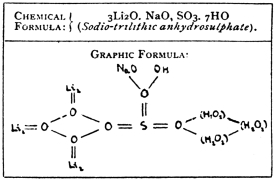
This picturesque “graphic formula” for Thialion appears with many of the advertisements. To most of us it looks formidable, wonderfully and deeply scientific and non-understandable; to a chemist it looks absurd.
But there are hundreds of other so-called “new chemical” compounds among the “ethical” proprietaries on the market aside from the acetanilid mixtures. These wonderful compounds, by the mysterious union of their ingredients, possess therapeutic properties different from, or more powerful for good than the drugs from which they are made. At least, this is what we are told, and this is what many believe or they would not sell so well.
There is another factor worth noticing connected with this subject: When to the claim that the mixture is a “chemical compound” is added a complex chemical formula, it prevents the impertinent question, “What is it?” For isn’t the “formula” there, and is not the information given without the asking? Most of us have been so overcome by the display of the chemical knowledge of the nostrum maker that we have been afraid to expose our ignorance by asking for information or explanation. And thus the promoter avoids perplexing questions, which, if answered truthfully, would spell bankruptcy.
To a chemist the formula of Thialion furnished by the Vass Chemical Company signifies nothing. To a physician who possesses but little knowledge of chemistry, it will seem impressive, and he may absorb the idea that it stands for a preparation that is the result of exhaustive scientific research. To the chemist, this formula will appear as a jumble of symbols and numbers that mean nothing.
It is not worth while to call attention to the simplicity of this simple mixture of ordinary salts, for it is too self-evident. As to the remarkable therapeutic qualities of Thialion, the reader is referred to that ably edited “scientific” periodical, the Uric Acid Monthly, and to the mass of “literature” relating to this wonderful remedy.
While there is a ridiculous side to this business, there is also a serious one. Those who have been making money out of us undoubtedly laugh in their sleeves at our gullibility, but to us as members of a presumably learned and intelligent profession, it is not a laughing matter. The whole nostrum business is a shame and a disgrace.—(Modified from The Journal A. M. A., Nov. 3, 1906.)
UNGUENTUM SELENIO VANADIC (V. ROEMER)
Report of the Council on Pharmacy and Chemistry
Unguentum Selenio Vanadic (v. Roemer) is an ointment manufactured by A. von Roemer, Brooklyn, N. Y., and put on the market by Schering and Glatz, New York. It is claimed to contain 1 per cent. of selenium oxycyanid and 1 per cent. of vanadium chlorid “so prepared and incorporated into a modified lanolin base as to insure complete absorption.” The preparation is recommended in the later stages of inoperable carcinoma, sarcoma, epithelioma and other malignant tumors, as a substitute for morphin and other narcotics to control pain, as a modifying (ante-operative) treatment in the middle stage of malignant cases presenting the characteristics of being inoperable, and as a prophylactic treatment of recurrences and metastases following excision of malignant tumors. It is also recommended for use in slow-healing surgical wounds, abscesses, tuberculous and mixed septic and gangrenous processes, etc., in lupus, acne, eczema, psoriasis, scabies, erythemata, adenomata, angiomata, papillomata, etc. The use of the ointment is further recommended by systemic inunction in septicemia, pneumonia, erysipelas, cerebrospinal meningitis, septic rheumatism, septic neuritis, etc. The Council voted that the preparation be not accepted for inclusion with New and Nonofficial Remedies because no evidence has been submitted that the vanadium and selenium are absorbed or that they produce any of the effects claimed.