Part 6 — CHAPTER LII. THE LIVER. (continued 2)
Reading edition
Fig. 630
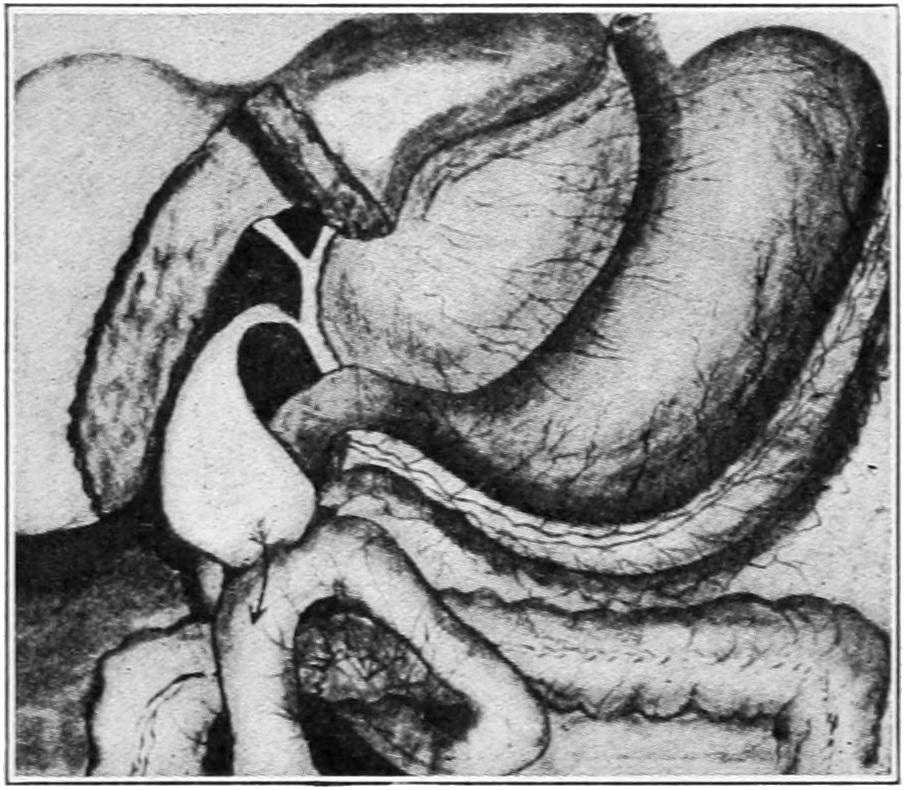
Demonstrating the technique of anastomosis between the gall-bladder and the jejunum. (Cordier.)
After-management.
—What to do with these cases of biliary drainage after it has been effected is sometimes a serious problem. No hard-and-fast rules can be laid down regarding the length of time during which drainage should be maintained. In instances where the gall-bladder has been removed the drain should be taken out within thirty-six hours, but in those cases where a tube has been fastened into the gall-bladder for so-called permanent drainage the term “permanent” may be regarded as elastic, and covering a period of from ten days to perhaps ten weeks. In the majority of instances three weeks or so of such drainage suffice to meet the original indication. In cases, however, of chronic pancreatitis a long period of easy outflow will be demanded, while in rare cases of cancer drainage once thus made cannot be abandoned.
When the gall-bladder has not been fastened nor allowed to adhere to the skin, but only to the peritoneum, the fistulas thus made will usually close and rarely need stimulation. Should, however, the granulation process by which closure is effected be too sluggish it may be stimulated by the application of nitrate of silver, either in solution upon a swab, or in solid form, as when melted into a bead upon the end of a suitable probe. Firm pressure will also assist in final closure.
It is not reasonable to expect that after so much intervention, within the rudely triangular potential cavity occupied by the gall-bladder and the ducts, adhesions will not form as a part of the reparative process. In fact it may rather be expected that as it becomes obliterated adhesion must necessarily follow. In consequence there may result an agglutination around the gall tract, and into a common mass, of the liver, the colon, and the pyloric end of the stomach. In spite of these adhesions bad symptoms rarely ensue, and when discomfort persists it is usually in those cases in which no stone was found or those in which stones have been overlooked. Andrews regards such postoperative adhesions as unavoidable and even desirable, and, having no faith in any measures to prevent their formation, differs from Morris in regard to the technique of their subsequent removal. It appearing from observation and experience that the stomach is the organ which suffers most by extensive adhesion to the liver, he has proposed to substitute the colon for the stomach in this necessary union of surfaces, and would even practise it in old cases after separation of old adhesions.
The operation suggested by Andrews, and which he calls cholehepatopexy, or colon substitution, is made with an incision through the middle line of the right rectus, avoiding any old scar, long enough to afford plenty of room. The stomach is then carefully separated from the liver, tearing liver tissue rather than that of the former, if something must be torn, and checking bleeding by hot sponges. The pylorus having been exposed the stomach is invaginated into it in order to demonstrate its patency. The freshly separated viscera will now fall again into immediate contact unless the transverse colon be pulled up and held in place between the liver and the pylorus, this not being so much of a displacement as would appear, as the bowel is not rotated and does not cross over the stomach. The colon is held in its new relation by attaching its omentum to the gastrohepatic ligament, to the liver surface, or to remnants of old adhesions in the angle between the pylorus and the liver. The looser the omentum and the more easily it can be interposed in this way the better. Andrews’ conclusions are that gall-tract adhesions are unavoidable, both in disease and after operation, that they are harmless except in a very few cases, and often beneficial, and that in the few cases where they do harm this comes from malposition rather than from adhesions per se. He even believes that certain vague gastric adhesions which might have been benefited by this operation have been previously treated by gastro-enterostomy.