Part 5 — CHAPTER XXIX. SURGICAL DISEASES OF THE HEART AND VASCULAR SYSTEM. (continued 2)
Reading edition
When it is not possible to early and speedily remove the existing cause there is but one cure for varices, and that is by radical surgical treatment. A generation ago this was effected by the injection into the veins of perhaps one of the iron salts, in order to produce artificial and instantaneous thrombosis, by which later occlusion of the vein could be induced. The coagulating effects were decided, and so also were the effects of the germs introduced at the same time, in the absence of ordinary antiseptic precautions. Thus it resulted that the mortality, even after this trifling procedure, was tremendous and led to its abandonment. When it had been demonstrated, through Lister’s achievements, that the surgeon could be clean about such work, it was learned also that veins could be more radically treated than had been previously realized. With the advent of the antiseptic era came more effective and extensive operations upon veins. Now we know that with strict asepsis they can be handled with absolute impunity, and open methods of treatment have replaced the subcutaneous. No hesitation is at present felt in exposing the veins at one point, or numerous points, and applying ligatures; these, however, have been found to be less effective than a long incision made over a vein, with its complete extirpation. Thus the long internal saphenous should nearly always be excised, though it take an incision twenty inches in length, in order to take off the weight of its column of blood. It is ordinarily a simple matter to clamp and tie each branch as it is divided, and, after removal of the principal trunk, to bring together the entire incision with subcutaneous or continuous sutures. In the same way numerous incisions may be made in the leg. It is possible, however, to meet with so many enlarged veins that the surgeon may feel that he cannot thus eradicate each one. In such cases it is my custom to extirpate the principal trunk or trunks involved above, and then to combine this with Schede’s suggestion to completely or partly circumcise the leg, below the knee, down to the deep fascia, cutting across every vein and tying on each side those which bleed to any extent. After all these veins are ligated the incision is usually brought together again, as above. By this means all communication between the subcutaneous veins above and below the line of incision is cut off. Wound healing is accompanied by a temporary edema of the foot and leg, especially when these are held down, and by more or less numbness of the skin due to division of the cutaneous nerves; but circulation and nerve supply both rearrange themselves in time, and the result is usually satisfactory.[28]
Should ulcer, i. e., the so-called varicose ulcer, be present, it may also be attacked radically, and at the same time completely, by excising the affected area, with its indurated border, down to the level of the deep fascia, and covering the surface thus denuded with Thiersch skin grafts from some other portion of the body. Should such an ulcer require treatment after this fashion it is best to attend to excision of the infected area first, in order to clear away all material which might harbor germs. The usual procedure, then, should be excision of the ulcer, extirpation of the veins, to be concluded by skin grafting. A limb thus radically treated should be included in a comfortable dressing, and then be affixed to some splint or other device by which absolute rest and repose may be maintained.
In milder cases, where no single large dilated vein seems to call for extirpation, it may suffice to practise Schede’s operation alone. Experience has taught this fact, that in dealing with extensive varices the surgeon is more likely to err on the side of leniency than on that of thoroughness.
VENOUS ANGIOMAS.
These have already been mentioned in the chapter on Tumors as constituting one variety of the angiomas. Many of them are of congenital origin. In many instances they produce erectile tumors. They frequently occur in the liver, in the thyroid, and other internal organs, as well as on the body surface.
A venous tumor, composed of good-sized veins, distended perhaps far beyond their normal capacity, constitutes a compound varix, of which the best expression is a hemorrhoid or a varicocele. Another form is composed almost entirely of capillary veins, which are increased not only in size but also in number. These constitute the growths called “mothers’ marks,” “strawberry growths,” etc. Technically they are venous nevi, which vary in size from trifling lesions to large tumors of varying shapes. These growths are always most conspicuous about the hands and face, because these are the visible parts of the body. They may, however, occur at any point, but mainly about the face and the orbit. A diffuse form, whose area may be almost unlimited, but usually circumscribed, is that called “port-wine mark,” which occurs more frequently about the face. It has been attributed to mental impressions during pregnancy, but there seems little to justify this view. The affected surface is sometimes pigmented and generally more hairy. Surface markings of this kind may accompany that form of neuroma described as plexiform neuroma. Fig. 183, from Holloway, illustrates another form of congenital growth of this kind. These growths rarely occur in the nasopharynx, where they not only obstruct but are sources of actual danger from hemorrhage.
Fig. 183
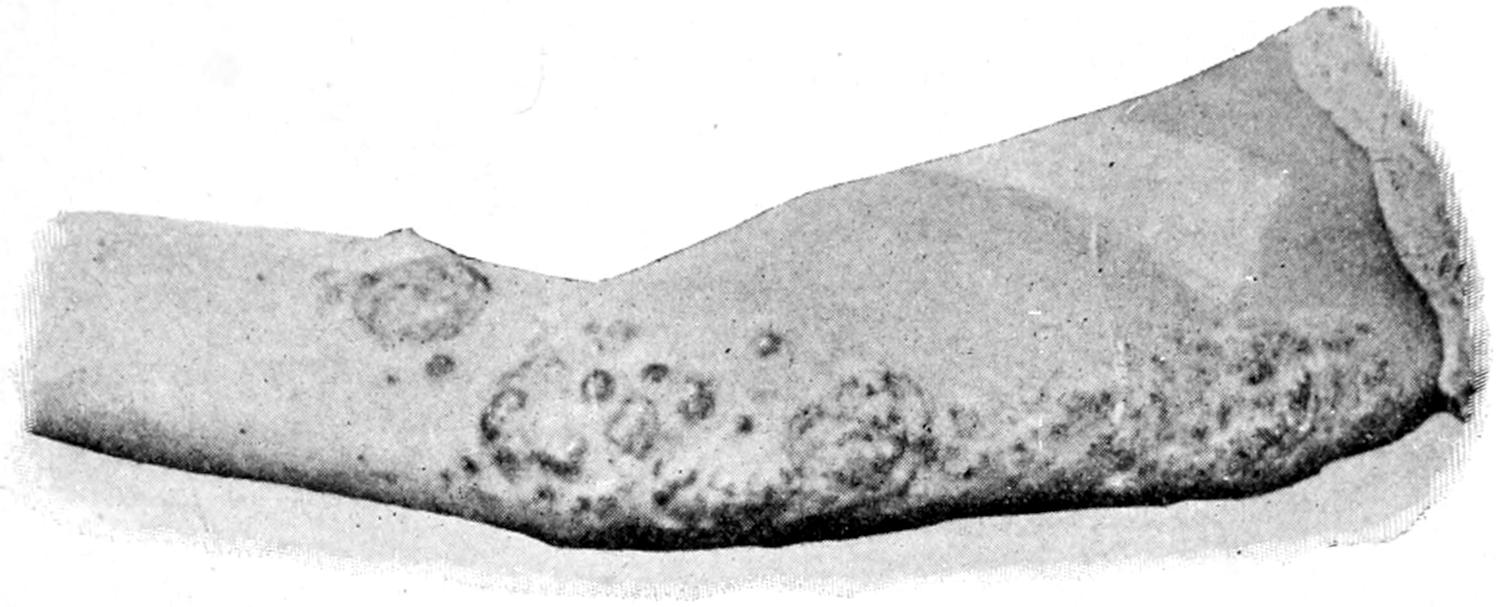
Congenital venous nevus. (Holloway).
Treatment.
—The most satisfactory treatment of a limited growth of this kind is excision, especially if this can be made at an early age. The resulting scar will be smaller, the healing more prompt, and the result in every way better. When excision seems impracticable electrolysis should be employed, one or both poles of a galvanic battery of six to ten cells being connected with needles, which are inserted directly into the growth, and whose position is constantly changed, so that the coagulating effect of the electric current may be equably distributed throughout the growth. Occasionally the growth may be so shaped as to permit of ligature, and it is best employed either with or without the use of a needle, after which it may be excised or will slough off. This is essentially one method of treating external hemorrhoids. Methods by injection of coagulants are all open to serious objection, are hazardous, and should be abandoned. A port-wine mark may be sometimes treated by a tattooing process, which should, however, be practised with strict antiseptic precautions. Electrolysis may also be practised over a small area at a time. The more destructive method, by use of the cautery, is likely to leave scars almost as conspicuous as the original condition. Occasionally a lesion of this kind will be so shaped and placed as to justify excision with an autoplastic operation.