Chapter IX · RUSSIA IN THE NAPOLEONIC EPOCH
Reading edition
Perhaps no sovereign since the days of the Antonines ever was called to higher destinies, or more worthily filled an important place in the theatre of the world, than the emperor Alexander I. Placed at the head of the most powerful and rising empire in existence, stationed midway between ancient civilisation and barbaric vigour, he was called to take the lead in the great struggle for European freedom; to combat with the energy and enthusiasm of the desert the superiority of advanced information, and meet the condensed military force of a revolution, which had beaten down all the strength of continental power, with the dauntless resolution and enduring fortitude which arise in the earlier ages of social existence. Well and nobly he fulfilled his destiny. Repeatedly defeated, never subdued, he took counsel, like his great predecessor Peter, from misfortune, and prepared in silence those invincible bands which, in the day of trial, hurled back the most terrible array which ambition had ever marshalled against the liberties of mankind.—Alison.f
EARLY MEASURES OF THE REIGN OF PAUL I
[1796-1815 A.D.]
The emperor Paul I, Catherine’s successor, had been long known for his singularities, his great dislike of the French, and to everything which Catherine had done. He appeared desirous of proceeding directly on the very opposite course to that which she had followed. She had chiefly directed her attention to foreign relations and affairs, whilst he appeared to occupy his mind solely with the internal state of his dominions. His very first act was a proof that he was quite ready to go in opposition to all the ordinary rules of political prudence, and when under the influence of his humour to follow his views, reckless of consequences. He caused splendid funeral honours and services to be performed for his murdered father, and forced the audacious and godless, though clever criminals, who had helped to place his mother on the throne, to be publicly exposed to the gaze of the people. Notwithstanding this, he suffered them to remain in possession of their honours and estates, whilst he designated them as murderers, and reminded the people that his mother had taken part in the murder of his father. The body of Peter III, which had been deposited in the convent of Alexander Nevski, was by his orders placed beside that of his wife; and it was notified by an inscription in the Russian language that, though separated in life, in death they were united.
[1796 A.D.]
Alexis Orlov and Prince Baratinski, two of the murderous band, were compelled to come to St. Petersburg to accompany the funeral procession on foot, but they were not so treated as to prevent them afterwards from doing further mischief. Alexis obtained permission to travel in foreign countries. Baratinski was ordered never again to show himself at court; which, under existing circumstances, could not to him be otherwise than an agreeable command. Single proofs of tender feeling, of a noble heart, and touching goodness, nay even the emperor’s magnanimous conduct towards Kosciuszko and his brethren in arms, combined with his sympathy with the fate of Poland, could not reconcile a court, such as that of Russia under Catherine II had become, and a city like that of St. Petersburg, to the change of the court into a guard-room, and to the daily varying humours of a man of eccentric and half-deranged mind. Even the improvements in the financial affairs of the country were regarded as ruinous innovations by those who in times past had profited by the confusion. The whole of Russia, and even the imperial family, were alarmed and terrified; a complete flood of decrees, often contradictory, and mutually abrogatory, followed one another in quick succession; and the mad schemes of the emperor, who was, nevertheless, by no means wicked or insensible to what was good and true, reminded all observers of the most unhappy times of declining Rome.b
Imperial Eccentricities
The guards, that dangerous body of men who had overturned the throne of the father, and who had long considered the accession of the son as the term of their military existence, were rendered incapable of injuring him by a bold and vigourous step, and treated without the least deference from the first day. Paul incorporated in the different regiments of guards his battalions that arrived from Gatshina, the officers of which he distributed among the various companies, promoting them at the same time two or three steps; so that simple lieutenants or captains in the army found themselves at once captains in the guards, a place so important and hitherto so honoured, and which gave the rank of colonel, or even of brigadier. Some of the old captains of the first families in the kingdom found themselves under the command of officers of no birth, who but a few years before had left their companies, as sergeants or corporals, to enter into the battalions of the grand duke. This bold and hasty change, which at any other time would have been fatal to its author, had only the effect of inducing a few hundreds of officers, subalterns and others, to retire.
Paul, alarmed and enraged at this general desertion, went to the barracks, flattered the soldiers, appeased the officers, and endeavoured to retain them by excluding from all employ, civil and military, those who should retire in future. He afterwards issued an order that every officer or subaltern who had resigned, or should give in his resignation, should quit the capital within four-and-twenty hours, and return to his own home. It did not enter into the head of the person who drew up the ukase that it contained an absurdity; for several of the officers were natives of St. Petersburg, and had families residing in the city. Accordingly, some of them retired to their homes without quitting the capital, not obeying the first part of the order, lest they should be found guilty of disobedience to the second. Arkarov, who was to see it put in force, having informed the emperor of this contradiction, directed that the injunction to quit St. Petersburg should alone be obeyed. A number of young men were consequently taken out of their houses as criminals, put out of the city, with orders not to re-enter it, and left in the road without shelter, and without any furred garments, in very severe weather. Those who belonged to very remote provinces, for the most part wanting money to carry them thither, wandered about the neighbourhood of St. Petersburg, where several perished from cold and want.
The finances of the empire, exhausted by the prodigalities and still more by the waste of Catherine’s reign, required a prompt remedy; and to this Paul seemed at first to turn his thoughts. Partly from hope, partly from fear, the paper money of the crown rose a little in value. It was to be supposed that the grand duke of all the Russias, who for thirty years had been obliged to live on an income of a hundred thousand rubles (£10,000) per annum, would at least have learned economy per force; but he was soon seen to rush into the most unmeasured sumptuosity, heap wealth upon some, and lavish favours upon others, with as much profusion as his mother, and with still less discernment. The spoils of Poland continued to add to the riches of men already too wealthy. All he could do towards restoring a sort of equilibrium between his receipts and disbursements was to lay an exorbitant tax on all the classes of his slaves. The poll-tax of the wretched serfs was doubled, and a new tax was imposed upon the nobles, which, however, the serfs would ultimately have to pay. After the first impressions which his accession caused in the heart of Paul, punishments and disgraces succeeded with the same rapidity and profusion with which he had lavished his favours. Several experienced the two extremes in a few days. It is true that most of these punishments at first appeared just; but then it must be allowed that Paul could scarcely strike any but the guilty, so corrupt had been all who were about the throne.
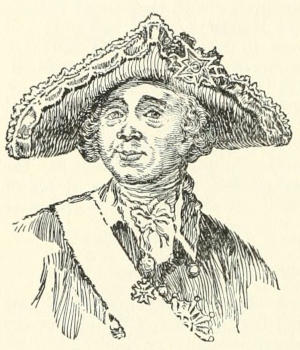
Paul I
(1754-1801)
A whim which caused no little surprise was the imperial prohibition of wearing round hats, or rather the sudden order to take them away or tear them to pieces on the heads of those who appeared in them. This occasioned some disgraceful scenes in the streets, and particularly near the palace. The Cossacks and soldiers of the police fell on the passengers to uncover their heads, and beat those who, not knowing the reason, attempted to defend themselves. An English merchant, going through the street in a sledge, was thus stopped, and his hat snatched off. Supposing it to be a robbery, he leaped out of his sledge, knocked down the soldier, and called the guard. Instead of the guard, arrived an officer, who overpowered and bound him; but as they were carrying him before the police, he was fortunate enough to meet the coach of the English minister, who was going to court, and claimed his protection. Sir Charles Whitworth made his complaint to the emperor; who, conjecturing that a round hat might be the national dress of the English as it was of the Swedes, said that his order had been misconceived, and he would explain himself more fully to Arkarov. The next day it was published in the streets and houses that strangers who were not in the emperor’s service, or naturalised, were not comprised in the prohibition. Round hats were now no longer pulled off; but those who were met with this unlucky headdress were conducted to the police to ascertain their country. If they were found to be Russians, they were sent for soldiers; and woe to a Frenchman who had been met with in this dress, for he would have been condemned as a Jacobin.
A regulation equally incomprehensible was the sudden prohibition of harnessing horses after the Russian mode. A fortnight was allowed for procuring harness in the German fashion; after the expiration of which, the police were ordered to cut the traces of every carriage the horses of which were harnessed in the ancient manner. As soon as this regulation was made public, several persons dared not venture abroad, still less appear in their carriages near the palace, for fear of being insulted. The harness-markers availed themselves of the occasion to charge exorbitant prices. To dress the ishvoshtshki, or Russian coachmen, in the German fashion, was attended with another inconvenience. Most of them would neither part with their long beards, their kaftans, nor their round hats; still less would they tie a false tail to their short hair, which produced the most ridiculous scenes and figures in the world. At length the emperor had the vexation to be obliged to change his rigorous order into a simple invitation to his subjects gradually to adopt the German fashion of dress, if they wished to merit his favour. Another reform with respect to carriages: the great number of splendid equipages that swarmed in the streets of St. Petersburg disappeared in an instant. The officers, even the generals, came to the parade on foot, or in little sledges, which also was not without its dangers.
It was anciently a point of etiquette for every person who met a Russian autocrat, his wife, or son, to stop his horse or coach, alight, and prostrate himself in the snow or in the mud. This barbarous homage, difficult to be paid in a large city where carriages pass in great numbers, and always on the gallop, had been completely abolished under the reign of the polished Catherine. One of the first cares of Paul was to re-establish it in all its rigour. A general officer, who passed on without his coachmen’s observing the emperor riding by on horseback, was stopped, and immediately put under arrest. The same unpleasant circumstance occurred to several others, so that nothing was so much dreaded, either on foot or in a carriage, as the meeting of the emperor.
The ceremony established within the palace became equally strict, and equally dreaded. Woe betide him who, when permitted to kiss the hand of Paul, did not make the floor resound by striking it with his knee as loud as a soldier with the butt-end of his firelock. It was requisite, too, that the salute of the lips on his hand should be heard, to certify the reality of the kiss, as well as of the genuflection. Prince George Galitzin, the chamberlain, was put under arrest on the spot by his majesty himself, for having made the bow and kissed the hand too negligently.
If this new reign was fatal to the army and to the poor gentry, it was still more so to the unhappy peasantry. A report being spread that Paul was about to restrict the power of masters over their slaves, and give the peasants of the lords the same advantages as those of the crown, the people of the capital were much pleased with the hopes of this change. At this juncture an officer set off for his regiment, which lay at Orenberg. On the road he was asked about the new emperor, and what new regulations he was making. He related what he had seen, and what he had heard; among the rest, mentioning the ukase which was soon to appear in favour of the peasants. At this news, those of Tver and Novgorod indulged in some tumultuous actions, which were considered as symptoms of rebellion. Their masters were violently enraged with them; and the cause that had led them into error was discovered. Marshal Repnin was immediately despatched at the head of some troops against the insurgents; and the officer who had unwittingly given rise to this false hope, by retailing the news of the city on his road, was soon brought back in confinement. The senate of St. Petersburg judged him deserving of death, and condemned him to be broken, to undergo the punishment of the knout, and if he survived this, to labour in the mines. The emperor confirmed the sentence. This was the first criminal trial that was laid before the public; and assuredly it justified but too well those remains of shame which had before kept secret similar outrages.
The most prominent of Paul’s eccentricities was that mania which, from his childhood, he displayed for the military dress and exercise. This passion in a prince no more indicates the general or the hero than a girl’s fondness for dressing and undressing her doll foretokens that she will be a good mother. Frederick the Great, the most accomplished soldier of his time, is well known to have had from his boyhood the most insuperable repugnance to all those minutiæ of a corporal to which his father would have subjected him; this was even the first source of that disagreement which ever subsisted between the father and the son. Frederick, however, became a hero; his father was never anything more than a corporal. Peter III pushed his soldato-mania to a ridiculous point, fancying he made Frederick his model. He loved soldiers and arms, as a man loves horses and dogs. He knew nothing but how to exercise a regiment, and never went abroad but in a captain’s uniform.
Paul, in his mode of life when grand duke, and his conduct after his accession, so strongly resembled his father that, changing names and dates, the history of the one might be taken for that of the other. Both were educated in a perfect ignorance of business, and resided at a distance from court, where they were treated as prisoners of state rather than heirs to the crown; and whenever they presented themselves appeared as aliens and strangers, having no concern with the royal family. The aunt of the father (Elizabeth) acted precisely as did the mother of the son. The endeavours of each were directed to prolong the infancy of their heirs, and to perpetuate the feebleness of their minds. The young princes were both distinguished by personal vivacity and mental insensibility, by an activity which, untrained and neglected, degenerated into turbulence; the father was sunk in debauchery, the son lost in the most insignificant trifles. An unconquerable aversion to study and reflection gave to both that infatuated taste for military parade, which would probably have displayed itself less forcibly in Paul had he been a witness of the ridicule they attached to Peter. The education of Paul, however, was much more attended to than that of his father. He was surrounded in infancy by persons of merit, and his youth promised a capacity of no ordinary kind. It must also be allowed that he was exempt from many of the vices which disgraced Peter; temperance and regularity of manners were prominent features of his character—features the more commendable, as before his mother and himself they were rarely to be found in a Russian autocrat. To the same cause, education, and his knowledge of the language and character of the nation, it was owing that he differed from his father in other valuable qualities.
The similarity which, in some instances, marked their conduct towards their wives, is still more striking; and in their amours, a singular coincidence of taste is observable. Catherine and Marie were the most beautiful women of the court, yet both failed to gain the affections of their husbands. Catherine had an ambitious soul, a cultivated mind, and the most amiable and polished manners. In a man, however, whose attachments were confined to soldiers, to the pleasures of the bottle, and the fumes of tobacco, she excited no other sentiment than disgust and aversion. He was smitten with an object less respectable, and less difficult to please. The countess Vorontzov, fat, ugly in her person and vulgar in her manners, was more suitable to his depraved military taste, and she became his mistress. In like manner, the regular beauty of Marie, the unalterable sweetness of her disposition, her unwearied complaisance, her docility as a wife, and her tenderness as a mother were not sufficient to prevent Paul from attaching himself to Mademoiselle Nelidov, whose disposition and qualities better accorded with his own, and afterwards to a young lady of the name of Lopukhin, who, it is believed, rejected his suit. To the honour of Paul it is related that he submitted to that mortifying repulse with the most chivalric patience and generosity. Nelidov was ugly and diminutive, but seemed desirous, by her wit and address, to compensate for the disadvantages of her person; for a woman to be in love with Paul it was necessary she should resemble him.
On their accession to the throne, neither the father nor the son were favourites with the court or the nation, yet both acquired immediate popularity and favour. The first steps of Paul appeared to be directed, but improved, by those of Peter. The liberation of Kosciuszko and other prisoners brought to public recollection the recall of Biron, Munich, and Lestocq, with this difference—that Peter III did not disgrace these acts of clemency and justice by ridiculous violences, or by odious and groundless persecutions. Both issued ukases extremely favourable to the nobility, but from motives essentially different, and little to the honour of the son. The father granted to the Russian gentry those natural rights which every man ought to enjoy; while the son attempted the folly of creating a heraldic nobility in Russia, where that Gothic institution had never been known. In the conduct which he observed towards the clergy, Paul, however, showed himself a superior politician. Instead of insulting the priests, and obliging them to shave their beards, he bestowed the orders of the empire on the bishops, to put them on a footing with the nobility, and flattered the populace and the priesthood by founding churches, in obedience to pretended inspiration.
In his military operations, however, his policy appears to have abandoned him, because here he gave the reins to his ruling passion. The quick and total change of discipline he introduced in his armies created him nearly as many enemies as there were officers and soldiers. In the distrust and suspicions which incessantly haunted him, his inferiority to his father is also evident. One of the first acts of Peter III was to abolish the political inquisition established by Elizabeth; whereas Paul prosecuted no scheme with greater alacrity than that of establishing a system of spies, and devising means for the encouragement of informers. The blind confidence of the father was his ruin, but it flowed from a humanity of disposition always worthy of respect. The distrust of the son did not save him; it was the offspring of a timorous mind, which by its suspicions was more apt to provoke than to elude treason.k
Paul’s Foreign Policy
In regard to foreign matters Paul’s initial policy was one of peace. He put a stop to the levying of recruits after the manner adopted by his mother—that is, in the proportion of three men to every five hundred souls—recalled his army from Persia, and left Georgia to take care of itself. He showed compassion for the Poles, recalled the prisoners from Siberia, transferred King Stanislaus from Grodno to St. Petersburg, visited Kosciuszko at Schlüsselburg and released him in company with the other prisoners. He bade Kolitchev, envoy extraordinary at Berlin, inform the king that he, Paul, wished neither conquest nor aggrandisement. He dictated to Ostermann a circular directed to the foreign powers, in which he declared that of all the countries of the world Russia alone had been constantly engaged in war since 1756; that forty years of warfare had reduced the population; that the emperor’s humanity would not allow him to withhold from his beloved subjects the peace for which they longed; that though on account of these considerations Russia could take no active part in the struggle against France, the emperor would “nevertheless remain closely united with his allies, and would use every means to oppose the rise of the mad French Republic which threatened all Europe with upheaval by the destruction of its laws, privileges, property, religion, and customs.” He refused all armed assistance to Austria, which was alarmed at Napoleon’s victories in Italy, and recalled the fleet that Catherine had adjoined to the English fleet for the purpose of blockading the coasts of France and Holland. He even received overtures made by Caillard, the French envoy to Prussia, and caused him to be informed that the emperor “did not consider himself at war with the French, that he had never done anything to harm them, but was rather disposed to keep peace with them, and would induce his allies to hasten the conclusion of war, to which end he offered the mediation of Russia.”
It was not long, however, before relations again became strained between France and Russia. By the Treaty of Campo Formio the Ionian Isles had been given to the French, who thus acquired a threatening position in the East and increased power over the Divan. The Directory authorised Dombrowski to organise Polish legions in Italy. Panin, at Berlin, intercepted a letter from the Directory to the French envoy, which spoke of a restoration of Poland under a prince of Brandenburg. Paul, on his side, took into his pay the troops of the prince of Condé, and established ten thousand émigrés in Volhinia and Podolia. He offered an asylum to Louis XVIII after his flight from Brunswick, and installed him in the ducal palace at Mitau with a pension of 200,000 rubles. The news that a French expedition was being secretly organised at Toulon made him fear for the security of the coasts of the Black Sea, which were immediately put in a state of defence. The abduction of Zagurski, the Russian consul at Corfu, the capture of Malta by Napoleon, the arrival at St. Petersburg of the banished knights who offered Paul the protectorate of their order and the title of grand master, the invasion of Helvetian territory by the Directory, the expulsion of the pope and the proclamation of the Roman Republic—all were events that precipitated the rupture.
Paul concluded an alliance with Turkey which had been disturbed by an Egyptian invasion, also with England, Austria, and the kingdom of Naples. Thus, by the double aggression of Bonaparte against Malta and Egypt, Russia and Turkey were led, contrary to all traditions, to make common cause. Paul pledged himself to unite his fleet with the Turkish and English squadron, and to furnish one body of troops for a descent on Holland, another for the conquest of the Ionian Isles, and a grand auxiliary army for the campaigns in Italy and Switzerland.
In the autumn of 1798 a Turkish-Russian fleet captured the French garrisons in the Ionian Isles. The king of Naples invaded the territory of the Roman Republic, but Championnet brought the Neapolitan troops back on to their own ground, and after making a triumphal entry into Naples proclaimed the Parthenopean Republic.
THE CAMPAIGNS OF KORSAKOV AND SUVAROV (1798-1799)
[1798-1799 A.D.]
The Russian army in Switzerland was placed under the command of Rimski-Korsakov, that of Holland under the orders of Hermann; while Austria, at the suggestion of England, requested that the victor of Fokshani and of the Rimnik should receive the command of the Austro-Russian army. Flattered by this mark of deference, Paul I recalled Suvarov from exile in his village. “Suvarov has no need of laurels,” wrote the czar, “but the country has need of Suvarov.”c
A few days after the battle of Magnano, Suvarov arrived on the Mincio with the first division of his forces, twenty thousand strong, and took the command of all the allied troops in Italy. The jealousy of the Austrian generals was naturally excited and they called a council of war, in order to examine his plans. The members of the council, beginning at the youngest, proposed their several schemes. Suvarov quietly heard them all, and when they had done, took a slate, drew two lines, and said, “Here, gentleman, are the French, and here the Russians; the latter will march against the former and beat them.” So saying, he rubbed out the French line, and added, “This is all my plan; the council is concluded.”
Suvarov kept his word, and in less than three months swept the French entirely out of Lombardy and Piedmont. Thrusting himself between the three French armies of Switzerland, northern Italy, and the Parthenopean Republic, it was his purpose, in concert with the archduke Charles of Austria, to penetrate into France on its most defenceless side, by the Vosges and the Jura, the same quarter on which the great invasion of 1814 was afterwards effected. The campaign opened on the 25th of April, on the steep banks of the Adda, behind which Moreau had posted his diminished force of twenty-eight thousand men in three divisions. The passage was forced with immense loss to the French, who were compelled to abandon Milan, which Suvarov entered in triumph on the 29th.
After a week’s delay, during which all the principal places of Lombardy surrendered to the allies, Suvarov followed Moreau’s retreat, and endeavoured to dislodge him from his advantageous position on the Po. Not succeeding in this attempt as rapidly as suited his impetuous habits, the Russian general suddenly changed his purpose, and advanced against Turin, whilst Moreau at the same moment had resolved to retire to Turin and the crests of the Apennines, in order to preserve his communications with France. On the 27th of May, Vukassovitch, who commanded the advance guard of the Russians, surprised Turin, and forced the French to take refuge in the citadel, leaving in the hands of the victors nearly three hundred pieces of artillery, sixty thousand muskets, and an enormous quantity of ammunition and military stores. Moreau’s army, thus deprived of all its resources, was saved from destruction only by the extraordinary ability of its commander, who led it safely towards Genoa by a mountain path, which was rendered practicable for artillery, in four days. With the exception of a few fortresses, nothing now remained to the French of all Napoleon’s conquests in northern Italy; they had been lost in less time than it had taken to make them.
[1799 A.D.]
Exulting in the brilliant success of his arms, Paul bestowed another surname, Italienski, or the Italian, on his victorious general, and ordered by an express ukase that Suvarov should be universally regarded as the greatest commander that had ever appeared. Meanwhile the results of his skill and vigour were neutralised by the selfish policy of the Austrian court, which had become by the Treaty of Campo Formio, and the acquisition of Venice, in some degree an actual accomplice with the aggressors against whom it was in arms. Suvarov was compelled to submit to the dictation of the emperor Francis I, and deeply disgusted he declared that he was no longer of any use in Italy, and that he desired nothing so ardently as to be recalled.
The disasters of the French in upper Italy were fatal to their ascendancy in the south, and Macdonald received orders to abandon the Parthenopean Republic, and unite his forces with those of Moreau. His retreat was exposed to great dangers by the universal insurrection of the peasants; but he accomplished it with great rapidity and skill. The two French commanders then concerted measures to dislodge the allies from their conquests—a project which seemed not unlikely to be fulfilled, so obstinately had the Aulic council adhered to the old system of dispersing the troops all over the territory which they occupied. Though the allies had above a hundred thousand men in the field, they could hardly assemble thirty thousand at any one point; and Macdonald might easily have destroyed them in detail could he have fallen upon them at once; but the time he spent in reorganising his army in Tuscany, and in concerting measures with Moreau, was well employed by Suvarov in promptly concentrating his forces. Macdonald advanced against him with an army of thirty-seven thousand men, taking Modena on his way, and driving Hohenzollern out of it after a bloody engagement. The two armies met on the Trebbia, where a first and indecisive action took place on the 17th of June; it was renewed on each of the two following days, and victory finally remained with the Russians. In this terrible battle of three days, the most obstinately contested and bloody that had occurred since the beginning of the war, the loss on both sides was excessive; that of the French was above twelve thousand in killed and wounded, and that of the allies not much less. But nearly equal losses told with very unequal severity on the respective combatants; those of the allies would speedily be retrieved by large reinforcements, but the republicans had expended their last resources, were cut off from Moreau, and had no second army to fall back upon. Macdonald with infinite difficulty regained the positions he had occupied before the advance to the Trebbia, after losing an immense number of prisoners.
The fall of the citadel of Turin on the 20th of June was of great importance to the allies; for besides disengaging their besieging force it put into their hands one of the strongest fortresses in Piedmont, and an immense quantity of artillery and ammunition. This event, and Suvarov’s victory on the Trebbia, checked the successful operations of Moreau, and compelled him to fall back to his former defensive position on the Apennines. Again, contrary to Suvarov’s wishes, the allied forces were divided for the purpose of reducing Mantua and Alexandria, and occupying Tuscany. After the fall of those two fortresses, Suvarov laid siege to Tortona, when Joubert, who had meanwhile superseded Moreau, marched against him at the head of the combined forces of the French. On the 15th of August, another desperate battle was fought at Novi, in which Joubert was killed, but from which neither side derived any particular advantage. The French returned to their former positions, and the Italian campaign was ended.
Suvarov now received orders to join his forces with those under Korsakov, who was on the Upper Rhine with thirty thousand men. The archduke Charles might, even without this fresh reinforcement, have already annihilated Massena had he not remained for three months, from June to August, in complete inactivity; at the very moment of Suvarov’s expected arrival, he allowed the important passes of the St. Gotthard to be again carried by a coup-de-main by the French, under General Lecourbe, who drove the Austrians from the Simplon, the Furka, the Grimsel, and the Devil’s Bridge. The archduke, after an unsuccessful attempt to push across the Aar at Dettingen, suddenly quitted the scene of war and advanced down the Rhine for the purpose of supporting the English expedition under the duke of York against Holland. This unexpected turn in affairs proceeded from Vienna. The Viennese cabinet was jealous of Russia. Suvarov played the master in Italy, favoured Sardinia at the expense of the house of Habsburg, and deprived the Austrians of the laurels and the advantages they had won. The archduke, accordingly, received orders to remain inactive, to abandon the Russians, and finally to withdraw to the north; by this movement Suvarov’s triumphant progress was checked, he was compelled to cross the Alps to the aid of Korsakov, and to involve himself in a mountain warfare ill-suited to the habits of his soldiery.
Korsakov, whom Bavaria had been bribed with Russian gold to furnish with a corps one thousand strong, was supported solely by Kray and Hotze with twenty thousand men. Massena, taking advantage of the departure of the archduke and the non-arrival of Suvarov, crossed the Limmat at Dietikon and shut Korsakov, who had imprudently stationed himself with his whole army in Zurich, so closely in that, after an engagement that lasted two days, from the 15th to the 17th of September, the Russian general was compelled to abandon his artillery and to force his way through the enemy. Ten thousand men were all that escaped. Hotze, who had advanced from the Grisons to Schwyz to Suvarov’s rencontre, was, at the same time, defeated and killed at Schanis. Suvarov, although aware that the road across the St. Gotthard was blocked by the Lake of Lucerne, on which there were no boats, had the temerity to attempt the passage. In Airolo, he was obstinately opposed by the French under Lecourbe, and, although Shveikovski contrived to turn this strong position by scaling the pathless rocks, numbers of the men were, owing to Suvarov’s impatience, sacrificed before it.
On the 24th of September, 1799, he at length climbed the St. Gotthard, and a bloody engagement, in which the French were worsted, took place on the Oberalpsee. Lecourbe blew up the Devil’s Bridge, but, leaving the Urnerloch open, the Russians pushed through that rocky gorge, and, dashing through the foaming Reuss, scaled the opposite rocks and drove the French from their position behind the Devil’s Bridge. Altorf on the lake was reached in safety by the Russian general, who was compelled, owing to the want of boats, to seek his way through the valleys of Schächen and Muotta, across the almost impassable rocks, to Schwyz. The heavy rains rendered the undertaking still more arduous; the Russians, owing to the badness of the road, were speedily barefoot; the provisions were also exhausted. In this wretched state they reached Muotta on the 29th of September and learned the discouraging news of Korsakov’s defeat. Massena had already set off in the hope of cutting off Suvarov, but had missed his way. He reached Altorr, where he joined Lecourbe on the 29th, when Suvarov was already at Muotta, whence Massena found on his arrival that he had again retired across the Bragelburg, through the Klönthal. He was opposed on the lake of Klönthal by Molitor, who was, however, forced to retire by Auffenberg, who had joined Suvarov at Altorf and formed his advanced guard, Rosen, at the same time, beating off Massena with the rearguard, taking five cannon and one thousand of his men prisoners. On the 1st of October, Suvarov entered Glarus, where he rested until the 4th, when he crossed the Panixer Mountains through snow two feet deep to the valley of the Rhine, which he reached on the 10th, after losing the whole of his beasts of burden and two hundred of his men down the precipices; and here ended his extraordinary march, which had cost him the whole of his artillery, almost all his horses, and a third of his men.
The archduke had, meanwhile, tarried on the Rhine, where he had taken Philippsburg and Mannheim, but had been unable to prevent the defeat of the English expedition under the duke of York by General Brune at Bergen, on the 19th of September. The archduke now, for the first time, made a retrograde movement, and approached Korsakov and Suvarov. The different leaders, however, did nothing but find fault with each other, and the czar, perceiving his project frustrated, suddenly recalled his troops, and the campaign came to a close.
Paul’s anger fell without measure or reason on his armies and their chiefs. All the officers who were missing, that is to say who were prisoners in France, were broken as deserters, and Suvarov, instead of being well received with well merited honours, was deprived of his command and not suffered to see the emperor’s face. This unjust severity broke the veteran’s heart. He died soon after his return to St. Petersburg; and no Russian courtier, nor any member of the diplomatic body except the English ambassador, followed his remains to the grave.
PAUL RECONCILED WITH FRANCE (1800 A.D.)
[1800 A.D.]
Frustrated in the objects for which he had engaged in war, Paul was now in a mood easily to be moved to turn his arms against the allies who had deceived his hopes. He had fought for the re-establishment of monarchy in France, and of the old status quo in Europe; and the only result had been the aggrandisement of Austria, his own immediate neighbour, of whom he had much more reason to be jealous than of the remote power of France. The rapid steps, too, which Bonaparte was taking for the restoration of monarchical forms in that country were especially calculated to conciliate Paul’s good-will towards the first consul. The latter and his able ministers promptly availed themselves of this favourable disposition through the connections they had made in St. Petersburg. Fouché had such confidential correspondence even with ladies in the Russian capital, that he afterwards received the earliest and most correct intelligence of the emperor’s murder. Two persons at the court of St. Petersburg were next gained over to France, or rather to Bonaparte’s rising empire; these were the minister Rostoptchin, and the emperor’s favourite, the Turk Kutaisov, who had risen with unusual rapidity from the situation of the emperor’s barber to the rank of one of the first Russian nobles. He was also nearly connected by relationship with Rostoptchin.
Rostoptchin first found means to send away General Dumourier from St. Petersburg, whither he had come for the purpose of carrying on his intrigues in favour of the Bourbons. He next sought to bring Louis Cobenzl also into discredit with the emperor, and he succeeded in this, shortly before the opening of the campaign in Italy in 1800, when the cabinet of Vienna was called upon to give a plain and direct answer to the questions peremptorily put by the emperor of Russia. Paul required that the cabinet should answer, without if or but, without circumlocution or reserve, whether or not Austria would, according to the terms of the treaty, restore the pope and the king to their dominions and sovereignty. Cobenzl was obliged to reply that if Austria were to give back Piedmont to the king of Sardinia it must still retain Tortona and Alessandria; and that it never would restore the three legations and Ancona. The measure of the emperor’s indignation was now full; he forbade Count Cobenzl the court, and at a later period not only ordered him to leave the country, but would not even allow an embassy or chargé-d’affaires to remain.
The emperor proceeded more deliberately with regard to the English. At first he acted as if he had no desire to break with them; and he even allowed the Russians, whom they had hired for the expedition against Holland, to remain in Guernsey under Viomesnil’s command, in order to assist their employers in an expedition against Brittany. The English government, however, at length provoked him to extremities. They refused to redeem the Russians who had been made prisoners in their service, by giving in exchange for them an equal number of French, of whom their prisons were full; they refused to listen to any arrangements respecting the grand mastership of the knights of Malta, or even as to the protectorate of the order, and gave the clearest intimations that they meant to keep the island for themselves. Bonaparte seized upon this favourable moment for flattering the emperor, by acting as if he had really more respect for Paul than the two powers for whom he had made such magnanimous sacrifices. Whilst the English refused to redeem the Russians made prisoners in their service by exchange, Bonaparte set them free without either exchange or ransom.
The emperor of Germany had broken his word, and neither restored the pope nor the king of Sardinia, whilst Bonaparte voluntarily offered to restore the one and give compensation to the other. He assailed the emperor in a masterly manner on his weak side, causing the six or seven thousand Russians, whom the English refused to exchange, to be provided with new clothing and arms, and he wrote a letter to Panin, the Russian minister, in which he said that he was unwilling to suffer such brave soldiers as these Russians were to remain longer away from their native land on account of the English. In the same letter he paid another compliment to the emperor, and threw an apple of mortal strife between him and England. Knowing as he did that his garrison in Malta could not hold out much longer, he offered to place the island in the hands of the emperor Paul, as a third party. This was precisely what the emperor desired; and Sprengporten, who was sent to France to bring away the Russians, and to thank the first consul, was to occupy Malta with them. The Russians were either to be conveyed thither by Nelson, who up to this time had kept the island closely blockaded, and was daily expecting its surrender, or at least he was to be ordered to let them pass; but both he and the English haughtily rejected the Russian mediation.
Paul now came to a complete breach with England. First of all he recalled his Russian troops from Guernsey, but on this occasion he was again baffled. It was of great importance to the English cabinet that Bonaparte should not immediately hear of the decided breach which had taken place between them and the emperor, and they therefore prevailed upon Viomesnil, an émigré, who had the command of the Russians in Guernsey, to remain some weeks longer, in opposition to the emperor’s will. Paul was vehemently indignant at this conduct; Viomesnil, however, entered the English service, and was provided for by the English government in Portugal.
Lord Whitworth was next obliged to leave Russia, as Count Cobenzl had previously been. Paul recalled his ambassadors from the courts of Vienna and London, and forthwith sent Count Kalitchev to Paris to enter into friendly negotiations with Bonaparte. In the meantime, the English had recourse to some new subterfuges, and promised, that in case Malta capitulated, they would consent to allow the island to be administered, till the conclusion of a peace, by commissioners appointed by Russia, England, and Naples. Paul had already named Bailli de la Ferrette for this purpose; but the English refused to acknowledge his nominee, and even to receive the Neapolitans in Malta. Before this took place, however, the emperor had come to issue with England on a totally different question.
The idea of a union among the neutral powers, in opposition to the right alleged by England, when at war with any power whatsoever, to subject the ships of all neutral powers to search, had been relinquished by the empress Catherine in 1781, to please the English ambassador at her court; Paul now resumed the idea. Bonaparte intimated his concurrence, and Paul followed up the matter with great energy and zeal, as in this way he had an opportunity of exhibiting himself in the character of an imperial protector of the weak, a defender of justice and right, and as the head of a general alliance of the European powers. Prussia also now appeared to do homage to him, for the weak king was made to believe, that by a close alliance between Russia and France, he might be helped to an extension of territory and an increase of subjects, without danger or cost to himself, or without war, which he abhorred beyond everything else. The first foundation, therefore, for an alliance between Russia and France, was laid in Berlin, where Beurnonville, the French ambassador, was commissioned to enter into negotiations with the Russian minister Von Krüderer. Beurnonville promised, in Bonaparte’s name, that the Russian mediation in favour of Naples and Sardinia would be accepted, and that, in the question of compensations for the German princes particular regard would be had to the cases of Baden and Würtemberg.
THE ARMED NEUTRALITY (1800 A.D.)
As to the armed neutrality by sea against England, Prussia could easily consent to join this alliance, because she had in fact no navy; but it was much more difficult for Sweden and Denmark, whose merchant ships were always accompanied by frigates. In case, therefore, the neutral powers came to an understanding that no merchant vessels which were accompanied by a ship of war should be compelled to submit to a search, this might at any time involve them in hostilities with England. In addition to Denmark, Sweden, and Prussia, which, under Paul’s protectorate, were to conclude an alliance for the protection of trading vessels belonging to neutral powers against the arrogant claims of England, Bonaparte endeavoured to prevail upon the North Americans to join the alliance. They were the only parties who, by a specific treaty in 1794, had acknowledged as a positive right what the others only submitted to as an unfounded pretension on the part of England. On that occasion the Americans had broken with the French Republic on the subject of his treaty, and Barras and Talleyrand had been shameless enough to propose that the Americans should pay a gratuity, in order to effect a renewal of their old friendship with France, which proposal, however, the Americans treated with contempt.
On the 30th of September, 1800, their ambassadors concluded an agreement at Bonaparte’s country seat of Morfontaine, which referred especially to the resistance which all the neutral powers under the protectorate of the emperor of Russia were desirous of making to the pretensions and claims of England. The Americans first of all declared that neutral flags should make a neutral cargo, except in cases where the ship was actually laden with goods contraband of war. It was afterwards precisely defined what were to be considered goods contraband of war. By the fourth article it was determined that neutral ships must submit to be detained, but that the ships of war so detaining a merchantman with a view to search should remain at least at the distance of a cannon-shot, and only be allowed to send a boat with three men to examine the ship’s papers and cargo; and that in all cases in which a merchantman should be under convoy of a ship of war, no right of search should exist, because the presence of the convoy should be regarded as a sufficient guarantee against contraband. Inasmuch as England and Denmark were at open issue concerning this last point, the Americans would have been inevitably involved in the dispute had they immediately ratified the treaty of Morfontaine: they were, however, far too cunning to fall into this difficulty; and they did not therefore ratify the treaty till the Russian confederation had been dissolved.
Sweden and Denmark had come to issue with England concerning the right of search in 1798 and 1799, when four frigates, two Swedish and two Danish, were captured and brought into English ports. True, they were afterwards given up, but without any satisfaction, for the English still insisted upon the right of search. The dispute became most vehement in the case of the Danish frigate Freya, which, together with the merchantmen under her convoy, were brought into an English port, after a sharp engagement on the 25th of July, 1800; and the English, aware of the hostile negotiations which were going on in the north, at once despatched an expedition against Denmark.
Sixteen English ships of war suddenly appeared before Copenhagen, and most unexpectedly threatened the harbour and city with a destructive bombardment, if Denmark did not at once acknowledge England’s right of search at sea. Had this acknowledgment been made, Bonaparte’s and the emperor’s plan would have been frustrated in its very origin; but Denmark had the good fortune to possess, in its minister Bernstorff, the greatest diplomatist of the whole revolutionary era, who contrived for that time to save Copenhagen without the surrender of any rights. It was quite impossible to resist by force, but he refused to enter upon the question of right or wrong; and in the agreement which he signed with Lord Whitworth on the 25th of August, 1800, he consented that in the meantime all occasion for dispute should be avoided, and thus the difficulty be postponed or removed. Denmark bound herself no longer to send her merchantmen under convoy—whereupon the Freya, and the vessels by which she was accompanied, were set at liberty. On this occasion the emperor Paul offered himself as arbitrator; and when Lord Whitworth rejected his interference or arbitration, he immediately laid an embargo on all the English ships in Russian ports.
The news of the agreement entered into at Copenhagen, however, no sooner reached St. Petersburg, than this first embargo was removed, and the dispute carried on merely in a diplomatic manner. At last the emperor Paul put an end to this paper war, when Vaubois, who had defended Malta since July, 1798, against the English, Russians, Neapolitans, and sometimes also the Portuguese, at length capitulated, on the 5th of September, 1800. The island was taken military possession of by the English without any reference whatever to the order, to Naples, to the promise which they had made to the emperor, or to Bailli de la Ferrette, whom Paul had named as the representative of the order. As soon as this news reached St. Petersburg, Paul’s rage and indignation knew no bounds. On the 7th of November, he not only laid an embargo upon three hundred English ships then in his ports, but sent the whole of their crews into the interior of Russia, and allowed them only a few kopecks a day for their support.
Lord Carysfort, the English ambassador in Berlin, was unable for six weeks to obtain any answer from the Prussian government with respect to its connection with the northern confederation, although he insisted strongly upon it; and yet Stedingk, the Swedish minister, and Rosenkranz, the Danish minister, had signed the agreement for an armed neutrality in the form of that of 1780 as early as the 17th of December, 1800, in St. Petersburg, and the Prussian minister, Von Luft, in the name of his king, had signified his acceptance of the alliance on the 18th. When Lord Carysfort at length obtained an answer on the 12th of February to his demands, so long and repeatedly urged in vain, Haugwitz had drawn it up equivocally both in form and contents. The emperor of Russia was so indignant at the ambiguity that he not only expressed his feelings on the subject warmly, but also took some hostile measures against Prussia.
On the other hand, the emperor invited Gustavus IV to St. Petersburg where he was received with the greatest splendour. He arrived at St. Petersburg at Christmas, 1800, and immediately, as if to insult the English, a grand meeting of the order of Malta was held; the king himself was loaded with marks of honour of every possible description, and at the end of December he signed a new agreement, by which the objects of that of the 16th of the same month were greatly enlarged. In the former alliance defensive operations alone were contemplated; but now offensive measures were also agreed upon, with the reservation, indeed, if they should become necessary. Paul took measures to refit his fleet, and an army was equipped which was to be placed under the commands of Soltikov, Pahlen, and Kutusov; the Danish fleet was in good condition; the Russian minister in Paris appeared to regard the circumstances as very favourable for gaining Hanover to his master without danger or risk; and Pitt himself considered the state of affairs so unfavourable, that he seriously contemplated the propriety of retiring and making way for a new ministry, in order to render a peace possible. This close confederacy against England was, however, dissolved at the very moment in which the first consul appeared to be disposed to favour Naples and Sardinia, in order to gratify the wishes of the emperor of Russia.
ASSASSINATION OF PAUL (1801 A.D.)
[1801 A.D.]
The catastrophe in St. Petersburg is easily explained by the continually changing humours of the emperor, by his mental derangement, which had been constantly on the increase for several months previous to his murder, by the acts of violence and injustice which he suffered himself to commit, and by the dreadful apprehension which prevailed among all classes of society, from the empress and the grand duke down to the very lowest citizen. The emperor’s sober and rational intervals became progressively rarer, so that no man was sure for an instant either of his place or his life; thousands of persons completely innocent were sent to Siberia, and yet goodness and mildness alternated with cruel severity. The emperor one while exhibited the most striking magnanimity, at another the meanest vindictiveness.
The beautiful and virtuous empress had patiently submitted to her husband’s preference for the plain Nelidov, who at least treated her with honour and respect; but she was obliged also to submit to his attachment to Lopukhin, who continually provoked strife. She endured these things patiently, lived on good terms with the emperor, slept immediately under his chambers, and yet neither she nor her sons, Alexander and Constantine, were able to escape the suspicions of his morbid mind. It was whispered, by persons in the confidence of the court, that the emperor had said he would send the empress to Kalamagan, in the government of Astrakhan, Alexander to Shlüsselburg, and Constantine to the citadel of St. Petersburg. It is not worth while to inquire what truth there may have been in these reports; everyone felt that the time had arrived to have recourse to the only means which can be employed in despotic kingdoms for effecting a complete change in the measures of government. This means is the murder of the despot, which in such circumstances was usually effected in the Roman Empire by the Pretorians, in Constantinople by the Janizaries, or by a clamorous and infuriated mob, in St. Petersburg by a number of confederated nobles; and in all these cases was regarded as a sort of necessary appendage to the existing constitution.
Rostoptchin, the minister, who had long possessed the emperor’s confidence, was dismissed and in disgrace; and Count Pahlen, who was at the head of the emperor’s dreadful police, was suddenly and excessively favoured. He, too, observed, when he had reached the highest pinnacle, that he began to be suspected. The count was an Esthonian by birth, a man of a cold, deep, and faithless disposition, and the instrument of all the cruelties and severities which had been exercised by the emperor. He was also commander-in-chief of all the troops in the capital, and since the 10th of March had become a member of the ministry for foreign affairs. Up to this period he had been successful in discovering and frustrating all the real or pretended attempts at dethroning the emperor, but he now formed a conspiracy against him, because he knew that Paul had called to his aid two formidable assistants, to use them against himself in case of necessity. The emperor had previously sent away from St. Petersburg and now recalled Lindner and Araktcheiev, two of his most dreadful instruments of violence, the latter of whom played a fearful part in Russia even during the reign of the mild and clement emperor Alexander. Pahlen had previously taken his measures in such a manner that a number of those to whom the murder of an emperor was no novelty were at that time collected in St. Petersburg, and only waited for a hint, either with or without Pahlen, to fall upon the emperor, who had personally given them mortal offence.
Valerian, Nicholas, and Plato Zubov had first been publicly affronted by the emperor like the Orlovs, and afterwards dismissed; they remained under compulsory absence in Germany till they found a medium for securing the favour of the only person who had any influence over the emperor. This medium was the French actress, Chevalier, who ruled the Turk Kutaisov (formerly a valet de chambre, but now adorned with all possible titles, honours, and orders, with the broad ribbon and stars of Europe), and through him ruled the emperor. Chevalier obtained permission for the Zubovs to return to the court, and Plato held Kutaisov bound by his expressed intention of marrying the Turk’s daughter. Plato had been previously commander-in-chief of the army, and could, in case of need, reckon upon it with the greater certainty, as it had been made discontented by the gross and ridiculous treatment of the generals of the whole army, and even of such a man as Suvarov.
Participators in a plan for setting aside the emperor were easily found among the nobles, as soon as it became certain that there was nothing to fear. It was necessary, however, to obtain the consent of the two eldest grand dukes; but not a word was said of the murder, but merely of the removal of their father from the government. Alexander was not easily prevailed upon to acquiesce in the deposition of his father, as, however numerous Alexander’s failings in other respects may have been, both he and his mother were persons of gentle hearts. Pahlen undertook the business of persuading the prince, for which he was by far the best fitted, inasmuch as he knew all the secrets of the court, and combined all power in himself; he therefore succeeded in convincing the imperial family of the dangers with which they themselves were threatened, and of the necessity of deposing the emperor. He appears to have prevailed with Alexander by showing that he could only guard against a greater evil by consenting to his father’s dethronement. Certain it is at least, that Alexander signed the proclamation, announcing his own assumption of the reins of government, two hours before the execution of the deed by the conspirators.
The emperor with his family lived in the Mikhailov palace; the 23rd of March, 1801, was chosen for the accomplishment of the deed, for on that day the Semenovski battalion of guards was on duty at the palace. The most distinguished men among the conspirators were the Zubov, General Count Benningsen, a Hanoverian, who had distinguished himself in the Polish wars under Catherine, Tchitchakov, Tartarinov, Tolstoi, Iashvel, Iesselovitch, and Uvarov, together with Count Pahlen himself, who did not accompany the others into the emperor’s bedchamber, but had taken his measures so skilfully that, if the enterprise failed, he might appear as his deliverer. Very shortly before the execution of the deed, Pahlen communicated the design to General Talitzin, colonel of the regiment of Preobrajenski guards, to General Deporadevitch, colonel of the Semonovski guards, together with some fifty other officers whom he entertained on the night on which the murder was committed.
On the evening before his death Paul received, when sitting at supper with his mistress, a note from Prince Mechereki, warning him of his danger, and revealing the names of the conspirators. He handed it unopened to Kutaisov, saying he would read it on the morrow. Kutaisov put it in his pocket, and left it there when he changed his dress next day to dine with the emperor. He turned to get it, but Paul growing impatient sent for him in a hurry, and the trembling courtier came back without the letter on which so much depended. On the night of the 3rd Paul went early to bed; soon afterwards the conspirators repaired to his apartment, the outer door of which was opened to them in compliance with the demand of Argamakov, an aide-de-camp, who pretended that he was come to make his report to the emperor. A Cossack who guarded the door of the bedroom offered resistance and was cut down. The conspirators rushed in and found the bed empty. “He has escaped us,” cried some of them. “That he has not,” said Benningsen. “No weakness, or I will put you all to death.” Putting his hand on the bed-clothes and feeling them warm, he observed that the emperor could not be far off, and presently he discovered him crouching behind a screen. The conspirators required him to sign his abdication. He refused, a conflict ensued; a sash was passed round his neck, and he was strangled after a desperate resistance.
Alexander was seized with the most passionate grief when he learned at what a price he had acquired the crown. He had supped with his father at nine o’clock, and at eleven he took possession of the empire, by a document which had been drawn up and signed two hours and a half previously. The most dreadful thing of all, however, was that he was obliged not only to suffer the two chief conspirators, Zubov and Pahlen, to remain about his person, but to allow them to share the administration of the empire between them. It was a piece of good fortune that those two thoroughly wicked men were of very different views, by which means he was first enabled to remove Pahlen, and afterwards Zubov also. Their associates, however, remained, and at a later period we shall find Count Benningsen at the head of the army which was to deliver Prussia after the battle of Jena.
Paul was twice married: by his first wife, Nathalie Alexeievna, princess of Hesse Darmstadt, who died in 1776, he had no family; by his second, Marie Feodorovna, princess of Würtemberg, who died in 1828, he had ten children, the eldest of whom, Alexander by name, now succeeded to the imperial throne.
THE ACCESSION OF ALEXANDER I (1801 A.D.); HIS EARLY REFORMS
The accession of Alexander was hailed with sincere and universal delight, not only as an escape from the wretched and extravagant reign of Paul, but as the opening fulfilment of the expectations which had long been anxiously fixed on his heir. The new monarch was twenty-five years of age, of majestic figure and noble countenance, though his features were not perfectly regular. He possessed an acute mind, a generous heart, and a most winning grace of manner. “Still,” says M. Thiers, “there might be discerned in him traces of hereditary infirmity. His mind, lively, changeable, and susceptible, was continually impressed with the most contrary ideas. But this remarkable prince was not always led away by such momentary impulses; he united with his extensive and versatile comprehension a profound secretiveness which baffled the closest observation. He was well-meaning, and a dissembler at the same time.” Napoleon said of him at St. Helena, “The emperor of Russia possesses abilities, grace, and information; he is fascinating, but one cannot trust him; he is a true Greek of the Lower Empire; he is, or pretends to be, a metaphysician; his faults are those of his education, or of his preceptor. What discussions have I not had with him! He maintained that hereditary right was an abuse, and I had to expend all my eloquence and logic during a full hour to prove that hereditary right maintains the repose and happiness of nations. Perhaps he wished to mystify me; for he is cunning, false, and skilful.”
In the beginning of Alexander’s reign reform succeeded reform, and all Europe applauded. He quickly put a stop to the system of terror and to the absurd vexations which Paul had introduced. He disgraced the instruments who had worked out the will of that poor maniac; he repaired the crying injustice which had been committed; he once more abolished the terrible secret inquisition, but, as we already said, it was again established by his successor. He instituted a permanent council, and contemplated the complete reorganisation of the administration of the interior. He relaxed the rigour of the censorship of the press, and granted permission to introduce foreign works. He reduced the taxes and the expenditure of the court; and in the first year of his reign he abstained from exacting the recruits for his army, an exaction odious to those whom it affects, and therefore often accompanied with fearful violences.
He applied himself most diligently to affairs, and laboured almost as much as his grandmother, who had devoted three hours to the concerns of the state when her ministers came to confer with her. He required detailed reports from all the higher officers of state; and having examined them, caused them to be published, a thing never before heard of in Russia. He abolished punishment by torture; forbade the confiscation of hereditary property; solemnly declared that he would not endure the habit of making grants of peasants, a practice till then common with the autocrats, and forbade the announcement in public journals of sales of human beings. He applied himself to the reform of the tribunals; established pecuniary fines for magistrates convicted of evading or violating their duties; constituted the senate a high court of justice, and divided it into seven departments in order to provide against the slowness of law proceedings; and re-established the commission which had been appointed by Catherine for the compilation of a code. He applied himself to the protection of commerce; made regulations for the benefit of navigation, and extended and improved the communication in the interior of his empire. He did much to promote general education, and established several new universities with large numbers of subsidiary schools. He permitted every subject of his empire to choose his own avocation in life, regardless of restraints formerly imposed with respect to rank, and removed the prohibition on foreign travel which had been enacted in the last reign. He permitted his nobles to sell to their serfs, along with their personal freedom, portions of land which should thus become the bona fide property of the serf purchaser—a measure by which he fondly hoped to lay the basis of a class of free cultivators. It was under his auspices that his mother, Marie Feodorovna, founded many hospitals and educational institutes, both for nobles and burghers, which will immortalise her name.
One of the first acts of Alexander’s reign was to give orders that the British sailors who had been taken from the ships laid under sequestration, and marched into the interior, should be set at liberty and carefully conducted at the public expense to the ports from which they had been severally taken. At the same time all prohibitions against the export of corn were removed—a measure of no small importance to the famishing population of the British Isles, and hardly less material to the gorged proprietors of Russian produce. The young emperor shortly after wrote a letter with his own hand to the king of England, expressing in the warmest terms his desire to re-establish the amicable relations of the two empires; a declaration which was received with no less joy in London than in St. Petersburg. The British cabinet immediately sent Lord St. Helens to the Russian capital, and on the 17th of June a treaty was concluded, which limited and defined the right of search, and which Napoleon denounced as “an ignominious treaty, equivalent to an admission of the sovereignty of the seas in the British parliament, and the slavery of all other states.” In the same year (October 4-8) Alexander also concluded treaties of peace with France and Spain; for between Russia and the former power there had previously existed only a cessation of hostilities, without any written convention.
THE INCORPORATION OF GEORGIA
The incorporation of Georgia with the empire, an event long prepared by the insidious means habitually employed by Russia, was consummated in this year. The people of Georgia have always had a high reputation for valour, but at the end of the seventeenth century they suffered immensely from the Tatars and the Lesghians. Russia supported Georgia, not sufficiently indeed to prevent the enemy from destroying Tiflis, but quite enough to prove to the country that, once under the Russian rule, it would be safe from the Mussulmans. Alexander’s manifesto of the 12th of September, 1801, says that he accepts the weight of the Georgian throne, not for the sake of extending the empire, already so large, but only from humanity! Even in Russia very few could believe that the Georgians surrendered themselves to the czar from a spontaneous acknowledgment of the superiority of the Russian rule, and of its ability to make the people happy; to disabuse themselves of any such notion, they had but to look at the queen of Georgia, Maria, who was detained at St. Petersburg, in the Tauric palace—a name that might well remind her of the treacherous acquisition of another kingdom. She rode through the streets in one of the court carriages, and her features expressed great affliction. The covering which she wore on her head, as usual in Georgia, prevented the people from seeing the scars of the sabre wounds she had received before she quitted the country. Her consort, George XIII, had bequeathed the kingdom to the Russians, but she protested against the act; and when the Russian colonel Lazarev came to carry her away to St. Petersburg, she refused to go with him. He was about to use violence, but the queen took out a poniard from her bosom and stabbed him. The interpreter drew his sabre and gave her several cuts on the head, so that she fell down insensible.
RUSSIA JOINS THE THIRD COALITION
[1803 A.D.]
Concurrently with his domestic reforms, Alexander occupied himself in an extensive series of negotiations, having for their object the general settlement of Europe upon such new bases as the results of the last war had rendered necessary. In particular, he was engaged as joint arbiter with Bonaparte in the matter of the indemnifications to be made to those princes who had lost a part or the whole of their possessions by the cession of the left bank of the Rhine. Alexander was secretly dissatisfied with the part he was made to play in these transactions, for the authority which he shared in appearance with Bonaparte, was in reality monopolised by the latter. He abstained, however, from remonstrating, contenting himself for the present with the outward show of respect paid to his empire, and with a precedent which, added to that of Teschen, established in future the right of Russia to mix itself up in the affairs of Germany. The Peace of Amiens between France and England was broken, and a war was declared on the 18th of May, 1803, between the two powers, which was ultimately to involve the whole of Europe. Meanwhile, many cases were arising to increase Alexander’s displeasure against Bonaparte.
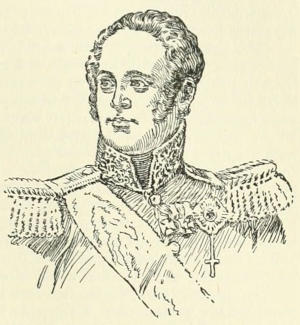
Alexander I
(1777-1825)
The relations between Russia and France were at this time of such a nature that the Russian chancellor, Vorontzov, said plainly, in a note of the 18th of July, that if the war were to be prolonged between France and England, Russia would be compelled finally to take part in it. Before this declaration on the part of Russia, Bonaparte had a scene with Markov, which alone might well have caused a rupture. He addressed the Russian ambassador, in a public audience, so rudely and violently that even Bignon, who is disposed to worship Bonaparte as a demi-god, is obliged to confess that his hero entirely lost his dignity, and forgot his position.
[1803-1805 A.D.]
When Markov withdrew in November, he left his secretary of legation, D’Oubril, as acting ambassador in his place. Everyone, however, foresaw a breach at no very distant period; and Russia had already, in the autumn of 1803, when nothing was to be done with Prussia, entered into a closer connection with England. Negotiations were also commenced with Austria, and a union with Sweden and Denmark, for the purpose of liberating Hanover, was spoken of. This was the state of affairs at the beginning of 1804: the murder of the duke d’Enghien brought matters to a crisis. The mother of the Russian emperor had been all along hostile to everything proceeding from Bonaparte; and the mild and gentle spirit of the emperor, like that of all persons of good feeling in Europe, was deeply wounded by the fate of the duke. From the beginning of 1804, he had no further political reasons for keeping up a friendly relation with France; he therefore gave himself up entirely to his natural feelings on hearing of the catastrophe at Vincennes.
By the declarations interchanged between the courts of St. Petersburg and Berlin (May 3rd and 24th, 1805), it was agreed that they should not allow the French troops in Germany to go beyond the frontier of Hanover; and that should this happen, each of the two powers should employ 40,000 men to repel such an attempt. A convention was also signed between Russia and Austria before the end of the year, and they agreed to set on foot an army of 350,000 men. England, under the administration of William Pitt, added her strength to these combinations, and united the several powers in a third coalition for the purpose of wresting from France the countries subdued by it since 1792, reducing that kingdom within its ancient limits, and finally introducing into Europe a general system of public right. The plan was the same as that which ten years afterwards was executed by the Grand Alliance; it failed in 1805, because the participation of Prussia, on which the allies had reckoned, was, from the most ignoble motives withheld.
The negotiations of the several treaties connected with the coalition, occupied the greater part of the year 1805. By the Treaty of St. Petersburg (August 11th), between Great Britain and Russia, it was agreed that Alexander should make another attempt for arranging matters with Bonaparte, so as to prevent the war. The Russian minister Novosiltzov was sent to Paris by way of Berlin, where he received the passports procured for him from the French cabinet by that of Prussia; but at the same time, orders reached him from St. Petersburg, countermanding his journey. The annexation of the Ligurian Republic to France, at the moment when the allies were making conciliatory overtures to Napoleon, appeared to the emperor too serious an outrage to allow of his prosecuting further negotiations. War was consequently resolved on.
THE CAMPAIGN OF AUSTERLITZ (1805 A.D.)
[1805 A.D.]
Napoleon seemed to be wholly intent on his design of invading England. Part of his troops had already embarked (August 27th), when on a sudden the camp of Boulogne was broken up, and the army put in march towards the Rhine, which river it passed within a month after. Austria had set on foot three armies. The archduke Charles commanded that of Italy; his brother John was stationed with the second army on the Tyrol; and the third was commanded nominally by the archduke Frederick, the emperor’s cousin, but in reality by General Mack. The first Russian army under Kutusov had arrived in Galicia, and was continuing its march in all haste. It was followed by another under Michelson. The Russian troops in Dalmatia were to attempt a landing in Italy.
Mack having crossed the Inn (September 8th), and entered Swabia, Napoleon’s plan was to cut him off from the army of Kutusov, which was marching through Austria. In this he succeeded by a violation of the Prussian territory. Marmont, who had marched by way of Mainz, and Bernadotte, who had conducted an army into Franconia, where they were joined by the Bavarians, traversed the country of Anspach, and thus came on the rear of the Austrian army (October 6th). From that date, scarcely a day passed without a battle favourable to the French. Several Austrian divisions were forced to lay down their arms. Mack, who had thrown himself into Ulm, lost all resolution, and capitulated with 25,000 men (October 19th). Mack’s army was thus totally dissipated, except 6000 cavalry, with which the archduke Ferdinand had opened himself a passage through Franconia, and 20,000 men, with whom Kienmayer had retired to Braunau, where he was met by the vanguard of Kutusov. The two generals continued their retreat. The Russians repassed the Danube near Grein (November 9th), and directed their march towards Moravia. A few days after (November 13th), Vienna fell into the hands of the French. The Austrians had renounced the design of defending their capital, but decided that the passage of the river should be disputed.
Vienna is situated at some distance from the Danube, which flows to the right of the city between wooded islands. The Austrians had placed explosive materials under the floorings of the wooden bridge which crosses the several arms of the river, and were ready to blow it up the moment the French should show themselves. They kept themselves in readiness on the left bank, with their artillery pointed, and a corps of 7000 or 8000 men, commanded by Count Auersberg. The French, nevertheless, got possession of the bridge by stratagem. Murat, Lannes, Belliard, and their staff, leaving their troops behind them, crossed the bridge, told the Austrians that an armistice was agreed on, and asked to see their general. He was sent for. Meanwhile, the French officers kept the Austrian gunners in conversation, and gave time for a column of French grenadiers to come up unseen, under cover of the woods, seize the cannon, and disarm the artillerymen. The Austrian commander who had come to the spot just at the critical moment, fell completely into the trap. He himself led the French column over the bridge, and ordered the Austrian troops to be drawn up on parade to receive them as friends. The possession of the bridge afforded the French troops the means of reaching Znaim sooner than Kutusov, and thus preventing his junction with Buxhövden.
Meanwhile, Alexander had gone to Berlin, to exert his personal influence over the timorous king, and prevail on him to abandon his wretched neutral policy, in which there was neither honour, honesty, nor safety. Alexander was warmly seconded by the beautiful queen of Prussia, and by the archduke Anthony, who arrived at the same time on a special mission from Vienna. French influence rapidly declined in Berlin; Duroc left it on the 2nd of November, without having been able to obtain an audience, for some days previously, either from the king or the emperor; and on the following day a secret convention was signed between the two monarchs for the regulation of the affairs of Europe, and the erection of a barrier against the ambition of the French emperor.
The Prussian minister Haugwitz, who had signed this convention only to gain time, and with a secret determination to elude its provisions, was to be entrusted with the notification of it to Napoleon, with authority, in case of its acceptance, to offer a renewal of the former friendship and alliance of the Prussian nation; but in case of refusal, to declare war, with an intimation that hostilities would begin on the 15th of December—when they would be too late. Before that day came, Prussia relapsed into her old temporising habits; her armies made no forward movement towards the Danube, and Napoleon was permitted to continue without interruption his advance to Vienna, while 80,000 disciplined veterans remained inactive in Silesia; a force amply sufficient to have thrown him back with disgrace and disaster to the Rhine.
A characteristic scene took place at Potsdam during Alexander’s visit. The king, the queen, and the emperor went one night by torchlight into the vault where lay the coffin of Frederick the Great. They knelt before it. Alexander’s face was bathed in tears; he pressed his friend’s hands, he clasped him in his arms, and together they swore eternal amity: never would they separate their cause or their fortunes. Tilsit soon showed what was the value of this oath, which probably was sincere for the moment when it was taken.
During the retreat of the Austrians and Russians under Kienmayer and Kutusov from Passau to Krems, the imprudence of Mortier, who had crossed to the left bank of the Danube at Linz, gave occasion to engagements at Stein and Dirnstein, in which the French lost more men than they ever acknowledged. Mortier’s army of 30,000 men consisted of three divisions, under Generals Gazan, Dupont, and Dumonceau. This army had positive orders to keep always near to the main body, which was pursuing its march along the right bank, and never to advance beyond it. Kutusov had long retreated on the right bank; but on the 9th of November he crossed to the left at Grein, as before mentioned, and lay in the neighbourhood of Krems, when Mortier’s troops advanced. The French divisions maintained the distance of a whole day’s march one from another, because they thought they were following a fleeing army; but between Dirnstein and Stein they fell in with the whole Russian army, 20,000 strong, at a place where the French were obliged to pass through a frightful ravine. On the 11th of November, Mortier ventured to make an attack with Gazan’s division alone; but near Dirnstein (twenty hours from Vienna), he got into a narrow way, enclosed on both sides by a line of lofty walls, and there suffered a dreadful loss. When the French, about noon, at length supposed themselves to have gained some advantage, the Russians received reinforcements, outflanked the French, cut them off, and would have annihilated the whole division, had not Dupont’s come up at the decisive moment. The latter division had also suffered severely on the same day. Whilst Kutusov was sharply engaged with Mortier, whose numbers were being rapidly diminished, and his cannon taken, the Austrian general Schmidt attacked Dupont at Stein, where the contest was as murderous as at Dirnstein, till Schmidt fell, and the French forced their way out.
Kutusov, on his march to Znaim, was overtaken by the van of the French, under Belliard, near Hollabrunn; and everything depended on detaining the latter so long as might enable Kutusov to gain time for getting in advance. For this purpose, Bagration, with about six thousand men, took up a position in the rear of the main body. Nostitz served under Bagration, and had some thousand Austrians and a number of Russians under his immediate command. He occupied the village of Schöngraben, in the rear of the Russians, and in the very centre of their line of march. Belliard ought to have attacked him first; but as his corps was not superior in number to that of Bagration, he had again recourse to the expedient which he had already tried, with such signal success, at the bridge of Vienna. He entered into a parley; declared that peace with Austria was already concluded, or as good as concluded; assured them that hostilities henceforth affected the Russians alone; and by such means induced Nostitz to be guilty of a piece of treachery unparalleled in war. Nostitz, with his Austrians, forsook the Russians, even those whom he had under his own command; and they being unable to maintain the village of Schöngraben, it was taken possession of without a shot; and Bagration and Kutusov seemed lost, for Murat’s whole army was advancing upon them.
In the meantime the Russians at Hollabrunn extricated themselves from their difficulty; for they were not so stupidly credulous as the Austrians, but knew how to deceive the Gascons, by whom they were pursued, as Belliard had deceived the Austrians. For this purpose, they availed themselves of the presence in Kutusov’s camp of Count von Winzingerode, the adjutant-general of the emperor of Russia, who had been employed in all the last diplomatic military negotiations in Berlin. Murat having sent his adjutant to call upon Kutusov, whose line of march had come into the power of the enemy, in consequence of Nostitz’s treachery in capitulating, the Russian general assumed the appearance of being desirous to negotiate, and Winzingerode betook himself to the French camp. Belliard and Murat, without taking the trouble to inquire what powers the count and Kutusov had to conclude a treaty which should be generally binding, came to an agreement with Winzingerode, by virtue of which all the Russians, within a certain number of days, were to evacuate every part of the Austrian territory. This capitulation was to be sent to the emperor Napoleon, at Schönbrunn, for confirmation; and to this condition there was necessarily attached another, for the sake of which Kutusov had commenced the whole affair. There was to be a suspension of hostilities till the arrival of Napoleon’s answer; and it was agreed that in the meantime both parties should remain in their then positions.
Bagration, with seven or eight thousand Russians, complied with this condition, and remained in his position at Hollabrunn, because he could be observed by the French; but Kutusov, with all the rest of the army, which lay at a greater distance, quietly continued his route to Znaim; and this, with a full knowledge of the danger of Bagration being afterwards overwhelmed by a superior force. On being made acquainted with the capitulation, Napoleon was enraged, for he immediately perceived how grievously his brother-in-law had suffered himself to be deceived; and he ordered an immediate attack. This was indeed made; but eighteen hours had been irreparably lost, and Kutusov gained two marches on Murat; the whole French army, above thirty thousand strong, therefore fell upon Bagration.
Bagration, who had still with him the Austrian regiment of hussars of the crown-prince of Homburg, commanded by Baron von Mohr, offered a vigorous resistance to the whole French army with his seven or eight thousand men. The Russian bombs set fire to the village in which was stationed the corps which was to fall upon Bagration’s flank; the consequence was, that this corps was thrown into confusion, and the Russians opened up a way for themselves at the point of the bayonet. The Russian general, it is true, was obliged to leave his cannon in the hands of his enemy, and lost the half of his force; it must, however, always be regarded as one of the most glorious deeds of the whole campaign, that, after three days’ continued fighting, he succeeded in joining the main body under Kutusov, at his headquarters at Wischau, between Brünn and Olmütz, and, to the astonishment of all, with one-half of his little army. Even the French admit that the Russians behaved nobly, that they themselves lost a great number of men, and that, among others, Oudinot was severely wounded.
On the same day on which Bagration arrived in Wischau, a junction had been formed by Buxhövden’s army, with which the emperor Alexander was present, with the troops under Kutusov, who thenceforward assumed the chief command of the whole. Napoleon himself came to Brünn, and collected his whole army around him, well knowing that nothing but a decisive engagement could bring him safely out of the situation in which he then was, and which was the more dangerous the more splendid and victorious it outwardly appeared to be. It is beyond a doubt that the precipitation and haughtiness of the Russians, who were eager for a decisive engagement, combined with the miserable policy of the Prussian cabinet and the cowardice of the king, as well as the fears and irresolution of the poor emperor Francis, and the want of spirit among his advisers, contributed more to the success of Napoleon’s plans respecting Prussia, Germany, and Italy, than his victories in the field.
A glance at the situation of affairs at the time of the battle of Austerlitz will show at once how easily he might have been stopped in his career. There was nothing Napoleon feared more than that the Russians should march either to Hungary or to Upper Silesia, and avoid a decisive engagement; he therefore took means to ascertain the characters and views of the personal attendants and advisers of the emperor Alexander; and when he had learned that young men of foolhardy dispositions had the preponderance in his councils, he formed his plans accordingly. He first advanced from Brünn to Wischau, and afterwards retired again into the neighbourhood of Brünn, as if afraid to venture upon an attack. The emperor of Germany, as well as Napoleon, appeared seriously desirous of a peace; but the former was obliged to propose conditions which the latter could not possibly accept; and Napoleon wished first completely to set the emperor Francis free from the Russians, his allies and from Prussia, before he came to an agreement with him. As Count Stadion, who came to the headquarters of the French on the 27th of November, with Giulay, as ambassadors to treat for peace, was a sworn enemy of Napoleon, and remained so till 1813, and had, moreover, been very instrumental in founding the whole coalition, and in maturing their plans, his appearance on this occasion was of itself no good omen for the favourable issue of the mission.
The proposals made as the basis of a peace were the same as had been contemplated in the event of a victory on the part of the allies—the French were to evacuate Germany and Italy. When Napoleon sent Savary (afterwards duke of Rovigo), the head of his gendarmerie police, under pretence of complimenting the emperor Alexander, it was indisputably a great part of this envoy’s object, as appears from the 30th bulletin, to make himself thoroughly acquainted with the prevailing opinions and the leading characters during the three days of his sojourn in the emperor’s camp. Savary was very well received, and sent away with every courtly attention by Alexander; but it was intimated that it was intended to make common cause with Prussia, and that it was expected that Novosiltzov, whom the emperor Alexander wished to send to Napoleon, would meet Haugwitz in Brünn. The hint was sufficient to induce Savary to decline the company of Novosiltzov.
When Savary informed the emperor of the illusion of the Russian generals, and of their belief that fears were entertained of the Russians, and that on this account embassies were sent to seek for peace—Napoleon very cunningly took care to strengthen the fools in their folly. Savary was sent again to the enemy’s camp to propose an interview between Napoleon and the emperor of Russia. The interview was declined; but Prince Dolgoruki was sent to propose conditions to Napoleon. The latter did not allow him to come into his camp, but received him at the outposts.
If it be asked why the Russians, with whom there were only some twenty thousand Austrians, did not wait for their third army, under Bennigsen, or reduce Bonaparte to the greatest perplexity, by taking up a strong position in Hungary or Upper Silesia, or remaining quietly upon the heights of Pratzen, the reply is, that the whole system of supplies was bad, and that want had reached so great a pitch, that it would have been impossible for them to remain. Certain it is that they suffered themselves to be drawn down from the heights, and away from Austerlitz, near Brünn, where the talents of their generals were unable to devise any plan of battle which Napoleon could not immediately oversee; it would have been otherwise in the mountains. The French allege, that Napoleon had long before fixed upon the very place in which the Russians offered him battle at Austerlitz, on the 2nd of December, as his battle-field, and laid all his plans accordingly. The possession of the heights of Pratzen was regarded by those skilled in strategy as the key of this battle-field. The Russians were in full possession of these heights, with all their force, on the 1st of December; on the 2nd they descended from them, when Bonaparte drew back one of the wings of his army. He had long calculated on gaining the victory by the possession of these heights, and thus rendering the retreat of the Russians impossible. He did not, therefore, fail, in the very opening of the battle, to seize upon them.
A column of the third Russian army, under Bennigsen, commanded by Michelson, just arrived at the decisive moment when Napoleon had also called to his aid Bernadotte’s corps, and when the Bavarians were on their march from Budweis to Moravia; but none of their leaders could lay any claim to the reputation of a commander of genius. Napoleon’s proclamation to his army shows his full confidence in his own superiority, as well as in that of his generals and soldiers; and this confidence was fully realised on the bloody field of Austerlitz on the 2nd of December.
THE CAMPAIGN OF EYLAU AND FRIEDLAND (1806-1807 A.D.)
[1806 A.D.]
After the defeat at Austerlitz the emperor made an attempt, whether sincere or not is uncertain, for a reconciliation with Napoleon. He sent D’Oubril to Paris, who, after a negotiation of ten days, concluded a treaty with the French plenipotentiary, General Clarke (July 20th, 1806). But Alexander refused to ratify the treaty, upon the very questionable allegation that his ambassador had exceeded his powers.
Prussia now suffered the just consequences of her policy. Disappointed in her hopes of acquiring Hanover, the reward for which she crouched to Napoleon, she imprudently provoked him to war without waiting for the arrival of the aid due to her by Russia. The campaign was decided in one day by the two terrific defeats of Jena and Auerstadt (October 14th, 1806). Prussia was hopelessly ruined before the Russian armies, ninety thousand strong, under Bennigsen and Buxhövden, could arrive to save her. The Russians entered Prussia in November, and on the 26th of December the battle of Pultusk was fought with great obstinacy and loss of blood on both sides. The French spent the whole of a December night without covering; rain and snow fell incessantly; they waded up to their knees in marshes, spent twelve hours in making an advance of eight miles, and were obliged to pay dearly for their passage over the Narev. During the battle, Marshal Lannes and other generals were several times obliged to put themselves at the head of single regiments and battalions, and yet no decisive advantage was gained. The French, indeed, boasted of the victory; because the Russians, after having maintained their ground on a part of the field, retreated the next day.