Chapter VI · PETER THE GREAT
Reading edition
When, towards the beginning of the eighteenth century, Peter the Great laid the foundation of Petersburg or rather of his empire, no one predicted success. Had anyone at that time imagined that a sovereign of Russia could send victorious fleets to the Dardanelles, subjugate the Crimea, drive out the Turks from four great provinces, dominate the Black Sea, establish the most brilliant court of Europe, and make all the arts flourish in the midst of war—if anyone had said that he would merely have been taken for a visionary.—Voltaire.b
[1684-1725 A.D.]
The question of the succession was now again thrown open to discussion, and the family feuds were revived. Ivan, the next in succession, was nearly blind, and, according to some historians, nearly dumb, and inferior in mind and body; and shortly before his death Feodor expressed his wish that his half-brother, Peter, then between nine and ten years of age, should be nominated to the throne; a nomination of which Ivan had just sense enough to approve. The imbecility of Ivan was so great that, had it not been for the influence of the family to which he belonged, and the bold and ambitious spirit of his sister Sophia, he must have been set aside at once, and Peter without further difficulty raised to the sovereignty. The Miloflavskoi, however, were resolved to preserve the right of succession in their own blood; and Sophia, a princess of singular beauty and high mental endowments, in the meridian of youth and possessed of indomitable courage, set the example of contesting the throne, first in the name of her idiot brother and next in her own name: for when her plans were ripe she did not scruple to declare that she aspired to the sceptre in the default of the rightful heir. But as all her machinations were carefully conducted with a colour of justice on behalf of Ivan, she escaped from the charge of interested motives, which, in the early part of the plot, would have defeated her grand object.
[1684 A.D.]
While Sophia was employed in devising her plans, the Narishkins urged with unabating activity the claims of Peter. Friends arose in different quarters for both parties, and the city was thrown into consternation. But the Miloflavskoi had the advantage of possession: the keys of power were in their hands: the officers of the state were in their immediate confidence, and the bands of the strelitz, the janissaries of Russia, were under their control. Sophia, availing herself of these fortunate circumstances, pleaded with her supplicating beauty in the name of her brother; besought the strelitz, by arts of fascination which were irresistible, to make common cause with her; and where her eyes failed to impress their sluggard hearts, she was bountiful in money and promises. A body so corrupt and slavish as the strelitz was easily won by bribes to any offices of depredation, and they accordingly declared for the beautiful and prodigal Sophia.
The accession of fourteen thousand soldiers to her side—men who were ready at any moment to deluge the capital in blood—determined the scales at once. It was necessary in the first instance to exterminate the Narishkins, the formidable supporters of Peter; and next, if it could be accomplished with safety, to make away with the life of the prince. A rumour was accordingly disseminated that the Narishkins had compassed the death of Feodor, in order to make room for the young Peter; that they had poisoned him through the agency of foreign physicians; and that they contemplated a similar act of treachery towards Ivan. The zeal of the Narishkins seemed to justify these charges; and the populace, who were universally in favour of the direct lineal succession, were brought to believe them; particularly as Galitzin, the favourite minister of Feodor, was the chief counsellor and friend of Sophia. Affairs were now ripe for revolt. The chiefs of the strelitz, having previously concerted their plans, broke out into open violence; and for three days in succession this band of legalised plunderers committed the most extravagant excesses in the streets of Moscow, secretly abetted by the encouraging patronage of Sophia. In their fury they murdered all those officers of the state whom they suspected to be inimical to the views of the princess; and bursting into the palace of the czars demanded the lives of the Narishkins. Two brothers of Natalia, the widow of Alexis, were sacrificed on the spot, and sixty of her immediate kindred were shortly after put to death in the most cruel manner.
The czarina herself was forced to flee for safety from the capital, accompanied, providentially for the destiny of Russia, by the young prince Peter. For sixty versts she fled in consternation, carrying the boy, it is reported, in her arms: but the ferocious strelitz had tracked her footsteps, and followed close upon her path. Her strength at last began to fail: her pursuers were rapidly gaining on her; she could hear the sound of their yells, and the tramp of their approaching feet: her heart trembled at the horrors of her situation, and in despair she rushed into the convent of the Trinity to seek for a last shelter in the sanctuary. The strelitz, uttering cries of savage triumph, followed on the moment: the despairing mother had just time to gain the foot of the altar, and place the child upon it, when two of the murderous band came up. One of them seized the prince, and, raising his sword, prepared to sever the head from the body, when a noise of approaching horsemen was heard without: the ruffian hesitated—his fellow murderers at the distant part of the church were struck with terror—dismayed by the apprehension of some sudden change in the fortune of the day, he abandoned his grasp of the prince and fled, and Peter the Great was preserved to Russia.
The immediate result of those violent efforts of the strelitz was the declaration of the sovereignty in the name of Ivan. That prince, however, trembled at the prospect of incurring the responsibility of a trust to which he felt himself to be unequal, and entreated his counsellors to permit his half-brother Peter to be associated with him in the government. This request, which was considered on all sides reasonable enough, could not be refused without increasing the difficulties of Sophia’s party, and rendering such further measures necessary as might probably betray her motives too soon. It was therefore sanctioned by the nobles; and on the 6th of May, 1681, the coronation of Ivan and Peter were celebrated in due form; Sophia being nominated regent, on account of the imbecility of the one and the youth of the other. Thus far Sophia had carried her purpose. She was now in possession of the power to which her ambition tempted her to aspire; but she panted to have that power formally assigned and publicly acknowledged. In order the more effectually to exclude Peter from any future lien upon the throne, she brought about a marriage between Ivan and a young Soltikov; trusting to the issue for an insurmountable obstacle in the path of the prince, whose dawning genius, even at that early age, she appeared to dread.c
THE CHILDHOOD AND YOUTH OF PETER
During Sophia’s government Peter continued to reside with his mother in the village of Preobrazhenski. His education was entirely neglected; his teacher, Nikita Zotov, was taken away from him and not replaced by another; he spent his time in play, surrounded by companions of his own age and without any intelligent occupation: such an existence would certainly have spoiled and maimed a less gifted nature. Upon Peter it only had the effect, as he himself afterwards recognised, of making him feel in later years the want of that knowledge which is indispensable for a sound education. By reason of this neglect Peter had to study much when he reached maturity; besides this, the manner in which his boyhood was spent deprived him of that training of the character in intercourse with other people which is the mark of an educated man. From his youth Peter adopted the rough habits of those who surrounded him, an extreme want of self-restraint, and hideous debauchery.
But his unusually gifted nature could not be crushed by this absence of all intellectual interests. Peter had no early instruction, but the love of knowledge inherent in him could not be destroyed. He himself afterwards communicated the circumstances which directed him into the paths he elected to follow. When he was fourteen years of age, he heard from Prince Iakov Dolgoruki that he had possessed an instrument “by means of which it was possible to measure distances or extension without being on the spot.” The young czar wished to see the instrument, but Dolgoruki replied that it had been stolen; so Peter commissioned the prince, who had gone to France as ambassador, to purchase there for him such an instrument. In 1688 Dolgoruki brought from France an astrolabe and case of mathematical instruments, but there was no one amongst the czar’s entourage who had any understanding of what they were for. Peter applied to a German doctor, but neither did he know how to use the instruments; finally he found a Dutchman, Franz Timmerman, who explained to him the significance of the objects. The czar began to study arithmetic, geometry, and the science of fortification with him. The teacher was not a great authority in these matters, but he knew sufficient to give Peter indications, and the talented pupil worked out everything himself; but his education had been neglected to such an extent that when he was learning the four rules of arithmetic, at the age of sixteen, he could not write a single line correctly and did not even know how to divide one word from the other, joining two or three together with continual mistakes and omissions.
Some time later Peter was in the village of Izmailov, and strolling through the storehouses, he looked over a lot of old things that had belonged to the cousin of the czar Michael Feodorovitch—Nikita Ivanovitch Romanov, who had been distinguished in his time for his remarkable love of knowledge. Here he found a foreign-built vessel and questioned Franz Timmerman about it; the latter could tell him only that it was an English boat, which had the superiority over Russian boats as being able to sail not only with the wind but also against it. Peter inquired whether there was anyone who could mend the boat and show him how to sail it. Timmerman replied that there was and found for Peter the Dutchman, Christian Brandt (Karstein Brandt, as Peter called him). The czar Alexis Michailovitch had thought of building a ship and launching it at Astrakhan, and had therefore sent for shipwrights from Holland; but the ship that had been built and launched at Astrakhan was destroyed by Stenka Radzin, the shipwrights were dispersed, and one of them, the ship’s carpenter, Karstein Brandt, lived in Moscow where he gained a living by doing carpenter’s work.
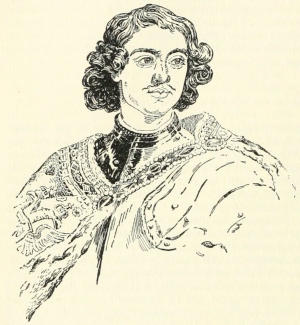
Peter the Great
(1672-1725)
By order of the czar Brandt mended the boat, put in a mast and sail, and in Peter’s presence manœuvred it on the river Iauza. Peter was astonished at such art and himself repeated the experiment several times with Brandt, but not always successfully; it was difficult to turn the boat, which stuck to the shore because the channel was too narrow. Peter then ordered the boat to be taken to a pond in the village of Izmailov, but there also navigation was difficult. Then Peter learned that the lake near Pereiaslavl would be suitable for his purpose; it was thirty versts in circumference and had a depth of six sazhen.[39] Peter asked his mother’s leave to go on a pilgrimage to the Troitsa monastery, came to Pereiaslavl, and examined the lake, which greatly pleased him. On his return to Moscow he entreated his mother to let him go again to Pereiaslavl in order to take the boat there. The czaritza could not refuse her beloved son, although she was much against such a project out of fear for his life. Together with Brandt, Peter built a wharf at the mouth of the river Troubezh, which falls into the lake of Pereiaslavl and thus he laid the foundation of his ship building.
[1687-1689 A.D.]
At that period Peter’s diversions with his companions began to lose their playful character. He enrolled amongst them volunteers of every condition and in 1687 he formed with them two regular regiments, called by the name of the two royal villages near Moscow—the Preobrazhenski and the Semenovski. Sophia and her partisans endeavoured to represent these diversions as foolish extravagances; Natalia Kirillovna, the mother of Peter, did not herself see anything more in them than the amusements of a spirited, impetuous youth, and thought to steady him by marriage. She found for him a bride in the person of Eudoxia Lapoukhin, a beautiful young girl; her father, an okolnitchi, or courtier of the second rank, called Sarion, had his name changed to Theodore, and the marriage took place on the 27th of January, 1689. Peter had no attachment or love for his wife and only married to please his mother; in fact, he married as the majority of men married at that period. His mother hoped that when the young man was married he would begin to lead the life that was considered fitting for exalted personages. But soon after the marriage, as soon as the ice began to break up in the rivers, Peter galloped away to Pereiaslavl and there occupied himself with the building of ships. His mother wished to draw him away and demanded his return to Moscow under the pretext of a requiem service for the czar Theodore: “You were pleased to summon me to Moscow,” wrote the czar to his mother, “and I was ready to come, but verily there is business on hand.” His mother insisted that he should come to the capital; Peter obeyed and came to Moscow, but after a month he was again back at the Pereiaslavl lake. He loved his mother and in his letters shared with her the satisfaction he experienced in the success of his work. “Thanks to your prayers,” he wrote, “all is well, and the ships are a great success.” But the czaritza Natalia did not understand her son’s passion, and moreover feared Sophia’s inimical designs; therefore she called him again to Moscow. His young wife also wearied for his presence and wrote to him, calling him “her joy, her light, her darling,” and begging him either to come back or let her come to him. Peter, recalled by his mother’s persistent demands, unwillingly returned that summer to Moscow.d
PETER ASSERTS CONTROL
It is alleged, with what truth we know not, that at this period Sophia and her favourite, Prince Galitzin, engaged the new chief of the Strelitz to sacrifice the young czar to their ambition. It appears at least that six hundred of those soldiers were to seize on that prince’s person, if not to murder him. Peter was once more obliged to take refuge in the monastery of the Trinity, the usual sanctuary of the court when menaced by the mutinous soldiery. There he convoked the boyars of his party, assembled a body of forces, treated with the captains of the strelitz, and sent for some Germans who had been long settled in Moscow, and were all attached to his person, from his already showing a regard to foreigners. Sophia protested her abhorrence of the plot, and sent the patriarch to her brother to assure him of her innocence; but he abandoned her cause on being shown proof that he himself was among those who had been marked out for assassination.
Peter’s cause prevailed. All the conspirators were punished with great severity; the leaders were beheaded, others were knouted, or had their tongues cut out, and were sent into exile. Prince Galitzin escaped with his life, by the intercession of a relative, who was a favourite of the czar Peter, but he forfeited all his property, which was immense, and was banished to the neighbourhood of Archangel.
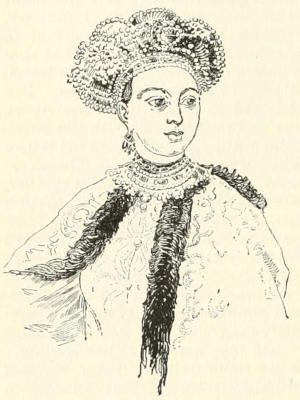
Sophia Alexievna
(1658-1704)
The scene concluded with shutting up the Princess Sophia in a convent near Moscow, where she remained in confinement until her death, which did not happen until fifteen years afterwards. From that period Peter was real sovereign. His brother Ivan had no other share in the government than that of lending his name to the public acts. He led a retired life, and died in 1696.
Nature had given Peter a colossal vigour of body and mind, capable of all extremes of good and evil. It is impossible to review his whole history without mingled feelings of admiration, horror, and disgust. That he was not altogether a monster of wickedness was not the fault of Sophia and her minister, whose deliberate purpose it was to destroy in him every germ of good, that he might become odious and insupportable to the nation. They succeeded only in impairing the health, corrupting the morals, and hardening the heart of the youthful czar; it was no more in their power to deprive him of his lofty nature than to have given it to him. General Menesius, a learned Scotchman, to whom Alexis had intrusted his education, refused to betray him, and was, therefore, driven from his charge. The first impressions on the mind of Peter were allowed to be received from coarse and sordid amusements, and from foreigners, who were repulsed by the jealousy of the boyars, hated by the superstition of the people, and despised by the general ignorance. Thus it was hoped that he would at last be driven by public execration to quit the palace for a monk’s cell; but to ensure his disgrace served to lay the foundations of his greatness and glory.
Kept at a distance from the throne, Peter escaped the influence of that atmosphere of effeminacy and flattery by which it is environed; the hatred with which he was inspired against the destroyers of his family increased the energy of his character. He knew that he must conquer his place upon the throne, which was held by an able and ambitious sister, and encircled by a barbarous soldiery; thenceforth, his childhood had that which ripened age too often wants, it had an aim in view, of which his genius, already bold and persevering, had a thorough comprehension. Surrounded by adventurers of daring spirits, who had come from afar to try their fortune, his powers were rapidly unfolded. One of them, Lefort, who doubtless perceived in this young barbarian the traces of civilisation, which had perhaps been left there by his first tutor, gave him an idea of the sciences and arts of Europe, and particularly of the military art.
MILITARY REFORMS
[1692-1695 A.D.]
Lefort, in whom Peter placed his whole confidence, did not understand much of the military service, neither was he a man of literature, having applied himself deeply to no one particular art or science; but he had seen a great deal, and was capable of forming a right judgment of what he saw. Like the czar, he was indebted for everything to his own genius: besides, he understood the German and Dutch languages, which Peter was learning at that time, in hopes that both those nations would facilitate his designs. Finding himself agreeable to Peter, Lefort attached himself to that prince’s service: by administering to his pleasures he became his favourite, and confirmed this intimacy by his abilities. The czar intrusted him with the most dangerous design a Russian sovereign could then possibly form—that of abolishing the seditious and barbarous body of the strelitz. The attempt to reform the janissaries had cost the great sultan Osman his life. Peter, young as he was, went to work in a much abler manner than Osman. He began with forming, at his country residence of Preobrajen, a company of fifty of his youngest domestics; and some of the sons of boyars were chosen for their officers. But in order to teach those young boyars a subordination with which they were wholly unacquainted, he made them pass through all the military degrees, setting them an example himself, and serving successively as private soldier, sergeant, and lieutenant of the company.
This company, which had been raised by Peter only, soon increased in numbers, and was afterwards the regiment of Preobrajenski guards. Another company, formed on the same plan, became in time the regiment of guards known by the name of Semenovski. The czar had now a regiment of five thousand men on foot, on whom he could depend, trained by General Gordon, a Scotchman, and composed almost entirely of foreigners. Lefort, who had seen very little service, yet was qualified for any commission, undertook to raise a regiment of twelve thousand men, and effected his design. Five colonels were appointed to serve under him; and suddenly he was made general of this little army, which had been raised as much to oppose the strelitz as the enemies of the state.
Peter was desirous of seeing one of those mock fights which had been lately introduced in times of peace. He caused a fort to be erected, which one part of his new troops was to defend and the other to attack. The difference on this occasion was that, instead of exhibiting a sham engagement, they fought a downright battle, in which there were several soldiers killed and a great many wounded. Lefort, who commanded the attack, received a considerable wound. These bloody sports were intended to inure the troops to martial discipline; but it was a long time before this could be effected, and not without a great deal of labour and difficulty. Amidst these military entertainments, the czar did not neglect the navy: and as he had made Lefort a general, notwithstanding this favourite had never borne any commission by land, so he raised him to the rank of admiral, though he had never before commanded at sea. But he knew him to be worthy of both commissions. True, he was an admiral without a fleet, and a general without any other troops than his regiment.
By degrees the czar began to reform the chief abuse in the army, viz., the independence of the boyars, who, in time of war, used to take the field with a multitude of their vassals and peasants. Such was the government of the Franks, Huns, Goths, and Vandals, who, indeed, subdued the Roman Empire in its state of decline, but would have been easily destroyed had they contended with the warlike legions of the ancient Romans, or with such armies as in our times are maintained in constant discipline all over Europe.
Admiral Lefort had soon more than an empty title. He employed both Dutch and Venetian carpenters to build some long-boats, and even two thirty-gun ships, at the mouth of the Voroneje, which discharges itself into the Don. These vessels were to fall down the river, and to awe the Crim Tatars. Turkey, too, seemed to invite the czar to essay his arms against her; at the same time disputes were pending with China respecting the limits between that empire and the possessions of Russia in the north of Asia. These, however, were settled by a treaty concluded in 1692, and Peter was left free to pursue his designs of conquest on the European side of his dominions.
AZOV TAKEN FROM THE TURKS
It was not so easy to settle a peace with the Turks; this even seemed a proper time for the czar to raise himself on their ruin. The Venetians, whom they had long overpowered, began to retrieve their losses. Morosini, the same who surrendered Candia to the Turks, was dispossessing them of the Morea. Leopold, emperor of Germany, had gained some advantages over the Ottoman forces in Hungary; and the Poles were at least able to repel the incursions of the Crim Tatars.
Peter profited by these circumstances to discipline his troops, and to acquire, if possible, the empire of the Black Sea. General Gordon marched along the Don towards Azov, with his regiment of five thousand men; he was followed by General Lefort, with his regiment of twelve thousand; by a body of strelitz, under the command of Sheremetrev and Schein, officers of Prussian extraction; by a body of Cossacks, and a large train of artillery. In short everything was ready for this grand expedition (1694). The Russian army began its march under the command of Marshal Sheremetrev; in the beginning of the summer of 1695, in order to attack the town of Azov, situated at the mouth of the Don. The czar was with the troops, but appeared only as a volunteer, being desirous to learn before he would take upon him to command. During their march they stormed two forts which the Turks had erected on the banks of the river.
This was an arduous enterprise, Azov being very strong and defended by a numerous garrison. The czar had employed several Venetians in building long-boats like the Turkish saicks, which, together with two Dutch frigates, were to fall down the Voroneje; but not being ready in time, they could not get into the sea of Azov. All beginnings are difficult. The Russians, having never as yet made a regular siege, miscarried in this their first attempt.
A native of Dantzic, whose name was Jacob, had the direction of the artillery under the command of General Schein; for as yet they had none but foreign officers belonging to the train, and indeed none but foreign engineers and foreign pilots. This Jacob had been condemned to the rods by Schein, the Prussian general. It seemed as if these severities were necessary at that time in support of authority. The Russians submitted to such treatment, notwithstanding their disposition to mutiny; and after they had undergone that corporal punishment, they continued in the service as usual. This Dantziker was of another way of thinking, and determined to be revenged; whereupon he spiked the cannon, deserted to the enemy, turned Mohammedan, and defended the town with great success. The besiegers made a vain attempt to storm it, and after losing a great number of men, were obliged to raise the siege.
[1696 A.D.]
Perseverance in his undertakings was the characteristic of Peter the Great. In the spring of 1696 he marched a second time to attack the town of Azov with a more considerable army. The most agreeable part of the czar’s success was that of his little fleet, which he had the pleasure to see completely equipped and properly commanded. It beat the Turkish saicks that had been sent from Constantinople, and took some of them. The siege was carried on regularly, though not entirely after the English manner. The trenches were three times deeper than the English, and the parapets were as high as ramparts. At length the garrison surrendered, the 28th of July, 1696, without obtaining any of the honours of war; they were likewise obliged to deliver up the traitor Jacob to the besiegers.
The czar immediately began to improve the fortifications of Azov. He likewise ordered a harbour to be dug, capable of holding large vessels, with a design to make himself master of the straits of Caffa, which open the passage into the Black Sea. He left two-and-thirty armed saicks before Azov, and made all the preparations for fitting out a strong fleet against the Turks, which was to consist of nine sixty-gun ships, and of one-and-forty carrying from thirty to fifty pieces of cannon. The principal nobility and the wealthiest merchants were obliged to contribute to the fitting out of this fleet; and, as he thought that the estates of the clergy ought to bear a proportion in the service of the common cause, orders were issued that the patriarch, the bishops, and the superior clergy should find money to forward this new expedition, in honour of their country, and for the general advantage of Christendom. He likewise obliged the Cossacks to build a number of light boats, such as they use themselves, with which they might easily infest the whole coast of the Crimea. The scheme was to drive the Tatars and Turks forever out of the Crimea, and afterwards to establish a free and easy commerce with Persia, through Georgia. This is the very branch of trade which the Greeks formerly carried on to Colchis, and to this peninsula of the Crimea, which the czar seemed likely to subdue.
Before Peter left the Crimea he repudiated his wife Eudoxia, and ordered her to be sent to a convent, where, before his return to Moscow, she became a nun, under the name of Helena. She had long made herself distasteful to her husband by her querulous jealousy, for which, indeed, she had ample cause, and by her aversion to his foreign favourites and the arts they introduced.
After his successful campaign against the Turks and Tatars, Peter wished to accustom his people to splendid shows, as well as to military toil. With this view, he made his army enter Moscow under triumphal arches, in the midst of fireworks and other tokens of rejoicing. The soldiers who had fought on board the Venetian saicks against the Turks led the procession. Marshal Sheremetrev, generals Gordon and Schein, Admiral Lefort, and the other general officers, took precedence of their sovereign, who pretended he had no rank in the army, being desirous to convince the nobility by his example that merit ought to be the only road to military preferment.
This triumphal entry seemed, in some measure, to resemble those of the ancient Romans, especially in that as the triumphers exposed the captives to public view in the streets of Rome, and sometimes put them to death, so the slaves taken in this expedition followed the army; and Jacob, who had betrayed them the year before, was carried in a cart, with the gibbet, to which he was fastened after he had been broken upon the wheel.
Upon this occasion was struck the first medal in Russia. The legend, which was in the language of that country is remarkable: “Peter I, the august emperor of Muscovy.” On the reverse is Azov, with these words, “Victorious by fire and water.”
SCHEMES OF CONQUEST
The paramount idea of Peter’s whole life displayed itself in the siege of Azov, his first military enterprise. He wished to civilise his people by beginning with the art of war by sea and land. That art would open the way for all the others into Russia, and protect them there. By it the czar was to conquer for his empire that element which, in his eyes, was the greatest civiliser of the world, because it is the most favourable to the intercourse of nations with each other.
But ignorant and savage Asia lay stretched along the Black Sea, between Russia and the south of Europe. It was not, therefore, through those waters that Peter could open himself a passage to European knowledge. But towards the northwest, another sea, the same whence, in the ninth century, came the first Russian founders of the empire, was within his reach. It alone could connect Muscovy with ancient Europe; it was especially through that inlet, and by the ports on the gulfs of Finland and of Riga, that Russia could aspire to civilisation. Those ports belonged, however, to a warlike land, thickly studded with strong fortresses. It mattered not; everything was to be tried to attain so important an object.
Peter, however, did not deem it proper to begin such an arduous enterprise until he should have made himself better acquainted with the nations which he wished to conciliate, or to conquer, and which were recommended to him as models. He was desirous, with his own eyes, of beholding civilisation in what he supposed to be its mature state, and to improve himself in the details of government, in the knowledge of naval affairs, and of the several arts which he wished to introduce among his countrymen.
CONSPIRACY TO MURDER PETER
[1697 A.D.]
But he was not allowed to depart in peace. The announcement of his intention was received with deep disgust by his bigoted subjects. The strelitz in particular, who saw themselves supplanted by the regiments disciplined in the European manner, were actively hostile. The childhood and youth of Peter had several times escaped from their rage; and now, in the horror which was inspired by his approaching departure for profane Europe, they determined to sacrifice the impious czar who was ready to defile himself by the sacrilegious touch of foreigners whom they abhorred. They saw in the midst of them twelve thousand heretics, already organised, who would remain masters of their holy city; while they themselves, exiled to the army, were destined to fight at a distance on the frontier. Nor was this their only grievance, for Peter had given orders to construct a fleet of a hundred vessels; and of this sudden creation they complained, as being an insupportable tax in the midst of an already ruinous war, and as rendering it necessary to introduce into their sacred land a fresh supply of those schismatical artisans who were preferred to them. A few days before the departure of their sovereign, Tsikler and Sukanim, two of the strelitz leaders, plotted a nocturnal conflagration. They knew that Peter would be the first to hasten to it; and in the midst of the tumult and confusion common to such accidents, they meant to murder him without mercy, and then to massacre all the foreigners who had been set over them as masters.
Such was the infamous scheme. The hour fixed for its accomplishment was at hand. The principal conspirators assembled at a banquet, and sought in intoxicating liquors the courage requisite for the dreadful work before them. But drunkenness produces various effects on different constitutions. Two of the villains lost in it their boldness, left the company under a specious pretext, promising their accomplices to return in time, and hurried to the czar to disclose the plot.
At midnight the blow was to have been struck; and Peter gave orders that, exactly at eleven, the haunt of the conspirators should be closely surrounded. Shortly after, thinking that the hour was come, he went thither alone, and entered boldly, not doubting that he should find them already fettered by his guards. But his impatience had anticipated the time, and he found himself, single and unarmed, in the midst of the ferocious gang at the instant when they were vociferating an oath that they would achieve his destruction.
At his unexpected appearance they all rose in confusion. Peter, at once comprehending the full extent of his danger, exasperated at the supposed disobedience of his guards, and furious at having thrown himself into peril, had yet the presence of mind to conceal his emotions. Having gone too far to recede, he unhesitatingly advanced among the throng of traitors, greeted them familiarly, and, in a calm and natural tone, said, that “as he was passing by their house he saw a light in it, and guessing that they were amusing themselves, he had entered in order to share their pleasures.” He then seated himself, and drank to his assassins, who, standing up around him, could not avoid putting the glass about, and drinking his health.
But they soon began to exchange looks and signs. At last one of them leaned over to Sukanim, and said, in a low voice, “Brother, it is time!” The latter, for what reason is unknown, hesitated, and had scarcely replied, “Not yet,” when Peter, who heard these words, and along with them the footsteps of his guards, started from his seat, knocked him down by a blow in the face, and exclaimed, “If it is not yet time for you, scoundrel, it is for me!” This blow, and the sight of the guards, threw the assassins into consternation; they fell on their knees and implored forgiveness. “Chain them!” replied the terrible czar. Then turning to the officer of the guards, he struck him, and reproached him with his want of punctuality; but the latter showed him his order; and the czar perceiving his mistake, clasped him in his arms, kissed him on the forehead, proclaimed his fidelity, and entrusted him with the custody of the traitors.
His vengeance was terrible; the punishment was more ferocious than the crime. First the rack, then the successive mutilation of each member; then death, when not enough of blood and life was left to allow of the sense of suffering. To close the whole, the heads were exposed on the summit of a column, the members being symmetrically arranged around them, as ornaments—a scene worthy of a government of masters and of slaves, brutifying each other, whose only god was fear.
PETER TRAVELS TO ACQUIRE KNOWLEDGE
After this terrific execution, Peter began his journey in April, 1697, travelling incognito in the retinue of his three ambassadors, General Lefort, the boyar Alexis Golovin, and Vonitsin, diak, or secretary of state, who had been long employed in foreign courts. Their retinue consisted of two hundred persons. The czar, reserving to himself only a valet de chambre, a servant in livery, and a dwarf, was confounded in the crowd. It was a thing unparalleled in history, either ancient or modern, for a sovereign of five-and-twenty years of age to withdraw from his kingdoms, only in order to learn the art of government. His victory over the Turks and Tatars, the splendour of his triumphant entry into Moscow, the multitude of foreign troops attached to his interest, the death of his brother Ivan, the confinement of the princess Sophia to a cloister, and the fearful example he had just made of the conspirators might naturally encourage him to hope that the tranquillity of his dominions would not be disturbed during his absence. The regency he entrusted to the boyar Strecknev and Prince Romadonovski, who in matters of importance were to consult with the rest of the nobility.
The troops which had been trained by General Gordon continued at Moscow, with a view to awe the capital. The disaffected strelitz, who were likely to create a disturbance, were distributed on the frontiers of the Crimea, in order to preserve the conquest of Azov and check the incursions of the Tatars. Having thus provided against every contingency, he gave a free scope to his passion for travelling, and his desire of improvement. He had previously sent threescore young Russians of Lefort’s regiment into Italy, most of them to Venice and the rest to Leghorn, in order to learn the art of navigation and the method of constructing galleys: forty more set out by his direction for Holland, to be instructed in the art of building and working large ships: others were ordered to Germany, to serve in the land forces and to learn the military discipline of that nation.
At that period, Mustapha II had been vanquished by the emperor Leopold; Sobieski was dead; and Poland was hesitating in its choice between the prince of Conti and Augustus of Saxony; William III reigned over England; Louis XIV was on the point of concluding the Treaty of Ryswick; the elector of Brandenburg was aspiring to the title of king; and Charles XII had ascended the throne.
Setting out from Novgorod, Peter first visited Livonia, where, at the risk of his liberty, he reconnoitred its capital, Riga, from which he was rudely repulsed by the Swedish governor. Thenceforth he could not rest till he had acquired that maritime province through which his empire was one day to be enriched and enlightened. In his progress he gained the friendship of Prussia, a power which, at a future time, might assist his efforts; Poland ought to be his ally, and already he declared himself the supporter of the Saxon prince who was about to rule it.
The czar had reached Amsterdam fifteen days before the ambassadors. He lodged at first in a house belonging to the East India Company, but chose afterwards a small apartment in the yards of the admiralty. He disguised himself in a Dutch skipper’s habit, and went to the great ship-building village of Zaandam. Peter admired the multitude of workmen constantly employed; the order and exactness observed in their several departments; the prodigious despatch with which they built and fitted out ships; and the vast quantity of stores and machines for the greater ease and security of labour. He began with purchasing a boat, and made a mast for it himself. By degrees he executed every part of the construction of a ship, and led the same life all the time as the carpenters of Zaandam—clad and fed exactly like them; working hard at the forges, at the rope-yards, and at the several mills for sawing timber, extracting oil, manufacturing paper, and wire-drawing. He entered himself as a common carpenter, and was enrolled in the list of workmen by the name of Peter Michaelov. They commonly called him Master Peter, or Peter-bas; and though they were confounded at first to behold a sovereign as their companion, yet they gradually accustomed themselves to the sight.
Whilst Peter was handling the compass and axe at Zaandam, he received intelligence of the division in Poland, and of the double nomination of the elector Augustus and the prince of Conti. Immediately the carpenter of Zaandam promised King Augustus to assist him with thirty thousand men. From his shop he issued orders to his army in the Ukraine, which had been assembled against the Turks.
His troops obtained a victory over the Tatars, in the neighbourhood of Azov; and a few months after became masters of the town of Orkapi, or Perekop. For his part he persisted in making himself master of different arts. With this view he frequently went from Zaandam to Amsterdam, in order to hear the anatomical lectures of the celebrated Ruisch. Under this master he made such progress as to be able to perform some surgical operations, which, in case of necessity, might be of use, both to himself and to his officers. He likewise studied natural philosophy, under Vitsen, celebrated for his patriotic virtue and for the noble use he made of his immense fortune.e
Peter in Holland, England, and Austria
Besides ship-building Peter also turned his attention to machinery, factories, and industry of every kind. Sometimes he was to be found sitting at the weaver’s loom, sometimes handling the sledge-hammer, axe, and plane. He could truthfully write to the patriarch Adrian concerning himself: “We act obedient to the word of God to our first parent Adam and are working—not because it is necessary, but in order that we may have a better insight into naval affairs and be the more able to go against the enemies of Jesus Christ’s name and conquer by his grace.”
On the 9th of September Peter, accompanied by Vitsen and Lefort, journeyed to Utrecht for a conference with the hereditary stadholder William of Orange, king of England. On his return he visited the whale-fishing fleet which had shortly before arrived, so as to become acquainted with everything concerning whale-fishing—that important branch of the seaman’s activity.
Peter always took note of everything new and important that he saw. Vitsen had to take him everywhere—to the hospitals, the foundling asylums, and the prayer meetings of different religious sects. He found great pleasure in the anatomical cabinet of the celebrated Ruisch, who had greatly advanced the art of preserving corpses from decomposition by injections. It was with difficulty that the czar could be got out of the room. He stood there transfixed and as it were unconscious, and he could not pass before the body of a child, that seemed to smile as if it were alive, without kissing it. His taste for being present at surgical operations went so far that at his request a special door was made in the wall of the St. Peter Hospital, by which he could enter it with Ruisch from the embassy, unobserved and unmolested by the curious. It was this doctor who recommended to him the surgeons for the new Russian naval and military troops.
After a stay of two months the Russian embassy went to the Hague, where it had long been expected. The entry was even more magnificent than at Amsterdam. Peter wished to attend the formal audience of his embassy in strict incognito. Vitsen, accompanied by two gentlemen, fetched him in his carriage. The czar wished to take along his dwarf, and when told that space was lacking, he replied: “Very well, then, he will sit on my lap.” At his command a drive was taken outside the town. At every one of the many mills that he passed, he asked what it was for; and on being told that one before which there were no stores was a grinding-mill, he jumped out of the carriage, but it was locked. On the road to Haarlem he observed a small water-mill for irrigating the land. It was in vain that they told him it was encompassed by water. “I must see it,” was the reply. The czar satisfied his curiosity and returned with wet feet. Twilight was already setting in, and the Dutch escort of the czar were rejoicing that the sight-seeing was at an end. But alas! before entering the Hague, Peter felt the carriage give a sharp jolt. “What is it?” he inquired. He was told that the carriage had driven on to a ferry-boat. “I must see it,” said he, and by lantern light the width, length, and depth of the ferry-boat had to be taken. Finally, at eleven at night, one of the best hotels in the Hague was reached. The czar was given a beautiful bedroom with a four-post bed. He preferred a garret. After midnight it occurred to him to spend the night at the hotel where his ambassadors were. Looking there for a place to sleep in, he found a Russian servant snoring on a bear skin. With a few kicks he awakened him. “Go away, go away, I am going to sleep here.” At last he found a comfortable resting place.
On the day of the audience, Peter dressed himself as an ordinary nobleman in a blue garment not overladen with gold lace, a large blond wig, and a hat with white feathers. Vitsen led him to the anteroom of a hall where soon the members of the states general and many distinguished spectators assembled. As some time passed before the retinue of his embassy arrived, and meanwhile all eyes in the hall were turned towards the ante-chamber where the czar was, he became extremely restless. “It takes too long,” he said and wanted to depart. But Vitsen represented to him that he would have to pass through the hall where the states general were already assembled. Thereupon he demanded that the lords should turn their backs to him as he passed through the room. Vitsen replied that he could command the lords nothing, as they were the representatives of the sovereignty of the land, but that he would ask them. The reply brought back was that the lords would stand up as the czar passed through the room, but would not turn their backs. Peter then drew his great wig before his face and ran at full speed through the assembly room and down the porch.
In the Hague also Peter had several informal meetings with the stadholder, King William; he became personally acquainted with the eminent statesmen Heinsius, Van Slingerland, Van Welde, Van Haven, and with the recorder of the states general, Franz Flagel. He besought the latter to find him someone who would know how to organise the Russian chancellery on the Dutch model. He also entered into connection with the celebrated engineer, General Coehorn, and on his recommendation took many Dutch engineering officers into the Russian service.
As Peter next undertook a journey to Leyden, the great scientist Leeuwenhoek had to come on board his yacht. He brought some of his most beautiful apparatus and a microscope with him. Peter conversed with him for two hours, and manifested much pleasure in the observation of the circulation of the blood in fishes. Boerhaave took him to the Botanical Gardens and to the anatomical lecture-room. On observing that one of his suite could not hide his aversion for a body which seemed to him particularly worthy of observation on account of its exposed sinews, he ordered him to tear out one of these sinews with his teeth.
From Leyden, Peter returned to Amsterdam. Here he often joined in the work on the galley which had been commenced at his request. In the name of the town Vitsen requested the czar to accept this ship as a present. Peter gave it the name Amsterdam, and in the following year, laden with wares bought by Peter himself, it started on its first journey to Archangel. From Amsterdam Peter often made excursions to Zaandam, ever keen and confident, although his Russian attendants trembled and quaked at the threatening dangers. On market days he was greatly entertained by the quacks and tooth drawers. He had one of the latter brought to him, and with great dexterity soon acquired the knack necessary for this profession. His servants had to provide him with opportunities for practising the newly acquired art.
Through Vitsen the Dutch Jews petitioned the czar to permit their nation, which had been banished by Ivan IV from Russia, to re-enter it, and they offered to prove their gratitude by a present of 100,000 gulden. “My good Vitsen,” replied Peter, “you know my nation and that it is not yet the time to grant the Jews this request. Tell them in my name that I thank them for their offer, but that their condition would become pitiable if they settled in Russia, for although they have the reputation of swindling all the world in buying and selling, I am afraid they would be greatly the losers by my Russians.”
During his sojourn in Amsterdam Peter received the joyful news of two successful engagements against the Tatars in July and August. To celebrate this victory he gave a brilliant fête to the authorities and merchants of the town. The brilliant victory of Prince Eugene at Zenta was yet more decisive for the issue of the war against the Turks.
On the 9th of November Peter, accompanied only by Lefort, returned to the Hague, where he informed King William III of his desire to see England. The king preceded him, and sent three men of war and a yacht under the command of Admiral Mitchel to conduct the czar. On the 18th of January, 1698, accompanied by Menshikov and fifteen other Russians of his suite, he set sail at Hellevoetsluis. Soon after the first days of his arrival in England, he exchanged the dwelling assigned to him in the royal castle of Somerset for the house of Mr. Evelyn at Deptford in the neighbourhood of the admiralty works, whence he could enter the royal construction yards unseen. There he learned from the master builders how to draw up the plan according to which a ship must be built. He found extreme pleasure in observing the cannon at the Tower, and also the mint, which then excelled all others in the art of stamping.
In his honour Admiral Carmarthen instituted a sham sea fight at Spithead on the 3rd of April which was conducted on a greater scale than a similar spectacle given for him in Holland. He often visited the great cathedrals and churches. He paid great attention to the ceremonial of English church worship; he also visited the meeting-houses of the Quakers and other sects. At Oxford he had the organisation and institutions of the university shown him. As in Holland, he preferred to pass most of his time with handicraftsmen and artists of every kind; from the watchmaker to the coffin maker, all had to show him their work, and he took models with him to Russia of all the best and newest. During his stay he always dressed either as an English gentleman or in a naval uniform.
In Holland the English merchants had presented the czar with a memorial through Count Pembroke on the 3rd of November, 1697, in which they had petitioned for permission to import tobacco (which had been so strongly forbidden under the czars Michael and Alexis), and offered to pay a considerable sum of money for the privilege. The marquis of Carmarthen now again broached the subject, and on the 16th of April a treaty was signed with the Russian ambassador Golovin for three years, which authorised Carmarthen’s agents to import into the Russian Empire in the first year three thousand hogsheads (of five hundred English pounds each), and in each of the following two years four thousand hogsheads, against a tax of 4 kopecks in the pound. Twelve thousand pounds were paid down in advance. This money placed the czar in a position to make still greater purchases, as well as to engage a greater number of foreigners in his service; amongst them the astronomer and professor of mathematics Ferguson of Scotland, the engineer Captain Perry, and the shipbuilders John Dean and Joseph Ney.f
[1698 A.D.]
King William made Peter a present of the Royal Transport, a very beautiful yacht, which he generally used for his passage over to Holland. Peter went on board this vessel, and got back to Holland in the end of May, 1698. He took with him three captains of men-of-war, five-and-twenty captains of merchant ships, forty lieutenants, thirty pilots, thirty surgeons, two hundred and fifty gunners, and upwards of three hundred artificers. This colony of ingenious men in the several arts and professions sailed from Holland to Archangel on board the Royal Transport; and were sent thence to the different places where their service was necessary. Those whom he engaged at Amsterdam took the route of Narva, at that time subject to Sweden.
While the czar was thus transporting the arts and manufactures from England and Holland to his own dominions, the officers whom he had sent to Rome and Italy succeeded so far as also to engage some artists in his service. General Sheremetrev, who was at the head of his embassy to Italy, made the tour of Rome, Naples, Venice, and Malta; while the czar proceeded to Vienna with the other ambassadors. All he had to do now was to observe the military discipline of the Germans, after seeing the English fleet and the dockyards in Holland. But it was not the desire of improvement alone that induced him to make this tour to Vienna, he had likewise a political view; for the emperor of Germany was the natural ally of the Russians against the Turks. Peter had a private audience of Leopold, and the two monarchs stood the whole time of the interview, to avoid the trouble of ceremony.
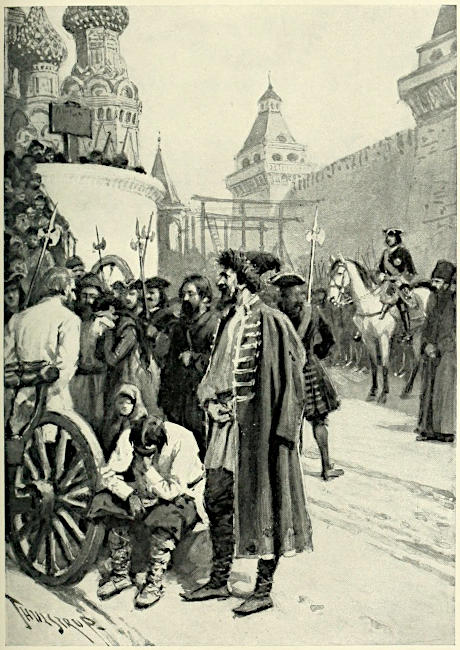
EXECUTION OF THE STRELITZ BY COMMAND OF PETER THE GREAT
(Painted for The Historians’ History of the World by Thure de Thulstrup)
During his stay at Vienna, there happened nothing remarkable, except the celebration of the ancient feast of “landlord and landlady,” which Leopold thought proper to revive upon the czar’s account, after it had been disused during his whole reign. The manner of making this entertainment, to which the Germans gave the name of Wirthschaft, was as follows: The emperor was landlord, and the empress landlady; the king of the Romans, the archdukes, and the archduchesses were generally their assistants; they entertained people of all nations, dressed after the most ancient fashion of their respective countries. Those who were invited as guests drew lots for tickets; on each of which was written the name of the nation, and the character to be represented. One had a ticket for a Chinese mandarin, another for a Tatar mirza, another for a Persian satrap, or a Roman senator; a princess might happen to be allotted the part of a gardener’s wife, or a milkwoman; and a prince might act the peasant or soldier. They had dances suited to these different characters; and the landlord and landlady with their family waited at table. On this occasion Peter assumed the habit of a Friesland boor, and in this character was addressed by everybody, at the same time that they talked to him of the great czar of Muscovy. “These indeed are trifles,” says Voltaire, from whom the account is taken, “but whatever revives the memory of ancient customs is, in some measure, worthy of being recorded.”
THE INSURRECTION OF THE STRELITZ
Peter was preparing to continue his journey from Vienna to Venice and Rome when he was recalled to his own dominions by news of a general insurrection of the strelitz, who had quitted their posts on the frontiers, and marched on Moscow. Peter immediately left Vienna in secret, passed through Poland, where he had an interview with King Augustus, and arrived at Moscow in September, 1698, before anyone there knew of his having left Germany.e
When Peter I arrived from Vienna he found that his generals and the douma had acted with too great leniency. He cherished an old grudge against the strelitz; they had formed the army of Sophia which had been arrayed against that of the czar, and in his mind was still alive the memory of the invasion of the Kremlin, the murder of his maternal relatives, the terrors undergone by his mother in Troitsa, the plots that had well-nigh prevented his departure for the west, and the check placed by the mutineers on the plans he had matured for the good of his country during his journey through Europe. He resolved to seize the opportunity thus placed in his hands to crush all his enemies at one blow, and to inaugurate in old Russia a reign of terror that should recall the days of Ivan IV. The particular point of attack had been his taste for foreign fashions, for shaven chins, and abbreviated garments. These therefore should be the rallying-sign of the Russia of the future. Long beards had been the standard of revolt; long beards must fall. He ordered all the gentlemen of his realm to shave, and even performed that office with his own hand for some of the highest nobles of his court. On the same day the Red Square was covered with gibbets. The patriarch Adrian tried in vain to divert the anger of the czar. “My duty is to protect the people and to punish rebels,” was the only answer he received.
On the 10th of October a first consignment of two hundred prisoners arrived in the Red Square, followed by their wives and children, who ran behind the carts chanting funeral dirges. The czar ordered several officers to assist the headsman in his work. Johann Korb, an Austrian who was an eye-witness of the scene, relates that the heads of “five rebels were struck off by the noblest hand in Russia.” Seven more days were devoted to the executions, and in all about a thousand victims perished. Many were previously broken on the wheel or given up to other frightful tortures. The czar forbade the removal of any of the bodies, and for five months Moscow was given the spectacle of corpses hanging from the turrets of the Kremlin, or exposed in the public squares. Two of Sophia’s female confidantes were buried alive, and Sophia herself and the repudiated czarina, Eudoxia Lapukhin, noted for her attachment to old customs, were confined in monasteries. After the revolt of the inhabitants of Astrakhan, who murdered their voyevod (1705), the militia was abolished and the way was clear for the establishment of a new army.g
WAR WITH SWEDEN
[1699 A.D.]
The external relations as well as the domestic circumstances of the empire were at this juncture peculiarly favourable to the czar’s grand design of opening a communication with the Baltic. He had just concluded a treaty of peace for thirty years with the Turks, and he found himself at the head of a numerous army, a portion, at least, of which was well disciplined, and eager for employment. The death of General Lefort, in 1699, at the early age of forty-six, slightly retarded the progress of his movements; but in the following year he prepared to avail himself of events that called other powers into action and afforded him a feasible excuse for taking the field.
Charles XII, then only eighteen years of age, had recently succeeded to the throne of Sweden. The occasion seemed to yield an auspicious opportunity to Poland and Denmark for the recovery of certain provinces that in the course of former wars had either been wrested from them by Sweden, or ceded by capitulation. Augustus, the elector of Saxony, called by choice to the throne of Poland, was the first to assert this doctrine of restitution, in which he was quickly followed by the Danish king. Livonia and Esthonia had been ceded by Poland to Charles XI, and the provinces of Holstein and Schleswig had been conquered from Denmark in the same reign, and annexed to the Swedish territories. The object of the allies was to recover those places. Sweden, thus assailed in two quarters, presented an apparently easy victory to the czar, whose purpose it was to possess himself of Ingria and Karelia, that lay between him and the sea. A confederacy was, therefore, entered into by the three powers for the specific view of recovering by war those provinces that had previously been lost by war. But Peter miscalculated his means. The arms of Sweden were crowned with triumphs, and her soldiery were experienced in the field. The Russian troops, on the contrary, were for the greater part but raw recruits, and, except against the Turks and Tatars, had as yet but little practice in military operations. The genius of Peter alone could have vanquished the difficulties of so unequal a contest.
The preparations that were thus in course of organisation awakened the energies of Charles. Without waiting for the signal of attack from the enemy, he sent a force of eight thousand men into Pomerania, and, embarking with a fleet of forty sail, he suddenly appeared before Copenhagen, compelled the king of Denmark within six weeks to sign a peace by which the possession of Holstein was confirmed to the reigning duke, and a full indemnity obtained for all the expenses of the war. He had no sooner overthrown the designs of the Danish monarch than he turned his arms against Poland. Augustus had laid siege to Riga, the capital of Livonia; but that city was defended with such obstinacy by Count Dalberg that the Polish general was glad to abandon the enterprise, upon the shallow pretext that he wished to spare the Dutch merchandise which was at that time stored in the port. Thus the confederation was dissolved, and the struggle was left single-handed between the Russians and the Swedes.
Peter, undismayed by the reverses of his allies, poured into Ingria an army of sixty thousand men. Of these troops there were but twelve thousand disciplined soldiers; the remainder consisted of serfs and fresh levies, gathered from all quarters, rudely clad, armed only with clubs and pikes, and unacquainted with the use of firearms. The Swedish army, on the other hand, was only eight thousand strong; but it was composed of experienced battalions, flushed by recent successes, and commanded by able generals. The advanced guards of the Russians were dispersed on their progress, in some skirmishes with the Swedes; but the main body penetrated to the interior, and intrenched itself before the walls of Narva, a fortified place on the banks of the Narova, a river that flowed from Lake Peipus into the Baltic Sea. For two months they lay before the town, when Peter, finding it necessary to hasten the movements of some regiments that were on their march from Novgorod, as well as to confer with the king of Poland in consequence of his abandonment of the siege of Riga, left the camp, delegating the command to the duke of Croy, a Flemish officer, and prince Dolgoruki, the commissary-general.
[1701 A.D.]
His absence was fatal to this undertaking. Charles, during a violent snow-storm, that blew directly in the face of the Russians, attacked the enemy in their intrenchments. The besiegers were filled with consternation. The duke of Croy issued orders which the prince Dolgoruki refused to execute, and the utmost confusion prevailed amongst the troops. The Russian officers rose against the Germans and massacred the duke’s secretary, Colonel Lyons, and several others. The presence of the sovereign was necessary to restore confidence and order, and, in the absence of a controlling mind the soldiers, flying from their posts and impeding each other in their attempts to escape, were slaughtered in detail by the Swedes. In this exigency, the duke of Croy, as much alarmed by the temper of the Russians as by the superiority of the enemy, together with almost all the German officers in the service, surrendered to the victorious Charles, who, affecting to despise his antagonist, contented himself with retaining a few general officers and some of the Saxon auxiliaries, as prisoners to grace his ovation at Stockholm, and suffered the vanquished troops to return home. Thus failed the first descent upon Ingria, which cost Russia, even on the statement of the czar himself, between five thousand and six thousand men. The loss of the Swedes is estimated by Peter at three thousand, but Voltaire reduces the number to twelve hundred, which, considering the relative positions of both armies, and the disadvantages of other kinds under which the Russians were placed, is more likely to be accurate.
This unpropitious event did not discourage Peter. “The Swedes,” he observed, “will have the advantage of us for some time, but they will teach us, at last, how to beat them.” If Charles, however, had followed up his success, and pushed his fortunes into the heart of Russia immediately after this victory, he might have decided the fate of the empire at the gates of Moscow. But, elated with his triumphs in Denmark, and tempted by the weakness of the Poles, he embraced the more facile and dazzling project of concentrating his whole power against Augustus, declaring that he would never withdraw his army from Poland until he had deprived the elector of his throne. The opportunity he thus afforded Peter of recruiting his shattered forces, and organising fresh means of aggression, was the most remarkable mistake in the whole career of that vain but heroic monarch.
RALLYING FROM DEFEAT
While Charles was engaged in Poland, Peter gained time for the accomplishment of those measures which his situation suggested. Despatching a body of troops to protect the frontiers at Pskov, he repaired in person to Moscow, and occupied himself throughout the ensuing winter in raising and training six regiments of infantry, consisting of 1000 men each, and several regiments of dragoons. Having lost 145 pieces of cannon in the affair at Narva he ordered a certain proportion of the bells of the convents and churches to be cast into field pieces; and was prepared in the spring of the year 1701 to resume hostilities with increased strength, and an artillery of 100 pieces of cannon, 142 field pieces, 12 mortars, and 13 howitzers.
Nor did he confine his attention to the improvement of the army. Conscious of the importance of diffusing employment amongst his subjects, and increasing their domestic prosperity, he introduced into the country flocks of sheep from Saxony, and shepherds to attend to them, for the sake of the wool; established hospitals, and linen and paper manufactories; encouraged the art of printing; and invited from distant places a variety of artisans to impart to the lower classes a knowledge of useful crafts. These proceedings were treated with levity and contempt by Charles, who appears all throughout to have despised the Russians, and who, engrossed by his campaign in Courland and Lithuania, intended to turn back to Moscow at his leisure, after he should have dethroned Augustus, and ravaged the domains of Saxony.
Unfortunately the divisions that prevailed in the councils of Poland assisted to carry these projects rapidly into effect. Peter was anxious to enter into a new alliance with Augustus, but, in an interview he held with that prince at Birzen, he discovered the weakness of his position and the hopelessness of expecting any effectual succour at his hands. The Polish diet, equally jealous of the interference of the Saxon and Russian soldiery in their affairs, and afraid to incur the hostility of Charles, refused to sanction a league that threatened to involve them in serious difficulties. Hence, Augustus, left to his own resources, was easily deprived of a throne which he seemed to hold against the consent of the people, while Peter was forced to conduct the war alone. His measures were consequently taken with promptitude and decision. His army was no sooner prepared for action than he re-entered Ingria, animating the troops by his presence at the several points to which he directed their movements. In some accidental skirmishes with small bodies of the Swedes, he reaped a series of minor successes, that inspired the soldiers with confidence and improved their skill for the more important scenes that were to follow. Constantly in motion between Pskov, Moscow, and Archangel, at which last place he built a fortress called the New Dvina, he diffused a spirit of enthusiasm amongst the soldiers, who were now becoming inured to action.
[1702 A.D.]
An open battle at last took place in the neighbourhood of Dorpat, on the borders of Livonia, when General Sheremetrev fell in with the main body of the enemy on the 1st of January, 1702, and, after a severe conflict of four hours, compelled them to abandon their artillery and fly in disorder. On this occasion, the Swedes are said to have lost three thousand men, while there were but one thousand killed on the opposite side. General Sheremetrev was immediately created a field-marshal, and public thanks were offered up for the victory.
Following up this signal triumph, the czar equipped one fleet upon Lake Peipus to protect the territory of Novgorod, and manned another upon Lake Ladoga, to resist the Swedes in case they should attempt a landing. Thus guarded at the vulnerable points, he was enabled to prosecute his plans in the interior with greater certainty and effect.
Marshal Sheremetrev in the meantime marched upon Marienburg, a town on the confines of Livonia and Ingria, achieving on his progress another triumph over the enemy near the village of Humolova. The garrison at Marienburg, afraid to risk the consequences of a siege, capitulated at once, on condition that the inhabitants should be permitted a free passage, which was agreed to; but an intemperate officer having set fire to the powder magazine, to prevent the negotiation from being effected, by which a number of soldiers on both sides were killed, the Russians fell upon the inhabitants and destroyed the town.
THE ANTECEDENTS OF AN EMPRESS
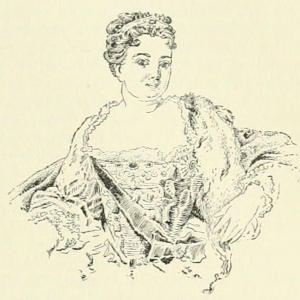
Catherine I
(1679-1727)
Amongst the prisoners of war was a young Livonian girl, called Martha, an orphan who resided in the household of the Lutheran minister of Marienburg. She had been married the day before to a sergeant in the Swedish army; and when she appeared in the presence of the Russian general Bauer, she was bathed in tears, in consequence of the death of her husband, who was supposed to have perished in the melée. Struck with her appearance, and curious to learn the history of so interesting a person, the general took her to his house, and appointed her to the superintendence of his household affairs. Bauer was an unmarried man, and it was not surprising that his intercourse with Martha should have exposed her to the imputation of having become his mistress; nor, indeed, is there any reason, judging by the immediate circumstances as well as the subsequent life of that celebrated woman, to doubt the truth of the charge. Bauer is said to have denied the fact, which is sufficiently probable, as it was evidently to his interest to acquit the lady of such an accusation; but, however that may be, it is certain that Prince Menshikov, seeing her at the general’s house, and fascinated by her manners, solicited the general to transfer her services to his domestic establishment; which was at once acceded to by the general, who was under too many obligations to the prince to leave him the option of a refusal.
Martha now became the avowed mistress of the libertine Menshikov, in which capacity she lived with him until the year 1704, when, at the early age of seventeen, she enslaved the czar as much by her talents as by her beauty, and exchanged the house of the prince for the palace of the sovereign. The extraordinary influence she subsequently exercised when, from having been the mistress she became the wife of the czar, and ultimately the empress Catherine, developing, throughout the various turns of her fortune, a genius worthy of consort with that of Peter himself, opens a page in history not less wonderful than instructive. The marriage of the sovereign with a subject was common in Russia; but, as Voltaire remarks, the union of royalty with a poor stranger, captured amidst the ruins of a pillaged town, is an incident which the most marvellous combinations of fortune and merit never produced before or since in the annals of the world.
MILITARY SUCCESS: FOUNDATION OF ST. PETERSBURG
The most important operations of the campaign in the year 1702 were now directed to the river Neva, the branches of which issue from the extremity of Lake Ladoga, and, subsequently reuniting, are discharged into the Baltic. Close to the point where the river flowed from the lake was an island, on which stood the strongly fortified town of Rottenburg. This place, maintaining a position that was of the utmost consequence to his future views, Peter resolved to reduce in the first instance; and, after laying siege to it for nearly a month, succeeded in carrying it by assault. A profusion of rewards and honours were on this occasion distributed amongst the army, and a triumphal procession was made to Moscow, in which the prisoners of war followed in the train of the conqueror. The name of Rottenburg was changed to that of Schlüsselburg, or city of the key, because that place was the key to Ingria and Finland. The solemnities and pomp by which these triumphs were celebrated were still treated with contempt by Charles, who, believing that he could at any moment reduce the Russians, continued to pursue his victories over Augustus. But Peter was rapidly acquiring power in the very direction which was most fatal to his opponent, and which was directly calculated to lead to the speedy accomplishment of his final purpose.
The complete occupation of the shores of the Neva was the first object to be achieved. The expulsion of the enemy from all the places lying immediately on its borders and the possession or destruction of all the posts which the Swedes held in Ingria and Karelia were essential to the plans of the czar. Already an important fortress lying close to the river was besieged and reduced, and two Swedish vessels were captured on the lake by the czar in person. Further successes over the Swedish gunboats, that hovered near the mouth of the river, hastened his victorious progress; and when he had made himself master of the fortress of Kantzi, on the Karelian side, he paused to consider whether it would be advisable to strengthen that place, and make it the centre of future operations, or push onwards to some position nearer to the sea. The latter proposal was decided upon; and a marshy island, covered with brushwood, inhabited by a few fishermen, and not very distant from the embouchure of the Neva, was chosen as the most favourable site for a new fortress. The place was, by a singular anomaly, called Lust Eland, or Pleasure Island, and was apparently ill adapted for the destinies that in after-times surrounded it with glory and splendour. On this pestilential spot, Peter laid the foundations of the fortress of St. Petersburg, which gradually expanded into a city and ultimately became the capital of the empire.
The country in the neighbourhood of this desolate island, or cluster of swamps, was one vast morass. It did not yield a particle of stone, and the materials with which the citadel was built were derived from the ruins of the works at Nianshantz. Nor were these the only difficulties against which Peter had to contend in the construction of the fortifications. The labourers were not furnished with the necessary tools, and were obliged to toil by such expedients as their own invention could devise. So poorly were they appointed for a work of such magnitude that they were obliged to carry the earth, which was very scarce, from a considerable distance in the skirts of their coats, or in bags made of shreds and matting. Yet the fortress was completed within five months, and before the expiration of a year St. Petersburg contained thirty thousand houses and huts of different descriptions.
So gigantic an undertaking was not accomplished without danger, as well as extreme labour. Peter, who could not be turned aside from his purposes by ordinary obstacles, collected a vast concourse of people from a variety of countries, including Russians, Tatars, Kalmucks, Cossacks, Ingrians, and Finlanders; and employed them, without intermission, and without shelter from an inclement climate of sixty degrees of latitude, in deepening the channels of the rivers and raising the general level of the islands which were in the winter seasons usually sunk in the floods. The severity of the labour, and the insufficiency of provisions, caused a great mortality amongst the workmen. A hundred thousand men are said to have perished in the first year. While this fort was in progress of erection, Peter despatched Menzikov to a little island lying nearer to the mouth of the river, to build another fortress for the protection of the entrance. The model of the fortress was made by himself in wood. He gave it the name of Kronstadt, which, with the adjacent town and buildings, it still retains. Under the cannon of this impregnable fortress the largest fleet might float in shelter.
The establishment of a new city on so unfavorable a site, and the contemplated removal of the seat of government, received considerable opposition from the boyars and upper classes, as well as from the inferior grades, who regarded the place with terror, in consequence of the mortality it had already produced. The discontent of the lower orders broke out in loud complaints during Peter’s temporary absence. No measures short of the most despotic could have compelled the inhabitants of Moscow to migrate to the bleak and dismal islands of the Neva, and Peter was not slow to carry such measures into effect.
If the people could have looked beyond the convenience of the moment into the future prospects of the empire, they must at once have perceived the wisdom of the change. The paramount object of Peter’s policy was the internal improvement of Russia. The withdrawal of the nobility, the merchants, and the artisans from their rude capital in the interior, to an imperial seat on the gulf of Finland, by which they would be brought into closer intercourse with civilised Europe, and acquire increased facilities for commercial enterprise, was evidently calculated to promote that object, which was distinctly kept in view in the place upon which the city was built. Peter had not forgotten the practical lessons he had learned during his residence in Holland. That country, the inhabitants of which in Pliny’s time were described to be amphibious, as if it were doubtful to which element, the land or the sea, they really belonged, had been redeemed from the ocean by the activity and skill of the people; and Peter, profiting by their experience, adopted Amsterdam as his model in securing the foundations of St. Petersburg. He employed several Dutch architects and masons; and the wharfs, canals, bridges, and rectilineal streets, planted with rows of trees, attest the accuracy with which the design was accomplished. To a neighbouring island, which he made a depot for timber, he gave the name of New Holland, as if he meant to leave to posterity an acknowledgement of the obligations he owed to that country.
The speculations of the czar were rapidly fulfilled in the commercial relations invited by the establishment of St. Petersburg. Five months had scarcely elapsed from the day of its foundation when a Dutch ship, freighted with merchandise, stood into the river. Before the expiration of a year, another vessel from Holland arrived; and the third vessel, within the year, that entered the new port was from England. These gratifying facts inspired confidence amongst those who had been disposed to look upon the project with such hasty distrust; and Peter, whose power was now rapidly growing up on all sides, was enabled to extend his operations in every direction over Ingria. The variety of affairs which, at this juncture, occupied his attention sufficiently proves the grasp of his capacity and the extraordinary energy of his mind. At nearly the same time that he founded a new capital he was employed in fortifying Pskov, Novgorod, Kiev, Smolensk, Azov, and Archangel; and in assisting the unfortunate Augustus with men and money. Cornelius van Bruyer, a Dutchman, who at that period was travelling in Holland, states that Peter informed him that, notwithstanding all these undertakings, he had 300,000 roubles remaining in his coffers, after providing for all the charges of the war.
The advances that the czar was thus making in strengthening and civilising the empire were regarded with such contempt by Charles that he is reported to have said that Peter might amuse himself as he thought fit in building a city, as he should soon find him to take it from him and set fire to his wooden houses. The Porte, however, did not look with indifference upon his movements, and sent an ambassador to him to complain of his preparations; but Peter replied that he was master of his own dominions, as the Porte was of his, and that his object was not to infringe the peace, but to render Russia “respectable” upon the Euxine.
RENEWED HOSTILITIES
[1704 A.D.]
The time was now approaching when the decision of the disputes in Poland enabled Charles to turn back upon Ingria, where Peter was making so successful a stand. On the 14th of February, 1704, the primate of Warsaw threw off his allegiance to Augustus, who was in due form deposed by the diet. The nomination of the new king was placed in the hands of Charles, who proposed Stanislaus Leszczynski, a young nobleman distinguished for his accomplishments, who was accordingly declared king of Poland and grand duke of Lithuania. But Lithuania had not as yet sent in her adherence to either side; and Peter, still taking a deep interest in the fortunes of Augustus, whose Saxon troops were every day suffering fresh discomfitures from the Swedish army, sent that monarch a reinforcement of twelve thousand men to support his claims in the undecided province. The military force of Russia had now become a formidable body, highly disciplined, and fully equipped; and Peter, without loss of time, in the spring of 1704, disposed the remainder of his army into two divisions, one of which he sent under the command of Field-Marshal Sheremetrev, to besiege Dorpat, while he took in person the conduct of the other against Narva, where he had formerly endured a signal defeat.
Dorpat, which is better known by this siege than by the university which Gustavus Adolphus had previously established there, was forced to capitulate by a ruse de guerre. It was necessary in the first instance to become master of Lake Peipus, for which purpose a Russian flotilla was placed at the entrance of the Embach. Upon the advance of a Swedish squadron a naval battle ensued, which ended in the capture or destruction of the whole of the enemy’s fleet. Peter now sat down before Dorpat, but, finding that the commandant held out for six weeks, he adopted an ingenious device to procure entrance into the town. He disguised two regiments of infantry and one of cavalry in the uniforms of Swedish soldiers, giving them Swedish standards and flags. These pretended Swedes attacked the trenches, and the Russians feigned a fight. The garrison of the town, deceived by appearances, made a sortie, when the false attackers and the attacked reunited, fell upon the troops, and entered the town. A great slaughter ensued, and, to save the remainder of the garrison, the commandant surrendered.
At Narva Peter was equally successful. The siege was conducted under his own personal command. Sword in hand, he attacked three bastions that offered the strongest points of defence, carried them all, and burst into the town. The barbarities that ensued were of a nature to revolt even the czar himself. Pillage, slaughter, and lustful excesses were committed by the infuriated men; and Peter, shocked at the cruelties he witnessed, threw himself amongst the barbarians who refused to obey his orders and slew several of them in the public streets. A number of the unfortunate citizens had taken refuge in the hôtel de ville; and the czar, appearing in the midst of them, cast his bloody sword on the table, declaring that it was stained not with the blood of the citizens but of his own soldiers, which he had shed to save their lives.
These victories were decisive of the position of Peter. He was now master of all Ingria, the government of which he conferred upon Menzikov, whom he created a prince of the empire and major-general in the army. The elevation of Menzikov, through the various grades of the service, from his humble situation as a pastrycook’s boy to the highest dignities in the state, was a practical reproof to the indolent and ignorant nobility, who were now taught to feel that merit was the only recommendation to the favour of the czar. The old system of promotion was closed. The claims of birth and the pride of station ceased to possess any influence at court. The great body of the people, impressed with the justice that dictated this important change in the dispensation of honour and rewards, began for the first time to be inspired with a spirit of emulation and activity; and exactly in proportion as Peter forfeited the attachment of the few, whose power was daily on the decline, he drew around him the mixed wonder and allegiance of the many, whose power he was daily enlarging. Thus were laid the foundations of a mighty empire in the hearts of a scattered population, as various in habits and in language as it had always been discordant in interests and disunited in action.
Having acquired this valuable possession, and secured himself in St. Petersburg against the Swedes, it was the profound policy of Peter to keep up the war between Charles and Augustus, with a view to weaken by diversion the strength of the former. He accordingly made a great offer of assistance to the dethroned king, and despatched General Repuin with six thousand horse and six thousand foot to the borders of Lithuania; while he advanced in person into Courland at the head of a strong force. Here he received a severe check, having fallen in with the Swedish general Lewenhauft, who defeated the Russians after an obstinate battle, in which the czar’s troops lost between five thousand and six thousand men, and the Swedes no more than two thousand. Peter, notwithstanding, penetrated into Courland, and laid siege to the capital, which surrendered by capitulation. On this occasion the Swedes degraded themselves by committing an extensive pillage in the palace and archives of the dukes of Courland, descending even into the mausoleums to rob the dead of their jewels. The Russians, however, before they would take charge of the vaults, made a Swedish colonel sign a certificate that their sacrilegious depredations were the acts of his own countrymen.
POLISH AFFAIRS
The greatest part of Courland, as well as the whole of Ingria, had now been conquered in detail by Peter, and, as Charles was still engrossed by his operations in Poland and Saxony, he returned to Moscow to pass the winter; but intelligence of the approach of the Swedish king at the head of a powerful force towards Grodno, where the combined armies of Russia and Saxony were encamped, recalled him from his repose. Peter immediately hastened to the field, and found all the avenues occupied by Swedish troops. A battle ensued near Frauenstadt, in which the flower of the confederated battalions, under the command of General Schullemberg, to the number of eighteen thousand men, six thousand of whom were Russians, suffered a complete defeat. With an insignificant exception, they were nearly all slain. Some authorities attribute this disaster to the treachery of a French regiment, which had the care of the Saxon artillery; but it is certain that the most sanguinary atrocities were committed on both sides, in a contest upon the issues of which two crowns appeared to be dependent.
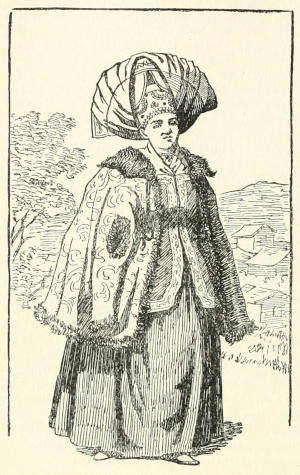
Wife of a Merchant of Kalonga
The consequences of this overthrow would have been immediately fatal to Augustus, but for the energy of the czar, who, rapidly organising an army of twenty thousand men, urged that wavering prince to take advantage of the absence of Charles in Saxony, and throw himself once more into Poland. A revolt in Astrakhan called Peter into that part of his territories; but he deputed General Patkul, a brave Livonian, who had formerly made his escape from the hands of Charles, and had passed from the service of Augustus into that of the czar, to explain the necessity of the measure. Augustus yielded to the advice of his ally, and marched into Poland; but he had no sooner made good his progress than, suddenly panic-struck by the increasing successes of Charles, he resolved to sue for peace upon any terms at which it could be procured. He accordingly invested two ambassadors with full powers to treat confidentially with Charles, and had the temerity to cast Patkul into prison. While the plenipotentiaries were negotiating this shameful treaty at the camp of Charles XII, Menshikov joined the forces of Augustus at Kalish with thirty thousand men. The consternation of Augustus at this unexpected reinforcement was indescribable; and his confusion amounted almost to despair upon the receipt of intelligence that ten thousand Swedes, under the command of General Meierfeldt, were on their march to give him battle.
In this dilemma he transmitted a private message to General Meierfeldt to inform him of the negotiation he had opened with his master; but that general, naturally treating the whole affair as a mere pretext to gain time, made preparations for hostilities. The superior force of the Russians decided the fate of the day, and, after having defeated the Swedes with great slaughter, they entered Warsaw in triumph. Had Augustus relied upon the energy and friendship of his ally, he would now have been replaced upon his throne; but the timidity that tempted him to cast himself upon the mercy of Charles was prolific of misfortunes. He had scarcely entered Warsaw as a victor when he was met by his own plenipotentiaries, who placed before him the treaty they had just concluded, by which he had forfeited the crown of Poland forever. His humiliation was complete. Thus the weak and vacillating Augustus, fresh from a triumph that ought to have placed him upon the throne of Poland, was a vassal in its capital, while Charles was giving the law in Leipsic and reigning in his lost electorate.
His struggles to escape from the disgrace into which his folly and his fears had plunged him only drew down fresh contempt upon his head. He wrote to Charles a letter of explanation and apology, in which he begged pardon for having obtained a victory against his will, protesting that it was entirely the act of the Russians, whom it was his full intention to have abandoned, in conformity with the wishes of Charles; and assuring that monarch that he would do anything in his power to render him satisfaction for the great wrong he had committed in daring to beat his troops. Not content with this piece of humility, and fearing to remain at Warsaw, he proceeded to Saxony, and, in the heart of his own dominions, where the members of his family were fugitives, he surrendered in person to the victorious Swede. Charles was too conscious of his advantages not to avail himself of them to the full, and not only made the timid Augustus fulfil all the stipulations of the treaty, by which he renounced the crown of Poland, abandoned his alliance with the czar, surrendered the Swedish prisoners, and gave up all the deserters, including General Patkul, whom Augustus had arrested by a violation of good faith, but he forced him to write a letter to Stanislaus, congratulating him on his accession to the throne. The unfortunate Patkul was no sooner delivered into the hands of Charles than he condemned him to be broken on the wheel and quartered.
The timid and treacherous conduct of Augustus and the deliberate cruelty of Charles drew from Peter expressions of unbounded indignation. He laid a statement of the whole circumstances before the principal potentates of Europe, and declared his determination to use all the means in his power to drive Stanislaus from the throne of Poland. The first measure he adopted was the holding of a conference with several of the Polish grandees, whom he completely gained over to his side by the suavity of his manners. At a subsequent meeting it was agreed that the throne of Poland was in fact vacant, and that a diet should be summoned for the purpose of electing a king. When the diet assembled, Peter urged upon their attention the peculiar circumstances in which the country was placed, and the impossibility of effecting any substantial resistance against the ambitious intrigues of Charles, unless a new king were placed upon the throne. His views were confirmed by the voice of the assembly, who agreed to the public declaration of an interregnum, and to the investiture of the primate in the office of regent until the election should have taken place.
CHARLES XII INVADES RUSSIA (1707 A.D.)
[1707 A.D.]
But while these proceedings were going forward at Lublin, King Stanislaus, who had been previously acknowledged by most of the sovereigns of Europe, was advancing into Poland at the head of sixteen Swedish regiments, and was received with regal honours in all the places through which he passed. Nor was this the only danger that threatened to arrest the course of the proposed arrangements for the settlement of the troubles of Poland. Charles, whose campaign in Saxony had considerably enriched his treasury, was now prepared to take the field with a well-disciplined army of forty-five thousand men, besides the force commanded by General Lewenhaupt; and he did not affect to conceal his intention to make Russia the theatre of war, in which purpose he was strengthened by an offer on the part of the Porte to enter into an offensive alliance with him against Peter, whose interference in the affairs of Poland excited great jealousy and alarm in Turkey. Charles calculated in some degree upon the support he might receive from the Russians themselves, who, he believed, would be easily induced to revolt against Peter, in consequence of the innovations he had introduced and the expenses that he would be likely to entail upon them by a protracted war.