Chapter VII · CATHERINE I TO PETER III
Reading edition
CATHERINE I (1725-1727 A.D.)
[1725-1727 A.D.]
At the death of Peter the Great two powerful parties were arrayed against each other, one supporting his youthful grandson Alexievitch, and the other advancing the claims of Catherine, the Livonian. The Galitzins, the Dolgoruki, Repnins, and all Old Russia wished to crown Peter’s son, Alexis; but those who owed their elevation to Peter I, or had been involved in the suit against his son, as well as the members of the tribunal that had condemned the czarevitch, felt that their only hope of safety lay in raising Catherine to the throne. This party, counting among its numbers the most capable and enlightened men, still held the highest authority in the administration and in the army, and its adversaries felt that a compromise was the most that they could expect. Dmitri Galitzin proposed to proclaim Peter II, but only under the guardianship of the widowed empress.
Tolstoi combated this proposition by showing that it was the surest method of arming parties against each other, of furnishing hostile factions a pretext for inciting the people to rebellion against the regent. He demonstrated that in the absence of the testamentary disposition she had the best right to succeed Peter I; furthermore, she had been solemnly crowned, had received the oath of allegiance from her subjects, had been initiated into all the state secrets, and had learned from her husband the art of reigning. The officers and regiments of the guards declared energetically in favour of the heroine of Pruth, and it was finally decided that she should reign alone, with an authority as absolute as that of her dead husband. This was a greater novelty in Russia than the regency of Sophia; Catherine was not only a woman, but a foreigner, a captive, and a second wife, scarcely to be considered as a wife at all. Many were the protests against a decision which excluded from the throne the grandson of Peter the Great, and certain of the raskolniks submitted to the torture rather than swear allegiance to a woman.
Menshikov, one of Catherine’s earlier lovers, now became all-powerful. He stopped the suit for mal-administration that the late czar had commenced against him, and obtained for himself Baturin, the former capital of Mazeppa, which was equivalent to the principality of Ukraine. His despotic and evil character rendered him odious to his companions and discord everywhere broke out among the “eaglets” of Peter the Great. Iagushinski publicly lamented on the tomb of the czar, and Tolstoi was later exiled to Siberia. Catherine, however, restrained the ambition of her favourite and refused to sacrifice her other councillors to him.
Catherine’s rule, which was a continuation of that of Peter the Great, gave the lie to the pessimistic predictions that had announced the abandonment of St. Petersburg and the fleet, and the return to Moscow. The greater part of the plans for reform entertained by the czar were put in execution. The Academy of Sciences was inaugurated in 1726, the publication of the Gazette was carefully supervised, the order of Alexander Nevski, originated by Peter, was founded, the Danish captain Béhring was placed at the head of the Kamchatka scientific expedition, Chasirov, recalled from exile, was commanded to write the history of Peter the Great, and Anna Petrovna was solemnly married to the duke of Holstein, to whom she had been affianced by her father. On the other hand the senate and the holy synod lost their title of Directors, and the affairs of state were given into the hands of the secret high council which sat under the presidency of the empress and was composed of Menshikov, the admiral Apraxin, the chancellor Golovkin, Tolstoi, Dmitri Galitzin, and the vice-chancellor Ostermann.
On her death-bed Catherine designated as her successor Peter Alexievitch, the grandson of her husband, and in default of Peter her two daughters Anna of Holstein and Elizabeth. Pending the majority of the youthful emperor the regency was to be conducted by a council composed of Anna and Elizabeth, the duke of Holstein, Menshikov, Apraxin, Golovkin, Ostermann, and others; but Menshikov after the first sitting took the duties of regent upon himself.
PETER II (1727-1730 A.D.)
The empress died on the 17th of May, 1727, and on the following day the nobility and clergy assembled in the palace to be present at the reading of the will by which Peter was made emperor of all the Russias. Menshikov had taken measures to retain his high position and even to increase his power under the new reign. With the design of removing all those who might be detrimental to him he banished Apraxin from court, sent Iagushinski to Ukraine and despatched Makarov on a mission to the mines of Siberia. Menshikov had further obtained Catherine’s consent to the betrothal of his daughter to the young prince. He gave his own palace as a residence for the emperor and surrounded him with men on whose devotion he could count. He assumed the title of generalissimo and signed his letters to his sovereign “your father.” He caused the members of his own family to be inscribed in the almanac beside those of the imperial house, and had his daughters mentioned in the public prayers; he also planned to obtain the hand of Peter’s sister, Natalia Alexievna, for his son in addition to marrying his daughter to the emperor.
Peter II soon began to chafe under the rule of the generalissimo. Menshikov had appointed Ostermann to be his tutor, but the young prince hated study and preferred to spend his days hunting with his favourite, Ivan Dolgoruki. The adroit Ostermann excused himself to the prince for the disagreeable nature of his pedagogic duties, and contrived to cast all the blame on Menshikov. The emperor one day sent a present of 9,000 ducats to his sister Natalia, and Menshikov insolently confiscated them with the remark that the “emperor was too young to know the proper use of money.” Peter II rebelled at this and it was with difficulty that the prince appeased him. The generalissimo had another enemy in the person of Elizabeth, daughter of Peter the Great and aunt of Peter II. She was seventeen years old at the time, gay, careless, and lively, with a bright complexion and blue eyes; her laughter drove the insupportable tutor from his office.
[1728 A.D.]
An illness which overtook Menshikov and kept him absent for a time from court prepared his downfall; Peter II accustomed himself to the idea of getting rid of him. When the prince returned and began again to oppose the young ruler’s wishes the latter left Menshikov’s house, caused all the crown furniture to be removed from it to the imperial palace, treated his affianced wife with marked coldness, and finally gave orders to the guards that they were to obey no commands save those given by their colonels. This was the prelude to an overwhelming disgrace; in September, 1727, Menshikov was arrested, stripped of all his dignities and decorations, and banished to his own lands.
The Dolgorukis profited by the revolution they had caused. They fell, however, into Menshikov’s error and oppressed the prince with the same officious care. Like Menshikov they banished all who gave them offence, even Ostermann for whom Peter began to feel affection, and the old czarina, Eudoxia Lapukhin, who had been liberated from the prison in Ladoga. Advancing as a pretext certain placards in which the services of Menshikov were extolled, they exiled the latter to Berezov, in Siberia, where he died in 1729. Taking no lesson by his example they imposed on the prince a new bride, Catherine Dolgoruki, sister of his favourite, Ivan. Their administration bore all the character of a reaction against the reforms instituted by Peter the Great.
In 1728, when the young emperor went to Moscow for his coronation, he was warmly received by the people. Ostermann, however, and all the other faithful servants of the “giant czar” were chagrined at the return of the court to Moscow and its indifference to European affairs in general. In order to gain more complete possession of their master the Dolgoruki encouraged his taste for dissipation and took him away on hunting expeditions that lasted weeks at a time. Peter would certainly have grown as weary of them as he had of Menshikov: and to the complaints of his aunt Elizabeth that she was left without money he had already replied: “It is not my fault: they do not execute my orders; but I shall find means to break my chains.” The crisis came about in a different manner from what had been expected; the young emperor caught cold while attending the ceremony of the benediction of the waters, and died of smallpox at the age of fourteen years and four months. The two reigns of Catherine and Peter II, which lasted in all about five years, were peaceful.
In 1726 Russia had concluded an alliance with the court of Vienna and in 1727 it became involved in the war of the Quadruple Alliance. Despite the efforts of Campredon and Kurakin the failure of the project of marriage between Louis XV and Elizabeth had brought about coolness between France and Russia. The most remarkable episode of the foreign relations was the attempt of Maurice of Saxony, illegitimate son of King Augustus, to obtain possession of the duchy of Courland. The offer of his hand had been accepted by the widowed Anna Ivanovna, and he had been elected at Mittau by the deputies of the nobility. Disregarding the protestations of Prussia, Russia, and the Polish diet, he levied a body of troops with the money raised by the sale of the jewels belonging to an abbess of Quedlinburg, a certain French actress, his mother Aurora of Königsmark, and Adrienne Lecouvreur, and set about putting his duchy in a state of defence. His father disavowed him and Cardinal Fleury did not venture to support him even indirectly. Menshikov, restored to greater liberty since the death of Catherine I, himself laid claims to the duchy. He despatched Lacy at the head of eight thousand men to drive out the Saxon adventurer. The future victor of Fontenoy could get together no more than 247, and was obliged to swim across an arm of the sea in his retreat. His election was annulled, his father publicly reviled him as a galopin, or rascal, and Courland came once more under Russian influence.
[1730 A.D.]
During the reign of Peter II a treaty was signed with Prussia by virtue of which the two powers pledged themselves to sustain, on the death of Augustus II, the candidate they might choose for Poland. The emperor Charles VI and the “sergeant king” sounded Russia as to the eventual dismemberment of the Polish Republic. This was not the first time that the question of partition was brought forward. In Asia, Iagushinski concluded on the Bura a treaty of commerce with the Celestial Empire in the name of Peter II, by the terms of which Russian caravans could journey to Pekin every three years and could carry on their trade toll-free. Russia was also to have the privilege of keeping four priests and six young men in Pekin to learn Chinese. Kiakhta on the Russian territory and Maimatchin on the Chinese were to be the authorised depots.f
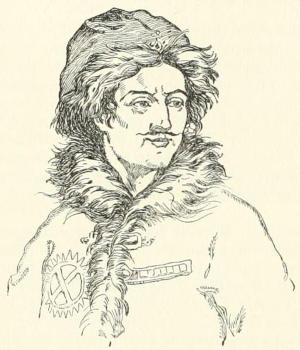
Prince Alexander Menshikov
The death of Peter II was universally regretted in Russia. During his reign, the empire enjoyed tranquillity at home and peace abroad; and he discovered such excellent qualities for government that the people looked forward to enjoying under his rule a period of freedom and prosperity such as they had never before experienced. There is no doubt, however, that if he had survived his own good intentions would have been perverted by those advisers who had obtained so strong a hold upon his mind. His predilection for Moscow had already produced serious injury to the maritime affairs of St. Petersburg: the fleet and the army suffered severely by his continued absence from the capital; and had he lived to complete the change by which he meditated Russia must have ultimately lost, by the neglect of her great station on the Neva, the national consequence she had maintained amongst the states of Europe during the two previous reigns. It was evident, also, that he would gradually have discouraged the residence of foreigners in his dominions; and that the old families were acquiring such power at court that they would finally have succeeded in restoring those national usages which had been set aside by Peter the Great. If the people, therefore, were deprived on the one hand of the temporary advantages of a tranquil reign, Russia on the other was preserved from the risk of permanent evils.
Disappointed in their expectations of an alliance with the emperor, the Dalgoruki did not wholly relinquish their hopes of securing some advantage by their position. The young Dalgoruki, impatient of delay, forged a testament in the name of Peter II, in which Catherine Dalgoruki was named as the successor to the throne. With this instrument in one hand and a drawn sword in the other he rushed into the hall, where the senators were assembled in deliberation, and cried aloud, “Long live the empress Dalgoruki!” But no voice seconding him in this wild and shallow trick, he sheathed his sword, and suppressed the fraudulent testament.
The question of the succession was now to be considered; and the only authentic document by which the proceedings of the council could be regulated was the will of Catherine I, which devised the succession to the princess Anna and her posterity, or, in failure, the princess Elizabeth. But Anna had died two years before, and her husband the duke of Holstein had retired into Germany. It was true that there was a young prince, the issue of this marriage; but the council were so averse to the introduction of foreigners into the state that they decided at once against any claim that might be set up in that quarter.
The princess Elizabeth, second in the order of nomination, exhibited no desire to avail herself of the testament of her mother, although she was strongly urged to do so by Lestocq, her physician, preferring to enjoy the ease of a life unburdened by the cares of the state. In these circumstances the council, the senate, and the great officers of state assembled to consult upon the election of a successor to Peter II. Although the male line of the Romanovs was extinct in that sovereign, yet the female line was preserved in the three daughters of Ivan, the stepbrother of Peter the Great, and for some time a partner with him in the government. The eldest was separated from her husband, the duke of Mecklenburg; the second, Anna, duchess of Courland, was a widow living at Mittau; and the third was still unmarried, residing at St. Petersburg. The objection that was entertained against foreign alliances determined the senate to reject the claims of the first, and the choice consequently fell upon Anna Ivanovna.
ANNA IVANOVNA (1730-1740 A.D.)
From the time of the death of Catherine I the prejudice against foreigners had insensibly acquired weight amongst those influential persons who surrounded the throne. The Dolgoruki were the most active agents of this sentiment, through which they hoped at last to reap the largest share of profit themselves. Taking advantage of the jealousy in which the old aristocracy held their privileges, and apprehensive that the new sovereign might act upon the system of her immediate predecessors, they struck upon an expedient by which they hoped to deprive her of the power of exercising her own judgment, and to place her under the control of that irresponsible council which had been instituted by Catherine I. “The welfare of the nation,” said Galitzin, in an address to the assembly, “demands that the supreme authority and the unlimited power of the sovereign, by which Russia has suffered so much and which has been sustained chiefly by the influx of foreigners, should be circumscribed, and that the crown should be conferred upon the new sovereign under certain conditions.” This proposal was received with universal approbation, and the following conditions were unanimously agreed to:
That the empress should govern solely by the resolves of the high privy council; that she was not, of her own motion, either to wage war or make peace; that she could not, of herself, impose any new tax upon the people; that she could not dispose of any important office, nor inflict capital punishment on any nobleman, nor confiscate his estate, unless he had been previously convicted of the crime laid to his charge; that she should not alienate any lands belonging to the crown; and that she could not marry, or nominate an heir, without obtaining, in the first instance, the consent of the council. A strange article was added to these conditions—that her chamberlain, von Biren, should not accompany the empress into Russia.
These conditions, which were apparently intended to curb the tyranny of the throne, aimed at nothing more than the abolition of one description of despotism, for the purpose of substituting a worse in its stead. If it abrogated the supreme and unlimited power of the sovereign, it transferred that power to the secret council, which was thus elevated above the sovereignty and the senate and invested with a complete control over the administration of the public affairs. The proposed change was from an unlimited monarchy to an irresponsible oligarchy.
The drift of this capitulation was speedily detected by those whose interests it affected—the aristocracy. They saw that it concentrated the power of the state in the hands of seven persons; that the Dolgoruki had already possessed themselves of the voice of the council; and that the issue would be the sacrifice of the empire to a family contract. The capitulation, therefore, was scarcely passed when a powerful opposition was raised up against it; and the people, accustomed to the despotism of an unlimited sovereignty, from which, amidst all its severities, they had derived many valuable safeguards and benefits, declared that they preferred rendering obedience to one master instead of seven. This feeling rapidly spread amongst the guards, who had good reasons for objecting to a clause which would throw the patronage of the army into the hands of a few persons, who, instead of promoting the meritorious, would, as a matter of course, provide for their own friends and relatives.
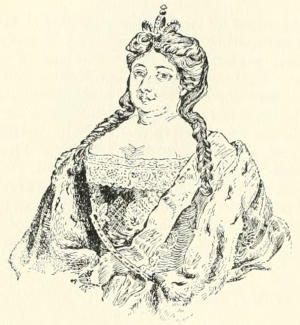
Anna Ivanovna
(1693-1740)
Nor was the princess Anna insensible to the wrong which she suffered from this novel procedure; and, when the deputation from the council waited upon her to inform her of her election, and the conditions which were annexed to it, she would have refused to subscribe to the capitulation, had she not been already prepared by the advice of General Iagushinski as to the course she ought to pursue. That officer had previously recommended her to accept the conditions, but to revoke them immediately after she should be acknowledged as empress, assuring her, at the same time, that she would be powerfully supported in the proper quarter. She accordingly agreed to the demands of the deputation, and was crowned in the usual forms.
The empress Anna was no sooner established upon the throne, than her friends gave her an opportunity of carrying the advice of General Iagushinski into effect. A petition signed by several hundred noblemen was presented to her, in which she was entreated to abrogate the restrictions which the council had placed upon her authority, and to assume the unlimited power that had hitherto been exercised by her predecessors. Fortified by this requisition, the empress presented herself before the council and the senate, and, reading the terms of the capitulation, demanded whether such was the will of the nation. Being answered in the negative by the majority of those who were present, she exclaimed, “Then there is no further need of this paper,” and tore the capitulation in pieces. This act was ratified and published in a manifesto which declared that the empress ascended the throne not by election but by hereditary right, and which exacted from the people an oath of allegiance, not to the sovereign and the country, as had formerly been the case, but to the empress alone, as unlimited sovereign, including not only the rights of sovereignty already existing but those that might be asserted hereafter.
Anna was now empress without conditions, and her chamberlain, von Biren, was raised to that place in her councils which Menshikov filled during the reign of Catherine I. The first exercise she made of her power was to abolish the council of seven and to restore to the senate the privileges it enjoyed under Peter the Great. She appointed, however, a cabinet of three persons, with Ostermann at its head, whose duty it was to superintend the affairs of the most pressing importance, leaving to the senate the management of less momentous matters. When these arrangements were completed, the urgent attention of the empress was directed to the foreign relations of the empire, which, at this crisis, demanded serious consideration.
The struggle for the throne in Poland had entailed jealousies which threatened not only to involve the peace of Russia but to draw France and Sweden into the quarrel. The cause of Augustus, the elector of Saxony, which had originally been espoused by Peter I, was still maintained by the Russian cabinet; and, although France made strenuous exertions to reinstate Stanislaus, the father-in-law of Louis XV, yet, by the determined interference of his northern ally, Augustus was proclaimed king of Poland, and Stanislaus was compelled to fly. The mortification which France endured under these circumstances excited in her a strong feeling of hostility against Russia; but there existed still more cogent reasons why she should make an attempt to restrain the advances of that power.
It had long been a favourite point in the policy of France to secure upon the throne of Poland a monarch who should be devoted to her will, and although she had been hitherto defeated in that object, she did not relinquish the hope of its ultimate accomplishment. She saw also rising in the north a gigantic empire, which had already acquired extraordinary power in Europe, and which threatened at last to overshadow and destroy the influence which she had been accustomed to exercise in that part of the globe. Urged by these considerations, and knowing how important it was to Russia to be at peace with Sweden, she left no means untried to engage the court at Stockholm on her side. Her diplomacy succeeded even better than she expected and Russia was once more compelled to watch with vigilance the movements of a dangerous neighbour, who was still suffering under the disastrous effects of a war from which Russia had reaped all the benefits and she the misfortunes.
But affairs pressed with still greater energy in a more remote quarter. It was found by experience that the territories which Peter had acquired in Persia by the treaty entered into between him, the sultan, and the shah were exceedingly burdensome to the country. In his desire for the enlargement of his dominions, Peter overlooked the necessity of ascertaining whether the new provinces were likely to be productive of advantages, either in the way of revenue or as adding strength to the frontiers. In order to preserve the possession of those provinces, it was necessary to maintain a considerable garrison in the interior, even in time of peace; they were also frequently exposed to scenes of warfare and devastation; and the climate was so injurious to the health of the Russians that in the course of a few years no less than 130,000 men perished there.
[1735 A.D.]
The great cost of these dependencies, and their uselessness in a territorial point of view, determined Anna to relinquish them upon the best terms she could procure from the shah. She accordingly proposed to that prince the restoration of the conquered provinces, upon condition that he would grant to the Russian merchants certain commercial privileges in the trade with Persia. To these terms the shah acceded, and in 1735 Russia made a formal surrender of her Persian possessions. This negotiation was connected with another of still greater importance—a defensive treaty between Persia and Russia, which was concluded at the same time. The motives which induced Anna to enter into this alliance require a brief recapitulation of preceding events.
The unfortunate situation in which Peter I was placed upon the banks of the Pruth compelled him to submit to the terms dictated by the Porte, by which he surrendered many important advantages which he had previously obtained by conquest. The principal sacrifices he had made upon that occasion were the evacuation of Azov and the destruction of the fortifications at Taganrog which had the immediate effect of shutting him out from the trade on the Euxine. The annoyances also to which the empire was subjected by the frequent incursions of the Crimean and other Tatars into the border lands, where they committed the most frightful excesses, and the haughty refusal of the Porte to acknowledge the imperial title which the people had conferred upon him, led Peter to meditate a new war against the Turks. He made ample preparations for the fulfilment of this design by fortifying the frontiers in the neighbourhood of Turkey; but his death arrested the execution of the project, which was entirely laid aside by Catherine I and Peter II.
Anna, however, relying upon the assistance of thirty thousand auxiliaries from Germany, considered this a favourable opportunity for reviving a stroke of policy which promised such signal advantages to the country, particularly as the Turk was at this period employed in hostilities against Persia. She did not long want an excuse for opening the war. The Tatars had of late made several predatory inroads upon the Russian territories, and laying waste the districts through which they passed carried off men and cattle on their return. These Tatars being under the protection of the Porte, the empress remonstrated upon the subject, and demanded satisfaction; but the sultan, in his reply, excused himself from interfering in the matter, upon the pretext that it was impossible to keep those roving bands under proper restraint. This evasive reply was precisely what Anna anticipated, and as the sultan declined to render her any atonement, she undertook to obtain retribution for herself. A force was immediately despatched into the country of the Tatars, which they overran, spreading ruin in their path, and destroying the marauders in great numbers. The expedition failed, however, in consequence of the incautious advance of the troops too far into the interior, where, not being prepared with a sufficient stock of provisions, they underwent severe privations, and sustained a loss of ten thousand men.
But this discomfiture did not divert the empress from her grand design; and in the year 1736 Count Munich, at the head of a sufficient force, was sent into the Ukraine, with a free commission to retaliate upon the Tatars. After a victorious course through that region, he passed into the peninsula of the Crimea; the Tatars, unequal to contending with him in the open field, flying before him until they reached their lines, extending from the sea of Azov to the Euxine, behind the intrenchments of which they considered themselves secure. The lines were established with a view to protecting the Crimea from any attack on the land side; and, having been built with incredible toil, and being strongly fortified with cannon, the Tatars deemed them impregnable. They did not long, however, withstand the vigorous assault of the Russians, who speedily scaled them, and, driving the tumultuous hordes before them, soon possessed themselves of the greater part of the Crimea. But the same inconveniences were felt on this as on the former expedition. The Tatars on their flight laid the country in ashes, and it was impossible to provide sustenance for the troops without keeping up a constant communication with the Ukraine, where provisions at least were to be had, but which was attended with great difficulty. In this exigency, Count Munich was obliged to return to the Ukraine, to take up his winter quarters.
War with Turkey
[1737 A.D.]
While Munich was thus engaged against the Tatars, a much more important movement, in which the real object of the Russian government was directly exhibited, was taking place elsewhere. General Lacy had laid siege to Azov, and reduced it to submission on the 1st of July, in the same year. This bold and decisive step forced the reluctant Divan to take into consideration the means by which the progress of the Russians could be most effectually stayed. The sultan was unwilling to commit himself in a war with Russia, content with the possession of the advantages he had gained by the Treaty of the Pruth; and even now that Russia had regained one of the ceded forts, and was manifestly prepared to follow up the victory, he preferred to attempt the negotiation of peace through the mediation of Austria, for the sake of avoiding hostilities as long as he could. Russia, however, would not agree to any accommodation; and, instead of being moved from her purpose by the representations of Austria, she demanded of that power the fulfilment of the treaty subsisting between them, by which, in case of need, she was bound to furnish thirty thousand auxiliaries. This demand placed the subject in a new light before the German cabinet. The required assistance would obviously have the effect of enabling Russia to extend her conquests without producing any benefits whatever to Austria; whereas, if Austria united herself with Russia in the war, she might derive some advantages from an alliance against which it appeared highly improbable that the Turks could make a successful stand. She decided, therefore, upon throwing the whole weight of her power into the scale, greatly to the consternation of the Turks, who had, in the first instance, solicited her friendly interference. The sultan, however, felt that, doubtful as must be the issue of a contest against such formidable enemies, it would be wiser to risk it than, yielding to intimidation, to make such sacrifices as would be inconsistent with the security and honour of the country. He accordingly lost no time in preparing for the campaign. He recruited the garrisons and forts, raised new levies, put his army into proper condition, and equipped a fleet for the protection of the Euxine; on the other hand, the combined forces rapidly prepared to act in concert.
The operations of the year 1737 were not followed by any important results. The Russian army, strengthened by forty thousand recruits, was separated into two divisions; one of which, under the command of Count Munich, proceeded to Otchakov on the Euxine, while General Lacy, with the other, entered the Crimea. The objects proposed to be attained by these expeditions were not adequate to the expenditure that attended them. Otchakov submitted, and was garrisoned by the conquerors; and the Crimea was again desolated. This was all Russia gained by the sacrifice of about fifty thousand of her veteran troops. The blame of these barren and expensive victories was to be attributed to that very union of forces which ought to have been productive of increased strength. The most unfortunate jealousies existed, not only amongst the Austrian officers, but between Count Munich and the Austrians. To so extravagant a length was this dangerous feeling carried that, with the exception of the affair at Otchakov, Munich remained inactive throughout the campaign, from an obstinate determination not to act upon the same plan that was pursued by the Austrians.
Nor was this the only evil that these feuds produced. The Turks, taking advantage of the dissension, poured in with greater force upon the German ranks, which they broke through on several occasions, gaining frequent petty advantages, which, at all events, had the effect of rendering their movements in a great measure abortive. Constant complaints were now made alternately by the courts of Vienna and St. Petersburg, respecting the conduct of the officers at both sides; and, although Munich was especially accused of thwarting the efforts of the allies, he always had the address to escape from reprehension, by throwing the censure on his accusers.
These circumstances inspired the Turks with fresh courage. A congress had been appointed to be held at Nemirov, in Poland, but they withdrew their ambassador; signifying, however, that if Russia would evacuate Azov and Otchakov, and the rest of her conquests, they might be induced to entertain a treaty of peace. This insolent proposition was at once rejected by Russia, and the war was resumed. In the campaign of the following year, Munich appeared to be anxious to make amends for his former inactivity; but, although he made some vigorous marches and vindicated the character of the soldiery, he effected nothing of substantial importance. A similar fortune attended General Lacy in the Crimea, from which, after a disastrous progress through a desolated country, and after a great mortality amongst his troops, occasioned partly by fatigue and partly by the deficiency of provisions, he was ultimately obliged to withdraw.
[1739 A.D.]
The opening of the year 1739 promised to make amends for these successive failures. General Munich, whose ability in the field was admitted on all hands, collected a numerous army at Kiev, and, crossing the Bug, met the Turks in a pitched battle, near Stavutshan, in which he obtained a signal victory. Pursuing his success with vigour, he advanced and, passing the Pruth, he possessed himself of Jassi, the capital of Moldavia, the whole of which territory he subjugated in an incredibly short space of time. Retracing his march, after having achieved this important conquest, he made preparations for a descent upon Bender. These brilliant triumphs, accomplished with such rapidity that the couriers were kept constantly occupied in the transmission of despatches to the court of St. Petersburg, encouraged, for a brief season the flattering prospects of complete restitution which the unpropitious commencement of the war had almost annihilated.
But unfortunately the same evil spirit which had frustrated the former campaigns broke out just at the moment when Turkey was so discomfited that Russia, had she pushed her successes a little further, might have dictated a settlement upon her own terms. Envy at the progress of the Russian army was again exhibited in the ranks of the Austrians, who were suffering under a contagious disease that helped in a still greater degree to paralyse their activity. Unfortunately, too, the emperor Charles VI was afflicted with a dangerous illness; and his daughter, shrinking from the apprehensions of the future, was extremely desirous by any means to bring about a peace with Turkey. This disposition on the part of Austria was gladly seized upon by the sultan; and, before there was time to reconcile the unhappy differences that existed amongst the allies, a treaty of peace was drawn up and signed between Austria and Turkey, on the 1st of September, 1739. By this inglorious treaty, Austria escaped from all further responsibility in the war; but she purchased the peace at so enormous a price that it is difficult to comprehend the tortuous policy which led her to adopt so extraordinary a measure. The war, in which she had embarked in the hope of securing territorial advantages, had cost her a considerable expenditure in troops and treasure; and she not only did not obtain an indemnity for this outlay, nor acquire a single rood of ground by her participation in the campaigns, but by the conditions of the treaty she was compelled to relinquish Belgrade, her Hungarian rampart against the Turks, and all those conquests which she had formerly obtained under the victorious flag of Prince Eugene.
This peace produced great dissatisfaction at St. Petersburg; for, although Austria reserved to herself the right of fulfilling her treaty with Russia by succouring her in the field, it was not deemed prudent to prosecute a war single handed, which had been commenced with such a formidable display of power. The Turks, relieved from one antagonist, were now the better enabled to resist the other; and the empress conceived that the wisest course she could pursue was to negotiate her differences with the sultan, to which proposal he was not unwilling to accede. A peace was consequently entered into between the belligerents with such promptitude that it was concluded as early as the 18th of September. The conditions of this treaty involved compromises on both sides. It was agreed that Azov and its surrounding territory should be evacuated and remain uncultivated, as a neutral boundary between the two empires; a similar arrangement was guaranteed respecting Kabarda, both governments agreeing to retain in their hands a certain number of hostages from that province, for better security against an abuse of the stipulation. It was also settled that Russia should be at liberty to erect a fortress on the Don, and that the Porte should construct another in the Kuban. Some minor conquests of the Russians were surrendered: Russian fleets were not to be allowed to be kept in the sea of Azov or the Euxine; and in the latter sea the commerce of Russia was to be conducted only in Turkish bottoms.
Internal Administration
The empress Anna, in thus suddenly concluding a peace with Turkey, was actuated by a still stronger motive than that which was supplied by the desertion of Austria. She justly apprehended that Sweden, influenced by the intrigues of France, who had now attained a decided ascendency in the councils of Stockholm, would endeavour to distract Russia in the north, while the main body of her army was occupied with the Porte on the south. Secret negotiations, carried on between the three powers, appeared to confirm this suspicion. It was true that, at the conclusion of the last war, Russia and Sweden had entered into an amnesty for twelve years, which was renewed for a similar period, on its expiration in the year 1736. But this amnesty served only as a thin disguise for the rankling and bitter hostility which the Swedes entertained towards Russia. They had not forgotten the protracted and ruinous struggle between Charles XII and Peter I, which convulsed the whole kingdom and exhausted its resources; nor the sacrifices which they were compelled to make at the Peace of Nystad. These feelings were assiduously cultivated by the French court, which found easy means of securing a strong party in the national council, which in fact was paramount in Sweden, the king being completely under its control. The empress, warned of this increasing desire for a rupture on the part of Sweden, was the more anxious to come to terms with Turkey, that she might be free to act in Finland and that neighbourhood, should it become necessary.
Anna was evidently guided in the whole course of her policy by the example of Peter I, whom she adopted as her model. Fortunate in the choice of at least two of her advisers—Ostermann in the council of state, and Munich at the head of the army—she persevered in her attempts to complete those projects of improvement which her great predecessor had left unfinished. The canal connected with the Lake of Ladoga, which was designed to facilitate the transport of provisions to St. Petersburg, was brought to a close by her in the year 1738. She also fitted out an expedition to sail from Kamchatka towards the north, for the purpose of determining whether Siberia was connected with North America.
The manufacture and commerce of Russia, too, commanded a large share of her attention. She instructed her ambassadors at foreign courts to make vigilant inquiries after the most skilful persons engaged in those trades in which Russia was most deficient; and by this means she was enabled to draw into her dominions a great number of artisans, particularly those who were experienced in the production of such fabrics as silks and woollen stuffs. In furtherance of these views she entered into a treaty of commerce with Great Britain, from which the industry of her people derived a fresh and invigorating stimulus. It may be observed, also, that she increased the numerical population by the return of the Zaparogian Cossacks to their allegiance, shortly after the opening of the campaign in the Crimea, which they had forfeited by the rebellion of Mazeppa; and that she enlarged her territories by the acquisition of the province inhabited by the Kirghiz, a nomad tribe, on the Chinese borders. This latter accession was of great importance, from the protection it afforded to the frontiers against the incursions to which they had hitherto been continually exposed: while it not only created a new trade with the Kirghiz themselves, but gave greater freedom to the commercial intercourse with China, which had been constantly interrupted by these hostilities.
Biron the Favourite
Throughout her life Anna placed unreserved confidence in a favourite who, rising from a humble station in society to the first place in the councils of his sovereign, at last aspired to the illicit possession of her affections. John Ernest Biron, the son of a gamekeeper in Courland, happening to attract the attention of the duchess, was appointed her private secretary. From this post he was elevated to the more important office of chamberlain; and even then it was rumoured that he stood higher in her grace’s favour than was consistent with the position which he nominally occupied. When the council elected his mistress to the imperial throne, it was stipulated that Biron should not be suffered to accompany her into Russia; and one of the conditions of the capitulation restricted her from marrying, or choosing an heir, without the consent of the council and senate. The empress, accepting the sovereignty under these limitations, left Biron at Mittau, when she came to St. Petersburg; but she had no sooner abrogated the stipulations within which her power was restrained, than Biron appeared at court, was created a Russian count, appointed first lord of the bedchamber, and raised at once to the same eminence which he had occupied before. Some years previously he had succeeded in prevailing on the nobility of Courland to confer upon him the title of duke; and when the Kettler family became extinct by the death of the duke of Courland, he procured that dignity from the hands of the electors for himself and his heirs in perpetuity.
Thus glittering with honours, which at best were but surreptitiously obtained, he took upon himself at once in St. Petersburg the character of one who wielded an absolute authority. He was careful, however, not to offend Ostermann or Munich, because, possessing no abilities for government himself, he was obliged to rely upon them as the instruments of his power. It was supposed that the Turkish war was undertaken at the instigation of this daring man, for the purpose of keeping Munich at a distance from the capital—that officer having attained in a high degree the confidence of the empress. By the most adroit measures Biron contrived to remove from a familiar intercourse at court everybody who might be likely to interfere with his ambitious designs. Apprehensive that the empress, freed from the control of the council, might entertain thoughts of marriage, he assiduously limited all opportunities that could lead to such a result; and even attempted to prevent a union between the princess Anna and Ulrich duke of Brunswick, the object of which had reference to the succession. In this scheme, however, the machinations of Biron were defeated, and the marriage was celebrated in the month of July, 1739. This event seriously interfered with the projects of the favourite; but his ingenuity was not exerted in vain in the attempt to derive profit from circumstances which at first seemed so discouraging.
Death of Anna (1740 A.D.); the Succession
[1740 A.D.]
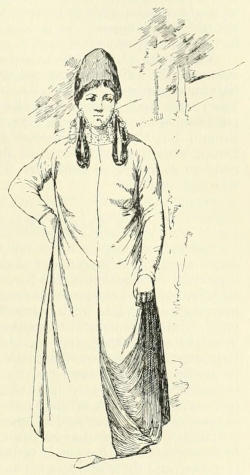
Russian Peasant Woman
In the August following, the duchess of Brunswick became the mother of a prince, who was immediately taken by the empress under her own guardianship and nominated to be her successor. This proceeding, apparently founded upon some show of justice, was in reality the result of a deep-laid conspiracy. The empress was in a declining state of health, and it was felt that she could not long continue to exercise the sovereignty. In this state of things, it became necessary to provide a successor by an authentic act that could not afterwards be called into question. Biron aimed at the concentration of the imperial power in his own hands; but as an open declaration to that effect would have provoked animosities dangerous to his safety, it was arranged that the young prince, then but a few weeks old, should be nominated to the throne, and that Biron should be appointed regent during the minority of Ivan. Ostermann and Munich, relying upon the future gratitude of Biron, favoured this crafty design. Biron coquetted for a time with the dignities which he was solicited to accept; and pretended at last that, in undertaking the toils of the regency, he yielded to the importunities of others at the sacrifice of his own private wishes.
The extent of the power thus delegated to him was specified in the provisions of the will of the empress, which ordained that he should be the administrator of government until the emperor Ivan had attained his seventeenth year; and that, should Ivan die before that time, Biron should continue guardian to Ivan’s brethren, born after him, who should succeed him on the throne; but that, should neither Ivan nor any of his brethren survive, then Biron, with the concurrence of the state, should elect and confirm a new emperor as unlimited monarch. This was the final injunction of the czarina, who died in 1740.b
A Russian Estimate of Anna and of Biron
Contemporaneous writers are unanimous in asserting that, during her entire reign, Anna Ivanovna was not only under the influence, but, so to say, under the domination of her favourite. On the basis of such authorities it therefore became customary to ascribe to Biron and the Germans who were grouped around him all the cruelties and coarseness that characterised her reign. But if we subject this question to a dispassionate and severe criticism it would appear that such an accusation of Biron—and in general of the Germans who governed with him—has no firm foundation. It is impossible to ascribe all the character of the reign to a German clique, because those Germans who were at the head of the government did not constitute a united corporation, but each of them followed his own personal interests; they were envious of one another and at enmity each with the rest.
Biron was a somewhat narrow-minded egotist, incapable of attracting any circle around him; his power rested exclusively on the personal favour of the empress; and therefore, as soon as Anna Ivanovna’s eyes were closed forever, her former favourite had no sure ground to go upon, and although his deceased mistress had made his position secure yet he was not able to maintain it a month without her. There is no contemporary indication that the cruelties which signalised the reign of Anna emanated from Biron or that they were accomplished at his initiative.
Moreover, the cruelties and in general the harsh measures which signalised the reign of Anna Ivanovna were not an exclusive characteristic of that epoch; they did not begin to make their appearance in Russia with her and did not cease with her. The administration of Peter the Great was signalised by persecutions even more cruel and harsh of everything opposed to the supreme power. The actions of Prince Romodanovski in accordance with the Preobrajenski edict were in no wise milder or more humane than those of Andrew Ivanovitch Uskakov in the secret chancery. On the other hand, similar features of cruelty and contempt for human dignity are to be met with after Anna Ivanovna under Elizabeth Petrovna. Therefore we do not hesitate to say that all that disturbs us in the reign of Anna should not be ascribed to the empress herself, nor to her favourite, the duke of Courland, but to the whole age in which such occurrences took place. On the contrary, if we separate from that which belongs to the age what we may justly ascribe to the empress herself and the statesmen of her time, we come to a conclusion which is more to the advantage and credit of the government of the epoch than to its condemnation. Many dispositions of the government of that time in matters of interior policy were accomplished in the spirit of Peter the Great and it was not in vain that Anna Ivanovna confided the affairs of the state to the wise and gifted “fledgelings” of Peter. Thanks to them, in many respects the reign of Anna may be called a continuation of the glorious reign of her great uncle: in general the life of Russia moved forward and was not stagnant. The people of Russia suffered from bad harvests during the reign, besides other various accidental calamities, as for instance fires and robbers; for all such evils, of course, the governments of the period cannot be blamed, and there is no doubt that measures were taken to alleviate the distress of the people.c
THE NOMINAL REIGN OF IVAN VI (1740-1741 A.D.)
For a short time after the death of Anna (1740) Biron maintained an autocratic rule, assuming the title of His Highness, Regent of the Russian Empire. But finally the people, jealous of seeing the administration of the imperial rule confided to the hands of a foreigner—and one too who, instead of exhibiting a sympathy in their interests, treated them with the most flagrant tyranny—betrayed universal discontent at the new order of things. It was held to be a direct act of injustice to debar the duke of Brunswick from the guardianship of his son; and a formidable party now rapidly sprang up, prepared to espouse the rights of that prince. The popular disaffection increased on all sides; but Biron had established his spies in every direction, and was unsparing in the punishments which he inflicted upon all those persons whom he had reason to believe inimical to his government. The streets groaned with the cries of the victims of the knout; the people fled before him, or, in an agony of fear, prostrated themselves upon the earth as he advanced; and the dungeons were filled with the unhappy objects of his suspicions. It was calculated that, throughout the period of his authority, including the reign of the empress Anna, no less than twenty thousand persons were exiled to Siberia.
At length the smothered flame broke out, and the demands in favour of Duke Ulrich took an affirmative shape. Count Munich, disappointed in his expectations by the hypocritical Biron, warmly embarked on the other side; and, by still affecting to be the friend of the regent, he was enabled to render essential service in the revolution which was now swiftly encircling the walls of the palace. The confidence which the military placed in Munich gave increased importance to his services; and, as he found that he had nothing to expect from the regent, he attached himself zealously to Duke Ulrich in the anticipation that he would ultimately be rewarded with the chief command of the army, which was the station he had long eagerly desired to obtain.
The revolution which was thus organised was promptly accomplished. The regent was arrested in the middle of the night, in his house, by a detachment of the guards; and the principal senators assembled in the palace before daybreak, and acknowledged the princess Anna as grand duchess of Russia, and guardian of her son the infant emperor. This proceeding was the work of a few hours. Biron was at first confined in the castle of Schlüsselburg, whence he was removed as a prisoner and brought to trial for obtaining the regency by improper means, for squandering the imperial treasures, for treating with contumely the parents of the emperor, and for violating the statutes and ordinances so as to throw the empire into confusion. For these capital offences he was condemned to death; but his sentence was mitigated to perpetual banishment to the deserts of Siberia, where, in addition to the ordinary miseries of that forlorn region, he was compelled to associate in the labours of the numerous wretches whom he had himself condemned to the same fate. [He was, however, set at liberty by Peter III, and Catherine II ultimately restored to him the duchy of Courland.]
Anna of Brunswick Assumes the Regency (1740 A.D.)
The regency of the princess Anna was slightly perplexed at its opening, by the importunate demands of Munich to be placed at the head of the army—a post which Duke Ulrich appropriated to himself, and peremptorily refused to relinquish. As a compensation, however, to Munich, he removed Ostermann, and appointed his rival in his place as first minister of the government. Munich did not long hold this office: failing to accomplish a course of policy which he urged upon the regent, he tendered his resignation, which was unexpectedly accepted. Frustrated in his hopes, he lingered in St. Petersburg, anticipating that he would be recalled; but the period of his utility was past, and his anticipations were disappointed. The ground of his retirement involved a serious change in the foreign policy of the empire. Frederick II had just ascended the throne of Prussia, and, regarding with jealousy the alliance that had been formed between the courts of St. Petersburg and Vienna, endeavoured to accomplish a union with Russia through the regency of Munich, whose antipathy to Austria was notorious. Frederick did not find it very difficult to work upon the vanity and prejudices of the minister, who was easily brought to prevail upon the regent to enter into a defensive treaty with the cabinet of Berlin; both parties mutually binding themselves to furnish assistance, as occasion might require, to the extent of twelve thousand men. In consenting to this treaty, the regent mentally resolved to fulfil the stipulation it enjoined, only so long as Prussia should be at peace with Austria. An occasion soon offered which obliged her to act upon this secret resolution, Frederick having signified his intention of taking possession of Silesia as a part of the inheritance of Maria Theresa. In consequence of this proceeding, a new alliance was formed with Austria at the commencement of the year 1741, by which a fresh engagement to furnish auxiliaries was entered into. Munich in vain remonstrated against this measure; and at last, finding his influence at an end, he solicited permission to resign, which was granted to him at once. Notwithstanding the disposition thus manifested on the part of Russia, she did not take any part in the war between Prussia and Austria; particularly as the king of Poland and the elector of Saxony, who also raised pretensions to the patrimony of Theresa, protested against the progress of the Russian troops through Poland; Sweden at the same time threatening the empire on the borders of Finland.
Sweden Renews the War
[1741 A.D.]
The Swedes had long looked anxiously for an excuse to make war against Russia; and now that the government of that empire was, to a certain degree, unpopular, and likely from that circumstance to undergo an alteration, a favourable opportunity appeared to present itself for executing a project so gratifying to the whole nation. The ambassador of France at the court of Stockholm encouraged the council to prosecute this war; while the French minister at St. Petersburg demonstrated its facility by representing in strong colours the weakness and instability of the new administration. The Swedes, flattered by the hopes in which they were led to indulge, already calculated with certainty upon the results of the campaign; and the diet at Stockholm were so sanguine of success that they actually drew up no less than three sets of articles containing the conditions which they intended to dictate at the conclusion of the war, when they were assured Russia would be compelled to submit to any terms they might propose. By these articles, they made provision for the resumption of all the provinces that had been ceded to Russia by the Treaty of Nystad; and prepared arrangements, in the event of these not being quite so successful as they expected, by which certain terms, less humiliating but exceedingly extravagant, were to be forced upon their adversary. It was decided, at all events, that, in any case, Russia should surrender Karelia, Ingermanland, and Livonia; that she should not be permitted to keep a single ship on the Livonia or Esthonian coasts; and that she should be compelled to grant the free exportation of corn.
These plans of aggrandisement were deliberately settled by the diet, before any preparations were made for their execution. The Swedes were zealous enough in their desire to wrest from Russia her conquered territories; but they were lamentably deficient in the means by which that desire was to be accomplished. Their fleet was not seaworthy; and the army, brave to a proverb, was insufficiently furnished with provisions, and so destitute of skilful commanders that if it had achieved a victory it must have been by some miracle of good fortune, and not by its own prowess. The generals Levenhaupt and Buddembrock were the most strenuous advocates of the war; yet, although its conduct was committed to their own hands, the sequel proved that the enterprise was as rashly conceived as it was badly conducted.
Russia was the first in the field; and General Lacy, advancing on the Swedes in August, 1741, before they had time to organise their forces, obtained a signal victory over them near Vilmanstrand. This fortress immediately surrendered to the Russians; but the Swedes collected in such superior numbers that no further progress was made by Lacy throughout the rest of the campaign.
When Sweden entered upon this ill-advised war, she acted under a conviction that serious discontents prevailed in Russia against the regency of the duchess of Brunswick. The sudden changes, succeeding each other with marvellous rapidity, that had taken place in the imperial government, justified, in some measure, the supposition that the present regency was as much exposed to revolution as the preceding administrations. The question of the succession had been treated so vaguely, and had been subjected to such fluctuating decisions, that it was believed some new theory would be set up to annul the last election, as others had been annulled before. There was no doubt that the division of parties in Russia afforded a reasonable ground for anticipating a convulsion. The supreme power had latterly become the prize for which base and ambitious men, without hereditary pretensions and destitute of personal merit, had struggled with various degrees of success. There was evidently no settled principle of inheritance; and even the dangerous principle sanctioned by the example of Peter the Great, which gave to one unlimited sovereign the right of choosing another to succeed him, was acted upon capriciously, and appealed to or overruled as it happened to suit the exigency of the occasion.
The brief reigns of Catherine, of Peter, and of Anna, remarkable as they were for the confusion to which they led in the attempts to settle the crown, for the vicissitudes which they drew down upon persons who had previously enjoyed uninterrupted prosperity, and for the factious views which they extracted and condensed into conspiracies, might be referred to as furnishing the probabilities of the future, and confirming the hopes of those who desired, above all things, to see Russia once more broken up by civil commotions. The antipathy which existed against foreigners, and the objections of the old aristocracy to those European reforms that had been from time to time forced upon the people, were well known to the courts of Stockholm and Paris. The vulnerable point in the domestic concerns of the empire was laid bare; and Sweden, who anticipated a revolution from some cause or other, without being able to predicate from what precise ground of discontent it would spring, resolved, at all events, to expose to the Russians the permanent evil of their condition, leaving it to work its effects as it might. With this view she issued a manifesto, containing the following artful reasons, which were designed to draw with her the sympathies of the Russian population.
“The sole intention on the part of Sweden,” observed the manifesto, “is to defend herself by arms against the oppressions exercised against her by the arrogant foreigners, the ministers of the Russian court; and at the same time to deliver the Russian nation from the yoke which these ministers have imposed on it, by assisting the Russians to regain their right of electing for themselves a lawful ruler.” The foreigners particularly pointed at in this manifesto were Munich and Ostermann. The allusion, towards the close, of the design of Sweden to deliver Russia from the yoke of those ministers and to assist her in her right of electing a lawful ruler, touched upon topics which were well calculated to disturb the minds of the people, and to suggest to them notions of independence which they had been hitherto prevented by coercive institutions from entertaining. But there was either a stolid apathy on the part of the Russians, an indifference to or ignorance of the nature of liberty, or a national jealousy at the interference of other countries in their affairs, which rendered this ingenious and inflammatory document perfectly harmless. It was disseminated and forgotten; but, although Sweden could not create a revolution in Russia, there were elements of discord within which rendered revolution inevitable.
The assertion of the right of the sovereign to nominate his successor was productive of inconvenience in a variety of ways: (1) as it constantly brought the new monarch into collision with the authorities, who were thus deprived of the privilege of election; (2) as it was almost certain to dissatisfy some party, and to produce continual feuds; (3) as it led to dissensions and attempts to vindicate the ancient principle, whenever the sovereign, as we have seen, happened to die intestate; and (4) as it was calculated to perpetuate in particular families the inheritance of the patronage and the power of government. But the chief danger arose from the fatal precedent of its interruption, which was seized upon with avidity as a justification, on all future changes, of those revolutions which so frequently originated within the walls of the palace. Alterations had now followed each other so quickly in the persons to whom the administration of the government was committed, and they were conceived so rapidly, and executed with such suddenness and decision, that it was no longer surprising to find the imperial authority vested in the morning in different hands from those which exercised it the night before.
These bold transactions were, of course, founded upon some plausible pretext—the unpopularity of the late ruler, the more authentic claims of the new, the support of the army, or, perhaps, the rare argument of the national will, which it would be mockery to designate public opinion. The overthrow of Biron was effected by a combination of circumstances: the hatred in which he was universally held, his cruelty and rapacity, the obscurity of his origin, and the fact that he was an alien by birth. But the last of these objections lay with almost equal force against the young emperor Ivan, and might be employed with still greater truth against his father, the duke of Brunswick, who, as husband of the regent, exercised considerable influence at court. A stronger motive than this was not required to inflame the prejudices of a powerful section of the nobility, and to yield a satisfactory apology for removing the regent and her son, who was not considered a true Russian, from power. The project was not slow in arriving at maturity; and the term of authority permitted to the guardian of Ivan was, all circumstances considered, of little more duration than that extended to Biron, who held his perilous elevation only two and twenty days.
Successful Conspiracy against the Regent
These designs against the throne were greatly facilitated by the strange conduct of the princess Anna and her husband. Since they had attained their wishes in the government, their behaviour towards each other had undergone a most remarkable change. Harmony and confidence seemed to have ceased between them; and, no longer acting in concert, but, on the contrary, opposing each other by conflicting views, the affairs of the state unavoidably fell into perplexity and confusion. The rivalry that had been produced between Ostermann and Munich in consequence of the favour shown, in the first instance, by the duke to the latter, contributed to increase that disagreement in action which was imperceptibly dividing the government into two parties. Ostermann, finding himself displaced to make way for Munich, attached himself still more closely to the duke, for the purpose of supplanting his rival upon the first opportunity; while Munich, on the other hand, smarting under the mortification he endured by the duke’s repeated refusal of the office he solicited, sought to ingratiate himself in the good opinion of the regent. The consequence of this spirit of opposition, fed by the jealousies of those able ministers, was the daily counteraction by one party of the measures projected by the other.
The regent was a woman of serene temper and lenient disposition; she regarded severity with aversion, and always resorted to the prerogative of mercy where it was possible she could do so consistently with justice: but her desires were so completely thwarted by Ostermann that the public results of the administration bore a very different character from that by which they would have been distinguished had her own opinions been allowed their proper weight. Perhaps it was to this undercurrent of resistance that the indifference concerning the government into which she fell ought to be attributed. But, to whatever cause it might be referred, she gradually neglected the duties of her station, and suffered them to be discharged at hazard by the advisers of the duke. Totally estranging herself from her husband, she retired for weeks together from public affairs, and shut herself up with a Countess Mengden, who obtained so great an ascendency over her mind as to withdraw her attention almost wholly from the responsibility of her position. This circumstance produced considerable dissatisfaction, and heightened the antipathy with which the people regarded the German party that was now growing up at court. The aversion entertained towards foreigners now broke out with more violence than ever. It seemed as if the administration of affairs had completely passed out of the hands of the Russians. The convention that had been formed on the demise of Peter II, by which the supreme authority was vested in the council, which was composed almost exclusively of members of native families, would have had indirectly the effect of excluding strangers from the government; but the evils with which it was pregnant, and its immediate interference with the privileges of the empress, led to its abrogation. The ascendency of foreigners was then resumed with greater force than ever. Biron the insolent guardian, Ostermann the experienced politician, and Munich the able commander rose to the summit and swayed the destinies of the empire.
Nor did Ivan himself possess a much better claim to be considered as a Russian. He was but a remote descendant of the house of Romanov; his father was a German prince, his mother the daughter of a German prince; and the only member of the imperial house to whom he could refer his lineal descent was his grandfather Ivan, stepbrother to Peter I. The family, therefore, that occupied the throne, was almost exclusively of German blood, which was rendered still more repugnant to the people by the fact that all the most important offices under government were filled by foreigners. There was in these circumstances, and in the desire to arrest finally the influence of strangers—which appeared to progress with increasing certainty in each successive reign—a sufficient ground for protest; and the extraordinary indolence of the regent, her utter neglect of state affairs, her discouragement of Russian customs, and her lavish patronage of her immediate adherents, who were all obnoxious to the people, furnished the ready pretext upon which a plot was formed to expel her from the throne.
The princess Elizabeth, daughter of Peter I, residing at St. Petersburg, was the person in favour of whose claims this conspiracy was got up. By birth, she was closer to the throne than either the young emperor or the regent; and the habits of her life were much more congenial to the feelings of the country. She might have preferred her pretensions on the death of Peter II, when there was a strong probability that they would have commanded the suffrages of the council; but at that time she expressed no desire to enter upon the cares of sovereignty, choosing rather to cultivate the repose of a retired and tranquil life. Throughout the reign of the empress Anna she observed the same quiet course, kept aloof from politics, and avoiding, as much as possible, all intercourse with the great men or distinguished families at court. Her conduct was so entirely free from suspicion that she enjoyed the closest intimacy with the empress, who, believing that the princess was averse to the toils of power, bestowed her full confidence upon her; and even Biron, who distrusted almost everyone about him, never contemplated any measure to her prejudice. She enjoyed the immunities of a private person; never made any display of her rank in public; and was in truth, as she was in appearance, without a party in the country. The only exception to the privacy of her life was the attachment she showed for the soldiery, particularly the guards; which she did not hesitate to exhibit by frequently standing sponsor for their children.
Yet, although her conduct was so exempt from reproach, the Dolgoruki were accused of an intention of placing her upon the throne—an intention which they might have entertained without her knowledge or sanction; for there was sometimes as much violence committed in forcing the dignity upon unwilling shoulders as in deposing the possessor. That aspiring family fell under the displeasure of Biron, and its members were put to the torture towards the close of the year 1739; when they confessed that they had planned an insurrection, the purpose of which was to carry off the empress, the princess Anna, and her husband, to expel the Germans from Russia, to proclaim Elizabeth empress, and to bring about a marriage between her and one of the Nariskins. This confession might be true, or it might have been wrung from the accused by torture, which, in those times, was too often persuasively employed to make its victims confess more than the truth; but it was satisfactory for the ends of Biron, who, proceeding to capital punishment at once, broke one of the victims on the wheel, decapitated three others, and sentenced two more to a dungeon for life.
There is no reason to believe that Elizabeth contemplated any designs upon the throne during the reign of the empress Anna, or that the simplicity of her general conduct was assumed as a disguise for secret intrigues. The project seems to have occurred to her for the first time, when she saw an infant emperor consigned to the regency of a foreigner; it was probably strengthened afterwards, when the guardianship of the child was transferred to its parents, one of whom was a German by birth, and the other by descent; and it reached its maturity, when she heard it reported currently that the regent intended to have herself declared empress on her birthday in the following December, 1741, and to establish the succession in the line of her daughters. This intelligence, which every day obtained fresh credit at court, imparted a new aspect to the question. It was no longer to be considered a choice between lineal and indirect descendants of the house of Romanov, but between a sovereign who should be chosen by the electors and one who was resolved to usurp by force what she could not legitimately obtain.
The discontent of the people, the inconsistent bearing of the regent, and the favourable disposition for a change which began to be developed in influential quarters, seemed to sanction the act of revolution, and to invoke Elizabeth from her retirement to fulfil its ends. Personally, she stood alone; she had never drawn around her any powerful friends; she had never mixed in the court feuds; and her whole reliance was upon the temper and accidents of the time. But it was not forgotten in her calculations that the individual who is the representative of a principle acquires at once all the power which the cause he espouses can confer, and that he is sure to be sustained by a party for the promotion of their own objects, although he might be destitute of support in the attempt to advance his own.
Lestocq, the physician and favourite of the princess, was the mainspring of the plot. It was by his advice that the enterprise was undertaken, and it was almost solely by his perseverance that it was prosecuted. He first addressed himself to the guards, who were individually devoted to the princess. The earliest confidants of his schemes were Grünstein, a broken merchant, who was then a corporal in the Preobrajenski guards, and Schwartz, a trumpeter. Through the agency of these persons, to whom he promised large rewards, Lestocq succeeded in gaining over to his views a strong party of the soldiery. M. de la Chetardie, the French ambassador resident at St. Petersburg, readily engaged in the conspiracy, acting, no doubt, under the sanction of his court, whose policy it was to convulse the Russian government by any means in its power, in the hope of ultimately effecting a disunion between that cabinet and the Austrian emperor. From that minister Lestocq procured the sums of money that were necessary to carry forward his plans, which now proceeded with rapidity.
But Elizabeth, who had entered into the project with reluctance, regarded its progress with fear, and was as anxious to postpone the catastrophe as Lestocq was eager for its accomplishment. This produced delays which were nearly fatal. The soldiers, entrusted with a secret of too much magnitude for persons in their condition, could not long preserve the confidence that was reposed in them; and at last the design began to be rumoured abroad. It even reached the ears of the regent, who, possessed by some unaccountable infatuation, treated it with the utmost carelessness. She either did not believe in its truth, or lulled herself into security by depending upon the fidelity of her friends. Unmoved by the danger that threatened her, she concealed from her husband the information she had received; for which, when it was too late to retrace her steps, he afterwards severely censured her. Ostermann, who was early made aware of the proceedings of the conspirators, warned the regent of her danger, and entreated her to take some decisive measures to avert it: and the British ambassador, detecting, probably, the insidious hand of France, predicted her destruction in vain. Her facile nature still lingered inactive, until at last she received an anonymous letter, in which she was strongly admonished of the perils by which she was surrounded. A more energetic mind would have acted unhesitatingly upon these repeated proofs of the approaching insurrection; but Anna, still clinging to the side of mercy, instead of seizing upon the ringleaders, who were known to her, and quieting at once the apprehensions of her advisers, read the whole contents of the letter in open court in the presence of Elizabeth, and stated the nature of the reports that had reached her. Elizabeth, of course, protested her ignorance of the whole business, burst into a flood of tears, and asserted her innocence with such a show of sincerity that the regent was perfectly satisfied, and took no further notice of the matter.
This occurred on the 4th of December, 1741. Lestocq had previously appointed the day of the consecration of the waters, the 6th of January, 1742, for Elizabeth to make her public appearance at the head of the guards, to issue declarations setting forth her claims upon the throne, and to cause herself to be proclaimed. But the proceeding that had taken place in the court determined him to hasten his plans. Now that the vigilance of the court was awakened, he knew that his motions would be watched, and that the affair did not admit of any further delay. He applied himself, accordingly, with redoubled vigilance, to the business of collecting and organising the partisans of the princess; continued to bribe them with French gold; and, when everything was prepared, he again impressed upon his mistress the urgent necessity of decision. He pointed out to her that the guards, upon whose assistance she chiefly relied, were under orders to march for Sweden, and that in a short time all would be lost. She was still, however, timid and doubtful of the result, when the artful Lestocq drew a card from his pocket, which represented her on one side in the habit of a nun, and on the other with a crown upon her head—asking her which fate she preferred; adding that the choice depended upon herself, and upon the promptitude with which she employed the passing moment. This argument succeeded; she consented to place herself in his hands; and, remembering the success that had attended the midnight revolution that consigned Biron to banishment, he appointed the following night, the 5th of December, for the execution of his plan—undertaking the principal part himself, in the hope of the honours that were to be heaped upon him in the event of success.
When the hour arrived Elizabeth again betrayed irresolution, but Lestocq overcame her fears; and after having made a solemn vow before the crucifix that no blood should be shed in the attempt, she put on the order of St. Catherine, and placing herself in a sledge, attended by Lestocq and her chamberlain, she drove to the barracks of the Preobrajenski guards. When she arrived at this point, she advanced towards the soldiers on foot, holding the cross in her hand; and, addressing them in a speech of some length, justified the grounds on which she advanced her claims to the throne; reminded them that she was the daughter of Peter the Great; that she had been illegally deprived of the succession; that a foreign child wielded the imperial sceptre; and that foreigners were advanced, to the exclusion of native Russians, to the highest offices in the state. A considerable number of the guards had been previously prepared for this proceeding by bribes and promises, and inflammatory liquors were distributed amongst them to heighten their zeal. With the exception of a few, who would not violate their duty and who were, in consequence, manacled by the remainder, the whole body responded to the address with enthusiasm.
They now proceeded to the palace of the emperor and his parents, pressing into their train everybody they met on the way, to prevent their object from being betrayed; and, forcing the sentries at the gates, obtained easy admittance to the sleeping apartments of the regent and the duke, whom they dragged, unceremoniously, and without affording them time to dress, out of their beds, and conveyed to the palace of Elizabeth, where they confined them under a strong guard. The infant Ivan, unconscious of the misery that awaited him, was enjoying a gentle slumber during this scene of violence; and when he awoke he was carried, in a similar manner, to the place where his unhappy parents were immured. On the same night the principal persons connected with the government were seized in the same way, and thrown into prison. Amongst them were Lewis Ernest of Brunswick, the brother of the duke, Ostermann, and Munich.
This revolution was as rapid and complete as that which deprived Biron of the regency, and was effected by a similar stealthy proceeding in the silence of the night. Early on the following morning, the inhabitants were called upon to take the oath of fealty to Elizabeth. But they were accustomed to these sudden movements in the palace; and before the day was concluded the shouts of the intoxicated soldiery announced that the people had confirmed, by the usual attestation of allegiance, the authority of the empress.[49] A manifesto was immediately issued, which contained the following statement:
The empress Anna having nominated the grandson of her sister, a child born into the world only a few weeks before the empress’ death, as successor to the throne; during the minority of whom various persons had conducted the administration of the empire in a manner highly iniquitous, whence disturbances had arisen both within the country and out of it, and probably in time still greater might arise; therefore all the faithful subjects of Elizabeth, both in spiritual and temporal stations, particularly the regiments of the life-guards, had unanimously invited her, for the prevention of all the mischievous consequences to be apprehended, to take possession of the throne of her father as nearest by right of birth; and that she had accordingly resolved to yield to this universal request of her faithful subjects, by taking possession of her inheritance derived from her parents, the emperor Peter I and the empress Catherine.
Shortly after this another manifesto appeared, in which Elizabeth grounded her legitimacy on the will of Catherine I. As the statements in this document respecting the right of inheritance are singular in themselves, and as they illustrate in a very remarkable degree the irregularity with which the question of the succession was suffered to be treated, the passage touching upon those points appears to be worthy of preservation. It will be seen, upon reference to previous facts, that these statements are highly coloured to suit the demands of the occasion. After some preliminaries, the manifesto proceeds to observe, that on the demise of Peter II, whom she (Elizabeth) ought to have succeeded, Anna was elected through the machinations of Ostermann; and afterwards, when the sovereign was attacked by a mortal distemper, the same Ostermann appointed as successor the son of Prince Antony Ulrich of Brunswick and the princess of Mecklenburg, a child only two months old, who had not the slightest claim by inheritance to the Russian throne; and, not content with this, he added, to the prejudice of Elizabeth, that after Ivan’s death the princes afterwards born of the said prince of Brunswick and the princess of Mecklenburg should succeed to the Russian throne; whereas even the parents themselves had not the slightest right to that throne. That Ivan was, therefore, by the machinations of Ostermann and Munich, confirmed emperor in October, 1740; and because the several regiments of guards, as well as the marching regiments, were under the command of Munich and the father of Ivan, and consequently the whole force of the empire was in the hands of those two persons, the subjects were compelled to take the oath of allegiance to Ivan. That Antony Ulrich and his spouse had afterwards broken this ordinance, to which they themselves had sworn; had forcibly seized upon the administration of the empire; and Anna had resolved, even in the lifetime of her son Ivan, to place herself upon the throne as empress. That, in order, then, to prevent all dangerous consequences from these proceedings, Elizabeth had ascended the throne, and of her own imperial grace had ordered the princess with her son and daughter to set out for their native country.
Such were the arguments upon which Elizabeth attempted to justify her seizure of the throne. With what sincerity she fulfilled the act of grace towards the regent and her family, expressed in the last sentence, will be seen hereafter.
ELIZABETH PETROVNA (1741-1762 A.D.)
The revolution which elevated Elizabeth to the throne and the circumstances which preceded that elevation were in every respect remarkable. She had no claim to the dignity, either by birth or by the regulation in regard to the succession introduced by the innovating Peter. Elizabeth was the younger daughter of Peter: Anna, who had been married to the duke of Holstein, was the elder; and though this princess was dead, she left a son, the representative of her rights, who, as we shall hereafter perceive, did ultimately reign as Peter III. The right of primogeniture, indeed, had, in the regulation to which we have alluded, been set aside, and the choice, pure and simple, of the reigning potentate substituted; but the infant Peter had the additional claim of being expressly indicated in the will of Catherine I. These claims, however, had been utterly disregarded when Anna, duchess of Courland and daughter of Ivan, brother of Peter I, had been raised by a faction to the throne. On the death of this empress without issue, Peter, as we have seen, was again overlooked, through the ambition rather of an individual than of a faction—the bloodthirsty Biron.
Ivan, the son of Anna, had been preferred to his mother, who had been married to Prince Antony Ulrich of Brunswick; and no doubt could be entertained that the object of Biron, in prevailing on the empress to nominate the child, was to retain the supreme power in his own hands as regent. We have seen by what means his ruin was effected; what circumstances accompanied the regency of the duchess Anna, mother of the youthful emperor; and how, by a similar revolution, Anna herself was replaced by the princess Elizabeth.
That Ivan had no other right to the throne than that conferred by the will of the empress Anna, was one of the pretexts which Elizabeth employed to prove the validity of her own title. That will, in the manifesto published three days after the revolution, was insinuated—probably with great truth—to have been irregularly obtained; but in either case it was of no validity, since the right of Elizabeth was asserted to be superior even to that of the former empress. But the instrument was a tissue of sophistry. Though she had been placed on the throne by about three hundred soldiers, she did not hesitate to affirm that the revolution had been effected at the demand of all her subjects. In ostentatiously displaying her clemency, in proclaiming that she had sent back the parents of Ivan to their own country, with all the honours due to their station, she was equally insincere. Both passed their lives in captivity, and were transferred from one fortress to another, according to her caprice or jealousy. Until his eighth year Ivan was permitted to remain with them; but, apprehensive lest his mind should be taught ambition, he was consigned to solitary confinement first in the fortress of Oranienburg, next in that of Schlüsselburg. In one respect his fate was worse than that of his parents: they died in the course of nature[50]; he, as we shall hereafter perceive, perished by violence.
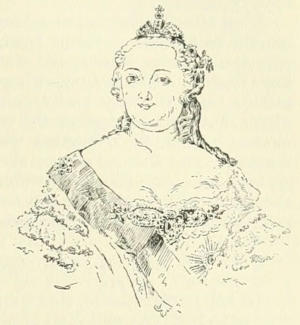
Elizabeth Petrovna
(1709-1762)
One of Elizabeth’s first cares was to punish the men who had, during the former reigns, kept her from the throne—those especially who had assisted the regent Anna in overturning the power of Biron, and had instigated her afterwards to seize the throne. All were condemned to death; but the new empress was not a woman of blood, and the sentence was commuted into perpetual banishment. Ostermann, Munich, Golovkin, Mengden, Lövenwold, driven from a power scarcely less than supreme and from riches almost inexhaustible, were forced to earn their own subsistence in the wilds of Siberia. Munich opened a school. The hand which had conquered the Turks, which had given a king to Poland, was employed in tracing mathematical figures for children.
If Elizabeth could punish, she could also reward. The surgeon, Lestocq, was made head physician of the court, president of the college of the faculty, and privy councillor, with a magnificent income. The company of grenadiers who had raised her to the throne were all declared noble; and the common soldiers ranked in future as lieutenants. But under a despotic government there is little security for the great, least of all for those whom capricious favour has exalted. Presuming on his services, the ambition of Lestocq urged him to demand higher preferment, and he had the mortification to be refused. Nor was this all: by his arrogance he offended the most powerful favourites of Elizabeth, especially the grand chancellor Bestuzhev, who had been the minister of Anna; and, in seven years after the revolution, he was exiled to a fortress in the government of Archangel. Exile, in short, was perpetual in this reign. The empress vowed that no culprit should suffer death; but death would often have been preferable to the punishments which were inflicted. Torture, the knout, slitting of the tongue, and other chastisements—so cruel that the sufferer frequently died in consequence—were not spared even females.
[1743 A.D.]
Soon after her accession a conspiracy was discovered, the object of which was the restoration of young Ivan. The conspirators, who were encouraged by a foreign minister, were seized, severely chastised, and sent into exile. Among them was a court beauty, whose charms had long given umbrage to the czarina, and we may easily conceive that the revenge was doubly sweet which could at once destroy the rebel and the rival. But the number of these victims was small, compared with that which was consigned to unknown dungeons, and doomed to pass the rest of life in hopeless despondency. With all her humanity, Elizabeth suffered that most inquisitorial court, the secret chancery, to subsist; and the denunciations which were laid before it were received as implicitly as the clearest evidence in other tribunals.
Foreign Affairs (1743-1757 A.D.)
In her foreign policy this empress seems scarcely to have had an object. Averse to business, and fond of pleasure, she allowed her ministers, especially Bestuzhev, to direct the operations of the wars in which she was engaged, and to conduct at will the diplomacy of the empire. Her first enemy was Sweden. That power demanded the restitution of Finland, and was refused; hostilities which, indeed, had commenced at the instigation of France during the last reign, were resumed, but they were prosecuted with little vigour by the Swedes. The valour of the nation appeared to have died with their hero, Charles XII. So unfortunate were their arms that, by the Treaty of Nystad, in 1721, and that of Åbo, in 1743, Livonia, Esthonia, Karelia, Ingermanland, Viborg, and Kexholm passed under the domination of Russia.
Still worse than the loss of their possessions was the influence thenceforward exercised over the court of Stockholm by that of St. Petersburg. In vain did Sweden endeavour to moderate the exactions of the empress by electing the duke of Holstein, her nephew, successor to the throne of the Goths: the Treaty of Åbo was not the less severe. It is, indeed, true that the intelligence of this election did not reach St. Petersburg until Elizabeth herself, who was resolved never to marry,[51] had already nominated Duke Peter as her own successor; but she ought to have received in a better spirit a step designed as an act of homage to herself.
Had Elizabeth known her own interests, she would never have engaged in the celebrated war which during so many years shook all Europe to its centre. But, in the first place, she affected much commiseration for the Polish king, whose Saxon dominions were invaded by the Prussians, and whom she called her ally. In the second, she was evidently actuated by a personal antipathy to Frederick, and whoever were his enemies were sure to be her allies. It would, however, be wrong to suppose that personal feeling alone was her sole motive for interfering in a foreign war. There can be no doubt that even at this early period, and indeed long before this period, the ministers of Russia had cast a longing eye on the possessions of Poland.
[1757 A.D.]
Courland and Semigallia, though nominally dependent on the Polish crown, were in reality provinces of Russia. They had been lost to Poland through the marriage of Anna, niece of Peter I, to Kettler, sovereign of the duchy. Though she had no issue; though Ferdinand, the successor of Kettler, was also childless; though the Polish diet contended, with justice, that the fief was revertible to the republic, Anna was resolved that its future destiny should be changed. Under the pretext of certain pecuniary claims, the Russian troops overran the territory; and the states were compelled to elect Biron, the parent of the empress, to the vacant dignity. After the fall of that unprincipled adventurer, the states, disgusted with Russian preponderance, had ventured to unite their suffrages in favour of Charles, son of Frederick Augustus III king of Poland; but Frederick durst not sanction the election until he had obtained the permission of the empress Elizabeth. She could, for once, well afford to be generous; and Duke Charles was suffered to take possession of the dignity. And, while on this subject, we may so far anticipate events as to add that Peter III, successor of Elizabeth, refused to admit the rights of Charles, whom he expelled from the duchy; and that Catherine II incorporated it with her dominions. That Elizabeth herself had the ambitious views of her father, in reference not only to Courland but to other provinces, is certain; and, as we have already observed, one of her motives for engaging in the great European contest was the prospect of ulterior advantages. The pretext of succouring an ally was sufficient to justify, in the eyes of Europe, the march of her armies. In this respect, her policy was macchiavellian enough. But to her the war was an imprudent one; whatever her views, the time was not yet arrived when they could be fully executed. Nor were the events always honourable to the military glory of the empire. The reason is generally and, perhaps, justly assigned to the partiality of the grand duke Peter, the heir presumptive, for the Prussian monarch—a partiality so great as to be inexplicable. The Russian generals, however anxious to win the favour of their sovereign, still more the honours of successful warfare, were yet loth to incur the dislike of Peter: hence the operations were indecisive; and success, when gained, was not pursued.
Antecedents of the Future Peter III
Charles Peter Ulrich, duke of Holstein Gottorp, whom Elizabeth had nominated her successor, who had embraced the Greek religion, and who, at his baptism, had received the name of Peter Fedorovitch, had arrived at St. Petersburg immediately after her accession. He was then in his fourteenth year. The education of this unfortunate prince was neglected; and the cause must be attributed alike to his own aversion to study and to the indifference of the empress. Military exercises were the only occupation for which he had any relish, and in them he was indulged. At the palace of Oranienbaum, with which his aunt had presented him, he passed the months of his absence from court—a period of freedom for which he always sighed. As his recollections were German, so also were his affections. He had little respect for those over whom he was one day to reign: instead of native, he surrounded himself with young German officers. His addiction to such exercises became a passion, and was doubtless one of the causes that so strongly indisposed him to more serious and more important pursuits.