Chapter XI · THE REIGN OF NICHOLAS I
Reading edition
Nicholas Pavlovitch triumphed over two military revolts; then, as if the twelve days’ interregnum had not existed, he dated his reign from the 1st of December, 1825, the day of Alexander’s death. During the first ten or twelve years of his reign embarrassments of every kind, followed hard upon one another. These embarrassments were foreign war, first with Persia, and next with Turkey; the enmity of Austria whilst this latter struggle was going on; the abandonment of the Russian alliance by France, in consequence of the revolution of July, 1830; the insurrection of Poland; the epidemic of Asiatic cholera in 1831 and the popular riots to which this scourge gave rise, especially in St. Petersburg; a revolt in the heart of the military colonies; a famine which desolated the southern provinces during the years 1834 and 1835; the fires at Åbo, Tula, Kazan, and at last (December, 1837) at the emperor’s own residence, the Winter Palace. But all these cruel trials did not daunt the courage of the new autocrat; they served only to bring out the firmness of his mind and the strong cast of his character.—Schnitzler.c
THE INTERREGNUM
[1825-1855 A.D.]
After the 24th of November, 1825, Adjutant-general Diebitsch had begun to send information to Warsaw of the illness of the emperor Alexander, by means of letters addressed to General Kuruta. The first courier, bearing this alarming news, arrived at Warsaw on the 1st of December in the evening of the very day of the emperor Alexander’s death.
The czarevitch Constantine Pavlovitch did not conceal the painful presentiment that took possession of him, and wrote to Baron Diebitsch the same day in the following terms: “In spite of all the consolations expressed in your letter, I cannot rid myself of the painful impression it has produced on me. I tell you frankly that if I were to obey the dictates of my heart I should set off and come to you. But unfortunately my duties and my position do not permit me to give way to these natural sentiments.”
The grand duke Michael Pavlovitch was at that time at Warsaw, and the czarevitch hid even from him and Princess Lovitch the alarming letters that he received from Taganrog. “I do not speak to you of the condition of mind in which I now find myself,” wrote the czarevitch to Adjutant-general Diebitsch on the 5th of December, “for you know only too well of my devotion and sincere attachment to the best of brothers and monarchs to doubt them. My position is rendered all the more painful from the fact that, the emperor’s illness is only known to me and my old friend Kuruta and my doctor; the news has not yet reached here, so that in society I have to appear calm, although there is no such calmness in my soul. My wife and brother do not suspect anything, so that I had to invent an explanation for the arrival of your first messenger, which I shall have to do again to-day. If I were to obey only the suggestions of my heart of course I should have been with you long ago, but you will naturally understand what hinders me.”
[1825 A.D.]
Meanwhile couriers continued to follow upon each others’ heels and finally on December 7th, at seven in the evening, the czarevitch received the fatal intelligence of the death of his brother. The report of Adjutant-general Diebitsch did not shake the czarevitch’s decision as to the question of the succession to the throne, and he then said to the grand duke Michael Pavlovitch, “Now the solemn moment has come to show that my previous mode of action was not a mask, and to terminate the matter with the same firmness with which it was commenced. My intentions and my determinations have not changed one iota, and my will to renounce the throne is more unchangeable than ever.”
Summoning the persons of his entourage and informing them of the loss that had overtaken Russia, the czarevitch read them his correspondence with the emperor Alexander in 1822 and ordered that letters to the empress Marie Feodorovna, and to the grand duke Nicholas Pavlovitch, should be prepared, stating that he ceded his rights to the succession to the throne to his younger brother, by virtue of the rescript of the emperor Alexander of the 14th of February, 1822. The czarevitch here used the expression “cede the throne to the grand duke Nicholas Pavlovitch,” because he knew nothing of the existence of the state act which as long ago as 1824 had invested this cession with the power of a law. Such were the misapprehensions with which was accompanied Alexander’s secret and evasive manner of action in regard to the question of the succession.
Meanwhile what was taking place in St. Petersburg? The news of the death of the emperor Alexander was received in the capital only on December 9th, during prayers which were being said for the recovery of the emperor in the church of the Winter Palace. The circumstances are thus narrated by the empress Elizabeth Alexievna herself:
On the 9th inst. at the termination of the liturgy, when prayers for the health of the emperor had already commenced, his highness was called out from the sacristy by Count Miloradovitch and informed by him that all was over. His imperial highness became faint, but recovering himself he returned with Doctor Rule to the sacristy. The empress was on her knees and being already prepared by the grand duke’s prolonged absence, and guessing her lot from his face she grew faint; meanwhile the priest presented the cross to her, and as she kissed it she lost consciousness.
His imperial highness, turning to his wife, said to her “Take care of our mother, and I will go and do my duty.” With these words he entered the church, ordered that a reading desk should be brought in, and took the oath of allegiance to his beloved brother and emperor, Constantine, which he ratified by his signature; some others who happened to be there also subscribed to the same: they were the minister of war Tatistchev, General Kutusov, the general in waiting Potapov, and all the others who were present.
Then he presented himself before the Preobrajenski regiment that was on guard in the palace (the company of his majesty’s grenadiers), and informed them of the emperor’s death and proclaimed Constantine emperor. The grenadiers received the announcement with tears, and immediately took the oath of allegiance. After this his imperial highness commissioned the general in waiting, Potapov, to inform the chief and all the other guards of what had taken place and to bring them from their posts to take the oath, which was done without delay and with sorrow and zeal; meanwhile General Neitgart was sent to the Nevski monastery, where were all the general officers of the guards’ corps, with the proposal to General Voinov to do the same throughout all the regiments of the guards. Finally similar announcements and instructions were sent to all the regiments and detachments in both the city and its environs.
Meanwhile the council of the state had assembled and opened its sitting by the proposal to break the seals of the envelope which contained the will of the late emperor. Some discussion arose, and finally it was decided to unseal the packet, in order to learn the last will of the czar.
In the act was drawn up the renunciation of the throne by the czarevitch and the nomination of the grand duke Nicholas as the emperor’s heir. Some discussion again arose upon this question, but it was cut short by the suggestion that his highness should be invited into the presence of the council. Count Miloradovitch replied that his highness had already taken the oath and that in any case he considered it unfitting that his highness should be called, or should come to the council, but offered to bring all this to his knowledge and to ask that they might be allowed to come to him in order to report all that had taken place; this was done and the grand duke replied that he could not hinder their coming.
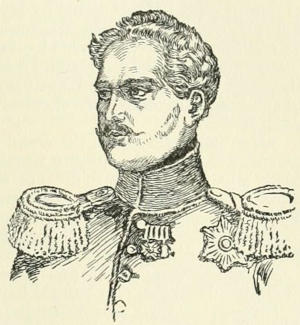
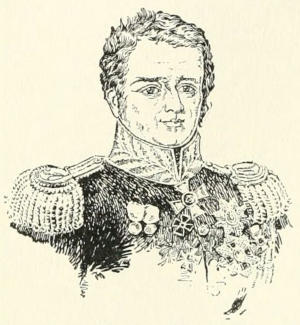
Nicholas I
(1796-1855)
When the members of the council presented themselves before the grand duke he informed them that the contents of the act had long been known to him, namely since July 25th, 1819, but that in no case would he dare to occupy the place of his elder brother, from whose supreme will his lot depended, and that holding it as a sacred obligation most humbly to obey him in all things, he had therefore taken the oath and felt entirely certain that the council, having in view the welfare of the state, would follow his example.
The council followed his highness into the church and at his request took the oath before him; they were then introduced by him into the presence of the empress mother, who was pleased to inform them that the act and its content were known to her, and were made with her maternal consent, but that she also was enthusiastic over her son’s conduct. Confirming all his actions she requested the council by their united endeavours to preserve the tranquillity of the empire.
In accordance with the measures taken, by three o’clock in the afternoon the troops as well as all grades of officials in the government service had taken the oath confirming the accession to the throne of the emperor Constantine. During the whole time tranquillity and order were preserved. It is easy to imagine the astonishment and vexation of the czarevitch when, instead of receiving the expected commands of the new emperor, he was informed that all Russia had taken the oath of allegiance to him as lawful sovereign, and that the will of the late emperor had not been fulfilled.
Meanwhile early in the morning of December 15th the grand duke Michael Pavlovitch arrived in St. Petersburg with letters from the czarevitch. To the amazement of the court and the inhabitants, the grand duke did not follow the general example of swearing fidelity to the emperor Constantine. He did not conceal his regret at what had taken place in St. Petersburg, nor the apprehension with which the necessity of a new oath filled him. He dwelt on the difficulty of explaining to the public why the place of the elder brother to whom allegiance had already been sworn should suddenly be taken by the younger. The grand duke Nicholas in answer to his brother repeated what he had already said, that he could not have acted otherwise in such a position as that in which he was placed by his ignorance of the sacred acts of the late emperor, and that neither his conscience nor his reason reproached him. “Everything, however,” added he, “might yet be amended and take a more favourable turn if the czarevitch himself were to come to St. Petersburg; his obstinacy in remaining at Warsaw may occasion disasters, the possibility of which I do not deny, but of which in all probability I shall myself be the first victim.”
After long deliberation the grand duke Nicholas decided to write a fresh persuasive letter to the emperor Constantine, in which he asked him to decide finally what his fate was to be; and in conclusion he wrote, “In God’s name, come.” The empress Marie Feodorovna added her persuasions to those of her son, and not satisfied with these measures it was decided a few days later to despatch the grand duke Michael to Warsaw to convince the czarevitch of the necessity of his presence in St. Petersburg.
An answer from the czarevitch to the grand duke Nicholas’ letter dated the 14th of December was brought to St. Petersburg by Lazarev, aid-de-camp to Nicholas: “Your aide-de-camp, dear Nicholas, on his arrival here, confided your letter to me with all exactitude. I read it with the deepest grief and sorrow. My decision is unalterable and consecrated by my late benefactor the emperor and sovereign. Your invitation to come quickly cannot be accepted by me, and I must tell you that I shall remove myself yet further away, if all is not arranged in accordance with the will of our late emperor. Your faithful and sincere friend and brother for life.” But even this letter did not decide the matter; the return of Belussov from Warsaw with the answer to the grand duke Nicholas’ letter of December 15th had yet to be awaited.
A new complication remained to be added to all these difficulties. On December 24th there came to St. Petersburg and presented himself to the grand duke Nicholas, Colonel Baron Fredericks of the Izmailovski Life Guards, who had fulfilled the functions of commandant in Taganrog. He brought to the grand duke a packet from Baron Diebitsch addressed to his imperial majesty, to be given into his own hands. To the question as to whether he knew of the contents of the packet, Fredericks replied in the negative, but added that as the place of residence of the emperor was unknown in Taganrog, exactly the same paper had been sent also to Warsaw.
Nothing therefore remained for Nicholas to do but to open the mysterious packet and “at the first rapid glance over its contents,” writes Baron Korv, “an inexpressible horror took possession of him.” It was on reading the report contained in this packet that the grand duke first learned of the existence of secret societies formed with the object of destroying to the very roots the tranquillity of the empire. The existence of these societies had been carefully hidden from him by the late emperor Alexander.
Almost immediately thereafter the courier Belussov returned from Warsaw with the czarevitch’s decisive answer, which put an end to the interregnum. Nicholas Pavlovitch was emperor. At nine o’clock in the evening the emperor sent the following postscript to Adjutant-general Diebitsch:
The decisive courier has returned; by the morning of the day after to-morrow I shall be emperor or else dead. I sacrifice myself for my brother; happy if as a subject I fulfil his will. But how will it be with Russia? What about the army? General Tolle is here and I shall send him to Mohilev to bear the news to Count Saken. I am looking out for a trustworthy person for the same commission to Tultchin and to Ermolov. In a word, I hope to be worthy of my calling, not in fear and mistrustfulness, but in the hope that even as I fulfil my duty so will others fulfil their duty to me. But if anywhere anything is brewing and you hear of it, I authorise you to go at once where your presence is necessary. I rely entirely upon you and give you leave beforehand to take all the measures you deem necessary. The day after to-morrow if I am alive I will send you, I do not know by whom, information as to how matters have passed off; on your part do not leave me without news of how everything is going on around you, especially with Ermolov. I again repeat that here until now everything is incomprehensibly quiet, but calm often precedes a storm. Enough of this, God’s will be done! In me there must only be seen the vicar and executor of the late emperor’s will and therefore I am ready for everything. I shall ever be your sincere well wisher,
Nicholas.
THE ACCESSION OF NICHOLAS
The czarevitch’s decisive answer was brought by Belussov, not through Riga, but by the Brest-Lithuani road; and therefore the grand duke Michael Pavlovitch was still in ignorance of the events at Nennal. The emperor Nicholas immediately sent an express after him commanding him to hasten to St. Petersburg. The return of the grand duke to the capital where his presence was of urgent necessity was thus by chance delayed.
Nicholas had now to occupy himself with the composition of his manifesto; the inexplicable had to be explained and it presented a task of no little difficulty: Karamzin and Speranski were set to work upon it. The emperor Nicholas signed the manifesto on the 25th of December, but dated it the 24th, as the day on which the question of his accession had been definitely settled by the czarevitch. It was proposed to keep the manifesto secret until the arrival of the grand duke Michael, but it was decided that the troops should take the oath of allegiance on the 26th of December; meanwhile notifications were sent to the members of the council of state, calling upon them to assemble on Sunday, December 25th, at eight in the evening, for a general secret meeting.
When the council of state had assembled at the hour designated, Prince Sopukhin announced that the grand duke Michael would be present at the sitting. The hours passed in anxious expectation; midnight approached and the expected arrival of the grand duke did not take place. Then Nicholas decided to be present at the sitting alone. Taking the place of the president, Nicholas himself began to read the manifesto announcing his acceptance of the imperial dignity in consequence of the persisted rejection of it by the czarevitch Constantine Pavlovitch. Then the emperor ordered that the czarevitch’s rescript, addressed to Prince Sopukhin, president of the council, should be read. The 26th of December, 1825, had come. Commands had been issued that on that day all persons having access to the court should assemble at the Winter Palace for a Te Deum; eleven o’clock was the hour first named, but this was afterwards changed to two. Circumstances arose, however, which postponed the Te Deum to a still later hour. The members of the secret society decided to take advantage of the end of the interregnum and the approach of the new oath of allegiance in order to incite the troops to rebellion and to overthrow the existing order of things in Russia. The secrecy in which the negotiations with Russia had been enveloped had given occasion for various rumours and suppositions, and for the spread of false reports which occasioned alarm in society and especially in the barracks: all this favoured the undertakings and designs of the conspirators.
The only issue from the position that had been created by Nicholas in a moment of chivalrous enthusiasm “undoubtedly noble, but perhaps not entirely wise,” would have been the arrival of the grand duke Constantine in the capital with the object of publicly and solemnly proclaiming his renunciation of the throne. But the czarevitch flatly refused to employ this means of extricating his brother from the difficult position in which he placed himself; Constantine considered that it was not for him to suffer from the consequences of an imprudence which was not his, and the danger of which might have been averted if matters had not been hurried on, and if he had been previously applied to for advice and instructions. Thus led into error, some of the lower ranks of the guards’ regiments refused to take the oath of allegiance to Nicholas Pavlovitch, and assembled at the Pelrovski square, before the senate buildings, appearing as though they were the defenders of the lawful rights of the czarevitch Constantine to the throne.
Meanwhile distinguished persons of both sexes began to drive up to the Winter Palace. Amidst the general stir and movement going on in the palace, there sat isolated and immoveable three magnates, “like three monuments,” writes Karamzin: Prince Lopukhin, Count Araktcheiev, and Prince A. B. Kurakin. At the time when the military men had already gone out on the square, Count Araktcheiev, as might have been expected, preferred to remain in the palace. “It was pitiful to look at him,” writes V. R. Martchenko in his Mémoires.
The rioters were stubborn for a long time and would not yield to exhortation; Count Miloradovitch fell mortally wounded. It began to grow dusk. Then the emperor Nicholas, at last convinced of the impossibility of pacifying the rioters without bloodshed, gave orders with a breaking heart for the artillery to fire. A few grape-shot decided the fate of the day; the rioters were dispersed, and tranquillity at once reigned in the capital.
The Te Deum announced could take place only at half past six. The troops bivouacked round the palace. “Dear, dear Constantine,” wrote the emperor the same evening to the czarevitch, “your will is fulfilled: I am emperor, but at what price, my God!—at the price of the blood of my subjects.” Arrests were made during that night and investigations pursued to discover the leaders of the revolt. And thus in the troubles of the 26th of December, the 1st of December, 1825, was terribly recalled. “The day was one of misfortune for Russia,” writes Prince Viasenski, “and the epoch which it signalised in such a bloody manner was an awful judgment for deeds, opinions, and ideas, rooted in the past and governing the present.” According to the words of Karamzin, on that day Russia was saved from a calamity “which, if it had not destroyed her, would certainly have torn her to pieces.” “If I am emperor even for an hour, I will show that I was worthy of it”; thus spoke Nicholas on the morning of December 26th to the commanders of the guard regiments assembled at the Winter Palace; and on that awful day he triumphantly justified his first and impressive words.
TRIAL OF THE CONSPIRATORS (1826 A.D.)
[1826 A.D.]
The emperor Nicholas gave all possible publicity to the proceedings against the secret societies, the Southern, Northern, the United Slavonians, and the Polish; then the whole matter was transferred to the supreme criminal court, which had to pronounce sentence on the principal participators in the conspiracy. Of the accused, Rileeks, Muraviev-Alostob, Bestuzhev-Riumin, Pesteb, and Kakhovski were condemned to death, and the remaining members of the secret societies brought before the court were exiled to Siberia or other places of incarceration.
No one had expected such a termination to the affair. During the whole of Alexander’s reign there had not been one case of capital punishment, and it was looked upon as entirely abolished. “It is impossible to describe in words the horror and despair which have taken possession of all,” writes a contemporary and eye witness of the events of 1826 in Moscow. This frame of mind was reflected in the coronation ceremonies. The emperor Nicholas appeared extremely gloomy; the future seemed more sad and fuller of anxiety than ever; all was in sharp contrast to the enthusiasm and hopes that had accompanied the coronation of Alexander in 1801.
THE CORONATION OF NICHOLAS (1826 A.D.)
Immediately after the termination of the trial of the Dekabrists, the court proceeded to Moscow for the approaching coronation, which took place on the 3rd of September. Previously the emperor was rejoiced at the unexpected arrival of the grand duke Constantine Pavlovitch. According to Benkendorf “the czarevitch’s appearance was a brilliant public testimony of his submission to the new emperor and of his conscientious renunciation of the throne; it was at the same time a precious pledge of the harmony which bound together all the members of the reigning family, a harmony conducive to the peace of the empire. The public was delighted and the corps diplomatique completely astounded. The people expressed their satisfaction to the czarevitch by unanimous acclamations, whilst the dignitaries of the state surrounded him with marks of respectful veneration.”
The day of the coronation was signalised by an important reform in the administration of the court; the ministry of the imperial court was created, and confided to Prince P. M. Volkonski. Thus the old and tried companion of the emperor Alexander I again occupied the post of a trusty dignitary by the side of his successor. Prince Volkonski remained minister of the court until his decease, which took place in 1852. Amongst the favours and the mitigations of punishments which were granted on the 3rd of September, the state criminals who had lately been condemned were not forgotten; by special ukases the sentences of all those sent to the galleys, to penal settlements, and hard labour were mitigated. Those who had been sent to the Siberian, Orenburg, and Caucasian garrisons, both with and without deprivation of the rights of nobility, were enrolled in the regiments of the Caucasian corps.
During the emperor’s stay in Moscow, the poet Pushkin, who had been banished to the village of Mikhailovski, was recalled. From that moment he regained his lost liberty, besides which the emperor Nicholas said to him: “In future you are to send me all you write—henceforth I will be your censor.”
CHANGES IN INTERNAL ADMINISTRATION
On the 18th of October, 1826, the emperor Nicholas returned to St. Petersburg; although his accession to the throne did not constitute the opening of a new era for Russia, yet certain changes were made in the system of administration which had prevailed during the last decade of the reign of Alexander I. After Count Araktcheiev had been relieved of the management of the general affairs of the state, it was to be foreseen that he would not remain long at the head of the direction of the military settlements. And thus it turned out. In the spring of 1826 Count Araktcheiev, on account of illness, was given leave to go abroad. In the report presented by him on this occasion to the emperor he announced to him economies of more than 32,000,000 rubles made on the military settlements, and concluded his epistle by observing, “Those impartial judges—posterity and the future—will pronounce a just sentence on all things.”
On the return of Count Araktcheiev in the autumn from his travels abroad he did not again take up his duties. In accordance with a ukase which then followed, the staff office of the military settlements was united to the general staff of his imperial majesty, under the jurisdiction of its adjutant-general Baron Diebitsch. At the same time the Novgorod military settlement passed under the entire direction of General Prince Schahovski, who was nominated commander of the grenadier corps; the Kherson and Iekaterinoslav settlements were put under the supervision of their chief, Count Vitt (who was also commander of a separate corps), while the settlements in the villages of the Ukraine and Mohilev governments remained under the jurisdiction of their former chiefs, who bore the rank of commanders of divisions. Count Araktcheiev, when he had finally bidden adieu to his administrative career, settled on his Georgian estates, where he died in 1834.
Having delivered Russia from the administrative guardianship of Count Araktcheiev, the emperor Nicholas, in addition, delivered Russian instruction from the influence of Michael Leontievitch Magnitzki. On the 18th of May, 1826, a ukase was issued in which it was stated that “the curator of the University of Kazan and of its educational district, the actual councillor of state Magnitzki, is by our command relieved of his functions and of his position as member of the administration of schools.” But the matter was not limited to this ukase. Magnitzki continued to live in Kazan and in accordance with his character he continued to intrigue as usual and indirectly to influence the university he had left. General Jeltukhin, who had been commissioned to make a detailed revision of the Kazan University, brought this fact to the emperor’s knowledge. Nicholas’ reply was rapid and decisive; a courier was sent with orders to the governor to arrest Magnitzki and send him to Revel under the surveillance of the commandant. Magnitzki lived there six years, having given his promise not to absent himself.
An equally sad fate overtook the champion and imitator of Magnitzki, Dmitri Pavlovitch Runitch, who had filled the office of curator of the St. Petersburg educational district. By a ukase of the 7th of July, 1826, Runitch was deprived of his functions and of the position of member of the chief administration of schools, for his incompetence in the matter of the direction of the St. Petersburg educational district. The requital experienced by Runitch for his educational labours was a terrible one; he languished beneath the consequences for sixteen years and died in 1860 in the conviction that he had formerly saved Russia, and was suffering for the good work he had accomplished in the University of St. Petersburg.
Reforms in the Administration of Justice
The lamentable condition of the administration of justice in Russia was one of the first subjects to which the careful attention of the emperor Nicholas was directed. In a speech pronounced by the sovereign many years later, in 1833, before the council of state, Nicholas Pavlovitch thus expressed himself:
“From my very accession to the throne I was obliged to turn my attention to various administrative matters, of which I had scarcely any notion. The chief subject that occupied me was naturally legislation. Even from my early youth I had constantly heard of our deficiencies in this respect, of chicanery, of extortion, of the insufficiency of the existing laws or of their admixture through the extraordinary number of ukases which were not infrequently in contradiction to one another. This incited me from the very first days of my reign to examine into the state of the commission appointed for the constitution of the laws. To my regret, the information presented to me proved to me that its labours had remained almost fruitless. It was not difficult to discover the cause of this: the deficient results proceeded chiefly from the fact that the commission always directed its attention to the formation of new laws, when in reality the old ones should have been established on a firm foundation. This inspired me above all with a desire to establish a definite aim towards which the government must direct its actions in the matter of legislation; from the methods proposed to me I selected one in entire opposition to the former methods of reform. Instead of drawing up new laws, I commanded that first those which already existed should be collected and set in order, whilst I took the matter itself, on account of its great importance, under my own immediate direction and closed the previous commission.”
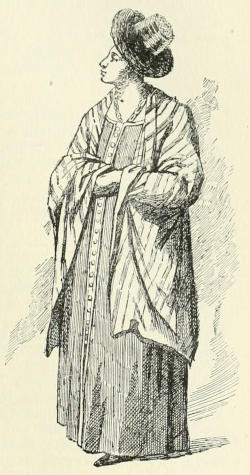
Married Woman of Valdai
With this object was formed and opened on the 6th of May, 1826, the “second section of his imperial majesty’s own chancery.” M. A. Balongianski was appointed chief of the second section, but in reality the work itself was confided to Speranski. The emperor’s choice rested on the latter, out of necessity, as he did not find anyone more capable around him. When Balongianski was appointed chief of the second section, the emperor, in conversing with his former tutor, said to him, speaking of Speranski: “See that he does not play any pranks, as in 1810.” Nevertheless, in proportion to Speranski’s successful accomplishment of the work confided to him, the emperor Nicholas’ prejudices against him gradually softened and finally gave way to sincere favour and full confidence. All the accusations and calumnies directed against Speranski were, in accordance with the emperor’s own expression, “scattered like dust.”
Thus the emperor Nicholas in his almost involuntary choice was favoured by a peculiarly fortunate chance and could hardly have found a person better fitted for the accomplishment of the work he had planned. The results of Speranski’s fresh efforts, under completely different circumstances from those against which he had formerly contended, were the “complete collection of laws,” and a systematic code.
Even before the termination of the trial of the Dekabrists, the emperor Nicholas took another important measure, which left an imprint on all the succeeding years of his reign and is directly connected with the events of the 26th of December. On the 15th of July, 1826, a supreme edict was issued in the name of the minister of the interior Lanskoi, by which the private chancery of that ministry was abolished and transformed into the third section of his imperial majesty’s own chancery. In fulfilment of this ukase, it was prescribed that the governors of provinces, in matters which entered within the sphere of the former division, should no longer present their reports to the ministry of the interior, but should submit them directly to his majesty.
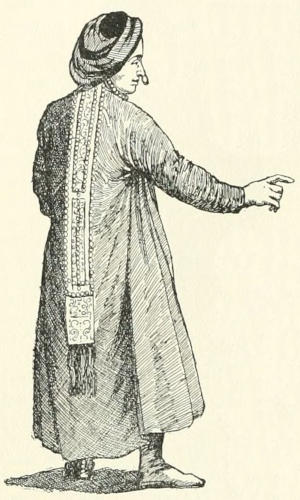
A Woman (Sailor) of the Nogai Tribe
Some days before, on the emperor Nicholas’ birthday, the 6th of July, a supreme order appeared naming the chief of the first cuirassier division, Adjutant-general Benkendorf, chief of the gendarmerie and commandant of the emperor’s headquarters; to him was confided the direction of the third section. Adjutant-general Benkendorf explains in his memoirs in the following manner the reasons for establishing the institution confided to his direction: “The emperor Nicholas aimed at the extirpation of the abuses that had crept into many branches of the administration, and was convinced by the sudden discovery of the conspiracy which had stained the first moments of the new reign with blood, of the necessity of a universal and more diligent surveillance. The emperor chose me to organise a higher police, which should protect the oppressed and guard the nation against conspiracies and conspirators. Never having thought of preparing myself for this sort of service, I had hardly the most superficial understanding of it; but the noble and beneficent motives which inspired the sovereign in his creation of this institution and the desire to be of use to him, forbade me to evade the duty to which his high confidence had called me. I set to work without delay and God helped me to fulfil my new duties to the satisfaction of the emperor and without setting general opinion against me. I succeeded in showing favours to many, in discovering many conspiracies, and averting much evil.” With the creation of the new third section, the committee of the 13th of January, 1807, established by the emperor Alexander, became superfluous; and on the 29th of January a ukase was issued closing it.
The disturbances of the year 1825 did not pass without leaving traces on the peasant population; a momentary confusion ensued, freedom was talked of, and disorders arose in some provinces—a phenomenon often seen in previous times. The movement amongst the peasants incited the emperor Nicholas to publish, on the 24th of May, 1826, a manifesto in which it was declared that all “talk of exempting the villagers in the state settlements from paying taxes and of freeing landowner’s peasants and menials from subjection to their landowners are false rumours, imagined and spread by evil intentioned persons out of mere cupidity with the object of enriching themselves through these rumours at the expense of the peasants, by taking advantage of their simplicity.” It was further said in the manifesto that all classes throughout the empire must absolutely submit to the authorities placed over them, and that disturbers of the public tranquillity would be prosecuted and punished in accordance with the full severity of the laws. It was commanded that the manifesto should be read in all the churches and at the markets and fairs during a space of six months; the governors of provinces were sternly admonished to be watchful in anticipating disorders.
If, however, the emperor Nicholas was forced by circumstances to promulgate this punitive manifesto, he also issued two rescripts in the name of the minister of the interior, enjoining upon the nobility behaviour towards their peasants, which should be in accordance with the laws of Christianity, thus clearly expressing his desire to protect the peasant against the arbitrariness and tyranny of the landowners. “In all cases,” wrote the emperor: “I find it, and shall ever find it, better to prevent evil, than to pursue it by punishment when it has already arisen.”
Finally the solicitude of the emperor Nicholas for the peasant classes manifested itself by yet another action. On the 18th of December, 1826, a special secret committee was formed to which was confided the inspection of the entire state organisation and administration, with the order to represent the conclusions it arrived at as to the changes deemed necessary; the labours of the committee were to be directed also to the consideration of the peasant question. Besides this the emperor did not leave without attention what had been said by the Dekabrists, during the time of their examination before a committee of inquiry, in regard to the internal conditions of the state in the reign of Alexander I. The emperor ordered a separate memorandum of these opinions to be drawn up for him and often perused this curious document, from which he extracted much that was pertinent.b
WAR WITH PERSIA (1826-1828 A.D.)
[1826-1828 A.D.]
The shah of Persia thought he saw in the change of rulers and the troubles by which it was accompanied circumstances favourable to the recovery of the provinces ceded to Russia by the Treaty of Gulistan. In August, 1826, he ordered his troops to move forward. The solemnity of his coronation, which was then being celebrated and whose splendour was enhanced by the presence of the czarevitch, did not prevent Nicholas from promptly organising the defence of the empire. A few weeks afterwards General Paskevitch defeated the Persians at Ielisavetpol, and in the following year, transferring the theatre of war to the enemy’s territory, he seized the celebrated convent of Etchmiadzine, the seat of the Armenian patriarch, and Erivan, one of the great towns of Armenia; he moreover penetrated as far as Tauris, capital of the Azerbaijan and residence of the prince royal, Abbas Mirza. Then the shah asked for peace. It was signed at Turkmantchaï, the 22nd of February, 1828, and advanced Russia as far as the line of the Araxes, by giving up to her the provinces of Erivan and Nakhitchevan.
WAR WITH TURKEY (1828-1829 A.D.)
This treaty was concluded, to the great regret of Persia, when the war with Turkey broke out. This war had been threatening for years; for, deeply affected by the violences to which the Greeks in the Ottoman Empire had been exposed ever since the hetaerist insurrection of 1821, and by the martyrdom which the Greek patriarch had been made to suffer, Alexander left the sword in its sheath only out of deference to the members of the Holy Alliance. His successor was thoroughly determined no longer to subordinate the direction of his cabinet’s policy to the interested views of these princes and to their fears, though it is true that the latter were well founded. The Divan, by signing the Treaty of Akerman (October 6th, 1826), had momentarily averted the storm which was ready to burst; but still more irritating disputes had afterwards arisen. The conclusion of the Treaty of London of the 6th of July, 1827, in virtue of which France, England, and Russia gave existence to a Christian kingdom of Greece placed under their common protection, was shortly followed by the naval battle of Navarino, fought on the 20th of October of the same year by the combined fleets of the three powers, against Ibrahim Pasha, commander-in-chief of the Egyptian forces in the Morea; and in this memorable conflict, expected by no one, but a subject of joy to some whilst judged untoward by others, the whole of the navy which the Porte still had at its disposal was destroyed. Very soon Mahmud II, yielding to the national desire, let it be understood that he had never had any intention of lending himself to the execution of a treaty in virtue of which Moldavia, Wallachia, and Servia were almost as much the czar’s vassals as his own. This was the beginning of a rupture, and Nicholas answered it by a declaration of war, which appeared June 4th, 1828, when his army had already crossed the Pruth.
The campaign of 1828, which accomplished nothing more than the taking of Braila and Varna, did not give a high idea of the strength of Russia; and when the emperor made up his mind to take part in it in person, his presence wrought no change in the feebleness of the results. But it was not the same with the campaign which followed. Not only did the Russians again pass the Danube, but after having beaten the grand vizir, Reschid Pasha, at Koulevtcha, on the 11th of June, Diebitsch marched them across the Balkans for the first time, a feat which won him the name of Sabalkanski, and proceeded straight to Adrianople, where he was scarcely more than two hundred kilometres (about 125 miles) from the Ottoman capital. At the same time Paskevitch took Erzerum in Asia, and the two generals would doubtless have joined hands in Constantinople but for the efforts of diplomacy and the fear of a general conflagration. For Russia was already too powerful; she had been allowed more than was compatible with the policy of the system of balance, no doubt from the fear of incurring a grave responsibility by troubling the peace of Europe. But a prospect like that of the occupation by Russia of Constantinople and the Straits silenced this fear.
[1829 A.D.]
Austria was ready to send her troops to the help of the Turks, and the English also seemed likely to declare for the vanquished. It was therefore necessary to come to a halt. Russia reflected that, after all, “the sultan was the least costly governor-general she could have at Constantinople,” and lent an ear to moderate conditions of peace. Nevertheless, if the Treaty of Adrianople, signed September 14th, 1829, delivered nothing to her in Europe save the mouths of the Danube, in itself a very important point, it enlarged her territories in Asia by a part of the pashalik of Akhalzikh, with the fortress of that name, besides abandoning to her those of Anapa and Pothi on the Black Sea; it considerably strengthened Muscovite influence in the principalities, and still further weakened Turkey, not only morally but also materially by the great pecuniary sacrifices to which she had to subscribe. That power, once so formidable, was henceforth at the mercy of her northern neighbour, the principal instrument of her decay.
THE POLISH INSURRECTION (1830-1831 A.D.)
[1830 A.D.]
But Russia was in her turn rudely shaken by the insurrection in Poland, always her mortal enemy after she had ceased to be her rival.c
It was in Moscow that the emperor Nicholas received news of the further progress of the Belgian revolution, in consequence of which the king of the Netherlands found himself obliged to ask for the assistance of his allies by virtue of the existing treaties. The emperor at once despatched orders to Count Tchernishev, Field-marshal Saken, and the czarevitch to place the army on a war footing. The czarevitch was not pleased at the martial turn given to the diplomatic negotiations; still more dissatisfied was the Polish Society of that time, which sympathised with the revolution of July; neither was the army in sympathy with the approaching campaign, which would bring it into armed collision with France in the name of the principles of the Holy Alliance. Although tranquillity apparently reigned in Warsaw, yet the secret societies continued to carry on their destructive work with success.
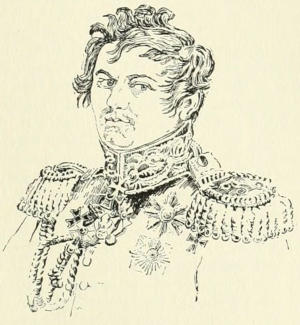
Count Diebitsch-Sabalkanski
(1785-1831)
Various ominous signs of the approaching catastrophe were not, however, wanting; but the czarevitch continued to lull himself with impossible hopes that all was peaceful and tranquil and would remain so. As to the European powers allied to Russia, they did not enter into the matter with such decided zeal. In the present case it was the Russian autocrat alone who was ready with entire disinterestedness to take up the defence of the infringed lawful order. The other powers found it incomparably more expedient to have recourse to the co-operation of diplomatic remedies; the result was that, instead of an armed intervention, a general European conference for the settlement of the Belgian question by peaceful means took place in London.
Count Diebitsch was still in Berlin awaiting the termination of the negotiations confided to him, when they were suddenly broken off by an event upon which the field-marshal had not in the least calculated at the given moment. On the 3rd of December, 1830, Diebitsch received from the Prussian minister, Count Berastorf, news of the revolution which had taken place in Warsaw on the 29th of November: the Polish army, forming a prepared coalition, had taken up arms against Russia. There remained but one thing for Diebitsch to do and that was to hasten to St. Petersburg as quickly as possible. Meanwhile in St. Petersburg the emperor Nicholas had received only the report of the czarevitch concerning the rising of the troops and of inhabitants of Warsaw on the evening of the 7th of December, 1830.
On the next day a parade of the Preobrajenski regiment was appointed to take place, and as usual the emperor came to the riding school. At first everything proceeded in the usual manner; there were even no traces of inward agitation manifest upon the handsome face with its regular, classic profile, which preserved its habitual expression of majestic nobility. At the termination of the parade the emperor rode into the middle of the riding school, called the officers around him, and personally communicated to them the intelligence of the Warsaw rebellion: “I have already made arrangements that the troops designated by me should move on Warsaw, and if necessary you too shall go, to punish the traitors and re-establish order and the offended honour of Russia. I know that under every circumstance I can rely upon you,” said the emperor. A unanimous outburst of indignation momentarily seized upon all present and then enthusiastic cries resounded: “Lead us against the rebels: we will revenge the offended honour of Russia.” They kissed the emperor’s hands and feet and the hem of his garment with shouts and cheers. The outburst of indignation was so violent that Nicholas considered it necessary to moderate it, and with the majesty that was natural to him he reminded the officers surrounding him that not all the Poles had broken their oath; that the ringleaders of the insurrection must be punished, but that vengeance must not be taken on the people: that the repentant must be pardoned and hatred not allowed.
From the subsequent reports of the grand duke the emperor learned that the czarevitch had permitted the portion of the Polish army that remained with him to return to Warsaw; in exchange for this the deputies who came to the czarevitch promised him and the Russian detachment a free passage to the frontiers of the empire. It was decided that a sufficient number of troops should be concentrated in the Polish frontier to allow of decisive measures being taken against the insurgents. Count Diebitsch was appointed commander-in-chief of the acting army, whilst the office of chief of the staff was filled by Count Tolle.
When the czarevitch reached the Russian frontier he wrote as follows to the emperor Nicholas: “And now the work of sixteen years is completely destroyed by a set of ensign-bearers, young officers, and students. I will not further enlarge on the matter, but duty commands me to bear witness to you that the landed proprietors, the rural population, and in general all holders of property of any kind are up in despair over this. The officers and generals as well as the soldiers are unable to keep from joining the general movement, being carried away by the young people and ensign-bearers who led everyone astray. In a word, the position of affairs is extremely bad, and I really do not know what will come of it. All my measures of surveillance have led to nothing, in spite of the fact that everything was beginning to be discovered. Here are we Russians at the frontier, but great God in what a condition!—almost barefoot, for we all came out as if at the sound of an alarm, in the hopes of returning to barracks, whilst instead awful marches have had to be made. The officers have been deprived of everything and have almost nothing with which to clothe themselves. I am broken hearted; at the age of fifty-one and a half years I never thought to finish my career in this lamentable manner after thirty-five and a half years of service. I pray to God that the army to which I have devoted sixteen years of my life may be brought to reason, and return to the path of duty and honour, acknowledging its previous errors, before coercive measures have to be taken. But this is too much to expect from the age in which we live, and I greatly doubt the realisation of my desires.”
Any agreement with Poland became daily more impossible and both sides prepared for war. On the 17th of December the emperor Nicholas’ proclamation to the Polish army and nation was issued, and on the 24th a manifesto was published offering means of reconciliation to all those who returned to their duty. Meanwhile General Chlopicki was installed as dictator in Warsaw, but he was unable to save Poland from a rupture with Russia. Two deputies were sent to St. Petersburg to enter into negotiations with the emperor Nicholas; they were the minister of finance, Prince Lubetzki and a member of the diet, Count Ezerski. But neither could these negotiations avert the bloody events of the year 1831. “It is hard to foresee the future,” wrote the emperor to the czarevitch; “but weighing the relative probabilities of success, it is difficult to suppose that the new year will show itself more distressing for us than the year 1830; God grant that I may not be mistaken. I should like to see you peacefully settled in your Belvedere and order re-established throughout; but how much there yet remains to be accomplished before we are in a condition to attain to this! Which of the two must perish—for it appears inevitable that one must perish, Russia or Poland? Decide for yourself. I have exhausted all possible means in order to avert such a calamity—all means compatible with honour and my conscience—but they are exhausted. What remains for me to do?”
[1831 A.D.]
Soon the diet assembled in Warsaw took a decision which completed the rupture between Poland and Russia. On the 25th of January, 1831, the diet declared the Romanov dynasty to be deprived of the throne of Poland. The Poles themselves thus unbound the hands of the emperor, and the duel between Russia and Poland became inevitable. The emperor replied to the challenge by a manifesto in accordance with which the Russian troops crossed the Polish frontier, and on the 25th of February a decisive battle took place before Prague at Grokhov, by which the Polish army was obliged to retreat to Warsaw with a loss of twelve thousand men.
But Count Diebitsch did not recognise the possibility of taking advantage of the victory gained, and which would have been inevitably completed by the occupation of the Polish capital; and Sabalkanski was not fated to become prince of Warsaw. The Polish troops retreated unhindered across the only bridge to Warsaw; the new Polish commander-in-chief Skrjinetzski set out to reorganise the army, the rising spread even to the Russian governments, and the campaign, against all expectations, dragged on for six months. Meanwhile it was a war upon which depended, according to the expression used by the emperor, “the political existence of Russia.”
On the 26th of May Diebitsch gained a second victory over the Polish army, which also terminated by the favourable retreat of the latter; and on the 13th of June, the emperor found occasion to write to his field-marshal: “Act at length so that I can understand you.” The letter was however not read by Count Diebitsch, for on the 10th of June the field-marshal suddenly died of cholera in the village of Kleshov near Pultiusk. He was replaced by Field-marshal Count Paskevitch-Erivanski, who was as early as April, 1831, called by the emperor from Tiflis to St. Petersburg. It was decided to cross the lower Vis-Suta and move towards Warsaw. The czarevitch Constantine outlived Count Diebitsch only by a few days. He also died suddenly of cholera at Vitebsk, in the night between the 26th and 27th of June of the year 1831.
Field-marshal Paskevitch
(1782-1856)
The Polish insurrection from that time daily grew nearer to its definitive conclusion; it was determined by the two days’ storming of Warsaw, which took place on the 7th and 8th of September. Finally Field-marshal Paskevitch was able to communicate to the emperor the news that “Warsaw is at the feet of your imperial majesty.” Prince Suvorov, aide-de-camp of the emperor, was the bearer of this intelligence to Tsarskoi Selo on the 16th of September.
Nicholas wrote as follows to his victorious field-marshal: “With the help of the all-merciful God, you have again raised the splendour and glory of our arms, you have punished the disloyal traitors, you have avenged Russia, you have subdued Warsaw—from henceforth you are the most serene prince of Warsaw. Let posterity remember that the honour and glory of the Russian army are inseparable from your name, and may your name preserve for everyone the memory of the day on which the name of Russia was again made glorious. This is the sincere expression of the grateful heart of your sovereign, your friend, and your old subordinate.”
After the fall of Warsaw the war still continued for a while, but not for long. The chief forces of the Polish army, which had retired to Novogeorgievsk, finished by passing into Prussian territory at the end of September, and on the 21st of October the last fortress surrendered. The Polish insurrection was at an end. But the peace, attained by such heavy sacrifice, was accompanied by a new evil for Russia; in Europe appeared the Polish emigration, carrying with it hatred and vociferations against Russia and preparing the inimical conditions of public opinion in the west against the Russian government.
THE OUTBREAK OF CHOLERA AND THE RIOTS OCCASIONED BY IT (1830 A.D.)
The emperor had hardly returned to St. Petersburg from opening the diet in Warsaw, when suddenly a new care occupied the attention of the government. The cholera made its appearance in the empire. This terrible illness, until then known to Russia only by name and by narratives describing its devastations, brought with it still greater fear, because no one knew or could indicate either medical or police measures to be taken against it. General opinion inclined, however, towards the advantages to be derived from quarantine and isolation, such as had been employed against the plague, and the government immediately took necessary measures in this direction with the activity that the emperor’s strong will managed to instil into all his dispositions. Troops were without delay stationed at various points and cordons formed from them and the local inhabitants, in order to save the governments in the interior and the two capitals from the calamity.
In spite of all precautions, however, a fresh source of grief was added to all the cares and anxieties that pressed upon the emperor at that period. Since the 26th of June the cholera had appeared in St. Petersburg and in a few days had attained menacing dimensions. This awful illness threw all classes of the population into a state of the greatest terror, particularly the common people by whom all the measures taken for the preservation of the public health—such as increased police surveillance, the surrounding of the towns with troops, and even the removal of those stricken with cholera to hospitals—were at first regarded as persecutions. Mobs began to assemble, strangers were stopped in the streets and searched for the poison they were supposed to carry on them, while doctors were publicly accused of poisoning the people. Finally, on the 4th of July, the mob, excited by rumours and suspicions, gathered together at the Hay Market and attacked the house in which a temporary cholera hospital had been established. They broke the windows, threw the furniture out into the street, wounded and cast out the sick, thrashed the hospital servants, and killed several of the doctors. The police were powerless to restore order and even the final appearance of the military governor-general Count Essen did not attain the necessary result. A battalion of the Semenov regiment forced the people to disperse from the square into the side streets, but was far from putting a stop to the disturbance.
The next day the emperor Nicholas went on a steamer from St. Petersburg to Elagium Island. When he had heard the reports of various persons as to the state of the town he got into a carriage with Adjutant-general Prince Menshikov and drove to the Preobrajenski parade-ground in the town, where a battalion of the Preobrajenski regiment was encamped. When he had thanked the troops, the emperor continued his way along the carriage road where he threatened with his displeasure some crowds and shopkeepers; from there he drove to the Hay Market where about five thousand people had assembled. Standing up in his carriage and turning to the mob, the emperor spoke as follows: “Misdeeds were committed yesterday, public order was disturbed; shame on the Russian people for forgetting the faith of their fathers and imitating the turbulence of the French and Poles! They have taught you this: seize them and take those suspected to the authorities; but wickedness has been committed here, here we have offended and angered God—let us turn to the church, down on your knees, and beg the forgiveness of the Almighty!”
The people fell on their knees and crossed themselves in contrition; the emperor prostrated himself also, and exclamations of “We have sinned, accursed ones that we are!” resounded throughout the air. Continuing his speech to the people, the emperor again admonished the crowd: “I have sworn before God to preserve the prosperity of the people entrusted to me by providence; I am answerable before God for these disorders: and therefore I will not allow them. Woe be to the disobedient!”
At this moment some men in the crowd raised their voices. The emperor then replied: “What do you want—whom do you want? Is it I? I am not afraid of anything—here I am!” and with these words he pointed to his breast. Cries of enthusiasm ensued. After this the emperor, probably as a sign of reconciliation, embraced an old man in the crowd and returned, first to Elagium and afterwards to Peterhov. The day afterwards the emperor again visited the capital. Order was re-established, but the cholera continued to rage. Six hundred persons died daily, and it was only from the middle of July that the mortality began to diminish.
Far more dangerous in its consequences was the revolt that arose in the Novgorod military settlements. Here the cholera and rumours of poisoning only served as a pretext for rebellion; the seed of general dissatisfaction among the population belonging to this creation of Count Araktcheiev continued to exist in spite of all the changes introduced by the emperor Nicholas into the administration of the military settlements. A spark was sufficient to produce in the settlements an explosion of hitherto unprecedented fury, and the cholera served as the spark. Order was however finally re-established in the settlements and then the emperor Nicholas set off for them quite alone and presented himself before the assembled battalions, which had stained themselves with the blood of their officers and stood awaiting, trembling and in silence the judgment of their sovereign.b
THE WAR IN THE CAUCASUS (1829-1840 A.D.)
The possession of the Caucasus is a question vitally affecting the interests of Russia in her provinces beyond that range of mountains, and her ulterior projects with regard to the regions of Persia and Central Asia. Here are the terms in which this subject is handled in a report printed at St. Petersburg, and addressed to the emperor after the expedition of General Emmanuel to Elbruz in 1829:
“The Circassians (Tsherkessians) bar out Russia from the south, and may at their pleasure open or close the passage to the nations of Asia. At present their intestine dissensions, fostered by Russia, hinder them from uniting under one leader; but it must not be forgotten that, according to traditions religiously preserved amongst them, the sway of their ancestors extended as far as to the Black Sea. They believe that a mighty people, descended from their ancestors, and whose existence is verified by the ruins of Madjar, has once already overrun the fine plains adjacent to the Danube, and finally settled in Panonia. Add to this consideration their superiority in arms. Perfect horsemen, extremely well armed, inured to war by the continual freebooting they exercise against their neighbours, courageous, and disdaining the advantages of our civilisation, the imagination is appalled at the consequences which their union under one leader might have for Russia, which has no other bulwark against their ravages than a military line, too extensive to be very strong.”
For the better understanding of the war which Russia has been so long waging with the mountaineers, let us glance at the topography of the Caucasus, and the respective positions of the belligerents.
The chain of the Caucasus exhibits a peculiar conformation, altogether different from that of any of the European chains. The Alps, the Pyrenees, and the Carpathians are accessible only by the valleys, and in these the inhabitants of the country find their subsistence, and agriculture developes its wealth. The contrary is the case in the Caucasus. From the fortress of Anapa on the Black Sea, all along to the Caspian, the northern slope presents only immense inclined plains, rising in terraces to a height of 3,000 or 4,000 yards above the sea level. These plains, rent on all directions by deep and narrow valleys and vertical clefts, often form real steppes, and possess on their loftiest heights rich pastures, where the inhabitants, secure from all attack, find fresh grass for their cattle in the sultriest days of summer. The valleys on the other hand are frightful abysses, the steep sides of which are clothed with brambles, while the bottoms are filled with rapid torrents foaming over beds of rocks and stones. Such is the singular spectacle generally presented by the northern slope of the Caucasus. This brief description may give an idea of the difficulties to be encountered by an invading army. Obliged to occupy the heights, it is incessantly checked in its march by impassable ravines, which do not allow of the employment of cavalry, and for the most part prevent the passage of artillery. The ordinary tactics of the mountaineers is to fall back before the enemy, until the nature of the ground or the want of supplies obliges the latter to begin a retrograde movement. Then it is that they attack the invaders, and, intrenched in their forests behind impregnable rocks, they inflict the most terrible carnage on them with little danger to themselves.
On the south the character of the Caucasian chain is different. From Anapa to Gagri, along the shores of the Black Sea, we observe a secondary chain composed of schistous mountains, seldom exceeding 1000 yards in height. But the nature of their soil, and of their rocks, would be enough to render them almost impracticable for European armies, even were they not covered with impenetrable forests. The inhabitants of this region, who are called Circassians, are entirely independent, and constitute one of the most warlike peoples of the Caucasus.
The great chain begins in reality at Gagri, but the mountains recede from the shore, and nothing is to be seen along the coast as far as Mingrelia but secondary hills, commanded by immense crags, that completely cut off all approach to the central part of the Caucasus. This region, so feebly defended by its topographical conformation, is Abkhasia, the inhabitants of which have been forced to submit to Russia. To the north and on the northern slope, westward of the military road from Mozdok to Tiflis, dwell a considerable number of tribes, some of them ruled by a sort of feudal system, others constituted into little republics. Those of the west, dependent on Circassia and Abadja, are in continual war with the empire, whilst the Nogaians, who inhabit the plains on the left bank of the Kuma, and the tribes of the great Kabarda, own the sovereignty of the czar; but their wavering and dubious submission cannot be relied on. In the centre, at the foot of the Elbruz, dwell the Suanetians, an unsubdued people, and near them, occupying both sides of the pass of Dariel, are the Ingutches and Ossetans, exceptional tribes, essentially different from the aboriginal peoples. Finally we have, eastward of the great Tiflis road, near the Terek, little Kabarda, and the country of the Kumicks, for the present subjugated; and then those indomitable tribes, the Lesghians and Tchetchens, of whom Schamyl is the Ab del Kadir, and who extended over the two slopes of the Caucasus to the vicinity of the Caspian.
In reality, the Kuban and the Terek, that rise from the central chain, and fall, the one into the Black Sea, the other into the Caspian, may be considered as the northern political limits of independent Caucasus. It is along those two rivers that Russia has formed her armed line, defended by Cossacks, and detachments from the regular army. The Russians have, indeed, penetrated those northern frontiers at sundry points, and have planted some forts within the country of the Lesghians and Tchetchens. But those lonely posts, in which a few unhappy garrisons are surrounded on all sides, and generally without a chance of escape, cannot be regarded as a real occupation of the soil on which they stand. They are, in fact, only so many pickets, whose business is only to watch more closely the movements of the mountaineers. In the south, from Anapa to Gagri, along the Black Sea, the imperial possessions never extended beyond a few detached forts, completely isolated, and deprived of all means of communication by land. A rigorous blockade was established on this coast; but the Circassians, as intrepid in their frail barks as among their mountains, often passed by night through the Russian line of vessels, and reached Trebizond and Constantinople. Elsewhere, from Mingrelia to the Caspian, the frontiers are less precisely defined, and generally run parallel with the great chain of the Caucasus.
[1835 A.D.]
Thus limited, the Caucasus, including the territory occupied by the subject tribes, presents a surface of scarcely 5000 leagues; and it is in this narrow region that a virgin and chivalric nation, amounting at most to 2,000,000 of souls, proudly upholds its independence against the might of the Russian empire, and has for upwards of twenty years sustained one of the most obstinate struggles known to modern history.
The Russian line of the Kuban, which is exactly similar to that of the Terek, is defended by the Cossacks of the Black Sea, the poor remains of the famous Zaparogians, whom Catherine II subdued with so much difficulty, and whom she colonised at the foot of the Caucasus, as a bulwark against the incursions of the mountaineers. The line consists of small forts and watch stations; the latter are merely a kind of sentry-box raised on four posts, about fifty feet from the ground. Two Cossacks keep watch in them day and night. On the least movement of the enemy in the vast plain of reeds that fringe both banks of the river, a beacon fire is kindled on the top of the watch box. If the danger becomes more pressing, an enormous torch of straw and tar is set fire to. The signal is repeated from post to post, the whole line springs to arms, and 500 or 600 men are instantly assembled on the point threatened. These posts, composed generally of a dozen men, are very close to each other, particularly in the most dangerous places. Small forts have been erected at intervals with earthworks, and a few pieces of cannon; they contain each from 150 to 200 men.
But notwithstanding all the vigilance of the Cossacks, often aided by the troops of the line, the mountaineers not unfrequently cross the frontier and carry their incursions, which are always marked with massacre and pillage, into the adjacent provinces. There are bloody but justifiable reprisals. In 1835 a body of fifty horsemen entered the country of the Cossacks, and proceeded to a distance of 120 leagues, to plunder the German colony of Madjar and the important village of Vladimirovka, on the Kuma, and what is most remarkable they got back to their mountains without being interrupted. The same year Kisliar, on the Caspian, was sacked by the Lesghians. These daring expeditions prove of themselves how insufficient is the armed line of the Caucasus, and to what dangers that part of southern Russia is exposed.
The line of forts until lately existing along the Black Sea was quite as weak, and the Circassians there were quite as daring. They used to carry off the Russian soldiers from beneath the fire of their redoubts, and come up to the very foot of their walls to insult the garrison. Hommaire de Hell relates that, at the time he was exploring the mouths of the Kuban, a hostile chief had the audacity to appear one day before the gates of Anapa. He did all he could to irritate the Russians, and abusing them as cowards and woman-hearted, he defied them to single combat. Exasperated by his invectives, the commandant ordered that he should be fired on with grape. The horse of the mountaineer reared and threw off his rider, who, without letting go the bridle, instantly mounted again, and, advancing still nearer to the walls, discharged his pistol almost at point-blank distance at the soldiers, and galloped off to the mountains.
As for the blockade by sea, the imperial squadron has not been expert enough to render it really effectual. It was only a few armed boats, manned by Cossacks, that gave the Circassians any serious uneasiness. These Cossacks like those of the Black Sea, are descended from the Zaparogians. Previously to the last war with Turkey they were settled on the right bank of the Danube, where their ancestors had taken refuge after the destruction of their Setcha. During the campaigns of 1828-29, pains were taken to revive their national feelings, they were brought again by fair means or by force under the imperial sway, and were then settled in the forts along the Caucasian shore, the keeping of which was committed to their charge. Courageous, enterprising, and worthy rivals of their foes, they waged a most active war against the skiffs of the mountaineers in their boats, which carry crews of fifty or sixty men.
The treaty of Adrianople was in a manner the opening of a new era in the relations of Russia with the mountaineers; for it was by virtue of that treaty that the czar, already master of Anapa and Sudjuk Kaleh, pretended to the sovereignty of Circassia and of the whole seaboard of the Black Sea. True to the invariable principles of its foreign policy, the government at first employed means of corruption, and strove to seduce the various chiefs of the country by pensions, decorations, and military appointments. But the mountaineers, who had the example of the Persian provinces before their eyes, sternly rejected all the overtures of Russia, and repudiated the clauses of the convention of Adrianople; the political and commercial independence of their country became their rallying cry, and they would not treat on any other condition. All such ideas were totally at variance with Nicholas’ schemes of absolute dominion; therefore he had recourse to arms to obtain by force what he had been unable to accomplish by other means.
Abkhasia, situated on the eastern coast of the Black Sea, and easily accessible, was the first invaded. A Russian force occupied the country in 1839, under the ordinary pretence of supporting one of its princes, and putting an end to anarchy. In the same year General Paskevitch, then governor-general of the Caucasus, for the first time made an armed exploration of the country of the Circassians beyond the Kuban; but he effected absolutely nothing, and his expedition only resulted in great loss of men and stores. In the following year war broke out in Daghestan with the Lesghians and the Tchetchens. The celebrated Kadi Mulah, giving himself out for a prophet, gathered together a considerable number of partisans; but unfortunately for him there was no unanimity among the tribes, and the princes were continually counteracting each other. Kadi Mulah never was able to bring more than 3,000 or 4,000 men together; nevertheless, he maintained the struggle with a courage worthy of a better fate, and Russia knows what it cost her to put down the revolt of Daghestan. As for any real progress in that part of the Caucasus, the Russians made none; they did no more than replace things on the old footing. Daghestan soon became again more hostile than ever, and the Tchetchens and Lesghians continued in separate detachments to plunder and ravage the adjacent provinces up to the time when the ascendancy of the celebrated Schamyl, the worthy successor of Kadi Mulah, gave a fresh impulse to the warlike tribes of the mountain, and rendered them more formidable than ever.
After taking possession of Anapa and Sudjuk Kaleh, the Russians thought of seizing the whole seaboard of Circassia, and especially the various points suitable for the establishment of military posts. They made themselves masters of Guelendchik and the important position of Gagri, which commands the pass between Circassia and Abkhasia. The Circassians heroically defended their territory; but how could they have withstood the guns of the ships of war that mowed them down whilst the soldiers were landing and constructing their redoubts? The blockade of the coasts was declared in 1838, and all foreign communication with the Caucasus ostensibly intercepted. During the four following years Russia suffered heavy losses; and all her successes were limited to the establishment of some small isolated forts on the sea-coast. She then increased her army, laid down the military road from the Kuban to Guelendchik, across the last western offshoot of the Caucasus, set on foot an exploration of the enemy’s whole coast, and prepared to push the war with renewed vigour.
In 1837 the emperor Nicholas visited the Caucasus. He would see for himself the theatre of a war so disastrous to his arms, and try what impression his imperial presence could make on the mountaineers. The chiefs of the country were invited to various conferences, to which they boldly repaired on the faith of the Russian parole; but instead of conciliating them by words of peace and moderation, the emperor only exasperated them by his threatening and haughty language. “Do you know,” said he to them, “that I have powder enough to blow up all your mountains?”
[1839 A.D.]
During the three following years there was an incessant succession of expeditions. Golovin, on the frontiers of Georgia, Grabe on the north, and Racivski on the Circassian seaboard, left nothing untried to accomplish their master’s orders. The sacrifices incurred by Russia were enormous; the greater part of her fleet was destroyed by a storm, but all efforts failed against the intrepidity and tactics of the mountaineers. Some new forts erected under cover of the ships, were all that resulted from these disastrous campaigns. “I was in the Caucasus in 1839,” says Hommaire de Hell, “when Grabe returned from his famous expedition against Shamyl. When the army marched it had numbered 6000 men, 1,000 of whom, and 120 officers, were cut off in three months. But as the general had advanced further into the country than any of his predecessors, Russia sang pæans, and Grabe became the hero of the day, although the imperial troops had been forced to retreat and entirely evacuate the country they had invaded. All the other expeditions were similar to this one, and achieved in reality nothing but the burning and destruction of a few villages. It is true the mountaineers are far from being victorious in all their encounters with the Russians, whose artillery they cannot easily withstand; but if they are obliged to give way to numbers, or to engineering, nevertheless they remain in the end masters of the ground, and annul all the momentary advantages gained by their enemies.”
The year 1840 was still more fatal to the arms of Nicholas. Almost all the new forts on the seaboard were taken by the Circassians, who bravely attacked and carried the best fortified posts without artillery. The military road from the Kuban to Guelendchik was intercepted, Fort St. Nicholas, which commanded it, was stormed and the garrison massacred. Never yet had Russia endured such heavy blows. The disasters were such that the official journals themselves, after many months’ silence, were at last obliged to speak of them; but the most serious losses, the destruction of the new road from the Kuban, the taking of Fort St. Nicholas, and that of several other forts, were entirely forgotten in the official statement.
On the eastern side of the mountain the war was fully as disastrous for the invaders. The imperial army lost four hundred petty officers and soldiers, and twenty-nine officers in the battle of Valrik against the Tchetchens. The military colonies of the Terek were attacked and plundered, and when General Golovin retired to his winter quarters at the end of the campaign, he had lost more than three-fourths of his men.
The great Kabarda did not remain an indifferent spectator of the offensive league formed by the tribes of the Caucasus; and when Russia, suspecting with reason the unfriendly disposition of some tribes, made an armed exploration on the banks of the Laba in order to construct redoubts, and thus cut off the subjugated tribes from the others, the general found the country, wherever he advanced, but a desert. All the inhabitants had already retired to the other side of the Laba to join their warlike neighbours.d
THE EMPEROR’S CONSERVATIVE PATRIOTISM
However, in spite of all these disastrous campaigns, Nicholas had not lost sight of his most important task—that of consolidating internal order by reforms. His attention had been directed above all to the administration, from the heart of which he had sought especially to exterminate corruption with a severity and courage proportioned to the immensity of the evil. Then he had announced his firm desire to perfect the laws, and had charged Count Speranski to work at them under his personal direction. The digest (svod) promulgated in 1833 was the first fruit of these efforts and was followed by various special codes. Finally, turning his attention to public instruction, he had assigned to it as a basis the national traditions and religion and charged Uvarov, president of the Imperial Academy of Sciences, a man of learning and talent, to animate it with this spirit, so hostile to the ideas of the west, but—let us say it at once—better suited to the real needs of the country.
Nicholas, allowing himself to be ruled by this spirit, plunged further and further into a system which, though contrary to that of Peter the Great, we do not pretend absolutely to condemn on that account, and which the marquis de Custinee has highly extolled in his celebrated book, La Russie en 1839. “The emperor Nicholas,” he said, “thought that the day of mere seeming was past for Russia, and that the whole structure of civilisation was to remake in that country. He has relaid the foundations of society. Peter, called the Great, would have overturned it a second time in order to rebuild it: Nicholas is more skilful. I am struck with admiration for this man who is secretly struggling, with all the strength of his will, against the work of Peter the Great’s genius. He is restoring individuality to a nation which has strayed for more than a century in the paths of imitation.”
Without ceasing to borrow diligently from Europe her inventions and arts, her progress in industry, in administration, in the conduct of land and sea armies—in a word, all the material improvements which she devises and realises, he endeavoured to close Russia to her ideas on philosophy, politics, and religion. He condemned exotic tendencies as pernicious to his states, and, without depriving himself of the services of the Germans, the principal depositaries of superior enlightenment in that country, as yet only imperfectly moulded to civilisation, he relied by preference on the party of the old Russians, which included the clergy, whom he treated with respect in spite of the inferiority of their position. Nationality, autocracy, orthodoxy—these three words, taken as the national watchword, sum up the ideas to which he subordinated his internal policy. The expression, Holy Russia, which has been the object of such profound astonishment to the Latin world, reflects also this spirit.
He surrounded with great solemnity those acts which he performed in his quality of head of the church in his own country, and posed as the protector of all his co-religionists in Moldavia, Wallachia, Servia, Montenegro, and other countries. Like his ancestors of preceding dynasties, he adorned himself on solemn occasions with a gold cross which he wore diagonally on his breast. This bias was summed up in the new word cæsaropapism. He regarded with special enthusiasm that one act on account of which, the accusation of religious intolerance was fixed upon him—an accusation justified by many of his deeds. In consequence of the decisions of the council of Florence, and up till 1839, there were in Russia 1,500,000 United Greeks, subjected to the papal obedience. At their head was the archbishop, sometimes the metropolitan, of White Russia, and the bishop, or archbishop, of Lithuania. In 1839 these two prelates, having met in conjunction with a third, at Polotsk, the seat of the first of these eparchies, had signed a document in which they expressed the wish to unite, they and their church, with the national and primitive church, and prayed the emperor to sanction this union. Nicholas referred the matter to the holy synod, and, the latter having with great eagerness signified its approval of the act, he sanctioned it in his turn, adding these words beneath his signature: “I thank God and I authorize it.” It is well known to what complaints on the part of the pope this suppression of the uniate Greek church soon afterward gave rise.c
UNVEILING OF THE MONUMENT AT BORODINO
The emperor Nicholas was fond of great gatherings of the troops, and an occasion for such was afforded in 1839 by the unveiling of the monument erected on the battle-field of Borodino. The thought of this muster of the troops had already occupied the emperor’s mind since 1838, but at that time he had in view not merely the participation of the troops in manœuvres and exercises, but the immortalisation of the tradition of the valorous exploits of the Russian army in the defence of the fatherland against the invasion of Napoleon. On the day of the unveiling of the Borodino monument, August 26th, 120,000 men were gathered around it. The emperor invited to take part in the solemnities all the surviving comrades of Kutuzov and many foreign guests.
On the anniversary of the battle of Borodino a great review of all the troops assembled on this historic spot took place. In the morning, before the review began, the following order of his imperial majesty, written by the emperor’s hand, was read to the troops:
“Children. Before you stands the monument which bears witness to the glorious deeds of your comrades. Here, on this same spot, 27 years ago, the arrogant enemy dreamed of conquering the Russian army which fought in defence of the faith, the czar and the fatherland. God punished the foolish: the bones of the insolent invaders were scattered from Moscow to the Niemen—and we entered Paris. The time has now come to render glory to a great exploit. And thus, may the eternal memory of the emperor Alexander I be immortal to us: for by his firm will Russia was saved; may the glory of your comrades who fell as heroes be also everlasting, and may their exploits serve as an example to us and our further posterity. You will ever be the hope and support of your sovereign and our common mother Russia.”
This order aroused the greatest enthusiasm amongst the troops, but it was highly displeasing to the foreigners; it appeared to them strange and almost offensive, they considered that “in reality it was nothing but high sounding phrases.”
Three days later the emperor Nicholas had the battle of Borodino reproduced. After the unveiling of the Borodino monument the laying of the first stone of the cathedral of Christ the Saviour took place in Moscow. This solemnity brought to a close the commemoration of the year 1812 which had delivered Russia from a foreign invasion and was the dawn of the liberation of Europe.
The year 1839 was remarkable for yet another important event: the reunion of the Uniates.[68]
DEATH OR RETIREMENT OF THE OLD MINISTERS
Little by little the workers in the political arena of Alexander’s reign had disappeared. Count V. P. Kotchulzi, who had been president of the senate since 1827 and afterwards chancellor of the interior, died in 1834 and had been replaced by N. N. Novseltsev as president of the senate. After his death the emperor Nicholas appointed to that office Count I. V. Vasiltchikov, who remained at his post until his death, which took place in 1847.
The emperor was above all grieved at the death of Speranski in the year 1837. He recognised this loss as irreparable, and in speaking of him said: “Not everyone understood Speranski or knew how to value him sufficiently; at first I myself was in this respect perhaps more in fault than anyone. I was told much of his liberal ideas; calumny even touched him in reference to the history of December 26th. But afterwards all these accusations were scattered like dust, and I found in him the most faithful, devoted and zealous servant, with vast knowledge and vast experience. Everyone now knows how great are my obligations and those of Russia to him—and the calumniators are silenced. The only reproach I could make him was his feeling against my late brother; but that too is over”.... The emperor stopped without finishing his thought, which probably contained a secret, involuntary justification of Speranski.
In 1844 died another statesman who was still nearer and dearer to the emperor Nicholas; this was Count Benkendorv of whom the emperor said: “He never set me at variance with anyone, but reconciled me with many.” His successor in the direction of the third section was Count A. F. Orlov; he remained at this post during all the succeeding years of the emperor Nicholas’ reign.
In that same year Count E. F. Kankrin who had been minister of finance even under Alexander I was obliged on account of ill health to leave the ministry of which he had been head during twenty-two years. As his biographer justly observes Kankrin left Russia as an heritage: “Well organised finances, a firm metal currency, and a rate of exchange corresponding with the requirements of the country. Russia was in financial respects a mighty power whose credit it was impossible to injure. And all this was attained without any considerable loans, and without great increase in taxes, by the determination, the thrift and the genius of one man, who placed the welfare of the nation above all considerations and understood how to serve it.”
But at the same time it must not be forgotten that all these brilliant results were attainable only because behind Count Kankrin stood the emperor Nicholas. The enemies of the minister and of his monetary reforms were many; but the snares they laid were destroyed before the all powerful will of a person who never wavered. This time that inflexible will was directed in the right path, and the results showed unprecedented financial progress, in spite of the three wars which it had been impossible for Russia to avoid, despite the ideally peace-loving disposition of her ruler; and to these calamities must be added also the cholera and bad harvests. Kankrin’s resignation was accompanied by important consequences; he was replaced by the incapable Vrontchenko, while Nicholas took the finances of the empire into his own hands, as he had previously acted regarding the other branches of the administration of the state.
Among the old-time servitors of Alexander I, Prince P. M. Volkonski remained longest in office. He lived until he attained the rank of field-marshal and died in 1852, having filled the office of minister of the court during twenty-five years.
One of the younger workers of the Alexandrine period, P. D. Kisselev, former chief of the staff of the second army, attained to unusual eminence in the reign of the emperor Nicholas. In 1825 his star nearly set forever, but soon it shone again with renewed brilliancy and on his return from the Danubian provinces, which he had administered since 1829, Kisselev was created minister and count. “You will be my chief of the staff for the peasant department,” said the emperor to him, and with this object, on the 13th of January, 1838 there was established the ministry of state domains, formed from the department which had until that time been attached to the ministry of finance.
GREAT FIRE IN THE WINTER PALACE
A disastrous fire at the Winter Palace began on the evening of the 29th of December, 1837, and no human means were able to stay the flames; only the Hermitage with its collection of ancient and priceless treasures was saved. The ruins of the palace continued to burn during three days and nights. The emperor and the imperial family took up their abode in the Anitchkov palace.
The rebuilding of the Winter Palace upon its previous plan was begun immediately; the palace was consecrated on the 6th of April, 1839 and the emperor and his family were installed there as previously. As a token of gratitude to all those who had taken part in the rebuilding of the palace a medal was struck with the inscription: “I thank you.”—“Work overcomes everything.”
On the last day of the Easter holidays the emperor Nicholas resolved to allow visitors access to all the state rooms, galleries, etc.; and in that one day as many as 200,000 persons visited the palace between the hours of six in the evening and two in the morning.
Twice the emperor and his family passed in all directions through the palace that was thronged with the public. An eye-witness writes that “the public by prolonging their visitation for seven hours so filled the palace with damp, steamy, suffocating air that the walls, the columns, and carvings on the lower windows sweated, and streams of damp poured down on to the parquet flooring and spoiled everything, while the marble changed to a dull yellowish hue.” 35,000 paper rubles were required to repair the damage. But the matter did not terminate with this; during one night that summer, fortunately while the imperial family were staying at Peterhov, the ceiling in the saloon of St. George fell down with the seventeen massive lustres depending from it.
THE 25TH ANNIVERSARY OF THE CORONATION OF NICHOLAS I (1851 A.D.)
[1851 A.D.]
In August 1851, upon the occasion of the twenty-fifth anniversary of his coronation the emperor Nicholas left St. Petersburg for Moscow, accompanied by his family. For the first time the journey was accomplished by the newly completed Moscow railway, constructed in accordance with the will of the emperor, and in opposition to the desires of many of his enlightened contemporaries. The opening of the railway to the public followed only on the 13th of November. In Moscow the emperor was met by Field-marshal Paskevitch, prince of Warsaw. On the eve of the festivities in honour of the anniversary of the coronation Nicholas visited the field-marshal, and addressed the following memorable words to him:
“To-morrow will complete twenty-five years of my reign—a reign which you, Ivan Feodorovitch, have made illustrious by your valiant service to Russia. It was under sorrowful prognostications that I ascended the throne of Russia and my reign had to begin with punishments and banishments. I did not find around the throne persons who could guide the czar—I was obliged to create men; I had none devoted to me. Affairs in the east required the appointment there of a man of your intellect, of your military capacity, of your will. My choice rested on you. Providence itself directed me to you. You had enemies: in spite of all that was said against you, I held fast to you, Ivan Feodorovitch. You proved, commander, that I was right. Hardly had affairs in the east quieted down when my empire was overtaken by a public calamity—the cholera. The people ascribe every misfortune to the person who governs. God knows how much suffering this national affliction cost me. The war with Poland was another grievous trial. Russian blood was shed because of our errors or because of chastisement sent from above. Our affairs were in a bad way. And again I had resource to you, Ivan Feodorovitch, as the only means of salvation for Russia; and again you did not betray my trust, again you exalted my empire. By your twenty years’ administration of the Polish land you have laid the foundation for the happiness of two kindred yet hostile elements. I hope that the Russian and the Pole will constitute one Russian Empire—the Slavonic Empire; and that your name will be preserved in history beside the name of Nicholas. It is not so long ago—when western Europe was agitated by aspirations after wild, unbridled freedom; when the people overthrew lawful authority and thrones; when I decided to give a helping hand to my brother and ally, the monarch of Austria—that you, commander, led my soldiers to a new warfare: you tamed the hydra of rebellion. In six weeks you had finished the war in Hungary, you supported and strengthened the tottering throne of Austria, Ivan Feodorovitch. You are the glory of my twenty-five years’ reign. You are the history of the reign of Nicholas I.”
THE EMPEROR NICHOLAS’ VIEWS ON LOUIS NAPOLEON
When Prince Louis Napoleon had accomplished his coup d’état of the 2nd of December, 1851, and the restoration of the second empire was to be expected, the emperor Nicholas, judging by a letter which he had received from Frederick William IV, said: “Before the end of next year Louis Napoleon will become our colleague. Let him become what he likes, even the great mufti, if it pleases him, but to the title of Emperor or King I do not think he will be so imprudent as to aspire.” According to the emperor’s opinion, as soon as Louis Napoleon desired to make himself emperor he would become a usurper, because he did not possess the divine right—he would be emperor in fact but never by right; in a word, “a second Louis Philippe, less the odious character of that scoundrel.”
[1853 A.D.]
When the French diplomatic representatives in St. Petersburg and Warsaw evidenced an intention to celebrate the 15th of August, the emperor Nicholas drew up the following resolution: “A public church service for Napoleon cannot be allowed, because he ceased to be emperor, being banished and confined to the island of St. Helena. There is no propriety in celebrating the birthday of the late Napoleon in our country, whence he was despatched with befitting honour.” The Napoleonic empire had already transcended the limits which the emperor Nicholas would at one time have allowed; it was in direct contradiction to the stipulations of the congress of Vienna, which formed the basis of the national law of Europe. The emperor’s allies, however, looked on the matter somewhat differently. Austria and Prussia recognised Napoleon III; it therefore only remained to the emperor Nicholas, against his will, to follow their example; but still he departed from the usually accepted diplomatic forms, and in his letter to Napoleon III he did not call him brother, but “le bon ami” (good friend). Soon on the political horizon appeared the Eastern question, artfully put forward with a secret motive by Napoleon III; his cunning calculations were justified without delay; the Russian troops crossed the Pruth in 1853, and occupied the principality, as a guarantee, until the demands presented to the Ottoman Porte by the emperor Nicholas were complied with. Austrian ingratitude opened a safe path for the snares of Anglo-French diplomacy. The Eastern War began, at first upon Turkish territory and afterwards concentrated itself in the Crimean peninsula around Sebastopol; France, England, and afterwards, in 1855, little Sardinia, in alliance with Turkey, took up arms against Russia; on the side of the allies lay the sympathy of all neutral Europe, which already dreamed of wresting Russia’s conquests from her.b